
- 1: Let It Take Your Mind
- 2: The Time Has Come
- 3: Think On, the People Arise; Mulobo; People Arise!!!
- 4: Don't Need Nobody
- 5: Pruda's Shoes
pre-order now06.02.2026
expected to be published on 06.02.2026
28,15 €
expected to be published on 06.02.2026

Loaded with tension and anchored by bold textural and stylistic contrasts, Sam Slater’s third solo full-length finds the British sound artist, composer, and engineer grappling with his creative contradictions head-on.
Having spent a life time in bands and producing records, Sam transitioned somewhat by accident through his work with Johan Johansson into working as a composer on high profile projects such as his collaboration with Hildur Guðnadóttir on the Grammy Award-winning Joker and Chernobyl, and with Pulitzer Prize-winning journalist Mstyslav Chernov on the soundtrack to the lauded 2000 Meters to Andriivka. Having a vast set of interests and influences is an asset when helping realise a directors vision for a soundtrack, but one's own musical voice can end up being constrained. In Lunng, Slater has gone back to his wildly divergent range of influences and rather than shy away from the extremes, he's used them to create a singular vision.
Take the opening track “Heatsick”: Slater imagines an extravagant fusion of 2000s drone metal and vintage British brass, welding ear-splitting overdriven drones and blown-out choral vocals to stirring trombone swells from veteran player Hilary Jeffery. On paper, it’s hard to imagine—but Slater’s intentionality conducts these polarizing elements into a surreal blur of sonic extremes, with the guitars’ relative harshness softened by Jeffery’s eerily nostalgic colliery echoes.
His last solo album, I do not wish to be known as a Vandal (Bedroom Community, 2022), showcased this breadth by assembling a team of collaborators including Sam Dunscombe and Yair Elazar Glotman. On this record he’s linking up with acclaimed multi-instrumentalist Maria W. Horn, idiosyncratic sax virtuoso Bendik Giske, versatile percussionist Adam Betts, and the aforementioned Jeffery, Slater ushers these players toward a lattice of calculated confutations.
Working to explore the tension between the divergent practices of his collaborators—Lunng was meant to be challenging. On “Praya”, Giske’s familiar overblown horn phrases are almost vaporized, vanishing among Slater’s weightless synths and Horn’s chillingly hoarse vocals. There are traces of Horn’s Funeral Folk project, but Slater shifts the emphasis, letting her voice brush past the other elements like a hallucination.
Slater’s use of extremes isn’t just in the micro; dynamics drive the album’s overall flow. “Praya” sets the stage for the record’s heaviest, most prickly moment: “Passengers”. Here, Horn’s voice cracks, rasps, and gurgles over serrated synths and Betts’ ritualistic drums. Slater turns an industrial symphony into a folk opera—dark, dramatic, and strangely beautiful—etched with Giske’s fluttering phrases.
But the mood soon shifts. Slater careens toward chaos, unleashing double-time rhythms and piercing textures familiar to anyone with a soft spot for classic black metal. These grotesque incongruities are deliberate; Slater surveys years of musical conflict and leans in, using dissent as fuel to build kinetic energy.
The weight of sentimentality bears down on “Black Metal Rewind (Night Drive Astra, 2006)”, melting teenage memories into hypnagogic ambience—shoegaze dreams whirled with angelic choral delusions. On “Death by Nostalgia, 1688”, he ventures further into polarizing territory, distorting AutoTuned voices with cryptic strings and medieval tonalities, unsettling any stable sense of past or present.
In this record Slater focuses on pure energy, color, and mood. Lunng distills years of listening into a bracing brew—boiling each sound down to its essence, then serving it with unflinching intent.
John Twells, 2025
expected to be published on 05.02.2026

Big Science Records is proud to unveil a brand-new split 12” EP — crafted equally for peak-time energy and post-rave reflection — from the label’s co-foun-ders, NVST and Warzou.It’s been a minute since our last vinyl release — the Leo James edition — and we’re excited to be back with an ultra-limited, hand-stamped pressing. Four tracks total: two from each of these kindred artists, the duo behind Big Science.We’re constantly making, exchanging, and living through music — daily, weekly, endlessly. “Nothing is real, nothing exists,” says NVST. And yet, this release feels like a moment where the invisible becomes tangible — the private tracks we’ve shared and cherished with each other now find their place in the world. They’re here. They’re real.
Order now and we will order the item for you at our supplier.

Once again Trunk Records comes through with an album of sublime 1980s new age synthwave
music from an artist and library company you have never heard of.
With most Trunk LPs we write the story about how Jonny came across the music. And yes, this LP is no different...over to Jonny…
“My first encounter with Peter Patzer was when I was writing and researching the updated and fully expanded version of The Music Library Book, published by Fuel. The initial book - called The Music Library, was the first ever overview of library music and the wild, unpredictable graphic art of their sleeves. It was first published in 2005 and featured about 400 sleeves and about 120 library companies over 200+ pages. The book was based on over a decade of intense library LP collecting by myself and a handful of other geeky weirdos and made for fascinating and revealing reading and looking. It was a great education for many entering this odd, hidden musical world for the first time. The book quickly sold out.
A few years later the price of the original book had gone bananas. But the geeky weirdos like me had all carried on voraciously consuming and collecting library music so I strongly felt the first book could easily be doubled in size with new info, new sleeves and many newly discovered lost library companies. Which is exactly what I set about doing. The Music Library expanded edition came out in 2015. You have to realise here that The Music Library book was very much a first - until its unexpected arrival (and even the arrival of the much larger expanded edition) there was no published survey, accessible catalogue or anything about international library music. It was still an odd old world shrouded in some historical mystery - even the internet had not really caught up. And I was still finding unusual British one-off library LPs, more unusual Italian library diversions, hidden French funky things and then I finally found Peter Patzer. From Germany.
Hidden away in a very obscure music library corner. All on his own.Peter was unusual in that he was an artist and musician who made his own music and issued it all on his own library, called Crea Music, based out of Bremen in North Germany. Over a series of eight whitevinyl LPs produced in the 1980s Peter Patzer created synth heavy experiments for possible use in film, TV, video and anything else coming along. All his LPs had the same simple red, white and blue sleeve and a typed name and number. Across the eight LPs Peter goes to musical space, creates post-disco funk,travels to Vegas, goes all geological and more.
The eight Peter Patzer / Crea Music LPs are as follows:
01 - Puddy’s Bus 02 - Straight Line 03 - Pos-Attractions 04 - Patterns 05 - Canyons 06 - MIls Maniac 07 - Classic Themes 08 - Formation 17
This is a compilation of some of the music featured across those eight LPs, and yes, it was initially
licensed a few years ago but I held it back as I wasn’t sure people were quite ready for the plugged-inway out drifting 1980s electro sound of Peter Patzer with his synth washes, rhythms and chords. Or maybe I wasn’t ready. Anyway it’s here now... and if this sells out there could be another Peter Patzer LPbut with all his longer 7 minute compositions which there wasn’t room for here.
Order now and we will order the item for you at our supplier.

Belia Winnewisser and Fatuma Osman have known each other since childhood, a friendship rooted in shared afternoons of music and late 90s/early 00s girl core. Their first joint debut EP Vertex, released through the Swiss label Light of Other Days, emerges as both a continuation of that bond and an exploration of process, weaving together collective memories with their present-day musical language.
Resisting polished closure, the record circles around the idea of limerence in sound: suggesting rather than declaring, outlining atmospheres that leave room for the listener’s imagination to fill out the blanks. Across its five tracks Belia and Fatuma oscillate between the personal and the universal, immediacy and nostalgia. The opening track Emerald rises like morning light; fragile, blissful, and quietly radiant. Covering Madonna’s 80s single Angel feels natural and slots seamlessly into the EP’s arc: as a defining pop presence of the last four decades, she embodies less an idol than a subtle compass. Surrender, the first track on the B-side, draws you into the club, vibrating between vulnerability and release. Each step extends their vision further, revealing a cohesive body of work.
Vertex holds opposite poles in tension, creating a space where vulnerability and intensity create dialog. What lingers is a realm of possibilities: a conversation between two friends and collaborators who understand that sound can be as much about what is left out as about what is expressed. Vertex documents their progression, marking a milestone without concluding it.
expected to be published on 31.01.2026

'In 2023, sound artist and composer Weston Olencki toured across the American South. Beginning in their hometown in South Carolina, they snaked a circuitous path from the mountains of West Virginia to the banks of the Mississippi River. As the miles accumulated, so did the initial seeds of new work.
'Instruments and artifacts they acquired hitched a ride in the backseat, while songs and sounds filled their portable recorder: water in its various states, the familiar insectoid buzz of those summer nights, trains cutting through the landscape, the traditional music that lived alongside the communities that kept it. Olencki took it all in, and over time, found ways that these experiences coalesced into a bramble-like perspective of time, where past, present, and future intersect in ways both barbed and beautiful.
'Broadsides, Olencki’s newest solo full-length is the multilayered result of this journey. The album follows their landmark release Old Time Music from 2022, which presented radical interpretations of traditional tunes from Appalachia and throughout the South alongside original compositions that drew significantly on archival recordings. On Broadsides, Olencki rejects delineations between the unmoored avant-garde and the rootedness of one’s cultural heritage, revealing their porous and intertwined nature. “My mother was a quilter. Her mother before that,” they write in the album’s liner notes. “Quilting, like music, is a practice of embedding knowledge and remembrance into the very core of the thing you are making. It’s not just about the materials, but how they’re reassembled, recontextualized, stitched, woven to form new patterns - the minutiae of craft holding significance to those looking to find it. Stories woven from stories, never told the same way twice.”
'Like all great road trips, Broadsides unfolds slowly and continuously, with moments of dramatic reverie punctuating the endless melt of highway in the rearview. We’re immediately confronted by the uncanniness of revisiting old haunts, as Southern storms break through the initial churn of the freight locomotives of Alabama. Olencki’s interpretation of the bluegrass standard “Foggy Mountain Breakdown” captures the euphoria of melancholy in motion. The permutational plucks of banjo are bounced around the frame by a computer, its pitches determined within algorithmic sequences and transcriptions of classic three-finger licks. The tonalities of old-time are smeared and stretched until all that’s audible is the insistence that Heaven might be real.
'In the album’s second half, “Omie Wise,” a murder ballad made famous by Doc Watson, follows an interlude recorded on the river in North Carolina in which the titular character’s body was laid. Ghostly echoes of a dozen other renditions float through the substrata as Tongue Depressor’s Henry Birdsey accompanies them on the pedal steel guitar. The album’s central composition, “all my father’s clocks,” is a profound meditation on entropy and impermanence. The sound of their father’s extensive clock collection ticks away as Olencki pulls a bow across the length of an autoharp sourced from a rural strip mall. The instrument was left as detuned as it was found, the resonance of its deep bass drone and clanging high-end the result of years of neglect and the warping effects of Southern humidity.
'Historically, broadsides were an early form of broadcasting, an often- musicalized telling of current news pasted in the public square. The name was later taken up by Sis Cunningham and Gordon Friesen in the 1960s, whose Broadside magazine published songs and social commentary when American folk music resurfaced as an urgent way of communicating the multifaceted politics of its time.
'Olencki borrows the phrase to recall both this old form of songmaking and that later prominent reexamination of traditional music’s role in modern life, but also to draw attention to the fragmented and machine- mediated way heritage is diffused in this very different, but no less pivotal, moment.
'As a sanitized past is used as justification for current violence and domination, we can turn to these artifacts to better understand the history of ourselves, but only if they are consciously pushed to evolve. Broadsides represents one personal, striking vision of what far-flung futurisms could be respun from = these high, lonesome sounds: a reflection of the unbridled joy and deep sorrow inherent to living together through time, and a desire to push further into the untold and unknown.'
expected to be published on 30.01.2026
Una interpretación de Soinuarenbidea II debería partir de esta premisa: todo es posible, nada es aleatorio, y en sí mismo es un imposible de aleatoriedades. El escenario planteado explora la idea de realidad aumentada desde una percepción sonora, ambiental y colectiva. La obra transita hacia adelante y hacia atrás recreando experiencias extintas de porvenir incierto, tratando de facilitar un fin pacificador. Cada pieza sonora se crea, se despliega, se repliega y se destruye, en una torsión permanente de toda la realidad que hace posible cada fragmento musical, cada identidad acústica, cada espacio sonoro. Lo onírico, la ficción, y el viaje están continuamente presentes, y es en el transitar de cada fragmento donde se produce el diálogo de la exposición musical. Los elementos de esta ficción se recrean continuamente, en un continuum donde se entrelazan y se van contorsionando a medida que crecen o decrecen con cada fragmento de síntesis concreta. Los temas explícitamente musicales son el magma que conduce a dar voluptuosidad al disco, siendo la piel un contexto o límite que en sí mismo fluctúa indefinidamente en texturas y configuraciones posibles. Y la urdimbre del silencio es la síntesis que está continuamente presente y que trata de cohesionar los fragmentos en continua colisión expresiva. Las grabaciones de campo proporcionan el material sonoro concreto, y como un fractal sonoro cada una de ellas ofrece diferentes grados de interpretación que a su vez conduce a nuevos fragmentos y nuevas creaciones. Así que se puede pensar que esta es una síntesis de una posible realidad, pero interpretable en infinidad de maneras. Un movimiento y una estaticidad implícitas que generan estructuras y dinámicas acústicas. Lo que se escucha no es real, pero en sí mismo forma parte de la realidad, creando un escenario expectante. Lo cinematográfico, plástico y teatral, danzante y dinámico cobra importancia en este juego, porque se trata de contar una historia, una experiencia recreada desde los puntos de vista del arte visual. Es a su vez hilo conductor y entretenimiento, discurso político y puro divertimento. Es desde este espacio de convivencia artística que tiene sentido la totalidad y justifica el formato sonoro planteado. La contradicción de la obra es patente en el formato, y es a su vez el planteamiento de una accidentalidad en el devenir vital. Contenedor de Ruido recoge todas estas contradicciones y las manifiesta en la obra Soinuarenbidea II. Es una historia sonora, es un cuento acústico. Es un fragmento de vitalidad en imágenes audibles. Es una invitación a la reflexión, a la crítica, al disfrute, a la meditación, a la celebración. Y sobre todo es esperanzadora apreciación de la realidad como algo maleable que confeccionamos colectivamente, que requiere de una paciente observación y la participación colectiva global, en un mundo finito pleno de diversidades y del que ignoramos prácticamente todo, al que deberíamos volver con respeto y devoción.
Soinuarenbidea II-ren interpretazio batek premisa honetatik abiatu beharko luke: dena da posible, ezer ez da ausazkoa, eta, berez, ausazkotasun ezinezko bat da. Planteatutako agertokiak errealitate areagotuaren ideia aztertzen du, soinu-, ingurumen- eta talde-pertzepzio batetik abiatuta. Lanak aurrera eta atzera egiten du, etorkizun zalantzagarriko esperientzia desagertuak birsortuz eta helburu baketsua lortzen saiatuz. Soinu-pieza bakoitza sortu, hedatu, tolestu eta suntsitu egiten da, musika-zati bakoitza, identitate akustiko bakoitza eta soinu-espazio bakoitza ahalbidetzen dituen errealitate osoaren etengabeko bihurdura batean. Onirikoa, fikzioa eta bidaia etengabe daude presente, eta pasarte bakoitzaren joan-etorrian gertatzen da musika-erakusketaren elkarrizketa. Fikzio honen elementuak etengabe birsortzen dira, continuum batean, non sintesi zati zehatz bakoitzarekin hazi edo txikitu ahala elkar lotzen eta bihurritzen diren. Esplizituki musikalak diren gaiak diskoari atsegintasuna ematera eramaten duen magma dira, azala testuingurua edo muga izanik, testura eta konfigurazio posibleetan mugarik gabe aldatzen dena. Eta isiltasunaren irazkia etengabe presente dagoen sintesia da, zatiak etengabeko adierazpen-talkan kohesionatzen saiatzen dena. Landa-grabazioek soinu-material zehatza ematen dute, eta soinu-fraktal batek bezala, horietako bakoitzak interpretazio-maila desberdinak eskaintzen ditu, eta horrek, aldi berean, zati eta sorkuntza berrietara eramaten du. Beraz, pentsa daiteke errealitate posible baten sintesia dela, baina hamaika modutan interpreta daitekeena. Egitura eta dinamika akustikoak sortzen dituzten mugimendu eta estatikotasun inplizitu bat. Entzuten dena ez da erreala, baina, berez, errealitatearen parte da, eta agertoki espektakularra sortzen du. Zinematografikoak, plastikoak eta antzerkikoak, dantzariak eta dinamikoak garrantzia hartzen dute joko honetan, ikusizko artearen ikuspegitik birsortutako istorio bat, esperientzia bat, kontatzea baita helburua. Aldi berean, hari gidaria eta entretenimendua da, diskurtso politikoa eta dibertimendu hutsa. Elkarbizitzarako espazio artistiko honetatik osotasunak zentzua du eta planteatutako soinu-formatua justifikatzen du. Obraren kontraesana nabarmena da formatuan, eta, aldi berean, bizi-bilakaeran istripu-tasa bat planteatzea da. Zarata-edukiontziak kontraesan horiek guztiak jasotzen ditu eta Soinuarenbidea II obran adierazten ditu. Soinu istorio bat da, ipuin akustiko bat. Bizitasun zati bat da, irudi entzungarrietan. Hausnarketarako, kritikarako, gozamenerako, meditaziorako eta ospakizunerako gonbidapena da. Eta, batez ere, itxaropentsua da errealitatea modu kolektiboan egiten dugun gauza xaflakor gisa hautematea, behaketa pazientea eta partaidetza kolektibo globala eskatzen dituena, dibertsitatez betetako mundu mugatu batean, ia guztia kontuan hartzen ez duguna, eta errespetuz eta debozioz itzuli beharko genukeena.
An interpretation of Soinuarenbidea II should start from this premise: everything is possible, nothing is random, and in itself is an impossible randomness. The proposed scenario explores the idea of augmented reality from a sonic, environmental, and collective perception. The work moves back and forth, recreating extinct experiences of an uncertain future, seeking to facilitate a peaceful end. Each sound piece is created, unfolds, retreats, and is destroyed, in a permanent twisting of all reality that makes each musical fragment, each acoustic identity, each sonic space possible. The dreamlike, the fictional, and the journey are continually present, and it is in the transit of each fragment that the dialogue of the musical exposition takes place. The elements of this fiction are continually recreated, in a continuum where they intertwine and contort as they grow or diminish with each fragment of concrete synthesis. The explicitly musical themes are the magma that leads to the work's voluptuousness, the skin being a context or boundary that in itself fluctuates indefinitely in possible textures and configurations. And the warp of silence is the synthesis that is continually present and seeks to unite the fragments in a continuous expressive collision. The field recordings provide the concrete sound material, and like a sonic fractal, each one offers different degrees of interpretation that in turn lead to new fragments and new creations. So one can think of this as a synthesis of a possible reality, but interpretable in an infinite number of ways. An implicit movement and staticity that generate acoustic structures and dynamics. What is heard is not real, but in itself is part of reality, creating an expectant scenario. The cinematic, plastic and theatrical, dance and dynamic aspects take on importance in this game, because it is about telling a story, an experience recreated from the perspective of visual art. It is at once a common thread and entertainment, political discourse and pure entertainment. It is from this space of artistic coexistence that the whole makes sense and justifies the proposed sound format. The contradiction of the work is evident in its format, and it is, in turn, the presentation of an accidentality in the course of life. Noise Container gathers all these contradictions and manifests them in the work Soinuarenbidea II. It is a sound story, an acoustic tale. It is a fragment of vitality in audible images. It is an invitation to reflection, to critique, to enjoyment, to meditation, to celebration. And above all, it is a hopeful appreciation of reality as something malleable that we collectively craft, requiring patient observation and global collective participation, in a finite world full of diversity and of which we know practically nothing, to which we should return with respect and devotion.
Paisajes sonoros, diseño sonoro, drones y música grabada, realizada y arreglada para Contenedor de Ruido por David Aranaz. Coro: Basandere Ahotsak. Producido y mezclado por David Aranaz. Mástering: Estanis Elorza. Fotografía: David Aranaz. Texto: David Aranaz. Traducción: Saioa Aranaz Oreja. Trabajo y Diseño artístico: Cristina Martinez. Edición: Contenedor de Ruido Producciones y Sarbide Music. Distribución: Contenedor de Ruido.
Contenedor de Ruido agradece el apoyo en la realización de Soinuarenbidea II al coro Basandere Ahotsak y en especial a Eva Orbara Goicoa.
Soinuarenbidea II está dedicado al pueblo palestino.
Paisajes y objetos Sonoros, samplers y otras músicas transformadas para Soinuarenbidea II
Burlada: Paseos sonoros matinales por Merindad de Sangüesa, Calle Mayor, Capuchinas, Parque Uranga y varias iglesias y plazas. Pasajes del cotidiano: basura de papel, cristal y plástico.
Pamplona: Cementerio de San José. CEIP Sanduzelai /// Quinto Real: Fábrica de Armas, Puerto de Urkiaga y alrededores. Suite del silencio, bosques en movimiento /// Fábrica de armas de Orbaiceta: regatas, biosques, paseo sonoro hasta regata /// Belate: Puerto de Belate y alrededores. Vacas en pradera junto a las turberas /// Bardenas Reales: Suite de guitarra y Suite del silencio, estepa desértica /// Austria: Tranvías de Graz y Viena. Muchedumbre del metro de Viena.
Voces cinematográficas de: Matanza en Texas, Robocop, Espíritu Sagrado, Solo los Amantes Sobreviven, Voces de Gaza, Yojimbo, Terciopelo Azul, Los 7 Magníficos.
La pista A2 está dedicada a la memoria de David Lynch.
La pista B4 está dedicada a Eva Orbara Goicoa.
Pista A4: Contiene interpretaciones de piano de Three Piano Pieces Op.11 de Arnold Schoenberg.
Pista A5: Es una interpretación expandida con síntesis FM del Concerto Op. 24 - Etwas lebhaft - de Anton Webern.
Pista A7: Contiene la canción Besarkatu ninduzun (Letra de Josune López y música de Josu Elberdin) en interpretación de Basandere Ahotsak en la iglesia de Burutain bajo la tormenta.
Pista B2: Contiene la canción Recuerdos de la Alhambra (Fernando Tárrega) en interpretación torsionada de David Aranaz Sarasa.
Pista B14: Contiene la canción Agur María (Letra y Música de Estíbaliz Robles “Estitxu” y arreglo exclusivo de Alfonso Ortiz para Basandere Ahotsak) en interpretación de Basandere Ahotsak.
Equipamiento para Soinuarenbidea II.
Micros de condensador SE7, configuración XY y ORTF; Micros de cinta ORTIZ LUTHIER configuración XY y Blumlein; Grabadoras MARANTZ y ZOOM; Sintetizadores y samplers Elektron MONOMACHINE SPS-1, MACHINEDRUM SFX6 y MODEL:SAMPLES. Dave Smith MOPHO. Torso Electronics S-4. Sintetizador Modular 333 DIY; Guitarra clásica ALHAMBRA 6P; Esculturas Sonoras tipo Baschet, cristal y metales; Mesa Soundcraft FX16ii; Interface de Audio RME Babyface Pro FS; DAW Logic Pro; Procesamiento de modelado analógico con Acústica Audio, Waves, Softube, Brainworx, Sonible, Analog Obsesion, Tokio Dawn. Metering de Logic y RME DigiCheck . Amplificación Hafler PRO2400. Monitorización BW DM602 S3. Mezcla digital; Mastering híbrido.
expected to be published on 30.01.2026

The journey through French-speaking pop archives continues with this fifth volume, packed with fuzz, gimmicks, and dissent. Far from the charts, the selected tracks display a great creative freedom, often backed by corrosive humor. Welcome to the surprising, kaleidoscopic, and colorful world of the late sixties and early seventies, Wizzz!
Born in Montauban, Robert Pico stumbled into music by chance when he met René Vaneste, then artistic director at Pathé-Marconi. René brought him to Paris to record his first 45 RPM EP in 1964. A year later, Pierre Perret introduced him to Vogue, where he recorded his second album with Claude Nougaro’s orchestra. Sylvie Vartan then introduced him to RCA, where he recorded four singles, including the astonishing "Chien Fidèle," a track backed by a hair-rising fuzz guitar. Alongside his solo career, he also composed for other artists like Alain Delon (the song was recorded but remains unreleased), Magali Noël, Bourvil, and Georges Guétary. In the Paris of the sixties, he mingled with Mireille Darc, Elsa Martinelli, Marie Laforêt, France Gall, Françoise Hardy, Petula Clark, Régine, Dani, Serge Gainsbourg, Joe Dassin, Franck Fernandel, Charles Level, and Roland Vincent. Despite his efforts and winning a Grand Prix Sacem for his final record, Robert Pico didn’t achieve the expected success in show business and decided to leave Paris and return to the Southwest, where he devoted himself to writing. He is the author of 23 books (including Delon et Compagnie, Jean-Marc Savary Editions 2025, a memoir about his youth and his many encounters). Today, he is relieved to never have become a celebrity and devotes himself to his work with passion.
In 1969, the Franco-Italian movie Erotissimo was released, directed by Gérard Pirès (who later directed Taxi in 1998, written and produced by Luc Besson). This pop comedy features Annie Girardot, Jean Yanne, Francis Blanche, Serge Gainsbourg, Nicole Croisille, Jacques Martin, and Patrick Topaloff. The soundtrack was written by Michel Polnareff and William Sheller, with lyrics by Jean-Lou Dabadie. "La Femme Faux-cils," performed by Annie Girardot. It recounts the feelings of a rich CEO's wife who seeks to develop her sex appeal under the influence of advertisement and magazines. Groovy, sparkling and light, this track, with ITS lush arrangements humorously critiques consumer society and feminine beauty standards.
“Je suis l’Etat” (1967) is the flagship track of the first EP by singer-songwriter Spauv Georges, aka Georges Larriaga, better known as Jim Larriaga (1941-2022). Born into a family of bakers, the young man was initially planning to become a hairdresser when he discovered English-speaking music through Elvis Presley and the Beatles. After this revelation, he decided he would become a songwriter and gave himself five years to succeed. He recorded his first two EP’s independently for RCA under the pseudonym Spauv Georges; meaning “that poor George”, a nickname given to him by the mother of her friend Jean-Pierre Prévotat (future drummer of the Players, Triangle, or Johnny Hallyday). Portraying a depressed and eccentric young man, Spauv Georges created corrosive and amusing songs that didn’t reach a wide audience, despite a TV appearance with Jean-Christophe Averty.
Supported by his loyal friend and fellow songwriter Jean-Max Rivière, Georges Larriaga met the future singer Carlos in the early '70s, then Sylvie Vartan’s assistant. He wrote songs for Carlos, including the popular "La vie est belle," "Y’a des indiens partout," and "La cantine", which went onto become a huge hit in 1972. He also composed for Claude François (“Anne-Marie”, 1971), Charlotte Julian (“Fleur de province”, 1972), helped launch child singer Roméo (who sold 4 million records), and later wrote the hit "Pas besoin d’éducation sexuelle" (1975) for the young Julie Bataille. In 1971, Jim recorded an album for Disc'Az: “L’univers étrange et fou de Jim Larriaga”, which featured pop gems like “La maison de mon père”.
The story of the song "Zoé" began when Pierre Dorsay, artistic director at Vogue Records, asked Swiss singer and musician Pierre Alain to write a song for a new female singer. The inspiration came when he realized that Zoé (the artist's name) was also the name of France's first atomic battery, created in 1948, which consisted of uranium oxide immersed in heavy water! The lyrics reflect a bubbling energy that must be handled with caution, while the instrumentation echoes this atomic theme, notably with the use of a theremin.
Zoé’s career lasted only as long as a single 45 RPM, but it seems Christine Fontane was the vocalist behind this pseudonym, who is known for several EPs, a good "popcorn" album in 1964, and a handful of children’s singles in the '70s. Regardless, the photograph on the cover is of a different girl entirely.
Later, Pierre Alain continued his career, writing songs for himself, Marie Laforêt, Danièle Licari, Alice Dona, Arlette Zola (3rd place in Eurovision 1982), and achieving multiple gold and platinum records in Canada. Also an inventor with several patents, president of the Romande Academy, and head of the French Alliance in Geneva, he now composes atonal music, books, and poetry. Moreover, he is also the host of "Les Mardis de Pierre Alain" at "Le P'tit Music'Hohl" in Geneva.
Filled with oriental choruses and fuzz guitar, "Fou" is from Jacques Da Sylva's only EP released by Vogue in 1967. Despite the quality of this recording, all traces of this singer disappear after this first effort.
Valentin is a baroque pop singer born in Belgium. He is the songwriter and composer of most of the tracks on his three singles released in the late 60s in Canada. A legend says that he reincarnated himself as Jacky Valentin during the 1970s for a rock'n'roll revival career in Belgium, but his older brother sadly debunked this story. Valentin's first two singles were arranged by Claude Rogen, a Parisian session pianist who had come to Canada to promote the song “Mister A Gogo”, a cover of David Bowie’s “Laughing Gnome”, adapted by singer Delphine, his wife at the time. Far from his usual network, Claude Rogen arranged music for Polydor, including the arrangements for “Je suis un vagabond” in 1969, a jerk tune with string arrangements and a furious optimism.
Jacques Malia wrote, composed, and recorded his only 45 EP for Festival in 1966. “Histoire de gitan” is an incredible beat track with bohemian scat that tells the story of a gypsy musician who came to Paris to make it in the Music-Hall, to no avail. The hero of the song and its author probably shared a similar fate, as Jacques Malia faded into anonymity after this remarkable attempt.
Bernard Jamet recorded two EPs for Barclay in the late sixties and co-wrote several songs with Christine Pilzer, Pascal Danel, and prolific songwriters Michel Delancray and Mya Simile. The track “Raison Légale” (1968), his masterpiece, immerses the listener in a courtroom right when a murderer is being judged, with jerk rhythm and free arrangements. A unique, paranoid, judicial, and psychedelic oddity.
Jean-Pierre Lebrot-Millers started his career in show business in 1967 as a singer and songwriter for the Philips label. After three singles, he wrote several songs of a new kind with his friend Pierre Halioche, in the midst of the sexual liberation movement and the democratization of drugs. With provocative lyrics, “Les filles du hasard” and “Barbara au Chapeau Rose” were released on a Philips singles in 1968. The character of Barbara was inspired by a queen of Parisian nightlife during the psychedelic years: model Charlotte Martin, who dated Eric Clapton from 1965 to 1968, then Jimmy Page from 1970 to 1983. Jean-Claude Petit’s arrangements, with a table-filled intro, soul brass, and Hendrixian guitar, emphasize the flamboyance of a hedonistic and sexy character, whose dog is named Junkie because “Junkie est un nom exquis”! The track was recorded live in three takes with a full orchestra.
Upon its release, the record was censored by Europe 1 and RTL due to its references to drug use. Jean-Pierre Lebrot was then banned from the airwaves and later dismissed by his record label. He changed his artist name to Jean-Pierre Millers, while his companion Pierre Halioche became D. Dolby for a new dreamy composition, “Chilla”, which Jean-Pierre produced himself with arrangements by Jean Musy. Once again, the song was immediately censored everywhere. After this setback, he decided to stop singing and started taking on odd jobs to support his Swedish wife and their son until the day he met Jean-Pierre Martin, then production manager at Decca, who had worked with Manu Dibango. Martin offered Jean-Pierre Lebrot-Millers, then employed at Rank Xerox, the position of artistic director at Decca. He accepted and became, a year later, promotion director (radio, press, TV). He worked on Julio Iglesias’s first album for Decca, which became a massive hit and allowed him to meet Claude Carrère. The latter asked him to write new songs and find their performers, much like a “talent scout.” It’s through him that Jean-Pierre discovered Julie Pietri and Corinne Hermès. He composed “Ma Pompadour” for Ringo, Sheila’s husband, and took the microphone again for the syncope hit “Rendez-Vous” in 1982.
That same year, Jean-Pierre Lebrot-Millers tried to release a track for which he had heavily gone into debt: “Si la vie est un cadeau”. Having recorded it in London, he presented it to numerous professionals, all of whom refused to get involved. The same thing happened with Antenne 2 and the Sacem when he proposed the song as France’s entry for Eurovision. He then met Haïm Saban, who was producing cartoon soundtracks and had just launched the Goldorak theme song. Saban, having listened to the song, declared it had the potential to become a hit. He sent Jean-Pierre and Corinne Hermès to meet the CEO of the Luxembourg radio and television network. The latter received them, asked to hear a verse and chorus a cappella in his office, and immediately hired them to represent Luxembourg at Eurovision 1983. They reworked the arrangements and recorded a new version with Haïm Saban as co-producer. The song ended up winning Eurovision 1983, a great comeback for our hero. He continued producing and hung out with the band Nacash in Belgium when a couple came to introduce their daughter for an impromptu audition in a hotel room. The girl sang “Les démons de minuit” while dancing to a radio cassette. Impressed, he had her take singing lessons for a year and composed a song for her (for which he had the melody and title, but no lyrics). This required him to go on the hunt for a lyricist, who ended up being Guy Carlier. They recorded the song, which was initially a ballad, at Bernard Estardy’s CBE studio, and gave the singer a new name: Melody. They showed the song around their industry network without success. Later, Estardy called Jean-Pierre to suggest changing the rhythm and making it pop-rock. Orlando, Dalida’s brother, liked the result and decided to co-produce the track. “Y’a pas que les grands qui rêvent » became a classic hit. The song has since been covered by Juliette Armanet (as a ballad, like the original) and Valentina.
Born into an aristocratic Breton family, Hervé Mettais-Cartier worked as a DJ at Queen Kiss, a nightclub in Poitiers, where he formed the band Les Concentrés with Michel (an actor) and Christian (a radio technician). Together, they created a repertoire of whimsical songs (“Ma bique est morte”, “J’suis un salaud”, “Fils de dégénéré”...) that they performed on stage dressed in white (in homage to “concentrated milk”). They performed at Bliboquet and Olympia in 1968 for the 10th edition of the “Relais de la chanson Française” organized by L’Humanité-Dimanche and Nous les Garçons et les Filles, sponsored by Pepsi Cola. Winners in the author-composer category, alongside Danish singer Dorte, their visibility allowed them to record a 45, and appear on television in Jean-Christophe Averty’s show. The A-side of the disc features Bruno le ravageur, a casatchok dedicated to Bruno Caquatrix, the director of Olympia, nicknamed in the song “Coq Atroce” or “croque-actrices”. The B-side is dedicated to “Fils de dégénéré”, a quirky tribute to Hervé's aristocratic roots, mixing absurdity with sophisticated vocal harmonies.
After Les Concentrés, Hervé Mettais-Cartier formed the duo La Paire et sa Bêtise with his friend Olivier Robert. They performed in Parisian cabarets and toured with Pierre Vassiliu. In the late 1970s, Hervé began a solo career. He recorded two albums for the Motors label in 1978 and 1979, which did not achieve their anticipated success due to lack of promotion. In 1980, he met Bernadette, with whom he started a family and created a “Chansons à voir” (songs to see) show that he performed until his death at the end of 2024.
Publicité comes from the final EP by the Missiles (Ducretet Thomson, 1966), a disc that also includes “La (nouvelle) guerre de cent ans”, featured on Volume 4 of our Wizzz! series. Please refer to the booklet for the story of the band.
“He’s 1.82 meters tall, 28 years old, weighs 135 kg, is black and Belgian”: this is the description of singer Hegesippe on the back of his sole single (Decca, 1967). He appears on the album cover wearing a Greek toga, like a hippie gag – we are at the end of the year 1967. In “Le crédo d’Hegesippe”, this former bodyguard of Antoine and the Charlots plays the delightful card of the thick brute converted to Flower-Power and non-violence, with arrangements by Jean-Daniel Mercier, aka Paul Mille.
“Ethéro-disco” was released on a promotional record for clients of the Maréchal company (Liège, Belgium) for the New Year 1979. Over a funky rhythm, celebrity impersonations (Brigitte Bardot, Jacques Dutronc, Fernandel…) deliver an enigmatic text about pharmaceutical products like ether, bismuth, and aspartate. The track was composed by Dan Sarravah (responsible for Joanna's “Hold-up inusité” featured on Wizzz! Volume 3) and Tony Talado, who was also a singer (one 45 in 1967), songwriter (with over a dozen credits between 1964 and 1985 in various styles from surf music to disco), author (Devenez Végétarien, Dricot Editions, 1985), ad designer, and psychologist.
Décollez-les is on the A-side of Mamlouk's only single, a pseudonym for Marsel Hurten, who is known for his work on several EPs in the late sixties, as well as composing music for Hervé Vilard’s “Capri, c’est fini”, Claude Channes' “La Haine”, Annie Philippe’s “On m’a toujours dit”, and Nancy Holloway’s “Panne de Cœur”.
This strange song, with Afrobeat horns and absurd dialogues between a chef and his kitchen staff, is the result of a collaboration between Marsel Hurten and one of his neighbors, a photographer from Pavillon-sous-Bois (93), where the musician settled after returning from the Algerian War. A music video was shot to promote the record.
Marsel Hurten was born in Tourcoing (59) into a musical family. At a young age, he joined the brass band founded by his grandfather, playing the piston before studying trumpet at the conservatory, as well as teaching himself how to play the guitar. As an orchestra musician, he toured in France, Belgium, Germany, and England. He released a series of solo 45’s between 1965 and 1968 for the DMF and Az labels before stopping recording to focus on working for other artists (Gilles Olivier, Noëlle Cordier…).
“L’amour nu” (Vogue, 1971) is the work of the short-lived Belgian band Mozaïque. The track, written by singer Jacques Albin, closely resembles another of his compositions, “Carré Blanc”, which he recorded in 1969 for Disc’AZ.
Represented by the Lumi Son micro-label based in Marignane (Côte d'Azur), Jean-Marc Garrigues released two 45 RPMs in the late sixties, defending the French jerk sound. The song “Je dis Non” is a short, joyful ode to youth, pop music, and rebellion.
Songwriter and performer Jacques Penuel released three singles. The first one, “Astronef 328” (Fontana, 1969), features a dizzying series of chords punctuated by sound effects, a sci-fi story, and arrangements by Jean-Claude Vannier.
We would like to sincerely thank Pierre Alain, Moon Blaha, Marsel Hurten, Bastien Larriaga, Jean-Pierre Lebrot-Millers, Bernadette Mettais-Cartier, Robert Pico, Olivier Robert, Claude Rogen, Micky Segura.
Order now and we will order the item for you at our supplier.

*13 ripping songs totalling 33 minutes from the original 20-song 65 minute master reel tapes, recorded in early February 1978 for producers Flo & Eddie, the night before DMZ (the raw-assed pre-Lyres outfit that never made it!) spent 3 days trapped by a blizzard recording their Sire album. **4 page insert with info, pics and Rick Coraccio's ultra-detailed journal on how it all went down! ***LP includes DOWNLOAD CODE Kapital Ink zine: "In the annals of R&R history, as far as local American rock'n'roll scenes go, Boston is hardly ever looked upon in the same shining light as, say, NY, Detroit, San Francisco or even Austin or Seattle. Unlike those other towns, there's never even been a definitive book about the scene. Maybe it's because Boston is a perennial hard-luck place (just witness the Red Sox) with a serious New York inferiority complex hanging over its head. Boston is ignored by the industry at large, despite the fact that the city has spawned countless heavyweights in both a commercial (Aerosmith, Boston, the Cars) and aesthetic (Modern Lovers, Real Kids, Mission Of Burma) (Crypt editor note: and DMZ!! and LYRES!!) sense. Boston was the first US city to directly reflect the influence of the Velvet Underground, as epitomized by the Modern Lovers, who've proven to be almost as influential in their own right. Fast forward to the days of hardcore, and Boston was one of the pre-eminent strongholds of shave-head mania, shoring up its rep as an angry, intolerant New England outpost. Naturally the town has produced more than its share of local legends: Willie Alexander (who actually was in the Velvet Underground, albeit when the band was on its Lou Reed-less last legs); Jonathan Richman (geekus supremus no small thing considering the subsequent indie hordes, to whom he's a savior); and most of all, the great Real Kids, (Crypt editor note: and DMZ!! and LYRES!!) who could've been the equivalent of the MC5, Stooges or Flamin' Groovies in the annals of American rock if it hadn't been for a series of bad breaks but let's not get into that because it'll only reinforce Boston's eternal self-pitying plight. The fact is, the scene in Boston was more or less built by a string of bands who are so organically-interconnected that it seems like an act of God."
expected to be published on 30.01.2026

Whitelands' second album Sunlight Echoes builds on their elemental debut - that won them fans from Slowdive to David Jonsson - with a more expansive sound that takes them out of the shoegaze shadows to somewhere bigger, better and brighter. Produced by long-time collaborator Ian Flynn and mixed by double Grammy Award-winner Eduardo De La Paz (New Order, The Horrors, The Charlatans, The KVB, Drug Store Romeos), there are soaring string arrangements (by Iskra Strings) and Lush guest vocals from labelmate Emma Anderson. "We're coming back with a lot more maturity and realness," says singer and guitarist Etienne Quartey-Papafio of their step up. "It shows in how much more emotional our music has become." With maturity comes a newfound confidence, so not only are there stunning melodies everywhere, but Etienne's vocals are front and centre throughout. "It's been really cool to watch Etienne push through boundaries," adds bassist Vanessa Govinden. "I like the direction we've taken on this album. We're taking a risk. It's half and half." She's right - the first half of the album has an almost Britpop breeziness, that belies the serious subject matter that inspired the songs, while the second half gets heavier, in all senses, with added grit and gravitas."This album is one of enduring," says Etienne of the overarching theme. "We had family that were dying, I was broke, there was a shortage of my ADHD medication_ I was suffering, but not just me, everyone around me was too." "The last two years have been challenging," concludes Vanessa. "The universe really fucked with us. That's why there are themes of loss, disconnection, fragmentation and yearning, but on the other side there is also unity and hope." Sunlight Echoes is a poetic, melodic statement of intent from this formidable band. Whitelands have fought back and triumphed in the face of adversity.
expected to be published on 30.01.2026

We Jazz Records continues their 7" series with a new release by Oaagaada, a fresh quartet from the rural parts of Southern Finland. "Oag-ada / A Swimming Trip" appears on 30 October and presents the band's ability to create fiery and flowing jazz music with strong avantgarde leanings. Think Art Ensemble Of Chicago on their groovy mode and add a strong DIY mentality, four people in a room creating music in the now. The lows are low and the highs are high, with the trumpet firmly on the red, adding just the right amount of blurriness into the picture. Perhaps it's not "lo-fi jazz" per se, but rather music which is more concerned with other things than the cleanest of hi-fi imagery. This is "real jazz for real people".
The quartet includes Tuure Tammi (trumpet), Sami Pekkola (sax), Tero Kemppainen (bass) and Simo Laihonen (drums). Laihonen has recently appeared on We Jazz Records with Stanley J. Zappa and previously with Black Motor, and more Oaagaada can be heard on the recent "We Jazz Live Plates" album "Lonna 2019".
True to We Jazz style, the 7" single comes with old school heat-pressed labels and a plain brown paper sleeve.
Order now and we will order the item for you at our supplier.

Audio taken from a live performance by Anar Band (Jorge Lima Barreto and Rui Reininho) with E.M. de Melo e Castro in November of 1978 at Cooperativa Árvore, Porto. The performance was filmed. A segment was included in »Obrigatório Não Ver«, a weekly programme presented by Ana Hatherly on Public Television’s Second Channel. It was not possible to determine the exact date of the event, and no documentation seems to be available in the relevant archives.
»Encontro que Tenho« and »Profissões«: these titles are specific to this release. Having failed to locate the respective poems after a thorough search in E.M. de Melo e Castro’s body of work, it was deduced both texts were created for the occasion.
Even without a full contextualisation, the sound transmits the spirit of cultural agitation proper to these sessions. When this show happened, Anar Band were Jorge Lima Barreto (ARP Odyssey synthesizer) and Rui Reininho (Ibanez double-neck guitar), with the addition of E.M. de Melo e Castro, whom we shall call a poet but whose creative intervention was far reaching. Besides poetry, also continued his efforts in linking up diverse artistic areas (painting, drawing, collage, performance, video) and his official training in textile engineering. He was one of the artists featured in Henri Chopin's »OU Revue« in 1966, establishing his natural connection to the European concrete/visual/sound-poetry avant-garde. Melo e Castro was also proficient in the agitation of minds and political awareness. A good example in »Profissões«, where initially separate professionals (an intellectual, a fisherman, a soldier, a factory worker) are gradually mixed in a show of interdependency. Symbolically, through his words one listens to a transformation of society, although the same conclusion arises twice: surplus always finds its way to the hands of the capitalists.
That was the state of affairs many were looking to change, an economic and social malaise that the 1974 Revolution in Portugal fully uncovered, when dissident voices could finally be heard in public. Each in his own way, all three participants in this recording were non-believers in the structure of society such as it was presented. Through his books and press writings, mainly concerned with Jazz, Jorge Lima Barreto pushed his way into Portuguese artistic and critical circles since the late 1960s. Consciously and unwittingly, he collected enemies and pointed them by name, people he labelled as reactionary, people who delayed progress, social and cultural mixes, the avant-garde; they even delayed the chaos from which new forms and attitudes arise.
Rui Reininho, a non-conformist by heart, experienced incomprehension from an early age. His anarchic ways, a tendency to baffle others, were revealed through the choice of clothes and accessories, public behaviour, and »real life« performances. Just as Lima Barreto, and even together with him, he enjoyed provoking the extremes: Maoists on one side, right-wing conservatives on the other. He translated leftist books and joined Anar Band precisely on the day a duck or swan or goose (one of them) was thrown on stage in Porto, 1976.
This record documents a concrete action, a snapshot of the agitation, something we have no problem calling punk activism, something which allowed two people with little to no musical training to play and record music. By then, Anar Band had managed to release their only LP in 1977. It’s this performance, however, that reveals the naked rawness of the music: improvisation, mutual listening, and choice of intervention between both musicians and Melo e Castro, clearly sensing when the synth has to change tone, the voice has to make pauses, the guitar punctuates both and finds the space to… scream. The sound was captured by the film crew, adding to the rawness: the instruments are palpable, the voice often too close to the mic. Everything was preserved. First time on disc.
expected to be published on 30.01.2026

Berlin-based Swiss vocalist Lucia Cadotsch returns with her celebrated Speak Low trio for their second album, released by We Jazz Records on 27 Nov. "Speak Low II" features Cadotsch on voice, Otis Sandsjö on tenor saxophone and Petter Eldh on double bass, and introduces guest artists Kit Downes on hammond organ and Lucy Railton on cello. "Speak Low II" picks up where their genre-bending and forward-looking debut album left off, introducing new shades into the band's sound and also diving even deeper into the songs they tackle. What makes Speak Low special is their approach to really get to the heart of each composition with seemingly minimal means, yet generating a sound which is both instantly recognisable and remarkably impactful.
"Speak Low II" comes almost five years after the band's lauded debut, and proves the depth of the band's approach right from the start. At the core of the trio's operation is an openness to their love of the music and to their surrounding scene(s). The album comes across as a unified collection of songs made truly theirs and found through listening to records and spending time with their musician friends, often on the road. The highly evolved band sound and the equality of the musicians shines through on the Speak Low sound, as the group uses their 100+ performances together as a vehicle for the development of their music.
"The first album was filled with pretty famous songs, but that was actually not at all intentional" explains Cadotsch. "Those were just my favourite songs of the previous 10 years and we started working on making them ours, musically. We were playing around with concepts for the second album, but soon realised that we just needed to find the right songs and adapt them organically, which comes through in how we interact with the songs and each other. This time around, we wanted to dig deeper and made finished arrangements of around 20 tracks, half of which we ditched in the process. The ones that made the cut have been through a lot and they just felt right for us."
In a way, the Speak Low approach could be described as archaeological. Three music lovers connecting with songs found at various sources, readily throwing away any ideas that don't seem natural to them, and hanging on tight to the ones that do.
Turns out there is a concept to "Speak Low II". It's the band itself, their shared musical development and their love of music.
"Speak Low II" will be available on We Jazz Records on vinyl (PURPLE and BLACK editions), CD and digitally. The vinyl versions come with a heavy duty tip-on sleeve and a printed inner sleeve. CD in digisleeve with no breaking plastic parts.
Order now and we will order the item for you at our supplier.

Building logically on the natural development of their two previous collections, this time the fearless threesome can be heard roaming further than ever before into the uncharted hinterlands where the deep jazz tradition of the classic tenor trio format, laden with melody and swing, ventures into the untamed regions of free improvisation. At the heart of the band is the unmistakable beat of drummer Spike Wells, who this year celebrates his 80th birthday and the 65th year of his extraordinary career at the forefront of jazz in the UK, providing the driving force behind everyone from homegrown heroes Tubby Hayes to Bobby Wellins to visitors like Stan Getz and Roland Kirk and countless others. Riding at his side to represent the current Londonbased millennial cohort is saxophonist Riley Stone- Lonergan , whose intriguing compositions and boundless creative imagination as an improvisor continue to add to his burgeoning reputation.
Representing the diversity of tastes and interests and uncompromising creative stance typical of Gen X, big- toned bassist Eddie Myer rounds up the posse. The trio initially got together through their mutual love of Sonny Rollins' touring pianoless trios of the late 50s and early 60s, but soon found themselves expanding their repertoire to explore the rich and varied territory opened up by their unique combination of individual tastes. This album is their most coherent, wide-ranging and adventurous set of recordings yet. From Ayler to Strayhorn, from be-bop to calypso, from cowboy movie to free-jazz shootout, there's a surprise at every turn, but always delivered with total sincerity and conviction and a driving desire to bring the audience with them every step of the way. 'The Rule of Three' is a bold and confident statement of intent from a real long-term project that's as invested in the music's future as it is inspired by and reverent of its past.
expected to be published on 30.01.2026
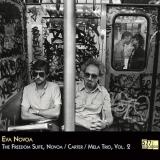
"Brooklyn-based pianist Eva Novoa returns with The Freedom Suite: Novoa / Carter / Mela Trio, Vol. 2 — the second radiant release from her compelling trio with saxophone icon Daniel Carter and celebrated drummer Francisco Mela. This marks Novoa’s sixth album with 577 Records. The trio first came together live in 2021, followed by a series of performances, including appearances in Cambridge (Boston) and later at the Brooklyn edition of the NY Forward Festival.
"The Freedom Suite is an homage to jazz titan Duke Ellington — particularly his masterful big band suites and legendary orchestra featuring Johnny Hodges and other luminaries who helped define an era of jazz greatness. In contrast, Novoa presents her Suite in a more intimate format: the piano trio. The album comprises twelve pieces — mostly brief — with a few extended tracks such as Free to Be Free and Cyborgs.
"For this recording, Novoa also steps in as a vocalist on several tracks, including Mainstream Media, Big Grande, Global, Free to Be Free, Dream, and Cyborgs. These pieces often feature a vocal dialogue between Novoa and Mela, whose expressive, word-infused style draws from rich Cuban traditions.
'Words are powerful,' says Novoa. 'They define who we are, where we come from, and who we hope to become. Without words, there is no conversation — and without conversation, there is no real sense of time, space, or connection.'
The Freedom Suite emerged from deep philosophical and creative conversations — spoken, written, and improvised — between Novoa, Carter, and Mela. In the studio, Novoa introduced printed texts that served as thematic foundations for spontaneous, in-the-moment musical interpretation. The result is an urgent and organic interplay, where instruments speak to one another in a language as fluid as it is fearless.
"Standout track Cyborgs begins with Novoa’s percussive piano, exemplifying the trio’s dynamic, conversational energy. Creative Destruction features Novoa on electric harpsichord in a wild, electric exchange. While Free to Be Free stands out as the album’s leading single, it also captures the essence and message of the entire Suite.
"Recorded in 2021 at New York City’s legendary Sear Sound Studio, the album captures a creative explosion of sound and spirit. Novoa dazzles on piano, Fender Rhodes, electric harpsichord, Chinese gongs — even whistle — showcasing her expansive sonic palette. Together, the trio embodies the power of free improvisation and emotional storytelling.
"Originally from Barcelona, Spain, Eva Novoa has been cultivating her distinctive voice since childhood. Now a staple of the New York creative music scene, she has performed across the globe and collaborated with some of the most adventurous voices in jazz and beyond."
expected to be published on 30.01.2026

Featuring special guests Bobby Rush, Shemekia Copeland, Ronnie Baker Brooks, and The Sons of Blues, the record reflects Billy's lifelong journey through the music he loves. "Every song on this album has special meaning to me," Billy says. "This is the most important work I've ever done - and the best work I've ever done as well." Over his remarkable 50-year career, he has earned numerous awards and accolades, including an Emmy award, three GRAMMYr nominations, and induction into the Blues Hall of Fame. His career reads like a "Who's Who" of the Blues world. Mentored by legends such as James Cotton, Junior Wells, Willie Dixon, and Big Walter Horton, Branch has built an enduring legacy both as a performer and a teacher. In addition to releasing 15 albums with his acclaimed band, The Sons of Blues, he has contributed harmonica to more than 300 recordings by artists including Koko Taylor, Willie Dixon, Eric Bibb, Johnny Winter, Taj Mahal, Keb' Mo', Son Seals, and Big Head Todd, among many others.
expected to be published on 30.01.2026

The original trio featured Liz McClarnon, Natasha Hamilton, and Kerry Katona. Just weeks before the release of their breakout single "Whole Again", Katona departed and was replaced by Jenny Frost, a pivotal change that coincided with the group's meteoric rise. "Whole Again" soared to number one on the UK Singles Chart in 2000 and topped charts in 18 other countries, cementing Atomic Kitten's global appeal. Their follow- up single, "Eternal Flame", cover of The Bangles' 1989, became their second number one in both the UK and New Zealand, with strong international chart performance. Originally released in 2000, their debut album Right Now was partially re-recorded following Frost's arrival. The revamped edition featured three new tracks: "Eternal Flame", "Tomorrow and Tonight", and "You Are". Jenny Frost's vocals were also added to updated versions of "Right Now", "Whole Again", "Hippy", and "Bye Now". Celebrating it's 25th Anniversary, the reimagined album reached number one in the UK, earned double platinum certification in 2001. Right Now is available on vinyl for the first time and includes an insert with credits.
expected to be published on 30.01.2026

On »Empty Room,« David Granström works with slow transformations, cyclical and isometric patterns as well as just intonation as a way to create harmonic stability, allowing his long-form pieces to develop their own unique temporal and spatial qualities. A prolific figure in Stockholm’s experimental drone scene and a collaborator of Hallow Ground label mates Maria W Horn and Mats Erlandsson, the Swedish composer navigates through moments of quietude and crushing volume on these five tracks. Sonically and atmospherically, the pieces on »Empty Room« simultaneously call to mind Fennesz’s most meditative work or the physical experience of seeing Sunn O))) live, blending guitar recordings and synthesised sounds with forceful effects similar to those of Mario Díaz de Leon’s Oneirogen project while still being as moving and delicate as Alessandro Cortini’s solo work. The album is marked by melodies and harmonies that are the product of a peculiar working process that turned the composer into an intent listener collaborating with, rather than simply using technology.
Having been invited by the self-organising artist group The Non Existent Center for a residency to Ställbergs Gruva, a defunct iron ore mine in Sweden’s Bergslagen region, Granström took his guitar as a starting point for his compositional work that heavily relies on real-time sound synthesis. »I seldomly use the instrument as a sound source in the final compositions and rather transcribe and orchestrate the harmonic structures using sound synthesis,« he explains. »On this album however, I chose to include the actual recordings of the guitar in order to extend the spectra between non-referential synthetic sounds and embodied referential sounds.« Working with precise tunings in order to blend the timbre of the synthesis with the harmonic structures of the composition, he created composite sound objects in which the harmonic elements blend into each other.
Through the re-amplification of synthetic musical materials from the inside of the abandoned mine, his original compositions were enriched with site-specific sound qualities before he further refined them in a singular working process. Granström works with algorithmic and generative processes, using the SuperCollider programming environment and thus blurring the lines between generative and creative forms of composition. »One of the things that I like about this way of working is that it creates a distance between myself as a composer and myself as a listener of the music that is produced entirely by the system,« he says. Granström’s technologically aided eschewing of the conventions of composing doesn’t make the end result any less personal, however. By listening again and again to the newly generated output, Granström simply took on a different role in the process of finalising the music, with the technology and the sounds becoming his co-authors.
By creating systems that generate music, he gains a new perspective on (musical) time, says Granström. »There doesn't have to be a fixed length to the music at all,« he explains. »And by writing music with this in mind, my focus tends to shift towards writing cyclical structures that gradually change and transform over time.« Simple parts, in other words, that emerge as the five complex wholes that form »Empty Room,« a record that itself seems to take on different forms with every new listen.
Order now and we will order the item for you at our supplier.

Childhood Intelligence Nineteen by Dan Piu “The Mystic Mind” 2x12 LP
As the vortex of time evolves, Swiss Underground Legacy “Dan Piu” returns to his home planet “Childhood intelligence”. A rare specimen and artifact known for his timeless & intelligent soul-infused music, arises with his 3rd solo album on Childhood. “The Mystic Mind” 2x12 Lp as the trilogy, the sequel of “Tru Time And Ages” and “Inside Universe”.
This Full-Length player is a voyage through yet another unexplored realm of Dan's creativity, where listeners are invited to explore a vast network of emotions. As the album organically unfolds, tales of spooky synth worlds emerge, where hypnotic atmospheres collide with analog technoid elements, guided by classic JUNO chord progressions. Witness the alchemy of vintage ARP, Jupiter, Mono/Poly, and 80s Yamaha sounds as they morph into an elusive journey of electronic mysticism crafted by the otherworldly mind, the “Mystic Mind” of Dan Piu.
Order now and we will order the item for you at our supplier.
Mike Majkowski makes his debut on Hands in the Dark Records with Invisible, a selection of six moody and mysterious pieces produced between 2019 and 2025.
The prolific Australian double bassist and music maker has been involved in a diverse array of contemporary, improvised and experimental music since the early 2000s. This time, the Berlin-based artist is venturing deeper into downtempo, meditative and hypnotic minimal electronic realms.
While time and space are constraints, they also define our identities, creating inexplicable bonds with others flowing through shared moments and shared places. The state of being invisible obliterates these confines, allowing one to return to their pure essence. In this setting, Majkowski’s compositions display a discreet and profoundly emotional language characterised by vulnerability, darkness and confusion, while also embodying hope, soothing and resilience. A dim light, transcending love, space, memory and time.
Order now and we will order the item for you at our supplier.

One of the leading Japanese alternative rock band, GEZAN’s leader, MahitoThePeople’s director debut film, i ai was released in March 2024, and it is an atypical coming-of-age film decorated with tinge of red.
The film takes place in Akashi and Kobe, Hyogo prefecture. This film’s main characters are Ko (Kentaro Tomita), a rookie member of a band and a brother-like figure of his, Hee (Mirai Moriyama) who Ko idolizes and the story of this movie is based on their struggles with life and death. The story is also based on Mahito's real-life experiences and while reality and fiction are duplicated, the boundary between them slowly melts away. The film co-stars Honami Satoh, Kazuki Horike, Mitsuru Fukikoshi, Eita Nagayama, Kyoko Koizumi, K-BOMB, Ichi Omiya and many other unique personalities. It should also be noted that the transparent images filmed by photographer, Masafumi Sanai gives the film, a special emotional quality.
The film is not bound by any film theory but it poses a theme common to GEZAN's recent works and Mahito's writing activities: How can we live in a crumbling society while interacting with others? We can never live alone but living with others is also never easy. How can we overcome this time of extreme division of the world?
What left quite a strong impression in this film that not only Mahito personally directed but also wrote the script and composed the soundtrack as well was the main theme song, entitled “i ai”. This new piece of GEZAN is an extension of the work that this band has continued doing over the last few years. This 12" single, contains the song, “i ai” and it will be the first time released on vinyl.
Led by soft guitar arpeggios, the song gradually builds to a fever pitch, condensing the mood of the film which encompasses both tranquillity and intensity. The chorus of ineffable, multiple voices united together sounds like a lament that has spilled out of society or a cry of joy. GEZAN's collaboration with the 15-member chorus group, Million Wish Collective has been in development of late and the cultivated sensibilities through their activities are put to use in this song.
The song can also be considered a slow, relaxed dance track that lasts 9 minutes and 8 seconds. It has something in common with organic dance tracks from South America and other regions, and it is significant that GLOCAL RECORDS which represents glocal music from around the world in Japan are releasing it as a DJ-friendly 12-inch single.
The B-side features a remix by COMPUMA who is also closely associated with GEZAN. The song starts with an African styled percussion, with a thumb piano in the middle of the song and then returns to that memorable chorus. This song feels like a 18 minutes and 18 seconds long short movie like suite, with some dizzying changes from the beginning to the end. It is remix filled with enormous drama!
The cutting and mastering of this 12” was done by TOREI who is also active as a DJ and the artwork was created by jvnpey, a visual artist and graphic designer based in Tokyo. Their loving work also makes this 12" very special.
When I asked AI to find a synonym for the word, “division,” it displayed in succession, a series of words: “integration,” “consolidation,” “unification,” “unity”, and “reconciliation". All of these phrases are somewhat whitewashed and embarrassing but the mirage-like chorus echoing in the song, “i ai” seems to be trying to find a new word, that is a synonym for the word, "division. In this film, “i ai”, the message, “Let's live together after the end roll” was thrown out but included in this 12-inch, the message, “Let's live together after the music stops”, emerges.
expected to be published on 23.01.2026

"Eau" is the lovely new album from aus, the solo project of Tokyo-born composer and producer Yasuhiko Fukuzono, who has gained attention, in Japan and overseas, for his thoughtfully paced and sensitively skillful music as well as his intriguing sound design for exhibitions and experimental cinema. Having worked primarily with keyboards and electronic sound up to this point, "Eau" is a slight yet fascinating shift for aus; the album, while still primarily an electronic work, revolves around the sonic world of a stringed acoustic sound source, the koto, that most characteristically Japanese of musical instruments. The very accomplished Eden Okuno provides the delicate-yet-rich koto sounds on offer here; Fukuzono, in the liner notes, acknowledges the importance of Okuno's artistry to the project.
The compositions on the album are designed to balance the sound of the koto, with its subtly variable attack and flickering resonance, with the timbre of other instruments. The delicate decay and metrical flexibility of the koto is enveloped by sustained synthesizer sounds and contrapuntally constructed piano melodies, creating a flowing ambience with absorbing undercurrents, a languid and liquid quality that reveals the suitability of the title.
Avid fans of contemporary Japanese music might hear the influence of pioneering works such as the the 1979 Hiroshi Yoshimura composition "Clouds for Alma", realized by koto player Tadao Sawai, and the 1993 album "Koto Vortex I: Works by Hiroshi Yoshimura" which featured performances of Yoshimura's works by the Japanese koto quartet Koto Vortex. These works attempted to remove the koto from its traditional context and place it within the context of ambient and techno. "Eau" is available on CD/LP/cassette/digital, with E/J liner notes by aus. "Eau" is the first collaborative release by EM Records and FLAU, the label run by Yasuhiko Fukuzono (aus).
Order now and we will order the item for you at our supplier.

“There's a clarity here that feels hard-won. Honing ideas first explored with his Organic Music series, Tiago Sousa unlocks the final puzzle pieces on Sustained Tones Vol 1. This music is enchanted, the way each layer moves in conjunction with the others: complex structures that feel less constructed than discovered, like stumbling upon ancient mechanisms still whirring beneath the earth. "Readily Reliance" opens as an effervescent sea, waves gilded in neon creating an enveloping sense of eternal motion. Bright organ timbres throw silhouettes and cast Sousa as the deft puppeteer keeping everything moving with an effortless precision. These evolving shapes suspend listeners somewhere between the physical and the cosmic, held in place by nothing but intention and sound.
Drones build rippling foundations in other places, using slower tempos to construct immersive, off-kilter sound worlds where minimalism becomes emotive, almost poignant. The fluctuating tones have a gossamer sheen, creating this interesting sonic dichotomy: a solid surface with fragile rotations beneath. It's music that commands attention; it is so much more than simply aural furniture. Sousa writes these beautiful sequences that are all interconnected, intricate sonic architecture that pulls us further into some kind of unknowable ether.
On the piano pieces, "Smooth Flow Into It" and "Swirling Mist and Thin Dust," Sousa shines sunlight through all the cracks. Washes of melody are effervescent, clouds clearing to reveal the day has not gone. Not yet. Positioned in the middle of Sustained Tones Vol 1, these pieces ground the album in something transcendent yet still earthen: moments of breath inside all that cosmic drift. Darkness finds its way through on "Restlessness," where Sousa smears sinuous electronics into a ghostly sonic mesh that seeps through the skin. It feels like a slow inhale, time suspended long enough to take note of where we are and how we feel before moving forward. Expressive, almost sparkling synth arrangements return to send us back into reality on closer "Becoming a Landscape." Its title hints at larger concepts at play throughout this album, where lines between our physical beings and the wider environment are blurred. The tones that echo throughout these six pieces mirror the echoes inside our bodies, from heartbeats and voices to something quieter, something much smaller and more elemental. By immersing us inside these mesmerising, beautiful soundscapes, Sousa immerses us within ourselves.’’
Brad Rose, 2025
expected to be published on 23.01.2026

Blues and Soul Award winner and double MOBO Awards nominee Ronnie Herel is back with his 2nd volume of his excellent compilation series Neo-Soul Sessions. Ronnie, a massively important figure in the UK Black music scene, is a radio presenter with Mi Soul and includes BBC 1xtra in his broadcasting credits. He is a DJ of international renown and was one half of the Quartz production duo which scored memorable hits with Dina Carroll. His undisputed love for and knowledge of the Neo-Soul genre shines through in the Neo-Soul Sessions and this latest, volume 2, is no exception. Featuring tracks from artists such as Vula, Terri Walker, Aname Rose and Slakah the Beatchild, among others, Neo-Soul Sessions volume 2 is a brilliantly curated and pieced together selection of twelve tracks that absolutely nails the beauty of the later releases in the Neo-Soul genre. Played from start to finish the track selection and order is a pre-made DJ set that flows in a way that would soundtrack a dancefloor, a house party and an excellent backdrop of tunes for any time and day of the week. Ronnie's passion for championing independent artists is also evident in his selections here and the compilation serves as a platform for those voices who deserve to break through. The decision to choose six of his favourite tracks to sit alongside six exclusive and unreleased gems means that a light is now shined on every artist featured on the compilation. An absolute must for serious lovers of Neo-Soul, RnB and Black Music, Neo-Soul Sessions volume 2 is released on double vinyl LP and CD formats.
expected to be published on 23.01.2026

At the end of the Sixties, the production of soundtracks for small and big classics of Italian cinema is now joined by another business which has proved to be less profitable but more creative and, in best case, free from the constraints imposed by clients on duty: the composition of music libraries. Almost all of the artists for the eighth art have finalized at least one or more music libraries. Names famous and not, old and young composers, real outsiders and meteors, usually hidden behind pseudonyms: this is the case, for example, of Braen and Peymont. The first needs no introduction, it was the one adopted by the former arranger, multi- instrumentalist, singer and composer Alessandro Alessandroni. The second is closely linked to the mysterious American composer, but resident in Italy, David Hoyt Kimball. The two are authors in different measure of an interesting album with an experimental background, “Paese Sotto Inchiesta” (1971), originally published by Flirt Records.
The titles of the tracks appear in connection with the socio-cultural climate of Italy after 1968 and can be relocated as a background for journalistic-like images. The latter is a hypothesis not supported by facts, but some titles seem to be referred to the perception of a subsisting economic backwardness of the southern regions compared to the other ones; to a situation of collective tension, thanks to the global revolutions; in addition to the new concerns with an ecological background. Overall, the seventeen tracks on the album are mostly 'dirty', characterized by an even atonal setting, with long repetitions in a noisy key, more fundamental reverbs and echoes for the different keyboard instruments. In a few words, abstract sounds, some guitar notes, echoes of Gruppo Di Improvvisazione Nuova Consonanza, flute melodies and proto- ambient intuitions. Composers like Alessandro Alessandroni and David Hoyt Kimball deserve to be rediscovered.
*Following the essence of the work, for this press, MPI release a 100% recycled vinyl that reduce waste, minimize environmental impact and support the planet*
Order now and we will order the item for you at our supplier.

As promised, Playfool was always meant to be about inviting other artists to join the fun.
For this first collaboration, Occibel teams up with Light Blue File, a friend he met recently in Paris.
After sharing some beers, ideas started flowing and the vibe instantly clicked — no choice but to turn it into something real for you guys.
These tracks mark the beginning of a new series of collabs under Playfool Records, where creativity meets spontaneity under the summer sun.
Enjoy and play it loud!
Order now and we will order the item for you at our supplier.

Tragic Tiger's Sad Meltdown is Heavenly aka Tiger Hutchence-Geldof's debut album of sorts, cut from cassette tapes of rehearsals mixed with snippets of field recordings. Recorded with contributions from Nicholas Allbrook (Pond), Scarlett Stevens (San Cisco), India Rose & Jacob Diamond.
"I made this cassette in the living room of our house in Fremantle, a seaside town in Western Australia. I had always been shy to sing with others but moving across the world and my ex-boyfriend Nick had given me some bravery. Something about living closer to nature meant I felt creative and open hearted. It was as if the wide open landscape of Australia had finally given my heart enough space to open properly. The recordings are actually just recordings of our rehearsals, I never feel set in how song is meant to be so they usually just come out of me in the moment. My friends playing along with me are luckily all very empathic players and we found a way to play with one another without any structure or plan. It was really moving to create with so much freedom and understanding. Most of the songs are about my sister Peaches who I lost as a teenager so singing them aloud felt very potent but my band always made me feel held"
Order now and we will order the item for you at our supplier.

Futura Resistenza is pleased to present the latest release from the prolific, restlessly creative composer-performer Anthony Pateras, two side-long pieces - one performed by Callum G'Froerer on double-bell trumpet, the other sung by Clara La Licata - in which soloists are accompanied by numerous pre-recorded tracks of their own instrument or voice, creating acoustic halls of mirrors where the distinction between live performer and recorded accompaniment becomes difficult to perceive. Palimpsest Geometry (2020) for double-bell trumpet & tape works with rapidly pulsed single trumpet notes, at brisk tempos that hover at the perceptual threshold between rhythm and tremolo. The interaction between different rates of pulse produces skittering echoes, as if G'Froerer's layers of trumpets were really a single sound bouncing around the sonic space. There Is A Danger Only Our Mistakes Are New (2021) for voice & tape goes to work on a see-sawing two-note melodic cell, insistently transposed and transposed again, hummed or sung with open vowels, contracting to a semitone and expanding to a minor third. More than anything in the canon of Western art music, the piece calls up the criss-crossing repeated figures of Inuit vocal games or the interlocking repetitions of Banda-Linda music, where rhythmic and harmonic displacements of repeated motifs fuse together individual parts into the illusion of an impossibly rich and multi-faceted unitary sonic organism. Essentially homogeneous in texture yet built up from constantly changing details, broadly static yet always moving and shifting, these pieces exemplify Pateras' recent work while also pushing it into a new, strikingly immediate direction. Here, form grows organically out of the material itself; the results are sparkling, immersive, and quietly uncompromising. (Francis Plagne)
Order now and we will order the item for you at our supplier.

‘Pilot’ is the debut album from London quintet Miniseries. Channelling the epic sweep of TV themes and movie soundtracks into resplendent space rock they explore themes of youth and ageing, heartbreak and paranoia, euphoria and existential dread.
Songwriter Doug Morch (Longview) had been working on largely acoustic folk songs when he met Angela Gannon (The Magic Numbers) at Glastonbury 2017. Romance and musical collaboration ensued. The band coalesced in the hallowed environs of Farringdon's The Betsey Trotwood pub – a musical nexus where burgeoning indie and Americana scenes collide – where they met fellow songwriter and guitarist Dermot Watson (from Brighton's The Dials) and drummer Danny Abbasi and were joined by Doug's former bandmate Aidan Banks on bass. When they came together, their indie folk mutated into motorik art rock, with their first single being an eight-minute jam called "Road".
When it came to capturing their sound, the band reached for maverick musician and producer Sean Read. They recorded tracks at Read's Famous Times studio in Clapton, London, as well as at Edwyn Collins' Clashnarrow in Helmsdale, Scotland – one of the world's most breathtaking and idiosyncratic studio locations, adding unquantifiable magic to the proceedings.
For the closing track "May You Always", they headed to another studio imbued with tangible inspiration: Blueprint Studio in Salford with producer Craig Potter (Elbow) at the helm. For the song, Dermot drew cinematic inspiration from the Withnail & I line "I'll never play The Dane", the song is about realising that the things you aspired to in youth will never come to pass and being at peace with that realisation.
The recurring themes of youth and ageing are apparent in the resplendent lead track ‘You're Gold’ – a heartfelt call for young people to reject materialism and exploitative influencer culture in search of life's deeper meaning, with stylistic nods to The Pixies and early Stereolab.
On the opposite end of the spectrum, "Sepia" explores old age and fading memories through dementia, where the ending descends into chaos like a fragmenting mind. Elements of "Sepia" are foreshadowed in the album's opening track, the instrumental "Pilot Theme", which pays homage to TV theme music, invoking spy thrillers or perhaps something otherworldly from science fiction.
“Offcumdens” is a Calder Valley, Yorkshire term for people who live in the area but come from somewhere else. Hailing from Bury, Lancashire, Morch wrote the song while living in Hebden Bridge (and watching too much Happy Valley) and found himself being an offcumden. It’s a pop at the kind of local nativism which breeds intolerance and an illustration of the sinister rise of wider political populism.
Miniseries' Pilot is just the beginning of the story. Enthralling and atmospheric, the London quintet have created something familiar yet timeless. As singer Doug Morch says, "It's the Miniseries Pilot episode. Like the TV episode a studio makes to test whether it's viable.” In the age of streaming and box-sets, this is an album to truly binge on. We can’t wait to hear what happens next.
expected to be published on 16.01.2026

Crypt of the Wizard is proud to present Ginger Wizard - The Curious Flora and Fauna of the Ancient World on vinyl and digital formats.
About ten years ago in a record store in Prague, the Ginger Wizard discovered a copy of Bo Hansson’s Lord of the Rings LP. Although initially unfamiliar with the record, the reference to Tolkien’s masterwork and the incredible cover art drew him in and, rather fittingly, sent him off on a journey of discovery that would reshape his creative trajectory.
Years later while working in cassette tape manufacturing, Ginger Wizard noticed that most fantasy-inspired music fell into two camps: metal and dungeon synth. With little interest in the former, but intrigued by the latter, he began writing a few songs imagining a beautifully packaged and tactile cassette tape. However, dungeon synth he soon realized was “the most boring music to make”.
So began the Ginger Wizard’s own mythological discography. In 2022 came The Feast for the Dead King and Other Musical Themes recorded at home in a cold kitchen, is conversely an album full of warmth drawn from sheer exploration. A year later Can I Choose My Own Psychopompos? was recorded for the legendary Stoned to Death label - a 7” séance of semi-improvised noise and melody featuring allies from the Ginger Wizard’s live backing band The Peter Jacksons. The following year with Bathysburg Tales, a new approach was needed in order to keep the project interesting. Drawing inspiration from Popol Vuh and the inclusion of vocals lent by Protomartyr’s Joe Casey and Jakob Battick, a new more cinematic sound began to emerge.
Now, we present The Curious Flora and Fauna of the Ancient World marking a step into something stranger while still channeling the spirit of Bo Hansson. The new album rejects swords and sorcery for the mythology of the natural world “the ancient stuff,” he explains in the record’s insert, “has a similar taste for me as fantasy.” These songs bloom, creep, and shimmer like forgotten plants under distant suns while rooted in something real and organic. Inspired by the myths of nature rather than heroic quests, it’s an album that feels alive, equal parts archaeological dig and psychedelic garden.
Currently at work on a soundtrack for an imagined 1970s fantasy film in collaboration with The Peter Jacksons, the Ginger Wizard continues to expand his strange universe while The Curious Flora and Fauna of the Ancient World serves as a new map to somewhere ancient, beautiful, and unknown.
expected to be published on 16.01.2026

HOUSE BY THE CEMETARY, the 'supergroup' led by former MONSTROSITY and VILE frontman and current artwork artist Mike Hrubovcak and Rogga Johansson from PAGANIZER and RIBSPREADER are releasing their third full-length, "Disturbing The Cenotaph". Since the duo, completed by former THE PROJECT HATE drummer Thomas Ohlsson, originally picked up their moniker as an homage to the 1981 cult horror flick of the same name, it shouldn't come as a surprise they've once again paying tribute to director Lucio Fulci (1927-1996) in one of this album most lethal salvo, 'New York Ripper'. Elsewhere on this third album, other tracks like 'Undead Apocalypse' or 'Burial Disturbance' were inspired by other famous horror classics like "Night Of The Living Dead" and "The Texas Chainsaw Massacre", Hrubovcak has come up in his lyrics with his own tales of terror. Some are totally fictional like, 'Coffin Colony' about a "diseased homeless living in underground coffins who gets infected with rabies after eating sewer rats". Others, like 'Lunatic Butcher' are inspired by real-life events or, in that case, by the antics and vicious killings of Paul John Knowles, dubbed 'the Casanova killer'. Musically speaking, Johansson jokes about "every band saying that their new album is their best but that's actually true here eh eh! This album is HOUSE BY THE CEMETARY on steroids. The sound is broad and impious, the vocals are awesome and the heavy riffing interlaced with occasional melody makes an overall varied, fun and GORY listen!" Completed, like on 2024's "The Mortuary Hauntings", by a gruesome artwork courtesy Felipe Mora (whose nightmarish visions can already be seen on albums by CONSUMPTION, ACHERON or WOMBBATH) and mixed by Håkan Stuvemark from WOMBBATH, Disturbing The Cenotaph is one raw, in-your-face and eight songs packed death-metal-to-the-core album ready to chill you to the bone!
expected to be published on 09.01.2026

The album long sought after by Mountain Goats fans is finally back in print and features new liner notes by John Darnielle. Released on the precipice of the Mountain Goats' breakout albums All Hail West Texas and Tallahassee, The Coroner's Gambit is an introspective epic that stands as one of Darnielle's best outings in any era.Darnielle on The Coroner's Gambit:There are few records in the Mountain Goats catalog that are closer to my heart than The Coroner's Gambit. It bears a sonic thumbprint shared by none of its brethren (Panasonic RX-FT500, Marantz PMD-222, and sessions in Omaha probably recorded to a Tascam Porta-One) and while two of those sources appear on several later releases, none of the other records really sound like it. Although it contains exactly no autobiographical songs, it feels personal to me_intimate, diaristic. I have vivid memories of the songs I wrote and recorded in Colo, and foggy memories of the Greyhound trip to and from Omaha. I was taking Greyhounds across Midwestern state lines to record songs with friends when I made The Coroner's Gambit, is what I'm saying. You can maybe hear the exhaust of the Greyhound in the songs if you listen close.
expected to be published on 09.01.2026

"I want nothing more than to be a loner," Emily Kempf sings early on Flower of Devotion, the new album by Chicago trio Dehd. It's a startling admission coming from a songwriter who, just a year ago on Dehd's critically acclaimed Water, wrote eloquently about the joys and pains _ more than anything, the necessity _ of love, compassion, and companionship. But then, "admission" isn't really the right word here, given the stridency of Kempf's tone. "Loner" is a declaration. The record ups the ante on Dehd's sound & filters in just enough polish to bring out the shining and melancholy undertones in Jason Balla and Emily Kempf's songwriting, even as it captures them at their most strident. Balla's guitar lines at times flirt with ticklish cosmic country, while at others they reflect the dark marble sounds of Broadcast. Kempf, meanwhile, establishes herself as a singer of incredible expressive range, pinching into a high lonesome wail, letting loose a chirping "ooh!," pushing her voice below its breaking point and letting it swing down there. When she and Balla bounce descending counter-melodies off one another over McGrady's one-two thumps, or skitter off over a programmed drum pad, they sound like The B-52s shaking off heartache. What makes Flower of Devotion so impressive is how its creation seems to have strengthened its creators, both as individuals and as a unit, even as they've stared down their own limitations. It's also striking just how much fun they seem to be having in the process. "It's okay to be lighthearted in the face of despair," Kempf says. It's a theme that runs through the album, from the opening back-and-forth build of "Desire" to the click-clacking chorus of "Haha," which finds them deflating their own history. Flower of Devotion was recorded in April and August of 2019 in Chicago. It will be released on Fire Talk Records on July 17th 2020.
expected to be published on 09.01.2026
The song titles on Van Halen's aptly titled Fair Warning don't lie. The likes of "Unchained," "Mean Street," "Push Comes to Shove," "One Foot Out the Door," and more indicate the mood the band channels on its double-platinum 1981 record — the nastiest, darkest, and fiercest album of the group's storied career. For the fourth time in four years, Van Halen throws down the gauntlet to all challengers and emerges victorious.
Sourced from the original analog tapes, pressed on MoFi SuperVinyl at Fidelity Record Pressing, and strictly limited to 5,000 numbered copies, Mobile Fidelity's UltraDisc One-Step 180g 45RPM 2LP set plays with unfettered clarity, dynamics, and immediacy. Benefitting from superb groove definition, an ultra-low noise floor, and dead-quiet surfaces, this vinyl edition captures what went down in the studio with tremendous realism and involving presence.
Taking a more controlled approach in the studio and still completing everything in less than two weeks, Van Halen and producer Ted Templeman relied on studio amplifiers to direct the sound. Further diverging from the live-on-the-floor approach of its earlier albums, the ensemble also employed overdubs to great effect. The result: Dense, stacked architecture that underlines the hard-hitting tenor of the songs — and which comes alive like never before on this reference edition that looks as good as it sounds.
The premium packaging and gorgeous presentation befit the reissue's select status. Housed in a deluxe slipcase, it features special foil-stamped jackets and faithful-to-the-original graphics that illuminate the splendor of the recording. Aurally and visually, it is made for listeners who want to immerse themselves in everything involved with the album, including the iconic cover art adopted from William Kurelek's haunting painting, "The Maze."
Isolated frames from Kurelek's childhood-inspired work — including a man bashing his head into a brick wall, a guy pinning down an adversary as he delivers bare-fist blows to his face and others watch with apparent glee, a boy tied down on a conveyer belt and being sent through the equivalent of a meat saw — adorn the front and back covers. The sunnier visual disposition of Van Halen's prior efforts gives way to something sinister and tortured, traits reflective of the music within. The band members, too, are visually depicted not in glamorous shots but in a serious black-and-white portrait in which the quartet is clad in black leather jackets.
Tough, aggressive, stark: Fair Warning comes on like a series of bare-knuckled punches to the solar plexus and boasts lyrical narratives to match. Though not a concept record, the concise album revolves around themes of roughing it on the streets and struggling to survive amid dim prospects. Singer David Lee Roth reportedly penned many of the initial lyrics after traveling to Haiti and observing extreme poverty. The characters and situations populating Fair Warning reflect hardscrabble existence, last-chance desperation, and underlying danger.
Witness the crazies, poor folks, and hunters of “Mean Street”; the former prom queen turned pornographic actress on “Dirty Movies”; the menace and vice of “Sinners Swing!”; the streetwise hustle of “Unchained”; the isolation and alienation of “Push Comes to Shove”; the desire for escape on “One Foot Out the Door”: A carefree California beach party Fair Warning is not.
Having said he felt angry and frustrated during the sessions, guitarist Eddie Van Halen uses the forceful arrangements as a playground for his seemingly unlimited arsenal. Supported by a crack rhythm section and a hyped-up Roth, he performs with an almost impossible combination of punk-like intensity, technical finesse, lyrical fluidity, and unbridled emotion. The virtuoso was increasingly butting heads with Templeton and seeking a freedom in the studio he believed denied him.
No wonder he plays like a bat out of hell. Listen to the rapid-fire manner in which he slaps the high and low E strings on the 12th fret of his instrument on “Mean Street,” instilling the tune with funk flair and metal-spiked sharpness. For the pouty strut of “Dirty Movies,” Eddie Van Halen contributes slide guitar magic made possible after he sawed off the lower portion of a Gibson SG so he could reach further down the fretboard.
Related intensity, urgency, and daredevil momentum punctuate the surging “Sinner’s Swing!” A heavily flanged, delicately melodic introduction frames the attitudinal “Hear About It Later,” among the most creative arrangements of Van Halen’s career. And do riffs come any bigger or magnetic than those on the high-wire kick of “Unchained”? As for the out-of-left-field “Sunday in the Park,” an instrumental composed on an Electro-Harmonix micro-synthesizer: Who but Eddie Van Halen to supply creep factor in such an ingenious way?
Despite selling fewer quantities than Van Halen’s prior efforts, Fair Warning remains for many diehards the record that epitomizes all of the band’s immense strengths —Roth’s manic energy and tongue-wagging humor, Alex Van Halen’s rhythmic heartbeat-in-your-chest bombast, and Michael Anthony’s lucid bass lines included. Arriving when the New Wave of British Heavy Metal and new-wave movements were taking flight, it signaled a shot across the bow from a band determined to stay a step ahead and provide proof nobody could touch what it delivered.
More than four decades later, Fair Warning still sounds that alarm.
This item has not yet been released. You can pre-order the product now.

"Souvenirs opened the door for me in L.A. as far as not just being the kid anymore, but being one of the guys, so I remember that one as a real good time—probably way too good a time! It's a miracle we survived that record." – Dan Fogelberg
Impex Records, in collaboration with Epic Records and Iconic Artists Group, is proud to present the official limited-edition 50th Anniversary 180-gram LP of Souvenirs! Our audiophile vinyl LP has been newly remastered from original analog tapes and features original photographs, new notes, and remembrances from Dan Fogelberg and others who crafted this classic album!
Celebrate the 50th anniversary of Dan Fogelberg's breakout hit album, newly remastered and lavished with The Impex Treatment.
50th Anniversary Edition
180g Audiophile Vinyl LP
Contains the Top-40 Hit "Part of the Plan" & Fan Favorites "As the Raven Flies" & "Illinois"
Features Members of Eagles, Graham Nash, Gerry Beckley, Kenny Passarelli & Russ Kunkel
Mastered from a Flat 1:1 Transfer of the Original Analog Tapes by Chris Bellman at Bernie Grundman Mastering
Pressed at Fidelity Record Pressing
Exclusive Booklet Containing Original Photos & an Appreciation by Charles L. Granata Featuring Archival & New Interviews with Many of the Participants Who Helped Make This Classic Album
Limited to & Individually Numbered to Only 3,000 Copies
This item has not yet been released. You can pre-order the product now.

“OTHERWORLDS” is a fantasy / sci-fi book presenting collaborators from the past and future through their otherworldly visions. Each artist offers an intimate glimpse into their own abstractions. The A3 spreads reveal visions, fragments of alternative realities, strange and mysterious flora and fauna, fantastic creatures and altered states of perception.
The book takes you on a curious journey through the minds of many, connected by shared inspirations and their collective contribution to building the Childhood Intelligence universe over the past eight years.
This item has not yet been released. You can pre-order the product now.

The duo Adjustment Bureau, return with another deeply hypnotic 12" on their own Hypnosapiens imprint. Following the label’s first two vinyl-only gems, The Others expands their sound palette between deep house, microhouse, and subtle breaks, all wrapped in a refined analog warmth.
Pressed on black 140-gram vinyl, The Others continues Hypnosapiens’ mission to showcase the minimal scene’s most sophisticated and soulful side. Functional yet emotional, understated yet timeless, crafted for DJs who value precision, patience, and space.
Order now and we will order the item for you at our supplier.

Hercules & Love Affair music has always been about folding past, present and future together – and never more so than in the latest phase, encapsulated by the track that launches things, “Someone Else is Calling.”
If the song-first, ultra-gothic mind-movie of the last H&LA album In Amber was partly motivated by Andy Butler falling out of love with dance culture, this new body of work – an EP titled Someone Else Is Calling – is an unabashed resurgence of the love affair. A co-production with London underground veteran and inspiration to Butler, Quinn Whalley of Paranoid London and Decius, the lead single is a surging, tactile acid track woven around the vocal of Icelandic icon Hips & Lips aka Elín Ey – who hits that new wave disco sweet spot between Grace Jones and Yazoo era Alison Moyet.
Elín’s lyrics work perfectly with the bodily momentum of the sounds, circling around themes of self-possession and the urge to move on to the next experience, the next sensation: hunger for reality. And this taps into Andy’s feelings on escaping New York and moving to Belgium, discovering that dance culture was anything but the hollowed-out, identikit-festival-lineup conveyor belt he’d feared, and still had plenty of outposts where it was still – as he’d first experience it as a teen – about the hot, sweaty reality of diverse people seeking communion, communication and heightened ways of being in the here and now.
The video, filmed by Tatsumi Milori couldn’t be a better expression of exactly this. A love letter to the strange and glorious party scene of Mexico City, it captures people who are both tapping into the eternal verities of those magical dancefloor communions, and thrilling – against all the odds of oppressive forces – at the sense of possibility in the flow of gender and sexuality in the present moment. It’s powered by innocence and experience as intertwined forces, and it amplifies the heartbeat of the song a thousandfold. There will be more, much more, to follow from the partnership of Andy, Elín and Quinn. It digs deeper still into the decades of dance and other underground cultures that feed into this modern moment – but this shining beacon should give you a pretty good hint.
Someone Else Is Calling will arrive on one of Los Angeles’s most exciting new independent labels and creative hubs, StrataSonic, on December 14. The lead single of the same name, along with the music video directed by Tatsumi Milori, is out now. This marks the first collaboration between Hercules & Love Affair and Stratasonic.
Order now and we will order the item for you at our supplier.

Deey, a native of Futenma, Okinawa, is one of the most popular artists today, known for his collaboration with Leo Iwamura on "Deep Blue," and EVO, who has
made a name for himself with The Anthem, hosted by IMUHA BLACK, and is attracting attention. This LP features a remarkable album by three artists at the forefront
of Japan's underground hip-hop scene, all produced by MrRn, whose popularity is rapidly rising in the Kansai region.
"Working with these three artists, I was able to bring out the best in myself and express my passion for swaying, nodding, and communicating. "Sunshin" in particular
is a song I want everyone to listen to and feel for its vibe and message!" -- Deey
"The album title, 'Amon', literally means 'Gate of Asia.' When we listen to music, we're usually drawn to the sound and groove first, so we created a record that
will resonate worldwide, regardless of the current domestic scene. I'm not really into forming and organizing a crew, so I'd like to continue working with friends
who share Amon's concept, not just in music, but in other areas as well." -- EVO
"When you hear it, it'll hit you like lightning. Creating it with my friends, supporting each other, learning from each other, I've managed to express myself more
authentically than any other production I've ever done." – MrRn
expected to be published on 19.12.2025

Spanish Love Songs return with a new EP, a reflective collection created mid-process while writing their next full-length. Since forming in 2013, the band has grown from DIY roots into one of modern punk’s most vital voices with albums like Schmaltz, Brave Faces Everyone, and No Joy. Vocalist Dylan Slocum calls these songs “imperfect snapshots,” built in real time with friends and collaborators — including Kevin Devine, Illuminati Hotties, Dan Campbell, and Tigers Jaw. The vinyl release will pair the new EP with their previous No Joy – Sessions and Doom and Gloom Sessions, offering fans a comprehensive physical collection.
expected to be published on 19.12.2025