Established in 2022, Warm Exit is a post-punk quartet hailing from Brussels, Belgium. Their violently frontal music is an explosive blend of sonic intensity that sets them apart as one of the country's most electrifying and raucous acts. Drawing inspiration from Krautrock, Punk, and Noise, their relentless rhythmic prowess is a testament to their diverse influences. Channeling the spirit of iconic 1970s bands like Wire, The Fall, and Public Image Limited, Warm Exit ventures into the shadowy realm of post-punk with their latest EP. Here, they seamlessly oscillate between fast and slow tempos, high and low energy levels, and vocals that span from tense whispers to unbridled screams. This journey takes the listener through a landscape of discordant riffs, haunting groans, evocative spoken word passages, and industrial undertones. Over the past three years, Warm Exit has cultivated a devoted following both locally and internationally, thanks to their electrifying live performances that leave audiences in awe. Carrying the reputation of a striking live band, they are eager to storm the stage at any and every given opportunity.
Bendik Giske’s Beatrice Dillon-produced 2023 album gets an addendum with reworks from Carmen Villain, aya, Hanne Lippard, Hieroglyphic Being, Wacław Zimpel and Dillon herself.
Giske’s clearly got his ear to the ground; his last remix record was an invitation for Laurel Halo to put her stamp on »Cruising«, while 2018’s »Adjust EP« roped in Deathprod, Total Freedom, Lotic, and Rezzett. Now comes this new LP of remixes and it’s one of the best we’ve heard in aeons. Carmen Villain boots things off with a remix of »Slipping«, following her excellent (and way, way too underrated) »Nutrition EP« with a giddy, subtle roller that sounds as if it’s been constructed using only Giske’s raw stems. His breaths and leathery key presses – already amped up by Dillon’s detailed recording – are magicked into a dubby concrète groove that’s enhanced with the sparest melodic elements: echoing rainforest-at-night horn blasts, and lopped off decay trails that help fuel the momentum.
aya’s revision of the same track takes a different approach, forming forceful overlapping polyrhythms from Giske’s clanks, using the gamelan-like arpeggios for melodic weight and repetition. The result is a constantly shifting, hypnotic trancer that’s achingly organic – more Raja Kirik than Paul Van Dyke. Polish clarinetist and producer Wacław Zimpel, meanwhile, supplements his trippy recent collaboration with James Holden on a similarly levitational wrinkle of »Slipping« that twists Giske’s quivering sequences with microtonal synth prangs, and gusty echoes. But it’s Jamal Moss who plays fastest and loosest with Giske’s source material, calling back to April’s psy-house stunner »Dance Music 4 Bad People« with a powdery, sexualised banger that buries the breathy »Start« stems underneath neon synths, and brittle drum loops.
»I’m a digital nomad,« Lippard deadpans over Giske’s »Not Yet«. »I’m addicted you know that.« It’s a typically dry treatment from the conceptual artist that unexpectedly amps up the hypnotic qualities of Giske’s original, adding her circuitous charm to his concertina-ing sax sequences. And to tie things up perfectly, Beatrice Dillon returns with her diaphanous remix of »Rise and Fall«, built to emphasise the radically different approaches of each artist.
Bernadette Price, wife of the late, legendary Sean Price, steps into the spotlight with her solo debut album, A Widow’s Cry. This deeply personal project features hard-hitting production from some of hip-hop’s finest producers, including Khrysis, Da Beatminerz, Stu Bangas, and more.
A Widow’s Cry not only honors Sean Price’s legacy but amplifies it, featuring collaborations with fellow Boot Camp Clik members Smif-N-Wessun, Ruste Juxx, Rockness Monsta, along with a rare, never-before-heard verse from Sean Price himself—a true gem for longtime fans.
More than just a tribute, this album is Bernadette Price’s bold statement that she’s here and ready to make her mark.
Big Thief will release their sixth studio album, Double Infinity, on 5 September 2025.
Double Infinity is the follow-up to 2022’s Grammy-nominated album, Dragon New Warm Mountain I Believe In You, recorded last winter at the Power Station, New York City. For three solid weeks, the trio would ride bicycles on frozen streets between Brooklyn and Manhattan, meeting in Power’s Station’s warm wood-panelled room. Together with a community of musicians (Alena Spanger, Caleb Michel, Hannah Cohen, Jon Nellen, Joshua Crumbly, June McDoom, Laraaji, Mikel Patrick Avery, Mikey Buishas) they would play for nine hours a day, tracking together – simultaneously – improvising arrangements and making collective discoveries. Double Infinity was produced, engineered and mixed by longtime Big Thief collaborator Dom Monks.
“How can beauty that is living be anything but true?” Adrianne asks as she drives nose against the future with childhood mementos on ‘Incomprehensible’. She understands, “everything I see from now on will be something new.” The silver hairs on her shoulders are new as well. Yet fear of aging is cracked by proof. If a life is shaped by living, “Let gravity be my sculptor, let the wind do my hair.” Being born, then staying a while, remains the greatest mystery. Adrianne claims her place and time. “Incomprehensible, let me be.”
Los Angeles trio Faetooth sophomore album Labyrinthine is a deeply felt exploration of emotional weight: grief, memory, uncertainty, and the quiet work of growing around your own wounds. Following the band's 2022 debut Remnants of the Vessel, which introduced the band’s signature blend of heaviness and mysticism, Labyrinthine pushes further inward. True to its name, the album winds through a maze of feeling and form, where meaning is never handed over easily. It’s rooted in self-discovery through disorientation, the idea that understanding comes not from escape, but from getting lost. Ari May (guitars and vocals), Jenna Garcia (bass and vocals), and Rah Kanan (drums) manage to stay grounded in the immediate in parallel with fantasy themes of the band's namesake. Labyrinthine holds space for this contradiction; tenderness and intensity, restraint and release. The band's self-branded “fairy doom” sound fits between shoegaze, doom, and grunge. It isn’t just texture; it’s a framework for navigating the unsaid. Like the myth that inspired its title, Labyrinthine doesn’t end in victory, but in confrontation—not with escape, but with the Minotaur. Only here, the Minotaur isn’t a monster. It’s something quiet and more familiar: unresolved feelings, old memories, and sadness that refuse to stay buried. The album winds like a maze, sometimes heavy, sometimes hushed, always intentional. Faetooth isn’t chasing catharsis. They’re creating space to reflect, to feel, and maybe to get a little lost along the way.
Artist quote: "White Noise" emerged from a diary entry, and is a relentless and intense reflection on inner turmoil. We’re often drawn to the familiar, even when we don’t realize we’re reaching out for it. It is an emotional upheaval, carrying harsh truths that weigh heavily on the heart. Guitarist, Ari May mentions, “Performing the song always takes me back to a specific place, even if just for a moment.”
“Riffs and melodies brimming with loneliness and longing… this band’s incantations affect my mood the whole day after listening.” — The Sleeping Shaman
“Bringing otherworldly hazy doom goodness… dreamy clean vocals, echoing harsh vocals, entrancing riffs, meditative shoegaze melodies.” — Nine Circles
“Slow, lumbering behemoths of great weight… couched in a melancholy atmosphere and explosions of crushing heaviness.” - Where Strides The Behemoth
Los Angeles trio Faetooth sophomore album Labyrinthine is a deeply felt exploration of emotional weight: grief, memory, uncertainty, and the quiet work of growing around your own wounds. Following the band's 2022 debut Remnants of the Vessel, which introduced the band’s signature blend of heaviness and mysticism, Labyrinthine pushes further inward. True to its name, the album winds through a maze of feeling and form, where meaning is never handed over easily. It’s rooted in self-discovery through disorientation, the idea that understanding comes not from escape, but from getting lost. Ari May (guitars and vocals), Jenna Garcia (bass and vocals), and Rah Kanan (drums) manage to stay grounded in the immediate in parallel with fantasy themes of the band's namesake. Labyrinthine holds space for this contradiction; tenderness and intensity, restraint and release. The band's self-branded “fairy doom” sound fits between shoegaze, doom, and grunge. It isn’t just texture; it’s a framework for navigating the unsaid. Like the myth that inspired its title, Labyrinthine doesn’t end in victory, but in confrontation—not with escape, but with the Minotaur. Only here, the Minotaur isn’t a monster. It’s something quiet and more familiar: unresolved feelings, old memories, and sadness that refuse to stay buried. The album winds like a maze, sometimes heavy, sometimes hushed, always intentional. Faetooth isn’t chasing catharsis. They’re creating space to reflect, to feel, and maybe to get a little lost along the way.
Artist quote: "White Noise" emerged from a diary entry, and is a relentless and intense reflection on inner turmoil. We’re often drawn to the familiar, even when we don’t realize we’re reaching out for it. It is an emotional upheaval, carrying harsh truths that weigh heavily on the heart. Guitarist, Ari May mentions, “Performing the song always takes me back to a specific place, even if just for a moment.”
“Riffs and melodies brimming with loneliness and longing… this band’s incantations affect my mood the whole day after listening.” — The Sleeping Shaman
“Bringing otherworldly hazy doom goodness… dreamy clean vocals, echoing harsh vocals, entrancing riffs, meditative shoegaze melodies.” — Nine Circles
“Slow, lumbering behemoths of great weight… couched in a melancholy atmosphere and explosions of crushing heaviness.” - Where Strides The Behemoth
Los Angeles trio Faetooth sophomore album Labyrinthine is a deeply felt exploration of emotional weight: grief, memory, uncertainty, and the quiet work of growing around your own wounds. Following the band's 2022 debut Remnants of the Vessel, which introduced the band’s signature blend of heaviness and mysticism, Labyrinthine pushes further inward. True to its name, the album winds through a maze of feeling and form, where meaning is never handed over easily. It’s rooted in self-discovery through disorientation, the idea that understanding comes not from escape, but from getting lost. Ari May (guitars and vocals), Jenna Garcia (bass and vocals), and Rah Kanan (drums) manage to stay grounded in the immediate in parallel with fantasy themes of the band's namesake. Labyrinthine holds space for this contradiction; tenderness and intensity, restraint and release. The band's self-branded “fairy doom” sound fits between shoegaze, doom, and grunge. It isn’t just texture; it’s a framework for navigating the unsaid. Like the myth that inspired its title, Labyrinthine doesn’t end in victory, but in confrontation—not with escape, but with the Minotaur. Only here, the Minotaur isn’t a monster. It’s something quiet and more familiar: unresolved feelings, old memories, and sadness that refuse to stay buried. The album winds like a maze, sometimes heavy, sometimes hushed, always intentional. Faetooth isn’t chasing catharsis. They’re creating space to reflect, to feel, and maybe to get a little lost along the way.
Artist quote: "White Noise" emerged from a diary entry, and is a relentless and intense reflection on inner turmoil. We’re often drawn to the familiar, even when we don’t realize we’re reaching out for it. It is an emotional upheaval, carrying harsh truths that weigh heavily on the heart. Guitarist, Ari May mentions, “Performing the song always takes me back to a specific place, even if just for a moment.”
“Riffs and melodies brimming with loneliness and longing… this band’s incantations affect my mood the whole day after listening.” — The Sleeping Shaman
“Bringing otherworldly hazy doom goodness… dreamy clean vocals, echoing harsh vocals, entrancing riffs, meditative shoegaze melodies.” — Nine Circles
“Slow, lumbering behemoths of great weight… couched in a melancholy atmosphere and explosions of crushing heaviness.” - Where Strides The Behemoth
"Laurel Hell" ist ein Soundtrack zur Transformation. Eine Landkarte für den Ort, an dem Verletzlichkeit und Widerstandsfähigkeit, Trauer und Freude, Fehler und Transzendenz in unserer Menschlichkeit Platz finden und als würdig angesehen werden können - um letztendlich anerkannt und geliebt zu werden. "I accept it all," verspricht MITSKI. "I forgive it all." Auf "Laurel Hell" festigt MITSKI ihren Ruf als Künstlerin, die die Kraft besitzt, unsere wildesten und zwiespältigsten Erfahrungen in ein heilendes Elixier zu verwandeln. "I wrote what I needed to hear. As I've always done." Nach der Veröffentlichung von "Be The Cowboy", einem der meistgelobten Alben des Jahres 2018, das von Outlets wie Pitchfork (u.a.) zum Album des Jahres gekürt wurde, stieg MITSKI vom Kultliebling zum Indie-Star auf. Mit spürbaren Folgen: Die Schinderei des Tourlebens und die Fallstricke die mit der erhöhten Sichtbarkeit einhergingen, beeinflussten ihre Musik ebenso wie ihren Geist, die sich in der ersten Single "Working For The Knife" niederschlägt. Ein Song, wie ein Prüfstein für das Gesamtgefühl von "Laurel Hell": "I start the day lying and end with the truth / That I'm dying for the knife." "Be The Cowboy" wurde von weiblicher Stärke und Trotz angetrieben, lebte jedoch von seinem Spiel mit Masken. Wie der Berglorbeer bzw. die "laurel hell", nach dem das neue Album benannt ist, kann die öffentliche Wahrnehmung, wie das berauschende Prisma des Internets, eine verlockende Fassade bieten, hinter der sich eine tödliche Falle verbirgt. Die sich immer enger zieht, je mehr man sich anstrengt. "I got to a point, where I just knew that if I kept going this way, I would numb myself to completion." Erschöpft von diesem verzerrten Spiegel und unserer Sucht nach falschen Binaritäten, begann MITSKI, Songs zu schreiben, die die Masken abstreifen und die komplexen und oft widersprüchlichen Realitäten dahinter offenbaren. MITSKI dazu: "I needed love songs about real relationships that are not power struggles to be won or lost. I needed songs that could help me forgive both others and myself. I make mistakes all the time. I don't want to put on a front where I'm a role model, but I'm also not a bad person. I needed to create this space mostly for myself where I sat in that gray area." Die daraus entstanden Songs verkörpern genau diesen Raum. Wie die zweite Single des Albums, "The Only Heartbreaker", die gemeinsam mit Dan Wilson geschrieben wurde und der erste Song dieser Art in ihrer Diskografie ist. "The Only Heartbreaker" verbindet treibenden 80er-Pop mit einem trügerisch einfachen Text, dessen aufrichtiger Refrain ins Ironische kippt, sobald dieser "the person always messing up in the relationship, the designated Bad Guy who gets the blame," beschreibt und sich zugleich fragt, ob "the reason you're always the one making mistakes is because you're the only one trying." MITSKI schrieb viele Songs für "Laurel Hell" während und teilweise vor 2018. Das Album wurde allerdings erst im Mai 2021 final abgemischt. Es ist die längste Zeitspanne, die MITSKI jemals für ein Album gebraucht hat und für die Musikerin inmitten einer radikal veränderten Welt endete. MITSKI nahm "Laurel Hell" mit ihrem langjährigen Produzenten Patrick Hyland in der Zeit der Isolation während der Pandemie auf, als einige der Songs "slowly took on new forms and meanings, like seed to flower." Das Album als Ganzes entwickelte sich "to be more uptempo and dance-y. I needed to create something that was also a pep talk" erklärt MITSKI. Die Spannung, die zwischen ihren raffinierten, aber wehmütigen Texten und dem sprudelnden Pop-Sound der 1980er Jahre entsteht, ist eine dringend benötigte Infusion in Zeiten wie diesen und das Werk einer reifen wie unwiderstehlichen Künstlerin, die auch zu fröhlich ansteckenden Dance-Beats immer noch etwas Profundes beizutragen hat.
With influences ranging from Burt Bacharach to Quincy Jones, Tilsley Orchestral No.10 belongs on the shelves of all record collectors. Sweeping strings, pounding drums, leaping flutes, and polished horn sections take the listener on a sonic journey of late 60’s orchestral pop. Composed and arranged by the library legend Reginald Tilsley, this eponymous collection of recordings digs deep into jazz harmonies that adds a level of complexity while maintaining the simplicity of easy listening, highlighting the true genius of the composer.
Tilsley Orchestral No. 10 spans a spectrum of spirits, from the lows of lost love (Sue) to the highs of winning the big game (Grand Slam). This LP features a favorite of hip-hop producers, Warlock, which has been sampled in songs by artists including Cam’ron, KRS-ONE, Soulja Boy, and Jay Electronica.
Posters announce a daily action: A professional marksman shoots daily at 12 o’clock from a distance of approximately 15 meters at a paper flower. The number of shots is limited to a maximum of three per day. Upon a hit, the flower is replaced by a new one, the action ends and is continued the next day with a new flower. The bullet holes in the wall are not removed. The flowers remain lying on the floor until the end of the exhibition or event and are then given away.
Posters are produced in color variants (yellow, orange, red, violet, light blue, green) to advertise the action:
Every day at noon a professional marksman will shot at a paper flower (place of action to be filled in).
This performance was first presented at The Fruitmarket Gallery, Edinburgh in November and December 1999 and subsequently repeated (Aberystwyth, London, Nottingham, 2000 – 2002 and Langenhagen, 2007).
The action will be re-staged as part of the Klang Moor Schopfe Festival in Gais, September 4 –14, 2025.
To celebrate the 40th Anniversary of Camper Van Beethoven"s groundbreaking debut "Telephone Free Landslide Victory", the CD album is being reissued in a deluxe edition featuring a previously unreleased 11 track demo recorded in 1983 plus B-sides and rarities. It also includes a 16-page booklet and sleevenotes from Victor Krummenacher. The LP is being reissued on dark green vinyl, with an alternative dark green cover to match. Featuring the cult classic "Take the Skinheads Bowling", the album showcases Camper Van Beethoven"s unique blend of folk, punk, ska, and absurdist wit. Beloved for its playful, offbeat charm and eclectic instrumentation, "Telephone Free Landslide Victory" cemented the band"s status as pioneers of alternative music.
Vom Beginn des Album-Openers „Obsidian Mirror“ an ist die Atmosphäre beklemmend, dicht mit einem erstickenden Unbehagen. Man hat das Gefühl, dass etwas Zeremonielles am Werk ist, aber nicht in einer Weise, die nach Gemeinschaft strebt. Vielmehr ist es eine Tortur als Sakrament. Riffs würgen und wälzen sich in krampfhafter Unterwerfung, oszillieren zwischen langsamer Agonie und psychotischem Ausbruch, über dem ein gutturales Lamento, das so brutal ist, dass es das Blut gefrieren lässt, durch Kerkerstein gerissen wird. Jeder Track entfaltet sich wie eine Zeit, die man in der Isolation verbracht hat, gefesselt durch Ketten, den Geist langsam enträtselnd und umgeben von Erinnerungen an reale und imaginäre Qualen.
Wenn sich das epische, 14-minütige Schlussstück „Disquiet“ in einer Masse formlosen Rauschens auflöst, haben Ritual Mass den Hörer in eine Welt gezogen, in der das Leiden kein Ende, sondern eine Bedingung der Existenz ist. Cascading Misery" ist Musik für die Auflösung der Hoffnung, den Schrecken des Seins und den langen Marsch auf den Tod.
- Debüt-Album nach mehreren EP-Veröffentlichungen
- Aufgenommen, gemischt und gemastert von Greg Wilkinson / Earhammer Studios (Ulthar, Autopsy, Undergoing)
- Erste 20BS-Band aus Pittsburgh (Labelsitz)
- FFO: Vastum, Krypts, Phrenelith, Master, Incantation, Abhorrence, Funebrarum, Disembowelment
Teppana Jänis was born in the village of Uuksujärvi in Suistamo on 21 June 1850. After becoming blind in the late 19th century, he went house to house, supporting himself by playing the kantele, a traditional Finnish and Karelian plucked string instrument belonging to the southeast Baltic box zither family. He performed at dances and in schools, and also participated in the Suistamo kantele and runosong competitions in 1911.
In the summers of 1916 and 1917, the young folk music researcher Armas Otto Väisänen (1890-1969) made collecting trips to Border Karelia. His aim was to collect kantele tunes, laments and shepherd melodies, which were confusingly few in the archives. The 1916 trip was financed by the Finnish Literature Society, who provided a phonograph for recording purposes. In 1917, the trip was financed by the Kalevala Society and the recording was carried out using a parlograph. During these two summers, Väisänen recorded kantele players in the parishes of Suojärvi, Korpiselkä, Suistamo, Tuupovaara, Kitee and Impilahti. Väisänen met Teppana Jänis in both summers and transcribed 22 kantele melodies from him. He recorded 14 of these on wax cylinders.
This LP, titled simply 'Teppana Jänis' fuses and intertwines the original raw cylinder recordings with replayed pieces by Kantele player and researcher Arja Kastinen together with the now late Finnish folk musician Taito Hoffrén, taking into account the additional information and notes found in Väisänen's sheet music manuscripts. Warm thanks to the Finnish Literature Society for permission to use the archive recordings, to Risto Blomster for his invaluable assistance, and to the Karelian Cultural Foundation.
In truth, singing is not all that different from acting. Performing a song is very similar to playing a role in a theatrical production. A singer's delivery — the way they interpret and emphasize certain parts of a song — is much like what an actor does with their character.
That's why we often find singers who go on to gain popularity as performers — some on stage, but more often on the silver screen (film).
These are called 'singing stars' — vocalists who are also featured actors, usually given roles specially created to suit their primary strength: singing.
Among them, a few have become even more famous for their acting talents, which sometimes surpass their singing ability. However, the number who manage to do this successfully is very small. Oslan Husein is lucky enough to be counted among that small number. As his fame as a singer began to rise sharply, he also began his film career as an actor. It's true that he had previously appeared in a film, but only as an extra, alongside the orchestra he performed with.
Following that, he appeared in several other films, including Detik-detik Berbahaya, 1000 Langkah, Kasih Tak Sampai, Hadiah 2.000.000,-, Maut Menjelang Magrib, and Antara Timur dan Barat. Six films over a span of just about 2.5 years — quite an impressive achievement.
Over time, a number of songs that Oslan had performed in his films began to accumulate. Together with a few additional songs — also from films — there were eventually enough to compile into one long-playing (LP) record.
And so, accompanied by Jack Lemmers — who, for this project, created special arrangements and musical treatments unlike the usual (for example, the use of four guitars at once) — Oslan carried out the recordings at Irama studios.
By releasing this LP of songs from the silver screen, Irama took an exciting step forward and opened many new possibilities in its history. Because the world of recorded music and the world of film, wherever they are in the world, are like siblings — and they work best when they collaborate, shoulder to shoulder, in harmony.
Ken Jacobs, an essential figure of avant-garde cinema, developed the »Nervous Magic Lantern« in the 1960s — a self-made apparatus containing a spinning shutter, a light source, and lenses set in a wooden frame. Hand-painted circular slides, gently moved by hand, produce flickering imagery: geometric patterns, Rorschach-like inkblots, and three-dimensional forms that seem to float beyond the screen. These hallucinatory visions challenge perception and suggest what Jacobs once called »a whole new play of appearances«.
Unlike Jacobs’ politically charged works, the »Nervous Magic Lantern« is patently abstract, examining how the brain regulates perception. For these performances, Jacobs requested »sounds of daily life« — environmental recordings that anchor the phantasmagoria in reality. Field tapes of Chinatown streets, conversations, and other uncategorisable sounds became the material for Aki Onda’s sonic compositions, adding narrative resonance to the abstract visuals and creating an almost documentary dimension.
This album documents a performance of »Nervous Magic Lantern« at Spiral Hall, organised by Sound Live Tokyo on November 3, 2015. Jacobs’ selection and sequencing of slides offered improvisatory space, mirrored by Onda’s flexible arrangement of cassette recordings. The result is a work where life and art dissolve into one another — a soundtrack for life in the depth of illusion.
Music by Aki Onda Cassette field recordings by Ken Jacobs
Let’s Start Again – A Collaboration between Mikekon & BTA (Byron The Aquarius), connected whilst Byron was touring Australia in 2023. Mike threw an intimate afterparty for Byron after his Nature’s Calling festival tour and got talking about Music, DJing and Life.
They threw some beats around to feel out and Byron began laying some lush keys, and within hours the magic was made. The project was left to cool off a little while and the two picked it up and polished it (Hence the title “Lets Start Again” before setting the date for a mid 2025 release via Mother Tongue distribution.
WIP Music is proud to have this as their first vinyl release under the label, further emphasising its desire to share timeless electronic music.
out of Stock
Last delivered 13 months ago available to reorder, subject to availability
Returning for a second release on his own House of Jack imprint: Gunjack serves up another 180 grams of forward thinking techno music with a remix by Oliver Kucera of Djax/R&S acclaim. "Breakfast at the Guillotine" Shows the increasing use of custom modified, vintage synthesizers alongside FM synthesis to achieve a unique sound that is refined, while still maintaining a raw and industrial feel. With nods to 90s electronica like FSOL or AFX, the devil is in the details with each track forming part of a larger narrative while remaining firmly anchored in the Gunjack sound. "This feels to me; more like a concept album than a collection of tracks. I wanted this record to reflect the current, dystopian version of the future we were promised - a place where we are all having 'Breakfast at the Guillotine'."
- Gunjack
out of Stock
Last delivered 81 days ago available to reorder, subject to availability
Eine neue Compilation von Joni Mitchell, die einige ihrer Aufnahmen enthält, auf die sie am stolzesten ist. Diese Zusammenstellung von Jonis jazz-beeinflussten Stücken, die im April passend zum Jazz Appreciation Month veröffentlicht wird, wurde von der Künstlerin selbst konzipiert und zusammengestellt – ein wahres Herzensprojekt, das Jahre in der Entstehung war...Joni's Jazz erscheint auf 8LP, 4CD und digital/streaming und enthält Stücke aus ihrem gesamten, die Karriere umspannenden Katalog, einschließlich Repertoire von Veröffentlichungen mit anderen Künstlern und Labels. Es ist eine Widmung und ein Liebesbrief an ihre größten Kollaborationspartner in diesem Genre, darunter Charles Mingus, Herbie Hancock, Jaco Pastorius und Wayne Shorter.
Obsolete is the third studio album by American industrial metal band Fear Factory, released in 1998. It was produced by Fear Factory, Greg Reely and Rhys Fulber, the latter of whom wrote, arranged and performed all of the album's keyboard parts, and this was the band's first full album to feature bassist Christian Olde Wolbers.
Musically, the album saw Fear Factory experiment with their sound and it was the band's first fully fledged concept album. Obsolete revolves around a story penned by vocalist Burton C. Bell, "Conception 5", set in the year 2076 where machines have taken over mankind.
Obsolete would break Fear Factory into the mainstream and remains their highest selling album.
Obsolete is available as a limited numbered edition of 3000 copies on crystal clear & black marbled vinyl and contains a 4 page booklet
This is the second pressing of the highly sought after debut LP from dutch synth funk wizard Shook.
The special edition reissue is dedicated to Shook’s fans and special fan Nasa Astronaut Christina Koch who played the song ‘Always’ to her husband while she was in space during her ISS mission. In Koch’s words the song was “one of the most memorable anthems” of her mission.
To celebrate this achievement it was the right time to repress this masterpiece of exploratory electronic music with a special variant cover made by Marvel comics artist Stefan Tosheff based on the story of Koch.
Back in 2013 Harder Blogger Faster said: This debut album showcases Shook’s talents in a multitude of sonic intensities, emotions and styles without it ever being too show-y.
The album manages to find a perfect blend between nostalgic love letters and Shook’s need to combine cutting edge electronic instrumentation with his virtuoso abilities on the piano.
out of Stock
Last delivered 12 months ago available to reorder, subject to availability
Takafumi Noda aka Mystica Tribe and Legowelt with their second Noda & Wolfers album on Nightwind Records
Once more, Japanese digital dub legend Takafumi Noda, aka Mystica Tribe, and Dutch synth wizard Danny Wolfers aka Legowelt reunite for their highly anticipated second album under the Noda & Wolfers project on Nightwind Records. EVIL FADES IN ECHO offers a unique concoction of digital dub, raw lo-fi electro and acid hall influences, creating a deviant captivating sound. Wild untamed synths clash with raw sloppy rhythm boxes. Seductive spring reverbs dissolve into clouds of space echo. Heavy intense bass crumbles on decaying fuzzy tapes while Noda's haunting melodica melodies elevate this LP to new heights!
out of Stock
Last delivered 12 months ago available to reorder, subject to availability
Editions Mego presents Bosko, landing exactly 30 years after the initial General Magic flights into the fantastic; the legendary first Mego release, a collaboration with Pita whereby all sounds were harnessed from the buzzing, drinking, humming sounds of fridges MEGO 001 General Magic & Pita and a 12” with Elin called Die Mondlandung (The Moon Landing) MEGO 002 which embarked on a minimal techno template so austere and strange it was one of the historic progenitors of austere and wonky rhythms alongside Sakho and other European explorers.
The initial return of the playful and mystical Austrian outfit General Magic came with the 20th year anniversary vinyl reissue of their classic debut Frantz eMEGO 010. A record so audacious and playful it still baffles as much as it entertains. At some point whilst working on this reissue GM’s Ramon Bauer and Andi Pieper were spurred on to rummage around with ideas and tools once more and after more than two decades of inactivity sonic sorcery was conjured once again. Live shows in honour of Peter Rehberg were performed in Vienna and London. Softbop, a limited risograph collaboration with Tina Frank came with the first new recordings as a digital download came out discreetly online. The first full length album following Rechenkönig in 2000 MEGO 032 “Nein Aber Ja” released in 2023 on Finlay Shakespeare’s GOTO Records on CD and cassette. An ongoing series of mix tapes online further highlights their interests encapsulating a new found angle on electronic mayhem. All of these elements retain the wildly eclectic and ecstatic glow that only they can harness and hand out to an unprepared world.
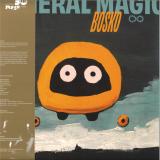
Now, we have General Magic’s second official full length comeback recording, Bosko. The new album is initially notable prior to the needle hitting the wax or the cursor identifying a track due to the artwork. Made by long term collaborator Tina Frank, this is Frank’s first analogue artwork, with a painting of a happy/nervous machine thing hovering in a landscape of no discernible identity. It’s quasi science fiction hovering amongst the potential for fun. Suited to the music? Natürlich.
Bosko sees Bauer and Pieper update and reframe their original investigations with a fresh supply of head scratching, heart racing tunes that hit the inexplicable with a wild mesh of drums, pianos, synthetic voices and all manner of immaterial sonic play. Startling sonics shock the ears on Club Duchamp which sounds like a conversation between synthetic adult ants in an environment still in development. Elfer features vocals supplied by a female-ish voice who, whilst grappling melody, has trouble executing a firm identity. Noorenhalt catapults along a mainframe of syncopation so unwieldy it feels like the voice, which is utterly alien, provides the only comfort. Seite 5 inhabits a fuzzy zone where a synthetic Horn of Jericho type ambience competes with rhythms never quite sure of who they are. Rise of the Ombré raises the spectral dread. Is this Science Fact? Absolutely nothing within Bosko is predictable.
The amount of change in the miasma of existence and the things we touch in order to make things has shifted so exponentially we are at the point where minds are starting to glaze over. All of this makes the return of the always original, always surprising, always fresh and exciting General Magic totally in tune with the artificial intelligent apocalyptic age we currently inhabit. The tools may have changed but the wonderfully warped gaze of Bosko offers a fresh new vision of perplexing funk and robotic punk.
out of Stock
Last delivered 13 months ago available to reorder, subject to availability
"Back in print with a brand new 2024 cut by Carl Saff at Saff Mastering, pressed on striking Transparent GOLD colored vinyl and topped off with a collectible “Footlong” OBI. NPR calls “Angherr Shisspa” a “vital reissue of a punk-prog opus”.
Japan's Koenjihyakkei blend progressive rock, jazz fusion, symphonic rock and neoclassicism with the energy of hardcore punk, the volume of metal and the attitude of rock in opposition.
Tatsuya Yoshida’s (of the renowned bass and drum duo RUINS), progressive rock powerhouse is Area and ELP at their most excessive; Deus Ex Machina with tempo changes multiplied by 100; and Magma at their orff-ian choral, fusion jazz, overcharged gospel peak.
“Angherr Shisspa”, the band’s landmark fourth album explodes with glittery keyboard lines, speedy bass/drum workouts, emotive reed respites, and operatic female vocals that take the listener from sheer exuberance to absolute apocalypse... all performed with superhuman technique in confoundingly catchy, complex arrangements.
“...towers over most modern progressive rock because of an attention to detail and an almost overwhelming force of conviction. No irony here: this rocks with the teeth and heart to cut through scenes and the ""overground"" like a knife."" - PITCHFORK"
out of Stock
Last delivered 13 months ago available to reorder, subject to availability
Russell Haswell and Florian Hecker have both a long history with Mego/Editions Mego. Individual releases have peppered the Mego catalogue since Haswell’s Live Salvage 1997->2000 cd release (MEGO 012) in 2001 and the debut Hecker release IT ISO161975 (MEGO 014) in 1998.
The individual exploration of sonic phenomena by these two practitioners has resulted in both being highly regarded for their uncompromising approach to sound as matter. Russell Haswell and Florian Hecker came together as a collaborative duo with the now-legendary record Blackest Ever Black, somewhat inexplicably, on the classical imprint of Warner Brothers.
In 2025, Hecker and Haswell return with a new album featuring the two-channel edit produced initially for their UPIC DIFFUSION SESSION #23, performed as a live diffusion across 8-channels at the X100 Festival, Berlin, 2023, celebrating the 100th anniversary of Xenakis' birth.
This record furthers the duo's exploration of Xenakis's UPIC system as the sole instrument. The UPIC is a computer music system that generates sound from visual input. The original intention of the system developed by Xenakis was to make a utopian tool for producing new sounds accessible to all, independent of formal training. One can locate footage of Xenakis and a group of children making drawings for the system in the 70's.
The duo set off experimenting with a diverse array of hand-drawn images to feed the UPIC system including news photographs of disasters and atrocities, "food porn" through to depictions of the natural world and microscopic images of molecular structures (including 'the blackest ever black'). The resulting eccentric audio from these images is claimed by the artists to heighten synaesthesia and is as mysterious as it is baffling.
Throughout UPIC DIFFUSION SESSION #23 frequency clusters move and morph in the most unusual manner, shifting and stretching into shapes that hint at some kind of magical process. What starts out deceptively simple soon unravels into a large array of sonic mayhem. Symbolic jet planes are shredded by a swarm of insects, a metal bowl howls into the void, a tiny tin toy crawls into a thicket with the resolute aura of a black hole. A burning geyser of laser forms liquid shrapnel. This is sound as an alchemical process, a constant chimerical flow into the netherworld and is the net result of the decades long radical investigations by the two artists involved. UPIC DIFFUSION SESSION #23 is a direct, rich and rewarding listen for those willing to invest time into the outer limits.
out of Stock
Last delivered 13 months ago available to reorder, subject to availability
Rivet’s new album for Editions Mego is an uplifting and joyous affair coming in the wake of tragedy and disenchantment. It is yet another rebirth from an artist willing to take a step back and reprise the current situation he is in. Mika Hallbäck has a long credible history in the Swedish underground. First recognised for his industrial techno works under the Grovskopa moniker he worked privately on more experimental works that eventually came out as On Feather and Wire, an album released on Editions Mego in 2020. After much acclaim for this bold new direction that blended electronic abstraction, pop and industrial forms into a heavy synthetic trip two tragedies struck. One was the passing of label boss Peter Rehberg and then the passing of his dog Lilo, who was as close as a companion one could have. These events led to the release of the more unsettling follow up L+P-2 (Lilo and Pita minus two) on Midnight Shift Records in 2023. Peck Glamour sees Rivet return to the reawakened Editions Mego with an album of optimism inspired by reconciliation with loss and further explorations of new mental/sonic realms.
Hallbäck defines his approach as not being married to any particular machine, instrument, process or genre. However he holds a particular affinity to sampling, of which, he says, provides the dirt and grit amongst what would otherwise be pristine, generic machine music. The contemporary crate digging method of scouring obscure download music bogs for unique sounds was his preferred research practice.
Peck Glamour is an album full of tracks brimming with the excitement of exploration. It's the results of a mind informed by punk, industrial, techno, dancefloor, disappointment, trauma and rebirth. Here the synthetic and authentic is viewed simply as the same means of human rationale and expression.
The opening, ‘Catch Up to Light’, sets the scene with ecstatic and odd fluorescent vocals sliding amongst crystalline likembe whilst synths swirl amongst the external festivities. ‘Orbiting Empty Cocoon’ is somewhat a homage to the alien sound worlds of The Orb, one which takes the listener deeper into a mind melting array of teased potential as visual elements are executed in a mask of audio wizardry and euphoric staccato rhythms, the later being a nod to Singeli music. ‘Patitur Butcher’ is more dance frontal utilising the Ghatam drum and a YouTube rip of a Chinese language lesson. ‘Plastic Bag Putain’ was made during the beginning of Russia's invasion of Ukraine and should be clear of its intent. ‘All that Heaven Allows’ is a marimba cover of an imaginary Love Parade anthem. 'Kyrie Geire’ potentially briefly fills the void left by the demise of Coil. The entire trip of Peck Glamour is sewn up with ‘We left before we came’ whereby extraneous recordings of double bass player Gregory Vartian-Foss (tuning/strumming/moving the bass) are superimposed with local field recordings to create a gorgeous bed of sounds acting as an exciting exit music to this sharp collection of cinematic ear excursions.
out of Stock
Last delivered 13 months ago available to reorder, subject to availability
A Different Kind Of Pain is the fourth studio album by Jacksonville-based rock band Cold, which was originally released in 2005. It was recorded with award-winning producer Michael Baskette, who also worked with Alter Bridge, Limp Bizkit, and Slash among many others. The album further explored the band’s melodic and less aggressive sound that they first initiated with the predecessor Year Of The Spider. However, Cold proved that heaviness isn’t a requirement for the band to be effective and successful.
The album spawned two singles, “Happens All The Time” and the title track, but also included the additional standout tracks “When Heaven’s Not Far Away” and “Back Home”. Shortly after the release, the band went on a hiatus for three years. A Different Kind Of Pain is available as a limited edition of 1000 individually numbered copies on silver coloured vinyl it includes an insert and the sleeve has a linen laminate finish.
out of Stock
Last delivered 8 months ago available to reorder, subject to availability
Pascal Garnier aka Krewcial is back on Local Talk, this time with a raw 4-track 12" EP dripping with that deep basement, 90's New Jersey House sound we all love.
Combining all four tracks, you'll hear the Kerri Chandler inspiration shining strong throughout the EP.
All the key references are there, bumping (not pumping) 4/4 beats, killer basslines, dark chords, deep strings, and a big slice of electronic funk
Music for basements and house dancers!
out of Stock
Last delivered 13 months ago available to reorder, subject to availability
Amoul Bayi Records continues its mission of discovering and showcasing West African artists. After introducing talents such as Daba Makourejah and Saah Karim, the Dakar-based label returns with a new release from one of the most soulful
voices in Gambian reggae: Royal Philosopher.
"Thank You Jah" is a song of gratitude, carried by the emotive and distinctive voice of Royal Philosopher. With humility, he expresses his thankfulness for the talent he has received, the path he has walked, and the strength that has guided him along the way.
Built on a dynamic Digi Roots riddim produced by Yared and mixed by Rootical45, the track provides the perfect space for his voice to shine. The refrain – “Thank you Jah for giving I talent” – echoes like a personal prayer and a universal message, able to resonate beyond belief systems.
Royal Philosopher is a Gambian singer whose powerful and precious voice is shaped by spirituality, African heritage, and musical commitment.
Born in Banjul, he first discovered his vocal gift in a church choir, where he developed a heartfelt and sincere expression. He fell in love with reggae through the voice of Garnett Silk, whose intensity and devotion deeply influenced his path. He began his journey with the group The Royal Family, before pursuing a solo career, releasing music with consistency and authenticity.
Today, he presents "Thank You Jah", a single produced by Amoul Bayi Records, imbued with gratitude and faith, true to his artistic vision: sincere, elevated, and deeply connected.
Designed both for turntables and streaming platforms, the single will be released in digital format and on 7" vinyl. The artwork is by renowned Senegalese graffiti artist King Mow.
out of Stock
Last delivered 13 months ago available to reorder, subject to availability