For VENT’s 19th release, Tolga Baklacioglu has collaborated with Ezgi Irem Mutlu and received remix support from both Julia Govor and Anastasia Kristensen, which has resulted in a rich and diverse EP that is full of currents and counter currents - drawing on each contributor’s vision and interpretation of the themes created by Tolga and Ezgi. The two have previously collaborated, and it is perhaps this that has allowed both artists to stretch the limits of their own personal expressions whilst remaining in touch and correspondence with the other. Tolga’s vortexes and knots of rhythms and textures are as disorienting and entrancing, as Ezgi’s diverse and intuitive range of vocalistic expression is mysterious yet straightforward. Julia Govor’s remix masterfully opens up the original mix of “Repentless” into a dramatic vista propelled forward by pulses of momentum coming from the bassline, while Anastasia Kristensen’s “Bir Vars” remix focuses on the suggestive elements of Ezgi’s vocals and reconfigures the dreamy and paradoxical original track into a dark and intense new experience. As a digital bonus track, Tolga and Ezgi offer a third collaboration, “A Very Slow Goodbye”, which together with “Repentless” and “Bir Vars” forms a triad of quizzical and dreamy tracks. It sits nicely between the two tracks and functions as a key to understanding the other two as the respective explorations of the outermost ends of the creators’ joint spectrum of collaboration.
quête:para x
What are the best non-physical landfills for discarded thought? Do waves transition between naturally occurring substrates and audio signals? Does adrenal fatigue and replenishment in the human brain relate to cycles of euphoria and dysphoria in music? What is the mental effect of visual versus aural repetition? Is all music fictional? Can the language of objects and memories impregnate sound? Are bodies out of fashion? What is the music production equivalent to a green screen in film? What is the best non-physical preservation method for sound? Is film editing a way of ordering memories? Is repetition therapeutic? Are all films fictional? Have physical forms slipped into obsolescence? Did Erik Satie have an anxiety disorder? Is background music parasympathetic? Are physical players more virtuosic than virtual instruments? Is thought finite? Is physical music a fetish? Is reality fictional? What is the most elegant way to float between corporeal and ethereal forms? Do memories deteriorate and fade like audio signals exposed to the elements? Can thought exist without the body?
Previously released on CD accompanied by “Gone, Gone Beyond”, “The Mirror” is the
dreamy soundtrack of an a/v project from collage artist extraordinaire Vicki Bennett aka
People Like Us.
With ‘’The Mirror’’ Bennett continues her eternal disassembling of popular music by
exploring how the narrative of familiar sounds/songs can change dramatically under a
new context, with that context always changing, in a never-ending flow.
Each song is singular. And each song is a collage of and undefined number of other
songs from other artists. It sounds familiar because that has been the modus operandi of
People Like Us since the early 1990s. But “The Mirror” plays with the notion of familiar,
driving around a collection of famous pop songs/artists, messing around with the memory
of the listener and, of course, his unique comprehension of those specific songs applied
in a new context.
Because of the use of familiar pop sounds, “The Mirror” is often grandiose. Like an epic
film only with highs, never letting the listener down or letting him doubt the power of pop.
Even, of course, when the coordinates are twisted, mixed, over or underrepresented.
Each moment feels like something that could only happen in a parallel universe.
Although that may sound naïve, it’s just a lost thought of reaction to the beautiful collages
of People Like Us in “The Mirror”. This mirror doesn’t reflect an image of ourselves or an
image of pop. But an image on the way memories drift and are being constant rebuilt. An
unfinished collage.
Mastered by Mark Gergis
Vinyl Cut by Rashad Becker
Director Amanda Kramer’s prompts for composer Ben Babbitt’s soundtrack to her enigmatic film Paris Window read like magnetic fridge poetry – “warped ambient bumper muzak tension” – but the results skew closer to some hypnagogic contemporary noir: lulling, low-lit, and laced with lingering dread. Electronics, strings, and percussion swoon and seethe in heady mirages of dreams and delirium, romance and menace. The narrative it accompanies is equally opaque and out of time: two eccentric siblings psychologically unravel through divergent fixations, one obsessed with the hypnotic infomercials of a mysterious self-help institute while the other falls in love with an ambiguous doppelganger.
Babbitt’s background scoring experiential video games (Kentucky Route Zero) and collaborating with exploratory songwriters (Angel Olsen, Weyes Blood, Eartheater) is evident in his versatility and finesse, flowing fluidly between minimal and maximal modes. Like all dynamic film music, the pieces weave a story of their own. Serene synthetic swells decay into murmuring television static and eerie vocal fragments; close-mic’d drones turn acidic then claustrophobic, mirroring sleep paralysis transformed into panic. Babbitt builds a window into a surreal world, seen through shadows and smeared, street-lit glass.
- A1: Deus Ex Machina
- A2: (Give Me) Paralizer
- A3: Mockba
- A4: Lasergunn
- A5: Body Snatcher
- B1: Kill The Light
- B2: Packman
- B3: Process & Reality
- B4: Sarcofague
- B5: Ritual Dance Movements
- C1: Dance The Algorhythm (Special Club Mix)
- C2: Algorythm (Orchestral Mix)
- C3: Algorhythm (Cocktail Mix)
- C4: Algorhythm (Razormaid Mix)
- D1: Fatal Erection (New Version)
- D2: Scanners (New Version)
- D3: Pas De Deux
- D4: Attenzione Prego!
- D5: Sequence Your Body
- D6: Cradle-Song
The Force Dimension was formed in the late 80’s by René Van Dijck and Tycho de Groot. After some demos and appearances on compilations, the band signed a contract with the Belgian label KK Records. Their self-titled debut was released in 1989 curiously on two different versions, one produced by Luc Van Acker (Revolting Cocks) and the other co-produced by Dirk Ivens (Klinik, Dive). The duo continued developing a very unique sound mixing EBM, industrial and different electronic influences. In 1990 they finished what is considered their definitive work, “Deus Ex Machina”, followed by the mega club-hit “Algorythm”. The band released another single next year, “New Funk”, and after a couple of compilations stopped to work together in 1997. During the next years there were some failed attempts to reunite but it wasn’t until 2013 when The Force Dimension was resurrected by René Van Dijck.
“Deus Ex Machina” is being now re-released on an expanded edition with all original tracks plus some bonus including remixes of “Algorythm”, some rare tracks from old compilations and new versions of the unreleased songs “Fatal Erection” and “Scanners”. Limited edition of 500 copies on double vinyl and gatefold sleeve.
- A1: How Do You Like My New Dog_ (2019 Remaster)
- A2: Kaltes Klares Wasser (2019 Remaster)
- A3: Geh Duschen (2019 Remaster)
- A4: Zarah (2019 Remaster)
- A5: Pernod (2019 Remaster)
- B1: Your Turn To Run (2019 Remaster)
- B2: Thrash Me (2019 Remaster)
- B3: You You (2019 Remaster)
- B4: Kampfen Und Siegen (2019 Remaster)
- B5: Dabo (2019 Remaster)
- C1: Geld - Money (2019 Remaster)
- C2: Leidenschaft - Passion (2019 Remaster)
- C3: Eifersucht - Jealousy (2019 Remaster)
- C4: Einsam - Lonesome (2019 Remaster)
- C5: Macht - Power (2019 Remaster)
- D1: Tod - Death (2019 Remaster)
- D2: Mensch (2019 Remaster)
- D3: Slave (2019 Remaster)
- D4: Traum - Dream (2019 Remaster)
- D5: Gewissen (2019 Remaster)
2x12" Repress
January 1981 found Gudrun Gut and Bettina Koster in Christopher Franke’s Berlin-Spandau Studio recording their first Malaria! EP (Zensor Records). Christine Hahn of The Static with Glenn Branca and Barbara Ess, joined in from New York, and Manon P. Duursma fresh from Nina Hagen’s O.U.T. project and Susanne Kuhnke completed the Line-Up.
Malaria! started touring intensively soon after the release of their 12”, commencing with a concert with New Order at Brussel’s Ancienne Belgique, and going on from there to concerts with Siouxsie and the Banshees, Birthday Party, The Slits, The AuPairs, Raincoats, Nina Hagen, John Cale, Einstuerzende Neubauten. They played venues as diverse as the Mudd Club, Peppermint Lounge and Studio 54 in New York, the Documenta in Kassel, the Bat Cave in London, Les Bains Douche in Paris, Milky Way and Paradiso in Amsterdam, ICA in London, the Piazza Santa Maria Novella in Florence and Markthalle in Hamburg and naturally, again and again, at the SO36 in Berlin.
While touring, Malaria! used their time off to record in Studios in New York, London, Brussels, New Orleans, and in Berlin (How Do You Like My New Dog? 7”, Weisses Wasser 12”, New York Passage 12”, Revisited MC, Emotion Album). At the BBC studios in London Maida Vale Malaria recorded an Kit Jensen and a John Peel Session.
Malaria! took a break in 1984 - Bettina and Christine re-located to New York, and Gudrun and Manon stayed in Berlin to form, with Beate Bartel, Matador, but not before they recorded their Mini-Album, Beat the Distance. 1992 Gudrun, Bettina, Christine, and Manon met up in New Orleans with Jim Thirlwell (Foetus) to record Elation 12”. Elation was followed by Cheerio, Album, which again was recorded in Berlin.
Chicks on Speed did their own version of Malaria’s song, Kaltes Klares Wasser in 2001, and the Remix went into the German Top 10.
Malaria has been an instrumental part of Berlin Music History, as recently presented at the „Zurück zum Beton“ at Düsseldorf’s Kunstakademie, Kunsthalle Wien „Punk!“, „Geniale Dilletanten“ Goethe Institut, and in B-Movie.
BIBA KOPF 2019
The theme song for that great German road movie yet to be made, Malaria!’s 1981 single “How Do You Like My New Dog?” etched the E into the motion music of their soon-come debut album Emotion with its trail-out line “Immer vorwärts, nie zurück...”. Always forward, never back: from West Berlin to London, Paris, New York and Tokyo... from here, there and everywhere to eternity, the Autobahn goes on forever, with Malaria! at the wheel, spinning new moves from timelines crossed in records and songs right on the money evoking Zarah Leander, fighting the power, staring down Death, and a whole lot more. In all, one merry hell of a ride, and on the evidence of Compiled 2.0, it’s not over yet.
MARK REEDER 2019
"Even today, their originality in everything from sound to style, has proven just how relevant Malaria! are. In my opinion, their music has stood the test of time. To me, Emotion sounds as good today as it did when it was first released and it was a pleasure to revisit it. They might not have had any zillion selling albums, and their image might have been copied, while their sound could never be. They remain exclusively unique and their influence and legacy will reach far into the future. This band is both an inspiration and a statement and they prove what five very creative girls can achieve, if given the right support to allow them to evolve, and it is exactly that, which has made Malaria! Germany’s most successful and renowned, all-girl band...“
DIEDRICH DIEDERICHSEN 1991
"...Malaria! put across so many clear, manifest, attractive, certain, muscular, and harsh symbols, just as they refused - defying the customs intrinsic to these symbols and the worlds in which they circulate - to weave all these things into a readable, reproducible and manageable, generic text..."
Kompakt welcomes veteran contemporary experimental producer Marcus Schmickler with the release of his spectacular noise/techno fused medallion entitled “Particle/Matter-Wave/Energy”. Marcus Schmickler’s fifty plus release discography is one of the most fascinating in his field. From his studies under Cologne based Stockhausen collaborator Johannes Fritsch to his releases through legendary imprints a-Musik, editionsMego and Mille Plateaux, over the years Schmickler has been behind innumerable collaborations and sonic explorations. Be it through his ground-breaking indie/electronic band Pluramon or through his releases that have included collaborations with musicians such as John Tilbury, Thomas Lehn, Julee Cruise or MIMEO he has even had his works being performed by ensemble recherche, musikFabrik or Paragon Ensemble. Beyond continuing to perform on the world stages, he authors theatre and film and currently teaches at Institut für Musik und Medien in Dusseldorf. This brings us to the release of "Particle/Matter-Wave/Energy" - a 37 minute long piece (split into 2 parts on the LP version) that explores the borders of a scientific universality of sonification towards something that becomes a singular experience – sound. The pieces’ foundational aim was to create an acoustic rendering of what it sounds like when two galaxies collide by gravitational forces. To avoid this one sheet getting lost in theory, the audible result of “Particle/Matter-Wave/Energy” is an incredibly, immersive work that is required listening from start to end. Contemporary experimental music and modern techno collide as waves of synths caress the listener through intense waves of frequency variables. The orchestral enormity of the piece is both discomforting yet embracing as the listener feels engulfed with it’s robotic caress.
Private press, Calypso/deep funk monster, originally recorded & released in 1970's Nassau, in the Bahamas. Replica original artwork, cut loud & proud on 7″. 300 copies only. The second release on Gary Johnson's Pressure Makes Diamonds imprint, following on from Azwon's 'Paradise Island'.
We are honored to release the debut album from Violet, the alias of Inês Borges Coutinho, Lisbon born and raised DJ, producer boss of Naive records, co-founder of Rádio Quântica, and mina resident. Violet began producing music in 2012 and has released music on One Eyed Jacks, Love on the Rocks, Paraíso and Naive. Inês uses her seemingly boundless energy to amplify other artists all the while progressing her own creative practice.
‘Bed of Roses’ contains 10 songs made as a sort of childhood-teenage memories diary, a return to things Inês liked then and also the difficult things she’s been through. The feeling behind the album is self forgiveness in an optimistic way but also in an adult way, aware of the bruises (thorns) but also of the invaluable love and life experiences (roses). The title comes from the Bon Jovi song that Inês loved as a 9-year old and doubles as an intent of positivity paired with the inescapable darkness of life. Inês says, “I wrote this music as a healing device that I hope can somehow help heal others too.” All songs have been mastered by George Horn at Fantasy Studios. The jacket features an original design by Eloise Leigh that incorporates themes of self-inspection and hope mixing a teen bedroom girly vintage scrapbook aesthetic with contemporary 3D mapping techniques. Each LP contains a postcard featuring a childhood photo of Inês with notes.
Fleeing her Soviet ruled home of Tbisili at a young age with her parents, Saze grew up as a nomad living in Russia, France, Canada and the USA before finally settling down and pursuing a career in NYC. A classically trained musician and dancer, before long the Georgian turned her back on corporate life to pour her heart and soul into the arts. Becoming a diligent and versatile electronic music producer, DJ and live act, Sophia Saze is as comfortable sculpting intricate and atmospheric productions in the studio as she is decimating dancefloors with robust Techno and frenetic Breaks. Reflecting on her turbulent life and how it’s formed her own identity, Saze composed her aptly titled debut album, ‘Self’. Released on cassette in two instalments, ‘Part I’ dropped in June and was critically acclaimed with support from the likes of BBC 6MUSIC’s Tom Ravenscroft, Mixmag, DJ Mag, XLR8R, Resident Advisor, Future Music, Attack Magazine, TRAX, Tsugi, Ransom Note and Groove Magazine, with the latter drawing a parallel between hers and Burial’s music. Completing the journey, ‘Part II’ meanders through genres like Ambient, Hip Hop and Breaks, and features very personal insights including handpicked samples from Soviet television shows and VHS cassette recordings from her childhood. Hidden allusions of her classical music education bring up distant memories and melt together the organic but thoroughly electronic ambience. Crackles, hushes and hisses are elaborated so well that the record virtually gushes over the ears like mountain torrents. It appears peaceful and quiet, then rousing and it is sparked with bewildering sounds. It lets scattered beats arise from the thicket and drown again in streams of noise. But
After inaugurating the label with a tape in 2015, our local friend Richard Brown (AKA Brown Irvin) returns to Motion Ward with an oblique two-track 12" entitled "Run Me That Soul". "Locution" flexes a wobbly equilibrium of dubbed dancefloor energy and amorphous acid while "Overcast" coats the B Side in a smeared gradient of ambient wash and shape-shifting stasis. A persuasive pair of parallel worlds for winding up and winding down.
rRoxymore's long-anticipated debut album, Face To Phase, was born of her annual creative hibernation practice. Whereas her previous appearances for Don't Be Afraid - Thoughts Of An Introvert, Parts 1 & 2 - revealed inner worlds of saturated colour and natural expressiveness, she retreated into her studio at the turn of winter 2018 occupied with the idea of dismantling the dancefloor-centric pressure paradigm.
The resulting album, Face to Phase, finds rRoxymore methodically and mindfully stripping back to fundamentals: rumbling minimalist dub, sparse polymetric drums, boldy unpredictable melodic narratives and subtleties which hover out-of-reach or disappear into vapour. Forged by the spirit of club music cultures, Face To Phase favours deep listening; resisting the temptation to reflect on the past or project towards the future, it's an album that is firmly rooted in the contemporary.
Sparked by her own archive of field recordings, and produced primarily but not exclusively in the box, Face To Phase adds several facets to rRoxymore's already wide repertoire. The pensive and beatless opener "Home Is Where The Music Is" was inspired by her longtime friend Planningtorock, while "Forward Flamingo" is a spiraling dream-state of house music dissociation; elsewhere "Energy Points" remains anchored to the ocean floor, radiating heavy dub waves, "Passages" is a ghoulish skeleton of UK break beats, "What's The Plan" closes the album in a blissfully blunted fashion, while twisting, shape-shifting rhythms push and pulse "PPS21" into series of ever-evolving shapes and forms.
Through and in between the eight songs of Face To Phase, rRoxymore fortifies her status as a seasoned artist, grounded by over a decade of live performance and touring, collaboration, composition and experimentation. With a new live performance collaboration with a percussionist set to debut the LP at Atonal on 1st September, rRoxymore is primed to expand her reputation even further as one of the most vital and distinctive artists on the fringes of contemporary club culture.
The original freaks SES are back for another mind melting EP called “Saboteur”.
Completely tuned for a sweaty underground club system, the kicks in ‘Sounds Like’ hit deeper then your typical sound-boy bass lines of 2019.
Europa is on some dystopian Kraftwerk transeuropean express tip with all the attitude you’d hope to squeeze into four and a half minutes.
Hijacker kicks off the B side with continuing paranoid themes of the SES back catalog.
Flesh Tone simply jacks you in half and makes you throw shapes like it’s 1989. Only in Hi Def.
- all tracks blend with each other flawlessly, so buy two copies why don’t you.
The title Ghost Frequency works on several levels. I was introduced to the term when I first began learning about recording techniques. It was used (usually negatively) to describe sounds that appeared on recordings due to signal interactions that resulted from “improper” mixing or recording and read as “noise” rather than the “music” that was being recorded. I became instantly fascinated with the phenomenon and intentionally creating these sounds in my recordings by deliberately using supposedly incorrect techniques has become a big part of my composing and recording process, probably the most central and consistent practice of it. I’m interested in how the presence of these sounds, and traditional production’s insistence on eradicating relates to larger ideas about the eradication of vital social practices relating to the dead such as ancestor worship, mediumship and history itself in favor of state and market dictated modes of understanding existence. The internet abounds with references to the the term, but applied to ultra low frequency or “infrasound” which can allegedly be responsible for inducing supernatural perception experiences. These posts from the margins posit a Ghost Frequency that operates on the same level as a radio station, one can simply tune into paranormal activity. It’s also a pun on an imaginary metric of how frequently ghosts might be around at any given moment. The songs on the EP employ (as does all of my music) a large amount of Ghost Frequencies (i.e. sounds that appear on the recording as the result of signal interactions rather than those sounds being performed on an instrument) and they also orient themselves toward interaction with the dead as a necessary component of human experience, and a mode of resistance to state power and it’s accompanying carceral technologies.
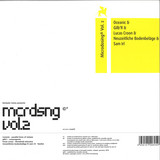
Microdosing is a series of compilation 12”s selected by Julienne Dessagne aka Fantastic Twins, and designed in collaboration with French visual artist Geff Pellet. Microdosing is a collective experiment aimed at helping you fighting back your modern obsession with happiness. You may deserve a nice day but the day does not need a nice you, nothing should be forced, everything is permitted. Microdosing will provide you with sonic healing weapons on regular basis and at irregular dosage. Those doses will favour psychedelic social techniques against self help tyranny, creation over soma, provoking over numbing, our outer-selves over our inner-selves. Microdosing refuses the fatality of the pleasure principle. Life is a struggle, time to embrace it. —— "My battery is low and it’s getting dark” We at Microdosing will make Opportunity’s famous last words fully ours. Some would see these as an epitaph on a black screen, we embrace them as a reclaimed fragility. Are we grains of sand wandering in space, hoping for a goal? No. We are the cosmos, the cosmos is us, unafraid of the end, unafraid of the void. Before the rise of the infinite silence, Microdosing brings you new guiding lights, white sun or black hole being a simple permutation of the kinetic rainbow. Oceanic’s “Parallel Lines Of Stripes” is a meandering mantra, an synthesised Moebius ring, a mission to your heart, that furthest star in the sky. Gilb’R’s “Cosmogonie” simply reminds us of the profound relation between spatial systems and the holy act of birth (cosmo, world and gon, conceive). The universe is a body, your body is your universe. Lucas Croon’s “Threshold Stimulus” is the soundtrack of a never ending voyage, the man is on a trip to the core sanctum. Imagine Space as a reverberation room cladded with bakelite. Losing yourself in delay repeats sometimes is the shortest way. Neuzeitliche Bodenbeläge & Sam Irl’s “Faeden” is another hymn to the umbilical chords joining us to the outer world, a black monolith of kraut acid, a pagan dance as portal to a destination only you can choose. Microdosing will be back soon with more enablers, helping to turn your petty struggles into a search for a meaning of life. The Quest lives on.
Razen celebrate their 10 yr anniversary with “Ayîk Adhîsta Adhîsta Ayîk”, an album that takes a paragraph from CG Jung’s Memories, Dreams, Reflections as a reference point to set off a journey that goes from light to dark, from day to night, from life to death, and back.
As much a reflection of primal imagery and rituals of knowledge as a way of coming to terms with anxieties about the chaos of the night, the album concerns itself with the question: who - or what - are we in the moments before (re-)birth, before waking up, in the state inbetween darkness and light?
On “Ayîk Adhîsta Adhîsta Ayîk”, the wind instruments and organ stabs of band leaders Kim Delcour and Brecht Ameel are expanded with Pieter Lenaerts’ five string double bass and sarangi, Jean-Philippe Poncin’s bass clarinet and chalumeau, and Paul Garriau’s hurdy gurdy.
The album sees the group explore new straight-to-the-gut emotional territory, while simultaneously showcasing Razen’s intuitive, continuous investigation of the acoustic properties and resonant possibilities of churches and chapels in the countryside around Brussels; after “Remote Hologram” (2014) and “ The Xvoto Reels” (2017), this time the St Agatha Church (St.-Agatha-Berchem) functions as the conduit for Razen’s acoustic sound jolts.
With the past ten years entirely devoted to the search for archetypical timbres and connotations by improvising on Early Music instruments, it’s no wonder that the world of Razen would one day collide with the world of CG Jung and take his writing as an inspiration.
A sonic hex tour de force from this unique ensemble, “Ayîk Adhîsta Adhîsta Ayîk” is a present-day, nocturnal emitter of the Coleridge quote that opens Jung’s Memories:
‘He looked at his own soul with a Telescope. What seemed all irregular he saw and shewed to be beautiful Constellations and he added to the Consciousness hidden worlds within worlds’.
- A1: Strictly A Vibe Thing
- A2: Nostalgia
- A3: Just A Matter Of Time
- A4: Feel Good Factor
- B1: Concrete Jungle
- B2: Props
- B3: Free Spirit
- B4: There For Me
- C1: For Your Love
- C2: Until You Come Back To Me
- C3: Together
- C4: Paradise
- D1: Higher Ground
- D2: Until You Come Back To Me
- D3: Down To Business
- D4: Just A Matter Of Time
Twenty years ago the duo HIL ST SOUL released a groundbreaking debut album SOUL ORGANIC.
Zambian-born vocalist Hilary Mwelwa and producer/musician/songwriter Victor
Redwood-Sawyerr (VRS) had been working away in a North London studio creating a unique blend of neo soul, jazz and R&B that had critics on both sides of the Atlantic in raptures.
Billboard magazine enthused: “Brimming with R&B/hip-hop/jazz-flavoured rhythms and image-rich
lyrics….Even Aretha’s Until You Come Back To Me glows again under Hil’s touch”.
And talking about the lead single Strictly A Vibe Thang, US magazine Radio & Records were
smitten: “You can’t sit still on this one. While listening to this infectious tune you got to move something – even if it’s just your big toe!” In the UK Echoes magazine called it “one of the best UK soul albums ever”.
Strictly A Vibe Thang charted on the Billboard R&B Singles chart, following in the footsteps of Loose Ends, Soul II Soul and Brand New Heavies, while Hil’s acoustic take on the Stevie Wonder-composed Until You Come Back To Me came out of nowhere to be a sensation at America’s Smooth Jazz radio format It ended 2000 as the most-played vocal track of the year across US Smooth Jazz radio stations, and in the ensuing two decades it has been the most-downloaded - and one of the most-streamed - tracks on the Dome label. Also heavily played: the joyful mid-tempo groove of For Your Love
This 20th Anniversary Edition of the album – now in a gatefold sleeve – includes three bonus tracks not included on the original vinyl release: the acoustic version of Until You Come Back
To Me, the VRS Remix of Just A Matter Of Time, with its insidious groove, and Down To Business.
Hil is still very active, playing several UK shows this autumn, including one at London’s Jazz Café, where she first performed 20 years ago.
Dance floor ready remixes of selected tracks from Kornél Kovács' Stockholm Marathon album.
Robert Dietz sending Rocks on a trance trip, D. Tiffany getting all deep & bubbbly with Purple
Skies. Paradise Alley perform their sing-along cover version of Marathon, Butch butchers Baltzar
Back in stock!
Extracting a rich sense of emotion from an evolving analogue set-up, Hammer follows up his previous FMB outings Dahlia and C-Space with a similar tone and sound palette as he lays out a new EP with 3 tracks that capture the Feel My Bicep sound perfectly, striking the balance between delicate melody and power with aplomb. This EP follows what has been a heavy 2019 gig schedule, with stand out sets at many top festivals and clubs such as Glastonbury, Panorama Bar and Parklife, along with both an Australian and Indian tour under his belt. The lead track ‘Parabola’ manifested as a slow burning percussive experiment that, as Hammer explains, ‘quickly got fired up by an extra 10bpm for the dance floor effect, turning itself into an acid led epic’ and as a consequence accidentally becoming the A1 at the same time. ‘Parabola’ is followed by ‘Panoptic’ and ‘Entropy’; all three track names inspired by his recent love for physics podcasts. He describes how ‘they are based around types of curvatures and levels of order that, in my head, are the visualisation of the 3 tracks inside workings; the engine room of the time machine.’ All three tracks were created with Hammer’s much loved Yamaha CS1-X, ‘a spaceship in its own right’, he explains. ‘A Xoxbox and a Roland SH-2 did the rest of the hard work. Time to enter the twilight zone with this one’! Bicep continue to add substance to what has now become a distinctive and singular label with this new 12" courtesy of their long term friend and blog contributor Hammer. With their previous offering from James Shinra still in many roving record bags and with a release catalogue full until the end of the year, the development of the label has reached a certain zenith and here - as head strong and highly effective as ever - Hammer makes a welcome return to the label with another batch of machine-driven dance tracks.After 12 years of promoting parties in Glasgow, The Hammer Hits goes on tour inviting guests such as Sally C, Jennifer Cardini and fellow FMB signee Cromby across the UK, Ireland and Berlin.