The lovely, longing ‘I Still Think About You’ was a regular highlight of the band’s earliest live sets and was one of the first songs they wrote together. “We wrote it three years ago, before we had released any music,” explains the band’s Ben Easton. “It had a certain youthful optimism that we loved, but after a few road tests we decided to shelve it. However, we knew that there was still something in it, so we brought it back earlier this year and we’re chuffed with the result.” “We wanted to capture the purity of wanting to see someone again, hoping they appear around the corner, or in your local park or pub, without any form of doubt that creeps into one’s mind as we grow older,” adds singer Dottie. “We enjoyed exploring and challenging ourselves to achieve a softer and uplifting narrative – it’s possibly the most joyful thing we’ve ever written.” On the flip side, the ‘No Ordinary Love’ reframes the slick R&B of the original as a dark and delicious dreampop / trip-hop crossover. “The original was pretty much on repeat during our tour late last year and we thought it’d be an interesting thing to try,” explains the band’s Ben Easton of the decision to cover the song. “It’s a good representation of where we’re going, sonically, and it was also our first recording experience with Harry Catchpole on drums and so we particularly focused on what he brings to the table. We experimented with different snares, mics and other effects to create our own kind of drum sample which is something that feels important to the deary sound going forward.”
Vines, the solo project of New York-based multi-instrumentalist and composer Cassie Wieland, offers a window into her inner world through expansive swaths of sound. She pieces together a celestial mix of synths, percussion, strings, and vocoded voice, making music that is at once deeply personal and cinematic in scope. This diaristic approach first took shape with her 2023 EP Birthday Party, and is crystallized on her debut LP, I’ll be here. With the sweeping and vulnerable I’ll be here, Vines arrives fully formed as an artist who crafts deeply resonant and open music–the kind that invites listeners in to listen, reflect, and share in the journey of learning through living.
“It was through making music that I was able to meet myself,” Wieland said. “Anything I’m going through or feeling is something that somebody else out there can relate to, and that’s really special to me.”
I’ll be here is both a culmination of years spent creating gossamer soundscapes and an opening to a new journey for Wieland as an artist. The album grew out of her years as a composer and songwriter, and builds on the language she developed on Birthday Party, which transformed the tumultuous feelings of the passing of time into minimalist meditations. It was just a start, though–a prologue, a development of the kind of language and ideas she wanted to express. With I’ll be here, she digs deeper and writes music that feels more sprawling, further solidifying her singular voice.
Wieland’s musical composition process is similar to journaling, lending itself to the music’s honesty. When she writes, she makes room for all the ideas she has; in these sessions, there are no wrong ideas, and she allows the music to be attuned to the experiences she’s having at the time. With I’ll be here, Wieland zeroes in on themes of anxiety, loneliness, navigating human connection, and having to grow up from a young age, ultimately coming to a place of acceptance. And though it began as a journal written in solitude, her collaborators shape the music with her.
Working with friends, in fact, was a crucial part of bringing the record to life. “Everything that was supposed to happen came together so easily because of the people involved,” Wieland said. I’ll be here was co-produced and recorded with Wieland’s longtime collaborator Mike Tierney, a four time Grammy-nominated engineer who has worked with artists across the contemporary classical and experimental scene like minimalist pioneer Steve Reich, LA’s preeminent classical ensemble Wild Up, and various bands on Bang on a Can’s Cantaloupe Music label. Percussionist and composer Adam Holmes and violinist Adrianne Munden-Dixon are two other longtime collaborators who are frequent fixtures of her live show. Holmes plays synths, drums, and banjo; in live settings, his kit is loaded with elements of the songs that are then triggered by MIDI, making the music an interactive, evolving experience. The album’s gentle, filamented edges are colored by Munden-Dixon, whose poignant string melodies elevate Wieland’s introspective compositions, as well as cellist Helen Newby, saxophonists Julian Velasco and Jordan Lulloff, and bassist Pat Swoboda.
Wieland takes an economic approach to writing music, building the swirling and immersive landscapes of Vines through short melodies, lyrics, and phrases. As each element layers and interweaves, they grow into sprawling webs of ghostly sound. Prior to Vines, Wieland composed pieces for other people to play using a minimalist’s sensibility, writing slowly unfolding melodies for instruments like violin and saxophone. In recent years, she sharpened her solo style across a variety of singles and covers which have garnered significant attention on social media for their emotional resonance (“being loved isn't the same as being understood” in particular went massively viral on TikTok in 2024). Birthday Party, her debut as Vines, brought her writing to a much more intimate space, centering on her vocoded voice cloaked in feathery reverb. A series of recent singles, meanwhile, including “I am my home,” showcase the way that Wieland’s music is born from the story of her innermost feelings, extending far beyond just the self.
Though Wieland’s music often deals with dark themes, it unfolds with tender melancholy, the kind that feels like a warm embrace. On “Evicted,” Wieland wonders if she’s getting sick or moving on, if she’s lost or found. Her vocals expand with each lyrical repetition, as the instrumentals slowly encircle and the music’s rhythm grows and bursts into a heart-wrenching, yet radiant wave reminiscent of post-rock bands like Explosions in the Sky. “Tired” follows a similar trajectory, building from a looping, melancholy rhythm and floating lyrics into a solemn resignation. Elsewhere, Wieland takes a more ruminative approach: “Omw” begins with twinkling piano and melancholy strings that gradually transform into an undulating mass. It is a song born out of the warm feeling of reminiscence, the slight return of hope that comes with nostalgia.
With any searching journey, there is also a point of understanding. The title track closes the album with the freedom of acceptance. A marching drum beats steadily beneath Wieland’s open vocals, moving forward, ever onward as it flies into the ether. In Wieland’s delicately textured music, there is room to come into yourself, and learn to love whomever that is. I’ll be here is a special space that can be all your own, one in which to feel what needs to be felt. “This is music for your story,” Wieland said. “I want you to use it how you need it.”
Tough Love brings to vinyl for the first time April Magazine's Sunday Music For An Overpass, a nine track collection originally issued on cassette in vanishingly small number by Paisley Shirt in 2021. The kind of mythical recording you might have once needed to know the band to own. Alas, no longer... Can the universe have two centres? Because if it's not Gothenburg it's San Francisco... It's impossible for me to think about what's going on in that particular part of the west coast right now without immediately being drawn to April Magazine, a comparatively loosely assembled three (sometimes four) piece centred around artist/musician Peter Hurley, who seem to simultaneously operate at both the heart and the margins of the current Bay Area underground. On the one hand they share members with many other bands, their guitarist/singer runs a gallery that functions as some kind of focal point/social space, and Cindy even have a song named after them. On the other hand, their music is resolutely lo-fi and invariably couched in a mysterious haze, the live footage available online seems to suggest that they sound slightly different each time they play, and there are reports they have dozens of songs (possibly albums?) that have not and may never be released, hidden inside their own private universe. On its initial release, Sunday Music For An Overpass was an early attempt to drag the group a little closer into the light, yet inevitably made them feel as endearingly enigmatic as ever. Typically, this vinyl reissue some four years later only goes part way in clearing that alluring fog. April Magazine channel the greats - Spacemen 3, The Pastels, early B&S, Mary Chain, Rainy Day/Opal/Mazzy et al - but submerge their obvious melodic capabilities within seemingly infinite spray can hiss, as if the songs are being pulled backwards through some vortex to the past. Half of these tracks are instrumentals, and it's in those moments that the band are perhaps at their most expressive, suggesting a very inviting melancholy that can't quite be figured out. Though the LP remasters the original recordings and is a little cleaner sounding as a result, no secret is being given away. The appeal is that the more you hear from them, the less you really know, and all the better for it. Maybe, then, it's that April Magazine are here to show there is no centre to the universe, that instead it's always just off to the side...
After roughly 15 years out of the game, Marc Kushin makes a highly anticipated return with his Ely Muff project - a label favourite since its inception - debuting proper on Love Love with 4 tracker 'Human Nature'. Kushin's proto-tekno take on the early breakcore sound was a stand-out of a particularly noisy strain of hardcore which emerged in the UK in the late 90s and early 00s, releasing on the likes of Headfuk, One Inch Punch, Deathchant, as well as Kushin's own labels Kinky Stump and Dead Pig, run alongside longtime collaborator Tantrum.
Unpretentious, unserious and completely unapologetic, 'Human Nature' features four tracks of brutal hardcore spiral tekno, distorted and mangled but retaining groove and swagger. The EP features two re-released classics from Kushin's back catalogue: the pumped-up pirate radio pastiche of 'Hold Tite The P, No Need For London' and the feedback-laden blunt lobotomy of 'Automatic Predator', two decades on from their original releases in 2005 on Capsule Core and One Inch Punch. Complementing them are tracks 'Human Nature' and 'Cycle Dirty', previously unreleased spasmoid gems from the same era, unearthed and seeing the light of day for the first time.
All four tracks have been lovingly (re)mastered by Love Love's own Ben Pest for a maximal sonic experience, shining a light on this criminally overlooked corner of UK rave heritage.
The discovery of Doris Dennison's score represents a genuine musicological breakthrough—what once would have been "a tree falling in the woods" thirty years ago now holds the potential to render "a thunderous clap in our minds." While researching Anna Halprin's lesser-known collaborators, scholar Tom Welsh uncovered the archives of AA Leath, one of Halprin's principal dancers. Buried within these materials was Dennison's handwritten score for Earth Interval, dated May 1956. Born in Saskatchewan, Canada, in 1908, and raised near Seattle, Dennison (1908-2009) encountered John Cage while teaching Dalcroze eurythmics at the Cornish College of the Arts. She joined Cage's earliest percussion quartet—alongside Margaret Jansen, the composer and his wife Xenia—in the group widely regarded as having performed the first complete concert of percussion music in the United States. This historic December 1938 concert was followed by tours and the landmark May 1941 performance at the California Club, comprising Cage and Lou Harrison's Double Music, the premiere of Cage's Third Construction, and Harrison's 13th Simfony.
As Bradford Bailey observes in his extensive liner notes, Earth Interval demonstrates "an extraordinary balance of elements that imbues the piece with a sense of clarity, directness, and constraint that is both distinct and ahead of its time." The work's most remarkable innovation lies in its approach to extended techniques, particularly Dennison's notation for the central movement: "In 2nd movement, 1st player lowers + raises a gong into a tub of water while beating." This technique, absorbed from Cage's experimental vocabulary, generates what Bailey describes as "fields of acoustic abstraction that bend and warp time through sustained resonances, beat, and space." The temporal sophistication of these manipulations anticipated Karlheinz Stockhausen's Mikrophonie I (1964) and Annea Lockwood's water-based sound investigations by over a decade. After joining Mills College as dance accompanist, Dennison maintained crucial connections to the Bay Area's experimental scene, collaborating with figures like Merce Cunningham and programming Cage's music throughout the 1950s.
Comprising three movements—Land Form, Air Tide, and Earth Play—Earth Interval is scored for recorder, drums, gongs, maracas, muted gongs, and bowl gongs. In total, the piece is just under eight minutes: "a fleeting glimmer of moment in time, a life spent at the cutting edge, and a singular creative vision that packs a powerful punch." When viewed in historical context, placed in contrast to roughly contemporaneous avant-garde percussion works by Cage, Harrison, Louis Thomas Hardin (Moondog), and Harry Partch, or important precursors like Edgard Varèse's Ionisation (1931) and Henry Cowell's Ostinato Pianissimo (1934), it's clear that Dennison was following her own path. Earth Interval is not derivative. It is a precursor to what was yet to come, alluding to developments of avant-garde and experimental music that wouldn't begin to appear on the cultural landscape until the 1970s and '80s, with the emergence of Post-Minimalism and more idiosyncratic artists and ensembles like Midori Takada, Ros Bandt, Peter Giger, Frank Perry, Christopher Tree, Michael Ranta, Gamelan Son of Lion, and Niagara.
This recording by Chicago's Third Coast Percussion, captured in March 2022, represents the first complete documentation of this pioneering work. The ensemble's interpretation reveals the piece's remarkable contemporaneity while maintaining its historical specificity. Where Cage, Harrison, and Partch employed "self-consciously off-kilter polyrhythms," Dennison's rhythmic sensibility anticipates minimalist developments by nearly a decade, yet integrates "forceful rests, as well as sharp shifts in sonic character, tempo, and meter, that break the momentum and breathe a sense of life into the piece's structure." This positions her work closer to Post-Minimalism decades before its emergence. The architectural approach demonstrates Dennison's understanding that "the composer almost entirely disappears" in favor of phenomenological listening experience, creating what might be called an egoless music that places its realities and meaning entirely in the ear of the beholder. The present recording, realized by Chicago's distinguished Third Coast Percussion ensemble, represents a significant achievement in experimental music scholarship and performance practice. As specialists in the Cage tradition and contemporary percussion repertoire, Third Coast Percussion approached Earth Interval with the historical sensitivity and technical precision required to illuminate Dennison's subtle compositional innovations. The March 2022 recording sessions, engineered by Colin Campbell, capture both the work's intimate chamber music qualities and its bold exploration of extended techniques. The ensemble's interpretation reveals the piece's remarkable contemporaneity—its ability to speak directly to current musical concerns while maintaining its historical specificity.
This recording serves multiple scholarly functions: it provides the first complete documentation of Dennison's compositional voice, offers insight into the broader network of experimental music practitioners surrounding Cage and Harrison, and demonstrates the sophisticated level of compositional thinking that was occurring within the Bay Area's dance-music collaborations of the 1950s. The work's emphasis on phenomenological listening—what might be called an "egoless" approach to musical experience—places it within a lineage of American experimental music that prioritizes perceptual process over compositional personality. The work's original obscurity—limited to AA Leath's performances at venues like the 1957 Pacific Coast Arts Festival at Reed College—paradoxically allowed it to remain "entirely on its own terms," free from the constraints of historical categorization. Drawing on Jacques Derrida's Archive Fever, the argument emerges that "the archive can acknowledge, celebrate, and resurrect" overlooked voices, transforming our understanding of experimental music history. The present Blume edition, featuring Third Coast Percussion's authoritative interpretation, includes a lavishly illustrated 16-page booklet designed by Bruno Stucchi / dinamomilano, containing complete scholarly apparatus, historical photographs, and detailed production notes. This recording enables "cross-temporal intersectionality," allowing Dennison to "belong to a newly formed and more dynamic understanding of the present and past," demonstrating how forgotten voices can reshape entire historical narratives when given proper scholarly attention and performance advocacy.
Thee modern masters of sweet soul return with two killer 6/8 ballads that explore the messy particulars of love lost and love found. The moody, blues forward “Somebody Knew” tackles the former as singer Josh Lane bares his soul with a tale about a sensitive subject many of us can relate to- processing the shame and pain associated with losing the one you love to another. Tracked during the sessions for Got A Story to Tell and a stand out in their live set, “We Don’t Have to Be Alone” is a gorgeous, floaty ballad that deals with two folks coming to terms with the fact that it’s ok to find comfort and joy in love at a provisional level.
A true royal rebel without a cause joins the Step Ball Chain chosen family. Berlin psy-con Yazzus presents a sexy sweatfest; a four track original EP featuring DJ Fuckoff of tech-trodden club stompers that will shake and break you. Operating in a lane of her own, she draws on her UK roots with bass laden bounce and never forgets to add that sapphic touch crucial to SBC. “Rebel Royale” is keeping techno freaky, cheeky and ahead of the curve.
Quintessentially out of control, elements of tension and release are toyed with throughout all the tracks, the building and driving addictive synth work in Venom & Vision; Serpent’s Rising sending even the most sane into a spiral. Basslines come thick and heavy, chunky by nature and particularly prevalent in Delicately Mad and My Lipgloss My Rules, they are the backbone of the record. Don’t get it twisted, this isn’t some run of the mill techno; the modular bleeps and freakouts, FX and vocals are wired and inspired; the glue showcasing Yazzus’s fully sick technical abilities. Last but not least, she entails the help of friend DJ Fuckoff; haunted slippery vocals are a match made in heaven for the percussive psy workout Erotica.
out of Stock
Last delivered 5 months ago available to reorder, subject to availability
Formed in 2012 by long-time musical companions Oyvind Holm and Hogne Galaen,
the band quickly grew into the six- piece musical force they are today. Their unique
sound fuses cosmic Americana and rich vocal harmonies with catchy melodies, highspirited improvisation, and contagious musical energy that will leave you craving
more.
The six members come from diverse musical backgrounds but are united by their
shared love of psychedelia and cosmic Americana. They draw particular inspiration
from the California sound of the late '60s, with bands like The Byrds, Crosby, Stills,
Nash & Young, and the Grateful Dead as key infuences.
Between 2012 and 2019, the band recorded and released fve critically acclaimed
albums, two of which were recorded in the California desert at the legendary Rancho
De La Luna, nestled among the Joshua trees. Like many other artists, the pandemic
shook their foundations, forcing the band into an involuntary hiatus. In the aftermath
of lockdowns and other imposed restrictions, the backlash from other projects kept
them from picking up where they had left off.
However, the fall of 2024 brought new opportunities. An unexpected email from Mike
Scott of The Waterboys reignited their spirit and motivation. While on tour in Norway,
Scott discovered one of their albums and was so taken by their sound that he invited
them to contribute vocal harmonies to 'The Tourist,' a track off The Waterboys' new
album Life, Death & Dennis Hopper.
Soon after, an even greater opportunity arose--an invitation to join The Waterboys on
tour in the UK and Scandinavia. To accompany the upcoming tour, we've put together
a beginner's guide to Sugarfoot.
The compilation album Cosmic Norse Americana features nine highlights from
Sugarfoot's career so far, along with a newly recorded cover of Emitt Rhodes' 1967
track "Time Will Show The Wiser."
Sugarfoot:
Hogne Galaen - guitars, vocals
Even Granas - drums
Thomas Henriksen - keyboards
Oyvind Holm - guitars, vocals
Bent Saether - bass
Roar Oien - pedal steel
THOUGHTS AND WORDS
The Sugarfoot story begins back in 2011. But before there was Sugarfoot, there were
the Dipsomaniacs, Kulta Beats, Motorpsycho, Too Far Gone, and Deleted Waveform
Gatherings--bands that, in one way or another, featured future members of what would
eventually become Sugarfoot. Six musicians from diverse musical backgrounds,
united by a shared love of psychedelia and cosmic Americana. Drawing deep
inspiration from the California sound of the late '60s, their musical compass points
toward The Byrds, Crosby, Stills, Nash & Young, and the Grateful Dead.
I say eventually, because Sugarfoot didn't start as a band--it began as a duo. Hogne
Galaen and Oyvind Holm had previously played together in Deleted Waveform
Gatherings. But when their drummer moved out of town, the group was put on ice. Not
ones to sit still, the two of them launched a side project to keep the creative wheels
turning.
Throughout the winter of 2011, they holed up in their rehearsal space, writing and
recording rough sketches of what would soon grow into a full album. And that's when
things got interesting. They drew up a wish list--a dream lineup of musicians they'd
love to bring into the fold.
Among the names on that list were Even Granas, Thomas Henriksen, Bent Saether,
and Roar Oien, all soon to be permanent Sugarfooters. Each was invited to contribute
to the project, adding their parts to the pre-recorded tracks--without knowing what the
others were doing. Like assembling a giant musical puzzle, Galaen and Holm later
pieced the album together from these blindfolded contributions. The result was This
Love That We Outwore, released in the fall of 2012.
From there, things escalated quickly. By the following year, Sugarfoot had become a
proper band. Big Sky Country-- written and recorded collectively-- landed in 2014,
solidifying the group's evolving sound, including favourites such as Dolphins Hotel and
Ego In A Bag. When it came time to record a third album, the band felt the itch for
something new. They wanted a change of scenery--somewhere that could spark fresh
inspiration and leave its own sonic fngerprint on the production. So they asked
themselves: where could they go that carried the spirit, the legacy, the stardust of their
musical heroes?
That search led them to the California desert, to the legendary Rancho De La Luna,
nestled among the Joshua trees. Their next two albums, Different Stars (2016) and
The Santa Ana (2017), were both recorded at the Rancho. In fact, The Santa Ana was
both recorded and mixed during a two- week stay in 2015, making it a true time
capsule in the band's discography.
Flexout Audio is thrilled to announce the upcoming release of 'Digital Nature,' a brand-new 6-track solo EP from the exceptionally talented Arkaik. This release holds particular significance as it marks a decade of Arkaik's invaluable contributions to the Flexout Audio family, solidifying his status as a true veteran of the label. 'Digital Nature' is not only a celebration of his enduring legacy but also serves as the exciting introduction of his brand-new alias, Peter Outlaw, offering listeners a fresh perspective on his evolving sound.
out of Stock
Last delivered 70 days ago available to reorder, subject to availability
* Speaker distressing early 1990s UK dub from The Disciples.
* `Chant of Freedom and `Armageddon' are dubplate cuts only ever heard before in sound system dances.
* The original versions of `Chant of Freedom' tracks appeared on 10' on the Boomshackalacka label in 1995, while `Armageddon' is previously unreleased on any format.
* Disciples, along with the likes of Sound Iration, Manasseh, Alpha and Omega and Conscious Sounds are the forerunners of what became known as the UK roots/dub scene.
* Highly regarded for their custom built dubplate cuts for Jah Shaka. Disciples have a sizable following worldwide, particularly in the UK, France, Germany and Japan.
Matt Duncan is one of the biggest artists you have not heard of yet. This particular album, "Soft Times" has almost 20 MILLION STREAMS on Spotify alone. You might not know Matt Duncan, but you have definitely heard his music. His music has been on "The Vampire Diaries," "Private Practice," and HBO's "Bored To Death." Most recently Matt was a featured performer in the Tony Award winning Broadway musical, "Hedwig and The Angry Inch." The album art was created by Robert Beatty, who has recently done art for Tame Impala, Flaming Lips, and more!Matt Duncan creates music that would have fit in perfectly on your Dad's AM Radio in the 1970's. Touches of Blue Eyed Soul await you on this LP. This album showcases the strength of Matt's arranging. Strings, horns, layered vocals all make this perfect mix of Motown and Bacharach. There is a track for any ear on this LP.
Los Angeles trio sunking marry hip hop, and electronic influences on their 2nd album I DON"T LIKE MY TELEPHONE. Childhood friends Bobby Granfelt, a jazz drummer and self-proclaimed hip-hop head, Antoine Martel, a synthesist and composer, branched off their mainstay High Pulp to explore their polar opposite tastes and make music as sunking in addition to multi-instrumentalist Victory Nguyen. Their 2022 debut Smug, was more jazz-influenced, while I DON"T LIKE MY TELEPHONE is akin to the early work of beat-driven artists Thundercat, Madlib, and Flying Lotus. They hand selected artists Salami Rose Joe Louis, Niki Randa, Deradoorian, and Takoda to lend vocals and help capture that spirit. I DON"T LIKE MY TELEPHONE as a series of self-contained "micro-compositions," built around Granfelt"s drum loops and Martel"s new gear. In addition to, they were fueled by an increasing love for electronic music artists like Galcher Lustwerk, The Field, and Susumu Yokota, whose 1994 cult classic Acid Mt. Fuji they cite as a particular inspiration. The result is a record as vibrant as a kaleidoscope, and compact as one too, shuffling through more styles and ideas in neat, three-minute chunks of virtuosity.
Poor Creature is comprised of Ruth Clinton, Cormac MacDiarmada and John Dermody, all three are members of other bands (Landless and Lankum respectively) who have built a large following on re-interpreting songs from the past Songs that have existed for centuries can seem immutable and anchored to time. A new generation of Irish musicians are keen to acknowledge that musical legacy, while reimagining the songs within a contemporary context. Poor Creature's sound - particularly in the context of contemporary Irish folk - offers something unique. There's the gauzy, underwater, almost psychedelic seams of 'Bury Me Not' and 'Adieu Lovely Erin'. 'All Smiles Tonight' and 'Hicks' Farewell' nod to the influence of American folk/bluegrass acts like Doc Watson and the Louvin Brothers. These shifting sounds are made possible by producer John 'Spud' Murphy, who has produced all of Lankum's albums, and worked with Junior Brother, OXN, Pretty Happy, Ye Vagabonds as as well as the final two albums by The Jimmy Cake, with whom John has played for over 20 years. "There's something about the everyday and the fantastical, being entangled, which I think Irish music does so well." This also sums up All Smiles Tonight, moving through stories and loss and history to create an otherworldly and timeless album for the ages.
Smut is the project of lyricist Tay Roebuck, guitarists Andie Min and Sam Ruschman, drummer Aidan O’Connor, and bassist John Steiner. Roebuck, Ruschman and Min started the band a decade ago in Cincinnati, Ohio. Since then, they’ve played alongside Bully, Wavves, and Nothing. After years in the Cincinnati DIY scene, they made their Bayonet Records full-length debut, How the Light Felt. The record was a revelation. Pitchfork called it “a rigorous, decade-spanning study,” and a “well-oiled spin on late-’80s guitar pop.” Under the Radar called it “pop perfection,” that “blends subtle hooks with wistful lyrics.” It was a record that explored grief through the lens of melancholic dreampop, using drum machines and layered, intricate melodies.
Tomorrow Comes Crashing, Smut's first record with O'Connor and Steiner, sees the band re-energized and trained on the limitless potential that comes with making music with people you love. Galvanized with a new lineup, Smut focused on creating a record that possessed the same towering intensity as the records that first got them into music: Three Cheers for Sweet Revenge, Relationship of Command. The outcome is ten of their most intense, bombastic, and focused songs to date.
Catharsis bursts through the seams throughout Tomorrow Comes Crashing. “Syd Sweeney, ”inspired by the actress, is the record's centerpiece. It's about how profoundly strange it can be to be a woman, to be misunderstood by people who don’t even know you. The song is driven by chugging guitars and big, rolling drums. In other words: stadium rock about perception. Paramore meets Dookie. “She connects to the youth and the girls in the water/All she amounts to is someone’s daughter,” sings Roebuck in one particularly poetic moment. The song comes to a thrashing metal-inspired breakdown. It’s ecstatic.
To make the record, Smut recorded “as live as they could,” alongside Aron Kobayashi-Ritch(Momma) in a studio in Red Hook, Brooklyn, over the course of ten days. “We have so much energy right now,” says Roebuck. Right before they went off to New York, Roebuck and Min got married, with the rest of the band by their side. The recording was a true labor of love — driving from Chicago with all their equipment, returning from 12 hour studio days to sleep on friends' couches and floors, Roebuck completely blowing her voice by the end. Smut has always been DIY. Because they love it. Because they have to do it–there’s no other option. Tomorrow Comes Crashing is the culmination of that DIY spirit: making a record that completely encompasses the intensity, moodiness, and emotion of their journey so far.
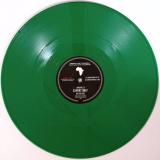
12" GREEN Color Vinyl / With Black Solid Jacket and Large Sticker
The Unofficial Edits & Overdubs by Joaquin Joe Claussell
Finally comes the first of a two-part forthcoming EP's, Extended Versions taken from the highly successful Joe Claussell Afro Edits & Overdubs Series previously released on LP and CD.
Influence of hallucinations induced by chewing roots from the iboga plant on the works of Joaquin Joe Claussell's Edits & Overdubs IBOGA Compilation. The iboga plant is indigenous to the humid, tropical climates of West Central Africa, including Gabon, Cameroon, Congo, and Angola, which are home to the 2nd largest rainforest in the world. It has been used for centuries in spiritual initiation ceremonies and practices, particularly by the Bwiti tradition and religion in Gabon.
Joaquin Joe Claussell was inspired by these influences and went into the studio to create a compilation of edits and overdubs of African vibrational sounds and rhythms. The result is a collection of nine compositions that showcase the future possibilities of this influential work.
Tested for months on dance floors across the globe every on this complication are sure to continue setting dance floors on fire where ever spun.
Extended Versions Cuts Taken Limited Vinyl EP featuring selected cuts from the compilation. Listen loudly and enjoy the experience!
Thank You for Listening
out of Stock
Last delivered 70 days ago available to reorder, subject to availability
Far Out Recordings continues its reissue campaign of the late Argentinian guitarist Agustin Pereyra Lucena's work with the first-ever vinyl reissue of his singular 1988 private press album, Puertos De Alternativa, now his most sought-after LP. The album features some of Agustin’s most uniquely beautiful compositions, including “Luces de Valeria” and “Preparativos Maritimos,” alongside Baden Powell's “Pequeño Vals” and “O Cego Aderaldo (Nordeste...),” and “Tema Barroco” by his longtime collaborator, Guilhermo Reuter.
By 1988, Agustín had established himself as one of Argentina’s foremost interpreters of Brazilian music. The seventies saw success with his group Candeias, and he gained recognition in Brazil, forming friendships and collaborations with luminaries such as Vinicius de Moraes, Baden Powell, Dorival Caymmi, Toquinho, and Maria Bethania. Following the era of dictatorship in South America, Agustín spent the late seventies and early eighties, living and touring in Norway as part of his European travels with his group Agustín Pereyra Lucena quartet.
Recorded after returning to his native Buenos Aires, Agustin Peyera Lucena’s Puertos de Alternativa emerged from this confluence of diverse experiences and influences, revealing an artist deeply connected to his environment. The album's title, meaning "Alternative Harbours," reflects Agustín's particular affinity for water. He observed that much of his favourite music originated from places with rivers and seas nearby, noting, "There is a flow near water that influences guitar playing for sure."
With a profound connection to both instrument and environment, Agustín’s music is often difficult to place. The album begins rooted deeply in South American soil, drawing clear inspiration from Brazilian guitar masters like Heitor Villa Lobos, Garoto and Baden Powell. But, as it progresses, a sense of journey unfolds, evoking new landscapes and horizons – from the crystalline beauty of glacial Norway to the gentle currents of the Rio de la Plata.
The ensemble on Puertos de Alternativa features notable Argentinian musicians, including drummer Osvaldo Avena, flautist Rubén Izarrualde, and saxophonist Bernardo Baraj.
Mastered by Stuart Hawkes at Metropolis Studios from the original master tapes which had been lovingly kept by Agustin’s nephew José Lucena Perreyra
Tracklist & Credits:
A1. Luces De Valeria (Agustin Pereyra Lucena)
Guitar, Vocals – Agustin Pereyra Lucena
Piano, Bass, Drums, Vocals – Guillermo Reuter
Tamboril – Julio Said
"Three years ago, Jérôme Leclercq and I from Mediatoon Licensing came up with the idea of creating a cinema concert to celebrate the 20th anniversary of Naruto. Why a cinema concert? The music is part of the success of the licence and fans have a particular attachment to the credits and the original soundtracks. The originality of the music by Toshio Masuda, the composer of Naruto, comes from the clever mix of traditional Japanese instruments, such as the Shakuhachi or the Shamisen, with guitar and other pop/rock instruments. So we came up with the idea of bringing this music to the stage with a 50-strong orchestra, accompanied by an original montage of the best moments from the anime. This orchestra is made up of three parts: symphonic instruments, pop/rock instruments and traditional instruments.
To do this, we approached the ODINO orchestra and its conductor Sylvain Audinovski. The ODINO orchestra is one of those capable of mixing musical styles while maintaining a very high level of performance. We have also chosen traditional Japanese instrumentalists to complete the orchestra's core, especially for the show.
The arrangements and musical direction are the fruit of a collaboration between Quentin Benayoun, Sébastien Caviggia and myself. My two accomplices, with whom I formed the group P.U.S.S. in 2007, have a great mastery of rock and orchestral music writing. This mix is essential to keep the promise made to the fans of the series and required several months' work to select the music and write the scores for the whole orchestra.
How do you tell the story of Naruto to fans, but also to those who don't know the anime? That's the real challenge of this unique film-concert. How do you select the best moments in the story of this young ninja apprentice from the vastness of the first 220 episodes? Six months of selection and research enabled me to choose the key images in the narrative, while preserving certain dialectics to match the anime's incredible music.
This original film-concert, lasting almost 2? hours, is a real Rock-Symphonic show paying tribute to the work of Masashi Kashimoto and the music of Toshio Masuda."
out of Stock
Last delivered 6 months ago available to reorder, subject to availability
It's the quiet ones we should watch, they always say. Which is particularly astute advice right now, when loud, constant self-declaration and saturated 'brand' visibility have become the norm. But above the babble and brightness, some voices will always speak quiet volumes - with calm eloquence and the kind of certitude that comes from valuing the playing out, not just the prize.
Sweden's José González is just such a voice. He first charmed his way into the UK's earshot via the murmurous and elegant, classically finger-picked folk pop of his 2005 album, Veneer, which has since sold over a staggering 430, 000 copies in UK alone. Two years later came In Our Nature, a further exploration of José's influences (Argentinian Folklore, the '60s US folk tradition and the British pastoral folk-pop style of the same era), on which he resisted the temptation to beef up his alluringly introvert aesthetic. The albums made the UK Top 10 and Top 20 respectively.
Conceived as the natural third part in an acoustic trilogy, Vestiges & Claws is a(nother) hushed and delicate solo set that forefronts the artist and guitarist's compellingly intimate vocal style and intricate playing technique, but it's often strikingly rhythmic in nature and cohere's perfectly, with hand claps and taps on the body of his instrument underlining the songs' mantric rise-and-fall pattern, while elsewhere, over-dubbed guitar parts and multi-tracked vocal harmonies entwine to sweetly immersive effect.
The title refers to both cultural practices and biological features that survive despite having lost their original function, and to currently useful tools, ie the 'claws' of modern life.
Vestiges & Claws was recorded almost entirely by José and self-produced, mostly in his Gothenburg home, using computer plug-ins to achieve a warm, analogue sound. He prefers working alone, mainly for artistic reasons. 'There were a couple of things that enabled me to complete this record: one was curiosity, to be able to play percussion and do a lot of harmonies and also to produce and mix the album; the other was aesthetics. I love to listen to Arthur Russell and Shuggie Otis, to music that has been done mostly by one person in their solitary state.'
As José sees it, the record is his personal, 'zoomed-out eye on humanity on a small, pale blue dot in a cold, sparse and unfriendly space. The amazing fact that we are all here, an attempt at encouraging us to understand ourselves and to make the best of the one life we know we have - after birth and before death.
12" RED Color Vinyl / With Black Solid Jacket and Large Sticker
The Unofficial Edits & Overdubs by Joaquin Joe Claussell
Finally comes the first of a two-part forthcoming EP's, Extended Versions taken from the highly successful Joe Claussell Afro Edits & Overdubs Series previously released on LP and CD.
Influence of hallucinations induced by chewing roots from the iboga plant on the works of Joaquin Joe Claussell's Edits & Overdubs IBOGA Compilation. The iboga plant is indigenous to the humid, tropical climates of West Central Africa, including Gabon, Cameroon, Congo, and Angola, which are home to the 2nd largest rainforest in the world. It has been used for centuries in spiritual initiation ceremonies and practices, particularly by the Bwiti tradition and religion in Gabon.
Joaquin Joe Claussell was inspired by these influences and went into the studio to create a compilation of edits and overdubs of African vibrational sounds and rhythms. The result is a collection of nine compositions that showcase the future possibilities of this influential work.
Tested for months on dance floors across the globe every on this complication are sure to continue setting dance floors on fire where ever spun.
Extended Versions Cuts Taken Limited Vinyl EP featuring selected cuts from the compilation. Listen loudly and enjoy the experience!
Thank You for Listening
out of Stock
Last delivered 70 days ago available to reorder, subject to availability
Unreleased electronic / jazz / madness from two titans of jazz and experimentation: JOHN SURMAN and KARIN KROG.
I could now write a load of blown up puffery about how amazing this is, but everyone does that, and a lot of the time it’s all a load of bollocks. But basically this was sent to me by Karin / John when I asked if they had anything hanging about that had not been released. This came through and blew my tiny mind. Like something from prime Annette Peacock “Pony” period. Here is what John Surman said…
John Surman writes:
Back in 2012/13 there had been some talk about a big futuristic open air urban dance/theatre production for about 80/100 actors/dancers with lasers and all kinds of lighting effects on different stages. I was invited to get involved and, together with Ben and Karin, we eventually decided to get to work on some ideas. I think that the original plan was that in performance there would be a mixture of live music and electronica.
Not altogether surprisingly, bearing in mind the complexity of the project, it never moved forward and developed into anything more than an interesting idea. It was probably over ambitious & I guess the funding never came through.
The only information I that I can find relating to the production refers to two silent movies made in 1927/1928 by the filmmaker Eugene Deslaw, entitled `La Marche Des Machines´ and `Les Nuits Électriques.These were clearly intended to act as inspiration for the project.
After months turned into years it became obvious that the project was going nowhere, and so the recorded music laid around gathering dust until Johnny Trunk asked Karin if she had any interesting music that he might be interested in releasing. One thing led to another and so, finally, Electric Element found a home!
For anyone interested in the equipment used this will have to be an approximation since the memory might be playing tricks. Karin was probably using a Yamaha Rex50 f/x unit, a Roland VT-3 Voice Transformer and an Oberheim Ring Modulator. I was playing Bass Clarinet and Contrabass Clarinet through various f/x units together with a Yamaha WX5 wind synth. All the instruments and voice were also processed through Ben´s equipment. After writing this I asked Ben for his recollections and he came up with the following:
John, Karin and I created this music in 2 or 3 days in the winter of 2013 at their studio in Oslo, Norway. I followed up with another 2 or 3 days of mixing, editing and post-processing . We kept a collaborative, improvisational and free-form approach to the sessions. I grew up immersed in music such as Cloudline Blue, the 1979 duo album of Krog/Surman, and this felt like a similar approach. I have mixed sound for many of their live duo concerts and I would use effects and electronics as an
accompaniment and counterpoint to the performed music. The relation of organic and artificial sound sources in music has always fascinated. In this case, I used some contemporary digital signal processing to introduce my own aesthetic into the conversation, in particular using granular synthesis to recombine small 'clouds' of sound into alternate forms. Some of the software tools I used included Ableton Live, Max/MSP and Reaktor.
out of Stock
Last delivered 14 months ago available to reorder, subject to availability
The collaboration between influential DJ/producer Eli Escobar and acclaimed vocalist/songwriter Nomi Ruiz has been a long time in the making. The two Puerto Rican New York native’s first collaboration, the electrifying track ‘Desire’ in 2011, set the stage for a series of projects, including their recent joint effort ‘Dance 4 Love ’99’. Now, they are set to release their debut LP, ‘Love Louder’.
‘Love Louder’ captures Eli and Nomi’s experiences of love and loss, reflecting their enduring connection to New York City and its vibrant, yet fading, nightlife culture. The album, while featuring dancefloor gems like ‘Heathens’ and ‘Full Fantasy’, takes an emotional turn, focusing on the themes of loss and presence in a rapidly changing world. The title track opens with lyrics invoking the late Donny Hathaway, reflecting a more profound introspection from the duo. They share their pain over loss, particularly the passing of mutual friend James Dewitt (DJ BluJemz), whose absence profoundly affected their creative process.
Escobar recently opened a club in Brooklyn named Gabriela, honoring a friend who passed away during the pandemic, emphasizing their commitment to preserving New York's cultural landscape. ‘Love Louder’ serves as a love letter to their hometown, intertwining celebration with mourning. In the poignant track ‘Go Be Gone’, Ruiz expresses the difficulty of embracing change and saying goodbye.
As they honor the past, they also aim for a brighter future through their music.
out of Stock
Last delivered 12 months ago available to reorder, subject to availability
Reissue of Don Cherry's 'Relativity Suite', recorded with the Jazz Composer's Orchestra in 1973. At this time, Cherry was becoming increasingly interested in Middle Eastern and traditional African and Indian music, having traveled extensively and studied with Indian musician Vasant Rai. This suite of songs was particularly influenced by the Indian karnatic singing tradition, as can be heard from the very opening moments of the album. Featuring Carla Bley on piano, Charlie Haden on bass, and Ed Blackwell on drums, as well as an extended horn and string section.
out of Stock
Last delivered 6 years ago available to reorder, subject to availability
There’s a particular magic that happens when seasoned producers with global roots come together under a shared ethos - not for hype, but for connection. That’s precisely what MISINGO represents. A cross-continental studio experiment born out of Covid-era isolation, the group spans hemispheres and histories: Yorkshire's Doorly, L.A. legend Gary Richards (aka Destructo), and Australian duo Colour Castle. Their debut offering, Give You Love, lands via UK House Music institution Hard Times Records, and it’s as emotionally resonant as it is built for the floor.
Anchored by a slow-burning acid line and moody, immersive synthwork, 'Give You Love' carries the DNA of classic house without feeling like pastiche. DJ Rae’s smokey vocal, recorded in Doorly’s Ibiza studio, sets the tone - raw, intimate, immediate. Gene Farris enters with a gravelly, magnetic counterpoint, flipping the call-and-response into something spiritual. It’s a record that feels both new and deeply lived-in, a jam session from afar that somehow lands with unity and purpose.
For the remix suite, Hard Times dig into family ties and deliver a heavyweight lineup that spans generations of dance music lineage.
First up, DJ Pierre, the Phuture pioneer himself, brings a Wild Pitch revision that is pure summer sleaze and shimmer. Glistening keys, kinetic snares, and a syrup-thick bassline collide in a mix that’s tailor-made for golden-hour sets and open-air systems.
DJ Romain brings that New York swing. All velvet chords, stabbing pianos, and organ swells that spiral skyward. It’s gospel-house energy that doesn’t need to shout to be heard, a reminder that soul still moves the dancefloor.
Closing out the package is Charles Lavine of Soul Clap fame, whose Boston-bred funk sensibility steers things into new territory. He strips back the mix, lets Rae’s vocal ride the groove, and injects a subtle bounce that turns heads and hips in equal measure.
With 'Give You Love', MISINGO and Hard Times haven’t just released a single, they’ve bottled a moment: one born of distance, stitched together with soul, and destined for collective release on dancefloors worldwide.
out of Stock
Last delivered 4 months ago available to reorder, subject to availability
It was 1976 when Prince Far I debuted is unique toasting style under the spell of producer Lloydie Slim at Randy's Studio. The album features nine tracks based on psalms and "The Lord's Prayer", over rhythms largely played by The Aggrovators. Psalms 53 - in particular - used the rhythm from the Lee"Scratch" Perry-produced "Mighty Cloud Of Joy". It is meditative music and established Prince Far I, literally the man with the voice of thunder, as a formidable force in music business.
out of Stock
Last delivered 16 months ago available to reorder, subject to availability
Bar Part Time launches its record label with none other than Toronto UFO hunter, certified bad boy DJ, and good friend Cal-C. Cal comes correct with a ripper of a 4 track EP, Bath Bomb. A deep digger and wild style DJ in his own right, Cal brings you a grip of tracks that a tasteful selector can make use of throughout all points of a night time music party. Title track "Bath Bomb" is a blissed out, downtempo joyride that would make a perfect companion for either sunset or sunrise. "Morning Dew" evokes sounds of all your favorite early 90s Italian records, with a particularly euphoric crescendo. Hey man, did you say this guy was from Toronto or Torino? Either way, molto bene! As we move on, "Blurry Moon" is a slice of dancefloor perfection that sounds like something Jose Padilla would've made if he were from San Pedro instead of San Antonio. And lastly, the aptly named "Wine 69" (nice) is an M1 organ cruiser that's practically begging to be heard in front of an azure sea in balmy temps. Vamos a la playa!
out of Stock
Last delivered 9 months ago available to reorder, subject to availability
Introspekt’s hotly anticipated debut album Moving The Center comes nearly a year after the release of her latest EP Tectónica. Set to be released on June 20th, Moving the Center sees Introspekt play homage to dubstep’s point of genesis in South London in order to then shift the center of focus from a singular point of origin, to a more global narrative of bass and vibration. The album blends UK bass with contrasting genres like garage and ballroom, creating the perfect feminine blend of these historically masculine genres. The album merges the Black diaspora from across the Atlantic, crafting a sonic world where past, present and future are parallel and immersed in an early millennium type dubstep soundscape.
Speaking about the album, Introspekt says, “‘Moving The Center’ embodies an alternate perspective to that which has been dominant in dance music, particularly so-called ‘bass music’. The narrative it presents is one which throws a wrench in the seemingly common perception of Dubstep as a masculinist sensibility. ‘Moving The Center’ pushes a feminine physicality to the front of the bassbins. Femmes to the front!”
out of Stock
Last delivered 5 months ago available to reorder, subject to availability
Neo Gibson, born in Virginia and based in New York City, records, performs, and produces as 7038634357. This numerical alias, under which Gibson has been releasing work since 2016, offers a window into the careful ambivalences of the musical project. It conjures the impersonal_the opacity and randomness of data, a number that is hard to remember or even say out loud_while also suggesting a direct line of communication with the artist, down to an area code indexing their biography. 7038634357 uses a restricted palette to achieve music that is formally precise and emotionally direct. Their digital-native approach to production, in which frank melodies cross paths with heavy distortion, contains traces of both trance's maximalist arcs and a songwriterly intimacy. Expressive details may appear submerged or abraded, subjected to a canny sense of dynamics and textural specificity. Waterfall Horizon, Gibson's second vinyl record with Blank Forms Editions under the moniker 7038634357, was written for live performance and workshopped over successive shows during their 2022 European tour. Here, hallmarks of their earlier, studio-crafted recordings_digital distortion that obfuscates their lyrics and a slow-burning ambience_are noticeably pared back. Instead, Waterfall Horizon takes on a pop inflection, adopting more traditional lyric scaffolds so that the interstices from verse to chorus or track to track can flourish within their limited tonal range.Across recordings and performances, Gibson activates wide-ranging mechanisms of audience connection: from the relative anonymity of internet platforms to live experiments with the spatial effects of amplification. They have a particular interest in site-specific performances in non-musical spaces, and have performed in a variety of contexts, including the mezzanine of the West 4th Street subway station in New York City and INA GRM/Radio France's Présences électronique festival. Under their own name, Gibson has maintained a longstanding collaboration with the artist Charles Stobbs, working primarily with FM transmission and techniques derived from the early-seventeenth-century English tradition of change-ringing bells. The first 7038634357 vinyl record, Neo Seven, was released on Blank Forms Editions in 2023; previous releases include self-released cassettes and CD-Rs, as well as a pair of EPs on Genome 6.66 Mbp (2018, 2019).
Listening to CD3, I'm reminded of how the Vincent Over The Sink record '22 Coloured Bull Terriers' made me feel all those years ago. There's a free ranging quality to it.
It feels calmly capable of doing whatever it wants. It feels mysterious and self-generating, almost aloof to the humans who made it. I adored that record; it cascaded into so many epiphanies.
I don't want to implicate Cooper and David's music in any fleeting desire towards currency, but listening to this CD3 record over the last few weeks has felt weirdly, thematically correct. There's an echo-ey kind of referentiality to it. Not to particular styles of music, but to the recently elapsed histories those styles of music evoke. It's something that Th Blisks kind of gestures towards, but which this project seems to own entirely.
It's a kind of melted reconfiguration of popular (occasionally popular-on-the-fringes) styles. These familiar sounds are reconfigured and muddied. Hindsight frames the sources in an almost primordial light, to the extent that they feel like folk art.
Glyphted and Franzbranntwein sound like pop songs stripped to their bones and distorted, as if the styles they vaguely recall are as old as time. It's a stunningly weird effect. Songs like The Duchess and Farmhand exacerbate this impression. The record comes to feel yearningly ahistorical. But in a way that feels pertinent?
It might just be where my head is at, but the implacable nature of the record feels important to me, somehow. It's something far, far north of post-modern but... ancient too. - Shaun Prescott
From "Spirit Of The Air"'s violence, "Cross Over"'s industrial poundings, the PCP-infused minimalism of "High On Angel Dust", to "Someone Was There" mixing techno and hardcore, Derniere Danse Part II outlines what Manu le Malin is as a producer : not afraid to visit experimental soundscapes nor ashamed to go straight to the dancefloor point... But always soaked in darkness. This is a black gateway to the world of MKNK's head, through five of his all-time favorite tracks, including one unreleased, all remastered by Scan X and Deathmachine.
But before pressing play, consider yourself warned : the first track "Spirit Of The Air", with its tortuous intro, piano break, screams samples and references to The Exorcist saga, is relentless, violent and unpredictable. And things don't go softer with "Cross Over", also an extract from his Fighting Spirit album (2002), a downright industrial attack that sounds particularly up-to-date.
Unreleased "High On Angel Dust" then shows Manu's admiration to the label PCP (hence the powdery title) and its founder Marc Acardipan. An oddity in his discography that almost never saw the light of the day : the synths and TR-909 based track was recorded in one night, and completely forgotten in a DAT for 28 years! "Someone Was There", from the soundtrack of Jalil Lespert's 24 Mesures, and the esteemed classic "One The Way Home", available as a bonus in the digital release, conclude this handpicked selection.
Diverse, personal, tormented and yet dancefloor compatible, Derniere Danse Part I and Part II feature some of Manu's best works. But they also are a stepping stone : MKNK will now open to new artists exploring every dark corner of what hardcore music can be.
out of Stock
Last delivered 10 months ago available to reorder, subject to availability
“Splitter Archive” is a debut release by p4rticl3, a duo consisting of Berlin-based Gerriet Krishna Sharma, co-founder of spæs lab Berlin, and Glasgow-based TRSSX. Presented and recorded entirely live at EXIT Glasgow in November 2024, “Splitter Archive” was a 4-channel abstract electronics performance presented as part of a larger collaboration between EXIT and spæs lab. This particular ‘archive’ catalogues intricate granularity and looped swells of low frequencies generating a multitude of vertiginous spatio-temporal planes. Abstract, experimental techno-esque structures.
The Ottawa composer/performer and head of Black Bough Records plays every instrument on his CST debut: an accessibly avant-garde work of dark/ambient modern chamber music. Mark Molnar has been a linchpin of the Ottawa experimental music scene for over two decades, spanning contemporary classical, electroacoustic, industrial/noise, and improv. As a string player in a wide range of projects, an organizer and curator of innumerable shows, and via his own avantgarde label Black Bough Records, Molnar's unflagging contributions to independent music culture in Canada's capital city have been significant. EXO is his Constellation debut: a remarkable and bracing suite of post-classical composition on which Molnar plays every instrument. Meticulously self-recorded, primarily with strings, harp, and piano, EXO balances thematic melodicism, polytonality, and dissonance across three elegiac pieces of exquisitely expressive dynamism. This is exacting modern chamber music that blends formal and harmonic complexity with a solemn emotive sensibility accessible to a broad audience. Listeners that yearn for some edge and disquietude in a landscape of often all-too-approachable post-classical music should find EXO eminently worth their time and attention. While Molnar is a highly trained string player, and studied music under Aubrey Wolfe, microtonality with James Tenney, and composition with R. Murray Schafer, his trajectory has been entirely and intentionally outside the academy, signalling a socio-artistic commitment to DIY culture, forged from an early passion for the sonic worlds of post-hardcore, post-punk, no-wave, free improv, power electronics, and other independent/underground musics. His classically-informed works have been described as "tense currents of musical modernism invigorated with punk's raw vitality." EXO carries an undercurrent influenced by dark industrial and ambient metal in particular, with microphones purposely placed to pick up the low-end frequencies of the piano body, and of a bass drum positioned as a resonant skin in the acoustic space; an electroacoustic strategy organically meshed to the crisply defined and pristinely recorded pointillisms and polychords of strings, harp, and piano, which feed into this noisefloor of crepuscular sub-bass disquietude and decay. It's a production aesthetic that lends EXO a distinct undertow of tension and feeling, a sort of roiling maximalism where the chamber instrumentation traces arcs and waves of form and flow as if drawn from a dark, impervious ocean below. It also reinforces the profound hermeticism of Molnar's process, as a forbiddingly solitary creative act of immersion and navigation. The album artwork, featuring semiabstract stills of the sea by British photographer Ed Allen, further reifies this metaphor. The album's opening piece 'Sub Luna' (and its shortest at 8 minutes) showcases Molnar's adeptness at naturalistic and flowing complexity: tight cascades of climbing and descending chordal clusters hold their polytonal densities for various durations, yielding to more clarified harmonic suspensions and motifs, as melodic themes led primarily by violins in the higher registers provide a fractured lyricism. Molnar says: "the opening and closing figures of this piece act as opposing shorelines; the shorelines provide a reliable expression of range and key signature, and the tides come in and swallow them up, the motion of a body that addresses the relationship between states of lucidity and melodic figures." On 'Terre Sacer' everything happens in soupier waters, as a slow and doleful theme, anchored by grinding bass notes, circles in a gyre of dark resonances, until glistening strings gradually ascend to enrobe a plaintive and gently harrowing single-voiced ostinato over the composition's final third. Molnar's drone, ambient, minimalist, and goth-industrial influences are on display here. Side Two of EXO features the 18-minute multi-movement 'pallida Mors' (pale death): a waterfall of heterophony introduces dense chordal movements where strings are recorded and mixed to evoke pipe organ, in the album's most overtly dissonant and (anti)liturgical sequence. This gives way to ever more open and fragile spaces, before a resurgence of dark clusters and noise treatments introduces a final repeating piano coda, shrouded in devastated bass resonance, settling into what Molnar calls "a meditative hollow." Constellation is honoured to release this work by Mark Molnar, a longtime fellow-traveler whose selfless and boundlessly generous activities as an independent arts enabler sometimes obscure his own accomplished and uncompromising artistry. We trust EXO can help shed some much deserved light on this fine composer. Thanks for listening.
Oh yes, we love it when Theo represses some of his most sought after tracks and this one is particularly well-timed. Leron Carson is still an unknown figure, a kid who used to make viciously raw and futuristic techno tracks in the late 1980's! "China Trax", alongside the rest of his tracks on a different Sound Signature double 12", is totally ahead of its time and if it was truly made in 1987 then it is nothing short of amazing. Of course, it's not just the year it was made in that's interesting but also the fact that it's music without an age, able to be appreciated by any generation of techno freaks. Theo's own "Insane Asylum" on the flipside is also pretty monumental; rigged beats, off-kilter grooves and that familiar spontaneity so heavily associated to the label. RECOMMENDED.
out of Stock
Last delivered 14 months ago available to reorder, subject to availability
In the mid-nineties, documentarian Peter Spirer embarked on a three-year odyssey to offer a realistic view of Hip-Hop and the people and culture it encompassed, interviewing over 80 artists involved in the art form. Spirer managed to capture a seminal moment as the culture balanced on the cusp of the mainstream. As Ice-T comments in his foreword to the book, 'Rhyme & Reason is one of the few films that was there to document us before Hip-Hop truly exploded.' While filming, Spirer took accompanying stills using a medium format Rolleiflex camera. It is these photographs that form The Book Of Rhyme & Reason. 'The Rollei allowed me to capture some amazing moments: Puffy getting a trim in his office while doing three tasks at once, Biggie opening record plaques on his couch, Ice-T and Mack 10 hanging with their homies, Heavy D at the barber, playing pool. There was the Jack The Rapper convention with Death Row making a statement, at a Disney World Hotel, that ended in chaos. There were magical moments such as Redman and Erick Sermon freestyling on the mic to amazed onlookers at a block party in Newark and watching Wu-Tang Clan chop it up on the block in Staten Island on a cold winter's day before they exploded.'
This coffee table volume features over 130 of Spirer's photographs from 1994 to 1997. As Hip-Hop commemorates its fiftieth anniversary in 2023, it is particularly fitting that many of these images from this formative period are being seen and published for the first time.
Following the cinematic jazz-funk of Ufo Bar (2021), Banda Maje are back, ready to take you on another sonic journey across Salifornia—and beyond.
Their new 7" single, available starting May 30 via Four Flies, offers an exciting glimpse into the expanded horizons of Banda Maje, serving as a prelude to their sophomore album, Costa Sud.
These past four years, Peppe Maiellano—the band's composer and mastermind—has further refined his unique Mediterranean sound. A deep connection to Italian and Neapolitan roots remains, as evidenced in the heartfelt cover of Peppino di Capri's 1981 track, "Mo…" on Side A. Maiellano keeps things simple, staying faithful to the original, yet manages to freshen the track for today's listeners, making the lyrics resonate with his compelling vocal rendition.
But Maiellano has also embraced new influences, particularly Brazilian music, as showcased in the infectious "(Roda De) Samba Maje" on Side B. This roda-de-samba version of the upcoming album track "Samba Maje," a collaboration with the Amor Pela Roda group featuring Antonio Montuori on percussion and Pasquale Del Solio on cavaquinho, gives us a taste of Maiellano's vision for Costa Sud—a 'music of the South' that transcends geographical and time boundaries, bridging Italy, Brazil, Africa, and contemporary vibes.
Out on 30th May 2025 on 7" and digital.
out of Stock
Last delivered 59 days ago available to reorder, subject to availability
German trio Cloud Management approached Digital-Sting in late 2023 and started a conversation concerning a loose configuration of improvisations, studio experiments and rehearsal jam recordings. The timing was particularly serendipitous with Feel Free Hi Fi fresh off a West Coast USA tour with Exotic Gardens where we had spent several long drives along the California coast listening to Cloud Managements prior records on Altin Village. The second of which included collaborations with Exotic Gardens. This release " Unfinished Business" inhabits much of the musical history and influences foundational to the Digital Sting sound and ethos making the link up an obvious one. I don't want to be overly predictable in the comparison to the great body of work created by German legends like Moebius, Roedelius, Plank and others but it is there. Also present are heavy doses of dub wandering not too far from the furthest out zones created by African Head Charge or Dub Syndicate. Some creeping psychedelic unease in the way of Industrial Records also sits in the mix. Comparisons aside, Cloud Managements embrace of collaboration and jammy experimentalism create a sound that is unique and a bit rare in the contemporary dub and electronic music continuum where perceptions of genre restrictions can guide a bit too much. The two side long continuous tracks documented in this release lock in and groove as much as they wander, drift and break apart in subtle shifting ways making for special repeat listening where something new is always waiting.
The Ramones were punks before punk rock was even invented. With their catchy, sing-along tunes, iconic hair styles and outfits, Joey, Dee Dee, Johnny and Tommy rewrote rock history and are now, as part of the first wave of US punk, firmly considered part of the subcultural world heritage. In the DUB-cultural world, on the other hand, their footprint has been pretty slim, particularly if one considers their stomping, three-chord songs, instantly recognizable chants (“Gabba gabba hey!”) and laconic humour. There are a few reggae and Latin versions of their songs online, but never before have the Ramones been honoured with an entire album in early reggae style…until now, bang on time for the band's 50th anniversary in 2024. The label Echo Beach, a bit of a specialist for missions such as these with a string of releases including “Bad Brains in Dub”, “Dubby Stardust”, got together with André Meyer (production, bass) and Manougazou (production, guitar). Both were part of the 2008 Echo Beach New Wave/Dub project DubXanne and were involved in the production and subsequent live shows. Also back in the team is keyboarder and DubXanne mastermind Guido Craveiro, who plays Hammond organ and piano on half of the tracks. The other two additions to the core team are singer and all-round instrumentalist Sebastian Sturm and drummer Raul Pfeffer. Together they homed in on the 11 most iconic Ramones three-minute-singalongs, including "Blitzkrieg Bop", "I Wanna Be Sedated", "Pet Sematary" and "Rock'n'Roll Highschool", and treated them to a reggae make-over. The whole process was kicked off by a slightly off-beat question (reggae music does that to you): What if Joey, Johnny, Tommy and Dee Dee had gotten together not in NYC, but in Kingston? And then stepped up to the mic alongside local singing and deejay greats? In musical terms the answer is surprisingly plausible and the line-up is sensational, even for a label like Echo Beach with its unrivalled connections. From up-and-coming youngsters to living legends, everyone is included, albeit with a focus on the elder statemen and stateswomen: the vast majority of the guests are over 60 and look back on deeply impressive careers! The artists come from Jamaica, the USA, the UK and Germany. All contributed one or two songs, and all of them tackle the songs in pairs with infectiously good humour, transforming legendary punk rock bangers into unpredictable dub tracks. Ramones’ classics such as "Blitzkrieg Bop" with its trademark battle cry "Hey! Ho! Let's Go!", "Sheena Is A Punkrocker" and "The KKK Took My Baby Away" are slowed down and underpinned with roots and rocksteady riddims. It almost goes without saying that the lyrics have been adapted to everyday Jamaican life with a great deal of fun and creativity. And amidst all the icons of early reggae, the Ramones also make an appearance: in the opening track "Pinhead", for example, we learn that the Ramones did actually listen to reggae and had even been planning a reggae album. Features guest vocals from Susan Cadogan, Ranking Joe, Ranking Ann, Prince Alla, Welton Irie, U Brown, Earl Sixteen, Dennis Alcapone and more
One of the very rare chances, and quite possibly the only chance to listen to the genius of Ennio Morricone engaging with the musical world of jazz. His soundtrack for the film The Blue-Eyed Bandit (Il Bandito Dagli Occhi Azzuri by Alfredo Giannetti, 1980) is marked by a relentless rhythm that perfectly matches the atmosphere of the film. The film was shot in Genoa – one of the most iconic cities of the Italian detective (poliziottesco) film genre – and stars Franco Nero, one of the leading stars of the whole genre. The main theme, Città Viva, is a vibrant and metropolitan piece, beautifully arranged for big band + trio of soloists, hand-picked by Morricone himself; his friend and collaborator Enrico Pieranunzi (piano), Roberto Gatto (drums) and Riccardo Del Fra (double bass). This is one of the very few times in which Ennio Morricone, who was famously suspicious of jazz improvisation, asked his musicians to be free and improvise, adding their solos to the original structure – the solo viola of Dino Asciolla, one of the greatest violists of all time, in particular stands out. This is the first time the soundtrack has been released on vinyl since its original release in 1982
out of Stock
Last delivered 16 months ago available to reorder, subject to availability