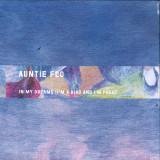
Brian d’Souza, better known as Auntie Flo, delivers his brand-new fourth studio album, ‘In My Dreams (I’m A Bird and I’m Free)’, set for release on 21st November. The album, a rich blend of electronic music, live instrumentation, and global influences features collaborations with the likes of Nicola Cruz, Joshua Idehen, Shingai Shoniwa, Yohan Kebede (Kokoroko) and even his Goan Auntie Florie, where the Auntie Flo moniker is derived from. Each track on the album transports you to a different location: Goa, Istanbul, Nairobi, Mexico City, Waiheke Island, Rio De Janeiro, Havana, Seoul are all destinations to nest in across its ten tracks. It will be available in both digital and vinyl formats on his own label, A State of Flo Records.
Auntie Flo’s latest body of work is the culmination of a five-year journey that has seen d’Souza expand both personally and musically. Known for his unique ability to fuse electronic sounds with rhythms and influences from across the globe, d’Souza takes his craft to new heights in this album, offering listeners an intimate look into the experiences, places, and stories that have shaped his artistic evolution. The groundbreaking DJ and producer presents an expansive, deeply personal exploration of global sounds, collaboration, and migration.
Following the success of the Afro-disco single Green City—a dynamic tribute to the legendary Fela Kuti and Luke Una’s ‘track of the year’—In My Dreams (I’m A Bird and I’m Free) ventures further into uncharted musical territory. The album, however, is more than just a continuation of Auntie Flo’s signature sound. It is a reflection of d’Souza’s life and career, capturing his exploration of identity, migration, and cultural fusion. With tracks that draw inspiration from field recordings collected around the world, the album resonates with a profound sense of place and memory.
In My Dreams (I’m A Bird and I’m Free) is not only a reflection of d’Souza’s creative journey but also a commentary on migration—both human and musical. The album draws on the freedom of birds to migrate across borders as a metaphor for artistic and personal freedom, juxtaposed with the challenges that political barriers impose on human migration. As d’Souza explains, “Birds have the freedom to migrate wherever they choose, while humans face constant barriers”.
A State of Flo supports Earth Percent. 10% of the revenue generated from this release will be paid to environmental charities.
Suche:pat san
LP + insert with extended liner notes and download code including extra bonus track 'Movements of The Mind'.For his second album on the Belgian leftfield imprint Cortizona, Devin Brahja Waldman gathered a group of insanely gifted and talented musicians to start a new and highly moving musical chapter titled 'Nebulizer'.
From the first moment the pulsating tone of Devin's synth blends with the whispering voices of Earth, Wind and Choir and the menacing bells Naima Karlsson set in motion this record you just know and feel immediately 'Nebulizer' will be a soul-searching journey, soaking you deep into an unknown and very personal musical world.
Devin Brahja Waldman is a New York saxophonist, drummer, synthesizer player and composer who leads the group BRAHJA. He has performed with Patti Smith, William Parker, Nadah El Shazly, Malcolm Mooney, Thurston Moore, Godspeed! You Black Emperor, Charles Hayward, Luke Stewart and Yoshiko Chuma. Waldman is also a member of NYC's Heroes Are Gang Leaders (led by poet Thomas Sayers Ellis and saxophonist James Brandon Lewis), of Sam Shalabi's Land of Kush, and of the Norwegian hardcore group MoE.
In 2022 BRAHJA released the critically acclaimed album 'Watermelancholia' on the Belgian leftfield imprint Cortizona. For his second album on the same Cortizona label, Devin Brahja Waldman gathered a group of insanely gifted and talented musicians to start a new and highly moving musical chapter titled 'Nebulizer'.
Together with Adam Kinner, Georgia Wartel Collins, Earth, Wind and Choir, Luke Stewart, Kenichi Iwasa, Naima Karlsson, Alexis Mercelo, Janice Lowe, Watson and Damon Hankoff, Devin forms a slow-burning fireball unity.
A devotional séance channelling unknown powers proving music is a healing force of the universe.
Rejoicing the Holy Jazz Spirit.
Ready to nebulize the world and bring light out from the darkness. Head cleaning the world in 4 musical parts: Geological Drum, Nebulizer, Bushido and Movements of The Mind. Nebulizer is an elevating meditation on our estrangement of nature.
Interstellar sonic stardust from a mindblowing collective that will leave you flabbergasted.
Be prepared and hear it to believe it.
For fans of: Art Ensemble of Chicago, Archie Shepp, Pharoah Sanders, John & Alice Coltrane, Kamasi Washington, Shabaka Hutchings, SAULT, Ill Considered, Jamie Branche, Angel Bat Dawid, Mackaya Craven, Matana Roberts, Sun Ra and other good music.
On its 14th album RAMZi addresses the Gremlin’s Paradox. Feeding the ‘World Fuzion Music’ frequencies, above every category and for all hearing ears, the beat-wielding imp meets each new quest with a sharp-toothed smile and a moon tan glow.
This new multi-quest pathfinder on FATi imprint was aided by Dave Biddle on sax, Loic Reeves-Blizzard on guitar and Zach Frempton on keyboard.
Stefano De Santis makes his debut on Quattro Bambole with five captivating tracks, delivering some blend of jazzy house, broken-beat rhythms and city-pop oriented synth-boogie, including a remix of Sean McCabe. Stefano is a young musical maestro from Rome involved in the jazz and deep-house scene for several years and he released music for ZRecords, Colin Curtis Presents, Local Talk, Ramrock, Tenlovermusic, Cognitiva. Even new listeners can dive into this small ocean of constantly evolving sounds and that the often changes of rhythm and mood.take us by surprise... with enormous joy!
- A1: The Prelude
- A2: You Are Leaving My Mind
- A3: You Are The Other Reality And I Am This Reality Okay Okay No More Scary Faces
- A4: You Are Leaving My Mind Reprise
- A5: Mariko - The Finale Sands And Sun Inst
- A6: A Peeling Off Poster Part 2 Inst
- B1: Sha-La-La On The Hill A Dawn Poem
- B2: Bells Of Spring
- B3: Lipstick Boy
- B4: Love Gone To The Blue Sea Once Again On The Seaside Path
- B5: Twistar Sister Pylot Twinkle Star Patrol
Have you ever been to Miyazaki? It’s a prefecture on Japan’s southern island of Kyushu, facing the Pacific. Palm trees. Humid subtropical climate. This is the home of Maple Fyshh, a musical artist whose late-80s/early-90s recordings have been collected and reissued here. Liberated by the advent of 4-track cassette home recording technology, inspired by a love of 60s pop oddball production mavens like Phil Spector and Joe Meek, as well as American hot rod and surf music, these Maple Fyssh songs glow with an outsider’s love of the transformative power of newly-available sound technology, allowing him to pull his inspirations across decades and oceans to his 1990s Miyazaki home studio. The tracks here are a d.i.y. dream-pop wonderland, compiling songs from his first LP “Mariko” and second LP “Dokitto Station!!”, both self-produced, both released in 1995. The A-side of this release features tracks from the concept album “Mariko”, a masterpiece of daydream pop introspection, recorded in 1994-95, inspired by a poem submitted to a manga magazine. The B-side features tracks from “Dokitto Station!!”, slightly earlier recordings that draw inspiration from a range of 60s pop including girl groups, surf music and acid folk. All the music here demonstrates Maple Fyshh’s deep understanding and appreciation 60s pop moves, and also his mastery of the limited technology at his disposal.
Remastered in 2024, the sound of Miyazaki has been reborn for a new audience. Available on Vinyl LP and download, with a DL card, English/Japanese lyrics and entertaining and informative English/Japanese liner notes by the artist.
EN:
I am thrilled to present my new musical work, "Oscillations" – an album that explores the harmonious connection between the natural world and electronic sound art. The title "Oscillations" symbolizes the vibrations and rhythms that are omnipresent in both
nature and music.
Nature is an inexhaustible source of inspiration. From the gentle waves of the ocean to the subtle oscillations of leaves in the wind – everywhere, there are rhythms and patterns that are music in their own right. These natural movements and sounds inspired me to incorporate them into my compositions and weave them with
electronic elements.
"Oscillations" attempts to bridge the organic world and the synthetic soundscape.
Electronic sounds meet acoustic instruments and merge into a new, fascinating unity.
It's about uniting the natural beauty and the technical possibilities of music to create something unique.
With a piano, a double bass, a harmonium and a Moog synthesizer, I would like to invite my listeners on a journey into my sound universe.
DE:
Mit großer Freude präsentiere ich mein drittes musikalisches Werk "Oscillations" – ein Album, das die harmonische Verbindung zwischen der natürlichen Welt und elektronischer Klangkunst erforscht. Der Titel "Oscillations" steht symbolisch für die Schwingungen und Rhythmen, die sowohl in der Natur als auch in der Musik
allgegenwärtig sind.
Die Natur ist eine unerschöpfliche Quelle der Inspiration. Von den sanften Wellenbewegungen des Ozeans bis hin zu den subtilen Schwingungen der Blätter im Wind – überall findet man Rhythmen und Muster, die auf ihre eigene Weise Musik sind. Diese natürlichen Bewegungen und Geräusche haben mich dazu inspiriert, sie in
meine Kompositionen einzubinden und sie mit elektronischen Elementen zu verweben.
"Oscillations" versucht, eine Brücke zwischen der organischen Welt und der synthetischen Klanglandschaft zu schlagen. Elektronische Klänge treffen auf akustische Instrumente und verschmelzen zu einer neuen, faszinierenden Einheit. Es geht darum, die natürliche Schönheit und die technischen Möglichkeiten der Musik zu
vereinen und daraus etwas Einzigartiges zu schaffen.
Mit einem Piano, einem Kontrabass, einem Harmonium und einem Moog Synthesizer möchte ich meine Hörer auf eine Reise in mein Klanguniversum einladen.
- A1: Ladema Eini
- A2: Kirya Yefeyfiya
- A3: Rak Et Koleh Eshma
- A4: Im Nin'alu
- B1: Shuvi Yefeyfiya
- B2: Ya Wald Ya Hali
- B3: Anat Alhawa
- B4: Am'at Soutak
- B5: Hil Yahil
- B6: Kweit Ruhi
- C1: Alail Ahim
- C2: Safart
- C3: Hargat Nof Alail
- C4: Ya Bnaya
- C5: Kalo Li Alnas
- D1: Ach Ya Ouma
- D2: Ya Bnat El Hoo
- D3: Saperi Tama
- D4: Hayyeh Mi Sana
- D5: Aslak Ya Hur
An anthology spanning three decades of haunting funk, soul, and disco, from the undisputed godfather of Yemenite-Israeli music, Aharon Amram.
Eine Anthologie, die drei Jahrzehnte eindringlichen Funk, Soul und Disco vom unbestrittenen Paten der jemenitisch-israelischen Musik, Aharon Amram, umfasst.
Seattle's own Manatee Commune (aka Grant Eadie) makes his long-awaited return to
Bastard Jazz with his fourth album, 'Simultaneity'. Lush and vibrant production is
familiar to his previous works, though Eadie has significantly matured in the activation of
space and character. A step away from standard songwriting, and a total disassociation
from lyrics at all, has made this record closer to the ambient genre than anything
Manatee Commune has released, all the while keeping one solid foot in the realm of
dance music.
'Simultaneity', as a whole, is an exploration of the collision between texture and time.
Captured recordings reminiscent of wind in wheatgrass, soft rain showers in the open
plains, and cascading beach sand wash over the mix, splashing into warm drones and
ascending melodies that cleanly syncopate against a steady rhythm. Though decidedly
electronic at times, a raw human element is ever-present in the form of a vocal motif:
just tiny moments of a loving voice lost in a sea of reverberation.
The album is a noticeably positive evolution from previous works. All nine tracks depict
a calmness and subtlety in musicianship, relying primarily on tenuous snippets of live
instrumentation and synthesis that hypnotically coil and coalesce with one another.
'Love Tone', the opening track, features Eadie's partner, a small voice memo clipped
and expanded into an ethereal vocal melody. A crisp felt piano delivers a complex
arpeggiation in 'Mosaic', a warm sonic bath scape reminiscent of Olafur Arnalds or
Kiasmos. Simple, undemanding bass lines drive tracks 'Path' and 'Faulted', though their
simplicity is contrasted with a variety of patterns that combine to create unique auditory
shapes, both building and landing in satisfying climactic movement. The album
culminates in the final track, 'Touch Theme', where a block of sound in the form of a
broad, open synthetic chord warms the ears, eventually twisting and shifting to rhythmic
chunks that shove against a familiar house rhythm.
" In 2022, Guts brought together his musical family for his ‘Estrellas’ album. An ambitious project that brought together musicians from: Franc, Cuba and various African countries. For a journey that was as rich artistically as it was humanly. The list of superlatives was almost endless, "Formidable", "incredible", "unforgettable" and "magical" all thrown into the pot, during these magical moments in the Dakar studio. From the seventeen tracks heard on the original album, three have been entrusted to the expert and inventive hands of four producers, who have come up with new interpretations bringing Africa and the Caribbean together for a modern dancefloor.
‘Por Que Ou Ka Fe Sa’ (Poirier Remix)
From his studio in Montreal, Canadian Poirier has opted for a strong groove and relentless bass drum to keep out intruders, putting vocalists David Walters and Brenda Navarrete in a rhythmic cocoon. Accompanied in a slightly moody bassline that adds some driving muscle to the track. The hooky guitar line eventually gives way to the saxophone that emerges from the mix to parade around the front line. The original electric piano is replaced by a synth pad that loops and spins driving the track to its conclusion.
‘Por Que Ou Ka Fe Sa’ (David Walters Remix)
Before recording this track, David Walters and Brenda Navarette didn't even know each other. So in the magic of the moment that brought them together is a genuine and sincere artistic bond. It is no longer Guts but David who is at the musical helm, and before they too can savour the connection between the two artists, the dancers will have to pass through an overheated corridor where a Caribbean rhythm resonates with percussion. Digital and woodwind swirl and clash until the vocal encounter with the artists. It's a moment of respite that's as suspended as it is life-saving, because the exit is also via the famous corridor.
‘San Lazaro’ (Bosq Remix)
On Bosq’s mix, he’s opted to maintain things focused on the dancefloor, keeping the percussion persistent for the unleashed bodies of the dancers to smile. It's once again the walking bass line rises to the forefront of the groove, softening the shocks of the relentless kick drum. Roberto Valdes's timeless piano has disappeared, while guitars float and add to the atmosphere. The track is no longer awash in cigar smoke. Under Akemis's powerful vocals the low ceiling has disappeared, and the open roof is more a brass-lit spectacle. That doesn't make things any less overheated though, this one is sweaty until the end.
‘Medewui’ (Captain Planet Remix)
Captain Planet brings the dancer’s attention to the Afrobeat flavored jam that rocked the original, highlighting the Pat Kalla & Assane Mboup duet. Despite the track remaining mid tempo, laying back is no longer the order of the day as this mix really develops. The drums are more present jolting along with the organ in the first half. Once all the storytellers have taken their microphones, the rhythmic beats are doubled and the track is carried towards a frenzy of Afro-Latin dancing. Fired up by the brass and percussion, it’s this almost switch up that takes hold of the second part of the tune, with some righteous authority and relentless piano and trumpet."
Repress
I lean upon this,
I lean on all of this
and I know
her dress upon my arm
but
they will not
give her back to me.
Early support: Truss, Tommy Four Seven, Truncate, Marcel Dettmann, Psyk, AnD, Pfirter, Eomac, Perc, Rebekah, Svreca, Paula Temple, Dax J, Joseph Capriati, Joachim Spieth, Henning Baer, Lag, Takaaki Itoh, Go Hiyama, D. Carbone, Par Grindvik, Max M, Wire, Paul Mac, Kriz, Octave, Drvg Cvltvre, Dimi Angelis, Joe Farr, Ryuji Takeuchi, Slam, Rivet, Gary Beck, Nuno dos Santos, Manni Dee, Luis Ruiz, Mark Morris, Mattias Woot, Mike Darkfloor, Erphun, Radial, Exium, P.E.A.R.L., Mr. Jones, Joseph Mcgeechan, Joton, UVB, Juho Kusti, Aiken, Operator, Jeff Rushin, Martyn Hare, Inigo Kennedy, Sebastian Kokow, Roberto, Shards, L.A.W, Ricardo Garduno, Space DJz, Operator, Blank Code, Patrick DSP...
On "The Best EP", Chengdu-based artist B.AI shows she can not only write memorable hooks but can do so while covering a broad array of registers. One of her most enticing feats is her ability to make the minimal, electro and tech house genres she navigates her own by injecting them with a unique sense of melody. "Nightdreaming" is a moody builder: although new, sturdily patched layers keep being introduced and the pace never slows down, a sense of restraint remains. This atmosphere quickly changes on "Satisfy", which, with its tapestry of indeterminate arpeggios and EBM-evoking vocals, takes a nervous turn. "The Best" on the B-side is a slab of vigor tailored for the peak time. Set to an effective bass groove, modulated chords, white noise sweeps, delicately mixed moans and bright pads nearly trip one over another. On "Crash Landing On Nimas" B.AI , together with Diego Santana, unleashes a batch of detuned and portamento heavy square wave patterns. The EP, diverse yet balanced, ends on a note so ominous...
This is the first re-release on 7inch vinyl single of the early Reggae classic “She Caught The Train” by Ray Martell released in 1970 on the Trojan sublabel Joe in the U.K. and later covered by UB 40 in 1983. This original song, a huge hit, has featured on many compilations but has never been repressed as a single, until now…
It was initially released with the track “Tea House From Emperor Roscoe” by Dice The boss on the B side (which we will also release separately on the 22nd of March 2024). On this release, we chose to showcase a super rare Ray Martell song, the gorgeous “Cora” initially released on Attack in 1970.
About Joe Mansano:
“She Caught The Train” was credited to Joe Mansano, real name Joel Mansano who also produced the song. Joel was a Trinidadian who moved to London in 1963. He was a record shop seller, song writer and producer and became heavily involved in the early reggae era producing and writing tracks for several Jamaican artists, enough for Trojan to dedicate a label to him: the “Joe” label aimed at the emerging Skinheads market. He also owned a shop the Joe's Record Centre in Brixton and recorded two handfuls of singles under the name Joe The boss…
About Ray Martell:
“Cora” is credited to Ray Martell himself and was produced by Philligree, an alias for Graham Goodall and Phil Chen. The Philligree duo produced about 20 very interesting singles on a variety of labels with artist such as Desmond Dekker, Millie, Pat Sandy and Ray Martell among others between 1969 and 1970. Although “She Caught The Train” is indeed a famous track, little is known about Ray Martell aka Martel Robinson. Ray was born in St Catherine parish in Jamaica in September 1943. He started to sing at school and church and later on moved to U.K. where he kept on singing in clubs in Coventry and Birmingham … He eventually moved to London where he recorded 4 great tracks in 1970 “She Caught The Train” on Joe, “Cora” and “Loving Lover” on Attack, and “Lover” on Trojan, the last three being written by himself. In 1973 he started his own label “Ray” featuring his own productions but these were unfortunately not as interesting as his previous releases…
L+P-2 is Rivet's second album following his acclaimed debut, On Feather and Wire, released on Editions Mego in 2020. The wheels were already in motion for a subsequent album on the same label, but tragedy struck. Peter "Pita" Rehberg, the legendary owner of Editions Mego, suddenly passed away at only 53 years old, leaving the experimental electronic music community in a state of pitch-black grief. Rivet was among the many deeply affected by this loss. The inspiration and support from Rehberg had propelled Rivet to create at a level he himself was uncertain he had mastered. For Rivet, Rehberg's death felt like the death of music.
However, that brooding sentiment was abruptly shattered when Rivet's beloved dog and companion, Lilo, was diagnosed with incurable cancer just a couple of months later. They were inseparable, and now they would be separated nonetheless. The only way Rivet could cope with this double blow was to compose—for Lilo, for Pita, for his own sanity. L+P-2 is the result.
While the album naturally emerges from a place of despair, it's remarkably comforting. Partly, this stems from Rivet's singular ability to make machines not only sound human but also act human—sincere and warm, yet flawed. In more than one track on L+P-2, you'll encounter a distinctive melody and a gnarly bassline dancing hand in hand with Rivet's eccentric and captivating drum patterns. Then, seemingly on a whim, the melody takes off on its own, leaving the faithful bassline behind—much like a dear friend that suddenly vanishes from your life without warning. Yet life goes on, and so does the music. But never unchanged. Never.
L+P-2 is an album of lamentation, yet also of resolve—a dedication to those who go through life losing more than their share because they always carry too much.
Nine months after the well received MXMN002, SAMA is back on his own imprint with his third release. 4 tracks, all centered around a general theme; each track consists of textural soundscapes and heavy growl-like sounds, but with vastly different flavours.
Whereas “There’s Not A lot To Say” is the most subdued and atmospheric track, “Benefit The Masses” is the more in-your-face track, driven by a heavy broken-beat kick pattern.
On the B-side, “Fragments Of Distrust” is a more tribal and groovy track, and to top it off “Gentle Reminder” is the most driving track, with a forward-pushing locked groove. Long story short: there should be a track in there for everyone’s needs.
As with the first two releases, the artwork is painted by Argentinian artist Ric Santesteban.
I Talk To Water, the fifth album for Kompakt by Danish producer Kölsch, is the artist’s most personal statement yet. While all the trademarks that make his music so popular and powerful are still present – lush, melodic techno; swooping, trance-like figures; sensuous, shivery texturology – I Talk To Water is also a deep and intimate rapprochement with family and history, a beautiful, finely detailed document of loss and memory, and a tracing of the long, unbroken thread of grief that runs through our lives once we’ve lost those we loved.
The emotional core of I Talk To Water, then, is a cache of recordings by Kölsch’s father, Patrick Reilly, who passed away in 2003 from brain cancer. With time rendered elastic by the pandemic and its associated lockdowns, its sudden, alienating shifts in everyday living, Kölsch found himself reflecting on his father’s passing and ongoing spiritual presence, thinking about how best to memorialise such a significant figure in his own life. Those recordings opened a gateway, of sorts, for Kölsch to move through – a way to bring past and present together and entwine them in a sensitive, poetic manner.
Kölsch’s father was a musician – “touring in the sixties and seventies, in the Middle East especially, he was doing the whole hippy trail, playing guitar, and wrote some songs over the years,” he recalls. “But all in all, he decided to focus on family rather than pursue a musical career.” Reilly kept playing and writing music over the years, though Kölsch hadn’t listened to the material for some time: “I’d never had the guts to listen to it, because I just felt too fragile listening to his voice. It’s such a tough thing to go through.”
During the pandemic, though, Kölsch listened through the fragmented body of work that his father had produced over the years. “I decided I’m gonna finally release my dad’s music twenty years after his passing,” he reflects. “This whole album is about the process of loss, and for me it’s been one of my main driving forces in my musical life, the whole emotional aspect of whatever I’ve done has been based in that feeling that he’s not there anymore.”
Recordings of Reilly appear on three songs across I Talk To Water. His guitars drift pensively across “Grape”, offering a lush thread of melody that Kölsch wraps with clicking, driftwood rhythms and droning, melancholy bass. “Tell Me” is a lovely three-minute art song, a sadly beautiful reflection, minimally adorned with gentle keys and a muted pulse. And on the closing “It Ends Where It Began”, Kölsch lets his father’s acoustic guitar take centre stage for a lament that’s unexpectedly folksy, a guitar soli dream, which Reilly originally recorded in 1996. “He actually recorded it for my first album that never came out,” Kölsch reveals, “and I had it sitting around forever. That is purely him.”
These three imagined collaborations between father and son are poised and delicate. But their relationship also marks the gorgeous music Kölsch has made across the rest of I Talk To Water, from the itchy yet lush “Pet Sound” (titled in tribute to one of Reilly’s favourite albums), the flickering synths and yearning vocal samples that slide through “Khenpo”, the ecstatic shuddering that marks “Only Get Better”, or “Implant”’s slow-motion pans and subtle reveals.
There’s also the title song, where Kölsch is joined by guest Perry Farrell (Jane’s Addiction, Porno For Pyros), singing a mantra for internal reflection: “I talk to water / Searching for myself / Looking for answers / Oceans of you.” Farrell’s appearance brings another timbre, another spirit to the album, aligning neatly with his recent interest in electronic music. “He was completely taken by this idea of talking to water,” Kölsch says, thinking about the ways we collectively lean towards the natural world as a comfort and a listener, a guide through mourning, a way to map out the terrain of the heart. This mapping is something that Kölsch has proven remarkably adept at through the years; dance music for both body and mind, but also both for the here-and-now, and for the hereafter.
“I Talk To Water”, das fünfte Album des dänischen Produzenten Kölsch für Kompakt, ist zweifellos das persönlichste Statement des Künstlers bislang. Während alle Markenzeichen, die seine Musik so beliebt und kraftvoll machen, immer noch präsent sind – üppige, melodische Techno-Tracks; schwebende, tranceartige Elemente; sinnliche, fiebrige Texturen – ist “I Talk To Water” auch eine tiefe und intime Annäherung an Familie und Geschichte. Es ist ein wunderschönes, fein ausgearbeitetes Dokument des Verlusts und der Erinnerung, und es verfolgt den langen, ungebrochenen Faden der Trauer, der durch unser Leben läuft, sobald wir diejenigen verloren haben, die wir liebten.
Der emotionale Kern von “I Talk To Water” besteht aus Aufnahmen von Kölschs Vater, Patrick Reilly, der 2003 an Hirnkrebs verstarb. Durch die Pandemie und ihre damit verbundenen Lockdowns, die plötzlichen, entfremdenden Veränderungen im Alltag, fand Kölsch sich in Gedanken an den Tod seines Vaters und seine fortwährende spirituelle Präsenz wieder. Er überlegte, wie er eine so bedeutende Figur in seinem eigenen Leben am besten verewigen könnte. Diese Aufnahmen öffneten ihm sozusagen ein Portal, um Vergangenheit und Gegenwart miteinander zu verbinden und sie auf sensible und poetische Weise zu verweben.
Kölschs Vater war Musiker – “er tourte in den sechziger und siebziger Jahren, vor allem im Nahen Osten, auf dem Hippie Trail, spielte Gitarre und schrieb im Laufe der Jahre einige Songs”, erinnert sich Kölsch. “Aber alles in allem entschied er sich, sich auf die Familie zu konzentrieren, anstatt eine musikalische Karriere zu verfolgen.” Reilly spielte und schrieb jedoch im Laufe der Jahre weiterhin Musik, obwohl Kölsch das Material lange Zeit nicht angehört hatte: “Ich hatte nie den Mut, es anzuhören, weil ich mich einfach zu zerbrechlich fühlte, seine Stimme anzuhören. Es ist so schwer, das durchzustehen.”
Während der Pandemie hörte sich Kölsch jedoch durch das fragmentierte Werk, das sein Vater im Laufe der Jahre produziert hatte. “Ich beschloss, die Musik meines Vaters zwanzig Jahre nach seinem Tod endlich zu veröffentlichen”, reflektiert er. “Dieses ganze Album handelt von dem Verlustprozess, welcher für mich generell eine der Hauptantriebskräfte in meinem musikalischen Leben ist. Der ganze emotionale Aspekt von dem, was ich getan habe, basierte auf dem Gefühl, dass er nicht mehr da ist.”
Auf “I Talk To Water” sind Aufnahmen von Reilly in drei Songs zu hören. Seine Gitarren ziehen nachdenklich durch “Grape”, bieten einen üppigen Melodiefaden, den Kölsch mit klickenden, treibenden Rhythmen und dröhnendem, melancholischem Bass umwickelt. “Tell Me” ist ein schönes dreiminütiges Kunstlied, eine traurig-schöne Reflexion, minimal geschmückt mit sanften Tasten und einem gedämpften Puls. Und auf dem Abschlusstrack “It Ends Where It Began” lässt Kölsch die akustische Gitarre seines Vaters im Mittelpunkt stehen, ein überraschend folkiger Klagegesang, den Reilly ursprünglich 1996 aufgenommen hatte. “Er hat es tatsächlich für mein erstes Album aufgenommen, das nie veröffentlicht wurde”, enthüllt Kölsch, “und ich hatte es ewig liegen.”
Diese drei erdachten Kollaborationen zwischen Vater und Sohn sind ausgewogen und zart. Aber ihre Beziehung prägt auch die wunderschöne Musik, die Kölsch im Rest von “I Talk To Water” geschaffen hat, angefangen bei dem nervösen, aber üppigen “Pet Sound” (benannt als Hommage an eines von Reillys Lieblingsalben), den flimmernden Synthesizern und sehnsüchtigen Vocal-Samples in “Khenpo”, den ekstatischen Erschütterungen in “Only Get Better” oder den langsamen Schwenks und subtilen Enthüllungen in “Implant”.
Es gibt auch den Titelsong, in dem Kölsch von Gast Perry Farrell (Jane’s Addiction, Porno For Pyros) begleitet wird, der ein Mantra für die innere Reflexion singt: “I talk to water / Searching for myself / Looking for answers / Oceans of you.” Farrells Auftritt bringt eine weitere Klangfarbe, einen weiteren Geist in das Album, der gut zu seinem jüngsten Interesse an elektronischer Musik passt. “Er war völlig fasziniert von der Idee, mit Wasser zu sprechen”, sagt Kölsch und denkt darüber nach, wie wir kollektiv zur Natur als Trost, Zuhörer, Führer durch die Trauer neigen, um die Gelände des Herzens zu kartieren. Diese Kartierung ist etwas, in dem Kölsch im Laufe der Jahre erstaunlich geschickt war; Tanzmusik für Körper und Geist, sowohl für das Hier und Jetzt, als auch für das Leben danach.
- A1: Groove Armada - Fly Me To The Moon 5 13 (Exclusive Cover Version)
- A2: Brs - Lovin’ Me (Dubtribe Mix) 6 48
- A3: Good Together - (We Can) Work It Out 8 21
- B1: Tim ‘Love’ Lee - Java Jam 5 53
- B2: Open Door - Breathe 6 19
- B3: Kleeer - Tonight 5 06
- B4: Roy Ayers - The Memory 4 31
- C1: Metro Area Miura 6 42
- C2: Kimbu Kimra - Raise The Dead 5 51(Love From San Francisco Dub)
- C3: Don Ray - Standing In The Rain 6 32
- C4: Al Green - Truth N' Time 3 42
- D1: Shuggie Otis - Strawberry Letter 23 3 56
- D2: Mr Fingers - Can You Feel It 5 45
- D3: Aretha Franklin - Day Dreaming 3 59
- D4: Loose Ends - Feel The Vibe 4 09
- D5: Sir Patrick Moore - Peepshow Part 1 4 57
'After a first album as a duo released on Okraina Records: "Le Corps Défendant", Delphine Dora and Mocke invite us to join them again in listening to a new album. We slip into it as if in a dream, the music carries us away with its floating images.
Heard before on a handful of disturbingly beautiful solo albums and in collaborations such as Midget!, Arlt, Chevalrex, Mohamed Lamouri, Mocke (Dominique Dépret's nom de plume) is a subtle and inventive guitarist, who draws melancholic arpeggios, with a beautiful languor, that walk the line between tensions and tears. Delphine Dora has been heard with Roxane Métayer, Sophie Cooper, Andrew Chalk, Jackie McDowell, Helena Espvall, Valentina Magaletti ... meeting in a moment of improvisation, a solitary sincopated voice blooming between the black and white keys of her piano, tuning betwist these keys, or at other times in the gap of the right note. Here improvisation feeds on melody, or is it the other way round?
Recorded in an old church in the village of Mauzun in the Puy-de-Dôme, by Cyril Harrison, "L'invisible est multiforme" is an invitation to join them, to let these abstract songs erase our obsessive thoughts of the day, to open ourselves to the vibrant poetry of the air and the evening, to finally forget ourselves. Each note played by these four intertwined hands is like a slight break in the fabric of time, sliding one over the other, reminding us of mortality and its beauty. Ritornellas flow out of mechanical clocks, fragile, taking care not to hurt the silence. Both seek to dig and open up new paths to enrich their duet, to open up imaginary landscapes. Sometimes the guitar cuts through the fabric of an organ, fractures the song, just as the rain erases a landscape, redrawing it. But very quickly, both of them continue to follow this new path, improvising what will serve as a framework, a perspective, a language. There is a kind of praise for slowness in this "invisible", a desire to hold back the song, not to let it slip away, to let the listener's ear enter its course, to share the last note, its illumination. Each of these thirteen short sound pieces merge into a common colour, a vibration close to the different tonalities, which inter-penetrate, like a cubist painting. Words cannot take away the mystery of this record, words can only fail to describe the music, you must hear it.'
- Michel Henritzi
Halbert kicks off "OUR STORY“ EP with no fear and no compromises to his sound legacy. It has been produced during the last year in the neighborhood of Santa Catalina - where everything is happening - under the experience and influence of local parties such as private villas and small sweaty clubs.
A1 "OLEEVA" features a weird half-tempo break, grooving along a 4x4 kick and Bmore loop style. The "Spanish" trumpets act as an irresistible hook, leaving a long lasting impression. A fusion of folklore and timeless sounds, "Oleeva" is a true party anthem that defies genres. Continuing the journey, A2 "WHAT IS IT?" is a playful cocktail-Molotov made of fat FM rolling bassline, slap bass guitar, arabic strings, and other mind-bending surprises. Get ready to let loose and immerse yourself in this freaky gem.
On the flip, B1 "SECRET PATH" delivers a functional old catchy house jam with a non-directional arrangement where organic meets dark electronic synth sound. An ideal companion for a pool party or daytime vibes. Wrapping up the EP, B2 ”POWER UP!" shines as a high energy breakbeat tune influenced by Plank Records sound. Featuring an evolving big guitar synth stab, lively percussion, uplifting trancy synths and robust old school bass.
Mixed by Halbert and Hamid at MariaDiaz Studio. Mastered by Marco Pellegrino at AnalogCutMastering Berlin.
Die bereits mehrfach für die GRAMMYs nominierte brasilianische Sängerin Bebel Gilberto veröffentlicht ihr mittlerweile achtes Studioalbum 'João'. Das Album ist eine Sammlung von Liedern ihres Vaters João Gilberto, der weithin als Erfinder und Wegbereiter des Bossa Novas gilt und 2019 nach einer 70-jährigen Musikkarriere verstarb. Bebel begann schon als kleines Kind mit ihm zu singen und die Lieder, die sie nun in neuem Gewand präsentiert, begleiten sie schon ihr ganzes Leben - 'João' ist ihr ganz persönlicher Liebesbrief an João Gilberto und seine Musik.
- A1: Dushume - Chakria
- A2: Dhangsha - Germinate
- B1: Bantu - Dark Energy Live Stream Track 2
- B2: Nikki Sheth - Pemberton Gardens
- C1: Dhangsha - Mahapralay
- C2: Niknak - Combative Embers
- C3: Nikki Sheth - Sandwell Valley
- D1: Poulomi Desai - Electromagnetic Signals From Our Raging Black Earth All Our Flora & Fauna Are Burning
- D2: Niknak - Swirls
Sound artist and researcher Amit Dinesh Patel aka Dushume began working in the field of music technology in 2000. In 2021, he began a research project addressing the distinctive lack of visibility for Black and Brown artists within the field of experimental music and sound: "Exploring Cultural Diversity in Experimental Sound", hosted at the Sound/Image Research Centre, University of Greenwich.
Disruptive Frequencies is one output of this research. Patel, together with five other Black and South Asian experimental and electronic artists recorded new music to release as part of this compilation:
Crossing noise, high-energy electronic music, deep bass, ambient and experimental soundscapes, this compilation is a statement challenging institutional Whiteness, racist biases, lack of visibility and access to experimental practices. Each contribution pushes the boundaries of sound manipulation, turntablism, field recording, audio fragmentations and sound collage techniques.