On his fourth solo album, much as in Oh! (2020), the French composer, pianist and vocalist follows his ongoing exploration of the crossroads between poetry and songs, piano and synth, old-time verses and contemporary sounds. Inspired by the rhythms, effects and speech patterns of urban music, he also delivers, with a warm and moving voice, the texts of three poetesses from the past.
Since 2013, Ezéchiel Pailhès has been crafting a unique French synth pop. On his first three albums, he switched between songs inspired by poetry, instrumental ballads and electronica with hummed
choruses. This latest record is a collection of eleven new songs, two of which he wrote: "Opaline" and "Ni toi, ni moi" (neither you nor me). The others are adaptations of poems written in the 16th, 18th and
19th centuries by French poetesses Louise Labé (1524-1566), Marceline Desbordes-Valmore (1786- 1859) and Renée Vivien (1877-1909).
Poetesses from the past...
From classical music to songs, poetry adaptation is an old French tradition. "My universe has always embraced the musicality of this literary genre," the artist recalls. He actually started this project in 2017 with poems and sonnets by William Shakespeare, Pablo Neruda, Victor Hugo and above all Marceline Desbordes-Valmore, who can be heard again on songs such as "Dors-tu?" (Are you sleeping?),
"Élégie" or "L'attente" (The wait). A figure of romanticism, the author left her mark on the early 19th century through the quality of her texts and her formal inventions, particularly praised by Balzac, and
apparently a decisive influence on Verlaine and Baudelaire. "Marceline's poetry is very musical," says Ezéchiel admiringly. "Her use of rhythm and repetition sounds great and takes on a new perspective when set to music. In fact, she wrote some of her texts with singing in mind.”
“Ces longs secrets dont l'amour nous accuse, Viens-tu les rompre en songe à mes genoux ? Dors-tu, ma vie ! ou rêves-tu de moi ?”
“These long secrets for which love accuses us, Do you come to my knees to break them in a dream?
Are you sleeping, my life! or do you dream of me” (“Dors-tu ?”, after “Les pleurs” (the tears), 1833)
Besides her, we find the more famous, and rebellious, Renée Vivien, whose texts inspired three songs, "Regard en arrière" (Looking backwards), "Mélopée" (Melopoeia) and "La fille de la nuit" (The
night girl). Sometimes nicknamed "Sapho 1900", this figure of lesbian culture and, more broadly, of female genius, combined in her work the themes of desire, dreams, melancholy and the relationship with nature.
“Ta forme est un éclair
Ton sourire est l’instant Tu fuis, lorsque l’appel
T’implore, ô mon Désir !”
"Your shape is a spark of lightning
Your smile, the very moment
You flee, when the calling
Begs you, O my Desire!"
(After “Parle-moi, de ta voix pareille à l’eau courante” (Speak to me, with a voice like flowing waters) and “Ta forme est un éclair” (Your shape is a spark of lightning), Renée Vivien, 1901)
Lastly, with "Tant que mes yeux" (As long as my eyes), Ezéchiel was inspired by a 1555 poem by Renaissance poet Louise Labé, whose main topic explored female love, physical and spiritual desire,
and the torments and pains they generate.
" At the start of the project ", Ezéchiel continues, " I was interested in many poets, men and women, past and present, before my selection was narrowed down to these three female authors. Their works,
often written in difficult or secret conditions, express a raging romanticism, a passionate soul, fuelled by desperate and tormented love. I found it interesting, as a man coming from another world and time, to face this otherness, to trade viewpoints. Obviously, I could loudly claim that the album was the result of a concept, that it reflects today's world, and that it allows me to explore the notion of gender,
giving visibility to the work of a few women, while at the same time pairing these ancient texts with a more modern and rhythmic music, and obviously, there is some truth in that. But more than anything, I
wanted to serve the text itself, to express the emotion and connection I felt with these works.”
Today's rhythms and prosody...
Ezéchiel Pailhès combines texts from French literature with electronic music, its effects and rhythms, as well as a form of scansion that echoes rap, R&B or the current fusion between hip hop and pop,
which is part of our musical background and that of younger generations. "I wanted to cross-reference texts from the beginning of the century with this type of music. I wanted to use today’s techniques to tell the tale of different daily lives and experiences.
The album is thus marked by contemporary electronic orchestrations, in which he drops his favourite instrument, the piano, and his digital collage technique to use more extensive synth melodies, enhanced by drum machines, bringing a gentle and bright vibe to the romantic texts. Lastly, we can hear slight digital tones of Auto-Tune, which Ezéchiel uses sparingly and inventively.
Beyond its sophistication, the term "melopoeia" means a "sung declamation", a "recitative song", sometimes interpreted in a monotonous way. On this album, it could also refer to a sense of phrasing, which does not come from rap, but rather from jazz, Ezéchiel's first love. " In the past, I tried to hide my jazz culture, but it naturally came back on this new album, as can be heard, for instance, in Regard en arrière.” With its verses anchored in our literary memory, the following track "Mélopée", perfectly illustrates the album's vision. It manages to transcend eras, mixing past romanticism with a modern
prosody, fuelled by the nonchalance of hip hop and the warm chords of jazz.
“Qu’un hasard guide enfin mon désespoir tranquille
Vers l’eau d’une oasis ou les berges d’une île,
Où je puisse dormir, mon voyage accompli,
Dans la sécurité profonde de l’oubli”
"May chance guide my quiet sorrow, at last
To the water of an oasis, the shores of an island,
Where I may sleep, having traveled my way,
In the safe depths of oblivion".
(After “Sillages” (Trails), René Vivien, 1908)
Suche:pattern
E.L.I. lands on MRT shores and pollutes them with all sort of filth. The label second last instalment takes us to Britain and it is one of the most aggressive so far. The distorted screams, the ultra darkness, the violent atmosphere it creates is tinted in black and white by the stroboscopic lights of underground clubs. A perfect mixture of relentless basslines and straightforward rhythmic patterns for the dancers with no cause, with no hope for tomorrow. Places made famous by death and disaster.
New studio album from CMA, due out October 7th, 2022. Produced by Sam Evian. Following Old Flowers' 2020 Grammy nomination, and due to Covid restrictions, Courtney, for the first time in her young nomadic life, was forced off the road and to remain at home. What resulted was the publishing of her first book of poetry, the first gallery showings of her paintings, and a period of self-discovery leading to the new album, Loose Future. Whereas Old Flowers was a beautiful and emotional break-up record, CMA's return with Loose Future is a bright, dynamic, falling-in-love record. Courtney's got a new story to tell, backed by a strong new musical direction, and a show-stopping collection of songs. Loose Future was recorded at Sam Owen's upstate New York Flying Cloud Studios, with musicians Josh Kaufman (Bonny Lighthorseman), Chris Bear (Grizzly Bear), and Sam Owens (Sam Evian). On the honey shores of Cape Cod in a beach shack, Courtney Marie Andrews found self-love and her voice. Every morning, she’d walk 6-8 miles around the back trails of an island and meditate on her life, perusing old memories and patterns like browsing a used bookshop. After more than a decade on the road, the Phoenix-born songwriter, poet, and painter finally had the space to process all the highs and lows of a life of constants. She was finally ready to make a record of triumph, while not completely forgetting the years that made her. That record is the Sam Evian produced Loose Future.
What is the sound of the Russian dub? There is a storied history of attempts to adapt roots music to Russian soil, but most of them can be attributed to reggae (the so-called 'northern' variety) rather than dub. Gost has a history with the town of Smolensk. It's home to Gamayun, whose great album Filterealism was released on our label last year. Now Anton, one of Gamayun's members, presents his new duo Dubovaya Kolesnitsa (The Oaken Chariot). In his words, it has no connection to his other band at all and is an attempt to go back to the roots of a genre that doesn't truly exist.
The Russian word for oak, 'dub,' looks exactly like the genre, and the chariot emerged from the name for the group's jams - 'telega' - which can be translated as a cart. All the music here is the result of live improvisations: no samples, just instruments (notably Vasiliy Shilov's bass). These recordings have been slightly edited, and even the almost indecipherable texts are freestyle. There's no place for real riddims in Russian dub: sometimes this record sounds like something akin to dub variations on underground Russian hip hop (and we mean that in the best possible way).
We should also remember that dub and reggae (and hip hop as well) all started as the voice of people. The voice of those who are always in the minority and try not to be silent. The most prominent dub producers and reggae performers were against hierarchy, imperialism, and colonialism - and their music was born out of the desire to protest against it. As Anton puts it, Oaken Chariot, the "Russian mutation of dub," is an attempt of voicing the concern. And he links this attempt to a historic Russian tradition of Foolishness for Christ, also known as yurodstvo. The "fool" in question is not naive at all; he's trying to seem lunatic on purpose. For Anton, the music of Oaken Chariot is a rebellion with a cut-off tongue. Here, illegible speech, full of inarticulate sounds, is a sign of the inability of the statement. But this inability represents a statement itself that is inevitable.
Yet, the music of Oaken Chariot is genuinely fun, free, and mesmerizing (like the happenings of holy "fools"), but we could also approach it more conceptually. Theoretician Michael E. Veal describes dub as a 'postsong', taking the form of "linguistic, formal and symbolic indeterminacy." The duo's faintly eerie compositions call back to the notion of musical hauntology. There is an attempt, without any direct references, to reconstruct the feeling of something that was never there at all. A little nostalgic and very forward-thinking at the same time, the music of Oaken Chariot is best described in its own words. In the opening track, a voice can be heard saying "eto delo v lob," which means something like "it's a straight-on thing." This is very direct, almost in the vein of folk music. This is a great - and, it must be said, successful - experiment in searching for the soul of Russian dub. Simple as that.
Herva started to work on 'Seez' right after the release of his last Planet Mu album 'Hyper Flux' back in 2017. He was experimenting with home-made hardware and after the album release wanted to raise the bar, challenging himself to build a point-to-point mixer from scratch. This task took almost a year of intense soldering and forced him to scrap music production. Eventually all this hard work grew into making studio hardware properly and he co-founded a new company making mixers and compressors that work with Eurorack, called Audio Gear Obsession. On 'Seez' Herva moves away completely from the sample-based music he's most known for and into programming and computational production, which he mixes and compresses with his newly-built hardware tools to give them the life and feeling he requires. There's also an element of randomness in 'Seez' as the music is generative, defined with numbers and ratios from his own software, tuned by ear rather than to set scales, with unexpected outcomes.To make the record, he spent more time digging between the different iterations of each track than coding the programs that generated them. He says "How I make music is kind of weird for most producers, but I like it, and I plan to dig further. You can think of 'Seez' as the alpha version of what I and my system are able to do." The new music still retains Herva's laid back airy feel. Each track is like a small ecosystem of chiming tones, wafting drones and skittering rhythms, hinting at formal patterns and melodies but developing on its own abstract terms. It feels as if it's the audio equivalent of watching sped-up recordings of a camera capturing different combinations of plants growing, a pleasant and curious experience to let yourself enjoy.
Hoshina Anniversary offers a new LP of fluid, alchemical dance music in the shape of Hisyochi, on Impatience. Moving well beyond the initial influence of jazz fusion, electronica and his Japanese heritage, Hoshina Anniversary continues to carve deeper into his own cosm, and Hisyochi arguably represents this prolific producer at his most singular, refined and potent yet.
With nowhere to go and little to do, Hoshina was making music at a seemingly unstoppable torrent throughout the pandemic, sometimes sketching close to 100 tracks in any given month. Opening up a session from a previous track, he would erase all but one element, using it as a starting point for a completely new experiment, lending the body of work a subtle yet tangible coherence. Hisyochi was pieced together from a swathe of productions that came out of a particularly fertile period in the first half of 2021, which also birthed his recent release on Patience, Hyakunin Isshu.
Roughly translating to “somewhere cool to relax during a hot summer” according to Hoshina, Hisyochi transcends seasons but undoubtedly runs hot. Drum patterns are crisp, varied and invariably body-moving, basslines ascend at vertigo-inducing velocity, and dimly-lit jazz-bar piano is often the only element anchoring the sound to terra firma.
Following the plaintive, palette cleansing introduction of Rakka, Irahu plots the course with a light arpeggiator over a chugging rhythm before a warbly piano line to creeps in the back door. Misebayana is a jolt of gyrating mutant dance, part video game suspense and part footwork for drums and koto, while Kokoro no Heisei (Peace Of Mind) sees Hoshina deliver a salvo to stillness over a meandering, dubby spacewalk. Roman is an invigorating cut of warped dancehall tango, while the closing title track perfectly encapsulates the essence of the record and Hoshina Anniversary in 2022 in one elegant, acidic rinse.
Hoshina Anniversary is Yoshinobu Hoshina, from Hachioji, outside of Tokyo. He’s released records as Hoshina Anniversary on ESP Institute, Alien Jams and Youth, under his Suemori moniker for Osare! Editions and as Shifting Gears for Toucan Sounds, amongst others.
Hisyochi was written, produced and mixed by Hoshina Anniversary. It was mastered by Josh Bonati in NYC, and artwork is by Luca Schenardi.
All artists are well known for their outstanding sound design and mixing skills. Get carried away by pounding drums and razor sharp hi-hat patterns. Intense synth workouts, nebulous atmospheres and well-chosen floating percussion parts are desi- gned to melt the boundaries between modern sci-fi sounds and 90s techno vibes.
This release is an absolute weapon and meant to create a higher state of tension and high voltage energy on any techno dance floor. ‘Insolate – Cosmic Paranoia’. The track’s kick drum has a clear crisp knock to it while the sub-bass swells and cradles around it perfectly. The sharp acid stabs in conjunction with this make it a very stomping track while the arpeggiated synth in the background flows with the voice resonance.
‘Mode_1 – Broken Machines’ is the second track on the EP and has a bit more depth and groove to it. The massive low end grooves beautifully with the flowing synth as well as the bright variations of hi-hats.
Next up we have ‘Elias the Prophet – Masochist’ which has a very bright kick and a wobbling bass that’s sure to make your chest rumble. The tight and delicate hats loosen up creating a washing of bright noise that flows over the track while the synth continues to send you into another realm.
The fourth track ‘Joton – Ziggurat’ fits perfectly due to the distressful synth. The track’s sub swells between every fourth and first beat while giving it space to ride smoothly beneath the kick drum between these intervals. The hats remain tight while the cymbals flow over the track creating even more tension.
"Is it too Sam Prekop?", Sam Prekop asked me in an email conversation in which he delivered his wonderful illustrations which would become the front cover artwork. No, it is not too Sam Prekop at all. His drawings as well as the freeform music on this album are subtly different from anything else he has produced in his solo career. Regardless of the style he is working in, Sam Prekop’s music is always imbued with a sense of wide-eyed discovery and unpredictable exploration.
On »The Sparrow« Sam Prekop expands his electronic cosmos with a remarkable expression of timeless simplicity and coherent execution. It's deceptively simple music that feels accessible without abandoning the experimental legacy of the Modular hardware system which serves, besides a polyphonic Prophet 5 synthesizer, as the centre piece of this production.
The side long title track opens this album with unpredictable synth dissonances and broken step sequenced patterns. »Palm« brings the set to a close with its irregular fragility while »Fall is Farewell« is build around a yearning brassy fanfare which resembles the noir romance theme of Michael Smalls soundtrack for the 1971 film »Klute«. The sparkling essence of »Step and Stair« seems a suitable space for unforgotten summer holidays of our childhood.
On his first solo release for Düsseldorfs label TAL, electronic experimentalist Sam Prekop offers his most captivating yet stripped down modular music. All compositions on »The Sparrow« were gradually developed piece by piece. Best known for his jazz-leaning tropicalismo with The Sea And Cake, a key part of the Chicago scene with the likes of Tortoise or Chicago Underground Duo, he has in recent years established himself as a modular synthesist, building his instrument meticulously to create a unique system that allows him to create highly individual music through mechanical patterns, repetitions and chance. In this context his widely acclaimed community forming public tutorials on fb should be noted as well.
»The Sparrow« is an exciting new chapter in his development as a constant creative influence.
Stefan Schneider, Düsseldorf August 2022
DJ Scriby - Izingoma zeGqomu / DJ MARIIO - ZULU MAN / DJ Skothan – Nevegation. Highlighting the continuing evolution of Durban's globally influential gqom sound, this special trilogy of releases showcases three separate artists from South Africa's fertile musical landscape. The set captures a fresh wave of gqom innovation from veteran producer DJ Skothan/DJ Scoturn, DJ Scriby, and 20-year-old DJ MaRiiO. DJ Skothan/DJ Scoturn has been a key figure in Durban's underground scene for many years, producing alongside Phelimuncasi, Bhejani, Tweeyking, Lafaristo, MaRiiO and DJ MP3. His gqom and house tracks have quietly provided a rumbling engine for the city's scene, and "Nevegation" is his debut full-length, providing a complex diagram of his dancefloor versatility. This isn't the gqom you might expect to hear: immediately on opener 'The Gringo' familiar sounds - shovel kicks, chopped vocals, sampled gasps, horror movie strings - are shuffled into atypical patterns, creating jerky soundscapes rather than the expected four-on-the-floor bump. 'Salut to DJ Lag' pays respect to Durban's Beyoncé-approved pioneer, but twists the template into a propulsive new form, adding rolling and evolving percussion that teases fractal shapes each bar. But the album's most unexpected and forward-thinking moment arrives with the aptly titled 'The King of Gqom', a track that simmers the genre's percussive sounds into limber sci-fi club futurism, tweaking the bass sounds into patterns that nod to dubstep, Jersey club and ballroom. 25-year-old DJ Scriby has been working behind the scenes since 2013, assisting the first wave of gqom innovators promote their sound both inside Durban and beyond. In 2017 he joined London's Trax Couture to release "The Clermont EP", and here he introduces his long-awaited follow-up "Izingoma zeGqomu". Scriby's approach to gqom is well-studied and self-aware, which gives him the ability to stretch the sound's scope across the diaspora: just peep the Atlanta trap synths on the dynamic 'Friday 13th', or the absorption of tight grime snares on opening track 'Goi'. Scriby's engineering skill pushes his productions to the next level, lending slithering downtempo tracks like 'Ouuu1' and 'Igqom Libuye' a widescreen, big-room punch without losing the genre's undulating funk. And the producer even eyes the EDM mainstage with 'Qumqum!!', balancing saccharine synths with jerky kicks, claps and rolling toms. The youngest artist featured in the collection, DJ MaRiiO started producing when he was just 12 years old, watching YouTube production videos. "No one told me how to use FL Studio," he admits, "and no one helped me doing different genres." This might be why his music sounds so completely unique; the basic structure of gqom is still present, but MaRiiO augments these elements with youthful energy and carefree use of unusual sounds and production methods. "Zulu Man" opener 'GQom NyeGe' manages to mash together trance synths, DMZ bass and a driving woodblock rhythm that reminds you of its Durban roots, while the bizarre 'Ngom ya Phesh', featuring MaRiiO's regular collaborator Hot Chicks on vocals, pushes the gqom template into the red, with overdriven kicks and disorienting environmental sounds. All three records provide a 360 degree view of Durban's contemporary underground, nodding to the past, present and future of gqom. It's a genre that's constantly in flux as it moves from South Africa's bedrooms and basements to main stages and movie screens across the globe.
A1 Somber ambience and dark drones pair well with small, silent melodies and form this perfect teaser track by Ninze & Niju.
A2 With their well-known ear for details, Ninze & Niju deliver the soundtrack for riding your skateboard through deserted downtown past midnight.
A3 Another signature tune by genre-defining NInze & Niju, bringing together hushed drum patterns and filtered organs to this mind-boggling brain bender.
B1 Not much time is wasted when rhythmic layers, driving arpeggios and moving percussion slowly unite to this hypnotic peak time beast to be unleashed by Ninze & Niju.
B2 This pretty straightforward, yet hard-to-grasp track unfolds in too many layers to leave you calm - another twisted tune for bare feet in morning dew.
"Singe" is the new record by Angelo Harmsworth, a musician who hails from the American Southwest and is operating now out of Berlin. Harmsworth’s work deals resolutely in extremes, but this music is not concerned with presenting binary or dichotomous relationships so much as it is with reconciling disparate sensibilities and sounds. Layers of meticulously edited and sculpted tones swirl around one another, creating kaleidoscopic patterns and hallucinated choral motifs that seem to thrive on amplitude or the position of the listener’s head. There is a visceral physicality to this music that aligns it with some of the core tenets of harsh noise, even while its tonal and timbral choices recall those of ambient music. This record follows excellent releases on enmossed/Psychic Liberation, Angoisse, Opal Tapes, Vaknar, and Harmsworth’s own Lime Lodge imprint and may be the high water mark of his published output thus far. There is drama and implied narrative in these seven compositions that seethes and hums as if reveling in a sort of violent gracefulness.
Royal Blue Vinyl[25,42 €]
* Remastered At Abbey Road * Ltd Colour 180gm Vinyl * Die Cut Sleeve * Two New Sleeve Designs * Fold Out Poster. When the mysterious masked collective calling themselves Goat first emerged in 2012, armed with an incendiary debut album ‘World Music’ and a backstory for the ages – the band’s anonymous members hailing from the remote village of Korpilombo in northern Sweden, where inhabitants had for centuries been devoted to a form of voodoo introduced by a travelling witch doctor – there was, and there still isn’t, anyone else on earth quite like them. Their mythology enticing, their music full of sinuous grooves and manic explosions of fuzz, Goat were outliers from the very beginning. ‘World Music’ received an avalanche of acclaim with critics, psych heads, outernational crate diggers etc, all left enraptured by its thunderous intensity, conjured from a singular mix of sounds from across the globe.Now, exactly a decade later, Rocket Recordings and the band have decided to dust-off the original recordings of ‘World Music’ and pass them over to the capable hands of the team at the legendary Abbey Road Studios to remaster the tracks and make them shine like they have never before. The results are better than we could have hoped. New details within the tracks have been revealed and - most importantly - the fuzz is even more explosive than before. You hear every crackle of electricity as it flows through the pedals. ‘World Music’ s famous die-cut sleeve has been updated too, the colours of the eye-popping pattern have been reversed from the original, making this package even more desirable. The album is brimming with tracks now seen as ‘classic’ Goat live favourites. Tracks that have been wowing audiences all over the world; the afrobeat stomp of ‘Disco Fever’ , the fuzz abuse of ‘Goathead’, the post-punk groove of ‘Let it Bleed’, the sing-along repetitive pop of ‘Run to your Mama’ ...From the first note to the last, ‘World Music’ oozes with a sonic confidence rarely seen on a debut album. Over the last 10 years many bands have tried to recreate the addictive ingredients which make up Goat ’s cosmic soup, but none have ever come close to getting the recipe right. What Goat have is unique. They have an unsurpassed level of authenticity and honesty that makes them stand head and shoulders above all their imitators. They’ve managed to create a sound unrestrained by genre boundaries. There literally is still no other band on earth that sounds quite like them
Hot Pink Vinyl[23,74 €]
* Remastered At Abbey Road * Ltd Colour 180gm Vinyl * Die Cut Sleeve * Two New Sleeve Designs * Fold Out Poster. When the mysterious masked collective calling themselves Goat first emerged in 2012, armed with an incendiary debut album ‘World Music’ and a backstory for the ages – the band’s anonymous members hailing from the remote village of Korpilombo in northern Sweden, where inhabitants had for centuries been devoted to a form of voodoo introduced by a travelling witch doctor – there was, and there still isn’t, anyone else on earth quite like them. Their mythology enticing, their music full of sinuous grooves and manic explosions of fuzz, Goat were outliers from the very beginning. ‘World Music’ received an avalanche of acclaim with critics, psych heads, outernational crate diggers etc, all left enraptured by its thunderous intensity, conjured from a singular mix of sounds from across the globe.Now, exactly a decade later, Rocket Recordings and the band have decided to dust-off the original recordings of ‘World Music’ and pass them over to the capable hands of the team at the legendary Abbey Road Studios to remaster the tracks and make them shine like they have never before. The results are better than we could have hoped. New details within the tracks have been revealed and - most importantly - the fuzz is even more explosive than before. You hear every crackle of electricity as it flows through the pedals. ‘World Music’ s famous die-cut sleeve has been updated too, the colours of the eye-popping pattern have been reversed from the original, making this package even more desirable. The album is brimming with tracks now seen as ‘classic’ Goat live favourites. Tracks that have been wowing audiences all over the world; the afrobeat stomp of ‘Disco Fever’ , the fuzz abuse of ‘Goathead’, the post-punk groove of ‘Let it Bleed’, the sing-along repetitive pop of ‘Run to your Mama’ ...From the first note to the last, ‘World Music’ oozes with a sonic confidence rarely seen on a debut album. Over the last 10 years many bands have tried to recreate the addictive ingredients which make up Goat ’s cosmic soup, but none have ever come close to getting the recipe right. What Goat have is unique. They have an unsurpassed level of authenticity and honesty that makes them stand head and shoulders above all their imitators. They’ve managed to create a sound unrestrained by genre boundaries. There literally is still no other band on earth that sounds quite like them
Originally released on tape in 2021 and mastered for vinyl by North London Bomb Factory Mastering. Second LP from the project led by Albert Limones (Nosferatu/ Creamers) following on from The Grotto Screams in 2021. Skeletal, brittle and skittish punk. Complex, layered tones with wobbly chorused bass, jagged drum patterns and bristling guitar. Amongst the rubble, 'Limones vocals are everything that hold this together, piercing and primal. Recalling Christian Death, Bauhaus, but Altar of Eden really stand alone The LP sounds like it’s been pulled from some tape archive from 1985. Not that it’s dated in any way. It’s just along the same strand of DNA.. Essential. TRACKLIST: 1.Sacrilege 2.Genesis 3.Three Fires 4.Existence 5.Matrix of Chaos 6.Legion
Raised somewhere between Ministry Of Sound’s ‘The Annual’ and early music message boards, Kolya’s taste still extends from obscure tape-only releases to turn-of-the-millennium trance anthems.
As a DJ, it’s taken the South Londoner from Bugged Out! to Berlin – at home supporting Demdike Stare with coldwave, spinning runway house alongside MikeQ while a House Of Trax resident, or unleashing noughties fidget at the closing of Camden’s infamous Lock Tavern. All of which is to say, his debut EP for Ecstasy Garage Disco arrives steeped in musical history.
Recorded during lockdown, it draws on perhaps his greatest love, deep (deep, deep) house. A soaring synth work out, opener ‘Stick Together’ is a case in point, standing on the shoulders of giants like Peter Daou, but with a life-affirming exuberance all of its own. ‘Miss Honey Prancin’ In The Twilite’, meanwhile, is a tribute to Moi Rene, as well as a love letter to Project X Records in general, her vocal recast over a groove that alternates between outer space iciness and snare-rolling high drama.
On the flip, ‘Crying Over Spilt Poppers’ blends the flavour of amyl-soaked Gherkin with the emotional nuance of Nu Groove, joyous and reflective in equal measure. And ‘Jamais Vu’ signs off, its bumping kick pattern and intertwining melodic layers connecting glimmering 90s electronica and contemporary, future-facing house.
.
- A1: Rock This Mother
- A2: Talk To Me Girl
- A3: You Can Find Me
- A4: Check This Out
- A5: Jesus Going To Clean House
- A6: Hope You Understood
- A7: Is It What You Want
- A8: Love Is Everlasting
- A9: This Is Hip-Hop Art
- A10: Opposite Of Love
- A11: Do You Know What I Mean
- B1: Saving All My Love For You
- B2: Look Out Here I Come
- B3: Girl You Always Talking
- B4: Have A Great Day
- B5: Take My Hand
- B6: I Need Your Love
- B7: Your Town
- B8: Talk Around Town
- B9: Booty Head/Take A Little Walk
- B10: I Love My Mama
- B11: I Never Found Anyone Like You
Cassette[11,72 €]
As the sun sets on a quaint East Nashville house, a young man bares a piece of his soul. Facing the camera, sporting a silky suit jacket/shirt/slacks/fingerless gloves ensemble that announces "singer" before he's even opened his mouth, Lee Tracy Johnson settles onto his stage, the front yard. He sways to the dirge-like drum machine pulse of a synth-soaked slow jam, extends his arms as if gaining his balance, and croons in affecting, fragile earnest, "I need your love… oh baby…"
Dogs in the yard next door begin barking. A mysterious cardboard robot figure, beamed in from galaxies unknown and affixed to a tree, is less vocal. Lee doesn't acknowledge either's presence. He's busy feeling it, arms and hands gesticulating. His voice rises in falsetto over the now-quiet dogs, over the ambient noise from the street that seeps into the handheld camcorder's microphone, over the recording of his own voice played back from a boombox off-camera. After six minutes the single, continuous shot ends. In this intimate creative universe there are no re-takes. There are many more music videos to shoot, and as Lee later puts it, "The first time you do it is actually the best. Because you can never get that again. You expressing yourself from within."
"I Need Your Love" dates from a lost heyday. From some time in the '80s or early '90s, when Lee Tracy (as he was known in performance) and his music partner/producer/manager Isaac Manning committed hours upon hours of their sonic and visual ideas to tape. Embracing drum machines and synthesizers – electronics that made their personal futurism palpable – they recorded exclusively at home, live in a room into a simple cassette deck. Soul, funk, electro and new wave informed their songs, yet Lee and Isaac eschewed the confinement of conventional categories and genres, preferring to let experimentation guide them.
"Anytime somebody put out a new record they had the same instruments or the same sound," explains Isaac. "So I basically wanted to find something that's really gonna stand out away from all of the rest of 'em." Their ethos meant that every idea they came up with was at least worth trying: echoed out half-rapped exhortations over frantic techno-style beats, gospel synth soul, modal electro-funk, oddball pop reinterpretations, emo AOR balladry, nods to Prince and the Fat Boys, or arrangements that might collapse mid-song into a mess of arcade game-ish blips before rallying to reach the finish line. All of it conjoined by consistent tape hiss, and most vitally, Lee's chameleonic voice, which managed to wildly shape shift and still evoke something sincere – whether toggling between falsetto and tenor exalting Jesus's return, or punctuating a melismatic romantic adlib with a succinct, "We all know how it feels to be alone."
"People think we went to a studio," says Isaac derisively. "We never went to no studio. We didn't have the money to go to no studio! We did this stuff at home. I shot videos in my front yard with whatever we could to get things together." Sometimes Isaac would just put on an instrumental record, be it "Planet Rock" or "Don't Cry For Me Argentina" (from Evita), press "record," and let Lee improvise over it, yielding peculiar love songs, would-be patriotic anthems, or Elvis Presley or Marilyn Monroe tributes. Technical limitations and a lack of professional polish never dissuaded them. They believed they were onto something.
"That struggle," Isaac says, "made that sound sound good to me."
In the parlance of modern music criticism Lee and Isaac's dizzying DIY efforts would inevitably be described as "outsider." But "outsider" carries the burden of untold additional layers of meaning if you're Black and from the South, creating on a budget, and trying to get someone, anyone within the country music capital of the world to take your vision seriously. "What category should we put it in?" Isaac asks rhetorically. "I don't know. All I know is feeling. I ain't gonna name it nothing. It's music. If it grabs your soul and touch your heart that's what it basically is supposed to do."
=
Born in 1963, the baby boy of nine siblings, Lee Tracy spent his earliest years living amidst the shotgun houses on Nashville's south side. "We was poor, man!" he says, recalling the outhouse his family used for a bathroom and the blocks of ice they kept in the kitchen to chill perishables. "But I actually don't think I really realized I was in poverty until I got grown and started thinking about it." Lee's mom worked at the Holiday Inn; his dad did whatever he had to do, from selling fruit from a horse drawn cart to bootlegging. "We didn't have much," Lee continues, "but my mother and my father got us the things we needed, the clothes on our back." By the end of the decade with the city's urban renewal programs razing entire neighborhoods to accommodate construction of the Interstate, the family moved to Edgehill Projects. Lee remembers music and art as a constant source of inspiration for he and his brothers and sisters – especially after seeing the Jackson 5 perform on Ed Sullivan. "As a small child I just knew that was what I wanted to do."
His older brother Don began musically mentoring him, introducing Lee to a variety of instruments and sounds. "He would never play one particular type of music, like R&B," says Lee. "I was surrounded by jazz, hard rock and roll, easy listening, gospel, reggae, country music; I mean I was a sponge absorbing all of that." Lee taught himself to play drums by beating on cardboard boxes, gaining a rep around the way for his timekeeping, and his singing voice. Emulating his favorites, Earth Wind & Fire and Cameo, he formed groups with other kids with era-evocative band names like Concept and TNT Connection, and emerged as the leader of disciplined rehearsals. "I made them practice," says Lee. "We practiced and practiced and practiced. Because I wanted that perfection." By high school the most accomplished of these bands would take top prize in a prominent local talent show. It was a big moment for Lee, and he felt ready to take things to the next level. But his band-mates had other ideas.
"I don't know what happened," he says, still miffed at the memory. "It must have blew they mind after we won and people started showing notice, because it's like everybody quit! I was like, where the hell did everybody go?" Lee had always made a point of interrogating prospective musicians about their intentions before joining his groups: were they really serious or just looking for a way to pick up girls? Now he understood even more the importance of finding a collaborator just as committed to the music as he was.
=
Isaac Manning had spent much of his life immersed in music and the arts – singing in the church choir with his family on Nashville's north side, writing, painting, dancing, and working various gigs within the entertainment industry. After serving in the armed forces, in the early '70s he ran The Teenage Place, a music and performance venue that catered to the local youth. But he was forced out of town when word of one of his recreational routines created a stir beyond the safe haven of his bohemian circles.
"I was growing marijuana," Isaac explains. "It wasn't no business, I was smoking it myself… I would put marijuana in scrambled eggs, cornbread and stuff." His weed use originated as a form of self-medication to combat severe tooth pain. But when he began sharing it with some of the other young people he hung out with, some of who just so happened to be the kids of Nashville politicians, the cops came calling. "When I got busted," he remembers, "they were talking about how they were gonna get rid of me because they didn't want me saying nothing about they children because of the politics and stuff. So I got my family, took two raggedy cars, and left Nashville and went to Vegas."
Out in the desert, Isaac happened to meet Chubby Checker of "The Twist" fame while the singer was gigging at The Flamingo. Impressed by Isaac's zeal, Checker invited him to go on the road with him as his tour manager/roadie/valet. The experience gave Isaac a window into a part of the entertainment world he'd never encountered – a glimpse of what a true pop act's audience looked like. "Chubby Checker, none of his shows were played for Black folks," he remembers. "All his gigs were done at high-class white people areas." Returning home after a few years with Chubby, Isaac was properly motivated to make it in Music City. He began writing songs and scouting around Nashville for local talent anywhere he could find it with an expressed goal: "Find someone who can deliver your songs the way you want 'em delivered and make people feel what you want them to feel."
One day while walking through Edgehill Projects Isaac heard someone playing the drums in a way that made him stop and take notice. "The music was so tight, just the drums made me feel like, oh I'm-a find this person," he recalls. "So I circled through the projects until I found who it was.
"That's how I met him – Lee Tracy. When I found him and he started singing and stuff, I said, ohhh, this is somebody different."
=
Theirs was a true complementary partnership: young Lee possessed the raw talent, the older Isaac the belief. "He's really the only one besides my brother and my family that really seen the potential in me," says Lee. "He made me see that I could do it."
Isaac long being a night owl, his house also made for a fertile collaborative environment – a space where there always seemed to be a new piece of his visual art on display: paintings, illustrations, and dolls and figures (including an enigmatic cardboard robot). Lee and Issac would hang out together and talk, listen to music, conjure ideas, and smoke the herb Isaac had resumed growing in his yard. "It got to where I could trust him, he could trust me," Isaac says of their bond. They also worked together for hours on drawings, spreading larges rolls of paper on the walls and sketching faces with abstract patterns and imagery: alien-like beings, tri-horned horse heads, inverted Janus-like characters where one visage blurred into the other.
Soon it became apparent that they didn't need other collaborators; self-sufficiency was the natural way forward. At Isaac's behest Lee, already fed up with dealing with band musicians, began playing around with a poly-sonic Yamaha keyboard at the local music store. "It had everything on it – trumpet, bass, drums, organ," remembers Lee. "And that's when I started recording my own stuff."
The technology afforded Lee the flexibility and independence he craved, setting him on a path other bedroom musicians and producers around the world were simultaneously following through the '80s into the early '90s. Saving up money from day jobs, he eventually supplemented the Yamaha Isaac had gotten him with Roland and Casio drum machines and a Moog. Lee was living in an apartment in Hillside at that point caring for his dad, who'd been partially paralyzed since early in life. In the evenings up in his second floor room, the music put him in a zone where he could tune out everything and lose himself in his ideas.
"Oh I loved it," he recalls. "I would really experiment with the instruments and use a lot of different sound effects. I was looking for something nobody else had. I wanted something totally different. And once I found the sound I was looking for, I would just smoke me a good joint and just let it go, hit the record button." More potent a creative stimulant than even Isaac's weed was the holistic flow and spontaneity of recording. Between sessions at Isaac's place and Lee's apartment, their volume of output quickly ballooned.
"We was always recording," says Lee. "That's why we have so much music. Even when I went to Isaac's and we start creating, I get home, my mind is racing, I gotta start creating, creating, creating. I remember there were times when I took a 90-minute tape from front to back and just filled it up."
"We never practiced," says Isaac. "See, that was just so odd about the whole thing. I could relate to him, and tell him about the songs I had ideas for and everything and stuff. And then he would bring it back or whatever, and we'd get together and put it down." Once the taskmaster hell bent on rehearsing, Lee had flipped a full 180. Perfection was no longer an aspiration, but the enemy of inspiration.
"I seen where practicing and practicing got me," says Lee. "A lot of musicians you get to playing and they gotta stop, they have to analyze the music. But while you analyzing you losing a lot of the greatness of what you creating. Stop analyzing what you play, just play! And it'll all take shape."
=
"I hope you understood the beginning of the record because this was invented from a dream I had today… (You tell me, I'll tell you, we'll figure it out together)" – Lee Tracy and Isaac Manning, "Hope You Understand"
Lee lets loose a maniacal cackle when he acknowledges that the material that he and Isaac recorded was by anyone's estimation pretty out there. It's the same laugh that commences "Hope You Understand" – a chaotic transmission that encapsulates the duality at the heart of their music: a stated desire to reach people and a compulsion to go as leftfield as they saw fit.
"We just did it," says Lee. "We cut the music on and cut loose. I don't sit around and write. I do it by listening, get a feeling, play the music, and the lyrics and stuff just come out of me."
The approach proved adaptable to interpreting other artists' material. While recording a cover of Whitney Houston's pop ballad "Saving All My Love For You," Lee played Whitney's version in his headphones as he laid down his own vocals – partially following the lyrics, partially using them as a departure point. The end result is barely recognizable compared with the original, Lee and Isaac having switched up the time signature and reinvented the melody along the way towards morphing a slick mainstream radio standard into something that sounds solely their own.
"I really used that song to get me started," says Lee. "Then I said, well I need something else, something is missing. Something just came over me. That's when I came up with 'Is It What You Want.'"
The song would become the centerpiece of Lee and Isaac's repertoire. Pushed along by a percolating metronomic Rhythm King style beat somewhere between a military march and a samba, "Is It What You Want" finds Lee pleading the sincerity of his commitment to a potential love interest embellished by vocal tics and hiccups subtlely reminiscent of his childhood hero MJ. Absent chord changes, only synth riffs gliding in and out like apparitions, the song achieves a lingering lo-fi power that leaves you feeling like it's still playing, somewhere, even after the fade out.
"I don't know, it's like a real spiritual song," Lee reflects. "But it's not just spiritual. To me the more I listen to it it's like about everything that you do in your everyday life, period. Is it what you want? Do you want a car or you don't want a car? Do you want Jesus or do you want the Devil? It's basically asking you the question. Can't nobody answer the question but you yourself."
In 1989 Lee won a lawsuit stemming from injuries sustained from a fight he'd gotten into. He took part of the settlement money and with Isaac pressed up "Saving All My Love For You" b/w "Is It What You Want" as a 45 single. Isaac christened the label One Chance Records. "Because that's all we wanted," he says with a laugh, "one chance."
Isaac sent the record out to radio stations and major labels, hoping for it to make enough noise to get picked up nationally. But the response he and Lee were hoping for never materialized. According to Isaac the closest the single got to getting played on the radio is when a disk jock from a local station made a highly unusual announcement on air: "The dude said on the radio, 107.5 – 'We are not gonna play 'Is It What You Want.' We cracked up! Wow, that's deep.
"It was a whole racist thing that was going on," he reflects. "So we just looked over and kept on going. That was it. That was about the way it goes… If you were Black and you were living in Nashville and stuff, that's the way you got treated." Isaac already knew as much from all the times he'd brought he and Lee's tapes (even their cache of country music tunes) over to Music Row to try to drum up interest to no avail.
"Isaac, he really worked his ass off," says Lee. "He probably been to every record place down on Music Row." Nashville's famed recording and music business corridor wasn't but a few blocks from where Lee grew up. Close enough, he remembers, for him to ride his bike along its back alleys and stumble upon the occasional random treasure, like a discarded box of harmonicas. Getting in through the front door, however, still felt a world away.
"I just don't think at the time our music fell into a category for them," he concedes. "It was before its time."
=
Lee stopped making music some time in the latter part of the '90s, around the time his mom passed away and life became increasingly tough to manage. "When my mother died I had a nervous breakdown," he says, "So I shut down for a long time. I was in such a sadness frame of mind. That's why nobody seen me. I had just disappeared off the map." He fell out of touch with Isaac, and in an indication of just how bad things had gotten for him, lost track of all the recordings they'd made together. Music became a distant memory.
Fortunately, Isaac kept the faith. In a self-published collection of his poetry – paeans to some of his favorite entertainment and public figures entitled Friends and Dick Clark – he'd written that he believed "music has a life of its own." But his prescience and presence of mind were truly manifested in the fact that he kept an archive of he and Lee's work. As perfectly imperfect as "Is It What You Want" now sounds in a post-Personal Space world, Lee and Isaac's lone official release was in fact just a taste. The bulk of the Is It What You Want album is culled from the pair's essentially unheard home recordings – complete songs, half-realized experiments, Isaac's blue monologues and pronouncements et al – compiled, mixed and programmed in the loose and impulsive creative spirit of their regular get-togethers from decades ago. The rest of us, it seems, may have finally caught up to them.
On the prospect of at long last reaching a wider audience, Isaac says simply, "I been trying for a long time, it feels good." Ever the survivor, he adds, "The only way I know how to make it to the top is to keep climbing. If one leg break on the ladder, hey, you gotta fix it and keep on going… That's where I be at. I'll kill death to make it out there."
For Lee it all feels akin to a personal resurrection: "It's like I was in a tomb and the tomb was opened and I'm back… Man, it feels so great. I feel like I'm gonna jump out of my skin." Success at this stage of his life, he realizes, probably means something different than what it did back when he was singing and dancing in Isaac's front yard. "What I really mean by 'making it,'" he explains isn't just the music being heard but, "the story being told."
Occasionally Lee will pull up "Is It What You Want" on YouTube on his phone, put on his headphones, and listen. He remembers the first time he heard his recorded voice. How surreal it was, how he thought to himself, "Is that really me?" What would he say to that younger version of himself now?
"I would probably tell myself, hang in there, don't give up. Keep striving for the goal. And everything will work out."
Despite what's printed on the record label, sometimes you do get more than one chance.
Temples is a tempting invitation into another world, full of light and movement. From the second the synth comes in this track has got us deep in its pocket. Shotter manages something that is hard to achieve - he has us floating completely, yet steadily carried by tip-toeing metallic rhythm elements and the relentless swells of bright synths. The game changer in the second half is a new, gritty bass quality, which couldn't roll in any more fiercely. At its fullest the track has us in an uncompromising trance, a relentless movement that we don't ever want to escape from. Breaking back down to pleasantly gentle hi-hat reverb-tails and inducing synth patterns Temples lets us down easy, with the unspoken promise to return.
Ueno claims the room to itself completely and immediately. The rise and fall of melodic synth lines lead us through a labyrinth at first, leaving plenty of space for imagination. Before we notice playful call-and-response rhythms are teasing our ears, until the track surrenders itself to an ever-growing wave of synth patterns and their behind-the-beat-delay. It climaxes into a haunting silence with tenuous high-pitched sounds and a clear outer space feel. Finally, all elements lock into a comforting groove, driving us forward, not too fast, not too slow - exactly right.
The track starts off with a blissfully nostalgic vintage-feel - slightly muffled, like the humbling quality you get from an old Technics playing your favourite LP. But don't be fooled, Cube March is bold. And unexpected. Stomping rhythms take over quickly and full-blown gritty synth-stabs cut the air effortlessly, like blades. An unapologetic and careless pumping bass line makes us want to move with every cell in our body. Shotter demonstrates his fearlessness in experimenting with heavy contrasts and elements from different genres here. A break with tastefully placed repetitive rhythm elements is complemented by the constant ebb and flow of melody lines. Both in volume and presence they fluctuate, one handing over the spotlight to the other seamlessly, keeping us hooked until the very end.
This remix lures you away from reality in a matter of seconds, with Definition's signature heavy hitting bass dominating. He expertly weaves shimmery fills into buoyant synth lines and brings us a skilful mix of dark minimal techno, breaks and infectious monster synth lines. Every so often, he adds a new layer, increasing the depth of the track, before letting it all crumble in a breakdown where time stops and tension grows, as we impatiently await the next rise to carry us away. The lengthy build-ups give this remix the energy to fill any room, easily. It is subtle, yet propulsive, too - a lane that Definition seems to manage regularly.
Blue Vinyl
If emptiness is heaviness is Godliness, Birds of Prey’s third full-length LP is an immaculate conception from on high. The record luxuriates in the spaces between. What’s left out says as much as what made it in. Deep, droning, and dub wise, “Vanishing Point” cascades in elegance. Its reference points call towards the sample manipulation of American tape music and the downward gaze of amniotic British bass music. It charts its own path nonetheless, building its own space for drifting off to. Unlike many peers operating in similar realms, Birds of Prey are a proper band, a foursome: Grant Aaron, Clay Wilson, Eric Holmes, and Camille Altay. Each are artists in their own right with a distinct practice. In Birds of Prey, their collaborations in studio take on a greater shape, whittled and edited into cosmic formlessness. Although borne of improvisation, you may never know that in the listening. “Vanishing Point” is a tight, coherent work, the sound of a cadre of talented musicians locked in flow. Rippling tones become glacial melodies. Cavernous drums emerge barely from the ether. Rhythms interlock, interpolate. Patterns repeat and dissolve whence they came. There is untold potency in simplicity, and Birds of Prey make it known.
How many forms can a drum break take across the course of one EP? Needing little introduction are TIN mainstays Frankel & Harper who, with the help of Bakey, help us get to an answer. Buffalo Skank EP is a celebration of breakbeat. Whilst proving the duo's prowess in rhythmic variety, there is an emphasis on fun as they form complex drum patterns only for them to be chopped and screwed into myriad formations. At times, an Amen break is accompanied by blissed-out atmospherics borrowed from old school dnb ("Buffalo Skank"). At others, an unapologetic rhythm drives forward as if crushing anything in its way ("Oblivion"). On "Taz &" ricocheting snares evoke the music of junglist Sully before Bakey strips them entirely in favour
of a more minimal sound.
Lindenberg Support is the man behind 'Ode To Gallantry', a complex and emotional tale of mistaken identity, trust and honor.
The story begins with the beggar Shi Po Tian, aka the Bastard, stealing a bun which contains the Black Iron Token, created by skilled pugilist Xie Yanke, which grants the holder one wish. 'C20/25' and its pounding and pacy rhythmics, carrying pads and heavy hitting vibe, perfectly set the journey's energetic and warm tone.
Xie appears yearly, demanding that the clans repay in blood for any heinous act they committed throughout the year. The only way that a rude clan can avoid the cull is for the clan's leader to sacrifice himself for them. With 'SKS (101)' and its soothing and floating pads carrying the gentle lo-fi drums, the story heats up and evolves to a deeper intricacy.
Fearing that Bastard might make him promise to stop his annual harvest of death, Xie spirits him away and trains him in martial arts so powerful that he is certain it will kill him, but instead, it makes him strong and resilient. The uplifting pads in 'Gate', supported by a reckless broken beat and pinging vocals, create a celestial vibe that pushes Bastard to his limits.
He is rescued by the Chang Lo Clan that mistakes him for their villainous leader Shi Zhongyu and then treats him as their boss. With each case of mistaken identity, he becomes drawn into a number of heated conflicts between several rival schools and gangs - a dilemma that he just isn't prepared to deal with. The dreamy ambiance of 'Kinda Weak' and its well-wrought drum pattern slowly shroud the memories of his old life.
The final point is set with 'Pol-1 (For Stefan)' - an emotive and profound ambient piece to close the story. He's sure to learn some valuable lessons about brotherhood and honor, but at what price?
‘Amorpha’, a side-long shower of synthetic bells and bass, as
patterns interlock and repeat and the beat within the bar lines
shifts constantly, forms a new, latest miniature of infinity. You flip
it, and ‘Geomancy’ resets you, starting anew, with heavy drift and
drone leading into a space of shorter broken lines and Middle
Eastern tonalities, that roll back into ether again - new spaces, but
mysteriously consonant with the vibe.
‘Bajascillators’ arrives almost five years since their last official fulllength, 2017’s ‘Bajas Fresh’. In the eight years prior to ‘Bajas
Fresh’, Bitchin Bajas issued seven albums, plus cassettes, EPs,
singles… wave after wave of analogue synth tones and zones
extending into a stratospheric arc. Each release its own
headspace, shape and timbre, each one sliding naturally into their
implacable, eternal gene pool.
Following the flow, always, the Bajas went ever-deeper-and-higher
on these records, whether making soundtracks or collaborating
with Bonnie ‘Prince’ Billy, using only fortune cookie fortunes as a
libretto. Plus engagement, with a steady stream of shows and
tours around the world; live re-airings and expansions of the space
captured in their records as they continued to grow and flow - all
the way through, really, to the present moment.
Plus, there have been releases since 2017 - a split 12”, a 7”
single, digital track release and two ‘Cuts’ cassettes, plus the allcovers cassette release ‘Switched On Ra’. But the overall number
of releases, plus the five years between long players, implies a
potential distance between phases, a new line in the sand. The
sound of Bajascillators bear this out. How couldn’t it? Compared to
2017, this is a different world.
Mastered directly from half-inch analogue tape, ‘Bajascillators’
floats transparently from the speakers, its expansive grooves
gathering resonance and building momentum over the four sides,
from genesis to re-conclusion, cascading ecstatically. The elastic
magic of time at its brightest. As the world keeps turning, so too do
Bitchin Bajas, in the same unknowable way. You can’t explain it -
just keep turning.
Egyptian artist Hassan Abou Alam debuts on Nehza Records. On Ice, the producer and DJ delivers a 4-track collection of unusual textures that glide through multiple soundscapes, including techno, breaks, bass and unclassifiable noise.
The opener "Shmoolaire" starts with a skittery drum pattern before descending into a squelchy bassline while squeaky vocal clips snake through the track. It's weird, wonky and the perfect dancefloor curveball. Dominated by massive drums, the title track blends a sultry vocal with bleepy percussion, conjuring a sticky atmosphere. Things get spooky on "Hollow In C#" as Hassan pairs a voice saturated in reverb with chugging drums and eerie pads. Freaky but fierce. The closing track "Lost In A Jar Of Thyme" ends on a distinct note. A warbling bassline slithers throughout the track as siren-like sound FX and hyperactive drums evoke tension. A true artist aligned with the vibe of Nehza Records.
Hassan Abou Alam has spent the last decade exploring several sound palettes and genres, from breaks to techno to bass. Today, his curiosity is unwavering. Hassan produces music with a hybrid setup of analog and digital instruments, conveying organised but compelling chaos that's won him legions of fans worldwide.
Black Vinyl[21,39 €]
Ghent based psych jazz collective Compro Oro, are set to release new album 'Buy The Dip' on the 2nd September via the groove-obsessed Sdban Ultra label. Having received critical acclaim for their 2020 album 'Simurg' - a collaboration with Murat Ertel, co-founder and frontman of Istanbul's cult psychedelic folk band BaBa ZuLa and his singer partner Esma Ertel - the band's fifth album is less ethno- and more techno-logy, both on a musical and conceptual level.
With tastemaker fans including BBC 6 Music's Gilles Peterson and Stuart Maconie alongside Jazz FM's Jez Nelson, the band's spontaneous quest for psychedelic sounds and jazz grooves has not stopped expanding since their formation in 2014.
After imaginative musical trips to Havana, Mogadishu and Istanbul for previous releases, Compro Oro went looking for sounds and inspirations from other corners of the globe for 'Buy The Dip'. Synthesizers and electronic effects spice up Compro Oro's distinctive musical marriage of vibraphones, electric guitars, jazzfunk rhythms, exotic percussions and dubby bass patterns. Band leader and composer Wim Segers created these new compositions often on piano or vibes in a more analogue way, leaving enough room for his band mates to colour each track when fine tuning the song.
Segers was inspired by the world of crypto markets and the specific concept of 'buying the dip': bitcoin diggers who play the markets at specific 'low' moments to gain higher profits when prices go up again. Are we all reduced to consuming creatures, seeking for nothing more than the thrill of pointless spending and endless profits? It's a fairly philosophical question - especially for an instrumental album - but it's key for the punchy and eclectic sounds on 'Ben Hur' and 'Bitcoins'.
Apart from those synths and fx, a fair bunch of neo-noir western vibes sprout up on this album as well - think detuned piano's, flamenco-like guitars, rattling snare drums, and imminent whistles. Add to that some laid back sunny pop sounds ('Kayak'), off-hook and swaying Turkish psychedelica ('Karsilama') and even some haunted, kraut-ish vocal parts ('Dungeon'), it's evident Compro Oro has a musical voice without any equal in Belgium and beyond.
Compro Oro released their first album 'Transatlantic' in 2015, an ode to jazz vibraphonist Cal Tjader, an icon of the 1950's Latin jazz movement. The release received critical acclaim back home, lauded in the press as a drunken mix of Buena Vista Social Club and guitarist Marc Ribot's, Cubanos Postizos. Subsequent live shows have been called a celebration for the hips, the ear and the soul.
2017 saw the release of 'Bombarda', a bold EP that sailed South and East of Cuba, incorporating different ethnic rhythms and melodies in elaborate jams. No palm trees and cocktails in Havana this time, but instead dingy basements and LSD in West African cities. The critically acclaimed 'Suburban Exotica' followed in 2019 with 'Simurg', released in 2020, earning the band global success.
When Irish DJ and producer Pineal Navigation set up Awareness System in 2020, he intended to use the label as an outlet for music, specifically Techno & Electro, that told an evocative story. As the world went into lockdown, Niall, aka Pineal Navigation, decided to hone in on a sound that produced a positive frequency and dismantle the negative energy that started to seep into everyday life. Two years on, the Dublin-based artist launches Awareness System with a split EP called ‘Combination 1’. Swedish producer Daniel Andréasson contributes two tracks to the release, adding another layer of intensity that aligns with the label’s aesthetic. Andréasson is an artist who approaches music with a no-frills attitude, which inspired Niall to invite his long-time friend into the fold of Awareness System. On ‘Sensory Open’, Pineal Navigation creates an eerie atmosphere with swirling synths and gnarly basslines — a response to the chaos unfolding in the modern world. Daniel Andréasson cranks up the pace on ‘Enable’ with wonky drum patterns and distorted FX, veering into the darker textures of techno. The flip-side opens with Daniel Andréasson’s ‘Money Is A Motivator’ where he mutates bleeps and crackling percussion, luring the listener into a dystopian soundscape. Pineal Navigation closes the EP with ‘Off The Earth’, a stomping blend of rumbling bass and stabby percussion. A potent club-orientated track to mark the first chapter in the story of Awareness System.
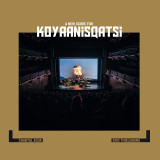
Dark-folk songwriter Chantal Acda and beyond drums-percussion musician extraordinaire Eric Thielemans propose a new score for Koyaanisqatsi, re-actualising the incredibly beautiful, raw, rhythmic and touching images of this 80-ties cinematographic masterpiece. Slow deep electric waves, lonely synths in sonic desert landscapes, rhythmic pulses, transporting drums and bells, and deeply longing sounds and voices make up the audible fundamentals of this imagined, neo shamanic, ritualistic music to accompany the Earth as it keeps on supporting our post human frenetics even today. This release contains a selection of the musical material scored for a live performance together with the screening of the movie. The live performance premiered on Film Festival Gent and Vooruit in the fall of 2022.
Currently based in Belgium, Dutch-born Chantal Acda (b. 1978) has worked under the Sleepingdog moniker since 2006, making three acclaimed albums that closed on the 'With Our Heads in the Clouds and Our Hearts in the Fields' (2010) album for which she collaborated with Adam Wiltzie (Stars of the Lid, A Winged Victory For The Sullen). They toured the UK and Benelux with Low in 2011. After all this, it was time for her first real solo record. Playing in various formations (Isbells, True Bypass, Marble Sounds) had made her conscious of the patterns that we all, as humans, share in. So, she sought out kindred spirits with whom she might record an album filled with freedom and intensity, and who were conscious of the patterns we so often fall back on. Nils Frahm was the first of these to cross her path. The inventive German pianist and producer is an intense and adventurous performer and was a perfect match for it. Acda also experienced a direct bond with Peter Broderick, a multi-instrumentalist known from his solo work (on labels such as Bella Union and Erased Tapes) and from his work with, among others, Efterklang. Cellist extraordinaire Gyda Valtysdottir from Icelandic group Múm had previously worked with Chantal as a member of the Sleepingdog live band. And lastly, Shahzad Ismaily stumbled into this picture by chance, but when Acda and he found themselves in the same room they formed an instant rapport. After this first record, 3 other solorecords followed. Chantal kept on searching for a deeper connection with the outside world and recorded "The Sparkle In Our Flaws" (2015) and "Bounce Back" (2017). She also released some live recordings with her band and also Bill Frisell, a highly respected jazz guitarist.(2018). These records were released on the German label Glitterhouse. Chantal and her band toured with these records in Europe. In 2019 Chantal created her first music/theatre performance P_wawau for Oerol Festival, The Netherlands. She worked with Valgeir Sigurdson (Björk, Bonnie Prince Billy,...) and singers from Het Nederlands Kamerkoor. As a result of this, she released the recorded music: Puwawau (2019). In 2021 Chantal released her most recent album Saturday Moon. (2021) For this album she worked with her band (Eric Thielemans, Alan Gevaert, Gaetan Vandewoude and Niels Van Heertum) but also with Bill Frisell, Shahzad Ismaily and Mimi and Alan Sparhawk (Low). Saturday Moon was very well received, internationally, by the press.
Eric Thielemans is a drummer and percussionist. Travelling across music scenes and disciplines, Thielemans navigates by means of his own compass. Most known for his resonant solo works like a Snare is a Bell, Sprang, Aural Mist and Bata Baba Loka and many collaborations with musicians in the experimental music scene, as well as the Jazz scene, and indie folk/pop/rock scenes Thielemans keeps on pushing the borders and expanding conscious aural spaces and territories. Recently, Thielemans has collaborated with PVT - a trio together with Mika Vainio & Charlemagne Palestine (album released April 2020) , PAT - a new trio together with Oren Ambarchi and Charlemagne Palestine, A new duo together with Oren Ambarchi, Billy Hart ("Talking about the Weather"), Chantal Acda ("The Sparkle in our Flaws", "Bounce Back", "Puwawau", "Saturday Moon"), Marshall Allen (Sun Ra), Tape Cuts Tape, Distance Light & Sky, Jozef Dumoulin, Trevor Dunn, Shahzad Ismaily, Vaast Colson, Nico Dockx, and many more. Currently Thielemans is working on r-e-s-o-n-a-n-c-e , a culminative work that encompasses and brings to the surface the underlying currents within his life in and with music. Withing r-e-s-o-n-a-n-c-e he investigates the everyday magic through conversations, writing and score writing to invite as many souls as possible to experience and co create the magic in the everyday.
Dirtiness and Divergency
It's a mystery what the handwriting of an artist is made of. What are the ties between artist and art? Why do we recognize the sound of a music producer even if they suddenly create music of a differnet genre?
On his new album "Kiss Dance Kiss" F.S.Blumm remains unmistakably himself, even if he assembles dub- infected, saturated, overdriven instrumental tracks. It may be his signature guitar sound, the disarmingly straightforward melodies, or the irresistible groove: This groove is compelling but unobtrusive. Three, sometimes four notes create timeless melodies.
F.S.Blumm unleashes his love for beats and dub by allowing the bone-dry riddims to dive deeply into the genre typical echo-chamber, combined with sweet guitar arpeggios and melodic basslines. These are friendly dub monsters. It doesn’t all fit seamlessly into the homogeneous sound. Take "Nimbb" with it's angular electronic groove, devoid of any melody, or the surprising horn timbres on "Twistert".
As with all of Blumm‘s works, there is a familiar intimacy even within big echo chambers.
His music searches for the sweet spot. He waits for the right time to record a piece, allowing for the exact degree of maturity of an idea, the magical moment when guest musicians meet, the collision between a well-planned process and happy coincidence. Finding the perfect spot for microphone placement, walking the fine-line between too slow and too fast, pinpointing the right delay-time are all inherent in Blumm's craft. It is a music full of these fragile constellations, interferences and synergies.
The concept of 'composition through duplication' is repeated visually on the cover:
Repetition creates blur and noise. Patterns rub against each other. Sound waves flutter in the wind. A simultaneous sunrise and sunset indicate the search for the perfect overlap.
Each track acts like a rhythmic serving suggestion for individual dance moves. Music for the daily dance around the kitchen table. A lookbook for kraut-dub, analog-electro or adult-instrumental-pop.
.. and now out into the sun.
repress
Mohamed Abdel Wahab wrote another big score for Om Kalsoum in 1972. In “Laylet Hob” (A Night of Love) we hear Arabic music and poetry in perfect symbiosis. The rich and lengthy instrumental intro is just a precursor of the emotion present in this song. The talent of the composer is underlined by how he utilises the traditional style of singing poetry in a more open and creative way. Abdel Wahab’s infusing of long and groovy interludes with varied tonality, rhythmical patterns and an overall unique approach, carries Om Kalsoum’s powerful voice and brings the song to an incredible climax. In this way, he gives more colour and depth to the music and the skilled soloists in the orchestra are finally able to breathe. Sensual rhythms, breaks and breathtaking solos of accordeon, guitar (Omar Khorshid), violin and organ (Hany Mehanna), have ensured this song is an all-time classic for belly dance routines. Souma Records thought it was time to re-release this monument on a high quality vinyl format, together with a repress of “Enta Omri”, another classic song by Souma.
- A1: Goi
- A2: Esheee!!!
- A3: Friday 13Th
- A4: Igqom Libuye
- B1: Ouuu1
- B2: Qumqum!!!
- B3: S3
- B4: Siyangqongqoza
- B5: The Night
- C1: Gqom Nyege
- C2: Pink Light
- C3: Ngom Ya Phesh*
- C4: Izandla
- D1: Umshini*
- D2: I Xhaphozi
- D3: Ushukela
- D4: Ubhuku
- E1: The Gringo
- E2: Salut To Phelimuncasi
- E3: Salut To Dj Lag
- E4: Qhafaza
- F1: Section A
- F2: Shadow
- F3: The King Of Gqom
- F4: Congo Dance
- F5: Uzalo
Highlighting the continuing evolution of Durban's globally influential gqom sound, this special trilogy of releases showcases three separate artists from South Africa's fertile musical landscape. The set captures a fresh wave of gqom innovation from veteran producer DJ Skothan/DJ Scoturn, DJ Scriby, and 20-year-old DJ MaRiiO. DJ Skothan/DJ Scoturn has been a key figure in Durban's underground scene for many years, producing alongside Phelimuncasi, Bhejani, Tweeyking, Lafaristo, MaRiiO and DJ MP3. His gqom and house tracks have quietly provided a rumbling engine for the city's scene, and "Nevegation" is his debut full-length, providing a complex diagram of his dancefloor versatility. This isn't the gqom you might expect to hear: immediately on opener 'The Gringo' familiar sounds - shovel kicks, chopped vocals, sampled gasps, horror movie strings - are shuffled into atypical patterns, creating jerky soundscapes rather than the expected four-on-the-floor bump. 'Salut to DJ Lag' pays respect to Durban's Beyoncé-approved pioneer, but twists the template into a propulsive new form, adding rolling and evolving percussion that teases fractal shapes each bar. But the album's most unexpected and forward-thinking moment arrives with the aptly titled 'The King of Gqom', a track that simmers the genre's percussive sounds into limber sci-fi club futurism, tweaking the bass sounds into patterns that nod to dubstep, Jersey club and ballroom. 25-year-old DJ Scriby has been working behind the scenes since 2013, assisting the first wave of gqom innovators promote their sound both inside Durban and beyond. In 2017 he joined London's Trax Couture to release "The Clermont EP", and here he introduces his long-awaited follow-up "Izingoma zeGqomu". Scriby's approach to gqom is well-studied and self-aware, which gives him the ability to stretch the sound's scope across the diaspora: just peep the Atlanta trap synths on the dynamic 'Friday 13th', or the absorption of tight grime snares on opening track 'Goi'. Scriby's engineering skill pushes his productions to the next level, lending slithering downtempo tracks like 'Ouuu1' and 'Igqom Libuye' a widescreen, big-room punch without losing the genre's undulating funk. And the producer even eyes the EDM mainstage with 'Qumqum!!', balancing saccharine synths with jerky kicks, claps and rolling toms. The youngest artist featured in the collection, DJ MaRiiO started producing when he was just 12 years old, watching YouTube production videos. "No one told me how to use FL Studio," he admits, "and no one helped me doing different genres." This might be why his music sounds so completely unique; the basic structure of gqom is still present, but MaRiiO augments these elements with youthful energy and carefree use of unusual sounds and production methods. "Zulu Man" opener 'GQom NyeGe' manages to mash together trance synths, DMZ bass and a driving woodblock rhythm that reminds you of its Durban roots, while the bizarre 'Ngom ya Phesh', featuring MaRiiO's regular collaborator Hot Chicks on vocals, pushes the gqom template into the red, with overdriven kicks and disorienting environmental sounds. All three records provide a 360 degree view of Durban's contemporary underground, nodding to the past, present and future of gqom. It's a genre that's constantly in flux as it moves from South Africa's bedrooms and basements to main stages and movie screens across the globe.
Pretty Girl is in some sort of purple patch. Storming off the back of stellar releases ‘Arc’ and ‘Sun Phase’, the Naarm neophyte has officially arrived with her debut EP ‘Middle Ground’. What is now becoming somewhat of a signature, the artist lathers the debut in her very own saintly vocals. This is a four-track exposé of emotive dance music.
The A1 ‘Arc’ sets the tone. Flexing her muscles in sound design, PG pieces together a shimmering house runner. Featuring laser-like chords and delectable drum patterns, ‘Arc’ sends you skyward. Racking up giant streaming numbers and snaring features on more than 20 Spotify Editorial playlists, this one’s an underground bullseye.
'Empathy’ is the next to arrive. A call and response record that walks a lovely tightrope, perfectly balanced in both vocals and production. As the name suggests, the piece is stacked with deep motif’s that act as a window into Pretty Girl’s day-to-day. Her standout vocal production to date is met with her distinctive driving percussion and melancholic chord progressions.
'Lavender’ is a sharp percussive creation and a fitting welcome to the B-side. A one-line affair that burrows deeper and deeper. Once again, showing off her prowess in production, PG plays masterfully with sub-bass and glitchy drums resulting in a stellar display of late-night audio.
Although devoid of lyrics ‘The Only Way Is Through’, brims with feeling and is the perfect climax. Here’s a record full of hope and promise. Manipulating an array of judiciously chosen synths, PG shapes a vast interstellar space. Over the 8 minute trip, a palette of tight drum patterns come knocking, pleasantly surprising you with each visit. With time on her side, the producer gives each sonic element its moment in the spotlight. And girl do they shine! Where there is light, there is darkness and PG plays with both moods to perfection. Listen closely and you can almost hear the concentration involved in piecing this moving galaxy together.
With staggering streaming numbers across multiple platforms along with additions to some of the world’s most sought-after playlists, the time is now for Pretty Girl and the release of ‘Middle Ground’.
Italy’s rising star Mauro Venti will arrive on Hot Creations for the first time in July with the three-track Sirens EP. It continues a stellar 2022 for the burgeoning artist, having released on EMI and Snatch Records already this year.
The title track leads the charge, blending minimal-laced bass elements with a rolling lead groove. It’s a modern house cut through and through, building cleanly into the futuristic sounds of Prison. Signature synths create a bladerunner-esque feel, transporting us to far away realms, before Symphony ends proceedings on a techy, late-night note courtesy of four-four bass patterns and gritty, hard-hitting percussion.
Mauro Venti is fast-becoming one of contemporary house music’s leading forces. His releases speak for themselves, with appearances on Green Velvet’s Relief, Superfett and Gorgon City’s Realm Records already under his belt. At just twenty-five years old, such feats are made all the more impressive, proving there’s plenty still to come for the young Italian talent.
The members of Szun Waves may not have been collectively in the same country, let alone room, for over two years, but that hasn't prevented them from realising their third album, Earth Patterns. The trio - comprised of producer Luke Abbott, saxophonist Jack Wyllie (Portico Quartet) and drummer Laurence Pike (Triosk/PVT/Liars) - recorded the album sessions together at the tail end of their 2019 European tour, locking themselves away in the studio for three days of improvisation. They emerged with hours of music, some inspired by their live shows, most born fresh in the studio itself, ready to be moulded into the group's third album in five years.
Belgian duo Chassé keep the acclaimed Black Jukebox series rolling with a 4-track EP that pays homage to classic US house sounds in accomplished style.
‘Fake Real’ kicks off with sunny abandon, all breezy piano chords and synth sax creating an authentic early-’90s NYC house vibe over plump plucked bass and lazily skipping percussion. Deep pads, bright strings and delicate synth arps bring the atmospheric edge.
‘People Dancing’ ups both the chonk and swing factor, getting more jaunty with its live piano chords and lilting rhythm. Hazy, filtered electric piano chords swoon over classic drum hits, the deep and the pumping meeting in perfect harmony.
‘Nightlife’ takes snatches of classic house vocal and peppers them between melancholic chord samples and dramatic snare hits, and a tense breakdown that exacerbates the subtle qualities of this soulful stomper. A few carefully placed organ notes are all that’s needed to draw the most out of the cool bassline funk.
‘True Game’ rounds off this delicious EP, finding itself somewhere between the classic US house vein and the French touch era, where graceful pads cut against jazzy organ chords, pitched-down vocals, garage snare patterns and seductive bass throbs.
"My debut album "Leidenzwang" is the consequence of boundless obsession" apostrophizes Kenji Araki with stoic calm. An obsession in the most positive as well as in the most negative of all senses, involving a wide variety of media. Kenji, in his early 20s, is known to be a digital and interdisciplinary artist from Austria with roots in Japan whose work is primarily influenced by the deconstruction of music and contemporary art.
"Leidenzwang" (in English: Suffering compulsion) is confrontation. Confrontation with the world. Confrontation with oneself. A confrontation that can be productive and cathartic. However, until Kenji Araki was able to get into this pattern of thinking, it was necessary in the process of creation to leave his very own sanctuary which he cultivated over the years. Escapism in the rear-view mirror of the past. "Leidenzwang" as a natural hybrid of passion (probably the most beautiful feeling a creatively active person can experience) and dangerous self-flagellation plus constant unrest. The result and musical core of Kenji Araki's debut album is an experimental, emotional post-club exploration with pop sensibility that deliberately ignores genre boundaries.
12 tracks spread over 50 minutes in fast forward: It starts with the adequate intro "Avant" - a primal scream. Next with "Matter" where Kenji collaborates with Thomas Mertlseder and constructs the sound world of a dark fashion film. Emotional highlights for the vividly vibrating club floor as well as for the digital terminals of Planet Earth delivers "Nabelschnurtanz" with its amalgamation of human sound waves. Followed by "Gel & Gewalt" - a combination of 90s Grunge, IDM and exponential rhythms - the fierce "SINEW" with its distorted double bass recordings and "Monomythz" which is Kenji's interpretation of a club banger with a combination of 2000s Eurodance aesthetic and hypermodern off kilter beats.
A moment to take a breath is offered by the spherical track "Milieu" which was written during an emotional low and thus naturally has a dark note. At position 8 is "lluviácida" - inspired by the "rave scene" observed from afar. Closely followed by the album's title number "Leidenzwang" with its granularized piano melodies while nature sounds can be heard in the background.
The album finale is formed by the polyrhythmic fireworks "Deathless Mess", the piece "Isan 世襲" (in Japanese heritage) which symbolizes the own inner turmoil and at the same time acoustically illustrates the relationship to his origin. And the conclusion is marked by the heartbreaking "Au-Dèla" as the epitome of a closer. Kenji Araki: The time is now.
"What took you so long?" might be a valid question concerning the ten year gap between Zanshin's new album "In Any Case By Any Chance" and his first album "Rain Are In Clouds".
Of course it is a question that the Viennese musician has asked himself quite startled in his usual self-critical manner, just to realize at a closer look that it has not been a lack of creativity or laziness at least. He used the Zanshin moniker on four EP releases and several remixes, plus a game soundtrack. Not to forget all his output as one half of producer duo Ogris Debris (the album "Constant Spring" from 2016 and roughly two dozen singles and remixes) and the many, partly award-winning audiovisual installations and performances with Leonhard Lass as DEPART (depart.at). Furthermore he has also built two sound installations in 2021, "I Gong" at Elevate Festival and "Cymatic Sands" at Ars Electronica. In addition, Zanshin performs with the Max-Brand-Synthesizer from time to time as part of the compositions by Elisabeth Schimana, and together with label mate Dorian Concept he has also composed and performed the piece "Half Chance/Music for Moogtonium" for this unique instrument, built by Bob Moog himself.
Not spared by certain global developments of recent years, but rather invigorated by exploring his own resilience, Zanshin had a talk with Affine Records Operator Jamal in the beginning of 2021, speaking of future ideas and releases. And what was initially a single release spawned into a whole album in seemingly no time. An old skit ("Polar Polychrome") on the Roland MC-505 groove-box that had never really been forgotten, but was rather waiting patiently somewhere in the back of his mind, suddenly proved to be the initial spark for the album.
The term "Zanshin", roughly translated as un-focussed attention, is in fact more than just a pseudonym but rather a directive in the artists life. Zanshin really likes to go in several directions at once, kind of according to Wittgenstein's claim that "The world is everything that is the case.", to find out where his love for music might lead him this time. He also somehow went back to his roots with this album. Not necessarily in the sense of certain musical influences or genres, because then the album would be even more eclectic than it already is. More like a focus on the core values in the fabrication process of the music itself, the freedom to rather follow the structures and sounds than to shape them in a completely predetermined way. Somebody once called it, "to weave what the music demands."
In this regard, Zanshin often feels more like a sculptor and tries not toadhereto strongly to the rules of specific sub-genres of electronic music. Searching for sounds and designing them is one of the energies that fuels his interest the most, thus at the beginning of a lot of tracks there are small skits and ideas that have the freedom to grow in whatever direction.
Hence this album has no elaborate story to tell, there is no extensive "narrative" or big time "storytelling" at work. "In Any Case By Any Chance" is not a novel but rather a collection of short stories (which are certainly dense and have complex plots nonetheless). The result is a long-player where playful electronica, skillful songwriting, extrovert dance music and symphonic film music enter into a symbiotic relationship. Returning to another Wittgenstein quote, "Whereof one cannot speak, thereof one must be silent", the emotional impact of music is the main focus and the results can be quite solemn at times, but around the corner always lurks the next bone-breaking rhythm pattern and gnarly sound design.
The infamous saying, "writing about music is like dancing about architecture", is another brick in the wall of sound in Zanshin's approach to music. He rarely roots himself in traditions or uses them too overtly, he really likes to agglomerate sounds, to challenge the listeners. It seems like he tries to avoid classification on purpose, because he knows that everyone has their own perception anyway. The only thing that this music demands implicitly is a willingness to listen attentively.
Very dense, at times really heavy and massive, then again airy and playful. "Music for clubs that don't exist.", might be another fitting caption to describe this album, which lasts for a little more than an hour.
The opener "Heatseeker" rushes to a sudden head start with its steel pan extravaganza, tropical vibes meet a bass line drenched in electro funk, and electrified synth stabs support the declaration of love in the lyrics. Kind of Jamie XX meets Electro meets Diva House. The monster that is "Bronteroc Brawl" is up next, a serious test for the speakers and a wild ride with metallic, growling sounds. The aggressive sound design reminds of suspense ridden shark chases, vicious dogs and cunning dinosaurs, in any case a track for people who love a proper bass stomper.
A new approach for the "indie discotheque" brings the emotional roller-coaster "In Gloom" with snappy drums and hypnotic synth motives á la Alessandro Cortini, creating an epic atmosphere together with the multi-layered vocals. A psycho-acoustic treat is position 4, the crisp instrumental "Polar Polychrome", you could even go as far as calling this a Zanshin signature track. Like mentioned before, the roots of this track go back to 2002 and you can hear the unmistakable influence of beat wizards like Photek, a piercing bass line is supported by poly-rhythmic drums, while dense pads try to escape the claustrophobic lockdown mood of winter 2020/21.
Another round of intense pathos waits for the listeners in the ensuing track "In Search Of". Moderat say "Hello", a melancholy piano melody is rushed to a climax by a wild bass arpeggio and forceful drums, the desire for a perfect sunrise at the next after-hour to the max. Initially just an appendix to the preceding track, "Time After Thought" swiftly developed from a mere improvisation to an ambient epic with a croaking alien piano, as if Keith Jarrett were on his way to Alpha Centauri.
Up next is the first single "Because Why", a breakbeat driven, synth-heavy track with winged vocals and a popular film quote. The title refers to the movie "Alphaville" by Jean-Luc Godard, a dystopian science fiction film noir, in which an omniscient computer system named Alpha 60 is ruling society and humans can only say "because" but never "why". As if the gears of a galactic mechanism were spinning into motion sounds "Identity Slices". A raspy chord structure finds its counterbalance in a kind of stumbling, wonky beat, and Zanshin would never deny the huge influence that Autechre's sounds and structures always have had on his music. Micro- and macrocosm meet on the same level and this friction is also a metaphor for questions of identity and self-awareness, without using voices or lyrics.
Off we go into the IDM bubble bath of "Enzyme Enigma", the bass drum is stomping and a fizzy acid-line is twisting in all directions behind rolling dub-techno chords. "Corrosion Creak" is a kind of acoustic degradation process, the rave dogs are finally let loose and everything happens at once, funky synths shred, string sounds wail and then there is this bass that sounds like smashing a rusty metal plate in the junk yard with a vengeance.
Towards the end everything slows down a bit, the beat in "Whatever Words" is Warp school cerebral hop at its best and therefore loads of glittery, creaky sounds swarm out until the synapses are overloaded, cumulating in a mighty bass ending. Last but never least, "Rebus Redux" guides us into the limitless night sky, with long indulgent pads dotted by an aimlessly wandering piano, while a compact net of tamed resonances and meandering sub frequencies unfolds in the background, enticing navel-gazing imagination.
HET’s man in charge, Hagen Richter, is taking care of the labels’ new release, Cat #: HET008. Upcoming 721 Lee EP is a 12” two track release, each side giving space to just one track running on 45rpm. The original mix of 721 Lee is aiming at dancers’ emotions, building up slowly and in the end leading to a classic, uplifting arpeggio pattern. On the B-Side Dystopian’s core artist Alex.Do interpretates 721 Lee. His “Nautilus Version” uses a catchy melodic hookline and backs it up with quotations of trance and goa elements. This fast pace remix is full of energy and yet transports the original’s emotions in his unique Alex.Do-style! ☺
The long-running Kompakt imprint will release an EP by German DJ and producer Sascha Funke in September. Sharing five tracks that traverse quirky house and techno, Treets marks Funke’s monumental return to Kompakt since his Zug um Zug two-tracker in 2014.
Speaking about Treets, Funke says he is "very happy to be back on the mothership Kompakt" after an eight-year break. As one would expect with Funke, the EP fits the cosmic world of Kompakt to a tee. The title track conveys a weird, tripped-out atmosphere as an alien-like vocal burbles between an acid bassline and squeaky percussion. It's a tantalising glimpse of Funke's freaky underworld. E_Plus follows a similar wonked-out vein, only this time, the vibe is ominous. Funke pairs an orchestral vocal with bleepy pads and signature acid-drenched melody — a solid offering oddball of energy. On Alles Paletti, a 2-step drum pattern and string of bright claps create a sunny soundscape, complemented by a robust bassline and ethereal synth notes. It's fairytale house music, the kind only Funke can produce. The penultimate track Haus More is subdued, as chugging drums slither between a wobbly melody. The Other Version feels futuristic, as Funke goes full-force electro. Extra-terrestrial vocals return, but the pace is cranked up by strident sound FX and thudding drums. An eccentric end to an eccentric EP.
Sascha Funke is a Berlin-based producer and DJ with two decades' worth of releases building his back catalogue. BPitch Control, Turbo Recordings, Endless Flight, Running Back, and several more esteemed imprints have released his work. Today, he continues to create sleek sounds that weave various genres from house, techno, disco, Krautrock, wave, electro and unclassified anomalies. As a DJ, Funke is just as free-wheeling as his productions. He's played E1 in London, Caos in São Paulo and Renate in Berlin, amongst others, displaying his sweeping sound to a worldwide audience. Having been exposed to euro-dance pop as a youngster, you can hear flashes from the genre stitched throughout his work but blended in a way that's quintessential to Funke. Never one to change his sound according to the latest trend, Funke stays true to his creative vision — one of the most significant challenges for producers today.
Das traditionsreiche Kompakt-Imprint wird im September eine EP des deutschen DJs und Produzenten Sascha Funke veröffentlichen. Mit fünf Tracks, die sich durch schrulligen House und Techno auszeichnen, ist “Treets” Funkes monumentale Rückkehr zu Kompakt seit “ Zug um Zug” im Jahr 2014.
Im Gespräch über Treets sagt Funke, er sei "sehr glücklich, nach acht Jahren Pause wieder auf dem Mutterschiff Kompakt zu sein". Wie bei Funke nicht anders zu erwarten, passt die EP hervorragend in die kosmische Welt von Kompakt. Der Titeltrack vermittelt eine seltsame, abgedrehte Atmosphäre, wenn eine außerirdisch anmutende Stimme zwischen einer Acid-Bassline und quietschenden Perkussionsinstrumenten dahinplätschert. Es ist ein verlockender Einblick in Funkes freakige Unterwelt. “E-Plus” geht in eine ähnliche Richtung, nur dass dieses Mal die Stimmung bedrohlich ist. Funke paart einen orchestralen Gesang mit bleepigen Pads und seiner typischen Acid-getränkten Melodie - ein solides Angebot voller Energie. Auf “Alles Paletti” schaffen ein 2-Step-Drum-Pattern und eine Reihe heller Claps eine sonnige Klanglandschaft, die durch eine robuste Bassline und ätherische Synthesizernoten ergänzt wird. Das ist märchenhafte House-Musik, wie sie nur Funke produzieren kann. Der vorletzte Track Haus More ist zurückhaltend, da tuckernde Drums zwischen einer wackeligen Melodie schlittern. “Treets (The Other Version)” fühlt sich futuristisch an, weil Funke hier voll auf Elektro setzt. Der außerirdische Gesang kehrt zurück, aber das Tempo wird durch schrille Soundeffekte und stampfende Drums angezogen. Ein exzentrisches Ende für eine exzentrische EP.
Sascha Funke ist ein in Berlin ansässiger Produzent und DJ mit einem Backkatalog von zwei Jahrzehnten an Veröffentlichungen. BPitch Control, Turbo Recordings, Endless Flight, Running Back und einige andere angesehene Labels haben seine Arbeiten veröffentlicht. Heute kreiert er weiterhin geschmeidige Sounds, die verschiedene Genres wie House, Techno, Disco, Krautrock, Wave, Electro und unklassifizierte Anomalien miteinander verweben. Als DJ ist Funke genauso freizügig wie seine Produktionen. Er hat unter anderem im E1 in London, im Caos in São Paulo und im Renate in Berlin aufgelegt und seinen mitreißenden Sound einem weltweiten Publikum vorgestellt. Da er schon als Jugendlicher mit Eurodance in Berührung kam, sind in seiner Arbeit immer wieder Anklänge an dieses Genre zu hören, die aber auf eine Art und Weise vermischt werden, die ganz typisch für Funke ist. Niemals verändert Funke seinen Sound nach dem neuesten Trend, sondern bleibt seiner kreativen Vision treu - eine der größten Herausforderungen für Produzenten heutzutage.
Clear Vinyl[23,49 €]
Ghent based psych jazz collective Compro Oro, are set to release new album 'Buy The Dip' on the 2nd September via the groove-obsessed Sdban Ultra label. Having received critical acclaim for their 2020 album 'Simurg' - a collaboration with Murat Ertel, co-founder and frontman of Istanbul's cult psychedelic folk band BaBa ZuLa and his singer partner Esma Ertel - the band's fifth album is less ethno- and more techno-logy, both on a musical and conceptual level.
With tastemaker fans including BBC 6 Music's Gilles Peterson and Stuart Maconie alongside Jazz FM's Jez Nelson, the band's spontaneous quest for psychedelic sounds and jazz grooves has not stopped expanding since their formation in 2014.
After imaginative musical trips to Havana, Mogadishu and Istanbul for previous releases, Compro Oro went looking for sounds and inspirations from other corners of the globe for 'Buy The Dip'. Synthesizers and electronic effects spice up Compro Oro's distinctive musical marriage of vibraphones, electric guitars, jazzfunk rhythms, exotic percussions and dubby bass patterns. Band leader and composer Wim Segers created these new compositions often on piano or vibes in a more analogue way, leaving enough room for his band mates to colour each track when fine tuning the song.
Segers was inspired by the world of crypto markets and the specific concept of 'buying the dip': bitcoin diggers who play the markets at specific 'low' moments to gain higher profits when prices go up again. Are we all reduced to consuming creatures, seeking for nothing more than the thrill of pointless spending and endless profits? It's a fairly philosophical question - especially for an instrumental album - but it's key for the punchy and eclectic sounds on 'Ben Hur' and 'Bitcoins'.
Apart from those synths and fx, a fair bunch of neo-noir western vibes sprout up on this album as well - think detuned piano's, flamenco-like guitars, rattling snare drums, and imminent whistles. Add to that some laid back sunny pop sounds ('Kayak'), off-hook and swaying Turkish psychedelica ('Karsilama') and even some haunted, kraut-ish vocal parts ('Dungeon'), it's evident Compro Oro has a musical voice without any equal in Belgium and beyond.
Compro Oro released their first album 'Transatlantic' in 2015, an ode to jazz vibraphonist Cal Tjader, an icon of the 1950's Latin jazz movement. The release received critical acclaim back home, lauded in the press as a drunken mix of Buena Vista Social Club and guitarist Marc Ribot's, Cubanos Postizos. Subsequent live shows have been called a celebration for the hips, the ear and the soul.
2017 saw the release of 'Bombarda', a bold EP that sailed South and East of Cuba, incorporating different ethnic rhythms and melodies in elaborate jams. No palm trees and cocktails in Havana this time, but instead dingy basements and LSD in West African cities. The critically acclaimed 'Suburban Exotica' followed in 2019 with 'Simurg', released in 2020, earning the band global success.
Wardown, the emotive and experimental project from Technimatic's Pete Rogers, releases second LP on Blu Mar Ten Music
Where the debut Wardown album was a diary of smeared memory, musically recounting the author's childhood home and his subsequent feelings of dislocation from it, Wardown II expands on the themes of nostalgia and focuses on our collective reactions to a promised future that remains undelivered.
Using aural scraps from that most optimistically futurist period, the 1950s & 1960s, Wardown weaves them into an uneasily dreamy, bittersweet commentary on postmodern nostalgia. The album veers between otherworldly, euphoric harmonies and pumping, mechanical incantations of promises for a new age.
- A1: Call It A Night 03 47
- A2: Toby Whyle What A Ride 03 23
- A3: Toby Whyle Maze 03 21
- A4: Toby Whyle No One Moves 03 12
- A5: Toby Whyle Not In The Slightest 04 29
- B1: Gave My All 03 24
- B2: Toby Whyle Quiet The Silence 03 41
- B3: Toby Whyle Liven Up This Place 03 54
- B4: Toby Whyle Pity 03 47
- B5: Toby Whyle Trip To The Sun 05 49
What happens when you let go of something you've always been passionate about? Will it come back? And if so, in what ways and with what impact?
These questions laid the foundation for Toby Whyle's debut album 'Call It A Night'.
It is a journey to find out what feels right to him-this means escaping old patterns and allowing himself to try new things. Musically, he exposes himself unreservedly to the gravitational forces of electronic music and guitar pop by orbiting these points of attraction without ever really getting caught by either of them. Each song moves along its own trajectory, fueled by Toby's thoughts and experiences.
His first single, 'No One Moves', hitting number 1 on the FM4 charts in early 2021, marked the beginning of a new adventure-a journey upon which Toby embarks entirely on his own for the first time. After his first EP, 'A Mood Of Its Own', and the release of further singles, the debut album 'Call It A Night' will be out on May 20th, 2022, on Matches Music.
PRESSTEXT
Writing songs has always been quite natural and ever-present in Toby Whyle's life. And he's written plenty of them over the last decade. However, what's new is the realisation that songwriting is one of his few means to slow down the bright and fast-paced world surrounding us. Driven by the urge to create and develop something new, he started to write again. And suddenly, this feeling of being able to pause time came out more intense and immediate than ever.
In this way, the singer, songwriter, and guitarist manages to stand back from the constant rush, carving out space to move freely at his own pace. " Each song is an empty room, and I can decide for myself how I'm going to furnish it. It might get rather chaotic with stuff piled up to the ceiling, then again there's almost nothing in it", he describes his approach to songwriting. For him, creating melodies, crafting music and lyrics is not just a means of reflecting on situations he finds himself in but also a tool of handling them. Toby's music strives to affect and inspire people in all the different phases in life, as his songs are also a result of the diverse situations he's gone through.
Aesthetics and craftsmanship play a crucial role in Toby Whyle's creative process, from crafting songs, recording and producing them, and building and maintaining a particular visual language. He aims to create high-quality and exceptional music that enthuses and delights people, which sparks energy and conveys a certain feeling.
Polifonic Records is the melodic balance between antagonistic vibrations, spirits and energies that inhabit the land of Puglia since the dawn of time.
An harmonic exploration into colorful, vibrant sunrise atmospheres and emotional, introspective sunset sensations. One Body. Many Souls.
PF004 // The fourth vinyl of Polifonic Records label brings together artists from different cultures and ethnicities to create a seamless blend of sounds with diverse influences. Encompassing genres like house, Balearic beat, and acid, harmonized through ambient arrangements and 4-tothe-floor rhythm patterns to chill and groove to, this record is a material embodiment of the multicultural and polyhedric approach that Polifonic adopts throughout the multiple extensions of our projects.
The first track “Generations of Sunsets” by Lipelis joining with Andy Butler from Hercules and Love Affairs, vividly illustrates the extent of their sonic palette: a journey that runs through a Balearic groove - also with the use of guitar - and expands the mind to exotic places keeping the body moving with its acid touch.
Italian 90’s riviera house meets percussions and ethnic grooves in the born new track from the Milano duo Eternal Love. “Kuasi Riviera” reflects perfectly the nature of Polifonic between clubby atmospheres and connection with the wild world.
Then comes the darker side with Yu Su, who switches it up with new diversions in tempo and rhythm throughout “Oil” with a blend of deep basslines and obscure soundscapes contributing to this journey through space and time.
Benedek’s “Desperado” doesn’t shy away from deep diving right back to the 90s Italian house overlapping bold soundscapes through the lens of a contemporary producer. Distinctive,
immersive, and dauntless.
The Gamelatron is many things; one could call it a sculpture, a multimodal installation, an instrument, a robot, a feat of engineering, a vision—and it is all of these things. More importantly, though, it is a concept sustained by Aaron Taylor Kuffner, aka Zemi17, whose Gamelatrons are “sound producing kinetic sculptures” designed to create an immersive, visceral experience for the listener. Not a small feat, and yet the ambitions of Zemi17 are absolutely realized in this long-standing project, culminating now in his third release for The Bunker NY: Gamelatron Bidadari.
The Gamelatron Bidadari is not just a name—it is one of seventy-plus musical sculptures that Zemi17 has conceptualized, designed, and fabricated. Therefore, it would be inaccurate to think of this release as simply a series of arrangements composed in a finite period of time. Rather, it’s a window into a project and a process that is much larger than any single album can encapsulate. Gamelatron Bidardi is the culmination of more than a decade of work, and is central to Zemi17’s evolution, not only as a musician but as an artist.
Having studied gamelan for many years in Indonesian villages and at the Institut Seni Indonesia in Yogyakarta, Kuffner is a musician, an artist, technologist, and craftsman. The gongs in his sculptures are co-created with master Indonesian artisans. Each Gamelatron composition is site-responsive, meaning its sounds are composed for the acoustics and intentions of the space it inhabits, whether it’s an art gallery, a wooded landscape, or the inner temple of Burning Man. The Gamelatron does not stand alone: it is in constant co-creation with its physical environment, and in dialogue with gamelan’s long-standing history.
Originally exhibited at the Smithsonian Renwick as part of a show entitled, No Spectators: The Art of Burning Man, the Gamelatron Bidadari produces sounds that are delicate yet strong, and deeply hypnotic. Textured chiming creates intricate polyrhythmic patterns that are both complex and simple, or in a word, elegant. On Gamelan Bidadari, Zemi17 refrains from adhering to the strict musical structures; his approach to composition is free flowing.
He says, “I want to evoke what the music tells me it has to offer. It is like following water to its conclusion (or non-conclusion).” The arrangements on this album, written by Zemi17 and performed by the robotic arms of the Gamelatron, leaves the listener feeling enchanted, nourished and enriched.
A sense of the mystical comes through in the tonal quality of the instrument, and is conceptually felt in the sculpture’s name: the Bidadari, which loosely translates to “forest nymph.” The music conjures up natural wonder, and the four sculptures that make up the Gamelatron Bidadari, in fact, resemble trees. They are four independent yet connected entities, each with a large gong situated at their structural base—the sonic “roots” of the sculpture—while smaller gongs branch off of a golden, trunk-like spine. The Gamelatron Bidadari is as physically stunning as it is mesmerizing to the ear. A kind of divinity is invoked through its sound, or a sacred cohesion between past and present, tradition and new form. Meant to be viscerally experienced, the sounds of the Gamelatron call for sublime togetherness. Gamelatron Bidadari is not just an album but the crystallization of Kuffner’s work; it is a condensed yet spacious glimpse into the sonic power of Zemi17’s Gamelatrons, which have already been heard and experienced live by over a million people.
Limited to: 300 copies.
Lera Lynn blurs the boundaries between genres, carving out a sound inspired by art-pop, indie-folk and the outer edges of American roots music. She’s a singer. She’s a songwriter. She’s a road warrior. She’s a multi-instrumentalist and producer. She’s a mother.
Texas born, Nashville resident Lera Lynn is just as comfortable creating an album entirely by herself, as she is collaborating with her heroes. In 2018, she worked with T Bone Burnett and Rosanne Cash on tracks that were not only picked up by the TV show True Detective, but Lynn was cast as a recurring character who performs in a dive bar frequented by the main characters.
However, nothing could have prepared Lynn for the lessons learned during motherhood. She welcomed her first son during the early months of the pandemic and began writing down her insights, chronicling this newfound experience of shifting priorities, strange endings, and new beginnings. Inside, she was battling postpartum depression. Outside, a bigger picture began taking shape: a feeling of interconnectedness, of cyclic renewal, of the knowledge that every beginning is an end and every end is a beginning. Those realizations coalesced into Something More Than Love, a record filled with synthesizers, lush soundscapes, the pop-noire punch of Lynn's voice, and the most dynamic melodies of her career.
Inspired by the cyclical patterns that shape our place in the world, Something More Than Love was co-produced and largely performed by Lynn and her partner, Todd Lombardo (Kacey Musgraves/Donovan Woods/Kathleen Edwards). They'd met years earlier, not long after Lynn relocated to Nashville from her college town (and musical launchpad) of Athens, Georgia. "My first time ever co-writing a song was in Nashville with Todd," she says of the ACM-nominated multi-instrumentalist. The two became fast friends and, eventually, partners; their creative chemistry giving way to romance and a growing family. That partnership reached a new milestone in 2021, with the newfound parents sharpening their creative instincts and expanding their palette for Lynn's sixth album.
"A lot of people were making records during the pandemic," Lynn notes, "and all they had was time. But it was the opposite experience for us. We created this whole record while still in the fog of early parenthood, and we didn't have the luxury of waiting for lightning to strike. We had to be focused and intentional."
Striking a balance between intimate self-reflection and universal insight, Something More Than Love poses big questions over even bigger-sounding music, with tempos and layered arrangements that find Lynn at her most dynamic. Illusion opens the album with spacey synthesizers before snapping into a taut, 1980s-influenced groove, combing reverb and rhythm into a song that swoons one minute and struts the next. I'm Your Kamikaze — a deconstructed burst of indie garage-rock, heavy on melody and percussive pulse — unfolds like a salute to self-sacrifice, with Lynn dedicating her own existence to ensuring her child's flourishing. What Is This Body? finds her reassessing her ideas of physical identity and womanhood, while the album's gorgeous title track makes room for slow-burn strings and a meteoric chorus.
Together, those songs turn Lera Lynn's experience with absolute surrender — surrendering oneself to the trials and triumphs of motherhood — into a universal record about the experiences that bind us together. This isn't just Lynn's story. It's the story of a life cycle that repeats itself over and over, every termination point becoming a starting line, every death matched by a rebirth, every edge giving way to the circular slope of the ouroboros.
UK label Dawn State continue their hot streak this summer with further eclectic moods for the dance floor and beyond. On the tools for the fifth outing on the label is KIDWHO, a blossoming talent who through the last years whilst enduring the pandemic found light by burying himself in his studio experiencing new creative flows. The “Warez House” EP varies in tastes, similar to the highs and lows of the times that just passed us by.
Diving into the deep end is the title track, “Warez House”, loopy and hypnotic, swaying between shades of low end leaned house and techno. Off kilter synths and pads maneuver their way around the driving force of the track. “It came together layer by layer, eventually turning into a dense (and at times, unruly!) groove. A final touch
of atmospherics from an old Roland ROMpler and the track was done - bar a generous helping hand in mixdown from Joel Kane (who also turned out a heads-down dub version which might make an appearance!).”
Leaning in a more hazy direction is the blissful cruiser, “Leploop Lagoon”, a deep and emotive vibe crafted especially for the early mornings. A sophisticated deep house energy from the talented producer. “‘Leploop Lagoon’ is the oldest track on the EP, a cleaned-up version of a rough jam I made around four years back. It takes its name from the Leploop, a quirky semi-modular analogue groovebox of sorts, hand-built in Italy. A very unique and unpredictable machine, it’s on bass duties here as well as providing some percussion sounds via the MPC sampler.”
On the flip side lies “Spectral Pattern”, and it packs a certain punch. The rolling arrangement converses in harmony with icy hi-hats that flash in and out teasing the energy, all of the elements having space to breathe and work their magic.“‘Spectral Pattern’ came together quickly one very productive weekend in the studio last year. It developed from the bass sequence, which comes from a Yamaha TG-33, an unassuming 80s digital synth known for its glassy mix of ROM samples and FM tones - very New Age sounding, or 90s computer game soundtracks. But when you strip it back to basics, it punches hard in the low-end.”
Slipping on to the B side is a five minute transcendental trip, offering yet another series of textures to this otherworldly EP. The final track “At Least We Hav Music” is an ethereal soundscape waiting to be explored, wandering amongst ambient realms throughout. “The label was keen to include an ambient track on the release, and I wanted to record something specially for them. At first I had in mind something droning and melancholic, but after a few experiments with cassette
loops and reverb pedals this was the one that stood out. It was recorded during one of the lockdowns, and I guess I needed to create something that sounded more hopeful than brooding. I messaged DS boss Tom Haus with a rough version, and we went on to have a grumble about the gloomy state of things, locked-down in our respective cities and missing friends, family, activities… At some point I wrote ‘at least we have music’ - and almost as soon as I had sent it I knew I had found the track’s title. I’m very lucky to have had my home studio as a refuge through the long months of lockdown, and I’m honoured to have the chance share some of my output from this period on this record.”
KIDWHO fitting the Dawn State ethos to a tee here as they set up shop for what looks to be another fantastic release. “Each of these tracks came about in quite different ways. Like many creative people, I had moments of struggle during the pandemic, where the lack of variety and day-to-day stimulation lead to periods of writer’s block, and so I used those times to focus on smaller, more manageable projects such as making synth patches, recording sounds and and throwing together short loops in my samplers for later use. A number of
these short loops eventually laid the foundations for title track ‘Warez House’. Big thanks to Dawn State, Joel Kane, El Choop and everyone else who has helped make this happen.” -
KIDWHO
Akae Beka's inimitable style of rich, deep, multi-layered songwriting, uncompromising devotion to RasTafari and soulful healing melodies developed over decades performing with St. Croix based band Midnite and countless recordings. At the point of his untimely passing in 2019, he had released over 70LP's. He is without a doubt one of the most prolific reggae artists ever known.
The stellar production trinity that is Zion I Kings have been involved collectively and individually in creating some of the most highly regarded contributions to the vast Akae Beka catalogue. Ride Tru, originally released digitally and on CD in 2014, stood every chance disappearing into the all eclipsing shadow of the LP released by them earlier that year, Beauty for Ashes, which had been named by iTunes as the reggae album of the year. A monumental achievement for undiluted, uncompromising RasTafari roots reggae music this side of the millennium. So needless to say, the bar was high and Vaughn Benjamin and Zion I Kings must have known that, as they managed to raise it higher again.
Ride Tru continues in the same form, rootsy, soulful, refreshingly polished and authentically raw, the threads of anciency that any devout reggae lover will be looking for and the threads of modernity that keep it alive and appealing in the modern day. A uniquely regal tapestry that has become synonymous with music created from the unity of Zion I Kings and Vaughn Benjamin
Following 8 years of anxious anticipation, for the countless Akae Beka fans that are also vinyl connoisseurs, this LP is now being released on as a 12" vinyl LP courtesy of Before Zero Records. This offers the listener not only the chance to enjoy this LP in an analogue form, but also the chance to hold the artwork as a 12" square masterpiece, created by the hands of Ras Marcus, the artist who gave the powerful visual presence that became synonymous to much of the I Grade / Akae Beka works over the years.
“How does an artist follow an album considered by many to be the best reggae album of 2014?..... you get right back in the studio with the same brilliant production team and follow that album a few short months later with one that nearly eclipses it entirely.”
Midnight Raver — Worldareggae
“...remarkable for the clarity of Tippy’s mix and the contrast between the hardness of Lloyd Richards’ drums and the softness of the guitars, keyboards and brass. The woozy analogue warmth of an old Augustus Pablo production – Son of Jah Dub - for Worry Free demonstrates how well Vaughn sits on the sounds of the original masters (an avenue that should be pursued further). Another veteran guest is the late Style Scott - who beats out one of his final patterns on How I & I Carry On.”
Angus Taylor — United Reggae
‘Reich’s music expands from minimalist austerity to more full-bodied passages and back again. Reminiscent of his earliest work, it is very beautiful.’ – Financial Times
‘The music has tender energy, and an undercurrent of melancholy. Its droning tones sometimes seem to be pulling apart – like taffy, or like Richter’s stretching spaghetti stripes of color.’ – New York Times
Nonesuch Records releases the first recording of Steve Reich’s Reich/Richter, performed by Ensemble intercontemporain and conducted by George Jackson. The composition was originally written to be performed with German visual artist Gerhard Richter and Corinna Belz’s film Moving Picture (946-3).
Reich describes Richter’s book Patterns, which served as source material for the film: “It starts with one of his abstract paintings from the ’90s. He scanned a photo of the painting into a computer and then cut the scan in half and took each half, cut that in half and two of the four quarters he reversed into mirror images. He then repeated this process of ‘divide, mirror, repeat’ from half to quarter, eighth, sixteenth, thirty-second, all the way up to 4096th. The net effect is to go from an abstract painting to a series of gradually smaller anthropomorphic ‘creatures’ (since the mirroring produces bilateral symmetry) to still smaller very fine stripes.
“Belz described the film in terms of ‘pixels’. It begins with two-‘pixel’ stripes and the music begins with a two-sixteenth note oscillating pattern. When the film moves to four ‘pixels’, the music moves to a four-sixteenth note pattern, then to eight, and sixteen,” the composer continues. “After that, I began introducing longer note values – initially eighth notes, and later to quarter notes. By the middle of the film, when the images move from 512 to 1064 pixels, the music really slows to dotted half notes. Finally, as the ‘pixel’ count begins to diminish, the music moves back into more rapid eighths and then ending with the most intense rapid sixteenth movement.”
After more than one hundred performances of Reich/Richter at The Shed in New York in 2019, it was performed in London at the Barbican by the Britten Sinfonia conducted by Colin Currie and then in Paris at the Philharmonie, where this recording was made. The Austrian ensemble Windkraft Tirol, led by Kasper de Roo, will perform Reich/Richter on September 8 at Szentrum, Silbersaal in Schwaz, and the LA Phil New Music Group, led by Brad Lubman, performs the piece, accompanied by Richter and Belz’s film, at Walt Disney Concert Hall in Los Angeles on April 1, 2023.
Nonesuch has recorded every new piece of music by Steve Reich since 1985, beginning with The Desert Music and continuing through 2018’s Pulse/Quartet, resulting in twenty-two albums and the two box sets Phases in 2006 and Works: 1965-1995 in 1997. The label will put out a collection of his complete works in 2023.
Reich released a book last month, Conversations, that includes dialogues with past collaborators, fellow composers, musicians, and visual artists who have been influenced by his work, including: David Lang, Brian Eno, Richard Serra, Michael Gordon, Michael Tilson Thomas, Russell Hartenberger, Robert Hurwitz, Stephen Sondheim, Jonny Greenwood, David Harrington, Elizabeth Lim-Dutton, David Robertson, Micaela Haslam, Anne Teresa de Keersmaeker, Julia Wolfe, Nico Muhly, Beryl Korot, Colin Currie, and Brad Lubman. Booklist said in its review, ‘Iconoclastic American composer Steve Reich is singular in his own right, and when he is in conversation with other equally iconoclastic composers, conductors, sculptors, musicians, percussionists, and video artists, sparks not only fly, they sparkle. Reich and his colleagues conduct lovely give-and-takes during which they share stories, creative approaches, and viewpoints. Reich's Conversations is the best kind of eavesdropping.’
Steve Reich has been called ‘America’s greatest living composer’ (Village Voice), ‘the most original musical thinker of our time’ (New Yorker), and ‘among the great composers of the century’ (New York Times). His music has influenced composers and mainstream musicians all over the world. Music for 18 Musicians and Different Trains have earned him two Grammy Awards, and in 2009, his Double Sextet won the Pulitzer Prize. Reich’s documentary video opera works – The Cave and Three Tales, done in collaboration with video artist Beryl Korot – have been performed on four continents. His recent work Quartet, for percussionist Colin Currie, sold out two consecutive concerts at Queen Elizabeth Hall in London shortly after tens of thousands at the Glastonbury Festival heard Jonny Greenwood (of Radiohead) perform Electric Counterpoint followed by the London Sinfonietta performing his Music for 18 Musicians.
In 2012, Reich was awarded the Gold Medal in Music by the American Academy of Arts and Letters. He has additionally received the Praemium Imperiale in Tokyo, the Polar Music Prize in Stockholm, the BBVA Award in Madrid, and the Golden Lion at the Venice Biennale. He has been named Commandeur de l’Ordre des Arts et des Lettres and has been awarded honorary doctorates by the Royal College of Music in London, The Juilliard School, and the Liszt Academy in Budapest, among others. ‘There’s just a handful of living composers who can legitimately claim to have altered the direction of musical history and Steve Reich is one of them’, states the Guardian.
Pierre Boulez founded the Ensemble intercontemporain in 1976 with the support of Michel Guy (who was France’s Minister of Culture at the time) and the collaboration of Nicholas Snowman. The Ensemble’s thirty-one soloists share a passion for twentieth and twenty-first century music. Under the artistic direction of Matthias Pintscher, the musicians work in close collaboration with composers, exploring instrumental techniques and developing projects that interweave music, dance, theater, film, video and visual arts. In collaboration with IRCAM (Institut de Recherche et Coordination Acoustique/Musique), the Ensemble intercontemporain is also active in the field of synthetic sound generation. New pieces are commissioned and performed on a regular basis. Resident of the Cité de la musique – Philharmonie de Paris, the Ensemble performs and records in France and abroad, taking part in major festivals worldwide.
George Jackson, winner of the 2015 Aspen Conducting Prize, came to attention after stepping in at short notice with Orchestre de Paris, where he stepped in for Daniel Harding. Recent highlights include leading Ensemble intercontemporain at Festival Romaeuropa, the Rainy Days Festival in Luxembourg, and Festival D’Automne in Paris, as well as conducting the RTÉ National Symphony Orchestra, the orchestra of Opéra de Rouen and the world premiere of Tscho Theissing’s Genia with Theater an der Wien. His varied operatic experience includes performances at Opera North, Hamburg State Opera and Opera Holland Park, as well as conducting a new production of Hänsel und Gretel at Grange Park Opera.
As Spacemoth's Maryam Qudus was hard at work in her recording studio, synthesizers piled high, she found her mind in another place, hypnotized by the questions swirling inside her: “How could I ever face this world alone?” she wondered. “How long will I be able to stay in this place that I love?” Attempting to understand her position in the universe, the relationships that hold her together, and the climate crisis unfolding around her, she realized ruminating over these concerns was paradoxically taking her away from precious experiences. No Past No Future is the reckoning point between nostalgia and nihilism: the struggle to hang on to a moment as it warps in time.
Devotion to music has driven Qudus—a performer, composer, and producer based in the Bay Area—for as long as she can remember. At age twelve, she traded chores for guitar lessons; at sixteen, she took on after school jobs to pay for voice lessons. As a first-generation Afghan-American child of working-class immigrant parents, finding a place in music has been nothing short of a challenge for Qudus.
The bulk of performance on Spacemoth songs comes from Qudus herself, who favors vintage synths like the Yamaha CS-50 and Korg Polysix alongside fluttering tape manipulations; these create cosmic, lush soundbeds, drawing comparisons to beloved projects like Broadcast and Stereolab. On songs like “Waves Come Crashing,” a whirlwind of noise leads into darker, bass-heavy instrumentation as she confronts the inevitability of death: “These fears, they have taken our years,” she laments about the anxiety of mortality. On “Pipe and Pistol,” Qudus explores the experience of being an immigrant starting over in America. The song showcases punchy rhythms, reminiscent of Devo’s post-punk dynamism: “I see your face / my powers, they raise,” she sings with potency. Identifying cyclical habits inspired “Round In Loops,” which highlights patterns we endure in our lives and minds. “Boss is waiting / we run / love is fading / we run,” Qudus commands, encouraging escapism and a break to the cycle of mundanity.
Every track flows with Qudus’ low timbered vocals, in harmony with the watery, glowing synthesizers that anchor the album. The result is a record rich in intergalactic, avant-pop, radiating in astonishment at the vast, emotional landscape humans contain within ourselves, and in wonder at the preciousness of our time on earth.
The members of Szun Waves may not have been collectively in the same country, let alone room, for over two years, but that hasn't prevented them from realising their third album, Earth Patterns. The trio - comprised of producer Luke Abbott, saxophonist Jack Wyllie (Portico Quartet) and drummer Laurence Pike (Triosk/PVT/Liars) - recorded the album sessions together at the tail end of their 2019 European tour, locking themselves away in the studio for three days of improvisation. They emerged with hours of music, some inspired by their live shows, most born fresh in the studio itself, ready to be moulded into the group's third album in five years.
Debuting on Sydney based label Gallery Records in 2020 - inspired by the lack of female faces in a male-dominated scene - AK Sports has been setting the standard for her style of high energy, new-age rave spanning breaks, electro, grime, jungle, techno as she finds her footing in the contemporary electronic circuit between London and LA. Releases and remixes have followed on Dansu Discs, Mad Decent and CLUB GLOW (where she produced a collaborative EP with rising artist Kessler), and now the Aussie producer readies her Lobster Theremin debut; six varied and stylistic cuts of techno, electro and distinct Sports-rave.
'Dial Up' is a pirate radio inspired, scattered break warper that captures an underground, empty warehouse energy. Flashes of bright, coloured lasers enter the fray on 'You Want Some' - an uplifting, happy-hardcore influenced cut of breakbeat-techno - before the progressive, bubbling patterns of 'Listen Now' deepen the undercurrents.
The B-side opens with 'Odorimashou!' - a lo-fi industrial experiment laced with trance and jack-hammer melodies - while 'Twin Flame' switches the vibe again with it's high-speed, malfunctioning electro aesthetic.
Bringing Displaced to an end is 'The Humans Are Dead' - a dystopian trip through a Fallout-like apocalypse soundtracked by 80s horror styled melodies and futuristic laser blasts.
THE 1994 ALBUM REMASTERED BY ED WYNNE & RELEASED ON
CLASSIC BLACK VINYL.
One of the most influential bands to emerge from the UK's festival scene, the Ozrics layer ambient & ethereal landscapes with freeform dub trips, incredible rave grooves & psychedelic progressive rock.
It's an open exploration of music & the soul. The band's last release to feature Merv Pepler & Joie Hinton, who left to form Eat Static, 'Arborescence' was the Ozrics' fifth studio effort in as many years. Soundscape textures remained their focus & their strength, with the now trademark Steve Hillage- esque guitar, gurgling & whirling synths & tight rhythm section all wrapped around rave, techno, African & Middle Eastern influences.
The tracks alternate between the power driven ('Myriapod', 'Shima Koto', 'Astro Cortex'), classic Ozric Tentacles space rock ('Dance of the Loomi', 'There's a Planet Here', the title track) & those with an ethnic flavour ('Al- Saloog'). The powerful music here, embellished by plenty of synth dweedling & strong rhythm patterns, takes the listener of open mind & free spirit to somewhere special. Classic Ozrics then. Arborescence' will be released on classic black vinyl via Kscope.
Of the many great talents of the classic Nigerian highlife scene, none contained the existential depth, transcendence and grace of Celestine Ukwu. During his brief time in this world, he pursued education, music, and philosophy; first as a school teacher, then ultimately a singer, lyricist and musician, first as a member of Gentleman Mike Ejeagha's Premier Dance Band, and eventually fronting his own groups, The Music Royals and The Philosophers National. Beginning in the early 1970s, The Philosophers National established a radical shift in the possibilities of Nigerian highlife by moving away from the typical mid-century style and cutting a new path with a distinctly hypnotic and cerebral atmosphere. This sense of depth was apparent in the lilting, multi-layered and pulsing music of The Philosophers National, as well as the concise and clear-eyed lyrics sung so beautifully by Celestine Ukwu. The arrangements establish a living, breathing environment for each song; muted trumpet solos, hypnotic guitar runs, driving percussion; every instrument gracefully following a tide of patience, tranquility, wonder, climax, knowing and unknowing. "Celestine ditched the jaunty dance rhythms and relatively facile lyrics typical of the reigning highlife tunes, and ignoring the soul music tropes most of the highlife bandleaders were appropriating in an effort to inject new life to their ailing format. Instead Celestine concocted a new highlife style that was more contemplative and lumbering; with the layering of Afro-Cuban ostinato basslines and repetitive rhythm patterns that interlocked to create an effect that was hypnotic, virtually transcendental. Meanwhile, Celestine himself sang as he stood coolly onstage in a black turtleneck and a sportscoat, looking like a university professor. The message was clear: this was not necessarily music for dancing_even though the rhythms were compelling enough. This was music for the thinkers." - Uchenna Ikonne This LP compiles some of Celestine Ukwu's deepest and most affecting songs from the 1970s, which have been gorgeously restored and remastered by Tim Stollenwerk to highlight the brilliant details of Celestine and the entire Philosopher's National. Pressed on 160 gram black vinyl at Smashed Plastic in Chicago, and comes in heavy 3 spot-color jacket, with fold-over insert with bilingual lyrics and notes by Uchenna Ikonne (Comb & Razor Sound).
It's been so long but finally we are back with our 3rd release OTTEP20, brought to you by the Venezuelan artist Onoffon based in Barcelona and resident Dj in MAD Radio. The release has two original cuts that fit perfectly for the dance-floor with tracending melodies, acid basses and energetic drums patterns. It includes a sick remix by the well-known producer Len Lewis which is a track irresistible for the peak hour.
**Hardcore, FWD dance music from two leading sound artists. Edition of 500, Mastered and cut by Matt Colton** Mark Fell and Gábor Lázár ratchet the game with their razor-sharp debut collaboration, 'The Neurobiology of Moral Decision Making'. As promised in the wake of Gábor's acclaimed vinyl debut, 'EP16', the duo have colluded on a full set of ten tracks, ranging from short synapse bursts thru to an uncannily emotive 12 minute masterpiece on the closing side. As the 10th release on The Death of Rave, it demonstrates the distance travelled since the early '90s paradigm shift of original rave culture, effecting a radical recalibration of meter and tone conventions in electronic/dance music, and by turns, acutely probing our perception of time and space. Essentially it's incredibly "funky", if "funk" is taken to mean syncopation or a play on tension-and-resolution. By utilising the grid-morphing potential of Max/MSP software, they unlock mutant ballistic patterns cleanly weaving between and recoding the tendons and ligament of techno, garage, footwork and hardcore with muscle memory-reprogramming impact. Kicks, claps and visceral chromatic stabs land at irregular, blind-spot junctures, acutely rewiring our sense of rhythmic anticipation and offering a thrilling new freedom of expression and dancefloor discipline in the process. It's a masterful step forward from Yorkshireman, Mark Fell's Sensate Focus output and SND classics, and, likewise, a logical leap from Budapest-based Max whizz, Gábor Lázár. If you're into Mumdance, Errorsmith, Lorenzo Senni, Autechre, Actress or SND; we'd say it's as essential as they come.
- A1: Testimonial
- A2: Damned Le Monde
- A3: Transparency
- A4: Mourners
- A5: Birthday
- B1: Terminal Love
- B2: Worth Less Than Deutsche Marks To Me
- B3: Orchestra Of Knives
- B4: Stand On Ceremony
- B5: San Zero
- C1: Mourners (Sebastian Komor Remix)
- C2: Damned Le Monde (Love + Revenge Rework)
- C3: Terminal Love (Architect Remix)
- C4: Mourners (Rotersand Rework)
- D1: Terminal Love (L'âme Immortelle Remix)
- D2: Damned Le Monde (This Eternal Decay Remix)
- D3: Mourners (Electro Spectre Remix)
- D4: Damned Le Monde (Exfeind Remix)
- D5: Terminal Love (Sniffergod Remix)
STRICTLY LIMITED COLLECTOR'S 'ART EDITION' OF THE ALBUM OF THE SAME NAME + TONS OF BONUS SONGS.
Elegantly electronic as ever, the new songs draw a remarkable strength from their monumental arrangements and foreboding aura. Embellished by a vague sense of nostalgia and enhanced by old family photos from the private Ljung vaults, "Orchestra Of Knives" is ZEROMANCER's dark night of the soul, an odyssey trying to coming to terms with the ineffable fact that we're all going to die. Instead of wallowing in misery and self-pity, however, the Norwegians chose to use this intense realization to craft some of their most touching, most heartfelt and easily most monumental songs ever.
The harsh and the mellow, the dark and the light, the depression and the elation all flow together on "Orchestra Of Knives", an album worthy of the turmoil of our age. Once and for all, ZEROMANCER are the masters of electronic melancholy, the designers of a musical world nourished by the shadows we cast. It's been too long since we felt understood and at ease merely by listening to a song.
- Multicoloured vinyl
- Black, red and white in the form of rotating rays
- Each record individually made by hand
- Differences in pattern shapes and colours are therefore possible
- Every copy is unique
- 2 x180g 12" vinyl
- In total 9 bonus tracks off the EPs 'Damned Le Monde', 'Mourners' and 'Terminal Love'
- Sumptuous gatefold sleeve
- Printed inner sleeve and containing lyrics
- Printed vinyl labels
- Strictly limited to 300 copies only!!!
»1976 Kaleidoscope of Rainbows« in unmistakably a trait d’union between the british (orchestral) jazz-rock heritage and a more confident way of writing. Heading clearly to different directions, the album showcase the talent of the main composer with the singular talent of trumpet player Ian Carr (Nucleus), cello player Paul Buckmaster (otherwise known for his collaboration with David Bowie and Miles Davis) and clarinet player Tony Coe.
This is the final part of an Ardley trilogy, preceded by »Greek Variations« (1969) and »A Symphony of Amaranths« (1971). Here, Ardley uses Balinese scales – the pelog, a Gamelan scale comprising seven notes, and the slendro, an older, more commonly used Gamelan scale. They are used in a variety of note patterns, each unique combination the basis of a series of »Rainbow« compositions, from »Rainbow 1« to »Rainbow 7«. This brand new concept is fitting, showing different strategies and a more exotic feel with a certain minimalist counterpoint. A new beginning to a certain degree, with the spacey 1979 masterpiece »Harmony Of The Spheres« soon to come
ft. Leia Contois
Crosstown Rebels has remained at the forefront of contemporary dance music for nearly two decades. Championing both breakthrough artists as well as those well-established, the 15th of April will see this perfectly encapsulated as label-head Damian Lazarus, global-house duo Gorgon City and rising vocalist Leia Contois team up on Start Over, Crosstown’s biggest release of the year so far.
Tribal-like drum patterns get things underway on Start Over, as we’re soon graced with the enchanting vocals of Leia Contois. Mesmeric and moving, her delicate lyrical offerings complement the electronic sounds of Damian and Gorgon City, with the introduction of a driving lead bassline in the track’s second half helping to create a hard, club-ready edge. It feels emotive and geared for the dancefloor simultaneously, showcasing an innate chemistry between each artist.
Damian Lazarus: DJ, producer, Crosstown Rebels label-head and internationally recognised talent. His contributions to electronic music speak for themselves, from championing the likes of Jamie Jones and Seth Troxler in their early days, to running and operating multiple festivals in the form of Day Zero and Get Lost. From global headline tours to achieving several UK Top Ten singles, Gorgon City have become one the UK’s most successful electronic producers in recent years. Crossing over into mainstream popularity whilst remaining true to their underground roots, the boys have sold out venues the world over, with London club highlights including Printworks, Tobacco Dock and O2 Academy Brixton to name a few. US-native Leia Contois is an actress, model and vocalist. Her contributions on Start Over marks her maiden appearance on Crosstown Rebels, setting the tone for a highlight year ahead.
Ghetto Supastar is a song by American rapper Pras, but is also the name of this new 12" from 207737 on the Detroit Techno Records label. It embodies a new sound coming from the celebrated Motor City that draws on everything which went before and adds new perspective, emotion and sound designs. 'Stella' is a lithe and soulful cut with minimal drums and a cosmic atmosphere, while 'Tribal Dance' brings brighter chords and more playful patterns over raw-ass drums. There is plenty of Omar-S's rough hewn drum work in 'Apply Pressure' and elsewhere '8 Mile Boogie' brings a Mediterranean Balearic vibe to the D in superb fashion. An intriguing EP for sure.
Renowned German artist Jonathan Kaspar will make an eagerly-awaited return to Kompakt next month via his Umfang EP, with the four-track offering acting as his first full-length solo release on the label since March 2021. “My third Kompakt EP feels particularly special as it is the first time I’m releasing on my home label with dancefloors being open again. The result is four different tracks producing four different vibes, each of which transport my pandemic desires into today’s world.” - Jonathan Kaspar.
The title track leads the way, taking the form of a retro-leaning cut that features whirring synth stabs throughout. Kupfer comes next, a track packed full of emotive chords and a delicate underlying bassline, before Am Raster leads us to the dancefloor and beyond courtesy of minimal-laced kick patterns. Gemach, Gemach Herr Rabe ends proceedings on an incandescent note, as symphonic keys combine with intermittent crow samples to form a slice of wholesome, nature-inspired musical bliss.
Hailing from Bonn, Germany, Jonathan Kaspar is an integral part of the scene in Cologne. He is a resident at the city’s renowned Gewölbe club and also one of the current main figures at the legendary Kompakt label. His discography boasts releases on some of contemporary dance music’s most esteemed labels, including Innervisions, Cocoon Recordings and Crosstown Rebels to name a few, whilst performances at Watergate (Berlin), NDSM (Amsterdam) and Extrema Festival (Hasselt) have brought his sound to global audiences. The Umfang EP proves exactly why he has become one of Germany’s most exciting prospects in recent times and with a highlight year ahead, the future certainly shines bright for Jonathan.
Jonathan Kaspar ist mit einer neuen EP zurück auf KOMPAKT. Die vier Tracks unter dem Titel “Umfang EP” sind seine erste Solo-Veröffentlichung auf dem Label seit März 2021.
"Meine dritte KOMPAKT EP fühlt sich als etwas ganz Besonderes an, weil es das erste Mal ist, dass ich etwas auf meinem Heimatlabel veröffentliche und die Clubs wieder geöffnet sind. Dabei herausgekommen sind vier verschiedene Tracks mit vier unterschiedlichen Stimmungen, die meine pandemischen Sehnsüchte in die Jetztzeit transportieren", so Jonathan Kaspar.
Den Anfang macht der Titeltrack, retro-orientiert und mit flirrenden Synth-Stabs. Es folgt “Kupfer”, ein Track voller gefühlvoller Akkorde und einer zarten Bassline, bevor “Am Raster” uns mit minimalistischen Patterns auf die Tanzfläche und darüber hinaus führt. Mit “Gemach, Gemach Herr Rabe” schließt sich der Kreis, ein Stück glühender musikalischer Glückseligkeit, in dem sich symphonische Keys mit hier und da eingestreuten Samples von Krähen verbinden.
Der aus Bonn stammende Jonathan Kaspar ist fester Bestandteil der Kölner Elektro-Szene. Er ist Resident im renommierten Gewölbe Club und einer der aktuellen Protagonisten des KOMPAKT Labels. Seine Diskographie umfasst Veröffentlichungen auf einigen der angesehensten Labels der zeitgenössischen elektronischen Tanzmusik, darunter Innervisions, Cocoon Recordings und Crosstown Rebels, um nur einige zu nennen. Als DJ ist Jonathan international in den wichtigsten Clubs und auf den renommiertesten Festivals unterwegs, um seinen Sound einem weltweiten Publikum nahezubringen. Die “Umfang EP” ist ein neuerlicher Beweis, warum Kaspar in letzter Zeit zu einem der aufregendsten Produzenten aus Deutschland geworden ist. Dass ihm als Künstler weiterhin Großes bevorsteht, dem sollte nichts entgegenstehen.
Dewa Alit, Bali’s master of contemporary Gamelan composition, returns to Black Truffle with Chasing the Phantom, presenting two recent works played by the composer’s Gamelan Salukat, a large ensemble that performs on instruments specially built to his designs, using a unique tuning system that combines notes from two traditional Balinese Gamelan scales. Alit explains that the ensemble’s name suggests “a place to fuse creative ideas to generate new, innovative works” and both compositions demonstrate the composer’s ability to wring stunning new possibilities from variations on the traditional Gamelan ensemble. While using familiar elements of Balinese Gamelan music, such as unison scalar melodies and stop-start dynamics, Alit’s music is overflowing with harmonic, rhythmic, and timbral inventions, the latter often facilitated by unorthodox playing techniques.
“Ngejuk Memedi”, an English translation of which gives the LP its title, results from Alit’s reflection on the complex relationship between tradition and modernity in Balinese culture, particularly in the way that belief in the phantoms or spirits known as ‘memedi’ are shared through social media using digital technologies. Embodying this uncanny co-existence, the opening passages of the piece are at once immediately recognisable in their use of the metallophones of the Gamelan ensemble and strikingly reminiscent of electronics in their timbre and movement. At points, what we hear seems to have been fragmented with digital tools, or even to originate in some incessantly glitching DX7. Short melodic figures loop irregularly, with the ensemble splintering into polyrhythmic shards before unexpectedly recombining for intricate unison passages. After several minutes of this manically tinkling metallic sound world, the metallophones are joined by drums for a meditative passage of lower dynamics, as the uniformly high pitch range explored in the opening sections gradually opens up to include resonant low gong hits. Recovering some of the manic energy of the opening, but now enhanced with the full range of percussion, the piece weaves through a series of tempo changes to a stunning passage of rapid-fire melodies and ringing chords that sweep across the metallophones, their unorthodox tuning creating complex clouds of wavering harmonies.
“Likad”, written during Covid-19 lockdowns, channels anxiety and uncertainty into musical form, resulting in a piece that, even by Alit’s standards, is stunning in its complexity and the virtuosity it demands of Gamelan Salukat. Its opening section is perhaps most remarkable for its mastery of texture, with rapid transitions between dry, muted strikes and metallic shimmers calling to mind the use of filters in electronic music. At points, the complex irregular repetitions of short melodic patterns, where the music seems to get stuck or be suddenly interrupted by a skip, recall the mad sampler works of Alvin Curran or the skittering surface of prime period Oval more than anything familiar from acoustic percussion music. Moving through a dizzying series of twists and turns, the piece ends with a majestic sequence of chords possessing an almost hieratic power. A major statement from a radical contemporary composer, one cannot help but agree with Alit when he sees Chasing the Phantom as an answer to the “question of the future of Gamelan music”.
I can remember sitting in the booth after a botched take, so many years ago during the original Nation of Heat sessions, and being astounded at how much I had to learn. I could barely make it through a full song without fumbling the fingerpicking pattern, or breaking a string, or cracking my voice. In that moment, it felt like I was standing on the shore of a vast ocean over which I had every need but no ability to cross. Thankfully the songs themselves struck a chord with many listeners which gave me the chance to embark on that long journey. There followed a serious education on the stages of the Tractor Tavern in Seattle and the Turf Club in Minneapolis and the Hideout in Chicago and the Mercury Lounge in New York City and the Tricky Falls Theater in El Paso and the Bottleneck in Lawrence KS. I spent over a decade in tiny clubs across the United States putting one foot in front of the other, musically speaking. And so here I am again with this original set of songs, recorded now as I had always wished they could have been. -Joe Pug Greenbelt, MD 12/21
After three EP's in his own name, and one with Moreno Ácido at Holuzam, Diogo makes his debut 12” in the Discos Extendes series with “FINALMENTE!”. In a singular appropriation of the vast legacy of rave culture, Diogo crosses, along four tracks, a certain time span between the 90's and the 2020's, with all kinds of recycling and updates that the exercise entails. Syncopated rhythmic patterns, robust basses, junglist echoes, haunted voices or celestial pads make up a revivalist sound palette, here rearticulated beyond linear structures. “Até Segunda” sets the tone in territories close to Objekt's Theme from Q in a live sound design amidst sudden disturbances and rallying hooks. Tracks 2 and 3 stand out for their plot twists: “Ponto de Não Retorno” starts with a frenetic breaky maze before get immersed in a oneiric landscape, and “What?!” progresses gently within Vancouver coordinates to be opened to a schizophrenic rawness that, from there, completely remakes the track. “Errar É Ok” is an exercise of decompression, melodically woven, with a dreamy coda pointing to nostalgic horizons. Violet closes the EP with a muscular version of “Ponto de Não Retorno”. "Finalmente!" marks for this unstable balance between familiarity and strangeness, intuitiveness and disturbance, euphoria and immersion. Tracks for the dance floor, yes, with a twist, to be rediscovered as often as you like.
Diving once more into the forgotten corners of the electronic Spanish music scene from the 80’s and early 90’s, Soundway reissue Scan Man’s full single Arabian. Bringing together a Furious Five retro styled bounce & rhyme and a bite of UK street soul, the track is taken from Soundway’s hugely popular compilation Ritmo Fantasía. Expect soulful American expat rap layered over sitarlike sounds, and a tumbling, rattling, 808 pattern. Along with the original track and instrumental, DJs Trujillo and Ray Mang serve a souped up instrumental primed for modern dancefloors.
Recorded at the CEV Studios in Madrid, Arabian was the first composition and production of Marcos Manzanares to get an official release. Using an Ensoniq Mirage Sampler (one of the early, affordable synth samplers), and with Stephen Sutton providing the vocals for the track, he first made his entry into the Spanish music scene. A short while later he would go onto make a career for him self under the name of Tension808.
Cheri Knight's music emerges from the outskirts of late seventies / early eighties Olympia, Washington, offering sound that is both performative and meditative, electronic and organic, collaborative and self-contained, and richly rewarding. Nestled in the nascent milieu of Evergreen State College, where Cheri studied music composition, her practice developed between campus studios and expeditions to San Francisco and Mt. Temper, New York, where she apprenticed and collaborated with Pauline Oliveros and Linda Montano; always adapting to the musical and philosophical timbre of those times and places. American Rituals captures an artist's environmental emergence, unearthing a unique compositional voice and spotlighting regional sonic ethos. The seven works collected here, largely from various DIY cassette and vinyl compilations, range from polyvocal chants, pensive instrumental works, spoken-word collages, primal post-punk excursions, and hymn-like incantations. All are bound by a performative energy, expressing a Cage-ian commitment to the present moment, but also harboring a meditative interior. Marrying the seeing and hearing senses, Cheri's early work primarily plays with words-spoken, sung, recited, incanted, chanted, instructed, whispered - expressing the ritualized patternings of everyday material turned beautiful and strange, musical and hummable, conceptual and devotional. Freedom to Spend excavates this verdant period of experimentation, meeting Cheri at a moment of elemental evolution. Restored and remastered from original tape sources by Josh Bonati, the vinyl edition includes comprehensive liner notes by Steve Peters, a high quality, multi-format digital download, and a future world of past possibilities.
The seductive first full-length from electronic composer and multi-disciplinary visual artist Amosphère. Born in China, partly educated in Japan and now residing in Paris, her work came to the attention of a wider circle of listeners when she was invited by Laurel Halo to perform as part of a 10-hour durational ambient concert at London's Mode Exchange in 2019. Amosphère uses a careful selection of vintage electronics, sophisticated harmonic sense, and keen compositional intelligence to invite listeners into a meditative sonic space. Time expands and contracts, simplicity reveals complexity, and repetition becomes patient transformation. Spreading out over six expansive yet self-contained tracks, more die of heartbreak serves as a perfect introduction to Amosphère's warmly enveloping approach to analogue sound. Developed from scores (contained in the accompanying booklet) using techniques from concrete poetry and graphic notation as well as fragments of traditionally notated material, these six pieces take in a broad sweep of moods and approaches, from the gently burbling layered monophonic patterns of the opening 'circuit of unconsciousness', reminiscent of the sun-drenched synth figures of 70s Alvin Curran, to the haunted gliding tones and reverberating pops of the closing 'melting a piece of cadmium'. At times starkly minimal and making bold use of the stereo field, Amosphère's production approach keeps the grit and grain of her analogue gear intact, at times calling to mind the work of pioneers like Delia Derbyshire and Eliane Radigue.
Restock soon..!
London underground sound meets south German dopehouse science: Shuffling Grooves, deep chords and the little extra spice of bigbait flavour - that's the Stoney Clouds EP. On this groundbreaking 4-tracker we introduce London- based producer Chocky, supported by Big Bait stalwarts de:pot and Scherbe.
Stoney Clouds - About the Record
The Stoney Clouds Ep is unfolding a wide span of warm and soulful electronic dance music, again beautifully boxed by our in-house visual-arts-mastermind Marek Slipek!
Go Bananas Original
The opener of this wonderful EP immediately sets the record straight, with smooth as silk drum-patterns rolling around an obscure vocal sample over dirty state-of-the-art-jazzloops. With these ingredients, mastermind Chocky unfolds his unique world of shuffle-laden hyperspace-house, fizzling and wonking every floor to great extent!
Go Bananas Scherbe Remix
Dresden-resident and long-time bigbait collaborator Scherbe takes control of the remix. In his highly significant Slowhouse-style, he turns the original into a lightfoot dancefloor bomb with trademark MPC-grooves slowly pioneering the way for this huge and wet clap, that's bursting every club speaker into pieces. After the break a sparkling synth arpeggio comes in, abducting the dancer into unknown yet addictive discoid heights.
Stoney Clouds Original
Straight forward from the beginning, the title track of this EP opens dj-friendly with huge kicks and jazzy hihat patterns. In an unbelievably smooth stop-and-go manner, a deep bassline pairs itself with an almost sucked-out clap compressing everything into an amalgam of UK-history-laden deephouse funk for every smoked out latenight workout.
Stoney Clouds de:pot Remix
Last but not least we have de:pot, the crazy beat-wizard from Gera. His remix doesn't even bother to stay close to the original. Instead, inscrutable, de- quantized patterns wipe over deconstructed sample melodies twisted with his highly educated trademark sound to a completely new definition of German dopehouse science. This one is for the sophisticated headphone connoisseur who likes his b2 sides slow and dirrrty!
The co-curated Air Texture Compilation series returns with two Brooklyn based selectors.
As the cost of living in Manhattan proper moved artist minded migration patterns further afield, places like East Williamsburg, Bushwick, and Ridgewood became post-cultural centers in a way, with producer after producer gaining international recognition in the last 10+ years. New clubs such as Nowadays, Knockdown Center, and Elsewhere furthered the momentum, anchored by first mover Bossa Nova, and important festivals like Mutual Dreaming and Dweller came soon after.
Collectively, the stage was set for a beautiful moment in electronic music history, still unfolding, and maybe something that could only happen in the States in a place like Brooklyn.
ft Alton Miller Mix
Razor-N-Tape co-founder JKriv delivers a trio of all-original cuts on his Something Else EP, bringing together a cast of featured hometown Brooklyn talent to center dynamic songwriting with club-ready vibes.
On the A1 title track, a playful funk-laden bassline lays the foundation for an explosive hook and soaring vocal performance from Brandon Markell Holmes. Dynamic live instrumentation take center stage in the soulful Try Again, which builds to an anthemic peak as guests Nic Hanson and Phenomenal Handclap Band intone the song’s hopeful message.
On the flip, the laid-back boogie groover Shoulda Been Me slow-burns with heavy bass, percussive rhythms, and serene synth-work to support the layered vocal textures by Toribio (of Conclave). Detroit legend Alton Miller takes the tune in a classic soulful deep house direction, with a bouncing rhodes pattern revolving over solid drums, and showcasing Toribio’s vocal prowess in a new light.
For a prolific artist as Gerardo Frisina, almost two years without a new release from him seems like an eternity: this brand new 12" EP entitled 'Soul Drum' breaks the silence, giving us three new works composed by Gerardo, made up of four recordings if we consider the two versions of the title track.
This EP anticipates the full album already in the works, scheduled for release at the end of 2022.
Without losing his Latin trademark, Gerardo continues his research into hypnotic and pulsating rhythmic patterns in both acoustic and electronic form, which are now a fundamental stylistic element of his. As on his previous album 'Moving Ahead', the rhythmic style blends naturally with echoes of tribal voices, piano keys and wind instruments (trumpet, saxophone, flute), creating the 'Joyful Sound' (title of the forthcoming album) that reverberates on the surface. With an artist as meticulous as Gerardo Frisina, it is to be expected that even the simplest beat has been deeply thought out and chosen from a potentially infinite sound palette, and this can be heard perfectly in the depth of sound of the four tracks of this release.
"Soul Drum" is dedicated to the loving memory of bassist Enzo Frassi, who contributed to this EP - along with 'usual guests' Fabrizio Bernasconi, Gendrickson Mena, Alfonso Deidda and Ernesto Lopez.
When you drop the needle on Vocal Patterns, you are entering a world that is equal parts suave, smooth, cool, nostalgic, and kitsch. With haunting and beautiful vocals, upbeat numbers, and smooth sounds made for a late 60’s summer holiday, let this cult classic transport you back to a simpler time. Originally released in 1971, Vocal Patterns features compositions by Roger Webb and vocal performances by Barbara Moore. This powerhouse duo has their own recognition outside of library music. Roger Webb worked as a musical director alongside the likes of Rex Harrison and Bette Davis and wrote songs for Shirley Bassey and Johnny Mathis. Barbara Moore, composer of the de Wolfe cult classic “Vocal Shades and Tones”, collaborated with the likes of Jimi Hendrix, Elton John, Dusty Springfield, and Tom Jones.
"Animist Pools" was released July 1, 2016 in a cassette limited edition on Human Pitch records. Originally released as "Hippies Wearing Muzzles", pseudonym of Lee Evans. "A shifting center in a stream of rippling analog tones, the music of Hippies Wearing Muzzles is orchestrated to transfix, echoing sounds heard in nature with modular synthesizers and the powerful element of chance. Evoking the Fourth World Music of Jon Hassel or the kosmische innovations of Cluster, Animist Pools marks its composer, Lee Evans’ first full-length release for Human Pitch. Accompanied its popping, glyphic art design and video, the project’s hypnotic aptitude is heightened to full-effect. Citing his background in painting as a chief influence on his musical approach and thought process, Evans composes with a strong sense of space––each sound an event in a slowly expanding landscape, zooming out to reveal a world of scale in which depth and contrast take precedent over rhythm and melody. Embracing the generative compositional nature of working with the modular synthesizer, Evans himself is the final filter through which all sounds pass. The boundary between programmed repetition and human choice is subtle, but detectable, highlighting Evans’ careful, nuanced guidance of his auto-compositions. The result is ultimately an improvised structure––a living, breathing, musical creature, acting on a mixture of impulse and memory. Animist Pools is a functional body of music for everyday human applications, with the implied invitation to tune out and back in at one’s discretion. The cleanly organized musical space of Animist Pools encourages a tidying up of the mind. On a psychoacoustic level it is one, breathing life into the dusty corners of one’s headspace. Animist Pools is an immersive, meditative, and therapeutic experience."
Relentless techno powerhouses Octave One stride in 2022 with a brand new release that re-affirms their status across two essential tracks. 2021 was another busy year for the Burden Brothers, who re-introduced the world to their Never On Sunday alias. The project first started in the 90s as an outlet for deeper, more introspective sounds and was fittingly brought back last year to great acclaim. The Detroit duo’s Locus of Control series also hit volume number three and the iconic Octave One live show continued to light up clubs everywhere from Barcelona, Paris and Geneva to LA and New York. Despite that, they still had time to cook up more of their famously soulful techno in the studio, the first two tracks of which are presented here.Opener ‘The Blue Drift’ surges ahead on waves of rattling metallic synths. Well swung claps bring that irresistible sense of groove, while twisted melodies add raw dynamics. Add in the heavy underlying bass and you have a classic Octave One track that is both physical yet emotional. On the flip side is ‘It-Just-Is’ a powerful statement of intent. It’s a stripped back track where house and techno meet - there is a seductive slide to the drums and potency in the turbulent synths which bring the energy. The melody is melancholic and as the emotive pads ring out they lodge deep in your brain to make for another standout cut. This vital new release proves Octave One remains right at the forefront of underground music more than 30 years after they started out.
Moxie’s On Loop label is back with a new release from Eternal Ocean label founder Ronan. The new EP, Interdependence, follows on from his highly acclaimed debut album ‘Reflections On Intrinsic Value’ and further contributions to labels such as Pressure Dome, Vanity Press and Jungle Gym.
Ronan’s productions are described as ‘aquatic sounds for healing’ and this release for On Loop is no different. Very much driven by percussion, the EP opens with a trippy dub-infused ‘Suderoso’, whilst the second track ‘Interdependence’ showcases a more emotional driven production, filled with blissful, ethereal pads and hypnotic vocal samples. It’s a moment of reflection before picking things up again on ‘Geodesis’ where excitable drum patterns lead the way, bringing you to the centre of the dancefloor. ‘Morning Glory’ rounds off the EP in glistening style - the perfect sunrise anthem.
Deciding to take a brief hiatus after the 2020 release of Moxie Presents Vol. 5, On Loop made its return at the end of last year with the stunning release of Matisa’s ‘Peace Building’ EP. Back for good, the label has now evolved into a new era, signifying the start of this chapter with the the brilliant On Loop 001 compilation earlier this year. The release showcased Moxie’s global impact, enlisting new tracks from the likes of Eris Drew, Nicola Cruz, Space Ghost, Olive T, Nachtbreaker and more.
100 copies only
Apron Records has been instrumental in shaping the current landscape of contemporary electronic music coming out of the U.K. since 2014. After almost a decade of pushing their unique vision has made the Apron Records imprint one of the most in-demand labels in most independent record stores. Now more than 45 releases deep in their journey, Apron Records have teamed up with Patta Soundsystem to work on their first various artists release and to celebrate this monumental milestone, both camps have collaborated to create a clothing capsule to accompany this release. After working with the artist formerly known as Funkineven on ‘The Wave’ late last year, it was only right to showcase the diverse talents behind this movement.
Sharing a drawing board with Patta for the first time with Apron Records, together they have created a Trucker Cap and a Graphic T-Shirt that echo the racing theme of the whole project. Better Together is the slogan that runs throughout the entire collaboration, stressing how unity makes us stronger as individuals. Artwork for the record has been provided by Amsterdam based artist Jim Klok. His unique Acetone printing technique has now been immortalised on this LP, juxtaposing vintage cars with checkered racing flags to create a dynamic cover that would be right at home in a picture frame as well as a record bin.
System Olympia’s ‘Passi Mai’ is a beautiful 80’s inspired driving riddim layered with her own vocals that wouldn’t be out of place in an arcade or a sticky nightclub floor. Followed up by ‘Leven’ by Brassfoot, we get a wobbler from the NTS regular. Layed with Jamaican vocal samples and audacious arpeggiated bleeps, Leven is a soulful approach to techno tropes that have been bouncing around Brassfoot’s head. Shamos’ 737363 is a cryptic masterpiece. With dreamy pads as a backdrop for shuffling drum beats, euphoric sweeps and dynamically designed synthesis, this closes off the themes explored in the first half of the record.
Side B kicks off with J M S Khosah’s contribution to the record titled ‘Lessons’ which is a dancefloor filler, adorned with glamorous percussion, vocal samples and syncopated stabs ontop of a driving 4x4 kick pattern. Kicking things into 6th gear is a club-ready production from London's most soulful selector Shy One. Groovy basslines and a 2-step riddim make ‘Candy Floss’ an ode to the grimey and the glittery sides of London nightlife. This project champions one of the people that have been pivotal in the success of the label, Steven Julien whose track E46 is an emotional journey through his synth-laden East London studio. Bookending the project are two compositions from Compton’s-own AshTreJinkins. Showcasing his abilities to approach the project from both an ambient and a pure beat-making perspective in order to hold the whole project together.
The musical vortexes of Caterina Barbieri rewire time and space. Listening to the Italian composer and modular synth virtuoso has felt like traveling at light-speed and slow-motion all at once since 2017's breakthrough double-album Patterns Of Consciousness. 2019's acclaimed Ecstatic Computation pushed even further with the lead single "Fantas", where a haunting melody hurtling towards its supernova climax felt like witnessing the life and death of a burning star. Far beyond any new age trope or modern synth trend, her music stands alone in its ecstatic intensity and cataclysmic emotional impact. Marking the debut album on her new label light-years, Barbieri now delivers her most profound work yet - a journey through inner-space as vast as a universe and as intimate as a heartbeat. The Spirit Exit opens and we fall in.
Basic Rhythm returns to his Jungle roots for his final release with Planet Mu. Harking back to the golden era of the mid 90s, but with a contemporary slant, Basic Rhythm hands in three dance floor killers, with a remix from the grim reaper himself, Loxy. The titular track, Cool Down The Dance, opens with a jittery fragmented drum pattern and wooshing stereo effects, lending a slightly disorienting feel to the intro before the well known vocal refrain leads into a monster amen drop. Deep subs, amen breaks and steely stabs roll out this dance floor banger. This is followed up with an absolute behemoth of a track. Horse Mout’ utilises an infamous vocal sample in a fresh way, building upon the intro with waves of dubwise effects before launching into a devastating onslaught. With support from scene stalwarts DJ Storm and Flight this one has been smashing up dance floors! The third track is a remix of Cool Down The Dance by Loxy, bringing his inimitable cool production style to the fore, stripping away the amen layers to reveal something for the darker corners of the dance. One for the head noders and the eyes down crew. The final track, Satta, is a nod to the dub of Augustus Pablo, King Tubby, and On U Sound. A slow boiling minimal intro that drops into the extreme minimalism of just a kick drum and sub bass line belies the swagger of the eventual drop. Swinging drums in an almost military pattern tumble and stagger around the core line of kick drum and sub bass, lending this an almost drunken air.
What if music had no beginning, no end Can music exist 'for itself' or 'of itself,' without structure constraining it, defining it Can music be non-linear, non-narrative, simply experiential, existential The second full-length album on Mysteries of the Deep, Musica Enterrada from Portland's William Selman, neither answers these questions nor supposes them. But in listening, one can't help but wonder: What if I disappeared into this record forever In another time and place, William Selman was known as Warmdesk, an alias through which he issued a series of sharply precise minimal techno records. In recent past, Selman shifted gears, shedding the dynamics of tension and release that characterized his previous alias' output. Under his own name, Selman began releasing process-oriented, freeform experimental music on cassette-focused outlets like Digitalis and Hausu Mountain. Now comes Musica Enterrada, a diaphanous, weightless musical vision not unlike the theoretical square root of GRM and Popol Vuh's early electronic forays. Split into six tracks across two sides of vinyl, Musica Enterrada bubbles, churns, drifts, and dozes. Dulcet tones pile up gently like waves on shore. Patterns repeat and reconfigure, as if heard from different angles. Rhythms appear, shift the frame, then disappear, into the ether whence they came. Play Musica Enterrada on repeat. And if you disappear into it, fret not — you have drifted into solace.
Coming hot on the heels of his debut on Distant Horizons, London breaks-master Yosh joins the core label family with a killer 4-tracker on Lobster Theremin.
As one of the most recognisable names from the emerging UKG re-rise (it never went away, y’know), Yosh has developed a reputation for dutty 2-steppers and screw-face breakbeats designed to delight and devastate the rave.
‘My Fire’ is a jungle-influenced cut of broken breaks - malfunctioning, soulful and electric - the perfect accompaniment as day turns to night, the atmosphere loosening as it does. A sun-setting stepper brimming with v i b e s.
‘Hold On’ sees Yosh venture towards his traditional garage territory - low-swung percussion, wubby stabs and ambient dreamscape aesthetics spraying contemplative thought patterns into the air as we sway from side-to-side, before ‘I Feel’ reignites the junglist inspiration with its rumbling bassline, bouncing breaks and underground energy.
We reach our climax with the most ‘heads down’ cut on the record; ‘Outa Sight’ maintains that light and dark sensibility that has become such a staple of Yosh’s productions, simultaneously taking us from moments of sweaty intenseness to moments of blissed-out ecstasy.
Like the MIMIKOTO project’s previous albums, also “Blackbird’s Philosophy” can be described as a symbiosis of jazz with electronic music and other styles of groovy stuff.
On this album the electronic elements melt into the acoustic sounds and rhythms on a quite subtle way, while the acoustic patterns partially adopt styles of electronic music reminding of deep house, ambient and Detroit house.
Jazzy Rhodes, bass, drums and sax solos performed by jazz-rooted musicians like Darius Blair, Uli Schiffelholz, Johannes Schwarting and Justin Zitt, play a more important role than on former releases and bring nuances of funk, modal jazz, free jazz and bebop to this album.
With Fabio Kumori’s string orchestral sound created with upright bass, effects and looper in the track “Notes from Kirishima”, even elements reminding of classical music and atmospheres from soundtracks become a part of this album. These elements merge with rhythmic sound arpeggios of analog synths and vibraphone, which create a maybe unknown style of new music.
On the last track of the album, namely on the track “Blackbird’s Philosophy (Part II)”, you hear the soulful and expressive voice of Noomi Mae Coleman, who joined the MIMIKOTO crew in 2020.
The MIMIKOTO project was founded in 2019 as a collective of musicians related to jazz, funk, soul and electronic music, after a certain period of composing and playing as duo, trio and quartet
Bliue Vinyl
Yamila reveals her most intimate catharsis in Visions, an album that brings together and provokes the hallucinatory powers of music. Like an ancient herald, she announces the profound feminine mystique while crossing epic melodies full of pleasure and pain. This album is a journey that prodigiously unites baroque accents, Spanish folklore – such as flamenco – and contemporary electronic music.
Her voice and music – sometimes torn and others buoyant – could resemble the score for a biblical passage (ie. visions of the Apocalypse), for they are overflowing with physical ecstasy and sounds that one can touch. Visions is composed of different forms and rhythms. Pieces like "Visions V" evolve intensely with sharp and systematized hits –– powerful layers that bring us closer to Alessando Cortini's Forse era. "Visions II", for its part, shares intensity and power with flamenco ritual patterns, as if it were an old Andalusian scene dripping with oscillations and electric shocks. Yet there are luminous vocal pieces such as "Visions I" (featuring Rafael Anton Irisarri), inspired by Manuel de Falla's Suite Española composed in 1922. Here, an aural chiaroscuro with beautiful voices and choirs is deeply fused with daring drones. And it is in the ensemble of moments of Visions where Yamila's conceptual axis is rendered solid. Pain and glory, lacerating religiosity, feminism cauterized by power, and hallucinations as a source (or pretext/tool) to be heard.
Yamila exhibits a profuse aesthetic with her music that calls for a look at the far-past with romanticism and nostalgia. Visions is radiant, intense. A unique album.
All songs written and performed by Yamila Ríos (Spain), except “Visions I”, which features Rafael Anton Irisarri. Recorded between the Swedish winter and the Belgian countryside. Additional musicians: Simbad guitar on V-IV and V-I, Vera Cavallin harp on VIV. Mastered by Rafael Anton Irisarri at Black Knoll Studio. NY. Photos by Virginia Rota in Madrid. Design by Daniel Castrejón in Mexico City.
Clear Vinyl
"Flux" is the 1981 debut solo outing of Robert Turman, an American multi-instrumentalist and avant-garde composer. Until recently, Turman was perhaps best known for his contributions to the ballistic NON project with Boyd Rice, as well as other obscured U.S. industrial acts such as Z.O. Voider.
In the summer of 1981 Turman decided he would take a drastic turn from the noisy/electronic/industrial work of his compatriots, and began work on what is now the classic "Flux" cassette. "Flux" was originally self-released in extremely limited numbers. Weary of the noisescapes of old, he set out to create long-form minimalism utilizing kalimba, piano, "Mini-Pops Jr." drum machine, and tape loops to create a complex bed of interweaving micro-stasis'. The results of these new experiments were as beautiful as they were perplexing.
A curious dusty fidelity carries these classic tracks across four sides of vinyl, including all of the original "Flux" content. These compositions glow with a sprawling, slow motion haze that's light years ahead of its time. "Flux" reveals wide spectrums of sound from melancholic kalimba and percussion patterns to slowed down, syrupy Exotica. Turman had complex ideas in his mind yet only the simple technologies of the day were at hand. Hear the click of the stopping and starting Tascam 3340 open-reel tape machine as one hand presses the "record" and "play" buttons and the other plays piano phrases. While there are similarities in style to Classical Minimalism, Turman's sound and vision is his own and is exclusive to his limited discography.
Released in a limited edition 2xLP set. Lovingly remastered and cut by Rashad Becker at Dubplates & Mastering from the original C-60 cassette master. Original cassette artwork and scans provided by Aaron Dilloway.
Spectrum Spools released in association with Editions Mego
Fabric resident Anna Wall and production partner Corbi link up again for the first time since their debut EP 'DATs In The Attic' dropped on Ritual Poison in 2019. Between then, Anna has gone on to release music on her own label Dream Theory and turned in a gorgeous deep cut for music platform 22 tracks' final send off before closing. Corbi has been no stranger to production either, heading up important label Fina records and releasing stand-out EPs on Rough Recordings & Kouncil Cuts.
The pairing bring their newfound knowledge to LTWHT, shape shifting between colorful displays of breakbeat and melodic perfume. Ahead of the release, Anna & Corbi spoke of their love of digging into the past, delving into old techno and rave records and inspired by artists like LFO. While the influences are apparent their sound remains unique, contemporary and flourishing with personality.
Title track 'Persistence' opens with choppy breakbeats and deep subs, adding extra depth and weight; providing the perfect base for the record's shimmering synth lines. 'Consciousness' then conjures wide-eyed atmospherics, joining hands with a soothing, deep bassline and diamond shaped arpeggio. 'I'm just changing consciousness' is gently spoken as the track ebbs and flows across the oceans moon-lit surface.
Subtly euphoric and inherently introspective, B side opener 'Take A Moment' shows a developing side to the pair's growing sonic palette. Early trance meets breakbeat, in an emotive display of otherworldly electronics and primordial whispers. The tracks bassline and lead add an extra layer of playfulness, turning the track from a cerebral workout to a blissful dance around an open flame. The record comes to a close with 'Regardless' an acid inspired dream that unfolds amongst a backdrop of clouded pads and intoxicating patterns.
Having kicked off in Galway and then quickly on to Brisbane, we travel across the pond to Durham, to pick the brains of one dance music’s freshest minds and most exciting talents, Tommy 2000, for the all-encompassing GTOWN 003 - ‘2K Musik’.
5 tracks that will travel the length and breadth of your brain; from the epic opener and lead single, ‘Whales’, to the algebraic break sequences of ‘T-2000’, Tommy’s follow up to his debut EP on DJ Haus’ Dance Trax is about as mature a sound you could expect from any artist, let alone an 18 year old just dipping his toes in the water.
‘Whales’ leads the way as an almost orchestral breakbeat builder-style track that reaches its peak gradually and really takes us for a ride as we step into the world of 2K Musik. Following on from that, is the most classically-conventional track of the lot, ‘Baff’. The four to the floor backbone lulls the listener to be sucked into what is an entirely unique club track they’ve never even come close to hearing before. That is then spun on its head entirely when Tommy’s almost bookmark sound comes into play on the title track, ‘2K Musik’. Hammering us with breaks and unapologetic bass, this marriage of old school sounds with entirely dynamic arrangement and all around ingenuity tells us exactly what 2K Musik is all about.
We swap over to the B side then, without much of a break for air, and kick off with the ever-nautically themed ‘Tuna’. At this point, it’s more than evident that Tommy 2000 is entirely worthy of his placement as an artist that’s here to stay, as if he’s pulled us underwater to listen to what the sea creatures have to say to us. Totally transforming even more modern sounding breakbeat drum patterns and bending them to his will, GTOWN003 is almost like a portal into the mind of a music genius, not just an EP you sit down and listen to; this is an immersive exhibition into the world of Tommy 2000. The final stop on the line is ‘T-2000’. You want to stop and get off, but you can’t. Everytime you think you’ve got this track figured out, you haven’t. Snares coming crashing down and attacking the breaks just as you’ve began to comprehend the synthlines and pads that eb and flow off of each other as this crescendo takes us home and back to reality, as the needle lifts on what is only the beginning for one of dance music’s brightest stars on one of its realest labels.
GTOWN003 - 2K MusiK by Tommy 2000 lands on G TOWN RECORDS on June 24th. Are you Ready?
"A collection of pieces about the discovery of sounds and sonic universes hidden in objects, places and within yourself." - Feldermelder & Julian Sartorius
Commissioned by the legendary concert venue Bad Bonn in Düdingen, Switzerland, and the KRAN project, 'Bonn Route' is a collaborative album by electronic musician Feldermelder and percussionist Julian Sartorius. A location- based sound walk that can be experienced both on-site in the village of Düdingen, and as a full-length album. The eleven tracks are a sonic homage to, and an artistic interpretation of, a small village in Switzerland's heartland.
Building on his practice of site-specific performances and percussive sound walks, Julian Sartorius captured sounds and patterns at eleven locations: the train station and cemetery, on the banks of a stream, on a bicycle path, and in an intimate cavern above the village's lake, amongst other locales. Sartorius documented the soundscape of the village in field recordings, recorded samples of objects and captured percussive patterns by playing on the architecture and vegetation found on-site.
Feldermelder then processed these recordings into eleven compositions, preserving the locations' acoustic identities, but expanding on Sartorius' material. Besides the bassline on 'Veloweg', Feldermelder used only sound reactive synthesis and resonators to create additional sounds, layers and tracks, thus multiplying the spectrum and rhythms of the original material. 'Bonn Route' is a musical journey rooted in the emittance of sound, and our resonation with the world around us.
Feldermelder is a Swiss musician, sound designer, producer and installation artist. He is co-founder of -OUS and part of the audiovisual collective Encor.studio. He has previously released several releases on -OUS, both solo and in collaboration with Sara Oswald.
Drummer, artist and percussionist Julian Sartorius' precise and multi-layered rhythmical patterns are keen excursions into the hidden tones of found objects and prepared instruments, bridging the gap between organic timbres and the vocabulary of (experimental) electronic music. He has previously released his album "Locked Grooves" on -OUS.
"Points of Light” is the debut album from Sơn FM, consisting of Nic Ford and Attiss Ngo. After being part of the Vinyan cassette, the Vietnam-based duo returns to Siamese Twins Records with the label's first album in 2xLP format.
The album is an ode to the patterns of nature, which are repetitive but never quite identical. Playing with the endless possibilities of phase-shifting is at the core of Sơn FM's heavy ambient sound, shaped by their signature live performances across art galleries or surrounded by nature. Weaving dreamy kinetic sound tapestries into morphing texture movements. Analog synthesizers loops slowly decay and unfurl, ranging from melodic elements to droning sequences in a fourth world atmosphere.
This is music for inward journeys and exploring the interstices between cosmic patterns. Commanding harmonies evolve in soft-focus, phase-shifting soundscapes reminiscent of how sound is perceived underwater, at mountain summits, in the womb, or in altered states. Resembling liminal spaces between places, like dreams that haven't been dreamt yet or forgotten visions at the edge of consciousness, gently corralling its audience towards transcendental points of light.
‘Self Oscillation’ is made up of 5 club-ready psychedelic workouts swaying with natural momentum, from
Ecuadorian superstar Nicola Cruz, who makes his 2nd appearance on London’s Rhythm Section INTL.
The internationally renowned producer, Nicola Cruz, has been instrumental in pioneering the sound of Andean music over the last decade. Born and raised in Ecuador, Nicola has found his own unique way to tap into Latin America’s illustrious musical past to create something utterly contemporary. His previous projects have had the 4 elements running through as major themes: Fire and lava erupted during his sophomore album, Siku, with an Ecuadorian volcano doubling up as a recording space. And now, with his second Rhythm Section release, we are met with sounds of flowing water that Nicola describes as “aqueous explorations”. On this EP, ‘Self Oscillation’, Nicola Cruz fuses experimental production techniques with underwater, bass-heavy constructions. Moods change like the tides; from euphoric highs with acid riffs and latin drum patterns, the music quickly dives to moody submarine basslines and dark, frenetic rhythms.
‘Self Oscillation’ sees Nicola’s production move to new heights as he expertly bridges the gap between natural and mechanical sounds. With the help of iconic 80s and 90s synths and the retro colours of a Roland Space Echo, his newest work is a hybrid of electronic dance music and a synaesthetic image of nature. In the spirit of his previous EP on Rhythm Section INTL, ‘Self Oscillation’ showcases the synergy - or rather ongoing battle between the organic and inorganic, the analog and digital, civilisation confronted and confounded by nature. It’s within this dichotomy that Cruz revels, and manages to say so much, without words.
Renata Zeiguer's new album 'Picnic in the Dark' - her second full length
with Northern Spy - is a sonic dreamworld infused with magical realism
that tells an extremely personal narrative
It is a culmination of a lifetime of reckoning with her past and her unwavering
resolution to transcend inherited patterns and cycles that have held her back. Coproduced with Sam Griffin Owens (Sam Evian), the twelve songs lead a mystical
conversation between characters within her psyche that all center around this
process, which she whimsically likens to the ritual of having a picnic in the dark.
Integrating her child self into her adult life with immense compassion and
enlightenment, 'Picnic in the Dark' is not only an album of exploration but one of
transformation, healing and self- actualization, all through a courageous journey
towards that extremely uncomfortable yet fertile liminal space between
familiarity and uncertainty.
An absolutely legendary album from Lebanon by Issam Hajali’s group Ferkat Al Ard, “Oghneya” stands out as one of the great musical gems of the Arab world. A groundbreaking release from 1978 that represents the meeting point of Arab, jazz, folk and Brazilian styles with the talent of Ziad Rahbani, who did the albums arrangements. Filled with a variety of sounds and genres, from Baroque Pop to Psych-Folk to flashes of Bossa Nova, Tropicalia and MPB, “Oghneya” is like if Arthur Verocai took a trip to Beirut in the 70’s to record an album.
In 2015 we heard Ferkat Al Ard’s music for the first time, a Lebanese trio compromised of Issam Hajali, Toufic Farroukh and Elia Saba. It was a stunningly unique release that blends traditional Arabic elements, jazz and Brazilian rhythms hand in hand with poetic-yet-politically engaged lyrics. The band was active in the left-wing movement of Lebanon of the time and they communicated their political ideas candidly through their songwriting.
In our mind the idea was to see whether Issam was interested in re-releasing “Oghneya.” He was not opposed to it, but also made it clear that it was not his priority for a first project. He suggested we start with his first album, before Ferkat Al Ard was formed, “Mouasalat Ila Jacad El Ard,” which was recorded in 1977 in Paris together with his friend Roger Fakhr (whose work we have been privileged to re-release in the meantime as well.) “Mouasalat Ila Jacad El Ard” is melancholic, stripped-down, guitar-based folk intertwined with jazz-fused breaks, and the unique sound of the santour glistens through. While the music is very accessible, some song structures are rather atypical, neglecting common patterns of verse, hook, verse, hook. The lyrics mostly trace back to the poetic work of Palestinian author Samih El Kasem, with one song also written by Issam, who composed the music for the whole album.
We re-released Issam’s “Mouasalat Ila Jacad El Ard” in 2019 to a great reception, with positive reviews all over the place and an ongoing appreciation for the album. This meant it was time for us to undertake an “Oghneya” re-release again!
If you compare “Mouasalat Ila Jacad El Ard” and “Oghneya,” one apparent distinction is the strong Brazilian influence in the music. Issam Hajali explained that you can already hear traces of this influence on his debut, but it’s “Oghneya” where this musical relationship really peaks. Lebanon and Brazil have had a strong connection for nearly a century due to the continuous flow of immigrants from one country to the other. Today, Brazil has the largest Lebanese diaspora in the world, the “Brasilibanês”. The migratory route was not a one-way street, however, and some Lebanese returned to their home country, taking recordings of the music they learned to love in Brazil with them. They were followed by Brazilian musicians who visited primarily Beirut during the 1960’s and the first half of the 1970’s, just like many other musicians from around the world. In these years between the independence and the beginning of the civil war, Beirut became even more of a cultural center and regional hub than it already was.
Bossa Nova, at that time, was one of the defining sounds of Brazilian popular music. Issam Hajali remembers hearing it at a bar in Beirut’s Hamra district in 1974, which hosted musicians from Brazil playing the occasional gig. When Issam had returned from Paris in 1976 he got to know Ziad Rahbani, son of Fairouz, who had a shared passion with Issam for a lot of things, among them Brazilian music. Issam showed him some of the tracks he was working on, and Ziad agreed to help with arranging. The music that evolved from this cooperation between Ferkat Al Ard and Ziad Rahbani’s arrangement is, to put it lightly, outstanding. Issam’s singing is embedded into the uniquely beautiful string arrangements backed by the band’s poignant, swinging groove. The lyrics of the songs on “Oghneya” are based on poems by Mahmoud Darwish, Samih Al Qasem and Tawfiq Ziad, three pillars of Palestinian poetry within the last century, and their influence on “Oghneya” was itself a strong political statement during the Lebanese war.
“Oghneya” was eventually released in 1978 by the band themselves on cassette tapes. Finding a blank tape that fit the playing time proved to be impossible during the war so they needed to open up the case of each cassette to physically cut down the tape and customize it to the playing time. The album was well received, though some cultural critics deemed it too “occidental” in its sound. While the cassette was circulating, Ziad Rahbani started a label called Zida, together with Khatchik Mardirian. They decided to help the band with a re-release on vinyl in 1979, a year after “Oghneya” was originally released on cassette.
Sadly, there are two tracks from the original release of “Oghneya” that did not make it onto the reissue. “Ghfyara Ghaza” was replaced by the song “Juma’a 6 Hziran.” while “Huloul” was taken off without a replacement. This happened as a precondition from the band for this reissue to happen. We would have loved to include all tracks, but the decision ranged between having either a reissue like the one we put out or no reissue at all. Thus, an easy choice for us.
As always both vinyl and CD come with an extensive booklet with an interview with Issam as well as unseen photos from the recording sessions.
Swedish disruptors SHXCXCHCXSH return to Avian.
Following on from 2018’s SHULULULU EP, the duo are back channeling their sound-design focused experimentalism into a brace of characteristically high energy recordings. Melding contemporary explorations in rhythm and texture with more traditional club tropes, Kongestion places recognizable leitmotif’s from the dance music continuum in the context of the pair’s inimitable production prowess
A1 Kong and follow up Onge offer two takes on a similar template that marry a stepping kick drum pattern with dense, ever-shifting granules of processed white noise. The mentasm sample, that will become a recognizable device across the EP’s course, provides it’s own twisted energy – front and center on the former, and sunk – but no less effective, on the latter. With Nges SHXCXCHCXSH draw on their beatless material for inspiration, inviting a more musical sensibility into the work. What begins life as a staccato, monotonal recording develops slowly and organically into an emotive patchwork piece – drawing on the mentasm, but this time twisting it further and introducing a bassline and shuffling hats. Relentless rhythm track Gest follows – a dense, thorny construction that segues neatly into Esti, another more caustic composition that places it’s focus on intricate, delay-driven sound design with ghostly lead tones that operate just below the surface. As the record approaches it’s close, the duo showcase their range with Stio – a pulsing, meditative ambient cut. Final track Tion wraps up the EP neatly, acting as a fulcrum for the themes explored so far. Bending the mentasms into a hook, the artists create a wall of undulating sound, broken by sporadic kick drum hits and propelled forward with percussive strikes that run through the track before dissolving into soft reverb tails.
‘4-Vesta’ is the brightest asteroid visible from Earth. Measuring around 500km in diameter, it’s one of the four largest objects in the asteroid belt between Jupiter and Mars. Fragments of Vesta have been found on Earth, as meteorites that were ejected into space after two collisions that left huge craters on its surface. These fragments show that Vesta was probably once a planet itself, made of the same material as the four terrestrial planets (Mercury, Venus, Earth and Mars).
It was an encounter with one of these fragments that inspired the name for Azu Tiwaline’s latest EP for I.O.T Records, ‘Vesta’, which features tracks that were written and recorded around the same time as ‘Magnetic Service’, her break-through EP for Livity Sound. Holding a piece of Vesta that had been found in the Saharan Desert - already a place of deep significance for her - she felt a sense of wonder, on a cosmic scale. In her hands, was an object so apparently familiar, of the same age and made of the same fundamental materials as the Earth on which she stood, yet from somewhere else entirely. A perfect name for the four tracks that make up ‘Vesta’. And also the perfect source material for the EP’s cover, an electron microscope image of a razor-thin slice of that same cosmic fragment that Azu held in her hand.
‘Vesta’ is familiar, yet distinct. It’s recognisably Azu Tiwaline from the very start, yet the unexpected always finds a way in. A booming, echoing kick opens ‘Low’, followed by the rattling, shivering sound of a tanbur hand-drum, courtesy of his regular collaborator, Franco-Iranian percussionist and producer Cinna Peyghamy. But then, tentatively at first, a jazzy synth line emerges, and disappears again, only to reappear later. An another colour to add to Azu Tiwaline’s already rich palette?
Azu Tiwaline’s music has always explored the dynamics between space and depth, and the contrasts between light and density. ‘Vesta’ often feels like a high-wire act, an exercise in finding space even as the air fills with drum patterns and synth lines. ‘Medium Time’ builds from a chorus of buzzing insects into a thick percussive track across eight minutes, without ever losing that initial wide-open sound of the dusk. ‘Into The Void’ pays homage to her well-worn collection of Rhythm & Sound and Basic Channel 12-inch singles, all swaying dub echoes and languid kick drums. Then mid-track, it pivots in intensity, each element suddenly expanded and magnified: a psychedelic shift. Those who’ve had the chance to see Azu Tiwaline perform in the past few years might get a few flashbacks - it’s been a key part of her live set.
But it’s the final track ‘Deep Theko’ that best fits the EP’s cosmic title. A shape-shifting ‘ambient’ track that never seems to settle, it drifts restlessly, sporadic percussion and synth washes injecting random bursts of activity. A sonic representation of planetary debris floating through space? Here, as with the airless void of space, emptiness enables a certain perspective. If the distances between the stars weren’t so enormous, we wouldn’t be able to gaze upon them in their entirety, after all.
Following the sublime smash debut "X17", LA-based label Elbow Grease head conductor Dave Aju continues on his righteous piece-by-piece journey toward a multi-genre multiverse, where deep musical roots come together in kaleidoscopic expression, and unfakeable funk reigns supreme.
"Spacio Tempo" picks up where we last left off, though with a notable drop in bpm as the title implies, with a rolling 4/4 textural tapestry that combines pulsating layers of soulful synth work, effervescent live percussion, and heavenly strings into a dense yet open-as-the-night-sky extended gem yet again. Just as the machine patterns of near-equator rhythms bubble over and begin to lock into a hypnotic groove, a bold left turn into a dank latin jazz noir vibraphone solo and SH-101 duet tango ensues, before landing us safely back at home base - right on time, at its own spacial pace.
As per the Elbow Grease release recipe so far, the B1 cut offers DJs a more driving flex, this time in the form of the "Acido Tempo Mix": a raw 303-driven take on the original which will undoubtedly stomp its way fiercely thru many bass bins in sweaty basements and warehouses worldwide. Finally the B2 blessing "Domingo Dub" closes things out, removing all but the highest vibes as an ambient drifting and uplifting take on the main theme, where the faintest of vocal tones, space echoes, and light percussive touches leave us elated in a West Coast, with subtle splashes from the D, sunset dream. Another solid single turned three-tracker sure-shot from EG.
- A1: Inner Life
- A2: Halfbaked (Feat Odyssee)
- A3: Space Forest
- A4: Voyage
- A5: Jazz Notes (Feat Tesk & Og Nuage)
- A6: What You Know
- A7: Keep It Close (Feat Devaloop)
- A8: Mula (Feat Fujibando)
- B1: Easy Life
- B2: Other Side
- B3: Cloudwalker
- B4: Beyond Pluto
- B5: Cotton Tweak (Feat Flitz&Suppe)
- B6: Wanna Be With You
- B7: She Is One Of A Kind (Part Ii)
- B8: Superlite (Feat Og Nuage & Fujibando)
B-Side is one of the cornerstones of the german Instrumental-beats scene and has been here for a minute. His unique approach for cutting and programming drums made him well known and gave his music a very distinct touch. His last LP came out three years ago and since then he released a number of collaborations with other international producers, rappers and singers. But now it’s time to show the world his interpretation of modern Instrumental-beats. Of course is he a man of the classic retro jazzsound but his record „Inner Life“ is pushing boundaries to the next level. Rhythmical Trap patterns clash with head nodding Boom-Bap vibes. B-Side really took his time. Three years of constant work on the right sound for this album did certainly pay off. This Record takes you on a journey that is not your average sleepy sound. It is hypnotizing and straight up futuristic, both sonically- and productionwise. It just sounds grown up, but in a good way.
He gathered a bunch of his friends for some partial collaborations. Devaloop, TESK, OG Nuage, ØDYSSEE and Flitz&Suppe are really contributing to the whole picture of „Inner Life“.
While the world is busy chasing the right sound for playlists, B-Side made an album that will stand the test of time. Purely good music by an artist that is passionate about his art. He mixed and mastered every single track and also took care of the complete artwork himself with photos shot by Flitz&Suppe. INNER LIFE is released on The Breed's WE RUN THIS Records.
HAVEN return with another killer EP from Berlin duo New Frames - Mathis Mootz (aka The Panacea) and David Frisch. There's no messing around in their second release on the imprint, with the A1 track 'Clownhouse Reality' designed pummelling bodies with it's driving 4-4 rhythms, spiky synths and perfect techno sound design. The A2 continues this formula with 'Variation Is A Feature Not A Flaw' - where the huge pounding drums and rolling break samples interplay with wailing sound effects and a lively side-chained mid-range synth in another dance-floor burner.
The tempos increase on the flip with the B1 track, 'Proton Isospace', leading the charge with its sinister melodic stabs, rolling drum patterns, and creeping washes of mid-bass guaranteed to get feet moving. The B2 ends the record with a massive Manni Dee remix of New Frames modern classic 'Scatter' released on the first Sardonic Tonality compilation back in 2019. The UK producer proves his mettle in this re-imagining with colossal drum work, a monster rap line, and a cheeky half-time build up to close out another hefty offering from the HAVEN camp.
For more than twelve years, Morphology have been re-writing the rules of electronics. Michael Diekmann and Matti Turunen have melted electro, IDM and techno into their own unique sound. To celebrate their achievements, FireScope has sifted through the impressive discography of this Finnish pairing to bring long out of print tracks back to life.
Twelve 2 brings together a decade’s worth of music released between 2009 and 2019, a dozen works that traverse genres and labels like Abstract Forms, AC Records, Analogical Force, Central Processing Unit, Cultivated Electronics, diametric., Inner Space Records and Vortex Traks. Spliced beats and bulging bass lines introduce the album with "Karma Flies.” Rhythmic patterns are condensed and stretched in “Inversion Layer” and “Amphidiscosa”, the latter’s aquatic undercurrents melting an organic touch with the coldness of the machine. Darker tones lurk, the long shadows cast by “Convince the Computer” spread to other tracks like “Nucleosynthesis.” Yet, despite these more sombre shades, pieces with a human element punctuate the album. The frenetic pace of “Fluid Dynamics,” with its playful melody, throbs with the pulse of a city while the ebbs and flows of the watery “Active Optics” explore an ever morphing and shifting sound. An imagined future is never far away in Morphology’s machinations. These other places are given sound in the frigid grooves of “Sentinel,” the primal beauty of “New Horizons” and the stark structures of “Landforms.”
Not only does this double LP gather rare tracks never heard together before, but also each piece has been lovingly remastered to breath new life into these wonderful works. Twelve 1 celebrates the music of Morphology in all its glory, two masters of modern electronic music who continue to re-define and re-design genres.
Jasmyn is the new solo project created by Jasmyn Burke, former singer-songwriter and frontwoman of the critically acclaimed Canadian band, Weaves. Having two JUNO nominations for Alternative Album of the Year and two SOCAN Songwriting Prize nominations, Burke has established herself as one of Canada's most exciting and fresh voices. With this new project, she has decided to use her own name, Jasmyn, to mark the start of exploring her own unique sound as a solo artist. Collaborating remotely with Los Angeles-based producer John Congleton (St. Vincent, Angel Olsen, Sharon Van Etten) on a body of work she had compiled over months of being in lockdown. Finally in the Spring of 2021, Jasmyn went to LA to record with Congleton, exploring themes of finding patterns in life and how to perhaps change them. On the general direction of her new album In the Wild, Jasmyn said, "This was written during the Fall of 2020; The world was feeling pretty heavy, and I felt myself wanting to write music that created a mood of happiness and space to grow. I feel like I have grown and changed as a person over the last few years and wanted to write songs that created a sense of confidence and well-being." With Weaves receiving worldwide support from the likes of Rolling Stone Magazine, NPR, Pitchfork, and more, Jasmyn is excited to share a new side of herself, perhaps her most honest and raw work to date.
Mark Du Mosch is a master of electronics. Gracing a glut of labels in a career spanning more than a decade, he arrives at Schrödinger’s Box with a very special release. Presence is a fiver tracker of enviable quality. Set in the canon of warm techno, Du Mosch focuses on melody and texture. “Studio M Uno” is bright and unassuming, “Koriander” both assured and fragile. The tracks on offer feel like the musical accompaniment to a Summer’s day, a time where cares are in the present and future worries do not exist. The unseen complexities of the everyday are an audio focus, the intertwined interplay of drum patterns in “Mrk I Utilities” and the mechanical dawn of the title piece throb with a human pulse. Always present, but never imposed, is the techno composition that brought this dutchman to the attention of so many. This is plain to hear in the diverse threads that are collected to produce the rich and varied closer, “Too Much.”
New album by the Berlin-based musician, composer and producer MIDORI HIRANO aka MIMICOF, entirely recorded using the EMS SYNTHI100 at Electronic Studio Radio Belgrade during an artist residency: contemporary electronic music / ambient for the advanced listener.
Midori Hirano is a Japanese musician, composer and producer based in Berlin. She started learning the piano as a child and later studied classical piano at university. Therefore the music she releases under her own name is based on the use of piano, but yet experimental and an eclectic mixture of modern digital sounds with subtle electronic processing and field recordings. So far, Hirano released 7 solo albums under her civilian name on labels such as Sonic Pieces and DAUW.
Under the moniker MimiCof she explores the realm of more experimental music and detailed rhythmic patterns, combined with an idea of drawing melodic shapes and harmonies. As MimiCof she performed at prestigious festivals and events such as CTM, Heroines of Sound Festival, Boiler Room Berlin and L.E.V. Festival, and was selected by Frank Bretschneider for the first volume of the "Sichten" compilation series on his raster label.
Besides producing her own works, Hirano has composed music for dance performances, video installations and films which have been screened at Berlin International Film Festival, Krakow Film Festival, SXSW Film Festival and HongKong International Film Festival (among others) and remixed tracks by artists including Rival Consoles, Foam And Sand aka Robot Koch, Liars and Pascal Schumacher.
While the last MimiCof album "Moon Synch" (2017, Alien Transistor) was recorded on the Buchla analogue modular Synthesizer at EMS Elektronmusikstudion in Stockholm, her latest effort "Distant Symphony" (the 4th as MimiCof) was created on a different synthesizer: the EMS SYNTHI 100 Synthesizer at Radio Belgrade. All sounds from this instrument were recorded as single sound samples at first, then mixed and modified into three long pieces of music, so that the audience can experience the machine's uniqueness and versatility of sound. Hirano understands this work as a gesture of respect for the SYNTHI 100's character: though a vintage instrument, it has never lost the beauty of its modern sound.
- A1: All The Earth
- A2: Finding The Pattern
- A3: Liquid Light
- A4: The Sleep Of Death
- A5: For Ever
- A6: The Mourning Tree
- A7: Disappearing
- B1: All Of My Birds
- B2: A Choice
- B3: The Seventh Whistler
- B4: An Early Harvest
- B5: The Fragmenting
- B6: A Beautiful Morning
- B7: Carry Me Back To Her Arms
- C1: A Storm Over Yaughton
- C2: Little White Lie
- C3: Aurora
- C4: Clouds And Starlight
- C5: The Pattern Calls Out
- C6: The Manifestation
- D1: These Silent Numbers
- D2: Primary Conduit
- D3: I Hope You Find Peace
- D4: Slipping Away
- D5: Infinite Zero
- D6: The End Of All Things
- D7: I Am Not Afraid
- D8: The Light We Cast
The groundbreaking 2015 PlayStation® 4 game Everybody’s Gone to the Rapture tells the story of the inhabitants of a remote English valley who are caught up in world-shattering events beyond their control or understanding. Made by The Chinese Room - the studio responsible for the hauntingly beautiful Dear Esther - this tale of how people respond in the face of grave adversity is a non-linear, open-world experience that pushes innovative interactive storytelling to the next level. This story begins with the end of the world. The game has already won GameSpot’s Best of E3 and was nominated for Best in Show and Best PS4 game by IGN.
The soundtrack features the music by Jessica Curry, who is also joint Studio Head of the developer The Chinese Room. The music was recorded at the famedAIR Studios in London and features solo vocal performances by renowned Welsh soprano Elin Manahan Thomas, ethereal choir, and a tragically beautiful orchestral accompaniment. With her compelling soundtrack, Curry took home the BAFTA Games Award for Best Music.
Everybody’s Gone To The Rapture is available as a 2LP limited edition of 500 individually numbered copies on translucent red coloured vinyl and includes a
4-page booklet.
The clandescent Federico Sutera and Laurent Schmidhäusler form the insidious duo Rotkeller, known for their excursions into ponderous and maundering interpretations of electronic music. Their last release on Thrènes was an experimental and perplexing delight that perpetuated their virtuosity. The Swiss pair has returned to release a pressing technoid sound on the Thrènes imprint entitled Antimatter.
The project kicks off the track 'Antimatter'. It has distinctive and emphatic patterned percussions and a wandering pad that wistfully saunders in and out. There are clever uses of claps, crisp hats and insisted clicks. The track lays the foundation of the sound to expect from the EP with comprehensive yet wonderous beats.
'DipK' follows the opening track, which has a bit more body and sways. It was made for the waning hours of a club when it might be getting bright outside, but the crowd doesn't want to leave. It has a captivating synth that runs throughout and an infectious bassline; the sound allows the mind to roam free but rhythmic drums, hits and snares make the body move.
Midway through is the Kangding Ray remix of 'Tetra4'. The French-born but Berlin-based artist is known for his mastery in blurring the lines between techno and experimental, and this track is a testament to his talents. The cut has a classic underground club feel as it simply keeps up the tempo. The oscillating synth is compounded with spacy fluttering stabs with a kick drum that adds resounding velocity to the track.
The penultimate track, 'Skpp Skpp', features B.Skupin. It has an enchanting heavy breath prominent throughout the cut, accompanied by ethereal choir chants and a deep repetitive voice before being replaced by a siren-like synth. The beats fluctuate by dropping in and out, enhanced by the catalyst of deep drums and luring drops.
The final cut is the original mix of 'Tetra4', which keeps the same modus operandi of the remix. The telling differences come in the pensive drops and ability to slow tempo momentarily with hypnotic synths and drifting rhythms.
Tresor Records is proud to announce 333 Mirrors from Torus, the artist alias of Joeri Woudstra. Coupled with its catalogue number
333, it indicates the large-scale conceptual thoughts behind the record, typical of Woudstra's practice. As an artist, he sets out to
frame re-interpretable references that trigger some subconscious recognition in listeners, with no set way to interpret them but leading to singular feelings and thought processes. The eect, a combination of static electronic sounds and looser field recordings, speaks to each listener differently.
333 Mirrors is, in part, the continuation of a project called These Cars Do Not Exist, made with videographer Mark Prendergast during the Covid-19 limbo. The live performed short film sold out selected popup cinemas in 2020 in a short sprint of shows. Two of the tracks on that project, Sound of the Drums and Chroniko, are re-imagined on 333 Mirrors, emanating as versions created in live performances. Set to be released as a single, Chroniko VIP will be accompanied by an enduring theme from that project, the three-winged bird, this time deceased. On 333 Mirrors, in exploring the ambient, stretched sonic universe of this project more, Woudstra moves from these three winged birds to the phoenix, finding a rebirth on the b-side with tracks that inhabit a similar sound as Deep Mid, Torus's inclusion on the recent Tresor 30 compilation. The sound of Torus places importance on the multi-faceted approach to sampling, pushing the idea behind the practice beyond usual boundaries. How to break the unwritten rules? Woudstra looks within by resampling previous Torus releases and reverse-engineering the sounds of the most revered pop and electronic musicians alive today, references that trigger recognition, melancholy and nostalgia in the listener.
3000 Mirrors features a staccato arpeggiating rigid pattern, the sonic eect of standing in front of a strobe until it becomes the anchor. Silence and interruption are used as a device to explore the physically uncomfortable, more the central compositional tool than the disrupted harmonic structures. Woudstra has never stepped foot in Tresor, so when writing this record, an enduring question spoke to him, what is Tresor when you have never been? How do you sample the essence of an unknown location? The closing track, Omnia, is the sound of anticipation, where the rave beckons. This imagined industrial space is calling for you.
Single sleeve, 12” 45rpm EP. 'Avocet Revisited' is a four track EP, commissioned by Earth recordings as a companion piece to Bert Jansch’s 1979 avian-themed masterstroke ‘Avocet’. Again drawing inspiration from the resplendence of birds native to British waters (Bert himself was a keen ornithologist), Earth invited this quartet of artists to each choose a species that particularly speaks to them, and base a track around it. The results have been universally graceful, evocative, and majestic - much like the creatures themselves. Fulmar - Drifting low and gliding high, the flight patterns of this gull-like creature are echoed in Edwyn Collins and Carwyn Ellis’s paean to the bird that spends most of its life airborne. Part waltz, part lullaby, ‘Fulmar’ is exquisite in its simplicity, with Carwyn’s elegant arrangements providing the perfect foil for Edwyn’s unmistakeable intonation. // Curlew - The opening of Modern Studies’ track - the call of the Curlew itself - is as recognisable as the looping feathered frame of its namesake. Perfectly showcasing the handsome orchestral arrangements that have become the group’s signature style, there is a lightness of touch here that evokes Virginia Astley’s ‘From Gardens Where We Feel Secure’. // Goosander - Another Scottish resident, both artist and avian. Unmistakably Alasdair Roberts, ‘Goosander’ is at once refined and somewhat feral; Alasdair’s picking supplemented by sighing organ drones and spartan electric guitar. // Golden Plover - Playing us out, Trembling Bells’ contribution has a Harvest feel - the last days of summer invoked by the warm refrain and gentle orchestration found on 'Golden Plover’. In another lifetime, this song - infused with the sounds of yesteryear - could very easily have made it onto the Wicker Man soundtrack… which should tell you all you need to know. A pagan hymn reimagined for the Scarfolk era! The band is joined by Callum Calderwood (violin), Rory Haye (vocals), Andrew Pattie (vocals) and Belle & Sebastian’s Stevie Jackson (12 string guitar). // Notes come courtesy of musician and keen twitcher, Karine Polwart, whose lyrical, prosaic turn of phrase brings the creatures here to life, as effortlessly as the songs themselves. Artwork again comes from Earth collaborator Hannah Alice (recently nominated for the Art Vinyl 2016) who has gifted each bird magnificent new plumage in her unique style.
The project "Records Without Conception" shows toğrul's process of finding his sound. The album is not based on a concept, a statement or an overriding mood. The tracks are rather to be understood as portraits from protracted explorations of basic patterns in electronic genres and modular sound synthesis. The results are a not self- contained body of work, but rather discussions of various demands on sound and music that were experienced by the artist himself between the years 2018 and 2021. With his debut album, the German and Azerbaijan based producer wants to capture the process of this artistic searching and finding.
Surreal constructions of contrasting sounds evolve between the grids of genres. An experimental style and contemporary references across Contemporary RnB, Electro, Glitch and IDM form a sound logic of its own, which is additionally grounded by the singers Alice Dlugosch & Mariama Ceesay in two independent tracks.
A2 consists of 5 loops.
Subsequent to their formidable collabo with Max Delius a few months prior, Andreas Schuller and Jay Nagel deliver the next tracks for RFR. “Bionic Jelly” still moves in style within the croudian sound biotope, yet places the tooly aspect a little bit more in the foreground.
“It’s a match” starts restrainedly with dubby breakbeats, being driven forward by echoes and reverb. Rattling percussions jump on the sonic carpet and little by little increase the intensity of this funky opener. Yep, that fits!
„Stomache Grind“ comes around the corner way more relaxed than its title may suggest. Nothing indigestive is presented here, in contrary a digestif made of all the ingredients which crouds are famous for: Melody, broken beats, elaborately composed dub patterns and a dose of finesse.
Heavy 90s vibes in the final track of this EP. Kinda reminiscent of Luke Vibert in his best Rephlex days. Minimal, interlaced and mystical. “Shifting Space” not only moves space, but also time. Because this is what’s needed in order to enjoy the true depth of this track.
ODE TO 97 marks his first official release on the newly established Departure Lounge label, aiming to pay homage to evocative, ambient driven house with nostalgic tinged floor movers reminiscent of bygone times, whilst retaining a progressive edge. DL001 debuts this sound foremost on the A-side, featuring "Consider It Spun" - which endeavours to traverse the barrier between deep and minimal house, built from atmospheric pads bending and weaving amongst rolling percussion and driving string sections, cemented atop a subby bass line with tripped and delayed vocals pinning the track together - primed and ready to lay down suitably on discerning dance floors.
The B-side features "Labour of Love" - a sedating and melodic take to its A-side counterpart. We witness a more moody transition with warm delayed keys, accompanied with a skippy drum pattern and gliding pads rising to a sparkling crescendo beneath sweeping, yet stabby percussive elements. A perfect accompaniment to the start or end of the evening.
Reordering musical elements, patterns, and machines, Permutation is a duo of music producers from Barcelona who bridge inuences from electro and techno to 90s IDM and ambient electronica. Their second release presents three tracks developing a nuanced sonic palette of syncopated electro rhythms and intricate percussion immersed in a
dreamy contemplative atmosphere.
But the continuous stream wouldn't provide sufficient answers for long. Observing rudimentary structures sewer sender became tantalized with a vision of reverbation fromlower vaults of confinement. Waves reminiscent of solid concrete yet deeply seated below the ocean surface form and merges with the narrow surroundings.
Manitou takes the first step by setting a clear form for something deep seated. Proceedingextends the notion of martinous inaugural appointment Procedure' with a take on industrial
drums reverbing from the depths. Never (Anthem) takes the first part of the EP to fruition with stripped anthemic stabs and alarms to a strict and cleanly distorted beat. Jargonsolidifies concrete solid with enigmatic percussions over jaunty kick patterns. I have lost again focuson a dramatic narrative with hypnotic vocal stabs rolling over an intense kickand climatic builds. Needlessness frames the entire release combining both the concrete solid and the deep sea seated with again a take on martinous inaugural release Needless, leaving the frail thematic stab subdued by syncopated kicklike percussion and soaring
hihats to create a toollike appearance.
Kicks & Hugs, a multi-disciplinary platform established in 2017 to hold space for like-minded creators, now launches its own label showcasing emerging sonic spheres that reach beyond momentary hype and trends alike. Based in Berlin, the foundation of Kicks & Hugs lies at intersectional crossroads of music and art, with their first record establishing a definite attitude towards contemporary artistry. Kicks & Hugs celebrates an immersive spectrum of talent across different mediums and promotes ideas composed of color to challenge a steady current of long exhausted black & white patterns within the realm of electronic music. The debut EP available on black & limited edition colored marble vinyl assorts a kinetic flow of ideas produced by a seemingly divergent roster. Completely ecstatic & exhilarating maze of rhythm by The Lone Flanger, additionally reworked with Varg2TM versus contrasting yet innovative dancefloor mechanics by Bertrand., ending with a hypnotic mix by Dasha Rush, the record is an absorbing material of dynamics that subtly surprise and leave nothing but an ambitious statement for what’s yet to come. KH01 is dedicated to a musical shape-shifter, a paramount figure, ephemeral talent & a dear friend – Andrew Smith. To end in his own words, Keep It Fungki. The Lone Flanger was an audio-visual project from the artist Jasen Loveland also known as Andrew Smith (1980-2021). Dedicated to exploring the intersection of music and visual arts in the expanded dimension, the work of TLF picked up where Loveland’s eponymous acid-based project left off, aspiring for a kind of transcendence that takes the listener beyond the previously known concepts to experiments with the possibility of creating a resonant bridge between frequencies, worlds and dimensions. The work of TLF questions, obfuscates and complexifies notions of rhythm, melody and musical genre… even our ability to rely on our senses for accurate information about the work in question Varg2TM also known as Jonas Rönnberg casts a cryptic shadow from the North over contemporary aesthetics, continuing to create in his largely collaborative and always thrilling approach. Tempering a caustic rhythmic sensibility with a pneumatic palette for high definition synthesis, his unique embrace of risk tests the reliability of the forms he works in as well as the genre borders he surveys. Bertrand.’s work as a producer incorporates a wide spectrum of influences and aims to create beyond the common means of electronic dance music. Bertrand.’s restless nature and desire for technical perfection bleed into his productions of bass-heavy futuristic soundscapes often juxtaposed with playfully intense dancefloor fundamentals. Dasha Rush constructs a rather wide assortment of electronic music and arts projects. She sees the genre as a starting place, not a destination. Rush brings up a mixture of rather rare electronic experimentation more akin to the brief movement of underground music. Credits: Mastering and mastercut by Andreas LUPO Lubich at Loop-O Cover artwork by Fredrik Altinell Graphic Design by Marta Braga Inner label artwork by Tommy Dwane Vocals by Kawala Bravo
Fractal head rearrangement from Keith Fullerton Whitman on his first vinyl release in what feels like years, here blessing Japan’s NAKID label with a new instalment in his forever-evolving Generators project, arcing from bleeping post-Kosmische sounds into completely unexpected drum mutations in footwork and grime modes. It’s properly head melting gear that links the algorithmic mind-fukkery of Laurie Spiegel with the floor-bending rhythmic experimentation of Mark Fell, Rian Treanor or Jana Rush, and the first in a three part series that offers some of the strongest gear we’ve heard from one of the very best in the game.
Modular synth scientist, critic and historian Keith Fullerton Whitman first debuted his »Generators« set in 2009, using a modular setup to create non-repeating melodic patterns that basically came close to generating themselves. Over the course of hundreds of live shows (and a handful of releases on Root Strata, Editions Mego and other labels), Whitman glacially honed his process and allowed the concept to slither down different avenues, mutating as it picked energy from the various venues it was situated in. His rigorous method meant ‘Generators’ was never played out the same way twice, veering from psychedelic Kosmische experimentation to obliterated, off-grid Techno.
In 2019, on the tenth anniversary of the project, Whitman was invited by the GRM in Paris to set up in Studio C, where he avoided the arsenal of pristine, museum-worthy modular synthesizers and instead reprogrammed his classic ‘Generators’ patch. Recorded in a single take using luxe analog- to-digital convertors, the result is a 45-minute durational piece, split into two distinct sides for this release.“Very little manual interaction happened,” Whitman explains. The music is, as its title suggests, generative, and at this point basically sounds as if it reached its most advanced, final form. The first few minutes of the opening side mine the original theme, with clocked LFO shapes triggering oscillator blips in mind-expanding non-looping patterns. Soon, percussion enters the matrix, at first wrong-footing us with a 4/4 fake-out - possibly nodding to the piece’s 2010 Root Strata iteration - before splitting into staccato polyrhythmic abstractions of the most loose- limbed and deadly variety.
General MIDI drums can sound almost hilariously boxed-in, but handled by Whitman they show off a plastic cultural sheen to piercing effect, deployed in a way that re-draws the rhythmic bass music of someone like Jlin while nodding to Mark Fell and Rian Treanor’s quasi-generative dance explorations. These comparisons take on even more weight on the second side, where Whitman opens up his filters to allow the synth bleeps to sing even more loudly, introducing that all- important clap/hat interplay that dialogues with Atlanta and Chicago simultaneously.
Just as one can smell a storm swelling on the horizon, the cataclysmic tremor that is IMMOLATION approaches to unleash its latest, immense creation: ACTS OF GOD. Due to be released in winter of 2022, this 11th studio album serves as the next chapter of IMMOLATION’S Death Metal epic. With 5 long years passed since the most recent studio album, ATONEMENT, ACTS OF GOD vigorously showcases IMMOLATION’s ability to consistently create fascinating sounds, while still keeping their feet firmly rooted in the old school, New York Death Metal for which they are renowned.
Emblazoned with a haunting new masterpiece by artist Eliran Kantor, ACTS OF GOD displays a trifecta of angelic beings desperately trying to prevent one another’s flesh from melting in a blackened light from above. The muted colors and ethereal images will ring familiar to fans of IMMOLATION’s previous album covers. “We wanted this cover to feel much darker; more melancholy and hopeless. The music has always been very dark, and a lot of Kantor’s work had the feeling that we were going for; the semi-surreal colliding with a classic, almost renaissance feel,” explains founder and vocalist/bassist Ross Dolan. “It’s unnerving. It really reflects the music perfectly,” agrees founder and guitarist Robert Vigna.
The album’s third track “The Age Of No Light” is a powerful, hard hitting song with an extreme yet catchy melody. “It’s quick, hits hard, and gets straight to the point” explians Vigna. Consistently changing speeds and patterns throughout, the song is short but remains both dynamic and memorable.
“Blooded” has all the usual IMMOLATION elements: the slow, the fast, the explosive, the big overlaid sections of groovy harmony eventually dropping into evil, ripping guitar work. “It’s a little powerhouse,” describes Vigna, “it’s straightforward, and it has all the elements you would expect from us in a nice, neat package.”
A song like “Immoral Stain” is a slightly mid-paced track with an intense, creepy atmosphere. Equipped with plenty of unusual moments, the beat is catchy, dark, and echoing. Searing guitar starts to recite a story and then quickly begins a conversation with thunderous vocals and a vociferous beat. “That whole section of build up just needed to be done exactly as it is. That’s what makes it sound different and interesting,” describes Vigna. Much like the rest of the album, while the lyrics cover the usual, general topics of genuine evil and the great deception of religion, the specifics are most certainly left to the listener’s interpretation. Fortunately for IMMOLATION fans, there is no shortage of corruption and catastrophe in this world.
Fittingly, the concluding track “Apostle” was the last song written for the album. “Some of those chorus sections have a weird almost dream-like quality,” describes Dolan. Its steadily growing momentum discharges rounds of guitar solos and relentless vocals which eventually lead way to an explosive finale to the album.
The creative journey for ACTS OF GOD began with years of notes, and an abundance of inspiration. With Vigna at the helm of the structural writing as usual, further composing and concepts were tossed back and forth amongst all 4 members. Eventually, they began to skeletonize the beginning of what would become a full length, studio album. While the recording process and entering the studio can be a very sterile experience for some musicians, the ferocity of the demos combined with the expertise of long time friend and recording counterpart Paul Orofino of Millbrook Studios (BLUE OYSTER CULT, BAD CO, GOLDEN EARRING), assured that this would not be an issue for IMMOLATION. “Having such a level of comfort is key,” remarks Dolan. Final touches were brought about on the mixing and mastering by Zack Ohren of Castle Ultimate Studios.
Firmly aligned with Nuclear Blast Records, the often coveted sound of IMMOLATION has reemerged from the depths of a cursed and cruel world to illuminate our minds and ears with exquisite, sonic destruction.
An explosive collision of garage punk and weirdo art rock from Sacramento's most exciting export since Mayyors. Clean Living Under Difficult Circumstances is a strange, haunting thrill ride driven by angular guitars, an unhinged drum attack and the dynamic, sometimes violent vocal delivery of Whittney K. Featuring long time members of the Sacramento punk scene, Drug Apts have released two E.P.s on Tyler Pope's (LCD Soundsystem, !!!) Berlin based label, Interference Pattern Records, the first produced by Death Grips' Zach Hill and Andy Morin, the second by Dub Genius and Slits producer Denis Bovell. "The band name is a reference to drug apartments, those Mid-Century Modern complexes scattered throughout Sacramento, with rows of palm trees out front and mock English names like Dorchester Court or the Royal Arms. Common features include: concrete stairs, prison-style walkways with dudes looking in your window every five minutes, moms beating their kids next door and cop car lights reflecting off the pool. An ex used to say, “I hate living in these fucking drug apartments,” and friends would say, “It’s three blocks that way, past the drug apartments.” We all spent time staying up and crashing in them, or we tried to sleep through the noise emanating from their windows. I hear they’re better these days, but who knows? So the name is rooted in places and times."
Precious Metals are excited to announce "Chaos Butterfly", the debut album from the Vietnamese-Canadian electronic music producer, vocalist and filmmaker, x/o. “Chaos Butterfly” is an epic tale of catharsis and self-actualization explored through metamorphosis. It is a free-falling kaleidoscopic journey into a beautiful nightmare, both cataclysmic and tender. Expanding on the themes present in their first EP “Cocoon Egg”, the album builds a parallel world from a different perspective. “Chaos Butterfly” tells a loose narrative about an anti-hero navigating trauma through whirlwinds of grief and anger; a vengeful spirit who finds true strength in inner healing and forgiveness. An allegory for transcending societal concepts of gender, “Chaos Butterfly” is a journey of self-acceptance and reflection of x/o’s own path towards their non-binary identity. Throughout the voyage, x/o pulls apart and collides masculine and feminine tropes both theoretically and musically by utilising contrasts between soft and hard, internal and external, calmness and anger, loud and quiet. This system of symbolism and influences reveal a pattern that is the overarching theme of duality. Colliding disparate but interconnected influences, x/o references Playstation 2’s Final Fantasy X world-building, Fight Club, the half-yoma warriors in the anime Claymore, as well as the real legends of the Vietnamese Trưng Sisters. Musically, “Chaos Butterfly” resists easy categorisation, playfully fusing moments of reversed breakbeat, with elements of solemn ambience, distorted metal, and trip-hop catharsis, with inspiration from artists such as Yoko Kanno, to Bone Thugs-n-Harmony as well as Deftones, Massive Attack, Orbital, and Aaliyah. The album journey begins with opener “Chrysalis Wrath”, a prologue to the story, and emblematic of the metamorphosis of the album. A soft and unassuming exterior to the hard shell and bone that lies beneath. Delicately cascading melodies and disembodied vocals are torn asunder by a brooding, ominous synth, punctuated by blasts of percussion, like dark clouds forming on the horizon, the egg cracks; a foretelling of what is to come and a reference to what has been. This is followed by “Red Alert,” the first single from the release, which blends airy melancholic vocals with a flurry of drum breaks and synths plucks, an ambitious and cinematic exploration of intuition against recurring trauma. Melodies drifting and out of focus under the swirling vocal, like the blur of neon street lights reflecting in a rain-soaked cityscape. It’s a liminal poem about listening to your inner voice to protect you from harm. Duality is never more apparent than on “Promise : Armour” delicate piano melodies drift and settle like snowfall before crushing blows of hardstyle kicks blast through the ether, as their soulful, but anguished vocal harmony is overcome by a demonic refrain “Cross your heart, don’t cross me”. x/o is a founding member of s.M.i.L.e, a trail-blazing collective of like-minded artists in Vancouver pushing the boundaries of club experimentation, showcasing artists such as Actress, Hitmakerchinx, Mechatok, Nídia, and Shygirl. This is an album that reaches dizzying heights, and in 2022 we expect x/o to do the exact same.
"The focus of this project and presentation examines the art of mental persuasion and how the mind can control as well as fall vulnerable to subservient ways. It allows the means to look creatively and more in-depth to a subject that applies to every person and at every stage of life because how we perceive or sense something is part of our evolutionary survival pattern. " -Jeff Mills
Mind Power Mind Control
The focus of this project and presentation examines the art of mental persuasion and how the mind can control as well as fall vulnerable to subservient ways. It allows the means to look creatively and more in-depth to a subject that applies to every person and at every stage of life because how we perceive or sense something is part of our evolutionary survival pattern. Because there is no exact mental compatibility between any of us, speculation and misconceptions are not exemplary so, an emphasis on "the presentation of facts, ideas and methods and what we knew as true by example" are the major points that drives the overall purpose of this album project.
Mainly artistic but scientifically as well, the album will explore various techniques used to control minds, physicality of people and inanimate objects. The objective of this project is to examine, reveal and demonstrate how humans have created metaphysical and mind-bending techniques to control people, they're minds, societies and our outlook on reality and life.
-Jeff Mills
With the VOI 030 - "Sense", the project Z.I.P.P.O enters a new sphere within its own sound direction. This release is characterized by IDM texture work, glitchy percussion and drum patterns, that find their room within deep atmospheric spaces and carefully placed delay programming. Certainly, recognizable is Maffei's eclectic taste for more complex electronic bits, which are also known from his more demanding DJ sets. "Sense" brings together different factettes of his nicely equipped studio arrangement, as you get to hear a range of grainy saturated hardware synthesis to innovative and more complex sound design. The sound of this record combines a bit of everything while keeping its very own character. If you like to give it a name, then it might feel like Aphex Twin meets Doppler Effekt and Pan Sonic.
The British composer, musician and audio engineer Daphne Oram was a pioneering figure in the use of electronic music. Coming to prominence through her work with the BBC Radiophonic Workshop, which she co-founded, Oram was one of the first British composers to feature electronic instruments in her work and has been rightly hailed as helping musique concrete to become accepted in Britain. Born in 1925 and raised in rural Wiltshire, close to Stonehenge and the ancient stone circle at Avebury, Oram eschewed a place at the prestigious Royal College of Music to take a junior engineering role at the BBC in 1942, she was often tasked with creating sound effects, leading to cut-up experiments with tape recorders and the development of synthetic sound; her composition Still Point, involving two orchestras, two turntables and five microphones, was deemed too radical by the BBC, though she was promoted to studio manager in 1950, leading to the gradual introduction of electronic music and musique concrete techniques on BBC soundtracks. In 1957, she composed the music for the play Amphitryon 38, using a sine wave oscillator and homemade filters, and this and other subsequent works led to the establishment of the BBC Radiophonic Workshop the following year, but Oram soon tired of the conservative constraints of the BBC, leading to her resignation in 1959 to pursue her own vision at the Oramics Studios for Electronic Composition, located in Tower Folly, a former hop kiln located at Fairseat, near the village of Wrotham in rural Kent. Oramics was a radical sound composition technique that sought to transform images to music, enacted by drawing onto 35mm film, which would then be read by photo-electric cells; in addition to its use in Radiophonic Workshop material, Oramics was also employed for sound installations, theatre productions and feature films, such as The Innocents, though financial pressures forced Oram to seek a range of commercial engagements in addition to creating her own artistic works. The Listen Move And Dance series of BBC programmes were devised as a radical new technique to help British schoolchildren learn how to dance; on the LP releases, Vera Gray arranged short adaptations of classical pieces by Bartok, Stravinsky, Shostakovich and others, designed for “stamping, punching, kicking and jumping” movements, as well as “running lightly, dancing on toes” and “shaking all about,” which contrasted sharply with Oram’s electronic abstractions, which seemed to have been beamed in from outer space.
- A1: The Perfect Crime
- A2: Smilers Strange Politely
- A3: Material Condition
- A4: Butchering The Punchline
- A5: Up To My Elbows
- B1: I'm In The Water
- B2: Tricks On Everything
- B3: Caveats
- B4: Figure Eights
- B5: The Bell
LTD Clear Vinyl[24,79 €]
RIYL: Guided by Voices, Pavement, The Clean, XTC, Flying Nun. The title of The Stroppies' newest LP, Levity, serves as a creative statement of intent and an acknowledgment of the dichotomy between the music they have made and the conditions in which they were produced. For a group that started over an initial idea to "create open ended music, quickly and haphazardly”, the logistical challenges of creating their second album in the midst of a pandemic, in a city that endured the longest lockdown in the world, created a need to redefine process. Levity, The Stroppies strongest creative statement to date, is the result of this new approach to creative process. Playful yet focused, but broader in scope and experimentation than previous efforts, the ten songs that comprise Levity continue the band's exploration of the pop song as both foil for experimentation and conduit for personal reflection. Whereas the group's debut LP Whoosh! demonstrated their ability to craft clean, concise jangle pop, Levity takes a different route by utilizing a darker pallet of sounds to create its impressionistic whole. Fuzz and distortion are employed to add weight to songs built on tape loops and Motorik drum patterns. Warbling synthesisers and modulated keys add new moods and dimensions to The Stroppies unique brand of pop classicism. Thematically, the band continues their exploration of the personal refracted through the lens of the absurd, though this time around the music feels a few shades darker, a somewhat inevitable consequence of the collective trauma of the past 24 months. While the narrative around the 'lockdown record' is increasingly commonplace, there are unavoidable realities involved in making creative decisions under such circumstances that can't be overlooked, especially for a band that thrives on collaboration. "The restrictions around COVID really informed the way we made the record', says Angus Lord, the band's co-founder and guitarist. "It meant that there was a lot less opportunity to meet and build ideas collaboratively, which is how we’ve worked in the past. Instead, ideas were developed in isolation, then shared digitally, developing slowly over correspondence and only bearing fruit when we were able to be in a room together. I think this had a big effect on the songwriting and execution.” This process even extended to the studio, where The Stroppies found a kindred spirit in John Lee of Phaedra Studios, who mixed the record in isolation, somehow managing to synthesise the band's pop sensibilities with their penchant for studio experimentation. Furthermore, the addition of new member Zoe Monk, known for playing in a diverse array of Melbourne acts (Eggy, Thibault, The Opals) contributed both synthesiser experimentation and rock solid rhythm guitar, a huge addition to the band's developing sound, an infectious combination of the off-kilter 90s US underground, British artpunk ala Wire and a more than generous love of classic Pop songwriting. The Stroppies have managed to craft a record of weight and substance. Through Levity the Stroppies have, at least temporarily, found their feet amongst the chaos
Cocteau Twins, Jefre Cantu-Ledesma, Julia Holter, DIIV, Washed Out, Broadcast, Insides, Beach House, Drug Store Romeos. Introducing Beneather, a BAFTA-nominated composer from North London obsessively crafting sad, lo-fi, cinematic, ambient scandi-dreampop submerged in gently fuzzy tape loops. Much like the paintings of Gerhard Richter or a heavy mist rolling through a familiar landscape, the debut long player from Beneather obscures and blurs ten beautiful tracks beneath washes of cinematic, ambient scandi-dreampop – details emerge and fade, voices ooze and flow, tunes soothe and unnerve, metronomic beats click and swing. It would not be out of place on a David Lynch or Jim Jarmusch soundtrack. Inspired by the likes of Jefre Cantu-Ledesma, Hammock, Grouper, Low, GAS, Huerco S., Emeralds, Jenny Holzer, William Basinski & ABBA!! Beneather is the solo project of Lewis Young - composer and collaborator in The Leaf Library, drone pop from north London. As a composer, Lewis recently scored the British short ‘Lucky Break’ which found its way into the BAFTAs short list only to narrowly miss out on the gong. Lewis is a multi-instrumentalist, producer, designer and filmmaker currently living in Walthamstow, London. He started as a guitarist in noughties math-rockers Tea with the Queen, shifting to bass for multi-harmonied Naomi Hates Humans before returning to thumping roots as drummer for The Leaf Library. Objects Forever - the imprint label created by The Leaf Library - has provided Lewis with the vehicle to jump back into experimental song craft, inspiring the genesis of Beneather. “I just needed to make a project which spoke to all the aspects of music I’ve loved creating as a multi-instrumentalist. Plugging things into things to make satisfying little electronic loops, then layering extremely minimal bass and guitar lines with a lo-fi aesthetic. Melinda and I spent a few days in the studio - picking out objects, patterns… items that could inspire a thread of instinctive wordless melody. I took that expressionism and sliced it to pieces, rearranging it into ambient vocal hooks.” Beneather is an exercise in hypnotic simplicity. Experimental, dream-like music built on layers of scratchy electronic tape loops, chiming spacious guitars and abstract pulsing vocals. These cinematic songs combine Grouper's wistful deviations with the warm fuzz of Jefre Cantu-Ledesma, the nocturnal hum of Emeralds, the crackling collapse of William Basinski and Low's glacial pop melancholy. Outside of compositions for film, TV and Podcasts - Lewis plays with the indie drone-pop band The Leaf Library, featuring Matt Ashton from John Peel faves Saloon (“World-weary yet innocent, blissful dream-pop” - UNCUT - 8/10). Lewis has supported the likes of Lali Puna, Joanna Newsom, Lætitia Sadier & Alexis Taylor.
Stars of the Lids, Tim Hecker, Brian Eno, Manuel. Duo Consists of Jonas Munk (aka Manual) and Jason Kolb (guitarist from Auburn Lull). 4th album, 2nd for Felte and first one since 2012. Initially on blue vinyl. Past press by Pitchfork, XLR8R, Impose. Past project Releases on Morr Music, Darla, and more. Billow Observatory is the project of trans-Atlantic duo Jonas Munk (Denmark) and Jason Kolb (Michigan). Initially planned as a small sideproject from their main work in Manual and Auburn Lull respectively, the two quickly realized their collaborative experiments merited more time and attention. Using heavily treated cavernous guitars, subtle synths, and crackling radio transmissions, their self-titled debut was released in 2012 as a double LP and established Billow Observatory as purveyors of unhurried, highly detailed ambient immersion. The release pair of II: Plains/Patterns in 2017, and III: Chroma/Contour in 2019, on Munk's own Azure Vista Records, introduced a subtle underpinning of rhythm, pulse, and stutter among the washes, expanding their sound with a hint of understated electronica. Marking 10 years since debuting on Felte, 2022 sees the release of Stareside, their most forcefully elegant undertaking to date. A record of swaying quarantine temperament, Stareside's 9 tracks thread the needle between hope and hopelessness - daydreaming whilst watching the world go mad in the blink of an eye. Not shy of overt rhythm, soaring motifs, and daunting undercurrents, Stateside veers wildly in new directions, yet keeps one hand near the record bin of comforting nostalgia (think early Warp Records, Jon Hassel, and Conny Plank to name a few).
RIYL: Guided by Voices, Pavement, The Clean, XTC, Flying Nun. The title of The Stroppies' newest LP, Levity, serves as a creative statement of intent and an acknowledgment of the dichotomy between the music they have made and the conditions in which they were produced. Levity, The Stroppies strongest creative statement to date, is the result of this new approach to creative process. Playful yet focused, but broader in scope and experimentation than previous efforts, the ten songs that comprise Levity continue the band's exploration of the pop song as both foil for experimentation and conduit for personal reflection. Whereas the group's debut LP Whoosh! demonstrated their ability to craft clean, concise jangle pop, Levity takes a different route by utilizing a darker pallet of sounds to create its impressionistic whole. Fuzz and distortion are employed to add weight to songs built on tape loops and Motorik drum patterns. Warbling synthesisers and modulated keys add new moods and dimensions to The Stroppies unique brand of pop classicism. Thematically, the band continues their exploration of the personal refracted through the lens of the absurd, though this time around the music feels a few shades darker, a somewhat inevitable consequence of the collective trauma of the past 24 months. While the narrative around the 'lockdown record' is increasingly commonplace, there are unavoidable realities involved in making creative decisions under such circumstances that can't be overlooked, especially for a band that thrives on collaboration. "The restrictions around COVID really informed the way we made the record', says Angus Lord, the band's co-founder and guitarist. "It meant that there was a lot less opportunity to meet and build ideas collaboratively, which is how we've worked in the past. Instead, ideas were developed in isolation, then shared digitally, developing slowly over correspondence and only bearing fruit when we were able to be in a room together. I think this had a big effect on the songwriting and execution." This process even extended to the studio, where The Stroppies found a kindred spirit in John Lee of Phaedra Studios, who mixed the record in isolation, somehow managing to synthesise the band's pop sensibilities with their penchant for studio experimentation. Furthermore, the addition of new member Zoe Monk, known for playing in a diverse array of Melbourne acts (Eggy, Thibault, The Opals) contributed both synthesiser experimentation and rock solid rhythm guitar, a huge addition to the band's developing sound, an infectious combination of the off-kilter 90s US underground, British artpunk ala Wire and a more than generous love of classic Pop songwriting. The Stroppies have managed to craft a record of weight and substance. Through Levity the Stroppies have, at least temporarily, found their feet amongst the chaos.
After lurking on the internet as an outlet for Dreamlogicc's solo and collaborative work, cheeky Peak Time Dance Music launches its physical imprint with a half dozen tracks of drum-driven madness. Drawing raw rhythms and rugged sound design from gqom, integrating elements of electro, grime, and techno, these flexible beats absolutely stomp. While the core sound remains, the moody grooves from his Kimochi Sound releases and bassy halftime from Main Drain Studios take the back seat here: it's a 12" for the club.
Proprietary rhythm: Vector Rituals sees techno polymath Stefan Goldmann constructing polymetric rites of percussion. Synthesized from the ground up, timbral characteristics, metric properties, dynamic expression and microrhythmic phrasing are shaped by the interactions of layered control voltage functions. The result is an assembly of abstract dances ranging from the intricate to the powerful.
Near-humanoid behaviour emerges from liquid patterns, laid out and brought to life by the freewheeling encounter of modular waveforms and snappy envelopes. Sounds evoke metallic textures
– ringing, scraping – and group into virtual shapes from tiny spikes to vast surfaces.
Some of the parametric relationships employed are as loose as to imply chance drifts. Others lock in with strict regularity as found in the 13 vs. 17 polymeter pattern of opening track 'Nayba'. By contrast,
in the strictly repetitive yet highly asymmetrical sequence of 'Yukagir' each metric step has its own uniquely irregular duration. The center piece of this collection is 'Ayon' with multiple autonomous and
highly agile timelines. Its constituent layers break away in radial fashion and fall back together at widely spaced points of congregation.
All compositions herein present powerful proof of the unlimited capacity of electronic music to yield new principles of organisation and to solidify their expression into clear-cut gestalt.
Painting is a new Berlin-based band featuring former Soft Grid members Theresa Stroetges and Christian Hohenbild as well as saxophonist Sophia Trollmann. Drawing on a broad palette ranging from experimental rock, electronic avant-garde sounds, unconventional pop and jazz, their debut album "Painting Is Dead" is a veritable kaleidoscope of sounds that ties in with a virtual room installation by Paula Reissig and a hybrid live show.
Ferocious JP / US free jazz bomb. A rare meeting between the NYC free jazz scene and the Japanese free music scene. Old-style Gatefold LP, with rare photographs & liner notes by Alan Cummings.
Following hot on the heels of the first, mid-sixties generation of Japanese free jazz players like Kaoru Abe, Masayuki Takayanagi, Yōsuke Yamashita, Motoharu Yoshizawa, etc., an exciting second wave of younger players began to emerge in the seventies. Two of its leading members were the saxophonist Kazutoki Umezu and multi-instrumentalist Yoriyuki Harada. Both were post-war babies and immigrants to the city, Umezu from Sendai in the north and Harada from Shimane in the west. They first met as students in the clarinet department at the Kunitachi College of Music, a well-known conservatory in western Tokyo. Harada was already securing sideman gigs on bass with professional jazz groups and was active in student politics, making good use of his connections to set up jazz concerts on campus. It was around this time that the two began to play together in an improvised duo, with Umezu on clarinet and bass clarinet and Harada on piano. They also experimented with graphic scores and prepared piano.
These experiments eventually led to the creation of a trio, with a high-school student called Tetsuya Morimura on drums, that they decided to name Seikatsu Kōjyō Iinkai (Lifestyle Improvement Committee) in joking reference to the Marxist discourse of the student radicals of the time. Around 1973, Umezu and Harada decided to call it a day and go their separate ways. Umezu began playing with the Toshinori Kondo Unit and Harada with the Tadashi Yoshida Quintet. In 1974 Harada formed his own trio and began to play at jazz coffeehouses across Japan.
Then, in September 1974 Umezu travelled alone to New York, where he set about building connections with the loft jazz scene in the city. It was a fortuitous moment to arrive in New York. Rents were cheap in the Lower East Side, possibilities for squatting existed, so many musicians and artists had moved to the area. Umezu soon became known on the scene as Kappo and he started to make connections with some of the young musicians like David Murray, Arthur Blythe, and Oliver Lake. He recalls making the rounds of the lofts every evening, checking out the performances, and getting the chance to sit in with many groups including Juma Sultan’s Aboriginal Music Society and trumpeter Ted Daniel’s orchestra.
Things were going so well that Umezu wrote to Harada and invited him to come to New York. He accepted and arrived in the city in July 1975. Harada and Umezu took the opportunity to resume their artistic collaboration. Their first concert together in over two years took place on July 20th at another loft, Sunrise Studios at 122 2nd Avenue. Umezu remembers Sunrise as an unusually sunny loft with the rarest of things, a grand piano. He invited along Ahmed Abdullah, a trumpeter he had got to know while playing with Ted Daniel. Abdullah led his own group and was a long-term Sun Ra sideman. William Parker, one of the key figures in the loft jazz scene of the period, was on bass. Abdullah also brought along Rashid Sinan on drums. Sinan drummed in Abdullah’s units throughout the seventies, but he had also played on Frank Lowe’s immortal Black Beings album and collaborated with Arthur Doyle, playing on Doyle’s Alabama Feeling album. By all accounts the evening was a huge success, with speed and dynamism of Harada’s piano playing gaining him lots of support.
Since they had managed to save some money from their day jobs, Umezu and Harada decided to set up a recording session with the same line-up on August 11 at Studio We, where there was a well-equipped studio on the third floor. Umezu recalls the session as follows, Of course, we recorded our performances in one take, with zero retakes as far as I remember. On all the tracks we recorded, we moved as one unit, sharp and fast. That was the nature of Lifestyle Improvement Committee, New York Branch.
Umezu and Harada would later become known for the elements of parody and entertainment that they brought to their music, a freewheeling blend of pastiche, humour and on-stage performativity that paralleled the approaches of the Art Ensemble, Sun Ra, and Holland’s ICP. But here, on their first recordings, the humour element is not yet present. Instead, there is a febrile sense of joy in creation and connection. On the Umezu-penned “Kim”, for example, Harada opens the piece with a speedy exploration of the full-range of the keyboard, hitting hard on the bass keys to create a rhythmic bed out of which patterns begin to emerge. Umezu enters at a much slower pace, longer held notes that at first float weightlessly over the urgency of the piano before they begin in splinter and accelerate. When Parker and Sinan kick in, it’s a rollicking tempo with Parker plucking deep and hard and the left-handed Sinan skittering hard across the topside of his kit. Abdullah kicks in a glorious solo twelve minutes in, bright and breathy at once. The piece slows and grows more spacious towards the end, giving Parker a chance to showcase some arco work that shades beautifully into the air against Abdullah’s trumpet.
"Every 4,044 years comet Calanhi enters the inner solar system, returning from its long and silent voyage through the Oort cloud. As it approaches perihelion, billions on Earth gaze into the night sky, transfixed by the celestial spectacle of their lifetime. While solar winds tear at the comet's surface, deep inside the glowing ball of ice, ancient machinery springs to life..." Over the past five years Daniel Lodig and Martin Sovinz aka /DL/MS/ have been continually commuting through the electro singularity, constructing their unique brand of fragile bass music from extradimensional sound salvage, and spreading their frequency patterns via the subspace channels of Frustrated Funk, Pomelo, and TRUST. 'Calanhi' is the Viennese duo's debut album - 12 tracks that combine the eternally fresh aesthetics of Detroit-style electro with a relentless curiosity for rhythmic and harmonic experimentation. Seismic club thumpers like 'Invisible Bits', 'Mountains', and 'Trusted Funk' alternate with moody ambient interludes, boldly constructed beat inventions, and blissfully melodic acid breaks. Two collaborations further switch up the flow: Nigerian artist G.Rizo (Hezekina Pollutina, Deejay Gigolo) drops her cryptic rhymes on 'Divide & Conquer', and Spanish singer Xx Isis xX provides vocals for 'Accelerated Frequency'. Mastered by Keith Tenniswood aka Radiocative Man. Sleeves designed by dextro_org. Vinyl version ships with postcard and Bandcamp download code.
After high rotation online, Ghent's finest dub crew finally bring 'Furious' to wax, with an exclusive dub version by Kosmo Sound's drummer Marius Couvreur on the flipside. One for the bassheads!
The instrumental sextet mix heavy bass lines and tight drums with spacy melodies into an organic trip that sets every venue on fire. They have already performed twice as the support act for dub legend Adrian Sherwood and became winners of Sound Track in 2019.
“It's a slow motion dub explosion.” - Woodburner
“As a mixture of Slimmah Sound, El Michels Afffair and Khruangbin in which deep dub basses flirt with thin desert blues guitars, jazzy drum patterns and tufts of saxophone.” - Indiestyle
“The canvas that these six musicians span as Kosmo Sound has a musical breadth that effortlessly ranges from dub over jazz to psych.” - daMusic
Finnish acid label ProForm Series is back! New release by Finnish duo HYV contains four new absolute killer tracks to set every dancefloor on fire and leave it burning.
As a starter, title track "Kävele Ohi" serves serious acid workout with nice (Finnish) lyrics on top. Haunting, melodic, melancholic, pulsating and more, all at once!
"Halfway Acid" on A2 combines acid action to shakuhachi samples, a combination you haven't heard for a while, or never. Instant classic!
B-side opens up with track "Ketä Siellä?", making a good relationship between acid and house, but keeping that TB-303 alive and kicking.
Finally, "H-Town Pressure" shows you how to make danceble acid with interesting rhythm arrangements and other than 16 step length acid patterns.
Highly limited and numbered edition of 200pcs, no digital downloads now or never, so buy it in real world 12" vinyl format!
Milanese producer Nelson of the East sets out on a deeper exploration of percussive house/techno on Sub Erotic, the first release on Tartelet Record’s new dance floor-focused sub-label DANCEMPORIUM – out May 6th.
Following his 2021 album release of Kybele, Nelson of the East (Nicolas Meyer) is embarking on a new area of sonic exploration rooted in club music motifs. His forthcoming EP, Sub Erotic, builds on his accomplished artistic imprint, balancing the urgent pulse of dance music with the rhythmic sensibilities of non-Western cultures. “After the release of Kybele, it took me a while to figure out what would be a good sequel, and I found myself deconstructing tracks from the album,” says Nelson. “I came to the conclusion that the most important thing on the new EP would be the relationship between the different elements, while trying to use fewer layers.” While the lilt and sway of organic musicality remains at the heart of his sound, the Berlin-based producer applies these qualities in a variety of ways. On “Ellipsis”, for example, live percussive patterns were recorded and recreated using synthesis, which Nelson found to be more effective than the acoustic originals. The result is three tracks that pivot around danceable structures while moving well outside the established norms of house and techno. From the pinging textures and staggered beat impulses of “Ellipsis” to the Go Go-flavored funk of “Sub Erotic” and the trance-inducing acid incantation of “Memoria”; Nelson’s distinctive inspirations spill out of his music in intriguing formations.
Danish mainstay Kasper Marott rounds out the EP, applying a seductive pulse to push “Ellipsis” towards a psychoactive peak. The perfect brooding partner to the original, while reinforcing Nelson’s vision of an electronically minded album. Sub Erotic marks the first release on DANCEMPORIUM, Tartelet Records’ new home for dance floor-oriented music. Having grown to become a broad church of musical modes and expressions, the label is now breaking out into more focused sonic spheres. With his use of rich timbres and adventurous spirit, Nelson of the East is the perfect inaugural candidate.
Elders is the debut release from Ensemble Nist-Nah, a nine-piece percussion group led by Nantes-based Australian drummer and percussionist Will Guthrie. The diverse group of French musicians that make up Ensemble Nist-Nah – whose collective experience encompasses traditional Gamelan performance, contemporary composition, noise, jazz, and everything in between – perform on drum kits, traditional and junk percussion, and a complete set of Javanese Gamelan instruments. Though building on the foundations of Guthrie’s solo work with Gamelan instruments (Nist-Nah, BT057) and primarily performing his compositions, Ensemble Nist-Nah is a collective endeavour, propelled by a breathtaking enthusiasm that has seen the ensemble manage to rehearse, perform, and even tour Europe during the Covid-19 pandemic.
From the first seconds of opening track ‘Geni / Tirta’, it becomes immediately obvious that this is no dry academic exercise or exotic indulgence. Rapid arpeggiated figures are propelled by manically busy kit drumming while slow-motion melodic lines float above. After a series of abrupt tempo changes and fragmented unison passages that crossbreed the rhythmic intensity of the Balinese Kecak with the joyride of an Ornette Coleman head, the music slows to a monumental groove, equal parts Javanese court music and Dark Magus. Another sequence of thrilling divagations leads us to the unexpected guest appearance of acclaimed vocalist Jessica Kenney, who elaborates a haunting Javanese Bedhaya across a spacious backdrop of massive gong hits, shimmering cymbals, rustling bells, and gritty textures.
The remaining pieces that make up Elders explore a dizzying variety of approaches, from the shifting rapid-fire muted textures of ‘Overtime’ to the ghostly bowed tones and ominous swells of the title piece (developed from a track on Guthrie’s solo Nist-Nah release), which gradually builds into waves of shuddering low resonance and asynchronous percussive clicks like a haunted clock mechanism. On the aptly titled ‘Rollin’, virtuosic twin drum kits criss-cross errant metallophone patterns in propulsive polyrhythms, while ‘Planeker’ manages to achieve a bizarrely effective fusion of Harry Partch and Autechre. Arriving bedecked in beautiful monochrome images of gongs drawn by ensemble member Charles Dubois, Elders is a feast for the ears: music that burrows deep into timbral and rhythmic possibility while possessing an intoxicating physicality and revelling in the joy of collective performance.
For the twelfth release on the main catalogue and first record of 2022 Haven are proud to present the first full EP on the imprint from label boss Keepsakes for two years. Following on from releases in recent years on South London Analogue Material, Perc Trax, and more, Keepsakes brings the dancefloor heat in this 4-track collection of 4-4 killers.
The A1 kicks things off with "Peak Egotist" - where rolling tribalistic drums, playful vocal samples and 80s industrial-inspired synth stabs interplay in a confronting track of driving techno. This is followed by "Malignant Motion" on the A2, with its swung rhythms and discordant rave synthesiser keeping the club energy high for concrete dancefloors.
"Mr. Shakedown" launches the flip on the B1 with its fast-house-gone-crunchy stylings, where a rolling 16th note synth pattern works with heavy drum patterns and ear-worm vocal shouts to set feet on fire. The B2 closes out the record with "No Acceptance Uptown" - a tried-and-tested frisky club banger with mischievous "yo" vocals and a lively acid-like sequence closing out the latest offering from Haven.
Prolific London producer Lxury returns to the Lost Palms catalogue, this time with his second-ever solo long play - a honey-dipped journey through the rainbow colours of house music and its adjacent styles.
Living up to his name, no room is spared in Lxury's careful curation of full-bodied soundscapes which make for a truly immersive listening experience. Emotion-laden melodies and glistening pads grant permission for shameless self indulgence, whilst flickers of cooler, harsher tones add dynamism and depth. At times, this sounds like anthemic melodies, reverberating claps and sunshine-doused pads ("Motion" and "YT Storm"); at others, like mournful female vocals which are chopped and looped beneath a shuffling drum pattern ("Get Down On"). Elsewhere, highly-processed flutes and video-game-esque samples transport you to a neon speedway ("Ninja H2R Flyby") before industrial-sounding textures and down-tempo rhythms ease things to a blissful close ("Ride"). No matter where it is that Vivid Night Experience takes you, playfulness and warmth are guaranteed: two descriptors which have become synonyms with the Lxury's musical output.
Vivid Night Experience LP drops 29th April via Lost Palms
Let’s Eat Grandma, the duo composed of songwriters,
multi-instrumentalists and vocalists Rosa Walton and
Jenny Hollingworth, release their third full-length
album, ‘Two Ribbons’.
Co-produced by David Wrench and Let’s Eat
Grandma, the album includes previously released
singles ‘Happy New Year’, a celebratory song about
friendship, plus the stunning, melancholic title track
‘Two Ribbons’, glistening pop song ‘Hall Of Mirrors’
and ‘Levitation’, a glimmering and expansive track
driven by soaring synths.
The band have also announced details of a UK tour,
their first in over three years, including a homecoming
headline appearance at the Sunrise Arena at Latitude
Festival, with further international shows to come.
Deluxe 140g vinyl LP in 300gsm gatefold sleeve with
matt UV varnish and embossed foiling area, with
150gsm matt UV varnished inner sleeve and digital
download card, also with matt UV varnish.
Deluxe LP includes exclusive 7” in spined sleeve disco
bag and 180gsm matt machine varnish inner sleeve.
Tourdates - April 30 & May 1 Stag and Dagger Festival
Glasgow, July 24 Latitude Festival Southwold, October 6
Clwb Ifor Bach Cardiff, 7 Yes (Pink Room) Manchester, 8
Belgrave Music Hall Leeds, 13 Cluny Newcastle, 14
Metronome Nottingham, 15 Space 54 Birmingham, 16
Mash Cambridge, 18 Thekla Bristol, 19 Koko London, 21
Patterns Brighton, 22 Epic Norwich.
Fresh Afro-Soul Music - Ghana’s Highlife going by the heartbeat of 70s Soul Music. Jembaa Groove is a multicultural band founded in late 2020 by bass player and composer Yannick Nolting, and singerpercussionist Eric Owusu.
Speaking the same musical language, they quickly realized the fruitful
outcome of their musical encounter and decided to spend a couple of
months composing their original music. Digging deep into both their
backgrounds and musical identities, they came up with an organic result both like to label as Afro-Soul.
After seeking for the right companions for the upcoming journey and
stumbling on a few of Berlin's finest musicians, they finally formed Jembaa Groove, a 7-piece band that combines fresh sounds from Berlin's underground music scene with traditional West-African sounds from Ghana and Mali, such as Highlife, Adowa and Wassoulou. Their aesthetic vision is inspired by soul music from the ‘60s and ‘70s and avoids overly-produced commercial arrangements while merging driving bass grooves and steady drum patterns with fresh horn lines and catchy melodies. Produced by Yannick Nolting. Composed and arranged by Yannick Nolting. Vocal
arrangements and lyrics by Eric Owusu.
Take to the sky and spread your wings because Tartan is back with another double header! Butterfly showcases soaring synths, a 90’s sample, sky high hats & breakbeats for a 5 minute flight.
It’s a soul thing on the flip. A hypnotising synth pattern weaves its way in between, tambourines, 909 drums and big organs. Dancefloor business!
There is a tendency within modern electronica to pigeonhole and categorise, to package music into easily digestible formulae. In direct revolt comes Dutch artist Satori and his new album Dreamin’ Colours, released globally April 22nd, 2022, on renowned imprint Crosstown Rebels. Recorded at the esteemed Sonic Vista Studios in Ibiza, the nine-track LP has been greatly anticipated off the back of its proceeding’s singles: Yellow Blue Bus ft. Laska, Lalai ft. Ariana Vafadari and most recently Gin Song.
An ethereal, swirling body of work, Dreamin’ Colours is rich in texture, colour and imagination. Satori stretches himself out through languorous, mystical explorations of both the digital and the analogue elements of music, the result a beautifully conspired collection of world music, steeped in electronic and Balkan roots, and straddling a multitude of genres from blues and indie electronic to opera, folk and beyond.
Colourful Dream begins proceedings, taking the form of a gently-building opener. From the pluck of a guitar string to hypnotic flute-like elements, we soon arrive at the enchanting world of Lalai ft. Ariana Vafadari. Recorded in a four-hundred-year-old water well, it showcases the transcendent sound with which Satori has become best known, meandering through rustling hats and tribal-like drum patterns whilst the dulcet tones of Ariana shimmer softly throughout.
Tuti ft. Kalima takes on a harder edge, with gritty drum patterns opening into melancholic chords early on. Kalima’s vocals add an emotive touch to the piece, paving the way for Moj Dilbere: a euphoric cut that feels tribal and reflective in one.
We land at a similarly ethereal soundscape on The Gin Song ft. Mybaby, as star-like synths pulse alongside punchy percussion before Yellow Blue Bus ft. Laska takes its place. It begins with real-life ambience, made up of sounds recorded live in Ibiza as a bus passes and birds chirp merrily in the background. This swiftly gives way to a guitar-flecked bassline, opening neatly into the vocal offerings of both Satori and Laska.
Troublemaker ft. El Mundo retains an inherent melodic quality, progressing through poignant strings and whispering kick-hat combos. Powerful and poignant, the mesmeric sounds of Ora Dea and Moshe meander subtly into Lonely Boy (Redux) ft. Hugo Oak. The closing saga brings things to a wonderfully subdued finish, rounding off the album on a wholeheartedly calming note.
Although raised in the Netherlands, where commercial electronic music is of course king, on Dreamin’ Colours it is undeniably Satori’s Balkan heritage that layers his production with dreamy, ethereal, Eastern European influences. The album’s overriding voice lies in his exultant celebration of Eastern European music, weaving vibrant threads of its earthy, melodic, rhythmic sounds into his thick musical tapestry. Written during the pandemic and driven by the ache of separated love, the album is, Satori says, his most personal yet.
From holding down an eighteen-month residency at Heart, Ibiza to having nearly four-hundred-thousand listeners on Spotify each month, Satori is a truly worldwide artist in today’s electronic music scene. Having been championed by Damian Lazarus early on in his career, he has emerged as a must-see live act for fans from all corners of the globe. November 2021 marked the start of his USA tour, where his Maktub concept adorned some of the country’s most iconic clubbing institutions, whilst his discography speaks for itself, with a plethora of acclaimed releases on labels including Crosstown Rebels, Sol Selectas and DGTL Records to name a few. As Dreamin’ Colours introduces him to an ever-growing audience, Satori remains one of the most exhilarating, untamed and truly authentic forces in music.
Bézier returns to Dark Entries with Valencia, a six track rumination on memory, geography, and transmutation. Multi-instrumentalist Robert Yang’s Bézier project has appeared on Dark Entries many times over the last decade, most recently with the 2018 LP Parler Musique. Says Yang, “What started as a project to investigate the love of the sound and scenery while living in San Francisco quickly developed into a passionate search for interlocking melodies and driving rhythms.”
On Valencia, Bézier invokes twinned places. The Valencia Street of San Francisco is channeled, which was the center of the city’s vibrant new wave scene in the 1980s.
But also echoed is Valencia, Spain, and La Ruta del Bakalao aka La Ruta Destroy, the Spanish clubbing scene throughout the 80s and 90s famed for its aggressive and synthetic sounds. Valencia is a darker record for Yang, exploring themes of submission and catharsis with nods to SF’s gay leather bars of the 70s and 80s. The high BPM salvos of “Valencia” and “Scrupulous” capture the frantic energy of Bakalao and Valencian wave acts like Última Emoción. Elsewhere Yang mines the dreamy space disco and Hi-NRG sounds they’re known for, like on the brooding “Past the Marshes” or the anthemic “Reservoir”, which features their partner Len.Leo on vocals. Bézier deftly navigates past and present, light and dark, pain and pleasure, the stasis of memory and the flux of time.
Valencia was mastered by Alex Michalski, with EQ for vinyl done by George Horn. Gwenaël Rattke designed the sleeve, which features an 80’s punk zine-esque geometric grid pattern mirroring San Francisco street maps. Also included is a 5x7 postcard with notes.
3x12"
Extraordinary musical talent returns with a deeply textured third outing on Blu Mar Ten Music.
Having made serious waves with the release of his debut album "Coeur Calme" in 2014 and the incredible 2016 follow up album "Zawadi", Kimyan Law steers his sound in a darker, more introspective direction with the twelve heavily themed set-pieces of his new album, "Yonda".
The album title, "Yonda", homophonically flits between a location in Kimyan Law's native Congo and definitions of something situated at a distance but still visible, foreshadowing the artist's move away from his typical uplifting palette into less playful territory.
While previous work seemed to be a personal exploration of joy-tinged melancholy, "Yonda", feels much more sober and pensive, infected with external events. In conversation with Kimyan Law the artist described one piece ("Krieg") as his "portrait of war", with the music moving through phases of violence, silence, panic, redemption and peace. Ever the allegorist, Kimyan Law relates themes of conflict and war not just to obvious geopolitics but also to his own physical struggles, and even an obsessive battle with the music itself, ("Yonda" has been more than three years in the making). In 2017 the artist wrote, "I've reached a point where I couldn't sleep because it bothered me so much... I have found myself unable to make any music except for Krieg".
An accomplished drummer in his own right, Kimyan Law's intricate rhythmic sensibility is the lifeblood that runs throughout the album, incorporating ever more outlandish sources of percussion recorded from his natural surroundings and filtered through technology.
"Yonda's opener, "Jaardin", is deceptively gentle, with off-kilter rhythms and pianos providing fertile ground for Elyn's delicate singing before the whole piece careens off into what can only be described as orchestral proto-jungle territory. It soon becomes apparent that this placid introduction is misleading, with subsequent tracks fluctuating between pounding tribal beats ("Arboreal Epitone" / "Kin"), chilling orchestration ("Byo" / "Krieg") and rehabilitated jungle forms ("Seven Ant Foley"). A constant mix of light and dark, futuristic yet primitive atmosphere hangs over the album, with waves of luscious synths and deeply musical string arrangements lovingly cloaked over the razor-sharp drum work.
Unusual conceptual themes litter "Yonda"; "Dor Rhythm" is about a Dung Beetle's journey, "Lampion" is about paper lanterns, "Nova" is about plant growth while "Kilele" is a song about peace, featuring Kimyan Law's own vocals in a new language he created himself, conjuring memories of Cocteau Twin's Liz Fraser.
While "Yonda" contains moments of incontestable beauty it can often be a difficult listen, an illustration of an anxious mind yearning for peace. An obsessive and intricate musician, Kimyan Law's use of African percussion, finely honed polyrhythmic patterns and celestial sprinklings of keys melded with slabs of sub-bass power and sheer energy makes for an intoxicating listen. As ever, Kimyan Law has delivered a profoundly serious piece of work that expands the vocabulary of his genre. Despite the darkness saturating the work, a soft light still breaks through the window. It is the east, and Kimyan Law is the sun.
The debut LP from duo Sunflower Aquarium offers a full spectrum bloom into the electronic ecosystem. Dylan Batelic (Paper-Cuts) and Thomas Martin (Furious Frank) fuse together for a 7 track collection of low-slung immersive deepness, embodying a cycle of life via the ebbs and flows of sonic seasonal evolution. A collaboration of cyber synthesis; written simultaneously Melbourne through Adelaide during late 2021, the result a refined yet spontaneous take on dubbed downtempo through to driving dance deviance.
Beginning with a birth, the stand alone Intro’s saturated glow cultivates a vivid timbre and sun kissed sub-stratosphere. Sprouting melodic constructions continue to blossom throughout the record and growing pains are welcomed with open arms, a mature moodiness brooding delicately through assured drums and fleeting Janet vocal fragments. Broken beat patterns group together and tessellate, the woven sunken bass leaves space for flickering hi hat fissure in SA-124, this groove based atmospheric momentum evolving cohesively track after track. Bright, refined concepts that linger and dissolve in your subconscious for weeks. The B Side preserves the introspective tip but dives deeper, faster; Birds Of Paradise melting organic field recordings into blissful synth voices and ricochet breaks. Bubble (Contagious Mix) feels like a midnight highway dub drive, shooting and gliding fluently; coloured lights iridescently blurred as if it was all a dream... then the closing track, which induces a sharp sense of hypnosis. Traditional techno expressions flirt with your ears, layers of repetition locked and loaded, dwindling into the abyss; conclusion of the cycle.
achyon Audio partner and artist Paradaux brings you the label’s eighth installment TAC008 the Fleeting Glory EP. The four-track release presents some hard-hitting functional and engaging beats with strong support from Los Angeles USA techno powerhouse Drumcell who contributes a scintillating remix of the records title track.
Side A begins with another of Paradaux’s gems in Fleeting Glory (A1). This title track is impeccably orchestrated and strikes a hard-to-find balance between being dancefloor-friendly driving and creative and heady with its synth work.
Drumcell brings his distinct sound and mesmerizing groove to the EP in Fleeting Glory (Drumcell Mutation) (A2). Engaging and unique drum patterns guide the listener through an expansive soundscape that tweaks the ears and pointedly reforms the core elements of the original retaining the strong mood.
Side B Mover (B1) continues the glory immediately with a strong trippy 303-oriented dive into the realm of drum-driven sci-fi techno. Leave no interstellar prisoners.
The last full track on the EP Pulsar (B2) finishes the record with Paradaux's strong and distinct desert techno acid vibe as it envelopes the listener with grimy and building synth work and broken and loopy percussive elements and noise manipulation.
The record is capped off with a vinyl locked groove from the National Aeronautics and Space Administration’s (NASA) audio collection Haquindar (B3) capturing a mission control audio test countdown from the Apollo moon mission’s Capsule Communicator.
Kailus Echo and IGC for life.
Curtis Electronix is proud to present "Destroy Your Future", the new LP from the one and only Galaxian. In the last years Mark Kastner aka Galaxian has become a prominent figure in the underground scene because of his high quality productions and his unique take on electro. We all know electro started with futurism and well, this work is pure futurism. Each cut is a trip into his restless creativity. Each track is a mind altering exploration of a deeply cinematic soundscape with a massive number of elements perfectly fused together with his "one of a kind" sci-fi aestethic that immediately pulls you out of the schemes. Caustic distortions, post industrial environments, mind expanding electronics and primitive drum patterns are only the main elements of this sci-fi masterpiece. There is no "Detroit Nostalgia" in it. This is sonic militance. The same that inspired the originators back in the days. When you play it, time runs faster and future looks closer. We are on board, but Galaxian is the only pilot of the ship.
Gold Vinyl
'You Belong There' ist Daniel Rossens ausgefeilte und eindringliche Betrachtung dessen, was nach dem rastlosen Enthusiasmus der Jugend kommt. Es ist eine fesselnde 10-Song-Wiedereinführung in eine Stimme, die sowohl völlig vertraut klingt, als auch durch den Akt des ungehinderten Ausdrucks und der neu gefundenen Selbstsouveränität völlig neu belebt wird. Fast zwei Jahrzehnte lang war Rossen entscheidender Bestandteil von Grizzly Bear, deren gemeinsame Harmonien und verschachtelte Texturen die Musik der frühen 1980er neu interpretierten. Er ist auch Gründungsmitglied der gefeierten Folk-Electronica-Band Department of Eagles. Vor vielen Jahren verliess Rossen die Enge Brooklyns, zog zunächst ins New Yorker Hinterland und dann nach Santa Fé, wo er in seinem Haus in der Wüste langsam die Welt von 'You Belong There' aufbaute. Rossen besorgte sich Kontrabass, Cello und Holzblasinstrumente und spielte fast alle Songs selbst ein, wobei Chris Bear von Grizzly Bear als Gast auf 'Tangle' mitwirkte.
Interior sounds from Madalyn in an album that flits between eerie ambience, environment, and hermetic logic. The music’s timing and sequencing feels distant, the elegant constructions conjured and organised semi-consciously, drawing the listener deeper into the dream and towards a zone where watch hands tick forward accurately and their perception of time unspools. Here each neatly tuned conversation and clockwork assemblage harmonises, spinning tantalisingly just out of range and understanding.
“Puzzle Music is the desire to create images out of diverse pieces of sound. To collect timbral colours in a gradient procession and connect them until they create reason. Principally not knowing how the image will turn out, or what the picture even is. It is the act of placing sound shapes next to one another in the hope that clarity will gradually be revealed.
When grouping the songs together I was thinking of them as mechanisms in a timepiece. I have something of an obsession with Swiss watchmaking, although I think this stems from a desire for creative mastery and the design of an energy source independent of electronic needs. Hopefully the songs all serve a purpose towards the end goal of the album... but also, the way the Oberheim Xpander pans sounds is in a very clear circular pattern, which makes me think of gears turning.”
Tephra is the latest mesmerizing, propulsive EP by Philadelphia-based rave conjurer Furtive. With captivating woozy arpeggios, high-pressure textural progression, and sharp scintillating sound design, Furtive’s release is a fresh and powerful entry on Mild Fantasy - the brainchild of NYC-based DJ/producer Elle Dee.
Furtive is a full-gonzo rave rat, intractably committed to the dancefloor as a producer, DJ, and DIY event organizer. Tephra showcases a canny approach to creative techno dynamics most familiar to die-hard dancefloor supplicants who’ve both been in the booth and worshiping in front of the speaker stacks.
The EP kicks off with its namesake track: Tephra is a pressure-building whirlwind of dense, textural progression and explosive tension-and-release dynamics. Mounting from a muscular low-end pattern up to a dramatic break, Tephra is a proper warp-drive weapon.
With Strobe Bubble Romance, Furtive dives into pedal-to-the-metal rave acceleration with jagged arpeggio interplay and sharper sound design. In gentler, more romantic contrast, Iris Blur brings back a dizzying melodic progression to even out the blistering pulse of the former.
Question Accelerator (No Answers) is a trippy twist in the EP, comprising a high-torque psychedelic drum and bass journey. As a digital-only bonus, Furtive closes the release with Lullaby, a haunting ambient exploration.
A ferociously productive producer with over a decade of experience bending sounds, Furtive cut their teeth as a DJ and promoter in Washington, DC’s warehouses, where they also played a turnkey role in putting on some of the District’s zaniest techno parties. They’ve supported internationally celebrated non-nonsense acts and held court in dingy watering holes with eclectic selections and a steadfast focus on pacing, dynamics, and surprises. Beyond the fog and strobe lights, Furtive creates art in various mediums, including linocuts, render art, inky drawings, and tattooing.
Meaning all things magick and supernatural, the root of the word occult is that which is hidden, concealed, beyond the limits of our minds. If this is occult, then the Occult Architecture of Moon Duo’s fourth album - a psychedelic opus in two separate volumes released in 2017 - is an intricately woven hymn to the invisible structures found in the cycle of seasons and the journey of day into night, dark into light.
Offering a cosmic glimpse into the hidden patterning embedded in everything, Occult Architecture reflects the harmonious duality of these light and dark ener¬gies through the Chinese theory of Yin and Yang.
In Chinese, Yin means “the shady side of the hill” and is associated with the feminine, darkness, night, earth. Following this logic, Vol. 1 embraces and embod¬ies Moon Duo’s darker qualities — released appropriately on February 3, in the heart of winter in the Northern Hemisphere.
According to guitarist Ripley Johnson, “the concept of the dark/light, two-part album came as we were recording and mixing the songs, beginning in the dead of winter and continuing into the rebirth and blossoming of the spring. There’s something really powerful about the changing of the seasons in the Northwest, the physical and psychic impact it has on you, especially after we spent so many years in the seasonal void of California. I became interested in gnostic and her¬metic literature around that time, especially the relationship between music and occult qualities and that fed into the whole vibe.”
Adds keyboardist Sanae Yamada, “the two parts are also intended to represent inverted components of a singular entity, like two faces on the same head which stare always in opposite directions but are inextricably driven by the same brain.”
Vol. 1[26,68 €]
Meaning all things magic and supernatural, the root of the word occult is that which is hidden, concealed, beyond the limits of our minds. If this is occult, then the Occult Architecture of Moon Duo’s fourth album - a psychedelic opus in two separate volumes released in 2017 is an intricately woven hymn to the invisible structures found in the cycle of seasons and the journey of day into night, dark into light.
Offering a cosmic glimpse into the hidden patterning embedded in everything, Occult Architecture reflects the harmonious duality of these light and dark energies through the Chinese theory of Yin and Yang.
Following the Yin (feminine, darkness, night, earth) represented on Occult Architecture Vol. 1, Vol. 2 presents the Yang. Yang means “the bright side of the hill” and is associated with the male, sun, light and the spirit of heaven, and as such Vol. 2 explores the light and airy elements of Moon Duo’s complex psyche.
“In production we referred to Vol. 1 as the fuzz dungeon, and Vol. 2 as the crystal palace,” guitarist Ripley Johnson explains. “The darkness of Vol. 1 gave birth to the light of Vol. 2. We had to have both elements in order to complete the cycle. We’re releasing them separately to allow them their own space, and to ensure clarity of vision. To that end we also mixed Vol. 2 separately, in the height of Portland summer, focusing on its sonic qualities of lightness, air, and sun. Listeners can ultimately use the two volumes individually or together, depending on circumstance or the desired effect.”
Vinyl Edition of 300 copies
Aesthetical in collaboration with Sync presents "Detect" by Marco Monfardini.
Originally developed as an audio/video live performance, Marco Monfardini based his research for Detect on the decoding of inaudible sounds, sound generated by electromagnetic emissions left from electronic devices and inaudible to the human ear. By using various electro-smog detectors Marco Monfardini creates a sort of detection mapping where electromagnetic emissions are the starting point for the sonorous development of each single composition.
A path that creates a parallel with our lives by questioning how much these emissions affect unconsciously our choices, tastes and perceptions, seeking a relationship between the massive use of technology in everyday life and our emotional state.
The album Detect is developed in 15 tracks in continuous play, an imperfect, faulty mosaic inhabited by invisible beings manifesting themselves in the form of sound streams, mutable entities that find a definitive form in the pattern of the compositional structure.
The album opens with “aR1 detection", sounds of pure detection place themselves in the sound space giving the initial coordinates for the exploration of unconscious parallel areas. The boundaries transform and gradually expand until they flow into the structure of "kernel variations", a growing rhythmic pattern decodes the impulses projecting a perspective that dissolves in the unstable and fluctuating electromagnetic emissions of the subsequent "[a]3020t detection", "binary defect "and "core[2] ". “[A.box]emission” confronts the use of sound downloaded random from internet sample banks and the emissions generated during the download itself, micro sound fragments arrange themselves in an organized and regular pattern, shaping a rhythmic structure. The first part ends with the short “[sa]6030” and “[det]x1a”, absence and presence provide an alternation of movements, inaudible and elusive signals all trying to establish a contact with our perception. “det : scan” opens the second part of Detect, a sort of scanning, leaving EMF (electromagnetic field) textures, a static multilayer that progressively expands until it dissolves into the rhythmic emissions of a common smartphone “[4s]detection”.The track “[rs]zone” " is pushing itself deeper, two minutes of sound speleology that reveal the existence of sound artifacts that seem to vanish getting in contact with the light accented by the bass drum of "[det] 0100+" a constant, rhythmic pumping, a luminous pulsation that reveals an apparent void, which seems to subside entering in the winding and waving atmosphere of "conductive [area]" and "[s3] microfunktion". Detect comes to the end with “[emf]terminal” a mirror of the unarrestable technological acceleration intercepting the flow of data that feeds the system of communication , digital micro waste suffocates the living space by centering up the invisible in an unconscious map.
[a] A1
[c] A3
[e] A5 core[2]
[f] A6 [A.box]emission (2)
[g] A7
[i] B2 [4s]detection
[j] B3
[k] B4 [det]0100+
[l] B5 conductive[area]
[m] B6 [s3]microfunktion
[n] B7 [emf]terminal
Cassandra Jenkins' An Overview on Phenomenal Nature emerged from the blue earlier this year. With pandemic unknowns and political upheaval leaving most at frayed ends, the New York-born musician’s assuring voice and expansive fresh take on songwriting created a much needed reflective space for listeners worldwide. As 2021 comes to a close, Jenkins revisits those flowing textures and refrains with (An Overview On) An Overview On Phenomenal Nature, a collection of previously unreleased sonic sketches, initial run-throughs, demos, and sound recordings from the cutting room floor that provided the scaffolding for what became one of this year’s most critically acclaimed albums.
When Jenkins visited Josh Kaufman’s studio this summer, they opened up their original sessions to uncover the ideas that were shed in the creative process. The new collection, (An Overview On) An Overview On Phenomenal Nature, isn’t merely a retrospective; it acts as a clear-eyed addendum as well as a compelling origin story, coming to life as a subconscious companion to the original album.
First takes of “New Bikini” and “Hailey” are born from opposite starting points; while “New Bikini” began as an airy alto meander, “Hailey”’s origins lie in an upbeat dance track. On “Crosshairs (Interlude),” Jenkins’ pitched vocal delivers a straight monotone, recasting the format as poetry with music highlighting her words, and “Ambiguous Norway (Instrumental)” lifts the ambient nature of the mournful song into glimmering waves. The demo version of “Michelangelo” contains alternate lyrics “I’m Michelangelo, a Teenage Mutant Ninja Turtle,” a lost contrast to the later verse where Jenkins’ likens herself to the sculptor. On “Hard Drive (Security Guard),” we join Jenkins as she listens to a passionate museum guard whose promised “overview” of the exhibit on view builds into a monologue of observations on art, politics, feminism and the human condition. This candid interaction evolved into the cornerstone and title of Jenkins’ album.
Before they decided to make an album together, Jenkins brought Kaufman a song called “American Spirits.”The dusky ballad takes us to the Texas plains via a voicemail from the payphone of a county jail (“Miss Cassandra”). Cassandra sings, “Time here burns through the sunsets / Like you and a pack of American Spirits” over warm instrumentation with a vocal delivery that reinforces Jenkins’ unwavering tenderness towards her subjects.
(An Overview On) An Overview On Phenomenal Nature bookends Cassandra Jenkins' musical output this year with nuance, coloring in the corners, and giving us another window into her ever-expanding world of chance encounters, experiences, and sonic textures. They glimmer like the sun’s changing patterns on the wall as a new day gets going.
- A1: A Gente Acaba (Vento Em Rosa) (Vento Em Rosa)
- A2: Don't Forget You're Precious
- A3: Fucking Let Them
- A4: The World Is Mine
- A5: The Sound Of My Feet On This Earth Is A Song To Your Spirit
- B1: I'm Gonna Say Seven
- B2: Do You Know A Human Being When You See One?
- B3: Visitors Yt15B - Jerusalem, Palestine
- B4: I'm Good At Not Crying
- B5: Now (Stars Are Lit) (Stars Are Lit)
- B6: Again (Feat Falle Nioke)
- C1: Mrs Calamari
- C2: People What's The Difference?
- C3: Visitors Xt8B - Oak
- C4: Who Is A Fool
- C5: I Will Not Be Safe
- D1: Visitors Yt15 - Krupp Steel Condition Pivot
- D2: Broken Like
- D3: Now (Pink Triangle, Blue Valley) (Pink Triangle, Blue Valley)
LA FAMILIA AUFLAGE!!!
GOLD, the follow-up to Alabaster DePlume's widely-acclaimed, 2020-
released cinematic instrumental LP To Cy & Lee: Instrumentals Vol. 1,
introduces the world to the artist’s truest self.
That is... though DePlume’s now known across the globe as the saxophonist who created that collection of wonderful, wordless music, he’s most known to fervent fans in his home zone of London, UK, as an outspoken poet and orator, beloved for his inspiring words of encouragement and sing-a-long-able songs about vulnerability, humanity, and courage. GOLD is a sprawling double album that finds DePlume expressing both sides of his artistic character beautifully: (1) an articulate singer and songwriter who invokes the melodious crooning of Donovan as much as Devendra Banhart or Syd Barrett, whose tunes are almost like mini-sermons, full of existential comedy and spiritual enlightenment; and (2) a brilliant composer of simple, soothing, and viscerally nourishing instrumental melodies, with a gift for expanding them into intrepid collective improvisations, led by a delicate and distinguished saxophone tone that conjures the fluttery sweetness of the great Ethiopique Getatchew Mekurya.
Packaging specs: Black & 'Eye of the Sun' coloured Vinyl 2xLP in Heavyweight Gatefold Jacket with Gold-Foil Stamp over Reverse-Board print, with Insert Sheet, IA OBI Strip and Dome-Pattern Inner Sleeves
Perfect Location Records in close collaboration with Cherushii’s family is proud to present Nobody’s Fool, Starlight Express, and Manic on vinyl for the first time as 3 EPs. Originally released by Cherushii on her Bandcamp in 2015 and 2016, these 3 EPs encompass the radiant love, fluent creativity, and unapologetic joviality of not only the musical world of Cherushii, but also the person behind the music.
The hand-drawn artwork, which has become iconically synonymous with the Cherushii sound, are original creations by Cherushii’s sister, Sabrina Fox. With this reissue, we offer a continuation of the same visual candy with a new front cover by Sabrina: the nudibranch pattern. Chosen by Sabrina after a dream visitation, the nudibranch is a curious, resilient creature which harnesses its profound coloration to flourish in the oceanic infinity. It can only do so, however, once it sheds its shell.
Inside of 3 EPs you will find the original covers belonging to Nobody’s Fool, Starlight Express, and Manic as gloss sleeves for the respective EP.
3 EPs also features some of Cherushii’s talented friends and mentors, from her production with Golden Donna, lyrics by her longtime friend Kara Marie, and an appearance by her childhood music teacher Marcia Miget, to remixes by 100% SILK all-stars Bobby Browser and Magic Touch.
It is our hope that this vinyl reissue, with its beautiful, large gloss prints of Sabrina’s artwork, will further disseminate the legacy of Cherushii while contributing to the posthumous archive of a musical mastermind, viciously devoted and missed friend, and beloved sister.
In loving memory of Chelsea Faith 1983-2016
i F1 Manic (Magic Touch Mix feat. Colored Craig) Vinyl Edit
Tape
Lucia H. Chung is a Taiwanese experimental artist based in London. She performs and releases music under the alias 'en creux'.
Under this alias, Lucia is interested in the underlying structures of what we call noise and is examining the effects of human interventions into its complex web of tones. Repetition and chance operations are fundamental to Lucia‘s music. It is not built on the dionysian maximalism and symbolic harshness of lots of noise artists; catharsis is not reached via an explosion of sound, but via concentration on sound phenomena and small changes, which, not unlike some minimal disco night your usual mind-altering drone ritual, sucks you in more with every tiny alteration. This music is as intense as it is sensitive.
„The Liberated Mind“, in Lucia‘s own words, „is a sort of split release between two no-input configurations“. For „Wyldside“, she tuned two different feedback mixers with identical routings as close possible, as much as tuning is possible at all on these highly volatile instruments. „The two channels naturally phased in and out from each other. I guess the process was actually akin to Steve Reich's tape techniques on Come Out and It's Gonna Rain. The whole release extrapolated from that point onwards...“ Finding and replicating similar routings/settings on no input mixing desks is the nightmare of every control freak and a task doomed to failure, but in letting go and embracing these failures, patterns emerge. And thanks to Lucia‘s careful work, these patterns become hypnotic as she carves out the essence of each feedback loop, or, as she puts it: „Actually, I did remember the setting for the final track „Earthrise“, but for whatever reasons, I just cannot reproduce the sounds and it's forever lost (at least for this point in time, maybe when the conditions are primed again for the machine, the same sounds will emerge again...). I guess that's really the essences of improvised NIMB setup. Every single sound was the effect of the previous iteration and the cause of the next iteration... (Wait... isn't it just like a Blockchain? Ha!)“
A collection of no-input studio sessions improvised with Mackie 1202-VLZ Pro, TAPCO MIX260FX, MXR Phase 90 and Electro-Harmonix Bad Stone Phase Shifter. All tracks recorded live, no overdubs. Recorded in London in February 2020. Mastered by causeandcondition
Lucia also works as independent curator, producer and broadcaster at Happened. Check out Lucia‘s other albums on Hard Return, Falt and SM-LL.
Hot Creations prepares to welcome in a milestone release this March, as Riton’s Gucci Soundsystem project makes its debut on the label with Fuck Me Right feat. DJ Funk & Vula. Made up of Grammy Award winning producer Riton and long-term friend Ben Rymer, the single features legendary Chicago house veteran DJ Funk and esteemed Basement Jaxx vocalist Vula.
The single begins with Vula’s enchanting vocals, the likes of which open into rapid kick-hat combos. A funky, guitar-like bassline swiftly complements proceedings, as 4x4 drum patterns march on to create that four-to-the-floor feel. It’s an outright party anthem - as to be expected from Jamie Jones’ flagship imprint - but one that retains a soulful underlying groove courtesy of DJ Funk and Vula’s signature contributions.
Riton is a globally-recognised artist in today’s music world. Crossing the bridge between contemporary pop and underground electronic music, the renowned British producer received a Grammy nomination in 2017 for one of the year’s biggest singles: Rinse & Repeat. He followed this up by winning a Grammy Award in 2019, for his production work on Silk City (Mark Ronson & Diplo) and Dua Lipa’s Electricity. Since then, Riton has continued to work with some of the industry’s most iconic talents, including Kylie Minogue, The Chemical Brothers and Gorgon City to name a few.
Ben Rymer has been a stalwart of London’s club scene for decades. One half of Gucci Soundsystem and formerly a part of The Fat Truckers, the likes of whom toured with Jarvis Cocker’s rock band Pulp, Ben’s club history boasts performances across some of the scene’s most respected night time venues, including Fabric, London and Space, Ibiza.
With ‘Love on My Mind’ - the six-song mini-album, mixed by Claudius
Mittendorfer (Tennis, Parquet Courts, Johnny Marr) - Bambara condense all the energy and darkness that have made them so compelling and rearrange it into something defiantly new.
Opening track, ‘Slither in the Rain’, all hissing high-hat and spectral
synthlines, is a true statement of intent. It’s minimal and atmospheric,
foregrounding Bateh’s raw vocals as he introduces one of ‘Love on My Mind’s main characters years after the events of the album are over, a lonely man who throws bottles at airplanes and dances a two-step in the pattern of a figure-8. While Bateh has always been adept at character sketches, tracks like ‘Slither’ introduce a newfound vulnerability that runs true through the entire album and cause the songs to hit on a more human level.
Similarly, ‘Point And Shoot’ - in which each stanza describes the louche, lawless scenes of “rooftop girls / standing shoulder-to-shoulder, naked figures with their hips / cocked,” busted up jaws, and couches full of burnholes captured by the snapshots of ‘Love on My Mind’s female lead - displays an autobiographical intimacy that is not as apparent in Bambara’s previous releases. This tenderness is echoed on ‘Birds’, a rare love song (from which the EP’s title is derived), and album closer ‘Little Wars’, a gripping finale of loneliness and isolation.
But while these songs may display a softer side of Bambara, it’s important to note that they haven’t lost the thrill of what attracted so many people to them in the first place. ‘Mythic Love’ (featuring vocals from Bria Salmena), with its driving bassline and ricocheting guitar lines, brings to mind past rave-ups like ‘Serafina’ and ‘Sunbleached Skulls’ but obliterates them in the process, while ‘Feelin’ Like A Funeral’ - a dangerously oscillating tale of a city knifing - is probably the most thrillingly anthemic song the band have ever recorded.
Taken together, ‘Love on My Mind’ amounts to another massive step forward for Bambara - the boldest thing they’ve ever done - and the sound of yet another breakthrough.
“Engrossing, dark and irresistible… an adventurous group, who just keep getting better all the time.” - CLASH
“Never anything less than captivating.” - Upset
“What Athens, Georgia bunch Bambara do, they do very well… the trio’s commitment to the dark side is never in question.” - DIY
“Bambara are ice cold and sharp as a knife’s edge.” - Loud & Quiet
“Brooklyn based doom-mongers delight… the trio go further than most in their quest to rattle.” - Q (4/5)
For fans of Daughters, Protomartyr, IDLES, King Krule, Ice Age.
White Vinyl
This 3 track EP produced by Noise Factory and showcases sum serious anthems that can stand the test of time.
Upholding the essence of hardcore musik scene n the merging into what was to be jungle musik ... Can You Feel The Rush - This track was produced in 1992 by Noise Factory and sums up the vibes at that time and stands out due to the piano stabs merging with the drum patterns while upholding the hardcore elements with the strong leading vocals from homeboy Danny from Tottenham.
AA. The Buzz - This track produced by Noise Factory back in 1991 was a major game changer with the piano stabs and sub bass crossing over with the hardcore elements helps this track to stand the testimony of time. This track was named by Mad P from Top Buzz.
AAA. Feel The Music - This track produced in 1991 by Noise Factory represents hardcore jungle at its best with the samples and speeded up vocals alongside sum heavy sub bass.
LIMITED TO 500 COPIES. THIS IS THE REMASTERED VERSION OF EL GOODO’S SECOND ALBUM ON VINYL AT LAST.
ORIGINALLY RELEASED ON DELL’ORSO IN 2010 THE LP IS ON ECO COLOUR MIX (COMPLETELY RANDOM PATTERN AND COLOUR)
As The Sunday Times wrote back when –
This album mixed by the Super Furries' Cian Ciaran has an incredibly sure touch in romping through 1960s (and occasionally later) pop sounds, whether early Beatles, Joe Meek meets Morricone, the Monkees or The Velvet Undeground. As the album progresses, El Goodo calmly assimilate these influences and make the sounds their own on a superb set of songs"
SFA’s young-buck buddies El Goodo are here to prove you know of at least
two Welsh bands who can kick ass, and in the hearts of some of our worlds,
save rock-n-roll. -Children of the Coal
The Welsh five piece release an album filled with summery psychedelic
harmonies and spaghetti western rhythms: a match made in vintage
heaven – PopMatters
Coyote is the sound of a band that has perfected its sense of style, while at the same time spreading its wings.- Under the Radar
When we first heard from recent Kompakt signing Emma Kollmorgen, with 2021’s “You Are The”, she was hymning the complexity of romance: “Love is scary as fuck!”, she said. On her debut EP, “1243”, she’s built on that intensity and offered up a five-track suite of night-vision electronic pop, bristling with a stealthy sensuality. It’s a cinematic collection, building from the brooding “Escape”, through the drifting, tactile pulses of “Taciturn”, the gritty, bustling noises that run underneath the smoke-signal torch-song of “All The Wild Animals”, and the closing, tear-stained melancholy of “Home”. “You Are The” reappears here as well, settling in perfectly amongst new friends.
It’s a completely assured first EP from an artist who’s been slowly and steadily building her own sonic world. From her early days, when she busied herself by learning guitar and joining bands, Kollmorgen always had a vision of doing something “more independent”, to allow her to find her own sound and write her own songs. A brief creative alliance with the Berlin DJ duo Dole & Kom led to some recordings and live performances. All the while, Kollmorgen was carefully shaping her production and sound designing skills with Ableton Live, and exploring distinctive musical terrain in collaboration with co-producer and multi-instrumentalist Paul Seidel (The Ocean Collective, Fern, Nightmarer). She joined the Kompakt family after a recommendation by Patrice Baumel, who also remixed her debut single with typical flair.
On “1243”, though, Kollmorgen fully inhabits her songs, gifting each of them with a sweet, subtle sway, her vocal and lyrical openheartedness balancing the bluer hues of her production. Each song is confident and poised, Kollmorgen relying on cross-thatched patterns of texture as a web to support her melodies: “I like patterns,” she says, “they give me something to hold onto, something stable in an unstable world.” The songs feel as though they’re grappling with moments of revelation and experience in Kollmorgen’s world, which makes sense, given her approach to music: “I never had a diary,” she reflects, “so writing songs is my way of expressing and dealing with life.” On 1243, you’ll catch some glimpses of life lived, made sonorous through songs beautifully sung.
Als wir das erste Mal von Emma Kollmorgen hörten, nachdem sie sich KOMPAKT angeschlossen hatte, besang sie mit "You Are The" (2021) die Komplexität von Romantik: "Liebe ist verdammt beängstigend!". Auf ihrer Debüt-EP "1243" baut sie auf dieser Intensität auf und präsentiert uns eine fünf Tracks umfassende Suite von elektronischem Pop mit ausgeprägtem Nachtsicht-Faktor, die vor verborgener Sinnlichkeit nur so strotzt. Ein geradezu cineastischer Spannungsbogen, der sich vom grüblerischen "Escape" über die treibenden, taktilen Impulse von "Taciturn", die düsteren, umtriebigen Geräusche, die den Rauchzeichen sendenden torch song "All The Wild Animals" untermalen, und die abschließende, tränenreiche Melancholie von "Home" aufbaut. Auch "You Are The" taucht hier wieder auf und fügt sich perfekt in die neue Gesellschaft ein.
Eine überzeugende erste EP von einer Künstlerin, die sich langsam und stetig ihre eigene Klangwelt aufgebaut hat. Seit ihren Anfängen, als sie Gitarre lernte und in Bands spielte, hatte Kollmorgen immer die Vision, etwas "Unabhängiges" zu machen, um ihren eigenen Sound zu finden und ihre eigenen Songs zu schreiben. Eine kurze kreative Allianz mit dem Berliner DJ-Duo Dole & Kom führte zu einigen Aufnahmen und Live-Auftritten. Währenddessen feilte Kollmorgen an ihren Produktions- und Sounddesign-Skills und erkundete gemeinsam mit dem Co-Produzenten und Multi-Instrumentalisten Paul Seidel (The Ocean Collective, Fern, Nightmarer) ihr eigenes musikalisches Terrain. Zur KOMPAKT Label-Familie kam sie auf Empfehlung von Patrice Baumel, der auch ihre Debütsingle remixte.
Auf "1243" lebt Kollmorgen ihre Songs voll und ganz aus und verleiht jedem von ihnen einen süßen, subtilen Twist, der ihre stimmliche und textliche Offenheit mit den melancholischen Tönen der Musik in Balance hält. Voller Selbstbewusstsein und Ausgeglichenheit verlässt sie sich auf durcheinander laufende Texturen und Pattern, die ihre Melodik unterstützen: "Ich mag Pattern", sagt sie, "sie geben mir etwas, woran ich mich festhalten kann, etwas Stabiles in einer instabilen Welt."
Die Songs fühlen sich an, als würden sie sich mit realen Momenten der Offenbarung und mit Erfahrungen aus Kollmorgens Lebenswelt auseinandersetzen, was angesichts ihrer Herangehensweise an Musik durchaus Sinn ergibt: "Ich hatte nie ein Tagebuch", erzählt sie, "also ist das Schreiben von Songs meine Art, mich auszudrücken und mit dem Leben umzugehen." Auf "1243" gibt sie uns einige Einblicke in dieses gelebte Leben, das durch wunderschön gesungene Lieder zum Klingen gebracht wird.
Italian artists Francesco Parente and Josh Kalker team up with vocalist David Blank as they get set to release Lost In Paradise on Hot Creations. Upcoming UK producer Wheats is also onboard to deliver a solid remix.
An infectious bassline entices you from the start on Lost In Paradise, as the uplifting chords and sensual tones of David Blank’s vocal make an invigorating and euphoric ride for the dancefloor. On the remix, intricate drum patterns set the pace. Minimal undertones bubble throughout, as the track unfolds with hypnotic vocal cuts, leading to a buildup that will be sure to make the crowd erupt.
Francesco Parente started producing at the age of sixteen and soon received support from the most respected artists in the underground scene like Nicole Moudaber and Marco Carola. In 2017 Francesco started playing in the famous clubs in his region followed by international bookings and support from his mentor Loco Dice, leading to releases on labels like Rawtentic, CUFF and HOTTRAX. Josh Kalker is influenced by the house and techno of the 90s. Since working full time in the studio and DJing in Europe, Josh has had the opportunity to release on labels such as La Pera Records, Nervous, Lost, Roush, Safe, Cryminal Hype, and many more. His music is supported by heavy-weights including Marco Carola, Loco Dice, Wade and Michael Bibi.
Wheats has become one of the most exciting new artists, sitting at the forefront of the UK’s surging wave of rising DJs and producers making an impact on the global scene. Releasing cuts on Hottrax, Kaluki, Circus and Solid Grooves, Wheats enjoys the backing of some of the biggest names in the underground scene.
Faitiche presents Beispiel (German for "example", also suggests playing together), a joint project by Frank Bretschneider and Jan Jelinek. Muster is their first album.
Free electronic music, the result of spontaneous improvisations.
“Meaning” is a concept that is overused in connection with music. Muster does not call for the same kind of air quotes. With its title, German for patterns/exemplars, Beispiel’s album frees itself from the ballast of teleological semantics. There is no overarching theme, no preparation, no reading list, no reason for this music. Just two facts: Frank Bretschneider and Jan Jelinek have known each other a long time and appreciate each other’s work; and they share a love of modular synthesizers and of experimental set-ups designed to capture surprise.
Bretschneider and Jelinek got together for their first joint session in 2016 and the years that followed brought more such meetings at Jelinek’s studio for open-ended musical dialog – at irregular intervals and with no clear objective. The improvisations were recorded in two stereo tracks: one track for Bretschneider’s audio, one for Jelinek’s. After each session, the recordings were processed separately, the options essentially limited to cutting and altering the frequency range. The nine pieces for Muster were selected from the resulting material.
This approach reflects an ideal: music is when you play your first note without knowing what the third or fourth will sound like. When your 290th note still sees you leaving the beaten track, and when curiosity grows as the piece unfolds. Duping is part of Beispiel’s practice. Improvisation is about disagreement. It’s a matter of addressing the right issues. What’s happening here? What’s mine, what’s yours? Are “why” and “where next” legitimate questions?
Muster is an exemplary work. Nine suggestions for what can be. Nine ideas for possibilities of listening.
Arno Raffeiner
High Focus Records linchpin Fliptrix announces his 8th solo album ‘Light Work’. The 16-track project is a complete representation of Fliptrix as both an artist as well as reflecting the person behind the artistry. The album tackles deep rooted issues within society, the current state of the world as well as portraying an overarching message of peace, openness and optimism.
“Light Work is the culmination of years of experience, emotion, research and love. Crafted to heal, fulfil my desire to create and further raise vibrations.”
The London born, Brighton based lyricist’ creative CV has become one of legends. His long-standing trade as a solo artist is paired with him being one-quarter of the acclaimed collective The Four Owls (Big Owl), adding in Founder and Director of High Focus Records and not to forget becoming a first-time dad earlier this year. Operating at this level has been achieved by years of self-development and his mission is to pay it all forward.
Both Fliptrix and High Focus Records have been irreplaceable cogs in the UK HipHop machine for well over a decade. He and the label have been there for the hard times and the glory days but have never sought out fame or verification. Albums such as ‘The Road To The Interdimensional Piff Highway’ and ‘Patterns Of Escapism’ were pioneering amongst peers and resulted in multiple global tours and a dedicated fanbase across the world.
Kicking off the album is the title track ‘Light Work’ which starts with faded, eerie laughter whilst Fliptrix unleashes a barrage of flows ending with “DMT be elevating my consciousness”. An introspective cut,
‘Light Work’ expresses his undeniable passion for his craft whilst tackling personal demons and overcoming them through altered states of consciousness. ‘Multicolour’ paints a raw psychedelic picture and encourages us to think outside the box and not take everything for face value. His vivid storytelling continues throughout with feelings of being burnt out expressed in ‘Broken Glass’ whilst ‘Powerizm’ switches up the tempo and he conveys his daily grind whilst paying homage to his fallen friend and legendary London graffiti artist ‘POW’ as well as his recently born first child. Tracks ‘Problem, Reaction, Solution & The Realisation Part 2, tackle the world's current situation head-on with a no holds barred viewpoint. Coming full circle, Fliptrix closes the project with ‘Vibes’ which is full of positivity and hope.
No stranger to talking openly about his mind-altering experiences, spirituality, quest for knowledge and dedication to the exploration of consciousness, Fliptrix’s raw flow and intricate lyricism perfectly portray the albums hard hitting narratives and set him apart from the rest of the scene. Self-reflection, personal improvement, determination and revolution are at the core of ‘Light Work’ and they come together harmoniously under one roof.
The first remix series on PROLETARIJAT brings together 3 Techno Proletarians! Nihad Tule, Skudge and Stanislav Tolkachev recreated the sound of Sev Dah on this release to push the struggle for resistance further and created the fundament for the future remix series on PROLETARIJAT.
Nihad Tule created a forward-going shaker with the "Marija Bursac" remix while Skugde closed the A side with his dreamy remix of "Lisina" in his style.
On the B side Nihad Tule took again the challenge and reinforced the sounds of "Kozarcanka" into the more mystical vibe. Stanislav Tolkachev rounded up this remix series with a spacey and experimental rework of "Kozarcanka" with new patterns and moods to make this release suitable for every taste! Revolutionary Proletarian working-class stuff!
With the VOI 029 we are presenting the UK-based Mercy System, also known as Adam Crawford. Growing up in a small town on the outskirts of Manchester, he brings a dark, swung, early dubstep influence to his beats. With "Recognise" Crawford now lands his debut EP on Voitax, a personal project that represents his patiently accumulated skill set in sound design, as part of an excellently produced dystopian UK Bass four-tracker. This powerful package combines high-definition sample work with outstanding arrangements. With the right eye for voice shaping, crowned with beautifully placed drone delays, dense bass, and broken drum patterns, this EP also explores the realms of Dubstep nuanced with UK Garage, Grime, and Dancehall, while keeping its unique character. We are thrilled to hear more to come from this newbie among the UK ass producers.


![Daniel[i] - Diluvium EP](https://www.deejay.de/images/l/3/8/995938.jpg)