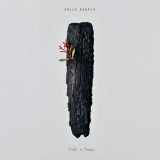
Cindy is to release a new six song EP called Swan Lake on 4th October via Tough Love. The title isn’t a nod to the folktale or ballet in any real way, but to the fact that it all has ended up in the collective imagination as an object, vaguely recognizable, a little suggestive, and mostly blank. Karina Gill, Cindy’s songwriter, likes to make use of that kind of resonance to connect sound and experience. The six songs on this EP continue the stripped-down habits of previous Cindy releases, while adding a few departures and left-turns. Cindy likes to work at the essentials and the elements here say exactly what’s needed. In other ways, these songs present a soft filigree that’s unusual for their recordings. Oli Lipton (Now, Violent Change) on guitar and Will Smith (Now) on bass play counterpoint melodies to Gill’s structures. Staizsh Rodrigues (Children Maybe Later, Almond Joy, Peace Frog) sings vocal harmonies that both offset and deepen Gill’s voice and delivery. There are playful drums by Mike Ramos (Tony Jay, Sad Eyed Beatniks) and coolly elaborate guitar lines from Stanley Martinez (Famous Mammals, Violent Change, Non Plus Temps). Gill’s songs strike this balance too: almost nonchalant reporting tied up in unexpected knots. A ride in an elevator connects up with questions about peace and/or the nature of things; the title track wonders about associative thinking and associative feeling; The Bell is an account of one of those times when everything makes sense but you can’t explain it; and there’s the scene of a party viewed with admiration for how friends can love each other. As Gill herself says: "People have told me that they can’t quite identify my influences. Me neither. The foundational layers of music of the past and my past have been metabolized like breakfast and turned into more me, sorry to say. But I experience the music of people I’m connected with and it impacts me in the moment. There’s the music I’m around – April Magazine, Sad Eyed Beatniks, Violent Change, Katsy Pline, collaborating with Mike on Flowertown – that I can feel a direct line from. Then there’s music that is being made far away but feels close, like Lewsberg, specifically, for this EP. " CINDY – UK Tour Dates: Oct 31st WOE is 6 @ Walthamstow Trades Hall, London w/ Cuneiform Tabs & Bobby Would. Nov 1st Coventry, UK Just Dropped In Records, 2 Halifax, UK The Grayston Unity, 4 York, UK The Fulford Arms, 5 Gateshead, UK The Central Bar, 6 Glasgow, UK The Glad Café, 7 Manchester, UK Rat & Pigeon, 8 Cambridge, UK NCI Centre.
Cerca:people that make the music
Cindy is to release a new six song EP called Swan Lake on 4th October via Tough Love. The title isn't a nod to the folktale or ballet in any real way, but to the fact that it all has ended up in the collective imagination as an object, vaguely recognizable, a little suggestive, and mostly blank. Karina Gill, Cindy's songwriter, likes to make use of that kind of resonance to connect sound and experience. The six songs on this EP continue the stripped-down habits of previous Cindy releases, while adding a few departures and left-turns. Cindy likes to work at the essentials and the elements here say exactly what's needed. In other ways, these songs present a soft filigree that's unusual for their recordings. Oli Lipton (Now, Violent Change) on guitar and Will Smith (Now) on bass play counterpoint melodies to Gill's structures. Staizsh Rodrigues (Children Maybe Later, Almond Joy, Peace Frog) sings vocal harmonies that both offset and deepen Gill's voice and delivery. There are playful drums by Mike Ramos (Tony Jay, Sad Eyed Beatniks) and coolly elaborate guitar lines from Stanley Martinez (Famous Mammals, Violent Change, Non Plus Temps). Gill's songs strike this balance too: almost nonchalant reporting tied up in unexpected knots. A ride in an elevator connects up with questions about peace and/or the nature of things; the title track wonders about associative thinking and associative feeling; The Bell is an account of one of those times when everything makes sense but you can't explain it; and there's the scene of a party viewed with admiration for how friends can love each other. As Gill herself says: "People have told me that they can't quite identify my influences. Me neither. The foundational layers of music of the past and my past have been metabolized like breakfast and turned into more me, sorry to say. But I experience the music of people I'm connected with and it impacts me in the moment. There's the music I'm around - April Magazine, Sad Eyed Beatniks, Violent Change, Katsy Pline, collaborating with Mike on Flowertown - that I can feel a direct line from. Then there's music that is being made far away but feels close, like Lewsberg, specifically, for this EP. "
The growth of the Jamaican recording industry…
Records have played an integral part in the history of Jamaican music and the importance of making records, as opposed to making music, can never be overstated. These are the stories, told through first-hand accounts wherever possible, of the men and women… manufacturers, musicians, singers, deejays, arrangers and record producers… who made the records and who made the sound of reggae available worldwide.
“This volume of what promises to become a crucial series covers in comprehensive fashion Jamaican music’s pivotal phase, when the music absorbed its US influences from soul and moved on from rock steady and progressed to the uniquely Jamaican sound of reggae and rockers.
It was a period in which old and new rhythms became the cornerstone of the music and thus the true
foundation of reggae. This second volume in the trilogy, amply illustrated, contains a wealth of interview testimony from the creators of the music and is both utterly authentic and essential reading.”
Steve Barrow
Co-author of ‘Reggae The Rough Guide’
“Noel Hawks takes another deep dive into the history of Jamaica’s recording studios, the businessmen who owned them and the record producers who worked in them. While the previous volume, ‘The Birth Of Ska’, dealt with Jamaica’s nascent music business and the journey, from its mento and folk roots to rhythm & blues and then ska, ‘Rock Steady To Rockers’ picks up the story as ska is about to transform into the smoother rock steady style and carries us through to reggae and the sonically sophisticated dub of the Seventies.
The book contains a stunning collection of hard facts about the business of making records, as well as personal recollections from many of the leading lights of Jamaica’s music scene, and is a fascinating read for record collectors, reggae fans and anyone who loves music.
Chris Lane
Fashion Records
“The second part of this important trilogy is no less informative and engrossing than the first volume. The author’s blending of his own authoritative narrative and entertaining quotes from people who watched everything that’s chronicled here unfold… artists, producers and early collectors… makes for a seamlessly entertaining read from start to finish.
If you couldn’t be there, or even thereabouts, at the time consider this book your very own literary TARDIS to help you to relive the evolution of Jamaican music at (almost) first hand. I’m very proud to have had even the smallest involvement with this essential read. Roll on Volume Three…”
Tony Rounce
Author & Music Historian
Their first EP "Higher" on Toy Tonic last year reached no. 1 of BEATPORT House music charts and this follow up probably will be similarly successful as it has the same high quality of music and dancefloor catchiness every DJ dreams of.
The new "Everybody Knows" EP consists of four extremely groove infected house music tracks that connect the good things of 1990ies house with the indie disco of the 2000s. Think of Daft Punk in the studio with Kerri Chandler and LCD Soundsystem and you got the sound!
Dutch house wizzard Lars Dales (who also runs HEIST records) and keyboarder and super producer Lorenz Rhode (recently worked also with Purple Disco Machine) connected through their mutual love for dance music. After years of having worked together on several projects, such as the Dam Swindle liveshow, they finally got around to making more and more music together to release their amazing tracks under the name of SOUND SUPPORT: A perfect name because these tracks really support every DJs set ... they fill dancefloors in seconds and make people go mad.
"Once more with attitude: April Art have set out to do nothing less than change the world. That may seem bold, true, but you know what: They have the songs to back this attitude. It’s a modern metal sensation like no other, emerging from the underground and led by sparkling frontwoman Lisa-Marie Watz. In, fact, April Art have risen so rapidly in recent years that it could make you feel dizzy just by watching them. Now, however, the time has come for the big leap, for their breakthrough: their third album “Rodeo” unapologetically changes into the fast lane, speeding away from everyone else with huge hits, a brutal bite and peerless power.
Trigger warning: a German band hasn’t sounded this explosive, this hungry, this insatiable for a very long time. “Our music stands for hope,” says the German band. “We want to give strength and courage to believe in yourself and in life. The more people realise that they can take their lives into their own hands, the less room there is for hatred and envy.”
April Art deliver this important message in the best possible way – with uplifting, electrifying, euphoric music somewhere between modern metal and alternative rock. The band are just as averse to blinkers as they are to racism, homophobia or division, spicing up their energising brew with flavours ranging from pop to rap and electro. “Rodeo” gives us all wings. Let’s soar together. In 2022 and 2023 alone, April Art earned two million streams on Spotify, appeared on WDR Rockpalast and will be on stage at the legendary Wacken Open Air this year. "
From the perspective of people who categorize music by genres and types, Evan Shornstein, better-known under his production moniker Photay, has created lots of different kinds of sounds over the past decade. There’s the Hudson Valley-raised, Los Angeles-based multi-instrumentalist composer’s quasi-IDM and electronic almost-pop tracks with the occasional vocal; the improvised organic and and experimental music sessions he participates in alongside new age giants, Laraaji and Carlos Niño; the diaspora electronic folk-jazz he makes with veteran musicians from all over the globe; and the disco and house adjacent records he tag-team DJs with Brooklyn producer Cesar Toribio and engineer Phil Moffa (who also masters all of Photay’s records — and those of dance-music dons around the world). But if you’ve listened closely to Shornstein’s prodigious output, you know that separating and classifying the work is actually contrary to the energy of Photay music. That what on-the-surface may lazily appear as differences, is actually brought together by a shared sonic warmth, a hardware pastoralism at play. Whatever category he engages, Photay makes outdoor music under the spell of the elements, for the purpose of different human movements — some physical, some spiritual, some emotional, some philosophica.
"Mountain Music is Nina Nesbitt as fans have never heard her before. Having risen to fame at a young age with her disarming, candid pop – the Scottish musician is now found in an entirely new realm. It is inspired in part by the two years she spent touring the States in support of her second studio album: the critically acclaimed Top 40, The Sun Will Come Up, The Seasons Will Change, which has now accrued over a billion streams. These songs are permeated with gorgeous nods to US folk and Americana. It’s made all the more extraordinary by the face that, not long ago, Nesbitt was considering quitting music altogether. Produced by Peter Miles and Nesbitt, mixed and mastered by Miles at his stunning studio MiddleFarm in south Devon, and released via her own label, Apple Tree Records. A playful nod to her 2012 debut EP, TheApple Tree, this marks the start of an exciting new era for Nina Nesbitt. While it might sound strange that Nesbitt was drawn to the music of Appalachia, heard echoing through the vast, verdant mountain ranges of the eastern United States, it makes more sense when you consider how traditional Scottish ballads and hymns are threads in that rich tapestry.
Empathy is one of Nesbitt’s greatest strengths. We hear it on “Painkiller”, a Joni Mitchell-indebted ballad on which her heart breaks for the men who believe they have to suppress their own feelings. One of the album’s standout qualities is, perhaps, the dynamic that Nesbitt creates from one song to the next. Where many folk artists might lean into quiet introspection, she craves the full spectrum of emotion – so ensconced around “Painkiller” you have the tender “On the Run’, with its distant shivers of percussion and crystalline piano, but also “Anger”. She’s in a nostalgic mood on the rousing “Coming Home”, a Springsteen-inspired, driving-with-the-top-down journey back to the places and people she loves. We all lose ourselves sometimes. The trick is learning how to find our way back, pushing those clouds away to see the blue skies beyond. For artist Nina Nesbitt, hard-hitting truths and revelations take precedent on her remarkable, career-best album, Mountain Music. Nesbitt knows exactly who she is, and now, she’s ready to tell the world."
It took four years for The Lumineers to follow up their platinum-plus, multi-Grammy-nominated, self-titled debut. Cleopatra proves Schultz and Fraites - along with cellist/vocalist Neyla Pekarek- are neither taking their good fortune for granted, nor sitting back on their laurels. With the help of producer Simone Felice (The Felice Brothers, The Avett Brothers), the man Wesley calls "our shaman," the band ensconced themselves in Clubhouse, a recording studio high atop a hill in rural Rhinebeck, N.Y., not far from Woodstock. The Lumineers then set about trying to make musical sense of their three-year-plus roller coaster ride. Their skill at setting a visual story to music comes through amidst the delicate, deceptively simple acoustic soundscapes. This time, though, bassist Byron Isaac provides a firm, low-end on the apocalyptic opener "Sleep on the Floor," a ghostly tune about getting out of town before the "subways flood and the bridges break." It's a densely packed, cinematic song that echoes Bruce Springsteen's "Atlantic City" and John Steinbeck's East of Eden. Cleopatra also deals with what Wesley terms "the elephant in the room," the band's success and the way it can sometimes put a target on your back. The syncopated piano rolls in "Ophelia" , the organic sound of fingers squeaking on guitar strings in "Angela" and the Faustian bargain described in "My Eyes" consider the perils of getting what you wish for, with everyone knowing your name, and your songs. The band had total artistic freedom in writing and recording the album, so Wesley and Jer pushed the envelope. "We continue to make the kind of records we want to," says Wesley. "We believe in this music. It's a true labor of love. We just want to keep reaching more people with our songs." Given the evidence on The Lumineers' sophomore album Cleopatra, that shouldn't be a problem.
Phantastic Ferniture, the delightfully lightheaded project of Julia
Jacklin, Elizabeth Hughes, Ryan K Brennan and Tom Stephens,
release their self-titled debut album via Transgressive Records.
The mission is obvious: don't overthink it. These artists' shared
want to shake the shackles of their meticulously crafted solo
work to experience a second, giddy adolescence is evident in
the garage-pop perfection introduced today.
I'd gone straight into folk music,' says Jacklin, 'so every
experience I'd had on stage was playing sad music with a
guitar in my hand. I thought, I would love to know what it's like
to make people feel good and dance.'
Phantastic Ferniture's spiritual home may be the garage but
they were born in a bar, specifically the hallowed basement of
Frankie's Pizza in Sydney. One late night in 2014, on Jacklin's
birthday, a group hug manifested amid the pinball machines,
with all ten participants vowing to form a band. 'Only four of us
remembered the next day,' notes Hughes.
United by fern puns and a love of leisurewear, the band met up
whenever schedules would allow, writing songs and playing
smatterings of dates to an increasingly devoted audience.
Eventually it was decreed that this was no side project and an
album should follow. The result is one of the most enjoyable
albums of 2018. 'It feels really good,' Jacklin says with
satisfaction. 'It's like having an alter ego.'
A slice of defiant brilliance that feels effortless in its
execution.' - London In Stereo
LP pressed on pink vinyl with digital download code.
Press - Reviews in Clash, DIY, Q , Loud & Quiet, The Skinny. Radio - 6Music Lauren Laverne Track Of The Day
Online - DIY, Too Many Blogs, Most Radicalist, Giglist, London In
Stereo, Loud and Quiet, The Skinny, God Is In The TV Zine.
Aesthetically, Ed Schrader’s Music Beat hates to tread water. At the same time, the Baltimore-based two-piece of vocalist Ed Schrader and bassist Devlin Rice won’t force their songs to fit a preconceived style. “The next album’s always gotta be different from the last one. We’re different people from record to record. So, writing authentically to ourselves will always bring our work to a place that we haven’t been to yet,” Rice said. Schrader added, “We’re terrified of turning into AC/DC. We never want to be married to one scene or time or sound. We want to be the Boba Fett of bands! Constantly altering the way in which we make records has been pretty key in that process.”
For Orchestra Hits, the band’s latest, that alteration was welcoming longtime musical comrade Dylan Going into the fold as a co-writer and co-producer. A songwriter in his own right, a guitar sideman for ESMB on their last two tours, and a collaborator with Rice in the noise riffage band Mandate, Going had both a unique vision and an intimate familiarity with the ESMB vibe.
“Dylan came to every show we’ve ever played in New York—no matter how weird it was,” Schrader said. “He’d be standing there ready to move an amp or feed us barbecued cactus after the gig and toss on some Golden Girls so we could decompress. It felt like family as soon as we began working, but I honestly had no idea how damn good he was at tossing out these hooks.”
According to Schrader, the songs “just poured out of us” over the course of a highly caffeinated three-day weekend in a tiny room in Devlin’s house while his cat, Sandy Goose, screamed continually. “It was like three kids hiding from the world to get into some lovely mischief,” they said. The lack of external pressure in the process gives Orchestra Hits an almost paradoxical vibe. For all of the album’s layers, that mix live and sequenced instruments, it never loses the raw energy of a small handful of friends in the same room plugging in, cranking up, and playing until they pass out.
Lyrically, the album finds Schrader, now 45, meditating on experiences in their youth to make sense of the present moment. “We are not into the garden,” Schrader wails on the relentless “Roman Candle,” a song about the sad debacle of Woodstock ’99, and a direct response to Joni Mitchell’s “Woodstock,” a utopian ode to hippie idealism. A 19-year-old Schrader, having snuck into Woodstock ’99 through a hole in the fence, was there the night members of the crowd used candles intended for a vigil for victims of the Columbine High School massacre to set fires all over the grounds. Even before the fires, Schrader remembered feeling disconnected from the music, the nostalgic cash grab, and the meatheads in the crowd. After watching a press tower collapse, they boarded a random shuttle bus and were dropped off near a Denny’s. “It was a far cry from the Garden of Eden,” Schrader said. “That experience defined what I didn’t want to be a part of, and yet America is more like Woodstock ’99 than ever.”
With percolating synthesizer arpeggios, and climbing bass grooves, “IDKS” is the album’s dance-floor slapper. “’IDKS’ is a funny one,” Schrader said. “We already had a pretty satisfying suite of songs when Dylan was packing up to head back to New York, but he missed the train because of a freak snowstorm. Realizing he’d be stuck in town another day, he says to me, ‘Here’s this other weird thing I have.’ It was ‘IDKS.’ The hooks were so good I felt like Homer Simpson at a free donut convention. I just dove right in, and we cranked that baby out in like 20 minutes.”
Lyrically, “IDKS” is a letter from the true self to public-facing self. “It’s an angry song,” Schrader said. “Because the public-facing self is always looking for an easy escape, but it forces the true self into a cage. I honestly thought my lyrics were corny and was about to change them, but Dylan was digging it just the way it was. So that’s what you hear.”
With the soaring “Daylight Commander,” the band went against all of their musty-basement-bred instincts. “I went full High School Musical with the vocals,” Schrader said. “At first it felt almost embarrassing, but I remember reading somewhere that Bowie recommended always floating a little bit above your comfort zone, and that’s what we did here.” The song is part exercise in absurdity and part pop Trojan horse. “If ever we had a ‘Shiny Happy People’ moment, I guess this is it,” Schrader said.
We can't hide the fact that we're a Manchester label with some very strong feelings for the Red side of the city. Regardless of your tribal affiliation - whether you have one or not - Edric Connor's "Manchester United Calypso" is an undisputedly joyous, soulful classic. Like the bunch of bouncing Busby Babes the song sought to raise up, it's remarkable, stylish and profoundly memorable; and its magical legacy has only grown in the 70 years since it first surfaced.
A testament to its enduring brilliance, "Manchester United Calypso" is heard to this day on the terraces of Old Trafford and beyond. However, it's impossible to find a copy of the original 78rpm shellac release or, indeed, the 45rpm vinyl. So, we're delighted to reissue this unforgettable anthem - with Lord Kitchener's equally dazzling "Manchester Football Double" on the B-Side - and make it available on 7" vinyl to United fans of any vintage; as well as fans of vintage calypso fire! Featuring typically striking, specially commissioned artwork from the legendary Stan Chow, this record is a collectors item for the ages.
"Manchester,
Manchester United
A bunch of bouncing "Busby Babes",
They deserve to be knighted
If ever they're playing in your town,
You must get to that football ground
Take a lesson come to see,
Football taught by Matt Busby
Manchester,
Manchester United"
Whether you have United in your heart or not, "Manchester United Calypso" is a record that, like the best football teams in Old Trafford's history, swaggers with an addictive beauty that's impossible to ignore.
It's impossible to discuss the significance of the calypso without remembering what ultimately ripped through the heart of this most beloved youthful side.
Eight of the Babes who were celebrated in the Calypso tragically lost their lives on 6th February 1958 in the Munich air disaster.
Like the players and the club itself, the United calypso radiates a special type of magic and speaks to the spirit of United:
the demand to be fearless, unrelenting, creative and obliged to entertain the viewing public.
The Calypso was written by Eric Watterson and Ken Jones and sung by Edric Connor, who moved to England from Trinidad in 1944.
Connor is considered a pioneer, popularising calypso music, becoming the first black actor to perform with the Royal Shakespeare Company, setting up the Afro-Asian Caribbean Agency to represent Black and minority artists with his wife, Pearl and establishing a theatre workshop.
“I would think coming to this country right after the war, as Edric did, and getting into BBC radio, and moving among the people, he did a great deal of good for our own community,” Pearl once revealed.
He saw himself as a self-appointed ambassador for his country, Trinidad. We were very nationalistic back then. We believed we had a country worthy of recognition”.
The B-Side is another doozy.
Swoon along to Lord Kitchener's fantastically woozy "Manchester Football Double" - a fitting ode to the city where you'll "find football's headquarters".
Then and, after the 2024 FA Cup Final, now.
Simon Francis remastered the original audio for both tracks and Cicely Balston's precise cut for Alchemy at AIR Studios ensures this 7" well and truly soars.
The immaculate Record Industry pressing will ensure this sought-after gem finds a home in many more collections, from Manchester to Malta, Mumbai to Malaysia.
Ever-evolving the mythologies and magic of Dialect's sonic sphere, Andrew PM Hunt returns with Atlas of Green, elegantly molding unexacting details of memory and mistranslation into the framework of the British musician and composer's creative pursuit. The album imagines a young musician named Green working in a future dawning era where lost signals and enduring impulses are unearthed from the sediments of technology and time. Across twelve compositions, Green becomes the compass in an epoch of transition; one shaded with pastoral patinas and studded with the fragments of allegorical ruin. As tattered as it is tender, Atlas of Green is a patchwork of scavenged relics and bygone hues, cast through the iridescent shimmers of a mid-future in flux. Growing up on the Wirral Peninsula in North West England, Hunt was surrounded by stone age landmarks and rock carvings that infused the landscape with legend. It was beside those carvings on a residency at Bidston Artistic Research Center where he began the journey of Atlas of Green, experimenting with tape loops and exploring the center's library of sci-fi. Here Hunt also encountered the work of Italian philosopher Federico Campagna, a writer who believes we're at the end of our current world. This encouraged Hunt's exploration of how the fabric and fantasies of our current era might endure into the future of Green, as they try to make sense of the riddles of the past, utilizing broken electronics and simple acoustic instruments to create new mythic forms. This question of endurance led Hunt to inscribe Atlas of Green with its own lucid markings - sometimes almost anthemic adornments - which unfurl through the album's melancholic air as possible new metaphors for how the human spirit might persist through dark days and regain lost wisdom. As Hunt reflects, "We're not just on an endless procession through constantly better worlds. Our lack of action (on climate and inequality) feels hopeless at times. I find some comfort in the idea that maybe the world needs a new song in order to tell a new story about itself". The image of Green as a journeying adolescent in-between eras developed out of a burgeoning interest in the fantasy writing of Ursula K. Le Guin and Gene Wolfe and occurred at a point in Hunt's life where the question of starting a family was looming. Green became a device for thinking about the future, or futures, putting someone in another world and granting access to a slightly longer timeframe than one's own life. What would this person, in this as-yet-unsung world do with something as powerful as music? As Hunt notes, "I imagined them doing what we've always done with music - using it to build a map of feeling, providing boundaries and tracing the edges of our emotions, defining a space of possibility and giving voice to our intuition. This is an alternative future to the one of endless growth but one which still holds space for hopes and dreams." Mapping new folds in the passage of time, Atlas of Green is traced with an aura of sonic urgency which arises through its process-led construction. Following a series of live shows in early 2023, the record was created with an assemblage of analogue electronics and acoustic instruments, including scratched records and a broken four track, collaging studio work with recorded live recordings featuring work in progress. Where the indeterminate energies of Under~Between (2021) appeared through digital processing, Atlas of Green embraces chance encounters within the malfunctions of physical media and glitching gear. Within these interwoven clusters of organic and blemished sound, Dialect reclaims the joyfulness of the inner amateur and creates a soft landing for new seeds of magical possibility - rooted in the bounds and abundance of realism. "As a planet of people we have to deal one way or another with our finite existence. We have to deal with that loss with hope still in our hearts - our capacity to love cannot be contingent on things lasting forever, and so this image of Green is not a vision of dystopia, nor utopia but an expression of trust and an acceptance of limits."
Limited Gatefold LP version on 180g transparent vinyl, with 4-page lyrics booklet (777x) Tusmorke, arguably the most atavistically trollish, acid-drenched musical act ever to come out of the kingdom of Norway makes yet another eternal return, this time to take the fellow traveller on a subterranean expedition to the kingdom of the Fair Folk! Dawn of Oberon is the band's 12th album, released 12 years after their debut "Underjordisk Tusmorke" (2012). 12-12-12 - That makes this album twice as occult as 666. The band says: "This record is a testament of a tumultuous time. We had a new drummer, Kusken, and keyboard player, Herjekongen, in 2022 and immediately started working on the epic Dawn of Oberon. This behemoth had been wallowing about since the start of the millenium, never quite finding its shape and form. We thought of this as a trial by fire to galvanize the new members. During jams at rehearsals and concerts, new themes emerged, resulting in a sort of sequel in the form of Dusk of Tawblerawn part 1-5. Kusken decided to quit after just 8 months but agreed to document the time we had spent together. All the music was recorded in our rehearsal space and studio in 2022-2023. The record is a manifestation of our Peter Pan syndrome; our aesthetics and ideals remain unchanged for the last 25 years. Never grow up, just grow old. This time we go away with the fairies all together, to the far-away land of the far-out mind.
Lovers of Italo disco music will consider Cyber People as one of the most important acts in its scene. The Space-synth sound Cyber people brought in the mid 80’s, was highlighted by their 1985 ‘Void Vision’ release, which became a hit both in Europe, as well as in South America. On top of that, Cyber People paved the road for acts like Koto, Laserdance and Hipnosis, just to name a few. Cyber People were disbanded though in 1988, but left behind a series of most important Italo Disco records.
Now, build on the ashes of the former and legendary ‘Memory Records label from Parma – Italy, Memix International is pleased to announce its return, and the return of Cyber People. In its original form, headed again by the Maestro Giorgio “Theo” Spagna himself, as leader of the pack, with a tribute to Anfrando Maiola, the founding father of Mamory Records’ most important act, Koto, who left us in 2023.
As a tribute, Anfrando’s “Dragon’s Legend” get’s a complete new overhaul by Cyber People, respecting its original structure, concept and spirit, bringing it however into the 21st century.
Besides the almost 8-and-a-half-minute tribute of Dragon’s legend on the MEM-side, on the MIX-side you will find the DJ friendly ‘DJ DUB’, bringing you the compact essential of ‘Dragon’s Legend’ for any up-to-date Italian Disco set. (And if you want to call it Italo Disco, that’s perfectly fine with us too!)
With this release, Memix International continues where it’s predecessor stopped in 1989. Paves the road into a new era, and pays with this rerelease it’s respect to Anfrando Maiola and his Koto releases , such with full support from his heir.
With this release Memix International also brings a tribute to Alessandro Porta, the great Italian designer and visual artist, whose heirs were as kind to participate also, and made one of Alessandro’s drawings available for the sleeve of this unique release. It was Porta who was, on many occasions, responsible for the characteristic artwork of various Koto releases and, all together it will for sure make this release a well sought item which comes in a strictly limited edition of 500 units, so distributed on a ‘first to come, first to serve’ basis. Expected release and shipment: end of September/begin of October 2024.
- A1: Grateful (Instrumental)
- A2: Glorious Game (Instrumental)
- A3: I'm Still Somehow (Instrumental)
- A4: Hollow Way (Instrumental)
- A5: Protocol (Instrumental)
- A6: The Weather (Instrumental)
- B1: That Girl (Instrumental)
- B2: I Would Never (Instrumental)
- B3: Alone (Instrumental)
- B4: Miracle (Instrumental)
- B5: Glorious Game (Reprise) (Instrumental)
- B6: Alter Ego Feat Brainstory (Instrumental)
Sky High Coloured Vinyl[24,16 €]
Blood Smoke Vinyl. The Instrumental version of the underground classic El Michels Affair & Black Thought collaborative album Glorious Game When Leon Michels and El Michels Affair released their rst record, Sounding Out The City, in 2005, it was hard to guess what was next for Michels and his then-introduced, now-patented "cinematic soul" sound. Now, four EMA studio albums and scores of tribute and remix projects later_all while producing for some of the biggest names in the industry_Michels has trademarked his sound, with each project taking audiences somewhere new and pushing the boundaries of what he is known for. The man is a river, not a lake and this time he takes his golden touch into the realm of hip-hop laying down a musical bed for one of the greatest to ever rhyme into a microphone: Black Thought of The Roots crew. Releasing on Big Crown Records, the LP is called Glorious Game and it is a remarkable debut partnership in more ways than one. Michels provides his bottom-heavy, soul-tinged production for Black Thought who gives us some of the more personal and transparent verses we've ever heard from him. Michels and Black Thought have been in each other's orbit for a while now. The two rst met in the 2000s when Thought was rst getting familiar with the contemporary soul scene. "Out of that whole world, Menahan Street Band was probably my favorite," recalling the funk and soul group Michels was a founding member of back in 2007. Fast forward a few years and musicians from that collective_Dave Guy on trumpet and Ian Hendrickson-Smith on sax _are now full time players with The Roots. This connection eventually led Leon and Thought to doing a few fundraising events around NYC and Philly together. "Before long, Black Thought was coming around the studio and would jam with us from time to time," Michels explains. "Then, fast forward to 2020 and COVID lockdowns, he just hit me up out of the blue, wanting me to send him stuff to write to. We both were looking to stay busy." Being that Black Thought is the co-founder and emcee for, hands down, the best live-band group in hip-hop. Michels took a decidedly different approach to this project and instead of sending recorded tracks of live compositions, he pulled out the sampler and sampled himself and some records from his collection. "I'm a big fan of soul music," as if Michels has to remind us. "And part of hip-hop's appeal to me has always been the sample-based production" For Glorious Game, Michels would make wholly composed and recorded soul songs in his studio, sample himself, then chop and/or loop up his sounds and create instrumentals for Black Thought. On some tracks he took a more traditional hip-hop approach, starting from samples of other people's music but then adding live instrumentation on top. But for the most
In their musical journey spanning 15 years, Jungle by Night always knew their music isn't about individual talent, but in the blend of all elements its members bring to the table. This realization birthed the theme of their seventh album, “Synergy”. With the mantra "the whole is greater than the sum of its parts" echoing in their minds, Jungle by Night embarked on a mission to make an album that is recorded right in the moment, and as live as possible, to capture the energy between musicians. And to take it a step further, they threw open the doors of their studio in Amsterdam and invited some of Holland’s most prolific vocalists such as: Spinvis, Sef, Merol, Pitou, and Meral Polat. Each vocalist brought their unique style to the mix, infusing the tracks with depth and emotion. Recorded in their beloved studio in Amsterdam Noord, "Synergy" captures the essence of Jungle by Night's creative spirit. Here, imperfection is embraced, and spontaneity reigns supreme. It's about capturing the energy of the moment, where music comes alive in all its vibrant glory. So, dive into the world of "Synergy" and experience the crazy world Jungle by Night, and friends. It's more than just an album – it's a testament to the beauty of coming together and creating something greater than the sum of its parts. Jungle by Night are seven Dutch guys who together form a live act to be reckoned with. This Amsterdam band consists of a lot of synths, drums, bass, guitar and percussion enhanced by a trumpet and trombone. From more brass-heavy earlier albums to a stronger focus on the electronic groove on their latest, they bravely go where no band has gone before and now find themselves in the goldilocks zone between analogue dance music, nu-disco, Krautrock, 70’s funk and 80’s electro. The transfer to a more electronically driven sound might have been a small step for this merry band of highly skilled musicians, but it became a giant leap for the people on the dance floor. Their radiant and energetic live shows have become the must-see festival act that festivalgoers all over Europe include as a staple in their concert schedule. They know this won’t be a show, it’ll be a downright party. It’s like that tree in the forest. Was it really a festival if you didn’t see Jungle by Night? What constitutes this ever-present attraction is the highly danceable and addicting build up of their set, in which they take their audience by the hand and lead them into the groove. What happens when you come out on the other side? Depends. Just know you won’t be the same.
"One of the best bands to come out of NYC since who gives a shit." -CVLT Nation. When you enter White Hills' lair in Brooklyn, the duo's insatiable desire for music and art is immediately palpable. Crates of vinyl from floor to ceiling line the long hallway. Guitars appear at every angle, one lying across a sofa in obvious mid-play with others in cases tucked beside amplifiers into every conceivable corner. Synthesizers and cables cover the purple satin bed while gouache paintings in various stages of progress strewn the floor. Album covers, movie posters, books, paintings, prints and souvenirs of subversive culture occupy the remaining wall space. A sanctuary of adoration, creation and imagination, it's also the nerve center of their record label Heads on Fire Industries and the site where the final mixes of their latest album Beyond This Fiction took shape. For nearly two decades, White Hills have been blowing minds with their sonic alchemy: a unique mix of neo-psychedelia, art rock, and post-punk- at once original and recognizable. Their cult reputation emblazoned in celluloid following their performance in Jim Jarmusch's sultry vampire romance Only Lovers Left Alive, the duo has toured vigorously since their inception. With a vast catalogue that astounds and a relentless punk ethos, time seems to energize the duo, making them increasingly daring and prolific. "Music creates a bliss beyond sex and drugs," professes one-woman rhythm section Ego Sensation. "We'll never stop making music. It's the highest high to be had in life." Founding member Dave W, whose signature other-worldly guitar sorcery defines the White Hills sound, grabs his Les Paul to record a melody lingering in his head from last night's dream before it escapes. Outside, the sound of passing sirens, honking horns and bits of conversation remind you that you're in the middle of New York, a city so flush with rock legacy and artistic innovation it would take lifetimes to drink it all in. A voice from outside shouts, "This shit is going for 3! These people got to be out of their fucking minds!" Dave shakes his head and laughs, "There's no place I'd rather be." Committed to a vocation marked by extremes, doubt, struggle and moments of ecstasy, Dave and Ego continue this torrid affair with music bearing their latest fruit Beyond This Fiction. Inspired by the ideas of Joseph Campbell, the writer/philosopher known for the book The Power of Myth, the album explores the idea of "riding between opposites"- forging one's own path unrestrained by the dualistic constraints of society. It's a cry to all the seers among us- call us outsiders or rebels- who feel smothered by convention and see nonconformity as the gateway into divine mystery. Recorded with Martin Bisi, known for his iconic NYC sound developed through his work with no-wave titans Sonic Youth, Swans and Lydia Lunch, Beyond This Fiction sees Dave W (guitar/vocals/synths) and Ego Sensation (drums/bass/vocals) orchestrating their distinct guitar heavy meditations into songs with a stronger focus on vocals than previous albums. Opener "Throw It Up In The Air" and closer "Beyond This Fiction" both have a lush quality that flirts with shoegaze. "Killing Crimson", a song that takes inspiration from Killing Joke and King Crimson, has a driving beat and a catchy hook that begs for a sing-a-long. "The Awakening" plunges into the meditative ambient abyss the band is well known for, featuring the unique voice of frequent collaborator poet Dan McGuire to deliver the meaning behind Beyond This Fiction. The album harnesses the seductive accessibility of 2015's Walks For Motorists while evoking the tempestuous soul of the band's seminal 2011 H-p1. Notorious shapeshifters, White Hills make Beyond This Fiction a familiar surprise. Back in the lair, Dave draws eyes on his hands in preparation for the day's video shoot. Ego reaches in the closet pulling out the red velvet jacket she wears on the cover of Beyond This Fiction where she stands in a NYC alley holding a glowing orb. "That's the portal- the gateway into the mystery. The music will take you there.".
Coming out on September 6th on Sharptone Records, Sundiver is Boston Manor’s fifth album and one that represents a glimmering dawn for the Blackpool five-piece. Grown from a seedbed of optimism and sobriety, the LP celebrates new beginnings, second chances and rebirth. With two members recently stepping into fatherhood, hope is baked into every note. “Datura came out of these really dark few years over the hangover of the pandemic,” Henry reflects. “I'd been struggling a lot with drinking and not taking care of myself and bad mental health and stuff. We wanted Sundiver to be the next morning of the following day.” He explains that it feels good this time round to write through the lens of positivity. “The themes began to emerge, of rebirth, spring, dawn, sunshine and then other elements just started to fit into that.” It was during the making of Sundiver that Henry found out he was going to be a dad. This album is a significant one for the band. Originally coming out of the emo and pop punk scene, they’ve explored sonics and genres throughout their career, taken risks and achieved more than they could ever had dreamed of. They’ve grown up as Boston Manor – their lives and the world changing around them. They’re now taking stock, at a crossroads of the band they were and the band they could be.
While writing the album, they revisited the bands that shaped them in the late 90s and early 00s. “I was listening to the music I loved when I was a teenager and I just thought, why don't we make music like our favourite bands?”, guitarist Mike Cuniff remembers with a smile. “So we brought our interests to the table that way. Y2K kind of vibe. There are elements of Deftones, there are elements of Portishead in there, some Garbage, The Cardigans.” He laughs and adds NSYNC to the list of inspirations. From this cocktail of classics comes a dynamic and ambitious record, rich with depth, groove and more hooks than Peter Pan’s nightmares. Lyrics that foxtrot from parallel universes to personal growth, vivid dreamscapes to raw grief. Individually they’re single strokes full of meaning and magic. Together they’re a landscape.
Container (out Feb 15th) is the first single and it’s them at their best – impassioned and infectious. “This song is about the stagnancy of life creeping up on you & how that can bring about change.,” Henry explains, citing Ocean Song by US band Daughters as an inspiration.
The concept of the butterfly effect is present on Sundiver – how small actions can lead to big changes. This is no clearer than on their second single, Sliding Doors (out April 5th). It has the golden sound of late 90s Lollapalooza rock – think Smashing Pumpkins - rebooted with crisp 2024 production and a potent heaviness. In the lyrics Henry wonders, what if?, pondering on what could be. The idea that there are infinite versions of you whose lives splinter off in different directions at every decision you make. That there’s another you out there somewhere right now reading this sentence, and another me writing it. “So much is down to chance and circumstance,” Henry says. “You might catch that train and your life totally changes. Or you might miss it and things stay the way they are.”
Heat Me Up (out May 30th) is defiant and victorious, the audio equivalent of quitting your shit job and driving into the hot summer sun with a head full of dreams. “The lyrics are about love and gratitude,” Henry shares. “Another theme on the record is just appreciating what you have. It’s about not taking for granted the things that you've been afforded.”
There was some natural magic in the creation of Sundiver. They worked with their usual producer, Larry Hibbitt, and engineer, Alex O’Donovan, but instead of recording in London again they ended up in the green pastures of Welwyn Garden City. “Because Larry lives out in the countryside now, it was a way different environment and way different experience recording this time,” Mike remembers. “That contributed a lot to the brighter sound of the record.” The daily barbecues they had during their recording sessions imbued the process with harmony – five old friends spending quality time together and making quality music.
However, the album is by no means one-note. Birthing this new world they’ve created wasn’t without it’s pain, and that can be heard in the heavier moments on Sundiver. What Is Taken Will Never Be Lost is the most-stripped back on the album, a slow rock number seasoned with the downtempo Portishead influence. The heartfelt lyrics are Henry’s way of processing the loss of his grandfather, who died in a hospice last year(?). “It was just fucking horrible. It was always cold when I went there and they were always trying to get rid of me. The song title, What Was Taken Can Ever Be Lost, is the idea of his memory fading at the time because of dementia.” Henry goes onto explain that shoeboxes of photographs, diaries and a legacy is what he’s left behind. “He lived a really rich life and it has really impacted me and my father. His legacy is etched into the fabric of history in a very small way.” This song continues the connection between his grandfather and the band, as his painted face is emblazoned on the cover of the very first Boston Manor EP, Driftwood. As well as emotionally heavy themes, there’s heaviness in the music of Sundiver too. The closing song, Oil In My Blood, descends into an intense shoegaze outro with Debbie Gough from Heriot screaming hellfire. It’s in moments like this that the band show us aggression and fury can be as much a part of positive change as quiet introspection. The last lyrics of the song, “It resets and starts again,” leaves us in contemplation as the final chord rings out.
Touring the US, Europe and Japan over the years makes for an impressive CV, but if you know anything about Boston Manor you’ll know that they’re all about their hometown. Their choice to work with Blackpool-based photographer Nick Barkworth is testament to that. They’ve been working with him since the pandemic. “He captures Blackpool in a light that really reflects the weirdness and quirkiness of the town,” Henry says.” He's got a really good way of presenting that.” For the Sundiver cover, Nick photographed a 30ft tall abstract glass sculpture made by the local artist John Ditchfield. A striking and bewitching monolith that’s familiar to them but unusual to most people. “It has such kind of a gravity and power to it,” Henry describes the sculpture which stands in a field just outside of the seaside town. “It reminds me of either an explosion or a star or a supernova. To me it represents new life, power and radiance.” Boston Manor have got a knack for that - connecting the otherworldly and the everyday, the stars and the streets.
They’re a band known for using their music to make bigger statements about society. This time round they’re harnessing the uplifting power of music, and the communion it creates, as an antidote to the daily doom and isolation. “It seems like absolute chaos out there at the moment,” Henry says. “You’ve got Gaza and Israel, you've got Russia, you've got the fact that 40% of the world is going to have an election this year and increasingly most governments are leaning very far to the Right. The internet is dividing everybody, people are getting poorer and more desperate. It's really, really scary.” They considered trying to tackle the weight of it all in their music. “We could’ve written Welcome to the Neighbourhood on steroids, where it's just absolute darkness and misery”. He’s referring to their 2018 concept album that deals with class, inequality and the bleaker side of Blackpool. “But I think it's really important to write something that people can be immersed in and find some sort of solace in. Somewhere they can escape to from the modern day pressures and everything that’s going on. We’re all in this together.”
A new album by Medway's premier alt-folk outfit The Singing Loins! Yes indeed. We caught up with Rob Shepherd to find out more about their brilliant new LP Twelve_ Q: "The new album is called Twelve. Could you settle an office debate - is it your 12th album or have you called it that because it has twelve songs on it? (We thought Here On Earth was your 12th but not according to Discogs. Also, our ability to count accurately has diminished over the years!)" A: "A bit of both. Course, there's the 12 songs, but then, depending on how you count, it's also our 12th album (from 91-98, there's the 1st 4 LPs that Damaged Goods collected together on The Complete & Utter - that's a comp though, so we can't count that eh - then there's At The Bridge with Billy, so that's 5_..we can skip Alive In Dunkerque as well cos it's a live album....then there was 2004-13 where we made four more with you, then in 2019 we got back together and made 13 Moon Songs From Merry Hell, released on the Vacilando 68 label...so that's 10_and then we did another record with Billy, The Fighting Temeraire_ so yeah, that makes this one number 12)." Q: "The album has features newly recorded versions of several Loins classics. Was it a difficult decision deciding which back catalogue songs to record?" A: "No, pretty easy - it's basically the 12 songs we enjoy playing the most with the current lineup. Saying that, it's been a bit of a meandering road getting to this point. Since Brod passed away, Arf & me have done few nights of Loins songs - and it's felt good - celebrating the songs we all wrote together - so that started the selection process. Oli, Arf's lad, joined us on percussion and then Rich, who Billy had introduced to us, joined on violin - then Chris came along to play the drums, so Oli switched to guitar - and through all that we were refining the set of songs, and we got a point where we felt that, yeah, we've sort of worked out how to do this (you know, respecting and celebrating our past, without coming on like a tribute band to ourselves), so it made sense to make the album - just to reflect where we'd arrived at....so we went into Jim's Ranscombe Studios and bashed them all out live in a couple of hours....no overdubs, no fussing over mistakes....just sing and play the songs as if it was a gig." Q: "It's been 33 years since the debut Loins' LP - How does it feel to be the elder statemen of Kent's alt-folk scene?" A: "Ha ha, are we? We don't know any other folk bands, alt or not, so it doesn't feel as though we're qualified to be the statesmen of anything! Elder, certainly, but statesmen? Nope." Q: "There's been plenty of gigs recently with more to come around the album's release, including some European dates. For people who've not seen you before what can they expect from a Loins gig?" A: "Yeah, as I said, now that we've worked out how to do this, and as we're having so much fun with it, we thought we'd get out & about. We're off to Serbia immediately after the album's release, so that'll be an adventure - Serbia was always special for us (Aleks, the promotor, took us out there to play seven or eight times in all) and we've stayed in touch over the years, so it'll be lovely to see everyone out there again. As for what can anyone expect when they see us? "Riotous fun filled joy" I've just been told, but best let everyone else be the judge of that!" Q: "The Singing Loins wouldn't have existed of course if it wasn't for Chris Broderick. Chris sadly passed in 2022. What would he have thought about the fact you're carrying on with the band and recording new music?" A: "Yeah_ he'd be happy. In the week before he passed away, he asked Arf & me over, basically to say goodbye and tie up any loose ends. And he told Arf that we should carry the Loins on. So yeah, I think he'd be pleased and proud that we're keeping the songs, and his words, alive."
Thandii (aka Jessica Berry, Graham Godfrey) first made waves with their debut album A Beat To Make It Better in 2023. The album gained somewhat cult critical acclaim long after its release, with listeners luxuriating in the unusual sound collaged from offcuts of Soul, Lo-fi Hiphop & Psych. Thandii’s world comes bolstered by collaborations with esteemed artists such as Michael Kiwanuka, Inflo, SAULT, Joy Crookes, Jordan Rakei, and Little Simz. The duo’s sophomore offering comes in the form of two companion albums Dream With You & Come As You. The two albums make up a single conceptual statement celebrating dissonance, contradiction, polarity and opposition.
The pair believe that binary thinking has a lot to answer for in today’s world and is often used to divide us as a people. ‘We wanted to explore what it felt like to hold disparate notions in both hands whilst making the music. Starting with the title tracks, we explored the idea of unashamedly being your authentic self in every moment - this is admirable for those that can live their life in an uncompromising way. In contrast to that idea, we explored those moments where we perhaps wished we were more than our reality - a dreamed up, imagined self’. It’s no surprise that duality is central to what Thandii is all about with the pair co-writing, co-recording & co-producing from their seaside studio HaloHalo in Margate, Kent.
The albums each have a distinct flavour of their own. Dream With You is built on cassette-tape-driven lofi beats, art-pop melodies and soulful piano breaks. Whilst Come As You explores more experimental song-form that wouldn’t seem out of place on Tender Buttons - Broadcast or Dots And Loops - Stereolab. Jessica’s voice is the transcendent, ethereal form that shapeshifts between the realms of the two statements; dancing playfully through falsetto harmonies, confessional spoken word, detuned alter egos and haunting choirs. Key collaborators on the albums include bass player Jonathan Harvey and pianist Steve Pringle, both members of Margate’s burgeoning Arts scene. Thandii escaped London nearly a decade ago, their sights set on creating a means for prolific expression, without the distractions that the city can bring. The albums find them in an exploratory stage, throwing paint at the canvas with joyful abandon, gifting themselves permission for uncensored expression. The LPs muse on relationships - romantic, platonic & familial - community, self-worth, self love, healing and boundaries, at times from differing perspectives. This contrast of opinion makes for rich listening throughout a vast emotional landscape
- It Only Takes 2
- Dream With You
- Call It What You Like
- Workin
- Are You Gonna Find It
- I’ll Be There
- Believe In Your Reasons
- Sinus Node
- Nothing Like This
- Sunlight
Thandii (aka Jessica Berry, Graham Godfrey) first made waves with their debut album A Beat To Make It Better in 2023. The album gained somewhat cult critical acclaim long after it’s release, with listeners luxuriating in the unusual sound collaged from offcuts of Soul, Lo-fi Hiphop & Psych. Thandii’s world comes bolstered by collaborations with esteemed artists such as Michael Kiwanuka, Inflo, SAULT, Joy Crookes, Jordan Rakei, and Little Simz. The duo’s sophomore offering comes in the form of two companion albums Dream With You & Come As You. The two albums make up a single conceptual statement celebrating dissonance, contradiction, polarity and opposition.
The pair believe that binary thinking has a lot to answer for in today’s world and is often used to divide us as a people. ‘We wanted to explore what it felt like to hold disparate notions in both hands whilst making the music. Starting with the title tracks, we explored the idea of unashamedly being your authentic self in every moment - this is admirable for those that can live their life in an uncompromising way. In contrast to that idea, we explored those moments where we perhaps wished we were more than our reality - a dreamed up, imagined self’. It’s no surprise that duality is central to what Thandii is all about with the pair co-writing, co-recording & co-producing from their seaside studio HaloHalo in Margate, Kent.
The albums each have a distinct flavour of their own. Dream With You is built on cassette-tape-driven lofi beats, art-pop melodies and soulful piano breaks. Whilst Come As You explores more experimental song-form that wouldn’t seem out of place on Tender Buttons - Broadcast or Dots And Loops - Stereolab. Jessica’s voice is the transcendent, ethereal form that shapeshifts between the realms of the two statements; dancing playfully through falsetto harmonies, confessional spoken word, detuned alter egos and haunting choirs.
Mutant, in proud partnership with Back Lot Music, are proud to present the premiere physical release of Dominic Lewis’ score to THE FALL GUY.
The Fall Guy is our favourite kind of movie - it's a love story not only between the film’s two leads but also a love letter to the cinema. Its also a love letter to the people who risk their lives to tell us stories. That it's scored like a stadium rock anthem also helps.
Dominic Lewis has produced a soundtrack that makes you want to stand up and cheer in the theater and blast at full volume at home.
It is pressed on 2x 140-gram Black vinyl and features liner notes by the film’s director, David Leitch, and composer, Dominic Lewis.
After releasing my album 'ÖÐRUVÍSI,' which was a very personal and emotionally challenging project, I felt the need to make something weird and energetic for the club. I’m really into tunes that feel both slow and fast simultaneously.
The first track on the EP, 'Let’s be Havin u,' was initially hard to place genre-wise, i ended up sending it to Darren, who loved it and wanted to sign it. Releasing on Exit kinda feels like earning a black belt as a producer hah. I never imagined that a decade after buying Exit 12”s in 2014, I’d be releasing my own music on the label.
When I started making the EP, I had just begun performing again. I often saw people on the dance floor, too out of it to enjoy the music and often some of them having to be carried by their friends to backstage. This made me wanna make tunes for the dance floor as a bit of a statement on this. I first tested 'Let’s be Havin u' at Prikið in Reykjavik, sounded mad on the little old funktion one. The moment I knew that I was onto something with the EP was when I was Performing in Bristol at Thekla for my friend Boofy. It was wild, the ceiling started leaking during the show. I Love Bristol, feels like home to me.
Most of the percussion and hats on the EP are made with an Elektron Model Cycles, and the synths and pads are from a 80s Yamaha hybrid FM/sample synth I found at a thrift store. It doesn’t have MIDI, so I have to record perfect takes for chords and melodies. I often use pedals afterwards or resample the sounds for more tonal control.
I enjoy digging for records with unique breaks to sample, as I feel this is lacking nowadays. I usually make all my drums from scratch but when I use breaks I like it to be something I haven’t heard before. The alien percussion sound in the last track is actually me biting my teeth together, resampled repeatedly and ran through pedals and interfaces. I also recorded myself chewing gum for the second track to give it that hand on the hip feel. Most of the EP is made with hardware, outboard gear, or real-life recordings.
I’m not concerned about the EP fitting a specific genre or playlist. Too many artists play it safe by focusing on their Spotify stats and abandoning projects that don’t work instantly. I think also Obsessive nostalgia stifles innovation, keeping things stuck in a loop by replicating to the tee, tunes from 2 decades ago. I get it, but there has to be a middle ground sometimes.
2024 REPRESS
Fourth corner. Physically, it's where four states in the U.S. come together at one singular point. Symbolically, it's where the four great rivers in China come together as one. Or, it could be the cycle of life during the four seasons of the year. For Trixie Whitley, it's a metaphor for trying to find balance and belonging from the songs that make up her scintillating debut album, Fourth Corner.
Whitley burst into public consciousness in 2011 as the lead singer of Black Dub, super-producer Daniel Lanois' (U2, Bob Dylan) project, blowing people away with a voice and presence beyond her now-25 years.
And it's that voice: an emotional, blues-drenched instrument that ranges from a lilting slap to a knock-you-backwards uppercut. On Fourth Corner, Whitley explores the range of human emotion in another set of four: utter love, total rage, unadulterated happiness, and crippling loneliness. "It's those elements of life I keep coming back to," she says. "Both as a person and musically as well."
Recorded in New York with producer/keyboardist Thomas Bartlett (aka Doveman, who's also worked with Glen Hansard, Antony and the Johnsons, Grizzly Bear and the National) engineer Pat Dillett (David Byrne, St. Vincent, Mary J. Blige), and string arrangements by Rob Moose (Antony, Bon Iver), aching songs like "Need Your Love" have Whitley working from a spare beginning that explodes into a blossom dripping with pleading vocals and delicate piano. On tracks like the sassy "Irene" and the sinister "Hotel No Name," Whitley lays down a snarling guitar line on top of scuzzy beats while her voice veers from defiant to remorseful.
It's a tantalizing mix of sounds that can come only from someone who says: "I'm from everywhere but have never felt like I belong." Whitley lived a nomadic life: born in Belgium, she split her time growing up there and in New York but also frequently visiting family in France, Texas, and Mexico. Her mother came from an artistic European gypsy family, filled with musicians, painters, writers, and sculptures, while her father, renowned singer-songwriter Chris Whitley, thrust her into the world of music as a toddler when she joined him onstage in Germany at age three.
After a few years of touring and recording experience with some of the most inspiring artists around, Trixie is ready to presenther anticipated first solo full length.
"I'm psyched and petrified," says Whitley in her archetypal wide-eyed wonderment mixed with a fierce determination. "As a songwriter, I want to go to places people don't expect and with that is complete freedom of expression." Perhaps that place is another version of a fourth corner: something spiritual perhaps, certainly emotional, but most definitely real.
repress !
“Tubby did three original dub albums, ‘Dub From The Roots’. ‘The Roots of Dub’ and the third is ‘Brass Rockers’ with Tommy McCook ‘pon the flying cymbals. Where he mixed it with the horn going in and out in a dub way and one named ‘Shalom Dub’ you can call Tubby’s too because he mixed the versions as they were off forty fives’’
Bunny ‘Striker‘ Lee
King Tubby and Producer Bunny ‘Striker’ Lee are intertwined in the birth of Dub Music. After discovering a mistake that made a ‘serious joke’ ( more of which later...) they went on to release the first pressings of this new musical genre namely ‘Dub Music’. Tubby’s vast knowledge of electronics and Bunny’s vast catalogue of rhythms would lay the foundations of what today is taken as a standard... the Remix / Version cuts to an existing vocal tune.
Osbourne ‘King Tubby’ Ruddock was born in Kingston, Jamaica on 28th January 1941 and grew up in the High Holborn Street area of downtown Kingston. He studied electronics at Kingston’s National Technical College and also on two correspondence courses from the U.S.A... When he had qualified Tubby began repairing radios and other electrical appliances in a shack in the back yard of his mother’s home. His work in the early days included winding transformers and building amplifiers for Kingston’s Sound Systems. Tubby built his first Sound System in 1957 playing jazz and Rhythm & Blues at local weddings and birthday parties. His reputation as a man who knew and understood both electronics and music grew steadily and as the sixties drew to a close. Tubby purchased his own basic two track equipment. He installed this alongside his dub cutting machine, a home made mixing console and his impressive collection of Jazz albums in the back bedroom of his home at 18 Dromilly Avenue which he christened his music room.
Tubby and Striker were at Treasure Isle Studio’s one day while Ruddy from Spanish Town was working with the engineer Byron Smith....
“Tubby and myself was talking when Ruddy was cutting some dub but Smithy (engineer) made a mistake through we were talking and forgot to put in the voice. It was two track recording in those days. Ruddy said ‘No Man! Make it stay! and so they cut the rhythm. When I went over to Ruddy’s that Saturday night a dance was in progress and when they played the vocal to the tune... then he said we’re going to play ‘Part Two’. They never called it ‘Version’..and then he played the rhythm track. The song was a catchy song and everybody started to sing along and the deejay started to toast so everything went down well. On Monday morning I went up and I said ‘Tubbs the mistake we made was a serious joke.It mash up Spanish Town! The people went wild. So you have to start to do that now ‘cause when the man put on the ‘Part Two’ everyone start singing this song. It played about twenty times. I said you try Tubbs!’...Well the next Saturday night now when Tubby strung up down the farm U Roy said he’s going to play ‘Part Two’ but Tubby did it different now. He started with the voice then dropped it out and let the rhythm run and then he brought in the voice in the middle and from there Tubby started to get really popular.’’
Bunny ‘Striker’ Lee
Dynamic Sounds upgraded to sixteen track recording in 1972 and Tubby purchased, again with the help of a deal brokered by Bunny Lee. The old four track equipment and the MCI console from their Studio B. The four tracks now gave him far wider scope to work with and he began to create a new musical form where the bass and drum parts were brought up while the faders allowed Tubby to ease the vocal and rhythm in and out of the mix. It was only a matter of time before Tubby’s dub plate experiments began to make it on to vinyl and the first ever long playing King Tubby releases would feature a collection of his mixes to a selection of Strikers rhythms. So please sit back and enjoy this historic set of sounds. Lovingly restored and with a few extra gems added to the CD Editions. These releases were the first to carry the name of King Tubby and the first to credit the great musicians that contributed so much to the rhythms that made these albums possible.
- Throw It Up In The Air
- Clear As Day
- Killing Crimson
- Fiend
- Closer
- The Awakening
- Beyond This Fiction
CLOUDY SEA BLUE VINYL[28,53 €]
"One of the best bands to come out of NYC since who gives a shit." -CVLT Nation. When you enter White Hills' lair in Brooklyn, the duo's insatiable desire for music and art is immediately palpable. Crates of vinyl from floor to ceiling line the long hallway. Guitars appear at every angle, one lying across a sofa in obvious mid-play with others in cases tucked beside amplifiers into every conceivable corner. Synthesizers and cables cover the purple satin bed while gouache paintings in various stages of progress strewn the floor. Album covers, movie posters, books, paintings, prints and souvenirs of subversive culture occupy the remaining wall space. A sanctuary of adoration, creation and imagination, it's also the nerve center of their record label Heads on Fire Industries and the site where the final mixes of their latest album Beyond This Fiction took shape. For nearly two decades, White Hills have been blowing minds with their sonic alchemy: a unique mix of neo-psychedelia, art rock, and post-punk- at once original and recognizable. Their cult reputation emblazoned in celluloid following their performance in Jim Jarmusch's sultry vampire romance Only Lovers Left Alive, the duo has toured vigorously since their inception. With a vast catalogue that astounds and a relentless punk ethos, time seems to energize the duo, making them increasingly daring and prolific. "Music creates a bliss beyond sex and drugs," professes one-woman rhythm section Ego Sensation. "We'll never stop making music. It's the highest high to be had in life." Founding member Dave W, whose signature other-worldly guitar sorcery defines the White Hills sound, grabs his Les Paul to record a melody lingering in his head from last night's dream before it escapes. Outside, the sound of passing sirens, honking horns and bits of conversation remind you that you're in the middle of New York, a city so flush with rock legacy and artistic innovation it would take lifetimes to drink it all in. A voice from outside shouts, "This shit is going for 3! These people got to be out of their fucking minds!" Dave shakes his head and laughs, "There's no place I'd rather be." Committed to a vocation marked by extremes, doubt, struggle and moments of ecstasy, Dave and Ego continue this torrid affair with music bearing their latest fruit Beyond This Fiction. Inspired by the ideas of Joseph Campbell, the writer/philosopher known for the book The Power of Myth, the album explores the idea of "riding between opposites"- forging one's own path unrestrained by the dualistic constraints of society. It's a cry to all the seers among us- call us outsiders or rebels- who feel smothered by convention and see nonconformity as the gateway into divine mystery. Recorded with Martin Bisi, known for his iconic NYC sound developed through his work with no-wave titans Sonic Youth, Swans and Lydia Lunch, Beyond This Fiction sees Dave W (guitar/vocals/synths) and Ego Sensation (drums/bass/vocals) orchestrating their distinct guitar heavy meditations into songs with a stronger focus on vocals than previous albums. Opener "Throw It Up In The Air" and closer "Beyond This Fiction" both have a lush quality that flirts with shoegaze. "Killing Crimson", a song that takes inspiration from Killing Joke and King Crimson, has a driving beat and a catchy hook that begs for a sing-a-long. "The Awakening" plunges into the meditative ambient abyss the band is well known for, featuring the unique voice of frequent collaborator poet Dan McGuire to deliver the meaning behind Beyond This Fiction. The album harnesses the seductive accessibility of 2015's Walks For Motorists while evoking the tempestuous soul of the band's seminal 2011 H-p1. Notorious shapeshifters, White Hills make Beyond This Fiction a familiar surprise. Back in the lair, Dave draws eyes on his hands in preparation for the day's video shoot. Ego reaches in the closet pulling out the red velvet jacket she wears on the cover of Beyond This Fiction where she stands in a NYC alley holding a glowing orb. "That's the portal- the gateway into the mystery. The music will take you there.".
Bomp Records of Burbank, California was likely the most significant American independent record label of the 1970s. In 1979 Voxx was founded as a subsidiary of Bomp as a specialty label for '60s-styled garage and psychedelic inspired music and was home to the debut album of the Pandoras. The Pandoras really got started back in 1982 when triple threat Paula Pierce (guitar, vocals AND songwriter) met singer and guitarist Debbie Mendoza at Chaffey College Rancho Cucamonga, one of those dozens of small communities that make up the greater Los Angeles area. According to stories told around the campfire, Paula had posted an advertisement on the bulletin board inside the college's cafeteria. The ad was both simple and direct: Wanted: female musician to jam with. As legend has it, the ad also stressed a keen interest in 60's garage punk music. Debbie answered Paula's ad, and soon the two girls were bringing guitars to school and holding impromptu jam sessions between classes. A little later that year, Paula brought in Gwynne Kahn on keyboards and second guitar, and Debbie convinced drummer Casey Gomez to join. People who were around at the time pinpoint December 1982 as the official beginning of the Pandoras as a band. The Pandoras didn't waste any time getting down to business. They started gigging regularly, and their repertoire of tasty garage nuggets expanded substantially, fueled both by Paula's talented songwriting and also no doubt by her relationship with Unclaimed frontman Shelley Ganz and his extensive knowledge of obscure 60's gems. The Pandoras unleashed their first recordings on the world in 1983 with the "I'm Here, I'm Gone" EP on Moxie records. It was a meaty slab of girls in the garage punk rock, and while maybe not as polished as subsequent efforts, it clearly showed off the talent of the band. Greg Shaw had been alerted to the band a few months earlier, and always one to know a good thing when he heard it, he quickly signed them. "It's About Time" saw the light of the day in 1984 on Voxx Records and became one of the first and best efforts of authentic 1960's-styled garage punk to emerge from the revival scene. It was pure garage gold! Today, 40 years after its original release date, we are thrilled to reissue this essential '80s garage punk gem as part of a series of releases celebrating Bomp! 50th anniversary. Our issue includes 3 bonus tracks and liner notes by Gravedigger V's John Hanrattie. "Paula Pierce refused to play it cute. On The Pandoras' debut album she out-snarled, out-screamed, out-fuzzed and out araged the male-dominated competition-like a well-aimed go-go boot to the jugular." - Mike Stax, Ugly Things Magazine "As good a '60s punk record as any contemporary combo is likely to make." - Trouser Press
Human Worth are proud to present the killer second album ‘Celestial Devastation’ from UK supergroup COWER, featuring members of The Ghost of a Thousand, Petbrick, USA Nails, Yards, The Eurosuite and JAAW, with a portion of proceeds donated to charity. Featuring the musical might of Tom Lacey (Yards, The Ghost of a Thousand), Wayne Adams (Petbrick, JAAW, Big Lad) and Gareth Thomas (USA Nails, The Eurosuite) Cower is a collaborative project of 3 friends celebrating a lifetime of music exploration together. Each bringing their own distinct flavour to this new record, which pushes the boundaries even more than their acclaimed debut ‘BOYS’, exploring further into the realms on gothic darkness, but still with a real kick, highlighting the trio’s noise roots.
Recorded, mixed and mastered at Bear Bites Horse Studio by Wayne Adams, ‘Celestial Devastation’ explores the idea of technology becoming the guiding light in our lives, for better or worse. In the words of the band’s lyricist Tom Lacey “We give up a lot of decision making to the algorithm more and more, so these songs are an attempt to make sense of that. I think that kind of power speaks to certain type of men, they seem to want to try and harness it, make others see it’s value, so this record speaks a lot to tech bros and the weird cult of silicon valley.” Human Worth have pressed up a limited run of ‘Celestial Eco Mix’ vinyl, housed in a gorgeous package designed by Thomas Lacey using MidSommar AI – linking perfectly with the album’s themes. Featuring a super high gloss cover, with additional photographic inserts illustrated by Daniel Holloway. 10% of all proceeds will be donated to Hackney Foodbank, supporting people in crisis or trapped in poverty with compassion and dignity.
Two classically trained musicians from vastly different traditions, MD Pallavi and Andi Otto came together to create a jewel of a record in ’Songs for Broken Ships’ and Multi Culti have whipped up a stunning remix package for it featuring Simone de Kunovich, Auntie Flo, Peter Power, Kaleema and more.
Hailing from Bangalore, trained in Hindustani music and poetry since childhood, MD Pallavi’s beautiful voice makes an elegant companion to cellist / composer / producer Andi Otto’s idiosyncratic and unconventional style. Andi’s music has featured on labels such as Shika Shika and Pingipung (which he co-runs and curates) and, of course, Multi Culti, who released his previous album ‘Bow Wave’ which featured his first collaboration with Pallavi.
While the heart of "Songs for Broken Ships" showcased the duo's unique meld of cross-cultural folktronica and acoustic ballads with MD Pallavi's poetic Kannada verses at the core, "Remixes from the Clouds” reframes these elements for a vast spectrum of electronic listeners and club go-ers.
An ethereal hypnotic techno re-interpretation of ‘Prayer to the Cloud’ from Italian producer Simone de Kunovich. Scottish ambient maestro and mushroom aficionado Auntie Flo's ecstatic reinterpretation of "Clockshop". Multi Culti veteran downtempo wizard Peter Power's organic and earthy rendition of "Prayer to the Cloud." The mystic sounds of Kaleema breathing new percussive life into "Clockshop". The package concludes with a 'prayer-a-pella' version of "Prayer to the Clouds", spotlighting MD Pallavi's vocals in their purest form, for DJs and producers seeking to slather their rhythms with spiritual voice.
The Multi Culti imaginarium also present an expanded digital package that includes mixes from Hannah Lee, Bliz Nochi & Emil Jourjou, Migramara, and Poligra. In the words of Shawn Christopher: "people from all nations, dancing together." Celestial harmony, one 12” at a time.
The latest full-length from Kishi Bashi, Kantos is a work of exquisite duality: a party album about the possible end of humanity as we know it, at turns deeply unsettling and sublimely joyful. In a sonic departure from the symphonic folk of his critically lauded 2019 LP Omoiyari - a career-defining body of work born from his intensive meditation on the mass incarceration of Japanese-Americans during World War II - the Seattle-born singer/songwriter/producer's fifth studio album encompasses everything from Brazilian jazz and '70s funk to orchestral rock and city pop (a Japanese genre that peaked in the mid-'80s). Informed by an equally kaleidoscopic mix of inspirations - the cult-classic sci-fi novel series Hyperion Cantos, the writings of 18th century enlightenment philosopher Immanuel Kant, a revelatory trip to ancient ruins on the island of Crete - Kantos ultimately serves as an unbridled exaltation of the human spirit and all its wild complexities. During the earliest stages of creating songs for the album, Ishibashi's main intent was to return to his highly eclectic musical roots, in part by tapping into his jazz background and by delving into the dance-rock-leaning sensibilities he previously embraced as co-founder of Brooklyn-bred indie band Jupiter One. But not too long into the songwriting process, he stumbled upon an AI-equipped website capable of composing catchy song hooks based on a prompt - a turn of events that quickly catalyzed the existential inquiry at the heart of Kantos. Although his ruminations on AI, transhumanism, and humanity's troubled fate indelibly guided the making of Kantos, Ishibashi nonetheless views the album as "less of a warning about this kind of hubris but more a celebration of the very characteristics that make us human: desire, passion, empathy, and love." "If there's anything I want people to come away with when they hear this record, it's a feeling of excitement about the possibilities of human-created art," he says. "Even as we're learning more about all the amazing things AI can do, I think humans will always be one step ahead in terms of our creativity and innovation. There's still no limit to what we have to offer."
Darren Hayman New Starts are a spikey, fresh sounding band recalling the poppier ends of new wave and angular guitar rock. Their influences include The Cars, Breeders, Bay City Rollers, The Velvet Underground and ZZ Top. Lead singer Darren Hayman has his own long career running from the late 90s with John Peel faves Hefner to his more recent thematic and historical albums dealing with the English Civil War, William Morris and forgotten rural idylls. “I wanted a band again,” says Hayman, “and not a band that just backed me up and played my old songs. When we form our first bands in our teens we just find some friends and work through the musical differences. I usually look for players who play in a way I’m used to. This time I looked for variance and was led by people’s personality.” Guitarist Joely Smith of South London’s noise-pop adults and recently DIY-punks Fresh was recommended by a mutual friend who said, ‘She makes everything better’. Hayman and Smith shared a coffee and agreed on the correct number of guitar pedals and decided to proceed without an audition. “There is a tendency for me to make my chords too pretty. Joely cuts against that and plays in the opposite direction.” Hayman is a fan of rules and constraints and employed a new, oblique strategy on this record. “Even though I wrote all the songs, I wanted the songs to belong to everyone during arrangement. I decided that I would say ‘yes’ to every suggestion from the band, regardless of my instinct.” This made the songs warp and bend into new shapes and ensured that the record was the product of four individuals. Bassist Giles Barrett and drummer Will Connor come from funky afro beat influenced band Tigercats. “Pretty much the only rhythm I use, left to my own devices, is the ‘road runner’ rhythm. Will takes to care to find where the drum beat can be and we always end up somewhere I didn’t expect.” More Break Up Songs is a collection of 12 Break Up songs because Darren broke up with someone. Again. “I suck’, he says, “But it’s never anyone’s fault. It makes me very sad but I do have to work through these things in song and there’s always something to learn. I try to make songs about breakups that could be understood by both parties. I’m not interested in nasty songs.” Opening song ‘Little Stone in my Heart’ blisters along with Joely’s wildest guitars. The protagonist will do anything to make things right, but nothing ever is. ‘Under the Striplights’ has driving, choppy, incessant riffs, and is about the need to be anywhere but somewhere other than here. We could be under the moon or under the strip lights as long as we have each other. Another barely kept rule that Darren instigated on this album was that each song would be a tonal equivalent to one from The Velvet Underground’s third album. To that end ‘Don’t Need Persuading’ is this record’s ‘Pale Blue Eyes’ with the narrator being unable to break free of a vortex, knowing they will stay the night against all better judgment. ‘I’ve had a long standing distrust of the guitar,’ says Darren, ‘despite it being my primary instrument for twenty years. I thought it was time I made a record with two guitars and drums and bass. I wanted it to be bright, immediate and young sounding, despite the fact I’m old. We recorded it in four days and I think this might be the record a lot of my audience has wanted me to make for a long time.’ “bold and unique" The Sunday Times. // “Hayman has hit a creative purple patch… a treat” Mojo // “uniquely intimate and very satisfying”
Repress!
Today – Friday 9th July – artist, producer, DJ and club culture icon Peggy Gou releases the second of a pair of summer singles. Released via Gou’s own Gudu Records, “I Go” is an incredible piece of club-focused electronic music and showcases a very different sound to previous single “Nabi”.
Described by The FADER as “the kind of dazzlement you get from light dancing off of ocean water on a hot day: pure dopamine activating bliss” and Resident Advisor as “a refreshingly low-key jam”, “Nabi” was an evocative piece of slow-burning, 98bpm electronic pop, inspired by 80s synth classics, the piano pieces of renowned composer Erik Satie and the 80s and 90s Korean songs Gou's mother used to play at home during her childhood.
“I Go” takes inspiration from a similar era but this time the energy comes from Gou’s love of 90’s dance anthems, many of which she revisited during lockdown and an enforced break from touring. Both retain the hallmarks of Peggy Gou’s unique take on electronic music; at once both nostalgic and totally modern. But on “I Go”, the tempo, 808s and 909s are dialled right up for a self-motivating anthem that is set to soundtrack a summer when we can all hopefully dance together in our thousands again.
Talking about “I Go”, Peggy says:
“When I was a teenager in Korea, we didn’t have rave culture like there was in the UK. “I Go” is a tribute to that era, my own reimagination of the sounds I grew up loving. The lyrics are inspired by a note I wrote on my phone in 2019, staring at myself in the mirror of an airport toilet – I looked so exhausted but there was no way I wasn’t going to keep going! “I Go” is basically me motivating myself, finding courage and returning to a feeling of innocence. I hope people feel the same sense of positivity when they hear it”
Meanwhile, Peggy Gou is set to make a handful of DJ appearances in Europe over the summer. These include a huge sold out London event in August in the form of The Pleasure Gardens; an outdoor party in Finsbury Park created and curated by Gou herself and featuring a stellar supporting line up including DJ Harvey, Anz and Spencer.
Track List:
Black vinyl[17,02 €]
Valuable reissue of slow Italo classic! Roberto Onofri, since he was a teenager, has developed his own culture independently. Whatever he liked to do, he immediately embodied it, instantly identifying with what he was passionate about. However, one certainly cannot expect the sixteen-year-old and self-taught disc jockey to be ready as a composer for his first time in a recording studio. He became an author, arranger and performer shortly after, but for his first experience on vinyl he had to resort to a cover, as many did to get noticed and have the limelight on him. There was no mistake in choosing 'Living with Passion'' by the Canadian band Moral Support, but only how to write the title of the piece on the album cover!!! At the time, not all Italian printers knew English well, which is why Italo Disco soon became sadly famous for the huge blunders that were written. It was love at first sight for Roberto, who played the song written and produced by Richard Cranford and Sandro Durante every night in the disco. There were some imperfections due to inexperience, but the electronics, more and more imperious and overwhelming, won over everything, effectively decreeing the beginning of a new musical style. The Italian one. Dave Mathmos did well to have the same passion as Onofri and his DJ Program Band, developing an excellent version that gave new life to the piece from 40 years ago, reprinted by Best Record in two different and limited editions, in black vinyl and in green vinyl with black shades. Both editions come out with the artwork and credits in relief and with the image of the very young DJ Onofri immortalized next to a drum kit with the microphone in his hand, ready as always to make people jump and have fun.
Green color vinyl[18,70 €]
Valuable reissue of slow Italo classic! Roberto Onofri, since he was a teenager, has developed his own culture independently. Whatever he liked to do, he immediately embodied it, instantly identifying with what he was passionate about. However, one certainly cannot expect the sixteen-year-old and self-taught disc jockey to be ready as a composer for his first time in a recording studio. He became an author, arranger and performer shortly after, but for his first experience on vinyl he had to resort to a cover, as many did to get noticed and have the limelight on him. There was no mistake in choosing 'Living with Passion'' by the Canadian band Moral Support, but only how to write the title of the piece on the album cover!!! At the time, not all Italian printers knew English well, which is why Italo Disco soon became sadly famous for the huge blunders that were written. It was love at first sight for Roberto, who played the song written and produced by Richard Cranford and Sandro Durante every night in the disco. There were some imperfections due to inexperience, but the electronics, more and more imperious and overwhelming, won over everything, effectively decreeing the beginning of a new musical style. The Italian one. Dave Mathmos did well to have the same passion as Onofri and his DJ Program Band, developing an excellent version that gave new life to the piece from 40 years ago, reprinted by Best Record in two different and limited editions, in black vinyl and in green vinyl with black shades. Both editions come out with the artwork and credits in relief and with the image of the very young DJ Onofri immortalized next to a drum kit with the microphone in his hand, ready as always to make people jump and have fun.
Pirates Press Records is proud to re-release Close My Eyes, the 2002 album by NYC ska-reggae legends The Slackers - a complex and nuanced album that shows the band's versatility and capacity for both commentary and introspection. It is often said - to the point of cliche - that New York City is a "character" in the work of the city's most noted filmmakers. A similar statement could be made about the artistic symbiosis between the city and The Slackers. From the Bronx-born accent of lead vocalist Vic Ruggiero to the band's embrace of cosmopolitan musical traditions from a melting pot of cultural origins, New York defines The Slackers at least as much as the band have contributed to defining the sound of New York for well over 30 years.Therefore, it bears mentioning that - aside from a 2002 collaborative album by "The Slackersand Friends" - Close My Eyesis the band's first proper studio LP released after the traumatic terrorist attacks on their home city in 2001, and the band took enough time to reckon with the global fallout of this tragedy. "So feel free go steal and rob, revolution ain't my job," sings Ruggiero on the title track. "And if I sing your happy song, please don't tell me I am wrong." It is the statement of an artist searching for a way to still sing about joy and life in uncertain times of great upheaval. And ultimately the band must reckon with these times. On "Real War," toaster Marq Lyn takes lead vocals as the band addresses the march to war that was omnipresent in those early days of the 21st century, stating in no uncertain terms that it was "Time to fight the real war_ Against hunger and poverty_ For racial equality." The Slackers make it clear that while the machinations of hawkish politicians grind on, the real needs of people all over the world are left behind. This tension between a dangerous world and the struggles of one's personal life are present throughout the record, and the band weaves stories from the whole spectrum of human emotion, war, heartbreak, joy, and everything in between. Bookended by instrumental tracks, opening with the energetic "Shankbon" and ending with moody dub reggae, these veteran virtuoso players ultimately take listeners on a masterful journey through the human experience.
THE 7000 DOLLAR ACETATE
The year is 1971, a time when nightclubs still had live bands perform the musical hits of the day. Every city had its local stars and for the club scene of the city of Columbus, Ohio it was the CROWD PLEASERS. Founded in 1968 by June Carey along with her younger brothers, twins El & Al, the seven-piece band grew into an in-demand act that performed all over the city. In April 1971 they went into the studio to record eight songs, but an actual release never materialized. In time the master tape was destroyed and all that was left were two acetates. But as time passed, these too were lost. Over the years, a growing market for obscure funk and soul albums emerged. When one of the acetates went up for sale on eBay in 2011, it sold for $3,900! Eleven years later, in 2022, the last remaining copy also appeared on eBay. Collectors drove the price up until it finally sold for a staggering $7,000! So now, after more than 53 years, Al Carey & Regrooved Records proudly presents the previously unreleased 1971 album of the CROWD PLEASERS featuring renditions of hits by Marvin Gaye, Sly Stone's Little Sister, Neil Young, Gladys Knight & The Pips, Cold Blood, Dionne Warwick, The Lettermen and the original funk break track “Eggs & Bacon”.
"Two-time GRAMMY Award Winner and multi-platinum selling performing artist Lauren Daigle will release a very special collection of reimagined songs entitled Sessions, on August 16th. Recorded live in front of a limited audience, the 8-tracks highlight the beauty in the songcraft and purity of Daigle vocal prowess. In a first for Daigle, Sessions will be available on numbered limited- edition vinyl variant in addition to digital platforms.
“I love that we’re able to share versions of these songs that people might not have heard before,” shares Daigle. “I think it’s what makes them special. I also thought it’d be cool to add something a little different, something we’ve never done before, so I thought what better, more poignant song is there than Joe Cocker’s “You Are So Beautiful”. It’s up there on my list of all- time favorites.”
Sessions marks the debut release of the recordings captured at SiriusXM, which were previously only heard during the original performances. The Apple Music performances will now be available for the first time across all streaming platforms. Sessions includes her rendition of Joe Cocker’s “You Are So Beautiful,” two new versions of her recently Gold Certified hit “Thank God I Do,” her current radio single, “Be Okay” and the first new recording of her 6x Platinum smash “You Say.”
Daigle recently wrapped the long-awaited European Leg of The Kaleidoscope Nights Tour including sold out performances in London, Manchester, and Amsterdam. The tour will make its debut in the US on July 29th in Columbus, OH with stops in Amphitheaters across the states including Brandon, MS, Colorado Springs, CO, and Santa Barbara, CA before wrapping September 5th in Honolulu, HI. The Kaleidoscope Nights Tour features many of Daigle’s #1s including her groundbreaking 6x Platinum smash “You Say,” 2x Platinum hit “Rescue,” “Look Up Child,” her latest No.1 and Gold Certified GRAMMY Nominated “Thank God I Do.”"
Don’t let the list of stellar sideman gigs (with Elvin Jones, Miles Davis, Freddie Hubbard, McCoy Tyner, Woody Shaw et al.) make you overlook the solo work of saxophonist Azar Lawrence; for over 45 years he has recorded a string of spiritual ‘n’ soulful jazz albums that come closer to the ethos and aesthetic of John Coltrane than probably any of Lawrence’s contemporaries. Recorded for the legendary Prestige label in 1976, People Moving is his third solo album, and it’s one of his best; it features such luminaries as Lee Ritenour, Patrice Rushen, Harvey Mason, and Mtume on a soaring set of funky tunes produced by a young Skip Scarborough, who would go on to helm recordings by Bobbie Humphrey, Con Funk Shun, and Phyllis Hyman among others. First vinyl reissue!
At the muddy miracle that was Woodstock, the most miraculous performance just might have been Jefferson Airplane’s. The band had been one of the first to sign on for the festival, their imprimatur prompting many other acts to hop on board, and their stature had landed them a coveted headlining slot closing Saturday night’s schedule. But, as the torrential downpours and the unexpected crush of half a million people kept on delaying their set, the chances of putting on anything approaching a quality performance seemed to diminish.
According to Paul Kantner, “We were supposed to go on at 10:30 at night and we’d been up and down about four or five times on acid that night, getting ready to go on, and then everything was delayed for whatever reasons. So, we didn’t get on until like 7:00 the next morning and everybody was pretty much burned out.” Kantner’s protestations to the contrary, the Airplane (with guest pianist Nicky Hopkins in tow) played a scorching two-hour set that defied the elements and the circumstances. Grace Slick led the charge as the band plunged into a frenetic version of Fred Neil’s “The Other Side of This Life”: “Alright, friends, you have seen the heavy groups. Now you will see morning maniac music. Believe me, yeah. It’s a new dawn!” What followed was an adventuresome (and surprisingly tight) set that not only featured the band’s big hits like “White Rabbit” and “Somebody to Love” but also premiered songs from the Volunteers album that was still three months away from being released, including a 21-minute version of “Wooden Ships!” Indeed, about the only members of the crew who weren’t up to snuff were the ones filming the concert documentary, which explains why the Airplane is not one of the acts that commonly come to mind when thinking about Woodstock; they didn’t appear in the film due to subpar footage, and only one of their songs (“Volunteers”) was included the chart-topping 3-LP Woodstock release.
Now, Real Gone Music is proud to present Jefferson Airplane’s complete Woodstock performance. The 3-LP set comes inside a gorgeous, double-gatefold jacket sporting photos of the band at Woodstock, most of them taken by the legendary Henry Diltz; liner notes by folk-rock guru Richie Unterberger complete the package. Pressed in iridescent, “clouds breaking” blue for its 55th anniversary, this release makes a convincing claim that Jefferson Airplane’s Woodstock performance ranks right up there with those of Jimi, Sly, and Santana as a festival highlight. Limited to 1000 copies!
Indignation Meeting are punky rail fans from Leeds. 15-year-old Peter is the driver - he's the drummer and lead singer, writes most of the songs, and also plays bass and trumpet on the album. The rest of the crew is his dad Michael on guitar, Hugo on bass, and with Keith, Heather and Sally often along for the ride when they play out. Here at DGHQ we've been listening to their self-released debut album Trouble In The Shed since last year and finally spoke with the band and agreed to release it on vinyl for the first time. It was very good timing as they've just been in the studio to finish recording their second album, so we'll be releasing that later in 2024. Welcome on-board! We caught up with Peter to ask as few questions about the band_ Q: "In a week when the Labour Party promised to return the rail network to public ownership, we ask how did your fascination with trains begin?" A: "Honestly, I don't really know - I've just loved them ever since I can remember. It's not like with some people who had a family connection or watched Thomas the Tank Engine; I've just always loved them. I guess it's just a childhood obsession that never went away!" Q: "'Trouble In The Shed' is quickly becoming a firm office favourite here at DG. There's a touch of punk, indie and new wave about it. What would you say are the key influences that make up your musical DNA?" A: "My main influence when this album was released was Blyth Power. They'd been my favourite band for years when this was recorded, so everything on it was influenced by them in some way. They've had so many different musical styles over the years that they kind of conglomerated into this album, to create yet another eclectic mix of songs. The only real exception to that on this album is Electrification - no prizes for guessing the influence there! If you see us live, however, you may notice another influence pervading through our songs. That influence is the anarcho-hippy band 'The Astronauts,' whom I discovered midway through the recording process, and have quickly become one of my all-time favourite bands!" Q: "What's the story behind your song 'Hornby Horrors'?" A: "Hornby Horrors is an interesting one. People who haven't heard it may assume it's about some ill-fated model railway endeavour, but it's actually a tale of corruption in, of all places, the model train company Hornby! This song was the result of several minor scandals at Hornby HQ making their way to the modelling masses, the main ones of which were an ill-fated tier list, which placed retailers in three categories as to whether or not they received Hornby's products, with tier 3 retailers barely getting anything at all. Interestingly, the UK's former biggest retailer, Hatton's Model Railways, was a tier 3 retailer due to their 'competing products' (made by their own small brand Hatton's Originals') and has recently announced closure due to financial hardship. Now as we all know, correlation does not equal causation, but I wonder_" Q: "The album is being released on a specific shade of green vinyl. What's the significance?" A: "The shade of green on the vinyl is very similar to the shade worn by the locomotives from the Great Western Railway in the 1870s - 1940s. Due to this connection, we thought it was only proper we picked this colour, which we have dubbed 'Great Western Green!'" Q: "The album release coincides with an appearance at Rebellion Festival in Blackpool this August. Can you give the readers three reasons why they should come and see your performance?" A: "1 - We like to think we provide something different with our music - it is very obviously punk, but it's a bit more light-hearted than a lot of the political stuff, with nearly all the songs being about some sort of obscure steam loco engine. If you just want something light-hearted to enjoy, we might just be the band for you! 2 - We've got a rather interesting line up - instead of the usual line-ups you see, we've got a 15 year-old singing drummer with his dad on guitar, a newly-turned adult with a massive ginger afro playing the bass, the guitarist from the old anarcho band 'Dog On A Rope' playing some gnarly lead parts, and all topped off with some beautiful backing vocals from the drummer's sister and mother. As Attila the Stockbroker described us, Blyth Power meets the Partridge Family - not to be missed! 3 - Here's something you won't forget in a hurry - as well as his vocals, our 15-year-old frontman Peter plays drums and trumpet at the same time! If that's something you want to see, make sure you get down to see us!"
To experience Justin R. Cruz Gallego's pulverizing Sub Pop debut is to get burned down to ashes and burst forth, born anew. Grim Iconic...(Sadistic Mantra), the Tacoma-based artist's second album, is driven by opposing forces: noisy abstractions and tightly structured beats, anguish and dissolution at the outside world and empowerment within, apathy and catharsis. Grim Iconic...(Sadistic Mantra) weds scouring electronics to hooky songs and Gallego's powerful drumming in a way that feels visceral and new. It's his most personal statement to date, at once playful and intent, driven and combustible, total fucking chaos mixed into glints of broken-glass beauty. Born in Tucson, Arizona, Gallego experienced culture shock as a child after relocating to the frigid climes of the Pacific Northwest. He found solace in the Seattle punk scene centered around Iron Lung Records and has since remained a fixture in the underground community. "I see this record as first and foremost a musical statement," Gallego says. "I grew up in punk and DIY subcultures, but before that I had Latin music playing in the background through my childhood and every phase of adolescence. It was surprisingly natural to incorporate. I realized I wanted to go deeper into these rhythms. I wanted to make a record that felt as experimental as much as it felt from the perspective of a Latino. When I got a glimmer of that possibility, it felt exciting." Lead single "Dogear" is a face-melting party starter that sounds like someone forced Talking Heads and Rudimentary Peni to share a practice space. "I wanted a song that felt playful in the way it attempted to be dissonant without taking itself too seriously," Gallego says. "Cholla Beat" is even more ambitious, an anthemic mix of WAR and Wire led by unruly synthesizers spiraling down a labyrinth of production. Gallego's influences for the album are vast, ranging from British documentary filmmaker Adam Curtis to electric Miles Davis to audio miscreants like Demdike Stare and Oneohtrix Point Never. But it's Gallego's assured sonic vision that resounds the loudest. And, while J.R.C.G. is a solo project, conceived and executed primarily in Gallego's home studio, he found strength in opening the project to others, starting with Seth Manchester as co-producer. Manchester's penchant for bone-rattling frequencies, as seen in his production work with The Body, Battles, and Mdou Moctar, made him a natural fit for Gallego. Together, they retained the intimacy of Gallego's home recordings while taking advantage of the hi-fi stylings of his Machines With Magnets Studio in Rhode Island. The closing song, "World i," offers a glimpse into the live experience of Grim Iconic...(Sadistic Mantra), with upwards of seven band members blasting off. The album features a fascinating mix of supporting players, many of whom cycle through J.R.C.G.'s live lineup: Morgan Henderson (The Blood Brothers, Fleet Foxes), Jason Clackley (Dreamdecay, The Exquisites), Jon Scheid (Dreamdecay, U Sco), Erica Miller (Casual Hex, Big Bite), Veronica Dye (Terminator) Phil Cleary (U Sco), and Alex Gaziano (Dreamdecay, Kidcrash, Science Amplification). Taken as a whole, G.I.S.M. is a whirlwind of sound, pummeling, and cleansing. It's a sweaty, thrilling aural adventure and, like a great basement show, it'll leave you breathless, exhausted, and wanting to repeat it all over again. As any good mantra should.
White Witch Canyon's self-titled album is a true gem and should be in everyone's record collection.
That's why Ripple Music are thrilled to include it in their new series 'Beneath The Desert Floor' and
hopefully make more people realize the greatness of this recording!
Comes with insert and download coupon.
Imagine a Latin remake of Back to the Future. The mad scientist is Arsenio Rodriguez (the godfather of salsa) and the young student who travels through time with him is Eblis Alvarez (Meridian Brothers). This album can only be described as the perfect soundtrack for that movie that never was.
After the massive buzz generated by his first solo album, Mentallogenic, Alex Figueira got back in the studio to work in a more collective fashion this time, carefully assembling the second album of his largest project to date, Conjunto Papa Upa; a team of 6 musicians, spanning 3 generations of some of the best talent in the Latin and avant-garde scenes.
In an era where tropical music is dominated by purely electronic and rhythmically uniform sounds, the ten songs encompassed in “Fruta Madura” (“Ripe Fruit”) wander through the most diverse tempos, rhythms, and motifs effortlessly. A real breath of fresh air that gracefully incorporates soul, funk, jazz, psychedelia, and electronics into a solid tropical, irresistibly polyrhythmic foundation, without ever succumbing to the many genre clichés.
The distinctive production and catchy songwriting of Figueira shine in a very distinctive light on this second full-length. Living up to his reputation (Miles Cleret, founder of Soundway Records, called him “one of the scene's truly authentic and eccentric producers”), he takes the opportunity to show he’s not afraid to keep walking his own path.
Taking the band for a wild ride through the traditions of Africa, America, and the Caribbean; contrasting them with a ridiculously wide plethora of vintage, contemporary, and futuristic sounds, and pivoting on the exuberant musicality displayed by his musicians; the result leaves no doubt: this album is destined to be considered a future classic of the exciting tropical psychedelic music of the 21st century.
Addressing the most diverse themes in this new collection of songs, things take on a much more mature tone, as the title clearly suggests.
The opening track “El segundo es más sabroso” (“The second one is tastier”) sets the tone in the most assertive way imaginable, with the band boldly declaring, through multiple metaphorical references (laid upon a crazy mix of Dominican merengue, Detroit techno, classic and free jazz, dub, and electro), that the bar will be set higher with this second album.
The remaining compositions touch upon the most diverse subjects, with a fair dose of humor, sarcasm, and postmodern “magic realism”. “El Algoritmo” (The Algorithm) is a parranda-cumbia hybrid (for lack of a specific term) about the omnipresence of technology in our lives. The sophisticated Latin soul of the titling track “Fruta Madura” makes a case for the beauty of the maturity process. Some key philosophical teachings of Marcus Aurelius (the role of causality, the impositions of “the logos” and the importance of self-control) get a twisted cumbia treatment on “Reos del Deseo” (Prisoners of Desire). “No le pongas Coca-Cola” (“Don’t put Coca Cola in it”) shows us the most satirical side of the band, accusing those who mix Coca Cola with Rum of committing "sacrilege", on a powerful base of Dem Bow (the grandfather of Reggaeton), intertwined with touches of soul, salsa, and Cuban comparsa.
"Háblame Claro" (“Talk to me clearly”) is a story of heartbreak that evokes in its first part the spirit of the erotic salsa of the 80s (a subgenre deeply despised by purists), and after an unexpected samba interlude, leads to the hardest salsa of the 70s (a subgenre adored by purists), to end up in the surprising form of pure Afro-Cuban ceremonial music.
“Tu mamá tenía razón” ("Your Mom Was Right") is an attempt to exalt the spirit of the Latin American soap opera in the key of “acid bachata”, to recount a real-life case, witnessed by the band on countless occasions: the partying woman who arrives at the show accompanied by her bitter husband, who obviously does not like to dance. A very cheeky song to talk about the very serious and pertinent topic of female empowerment.
“La misma vaina” (“The same thing”) with its indescribable blend of bantú, candomblé, and Mozambique rhythms with abstract synthesizers, is an ode to adventure in favor of the aversion to taking risks and seeking predictability.
“Amigas picadas” (“Salty friends”) is another humorous song recounting another real-life case witnessed by the band on countless occasions: a love encounter sabotaged by the girlfriend's friends, who all happen to fancy the same guy. A jazzy take on the ancient Dominican rhythm of pambiche (grandfather of merengue), with generous psychedelic touches, resembling the classy late 60s releases of Guadeloupe's legendary producer / label owner Henri Debs.
“Vinimos a hablar” (“We came to talk”) takes sarcasm to the highest level, to ridicule the absurdity (also experienced by the band firsthand) seen in live music venues where people pay a ticket to go and have conversations that could be carried out much better on any bar, where no band is playing. The music alternates between a delicate melody with loose, sparse percussion and a full-on, pumping Angolan semba, with a techno kick drum included; bringing things to an apotheotic grooving finale, where the peculiar swing of Venezuelan calypso from the Callao region is thrown on top of all the precedent elements; closing the album in the most uplifting, “end of the carnival parade” feel.
The artwork is a delicate and impactful oil painting by Colombian artist Kevin Simón Mancera, who has collaborated many times with the label before (“Maracas, tambourines and other hellish things” tape and the Lola’s Dice LP).
What the experts are saying:
“Alex (Figueira) dove into this work with a brutal cohesion between lyrics and synths. Timbre poetry, sound poetry (you name it). And that, superimposed on his always impeccable percussive base, confirms the title of “avant-garde visionary of our beautiful Latin music”".
EBLIS ALVAREZ (MERIDIAN BROTHERS)
“Papa Upa's infectious quirkiness is a balm against boredom. A mature album, but without an expiration date”.
GLADYS PALMERA
“Here there is a lot of strength, drum, cadence and psychedelia, lost dance rhythms, united in an intercontinental Latin/African/and Caribbean journey, a unique winning combination that we could consider the new “Ritmo Figueira”.
DISCODELIC
Conjunto Papa Upa are:
Alex Figueira - Timbales, percussion, vocals.
Gerardo Rosales - Congas, percussion, vocals.
Ramón Mendeville - Bongos, percussion, vocals.
Randy Winterdal - Bass.
Andrew Moreno - Guitar.
Nico Chientarolli - Organ, piano, synths.
All songs written by Alex Figueira.
Arranged and performed by Conjunto Papa Upa.
Recorded, produced, mixed and mastered by Alex Figueira at Heat Too Hot, Amsterdam.
- A1: Prayer (From Xabo: Father Boniecki)
- A2: In Between (From Xabo: Father Boniecki)
- A3: Journey (From Xabo: Father Boniecki)
- A4: Trip To Ireland (From I Never Cry)
- A5: The Beach (From I Never Cry)
- A6: The Locker Room (From I Never Cry)
- A7: At The Hospital (From I Never Cry)
- B1: Waiting (From At Home)
- B2: Wildfires (From Truth In Fire)
- B3: Ghosts (From Pradziady)
- B4: Soleil Pâle
- B5: Nora (From Nora)
Writing music for film and theatre has always been a big part of Hania Rani's musical world. It is also a part of the creative process that can be tantalisingly out of reach for listeners, either the project doesn't come to fruition or the music simply isn't available away from the film or play. From early collaborations with friends, to last year's two scores for full length films (xAbo: Father Boniecki directed by Aleksandra Potoczek and I Never Cry directed by Piotr Domalewski') Rani has been involved in many such projects, each representing an important step in her artistic development and life as a composer and artist:
"Composing for motion picture or theatre is for me a very different kind of work than writing for my own projects. Firstly, I need to collaborate with somebody else who sees the world through the lense of their own art and craft. That's why these kinds of encounters can be so exciting - they are a promise of creating something very new, as a result of creative work of so many people from all walks of life. Secondly, I feel that music in film is an invisible character, a missing emotion that creates a special atmosphere and sensation. It doesn't illustrate, it completes the work of art. I think it is an extremely sensitive matter that rejects banal associations and easy solutions. I feel like composing for film works like an exercise for my imagination."
It is the nature of these collaborations though, that sometimes the composers own preferred compositions don't make the final cut. This is where Music for Film and Theatre comes in as it allows Rani to present a selection of her own personal favourite pieces composed for film and plays. Pieces that made it to the final cut and pieces that were rejected by the director or the producer. Bringing the music together as an album offers a chance for Rani to share her music with her listeners on her own terms and a chance for her fans to hear a different side of her art.
"I put them in one place, as a collection of precious objects that were kept for years in a drawer. Some of them were composed a couple years ago, some are the result of recent research. I am very happy to finally be able to present them as a separate project."
Rani is of course grateful to all of the directors who have entrusted her to create music for their projects, but she professes especially warm feelings for the pieces composed for her first 'real' theatre play, Pradziady, directed by Michał Zdunik. The title comes from 'Dziady' a term in Slavic folklore for the spirits of the ancestors and a collection of pre-Christian rites, rituals and customs that were dedicated to them. The essence of these rituals was the 'communion of the living with the dead', namely, the establishment of relationships with the souls of the ancestors. "I felt this story needed extremely dark and fragile music, and at the same time a sound that could express the mixture of the two worlds - the living and the dead. I decided to compose part of the soundtrack with a string quartet but including two cellos, viola and only one violin. We recorded in a little house, completely built from wood, mostly from Finnish pine. I always felt this space has a very special, warm and natural acoustics - especially when it is combined with string instruments. The track composed for this theatre play is called Ghosts but actually didn't finally make it to the performance, although I like it so much that I thought it would perfectly fit
this compilation". Other highlights include the enchanting Soleil Pâle written for a collaboration with director Neels Castillon, and improvising dancers Alt Take, the beautiful melancholy of In Between (from the film score for xAbo: Father Boniecki) and the magical bliss of The Beach (from I Never Cry) and together they create a beautiful offering from an artist whose every note is worth hearing, but for whom the journey is just beginning:
"I am very happy to see that many artists consider my music as the right soundtrack for their works, because film music was always a huge inspiration for any of my compositions. I find there a lot of life and real emotions, but also a feeling of freedom. Freedom from my own thinking patterns and prejudices. I also believe strongly in collaboration between people, I always feel this is the way to create something really new, based on a mixture of different ways of thinking, feeling, expressing."
This then is Hania Rani, Music for Film and Theatre – enjoy!
- A1: Princess Aya Sarah – O Wina Tienge
- A2: Meta & Feza – Mivé Temoin
- B1: The African House Party Project Feat. Splash, Patricia Majalisa & Dalom Kids – P-Coq
- B2: V-Mash – Naughty Boy
- B3: Di Groovy Girls – Ririmi Rotsombela
- B4: Tshala Muana – Djepué
- C1: Lady Isa – Djambo
- C2: Pembey Sheiro – Sala Ni Toto
- C3: Princesse Mansia M’bila – Ngoma Mansia
- D1: Samba Mapangala And Orchestra Virunga – Mashariki
- D2: International Zaistars & Nene Tshaku – Je T’aime Au Pluriel
- D3: M.d. Shirinda & Gaza Sisters – Mabazi
- D4: “Bwaluka” Founders Band – Kimbera
Strut introduces a pioneering new compilation 'A Dancefloor In Ndola,' curated by revered East African DJ, Kampire. This release marks an evolution in Strut's approach to compilations, showcasing emerging DJ talent from across the world and embracing an innovative approach to musical discovery from the next wave of selectors. Forging her reputation through memorable sets for the Nyege Nyege Festival in Uganda over the last decade, Kampire now tours worldwide and is celebrated for her brilliantly curated sets spanning the full range of African music styles from the ‘70s and ‘80s to the present day.
Although born in Kenya to Ugandan parents, Kampire spent her formative years in Ndola, Zambia. ‘A Dancefloor In Ndola’ is inspired by artists and songs that formed part of her soundtrack during that time. “It is important for me to continually reference Africa’s own musical history,” she explains. “At 17, I didn’t pick up on my Dad’s music but now I love and collect those records. I’m constantly referencing them in my music sets today. I love that feeling of shared nostalgia where people recognise a song they haven’t heard in a long time. It is a touchstone for me when I’m playing.”
The compilation flows through different East African and South African genres from Congolese rumba and soukous to 1980s township bubblegum and the rich guitar-led sounds of Zambian kalindula. “There are styles of music on the compilation which are often considered unsophisticated from rural areas. I and other contemporary African artists and DJs draw inspiration from them; it is part of what makes us ourselves.” Kampire also shines the spotlight on many incredible women in African music from the ‘80s, including Congolese legends like Pembey Sheiro, Feza Shamamba and Princesse Mansia M’bila to V-Mash and Di Groovy Girls from South Africa.
‘A Dancefloor In Ndola’ is released on 2LP and CD and features exclusive new edits by Kampire alongside personal liner notes tracing her links to the music. Cover artwork montage is by Canon Rumanzi and vinyl restoration / mastering by The Carvery
Debut compilation by one of East Africa’s leading new generation DJs, Kampire.
Mix of African classics and rarities spanning 1970s – 1990s from Congolese soukous, South African bubblegum and Zambian kalindula.
Shining the spotlight on women in African music Pembey Sheiro, Feza Shamamba and Princesse Mandisa M’bila.
Exclusive cover artwork collage by Canon Rumanzi.
Worldwide DJ dates supporting release during Summer and Autumn 2024.
7A Records are proud to present our deluxe reissue of Mungo Jerry’s Electronically Tested. Released on July 19th, the album has been remastered and expanded with four bonus tracks and features extensive liner notes including Ray Dorset’s own recollections.
Electronically Tested, Mungo Jerry’s second album, was first released in March 1971. Even the title clued in listeners that this was no ordinary record. As Ray Dorset reveals, “I came up with the name of the album. Durex used to have ‘electronically tested’ written on their packets. I thought that was quite the talking point, if people in the know said, ‘That’s the same name as on the packet of condoms!’ It was taboo to mention stuff like that.” Electronically Tested offered hints of the familiar via its inclusion of the UK #1 Hits “In the Summertime” and “Baby Jump,” but elsewhere, the album was pure, eclectic Mungo Jerry. Every side of Dorset’s talents as a singer, songwriter, and musician came to the fore on Electronically Tested, with his bandmates John Godfrey, Paul King, and Colin Earl–as well as producer Murray– joining him to create a joyful noise: “It’s got a lot of tracks that could have been singles in their own right. It was good for me to be able to play all that kind of stuff”. Mungo Jerry’s singular sound has been described as rock, folk, blues, country, good-time music, jug band music, pub rock, and gypsy rock–and that’s just a partial list. One can hear all of those elements in the disparate, timeless songs that form Electronically Tested. How would Mungo himself describe it? “It’s kind of rocky stuff. It’s got social commentary. It’s got all sorts of influences in there. It’s really best to say it’s Mungo Jerry music.” Electronically Tested originally peaked at # 14 on the U.K. Albums Chart the week of April 14, 1971.
"1996-97? Yeah, that’s when New York was still NEW YORK!
That was around the time we really started to get hold of exotic herbs. Copper Haze, hydroponic! The vibes in the studio were always lovely. I had hair at the time! Dread-Locs down to my shoulders... I was still rockin’ the Wallabees, or British Walkers as we called them - representing for Brooklyn and my West Indian roots!
There was no social media, no supervision, nobody all up in our business… It was classic "mind your own business" NYC Vibes! I was DJing at a lot of the hot clubs and THE hottest afterhours in the city. There were nights when I saw Micheal Douglas roll into the afters with Grace Jones - they were there to party and unwind and I was there dropping the dope tracks for the people.
When it was studio time, with my homie Matt Echols...I was probably setting things off with some quality herbage, a big ass bag of Funyuns and my trusty SP-1200, lol. I had picked up some tips and tricks from Todd Terry and by '96-'97 I was a Shaolin with it myself! This was around the time tracks like "Flowers" and "Only Love Can Break Your Heart (Dub)" were tearing up the clubs. I wanted to be able to get my ideas out with no problem, and by then I had a lot of confidence...
Being able to Dj in some of the hottest NY hot spots at the time, I was able to really see what worked and what didn't on the dancefloor. The best House Dancers from around the world and around the Tri-State area would be at my jams. I'm talking Ejoe, Voodoo Ray, maybe kids from the Mop-Top Crew... I was definitely taking note of the kind of rhythms and sounds that would make them go crazy on the dancefloor!
And that's how we went about it - I laid down the rhythms that made it happen in my sets and translated the vibes I was picking up from NYC itself. Matt threw down musically and we were just being as creative and inventive as possible! But we always kept in mind that our job was to make the people on the dancefloor jump!
A lot of the jams from those days got signed to various record labels, we dropped a lot of them on our own label...and some of them ended up in the archives - until now!"
- DJ Romain
After remaining unavailable for years, here's the long-awaited vinyl reissue of the debut album (originally released in 1972) by one of the epoch-making groups in the history of Peruvian rock: We All Together. Their original compositions -all sung in English- betray their passion for McCartney, taking Beatle centrism to new heights in South America. While the Uruguayan Los Shakers could remind us of the first phase of the Fab 4, We All Together is like their '70s version. Amazing compositions, with nods to prog rock and the twilight imprint of singer-songwriters living the end of the hippy dream, that show both diversity and a defined identity. A must for any '70s rock collector. DESCRIPTION Between 1967 and 1974 Saúl and Manuel Cornejo led a series of epoch-making groups on the MAG label (New Juggler Sound, Laghonia and We All Together) in the history of Peruvian rock. All these bands were directly influenced by the British invasion and used new sounds from Hammond, phase shifters, synthesizers and tapes played backwards, which stimulated rivalry with other groups. Another hallmark of the brothers was the technical quality of their records, thanks to Saul's supervision of all MAG recordings between 1972 and 1974. At the end of 1971, when Laghonia was working on the last tracks of "Etcétera", they met Manuel Antonio Guerrero's (MAG) son, Carlos, who had just got back from the USA, and gladly joined in the choruses of the last songs Laghonia was recording. They met up again soon after to rehearse some of Paul McCartney's songs. As soon as he heard them play, Guerrero Senior urged them to form a group focused on cover versions of foreign hits not yet known in Peru. Initially, the Cornejo brothers weren't enthused by a project so different from Laghonia, but ended up accepting as it gave them the opportunity to spend time in the studio. Carlos' melodic voice was another incentive, although they made it clear that the new group, We All Together (WAT), would stick to the mixing desk: "The group isn't into presentations or shows, we're about recording music and purifying it to the max," stated Saúl at that time. Their first album included four covers of Paul McCartney and Badfinger, several compositions by Carlos Guerrero -appealing Beatles-style melodies- and two songs from Saúl and Manuel's archives. 'Children', by keyboardist Carlos Salom, opens the LP: a nostalgic description of childhood, with the distinctive piano sound (achieved through mixing) that permeates the record. Although WAT sang and composed in English, they had no intention of undermining or alienating national culture. Their aim was much more innocent: they simply wanted to make it in the English-speaking world. 'It's a Sin to Go Away' was composed during Laghonía's lifetime as a band and it features guitars played backwards and a psychedelic-progressive style closely attuned to the era. After being included on several compilations, praise for the song has flowed from Europe and the United States in recent years. The album was released in July 1972 and became one of the best-selling Peruvian rock LPs.
- A1: Srirajah Sound System - Si Phan Don Lovers Rock
- A2: Perikas - Laberinto
- A3: Mac Thornhill - No Way To Control It
- A4: King B. - Love Is Crazy
- B1: L'innovateur Djoe Ahmed Et Le Zoukabyle - Amek Amek
- B2: Champagn’ - Bel Ti Négress
- B3: Androo - Lyriso
- B4: Hidrogenesse - La Carta Era Muy Larga (Dub)
- C1: Kajou - Tet Chajé
- C2: Conjunto Baluartes - Nira Gongo
- C3: Landshark - Tie Me Up - The Nas T Version Instrumental
- C4: Pellegrin El Kady - Selva De Carnaval
- D1: Lee Jackson - Call On Me
- D2: Lta - What Comes To Ya?
- D3: Urban Volcano - Ame No Uta (Rain Song)
Black[28,36 €]
To celebrate 10 years of one of London’s most loved underground club nights, Tangent, Mr Bongo are thrilled to launch this new compilation series. Crafted by its two residents, John Gómez and Nick the Record, it aims to transmit a taste of Tangent’s spirit. A party rooted in inclusivity and open-mindedness, whose name captures the spontaneous switches in musical direction that are a defining element of their nights. For the compilation, the pair have cherry-picked a selection of their prized, rare and dancefloor-ready tracks from around the globe, that have soundtracked the past decade of parties.
Friends for close to 20 years, music lovers, record obsessives and internationally renowned DJs in their own right, John and Nick have two lifetimes worth of musical knowledge to draw from. John a long-standing NTS Radio resident and compiler for Music From Memory. Nick one of the UK’s go-to record dealers, resident DJ since the ‘90s at one of Japan’s pioneering parties, Life Force, and co-captain / co-edit-expert of Record Mission with Dan Tyler (Idjut Boys).
In 2014, the pair decided to bring some of Life Force’s grassroots principles to the UK, whilst channelling underground clubbing institution Plastic People’s meticulous attitude to sound. Tangent grew from being a small gathering of friends, to an established fixture in London’s nightlife, whilst always maintaining a strict no guest DJ policy. “As London’s clubs have become increasingly reliant on international guests, we wanted to emphasize the importance of a club night growing through its residents”, John and Nick reflect. With 10 years of the duo at the helm, an intimate connection between DJ and dancefloor has been built, allowing for freedom of expression on both sides of the decks.
Tangent reaches around the globe and across different eras to make connections that stimulate emotional reverberations in the unfamiliar. Where the blissfully Balearic ‘Laberinto’ by Miguel Perikás, goes hand-in-hand with the Cameroonian hip-house of King B.’s ‘Love is Crazy’. The thundering ‘Amek Amek’ by L'Innovateur Djoe Ahmed et le Zoukabyle, rubs shoulders with the soulful Caribbean-influenced touch of Champagn’s ‘Bel Ti Négress’. And Pellegrin El Kady’s afro-cosmic ‘Seiva de Carnaval’, crosses paths with Kajou’s Kompa disco anthem ‘Tet Chajé’.
Tangent’s longevity is in part down to it having always embraced contemporary sounds. The sub-rattling bass of Srirajah Sound System’s stunning Molam dub stepper ‘Si Phan Don Lovers Rock’ and the slow, woozy mantra of leftfield dancehall explorer Androo’s ‘Lyriso’, are two shining examples.
This compilation represents an ongoing dialogue between past and present, transporting listeners to the heart of a pure musical experience, where open minds and open hearts are eager to follow the tangent.
Limited edition "Coke Bottle Cloud" color vinyl with etched b-side. Australian duo Armlock make music for having your head in the clouds. On new album Seashell Angel Lucky Charm, Simon Lam and Hamish Mitchell bring you on a steady ascension through compressed and heavenly sonic realms. The band's second proper release, and first for Run For Cover Records, showcases the songwriters' experimental electronic roots through an indie rock lens. Free from distortion or overindulgence, Seashell Angel Lucky Charm is a collection of consistent rhythms decorated with clean guitar tones and eccentricities. Through playful layers of vocal harmony and minimal arrangements, Armlock capture the inventive and uncomplicated essence of Pinback or Alex G. Self-described as "indie rock with a touch of spirituality and emo", Armlock's journey into a higher realm is seeped with the looming confusion that comes with exploring the unknown. With an introverted demeanor, Armlock explores the human desire to find guidance in a world much bigger than its people. Every sound on Seashell Angel Lucky Charm feels precise and intentional, making the anthemic choruses on tracks like "Fear" and "El Oh Ve Ee'' feel expertly placed and pop-oriented. These two songs show Armlock's savvy with harmony as they use octaves of angelic sounds to stretch a simple one-word chorus until it soars with meaning. Unlike most indie rockers, Armlock use guitar as a tool in their belt rather than a vessel for songwriting. Where their 2021 EP Trust set foundations in downtempo acoustic guitar, Lam and Mitchell's evolved songwriting is a testament to where an electric guitar can amplify a song's groove, or usher in sonic space.
- A1: Union 2’S
- A2: In My Hands
- A3: Cement 4’S (Feat. Kota Savia)
- A4: 2Cents
- A5: Cantonese Characters (Feat. Rome Streetz & Ty Farris)
- A6: Preguntas
- B1: Ksubi Tags (Interlude)
- B2: Risk & Reward
- B3: Sign Of The Cross (Feat. Ot The Real)
- B4: Broken Mirrors
- B5: Mothers & Gods
- B6: Skyscraper
The first signee to Conway The Machine’s Drumwork Music Group imprint, Jae Skeese helped usher in Drumwork’s 2023 Spring Takeover with his collaborative project with Conway, Pain Provided Profit, the labels first compilation album, Conway The Machine Presents: Drumwork The Album and Skeese’s own Drumwork debut album Abolished Uncertainties.
After releasing focus tracks “Skyscrapers” & “Cantonese Characters” featuring Rome Streetz and Ty Farris, Jae Skeese and Superior have officially released their new collaborative project Testament Of The Times.
Testament Of The Times is produced in its entirety by Superior and features guest appearances from Rome Streetz, OT The Real, Ty Farris and Kota Savia.
“Testament Of The Times is an encapsulation of my current plight in striving to carve out my own unique space in hip-hop; starting from ground level” Jae Skeese testifies. “Anyone that has accomplished anything had a starting point, and different things motivate individuals to push forward. I want to be the voice that helps guide people through the “figuring it out stages” by letting them know they are not alone; sometimes that’s all the reassurance you need to make it to the finish line.”
DJ Support: Martin Garrix, Don Diablo, Nic Fanciulli, Chris Lake, Claptone, Mark Knight, David Penn, Tini Gessler, Marco Lys
Renowned Curacao-born electronic music duo Shermanology drop a 4 track EP on their own cutting-edge label, D'EAUPE, inc My World, Boys In Da Club, U Got Me and Hijos De La Noche.
Known for their dynamic sound and ability to seamlessly fuse various genres, Shermanology has consistently been at the forefront of the electronic music scene.
Infectious beats and soulful vocals showcase Shermanology's mastery in creating music that transcends genres and brings people together on the dance floor. This release marks a significant milestone for Shermanology as they continue to make waves in the industry with their forward-thinking approach.
Northampton, Massachusetts. The Five Colleges. Hampshire College. Forward-thinking education. Electronic Music studies. A vast student population created and sustained a vibrant cultural scene. This is but a snapshot of a fraction, but a fertile and significant one that impacted the lives of many who came in contact with it. The book follows a tight group of people who got together, made music, promoted and released it, created the conditions for others to record and release music, booked bands and then scattered throughout the Midwest and East Coast.
First person memories and memorabilia from Christopher Vine, Craig O'Donnell, Elliott Sharp, James Whittemore, Nicholas Brown, Sean Elias and others, patch up a story of joyous action, firm and enthusiastic DIY endeavours to make things happen as they would like them to happen. It is about a local scene and some key protagonists and it communicates values and methods that are still current — and probably will always be in some form or another among young people with a serious drive to act upon their artistic inclinations. This is also a depiction of what was in fact a model of a music scene. A complete ecosystem was in place during this period. Northampton, sure, but extended across the whole of Pioneer Valley in Western Massachusetts. Bars, music and record stores, live music, College radio, electronic music studios, written press and a lot of energy going into creative work. The immediate "punk effect" motivated the appearance of numerous bands, many short lived, others evolving into New Wave / Power Pop territory, eventually crossing into Post-Punk experimentation.
Turning The Crank is also a companion to an EP of the same title, including music played, produced and recorded in Northampton between decades (1970s going into the 1980s) by different combinations of individuals resulting in The Higher Primates, The Scientific Americans and Human Error. Music in turns mechanical and austere, gorgeously loose, in love with Dub.
The new album from Lebanese-American musician Solpara, Melancholy Sabotage, marks his full length debut and return to Nicolas Jaar's Other People label. While it was recorded over Covid lockdowns, Jaar had been talking about wanting to back a Solpara full-length since he put out Swing. The album came to life while Solpara was living alone in a Brooklyn loft, collecting unemployment checks and viewing ample free time as the artist residency he'd dreamed of; he'd previously been forced to make music in odd windows between numerous jobs and the unmerciful pace of city life. Free from obligations, he would wake up early to take Arabic lessons online, read Tracey Thorn's autobiography, and skateboard the deserted streets, then come home and design sounds until he had a track that felt like it needed to be released. While this easy going lifestyle was peaceful in many ways, Solpara found more complex inspiration in the emotion that stemmed from participation in Black Lives Matter protests and the 2020 Beirut Port explosion, which rocked all of his extended family members in Lebanon.
Melancholy Sabotage explores the theme of sabotaging melancholy. Echoing sounds from the post-punk, trip-hop, and ambient genres, it is about sabotaging the cycle of melancholy and looking at this process without ignoring the sources that put it into motion. It may be compared to a rattling breaking free from retention, reaching states of dreamy euphoria while simultaneously acknowledging the sources of retention, viewed from above. The sources can be personal, political, or socio-economic. They are to be apprehended post-melancholy, after the sabotaging of the initial cycle of melancholy. In other words, it is about transcending melancholy and understanding where it came from with some distance. It may be beautiful and healthy to feel for a while, but how may one sabotage this cycle when it becomes paralyzing? Ultimately, this album is about feeling melancholy but also resisting it and naming the sources that initiated it.
"Time To Hold Better" points to neglect on both personal and group levels. "This Time Last Year" is a personal time capsule. "We Keep Us Safe" is about solidarity, autonomy, and care witnessed within protest groups. "Melancholy Sabotage" is a sonic exploration of the album concept illustrating anger and sadness, but finally, resistance and liberation from these feelings. "Measures" is a more fluid exploration of the latter after the initial storm has passed. "We Don't Owe" points to bigger bodies inflicting harm on populations that we owe nothing to. "Breaking Points" harkens the times that we may lose focus while pushing to transcend melancholy. "Eviction" is about being pushed out of a space unwillingly while simultaneously being forced to move forward.
Melancholy Sabotage pulls from a range of genres, uniting electronic sounds under the same post-punky glow. It pulls from complex, heavy themes including damage and injustice, presenting Solpara's most moving body of work to date. It highlights the poignance that has always been at the heart of his fluid sound, which caters to dancefloors and avant-garde spaces in equal measure. Working with a mix of dissonant guitars, distorted drum machines, and distant, reverb-washed vocals, Melancholy Sabotage is Solpara's uneasiest outing to date. The record pinpoints the duality at the heart of Solpara's sound, which is as plaintive as it is searing.
Hey music lovers! The highly ancipated vinyl of Kentha by Ricky Fobis Feat. Lady Brian is finally here! This legendary track from the 2000s Techno scene has been making people dance for generaons and sll packs dance floors worldwide. It's an anthem for anyone who loves music that makes you move and groove!
The reissue is true to the original in every detail, a gem that can't be missed in your vinyl collecon. With a limited number of copies available, don’t miss your chance to own a piece of music history. Add Kentha to your collecon now and get ready to rock your house with its powerful beats.
Ltd. Purple & Black Splatter Vinyl. It's been four years since Zach Saginaw, aka Shigeto, returned home to Michigan from a stint in Brooklyn, NY, and since then, the multi-faceted musician has become a part of the fabric of Detroit's music scene. While always having a personal approach to his projects, Saginaw's influences for his third album, The New Monday are more about the community of Detroit than anything else. Named after a weekly DJ event called Monday is the New Monday that Saginaw does at the unassuming Motor City Wine with a group of friends, The New Monday is the result of Saginaw diving into the city's deep record culture, where there legacy of artist's of the past help Saginaw embrace his own contributions. "It's focused on a couple things and they all kind of come together to represent dierent things," explains Saginaw. "My time back in Detroit, back living in Michigan and spending time with a lot of kind of original people who have always been here, learning from them, hearing stories from them, being influenced by them, and inspired by them." While, in the past, projects like Lineage or No Better Time Than Now were rooted in strong personal messages, family and relationships respectively, The New Monday represents a communal eort where solidarity is the key. Going for a simplified approach of just trying to make good tracks, The New Monday is diverse in its styles leaning more into a dance music direction - new ground for a Shigeto project. A new air of confidence in Saginaw has expanded his horizons since his return to Detroit, but traces of his past work will continue to be present. "I don't want people to think I'm leaving anything," says Saginaw. "I'm still me. It's a result of me being immersed in the culture, and inevitably making music that is influenced by that culture whether it be house, techno, jazz, rap. It doesn't matter. It's all coming from what I love about Michigan." While The New Monday still features the jazz textures long associated with Shigeto projects, the varied elements that make up the album cohesively come together to show the distinct inspiration that Saginaw has drew from since his return home to Detroit. Like on "Barry White", which features Detroit hip-hop artist ZelooperZ (a member of Danny Brown's Bruiser Brigade crew who Saginaw also has a side project with called ZGTO), Saginaw captures everything he's been doing all on one track. As much as it's hip-hop influenced, it's a mutant that encompasses elements of dance music, jazz, and ambient sounds. Throughout The New Monday, Saginaw poignantly references the musical influences that have either always been with him or newly discovered. It is Saginaw's interpretation of Detroit's rich culture of innovative artistry, but done so with respect for the history and to contribute, not disrupt. "I think over the past four years, I can confidently say that I found my place here," describes Saginaw. "I'm happy here and I feel that I have the respect from the people I need respect from, that I want respect from. It's all of the result of embracing it and embracing, not Detroit, but embracing community, embracing family,
f A2D (FT. ZEELOOPERZ & SILAS GREEN) AAPV
f A2D (FT. ZEELOOPERZ & SILAS GREEN) [AAPV]
Bed Maker's origins date back to summer 2019, when bassist Arthur Noll (Light Beams, Kid Congo Powers) and drummer Vin Novara (The Crownhate Ruin, 1.6 Band), each having played in Alarms & Controls, invited guitarist Jeff Barsky (Insect Factory, Time Is Fire) to collaborate and see what might happen. By autumn, they invited Amanda MacKaye (Desiderata, Routineers) to join them, and the chemistry was immediate. In February 2020 at DC's Rhizome, Bed Maker played their first show and then paused their activities the follow- ing month, as did most people.
Due to the state of the world in 2020 and 2021, they continued writing music through sharing recordings. Mike Schleibaum assisted by assembling home recordings of their individual parts into working demos. This allowed them to keep momentum, and by the time in-person rehearsals resumed, a handful of songs and new ideas were close to fruition. Bed Maker resumed playing shows in November 2022.
Following a self-released digital single ("Miss Dickens") and an EP (Three on the Tree) -- each recorded with Schleibaum and Matt Michel at Viva Studios -- Bed Maker began work on their self-titled LP in May 2023 with Ian MacKaye and Don Zientara at the original Inner Ear Studio in his basement in Arlington, VA, and with Mike Schleibaum at his home studio in Maryland.
That their debut LP even exists is only possible thanks to the support of family and many friends, and also serves as an act of defiance to the horrors of the last four-plus years.
(Clear with black, white & yellow splatter limited to 500 copies) SKA DREAM is a complete re-recording of Jeff Rosenstock's critically-acclaimed 2020 record NO DREAM however this time around all the songs are ska songs you're welcome. The very good idea to make this record came together when, like many other bands throughout this pandemic that refused to participate in super spreading events, we were trying to find a fun way to make some music together to share with people. Otherwise we were just spending our evenings texting the group chat in dread about the collapsing world around us. Not the most fun band activity. As with most things ska in my life, what started out as a fun goof with friends eventually morphed into "Hey, what if we tried to make it good though?" All of us have a pretty deep history playing and touring the country in punk/ska bands. We all understand the stigma that comes along with ska, we've all dealt with the pitfalls of it, and we've all kept on truckin' regardless. If you are one of those people who loves music as long as it isn't ska, that's cool, we see you. This record isn't for you and you don't have to listen to it. Byeeee. Okay, everyone else, we see you too, we love you and check it out, SKA DREAM is real. This record includes contributions from Jer Hunter (JER, Skatune Network, We Are The Union), Rick Johnson (Mustard Plug), Laura Stevenson, Ara Babajian (The Slackers, Leftover Crack), Boboso, Sean Bonnette (AJJ), George Clarke (Deafheaven), David Combs (Bad Moves), Chris Farren, Augusta Koch (Gladie, Cayetana), Angelo Moore (Fishbone), Franz Nicolay, nonregla, Elise Okusami (Oceanator), Mike Park (Bruce Lee Band, Skankin Pickle, Asian Man Records), PUP, Anika Pyle (Katie Ellen, Chumped) & Shannon Toombes.
For fans of: Spectrum / Recurring Era Spacemen 3, Loop, AR Kane, MBV, bdrmm, Cocteau Twins, Telescopes and early 90s Creation records.
Following a series of meditative explorations in the form of the Singularity Zone series of releases, The Oscillation have returned with a new sense of vigour and purpose. Refreshed and re-energized, the result is The Start Of The End, an album that casts more light and shade than ever before to create a mood of hope and re-birth.
At once warm and welcoming, The Start Of The End is an album quite unlike anything that The Oscillation have ever released before. Fuelled by optimism and taking stock of what’s good about life and what needs to be jettisoned, the record is a result of spiritual and physical re-charging and cleansing.
Leaving the claustrophobic environs of the big city for a more bucolic backdrop, the change in location has left a profound mark on Demian Castellanos, the creative force behind The Oscillation. Where the exorcism of dark emotions of previous album Untold Futures left Castellanos wondering if he’d ever make music again, his new surroundings stirred something within him.
“When I made my new home, I allowed myself time to do nothing for a while,” says Castellanos, “and I then started some new songs without worrying about them being on an album. I just wrote with the mindset to put out something positive.”
He continues: “I did a lot of reflecting on the past and really wanted to change something in myself, but not knowing how and thinking that a lot of people must be feeling the same way.”
Recalling the creation of The Start Of The End, Castellanos says, “Writing and recording in an environment where I had little contact with people, no hanging out or partying or even having conversations was very interesting.”
The result is an album that’s recognisably the work of The Oscillation while pointing to a variety of new directions. Be it the celestial majesty of the title track, the melodic infusions that drive opening track ‘War On The Mind’ or the pulsing grooves underpinning ‘Faraway’ and ‘Body Electric’ or even hypnotic repetition at the heart of ‘Mantra’ and ‘The Eternal’, this music brimming with zeal and confidence. And to crown it all, closer ‘Sovereign’ is akin to communing with angels.
The Start Of The End is a line in the sand and one that points to a better tomorrow.
- A1: Savour
- A2: Day Is Gone
- A3: Founding
- A4: Big Ship
- A5: Will Bleed Amen
- A6: Fear
- A7: Shaping The River
- A8: Let Alone My Plastic Doll
- A9: The Stench Of Honey
- B1: Wind And Rains Is Cold
- B2: A Little Man And A House
- B3: Up In Annie's Room
- B4: Is This The Life
- B5: Stoneage Dinosaurs
- B6: March
- B7: Lilly White's Party
- B8: Home Of Fadeless Splendour
This is not just a tribute album. It is an endeavour borne of love. Tim Smith composer, principal songwriter, lead singer and guitarist of Cardiacs passed away on the 21st July 2020. The artists on this record came together to celebrate Tim's unique music and further it's dominion Everyone involved in the making of this album generously gave their time and creativity freely, a testament to the love they all shared for Tim. After articles about Tim Smith and Leader Of The Starry Skies have been written in The Guardian and the Sun this is what some reviewers have had to say; A treat for fans and a primer for everyone else, this is extraordinary and timeless music that glows and trobs with love for the very brilliant man who created it. Dom Lawson ~ Prog Classic ...the music of Mr Smith, has the uncanny ability to transform minds, delve deep into whatever it is that makes us think and feel and push and pull at it in a way that is utterly unique and endlessly rewarding... Prog Archives ...the most diverse eclectic and excellent mix of music styles, artistic execution and musical diveristy that this reviewer has had the privelege - nay, the JOY to hear in ages. Andi James Chamberlain ~ Subba-Cultcha These aren’t just pop songs, there’s something far deeper going on. Many have the familiarity and spirituality of hymns... he’s our generation’s Elgar . Sam Shepherd ~ Line Of The Best Fit ...smart, talented people performing great, unique songs in support of a very worthy cause. Matt Evans ~ Rockarolla
Repress!
***Limited Edition Coloured Splatter Vinyl with download code***
In recent years, the Paris native producer has made himself known through many quality projects marked by ingenious collabs that helped him refine his style. On this new album, DJ Brans asserts his ability to produce more than ever dynamic beats with timeless tones..."Endless" music.
For Endless, the talented beatmaker has put together prestigious guests like M.O.P., Planet Asia, Rasco, Guilty Simpson, Blaq Poet among others, as well as artists and people connected to the EFFISCIENZ label like FelSweetenberg, Dirt Platoon, Nutso, Starvin B as well as the essential DJ Djaz.
13 artists for 12 hard hitting DJ Brans' bangers!
In 2012 DJ Brans released "The Branstorm", three years later Parisian beatmaker comes back with 'Endles's which features;
M.O.P., Planet Asia, Rasco, Guilty Simpson, Blaq Poet, FelSweetenberg, Starvin B and more.......
Red Vinyl[26,85 €]
British four-piece rock band Collateral are set to release their highly anticipated sophomore album Should’ve Known Better on May 24, 2024. The album is distributed worldwide by Cargo. The album will be released on CD, red vinyl, picture disc, limited edition cassette, and digital. Friday February 9th saw the release of the lead single “Glass Sky.”. The new single “Glass Sky” and the forthcoming album Should’ve Known Better is produced by Dan Weller (Those Damn Crows, Enter Shikari, Monster Truck, Kris Barras, Holding Absence, Bury Tomorrow). "I love massive riffs, massive hooks and feel-good guitar music,” says Weller. “When Collateral sent me their demos, I jumped at chance to produce their new record. I’m proud of what we managed to create. It’s Collateral mk2 - ambitious, daring and refined. I can’t wait for people to hear it." Since the band released their debut album (Top 5 UK Rock Album Chart) at the start of 2020 Collateral have spent no time standing still. Covid came only weeks after the debut album was released and forced the band to cancel their highly successful tour with Phil X (Bon Jovi) halfway through. This made the band hungry to keep the momentum. With innovative ways to produce top quality live streams, the band became special guests supporting the likes of Skid Row, H.E.A.T and Reckless Love. The exciting and flamboyant Kent-based rock and roll band are comprised of Angelo Tristan (lead vocals, guitar), Louis Malagodi (guitar), Jack Bentley-Smith (bass) and Ben Atkinson (drums). On October 21, 2022, Collateral independently released a re-mixed and re-mastered version of their debut album “Re-Wired” which featured Jeff Scott Soto, Phil X, Kee Marcello, Rudy Sarzo, Danny Vaughn, and Joel Hoekstra. The re-release saw the band in the Official UK Rock Charts at #12. After the gruelling back-to-back tours with Skid Row, H.E.A.T and Reckless Love, the band ignited a spark and strengthened their already loyal fanbase leading them to win the opening slot at 2023s Stonedead Festival, leading the band to perform their biggest show. Collateral’s hotly tipped sophomore album looks like it will take them to the next level. A lot of people don’t know what to expect from the new album, as the band have been tight-lipped about the new songs. Collateral have created a state-of-the-art rock album that will immerse listeners in their rock music universe, enabling fans to feel the blood, sweat and glory that went into the recording of every song. “We felt that our debut album was lacking the production,” reflects Collateral’s frontman, Angelo Tristan. “For the sophomore album, I wanted to make sure that this time we left no room for error and so got one of the hottest producers in the music industry, Dan Weller, to help lift these songs into a new dimension. With Dan’s pioneering studio expertise, this album has massive production quality that enables you to get lost in each character-filled track. Dan really brought out the emotions we were trying to portray and has achieved it with his own unique style.” “We wanted this album to express where we were in our own lives since the release of our first. So much has happened since then, I mean the world shut down for what felt like a lifetime! And it was obvious that people were going to need some sort of optimism. I hope ‘Glass Sky’ is one of those songs that gives people the belief to find themselves again.” “Whereas, the feel-good ‘Just One Of Those Days’ is trying to find the good side of a bad day. Me being me, couldn’t help but to write a big power ballad, ‘The Long Road’, that I wrote from a very hard and deep place, in hope that it could maybe bring some peace and comfort to people who need it. I think there’s all aspects of life running though this album and what it means to us will remain in our hearts forever. ”Should’ve Known Better” is an album that goes beyond specific music genres,” says Angelo. “It’s almost like a soundtrack to a beating heart. It’s an album that will remain timeless in years to come
Picture Disc[26,85 €]
British four-piece rock band Collateral are set to release their highly anticipated sophomore album Should’ve Known Better on May 24, 2024. The album is distributed worldwide by Cargo. The album will be released on CD, red vinyl, picture disc, limited edition cassette, and digital. Friday February 9th saw the release of the lead single “Glass Sky.”. The new single “Glass Sky” and the forthcoming album Should’ve Known Better is produced by Dan Weller (Those Damn Crows, Enter Shikari, Monster Truck, Kris Barras, Holding Absence, Bury Tomorrow). "I love massive riffs, massive hooks and feel-good guitar music,” says Weller. “When Collateral sent me their demos, I jumped at chance to produce their new record. I’m proud of what we managed to create. It’s Collateral mk2 - ambitious, daring and refined. I can’t wait for people to hear it." Since the band released their debut album (Top 5 UK Rock Album Chart) at the start of 2020 Collateral have spent no time standing still. Covid came only weeks after the debut album was released and forced the band to cancel their highly successful tour with Phil X (Bon Jovi) halfway through. This made the band hungry to keep the momentum. With innovative ways to produce top quality live streams, the band became special guests supporting the likes of Skid Row, H.E.A.T and Reckless Love. The exciting and flamboyant Kent-based rock and roll band are comprised of Angelo Tristan (lead vocals, guitar), Louis Malagodi (guitar), Jack Bentley-Smith (bass) and Ben Atkinson (drums). On October 21, 2022, Collateral independently released a re-mixed and re-mastered version of their debut album “Re-Wired” which featured Jeff Scott Soto, Phil X, Kee Marcello, Rudy Sarzo, Danny Vaughn, and Joel Hoekstra. The re-release saw the band in the Official UK Rock Charts at #12. After the gruelling back-to-back tours with Skid Row, H.E.A.T and Reckless Love, the band ignited a spark and strengthened their already loyal fanbase leading them to win the opening slot at 2023s Stonedead Festival, leading the band to perform their biggest show. Collateral’s hotly tipped sophomore album looks like it will take them to the next level. A lot of people don’t know what to expect from the new album, as the band have been tight-lipped about the new songs. Collateral have created a state-of-the-art rock album that will immerse listeners in their rock music universe, enabling fans to feel the blood, sweat and glory that went into the recording of every song. “We felt that our debut album was lacking the production,” reflects Collateral’s frontman, Angelo Tristan. “For the sophomore album, I wanted to make sure that this time we left no room for error and so got one of the hottest producers in the music industry, Dan Weller, to help lift these songs into a new dimension. With Dan’s pioneering studio expertise, this album has massive production quality that enables you to get lost in each character-filled track. Dan really brought out the emotions we were trying to portray and has achieved it with his own unique style.” “We wanted this album to express where we were in our own lives since the release of our first. So much has happened since then, I mean the world shut down for what felt like a lifetime! And it was obvious that people were going to need some sort of optimism. I hope ‘Glass Sky’ is one of those songs that gives people the belief to find themselves again.” “Whereas, the feel-good ‘Just One Of Those Days’ is trying to find the good side of a bad day. Me being me, couldn’t help but to write a big power ballad, ‘The Long Road’, that I wrote from a very hard and deep place, in hope that it could maybe bring some peace and comfort to people who need it. I think there’s all aspects of life running though this album and what it means to us will remain in our hearts forever. ”Should’ve Known Better” is an album that goes beyond specific music genres,” says Angelo. “It’s almost like a soundtrack to a beating heart. It’s an album that will remain timeless in years to come
Four track EP on Black vinyl- “It’s not enough just to have the songs, it has to be a world that you create. I'm trying to make music with imagery that takes people somewhere, that makes people feel something, so everything has to be consistent with that. The artwork for this new music is just that – it’s somewhere I’d like to be. It’s a scene that I wish I could see and feel and smell. It’s this isolation; musically, thematically, it’s everything I need at the moment. For that reason, I'm so excited to have worked with Nicholas Moegly on this new artwork, and I can't wait to share this EP with you. It's called 'i've told the trees everything,' and it's out on Friday 14th June.”
A Haunted Tongue is the third album by Colossal Squid, the solo project of producer/virtuoso drummer Adam Betts (Goldie, Squarepusher, Melt Yourself Down, Jarvis Cocker). The first self-titled Colossal Squid album (2016) was intended by Betts as a way of exploring the process of creating music from purposefully limited tools (a drumkit and electronica) and finding a place where technology and live performance could happily meet. In comparison, the second album Swungert (2019) acted as a chance to see if the music written from that same process could be moulded (via collaboration and editing) into something more traditionally recognisable as a ‘song’. A Haunted Tongue moves things on one step further, letting the process and approach fade into the background, freeing Betts to balance a million inspirations (early 90s Warp, rave tapes, Nubian drumming, Indonesian gabba…) and filter them through an anything-goes punk aesthetic that results in a feeling of freedom that is both refreshing and rare. Betts has spoken of “a recurring dream of a stranger trying to get across an important message but not talking in any discernible language” that guided these recordings. This feels appropriate to the listener – the language of A Haunted Tongue isn’t straightforward or easily classified but yet the message is clearly understood and embraced by the listener at a primal level. That message is one of hope - channelling the shared euphoria of communal musical experience and searching for an uncynical and personal expression of positive energy that can move people and resonate with them. “A while back we had a chat with JR Moores, he was doing a Bandcamp piece on the label. We mentioned we wished we did more rave-related releases. Within seconds we had the Johnny Broke album in our inbox. Johnny Broke is actually Wayne Adams. Wayne messaged and told us about Adam Betts (AKA Colossal Squid). And here we are, dealing with someone who drums for Squarepusher and Goldie. Both Chris and I have the biggest love for 90s rave music. For me (Joe) I'm listening to an alternative world that I was old enough for but missed out on. I knew the music but didn't have the knowledge to drive around the M25 looking for the fields. It's a history I don't quite have but feel like I do. It's like the Beatles: known all my life but no idea why. It's cut into our DNA. It was our punk rock but we missed it. This Colossal Squid album, no matter how many times I listen to it, brings something new every time. And it makes me feel like I'm finally there” – Wrong Speed HQ
The follow up and his second (4 Track) on a (Black) classic (TRAX) RECORDS (LOGO) from the
(LATE NITE 'DUB' ADDICT). Is another 'BIG' release on the inprint that pionnered (Chicago) & (Acid House). Making waves with DJ's such as (Marshsll Jefferson) / (DJ Pierre) / (Farley 'Jackmaster' Funk) & the late, great (Frankie Knuckles). The (Late Nite 'DUB' Addict) has been releasing a string of hits on Traxsource and winning through hearts of both 'HOUSE HEADS' & DJ's alike. His RAW Underground style has seen Bookings & has seen this talented (DJ /Producer) make waves & play with legends in the scene such as (Lenny Fontana, Victor Simolli, Ian Van Dahl, Filta Freqz & Dave Seamen (Brothers In Rhythm). His productions have had Chart success through (Traxsource) and through channels including his last solo release another (4Tracker) his (DEEP IN 'DUB' EP). In the last 10 years he has let his music do the talking. If you like beats deep - You are in
for a treat!!!
My Back Was A Bridge For You To Cross, ANOHNI"s sixth studio album, expresses a world view by shape-shifting through a broad range of subject matter. Through a personal lens, ANOHNI addresses loss of loved ones, inequality, alienation, acceptance, cruelty, ecocide, devastation wrought by Abrahamic theologies, Future Feminism, and the possibility that we might yet transform our ways of thinking, our spiritual ideas, our societal structures, and our relationships with the rest of nature. On her first full album since 2016"s HOPELESSNESS, she explains the creative process was painstaking, yet also inspired, joyful, and intimate, a renewal and a renaming of her response to the world as she sees it. "Some of these songs respond to global and environmental concerns first voiced in popular music over 50 years ago." ANOHNI"s approach since her last record has shifted from someone tasked with challenging global denial, to an artist seeking to support others on the front lines. "I learned with HOPELESSNESS that I can provide a soundtrack that might fortify people in their work, in their activism, in their dreaming and decision-making. I can sing of an awareness that makes others feel less alone, people for whom the frank articulation of these frightening times is not a source of discomfort but a cause for identification and relief. On "It Must Change," ANOHNI soulfully describes systems in collapse with a note of compassion for humanity: "The truth is I always thought you were beautiful in your own way // That"s why this is so sad." ANOHNI"s voice is sensual and smoothed, selectively reaching to the edges of what it can contain. "We"re not getting out of here // No one"s getting out of here // This is our world," she murmurs. A portrait of legendary human rights activist Marsha P. Johnson taken by Alvin Baltrop features on the cover, reflecting a 25-year relationship with the memory of Johnson that ANOHNI has held space for in the presentation of her own work. Elsewhere, the album artwork states "IT"S TIME TO FEEL WHAT"S REALLY HAPPENING". In some ways it feels as if she is reaching across her life"s expression, and has found a moment of unique composure, wearing her long exploration of disarming intensity, with the maturity of a painter carefully choosing her colors. "I want the work to be useful, to help others move through these conversations we are now facing, to move with dignity and resilience through this bitter dawning."
A home, a house, has countless frequencies. Each room, each corner feels different. Swings differently. And as you grow older, you realize which corner is yours. But yeah, it takes time…
It certainly marks the end of an era when the house one called home as a kid no longer exists. This home, it was the starting point of so many journeys. Of one big, ongoing journey. And so it feels good, soothing, reassuring to at least return to a spot nearby – to that (proverbial) hill from where you can see it. Feel the vibe that made you.
Andi Haberl’s debut solo album as Sun is sort of dedicated to that house. It’s a journey leading to that hill overlooking everything that made him. It’s not about nostalgia, not about actually returning to a specific place. Instead, it’s about finding a personal frequency, an overlapping of sounds and samples, an open space that mirrors and extends whatever frequencies felt right at different points in time.
“To me, the results feel like Gold Panda/Four Tet meets Steve Reich meets Krautrock meets film scores. I just really wanted to create moods that touch me – and ideally others, too.”
Talking about his first solo album, Haberl recalls many stages: early compositions that ended up on Alien Ensemble’s albums, early DIY/home studio/multi-instrumentalist inspirations (Le Millipede), new technologies that came and went, even a set of wildly convincing arrangements (done with Cico Beck’s crucial input) that ultimately became stepping stones for yet another round of DIY takes. “It was a long, recurring process, and the songs went through so many different versions,” he says, talking about phases of growth (“I added more and more equipment over time”) and pruning, “cleaning up my music a bit.” Tending towards instruments that open up space, and slowly falling in love with sampling, he certainly didn’t rush things once it was time for interior design decisions ;)
“During this whole process I got to learn so much about my own taste, how I prefer to listen to the pieces, which musical elements really matter to me… and what my own voice is. For example, that acoustic elements are most important to me: the banjo, piano, drums, my voice, glockenspiel, trumpet, melodica. Anything that opens up some space.”
Every journey begins with a search: “Missing” with its plucked chords opens like a sunrise over pastoral plains, gently leading the way towards the intricate, playful explosion that occurs once a certain amount of energy (“Sun”) hits dirt and other surfaces: things grow, clot and curdle into new shapes, like new buds; layers of sound move forward, drenched in Spring’s new light. Relying on samples to ask for precipitation (“Rain On Me”), robotic “Low” goes from barren to bass-heavy after its midway shift in pace, full of loops plucked from the shade.
Towards the album’s midpoint, things are suddenly reversed: “Cluster” has that backwards pull, you can’t tell what’s what, yet everything is perfectly locked in, as the pace increases once again. And before the title song shimmers with densified cheering (to eventually stand tall like early Lymbyc Systym), “Beside Me” swipes you off your feet with its booming bass drum. The beat returns once again (“Daydream”), full of searching voices underneath, and at “Dawnday,” we can finally catch a melancholy view of the house. Voices hum. It’s the score moment of the album. Everything makes sense now. A happy end of sorts?
“I want to take people on a journey. A personal journey, too, because when my parents split up and sold the house I grew up in, I felt a bit like the ground had fallen out from under my feet. But I have dedicated the album title and the accompanying piece to this house… so I can keep it in good memory.”
“I Can See Our House From Here” has been a long time coming. It’s been a long journey. Homeward-bound. Leading to a place that’s really Haberl’s – his sound. His frequencies.
Known as a long-time member of The Notwist and various other bands/projects (Alien Ensemble, AMEO, jersey, Ditty etc.), Berlin-based drummer/composer Andi Haberl has also worked with My Brightest Diamond, Till Brönner, Owen Pallet, and Kurt Rosenwinkel, to name a few. “I Can See Our House From Here” is his first solo offering.
Hello! Tim here. My band is called Strand of Oaks. This is my eighth record and it's called Miracle Focus. I spent over three years building Miracle Focus. In the midst of writing, I became a painter and spent two seasons acting on a television show (Mayans MC). The dichotomy of painting for days in my garage and then flying out to LA to play a villainous biker on TV was one of the most thrilling experiences of my life. The idea of Miracle Focus was born out of one simple concept: to make people feel good. Throw in a healthy mix of Ram Dass, yoga, Freddie Mercury, Alice Coltrane, and Beastie Boys, plus over a year of writing and building the extremely dense architecture of the songs, and Miracle Focus was born. The result is FUN, wild, rhythmic music filled with synth layering and mantra-like lyrics intended to uplifting and hopefully bring some light to whoever listens. In many ways, this record is a love letter to bliss. Through meditation, I found a way to connect with something greater, a positive force that allowed me to write music as a manual towards a more love-focused life. And the miracles I refer to aren't asking the universe for anything; it's just acknowledging and celebrating this complex beautiful moment that we all get to share. It will be gone, it will re-emerge as something new, that will be gone, repeat....repeat... repeat - this eternal cycle. My most sincere hope is that whoever listens might through sonic osmosis experience a similar joy. Sending peace and love. Thank you for your time. - Tim
As we embark on this musical journey, we begin with a series of singles by female-led groups that celebrate ancestral traditions through a feminist lens.
Orito Cantora and Jenn del Tambó (Orijenn), an extraordinary musical duo with more than two decades of artistic experience, have left a deep mark on the Colombian music scene as well as in various international festivals.
Orito Cantora is a talented luthier, singer-songwriter, producer, composer and feminist from Barranquilla. Jenn del Tambó, born in Barrancabermeja, is a producer, feminist, and master percussionist specializing in the rhythms and drums of the Colombian Caribbean.
She is the founder, leader and teacher of the First Network of Drummers of Colombia and Switzerland. Their music not only makes people vibrate, but also makes them think and strengthens the cause of gender equality. Their passion for music is powerfully intertwined with their social commitment, creating energetic and passionate sonorities.
Original pioneers of rare groove, PUSH, make a welcome return with an existing and exciting album. Originally released in 2004, now 20 years later it’s still alive and kicking. “Push People” is a cross pollenation of classic underground rare groove and contemporary feel good funk n' soul in the shape of heartfelt songs and incredible instrumental pieces. PUSH emerged from the underground London club scene in 1987, where they were at the heart of a community that thrived on JB inspired Funk, Blaxploitation soundtracks and raw soul-jazz. Push toured Europe and Japan and were regulars onstage at Gilles Peterson's legendary Dingwalls’ Talking Loud & Saying Something sessions. They have worked with the likes of Style Council's Paul Weller and Mick Talbot and have long provided the soulful foundation for the regular European tours of US divas like Candi Staton and Marlena Shaw. The triumvirate of key band members Crispin Taylor (drums), Ernie McKone (bass) and Mark Vandergucht (guitar) also doubled up as the rhythm section for the innovative Galliano – a conscious and wayward band that sold in excess of 800, 000 albums. PUSH are one of the mainstays of the Eighties Rare Groove and Acid Jazz scene alongside Brand New Heavies, Young Disciples and Soul II Soul. PUSH is on a mission, bringing a breath of fresh air and a wealth of musical experience into a very popular scene for people that "Feel the Funk!"
The Telescopes Radio Sessions collects together the essence of three live session recordings in 3 different countries over a three year period between 2016-2019. This is the third in a series of radio session releases from Tapete Records that have so far included The Monochrome Set and Comet Gain. More session releases are being lined up for the rest of the year and beyond - enjoy the sonics and stay tuned. Over the years I have read a lot on people’s impressions of The Telescopes. Some folk think it’s a collective, others imagine it used to be a band and feel nostalgia towards what they consider to be the original line-up (even though many had come before, during and since) and some people refer to it as currently a solo career. In a way this is all true and none of it is. When faced with these kind of questions, along with questions about the style of music that The Telescopes make I often say The Telescopes house has many rooms, which explains things perfectly for me but for people on the outside looking in it only serves to increase their confusion. For me, confusion isn’t such a bad thing. Everything is born into confusion, the sense we try and make of that chaos is interesting and excites me. The universe often disorientates, it sends me a jumble of thoughts and impressions coupled with a feeling of something I need to express… if I could only decipher the encryption. This is how The Telescopes music comes to be and it is also how The Telescopes came to me. I regard The Telescopes as an entity of it’s own that introduced itself in my darkest hour and I was chosen as its vessel. From the second it arrived I was obsessed to the point where there was nothing else. A bit like having an imaginary friend. As the obsession grew it began to infect others, everybody loved my imaginary friend and wanted a piece of it. As its success grew however, so did the corruption, until one day the entity fell silent. The silence lasted for years, I tried everything to reconnect but it was having none of it. I had been a bad caretaker, I had let the house become infested and I had lost my way. This epiphany served to remind me of simpler times when anything felt possible with this entity by my side. It had trusted me with something so simplistically profound and I had let it down. The realisation of this was a eureka moment. I am not The Telescopes, I never was and never will be, I am the caretaker, the lighthouse keeper and if a job is worth doing it is worth doing well. With this dawning, I felt a crack open up in the cosmic egg and a familiar confusion in my head. The entity had returned. It was time to start untangling its tangled threads once more, to make sense of what it was saying, this time without corruption. It’s all about listening. I listen to what my cosmic friend sends me and channel this expression into what you hear through your speakers. It may take one person to achieve this, it may take more. There is no set line up or instrumentation that can hold The Telescopes. Whatever it takes to hit the zone, whatever is available, absolute focus is imperative. Sometimes it takes sabotage to keep that line of vision intact, there is no room for preconceptions or complacency in making the music. The Telescopes music is the now
incarnate and a state of total being is necessary to achieve. From the outside looking in... again, it’s all about listening. What comes through your speakers is the only thing that matters. The music either reaches you or it doesn’t. Everything else may seem interesting or confusing but ultimately it is corruption. So if you’ve bought the record, read the sleeve notes and bought a ticket to see a live show, don’t be surprised if the line-up is or isn’t the same as the recording. The only thing that is for sure is that The Telescopes as an entity is speaking to you in its own voice in every scenario.
Of course the difference between albums and live shows is that you can play the record over and over again to the point where you know every line and every note that was played. Whereas with live events you are left with an impression that can only be replayed in your mind. It can be frustrating at times. When you are touring with a great line-up and feel like something exciting is happening, you want everyone to hear it, not just the people at the shows but the people that couldn’t make it on the night as well. There is no guarantee that there will be the same line-up at a live show as there is on the album. This is why live sessions are important, they document a side of things that is often fleeting. Here we have three sessions, all different people transmitting The Telescopes sound on each. Some are regulars, some dip in and out and some were just passing through. In each case The Telescopes chose them as their vessel and as the lighthouse keeper I did everything I could to help them on that journey while trying to be a good caretaker to the house of many rooms. The Telescopes have been invited in for many sessions over the years, the first two were for John Peel on BBC Radio 1. We also recorded a session for Marc Riley and Mark Radcliffe before their
celebrity when they had a show on BBC Radio Manchester. We could have compiled this album from those sessions, it was certainly considered but Tapete and myself believe this selection gives an exciting glimpse into that fleeting side of The Telescopes in a constant state of flux that is left mostly to myth and imagination. For those who listen to the records but have never had the chance to take in the live experience, welcome to the other side. For those that follow us live, here’s a little reminder and a keepsake. Infinite suns. Stephen Lawrie February 2024.
Upchuck are experiencing a moment. The Atlanta punk collective just came off multiple tour runs with their good friend Faye Webster. Their Ty Segall-produced second album Bite The Hand That Feeds, with all its buzzsaw guitars and high-speed rippers and headbanging sludge, arrived in October. Later this year, they’ll make appearances at multiple festivals including Coachella. In the midst of relentlessly barreling ahead, the band and their label Famous Class are taking a beat to revisit how they got here. After working with Segall on Bite the Hand That Feeds, the band floated the notion that they wished they could hear what their collaborator could do with the songs on their 2022 debut album Sense Yourself. Holed up in his studio over Christmas with COVID and nothing else to do, Ty Segall began toying with Sense Yourself, sifting through folders of unlabeled stems to find the best guitar parts, emboldening the drum sound, and bringing greater clarity to KT’s vocals, all while bolstering the urgency of the band’s overall attack. With Segall’s new mix, Upchuck’s intense and righteous debut now impossibly overflows with even more fuzz and fury. In Segall, they found a kindred spirit whose studio approach made sense for just how hard they wanted this music to hit. “When we first went to record with Ty for Bite the Hand That Feeds, Mikey and I walked into the guitar room and Ty said, ‘Don’t touch the EQs.’ We looked at the amp and everything was on 10 except the master volume,” Hoff said. Previously, the band had been encouraged to capture the unvarnished sound of the studio. They’d toured with Segall’s band Fuzz, so everybody had the same goal while recording together: Capture the electricity of their intense live set. The band’s shows have a reputation for coming unglued, and there’s no greater document of that than Sense Yourself’s iconic album artwork. With no text, it’s a candid photo of a moment from a show shot on film without editing: blood streaked across KT’s face as they shout into the mic. In the middle of their EP release show, KT was in the pit as a fan started crowd surfing inside a shopping cart. A loose piece of metal near a wheel caught the singer right near the eyebrow and blood was everywhere, an instant piece of iconography snapped by probably every camera phone in the room. When Hoff revisits the message of this first album and Upchuck’s first songs, he thinks back to the year before the band even started when he and KT were hanging out. “We were sitting around talking for eight hours like ‘fuck, that's fucked up, that's fucked up.’” Upchuck became a vehicle for these five people to process how fucked up everything it is—to digest these formative hours-long conversations and put them to bludgeoning, intense rock music. The music is also fun as hell, and that’s part of the point. “There's a lot we need to do as people and a lot of things we need to fix in society but also like come on man like have your fun, wild out, have your drink,” KT says. “But be on your shit at the same time. Check your folk.”
“Not a lot of people talk about the true origins of bluegrass music,” says Swamp Dogg, “but it came from Black people. The banjo, the washtub, all that stuff started with African Americans. We were playing it before it even had a name.” Blackgrass, Swamp Dogg’s remarkable new album, is no history lesson, though. Produced by Ryan Olson (Bon Iver, Poliça) andrecorded with an all-star band including Noam Pikelny, Sierra Hull, Jerry Douglas, Chris Scruggs, Billy Contreras, and Kenny Vaughan, the collection is a riotous blend of past and present, mixing the sacred and the profane in typical Swamp Dogg fashion as it blurs the lines between folk, roots, country, blues, and soul. The tracklist is an eclectic one—brand new originals and vintage Swamp Dogg classics sit side by side with reimaginings of ’70s R&B hits and timeless ’50s pop tunes—but the performances are thoroughly cohesive, filtering everything through a progressive Appalachian lens that nods to tradition without ever being bound by it. Special guests like Margo Price, Jenny Lewis, Justin Vernon, and The Cactus Blossoms all add to the excitement here, but it’s ultimately the 81-year-old Swamp Dogg’s delivery—sly and playful and full of genuine joy and ache—that steals the show. The result is a record that’s as reverent as it is raunchy, a collection that challenges conventional notions of genre and race while at the same time celebrating the music that helped make Swamp Dogg the beloved iconoclast he’s known as today.
Tuk Smith & The Restless Hearts is an American rock band from Nashville founded and fronted by former Biters leader Tuk Smith, originally from Atlanta, now living in Nashville. The band released their debut single "What Kinda Love" on January 10, 2020 and were also added as an opening act for The Stadium Tour with Def Leppard and Mötley Crüe on the same day. Then came the onset of Covid 19. “When the pandemic hit, it was like hitting the reset button on my music career” recalls Tuk, “everything got taken away…album campaign, stadium tour, record deal. The world was in lockdown, and the only way to escape was to throw myself into writing. My thoughts began exploring the past, and the inspiration for the songs just came in tidal waves.”
The new collection is a rock ‘n roll silver lining that came out of the solitude and reflection of the pandemic. Ballad Of A Misspent Youth is the new single (and subsequent album of the same name) released summer of 2022 on Tuk’s new record label MRG, through Virgin Music. Tuk explains, “I decided to make a rock and roll record for me and what I like because there was no label, there was no committee involved…just me and my stories. I wanted to create a setting and an authentic feeling about everything. I reunited with long-time friend Dan Dixon and recorded these songs in his garage studio, and there is a purity to the work that came from all the circumstances of that time.” Growing up as an outsider in rural Georgia, Tuk found solace in hardcore punk acts like Black Flag and The Exploited. From there, Smith branched out into exploring seventies New York bands like The Dead Boys and New York Dolls, which lead him across the sea where he embraced first-wave British acts like The Buzzcocks and the Clash. Smith wasn’t just a casual fan of these acts, he was obsessed with them and traced their lineage with fervent dedication. “I was always into the Clash growing up and Mick Jones’ favorite band was Mott The Hoople, so through the years I ended up developing a love of the first wave of British glam, power pop and things like that,” he explains. Soon Smith was forming his own acts, touring relentlessly and building a following with his high-energy live shows, including his tour of duty as lead singer for the Biters, who he fronted for nearly a decade. He offers “Then after being on the road for years, I had a reckoning about where I was at and the future ahead. …I realized the only way to achieve something meaningful was to be a good songwriter…that clicked. I went on a musical diet where I stripped the obscure stuff away, and I really started focusing on the greats. When I started clicking that it was just about the songs, things changed. I had already put my 10,000 hours in the van to play in the dive clubs, but then I put my 10,000 hours into figuring out how to write. I also started working with other songwriters. I humbled myself… it was an education, like going to school.” Tuk elaborates, “I wanted to kind of branch out musically and do different things, and I figured to go solo would be better. My manager actually suggested I call my new band “The Restless Hearts” and that's what he would call me all the time. It was the title of a Biters song that people loved and I’d seen a few restless hearts tattoos at our shows along the way… and so Tuk Smith & The Restless Hearts was born. I was in a period where I changed everything including the way I lived my daily life. I experimented with different ways to tap into positive/creative energy…it was an evolving overall process (and still is).” Tuk summarizes, “Things used to be about debauchery, and now they’re more about dedication. I mean, I was always driven, but I was sometimes focusing on the wrong things. Now I focus on the music and the craftsmanship of writing and producing and performing. “
For fans of Duster, LSD and The Search for God, The Microphones. Double LP (NO BOOKS!) First official physical copy of fan-made compilation of alternate tracks and demos from cult phenomenon album Deathconsciousness. Freshly remastered. With the broader adoption of the internet around the turn of the century, how people would engage with and discover underground music would change forever. As a result of the new digital era, DIY was now worldwide, and no band embraced this new frontier better than Have A Nice Life. Formed in 2000 by duo Dan Barrett and Tim Macuga, the Middletown, CT-based pair would, throughout the 00s, self-release and share a number of demos and home recordings via early social media channels as well as establish its in-house label ENEMIES LIST HOME RECORDINGS. These first steps set in motion Have A Nice Life’s rise to renown as an icon of underground music in the internet age, culminating with the release of its pivotal 2008 debut album, Deathconsciousness. Through word of mouth and online discussion, Deathconsciousness became subject to viral praise thanks to its synthesis of bleak post-punk, lo-fi shoegaze, and carpets of hypnotic drone music. Eventually, this humble self-released project would attain the status of a post-internet cult classic, amassing Have A Nice Life a fervent online following that the band would interact with in kind. In an effort to thank and continue to engage with Have A Nice Life’s internet cult following, Barrett and Macuga would regularly share links to old demos, works in progress, and outtakes from the recording of Deathconsciousness. Over time, a group of fans would compile these demos into an unofficial release. Dubbed Voids, this fan-made compilation several alternate takes of tracks from Deathconsciousness, as well as a handful of early versions of songs that would appear on Have A Nice Life’s two following albums, The Unnatural World and Sea of Worry. While undeniably reminiscent of their final album version counterparts, the earlier versions of these tracks each feel distinct in a way that makes the moody, decidedly lo-fi aura of Voids an essential slice of the Have A Nice Life discography. Hungry for more from the enigmatic duo, fans swarmed around this compilation, accompanied by loud calls for it to receive a physical release. Seeing that demand and with the band’s blessing, a pair of fan-made tape pressings of Voids would be released via Music Ruins Lives, a DIY label run by Have A Nice Life superfan Thom Wasluck, also known for his band Planning for Burial. Between both instances of the tape swiftly selling out and the compilation’s long absence from streaming services, Voids has historically been an elusive release to track down, only available in the obscurest corners of the internet or physically on the secondary market at eye-wateringly high prices.
Over a decade since its initial, unofficial release in 2011, The Flenser is proud to reissue Have A Nice Life’s Voids for the first time ever in an official capacity in physical form. Originally released digitally in early 2023 and freshly remastered for the occasion, this reissue of the beloved compilation will receive its first-ever wide release on physical formats (CD/LP/Cassette). This release also marks the first time fan-favorite tracks from Voids “Sisyphus”, “I’m Doctor House”, and “Human Error” will be available on vinyl and CD. Like a symbolic passing of the torch, the physical versions of the 2023 Voids reissue come with a foreword essay written by Wasluck, the previous custodian of Voids during the Music Ruins Lives days.
"I was in a dream, but now I can see that change is the only law." With a credo adapted from science fiction author Octavia E. Butler, an album title from a collection of metaphysical poetry, and an expansion in consciousness brought on by personal crisis, guitarist and songwriter Shana Cleveland learns to embrace a changing world with unconditional love on News of the Universe, the new full-length from California rock band La Luz. News of the Universe is a record born of calamity, a work of dark, beautiful psychedelia reflecting Cleveland's experience of having her world blown apart by a breast cancer diagnosis just two years after the birth of her son. It's also a portrait of a band in flux, marking the first appearance for drummer Audrey Johnson and the final ones from longtime members bassist Lena Simon and keyboardist Alice Sandahl, whose contributions add a bittersweet edge to a record that is both elegy for an old world and cosmic road map to a strange new one. But is there any band in the world more suited to capturing the chaos of change in all its messy beauty than La Luz? Formed by Cleveland in 2012, La Luz is beloved for their ability to balance bedlam and bliss, each new record another fine-tuning of the band's mix of swaggering riffs with angelic vocals borrowed from doo-wop and folk; a band so reliably great that it makes the huge step forward in confidence and sheer musicality that is News of the Universe all the more formidable. Cleveland, also a writer and painter, has developed into a truly original songwriter with her own canon of haunted psychedelia. Yet if Cleveland has spent years writing songs about ghosts, what lurks in the shadows of News of the Universe is nothing less than death itself. "There are moments on this album that sound to me like the last frantic confession before an asteroid destroys the earth," says Cleveland. The powerful sense of openness that permeates News of the Universe is at least partially due to the fact that it is a record made entirely by women-from the performing, writing, and producing all the way through to the recording, engineering, and mastering. Working with producer Maryam Qudos (Spacemoth), the all-female environment allowed Cleveland to feel safe tapping into difficult places and expressing hard emotions women are socialized to suppress. Unashamedly vulnerable, unabashedly feminine, and undeniably triumphant, News of the Universe is another knockout record from a band so reliably great that it has perhaps led people to overlook how pioneering La Luz really are: women of color in indie music forging their own path by following their own artistic star into galaxies beyond current musical trends, always led by an earnest belief in the cosmic power of love and a great riff. Never is that more true than on News of the Universe, which might be La Luz's most brutal record to date but also their most blissful.
Chelsea Wolfe has always been a conduit for a powerful energy, and while she has demonstrated a capacity to channel that somber beauty into a variety of forms, her gift as a songwriter is never more apparent than when she strips her songs down to a few key components. As a result, her solemn majesty and ominous elegance are more potent than ever on Birth of Violence.
There is a core element to Chelsea Wolfe’s music—a kind of urgent spin on America’s desolation blues—that’s existed throughout the entirety of her career. At the center, there has always been Wolfe’s woeful longing and beguiling gravity, though the framework for compositions has continuously evolved based on whatever resources were available. Her austere beginnings were gradually bolstered by electronics and filled out with full-band arrangements. The music became increasingly dense and more centered around live performances. Her latest album, Birth of Violence, is a return to the reclusive nature of her earlier recordings
“I’ve been in a state of constant motion for the past eight years or so; touring, moving, playing new stages, exploring new places and meeting new people—an incredible time of learning and growing as a musician and performer,” Wolfe says of the era leading up to Birth of Violence. “But after awhile, I was beginning to lose a part of myself. I needed to take some time away from the road to get my head straight, to learn to take better care of myself, and to write and record as much as I can while I have ‘Mercury in my hands,’ as a wise friend put it.“ Birth of Violence is the result of this step out of the limelight. The songs stem from humble beginnings—little more than Wolfe’s voice and her Taylor acoustic guitar. Her longtime musical collaborator Ben Chisholm recorded the songs on a makeshift studio and helped fill them out with his modern production treatments and the occasional auxiliary flourish from ongoing contributors Jess Gowrie (drums) and Ezra Buchla (viola).
The album opens with “The Mother Road,” a harrowing ode to Route 66 that immediately addresses Wolfe’s metaphoric white line fever. It explains the nature of the record—the impact of countless miles and perpetual exhaustion—and the desire to find the road back home, back to one’s roots. Songs like “Deranged for Rock & Roll” and “Highway” offers parallel examinations on the trials and tribulations of her journeys while the ghostly “When Anger Turns to Honey” serves as a rebuttal to self-appointed judges.
While the record touches upon tradition, it also exists in the present, addressing modern tragedies such as school shootings in the minor-key lullaby “Little Grave” and the poisoning of the planet on the dark wind-swept ballad “Erde.” But the record is at its most poignant when Wolfe withdraws into her own world of enigmatic and elusive autobiography. Much like Alan Ginsberg’s hallucinatory long-form poem Howl, the tracks “Dirt Universe” and “Birth of Violence” weave together specific references from her past into an esoteric overview of the state of mankind. Though the lyrical minutiae remain secret, the overall power of the language and delivery is bound to haunt the listener with both its grace and tension.
“These songs came to me in a whirlwind and I knew I needed to record them soon, and also really needed a break from the road,” Wolfe says. “I’ve spent the past few years looking for the feeling of home; looking for places that felt like home. The result of that humble approach yields Wolfe’s most devastating work to date.
European Headline tour confirming now for 2020. UK/EU Publicity handled by Lauren Barley at Rarely Unable. Immense support from Press, including coverage with NPR, Pitchfork, FADER, Vice, Revolver, Decibel, Under The Radar.
With 'Stone Flute', the free-improvising duo's third studio album proper, Galecstasy returns to the universe of synthesizers to deliver an aural odyssey, conjuring the ancient tones of a forgotten world.
The album was entirely conceived and recorded in, and around, the majestic landscapes of Joshua Tree National Park in the magnificent high desert of southern California. From atop the mountain, the two sonic surveyors were witness to a 360 degree view of the stars at night. From above, the giant rocks looked like immense wise faces looking up at the sky, or even huge bodies resting on the Earth and looking up at space. It was during this time that Galecstasy started a ritual that ended up being called the “Moon Cruise”. This would involve waiting for the full moon to rise and then driving into the national park after dark. They would turn off the headlights of the car and drive slowly through the alien landscape lit up by the moon. Boulder fields took on the shape of temples; faces carved into the rocks everywhere they looked; giant heads with smiles or haunting expressions; and the knowledge that people had been living, dancing, and making music here for thousands of years. It was during these enchanting escapades that 'Stone Flute' was conceived.
In the mountain-top recording studio, the band were utilizing every potential space to tap into the best vibrations the land had to offer. Where the mic was placed: Perhaps a giant boulder once stood, or an ancient tree. One could feel the different energies of every room. The fireplace in the living room was built of giant lava rocks for the music to swirl around. Sounds would spill and climb around the house.
"The living room was just a beautiful tangle of synthesizers and plants. It was an inspiring place to make great records. We channeled the music of the boulders buoyed by the energy shooting up from the fault lines. The good feelings emanated from the studio, it had become our own temple and the birthplace of 'Stone Flute'."
With 'Stone Flute', the free-improvising duo's third studio album proper, Galecstasy returns to the universe of synthesizers to deliver an aural odyssey, conjuring the ancient tones of a forgotten world.
The album was entirely conceived and recorded in, and around, the majestic landscapes of Joshua Tree National Park in the magnificent high desert of southern California. From atop the mountain, the two sonic surveyors were witness to a 360 degree view of the stars at night. From above, the giant rocks looked like immense wise faces looking up at the sky, or even huge bodies resting on the Earth and looking up at space. It was during this time that Galecstasy started a ritual that ended up being called the “Moon Cruise”. This would involve waiting for the full moon to rise and then driving into the national park after dark. They would turn off the headlights of the car and drive slowly through the alien landscape lit up by the moon. Boulder fields took on the shape of temples; faces carved into the rocks everywhere they looked; giant heads with smiles or haunting expressions; and the knowledge that people had been living, dancing, and making music here for thousands of years. It was during these enchanting escapades that 'Stone Flute' was conceived.
In the mountain-top recording studio, the band were utilizing every potential space to tap into the best vibrations the land had to offer. Where the mic was placed: Perhaps a giant boulder once stood, or an ancient tree. One could feel the different energies of every room. The fireplace in the living room was built of giant lava rocks for the music to swirl around. Sounds would spill and climb around the house.
"The living room was just a beautiful tangle of synthesizers and plants. It was an inspiring place to make great records. We channeled the music of the boulders buoyed by the energy shooting up from the fault lines. The good feelings emanated from the studio, it had become our own temple and the birthplace of 'Stone Flute'."
2024 Repress
If ever an album could transport you to the hazy sunshine and imagined halcyon paradise of Southern California in the mid-1980s, could capture the early evening warmth of hanging at an inclusive boogie jam as it approaches “magic hour” in Santa Ana or Anaheim, then it’s Vaughan Mason and Butch Dayo’s Feel My Love. A brilliantly produced deep slung, low rider funk classic originally released on Salsoul in 1983. It’s a masterpiece of “funk love music”.
Yes, this is indeed a perfectly formed five track “mini LP” of unparalleled heat, but there’s one song here that, above the rest, represents Orange County boogie-funk. A straight killer beloved by all that have had the pleasure of moving to it. A track that can fill up a dance floor within seconds of its starting. That song is the eternal title track, “Feel My Love”.
This is a work of art that made people fall in love with the funk. It transcends the limitations of genre. “Feel My Love”’s deceptive simplicity makes it perfect to drop during a house set, a classic funk party or at a west coast rap jam. It’s sexy, deeply emotional, melancholic, hopeful, passionate and just radiates so, so much raw energy. This is music.
The rest of the record is hardly filler though. Opener “Oh, Love” is a dizzying, emotional slow jam. With heaven-sent vocals riding gorgeous, sweeping keys that alternate between sweet twinkling lines and funk-fuelled stabbing. It’s sensational. A rollerskating jam named “Rollalong Songs” is an ultra-swish piece of dance floor dynamite. Its slick drums, staccato piano and neck snapping claps underscore Dayo’s buoyant vocals. It’s essentially “Bounce, Rock, Skate, Roll Part II”.
The flip begins with “Party On The Corner”. Smoother than silk vocals, day-glo synths, a bubbling bassline and guitar licks that surely received the Prince seal of approval. It’s another example of how Vaughan Mason and Butch Dayo flirt with perfection so routinely. The most majestic closer, the kaleidoscopic, cow-bell-assisted synth-funk heater “You Can Do It” is a proto-rap groover that truly smokes.
This prized LP is a stone cold jam and finding original copies on vinyl at affordable prices has been tough for years. Mastered brilliantly by Simon Francis, cut by Pete Norman and with lovingly reproduced artwork, this fresh Be With reissue ensures this legendary LP now sounds, looks and feels as sensational as it should.
December 2012 I showed up totally exhausted in Vancouver BC after touring stupidly and relentlessly for however many straight months and got a job at a call centre raising money for the Red Cross. It was a scent free office but one time this woman cooked a piece of fish in the microwave for 10 minutes on low and hot boxed the whole office - we got sent home early no pay. There was the other woman I named the Call Centre Coltrane because her pitch and routine usually involved improvised flights of fancy that went off in both directions at once somehow landing back down with a credit card number and a donation. I used to sleep under the desk. I was there a few months and at the time I reconnected with John Brennan who I had played with briefly in Montreal at the Mutek Festival. In Montreal John was running an experimental music night at a burrito shop downtown called Garbage Night. While in Vancouver I began connecting with the music scene there and would go hang out with the Shearing Pinx lads who I think lived with Sydney the bass player at the time. I knew Nic and Jer from an AIDS Wolf Tour and was so stoked to get to know them both better. I really fell in love with that era of Vancouver's music scene.
Fast Forward to today. 2024
Actually it was the dying days of 2023 but you get it and John asks if I'll sit in with Earth Ball and I keep thinking about Earth Balance, the vegan butter everyone eats here. I brought my aching bones and my ipads on the beautiful ferry named the Queen of Oak Bay and out to Nanaimo BC, home of the nanaimo bar (a dessert treat - special to this region - that seems to be more popularly found under the weird glass sneeze guards in office building deli's out east in Ontario.... anyhoops ). No one in Nanaimo wants to talk to me about the famous treat. I asked a couple of people. Silence. Nanaimo is like London, Ontario but more fried and by the sea. The town is filled with blown out old sea dawgs with tin coffee pots and loose leaf tobacco, then there's the usual streetfolk you find in this part of the Canadian Pacific Northwest and a bunch of bohemians who I guess have left Vancouver behind - that fine city having become uninhabitable for those not making over 100k a year. And then up the way are all the retirees.
Yup Nanaimo is a strange one. They mined the shit out of this region and Nanaimo is surely haunted by those buried in mining shafts or maimed by the heavy machinery or blown up by accident in the explosives store house. And when Earth Ball fire up the amps in Izzy and Jer's basement you can hear the voices of the ghosts hum through electrical lines and out the speakers, Kellen's hued feedback, Izy's sturdy basslines, Jer's paperbag guitar tone and rumble pack zaps, Liam's (aka the Kid) sheets of sound and Brennen's multidirectional drums.
You wouldn't guess Earth Ball was auto-composing and from what my rat brain can tell - the lyrics are improvised too...Improvising lyrics and singing them is the hardest thing to do in all of music.. Izzy and Jer are pros. And their attitudes are pro too.
The live show is scorched and without naming names they've been known to make headliners nervous. Lucky ones will get to see them live as they tour this beast of a record entitled ‘It’s Yours’ (out May 17th on Upset The Rhythm) and I hope I'm one of them.
But now you, fan of fun but totally fucked up music, have the opportunity to Ball with them thanks to Upset The Rhythm. Enjoy
-Alex Moskos, Montreal QC, Feb 2024
Audionaut sound adventurer Neil Stringfellow (aka Audio Obscura) makes a welcome return to Subexotic with his many-splendoured mixed media project Acid Field Recordings In Dub. Following years of avid field recording, Neil explains how it came about through a series of epiphanies: "It sort of started after I did a field recording introduction weekend workshop with the legend that is Chris Watson (the BBC wildlife team and ex-Cabaret Voltaire), just in terms of it being very inspirational and meeting like minded people. I've been sound recording for about 12 years now and have a good archive of sounds, and simply enjoy just listening and capturing the world. Since then over the years I've learned to really listen to the everyday soundscapes and as such I no longer walk down the street listening to a personal stereo anymore, the world can often be more exciting than music. A few memories of listening stick out which really helped form this album. I was walking up a hill in Norwich and a street cleaner was coming down pushing his cart, the broom attached to the cart but one end was bouncing up and down in the exact way a snare drum in a Dub reggae record might sound with the dub echo effect.. for a few seconds it was amazing and I stopped and stood still and just savoured the moment but of course did not have a microphone with me. Another time recording the dawn chorus in Lowestoft the chirping birds sounded intense coming from different trees and walking between the trees seemed to make the classic 303 acid squelch sound. part of this is in the middle section of the Babyloniacid track. Another time I was recording in a forest after a storm sitting under thick trees trying to keep the mics dry and the wind blowing the tops of the trees was like a swooshing synth line. I always liked the moments when the soundscapes felt like music and over time had a desire to marry music and field sounds together. Things really came together though when in summer 2022 I had a minor operation and was resting in bed after the operation, high on painkillers feeling quite spaced out. It was in the middle of a heat wave and the nurses had opened the ward windows, it was evening and I could see pink clouds but the sunset was out of view. I'd been listening to the Eno / Harmonia album and after that ended, I put on some Burial. I just lay there watching the clouds and the title Acid Field Recordings In Dub just came into my head... I could hear how the concept should be: made with field recordings, manipulating them and creating ambient soundscapes... dubby beats fractured in places and snatches of the acid 303. This is more or less what I wrote down that day and a few weeks later I started to create it... the process came easy and at first, I thought I'd need to spend some time making new extra field recordings but, to be honest, I has such an archive I pulled most of the sounds from that." Music, electronics & field recording by Neil Stringfellow. Design & mastering by Dan Seville. Test siren on 'Through Nuclear Skies' recorded by Marc Weidenbaum. Melodica on 'Hollowlands' played by Simon McCorry
- 1: Desmond Dekker & The Aces – 007 (Shanty Town)
- 2: Lee "Scratch" Perry – I Am The Upsetter
- 3: Pat Kelly – Somebody's Baby
- 4: Delroy Wilson – Once Upon A Time
- 5: The Rulers – Wrong Emboyo
- 6: The Sensations – Right On Time
- 7: Austin Faithful – I'm In A Rocking Mood
- 8: The Maytals – 54-46 That's My Number
- 9: The Paragons – Memories By The Score
- 10: The Rulers – Copasetic
- 11: Derrick Morgan – Conquering Ruler
- 12: Stranger & Gladdy – Seeing Is Knowing (With Lyn Taitt & The Jets)
- 13: Val Bennett – Baby Baby (Aka 5-10-15 Hours)
- 14: The Uniques – People Get Ready Do Rock Steady
- 15: Val Bennett – The Russians Are Coming (Take Five)
- 16: Desmond Dekker & The Aces – A It Miek
- 17: Roy Shirley – Hold Them
- 18: The Kingstonians – Winey Winey
- 19: The Viceroys – Lip And Tongue (Alternate Version)
- 20: The Overtakers – Girl You Ruff
- 21: Lloyd & The Groovers – Do It To Me Baby
- 22: The Upsetters – Return Of Django (Feat. Val Bennett)
- 23: The Ethiopians – Train To Skaville
- 24: Desmond Dekker & The Aces – Intensified '68 (Music Like Dirt)
- 27: The Tennors – Ride Your Donkey
- 28: Derrick Morgan – Judge Dread In Court
- 25: The Uniques – My Conversation
- 26: Stranger & Gladdy – Over Again
The immediate successor to ska, the soulful, melodic sound of rock steady first developed during the long hot Jamaican summer of 1966 and reigned supreme thereafter for two glorious years before finally being superseded by the more energetic style of reggae.
Despite its relatively brief period as the island’s national sound, the rhythms of many of its biggest hits have continued to influence and inspire music-makers to the present day, resulting in renewed interest in the sub-genre among record buyers in recent years.
This superb 2xLP vinyl collection features 24 of the most popular recordings of the rock steady era, including the UK hits, ‘007’, ‘Train To Skaville’ and ‘It Miek’ and The Maytals’ anthemic dance-filler, ’54 46 That’s My Number’.
Pressed on high quality 140gm vinyl and presented in a stylishly designed sleeve, the album not only provides the ideal introduction to this hugely popular and influential sound, but is also a must for established fans of the Jamaican sub-genre, with many of the tracks appearing on vinyl for the first time in decades.
- 1: Freda Payne - Band Of Gold (Single Mix)
- 2: Chairmen Of The Board - Give Me Just A Little More Time
- 3: Flaming Ember - Westbound #9
- 4: Silent Majority - Frightened Girl
- 5: Chairmen Of The Board - You've Got Me Dangling On A String
- 6: Honey Cone - Girls It Ain't Easy
- 7: Chairmen Of The Board - Pay To The Piper
- 1: Chairmen Of The Board - Everything's Tuesday
- 2: Freda Payne - Unhooked Generation
- 3: Glass House - Crumbs Off The Table
- 4: Chairmen Of The Board - All We Need Is Understanding
- 5: Freda Payne - Deeper And Deeper
- 6: 100 Proof Aged In Soul - Somebody's Been Sleeping
- 7: Honey Cone - Want Ads
- 1: Freda Payne - Bring The Boys Home
- 2: Barrino Brothers - I Shall Not Be Moved
- 3: 8Th Day - You've Got To Crawl (Before You Walk)
- 4: Lucifer - Don't You (Think The Times A-Comin')
- 5: Honey Cone - Sunday Morning People
- 6: Glass House – I Surrendered
- 1: Freda Payne - You Brought The Joy
- 2: General Johnson - I'm In Love Darling
- 3: Chairmen Of The Board - Working On A Building Of Love
- 4: Honey Cone - Stick Up
- 7: 8Th Day – Eeny-Meeny-Miny Mo
- 1: Holland-Dozier Featuring Lamont Dozier - Why Can't We Be Lovers
- 2: Chairmen Of The Board - Elmo James
- 3: Silent Majority - Something New About You
- 4: Barrino Brothers - Try It, You'll Like It
- 5: Danny Woods - Let Me Ride
- 6: Glass House - Thanks I Needed That
- 7: Laura Lee - Crumbs Off The Table
- 1: Warlock - You've Been My Rock
- 2: Laura Lee - Woman's Love Rights
- 3: Holland-Dozier Ft Brain Holland - Don't Leave Me Starvin’ For Your Love
- 4: The Politicians - Free Your Mind
- 5: Harrison Kennedy - Sunday Morning People
- 6: Satisfaction Unlimited - Let's Change The Subject
- 7: 100 Proof Aged In Soul - Nothing Sweeter Than Love
- 1: Eloise Laws - Love Factory
- 2: Freda Payne - We've Got To Find A Way Back To Love
- 3: Brian Holland - I'm So Glad Pt.1
- 4: Honey Cone - If I Can’t Fly
- 5: Tyrone Edwards - Can't Get Enough Of You
- 6: Chairmen Of The Board - Skin I'm In
- 7: New York Port Authority - I Got It Pt. 1
- 1: Chairmen Of The Board - Finders Keepers
- 2: Hi-Lites - That’s Love
- 3: Freda Payne - Two Wrongs Don't Make A Right
- 4: Holland-Dozier Featuring Lamont Dozier - New Breed Kinda Woman
- 5: 8Th Day - She's Not Just Another Woman (Single Mix)
- 5: Eloise Laws - Put A Little Love Into It (When You Do It)
- 6: Melvin Davis - You Made Me Over
- 7: Honey Cone Featuring Sharon Cash – Somebody Is Always Messing Up A Good Thing
- 6: Flaming Ember - Gotta Get Away
Holland, Dozier and Holland are arguably the greatest songwriters ever. More prolific than Lennon and McCartney, they shaped “the Sound of Young America” and propelled the Motown sound in the mid-1960s into a creative stratosphere unmatched by any other independent music label. Their trademark catchy teenage love songs were delivered energetically by previously unknown Detroit groups like The Supremes, the Four Tops, Martha & the Vandellas & Marvin Gaye. Although synonymous with Berry Gordy’s Motown, it was their departure from Motown after a stand-off strike in 1967 and a brutal legal battle that led them to run their own group of labels, Invictus, Hot Wax and Music Merchant. This compilation is a definitive look at this period in history, exploring how H-D-H, under a new guise ‘The Creative Corporation’, drove the next generation of soul music in a myriad of different ways, towards funk, underground disco and jazz. Featuring 55 tracks, this collection documents HDH’s creativity and growth over this seminal 8 year period. During this time the trio developed new artists to rival Motown’s success such as Chairman Of The Board, Freda Payne, Honey Cone, Glass House, Flaming Ember, 8th Day, Laura Lee & Eloise Laws. The collection is complete with a detailed depiction of this period in history by award winning author Stuart Cosgrove who wrote the Soul Trilogy, a series of books on soul music and social change - Detroit 67: the Year That Changed Soul, Memphis 68: The Tragedy of Southern Soul which won the Penderyn Prize, as Music Book of the Year in 2018, and Harlem 69: the Future of Soul. Stuart’s notes detail the relationship with Motown in the final days, the immediate fall out after the trio left Motown and the creation of the new labels Hot Wax, Invictus & Music Merchant
I Know I'm Funny haha is Webster's most realized manifestation yet of this emotional and musical alchemy. Continuing to bloom from her 2019 breakthrough and Secretly Canadian debut Atlanta Millionaires Club, Webster's sound draws as much from the lap-steel singer-songwriter pop of the 1970s and teardrop country tunes as it does from the audacious personalities of her city's rap and R&B community. The album began for Webster with the stirring ballad "In a Good Way," as in "You make me want to cry in a good way"_an instantclassic Faye Webster one-liner. It's beguilingly simple, the kind of melody and arrangement that seem to have existed forever. A sense of relief charges the neo-psychedelic pop of "Cheers," where Webster experiments with an overdriven guitar tone. She also collaborated, on "Overslept," with the Japanese artist Mei Ehara, who she calls the biggest influence on her new music. Webster's music is full of personality. Many of her songs contain bits of girl-group-esque talk-singing, which color her atypical storysongs. Webster says she's in a growth mindset, pushing herself to learn more, to be more vulnerable. "Growth is really important to me," she says. "I hope people will relate to my songs, and not just be like `this is a good record' but `this makes me feel something. This is making me think differently, this is making me question things.' I told myself a few years ago that I was going to be more honest in my songwriting, that honesty is the best route to take with music. If I have a voice and people are listening to me, I'm not going to waste it."
The opening line of Emily Dickinson’s short poem ‘‘Hope’ is the thing with feathers’ inspired the central image of Emily Barker’s new single ‘Feathered Thing’, written while she navigated cumulative grief.
When Barker was first introduced to producer Luke Potashnick (Gabrielle Aplin, Jack Savoretti, Katie Melua) in May 2022, she brought with her a full album’s worth of songs. But after visiting Potashnick’s storied studio, The Wool Hall and hearing his ambitious production ideas, she was inspired to write one more song.
“I also needed to process some heavy news” she comments. Barker and her husband Lukas Drinkwater had been trying to start a family. Following a couple of failed IVF cycles (and other “starts that we’d lost”), they investigated adoption and had decided to relocate to Australia to be closer to Barker’s family.
“It felt like we couldn’t work out what we wanted, but we finally reached a point where we both felt at peace with not having kids,” Barker recalls. “It had been an incredibly intense time, coinciding with a house move and the pandemic.”
And then Barker found she was pregnant. “We’d done all these things to try to make it happen, and then it happened naturally (and against all biological odds). Having previously navigated losses throughout our pregnancy journey, we now had to get our heads around what having this new person in our lives might look like - emotionally and practically.”
Soon after work began on the album, Barker had a miscarriage.
“Songwriting has always been a way of processing throughout my life.” Barker reveals how the new song came quickly as she sat at her piano at home. She shared an early version with Potashnick and remembers him politely asking, “Do you mind telling me what this is about?”
“I think I’d left it too abstract, initially,” she reflects. “It was difficult to open up about the miscarriage, but Luke was very supportive and encouraged me to dig a little deeper without necessarily being specific. I revisited the lyrics, and the result is much stronger.”
“I went to the burnt-out woods/ A tourist with some damaged goods/ Remembered how the trees withstood fires before…”
“The opening line is a metaphor for knowing that I’ll get through this,” Barker clarifies. “It’s about recovery and hope, allowing yourself both the space to grieve and permission to move on”. But Barker’s optimism is never misplaced – she knows the imprint of imagined futures and lost children are carried in hearts and minds forever:
“It’s so hard to let go, wanted to know wanted to know you …”
“I think that it's important to share and normalise these stories, which are all too common, yet not openly spoken about. People hide their pain and don’t want to burden friends and family. I think behind all this anguish, there’s a deep, often untold story.”
Now that Barker is settled back in Western Australia, she’s embracing being an auntie. “I’ve got three younger siblings over here who I’m close to, and they all have kids,” she enthuses. “I look after my brother's kids, aged two and five, one morning a week.”
Recorded - along with the entirety of the new album - at The Wool Hall, ‘Feathered Thing’ begins gently, with oscillating piano and distant drums, until the arrangement gradually transforms into an instrumental dervish of vibrant strings, bass drones and cymbal crashes. Throughout, Barker’s vocals float tantalisingly like a slipstreaming feather.
Watch the video, filmed at The Wool Hall here. The Wool Hall is a studio in Beckington, Somerset, set up by Tears for Fears in the 1980s and used by artists including The Smiths, Pretenders, Joni Mitchell and many more.
Emily Barker is an award-winning singer-songwriter, best known as the writer and performer of the theme to the hugely successful BBC crime drama ‘Wallander’ starring Kenneth Branagh.
Her last album, 2020's ‘A Dark Murmuration of Words’, was produced by Greg Freeman and recorded at StudiOwz, a converted chapel in the Welsh countryside. Lyrically probing, by turns both dark and optimistic, Barker searches for meaning through the deafening clamour of fake news and algorithmically filtered conversation, delivering a timely exploration of the grand themes of our age. It garnered widespread acclaim, with Uncut calling it “…a kind of Australian equivalent of PJ Harvey’s Let England Shake”.
Barker has released music and toured as a solo artist as well as with various bands and collaborations, most notably her long association with Frank Turner, and has written for TV and film, including composing the soundtrack for Jake Gavin’s lauded debut feature ‘Hector’ starring Peter Mullan and Keith Allen.
‘Fragile as Humans’ is scheduled for release on May 3rd 2024 through Everyone Sang/Kartel Music Group. The album will also feature earlier singles: the vast, cinematic ‘Wild to be Sharing This Moment’ and the meditative, crestfallen ‘Loneliness’.
- A1: Magic Momentum
- A2: Rockets To Mars
- A3: The News These Days
- A4: Life (Skit)
- A5: Love Vibration
- B1: Original Flow
- B2: Hold On
- B3: Surviver (Skit)
- B4: Tatamaka Pt.1
- B5: Tatamaka Pt.2
- C1: Time (Skit)
- C2: Time
- C3: Jinja (Skit)
- C4: Kochirakoso
- C5: Our Tactus
- C6: Nah Personal
- D1: No Chains
- D2: Push Comes To Shove
- D3: We No Let Y'all In
- D4: Mexico (Skit)
- D5: Future For Our Children
We Release JAZZ is very happy to announce an exciting new body of work by Joseph Deenmamode aka Mo Kolours. The singular musical spirit’s new 21-track album Original Flow is available as a double LP housed in a heavy 350gsm sleeve with original artwork by Mo Kolours himself and the classic WRJ obi strip, as well as in digipack CD and digital formats.
A catalog of critically acclaimed records, including his self-titled debut (2014), ‘Texture Like Like Sun’ (2015), 2018 album ‘Inner Symbols’ and three companion EPs, established Deenmamode as a prodigious musician and vocalist. Pitchfork extolled his “hypnotic, tribal-infused dance grooves”, DJ Mag appreciated the “colourful celebration of soundsystem culture”, and Resident Advisor advocated that “no one sounds quite like Mo Kolours”. Musical analogies were drawn by The Guardian as “The best album Curtis Mayfield never made with A Tribe Called Quest and Lee Perry” and Mojo as “like Marvin Gaye produced by J Dilla”.
Five years ago, Deenmamode moved to the Japanese countryside. Far away from familiarity, he contemplated his place and further questioned his identity. “I had none of my ‘own’ people around. I had time to really find what makes me tick musically. Japan has helped me go back to those subconscious leanings, really go deep, and reflect the aspects that make up my story”.
The tracks on ‘Original Flow’ have been constructed from sessions, improvisations and soundbites captured around the world during this time; collecting contributions from musicians including Deenamode’s brothers Reginald Omas Mamode and Jeen Bassa plus Andrew Ashong, Charles Bullen, Dwaye Kilvington, Eddie Hick, Stefan Asanovic, Myele Manzanza, Ross Hughes, and Tom Dreissler. Deenamode says “I’m proud of this album’s creative process. Coming from a tradition of scouring through hours of records, I wanted to create my own samples, to find that perfect loop that no other producer could put their hands on. I decided to invite a group of friends and acquaintances, who also happen to be incredible musicians, to a studio in Crystal Palace to improvise based on some loose ideas I had. We spent all day, and recorded everything”.
‘Original Flow’ is an album of UK street-soul nouveau, future indigenous jazz fusion, Rasta Segga, Nyahbinghi jazz, Malagasy Hebrew hip hop. While retaining a spirit of exploration and improvisation, it sees Deenmamode grow and flex beyond beat tape brevity, expanding composition and stretching his musical muscle to play live with other musicians. Themes of empowerment, overcoming adversity, and mental liberation coexist with notes from ancient history, futurism, and science, as well as musings on family and togetherness.
‘Magik Momentum’ springs from a discussion that features at the start of the song, an inspiring mentor answering a question from Deenmamode about improvisation and what role it plays in life when planning and manifesting the future. ‘Rockets to Mars’ questions the lack of care for the billions of people with nothing, while governments plan to explore space. “This sparked a comparison in my mind to a Sonny Okuson song that I would reference when performing. Okuson’s song talked of the lack of resources in many communities in the world, while governments go to the moon”.
He says the music behind ‘The News These Days’ is “possibly my favourite on the album”. Looped like he would a late sixty jazz-fusion sample, there was nothing added and the track was complete within a matter of minutes. “It was the first and best moment from the entire Crystal Palace session”, he adds. The album’s contrasting title track with minimal instrumentation played solo by Deenamode. While frustratingly searching for gems in past recordings, he thought in a burst of ego, “I don’t need no-one else to make a dope beat!” picked up his ravanne, (the traditional frame drum of his fathers home-land of Mauritius), pressed record, and started to play. He says, “In my thoughts were the rhythms of the Nubians in Upper-Egypt and Sudan, the swing of the huge drums played by Mauritanian women, of-course the Sega beat of Mauritius, and the ever inspiring beat of James Yancey”.
Driven by UK broken beat, Cuban congas, Nigerian and Mauritian inflections, ‘Love Vibration’ follows the concept that all emotions carry a vibratory frequency and pays homage to the frequency of creation and the power of love. The two part ‘Tatamaka’ tells of the history of Deenmamode’s ancestors, the maroons of Mauritius. “We are people who managed to run from our oppressors and find refuge in a corner of the island called ‘Le Morne’ where they could not reach us. One bloody day they came in numbers to re-capture, to revenge. Many of us chose to jump to our deaths, rather than be taken back into subjugation. The poem by Creole Richard Sedley Assonne says; “there were hundreds of them, but my people, the maroons chose the kiss of death over the chains of slavery”. Tatamaka was the name of a famed maroon leader who was murdered for claiming his, and our people’s freedom. The song is the imagined journey of escape and freedom by an ancestor of the maroons of Le Morne”.
Born in the west midlands and raised on the traditional sega music of his father’s Indian Ocean homeland of Mauritius alongside records by the likes of Jimi Hendrix, Santana and Michael Jackson; his influences expanded with late 90s jungle and drum and bass nights in Bristol, experiments at art college in Camberwell, and the rich culture of Peckham, “at the time we called it the Afro Quarters of London” says Deenmamode, adding hip hop, dub, soul and soundsystem styles to his individual sound.
He explains, “I love drum music, from hand-drums to 808s. I love music from the ancient past, heritage music, indigenous music, traditional music passed down from the beginning of time. Music from the body, hand claps, grunts and foot stomps. Music with audible depth, busy, bustling, highly charged. Music from the soul, the music from beyond. I love music from the islands and the mountains. The music of the streets, hustle music, alleyway beats. Club music”.
He describes the creative process as thinking in images. “The visual world and the world of sound seem to intermingle in my thought process. When I play the drum with my eyes closed, a world of imagery dances and moves with beat. Improvised drumming feels like I am listening to what I want to hear, rather than trying to play what I want to hear. Following the rhythm and finding new pathways to walk within the patterns is what I experience. In this way I often feel I am just a listener, instead of the player”.
Original Flow is pressed on biovinyl, a sustainable alternative to traditional vinyl. Biovinyl replaces petroleum in S-PVC by recycling used cooking oil or industrial waste gases, resulting in 100% CO2 savings in bio-based S-PVC production. Furthermore, it is 100% recyclable and reusable, embracing the circular economy ideology.
'Welcome to Hotel Heaven' is a fresh start for is George van den Broek, a young man with an old soul and the voice to match. His music as Yellow Days fittingly, feels both of his era and completely other: a woozy mixture of soul, blues, psych, and groove leaking through the walls of a jazz lounge that's come unstuck in time. A self-taught multi-instrumentalist, George has never fit into one style or space. Despite George being an old soul — he hates social media, loves vinyl, and collects old cameras — Yellow Days really is a project about youth and modernity: “Hotel Heaven represents fake comfort in all its forms, this whole bullshit idea of luxury where nothing is real,” explains George. “There are so many young people who are living that kind of life. Because of the cost of living crisis, people are spending all they’ve got on a bag of white powder just to make them feel nice. Their jaws are still swinging at four o’clock in the morning, but they’re not saying anything. I wanted to write about these people and everything that is happening right now. This TikTok age where everyone wants to be famous. It’s also a big 360 of my life and career to date. I wanted to get away from everything I’d done before, wash my face and start afresh.” - Yellow Days
Keep It Simple!
That's what Tony Allen told me, whether on stage, in the recording studio or when we were working together on the album "The Source"(Blue Note 2017) in my studio. Obviously, if he repeated it at will, it's because it's so difficult, to express the essential, not to scatter, over-play, over-arrange. So natural for him, so constraining for others! For years he pushed us, the members of his group to develop our projects. I had something in mind, necessarily with him, unfortunately his unexpected demise decided otherwise.
It took a moment to accept his departure, to accept being a voice, to find a new path. The desire to continue the work started together, that of mixing styles, sounds to appropriate them and create new, authentic. The desire also to meet new people, another energy.
After composing music for this project, I asked my friend Ben Rubin, musician and producer to help me record it. I found in NYC what I was looking for, a sense of urgency, that of doing, generous and committed musicians. I knew Jason Lindner, a musician that I have been following for a long time and he was the first person I thought of for pianos and synthesizers. He has this ability to find new and powerful sounds, with a direct and unadorned playing. For the drums, I didn't especially thought about a musician whose playing could come close or far to Tony's. Ben suggested Josh Dion to me, I've been following him since his "Paris Monster" project, I love his ability to make his drums sound like a new instrument by playing the bass synth with his right hand, that forces him to keep it simple! He also plays 2 tracks in drum/synth mode on the album.
I'm also happy that he agreed to sing a song on this album.
So we recorded at the Figure8 recording studio in Brooklyn, Eli Crews providing the sound recording, we decided with Ben to create a powerful and assumed sound from the take. Many biases on the tones, whether on the drums and the keyboards. Back in my studio in Paris, I continued to search, to dig while recording additional saxophones, percussions and keyboards.
I met Tchad Blake during a week-long mixing seminar. His work on the album on is radical.
Keep it simple?
Difficult but I try to remain so on all the phases of evolution of this project, from writing to production, in the improvisation parts. Where I feel it the most is in the immediate joy of playing with Jason and Josh, of tweaking a few sounds in my studio to create the unexpected, surprise in the structures, authenticity. Simple as the desire to go towards something essential, to seek oneself, to find oneself, to doubt but also to invent oneself.
With $10 Cowboy, Charley Crockett didn’t set out to make a themed record. He had released a concept album in 2022, the critically acclaimed Man From Waco, propelling Crockett to new heights and establishing him as one of the leaders of a sparkling revival of traditional country and folk music. For the follow up album, Crockett wrote freely, over a two-month period, as he wound his way across the United States on the back of a tour bus. The resulting songs—raw, personal, vivid portraits of a country in transition—ended up being connected after all. “This material is written at truck stops, it’s written at casinos, it’s written in the alleys behind the venues, it’s written in my truck parked up on South Congress in Austin,” explains Crockett. “A ramblin’ man like me, a genuine transient, is in a pretty damn good position to have something to say about America.” As the album unfolds, you begin to understand that a $10 Cowboy is anyone who has hustled to get by, who didn’t fit in, who has slept on other people’s couches, or the street, who has fallen down, gotten up, and ventured from home chasing a paying gig, or a new start. “Being out on the road gives you a first-hand experience of how different kinds of Americans see themselves as going through some kind of great struggle,” Crockett says. “The roughneck working the oil and natural gas fields in West Texas. The single mother raising kids by herself. The young man working a street corner because he thinks it's his only option. I would be dishonest if I said I couldn’t see the thread. Each of ‘em feel invisible. I am struck by the battles they are fighting internally, and the ways they have been entrapped by what America says they are.” The album was recorded at Arlyn Studios in Austin, produced by Crockett and his long-time collaborator Billy Horton. It was recorded live to tape, with anywhere from 6-12 musicians and backup singers on each track, giving the songs the feel of a live performance. It’s a sound Crockett has been after for years. “Reason I cut it on tape is because when you got the right people in the room, and the great players rise to the occasion when that red light is on and the tape is rolling, you get the magic of a great performance.” It's exactly what he achieved with $10 Cowboy. Regular bandmates Fox, Nathan Fleming, and Mayo Valdez are joined by some of the genre’s most talented players—Rich Brotherton, Kevin Smith, Dave LeRoy Biller, T. Jarrod Bonta and others, including a string quartet. Lauren Cervantes and Angela Miller sing on the album. While the musicianship and accompaniment are exquisite, they are also subtle, placed joyously, yet judiciously across the album. No, Crockett didn’t set out to write a themed record. Or, through his studied eye, to find America. But with $10 Cowboy, he might have done both.
2LP Repress!
Yosi Horikawa makes music quite unlike anything you've heard, music that reflects not only the appeal of rhythm and melodies but also the power and hidden musicality of everyday sounds. In that sense Horikawa is not just a producer or musician or sound artist: he is a world builder whose materials constantly surround us, though we rarely stop to appreciate them. Horikawa honed this approach for more than a decade, travelling far and wide to record forests, beaches, cities and people while never missing an opportunity to also find sounds closer to his home in Tokyo.
'Spaces' is Horikawa's new album, following from 2013's 'Vapor' released via London-based label First Word. This time the album is released on Borrowed Scenery, a new label setup by Horikawa and close collaborator Daisuke Tanabe to enable them to operate free of constraints.
The album features 11 songs that combine field recordings and sound design with a range of stylistic touch points: the fluid intricacies of hip-hop, the precise efficacy of IDM, the euphoric physicality of dance music, the humanity of acoustic instrumentation. Each song blends a primary sound source with a certain style, with titles often hinting at the origins of the sounds – "Moldy Vinyl," "Vietnam," "Fluid," "Swashers," "Nubia" – or the mood the music evokes. What ties it all together is Horikawa' s deeply personal understanding of what constitutes music, an understanding shorn from the commercial and stylistic structures of music as a commodity.
'Spaces' is a deeply human experience, and through Horikawa's approach music feels as natural as breathing. Horikawa has collaborated with French producer Fulgeance, American singer Jesse Boykins III and fellow Japanese experimentalist Daisuke Tanabe. His music has been supported by Gilles Peterson and Benji B. Outside of music Horikawa is an in-demand sound engineer and speaker designer who has worked with J-WAVE, Kengo Kuma, Mitsubishi and Sound & Bar Howl in Tokyo.
(by Laurent Fintoni / Original Cultures)
The Morning Papers Have Given Us the Vapours was made with the black watch bandmates and producers/engineers Rob Campanella (Brian Jonestown Massacre, The Tyde, The Warlocks) and Andy Creighton (The World Record, Parson Red Heads). Ben Eshbach, formerly of The Sugarplastic, arranged the strings. Kesha Rose guests on lead vocals on the second single, Oh Do Shut Up. And the great Lindsay Murray once again lends her beautiful backing vox to a number of tracks.
the black watch songwriter/frontman John Andrew Fredrick wrote the ten songs on this, his Los Angeles-based band's latest album, entirely unselfconsciously, with no set goal in mind other than to revel in the joy of songwriting, and, eventually, the luxury of recording his music with his more-than-accomplished band. The Morning Papers Have Given Us the Vapours, produced separately and together by Rob Campanella and Andy Creighton evinces the black watch's often stunning ability to, as Andy Gill once observed in The Independent, "find chaos in the calm, melody in the miasma."
Fredrick, who has also published four comedic novels and a book on the early films of Wes Anderson, jovially describes himself as "a recovering Anglophile--one who'll never, one hopes, fully recover." From his home studio in the Angeleno Heights district of L.A., he waxes eloquent about how being branded, as it were, as a too-ardent lover of British music, film, and literature has left him as bemused as has the tag "prolific" that is often affixed to reviews of his work.
"I just don't think it's all that interesting to note that we've made so many records. Looked at one way, it's a sort of deflection from talking about the timbre if not the quality of the individual songs. Though I know it can be intimidating for fans who've just discovered us--a sort of 'My goodness, where do I start with this band that has put out LPs since 1988?' I get it. I do. I picture someone standing at our slot at a bin at a record store becoming overwhelmed at the prospect of picking the 'wrong' title. And then walking away and not picking up anything from us!" Fredrick laughs. "What can you do indeed?"
He started his career as a songwriter as a result of an American Football injury that left him bedridden in the home he grew up in in Santa Barbara, California. The year The Beatles immortal double-album came out at Christmastime he broke his leg so badly that he had to be home-schooled for an entire year. His parents, ex-teachers themselves, refused to let him watch telly for more than an hour a day. He propped a Silvertone acoustic on top of the massive cast that screamed all the way up to his thigh from his toes, and began to write little melodies and lyrics that, doubtless, did not in the least mask his love for the Fabs, The White Album in especial.
And he read and read and read--histories of the American Revolution and Civil War, mostly, and as many Dickens novels as his mum and dad could bring him. "That year," Fredrick observes, "surely made me who I am today. Proof that intensely unfortunate-seeming events can prove most fortunate. As a sport-mad kid, it made me absolutely mental that I was exiled from the activities I loved most and the school teams I played on. What a blessing undisguised that injury was! Not that I'd like to experience anything like it ever again, mind you."
Fredrick can even recall a few of the melodies he wrote as boy ("Utterly trite, of course, completely jejune"); and in a way, The Morning Papers Have Given Us the Vapours showcases a kind of get-back-to-where-you-once-belonged sensibility. "I didn't intend, this time, to make an album per se. I write both songs and fiction in order to find out what happens, to find out what I might want to say," he notes. "Rob often asks me what a particular song is about; and I often reply that I either don't know, or would prefer that others say. Same thing goes for when people ask me where they should start with our discography. I never know what to say. Our LP from 2011, Led Zeppelin Five (remastered in 2021 for its tenth anniversary), has been our best seller, I think--but that may be because some stoned Zepheads thought their gods had perhaps put out a record they'd missed!"
Despite being deadly serious about music-making, TBW's been known to either whimsically or perversely title their albums. Examples: Jiggery-Pokery (an allusion to John Lennon assessing George Martin's productions), After the Gold Room (a pun on the Neil Young classic plus a local eastside L.A. watering hole), Sugarplum Fairy, Sugarplum Fairy (echoing Lennon's famous count-off to A Day in the Life), Fromthing Somethat (a garbled spoonerism/lyric while doing a vocal), Brilliant Failures (the 2020 release that, along with Fromthing Somethat, was named Album of the Year by venerable indie rock magazine The Big Takeover), and the aforementioned LZ5.
For the new LP, the band recruited longtime friends and allies Ben Eshbach (the Emmy-Award-winning frontman of The Sugarplastic) and Lindsay Murray (Gretchens Wheel) to compose and arrange strings and sing heaps of lovely backing vocals, respectively.
And the result? A collection of songs that Fredrick, in his quite-but-not-quite self-deprecatory way, might call another set of brilliant failures. "Every song, every LP we do, is a failure of sorts--no matter how powerful or beautiful or pleasing-to-us it turns out," John concludes. "I have often said that my aim is to write songs as good as anything on The Beatles... and I will never achieve my goal. And thus I'll have to keep at it, keep trying. And chin-chin to that!"
And now your attention's been brought to a band (or you've heard of them or heard a track or two down the years) that has been pegged by The L.A. Weekly as "a national treasure" as well as "the most criminally-neglected indie pop group imaginable."
So here's to the prospect of that ostensible neglect becoming as much of a thing of the past as John Andrew Fredrick's year-long stint in bed.
The incendiary proto hard rock and ambitious epic journeys this album delivers are all the more uncanny and devastating when you realize Gary Del Vecchio was a mere 16 years old when the title track Buzzin was unleashed! Even more astonishing is how far he travelled over the next five years, documented in this brilliant selection of nine tracks from the classic daze of early 1970s underground rock. Ohio was a hotbed for hard rock at the time with bands like the James Gang, Glass Harp, Poobah, Left End, Damnation Of Adam Blessing… what you get here matches the style any of those bands laid down. Gary's music grabs you immediately and grows over time. Grabber and Grower… best of both worlds style! It makes sense that Gary later owned a recording studio, right out of the gate he was laser focussed on all the aspects involved in making music that stands the test of time. The guitar action is incredible, shards of sound flying free yet hitting the bullseye continuously, vocals confident with none of the macho posturing that ages poorly in much early hard rock. These tracks are all vividly recorded and meticulously mixed in a way that balances fiery performance and intelligent structure to maximum effect. The bass and drumming here are phenomenally inventive and propulsive, the several players involved across the album nail it in their support of Gary's vision. This is rock music born in the 'anything is possible' life affirming energy of the late '60s right on time with where the most enduring artists of the early '70s took it. Had he scored the major label deal he pursued with labels like Mercury or London at the time I am confident we'd be hearing his music on classic rock radio today! The music on this album is both uncompromising and accessible. In particular, the two long tracks Wasted King and Starman have all the moves needed to grab fans of Pink Floyd, Led Zeppelin and the likes by the throat and brain in the extended progressive epic department! RidingEasy Records sets a high bar when it comes to unleashing the best vintage hard rock you never heard… take my tip people, the ride this one takes you on is definitely an 11 on a scale of 1 to 10… Gary Del Vecchio really knows how to do it!
The eagerly awaited debut album from the London-based four-piece * At the forefront of the new generation of Black British guitar music with Big Joanie and Bob Vylan * Supporting Slowdive on their UK tour in February * Singles playlisted by BBC Radio 6 Music, Spotify and others Whitelands are Etienne, Jagun, Vanessa and Michael and they are ostensibly a shoegaze band ever since Etienne stumbled across Slowdive's KEXP session in his recommended videos on YouTube a few years ago. However, they come at the resurgent, Gen Z-soundtracking genre from a refreshingly different angle thanks to their mishmash of musical backgrounds. There's also the fact that their line-up is fully PoC in what is traditionally seen as a predominantly white genre. "There's an underlying narrative that it's OK for white men to be romantic, sensitive, emotional and make dreamy music and, by contrast, young Black men should be making angry music," says Vanessa. "We've all grown up with these stereotypes and therefore I think people are mystified when they see Whitelands." "I consume a lot of media," says Etienne of his wide range of influences. "Videogames, music, news, paintings, manga, animations and film are my go-to, especially anime. There is this drive to want to understand and feel the whole weight of an expression. So, the songs are based on other songs, pictures, aesthetics, 'vibes', an emotion someone else felt. Fundamentally, you are what you eat." As a result of this diet, the lyrics are stunning, dealing with everything from unbalanced relationships and vulnerability to depression, being diagnosed with ADHD and, on the new single 'Tell Me About It' (featuring vocals by Dottie from the band's Sonic Cathedral labelmates deary), trying to navigate love following that diagnosis. The album is bookended by two poetically political songs - 'Setting Sun' and 'Now Here's The Weather' - that deal with imperialism, racism and performative ignorance. "We've experienced tokenism, micro-behaviours, envy and resentment," concludes Vanessa. "So we feel we have to continually prove ourselves. We know we're making a positive impact, but I want Whitelands to really break some barriers."
Nia Archives is the star at the forefront of the latest era of jungle. Since her emergence in 2020, her collagist soundscapes have helped bring the sound to a new generation of clubgoers (though fair warning: don’t call her a “revivalist” – she’s the first to point out that the scene never went away). So when it comes to talk of the 24-year-old producer, DJ, singer and songwriter’s much-anticipated debut album, the odds are you’re thinking of a full-length record of weightless jungle tracks with basslines so intense they’ll leave your ears ringing.
But the reality of the Bradford-born, Leeds-raised artist’s first ever album – while very much replete with that exquisite jungle sound she does so well – is also doing something a little different. On the thrilling and freeing Silence Is Loud, Nia Archives is looking to make music for beyond the rave. As she explains: “I think music can be experienced in different ways, and there’s different kinds of music for different scenarios. Say you’re at a festival listening to music with thousands of other people, that can feel really uniting. But then you might listen to an album on your own in the bus, or in a taxi; and this project is definitely more a record to sit and listen to than a collection of club tracks.” Nia is intent that Silence Is Loud is taken in as a full body of work of something “more song-focussed, putting interesting sounds on jungle.” It means that this is a record which finds gloomy Britpop, warm Motown, soaring indie, a love for Kings of Leon’s Aha Shake Heartbreak, skittering IDM, Madchester, classic rock, old skool hardcore and more, woven and fused into her ragga and junglist tapestry, all layered with feeling, imbued with her songwriterly lyricism about loneliness, relationships, family, navigating her 20s, and the intense potential power of silence.
The vast sonic palette on Silence Is Loud comes down to Nia’s broad array of influences through her life. With her Jamaican heritage, Nia remembers hearing jungle as a child via her nana, as well as at Bradford Carnival, where she was drawn to the soundsystem culture, dancing carefree on the floats in the parade. The first album she ever bought was Rihanna’s debut, Music of the Sun, and she also went to Pentecostal church back then, and was obsessed with gospel. Aged 16, she moved to Manchester, where she didn’t really know anybody: and so, her solution to meeting people was going out. “Partying was a huge part of my life,” she says, “They used to do little freestyle cyphers at the house parties and I would join in – that’s kind of how I got into singing.” She had found music boring at school, but in meeting all these new people she became interested in making her own music as a hobby. “I was making boom-bap kind of stuff which I didn’t really like in the end,” she laughs, “My lyrics are quite deep, so on a hip-hop beat it all sounds really depressing. I wanted people to dance to my music.” And so she began experimenting with faster tempos alongside that melancholy songwriting, teaching herself how to make beats on Logic: “It’s all been a lot of trial and error, really.”
Nia went to study music in London, and was also interested in visual art, making collages and VHS: “Before the music, I was trying to make a visual archive of my life and the people around me,” she explains, “And then my music was like my diary, and a sonic archive, as well.” Hence, she paired the word “archives” with her middle name, Nia. To this day, in her spare time she’s working on pulling together a documentary on the global nature of the jungle scene.
Back on those first two EPs, Headz Gone West (2021) and Forbidden Feelingz (2022), she honed that junglist sound, painting it with new flecks of colour and vibrance. It was only after she started releasing work that she realised pursuing music could be a viable life path for her. The decision has been paying off ever since. Nia Archives placed third in the prestigious BBC Sound Poll for 2023, alongside garnering a nomination for the Brit Awards’ Rising Star prize, plus wins at the DJ Mag, NME, the MOBOs and Artist and Manager Awards. She has also toured the world – be it North America, Europe or Asia – and even opened a show in London as part of a little something called Beyoncé’s Renaissance World Tour. She’s renowned as a party-starter in her own right, too, with takeovers at Glastonbury, Warehouse Project and her own Bad Gyalz day event. She’s done official remixes for the likes of Jorja Smith, had a huge summer hit with her Yeah Yeah Yeahs rework ‘Off Wiv Ya Headz’, and worked with brands like Corteiz, Nike, Flannels, Burberry, FIFA and Apple. In just three years, it’s fair to say that Nia Archives has become a need-to-know name in dance music.
But Nia is not interested in being one fixed thing. Building on the terrain from her third EP, Sunrise Bang Ur Head Against Tha Wall, the universe of Silence Is Loud is not totally unfamiliar territory; but it’s still emblematic of a bolder scope than we’ve heard from the artist before. Working with Ethan P. Flynn (the songwriter and producer known for his work with FKA twigs and David Byrne), the resulting record is an impressive feat of deftly-sculpted textures; sometimes big and euphoric, like the wobbly, lusty bass of ‘Forbidden Feelingz’, or elsewhere notably gentle and quiet – see: the gorgeous, surprisingly drumless ‘Silence Is Loud (Reprise)’, a heartfelt number that sits somewhere in the school of Adele. “I really sharpened my songwriting skill on this project,” Nia says, “I was really intentional about what I was writing about, and I really loved co-producing with Ethan. His process is so different to anyone I’ve worked with before, and he’s got a kind of DIY set-up like me.” Flynn’s flat overlooks the Barbican, adding that unquantifiable futurist urban quality that the area holds to the music. The pair enjoyed the collaborative process so much that the album was done within three and a half months.
Perhaps this is why Silence Is Loud maintains an exuberant immediacy while still being sleek and spacious, interspersed with flourishes of metallic beats, lush melody and topped with her sugary but powerful vocal, floating over it all. There is an intimacy to the record, perhaps in part due to Nia writing most of her lyrics while sitting in bed in her flat in Bow (once a bedroom producer, always a bedroom producer). You can hear it on the refrain for lead single ‘Crowded Roomz’, which finds rippling guitar lines cutting taut through the beats as Nia refrains: “I feel so lonely crowded rooms.” The song is an examination of life on tour, constantly surrounded by people, but not necessarily those she can be herself around; more than that, the track is exemplary in the category of sad bangers.
Silence Is Loud often finds itself in that push and pull between melancholy and euphoria. There’s a celebration of her unconditional love for her younger brother (the title track), a rumination of an evening with an Irish boy she met by Temple Bar (‘Cards On The Table), or a letter to herself on the light and airy ‘Unfinished Business’, even coming to terms with a lover having a past they haven’t quite processed yet (“nobody comes with a clean slate”). The latter was recorded the week after a music festival, and accordingly captures Nia’s vocal in its not quite healed, husky state.
Nia’s work is always a snapshot of where she’s at when she’s making it. This might not be the debut album you were expecting, but that’s what makes Silence Is Loud so special. Nia Archives has learned the rules of her sound, and is unafraid to break them, pushing jungle and herself into new, unchartered territories that, in turn, go some way to map the history of the greats of British dance music. More than that, it plants her firmly in that lineage.

- A1: Sebb Junior Feat. Paula – All Of My Life (Kaidi Tatham Remix)
- A2: The Realm X Atjazz X Kelli Sae – On The Road (Kaidi Tatham Remix)
- A3: Reel People Feat. Mica Paris – I Want To Thank You (Kaidi Tatham Remix)
- A4: Daz-I-Kue Feat. Hadiya George – Pedigree (Kaidi Tatham Remix)
- A5: Eric Ericksson & Reel People Feat. Debra Debs – Don’t Hold Back On Love (Kaidi Tatham Remix)
- B1: Reel People Feat. Eric Roberson – Save A Lil Love (Kaidi Tatham Remix)
- B2: Aaries – Don’t Give It Up (Kaidi Tatham Remix)
- B3: Monkey Brothers Feat. Shaun Escoffery – Losin’ My Head (Kaidi Tatham Remix)
- B4: Sebb Junior Feat. Muhsinah – Special (Kaidi Tatham Remix)
- B5: Tony Momrelle – Fly (Kaidi Tatham Remix)
Reel People Music breathes new life into its gleaming vault of back catalogue classics with brand new series Fusion Moves. The series will offer talented music-makers the opportunity to remix and reinterpret label releases of their choosing, kicking off with soulful progressive Kaidi Tatham in the hot seat.
Tatham’s modus operandi is clear from the get-go. Opening selection Sebb Junior feat. Paula’s All Of My Life flows dreamily upon that trademark Tatham mix of organic beats, polished horns and immersive keys. As Paula rightly sings, “the beautiful can happen.” And keep happening…. Reel People feat. Mica Paris’ reworked I Want To Thank You gains elegant funk and boogie bounce, a bubblin b-line and those upweighted backing vocals adding new urgency and depth, whilst some extended bass-end manoeuvrings on the collective’s 2020 hit Save a Lil Love provide a hugely effective counterpoint to Eric Roberson’s super-smooth vocals.
Tatham switches things up for his re-take of The Realm x Atjazz x Kelli Sae’s deep afro-house burner On The Road, adding wonderfully carefree jazz-funk flow ‘n’ feeling replete with sweet synth solos and guitar licks. The snappy syncopated rhythms propelling Daz-I-Kue feat. Hadiya George’s Pedigree and Monkey Brothers feat. Sean Escoffery’s stunning Losin’ My Head align to the rich broken beat heritage for which most admirers associate him but, true to form, he continues to glide compellingly between mood and moves….
From the loose bass-guitar groove of Eric Ericksson & Reel People feat. Debra Debs’ Don’t Hold Back On Love and sultry strut and swagger of AAries’ Don’t Give It Up to Sebb Junior feat. Muhsinah’s infectiously jammin’ Special – lovingly framed by nimble jazz-piano play – and the liberatingly upbeat dressing applied to Tony Momrelle’s seminal Fly, Tatham’s sonic upholstery right across Fusion Moves is as skilful as it is impactful. One expert body of work built upon another.
Expect to hear further Fusion Moves in the coming months. Fresh twists on quality songs and sounds. Always with soulful authenticity at the heart.
When Bob Vylan won the first MOBO award for Best Alternative Music Act in 2022, the punk-grime duo took to the stage and used the platform to speak about how they managed to achieve the impossible as independent artists in a genre-defying space. “We released an album this year that we produced entirely, mixed entirely, recorded entirely, all from my bedroom…so everybody that’s here, bigging up Atlantic and bigging up Warner, fuck that, us man did it ourselves”.
It was an acceptance speech that rattled the room and built anticipation for their next projects.
Humble as the Sun, the forthcoming album from Bob Vylan continues with much of the rage and urgency that they have come to be known and loved for, but this latest project shows that they are now stronger and wiser, bolstered by the wins and learnings that they have fought hard for along the way. The resulting tracklist aims to leave the listener feeling power alongside their anger, and brings a fresh and compelling blend of punk, rock, grime and rap together in an experimental way.
Following on from the last album, Bob Vylan Presents the Price of Life, the message woven throughout Humble as the Sun remains dark in places but is high-energy, defiant and unapologetic in its critique of a broken social and political system that so many have fallen victim to, but feel powerless against.
This album is for the underdogs, the ones who come out swinging and those who refuse to be defeated in the face of injustice, and aims to remind listeners that anger is a fire that can be harnessed and put to use. The album creation started from a conversation with the sun, which is, after all, a big ball of fire that sustains life.
From masculinity to myths about the G Spot, the themes and topics explored on Humble As The Sun make for an often humorously empowering celebration of the peoples ability to endure, overcome and bring about change.
The lyricism on this album is even more layered than their previous projects, still darkly humorous, anti-establishment and unforgiving but at times pauses to deliver much-needed words of afrmation to listeners, “You are loved. You are not alone. You are going through hell but keep going.” Bobby assures the listener, ofering an antidote to the state of the world, aiming to give some power and agency to those who hear it. At a time when so little trust or faith exists between the people and the powers that be, Bob Vylan ofers out a hand in the despondent darkness that has overwhelmed so many in the shadow of a burning planet. They guides the listener to a place where they can see some light and feel empowered to do something, to fight back, to continue pushing forwards despite the challenges faced along the way.
Mixing all of the best quintessentially British - and Jamaican - musical elements from punk to drum and bass, grime and rock, Bob Vylan creates a sound that reflects the state of the nation, at once voicing the frustrations that normal people have, while also highlighting one’s ability to persevere, overcome hardship and to change.
MAGNOLIA PARK, the Florida based genre-bending alternative rock band who play more than 200 shows a year, are releasing their third album, entitled HALLOWEEN MIXTAPE II. The band"s following has grown substantially in the past year (with over 710k TikTok followers/63M views, 187k Instagram followers), as they move from opening slots on tours with everyone from Sum 41 to Simple Plan, to sold out headline tours and top slots at festivals including When We Were Young (LV /Oct 23), Reading / Leeds Festival 2023 (UK). It"s no secret that Epitaph Records has been the breeding ground for some of the most legendary bands in existence and MAGNOLIA PARK carry on in that tradition. Since forming in Orlando, Florida, in 2019, the five-piece act-vocalist Joshua Roberts, guitarists Tristan Torres and Freddie Criales, drummer Joe Horsham and keyboardist Vincent Ernst-have released two albums, three EPs, and a handful of singles, bringing their upbeat brand of alt-rock to the masses. While MAGNOLIA PARK"s music is at times lighthearted, the ethnically diverse band are also serious about spreading a message of inclusivity and inspiring other kids like them to start bands as a form of creative expression. "Our goal when we"re together is to make sure the next generation doesn"t have to face as much racial backlash for being a rock band," Torres explains. "In the industry, people look at us a certain way and try to impose things on us-and we want to make sure the next generation of rock bands don"t have to go through what we"ve been through."
Pressed On Coke Bottle Clear Vinyl! Ridin' Dirty is the third studio album by dirty south legends Bun B and Pimp C - together known as UGK. It is easily considered one of the greatest southern hip hop albums ever made, but let's drop all the labels this is just pure good rap music, for any region. It's all right there, everything that people have come to expect from Houston rap: candy-painted cars, wood-grained steering wheels, flashy jewelry, late-night odes to lean and weed, passing references to DJ Screw tapes, those warm funk synthesizers that sound like radio oldies. All of Ridin' Dirty feels iconic now— among other reasons, because so many of its lyrics have since been cribbed by everyone from Slim Thug to Jay Z. There's the laid-back badassery of "Diamonds and Wood," the zoned-out celebration of "3 in the Morning," the ridiculous boasting of "Fuck My Car." Everything here is essential. Ridin' Dirty was produced entirely by Pimp C and features start to finish bangers such as One Day', Murder', Hi Lif' and of course the title track Ridin' Dirty.' Pimp C's makes use of perfectly chosen Soul, Funk and Gospel samples to create a perfect soundscape for he and Bun B to trade verse over. Despite there being no singles or videos released from the album, the set went on to be a pivotal moment in southern hip hop as well as UGK's best-selling and most critically acclaimed release.
- A1: Hopeton Lewis - This Music Got Soul
- A2: Hopeton Lewis - Let Me Come On Home
- A3: The Zodiacs - Walk On By
- A4: Termites- We Gonna Make It
- A5: The Dynamites - Fountain Bliss
- B1: Hopeton Lewis - Rock A Shacka
- B2: Hopeton Lewis - Don't Cry
- B3: The Royals - House Upon The Hill
- B4: The Tartans - Real Gone Sweet
- B5: The Tartans - Rolling Rolling
- C1: Hopeton Lewis - I Don't Want Trouble
- C2: Lester Sterling - Lester Sterling Special
- C3: The Dynamites - If You Did Love Me (Take 1)
- C4: The Tartans - Don't Take That Train
- C5: Lynn Taitt & The Jets - Batman (Early Take Version)
- D1: Hopeton Lewis - Oh Tell Me Darling (Take 1)
- D2: The Tartans - I'm Ready
- D3: Henry Buckley - Take Me Back
- D4: Roland Alphonso - Sounds Of Silence
- D5: Lynn Taitt & The Jets - Batman (Rehearsal Version)
- D6: The Federal All Stars - Merritone False Starts (Pt. 2)
Part 1[31,72 €]
repress !
The birth of rock steady portrayed in a consummate collection from the vaults of Federal Records
Most of them drawn directly from Ken Khouri's master tapes this miscellany of cool rock steady includes marvellous music from the originator of the genre, the one and only Lynn Taitt, alongside an array of Jamaica's greatest singers and vocal harmony group
American rhythm & blues fervour, boosted by a multitude of sound systems playing 78rpm records on increasingly larger sets, gripped Jamaica from the late forties onwards but, towards the end of the decade, the American audience began to move towards a somewhat softer sound. The driving rhythm & blues discs became increasingly hard to find and the more progressive Jamaican sound system operators, realising that they now needed to make their own music, turned to Kingston's jazz and big band musicians to record one off custom cut discs. These were not initially intended for commercial release but designed solely for sound system play on acetate or 'dub plates' as they would later be termed. These 'specials' soon began to eclipse the popularity of American rhythm & blues and the demand for their locally produced music proved so great that the sound system operators began to release their music commercially on vinyl and became record producers. Clement Coxsone' Dodd, Duke Reid 'The Trojan' and Prince Buster, who operated his Voice Of The People Sound System, were among the first to establish themselves in this new role and the nascent Jamaican recording industry now went into overdrive.
In 1954 Ken Khouri had numbered among the first far sighted entrepreneurs to produce mento records with local musicians (mento is Jamaica's original indigenous music) before progressing to opening Jamaica's first record manufacturing plant. Three years later he moved his operation to Foreshore Road (later renamed Marcus Garvey Drive) where, with the assistance of the inestimable Graeme Goodall, he updated and upgraded his recording studio. The importance of this enterprising move was critical to the development of Jamaican music and its influence both profound and far reaching.
"It was Ken Khouri's Federal Recording Studio, the womb that gave birth to the talented writers, artists and musicians that gave Jamaica its musical identity." Prince Buster
Federal Records was not only the place for the sound system men to record their music but it was also where they had their records manufactured and, consequently, the company enjoyed a near total monopoly on recording and record pressing in Kingston. In 1963 Ken Khouri sold his one track board to Clement 'Coxsone' Dodd, who established Studio One, and Ken imported the first stereo equipment to Jamaica and Federal began making stereo records. The following year WIRL (West Indies Records Limited) opened but the competition served to drive the company on to higher heights. Ken Khouri continued to work on his own productions and, in 1966, the seven inch release of Hopeton Lewis' 'Take It Easy', recorded under the guidance of Trinidadian guitarist Lynn Taitt, ushered in the rock steady era.
These two essential albums showcase a stunning selection of well known hits, and not so well known rarities, from the vast Federal catalogue. All tracks have been transferred direct from the master tapes and assembled with the invaluable assistance of Ken Khouri's son, Paul Khouri, who generously gave Dub Store unlimited access to the Federal tape vaults. The extensive liner notes feature extracts from extensive interviews with Paul Khouri whose knowledgeable recollections of working on Marcus Garvey Drive, not only as a producer but as an engineer and musician, are illuminating and educational. Both sets present an insight into the birth and growth of Federal Records and the Jamaican recording industry and are essential to an understanding of the real roots of reggae music.
So I have a problem: I hate everyone and all music. Well, OK, not everyone. But c’mon - you know what people are like. Honestly, they’re the worst. And fair enough I might not really hate all music, but let’s be honest: have you ever actually heard any music? I mean, jeeez. If I’m gonna listen to a record, I’ll need something that matches this misanthropy; something that really gets the neurotransmitters firing on all cylinders and ready to obliterate the feelgood factor. Something like Cleveland band Cruelster, basically. Cruelster are made up of members of Knowso, Perverts Again, and a plethora of other Ohio noiseniks. If it seems like you’ve seen that name before, it’s highly probable - they released a demo back in 2012 and have been sporadically dropping bundles of rough-edged sonic snot ever since, thanks to labels like Lumpy (whose own Dumpers are at the very least sonically adjacent) and Turbine Piss. This singles collection compiles all the non-album tracks they’ve released since that early demo to make a thrillingly ‘orrible racket. Twelve years’ worth of punk rottenness and general stupidity contained in 29 tracks and 40 noisy minutes. It is, of course, fucking brilliant. From the gleefully melodic dumbness (and Booji Boy-flavoured additions) of ‘My Embarrassment’ to the malevolent rumble of ‘Double Trouble’, not to mention a fabulously energised cover of Icona Pop’s dance-pop smash ‘I Love It’, every track here is a winner. It’s the perfect tonic for your rage and the perfect foil to a cruel world where everyone else’s disdain seems more pronounced than your own. You owe it to yourself to complete your record shelves with this instantly classic comp - it’s punk rock par excellence. And as for that ‘hating all music thing’... ah, who cares, this is all gold. Listen immediately, you’ll be causing chaos to its raucous brilliance before you know it. Genre: Alternative / Punk
96kHz - 48-bit HD Audio with digital booklet including original photography by Christopher Kayfield and liner notes by Shaun Brady.
Pianist Kevin Hays, bassist Ben Street, and drummer Billy Hart reunite for a second, scintillating trio date, BRIDGES, featuring original compositions by Hays and Hart with classics by Wayne Shorter, Bill Frisell, The Beatles, and Milton Nascimento.
Hays Street Hart, the trio of pianist Kevin Hays, bassist Ben Street, and legendary drummer Billy Hart, recorded their acclaimed 2021 debut, ALL THINGS ARE, under less than optimal conditions. The album began life as a performance in honor of Hart’s 80th birthday in December 2020, live-streamed from an empty Smoke Jazz Club in the final weeks of that grueling pandemic year. Despite those adversities, the music they created that night was spectacular enough to convince all involved that it should be released.
Two years later, the trio has reconvened, this time fully cognizant that they were going to record an album at Sear Sound Studios in NYC. The captivating BRIDGES brilliantly spotlights the unique chemistry and shared spirit of exploration that emerged fully formed on that initial impromptu session. The title succinctly hints at some of the reasons why Hays, Street and Hart work so well together: this is a trio that bridges generations, certainly, as well as a wealth of diverse experience and inspiration. But it also sums up a mutual desire to bring people together through music.
“In this world that seems to be crumbling beneath our feet,” Hays explains, “we sense the need to make allies where there might be adversaries. On the most intimate level, interpersonally and inter-psychically we set out to overcome any number of misunderstandings and adversarial situations.”
Not that there was any antagonism to overcome within the trio itself. More than anything, Hays Street Hart is a mutual admiration society of the highest order. The esteem in which the pianist and bassist hold Billy Hart likely goes without saying. The drummer was ordained in 2022 as an NEA Jazz Master, just one of the many honors he has chalked up over a breathtaking career. He began his career with an apprenticeship under the revered vocalist Shirley Horn and went on to make notable music with such luminaries as Miles Davis, McCoy Tyner, Herbie Hancock, Wes Montgomery, Jimmy Smith, Stan Getz, and as part of the quartet Quest featuring David Liebman and Richie Beirach.
But Hart is if anything, even more laudatory toward his younger bandmates. Street has been a member of the drummer’s stellar quartet for two decades, alongside pianist Ethan Iverson and saxophonist Mark Turner, a tenure that speaks for itself. As for Hays, Hart is quick to place the pianist in the exalted company of some of his iconic former collaborators.
“I’ve been lucky enough to have the chance to perform with Herbie Hancock and McCoy Tyner,” says Hart modestly. “Each generation presents their own equivalent, and Kevin is an example of the latest innovations. There was Herbie and McCoy, then it was Chick Corea and Keith Jarrett, and then you have what's coming next. I think Kevin is definitely part of that continuum.”
Though Hays sticks strictly to the piano on BRIDGES, he is also an accomplished singer whose vocal instincts fuel his inventive and lyrical melodicism. Street points to those facets as key to the connection between the pianist and Hart, who has enjoyed several meaningful collaborations with vocalists.
“It always seems to me that Kevin has the capacity to sing in his mind and then accompany himself on the piano,” Street describes. “That makes for such a nice connection with Billy, who has played with and learned from so many singers. I don't even feel like we're playing as a piano trio most of the time; it feels more like a quartet.”
Those qualities are especially clear on Hays’ “Butterfly,” which opens the album. Though it’s performed here as an instrumental, the pianist has composed lyrics for the piece, and its gorgeous, song-like quality shines through. Hays also contributed the breathtaking ballad “Song for Peace,” highlighted by Hart’s gentle, embracing brushwork and Street’s sturdy, stentorian tone. The pianist’s third original, “Row Row Row,” is constructed on a twelve-tone row, but as the playful title suggests, it has none of the more stringent qualities of the serialist composers.
Hart’s stunning “Irah,” originally recorded on his quartet’s self-titled 2006 debut, is dedicated to the composer’s mother and was recorded at Street’s suggestion. The bassist also brought guitarist Bill Frisell’s reflective “Throughout” to the date, imagining Frisell’s Americana influences would resonate with the similarly inclined Hays, who approaches the tune with a harp-like beauty. Hays’ love of pop and rock music is also reflected by the inclusion of The Beatles classic “With a Little Help from My Friends.”
The trio pays tribute to the late, great Wayne Shorter with “Capricorn,” originally released on the composer’s 1969 Blue Note album SUPER NOVA and later included on the Miles Davis Quintet set WATER BABIES. Hart called Shorter one of a kind. I think of the many times I heard him excel – with the Maynard Ferguson Big Band, with Art Blakey's Jazz Messengers, with Weather Report. And in each case, he was innovative.”
BRIDGES closes with the title track, a dazzling piece by the great Brazilian singer and songwriter Milton Nascimento, which Hays calls “one of my favorite compositions ever, by anybody.”
BRIDGES was recorded under ideal studio conditions by a now-established trio with a weeks-long European tour under their belts. Perhaps what’s most remarkable about the album is not that Hays, Street, and Hart play so masterfully together – with three artists of their caliber, who could expect any less? – but that this second outing maintains the bold spirit of inquisitiveness and spontaneity that its predecessor naturally possessed. Credit that to a trio perpetually determined to discover new bridges worth building.
Ivy Falls, the alias of singer-songwriter Fien Deman, will release her first full album in the spring of 2024. 'Sense & Nonsense' sounds mature, with a clear vision and direction. Fien wrote the album after a breakup and leaving her home; she witnessed cracks appearing in her life and found herself in a whirlpool of insecurities. Writing turned out to be the way to reorient herself and discover what she could fill her empty 'house' with. Everything changed: a new life, a new place, new people, and a new view of herself as a musician and writer. Bram Vanparys, aka The Bony King of Nowhere, makes his debutas a producer on Ivy Falls' first release. This unreleased duo impresses with 'the best coda for the confusing time that your twenties can be.'
Sometimes hitting a wall is inevitable. This occurred, partly even literally, in 2020: a broken nose, a painful breakup, and a series of chaotic events shook Fien's foundations. Losing her job, ending her relationship, leaving her home, and returning to her parental home, she hit rock bottom and started her quest to rebuild everything from scratch. After the tumult, Fien decided to shed the oppressive norms and ideas learned as a child and wholeheartedly pursue her own choices and projects.
In the years that followed, each aspect of her life gradually fell into its right place. This extended to her musical identity, themes, and sound. Acquiring some guitars and an upright piano, she endeavored to master them as a self-taught artist. Devoting ample time to her self-made home studio, she returned to the essence, distancing herself from the polished pop sound of her initial work and reconnecting with her first musical love - the singer-songwriters who had colored her teenage years. This rediscovered inspiration marked the first time in her musical career that everything felt perfectly aligned.
The album's artistic approach aligns with a fresh, expansive outlook on life and the future. Fien aims to challenge rigid societal concepts, including the notion of 'golden years.' She questions what and when exactly should be considered the most significant, joyful, and vibrant moments of life. The album delves into topics like the perceived superiority of extroverts, narcotic materialism, and toxic positivity. It's not a lament but rather an ode to what truly matters-the essence, love, and beauty. Fien's perspective encourages finding your inner child and immersing yourself in timeless and profound feelings.
Musically, Fien discovered her perfect match in Bram Vanparys (The Bony King of Nowhere), her newfound love. She wrote the songs, and he took on the role of album producer and co-arranger. Together, they crafted a metaphorical space where every small musical idea has room to flourish, and each insight and effort carries significance. Influenced by indie folk luminaries such as Julia Jacklin, Amen Dunes, Feist, Sharon Van Etten, Sufjan Stevens, and Nick Drake, Ivy Falls has set a high standard for her sound.
The main constant? Fien's distinctive voice commands every song, now revealing greater depth and nuance than ever. In live performances, Ivy Falls is joined by a talented ensemble: Trui Amerlinck (Tsar B, Mayorga), Jasper Morel (Black Box Revelation), Simon Raman (Steiger), and Anton De Boes (Philemon).
In the past, Ivy Falls has launched two EPs, received airplay on Studio Brussels and Radio 1, and shared the stage as supportfor artists like Balthazar, Jessie Ware, Sigrid, and Mabel.
Big Crown Records is proud to present the debut full length offering from Les Imprimés, Rêverie. The stirring and ethereal sounds of Les Imprimés have been making fans of anyone who hears them since their first 7" single hit the speakers. Morten Martens is the man behind the band. Born, raised, and working in Kristiansand, Norway, he keeps a low prole while making his heart felt, highly infectious, and unique music. This album is a long time coming for Martens and it is sure to make him a name to be reckoned with. The first thing you notice listening to Les Imprimés is the high level of musician-ship. Martens plays nearly every instrument on the recordings and handles the production and arranging. He has been making records for decades, winning a Spellemann Award (aka, the Norwegian Grammy) in 2006 for producing a HipHop album as well as getting nominations across three other genres. While awards and accolades speak to the level of his talent, this new album really shows who he is an artist on his own terms. Moving away from being a hired gun on the touring scene naturally led him to start doing more studio work. Slowly collecting gear and getting more experi-ence behind the boards he built his own studio on the island of Odderoya and was making a living playing with and recording other people's music. As the story goes, after those sessions would end he would work on his own project into the wee hours of the night. From these late night sessions, Les Imprimés was born and Rêverie began to take shape. However, "it wasn't until COVID, when things locked down, that I was really able to nd the time to focus on Les Imprimés" Morten says about creating and leading his own solo project. "It was a scary time. But I knew I had to do something with it." He took the sum of his inuences, combined them with his own vibe and got busy writing the music, playing the instruments, and singing the songs. "It's soul music, but I don't exactly have the soul voice," Morten explains humbly. "But I do it my own way, in a way that's mine. "It is his sound, his fingerprint, his sensibility, that makes his music hard to put in a box. The album showcases both Martens' range and his ability to make a cohesive album. The lead single "Falling Away" starts with a raw drum break and turns into a lushly arranged tune that paints the picture of love when it slips away. On "Still Here" he professes his resilience through life's twists and turns over a thundering track that puts a new spin on the B side ballad genre. Songs like "You" and "Our Love" mix tones from 60s and 70s Soul with arrangement nods to Doo Wop records while Martens' lyrics and delivery leave you singing the melodies long after they finish. "Love & Flowers" finds Martens in a moment of clarity with a song that ts the niche sub genre of happy break up tunes, the four on the floor track will move the dancefloor or while the message will resonate with anyone who put too much effort into the wrong situation in their lives. However, it is songs like "Muse" and "Chess" that really encapsulate the uniqueness of Les Imprimés as they push the boundaries of genre, one a profession of love for music and the other a cover of an electronic record respectively. Martens' lyrics, emotion, and delivery truly make the whole thing come together and stand out from any of his peers. There's an infectiousness and a pop sensibility in the writing that is done with the utmost class and taste giving Les Imprimés the rare quality of immediate attraction that only deepens the more you listen.
My Back Was A Bridge For You To Cross, ANOHNI"s sixth studio album, expresses a world view by shape-shifting through a broad range of subject matter. Through a personal lens, ANOHNI addresses loss of loved ones, inequality, alienation, acceptance, cruelty, ecocide, devastation wrought by Abrahamic theologies, Future Feminism, and the possibility that we might yet transform our ways of thinking, our spiritual ideas, our societal structures, and our relationships with the rest of nature. On her first full album since 2016"s HOPELESSNESS, she explains the creative process was painstaking, yet also inspired, joyful, and intimate, a renewal and a renaming of her response to the world as she sees it. "Some of these songs respond to global and environmental concerns first voiced in popular music over 50 years ago." ANOHNI"s approach since her last record has shifted from someone tasked with challenging global denial, to an artist seeking to support others on the front lines. "I learned with HOPELESSNESS that I can provide a soundtrack that might fortify people in their work, in their activism, in their dreaming and decision-making. I can sing of an awareness that makes others feel less alone, people for whom the frank articulation of these frightening times is not a source of discomfort but a cause for identification and relief. On "It Must Change," ANOHNI soulfully describes systems in collapse with a note of compassion for humanity: "The truth is I always thought you were beautiful in your own way // That"s why this is so sad." ANOHNI"s voice is sensual and smoothed, selectively reaching to the edges of what it can contain. "We"re not getting out of here // No one"s getting out of here // This is our world," she murmurs. A portrait of legendary human rights activist Marsha P. Johnson taken by Alvin Baltrop features on the cover, reflecting a 25-year relationship with the memory of Johnson that ANOHNI has held space for in the presentation of her own work. Elsewhere, the album artwork states "IT"S TIME TO FEEL WHAT"S REALLY HAPPENING". In some ways it feels as if she is reaching across her life"s expression, and has found a moment of unique composure, wearing her long exploration of disarming intensity, with the maturity of a painter carefully choosing her colors. "I want the work to be useful, to help others move through these conversations we are now facing, to move with dignity and resilience through this bitter dawning."
Mr Lee Perry who in no uncertain terms defines the words musical genius, recorded some of the most inspiring, soulful, funny and weird / wild reggae music ever put down on tape. Working through all the manifestations of reggae from Ska to Roots and Dub, where his ground breaking 1973 ‘Blackboard Jungle’ LP, set the standards, he was an innovator. If this was not enough his recordings of THE WAILERS, many believe to be their finest work. Born Rainford Hugh Perry, 28 March 1936, Hanover, Jamaica. He began his career at the grand age of 16, working for Clement ‘Coxone’ Dodd’s sound system, rising quickly to the position of record scout and organising recording sessions during his 3 year period 1963-1966. Restlessness and unsatisfied with credit he felt due to him he moved on to work with Producers J.J. Johnson and Clancy Eccles, the later of which would help him set up his ‘Upsetter’ label in 1968,which would see his first of many recordings telling the injustices done to him by previous employees. ‘The Upsetter’ track itself pointed at Mr Dodd but reflected back to Perry when he inherited it as a nick name along side many others during the coarse of his career, including ‘Scratch’, again taken from one of his recordings ‘Chicken Scratch’ recorded in 1965/1966. Perry’s work in 1968 with producer Joe Gibbs was fruitful and resulted in many successfulreleases, but again lack of credit and itchy feet, it was time to move on. But not without leaving his trademark recording summing up his feelings at the time ‘People Funny Boy’ this time aimed at Mr Gibbs. Still not having a studio of his own, Perry recorded at the various Kingston establishments of the time, Randy’s Studio 17 on North Parade, Dynamics on Bell Road and Harry J’s on Roosevelt Avenue where the bulk of the aforementioned recordings with The Wailers were carried out. During this time and the years that followed Perry has built up a vast catalogue of backing tracks / instrumentals, he had cut over a 100 releases on his ‘Upsetter’ label alone. A library of music that he has an uncanny knack of reutilising to work into something new when put against a new song / singer. This collection of rare and unreleased dubs stems from his 1971-1974 period. We can here on tracks like ‘Perry’s Jump Up’ Ska-ish up tempo chopping guitar cuts leading through to organ laden tracks like ‘Roots Rock Dub’. The sound moving to a slowed down rhythm on ‘Perry in Dub’ which would predominate his sound, when in mid 1974 he’d open his own studio at his home in the Washington Gardens district of Kingston. We hope this selection of lost treasures will add to the jigsaw that makes Mr Perry’s output now spanning over 5 decades so remarkable.
RESPECT.... JAH FLOYD.
HJirok is a mythical figure, conceived as a fictional character by Iranian-born Kurdish singer and artist Hani Mojahedy. Together with versatile music producer And Toma of Mouse On Mars, she combined a variety of sounds collected during their joint travels to Iraqi Kurdistan and elsewhere with heavily processed recordings of Sufi drum rhythms and setar melodies. The result is a driving, dubbed-out, and deeply intricate soundscape that perfectly sets the stage for Mojahedy's extended, unconventional vocal techniques and polyglot lyrics. Both informed by tradition and rigorously forward-looking, »Hjirok« (with a lowercase J) is at once a profoundly personal album and a universal utopian promise. As a ghost from the past, HJirok draws on Mojtahedy's memories to mould a new future out of them.
The foundation for »Hjirok« was laid in the city of Erbil in the Kurdish part of Iraq. During one of their stays in the region, Mojahedy and Toma recorded the three percussionists Hadi Alizadeh, Jawad Salkhordeh and Serdar Saydan as well as setar player Ali Choolaei from Motahedy's backing band while they were playingthe rhythms and notes that she had grown up with in the house of her grandfather in the Iranian city of Sanandaj. Her memories of that place revolve around hypnotic Sufi music, dervishes in deep trance, and ecstatic singing. Much like this music seemed to open a portal to other dimensions, the inhabitants of the house lived in a sort of alternative reality: It provided them with a hideaway from political circumstances. Following the Iranian revolution in 1979, a Kurdish rebellion ensued but was met with the utmost brutality by the new regime, which resulted in the death of thousands.
It is no coincidence that the music on »Hirok« would draw on rhythmic patterns that were passed on from one generation to the next for hundreds of years. »The project is rooted in the figures of the Sufi dervishes and thus a culture that precedes today's political, social, cultural, and religious systems,« explains Mohtahedy. »The Sufi sound travelled around the entire world. I like to think of it as a dialogue between peoples-one based on the rhythms of the drums and the sound of their voices.« Toma adds that by electronically transforming the recordings and enriching them with field recordings from both rural and urban spaces, they were able to use the stories told by the drums and the setar to create an entirely new narrative.
The story told by these eight pieces is hence a deeply personal, but also inherently political one. Moitahedy herself left Iran in 2004 and relocated to Berlin in 2010. Having continued to use her art as a platform to tirelessly advocate for the rights of the Kurdish people and women under oppressive regimes, she has not been allowed to return to her country of origin ever since. »Hani is singing for equality and there are people who are afraid of that-her femininity, her strength.« Toma says. Much like earlier Hirok sound installations addressed human-made climate change and other systemic ills, also »Hjirok« can hardly be disconnected from far-reaching struggles for liberation and equality.
This is also true on a thematic and even linguistic level. »The lyrics are about a promise,« Mojahedy says, citing Kurdish writer Ebdulla Pesêw as an inspiration. »At their core, these are about that day on which violence and fear become a thing of the past; what they tell you is ot not give up, to keep hoping,« she adds. The promise embedded in them is an emancipatory one. These contents are mirrored on a linguistic level: The lyrics were written in both Kurdish and Farsi, blurring the lines between the two languages and thus, Kurdish and Persian cultures.
Mojahedy, or rather HJirok, conveys these philosophical themes with elegance. Herversatile vocal performance is only loosely basedo n established styles. »Of course everything started with traditional rhythms, but we kept pushing things further and further, so Idid the same with my voice,« Mojahedy explains. »There were no boundaries.« The same can be said of the field recordings that she and Toma used. Whether it's conversations between members of the Pesmerge, the Kurdish armed forces, having a chat in meadow full of bunnies or the humming and buzzing of metropolises like Tehran: »Hirok« paints a sonic picture that is quite literally autopian one; that of a non-place in which different soundscapes, cultures and ways of life coexist peacefully.
What the album conjures up from Mojahedy's memory is not only a very specific place during a unique time in history as experienced by a single person. It is also ametaphorical home open to anyone who wishes to enter - promise of a better, more egalitarian future for everyone. Hence, HJirok will bring it on tour, presenting the material as an audio-visual live show that makes use of the photo and video material that Mojahedy and Toma have collected during their travels through Kurdistan.ja
Italian hard techno DJ-producer MAIKE DEPAS announces EP "Rave the Planet" (out 29 February) ahead of MAIKE DEPAS 2.0 audio-visual makeover
"Depas strikes a fine balance between raw energy and subtle melodic hooks." (DMY)
"Throughout the pounding track Midnight Ride, the Italian beatsmith expertly blends lush synths with intricate rhythmic components and gritty bass." (EDM com)
"Depas' approach to techno is a veritable melting pot of influences, blending sounds from the 80s and 90s with contemporary symphonic and cinematic elements." (Magnetic Mag)
Upon the return from the dark and dreamy regions of his previous EP "Euphoria", Milanese hard techno DJ-producer MAIKE DEPAS (Michelangelo De Pasquale) announces new EP "Rave the Planet", out 29 February via The Innovation Studio, ahead of MAIKE DEPAS 2.0 audio-visual makeover. Sending tremors through the electronic underground scene, Depas joins Kobosil and In Verruf in carrying the torch of uncompromising Berlin techno while keeping his feet firmly planted in the melodic 1990s trance of Push, Jam & Spoon, and Cygnus X.
Introducing his new heavy-duty fusion of face-melting techno and trance carrying "Go Hard or Go Home" warning sign, Depas makes the crowd grind their teeth with a behemoth of an opener "Heartbreaker" only to fill the dancefloor with dread on the shiver-inducing "Vortex", a power move designed to set the scene for the title track"s fervent rave sermon delivered in a cyborg voice by Depas, followed by the erotic undertones of throbbing closer "Float Together" including the blistering remix by the Italian DJ Amstra.
"Rave the planet / Stay together / In techno we trust / Rave the planet" - MAIKE DEPAS, Rave the Planet
At its core, "Rave the Planet" is Depas" personal paean to the true spirit of the original rave culture as represented by Lukas Havlik"s (Ludenworks) Luis Royo-esque artwork of a pulsating cybernetic planet of complex, interconnected nerve fibres wrapped around the Depas globe logo. “As a raver, you feel this sense of unity with community and it"s similar to a religion we"ve had for thousands and thousands of years,” Depas compares. “We are the planet, we are the culture, so both are the reflection of ourselves in the wider world.” For Depas, the concept of solidarity runs deep within techno culture. Coming right from the heart, Depas is driven by the opportunity to bring people together for one thing and one thing only: “Just for the love of techno and to celebrate the music in a club.”
"As a raver, you feel this sense of unity with a community similar to a religion we"ve had for thousands and thousands of years." - MAIKE DEPAS
"Rave the Planet" is released in conjunction with MAIKE DEPAS 2.0, a tectonic audio-visual shift that entails a wide array of digital content as varied as DJ sets live streamed from Berlin"s Teufelsberg and other dystopian locations around Europe as well as enhanced PR-photos featuring cyberpunk-inspired outfits designed by Demobaza, a cyberpunk-inspired casual couture brand best known for their sustainable Dune X Demobaza collection. Over the course of upcoming metamorphosis from a flesh-and-blood individual into a mysterious CGI character, Depas is another step closer to revolutionising the dance music scene through the metaverse.
- A1: Got A Fire In My Socket
- A2: Matter Vs Matter
- A3 10: 000 Monkeys + An Argument With Time
- A4: No One Wants To Hear It
- A5: Gotta Cold Feeling
- A6: Entangled Entropy
- B1: Call My City, Don't Call My Telephone
- B2: Josephine Says Explode
- B3: Schrödinger's Apocalypse
- B4: The Elasticity Of Knowing
- B5: A Billion Voices Screaming, Hello Void!
Dez Dare ventures further into the void than ever before on his 4th album and the 1st to be released via God Unknown Records, ‘A Billion Goats. A Billion Sparks. Fin.’. On past records Dare has fought beasts and beats alike, waging a fuzz war and tackling the biggest topics the world has to face; Doom scrolling, capitalist demagogues, a passionate dislike of the beach in summer. On this record he leaves the sardonic frustration behind for sarcastic existentialism, zeroing in on the big philosophical questions, and the pedantic shards of nonsense that make up our existence. Piling up the synths, noise boxes and guitar pedals, Dez set about building a soundscape of noise and ideas around the nature of reality, time, and how we interact with them. From the music you would play in your last moments, to the reverse Darwinism of modern society, to arguing with time itself, and very boring people talking at you, all is covered here for the aspiring existentialist. The self-produced Australian has spent over 3 decades producing music, releasing and touring bands, and doing live sound for z-grade metal bands. Growing up in the coastal town of Geelong (Djilang) in Australia, he was introduced to the DIY punk and rock scene at 15 and this community and the ideas rooted in the underground music scene have guided his output and ethics throughout his career. This year Dez will be joining forces with label titans God Unknown (Cassels / Duke Garwood / James Johnston + Steve Gullick / KLÄMP / Oneida / Oneida / Laura Loriga / Monster Magnet / Wellwater Conspiracy Soundgarden + Monster Magnet) and will be producing a deluxe version of the release that will include a 12 page comic illustrated by long time collaborator Mike Keane. Across the drone of noise and washed out guitars of the final track, ‘A Billion Voices Screaming, Hello Void!’, the chant repeats “We all return to where we begun...” which encapsulates the message that Dare delivers. We are all made from the same stardust and we all return to the universe that spat us out, we just need to enjoy the many shards of nonsense on that swift descent into the void...with wizards painted on the side." MAXIMUM ROCKNROLL "Early 90s-inspired take on DEVO punk... high energy sucker punches on your ear." Weirdo Shrine "Sludgey-grungey-fuzzed psychedelic-noiserock... I like the fact that despite all the edgy complexity, catchy songs emerge again and again."
Clear Vinyl[26,26 €]
Mannequin Pussy"s music feels like a resilient and galvanizing shout that demands to be heard. Across four albums, the Philadelphia rock band that consists of Colins "Bear" Regisford (bass, vocals), Kaleen Reading (drums, percussion), Maxine Steen (guitar, synths), and Marisa Dabice (guitar, vocals) has made cathartic tunes about despairing times. "There"s just so much constantly going on that feels intentionally evil that trying to make something beautiful feels like a radical act ," says Dabice. "The ethos of this band has always been to bring people together." Their new album, I Got Heaven, which is out March 1 via Epitaph Records, is the band"s most fully realized recording yet. Over ten ambitious tracks which abruptly turn from searing punk to inviting alternative pop, the album is deeply concerned with desire, the power in being alone, and how to live in an unfeeling and unkind world. It"s a document of a band doubling down on their unshakable bond to make something furious, thrilling, and wholly alive. Following the 2019 release of their critically acclaimed third album Patience, Mannequin Pussy returned in 2021 for their EP Perfect. They toured that release relentlessly and added guitarist Maxine Steen to the band"s official lineup. The band changed their entire creative formula, choosing to write together in the studio in Los Angeles with producer John Congleton , over slowly crafting tracks at home. "Everyone felt empowered to speak up about their own ideas to make this thing the best it could possibly be," says Regisford.
Black Vinyl[23,49 €]
Mannequin Pussy"s music feels like a resilient and galvanizing shout that demands to be heard. Across four albums, the Philadelphia rock band that consists of Colins "Bear" Regisford (bass, vocals), Kaleen Reading (drums, percussion), Maxine Steen (guitar, synths), and Marisa Dabice (guitar, vocals) has made cathartic tunes about despairing times. "There"s just so much constantly going on that feels intentionally evil that trying to make something beautiful feels like a radical act ," says Dabice. "The ethos of this band has always been to bring people together." Their new album, I Got Heaven, which is out March 1 via Epitaph Records, is the band"s most fully realized recording yet. Over ten ambitious tracks which abruptly turn from searing punk to inviting alternative pop, the album is deeply concerned with desire, the power in being alone, and how to live in an unfeeling and unkind world. It"s a document of a band doubling down on their unshakable bond to make something furious, thrilling, and wholly alive. Following the 2019 release of their critically acclaimed third album Patience, Mannequin Pussy returned in 2021 for their EP Perfect. They toured that release relentlessly and added guitarist Maxine Steen to the band"s official lineup. The band changed their entire creative formula, choosing to write together in the studio in Los Angeles with producer John Congleton , over slowly crafting tracks at home. "Everyone felt empowered to speak up about their own ideas to make this thing the best it could possibly be," says Regisford.
The eagerly awaited debut album from the London-based four-piece * At the forefront of the new generation of Black British guitar music with Big Joanie and Bob Vylan * Supporting Slowdive on their UK tour in February * Singles playlisted by BBC Radio 6 Music, Spotify and others Whitelands are Etienne, Jagun, Vanessa and Michael and they are ostensibly a shoegaze band ever since Etienne stumbled across Slowdive's KEXP session in his recommended videos on YouTube a few years ago. However, they come at the resurgent, Gen Z-soundtracking genre from a refreshingly different angle thanks to their mishmash of musical backgrounds. There's also the fact that their line-up is fully PoC in what is traditionally seen as a predominantly white genre. "There's an underlying narrative that it's OK for white men to be romantic, sensitive, emotional and make dreamy music and, by contrast, young Black men should be making angry music," says Vanessa. "We've all grown up with these stereotypes and therefore I think people are mystified when they see Whitelands." "I consume a lot of media," says Etienne of his wide range of influences. "Videogames, music, news, paintings, manga, animations and film are my go-to, especially anime. There is this drive to want to understand and feel the whole weight of an expression. So, the songs are based on other songs, pictures, aesthetics, 'vibes', an emotion someone else felt. Fundamentally, you are what you eat." As a result of this diet, the lyrics are stunning, dealing with everything from unbalanced relationships and vulnerability to depression, being diagnosed with ADHD and, on the new single 'Tell Me About It' (featuring vocals by Dottie from the band's Sonic Cathedral labelmates deary), trying to navigate love following that diagnosis. The album is bookended by two poetically political songs - 'Setting Sun' and 'Now Here's The Weather' - that deal with imperialism, racism and performative ignorance. "We've experienced tokenism, micro-behaviours, envy and resentment," concludes Vanessa. "So we feel we have to continually prove ourselves. We know we're making a positive impact, but I want Whitelands to really break some barriers."
- A1: Wear Your Love Like Heaven
- A2: Mad John's Escape
- A3: Skip-A-Long Sam
- A4: Sun
- A5: There Was A Time
- B1: Oh Gosh
- B2: Little Boy In Corduroy
- B3: Under The Greenwood Tree" (Words By William Shakespeare, Music By Leitch)
- B4: The Land Of Doesn't Have To Be
- B5: Someone Singing
- C1: The Enchanted Gypsy
- C2: Voyage Into The Golden Screen
- C3: Isle Of Islay
- C4: The Mandolin Man And His Secret
- C5: Lay Of The Last Tinker
- D1: The Tinker And The Crab
- D2: Widow With A Shawl (A Portrait)
- D3: The Lullaby Of Spring
- D4: The Magpie
- D5: Starfish-On-The-Toast
- D6: Epistle To Derrol
Donovan’s Original
A Gift From a Flower to a Garden made for a few firsts: the first double LP of Donovan’s
career, one of the first box sets in pop and, most importantly for Donovan himself; the first
pop album for the children of tomorrow.
He resolved to make A Gift From a Flower to a Garden an album of two halves. The first,
Wear Your Love Like Heaven, was intended for his own generation as they started to think
about the kind of world they wanted to leave behind. The second, For Little Ones, was for
the children they had or would have in the years to come. The result was a kaleidoscopic
folk-jazz suite on the power of love, imbued with all the romance and mystery of an Arthur
Rackham illustration for an ancient English fairy tale. The songs, remarkably adventurous
given Donovan was a globally famous singer at his commercial height, combined the
influences he had amassed so far.
There is something about A Gift From a Flower to a Garden that could never be repeated,
though. It is such an innocent evocation of the childlike imagination, so redolent of its time,
yet set apart from it too. All these years later, the peaceful qualities of this pioneering,
enchanting, deeply unusual album feel more valuable than ever.
The state51 Box Set
With authenticity core to the project, The state51 Conspiracy engaged one of the UK’s
leading experts in box set design, Daniel Mason at Something Else, to painstakingly recreate
the box, records and accompanying ephemera. The first challenge was to find the deep blue
leatherette paper the original box set was covered in; a problem since it was no longer in
production. “I knew people who had stacks of it, gathering dust on top shelves, so I bought it
up wherever I could find it,” says Mason. Then came the reproduction of 12 loose leaf lyric
sheets on fine art watercolour paper, each of them featuring a watermark and a fairytale-like
illustration by Donovan’s artist friends Sheena McCall and Mick Taylor. Where, though, to
find the same paper stock? “I found out that it was made at a paper mill in North Wales
called Abbey Mills. Unfortunately the mill dissolved in the early 70s and very little of the
paper remained. However enough paper remained to allow us to produce the numbered
certificate also signed by Donovan that sits within the box.”
Then to the iconic cover image. Donovan and Jimi Hendrix’s personal photographer Karl
Ferris, used infra-red film to achieve the psychedelic effect on the cover, but the original
negatives couldn’t be found. Mason then used digital technology to ramp up the colour levels
on a reproduction from an original copy of the album while allowing it to remain a little bit
faded, as it would be after half a century. The same labour of love and care has gone into
producing all elements of the box; from the rebuilding of the famous front cover font to the
hand-numbered and signed certificate; letterpress printed on the original paper stock of the
1968 UK release lyric sheets.
To cap it all off the original mono master tapes were waiting safely in the EMI Donovan
Archive and transferred from tape to digital by Abbey Road Studios where new lacquers
were cut, ensuring Donovan's favoured mono version of the album would be presented both
physically (and digitally for the very first time) in striking audiophile quality. The final touch to
For the first time, Brandt Brauer Frick’s seminal album Mr. Machine is being reissued on coloured vinyl.
‘Mr. Machine’ is a record that put them alongside names as Steve Reich and Philip Glass, but with considerably more groove. More than anything, Daniel, Jan and Paul are keen that the Brandt Brauer Frick Ensemble are not written off as a curiosity.
“Often people focus a lot on this whole "cross-over" aspect,” says Brauer. “We wish people would simply notice we have good chords, melodies etc. and take the music as it is. Because we make it the way we feel, and not for other, let's say purely conceptual reasons. Some only seem interested in how it’s made. Some reviewers perceive us as minimal techno, some as modern classical, some as nu jazz and so on. But we don’t divide the world into techno and nontechno.”
Since 2015, Berlin’s Cuntroaches have defiled countless venues across Europe and the UK, playing festivals and touring relentlessly. The trio’s influences range widely from metal to punk to hardcore to experimental noise. They aim to create a hybrid sonic experience within a dense wall of sound (often combined with some form of performative mischief - if they’re in the mood). Audiences have been subjected to spewing beer bra harnesses, diaper outfits, empty pet food containers or witnessed band members performing from inside of a trash bag. They’ve thrown a lot of trash on a lot of people. "Cuntroaches - a name inexplicably unused throughout the history of bands, orchestras... any grouping of people really...
As it is, the mantle’s (finally) been taken up by two women and a bloke making ferociously warped hardcore-flecked no wave. Mutating waves of feedback intoxicate and induce hangovers all at once, while David Hantelius gets a frankly obscene sound out of his bass - and the vocals - reverbed to an absurd degree - approach black metal levels of demonic witchery. As with New York’s no wave OGs, what it is definitely not is inept pissing around, ‘noise for noise’s sake’ - no matter how blown-out and violent Cuntroaches get, their interplay is lithe, their arrangements measured." - The Quietus “I want to make something clear: at this very moment, I think that Germany’s CUNTROACHES are the most important and life-affirming band on the planet. Period. The first demo blew me away, but this one... FUCK ME. Somehow they have become more in control and more chaotic at the same time, and the intensity borders on bleak / black metal darknes. I simply do not understand how this music exists, and how it can be so good... eternal hails.” - Maximum Rocknroll
For more than 30 years, singer-songwriter and guitar hero Mary Timony has cut a distinctive path through the world of independent music, most recently as vocalist and guitarist of acclaimed garage-pop power trio Ex Hex (Merge) but also as a member of seminal postpunk band Autoclave (Dischord), celebrated leader of the deeply influential Helium (Matador), multifaceted solo artist (Matador, Lookout!, Kill Rock Stars), and a co-founder of supergroup Wild Flag (Merge). Described by Sleater-Kinney's Carrie Brownstein as "Mary Shelley with a guitar" and dubbed "a trailblazer and an innovator" by Lindsey Jordan a.k.a. Snail Mail, Timony has distinguished herself as one of her generation's most influential. Although she has remained a cult hero and critical favorite since the early '90s, Timony's many triumphs have long been counterbalanced by crippling doubt and self-nullification. Her fifth solo album, Untame the Tiger, approaches these emotions head on. Her first solo release in 15 years is a startling document of an artist fully coming into her own power during the fourth decade of her career. It is the product of lessons learned during life-altering struggle. The mystical, acoustic-driven Untame the Tiger emerged after the dissolution of a long-term relationship and was bookended by the deaths of Timony's father and mother. The album was recorded during a two-year period during which she was the primary caregiver for her ailing parents. The tectonic psychic shift Mary experienced due to this loss informs many of her lyrics. Standout track "No Thirds" "is a song about losing everything and having to keep on going," says Timony. "I wanted the verses to sound like a wide-open barren space, like driving across a desert, because that is what the song is about - losing people and the feeling that your future is a giant, wide-open blank space." The stripped-back acoustic instrumentation of "The Guest" conjures Sweetheart-era Byrds. Timony describes it as a song sung directly to loneliness: "I was imagining loneliness as a house guest who keeps knocking on your door. I thought it would be funny to say loneliness is the only one who always comes back." Untame the Tiger does not eschew Timony's guitar hero reputation; in fact, "Summer" relishes in it, a straight-up banger that you'd be half tempted to call "no frills" until its initial garage rock stomp breaks into the unexpected bliss of a twin guitar solo conclusion. "I wanted the recording to have the energy of the Kinks, early Dio and Elf, or Rory Gallagher," she explains. "I was also listening to a lot of Gerry Rafferty's first solo album and was inspired to have two simultaneous guitar solos." Untame the Tiger picks up the thread woven through Timony's freak-folk-anticipating solo albums of the early '00s. Basic tracks were recorded at Studio 606 in Los Angeles, with Timony backed by Dave Mattacks, drummer of legendary British folk-rock band Fairport Convention. "Mattacks is a hero of mine and one of my favorite musicians of all time. He is a true legend. I never in a million years thought he'd agree to play on my record," says Timony. "Before the session, I had a panic attack and had to go sit alone in the parking lot_ Once we started playing together, it felt so great that the fear subsided and turned into excitement. His playing felt instantly familiar, which makes sense because it's the foundation of many of my favorite records." Untame the Tiger was produced by Mary Timony, Joe Wong, and Dennis Kane. The album was recorded over the course of two years at Studio 606, Magpie Cage, 38North, and in Mary's basement Additional engineering by J. Robbins (Jawbox, Burning Airlines). Musicians include Chad Molter (Faraquet, Medications), David Christian (Karen O, Hospitality), and Brian Betancourt (Cass McCombs, Devendra Banhart, Hospitality). The album was mixed by Dave Fridmann (MGMT, The Flaming Lips, Mercury Rev), Dennis Kane, and John Agnello (Dinosaur Jr., Kurt Vile, Waxahatchee).
Big Crown Records is proud to present Zero Grace, Liam Bailey's sophomore album on the label. Following the success of 2020's Ekundayo album, the tried and true chemistry of Bailey and producer Leon Michels (El Michels Affair) is on full display again as they take the sound they established and push it further. On Zero Grace they lean more into the bleeding heart singer-songwriter side of Liam. The result, much like Bailey himself, is impulsively honest without reserve. Born and raised in Nottingham, England, the son of an English mother and 2nd generation Jamaican English father, Liam will admit his early childhood was fairly chaotic and filled with "all the cliche racism that happens when people started mixing up in the '80s in England." Liam got his early influences from his mom's record collection. Bob Marley and Dillinger, Stevie Wonder and The Supremes, The Beatles and Jimi Hendrix would eventually shape the singer/songwriter we know today. Fast-forward to 2005, Liam is in London performing at every open mic and acoustic night he could, hustling with hopes of landing a record deal. It was through this time that Liam first teamed up with Michels, musician/producer luminary, and the co-founder of Brooklyn's own Big Crown Records. Liam flew out to New York and those first sessions together produced the now classic tunes "When Will They Learn" and "I'm Gonna Miss You" which still gets spins at Reggae spots around the globe and were co-signed by heavy hitters like David Rodigan & Don Letts. That first trip to NYC brought a lot of industry attention to Liam, including being noticed by a just-famous Amy Winehouse who heard one of Liam's apartment-made, lo- recordings, and liked what she heard. Regardless of the audio quality, Liam's particular sound shone through - all guitar, warm-rough and genuine soul. Eventually Liam signed to Polydor and wound up bumping against the typical major label industry obstacles. They already had an idea of the Liam they wanted to make, promote, and push With the typical large advance enticement, Liam did his best to trust that path. "Maybe I can make it work,' that's what you're thinking," Liam remembers, "but, you quickly find out that you can't." Zero Grace is full of freedom and love, in fact, working with Leon Michels and Big Crown Records has encouraged Liam to be himself. On album opener "Holding On '' Bailey speaks to his observations & fears when looking out at the world in front of him and also to the dedication it has taken to get on the other side of his personal trials & tribulations. "Dance With Me" is an instantly infectious two-stepper that nods to those incredible soul records that were coming out of Jamaica during the early Reggae days. Bailey steps into the dance with hopes of finding a new love and pulls us all out on the dance oor with him. "Disorder Starts At Home" is another close to the chest tune that addresses the difficulties he struggles with from his early chaotic childhood and his progress in getting past them. "Mercy Tree" is a powerhouse of Reggae Rebel Music. Bailey addresses the racial tensions that plague humanity and encourages everyone to step up and do their part to help foster equality. What starts out as a declaration of injustice turns into a call for action and an inspiration for hope.
2023 Repress
Frank Maston’s Tulips is a sample-ready film score to the best 70s movie never made. Originally a super-limited self-release on his Phonoscope label in late 2017, Tulips has already become incredibly sought-after. Be With were introduced to Maston by mutual friends Aquarium Drunkard and it didn’t take long before we decided this modern classic deserved a reissue.
Inspired by the deep-grooving soundtracks of Italian cinema - think Morricone, Umiliani and Alessandroni - Maston conceived the entire Tulips project as a continuation of these revered works. Frank designed the artwork and made two 16mm films to accompany the music: “It wasn’t just the LP… it was kind of a whole vibe I was trying to create. Not really trying to emulate the things that influenced me but more trying to make something that could sit alongside those records on a shelf. I’m still very proud of the project.”
There’s a distinct library music feel too, with wiry organ, spacey keyboards and loping 60s guitar hinting at KPM and DeWolfe. Like the best library music, Tulips creates a cinematic universe through sound alone, evoking moving images in the listener’s technicolour imagination. It turns out that was accidentally on purpose: “I was discovering a lot of library music for the first time… listening to a composer’s entire catalog or finding all this obscure stuff. I wasn’t entirely conscious of the influence until I started making this music and realized I was channeling the vibe. That’s when I began focusing more on weaving melodic themes throughout the record to make it function more like a soundtrack”.
Tulips was recorded between 2015 and 2017 in a small studio in a village called Zwaag in Holland, during downtime from Frank’s touring duties with Jacco Gardner’s band. “Tulips” comes from the title of the very first demo he made in Holland, it was the first thing that came to mind. Makes sense.
Recording in Europe with some very European influences in mind, Frank wanted to eschew any American influences. But we can still feel the studio wizardry of the likes of Brian Wilson and Harry Nilsson in there somewhere. A psychedelic bedroom-pop song-cycle, full of hypnotic hooks and dusty drums, Tulips manages to sound charmingly homemade yet wholly widescreen.
Dreamy opener “Swans” is an exquisite soul instrumental and recalls the soft-psych of Koushik, which Be With loves of course. Tropicalia influences abound in the cool and breezy “New Danger” and the KPM-references are loud and proud on the lush organ pop of “Old Habits”. Fast-paced “Chase Theme No. 1” manages to be both tense and laid back, decorated by acid-drenched spaghetti Western guitars. The glorious Gainsbourg-esque melancholia of “Infinite Bliss” is all gauzy flutes and happy-sad vocalizing and the title is almost perfect: it’s bliss, no question; *if only* it went on forever. Side A closes with “Evening”, a subtle bossa nova beat thing. Gorgeous.
Side B opens with the heat-shimmer guitars of “Rain Dance”, evoking an unreleased Byrds or Buffalo Springfield backing track. Yes, it’s that good. “Sure Thing” is music to accompany an elevator ride you never want to end, but in a good way! The ornate “Garçon Manqué” is as beautiful as the instrumentals on Pet Sounds (think “Let’s Go Away For A While”) and the wistful “Turning In” starts like a stroll in the park before Maston introduces a scorched-Earth guitar solo that would startle if it wasn’t so pitch-perfect. “Chase Theme No. 2” is a briefer, more keening counterpart to what we hear on side A. The head-nod bass-drums-keys funk of “Hues” rounds out this staggeringly assured set; still opening each phrase with a plaintive strum, but using vibrato and heavy reverb to accent the electric organ melody. Sublime.
All these top drawer musical references might sound like just more of the usual release notes hyperbole, but there’s a reason that this still-young LP already changes hands for big money. It really is that good. Of course that first pressing didn’t hang around for long and Frank’s regularly been asked about a re-press pretty much ever since.
Re-issuing Tulips on Be With made sense to Frank “because the record would fit in so well with the catalogue”. Having already delved into the archives of KPM and Themes, and beginning to do the same with Coloursound and Selected Sounds, the collaboration “just makes sense and seems inevitable”. We agree.
Frank wasn’t sure a record of instrumentals with obscure soundtrack references would be an easy sell when it was originally released, and was surprised when Tulips turned out to be exactly what some people wanted to hear. We reckon its timeless beauty ensures that it’ll *always* have an audience.
The record was originally cut to be played at 45rpm, a technical quirk that grants the home listener the opportunity to go deeper, for longer. Played at 33rpm, the more languid unfurling of the tracks proves just as wonderful a trip. As a psilocybin-soaked case study from Aquarium Drunkard back in January of 2019 describes, some of the songs sound as if they were intended to be heard that way. The slower speed allowing the listener to step inside and perhaps even “crack the code” of the music’s meaning.
Mastered for this vinyl reissue by Simon Francis and featuring alternative burnt orange artwork from Maston himself, this Be With pressing is limited to just 500 copies. Hypnagogic it may be, but please don’t sleep.
- A1: People Shrink - Remix By Andy Moor (4:17)
- A2: Like A Chicken In The Corn - Remix By Desmond Denker (2:03)
- A3: Donkeys Don't Grow Here - Remix By Phanton (1:27)
- A4: Exploding Dub Syndrom - Remix By Yürke (4:10)
- B1: Dub Specie Ludens - Remix By Dubby King Knarf (5:48)
- B2: Du Büst Dood Dub - Remix By Istari Lasterfahrer (4:28)
- B3: Danger They Say - Remix By Begritty (3:35)
All tracks licensed from Makkum Records | Produced and mixed by remix artists | Mastering by Detlef Funder, Paraschall Studios Düsseldorf | Artwork by Darko Kujundžic
It's the kind of project that brings the old mad scientist cliché out for an airing, "It's insane, but it just might work." The insanity in this case being a motley cast that features Andy Moor (The Ex, Amsterdam), Desmond Denker (Cologne), Phanton (Cologne), Yürke (Düsseldorf), Dubby King Knarf (Knarf Rellöm, Hamburg), Istari Lasterfahrer (Hamburg), Begritty (Cologne) laying down their versions of tracks from the demento-a-go-go-electro-pop-rock-mono-mind known as Zea.
How could we resist the spasmodic schizoid psychedelic menace of that devilish Dutch juggernaut called Zea. This bastardised twelve inch slab of wax has Zea sonically re-assessed, dissected and twisted in side out. And it had to happen, it had to be made.
"Standing up I forgot what came to mind when I was lying on the kitchen floor. Standing up I forgot what came to mind, something I tried to remember before." It's the punky pop intro of the song 'Staande ben ik vergeten wat ik dacht toen ik lag', the Dutch translation of the first sentence of the song that provided the title for this collection of remixes. Zea, a.k.a. Arnold de Boer, a musician who skips sitting down, who either jumps or lies on the floor fumbling with a dictaphone trying to remember the ideas that just came to mind jumping around from the couch straight into the kitchen, trying to write the next song while cooking spicy food that makes his head explode. It's all inthere, everyone is in there; shrinking people, growing people, dead people. And all "Sub specie ludens" (from the perspective of human play).
• The first up to date, post-pandemic, no-borders era book to cover Berlin’s role as an electronic music and cultural capital. Coming To Berlin breaks the tradition of Berlin’s perception as techno ground zero and shows the true diversity and richness that make up the city.
• Connects musical and cultural dots over a 120 year timeline, including the Weimar era, krautrock, the 80s art scene that involved Einsturzende Neubauten and Nick Cave, the East Berlin punk movement, through to Berlin’s role as a techno capital with the Love Parade, Tresor and Berghain, and into the post-techno, post-genre, post-gender future that takes in the refugee crisis, gentrification, ambience and lockdown.
• Written by a former Londoner who made Berlin his home, the book captures nuances and details of living in Berlin that will be immediately relateble to fellow Berliners yet at the same time captures the city’s creative, free-living essence to anyone with a curiosity for Berlin and a love of electronic music.
Coming To Berlin reflects, through the lives and music of migrants, settlers and newcomers, how a constantly in flux city with a tumultuous history has evolved into the de facto cultural capital of Europe. And how at the heart of this, electronic music and club culture play a unique role. A plea for multiculturalism and a love letter to the borderless potential of music, the book breaks the tradition of Berlin’s perception as techno ground zero and shows the true diversity and richness that make up this city.
Told through Paul Hanford’s novelistic narration, Coming To Berlin mixes imagination and interview, psychogeography and narrative, humour and horror. Each chapter follows encounters with people who have made the city their own. Club legends Mark Reeder, Danelle DePicciotto and Monika Kruse. The journey of a young Syrian refugee who has immersed himself in DJing and UK Drill. Ferruccio Busoni, an Italian Weimar era composer whose influence has echoed subliminally for over a century.
We catch glimpses of the 1980s punk and art movement, the Genialle Dillentanten, and how it led towards the birth of modern club culture in the city. We follow the Turkish hip-hop scene on the streets of Kreuzberg. And under threat from gentrification, into the post-pandemic world where clubs, a thirty-year long pulse stopped, we hang out with artists reshaping electronic music into new genres and even new genders.
Harm’s Way is Duck Ltd.’s most intuitive and organic album yet, the result of keen observation, self-possessed songwriting, and a collaborative spirit. Building on the successes of their previous releases, the deeply relatable album displays a band operating at a nuanced, lyrical and musical best.
Ducks Ltd. make inviting and frenetic guitar pop for when life feels overwhelming. While the band’s songs are ostensibly breezy, a palpable anxiety boils underneath that communicates something deeper about everyday existence. On their latest album Harm’s Way, the Toronto duo of Tom McGreevy and Evan Lewis hones in on interpersonal and societal collapses, urban decay, and the near-impossibility of keeping a level head when everything around you seems to be falling apart.
“They’re songs about struggling,” says singer and lyricist McGreevy (who also plays bass and rhythm guitar). “About watching people I care for suffer, and trying to figure out how to be there for them. And about the strain of living in the world when it feels like it's ready to collapse.”
Even with its often dark subject matter, Harm’s Way is Ducks Ltd.’s most vividly rendered and collaborative collection yet. It’s an undeniable evolution for the band, not just in how these songs soar, but in their entire writing and recording processes. Composed on tour while supporting acts like Nation of Language, Illuminati Hotties, and Archers of Loaf, the album displays the band’s finely tuned songcraft and well-earned, road-tested confidence. “When we got signed, we had played maybe five or six shows ever. After last year, it’s in the hundreds. That experience can change your perception of your own music and songwriting,” says McGreevy. “In the past when we got stuck on a song we had a tendency to look at our favourite records to see how they tackled it. But now, instead of asking ‘what would Orange Juice do?’, we’d ask, ‘what would we do?’.” Lewis adds, “We have this really great thing where every decision with the band is filtered through both of us. Here especially, we really figured out how to make something that truly sounds like us.”
The band, fortified by this strong sense of sonic identity and a self-assurance in their new material—and in contrast to their critically acclaimed 2021 debut Modern Fiction and 2019 EP Get Bleak, both self-recorded and self-produced in a Toronto basement—wanted to bring Harm’s Way to life in a new city, with an outside producer, and with some of their favourite musicians. “We realised that so many of our favourite bands who are making guitar music right now are from Chicago,” says McGreevy. Working with producer Dave Vettraino (Dehd, Deeper, Lala Lala), they enlisted a marquee cast of Windy City collaborators to round out the tracks on Harm’s Way, including: Finom’s Macie Stewart (violin, string arrangements); Ratboys’ Marcus Nuccio (drums on most tracks); Dehd’s Jason Balla (who helped arrange the backing vocals, to which he also contributed); and backing vocals from Julia Steiner (Ratboys), Nathan O’Dell (Dummy), Margaret McCarthy (Moontype), Rui De Magalhaes (Lawn), and Lindsey-Paige McCloy (Patio). The band’s touring drummer, Jonathan Pappo, and bassist Julia Wittman also appear on the LP.
Ducks Ltd. are a band that already thrives on skirting the edges of buoyant jangle pop and driving power pop, and the duo credits these collaborators with helping to push their sound even further. “Historically our process has been really tightly controlled and insular. On this record, we worked with people who we trusted with a pretty wide range of musical backgrounds and they had approaches and ideas that helped open up the record's sonic palette,” explains McGreevy. “Jason thinks about backing vocals in a totally different way than I do and is super intuitive with melodic ideas. Julia and Margaret have a really deeo understanding of harmony. Macie and Dave were comfortable with the idea of improvising string parts which took some of those layers in some surprising directions. Dave also has an amazing ability to create atmosphere on a recording, and encouraged us to use a bunch of different techniques, tones, and processes to achieve that.”
Harm’s Way’s lush, melodic swagger is clear from the first notes of opener “Hollowed Out.” A song about living with decline (inspired by a Toronto sinkhole), its bright, indelible catchiness serves in contrast to its lyrical unease. Anchored by Lewis’ shimmering electric guitar, “The Main Thing” laments growing apart from a person whose views you once shared while managing to toss in references to both the unglamorous lives of middle relief baseball pitchers and the occult. Other songs split the difference between country and krautrock, like the rollicking “Train Full of Gasoline,” which uses the 2013 Lac-Mégantic rail disaster in Quebec as a metaphor for self-destructive patterns. Meanwhile, “Deleted Scenes” mourns the absence of someone no longer in your life (even if for very good reasons) and recalls The Cure at their most direct, and closer “Heavy Bag” employs enveloping, mournful strings to evoke a sense of how misery frequently loves company.
- A1: Brainticket - Places Of Light
- A2: T.j. Lawrence - Fireplay
- A3: Robert Rental - Double Heart
- B1: African Head Charge - No, Don't Follow Fashion
- B2: Keith Hudson - Nuh Skin Up Dub
- C1: Smokin' Cheeba - When I Was A Youth
- C2: The Wad - 15 Inches
- D1: Idjut Boys & Laj - Foolin' (Beatin On Dave)
- D2: Jbb Et Soprann - Tibi Lap
Part 2.[29,83 €]
Optimo (Espacio) started life as a weekly club night. It was born at The Sub Club in Glasgow on a wet, windy, wintry November Sunday night in 1997. Run by JD Twitch and partner in crime Jonnie Wilkes. Optimo was a reaction against what felt like an increasingly conservative musical soundtrack in clubs here at that time. Clubland felt as if it had become very bland and a bit too serious; it was the era of the dawn of the Superstar DJ. Clubs often felt like bastions of male energy. It seemed dance music and culture was going somewhere far, far away from where it was meant to be. The notion of fun had got lost.
It was no longer the world they had devoted ten years of their lives to already, and lots of their friends felt the same. When the opportunity came up to do a Sunday night at The Sub Club it felt like the perfect opportunity to rip it all up and start again. So they did. There was nothing in the city (or possibly anywhere) like it. As the club believed wholeheartedly in what they were doing, there was no pressure from The Sub Club to fill the club. So, they embraced the freedom. Groups of people who had never been in the same room at the same time before came together. A community of kindred spirits started to emerge.
Word spread, slowly. Lots of people checked it out. Many loved it, some hated it. The core of the Optimo idea was to embrace music they loved that might work on the dancefloor from whatever era or genre they thought felt right. It might not seem very radical now but at that time it was revolutionary.
After about a year and a half, the club went from having 100 people attending most nights to suddenly one week having 500 people turn up. It was very weird. It was as if a collective light bulb went off in people’s heads in Glasgow. From that week on, until the very last weekly Sunday night at the Sub Club, in 2010, over a decade later, it was packed.
There were 550 Sunday Optimo nights. A LOT of music was played. So, what was the music? People often find it hard to pin down exactly what Optimo is. This has been a positive but also a negative as we live in a world where people want easily defined “brand identities”. The simplest definition of the music played is “music for dancing”, which of course is a very broad definition. Even better than trying to define it in words, we have these 2 volumes of music that give a hint of what that might be.
This is not a “Best of Optimo” or a “Greatest Hits of Optimo” compilation. For people who come to, or used to come to the nights there are of course “Greatest Hits”. But, over such a long timespan they are “hits” belonging to a certain moment in time and space. Someone who came to Optimo in 1997 would have a completely different notion of the big tracks at the club to someone coming in 2003, or 2010, or today. This compilation is just a snap shot missing several genres that might make up the DNA of Optimo. There is though a broad sweep through lots of music Optimo loves, that they believe is amazing. Music that they know will rock a dancefloor, that they have played between 1997 and 2023. Of course Optimo nights were not all about rocking the dancefloor. The first hour was always a time for them to play music they loved that often was far removed from the dance. Side 1, Volume 1 of this compilation is the kind of music one might hear at the very start of an Optimo night.

Optimo have always loved a good slogan. The most long lived, and fitting Optimo slogan is "We Love Your Ears", which is in essence what it is all about to them.
- A1: Chris & Cosey - Take Control
- A2: Isolators - Concentrate On Us
- B1: Mike Dunn - Life Goes On
- B2: Kc Flight - Voices (Original Dub Mix)
- C1: Faze Action - Good Lovin' (Special Disco Mix)
- C2: Hannah Holland - Ekotypic
- D1: Divine - Shake It Up
- D2: Xs-5 - I Need More (Extended Dance Version)
- D3: Liquid Liquid - Optimo
Part 1.[29,83 €]
Optimo (Espacio) started life as a weekly club night. It was born at The Sub Club in Glasgow on a wet, windy, wintry November Sunday night in 1997. Run by JD Twitch and partner in crime Jonnie Wilkes. Optimo was a reaction against what felt like an increasingly conservative musical soundtrack in clubs here at that time. Clubland felt as if it had become very bland and a bit too serious; it was the era of the dawn of the Superstar DJ. Clubs often felt like bastions of male energy. It seemed dance music and culture was going somewhere far, far away from where it was meant to be. The notion of fun had got lost.
It was no longer the world they had devoted ten years of their lives to already, and lots of their friends felt the same. When the opportunity came up to do a Sunday night at The Sub Club it felt like the perfect opportunity to rip it all up and start again. So they did. There was nothing in the city (or possibly anywhere) like it. As the club believed wholeheartedly in what they were doing, there was no pressure from The Sub Club to fill the club. So, they embraced the freedom. Groups of people who had never been in the same room at the same time before came together. A community of kindred spirits started to emerge.
Word spread, slowly. Lots of people checked it out. Many loved it, some hated it. The core of the Optimo idea was to embrace music they loved that might work on the dancefloor from whatever era or genre they thought felt right. It might not seem very radical now but at that time it was revolutionary.
After about a year and a half, the club went from having 100 people attending most nights to suddenly one week having 500 people turn up. It was very weird. It was as if a collective light bulb went off in people’s heads in Glasgow. From that week on, until the very last weekly Sunday night at the Sub Club, in 2010, over a decade later, it was packed.
There were 550 Sunday Optimo nights. A LOT of music was played. So, what was the music? People often find it hard to pin down exactly what Optimo is. This has been a positive but also a negative as we live in a world where people want easily defined “brand identities”. The simplest definition of the music played is “music for dancing”, which of course is a very broad definition. Even better than trying to define it in words, we have these 2 volumes of music that give a hint of what that might be.
This is not a “Best of Optimo” or a “Greatest Hits of Optimo” compilation. For people who come to, or used to come to the nights there are of course “Greatest Hits”. But, over such a long timespan they are “hits” belonging to a certain moment in time and space. Someone who came to Optimo in 1997 would have a completely different notion of the big tracks at the club to someone coming in 2003, or 2010, or today. This compilation is just a snap shot missing several genres that might make up the DNA of Optimo. There is though a broad sweep through lots of music Optimo loves, that they believe is amazing. Music that they know will rock a dancefloor, that they have played between 1997 and 2023. Of course Optimo nights were not all about rocking the dancefloor. The first hour was always a time for them to play music they loved that often was far removed from the dance. Side 1, Volume 1 of this compilation is the kind of music one might hear at the very start of an Optimo night.
Optimo have always loved a good slogan. The most long lived, and fitting Optimo slogan is "We Love Your Ears", which is in essence what it is all about to them.
toechter is an all-female trio operating from Berlin. toechter’s 2nd full-length album »Epic Wonder« sees its classically trained members blend elaborate string arrangements with ethereal indie pop and delicate rhythms. Katrine Grarup Elbo, Lisa Marie Vogel and Marie-Claire Schlameus exclusively use analogue sound sources (such as violin, viola, cello, and their voices), which were then electronically processed.
Named after the Greek god of the wind, toechters 2022 album »Zephyr« exhaled deeply with concurrently invigorating and confusing sounds. »Epic Wonder«, their second album, was created in the spring and summer of 2023. Playing with forms and contours, the music sounds like the awakening of something new. One seems to be listening to an ongoing conversation, an exchange about what music could be, where it wants to go and how it contributes to our view of life. It all rests on a simple premise:
»Every sound you hear in our universe comes from us. The string trio is the core of toechter, the starting point of all our work.«
Those looking for new worlds of sound can find them in the work of this classically- trained musicians. Whether they add voices or percussive instruments, sample the sounds, or manipulate them electronically; ultimately they are exploring the string trio's place in a world shaped by the digital.
»Prelude« opens the album, seemingly a conversation, yet not only between humans. We catch the word ›love‹ which soon morphs into pure sound images, while a violin theme tentatively takes over. Is it the dawning of a new day? The chorus of sound transforms into a fascinating rhythmic figure, creating a club-like experience that fades out in delicate structures. A perpetual transformation.
According to toechter, »Epic Wonder« is all about making connections. Connections between people, animals, plants, fungi, rocks, soils, oceans, ice caps, stars, and planets. One imagines oneself in a folk-pop song of the 60s, or even blown around by Morricone's desert wind:
»The world as we see it is in desperate need for a deeper understanding; for compassion, for empathy. We have to understand that we are all part of the same organism. Epic Wonder is a dream, a wish, a longing for kinship between all species that share the world - all that is alive.«
The acoustic throbbing and knocking in »Sea Of Serenity« makes you think of encounters with mythical creatures or planetary oceanography; and out of the mechanically clacking groove of »Shift Souls« a gentle, but steady movement awakens with voices that seem to sound from the depths of the sea. Everything is in flux, floating in and out of dimensions and elements.
The album ends with »Mercury«, spherically elegant and almost science fiction-like. Here, a pizzicato melody leads us back to the baroque, simultaneously representing a detail of intertwined sonic worlds, while the steady, housy baseline develops its driving theme.
»Creating the music for the album, we allowed ourselves to waft away with the aspiration that connections are possible. Sometimes dwelling on subtle, yet marveling phenomena like the evening fog covering a valley on Midsummer, sometimes on grandiose splendors like the genesis of mountains or the birth of a child - letting interactions and encounters with other beings float through the musical universe as drips of emotional perceptivity.«
For the visual manifestation of »Epic Wonder«, toechter has engaged with Finish up-and-coming lens-based artist Aino Kontinen. Her work will grace both the cover art of the album and accompany the first single and video as an ephemeral tale in motion.
What I can say about TORRES is I think the music comes from a convicted place. Not convicted meaning a person is narrowly and foolishly committed to an ideal, or unshakably convinced of themselves, or a zealot, or stubborn. I mean dedicated, I mean: If TORRES' music gets weird, gets brainy, gets funny, gets defiant, provokes, deliberately scandalizes, employs the crass to undermine the austere, courts lofty philosophical truth-it's all done with the conviction of an artist with the (essential) belief in the worth of their task. I think you can hear it in the songs, someone reaching, leaning over the boundary between known and not, probing the almighty. After a decade and six studio albums and however many one-offs and tours and articles read and conversations had, the parts of this pursuit I've been able to observe are all marked by a dedication to creation that treats the act-ongoing-with as much preciousness as the evidence of the act that is left in a record. The modes of being are different: heartbroken, broke, furious (right- and unrighteously), awestruck by love, compelled by desire. sometimes resigned to death, sometimes fascinated by and reverent of the future. Sometimes viscerally present, other times suspended in heady awareness, poised on a fulcrum of observation and participation in the phenomenon that aliveness is. The tools are the same: instruments that growl and shriek and moan, a lyrical voice shouting, swooning, chuckling, snarling as the moment commands. TORRES' music-making is conducted in a melodic vocabulary unique to itself-methods, equipment, circumstances shifting around the impulse to affirm the self within the world, to make art that bears all these little artifacts of the divine and of the real and show it to people and know it is valuable. I think that's what Mackenzie's music does. And I think it's just incredibly good music to listen to. -Julien Baker TORRES is the pseudonym of Mackenzie Scott. She was born January 23, 1991, and lives in Brooklyn, New York, with her wife Jenna, stepson Silas, and puppy Sylvia. She has been releasing albums and performing as TORRES since 2013. What an enormous room is TORRES' sixth studio album (her third with Merge). It was recorded in September and October 2022 at Stadium Heights Sound in Durham, North Carolina. It was engineered by Ryan Pickett, produced by Mackenzie Scott and Sarah Jaffe, mixed by TJ Allen in Bristol, UK, and mastered by Heba Kadry in NYC. The album contains 10 songs. Mackenzie wrote all of them. Sarah played bass guitar, synths, drums, organ, and piano. Mackenzie sang vocals, played guitar, bass, synths, organ, piano, and programmed drums. Additional synth bass, tambourine, and shakers were played by TJ Allen.
"Cross My Heart" is a tribute to the harmonica player and singer James Cotton, one of Boney Fields" heroes and companions on the road, is certainly the most representative track of this thrilling groove mood that authentic blues musicians know how to infuse. Boney Fields possesses that almost funk tone matured enough to tickle our ears and make us tap our feet. By revitalizing, for example, "The Thrill Is Gone" in the spirit of its original author (Roy Hawkins), Boney Fields perpetuates the tradition of spirited orchestras of yesteryears without compromising the modernity of its irresistible tempo. Much more personal than all his previous albums, "Just Give Me Some Mo" is also the expression of introspection, that of a man who remembers without drowning in dark nostalgia. He thinks of the courage of his mother bravely facing obstacles in an unequal America. "Back in the Day" is not a sad song. It makes one stronger and nurtures faith in the future. This melody is certainly the most touching of the six compositions written by Boney Fields. From "Control of you" to "Something" holding me" or "I know yes I Know" he invites us into his intimate biography, the story of a large family shaken by inevitable upheavals that must be faced, the destiny of a combative musician who resists adversity. Boney Fields chose to let his soul speak. This effort of truth had to be supported by the artistic direction of a master. By enlisting Sebastian Danchin for the production of this album, Boney Fields turns to a historian of African-American culture whose keen ear has already won over Little Milton, Mighty Mo Rodgers, Toni Green, and Jean-Jacques Milteau, among others... Their exchanges uncovered a perfect understanding of "Chicago Blues" the brassy vigor of which they experienced firsthand 40 years ago. Surrounding oneself with the right people is quite a challenge. Fortunately, Boney Fields knows how to spot true talents. He was convinced that the Senegalese guitarist Hervé Samb would also be a good musical director. Hadn"t he been the first to highlight the expressive power of this luminous composer and arranger? The enduring vitality of the blues, when narrated with precision and insight, always manages to find its legitimacy. The months of reflection, of questioning, will not have been in vain. They have given substance and depth to this thrilling record which, we wager, will be a milestone. Boney Fields has waited long enough. Does he want more? We will give him more! "Just Give Me Some Mo" will now be a shared leitmotif, that of an insatiable conductor and that of enlightened admirers.
- Reaktor (1983)
- Unser Abv (1983)
- Stehen Bleiben Ist Verrat (1983)
- Warum (1983)
- Can't You See (1983)
- Die Angst Der Allgemeinheit (1983)
- Rosa Beton (1983)
- Wir Glauben (1983)
- Maschinengewehr (1983)
- Scheiss Stadt Berlin (1983)
- 16: Jahre Im Exil (1983)
- Müde (1983)
- Reaktor (2022)
- Unser Abv (2022)
- Stehen Bleiben Ist Verrat (2022)
- Warum (2022)
- Die Angst Der Allgemeinheit (2022)
- Rosa Beton (2022)
- Wir Glauben (2022)
- Maschinengewehr (2022)
- Scheissstadt Berlin (2022)
- 16: Jahre Exil (2022)
- Müde (2022)
A tape with the rather factual title “Rosa Beton – Demo 83” gained currency in 1983, albeit among an inner circle, or as it says in a lexical note on the band: Rosa Beton “achieved beyond-regional fame in and around Berlin”. Unlike some other bands that were merely rumoured to exist, this name was widely recognized in the East Berlin punk scene and the demo tape was received with some delight. It had been made in the suburb of Hönow, or more precisely in music enthusiast Thomas Wagner’s childhood bedroom. The band was less a classic combo than a short-lived pro- ject run, for a brief underground season, by 16-yearold Wagner and Ronald Mausolf, who was known as “Mausi” and had just come of age. An old clunker of a four-track machine served as an impor- tant nutritional supplement for the duo, allowing bass and vocals to be overdubbed separately. For a project without a professional background, especially for an illegal punk band in the East, this conventional procedure was clearly exceptional. Punk bands would usually record vocals and instruments simultaneously and on a cassette recorder. Recording gear was not readily available in the GDR, and it was disproportionately or prohibitively expensive. The adversities that had to be overcome in starting up a punk band were certainly challenging for teenagers. Rooms for rehearsals were few and far between despite wide- spread vacancies, and public space was taboo thanks to the state. Concerts, whether in flats and studios or under the protection of the Protestant church, remained rare events and, moreover, risky; starting with the party-loyal neighbour alerting the People’s Police as if there were a war on, to the ever-present “digging activity” of the Stasi. The only planned appearance by Rosa Beton never materi- alised. Whether it was the goddesses of fate who averted a show or the Stasi who prevented it can no longer be reconstructed. In any case, Rosa Beton never played live and thus joined a long list of GDR punk bands that, in the early 1980s, did not make it out of illegality into a public sphere, not even into a conspiratorial one. ausi compensated for the band’s lack of live performances by at least distributing a few copies of the demo tape. Among others, at the Kult, the Kulturpark Plänterwald, which provided an initiation field for the Berlin punk scene and a hotspot with a pull beyond it. The punks adapted the Kulturpark to their understanding of an amusement park.
They would thrash about to Schlager music and pogo to third-rate Ostrock bands, make fun of overwhelmed provincials, hang out and exchange half-baked ideas as superior knowledge. In between, the punks liked to ride the chain carousel, there was a certain liking for chains. The Kulturpark management made quite a fuss about the riot the punks put on. Initially they were banned from the chain carousel, then, when the punks switched to bumper cars, they were banned from the bumper cars, then from the roller coaster, and finally from the ghost
Vladislav Delay's complete "Hide Behind The Silence" series. Intuitive and raw music, momentary and reflective, released on Ripatti's own label Rajaton.
Stillness is a myth. Consider concepts such as ”still water”, or ”still air” for that matter. Go to a restaurant, ask them for a glass of still water, hold it against the light and see where we’re at. Even though the water itself has been captured and imprisoned in the glass, it never stops breathing. It’s filled with tiny particles, dancing. Everything can be explained on a molecular level, but since we’re not scientists – and even if you happen to be – it’s the natural world of perception that moves me.
Still air is very similar. A hot summer’s day with zero wind feels completely still. It’s the closest I have felt to complete stillness. Or for a more urban adaptation, imagine the same vibe inside a normal apartment. In those moments, revelations and mind- blowing experiences can be had with experiments in stillness.
Try this: Just sit down for a minute on a sunny day, making sure there’s enough natural light. Do absolutely nothing. Try not to breathe for a bit. (If you need a mental anchor, you can play Cage’s 4’33” in your head but nothing else.) Watch the tiny dots of dust dancing :..’ ̈.:; ́ ́*°.,’:,. ̈ ̈ ̈ ̈:,.’
The movement is crazy, but the feeling of stillness comes from witnessing how subtle it is. In (perceived) complete stillness, every act of microscopic mobility seems to speak volumes. Yet, it feels both reassuring and oddly threatening that the stillness is never complete. What if we would need absolute stillness? Or is it just enough that we can perceive something as such? Extremes attract, so for both water and air, extraordinary movement is equally fascinating. That is also a luxury item of sorts. For us to enjoy a very ”loud” body of water or air, we need to be safe, in enough control of the situation. So when you are, it’s worthwhile to pay attention and take it all in.
A rapid flowing free with extreme strength and just barely in control. Look at that water go! No still water on this one, only ”sparkling”. A windy day when birds seem surprised how hard it is to fly, but in the end they make it. Trees bend but don’t break. The wind shows you its movement but doesn’t hurt you. It feels friendly, like a big clumsy dog that doesn’t quite understand its size.
It’s beautiful to be a guest of the elements, but not at the mercy of them. A new kind of dialogue forms.
Q&A with Sasu Ripatti:
1) Tell us something about the EP series ”Hide Behind the Silence”, what’s the idea and what can we expect?
Exploration of inaction. Of many kinds. In arts and in personal life, or at bigger and more serious levels. Questioning myself as a human being as well as an artist. Acknowledging the growing activism all around, and the very clear need for it, and how it reflects my own inaction.
Musically speaking, after Rakka, Isoviha and Speed Demon, I finally found some relief, but more importantly lost the need to go musically ever more outward and intensive. I felt quite strongly certain periods/moods from the past and they made me revisit some musical ideas or states of mind I was exploring early on.
It’s about live moments being captured, not much premeditation or editing. More intuitive and raw, even though the end result (to me) feels and sounds quite introspective and calm. It’s not very ambitious. Momentary and reflective.
2) Your music doesn’t sound very silent. Does it come from somewhere behind the silence?
Oh, this time to me it sounds quite quiet and playing with space if not silence. I don’t know what’s actually behind silence, but I think silence is the source of everything. We just don’t understand it yet.
3) What kind of thoughts or experiences gave inspiration to this series?
Writing this in Nov ’22, it’s not a stretch to say the world has been really unwell. Sometimes, like Mika Vainio put it, the world eats you up. I feel a bit like that. And I try to hide in my studio and stay away from it all, but it’s getting harder by the day. I’ve been questioning myself and thinking if what us artists are doing is worth anything, and whether it’s just a selfish thing I’ve been doing for the past 25 years, running away from everything. I haven’t come to a conclusion yet.
4) Is it easy for you to be in silence, or around silence?
Absolutely. I not only hide behind silence but I also love silence. It’s only since I started going back to nature as a grown-up person that I sensed and was enveloped by silence, true silence. I have begun to appreciate it a lot. I think all the people should spend more time in silence.
All tracks composed and produced by Sasu Ripatti.
Artwork by Marc Hohmann, photography by Shinnosuke Yoshimori.
Mastering by Stephan Mathieu for Schwebung Mastering.
Vinyl cut by SST Brueggemann.
Publishing by WARP Music Ltd.
Story Of Collapsed Dimention unfold in 4 tracks multi-genres musical accompaniment and 12 frame comics, as artwork. The EP symbolizes a journey of personal transformation, the courage to confront the unknown and fight against circumstances and suffering. In order to become something new, we need to give up what we are now.
The tracks span across various styles, including funky house with a live-band feel, featuring infectious rhythms and vibrant instrumentation. There is a breakbeat track infused with a groovy bassline seized from NBA Live 95 on Sega Genesis, accompanied by turntablism hard drops and scratchy sounds that add an edgy and gritty vibe.
B-side explores psychedelic frequency modulations of polyharmonic intertwined with jungle-oriented breaks, creating a mesmerizing fusion of intricate melodies and rhythmic complexity. Finally, the EP concludes with an electro banger that has been accidentally reinvented with its captivating energy and a profound message.
Overall, the EP showcases a diverse and dynamic musical journey through these genres, offering a rich and immersive listening experience or valuable universal DJ-tool.
The artwork features hand-drawn comics by the talented artist Larisa Shalyapina, script and production by CDA.
The unique texture, blurriness, and overall quality of the illustration are meticulously preserved through a process of manual assembly and duplication, resulting in a visually captivating and tactile experience.
Used gear: Roland MC-808, Roland MC-505, Moog Subphatty, Waldorf Wave XT, MAM33, Volca FM, Volca Bass, Tascam Midistudio 644, Jomox t-resonator II, Boss Digital Delay, Teletron SAQ-206B Amp, KME Sound GBA 80 Bassbox, Culture vulture distortion, Distress compressors. DAW Ableton.
conceptualization:
Tracks are written during frequent relocations, capturing experienced moments and raw emotions. As the physical changes in our living environment are comparable to the collisions and evolving paths within the domain of knowledge reflected in the trials of spiritual awakening.
In Berlin, a city of expats, it has a special relevance to people who came here to find themselves. It also resonates with those who have been brought here by circumstances.
Record id released with all Ukrainian brothers and sisters in heart.
While we find comfort in our safe spaces, it is inevitable that some stress will eventually provoke us to take action. We may long for that period of comfort and feel a sense of anger or sadness for what once was. Once the truth is revealed, much like the unveiling of light, there is no turning back — a path to enlightenment shall be accepted.
Within the EP, each track serves as a chapter for this path.
A1
First track encapsulates escapism by chasing a feel-good sense in the run from responsibilities into fantasy-land. In the moment of careless life in careless time, where the future is sacrificed in the name of immediate pleasure.
A2
Robotboy incorporates a superficial state of mind with a reactive personality rooted in a narcissistic ego, dishonestly denying the righteous path. Subconscious struggle from hedonistic lifestyle with no relief.
B1
A deeply intimate and personal, embodied introspective sentiment kept hidden from the world, revealing when we’re alone and usually stifled with distraction and entertainment. Nostalgic feeling of loss follows us during the abandonment of a beloved place. Overwhelming weight of regret in presents.
B2
Taking action of the first step makes us unstoppable and disclosure of knowledge leads to destruction of the illusory world. Finding out the truth, same as seeing the light, excludes the retreat into darkness. As comprehension is the way to enlightenment.
There are two versions of the vinyl - classic black and triple-color limited Indie Shop edition.
Both have special insert inside with the bands bio and photos.
Generacja JAZZ is a project showing a fragment of the new wave of Polish jazz, treading its own path, creating, touring and jamming across Europe. Borders don't exist - especially musical - the new generation is engaging with nightclubs, festivals and playlists. The time has now come to show its broader perspective. We created a project which involves a handful of groups that have already racked up debut albums and festival wins, as they set out on their musical odyssey. The groups also have other things in common, like their passion, originality and, for the needs of the project, age - all the artists during the recording of this album were under 30 years old. This is the new generation - the Jazz Generation.
For the Jazz Generation record we invited five bands who had already released debut albums: Immortal Onion, Klawo, Rejoin, Twoosty Mayonez and USO 9001. We also reserved two spots on the compilation for the winners of our open call competition, whereby on the basis of the jury's choice (jury: Monika Borzym, Paulina Przybysz, Envee, Wojtek Mazolewski i Marcin Groh Grośkiewicz) we met the winning bands: Kosmos and quietet.
The sleeve artist is Kornelia Nowak, who won our open call for young designers and graphic artists. Here once again we could rely on the opinion of a prestigious jury comprised of: Beata Śliwińska Barrakuz, Bovska, Maciej Animisiewasz Grochot, Grzegorz Forin Piwnicki i Marcin Groh Grośkiewicz.
Generacja JAZZ LP is also a start of the new imprint - U JAZZ ME, which will be focused on jazz from Poland.
And here are the bands from the album:
1. Immortal Onion - A band from the Tri-City playing a broad spectrum of instrumental music.
Band members: Wojtek Warmijak (percussion), Tomir Śpiołek (piano, synths), Ziemowit Klimek (Upright Bass, synths).
The band Immortal Onion has already established itself as one of the most interesting projects of the new wave of Polish jazz, and is consistently being labelled as such abroad. After two well received albums ("Ocelot of Salvation" (2017) and"XD Experience Design" (2020) U Know Me Records) they released their third album "Screens" in 2022, which was recorded with the well known Tri-City composer and saxophonist - Michał Jan Ciesielski.
The inspiration behind the band's formation were such artists as: Esbjörn Svensson, Hiromi Uehara, Tigran Hamasyan and Tosin Abasi.
The group's guiding principle from the very beginning was the fusion of often disparate musical styles, which bore "post instrumental aggressive gay pop". Despite the stylistic discrepancies, between which they swim, the group has forged its own identifiable language, characterised by complicated rhythmical structures, energetic riffs and trance beats with lyrical melodies.
The trio has performed its original material at many venues and festivals around Europe and Asia.
2. Klawo - seven adventurous adventurers from Gdańsk, who were brought together by their love for music, halvah and throwing Frisbee. Their self-named début album, released in 2022 on the local label Coastline Northern Cuts, is an amalgam of the inspirations of each of the team members and played backwards contains tips on how to reach the Kashubian pyramids. After a win at the international competition Jazz in the Park, held in Cluj-Napoca in Romania, the band began work on their second album. Meanwhile, they were also travelling the length and breadth of Poland on a mission to infect people with the idea of Baltic Funk.
3. Kosmos is a Łódż based jazz quintet. It was formed in 2020 by Pianist Stanisław Szmigero, Saxophonist Iwo Tylman and Trumpeter Jan Ostalski. However, it wasn't until 2022 that Kosmos found its true form when Kamil Gużniczak (Upright bass) and Kacper Kuta (Percussion) joined the line-up.
Their compositions are influenced by Polish yass bands, electronic music and hip-hop. Kosmos music is a mix of lyricism, space, intensity and elements of experiment.
The band members are all eccentric characters possessing different means of musical expression - looking at them, one could even argue they are a group of oddballs. Despite this, for reasons unbeknownst to themselves, the members of Kosmos complement each other on stage and form a unified artistic vision of the world around them.
Kosmos officially released their début single "Ja" in June 2023. They regularly play concerts across Poland and recently were selected as distinguished artists at JAZZiNSPIRACJE (JAZZiNSPIRATION) - a competition held during the 13th Lublin Jazz Festival.
4. Quietet (formed at the beginning of 2023) is the result of meetings between five talented musicians with a deep passion for musical creation. Its sound is a unique blend of Jazz and classical music with a hint of hard rock. The band is inspired by the Scandinavian approach to making music, which brings a characteristic atmosphere and melodies to their work. Their music captivates listeners with its originality, refined improvisations and flawless technique. Both classical and modern musical trends feed their inspiration when creating passionate and emotional compositions.
Their works are full of sound experimentation, which equally surprise and expose new musical horizons. Through their compositions, "Quietet" aims to share their emotions evoked during performances, creating a musical journey that affects and inspires.
5. Connecting jazz with electronic music in fresh interpretations, six young musicians make up the group Rejoin. The group re-formed in 2020 after a four-year break, playing their debut concert at Lotos Jazz Festival Bielska Zadymka Jazzowa. The musicians in Rejoin have performed alongside such artists as: Urszula Dudziak, Krystyna Prońko, Marcin Masecki, Szczyl, Kuba Więcek and Paulina Przybysz.
Most of the members of Rejoin are students from the Katowice Music Academy, where they also develop their own projects. Rejoin was a recipient of the Fabryki Norblin Music Masterclass Foundation scholarship.
6. Twoosty Mayonez is something your grandad would listen to with his younger sister. The non-standard approach to jazz alongside a pursuit of strange sounds, culminated in the conceptual album entitled "Carmin". The material was created by Bartosz Wolerta (percussion) and Dominik Kaniewski (bass guitar/synths). "Triceradiplodocus" tells the story of a mechanical dinosaur that lives on the yet undiscovered planet Carmin.
An autumnal treasure, East Village’s Drop Out has spent the past thirty years finding new ears to bewitch and new hearts to melt. The only album from this British four-piece, recorded and released in the early nineties, it’s long been considered one of the hidden jewels of its time, and is talked of with hushed reverence by people who know. Bob Stanley of Saint Etienne once called it “an elegy for a particular brand of eighties guitar music, sweet minor chords and Dylanesque lyrics”, which captures what makes it so special; in summarising its era, though, it also effortlessly transcends it.
Like all great guitar gangs, East Village fell together as a four-piece; having relocated from High Wycombe to London in mid ‘80s, brothers Martin and Paul Kelly on bass and guitar, set on forming a group together, were joined by John Wood (guitar) and Spencer Smith (drums). Wood and the Kellys shared writing and vocal duties; it was an ideal combination, and one of the many charms of East Village is their various song writing voices, a tip of the hat, seemingly, to the 60s folk-rock groups who influenced them.
Originally influenced by garage-rock and freakbeat, the band eventually came through via the same scene as groups like Felt, The Go-Betweens, The Weather Prophets, and Primal Scream. They’d formed as Episode Four, releasing an EP, Strike Up Matches, in 1986, which has gone on to become one of most sought after releases of the C86 era. Their first two singles as East Village, ‘Cubans In The Bluefields’ (1987) and ‘Back Between Places’ (1988), were released on Jeff Barrett’s Sub Aqua label.
When it came time to record Drop Out, East Village found a supporter in Bob Stanley, who bankrolled the album sessions until Barrett re-signed the band to his new imprint Heavenly Recordings in 1990. The album that took shape is dusky, heartfelt, lamplit, full of chiming minor chords, close harmonies, rattling organs, all buoyed by a rhythm section that moves as one, steady and elegant. There’s melancholy here, certainly, on songs like ‘What Kind Of Friend Is This’, but also pleasure and freedom, on ‘When I Wake Tomorrow’ and ‘Silver Train’. The group were obsessed with Dylan’s Eat The Document at the time, and the album’s rich with references to the film; Drop Out’s character is also somehow close to the thin wild mercury sound of Blonde On Blonde, and the lambent light of the Byrds’ Notorious Byrd Brothers.
In one of life’s gentler surprises, ‘Silver Train’ became an unexpected radio hit in Australia when released there as a single in 1993. The story of East Village seems marked by such unexpected turns and surprising events. None was more surprising for their fans at the time, though, than their onstage split in 1991, leaving an unreleased album in the can. Encouraged by Jeff Barrett the band revisited the tapes two years on and while mixing the album for its posthumous release in 1993 invited Debsey Wykes (Dolly Mixture, Coming Up Roses, Saint Etienne, Birdie) to sing the quietly devastating album closer, “Everybody Knows”, a perfect, sad-eyed sign-off.
Listening now to Drop Out, its timelessness is clear. It could have been recorded by young folk-pop hopefuls in the late sixties, taking their shot at the big time; but it could just as easily have been recorded yesterday, by a group that’s both reverent to music’s past, but forward looking in spirit and temperament. It’s that kind of album. Drop Out’s pop poetry is fully formed, with a singular charm that takes in wistfulness, romance, and good times, and a clutch of deeply moving songs that are overflowing with melody and gracefulness. It’s pretty much everything you’d want from a guitar pop record.
It's also an album that’s slowly accrued its own legend. From its stunning cover art, photographed by Juergen Teller originally for a Katherine Hammett campaign, to the ten perfectly formed songs within, Drop Out’s significance in the scheme of things is such that, a decade ago, it was given a rare 10/10 rating in Uncut magazine, who called the album “the lost classic of its era”. Drop Out comes round every decade or so, each edition introducing new fans to its understated beauty, and this latest reissue is its most elegant and deluxe yet.
The 30th anniversary edition of Drop Out lands in two formats: an LP with tip-on style jacket and four-page insert, designed to partner with the 2019 vinyl reissue of their singles and rarities compilation, Hot Rod Hotel; and a double CD, featuring an extra disc compiling the group’s early singles and alternative versions. This CD edition previously has only been available in Japan, though it now features a new, superior mix of their second single, ‘Back Between Places’. Both feature new, typically eloquent liner notes from writer Jon Savage.
The members of East Village have all gone on to do inspired things: Martin Kelly joined Jeff Barrett at Heavenly and has managed label mainstays Saint Etienne since 1993; Paul Kelly formed Birdie with Debsey Wykes, and is now a renowned film director and graphic designer; both Paul and Spencer Smith played in Saint Etienne’s live band; John Wood moved to China to teach, and released a lovely, understated folk album, Quiet Storm, in Japan in 2006. But with the hazy perfection of Drop Out, they’ve all already etched their names in the firmament.
As one of the most influential rock groups in the late eighties, Living Colour proved that blending Hard Rock with Funk, Soul, Rap and Punk can be a very successful undertaking. Their debut Vivid (1988) took some time to build up steam, but eventually turned heads worldwide as the sheer quality of this album inevitably rose to the surface. A combination of intelligent lyrics dealing with personal emotions and social/political issues, laid on top of eleven groovy and diverse songs enriched by Vernon Reid’s monster riffs is what makes Vivid a highly powerful album. Vivid spawned the hits “Glamour Boys” and “Cult Of Personality”, which was awarded a Grammy for Best Hard Rock Performance in 1989.
Available as a limited edition of 1000 individually numbered copies on
transparent pink coloured vinyl. The package includes an insert.
KID FRANCESCOLI, leader of the French Riviera Touch is back with the stellar album SUNSET BLUE out Sept 22nd 2023.
After a first sold-out world tour (over 200 concerts in Europe, USA, Asia...), and successful hits such as Nopalitos, Blow Up or Moon (now certified diamond, with more than 200 millions streams), the Marseille-based producer, crooner and multi-instrumentalist, Mathieu Hocine, is eager to share his most accomplished LP ever. This fine collection of soulful songs honor his Mediterranean roots, with elegant and pop melodies. His most recent success and the creation of his first original soundtrack with AZURO, installed him as one of the best French songwriters of his generation, with a unique signature sound.
"I live in Marseille, I spent my childhood in Corsica, I have Algerian origins, my first vacations with friends were in Barcelona, vacations with my first girlfriend in Roma,... Then, I had the chance to perform in Morocco, Greece, Turkey and Egypt: each time I spent time in the Mediterranean region, the people I met there made me feel like I was part of the same country. This shared multiculturalism is really comforting, it has its own poetry and strength, bringing uniqueness and empathy to the people. It is essential for me. I love my city: it’s the perfect place to feel good with sun, sea, family, friendships, love... It gets me emotional, bringing tears with a smile".
With his new musical gem, Mathieu Hocine unveils 11 elegant tunes of his finest craft: sunbathed French Touch (Run Run, 1986), romantic chillwave (Corsica), uplifting synthpop (You Are Everywhere, Like Magic), electronic-soul (Casino Soul), cinematic disco (Solaris), cosmic R&B (Sweet and Sour, Take Time), … Everything is in this record.
For the first time ever, Kid Francescoli paid tribute to his mixed origins with his collaboration with world-renowned lute and mandolin player Hakim Hamadouche (Rachid Taha, Patti Smith, Brian Eno, Tricky...), whom added Algerian patterns to the introspectives songs Drift in Blue and The Morning After.
"My ambition is to create pictures in people's heads with music, to transport them instantly into a movie"
SUNSET BLUE is an instant-crush album: crystal-clear, strong, personal but universal at the same time.
It's an ecstatic soundtrack for this moment when time is suspended, the golden hour when everything seems possible. It feels like Love is in the air, you're living your best life and you're at the right place at the right time. This album embodies this magic moment where we would like to last forever… Like an epiphany, Kid Francescoli's new album is a moment of pure pleasure, a soothing way to escape reality.
"I see myself as a melodist.I would like my music to feel like velvet. There's something cinematic, classy about it, and yet comforting. It's very simple, popular and synonym of love and passion"
His friend French 79 co-produced the album, while the american rapper Bamby H2O brought his NYC swag (on Sweet & Sour), Stan Neff (Polo & Pan, Kungs, Christine and the Queens...) took care of the mix and Alex Gopher (Daft Punk, The Blaze, Bon Entendeur...) added a final touch of magic when mastering. Nicolas Despis (known for his work with Etienne Daho, Hoshi, Juliette Armanet... and many famous French rappers) later joined this dream-team to craft custom-made artworks. SUNSET BLUE is a deeply personal quest, a human adventure for Mathieu Hocine (whom explores his maghrebian origins, his feminine side, his subconscious space, ...). It's a male's work, but don't get it wrong, this LP would be nothing without women’s touch : Julietta (on Run Run and Take Time), Sarah Gaugler from Turbo Goth (on You Are Everywhere and Like Magic), and iOni (on Drift in Blue).
“Music has this magical power to broaden your vision of the world. It's fascinating because, like dreams, it's the kind of irrational things science can't explain and that makes life exciting."
Planets aligned perfectly on this project and thanks to this five-star cast of collaborators, Kid Francescoli achieved his personal holy grail : he orchestrated a great 21st century pop-music album.SUNSET BLUE is a new turning point between organic and electronic, both a mediterranean travel and a Californian dream, a bridge between Ennio Morriconne and modern electronic music.
Also, while it might be called SUNSET BLUE in honor of the sea and the Portuguese / Brazilian concept called “saudade”, but it is a really optimistic album, whose true colors would rather be "yellow-orange-red" in nod to the sun.
Created in the midst of the world tour, SUNSET BLUE is a direct result of the lives’ energy and fans’ joyful vibes: going back in the studio after smiling, singing and dancing with people all around the world inevitably gave Kid Francescoli the desire to retranscribe this ecstatic feeling in music. This album is a sensitive experience, from sunrise to sunset, from first track to last one. It’s an exploration of an everlasting summer, reaching its climax in the very final seconds of the track Corsica, making us want to press play and dive into this jewel all over again.
A beautiful cosmic trip, whether you like to stay in bed cocooning, to travel far, far away or to dance ‘till dawn, to catch the first rays of light.
Make sure to catch Kid Francescoli on his next world tour to have a good time.
Big Crown Records is proud to present the debut full length offering from Les Imprimés, Rêverie. The stirring and ethereal sounds of Les Imprimés have been making fans of anyone who hears them since their first 7” single hit the speakers. Morten Martens is the man behind the band. Born, raised, and working in Kristiansand, Norway, he keeps a low profile while making his heartfelt, highly infectious, and unique music. This album is a long time coming for Martens and it is sure to make him a name to be reckoned with.
The first thing you notice listening to Les Imprimés is the high level of musicianship. Martens plays nearly every instrument on the recordings and handles the production and arranging. He has been making records for decades, winning a Spellemann Award (aka, the Norwegian Grammy) in 2006 for producing a Hip Hop album as well as getting nominations across three other genres. While awards and accolades speak to the level of his talent, this new album really shows who he is as an artist on his own terms.
Moving away from being a hired gun on the touring scene naturally led him to start doing more studio work. Slowly collecting gear and getting more experience behind the boards he built his own studio on the island of Odderøya and was making a living playing with and recording other people's music. As the story goes, after those sessions would end he would work on his own project into the wee hours of the night. From these late night sessions, Les Imprimés was born and Rêverie began to take shape.
However, "it wasn't until COVID, when things locked down, that I was really able to find the time to focus on Les Imprimés" Morten says about creating and leading his own solo project. "It was a scary time. But I knew I had to do something with it." He took the sum of his influences, combined them with his own vibe and got busy writing the music, playing the instruments, and singing the songs. "It's soul music, but I don't exactly have the soul voice," Morten explains humbly. "But I do it my own way, in a way that's mine."
It is his sound, his fingerprint, his sensibility, that makes his music hard to categorize. He has crafted an album of songs with different energies that all fit together to make one gorgeous record. The lead single “Falling Away” starts with a raw drum break and turns into a lushly arranged tune that paints the picture of love when it slips away. On “Still Here” he professes his resilience through life’s twists and turns over a thundering track that puts a new spin on the B side ballad genre. Songs like “You” and “Our Love” mix tones from 60s and 70s Soul with arrangement nods to Doo Wop records while Martens’ lyrics and delivery leave you singing the melodies long after they finish. “Love & Flowers” finds Martens in a moment of clarity with a song that fits the niche sub genre of happy break up tunes, the four on the floor track will move the dancefloor while the message will resonate with anyone who put too much effort into the wrong situation in their lives. However, it is songs like “Muse” and “Chess” that really encapsulate the uniqueness of Les Imprimés as they push the boundaries of genre, one a profession of love for music and the other a cover of an electronic record respectively. Martens’ lyrics, emotion, and delivery truly make the whole thing come together and stand out from any of his peers. There’s an infectiousness and a pop sensibility in the writing that is done with the utmost class and taste giving Les Imprimés the rare quality of immediate attraction that only deepens the more you listen.
- A1: Jeito Bom De Sofrer
- A2: Papo Furado (Jive Talking)
- A3: Xibaba (She-Ba-Ba)
- A4: Andei
- A5: Back Streets Of Havana
- B1: Flora's Song
- B2: San Francisco River
- B3: Vera Cruz
- C1: Celebration Suite
- C2: Casa Forte
- C3: From The Lonely Afternoon
- C4: Black Narcissus
- D1: When Angels Cry
- D2: O Sonho (Moon Dreams)
- D3: Summer Night
- E1: A Secret From The Sea
- E2: O Cantador / I Just Want To Be Here
- E3: Light As A Feather
- E4: O Canto Da Sereia
- F1: Open Your Eyes You Can Fly
- F2: Hot Sand
- F3: Parana
- F4: Jump
- G1: Fingers (El Rada)
- H1: Samba De Flora
- H2: Amajour
- H3: The Road Is Hard (But We're Going To Make It)
- I1: Above The Rainbow
- I2: Love Lock
- I3: What Can I Say
- I4: Musikana
- J1: The Happy People
- J2: Peasant Dance
- J3: Dom-Um (A Good Friend)
- J4: Outernational Meltdown - Hungry On Arrival
- G2: Toque De Cuíca
- G3: Romance Of Death
Airto Moreira and Flora Purim, the legendary King and Queen of Brazilian Jazz, have captivated audiences for over six decades with their vibrant albums and exhilarating live performances. With a dedicated global fan base including the UK's jazz funk and jazz dance scene to Japan's concert halls, the power couple continues to make waves in the industry – Flora's 'If You Will' (2022) album was even nominated for a Grammy! The duo met and came together musically in Sambalanço and the Sambrasa Trio. The mixture of Airto's rural Brazilian background and percussion talents and Flora's classical training and involvement in the underground Bossa Nova movement, created a unique blend of sounds that resonates across generations. They have not only collaborated with music legends like Miles Davis and Chick Corea but have also produced ground-breaking music alongside the likes of Hermeto Pascoal. Despite facing numerous challenges, including Flora's arrest and incarceration in 1974, the duo's close connection with friends-musicians like Thelonius Monk and Cannonball Adderley, their persistence and absolute passion for music have propelled them to the pinnacle of success. They worked with renowned musicians like Wayne Shorter, Jaco Pastorius, Herbie Hancock, Joe Henderson, McCoy Tyner, George Duke and producers such as Orin Keepnews and Creed Taylor. Having been a part of numerous prestigious ensembles, including Dizzy Gillespie's United Nations ensemble, Airto and Flora's journey is a testament to their innovation and devotion to their craft. This collection offers a glimpse of that incredible journey, showcasing their extraordinary talent and unique sound and it’s also the first comp scanning their 60 year careers Compiled by Straight No Chaser editor/publisher Paul Bradshaw & Totally Wired Radio presenter Roberta Cutolo. Àṣẹ.
- A1: Donna Summer - I Feel Love
- A2: Earth, Wind & Fire With The Emotions - Boogie Wonderland
- A3: The Trammps - Disco Inferno
- A4: Chic - Good Times
- A5: Sister Sledge - He's The Greatest Dancer
- A6: Tavares - More Than A Woman
- A7: Yvonne Elliman - If I Can't Have You
- A8: Odyssey - Native New Yorker
- B1: Gloria Gaynor - I Will Survive
- B2: Village People – Ymca
- B3: Sylvester - You Make Me Feel (Mighty Real)
- B4: Patrick Hernandez - Born To Be Alive
- B5: Grace Jones - I Need A Man
- B6: Liquid Gold - Dance Yourself Dizzy
- B7: Kelly Marie - Feels Like I’m In Love
- B8: Leo Sayer - You Make Me Feel Like Dancing
- C1: Amii Stewart - Knock On Wood
- C2: Candi Staton - Young Hearts Run Free
- C3: Chaka Khan - I'm Every Woman
- C4: A Taste Of Honey - Boogie Oogie Oogie
- C5: Alicia Bridges - I Love The Nightlife (Disco 'Round)
- C6: Cheryl Lynn - Got To Be Real
- C7: Labelle - Lady Marmalade
- C8: Diana Ross - Love Hangover
- E5: Mcfadden & Whitehead - Ain't No Stoppin' Us Now
- E6: The Whispers - And The Beat Goes On
- E7: Baccara - Yes Sir, I Can Boogie
- E8: Sheila & B Devotion - Singin' In The Rain
- F1: Eruption - I Can't Stand The Rain
- F2: Boney M - Daddy Cool
- F3: Ottawan - D I.s.c.o
- F4: Village People - In The Navy
- F5: Viola Wills - Gonna Get Along Without You Now
- F6: Gloria Gaynor - Never Can Say Goodbye
- F7: Lipps Inc - Funkytown
- F8: Space – Magic Fly
- G1: Dee D Jackson - Automatic Lover
- G2: Sarah Brightman And Hot Gossip - I Lost My Heart To A Starship Trooper
- G3: Frankie Valli & The Four Seasons - December, 1963 (Oh, What A Night)
- G4: Meco - Star Wars Theme / Cantina Band
- D1: Melba Moore - This Is It
- G5: Leif Garrett - I Was Made For Dancin
- D3: Odyssey - Use It Up And Wear It Out
- G6: The Michael Zager Band - Let's All Chant
- D5: Patrick Juvet - I Love America
- G7: Kc & The Sunshine Band - That's The Way (I Like It)
- D7: Elton John - Are You Ready For Love
- G8: Heatwave - Boogie Nights
- E1: Barry White - You're The First, The Last, My Everything
- H1: Kool & The Gang - Ladies Night
- E3: The Real Thing - Can You Feel The Force
- H2: Dan Hartman - Instant Replay
- H3: Frantique - Strut Your Funky Stuff
- H4: Musique - Keep On Jumpin’
- H5: The Three Degrees - Givin' Up Givin' In
- H6: Sparks - Beat The Clock
- H7: Voyage - Souvenirs
- H8: Chic - Le Freak
- I1: Sister Sledge - We Are Family
- I2: Sheila & B Devotion - Spacer
- I3: Diana Ross - Upside Down
- I4: Earth, Wind & Fire - September
- I5: Candi Staton - Nights On Broadway
- I6: The Emotions - Best Of My Love
- I7: Amii Stewart - Light My Fire
- I8: Belle Epoque - Black Is Black
- J1: Amanda Lear - Follow Me
- J2: Patsy Gallant - From New York To La
- J3: Vicki Sue Robinson - Turn The Beat Around
- J4: Andrea True Connection - More, More, More
- J5: Rose Royce - Car Wash
- J6: Tina Charles - I Love To Love
- D2: Rose Royce - Is It Love You're After
- D4: Irene Cara - Fame
- D6: Stephanie Mills - Never Knew Love Like This Before
- D8: George Mccrae - Rock Your Baby
- E2: The Spinners - Working My Way Back To You / Forgive Me, Girl
- E4: Edwin Starr - Contact
- J7: Cher - Take Me Home
- J8: Thelma Houston - Don't Leave Me This Way
NOW Music is proud to announce NOW Presents…Disco, a stunning 5LP boxset featuring 80 of the greatest Disco classics ever!
Kicking off with the genre defining #1 from Donna Summer ‘I Feel Love’ followed by Earth, Wind & Fire with The Emotions and their timeless hit ‘Boogie Wonderland’, this boxset features the most enduring tracks from dance-floor legends, including Chic, Sister Sledge, Gloria Gaynor, Village People, and Grace Jones - together with Saturday Night Fever gems - ‘Disco Inferno’, ‘More Than A Woman’, and ‘If I Can't Have You’.
LP 2 opens with Amii Stewart’s stunning version of ‘Knock On Wood’, followed by Candi Staton’s ‘Young Hearts Run Free’ and Chaka Khan’s hugely successful debut solo single ‘I'm Every Woman’. Other massive debuts include ‘Boogie Oogie Oogie’ from A Taste Of Honey, Alicia Bridges’ ‘I Love The Nightlife (Disco 'Round)’, and Cheryl Lynn’s ‘Got To Be Real’. Up next is the often-covered ‘Lady Marmalade’ together with Diana Ross’ ‘Love Hangover’ which lead into #1s from Frankie Valli & The Four Seasons, (‘December, 1963 (Oh, What A Night)’), Tina Charles (‘I Love To Love’), Odyssey (‘Use It Up And Wear It Out’) and Irene Cara (‘Fame’).
LP 3 Side A is packed with groovy and romantic chart-toppers from Elton John (‘Are You Ready For Love’), George McCrae (‘Rock Your Baby’), Barry White (‘You're The First, The Last, My Everything’), and The Spinners with their ‘Working My Way Back To You / Forgive Me, Girl’ medley. Flipping over to the other side, we have the timeless smash from Baccara ‘Yes Sir, I Can Boogie’, Boney M. with ‘Daddy Cool’, and Village People’s ‘In The Navy’. Viola Wills’ Hi-NRG cover of ‘Gonna Get Along Without You Now’ and Gloria Gaynor’s ‘Never Can Say Goodbye’ bring LP 3 to a close.
Lipps Inc., Kool & The Gang, Frantique, and KC & The Sunshine Band keep the dance-floor energy levels high on LP 4 with ‘Funkytown’, ‘Ladies Night’, ‘Strut Your Funky Stuff’, and ‘That's The Way (I Like It)’. The disco-mania of the late-70s also saluted the late-70s craze for Space themed movies & tv with early Electro-pop-dance, and included here from Space and Dee D. Jackson, before Sarah Brightman’s debut with Hot Gossip, ‘I Lost My Heart To A Starship Trooper’, and Meco’s remake of the ‘Star Wars Theme / Cantina Band’ as a dance-floor classic… Giorgio Moroder productions for Sparks with ‘Beat The Clock’ and The Three Degrees with ‘Givin’ Up Givin’ In’ lead the side to a close with ‘Souvenirs’ from Voyage.
LP 5 is filled with truly monster sized dancefloor-fillers, beginning with a run of Nile Rodgers & Bernard Edwards productions: ‘Le Freak’, ‘We Are Family’, ‘Spacer’ and ‘Upside Down’ from Diana Ross. It wouldn’t be a Disco album without Earth, Wind & Fire’s ‘September’, the Bee Gees-written ‘Nights On Broadway’ covered by Candi Staton, and the Grammy award-winning ‘Best Of My Love’ from The Emotions, before another hit cover from Amii Stewart, ‘Light My Fire’. Side B features some fabulous European Disco, including Belle Epoque and Amanda Lear, and signature hits from Patsy Gallant and Vicki Sue Robinson before drawing to a close with Rose Royce’s celebrated ‘Car Wash’, and Cher’s biggest disco hit ‘Take Me Home’ – and the last dance is left to Thelma Houston with her defining anthem ‘Don’t Leave Me This Way’.
NOW Presents…Disco – the perfect collection and collector’s item for every 70s Disco lover.
"East of Any Place,” out December 1st via Habibi Funk, is a treasure trove of songs we came across alongside Rogér Fakhr's acclaimed 2021 album, "Fine Anyway." These tracks, hidden for decades and only passed between a handful of people, offer a glimpse into Rogér’s musical genius and the vibrant scene of Lebanon during a period marked by civil war and social upheaval. This release serves as a companion to "Fine Anyway," feat studio tracks that didn't make it into the previous album.
Over the top and pummelling return from QUARANTINE. No change in intensity or drive offering another tastefully brief and intense blast that bores holes into the earth's crust with steel drillbits sharpened on the FUs, YDI, OUTO, GBH, and a healthy dose of the jester's grin. Absolute powerhouse of musical talent featuring an unequivocally ferocious rhythm section driving seriously gnarly guitars and twisted vocals at speeds that would make most people pass out. This is pure hc
Those familiar with the sound and style of the DIY scene in Chicago's Logan Square may be surprised to find out that it was the birthplace of psych pop quintet Lucille Furs. They are a little surprised themselves.
At the time it wasn't exactly the place to hear harmonies and harpsichords so much as songs about sniffing glue. This isn't to say they didn't like the raucous power of Magik Milk, on the contrary. But, as the people who would come to make up the band began to talk, it became clear that they wanted to make something different entirely. They wanted to make something with the heartbeat of sweaty city basement shows but with the unrestrained imagination of places and times where they had never been.
Bassist Patrick Tsotsos will tell you about the music of post-war Greece where his grandparents grew up. Guitarist Nick Dehmlow will tell you about the garage bands of LA. Drummer Brendan Peleo-Lazar can fill you in on a late 60s London studio session as though he was running the tape machine. Mellotron/organ player Constantine Hastalis can show you a record by some long-forgotten folk singer who writes so earnestly you won't forgive the world for forgetting it. Singer Trevor Newton Pritchett is unapologetic about what they borrow. "You might hear the Zombies for their kind of haunting and contemplative quality, the Kinks kind-of casual criticism, the West Coast Pop Art Experimental Band for their distant romantic quality, Temples, Love, Diane Coffee, Charles Bradley or our Chicago people Post Animal, Jude Shuma and Whitney." Now that half of the band is located in Los Angeles you'll be likely to hear those influences, too.
And that's what becomes crystal clear when listening to the upcoming album Another Land. It's an immersive listen, the kind of record you can get lost in on a cross-country drive from the midwest to the west coast. A record with warm blood running through its veins. Music where thought can be abandoned.
The whole record is dressed up in surreal and esoteric terms, in exchange for being topical. Think Dylan lyrics from the late 60s. "Paint Euphrosyne Blue" is kind of a meta-level example of that. The song is a reference to the goddess of mirth, about the human need to adapt to the point of becoming unoriginal. It's about chasing Van Gogh's depression because it makes you feel like a better painter.
The album was written through September 2017 and was recorded following the release of the self-titled Lucille Furs album later that year. It was recorded direct to tape before being completed at Treehouse Records in Chicago.
For fans of: The Kinks, The Zombies, Love, West Coast Pop Art Experimental Band, The Byrds, The Beatles, Foxygen, Triptides, Temples, Mystic Braves, Levitation Room
Those familiar with the sound and style of the DIY scene in Chicago's Logan Square may be surprised to find out that it was the birthplace of psych pop quintet Lucille Furs. They are a little surprised themselves.
At the time it wasn't exactly the place to hear harmonies and harpsichords so much as songs about sniffing glue. This isn't to say they didn't like the raucous power of Magik Milk, on the contrary. But, as the people who would come to make up the band began to talk, it became clear that they wanted to make something different entirely. They wanted to make something with the heartbeat of sweaty city basement shows but with the unrestrained imagination of places and times where they had never been.
Bassist Patrick Tsotsos will tell you about the music of post-war Greece where his grandparents grew up. Guitarist Nick Dehmlow will tell you about the garage bands of LA. Drummer Brendan Peleo-Lazar can fill you in on a late 60s London studio session as though he was running the tape machine. Mellotron/organ player Constantine Hastalis can show you a record by some long-forgotten folk singer who writes so earnestly you won't forgive the world for forgetting it. Singer Trevor Newton Pritchett is unapologetic about what they borrow. "You might hear the Zombies for their kind of haunting and contemplative quality, the Kinks kind-of casual criticism, the West Coast Pop Art Experimental Band for their distant romantic quality, Temples, Love, Diane Coffee, Charles Bradley or our Chicago people Post Animal, Jude Shuma and Whitney." Now that half of the band is located in Los Angeles you'll be likely to hear those influences, too.
And that's what becomes crystal clear when listening to the upcoming album Another Land. It's an immersive listen, the kind of record you can get lost in on a cross-country drive from the midwest to the west coast. A record with warm blood running through its veins. Music where thought can be abandoned.
The whole record is dressed up in surreal and esoteric terms, in exchange for being topical. Think Dylan lyrics from the late 60s. "Paint Euphrosyne Blue" is kind of a meta-level example of that. The song is a reference to the goddess of mirth, about the human need to adapt to the point of becoming unoriginal. It's about chasing Van Gogh's depression because it makes you feel like a better painter.
The album was written through September 2017 and was recorded following the release of the self-titled Lucille Furs album later that year. It was recorded direct to tape before being completed at Treehouse Records in Chicago.
For fans of: The Kinks, The Zombies, Love, West Coast Pop Art Experimental Band, The Byrds, The Beatles, Foxygen, Triptides, Temples, Mystic Braves, Levitation Room
FULL OF HELL return with their highly anticipated new album, Garden Of Burning Apparitions. The new album, a genre-bending blitzkrieg of hardcore, grind and death metal, sees the band expand upon the very elements that have propelled FULL OF HELL to the forefront of extreme music over the last decade. Produced by Seth Manchester at Machines With Magnets in Pawtucket, Rhode Island, Garden of Burning Apparitions also sees FULL OF HELL adding new dimensions to their warp-speed hellscape. Guitarist Spencer Hazard and bassist Sam DiGristine's monstrous riffs now have an added noise-rock influence, while drummer Dave Bland commands the rhythm section at blazing speeds. Lyrically, Garden of Burning Apparitions sees vocalist Dylan Walker exploring (anti)religion, life's impermanence and the fear that comes with knowing death is inescapable. "Industrial Messiah Complex” grinds organized religion to a pulp in under 90 seconds, while Walker contemplates the commodification of spirituality seen in America’s vast network of garish mega-churches and how these practices are at odds with true spirituality. Meanwhile, “Reeking Tunnels” rides a strident noise rock riff down into the sewer. It’s a metaphor for the physical and mental space we become trapped in when we live in a perpetual state of fear and hate. Elsewhere, justifiable ochlophobia propels the guttural death metal blast of “Eroding Shell.” Lyrically, the song seeks to capture our fear of the violent, ignorant mob—a scene glimpsed far too often in this volatile era. In the end, FULL OF HELL’s boundary smashing has paid off again. “I think it’s good that we tried not to pigeonhole ourselves early on,” Walker reflects. “Because now, 10 years in, we have the opportunity to make whatever record we want, within reason, and people will follow along.”
Big Thief's music, rooted in the songs of Adrianne Lenker, paints in vivid tones "the process of harnessing pain, loss, and love, while simultaneously letting go, looking into your own eyes through someone else's, and being okay with the inevitability of death," says Adrianne.
Masterpiece, Big Thief's debut album, is -lled with characters and visceral narratives, songs that pivot in the space of a few words. Adrianne's voice and guitar playing speak of rich emotional territory with grace and insight. In her words, the record tracks "the masterpiece of existence, which is always folding into itself, people attempting to connect, to both shake themselves awake and to shake o the numbness of certain points in their life. The interpretations might be impressionistic or surrealistic, but they're grounded in simple things.'
Adrianne met her longtime musical partner, guitarist and singer, Buck Meek, in Brooklyn a few years ago, and they quickly formed a creative bond tempered by the experience of traveling and performing for months on end in old dive bars, yards, barns, and basements together. They recorded a pair of duo albums (A-Sides and B-Sides), and Adrianne showcased her songs on a solo album, Hours Were The Birds.
Now, as a full rock and roll band, with Buck on guitar, Max Oleartchik on bass, and James Krivchenia on drums, they bring a steady wildness, giving the songs an even deeper layer of nostalgia. "These guys feel like a pack of wolves at my back," says Adrianne, "they make the songs howl and bark with a fierce tenderness that gives me courage."
After spending last July in an old house that they turned into a studio on Lake Champlain with producer Andrew Sarlo, the resulting collection soars on what Big Thief fan Sharon Van Etten calls "...a real journey, with intelligent stories and twist-and-turn melodies.
Powerhouse R&B/Soul vocalist and Canadian Idol finalist. Gary Beals, is thrilled to be releasing his new album, The Melody Within. The Melody within is a musical journey that unfolds across two sides, much like a story that reveals new layers with each turn. The album is more than just a collection of songs; it's an emotional guide that beckons us to explore the depths of our own feelings and explores navigating emotions, self discovery, and nostalgia through soulful melodies. "This album serves as the aftermath to my previous album, "Bleed My Truth". It's a continuation of my musical journey, a fusion of soulful melodies and diverse influences that mirror both my personal and artistic evolution," said Gary Beals. "Each song is a chapter, a piece of my heart and soul, inviting listeners into my world of emotions, experiences and connection. It uncovers the melody that resides within. The anticipation is building as I look forward to sharing this collection of new music, and I hope it resonates deeply, offering a meaningful and memorable musical experience enriched with a multitude of emotions." With this new body of work, Gary had the opportunity to work with two talented primary producers,Beatchild (Drake, Justin Nozuka, Glen Lewis) and Myles "Losh'' Schwartz (Allan Rayman, Tobi, The Game, Pretty Lights). Additional production credits on the album include, Chris Guirguis, Frizzy Astro (Raz Fresco, Daniel Son), Jordan "Tempo" Farmer, Kobebeats (Rodwave, Kcamp, Sevyn),Sid Aakowa, Ty Danelley (Popcaan, Tory Lanez, Pressa) and Warren Williams, who all helped to shape the makings of the album while maintaining a consistent synergy. Side A of the album draws inspiration from the likes of Al Green, Aretha Franklin, Otis Redding, Marvin Gaye, and James Brown, and pays homage to artists who have played an integral part in shaping Gary's musical roots. This side includes Gary's previously released singles, "Good People, Good Vibes" and "All of Me," and the album's title track "The Melody Within," that commends the process of self-discovery and introspection. Also included is the album's 5th single, "Self Revolution," which will be released on October 27th along with the official music video. On Side B, you'll encounter a fusion of R&B and pop elements while still staying true to the album's soulful essence. Included on this side, is Gary's third single "I Like That," featuring JRDN and KAYO ,and the new single "How Do I Say (I Love You)," released September 22nd. "How Do I Say (I Love You)" dives into the inner conflict of conveying affection, showing vulnerability, and the bravery needed to expose one's heart to someone else. About Gary Beals: Two decades ago, Gary embarked on his musical journey when he, a small-town kid from Nova Scotia (now calling Toronto home), made a remarkable entrance onto the national stage as a part of Canada's inaugural season of Canadian Idol. This month marks the 20th anniversary of the finale where Gary was crowned as the "runner up" on the show. The experience ignited a transformative period of self-reflection and discovery that propelled Gary toward personal growth, shaping his life and musical career in lasting ways.
Fast forward through three albums and twenty years, Gary's work and talent have made a remarkable impact and received widespread critical acclaim. Among his accomplishments are debuting in the top 10 of the Canadian sales chart, being nominated for a JUNO Award for "Best R&B/Soul Recording," winning an East Coast Music Award and seven African Nova Scotia Music Awards, as well as scoring nominations for an Urban Music Award and a Canadian Radio Music Award. These accomplishments led to his home province's Premier officially designating November 22nd as Gary Beals Day in acknowledgment of his achievements.
With his return, Gary is poised to make a positive impact on the ever-expanding global community as he prepares to release his new album The Melody Within. The album will stand as a tribute to the strength that resides within all of us and a reminder that true fulfillment comes not just from achieving goals, but from discovering the intricate beauty that lies within our own hearts and souls.
Craig Charles is a big supporter of Gary Beals and spun his single 'All Of Me' for three weeks in a row on his Funk and Soul Show on BBC Radio Six
ME LOST ME led by Newcastle-based artist Jayne Dent announces a new album RPG via Upset The Rhythm on 7th July, and is touring across the UK including support dates with Pigs x7. RPG (recorded in Blank Studios with Sam Grant of Pigs x7) is ME LOST ME’s fourth outing as a collective, having transitioned from an ambitious solo project in 2017, Jayne now regularly collaborating with acclaimed North-East jazz musicians Faye MacCalman and John Pope.
ME LOST ME delights in experimenting with songwriting and storytelling, creating a beguiling mix of soaring vocals and atmospheric electronics that playfully weave together disparate genres, drawing influence from folk, art pop, noise, ambient and improvised music. Hauntological in part, RPG is concerned with tales and with time - are we running out of it? Does insomnia cause a time loop? Do the pressures of masculinity prevent progress? Jayne Dent asks these questions and more on RPG, her homage to worldbuilding and the story as an artform, calling back to those oral traditions around a campfire, as well as modern day video games - bringing folk music into the present day as she does so.
ME LOST ME presents sound reaching in opposite directions, straddling time towards the archaic and timeless traditions of folktales, and towards the possible and potential futures of pastoral Britain and the world at large. Part speculation, part reminiscence, what results on the new album RPG is music that sounds ultimately displaced and yet omnipresent, adjacent to a hapless Vonnegut hero whose life is scattered throughout time and history, but full of wonder and curiosity rather than fear.
On track “The Oldest Trees Hold The Earth”, we see time stretched out between the branches of impossibly old beings in the woods. This track was co-written in Aarhus, Denmark with fellow Newcastle folk musician (with Danish heritage) Ditte Elly. The pair wordlessly passed a sheet of paper between each other to write the lyrics, inspired by Højbjerg and Mosegård, the woods they were sitting in. “How long should I wait/Before the moss grows?/On my skin, on my outstretched arms,” the lyrics are sung in a round, the close harmonies delicate and detailed.
A central thesis of this album is the joy of creation, something which is paid homage to in the album’s final track, “Science And Art” (Not because we need it to last/just because we needed to make it - so we invented the words/this language). It is also reflected in the definition that Jayne gives for “folk” itself. She comments, “To me, folk is quite an expansive idea. I think of it as creative work that's often made ad-hoc, with things that are at hand and more often than not it's born of a DIY ethos. It is songs and stories of the people, as in the traditional sense, but also creative coding, game design etc. Whatever outlet someone has for their creative expression could be described as folk. It's the things we make because humans need to make things, and the stories we tell about ourselves and the world around us.”
Crucially, on latest album RPG, Dent expands her songwriting and looks towards the unreal locations of worldbuilding in video games for inspiration. She comments, “I think the main similarity is the importance of a song's setting/environment to inform its narrative and textures, I'm often most inspired when out walking in the natural landscape, in cities and travelling to places I've never been before - the environment I'm in really impacts the work I make. While writing this album, however, I found myself inspired by imaginary landscapes, those in video games, paintings, etc. I was writing stories into these unreal locations instead. Even the songs inspired by real places, like The Oldest Trees Hold the Earth, have a very surreal quality to them in the songs, like they're being warped and turned into something not of this world. I think that's the main difference for me in terms of the thematic content and inspiration behind this album - I've been getting more and more interested in balancing surreal and fantastical environmental elements with ordinary and everyday settings.”
RPG upends the concept of the eternal return - we may be in the midst of inevitable repetition, but we tell stories whilst awaiting the passage of time.
"Being familiar with, and a fan of Jayne's earlier work, it was great to get the opportunity to work with her on the production of her new record. I had in mind a sense of what the record might be, but what came of the sessions, led by the vision Jayne had for the record, totally exceeded my expectations. As far as albums go, it has a breadth of writing and a sonic depth that made it a truly brilliant record. Having Jayne join us on a leg of the Pigs x7 tour in April is going to be ace. The creative nature, the sincerity and bold strokes of ME LOST ME put it in that space outside of any genre pigeonholes, and between our two sets I imagine the audience is going to have a proper sonic bath..."
Sam Grant, Pigs Pigs Pigs Pigs Pigs Pigs Pigs, 2023
“The music of Me Lost Me is beguiling, idiosyncratic and cinematic - or should that be video-game-omatic? This suite of songscapes often hits the sweet spot between ancient and modern with its masterful blend of stark folk, neon electronic burbling and unusual arrangements. Jayne's singing is refreshingly straightforward and nuanced - it's exquisite! - and perfectly punctures the nebulae of synths and brass which billow around the old wooden frames of the songs. Whilst listening I had images in my mind of what Northumberland might look like through the eyes of Simon Stalenhag - foggy moors, a robot looking across the sea to Lindisfarne, twinkling lights on metal towers.... that sort of thing. It's a really great album.”
Richard Dawson, 2023
40 years after their last album ‘Secret’ was released in 1983, Classix Nouveaux are back with a brand new album entitled ‘Battle Cry’. Containing nine tracks including seven brand new compositions plus ‘Never Never Comes’ and ‘Interlude/Inside Outside’ which have been re-imagined for the 21st century. Featuring a very guitar-rock sound and also contains a couple of instrumentals which is something that the band used to do on their early albums. In the words of lead singer Sal Solo, this is how the album came about: “The reason this project came about after 40 years is really because of the fans. About 10 years ago, some of the Classix fans were making Facebook pages but it didn’t really come to our attention until a couple of years back. We realised these people are really dedicated and decided to give them a kind of birthday present. I said to the guys ‘Why don't we do a recording together and surprise the fans?’ Everybody said yes and so we did a quick remake of one of our old songs “Inside Outside” and to our surprise everyone's immediately talking about new material! We’d never thought about doing new Classix material - we thought it was over years ago. After a few weeks of agonising, we suddenly realised we could be as we are now. In the light of our increased experience and the fact that our fans are mature as well, we decided we would just make the music that we like today. It didn’t take a lot of persuasion to get everyone on board. It's the original line-up from the first two albums - what people consider the ‘classic’ line-up. We've all been in other bands, but somehow, we've all just seemed to gravitate back to Classix Nouveaux. It feels like a natural home. We hadn’t been in touch for many, many years and so this album is really what’s brought us back together.”
Die-cut sleeve. In the fall of 2013 Bry Webb was putting the finishing touches on his second album Free Will. Released on May 20th 2014, Bry, with his newly assembled band The Providers, spent the following few years traversing North America playing clubs, festivals and storied stages such as Toronto’s Massey Hall. Nothing new for an artist who had spent the aughts in a constant state of motion with Constantines, a band who on average had performed one of every three nights on a stage somewhere in the world. In fact, running in parallel to Bry’s solo touring schedule was a reunion with his former Constantines’ bandmates to once again present their incendiary live show and celebrate the 11th anniversary reissue of the band’s Shine A Light. It is what happened as the decade wound down that seemed out of character for an artist who had spent close to 20 years immersed in the studio and on the stage: the music stopped altogether. Bry explains his feelings at that time, “I lost the musical plot about 5 years ago and stopped playing music entirely, sold instruments and recording equipment, and committed myself to the idea that I was absolutely done”. Webb dedicated himself to his ongoing work in community radio, months turned to years and musical life seemed to be all but gone from view. Now in an unexpected turnaround 10 years on from the recording of his last studio album, there is not only a return to the stage for Bry but also a new record. Primarily composed in a season of upheaval, Run With Me contains some of Bry’s rawest sentiments. Fresh and painfully present there is an immediacy one can hear as emotional walls collapse in real time. Bry explains the context of the album’s creation: “In early 2023 my personal life exploded. In the process of dealing with that, I started writing music again and started recording at home. Advised that I needed to figure out how to ask for, and accept, help from other people, I sent early recordings of songs to friends from twenty-five years of music making - many folks I hadn’t connected with in years - and asked if they’d contribute anything to the songs. People came through in ways that overwhelmed me to the point that I cried when I wrote out the list of players for the liner notes. I felt incredibly cared for. From Andy Magoffin, who recorded the first Constantines album in 1999, to members of the Cons, to my nieces Addy and Ella playing drums, and a doppler recording of my daughter’s heartbeat, the record is a document of my creative life, and the people who made it possible to make music again.” If the cover of Run With Me looks familiar, it is with full intent. The album’s technicolor marbling and die cut text serve to signal the inclusion of the album in a trilogy started with Bry’s first record Provider. Just as that album starts with the track Asa, this new one introduces itself with the instrumental Webb. The trilogy is now completed with his daughter's first, middle and last names represented as the first tracks on each of the three albums. While the LP’s package signals its place in the collection, and tracks such as Older Than The Dirt and What I Do revisit their predecessor’s familiar sonic starkness, Run With Me is the outlier of the trio. A number of new tracks forego the quietude of Provider and Free Will, clearly recalling the rallying rhythms of Constantines’ anthems. Thunder Bay (instrumental backing courtesy of The Harbourcoats circa 2009), with its insistent kick drum and wall of electrics, support one of Webb’s most indelible melodies, and the not so subtly psychedelic Modern Mind reveal an expansion of Webb’s palette. Perhaps the furthest afield is the contextual centerpiece of the album, Goodbye, where we not only hear a joyful voice that lay dormant for years, but hear it reclaim its power. Backed by Constantines’ Will Kidman, Doug MacGregor and Dallas Wehrle, Bry belts out “I’m through with all the rage, now watch the light pour out of me.” As with all of Bry’s work, Run With Me’s lyrics take their time to settle in. Songs of self-examination, reconfigured love ballads, and songs for those who work to help others. Songs of singing abound. It’s there in Older Than The Dirt’s second verse: "Logic to the last intention, logic in the way we kept holding on forever, singing as the floor- was swept”, ten thousand birds sing a warning song in Thunder Bay and again in Goodbye’s telling of a cathartic return to one’s true self with its celebration of those “Who sing - sing all joy - all joy of language, in a single word”. Joining Bry in singing Run With Me’s songs of “death, transition and hope,” are kindred spirits Jennifer Castle, Julie Doiron, Daniel Romano and Steph Yates. All of these singers elevate the album’s healing sentiments and help express the album’s central plea; a prayer of sorts wrapped in the traditional Scottish Gaelic melody of She Is Here’s second verse: “Let the sun rise in the morning and any witness bring. Let all the blooming cosmos teach us to sing”.
Parallel Minds’ fifth label release is a major landmark for the Toronto-based label. Not only is it their first full length LP, it is also the debut album from co-founder Ciel, who is also making her first solo appearance on the label since its inception.
In 2021, spurred on by a productive creative streak and the economic austerity of pandemic lockdowns, the Xi’an-born and Toronto-based DJ Ciel (real name Cindy Li) applied for grant funding from the government of Canada to write her debut album. Self-proclaimed “DJ first, producer second”, Ciel never thought she would have the self-confidence and desire to write an album. It wasn’t until after spending prolonged time away from clubs & festivals whilst dedicating herself to daily sessions in her studio that she gained the motivation and aspiration to make a musical statement that only an album could express.
Since the start of the covid19 outbreak, Ciel, like many other Chinese diaspora people in the West, had felt a great deal of anxiety and pain at the rise of anti-Chinese sentiment and racism in the media — even in her corner of the dance music industry. Tired of expressing her frustrations fruitlessly online, she felt inspired to channel that into her music, to turn something that was filled with hate into a thing of joy and beauty. It was within this context that Homesick began to take shape.
After researching the rich history of Chinese instruments, a concept began to form around the album in which she could marry her love of sampling and analogue instruments. Using the eight types of traditional Chinese instruments (silk, bamboo, wood, stone, metal, clay, gourd, and hide) as a guideline, Li began writing each track with a focus on one of the eight. She hired traditional Chinese instrumentalists to play the guzheng and the xiao, whilst purchasing and teaching herself the smaller hand drum instruments like the kuaiban (bamboo clappers), and muyu (temple blocks). With the news that she had successfully been granted funding from Canada Arts Council, she wrote, recorded, arranged, and mixed all nine tracks of her album over the first three months of 2022. More than just highlighting Chinese instruments, the music on this album encapsulates so many musical influences from Ciel’s childhood when she began her lifelong love affair with music. True to her style as a DJ, the LP incorporates a diversity of genres she loves, from drum & bass to house, electro to breaks - even downtempo.
What has come out of these sessions is a deeply personal dancefloor record, a true expression of love for Cindy’s culture that came out of a time of relentless chaos, negativity, and uncertainty. Ciel sees her compositions as a distillation of herself — her life experiences, her wide interests and passions, and her often-turbulent emotions. Immersing oneself in the LP feels like listening to the musical confessions of an artist heading towards the peak of their career, who is finally starting to make sense of her artistic identity. What a joy to witness it.
credits
Michael Chapman (1941-2021) released his debut album Rainmaker in 1969 on Harvest. He went on to release over fifty albums and influence many with his evocative songwriting and guitar prowess. From heady jams to expressive ballads to experimental noise, Chapman’s work continues to inspire. Tompkins Square recruited Henry Parker to curate a collection of covers by working musicians from Chapman’s home turf in Northern England. With stunning artwork by local artist Bunty Marshall mapping the important places in Michael’s life, this 12th volume of Tompkins Square’s Imaginational Anthem series is the ultimate tribute to a very dearly missed artist. Notes from Henry Parker: Tompkins Square approached me in Autumn 2022 about putting together a tribute album to Michael Chapman who had passed away one year ago, on my birthday, in 2021. I remember it well; Michael Chapman had always been a huge inspiration to me since starting out on the acoustic guitar and was the first artist I had heard who played the instrument with that heavy thumb, drop tuned sound. I first got the chance to see him live at the Bradford experimental music festival Threadfest in 2015 and then went on to watch him play many more times, in the northern towns of Halifax, Hebden Bridge and Preston, also getting the chance to support him on a couple of his Yorkshire dates in 2018, in Saltaire and his hometown of Leeds. With both Michael Chapman and myself proudly coming from the county of Yorkshire in northern England, Tomkins Square and I decided to make this compilation decidedly Yorkshire focused, bringing together seven other artists from the county who have drawn influence from the profound music of this man.For those who don’t know, Yorkshire is an area that spans much of northern England, with its people taking great pride in the county, never too seriously, and poking fun at the “soft south” or it’s near neighbour Lancashire. Michael’s sound always spanned from introspective folk songwriting to more experimental forms and naturally so does this album, created for Tompkins Square. When it came to choosing musicians to contribute to the record, I was grateful for the Yorkshire limitation on who I could draw from, as the resulting album is comprised of eight artists, who have all shared stages with each other across the folk and experimental scenes in the area. The lack of “bigger” names on the record feels natural, there’s no ego about this project as there never was with Michael, who always seemed content touring the smaller clubs and making records for anyone who was interested. The artwork for the project came together organically, and firmly within the Yorkshire cottage industry. Two months before I was asked to put this album together, I had played a show in Leeds for the launch of a new zine, centred on folklore and mythology. The artist and founder of the zine Bunty has an exceptional eye for detail and a profound love of Yorkshire landscape and culture. Her intricate maps and illustrations created for ‘Hwaet’ zine were the perfect starting point the for this record, and the cover art and inner sleeve is an ocean of detail for Michael Chapman’s incredible life, music and his connection to Yorkshire
André Roligheten is known for his strong presence in a number of collaborations with everything from Gard Nilssen's Acoustic Unity, Team Hegdal, Friends & Neighbors, Trondheim Jazz Orchestra, Susanne Sundfør, to his own release "Roligheten - Homegrown" from 2017.With his new adventurous ensemble, he is now releasing brand new music on the album "Marbles" (Odin, 03.11.23). The album contains a collection of compositions that facilitate bold interaction. The compositions are conceived as parallel universes with their own, improvised musical forms. Imagine that Sonny Rollins and Egberto Gismonti met on the beach at a yoga retreat in Hawaii and decided to make an album together! Roligheten brings out a highly personal expression in his warm tenor saxophone together with a star team of Scandinavian musicians. Each and every one of them adds a unique depth and substance to the musical universe; Strøm's rigorous double bass, Ståhl's bold vibraphone, Nilssen's elastic drums and Lindström's gripping pedal steel. This merges into a unique sound that carries Roligheten's compositions on a golden stool. The gallery of people in this ensemble has prestigious names, and they have worked with artists and bands such as Tonbruket, Bushman's Revenge, Ane Brun, Paal Nilssen-Love, Bobo Stenson, Supersonic Orchestra and Georg Riedel.
- A1: Star (Ricardo Villalobos Master)
- A2: Custard Last Stand / Amo1 Ambient Version (Ricardo Villalobos Master)
- B1: Make My Love Grow (Ricardo Villalobos Mix Down)
- B2: Black Apple Pink Apple (Ricardo Villalobos Remix)
- C1: Make My Love Grow (Ricardo Villalobos Make My Love Groove Remix)
- C2: Softlanding (Ricardo Villalobos Remix)
- D1: Dealer (Ricardo Villalobos Remix)
tom Ravenscroft at 6music amongst others. And now, in true AMO1 creative fashion they are presenting an off-shoot release of that album, one completely reimagined by the man, the myth: Ricardo Villalobos.
Much has been written and talked about when it comes to producer/DJ Ricardo Villalobos over the years.
The mercurial Chilean-German artist has consistently redefined the boundaries of techno and electronica over the past 30-years as a producer, whilst also traversing the world and expanding minds as a DJ who can equally delight as he does challenge.Like a great jazz drummer (he was a percussionist before discovering mixing records), Villalobos has not so much as broken “the rules” of structure as just created his own unique approach. One that is often surprising, ever open-minded, and clearly lead by whatever happens to be inspiring him at any given moment. Watching him work or hearing him play music always feels live and free. He’s an artist. And that is exactly how this (perhaps unlikely) collaborative album has come to light – but then this is Ricardo, so maybe we should all know by now that anything is possible.
Villalobos explains, “In my scientific search for some electroacoustic musical landscapes, the offer of remixing ‘Black Apple Pink Apple’ was just perfect for me… In general, the song writing is so very good and particular, with all the instruments played into a sequencer, so it was very inspiring to strip down these pop songs into my dubby extensions, taking only the drums, bass, and vocals of the song.” Expanding further, “After delivering the first remix, Mo and myself came up with the idea of reimagining the whole album in a new way, mixed simple with other ears and my inspirations, with a new and different point of view of what instruments are important to hold the song to bare itself.”
It says a lot, and somehow captures the essence of Ricardo’s approach to music (and life), that one remix soon evolved into a whole plethora of reimagined works, driven by a creative slipstream and a clear connection to the songs created by A Mountain of One.
Mo Morris provides more insight into his own connection with Villalobos, “I lived in Berlin back in 2002-04 and used to religiously go to dance to Rici at the after (after) hours parties: little, tiny events. And he just used to blow my mind, I hadn’t heard anything like it before (or since). Ultra-modern and forward thinking.”
Mo continues, “A good friend connected to Ibiza happenings introduced me to Ricardo as it transpired that he was a fan of our early material, so I sent him some demo’s when we were in the studio creating ‘Stars Planets Dust Me’ and he loved ‘Black Apple Pink Apple’. The relationship and collaboration grew from there really, and I hope that this release is still at the start of what we can all create together.”
Focussing in on the album at hand – ‘Ricardo Villalobos reimagines: Stars Planets Dust Me’ – we are treated to a concept listen that guides us from dreamy daytime Balearic pop – staying very true to the original songs – all the way through to completely original deep dubby techno excursions. And to Villalobos fans, it will perhaps surprise (and hopefully delight) how light a touch he has provided to the opening tracks, focussing more on enhancing the sonics, and allowing the originals to shine brighter through remastering and mixing down. It’s in these moments that we see Ricardo as a pure music fan, needing not overly change or alter what’s already been created, but simply doing what he can to maximise what’s already there.
What will certainly delight Ricardo fans are the four full ‘klub’ remixes provided of ‘Black Apple Pink Apple’, ‘Make My Love Grow’, ‘Softlanding’ and ‘Dealer’ that each boldly explore the outer regions of the dancefloor in a way that only Villalobos can.
Mo rounds off, “From an electronic and sonics standpoint he’s kind of out there on his own. It’s such a unique sound. Weatherall also had this, and Harvey has that unique flavour, and also people like Nils Frahm and Max Richter have this gift. It’s not an easy thing to produce. Ricardo has his own personal cosmic trademark.”
Indeed he does. Take a trip with him around the stars and planets and see for yourself.
Orbiting Human Circus' new album is called Quartet Plus Two. What is Orbiting Human Circus? It is the continuing evolution of Julian Koster (Neutral Milk Hotel, The Music Tapes), whose music and storytelling under this moniker have encompassed immersive theater and a Night Vale Presents podcast, as well as more traditional albums. Central to the album are the "two" referenced in the title: North and Romika, the singing saws, whom Koster doesn't "play" so much as encourage. "I think saws sing like angels," says Koster. "I always have. Since I was a little boy. When you encourage them to sing, they do so earnestly and beautifully. It's an honest and real sound." The origins of Quartet Plus Two are as magical and seemingly unlikely as everything else in Koster's career. While walking through New York's Central Park, he stumbled upon Gauvain Gamon and Kolja Gjoni_a standup bass player and drummer, respectively_playing Gershwin and Mingus, and a musical partnership was born. Pianist Benji Miller rounds out the titular quartet, with Koster's longtime collaborators Robbie Cucchiaro (horns) and Thomas Hughes (orchestral arranging and chimes) of The Music Tapes also contributing to the record. The music they make together is at once familiar and unrecognizable, as Koster and Orbiting Human Circus interpret jazz compositions by Irving Berlin, Duke Jordan, George and Ira Gershwin, and others, alongside Koster's three originals. The use of the term "composition" is intentional and speaks to Koster's relationship with the music of Quartet Plus Two in far more evocative terms than "cover" or "standard." "To me it was always magical that there were these people called `composers' who created symphonies and popular songs for other people to breathe into life and existence all over the world and throughout time," he explains. "They traveled into our homes as sheet music, endless recorded interpretations, or were passed from hand to hand, village to village, like folk tales, changed by every hand that touched them. That music was something that came to life in our own living rooms and lives, songs that our grandmothers might have sung in a choir that we might sing just as earnestly. I just think it's nice, and I would love to share that feeling in any way we can."
A Flor de Piel, the new album from singer-songwriter and composer Maria Monica Gutierrez (aka Montañera), is a meditative journey of self-discovery across oceans, time, and the traditional confines of genre. Originally from Bogota, Colombia, Gutierrez began the album as a way to explore her identity after a difficult move to London left her feeling untethered in a strange new place. The result is an examination of the immigrant's experience through a rich sonic lens of ambient pop textures, inspired by sources as disparate as Colombian traditional music, traditional Senegalese music, and whalesong from the depths of the Atlantic. The album begins with the title track "A Flor de Piel," Gutierrez's indelible vocals floating above a vast expanse before being joined by deep, silky bass and the plucks of a koto-like stringed instrument. "The song was inspired by traditional Japanese music," Gutierrez explains, "It's about making my heart a little lighter; I know that inside of me I can be as light as mist in heat, I can be fragile as the song of a sparrow." That sentiment perfectly encapsulates much of what makes A Flor de Piel so special. The album comes with a message of healing for all people, without forgetting the centuries of struggle and hurt that form the bedrock of modern society. The track "Santa Mar," for instance, is inspired by the musical traditions of afro-pacific women in Colombia, and the crucial role that they play as peacebuilders in the region. Backed by a hypnotic beat, the song features contributions from marimba player Cankita, alongside Las Cantadoras de Yerba Buena, an all-female vocal group that utilizes traditional Afro-Colombian music to preserve their history and promote peace. Standout track "Como Una Rama" is a futuristic take on bullerengue, a traditional style of music and dance originally developed by Maroon communities on Colombia's Caribbean coast. Deeply affecting, the song combines Gutierrez's indomitable voice with electronics that recall Steve Reich's rhythmic minimalism. "Cruzar," the final track on the album, feels almost like a lullaby, with a meditative harmonic style and trance-like vocal melody. "The lyrics," Gutierrez explains, "are a personal reminder of what is important to me: healing, letting go, breathing, evaporating, forgetting, changing, crystallizing." Across the 40-odd minutes of A Flor de Piel, Gutierrez triumphs at recontextualizing traditional sounds and sentiments into a modern form using synth-based and electronic textures. It's a fitting representation for the personal struggles that the artist endured during her move to London. Rather than dwelling solely on the past Guitierrez uses A Flor de Piel to summon the strength of past generations, and forge a new path forward. As she describes it, "The album has accompanied me through inner journeys of finding myself in a new territory _ of redefining myself, of remembering who I am _ in a strange place." As we drift towards an increasingly frightening and uncertain future, perhaps Montañera's A Flor de Piel is exactly what we need: something to give us strength, to bring us peace, and to accompany our journey into a strange new place.
Gombloh’s forgotten masterpiece
What if you have Brian Wilson and Bruce Springsteen rolled into one? And what if he came of age as an poor buskers in in Surabaya, Indonesia, but then summoned enough strength to record six albums that flew in the face of everyone in the country’s rock scene back in the early 1980s?
Genius, be they Brian Wilson or Soedjarwoto “Soemarsono” Gombloh, don’t conform to rules written for us mere mortals. They have their own way of doing things and in the case of Gombloh, writing music, conducting recording session and spending cash from his music, must be conducted on his own terms and his terms only. Studio time was expensive back in the early 1980s, yet Gombloh could be three-hour late for his session, and while engineers, session musicians and producers were jittery about the prospect of another botched session, Gombloh took his time for a nap before the recording begun.
Yet, some of his greatest works came into being in the wake of this napping session. Recording session for Sekar Mayang is no exception, despite the fact there’s foreboding sense of doom with Gombloh being unsure about the possibility of selling enough units to help his label break even. This is, after all, this is his last record with his band Lemon Tree’s. No one knew that Gombloh was operating with all his cylinders running and what came out of this Indra Record session, in the waning days of 1980, were some of the best compositions ever committed to magnetic tapes (to wax, if now you’re holding this on vinyl).
This is Gombloh at the peak of his creative genius. You can argue that his debut album Nadia & Atmospheer (what’s with the spelling mistake?) is the most sprawling and complex album (both sonically and thematically), but Sekar Mayang certainly had the best songs and I can make the argument that this album’s 10 songs are strong contenders for biggest hits in blues, country, psychedelic rock charts. “Prahoro & Prahoro” is one of those impossible song which appears to have sprung from a bottomless well of inspiration, encompassing King Crimson’s sprawling epic, Deep Purple’s deepest blues and Genesis’ most progressive tendencies. Or “Sekaring Jagat”, which begins as Lennon-McCartney lullaby before launching a thousand ships traveling to the end of the rainbow with children choir singing heavenly melodies backed by droning harpsichord and synclavier, while a buzzing Hammond B3 tightly locks with Gombloh’s guitar strumming.
For many of his fans, Gombloh is known as generous man of the people. A Robin Hood type if you please. He spent his royalty checks to buy foods for beggars and buskers and dish out some more to buy undergarments for Surabaya’s prostitutes. In Sekar Mayang, Gombloh went full Springsteen mode in “Mitra Becakan,” a social commentary that cut so deep you can end up with tears in your eyes and lump in your throat (even if you don’t understand any of its Javanese language lyrics). This is one the most devastating social commentary ever recorded for a pop song, and even if you discount the greatness of its musical composition, you chalk this up as a great social-realism poetry. His years of hanging out with pedicab drivers, street vendors and street-bound prostitutes certainly gave him enough insight into their (in)human condition.
Yet, a record this stellar was largely forgotten. First, this record was a flop upon its release in 1981. Indra Records reportedly only did one pressing on cassette tape and be done with it. For those who were lucky enough to have come across one of songs from this album on the radio were likely growing up in East Java, where Gombloh had a massive cult following early in the 1980s. Nothing was heard from this record again.
There were only a handful of cassette tapes from the first pressing found on second-hand market and I recently stumbled upon one online with a price tag of Rp 50 million (US$3,500). It’s no longer available now.
In Sekar Mayang, Gombloh harbours an obsession for a long-lost utopia, Java’s distant past, where farmers have their barn full of rice and corn, where blacksmith working around the clock making tools and children singing and dancing in their seminaries. Or the fact that he opens the song with stanza from Serat Weddhatama, arguably the most monumental poem in neo-classic Javanese literature, could be his pledge of allegiance. The question for him is should a modern-day Indonesia, rife with poverty, corruption and environmental degradation not be an anathema to that utopia?
In the end, you don’t need to be someone fluent in Javanese to enjoy this majestic record. And if this record turns out to be the last in Elevation Records catalogue and we shut down this label tomorrow, we will be very happy. Mission accomplished!
David Byrne is a modern renaissance man - and that’s not just a cliché. From the heady days as co-founder of the celebrated art new-wave group Talking Heads (1976-88) through his own constantly evolving and innovative solo music career, he has pursued his muse on many different artistic fronts. He’s been the driving force behind a body of work that has been both intellectually daring and commercially successful...and he shows no signs of slowing down decades later. This show, captured on November 28, 2001, came on the heels of his hit single, “Like Humans Do” and the release of the album Look Into The Eyeball, which was another typically eclectic musical stew reflecting a variety of styles and influences, from Philly soul to a D.C. Go-Go inspired groove and his first-ever Spanish composition, “Desconocido Soy.” Critics at the time called it his best work in years, and his performance on the Austin City Limits stage shows why. Joined by Austin’s own eclectic tango ensemble Tosca, Byrne takes us down many different musical roads in his ACL debut. Of course, besides the brilliant songwriter and performer that he is, he’s also an accomplished performance artist, photographer, web journalist, film writer / director, composer of motion picture soundtracks, and founder of his own world music label, Luaka Bop Records. He also has a collection of Grammys, Oscars and Golden Globes on his mantel. His music may be complex and poetic, but he makes no bones about his ultimate intent: “I want to move people to dance and cry at the same time. - Terry Lickona (Producer Austin City Limits)