Поиск:ph
Все
Steve O'Sullivan Returns to Phonogramme Records with New EP 'Tribal Dubs’ Following the success of his debut EP on the label, Steve is back with a mesmerizing three-track offering that showcases his signature blend of deep grooves and atmospheric textures.This marks Steve O'Sullivan's second EP on Phonogramme Records, further solidifying his relationship with the label and cementing his reputation as a leading figure in the techno scene. 'Tribal Dubs' is a testament to Steve's continued creativity and innovation, showcasing his ability to push boundaries while staying true to his roots.'Tribal Dubs' is set to release on Phonogramme Records and will be available on all major streaming platforms and vinyl. Don't miss out on this exceptional release from one of techno's most respected artists.
After a six-year hiatus, Efdemin returns with POLY — his fifth studio album, released on the recently revived Berghain-affiliated label, Ostgut Ton.
As the title suggests, POLY explores multiplicity: of rhythm, texture, style, and emotion. Across eleven meticulously sculpted textures, the album weaves a multidimensional web of sonic references, nodding to the origins of techno while pushing resolutely into uncharted terrain. POLY feels like an afterglow—of decades on the dancefloor, of restless sonic exploration, and of a profound connection to the spaces and communities that have shaped Efdemin’s sound.
Over the course of 60 minutes we are taken through different territories and landscapes of sound. Mysterious and swirling, abstract and droning textures over at times fast and stoic rhythmic concepts. Sometimes the sunlight breaks into the opaque and mysterious soundscapes before the pulse is taken over and sucks us back straight into the club.
The overall tone of POLY is mild and playful, introvert and at times dreamy. The music is rich in sonic expression and breathes the spirit of musical concepts that have been refined over the course of decades. What Sollmann has condensed here feels like a culmination of his multilayered and polyphonic personality situated between Club, Museum, Studio and Academy.
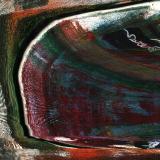
The album cover features a striking photograph of a human ear by renowned German artist Isa Genzken. Known for her radical visual language, Genzken’s work here functions as a metaphor for deep listening. The ear symbolises the layered complexity and immersive quality of the music on POLY — an invitation to perceive sound in all its depth, fragility, and force and unlock it’s potential to unite different voices in a distorted reality.
Nach einer sechsjährigen Pause kehrt Efdemin mit POLY zurück – seinem fünften Studioalbum, das auf dem kürzlich wiederbelebten Label Ostgut Ton, dem in-house Label des Berghain erscheint.
Wie der Titel vermuten lässt, beschäftigt sich POLY mit Vielfältigkeit: von Rhythmus,Textur, Style und Emotionen. In elf Stücken webt das Album ein multidimensionales Netz aus klanglichen Referenzen, das auf zurückliegende Ansätze der Klubmusik verweist und gleichzeitig entschlossen in neues Terrain vordringt.
POLY wirkt wie ein Nachglühen – von Jahrzehnten auf der Tanzfläche, von unermüdlicher klanglicher Erkundung und von einer tiefen Verbindung zu den Räumen und Communities, die Efdemins Sound geprägt haben. Im Laufe von 60 Minuten werden die Hörer*innen durch verschiedene Territorien und Klanglandschaften geführt. Mysteriöse und wirbelnde, abstrakte und dröhnende Texturen über teilweise schnellen und stoischen rhythmischen Konzepten. Manchmal bricht das Sonnenlicht in die undurchsichtigen und geheimnisvollen Klanglandschaften ein, bevor der Puls wieder die Oberhand gewinnt und uns direkt zurück in den Klub saugt.
Der Gesamteindruck von POLY ist mild und verspielt, introvertiert und manchmal verträumt. Die Musik ist reich an klanglichem Ausdruck und atmet den Geist musikalischer Konzepte, die im Laufe von Jahrzehnten verfeinert wurden. Was Sollmann hier verdichtet hat, fühlt sich wie eine Kulmination seiner vielschichtigen und polyphonen Identität an, die sich zwischen Klub, Museum, Studio und Akademie bewegt.
Das Albumcover ziert die Nahaufnahme eines menschlichen Ohrs der renommierten deutschen Künstlerin Isa Genzken. Genzken´s Arbeit wirkt hier als Metapher für deep listening. Das Ohr symbolisiert die vielschichtige Komplexität und immersive Qualität der Musik auf POLY – eine Einladung, Klang in seiner ganzen Tiefe, Zerbrechlichkeit und Kraft wahrzunehmen und sein Potenzial zu erschließen, widerstreitende Stimmen in einer verzerrten Realität zu vereinen.
- 01: Black Power (Feat. Donna Summer)
- 02: Mao (Feat. Joe Ki Und Die P.t.s.g.)
- 03: Lesbische Nummer
- 04: Tabarin Soul Shake
- 05: I Have No Friends (Feat. Joe Quick)
- 06: The World Has Gone (Feat. Joe Quick)
- 07: Haschkeller
- 08: Jazz-Kater
- 09: Soul Food (Feat. Joe Quick)
- 10: Night Trip
- 11: Moonflower Q 70
- 12: Karthago Ist Grün (Feat. Joe Ki Und Die P.t.s.g)
- 13: Beat-Schuppen Suite (Feat. Joe Quick)
- 14: Pozzolico
- 15: Midnight Love
- 16: Otran Limited Respettivo (Ii)
- 17: Snake Dance
- 18: Foreign Music Limited Alpha 80
- 19: Sphinx
- 20: Bal-Tha-Sar
Vol.1[28,99 €]
The second installment of The Tape Masters series by German film music maestro Peter Thomas. Audiophile pressing in deluxe 2x10" vinyl set, limited to 500 copies.
While volume one of the series compiled Thomas' dopest library music cuts, this album dives deep into the soulful side of the Peter Thomas Sound Orchester, featuring the mystique house band of Afro-American Munich GI club Tabarin Bar, Donna Summer's first solo recordings, stunning cinematic funk instrumentals and a healthy amount of breaks and beats.
Out of the 20 scorching tunes on this compilation, only three were released at the time of their recording and are nearly impossible to find on the 2ndhand market, ten have never been released anywhere before, others celebrate their first outing on vinyl or in stereo.
Peter Thomas is widely acknowledged as Germany's most inventive film music composer of the 1960s and 1970s, best known for his iconic soundtracks. Today, his work is cherished not least for its incredible groove factor. The story of this compilation traces the origins of the Peter Thomas Sound Orchester's rhythm section and its soul music background, shines a light on unsung heroes like singer Joe Quick and unearthes nuggets that have been lying dormant on tape for decades.
All music was carefully transferred from Peter Thomas' private master tapes and cut in full dynamics, housed in a beautiful fold-out cover with liner notes and private pictures. The compilation is released in cooperation with Peter Thomas' son Philip who represents the Peter Thomas Sound Orchester catalogue since his father's passing in 2020.
Joe Fujinoki centered the compositions of his latest album Glass Torso round the idea of the fragility of the human body. Fujinoki described the narrative thread of the album as that of “holding the shape of a human body as if it might shatter like glass”. The precariousness of the body, the essence of the body as defined by Fujinoki as the torso, and the object relations between the boundaries of dialectical exercises pack themselves into his creative process.
Fujinoki recorded Glass Torso exclusively with analog synthesizers, stumbling in and out of structural loops to find space for accidental discoveries. The ten pieces of recorded material feel somewhere on the edge of typified form, feeling like a vascular system pumping in and out its undulating liquidities. Maybe this is the hollowed space held together by Fujinoki’s notion of the torso where you hear a microscopic world, dubby and generative. Fujinoki is adept at organizing this realm of subtle sound sources, giving proper considerations of shared tonal space. Seemingly, this handling of the precarity of sonic material elucidates Fujinoki’s mature attention to detail.
Ambient music genre tropes often affirm the listeners vessel for escape and dissociation. It provides an intoxicating allure by respite from an overwhelming exterior reality far outside the listeners controls. Here this space becomes apolitical, or its protest vocabulary softer and subtle. Fujinoki does not aim to tackle hyperobject topics on how to course correct the world, but he does something increasingly rarer to come across. On Glass Torso an alternative space is created not as shelter, but as a meditation on negotiation and compromise. This twenty eight minutes of audio lays down a foundation for imagination, for imagining how to negotiate the fragility of the self. Zoomed out, the implications of his negotiative sonics can be a playground for broader reflections on distributive care and attention.
Fujinoki says he feels “alert” to his physicality and placement in the world amidst vast digital cultures creating impositions on him and his surroundings. On Glass Torso he creates a concretized space on a vinyl record, where the virtual and the tangible antagonize one another that create the spectacle of the listening experience. This spectacle is a soft one, a considered one, and an utmost enjoyable one. Fujinoki juggles opposing forces brilliantly, and formulates an exquisite palette of soft passing music so he can also help the listener with the exquisite burden of their own Glass Torso.”
- Nick Klein, January 2026
Bergsonist emerges on Dark Entries with Depths, a genre-bending 12-track LP of atmospheric and rhythmic excursions. For more than a decade, Moroccan-born Selwa Abd has been using the Bergsonist moniker to examine postcolonial identity and speculative temporalities across disparate media, including sound, image, video, and installation. She is also a key figure in New York underground music, fostering mutual aid and community support through her platforms Pick up the Flow (PUTF) and BizaarBazaar. On the 2025 album ASL أصل ⴰⵙⵍ, Bergsonist explored her Amazigh heritage using field recordings captured in Morocco. With Depths, her sixth LP, she continues the project of ancestral reconnection through sound. Abd notes: “I really use making music as therapy, not as a precious act, more as an energy release that makes me feel alive.” Depths overflows with this excess of vitality.
Tracks like “Trust the Current”, “Depths”, and “Underwater World Pursuit” showcase her singular take on diasporic techno-futurism, where James Stinson-esque atmospherics meet Moroccan rhythms. Elsewhere, “Again” and “Higher” push into coldwave territory, with icy arpeggios and electroid beats dancing beneath Abd’s ethereal vocals. But the dancefloor is not to be neglected: “Breakthrough” and “Ode to Life” spring forth with the kind of skewed peak-hour energy that only Bergsonist can bring. Artwork for Depths was designed by Eloise Leigh, and incorporates photographs by Abd and Greg Zifcak taken in Morocco. Also included is a protection poster that features an Amazigh symbol used for warding off the evil eye. Depths is an album that achieves a rare balance of elegance and DIY ethics - it is truly an ode to life.
- A1: Six Figurines
- A2: Assassination Tapes
- A3: How To Disinfect A Live Grenade
- A4: Chemo Crystal Ball
- A5: Saltwater Tantrums
- A6: Night Terrors
- A7: Recognition
- A8: Diagnosis
- B1: Crayola Circles Of Creativity
- B2: Anger
- B3: Chinese Sunrise
- B4: Kwaidan Snowstorm
- B5: Leon Ichaso
- B6: Willow Trees
- B7: The Destitute Stashspot
TAPE[17,23 €]
Backwoodz Studioz is excited to announce the release of Crayola Circles, a collaboration between rapper Fatboi Sharif and producer Child Actor. While both artists have long standing connections to Backwoodz, this album marks their first collaboration of any kind and breaks new artistic ground for all parties.
Sharif’s previous album, Decay, released on Backwoodz in 2023, was a haunting experimental rap masterpiece, an acid trip in a mental hospital. On Crayola Circles Sharif trades menacing psychedelia for a simmering stew of blacklight expressionism, his verses slipping effortlessly through the swells and tides of Child Actor’s masterful production. No matter how uneasy the waves grow, Sharif is at ease, a truth teller whispering anti-riddles in your ear. This album feels like a new chamber for Child Actor, as well. The producer has been on an impressive run since dropping CINE- a collaboration with rapper Cavalier- on Backwoodz in late 2024. Child Actor has shown up in the liner notes of everyone from Navy Blue (The Sword & The Soaring) to Earl Sweatshirt (Live, Laugh, Love) to ELUCID (Revelator) to Open Mike Eagle (Neighborhood Gods Unlimited), to Ghais Guevara (A Quest to Self-Mythologize), amongst others. On Crayola Circles Child Actor’s production is dynamic, shifting and sliding into new phases and movements in an instant. The beats are full and knotty, leaning into jazz and folk, while remaining tethered to the tender minimalism that is his signature. It’s a difficult balance for any producer, and here it is executed perfectly, placing us in a world of wood and brass, cowhide and undersea piano. On any other record, this soundscape would steal the show — and it very nearly does — but Sharif’s command never wavers, ever in control; a lucid dreamer in an induced coma.
There are no guests, no skits, and no interludes. There might not even be songs, instead Crayola Circles seems akin to a great river; singular, traversing forest and jungle, mountain and valley, running from mouth to endless sea.
Between flesh and silicon. “Under My Skin” (2026) is the first album by IADI, released by Neo Life. A record like few
others, highly conceptual, cover art included. Its essence lies in the folds of the increasingly ambiguous relationship
between man and machine, where the former designs the latter and, perhaps without fully realizing it, is gradually
destined to adapt and be reprogrammed by it. Each track of “Under My Skin” is, in fact, a sort of interface, connector, or
any other imaginative point of contact between two creative phases, amid emotional impulses and binary calculations.
The sonic architecture oscillates between analog warmth and algorithmic coldness, constructing landscapes in which
pulsating synthesizers and mechanical rhythms seem to question each other. There's no linear narrative, but rather a
progressive immersion in a zone of near-friction, where the comfort of technology coexists with more than a faint
musical uneasiness, like a background noise that never ceases to remind you who's truly in charge. In “Under My Skin”,
the machine is neither an enemy nor a simple instrument: it's a real presence, intimate, even tactile, amplifying desires,
fears, and dreams of dawns beyond the digital realm. Intelligent dance music. Less noise, more sensations. Electronic,
but profoundly human.
The final result, then, is a music project that speaks to the present, yet sounds like an X-ray of the future, capturing that
fragile moment when humanity and technology stop observing each other from afar and begin to merge, track after
track. It's no coincidence that IADI's album opens with “Impulse”, an immediate expression of an electrical impulse, for
both humans and machines, which is also the language of the nervous system, as fast as it is vital—pure energy and
rhythm, a track as intense as it is irregular. And after this introduction, it's the turn of the equally erratic “Axon”, whose
title describes the neuron that transmits the signal over distance, telling the listener to sit back and relax for a new
journey through the notes toward the more melodic “Cortex”. The cerebral cortex, the ultimate seat of thought and
memory, becomes the source from which the musical flow of the first part of the work is drawn.
Then, suddenly, an automatic, or instinctive, response to the constant succession of impulses: “Reflex”, or zerotemperature techno, with a fragmented pace, featuring vocal samples, breaks, and restarts. In the producer's
imagination, the subsequent, and conversely placid, “Neuron” represents the emotional core of the second part of the
work, providing a kind of respite from the seething vibrations. While the neuron is the basic unit of the nervous system,
the synapse is the functional connection point between one neuron and another effector cell, essential for the
transmission of nerve impulses and communication in the nervous system, enabling functions such as learning and
movement. Likewise, a track like “Synapse” once again illuminates the path traced by IADI. The more experimental and
streamlined “Static” instead suggests true ordered chaos. “Dreamstate” is the conclusion suspended in the void, relating
to that dreamlike state between waking and sleeping, where consciousness fades toward infinity and visions begin. Pure
fading into the subconscious. Eternal return to where it all began. Dancing is a form of consciousness. Every beat is a
question. IADI, however, holds all the answers you need.
Outstanding monimal grooves! In Spanish, Salida means “exit”, but in this EP, it becomes a metaphor for emergence. Not a way out, but a way through. From beneath layered emotions and dormant states, a new force begins to pulse. Textures rise from the underlayer. Grooves fracture silence. Each track is a signal of rebirth, slow, deep, inevitable. The artwork reflects this moment. From cracks of vivid red, new life pushes forward in green. It’s not escape. It’s transformation. This is Salida, the first breath of something real.
"I think I have never met anybody, with the exception of Brazilian guitarists Baden Powell and Toquinho, as connected to his instrument as Agustín Pereyra Lucena" – Vinicius de Moraes
Far Out continues its exploration into the singular catalogue of Argentine guitarist and songwriter Agustin Pereyra Lucena with a special Record Store Day edition of his most celebrated album Ese Dia Va A Llegar.
Agustín Pereyra Lucena was one of South America’s outstanding guitarists. Hailing from Buenos Aires but obsessed with the music of neighbouring Brazil, Agustin abandoned his architecture studies to pursue music full-time, earning friendship and collaborations with Brazilian music's greatest figures including Vinicius de Moraes, Baden Powell, Toquinho, Dorival Caymmi, Maria Bethania and Chico Buarque.
Originally released in 1975, the album has been better known in some parts of the world as Brasiliana – a title repurposed by Agustín's European record label in the 70s to exoticize the sounds of South America for the continental market. It finds Agustin and band—which includes key collaborators Guillermo Reuter on contrabass, and Carlos Carli on drums and percussion— at their most blissfully laid back. The album features idiosyncratic renditions of classics by Antonio Carlos Jobim, Vinicius de Moraes, João Donato and Agustin’s personal hero and friend Baden Powell, alongside Agustín's own works which ooze with captivating mystical wonder.
The analog warmth of the recording is such that it feels like you’re there in mid-seventies Buenos Aires, on a balmy late night session at Estudios Audión, with a group of phenomenally impressive musicians. The heat generated is offset only by the cool temperament of everyone involved. On the handful of vocal tracks on the album, Agustin’s gentle voice is responded to by the liquid smooth vocals of Laura Hatton, Luis Maria Cosenza and Patricia Scheuer.
Agustin’s unique position in the annals of his continent’s musical history has been lovingly maintained by Agustin’s nephew Jose Luis Pereyra Lucena, who has entrusted Far Out Recordings to preserve and re-release Agustin’s works. The music has been professionally remastered at London’s Metropolis Studios, using multiple copies of well kept original vinyl.
Reissued worldwide for the first time under its original title and cover as Agustin originally intended, Ese Dia Va A Llegar will be presented in a limited edition obi-stripped gatefold replica sleeve.
- Profondo Rosso
- Death Dies
- Roller
- Chi? - Parte Uno
- Chi? - Parte Due
- Suspiria
- Blind Concert
- Un Ragazzo D’argento
- Opera Magnifica
- Yell
- Amo Non Amo
- Funky Top
FOLLOWING THE SUCCESS OF “THE OTHER HELL”, GOBLIN ARE BACK FOR RECORD STORE DAY 2026 WITH AN EXCLUSIVE COMPILATION OF SINGLES RELEASED BETWEEN 1975 AND 1979!
For the very first time on vinyl, this compilation gathers together all the singles released by Goblin during their golden era between 1975 and 1979, a journey that begins with the explosive, legendary debut Profondo Rosso, a true chart phenomenon of its time, and reaches the rare Amo Non Amo, passing through unforgettable milestones of Italian film music and progressive rock.
The collection opens with Profondo Rosso and Death Dies, taken from the soundtrack of Dario Argento’s masterpiece that catapulted Goblin to fame, blending dark atmospheres, virtuosity, and a unique sense of cinematic tension. It continues with Roller and Snip Snap, drawn from the instrumental album Roller (1976), a record not tied to any film, yet considered a cult cornerstone of Italian progressive music for its intricate structures and expressive power.
Chi? and Chi? - Parte Seconda follow; two tracks originally composed as the theme for a 1976 RAI television show, which saw Goblin bring their unmistakable sound to a different medium, experimenting within a shorter, punchier format.
Next comes Suspiria with its haunting counterpart Blind Concert, from the soundtrack of Argento’s 1977 horror classic. This remains one of Goblin’s most iconic and unsettling works, where music becomes an active narrative force: hypnotic, percussive, and filled with eerie vocal layers that made it a cornerstone of horror soundtracks worldwide.
From Il Fantastico Viaggio del Bagarozzo Mark (1978) come Un Ragazzo d’Argento and Opera Magnifica, two tracks that highlight the band’s more conceptual and visionary side, a move away from cinema toward a self-contained narrative and progressive experimentation.
The single Yell stands as another late-decade gem. Originally composed as the opening theme for the RAI television series “Sette storie per non dormire” (1978), it captures Goblin’s ability to merge rock energy with electronic pulse, proving their versatility far beyond the horror realm.
The compilation closes with Amo Non Amo and Funky Top, taken from the soundtrack of the 1979 film Amo Non Amo, one of the group’s lesser-known but fascinating cinematic works.
Far more than a simple anthology, The Singles Collection 1975–1979 maps the evolution of Goblin’s sound, from the worldwide success of Profondo Rosso to their most mature and experimental phase. It finally restores to vinyl a body of work that had long been scattered across rare 45 rpm releases, offering fans and collectors a complete, vivid portrait of one of Italy’s most inventive and influential musical ensembles.
Very Limited 7” EP with printed lyric inner sleeve
Purely Physical Teeny Tapes continue to sink their teeth into the fleshy nethers of the contemporary oz
underground, plucking the self-titled ep of vivisected bedroom folk by naarm/melbourne trio Who Cares?
from the recesses of net anonymity for the greatest of good.
Upon appearing out of nowhere back in ‘24, the quartet’s debut registered (feverishly) somewhere
between immediacy & beguilement, the intervening year & change doing little to dull its aura, the
mystique only heightened by their suitably gorgeous appearance in wonderful company on a colourful
storm’s recent ‘going back to sleep…’ compilation-extravaganza. The conceit of these four tracks here is
disarmingly minimal - repetitious loner guitar strummage, oblique vox poetics as lullaby, intermittent
sunken percussion, bass the subtle melodic lugger - all recurring/revolving in delicious pirouette freefall,
un-rinseable within the mind, wayward melodies stuck like heat-warped treacle.
As with the firmest of its diy domestica ilk, there’s something ever so slightly off here, the carnivalesque
nature of this thing being the ‘what?’ that keeps pulling you in. parched ennui drip, fully zonked bacchanal
(anti-)energetics, listlessness rendered bedsit anthem, cooees in the hallway. depending on how your
head is screwed, ‘correct’ or otherwise, one might hear a charmed take on a vein of folk song fallen well
by the wayside/behind the mantle, others a seance for the spirits in the kettle, others more attuned to the
myriad wraiths swirling within the outer reaches of these songs, flights of whimsy foiled by a sticky, gluey
something or other. choose, or rather submit to your own adventure. Miaow miaow miaow.
- A1: Eastern Wizard - Le Baiser Du Sorcier
- A2: Mashti - Maine Pyaar Kiya
- A3: Fyordh - Kerala Blues
- A4: Gotama - Twilight Echoes
- B1: Jose Solano - Sal De Mar
- B2: Catching Flies – Tides
- B3: Nato – Apae
- B4: Tamer Elderini - Souq
- C1: Aural - Laulu Mustarastaan
- C2: Nairu - Mariposa Azul
- C3: Majnoon - Hatiralar
- C4: Yaensen / Yancouba Diebate - Kora Café
- D1: Rich Vom Dorf - Heartbroke
- D2: Linear / The Saint - Samadu
- D3: The Ab Brothers - Al Saha
- D4: Dj Phellix / Ablozé - Zal
The Buddha Bar collection is the one of the most emblematic electronic compilation series with over several million copies sold over the years. Discover the 27th Buddha-Bar Compilation, Mixed by DJ Ravin. Immerse yourself in the captivating and unique world of Buddha-Bar with this new « haute couture » selection. This latest edition, masterfully mixed by the iconic DJ Ravin, takes listeners on a mesmerizing sonic journey, blending sophisticated electronic beats, worldwide sounds, and deep chill and house vibes. More than just an album, it’s an immersive experience perfect for setting the mood at any gathering or accompanying moments of pure relaxation. With a legacy of globally acclaimed compilations, the Buddha-Bar series has already captivated millions, creating a lifestyle phenomenon like no other. Available on March 28th, Buddha-Bar XXVII is a must-have for fans of lounge and electro music. Give your customers the chance to escape into this musical adventure
Faitiche welcomes a new artist: Christina Kubisch belongs to the first generation of sound artists. Her practice ranges from performances, concerts, to works with video and visual art, but she is best known for her sound installations and electro-acoustic compositions.
TUNING brings together three pieces by Christina Kubisch from different periods of her oeuvre. What they have in common is the way they transform sound phenomena originally considered “non-music” into compositions.
Jan Jelinek: Gaming in Silence (2024) is the most recent work on this compilation. It’s a collage of electromagnetic waves, voice, and abstract sound textures. How did this combination come about?
Christina Kubisch: Gaming was commissioned as a fixed-media composition for the Sound Dome at ZKM Karlsruhe. Since Resonances: The Electromagnetic Bodies Project (2005), I’ve been making recordings in the old and new server rooms at the ZKM and in their permanent collection of historical computer games. Computer games like Asteroids (Atari, 1979) and Poly-Play (VEB Polytechnik, 1986) have specially generated analogue electromagnetic waves that interest me in particular on account of their density, rhythms and textures. I originally studied painting and to me the work of composition often feels like painting an abstract picture. I alter my source material as little as possible, layering and overlapping until a distinctive sound space emerges. In recent pieces, I sometimes combine magnetic waves with field recordings or live instruments. In Gaming it’s my recording of a Chinese song about silence.
JJ: Two persons walking through a street in Madrid (2004) is a recording from your Electrical Walks series. Here we should give a brief explanation of one of your best known works: participants in an Electrical Walk move through public spaces wearing prepared headphones that allow them to receive electromagnetic waves from their surroundings – for example from security gates, ATMs or neon signs. They discover a situation that normally is inaudible to the human ear and they can actively shape it by choreographing their movements. I really admire this piece, not least because there’s no clear dividing line between participants and artist. What exactly do we hear in Two persons walking through a street in Madrid (2004)?
CK: With this early work, I wanted to understand what is heard by people participating in an Electrical Walk in the same place but moving in different ways. The Spanish composer Miguel Alvarez-Fernàndez and I set off from opposite ends of a major shopping street in Madrid, met briefly in the middle, and then continued to the end. We both recorded our walks and I then layered them over one another. You might call it a work of electromagnetic conceptualism.
JJ: Diapason (2009 version) is an installation that plays a composition based on sounds from fifteen tuning forks. This setting is audible in the recording: there’s no dramatic arc, no beginning or end – instead, it recalls a piece of aleatoric music focussing on the decay phase. How did you come to make this work and could you tell us something about your compositional method?
CK: Diapason is part of a series of three pieces that deal with “non-instruments” or instruments that no longer exist: electrical mine bells used to send signals to the workers underground; a historical glass harmonica originally used for medicinal purposes; and tuning forks that were used by doctors to test people’s hearing. All of these methods are no longer in use. The sound of the tuning forks, audible only if held close to the ear, was recorded at the electronic studio at Berlin’s Technical University in such a way that even their decay remained audible. The frequencies range between 64 and 2048 Hertz and they can be adjusted at micro-intervals using small movable weights. The sequence and the duration of the pauses are dictated by chance and were not defined in advance. The 2009 version was created for an installation in the historic Holy Cross Church (Korskirken) in Bergen. Visitors could enter and leave the space at any time, deciding for themselves where and for how long they wished to listen to the sounds played back over an array of small loudspeakers placed on the floor of the apse.
Credits:
Gaming in Silence: commission of the ZKM/Hertzlab, Karlsruhe 2023
elektronic sound processing: Tom Thiel
sound engineering and mixing: Eckehard Güther
Diapason: produced at Elektronisches Studio of TU Berlin
rearrangement: Eckehard Güther
Christina Kubisch, published by Edition Christina Kubisch / Random Musick Publishing
image front: Transitionen 2021 by C. Kubisch, sonagrams of electronic waves (courtesy: Galerie Mazzoli Berlin)
image back: Diapason Tuning Fork, property of Folkmar Hein, Photo: Archiv Christina Kubisch
design by Tim Tetzner
mastered by Giuseppe Ielasi
Thanks to Miguel Álvarez-Fernández, Folkmar Hein, Dominik Kautz and Mario Mazzoli
A4 paperback, 120 pages
The second in our series of book relaunches is one of the original books on The Jam ( the first being The Sex Pistols
Retrospective ).
The Jam one of the most important British groups of all time, crashed on the scene with the Punk Explosion, but soon found their own niche. Charting consistently from 1977’s `In The City’ debut to 1982’s `Beat Surrender’ single.
The book details the groups worldwide releases with over 200 colour and black and white illustrations, The Jam 7” worldide release chart and a detailed timeline of the bands history and list of gigs and appearances up to the bands split in 1982.
The Jam are one of the UK’s most loved bands and have been surely missed but more importantly not forgotten.
The Jam were very much a vinyl orientated phenomenon that consisted of great artwork. So sit back and enjoy their story through their releases around the world.
Over 200 pictures of rare and deleted releases throughout the world
Plus history of the band and list of gigs and appearances.
Author: Agent Provocateur
Weight: 550gm
Height: 297mm
Width: 210mm
Depth: 10mm