~~~From Mississippi and Olvido Records~~~~~~ Steel-string guitar and vocals by the great Giorgos Katsaros, a mythic figure of Greek rembetiko. Our obsession with underground Greek music continues with 10 ultra-rare recordings of heartbreak and vice from rembetiko legend Giorgos Katsaros. Katsaros, who by some accounts lived to be over 100 years old, carried the old songs of Greece to the Diaspora in the United States, bridging centuries of music in one storied lifetime. Born in 1901 on the Greek island of Amorgos, Katsaros' was enchanted with the songs he picked up as a kid in the streets of Piraeus and Athens. Encouraged by his grandfather, an amateur singer, Katsaros developed a style that mirrored his upbringing - centuries-old Asia Minor songs, island rhythms of his homeland, well-known Athenian songs of the time, and anonymous `rebetiko' songs. Katsaros' songbook was vast, but he was most drawn to the street life and music of the manges of early 20th-century Greece: outcasts who dealt with the indignities of an unstable economy and an inauspicious future with the old standbys: wine, hash, and dancing. These ten tracks are remastered from Katsaros's 64 surviving early recordings, many rarely heard since their original release. Hypnotic melodies plucked over repeating thumbed basslines back his deep, mournful voice. Katsaros brought this nostalgic late-night music to smoke-filled rooms of Greek exiles in Chicago, Philly, and New York, where he emigrated in 1917. He continued to travel the country and play until his music was supplanted by more modern styles in the 1950s. He retired to the town of Tarpon Springs, FL, famous for its Greek sponge fishers, til a late-in-life revival brought him back to Greece for a few massive concerts and national accolades in the 1990s. Like many great artists, Katsaros carefully curated his own mythic backstory over the decades. He sometimes claimed he was born in 1888, making him 109 on his passing, and conflicting accounts of his birth and travels circulate to this day. Greek researchers Stavros Kourousis and Konstantinos Kopanitsanos, who also compiled these tracks, contribute groundbreaking new historical research on Katsaros' life. Lyrics, poetically translated by Tony Klein, further fill in the picture. Clean and rare 78s were remastered by Stereophonic. Katsaros has never sounded better than on this LP, pressed on heavy black vinyl, with extensive notes and lyrics.
Поиск:ph
Все
September 26th, 1994 - Jamiroquai released a song that still to this day sounds futuristic. Blending electronic, funk, jazz, soul & pop.
The record was then famously remixed by the legendary David Morales, taking the song to a whole new audience and anthem level… giving the band their first ever Billboard Dance #1.
The iconic music video was directed by Vaughan Arnell & Anthea Benton, and features Jay Kay dancing around a blue room with multiple versions of him and the other band members appearing and disappearing. The use of motion control photography allowed for a seemingly continuous shot as the camera pans around the room.
2024, Michael Gray delivers a modern club interpretation of the classic Jamiroquai anthem on his Sultra Records imprint.
Keeping the original funk, soul undertones of Jamiroquai, he takes us on a housey ride of funky disco rhythms laden with hi-pitched synths, a soul oozing chord melody and grooving drum pattern that sits relaxed allowing the emphasis on Jay Kay’s vocal and new worked bass line to do it’s thing. A lovely alternative to the dance floor classic we all know and love.
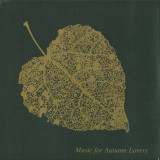
Set for release at the height of the season it’s dedicated to, ‘Music For Autumn Lovers’ by Adam Scrimshire is an eight track album of lush, mostly acoustic based, minimal instrumentals eliciting a mixture of feelings for this special time of year.
Four tracks originally released on an EP in 2022 are joined by new compositions ‘Hawthorn’, ‘Hazel’, ‘Willow’ and ‘Blackthorn’. Gently finger-picked acoustic guitars cosy up alongside pianos, synthesisers, strings and horns; filtered through an autumnal hue of susurrous production and effects. In turns comforting, melancholic and evolutionary; it feels like an album that can be kept being made and remade forever, like a season in itself.
Both a relentless creator and inspiring champion of new music; South London based Scrimshire has been recording, producing and DJing since the mid 2000s. Amongst his credits, he was featured by the Guardian as one of three producers behind the new wave of UK soul, alongside Inflo (Michael Kiwanuka, Sault, Lil Simz) and Swindle (Joel Culpepper, Greentea Peng, Kojey Radical). His bold 2023 album ‘Paroxysm’ was a response to the absurdity of the breakdown in the UK government, picking up an Album of the Week award on Huey Morgan’s BBC 6 Music show, and 2021’s beautiful ‘Nothing Feels Like Everything’ received an Album of the Year nomination at the Gilles Peterson Worldwide Awards. Scrimshire also somehow finds the time to support a wealth of talent on his label Albert’s Favourites, formed with Dave Koor and Jonny Drop, where they have recently released albums by And Is Phi, Huw Marc Bennet, Inês Loubet, Irini Arabatzi, Jonny Drop & Andrew Ashong, and Qwalia.
Radio Support: Gilles Peterson (BBC Radio 6 Music), Tom Ravenscroft/Deb Grant – New Music Fix (BBC Radio 6 Music), Huey Morgan (BBC Radio 6 Music) Guy Garvey (BBC Radio 6 Music)
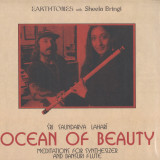
Multi Culti World Records venture deeper into the new new age with the release of 'Ocean of Beauty - Meditations for Synthesizer and Bansuri Flute,' a collaboration between California-based artist/DJ Earthtones and Indian classical musician Sheela Bringi. Earthtones, fresh off his genre-defying debut album on Wonderwheel, here dives into the deep end of the ocean of ambient. With music that traverses cultures,he’s known for bridging influences from Cumbia to hip hop and house music. Here he presents his most consciousness-expanding work yet, no doubt influenced by his involvement in Ojai new age culture,years living in ashrams, practicing Shaktism,+ spending as much time curating sounds suitable foraural healing and meditation as for dance-floors. He’s found a perfect muse in Boulder-based Sheela Bringi, whose virtuosity in Indian classical music sets the tone of the record with her bansuri (Indianbamboo flute) & harp, blending traditional instrumentation with more contemporary influences. Bringi was a direct disciple of bansuri master GSSachdev, and represents a devotional musical lineage. She has released two solo albums, 'Shakti Sutra' and 'Incantations,' and her work has been featured on over 50 world and ambient records, plus publicly on outlets from NPR to NBC News, & more. 'Ocean of Beauty' is the English translation of an ancient Sanskrit text devoted to the divine mother, the Sri Saundarya Lahari, The song titles are taken from verses in that text, and the album is in fact a dedication to the goddess Lalita Devi. It creates a serene, meditative space which seamlessly blends traditions; synth-driven ragas with a spirit of tranquility that nurtures Multi Culti’s philosophical bent towards ‘music without borders.’
Building up a head of steam, Ace Vision returns on the heels of his Raising Awareness EP.
For Shaped Mind, the Italian artist is exploring new musical avenues. While his musical essence, glow and style remain, a darker dancefloor palette is employed on the release. Polyrhythmic patterns race in the sample strewn “Second Phase”, rumbling waves and warehouse echoes tempered by swirling stabs. A bouncy liquid groove ushers in “Nu să Chan”, rasping beats shrouded in smoky bass while bars bend around an assortment of textures and tones. “Katana Cut (Trance Mix)” conjures up images of dancing bodies waiting for the dawn. Melodies circle percussive layers, meandering undercurrents of acid bubbling beneath shimmering synthlines. The finale comes with “Mixage Électronique.” Steady kicks and crisp cymbals give way to juddering chords, clean keys and snare rolls countering to a close.
Celebrating dance music’s roots in Africa, global music superstars Soweto Gospel Choir and renowned Australian DJ Groove Terminator team up with Grammy-winning producer Latroit to present ‘History of House,’ a global reimagination of the iconic dance music classics that defined a generation.
Featuring exquisite multilingual vocal performances and collaborations with some of Southern Africa's most promising emerging artists, "History of House" stands as a vibrant celebration of music and culture. This album transcends boundaries, effortlessly connecting diverse cultures across generations with an authentic fusion of global beats, Afro house, Amapiano, and house music.
Lennon & McCartney. Simon & Garfunkel. Ralf & Florian. Enema & GeJonte. The inventors of modern pop music as we know it. Joining forces in 1988, Orebro duo Kai Parviainen and Jonas Ohlsson put out four cassettes and a split album with Frak under the Enema & GeJonte guise, all teeming with clever and funny electronic pop songs. The sound? Imagine Duet Emmo jamming out with the Residents on a wheat field on Narkeslatten. Or picture early Severed Heads covering lost Philemon Arthur & The Dung tapes. Kai pushes his Sequential Circuits Pro-One synthesizer to its limits while Jonas makes discerning observations on everyday life in a Swedish small town. Mostly sung in Swedish, sometimes in English, but always with a touch of sweet naivety and innocence on par with lo-fi punk/pop geniuses Dan Treacy and Daniel Johnston. Typical song subjects: A friendly game of five-a-side football. The joy of rising at the crack of dawn to get on with the tasks of the day. A bus journey to Odensbacken to savour a semla at a local cafe and some small talk with the gas station manager. All delivered with a playfulness and ecstasy more commonly found on the records with Swedish Christian music Kai so devotedly collects than in contemporary industrial or electronic music. When Jonas moved to Amsterdam in 1996 the boys ceased making music together, leaving behind a treasure trove of unreleased material, some of which appeared on a couple of cassettes in the 00's. But the best stuff has remained buried until now. How dada pop gems like ''Joxa med trasan'' and ''Underground'' could dwell in obscurity for thirty-ish years beggars belief. Other standout tracks on this compilation: ''Plan 714 till NYC'', a wonderful waltz time instrumental performed in the vein of a drunken Bob Hund, and the En Halvkokt I Folie style cut up experiments of ''Gasten Harry''. So get ready for a glorious blast from the past, as the Swedish pioneers of the hypnotic groove cordially invite you to a sonic journey as adventurous and memorable as a trip on the lansbuss to Odensbacken. Get on board, grab a seat and enjoy the ride. Liverpool. New York City. Dusseldorf. Orebro. // Ulf Osterstrom
Re-mastered from original mono master tapes.
Limited edition 1000 copies.
180 gr vinyl pressed by Pallas in Germany.
Deluxe high-gloss flipback album jacket.
Facsimile reissue using the original cover art.
Double insert using an original photo by JP Leloir from 1955.
Each record has been visually checked to prevent defects.
Recorded December 27 and 29, 1955 at the Pathé Magellan studio, Paris.
Original LP issue: Barclay 84.023.
After hitting Paris in 1950, saxophonist Bobby Jaspar enthralled jazz fans and jazzmen alike with his smooth, elegant playing, with the lyricism of his tranquil phrases heavily influenced by Stan Getz in particular. So when Jaspar began regularly performing with a small ensemble at the Club St-Germain five years later, he adopted the same instrumentation as that of his idol’s illustrious quintet, with Sacha Distel on guitar and René Urtreger on piano in the roles of Jimmy Raney and Al Haig, respectively.
Contrary to what its title might suggest, ‘Modern Jazz au Club St-Germain’ was actually recorded in the studio. It features compositions by Milt Jackson, Dizzy Gillespie and Miles Davis along with a handful of standards, in which the angular aridity of bebop gives way to the generous and yet sensitive idiom of cool jazz.
Jaspar’s premature death in 1963 robbed the jazz world of a promising talent; this record is among his best efforts as a leader. Bobby Jaspar is in top form here !!!
Text – Pierre de Chocqueuse
Bobby Jaspar (Tenor Saxophone & Flute)
Sacha Distel (Guitar)
René Urtreger (Piano)
Benoit Quersin (Bass)
Jean-Louis Viale (Drums)
- A1: Cliff Cliff (Jacques Hesse) 5’14
- A2: Phenil Isopropil Amine (Bobby Jaspar) 3’29
- A3: Mysterioso (Thelonious Monk) 3’27
- A4: Lullaby Of The Leaves (Joe Young) 3’34
- A5: There Will Never Be Another You (Harry Warren – Mack Gordon) 3’20
- B1: Waiting For Irene (Bobby Jaspar) 3’53
- B2: Le Jamf (Bobby Jaspar) 4’15
- B3: Chasing The Bird (Charlie Parker) 5’10
- B4: Speak Low (Kurt Weill) 4’27
- B5: Doxology (Memory Of Dick (Bobby Jaspar) 2’31
2024 Repress
Re-mastered from original stereo master tapes.
Limited edition 1000 copies.
180 gr vinyl pressed by Pallas in Germany.
Deluxe high-gloss flipback album jacket.
Facsimile reissue using the original cover art (front photo is lost).
Double insert using an original photo by JP Leloir from 1959.
Each record has been visually checked to prevent defects.
Recorded December 19 and 20, 1958 at the studio Hoche, Paris.
Original LP issue: Barclay 84.063.
Belgian jazz artist Bobby Jaspar died far too young at age 37 in 1963, but fortunately made a handful of memorable dates as a leader. This is the last studio session under his name. Jaspar sticks exclusively to flute on these December 1958 studio recordings. He’s joined by drummer Kenny Clarke, Sadi Lallemand or Michel Hausser (who also doubles on xylophone) on vibes, and either Paul Rovere or Jymie Merritt on bass, as well as percussionist Humberto Canto (on one of the two sessions). Jaspar’s soft arrangements prove very appealing for his originals, standards such as ‘Lullaby of the Leaves’ and ‘There Will Never Be Another You’, and classic jazz tunes (an exotic ‘Misterioso’ and a Latin-flavored ‘Chasin’ the Bird’, the latter featuring Hausser on xylophone). This is easily one of Jaspar’s finest recordings as a leader.
Ken Dryden / All Music
Bobby Jaspar (Flute)
Michel Hausser (Vibes) (tracks 1 to 4, 6,8,9)
Sadi Lallemand (Vibes) (tracks 5,7,10)
Paul Rovère (Bass) (tracks 1 to 4, 6,8,9)
Jymie Merritt (Bass) (tracks 5,7,10)
Humberto Canto (Percussion)
Kenny Clarke (Drums)
Red Laser continue their prolific purple patch, unpacking four more slabs of red lit Manctolo from a host of box jammers, old and new.
Frank Butters wastes no time at all, 'The Call Of The Wild' engaging photon tubes with a highly kinetic array of crystalline synth shards, thunderous bass and hyperactive sfx. Without geeking out too much, special mention has to go out to the synthesis on display here - Butters advancing up the levels of sonic shamanism as he conjures up never-before-heard patches of interstellar cosmic NRG...
Bob Swans' 'Bodyform4U' unites the robots with a universal message of togetherness. Its multiple layers of shuddering arpeggios and star-aligned synths working in unison to quell any fears and send us off into a space age utopia. One that'll work as well soundtracking the end of the session as it will as the dancefloor's filling up; its subtle anthemic qualities sure to rouse the spirits of even the most dehumanized cyborgs.
New signing Lone Saxon drops 'Hypersleep' which utilises rich piano chords and a hefty breakbeat, switching up the vibe but keeping things super uplifting. This one reminds us of that innocent period when you could get on the megabus for 50p and score three for a tenner on the dancefloor. An evocative vocal refrain adds a moment of thoughtful introspection in between the e-rushes and arm-raising for another moment of interactive harmony.
Finally, 'Webo' sees Franz Scala (with a little help from Il Bosco) return to source, delivering a bona fide slice of maximum balls out MANCTALO chug. With tension-wrought chord progressions, delicious layers of lead melodies and a soaring vocal, there's few that can resist the charms of this late night electro-disco hyper anthem.
All aboard the starship !
RL x
*Includes download code
In the performance of this work, "Plan for Sleep" (1986), created simultaneously with “Every Dog Has His Day” (1985), Yamanaka took on the role of sound operation. The performance begins with a minimal piece where the tones of the electronic organ and striking phrases from the piano and saxophone race forward in syncopation. Following this, various sound fragments drift over a deafening industrial beat reminiscent of machine noises. There are also pieces that transform the typing sounds of a typewriter into rhythm, showcasing a range of experiments inspired by the then-novel sampling technology, beautifully intertwining with the physicality of the performance.
Additionally, influenced significantly by film music, Yamanaka incorporates a rich tapestry of colors through melancholic melodies that evoke various scenes, from secular jazz to other influences. This work constructs a uniquely original and sophisticated worldview that stands out even when surveying the canon of avant-garde performance art from around the globe in the postmodern era.
DUMB TYPE is a multimedia performance art group based in Kyoto that was formed in 1984 and continues to be active at the forefront of the art scene. We are excited to announce the simultaneous release of two cassette book works produced by musician Toru Yamanaka and the late Teiji Furuhashi, a central figure of the group, for works from the early DUMB TYPE Theatre era: "Every Dog Has His Day (recorded in 1985)" and "Plan For Sleep (recorded in 1986)," now available for the first time on vinyl.
Since the founding of DUMB TYPE, Yamanaka has primarily been responsible for music production, while the late Furuhashi played a crucial role in translating Yamanaka’s compositions into stage direction. Their collaboration began with previous groups ORG and R-STILL, and was influenced by the NEW WAVE and progressive rock trends they were pursuing at the time, as well as by artists like Laurie Anderson, Meredith Monk, and Robert Wilson, who fused minimal music and avant-garde performance. Moreover, their bold incorporation of cutting-edge sampling and house music during that era laid the foundation for DUMB TYPE's sound, marking an important intersection in the history of minimalism, ambient music and performance art in Japan.
Phase Group are thrilled to present our next release by newcomers to the label, the excellent Hamburg band, Love-Songs. Their new album 'Passive Progressive' will be out on cassette and digital on October 18th.
Love-Songs are the trio consisting of Thomas Korf (electronics + vocals) Sebastian Kokus (Bass) and Manuel Chittka (Percussion) who make cosmic, kraut-inspired electro-acoustic music. Many will be familiar with their previous output on wonderful labels like Kame House and Bureau B.
'Passive Progressive' lands in the form of 8 enthralling tracks that take us through dreamlike and psychedelic echoing territories, where Korf’s modulating electronics and effected vocals ripple over the grooving rhythm section of percussion and bass supplied by Kokus and Chitka. Across the album, the band are joined by a host of guest musicians and friends from Berlin and Hamburg’s underground and experimental music scenes, supplying Trombone, Mbira, Clarinet, Flute and extra synthesisers and vocals to enhance the mind-expanding and unique sound palette of these incredible tracks.
As with most of the material we’ve released on Phase Group, this is music that’s hard to pin down, that lends itself equally well to creating transcending atmospheres in the early moments of a special kind of club set as to soundtracking a mind-bending and deep personal listening experience. We’ve no doubt that the sound that Love-Songs have crafted with Passive Progressive will be enthusiastically received by all sonic voyagers and fans of the label, and we’re over the moon to welcome them to the Phase Group family.
Passive Progressive is available on limited cassette, with double-sided risograph print artwork by Andrija Čugurović.
- A1: Nasty Ain’t It
- A2: Get It Started
- A3: My Old Label
- A4: Cold Steel (Feat. Elzhi)
- A5: Danger (Feat. T3 & Black Milk)
- B1: Vessels (Feat. Truth Hurts)
- B2: Lovely (Feat. Melanie Rutherford)
- B3: Cash Em Out (Feat. Loe Louis)
- B4: Game Time
- C1: Survival Kit
- C2: Nightmare (Feat. Guilty Simpson)
- C3: Hard Enuff (Feat. Fat Ray)
- C4: True Story Pt. 2
- D1: Don’t Nobody Care About Us
- D2: World Premiere *
- D3: It Don’t Get No Liver Than This (Feat. La Peace) *
“For fans old and new, they can expect to be reintroduced to some raw, authentic, classic Detroit Hip-Hop from beginning to end.”-Phat Kat on the Deluxe Edition re-release of “Carte Blanche”.
Phat Kat’s phenomenal sophomore solo LP, “Carte Blanche”, first released in ’07 via Look Records, is the sound of Detroit. It’s gritty, soulful, and raw, three key ingredients in bringing the blue-collar city’s vibe to life in music form. It’s also a modern classic that is getting the deluxe edition re-release it deserves, Below System Records is adding two rare bonus tracks produced by late Detroit legend, J Dilla.
Anyone familiar with Kat or Dilla’s work knows the two shared a special bond. In fact, Dilla would often go to the gruff-voiced emcee whenever he was looking to create a particularly tough track. This friendship led to them forming the group 1st Down, and this re-release’s two bonus cuts, “World Premiere” and “It Don’t Get No Liver Than This (feat. La Peace),” which were recording in 1996 and ’97, respectively. Despite 1st Down never taking off due to label issues, Kat and Dilla remained close and recorded a number of underground classics. Those include several joints off “Carte Blanche”, such as the stirring “Don’t Nobody Care About Us”, “Game Time”, and the Elzhi-featured “Cold Steel”. It’s actually that last track that Kat picks as his favorite cut off the record.
“If I gotta choose one, it would have to be ‘Cold Steel’ because it makes you wanna wild out as soon as the beat drops”, he says, adding that this was the first time he got to choose a Dilla beat to rap over. “He would never let me rock over beat tape beats-he use to say ‘Nah Kat, just write to them cause I’m gonna make all ya shit from scratch.’ ”
The album also boasts collaborations with other Detroit rap heavy-hitters, such as Black Milk, Guilty Simpson, Nick Speed, and T3 & Young RJ (of Slum Village). With Kat as their host, they were able to not only capture the sound of the Motor city in 2007 (when the album was originally released), but also cement its place in the greater canon of hip-hop as we know it today.
2024 Repress
Re-mastered from the original Mono Master Tapes. Limited repress 1000 copies.
180 gr vinyl pressed by Pallas in Germany.
Deluxe high-gloss flipback album jacket.
Essay written by Brian Priestley.
Double insert using an original photo by JP Leloir from the concert.
Artwork by Jean-Louis Duralek.
Each record has been visually checked to prevent defects.
A never-before released Art Blakey 1965 live recordings.
First official release with the full permission and cooperation of the Art Blakey Estate & INA (Institut National de l’Audiovisuel).
Art Blakey, Live in ’65 boasts an exceptional one-hour concert from Paris in 1965. This performance showcases one of the few undocumented Blakey bands, the New Jazzmen, featuring Freddie Hubbard on trumpet, Jaki Byard on piano, Reggie Workman on bass, Nathan Davis on sax, and, of course, Blakey on drums.
Freddie Hubbard’s incendiary playing on “Blue Moon” and the blistering 24-minute version of his own “Crisis” shows that he was one of the most innovative trumpeters in jazz history.
On this live session, the audiences seem to have been enthusiastic and appreciative. “Everywhere we’d go people would say, This is the best Jazz Messengers we’ve heard!”, according to Davis. “And because of the way Jaki would play and Reggie would go, it was like a semi-freedom thing – with Messengers heads, you know, but when we got to soloing…! And Blakey was ridin’ and floatin’ the time…but he would always be loose enough to follow, to keep it going. He’s one helluva musician.”
Recorded at Palais de la Mutualité, Paris, France, November 3, 1965.
Freddie Hubbard (Trumpet)
Nathan Davis (Tenor saxophone)
Jacki Byard (Piano)
Reggie Workman (Bass)
Art Blakey (Drums)
- A1: Let ‘Em Know (Produced By Domino)
- A2: Live And Let Live (Produced By Domino)
- A3: That’s When Ya Lost (Produced By Del Tha Funkee Homosapien)
- B1: A Name I Call Myself (Produced By Del Tha Funkee Homosapien)
- B2: Disseshowedo (Produced By Domino And Jay Biz)
- B3: What A Way To Go Out (Produced By Domino)
- B4: Never No More (Produced By A-Plus)
- C1: 93 ‘Til Infinity (Produced By A-Plus)
- C2: Limitations Feat. Casual (Produced By Jay Biz)
- C3: Anything Can Happen (Produced By A-Plus)
- D1: Make Your Mind Up (Produced By Del Tha Funkee Homosapien)
- D2: Batting Practice (Produced By Casual)
- D3: Tell Me Who Profits (Produced By Domino)
- D4: Outro (Produced By Domino)
Repress! There are very few albums across any genre that stand the test of time better than 93 ‘Til Infinity, the classic debut record from the Hieroglyphics crew’s very own Souls of Mischief. In an era where Gangsta Rap and G-Funk dominated the West Coast Rap scene, Souls broke ground on a completely unique and thoroughly west coast sound. While the Dr. Dre’s and the Snoop Doggs were garnering much of the mainstream attention, Souls were quietly forging a charismatic, critically acclaimed, and cohesively shaped record that when categorized, sounded much closer to A Tribe Called Quest than N.W.A. The sound of their debut is characteristic of the distinct style explored by the collective, including a rhyme scheme based on internal rhyme and beats centered around a live bass and obscure jazz and funk samples.
93 ‘Til Infinity was propelled into success by its title track and lead single, which reached #32 on the Billboard Hot 100. It also featured singles “That’s When Ya Lost” and “Never No More” which also reached the Hot Rap Singles. In 1998, the album was selected as one of The Source’s 100 Best Rap Albums of All Time. Considered by many to be a text book “slept-on” classic Rap record, 93 ‘Til Infinity has only grown better with age. The album simply defines the Hiero golden age with a sound that would later be fine tuned with strong releases from MCs Del The Funkee Homosapien, Casual and Pep Love.
It takes some serious bravado to name your album 93 ‘Til Infinity, but certainly the goal of creating a Hip Hop “classic” must have been on the collective minds of group members A-Plus, Tajai, Opio, and Phesto when recording this landmark moment in Hip Hop history. It’s true, even seventeen years after the album’s initial release many people are still discovering it, and with this re-mastered reissue on double vinyl, fans all over the world will once again discover the brilliance that 93 ‘Til Infinity delivers and will continue to deliver beyond infinity.
MIRACLE OF SOUND hat weltweit über 1 Milliarde organische Streams gesammelt und zahlreiche virale Hits erzielt, darunter den erfolgreichen Song
„Valhalla Calling“.
Mit Materia (Best Of 2011 – 2024) veröffentlicht Mastermind Gavin Dunne sein erstes physisches Release und Napalm Records Debüt am 08.
November 2024.
Als Multi-Instrumentalist, Songwriter und Sänger hat Dunne mit seinem Solo-Projekt MIRACLE OF SOUND zahlreiche #1 Chartplatzierungen in ganz
Europa erlangt, kooperiert mit Ubisoft, Bioware, Owlcat/Games Workshop, EA und Bethesda und produziert virale Hits. Sein Projekt ist bekannt für
themenbezogene Musik, die von wagemutigen Charakteren, sagenhaften Filmgeschichten, Büchern und Gaming-Klassikern wie Mass Effect,
Assassin’s Creed, Warhammer 40k, Wasteland 2 und Watch Dogs inspiriert ist.
Das Best Of-Album steht als Sinnbild für seinen kreativen Geist und präsentiert eine exklusive Auswahl, die Hörer*innen in die mystischen Welten von
Wikingern, Piraten, Seemannsliedern, keltische Geschichte und moderner Fantasy entführt
Tim Bernardes ist ein zweifach für den Latin Grammy nominierter Sänger, Songwriter, Musiker, Komponist und Produzent, eines der größten brasilianischen Musiktalente seiner Generation und ein weltweites Phänomen. Als zeitgenössischer Künstler mit tiefen Wurzeln in Brasiliens grünem musikalischen Erbe, hat Bernardes mit Künstlern wie Caetano Veloso, Maria Bethânia und dem verstorbenen großen Gal Costa zusammengearbeitet, während er den Weg für die neue brasilianische Szene ebnete und die Herzen eines weltweiten Publikums eroberte. Viele entdeckten Tim Bernardes' aufsehenerregende Stimme und seine metaphysischen Texte durch sein bahnbrechendes Album "Mil Coisas Invisíveis" (2022), aber es war sein herausragendes Debüt "Recomeçar" mit dem Bernardes die Hörer in seiner einzigartigen Klangwelt begrüßte: warm, intim, emotional, resonant, heilend. Das Album entstand hauptsächlich während einer Tournee mit seiner gefeierten Tropicalia-angehauchten Indie Band O Terno und wurde 2017 veröffentlicht. "Recomeçar" ist eine Sammlung von intimen Reflexionen über Herzschmerz und Verlust. Jetzt wieder verfügbar!
The seeds of composer Rafael Anton Irisarri’s latest LP were first planted during his 2016 tour in Italy, months before that Autumn’s unexpected presidential election. The linguistic glitch of an innocuous diner in Milan named “il Mito Americano” – meant as “The American Dream” but translated literally to English as “The American Myth” – sparked a series of ideas, both conceptual and musical.
Amid the chaos of 2020, while exploring the stark world of brutalist architecture and inspired by the false fronts of Potemkin villages, a vision started to take shape: FAÇADISMS. Composed over three years, it’s a late capitalist lament of simmering electric despondency.
Irisarri’s obsession with repeating motifs mirrors the cyclical nature of our tumultuous political history. The album’s eight tracks heave and storm like a tempest being drained of its rage. This is the sound of majestic dissipation, of morning afters, fashioned from a mournful haze with cavernous guitars and granular twilight. A euphony of a receding tide as one sifts through the remnants of what remains: dust, delusion, and memory.
Opening with the somber gauze of “Broken Intensification," FAÇADISMS moves fluidly between moments of absence and abandon. Ashen swaths of electronics billow above smoldering embers of melody, guitar, and scattered streaks of processed strings and voice, as on the rapturous doom of “Control Your Soul's Desire for Freedom,” featuring Julia Kent on cello and Hannah Elizabeth Cox on vocals. "The impoverished peoples of the Americas have known all along that 'freedom' is a cruel illusion crafted by the elites, akin to Potemkin's fake villages designed to impress Catherine the Great," Irisarri indicates. "FAÇADISMS illustrates a twisted inversion where the rulers deceive their subjects with illusions of safety, democracy, and free speech to create a grotesque mirage of control over their own lives.”
Elsewhere, Irisarri leans into passages of hushed oblivion (“Hollow,” “Dispersion of Belief”), while ragged drones rumble and disintegrate into wind-battered ambient wreckage. One has the sense that it’s all too late. The hour of fury has passed. The beauty has come and gone. Irisarri’s muse has become the crack in the façade of the unraveling myth.
The record closes with a climax of grand departure. Co-written with Kenyan sound artist KMRU, “Red Moon Tide” surges from flickering elegy to celestial disquiet, roiling waves of hymnal descent, and bristling noise. The effect is unsettling and unmooring: a soundtrack for the soul leaving the body, only to discover a void. It’s the sound of the center not holding, of shared illusions being dissolved in a tunnel of white light.
The cover photograph captures a profound sense of desolation. Taken in the historic shanty town of La Perla, Puerto Rico, where Irisarri spent his childhood, brutal colonial mysteries are lost to time. A skeletal concrete structure decays against an expansive blue horizon. Only the shadow of its shell ripples on the empty sea.
Has the American myth finally run its course?
The seeds of composer Rafael Anton Irisarri’s latest LP were first planted during his 2016 tour in Italy, months before that Autumn’s unexpected presidential election. The linguistic glitch of an innocuous diner in Milan named “il Mito Americano” – meant as “The American Dream” but translated literally to English as “The American Myth” – sparked a series of ideas, both conceptual and musical.
Amid the chaos of 2020, while exploring the stark world of brutalist architecture and inspired by the false fronts of Potemkin villages, a vision started to take shape: FAÇADISMS. Composed over three years, it’s a late capitalist lament of simmering electric despondency.
Irisarri’s obsession with repeating motifs mirrors the cyclical nature of our tumultuous political history. The album’s eight tracks heave and storm like a tempest being drained of its rage. This is the sound of majestic dissipation, of morning afters, fashioned from a mournful haze with cavernous guitars and granular twilight. A euphony of a receding tide as one sifts through the remnants of what remains: dust, delusion, and memory.
Opening with the somber gauze of “Broken Intensification," FAÇADISMS moves fluidly between moments of absence and abandon. Ashen swaths of electronics billow above smoldering embers of melody, guitar, and scattered streaks of processed strings and voice, as on the rapturous doom of “Control Your Soul's Desire for Freedom,” featuring Julia Kent on cello and Hannah Elizabeth Cox on vocals. "The impoverished peoples of the Americas have known all along that 'freedom' is a cruel illusion crafted by the elites, akin to Potemkin's fake villages designed to impress Catherine the Great," Irisarri indicates. "FAÇADISMS illustrates a twisted inversion where the rulers deceive their subjects with illusions of safety, democracy, and free speech to create a grotesque mirage of control over their own lives.”
Elsewhere, Irisarri leans into passages of hushed oblivion (“Hollow,” “Dispersion of Belief”), while ragged drones rumble and disintegrate into wind-battered ambient wreckage. One has the sense that it’s all too late. The hour of fury has passed. The beauty has come and gone. Irisarri’s muse has become the crack in the façade of the unraveling myth.
The record closes with a climax of grand departure. Co-written with Kenyan sound artist KMRU, “Red Moon Tide” surges from flickering elegy to celestial disquiet, roiling waves of hymnal descent, and bristling noise. The effect is unsettling and unmooring: a soundtrack for the soul leaving the body, only to discover a void. It’s the sound of the center not holding, of shared illusions being dissolved in a tunnel of white light.
The cover photograph captures a profound sense of desolation. Taken in the historic shanty town of La Perla, Puerto Rico, where Irisarri spent his childhood, brutal colonial mysteries are lost to time. A skeletal concrete structure decays against an expansive blue horizon. Only the shadow of its shell ripples on the empty sea.
Has the American myth finally run its course?