New year, new energy, new music...
We’re all waiting for that tune to land in our lap, reach up and slap us simultaneously in the ears, feels, souls and feet. That big sonic blast of emotion and inspiration that sets the tone and gets us excited about a new season of shows.
Hard Times Records present ‘All I Need’, a powerful, slab of house music positivity that smacks of ‘first anthem of the year’ vibes and comes courtesy of one of house music’s biggest pioneers AND a certified UK House music institution that permanently changed the face of global club culture over 30 years ago... Steve ‘Silk’ Hurley and Hard Times.
Neither Hurley or Hard Times need any introductions, but both have histories that deserve so much more than this hype-fuelled promo blurb. Steve ‘Silk’ Hurley is a certified legend. As one of the pioneering House music artists to emerge from Chicago’s primordial 80s phenomenon and the first ever to score a UK number one Hit with ‘Jack Your Body’, the multiple Grammy nominated artist has been a powerful source of energy and inspiration ever since as one of the most consistent forefathers of this scene.
Hard Times have played an equally influential role and are arguably responsible for some of the most defining moments in uk House Music. One of the first club nights to import the US titans to UK dancefloors, the Yorkshire brand were instrumental in creating a blueprint in international DJ culture as they invited the biggest pioneers and legends to their events that began in the sleepy town of Mirfield, but eventually sprawled across the UK with line-ups that ranged from Todd Terry to Masters at Work to Deep Dish and every titan in between. A dominant force throughout the 90s, Hard Times wound down in the 2000s as its founder Steve Raine took a break from the industry to become a sheep farmer, which he still does to this day... Safe in the knowledge that he helped to create an ethos for uncompromising underground House Music that remains steadfast to this Day.
The Hard Times label originated back in 1994 And ran alongside the club night, boasting a small but elite catalogue. It’s about to thrive on a whole new level as Hard Times returns as a label with its first new material for over 20 years with ‘All I Need’.
Timeless yet forward-thinking, loaded to the brim with precision groovemanship, glazed with a strong Latin twist and sprinkled with the gorgeous vocals of Sara Garvey, who many will instantly recognise from her Nightmares On Wax collaborations, ‘All I Need’ is a pedigree house anthem-in-waiting. Universal in vibe and spirit, fully transcending trend or flavour-of-the-month fickleness, this taps into the source and has full potential to be the first big boundary-breaking house hit of 2023... 36 years after Steve ‘Silk’ Hurley topped the charts with ‘Jack Your Body’!
It comes complete with a rainbow of remixes from some equally eye-opening heavyweights: Alex Arnout, Eddie Leader, Terry Farley & Kevin Swain and DJ Skip (who runs S&S Records with ‘Hurley) all provide different perspectives on ‘All I Need’, giving it even more scope and depth to slap us simultaneously.
Buscar:phen x
Atlanta native Tha God Fahim has emerged as a leading figure in hip-hop’s thriving modern underground, captivating listeners with masterful street soliloquies and timeless production. Uninterested in the flashy trappings of the modern rap game, Fahim has channelled his energy into building a phenomenal catalog, blending soulful aesthetics with hard-edged rhymes. Now, the talented emcee is taking a break from his dizzying mixtape schedule to unveil the new studio album "Iron Bull".
Highlighting the power of relentless determination, the collection finds Tha God Fahim stronger than ever, elevating beyond adversity while remaining true to self. "Iron Bull" includes guest appearances by Mach-Hommy, Your Old Droog, and Jay NiCE, along with hypnotic production by Nicholas Craven, SadhuGold, Camoflauge Monk, and Fahim himself.
- A1: The Grand Jury - Music Is Fun To Me (Instrumental)
- A2: The Grand Jury - Music Is Fun To Me (Vocal)
- A3: South Side Coalition - (Don't You Wanna) Get Down Get Down (Don't You Wanna)
- A4: Chocolate Syrup - We've Got To Get Together (Brotherly Love) (Brotherly Love)
- A5: Three Ounces Of Love - Disco Man (Part 1 & 2)
- B1: Crystal Image - Gonna Have A Good Time (Instrumental)
- B2: Crystal Image - Gonna Have A Good Time (Vocal)
- B3: Lenny Welch - A Hundred Pounds Of Pain
- B4: Prophecy - What Ever's Your Sign (You Got To Be Mine) (You Got To Be Mine)
- B5: Prophecy - What Ever's Your Sign (You Got To Be Mine) (You Got To Be Mine)
- B6: The Dramatics - No Rebate On Love
- B7: The Electric Ladies - Nothing Between Us
In the mid-70s, Bob Shad’s cult New York Jazz label Mainstream Records turned to the burgeoning underground Disco scene and released a handful of great singles produced by the likes of Tommy Stewart, Jimmy Roach or Bert DeCoteaux. Featuring artists from the early Disco hotbed including South Side Coalition, Chocolate Syrup and Three Ounces of Love, these singles, proving Shad's great flair, accompanied the rise of the New York club and block party culture that was going to revolutionise the musical landscape a few years later. Most of the singles are officially reissued here on vinyl for the first time, with Three Ounces of Love's "Disco Man" full mix previously unissued on vinyl. Remastered by Colorsound Studio in Paris, with liner notes by Charles Waring and artwork by Thomas C. Bradley
Funk and Soul in the early 70s were mutating to a new sound spearheaded by such labels as Philadelphia International Records (PIR), Scepter and Salsoul: Early Disco was taking off and Its sound was earthier and more urban, mixing the nascent Disco beat with strong funk and soul elements. New York was at the epicentre of the phenomenon, thanks to its thriving club scene and also to a new wave of DJs from the Bronx who started playing the music at block parties along with James Brown and Mandrill. bubbling under was a cohort of small independent labels that released some great music on 7" singles to meet the growing demand. Industry veteran Bob Shad and his label Mainstream Records started investigating this new scene and asked his circle of independent producers to bring him their latest production for release. For the occasion, he set up two sub labels, IX Chains and Brown Dog.
Among the producers who'd heard Shad's call were Tommy Stewart who came up with The South Side Coalition's funky '(Don't You Wanna) Get Down Get Down' in 1975 and Prophecy's 'What Ever's Your Sign' a year later. Seasoned arranger/producer Bert DeCoteaux (Patti Austin, Maxine Brown, The Main Ingredient) brought Lenny Welch's soulful 'A Hundred Pounds of Pain' and the superb mid-tempo instrumental 'Nothing Between Us' by The Electric Ladies. Arranger Jimmy Roach came with his latest single with The Dramatics ('No Rebate on Love') whom he'd worked with at Volt and with Three Ounces of Love on their aptly titled single 'Disco Man,' whose unissued long version merging Side 1 and 2 is released here on vinyl for the first time. The sister group would go on to sign with Motown in 1978 and release their sole album self-titled 'Three Ounces of Love.'
Other highlights on 'Mainstream Disco Funk' include The Grand Jury's 'Music is Fun To Me' with its languid funky rhythm arranged by Ted Bodnar, a producer and studio engineer who'd work with Sir Joe Quarterman, Blair and Al Johnson. Also featured on the set is Crystal Image's superb 'Gonna Have a Good Time (part 1 & 2) which typifies the blend of urban funk, glitzy strings and metronomic beat that were signature elements of early Disco.
The style would keep getting more commercial over the years and reach overkill in the late 70s but the block party scene which more than embraced this breakbeat-filled genre would soon morph into hip hop in the second half of the 70s with the help of a few key industry figures such as Sylvia Robinson (Sugar Hill Records). By that time, Bob Shad had ceased releasing records and relocated in Los Angeles but he left behind a small treasure trove of superb obscure singles which are now making their LP debut on 'Mainstream Disco Funk' for the delight of all funk and disco lovers.
Taka Noda AKA Mystica Tribe has been releasing deep music on vinyl since 2011 on labels including SD Records, Solar Phenomena, Silent Season, and his own Mystica Tribe Records. Working in the dub/techno continuum, he is one of only a handful of artists who creates brilliant tunes at both ends of the spectrum, from heavy, psychedelic warehouse techno to beautifully orthodox reggae-infused dubwise. For his first ZamZam, he leans hard into the latter.
Noda describes his approach to these tunes as a “virtual live band,” and while “the only real live instrument is the melodica, I wanted to capture the energy of a live band with this song.”
A master of both melody and rhythm, Noda does exactly that with “Ido” (which means a well for water). The mood hits immediately with a loose & confident groove built from impossibly-live sounding drum work, a perfect orthodox bassline, and achingly beautiful interplay between piano, clav, and melodica. Somehow both melancholy and bright, it captures that moment when winter gives way to the first hint of spring, sun finally breaking through clouds after months of rain and darkness.
Rather than a simple dub of the A side, the version is a complete rebuild of the tune. “Ido - Renren Version” (which means flowing like tears, or a river) drops the tempo down to 120 but goes harder rhythmically in spite of its slower tempo. Opening with a stark, dark, and menacingly driving bassline and warped dub siren, the vibe is completely transformed from above-ground to below. Hard percussion, new melodica parts, and 4-4 hats & kick take it into that full post-punk dub territory that the world needs more of. Much more!!
- A1: Rashoumon (Feat The Blue Jeans)
- A2: Sado Okesa (Feat The Bunnys)
- A3: Tsugaru Goze (Feat The Blue Jeans)
- A4: Tsugaru Jongara Bushi (Feat The Blue Jeans)
- A5: Abashiri Bangaichi (Feat The Blue Jeans)
- B1: Dannoura (Feat The Blue Jeans)
- B2: Tsugaru Hanagasa (Feat The Blue Jeans)
- B3: Taiyou Ni Sakebou (Feat The Blue Jeans & Rui Takahashi)
- B4: Komoro Oiwake (Feat The Bunnys)
- B5: Amefuru Machikado (Feat The Blue Jeans)
Japan's guitar hero Takeshi Terauchi reworks traditional songs and lets everything go wild with his magnificent and frenzied guitar sound. Enter the electrifying world of Eleki!
Gatefold 180g heavy vinyl LP, reverse board print. Comes with extensive liner notes by Japanese pop culture writer Julien Seveon (Cinexploitation)
All tracks licensed by King Record Co., Ltd., Tokyo, Japan.
Mastering and lacquer cut by Jukka Sarapää at Timmion Cutting Lab, Helsinki, Finland.
Artwork by Nker
The aftermath of World War II gave rise to a global phenomenon that saw new generations of young people rise up determined to forge new paths from their elders – culturally, politically, and musically. Japan was no exception and the recent past made the local youth angrier, hungrier and even more determined to fully experience something different from their parents. The country caught on to the early rock & roll craze almost in tandem as it was happening in the States. Teenager Chiemi Eri singing "Rock Around The Clock" and Kazuya Kosaka with "Heartbreak Hotel" were among the first to make what would soon be called Rokabiri accessible to a large audience. Teacher and parent associations showed concern regarding this new music when teenagers started missing school to attend afternoon shows – one of which most notably being the Nichigeki Western Carnival where all the top names of Rokabiri played to sold out audiences. But by the end of the 1950s, the youth of Japan had moved on to something else entirely: Eleki.
The 50s and 60s were a time of rapid change that saw trends come and go. Japan, like all other industrial countries, saw its youth move from one musical sensation to the next. And in the early 60s, there was one band in particular that created a distinct new flavor: The Ventures. Leaving behind vocals and focusing strictly on the impact of the sound of the electric guitar, The Ventures drove kids crazy all over the world. Other bands followed, most notably The Shadows, but in Japan, no other instrumental rock band managed to leave such an impact. The sound of The Ventures helped boost guitar sales in Japan and soon hundreds of cover bands were popping up all over the country. The Eleki Bumu (electric boom) was now in full effect with Takeshi Terauchi emerging as its first and greatest guitar hero.
Terauchi was born January 1939 in the prefecture of Tochigi, north of Tokyo. His mother taught music and played the shamisen – a traditional Japanese stringed instrument – while his father ran, among other things, an electronics shop. Their respective professions were to be decisive in the path that Terauchi would later take. Serendipitously, at the age of five, Takeshi was given his first instrument – a guitar. His destiny sealed, he quickly began experimenting with different tools from his father's shop to give his instrument a stronger sound. The technological approach came from his father, the technique from his mother. Terauchi's signature playing style owes a lot to his mother's instrument of choice, as he attacks the notes on his guitar as one plucks the strings of a shamisen.
This exceptional compilation you are holding in your hands explores some of the best works by Takeshi Terauchi, recorded between 1966 and 1974, where the guitar hero looks inwards to Japan for inspiration. A meeting between traditional folk songs and the unique way Terauchi and his band play: the content is explosive, inspired, and highly addictive! The 60s and 70s were undoubtedly Terauchi's finest hours, and in the late 60s, one Japanese critic said that Terauchi was not only the best guitarist in Japan, but also in the world. You can now find out why.
With his new album, Gecko Turner confirms that he is a standout artist in the global groove scene, a must for the outernational sounds aficionados.
Somebody From Badajoz is the fifth studio album in his much lauded discography and his first in seven years, eagerly anticipated by both his fans and himself: "this business of dedicating yourself to music and making songs... it's a long game."
With the release of his first two, remarkable, albums, Guapapasea! (2003) and Chandalismo Ilustrado (2006), Gecko started cultivating what one astute journalist defined as Afro-maduran soul—the "maduran" bit referencing Extremadura, a region in central-western Spain.
Badajoz, Gecko's birthplace, is the biggest city in the area, on the border with Portugal, by the Guadiana River. It is a place that oozes history, where there is constant movement at the border, and people's character is friendly and open-minded with foreign habits.
Gecko's Afro-maduran soul isbuilt on Afro-American music and drenched in Brazilian, African, Latin American and Jamaican sounds. There are also echoes of a youth marked in equal parts by our man's admiration for the Beatles and the flamenco that could be heard everywhere in Badajoz in the seventies. It makes for a singular sound and a musical language of its own—spicy, succulent, full of nuances, but with a very personal flavour.
The album opens with the Nigerian talking drums of Twenty-twenty Vision, (neo) soul in a magical falsetto, carried by a sumptuous orchestral arrangement with a cinematic flavour: "I'd been thinking about doing something called 'Twenty-twenty Vision' for some time, making a play on words with the vision we have of the world after the year 2020 and the medical expression, which, in ophthalmological terms, means 'normal or complete vision.' Beyond that particular song, I think that's the mood of the album: a look at society in the twenties of the 21st century and the feelings and demons it produces."
It's followed by De Balde, a very special song born from a posthumously discovered lyric by the great writer Carlos Lencero, a regular collaborator of Camarón, Pata Negra, and Remedios Amaya, and also from Badajoz. While conceived as a fandango, Gecko has moulded it into his sound in such a seamless way it now seems as if the words could only have been written to be embraced by the percussion, brass, and backing vocals heard on the album. It's the only lyric on Somebody From Badajoz not written by Turner, still it sits rather comfortably with the rest, sharing the same emotivity and sensitivity, as well as the trademark humour and irony.
Other tracks see more protagonism for the rhythm.The beat-driven Ain't No Fun Preachin' to the Choir features Gecko's vocals walking the thin line between singing and talking over a phenomenal afro-disco-funk-infused trailblazer. In Am I Sad? it's impossible to not bob your head to the queen of Papatosina's mongrel rhythm, as close to the banks of the Guadiana river as it is to the shores of the Mississippi. Qué Siesta Tan Buena, He Babeao Y To! is an ode to the snooze in true Afro-Maduran fashion. And in Come And Try, the Caribbean influence is evident—lovers' rock that invites you to dance in good company.
In these songs, and throughout the album, for that matter, the musicians accompanying Gecko, who himself plays many of the instruments as well, shine brightly. All hailing from Extremadura, Javi Mojave (percussion), Álvaro Fdez 'Dr. Robelto' (bass), and Rafa Prieto (guitar) have been carrying him with delicate forcefulness since he started out as a solo artist. At the same time, the wonderful and essential voices of Deborah Ayo, Astrid Jones, Fani Ela Nsue, and Miriam Solís give the album a sunny variety of colours. And there are many more—a sensational group of musicians contributes dazzling harmonic bursts to many of the songs. The palette of sounds is very diverse and rich in textures and nuances, including, for example, the ngoni, bells, and various repurposed kitchen utensils.
The groove is always around, moving between the magical border sound of Everybody Knows Somebody From Badajoz and Little Dose, the silky soul of The Sibariteo Appreciation Society, and the exultant celebration of End Of The World (which surprisingly sees Gecko turning to the occasional use of autotune), a piece that could be used for the final credits of a Monty Python film and, in fact, closes the album.
Gecko Turner has done it again with Somebody From Badajoz, looking to the future without losing sight of the roots. In times of upheaval all over the globe, when people are looking for purity, he delivers a formidable piece of work: risky, optimistic in spite of everything, and with a decidedly bastard sound. Let's rejoice.
- A1: Atta Frimpong - Bepo So Dua
- A2: Alan Cosmos & His Bam-Baara Soundz - Soca For Your Pleasure
- A3: Ab Crentsil - Mama Dwen Meho
- B1: Dj Lawyer Okyere - Ohia Kannye Ya (Medley)
- B2: Alan Cosmos & His Bam-Baara Soundz - Onua Gyae
- B3: Pope Flyne Ackah - I Think You Are Right (Jepense Que Tu A Raison) (Jepense Que Tu A Raison)
- C1: Atta Frimpong - Yaako
- C2: Pat Thomas - Obae
- C3: Mawuli Decker - Mawu Nafako Nam
- D1: Nana Aboagye Da-Costa - Sikyi (Medley)
- D2: Alan Cosmos & His Bam-Baara Soundz - Yebi/Fontonfrom
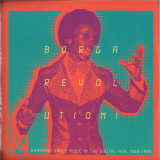
Kalita are proud to unveil the second volume in their "Borga Revolution!" compilation series, focussing on the phenomenon of "Burger Highlife", a crossover of West African melodies with synthesizers, disco and boogie that took over Ghanaian airwaves during the 1980"s and beyond. Featuring both highly sought-after recordings by artists including Atta Frimpong and D.J. Lawyer Okyere, as well as seminal performances by greats such as Pat Thomas, A.B. Crentsil and Alan Cosmos, Kalita once again come to the rescue of audiophiles, DJs and music-lovers alike with "Borga Revolution! - Volume 2". Spread over a double-LP housed in a gatefold sleeve. Accompanied by a 12-page booklet featuring extensive interview-based liner notes on each artist and never-before-seen archival photos.
Christine and the Queens return with new album PARANOÏA, ANGELS, TRUE LOVE, released on 9 June via Because Music on 3xLP, 3xCD, single LP and single CD.
The record’s first single, ‘To be honest’ is an ethereal, synth-driven first glimpse into the French phenomenon’s most personal and ambitious album to date. PARANOÏA, ANGELS, TRUE LOVE is written, performed and produced by Christine and the Queens, with co-production by Mike Dean (Lana Del Rey, Beyonce) and guest appearances from 070 Shake and Madonna.
King of Town (KoT), originally from Johannesburg but now in the UK, is back after a nearly a decade hiatus from his mutant disco-inflected remixes.
Prior to his long break, King of Town remixed the likes of Franz Ferdinand, Slow Club, Alice Russell, the Detachments and the Phenomenal Handclap Band.
His remix of Desmond and the Tutus' 'Kiss You on the Cheek', released on Tigersushi in 2009, has become a regular feature of Spotify playlists and has racked up a few million listens across various streaming platforms.
For this release KoT serves up four exclusive re-edits.
Lord Have Mercy is a retouch of Willie West's slow-burn R&B lament of his own elegiac defiance, where KoT underpins West's groove with a 303 acid bassline and synth flourishes.
Swimming in Your Eyes is a beefing up of Pasteur Lappe's 1979 Rhodes-heavy space disco groove.
Troubles of this World takes OV Wrights ridiculously soulful take on a gospel classic and transforms it into a retro-futurist track aimed firmly at the dancefloor.
And with Khomo Tsaka Deile Kae KoT nods towards his roots and inserts drive and snap into fellow South African Marumo's 1982 kwela-touched stomper.
As always the artwork has been completed by the very talented Pedro Carvalho de Almeida.
Vinyl Only.
As the lead singer and songwriter of duo Savage Garden, Australian born Darren Hayes quickly dominated the pop landscape achieving an impressive 10 UK Top 40 hits from I Want You, To The Moon and Back, to I Knew I Loved You to U.S Billboard number ones including the timeless Truly Madly Deeply. With Savage Garden and as a solo recording artist in his own right, Darren has sold over 30 million albums globally.
The evolution of Darren Hayes continues to flourish with the release of the iconic artist’s new single, All You Pretty Things (in August) and the announcement of his first new album in over 10 years, Homosexual.
The phenomenal Homosexual was entirely written, performed and produced by Darren over the past two years from his base of Los Angeles. Released as a 2LP standard edition turquoise coloured vinyl
“Mt. Hadamard National Park” is the Hallow Ground debut by composer, programmer, and instrument designer Matthias Puech. Informed by mathematical and artistic approaches that aim to both contemplate on and control complexity, the eponymous five-part composition explores natural and mystical forces through what he calls “audio-naturalist noise”. The composition is complemented by two further pieces that follow similar concepts: “Suspension” emulates the chemical phenomenon of the same name, while “Imperceptible Life” hinges on the musical possibilities of stridulation. Over the course of the entire album, Puech’s singular take on electro-acoustic and electronic music creates unique sonic spaces as much as it pays its dues to the unpredictability of the world that we inhabit. Jacques Hadamard was a pioneer among physicists and mathematicians who, in the early 20th century, were puzzled by processes that are deterministic but hard to predict. The sounds, arranged in sweeping and tense dynamics, serve as multiple agents within a complex system. The synthetic flora and fauna created through the use of the composer-performer’s instruments feels uncannily familiar or even disturbingly hostile at times... This process is mirrored in aquatic yet tangible sounds as well as dynamics that slowly converge towards density before the composition ends on a quiet note. The 14-minute-long “Imperceptible Life” is based on a 2019 live performance first conceived as a full-scale test drive of some new electronic equipment Puech was designing at that time. It explores the musical potential of stridulation, the act of creating sounds by rubbing together certain body parts—in the insect world, a common means of communication. Again, Puech’s approach is neither purely naturalistic nor only mimetic. Rather, “Imperceptible Life” offers yet another artistic reflection on the theme of chaos and order, and how human perception and emotion relate to it.As a whole, “Mt. Hadamard National Park” thus not merely mirrors natural phenomena but transforms them in ways that are emotionally evocative: the complexity and apparent arbitrariness of Puech’s compositions reveal an underlying beauty that is equal parts haunting and comforting.
With his new album, Gecko Turner confirms that he is a standout artist in the global groove scene, a must for the outernational sounds aficionados.
Somebody From Badajoz is the fifth studio album in his much lauded discography and his first in seven years, eagerly anticipated by both his fans and himself: "this business of dedicating yourself to music and making songs... it's a long game."
With the release of his first two, remarkable, albums, Guapapasea! (2003) and Chandalismo Ilustrado (2006), Gecko started cultivating what one astute journalist defined as Afro-maduran soul—the "maduran" bit referencing Extremadura, a region in central-western Spain.
Badajoz, Gecko's birthplace, is the biggest city in the area, on the border with Portugal, by the Guadiana River. It is a place that oozes history, where there is constant movement at the border, and people's character is friendly and open-minded with foreign habits.
Gecko's Afro-maduran soul isbuilt on Afro-American music and drenched in Brazilian, African, Latin American and Jamaican sounds. There are also echoes of a youth marked in equal parts by our man's admiration for the Beatles and the flamenco that could be heard everywhere in Badajoz in the seventies. It makes for a singular sound and a musical language of its own—spicy, succulent, full of nuances, but with a very personal flavour.
The album opens with the Nigerian talking drums of Twenty-twenty Vision, (neo) soul in a magical falsetto, carried by a sumptuous orchestral arrangement with a cinematic flavour: "I'd been thinking about doing something called 'Twenty-twenty Vision' for some time, making a play on words with the vision we have of the world after the year 2020 and the medical expression, which, in ophthalmological terms, means 'normal or complete vision.' Beyond that particular song, I think that's the mood of the album: a look at society in the twenties of the 21st century and the feelings and demons it produces."
It's followed by De Balde, a very special song born from a posthumously discovered lyric by the great writer Carlos Lencero, a regular collaborator of Camarón, Pata Negra, and Remedios Amaya, and also from Badajoz. While conceived as a fandango, Gecko has moulded it into his sound in such a seamless way it now seems as if the words could only have been written to be embraced by the percussion, brass, and backing vocals heard on the album. It's the only lyric on Somebody From Badajoz not written by Turner, still it sits rather comfortably with the rest, sharing the same emotivity and sensitivity, as well as the trademark humour and irony.
Other tracks see more protagonism for the rhythm.The beat-driven Ain't No Fun Preachin' to the Choir features Gecko's vocals walking the thin line between singing and talking over a phenomenal afro-disco-funk-infused trailblazer. In Am I Sad? it's impossible to not bob your head to the queen of Papatosina's mongrel rhythm, as close to the banks of the Guadiana river as it is to the shores of the Mississippi. Qué Siesta Tan Buena, He Babeao Y To! is an ode to the snooze in true Afro-Maduran fashion. And in Come And Try, the Caribbean influence is evident—lovers' rock that invites you to dance in good company.
In these songs, and throughout the album, for that matter, the musicians accompanying Gecko, who himself plays many of the instruments as well, shine brightly. All hailing from Extremadura, Javi Mojave (percussion), Álvaro Fdez 'Dr. Robelto' (bass), and Rafa Prieto (guitar) have been carrying him with delicate forcefulness since he started out as a solo artist. At the same time, the wonderful and essential voices of Deborah Ayo, Astrid Jones, Fani Ela Nsue, and Miriam Solís give the album a sunny variety of colours. And there are many more—a sensational group of musicians contributes dazzling harmonic bursts to many of the songs. The palette of sounds is very diverse and rich in textures and nuances, including, for example, the ngoni, bells, and various repurposed kitchen utensils.
The groove is always around, moving between the magical border sound of Everybody Knows Somebody From Badajoz and Little Dose, the silky soul of The Sibariteo Appreciation Society, and the exultant celebration of End Of The World (which surprisingly sees Gecko turning to the occasional use of autotune), a piece that could be used for the final credits of a Monty Python film and, in fact, closes the album.
Gecko Turner has done it again with Somebody From Badajoz, looking to the future without losing sight of the roots. In times of upheaval all over the globe, when people are looking for purity, he delivers a formidable piece of work: risky, optimistic in spite of everything, and with a decidedly bastard sound. Let's rejoice.
Deep Listening 2019 - 2022 features the best of Richard Norris' recent ambient, downtempo and deep listening music.
This reflective, meditative take on electronic music has been a daily practice for the musician for some years, and has resulted in numerous releases on the Group Mind and Inner Mind labels. Included are a number of 'Music For Healing' tracks, part of an ongoing series of releases specifically created for relaxation and anxiety relief. The results have been quite phenomenal. People have given birth to this music, and there have been many reports of people using this music to help anxiety, stress and bereavement.
Richard Norris is well known for his work with Soft Cell's Dave Ball in the Grid, and Erol Alkan in Beyond The Wizards Sleeve, as well as many solo releases, productions and remixes. He has been called 'the electronic musician's electronic musician', and the results are all over this double album, with warm analogue bubble baths heavily featured. Dive in...
Exclusive and limited 7” with two new recordings by The Phenomenal Handclap Band and Buscabulla, recorded for the new RELATIN project (the reimagining of Latin musical roots from another time for our generations).
The Phenomenal Handclap Band is a dance music trio from NYC, a heady mix of raw soul, vocal harmonies, African percussion, fuzzy guitars and analog synthesizers. They take the first single from the colombian sisters, from 1971… imagine the mix: Sweet sixties soft pop meets funk & club culture.
Buscabulla is the music project of Puerto Rican duo and Brooklyn resident.
Their diverse influences make up a hybrid that combines a mellow Caribbean sensibility. Their particular taste for tropical and unique
chilled sounds now added to Elia y Elizabeth. This version is exclusive to this 7”.
Just over a decade on from the launch of Leng Records, the Simon Purnell/Paul ‘Mudd’ Murphy-helmed label is set to release its’ 50th 12” single. Fittingly, it’s the first of a series of sampler EPs that form part of the imprint’s belated 10th anniversary celebrations.
Later in 2020, label fans will be treated to a celebratory compilation featuring a mixture of Leng classics, overlooked favourites and previously unheard material. Some of this music will also be released on a series of vinyl EPs, with this first volume focusing on unreleased material from long-time friends of the family Q&A and Lex.
Q&A is a collaboration between Phenomenal Handclap Band founding member,
Quinn Luke, and long-time friend and musical associate Alexis Georgopoulos, formerly of San Francisco dub disco/punk funk heroes Tussle. The pair worked together extensively at the tail end of the 2000s, but only ever released one single: 2009’s “Tumbling Cubes/Trap Door” on celebrated NYC label DFA.
The two tracks showcased on this Leng Records sampler were recorded during the same period as that celebrated single but are only now seeing the light of day. “Revolving Mirrors” is a typically low-slung and percussive affair that sees Luke and Georgopoulos wrap bubbly electronic melodies and glassy-eyed aural textures around a suitably weighty dub disco groove. In contrast, “Pulse” is a deliciously hypnotic, mind-altering affair: a bona-fide late night throb-job in which trippy electronic motifs, chiming melodies and crunchy Clavinet riffs vibrate attractively atop another killer punk-funk bassline and locked-in drums.
- A1: Danny - Maantielta Taloon (Nachts Scheint Die Sonne) (Nachts Scheint Die Sonne)
- A2: Koivistolaiset - On Siita Aikaa (Good Grief Christina) (Good Grief Christina)
- A3: Danny - Muuttokoon Maailma Taa (Cigarettes Women & Wine) (Cigarettes Women & Wine)
- A4: Virve Rosti - Antaudun (Giving Up Giving In) (Giving Up Giving In)
- A5: Mona Carita - Mona Carita Soita Mulle (Call Me - Theme From American Gigolo) (Call Me - Theme From American Gigolo)
- A6: Virve Rosti - Ohari (The Runner) (The Runner)
- B1: Markku Aro - Lady Lady Lady (Lady Lady Lady) (Lady Lady Lady)
- B2: Eini - Pista Valot Pois (Vamos A Bailar) (Vamos A Bailar)
- B3: Mona Carita - Mika Fiilis (Flashdance... What A Feeling) (Flashdance... What A Feeling)
- B4: Tarja Jykyla - Jos Valot Sammuttaisit (Turn Out The Night) (Turn Out The Night)
- B5: Seija Simola - Luotan Rakkauteen (Thief Of Hearts) (Thief Of Hearts)
- B6: Tauski Peltonen & Meiju Suvas - Kay Mun Vierellain (Hand In Hand) (Hand In Hand)
The pioneer of electric pop music, Giorgio Moroder (born April 26, 1940 in Ortisei, Italy) is an internationally acclaimed songwriter and producer who left his trace also in Finnish popular music. Several Moroder’s compositions and productions were released in Finland with Finnish lyrics in the 1970s and 1980s, when Moroder had his most creative peak. This compilation includes twelve Finnish Moroder covers from early bubblegum pop to electronic disco. Giorgio Moroder began his musical career as a singer. He gained success performing bubblegum pop in the late 1960s. He wrote some of his hits himself, but he also sang songs written by others. During his singer years he succeeded with songs Looky Looky (1969) and Son of My Father (1971). The latter became well known also in Finland, where it was covered by one of the most famous Finnish singers in 1960s and early 1970s, Ilkka Lipsanen alias Danny. The song found its way to Finland via Britain, where British band Chicory Tip had covered it first and made it to the charts with the song. Danny was not the only Finnish singer in the early 1970s who looked at Moroder’s repertoire when searching for good songs. Koivistolaiset was a singing and dancing duo of sisters Anja and Anneli Koivisto who were well-known celebrities in 1970s Finland. They released Moroder’s composition Good Grief Christina as On siitä aikaa in 1973. This song was also discovered from Chicory Tip’s repertoire. Cheerful and danceable bubblegum pop was an early 1970s phenomenon and in Finland it was the most popular music played in discos during those years.
Imagine a designer, who, after having traveled around the world, cuts her hair in a crew cut, sings « Voyage, Voyage » and will thus become number 1 in more than fifty countries including France, Germany, Spain, Russia, Israel, and many Asian
countries ! A real media phenomenon, Desireless hits a second hit with « John » before bowing out and heading off to other horizons.
We were no longer going to be deprived of the desire to listen to these now cult titles which met with dazzling success in the firmament of the Top 50 and European hit parades. This album, which includes 10 fully remastered tracks, is the ultimate testimony to the dazzling career of the New Wave diva and her collaboration with talented producers, such as her friend DJ Esteban, who delivers a super International Club Remix. The pop icon also offers an amazing acoustic version of her favorite hit, for the first time
on vinyl !
Limited Series, Colored Vinyl, including 2 versions of Voyage, Voyage.
- A1: Logic System - Unit
- A2: Kraftwerk - Computerwelt (2009 Remastered
- B1: Whodini - Magic's Wand
- B2: Rocker's Revenger - Walking On Sunshine (Feat Donnie Calvin
- C1: Klein & Mbo - Dirty Talk (European Connection
- D1: Liaisons Dangereuses - Los Niños Del Parque
- D2: Yello - Bostich
- E1: The The - Giant
- F1: The Residents - Kaw-Liga
- G1: Clan Of Xymox - Stranger
- G2: A Split - Second - Flesh
- H1: Severed Heads - Dead Eyes Opened
- H2: The Weathermen - Poison!
- I1: New Order - Blue Monday
- J1: Anne Clark - Our Darkness
- J2: 16 Bit - Where Are You?
- K1: Phuture - We Are Phuture
- K2: Model 500 - No Ufo's (Vocal
- L1: Frankie Knuckles Feat Jamie Principle - Your Love
- L2: Quest - Mind Games (Street Mix
- M1: Jasper Van't Hof - Pili Pili
- N1: Guem Et Zaka Percussion - Le Serpent
- N2: Hugh Masekela - Don't Go Lose It Baby
- O1: Sly & Robbie - Make 'Em Move
- Q1: The Ecstasy Club - Jesus Loves The Acid
- R1: Foremost Poets - Reason To Be Dismal?
- S1: Lhasa - The Attic
- S2: A Guy Called Gerald - Voodoo Ray
- T1: M/A/R/R/S - Pump Up The Volume - Usa 12" Mix
- T2: Bobby Konders - Nervous Acid
- U1: Meat Beat Manifesto - Helter Skelter
- V1: Raze - Break 4 Love
- W1: Sueño Latino With Manuel Goettsching Performing E2-E4 - Sueño Latino (Paradise Version
- X1: Off - Electrica Salsa
- O2: Brian Eno - David Byrne - Help Me Somebody
- P1: Primal Scream - Loaded (Andy Weatherall Mix
For this uniquely personal retrospective spread over twelve vinyl discs, Sven Väth takes us back to the early days of his DJ career. On What I Used To Play we meet great pioneers of electronic music, gifted percussionists, obscure wave bands, and innovative producers of a bygone 'new electronic' era. Rough beats and irresistible grooves from the identification stage of house, techno, and acid remind us not just how far electronic music has evolved over the past four decades, but how great it was to dance to EBM, techno, and house for the very first time.
If there is one protagonist of the electronic music scene who has remained curious, innovative and at the very cutting edge of music for over four decades, it's Sven Väth. His multi-layered artist albums and Sound of the Season mix compilations have been defining the genre for over two decades, and even today, he is constantly on the lookout for the next top tune to add to the highlights of his next set. At least, that's the case when he's not producing them himself as an artist or remixer. "Actually, it's always been part of my DNA to think ahead," and nothing had been further from his mind than looking back at his past, but when in spring of 2020 the international DJ circuit had to be scaled down to virtually zero, the 'restless traveler' suddenly had time. Time to stop and reflect on "how it actually was back then, at the very beginning of my career..."
"It was a great trip and with every track, beautiful memories came flooding back".
In the London apartment, he had just moved into, Sven has set up a "little music room", where he cocooned himself for several days, "to look way back for the first time and review my musical journey through the eighties, so to speak."
The interim result was six thematically oriented playlists with a grand total of 120 tracks from 'early 80s' to 'Balearic late 80s', together with excursions into afrobeat, European new wave, and EBM sounds and a few epochal techno/house tracks from the USA in between. From these 'Best of Sven Väth's favorites', the project What I Used To Play crystallized. Sven remembers how the Cocoon team reacted to his proposal: "They found the idea of making a compilation out of it MEGA from the beginning and everyone said 'Sven, go for it', but then, of course, the work really started, namely, to clear the rights and to get clean sounding masters of the up to 40-year-old tracks. There was also disappointment, of course. We couldn't clear certain titles because the rights holders in the USA had fallen out with each other or simply disappeared from the scene. In short, it wasn't easy, but now I can safely say we got the most important tracks."
Finally, after two years of research, curation, design, and administrative fine-tuning, the "little retrospective" from 1981 to 1990 is available. The exquisitely packaged, and three-kilo heavy box set is not only physically impressive, WIUTP is also the definitive record of Sven Väth's musical development. On each of the twenty-four sides of vinyl, you can trace track by track, what influenced him during which phase, and how he took off as a DJ from his parents' Queen's Pub straight into the spotlight at Dorian Gray. There and at Vogue (later OMEN), Sven became the style-defining player in the DJ booth that he still is today.
1981 - 1990: Future Sounds of Now
In the early eighties, the crowd in clubs like Vogue and Dorian Gray danced to what nowadays we call 'dance classics' - mainly disco, funk, soul, and chart pop. It was up to a new generation of DJs, including Sven Väth, the youngest protagonist in the Rhine-Main area at the time, to create their own club-ready music mix. Good new tracks and potential floor-fillers were rarities that had to be sought out and found, in order to prove oneself worthy.
Without MP3s, internet streaming, or other digital download possibilities, music didn't just gravitate to the DJ, instead, it had to be tracked down. In well-stocked record stores in Frankfurt and Wiesbaden or even in Amsterdam, London, or New York, Sven and friends sourced the material for countless magical nights. On WIUTP we can follow Sven's very personal journey through this wild, innovative era in which synth-pop, funk, hip-hop, and disco were successively replaced as 'club music' by house, techno, acid, and breakbeat. By the end of the decade, it was clear to see that these once exotic 'fringe' phenomena would soon become 'mass' phenomena.
Early 80s
Dirty Talk by the Italian-American duo Klein & M.B.O. represents the most innovative phase of the Italo-disco genre in the early eighties like no other track. Mario Boncaldo (I) and Tony Carrasco relied entirely on the original synthetic drum and percussion sounds of the Roland TR-808, coupled with the raunchy vocals of Rossana Casale and guitar accents of Davide Piatto. Of course, other tracks from this period were also influential in style, most notably Unit by Logic System, which worked as the perfect soundtrack to the laser lighting system at the legendary Dorian Gray club. With stomping beats and robotic rap interludes, Bostich by Yello also belongs on Sven's eternal playlist - after all, it caught the attention of Afrikaa Bambaataa, who invited the Swiss duo to perform at the Roxy in New York in 1983.
EBM Wave - Mid 80s
From today's point of view, the almost ten-minute-long, downtempo track Giant by Matt Johnson's band project The The, would probably not be considered an obvious club classic. However, a closer (re)listen reveals the rhythmic intricacies of the percussion overdubs by JG Thirlwell (aka Foetus) on Johnson's composition, and it becomes clear why this exceptional piece of music is one of Sven's absolute favorites. Other classics from this phase include Kaw-Liga by the mysterious The Residents, the hypnotic-synthetic Our Darkness by Anne Clark (and David Harrow), and last but not least, the somber, monotonous anthem Where Are You? by 16Bit, one of Sven Väth's projects together with Michael Münzing, Luca Anzilotti from 1986.
US House - Late 80s
You certainly can't talk about Chicago house without mentioning Frankie Knuckles. The resident DJ at the Warehouse not only gave the name to an entire genre, but also produced epochal floor fillers on the Trax label like the timeless Your Love, sung (and moaned) by Jamie Principle. Acid house protagonists Phuture also hail from Chicago, and on We Are Phuture (also released on Trax) we hear the chirping acid sounds of the legendary Roland TB-303 in full effect. Another featured classic is No UFO's by Detroit's Model 500 aka Juan Atkins, who is rightly considered the 'Godfather of Techno' even if the genre-defining track from 1985 still breathes with the spirit of hip-hop and electro from the first breakdance era.
Afrobeat
Le Serpent, by Algerian-born Abdelmadjid Guemguem, is a track that sounds completely different from everything else on WIUTP. Made in 1978, it's a monumental, rousing groove created without bass or synths, just with five congas! Even though Guem sadly passed away in 2021, his immortal, acoustic beats are understood all over the world and will continue to enrich many thousands of DJ sets for years to come. Another classic that not only Sven appreciates beyond measure is Hugh Masekela's Don't Go Lose it, Baby. In addition to being one of the most important jazz pioneers, the trumpeter and freedom fighter from Johannesburg was very experimental, integrating electronic sounds into his music in later years, in a similar vein to Miles Davis and Herbie Hancock. Dutch jazz pianist Jasper van't Hof's afrobeat project Pili Pili has also aged well. The trance-like, almost sixteen-minute-long track of the same name, manages to fill a whole side on the seventh of twelve vinyl discs in the WIUTP box.
UK-US-Euro - Late 80s
Time for a change of scene, in the truest sense of the word, and from a musical perspective, this section is like landing on another planet. First up is Andrew Weatherall's classic remix of Primal Scream's Loaded, featuring the iconic Peter Fonda sample (lifted from the 1966 biker film Wild Angels) that came to personify the mood triggered by the British Second Summer of Love in the late eighties: "We wanna be free to do what we wanna do, and we wanna get loaded...". This period also saw the emergence of M/A/R/R/S whose only single, 1987's Pump Up The Volume, became a club classic with support from DJ legend CJ Mackintosh. In this most eclectic of sections, we also encounter New York house and reggae producer Bobby Konders and his seminal Nervous Acid.
Balearic - Late 80s
Those who know him, know that Sven had already lost his heart to the 'magic island' of Ibiza as a teenager, so with that in mind, the WIUTP project couldn't end without a Balearic chapter. Inspired by Manuel Göttsching's E2-E4, the immortal, eponymously titled Sueño Latino belongs in there without question. Equally popular on the island was, and still is Break 4 Love by Raze, which thinking about it, would also fit perfectly into the house chapter. Last, but not least, there's an overdue reunion with Sven Väth himself, in his role as frontman of the successful Frankfurt trio OFF. Together with Michael Münzing and Luca Anzilotti (later of Snap!) this 'Organization For Fun' created the off-the-wall club hit Electric Salsa in 1986 which incidentally turned into an international chart smash, putting Sven in the enviable position of having to decide between pop stardom and a DJ career. Well, we all know how that decision turned out and the rest, as they say, is history. A not insignificant part of his story is What I Used To Play. Enjoy!
It is recognized today that these tutelary pieces for four pianos are among the most powerful in contemporary music,their impact is almost unparalleled. After the historical version recorded forty years ago, this one, featuring four of the greatest European performers, is now regaining its full power. High level recordings too.
There was some for John Cage, then came Christian Wolff, and finally Morton Feldman, from this school in New York. Only Julius Eastman remained outside the game, the last figure, the most solitary and enigmatic - undoubtedly also one of the most powerful, and it is this power that is revealed through these recordings. In the 1970s and 1980s, Eastman was one of the very few African-Americans to gain recognition in the New York avant-garde music scene. He was politically committed, a figure of queer culture and a solar and solitary poet whose melancholy influenced his genius as well as his tragic destiny : suffering from various addictions, declared missing, actually homeless. During Winter of 1981-82, he got deported from his apartment by the police, who destroyed most of what he owned - including scores and recordings. He was found dead in 1990, on the streets of Buffalo, after years of vagrancy.
The Performers Nicolas Horvath, pianist and electroacoustic composer Nicolas Horvath is known for his boundariesless musical explorations - he has collaborated with leading contemporary composers from around the world, including Alvin Lucier, Alvin Curran and Valentyn Silvestrov - the recordings of his complete works for piano by Phil Glass made a lasting impression. He has collaborated recently with Lustmord on the Deconstruction of November by Dennis Johnson (Sub Rosa SR502: The Fall).
Melaine Dalibert, a French composer and pianist, fascinated by natural phenomena which are both expected and unpredictable, Dalibert has developed his own algorithmic procedures of composition which contain the notion of stretched time evoking Morton Feldman, minimal and introspective, adopting a unique concept of fractal series.
Stephane Ginsburgh, a tireless surveyor of the repertoire but also explorer of new music, collaborated with composers such as Philippe Boesmans, Jean-Luc Fafchamps, Stefan Prins, Frederic Rzewski and Matthew Shlomowitz of whom he premiered works, as well as with choreographers such as Anne Teresa De Keersmaeker (Rosas) and recorded Feldman, Duchamp and Satie for Sub Rosa and the complete set of Prokofiev piano sonatas for Cypres. Wilhem Latchoumia, he embraces both new music and the classical repertoire with success and charisma. His two last recordings for La Dolce Volta (Prokofiev and de Falla) have been highly acclaimed by critics with a FFFF in Télérama. Winner of the Hewlett-Packard Foundation and the Montsalvatge International Piano Competition, he brilliantly won the First Prize in the 2006 Orléans International Piano Competition.
- A1: Bloodhunt Main Theme
- A2: Prague
- A3: Fight Night
- A4: Chasing Shadows
- B1: Theme Of Brujah
- B2: Theme Of Nosferatu
- B3: Theme Of Toreador
- B4: Theme Of Ventrue
- C1: Targeted For Bloodhunt
- C2: Vampire Blues
- C3: The Entity
- C4: Next Time
- C5: The Ultimate Predator
- D1: Bloodhunt Main Theme (Classical Version)
- D2: Elysium
- D3: Ambient Threa
Born of the overarching World of Darkness and the tabletop phenomenon Vampire: The Masquerade, Bloodhunt is Sharkmob’s thrilling spin on the multiplayer action genre that sees players take part in a ruthless war between vampire factions.
Bloodhunt boasts a sonically rich score sired by acclaimed Polish-Bulgarian composer Atanas Valkov, and featuring the Sofia Session Orchestra & Choir. The city of Prague provided much of the aesthetic inspiration for Bloodhunt’s soundscape: classical and romantic, yet with many a shadowy corner in which a vampire might secrete themselves. Valkov enjoyed creating contrast between modern
electronic musical elements and old world ones, as well as layering guitars and using irregular rhythmic structures. The overall soundtrack is both cinematic and brutal.
This deluxe double LP set features a deluxe gatefold sleeve (individually inkjet numbered) and printed inners dripping with stylish artwork by Sharkmob. 16 tracks have been mastered specially for vinyl, and pressed onto heavyweight, red and transparent LPs with a cloudy effect. Also included are composer liner notes.