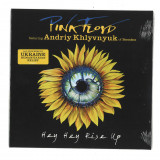
Pink Floyd are to release two physical versions of their first newly recorded music in over 25 years, ‘Hey Hey Rise Up’. The single, which was initially released digitally in April in support of the people of Ukraine and was #1 in 29 countries, will be available on 7” and CD single. Both formats will also feature a newly reworked version of ‘A Great Day For Freedom’ from the band’s 1994 album, The Division Bell. The track sees David Gilmour and Nick Mason joined by long time Pink Floyd bass player Guy Pratt, with Nitin Sawhney on keyboards and a lead vocal by Andriy Khlyvnyuk of Ukrainian band Boombox. It also has vocal harmonies by Romany and David Gilmour
When the track was first recorded at the end of March, Andriy, who left his band’s US tour to return home and fight for his country, was in a hospital bed in Kyiv recovering from a shrapnel injury. Proceeds for the physical release and the ongoing digital proceeds will go to Ukraine humanitarian relief.
For this limited edition release, David Gilmour revisited The Division Bell track ‘A Great Day For Freedom’. He has reworked the song using the original tapes which, as well as David, feature Nick Mason on drums and Richard Wright on keyboards, along with backing vocals from Sam Brown, Claudia Fontaine and Durga McBroom. The artwork for the track ‘The Sunflower Look’ features a painting of the national flower of Ukraine with a twist by the Cuban artist Yosan Leon. The cover is a direct reference to the woman who was seen around the world giving sunflower seeds to Russian soldiers and telling them to carry them in their pockets, so that when they die sunflowers will grow.
Поиск:physic
Все
Aside from being one of Anamanaguchi’s most streamed songs, “Miku,” featuring the vocaloid pop star Hatsune Miku, is an anthem for a new type of musical icon, one that doesn’t need to be attached to a physical human body. Miku, which was officially released in 2013, is a Vocaloid software voicebank developed by Crypton Future Media. Her voice is based around Japanese actress Saki Fujita and uses Yamaha Corporation's Vocaloid 2, Vocaloid 3, and Vocaloid 4 singing synthesizing technologies. Anamanaguchi wrote “Miku” with the virtual musician and were the first band to perform live alongside the Hatsune Miku hologram on the Miku Expo tour in 2016. Since then, the song has been streamed tens of millions of times around the globe and given way to several viral TikTok moments with 20K+ unique videos, signature dance moves, and millions of views.
Consistently engaging their audience in both the real world and the virtual internet-sphere, Anamanaguchi has had TV performances on Late Night with Jimmy Fallon and Adult Swim’s Fish Center, multiple appearances at Porter Robinson’s Secret Sky Fest, and co-curated one of the first major live stream events for indie musicians with the Nether Meant Festival, which was featured in the New
York Times and The Washington Post. The band has also continued to stay true to a uniquely cohesive collaborative spirit, sharing tracks with artists such as HANA, Planet 1999, Flux Pavilion, Porter Robinson, Dorian Electra, Pussy Riot, Village People, and POCHI.
For 2022, Polyvinyl is proud to announce the release of Miku on vinyl for the first time. The release will feature the original composition as well as 8 bonus versions of the song including remixes from LLLL, Carpainter, Ben Aqua, Mino Mino, Lazerdisk, as well as an NES version, a Japanese version, and an instrumental version.
Depeche Mode - Speak & Spell 12" Single Box
Depeche Mode realized the format's potential and embraced the power of 12" vinyl and the avenues of innovation it opened up. The 12" single allowed the band to explore new sonic possibilities while the physical beauty of the packaging gave Depeche Mode room to develop a sophisticated and commanding visual aesthetic. Depeche Mode used their singles discography as a means of offering left field remixes and other delights for their fans.
Each box set in the series will contain the singles from each Depeche Mode album on audiophile-quality 12' vinyl, with audio remastered from the original tapes and cut at the legendary Abbey Road Studios. The artwork for the exterior of each of the new box sets draws on street art iconography inspired by the original releases, while the vinyl sleeves themselves feature the original vinyl single artwork.
Speak & Spell | The 12' Singles contains a facsimile reproduction of the rare Flexi Disc 'Sometimes I Wish I Was Dead' b/w 'King of the Flies' (the Fad Gadget track as on the original release); Dreaming Of Me 12': 'Dreaming of Me' b/w 'Ice Machine'; New Life 12': 'New Life (Remix)' b/w 'Shout! (Rio Mix)'; Just Can't Get Enough 12': 'Just Can't Get Enough (Schizo Mix)' b/w 'Any Second Now (Altered)'; original single poster reproduction; download card.
Debut full-length collaboration from Jack Burton and Rory Glacken (Tourist Kid)
Follows Jack Burton's solo LP on Analogue Attic and Tourist Kid's solo LP on Melody As Truth
Early support from Ben Fester, Best Effort/DJ Earl Grey, Biscuit (Good Morning Tapes), Brian Not Brian, Ewan Jansen, Kato, Merve, Sleep D & Wax'o Paradiso
Dentistry is the dual energies of Rory Glacken and Jack Burton, Boorloo originals now living in Naarm. The pair have previously released an EP, "Ribbons," on their own Deep Water label, and a track on its local showcase comp "Greenhouse Vol. I" at the end of 2021. This transmission is their debut full length offering, channeled through hometown beacon Good Company Records.
"LP1" was created in unusual conditions between September and December of 2020, when the duo's shared Northcote studio became a site of remote collaboration. One person would start working on a track and leave the session open for the other, with no overlap of physical space shared. Responding to an invitation from GCR to make a record, the initial impulse was to write dance music. But what dance floor were these incorporeal partners writing for?
The album takes a spectral approach to the dance space, wrapping up air in a strata of textural tech, pulsing dub house and fractal illbience. Drawing on dub production techniques, "LP1" combines the structure of an ambient record with intricate percussive elements. Results are both atmospheric and material, abstract and palpable: a synthesis which expresses sonic relations of surface and depth, with the correlating mirage of light and shadow.
At times tinkering methodically and others in mercurial lurch, there is an immediacy to this album that stems from the way it was produced, using a mixing desk and outboard gear to rich and living effect. When we listen, we commune with the artists in the heat of working out of an otherworldly space, and feel every tweak and and turn. "LP1" is a current which carries the substance of process in communicable form. Intuitive and moving, breathing, dancing.
In the spring of 2020, Ben Cook _ a.k.a. Young Governor, Young Guv, or just Guv _ was holed up in the New Mexico high desert, his U.S. tour having been abruptly covid-cancelled during a southwest swing. He and his bandmates were living moment to moment in something called an Earthship, a solar-rigged adobe structure sustainably constructed with, among other things, recycled bottles and tires. And out there in the serene vastness, as a short ride-it-out stint turned into a nine-month sojourn, Ben was writing music, slowly, little by little, mostly at night while the others slept. By the New Year, almost in spite of himself, he had created a new album, two new albums actually, and through the ordeal he was forever changed. In a place he never expected to be, under circumstances no one could have predicted, and in the face of physical isolation, emotional desolation, and existential dread, Ben created GUV III & IV, a collection of songs dedicated and testifying to the eternal healing power of love _ how to find it in the world, in others, and most importantly, in himself. Written in the New Mexico wilderness and produced in Los Angeles, the double album will finally be available in it's entirety this summer via Run For Cover. Young Guv's talent as a songwriter has been with us for a long time. From forming iconic hardcore act No Warning in 1998 to joining Toronto legends Fucked Up, Ben Cook started writing songs as Guv in 2008 between a slew of other projects that were ambitiously working to define the genres they operated in. When he first started working with Run For Cover in 2019, the plan was to release a single record - but with too many songs to turn away, the project expanded into his first double album, GUV I & II. GUV III & IV finds the same ambition and expertise in hit-making, but this time the individual records hone into specific parts of Guv's sonic palette. GUV III is full of iconic hooks, power-pop guitar riffs and dancable-rock songs, while GUV IV takes notes from psych rock, electro pop and Laurel Canyon jangle to make something that as a whole, can only be defined as definitively GUV
- 1: Connais Tu L'animal Qui Inventa Le Calcul Integral?
- 2: Evariste Aux Fans
- 3: Les Pommes De Lune
- 4: La Chasse Au Boson Intermédiaire
- 5: Dans La Lune
- 6: La Faute À Nanterre
- 7: Ma Mie
- 8: Wo I Nee
- 9: Si J'ai Les Cheveux Longs C'est Pour Pas M'enrhumer, Atchoum!
- 10: La Révolution
- 11: Je Ne Pense Qu'a Ça
- 12: Je Chante Pour Vous Faire Marcher
- 13: Je Ne Suis Pas Simple
- 14: Si Les Étoiles Pouvaient Parler
Évariste is one of the rare specimens of artist-cum-scientists. Among his kind stand others like Pierre Schaeffer, a Polytechnique graduate (an engineer but also the father of musique concrète) and the eccentric Boby Lapointe (graduate of the École centrale and inventor of the Bibi-binaire system, patented in 1968). Évariste's songwriting, joyful and full of energy (albeit extremely critical), shrouds an original tragedy: born in 1943 among résistants, Joël Sternheimer (aka Évariste) grew up without a father, lost to Auschwitz. Although he makes little reference to Jewish culture in his music, his origins leave their mark: in 1974, he sings a Hebrew song on television. In 1966, the young Joël sports Princeton's colourful paraphernalia - that's because he's freshly returning from the US, where he was sent to pursue his research on "particle mass and the interpretation of observed regularities, such as the effects of a wave" (will understand who may). When he gets there the country's in the midst of the Vietnam War. With McNamara keen to find an alternative to the nuclear weapon and calling upon the country's biggest brains to undertake the task, there's a "fund shift" within the university - a diplomatic way to give notice to whoever may not be disposed to follow the government's scheme. Joël, who's under the supervision of a rebellious physician, is dismissed. He regardless keeps following the prestigious seminaries of the Institute for Advanced Study, chaired by Oppenheimer, inventor of the atomic bomb. Likely inspired by the hippie movement and music, Joël buys a guitar and starts playing in Washington Square - after all, Bob Dylan himself started there. He blithely skips Oppenheimer and receives a warm (though surprised) welcome from a crowd thoroughly unfamiliar with French. When the ageing physicist questions him about his decreasing attendance, Joël explains how drawn he is to music, and how he thinks it could help him in self-financing his research. Évariste recalls seeing the sickened man, his face torn by remorse, lighten up to his words and say: "What's keeping you - go for it! If I was still young that's exactly what I'd do." The student takes these words as a testimony from his professor - and it's enough to convince him . And so he takes the leap during the Christmas vacations he spends in Paris. A journalist friend he often sees around the Sorbonne introduces him to the artistic director of Disques AZ. The latter passes the tapes on to the label's boss, Lucien Morisse, also program manager on Europe N°1. Morisse is blown away - and signs him onto the label right away. Michel Colombier, arranger for Serge Gainsbourg and co-author of "Psyché Rock", with Pierre Henry, contributes some of his original ideas to the 7 inch "E=mc2": Évariste's preoccupation with the percussion sound on the track "Le calcul intégral" is that it goes "poom poom" and not "tock tock" - Colombier is aware of the issue and records Évariste's guitar like a percussion in an isolated booth. The organist Eddy Louis, who is to participate, in 1969, to the success of Claude Nougaro's "Paris mai", also appears on the record. It's 1966 and the Antoine phenomenon (signed on Vogue) storms through France. The two singers share similarities: Antoine is an engineer of the École centrale, gifted with a great originality in his song-writing. A godsend for the two labels who turn this resemblance into a commercial strategy, setting them out as rivals. To this day though, Évariste still denies what was little more than slushy tabloïd gossip. Success comes around swiftly and in 1967 Évariste launches into a second 7 inch, "Wo I nee", again arranged by Michel Colombier. Quantum mechanics fans finally get their anthem with "La Chasse Au Boson Intermédiaire" (or the "Intermediary Boson Pursuit"). To sum up what's a boson, say he's a close pal of the meson, photon and other gluons. A few months later, it's May 68 and everything's turned upside down. Évariste writes a series of songs inspired by the events, which he immediately submits to Lucien Morisse. When the man behind "Salut les copains", once married to Dalida, hears the song "La révolution" - a father and son dialogue - he can't take any more: AZ simply cannot release this. But there and then Lucien Morisse makes a gesture which will remain engraved in French music's history: sorry to be unable to officially stand by the singer, he encourages him to self-produce the record, but with his tacit support. He calls the pressing factory and asks they apply the same rate for Évariste as they would for AZ. The singer and his musicians use the same studio as for the previous record, all of them playing for free awaiting a return on investment. Évariste keeps singing at the Sorbonne with "Jussieu's gang" and "the young Renaud" he nicknames "le p'tit gavroche" (or "street urchin"). Renaud volunteers to type the lyrics of the song "La révolution" so that the chorus can be sung and recorded. A boy in the group is related to Wolinski and introduces them. The two get along so well that Wolinski ends up drawing the cover for the record "La révolution", for free. The self-released 7 inch "La révolution / La faute à Nanterre" is sold under the table and door-to-door for half the price of a standard record, on and around the boulevard Saint-Michel; and it runs out fast. In the end, there will be 6 releases of the record, and 25000 copies sold. When the theatre director Claude Confortès decides to adapt Wolinski's drawing series titled "Je ne veux pas mourir idiot" ("I don't want to die a fool"), he asks Évariste to write the original soundtrack. His friend, now cartoonist for Hara-Kiri Hebdo, often promotes him in accordance with a principle dear to him by virtue of which he gives a special place to his friends. Dominique Grange (writer of the song "Nous sommes les nouveaux partisans") soon joins the team. After 150 performances, Évariste leaves his place to Dominique Maurin (brother of Patrick Dewaere). Évariste composes the songs for Claude Confortès' next play, "Je ne pense qu'à ça" ("That's all I think about"), co-wrote with Wolinski in 1969. The comedians of the play record the songs on a 7 inch, with a cover signed, again, by Wolinski. In 1971, French television produces the documentary "Évariste et les 7 dimensions", but doesn't air it. Indeed, the scientific sub-comity of the programming comity (sic) censors the show. The given justification is that "Évariste dangerously mixed science with science-fiction, numerology and other non-scientific disciplines". The underlying motive might have been a will to censor the singer-mathematician's political discourse. In the documentary and among other things, Évariste discusses hierarchy, alienation and revolution. Half a century later the documentary remains invisible, though some excerpts resurfaced in 1992 in the cult show "L'oeil du cyclone", on Canal +. Though flourishing, Évariste's career is nearing its end. 1970 is the beginning of a decade in the course of which he is to make a decisive discovery in the musical and scientific domains. Following this breakthrough, he moves away from self-produced music and gaucho magazines to focus on science. He keeps Oppenheimer's encouraging words in mind, now freely pursuing his research thanks to the sales of his records. Joël realises that when decoding protein sequences, one finds musical sequences recognisable to humans. He names them "proteodies". If, when listening to a proteody, one responds by being so sensitive as to finding it beautiful, then it reveals a deficiency of the related protein - and this peculiar music may be the cure. We could trace back the music history in light of proteins lacking in a given artist, or within a public's majority. You always thought these hysterical groupies who'd throw their underwear with passion and faint in the pit had miraculously appeared because they had never heard anything as wonderful as the Beatles? Make no mistake! For Évariste, it all boils down to an intro's protein content. Indeed, the beginning of their first hit "Love Me Do" corresponds to dopamine, the neurotransmitter linked to compulsive buying. An intro like this could only unleash the fervour of groupies, victims of fashion and biology. Évariste's success is such that the income from his sales gives him the autonomy to which he had aspired when confiding to Oppenheimer. It made it possible for him to pursue his research without any institutional constraints. He now devotes himself to his proteodies, sat in the offices of the European University for Research, just around the corner from the Sorbonne he knew so well. Évariste is no more. Joël regained control of this strange and comical beast.
From Night Slugs’ Bok Bok comes the new label AP Life with their first physical release by seasoned London grime producer Kid D.
“Timing” 12” features 4 essential cuts of cutting-edge beats fusing drill, R&G and grime. From the squarewave bass pressure of Bar 4 Bar to the high emotion of The Eyes, Kid D applies his signature melodic touch to combine the sweet with the sour with devastating results.
Mastered & cut by Sam John @ Precise
Embodying the mutant nature of club music in the modern age, Cocktail Party Effect comes bowling into Sneaker Social Club with a taut, wiry sound which joins dots and melts barriers at will.
The brainchild of Charlie Baldwin, who previously recorded as Kasket, Cocktail Party Effect has been forged over the past six years through heavy bursts of sound design anchored by soundsystem dynamics veering between 140 and 160 tempo zones. From 2020’s self-titled LP on Tectonic to drops on Osiris, Cold, Transfigured Time and more, Baldwin’s deftly avoided allegiance to any specific scene and instead deployed shock-inducing gear for DJs with fortitude to test on their crowds.
On SNKRX010 the commitment to physicality is prevalent across all four tracks, veering from the deadly broken beat barbs and artful fills of ‘Racka’ to the splintered breakbeat rushes and stop-start aggravation of ‘C.A.T.C.R’. ‘Grims8’ is perhaps the purest manifestation of the Cocktail Party sound though, all monochrome rigour with the contrast turned way up, powered by steely, gleaming rhythmic impulses and writhing with dense layers of sonic matter. Watch out for the glutinous bass snarl of ‘58bethe7’ though, which slams in sideways with an unabashed rave instinct crushed through a post-modern production lens.
Baldwin may be operating on his own terms, but on this 12” he demonstrates versatility to match his originality, resulting in four inventive dance destroyers tooled to bridge between styles, sets and scenes.
Newly minted Berlin label Bulging Discs begins with a bang, with their first physical release from Novocastrian turned Berliner Okayokayokay. On the Zonts, is an introspective journey through a blend of nostalgic sounds from breakbeat, electro, garage, house and trance. While contrasting these eclectic and disparate influences via unexpected twists and turns, Okayokayokay uses these reference points to create something distinctly futuristic.
It’s going off and The Chisel are back to cause a bit of bovver. Following a trio of explosive singles, the band finally bring us their debut full-length album, Retaliation, on the London-based punk institution La Vida Es Un Mus. Having formed in early 2020 and featuring a crew of members with long-term associations to the London punk scene, The Chisel quickly secured a reputation as one of the most exciting bands from a pool of contemporaries that includes Chubby & The Gang, Stingray and Big Cheese. Their sound is rooted firmly in Punk but with influences that run across the board to create a distinctive blend of Oi!, anarcho, UK-82 and hardcore. Retaliation is an unmistakably British record that draws a line from 1982 up to the present day, pushing its way into your collection and torching your stereo. Opening with the agitated force of ‘Unlawful Execution’, the tone is firmly set by a song that addresses the brutality of the Met Police (“Tell me what’s the difference between right or wrong / When a copper gets to blast a lad who did nothing wrong”). ‘Come See Me’ is a ferocious ode to camaraderie in the face of mouthy boneheads and bellends. ‘Shit Life Syndrome’ is a poisoned reference to the same cynical phrase used by physicians to describe the effects of people living under poverty and in the grips of substance abuse (“How can you expect people to act nicely, they’ve all been left on the edge of society”). It’s one of many songs influenced by singer Cal’s experiences of growing up in the working-class town of Blackpool. Cal states: “Blackpool as a town is often overlooked or even looked down upon, I wanted to write lyrics which gave the people of my town a voice”. With tunes like these The Chisel show that they’ll never pull any punches. However, beyond the fury and the swagger there’s another side that plays to an additional strength; the ability to write a memorable hook. Songs like ‘Retaliation’, ‘Tooth & Nail’ and ‘Not The Only One’ could be described as modern day anthems (the latter has become a fan favourite since the arrival of their first live shows) and cement their identity as a band not to be defined by their influences. Recorded by Jonah Falco at Total Refreshment Centre, London, March 2021.
Mixed by James Atkinson at the Stationhouse in Leeds. Mastered by Daniel Husayn at North London Bomb Factory. Cover painting by Tara Atefi.
Relentless techno powerhouses Octave One stride in 2022 with a brand new release that re-affirms their status across two essential tracks. 2021 was another busy year for the Burden Brothers, who re-introduced the world to their Never On Sunday alias. The project first started in the 90s as an outlet for deeper, more introspective sounds and was fittingly brought back last year to great acclaim. The Detroit duo’s Locus of Control series also hit volume number three and the iconic Octave One live show continued to light up clubs everywhere from Barcelona, Paris and Geneva to LA and New York. Despite that, they still had time to cook up more of their famously soulful techno in the studio, the first two tracks of which are presented here.Opener ‘The Blue Drift’ surges ahead on waves of rattling metallic synths. Well swung claps bring that irresistible sense of groove, while twisted melodies add raw dynamics. Add in the heavy underlying bass and you have a classic Octave One track that is both physical yet emotional. On the flip side is ‘It-Just-Is’ a powerful statement of intent. It’s a stripped back track where house and techno meet - there is a seductive slide to the drums and potency in the turbulent synths which bring the energy. The melody is melancholic and as the emotive pads ring out they lodge deep in your brain to make for another standout cut. This vital new release proves Octave One remains right at the forefront of underground music more than 30 years after they started out.
- 1: Prologue / Monumental Mass Theme
- 2: Faster Than The Flame
- 3: Venom Of Venus
- 4: Stossgebet
- 5: Demons Are A Girl‘s Best Friend
- 6: Monumental Mass Theme - Sin
- 7: Dancing With The Dead
- 8: Cardinal Sin
- 9: Resurrection By Erection
- 10: We Drink Your Blood
- 11: Glaubenskraft
- 1: Monumental Mass Theme - Confession
- 2: Fire & Forgive
- 3: Beast Of Gévaudan
- 4: Incense & Iron
- 5: Where The Wild Wolves Have Gone
- 6: Monumental Mass Theme - Forgiveness
- 7: Amen & Attack
- 8: Army Of The Night
- 9: Blood For Blood (Faoladh)
- 10: Armata Strigoi
- 11: Epilogue / Monumental Mass Theme
"At the end of 2021, POWERWOLF – the most successful German metal band to date – fascinated with a streaming event of unprecedented dimensions. Those who thought they had seen everything in the live sector were instantly proven wrong with unmatched audio production and visuals that can only be described as simply breathtaking. This summer, on July 8, 2022, this new benchmark for music streaming events will finally be available to view any time you crave. THE MONUMENTAL MASS - A CINEMATIC METAL EVENT will be unleashed on DVD, BluRay and many other physical formats! POWERWOLF have stood at the peak of superlative, epic metal moments for years, but what they present with this streaming event surpasses anything seen before. After months of detailed work, a story was crafted and presented in several chapters based on the stunning music and elaborately staged cinematic scenes. All show effects, actors and stage settings work hand in hand with each other and bring the medium of live music to a level never seen before. From battles with clergy to stories of nuns, monks and burning angels, cinematic images immediately capture the viewer. Each song has its own stunning set designed and is perfectly staged - the production and size alone are unparalleled. One live premiere of a POWERWOLF classic follows the next, one after another – all with impressively produced sound design.
The first fully electronic album by the italian DJ/producer becomes physical in a very special vinyl containing 7 tracks of the "WAXTAPE" selected by the artist himself Ceri, alias Stefano Ceri, is currently one of the most influential personalities in the Italian music scenario: an eclectic musician and producer that redefined and “refreshed” the sound of the most recent years through his artistic
sensibility and innovative spirit.
He collaborated with some of the biggest Italian music icons such as Mahmood, Alan Sorrenti, Marco Mengoni, Salmo, Coez, Calcutta, Franco126, Frah Quintale, Crookers, Joan Thiele and many others:
If working as a producer gave him the chance to define the sound of the new urban/pop environment, his solo project got him to explore
more personal and deeper aspects while searching for his own original dimension.
His 2022 new project is named “WAXTAPE”: it’s an album published with a “4 movements structure” where new tracks have been added
each “movement” release, reaching a total number of 29 tracks.
In the 33rpm vinyl version he selected 7 tracks which, according to his vision, represented best the deepest soul of "WAXTAPE". A real journey from light to dark, from intimacy to community.
Following the precursor singles of 2021, Formality Jerne-Site’s unveiling is finally cast upon her already-growing fanbase. Trained classically as a composer and completing a masters at the Royal Danish Academy of Fine Arts, Jura introduces a highly-anticipated playground of carefully sculpted characters, plots and lessons - sometimes charming, sometimes nefarious, always absolute and sincere. A fictional land opens its doors and roof to us. A trio of trans kids run amok in rural suburbia. Various sorcerers of the wild future enter the scene on some songs; on others, the mind is cast to sun-drenched drives and journeys of yesteryear. At the heart is a pop sensibility: yearning, reflections, vanity, guesswork, hope. Jura is adamant about practice and precision. Dead seriously she offers, about making music: ‘Nothing should be half-hearted or an accident.’ There’s a maturity and elegance to her compositions, arrangements that - although at first sound seem abstract - lean away from experimental, somehow. She sing-speaks in English, and somehow not typically theatrically for such a play of a record. The theatrics are all real. It’s a fantasy land for sure, but it's based on hard facts. Like academia subdivided into poetry. It’s that weird-ass specificity she mentioned. Opener ‘Someone’s Lifework’ introduces less a choir of voices, than a choir of personalities. The art of storytelling is at the center of the musical expression. A protagonist relinquishes control of chaos that’s bigger than them on a perilous journey on some vessel: they comfort their co-passengers. There’s a sense that the hero - or anti-hero - might be more canny and cunning than the sweetness they first sell to fellow players. 'Is this our getaway chance?’ sings fellow Copenhagener Ydegirl amongst swelling synths and reverb that become so definitely Jerne-Site as the quest continues. The search? For intimacy, perhaps. ‘Same late Age (dIcK bIfFeReNcE)’ imbibes at once, some further disorientation, perhaps a little hallucinatory feeling which may come over the listener. Through a synthesizing of political themes that work across time ‘Same Late Age (dIcK bIfFeReNcE)’ bears reminiscences of the musical expressions of anti-capitalism in the 1980es, although in a new body and context. “I have a feeling that music reconjures societal morals and ideas from the time in which it was written when we press play or hear a live performance. From the moment at a concert when the symphonic orchestra starts tuning in, the time traveling begins. So I imagined how it would be to be trans sitting there playing the first violin, having the job of producing that first tone that all the other musicians around me tune in ona, ” Jura explains. The listener yearns for more; and subsequent tracks deliver. On ‘How Intimate It Gets,’ Jura meditates on the futility of closeness, begging the audience to enter the blood and guts of their own entanglements, the blueprints of focusing entering. Jura sings richly about fingers being lines, pointing or bending, and we’re reminded of their own wicked ways we can’t control. A history of singing in choirs informs the harmony of myriad inner voices heard across the album. At once prophetic and enigmatic, some of the songs rearrange historical events out of pop musical language. The enormously entertaining ‘Pinot-Botticelli Toast to European Users’ conjures scenes of Cold-War world leaders stuck on a cruise in the Transatlantic vacuum, and the protagonist watches a devastating heartbreaker careen on into the picture, led by his own hips on ‘The Lasceaux Associate’. Finally, on title track ‘Formality Jerne-Site’, American English rises to the occasion like a verdict around the narrative of three trans teenagers in rural Colorado: language turns into something sensual and haptic, playing with the snare and sizzle of syllables. The words twist and bend, while the music follows its own synaesthetic logic: “around us pop culture made a vow to a normative desire, drawing in like water color percussion”. Anyines is a site of play and documentation, with a canon so far quite nice. Their future is one that envisions supporting the galaxies their dear friends embody, be it music, performance, video games or beyond. Highlights from their discerning back catalogue include myriad formats: live and digital, plus releases binded to physical artefacts that enhance the live experience such as sculptures and scents. Their history also includes disappearing time-sensitive shadow-tracked material and cross-disciplinary opportunities that reflect deep professionalism and a totally non-schooled semblance of sound and drama. Recent releases include a dance-theatre soundtrack, a traditional shiny pop record, and the acclaimed ML Buch sophomore, Skinned.
Tape
Charlemagne Palestine (born Charles Martin ni 1947 in Brooklyn, New York) wrote intense, ritualistic music in the 1970s, intended by the composer to rub against audiences' expectations of what is beautiful and meaningful in music. A composer-performer, he always performed his own works as soloist. His earliest works were compositions for carillon and electronic drones, and he is best known for his intensely performed piano works. He also performs as a vocalist. Palestine's performance style is ritualistic; he generally surrounds himself (and his piano) with stuffed animals, smokes large numbers of kretek (Indonesian clove cigarettes) and drinks cognac.
Oren Ambarchi (born 1969 in Australia) is a composer and multi-instrumentalist with longstanding interests in transcending conventional instrumental approaches. His work focuses mainly on the exploration of the guitar, "re-routing the instrument into a zone of alien abstraction where it's no longer easily identifiable as itself. Instead, it's a laboratory for extended sonic investigation". (The Wire, UK).
Oren Ambarchi's works are hesitant and tense extended songforms located in the cracks between several schools: modern electronics and processing; laminal improvisation and minimalism; hushed, pensive songwriting; the deceptive simplicity and temporal suspensions of composers such as Morton Feldman and Alvin Lucier; and the physicality of rock music, slowed down and stripped back to its bare bones, abstracted and replaced with pure signal.
From the late 90's his experiments in guitar abstraction and extended technique have led to a more personal and unique sound-world incorporating a broader palette of instruments and sensibilities. On releases such as Grapes From The Estate and In The Pendulum's Embrace Ambarchi has employed glass harmonica, strings, bells, piano, drums and percussion, creating fragile textures as light as air which tenuously coexist with the deep, wall-shaking bass tones derived from his guitar.
Ambarchi works with simple constructs and parameters; exploring one idea over an extended duration and patiently teasing every nuance and implication from each texture; the phenomena of sum and difference tones; carefully tended arrangements that unravel gently; unprepossessing melodies that slowly work their way through various permutations; resulting in an otherworldly, cumulative impact of patiently unfolding compositions.
Ambarchi has performed and recorded with a diverse array of artists such as Fennesz, Otomo Yoshihide, Pimmon, Keiji Haino, John Zorn, Rizili, Voice Crack, Jim O'Rourke, Keith Rowe, Phill Niblock, Dave Grohl, Gunter Muller, Evan Parker, z'ev, Toshimaru Nakamura, Peter Rehberg, Merzbow, Kassel Jaeger, Anthony Pateras, Crys Cole, Giuseppe Ielasi, Judith Hamann, Sunn 0))), James Rushford, Stephen O'Malley and many more.
For 10 years together with Robbie Avenaim, Ambarchi was the co-organiser of the What Is Music? festival, Australia's premier annual showcase of local and international experimental music. Ambarchi now curates the Maximum Arousal series at The Toff In Town in Melbourne and has recently co-produced an Australian television series on experimental music called Subsonics. Ambarchi co-curated the sound program for the 2008 Yokohama Triennale. Ambarchi has released numerous recordings for international labels such as Touch, Southern Lord, Table Of The Elements and Tzadik.
Belgian drummer Eric Thielemans is one of the most idiosyncratic figures in Belgian music, someone who not only demonstrates that special musicians always seek out (and find) their own place, but above all that they always remain students of the art of questioning and listening. No musician better illustrates the difference between playing music and playing with music than percussionist Eric Thielemans. He gets to the heart of the matter with an at times extremely minimalist approach, but on the other hand he frequently relies on a range of objects beyond the regular drum kit: a drum placed on its side, a bicycle wheel with a bow, hands and the body.
Tape
Charlemagne Palestine (born Charles Martin ni 1947 in Brooklyn, New York) wrote intense, ritualistic music in the 1970s, intended by the composer to rub against audiences' expectations of what is beautiful and meaningful in music. A composer-performer, he always performed his own works as soloist. His earliest works were compositions for carillon and electronic drones, and he is best known for his intensely performed piano works. He also performs as a vocalist. Palestine's performance style is ritualistic; he generally surrounds himself (and his piano) with stuffed animals, smokes large numbers of kretek (Indonesian clove cigarettes) and drinks cognac.
Oren Ambarchi (born 1969 in Australia) is a composer and multi-instrumentalist with longstanding interests in transcending conventional instrumental approaches. His work focuses mainly on the exploration of the guitar, "re-routing the instrument into a zone of alien abstraction where it's no longer easily identifiable as itself. Instead, it's a laboratory for extended sonic investigation". (The Wire, UK).
Oren Ambarchi's works are hesitant and tense extended songforms located in the cracks between several schools: modern electronics and processing; laminal improvisation and minimalism; hushed, pensive songwriting; the deceptive simplicity and temporal suspensions of composers such as Morton Feldman and Alvin Lucier; and the physicality of rock music, slowed down and stripped back to its bare bones, abstracted and replaced with pure signal.
From the late 90's his experiments in guitar abstraction and extended technique have led to a more personal and unique sound-world incorporating a broader palette of instruments and sensibilities. On releases such as Grapes From The Estate and In The Pendulum's Embrace Ambarchi has employed glass harmonica, strings, bells, piano, drums and percussion, creating fragile textures as light as air which tenuously coexist with the deep, wall-shaking bass tones derived from his guitar.
Ambarchi works with simple constructs and parameters; exploring one idea over an extended duration and patiently teasing every nuance and implication from each texture; the phenomena of sum and difference tones; carefully tended arrangements that unravel gently; unprepossessing melodies that slowly work their way through various permutations; resulting in an otherworldly, cumulative impact of patiently unfolding compositions.
Ambarchi has performed and recorded with a diverse array of artists such as Fennesz, Otomo Yoshihide, Pimmon, Keiji Haino, John Zorn, Rizili, Voice Crack, Jim O'Rourke, Keith Rowe, Phill Niblock, Dave Grohl, Gunter Muller, Evan Parker, z'ev, Toshimaru Nakamura, Peter Rehberg, Merzbow, Kassel Jaeger, Anthony Pateras, Crys Cole, Giuseppe Ielasi, Judith Hamann, Sunn 0))), James Rushford, Stephen O'Malley and many more.
For 10 years together with Robbie Avenaim, Ambarchi was the co-organiser of the What Is Music? festival, Australia's premier annual showcase of local and international experimental music. Ambarchi now curates the Maximum Arousal series at The Toff In Town in Melbourne and has recently co-produced an Australian television series on experimental music called Subsonics. Ambarchi co-curated the sound program for the 2008 Yokohama Triennale. Ambarchi has released numerous recordings for international labels such as Touch, Southern Lord, Table Of The Elements and Tzadik.
Belgian drummer Eric Thielemans is one of the most idiosyncratic figures in Belgian music, someone who not only demonstrates that special musicians always seek out (and find) their own place, but above all that they always remain students of the art of questioning and listening. No musician better illustrates the difference between playing music and playing with music than percussionist Eric Thielemans. He gets to the heart of the matter with an at times extremely minimalist approach, but on the other hand he frequently relies on a range of objects beyond the regular drum kit: a drum placed on its side, a bicycle wheel with a bow, hands and the body.
“Still Lives” is the third solo full length by the Finnish composer Marja Ahti, following a pair of releases on the Hallow Ground imprint. As a collection, it may be seen as a series of studies on the liminality of the listening act and an investigation into the physicality of sound. Ahti forges vivid electroacoustic environments from field recordings, analog synthesizers, acoustic feedback, magnetic tape and digital processing, resulting in a set of articulate, prickly, and surprising compositions. In the artist’s words, “These pieces could be conceived of as vanitas paintings of a kind – selections of mundane or archetypal objects, sounds that have their own distinct qualities, but exist only by virtue of being temporary events. From another angle, one could think of them as shrines – objects assembled and set in a particular relationship to each other, charging each other in their given constellations.” Marja Ahti (b. 1981) is a musician and composer based in Turku, Finland. Originally from Sweden, Ahti has been a part of the Finnish experimental music scene for more than ten years in different constellations. She is currently active in the duo Ahti & Ahti with her partner and as a member of the Himera artist/organizer collective.
White Vinyl
Remastered reissue of Het Zweet's 1987 self-titled LP + a bonus LP, consisting of previously unreleased material.
Marien Van Oers work under the name Het Zweet (“The Sweat” in English) originally came out in the 1980s (specifically 1983-1988), but listening to the new reissue of this self-titled album from 1987 can feel like one is listening to something that’s both much more current and also much, much older than that. Van Oers, who passed away in 2013, made music that tended to get classed as “industrial”, and tracks here like the steady, clanging churn of “From the Lowland” or “On Earth” show why, but he was as or more inspired by tribal music intended to produce trance-like effects via rhythm and (percussive and vocal) repetition. Using instruments made by himself out of anything from shopping carts to cardboard tubes, the music of Het Zweet locks into grooves that somehow feel more elemental and physical than many of his contemporaries. It never quite feels like Van Oers is emulating or echoing the music of any particular region or tradition so much as trying to synthesize all the ones he’s heard into some sort of ur-pulse, an overtone so powerful as to compel the “Massive Trance” the title of the last song on the record evokes.
While the 1987 Het Zweet has four track titles per side, and on listening you can discern some segues and places where it feels like new movements do shift into place, it’s fitting to have this record on vinyl where the listener is encouraged to experience each side as one uninterrupted piece. The bonus material included on this reissue expands Het Zweet from one LP to two, the second LP consisting entirely of previously unreleased material. This bonus LP is sequenced similarly, with three untitled tracks and two live excerpts presented as side-long experiences that belie their disparate origins with a unity of sound and purpose. Van Oers’ percussive nous and distantly yelled chants certainly sound capable of working up a sweat in both the performer and any movement- minded listeners, but maybe the most striking thing about Het Zweet is how vital it still sounds, despite its age and relative obscurity.
Bliue Vinyl
Yamila reveals her most intimate catharsis in Visions, an album that brings together and provokes the hallucinatory powers of music. Like an ancient herald, she announces the profound feminine mystique while crossing epic melodies full of pleasure and pain. This album is a journey that prodigiously unites baroque accents, Spanish folklore – such as flamenco – and contemporary electronic music.
Her voice and music – sometimes torn and others buoyant – could resemble the score for a biblical passage (ie. visions of the Apocalypse), for they are overflowing with physical ecstasy and sounds that one can touch. Visions is composed of different forms and rhythms. Pieces like "Visions V" evolve intensely with sharp and systematized hits –– powerful layers that bring us closer to Alessando Cortini's Forse era. "Visions II", for its part, shares intensity and power with flamenco ritual patterns, as if it were an old Andalusian scene dripping with oscillations and electric shocks. Yet there are luminous vocal pieces such as "Visions I" (featuring Rafael Anton Irisarri), inspired by Manuel de Falla's Suite Española composed in 1922. Here, an aural chiaroscuro with beautiful voices and choirs is deeply fused with daring drones. And it is in the ensemble of moments of Visions where Yamila's conceptual axis is rendered solid. Pain and glory, lacerating religiosity, feminism cauterized by power, and hallucinations as a source (or pretext/tool) to be heard.
Yamila exhibits a profuse aesthetic with her music that calls for a look at the far-past with romanticism and nostalgia. Visions is radiant, intense. A unique album.
All songs written and performed by Yamila Ríos (Spain), except “Visions I”, which features Rafael Anton Irisarri. Recorded between the Swedish winter and the Belgian countryside. Additional musicians: Simbad guitar on V-IV and V-I, Vera Cavallin harp on VIV. Mastered by Rafael Anton Irisarri at Black Knoll Studio. NY. Photos by Virginia Rota in Madrid. Design by Daniel Castrejón in Mexico City.
Rome’s own disco wizard L.U.C.A. aka Francesco De Bellis is back for his second LP Terra, hot on the heels of his Venus 12” EP earlier this year. In this far-reaching album, the Edizioni Mondo founder explores the deteriorating relationship between Man and Nature, and the dire consequences. The album is split into two themes - part one is Consacrazione (Consecration) and side two is Coscienza (Conscience) - as L.U.C.A. charts a trip through mankind’s psychic universe, and imagines worlds beyond our physical dimension.
The opening composition Cities is an uptempo number that slowly comes into focus, as dreamy drum machines emerge from the urban bustle, before settling into a soulful groove as keyboard, upright bass and guitar figures dance across bright percussion. As it builds up a head of steam, the piece gives way to an ambient, tribal breakdown, which is also echoed in the following song, Drum Talk. This second tune sets up in a fourth world dreamscape of drums, synths, and abstracted echo effects, and is peppered with word fragments from the bush of ghosts. By the time we’ve reached the third track, Congiunzione sounds like travelling at singularity speed, beaming in from a future where human consciousness and gaia can finally dance on a cosmic plain.
Part two of Terra details how revelation of the spirit can guide the mind, as Time Spirals rises out of a drum motif with a nod to classic ragas, as a disembodied voice asks questions on the nature of corporeality. The sound design is just as front and centre as the sitar and fretless bass, and the song gives way to a richly-layered soup that sounds like the vast space between atoms. It’s this shift from composition to ambience that is the dynamic core of Terra, giving L.U.C.A. plenty of space to showcase his next-level audio and arranging skills. Midway through part two, Giallo Assoluto begins with reverb tails and choral voices before expanding in brightness and texture until the audio field is practically levitating your hi-fi speakers, vibrating them with drones, twinkling keys and shards of digital noise. The closing composition Ritorno al Domani is a perfect balance of optimism and mystery. Tension and release collapse in on themselves as waves of ambient pads crescendo and then break over stretched-out sonic turbulence, before reversed synths bring the listener to a closing door, and the end of the journey.
It’s a mind-expanding musical exploration of other worlds and parallel universes which are surely all around us, and in many ways serve to remind us of the marvel that is our own planet.



