Joke Lanz and Sudden Infant once again return in their razor-sharp trio setting whereby the absurdist nature that Joke’s work is already cut with is reconfigured in a gnarled and beefy punk-fucked contorted rock setting. Short bursts of angular flex are heavily propelled by depth-charge rhythms, wry lyrical musings on modern living, and sensibilities hatched from years of experience in the worlds of sound art, abstract music, industrialised junk-noise and related areas have manifested in the perfect follow up to 2018’s Buddhist Nihilism album on Harbinger Sound. Aided by Christian Weber on bass and Alexandre Babel on drums, Joke lays on a battery of electronics, loops, field recordings and samples to complement mostly semi-spoken vocals that appear like they’ve been swept from the overflowing gutters of a shopping centre into a huge ball of malaise that can only be laughed at as world leaders look on perplexed. Exactly as the title suggests, 'Lunatic Asylum' depicts a world in absolute disarray as the seams binding it together slowly fall apart to reveal jesters whose best attempts to glue everything back in place are built on bigger lies more transparent than ever. Meanwhile, citizens of the developed world turn on each other for the stupidest of reasons or grow fatter with their descent into an ignorance nourished by half-baked cultural nuggets pre-packaged and sold as great and awe-inspiring work. And everything has to be recorded, photographed and shared as brain cells are decimated by false ideals, propaganda, exaggerated lifestyles and a huge tub of popcorn swimming in indiscernible yellow gloop. Such are the snapshots that resonate as Lunatic Asylum takes some well-aimed swipes at the human condition of the 21st Century. Featuring a fantastic guest appearance by Franz Treichler (The Young Gods) on ' Il y a des Enfants', each of the 12 songs that constitute Lunatic Asylum are bold, heavy, playful and rife with surprising twists and turns Joke’s mostly English splatter-poetry helps guide into a space that’s about as accessible as the outer reaches of rock can get. In a perfect world, this is the stuff even daytime airwaves should be pregnant with but, since the world is presently tripping over its own feet more so than ever, we will have to suffice with wherever this can nudge with the help of Fourth Dimension Records. One day, hopefully, more will catch up. The CD version of Lunatic Asylum features two exclusive bonus tracks. It was released in April 2022. TRACKLIST 1/Good Morning! 2/Head 3/I Ghore Es Gloeggli 4/Mood Swings 5/Damage Control 6/Happiness to Go 7/Pain is a Pain 8/Il y a des Enfants 9/The Lived Body 10/Ah-Ah-Ah 1921 11/Mika the Dog 12/Tuba Manifesto
Cerca:poetry
- A1: Rock This Mother
- A2: Talk To Me Girl
- A3: You Can Find Me
- A4: Check This Out
- A5: Jesus Going To Clean House
- A6: Hope You Understood
- A7: Is It What You Want
- A8: Love Is Everlasting
- A9: This Is Hip-Hop Art
- A10: Opposite Of Love
- A11: Do You Know What I Mean
- B1: Saving All My Love For You
- B2: Look Out Here I Come
- B3: Girl You Always Talking
- B4: Have A Great Day
- B5: Take My Hand
- B6: I Need Your Love
- B7: Your Town
- B8: Talk Around Town
- B9: Booty Head/Take A Little Walk
- B10: I Love My Mama
- B11: I Never Found Anyone Like You
Cassette[11,72 €]
As the sun sets on a quaint East Nashville house, a young man bares a piece of his soul. Facing the camera, sporting a silky suit jacket/shirt/slacks/fingerless gloves ensemble that announces "singer" before he's even opened his mouth, Lee Tracy Johnson settles onto his stage, the front yard. He sways to the dirge-like drum machine pulse of a synth-soaked slow jam, extends his arms as if gaining his balance, and croons in affecting, fragile earnest, "I need your love… oh baby…"
Dogs in the yard next door begin barking. A mysterious cardboard robot figure, beamed in from galaxies unknown and affixed to a tree, is less vocal. Lee doesn't acknowledge either's presence. He's busy feeling it, arms and hands gesticulating. His voice rises in falsetto over the now-quiet dogs, over the ambient noise from the street that seeps into the handheld camcorder's microphone, over the recording of his own voice played back from a boombox off-camera. After six minutes the single, continuous shot ends. In this intimate creative universe there are no re-takes. There are many more music videos to shoot, and as Lee later puts it, "The first time you do it is actually the best. Because you can never get that again. You expressing yourself from within."
"I Need Your Love" dates from a lost heyday. From some time in the '80s or early '90s, when Lee Tracy (as he was known in performance) and his music partner/producer/manager Isaac Manning committed hours upon hours of their sonic and visual ideas to tape. Embracing drum machines and synthesizers – electronics that made their personal futurism palpable – they recorded exclusively at home, live in a room into a simple cassette deck. Soul, funk, electro and new wave informed their songs, yet Lee and Isaac eschewed the confinement of conventional categories and genres, preferring to let experimentation guide them.
"Anytime somebody put out a new record they had the same instruments or the same sound," explains Isaac. "So I basically wanted to find something that's really gonna stand out away from all of the rest of 'em." Their ethos meant that every idea they came up with was at least worth trying: echoed out half-rapped exhortations over frantic techno-style beats, gospel synth soul, modal electro-funk, oddball pop reinterpretations, emo AOR balladry, nods to Prince and the Fat Boys, or arrangements that might collapse mid-song into a mess of arcade game-ish blips before rallying to reach the finish line. All of it conjoined by consistent tape hiss, and most vitally, Lee's chameleonic voice, which managed to wildly shape shift and still evoke something sincere – whether toggling between falsetto and tenor exalting Jesus's return, or punctuating a melismatic romantic adlib with a succinct, "We all know how it feels to be alone."
"People think we went to a studio," says Isaac derisively. "We never went to no studio. We didn't have the money to go to no studio! We did this stuff at home. I shot videos in my front yard with whatever we could to get things together." Sometimes Isaac would just put on an instrumental record, be it "Planet Rock" or "Don't Cry For Me Argentina" (from Evita), press "record," and let Lee improvise over it, yielding peculiar love songs, would-be patriotic anthems, or Elvis Presley or Marilyn Monroe tributes. Technical limitations and a lack of professional polish never dissuaded them. They believed they were onto something.
"That struggle," Isaac says, "made that sound sound good to me."
In the parlance of modern music criticism Lee and Isaac's dizzying DIY efforts would inevitably be described as "outsider." But "outsider" carries the burden of untold additional layers of meaning if you're Black and from the South, creating on a budget, and trying to get someone, anyone within the country music capital of the world to take your vision seriously. "What category should we put it in?" Isaac asks rhetorically. "I don't know. All I know is feeling. I ain't gonna name it nothing. It's music. If it grabs your soul and touch your heart that's what it basically is supposed to do."
=
Born in 1963, the baby boy of nine siblings, Lee Tracy spent his earliest years living amidst the shotgun houses on Nashville's south side. "We was poor, man!" he says, recalling the outhouse his family used for a bathroom and the blocks of ice they kept in the kitchen to chill perishables. "But I actually don't think I really realized I was in poverty until I got grown and started thinking about it." Lee's mom worked at the Holiday Inn; his dad did whatever he had to do, from selling fruit from a horse drawn cart to bootlegging. "We didn't have much," Lee continues, "but my mother and my father got us the things we needed, the clothes on our back." By the end of the decade with the city's urban renewal programs razing entire neighborhoods to accommodate construction of the Interstate, the family moved to Edgehill Projects. Lee remembers music and art as a constant source of inspiration for he and his brothers and sisters – especially after seeing the Jackson 5 perform on Ed Sullivan. "As a small child I just knew that was what I wanted to do."
His older brother Don began musically mentoring him, introducing Lee to a variety of instruments and sounds. "He would never play one particular type of music, like R&B," says Lee. "I was surrounded by jazz, hard rock and roll, easy listening, gospel, reggae, country music; I mean I was a sponge absorbing all of that." Lee taught himself to play drums by beating on cardboard boxes, gaining a rep around the way for his timekeeping, and his singing voice. Emulating his favorites, Earth Wind & Fire and Cameo, he formed groups with other kids with era-evocative band names like Concept and TNT Connection, and emerged as the leader of disciplined rehearsals. "I made them practice," says Lee. "We practiced and practiced and practiced. Because I wanted that perfection." By high school the most accomplished of these bands would take top prize in a prominent local talent show. It was a big moment for Lee, and he felt ready to take things to the next level. But his band-mates had other ideas.
"I don't know what happened," he says, still miffed at the memory. "It must have blew they mind after we won and people started showing notice, because it's like everybody quit! I was like, where the hell did everybody go?" Lee had always made a point of interrogating prospective musicians about their intentions before joining his groups: were they really serious or just looking for a way to pick up girls? Now he understood even more the importance of finding a collaborator just as committed to the music as he was.
=
Isaac Manning had spent much of his life immersed in music and the arts – singing in the church choir with his family on Nashville's north side, writing, painting, dancing, and working various gigs within the entertainment industry. After serving in the armed forces, in the early '70s he ran The Teenage Place, a music and performance venue that catered to the local youth. But he was forced out of town when word of one of his recreational routines created a stir beyond the safe haven of his bohemian circles.
"I was growing marijuana," Isaac explains. "It wasn't no business, I was smoking it myself… I would put marijuana in scrambled eggs, cornbread and stuff." His weed use originated as a form of self-medication to combat severe tooth pain. But when he began sharing it with some of the other young people he hung out with, some of who just so happened to be the kids of Nashville politicians, the cops came calling. "When I got busted," he remembers, "they were talking about how they were gonna get rid of me because they didn't want me saying nothing about they children because of the politics and stuff. So I got my family, took two raggedy cars, and left Nashville and went to Vegas."
Out in the desert, Isaac happened to meet Chubby Checker of "The Twist" fame while the singer was gigging at The Flamingo. Impressed by Isaac's zeal, Checker invited him to go on the road with him as his tour manager/roadie/valet. The experience gave Isaac a window into a part of the entertainment world he'd never encountered – a glimpse of what a true pop act's audience looked like. "Chubby Checker, none of his shows were played for Black folks," he remembers. "All his gigs were done at high-class white people areas." Returning home after a few years with Chubby, Isaac was properly motivated to make it in Music City. He began writing songs and scouting around Nashville for local talent anywhere he could find it with an expressed goal: "Find someone who can deliver your songs the way you want 'em delivered and make people feel what you want them to feel."
One day while walking through Edgehill Projects Isaac heard someone playing the drums in a way that made him stop and take notice. "The music was so tight, just the drums made me feel like, oh I'm-a find this person," he recalls. "So I circled through the projects until I found who it was.
"That's how I met him – Lee Tracy. When I found him and he started singing and stuff, I said, ohhh, this is somebody different."
=
Theirs was a true complementary partnership: young Lee possessed the raw talent, the older Isaac the belief. "He's really the only one besides my brother and my family that really seen the potential in me," says Lee. "He made me see that I could do it."
Isaac long being a night owl, his house also made for a fertile collaborative environment – a space where there always seemed to be a new piece of his visual art on display: paintings, illustrations, and dolls and figures (including an enigmatic cardboard robot). Lee and Issac would hang out together and talk, listen to music, conjure ideas, and smoke the herb Isaac had resumed growing in his yard. "It got to where I could trust him, he could trust me," Isaac says of their bond. They also worked together for hours on drawings, spreading larges rolls of paper on the walls and sketching faces with abstract patterns and imagery: alien-like beings, tri-horned horse heads, inverted Janus-like characters where one visage blurred into the other.
Soon it became apparent that they didn't need other collaborators; self-sufficiency was the natural way forward. At Isaac's behest Lee, already fed up with dealing with band musicians, began playing around with a poly-sonic Yamaha keyboard at the local music store. "It had everything on it – trumpet, bass, drums, organ," remembers Lee. "And that's when I started recording my own stuff."
The technology afforded Lee the flexibility and independence he craved, setting him on a path other bedroom musicians and producers around the world were simultaneously following through the '80s into the early '90s. Saving up money from day jobs, he eventually supplemented the Yamaha Isaac had gotten him with Roland and Casio drum machines and a Moog. Lee was living in an apartment in Hillside at that point caring for his dad, who'd been partially paralyzed since early in life. In the evenings up in his second floor room, the music put him in a zone where he could tune out everything and lose himself in his ideas.
"Oh I loved it," he recalls. "I would really experiment with the instruments and use a lot of different sound effects. I was looking for something nobody else had. I wanted something totally different. And once I found the sound I was looking for, I would just smoke me a good joint and just let it go, hit the record button." More potent a creative stimulant than even Isaac's weed was the holistic flow and spontaneity of recording. Between sessions at Isaac's place and Lee's apartment, their volume of output quickly ballooned.
"We was always recording," says Lee. "That's why we have so much music. Even when I went to Isaac's and we start creating, I get home, my mind is racing, I gotta start creating, creating, creating. I remember there were times when I took a 90-minute tape from front to back and just filled it up."
"We never practiced," says Isaac. "See, that was just so odd about the whole thing. I could relate to him, and tell him about the songs I had ideas for and everything and stuff. And then he would bring it back or whatever, and we'd get together and put it down." Once the taskmaster hell bent on rehearsing, Lee had flipped a full 180. Perfection was no longer an aspiration, but the enemy of inspiration.
"I seen where practicing and practicing got me," says Lee. "A lot of musicians you get to playing and they gotta stop, they have to analyze the music. But while you analyzing you losing a lot of the greatness of what you creating. Stop analyzing what you play, just play! And it'll all take shape."
=
"I hope you understood the beginning of the record because this was invented from a dream I had today… (You tell me, I'll tell you, we'll figure it out together)" – Lee Tracy and Isaac Manning, "Hope You Understand"
Lee lets loose a maniacal cackle when he acknowledges that the material that he and Isaac recorded was by anyone's estimation pretty out there. It's the same laugh that commences "Hope You Understand" – a chaotic transmission that encapsulates the duality at the heart of their music: a stated desire to reach people and a compulsion to go as leftfield as they saw fit.
"We just did it," says Lee. "We cut the music on and cut loose. I don't sit around and write. I do it by listening, get a feeling, play the music, and the lyrics and stuff just come out of me."
The approach proved adaptable to interpreting other artists' material. While recording a cover of Whitney Houston's pop ballad "Saving All My Love For You," Lee played Whitney's version in his headphones as he laid down his own vocals – partially following the lyrics, partially using them as a departure point. The end result is barely recognizable compared with the original, Lee and Isaac having switched up the time signature and reinvented the melody along the way towards morphing a slick mainstream radio standard into something that sounds solely their own.
"I really used that song to get me started," says Lee. "Then I said, well I need something else, something is missing. Something just came over me. That's when I came up with 'Is It What You Want.'"
The song would become the centerpiece of Lee and Isaac's repertoire. Pushed along by a percolating metronomic Rhythm King style beat somewhere between a military march and a samba, "Is It What You Want" finds Lee pleading the sincerity of his commitment to a potential love interest embellished by vocal tics and hiccups subtlely reminiscent of his childhood hero MJ. Absent chord changes, only synth riffs gliding in and out like apparitions, the song achieves a lingering lo-fi power that leaves you feeling like it's still playing, somewhere, even after the fade out.
"I don't know, it's like a real spiritual song," Lee reflects. "But it's not just spiritual. To me the more I listen to it it's like about everything that you do in your everyday life, period. Is it what you want? Do you want a car or you don't want a car? Do you want Jesus or do you want the Devil? It's basically asking you the question. Can't nobody answer the question but you yourself."
In 1989 Lee won a lawsuit stemming from injuries sustained from a fight he'd gotten into. He took part of the settlement money and with Isaac pressed up "Saving All My Love For You" b/w "Is It What You Want" as a 45 single. Isaac christened the label One Chance Records. "Because that's all we wanted," he says with a laugh, "one chance."
Isaac sent the record out to radio stations and major labels, hoping for it to make enough noise to get picked up nationally. But the response he and Lee were hoping for never materialized. According to Isaac the closest the single got to getting played on the radio is when a disk jock from a local station made a highly unusual announcement on air: "The dude said on the radio, 107.5 – 'We are not gonna play 'Is It What You Want.' We cracked up! Wow, that's deep.
"It was a whole racist thing that was going on," he reflects. "So we just looked over and kept on going. That was it. That was about the way it goes… If you were Black and you were living in Nashville and stuff, that's the way you got treated." Isaac already knew as much from all the times he'd brought he and Lee's tapes (even their cache of country music tunes) over to Music Row to try to drum up interest to no avail.
"Isaac, he really worked his ass off," says Lee. "He probably been to every record place down on Music Row." Nashville's famed recording and music business corridor wasn't but a few blocks from where Lee grew up. Close enough, he remembers, for him to ride his bike along its back alleys and stumble upon the occasional random treasure, like a discarded box of harmonicas. Getting in through the front door, however, still felt a world away.
"I just don't think at the time our music fell into a category for them," he concedes. "It was before its time."
=
Lee stopped making music some time in the latter part of the '90s, around the time his mom passed away and life became increasingly tough to manage. "When my mother died I had a nervous breakdown," he says, "So I shut down for a long time. I was in such a sadness frame of mind. That's why nobody seen me. I had just disappeared off the map." He fell out of touch with Isaac, and in an indication of just how bad things had gotten for him, lost track of all the recordings they'd made together. Music became a distant memory.
Fortunately, Isaac kept the faith. In a self-published collection of his poetry – paeans to some of his favorite entertainment and public figures entitled Friends and Dick Clark – he'd written that he believed "music has a life of its own." But his prescience and presence of mind were truly manifested in the fact that he kept an archive of he and Lee's work. As perfectly imperfect as "Is It What You Want" now sounds in a post-Personal Space world, Lee and Isaac's lone official release was in fact just a taste. The bulk of the Is It What You Want album is culled from the pair's essentially unheard home recordings – complete songs, half-realized experiments, Isaac's blue monologues and pronouncements et al – compiled, mixed and programmed in the loose and impulsive creative spirit of their regular get-togethers from decades ago. The rest of us, it seems, may have finally caught up to them.
On the prospect of at long last reaching a wider audience, Isaac says simply, "I been trying for a long time, it feels good." Ever the survivor, he adds, "The only way I know how to make it to the top is to keep climbing. If one leg break on the ladder, hey, you gotta fix it and keep on going… That's where I be at. I'll kill death to make it out there."
For Lee it all feels akin to a personal resurrection: "It's like I was in a tomb and the tomb was opened and I'm back… Man, it feels so great. I feel like I'm gonna jump out of my skin." Success at this stage of his life, he realizes, probably means something different than what it did back when he was singing and dancing in Isaac's front yard. "What I really mean by 'making it,'" he explains isn't just the music being heard but, "the story being told."
Occasionally Lee will pull up "Is It What You Want" on YouTube on his phone, put on his headphones, and listen. He remembers the first time he heard his recorded voice. How surreal it was, how he thought to himself, "Is that really me?" What would he say to that younger version of himself now?
"I would probably tell myself, hang in there, don't give up. Keep striving for the goal. And everything will work out."
Despite what's printed on the record label, sometimes you do get more than one chance.

A rediscovered untitled Mass by Adriaen Willaert "Missa Ippolito", a
hidden ode to the Cardinal of Ferrara, Willaert's patron.Adriaen Willaert
must have already been a prolific composer before he assumed the
position of kapellmeister at the Basilica of San Marco in Venice
After all, a second Mass of his was included in a large, illuminated choral
manuscript that was produced for the Illustrious Brotherhood of Our Blessed
Lady in 's- Hertogenbosch, the Netherlands (the first Mass in this manuscript,
Missa sex vocum super "Benedicta," can be found on the LP Adriano 2). The title
page of the Mass does not mention the name of the composition, only that of the
composer, Adrianus Willart. It was catalogued as a Missa sine nomine, a Mass
without a name. It is assumed that the work was composed between 1522 and
1527, at a time when Willaert was a member of the music chapel of Cardinal
Ippolito d'Este in Ferrara, Italy. At first glance, what's striking about this
composition is that one of the tenor voices sings a cantus firmus (a "given, fixed,
foundational voice" that provides the basis for each movement of the Mass, to
which the other voices are added) that always consists of the same 13 notes: mi
ut mi sol mi ut fa mi fa mi re mi.
In an article about the Mass, the musicologist Joshua Rifkin claims to have
discovered a sogetto cavato delle parole in this sequence of notes. This is a
compositional technique common for the time in which the notes of a melody, in
this case the cantus firmus, are derived from the vowels of certain words. The
notes used for the tone poetry are those of the Guidonian hexachord, a series of
the 6 notes ut-re-mi-fa-sol-la.
For example, the word Maria (Ma-ri-a) can be "translated" into the notes la mi la.
The cantus firmus of the Mass, according to Rifkin, fits the words "Primus
Ippolitus Cardinalis Estensis" (Ippolito I, Cardinal d'Este) perfectly. The Mass is
thus almost certainly (via a hidden message in the music) an ode to the Cardinal
of Ferrara who was Willaert's patron. This rediscovered untitled Mass by Adriaen
Willaert, which we have now sung as a world premiere, can therefore rightly bear
the name Missa Ippolito.
This is a limited edition pressing of 500, 140-gram, black vinyl records in deluxe tip-on “old style” jackets. Exquisitely printed on textured, water color paper. Digital download included. Be Earth Now comprises forty minutes of potent poetic recitation by Joanna Macy and Anita Barrows from their seminal translation of Rainer Maria Rilke’s The Book of Hours. Channeled in a spiritual fervor in 1899, The Books of Hours remains a profound and highly prescient body of work. Rilke’s poems illuminate paths of embodied mysticism, passionately express ecological grief, and reveal the exquisite expanses of the human heart. The Book of Hours, and now Be Earth Now, offer a poetic map for navigating the heartbreak, rage, and soaring love that so many of us feel in these ecologically urgent and socially emergent times. Rilke’s poems surge with passion and pain for a world that was already teetering toward peril at the turn of the last century, due to the rapid industrialization of Europe, and humankind’s increasing alienation from nature. This work flowed through Rilke in a torrent with sometimes as many as five or six poems arriving in a single day, each self-complete and with no need for later revision. While truly mystical poetry, Rilke’s musings on spirituality overtly critique fundamentalism and organized religion. Instead, Rilke extolls what he finds sacred in the mundane and conjures a sense of wonder for both the more-than-human-world and simply for existence itself. So, who better to give voice to these mystic treasures than Joanna Macy and Anita Barrows? Not only because of their enchanted translations, but also because these women are unquestionably two of our righteous elders. Macy and Barrows have worked diligently for many decades, through art, activism, education, psychology, and spiritual practice, to bring some balance back to this world. The same world that Rilke pleaded with his God to sustain for “just a few more hours,” so that we might have time to mend our relationship with the natural world, to cherish and connect with what is good and real, and to possibly even learn to “be earth now.” A1 Anita Barrows Recites Selections from Rainer Maria Rilke's 'The Book of Hours' B1 Joanna Macy Recites Selections from Rainer Maria Rilke's 'The Book of Hours'
“The Berlin based label “lyree” continues its series with the release number “003” of the catalog. “Kuruka” is an electric and sparkling V.A. composed by Temudo, Judas, Quelza, D-Leria and JLTZ. The conceptual aspect of combining the arts of Music, Photography and Poetry is still well marked in this release, as well as the futuristic groovy and dark-tense sound that has characterized the label so far. From the rawness and aggressiveness of “Fuck Fifa” by Temudo and “La Charmeuse” by Quelza, to the “plasticky” brain-melting synths of “Berimbau De Boca” by D-Leria, passing through the darkness loopy “Σ-Range” by JudaΣ and the new acid of “Acid On The Rocks” by JLTZ, “Kuruka” manages to capture the listener’s psyche and to drag him onto fiery dancefloors. Each Record comes with a poem written by the label owner Valerio Polani as an insert. Photo Cover by Valerio Polani Artwork by Metaprog Master by Joao Rodrigues at Tema Mastering Studio.”
Emotional Rescue celebrates its 10th Anniversary with a repress of one of its most cherished reissues, in the first ever collection of works from Spanish song writer Javier Bergia. As a member of Finas Africae his name is finally coming to prominence, now with this selection of his music from 1985 to today, the depths of his acoustic, folk and balearic writing can be heard.
Born in Madrid to a family steeped in both classical and Spanish traditional music, Javier 's mastery of guitar, percussion, voice, poetry and composition is drawn from both this grounding and upon his lifelong musical inquisitiveness'.
Since 1980 he has been an integral part of the ancient music group 'Atrium Musicae', while in 1984 he founded, with Juan Alberto Arteche and Luis Delgado, the groundbreaking group 'Finis Africae' as a sonic investigation into a fusion of diverse ethnic musical forms incorporating both indigenous instruments and electronic elements.
As a solo artist, his career blossomed when, in 1985, he recorded his first LP, the acclaimed 'Recoletos' and with Luis Delgado he recorded the now classic album 'La Fl or De Piedra' under the name Ishinohana (ERC025).
Today Javier is active, participating in the Sephardic music groups 'Halilem' and 'Alquibla', as well as diverse alternative chamber music groups, as well as working around as composer, arranger and producer and appears regularly with Manolo HH on Radio Nacional de Espana.
AM006 is by Berlin's ML, titled 'Life always breaks your heart'. Two 30-minute pieces were written, constructed, collaged and fixed together by himself. It's an important story, so there's a copy from ML below and also ours was written by Bokeh Version Industrial to do it justice.
Hallucinated Brazilian poetry read by text to voice engines, supernatural thrillers ripped from Youtube, the clang of cutlery and distant canteen conversation, that noise wire fencing makes when you rake it with a stick, crickets chirping over odd dance emotions, a sample you think your recognise but can’t name…..
The trivial is cosmically important, the cosmically important is trivial. ‘It’s about the product’ - all of life’s a sample. You contain universes.
Alice in Wonderland, late night sessions with kosmische guitar legends, ethnographic chants from an unknown land, “There’s no monopoly of knowledge / there’s no monopoly of power”: forecasts from global political trends, China will be important they say, someone’s whistling a tune that doesn’t exist, I’m thinking of times long before I was born . . .
Growing naturally like a beautiful montage from his field recordings (a rich library of personal psychoacoustic details) and his 150 Session on NTS, ML's Life Always Breaks Your Heart is mixtape-concrète:
Gamelan of the soul, Bio-Curry-Wurst in Kreuzberg, zither overlays the booms of the squatter’s homegrade grenades…
Mark Leckey vs. Alvin Curran, Gustav Flaubert vs Cabaret Voltaire, free association flashbacks with the timestamps mixed up, with added bass guitar, OP-1, Ableton, distinguishing the ‘real’ instruments becomes unimportant….they’re absorbed by memory foam….
No country, no flag – outernational without a cause!
There is no purpose, there is only reverie.
ML -
"A useless ruin, things are falling apart, even in our deepest, we long for harmony. A hypothetical path, for obscure reasons, fades into transparency. The mediocrity of Western culture, sicken by P.R., life offers a chance, a place for enthusiasm. The texture of the world, them can read it in your eyes. In the heart of schizo-culture, distance, suddenly shortened, forms characters as symbols. Deafen by mass media, embittered by unsettled chemistry, the willing body, forever in transition. The pre-invented existence, owned by language, creates a passage towards chaos. Paragraphs of currents, amplify the feelings, while silence leaks into the new luxury of time. Gentrification of sentiments, beneath our palms, all these memoirs. A modern consciousness, stretching over years in narcissistic differentiation. In touch with another human spirit, blowing backwards, beneath dark waters. We put our hands on your body, onto a new landscape, employed by metaphysical mutations. At the edge of the cosmos, prairies and mountains hide the truth in tactical silence. Apparently so, a number of months ago, above our head, a landscape of journals. Mystical content, statistically insignificant. A new patio, them crawled through the walls."
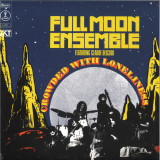
Comet Records present the first release out of the Comet new reissue series with this cult French Free Jazz LP from 1974, Crowded with Loneliness by Full Moon Ensemble was produced by Claude Delcloo, check the classic ‘Samba `Miaou’, like a lost Pharoah Sanders tune mixed with politically-engaged French poetry! The whole LP is varied, avant-garde and spiritual and now available as Vinyl LP with Gatefold cover, set to become collectible as the original is impossible to find.
All Tracks are written by - Thee Church Ov Acid House - (Oliver Bradford. Jörn Elling Wuttke) Klangfabrik Frankfurt am Main 2021
Published by Copyright Control - Exept A2 Produced by Jörn Elling Wuttke Oliver Bradford, Jörn Elling Wuttke by Courtesy of Vexed FM
Beat Poetry written and performed by Georg Heunoske
Mastered by Andreas Lubich In Memory Ov Andrew Weatherall and Genesis P-Orridge
repress
Mohamed Abdel Wahab wrote another big score for Om Kalsoum in 1972. In “Laylet Hob” (A Night of Love) we hear Arabic music and poetry in perfect symbiosis. The rich and lengthy instrumental intro is just a precursor of the emotion present in this song. The talent of the composer is underlined by how he utilises the traditional style of singing poetry in a more open and creative way. Abdel Wahab’s infusing of long and groovy interludes with varied tonality, rhythmical patterns and an overall unique approach, carries Om Kalsoum’s powerful voice and brings the song to an incredible climax. In this way, he gives more colour and depth to the music and the skilled soloists in the orchestra are finally able to breathe. Sensual rhythms, breaks and breathtaking solos of accordeon, guitar (Omar Khorshid), violin and organ (Hany Mehanna), have ensured this song is an all-time classic for belly dance routines. Souma Records thought it was time to re-release this monument on a high quality vinyl format, together with a repress of “Enta Omri”, another classic song by Souma.
"Kontakt Audio and Infinite Fog Productions proudly present the 25-th anniversary reissue of the one of most unique albums on avantgarde/neoclassic music – Ihor Tsymbrovsky – Come, Angel.
Recorded in 1995 in Ukraine and released in 1996 just as a small run on cassette on Polish label Koka Records, the album without any promotion little by little became legendary and madly wanted by many fans all around the world. And from the first seconds, you can hear why it is so. Pretty hard to explain what songs play Ihor, moreover that would be senseless. “Come, Angel” is one of those albums which are so unique that takes you in a vacuum of verbal forms in an attempt to describe the record. In a few words, this is definitely very intimate and deeply emotional music with an absolutely incredible voice. The first associations could forward you to Antony Hegarty from Antony And The Johnsons, Marc Almond, Arthur Russell, Baby Dee, Bjork. Experienced listener familiar with these great artist knows that all of them are inimitable and Ihor Tsymbrovsky is totally inimitable as well.
In 2016 well-known German label Offen Music published 3 tracks from the album “Come, Angel” which brought a lot of attention to Ihor’s music. This time we’re excited to announce the first full album reissue on CD, Double vinyl, and tapes. Beside the full version of the album, you’ll find an exclusive bonus song from the cult compilation “Music The World Does Not See” – Nefryt Records 2000.
~
“For me, music is a certain way of cultural survival. Here I do not set myself theoretical problems or experiments.
The connotations of life are important: rhythms, melodies, their connection with language, poetry, real life, virtual or imaginary space. It is very important to me how the recitation of work sounds, how consonant and vowel sounds dissolve in singing, how they combine musically. I understand sound space as a field of my interpretations, preferences, priorities, and I do not use direct imitation. If I hear a melody or a musical phrase, and it is fixed in my memory, later I extract it in my own interpretation, as already formed by this field. In art, the goal is in the work itself, not outside it. For me, the expression “To be is to create a new reality” is another winged reality.” – Ihor Tsymbrovsky
~~
“Tsymbrovsky – an architect, musician, a poet, an artist; one of the most underestimated musicians in Ukraine’s artistic world. Many critics pulled their hair out trying to get to the bottom of Tsymbrovsky’s music. It has been inspired by jazz, minimal, modern, ethnic, and meditation music. Tsymbrovsky is not a virtuoso, however, he creates whole worlds with his astonishing falsetto. Although Cymbrovsky’s music is simple it is made of many elements. Filled with magic and unusual sensitivity and warmth it can be therapeutic for the listener. This is that kind of music, which can be listened to many times – in a different way each time.” – Koka Records.
~~~
“Igor Tsymbrovsky’s only album “Come Angel” (1995) still remains perhaps the most bizarre phenomenon in Ukrainian music since independence. The story of its author is a vivid example of cultural amnesia. In the pre-Internet era, Tsymbrovsky was a prominent figure in the Ukrainian underground, performed on the “Red Route”, went on tour in Germany. However, he left a minimum of evidence of his activity and became a silent legend for a few. We talked to Igor to find out where he came from and where he was going.
The album “Come Angel” is eight compositions performed with a falsetto to the accompaniment of a piano. (Tsymbrovsky’s falsetto is a legacy of the Lviv Dudaryk choir, where he sang as a child.) It would seem that it could be easier. But, despite such ascetic tools, Tsymbrovsky managed to create a phenomenon unique to Ukrainian culture. Some people compare him to Benjamin Clementine and Anthony Hegarty, but no comparison will be exhaustive. The lyrics of the songs attract special attention: two of them were written by Tsymbrovsky himself, the others demonstrate his remarkable literary knowledge. Here and Guillaume Apollinaire, and Mikhaijl Semenko, and even less obvious poets, such as Mykola Vorobyov or Jozsef Attila.
The young performer’s first performance took place in 1987 in the club of the Forestry Institute. It is quite symbolic that this room used to be a Jesuit church because such a chamber environment suits his songs about angels much better than the noise of big festivals. However, there were also many festivals in Tsymbrovsky’s career: in 1989, Chorna Rada and Chervona Ruta, in 1991, Kharkiv’s Nova Scena and Ukrainian Nights in Gdansk, Alternativa in Lviv. Ihor calls his first performances musical performances and notes that they sounded completely different. Unfortunately, we will never know exactly how.” – Amnesia
~~~~
“The magicians at Dusseldorf’s Offen Music pluck a madly beguiling pearl of late-night songcraft by Ukraine’s Ihor Tsymbrovsky to follow their vital releases by Toresch and Rex Ilusivii. Come Angel was first recorded in Lviv, Ukraine, in 1995, and issued on cassette by Poland’s Koka Records in 1996. There appears to be no prior mention of the release or artist on the internet and quite how it came into of Offen Music possession is not disclosed, and that only ratchets the record’s enigma to astonishing degrees once you’ve heard the music. In a quivering, high register, androgynous trill, Ihor Tsymbrovsky beckons heavenly beings in the remarkable A-side Come, Angel against a swirling backdrop of phasing, subtly delayed organ. It was recorded in one take (this is the 2nd version), and, if we’re not mistaken, you can hear the keys being pressed rhythmically in the background, which seems to be the song’s only tangible connection to this mortal world as Ihor vaults octaves high and close-in-the-mix with the sort of alien, dreamlike vocal that requires pinching oneself to make sure you’re awake. Spellbinding is definitely the word. On the other side he (we’re assured it is a ‘he’ in the promo text) sets two poems by Mykola Vorobyov and Mykhal Semenko, respectively, to emphatic piano keys, this time more shy of FX save for some delay, placing that willowing, avian vocal at a dreamy arms reach in Roses for the Poet, and with a sort of liturgical dark jazz feel, sorta like Lewis repenting his sins as a castrato monk, in the spare atmosphere in By the Sea. This is gold-seal business, we tell ya. Clock the clips and clear some swooning room.” – Boomkat
credits:
Music By – Ihor Tsymbrovsky
Lyrics By: Ihor Tsymbrovsky (tracks: C2, D1)
Atilla Joszef (tracks: B1)
Mychajl Semenko (tracks: B2, C1,C3, D2)
Mykoła Worobjow (tracks: A1,A2)
Engineer – Edward Hryhorjew
Remastering – Ihor Tsymbrovsky"
The second extended EP by London synth cyberneticians 3 Electro Knights is Rave One, which is human and machine in hot synergy. If Blixa Bargeld played the synthesizer he would probably come up with something like the crazed lead on Rave One. I Move In Another Dimension is a remix of very limited lathe cut single, which Rough Trade shops described as “Electro sqwonk and clatter meet Patti Smith style beat poetry’. This, the “Mandy” remix ups the psychedelic energy, with Mandy referring to the acid drenched Nicholas Cage starring film of the same name. The flip side track, I_tense, is a 14 trip into territory somewhere between Berlin School synth and early Aphex Twin driven by perhaps the greatest synthesizer ever made, the Roland System 100m, and was recorded in one take with no overdubs Very limited copies – 250 only – on white vinyl with orange swirl. The sleeve design is by acclaimed graphic designer Asif Khan. Destroy/Exist wrote of their cassette album Sketches For Another Future: “Through krautrock, psychedelic, synthpunk, and modern electronica passages, 3 Electro Knights fully realize their analog electronic sound, exposing their warm connection with their synths.” 3 Electro Knights are Daren Pickles (Supercharger, bushpilot), Nik Clifford (Jesus Licks, bushpilot) and Ross Holloway (bushpilot).
Aidan Baker is a classically-trained multi-instrumentalist using the electric guitar as his primary instrument. Using prepared and alternate methods of playing the guitar, along with various electronic effects, Baker creates music which generally falls within the ambient/experimental genre but draws on influences from rock, electronic, classical, and jazz. A highly prolific artist, Baker has released numerous recorded works, both solo and with various group projects - most notably the duo Nadja - on such independent labels as Karlrecords, Important Records, Southern Lord, and his own imprint, Broken Spine Productions. Baker is also the author of several books of poetry. A regular live performer, Baker has toured extensively around the world, including appearances at such international festivals as FIMAV, SXSW, Incubate, Unsound, and Mutek, among others. Originally from Toronto, Canada, Baker currently resides in Berlin, Germany. Recorded mid-pandemic, Songs of Undoing cannot help but have a sort of mid- or post-apocalyptic overlying concept, lyrically dealing with themes of exodus and travel / wandering, self-reliance, the weight of history...with pointed references to two post-apocalyptic, societal / environmental collapse novels, Octavia Butler's "Parables of The Sower" and Kate Wilhelm's "Where Late The Sweet Birds Sang." Musically, the songs move between minimal slowcore and a sort of textural noise-rock or what might be called deconstructed grunge, taking influence from artists like Lungfish, American Analog Set, PJ Harvey, and Stina Nordenstam.
Stemming from a great legacy of poetry, Quintal de Clorofila was a duo from the south of Brazil composed by two musician brothers, Dimitri and Negendre Arbo, who turned their dad's poetry into music. In the album O Mistério dos Quintais, the two brothers presented a Brazilian Hippie Folk full of psychedelic touches a times with flanger effects, reverb and synthesizers, a times totally raw with medieval melodies, flutes and strings. The record goes with the original artwork, insert with lyrics plus unreleased photos including the one of the debut album O Mistério dos Quintais featuring the bird (a canary) that sang on stage with its own microphone. O Mistério dos Quintais was released originally in 1983 via a some sort of crowdfunding, before the term itself and even the existence of internet. Supporters who invested in the project had their names in the acknowledgements on the first edition insert. Given the fact that it was released independently, the purity and innocence of the Arbo brothers came to light and set them free to grace the listeners with sounds of nature, mysticism, influences from the Peru Andes and even some madness such as taking the family's bird (that was used to singing along with the brothers at their rehearsals at home) to then record in the studio. When the record was ready, the band realized that the record RPM was wrong. The songs were a bit faster, slightly 1/2 a pitch higher. However, it was too late, nothing else could've been done. Because they were a small band, the manufacturing plant refused to repress the records and they had to endure this. Almost 40 years later, Fatiado Discos present the first version of O Mistério dos Quintais in its original rotation speed, the right one.
"His music filled me with the urge to connect with the world," Kaitlyn Aurelia Smith says of Emile Mosseri. She first heard his work while watching the 2019 film The Last Black Man In San Francisco; just minutes in, she paused it to look up who did the score and wrote to him immediately. "I love Emile's ability to create melodies that feel magically scenic and familiar like they are reminding you of the innocence of loving life." Those talents saw recognition in 2020 with an Oscar nomination for Mosseri's original score to the film Minari. He was already a fan of Smith's and became increasingly intrigued by her impressionistic process as they started to talk. "The music feels so spiritual and alive and made from the earth," Mosseri says. "I think of her as the great conductor, summoning musical poetry from her orchestra of machines." I Could Be Your Dog / I Could Be Your Moon, their two-part collaborative album, introduces an uncanny fusion of their sonics. Constructed using synthesizer, piano, electronics, and voice, this soft-focus dream world is lush, evocative, and fleeting. It finds two composers tuning their respective styles inward as an ode to mutual inspiration, a celebration of the human spirit and its will to surrender to the currents of life. As a full album set, I Could Be Your Dog / I Could Be Your Moon moves fluidly from track to track, panning through textural vignettes. Two roughly 17-minute halves, the set evokes the bittersweet sense of something too bright or rare to last, a short-lived glimpse into a golden hour. There is a dreamy, elemental intention to this music, which Smith and Mosseri say came naturally, as they both embraced intuitive interplay throughout their creative back-and-forth. The stylistic threads of each composer are recognizable yet become more ambiguous as the album progresses, sewn into a singular vision.
In many ways Kumoyo Island represents the culmination of a journey for Kikagaku Moyo. While their decade-long career can be summarized as a series of kaleidoscopic explorations through lands and dimensions far and near, there's a strong intention in each of their works to take the listener to a particular place, however real or abstract they may be. In that sense, the title and cover art for the band's fifth and final album draws you into a magical mass of land surrounded by water-but the couch suggests that Kumoyo Island may not be a fleeting stop, but rather a place of respite, where one could pause and take it all in. Reconvening at Tsubame Studios in Asakusabashi, Tokyo, where their earliest material had been recorded, the five members of Kikagaku Moyo found new inspiration in a familiar and comfortable environment. With their adopted homebase of Amsterdam under lockdown and their touring activities halted due to the pandemic, the band felt a renewed sense of freedom being back in shitamachi, or the old downtown area of their hometown. With unrestricted time in the studio, they began to build upon the demos and song fragments they'd amassed since their last tour. In the 1.5 months spent in Tokyo, everything started to come together. "Monaka", its name taken from a type of Japanese wafer sweets, takes melodic inspiration from traditional minyo folk styles, while "Yayoi Iyayoi" is a rare instance of the band singing in their native tongue, its evocative lyrics utilizing archaic words taken from old poetry and nature books found in one of the many secondhand bookstores of Tokyo. For "Meu Mar", an Erasmos Carlos cover, the original Portuguese lyrics were translated into English, then to Japanese. Strangely enough, the words seem to conjure an image of the protagonist floating among the clouds, looking down upon Tokyo Bay. In fact, it may be possible to draw a parallel between the topography of the band's home country-an island nation, surrounded by bodies of water-and the mysterious isle of Kumoyo. Are they one and the same? Has the band finally made it back home? It's up to the listener to decide.
Standout favorites of RidingEasy Records’ Brown Acid compilation series, White Lightning’s stellar discography of rare and under-appreciated heavy psych, proto-metal rock gets a vital revival for new generations to learn how swinging, swaggering and often blazingly fast rock’n’roll is done.White Lightning was formed in Minneapolis, MN in 1968 by guitarist Tom “Zippy” Caplan and bassist Woody Woodrich after leaving garage psych band The Litter (themselves popular standouts from the Nuggets and Pebbles series of garage rock rarities.) Originally a power trio, the band later expanded to a 5-piece in 1969 while shortening its name to Lightning. The quintet’s brilliant and rare 1970 self-titled album on Pickwick International’s P.I.P. imprint provides 6 of the 10 tracks on Thunderbolts of Fuzz.The original White Lightning trio only released one 45-rpm single “Of Paupers and Poets” during their existence (on local Hexagon label in 1968, later reissued by major label ATCO Records in 1969.) A long out-of-print posthumous album released in 1995 gathered unreleased recordings, 3 of which are found here. This rounds out this collection of recorded highlights from the band’s rocky history.
Taking their name from a particularly potent type of LSD, White Lightning laid out from the start that it was not cute and cuddly 70s rock. In fact, the band’s aggressive tempos are like punk rock way before punk. However, their dirty blues groove and musical prowess shows the band was more than unrefined ne’er-do-wells, they had true versatility.
Drummer/lead vocalist Mick Stanhope later relinquished his drum throne to take center stage as lead singer of the expanded lineup. Throughout its initial 1968-1974 run, the band had 10 different lineups, with Caplan, Woodrich and Stanhope the most consistent members — though the band points out that no one member has played in all 11 incarnations of the group. For more facts and information visit thelitter-lightning.
Album opener “Prelude to Opus IV” is a wailing rocker with blazing double-kick drum, sizzling melodic riffs and Jim Dandy howls jam packed into an epic 4 minutes that serves enough testament to the band’s greatness, nothing more need be heard or said. However, the would-be hits keep coming as the Led Zeppelin meets Black Oak Arkansas thwack of “Hideaway” and “Born Too Rich” come screaming out of the speakers. “When A Man Could Be Free” shows the band could also reign in the fury, at least a little bit, for a warm Southern rock style ballad. “Borrowed and Blue” echoes the stately poetry of Electric Ladyland-era Hendrix with a dash of The Who’s rollicking psychedelia. “1930” is, quite simply, insane. Searing twin guitars with incredible fuzz-drenched tone, a warm and buzzing bass line bounce atop drummer Bernie Pershey’s unrelenting bass drum triplets while Stanhope ravages his lungs with soulful abandon. The album closes with the aptly titled “Before My Time” a barnstorming boogie rock instrumental the proves the band vanished long before receiving their due.
- A1: Nothing To Declare
- A2: Totally Spies (Feat Lafawndah)
- A3: Nightflame (Feat Orion Sun)
- A4: Anthology
- A5: Discipline
- A6: Blessgrips
- A7: Easy Jet
- A8: Candace Parker (Feat Muqata'a)
- B1: No More Kings
- B2: Capitol (Feat Alli Logout)
- B3: Sixteen
- B4: Spirit Airlines
- B5: Crown
- B6: More Victories (Feat M Tellez)
- B7: Seven
- B8: Lead Level 15 (Feat Ase Manual)
The LP version is limited to 1000 copies, pressed on blue vinyl, in a high grade spot-varnished gatefold sleeve.
700 Bliss is the forward-thinking duo of DJ Haram and Moor Mother. Their first full length for Hyperdub is an album of noise rap that ties together the raw edges of club music and hip hop with punk energy, jazz, house-party catharsis, percussion-heavy analogue sound design, and cheeky skits, ranging from experimental rap tracks with rolling hi hats and lyrical bravado, to poetry set to noise and sound collage.
Moor Mother and DJ Haram started collaborating in 2014 and eventually formed 700 Bliss, a blistering live act in Philly's DIY scene, releasing their 2018 debut, Spa 700 on Halcyon Veil / Don Giovanni Records. Since that time, both artists have grown global followings. Moor Mother is a prolific solo artist and collaborator, writer, and member of Black Quantum Futurism while Haram has been curating and creating radio shows, DJing, and producing (including an EP for Hyperdub in 2019).
‘Nothing To Declare’ is a smart, danceable revelation, a chiseled soundscape of dive bombing bass, piercing bleeps, crunchy distortion, and wavering synth lines. Welcoming in a variety of voices from their extended, cross-genre scene, 700 Bliss also bring along a cast of collaborators, including vocalists Orion Sun, Lawfandah, Ase Manual, and Ali Logout (from the band Special Interest), plus Palestinian producer Muqata'a, and writer M Téllez who delivers a surreal sci fi monologue over a pounding kick drum on ‘More Victories’.
‘Nothing To Declare’ is a deeply layered rewriting of hip hop and electronic music that gives more with each listen. You won't hear another rap album like it in 2022.
This release will have you dancing and crying at the same time. On his debut album, Paris-based producer and founder of the "raw poetry" aesthetic Loyce Demellier - AKA DJ Physical - takes us on a fast-paced journey through techno, electro, breaks and more. Whilst the music's indisputable home is the club, Physical teases out moments of playfulness and sentimentality amongst hard-hitting electronics.
"Silver Lake" LP resides on the colder, more industrial side of Demellier's sonic spectrum, following on from his latest release on London imprint 10 PILLS MATE which saw him depart from the more lofi quality of his previous releases in favour of a raw, club-focused sound. On the A-side, Demellier situates the release within the context of old warehouse raves, with euphoric acid melodies and a 140BPM propulsion ("Uranium"): and high-pitched synth stabs that ascend from darkness ("Gold Mines").
The B-side maintains the pace, but this time it's about electro and breaks. On "Overshoot", reverberating cymbals add another layer of depth to Amen break interludes whilst "Lawbreaker" harnesses a cheekier tone, offering respite from the previous tracks' venom. This air of playfulness sticks around on "Lunatic State" helped by MPC drum claps and a ludic electro melody, before fellow Parisian Ika Sile steps up for "Early Sprinter" and "Bootybounce": the former offering a slicker take on acid techno and the latter: rave music at its absolute with piano stabs and sleazy vocal chops. Silver Lake LP drops 22nd July 2022 via Lost Palms
The fourteen original compositions on "Old Love And New" were all composed by Ulita Knaus, created for poems by her favorite poets - these are timeless texts, always emotional and sometimes political. The songs already seem like rediscovered standards from the great songbook era of Cole Porter or the Gershwins, also because Ulita's band swings so fabulously. It is often downright spooky how much these lyrics and their songs fit into our time. Relaxation and evolution, rights for all and bicycles for two - the fact that these subjects are so haunting and relaxed on "Old Love And New" is of course also due to the musicians behind it. "An excellent band with sensitive arrangements accompanies Ulita in a great and sensitive way," said the European jazz legend Rolf Kühn. “Old Love and New”, an album full of poetry and swing and love - already a classic and certainly the peak so far in Ulita Knaus’ remarkable career.