Philip Lawn is an Italian music producer, co-founder of Turbokitchen, releasing on labels such as Motek and My Favorite Robot Recordings.
In his debut EP as solo artist for Thisbe Recordings, “Ten Years of Travel”, he tells the tale of the Odyssey and his protagonist Ulysses through the use of machines (such as Nord Lead 4, Roland SPD-30, Behringer TD -3, Yamaha Reface CS & Moog sub 37) and hot grooves. Out of his secret garden, a perfect acoustically isolated walk-in closet, “Ten Years of Travel” was born. Particular to the structure of the EP is that each track has its own remix.
With a rework of “Distorted View”, Days of Being Wild deliver a dark disco classic, true to their idiosyncratic sound and original beats, mesmerizing the dancefloor straight away. Traveller and cosmic poet Pyrame rework of the single “Start” first feels like rain dropping before the storm comes and reveals an euphoric feeling as the break starts. Romain FX nails a fine remix of Ten Years of Travel, the main single of Philip Lawns´EP. His remix is a pure italo disco rework of the original, infused with pop synths and keys, that won´t leave anyone still and quiet. Banger.
Buscar:pop machine
Camisole is proud to unveil another part of the french cold wave history with the reissue of "Paroles Absurdes" LP by White Pain.
Hailing from Lyon the band began as a duo with Patrick Saveau and Patrick Gravier in 1984.Active figures in the underground scene of their city, they played some gigs and even had their own show on the local radio station.They developed a small following around them and recruited other members to record this album in 1986.
"Paroles Absurdes" is driven by the feeling that you can't escape your fate. Saying Words that you sometimes regret but you feel to be true.This testimony infuses this whole album.However, positive assumptions flow from time to time and left their more pop appeal roll into some songs.
This reissue also includes the first two tracks of the group only released on tape in 1985.As a duo, White Pain was a synth and drum machine band inspired by early 80's german pioneers like DAF or Din a Testbild.They used to have a raw, powerful, and dark sound quite unique in France at this time."Vienna" is probably the best way to resume their first intention.
A.B. Crentsil is a heavyweight of Highlife music and the main vocalist of Sweet Talks, one of the most popular Ghanaian bands of the 1970’s. In 1992, musician Charles Amoah and producer Richie Osei Kuffour offered him the opportunity to explore a new popular sound: Bürger Highlife. Little did he know these studio sessions would give birth to the biggest song of his career.
Charles Amoah, who had released his Sweet Vibrations LP in 1984 to great acclaim, extensively toured in Europe with bands such as Black Earth and Saraba, was eager to bring a new sound to Crentsil, an artist he had admired for years. Throughout the 1980’s, Highlife had been changing pretty radically, following the same evolution as Congolese Soukous, Caribbean Zouk and most popular black music
genres of that era: Heavy use of drum machines, synths and digital technology was conveniently replacing big bands and expensive
analog studios and equipments. Mostly recorded, produced or mixed in Germany, this new breed of electric Highlife dubbed ‘Bürger Highlife’ could be defined as a fusion of Disco, Jazz, Funk and Pop with the popular Highlife beats, rhythms and lyrics.
According to A.B. Crentsil, the name was a reference to the ever present American cultural influence on Ghanaian musicians. Charles
Amoah has his own take: “I initially called this particular kind of Highlife ‘Ethno Pop’. Bürger is the German word for citizen, and that’s how Ghanaian musicians living and working in Germany were calling each other”.
The music for both “Obi Baa Wiase'' and “Sika Be Ba” was entirely composed and played by Charles Amoah, using minimal equipment: a
DX7 synth, a Korg M1, a Yamaha RX5 drum machine, and an Akai 1000 sampler. A.B. Crentsil provided the lyrics for both tunes on the spot. Obi Ba Wiase’s message is one of gratitude and faith: it says we should appreciate our life way more and follow the example of people who have a lot less but still praise God all day.
Charles remembers fondly Crentsil’s larger than life personality: "A.B. slept a lot, he really loved sleeping. His lack of punctuality was easily dismissed by his wonderful sense of humour and it wasn't uncommon to find musicians rolling with laughter on the studio floor."
Charles also remembers vividly the "Obi Baa Wiase" session: he could feel the magic in the air while working on the soon to be hit, and
knew something special was happening. A.B. asked for a break in the middle of the session, which Charles adamantly refused until the song was finished and the magic fully captured.
Success was not immediate, and Charles was first a little concerned by the lack of buzz following the immediate release of the Gyae Me
Life Ma Me album. But a few months down the line, the situation took a new turn. "Obi Baa Wiase" was making its way into radio playlists,
weddings and festive celebrations. It was covered by local bands, and soon most of Ghana and its European and American diasporas were hooked. It became A.B. Crentsil’s most requested song at live events for the following decades.
As producer Richie Moore wrote on the album back cover : "A perfect integration of two musical geniuses, the result of which are the
scintillating tracks of music on this record… so all you party fans go onto the floor and dance the body music"
- 1: The Rain Drops
- 2: Another Time
- 3: Melted Car (Feat. Karina Gill)
- 4: Deep In Squalor (Feat. Griffin Jones)
- 5: Hey There Flower
- 6: Cliché (Feat. Kati Mashikian)
- 7: Say It Now (By Françoise Hardy)
- 8: Uneasy
- 9: Ode To Little Bird (Feat. Alexis Harper)
- 10: September Skies (Feat. Karina Gill)
- 11: The Portal
- 12: The Word
- 13: Unled Lives (Feat. Hannah Lew)
- 14: Saint Matthew
Solo bedroom-pop project of Michael Ramos (Flowertown, April Magazine, Hectorine). Mostly recorded between last Christmas and New Year's during a window of isolation at home, “Hey There Flower” preserves Tony Jay’s prowess at making beautifully eerie lo-fi pop; like a hazy memory where your favorite Sixties girl-group melody is perpetually slowed down. Without a band to practice with, Tony Jay recorded the music alone, but recruited a slew of friends to remotely record backing vocals: Karina Gill (Cindy), Griffin Jones (Galore), Kati Mashikian (Mister Baby), Alexis Harper (Al Harper), & Hannah Lew (Cold Beat). "Hey There Flower", the most recent release from the prolific and mysterious Tony Jay delivers real melodies -- both lacey with vocal harmonies and dusty with layered guitars -- as fans have come to expect. This release also carries forward and elaborates on Tony Jay's tradition of songs that express a kind of naked honesty about things we all know -- love and loneliness and all that -- while communicating at the same time a wry edge of skepticism, so that the songs are like coins spinning on edge before landing heads, tails, or lost under the couch. Tony Jay brings us into a nostalgia where we recognize moods from music of the past -- Marc Boland definitely comes to mind, as well as Velvet Underground of the Nico era, and Tony Jay even covers Francoise Hardy on this collection -- but the songs create a three dimensional space with what feels like a thousand layers so that instead of being thrown back in time, it's like stepping into a little world with its own laws of nature, of which the listener gets just a few hints. - Karina Gill, Cindy/Flowertown. “Hey There Flower” is introduced by thudding snare beats eliciting reverb-stained tattered noisy guitar scrapes, to weave abrasive shimmery emotive vibrations, imbued with shattered nostalgic dreams, lit by brittle yet dazzling forsaken keyboard flows, over submerged and distorted male vocal’s whispery deluge of obsessive longing, lonely melancholy, and dark desire to exude a hazy gritty concoction of awkward sadness and brooding unrest.” White Light // White Heat // “What Tony sketches are concise commentaries on love, loneliness and a few things in between. His mode of expression is sparse, intense, and captivating. The arrangements are invariably lo-fi and slow tempo, blanketed with a fuzzy hiss. And it only took one listen to decide that it is a very special album. It has a '60s feel, albeit washed in an eerie slowcore machine. An ace example is "September Skies", which could be the 1965 'last dance' at the prom for the introverted students.” - When You Motor Away
For the label’s next release, the team at Leng Records has decided to offer-up something a little bit different: a 12” compilation of little-known and hard-to-find Balearic gems selected by friend of the label Paul Beckett.
Plucked from the dusty corners of his collection, the five tracks on show are quietly colourful, tactile and musically rich excursions that effortlessly blur the boundaries between genres and sound terrific blasting from speakers on a humid Mediterranean or Adriatic afternoon.
First up is Ray & John’s languid, subtly disco-tinged ‘Day By Day (Instrumental)’, which originally featured on the flipside of the Italian duo’s sole single from 1984. Rich in rubbery bass guitar, sequenced synth-bass, sharp disco guitar licks, Fairlight stabs, dreamy chords and occasional chanted vocals, it sounds like Please-era Pet Shop Boys reclining at a Rimini pool party after copious amounts of happy pills.
It’s followed by Angel’o’s ‘Angelo’, a turn-of-the-80s gem picked from the band’s long-forgotten album, Dream Machine. Marked out by warming electric piano motifs, squelchy synth-bass and hazy lead vocals, the track successfully mixes krautrock and space rock sounds with the then fresh sound of synth-pop.
Next up is All Trouvee’s ‘Darling’, a thoroughly overlooked 1987 single whose minimalistic sleeve artwork lists each of the now-classic – and then cutting edge – synthesizers used to make the sun-soaked blend of mid-80s synth disco, AOR pop and sunset-ready jazz-funk piano solos.
Equally as impactful is Angel’s ‘Tomorrow Night’, a classic – if little-known – chunk of glossy, laidback synth-pop from 1980 that sounds like something you’d hear on AM radio stations in the early hours of the morning. Its’ sound – all delay-laden Linn drums, synth-horns, Nile Rodgers style guitar licks and echoing lead lines – was actually far sighted for the time but would become more familiar to listeners as synth-pop boomed in the mid 1980s. Those who buy the digital version of the EP will also have access to a longer, club-style mix as well as the short version featured on the 12”.
Rounding off a fine package is ‘Feeling Action’ by Eggs Time, a deliciously warm and woozy chunk of fretless bass-sporting Italian pop/West Coast jazz-rock fusion plucked from a real since of buried treasure: an Italian compilation called – for reasons that aren’t clear – Moby Dick. There’s certainly a tinge of both yacht rock and blue-eyed soul about the track’s gorgeous blend of FM synth sounds, eyes-closed jazz guitar solos, unfussy beats and sweet female lead vocals. It provides a fittingly horizontal finish to a collection packed to the rafters with long-overlooked, sun-baked treats.
- A1: Live At The Sahara Tahoe, 1973 (Remaster 2022)
- A2: Farben Says Love To Love You Baby (Remaster 2022)
- A3: Muskeln (Remaster 2022)
- B1: Suntouch Edit (Remaster 2022)
- B2: Farben Says As Long As There's Love Around (Remaster 2022)
- B3: 6Ff (Remaster 2022)
- C1: Beautone (Remaster 2022)
- C2: Farben Says So Much Love (Remaster 2022)
- C3: T Microsystems (Remaster 2022)
- D1: Raute (Remaster 2022)
- D2: Silikon (Remaster 2022)
- D3: Farben Says Love Oh Love (Remaster 2022)
On textstar+ Jan Jelinek brings together the material from the CMYK series, four EPs he released between 1999 and 2002 under the pseudonym farben (the German word for both colours and paints), on a vinyl double LP for the first time. The selection of tracks has been remastered from the original tapes, joined by two additional pieces that appeared on compilations during the same period.
A Polaroid. Still life with tangled leads and consumer electronics, late twentieth century. Black and various shades of dirty white are the dominant non-colours. The image’s spatial depth remains diffuse, the links between its elements speculative. A note stuck to the wall (a legend, perhaps, or an all-explaining blueprint in text form?) is impossible to decipher. You can’t see what connects the picture’s signs. You have to hear it.
farben says: Every sound is a text. A bearer of meaning in search of a reader. Hoping the ideas inscribed in its autonomous existence will be understood as intended. While its beauty lies precisely in misunderstanding, in reading the coded message a new way every time. A thousand colours of sound, a thousand different ways to hear, to see, to understand.
On textstar+ Jan Jelinek brings together the material from the CMYK series, four EPs he released between 1999 and 2002 under the pseudonym farben (the German word for both colours and paints), on a vinyl double LP for the first time. The selection of tracks has been remastered from the original tapes, joined by two additional pieces that appeared on compilations during the same period. Another new element is the Polaroid, showing the origins of a world: Jelinek’s home studio in Berlin at the time.
farben says: Move your body! The project has its roots in Jelinek’s love of house as a reductionist vision of soul. Of four to the floor as a proposition that can be accessed anywhere. Of electronic dance music as a realm of possibility that can be continually expanded. farben was written as contemporary house music. As a text about excitement and euphoria. The arrangements were made directly while recording to DAT, on a twelve-channel mixing desk. Several track titles suggest a link to live concerts, coupled with the context of machine music and bedroom recording. Others affirm pop music’s most extravagant stock phrases about various states of love.
Jelinek produced the tracks with the aim of making music for dancefloors. An idea that failed very productively. In the locations to which it was originally addressed, the project barely figured. But people did listen, and they listened all the more closely to this music that opened up new acoustic and associative scope for house. farben is the opposite of genre: a music spawning new terms (clicks & cuts, micro-house) that never manage to fully capture it.
farben says: Signifiers. The four CMYK EPs are designed as a network of references that cannot be missed but that can also never be precisely deciphered. The vectors of sound, word and image point to Isaac Hayes and Ornette Coleman, to Detroit and the first generation of the Red Army Faction, to Karl Marx and Friedrich Engels. So multifarious that they are distorted to the point of recognition. Overall we hear sonic docufictions whose appealing vagueness derives precisely from this oscillation between clarity and ambiguity, which is also the source of their poetry: the lyricism of the pure circulation of signs.
The artwork is based on photographs of former Red Army Faction members, broken down into the four colours of the CMYK model. The motifs dissolve into individual dots of a single colour, so close to the faces that their expressions are only hinted at. Taken together, the individual colours compose a new whole out of fragmentary material, defying definition and thus maintaining their vibrancy. The same occurs on the level of sound. The sampler Jelinek used for these tracks had to be fed with floppy disks, imposing a memory limit of 1.44 megabytes per audio quotation from soul or jazz records. As a necessary consequence of this, the individual references, like the dots of colour, are dissolved into details and abstractions. They appear as splinters that recombine in new ways to create new meanings. The joy of collapsing metaphors.
farben says: New departures. Even two decades after its original release, textstar+ does not come across as an epitaph to the modern era. Instead, it appears as a euphoric affirmation of the utopias of the twentieth century, translated into new sound texts via the aesthetic strategies of abstraction, collage, networking and speculation. 1.44 megabytes of history, one thousand signifiers, one album. From “Live ...” to “... Love”.
Arno Raffeiner, 2021
- A1: Seventh Mirror
- A2: Ionization
- A3: Cloud Chamber
- A4: Harmonic Oscillator
- A5: Transfiguration
- A6: Urzeit
- A7: Cybernetic Dreams
- B1: Interference
- B2: Computer Garden
- B3: Pyramid
- B4: Halide Crystals
- B5: Integratron
- B6: Imaginary Forces
- B7: Phantom Lfo
- B8: Opticks
- C1: Mannequin
- C2: Mind In Light
- C3: Palantir
- C4: Vertigo Of Flaws
- C5: Exit Syndrome
- C6: Stasi
- D1: Atomic Voyage
- D2: Ultraviolet
- D3: Violence Cascades
- D4: Traumsprache
- D5: Zeitgeber
- D6: Prism
- D7: Threnody
- D8: Mind Oscillation
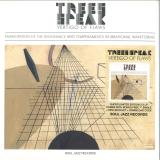
Trees Speak are back!
Speak’s new album, “Vertigo of Flaws: Emancipation of the Dissonance and Temperaments in
Irrational Waveforms” comes as a double-vinyl edition, single CD and digital release. The limitededition first pressing only of the vinyl includes a bonus 45 enclosed in an 8-page 7”x7” booklet
insert housed within the gatefold sleeve with cover artwork created by Soviet Union propaganda
artist Lazar Markovich Lissitzky in 1911.
Trees Speak are back!
This new release is a vast leap into an ocean of space and sound, a quantum leap into cybernetics, biology, anti-gravity,
time travel, dream speech and transfiguration. A seriously next step release!
Showing no signs of slowing down their rapid creative pace – incredibly this is their fourth album in the space of just over
one year – ‘Vertigo of Flaws’ is a mighty 29 tracks, one and a half hours of music across one double album that is surely
going to be a defining point in their musical career, a giant leap into the sonic unknown, an epic exploration of intensity
and sound.
Alongside their now trademark German krautrock motoric-beat rhythms, angular New York post-punk attitude, tripped-out
60s spy soundtrack, psyche-rock, and 70s synthesizers and vocoders, here you will also hear a new cosmic spacial
awareness (both personal inner space and galactic outer space) and a truly wilful pushing of sonic boundaries - as police
sirens, static noise, alarms, radio signals, avant-garde voices, and orchestral string quartets, all collide to add beautiful
dissonance to uber-powerful, intense, addictive and propulsive rhythms - in the process creating a truly unique
soundscape that Trees Speak have made wholly their own.
If you ever wanted to hear Can, Hawkwind, Destroy All Monsters, Pere Ubu, electric eels, John Cage, Liquid Liquid,
Tangerine Dream, Suicide, Neu!, Laurie Spiegel, Art Ensemble of Chicago, John Barry, Mother Mallard’s Portable
Masterpiece Company, Sun Ra, Stockhausen, John Carpenter, Electro-Acoustic and Musique Concrete and Mars in one
band - then this is it!
Trees Speak are Daniel Martin Diaz and Damian Diaz from Tucson, Arizona and their music often draws on the cosmic nighttime magic of Arizona’s natural desert landscapes. ‘Trees Speak’ relates to the idea of future technologies storing
information and data in trees and plants - using them as hard drives - and the idea that Trees communicate collectively.
Special guests from the hyper-creative hub of the Tucson music scene on this release are Gabriel Sullivan, Ben Nisbet, Saul
Millan, Stephani Guilmette, and Davis Jones.
The album Vertigo of Flaws was recorded in Brooklyn, New York, and Tucson, Arizona during the plague of 2021.
Extract from Vertigo of Flaws sleevenotes:
‘As we travel through space and time, avoiding the discarded remains of the industrial period, the
deconstruction of social norms through the expression of art, music, and philosophy guide the human
experience towards the unknown.
All that remains are musical echoes scattered throughout the universe, like ancient vibrations that now
populate the cosmos. These waves now show signs of decay. Melody, beauty, tonality have all but fallen
away as dissonance blossoms. As John Cage wrote in 1937,
“Whereas, in the past, the point of disagreement has been between dissonance and consonance, it will be,
in the immediate future, between noise and so-called musical sounds. New methods will be discovered,
bearing a definite relation to Schoenberg’s twelve-tone system and present methods of writing percussion
music and any other methods which are
free from the concept of a fundamental tone”.
Similarly, George Van Tassel claimed the Integratron as capable of
rejuvenation, anti-gravity, and time travel. So, what remains of the
“people”? We have adopted from them our own Zeitgeber: their pulses
now guide our sun, our planets, our earths, and are the new circadian,
diurnal, and ultradian rhythms of the galaxy. Traumsprache, dream
speech, is now the internal language of trees.
Decaying metal and machines liberated the note unto nature’s table,
and we sip the delicious nectar of music once more irrational, elaborate,
violent, vast. The past is the future, musical disintegration its own rebirth.
We are nature, once more the computer of the Universe.’
James Cullen and Dan Cobb formed TENDER in
2015, as the bedroom project of two flatmates tired
of the design by committee nature of larger
musical groups.
TENDER’s ‘Modern Addiction’ provides fresh
perspective to the idea of addiction, through the
lens of love. It is unafraid to admit or to accuse,
eager to confide and to provide, in direct,
shimmering confessionals.
Original pressing sold out - ‘Modern Addiction’ has
been out of print for several years. Now available
again, on black vinyl.
“Mysterious duo Tender specialise in marrying
polarising elements that could well soundtrack
parties as well as the loss of love” - DIY
“An enthralling, minimalist pop gem” - CLASH
“Gliding over guttural electro swoons, it’s the sort
of glacial pop that’d soundtrack late-night
contemplation no matter where you are in the
world” - Dork
Four years in making, Voyeurs In the Dark is Toronto artist Barzin’s fifth studio album. That the album is more cinematic in its scope and conceptual in feel than his previous studio albums can be attributed to the time he spent over the past several years composing the soundtrack for the independent film, Viewfinder. Voyeurs In the Dark retains that cinematic quality, and at the same time infuses the music with elements taken from Jazz, electronica, rock and pop. Having primarily explored the quiet side pop and folk in his previous four albums, Barzin has expanded his musical palate, broadening his sound towards a more an experimental direction, while still retaining his preoccupation with exploring the internal landscape. The uniformity of sound that characterized the previous albums has been abandoned for the expression of differing aspects of the self that at times hold opposing views and desires. This is best represented in the image chosen for the cover of the album, which depicts three figures in one body. The album seems to be the expression of not one unified self, but the various aspects of the self. Voyeurs In the Dark sees the artist plot a seductive, contemplative route through city haze, shuttling between graceful glimmering interludes, with wonderfully atmospheric songs at every stop. From opener Voyeurs In the Dark’s first guitar strums and the fizz of its drum machine, the record envelopes itself in a glorious shadow, as shown in the slow waltz of I Don’t Want To Sober Up, dancing around its own swirling guitar chords. On Watching, Barzin plunges himself deeper into a wash of cyclic bass, guitar and synth riffs, as the gloom grooves into light. It’s Never Too Late To Lose Your Life has a much more affirming and urgent tone, shade turning into shapes and motion, while To Be Missed In the End builds its own smoke in a cloud of saxophone and sparse guitar notes, closing out a record full to the brim with scatterbrain beauty and eclectic dusk. Voyeurs In the Dark will be released worldwide on Monotreme Records on May 6th on CD and limited edition180 g black vinyl LP with printed inner discobag and digital download card. Press highlights so far: Video premiere and feature interview on Rumore.IT. Airplay on BBC 6Music, Amazing Radio (UK and US), Glastonbury FM, Shoreditch Radio, Indie Music Discovery, Listen to Discover, Norfolk Radio. Press coverage in V13, Skope, Whisperin and Hollerin, Fame Magazine, High Violet, Indie Midlands, Beehive Candy, Music Won’t Save you. Feature confirmed for Wonderland Magazine. PUBLICITY - UK and North America press and radio Cannonball PR. Europe Five Roses Press
“Modern Primitive” is the new album by SEPTICFLESH who present a stunning combination of symphonic and cinematic music with aggressive yet catchy Death Metal. Picking up on the group’s sonic evolution in the past decades, “Modern Primitive” proves to be more emotional, epic and heavy than ever.
SEPTICFLESH was formed as “Septic Flesh” in Greece in the early '90s by Spyridon Antoniou (a.k.a. Seth Siro Anton): vocals/bass, Christos Antoniou: guitar and Sotirios Vagenas (a.k.a. Sotiris Anunnaki V.): guitar/ clean vocals. A debut Ep was released in 1991, entitled "Temple of The Lost Race". Their first full-length album "Mystic Places of Dawn" was released in 1994, followed by "EΣΟΠΤΡΟΝ" that was released in 1995. With the release of "Ophidian Wheel" in 1997, a female soprano vocalist (Natalie Rassoulis) was introduced, as the band moved towards a more symphonic style. "A Fallen Temple" (1998) continued in the same musical direction. In 1999, "Revolution DNA" was released, followed by “Sumerian Daemons” in 2003, both albums produced by Fredrik Nordström (At The Gates, Opeth, In Flames). Although the band's popularity was growing, the band members decided to disband, in order to focus on other personal projects and goals. But that was not the end of the story... After a reunion, the band returned with the album "Communion" in 2008, again with Fredrik Nordström at the helm of production. From that point onwards, the symphonic element (composed by Christos Antoniou, that has a Master Degree in Concert Music) was fully implemented in the structure of the songs, with the collaboration of Filmharmonic Orchestra of Prague. “The Great Mass” (2011) followed with Peter Tägtgren (Hypocrisy, Pain) producing, "Titan" (2014) with Logan Mader (ex-Machine Head) as producer and "Codex Omega" (2017) which started the group’s collaboration with Jens Bogren that continues to the very day. In 2020, the recording of the epic and fully orchestrated Live in Mexico entitled "Infernus Sinfonica MMXIX", was released on CD/LP/DVD/Blu-Ray.
Now, SEPTICFLESH has joined forces with Nuclear Blast Records and initiates the next phase in the band’s history, with a new album to be released in May 2022. Once again Jens Bogren is responsible for the bombastic mix and sound whereas Seth Siro Anton - who is also in charge for the visual aesthetics of the band and worked for artists like Nile, Paradise Lost or Moonspell - has crafted a really intense cover and over-the-top artwork for this release. The new songs impress with many layers, gloomy and empowering atmosphere while being heavy and memorable. Besides the continuous collaboration with the Filmharmonic Orchestra of Prague, the band used a full adult choir, a full children choir and a variety of ethnic instruments.
- A1: Ruth - Polaroid/Roman/Photo (Instrumental First Mix Edit)
- A2: Richard Wahnfried - Time Actor
- A3: Mecanica Popular - La Edad Del Bronce
- A4: Graham Gouldman - Bionic Boar
- B1: Ose - 29 H 08 Mm (Cdm Edit)
- B2: Schaltkreis Wassermann - Lux
- B3: Logic System - Unit
- B4: Explorer - No 8
- B5: Peter Godwin - Emotional Disguise (Instrumental)
The cosmic journey continues! Finally the fourth volume of the Cosmic Disco Machine series is out. As always pressed in limited number of copies , this volume is served in marbled white vinyl.The musical selection includes classic songs like "Time Actor" by Richard Wanhfried, as long as more underground and exclusive tracks such as "La Edad Del Broce" by Mecanica Popular, "Polaroid / Roman / Photo" By Ruth just to mention two from the rich traclkist.
The selection of these tunes is, as always, treated in any detail, artistic and musical, all tracks being gently mastered keeping the original and characteristic mood of each song. Just get it and you will discover the rest by listening to this new unmissable volume.Have a good listening and stay tuned for the next chapter of our cosmic journey.
After more than two decades flexing his muscles on the local underground scene and gaining a legendary cult status on his Tenerife home turf, the island’s most famous postman, as he’s affectionately known by his consorts, Tomás de la Rosa aka Postman breaks radio silence to bulldoze his way through the canyons surrounding his hometown of Santa Cruz into an unknown and unsuspecting world. We present thus, Postman’s first ever album of original bangers, micro chopped two steppers and rage induced breakbeat anthems.
Constructed over the course of global confinement, Seeds of Light marks a return to creative activity from the man who regularly delivers your post (its not just a random artist name). Postman aka Tomás de la Rosa has taken his time, compiling sketches and unfinished songs, rummaging through the deep ends of his hardrive, stitching early production sketches with recent compositions, revising, reediting and rebuilding with a more mature and concise attitude, eventually completing, almost unintentionally, the perfect self referential retrospective album. Far from being just a compilation album, Tomás managed to create an explosive document, suspended in time, in which styles are intertwined regardless of fashions and fads – letting go of the ‘modern’ or ‘up to date’ burden - so common these days in electronic music.
It is not an easy album, like many of his previous work it demands extra attention to experience the full crystallization of his complex sound structures. We find ourselves in front of a truly surgically precise work of art whose result comes as a waterproof war machine, refined and incisive, resonating deep with soul and groove.
Postman develops his sound palette throughout the album from very basic sound snippets into a concrete dance world of synthetic sounds eventually creating a parallel reality where J. Dilla could be living in Chemnitz instead of Detroit and releasing records for a label called Raster-Throw. Glitch sampladelics!
Incursions into Grime are also abundant with nods to the ineffable East Man, reunions with his beloved Funkstörung or many other stimulating revisions of lifelong genres and breaks populate this multidimensional sound space, see soul, dancehall, breakbeat, two step and the UK hardcore continuum.
Special mention to the magnificent fluid artwork by the very talented Catalan visual artist Alba de Corral. A still photo from one of her kinetic AI systems programmed directly in code, which matches perfectly the essence of Postman's brutalist alien sound.
Vinyl limited to 200 copies
- A1: 日が昇る / Higa Noboru / The Sun Rises (2022 Remaster) 04 39
- A2: ひこうき / Hikoki / Airplane (2022 Remaster) 08 12
- A3: 空気の底 / Kuki No Soko / The Bottom Of The Air (2022 Remaster) 04 29
- A4: パパイヤ / Papaya (2022 Remaster) 04 42
- A5: さっぽろんどん / Sappolondon (2022 Remaster) 03 57
- A6: ニュー・シーズンズ・デッド / New Seasons Dead (2022 Remaster) 05 15
- B1: ポー・フローデン / På Floden / On The River (2022 Remaster) 03 27
- B2: 砂漠 / Sabaku / Desert (2022 Remaster) 06 00
- B3: 誕生日の予感 / Tanjobi No Yokan / Expectation Of Birth (2022 Remaster) 04 10
- B4: 濁る空気わるくない / Nigor / Cloudy Air Is Not So Bad (2022 Remaster) 02 11
- B5: Come Maddalena (2022 Remaster) 05 17
- B6: ルーティー・ルーティー / Lutie Lutie (2022 Remaster) 04 17
Just over a decade ago, Japanese indie-pop duo Tenniscoats recorded »Papa's Ear« (2012) and »Tan-Tan Therapy« (2007), two albums made with musical and production help from Swedish post-rock/folk trio Tape. Originally released on Häpna, they are beautiful documents of the exploratory music made by a close-knit collective of musicians, fully at ease with each other, playing songs written by Tenniscoats and arranging them in gentle and generous ways. Released during a particularly productive time for Tenniscoats – during the late ‘00s and early ‘10s, they would also collaborate with Jad Fair, The Pastels, Secai and Pastacas – they have, however, never been available on vinyl. In collaboration with Alien Transistor, Morr Music is now reissuing these albums both digitally and on double vinyl, with extra tracks.
This reissue mini-series starts with »Papa’s Ear«. The second album from this expanded line-up of Tenniscoats, you can hear the musicians are immediately comfortable in each other’s presence, and they’ve almost intuitively understood what they can offer to one another. Saya and Ueno of Tenniscoats bring their magical, gentle folk-pop sensibility, and their winning way with straightforward, yet lush melodies. Johan Berthling, along with fellow Tape member Tomas Hallonsten, plus guests Fredrik Ljungkvist, Lars Skoglund, Andreas Söderstrom and Andreas Werlin, all generous and creative presences in the Swedish jazz underground, shades in the songs with endlessly inventive arrangements, highlighting the warmth and curiosity at the core of the Tenniscoats’ aesthetic – sometimes taking the songs in unexpected directions, other times pillowing the melodies with the softest of brushstrokes and the kindest of tones.
»Papa’s Ear« includes some of Tenniscoats’ most memorable songs. »Papaya« is a lustrous dreamland of a song, with the Swedish musicians singing ‘pa-pa-ya’ as an enchanted tattoo, while Saya’s piano and melodica clank and huff out, further expanding the song’s horizon. It’s followed by the spindly and mysterious »Sappolondon«, where drums and double-bass shuffle and pulse under weeping accordion and bittersweet clarinet. Saya’s voice sighs into the frame while the musicians breathe lungfuls of sweet drones and flick glittering countermelodies across the song’s surface. It reminds a little of the wild kindness of Movietone, or the regal charm of Carla Bley’s compositions.
Elsewhere, you can hear Tape and their friends embracing the freedom offered by the songs of Tenniscoats: see, for example, the glistening electronics in »På floden«, like a keyboard conducting a music box on a distant planet; or the descending phrase for winds on »Sabaku«, dovetailing beautifully into a creek of moon-lit texturology. The double-LP ends with two extra tracks, drawn from the 2008 Tenniscoats/Tape split single, also released by Häpna., »Lutie Lutie« is a sweet delight, driven by a clacking drum machine, the Tenniscoats duo joined by Hallonsten on glockenspiel and synthesizer, and special guest, Japanese indie-pop legend Kazumi Nikaido, as choir. »Come Maddalena« rounds off the set, a brooding cover of an Ennio Morricone tune, the music by Tape, the vocals by Tenniscoats and Nikaido. Open-hearted and full of puckish spirit, »Papa’s Ear« is an album of great tenderness and warm friendship.
After the 2020 album "Lieder Für Geometrische Stunden", Sankt Otten finally make us happy again with a new release at the beginning of 2022. "Symmetrie Und Wahnsinn" (Symmetry and madness) fits here skillfully, both creatively and musically, in an album series with geometric context.
The album starts unusually buoyant with "Hymne Der Melancholischen Programmierer" (Hymn for sentimental programmers). A Kraut-Pop pearl, which could go on forever with its Motorik swing and with its catchy melody the track doesn't come across as melancholic as the song title predicts. You have to listen twice to not succumb to the illusion that it was composed in Düsseldorf at the end of the seventies. Here (and on the track "Sei Symmetrisch Zu Mir"), Sankt Otten were supported in the studio by drummer friend DIRK PELLMANN.
The drum machine in rumbling funky mode. "Die Glücklichen Unglücklichen", the secret hit of the album? They bend the beat into geometric shapes, let the bass play in circles and cover the song with ghostly choirs. The echo of a spinett-like sound overlays the sound, spitting out a deceptively cuddly dream world.
The 10 minute long "Die Ordnung Des Lärms" could be called an Ambient-Kraut symphony without hesitation. An enormous swelling to ecstasy, a guitar sings distantly in the background. Silence. Synthetic strings pave the way and are supported by choirs. A crackle that suggests a rhythm until it is taken over by a drum computer in the main part of the track. Bombastic mountains of synthesizers pile up and yet a catchy melody finds its way through this mishmash of hypnotic electronics. Fourth movement - Kosmische-choirs in suspension over a bass synth and an Ebow guitar. Is this already Prog-Rock? The question doesn't arise, in the end everything merges into reverb. "Luftspiegelung Der Sentimentalitäten" begins cautiously with a gentle sequence and a discreet kick drum. The mini-Moog sounds like a guitar. Anyway. A surface floats by and returns, layers and shapes build up. At last, everything melts into perfect harmony with a plaintive-sounding synth. This track was composed as a stripped back reprise of the first track from the last album "Sentimentale Sequenzen". A hypnotic Motorik-beat of an 808 that encourages head nodding and could almost be danceable. True to style with warm analog 80s electronic sounds and a loose echo guitar. This is "Angekommen In Der letzten Reihe". Man and machine hand in hand as a homogeneous musical unit and the connection of tradition and vision.
Sankt Otten like images of infinity. In the religious sense of meditative mantras, or also in the mathematical sense of an elongated curve that eventually returns to its starting point. "Bis Das Helle Licht Uns Holt" goes exactly in this direction with its classical use of sequencers and a sound carpet of choirs. Sound worlds that, through a clever repetitiveness, barely noticeably guard the constant changes in the compositional mesh like a secret and only reveal what is to be discovered by listening closely and letting it be seen. Such a thing is probably called Berlin School?
The Osnabrück duo Sankt Otten, founded in 1999, has been releasing on Denovali since 2009. With their now 12th album they give us again a gem of timeless instrumental music. The holy trinity of Krautrock, Ambient and contemporary Electronics, but always stylistically confident and unmistakable Sankt Otten. For the mastering New York based RAFAEL ANTON IRISARRI could be won. Also with the cover layout again good taste is proven. As part two of a cover series, this extraordinary die-cut cover artwork was again created by designer DANIEL CASTREJÓN.
Mall Girl: «Superstar» Jansen Records 2022 «Superstar», the debut record from Norwegian art-pop outfit Mall Girl, represents an exciting new chapter for the buzzed-about band. The release follows a string of successful singles, including their 2018 track “Slay Queen,” which introduced them as an act to watch in the alt-pop arena. The chaotic year of 2020 brought a string of infectious, vibey singles, including “My Sweet Mall Girl” and the fierce “Bad Girl." Members Iver Armand Tandsether, Hannah Veslemøy Narvesen, Eskild Myrvoll and Bethany Forseth-Reichberg were forced to get creative when the pandemic hit, sidelining best-laid plans to flesh out some songs before heading into the studio together. "Because of COVID regulations and the four of us living in two different cities, we changed the way we worked with the songs quite radically in the months leading up to the studio recording,” Narvesen says. "We’ve always been very oriented towards the live performance of the songs, including when we compose them together in our rehearsal space. That way of working has led to some challenges when recording, as you end up listening to the songs in a different manner and might figure out you should have done everything differently." While others put their creative endeavors on hold, Mall Girl opted to try something different. Many of the songs on «Superstar» were tracks that the band regularly performed, but they wanted to seize the opportunity to evolve their sound even more. “We actually ended up ‘remote composing’ big parts of the album, with everyone working from their own home studio and bouncing ideas back and forth,” Narvesen explains. "This was a very welcome change of workflow for us, and it lead to us making some songs which probably wouldn’t have turned out that way had we been together in the same room." This experimental shift in their creative process led to the creation of songs bursting with infectious hooks, hypnotizing grooves and punchy lyrics.
Let’s Eat Grandma, the duo composed of songwriters,
multi-instrumentalists and vocalists Rosa Walton and
Jenny Hollingworth, release their third full-length
album, ‘Two Ribbons’.
Co-produced by David Wrench and Let’s Eat
Grandma, the album includes previously released
singles ‘Happy New Year’, a celebratory song about
friendship, plus the stunning, melancholic title track
‘Two Ribbons’, glistening pop song ‘Hall Of Mirrors’
and ‘Levitation’, a glimmering and expansive track
driven by soaring synths.
The band have also announced details of a UK tour,
their first in over three years, including a homecoming
headline appearance at the Sunrise Arena at Latitude
Festival, with further international shows to come.
Deluxe 140g vinyl LP in 300gsm gatefold sleeve with
matt UV varnish and embossed foiling area, with
150gsm matt UV varnished inner sleeve and digital
download card, also with matt UV varnish.
Deluxe LP includes exclusive 7” in spined sleeve disco
bag and 180gsm matt machine varnish inner sleeve.
Tourdates - April 30 & May 1 Stag and Dagger Festival
Glasgow, July 24 Latitude Festival Southwold, October 6
Clwb Ifor Bach Cardiff, 7 Yes (Pink Room) Manchester, 8
Belgrave Music Hall Leeds, 13 Cluny Newcastle, 14
Metronome Nottingham, 15 Space 54 Birmingham, 16
Mash Cambridge, 18 Thekla Bristol, 19 Koko London, 21
Patterns Brighton, 22 Epic Norwich.
Continuing the label's special 7"s releases that capture the nascent 80s post punk, dub, funk and pop - as examined on releases by The Jellies, Woo, Phantom Band, 4AM and more - here a discovery of unheard demos from Dislocation Dance's Midnight Shift album.
As part of the eighties Manchester scene, the band's pop and jazz sensibilities have continued to garner attention, offering a rightful place in the city's rich music history.
With the closure of Richard Boon's New Hormones label in 1982, they came to the attention of Geoff Travis' Rough Trade. Creating a home studio in the basement of an old rambling farmhouse in Withington, Ian Runacres (guitar, vocals), with lyricist Paul Emmerson (bass), set to work creating demos to garner a deal.
Inspired by the funk-disco of Dr Buzzards Original Savannah Band debut album, Here Comes Love was written using Roland TR-606 drum machine, guitars, bass and (cheap) keyboard, its magical and lo-fi charmed quality melts hearts.
On Mr Zak, the fun Runacres had is evident. Written as an "indie" song, but with Aztec Camera and Burt Bacharrach on his mind, with Andy Diagram (trumpet) and Kathryn Way (vocals), hides a structure matching the album version, but which in its rudimentary instrumentation and production is unique and outshines the later version, to encase a specific period and innocence, of time.
Hotel Paral.lel, released in 1997, marks the full length debut release from Austrian Christian Fennesz, originally released by MEGO, following the twitching drone as found on the 1995 EP Instrument, also included in this deluxe 2LP reissue. Once launched, Hotel Paral.lel was to instigate a sublime exploration of a wide variety of forms, from formal abstraction to shimmering drone around to ground zero glitch pop.
Recorded just before mobile computing devices became omnipresent it was an investigation into the sonic possibilities residing in guitar based digital music. Sz launches the career with a constantly buzzing sound that resembles a fax machine encountering a G3 laptop for the first time, realising the game is up. Nebenraum is the first foray into the style for which one would attribute to Fennesz. A glacial drone unexpectedly morphs into a gorgeous melody and microscopic groove. Adding pulse and melody was hearsay in the radical end of experimental music up until this point and with this single gesture, everything changed, for everyone. Blok M nails this trajectory home with a straight up 4/4 beat. Such rhythm also features on Fa with a euphoric mix of a thudding beat, sharp splinters of noise and a devastating exploding melody. Repetition plays heavily through this album as the hyper metronomic beat on traxdata lays a bed for all manner of buzzing electronics. On the closing “Aus” we see a glimpse of what was to come in the future works of Fennesz, an experiment in popping, bubbling pulse pop. A far more darker and experimental work than Fennesz’ subsequent work. This is an exquisite radical field of freeform noise, sliced techno beats and subtle ambient texture all coming together to create a timeless work. There’s little out there in the world of music, still to this day, that sounds remotely like Hotel Paral.lel.
With a radical reinvention of music Hotel Paral.lel is an essential addition to collectors of pioneering music in the late 20th Century and sounds as enthralling today as it did to the shocked ears occupying 1997.
Remastered by Stephan Mathieu.
Emerging when humanity needs him most, and currently adopting the body of a 60 odd-year old carpenter with a penchant for animation and Red Stripe; Terry Perace teams up with Red Laser's own Pharaoh Brunson to form a new perpetual EP series.
The Peraceamid project begins with EP 1. 4 x Hyper-ancient, super-hi-tek audio tools for us Earth dwellers to utilise, corrupting RL's standard "Manctalo" vigour with abandan.
(A1 - Terry Perace - Trip Pop 2020)
Perace himself, ditching the Carpenter attire and hardwiring himself straight into basic circuitry, conjures up skeletal, repetitive reduxes, born outta the oldest primordial gloop, churning together into embryonic life form rhythms that have now existed since the earliest signals of dual-cell organisms on our planet.
(A2 - Kid Machine S.D.M (Terry Perace's InSlaved mix)
Terry sparkles his Martian magic across Kid Machine's S.D.M from the 2020 'Magico' LP. An already high Manctalo watermark now given further accreditation by the highest Elders of Ancient Egypt which Terry confers with on the regular. Welcome to the top of the pyramid gee!
(B1 - Marcus Paulson - Wrecked in Utrecht)
The elusive Marcus Paulson we so far know very little about other than that he's an unconfirmed UFO enthusiast from Warrington...Terry received 'Wrecked In Utrecht' when he accidentally plugged a random USB drive into his earhole (he's not that up on our basic tech yet) in Pharaoh's studio at Hidden. An otherworldly Manctalo vortex and a holographic, plasma-soaked acid track designed to provide a cross-planetary bridge to raves and free parties on Cygnus.
(B2 - Ste Spandex - Examples of You)
Terry's been warmly applying his cosmic voodoo on Red Laser veteran Ste Spandex, nudging him further into the inter dimensional discipline of sonic energy manipulation, the fruits of which are a hyper-driven re-vamp of a '98, Earth-based club classic which he blasts into 5D thru the galvanised circuitry of his palladium-boosted studio.
Licensed and published by Red Laser Records here on Earth. First volume in a perpetual series...
As we emerge into the Now with a fresh perspective and renewed vigour, Red Laser Records usher in a novel epoch of Manctalo movements for our post-COVID enjoyment.
Entrusting piloting duties to four well decorated RL commandos, the EP serves to remind us all that despite everything that's happened, we can still find solace in red lasers, smoke machines and high-powered strobe lights.
Splitting open the collective dancefloor inertia is Kid Machine's 'Only Machines Allowed'.
A cybernetic b-boy jam straight outta the planet MEGOH circa 4044. Guided by electrified vocoder lines and a plutonium-grade, armoured groove this impenetrable battle rocket should issue the much needed power boost to get your body kinetics firing again when they release the e-barriers to hedonism.
Returning star fleet lieutenant Count Van Delicious has been collecting entities from the outer galaxies since his appearance on RL EP 9 ('Dark Fruit' w/ Senor Chugger).
Here he announces his return with an end-credits epic, an #inabiteveryoneelse theme from this young vet on a pants-off permo-buzz, up-scrolling through technicolored c64 visuals and deploying his now trademark zoopa-arps, euphoric synth stabs and thunderous low end shudder to deadly effect.
Meanwhile, Ste Spandex continues his cybernetic realignment surgery, dissecting a well circulated disco meme and adding voluptuous gender-neutral enhancements that'll be getting the next generation of androids frisky, despite their lack of reproductive organs. Fizzling synths, spherical repetition and a multi-dimensional mix of high voltage rhythms leaving that vocal line permanently downloaded in your memory cloud. No sharing necessary.
Scottish deep space observer Ernesto Harmon provides some cosmic ruggedness to close off our mission. Reinforced & galvanised low-end rhymix coalescing with humanoid synth expression and an infinite, carbon-free energy source keeping momentum plateaued through the morning after the night before. There's no off switch baby!
For astral travellers seeking solace in the new Now, EP12 kindly acts as an upgrade to your possibly dormant dancing system as you stumble out into the new nocturnal environment. Hopefully reminding us that the simple act of moving alongside one another in a pitch black, laser-guided club space hasn't changed that much...
Limited press, with artwork which could be the next top selling NFT, we urge our RL family to bag this collectable chronicle from the Red Laser Corp.