In a Word, the sixteenth installment of the intergenerational collaboration series FRKWYS, brings together postminimalist composer Daniel Lentz with vocalist and sound artist Ian William Craig for an album that embraces erosion and the fertility of the loam left behind. A document of shared transformation, Lentz's elegant piano figures and Craig's trembling tenor are wilted, warbled, and looped through manipulated tape machines in a real time composition that evokes a strange warmth and layered beauty.
2015. Two boys with guitars on their chests, stretching songwriting muscles and finding, to their delight, new possibilities at every run up the neck. This means trading vocal parts mid-song, then trading back again, modulating madly through rhythm changes, looking for a note in the harmony they’d never played or sung before. All in the service of locating the feelgood pop alchemy in a song in which no parts are repeated. Laying it all down with a sweet solid state vibe.
“Whatever happened to ‘She’s a Beam’!?!” has been a question/passive-aggressive demand from Ty and Cory aficionados over the past few years. This is what happened. It went to Heaven and lived a beautiful life there. This is the sound of it. Guitars and harmonies. Helium-coated keyboards. A celestial, Steve Millerish synth transformation. Positivity. Lightness. Rock. Epic. Energetic. Happy, headbanging days.
‘Milk Bird Flyer’ is a perfect other ‘A’ to pair with ‘She’s a Beam’, hovering on a fade-in fanfare of gleaming guitar godness before shifting into a countryish tripper with cheerful Psilo-sci-fi-bin lyrics to bend and stretch the ecstatic shuffle of the beat. As with ‘She’s a Beam’, Ty and Cory are floating so tight in the harmony that we’re like “Who’s who?”
The pure sounds of yesterday are bright like a moment in time just waiting for its chance to exist, a nugget of potency landing right between the eyes in any era. Turn it up and smile, smile, smile.
Sonor Music Editions presents the first commercial release on vinyl (shortly followed by a CD edition) of Ennio Morricone's soundtrack to the film "I DUE EVASI DI SING SING" from 1964, directed by the legendary Lucio Fulci and starring the famed Italian comedy characters Franco Franchi and Ciccio Ingrassia. A bit away from what would have been his 92° birthday, the label presents a pseudo unreleased gem by the greatest all-time composer at the beginning of his career. This stunning recovery was possible thanks to the work of the producer Lorenzo Fabrizi (head of Sonor Music Editions) and the collaboration of Claudio Fuiano and Daniel Winkler, two significant connoisseurs in the field and maestro Morricone's discography. The album was originally released on an impossible-to-find promo-only library release in the late '60s with different titles, due to that the score remained concealed until now. With the recoup of the original MONO tapes Sonor was able to work with the original soundtrack sequence adding two bonus tracks from the original sessions. The music enhances the stories of two sloppy thiefs (Franchi and Ingrassia) in the styles of orchestral Jazz and Bossa Nova, with more sweet and cheerful themes built around the bewitching character of Gloria Paul.
Passion is the fifth and final part of a series of five double vinyl releases that bring together some of Ennio Morricone’s greatest soundtrack music. Each collection centres on a different movie genre, together they allow the listener to rediscover the unmatched genius of the greatest movie composer of all time. Passion once again reminds us that everything in Italian life is approached with gusto, energy and passion.
Passion is available as a limited edition of 3000 individually numbered copies on pink and purple marbled vinyl. The package includes a 4-page insert with liner notes written by Claudio Fuiano. The gatefold sleeve contains a diamond glitter foil spot varnish on the outside and images of iconic movie posters on the inside.
Beyond the striking photography of the cover artwork, a cursory glance at this LP may appear misleading. One could be forgiven in thinking that what they had discovered was of a more obvious British provenance, but on closer inspection the truth is revealed… London in fact refers to London, Canada, an artistic hotbed that famously spawned the highly influential insurgent noise ensemble, 'The Nihilist Spam Band'. Less celebrated yet equally remarkable was the improvisational powerhouse 'The London Experimental Jazz Quartet', a short lived group led by the forward thinking saxophonist Eric Stach.
Their debut album, Invisible Roots is an overlooked jewel from the Canadian jazz scene. Inspired by the revolutionary artists from the New York free-jazz movement, (namely Ornette Coleman, Archie Sheep and Cecil Taylor), and fuelled by the exciting possibilities afforded by a completely free approach to music, Invisible Roots is an album of potent spontaneous composition, exhibiting both fiery unharnessed blowing alongside lyrical streams of consciousness. In recent years, the album has achieved notoriety in certain record collecting circles mainly due to the track Destroy The Nihilist Picnic, an infectious piece of vamping avant-funk. Despite the commanding presence of this track, it would be misguided to judge the merits of the album on this piece alone, for Invisible Roots is a much deeper and more complex musical statement. This is confirmed by the Iberian-jazz sketch, Spain Is For Old Ladies, the spiritual introspection of Jazz Widows Waltz or the ferocious yet soulful Eric's Madness, a track which wouldn't be out of place on an ESP-Disk or BYG Actuel album. Behold, a rare piece of fire music from the Canadian Free-Jazz underground.
First LP reissue of rare 1974 Canadian Free Jazz album.
Featuring the Avant-Funk classic 'Destroy The Nihilist Picnic'
Includes liner notes and rare photos.
Tip-on sleeve
• 180 GRAM AUDIOPHILE VINYL
• DELUXE HEAVYWEIGHT JACKET WITH LEATHER
LOOK LAMINATE
• CRITICALLY ACCLAIMED 1991 SOPHOMORE ALBUM
BY JAY FARRAR, JEFF TWEEDY AND MIKE HEIDORN
• INCLUDING “STILL BE AROUND”, “GUN” AND
“LOOKING FOR A WAY OUT”
• 30TH ANNIVERSARY EDITION OF 1500 INDIVIDUALLY
NUMBERED COPIES ON CRYSTAL CLEAR VINYL
Still Feel Gone (1991) is the second album by American alternative country pioneers Uncle Tupelo. While its predecessor No Depression was filled with uptempo tracks, their follow-up effort showcases a band taking a closer look at the middle ground by acoustic guitars. “Still be Around” and “Looking For A Way Out” are great examples of tracks with high-strung acoustic guitars. On this album, Uncle Tupelo sounds even more powerful than before. And the broader picture of the abilities of Farrar, Tweedy, and Heidom confirms a strong combination. This reissue gives the album the special treatment it deserves. Still Feel Gone is now available as limited edition (only 1500 copies) on crystal clear vinyl. Each album in individually numbered and housed in a deluxe heavyweight jacket with special leather-look laminate finish.
The Sea and Cake's fifth album Oui is back on vinyl. Pressed on color vinyl for the first time (yellow with white!) and packaged in a high gloss jacket with a free download card. Oui marks the triumphant return of The Sea and Cake after a three-year absence which saw the members of the band pursue a variety of interests; musical, professional and personal. The line up of the band remains Sam Prekop, Archer Prewitt, Eric Claridge and John McEntire. The Sea and Cake formed in 1994 out of the ashes of Shrimp Boat (Sam and Eric), and The Cocktails (Archer). John was a friend of the three and had just begun playing with Mosquito, which would later rename itself Tortoise. In fall of that year the band released their self- titled debut record and followed it with three more for a total of four in four years, each gaining in popularity and critical acclaim. In 1997 after months of touring in support of their most successful record The Fawn, the band decided to take some time off to focus their energy in other places. Eric went to work on his paintings with a series of shows in Chicago and a bi-monthly insert in the Chicago Reader. Archer recorded his second solo record, toured and continued to concentrate on his Sof' Boy merchandise and comics (published by Fantagraphics). John played with Tortoise, built a studio (SOMA) and engineered the Stereolab record among many others. Sam painted for his debut solo show in Chicago and a July 2000 show at Clementine in Chelsea, released his debut solo record and toured extensively. When things began to quiet down in late 1999, the four began setting aside the time to record what would become their finest record yet, Oui. "Surprisingly the long lay off didn't seem to pose any ill effects, somehow the distant perspective supplied a new necessary focus", says Prekop. There were no impediments as far as reconvening and songwriting were concerned. Sam added that "I think (the fact that) Archer and I continued to work together during The Sea and Cake's down time was crucial. So when we started writing it wasn't like we were starting over, we were just working in a new context."
This cassette collects some of these stills, or better said freeze frames. Freeze frames that become almost landscapes that one can enter or not, listen closely to or use as mere background ambience. Wilson went in and untied the knot, yet while investigating the situation, posing more questions. This is as open-ended a release can get, so captiously simple.I met Andrew Wilson, (aka Berko, Art Wilson, Andras), a few months ago in Tokyo where we were both to perform on a sort of Balearic Ambient variety show in the heart of Shibuya. At some point Andrew was telling me about his interest in Youtube videos of truck accidents, animals attacking people and bloopers. With creating one-shot samples of these sort of “popular fringe finds” he started creating long-form drones of harmonic beauty, without being overtly and subjectively emotional. Wilson presented some of these pieces on said night in Tokyo, in a dandyesque manner all dressed in white, sitting behind a small restaurant table. "Table for one, please … "
out of Stock
Last delivered 5 years ago available to reorder, subject to availability
Ever since his early teenager days Kareem El Morr has been working on tracks in the studio. Techno was and has always been the basis. Dirty, raw and in a positive way escalating are his sets, which he has been playing since the mid of the noughties. Not being limited when playing in the clubs or producing in the studio makes him undisputedly one of the most versatile artists in Munich. How multi-faceted he is, is now being shown on his latest RFR release.
“Supersonic” throws the gate open wide to electroid sceneries. Not a few will be reminded of I-F’s “Playstation” by the first sounds of the decently wobbeling bassline. Sick bassline variations, breaky drum parts and a pinch of Neo-Goa – any questions? „Quake“ portrays Morr’s infinite and unconditional love to Techno. Reminiscences of Detroit’s High Tech Jazz are floating relentlessly through widely varied rooms, which we absolutely adore since the Basic Channel era.
On the flip Morr expands his driving functionality by a melodic component. “Blaze” kicks in with a lot of delay, distorted bells and Highspeed drums. This ain’t no dance, this is a ceremony! „Trance with Benefits“ marks the ending of the “Supersonic EP”. Pictures of wafts of mist, whose intensity is being ruptured by the first rays of sunlight penetrating the club on an early Sunday morning. Happy people lying in each other’s arms, unified by the principle that Techno would be nothing without Trance.
out of Stock
Last delivered 5 years ago available to reorder, subject to availability
Having established himself as a core Apollo artist with three fantastic EPs since 2016, Sieren now steps up with a first full length for the label. 'Timelapse' is a majestic 13 track trip into this unique artist's very emotional fusion of post-bass bliss. Sieren aka Matthias Frick is a master of intricate electronics and bittersweet emotions, of deep atmospherics and compelling rhythms. He has been building a dedicated following for some years now, putting out his debut album on Christian Loffler's Ki Records in 2016. Inspired by a rich history of bass-driven UK sounds, he pairs that with a love of field recording and experimental soundscaping, and now shows he is an ever evolving master of his art on this stunning new record.
out of Stock
Last delivered 5 years ago available to reorder, subject to availability
Stain (1993) is the third album by Living Colour, released after previous albums Vivid MOVLP596 and Time’s Up MOVLP553. The album features a much heavier and aggressive Living Colour, containing elements of thrash metal and industrial music. Produced by Ron “Bad Brains” St. Germain, Living Colour’s Stain showcases the band’s darker side even more, as samples were now added to the sonic mix. Living Colour’s pessimistic viewpoint can be found in tracks such as “Go Away,” “Ignorance Is Bliss,” and “Never Satisfied,” while “Postman” pulls no punches in its depiction of a deranged killer. The explosive “Ausländer” is one of the album’s best tracks, as is the melodic rocker “Leave It Alone” and the superb ballad “Nothingness”. Stain is available as a limited edition on translucent red vinyl. Only 1000, individually numbered copies are available. The package includes an insert with pictures and credits.
NEP was a loose multimedia collective formed in 1982 Zagreb, ex-Yugoslavia. The founder Dejan Krsic collaborated with various artists in a quest of re-thinking the stale concepts of art history, position of the author and the barriers between pop and elitist high culture. Heavily influenced by Walter Benjamin and Andy Warhol in theory and Brian Eno and Kraftwerk in music, Krsic created NEP as an umbrella term (meaning Nova Evropa or New Europe) of diverse rule-breaking activities, covering graphic design, music, photography, video, news-media and theoretical work. Musically NEP focused on experiments in ambient and tape-music, self-released and hard to find compilation tapes like "The Cassette Played Poptones" (1988). Deeply immersed in pop-culture, politics and art theory Krsic's search for perfect pop music with cutting critical edge peaked in 1989, the year 'Decadance' track was conceived in studio. Fox & His Friends published the single in 2017 with Snuffo Remix on B-side. It received rave reviews in music press like MixMag and DJ Mag and it is still played on dance-floors around the world. But the story around the NEP is musically (as well as artistically) much wider: for the first time Fox & His Friends team compiles best cuts from unreleased and rare NEP tapes, covering the period from 1985 to 1989 on POP NOT POP abum. Dejan Krsic is now famous graphic designer and art historian in Croatia. Other collaborators include Laibach and Borghesia photographer Jane Stravs, artist and TV director Gordana Brzovic, Jovan Culibrk, now Bishop at The Serbian Orthodox Church and Anja Rupel, singer of cult Yugoslavian synth-pop group Videosex as well as the other members of Videosex, Iztok Turk and Janez Krizaj who produced some of the tracks. Other collaborators were talented producers Robert Logozar and Davor Daga Devcic, singers Linda Cooper, Natalija, Alexx Kovacs... The list of collaborations is long. Some of the memorable moments on POP NOT POP album are early demo version of Decadance 'How Do I Dance To This Music?' with blue movies samples and drum machine experiments like early Cabaret Voltaire, then Krsic's reinterpretation of legendary Kraftwerk's Trans Europe Express anthem as 'Transcendance', or 'Radical Chic', where Dejan himself and Anja Rupel from Videosex make lovely couple of dandy-esque fashionistas, singing chart-friendly radio synthpop tune that contrasts the A-side (The 'NOT POP' side) - full of experiments, dark wave and industrial nods to Test Department and Cabs. B-side is 'THE POP' side that will surprise most of the NEP followers from their early experimental cassette days. Sunny, danceable, joyfull pop that reveals the many faces of NEP. As Kraftwerk today is more of a concept than a band, NEP does the same by re-writing its products (musical, graphical, theoretical, activist) and constantly puts them in permanent state of change or re-mix. In the future, only NEP logo will be enough to consider something an art piece, and NEP will be everybody who wants to, as their Art Manifest claims. Until that day comes, 'POP NOT POP' is a document of how the vivid and creative were art-scenes in socialist Yugoslavia. Some of the graphic work, cut-ups from theory and Manifesto are also included on this LP, designed by Dejan Krsic aka NEP himself. This release is made from the original master tapes and published for the first time on vinyl.
out of Stock
Last delivered 5 years ago available to reorder, subject to availability
Limited edition cloudy clear vinyl. Combining processed recordings of wind and water with analog synthesizers and chamber orchestra, Elori Kramer's The Blue of Distance is an audio dissertation on the role technology plays in our relationships to geography and nature, unspooling into an examination of memory and longing across seven sections that layer filmic minimalism over churning electronic soundbeds. Half of the suite was written in the Adirondack mountains during summer amid lakes, rivers, and moss-laden forest floors, while the other half was conceived on a frozen Lake Superior island in deep winter, creating a subtextual dialogue between the two extreme settings. Kramer, who was born in 1990 and grew up alongside the internet, uses her music to explore nature in the actual and the virtual world, through direct experience and facsimile alike, focussing and blurring the line between the two. "Looking back at my videos of that summer-- which is where the processed audio came from-- I tried to remember what it had felt like to be there," she recalls, "thinking about questions of reality versus imagination; physical versus digital; and the ways in which memory shifts through our minds and technology." The title The Blue of Distance was derived from Rebecca Solnit's book A Field Guide to Getting Lost, referring to the phenomenon of faraway mountains appearing blue due to light particles getting lost over distance. "If we were to go up to the mountains that appear blue from far away, we would see that they weren't actually that color." she says. "This beauty is made possible because of their distance," much in the same way that the splendor of a lush season is only fully realized in the throes of a bleak one, and the joy of an event can only be felt when it has long since been consigned to remembrance. R.I.Y.L Kaitlyn Aurelia Smith, Philip Glass, Steve Reich, Josiah Steinbrick, Emily Sprague
Linus Hillborg’s solo debut Magelungsverket lures listeners through despaired soundscapes of justly tuned electroacoustic orchestral arrangements seeped in rich harmonic synthesis.
Magelungsverket is a rendering of materials from Hillborg’s own computer game hacking project, Orphan Works, where an obsolete game engine was modified to create an interactive installation in which participants drive through the purple midnight streets of a decrepit and abandoned Stockholm. The game's generative soundtrack interacts with the player’s haphazard navigation of a ceaseless digital void of factories, housing projects, run down bars, ditches and lakes. Displaced, uncanny narratives and depictions of both real and semi-fictional locations in Stockholm that could have existed - but do not - procures distinct sequences of sound constructed with the Buchla 200 system, programmed synthesis, bowed cymbals, metal clarinet and tape machines.
The rendered pieces on Magelungsverket have been adapted from Orphan Works’ interactive and generative material into separate, fixed compositions, bound by duration, each one named after a location in this fictional, virtual Stockholm. For instance, Vårbergsobservatoriet (The Vårberg Observatory), draws its name from an artificial mountain that exists in the outskirts of Stockholm, amidst the sprawl of residential areas far beyond the sparkling city center. It was built from garbage scraps left behind after the underground metro system was constructed in the 1970s. In this fictional version, a public observatory was wishfully imagined to have been built on top of it. However fictitious Hillborg has imagined these locations, it is a bittersweet reflection and fragmented mental image of a Stockholm that never existed. Magelungsverket will be released on the 4th of December in a limited run of 200 black vinyls and across digital platforms.
Linus Hillborg (b. 1989, Stockholm) is a composer, musician and sound artist based in Stockholm, operating in numerous fields, ranging from experimental musics and audio-visual installations to post-punk and noise formations.
“Instead of landscape sketches I wanted to go into more personal areas of my reality,” says Jim Ghedi of his third album In The Furrows Of Common Place. “To hold up certain aspects of society that were laying bare in front of me.”
Whilst Ghedi’s previous idiosyncratic take on folk has often been instrumental, exploring the natural world and his relationship to it through his music as seen on 2018's A Hymn For Ancient Land. His new album In The Furrow Of Common Place is a deeper plunge inside himself to offer up more of his voice to accompany his profoundly unique and moving compositions. “There were things I was seeing around me and being affected by in my daily life,” he says. “Socially and politically I saw defiance but also hopelessness. I wanted to be honest with the frustration and turmoil I was experiencing.”
The decision to include more of Ghedi’s vocals was a conscious one and driven by a need to say something. However, this isn’t a brash raging political polemic. As is now customary with Ghedi’s work, it is rich in nuance, history, poetry and allegory. Musically, the album is equally locked into this ongoing sense of evolution. Ghedi’s intricate yet deft guitar playing still twists and flows its way through the core, weaving in and out of gliding double bass, sweeping violin, gentle percussion and vocals that shift from tender solos to overlapping harmonies.
As with much of Ghedi’s work, there’s a rich connection between the past and the current. Musically, he continues to sit in a singular position of sounding distinctly contemporary yet also with a touch of traditional flair. This expands itself into the lyrical terrain here too. “I've been exploring contemporary issues and in that process discovering sources that correlate with similar issues in the past,” he says. “Which proves that these issues throughout history - environmental destruction, working class poverty etc - are ongoing.”
For all the socio-political and historical backdrop to the record it is not one that feels overwhelmed by it. Much like Ghedi’s work when it was largely instrumental - and some of it still is here - it flows and unfurls thoughtfully, with space still being utilised masterfully, creating room to pause and reflect. It’s another inimitable record from an artist that truly sounds like nobody else right now.
In a time where everyone from Whitney Houston to Frank Zappa have been re-created in hologram form, where Grimes recently suggested in an interview that “we were at the end of human art”; there could scarcely be a better time for genre-shifting Leeds-based six-piece Team Picture to bring forth the thrillingly expansive synth-pop opus of their debut album The Menace of Mechanical Music.
Inspired by an early 20th century essay under the same name by American marching band leader John Philip Sousa, Team Picture take a look at the automation of creativity on this, their first record with a fully settled line up. Themes centre around the value of creative identity in an automated age, the increasingly disposable nature of art and where that leaves its creators. At twelve songs split into a three-part suite; The Menace of Mechanical Music is emphatically maximalist.
Tracks like the breathy, twinkling Flowerpots, Electric Beds and Handsome Machines’ Icarus-like striving for the sun are an antidote to a music world awash with digital production manipulation and songs written to algorithm. In debating the loosening of the human grip on creativity, Team Picture have poured every last drop of emotion into the recording process.
The group’s now trademark three-way vocal delivery and blurring of textures takes on new structure and purpose. They’ve always had a self-awareness to themselves, too. Initially grouped in with the guitar psych crowd, thanks to their fledgling repeato-rock, they were quick to disassociate themselves from that on 2018's mini-album Recital. With The Menace of Mechanical Music, they expand their sound further still, pirouetting from the likes of Sleeptype Auction – which glimmers like a late 80’s 4AD artefact – through various FX-laden dreamscapes, to the squelchy post-punk of closer Quit Reading. Yet the group were as much influenced by the work of the Early Netherlandish painter Hieronymus Bosch, and his triptych The Garden of Earthly Delights, as they were music touchstones ranging from Kate Bush, Cass McCombs and The Cure.
It’s Sousa words that resonate most deeply within the record however: “The fears of Sousa echo the fears of today's musician,” says Lewis of the late band leader’s 1907 text. “The re-appropriation of funds and support that the artist needs to survive, the gradual erosion of musicianship and self-improvement, that art will become disposable, and that our cultural identity will disappear.”
Recorded with producer Matt Peel (W.H Lung, Eagulls), half the group were unemployed during the session and a daily routine would see them undertake universal credit meetings and job interviews in the morning, before heading to the studio to work into the night. “It was an anxious process but an enjoyable one” says the band’s guitarist Josh Lewis. Indeed, beyond the increasingly golden gated idea of ‘making it’ as an artist, this new album is simply about surviving as one.
Sousa’s vision of a society that had deferred to automation, where babies were rocked to sleep by wheels and pulleys, and people no longer played piano with their own hands. Well over 100 years later and on the precipice of a technological shift never seen before, The Menace of Mechanical Music is the most human response that Team Picture could have given.
Before fronting classic post-punk group The Sound, Adrian Borland was a Wimbledon teenager enamored of Iggy Pop and the Velvet Underground. With friends, he formed The Outsiders. In 1976, they home-recorded Calling On Youth, a searching full-length that straddles nihilo-punk argot (“Terminal Case” and “I’m Screwed Up”) as well as smudged glam balladry (“Start Over” and “Weird”). Its release in 1977, on the group’s own Raw Edge label, with Borland’s cityscape abstraction on the cover, marked the first independent punk full-length in the United Kingdom.
The Outsiders, featuring bassist Bob Lawrence and drummer Adrian “Jan” James, were punk in the moment before punk cut ties with solos and five minute songs. (Close Up, released in 1978, is more streamlined.) Like the Saints or Crime, they still trafficked in rock ’n’ roll. Calling On Youth, though, announces Borland as more than a precious teenage bandleader. The nervous introspection, wiry leads and negative space that he would refine solo and in The Sound, Second Layer and Witch Trials glistens throughout Calling On Youth, beckoning rediscovery.
The Begotten is the brainchild of Jürgen De Blonde (Köhn/de portables) and Brecht Ameel (Razen), who initially performed a number of shows and released a CS under the moniker 'Kohier' - gleefully referencing the absurdity of Belgian tax systems and institutions.
On their debut LP "Temidden Laaghangende Wolken" they are joined by percussionist and improv-veteran Dirk Wachtelaer (Pablo's Eye/Vanishing Pictures), who locked with De Blonde and Ameel's post-reality continuum during a recording session at Les Ateliers Claus in Brussels. In this new trio format, The Begotten weaves a stripped-down set of after-hours, trancey observations on keys, baritone guitar and drums. Neon-lit bars are named Le Kheops or 60 Moons, streets are soaked in sheets of rain, people are staring at tax sheets and comets pass by unnoticed. Dub with tears; "Temidden Laaghangende Wolken" is the perfect backdrop of a strongly medicated game of Manillen during a 'Derrick' rerun.
The thirteen song album has been remastered at the hallowed Abbey Road Studios in London from the original 1/4’ analog master tapes, and the vinyl processed with a new half speed lacquer cut to ensure the highest quality audio possible.
The bonus LP is a collection of outtakes of nearly every album track, including never before heard pre-production demo recordings, alternate mixes and arrangements, live material, an Archers of Loaf cover, as well as a newly recorded version of the album track ‘Caretaker’ which was recorded in 2019 on the literal last night in the house Stevenson grew up in, ten years after the song was originally written there.
The album features liner note essays written by musicians Julien Baker and Lucy Dacus who drew early inspiration for their own music and songwriting from the album. Also contributing liner notes are Pitchfork, NPR and Stereogum writer Nina Corcoran, as well Packaging: LP Deluxe edition, stoughton tip-on jacket gatefold w/ download card
Never Give Up is Partner’s second full-length album, following 2017’s In Search of Lost Time.
In the years since their first release, the band has developed their “post classic rock” sound, trading their 90s rock influences, for deep power grooves, bona fide guitar heroics, and big-hearted vocals from singers Jos e Caron and Lucy Niles.
Partner deliver a more anthemic, kinder, queerer boogie, for all who love the perfect riff, the perfect drum fill, for all whom Rock is their rock.
Niscitam is the debut album by Australian musician and songwriter Blake Scott. Better known as a member of The Peep Tempel, Blake is revered for his character driven lyrics and pointed songwriting, evident across the band’s three critically acclaimed albums.
Written in the months leading up to the birth of his first child and during a period of extended sobriety, Niscitam is a recollection and reflection on dreams, memories and the pressures of everyday existence. Blake partnered with multiinstrumentalist and engineer John Lee to produce the album at Phaedra Studios in Melbourne with musicians Jacey Ashton and Nick Finch.
It remains voluminous and bold in arrangement, whilst taking a more introspective path lyrically. On one hand, the album explores the fear, anxiety, and questions of adequacy ahead of pending parenthood. On the other, it celebrates health & mobility, love & possibility and is an attempt by the artist to reconcile with his past, as well as cultivating a positive and nourishing path forward. The result is an astonishing debut album.
RCA Records release this anticipated 9 track EP (already available digitally). Part of a (potential)series of four releases across 2021. The band are experimenting with their sound and style across each of the 4 releases. The first release is full on aggressive/industrial/metal. Collaborators include Yungblood, Amy Lee (Evanescence) and Baby Metal. Includes the singles "Parasite Eve", "Heavy Metal" and stand out track "Teardrops".
These newly remastered editions of Bill Fox’s second album are the first since its 1998 release, including the first-ever vinyl pressing. Listeners will hear a wider soundstage, more detail, and improved listenability. Recorded on 4-track cassette, the fidelity belies the sophistication and nuance of the songwriting, This adept remaster by John Golden Sr helps bring definition to the intimate, at-home feel of the album. It sparkles.Very similar in feel and quality to Fox’s debut album, much of Transit Byzantium draws from the same group of recordings. It has the same feel of musical inevitability, that the songs exist beyond time itself, their eventual manifestation guaranteed by Apollo. He could’ve given them to the Everly Brothers, or the Byrds, or the Who, but instead they were channeled through an everyman from Cleveland with an aversion to the limelight. And while a traditional folk influence colors several songs, even those possess the indelible stamp of Fox’s charismatic voice and personality. Although nearly entirely acoustic and with minimal percussion, these eighteen songs cycle through a remarkable variety of textures and moods.While much has quite rightly been written about the god-tier songwriting here (“Song of a Drunken Nightingale,” “My Baby Crying,” “I’ll Give It Away” for starters), it should also be noted that this is a guitar player’s record, though more in terms of conception than flash. Lines of harmony and counterpoint wander between parts, sublime in their invention though sometimes crudely documented.
The Danish quartet Yung returns with their second full-length Ongoing Dispute, their first with PNKSLM Recordings (ShitKid, Hollow Ship, Les Big Byrd etc). Arriving 5 years after their acclaimed debut A Youthful Dream on Fat Possum, Ongoing Dispute finds Yung leaping forward, with stronger and more confident songwriting and a broader sonic palette. After the receiving the attention of Pitchfork, NPR, Stereogum and more with the debut, Yung took a step back after returning home following multiple tours around the world and after reassessing themselves and the band they started working on what would become Ongoing Dispute, delivering on the early promise and firmly establishing themselves as one of the premier bands in their genre.
The Danish quartet Yung returns with their second full-length Ongoing Dispute, their first with PNKSLM Recordings (ShitKid, Hollow Ship, Les Big Byrd etc). Arriving 5 years after their acclaimed debut
A Youthful Dream on Fat Possum, Ongoing Dispute finds Yung leaping forward, with stronger and more confident songwriting and a broader sonic palette.
After the receiving the attention of Pitchfork, NPR, Stereogum and more with the debut, Yung took a step back after returning home following multiple tours around the world and after reassessing themselves and the band they started working on what would become Ongoing Dispute, delivering on the early promise and firmly establishing themselves as one of the premier bands in their genre.
The music of CARM features horns in roles typically reserved for drums, guitars, and voices, while also escaping the genre categorizations reserved for music featuring an instrumentalist as bandleader. It is not jazz or classical music, nor is it a soundtrack. This is contemporary popular music that features a sound normally used as a background color and texture as the unabashed lead voice. According to CARM, aka CJ Camerieri, "It started with the question: `What kind of record would my trumpet-playing heroes from the past make today?' I believe they would want to work with the best producers, beat makers, song-writers, and singers to create new, truly culturally relevant music, and that's what I sought to do with this project." Produced in Minneapolis by Ryan Olson ( Polica , Lizzo ) and featuring collaborations with Sufjan Stevens , Justin Vernon ( Bon Iver ), Yo La Tengo , Shara Nova , Mouse on Mars , Francis and the Lights and many others. It is a completely unique sound that additionally serves as a survey of the collaborations that have come to define the artist's career thus far. Says Vernon, "I truly believe there isn't a more accomplished brass player in the entire world of music. And this is way more than a 'horn' record. It's a discovery of new heights with what is possible in creating music." The album begins with an orchestral brass choir of french horns, which quickly gives way to a piano sample from Francis, as Stevens and Lupin combine voices over a lush bed of horns to sing "Song of Trouble." The album bookends with the same piano sample used as a springboard to an iconic lyric by Vernon in the album closer "Land." Between these two generation-defining artists we have upward sweeping melodies and fanfares reminiscent of Ennio Morricone . The acutely original sound of Georgia Hubley and Ira Kaplan of Yo La Tengo in "Already Gone" give way to the virtuoso sound of Nova's voice. A more experimental path emerges before the strings from yMusic bring us back to the piano sample that started the record. Instead of recycling well-trodden sounds, CARM offers a respite for those seeking an original voice.
out of Stock
Last delivered 5 years ago available to reorder, subject to availability
Growing up in deindustrialized Providence, Rhode Island of the 1970s and 1980s provided NYC-based composer and interdisciplinary artist Gavilán Rayna Russom access to derelict subterranean spaces including the mile-long East Side Rail Tunnel. The tunnel's reverberant darkness would produce distinctive sensory effects and host Russom's formative experiences of interpersonal connectedness, liminality, transgender identity, anti-capitalist desire and state repression.
Secret Passage – an absorbing, memoiristic work by Russom, whose synthesis-based practice fuses information and expression into organic wholes – draws on memories of "unsupervised autonomous zones where I tasted the possibilities of a world without surveillance," as she writes in the liner notes. Inspired by "this beautifully neglected place," the music resounds with ghostlike echoes and raw pulsations.
Russom utilizes synthesizers, field recordings and voice to illustrate hallucinatory revelations of the city's lightless undercarriage. Each track of Secret Passage, originally released as a limited cassette on Voluminous Arts, is dedicated to a friend – entwining personal liberation with collective discovery. The East Side Rail Tunnel has been inaccessible since the 1990s, the result of urban development and gentrification.
out of Stock
Last delivered 5 years ago available to reorder, subject to availability
Early summer 2019, João Lobo started recording his compositions at les Ateliers Claus in Brussels, with guitarist Norberto Lobo, bassist Soet Kempeneer and recording engineer Christophe Albertijn. The recording sessions were planned over the course of one week, however the job was mostly done in just a few takes. With the addition of some overdubs, the whole process was finalised in a spontaneous wave. It is too simplistic to define Joao Lobo’s compositions with one term, and the association of the album “Simorgh” with this ingenious partnership’s new creations, is inevitable.
While the mix of genres and styles may be easy to distinguish, the focus centres on the result of the mixing: a highly grooving and an occasionally paused and introspective music that seems out of time and out of space. It is difficult to grasp or define a specific period in time or a geographic origin in this fusion of references, as what you listen to is a bold creation of original and surprising elements. Drummers – such as João Lobo – employ a multi-layered concept in their music, weaving the different tracks into a linear wash of sound. He plays the song with the drum set while the other members fly in and out of the compositions, always gathering around their phoenix in order to attain enlightenment.
What João Lobo and many of his contemporaries are up to, can be explained through simple terms as a future exploration of the emotionally expressive possibilities of sound. It breaks away from the conventional order providing space for the discovery of a new order. Simultaneously it allows a more profound and broader expression of what the current reality of music is and represents. It was instantly clear for me that we had to share his music with our audience and create this medium for happiness.
This release is the trio’s debut record, which is the impetus for their personal development in the realisation that features João as a mentor in the creation process. The featured compositions highlight the musicians’ unique physical aspect to control their instruments and their hidden techniques that underlying these tracks. The result is an ongoing aural interplay. It was love at first sound.
This album is a co-release between Les Albums Claus and Shhpuma.
out of Stock
Last delivered 4 years ago available to reorder, subject to availability
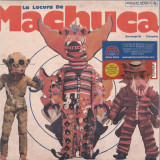
La Locura de Machuca is the story of one man’s bizarre odyssey into Colombia’s coastal music underground, and the wild, hypnotic sounds he helped bring up to the surface.
One night in 1975, a successful tax lawyer named Rafael Machuca had his mind blown in Barranquilla’s ‘Plaza de los Musicos’. Overnight he went from a high ranking position in the Columbian revenue authority to visionary production guru of the newly formed record label that bore his name, Discos Machuca, and for the next six years he devoted his life to releasing some of the strangest, most experimental Afro Psychedelia Cumbias ever produced. La Locura de Machuca is the story of one man’s bizarre odyssey into Colombia’s coastal music underground, and the wild, hypnotic sounds he helped bring up to the surface.
The Colombian music industry was thriving in the mid-seventies, but while homegrown bolero and vallenato tunes were doing well on the charts, it was imported African records that were setting crowds on fire at the picos – the sound-systems that fuelled neighbourhood parties – and wherever those records were played there were always a handful of groups who were inspired to plug traditional Cumbia directly into the electric currents coming from across the Atlantic.
It was these obscure bands, who fused Colombian and African rhythms with the swirling organs and psychedelic guitars of underground rock, that fired Machuca’s imagination. While the label made its money releasing popular hits by legends such as Alejandro Durán and Aníbal Velásquez, that money was poured back into a unique run of experimental releases by fringe artists such as La Banda Africana, King Somalie, Conjunto Barbacoa, and Abelardo Carbono, one of the godfathers of Champeta Criolla.
When Machuca couldn’t find groups to realise his particular vision, he simply created them himself. Drawing on a fearsome roster of musicians associated with the label, he assembled bands that lasted only as long as it took to record an album ,and unleashed the results – complete with arrestingly unusual album covers – under a series of different names such as Samba Negra or El Grupo Folclórico. This unorthodox approach led his longtime recording engineer, Eduardo Dávila, to describes Machuca’s productions as the “B-Movies of Colombian music.”
The story of Doctor Machuca and his eccentric exploits tells of one of Colombia’s most atypical and peculiar record companies; a defining pillar of Afro-Caribbean psychedelia. His productions have come to represent the roots of Champeta and set the pedigree standards for Afro and Costeño avant-garde. The seventeen tracks on La Locura de Machuca, harvested from the darkest, strangest corners of the Discos Machuca catalogue, sound like little else recorded before or since.
out of Stock
Last delivered 5 years ago available to reorder, subject to availability
It seems that every major jazz artist has a one-off sort of record in their discography, be it with strings, voices, spoken word or - as in this case - a foray into the funkier side of jazz. Charlie Rouse (going here as Charles Rouse) gets his chance on Two Is One, a funky soul jazz excursion on Strata-East, the artist-run label where creativity and pushing boundaries was at the forefront. Playing mostly with a group of session musicians, Rouse put together an album that may stray a bit from his hard bop roots, but is nonetheless an enjoyable and at times inventive record. The style of music played here - sophisticated soul jazz with some post bop and spiritual jazz thrown in for good measure - is very much a product of it's time. 1974 saw a whole slew of artists stretching the boundaries of what jazz music could be, combining elements from the past two decades into electric jazz adventures. The piano-less group that Rouse put together is a funky one, with lots of rhythmic playing behind either the searching solos of Rouse on the tenor or some inventive electric guitar work from either George Davis or Paul Metzke who appear together on all but a couple of tracks. Cal Scott gets plenty of time to shine throughout on what sounds like an electrified cello, an unusual instrument for modern jazz to be sure, but one that manages to fit in just fine here.
The first side of the album is all slow burning soul jazz, highlighted by the opening track "Bitchin'" where Rouse shows off that he is more than capable of setting down soulful lines over a funky backbeat. The second side is where the group gets a whole lot more inventive, particularly on the title track where they mix some post bop madness with the soul jazz sound. "Two Is One" features different tempos throughout: in the "first section" the bass plays in 9/8 time, the drums in 6/8 time and the cello and tenor are in 3/4 time. For the "second section" the rhythm section switches to 7/8 time while cello and tenor move to 4/4 time. Stanley Clarke is on bass here and his deep and twisty electric bass line is placed prominently up front.
"Two Is One" is certainly the highlight of the album from a pure jazz standpoint, and it lives up to it's title, which according to Gene Lewis' liner notes is taken from a Thelonious Monk phrase meaning two people so in tune with one another that they become one. The album finishes off with "In His Presence Searching," a spiritually informed jazz number that is reminiscent of the work being done during this period by the likes of Pharoah Sanders and Gary Bartz, (while not being quite as out there as their best work). The tune is all rhythmic glory, with Rouse and Scott playing introspective and penetrating solos throughout. It's a nice album closer, and a good reminder that while Two Is One may be best known for it's funkier excursions, Rouse had a few tricks up his sleeve and the album, when taken as a whole, is a complete statement from a legendary jazz musician.
Blue vinyl includes mp3 download, 12 x 24 inch poster: Some say life only makes sense in reverse, from the vantage point of your rear view - Magic Mirror is a looking glass of sorts. Like a modern day Alice in Wonderland, Pearl Charles beckons you to slip and fall into her world. You'll find yourself drifting with the tide - the ups, downs, and all-arounds of a life well-lived and well- loved. From start to finish you float along a reflective river, dancing in your own/the personal/private Studio 54 of your living room, decked out in sequins or nothing at all. It's a feel good album that asks us to actually take the time to feel good. Magic Mirror follows the cartography of a girl, growing into a woman, as she moves through life from singledom, to the expansive space of self-reflection, and the newly appreciated perspective of coming back together again and finding yourself, this time with someone new. A love letter to the self, a dance party for life, and at times as introspective as your best trip, Pearl takes us on a journey that, like life & love, has the tendency to surprise, delight, and leave you breathless. All you have to do is let yourself enjoy it.
Shame follow up their wildly acclaimed debut with a James Ford-produced peek into the riddled mind of the band's frontman, Charlie Steen. There are moments on Drunk Tank Pink where you almost have to reach for the sleeve to check this is the same band who made 2018's Songs Of Praise. Such is the jump Shame have made from the riotous post-punk of their debut to the sprawling adventurism and twitching anxieties laid out here. The South Londoner's blood and guts spirit, that wink and grin of devious charm, is still present, it's just that it's grown into something bigger, something deeper, more ambitious and unflinchingly honest. The genius of Drunk Tank Pink is how these lyrical themes dovetail with the music. Opener Alphabet dissects the premise of performance over a siren call of nervous, jerking guitars, its chorus thrown out like a beer bottle across a mosh pit. Songs spin off and lurch into unexpected directions throughout here, be it March Day's escalating aural panic attack or the shapeshifting darkness of Snow Day. There's a Berlin era Bowie beauty to the lovelorn Human For A Minute while closer Station Wagon weaves from a downbeat mooch into a souring, soullifting climax in which Steen elevates himself beyond the clouds and into the heavens. Or at least that's what it sounds like. From the womb to the clouds (sort of), Shame are currently very much in the pink.
Shame follow up their wildly acclaimed debut with a James Ford-produced peek into the riddled mind of the band's frontman, Charlie Steen. There are moments on Drunk Tank Pink where you almost have to reach for the sleeve to check this is the same band who made 2018's Songs Of Praise. Such is the jump Shame have made from the riotous post-punk of their debut to the sprawling adventurism and twitching anxieties laid out here. The South Londoner's blood and guts spirit, that wink and grin of devious charm, is still present, it's just that it's grown into something bigger, something deeper, more ambitious and unflinchingly honest. The genius of Drunk Tank Pink is how these lyrical themes dovetail with the music. Opener Alphabet dissects the premise of performance over a siren call of nervous, jerking guitars, its chorus thrown out like a beer bottle across a mosh pit. Songs spin off and lurch into unexpected directions throughout here, be it March Day's escalating aural panic attack or the shapeshifting darkness of Snow Day. There's a Berlin era Bowie beauty to the lovelorn Human For A Minute while closer Station Wagon weaves from a downbeat mooch into a souring, soullifting climax in which Steen elevates himself beyond the clouds and into the heavens. Or at least that's what it sounds like. From the womb to the clouds (sort of), Shame are currently very much in the pink.
Germany Exclusive on Smoke Marble Vinyl, only 1000 copies available. Shame follow up their wildly acclaimed debut with a James Ford-produced peek into the riddled mind of the band's frontman, Charlie Steen. There are moments on Drunk Tank Pink where you almost have to reach for the sleeve to check this is the same band who made 2018's Songs Of Praise. Such is the jump Shame have made from the riotous post-punk of their debut to the sprawling adventurism and twitching anxieties laid out here. The South Londoner's blood and guts spirit, that wink and grin of devious charm, is still present, it's just that it's grown into something bigger, something deeper, more ambitious and unflinchingly honest. The genius of Drunk Tank Pink is how these lyrical themes dovetail with the music. Opener Alphabet dissects the premise of performance over a siren call of nervous, jerking guitars, its chorus thrown out like a beer bottle across a mosh pit. Songs spin off and lurch into unexpected directions throughout here, be it March Day's escalating aural panic attack or the shapeshifting darkness of Snow Day. There's a Berlin era Bowie beauty to the lovelorn Human For A Minute while closer Station Wagon weaves from a downbeat mooch into a souring, soullifting climax in which Steen elevates himself beyond the clouds and into the heavens. Or at least that's what it sounds like. From the womb to the clouds (sort of), Shame are currently very much in the pink.
Musa Ancestral Streams remains a relative oddity in the pantheon of jazz's black consciousness movement -- a solo piano set of stunning reach and scope, its adherence to intimacy contrasts sharply with the bold, multi-dimensional sensibilities that signify the vast majority of post-Coltrane excursions into spiritual expression, yet the sheer soulfulness and abandon of Stanley Cowell's performance nevertheless vaults the record into the same physical and metaphysical planes. Cowell's energy and touch are remarkable, as if guided by divine power, and for all the music's structural spaciousness and rhythmic freedom, not a note feels out of place, let alone excessive. Most intriguing is "Travelin' Man," an overdubbed "duet" featuring Cowell on both acoustic and electric piano that underscores his uncommon affinity for space and presence.
In 1978 Pharoah Sanders went into the studio with pianist, Ed Kelly, who was an important figure in the local San Francisco and Oakland jazz scene. The two of them recorded six tracks which ranged from covers of standards, through soul jazz through to two real gems. The album was originally released as Ed Kelly and Friend due to Pharoah being contracted to Arista Records at the time. Indeed, as you can see, the cover shows Kelly playing next to Pharoah’s hat, shoes and Selmer tenor saxophone.
Rainbow Song, a Kelly composition, opens matters in a manner far removed from Pharoah’s work on his Impulse albums (although there had been a dramatic change of course when he signed with Arista and recorded). This is firmly in Grover Washington Junior territory with a liberal sprinkling of oh so tasteful strings. The Master’s sound is full and mighty as ever.
With the radio track out of the way it is business as hoped for and Newborn is a Sanders composition that burns with intensity. The power of his solo is as good as anything he has produced and he runs over the full span of the tenor’s range and onwards into territory lesser known or explored by 99% of sax players.
Sam Cooke’s You Send Me is treated with reverence and respect, with Pharoah delivering a sensitive and heartfelt rendition and ending with some extraordinary phonics, which we will meet again on later albums. Kelly’s accompaniment complements Sander’s playing before he receives his own space for a shimmering yet restrained solo which discloses what this non-pianist assumes to be an agile right hand.
Answer Me My Love is an early 50’s ballad with a fascinating back story. On its initial release in post-war Britain, covers of this fine melody stirred sufficient controversy for the song to be banned by the BBC. What led to it being barred from broadcast on the Light Programme and treated like Anarchy For The UK, Wet Dream and Give Ireland Back To The Irish? I can reveal that the reason for this draconian action was that the original version was entitled ‘Answer Me, My Lord’. In the olden days, it seems that a direct appeal to God was considered to be blasphemous- especially if set in a secular or selfish. Further research indicates that Nat King Cole made the most celebrated recording and that Bob Dylan used to sing it live in the 1990’s, presumably during his overtly Christian phase. Anyway, it is a grand tune.
Pharoah went on to record at least three studio versions of his great anthem You’ve Got To Have Freedom but the one here is the earliest incarnation that I am aware of. It is also the most restrained treatment of the theme, although Pharoah’s solo shows his ability to play with fire and power over the entire range of the horn. There’s plenty of space for Kelly’s piano too and he provides an elegant setting for Sanders’ exploratory work.
"I first heard Lady In Satin in a mega-shopping mall somewhere in San Francisco. I was about 20 years old and didn't know much about Billie's records or her life or how her voice changed over the years. Anyway, the sound was coming from the other side of the mall and I remember mistaking her voice for a beautiful perfectly distorted electric guitar - some other-world thing floating there on this strange mournful ocean of strings and I was hooked for life. Ten years later in 2006 I recorded an electric guitar instrumental version of "I'm A Fool To Want You" for my album Post-War. In 2018 I performed a concert in LA. of all the songs from Lady In Satin as a quintet and began preparing guitar arrangements for the recordings compiled on this record - Think of Spring. The title comes from a poem written in 1924 by Jane Brown-Thompson that eventually became "I Get Along Without You Very Well" in 1938 - the first song here. The conceit of Think of Spring is to filter the songs and strings from Lady In Satin through a single acoustic guitar using various alternate tunings and a minimal amount of textures and studio manipulation. most of the songs were recorded on an analog Tascam four track. Think of Spring is inspired by Billie Holiday, Ray Ellis, J.J. Johnson, John Fahey and Robert Johnson. Proceeds from this record will benefit Inner-City Arts & Donors Choose via PLUS1 for Black Lives Fund." - M. Ward
Shame follow up their wildly acclaimed debut with a James Ford-produced peek into the riddled mind of the band's frontman, Charlie Steen. There are moments on Drunk Tank Pink where you almost have to reach for the sleeve to check this is the same band who made 2018's Songs Of Praise. Such is the jump Shame have made from the riotous post-punk of their debut to the sprawling adventurism and twitching anxieties laid out here. The South Londoner's blood and guts spirit, that wink and grin of devious charm, is still present, it's just that it's grown into something bigger, something deeper, more ambitious and unflinchingly honest. The genius of Drunk Tank Pink is how these lyrical themes dovetail with the music. Opener Alphabet dissects the premise of performance over a siren call of nervous, jerking guitars, its chorus thrown out like a beer bottle across a mosh pit. Songs spin off and lurch into unexpected directions throughout here, be it March Day's escalating aural panic attack or the shapeshifting darkness of Snow Day. There's a Berlin era Bowie beauty to the lovelorn Human For A Minute while closer Station Wagon weaves from a downbeat mooch into a souring, soullifting climax in which Steen elevates himself beyond the clouds and into the heavens. Or at least that's what it sounds like. From the womb to the clouds (sort of), Shame are currently very much in the pink.
While on lockdown, Senbeï exchanged a lot with his fans on social networks, offering them a collaborative project. From these discussions a dedicated Facebook group has been created on which his fans proposed ideas, arrangements and instrumental interpretations.
So many possible inspirations that allowed Senbeï to then play the conductor, composing new titles based on these exchanges.
The fans were also invited to propose titles for the album and graphic proposals ... TOITSU - unification in Japanese - as well as the work of Adrien Waterlot (a fan) were chosen by the members, to represent this work common.
SENBEÏ talks about it:
This project was launched during the 2020 lockdown. Like a lot of people, I found myself stuck at home, no more work, no more touring. I wanted to take the opportunity to launch a collaborative project by appealing to my fans via social networks. At first, I just imagined doing a song, picking from their ideas, a sample here, a guitar take there. I didn't think it would take on this magnitude. We quickly reached more than 500 people on a dedicated discussion group. And then it all got wrapped up. 4 months later, Toitsu was complete.
It wasn't just music, but also incredible general goodwill, good mood, lots of support, sharing, dedication and humor. All of that helped me orchestrate this happy mess in record time.
"Toitsu" means "Unification". Without those who participated, this album would not exist.
Remastered by Bob Weston, ‘Mountains’ comes back to us as a gold foil-embossed gatefold double LP and includes the previously unreleased original takes of ‘Return to Pirates’, ‘Poison Moon’ and ‘Killed by the Telephone’, which were delivered along with the original master tapes 20 years ago but were omitted from the final album.
The record is completed by a newly recorded orchestral version of ‘Valley of One Thousand Perfumes’ produced by composer Joe Wong (Russian Doll, Midnight Gospel) and mixed by Dave Fridmann.
At the turn of the Century, Timony (Ex Hex, Wild Flag, Hammered Hulls) was already a celebrated presence in American underground music - a fixture of D.C. and Boston rock ’n’ roll via her work in Autoclave and Helium respectively. By 1998, though, Helium was drawing to a close and Timony was feeling uncertain about the future. “I had never been good at the rock ‘n’ roll business, and making a living from being in a band just didn't seem like it was in the realm of possibility for me,” she writes. “I just knew I wanted to make another record because that was the part of being in a band that I liked the most.”