Gatupreto, enigmatic duo, hiding their identity while exploring the common ground between an idealized African feeling and the classic references of the dance movement from the 80's and 90's. The art Gatupreto generates is simple, unpretentious and sincere, it owes to the classic rave vibe as much as to the rawness of hip hop.. as much to the sunset of Cape Verde as to the sunrise of the Lisbon riverside.
Gatupreto is a binomial entity that refers to itself as one, it was rescued from anonymity by TINK! Music, newly founded label split between Amsterdam and Lisbon. To the extend of most people's knowledge, Gatupreto comes from a colorful Lisbon suburb where they inhabit a luxurious house, on an isolated hill where music is made every day.
Those who have seen them perform live say they are frenetic and deep in their sound. At night all cats are black.
Cerca:povo
- 1
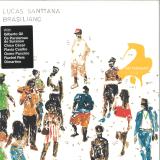
Lucas Santtana’s tenth album celebrates the vitality and musicality of the Romance languages.
The heir to Brazilian tropicalism, Santtana marks 25 years of his career with Brasiliano, a true collective celebration that brings together prestigious collaborators: Gilberto Gil, Oxmo Puccino, Flavia Coelho, Piers Faccini, Chico César, Paralamas do Sucesso, Cocanha, Dimartino, Karyna Gomes, Tainara Takua, Rachel Reis and Maria Lado.
Sung in eight different languages, Brasiliano is both an ode to linguistic diversity and a testament to its symbolic power. Carried by luminous and layered arrangements where voices intertwine like a polyphonic conversation, the album treats language as a musical instrument in its own right, but also as a political tool. Santtana questions cultural heritage, identity, colonial memory, and the possibility of a shared language. With his singular approach—blending popular rhythms, contemporary soundscapes and vibrant melodies—he celebrates the love and exchange embodied in Romance languages, where music becomes fertile ground for encounters and reinvention.
- A1: Me Pega
- A2: Tem Carnaval
- A3: Sexy Doce
- B1: Coeur
- B2: Então Tá Bem
- B3: Para Ser Feliz
- B4: Tô Nem Aí
Fresh from releasing projects on Method 808 and Future Classic, landing a huge collaboration with Chloé Caillet, and delivering an official remix for Fatboy Slim, PPJ are entering a new chapter in full force. Their expansive take on global street sounds, ranging from neoperreo to Miami bass, gets a cool re-coating.
Led by the magnetic vocalist Páula, with production from Povoa (individually supported by Four Tet, Ben UFO, and Barry Can't Swim, with recent releases on Live From Earth), the duo operates in maximalist mode: playful, sensual, and slightly unhinged.PPJ’s new era, JOKER, embraces a figure that appears everywhere from card decks to carnival culture as a symbol that mirrors their own DNA: funny, eerie, seductive, unpredictable. The EP leans further into club territory, but rather than polishing their edges, PPJ amplify them.
At the emotional core of the record sits “Coeur,” co-produced with Chloé Caillet. It begins with an MPB-tinged foundation flirting with bossa nova. It’s unmistakably Brazilian, bathed in sunset hues before being sped up and twisted into a dance-floor-ready electronic form. The groove shimmers with tension: warm percussion, elastic basslines, and Páula’s voice hovering between intimacy and tease. It feels like a remix of itself, romantic, but slightly untrustworthy.
If “Coeur” glows, “To Nem Ai” is a slow burner. A very deep and downtempo house cut, it unfolds slowly, almost luxuriously, guided by sensual vocals that feel whispered directly into the ear of the listener. A hypnotizing piano sample that feels like a late-night confession. It’s the kind of record that transforms a dancefloor into something tactile.
Elsewhere, “Me Pega” is a high-energy reinterpretation of the tech-house sounds from Santa Catarina, one of southern Brazil’s most feverish party states, twisted and accelerated for ferocious impact. Drawing direct inspiration from Sarro, a raw and vibrant Brazilian street dance, the track captures physical intensity in its purest form: sweat, bass pressure, collective release.
Its counterpart, “Tem Carnaval” channels Páula’s vivid storytelling into a thunderous ode to Rio’s carnival spirit, euphoric, chaotic, cinematic landed just in time for this year’s celebrations.
On “Sexy Doce,” rugged electroclash melodies collide with unexpected references. “It was inspired by Budots, which is dance music from the streets in the Philippines,” Povoa explains. “Then we mixed it with Páula’s Brazilian vocals. Baile funk is similarly from the streets, so there is a connection.” The result is raw yet futuristic, a cross-continental flirtation that feels both underground and explosive.
With this new EP, PPJ make music like they’re tuning into a dozen pirate frequencies at once. Pirate radio from Rio to Berlin to Manila intercepting fragments of street culture, sensuality, and chaos, and stitching them into something deliriously cohesive.
JOKER doesn’t just nod to club culture. It challenges it, twists expectation and leaves a lasting impression.
Recorded live in one session at age 18, this album helped launch Tania Maria's career as an acclaimed Brazilian jazz artist, celebrated for her virtuoso combination of piano and vocals. Produced by Romeo Nunes (Meirelles e Os Copa 5, Rio 65 Trio, Elis Regina, Elza Soares), the album features the pioneering Edison Machado, who transformed samba and was instrumental in the development of Bossa Nova through his groundbreaking "samba no prato" (samba on the cymbals) technique. His work helped shape the sounds of Jobim, Getz, and Milton Nascimento. On guitar is the legendary Neco, who played on over 500 albums. Initially self-taught, he later studied under maestros Guerra Peixe and Moacir Santos. He collaborated with icons like Elis Regina and Chico Buarque, and was a member of Os Ipanemas, Os Catedráticos, and Os Gatos. His solo work includes Velvet Bossa Nova (1966), which became an acid jazz favorite. The album features compositions by Caetano Veloso and Marcos Valle,alongside early samba classics.
Blending Brazilian rhythms with elements of samba, bossanova, and jazz fusion,it captures the early development of Tania Maria's signature style. Born in São Luís, Brazil in 1948,Tania Maria began playing piano at age seven. She learned samba, jazz, and chorinho through her father's weekend jam sessions. Leading her own band by age13, she performed across the region while collecting records from influential artists. Though she earned a law degree and started a family,her passion for musicu ltimately won out—she left law to pursue music full-time.
Continuing our exploration of São Tomé and Príncipe with DJ Tom B., Les Disques Bongo Joe proudly announces the release of África Negra Anthology Vol. 2. We've carefully selected and remastered 13 standout tracks for this volume, digitized from studio tapes by their tour manager. The album includes a booklet with updated liner notes and vintage photos of the group.
África Negra, established in the early 1970s by Horacio and Emidio Pontes, is São Tomé and Príncipe's most renowned musical group. Their blend of Puxa and Rumba, infused with Leonildo Barros' guitar riffs, Armando Tito's bass lines, and vibrant percussion, gained them recognition beyond the archipelago. This volume offers a glimpse into their musical journey, featuring unreleased sessions from 1979 and 1990, showcasing lead vocalists like João Seria and Sergio Fonseca.
Continuing our exploration of Sao Tomé and Príncipe with DJ Tom B., Les Disques Bongo Joe proudly announces the release of Africa Negra Anthology Vol. 2. We"ve carefully selected and remastered 13 standout tracks for this volume, digitized from studio tapes by their tour manager. The album includes a booklet with updated liner notes and vintage photos of the group.
The Brazilian composer, pianist and producer, Mário Castro Neves and his group, Samba S. A.'s self-titled album from 1967 is oozing with class. It possesses that archetypal 60's bossa nova, jazz, samba sound. We’d place it up there with Sergio Mendes at his finest, Tambo Trio or Milton Banana. It’s a breezy ride that touches on easy listening at times, but it holds it together with a cool swagger. Biba and Thaís Do Amaral's vocals are on point, with a relaxed delivery that compliments the tracks with the sublime beauty à la vocal groups such as Quarteto Em Cy, who Biba also sang with, as well as with Antonio Adolfo's e A Brazuca. Also appearing on the record is bassist extraordinaire, Novelli who worked with Milton Nascimento, Nelson Angelo E Joyce, Airto, and many of the greats of Brazilian music of the time.
The album has long been a favourite with DJs and collectors over the years, with songs selected for compilations by Gilles Peterson and Nicola Conte. One of the centrepieces of the album, 'Candomblé’, has been sampled by Cut Chemist on his track 'Povo De Santo'. The song 'Naña' is punchy and light with dancefloor-jazz appeal. The gloriously catchy 'Vem Balançar' is a brilliant bossa shuffler. A superb listen throughout, the album sticks to a framework but delivers in spades.
Though released on the major-label RCA Victor, original copies are elusive, sought-after items with a price tag to match. For this reissue, we have opted for the Mono master, mirroring the original 1967 Brazilian pressing. Instantly familiar, the album has a welcoming feeling of nostalgia and is something that stays with you from the first listen.
- A1: Memory Of The Gods (Full Version)
- A2: Opening Act
- A3: Carbo Village ~ Pious Believers
- A4: A Deus
- A5: Dangerous Zone
- A6: That Which Lurks In The Darkness
- A7: Garmia Tower
- B1: Fight!! Ver.1
- B2: You Won’t Be Able To Kill Me Just Like That!
- B3: Come On, Let’s Travel
- B4: Agear Town ~ Cursed Land
- B5: Commercial City Of Liligue ~ Pretense Of Prosperity
- B6: The Broken Seal
- B7: Having Dinner
- C1: Purification Of Darkness ~ Battle With The Parts
- C2: Nightmare Village Mirumu ~ A Good, Unknown Anxiety
- C3: Fight!! Ver.2
- C4: St. Heim Papal State ~ Pious Believers
- C5: Granas Sanctuary
- C6: Granasaber
- D1: Cyrum Kingdom ~ Prosperity And Freedom
- D2: Live! Live!! Live!!!
- D3: Cyrum Castle
- D4: Cyrum Kingdom Announcement ~ March
- D5: Romance At A Windy Isle
- D6: Have Faith In Yourself
- D7: Fight!! Ver.3 ~ Middle Boss Battle
- D8: Heh, They Didn’t Even Get To Fight Back!
- E1: Skye’s Reminiscence
- E2: Nanan Village ~ Placid Nature
- E3: Traditional Song ~ The Villager’s Chorus
- E4: Despair And Hope
- E5: Elegy
- E6: Collapse
- E7: The Mythical World
- F1: Valmar
- F2: A Farewell, And Decision
- F3: Ryudo Awakens ~ Prayers Of The People
- F4: Fight!! Ver.4 ~ The Final Battle
- F5: Canção Do Povo
Join Ryudo and his team on their greatest adventure yet! We're delighted to be collaborating again with Game Arts on this new vinyl edition of the Grandia II soundtrack, composed and arranged by Noriyuki Iwadare and entirely remastered for the vinyl format!
A cult title for the Dreamcast released in Japan in 2000 and acclaimed in particular for its innovative combat system, the game recently benefited from a remastered version in 2019 on Nintendo Switch and PC.
The Grandia II Memorial Soundtrack Edition comes in the form of a luxurious vinyl box set, newly illustrated for the occasion by the game's original character designer, Youshi Kanoe.
It contains 3 yellow color discs inserted in individually illustrated sleeves and a newly designed 16-page booklet with illustrations by Youshi Kanoe and new comments from the team, including Kei Shigema (Scenario Writer), Atsuko Nishida (Designer), Noriyuki Iwadare (Composer) and vocal Kaori Kawasumi.
The Grandia II Original Soundtrack CD Edition comes in the form of a luxurious box set, newly illustrated for the occasion by the game's original character designer, Youshi Kanoe.
It includes 2 CDs and a 16-page booklet with illustrations by Youshi Kanoe and new comments from the team, including Kei Shigema (scriptwriter), Atsuko Nishida (designer), Noriyuki Iwadare (composer) and singer Kaori Kawasumi.
- A1: Fado Hilário
- A2: Há Festa Na Mouraria
- A3: Povo Que Lavas No Rio
- A4: Solidão
- A5: (Canção Do Mar)
- A6: Maria Lisboa
- A7: Foi Deus
- B1: Estranha Forma De Vida
- B2: Ai Mouraria
- B3: Lisboa Não Sejas Francesa
- B4: Barco Negro
- B5: Primavera
- B6: Tudo Isto É Fado
- B7: Cansaço
- B8: Nem Ás Paredes Confesso
- B9: Uma Casa Portuguesa
She not only popularized fado throughout South America, she reinvented it; singing material that moved far beyond the traditional tales of failed romance to explore instead the deepest crises of the soul and spirit.
Limited edition audiophile pressing on 180gram premium vinyl.
Thanks to her, an internationally unknown folk music like Portuguese fado became a medium of universal expression known throughout the world. This collection includes some of her greatest hits, including such perennial classics as
"Uma Casa Portuguesa", "Ai Mouraria", and the unforgettable "Coimbra", also known as April in Portugal.
AMÁLIA RODRIGUES, vocals, with:
Jaime Santos - Portuguese guitar, Santos Moreira - Spanish classical guitar, Domingo Camarinha - Portuguese guitar, Castro Mota - Spanish classical guitar,Raul Nery - Portuguese guitar,José Nunes - Portuguese guitar. Orchestra conducted by Frederico Valério.
Sessions recorded between 1951 and 1962 in Lisbon Paris, and London.
Rare & unreleased 80's bangers from Sao Tome e Principe's most iconic singer !
Bongo Joe pursues their work with friend DJ Tom B and are sharing the fourth effort in their São Tomé & Principe series : “Recordar é viver”, the first volume of an anthology dedicated to the one and only Pedro Lima, , "A voz do povo de São Tomé" (the people's voice of Sao Tomé).
“Recordar é viver: Antologia Vol. 1” features some previously unreleased tracks and gives a comprehensive look into the discography of one of the islands’ biggest stars, known for his political outspokenness as much as for his soft voice, delicate rumbas, and high-energy puxas.
With his band Os Leonenses he built a brand new genre around the strong rhythms and infectious energy of Sao-Toméan Samba Socopé ("only with the feet” in Portuguese), but with the influence of Congolese soukous, Cape Verdean Coladeira, elements from French West-Indies Cadence/Compas, and Brazilian Afoxé, it soon developed into the infectiously danceable style known as “puxa”. The band kept playing together up until Pedro’s death in 2019, performing at large events around the islands and on the continent.
But Pedro shined also on his own. Alone, he demonstrated his compositional skills and ability to balance the band’s powerful rhythm section with São Tomé & Principe’s harmonic backing vocal traditions, creating strong, dance floor ready puxas or melodic, delicate rumbas.
Pedro Lima died in 2019, leaving behind the 23 children he fathered, with thousands of mourners accompanying him to his final resting place. The public funeral, paid for by ex-president Pinto da Costa, was one of the biggest the islands have ever seen. Lima, "O cantor do povo” (“The people’s singer”), was buried with his wireless microphone, so his powerful voice would always be heard.
Drei Vinylpremieren und zwei Neuauflagen füllen als hochwertige 180g-Pallas-Pressungen Lücken in der LP-Sammlung.
VINYL-PREMIEREN / BISLANG NUR ALS CD ERHÄLTLICH / REMASTERT / DOPPEL-LPs:
Till Brönner “That Summer” (2004): sommerliche Jazz-Vocals und Instrumentals, smoother Funk- und
Brazil-Grooves, noch immer eines seiner beliebtesten Verve-Alben
Barbara Dennerlein “Take Off” (1995): groovende Hammond-B3-Tracks in klassischer Verve- und BlueNote-Tradition, aufgenommen in New York mit All-Star-Band aus Roy Hargrove, Mitch Watkins, Dennis
Chambers u.a., internationaler Durchbruch von Deutschlands “First Lady of Jazz” Rolf Joachim Kühn Quartett ”Lifeline” (2012): mit den Gästen John Patitucci und Brian Blade, Gipfeltreffen zweier deutscher und zweier amerikanischer Jazzlegenden, ausgezeichnet mit dem Deutschen Schallplattenpreis VERGRIFFENE KLASSIKER ENDLICH WIEDER AUF LP / REMASTERT / 1-LP:
Elis Regina und Toots Thielemans ”Elis & Toots” (1969): aufgenommen in Stockholm, klingt aber so fröhlich und heiß wie direkt unter dem Zuckerhut in Rio entstanden, ein mitreißender Klassiker des BrasilJazz “Joyce Live At The Mojo Club” (1995): brasilianische Kultmusikerin gab rares Deutschland-Konzert im
legendären Hamburger Club und begeisterte das Publikum mit heißer Samba, Bossa Nova und MPB, ein Klassiker des Rare-Groove
- 1: Uma Casa Portuguesa
- 2: 1 Lisboa Nao Sejas Francesa
- 3: 1 Nem As Paredes Confesso
- 4: 1 Foi Deus
- 5: 1 Fado Amalia
- 6: 1 Tudo Isto É Fado
- 7: 1 Coimbra
- 8: 1 Estranha Forma De Vida
- 9: 1 Barco Negro (Mae Preta)
- 10: 1 Lisboa A Noite
- 11: 1 Ai, Mouraria F
- 12: 1 Fadista Louco
- 13: 1 Maria Lisboa
- 14: 1 Povo Que Lavas No Rio
Once upon a time Mr. Tomato made his way to Brazil. Surprisingly it was the time of the carnival in Rio de Janeiro, and he was drawn right into the heart of it. He was so overwhelmed by the joyful celebration that he ended up partying without sleeping for 3 days. Just before this “love” experience came to an end he was attracted by a bunch of people singing in the street: “Tudo que eles querem, é ver o povo daqui sofrer Retidos na miséria e a elite no poder
Fado is the popular folk music of the cities of Portugal and is an
expression of "saudade". "Saudade" is a difficult word to translate for it means many things, sadness, longing for someone or something, the past or even the future; nostalgia, yearning, wistfulness all of which is expressed not only in words and music, but is the very vocal qualities of the singer. Amalia Rodrigues and fado have come to mean the same thing. Amalia is the goddess of fado, and although there are many fado singers in Lisbon, Amalia reigns supreme. Even without understanding Portuguese one can feel "saudade" when listening to her thrilling voice.
There are no two voices like these. The late Amália Rodrigues, the Queen of Fado, a unique singer up there with the great voices of 20th century popular song like Piaf, Sinatra, Ella, Oum Kalthoum. Mariza, the young singer that has helped bring Fado into the 21st century. Two of the greatest and most influential stylists of Fado, the ex-libris of Portuguese popular music, a world cultural heritage.
Two artists who have a lot in common, beyond their origin. Mariza swept global audiences off their feet like only Amália had done in the 1950s and 1960s, with her residences at legendary venues such as the Paris Olympia or Carnegie Hall. Through her critically acclaimed recordings and unexpected collaborations, Mariza expanded what Fado could be – just like Amália had done in the 1960s and 1970s. Mariza became the ambassador of Portugal’s music in the 21st century like only Amália had been able to be in the 20th century.
2020, the 20th anniversary of Mariza’s career, the centenary of Amália’s birth. “This the best way I can find to pay my tribute to Amália, and to thank her for the legacy and inspiration she gave us,” says Mariza. It’s been a long time coming, but now it’s here: Mariza Sings Amália. Ten Amália standards reinvented for the 21st century, their soul intact, their identity unmistakable, their stylings unexpected.
For this new album, Mariza invited an old friend – Brazilian musician and producer Jaques Morelenbaum, regular accomplice of Ryuichi Sakamoto or Caetano Veloso. Morelenbaum produced Mariza’s triple-platinum 2005 album Transparente; here, he creates a seductive, inspired series of orchestral arrangements, simultaneously classic and innovative, that allow Mariza to delve into songs we all thought we knew and make them new, fresh, ravishing.
Mariza may have performed all over the world, may have multi-platinum albums that topped charts throughout the glove, may have received endless prestigious awards – but in the studio, face to face with the standards that defined Fado for global audiences, Mariza is starting from scratch. She has recorded Amália before, but never like this, never with this wisdom, this experience, this power of interpretation. Now was the time to try on for size the great Amália classics: “Gaivota”, “Estranha Forma de Vida”, “Com que Voz”, “Fado Português”, “Povo que Lavas no Rio”, “Foi Deus”... Ten in all for an album where Mariza more than lives up to her awards, her success, her performances and assumes the mantle only Amália wore before: that of an ambassador of music, culture, talent.
Recorded between Lisbon and Rio de Janeiro, Mariza sings Amália. Like only Amália could have done, like only Mariza can. Is it Fado? Yes, and no. Above all, it’s a match made in heaven.
Following the release of Milton Nascimento’s Maria Maria, Far Out Recordings proudly presents Nascimento’s 1980 follow up. With the success of Maria Maria in 1976 behind them, Nascimento reunited with his writing partner Fernando Brant in 1980 to produce another ballet, ‘Ultimo Trem (Last train)’. This time, they chose to tackle a more contemporarily relevant subject, the impact of the closure of a train line that connected certain towns and cities in the North East of Minas Gerais to the coast. “The military government shut down the route and the whole region began to fade away,” explains Milton. “I love train rides” adds the composer, “But today there are almost no trains to Brazil. So when I go to the US and Europe, any time I can, I go by train. The longer the journey the better.”
Featuring much of the same all-star line-up as Maria Maria – including legendary Brazilian musicians Naná Vasconcelos, João Donato, Paulinho Jobim and members of Som Imaginário, amongst many others, like Maria Maria, the album holds what Milton himself considers to be the definitive versions of some of his most beloved tracks, including 'Saídas E Bandeiras' and 'Ponte de Areia'.
The title track, ‘Ultimo Trem’ – performed exquisitely by Zezé Mota with a choir and piano – is a mournful lament about the human consequences of the axed line. The ballet brought great media attention to the campaign against closure. “Most of Fernando’s lyrics have some political tone,” says Milton, “This one helped the area a lot because the politicians grew concerned about the subjects.”
Fernando’s and Milton’s shared passion for the sounds, smells and memories of trains, inspired the soundtrack for the production which premièred in 1980. ‘A Viagem (The trip)’, launched with a train’s steam whistle, sees Milton’s guitar moving to a train’s rhythm. In contrast to the usual lyricism, ‘Bicho Homen (Beastly man)’ and ‘Decreto (Degree)’ are atypically upbeat and funky, their vocals a mesh of wordless male voices resembling the then fashionable Swingles Singers’ renderings of Bach. ‘E Daí? (And so what?)’, and ‘Olho d’Agua (Water’s Eye)’ were both drawn from ‘Clube Da Esquina’. ‘Olho d’Agua’ is mellow and delicate and Milton’s homage to the great voices of Brazil whilst ‘E Daí? (And so what?)’ is a stunning mosaic of voices. The unusual ‘O Velho (The Old Man)’ conjures up an image of an old shaman singing alone into the wind against the cries of nature. Perhaps the most affecting songs are Nascimento’s ‘Itamarandiba’ and ‘Oração (Prayer)’. The latter is a cry for a change in the situation whilst ‘Itamarandiba’ ends with an upbeat, whirling Hammond organ and guitar timepiece. The closing track ‘Ponta de Areia (Sand Edge)’, was based on one of Fernando’s newspaper stories and became one of Milton’s most famous pieces, covered by musicians across the planet, including Wayne Shorter and Earth, Wind and Fire. It reappeared as a ghostly 45-seconds memory on the ‘Milton e Gil’ album, his millennial collaboration with Gilberto Gil.
After 27 years of being locked inside contracts and record company legalities, these sublime songs were finally released in 2003 as a double CD package, along with Maria Maria. Set for its first ever vinyl release for this year’s Record Store Day, on limited edition red vinyl, Ultimo Trem sounds as fresh and relevant now as when Brazilian music was still a South American secret.
“Lugar Alto presents their very first release: the incredibly rare and absolutely stunning “Homenagem”, by Leonardo V. Boccia. This is a forgotten gem from the eighties that examines traditional Brazilian themes such as choro, northeastern folk, and capoeira with touches of eighties electronics and new age.
Leonardo Boccia is a musician, multi-instrumentalist, composer, researcher and university professor of Culture and Society at the Federal University of Bahia, whose interests include sound studies, manipulation of sound media, audiosphere and aesthetics, musical theatre, audio culture and neuromusic.
Born in Italy, this respected academic studied music in Berlin, moved to Rio de Janeiro and established himself in Salvador where he was invited to research the northeastern music of Bahia. There he created the experimental group Macchina Naturale, an eclectic combo that performed regularly during his stay. In November 1980, Boccia participated in the first Instrumental Music Festival of Bahia as a soloist where he performed works of his own.
But it was in 1983 that Professor Boccia composed, directed and produced the LP Homenagem. With photos by renowned photographer and artist Mario Cravo Neto for the front and back cover of the booklet, the album presents new and original compositions for instrumental ensembles, such as: Choro Fantasia – for guitar and berimbau -, Canção para Iracema, Homenagem and Lenda do Sertão. The LP was originally released on January 3rd, 1984, with a live performance in the main hall of the Castro Alves Theatre under the title Tribute to Brazilian Music, with the participation of vocalist Sueli Sodré, who contributes to the album, instrumentalists Zeno Millet and Onias Camardelli, accompanied by choreography and visuals.
Much of Homenagem examines the genre of Brazilian music known as Choro, or Chorinho, a genre which appeared in Rio de Janeiro in the 19th century. Choro is regarded as the first typically Brazilian urban music and, over the years, it has come to be considered one of the most prestigious genres of national popular music. Stylistically, it originates from Lundu, a percussion-based rhythm of African inspiration but also influenced by European genres. The instrumental composition of choro was based on the trinca flute, guitar and cavaquinho. Over time, other wind and string instruments were incorporated.
Here, in Homenagem, Professor Boccia deliberately mixes the old and the new, the traditional and the innovative; the album is the environment of Chorinho reconsidered and recontextualized, and its melodies and harmonies still capable of surprises. Just listen to “Terra e Povo” – it has an almost proto-acid-house quality to it, while the synth washes on “Mãe Natureza” with the ethereal vocal stylings of Sueli Sodré ushering in the progressive quality of the album.
Too long out of print, new label Lugar Alto now offers you the chance to reappraise this fascinating reissue of yet another forgotten chapter in Brazilian music.”
- 1