. It started in a cafe in Chico, California, with a flier, covered in glitter, wires, feathers, and assorted melted items, with a three-word advertisement: “Noise person wanted.” It wasn’t a sign. It was a sample. A tiny piece lifted from the visionary environment that the band XDS would continue building over the next couple of decades, hoarding an eclectic stockpile of collage materials/influences/approaches for assembling psychedelic dance-punk jams played with homemade instruments, blown-out samples, off-kilter drumming and dub baselines. Shoko Horikawa had come from Japan to (the small, music-crazy college town) Chico for school, and responded to Jesse Hall’s mysterious flier and a pitch to collaborate on making interesting sounds. The partnership would end up featuring her syncopated polyrhythmic drums alongside his vocals (through a duct tape-and-PVC-pipe mic) and custom-built Guitar-o-bass, plus synths/samplers and various noise-making devices. The two-piece Experimental Dental School eventually morphed into XDS as the duo moved the operation from Chico to Oakland to Portland and back to Chico, touring the world (playing alongside the likes of Deerhoof and other innovators) and releasing 11 recordings (on Cochon Records, German label TCWGA, etc.) as they went. On the new XDS album, Bicycle Ripper, the band’s genre-bending roots are as deep as ever, but the goal now is to be less “noise” people and more “fun” people. The songs are weird yet cohesive, with jittery grooves and inventive hooks. Throw a dart at the album and hit “Hot Panther, Cold Moon” for one random sample: an unrelenting fuzzed-out bass dances with a insistent drums; a sharp turn into sparse tin-can-guitar break; then a return to the dance floor with a bonus overdriven bass riff and full-throttle drums. The Panther stays hot whether she’s under the “hot hot sun” or the “cold cold moon.” It’s all very irresistible and, yes, really really fun
Search:psy def x
white 2x12"[47,86 €]
Obwohl Wasser auf den ersten Blick geschmeidig und veränderlich wirkt, kann es plötzlich hart und wild werden. Daher ist Wasser das perfekte Element für "Aion", das dritte Album der deutschen Psychedelic Doom Erneuerer BEES MADE HONEY IN THE VEIN TREE. Lyrisch erscheint Wasser auf "Aion" sowohl als Lebensspender als auch aufgrund seiner dunklen und bedrohlichen Seite. Musikalisch liefern BEES MADE HONEY dynamische, weitläufige Kompositionen, die von schwebender Ruhe bis hin zu wütenden Ausbrüchen reichen. Die konstante Gezeitenbewegung der musikalischen Ebbe und Flut übersetzt sich in spacige Gitarren, tropfende Basslinien und flüssige Drum-Fills, gekrönt von hallenden Clean-Gesängen. Der Albumtitel leitet sich vom griechischen Wort ???? (ai?n) ab, das übersetzt "Ewigkeit" bedeutet und im englischen Wort "aeon" für "Zeitalter" steht. BEES MADE HONEY IN THE VEIN TREE werden 2014 in Stuttgart gegründet. Da sich alle vier Mitglieder seit ihrer Kindheit kennen und einen akademischen Hintergrund haben, definiert die Band von Anfang an klare Ziele: An erster Stelle steht die Klangvision, krachende Doom-Metal-Riffs mit den sphärischen Klängen von Post- und Psychedelic-Rock zu kontrastieren. BEES MADE HONEY legen ihr musikalisches Konzept bereits mit dem Debütalbum "Medicine" im Jahr 2017 fest, das die solide Grundlage für ihren sich ständig weiterentwickelnden Sound bildet. Das zweite Album "Grandmother" (2019) erweitert den Soundhorizont durch tiefer gestimmte Gitarren, verdichtete Effekte, schnellere Passagen und einen härteren Gesangsstil. Die Schwaben treten außerdem im In- und Ausland vor einem stetig wachsenden Publikum auf, was zur Aufnahme und Veröffentlichung von "Harvestmen (live)" im Jahr 2022 führt. Setzt die Segel und gleitet mit BEES MADE HONEY IN THE VEIN TREE über die Zeitmeere von "Aion" auf der Suche nach der Schönheit der Ewigkeit.
black 2x12"[45,34 €]
Obwohl Wasser auf den ersten Blick geschmeidig und veränderlich wirkt, kann es plötzlich hart und wild werden. Daher ist Wasser das perfekte Element für "Aion", das dritte Album der deutschen Psychedelic Doom Erneuerer BEES MADE HONEY IN THE VEIN TREE. Lyrisch erscheint Wasser auf "Aion" sowohl als Lebensspender als auch aufgrund seiner dunklen und bedrohlichen Seite. Musikalisch liefern BEES MADE HONEY dynamische, weitläufige Kompositionen, die von schwebender Ruhe bis hin zu wütenden Ausbrüchen reichen. Die konstante Gezeitenbewegung der musikalischen Ebbe und Flut übersetzt sich in spacige Gitarren, tropfende Basslinien und flüssige Drum-Fills, gekrönt von hallenden Clean-Gesängen. Der Albumtitel leitet sich vom griechischen Wort ???? (ai?n) ab, das übersetzt "Ewigkeit" bedeutet und im englischen Wort "aeon" für "Zeitalter" steht. BEES MADE HONEY IN THE VEIN TREE werden 2014 in Stuttgart gegründet. Da sich alle vier Mitglieder seit ihrer Kindheit kennen und einen akademischen Hintergrund haben, definiert die Band von Anfang an klare Ziele: An erster Stelle steht die Klangvision, krachende Doom-Metal-Riffs mit den sphärischen Klängen von Post- und Psychedelic-Rock zu kontrastieren. BEES MADE HONEY legen ihr musikalisches Konzept bereits mit dem Debütalbum "Medicine" im Jahr 2017 fest, das die solide Grundlage für ihren sich ständig weiterentwickelnden Sound bildet. Das zweite Album "Grandmother" (2019) erweitert den Soundhorizont durch tiefer gestimmte Gitarren, verdichtete Effekte, schnellere Passagen und einen härteren Gesangsstil. Die Schwaben treten außerdem im In- und Ausland vor einem stetig wachsenden Publikum auf, was zur Aufnahme und Veröffentlichung von "Harvestmen (live)" im Jahr 2022 führt. Setzt die Segel und gleitet mit BEES MADE HONEY IN THE VEIN TREE über die Zeitmeere von "Aion" auf der Suche nach der Schönheit der Ewigkeit.
Three years after the original release date of Caterina Barbieri’s career defining album Ecstatic Computation, the Italian artist reissues the record on her newly found own label light-years.
Caterina Barbieri is an Italian composer who explores themes related to machine intelligence and object oriented perception in sound through a focus on minimalism. Ecstatic Computation revolves
around the creative use of complex sequencing techniques and pattern-based operations to explore the artefacts of human perception and memory processes by ultimately inducing a sense of ecstasy and contemplation. Computation is turned from being a formal, automatic writing technique into a creative, psychedelic practice to generate temporal hallucinations. A state of trance and wonder where the perception of time is distorted and challenged.
Equally nervous and ecstatic, the fast permutation of patterns can create a state where time stands still whilst simultaneously being in motion. Is this propulsive music moving forward or backward? As
long as the perception of the present is constantly enhanced and refreshed in an endless sense of loss, re-discovery and the search for self-orientation this question lies mute aside the thrilling and perplexing moment of the matter at hand.
Suff Daddy (578k monthly listeners on Spotify), is one of the legendary beatmakers who shaped a whole era of bedroom producers. His unique approach and musical understanding sets him apart from all the other fish in the pond. He has released countless genre-defining albums and EP’s over the past 15 years building a loyal fanbase. Suff Daddy's songs have previously been featured in many editorial playlists including Spotify's "Jazz Vibes" (2.1M Likes), "BUTTER" (770k Likes), "Sweet Soul Chillout" (1.2M Likes) and many more.
Introducing "Hair Of The Dog," Suff Daddys musical journey that blends instrumental hip-hop, electronic, and dance genres. This captivating album, produced with his own Suff Style invites listeners to unwind From start to finish. Once again a Suff Daddy album thrives on the pure brilliance of his on way to create music. The album's cover art, masterfully crafted by the renowned painter Mitch (@itsallinsideus, 165k Followers), adds an intriguing visual dimension to the experience. Both artists have known each other for a long time and are currently preparing their audiovisual release- event for August 18th in Berlin. Bringing their art together as a unique experience for their audience.
The phrase "Hair of the dog that bit you" commonly denotes consuming alcohol as a remedy for a hangover, aiming to alleviate its effects. Suff Daddy plans to introduce his own hangover solution, which will be plant-based and devoid of alcohol. Through all of his career he frequently played with alcohol references and now its the perfect timing to release his own hangover cure. Additionally, this endeavor will serve as a social media catalyst for the entire project.
Fünftes Album von Holy Wave aus Austin, Texas. Im Tarot steht die Karte der Fünf Kelche für Verlust und Trauer. Die Karte zeigt eine verhüllte Gestalt mit gesenktem Kopf, die über drei verschüttete Kelche blickt, während sie die beiden verbleibenden Gefäße ignoriert. Die Fünf Kelche wird im Allgemeinen so interpretiert, dass sie ein verzweifeltes Verharren in der Vergangenheit und die Unfähigkeit darstellt, die positiven Dinge der Gegenwart zu schätzen. Die Tarotkarte wurde zur Muse für das sechste Album von Holy Wave, "Five of Cups". Zu Beginn ihrer Karriere lehnten sich Holy Wave in ein ruhiges Reich der Psychedelik zurück und verzichteten auf lange Jams und Gitarren-Heldentaten zugunsten eines verträumten Pop-Ansatzes. Als sich die Band weiterentwickelte, wich der frühe Sgt. Peppers-meets-the-Velvets-Sound ausgefeilteren Melodien und einer ausgefallenen Instrumentierung und lenkte ihre Musik weg von sonnengebleichter Nostalgie hin zu einer farbenfrohen Dimension, in der sich Klänge der Vergangenheit, Gegenwart und Zukunft vermischten. Wie Pink Floyd in den frühen 70er Jahren haben Holy Wave es verstanden, auf ihrem neuen Album aus dem Pathos ein Gefühl tiefer Erheiterung zu zaubern, indem sie dunkle Elemente durch eine Linse filtern und sie in ein Kaleidoskop des Lichts verwandeln. Five of Cups eröffnet mit dem Titeltrack, der von Anfang an den auditiven und thematischen Modus Operandi des Albums festlegt. Die lysergische Texturpalette von Holy Wave wird sofort in den wabernden Synthie-Leads und dem Gitarren-Jangle des Songs deutlich, aber die untypischen Akkordfolgen und die Gesangsmelodie lenken die Musik weg vom anodynen Eskapismus hin zu einer nachdenklichen Auseinandersetzung zwischen Selbstbestimmung und Defätismus. Holy Wave reiten weiter auf dem wehmütigen und phantasmatischen Zug von "Bog Song" und schwanken zwischen Anschwellungen von strengen Moll-Akkorden und überlagerter elektrischer Orchestrierung. Die zuvor veröffentlichte Single "Chaparral" spielt mit der Nostalgie der Band und verwebt Verweise auf ihre Vergangenheit in El Paso zu einem Teppich des transzendentalen Triumphs. Wie so oft bei klassischer, albumorientierter Rockmusik entfaltet sich die wahre Magie erst in der zweiten Hälfte von Five of Cups. Auf "The Darkest Timeline" rekrutieren Holy Wave ihre Freunde Lorena Quintanilla und Alberto Gonzalez von dem Psych-Duo Lorelle Meets The Obsolete aus Baja California, Mexiko, um ihren berauschenden After-Mid-Night-Grooves zusätzliche ätherische Schichten hinzuzufügen. "Nothing in the Dark" funktioniert nach einem ähnlichen Prinzip, wobei ein gleichmäßiges, treibendes Schlagzeugmuster als Fundament für bandverwaschene Synthesizer, arpeggierte Gitarrenakkorde, Fuzz-Sounds und ruhige Vocals dient. Die Überlegungen von Five of Cups zur Bekämpfung von Niederlagen und Enttäuschungen werden im letzten Stück des Albums, "Happier", direkt aufgegriffen. Wieder einmal auf der melodischen Linie zwischen Melancholie und luftiger Raffinesse, untersuchen Holy Wave das synthetische Konstrukt des Glücks in unserem modernen Zeitalter und wie oft die Erlangung von Komfort jegliches wahre Gefühl von Freude vermissen lässt. Dennoch ist dies kein nihilistisches Klagelied. Vielmehr ist es eine beschwingte Erinnerung daran, dass die Bandbreite menschlicher Erfahrung von Natur aus Höhen und Tiefen erfordert und dass Euphorie oft in der Suche außerhalb des Vertrauten zu finden ist.
Fuzz Club's excavation of the underground has yielded another stellar discovery in coldwave duo Throw Down Bones. Their debut album is 8 tracks of instrumental electronica born from experimentation which dances between minimal rhythms and industrial soundscapes, shadowed by repeating riffs and persistent beats that got the crowds dancing at Psych Fest and the Fuzz Club Festival, London. To create this album, the band's experimental creative process saw them locked away in their alpine studio for a weeklong jam session, which was harvested for sounds, riffs and effects, from which they built the final tracks.. Their mix of infectious beats and the raw energy of live rock n roll make Throw Down Bones a great act to watch and a dark and modern definition of coldwave. 180g 45rpm double LP on coloured vinyl with alternative artwork and gatefold jacket limited to 300 hand-numbered copies.
Dot Allison returns with a new solo album, Consciousology. After over a decade away, the former One Dove singer and songwriter broke cover in 2021 with Heart-Shaped Scars and this new album follows just two years later, as she hits a purple patch of songwriting. It’s also her first full release for Sonic Cathedral after contributing to Mark Peters’ acclaimed Red Sunset Dreams last year. Consciousology finds multi-instrumentalist Dot joined by the London Contemporary Orchestra, her new labelmate Andy Bell from Ride, who plays guitar on two tracks, and Hannah Peel, who is responsible for some of the string arrangements with both the LCO and a stellar group of Scottish string players. It expands on the styles and themes of the previous album, all while pushing everything just that little bit further – the songs sound bigger, more avant-garde and experimental and, occasionally, properly out-there and psychedelic. “I wanted to make some albums that felt like a set, exploring love, what lies beyond the visible and how all these aspects dovetail together,” explains Dot. “I see Consciousology a more psych Heart-Shaped Scars with a far fuller, more immersive sound and so, in that sense, it’s a more wayward, bolder, rule-breaking partner.” Right from the eye-catching artwork by PJ Harvey collaborator Maria Mochnacz it definitely does not play it safe. It veers from the techno-played-as-folk of opener ‘Shyness Of Crowns’ and ‘220Hz’ and the Linda Perhacs-meets-The Velvet Underground chug of the first single ‘Unchanged’ to the Mercury Rev-style fantasia of ‘Bleached By The Sun’, the Brian Wilson-esque harmonies of ‘Moon Flowers’ and the kaleidoscopic colour trip of ‘Double Rainbow’. Elsewhere there are echoes of Desertshore-era Nico, Jack Nitzsche’s work with Neil Young, Karen Dalton and Anne Briggs before the relative simplicity of the Tim Hardin-inspired closer ‘Weeping Roses’. It’s a brilliant, breathtaking record.
The year is 1989. Techno’s second generation has begun to permeate the globe leading a young Carl Craig to a tiny village in the countryside of Belgium. It is here, undistracted and determined to break out, that Craig encounters one of the country’s only drum machines, an Alesis controlled midi-808. In a single session he composes and mixes a handful of records that are still to this day regarded as some of his most raw and explosive contributions to the fabric of electronic music history.
Carl revisits this fateful chapter through the lens of a famed cut from his Psyche alias ‘From Beyond’, with a ‘C2 2023 Mix’ and remixes from Seth Troxler, Ataxia and Admn, out July 14 on Planet E Communications.
The Psyche alias, known for early Transmat releases like ‘Crackdown’ and ‘Elements’, embodied a stripped back, less sample based yin attitude to the yang of Carl’s more aggressive 69 and sample-forward BFC and Paperclip People identities. ‘From Beyond’, first released in 1990 via the ‘Crackdown’ 12” on Transmat, offers an eerie glimpse into the simplistic production that came through Carl’s mastery of the 808 and the sonic value of restricting himself to this movement defining tool.
This new ‘From Beyond’ package sees Carl lift and bend the original in his ‘C2 2023 Mix’ alongside a package of remixes from artists near to the hearts of Detroit and the Planet E fold. Seth Troxler brings a subdued acid tinge to the package, while label regular Ataxia pays homage to the source material with a renewed percussive energy, followed by a soulful rework by Admn.
Whether it be through the 30 year repertoire of his seminal Planet E, his Party / After-Party sound and light installation now on display at Los Angeles’ MOCA, or his continuous work as a champion of Black-led creativity, the Carl Craig mission remains the same: to always rep Detroit and be the realest mutha f***a alive.
GER Als Night Beats erschafft der in Texas geborene und in LA lebende Künstler Danny Lee Blackwell Musik, wie man ein Puzzle zusammensetzen könnte. Der psychedelische Autorenfilmer aus dem Westen baut sein Werk aus einem Moment, einer Initialzündung, auf, die bestimmte Kriterien erfüllen muss: Sie muss ihm Gänsehaut bereiten. Wenn dieses Gefühl eintritt, verfolgt Blackwell die Idee unermüdlich, bis er einen neuen Song hat; wenn nicht, geht er zum nächsten Moment über, immer auf der Suche nach dem perfekten Molekül eines Songs. Auf seinem sechsten Night Beats-Album "Rajan" zeigt sich der Songwriter von seiner besten Seite und erschafft Werke, die mit fesselnden Melodien und hypnotischen Rhythmen glänzen, aber auch durch subtile handwerkliche Entscheidungen unterstrichen werden, die nur nach unzähligen Stunden im Studio erreicht werden können. Blackwell erschafft ein Werk, das irgendwo zwischen Spaghetti-Western-Filmmusik und Psych-Pop-Opus angesiedelt ist, ein karrierebestimmendes Album, das viel über Danny Lee Blackwells künstlerische Philosophie verrät und gleichzeitig den so wichtigen Hauch des Geheimnisvollen bewahrt. Exklusiv für den Indie-Handel, todesrote LP, handnummeriert mit Poster und DLC.
ENG As Night Beats, Texas-born, LA-based artist Danny Lee Blackwell creates music like one might assemble a puzzle. The Western psychedelic auteur builds his work from one moment, an initial spark, that must fit a certain criteria: it must give him goosebumps. If that sensation arrives, Blackwell will pursue the idea relentlessly until he has a new song; if not, he moves onto the next moment, constantly looking for the perfect molecule of a song. On his sixth Night Beats album, 'Rajan', the songwriter is at his strongest, creating works that shine with captivating melodies and hypnotic rhythms, but are underscored by subtle choices of craftsmanship that can only be achieved after countless hours in the studio. Blackwell creates a work that lands somewhere between Spaghetti Western film score and psych-pop opus, a career-defining album that reveals much about Danny Lee Blackwell's artistic philosophy while keeping that ever crucial air of mystery intact. Indies only LP on 180g 'Dying Red Giant' coloured vinyl, limited to 350 hand-numbered copies, fold-out art poster, download card included.
Available for the first time on vinyl - a 20th anniversary release of The Mystic Chords Of Memory's seminal, unique DIY psych-folk debut. By Beachwood Sparks singer/songwriter Chris Gunst & Aislers Set's Jen Cohen. Mastered at Abbey Road. The seeds of this exquisite album are scattered among the tracks of Make The Cowboy Robots Cry - the LP Beachwood Sparks hung their hats on before a ten year break. A further step forward from west coast country psych towards something with folkier roots but new, mysterious and above all free. Chris and Jen's conjuring of magical, unforced, domestic spirituality. Recorded in a little wood cabin amongst the redwoods overlooking a running creek with a range of collected musical toys. Just give it 5 minutes once you’ve dropped the needle & you’ll be right there. Here’s Amanda Petrussich’s brilliant write up in Pitchfork - “With its soft melodies, sweet vocals, and scratchy DIY production, Mystic Chords of Memory is also an overwhelmingly intimate record, focused and domestic - much closer to Elliott Smith than former-benchmarks the Byrds and Buffalo Springfield…. The duo's wordy moniker was lifted from Abraham Lincoln's first inaugural address, a lecture delivered in the spring of 1861 and boldly eternalised at the base of Mount Rushmore... Appropriately, the band's sound is just as archaic as a truly striking political speech: Gunst and Cohen blend tinkling bells, melodica, harp, keyboards, bits of samples, tinny drums, and strummy guitars, presenting a vaguely contemporary update on the British folk phenomenon of the late 1960s with more blips. Mystic Chords of Memory is a surprisingly coherent re-introduction to Gunst, and his professional coupling with Jen Cohen has proven both a freeing and inspired move.” Two decades later it’s obvious how seminal a record they conjured up. They forged a path that came to define the wave of US indie that followed for a while. In our opinion, the original has a natural, guileless, effortless beauty that trumps them all. Without a whiff of Starbucks. "Mystic chords of memory speech I interpreted the meaning as the underlying psyche fabric we are all creating on this land together. Jen and I thought it would be a great name to inspire our music together. This was really close to post 9/11 times and we were thinking about all of this and also wanting to improve our own contribution to the psychological fabric of the world.” Chis Gunst.
Three years after the original release date of Caterina Barbieri’s career defining album Ecstatic Computation, the Italian artist reissues the record on her newly found own label light-years.
Caterina Barbieri is an Italian composer who explores themes related to machine intelligence and object oriented perception in sound through a focus on minimalism. Ecstatic Computation revolves
around the creative use of complex sequencing techniques and pattern-based operations to explore the artefacts of human perception and memory processes by ultimately inducing a sense of ecstasy and contemplation. Computation is turned from being a formal, automatic writing technique into a creative, psychedelic practice to generate temporal hallucinations. A state of trance and wonder where the perception of time is distorted and challenged.
Equally nervous and ecstatic, the fast permutation of patterns can create a state where time stands still whilst simultaneously being in motion. Is this propulsive music moving forward or backward? As
long as the perception of the present is constantly enhanced and refreshed in an endless sense of loss, re-discovery and the search for self-orientation this question lies mute aside the thrilling and perplexing moment of the matter at hand.
- A1: Elevator Up
- A2: Delta 5
- A3: Gorellas
- A4: Double Xx
- A5: Knc
- A6: Heavy Defication
- B1: I Get
- B2: Clap Your Hands
- B3: Tons Of Drums
- B4: 2 Minutes Left
- B5: King Brain
- C1: Trash Out
- C2: Rolls Royce White
- C3: Hip Hop And R&B Broke Up
- C4: Get Down With Me
- D1: A Pllace
- D2: Delta 6
- D3: Hard Future
- D4: 125Th Street
- D5: Give Me Frequencies
- D6: The Rap-Up
Ced Gee & Kool Keith, both members of the legendary Ultramagnetic MC's, regroup for a new Ultramagnetic MC's record. The resurgence of classic Hip hop moves strong into 2022 with new release from Ultramagnetic MC's "Kool Keith x Ced Gee." Arising from the Boogie Down Bronx in the mid-'80s as a far-flung hip hop trio with a heap of new ideas to try out, Ultramagnetics Kool Keith, Ced Gee, and DJ Moe Love occupy something of a singular place in the old-school pantheon. Combining funk-heavy tracks with jeep-rocking beats and obscure lyrical references, Ultramagnetic MCs have a list of firsts to their credit: the first rap group to employ a sampler as an instrument, the first to feature extensive use of live instrumentation, the first to feature a former psychiatric patient (Kool Keith) on the mic. Early singles like "Something Else" and "Space Groove" were block-party staples and created waves in the underground, eventually landing the group on the disco-dominated Next Plateau label, where they released their underappreciated debut. The following years found the group shuffling from label to label, releasing albums on Mercury and Wild Pitch before splitting to pursue various projects. This special event will feature Kool Keith and Ced Gee performing classic Ultramagnetic MCs songs and sharing stories and history about the making of their iconoclastic catalogue.
Borrowed Tongue is the debut solo album by Korean singer-songwriter Minhwi Lee. It’s a mysterious, strangely compelling thing, an album of rare poetry, and remarkably self-assured. Originally released in November 2016, the album made waves, winning best folk album of 2016 at the 14th Korean Music Awards. Its eight songs, written and predominantly arranged by Lee, don’t reveal their secrets easily, or at first blush; rather, they take their time slowly to unfurl in her listeners’ worlds. There are hints of other music here, from time to time: the intimacy of Stina Nordenstam, perhaps; the gauzy haze of Hope Sandoval, on the blissed-out pop of “Broken Mirror”; there are touches of acid-folk, and ECM jazz, and a slyly filmic approach to songwriting and arrangement that makes every song fit perfectly into the album’s arc.
Lee arrived at her solo music through a complex, circuitous route. After studying musicology in Seoul, she learned her trade, film scoring, in New York and Paris. She also studied classical music, blowing off steam in a wild punk duo, Mukimukimanmansu, who released one album, 2012, on Korean indie label Beatball. Subsequently, Lee has been refining her music, focusing both on her solo songs, and on writing for television series and films; she’s written scores for films by such directors as Sangmoon Lee, Jeongwon Kam, and Wanmin Lee. She also plays in the jazz outfit Cubed, and recently joined doom metal group Gawthrop on bass.
Since its release in 2016, Borrowed Tongue has slowly bewitched listeners with its idiosyncratic arrangements and evocative songwriting. It’s an album that hints at plenty, but refuses to make grand statements, something Lee seems intent to pursue: in correspondence, she’s very clear that she wants these songs to enact a kind of transmutation, to be adopted into the listeners’ lives and exist within their own imaginings. She does, however, offer a few hints to what propels these mercurial songs, explaining, “this album is about a person who again opens their mouth, which was once shut. The album deals with what it means to speak: things that are known but not said, things that should be said but are not, things that cannot be said but nonetheless are.”
This may well explain the curious mood of Borrowed Tongue, the multiple ‘voices’ that inhabit the album; Lee’s singing voice is pliable and mutable, approaching each song as its own diorama and ensuring the song is sung with just the right tone. The arrangements Lee conjures for her songs are all in service to narrative and melody; they appear to her alongside the composition, which is surely why everything here fits together so beautifully. From there, Lee approaches her songs carefully, in deference to their ‘need to be sung’ a certain way. There isn’t a moment wasted: everything on Borrowed Tongue is as it needs to be, whether a melancholy folk song taking to the air, or a psychedelic reverie dreamed into being. It’s a beautiful, poised and confident debut.
Second album from West London, singer-songwriter, producer and multi-instrumentalist, Oscar Lang. A split from his childhood sweetheart sent Lang spiralling, dramatically changing the course of the follow-up to the psychedelic-tinged fuzzy-rock of his 2021 debut Chew The Scenery at the same time as driving Lang into the most creatively fruitful period of his short career. The diversion has resulted in Look Now, an astounding record that makes Lang’s previous output sound like he was just testing the waters. Chew The Scenery and three melodically-breezy EPs that preceded it introduced Lang as a songwriter of rare talents but here is where he really lays down a marker, emerging with an album that takes in playful hooks, poignant lyricism, orchestral swells, ba-roque-pop instrumentation, a record that’s expansive but never overblown, intimate at the same time as being epic. It is his definitive artistic statement. Formats; CD, LP
The Remainder comprise of Blancmange’s Neil Arthur (vocals, guitar and synthesisers), solo artist Finlay Shakespeare (synthesisers and vocals) and Liam Hutton (drums, guitar and synthesisers). The latter - best known for his work with Boxed In, Neneh Cherry and more recently, Young Fathers - initiated the writing process back in 2015. ‘There was never a clear brief or definition of the project that we were working towards collectively’, he explains. ‘It was always a completely open statement.’ The trio’s crisp, glacial rhythms, cascading synths, shadowy psychedelia, absurd humour and lyrical x-rays of everyday life all feature strongly on their forward-looking debut album. The hypnotic, beat-driven songs are a way of venting; facing up and expressing a strange new positivity in spite of all the darkness. Each song is also linked by interludes created by Liam’s mother Jo Hutton, a recording engineer and composer/sound designer of experimental music and sound art.
Under the moniker of Jaye Jayle, Louisville guitarist/vocalist Evan Patterson has spent over a decade exploring the more abstract realms of the American singer-songwriter process. On his latest album, Don't Let Your Love Life Let You Down, Patterson continues to mine his unique strain of the meditative blues while finally breaking the shackles of defeat and passing into a realm residing between Western stoicism and mystic wonder. Like Leonard Cohen fronting some intermediary step between Spacemen 3 and Spiritualized, Don't Let Your Love Life Get You Down, conjures an aura of psychedelic grace and enveloping warmth through its pairing of pensive baritone poetics, druggy studio manipulations, and gospel-infused blues. Abetted by the production and mixing skills of Ben Chisholm (Chelsea Wolfe). Across the eight songs of Don't Let Your Love Life Get You Down takes the old American singer-songwriter template and imbues it with a kaleidoscope of synesthesia delights culled from a half-century's worth of fringe music. This aural grandeur reinforces the life-affirming radiance of Don't Let Your Love Life Get You Down. Though Jaye Jayle retains the hypnotic repetition and austere instrumentation of their past, the added layers and saturation of sound intensifies the immersive hallucinatory spirit only previously hinted at in their work. As with all Jaye Jayle records, it's still best suited for the hours after midnight, but it now holds the promise of dawn. Jaye Jayle is Evan Patterson, with him as always is Todd Cook, Corey Smith, and Neal Argabright. With special guest Chris Maggio, Victoria Fisher, Patrick Shiroishi, and Bonnie `Prince' Billy. RIYL Leonard Cohen fronting Spiritualized, Spacemen 3, JJ Cale, Lungfish, Angels of Light, Young Widows Ltd single colour vinyl LP!
»Blank Vault / White Stains« is the new solo album by Franz Joseph Kaputt (DRNTTCKS, Otomatik Muziek, Hager/Kaputt). Under his S.U.V. alias, he presents nine highly personal, improvised synthesizer miniatures, accompanied by heavily delayed drum machines and enveloped in clouds of feedback. The music unveils a background rooted in years of noise exercises and ventures into the territories of dark, psychedelic folk, while showcasing a fondness for delicate synthesizer sounds and repetitive song structures. Layers of sound and rhythms collide and arrange themselves to create an idiosyncratic ambient/kraut music that explores the borders of when intimacy becomes toxic. It also delves into how relationships involving kink strategies can be used in a way that don‘t render one powerless or hurt, but ultimately leading to empowerment.
Side A is kind of an utopian dark room, filled with peculiar beats, drones, and dreamy synth arpeggios. Pleasure and joy are subversive acts that challenge and upend stereotypical role models. The pieces revolve around the mutual and consensual exploration of individual boundaries and the transformative states that emerge within these encounters – a unique entity, a »Body Of The Mind« if you will, is formed between individuals. Side B then represents the counterpart. Acid synths, distortion cascades and looped pianos evoke the regression from this playful and subversive approach on to sheer brutality and perverse destruction.
For more than a decade, Freak Heat Waves have been steadily amassing a cult following and earning acclaim from both critics and underground aficionados alike. Their music is a heady cocktail that defies easy categorization, blending elements of post-punk, psych, dub, ambient, house, and techno.
Their eclectic sound has served as the soundtrack to countless DIY punk shows, outsider galleries and sleazy discos, establishing the duo as iconoclasts with a reputation for ignoring expectations and subverting genre conventions. While at times, the term ‘acquired taste’ may have seemed fitting, their latest release offers their most alluring output to date.
Mondo Tempo, the duo's fifth LP, released through Vancouver's Mood Hut, was primarily recorded at their home studios in Montreal and Victoria. Building upon the electronic explorations of their previous record, Zap The Planet (Telephone Explosion), they inject their signature sound with a smoother and sweeter blend of dance music. The album’s tracks feature midi smoothness, trance mantras, dancehall grooves, ambient textures and vocal samples, creating a world that is both captivating and immersive.
Notably, the lead single “In A Moment Divine” features a collaboration with Cindy Lee, resulting in a dance floor number that boldly ventures beyond the familiar wheelhouses of both acts. With Mondo Tempo Freak Heat Waves solidify their reputation as one of the most exciting and unpredictable acts around.
12” LP cut at 45 (for the first time) (color vinyl only) Pressed on a 12" for the first time and cut at 45 RPM so it's EXTRA loud. Jacket is an extra hefty 24pt board with printed inner sleeve full of rare never before seen photos When Acid King pressed up their self-titled debut EP on a tape and started handing them out at shows with business cards, it wasn’t an aesthetic choice. It was 1993. And while the world was still reeling in the aftermath of grunge breaking big on rock radio, this dirty-as-hell trio founded by guitarist/vocalist Lori S. were digging into even heavier vibes. Born out of Lori's shiftless days of wasted youth hanging around Chicago-area public parks, Acid King laughingly adopted the name from the book 'Say You Love Satan' and its subject Ricky Kasso, a local drug dealer who killed a friend over angel dust, thereby becoming the stuff of Satanic Panic local news broadcasts all over the country. Founded after a move to San Francisco, Acid King were outliers on punker bills in the tradition of West Coast rifflords like Saint Vitus and Sleep, and this four-song outing captures them at their rawest. Long before the career-defining roll of Busse Woods (1999) and the psychedelic mastery of their latest offering, Beyond Vision, this EP set in motion one of American heavy rock’s most landmark careers. Presented on reissued vinyl through RidingEasy Records – the original 10” was on Sympathy for the Record Industry – Acid King’s Acid King also established one of the most crucial partnerships in underground rock in that between Lori S. and producer/engineer Billy Anderson (see also: Neurosis, Sleep, Om, Amenra, Eight Bells, Cattle Decapitation and too many others to list). As Acid King went on to help define stoner rock in the mid and late ’90s with Zoroaster (1995), their Man’s Ruin Records split with Altamont (‘97) and Busse Woods, that creative relationship would flourish no less than the band’s sound, and here it is distilled to its meanest and most elemental self. Led as ever by Lori, Acid King at the time featured bassist/vocalist Peter Lucas and drummer Joey Osbourne – legend has it both had to read 'Say You Love Satan' before joining – and Melvins drummer Dale Crover had a hand in producing it as well as singing lead on “The Midway” after Lucas took a turn on “Drop.” A preface to the many majesties to come throughout Acid King’s many-storied career, behold the formative incarnation that started it all. A piece of heavy rock history AND killer riffs? You can’t possibly go wrong. - JJ Koczan, May 2023
When he‘s not writing or recording, Baba Stiltz immerses in fearless fiction by the likes of Denis Johnson and Dodie Bellamy; prose where pedestrian details become transcendent in aggregate and the inner lives of marginal characters are examined as though they were kings.
A similar thesis runs through „Paid Testimony“, the essential second tape of minimalist guitar music from the FilipinoAmerican-Swedish artist.
In recent years, Stiltz has made like Lee Hazelwood‘s Cowboy In Sweden in reverse, making annual pilgrimages from Stockholm to California and reconnecting with his roots via a guitar and a Fostex 4- track. He‘s drawn to the less glamorous corners of the golden state, an observant habitué of unkempt streets and dive bars stretching from LA to Vacaville. It‘s a long stretch from the jetset techno clubs
where Baba originally plied his musical trade, but it‘s where he finds characters and ideas worth writing about.
The characters on „Paid Testimony“ are on the edge and on the run. Surrounded by flawed men with big schemes since childhood, he extrapolates characters who plot bank heists and order milk and vodka in AM hours, the type of confrontation- prone characters who „say some shit, make everyone uncomfortable and then just split.“ To focus on the rawness of this document would discount the humor and sympathy with which he treats his characters, not to mention the subtly- psychedelic songwriting recalling David Berman, early Smog, the original indie rock minimalist poets.
On the final song, Stiltz looks back on the city that raised him „Stockholm,“ referencing „young professionals carelessly living“ before adding „I can‘t say I‘m not jealous even though I live my life just like they do.“ There‘s an honesty in the small details revealed on „Paid Testimony“, and a defined sense of place, be it Stockholm, Sacramento or some dim barroom across from the Bank Of America.
Baba doesn‘t quite fit in anywhere. This outsider quality has often been used as a marketing tool, yet here, it lends a writerly aspect to the proceedings, an unreality to the everyday.
Bunker New York luminary Abby Echiverri joins the Patterns of Perception imprint with her Deformation EP, a diverse collection of playfully psychedelic techno tracks infused with a radiant cosmic energy.
Produced in 2021-22, Abby drew inspiration from the captivating physics simulations her partner was working on at the time, ultimately imbuing the music with an ethereal atmosphere that permeates the entire EP, and from which the tracks derive their names.
PTN03 presents a cohesive yet diverse collection of tracks, blending psychedelic energy with delicate and profound moments. Abby's music carries an almost hopeful quality, with drum programming that leans towards groove and shuffle, and the incorporation of diminished chords and progressions that pose questions to the listener. The Deformation EP is an intricate record that showcases Abby Echiverri's distinctive, three-dimensional approach to techno: one that never feels oppressive, but calls to mind a sense of exploration and freedom.
Hailing from the seaside communities surrounding Enoshima, a small island located 50 km southwest of Tokyo, Maya Ongaku is a ragtag collective of local musicians whose brand of earthy psychedelia transcends widely beyond the roots of their inner souls. The name derives not from any kind of ancient civilization, but rather a neologism defined as the imagined view outside one’s field of vision. The band—currently a trio of Tsutomu Sonoda, Ryota Takano, and Shoei Ikeda—finds sanctuary at the Ace General Store, a beachy vintage shop and salon-like space just hidden from sight from the bustling, touristy riverside Subana Street. Between discussions on music and art, curating the vinyl section and manning the register, and chatting up with locals young and old, the members find time to jam and record their spontaneous ideas in the studio tucked away in the back. It’s in this unlikely setting where Maya Ongaku finds its origins, the culmination of what Sonoda describes as 自然発生 (shizen hassei), meaning spontaneous generation, or the supposed production of living organisms from nonliving matter.
Approach to Anima, the group’s debut album released on Guruguru Brain, finds Maya Ongaku building a foundational groove while tapping into their innermost psyche. Sonoda’s malleable guitar and vocals, Takano’s sinuous bass lines, Ikeda’s floating woodwinds, and a sprinkling of delicate percussion—all coalesce into an aural experience that’s assertive yet abstract, calm but unsettling. The slow building, sax-laden “Approach” serves as an introduction to Maya Ongaku’s world, while the appropriately-named “Water Dream” floats its way toward the gentle finale of “Pillow Song.” It’s a concise distillation of their many interests and influences, from Neo-Dada and Fluxus, to where contemporary art intersects with the development of modern recording technology in the ‘60s and ‘70s.
As the title suggests, Approach to Anima is not intended to be a terminus; it’s merely the beginning of an exploration. The three childhood friends that comprise Maya Ongaku are always looking beyond the confines of the idyllic but rapidly gentrifying enclave of their beloved Enoshima. Feeding off of the energy that still radiates from the triumphant, decade-long journey of their label bosses’ band Kikagaku Moyo, who rose to global prominence from scrappy beginnings busking on the streets of Takadanobaba, they hope to go wherever inspiration takes them, to anywhere around the globe where their music can find a home.
Ultimately, Maya Ongaku’s uninhibited world-building will make it possible for us to see the unseen, expand the possibilities of the naked eye—all through the unbridled vibrancy of their music.
Nothing compares to Lewis Taylor and nobody crafts a "B-Side" quite like him. Indeed, his long deleted B-Sides are the stuff of legend. So, gathered together for the first time on one slice of wax, we present The Damn Rest: an album's worth of B-Sides from the era of the 1996 Lewis Taylor ("Damn") album. More off-the-wall and abstract than the album proper, these rare, underheard tracks burst with Lewis's uncompromising genius. A lot more experimental, the music is still drop dead beautiful. The Damn Rest is the essential bridge between Lewis Taylor and Lewis II.
Lewis Taylor's self-titled masterpiece from 1996 was to be originally called Damn. You can see the word right there on the from cover. However, concerns over distribution in the US scuppered this desired title. When thinking about what to call this collection of essential B-Sides from the era of that first album, we thought The Damn Rest would be appropriate. But these tracks aren't simply throwaways or outtakes, as Lewis himself states: "each little group were recorded specifically for the release of each 'single'." These B-Sides were simply the next thing to happen after self-titled, and before Lewis II. In other words, you need this!
The collection opens with "Asleep When You Come", the A2 on the original "Lucky" 12". It's a slow-mo string-drenched soul offering, cast in cinematic soft-focus with a vocal performance from the heavens set against wonky, shuffling drums and delicate instrumental flourishes. Beautiful. Also from the "Lucky" single, "You Got Me Thinking" may actually be Lewis' funkiest moment and is definitely one of our favourites, a great, gently psychedelic funky club track, that's for sure. Next, the gorgeous, meandering "I Dream The Better Dream" is just sheer, metronomic bliss, with shades of Stevie Wonder. Just ask D’Angelo, who included the track on his Feverish Phantasmagoria show for Sonos. Not only a celebrity-fan-favourite, it's Lewis's, too: "My favourite has always been this track. In my fantasy it’s what early Soft Machine would’ve sounded like if Marvin Gaye was their lead singer."
As we move to the B-sides from the "Whoever" single, the first to feature is "Pie In The Electric Sky / If I Lay Down". It's a brilliantly sprawling classic. A head-nod funk workout in two parts; part psychedelic heavy soul jam, part breezy Marvin-esque near-instrumental of the deeply lush variety. It needs to be heard to be believed. Astonishing! Flip over for "Waves", a shimmering, dramatic, sweeping string-led fan favourite. The climax of the song is just too stunning for words. It's followed by the deep wyrd-soul of "Trip So Heavy" the final, dizzying track from the "Whoever" single and another celestial funk delight featuring strings, organ, twisted bass and heavy drums. From the "Bittersweet" 12", "A Little Bit Tasty" is a building, schizophrenic soul-jazz epic that starts out with Lewis performing a call and (distant) response with himself over a gentle mid-90s drum loop before snatches of heavy, crunching metal guitars blast apart the otherwise neat song structure. Ultimately, it's unarguable that The Damn Rest is worth it for the inclusion of the jaw-dropping "Lewis III" alone. A dazzlingly lush and stunningly sophisticated prog/soul hybrid that owes as much to "Pet Sounds" as "What's Going On" with arrangements that grow and unfold in layers. Just sparkling.
A compilation like this feels like one of those promo-only rarities they used to give out to a select few back in the good old days, so when it came to the artwork it only made sense to follow what Cally Callomon (head of Island’s art department) had done for the singles and promos back in the 90s. He even did us some fresh scribbles of “The Damn Rest” to match his handwriting that’s all over the first album and its singles. We hope you like it as much as the music contained within. Simon Francis’s vinyl mastering ensures these classic recordings sound as great as they deserve to. The record has been cut by Cicely Balston at Air Studios and pressed at Record Industry. We've lost Prince. We still have Lewis.
- 01: Blacamerica
- 02: Uknowhut? (Ft. Blu)
- 03: Cost Of Business
- 04: Rob Peter, Pay Pallbearer (Ft. Daniel Luke)
- 05: Slo Pokes
- 06: The Green Monster (Ft. Solemn Brigham)
- 07: Zambezi Zinger (Ft. Tanya Morgan)
- 08: Lonely Planet
- 09: Yah's Shorthand
- 10: Service (Ft. Defcee)
- 11: President Streets
- 12: The All (Ft. Sleep Sinatra)
- 13: The Forgotten
The Expert vereint auf RITUAL Elemente aus Jazz und 1960er Psychedelia. Kombiniert mit MC Stik Figa in seiner ehrlichsten und persönlichsten Form, wird das Album zu einem überwältigenden Gesamtkunstwerk. Die Art und Weise, wie Jazzeinflüsse mit psychedelischer Produktion kollidieren, treibt sowohl den Dubliner Produzenten als auch den MC aus Kansas in neues Hip-Hop-Terrain. Zu allem gesellen sich Features von Blu, Solemn Brigham (Marlowe), Defcee, Sleep Sinatra, Tanya Morgan und Daniel Luke hinzu.
"The record is colorful, psychedelic, energetic. Revolutionary hip-hop." - NPR Music
"A psych-rock-tinged boom-bap opus." - Okayplayer
Clear LP[22,65 €]
Blue Lake is the musical moniker of American born, Copenhagen based multidisciplinary artist and musician Jason Dungan, who signs to the Tonal Union imprint for the release of his new longform album ‘Sun Arcs’. It follows 2022’s release ‘Stikling’, earning a nomination for ‘Album of the Year’ at the Danish Music Awards plus warm praise from The Hum blog and musicians and DJs alike including Jack Rollo (Time is Away/NTS) and Carla dal Forno. A self taught player, Dungan began freely experimenting with self-built multi-string instruments, preferring to build his own hybrid 48-string zither and working in the realms of left-field ambient music, off kilter folk and improvised acoustic minimalism.
The starting point of ‘Sun Arcs’ saw Jason travel for a week alone to Andersabo, a cabin set in the idyllic Swedish woods just outside of Unnaryd, known also as the music project, festival and residency space which has been run by Dungan since 2016, hosting artists like Sofie Birch, Johan Carøe and Ellen Arkbro. Whilst writing 1-2 pieces per day, a conscious decision was made to leave behind everyday distractions and shut out the outside world to instead focus on the natural passage of time as Dungan recalls: “My only sense of time came from these daily walks out in the woods with my dog, and an awareness of the sun’s path as it moved across the sky each day.”
The album’s immersive world unfolds with the opener ‘Dallas’, an ode to his home state and a musical synthesis of these two disparate spaces (Texas and Denmark), the touchstones of Dungan’s life. A folk-esque single acoustic builds to a flowing arrangement of clarinets, organ and cello drones coupled with percussion. ‘Green-Yellow Field’ chimes in as the first of two solo oriented zither recordings twinned with the dreamlike title track ‘Sun Arcs’, both densely rich as cascading and overlapping harmonic tones resound. ‘Bloom’ emerges with a krautrock psyche before an eruption of cello drones, slide guitar and free-ranging zither playing, ushering in the anticipation of spring. With half of the recordings conceived in Andersabo, Jason returned to Copenhagen to form the album's centre piece ‘Rain Cycle’ which features a tempered Roland drum machine alongside shifting zither improvisations. ‘Writing’ explores the shimmering harp-like qualities of sweeping playing figurations with Dungan mapping out adjusted tuning “zones” on the zither for unconventional but creatively liberating effects. ‘Fur’ captures the feeling of openness and the momentum of time, seeing Dungan perform waves of solo clarinet, often in one takes and embellished with textural drones, a zither solo, and layers of guitar. ‘Wavelength’ the album's closer is fondly inspired by the film works of Michael Snow and Don Cherry’s seminal live album ‘Blue Lake’ (1974), as it builds out from a drone-generated zither chord and features an alto recorder solo. Dungan found a deep connection to Cherry’s stripped back performance ethos, focusing on the core beauty of minimal instrumentation creating a genre-less meeting between folk and jazz. A dialogue is formed between the solo and the bandlike performances, interlinked in a geographical duality with all finding a sense of commonplace as musical sketches of visited landscapes. The bountiful instrumentation ebbs and flows as further layers emerge with Dungan constructing his material much like an artist would, recording and reviewing, adding and subtracting.
Musically it portrays a form of double life led by an American-identifying person living in Scandinavia, and a new found presence in Denmark, seeking out underdeveloped marshlands and barren stretches of beach adrift from other rhythms and distractions. Highlighting their individual and potent importance Dungan concludes: “Both places feel like “me”, I think on some level the music is always some kind of self-portrait.” ‘Sun Arcs’ depicts the intricate balance of nature’s cycles and the paths outlined by the seasons, from a winter dormancy to a warm sun drenched scene. The album scales new glorying heights and further defines Dungan’s musical narrative, inhabiting a unique space in left-field, improvised and experimental music, borning his most accomplished compositions to date. A singular and visionary expression, drawing on an array of instruments and sound worlds with a renewed sense of joy and discovery.
The album's rich tapestry was mixed by Jeff Zeigler (Laraaji, Mary Lattimore, Kurt Vile /Steve Gunn) and mastered by Stephan Mathieu (Kali Malone, KMRU, Félicia Atkinson).
Little Beat More, Do It Youssef, Not a Pub & Un Rêve Nu labels are glad to introduce ÈCH's latest work, a stunning display of musical mastery that will capture your heart and soul.
Led by Heddy Boubaker, the Toulouse-based band has created a sound that defies categorization, blending elements of free jazz and psychedelic afro-latin rhythm, and more to create a truly unique musical experience which they self described as "post-pfunk-afro-voodoo-weird-free-rock".
With 'Au nombre de joie' and 'Le bonheur des uns fait le malheur des autres', the ÈCH make up two little gems of music that take us back to a time when every note, every instrument was carefully thought out, down to the last detail, a time when music was made simply right.
The EP's artwork, created by painter, trumpeter and percussionist Walkind Rodriguez, represents with colors and shapes blending together to create oneiric flames, archetypal symbol of the band's soul, whose name is derived from a Hebrew word meaning 'fire'.
If you love music done with care, of musicians who pour their hearts and souls into every note, then you won't want to miss out on ÈCH's latest release. So sit back, close your eyes, and let the sound wash over you.
Repress!
**NEW 2018 ALBUM FROM KIKAGAKU MOYO**The shifting dimensions of Masana Temples, fourth album from psychedelic explorers Kikagaku Moyo,are informed by various experiences the band had with traveling through life together, ranging from the months spent on tour to making a pilgrimage to Lisbon to record the album with jazz musician Bruno Pernadas. The band sought out Pernadas both out of admiration for his music and in an intentional move to work with a producer who came from a wildly different background.
With Masana Temples, the band wanted to challenge their own concepts of what psychedelic music could be. Elements of both the attentive folk and wild-¬-eyed rocking sides of the band are still intact throughout, but they're sharper and more defined.
Kikagaku Moyo started in the summer of 2012 busking on the streets of Tokyo. Though the band started as a free music collective, it quickly evolved into a tight group of multi-¬-instrumentalists. Kikagaku Moyo call their sound psychedelic because it encompasses a broad spectrum of influence. Their music incorporates elements of classical Indian music, Krautrock, Traditional Folk, and 70s Rock. Most importantly their music is about freedom of the mind and body and building a bridge between the supernatural and the present. Improvisation is a key element to their sound.
More than the literal interpretation of being on a journey, the album's always changing sonic panorama reflects the spiritual connection of the band moving through this all together. Life for a traveling band is a series of constant metamorphoses, with languages, cultures, climates and vibes changing with each new town. The only constant for Kikagaku Moyo throughout their travels were the five band members always together moving through it all, but each of them taking everything in from very different perspectives. Inspecting the harmonies and disparities between these perspectives, the group reflects the emotional impact of their nomadic paths. The music is the product of time spent in motion and all of the bending mindsets that come with it.
- Asking Is There Anything You Believe That You Would Be Willing To Die For, And The Difference Between The Way That Most Beliefs Have Been Accepted/Tolerated And
- A1: Broken And Beaten In 5/8 Time Part 1. Beaten 6:34
- 2: What's It All For?10:39
- 3: Broken And Beaten In 5/8 Time Part 2. Broken 7:6
- 4: Mass Exodus (A Hymn)
- Acceptance Is Not Respect Part One: The Revolution Of Defiance(23:19)
- 1: Anthem For A New Beginning
- 2: Slide Down To Power Off
- 3: What Failure Looks Like
- 4: And So We Rise Again Part Two: Three Martyrs: Pressing, Stoning And Saltire 1/St. Stephen 6:29
- 2: St. Andrew 7:7
- 3: St. Margaret 7:50
In August 2020, following some typical delays at the plant, Fourth Dimension Records released the limited edition 2LP (and now sold out) set of Kleistwahr's This World Is Not My Home and Over Your Heads Forever albums, originally released by the same label in 2014 and 2016 respectively. Packaged together in a single sleeve with printed inners reproducing all the artwork found on the original CDs, the 2LP was always designed to represent the first volume in a series of them. This next volume gathers everything on the next two albums, Down But Defiant Yet and Acceptance is Not Respect, both also initially released on CD in, respectively, 2017 and 2018, and presented in the exact same way. 2017's long sold out at source album, Down But Defiant Yet, collects four lengthy cuts which catch Gary Mundy (also known for Ramleh, Breathless and Broken Flag Records) furrowing his distinct and recognisable take on a kinda contemporary psychedelia with dystopian leanings. Each piece nods towards the fug generated by certain ‘krautrock’ groups whilst retaining threads of those uncompromising power-noise surges he built his reputation on, this is music guaranteed to take you to new spaces before forcing you to nervously look over your shoulder. 2018's Acceptance is Not Respect collects two lengthy pieces themselves broken down into seven parts often tempered to the point restraint assumes new, often disturbed (and disturbing) psychedelic or even filmic, properties, this music arrives like a spitting and foaming scream into the insanity of the void and the myriad challenges and questions it inexorably keeps hurling at us. Whereas Ramleh captures the sound of at least two people dealing as best they know how with the constantly rising rivers of shit around us, Kleistwahr is akin to one man having scaled a great height poking out of an infinite chasm and wondering why he bothered. This is uneasy listening sometimes renderedvirtually elegiac by dint of a prowess rarely found in such realms. Of this, Gary himself quite prophetically, in light of how events have shaped the world since said, “I was trying to make the music more spiritual sounding this time as the album is about belief. The first half is about personal and political belief and the second half about religious belief. I was wondering about whether in the 21st Century, you can seriously get anyone to completely change their beliefs and [am] asking is there anything you believe that you would be willing to die for, and the difference between the way that most beliefs have been accepted/tolerated and [are] supposedly respected in recent times in [the UK]. Now our society is starting to break down, it becomes clear that that acceptance tends not to actually be the same thing as respect at all.”
- A1: Madman (4 22)
- A2: Keep Right On (5 30)
- A3: Reconsider (3 51)
- B1: When Will I Ever Learn 2 (3 44)
- B2: Out Of My Head Is The Way I Feel (3 05)
- B3: Carried Away (3 32)
- C1: Stoned Part 2 (4 13)
- C2: Positively Beautiful 2 (4 09)
- C3: Throw Me A Line (3 42)
- D1: Shame 2 (3 34)
- D2: Won’t Fade Away (4 05)
- D3: Keep On Keeping On (4 47)
Part 1[30,21 €]
Stoned Part II is Lewis Taylor's pure, perfect dance-pop album. His second self-released album and fourth album proper, it initially appeared on his own label Slow Reality in 2004. It's been licensed to Be With for this long-awaited double LP release, its first ever vinyl edition. Gravely misunderstood at the time by hardcore fans and the music press alike, it has aged quite magnificently. An experiment in the sounds of contemporary pop and dance music, Lewis's wonky take on funky pop would annihilate anything kicking around the charts, then or now. If only it were given half a chance.
Stoned Part II is brimming with Lewis's trademark soul, his singing as beautiful as ever, but the rhythms throughout are more upbeat, the overall sound a more smooth and slicker dance-funk presentation. Roughly half the tracks are absolutely essential, fascinating re-workings of tracks from the eternal Stoned Part 1, as Lewis explains: "When we were doing Stoned we were trying different approaches with everything so we ended up with more than one version of nearly all the songs which left us with more than an album's worth of material. There was a lot of really cool house tunes around at the time which we were both really into and that shaped the sound and production, some songs more directly than others." Amen to that.
The swoonsome, string-drenched opener "Madman" is quite the departure, a bleepy, bumping soulful disco-house record with a bassline to die for. Is there anything he can't do? It's followed by another huge dancefloor stomper, "Keep Right On" again riding another killer bassline over funky drums and featuring Lewis's dazzling vocals. There's no let-up with the sparkling "Reconsider" which sounds an awful lot like Daft Punk meets Nile Rodgers (prescient as ever, our Lewis). The wide-eyed French filtered house vibe is to the fore here, and how this wasn't picked up by someone like Kylie and taken wholesale to the top of the charts is something we'll never understand.
Opening the B-Side, "When Will I Ever Learn 2" really slaps, presenting a breezier, more upbeat funk take on the brilliant original and incorporating "From The Day We Met" from Stoned Part I. "Out Of My Head Is The Way I Feel" is absolutely fantastic and one of Lewis's very best songs. The vocals, self-harmonising and virtuoso playing are next level. To close out the side, "Carried Away" is a real standout, Lewis's gorgeous falsetto riding a quasi D&B groove to begin with before adorning a more classically funky 2-step rhythm. The marriage of undulating synths and guitars is stunning, giving way to Lewis indulging his goosebump-inducing Brian Wilson harmonies.
The funky, Rhythm King drum machine soul of "Stoned Part 2" refashions the original in the style of an unearthed Sly Stone classic, circa There's A Riot Going On. Yes, it's that good. On we then glide to "Positively Beautiful 2" which, if it's even possible, manages to be better than the original. The epic, orchestral opening truly captivates before Lewis truly gets down with kaleidoscopic dancefloor-slaying Philly soul-funk. It's surely tracks like this which help explain why he was soon to be tapped up by Dangermouse and Cee-Lo for the musical director role with Gnarls Barkley. "Throw Me A Line" closes out the side
"Shame 2" is a blissful, restrained version of the massive original, without the crazy psych-soul wig-out. Definitely more radio-friendly, that's for sure. The gorgeous mellow vibe continues with "Won't Fade Away", featuring more Beach Boys harmonies over a barely-there pulse (a version of which later pops up in an altered state on The Lost Album). The album bows out with - you guessed it - a psych-soul wig-out! "Keep On Keeping On", a real highlight, opens with looped sampled drums a la Massive Attack and Lewis's multi-layered self-harmonising again very much high in the mix. It amps up gradually to feature vocals dripping with tune and bite before screaming guitars and crashing drums really blast this whole set into the stratosphere.
Simon Francis’s vinyl mastering, approved by Lewis himself, presents the twelve tracks over a double LP so it sounds exactly as it should. The records have been cut by Cicely Balston at Air Studios and pressed at Record Industry. Allow Lewis Taylor to get you Stoned, Part II.
Lost soul phenomenon Lewis Taylor's Numb finally arrives on double vinyl! One of UK soul’s most fascinating artists, most enigmatic figures and most under-appreciated talents, Andrew Lewis Taylor is a prodigious multi-instrumentalist and eclectic polymath. He enjoys a fiercely loyal following which, over the years, has included celebrity champions like Bowie, Elton and D'Angelo. Numb is Taylor's sixth album, initially released on his own label Slow Reality (an anagram of his name) and licensed to Be With for this long-awaited physical edition. It captures Taylor's wholly unique, intoxicating take on lush, late-night psychedelic soul music.
Lewis wrote and recorded these 10 brand new tracks after a 17 year break from making music, although the album came together over a two-year period. The years away have done nothing to dull Taylor's unique musical vision. He still astounds. The lyrical themes, however, have shifted. Understandably, more than a decade and a half of soul searching and unflinching self-examination cannot fail to influence this most honest of songwriters, and boy does it show. Numb marks a return to the darker, more mysterious side of his output: "Brian Wilson-channels-Smokey Robinson atmospheres", as Mojo put it recently.
After playing a rapturously received gig at the Bowery Ballroom in NYC in 2006, Lewis unceremoniously walked away from music and disappeared completely. An interview in 2016 shed light on some of the reasons for Taylor’s withdrawal from the business, but there was no hint of a return anytime soon. Then in June 2021, news emerged out of the blue that he was readying new music alongside Sabina Smyth with whom he had worked first time around.
On Numb, Lewis deftly balances stark, soul-bearing lyrics with moody mid-tempo pop-soul sheen. He deals candidly with depression, mental turmoil, even thoughts of suicide - clearly more personal than Taylor's earlier songs. The music is rich, warm and layered, with infectious melodies and hooks that stick with you. A true grower of an LP, it really does reward repeated listens. As Jim Irvin in Mojo reflected, "despite the depths these plumb, it's a curiously uplifting experience, unfurling like a concept album about life's challenges with an optimistic beauty at its heart."
Triumphant dubwise horns ring out yet, almost instantly, “Final Hour” takes on a dark, downbeat vibe. With lyrics that confront (and, seemingly, confound) death head-on, Lewis ensures the groove is still there, the beats still swing and your head still nods, strings glissade. Woven around delicate yet insistent piano and subtle strings over a killer bassline, the title track “Numb” is a good example of the lyrical themes throughout the album. As Taylor reflects, "So removed I feel no pain / And for all I know I could be having the time of my life" with a coda that feels very much in conversation with Brian Wilson's finest harmonies. "Feels So Good" is sophisticated 90s-sounding soul of the highest order. The music and vocals feel simultaneously optimistic and despondent. Downlifting. A neat trick, and one Lewis has been so adept at over the years. "Apathy" is a mini-epic, a symphonic-soul gem which builds and glides and, eventually, soars. “Worried Mind" is another slow-builder, creeping out the gate in a sketchy, discordant fashion before climbing to half-crescendo but never quite breaking free of its disorientating restraint.
The brighter "Please" presents a more hopeful mood, with the refrain "I still believe" ringing out as Lewis harmonises with himself. "Brave Heart" quietly struts from step one, as Lewis's falsetto swaggers over a downtempo backdrop with ace echoey drums, beautiful strings and serene electric guitar. Closing out Side C, "Is It Cool" answers its own (non-) question with a spellbinding five and a half minutes of swoonsome deep soul that oscillates between a restrained, barely-there backdrop and a lushly full musical accompaniment of acoustic and electric guitar and organ over bass and slick drums. The penultimate track "Nearer" is a magical, soul-stirring ballad in which Lewis sings of reaching a sweet salvation and achieving a peace of mind. If the hairs on the back of your neck aren't standing up by the midway point, you might need to check your pulse. Album closer and true tear-jerker "Being Broken" places Lewis's gorgeous voice high in the mix and the wordless falsetto and melodies invite you to ponder what Pet Sounds might sound like if it were refashioned as a dubby 21st Century electronic soul album. Astonishing.
Simon Francis’s vinyl mastering spreads out the ten tracks over a double LP so, as ever, nothing is compromised. And as usual, the records have been cut by Cicely Balston at Air Studios and pressed at Record Industry. Turn it up and let the Lewis Taylor sound envelop you.
The next chapter of the Natural Information Society is here. Since Time Is Gravity, credited to Natural Information Society Community Ensemble with Ari Brown, presents a newly expanded manifestation of acclaimed composer & multi-instrumentalist Joshua Abrams nearly 15 year, 7 albums &-counting flagship ensemble. Joining the core NIS of Abrams (guimbri & bass), Lisa Alvarado (harmonium) Mikel Patrick Avery (drums) & Jason Stein (bass clarinet) are Hamid Drake (percussion), Josh Berman & Ben Lamar Gay (cornets), Nick Mazzarella & Mai Sugimoto (alto saxophones & flute), Kara Bershad (harp) & Chicago living legend of the tenor saxophone Ari Brown. Recorded live to tape at Electrical Audio & The Graham Foundation, cover painting Vibratory Cartography: Nepantla, by Lisa Alvarado. 2xLP on Eremite USA, 2xLP & CD on Aguirre/Eremite Europe. Out 14-04.
Since first developing Natural Information Society in 2010, Joshua Abrams has been gradually expanding the group’s conceptual underpinnings, its musical references & the sheer number of the group’s members. Its music is, in a sense, an expansive form of minimalism, based in repeated & overlaid rhythmic patterns, ostinatos & modality. Its roots, its scale & its meaning become clearer in time. If time is gravity, it also allows us to carry more. Having begun as fundamentally a rhythm section with Abrams’ guimbri at its core, the version here can stretch to a tentet, including six horns.
Abrams has been expanding his minimalism gradually, but he has long understood a key to minimalism’s potential: the breadth of its roots in the late 1950s & early 1960s, ranging from the dissatisfaction of young European-stream composers with the limitations of serialism to the simultaneous dissatisfaction of jazz musicians with the dense harmonic vocabulary of bop & hard bop. The former began exploring rhythmic complexity & narrow tonal palates in place of harmonic abstraction (Steve Reich’s Drumming, Philip Glass’ Music with Changing Parts; perhaps above all Terry Riley’s In C & his late ‘60s all-night organ & loop concerts); the later reduced dense chord changes to scales (signally with Miles Davis' Kind of Blue, but rapidly expanding with John Coltrane’s vast project). In the 1950s the LP record opened the world with documentation of Asian & African musics, key influences on both minimalists & jazz musicians. If John Coltrane’s soprano saxophone suggested the keening shehnai of Bismillah Khan, the instrument was rapidly taken up by two key minimalists, LaMonte Young & Riley, similarly appreciative of its flexible intonation, the same thing that kept it out of big bands.
If the guimbri, the North African hide-covered lute that Abrams plays with NIS, involves a rich tradition of hypnotic healing music associated with the Gnawa people, Abrams’ music also touches on other musics as well — other depths, memories & healings, different drones, rhythms & modes. As the group expands on Since Time Is Gravity, he has made certain jazz traditions in the same stream more explicit as well. If there is a mystical & elastic quality involved in the experience of time, both in direction & duration, you will catch it here. The parts for the choir of winds expand on the roles of Abrams’ guimbri, Mikel Patrick Avery & Hamid Drake’s percussion & Lisa Alvarado’s harmonium: at times, the winds are almost looping in the tentet version, each hitting a repeating note in turn, at once drone & distinct inflection on temporal sequence. The brilliance of the work resides in Abrams’ compositions, the NIS’ intuitive execution & in Ari Brown’s singular embodiment of the great tenor saxophone tradition, including the oracular genius of Eddie “Lockjaw” Davis, & Yusef Lateef. The three pieces by the expanded NIS featuring Brown —the opening “Moontide Chorus” & “Is” & the ultimate “Gravity”— have an immediate impact, & togther might be considered a kind of concerto for tenor saxophone. Here Brown presses almost indistinguishably from composed melody to improvised speech, getting so close to language that he might have a text. Everything here is a sign. Note the tap of the Rhythm Ace that links “Moontide Chorus” to “Is”, the attentive heart always present, even when signed by a machine. There’s a link here to the methodologies & meanings of dub music & the linear & vertical collage of beats, textures & tongues: treated with reverence, a sample of a beat-box can be as soulful, as hypnotic, as a mbira or a tamboura. If those pieces with Brown are heard as a suspended concerto, the three embrace & enfold the other works, like the sepals of a flower. That placement will also touch on the mysteries of our perception of time.
Particularly in “Is”, but elsewhere as well, a phenomenon of transcendence arises in which time appears to be tripartite, at once moving backwards & forwards & standing still. This is an act of technical brilliance certainly, but also an illumination of music’s ability to represent temporal consciousness through polymetrics. This particular listener has only heard it before in a few places, including the horn shouts & bowed basses of Coltrane’s Africa, in moments of Charles Mingus’ The Black Saint & the Sinner Lady, in certain pieces where tapes were literally running backwards, & earlier still in Dizzy Gillespie’s Cubana Be, Cubana Bop, in which the composer George Russell & conguero Chano Pozo found a music that spoke at once in the voices of Stravinsky’s Rite of Spring & the vestigial rites, rhythms & songs of the Yoruba language & Santeria religion of inland Cuba.
In Joshua Abrams’ compositions & the realization of them by the NIS, in the time of one’s close listening & memory thereof, distinctions between the “natural” & the “social”, the “quotidian” & the “transcendent” are erased, suspended or perhaps irrelevant. Consider two of the ensemble pieces, one named for nature, the other social science. In “Murmuration” the repeated wind figures of flute & alto saxophone combine with the interlocking patterns of harp, guimbri & frame drum (tar) to create a perfect moving stillness, not an imitation but a witness to the miracle of the starlings’ astonishing collective art, a surfeit of beauty that might be the ultimate defense tactic.
“Stigmergy” takes its name & concept from the Occupy movement’s Heather Marsh, who proposes a social system based on a cooperative rather than competitive models, one in which ideas are freely contributed & developed as ideas rather than an individual’s property. In its form, Abrams’ “Stigmergy” is the closes thing to traditional jazz, a series of accompanied solos by each of the wind players. However, the composed accompaniment is a radically collectivist notion: a repeated rhythmic figure, call it ostinato or riff, in which the different winds each play only a note or two of the figure, a concept both more collectivist & individualistic in its conception than any typical unison figure. It suggests another of the underlying recognitions that propel the Natural Information Society, the group as social organism, the teleology of hypnotic anarchy, all parts in place, functioning systematically, evolving & expressing itself, its nature & society, as a transformative organism.
George Lewis has described music as “a space for reflection on the human condition”. This suggests that, rather than a “distraction”, at least some music might serve as a distraction from distraction. It’s a focus, a clarity, a awareness, an external invitation to interiority, as if music itself is a model for form & contemplation, an organism contemplating for us or as us. If that is a possibility, & I am sure I have heard such musics, than this music is among them. How many of our rhythms, melodies & harmonies (cultural, historical, biological, psychic) might such music carry, translate & transform in the particulate ecstasy of our own murmuration? (Stuart Broomer, April 2022)
*The product of a move from South Carolina to Berkeley, CA and the subsequent extended separation from loved ones, Toro Y Moi's third full-length, Anything in Return, puts Chaz Bundick right in the middle of the producer/songwriter dichotomy that his first two albums established.
*There's a pervasive sense of peace with his tendency to dabble in both sides of the modern music-making spectrum, and he sounds comfortable engaging in intuitive pop production and putting forth the impression of unmediated id.
*The producer's hand is prominent- not least in the sampled "yeah"s and "uh"s that give the album a hip-hop-indebted confidence- and many of the songs feature the 4/4 beats and deftly employed effects usually associated with house music. Tracks like "High Living" and "Day One" show a considerably Californian influence, their languid funk redolent of a West Coast temperament, and elsewhere- not least on lead single, "So Many Details"- the record plays with darker atmospheres than we're used to hearing from Toro Y Moi. Sounding quite assured in what some may call this songwriter's return to producer-hood, Anything in Return is Bundick uninhibited by issues of genre, an album that feels like the artist's essence.
*Born and raised in Columbia, South Carolina, Chaz Bundick has been toying with various musical projects since early adolescence. Having spent his formative years playing in punk and indie rock acts, his protean Toro Y Moi project has been his vessel for further musical exploration since 2001. During his time spent studying graphic design at the University of South Carolina, Chaz became increasingly focused on his solo work, incorporating electronics and allowing a wider range of influences- French house, Brian Wilson's pop, 80s R&B, and Stones Throw hip-hop- to show up in his music. By the time he graduated in spring 2009, Chaz had refined his sound to something all his own. Music journals across the board touted his hazy recordings as the sound of the summer, and he released his debut album, Causers of This in early 2010.
*Since then, Bundick has proven himself to be not just a prolific musician, but a diverse one as well, letting each successive release broaden the scope of the Toro Y Moi oeuvre. The funky psych-pop of 2011's Underneath the Pine evinced an artist who could create similar atmospheres even without the aid of source material and drum machines. His Freaking Out EP, a handful of singles and remixes, and a retrospective box-set plot points all along the producer/songwriter spectrum in which he's worked since his debut, and Anything In Return is another exciting offering that shows he's still not ready to settle into any one genre.
‘Y Dydd Olaf’, which is sung entirely in Welsh,
apart from one song penned in Cornish, draws
inspiration from Owain Owain’s 1976 novel of the
same name. The book is set in a dystopian future
where robots enslave the human race through the
use of medication, while Gwenno’s album covers
such themes as patriarchal society, governmentfunded media propaganda, cultural control,
technology, isolation and the importance of
minority languages.
‘Y Dydd Olaf’ was initially released by Peski
Records in October 2014, before being released
worldwide in 2015 by Heavenly Recordings.
Now available on crystal clear vinyl. Includes
digital download of ‘Y Dydd Olad’ plus nine bonus
tracks of remixes and rarities.
“This record demands what’s left of your time.” - Q
(★★★★)
“Blissful, dreamy psychedelia, full of twinkling
electronics and metronomic drums.” - Evening
Standard (★★★★)
“Language as a metaphor for political defiance…
floats beautifully over the krautrock/space-rock
soundscape, a Goldfrappian album you should
hear.” - The Sunday Times (★★★★)
- A1: Dreaming With Alice (Verse 1)
- A2: The Witch
- A3: Dreaming With Alice (Verse 2)
- A4: Song For Wilde
- A5: Dreaming With Alice (Verse 3)
- A6: Roses For Columbus
- A7: A Norman Soldier
- A8: Dreaming With Alice (Verse 4)
- B1: Dreaming With Alice (Verse 5)
- B2: Lute And Flute
- B3: Dreaming With Alice (Verse 6)
- B4: Down Narrow Streets
- B5: Dreaming With Alice (Verse 7)
- B6: Mandolin Man
- B7: Dreaming With Alice (Verse 8)
- B8: Rehtorb Ym No Hcram
The definitive reissue of one of rock’s rarest and most sought-after albums – “acid-folk” – equal parts pastoral folk and contemplative psychedelic. The rst time since 1971 that this album has been pressed from the original master tapes, recently discovered in Italy. Lacquered directly from tape in an all-analog transfer by Bernie Grundman. This is the single LP version that we issued after the Now-Again Reserve Edition sold out. Mark Fry was 19 – recently graduated from high school and in Italy studying painting – when he walked barefooted into RCA’s Italian subsidiary, played some songs he’d written on his guitar and was signed to record the album that would become legend. The first recordings he made proved stuff, so he was paired with members of the Scottish band Middle of the Road, who were in Rome while under contract to RCA Italiana. Convening in a basement home studio with two 4-track reel-to-reel record- ers, Mark’s visions coalesced in a dreamy, airy manner – “Nick Drake meets Dr. Strangely Strange with a touch of Lewis Carroll” The Word Magazine would later write. Pressed in small amounts for Vincenzo Micocci’s RCA sub-label It, Alice remained an out of reach masterpiece for many but its creator, who returned to England in 1971 and subsequently traveled the world, playing music, sometimes recording and painting. By the time of its rediscovery, its master tapes were assumed lost. Their rediscovery allows this pristine transfer to reveal nuances not heard on anything but original It pressings.
- 1: Elevator Up
- 2: Delta 5
- 3: Gorellas
- 4: Double Xx
- 5: Knc
- 6: Heavy Defication
- 7: I Get
- 8: Clap Your Hands
- 9: Tons Of Drums
- 10 2: Minutes Left
- 11: King Brain
- 12: Trash Out
- 13: Rolls Royce White
- 14: Hip Hop And R&B Broke Up
- 15: Get Down With Me
- 16: A Pllace
- 17: Delta 6
- 18: Hard Future
- 19 12: 5Th Street
- 20: Give Me Frequencies
- 21: The Rap-Up
»Ced Gee X Kool Keith«, beide Mitglieder der legendären Ultramagnetic MC's, haben sich für eine neue Ultramagnetic MC's-Platte zusammengefunden. Das Wiederaufleben des klassischen Hip-Hop wird im Jahr 2022 mit der neuen Veröffentlichung von Ultramagnetic MC's »Kool Keith x Ced Gee« fortgesetzt Die Ultramagnetics Kool Keith, Ced Gee und DJ Moe Love, die Mitte der 80er Jahre in der Boogie Down Bronx als weit verstreutes Hip-Hop-Trio mit einem Haufen neuer Ideen auftraten, nehmen so etwas wie einen einzigartigen Platz im Pantheon der alten Schule ein.
Die Ultramagnetic MCs kombinieren funkige Songs mit rockigen Beats und obskuren lyrischen Anspielungen und können auf eine Reihe von Premieren verweisen: Sie waren die erste Rap-Gruppe, die einen Sampler als Instrument einsetzte, die erste, die ausgiebig mit Live-Instrumenten arbeitete und die erste, die einen ehemaligen Psychiatriepatienten (Kool Keith) am Mikrofon hatte.
Frühe Singles wie »Something Else« und »Space Groove« wurden zum festen Bestandteil von Blockpartys und schlugen Wellen im Underground, so dass die Gruppe schließlich bei dem von Disco dominierten Label Next Plateau landete, wo sie ihr unterschätztes Debüt veröffentlichte. In den folgenden Jahren wechselte die Gruppe von Label zu Label und veröffentlichte Alben auf Mercury und Wild Pitch, bevor sie sich trennte, um verschiedene Projekte zu verfolgen. Bei dieser besonderen Veranstaltung werden Kool Keith und Ced Gee klassische Ultramagnetic MCs-Songs vortragen und Geschichten über die Entstehung ihres ikonoklastischen Katalogs erzählen.
Powder Blue Vinyl. In den letzten fünfzehn Jahren haben Beach Fossils ihren Status als eine der definitivsten und beständigsten Bands des New Yorker Undergrounds der 2010er Jahre stetig ausgebaut und neue Hörer erreicht, während sich ihr Sound vom DIY-Soloprojekt von Dustin Payseur zu einer einflussreichen vierköpfigen Dream-Pop-Band entwickelt hat, die selbst produziert, selbst gemanagt und selbst veröffentlicht wird. Bunny steht für Stärke durch Verletzlichkeit. "Bunny" setzt die atemberaubende Entwicklung des Beach Fossils-Sounds fort, indem es Elemente aus der jangligen Melancholie der "What a Pleasure" EP (2011), den düsteren, Post-Punk-inspirierten Tracks von "Clash the Truth" (2013) und den üppigen Arrangements von "Somersault" (2017) aufgreift und ihren "Dream-Pop-Instinkt mit jeder weiteren Veröffentlichung schärft" (INTERVIEW). Inspiriert vom Psych-Pop der frühen Verve- und Spiritualized-Alben sowie von Einflüssen wie The Cure, Wire, den Byrds und Velvet Underground wurde "Bunny" von Payseur selbst produziert und aufgenommen, wobei Lars Stalfors (St. Vincent, Soccer Mommy, Lil Peep) als Mixer fungierte. Payseur merkt an, dass bei der Entstehung dieses Albums mehr Wert auf eine stärkere Ausrichtung auf Popstrukturen gelegt wurde. "Als ich die erste Platte schrieb, gab es keine Refrains, sondern nur instrumentale Gitarrenparts zwischen den Strophen. Dies ist die erste Platte, bei der ich bewusst darüber nachgedacht habe, einen Refrain zu schreiben." Unterstützt wird er dabei von den Bandmitgliedern Tommy Davidson (Gitarre), Jack Doyle Smith (Bass) und Anton Hochheim (Schlagzeug). "Bunny" ist das bisher lebendigste und persönlichste Werk der Band. Die Songs handeln von Depressionen, Liebe, Abenteuern, Verlusten, Fehlern, New York City, Freundschaften, die kommen und gehen - eine Melange aus körnigen Stücken im Prozess der Selbstfindung. Payseurs collageartige Texte kommunizieren durch Ton und Stimmung ebenso wie durch Erzählungen; New Yorker Dichter wie Frank O'Hara, Ted Berrigan und Anne Waldman sind Einflüsse, ebenso wie das Tao Te Ching.
*Limited to 666 copies!
*222 (randomly inserted) ‘Tartarus Red’ LPs / 222 (randomly inserted) ‘Caverns Of Baal’ Splatter LPs / 222 (randomly inserted) ‘Mephisto Black’ Black LPs!
*Deluxe Gatefold LP with exclusive scholarly liner notes by Alvin Lucia! Non-Returnable.
*Full dynamic range 2023 remasters direct from the first generation analogue master tapes! Graves to Forget.
Sometimes grim, often beautiful - this monumental anthology of knowns and unknowns, battered Opry icons and weathered regional evangelists features tales of Jilted Homicidal Rage, Loveless Bondage, Stygian Hellscapes, Rapturous Revelations and Gospel Tribulations.
Originally waxed in often penurious amounts, these Troubled Troubadours sing of Spectral Autocides, Paranormal Marionettes, Doomed Hallucinogenic Psychoses, Apocalyptic Arborists, Aquatic Defenestrations and Cadaverous Transmigrations.
Years in the making – ‘Hillbillies In Hell: A Chrestomathy’ walks the uncanny valley, crosses the rivers of regret and conquers the mountains of madness - a midnight clutch of Brazen Satanic Torments, Treacherous Bloody Lovers, Unquiet Infanticidal Voids, Drug-Fuelled Delusions, the Creator’s Boundless Sight and God’s Blazing, Eternal Light.
A dank, derelict crypt of marginal 45s - some of these sides are impossibly rare and are reissued here for the very first time.
All for your primordial listening pleasure.
- A1: Hanif Reads Toni (Feat. Hanif)
- A2: Sun, I Rise (Feat. Angélica Garcia)
- A3: Mezzanine Tippin' (Feat. Teller Bank$, Alfred.)
- A4: Run, Run, Run
- A5: Live! From The Kitchen Table (Feat. Ghais Guevara)
- B1: Tyler, Forever
- B2: Dedicated To Tar Feather (Feat. Anjimile)
- B3: The Story So Far (Interlude)
- B4: The Story So Far (Feat. Seline Haze)
- B5: Beloved! Paradise! Jazz!? (Feat. Ms. Jaylin Brown)
Recycled Col. LP
McKinley Dixon calls the late Toni Morrison the greatest rapper of all time; and the way he tackles topics like survival, violence, and religion within the expansive landscape of the Black experience, evokes her novels. It is from the title of Morrison‘s Beloved trilogy where he finds the title of his new album with City Slang Records: Beloved! Paradise! Jazz!? Musically his household was defined by “artists whose first name was Mary,” including Mary J. Blige and gospel duo Mary Mary. Discovering Outkast was formative for Dixon, deepening his love for hip-hop while he also grew curious about the more theatrical rock of groups of the day, bands like My Chemical Romance and Panic! At The Disco that his Maryland friends introduced him to. “Those groups also helped me with my sense of longing, since their music reflected a sense of longing,” he says. Eventually he channelled these competing influences into a debut EP he released in 2013. With time, his music became his primary means of self-expression, whether discussing Blackness or his own relationship with healing. Across his next releases, his style evolved and his confidence grew, especially when it came to live instrumentation. His 2021 debut album For My Mama and Anyone Who Look Like Her was a game changer, as Dixon set his sights on heartache and grief. “I was making these really dense and chaotic songs, stuffing whatever thought I had into five and a half minutes,” Dixon says of that project. Beloved! Paradise! Jazz?! is an attempt at channeling different impulses. Sometimes rough and other times delicate, this record is a journey into is a journey into the psyche of McKinley Dixon, with all of the of the attendant peaks and valleys.
- 1: Secretly Bad 03:08
- 2: I Like To Pretend 0:53
- 3: Rude Body 02:57
- 4: If I Ask Her 02:18
- 5: Stripey Horsey 03
- 6: Lean 03:2
- 7: I Have A Lot To Say 03:09
- 8: Born To Care 03:00
- 9: Done With The Day 03:30
- 10: Lighter Better 03:12
- 11: Wakey Wakey 01:57
PURPLE VINYL[22,65 €]
In a world of endless, bottomless content, to find something that stands out from the crowd is a rare thing. But it’s something that 7ebra manage without breaking a sweat. Based in Malmö, twin sisters Inez and Ella Johansson deal in sparkling indie-rock that’s pretty without being soft, sweet without losing its edge and catchy without being cheap. With Inez on guitar and vocals and Ella on keys, organ and Mellotron, their minimal set-up makes a virtue of simplicity – with a sliver of guitar fuzz, and organ lines snaking around stark, striking vocals, augmented by shivering harmonies, they don’t need a lot to make music that’s colourful, kaleidoscopic, and effortlessly original.
7ebra debuted in 2022 with the double-single “I Have A Lot To Say”/ “If I Ask Her”, two helpings of psych-tinged, street-smart rock and roll, and the music scene around them wasn’t slow to notice. They opened for the Future Islands and the Dandy Warhols, were picked out by Apple Music’s Matt Wilkinson as a Hidden Gem of 2022 and were booked for prestigious showcases SXSW and Eurosonic. With a packed schedule of shows across Europe and the UK already planned for 2023, their world looks set to get a lot bigger – something that their debut album Bird Hour makes certain. The record is a warm, elegant introduction to the sound 7ebra have crafted. The songs are full of personality and character, but also retain a little bit of enigma, a sense of keeping something secret to themselves. To unwrap that elusiveness is a daunting task, but one the listener can’t resist leaping into.
Ella and Inez’s parents played in bands as they were growing up, so picking up music was a natural thing for them. The origins of 7ebra start with Inez whiling away the hours playing guitar in her bedroom. “I learned by playing covers by myself in my room”, she says. “Ella didn’t do that as much, but we sometimes played and sang together, country songs”. Eventually she would start writing her own. Ella wasn’t involved originally (“we did play together a few times”, she says, “and it just went to shit laughs. We fought a lot”), and Inez was originally reluctant: “I was a bit unsure whether I wanted to be in a band with my sister. Because you get clumped together all the time, when you’re twins”. But Ella was keen to join, and eventually persuaded Inez to let her join for a show. It went – so well that producer Tore Johansson (The Cardigans, Franz Ferdinand), saw it and asked if they’d like to record with him. That changed things, says Ella: “It made us think there might be something in this music”. As a duo, 7ebra were in flight. “In the end, it’s kind of a nice thing too being sisters in a band”, Inez says. “It doesn’t bother me anymore. It just made sense to play together”.
On the album that they eventually came up with, the talent that caught Johansson’s eye is immediately obvious. Opener “Secretly Bad” has a way of walking along your nerves, an eerie echo of a hymn in Inez’s vocal backed by a swirl of woozy blend of guitars and organ. That’s followed up by “I Like To Pretend”, an easily charming song that has a sleepy brightness about it, like morning sunlight breaking through a window. They take a couple of different genres for a whirl on Bird Hour – they’re tense and snappy on “If I Ask Her”, breezy and cocky on “Lighter Better”, and there’s even a couple of droplets of blues and folk in the mix, in the raw intensity of the emotions in the slower songs, the vulnerability and aching of songs like “Lean” and “Stripey Horsey”. The record has a way of sweeping you along in its mood and tones, fuelled in part by the band’s use of repetition, sometimes fast and fevered, sometimes crawling and hypnotic. The duo’s musical input blends perfectly, with Inez’s guitar and vocals forming the core, and Ella drawing in the detail with keys, organ, and harmonies, to really bring out the vivid nature of the songs. Indie rock that’s melodic and sweet, but with enough shadow mixed in to make it really compelling.
On Bird Hour, what strikes you first about 7ebra’s sound is how fully formed it is, how much they’ve carved out their own sonic territory, perfected by trial and error in the studio with Johansson. “Tore wanted us to try everything possible”, says Ella. “We had moments where things weren’t working. But that was necessary in order to find the good stuff”. 7ebra’s signature might be found in the deft way they deal with emotion – unafraid of being open, but a little too clever to make things too clear cut: “You can’t take yourself that seriously. It’s too emotional to take it seriously, to start hating yourself. But at the same time, it is quite serious”, says Ella. Another trademark is the simplicity – a 7ebra song has just enough to make it work, and nothing more. “I think it was important for me that our voices were at the centre of the songs”, says Inez, “that all the little melodies have their place, and don’t get overwhelmed. With lyrics, I sometimes come up with something, and just feel ‘there’s no need to add more to this’. Sometimes a line works by itself. You don’t have to add a bunch of lyrics”. Finally, the album’s themes are ones that will resonate with most people that have set foot on this planet. “I guess it’s about trying to understand yourself, in relation to others. Just life. ‘Why am I not good at this, why is this thing happening to me, why is this thing so hard, why am I so stupid?’”, laughs Ella.
7ebra haven’t been around for very long – but a handful of songs and their fizzing live shows have stirred up the biggest buzz in Scandinavian music in quite a while. Their debut album justifies it all. It showcases the magic they’re capable of conjuring up, and hints at even more to come in the future. But from where they are right now, they’ve made something very special. Bird Hour takes all that promise and turns it into something concrete, in the form of one of the year’s best rock debuts.
In a world of endless, bottomless content, to find something that stands out from the crowd is a rare thing. But it’s something that 7ebra manage without breaking a sweat. Based in Malmö, twin sisters Inez and Ella Johansson deal in sparkling indie-rock that’s pretty without being soft, sweet without losing its edge and catchy without being cheap. With Inez on guitar and vocals and Ella on keys, organ and Mellotron, their minimal set-up makes a virtue of simplicity – with a sliver of guitar fuzz, and organ lines snaking around stark, striking vocals, augmented by shivering harmonies, they don’t need a lot to make music that’s colourful, kaleidoscopic, and effortlessly original.
7ebra debuted in 2022 with the double-single “I Have A Lot To Say”/ “If I Ask Her”, two helpings of psych-tinged, street-smart rock and roll, and the music scene around them wasn’t slow to notice. They opened for the Future Islands and the Dandy Warhols, were picked out by Apple Music’s Matt Wilkinson as a Hidden Gem of 2022 and were booked for prestigious showcases SXSW and Eurosonic. With a packed schedule of shows across Europe and the UK already planned for 2023, their world looks set to get a lot bigger – something that their debut album Bird Hour makes certain. The record is a warm, elegant introduction to the sound 7ebra have crafted. The songs are full of personality and character, but also retain a little bit of enigma, a sense of keeping something secret to themselves. To unwrap that elusiveness is a daunting task, but one the listener can’t resist leaping into.
Ella and Inez’s parents played in bands as they were growing up, so picking up music was a natural thing for them. The origins of 7ebra start with Inez whiling away the hours playing guitar in her bedroom. “I learned by playing covers by myself in my room”, she says. “Ella didn’t do that as much, but we sometimes played and sang together, country songs”. Eventually she would start writing her own. Ella wasn’t involved originally (“we did play together a few times”, she says, “and it just went to shit laughs. We fought a lot”), and Inez was originally reluctant: “I was a bit unsure whether I wanted to be in a band with my sister. Because you get clumped together all the time, when you’re twins”. But Ella was keen to join, and eventually persuaded Inez to let her join for a show. It went – so well that producer Tore Johansson (The Cardigans, Franz Ferdinand), saw it and asked if they’d like to record with him. That changed things, says Ella: “It made us think there might be something in this music”. As a duo, 7ebra were in flight. “In the end, it’s kind of a nice thing too being sisters in a band”, Inez says. “It doesn’t bother me anymore. It just made sense to play together”.
On the album that they eventually came up with, the talent that caught Johansson’s eye is immediately obvious. Opener “Secretly Bad” has a way of walking along your nerves, an eerie echo of a hymn in Inez’s vocal backed by a swirl of woozy blend of guitars and organ. That’s followed up by “I Like To Pretend”, an easily charming song that has a sleepy brightness about it, like morning sunlight breaking through a window. They take a couple of different genres for a whirl on Bird Hour – they’re tense and snappy on “If I Ask Her”, breezy and cocky on “Lighter Better”, and there’s even a couple of droplets of blues and folk in the mix, in the raw intensity of the emotions in the slower songs, the vulnerability and aching of songs like “Lean” and “Stripey Horsey”. The record has a way of sweeping you along in its mood and tones, fuelled in part by the band’s use of repetition, sometimes fast and fevered, sometimes crawling and hypnotic. The duo’s musical input blends perfectly, with Inez’s guitar and vocals forming the core, and Ella drawing in the detail with keys, organ, and harmonies, to really bring out the vivid nature of the songs. Indie rock that’s melodic and sweet, but with enough shadow mixed in to make it really compelling.
On Bird Hour, what strikes you first about 7ebra’s sound is how fully formed it is, how much they’ve carved out their own sonic territory, perfected by trial and error in the studio with Johansson. “Tore wanted us to try everything possible”, says Ella. “We had moments where things weren’t working. But that was necessary in order to find the good stuff”. 7ebra’s signature might be found in the deft way they deal with emotion – unafraid of being open, but a little too clever to make things too clear cut: “You can’t take yourself that seriously. It’s too emotional to take it seriously, to start hating yourself. But at the same time, it is quite serious”, says Ella. Another trademark is the simplicity – a 7ebra song has just enough to make it work, and nothing more. “I think it was important for me that our voices were at the centre of the songs”, says Inez, “that all the little melodies have their place, and don’t get overwhelmed. With lyrics, I sometimes come up with something, and just feel ‘there’s no need to add more to this’. Sometimes a line works by itself. You don’t have to add a bunch of lyrics”. Finally, the album’s themes are ones that will resonate with most people that have set foot on this planet. “I guess it’s about trying to understand yourself, in relation to others. Just life. ‘Why am I not good at this, why is this thing happening to me, why is this thing so hard, why am I so stupid?’”, laughs Ella.
7ebra haven’t been around for very long – but a handful of songs and their fizzing live shows have stirred up the biggest buzz in Scandinavian music in quite a while. Their debut album justifies it all. It showcases the magic they’re capable of conjuring up, and hints at even more to come in the future. But from where they are right now, they’ve made something very special. Bird Hour takes all that promise and turns it into something concrete, in the form of one of the year’s best rock debuts.
This ten-track album showcases Alex Pester's unique and unconventional sound, a blend of folk, baroque pop, psychedelia, and experimentalism, and is set to become a defining moment in his young career.
A PRESSING OF 300 COPIES WORLDWIDE. NON-RETURNABLE.
At just twenty-two years old, Pester has already established himself as a prolific singer-songwriter hailing from Bath, England. He has released three albums to date, each displaying his immense talent as a musician and songwriter.
Influenced by the Incredible String Band, The Beatles, Robert Wyatt, Animal Collective, Harry Nilsson, and The Microphones, among others.
Synth Soundtrack is a re-work of Sick Soundtrack, the first album by Gaznevada, the legendary new wave no wave rock dance punk band of the 70s-80s.
The Sick Soundtrack multitrack no longer exists, it was lost many years ago: no multitrack no remixes. And, in fact, Synth Soundtrack is NOT a remix.
No possibility of removing or correcting sounds, synthesizers, rhythms, it was only possible to add. Basically today's Gaznevada played together with original Gaznevada. A time machine jam session. A kind of techno-musical psychoanalysis. Synth Soundtrack moves away from Sick Soundtrcak to take its own original path.
Was there ever anyone in the history of rock who ever did something like this?
Hmm... Oh... So... Maybe... No... No, definitely not. Nobody.
* 300 COPIES FOR UK/EU* With a friendship stretching back nearly 20 years, it strangely ended up being a couple of childhood photographs that finally brought Ben Chasny and Rick Tomlinson together as collaborators. Both have rich musical backgrounds: Chasny being a member of the psych-rock outfit Comets on Fire but probably best known for his solo project, Six Organs of Admittance, while Tomlinson has released numerous records as Voice of the Seven Woods/Thunders and under his own name. “A mutual acquaintance, Jamie Tugwell, took me to go see Rick play live around 2005,” remembers Chasny. “Jamie kept saying how Rick was sort of an ornery fellow and that I would like him a lot. He was right. I loved his guitar playing right away, which seemed so far from what a lot of players were doing. We had drinks and hit it off. We remained friends over the years.” Chasny became a regular visitor to Tomlinson when on tour in the UK and one particular stay unearthed something serendipitous that would kickstart the making of a joint album. “I was staying at Rick’s house after a show and I looked over and saw a photo of him in a Halloween costume as a box of matches,” Chasny recalls. “It cracked me up because I have a similar photo of me as a robot and I tried to explain to him how it matched his photo.” About 6 months later Chasny found it and sent it to Tomlinson to show him the uncanny likeness of their childhood outfits. “Pretty soon after that we realized we needed to do a duo record and have those photos be on the cover,” says Chasny. “The entire record comes from the photos on the cover.” Tomlinson adds: “It was a pretty odd coincidence. Even down to us both standing on flags with a conifer behind us. We obviously had no option but to use these for the sleeve.” Recorded at Tomlinson’s house in Todmorden over three days one June, initially the pair didn’t quite know where they wanted to go with their musical direction. Tomlinson kept pulling out super rare records from his vast collection for inspiration and they sat and listened to the solo piano recordings of Popol Vuh’s Florian Fricke but they knew they needed to land on something that was intrinsically them. “We knew we wanted to do a record together but we weren’t sure what direction to take,” says Chasny. “When we first sat down to work out some ideas it was pretty much just us getting down to finally having a guitar showdown where each of us tried to outdo each other with flashy moves and ridiculous riffs and playing. After we got that out of our system, we were able to settle down and concentrate on a mood for the record to focus on.” The result is 6 instrumental tracks that capture beautifully fluid and interlocking guitars played with deft grace and skill but also a subtle looseness. On the 9 minute-plus ‘Wait For Low Tide’, the sparse and spacious back and forth playing becomes utterly hypnotic, neatly capturing the kind of natural and intuitive playing that can only come from music made between friends who understand the crucialness of leaving space for one another. While acoustic guitars are the primary means of expression on the record - from the soothing and gentle ‘i’ to the intricate playing of ‘Waking of Insects’ - the pair delve into ambient drone tape loop territory on the humming 16 minute ‘Paths of Ocean Currents and Wind Belts’, which further adds to the deeply textural, spacious and immersive feel of the album. All the tracks were recorded in one take, with the titles all stemming from translations from the Chinese book, The Dream Pool Essays, and then mixed in London at Jimmy Robertson's SNAFU studio, with additional mixing and mastering from Andrew Liles. The laid back, breezy and spontaneous approach to making this record is one that was reflective of the pair’s friendship and camaraderie, with their relationship ultimately driving the tone and feel of the finished album. “We hiked around the countryside, climbed into church bell towers, drank delicious beer in the middle of sunny afternoons, and had fantastic dinners,” says Chasny of the three-day recording period. “I think all of that wound up in the music. I really had the best time in the world.
As NuNorthern Soul eases into its second decade, the label welcomes back a familiar face: Benjamin J Smith, a multi-instrumentalist, songwriter, and pro-ducer whose emotive, colourful and atmospheric compositions are the very definition of ‘Balearic’.
Famously, it was Smith’s The Movedrill Projects album that kicked off the NuNorthern Soul story way back in 2012, and he’s periodically returned to the imprint on numerous occasions since. It’s fitting, then, that Smith is stepping up once more, with NuNorthern Soul found-er Phil Cooper selecting to showcase two overlooked gems from his bulging back catalogue.
Both tracks are taken from Smith’s digital-only album Mojave (Vintage Californian Dreams), a set of thor-oughly gorgeous, West Coast-inspired library music compositions smothered in sumptuous strings and in-formed by the artist’s love of jazz-funk, languid jazz-rock and the kind of luscious, sunset-ready soundscapes that defy neat categorization.
Opening proceedings, and sitting on side A of the vinyl release, is the breath-taking ‘Marina Del Rey’, where layered, reverb-laden harmonic vocalisations, twin-kling electric piano improvisations, lazy guitar licks, spacey synth flourishes and sultry strings slowly rise above a toasty bassline and gentle, Latin-tinged beats. Smith cannily adds layers of sound throughout while moving the musical story forwards, leading to a mem-orable, awe-inspiring conclusion.
In contrast, ‘Big Sur’ sees Smith take an imaginary road trip through the driest, dustiest parts of the Cali-fornian countryside. Psychedelic rock style organ mo-tifs, sustained Hammond B-3 chords and glistening West Coast rock guitar solos dance atop a rubbery bassline and intoxicated, loose-limbed drums, with Smith’s eyes-closed vocalisations – drenched in reverb and delay – adding extra layers of aural loveliness. Like ‘Marina Del Rey’, ‘Big Sur’ is a vivid, widescreen con-coction tailor-made for soundtracking films that have yet to be made.
Neon is eviscerated across the wet light of pavement dreams, splashed back and absorbed by the darker shapes coalescing in the shadows. Through the broken concatenation of the night, neuron inputs are fed relentlessly by hardwire bodies. Mainlined subtle as a fetishist’s whisper, they in turn feed a punishing progression of rhythms dragged like a dream through your body. Against this digital dystopia, Sequence 87’s I Am Sequence propels the ear through a high-intensity array of blackened beats at once familiar and fresh. The grimey pulse of underground techno bridges the DNA of early industrialized electronics, a chimeric construct which heaves with the chrome breath of EBM’s heavy assembly. Shawn Rudiman, the Pittsburgh pioneer behind alias, has been crafting techgnosis solo and as part of the experimental dance duo T.H.D., and these veteran bona fides show in how deftly he parses the language of that era’s heavy synthesis into a work that easily translates into the modern languages of club movement. I Am Sequence retains that chunky ‘80s analog bounce, while injecting a wriggling sheen of HD intensity through its veins. Vocals emerge from the glistening shards, bursting against a wash of sine waves before remerging in a fusion of funked-out bass. Headlights crashing as horns blare, an autobahn nightmare funneling you down some future highway where machines crash ceaselessly across a horizon of endless red night. Lifting the psyche upon high, corroded harmonies herald the last chants to dance before the inevitable systemic collapse. An album for a foreseen Apocalypse, experienced through the language of dance floor speakers. All songs written and recorded by Shawn Rudiman Artwork by Shawn Rudiman Mastering at Dadub Studio Distributed by ReadyMade Distribution Braid Records 2023
Fittingly, Control Freak's first full length LP comes from the artist who launched our imprint near-on 4 years ago. Keplrr’s ‘Petra’ is a remarkable entry into the canon of contemporary ‘non-functional’ techno.
After a string of acclaimed EPs and singles, the South London-based DJ/producer brings his unique ear for sound design to the forefront across his debut album, a continuous piece with many recurring musical themes and motifs. Drifting between dream states and the psychedelic, ‘Petra’ sees Keplrr set aside the rigid constraints of club music and delve deep into the wells of the subconscious.
The album moves deftly through styles: meandering ambient/downtempo pieces, including a collaboration with classically trained Jazz singer Livi Graham, to the deep & techno-influenced ‘Two Prophets Lay Here’, reaching its crescendo in the IDM-inflected ‘Celestial Body’.
For fans of: Call Super, Leif, Koreless, Perila, Lorraine James.
Bear's Choice, das erste echte Archivalbum von The Grateful Dead, wurde als Tribut an Pigpen kurz nach dessen Tod von keinem Geringeren als dem ursprünglichen Tonmann und Wohltäter der Dead, Owsley Stanley, alias Bear, liebevoll produziert. Bear's Choice basiert auf Liveshows, die Bear drei Jahre zuvor im Fillmore East in New York City aufgenommen hatte, und fängt die Dead in einem entscheidenden Moment ihrer Geschichte ein, als sie gerade Workingman's Dead (und
kurz darauf American Beauty) aufnahmen und sich zu Americana-Pionieren entwickelten, dabei aber nie den Kontakt zu ihren psychedelischen Improvisationswurzeln verloren.
Drei der acht Songs auf dem Album werden von Pigpen gesungen, wobei Seite 1 das definitive Beispiel für die frühen Acoustic Dead ist und Seite 2 aus elektrischem Blues und Rock 'n' Roll besteht, wobei Pigpen bei beiden Stücken auf der zweiten Seite den Ton angibt.
Dieses Album wurde von David Glasser mit Plangent Processes
von den originalen analogen 2-Spur-Bändern, die von Bear live aufgenommen wurden, neu gemastert und hat noch nie besser geklungen.
»Techno is a genre of electronic dance music (EDM) which is generally produced for use in a continuous DJ set, with tempo often varying between 120 and 150 beats per minute (bpm). The central rhythm is typically in common time (4/4) and often characterized by a repetitive four on the floor beat.«
Well, that's what Wikipedia says about »techno« - but can Laura BCR's music simply be called »techno«? We say it's much more than that. The French DJ and On Board Music label founder who took her name from the much-loved and now closed, Berlin record store, Bass Cadet Records, started to produce her very own music in 2020. Music which could easily fit in her transportive, deep techno and dubby ambient DJ sets. Sets that have brought her to some of Europe’s finest venues.
After her releases on SoHaSo, Semantica, Paloma, RDV Music, Technologia Organica or Sublunar we're happy to present to you her latest work for Live At Robert Johnson: »Human Behavior«.
The four tracks all share a deepness which is typical for a lot of her productions so far. This is repetitive music, yes - but also very atmospheric music. Whether it's the helicopter sound in first track »Farewell« which Laura put on top of layers of whirring synths sounds or the swelling and decaying sounds of »Long Wait«. Sounds which swallow you deep into their core and make you forget about the here and now. Yes, Laura's music is hypnotizing - and it has a certain psychedelic quality attached to it as well. This aspect of her music can be heard quite good in »Post Dynamic« with its electronic blowing wind sounds galore. Or in »Human Behavior«, the title track of Laura BCR's LARJ debut. Yet Laura never forgets the importance (and the power) of the bass drum and its four on the floor beat.
A beat that is the heartbeat of techno. And a beat that defines Laura BCR as well.
Now all hail the bass drum and all hail Laura BCR!
Veteran artist Sebra Cruz releases his debut album ‘Don't Worry Psy Happy’ on DJ Tennis’ revered Life & Death imprint. The daring eleven track LP is as experimental as it is definitive and encapsulates the Italian spirit in perfect style.
The LP follows two previously teased singles; ‘Margaret’, an ode to Cruz’ girlfriend which is a deeply passionate and expressive melodic house offering and album title ‘Don’t Worry Psy Happy’ a hedonistic, tripped out soundscape.
The lead track ‘Sunfish’ is a melange of powerful synths overlaid with sporadic vocals and a swinging breakbeat which make the record the perfect soundtrack for early morning dancefloor euphoria.
The album continues its genreless motif and is hard to pin down. It broaches a variety of styles including cinematic and ambient leaning sonics such as ‘Optimist’ and ‘Poliziesco’, the latter which includes Gabriele Fabbri’s atmospheric guitar riff throughout.
‘The Siebel Road To Mars’ is a similarly powerful yet emotive record which samples current Italian President Sergio Mattarella between the piano and the extraterrestrial sound palette. Continuing with the more abstract tracks ‘Flying Junior’, which was named after Cruz’ own sailboat, emulates the peacefulness and tranquillity of the sea. It’s yet another reflection of Sebra Cruz’ artistic personality.
Juxtaposing the calm and serene records from the album, ‘AltreCose’, inspired by the energy of the Neapolitan people during Sebra’s DJing residency in the 90s, is a more high energy disco-infused record. Similarly ‘When Life Was Slow’, released on Life & Death back in 2020, is another upbeat dance interpretation and a tribute to Cruz’ passion for Italian composers from the 60s and 70s.
Speaking about the album Sebra says: “What emerges is in my opinion an album with predominantly Italian spirit, disco, house with both edgy and gentle influences. I never decide what to do first, I simply follow my spur of the moment instinct. Releasing an album for Life & Death is cool because I've always had huge respect for Manfredi.”
Sebra Cruz and DJ Tennis have a long lasting and trusting collaborative relationship exhibited by the former's numerous releases on Tennis’ Life and Death label. DJ Tennis’ encyclopaedic musical brain and shared passion for Italian composers perfectly complements Sebra’s stylings.
Striking an impeccable balance between abstract and obscure sonics and more methodical and conventional melodies, 'Don't Worry Psy Happy’ is a body of work that exquisitely expresses Sebra Cruz’ personality via different worlds and mediums.
- A1: Grace For Drowning (Vol 1: Deform To Form A Star)
- A2: Sectarian
- A3: Deform To Form A Star
- B1: No Part Of Me
- B2: Postcard
- B3: Raider (Prelude)
- B4: Remainder The Black Dog
- C1: Raider Ii (Vol 2: Like Dust I Have Cleared From My Eye)
- D1: Belle De Jour
- D2: Index
- D3: Track One
- D4: Like Dust I Have Cleared From My Eye
Der vierfach Grammy-nominierte Multiinstrumentalist,
Produzent und Gründungsmitglied von Porcupine Tree
veröffentlichte 2011 sein zweites Soloalbum. Das experimentellere, eklektische Album baut auf den künstlerischen
Vorstößen auf, die er mit dem außergewöhnlich gut aufgenommenen "Insurgentes" von 2009 gemacht hatte. Es ist
eine moderne Hommage an den Geist der späten 60er und
frühen 70er Jahre, als das Album primäres Ausdrucksmittel
eines Künstlers war, und kombiniert Jazz, klassische und
psychedelische Musik, um "Klangreisen" zu kreieren.
— Reissue als schwarzes Doppelvinyl im Gatefold Sleeve
— Wilsons zweites Soloalbum erschien ursprünglich 2011
auf Kscope
— „Progrock frei von jeglicher Nostalgie, perfekt nicht zum
Ertrinken, sondern zum Eintauchen“ (Rolling Stone)
Omni AM presents the long-awaited reissue of “Can We Get / Keep Doing That.” This timeless record sent dance music in a new direction. Euphoria Record’s vaults are open and finally, for the first time since 1997, this seminal tech-house classic is available to everyone for the very first time in over 25 years. This 1997 indie record was Euphoria Records second release – and their first international record. Whether you agree with it or not, many people consider this one of the pioneering records of American Tech-House. Both sides and several mysterious alternate versions have graced the decks of DJs like Evil Eddie Richards, Terry Francis, Derrick Carter, Tyler Stadius, and Magda. The list goes on.
We were lucky. Curve Pusher lovingly remastered the original four tracks from the 1997 studio masters. Then, he went a step further, and remastered some previously unreleased versions – including a live version in Chicago that encapsulates what Omni AM was back then: ambient house. There’s a bit of Chicago, a bit of London, a bit of New York, and a bit of Tokyo in every second of these classic, genre-defining tracks.
A1.
“Can We Get” happily sits with the finest works of Ron Trent, Chez Damier, and Mood II Swing – and goes further, as Omni AM has never feared genre definitions. It opens with classic deep house chords, floating synth pads, and sparse vocals. The bassline is deep and warm. Marky Star and Adam Collins expertly work the percussive effects but always keep the theme simple and clear. Everyone knows this is a classic house track because it hypnotizes you.
A2.
“Keep Doing That” continues the theme with another classic late-night killer. However, this one is totally different – almost industrial, yet clearly housey and ambient. It drives deep into a tough groove that just builds and builds. The dub-influenced bass line gives way to a more angular synth riff that both offsets and adds to the track's forward thinking sound design. It’s dark and dirty, yet terribly sexxxy at the same time. It was and always will be mesmerizing. Once again, musical magic by Marky Star and Adam Collins.
B-Sides
The flip side features two remixes of “Keep Doing That” by UK tech-house legend Mark Ambrose. His bubbly, psychedelic take on the track pumps up the percussive Chi-town groove while going in a distinctly London afterhours direction. Trippy, for sure. Fun for all, for sure. These remixes are guaranteed to make your afterhours weird.
Damage and Their Slices” is a collaborative album NVST and Theo Muller, in which they invite the listeners to a deep dive into an esoteric universe where dark magic meets political revolt.
The Swiss artist NVST shouts, preaches, stirs up and questions the consciences of his audience with a deluge of words about this sick society, the capitalist infection and the abuse of power. In tune with this mantra of georgeorwellian rhetoric, the music by Frenchman Théo Muller turns the malaise of the content into form: paranormal psychedelia, arcane dub, industrial ectoplasms, esoteric ambient and paranormal drones. In short: a friction of electronic sounds that Kraftwerk, years ago, unwittingly defined as metal on metal. Live, this call to action to necromancy and revolution takes on an amphibious, organic, almost cathartic and revealing form.
The first thing that grabs you about Altin Gün"s new album is the energy. With Ask, the Amsterdam-based sextet turn away from the electronic, synth-drenched sound of their 2021 albums, Alem and Yol. While those two, created at home during the pandemic, paid homage to the electronic pop of the 80s and early 90s, Ask, marks an exuberant return to the 70s Anatolian folk-rock sound that characterised Altin Gün"s first two albums, On (2018) and Gece (2019). But there"s development here too. Ask is the closest the band have come so far to capturing the infectious energy of their live performances. "It"s definitely connecting more with a live sound - almost like a live album," says bassist Jasper Verhulst. "We, as a band, just going into a rehearsal space together and creating music together instead of demoing at home." "We didn"t record it like we did the last album," agrees vocalist Merve Dasdemir. "We basically produced that one at home because of the pandemic. Now we"ve gone back to recording live on tape." How many more worlds do Altin Gün visit in this joyful expedition? "Rakiya Su Katamam" is glowering space rock as though Gong had taken a stopover on the Bosphorus. "Canim Oy" is a psychedelic freak-beat stomper from a world where Istanbul"s Kadiköy district was the Carnaby Street of the east. "Güzelligin On Para Etmez" is a dreamy acid-folk anthem. And the finale, "Doktor Civanim," is an irresistible slice of sci-fi disco camp with lava-lamp synth squiggles that wouldn"t sound out of place next to Baris Manço"s "Ben Bilirim." Fresh yet timeless. Rooted in antiquity yet yearning for heavenly futures. Ask wants to take you places. All you have to do is strap yourself in
Angel numbers: a series of recurring numerical patterns or sequences which those who believe in such things invest with cosmic significance.
Also, the name of the forthcoming album by Hamish Hawk – an apt title for an artist who bounces between scepticism and wonder, who alchemises the quotidian, who is engaged in a constant quest to outwit and outflank the ordinary. With the release of Heavy Elevator in September 2021, Edinburgh-based Hawk established himself as a writer of heartfelt, headstrong, unashamedly literate songs to stimulate both pulse and psyche. Heavy Elevator offered words to savour and tunes to relish. The songs were filmic and romantic, blending wit, wisdom, resignation and beauty with a kind of sceptical joie de vivre, delivered in a rich baritone that has drawn comparisons to everyone from Jarvis Cocker to Scott Walker. A singer of style and guile peddling accessible intelligence: what’s
not to love? Heavy Elevator established a powerful artistic imprimatur which nonetheless felt neither defining nor confining. While the album has been justly lauded, Hawk’s next steps have moved the story considerably further forward. Angel Numbers meets growing expectations head on, with panache and aplomb.
- A1: India
- A2: Child Of Nature
- A3: Anna Was Mine (Demo Version)
- A4: Nature Boy (Mantovani Orchestra)
- A5: Land Of Love (Come My Love And Live With Me)
- A6: Hey Jacque (Hey Jacque)
- A7: Palm Springs (The Ray Anthony Orchestra)
- A8: Umgowah
- B1: Wild Boy ( With Mort Wise & The Wisemen And Rocky Holman)
- B2: Surfer John (Nature Boy & Friends)
- B3: Eden’s Island (Arthur Lyman)
- B4: Monterey (With John Harris And Paul Horn)
- B5: Overcomers Of The World (With John Harris)
- B6: The Clam Man
- B7: Nature Boy (The Talbot Brothers)
Colour Vinyl[31,89 €]
“Wild Boy …” is a reissue of the well-known 2016 release curated by Brian Chidester, renowned researcher and biographer of Eden Ahbez. Especially for this album, Brian wrote an interesting text about Abi’s life, which definitely became the decoration of the release.
With the new 2020 re-release, we went a little further and kept what is commonly referred to as studio cuts. It’s a few more minutes in the studio with ahbez himself, full of emotion and life. In addition, to the delight of fans, the edition includes an additional composition Nature Boy (Mantovani Orchestra).
Especially, it is worth noting the outstanding mastering prepared from practically decomposed tapes by the Grammy-nominated Jessica Thompson, which guarantees the deepest and warmth possible sound. Jessica a huge ahbez fan and we’re highly appreciated for what she has done to save his music for the future.
Eden Ahbez is definitely at the origin of psychedelic music and this release can be taken as further proof. Over the past twenty years, the iconic figure of the world’s first hippie Eden ahbez has become famous primarily for his 1948 song “Nature Boy”, praising universal love, and his amazingly solo album from the 1960s called “Eden’s Island” – one from the first concept albums in the history of music and probably the first psychedelic music album. “Wild Boy: The Lost Songs Of Eden Ahbez” deepens understanding of the origins of the psychedelic movement in the 1950s.
The disc contains a musical selection of works by Eden ahbez himself, written by him in the period after Nature Boy. The inclusion of songs such as “Palm Springs” – Ray Anthony Orchestra and “Hey Jacques” by Erta Kitt gives the listener the chance to discover for the first time the little-known recordings of world-famous artists composed by Eden ahbez. Through “Wild Boy” and “Surfer John” you can hear the author’s handling of absurd rock and exotic experimentation, as well as sweet psychedelic pop like Monterey (with Paul Horn on flute). Overall, Wild Boy: The Lost Songs Of Eden Ahbez offers an overview of the lost works of 1949-1971 with seven unpublished recordings and eight rare singles.
If in 2020 you are missing the hallucinogenic content in Eden Ahbez, it amazingly makes up for that deficiency with simple chords, expansive arrangements, and lyrics about travel, relaxation, free love, and spirituality. Thus creating the standard of psychedelic music. Eden Ahbez’s songs weren’t only fantasy and his personal philosophy was the real thing that he lived.
reviews:
“This carefully and extensively researched compilation culls covers by top notch mainstream artists juxtaposed with unreleased Eden recordings. What might sound like a mixed bag is actually more like a chronological, musical non-fiction novel about Eden Ahbez. While Eden was writing hundreds of songs and performing live and making recordings in various styles, his songs were also being picked up by popular artists like Nat King Cole and Eartha Kitt who recorded with a more polished mainstream style. There are also some early rock n roll style recordings here. Eden’s professionally recordings often end up as Novelty Pop records such as “Child of Nature” and “The Clam Man” but if you read between the lines and listen to the lyrics it is pretty eye-opening that he is singing about Eastern-religion-style and pre-hippie philosophies about being at one with the planet Earth.
All of this is explained in the lengthy liner notes inside the lp along with a few choice photos that establish Eden as a founding father of Southern California mystic/psychedelic music.” – Tiki_News
“Eden Ahbez’s life philosophy was summed up in the lyrics of his most famous song, “Nature Boy,” a 1948 hit for Nat King Cole: the song describes a “strange enchanted boy” who wanders the world in search of truth. “The greatest thing you’ll ever learn,” he concludes, “is to love and be loved in return.” Ahbez was a pre-cursor of California’s beatniks and hippies, and an exalted icon of ex-otica via his rare 1960 album Eden’s Island. Beyond “Nature Boy” and Eden’s Island, though, there were nu-merous lesser-known Ahbez record-ings. Ahbez biographer Brian Chidester has been doing an exemplary job of archiving and documenting that catalog of work. The Exotic World of Eden Ahbez (reviewed in UT#38) appeared a few years ago, gathering together 14 Ahbez-related rarities” – Ugly Things
Bizarro Records returns to its Australian roots for three functional tracks from Eora/Sydney local Eastern Distributor, alongside a remix from Montreal prodigy Maara. Drawing heavily from the psychedelic influences of our country’s bush doof scene, ‘State of Equilibrium’ alludes to trance and techno relics of the past whilst accelerating into a hybrid psy-tek sound.
‘Affinity’ delivers a functional, peak-time psychedelic motion, ebbing and flowing into dark resonant euphoria. ‘Balance’ sticks closer to the modern Australian scene; an upbeat, bubbling tech-house influenced track, presenting a futuristic psy take on a sound marking contemporary dance floors. The third track ‘Endorphin’ is a bouncing techno tool, infinitely ascending from powerful low-frequency buzz to progged-out elation. The EP comes to a close with a taste of Maara’s signature sound - characterizing her take on ‘Endorphin’ with an irresistible dancefloor oriented bassline, filled with the angelic pads that define her discography.
The first ever complete overview of Goth culture will be released in 2023.
Finally, after a decade of work, countless interviews and immersing himself into the culture, John Robb's definitive book is a journey far into The Art Of Darkness. The first in-depth book on Goth is a deep dive into the enduring culture and the social, historical and political backdrop that created the space for The Art Of Darkness to thrive.
680 pages with interviews with the likes of Andrew Eldritch, Killing Joke, Bauhaus, The Cult, The Banshees, The Damned, Einsturzende Neubauten, Danielle Dax, Johnny Marr, Trent Reznor, Adam Ant, Laibach, The Cure, Nick Cave and many others, this is a deep
dive and walk on the dark side and into the very heartland of Goth.
Every generation has got to deal with the blues - embrace the melancholy. Find a beauty in the darkness, a poetry in sex and death...Whether it’s the Roman love of ghost stories, European macabre folk tales of the Middle Ages, Romantic poets, or the original Gothic tribes sacking the Eternal City, a walk on the dark side has always had its attractions. In the post-punk period, Generation Xerox saw music, clothes and culture come together to create one of the most enduring pop cultures of them all that still resonates to this day..
Goth.
It may have been a retrospective term for a scene that was already thriving, but its back story goes back millennia. The book starts with the fall of Rome and ends with Instagram and Tik Tok influencers, taking diversions through Lord Byron, European folk tales, Indian sadhus, Gothic architecture, Romantic poets, philosophers and idealists before coalescing through the dark end of the Sixties’ youthquake, and then blooming like Baudelaire’s Les Fleurs Du Mal in the post-punk period.
Defying the broken heartland of the post-industrial cities, the semi-forgotten satellite towns and the grim real politic of the Thatcher years, this was a post-punk culture full of dark dance and a death disco. The music soundtracked the style and a Stygian obsidian soundtrack fused the many fragments of culture that had been flirted with in the post-war pop narrative; a darker culture that began to coalesce around the holy trinity of the Doors, the Velvets and the Stooges in the late Sixties before flirting with glam rock, being amplified by punk, exploding as Goth, and then splintering into electronic dance music, industrial, psychobilly and new Goth, before finally filtering through dystopian Hollywood blockbusters, modern literature and throughout the modern world.
In the late Seventies, Goth culture emerged around a clutch of bands who found a new form of beauty in the apocalyptic foreboding, as a new youth tribe took glam rock from the catwalk to the cobbles and onto their own dance floors, creating their own art of darkness.
The incongruous, yet glorious, creative partnership between Nancy Sinatra and Lee Hazlewood was well underway when the two singular artists reunited to record 1972’s Nancy & Lee Again, a follow-up to their bestselling duet debut, Nancy & Lee. Nancy, the eldest daughter of Frank Sinatra, had been working with the Oklahoma-born songwriter since 1965, when she topped the pop charts with “These Boots Are Made For Walkin’.” Over the next five years, the two artists forged a prolific relationship in the studio, with Hazlewood writing and producing many of Nancy’s solo hits. Soon, the duo found success with a series of duets, including “Sand,” “Summer Wine,” and “Some Velvet Morning” – all of which appeared on their highly-influential 1968 debut.
Not long after the critical acclaim and chart success of Nancy & Lee died down, however, Hazlewood unexpectedly relocated to Sweden, leaving his musical partner in the proverbial dust. America, meanwhile, was in the midst of a cultural shift, as the Vietnam War waged on. By the turn of the decade, the musical landscape had changed significantly. “Trivial music and not profound music became unimportant,” recalls Nancy, speaking to Hunter Lea. “It was a tough time.” And yet, despite the circumstances, the stars somehow aligned for the duo to record some of their most magnificent music together.
Returning to Los Angeles for the project, Hazlewood – who reprised his role as producer – chose to take a new direction with the duo’s sophomore album. Nancy recalls, “It was more dramatic; it was more fun to do, more challenging to do…. It was more grandiose.” For the lush, orchestral arrangements, they collaborated with Larry Muhoberac (an original member of Elvis Presley’s TCB band, whose early ‘70s credits also included Barbra Streisand, Neil Diamond, and Lalo Schifrin) and Clark Gassman, who had worked on Hazlewood’s 1970 LP, Cowboy in Sweden. Backing vocals from brothers John and Tom Bahler, who remain two of the most recorded singers in history, added additional texture to several songs.
The big sound that Nancy describes above is exemplified in the album’s cinematic opener, “Arkansas Coal (Suite).” Clocking in at nearly six minutes long, the dynamic overture tells the tale of an ill-fated coal miner (sung by Hazlewood), while Nancy adjusts her vocals to sing as both the miner’s daughter and his wife. Hazlewood’s knack for vivid, nuanced storytelling shines throughout Nancy & Lee Again, particularly in “Paris Summer,” which details the conflict that a married woman faces, as she engages in a passionate affair. Another highlight is the country-inspired hit, “Did You Ever,” which was released as the album’s lead single. After it landed at No.2 on the U.K. pop charts, the song served as an alternate title track in several countries, including LP pressings in the U.K., Germany, and Canada.
One of the most emotionally-charged moments on Nancy & Lee Again is a cover of Dolly Parton’s “Down From Dover.” The heartbreaking tune tells the tale of a pregnant teenager, who has been abandoned by her lover and her family and ultimately gives birth to a stillborn baby. While Parton’s 1970 version was sung from the teenager’s point of view, Hazlewood and Sinatra transformed the country song into a duet. Hazlewood, who offers the man’s side of the story, sings in a notably deeper octave than his signature baritone.
Another poignant selection is “Congratulations,” which describes a soldier coming home from Vietnam. “His face has grown old and his eyes have grown cold/And they tell you of where he has been/Congratulations, you sure made a man out of him,” Hazlewood sings, pointedly. Nancy, who performs as the vet’s wife, argues that the song had a deeper meaning for her duet partner. “Lee started out a hawk, he was an army guy, so he was all for the war in the beginning. We didn’t talk about it, but at some point, he changed radically. ‘Congratulations’ was almost like an apology from him. I don’t want to put words in his mouth, but it was as though he was saying ‘I’m really sorry.’”
The song “Friendship Train” could also be interpreted as an apology of sorts – this time to Nancy. “You’ve been hurt and I’ve been hurt/Now we’re living pain,” the tune opens. When Hazlewood moved to Sweden without telling his longtime musical partner, Sinatra was understandably upset. “I felt pretty betrayed. I mean, who does that? Who just up and disappears like that? I’ll never understand it,” she reveals. But the uplifting duet – a slice of ‘70s pop perfection – offers reaffirming words of love between friends. “Lee felt things very deeply and tended to express his feelings in song instead of in real life,” explains Nancy.
The 10-track album closes with the stripped-down “Got It Together.” Backed by an acoustic guitar, the song is equal parts playful and candid, as the duo has an impromptu, spoken-word conversation about their lives. “I wish that we’d quit getting so old,” laments Nancy, who later shares her wish to have children (she would do so in the next few years). Hazlewood, meanwhile, attempts to remedy his past wrongdoings – this time asking his partner, “Can I go back to Sweden?” With that, Nancy gives her blessing.
This definitive reissue of Nancy & Lee Again also includes two bonus tracks. Both are stylistic departures for the duo – but fit right in with the psychedelic pop of the era. The first one, “Think I’m Coming Down,” is a harmony-filled reflection on a toxic relationship. “I think that was one of [Lee’s] drug things. I don’t mean that he used drugs; I mean that he was trying to be part of that culture. Trying to be hip,” explains Nancy, who delivers an emotive vocal performance on the solo track. Also included is “Machine Gun Kelly,” penned by a staple of the 70s singer-songwriter movement, Danny Kortchmar (James Taylor, Carole King, Linda Ronstadt). Recorded several months after the release of the album, the song found Nancy reuniting with Billy Strange, who arranged many of her solo albums, as well as Nancy & Lee. Sinatra and Hazlewood first performed “Machine Gun Kelly” during their residency at Las Vegas’ Riviera Hotel in February 1972 (later released as a concert documentary on Swedish television). While the recording has long remained a career favorite of Nancy’s, it would be decades before it was officially released.
Nancy & Lee Again remains a creative high point in the careers of Sinatra and Hazlewood and, upon its release, garnered rave reviews from Billboard, Record World, and Cash Box, among others. Yet, Nancy & Lee Again never received the spotlight it so utterly deserved. “We didn’t have label support at all in those days,” recalls Nancy. “Without the strength of a label, records die. We were old. We were old-fashioned. We were just not what was happening. It’s a very ageist kind of business.” Nevertheless, she adds, “I think it’s a very good album. I think it’s timeless.” Now, after years of being a sought-after rarity, this gem in the Sinatra-Hazlewood canon can finally get its due.
Five decades later, Nancy’s legacy only continues to grow, as new generations discover her impressive catalog (which boasts nearly 20 studio albums – her duets with Hazlewood among them – and dozens of charting singles, including the theme song to the 1967 James Bond film, You Only Live Twice). In 2020, Sinatra was recognized by her peers when “These Boots Are Made For Walkin’” was inducted into the GRAMMY® Hall of Fame. That same year, Sinatra partnered with Light in the Attic for Nancy Sinatra: Start Walkin’ 1965-1976, a definitive survey of her most prolific period. LITA has also reissued Sinatra’s classic debut, Boots, and her iconic, 1968 album with Lee Hazlewood, Nancy & Lee. The label looks forward to celebrating Nancy over the coming years with a variety of special releases, exclusive merchandise, and more.
The incongruous, yet glorious, creative partnership between Nancy Sinatra and Lee Hazlewood was well underway when the two singular artists reunited to record 1972’s Nancy & Lee Again, a follow-up to their bestselling duet debut, Nancy & Lee. Nancy, the eldest daughter of Frank Sinatra, had been working with the Oklahoma-born songwriter since 1965, when she topped the pop charts with “These Boots Are Made For Walkin’.” Over the next five years, the two artists forged a prolific relationship in the studio, with Hazlewood writing and producing many of Nancy’s solo hits. Soon, the duo found success with a series of duets, including “Sand,” “Summer Wine,” and “Some Velvet Morning” – all of which appeared on their highly-influential 1968 debut.
Not long after the critical acclaim and chart success of Nancy & Lee died down, however, Hazlewood unexpectedly relocated to Sweden, leaving his musical partner in the proverbial dust. America, meanwhile, was in the midst of a cultural shift, as the Vietnam War waged on. By the turn of the decade, the musical landscape had changed significantly. “Trivial music and not profound music became unimportant,” recalls Nancy, speaking to Hunter Lea. “It was a tough time.” And yet, despite the circumstances, the stars somehow aligned for the duo to record some of their most magnificent music together.
Returning to Los Angeles for the project, Hazlewood – who reprised his role as producer – chose to take a new direction with the duo’s sophomore album. Nancy recalls, “It was more dramatic; it was more fun to do, more challenging to do…. It was more grandiose.” For the lush, orchestral arrangements, they collaborated with Larry Muhoberac (an original member of Elvis Presley’s TCB band, whose early ‘70s credits also included Barbra Streisand, Neil Diamond, and Lalo Schifrin) and Clark Gassman, who had worked on Hazlewood’s 1970 LP, Cowboy in Sweden. Backing vocals from brothers John and Tom Bahler, who remain two of the most recorded singers in history, added additional texture to several songs.
The big sound that Nancy describes above is exemplified in the album’s cinematic opener, “Arkansas Coal (Suite).” Clocking in at nearly six minutes long, the dynamic overture tells the tale of an ill-fated coal miner (sung by Hazlewood), while Nancy adjusts her vocals to sing as both the miner’s daughter and his wife. Hazlewood’s knack for vivid, nuanced storytelling shines throughout Nancy & Lee Again, particularly in “Paris Summer,” which details the conflict that a married woman faces, as she engages in a passionate affair. Another highlight is the country-inspired hit, “Did You Ever,” which was released as the album’s lead single. After it landed at No.2 on the U.K. pop charts, the song served as an alternate title track in several countries, including LP pressings in the U.K., Germany, and Canada.
One of the most emotionally-charged moments on Nancy & Lee Again is a cover of Dolly Parton’s “Down From Dover.” The heartbreaking tune tells the tale of a pregnant teenager, who has been abandoned by her lover and her family and ultimately gives birth to a stillborn baby. While Parton’s 1970 version was sung from the teenager’s point of view, Hazlewood and Sinatra transformed the country song into a duet. Hazlewood, who offers the man’s side of the story, sings in a notably deeper octave than his signature baritone.
Another poignant selection is “Congratulations,” which describes a soldier coming home from Vietnam. “His face has grown old and his eyes have grown cold/And they tell you of where he has been/Congratulations, you sure made a man out of him,” Hazlewood sings, pointedly. Nancy, who performs as the vet’s wife, argues that the song had a deeper meaning for her duet partner. “Lee started out a hawk, he was an army guy, so he was all for the war in the beginning. We didn’t talk about it, but at some point, he changed radically. ‘Congratulations’ was almost like an apology from him. I don’t want to put words in his mouth, but it was as though he was saying ‘I’m really sorry.’”
The song “Friendship Train” could also be interpreted as an apology of sorts – this time to Nancy. “You’ve been hurt and I’ve been hurt/Now we’re living pain,” the tune opens. When Hazlewood moved to Sweden without telling his longtime musical partner, Sinatra was understandably upset. “I felt pretty betrayed. I mean, who does that? Who just up and disappears like that? I’ll never understand it,” she reveals. But the uplifting duet – a slice of ‘70s pop perfection – offers reaffirming words of love between friends. “Lee felt things very deeply and tended to express his feelings in song instead of in real life,” explains Nancy.
The 10-track album closes with the stripped-down “Got It Together.” Backed by an acoustic guitar, the song is equal parts playful and candid, as the duo has an impromptu, spoken-word conversation about their lives. “I wish that we’d quit getting so old,” laments Nancy, who later shares her wish to have children (she would do so in the next few years). Hazlewood, meanwhile, attempts to remedy his past wrongdoings – this time asking his partner, “Can I go back to Sweden?” With that, Nancy gives her blessing.
This definitive reissue of Nancy & Lee Again also includes two bonus tracks. Both are stylistic departures for the duo – but fit right in with the psychedelic pop of the era. The first one, “Think I’m Coming Down,” is a harmony-filled reflection on a toxic relationship. “I think that was one of Lee’s drug things. I don’t mean that he used drugs; I mean that he was trying to be part of that culture. Trying to be hip,” explains Nancy, who delivers an emotive vocal performance on the solo track. Also included is “Machine Gun Kelly,” penned by a staple of the 70s singer-songwriter movement, Danny Kortchmar (James Taylor, Carole King, Linda Ronstadt). Recorded several months after the release of the album, the song found Nancy reuniting with Billy Strange, who arranged many of her solo albums, as well as Nancy & Lee. Sinatra and Hazlewood first performed “Machine Gun Kelly” during their residency at Las Vegas’ Riviera Hotel in February 1972 (later released as a concert documentary on Swedish television). While the recording has long remained a career favorite of Nancy’s, it would be decades before it was officially released.
Nancy & Lee Again remains a creative high point in the careers of Sinatra and Hazlewood and, upon its release, garnered rave reviews from Billboard, Record World, and Cash Box, among others. Yet, Nancy & Lee Again never received the spotlight it so utterly deserved. “We didn’t have label support at all in those days,” recalls Nancy. “Without the strength of a label, records die. We were old. We were old-fashioned. We were just not what was happening. It’s a very ageist kind of business.” Nevertheless, she adds, “I think it’s a very good album. I think it’s timeless.” Now, after years of being a sought-after rarity, this gem in the Sinatra-Hazlewood canon can finally get its due.
Five decades later, Nancy’s legacy only continues to grow, as new generations discover her impressive catalog (which boasts nearly 20 studio albums – her duets with Hazlewood among them – and dozens of charting singles, including the theme song to the 1967 James Bond film, You Only Live Twice). In 2020, Sinatra was recognized by her peers when “These Boots Are Made For Walkin’” was inducted into the GRAMMY® Hall of Fame. That same year, Sinatra partnered with Light in the Attic for Nancy Sinatra: Start Walkin’ 1965-1976, a definitive survey of her most prolific period. LITA has also reissued Sinatra’s classic debut, Boots, and her iconic, 1968 album with Lee Hazlewood, Nancy & Lee. The label looks forward to celebrating Nancy over the coming years with a variety of special releases, exclusive merchandise, and more.
The rawness of The Veils' Nux Vomica can be enjoyed to a degree never heard before, with Ba Da Bing's limited edition pressing of the records with the original mixes by Nick Rainey left intact.
Originally released in 2006, The Veils sophomore album Nux Vomica was praised for its “Herculean intensity” by The Guardian, and called “a heady blast of gothic psychodrama” by The Observer, while Pitchfork praised leader Finn Andrews’ “magnetic, outsize persona.” Long out of print, the vinyl version was resuscitated by Music on Vinyl in 2017 and quickly sold out. Now, The Veils present the definitive version of their most heralded album to date, which dusts off the original mixes by legendary producer Nick Launay (Public Image Limited, The Birthday Party, INXS and Midnight Oil) and offers them to fans here for the first time. Taken from the original two-inch analog tape reels, each song was carefully remastered by Alex Wharton at Abbey Road Studios in London.
Nux Vomica was the first of many creative reinventions for Andrews, who at 22 had already released an album on Rough Trade, moved from New Zealand to London to form a band, then back to New Zealand where he once again started the band anew. The creative progression is clear in Andrews’ incisive lyricism and knack for hell-fire dramatics. From the positively mirthful “Advice for Young Mothers to Be” to the simmering ominousness of “Nux Vomica,” from the ornate spectacle of “Calliope!” to the Grand Guignol of “Jesus for the Jugular”, Nux Vomica is a remarkably accomplished album for a musician so young who was facing the pressures of British musical stardom.
All intentions to release this dark and raw set of recordings were dashed upon submission to Rough Trade for approval, who didn't like the results. They hired mixing engineer Bill Price to adjust the sound and add additional instrumentation. Launey’s mixes were shelved and forgotten about, while the album nonetheless went on to be a critical highpoint for the band and is much loved to this day.
To celebrate the release of The Veils’ massive new double album, …And Out Of The Void Came Love, Ba Da Bing is issuing a limited-to-1200-LPs simultaneous run of Nux Vomica in a form you have never heard it before. The brilliance of Andrews’ talents come through all the more clear in this version, which strips his songs to the core and allows the holes to show. Here’s where the seeds of a lifelong artistic talent really began to first take root.
- 1: There Are Some Worlds Where All Dreams Die (En Glad Stu
- 2: The Day Of Days Was There (Vardag)
- 3: Love Shows In Her Smile: It Is Confident (Panik)
- 4: Their New Life Was Their Final Life (Vilse)
- 5: Birdbrain (Olle Ångest)
- 6: His Fingers, Moving In The Air, Produced A Soft Organ-L
- 7: Oh, Said The Strange Mind, You Want Me To Think For You
- 8: Her Eyes...were Like Cold Fires (Slut)
Ltd. Interdimensional Jade Vinyl[32,14 €]
World-renowned horn player Mats Gustafsson teams up with Joachim Nordwall to create THEIR POWER REACHED ACROSS SPACE AND TIME- TO DEFY THEM WAS DEATH- OR WORSE- an avant-garde masterpiece. Gustafsson and Nordwall push their instruments to the limit, almost mirroring the title of the record by "reaching across space and time". The duo creates a sense of vast, three-dimensional auditory expanses. "This is where acoustics and analog synths meet. It is unique music. Unheard Vibes. Perfect for special venues and good PAs..." -Gustafsson & Nordwall. We encourage listeners to take multiple journeys through the expansive spacial exploration that is THEIR POWER REACHED ACROSS SPACE AND TIME- TO DEFY THEM WAS DEATH- OR WORSE. Joachim Nordwall has been active in creating psychedelic electronic music since the late 80s- A cornerstone of the Swedish musical underground, exploring the extremities of guitar music with The Skull Defekts and solo recordings as The Idealist that access the spiritual and political dimensions of electronic music and dub. Nordwall also runs the esteemed and boundary pushing iDEAL Recordings, cementing his position as a major player in the contemporary scene. Mats Gustafsson is a prominent figure in the modern jazz scene, working as a composer, improviser, and saxaphone player. He has been involved in hundreds of projects, including work with Sonic Youth, Neneh Cherry, Peter Brötzmann, and Merzbow, as well as being an active member of groups such as FIRE!, The END, and Swedish Azz.
- 1: There Are Some Worlds Where All Dreams Die (En Glad Stu
- 2: The Day Of Days Was There (Vardag)
- 3: Love Shows In Her Smile: It Is Confident (Panik)
- 4: Their New Life Was Their Final Life (Vilse)
- 5: Birdbrain (Olle Ångest)
- 6: His Fingers, Moving In The Air, Produced A Soft Organ-L
- 7: Oh, Said The Strange Mind, You Want Me To Think For You
- 8: Her Eyes...were Like Cold Fires (Slut)
Black Vinyl[29,62 €]
World-renowned horn player Mats Gustafsson teams up with Joachim Nordwall to create THEIR POWER REACHED ACROSS SPACE AND TIME- TO DEFY THEM WAS DEATH- OR WORSE- an avant-garde masterpiece. Gustafsson and Nordwall push their instruments to the limit, almost mirroring the title of the record by "reaching across space and time". The duo creates a sense of vast, three-dimensional auditory expanses. "This is where acoustics and analog synths meet. It is unique music. Unheard Vibes. Perfect for special venues and good PAs..." -Gustafsson & Nordwall. We encourage listeners to take multiple journeys through the expansive spacial exploration that is THEIR POWER REACHED ACROSS SPACE AND TIME- TO DEFY THEM WAS DEATH- OR WORSE. Joachim Nordwall has been active in creating psychedelic electronic music since the late 80s- A cornerstone of the Swedish musical underground, exploring the extremities of guitar music with The Skull Defekts and solo recordings as The Idealist that access the spiritual and political dimensions of electronic music and dub. Nordwall also runs the esteemed and boundary pushing iDEAL Recordings, cementing his position as a major player in the contemporary scene. Mats Gustafsson is a prominent figure in the modern jazz scene, working as a composer, improviser, and saxaphone player. He has been involved in hundreds of projects, including work with Sonic Youth, Neneh Cherry, Peter Brötzmann, and Merzbow, as well as being an active member of groups such as FIRE!, The END, and Swedish Azz.
- Doin Nothin (Feat. U-God)
- Everything Ok (Feat. Jack Davey)
- Everybody Nose (Feat. Sa-Ra And Nola Darling)
- Above Crenshaw (Feat. Cashus King)
- Slngbngrs!
- Soupa (Feat. Suzi Analogue)
- Hours
- Annie Hall (Feat. Chop, Cherry Pop, And Tiombe Lockhart)
- Tags (Feat. Exile)
- Spring Winter Summer Fall (Feat. Jimetta Rose)
- Down To Earth (Feat. Donel Smokes, Definite, And Dubble Oh)
- My Sunshine (Feat. Nia Andrews)
- Jazmin (Feat. Andy Allo)
- Jazzmen
- Ronald Morgan (Feat. Edan)
- Keep Ush Inn
- Doin Somethin (Feat. El Prez, Pac Div, U-N-I, Tiron & Ayomari, And J*Davey)
Experience an experiment turned masterpiece…"York". Originally titled "NoYork" and slated to be the major label debut from acclaimed Los Angeles emcee Blu, this much-discussed collection was eventually renamed and (finally) released through Nature Sounds in 2013. The result was a certified classic that remains one of Blu’s most ambitious projects to date.
Infused with the electronic experimentation of the early 2000s L.A. beat scene, "York" covers a wide spectrum of sound, displaying the production of beat icons like Flying Lotus, Madlib, Exile, Dibia$e, Shafiq Husayn, Daedalus, Knxwledge, and Samiyam. Melding world-class lyricism with sonic textures encompassing psych rock, dub, broken beats, and jazz, the album strikes a unique balance between golden era hip-hop and eclectic futurism. Several guest artists helped Blu realize this vision, including U-God of Wu-Tang Clan, Edan, Sa-Ra, Pac Div, Suzi Analogue, U-N-I, J*Davey, and more.
With the original 4LP pressing long out of print, Nature Sounds is celebrating the 10-year anniversary of "York" with the release of this new redesigned gatefold 2LP edition.
It's often a good sign when one of your favorite musicians steps out from beyond the studio walls and past the stage lights to fulfill their own inspired and creative intent. And Caíto Sánchez is not just a favorite musician, but as his lengthy resume as a sideman shows, he's also one of your favorite musicians' favorite musicians, constantly working without fanfare as an essential ingredient in a larger music feast. Sánchez earned his stripes in the 2000s and beyond as a key session player and an integral touring band member, a quiet standout even among many oversized personalities. A dedicated drummer born in Panama and living in New York, Sánchez is quite capable of keeping time for legends like Charles Bradley, Lee Fields, and Brian Jackson, as well as supporting eclectic outfits like the live groups of Quantic, Chico Mann and Midnight Magic. For all the players who have shared a stage or studio with him it comes as no real surprise, and frankly as a long overdue development, that such a unique artistic force is finally stepping into the spotlight.
With this debut single we get a glimpse into Sánchez's creative and artistic personal space, more precisely a multi-instrumental discipline of not only drums, but also bass, guitar and lead voice. It's an intensely intimate recording debut, a fantastic studio concoction born from the heart of its creator, and later fostered and mixed down by the talented hands of NYCT and Daptone veteran Victor Axelrod. The defining result on this initial 7-inch offering are two heavy psychedelic and moody nuggets of rock enespañol, a decidedly new wave of sounds and style that are quite capable of shining on their own.
Death and Vanilla return with 'Flicker', presenting their unique pop music that defies categorisation. Housed in a beautifully austere post-ironic de-constructed sleeve; 'Flicker' is a modern reflection on these difficult times. World crises notwithstanding, they return reborn, re-arranged and revitalised after assimilating dub reggae, the motorik spirals of Can, the modal meander of Philip Glass and The Cure's dreamier pop sounds; plus the twice removed symphonic ambience of Spiritualized and Talking Heads under heavy manners from Brian Eno. By osmosis their period of transition since 2019's much darker 'Are You A Dreamer?' has hatched new eclectic electronica anthems riddled with melody lines, and layered for lush love. - Forming in Malmö, Sweden, Death And Vanilla gravitated towards vintage musical equipment; from vibraphone, organ and mellotron, to tremolo guitar and Moog synthesisers. Soaking up soundtracks from the 60s and 70s, listening to library music, kosmiche, French Ye-ye pop and 60s psych, Marleen Nilsson, Anders Hansson and Magnus Bodin were fashioned by the city's austere industrial past and flat pack present, and all in the shadow of the Orsesund Bridge that links their dreamworld to mainland Europe and a darker reality. Death And Vanilla at once sound like everything is possible; but nothing else at all. There is a flicker of hope for everyone. - "Deploying vintage instruments in their quest for melancholic utopia." Electronic Sound * "Baroque pop through a dreampop filter." The Guardian Ltd Indie Retail Only Yellow Vinyl LP including DLC!
After a first mini-album Dr Bolivard which took the form of a funky and electronic tragi-comic self-psychotherapy, a series of interviews with creators on YouTube (Jacques, Myd, L'impératrice...) where he played a zany psychiatrist character asking existential questions, Bolivard is back with a new mini-album which will be released on January 27th 2023: M. Bolivard.
Composed between 2020 and 2022, he gives his impressions of a turbulent period: pandemic, confinements, American and French elections, global warming, war in Ukraine, worsening mental health... Bolivard keeps his black humour and his taste for nonsense while adding a good dose of satire. On the agenda: social anxiety, radicalisation of opinions, narcissism, psychopathy...
Musically, French pop and funk are always mixed with electronic music. Bolivard sings, raps, slams, speaks, above all to tell stories that are more or less crazy, often funny, sometimes disturbing, definitely creative.
When the pandemic hit, Hannah van Loon adopted a dog named Gizmo, who became a much-needed companion while the Bay Area musician wrote her second album as Tanukichan. Aptly Named after her new four-legged friend, GIZMO is an exercise in release, whether from situational hindrances—a forced lockdown, for one—or from self-imposed hedonistic coping mechanisms.“ A theme I always had floating around was escape,” van Loon explains of her follow-up to 2018’s Sundays. “Escaping from myself, my problems, sadness and cycles.”
To channel the more uplifting spirit she wanted for GIZMO, van Loon turned to the radio pop-rock of her childhood: “I was struck by the in-your-face positivity of the lyrics,” she adds,referencing artists like 311, The Cranberries, and Tom Petty. “I wanted to bring that positivity while writing about the sad and helpless emotions I’d been grappling with.” But GIZMO’s lightheartedness doesn’t make it shallow: “I think that I could let it go, as beautiful as snow,” she murmurs on “Don’t Give Up,” a nu metal-meets-Cocteau Twins groove about the sudden awareness that all the relationships you depend on could vanish instantaneously. Van Loon’s main collaborator on GIZMO was Toro y Moi’s Chaz Bear, and the jangly pop earworm “Take Care” showcases the heavily distorted, in-your-face guitar work reminiscent of Bear’s own psych joints What For? And Mahal. On the hypnotic, wall-of-sound-rocker “Thin Air” featuring Enumclaw, van Loon channels the triumphant grit of The Smashing Pumpkins as she ponders the impermanence of even the most impactful relationships: “I’ll always have the memories/Of how you used to make me see/Until they fell in the ocean/They’re not swimming/They’re not floating.”
Existentialism aside, GIZMO also sees van Loon break out of her sonic comfort zone. “One ofthe main changes of how I’m approaching music now is that I want to have more fun in the process,” she says, and she walks the line between melodrama and whimsy gracefully: “I can learn something because I’ve been here before,” she sings on the soaring, bittersweet “Been Here Before.” Deftones-inspired thrash drums and screeching electric guitars are gracefully contrasted with van Loon’s hypnotic, almost deadpan vocal style and a crystal clear acoustic guitar she describes as “cute.” Gizmo the dog suddenly passed away right as van Loon finished the album, but he’s immortalised with his photo on the cover—a fitting emblem of this new era of Tanukichan.
Following on from their well received albums ‘Primitve Fuck (2018) and ‘The Wholly Other’ (2020), London based psych rockers Black Helium release their third album ‘Um’ via Riot Season Records on March 3rd, and take things even further…
Here we find psychedelic defiance at its most incendiary and joyous!
Returning to record at Bear Bites Horse studios with Wayne Adams, Beck Harvey, Diogo Gomes and Stuart Gray deep dive into lysergic rock primitivism sparking sprawling stream-of-thought explorations to bring about an album that is as fried as it is alive.
Black Helium are a psychedelic power trio, based in London. Never afraid to stray from the beaten path, they traverse aural hallucinatory soundscapes; from detuned Neanderthal rock to deep oceans of introspective blissed out psychedelia.
BLACK HELIUM are
Stuart Gray (vocals, guitar) Beck Harvey (bass, vocals) Diogo Gomes (drums)
BROODING PSYCHEDELIC REVELATIONS FROM THE STAVANGERIAN OUTSIDERCORE
The uncanny is never out of bounds in the debut release by shadowy Norwegian duo Firmaet Forvoksen. Gaute Granli and Thore Warland, two archetypes of the Stavanger experimental scene long active through solo work (Gaute Granli’s recent Ultra Eczema notoriety, for one) and other collaborative projects (Thore Warland’s ongoing drum devolutions with Golden Oriole, for another), have joined forces under multiple configurations over the years in order to finally coalesce under the FF banner. Together they project an ever-unfolding vision that sonically erodes into a radiant abyss, like some serious atonement from probable jazz school fugitives.
Undone Shal is an unfurling tapestry of erratic guitar pickings, muffled percussive conjurings, barging synths, and moans that are part lamentation, part incantation. These arrangements evoke a definite psychedelia, plunging the listener into unsettling yet luminous expanses of liminality that recall only the most brooding of outsiders. Like craggly rocks piled on top of each other forming an incomprehensible, gravity-defying tower, Firmaet Forvoksen’s disjointed musical deployments forge something lucid and concrete while grazing the edges of complete inscrutability. This strange relic of a record follows the lineage of KRAAK rosterees past and present - the KRAMPs, Ignatzes, Red Bruts and Calhau!s of our hearths - through its assemblage of crude elements that incite the universe to vomit its hidden harmonies and forcibly test the boundaries between fluency and unintelligibility. No Norwegian wood wisecracking to be made here, for these two dwell in a malleable zone where chaos aligns to draw you in, hinting at all that is obfuscated like a marching band to nowhere.
Known for their dynamic sound and complex song structures, De Beren Gieren deliver an extravagant blend of polyrhythmic soundscapes and elitist twists, showing an ability to change mood in a way that constantly holds the listener’s attention. They effortlessly shift from more rigidly styled compositions to improvised sections and thus reveal the pulsating and ominous futuristic sound of a new world.
Produced by Dijf Sanders and Frederik Segers, ‘Less Is Endless’ is an ode to a universe teeming with life. Seen as an extension to the critically acclaimed 2017 album ‘Dug Out Skyscrapers’, it searches for vents through which life can emerge and evolve. The secret of communicating creativity can be found in the cultivation of the unfinished; the missing piece of the puzzle tickles the imagination more than the perfect end result.
From the psychotropic opener ‘A Funny Discovery’ and off-kilter piano rhythms of ‘Animalcules’ to the impressionist melodies and harmonic soundscapes of ‘Tuin’, De Beren Gieren give the music the space to breath and grow with every unexpected twist and turn. Elsewhere, ‘Guggenheim House’ is a lesson in the avant-garde, while ‘Gentse Leugentjes’ is a far cry from the traditional piano-bass-drum set-up, before the affecting ‘Moments Never a Moment’ and 18-minute ‘A Random Walk’ is an adventure in improvisation and electronics that defies any logical convention.
Forming in 2009, Fulco Ottervanger (piano, fx, synths), Lieven Van Pée (double bass, electric bass) and Simon Segers (drums, fx) quickly built a reputation across the Benelux region with their ‘must-see’ live shows and have since taken their transcendental live energy across Europe, Morocco and Japan and have performed at North Sea Jazz, Jazz Middelheim, Trondheim Jazzfestival, Ljubljana Jazz Festival, Moers Festival, Gent Jazz, Kanazawa Jazz Street and Eurosonic.
The trio’s breakthrough came with second album ‘A Raveling’ (2013) which received rave reviews, and the following year, a live recording with Portuguese trumpet player Susana Santos Silva was released as ‘The Detour Fish’ (2014) on the Clean Feed label, gaining De Beren Gieren further widespread recognition. Their 2015 release ‘One Mirrors Many’ was lauded by Dutch magazine Jazzism and signalled the beginning of their electronic quest, finding its maturity in ‘Dug Out Skyscrapers’ (2017). In 2019, they celebrated their 10th anniversary, releasing the limited edition ‘Broensgebuzze EP’.
De Beren Gieren have collaborated with renowned jazz artists including Louis Sclavis, Ernst Reijseger, Joachim Badenhorst, Marc Ribot, Jan Klare and Jean-Yves Evrard.
The second instalment from London Odense Ensemble digs deeper into the group's vision of what modern psychedelic jazz should sound like. Cut from the same sessions as Jaiyede Sessions vol. 1, released last summer, vol. 2 presents a more nuanced approach to the material. On this set the ensemble focuses on shorter, layered pieces - travelling from deep spiritual jazz grooves to gorgeous free-flowing minimalism to full-on acid jazz. There's echo-drenched flutes being absorbed into layers of analog synth pads and guitars, bossa beats and double bass sequences merging with electronics. It's an intoxicating mélange of sounds and styles, spanning wide temporal and geographical distances. London Odense Ensemble came together when two of the finest exponents of London's flourishing jazz scene, flautist and saxofonist Tamar Osborn and keyboard specialist Al MacSween, came over to Denmark to explore new sounds with Causa Sui's Jakob Skott and Jonas Munk, as well as local bass player Martin Rude. For two days the group laid down grooves and ideas and experimented in the studio, and later the best segments were edited and mixed by Jonas Munk, who took a somewhat liberal approach to the mixing process, often dyeing the material with external effects and synthesizers. Jaiyede Sessions are the kinds of records that defy genre-terms, yet have its own instantly recognizable fingerprint. It carries a unique shared vision between the players of what modern psychedelic jazz sounds like. bios: Tamar Osborn: Saxophonist, composer and multi-wind instrumentalist is the creative force behind modal jazz ensemble Collocutor (On The Corner Records). She is a member of the Dele Sosimi Afrobeat Orchestra, performs and collaborates regularly with Sarathy Korwar, Jessica Lauren, Emanative, Ill Considered and DJ Khalab. Al MacSween: Keyboard player & founding member of Kefaya. Collaborations include American jazz legend Gary Bartz, Syrian qanun master Maya Youseff, London Community Gospel Choir, Palestinian jazz singer Reem Kelani & kora player Kadialy Kouyate. Martin Rude: Multi-string instrumentalist & lead singer in Sun River & Edena Gardens with members of Papir & Causa Sui. Jakob Skott: Drummer in Causa Sui with a slew of side projects on El Paraiso, including Chicago Odense Ensemble, Jonas Munk: Guitarist in Causa Sui & studio wizard on most releases on El Paraiso.
Angel numbers: a series of recurring numerical patterns or sequences which those who believe in such things invest with cosmic significance.
Also, the name of the forthcoming album by Hamish Hawk – an apt title for an artist who bounces between scepticism and wonder, who alchemises the quotidian, who is engaged in a constant quest to outwit and outflank the ordinary. With the release of Heavy Elevator in September 2021, Edinburgh-based Hawk established himself as a writer of heartfelt, headstrong, unashamedly literate songs to stimulate both pulse and psyche. Heavy Elevator offered words to savour and tunes to relish. The songs were filmic and romantic, blending wit, wisdom, resignation and beauty with a kind of sceptical joie de vivre, delivered in a rich baritone that has drawn comparisons to everyone from Jarvis Cocker to Scott Walker. A singer of style and guile peddling accessible intelligence: what’s
not to love? Heavy Elevator established a powerful artistic imprimatur which nonetheless felt neither defining nor confining. While the album has been justly lauded, Hawk’s next steps have moved the story considerably further forward. Angel Numbers meets growing expectations head on, with panache and aplomb.
Angel numbers: a series of recurring numerical patterns or sequences which those who believe in such things invest with cosmic significance.
Also, the name of the forthcoming album by Hamish Hawk – an apt title for an artist who bounces between scepticism and wonder, who alchemises the quotidian, who is engaged in a constant quest to outwit and outflank the ordinary. With the release of Heavy Elevator in September 2021, Edinburgh-based Hawk established himself as a writer of heartfelt, headstrong, unashamedly literate songs to stimulate both pulse and psyche. Heavy Elevator offered words to savour and tunes to relish. The songs were filmic and romantic, blending wit, wisdom, resignation and beauty with a kind of sceptical joie de vivre, delivered in a rich baritone that has drawn comparisons to everyone from Jarvis Cocker to Scott Walker. A singer of style and guile peddling accessible intelligence: what’s
not to love? Heavy Elevator established a powerful artistic imprimatur which nonetheless felt neither defining nor confining. While the album has been justly lauded, Hawk’s next steps have moved the story considerably further forward. Angel Numbers meets growing expectations head on, with panache and aplomb.
Musical legends from opposite sides of the world come together on Hell Yeah's next EP as Japan's Calm and Finnish musician Jimi Tenor collaborate on big city takes. It features two new singles as well as remixes from the celebrated tapes and Belfast's best-kept secret, The Vendetta Suite.
This most satisfying of eps came together when the psychedelic space-jazz-funk king and noted musician, composer and producer Jimi Tenor was in tour in Japan. Label head Marco arranged for him to head into Calm's studio in Kawasaki, Tokyo, and real magic happened.
'Big City Takes' is gloriously lush, with serene chords, delicate flutes and organic percussion. Tenor's airy vocal brings the soul as an intimate and late-night groove emerges to melt your heart.
Then come two remixes from tapes. The first is powered by dusty old-school drum breaks. They're doused in subtle euphoria with a nimble bassline down low, while the second one is stripped right back to a pulsing rhythm and killer phased bass. Spread chords bring sunrise feelings to this most colourful of grooves.
On the flip side, Calm offers a version of 'Time & Space' that is nearly eight minutes of exquisitely blissed-out downtempo. Chords ripple like waves, flutes flutter like birds and the whole thing is filled with the joys of a new spring day. The remix comes from The Vendetta Suite, a label regular and under-the-radar talent who is defining his native Northern Irish scene with his fresh fusion sounds. His version brings a new age ambiance to post-rave Balearic comedown. It's one that douses you in life-affirming synths as drums gently persuade you to sway along.
- A1: Exp 05 26
- A2: Slip Inside You 05 32
- A3: Onto The Body 04 31
- B1: Fourthinter 06 31
- B2: Imageforum 05 54
- C1: Angel Gate 05 31
- C2: P F.l.p. 06 40
- D1: Experience 06 48
- D2: Experience (Surgeon Remix) 06 02
- E1: Angel Exit 06 33
- E2: Flowers Of Cantarella 04 53
- E3: Innervisions 05 23
- F1: Innervisions (Pilot) 05 43
- F2: Opaqueness 06 39
- F3: Dawn Purple 03 01
Dropping in January 2023 is the reissue of DJ Shu�lemaster's album EXP, which Tresor Records first released in 2001. This expanded reissue comes as a 3xLP with new artwork by Japanese designer Sk8thing and combines the original CD release tracks with three tracks from the Angel Gate 12" from the same year, including a remix by Surgeon of Experience. Also present is a previously unreleased version of Innervisions, which replaces the assonant synths of the original with a looped vocal sample upfront. Climb and Guiding Light will feature as digital-only tracks.
Tatsuya Kanamori remains a critical component of the Tokyo techno underground scene, initially coming to the fore through the Subvoice label before releases with Tresor, Theory Recordings, and Japanese record labels such as Disq and Reel Musiq. At the moment of the original release, DJ Shu�lemaster considered the record to draw in disparate and latent ideas into a fully encompassing mesh - "I would like to show my thoughts and everything that I am through the album. If it doesn't reflect my ideas and the reasons that I live for, there is no meaning for me to create an album. Therefore, EXP doesn't contain just one theme or concept."
EXP represents an uncompromising and psychedelic slant on techno, with a purist's focus on the dancefloor. It bridges many avenues within the techno genre, from the minimalist, dubby terrains of tracks like P.F.L.P. and Opaqueness, to more fierce percussive works that share a kinship with the sonic movements in Berlin, Detroit and
the UK. Beyond the technical, pared-down techno found in tracks such as EXP and Onto The Body, the album leaps into unpredictable territories frequently. Angel Exit carries mystical UK steppers moods as if it were a long-lost dubplate of The Rootsman. Kanamori delves deep into looping digital grunge in Flowers of Cantarella and Dawn
Purple, these synthetic worlds enveloping and deforming at will. Bold and as fresh as ever, EXP is an unearthed jewel from Tresor's past for new ears.
- 1: The Train Kept A-Rollin
- 2: For Your Love
- 3: You're A Better Man Than I
- 4: Evil Hearted You
- 5: Shapes Of Things
- 6: I Ain't Done Wrong
- 7: Heart Full Of Soul
- 8: Good Morning Little Schoolgirl
- 9: Still I'm Sad
- 10: I Wish You Would
- 11: I'm A Man
- 12: I Ain't Got You
- 13: Stroll On (From The Motion Picture "Blow Up")
- 14: I'm Not Talking
Blue Vinyl[28,15 €]
Charly Records presents THE BEST OF THE YARDBIRDS The Yardbirds blend of blues, rock and pyschedelia paved the way for heavy rock… The definitive introduction to one of the UK's most successful and influential groups of the Sixties. This comprehensive band overview draws on the hugley important Giorgio Gomelsky recordings that defined the sound of The Yardbirds during their pivotal period 1963 through 1966. The distinctive and groundbreaking blues style of Eric Clapton features on half these tracks, whilst Jeff Beck and his pioneering brand of swaggering, ear-bending, psychedelic rock takes lead guitar duties on the rest. The compilation features the group's hits from the era, including the top 10 singles “Shapes Of Things”, “For Your Love”, “Still I'm Sad” and “Heart Full Of Soul”, as well as “Stroll On” from the soundtrack to the cult 1960’s film ‘Blow-Up’ scored by Herbie Hancock. Part of a new and lavish “Best of” series highlighting the key artists in the Charly Records catalogue.
Back in stock!
Following in the footsteps of the landmark 1966 double-quartet recording by Joe Harriott and John Mayer, Indian born musician Amancio D'Silva produced some of the most adventurous and sophisticated recordings within the canon of 'indo-jazz', a term used to define a pioneering east meets west synthesis that reflected the shifting musical and cultural landscape of post-war Britain. An experiment which reached a pinnacle in 1972 with D'Silva's seminal recording Dream Sequence by Cosmic Eye (The Roundtable TRZY001), an adventurous fusion of modal jazz and Indian classical music viewed through the psychedelic lens of swinging London. Exotic third-stream jazz conceived by a visionary composer whose virtuosic technique and deeply emotive guitar playing defined his two earlier and now legendary 1969 UK jazz albums Integration and Hum Dono with Joe Harriott, both recorded for the much celebrated Lansdowne label.
Also recorded in 1972 although not released at the time was Konkan Dance, an unofficial sequel to Dream Sequence that further explored the unchartered possibilities of an Indian music-jazz fusion. Featuring many of the same personnel, this session also included support from Don Rendell and Alan Branscombe, two giants of the UK jazz scene who add serious credentials to D'Silva's singular and intimate compositions. For reasons unknown the album was cancelled by Lansdowne at the time and never saw the light of day until being resurrected again in the 2000s. The Roundtable are pleased to once again showcase this important artist and present a new addition of this incredible and almost forgotten piece of the Amancio D'Silva story. Pressed on 180g vinyl and packaged in a custom 1960s-style flip-back sleeve.
Unreleased British Jazz from 1972.
Sequel to Cosmic Eye - Dream Sequence
Includes liner notes and rare photos.
Custom Flipback sleeve.
180g Vinyl
Cutting their teeth as teens in a West Bromwich bedroom, The Sea Urchins were nothing like the heavy metal that seemed to fill every bar in the UK Black Country. Fringe haircuts, perfect trousers, suede jackets and infectious tambourines gave plenty of hints as to their youthful ambition, but nothing could fully prepare you for just how utterly spellbinding these songs would be. Compiling their fanzine-only flexi material with the full complement of singles for Sarah Records, Stardust runs chronologically from late 1986 to the middle of 1989, beginning with the singles split for Clare Wadd’s Kvatch and Matt Haynes’ Sha La La, before hitting the first of what would be an even hundred releases from the new label Wadd and Haynes would form - Sarah.
The song that launched a legendary label and defined a sound, a scene, a place and time; “Pristine Christine” still rings out as immediate and magical today as it did on first listen. What a glorious jangly rush racing around the corners of pop’s history! The band would reach such heights time and again over the course of this three year burst. The melancholy swinging folk of “Everglade” and it’s wonderfully yearning vocal; the organ-fueled british invasion garage rock sing-a-long of “Solace”; the playful psych pop of “A Morning Odyssey”; the acoustic sweep of “Wild Grass Pictures”; the perfectly named “Summershine” leaving you with a ramshackle smile out on the dancefloor. All of it is just so filled with delicate humanity, yet somehow absolutely perfect.
As Bob Stanley said about the shimmering ballad “Please Rain Fall” while bestowing it with NME Single Of The Week (an honor also bestowed upon “Pristine Christine”), “think of some variations on the word marvelous and you’re most of the way there.”
In their time, they might have seemed wildly out of step, but it’s not crazy to say that things could have been very different for the likes of Radiohead, The La’s, and Oasis without The Sea Urchins. Liner notes by Television Personalities legend Dan Treacy.
Orange Vinyl
Cutting their teeth as teens in a West Bromwich bedroom, The Sea Urchins were nothing like the heavy metal that seemed to fill every bar in the UK Black Country. Fringe haircuts, perfect trousers, suede jackets and infectious tambourines gave plenty of hints as to their youthful ambition, but nothing could fully prepare you for just how utterly spellbinding these songs would be. Compiling their fanzine-only flexi material with the full complement of singles for Sarah Records, Stardust runs chronologically from late 1986 to the middle of 1989, beginning with the singles split for Clare Wadd’s Kvatch and Matt Haynes’ Sha La La, before hitting the first of what would be an even hundred releases from the new label Wadd and Haynes would form - Sarah.
The song that launched a legendary label and defined a sound, a scene, a place and time; “Pristine Christine” still rings out as immediate and magical today as it did on first listen. What a glorious jangly rush racing around the corners of pop’s history! The band would reach such heights time and again over the course of this three year burst. The melancholy swinging folk of “Everglade” and it’s wonderfully yearning vocal; the organ-fueled british invasion garage rock sing-a-long of “Solace”; the playful psych pop of “A Morning Odyssey”; the acoustic sweep of “Wild Grass Pictures”; the perfectly named “Summershine” leaving you with a ramshackle smile out on the dancefloor. All of it is just so filled with delicate humanity, yet somehow absolutely perfect.
As Bob Stanley said about the shimmering ballad “Please Rain Fall” while bestowing it with NME Single Of The Week (an honor also bestowed upon “Pristine Christine”), “think of some variations on the word marvelous and you’re most of the way there.”
In their time, they might have seemed wildly out of step, but it’s not crazy to say that things could have been very different for the likes of Radiohead, The La’s, and Oasis without The Sea Urchins. Liner notes by Television Personalities legend Dan Treacy.
- 1: The Creation Recordings Why Does The Rain
- 2: Like
- 3: Winter
- 4: Up The Hill And Down The Slope
- 5: Your Door Shines Like Gold
- 6: Lonely Street
- 7: Time
- 1: Bbc Radio Janice Long Session - 9/2/84 On A Tuesday
- 2: Skeleton Staircase
- 3: The Canal And The Big Red Town
- 4: Lonely Street
- 1: Live At The Living Room - 8/6/84 On A Tuesday
- 2: Your Door Shines Like Gold
- 3: Time
- 4: Colours I See
- 5: Emily
- 6: The Nothing Box
- 7: The Canal And The Big Red Town
- 8: Why Does The Rain
- 9: Over The Hill And Down The Slope
- 10: Day’s End
- 1: Bark Studio Recordings - 5-7/2/05 Model Village Rickety Frame
- 2: Beware
- 3: Mad Old Woman Mad Old Man
- 4: Ride
- 1: Bbc Radio 6 Music Gideon Coe Session - 24/9/5 Why Does The Rain
- 2: I Can’t Keep My Mind Off You
- 3: Up The Hill
Triple coloured vinyl version (Each disc is a different colour) of the double CD that came out on Cherry Red in 2021 Presented in Tri-fold gatefold sleeve with 16 page 12x12 colour booklet, poster & photograph.
ONLY 350 COPIES WORLDWIDE
Among the first crop of Creation Records bands in the mid-1980s, THE LOFT seemed the most likely to break through. Following the success of The Smiths, guitar-based independent pop was in vogue, Alan McGee’s Creation label was turning heads – its bands blending 60s psychedelia, the melodic end of punk and a new sound which would soon be immortalised on NME’s C86 cassette. And in this London quartet, Creation had their answer to bands like Television, The Only Ones or early Modern Lovers, offering taut, off-kilter songs with an irresistibly deadpan cool.
Sadly, after just two singles, 1984’s downbeat debut ‘Why Does The Rain’ and the punchier sequel, ‘Up The Hill And Down The Slope’ – an indie hit which the band performed live on TV show The Oxford Road Show, The Loft dissolved, with various members founding new bands The Weather Prophets, The Caretaker Race and The Wishing Stones. They left behind seven studio tracks, a BBC Radio 1 session for Janice Long and one track from a Creation LP documenting the scene’s roots in small club The Living Room.
However, The Loft’s legend endured, eventually prompting a reunion in the early 2000s with all four original members – singer/songwriter/guitarist Pete Astor, guitarist Andy Strickland, bassist Bill Prince and drummer Dave Morgan. Alongside various well-received live shows, that led to a new single, ‘Model Village’ (2006) and more recently a session for Gideon Coe on BBC 6 Music (2015). The Loft’s reputation as founding fathers of a new breed of mid-80s indie pop continues to grow to this day, with the band often cited as an influence.
Compiled and coordinated by the band, Ghost Trains & Country Lanes expands on previous retrospectives of The Loft, adding those reunion recordings (including three previously unissued tracks), the Gideon Coe session and several live recordings from that historic performance at The Living Room back in 1984. (including many exclusive songs which were never recorded in the studio).
With new sleeve-notes by Danny Kelly, this is the definite tribute to The Loft
Horn of Plenty excavates the shadowy depths of the New Zealand/Aotearoa underground with Old Light, a collection of previously unreleased recordings by Nova Scotia, the experimental trio of Dean Brown, Dick Whyte, and Rick Jensen. Resting at the borders of free improvisation, noise, drone, and ecstatic ritualism, across seven tracks - recorded sporadically between the early to mid-2000s - the LP unveils a widely unacknowledged flowering of singular, real-time creativity from the southern hemisphere, with few parallels before or since. Old Light - Nova Scotia’s first full-length to appear in 13 years and the first to be issued on vinyl - draws on live recordings made across the years spanning the early to mid-2000s. Encountering the trio fully embracing a radical search for creative freedom, while dispelling all notions of dedicated instrumentation in an “anything goes” approach, the LP’s seven tracks cover a vast amount of ground, while retaining a unifying logic and sense of cohesion. Rather than the brittle angularity and simmering aggression that helped define the generation of NZ/Aotearoa artists that proceeded them, Nova Scotia’s sound - a distant cousin at best - draws from a different well, embracing a form of ecstatic ritualism bound to a fundamental human desire to commune through sound. As though Faust, Marginal Consort, and the free-wheeling psychedelia of Parson Sound and International Harvester had birthed a delicate, inward-looking child, Old Light embarks on a journey through doomy noise dirges, clatter-threaded drones, spirited DIY clamour, and joyously experimental, real-time improvisation, culminating as a body of creatively brilliant sonority that recalibrates our understanding of what flowered from the NZ/Aotearoa underground at the dawn of the new millennium.
NOT EXPORTABLE TO France, Italy, Spain, Benelux, Greece, Balkans. "Center. The name may define the furtive action of search engines, but it says plenty about the music made by this trio, whose members reside in New Haven, Connecticut. Stefan Christensen, Ian McColm, and Dave Shapiro make music so weighty that it generates its own gravity, and yet transparent enough to see straight through to its center. They have arrived at a sound located within a matrix of possibilities suggested by their many shared and separate ventures. It is the sonic orb around which Christensen's post-Xpressway analog alchemy; Shapiro's expositions of acoustic guitar expressivity under the name Alexander and as an accompanist for Kath Bloom, McColm's generation of pulsing freedom as the drummer for Heart of the Ghost and diverse improvisational ensembles, Shapiro and Christensen's unification of historically sound psychedelic practices from either side of the Pacific Ocean as part of Headroom, and McColm and Shapiro's explorations of electric guitar turbulence in Nagual all turn. If you were to search for Center's generative root, you'd find it in Nagual. Christensen first joined the duo in 2016, first as a deputy, and ultimately a full member. Their improvisations acquired a quieter, more spacious character. This transformation necessitated a new name, and they have been working towards completing this LP ever since. While all of the music on Over The Stations originated spontaneously, it has been subjected to centrifugal forces of evaluation and collective debate in order to distill the trio's essence. Modulated chimes, squeezebox respirations, strategic drum beats, humid reeds, and pond-dwelling synth voices augment what is essentially a stringed instrument trio. Listen in, and listen deep. - Bill Meyer" TRACKLIST: "A1 Over The Stations A2 The Empty Gesture A3 10 / 10 Sky A4 White Pine Oval A5 Modern Heights A6 Birds Fall From The Dam B1 Door 5-4 B2 Pysyvä"
(GF Col. LP + DL
Formed in 1980 by guitar prodigy Leonardo Vela Rodriguez, Sonido Verde de Moyobamba created some of the hardest, craziest Cumbia to emerge from the Peruvian jungle. With distorted, surf-addled guitar facing off against lysergic organ and hyperactive tropical rhythms, Sonido Verde conjured the organic sound of the dense forests surrounding their hometown while riding their dance-party grooves to dizzying psychedelic peaks.
Compiled by Analog Africa, Sonido Verde de Moyobamba presents eight ultra-rare tracks of guitar and organ madness drawn from the band’s five albums recorded for Discos Universal between 1981 and 1987. Pressed on Sun Yellow colored vinyl, housed in a screen-printed jacket and strictly limited to 2000 copies, Sonido Verde is a definitive trip into the heart of the jungle.
Limited Edition 180g LP - Comes with a Silk-Screen printed cover and a Sun Yellow colored vinyl
Download for LP from Bandcamp also includes unlimited streaming of *Sonido Verde de Moyobamba* via the free Bandcamp app along with high-quality download in MP3, FLAC and more Analog
- 1: Turpe Est Sine Crine Caput
- 2: Não Fale Com Parede
- 3: Espêlho
- 4: Lem - Ed - Êcalg
- 5: Ôlho Por Ôlho, Dente Por Dente
- 6: Metrô Mental
- 7: Teclados
- 8: Salve-Se Quem Puder
- 9: Animália
Módulo 1000 were not messing around when they made 'Não Fale Com Paredes’. It holds its own, not just as a raw, heavy, experimental “Brazilian” psychedelic rock album, but as a raw, heavy, experimental psychedelic rock album, full-stop!
Formed in Rio de Janeiro in 1969, Módulo 1000 honed their craft as the house band in clubs and resorts in São Paulo where they predominantly covered American artists such as Jimmy Hendrix as well as British giants, Led Zeppelin. After acquiring a taste for fame following the performance of one of their tracks at the Rio International Song Festival, the band focussed their attention on composing original material. Their manager, Marinaldo Guimarães, encouraged the band to explore their experimental and creative sides. This, in parallel with the explosion of experimental music in Brazil, resulted in the band performing alongside heavyweights such as O Têrço; there was a happening in the air.
Módulo 1000 recorded just one album. Released on Top Tape records in 1972, it featured Eduardo Leal on bass, Candido Faria on drums, Daniel Cardone on guitar, violin and vocals, and Luiz Paulo Simas on organ, piano, and vocals. 'Não Fale Com Paredes' was produced by the popular DJ, Ademir Lemos, and came housed in a fold-out cover featuring tripped-out artwork and design by Wander Borges. However, due the uncompromising nature of its wild, heavy psychedelic rock sound, the album was destined not to be played on the radio in Brazil. Rumours suggest that the label didn't understand the album, and as a result, it wasn't promoted or marketed. Thus, like many other underground cult classics, it was lost in the ether, only later to be rediscovered by a new audience at a different time.
One thing is certain, you definitely know when you've heard Módulo 1000. The sound is raw, heavy and at points quite aggressive, more Black Sabbath than Os Mutantes. It floats between psychedelic rock, prog rock, early metal, and dare we say, displays elements of proto-math-rock.
The band’s discography includes a 7" single, as well as their music being featured on several compilations for Odeon Records, additionally they released a 7" single under their alias 'Love Machine' for Top Tape Records. These compositions are included as bonus tracks on the CD version of our reissue.
Quoth is the brainchild of Alex Egan (Utter) and Mike Smaczylo (Half Edge). Singular in focus, this newly minted (sub)label harnesses the pair’s diverse and expansive tastes in weird and hallucinatory sonics, aimed squarely at the dancefloor. We're very proud to present ‘Barney’s Maze’, a four-track EP of twisted techno, drawing influence from IDM, bass, and older strains of textural music.
‘Barney’s Maze’ is the work of Nottingham producer Coralie (aka Steven Randall). It fell on our ears strangely dislocated from time and place. Its sound world is utterly modern, technical and weird; mangled sonics slip deftly out of reach of easy categorisation. But the spirits evoked feel ancient, spectral resonances of a psychedelic continuum older than memory.
Haunting voices predominate: human, not too human, but captured and distorted by technology, cut from any source of context and voided of meaning. The sonic spaces conjured here are cavernous; great cathedral-like structures resonating with the collapsed centuries of digital time. Broken techno rhythms roll echoing in an artificial void with synthetic voices, raised to synthetic heavens. Strains of the sacred glimmer within a form that’s entirely profane, the most human of constructs.
It’s a stunning EP - moody, atmospheric and gorgeous, each track a world unto itself, but fully primed for the dance. We recommend it wholeheartedly.
Coralie tells us it’s dedicated to his dog.
Available on hand stamped vinyl, limited to 200 copies (including insert), and digital formats. Mastered by Beau Thomas at Ten Eight Seven.
2015 DEBUT ALBUM FROM O R K AVAILABLE FOR THE FIRST TIME ON
VINYL
"An electric storm that takes no prisoners but could seduce an army"
Prog"Impressive debut" Drummer
"Expertly done" Rock a Rolla
A band comprising some of contemporary music's most revered creators, O.R.K.
released their debut album 'Inflamed Rides' in 2015. The band are: accomplished
singer & composer LEF (lead vocals), Pat Mastelotto (drums, King Crimson), Colin
Edwin (bass, ex-Porcupine Tree) & Carmelo Pipitone (guitars, Marta Sui Tubi).
'Inflamed Rides' is an intriguing collaborative debut release which defies easy
categorisation. A primordial & energetic fusion of playful acoustic psychedelia,
precise math rock & intense ambient electronica, the album delivers a
soundscape rich with controlled chaos, much praised on release.
This new Kscope edition has been remastered in 2022 by Francesco Guadalupi.
Available for the first time ever on vinyl, pressed on a stunning blue edition.
Emanating from a ‘prehistoric’ existence near the end of the last millennium, Andy Votel and his slightly older college mates were once best recognised in Mancunian clubs and bars as teenage vinyl nerds and bum-fluffed battle rappers under the collective name Violators Of The English Language (which in acronymic form explains Andy’s own exotic pen-name).
As steadfast supporters of the 1980s / 90s Brit-core rap scene coming out of London, the multicultural Violators’ Mancunian accents were perhaps a bridge-too-far to secure dream job contracts for humble labels like Kold Sweat and Music Of Life. An unlikely constructive meeting with Gang Starr’s DJ Premier (while Andy helped out at a radio station), plus playing warm up DJ sets for countless US rap heroes might have temporarily added inspirational fuel to the fire, but after an active period combining graffiti, rapping, scratching, obsessive record digging and beat making into their daily operations, adulthood eventually began to rear its unwelcome head.
A decade later, Andy Votel and his digging skills would begin to provide direct sample material for the likes of Madlib, Mos Def, Jay Z, Nas, Dr Dre, Ghostface Killa and Action Bronson, amongst others, and the Violators’ black book of breakbeats and catalogue numbers soon began to feed a same-butdifferent rap beast.
For a project that has taken thirty years, it would be totally inadequate to call the formation of Hypocritical Beatdown Records a lockdown-project. There’s a deep history and psychology in these records by Violators Of The English Language and their spin-off groups Magnets (Rap Group) and ProVerbs, that combines stage-fright, loss, pride, creative-schizophrenia, racial inequality, surrealism, personal politics, brotherhood, artistic-constipation, better judgment, love, anti-love, soul searching and much more.
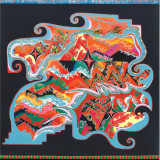
As well as Andy Votel taking care of both production and part of the microphone duties, some might recognise fellow MC and solo recording artist Figure Of Speech as a prominent voice here. The trio of Magnets (Rap Group) sees Andy also joined by local B-Girl legend Jeni Chan aka Penny Chew, and rapper and DJ Benjamin Hatton who has previously recorded with Kid Acne, The Mongrels and Sheffield’s Invisible Spies’ long-running squadron. Widely respected visual artist Rick Myers (now living in Massachusetts) also contributed scratches for many of these recordings via file sharing and custom dub-plates to keep the Violators’ authentic line-up intact, as well as galvanising the crew’s semi-reluctant art-school roots.
Extra production credits for the label also go to Sean Canty from Demdike Stare, and the late great Dan Dwayre aka Black Lodge (Mo Wax) who sadly passed away during the completion of these recordings. The members of Violators Of The English Language who you’ve not yet heard of will quickly make themselves known as the needle drops on this long-mooted debut vinyl release.
- A1: It's Your Thing
- A2: Work To Do
- A3: That Lady (Part 1 & 2)
- A4: Summer Breeze (Part 1 & 2)
- B1: Harvest For The World
- B2: Live It Up (Part 1 & 2)
- B3: Hello It's Me
- B4: Groove With You
- C1: Fight The Power (Part 1 & 2)
- C2: Hope You Feel Better Love (Part 1 & 2)
- C3: For The Love Of You (Part 1 & 2)
- C4: The Highways Of My Life
- D1: Footsteps In The Dark (Part 1 & 2)
- D2: It's A Disco Night (Rock Don't Stop) (Rock Don't Stop)
- D3: Say You Will (Part 1 & 2)
- D4: Between The Sheets
The Isley Brothers “Knowledge is power. I’m a witness to that. Our parents wanted us to have a complete musical education. They exposed us to everything, classical to country, standards, show tunes.” Ronald Isley, Mojo Magazine, 2000 The Isley Brothers have delighted audiences since the 1950’s and are celebrating their eighth decade in show business. Morphing from their roots in gospel and doo-wop through funk, rock and then, finally, into slow-jam R&B, the Isley Brothers remain one of the most fascinating groups of all time.
This album contains some of the most life-affirming music ever recorded: Ronald Isley’s keening yelp offering strength and sensitivity as it is supported by brothers Rudolph and O’Kelly. Our collection picks up their story in 1969. By this time, they had been recording for 12 years for many legendary labels, from RCA, to Atlantic, to Motown.
The brothers decided to go it alone on their own label, T-Neck. The repurposed Isleys broke onto the scene with the US R&B No.1/Hot 100 No. 2, ‘It’s Your Thing’. The album of the same name was a Top 30 smash and the group’s decision was vindicated. ‘It’s Your Thing’ marked a meeting point of influences: Sly Stone, James Brown, gospel and one-time group member Jimi Hendrix, laying the template for the Isleys’ next decade, from the gritty rock covers of Givin’ It Back to the era-defining ‘3 + 3’ (with the formal addition of the two younger Isleys, Ernie and Marvin, plus brother-in-law Chris Jasper).
After the 1972 release of ‘Brother, Brother, Brother’ (featuring the classic ‘Work To Do’) T-Neck moved to CBS leading to their first Platinum-selling album (1973’s ‘3+3’). Produced with Malcolm Cecil and Robert Margouleff, ‘3+3’ was practically prescribed to every soul boy in the UK (witness Wham’s cover of ‘If You Were There’). For the Isleys to take their old R&B hit, ‘Who’s That Lady’ and turn it into hard-rocking psychedelic soul was a blazing statement of their
intent. Their version of Seals and Croft’s pretty ‘Summer Breeze’ became one of their biggest hits, with Ronald and Ernie stamping their authority on the ballad. A period of phenomenal success followed. For every standout ballad (‘For The Love Of You’, or ‘The Highways Of My Life’), there was strident, take-no-prisoners political funk - as typified by ‘Fight The Power’, a US R&B No. 1 in 1975.
It was written by Ernie on the same day as another of their greatest moments, ‘Harvest For The World’.
This collection is a beautiful overview to the group, a most fabulous re-introduction to old friends. This era is affectionately known by the Isleys as the ‘gold and platinum years’ - one listen and you will understand why.
- 1: The Train Kept A-Rollin
- 2: For Your Love
- 3: You're A Better Man Than I
- 4: Evil Hearted You
- 5: Shapes Of Things
- 6: I Ain't Done Wrong
- 7: Heart Full Of Soul
- 8: Good Morning Little Schoolgirl
- 9: Still I'm Sad
- 10: I Wish You Would
- 11: I'm A Man
- 12: I Ain't Got You
- 13: Stroll On (From The Motion Picture "Blow Up")
- 14: I'm Not Talking
Blue Vinyl[26,85 €]
Charly Records presents THE BEST OF THE YARDBIRDS The Yardbirds blend of blues, rock and pyschedelia paved the way for heavy rock… The definitive introduction to one of the UK's most successful and influential groups of the Sixties. This comprehensive band overview draws on the hugley important Giorgio Gomelsky recordings that defined the sound of The Yardbirds during their pivotal period 1963 through 1966. The distinctive and groundbreaking blues style of Eric Clapton features on half these tracks, whilst Jeff Beck and his pioneering brand of swaggering, ear-bending, psychedelic rock takes lead guitar duties on the rest. The compilation features the group's hits from the era, including the top 10 singles “Shapes Of Things”, “For Your Love”, “Still I'm Sad” and “Heart Full Of Soul”, as well as “Stroll On” from the soundtrack to the cult 1960’s film ‘Blow-Up’ scored by Herbie Hancock. Part of a new and lavish “Best of” series highlighting the key artists in the Charly Records catalogue.
Deca’s streak of entrancing releases continues with Smoking Gun, an album that deftly blends psychedelic, raw production with sharp insights and clever lyricism. But it’s also much more than that. Smoking Gun is a sonic representation of an artist grappling with living in America, a country with a network of broken systems that leaves Deca questioning when and if it may turn around. To say this all makes for a compelling listen would be a vast understatement, because the New York City-based rapper/producer knows the key to presenting this material. He does it in a way that’s both refreshing and new, but never isolating or simply too oddball. There’s a left-field quality to his work, but Deca knows exactly what he’s doing. To prove that point, he enlisted fellow outside-the-box thinkers like Blu and Homeboy Sandman to appear on some of the album’s standout cuts. “Shelter,” which features Blu, is a jazzy, dusty piece of thoughtful hip-hop with crazy flows and lyrics to match. It’s so good you’ll wish these two would record an entire project together, and the same goes for Boy Sand’s appearance on “Dawn Wind.” Backed by Deca’s own low-key funky production, both he and Homeboy Sandman go verse for verse, each offering their own take on how to liberate yourself from the machine that aims to surveil and control both our outer world and inner peace. Other tracks embody a similar energy, including the justifiably cynical “St. America (feat. DJ Stan Solo)” and stunning “Tuning.” The latter track may just be the most impressive piece on Smoking Gun, thanks in part to the mind-melting beat-switch. It’s a thrilling musical journey that furthers Deca’s narrative about mankind’s ethical plight, and the problems we collectively face. TRACKLIST: 1. Smoking Gun (Intro) 2. St. America (feat. DJ Stan Solo) 3. Tuning 4. Blight 5. Flight Path (feat. Ichiban, DJ AWHAT!) 6. Hive of Industry 7. Crab Apples 8. Shelter (feat. Blu) 9. Tunnel Under 10. Dawn Wind (feat. Homeboy Sandman) 11. War Heads 12. The Eagle's Descent
In 2003, Pisco Crane assembled a six-piece band from motivated and talented like minds in the Kinshasa slums where he grew up. Pisco had been involved with a handful of local rap acts when he was younger, but after meeting legendary instrument builder Bebson De La Rue, he was inspired to follow a new path. He set about building instruments from the discarded trash that surrounded his city: bits of old computers or oil cans were fashioned into bass guitars and drums, and keyboards were bashed together using springs, metal pipes, and offcuts of tubing. If there was a core philosophy that guided Pisco at this stage in his journey, it was that everyone should have access to instruments, no matter where they come from or what their budget might be. And following in the footsteps of Bebson, Pisco locked into a Congolese tradition that touches on the eccentric genius of globally lauded artists like Konono Nº1 and Staff Benda Bilili. Over the years, Fulu Miziki's notoriety grew in the Kinshasa underground - their utopian vision of the future was infectious. Eventually, they were joined by performance artist, sculptor and fashion designer Lady Aisha, who offered the band unique colour and a soulful central focus. Influenced by Kinshasa's street performance scene, Aisha helped the band devise vivid masks and costumes that were as electric and singular as the instruments they played, and the scene was set. In 2020, as the world was plunged into lockdown, footage of Fulu Miziki went viral and their star began to grow exponentially, with a video of the band preforming the track 'Tikanga' racking up millions of views on Facebook. The band used this opportunity to work on documenting their sound, and shored up at the Nyege Nyege studios in Kampala for a year to assemble a definitive album. Recorded by HHY & The Macumbas' Jonathan Saldanha, this record captures the band's furiously innovative mixture of industrial sonics, spiritual jazz, punk, and Congolese soukous pressure. At their best, Fulu Miziki sound almost completely out of time, curving pounding rhythms around microtonal clanks, rousing chants and spiky sonics. On 'Mutangila', there's a hint of disco in the 4/4 stomp, but it's been shifted into a post-punk ritual, adorned with complex bell percussion and overlapping vocals. 'Congo' is even harder to define; electrified buzzes form a bassline, but it's the mindboggling rhythms that shuttle the track into psychedelic realms, led confidently by Lady Aisha's limber rhymes. Fulu positively slither on the sultry, industrial-influenced 'Sebe', while 'Tikanga' reminds of Congo's rumba-derived soukous traditions, materializing the sounds into the future with tight, pounding percussion and head-melting fx. The story of Fulu Miziki is sprawling and complex and constantly evolving, with various offshoots and band iterations. Two members left the band in 2016 to form KOKOKO! with French producer Débruit. Not long after they recorded this magnum opus album, several other original members left to form a similarly named outfit currently based in Europe. This other incarnation recently released an EP of electronic productions without the band founder Pisko Crane and lead vocalist Lady Aicha, on the UK based Moshi Moshi records. Pisco and Lady Aicha currently lead a different outfit in Kinshasa made up of completely new musicians. This full-length is the remaining proof of Fulu Mziki at their most vital and most complete - it won't be repeated - and can never be recreated. It's an essential portrait of one of the Democratic Republic of Congo's most innovative contemporary outfits, and some of the most surprising hybrid music you're likely to hear.
Ingredient is the elegant collaboration of Toronto poets, composers, producers and dear friends Ian Daniel Kehoe and Luka Kuplowsky. Their self-titled release is an enigmatic electronic avant-pop record attuned to the micro and macro perspectives of the natural world. Ingredient is an album whose lyrics are more poem than lyric, and whose songs exist in a merger of house music, philosophically-minded lyricism and contemporary R&B. One might recall electronic and art-pop luminaries such as Yukihiro Takahashi, The Blue Nile, and Arthur Russell, or connect it to contemporaries like Nite Jewel, Westerman and Blood Orange. A distinct world of dance, of questions, of secrecy and ultimate softness.
Eight years of friendship forges strange telepathy.
In the summer of 2020, Ian Daniel Kehoe was entrenched in a new feeling of heaviness; psychosomatic symptoms had started to proliferate; stress made new pores across the body, bending sensitivity into pain. His days were met with confusion, detachment, sleeplessness and pain without causation. Disfigured, he felt that what had been central and centering was blown out to the periphery of things. In a moment of self-preservation he reached out to his dear friend Luka Kuplowsky to make an album together. For Kehoe, it was an instinctual grasp for the anchoring truthfulness of deep friendship and the potential for a dedicated creative collaboration. Kuplowsky’s presence was light, supportful and curious, eager to explore musically the sounds they were mutually drawn to: house music, ambient pop, dub. The duality between Kuplowsky and Kehoe – between the Aflight and the Unmoored – is a portrait of a friendship whose exchanges came easy and produced an outpouring of song. Creation and therapy crisscross. In email correspondence that catalogs their process of collaboration, affection abounds: “feels bare without the Luka Licks”, or “Love you so much”, or “Kinda just overwhelmed with deadliness coming in at all angles.” When their voices first come in together on “Wolf,” that harmony arrives in a dramatic avant-pop sound that is bold and wondrous.
Kuplowsky and Kehoe both arrive at Ingredient as established artists whose works are committed to language’s propensity to provoke and mystify. Kuplowsky’s 2020 album Stardust is an idiosyncratic and otherworldly blend of pop and jazz romanticism grounded by Cohen-esque vocals and a stirring philosophical curiosity. Kehoe’s entrance into the new decade has hatched four records of pop experimentation, most recently 2022’s Yes Very So, a euphoric and bold album of poetic synth-pop and meditative ambient instrumentals. Kuplowsky and Kehoe’s union as Ingredient is a beautiful and unusual chemistry that integrates their distinct approaches while bringing forth a newness: a sound that alternates between cinematic technicolor and dubbed out fogginess; a lyricism that exchanges their lucid and clear poetics for a playful and obtuse verse. The album intuitively taps into the opposing emotional states of Kuplowsky and Kehoe during the conception of the record, contrasting the buoyancy of trumpeting keyboards (“Resurface”), angelic synthesized voices (“Come”), and rolling bass (“Photo”) with the record’s underlying darkness of whirring buzzsaw textures (“Transmission”), whooping sirens (“Wolf”) and murky ambience (“Illumination”). Lyrically, this duality arises in the record’s flux between openness (“Variation”, “Raindrop”) and existential dread (“Wolf”). “Illumination” most clearly crystalizes this opposition, reconciling the verses’ neurotic yearning for enlightenment with the chorus’ liberating doctrine of negation: “no more devotion… no more delusion”. Amidst the gradations of light and dark, Kuplowsky and Kehoe trade indelible, lush melodies as though their voices are made of a substance that melts easily one into the other. The harmony of poetry, sound, and texture cuts through your brain fog like a wet diamond.
Ingredient’s self-titled record was assembled by Kuplowsky and Kehoe over the course of six months in a home studio they frequented daily. Amidst synthesizers and drum machines they composed, re-composed, and workshopped a wide array of music, ultimately focusing on a set of eight songs that lived in a shared musical and philosophical world. Recording days often ended in basketball games at a local court or a rooftop commune over a pot of tulsi tea and a crossword puzzle. Kuplowsky brought in the Blue Cliff Record – the classic anthology of Chan Buddhism – whose inscrutable and sublime insights remained constant throughout the recording process as an activator of reorientation and reflection. While Kehoe was frequently rendered physically immobile by bouts of anxiety, a patience and mutual caring governed the pace of their creation; rest, stretching and meditation became equally important as the act of arrangement. Invited into their intimate circle of composition was Thom Gill, whose heavenly voice uplifts “Variation” and “Raindrop,” and Karen Ng, whose alto sax simmers and dances around the funky strut of “Raindrop.”
The lyrics on Ingredient reflect the persistence of change, the infinite variability of nature where randomness and divergence are no accidents. In Daoism, duality, in the form of Yin and Yang, is not contradictory as it is in Western idealist philosophy, but rather composes the eternal and lived paradox of our changeless-changing universe: changeless because all is change, and changing because the dynamism of the Dao makes each moment transformational. Kuplowsky and Kehoe refract this way of seeing the world, as in Variation: “Variation in the natural world / there it is.” Ingredient is an experience of the manifold ways of saying there it is of the transformational world, and there it is, unfolding. Elsewhere, change and ephemerality is addressed through the record’s preoccupation with non-human perspectives, reorienting the listener to the wolf, the mouse, the emerald frog, the centipede, the bird, the fly in the lamp. The album cover visualizes this fascination with the striking image of a reddish-orange frog atop a defamiliarized landscape of dark green leaves. Mirroring the exploratory process of the record’s collaboration, the frog also signals the amphibian’s natural inclination to leap into boundless potential. Kuplowsky and Kehoe’s lyrics manifest philosopher and ecologist Timothy Morton’s concept of “the mesh,” drawing attention to the “vast, entangled web” of interconnectedness that connects all life forms and interweaving the songwriters’ shared wonder into the Animal’s unknowability. As Luka narrates in the breakdown of the dance-floor ready “Photo,” “the closer we observe things, the further they retreat into abstraction.” In Ingredient’s ecosystem, perception is a reversible fractal where the world’s minutest details mirror the shape of the cosmos.
According to the Dao, the path to healing starts by reorienting perception away from the self and toward the self’s subsumption in Totality. For Kehoe, collaborating with Kuplowsky became the reorientation necessary for the self-preservation he was seeking, opening up a shared creative practice to navigate and soften the complexity of his psychological shattering. The album begins with Kuplowsky intoning “colossal faith” which bounces around the stereo field in a cloud of echo, and it is the enormity of “faith” that centers both Kuplowsky and Kehoe’s collaboration and their inquisitiveness in the vast mysteries of our very being. Truth in Ingredient is not an essential nugget, but a bending of the light – it is the equivocal entanglement of how we are in nature as nature, but with a plea or prayer under our breath that marks our felt distance from what we are a part of: “carry me towards the mountains of my birth / returning to the nest / the silence of the earth.”
ft. Cinna Peyghamy & Jay Duncan Remix
Soreab returns to Control Freak for a full length white label release - a masterclass in organic, dubbed-out, dancefloor psychedelia, featuring live recordings by sound artist and modular percussionist Cinna Peyghamy following a recent collaboration with Azu Tiwaline.
As a DJ, producer and co-founder of Baroque Sunburst, Italian-born Soreab has been a mainstay of London’s underground electronic music scene for over 5 years. On ‘Teleportation’, he manipulates and twists Cinna’s deft percussion work into a distinct range of UK styles, ranging from 170bpm euphoria to subby, half-time ex- plorations from the school of FWD>> and Plastic People.
On the B2, Jay Duncan (Phantasy Sound / Intergraded) takes a decidedly minimal tack on her remix of ‘Untitled 1’, with deep, dubby chord stabs and immersive rhythms for late night dancefloor revelations.
For Fans Of: Om Unit, Shackleton, Al Wootton
Limited pressing of just 300 hand-stamped records - don’t miss your chance to grab one
Mastered & cut by Ruy Marine @ D&M, Berlin
- A1: Ataxia - Detroit Gospel
- A2: Ataxia & Andres - Pine Island
- A3: Ataxia - Language
- B1: Ataxia & Dj Minx – Maxia
- B2: Ataxia - Spit In Your Percolator
- B3: Ataxia - 98 Degrees
- C1: Ataxia - Number Streets
- C2: Ataxia - The Formulator
- C3: Ataxia - The Pusher
- D1: Ataxia & Mister Joshooa - Feels Like
- D2: Ataxia – Wm
- D3: Ataxia - Dance The Bridge
Having torn up raves for well over a decade, the Detroit duo Rickers and Ted Krisko AKA Ataxia present their debut longplayer ‘Out Of Step’. Featuring guest spots from close peers DJ Minx, Andrés and Mr Joshooa, they twist house, techno, electro, breakbeat and rave into revitalized new shapes; embellished with a touch of soul, funk and hip hop. With backgrounds in hardcore and punk, Ataxia’s debut is suffused with that energy, attitude, and approach; this is raw, lean and unashamedly no-nonsense dance floor tackle that goes straight for the jugular. Heavily analogue, the album experiments with tape saturation, which harks back to the duo’s formative years in bands, recording demos to cassettes. These straight-up, in-the-red tracks give preference to overdriven drum machines, rather than generic polished sheen, but conversely, it’s all deceptively well-crafted too; ‘Out Of Step’ is a standout record that’s big in character, bringing to mind the renegade spirit of Underground Resistance, and the bombastic brilliance of The Prodigy and Chemical Brothers.
Defiantly optimistic despite the state of the world, a “life is good” vocal sample meets minor chords sliding over 808 hats on the exemplary house/techno pumper ‘Detroit Gospel’, before a lighter moment on the album, but no less impactful with its hefty low-end thump, is ‘Pine Island’ featuring Motor City hero Andrés. Together they cook up a Motown-inspired house cut awash with horn swells and backup singers, bouncing to wide swung funk bass, in classic 313 style. ‘Language’ turns the club on its head – busting out one of the most distinct basslines in recent times, and bristling with buzzy, undulating chords, whilst ‘Maxia’ features influential Detroit royalty DJ Minx. Inspired by her classic ‘A Walk In The Park’, with a fat distorted kick and stealthy bass groove, this is low-slung, stripped-back, heads-down coolness. The high-tech funk of ‘Spit In Your Percolator’, is laser-guided in its efficiency, with a strobe-like, increasingly intensifying energy, peppered with clever, tripped up vocal chops. With the next cut, conveyor belt noises and fast churning low-end gives way to a dubbed-out breakdown, on the deep breakbeat roller ‘98 Degrees’. Charged with a blistering, rave intensity, ‘Number Streets’, is a futuristic distorted techno workout that booms through the subs, whilst ‘The Formulator’ mixes filtered snippets, abstract synth noises and melodic bleeps with a bassline echoing Paperclip People’s ‘The Floor’. Closer to the UK definition of hardcore, combining 4/4 and breakbeat, ‘The Pusher’ evokes the spirit of late 80s orbital raves, adding a natty keys solo, and deadly bass used sparingly, for even deadlier effect. ‘Feels Like’ sees Rickers and Ted team up their studiomate and fellow TV Lounge resident and club booker, Mister Joshooa. Inspired by Photek but also almost UKG in style, this breakbeat session is stamped with MJ’s signature chopped vocals and intricate rhythmic interplay. The bubbling, wobbly loose swing of ‘WM’ is constructed around a classic chopped-up MTV cribs sample, with a filtered vocal creating a far out psychedelic effect – all of which is propelled apace by a huge bruising LFO. The LP concludes in fine style with ‘Dance The Bridge’, where bouncy beats and wigged-out keys meet bright, gently uplifting synth chords that bring a clear-skied mood; ending the record as it began, on an optimistic note.
‘Out Of Step’ marks another chapter in the ongoing relationship between Life and Death co-founder DJ Tennis and Ataxia. Their connection goes back to the earliest days of the label, where they played gigs together on some of Tennis’ initial visits to Detroit. It’s a friendship that’s blossomed organically over the last decade through their shared love of punk and hardcore, and led to the fruition of one of Ataxia’s most compelling projects to date. Labels to release Ataxia’s output include legendary Detroit techno imprints Planet E and KMS, plus the seminal American house label Nervous Records. Their catalogue also includes music for Visionquest, Leftroom, 20/20 Vision and Seth Troxler’s Play It Say It.
Hate Propaganda's far too overlooked 2019 debut EP "World War 666" sees a much needed reissue on vinyl, remastered and enhanced by brand new artwork commissioned for the purpose by Xerox master P. Van Trigt. When it was first released on cassette tape back in 2019 by War Arts Productions, this war-torn debut offering of primeval warnoise by the mysterious Portuguese war criminals stood out immediately as a crown jewel debut for the genre and as one of the year's most definitive and underrated manifestations of extreme metal's most hateful and berserk fringe. Packing in nineteen minutes of absolute hatred, the annihilating MLP manifests as a nightmare hallucination of complete violence and negativity, evoking eons of perennial apocalyptic global planetary war and terror on the wings of its nefarious design of achieving maximum annihilation in the shortest amount of time possible. To harness this bleak pantheon of ruin, the Portuguese conquerors have assembled a weaponized and uncontrolled sonic chain reaction where grindcore, black metal, death metal and hardcore punk are all accelerated and instigated into an inescapable payload of death aimed straight at the vital sinews of humanity. A sonic maelstrom churned into shape by an onslaught of obscure violent riffs, psychotic leads and ominous laughter which, parallel to a pulverizing drum performance, emanates from oblivion with an antediluvian, negative aura. Comparisons to bands like Diocletian, Heresiarch, Tetragrammacide and Nuclearhammer will run abound, yet these would be only easy superficial conjectures as this is a manifestation of sonic extremism which dwells on a plain of excellence entirely its own. Its uniqueness transpires particularly in the maniacal drumming which underlines the band's hardcore and punk influences, and is exalted further by an unusually crystalline production and by a masterful onslaught of uber-audible riffs hiding behind nothing and seemingly going in the opposite direction of the homogenous and indiscernible sensorial smothering the genre usually opts to go in. Tracklisting: 1. World War 666 2. Neverending Mass Graves 3. Violent Nature of Human Annihilation 4. Welcoming the Nuclear War With Open Arms 5. Let the Sirens Signal the End of Times
Brilliantly unclassifiable ambient midi-jazz salvo from Brazil’s Gabriel Guerra aka Guerrinha - member of PAN/Future Times' Lifted ensemble and lynchpin of the Rio De Janeiro underground. Very highly recommended noir sleaze x fantasy lounge music somewhere on the spectrum between Gigi Masin, Spencer Clark, 0PN, Flanger and Koji Kondo’s iconic video game soundtracks.
Deployed as the third release on the expertly curated confuso editions, ‘Cidade Grande’ sees Guerra unfurl an immersive and deeply enveloping variant of lounge jazz noir intersecting Japanese city pop, classic video game soundtracks and future-primitive kosmische signatures in a way that defies easy categorisation. Guerrinha colours outside the lines in swirling, exquisitely trippy designs that are as easy on the ears are they are hard to fully fathom over a single sitting.
Mirroring a strain of jazz music’s evolution from sophisticate lounge soundtrack to more psychedelic lustre when musicians found acid and Brazilian styles in the ‘60s, Guerrinha slants the paradigm thru the prism of late ‘80s midi with a c.21st suss that coolly echoes hauntological takes from Spencer Clark & James Ferraro to Leyland Kirby, and Eli Keszler’s electro-acoustic jazz proprioceptions, as much as emotive Kenji Kawai soundtracks. There's a complete lack of cynicism in his approach, and dense, hypnotic tracks like 'Venda Casada Village' and the moving 'Kafta Hoje' sound so completely straight-faced it's impossible not to respect the flex.
It’s a hugely trippy listen, at once calming and eerily evocative, with a wipe-clean palette of deft midi orchestrations that conjure flashbacks to soundtracks for everything from Twin Peaks to Sharky & George or Patlabor, but with more opalescent depth, dancing around motifs in holographic designs that mark the uncanny valley of perception.
Puckered with ruggedly pointillist swagger and evoking discrete worlds hidden in plain sight, »Traditional Music of South London« is a riveting masterwork by experimental music’s distinctive and cherished modernist, Dale Cornish. It is a concrète grimoire of recent and ancient folklore that binds Dale’s music, lyrics, and background into a strikingly personal synecdoche of South London.
Since emerging as part of London’s shouty electroclash movement in the mid ‘00s, and assuming the role of deconstructed rave pioneer and poet in 2011, Dale Cornish has been (lo)key to new movements in electronic music’s underbelly for the best part of this century. His 12th LP, proper, »Traditional Music of South London« is Dale’s definitive record; a confident testament to artistic maturity that comes with doing your thing against the grain over decades, and a potent expansion on ideas chiselled during his run of releases with the inspirational (now sadly defunct) label, Entr’acte, who helped foster Dale’s explorations of concrète rave and industrial pop tropes during the ‘10s.
On one level the album reads as a deep topography or psychosexual-geography of London’s lost gay club haunts, with the meat-motoring deep house of ‘Great Storm’ recalling DJ Sprinkles taking Loefah to the darkroom in its concrète carved and flesh trembling 8:08 perfection; or more literally in »Foxhole«, with Dale’s deliciously Croydon-toned accent describing urban gay mythologies with pungent lyrics about rotten fox cadavers synced to drily ricocheting hand claps, while the tight swinge of his “requiem for all the dead gay venues” in the gut-level bass of »Hoist Crash Fort«, and the playful evocation of “internecine conflict within the gays - live!” on »Palace Intrigue« just utterly slap like nothing else.
Yet it’s in the LP’s slower, bloozier and folky vocal bits that Dale’s dare- to-differ character comes into its own. The clandestine skulk of ‘My Geography’ portrays him like a modern Jandek traversing London’s brutalist- meets-semi rural meridian, and at its gooier core flashes of folk-classical brilliance such as the groggy ‘Norman Lewis’ give way to the writhing foley orgy of »Crowd Scene«, while the naked, one-take end of szn paean of »SCY BFR HNH« and slurred, Tricky-esque confessional »Shout Outs« consolidate and temper the conflicting aspects of his persona with a deep burning pathos in the LP’s fading phosphorescence.
In an era of overproduction and imitation-not-innovation, Dale’s strikingly original, sensually brutalist industro-folk-dance-pop critically cocks a snook at conventional, careerist music while embracing its heartical truths. An extremely personal record certain to resonate with those who believe art in music still matters.
Freedom is both an integral and multi-layered topic for improvised music, describing its mechanics, aesthetics, and values and often an underlying political dimension as well. In the case of free jazz specifically, the word carries additional weight given the music's deep connection to the black liberation movement of the 1960's and 70's.
The passionate and unclassifiable work of Calgary-based improviser Jairus Sharif embraces each of these definitions of freedom and others, albeit strictly on its own personal and idiosyncratic terms. Since early 2020, the 34 year-old autodidact has been generating a steady stream of homespun solo recordings that forge unprecedented connections between hip-hop abstraction, cosmic skronk, outsider jazz, and staunch post-punk DIY ethos.
Leading up to the pandemic, Sharif's immersion in spiritual and exploratory jazz had culminated in him deciding to purchase an alto saxophone. Unbeknownst to him this instrument would be a catalyst for him to discover his own ardently individualistic artistic voice.
Prior to that point, he had always been somewhat of a solitary musical traveler. In 2002, he acquired his first instrument—a pair of Technics 1200s — but struggled to find local collaborators that had equal investment in hip hop culture. Ultimately, Sharif picked up the guitar, turning to the resilient local punk community, that had also nurtured both of his mothers some time earlier.
As Black Lives Matter gained momentum in the wake of George Floyd's murder, Sharif was suddenly flooded with an acute awareness of his own identity. It compelled him to zealously plunge headlong into open-ended spontaneous solo creation. Water & Tools, his strange and stirring debut for Toronto's Telephone Explosion Records (home to full-lengths from the likes of Brodie West's Eucalyptus, Mas Aya, and Joseph Shabason), offers a glimpse into this ongoing hermetic journey.
As Sharif dedicated himself to uncovering his own deeper musical truths, he assembled a home studio in his basement, cobbling together a drum kit from bits his bandmate had left at his house pre-pandemic, chaining effects together and outfitting the entire space with microphones. Somewhere between the chaos of child's treehouse and the tidy import of a shrine, this space (pictured on the album's back cover) consecrated his own imagination. He laid it out to maximize access to any and every tool in his arsenal, providing him a freedom to explore that he had never permitted himself to consummate before.
Within this cozy private universe, his recent purchase—the saxophone—assumed new meaning. It furnished a tangible connection to the black radicalism that mobilized free jazz, but also something far more personal. From a technical standpoint, the instrument was completely unfamiliar to him, yet rather than this being a hindrance to Sharif, his inexperience opened fruitful path forward, unencumbered by preconceptions. Resolving to shirk formal training, convention, and build his own understanding of it from scratch, allowed him to access his most raw, fundamental creative impulses. The Saxophone's inseverable bond with breath compounded this effect, echoing revelatory discoveries he had been making about breathing through yoga, research, and psychotherapy. Of course, the parallels with BLM's harrowing rallying cry—“I can't breathe”—were not lost on him either.
Water & Tools is a dense, contradictory statement with a blustery surface that shelters a soulful heart. It's generous music, exuding profound vulnerability—grappling with the loss of one his mothers, Lisa—all the while brimming with electric wide-eyed wonder. Almost every one of the nine pieces seems to carry some semblance of a groove, while remaining completely untethered from pulse. For Sharif, this collection is an expression of newfound lucidity, however for the listener his sonic concoctions act as powerful psychotropics. At points, there's a timelessness that's conveyed through the music's processional, ritualistic tenor, and yet there's an endless amount of wild, futuristic detail waiting to unspool at any given moment. Similarly, while this recording emerges from Sharif's private pilgrimage and personal emancipation, he also leaves room for collaboration. Woven throughout Sharif's one-man-ensemble textures, one finds Maxmilian Turnbull (of Badge Epoque, U.S. Girls, and Cosmic Range infamy) providing sundry keyboards and treatments, as well as his mixing skills.
Whether conjuring effusive psychedelia or plumbing introspective depths, the music that Jairus Sharif produces is singular, visceral, and wondrously unpredictable. Water & Tools sketches a raw, firsthand account of his nascent explorations within his own unbridled imagination.
We love nothing more than belated success, from the Nightingales' rise to top cult band, to the string of five marvelous Blue Orchids LPs in six years (as much as Martin Bramah had managed in the previous four decades) . . . so give us more. Like David Westlake. The release of NME's C86 cassette heralded a new generation of artists who'd emerged since the preceding C81 assembled a set of acts who'd coaxed new dialects out of punk, rhythms, reggae and the avant-garde. Though variable, C86 became a phenomenon, making a bigger splash and enduring longer than anyone could have predicted. The evolution by 1986 of "independent" or "alternative" music into "indie" brought a modified focus. From C81's post-punk negotiations of politics and cross-cultural influence to C86's compact blasts of, on the one hand, effervescent melodic pop and, on the other, jagged Beefheart-esque racket. Tiny Global Productions has proudly presented already one of the best from C86. The Wolfhounds' leader David Callahan's talent evolved masterfully into Moonshake, and more recently to a strain of blistering raga-folk psychedelia which deals with sociopolitical issues in brilliantly idiosyncratic fashion. And what of another of the best from C86 - the Servants, David Westlake's band? Ambivalent about the invitation to be on C86, Westlake gave the NME a wrong-footing b-side, before keeping a distance from the noise around the compilation. Subsequent releases from Westlake and The Servants and Westlake attracted fine reviews but settled quietly into relative obscurity, despite musical involvement from various Housemartins, Go-Betweens and Triffids, a quest by Stuart from Belle & Sebastian to find Westlake and form a band; not to mention Luke Haines' own five-year presence in the Servants before forming The Auteurs, Baader Meinhof and Black Box Recorder. Westlake went first into the law, then spent years in literary academia. Now the surprise arrival of My Beautiful England. The album is a masterpiece of concept, composition and performance, a conceptual work of truths and reflections of difficult but deft and unflinching expression. "It is not only fashionable now to denigrate England and its past; it is heresy to recognise good in it. The place that made me is disappearing. Its values and traditions. Among them: good manners, humility and clemency, resilience and perseverance, good humour. History is being refashioned – in spirit and material fact – by ideologues unshakeably certain they are in the right, and people are being distanced from their pasts. Some find themselves forced into passive acceptance of new distortions of the past, out of imitativeness or cowardice. I resist. This album is a memorial. Intentionally, a museum piece. It is a personal tribute to the England I knew."
Following the recently released and highly praised Trees 50th Anniversary box set on Earth Recordings, Trees reissue their second album as a standalone release. “A beautiful hybrid, Trees found a unique space between intimate folk and freewheeling psychedelia. Musically ambitious yet brilliantly balanced, they have left an enduring legacy for those lucky enough to be in on the secret” Edd Gibson, Friendly Fires. It’s now over fifty years since Trees’ formation, a band who helped define ‘Acid Folk’, creating a sub-category in the lexicon of record dealers and music critics alike. Released just months after their debut second album, ‘On The Shore’ sees a shift from the first record into something darker and more ambivalent with an arcane Englishness. The product of an era characterised by clunky polemic, arcadian sentimentality or English fuzzy-felt surrealism, the album, like all classic records, is so much greater than the sum of its parts. Opening with ‘Soldiers Three’, learned from Dave Swarbrick, the album includes another traditional tune and one of the definitive moments in English folk rock ‘Polly On The Shore’ alongside ’Sally Free and Easy’ and ‘Streets of Derry’. // “The music’s arcane power remains intact” Mojo // “A fantastic band” Record Collector. // “Spectacular” Uncut. // “Sublime” Shindig. // “Timeless” Prog. // “It’s these two original albums that stand as pinnacles of form” The Wire. // Track listing: A1. Soldiers Three A2. Murdoch A3. Streets Of Derry A4. Sally Free And Easy B1. Fool B2. Adam's Toon B3. Geordie B4. While The Iron Is Hot B5. Little Sadie B6. Polly On The Shore
Remastered reissue of the eponymous debut album by legendary genre scramblers, Cerberus Shoal. Available on vinyl for the first time in over 25 years. Limited edition Toasted Peach colored vinyl, 500 only pressed. The long out-of-print, eponymous debut album by the prescient, genre-scrambling collective, Cerberus Shoal, showcases their humble beginnings as a progressive punk band with extraordinary promise. Recorded in 1994 and originally released the following year, Cerberus Shoal disTRR024LPC1 is an Indie Retail Exclusive on Rouge Colored Vinyl, 500 only while supplies last. The long out-of-print breakthrough third album by the forever forward-thinking New England collective, Cerberus Shoal, is rightfully considered a high-water mark for the band, and a quintessential example of what would eventually be commonly defined as “post-rock.” The first studio album to feature the members of fellow local experimental rock troupe, Tarpigh, Homb exemplifies the transitional magic and mystery that marked Cerberus Shoal’s brilliant early era. Unraveling their various influences – early 90s post-hardcore, shoegaze, avant-rock, psych-folk, early New Age – and weaving them into something uniquely rich and resonant seemed almost effortless to Cerberus Shoal, and perhaps no album epitomized that more than the lush tapestry of Homb. Finally available on vinyl for the first time ever, Homb Anniversary Edition is packaged in restored artwork with extensive new liner notes written by the band. The record has been newly mastered for vinyl by Bob Weston at Chicago Mastering Service, and pressed onto audiophile-grade vinyl. “It’s another milestone for the always intriguing Cerberus Shoal.” Pitchfork // “Formed in the early 90s, this six-piece collective has steadily gained a name for themselves as one of the most interesting and original bands coming out of the North American indie scene today.” tilled the band’s earliest creative and philosophical influences – the rhythmic post-hardcore of Dischord Records; the disarming histrionics of Ebullition and Gravity Records; and the ominous, patient dynamics of Slint and Moss Icon – into a concise six-song document that is as much a snapshot of an era as a blueprint for much that followed. Cerberus Shoal Anniversary Edition is packaged in restored artwork with extensive new liner notes and newly uncovered photos from the earliest era of the band. The record has been newly mastered for vinyl by Bob Weston at Chicago Mastering Service, and pressed onto audiophile-grade vinyl. The enclosed digital download coupon includes a massive 30-minute instrumental bonus track not available on the LP. Track Listing 1. Rain (2:44) 2. Daddy As Seen From Bar Harbor (11:25) 3. Elena (4:56) 4. Change (7:31) 5. Breakaway Terminal Cable (6:24) 6. Rain (Reprise) (5:34)
RUBY THE HATCHET liefern mit "Fear Is a Cruel Master" genau das siedend heiße, eingängige und doch voller roher Energie steckende Killer-Album ab, das sein gefeierter Vorgänger "Planetary Space Child" (2017) versprochen hatte. Fünf lange Jahre hat sich die amerikanische Psych Rock Truppe aus New Jersey nach der Veröffentlichung ihrer letzten Scheibe Zeit gelassen, aber das sehnsüchtige Warten hat endlich ein Ende. RUBY THE HATCHET haben in ihrem kollektiven Songwriting einen neuen Gipfel erklommen. Dies hat sich die Ausnahmetruppe durch zahlreiche Opfer sowie einen eisernen Willen, sich erneut zu steigern, hart erkämpft. Der Albumtitel "Fear Is a Cruel Master" spiegelt die Stimmung der Zeit, in der die neuen Songs geschrieben wurden, perfekt wider. Sängerin Jill Taylor, Gitarrist Johnny Scarps, Schlagzeuger Owen Stewart, Bassist Lake Muir und Organist Sean Hur hatten sich längst daran gewöhnt, als Gruppe zusammenzuarbeiten. Doch während der Arbeit am neuen Album konnten sie nur wenig Zeit miteinander verbringen. "Ich habe während der Pandemie viel gelesen und bin dabei auf den Satz 'Angst ist ein grausamer Meister' "Fear Is a Cruel Master" gestoßen", erklärt Taylor. "In dieser Zeit wurde die Angst sichtbar und wie sie die Menschen zurückhielt. Der Titel hat einen Bezug zur Musikbranche, denn alle waren verunsichert - von den Bands über die Booking-Agenten bis hin zu den Clubs. Angst lag in der Luft". "Fear Is a Cruel Master" wurde zusammen mit Paul Ritchie (THE PARLOR MOB) im New Future in New Jersey aufgenommen und war nicht so akribisch durchgeplant wie RUBYs vorherige Alben. Die Band ließ bewusst mehr Spielraum für Spontaneität und magische Momente. Das Hauptthema von "Fear Is a Cruel Master" ist letztlich die Selbstreflexion. Obwohl die neuen Songs im Schmelztiegel einer weltumspannenden Pestilenz geschmiedet wurden, besitzen sie doch eine Zeitlosigkeit, die weit über den Moment ihrer Entstehung hinausreicht. Alles, was RUBY THE HATCHET zu einem so herausragenden und selbst bei ihren Kollegen äußersten beliebten Act macht, findet sich auf diesem Album - von Jills üppigem Gesang voll rauchigem Honig, über die psychedelischen, aber dennoch knackigen Gitarren, bis hin zum Spirit der Rock'n'Roll-Orgelhelden. "Fear Is a Cruel Master" ist definitiv ein Album, das von einer Band geschrieben wurde, die nach einem Jahrzehnt ohne Bedauern auf all die Momente zurückblickt, die sie gelebt oder nicht durchlebt hat. "Fear Is a Cruel Master" ist sowohl Ergebnis als auch Zeugnis dieser Reise. Es ist Zeit, sich auf den Weg zu machen, um RUBY THE HATCHET in ihrem ebenso beeindruckenden wie mächtigen klanglichen Kielwasser zu folgen.
Several things happened before a warm day when I met the four members of Frankie Cosmos in a Brooklyn studio to begin making their album. Greta Kline spent a few years living with her family and writing a mere 100 songs, turning her empathy anywhere from the navel to the moon, rendering it all warm, close and reflexively humorous. In music, everyone loves a teen sensation, but Kline has never been more fascinating than now, a decade into being one of the most prolific songwriters of her generation. She's lodged in my mind amongst authors, other observational alchemists like Rachel Cusk or Sheila Heti, but she's funnier, which is a charm endemic to musicians. Meanwhile Frankie Cosmos, a rare, dwindling democratic entity called a band, had been on pandemic hiatus with no idea if they'd continue. In the openness of that uncertainty they met up, planning to hang out and play music together for the first time in nearly 500 days. There, whittling down the multitude of music to work with, they created Inner World Peace, a collection of Greta's songs changed and sculpted by their time together. While Kline's musical taste at the time was leaning toward aughts indie rock she'd loved as a teenager, keyboardist Lauren Martin and drummer Luke Pyenson cite "droning, meditation, repetition, clarity and intentionality," as well as "'70s folk and pop" as a reference for how they approached their parts. Bassist/guitarist Alex Bailey says that at the time he referred to it as their "ambient" or "psych" album. Somewhere between those textural elements and Kline's penchant for concise pop, Inner World Peace finds its balance. The first order of business upon setting up camp in Brooklyn's Figure 8 studios was to project giant colorful slides the band had made for each track. Co-producing with Nate Mendelsohn, my Shitty Hits Recording partner, we aimed for FC's aesthetic idiosyncrasies to shine. The mood board for "Magnetic Personality" has a neon green and black checkerboard, a screen capture of the game Street Fighter with "K.O." in fat red letters, and a cover of Mad Magazine that says "Spy Vs. Spy! The Top Secret Files." On tracks like "F.O.O.F." (Freak Out On Friday), "Fragments" and "Aftershook," the group are at their most psychedelic and playful, interjecting fuzz solos, bits of percussion, and other sonically adventurous ear candy. An internal logic strengthens everything, and in their proggiest moments, Frankie Cosmos are simply a one-take band who don't miss. When on Inner World Peace they sound wildly, freshly different, it may just be that they're coming deeper into their own. Inner World Peace excels in passing on the emotions it holds. When in the towering "Empty Head" Kline sings of wanting to let thoughts slide away, her voice is buoyed on a bed of synths and harmonium as tranquility abounds. When her thoughts become hurried and full of desire, so does the band, and she leaps from word to word as if unable to contain them all. As a group, they carry it all deftly, and with constant regard for Kline's point of view. Says Greta, "To me, the album is about perception. It's about the question of "who am I?" and whether or not the answer matters. It's about quantum time, the possibilities of invisible worlds. The album is about finding myself floating in a new context. A teenager again, living with my parents. An adult, choosing to live with my family in an act of love. Time propelled us forward, aged us, and also froze. If you don't leave the house, who are you to the world? Can you take the person you discover there out with you?" - Katie Von Schleicher
David Gedge says: "With its 1950s theremin and science-fiction sound effects, `Astronomic' sounds a bit like a cross between a psychedelic pop song and a television theme. It's also The Wedding Present's job to be educational as well as entertaining, of course, and who knew that `hypersonic speed' is actually defined as one that exceeds five times the speed of sound? Certainly not me. But I know now! Oh, and wait until the very end of the track to hear another of those occasional Wedding Present references to Status Quo, too. Meanwhile, `Whodunnit' no question mark because it's referring to the literary genre rather than asking a question is a much more melancholy affair, which is what we've come to expect from songs which are primarily Melanie Howard co-creations. It might win the prize for the most powerful chorus of the series, though" Tenth release in this monthly series, in 2022 The Wedding Present will be releasing a new 7" single every month, #9 is available for indie record stores only soonThis fascinating project - which goes under the name of 24 Songs - comes thirty years after the band's similar Hit Parade series of 7"s in 1992 and features two brandnew recordings of the current WP incarnation. Each of the records comes in a beautifully designed sleeve featuring brutalist photography by Jessica McMillan
- A1: Funny How Time Slips Away
- A2: Ramblin’ Man
- A3: Gimme That Old Time Religion
- A4: I Walk On Guilded Splinters
- A5: I’m So Lonesome I Could Cry
- B1: End Of The Line
- B2: Holy Water
- B3: Sleeping Dogs Best Left Alone
- B4: Give Myself A Good Talkin’ To
- B5: Guess Things Happen That Way
Over the course of his six-decade-long career, Dr. John embodied a near-mythic multitude of musical identities: global ambassador of New Orleans funk and jazz and R&B, visionary bluesman, rock and roll innovator, one-time top 10 hitmaker, self-anointed and massively revered high priest of psychedelic voodoo. On Things Happen That Way, the six-time Grammy-winning Rock & Roll Hall of Famer otherwise known as Malcolm John “Mac” Rebennack Jr. reveals yet another dimension of his cosmically vast musicality: a lifelong affinity for classic country & western, whose songs he first encountered via the 78 rpm records frequently spun at his father’s electronics shop. Things Happen That Way arrives as the latest and final studio album from an artist who remained wholly unpredictable, alchemizing the charmed simplicity of traditional country into a wildly enchanting body of work.
Things Happen That Way marks the fulfillment of a longtime goal of the legendary singer/songwriter/pianist, who first began plotting a country inspired album decades ago. In bringing his album’s songs to life, Dr. John drew on a lineup of musicians befitting of a universally beloved luminary who worked with the likes of Van Morrison, the Rolling Stones, B.B. King, Etta James, and artists as diverse as Aretha Franklin, Ringo Starr, and Eric Clapton. Along with an elite cadre of New Orleans session players, the album’s personnel include icons Willie Nelson and Aaron Neville, as well as label mate singer/songwriter Katie Pruitt and country-rock powerhouse Lukas Nelson & Promise Of The Real. True to an artist whose music “transcended race and cultural divides”—as Black Keys frontman Dan Auerbach proclaimed in presenting Dr. John his lifetime achievement award at the Americana Music Association Honors and Awards in 2013—Things Happen That Way reflects both a rich sense of history and a boundless passion for defying expectation.
THE NEW STUDIO ALBUM FROM THE JAPANESE LEGENDS - AN OPUS
OF DARK & ECLECTIC BLACKENED HEAVY METAL, SHROUDED IN
TRADITIONAL EASTERN INFLUENCES..
Cult Japanese black metal legends Sigh formed in 1989/90, featuring
mainman Mirai Kawashima, Satoshi Fujinami & Kazuki Ozeki
Following initial demos, Shinichi Ishikawa was brought in & Sigh set about
recording the masterpiece debut 'Scorn Defeat' for Euronymous' Deathlike Silence
Productions, going on to become one of the country's greatest & most revered
metal exports. With a journey through the strange & the psychedelic,
incorporating a whole eclectic mix of genre styles & experimentation throughout
their career, Sigh has remained a vital creative force in the avantgarde field whilst
maintaining their old school roots.
'Shiki' marks the latest chapter in the Sigh legacy & includes some of the band's
heaviest & darkest material for some years; a fine hybrid of at times primitive
black metal akin to early influences such as Celtic Frost amid more epic melodic
heavy metal riffing & solos. The album also utilises a whole host of instruments
to give further texture & dynamics to the compositions & eerie atmosphere,
incorporating traditional oriental instruments such as the Shakuhachi & Sinobue
flutes.
The word "Shiki" itself has various meanings in Japanese such as four seasons,
time to die, conducting an orchestra, ceremony, motivation, colour. The two
primary themes for the album are "four seasons" & "time to die".
The concept & artwork is based around a traditional Japanese poem & on 'Shiki'
Mirai explores how at this stage of life he himself is going through Autumn, with
Winter coming soon & so empathises with the contrasting sentimental feelings
from watching cherry blossoms (a symbol of spring) in full bloom.
Joining Mirai & Dr Mikannibal for this release are Frédéric Leclercq of Kreator,
plus US drummer extraordinaire, Mike Heller of Fear Factory, along with an
appearance by long-time member Satoshi Fujinami on bass. 'Shiki' was recorded
across multiple studios & mixed & mastered by Lasse Lammert at LSD studios in
Germany.
2022 Repress !!
2x12" 180g Vinyl LP w/ Download Card.
The dub master Radikal Guru returns to the trusted Moonshine Recordings to deliver his third album, which highlights his refreshing take on the beloved, dub sound of 2016. A selected few of the cuts involve exciting collaborations that are not to be missed.
Similar to King Yoof's recent album endeavour called 'Homage To The King', Radikal Guru exerts his speciality in various tempo ranges with the 'Dub Mentalist' LP. The result is just as exciting as his existing back catalogue; all mastered to meet the requirements of the true Moonshine vibration.
The polish producer once again shows appreciation to both the dancefloor fans and the more meditating listeners. Fusing his compelling sound in dub, reggae and dubstep with timeless, old school samples makes every release a reminiscing journey. The amount of dread and energy will most definitely spark a riot across the globe.
Radikal Guru executes his mix-up of dub by incorporating a dose of happiness and psychedelics. The effects take over the mixes in wild fashion; delays spin off the tasty spring reverberation tails, delivering a comfortable setting. Radikal's horns, including the trumpet, saxophone and trombone joined the Radikal Guru's live melodica to complement each other in rhythm and sound.
The collaborations featuring Moonshine familiars Jay Spaker, Echo Ranks, Solo Banton, Violinbwoy and Earl 16 bless the righteous sound waves, as the bassweight, immersive vocals and tight arrangements speak for themselves. Whether it is the bass weight, vocal parts or simply the rhythms, you know exactly when Radikal Guru's music is being played on a true sound system.
The contribution of the polish dub genius, to the healing of the nations and to global dub culture trembles, as he immediately reveals why his 'Dub Mentalist' LP forms an important chapter in our history of Moonshine Recordings material.
- 1: Chamber Of Wind And Thunder
- 2: Chamber Of Oil Cauldrons
- 3: Chamber Of Grinding
- 4: Chamber Of Dismemberment By Sawing
- 5: Chamber Of Flames
- 6: Chamber Of Dismemberment By Chariot
- 7: Chamber Of Mountain Of Knives
- 8: Chamber Of Ice
- 9: Chamber Of Tongue Ripping
- 10: Chamber Of Heart-Digging
- 11: Chamber Of Pounding
- 12: Chamber Of Disembowelment
- 13: Chamber Of Torso-Severing
- 14: Chamber Of Blood
- 15: Chamber Of Scales
- 16: Chamber Of Maggots
- 17: Chamber Of Eye-Gouging
- 18: Chamber Of Avici
Greetings from Buddhist synth pop hell - Sami "Albert Witchfinder" Hynninen joins forces with Finnish hip hop maverick Olli Hänninen A chance meeting in Hell? No! It was destined to happen: Hip hop maverick Olli Hänninen (Ronskibiitti, Hammaspeikko) teaming up with Doom Metal eccentric Sami Hynninen (Opium Warlords, Reverend Bizarre) to create alternative rhythm music unlike anything that has existed before. Hänninen and Hynninen take a trip to eighteen chambers of Buddhist Hell to reflect on the cold and violent world that surrounds us every day. The music stretches from experimental drones through jazz and marching music to bona fide synth pop, but do not try to label this album. It is impossible. It follows only its own laws. It can caress you or hit you in the head, but it never loses its intensity. Imagine a sober but psychotic COIL, or DAF with a shotgun, and you are not even close. The ambient elements and rhythm tracks defining the tone of each chamber morph together everything from weird crackle boxes, self-made anti-instruments and field recordings of a malfunctioning supermarket wicket or unorthodox paving block structures under a luggage trolley, to noisiest distortion and analogue delay effects on a mindlessly abused electric guitar. It is NOT Rock, it is NOT Metal it is just Alternative
Chronophage’s third LP is a scarcely anticipated revelation full of poise and delicacy. Tough,tender, precise and unconstrained, it concentrates the tragic ingredients of the past two yearsinto ten songs. Each one is a decisive, well-cut crystal: sharp, clear, weighted. Can you envisiona midpoint between Big Star and the Homosexuals? Imagine Nick Lowe constructing defiantrejections of the civil structure? Chronophage’s unconstrained melodies and gleefullyimaginative structures enact such original, liberatory music.Chronophage began five years ago in Austin, Texas. Stout participants in the transgressive DIYpunk community patchworked throughout the world, the band have released two LPs and ahandful of cassettes, always demonstrating a kind of risk-taking that feels both gleeful and dire.It’s clear that they delight in making hard, unexpected decisions, but there’s a colder sense thattheir existence depends on this daring.Defying the band’s scratchy, 4-track history, ‘Chronophage’ blooms, distilling the warmest, mostcompelling, most vulnerable qualities of their music. It’s a product of their unhurried approach torecording this album, a six-week process of tinkering and clarifying. It’s also a product of thematerial conditions of their songwriting phase—”the pandemic making it where we just saw eachother all the time and were less influenced by scenes,” as explained by guitarist/singer ParkerAllen. Undoubtedly their most immediate record, but without sacrificing the mortalconsequences or thrills of their past. The danger and vigor remains, the spring is wound eventighter. It’s evidence of the band’s growing confidence, but speaks most clearly to the strength ofthe songs. Producer Craig Ross articulated this strength through his own experience of workingon ‘Chronophage’: "When I would run into a block, in terms of arrangement, the narrative of therecord told me exactly what to do. I realized I just had to stick to the record, it has all theanswers."‘Chronophage’ is released simultaneously by Post Present Medium (US) and Bruit Direct(Europe). TRACKLIST: A1 Love torn in a dream A2 after a storm A3 swimmer A4 summer to fall A5 cop in psyche B1 spirit armor B2 old city back again B3 black clouds B4 burst the shell B5 fear + agony Dooms horn
Nach einer fünfjährigen Auszeit, in der er sich ganz unterschiedlichen Musikprojekten widmete, kündigt Squarepusher sein nächstes Studioalbum "Be Up A Hello" an. Für das neue Album setzte Tom Jenkinson nach vielen Jahren erstmals wieder auf dieselbe digitale und analoge Hardware, mit der er in den frühen 1990ern seinen Trademark-Sound definierte. Die Verwendung der Vintage-Synthesizer und -Effekte (inkl. eines Commodore Vic-20) markiert eine radikale Kehrtwende für den Briten, der auf dem Vorgänger "Damogen Furies" noch komplett auf moderne Tools und die neueste Software setzte, von ihm selbst im Laufe von 15 Jahren programmiert und optimiert. Das Ergebnis klingt vor allem ausgelassen, wenn Tom astreine Breakbeat-Tunes wie "Nervelevers" und "Terminal Slam" – klassisches Dancefloor-Material – vom Stapel lässt. Düstere Tracks wie "Vortrack" und "Mekrev Bass" belegen derweil, dass er nach wie vor ein Faible für perfekt ausbalancierten Psycho-Overload hat. Insgesamt verweist "Be Up A Hello" auf die Ära der DIY-Raves in Essex, deren Ekstase, Ausgelassenheit und Hemmungslosigkeit die ganze Herangehensweise von Tom nachhaltig prägen sollten.
Here’s artist Max Kuhn on hearing the new Ralph White recordings for the first time: “I was driving a familiar round trip across the high desert when I first put it on. It immediately spoke to me. In the lyrics there's a familiar geography for me, a familiar emotional landscape for all of us. And maybe it was driving an almost 40 year old truck on sun baked & cracked asphalt in July, but it's like you can hear his songs coming apart- the cadence, the rhymes stumbling & defying expectations, consistency but they just keep moving. You have no choice but to go with it. Probably a good lesson for how to live in this era we're in, cracking up but keeping it all running somehow, trying to make something pretty with the time.” Recorded in Austin, Texas in March of 2020, just days before the city and the rest of the world shut down, Ralph White spent two days with producer, Jerry David DeCicca (Will Beeley, Ed Askew) and recording engineer, Don Cento, capturing a raw and wild set of performances. Ralph, having recently converted his van into a mobile living and touring quarters equipped with a wood-burning stove, left Austin, the city where he was born 70 years ago, and retreated to an Arizona commune where he began building a new house in the desert hills to escape the virus and insanity of daily living. Ralph takes us on a journey through his myriad of travels: from Dock Boggs to Syd Barrett to William Faulkner to Stella Chiweshe to Blind Uncle Gaspard…scratching banjo, rasping train whistle hollers, rolling kalimba, rousing accordion, taut shimmers of guitar, caustic fiddle and lyrics - that could have been hidden amongst the dusty inner groove of a lost Harry Smith 78 - weaving in and out of streams of consciousness, time and place. In addition to his solo work, White has recorded or performed with a diverse group of folk and avant-garde musicians: Thurston Moore of Sonic Youth, Jandek, Jack Rose, Eugene Chadbourne, Michelle Shocked, Sir Richard Bishop, and Michael Hurley. “This is what Ralph White really sounds like. It’s what time passing really sounds like. It’s what a look really feels like. This record is someone touching you all over!” --Bill Callahan “Striking, electrifying acoustic music from an underappreciated legend of the American Southwest. Here, tight song structures meet open, unadorned instrumentation: guitar, banjo, kalimba, accordion, fiddle, and White's elastic voice, unspooling pitches and syllables. White draws listeners in on his terms. Lyrics wind and twist and pull back: "Motel 6, Motel 6, Altoona, Altoona; missing you, missing you so, great big hole in my--..." Brave, beautiful, a high point in White's long career. And this is just Volume 1!” - Eli Winter. "What Ralph White puts on albums and onstage is so mind-boggling and vast, it forces those of us in the description business down a treacherous path." --Darcie Stevens, Austin Chronicle. “White was a member of well-loved punk bluegrass outfit Bad Livers, but his solo work is possessed of a much more lonesome spark, exaggerating the implied drone at the heart of the music of Dock Boggs and The Stanley Brothers…White plays wooden six-string banjo, violin, button accordion and kalimba and his voice has a high, eerie quality to it…extremely psychedelic.” --David Keenan, The Wire Tracklisting: 1. Gun Barrel Polka 2. Misinformation Shuffle 3. El Golfo 4. Something About Dreaming 5. Rye Straw 6. The Stovepipe Blues 7. No Stranger 8. Morning Sickness 9. Lord Franklin
- A1: In And Out
- A2: Isola Natale
- A3: Black Cat
- A4: Lament For Miss Baker
- A5: Goodbye Jungle Telegraph
- B1: Tramp
- B2: Why (Am I Treated So Bad)
- B3: A Kind Of Love In
- B4: Break It Up
- B5: Season Of The Witch
- C1: A Day In The Life
- C2: George Bruno Money
- C3: Far Horizon
- C4: John Brown’s Body
- D1: Red Beans And Rice
- D2: Bumpin’ On Sunset
- D3: If You Live
- D4: Definitely What
- E1: Tropic Of Capricorn
- E2: Czechoslovakia
- E3: Take Me To The Water
- E4: A Word About Colour
- F1: Light My Fire
- F2: Indian Rope Man
- G1: Ellis Island
- G2: In Search Of The Sun
- G3: Finally Found You Out
- G4: Looking In The Eye Of The World
- H1: Vauxhall To Lambeth Bridge
- H2: All Blues
- H3: I’ve Got Life
- H4: Save The Country
- I1: I Wanna Take You Higher
- I2: Pavane
- I3: No Time To Live
- I4: Maiden Voyage
- J1: Listen Here
- J2: Just You Just Me
- F3: When I Was A Young Girl
- F4: Flesh Failures (Let The Sunshine In)
The ground- breaking, unique jazz/R&B/pop group Brian Auger & The Trinity were formed from the ashes of Long John Baldry’s and Brian Auger’s previous group bandThe Steampacket, an R&B Revue collective, which also featured a then barely known Rod Stewart and Julie Driscoll.
Adding the UKs then greatest soul/pop singer Julie Driscoll to this new collective meant that not only did the band have a unique, beautiful voice and face to front the group – Driscoll also embodied everything about the 1960s fashionable It Girl; her sound, her clothes, hair styles and make up assured that nearly as many column inches were dedicated to her stylish demeanour as much as the band’s genre bending music.
The group were the one of the first too to intentionally set out to break down musical barriers – Brian himself specifically stated in the sleeve notes for 1968s ‘Definitely What!’ album that his concept “lies along a straight line drawn between pop and jazz and aims at the ‘fusion’ of both elements”. ‘Fusion’ at that time was not even a recognised musical term, reinforcing Auger’s credentials as an originator and innovator.
“Back then the jazz audiences were purists. They really looked down on rock and pop,” he explains. “I had people cross the road when they saw me coming, I was persona non grata at Ronnie Scotts because of themusic we were doing and the clothes we were wearing”.
Happily – audiences of the time didn’t take the same dismissive approach, Julie Driscoll, Brian Auger & The Trinity toured the US and had exploded onto American TV screens as guests of The Monkees, and also scored hits across Europe's pop charts via the singles ‘This Wheels On Fire’ & ‘Save Me’ – but simultaneously appeared on the UK’s ‘Top Of The Pops’ in the same month as headlining major European Jazz Festivals – a feat no other act has equalled since.
Between 1967 and ’70, Brian Auger experienced a four year run of unprecedented creativity – 1967’s Open with Julie Driscoll, 1968’s Definitely What!, 1969’s Streetnoise again with Driscoll and 1970’s Befour – taking the Hammond Organ in new directions with their thrilling fusion of club R&B, jazz and psychedelic cool, engaging both the underground and the mainstream, and bringing the group chart success in the UK and Europe. “I look back on my years with The Trinity as aperiod of discovery,” Auger concludes. “I didn’t know what would happen or where it would take me but we were breaking down barriers and going someplace new.”
King Britt “The Multi-Genre Maestro, Brian Auger is every producer and DJ’s secret weapon. A hero who deserves his flower now”
DJ Format “I have more Brian Auger records in my collection than any other British artist, which says more about my love of his music than words ever could"
FOR FANS OF:
Jimmy Smith, Aretha Franklin, The Spencer Davis
Group, Nina Simone, Georgie Fame, Traffic. Sly &
The Family Stone, Jimmy McGriff.
Since 1999 the Kaophonic Tribu plays psychedelic tribal sound... Powerfull tripperz from France bring sound in a Acid mother Temple melted with Highlight Tribe style...
Definitely Gong at some point too...
But finally almost looking like themselves.
Quiet honored to have few copies !
Part 3[24,79 €]
Rhythm master Klaus Weiss knew he had a good thing going with NIAGARA. The first album was a gathering of every outstanding drummer and percussionist he could get hold of and despite the fact that there were only rhythm instruments featured , it became quite a memorable and unique record. Now for the second album “S.U.B.” he felt he had to go other ways, and recorded with a complete rock outfit plus the one or another brass instrument. ‘S.U.B.’ is definitely worth being traded for 180,00 Euros and more among collectors for a clean original and when the needle hits the groove you will realize why. There is a tightly woven web of rhythms from drums and percussions, as the solid and ever pulsating base with a laid back but really present bass guitar adding more depth and power to the beats and clean rhythm guitars with a nifty wah wah effect for the extra kick. From time to time the guitars fire off a memorable steaming riff on top of the rhythm pulse and the horns answer the call for arms. You really have to look at the backcover to find out that this is a German outfit instead of one of these utterly hot and hip US funk rock cult bands of the time. NIAGARA aka Klaus Weiss waive the vocals so it is an instrumental record you face with ‘S.U.B’, but then this band goes so wild in some of the compositions, that you will be left breathless on your knees by all these simmering performances. Each musician participating in this project is a professional, but they all let the music erupt into a climax of sound you can only achieve, when you put your whole heart and soul into it. A masterpiece of funky and utterly unleashed rock music from the early 70s.
Limited edition of 7500 picture disc copies. Spirituals is Santigold's first full-length album since 2016's 99¢, and was mostly recorded during the 2020 lockdown. "All of a sudden there I was with three small children out of school_just-turned-two-year-old twins and a six-year-old_I was cooking, cleaning, doing laundry and changing diapers from morning to night, with three little kids coming in and out of my bed throughout each night like musical chairs. I was losing touch with the artist me, stuck in a part of myself that was too small. I felt the other parts of me were shrinking, disappearing." Santigold struggled but succeeded in defining a space in which she could center herself and collaborate virtually with producers and contributors: Rostam, Boys Noize, Dre Skull, P2J, Nick Zinner, SBTRKT, JakeOne, Illangelo, Doc McKinney, Psymun, Ricky Blaze, Lido, Ray Brady, and Ryan Olson. "Recording this album was a way back to myself after being stuck in survival mode. It wasn't until I made the space to create that I realized I wasn't only creating music but a lifeline," she says. California was on fire, we were hiding from a plague, the social justice protests were unfolding. "I'd never written lyrics faster in my life. After having total writer's block, they started pouring out. I decided to create the future, to look towards where we are going, to create beauty and pull towards that beauty. I need that for myself, but it's also there for whoever else needs it."
Very limited vinyl pressing, 500 copies in a full colour single outer sleeve and full colour printed lyric inner sleeve, housing a 2-colour blue and yellow cosmic swirl vinyl. Full download included as well. Blacklab are back. The self-proclaimed ‘Doom witch duo from Osaka’ are set to drop their 3rd album ‘In A Bizarre Dream’ this summer. Their debut ‘Under the Strawberry Moon 2.0’ saw them taking Sabbath inspired doom, mashing it with a Japanese sensibility and a fuzzed-up groove. It certainly caused a stir, but only hinted at their potential. Album two ‘Abyss’ added to the mix. A Stooges like squalor to the riffs, dollops of lo-fi hardcore punk and loose riffing, pointing the way towards a signature sound. So what of the ‘difficult’ third album? Not so difficult at all it seems. ‘In A Bizarre Dream’ ups the ante considerably, to let rip and define what Blacklab are about. The combined talents of Jun Morino on production and Wayne Adams (Big Lad, Green Lung, Pet Brick, John, Cold In Berlin) on the mix have conspired to produce a towering beast of a record. A real step forward for the ‘Doom Witch Duo’. The drums have a humungous ‘Fugazi’ like welly, and the guitars are a boiling maelstrom of fuzz dense riffola and warped psychedelics, with added synth. Yuko’s throat shredding snarls are as mean as a pissed off Satan, and melodious, often within the same song. This is doom meets hardcore punk, hooky melodies, and killer riffs, all cranked up to the max. Japan has always had a special take on ‘noise’ and ‘heavy’ and with ‘In A Bizarre Dream’ Blacklab add their own spin to that tradition. Gone is the lo-fi approach, here is Blacklab in full effect. ‘Cold Rain’ and ‘Abyss Woods’ (debuted at their storming set at London’s Desert Fest and appearing here in its full version) are two nuggets of epic fuzz heavy doom with added screamo and a neat and canny grasp of melody at its core. Very much a Blacklab trademark. ‘Dark Clouds’ is D-beat fuelled hardcore, fierce and ferocious, with Chia’s rolling thunder drumming underpinning the distorted guitar. It’s pretty exhilarating stuff that shifts the mood perfectly. ‘Evil I’ is just that, a riff as evil as it gets, morphing into a chugging punk wig out. Then followed by ‘Evil II’ a breather, almost mellow, melancholy, with layers of dark overdrive threatening to explode beneath a sweet yet menacing vocal. Then, the mid-point of the album drops a real surprise. Yuko has said before that the band’s name is a combination of her two favourite bands, Black Sabbath and Stereolab. Odd bedfellows to be sure, but if you want to know what that combination might sound like ... here it is. ‘Crows, Sparrows and Cats’ actually features Laetitia Sadier of Stereolab, no less, providing the lead vocal, adding a layer of cool over Blacklab’s Hawkwind meets krautrock sludge. It’s a stoner groove with pop at its heart ...Sludge Pop even, a surprising gem amongst the maelstrom of sound around it. The skewed, sludgecore of ‘Lost’ with its push-pull riffs and rolling thunder drumming, signals that it’s back to business as usual. And after the brief atmospheric instrumental interlude that gives the album its title, comes ‘Monochrome Rainbow’ a huge beast of a track so simple, yet so seductive, from its filtered bass intro to its massive ebb and flow groove and stomping ending. The vocals are all mystery and melody, and the music is kind of a Groundhogs meets Goatsnake ten-ton fuzz-fest, with a singalong, wave your arms in the air chorus. The new Japanese Doom-blues, and what could be the album’s defining moment. ‘In A Bizarre Dream’ closes with ‘Collapse’ verging on noise rock, complete with throat shredding vocals and a crushing wall of guitars, that switch from a stoner groove to full on punk assault, teetering on mayhem before finally ending with the sound of Yuko switching off her fuzz pedal. Perfect. Blacklab have negotiated that ‘difficult’ third album with aplomb and have created a sound that, despite their many influences, is all their own.
A complete album masterpiece in every sense of the word, considered by many people to be one of the greatest ever made, regardless of genre.
Recorded at Studio Somil, Rio De Janeiro in 1972, the album was produced, arranged, directed by the self-taught, Arthur Verocai.
Previously he had worked on many records in various capacities, with artists including Jorge Ben, Ivan Lins and Celia, but this album gave him the chance to do his thing in it’s most pure form.
The 29 minute masterpiece, perfect in it’s arrangement and fusion of sonics, epitomises the sound of Brazil at the time; strings, guitars, pianos, break beats, bass lines, synthesizers, vocals from the wonderful Célia, Carlos Dafe and Oberdan (Banda Black Rio), plus percussion from Pedro Santos and Paulo Moura on sax. Bossa nova, samba, jazz, MPB, psychedelics and funk sit side by side effortlessly.
The album transcends the genre of Brazilian music, and infact all genres. Highlighted in part by the number of artists that have sampled from it; MF Doom, Ludacris & Common, Little Brother, Jneiro Jarel aka Dr Who Dat?, Dibiase and Action Bronson amongst others.
The original Continental version of the album now fetch around $2000. Our definitive re-issue is an exact replica of the gatefold original LP and the source master is taken from the Continental tapes, re-mastered in 2012 under Arthur’s supervision.
One of the last great albums of the first wave of Peruvian rock, originally released in 1974, linking psych-tinged rock with Afro-Latin American beats and folk pop. This first record by (former Traffic Sound and Los Nuevos Shain's member) Zulu was also his last and one of the most enigmatic albums released in Peru in the '70s, as the artist vanished into the religious path, making sure his music got as unnoticed as possible... Reissued for the first time with the collaboration of Zulu, including extensive liner notes and one extra track. DESCRIPTION: The first record by Zulu was also his last. Shortly after releasing it in 1974, the artist withdrew from the music scene and never returned. 46 years later, his music still sounds out of time. His musical eclecticism heralded a different era and linked rock with Afro-Latin American beats and pop. His debut and only LP is one of the last great albums of the first wave of Peruvian rock. No other original records of this type were released in Peru until the early 80s. In the 70s, in Peru, most rock groups sang in English. For his LP, Zulu chose to sing in his own language and focus on his own emotions and experiences. In the early days of his career he became member of Los Shain's, for less than a year. Then he was invited to join Traffic Sound playing bass guitar and keyboards and record the band's third album "Lux". An offer to start a solo career would follow and 'Como una escalera ', 'Alegría' and 'Cariño grande' 45s were released. The expectations that his first solo singles generated were met by the release of the LP Zulu in 1974, boasting an eclectic and innovative sound. Andean folk, Afro-Latin beats, psych-tinged prog rock scents, moog glides, choir arrangements spread across the entire album creating a truly unique piece of music. A few demos were also recorded for the next album but this never saw the light. In December 1974, a few months after the LP was released, the artist decided to disappear. At this point of his life, he started to become aware of the need to define spirituality. After exploring and comparing countless religious, philosophical, psychological texts and trying transcendental meditation and yoga, he concluded that the Bible was the most profound and clearest text. While this was going on, his public figure grew thanks to the success of his album. At the end of 1974, Zulu surprised the manager of IEMPSA, Augusto Sarria, by communicating his decision to leave show business. The artist vanished into the religious path, making sure his music got as unnoticed as possible... This is the first ever reissue of Zulú's 1974 album. It has been supervised by the artist himself and includes extensive notes and the extra track 'Haces mal, pobre chico', B side to his first single that never made it into the album.
Mit ihrem 1993er Debütalbum ‘Scorn Defeat‘ machte die
Band um Sänger/Bassist Mirai Kawashimi erstmals international auf sich aufmerksam, um sich mittlerweile als eine
der erfolgreichsten Metalbands Japans zu etablieren.
Einstmals Vorbild für Bands wie Emperor oder Cradle Of
Filth, legt Sigh jetzt 10 neue Tracks hin, die Metal-Fans mit
ihrer Kreativität, Power und Bandbreite positiv überraschen
werden. Psychedelic- und Prog-Elemente werden gekonnt
mit den Black Metal-Wurzeln der Band vermählt.
- A1: Quad
- A2: Don't Know Yet
- A3: Chipped
- A4: Slow Down
- A5: U33
- B1: Television
- B2: Woke Up
- B3: Widowmaker
- B4: Taken Too Much
- B5: Coogan's Bluff
- C1: Chipped (Peel Session, Maida Vale 10/11/95)
- C2: Widowmaker (Peel Session, Maida Vale 10/11/95)
- C3: Theme (Peel Session, Maida Vale 10/11/95)
- C4: Woke Up (Peel Session, Maida Vale 10/11/95)
- C5: Spliff Riff (Peel Session, Maida Vale 10/11/95)#
- D1: Quad (Live Bbc Radio 1 Rock Show, Glasgow 31/03/96)
- D2: U33 (Live Mark Radcliffe Bbc Radio 1, Manchester 02/05/96)
- D3: Television (Live Mark Radcliffe Bbc Radio 1, Manchester 02/05/96)
- D4: Jellystoned Park ( B-Side Of Television 7")
BLACK VINYL REPRESS
ITS 25 YEARS Since the first Heads album was released.. .so.. for 2021..Rooster has decided to get the album back in print on vinyl.. but changing the artwork. With some silver foiling and bordering, the single sleeve has been boosted to a sweet gatefold, Rooster also got the Radio 1 sessions from the time remastered, and re-cut along with the huge b-side to their Television 7” “Jellystoned Park”.
So there you have it, a double vinyl silver jubilee reissue of a fantastic debut album!
From the original reissue sales notes:
“The Heads had self-released a couple of 7"', and then Cargo Uk's inhouse label Headhunter UK got to release a further 7", and then the Debut album in 1996. Amidst a world suffocating in Britpop smarm, the Heads cut a timely swathe with their unkempt rock psychedelique. The album contained 10 tracks of guitar driven, amp destroying rock, with cues taken straight from the US underground, Stooges, MC5, Mudhoney, Pussy Galore, early Monster Magnet too but with a disitinctly British stamp, some of the drone and fuzz from Loop / Spacemen 3, some of the attitude of the Fall, Pink Fairies and Walking Seeds and overlaid with the spaced rock of early Hawkwind. It was obvious that the four members of the Heads were music obsessives. The debut album was recorded at Foel studios (owned by Dave Anderson from Hawkwind) and engineered by Corin Dingley, it was mastered by John Dent at LOUD.”
We’ve asked for some new appraisal of the Heads for the Silver Jubilee edition from good friends....
Stewart Lee February 2021
“The Halley's Comet victory orbits of historic heavy artefacts from Detroit, like The Stooges or The MC5, leave grateful onlookers aghast. But, hidden away in Bristol, The Heads are still with us now, our homegrown acid-garage godfathers, an ongoing thirty-two year old concern with a back catalogue arguably more consistent than the super-dense psyche-rock groups that inspired them. The Heads arrived fully formed and have spent three decades becoming more like themselves, a musical black hole that sucks in all surrounding matter. I love The Heads “
Phil Alexander February 2021
“The Heads make music for freaks in the know. If you were there in 1996, you’ll know just what that means…
Back then, they were gloriously out of step with the pop-cheese of the time and geezerly lumpiness of Britpop. Theirs was an altogether different take on music – a take inspired by the glorious burn-out of the ‘60s, the sonic overdrive of the ‘70s and the axis of joy created by the combination of excess volume and repetition.
We could name-check some inspirations and kindred spirits: The Stooges, Hawkwind, Floyd, Loop, Sabbath, Amon Düül II, Spacemen 3, Walking Seeds, Mudhoney, Monster Magnet among them... But in all honesty, The Heads have always existed in a world of their own, surfacing as and when the mood takes them, before returning to their subterranean rehearsal room to jam their way through yet more mind-altering riffs and mood-altering rhythms.
Relaxing With The Heads is their first defining statement. It is also possibly their most straight-forward release, the sound of a band attempting to find structure in their playing rather than abandoning themselves to their wildest impulses. That would come later…
And yet, 25 years on, this album blasts forth like few records from that time, its slacker charm welded to super-fuzzed riffs that propel its 10 tracks ever onwards. Righteous is probably the only word for it…”
Bay Area hip-hop luminary Lyrics Born unites with the high-energy funk band, Con Brio for a dynamic 7” packed to the gills with two standout singles taken from LB’s recently released full length LP, Mobile Homies Season 1.
Side A boasts the cathartic yet lively single, “Mistakes” first recorded at Con Brio’s West Oakland rehearsal space. “In the studio, I felt like I understood them instantly, and it was effortless,” LB says about the exhilarating group. When asked about the inspiration behind the track, LB adds, “Love and loss ain’t always easy but we live and learn. Everybody makes mistakes. This collab however, is def not one,” he concludes.
This same studio session proved to be invaluable, as this spirited alliance also recorded the flip side, “Sundown,” an intoxicating dance party-starter coupled with psychotropic electric guitar work and powerful lyrics. Led by vocalist Ziek McCarter, the talented songwriter explains to the San Francisco Examiner in a recent interview, ”I really studied his wordplay and how he’s able to paint a picture with words,” when speaking of Born.
Rose City Band is celebrated guitarist Ripley Johnson. A prolific songwriter, Johnson started Rose City Band to have an outlet to explore songwriting styles apart from Wooden Shjips and Moon Duo, where he is often not the lead songwriter. Rose City Band allowed him to follow his musical muses as they greet him and not be bound by the schedule of bandmates and demands of a touring group. Stepping out from behind the psychedelic haze that envelops his other output, Rose City Band"s lean yet richly textured arrangements lay bare the beauty of his songcraft. On Earth Trip, Johnson reveals more of himself than ever before, coloring the project"s country-rock twang with a melancholic, wistful undertone. It charts a journey of personal growth and introspection with surprising honesty, from pining for summers spent with friends to meditations on space, stillness and the splendor of the natural world. It continues Rose City Band"s celebration of summer warmth and the great outdoors, seen from a new vantage point, and with newfound appreciation for the freedom and joy that nature provides. Earth Trip was written during a period of sudden shocks and drastic lifestyle changes for Johnson. Forced to cancel extensive touring plans for 2020, the guitarist found himself home for an extended period for the first time in years. No longer in constant motion, he was able to experience and enjoy the simple pleasures of home life, of being in one place: hikes in nature, bathing outside, and waking with the dawn. Forming new connections to his surroundings, from tending to a garden to sleeping out under the stars, Johnson found hope and healing in a more mindful relationship with the natural world. Themes of recalibration and finding personal space are equally mirrored in Earth Trip"s lean production. Recorded at his home studio in Portland and mixed by Cooper Crain (Bitchin" Bajas, Cave), Johnson makes deft use of space while experimenting with new sonics. Shimmering pedal steel, woozy harmonica melodies, and stately piano enhance the album"s introspective tone without ever clouding arrangements. Psychedelic elements that nod to Johnson"s other projects and influences still appear throughout, but hover at the edge of perception, a subtle halo adding colour and texture to Johnson"s songwriting rather than taking centrer-stage. He elaborates: "I told Cooper I was trying to capture that feeling when you take psychedelics and they just start coming on - maybe objects start buzzing in the edges of your vision, you start seeing slight trails, maybe the characteristics of sound change subtly. But you"re not fully tripping yet. He got the idea right away and his mix really captures that feeling." Johnson"s lithe guitar playing throughout treads a fine line between country and cosmic, taut melodies spiralling out into long reverb trails or free-form solos buoyed by a breeze, radiating summer warmth. Through its daring honesty and masteful arrangements, Earth Trip cements Johnson"s place as a singular songwriter of inimitable skill. It"s message of mindfulness and our interconnectedness to the environment expands on a long country and blues music tradition that draws a symbiotic relationship between storyteller and the land, capturing the beauty of the natural world while also emphasising our responsibility in preserving it for future generations
- A1: Giacobinid Meteor Shower Attack (The Man From Giacobinid Meteor Comet)
- A2: Viva Astro Django
- A3: Sailing On Giacobini's Orbital
- B1: The Golden Apple And 400 Wives (Five Dimensional Nightmare)
- B2: Magic Fingers Of The Undesired Fiend
- B3: Or A Spell For Sargasso Of Space
- C1: Love Electrique
- D1: Pink Lady Lemonade (May I Drink You Once Again?) (May I Drink You Once Again?)
Continuing the ‘first time on vinyl’ purge of the AMT archives. Here’s the band's classic 2006 album finally available on double vinyl for the first time. Housed in full colour gatefold sleeve.
‘Myth of the Love Electrique’ is another scorcher from these ridiculously prolific psych masters. This album is notable for being the debut of their newest band member: Kitagawa Hao. Kitagawa's presence doesn't dominate the recording by any means, but her contributions nicely complement the swirling chaos the group generates. Acid Mothers Temple always manages to find a breath of fresh air at the most opportune times, and this is no exception. While remaining a tight unit, bringing Kitagawa into the fold adds another dimension to their chaotic sprawl without having to sacrifice any of their strengths on this incendiary album.
“Comprised of four lengthy tracks, the album explodes with a start: "The Man from Giacobinid Meteor Comet." Kawabata Makoto's guitar quickly becomes a tangle of screams, a frenzied surge that drags the band along with it. The rhythm section is ferocious. Bassist Tsuyama Atsushi frequently ventures out to the stratosphere, but he also knows when to hold back or to provide a vaguely melodic foundation. Likewise, the amount of energy drummer Shimura Koji dedicates to his performance is a lesson in endurance. Divided into three movements, this track eventually cools down and then glides to a drone landing, alighting the listener breathlessly upon calmer ground.
Kitagawa's voice makes its first appearance on "Five Dimensional Nightmare," floating over a bouzouki arrangement that sounds like singing glass. This one is divided into three sections like the previous track, but starts airy and then goes into a drone as Tsuyama briefly takes over the vocals. From here, strings are tortured like fingernails on a blackboard before a guitar and Higashi Hiroshi’s water drop electronics restore balance.
As much as I loved the two previous tracks, the band forges ahead into something different on "Love Electrique." Kitagawa's presence is most felt on this track. Her voice streaks across the mix as blistering guitars and freaky electronics blast all over the place. Over the course of 20 minutes, it hits several different moods and textures on a truly transcendent journey.
Of the four tracks, only the live staple "Pink Lady Lemonade (May I Drink You Once Again?)" may seem a little redundant. Kitagawa, however, breathes new life into this standard by bringing her vocals to the fore over the entire track, as if restoring an element that previously had been missing. It's hard to call it a definitive version because so many other excellent versions already exist, but it is a great one in its own right. For fans who may be weary of this song after all of its appearances over the years, it is easy enough to stop the disc after gorging on the first hour of music, and it is still a welcome dessert if the mood should strike”
- A1: Stephen Brown – Level Steps
- B1: Claude Vonstroke – Moody Fuse
- C1: Denis Horvat – Monomono
- D1: Daniel Avery – Your Future Looks Different In The Light
- E1: Jeroen Search – Subversive Elements
- F1: Marco Bailey – Kanai
- G1: Damiano Von Erckert – 500 People, 500 Hearts, 1 Love
- H1: Yokto – Vision99
- I1: Jonathan Kaspar – Ccc
- J1: The Emperor Machine – The Art Of Electronics
- K1: Carl Finlow – Surface Control
- L1: Defekt – Terraform
Cocoon Recordings presents: Cocoon Compilation T
Limited Vinyl Box Set including 6x blue vinyl & download code
Another year, another expertly curated compilation touches down courtesy of Cocoon Recordings. Somehow, the world keeps turning and with it the Cocoon universe keeps expanding, causing subtle yet persuasive shifts in the sonic soundscape that continue to
capture and captivate the imagination. In time-honored tradition the old guard and the new combine with devastating effect, to define the current state of play…
Veteran Techno producer Stephen Brown makes it clear the compilation series is back with a bang, opening things up in epic fashion with the lucid dreamscape ‘Level Steps’ - a true work of art. Another heavy-weight hitter steps straight up in the form of Claude von Stroke, who adds his own unique swagger to proceedings with those trademark shuffling beats and freaky, hypnotic bleeps scuffling for dominance on ‘Moody Fuse’. Denis Horvat then slows things down on ‘Monomono’, with post-raveNew Release Information
abstractions and disobedient synth-patches causing mayhem before the track finally unfolds in all its terrifying beauty.
Motoring on, the collection wastes no time reaching that familiar tipping point as we enter the techno phase of the journey. A very special appearance from Daniel Avery makes it all the more worthwhile amid a dense forest of chiming melodies and blistering electrical surges on ‘Your Future Looks Different In The Light’, before Jeroen Search’s aptly titled ‘Subversive Elements’ lead us deeper and
deeper, into the matrix.
Marco Bailey then kicks off a triptych of trance with some massive filtered piano action on ‘Kanai’ that’s destined to trigger a serotonin smile with everyone it touches. Revisiting the huge,
ever-growing pulsating brain of planet Orb, Damiano van Erckert continues the loved-up vibe on the gorgeously titled ‘500 People 500 Hearts 1 Love’, expertly complimenting the classic ambience with
some slick 909 snare and cymbal interplay. The melodic pull of ‘Vision99’ then signifies that the party is peaking at just the right moment as YOKTO concocts a glistening, psychedelic groove. The
emotional resonance climbs ever higher with brittle melodies endlessly circling a lush, throbbing bass drone to create the sense of something stirring out of reach.
Just when you think the acid sound is done and dusted, up pops a track like Jonathan Kaspar’s ‘CCC’ that somehow manages to offer an entirely new perspective. Riding in on a wave of expectant
arpeggios, the squelching bass and noise filter go toe to toe before Kaspar gets busy with a freaky tempo excursion that’ll be destroying dance floors all year long. ‘The Art of Electronics’ is, as the title
suggests, another superlative example of pure analogue fire, served up by UK legend, Andrew Meecham aka The Emperor Machine. The funk starts to flow as the bass drops, the machines cut loose and a swarm of cascading bleeps ride the trans-europa express to oblivion.
Electro overlord Carl Finlow, has come to define the UK take on the genre over the last couple of decades. Here, he makes his long overdue label debut, taking us into the closing straight with a
nervous sliver of dystopian futurism, complete with molten basslines and a fuzzy logic that underpins the tight, laser-guided groove on ‘Surface Control’. DeFeKT then draws this great adventure to a close
with the deliciously dark robo-disco overtones of ‘Terraform’ creating a dusky landscape that skillfully seduces the listener before the tension finally breaks in a wash of ecstatic chords.
All in all, it’s a supremely ambitious collection of tracks, generously featuring some of the most inspirational and durable artists of their respective generations. In fact, is this perhaps the best Cocoon
Compilation to date
Very limited vinyl pressing, 500 copies in a full colour single outer sleeve and full colour printed lyric inner sleeve, housing black and white smoke effect vinyl. Two albums in and London’s Grave Lines, purveyors of ‘heavy gloom’ have already carved a unique niche in the myriad spheres of heavy music. Their first album ‘Welcome To Nothing’ set the tone for their distinct take on doom metal, which was broadened even further with album two ‘Fed Into The Nihilist Engine’. An epic feast of hard ‘n’ heavy riffs coupled with brooding sadness interspersed with thoughtful transcendent moments of introspection. Never a band to rely solely on trotting out those ‘doom metal’ tropes, the band began to weave in gothic and experimental elements into their music, to delve deeper into the dark shadows of the psyche. Now with their third album ‘Communion’ Grave Lines continue their exploration into the ugliness of the human condition, at the same time becoming a band that truly defies any pigeonhole. Continuing to hone and evolve their collective vision and aided by the masterful production of Andy Hawkins at The Nave Studios, 'Communion' sees Grave Lines creep further into the various corners of their sound. In a nutshell ‘Communion’ is a violent descent of bile-soaked intensity spiralling between filth laden swagger, and fragile mournful lament. The album delves into the internal aloneness of existence and the failings of the human connection. Owing as much to Bauhaus and Killing Joke as it does to Black Sabbath or Neurosis, there are moments of gut wrenching doomed up heaviness and bellowing noise rock, contrasting with ambient gothic passages and a thoughtful melancholy, to a create a powerful new chapter in their ceaseless journey through the gloom. The seven tracks act as distinctly separate representations of the album, each individually mirroring the remoteness of human consciousness. Opening track 'Gordian' doesn't waste any time, a burst of feedback kicks you straight into a filthy low slung punked up stomp before the band switch mood to drop off into a doom abyss, singer Jake raging at the void. 'Argyraphaga' continues the pummelling groove, gradually descending into nihilistic sludge. In direct contrast the sprawling atmosphere of 'Lyceanid' travels through the darkness. Jake’s vocals harnessing the spirits of Scott Walker and Mark Lanegan in equal measure. The rest of the band (on top form throughout) focus the dynamics over eleven enthralling minutes, as the song builds and builds to a towering crescendo before finishing with a plaintive acoustic coda. This is pure Grave Lines’. An immersive blend of darkness and light. 'Tachinid' is a violent palette cleanser, harsh industrial synths astride a hateful droning spoken word sermon. 'Carcini' is soaring melancholic doom, with the band at their most melodic whilst still able to crush the listener. Broodsac, with its circular riffs, is all gothic post punk noise rock meets fuzz fat riffs, and album closer ‘Sinensis’ offers a final delicate, melancholy moment of calm before launching into an industrial charged grind into oblivion. Grave Lines’ fusion of elements makes them one of the most powerful and mesmerising bands inhabiting the heavy music world at the moment, and with ‘Communion’ they have crafted an album that encapsulates their distinctive dynamic perfectly. ‘COMMUNION’ will be released in deluxe black and white smoke effect vinyl, housed in a full colour single sleeve with download included, CD and all digital platforms
Russia's cosmic jazz ambassadors Mekbuda strike back with a new album, The Wonder of Wandering, dedicated to the concept of space travel and heavily inspired by vintage sci-fi movies. In fact, the album sounds like an OST for an imaginary sci-fi flick. It represents a collection of instrumental soundscapes: psych-tinged trumpet solos poured over atmospheric synth pads and backed by a steady rhythm section easily shifting from dusty jazz shuffle to uptempo broken beat.
The Wonder of Wandering is definitely based upon the ideas rooted in their previous release, Convincing Delusional, but it takes them to the next level in terms of arrangements and individual performance. So lay back, relax and put a needle to the groove. The universe is immense, full of wonders and ready for wanderers!
- 1: Schumann - Waldszenen: Eintritt (Entrance)
- 2: Schumann - Waldszenen: Einsame Blumen (Solitary Flower)
- 3: Schumann - Waldszenen: Vogel Als Prophet (Prophet Bird)
- 4: Ravel - Ondine
- 5: Fazil Say - Kara Toprak
- 6: Winaawayáy
- 7: Cage - In A Landscape
- 8: Ravel - Concerto In G: Adagio Assai
- 9: Schubert - Ständchen (Serenade)
Wilderness pianist Hunter Noack has been a regular guest pianist with Pink Martini, and has been featured on PBS and CBS This Morning. Now, his debut album is the definitive souvenir of Noack’s award-winning, ground-breaking wilderness concert series, IN A LANDSCAPE: Classical Music in the Wild. The album features Noack performing select favorites from the classical piano canon as well as collaborations with Native American flutist James Edmund Greeley, psychedelic electronics by Dave Friedlander, a spacious concerto with the Salem Orchestra, and an arrangement of Franz Schubert’s most beautiful song with Pink Martini’s China Forbes and Thomas Lauderdale. Be transported to the secret glens and sunny meadows that inspired the composers and performers with this contemplative collection.
Lasse Marhaug is one of those characters that operates at the nexus of so much stuff that’s important to us here - working as a producer (over the last couple of years alone he’s helped shape albums by Jenny Hval, Kelly Lee Owens, Okkyung Lee, Hillary Woods etc etc), a mastering engineer (far too many releases to mention), a prolific sleeve designer (likewise), publisher (his occasional Personal Best magazine is still going strong) and, perhaps most importantly - a recording artist in his own right. ‘Context’ is his most substantial release in years - a crushing assembly of bone-dry/darkside drone/machine malfunctions that’s bursting with a visceral, throbbing, mass of feeling. If yr into anything on the spectrum from Mika Vainio to Grouper to Kevin Drumm or Deathprod - this one’s as good as it gets
Over almost three decades of activity, Marhaug has carved out notoriety as a solo performer, a prolific collaborator (working with everyone from Sunn O))) to Jim O'Rourke) and as a busy producer, who's notched up credits on some of the most striking-sounding albums of the last few years. This new album was created as a swan song for the infamous Oslo studio that he's inhabited for 17 years, prior to his move back to the Arctic Circle where he originally came from. Recorded over a 14-month period and painstakingly edited from hours upon hours of material, it might just be the most impressive, moving record we’ve heard from him so far.
The interplay between piercing softness and deafening noise is the key to "Context", displaying a philosophy Marhaug has been exploring for years. Few other artists are able to balance chaos and harmony with such ease; Marhaug does it without grandstanding, it's music that sounds as simultaneously beautiful and as daunting as the Arctic landscape he's returning to. At any moment a sound can be alluring or treacherous, like the frozen sun reflecting on a snowy mountaintop. Marhaug's deftness with rhythm and bass emerges on 'Context 3', as he pairs Vainio-esque low-end pulses with crumpled noise and widescreen tones; as disquieting music-box chimes absorbed into the blasted soundscape on 'Context 5', while we're thrust into the freezing cold on 'Context 6', subjected to punctuating gusts of white noise and trapped string loops.
Trust it’s a rare and near-mythical beast, conjuring vast, treacherous soundscapes illuminated with pangs of sentiment that naturally weave strands of his non-musical practice in their psychosensual lustre and gritty attrition. As he steps into a new phase of his career, we're left with a concluding chapter that stands as a summation and open-ended post-credits reveal.
The Idealist is one of the many projects of Joachim Nordwall who has a long history in Swedish experimental music running the quintessential iDEAL Recordings record label since 1998, as a member of the psych-drone duo Alvars Orkester, avant punk rock trio Kid Commando and ritual drone rock group The Skull Defekts and through his many solo recordings and collaborations with people such as John Duncan, Aaron Dilloway, Mika Vainio, Mats Gustafsson, Leif Elggren, Gabi Losoncy, Mark Wastell and Christine Abdelour.
As The Idealist, he has been delving into an amalgam of experimental techno, dub and industrial music since 2006. His new A Lion Is A Lion And Not A Lamb continues this perspective unabatedly, conjuring up six tracks that shimmer with an almost psychotropic intensity, sometimes including acidic touches, dwelling in a confrontational minimalist musical stance where repetition, bursts of gorgeous noise and dubbed out skeletal rhythms make for wayward yet driving grooves at home on the dance floor and a set of headphones alike. The Idealist looks for engagement within rhythm, in its almost purest
form.
- A1: The Plastik Beatniks Feat. Angel Bat Dawid - The Sun Is A Negro
- A2: The Plastik Beatniks Feat. Doseone - Hollywood Beat
- A3: The Plastik Beatniks Feat. Allen Ginsberg - What He Looks Like_
- A4: The Plastik Beatniks Feat. Angel Bat Dawid - Westcoast Sound 1956
- A5: All Those Streets I Must Find Cities For
- A6: The Plastik Beatniks Feat. Angel Bat Dawid - Bagelshop Jazz
- B1: The Plastik Beatniks Feat. Moor Mother - War Memoir
- B2: The Plastik Beatniks Feat. Angel Bat Dawid - Harwood Alley Song
- B3: The Plastik Beatniks Feat. Patti Smith - Ginsberg (For Allen)
- B4: Would You Wear My Eyes
- B5: A Particular Police Officer
- B6: The Plastik Beatniks Feat. Angel Bat Dawid - The End Always Comes Last
Sounds like supergroup. Rarely have outstanding figures of such a variety of musical styles collaborated on one album to pay homage to a nearly forgotten artist, one of the few black Beatnik poets, Bob Kaufman.
"All Those Streets I Must Find Cities For" by The Plastik Beatniks is an attempt to acoustically reanimate Bob Kaufman, to return the Beat to him in a transatlantic collaboration. It is a shimmering psychedelic, at times jazzy concept album, sometimes reminiscent of Krautrock or hip hop, about a Beat-era poet who was as great as he was forgotten. It takes spoken word to a new level, as a transatlantic showcase of musical avant-gardes and a joyful "sound archaeology" of modernity, in which the tracks of the "Plastik Beatniks" meet the best voices of America.
The 12 wildly different songs and audi collages, on the transatlantically-produced album, "All the Streets I Must Find Cities For," is based on lyrics by Beat author Bob Kaufman. They were originally part of the radio play "Thank God for Beatniks," for which author Andreas Ammer ("Ammer & Einheit"), Notwist‘s Markus Acher and Micha Acher and loop maker Leo Hopfinger ("LeRoy") formed "The Plastik Beatniks." On the eastern side of the Atlantic they composed music and crafted soundscapes. On the west side of the ocean, they asked three of the most renowned singers, activists and producers in the U.S. to recite or sing Bob Kaufman's poetry.
Punk-pop icon Patti Smith immediately signed on to read Kaufman's poem "Ginsberg (For Allen)". Free jazz vocalist Moor Mother passionately performed Bob Kaufman's "War Memoir". American jazz clarinetist, composer, singer and “International Anthem” labelmate Angel Bat Dawid, a legitimate successor to Sun Ra, polyphonically read and sang such poems as "The Sun is a Negroe" and "West Coast Sound 1956" and included some clarinet solos on top. Also on the album, Bob Kaufman himself recites his previously unknown poems "Hollywood Beat", "Would You Wear My Eyes", and the "Jail Poem" "All Those Streets I Must Find Cities For". Beat chronicler Raymond Foye, who still lives at the Chelsea Hotel in New York, contributed an interview he conducted with late beatnik Allen Ginsberg about Bob Kaufman. Completing the circle was hip-hop artist Adam "DoseOne" ("13&God"), who once gave Markus Acher a well-thumbed volume of Bob Kaufman, whom he admired. He contributed some raps. Thus 12 tracks emerged, as diverse as the artists, poets and musicians who contributed to it. More than an album. An epitaph. A work for the eternity of Beat.
Regarding Bob Kaufman - of course the FBI kept a file on him – first as a sailor, then a communist, and finally a Beat poet. As one of the mainstays of the movement, he edited the literary magazine "Beatitude" in San Francisco and defined "Beatnik" to Allen Ginsberg: half rhythm, half sputnik. Bob recited his poetry loudly on the streets (when he wasn't sunk into years of silence in protest of the Vietnam War) and in the bars and bagel shops of North Beach. Once, he almost landed a pop hit ("Green Green Rocky Road"), which then made Dylan's companion Dave van Ronk famous. That Kaufman is today less known than his friend Allen Ginsberg may be because he was a black Beat poet, and also a Jew. This was not compatible with fame in the US of the 1950s. Though Kaufman had the same publisher, City Lights, as Ginsberg, he was frequently arrested and jailed, and was treated with electric shocks until he developed serious mental heath issues. There he wrote his "Jail Poems". The seventh of these lent this album its name:
"Someone whom I am is no one / Something I have done is nothing Someplace I have been is nowhere / I am not me What of the answers / I must find questions for? All these strange streets I must find cities for, Thank god for beatniks."
Mr. K transports us to the golden era of the Loft with two disparate, but equally heavyweight classics from the Mancuso oeuvre mastered and cut loud, deep, and clear for club play.
First up is an edit of a track that embodies the spirit of early ’80s downtown New York City. Released in 1982, “Konk Party” was the band’s calling card and first hit, and represented their multicultural, no wave, hip-hop/disco hybrid perfectly, the opening sax riff itself a sly nod to Wild Sugar’s breakbeat classic “Bring It Here” that the Beastie Boys would later sample. A Loft staple — the video was even filmed there — “Konk Party” was also played widely across the influential clubs of the day, becoming an instant staple at Danceteria, Mudd Club, and other hot spots. The easy-going groove, heavy on the percussion and low-slung bass, complimented by bilingual lyrics from Angel Quiñones, has dated well, and sounds especially ready for action in this new edit from Mr. K, largely inspired by the original 12-inch’s choice Uptown Breakdown Mix. This is the first time “Konk Party” has been available on 7-inch.
The heavy percussion backing is perhaps the only similar element that links our A-side to its flip, but that only goes to show the breadth of styles that coexisted in the audio landscape of the Loft. “Hold On To Your Mind,” first released in 1970 by Northern Irish rock group Andwella, is a heavy, psychedelic tour de force that more than lives up to its cautionary, heady title. Mr. K has outdone himself with his new mix, a supercharged blend of extended percussion breaks — absent on previous 7-inch mixes — driving vocals, and fuzz guitar. For those who have never been able to track down the original single, an expensive proposition, and even for those who have, this new edit is certainly the definitive version.
In the spring of 2020, Ben Cook _ a.k.a. Young Governor, Young Guv, or just Guv _ was holed up in the New Mexico high desert, his U.S. tour having been abruptly covid-cancelled during a southwest swing. He and his bandmates were living moment to moment in something called an Earthship, a solar-rigged adobe structure sustainably constructed with, among other things, recycled bottles and tires. And out there in the serene vastness, as a short ride-it-out stint turned into a nine-month sojourn, Ben was writing music, slowly, little by little, mostly at night while the others slept. By the New Year, almost in spite of himself, he had created a new album, two new albums actually, and through the ordeal he was forever changed. In a place he never expected to be, under circumstances no one could have predicted, and in the face of physical isolation, emotional desolation, and existential dread, Ben created GUV III & IV, a collection of songs dedicated and testifying to the eternal healing power of love _ how to find it in the world, in others, and most importantly, in himself. Written in the New Mexico wilderness and produced in Los Angeles, the double album will finally be available in it's entirety this summer via Run For Cover. Young Guv's talent as a songwriter has been with us for a long time. From forming iconic hardcore act No Warning in 1998 to joining Toronto legends Fucked Up, Ben Cook started writing songs as Guv in 2008 between a slew of other projects that were ambitiously working to define the genres they operated in. When he first started working with Run For Cover in 2019, the plan was to release a single record - but with too many songs to turn away, the project expanded into his first double album, GUV I & II. GUV III & IV finds the same ambition and expertise in hit-making, but this time the individual records hone into specific parts of Guv's sonic palette. GUV III is full of iconic hooks, power-pop guitar riffs and dancable-rock songs, while GUV IV takes notes from psych rock, electro pop and Laurel Canyon jangle to make something that as a whole, can only be defined as definitively GUV
- 1: Connais Tu L'animal Qui Inventa Le Calcul Integral?
- 2: Evariste Aux Fans
- 3: Les Pommes De Lune
- 4: La Chasse Au Boson Intermédiaire
- 5: Dans La Lune
- 6: La Faute À Nanterre
- 7: Ma Mie
- 8: Wo I Nee
- 9: Si J'ai Les Cheveux Longs C'est Pour Pas M'enrhumer, Atchoum!
- 10: La Révolution
- 11: Je Ne Pense Qu'a Ça
- 12: Je Chante Pour Vous Faire Marcher
- 13: Je Ne Suis Pas Simple
- 14: Si Les Étoiles Pouvaient Parler
Évariste is one of the rare specimens of artist-cum-scientists. Among his kind stand others like Pierre Schaeffer, a Polytechnique graduate (an engineer but also the father of musique concrète) and the eccentric Boby Lapointe (graduate of the École centrale and inventor of the Bibi-binaire system, patented in 1968). Évariste's songwriting, joyful and full of energy (albeit extremely critical), shrouds an original tragedy: born in 1943 among résistants, Joël Sternheimer (aka Évariste) grew up without a father, lost to Auschwitz. Although he makes little reference to Jewish culture in his music, his origins leave their mark: in 1974, he sings a Hebrew song on television. In 1966, the young Joël sports Princeton's colourful paraphernalia - that's because he's freshly returning from the US, where he was sent to pursue his research on "particle mass and the interpretation of observed regularities, such as the effects of a wave" (will understand who may). When he gets there the country's in the midst of the Vietnam War. With McNamara keen to find an alternative to the nuclear weapon and calling upon the country's biggest brains to undertake the task, there's a "fund shift" within the university - a diplomatic way to give notice to whoever may not be disposed to follow the government's scheme. Joël, who's under the supervision of a rebellious physician, is dismissed. He regardless keeps following the prestigious seminaries of the Institute for Advanced Study, chaired by Oppenheimer, inventor of the atomic bomb. Likely inspired by the hippie movement and music, Joël buys a guitar and starts playing in Washington Square - after all, Bob Dylan himself started there. He blithely skips Oppenheimer and receives a warm (though surprised) welcome from a crowd thoroughly unfamiliar with French. When the ageing physicist questions him about his decreasing attendance, Joël explains how drawn he is to music, and how he thinks it could help him in self-financing his research. Évariste recalls seeing the sickened man, his face torn by remorse, lighten up to his words and say: "What's keeping you - go for it! If I was still young that's exactly what I'd do." The student takes these words as a testimony from his professor - and it's enough to convince him . And so he takes the leap during the Christmas vacations he spends in Paris. A journalist friend he often sees around the Sorbonne introduces him to the artistic director of Disques AZ. The latter passes the tapes on to the label's boss, Lucien Morisse, also program manager on Europe N°1. Morisse is blown away - and signs him onto the label right away. Michel Colombier, arranger for Serge Gainsbourg and co-author of "Psyché Rock", with Pierre Henry, contributes some of his original ideas to the 7 inch "E=mc2": Évariste's preoccupation with the percussion sound on the track "Le calcul intégral" is that it goes "poom poom" and not "tock tock" - Colombier is aware of the issue and records Évariste's guitar like a percussion in an isolated booth. The organist Eddy Louis, who is to participate, in 1969, to the success of Claude Nougaro's "Paris mai", also appears on the record. It's 1966 and the Antoine phenomenon (signed on Vogue) storms through France. The two singers share similarities: Antoine is an engineer of the École centrale, gifted with a great originality in his song-writing. A godsend for the two labels who turn this resemblance into a commercial strategy, setting them out as rivals. To this day though, Évariste still denies what was little more than slushy tabloïd gossip. Success comes around swiftly and in 1967 Évariste launches into a second 7 inch, "Wo I nee", again arranged by Michel Colombier. Quantum mechanics fans finally get their anthem with "La Chasse Au Boson Intermédiaire" (or the "Intermediary Boson Pursuit"). To sum up what's a boson, say he's a close pal of the meson, photon and other gluons. A few months later, it's May 68 and everything's turned upside down. Évariste writes a series of songs inspired by the events, which he immediately submits to Lucien Morisse. When the man behind "Salut les copains", once married to Dalida, hears the song "La révolution" - a father and son dialogue - he can't take any more: AZ simply cannot release this. But there and then Lucien Morisse makes a gesture which will remain engraved in French music's history: sorry to be unable to officially stand by the singer, he encourages him to self-produce the record, but with his tacit support. He calls the pressing factory and asks they apply the same rate for Évariste as they would for AZ. The singer and his musicians use the same studio as for the previous record, all of them playing for free awaiting a return on investment. Évariste keeps singing at the Sorbonne with "Jussieu's gang" and "the young Renaud" he nicknames "le p'tit gavroche" (or "street urchin"). Renaud volunteers to type the lyrics of the song "La révolution" so that the chorus can be sung and recorded. A boy in the group is related to Wolinski and introduces them. The two get along so well that Wolinski ends up drawing the cover for the record "La révolution", for free. The self-released 7 inch "La révolution / La faute à Nanterre" is sold under the table and door-to-door for half the price of a standard record, on and around the boulevard Saint-Michel; and it runs out fast. In the end, there will be 6 releases of the record, and 25000 copies sold. When the theatre director Claude Confortès decides to adapt Wolinski's drawing series titled "Je ne veux pas mourir idiot" ("I don't want to die a fool"), he asks Évariste to write the original soundtrack. His friend, now cartoonist for Hara-Kiri Hebdo, often promotes him in accordance with a principle dear to him by virtue of which he gives a special place to his friends. Dominique Grange (writer of the song "Nous sommes les nouveaux partisans") soon joins the team. After 150 performances, Évariste leaves his place to Dominique Maurin (brother of Patrick Dewaere). Évariste composes the songs for Claude Confortès' next play, "Je ne pense qu'à ça" ("That's all I think about"), co-wrote with Wolinski in 1969. The comedians of the play record the songs on a 7 inch, with a cover signed, again, by Wolinski. In 1971, French television produces the documentary "Évariste et les 7 dimensions", but doesn't air it. Indeed, the scientific sub-comity of the programming comity (sic) censors the show. The given justification is that "Évariste dangerously mixed science with science-fiction, numerology and other non-scientific disciplines". The underlying motive might have been a will to censor the singer-mathematician's political discourse. In the documentary and among other things, Évariste discusses hierarchy, alienation and revolution. Half a century later the documentary remains invisible, though some excerpts resurfaced in 1992 in the cult show "L'oeil du cyclone", on Canal +. Though flourishing, Évariste's career is nearing its end. 1970 is the beginning of a decade in the course of which he is to make a decisive discovery in the musical and scientific domains. Following this breakthrough, he moves away from self-produced music and gaucho magazines to focus on science. He keeps Oppenheimer's encouraging words in mind, now freely pursuing his research thanks to the sales of his records. Joël realises that when decoding protein sequences, one finds musical sequences recognisable to humans. He names them "proteodies". If, when listening to a proteody, one responds by being so sensitive as to finding it beautiful, then it reveals a deficiency of the related protein - and this peculiar music may be the cure. We could trace back the music history in light of proteins lacking in a given artist, or within a public's majority. You always thought these hysterical groupies who'd throw their underwear with passion and faint in the pit had miraculously appeared because they had never heard anything as wonderful as the Beatles? Make no mistake! For Évariste, it all boils down to an intro's protein content. Indeed, the beginning of their first hit "Love Me Do" corresponds to dopamine, the neurotransmitter linked to compulsive buying. An intro like this could only unleash the fervour of groupies, victims of fashion and biology. Évariste's success is such that the income from his sales gives him the autonomy to which he had aspired when confiding to Oppenheimer. It made it possible for him to pursue his research without any institutional constraints. He now devotes himself to his proteodies, sat in the offices of the European University for Research, just around the corner from the Sorbonne he knew so well. Évariste is no more. Joël regained control of this strange and comical beast.
Decomposed recalls classic American hardcore like Bad Brains, Poison Idea and Jerry’s Kids or Japanese ragers like Paintbox, The Comes, Eiefits and Skizophrenia. But there’s also a healthy slug of classic UK and US punk and even a bit of Krautrock, psychedelia and Black Sabbath in there too. Nottingham has always been a melting pot for heavy music. For a small city, it has boasted more than its fair share of genre defining bands and artists, not to mention record labels. Bands cross-pollinate, form projects and offshoots and play one-off gigs that would result in lengthy careers and world tours if they had happened across the Atlantic. It has always been like that there. No big deal (but yet, a really big deal if you know). One such band/project/offshoot were Endless Grinning Skulls. Formed by guitarist Andy Morgan (also from Bloody Head, Army Of Flying Robots, Nadir and countless more), drummer Steve Charlesworth (Heresy, Wolves Of Greece, Meatfly, Geriatric Unit) and bassist Gords (Hard To Swallow, John Holmes, Geriatric Unit) in the early twenty-teens, they re-set the bar for the 3-piece hardcore band before (perhaps inevitably) burning out in 2018. Morgan and Charlesworth weren’t done though. They’d forged a bond in EGS and wanted to carry on playing together so - in a familiar Nottingham storyline - they recruited former Pitchshifter guitarist Stu Toolin on bass and Anmarie Spaziano (who you might know from running a famous burger joint) on vocals and formed Blind Eye. They knew Toolin was about to relocate to Portland, Oregon so they wrote and recorded an EP (released on Morgan’s own Viral Age Records). Quick-sharp. No messing about. And that – by rights – should have been that: over and out. New band please. However, the demo captured a rare intensity and vitality that more considered projects often fail to achieve. This was a band let loose, free from previous shackles and loving the noise they made. It seemed a shame to stop there. Recruiting Matt Grundy (a former bandmate of Morgan’s in both Nadir and Dead In The Woods) to the bass vacancy they went back to Stuck On A Name Studios in 2021 with Ian “Boulty” Boult at the helm again and delivered the album Decomposed.
Decomposed genuinely rocks out without losing one iota of the effervescent anger that made the demo such an essential listen. From the insistent, minimal opener Ready To Go Now via the unhinged thrash of Straw Man and the menace of the stomping Pero No Quieres, to the measured chugging and epic crescendo of closer Broken Star, this record is a fucking blast. Needle off, flip it back over, play it again. Your neighbours are loving it so much they’re banging on the walls to tell you. “I suppose the intention was to write high energy, catchy hardcore, with a nod to what has come before, but also to do our own thing,” explains Andy. “Lyrically, the album was written during the pandemic, and although it’s not ‘a pandemic album’, I think it deals with a lot of the feelings of loss, separation and isolation
OZRIC TENTACLES' ED WYNNE ANNOUNCES NEW ALBUM WITH GRE
VANDERLOO FROM 'GRACEROOMS'.Since 1983, the Ozric Tentacles have
woven psychedelic audio-tapestries that capture the almost dangerous
musical diversity of the free festival scene, blending acid rock with dub,
reggae, ethnic world music & electronic, jazzy experimentation
Ed Wynne, founding member & leader of the outfit, now presents a new project. A
long- term admirer & friend of Gre Vanderloo, better known from his project
'Gracerooms', the two have now teamed up to record 'Tumbling Through The
Floativerse'.
"I've always enjoyed the synth orientated musical worlds he creates with his
project 'Gracerooms'" says Ed of his new collaborator. "Shortly before lockdown
2020, whilst making the early stages of the recent Ozrics album 'Space for the
Earth', we decided to try & make some tunes together. Gre came over from
Holland where he lives, to the Blue Bubble Studio here in Fife & we started
recording pretty much straight away. We ended up with about six definite starting
points, which then developed & unfolded into a harmonic realm we referred to as
'The Floativerse'… A place where you might escape gravity for a moment".
Featuring guest appearances from 'Gracerooms' bassist, Paul Klaessen & longterm Ozrics synth player Silas Neptune, the entire album was recorded at Ozrics
headquarters; Blue Bubble Studios, engineered & produced by Ed Wynne &
mastered by Adam Goodlet. Mind- bending artwork comes courtesy of Valerie
Fangman.
Tartelet are proud to introduce the blissful, psychedelic electronic soul sound of ABUNAI on his sophomore album Chrysalis out May
20th. Across 11 songs the Oakland, CA-based multi- instrumentalist lays down a dreamlike style which should chimewith fans of Tame Impala, Khruangbin and James Blake alike. As well as the sun-soaked surrounding of his Californian home, ABUNAI’s family connection to Hawaii casts its influence over an album which has all the makings of a crossover success. Look no further than early support from the likes of Gilles Peterson, Don Letts, and Wayne Snow for further proof this album is set to blow up.
“My sound is definitely influenced by the live music I grew up with in the Bay Area,” says ABUNAI. “There's plenty of musical legacy here, including the '60s psychedelic and counterculture movements, the '90s rave scene, and the hyphy movement. "I'm always trying to connect the dots and blend all of my influences.
Chrysalis was, like so many recent albums, a project made largely in isolation during the pandemic, although ABUNAI did reach out to close collaborators Gravity and Raquel Marie to contribute some guest vocals, Kevin Farzad from Sure Sure for the acoustic drum parts and a few additional production touches from Tartelet regulars Glenn Astro and Max Graef. He bills the songs as an exercise in therapeutic self-care through lockdown as much as a balm for others. “It's music for healing,” ABUNAI explains, “for the listener to be able to marinate in the slow tempos, the dreamy textures, the swirling vocals, and the lush synthesizers. It’s very much about growth, re-emergence, and dreaming of a better future.”
As well as dealing in ear-catching pop melodies and sweet vocals, there’s an underlying theme of the ocean, which stems from his coastal surroundings and his family roots in the Pacific. “I think the album is aquatic,” he reflects, “and it feels like a voyage to me, or like a long shower, being reborn in the water. I played the album for my grandpa, who's a veteran sailor and pilot from Hawaii, and he said it was the perfect music to play when you're sailing on the open ocean at sunset.” Cast in nostalgic, soft-focus tones and endlessly soothing for the soul, Chrysalis is your new favourite record for tender moments, hazy days and starry-eyed reveries alike.
- A1: Second Nebula/Nebulosa Seconda
- A2: A Quiet Place In The Country (Suite)/Un Tranquillo Posto Di Campagna (Suite) (Suite)
- A3: Before The Revelation/Prima Della Rivelazione
- B1: The Infernal Trio/Il Trio Infernale
- B2: Percussively/Percussivamente
- B3: Copkiller (Symphony Of A City/Sinfonia Di Una Citta)) (Symphony Of A City/Sinfonia Di Una Citta)
- B4: Murder On The Lake/Assassinio Sul Lago
- C1: Fraction/Frazione
- C2: The City Moves/La Citta Si Muove
- C3: Thousand Times A Cry/Mille Volte Un Grido
- C4: Music For 11 Violins/Musica Per 11 Violini
- D1: The Scalpel/Il Bisturi
- D2: She Has Come From The Sea/Venuta Dal Mare
Giallo is the fourth in a series of five double vinyl releases that bring together some of Ennio Morricone’s greatest soundtrack music. Each collection centres on a different movie genre, together they allow the listener to rediscover the unmatched genius of the greatest movie composer of all time. The Maestro. This collection was announced before Ennio Morricone passed away on July 6, 2020. We’ll continue to release the series to honour this great composer.
When we think of 1960’s Italian pulp cinema, the spaghetti western is the genre that comes to mind. However, Italy was responsible for another classic cinematic exploitation movement around the same time, one that is equally as compelling, but less widely recognised. Giallo…
Giallo, meaning ‘yellow’, is the Italian term for crime fiction, it was named after the bright yellow colours of early pulp fiction paperbacks. Film audiences adopted it as the name for a peculiarly Italian sub-genre of thriller cinema that had its heyday in the 1970’s - just as the Spaghetti Western movement was waning. The Giallo can be difficult to define, but essentially it is an Italian crime film that draws from a pool of common themes: stylized murders, amateur sleuths, sleazy glamour, psychological crimes, enigmatic titles and all these themes are underpinned by creepily atmospheric Ennio Morricone music scores. Starting 70 years ago as an arranger for the piece Mamma Bianca, Ennio Morricone is the emperor of scores and soundtracks. Morricone has always been a huge influence for the likes of Hans Zimmer, Danger Mouse, Muse, Metallica and many more musicians. He was one of the most successful composers of all-time, selling over 70 million records and winning dozens of awards.
Giallo is available as a limited edition of 3000 individually numbered copies on “giallo and black marbled” (clear, yellow and black mixed) vinyl. The package includes a 4-page insert with liner notes written by Claudio Fuiano. The gatefold sleeve contains a silver foil spot varnish on the outside and images of iconic movie posters on the inside.
He might be vocalist in bands such as Brighton-based progressive act Diagonal and psychedelic outfit Baron, but when it comes to his solo work Alex Crispin has typically worked in more wordless fields. Last year the songwriter, vocalist and producer released a triptych of ambient albums, consisting of two older albums in 'Idle Worship' and 'Open Submission', as well as new meditative work in 'Resubmergency'. On his new self-titled album, however, Crispin re-emerges from the cavernous soundscapes to – for the first time – put his vocal and song writing stamp on a record under his own name. “I personally find it easier to create more guarded, moody music, but I was at a point where I wanted to embrace a more universal, intimate and open side to what I might say” Crispin says. “Over time I’d got over certain blocks or preoccupations and so wanted to create something accessible and open hearted, which became a big driver for this record.” Pointedly self-titled to reflect the newfound confidence in his song writing away from the collective of a band, the album’s nine tracks are a warm embrace amidst troubled times. Musically there’s nods to everything from tropicalia and Brazilian MPB, to 80’s dusk pop balladeers The Blue Nile and Paul Simon’s explorations into African music. Lyrically aware of the snowballing turbulence that surrounds us, Crispin in reaction tries to see hope and looks around at the relationships and connections in his life that provide him strength. He opens 'Invisible (To Us)' with the words “Before the world did end, there was just one moment when, everybody thought there might be time, to look around again, to laugh to cry to sing.” Elsewhere, 'Listen & Learn' strikes at the heart of other underlying themes of the record, of the rarity of people opening up, taking on new ideas and allowing change. It’s accompanied with a rich, maximal sound palette of flute and sax that play around each other as Crispin’s vocal chips in with gentle encouragement. “One of the main markers on the album that I was aware of from the start, was to let myself express joy and positivity in the music” he says. “I have come to greatly prize the power of accessibility and universality over artistic 'coolness or trend', much in the same way that so often for me, the greatest pieces of art humans make nowadays are things like Pixar movies, with their combination of undeniable human talent and craft, alongside genuinely moving and accessible themes.” Indeed, there is a cinematic feel to much of Crispin’s own music, something brought over from his ambient creations – although his self-titled album possesses a panorama all of its own. Something like 'When I Reach The Ocean' has a hazy, pastoral feel to it like something out of the Canterbury Folk scene; there’s space between the notes though, which in turn pushes the track out to a greater expanse than the comparatively soft-edged and modest sound palette used to create it. Similarly, the likes of 'Effert' revel in the space afforded to them - in the case of the aforementioned in particular, Crispin lets his voice take a back seat and creates an open wash of sound that he allows the guitar to probe and explore within. “In making any music I am definitely conscious of trying to put in only what is effective” Crispin says. “It is so easy to clutter tracks without realising it, just having the ability to add stuff can just become addictive as it’s so easy to do with recording setups now.” The album started coming together at the end of 2020, with Crispin getting most of the songs to a concrete state, before starting recording in May 2021 with Diagonal bandmates Luke Foster (drums) and Daniel Pomlett (Bass), who put down rhythm tracks. Jazz saxophonist Rob Milne then added parts which would become the glue that held the whole organic aesthetic of the album together. There’s no doubt that lockdown played a part in proceedings, with a kind of forced focus resulting in a need for joyful expression. However, Crispin and his partner also suffered a bereavement which led to her travelling for large periods of time. “It was a very intense and difficult time and I think some of the intensity of emotion of that situation coupled with being alone must have inevitably contributed to the work itself” he says. It's perhaps why when even in moments of sheer happiness, such as the 'Sabu’s' breezily euphoric opener, Crispin ponders: “No-one really cares beyond this moment, and even when it's here, it's never here”. It’s the first of several bittersweet moments on the record that give the album its weight. On this new LP, Crispin recognises that sadness doesn’t mean throwing out hope, and that even in moments of joy there’s still a path ahead of you to take.
The wiggy wanderings of Oog Bogo wind up on the same island of lost joys all at once, manufacturing a virtual jukebox of singles and side flips that won’t unplug, and just keeps reeling and raging on instead. A bright metallurgy of guitar pop, psych, post-punk and apocalypse disco embosses the sleek, multicoloured flash of ‘Plastic’.
Oog Bogo are a four-piece rock band from Los Angeles and their new album is ‘Plastic’, an electrifying set of songs and sounds that just don’t stop, working like a machine that makes joy and endless flips and repetitions, whether in front of the turntable or out in the real world.
In the past several years, Oog Bogo dropped two records that previewed this explosion in wildly divergent ways: 2019’s ‘Oogbogo’ EP, with wigged-out production, its contorted fun house mirror images pulling punk, psych and new wave in and out of focus in a chaotic procession of mutant tunes. 2021’s ‘EP2’ radiates a starkly different vibe, as chilled-out guitar-pop tunes conjure a flowing medley of plaintive echoes and atmospheres in a mellow mist of hiss.
Kevin Boog recorded these records in a largely hermetic state: at home on 4-track, playing all the parts, slowly drawing out the sounds. The songs for ‘Plastic’ were demoed this way too, as a starting point for a group interpretation - but when, for obvious reasons, logistics prevented everyone from getting in the same room to even rehearse, the planned recording session at Ty Segall’s Harmonizer Studios took on a different shape.
Starting off with only drummer Thomas Alvarez (Audacity) to accompany him, Kevin
realized that any obstacles to getting the record made were also opportunities, for
something else that was also right to happen. Rather than reach for the design of the
demos, he kept himself in the present moment, approaching every passage as fluidly
as possible, playing what he needed to play, staying open to what he needed to
know. It didn’t hurt that the laptop with all his songs crashed right after he walked into
the studio! There was no way possible but forward.
The direction was right on with the guys at Harmonizer - Ty Segall’s sense of
imagination made him the ideal production counterpart to walk together with Kevin
into this world, psyched to experiment and ready to get weird at any time. Ty and
engineer Matt Littlejohn met all requests and requirements in the form of sounds, with
gear and approaches that amazed and delighted, and an eternally ebullient spirit.
As this was Oog Bogo’s first time recording away from home, Kevin was a kid in a
candy store - where the store owner turns out to be a Wonka-esque philanthropist.
As band members Mike Kreibel (Dirty & His Fists) and Shelby Jacobson (Shannon
Lay) joined the session, there was a synchronicity and community with everyone
involved, finding an unexpected road to realizing the songs, with all the colours and
hues they added making everything pop that much harder.
Fluidity was key: ‘Plastic’’s tunes depict a polymorphic cast of characters. As in life,
they leap avidly from style to style; from pretty psych rock to new wave apocalypse
disco and harsh post punk bleakness, sometimes in a verse and a half. Corkscrewing
over and over like a riff-driven space-coaster, morphing in and out of each
successive moment with increasing momentum and gravity, ‘Plastic’ defines and
redefines Oog Bogo, with sweet tunes, barely-controlled intensity and sharp
production moves - a killer first album and an equally killer evolving state of mind.
The wiggy wanderings of Oog Bogo wind up on the same island of lost joys all at once, manufacturing a virtual jukebox of singles and side flips that won’t unplug, and just keeps reeling and raging on instead. A bright metallurgy of guitar pop, psych, post-punk and apocalypse disco embosses the sleek, multicoloured flash of ‘Plastic’.
Oog Bogo are a four-piece rock band from Los Angeles and their new album is ‘Plastic’, an electrifying set of songs and sounds that just don’t stop, working like a machine that makes joy and endless flips and repetitions, whether in front of the turntable or out in the real world.
In the past several years, Oog Bogo dropped two records that previewed this explosion in wildly divergent ways: 2019’s ‘Oogbogo’ EP, with wigged-out production, its contorted fun house mirror images pulling punk, psych and new wave in and out of focus in a chaotic procession of mutant tunes. 2021’s ‘EP2’ radiates a starkly different vibe, as chilled-out guitar-pop tunes conjure a flowing medley of plaintive echoes and atmospheres in a mellow mist of hiss.
Kevin Boog recorded these records in a largely hermetic state: at home on 4-track, playing all the parts, slowly drawing out the sounds. The songs for ‘Plastic’ were demoed this way too, as a starting point for a group interpretation - but when, for obvious reasons, logistics prevented everyone from getting in the same room to even rehearse, the planned recording session at Ty Segall’s Harmonizer Studios took on a different shape.
Starting off with only drummer Thomas Alvarez (Audacity) to accompany him, Kevin
realized that any obstacles to getting the record made were also opportunities, for
something else that was also right to happen. Rather than reach for the design of the
demos, he kept himself in the present moment, approaching every passage as fluidly
as possible, playing what he needed to play, staying open to what he needed to
know. It didn’t hurt that the laptop with all his songs crashed right after he walked into
the studio! There was no way possible but forward.
The direction was right on with the guys at Harmonizer - Ty Segall’s sense of
imagination made him the ideal production counterpart to walk together with Kevin
into this world, psyched to experiment and ready to get weird at any time. Ty and
engineer Matt Littlejohn met all requests and requirements in the form of sounds, with
gear and approaches that amazed and delighted, and an eternally ebullient spirit.
As this was Oog Bogo’s first time recording away from home, Kevin was a kid in a
candy store - where the store owner turns out to be a Wonka-esque philanthropist.
As band members Mike Kreibel (Dirty & His Fists) and Shelby Jacobson (Shannon
Lay) joined the session, there was a synchronicity and community with everyone
involved, finding an unexpected road to realizing the songs, with all the colours and
hues they added making everything pop that much harder.
Fluidity was key: ‘Plastic’’s tunes depict a polymorphic cast of characters. As in life,
they leap avidly from style to style; from pretty psych rock to new wave apocalypse
disco and harsh post punk bleakness, sometimes in a verse and a half. Corkscrewing
over and over like a riff-driven space-coaster, morphing in and out of each
successive moment with increasing momentum and gravity, ‘Plastic’ defines and
redefines Oog Bogo, with sweet tunes, barely-controlled intensity and sharp
production moves - a killer first album and an equally killer evolving state of mind.
LIMITED TO 500 COPIES // HIGH-QUALITY TIP-ON COVER // INCL. DOWNLOAD CODE
OFFICIAL RE-ISSUE OF GÖTZ TANGERDING'S BHAKTI JAZZ DEBUT ALBUM !!!
Born in Donauwörth, a small town in Bavaria in 1951, Götz Tangerding studied piano to concert level at the Leopold Mozart Conservatory in Augsburg. In the 1970s he started to make a name for himself on the local Munich jazz scene and traveled through East Europe with drummer Rudi Roth. In 1976 he came to New England Conservatory of Music in Boston to study compositions with George Russell and Jaki Byard with whom he played in the New York Big Band in 1978.
In 1980 he returned to Munich, Germany and founded his formation Bhakti Jazz as well his own record label Bhakti Records. "First Step", recorded at the Loft in Munich on May 1st and 2nd that same year, was the debut album and showcases the huge talent of the young and gifted band leader.
The two best known tracks are probably "Glimpses of Truth" and "Eastern Moods" which have been re-released back to back on 45RPM single by another german reissue label in the late 2000s. However, these are just two out of nine outstanding compositions from the prolific pianist to be found on this album. Tangerding's tasty style of playing, combined with the psychedelic maze created by his fellow band members on flute (Alan Ett), sax (Alan Ett again!), drums (Rudi Roth), and bass (Urs Hämmerli) plus Lisa Dawson's exotic vocal harmonies are sure grab your ear for a mind-blowing experience.
Götz Tangerding, who died much too young early in 1991, left us with dozens of wonderful compositons. "First Step" does not contain a single weak track. It's a true masterpiece and definitely one of the finest independent german jazz albums from the 1980s.
This is the first OFFICIAL RE-ISSUE - limited to 500 (HAND-STAMPED!) COPIES. The record is housed in a HIGH QUALITY TIP-ON record jacket and comes with a FULL ALBUM DOWNLOAD CODE.
Minru is the project of Caroline Blomqvist, a Swedish musician based in Berlin. Woven from light and shadow, the interplay of her folk and indie-rock blend appears from a personal space of finding life after death. On her debut LP »Liminality« she paints melody in soft tones, whispering secrets to navigate feelings of loss.
Built around winding layers of acoustic guitar, piano, and strings, Minru is a surprisingly uplifting and stirring testament to Blomqvist’s own suffering from the passing of someone close to her. Returning to Berlin from Sweden feelings of grief, confusion, and pain travelled with her, and these emotions prompted the journey both of and within the album, heard as a dreamlike actualisation of wandering lost between them. "I read that Carl Jung used the word "»Liminality«” to describe the psychological process of transitioning. I instantly felt seen; it reflected my own experience and the feelings I carried whilst making the album – a sense of the old certainties being gone, but the new not being quite there yet,” she says.
Defined as "the threshold separating one space from another" »Liminality« moves between feeling the ground beneath your feet fall away, fighting through the darkness and the doubt, and the emerging shades of hope and light as you painstakingly make peace with mortality and find yourself as a person again. "I am happy to have encapsulated this moment of time in sound," Blomqvist says, "it will always be there as a memory."
Flourishing from a preferred position of solitude, »Liminality« sees Blomqvist’s vision radiate with intensity from her home-based studio in Neukölln - a small, 2-room apartment with squeaky old wooden floors. Capturing the intimacy of the space, she recorded vocals and synth on gear partly borrowed from friends (to swiftly reunite it with its owners), and the songs flow with a stream of consciousness as feelings become entwined with melody. Time-restraint drew the process to a natural close, preventing Blomqvist from losing herself to experimentation. “Maybe I would have been stuck in »Liminality«, trying out sounds forever,” she suggests of the way ‘Into the well’s instrumental swims into a warm stream of synth pads. "It’s the cosiest moment on the album,” she says, “Cosy is a feeling I always strive for in life."
Finished and self-produced at a Berlin-Lichtenberg recording studio alongside musical friends (Povel Widestrand, Tobias Blessing, Sunniva Lilian Shaw Of-Tordarroch, Marlene Becher and Liv Solveig Wagner), the result is beautifully detailed and rich like the folk of her Swedish roots. First picking up a guitar as a kid and becoming obsessed with it, she would skip school to spend extra hours mastering the instrument, grappling to perfect the ‘Stairway to Heaven’ intro. “As a child I was fascinated by my dad’s acoustic guitars around the house and would hit the strings to make them sound,” she recalls. After attending music high school in Gothenburg and playing in bands during her teens, Blomqvist later moved to Germany. As well as enjoying walks at Tempelhofer Feld and coffee at Leuchtstoff café, she performed with Tuvaband, Adna, and Tara Nome Doyle and played in Berlin venues Loophole and Schokoladen, where music became her world. With the passing of time she felt a growing urge to find an outlet for her own songs; Minru was the answer along with her first »Yearnings« EP.
Now writing whenever she returns to Sweden, within the calm and stillness of her family’s mountainside cabin, her skilfully constructed arrangements summon the comforting atmosphere of home. “I hope listeners will feel inspired to slow down a bit, create, draw, cook something. Just be in the moment that is now.” »Liminality« is the kind of record that rewards attention. Give this album your time, it will give you its soul.
A revelatory collection of recordings from Japanese free-sound quintet Gu-N. Formed in 1994 by Fumio Kosakai (Incapacitants, Hijokaidan, C.C.C.C.) and Hidenobu Kaneda (Yuragi), alongside Ikuro Takahashi (Fushitsusha, Kousokuya, LSD March), Ryuichi Nagakubo (C.C.C.C., Yuragi), and Morihide Sawada (Yura Yura Teikoku, Marble Sheep), Gu-N played regularly at Plan-B in Tokyo, but released little during their relatively short time together. Hazy and hypnotic, their laminar improvisations, four of which appear on this untitled album, are compelling, oneiric visions for the ear.
In his liner notes for the album, Michel Henritzi writes that these Gu-N recordings situate the group within a broader trajectory of free improvisation and collective sound within Japan – Taj Mahal Travellers, East Bionic Symphonia, Marginal Consort, each of whom sprung, in many ways, from the radical vision and creativity of Takehisa Kosugi. But there’s a unique spirit here that aligns Gu-N with these predecessors, while also marking out singular territory.
Kosakai’s background in noise, via his participation in Hijokaidan and Incapacitants, can be heard in the unrelenting oscillations and heavyweight drones that purr throughout each of these four tracks. Both Kosakai and Nagakubo were members of C.C.C.C., perhaps the clearest precursors to Gu-N in their psychedelic density, though Gu-N trade in C.C.C.C.’s volcanic energy for a more tempered, sensuous exploration of tone and time.
There’s also a brutish element to Gu-N’s improvisations – see the saturated spectrum, rumbling and phasing throughout the album, and the crushing, almost Amon Düül-esque drum tattoos that Takahashi pounds out on the second track (recorded in 1998), punctuating the music from deep inside its hallucinatory murk. Elsewhere, as on the third track (one of three recorded in 1994), Kosakai’s cello scrapes out armfuls of buzz-tone as Sawada’s bouzouki trills out, elastic and vibrant, across spindrift electronics and lung-spun winds.
What’s most impressive here, though, is the way each player, formidable musicians in their own right, defers to the might of the communal and the collective. The quintet broke up in 1998, leaving behind scant recorded evidence – just one, self-titled CD, on Pataphysique, released in 1995. This LP is a most welcome addition to the small but blissful body of recorded work made public by this mysterious quintet of spirit channelers.
Japanese experimental group Les Rallizes Denudes are the ultimate rock ‘n’ roll enigma. Sometimes referred to as Hadaka no Rallizes or even as Hadaka no Rarizu, each appellation a variant of the name “Fucked Up and Naked” which equates to being high on hard drugs, they are seen as noise-rock pioneers, yet sifting fact from fiction isn’t easy with their oddball tale. Emerging from the radical hippie communes of Kyoto during the late 1960s, the band was formed in November 1967 by university student Takashi Mizutani, taking the overamplified, distorted guitar of the Velvet Underground as a starting point. Early demo recordings apparently suffered from poor sound quality, leading the perfectionist Mizutani to retreat from the studio environment, meaning that most of the group’s output has appeared as live bootlegs, with the occasional studio demo surfacing as well. Performances were initially staged as part of avant-garde theatre, though the band’s propensity for super-loud noise soon put paid to such collaboration; the ever-changing membership saw Mizutani the only permanent force, despite his embroilment in the 1970 Red Army hijacking of a civilian Japan Airlines flight, enacted partly through bass player, Moriaki Wakabayashi, who defected to North Korea in its aftermath. Though perhaps not quite as notorious, fellow improvisational group, Taj Mahal Travellers, has a backstory of random international travels that is almost as intriguing as that of Les Rallizes; formed in 1969 by six experimental musicians and an electronic engineer, they embarked on a series of improvisational gigs across Japan, notably including an all-day marathon held at a Kanagawa beach, and made their way to Europe in 1971, where they crossed paths with Don Cherry and other likeminded practitioners. They later drove from Holland to the Pakistan border, acquiring santoors in Iran on the way to help broaden their already unpredictable repertoire. The Oz Days Live release is culled from the Oz Last Days festival held in the autumn of 1973, to benefit Tokyo’s Oz Rock Café, which had been closed following repeated drug busts. Here the Taj Mahal Travellers are suitably cosmic, their echoing jams featuring looped vocal chants, disjointed string instruments and sparse, off-kilter percussion; in contrast, the contributions from Les Rallizes are more standard examples of instrumental psychedelic rock, which veers more towards the acid rock end of the spectrum as the performance progresses.
Numbers will release ‘Clear’, the debut album by FFT, on 24th June 2022.The result of three years of focused writing and programming by the London-based producer, ‘Clear’ is deeply psychedelic, defined by a mature sense of melody and structures crafted at a monumental scale.
Though FFT has previously released a handful of tracks under various names, it wasn’t until 2017’s ‘FFT1’ EP on theUncertainty Principle label that his production talents began to fuse into a distinct and personal style, especially evident in FFT’s‘Regional/Loss’ EP on The Trilogy Tapes in 2019, multiple releases on Bruk Records and2021’s ‘Disturb Roqe,’also released on Numbers.Through it all, FFT has mastered a complex sense of mood catalyzed by sound itself: He builds patches and presets from scratch, and feels these synths and software have their own objectives and reactions, creating a kind of compositional feedback loop.The result is an album that brings to mind a collision of electronic pioneers like Delia Derbyshire and Bernard Parmegiani, 2000’s braindance, the Max-imized wares of an OPN or Objekt and the rough rhythmatics of SND or Mika Vainio
The layering of sonic elements and intentions is starkly audible across these nine tracks.They can be seismically concussive and grandiose, but granular and fluid - echoing the Icelandic volcanic eruption that features in the artwork photography byGeorge Cowan. ‘Clear (Eight-Circuit Mix)’sets a euphoric tone immediately accelerated by the jagged sounds and vocal textures of ‘Redeemer’. ‘3 Sided’ channels hyper-urbanity from its almost entirely analogue palette, and by contrast ‘Disturb Roqe 2’is bracingly digital, gyrating in random cycles between clustered percussion, metallic splinters of audio and artificial vocal tics.
Opening side two, ‘You’ve Changed’ adheres to a more abrasive core, while ‘Heal’ and ‘Heal (Alt Mix)’evolved out of linked pieces in FFT’s live sets that grew into complete tracks in the months before Covid-19.The significant intensity of ‘Heal’ in particular was refined during strobe-heavy live performances and is the album at its most turbulent, the claustrophobia interrupted by dazzling arpeggios.The overall impact of 'Clear' is cinematic and precise, marking the arrival of an impressive electronic musician who is not new but has come into his own as a fully developed artist
An absolutely legendary album from Lebanon by Issam Hajali’s group Ferkat Al Ard, “Oghneya” stands out as one of the great musical gems of the Arab world. A groundbreaking release from 1978 that represents the meeting point of Arab, jazz, folk and Brazilian styles with the talent of Ziad Rahbani, who did the albums arrangements. Filled with a variety of sounds and genres, from Baroque Pop to Psych-Folk to flashes of Bossa Nova, Tropicalia and MPB, “Oghneya” is like if Arthur Verocai took a trip to Beirut in the 70’s to record an album.
In 2015 we heard Ferkat Al Ard’s music for the first time, a Lebanese trio compromised of Issam Hajali, Toufic Farroukh and Elia Saba. It was a stunningly unique release that blends traditional Arabic elements, jazz and Brazilian rhythms hand in hand with poetic-yet-politically engaged lyrics. The band was active in the left-wing movement of Lebanon of the time and they communicated their political ideas candidly through their songwriting.
In our mind the idea was to see whether Issam was interested in re-releasing “Oghneya.” He was not opposed to it, but also made it clear that it was not his priority for a first project. He suggested we start with his first album, before Ferkat Al Ard was formed, “Mouasalat Ila Jacad El Ard,” which was recorded in 1977 in Paris together with his friend Roger Fakhr (whose work we have been privileged to re-release in the meantime as well.) “Mouasalat Ila Jacad El Ard” is melancholic, stripped-down, guitar-based folk intertwined with jazz-fused breaks, and the unique sound of the santour glistens through. While the music is very accessible, some song structures are rather atypical, neglecting common patterns of verse, hook, verse, hook. The lyrics mostly trace back to the poetic work of Palestinian author Samih El Kasem, with one song also written by Issam, who composed the music for the whole album.
We re-released Issam’s “Mouasalat Ila Jacad El Ard” in 2019 to a great reception, with positive reviews all over the place and an ongoing appreciation for the album. This meant it was time for us to undertake an “Oghneya” re-release again!
If you compare “Mouasalat Ila Jacad El Ard” and “Oghneya,” one apparent distinction is the strong Brazilian influence in the music. Issam Hajali explained that you can already hear traces of this influence on his debut, but it’s “Oghneya” where this musical relationship really peaks. Lebanon and Brazil have had a strong connection for nearly a century due to the continuous flow of immigrants from one country to the other. Today, Brazil has the largest Lebanese diaspora in the world, the “Brasilibanês”. The migratory route was not a one-way street, however, and some Lebanese returned to their home country, taking recordings of the music they learned to love in Brazil with them. They were followed by Brazilian musicians who visited primarily Beirut during the 1960’s and the first half of the 1970’s, just like many other musicians from around the world. In these years between the independence and the beginning of the civil war, Beirut became even more of a cultural center and regional hub than it already was.
Bossa Nova, at that time, was one of the defining sounds of Brazilian popular music. Issam Hajali remembers hearing it at a bar in Beirut’s Hamra district in 1974, which hosted musicians from Brazil playing the occasional gig. When Issam had returned from Paris in 1976 he got to know Ziad Rahbani, son of Fairouz, who had a shared passion with Issam for a lot of things, among them Brazilian music. Issam showed him some of the tracks he was working on, and Ziad agreed to help with arranging. The music that evolved from this cooperation between Ferkat Al Ard and Ziad Rahbani’s arrangement is, to put it lightly, outstanding. Issam’s singing is embedded into the uniquely beautiful string arrangements backed by the band’s poignant, swinging groove. The lyrics of the songs on “Oghneya” are based on poems by Mahmoud Darwish, Samih Al Qasem and Tawfiq Ziad, three pillars of Palestinian poetry within the last century, and their influence on “Oghneya” was itself a strong political statement during the Lebanese war.
“Oghneya” was eventually released in 1978 by the band themselves on cassette tapes. Finding a blank tape that fit the playing time proved to be impossible during the war so they needed to open up the case of each cassette to physically cut down the tape and customize it to the playing time. The album was well received, though some cultural critics deemed it too “occidental” in its sound. While the cassette was circulating, Ziad Rahbani started a label called Zida, together with Khatchik Mardirian. They decided to help the band with a re-release on vinyl in 1979, a year after “Oghneya” was originally released on cassette.
Sadly, there are two tracks from the original release of “Oghneya” that did not make it onto the reissue. “Ghfyara Ghaza” was replaced by the song “Juma’a 6 Hziran.” while “Huloul” was taken off without a replacement. This happened as a precondition from the band for this reissue to happen. We would have loved to include all tracks, but the decision ranged between having either a reissue like the one we put out or no reissue at all. Thus, an easy choice for us.
As always both vinyl and CD come with an extensive booklet with an interview with Issam as well as unseen photos from the recording sessions.
Batsaykhan is the rebirth of the first project to ever release on Favela Discos, only a few hours after the label’s blogspot was put online back in 2013. Formerly known as Batsaykhantuul, Batsaykhan is not only one of Nuno Oliveira’s alter-egos but also something between a science fiction character and an ancestral spirit doomed to wander the earth in an apparently human physical manifestation.
The first album, Maestro Ir Noras, is a small and simple collection of tracks featuring only guitars and other stringed instruments, the second, being even smaller (only a single track) already seemed to lead us on through the psychedelic desert that would define the sound of the project.
After a long hiatus, Batsaykhan finally emerged from the drawer, or maybe it was from the desert, only to reveal that he had shape-shifted, now taking the form of a trio. With the help of André Azevedo and Tito Silva, Nuno started working on old demos of unpublished compositions and adapting them to the new formation. The trio started the process of refining the songs and the sound of the record, using only a strict selection of synths, percussions, bass and guitar.
They ended up settling down on a terrain of moving sands for those who feel the need to define their sound, between a forest of psychedelia, a river of ambient and the obvious desert that has buried the guitars under its “western” sand.
Batsaykhan’s self-titled release, and the project’s first long play will finally unveil itself on the last day of February, digitally and on 12’’ vinyl, with design and artwork by Rita Laranja.
- A1: Nemuru No Ga Kowai
- A2: Chicchana Toki Kara (Live)
- A3: Blue Spirit Blues
- A4: Fushiawase To Lu Na No Neko
- A5: Govinda
- B1: Chicchana Toki Kara
- B2: Boro To Furutetsu
- B3: Aisa Nai No Aise Nai No
- B4: Uramado
- B5: Kamome
- C1: Machi
- C2: Gogo
- C3: Zenkamono No Christmas
- C4: Hikkoshi
- D1: Cabaret
- D2: Konna Funi Sugite Iku No Nara
- D3: Onna I
- D4: Yuki Ga Furu
REPRESS
A stunning survey of the 1970s heyday of this great Japanese singer and countercultural icon.
Deep-indigo, dead-of-night enka, folk and blues, inhaling Billie Holiday and Nina Simone down to the bone.
A traditional waltz abuts Nico-style incantation; defamiliarised versions of Oscar Brown Jr and Bessie Smith collide with big-band experiments alongside Shuji Terayama; a sitar-led psychedelic wig-out runs into a killer excursion in modal, spiritual jazz.
Existentialism and noir, mystery and allure, hurt and hauteur.
With excellent notes by Alan Cummings and the fabulous photographs of Hitoshi Jin Tamura.
Hotly recommended.
- 1: Waveforms
- 2: Introduction
- 3: Zumm Zumm
- 4: Hail Bop
- 5: Default
- 6: Hand Of Man
- 7: Firewater
- 8: Life’s A Beach
- 9: Love’s Dart
- 10: Wor
- 11: Skies Over Cairo
- 12: Silver Rays
- 13: Storm
- 14: Introduction & Hail Bop
- 15: Hand Of Man . Default . Love’s Dart
- 16: Firewater
- 17: Wor
- 18: Storm
- 19: Waveforms
- 20: Zumm Zumm
- 21: Life’s A Beach
Django Django veröffentlichen zum 10-jährigen Jubiläum die Ausgabe ihres selbstbetitelten, für den Mercury Prize nominierten Debütalbums. Django Django gründeten sich 2009 im schottischen Edinburgh. Zunächst einmal jedoch galt es für die vier Herrschaften, das Kunststudium zu beenden. Dann folgte der Umzug nach London, das Debüt-Album in den UK – und Lobeshymnen der Kritiker.
Django Djangos Musik ist eine atmosphärisch dichte Mischung aus Art-, Dance- und Psychedelic Rock. „Django Django (10th Anniversary)“ erscheint als limitierte 3LP mit exklusiven Remixes von Mad Professor Dub.
- A1: Seventh Mirror
- A2: Ionization
- A3: Cloud Chamber
- A4: Harmonic Oscillator
- A5: Transfiguration
- A6: Urzeit
- A7: Cybernetic Dreams
- B1: Interference
- B2: Computer Garden
- B3: Pyramid
- B4: Halide Crystals
- B5: Integratron
- B6: Imaginary Forces
- B7: Phantom Lfo
- B8: Opticks
- C1: Mannequin
- C2: Mind In Light
- C3: Palantir
- C4: Vertigo Of Flaws
- C5: Exit Syndrome
- C6: Stasi
- D1: Atomic Voyage
- D2: Ultraviolet
- D3: Violence Cascades
- D4: Traumsprache
- D5: Zeitgeber
- D6: Prism
- D7: Threnody
- D8: Mind Oscillation
Trees Speak are back!
Speak’s new album, “Vertigo of Flaws: Emancipation of the Dissonance and Temperaments in
Irrational Waveforms” comes as a double-vinyl edition, single CD and digital release. The limitededition first pressing only of the vinyl includes a bonus 45 enclosed in an 8-page 7”x7” booklet
insert housed within the gatefold sleeve with cover artwork created by Soviet Union propaganda
artist Lazar Markovich Lissitzky in 1911.
Trees Speak are back!
This new release is a vast leap into an ocean of space and sound, a quantum leap into cybernetics, biology, anti-gravity,
time travel, dream speech and transfiguration. A seriously next step release!
Showing no signs of slowing down their rapid creative pace – incredibly this is their fourth album in the space of just over
one year – ‘Vertigo of Flaws’ is a mighty 29 tracks, one and a half hours of music across one double album that is surely
going to be a defining point in their musical career, a giant leap into the sonic unknown, an epic exploration of intensity
and sound.
Alongside their now trademark German krautrock motoric-beat rhythms, angular New York post-punk attitude, tripped-out
60s spy soundtrack, psyche-rock, and 70s synthesizers and vocoders, here you will also hear a new cosmic spacial
awareness (both personal inner space and galactic outer space) and a truly wilful pushing of sonic boundaries - as police
sirens, static noise, alarms, radio signals, avant-garde voices, and orchestral string quartets, all collide to add beautiful
dissonance to uber-powerful, intense, addictive and propulsive rhythms - in the process creating a truly unique
soundscape that Trees Speak have made wholly their own.
If you ever wanted to hear Can, Hawkwind, Destroy All Monsters, Pere Ubu, electric eels, John Cage, Liquid Liquid,
Tangerine Dream, Suicide, Neu!, Laurie Spiegel, Art Ensemble of Chicago, John Barry, Mother Mallard’s Portable
Masterpiece Company, Sun Ra, Stockhausen, John Carpenter, Electro-Acoustic and Musique Concrete and Mars in one
band - then this is it!
Trees Speak are Daniel Martin Diaz and Damian Diaz from Tucson, Arizona and their music often draws on the cosmic nighttime magic of Arizona’s natural desert landscapes. ‘Trees Speak’ relates to the idea of future technologies storing
information and data in trees and plants - using them as hard drives - and the idea that Trees communicate collectively.
Special guests from the hyper-creative hub of the Tucson music scene on this release are Gabriel Sullivan, Ben Nisbet, Saul
Millan, Stephani Guilmette, and Davis Jones.
The album Vertigo of Flaws was recorded in Brooklyn, New York, and Tucson, Arizona during the plague of 2021.
Extract from Vertigo of Flaws sleevenotes:
‘As we travel through space and time, avoiding the discarded remains of the industrial period, the
deconstruction of social norms through the expression of art, music, and philosophy guide the human
experience towards the unknown.
All that remains are musical echoes scattered throughout the universe, like ancient vibrations that now
populate the cosmos. These waves now show signs of decay. Melody, beauty, tonality have all but fallen
away as dissonance blossoms. As John Cage wrote in 1937,
“Whereas, in the past, the point of disagreement has been between dissonance and consonance, it will be,
in the immediate future, between noise and so-called musical sounds. New methods will be discovered,
bearing a definite relation to Schoenberg’s twelve-tone system and present methods of writing percussion
music and any other methods which are
free from the concept of a fundamental tone”.
Similarly, George Van Tassel claimed the Integratron as capable of
rejuvenation, anti-gravity, and time travel. So, what remains of the
“people”? We have adopted from them our own Zeitgeber: their pulses
now guide our sun, our planets, our earths, and are the new circadian,
diurnal, and ultradian rhythms of the galaxy. Traumsprache, dream
speech, is now the internal language of trees.
Decaying metal and machines liberated the note unto nature’s table,
and we sip the delicious nectar of music once more irrational, elaborate,
violent, vast. The past is the future, musical disintegration its own rebirth.
We are nature, once more the computer of the Universe.’
Touch Sensitive is honoured to dig into the vaults of legendary cult French group Vox Populi! with a collection primarily pulling from their creative highpoint of 1986-1990. The vast majority of the works are unreleased and all make their first appearance on vinyl. The recordings have been licensed from the group's extensive archive, mastered by Rupert Clervaux and cut by Andreas Kauffelt at Schnitstelle. The release is completed by liner notes focusing on Vox Populi!'s creative process and prolific output. Springing from the rip it up restart of post-punk in 1980 and primarily active throughout that decade, Vox Populi!'s discography is a perfect showcase of an almost unclassifiable group. The often-used 'ethno-industrial' tag - even if not approved by the group - goes some way to describing a melting pot of primarily self-taught techniques and vast cultural influences. Founding member Axel Kyrou's parents were avant-garde musicians and filmmakers resulting in a heavy cultural immersion from a young age. His partner and bandmate Mitra moved from Iran to Paris in 1978 - followed a few years later by her virtuoso brother Arash who joined the group at the age of 14. Based in their 14th arronidissement studio - previously Axel and his brother's family playroom - Vox Populi! quickly became a lynchpin in the Parisian experimental scene and beyond through the burgeoning mail-art scene. The group contributed work to a huge number of independent labels. Their music and approach quickly progressed from rudimentary experiments to harness transcendental spiritual qualities and moments of intense beauty. In this collection, we can feel the vibrations of Don Cherry's Organic Music Society, Faust's communal explorations and King Tubby's forward-thinking studio experimentation. "We recorded everything - every idea. We would always have a cassette or a reel running. We made such different styles - freaky, alternative, experimental, industrial etc. We had no rules and no plans - our main motives were play and pleasure. I think that many people can feel that in the music." Three tracks recorded in 2017 by a reconfigured Vox Populi! sit perfectly with music from 30 years previous - "We were never defined by fashion or the zeitgeist. So we remained ourselves. Our sound is still natural. We had to be turned on by our own music and we wanted the music to have an impact on consciousness. We were the subjects of our own experiments and there was also a kind of mystery - even for us." The Psyko Tropix collection is another magical and mysterious addition to the open-hearted and open-eared world of Vox Populi! "The music of Vox Populi! found me several years ago and it was one of my record digging highlights. Their stark contrast of dark and light paints a beautiful picture of the physical and mental world we all live in. This new album doesn't miss a step in exploring further in both directions" Cut Chemist
Very limited vinyl pressing, 500 copies in a gatefold sleeve, a printed inner housing white and marbling effect vinyl with full download included. CD in a 4 panel digipack with a 4 page booklet. New Heavy Sounds is very proud to bring you Moongazer, the 2nd album by the 4 piece stoner rock powerhouse from Italy, TENEBRA. The band had already made waves on the scene with their debut album ‘Gen Nero’ before delivering ‘What We Do is Sacred’ their debut EP for New Heavy Sounds last year, 3 killer tracks that were but a taster of things to come. Moongazer takes the story a stage further with 9 slabs of crushing fuzzed up grooves, fuelled by 70’s proto metal, hard rock, punk, psych-blues and noise, loaded with great riffs and melody and topped off by gutsy soulful vocals. Musically, you could say that TENEBRA occupy similar musical terrain to bands such as Graveyard, Witchcraft, Kadaver and other bands of that ilk, but TENEBRA are very much their own beast. They have all the chops of course, but are musically less slavish, often adding a twist that keeps the songs fresh and now. There’s also very little reliance on Sabbath-isms (apart from one cheeky nod) and though occult rock is also part of the vibe, the music steers well clear of the cliches. In fact the band bring a clutch of left field influences into their melting pot as well, from June of 44 and Love Battery to the Misfits and the psych grunge of Screaming Trees. Of the 4 members, Claudio (bass), Emilio (guitar) and Mesca (drums) came from the hardcore and post-hardcore squat scene that gathered around Bologna, whereas their formidable vocalist Silvia (the youngest of the crew) is immersed in the underground rock of the '60s and' 70s. When you hear her sing you’ll know where she’s coming from as she has one helluva rock voice, laced with whiskey, smoke, grit, late nights and a whole lotta soul. Think Maggie Bell meets Betty Davis with a smattering of Gillan, and you'll be in the right ballpark. So what you get with ‘Moongazer’ is a band revelling in the spirit of 70’s rock rather than recreating it. ‘Heavy Crusher’ lulls you with its dreamy intro, but it’s not long before the riffs hit with Silvia in full effect. This pretty much sets the tone for the record, coiling proto metal riffs, executed with gusto and joie de vivre. And as with every track on this album, Silvia belts it out like she absolutely means it man. ‘Cracked Path’ continues the journey and ups the heavy fuzz a notch or 2. First heard on ‘What We Do Is Sacred’ (full length album version). ‘Black Lace’ is a brooding beast, epic and melodic, almost a ballad, with a heap of soul lurking within, courtesy of Silvia’s mighty voice. ‘Carry My Load’ keeps the brooding vibe going till the loping off kilter killer riffs kick in. This is definitely Silvia at her most Gillan-esque. ‘Winds Of Change’ does just that, dial things down to bluesy, almost psych feel, with dreamy solos and a hooky guitar break. ‘Stranded’ is a full on stoner rocker as is ‘Space Child’ with its short homage to the dark lords, there’s even a a sax solo. Never one’s to just play it straight these guys. ‘Dark And Distant Sky’ is pure proto metal, a la Bloodrock or Grand Funk, it truly rips, and once again, it’s construction veers it away from anything approaching what you’d expect. ‘Moon Maiden’ is the album’s closer, featuring Gary Lee Conner (no less) of the aforementioned grunge legends Screaming Trees, guesting on guitar. It’s a fitting and epic closer, by turns hard ‘n’ heavy, psychedelic and chock full of great ideas. MOONGAZER is without doubt an accomplished sophomore release that deserves to be heard and appreciated, purely because, though it may appear to reside in the world of stoner, it is so much more.
- A1: Weakness Within
- A2: Desolation Of My Mind
- A3: Mentally Numb
- A4: Death Throes
- A5: Sigh
- A6: Mentally Numb
- A7: Desolation Of My Mind
- B1: The Knell
- B2: Desolation
- B3: Taste Defeat
- B4: The Zombie Terror
- C1: Suicidogenic
- C2: Schizo
- C3: Carnage
- C4: The Seven Gates Of Hell
- C5: Black Metal
- C6: The Shadowking
- D1: Black Metal
- D2: The Seven Gates Of Hell
- D3: Schizo
- D4: Welcome To Hell
- D5: Poison
- D6: Witching Hour
EXTENSIVE COLLECTION OF SIGH'S EARLY DEMOS, EP's & RARITIES,
PRESENTED ON DOUBLE CD FORMAT - INCLUDES INTERVIEW & LINER
NOTES COURTESY OF MAINMAN MIRAI KAWASHIMA ON THE
FORMATIVE YEARS OF THE JAPANESE LEGENDS.Cult Japanese black
metal legends Sigh formed in 1989/90, featuring mainman Mirai
Kawashima, Satoshi Fujinami & Kazuki Ozeki
Following initial demos, Shinichi Ishikawa was brought into the band, & Kazuki
removed from the line- up. It was following this shift that the band set about
recording the masterpiece debut 'Scorn Defeat' for Euronymous' Deathlike Silence
Productions, going on to become one of the country's greatest & most revered
metal exports. With a journey through the strange & the psychedelic,
incorporating a whole eclectic mix of genre styles & experimentation throughout
their career, Sigh has remained a vital creative force in the avantgarde field.
However, at its core, Sigh has always remained true to its roots of old school
metal. 'Eastern Darkness' contains a comprehensive collection of Sigh's early rare
works showing their swift musical evolution as well as the strong utilisation of
keyboards in their compositional process throughout. The collection includes the
band's legendary demo tapes, 'Desolation', & 'Tragedies', plus their EP's & rarities,
as well as contributions to various compilation releases in the mid 1990's.
Considering Sigh's well- known regard for UK legends Venom throughout their
career, 'Eastern Darkness' also contains the band's own tribute to the 1980's black
metal pioneers, in the form of tribute 'To Hell & Back', originally released on tape
in 1995.
This edition of 'Eastern Darkness' is presented on double disc CD format &
includes a 12- page booklet featuring an interview with Mirai Kawashima about
the early years of the band, along with his recollections of the origins of each title
contained within the release, three decades on from Sigh's formation.
At Now-Again, we avoid hyperbole, yet we believe that this album is one of record collecting’s ultimate
finds: the missing entry in jazz pianist/composer/psychiatrist Denny Zeitlin’s discography, a wonderful
and weird fusion of avant-classical, jazz, funk, rock and electronic music.
The Name Of This Terrain was recorded and pressed in a scant, custom run as a demo in 1969 –and it
so defied its own existence that, even after its producer died and his copies were discovered, Zeitlin
steadfastly resisted its release for almost 20 years, destroying his remaining demos so no...