J’Voudrais Qu’Tu M’Dises marks another official 12″ French re-issue from the Forest Jams label. Like the previous ‘Nathalie Letertre’ record we have a name on the front of the jacket but with little information behind it. What we do know is that Kelly Lane’s vocals sit atop this obscure synth-pop meets house meets slight boogie with a smooth aggression, equally cute as it is equally strong, funky indeed.
For those that just want the music there’s an instrumental version on the B-side. Two extra versions taken from the CD are re-mastered and included on this release with a surprisingly dancey ‘radio’ version and a pumping/housier ‘version dance remix’. Let Kelly Lane’s “J’Voudrais Qu’Tu M’Dises” find its way to your heart.
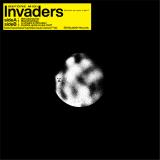
The four-track EP “Invaders, Qu'est-ce que c'est?” blends dark electro-house elements with cloudy live improvisations, created for the Turin and European underground club scene. The composer duo was born from the meeting between Viziale, a DJ & Producer, and the multidisciplinary composer Barabbah.
After connecting through Italia90®, they began collaborating on new music and launched a new label linked to the clothing brand; the 30x30 cm poster by Woc, included in the vinyl release, is a proof of the contemporary image aim of the label.
NB: The Lps are made with 100% regenerated plastic, totally green and respectful for the world and 100% compatible with the standard of the pure material.
qu"s debut album where did the sun go? presents his sonic transformation from a producer to a producer artist in his own right, not only engineering beats, but writing songs, arranging instrumentation and directing his own vision onto a full length album. where did the sun go? features prominent artists like Jay Prince (UK) and Serious Klein (GER), emerging artists Josh Kye (UK) and Malaya (US) as well as Kabul Fire artists agajon and Ninja Kidsoul. on 15 tracks qu proves his versatility in creating an alternative sound that is inspired by the music traditions of hiphop, rnb & jazz.
Évariste is one of the rare specimens of artist-cum-scientists. Among his kind stand others like Pierre Schaeffer, a Polytechnique graduate (an engineer but also the father of musique concrète) and the eccentric Boby Lapointe (graduate of the École centrale and inventor of the Bibi-binaire system, patented in 1968). Évariste's songwriting, joyful and full of energy (albeit extremely critical), shrouds an original tragedy: born in 1943 among résistants, Joël Sternheimer (aka Évariste) grew up without a father, lost to Auschwitz. Although he makes little reference to Jewish culture in his music, his origins leave their mark: in 1974, he sings a Hebrew song on television. In 1966, the young Joël sports Princeton's colourful paraphernalia - that's because he's freshly returning from the US, where he was sent to pursue his research on "particle mass and the interpretation of observed regularities, such as the effects of a wave" (will understand who may). When he gets there the country's in the midst of the Vietnam War. With McNamara keen to find an alternative to the nuclear weapon and calling upon the country's biggest brains to undertake the task, there's a "fund shift" within the university - a diplomatic way to give notice to whoever may not be disposed to follow the government's scheme. Joël, who's under the supervision of a rebellious physician, is dismissed. He regardless keeps following the prestigious seminaries of the Institute for Advanced Study, chaired by Oppenheimer, inventor of the atomic bomb. Likely inspired by the hippie movement and music, Joël buys a guitar and starts playing in Washington Square - after all, Bob Dylan himself started there. He blithely skips Oppenheimer and receives a warm (though surprised) welcome from a crowd thoroughly unfamiliar with French. When the ageing physicist questions him about his decreasing attendance, Joël explains how drawn he is to music, and how he thinks it could help him in self-financing his research. Évariste recalls seeing the sickened man, his face torn by remorse, lighten up to his words and say: "What's keeping you - go for it! If I was still young that's exactly what I'd do." The student takes these words as a testimony from his professor - and it's enough to convince him . And so he takes the leap during the Christmas vacations he spends in Paris. A journalist friend he often sees around the Sorbonne introduces him to the artistic director of Disques AZ. The latter passes the tapes on to the label's boss, Lucien Morisse, also program manager on Europe N°1. Morisse is blown away - and signs him onto the label right away. Michel Colombier, arranger for Serge Gainsbourg and co-author of "Psyché Rock", with Pierre Henry, contributes some of his original ideas to the 7 inch "E=mc2": Évariste's preoccupation with the percussion sound on the track "Le calcul intégral" is that it goes "poom poom" and not "tock tock" - Colombier is aware of the issue and records Évariste's guitar like a percussion in an isolated booth. The organist Eddy Louis, who is to participate, in 1969, to the success of Claude Nougaro's "Paris mai", also appears on the record. It's 1966 and the Antoine phenomenon (signed on Vogue) storms through France. The two singers share similarities: Antoine is an engineer of the École centrale, gifted with a great originality in his song-writing. A godsend for the two labels who turn this resemblance into a commercial strategy, setting them out as rivals. To this day though, Évariste still denies what was little more than slushy tabloïd gossip. Success comes around swiftly and in 1967 Évariste launches into a second 7 inch, "Wo I nee", again arranged by Michel Colombier. Quantum mechanics fans finally get their anthem with "La Chasse Au Boson Intermédiaire" (or the "Intermediary Boson Pursuit"). To sum up what's a boson, say he's a close pal of the meson, photon and other gluons. A few months later, it's May 68 and everything's turned upside down. Évariste writes a series of songs inspired by the events, which he immediately submits to Lucien Morisse. When the man behind "Salut les copains", once married to Dalida, hears the song "La révolution" - a father and son dialogue - he can't take any more: AZ simply cannot release this. But there and then Lucien Morisse makes a gesture which will remain engraved in French music's history: sorry to be unable to officially stand by the singer, he encourages him to self-produce the record, but with his tacit support. He calls the pressing factory and asks they apply the same rate for Évariste as they would for AZ. The singer and his musicians use the same studio as for the previous record, all of them playing for free awaiting a return on investment. Évariste keeps singing at the Sorbonne with "Jussieu's gang" and "the young Renaud" he nicknames "le p'tit gavroche" (or "street urchin"). Renaud volunteers to type the lyrics of the song "La révolution" so that the chorus can be sung and recorded. A boy in the group is related to Wolinski and introduces them. The two get along so well that Wolinski ends up drawing the cover for the record "La révolution", for free. The self-released 7 inch "La révolution / La faute à Nanterre" is sold under the table and door-to-door for half the price of a standard record, on and around the boulevard Saint-Michel; and it runs out fast. In the end, there will be 6 releases of the record, and 25000 copies sold. When the theatre director Claude Confortès decides to adapt Wolinski's drawing series titled "Je ne veux pas mourir idiot" ("I don't want to die a fool"), he asks Évariste to write the original soundtrack. His friend, now cartoonist for Hara-Kiri Hebdo, often promotes him in accordance with a principle dear to him by virtue of which he gives a special place to his friends. Dominique Grange (writer of the song "Nous sommes les nouveaux partisans") soon joins the team. After 150 performances, Évariste leaves his place to Dominique Maurin (brother of Patrick Dewaere). Évariste composes the songs for Claude Confortès' next play, "Je ne pense qu'à ça" ("That's all I think about"), co-wrote with Wolinski in 1969. The comedians of the play record the songs on a 7 inch, with a cover signed, again, by Wolinski. In 1971, French television produces the documentary "Évariste et les 7 dimensions", but doesn't air it. Indeed, the scientific sub-comity of the programming comity (sic) censors the show. The given justification is that "Évariste dangerously mixed science with science-fiction, numerology and other non-scientific disciplines". The underlying motive might have been a will to censor the singer-mathematician's political discourse. In the documentary and among other things, Évariste discusses hierarchy, alienation and revolution. Half a century later the documentary remains invisible, though some excerpts resurfaced in 1992 in the cult show "L'oeil du cyclone", on Canal +. Though flourishing, Évariste's career is nearing its end. 1970 is the beginning of a decade in the course of which he is to make a decisive discovery in the musical and scientific domains. Following this breakthrough, he moves away from self-produced music and gaucho magazines to focus on science. He keeps Oppenheimer's encouraging words in mind, now freely pursuing his research thanks to the sales of his records. Joël realises that when decoding protein sequences, one finds musical sequences recognisable to humans. He names them "proteodies". If, when listening to a proteody, one responds by being so sensitive as to finding it beautiful, then it reveals a deficiency of the related protein - and this peculiar music may be the cure. We could trace back the music history in light of proteins lacking in a given artist, or within a public's majority. You always thought these hysterical groupies who'd throw their underwear with passion and faint in the pit had miraculously appeared because they had never heard anything as wonderful as the Beatles? Make no mistake! For Évariste, it all boils down to an intro's protein content. Indeed, the beginning of their first hit "Love Me Do" corresponds to dopamine, the neurotransmitter linked to compulsive buying. An intro like this could only unleash the fervour of groupies, victims of fashion and biology. Évariste's success is such that the income from his sales gives him the autonomy to which he had aspired when confiding to Oppenheimer. It made it possible for him to pursue his research without any institutional constraints. He now devotes himself to his proteodies, sat in the offices of the European University for Research, just around the corner from the Sorbonne he knew so well. Évariste is no more. Joël regained control of this strange and comical beast.
“Les choses qu’on ne peut dire à personne” is Bertrand Burgalat’s fifth studio album. The record features 19 titles that set the bar very high, speak about the world as it is, with strength and subtlety. Racy songwriting, supple rhythms, sumptuous harmonies, corrupting voices: the testimony of a goldsmith at the height of his art. A masterful record that looks like no one else.
Harfloor killer of an hardtek sound... L'Hallucicité usually represses sounds and here comes to finally produces a new artist with new tunes. Harfdfloor anti-progressive, and anti-depressive. Full-out !
They say that good things come in threes... it must be true and Favorite Recordings also proudly presents the third edition of its acclaimed French Disco Boogie Sounds compilation series.
Like on prior volumes, the complete tracklist is selected by label head honcho, Charles Maurice (aka Pascal Rioux), who's unearthed 13 more forgotten and hidden tracks, all produced whether in France, in French, or by French artists between 1977 and 1987.
With most of these titles now very hard to find in their original edition and unknown by many, this compilation should be a must have for any Disco-Boogie-Funk music lover and collector.
Fully remastered from originals at The Carvery Cut (UK), French Disco Boogie Sounds Vol.3 (1977-1987, selected by Charles Maurice) is presented by Favorite Recordings in a gatefold vinyl double LP and as CD.
out of Stock
Last delivered 68 days ago available to reorder, subject to availability
For the first time Nicolas Repac's album Swing-Swing, originally out in 2004, is released on vinyl LP!
He has a reputation as a musician's musician, a talented Jack-of-all-Trades as much at ease playing the guitar alongside his old accomplice, French songwriter Arthur H, as he is when tinkering with all kinds of machines by instinct, and creating made-to-measure contexts for instrumentalists like Michel Portal. Everyone knew he had a secret garden, the song' world of a composer and performer who was difficult to categorize, a world not only lyrical but also dark and full of tender melancholy, not to mention easily surrealist (his first record of songs, La vile', which was released on the Indigo label in 1997, has a sequel in preparation in the form of a new opus, Lovni'.) But, once again,
Nicolas Repac had a surprise in store, because he has turned up where no one was expecting him: Swing Swing is a record as magnificent as it is difficult to place, with electro ramblings around jazz (its subjects and virtues, its spirit and memory), wanderings that are playful, light, fluid in gesture and crammed with ideas, discoveries and intuition, they are at once naive and instinctive (Repac is an erudite amateur, the Ferdinand Cheval of the already-established world of electronic music), and extremely elaborate in their crushed samples, hallucinatory, rhythmic whirls and sensual, dreamlike atmospheres.
out of Stock
Last delivered 4 years ago available to reorder, subject to availability
'Benjamin Lew was an enlightened amateur, in the noble and almost Renaissance-like sense of the word: he dabbled with equal grace in photography, writing, visual arts ... and worked part-time as a cocktail mixer in a tropical bar which was one of the favourite watering holes of Brussels' thriving artistic community of the early '80s. Tuxedomoon had just moved to Brussels, and Steven Brown was among the many musicians, designers & artists who patronized the bar. Benjamin had a secret passion: he wasn't a musician, but had acquired a small analog computer, with which he had started creating these strange mysterious little pieces. Benjamin played them to Steven and asked him if he'd agree to record with him. Steven was taken with them and accepted. The Douzième Journée was largely created in the studio by both protagonists, with the help of Gilles Martin and myself, in the spring of '82. Listening to his albums (he went on to record four more with Crammed) is like embarking on a dream journey to the Sahara or the Far East. You'd think that some of the pieces feature non-European musicians or samples but: no... this is just Benjamin's imagination, his synths, and his friends...'
Marc Hollander, Feb. 2019
out of Stock
Last delivered 6 years ago available to reorder, subject to availability
Guizmo has for many years left a strong imprint in the French rap scene with his unique personal universe and an acknowledged gift to writing. Three years after release the album 'Dans Ma Ruche' and the surprise street album 'GPG 1 in 2016, the singles of this fifth album are already receiving praises from the fans and the medias, paving the way for another success for the 26-year old rapper. Guizmo is a viral sensation and strategizes his own social campaigns to reach his fans directly. He's gathered 400+K followers on YouTube and 160+M views, 730+K Facebook fans, 100+K Twitter followers and more than 95K followers on Instagram
Blinding tracks from Joey Anderson, Qu, Nicuri and new artist Art Gallery.
Exchange Place is the DJ collective that includes Nicuri himself alongside Joey Anderson, DJ Qu and a producer by the name of Art Gallery. The name makes reference to a district in Downtown Jersey City, just across the river from Manhattan, which is where the crew is primarily based. They released a 12-inch under the name Exchange Place with DJ Qu's Strength Music label back in 2010, and have DJ'd occasionally as a group around New York City. The new EP, Immaculate Inception, includes one track from each of the four contributors.
out of Stock
Last delivered 2 years ago available to reorder, subject to availability
Special Remarks: 10'' vinyl in a cardboard sleeve with 3mm spine. CD included.
Les Fils du Calvaire is a Parisian trio (Jo, Damien & Clément. Nowadays they spend their time between the French capital and Berlin. They are also the creators of the hybrid electronic music project, dOP, signed on Circus Company, the label who released the first album of Nicolas Jaar. Les Fils du Calvaire is hybrid, transversal between elegant French Pop, decadent club music and outgoing cabaret. They compose for people who are singing in the shower, those who drive by night, for the charming ones while dancing upside down. Especially for those who understood that present may be our last freedom. And all this without any nostalgia. They also know how to pick their cast: they called Ash Workman for his production skills (Metronomy, Christine and the Queens...) to do the mixing of their first album. Rester avec Toi' is a perfect flavour extract from the forthcoming album ' Fils de ,
out of Stock
Last delivered 6 years ago available to reorder, subject to availability
This is France in the Mitterrand years: fashions fleet as fast as governments. In the early eighties, the happy-go-lucky gather the nectar of each and every new release.
Believing in a bright future for videotex, and loosened up by the sexy talks broadcasted on the budding pirate radios, the new generation dreams of dance floors and holiday clubs. French Boogie, which preserves the spirit of these years of boodle and bunkum, is the ideal soundtrack to their dreams.
What the web now refers to as French Boogie is some synthetic funk reflecting the spirit of those days when nothing was impossible, or so it seemed. Its syncopated flow heralded the dawning of French rap. Often considered as some kind of post-disco, inspired as much by black music as by new wave, this carefree pop music with bawdy lyrics indulged in simple pleasures: holidays, swank and sun were recurrent themes. Totally in tune with its time, it incidentally glorified luxury, success, and a certain consumerism embodied, for instance, in Bernard Tapie.
In popular clubs such as La Main Bleue in Montreuil, or L'Echappatoire in Clichy-sous-Bois - where Micky Milan could be seen behind the decks - an enthusiastic audience discovered this new sonic wave, influenced as much by French pop as by Sugar Hill Gang or Kurtis Blow. The artists who first launched the movement engaged in it wholeheartedly, but as often the case with new music trends in France, humour and casualness quickly became a decoy to impose a new style. This explosive mixture, in which startling and typically Frenchy French lyrics go along New-York-style tunes, is sometimes reminiscent of the kinky comedies directed by Max Pécas or Claude Zidi. On this prolific scene, partly originating from the Jewish community, everybody was looking for success, trying to hit the jackpot with what was to hand. Famous media personalities, one-hit wonders or John Does in quest of fame, all had a go at French Boogie - more or less successfully. Apart from « Vacances j'oublie tout » by Elégance, « Un fait divers et rien de plus » by Le Club, or « Chacun fait ce qui lui plaît » by Chagrin d'amour (produced by Patrick Bruel), very few songs became hits: the story of funk in France is that of a half-baked robbery.
In this myriad of new musicians, the very young François Feldman and Phil Barney pioneered a fresh and hybrid style. Other well-known artists like Gérard Blanc from Martin Circus (Attaché Case), Richard de Bordeaux (Ich), or Jean-Pierre Massiera (Anisette, Pirate Scratch Band, Mandrake, Scratch Man...) added an eccentric touch to this sound-wave, making it often entertaining, and sometimes showy.
Capture d'écran 2015-10-26 à 12.55.43Singers like Agathe (the author of 'La Fourmi' and of the hit song 'Je ne veux pas rentrer chez moi seule') were far more than just window dressing. They even tried to give an ironic and subversive twist to this rather harmless genre. The very vindictive rebel Gérard Vincent shared in this spirit, but as a whole, French Boogie became associated with nonchalance and sauciness. Thus, Stéphane Collaro, Gérard Jugnot, Alain Gillot Pétré and other TV clowns would clumsily contribute to this French variation on funky sounds. In a few but intense years, French Boogie gave all the tips to party with style.
If some hits made it possible for the happy few to get a real house under truly exotic palm trees, the wave actually ebbed away very quickly, leaving quite a few musicians stranded on the shore. Whether they were sincerely motivated, or simply opportunistic, they had failed. In 1984, French Boogie was already breathless, and got merged with other genres: on the one hand, rap and breakdance adapted its flow to a more urban world, especially with Sydney's show, H.I.P.H.O.P, and Dee Nasty's broadcasts on Radio Nova; on the other, italo, new beat and house began to rule over dance floors, even more strongly asserting the will to develop music for clubs.
Squeezed in between the age of disco and that of modern electronic music, French Boogie was a transitional phase, but it remains an amazingly refreshing testimony to the intermingling of pop and underground cultures. The genre was hastily categorized as anecdotal in spite of its pioneering synthetic groove and matchless bass lines. An attentive ear will discover the poetry of the ephemeral beyond the eccentricities of the genre, as well as a certain unexpected avant-gardism. At the origin of major music trends, always cheerful and catchy, French Boogie is what you need to party.