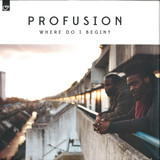
Profusion (noun): an abundance of something rich.
The sonic partnership of K15 and Emeson originated in the days of MySpace. A future of combining their skills was inevitable, and now in 2017, it's time to unleash their debut studio album into the ether.
The solo-projects of Tottenham-raised Kieron Ifill (aka K15) date back a decade, but were truly kick-started on labels such as Kyle Hall's Wild Oats and WotNot Music, with a number of genre-crossing releases dropping ever since, including the WU15 project (along with Yussef Kamaal's Henry Wu, on Eglo Records). Additionally to his production work, he has established himself internationally as a DJ, from the Jazz Cafe to the CoOp parties.
Partner in Profusion, Emeson, has many skills to his bow - singing, songwriting, producing, promoting, DJing (under the alias Ed Nice) and acting. As a musician, his varied skill-set has seen him work with Chico Hamilton, Carla Duke, Karmasound, Uzo Madu and Chris Jerome. A frontman for soul-jazz groups LifeSize, The One and Saturn's Children, he has featured on releases for BBE and Tokyo Dawn, and appeared live on stage at the likes of Ronnie Scott's.
The debut single was supported by tastemaker blogs Wonderland, XLR8R and Stamp The Wax, has been bumped by selectors such as Lefto and Jazzie B, and played on NTS, Worldwide FM, Mi-Soul, LeMellotron, Balamii Radio, Itch FM, Invader FM, Soho Radio and various stations across Europe and the US.
This album is full to the brim with summery sun-soaked synths, drifting across the warmest of basslines and heavyweight beats. Emeson's rich vocals gracefully ride atop of K15's delectably bruk twist on neo-soul sonics and electronics, this is some seriously classy contemporary London soul music, that manages to incorporate flashes of various dance music techniques, sound-system etiquette and jazz-tinged rhythms. As future-thinking as it is subtly retrospective, it doesn't lend itself to one genre, it intentionally embodies the best of many. An array of everything that is great about British black music in 2017. The message the album conveys itself couldn't have come at a more poignant time. Where do we begin
Profusion - an abundance of something rich indeed.
Buscar:rai
Never before reissued, this legendary 1968 EMI recording is a revered Indian jazz rarity, a collectors' holy grail. Raga Jazz Style is an original Indian excursion into Indo-jazz fusion. A one-away recording from the almost unknown Bombay jazz scene, it is among the few jazz LPs to hail from the subcontinent.Closely contemporary with the UK-based explorations of Amancio D'Silva, John Mayer and Joe Harriott, Raga Jazz Style takes the melodic, scale-based raga system of Indian classical music and marries it with a swinging jazz rhythm section assembled by Bollywood's most highly acclaimed musical directors, the soundtrack composing duo Shankar Singh and Jaikishan Panchal.Singh and Panchal were a dominant force in Hindi film music from the late 1940s onwards. Shankar had been trained in classical tabla, while Jaikishan was an expert harmonium player. They worked together on well over a hundred films, and their innovative compositions and orchestral scoring revolutionised the music of the nascent Bollywood industry. Central to their sound was regular collaborator Sebastian D'Souza. From 1952 onwards, D'Souza would work on every Shankar Jaikishan soundtrack, eventually becoming Bollywood's most coveted musical arranger.
Originally from Goa, D'Souza had cut his teeth in the dance-band era, arranging and playing with his uncle's jazz bands in Lahore and Quetta. After Partition, he had moved to Bombay to follow the reliable work provided by the film industry, where Goan musicians had become the mainstay of Bollywood's film studio orchestras. Goans were also the core of Bombay's thriving dance-hall and hotel-based jazz scene, with artists including saxophonist Braz Gonsalves, guitarist Amancio D'Silva and trumpeter Chic Chocolate all working in the city during the post-war years.
The team assembled for Raga Jazz Style were drawn from this inventive and forward-thinking milieu. Pianist Lucilla Pacheco, saxophonist Manohari Singh and guitarist Anibal Castro were all fixtures on the Bombay jazz circuit, while drummer Leslie Godinho is reputed to have taught Joe Morello the 5/4 'Take Five' beat when they jammed together during Dave Brubeck's State Department tour of India. To this jazz backbone was added the sitar of Ustad Rais Khan, scion of long line of classical instrumentalists, and nephew of the renowned sitarist Ustad Vilayat Khan. Bombay's jazz modernists had been experimenting with the fusion of ragas and jazz since the 1950s, long before American or British jazz musicians had tuned in to Indian classical music. But very little of this exciting scene was ever captured on record. Raga Jazz Style offers a rare chance to hear the innovative sounds of the Indian jazz scene, as peerless composers Shankar Jaikishan and arranging supremo D'Souza join with veteran Bombay jazzers to explore classical themes in a jazz setting — eleven ragas to a swinging beat!This is a highly impressive inaugural salvo by Outernational Sounds, using original masters and beautifully rendered facsimile artwork, with 180g vinyl pressed at Pallas, in Germany.
Lunar Disko presents...
Time marches on with two Various Artist EPs to celebrate the 20th release on Lunar Disko Records. Eight tracks encompassing the modus operandi of the label since the beginnings
Part 2 features another selection of Lunar Disko favourites, with the return of DJ Overdose and Raiders of the Lost ARP, while two of Ireland's finest in Tr One and Automatic Tasty complete this stellar line-up.
..and time is still marching on
Originally from Detroit, born and raised, this Atlanta transplant, has been a DJ since his youth. From backyard and basement parites as a youth, to the small club scene of metro Detroit, Reggie Dokes eventually became a sought after DJ in the city. Fast forwarding to 2001, is when he created his label Psychostasia Recordings. His sound is eclectic and soulful, and over the years as a producer of deep house, techno, tech house and downtempo, he has managed to release singles and EPs with various underground labels from the U.S. to Europe and Asia. Stay tuned for inspired and positivie vibrations from the DJ, producer and label head, Reggie Dokes.
LAATE returns with the mysterious Jack Keo! Our man was Born and raised in the southwest of England, he got his first pair of decks at 9 years old and started producing at 19. For this fourth release, Jack Keo delivers 3 originals tracks. On A side, "Module-e1 " is a heavy house tool with a groovy bassline and its organics sounds, catchy!!! On B1, Jack show his deep face with "Fondue", he make us travel a little bit more by using space synth, cosmic sound and voices cut. To finish " Apron " is a pure minimal track, strong bassline and female vocal increase the freaky atmosphere!
Are you ready to be where metaphysical borders with the dark Check the bag: water, food, flashlight, gloves, something else Go along with Mr. Cloudy in the outskirts, where every rustle to take into attention, where the barking of dogs like a beacon in the night. Sparkling from the frost luminous ice, or raw cold, with the smells of leaves and rain out all night. Mr. Cloudy - Outskirts on Skala Records, heavy ambient / drone, dub techno.
1983, in the history of synths, is a key year. During the January edition of NAMM (the most important music fair in the US), indeed, MIDI - the standard protocol for electronic instruments interaction - was introduced to the world. Until then, programming and making synths work together was something practiced by a restricted elite of 'wizards", explorers armed with cables and analog patches, who could create new sonic worlds - but totally temporary, not replicable. Real superheroes of sonic synthesis, scientists of filters who, nowadays, are highly considered by musicians all over the world, after decades of forced exile. In Italy, the seeds of this tradition were planted in RAI's Laboratory of Phonology (in Milan), in the middle of the 1950's; later, pioneers like Piero Umiliani, Federico Monti Arduini (aka Il Guardiano Del Faro), Marcello Giombini, Giampiero Boneschi and Fabio Borgazzi (Fabio Fabor) introduced electronic music in pop. Fabor (together with Antonio Arena) is the protagonist of 'Superman", an album of library music released by the World label (owned by Minstrel group) in 1984. Borgazzi, born in 1920, lived through the whole saga of Italian easy listening music (from big orchestras to the digital revolution), always keeping up with the latest styles and trends. So it's not a surprise, here, to see him using a LinnDrum and the first Japanes synths; and it's perfectly natural to find some electro-funk touches
Born and raised in Atlanta, Georgia, Fit of Body (aka Ryan Parks) is part of a new generation of ATL producers; underground artists who draw on the space and grit of Southern hip hop and team it with curveball electronica discovered on late night, weed-fuelled web trawls.Having honed his sound on a string of feted self-released cassettes released on his own Harsh Riddims label - which has also put out everything from bizarro hip hop to gleaming synth pop - and dropped a hyped 12' released on the CGI imprint, the Healthcare EP finds Fit of Body delivering his most accomplished work to date. Five woozy original tracks jammed out on second hand drum machines, bass guitar, cheap mics and creaking synths, this is techno as it was first imagined; raw machine soul made for strange times and unknown futures.
Finding a commonality between Arthur Russell's vocal delivery, Jermaine Dupri's club shaking bass, and the militant drum attacks of Underground Resistance, the EP ghosts past rigid categories, instead taking a journey through heat and haze. On the A side, Parks switches between the languid analogue house of 56k, the melancholic Drexciyan electro of Ridin 2 That Trap or Die, and the lo-fi post punk grooves of 770-997-2341. On the flip he offers the late night 808 soul of Antonio Girl, followed by the uptempo techno ballad All This Time (Since), a song sad and euphoric in equal measure. On 12', the EP is closed with a remix from fellow ATL producer Divine Interface who stretches 56k into a glistening shard of time-stretched trip hop.
Lagartijeando is the name of producer, musician and DJ Mati Zundel. Born, raised and currently living in a small town on the outskirts of Buenos Aires called Dolores. From a very early age, he was musically curious- experimenting with percussion, charango, guitar, bass, voice, and beyond.
Strongly influenced by his travels through Latin America, Mati's signature psychedelic dance tracks latch onto everything from traditional folk sounds from the Bolivian altiplano to the jungle beats of Brazil. Mati hypnotically fuses his traditional influences (with an emphasis on shaman chant and charango loops) with contemporary electronic beats, creating a sound that once left NPR speechless.
Lagartigeando was signed to the infamous ZZK Records in 2009 (Chancha Via Circuito, Nicola Cruz, etc.) on which he released his first EP Neobailongo- a mix of cumbias with electro and dubstep elements. After releasing the EP, Mati soon took to the road and dove deeper into the music of the Andes, studying charango and various traditional folk styles. In 2012, under the name Mati Zundel, he released his first full length album Amazonico Gravitante, via ZZK as well as Waxploitation (Gnarls Barkley, Danger Mouse) in the U.S.
Some more miles later, Mati released his second LP Cardos Redondo also on Waxploitation, which featured 8 songs recorded across Latin America- an album he calls an 'imaginary sound map of Latin America,'
Freshly into 2017, Mati brings us El Gran Poder via Wonderwheel (Novalima, Alsarah & The Nubatones)- named after an important Aymara festival that takes place in Bolivia and Peru, purely to celebrate family. At these festivals, the community also celebrates their culture and the importance of the collective identity. Like these festivals, the album is a celebratory one, and will tempt any listener out of their seat. The album was recorded in Mati's town, Dolores, outside of Buenos Aires. Once again taking a huge variety of sounds- this time influenced by Brazilian house,afro-brazilian rhythms, and folkloric Andean music. All songs are written and produced by Mati, apart from Lunita, a danceable track written in collaboration with Barrio Lindo.
Album of all new material from this maverick Spanish producer.
marvin horsch debuts on Berlin's FILM with an EP of exquisitely produced, cinematic electronica. the cologne based producer develops the colourful house found on previous work for the dorfjungs la-bel, with three playful compositions that draw as much on jazz and krautrock as more contemporary strains of alternative electronic music. opener 'omnisession#1' marries a beautifully shifting organ with live drum work before segueing into the glorious softness of 'sun after rain,' a rich synth solo drenched in tape hiss. closer 'negobebo#2' wraps up the EP - an energetic, looping recording replete with staccato drum-machine strikes and warm, wet verbs carrying a spirited lead across it's six minute duration. An honest record, open and expertly executed - fukushisha is an admirable addition to the FILM cata-logue.
Bottom dwellers rising to the top a little taste of who's who in the current Brooklyn underbelly, L.I.E.S. links up with like minded misfits from the Primitive Languages crew to present a six track comp 12 exploring freeform electronics of varying shapes and tempos from brutal to beautiful club to gutter it's all here...get in or get out. Picture cover by Matthew Bellosi! No Payments Rejected!
It's a pleasure to introduce Tony Rainwater - undoubtedly the most productive and creative savage we've come across recently. See usually we don't do this, Lehult is a crew affair, but this guy left us no choice. Being a music enthusiast, DJ and dancer for a long time, Tony has only most recently picked up producing his own music, yet at a stunning rate: When we first asked him for a demo - three months after he started producing - he swiftly dropped us a set of twenty-five tracks, another set of fifty more soon followed. His productions are straight rough edged, no-prisoners-taken Jams, combining samples from the most far-flung corners of his eclectic music collection. His magical patchwork wild style is on full display on his debut "Rockberry Jam" EP for Lehult. The A-Side takes us through the lighter side of his repertoire with the title tracks slow building house groove, some dizzy medieval monk grooves on "To All The World" and seductive R&B on "Lay It On The Line". On the flip "Operalight" irresistible groove and "Black Dream Flowers" provide some darker moments, before "Alone" closes on a soft note. The Vinyl version includes an extra goodie after the runout's. Tony is now a fixed member of the crew already and we're proud to have him and his crazy energy on the team. This won't be the last you'll hear of him.
- A1: Bye Bye Session Band - Lily
- A2: Sentimental Hotel - Rie Nakahara
- A3: Bara To Yajyu - Haruomi Hosono
- A4: Why Don't You Move In With Me - Yasuko Agawa
- B1: Jiken Ga Okitara Beru Ga Neru - Pink Lady
- B2: Summer Champion - Yuko Asano
- B3: Dancin' - Junko Ohashi
- B4: Rainbow Paradise - Masayoshi Takanaka
- C1: Uragiri - Mari Natsuki
- C2: Maboroshi No Hito - Miyako Chaki
- C3: Tornado - Minako Yoshida
- C4: Banana - Kay Ishiguro
- D1: Funky Miyo-Chan - Masaaki Hirao
- D2: Yashow Macashow - Ebonee Webb
- D3: Lovin' Mighty Fire - Naoya Matsuoka & Minako Yoshida
Lovin' Mighty Fire' is Howard Williams' third Japanese music compilation for the Ace Records house of labels - this time, for BGP International. Assembled in between his job as a record distributor and his monthly Japan Blues show for NTS radio, the first two have taken a look at the late 50s for a blast of Japanese rockabilly ( Nippon Rock'n'Roll' CDWIKD 313), then the 60s and 70s for a romp in Japanese surf music ( Nippon Guitars CDWIKD 297). Following his retrospective of jazz singer Maki Asakawa for Honest Jon's, this new outing searches for the soul music of Japan, from the early 70s to the early 80s.
Japan has long been known as the final destination for many a collectible soul record. Yet, who suspected that some fine soul grooves were recorded for the domestic market, from ballads, to funk and disco Strangely enough, some of the busiest writers and producers in this field came from a late 60s rock band, Happy End, but on listening to their collaborations, their rhythmic, soulful feel is immediately apparent.
The bluesy funk of Lily, the soul-diva brilliance of Minako Yoshida - represented here in both slow-grind mode and epic disco, the maverick genius of Haruomi Hosono, the lively songstress Yasuko Agawa, and the sultry steaminess of Mari Natsuki, and more. This album finally plants a Japanese flag firmly on the global map of soul.


