A journey into the raw and visceral origins: from the demo sessions mixed by Steve Albini to the night of the very first secret show on December 20th, 1988. In the heart of Chicago, Geordie and Martin Atkins turned frustration and distance into pure creative energy, recording the now-legendary "Black Cassette" demos at Albini"s house. Distorted, menacing bass lines, unruly oscillators, and Albini running endlessly up and down the stairs between the basement drum room and the pantry control room defined a sound that was brutally direct and uncompromising. The first interactions with the Yamaha drum machine foreshadowed elements that would later shape parts of the album. Those sessions sparked essential ideas, while the future studio - purchased from Steve and moved to Wabash Ave - would soon become the core of Invisible Records and Killing Joke"s operations. On the other side, a truly rare document: excerpts from Atkins"s very first show with the band, at Burberries in Birmingham on December 20th, 1988. In a small, mirror-lined club filled with tension, adrenaline, and inevitable collisions with the walls, Extremities, The Fanatic, Intravenous, and The Beautiful Dead were performed publicly for the first time. It was the night when everything ignited: the blast beat still in its embryonic stage, the controlled fury Geordie demanded - "can you go a bit more Moonie on it?" - and above all Jaz"s theatrical yet strikingly genuine laughter. Not just joy, but a declaration: a giant "fuck off" to the doubters and a prelude of what was about to come. A raw, essential, indispensable testimony: the birth of an era.
quête:re public
- Le Mieux Et Le Bien
- Yellow Moon
- Papillon
- Come Home
- My Little Sweet New Zealand Bunker
- Stop This World
- Indien De Paname
- Les Maximiseurs De Pi
- Notre Ile
- My Little Sweet New Zealand Bunker
- C'est Comme Ca C'est La Vie
Rather than yielding to despair in these troubled times and offering listeners a rope to hang themselves, Zimmermann (trombonist for Claude Nougaro, Manu Dibango, and Tony Allen) playfully grants them another option - a humorous sarcasm! He mocks the vain shelters of the powerful with the tune "My Little Sweet NZ Bunker", denounces the manufacture of one- track minds with "Les maximiseurs de PI", and escapism with the classic satirical Mose Allison's song "Stop This World (let me off" (translated and sung in French) In more tender moments, he reflects on the intimate consequences of this global unraveling.
Daniel Zimmerman's style, both as a composer and soloist, is that of a melodist above all else; disregarding concepts, he sings and seeks to go straight to the heart. He was voted 'Trombonist of the Year' by Jazz Magazine (Frances most influential jazz publication) in 2021, 2022, 2023 and 2024.
The roots of Studio Music lie in a special encounter between sound artist Jan D’Haene and visual artist Mark Manders. Recorded in Manders’ studio, where sounds resonated among the artworks, the music unfolded in dialogue with the imposing space. As the concluding part of a diptych, following the EP Études, this album evolves more slowly and with greater layers. It forms a dialogue with D’Haene’s introspective passages and invites a moment of pause and stillness. In doing so, the music embodies the tension between vulnerability and strength, between the individual and the universal.
- Side A. Gypsy Song
- Side B. Never Land
After traveling through Mexico, Miami, the Bahamas, and New Orleans, Nishioka recorded his fourth album South American Journey in Los Angeles,
released in 1979. From this album, two of his most celebrated tracks—“GYPSY SONG”, a fan favorite with numerous cover versions, and “NEVER LAND”,
featuring the distinctive sound of steel pans and a Japanese reggae vibe are now being pressed on 7-inch vinyl for the first time in a limited edition!
The recording features members of the So What Review band, including Junshi Yamagishi (guitar) and Osamu Ishida (guitar), along with renowned steel pan
player Robert Greenidge, known for collaborations with Van Dyke Parks and Taj Mahal.
(FLATT THE LAIDBACK)
Kyozo Nishioka Profile
(Born May 7, 1948 – Died April 3, 1999)
Singer songwriter from the Shima Peninsula in Mie Prefecture, affectionately nicknamed “Zo-san”.
After enrolling at Kinki University and moving to Osaka, Nishioka became a regular at the folk cafe Dylan in Namba, opened in August 1969 by Masaji Otsuka
and Yoko Ishimura. Dylan was a gathering spot for folk music enthusiasts from all over Japan.
Nishioka formed the folk group The Dylan with Masaji Otsuka and You Nagai, performing at folk camps and the Nakatsugawa Folk Jamboree. In 1971, Nishioka
left the group, and Otsuka and Nagai continued as The Dylan II. Nishioka wrote and composed the song “Puka Puka” under the pen name Zokyozo, which became
one of his signature works. The song was first released in July 1971 as the B-side of The Dylan II’s single “Otoko rashii tte Wakarukai” on URC Records.
Nishioka began his solo career, releasing his debut album “Dylan nite” in July 1972, produced by Kinji Yoshino on Bellwood Records, which included his own
version of “Puka Puka”. In September 1973, he appeared at the farewell concert of Happy End titled CITY – LAST TIME AROUND at Bunkyo Public Hall in Tokyo.
His 1974 album “Machiyuki Murayuki” was produced by Haruomi Hosono, and his 1975 album “Rokka My Baby” featured support from Shigeru Suzuki’s band
HUCKLE BACK. Nishioka recorded three albums under Hosono’s production, deepening their friendship.
Together with his wife and lyricist KURO, Nishioka wrote songs for artists such as Eikichi Yazawa. The couple traveled the world, recording overseas albums such
as “Nanbei Ryoko” (1977), “Yoh-Sollo” (1979), and “New York to Jamaica” (1981), incorporating reggae, calypso, and other global sounds. In the 1980s, he released
works under the duo name KYOZO & BUN with Yoshifumi Okajima, and in the 1990s returned to solo projects with albums like “START” (1993) and “Farewell
Song” (1997).
After KURO’s passing in 1997, Nishioka continued his musical activities until his own death in 1999 at the age of 50. His music transcended the boundaries of folk,
blending jazz and tropical elements to create a unique world view, leaving an indelible mark on Japanese music history.
2026 Repress
Alleviated Records is proud to present the first of hopefully a succession of releases sharing selections from our own Archive of recordings that either have never been issued or that have never been issued on the Alleviated imprint. After many years of being ''on-the-shelf'' we are extremely pleased to share these with the public. First up, we have a selection that was being considered for the ''Another Side'' (Fingers, Inc.) album that features Ron Wilson free-styling vocals to a deep-house vibe. To this day, we are not quite sure why this selection was not included on the project but are pleased to finally share it. Next up we have ''Electronic Debris'' delivering a ''mellow-deep'' vibe. Then we have ''Saspence'' with, as the title implies, a ''mysterious-deep-minimal house'' feel. Concluding the EP is ''Nyte Light'' delivering a ''deep-ambient-acid'' flavor. We sincerely hope that you enjoy these selections at the club and at home for a long time to come. Musically Yours...
2023 Repress
Alleviated Records is proud to present the second of hopefully a succession of releases sharing selections from our own Archive of recordings that either have never been issued or that have never been issued on the Alleviated imprint. After many years of being "on-the-shelf" we are extremely pleased to share these with the public.
- Ntr1
- Ntr2
- Drg5
- Drn9
- Drg10
- SL12:
- Drg14
- Drg15
- Prn2#16
- Otr
- Prn2_9Ofm15Tb
- Prn2_9Ofm15Ta
- Prn2_M15T
- Prn2_M15T_Selforg_Tapecut
NYZ (David Burraston) presents this collection of generative music pieces carefully extracted from a PreenFM2 gifted to him by Aphex Twin. PRN2_M15t is being released at the same time as an LP titled Stria from Dr. John Chowning who invented the original FM synthesis algorithms which were sold to Yamaha and used in the creation of the DX series of keyboards. An interview with Chowning, conducted by David Burraston, will be published at the same time.
David Burraston is an award winning artist/scientist working in the areas of technology and electronic music, operating Noyzelab as an independent art/science music studio since 1981. Numerous research publications include a 2006 PhD thesis Generative Music & Cellular Automata, which developed and applied fundamental new concepts from generative music practice to a key problem in complex systems theory.
His experimental arts practice encompasses field recording, landscape-scale sound art, chaos/complexity, practice-based research, sound synthesis and electronic music. He performs, lectures, conducts workshops and creates art installations in Regional NSW and around the world. David also designs and builds sound synthesizers based on his theories of chaos/complexity science. He was recently interviewed by Bandcamp Daily and The Wire Magazine.
David has worked with many diverse collaborators such as Aphex Twin, Chris Watson, Doug Quin, Russell Haswell, Robin Fox, Oren Ambarchi, Sarah Last, Cat Hope, Garry Bradbury, William Barton, Alan Lamb, MIT Media Lab and the Australian Broadcasting Corporation. In 2014 he independently published the legendary "SYROBONKERS!", the most technical and in-depth interview ever given by Aphex Twin.
- 1: Golden
- 2: Locks
- 3: Medusa
- 4: Roma
- 5: Katyusha
- 6: Runaway
- 7: Saigon
- 8: Brokenworld
- 9: Zoo Story
- 10: Trojan Stalks
- 11: Floods
- 12: Polen
In collaboration with EIoper Music, Impressed is proud to press the 10-Year Anniversary Edition of Szymon's debut album, Tigersapp, on limited edition vinyl.
Szymon was a multi-instrumentalist from Newcastle, Australia, with a deep love for jazz and production, building rich sonic worlds in his bedroom studio. Tigersapp stands as his creative legacy—a beautifully curated and emotionally layered collection that blends influences from folk, ambient, electronic, and indie pop.
These songs were mostly recorded in 2008–2009 in his home studio. After his death, his family and supporters enlisted producers like Rusty Santos (Animal Collective, Grizzly Bear) and Ian Pritchett (Angus & Julia Stone) to complete the mixes.
Tigersapp has earned both public and critical recognition in Australia and beyond. It debuted at #21 on the ARIA Albums Chart, and earned a nomination for the 2015 ARIA Award for Best Adult Contemporary Album.
Alleviated Records is proud to present the third installment of 'Vault Sessions' series. Sharing recordings from the archives that either have never been issued or been out of print for a long time. After many years of being "on-the-shelf" we are extremely pleased to share these selections with the public.
Straight outta Gothenburg, DJ Blendah & The Printz blur the lines between remixes, edits and reworks, and “Get Funky in the Heart” is no exception. Taking the finest elements from Teddy Pendergrass, Dee-lite & Q-Tip, and adding fresh live bass and beats, this is a tried and (road)tested floor-filler! 122 BPM
On the flip, Studio 45 gaffer Del Gazeebo has relented to years of public demand to finally release “Know How to Shake?” to the public - a staple of his party sets over the years that has never since a vinyl release until now. Not only that, he's completely rebuilt it, with more sonic twists, turns and "party tricks" than ever before. It's the Young MC/Jacksons blend you never thought you needed, but essential all the same. 118 BPM
- A1: Fading Away
- A2: Make It Stop
- A3: Who Wins
- A4: Read Between The Lines
- A5: Automated Paradise
- A6: Terminal Terminal The End
- A7: Endless Sky
- A8: Brockwell Lido
This is Jah Wobble"s first post punk LP in recent years following travel and dub records. The brash guitar driven tracks reflect his continuing preoccupation with the declining state of the nation. Driven by his experience working each week at a music based community project in Merton, with Jon Klein, it is reminiscent of Mark Stewart. Angry in an empathetic, constructive way it resolved with the beautiful instrumental "Brockwell Lido". Like much of his work these days, much of the lyrical content comes while traversing London"s transport system. Jah Wobble, is an English bass guitarist and singer. He became known to a wider audience as the original bass player in Public Image Ltd (PiL) in the late 1970s and early 1980s; he left the band after two albums. Following his departure from PiL, he developed a solo career. In 2012, he reunited with fellow PiL guitarist Keith Levene for Metal Box in Dub and the album Yin & Yang. Since 2013, he has been one of the featured pundits on Sunday morning"s The Virtual Jukebox segment of BBC Radio 5 Live"s Up All Night with Dotun Adebayo. His autobiography, Memoirs of a Geezer, was published in 2009. Jon Klein Is an English guitarist and producer, best known for being a member of Siouxsie and the Banshees for seven years, from 1987 until 1994. He also founded Specimen and The Batcave nightclub. Klein has worked for other artists including Talvin Singh and Sinéad O"Connor. More recently he has worked as a co-producer and guitarist with Jah Wobble.
- A1: Move
- A2: Jeru
- A3: Moon Dreams
- A4: Venus De Milo
- A5: Budo
- A6: Deceotion
- B1: Goldchild
- B2: Boplicity
- B3: Rocker
- B4: Israel
- B5: Rouge
In 1949 Miles Davis, Gerry Mulligan and Gil Evans - they'd never met before - gravitated together with the natural
affinity of kindred souls. Combined, they gave each other a spiritual boost that resulted in many all-night sessions of
earnest discussion, writing and playing-productive work on new musical ideas, new voicings, new concepts of jazz.
Their first appearance startled a delighted jazz public, and marked the birth of the cool. Today, these famous Miles
Davis instrumentals are as exciting as ever, and here are in all their glory.
2026 Repress
Next year the iconic anthem Cafe Del Mar will celebrate its 30th anniversary, a landmark that will be celebrated with a series of brand new remixes alongside the finest existing remixes in specially remastered versions.
Launching the series of vinyl releases in September is a remastered vinyl-only release of the original mix, as well as the best-known version of this classic track, the iconic Three ‘N One Remix.
Nearly 30 years ago, Paul M aka DJ Kid Paul recording as Energy 52 unleashed a record onto an unsuspecting public that would go on to define club culture for an entire generation of dance music enthusiasts. Named as an homage to the legendary Ibiza sunset spot, Café Del Mar broke down boundaries between the underground and
the mainstream, charting in the UK singles charts on three separate occasions and named as the “best tune ever” by Mixmag at the start of the new millennium. In terms of cultural and emotional impact in dance music, it’s hard to find a record that comes close.
Café Del Mar has come to represent the most euphoric and hedonistic pleasures of dancefloors - in Ibiza and all around the world - and has been remixed by some of the biggest names in the industry. Now, 30 years after its original release, Superstition Records will be putting out a new series of releases, with brand new remixes as well as remastered versions of some of the many remixes from across the last three decades. The vinyl-only remastered version of the original and Three ‘N One mixes will launch the series, with further details about the rest of the series announced in the coming weeks.
In 2021 Paul Van Dyk’s Café Del Mar remixes launched a series of vinyl and digital re-issues on the Superstition Records imprint after an almost 20 years hiatus. From 1993 until 2003 Superstition Records was a groundbreaking Techno, Tech-House and Trance Label and released some of the biggest and most revered records of the early German electronic scene.
»Ka ora te awa. Ka ora te iwi. The river is well, so the people are well«, says artist and writer Hana Pera Aoake. »In a Māori worldview, everything is connected and contains mauri, the life spark or essence inherent in all things, as they contain the residue of ancestors through whakapapa, or genealogy. Within Western environmental histories, there is a gap in knowledge around what we can learn through an act of listening.«
Hana Pera Aoake’s words resonated with Hinako Omori when they were invited by the Serpentine Gallery to write a piece of music for their »Serpentine Reader« publication on the theme of circulation. Aoake’s essay about listening to the river and other bodies of water parallels Omori’s own Japanese cultural view of water as a sacred source.
»studies on a river« places these two notions side by side, with Omori’s recordings of water sources and elegant 3/4 synth compositions matched to extracts from Aoake’s writing. The first side presents the music alone, while the second is where the project really clicks, with Aoake’s themes and Omori’s gentle, washing sounds completely in sync.
If there is a year zero for the introduction of reggae music to Japan, you’d be forgiven for thinking it was 1979 when Bob Marley and the Wailers toured the country, trailed by an entourage of journalists, photographers and fans ready to spread the message of the music into all corners of Japanese society.
But the story of Japanese reggae is not a linear one, and the music that is collected on Tokyo Riddim 1976-1985 captures the moment J-reggae entered the broader public consciousness, merging commercial city pop style with an infectious backbeat, that has drawn comparisons with the emergence of Lovers Rock in the UK.
Rather than look directly to Jamaica, many producers and artists in Japan were inspired instead by the more approachable sounds of The Police and UB40, their reggae fix arriving pre-filtered through the lens of new wave pop from the UK. Playful and groovy, these album deep cuts have been overlooked for too long.
Among them are Miki Hirayama, the idol singer who borrowed the bassline from Bob Marley’s Natural Mystic on ‘Denshi Lenzi’, Chu Kosaka, who headed to Hawaii to cut the Jimmy Cliff-inspired ‘Music’ and Marlene, the Philippine songstress whose cover of Roberta Flack’s ‘Hittin’ Me Wear It Hurts’ owed much to her producer’s obsession with Sly & Robbie’s Compass Point sound.
Then there was Izumi “Mimi” Kobayashi, who enlisted the Babylon Warriors to perform on a dubbed-out version of her own track ‘Lazy Love’, the city pop-meets-new wave reggae sound of Miharu Koshi’s ‘Coffee Break’, Junko Yagami’s anti-apartheid deep cut ‘Johannesburg’ and Lily, whose ‘Tenkini Naare’ was produced by Ryuichi Sakamoto and closes out the compilation with a flourish.
While these stories may not always conform to neat narratives, they do provide a more accurate reflection of the indirect ways in which styles infiltrate one another and, in their naivety, have the potential to create something beautifully strange and entirely new. Previously only available in Japan, the tracks on this compilation are a testament to that curious alchemy.
Tokyo Riddim 1976-1985 is released on vinyl and as a full album download (no streaming), featuring original artwork by Japanese Fukuoka-based artist Noncheleee, whose cover pays homage to the iconic dancehall album art of Wilfred Limonious.
Released on 1st September, Tokyo Riddim 1976-1985 is part of Time Capsule's Nippon Series, a loose series of compilations exploring different musical scenes from Japan between the 1960s and 2010s.
- A1: We Mean It, Man!
- A2: Life Is Possible Again
- A3: No Time For Idiots
- A4: Hater Liquidator
- A5: Boiling Point
- A6: Ignition
- A7: From Boyarka To Boyaca
- A8: Mystics
- A9: We Did Good With The Good We Did
- A10: Crayons
- A11: State Of Shock
- A12: Solidarity (Nick Launay Mix)
We Mean It, Man! If you're receiving this message, you are a writerly/music/culture person who wants to know more about the new Gogol Bordello album the band just unleashed. It's called We Mean It, Man! And it's out on February 13, 2026 via Casa Gogol Records. Gogol frontman and spiritual figurehead Eugene Hutz calls it the band's "post punk revenge." It's a fitting description. We Mean It, Man! #was co-produced by Nick Launay, whose 40+ year run of musical partners reads like the Great Canon of avant-teasing rock: Idles, Nick Cave and The Bad Seeds, Public Image Limited, Gang Of Four, the Yeah Yeah Yeahs (he did the one with "Heads Will Roll" on it. Dude is the Quincy Jones of the underground). And Adam "Atom" Greenspan (Nick Cave, Idles, Refused, Amyl and The Sniffers).
ULURU is a large sandstone rock formation in Australia. It's sacred to the Anangu, the local Indigenous of the area. For many years it had been deprived of its spiritual significance, due to mass tourism, capitalism, as well as greedy and selfishness of people who just want to make money out of it. However, as a result of the Anangu’s resilience, care and staunchness, huge changes took place in the national park around Uluru as well as in the broader public's consciousness, giving again to the Uluru the sacred identity that had been lost.
You might be reading and thinking now: so what's the point? Actually, there's no real point. I would rather say, there’s hope. The hope of seeing humans all around the world following the example of the Anangu. The hope of seeing humans finally stopping to treat the earth and all what’s part of it, what’s on and what’s in it, as a slave without soul. The hope of changing today, and if not today at latest by tomorrow. This system is failing. It's no longer sustainable, and there's no much time left.
So everybody, don't sleep, be critical.
- A1: Public Domain
- A2: Bruised Sky
- A3: Guardian
- A4: Constantly Nowhere
- A5: Unravel
- A6: Dying To Forget
- A7: Time Will Tell
- B1: Eat The Hate
- B2: The Wait
- B3: If We're Following The Light
- B4: Blink
- B5: Ribs
- B6: Empty Hands
White w/ Blue Marble Color Vinyl[27,10 €]
- Intro
- Picto
- I Could Just Do It
- Build A Box Then Break It
- This Time I’m Present
- Showroom Poetry
- Expo
- Square Root Of None
- Weights & Measures
- A Modern Low
- Incomplete Symphony
If art is to be exhibited, then Ulrika Spacek will ensure that their art is collective; that even as the world becomes inhospitable to community, their intentions are an act of resistance.
Whether it is Oysterland, the self-curated night the band have been Hosting for over ten years to platform artists of other disciplines in live music spaces, or Total Refreshment Centre, the East London studio Syd runs which connects the dots between the jazz scene and like-minded experimental artists of the capital and beyond, or their creative bleed as musicians and producers over the years with the likes of Crack Cloud, caroline, DIIV, Holy Wave and Slowdive, the band’s existence is inseparable from their community.
In a hyper-individual world, the band’s fourth album, ‘EXPO’, offers an antidote. It’s there, in the shared dream logic of the music, the off-kilter melodies, jagged guitars and cirrus cloud atmospherics. It’s there, in all the things that are said and unsaid between them; there in the writing, producing and mixing processes they share in. And even as each of their parts Moves toward a unified vision, it’s never more keenly felt than in the bigger Picture to which Ulrika Spacek belong.
Though their well-established foundations are in the art-rock world - and though they are inspired by electronic elements more than ever - Ulrika Spacek are interested in the glitch that exists between the two. Their Music reckons with human warmth and digital isolation, equal parts welcoming and altogether alienating. “Our music has always been a collage - a bit patchwork, sonically - but what makes this album a landmark for us is that we went one step further and made our own sample bank,” explains singer / guitarist Rhys. They create their own doppelgängers in a world of almostreal, where the band appear as if in a hall of mirrors. Digital drums are sampled layered upon real drums, and the effect is almost like birth in reverse - pulled from the ether and returned back to the tangible world.
“There’s a lot that can be said about writing when there is no aim, there is a freedom and a purity in it which opens a door to more music, and in this case, it set a mood for a new album, one that would be colder, darker and one that would embrace electronics and new instrumentation in a new terrain,” the band share. “The album’s greater theme is isolation and alienation in an online world where it seems everybody around you is constantly exhibiting themselves, living in public wanting to be seen and heard. The age of ‘individuality’ is lonely, it’s a room of concave mirrors, and with this in mind, we set upon making our most collective effort; ‘It’s back to strength in numbers, count in fives.”
For fans of Radiohead, Moin, DIIV, Astrel K, Slowdive.
LP presented on Crystal Clear vinyl.
In conjunction with the 2025 re-pressing of the Nora Guthrie "Emily's Illness/Home Before Dark" 7-inch single, we have here, in the same format, a lovely cover of the latter tune, performed by Eddie Marcon, a band based in Himeji, Japan. The band's vocalist Eddie Corman and musician/producer Shintaro Sakamoto wrote the Japanese lyrics for this gorgeous version, recorded in 2024 and originally unintended for public release; however, this slice of sweetness, delivered by the full band comprising guitar, keyboards, bass, percussion and wistful winds is now available to the lucky listener. The flipside, recorded in 2025, is an intriguingly ghostly recomposed version for cello and flute by TORSO, a Tokyo instrumental duo, who used the basic tracks from the Eddie Marcon version of "Home Before Dark" as a 'guide' before finally deleting the basic tracks.
Audio taken from a live performance by Anar Band (Jorge Lima Barreto and Rui Reininho) with E.M. de Melo e Castro in November of 1978 at Cooperativa Árvore, Porto. The performance was filmed. A segment was included in »Obrigatório Não Ver«, a weekly programme presented by Ana Hatherly on Public Television’s Second Channel. It was not possible to determine the exact date of the event, and no documentation seems to be available in the relevant archives.
»Encontro que Tenho« and »Profissões«: these titles are specific to this release. Having failed to locate the respective poems after a thorough search in E.M. de Melo e Castro’s body of work, it was deduced both texts were created for the occasion.
Even without a full contextualisation, the sound transmits the spirit of cultural agitation proper to these sessions. When this show happened, Anar Band were Jorge Lima Barreto (ARP Odyssey synthesizer) and Rui Reininho (Ibanez double-neck guitar), with the addition of E.M. de Melo e Castro, whom we shall call a poet but whose creative intervention was far reaching. Besides poetry, also continued his efforts in linking up diverse artistic areas (painting, drawing, collage, performance, video) and his official training in textile engineering. He was one of the artists featured in Henri Chopin's »OU Revue« in 1966, establishing his natural connection to the European concrete/visual/sound-poetry avant-garde. Melo e Castro was also proficient in the agitation of minds and political awareness. A good example in »Profissões«, where initially separate professionals (an intellectual, a fisherman, a soldier, a factory worker) are gradually mixed in a show of interdependency. Symbolically, through his words one listens to a transformation of society, although the same conclusion arises twice: surplus always finds its way to the hands of the capitalists.
That was the state of affairs many were looking to change, an economic and social malaise that the 1974 Revolution in Portugal fully uncovered, when dissident voices could finally be heard in public. Each in his own way, all three participants in this recording were non-believers in the structure of society such as it was presented. Through his books and press writings, mainly concerned with Jazz, Jorge Lima Barreto pushed his way into Portuguese artistic and critical circles since the late 1960s. Consciously and unwittingly, he collected enemies and pointed them by name, people he labelled as reactionary, people who delayed progress, social and cultural mixes, the avant-garde; they even delayed the chaos from which new forms and attitudes arise.
Rui Reininho, a non-conformist by heart, experienced incomprehension from an early age. His anarchic ways, a tendency to baffle others, were revealed through the choice of clothes and accessories, public behaviour, and »real life« performances. Just as Lima Barreto, and even together with him, he enjoyed provoking the extremes: Maoists on one side, right-wing conservatives on the other. He translated leftist books and joined Anar Band precisely on the day a duck or swan or goose (one of them) was thrown on stage in Porto, 1976.
This record documents a concrete action, a snapshot of the agitation, something we have no problem calling punk activism, something which allowed two people with little to no musical training to play and record music. By then, Anar Band had managed to release their only LP in 1977. It’s this performance, however, that reveals the naked rawness of the music: improvisation, mutual listening, and choice of intervention between both musicians and Melo e Castro, clearly sensing when the synth has to change tone, the voice has to make pauses, the guitar punctuates both and finds the space to… scream. The sound was captured by the film crew, adding to the rawness: the instruments are palpable, the voice often too close to the mic. Everything was preserved. First time on disc.
- A1: Robert Pico - Le Chien Fidèle
- A2: Annie Girardot - La Femme Faux Cils
- A3: Spauv Georges - Je Suis L'état
- A4: Zoé - Zoé
- A5: Jacques Da Sylva - Fou
- A6: Valentin - Je Suis Un Vagabond
- A7: Jacques Malia - Histoire De Gitan
- A8: Bernard Jamet - Raison Legale
- B1: Jean-Pierre Lebort - Barbara Au Chapeau Rose
- B2: Les Concentrés - Fils De Dégénérés
- B3: Les Missiles - Publicité
- B4: Hegessipe - Le Credi D'hegessipe
- B5: Marechalement Votre - Ethero Disco
- B6: Mamlouk - Decollez Les
- B7: Mozaique - L'amour Nu
- B8: Jean-Marc Garrigues - Je Dis Non
- B9: Penuel - Astronef 328
The journey through French-speaking pop archives continues with this fifth volume, packed with fuzz, gimmicks, and dissent. Far from the charts, the selected tracks display a great creative freedom, often backed by corrosive humor. Welcome to the surprising, kaleidoscopic, and colorful world of the late sixties and early seventies, Wizzz!
Born in Montauban, Robert Pico stumbled into music by chance when he met René Vaneste, then artistic director at Pathé-Marconi. René brought him to Paris to record his first 45 RPM EP in 1964. A year later, Pierre Perret introduced him to Vogue, where he recorded his second album with Claude Nougaro’s orchestra. Sylvie Vartan then introduced him to RCA, where he recorded four singles, including the astonishing "Chien Fidèle," a track backed by a hair-rising fuzz guitar. Alongside his solo career, he also composed for other artists like Alain Delon (the song was recorded but remains unreleased), Magali Noël, Bourvil, and Georges Guétary. In the Paris of the sixties, he mingled with Mireille Darc, Elsa Martinelli, Marie Laforêt, France Gall, Françoise Hardy, Petula Clark, Régine, Dani, Serge Gainsbourg, Joe Dassin, Franck Fernandel, Charles Level, and Roland Vincent. Despite his efforts and winning a Grand Prix Sacem for his final record, Robert Pico didn’t achieve the expected success in show business and decided to leave Paris and return to the Southwest, where he devoted himself to writing. He is the author of 23 books (including Delon et Compagnie, Jean-Marc Savary Editions 2025, a memoir about his youth and his many encounters). Today, he is relieved to never have become a celebrity and devotes himself to his work with passion.
In 1969, the Franco-Italian movie Erotissimo was released, directed by Gérard Pirès (who later directed Taxi in 1998, written and produced by Luc Besson). This pop comedy features Annie Girardot, Jean Yanne, Francis Blanche, Serge Gainsbourg, Nicole Croisille, Jacques Martin, and Patrick Topaloff. The soundtrack was written by Michel Polnareff and William Sheller, with lyrics by Jean-Lou Dabadie. "La Femme Faux-cils," performed by Annie Girardot. It recounts the feelings of a rich CEO's wife who seeks to develop her sex appeal under the influence of advertisement and magazines. Groovy, sparkling and light, this track, with ITS lush arrangements humorously critiques consumer society and feminine beauty standards.
“Je suis l’Etat” (1967) is the flagship track of the first EP by singer-songwriter Spauv Georges, aka Georges Larriaga, better known as Jim Larriaga (1941-2022). Born into a family of bakers, the young man was initially planning to become a hairdresser when he discovered English-speaking music through Elvis Presley and the Beatles. After this revelation, he decided he would become a songwriter and gave himself five years to succeed. He recorded his first two EP’s independently for RCA under the pseudonym Spauv Georges; meaning “that poor George”, a nickname given to him by the mother of her friend Jean-Pierre Prévotat (future drummer of the Players, Triangle, or Johnny Hallyday). Portraying a depressed and eccentric young man, Spauv Georges created corrosive and amusing songs that didn’t reach a wide audience, despite a TV appearance with Jean-Christophe Averty.
Supported by his loyal friend and fellow songwriter Jean-Max Rivière, Georges Larriaga met the future singer Carlos in the early '70s, then Sylvie Vartan’s assistant. He wrote songs for Carlos, including the popular "La vie est belle," "Y’a des indiens partout," and "La cantine", which went onto become a huge hit in 1972. He also composed for Claude François (“Anne-Marie”, 1971), Charlotte Julian (“Fleur de province”, 1972), helped launch child singer Roméo (who sold 4 million records), and later wrote the hit "Pas besoin d’éducation sexuelle" (1975) for the young Julie Bataille. In 1971, Jim recorded an album for Disc'Az: “L’univers étrange et fou de Jim Larriaga”, which featured pop gems like “La maison de mon père”.
The story of the song "Zoé" began when Pierre Dorsay, artistic director at Vogue Records, asked Swiss singer and musician Pierre Alain to write a song for a new female singer. The inspiration came when he realized that Zoé (the artist's name) was also the name of France's first atomic battery, created in 1948, which consisted of uranium oxide immersed in heavy water! The lyrics reflect a bubbling energy that must be handled with caution, while the instrumentation echoes this atomic theme, notably with the use of a theremin.
Zoé’s career lasted only as long as a single 45 RPM, but it seems Christine Fontane was the vocalist behind this pseudonym, who is known for several EPs, a good "popcorn" album in 1964, and a handful of children’s singles in the '70s. Regardless, the photograph on the cover is of a different girl entirely.
Later, Pierre Alain continued his career, writing songs for himself, Marie Laforêt, Danièle Licari, Alice Dona, Arlette Zola (3rd place in Eurovision 1982), and achieving multiple gold and platinum records in Canada. Also an inventor with several patents, president of the Romande Academy, and head of the French Alliance in Geneva, he now composes atonal music, books, and poetry. Moreover, he is also the host of "Les Mardis de Pierre Alain" at "Le P'tit Music'Hohl" in Geneva.
Filled with oriental choruses and fuzz guitar, "Fou" is from Jacques Da Sylva's only EP released by Vogue in 1967. Despite the quality of this recording, all traces of this singer disappear after this first effort.
Valentin is a baroque pop singer born in Belgium. He is the songwriter and composer of most of the tracks on his three singles released in the late 60s in Canada. A legend says that he reincarnated himself as Jacky Valentin during the 1970s for a rock'n'roll revival career in Belgium, but his older brother sadly debunked this story. Valentin's first two singles were arranged by Claude Rogen, a Parisian session pianist who had come to Canada to promote the song “Mister A Gogo”, a cover of David Bowie’s “Laughing Gnome”, adapted by singer Delphine, his wife at the time. Far from his usual network, Claude Rogen arranged music for Polydor, including the arrangements for “Je suis un vagabond” in 1969, a jerk tune with string arrangements and a furious optimism.
Jacques Malia wrote, composed, and recorded his only 45 EP for Festival in 1966. “Histoire de gitan” is an incredible beat track with bohemian scat that tells the story of a gypsy musician who came to Paris to make it in the Music-Hall, to no avail. The hero of the song and its author probably shared a similar fate, as Jacques Malia faded into anonymity after this remarkable attempt.
Bernard Jamet recorded two EPs for Barclay in the late sixties and co-wrote several songs with Christine Pilzer, Pascal Danel, and prolific songwriters Michel Delancray and Mya Simile. The track “Raison Légale” (1968), his masterpiece, immerses the listener in a courtroom right when a murderer is being judged, with jerk rhythm and free arrangements. A unique, paranoid, judicial, and psychedelic oddity.
Jean-Pierre Lebrot-Millers started his career in show business in 1967 as a singer and songwriter for the Philips label. After three singles, he wrote several songs of a new kind with his friend Pierre Halioche, in the midst of the sexual liberation movement and the democratization of drugs. With provocative lyrics, “Les filles du hasard” and “Barbara au Chapeau Rose” were released on a Philips singles in 1968. The character of Barbara was inspired by a queen of Parisian nightlife during the psychedelic years: model Charlotte Martin, who dated Eric Clapton from 1965 to 1968, then Jimmy Page from 1970 to 1983. Jean-Claude Petit’s arrangements, with a table-filled intro, soul brass, and Hendrixian guitar, emphasize the flamboyance of a hedonistic and sexy character, whose dog is named Junkie because “Junkie est un nom exquis”! The track was recorded live in three takes with a full orchestra.
Upon its release, the record was censored by Europe 1 and RTL due to its references to drug use. Jean-Pierre Lebrot was then banned from the airwaves and later dismissed by his record label. He changed his artist name to Jean-Pierre Millers, while his companion Pierre Halioche became D. Dolby for a new dreamy composition, “Chilla”, which Jean-Pierre produced himself with arrangements by Jean Musy. Once again, the song was immediately censored everywhere. After this setback, he decided to stop singing and started taking on odd jobs to support his Swedish wife and their son until the day he met Jean-Pierre Martin, then production manager at Decca, who had worked with Manu Dibango. Martin offered Jean-Pierre Lebrot-Millers, then employed at Rank Xerox, the position of artistic director at Decca. He accepted and became, a year later, promotion director (radio, press, TV). He worked on Julio Iglesias’s first album for Decca, which became a massive hit and allowed him to meet Claude Carrère. The latter asked him to write new songs and find their performers, much like a “talent scout.” It’s through him that Jean-Pierre discovered Julie Pietri and Corinne Hermès. He composed “Ma Pompadour” for Ringo, Sheila’s husband, and took the microphone again for the syncope hit “Rendez-Vous” in 1982.
That same year, Jean-Pierre Lebrot-Millers tried to release a track for which he had heavily gone into debt: “Si la vie est un cadeau”. Having recorded it in London, he presented it to numerous professionals, all of whom refused to get involved. The same thing happened with Antenne 2 and the Sacem when he proposed the song as France’s entry for Eurovision. He then met Haïm Saban, who was producing cartoon soundtracks and had just launched the Goldorak theme song. Saban, having listened to the song, declared it had the potential to become a hit. He sent Jean-Pierre and Corinne Hermès to meet the CEO of the Luxembourg radio and television network. The latter received them, asked to hear a verse and chorus a cappella in his office, and immediately hired them to represent Luxembourg at Eurovision 1983. They reworked the arrangements and recorded a new version with Haïm Saban as co-producer. The song ended up winning Eurovision 1983, a great comeback for our hero. He continued producing and hung out with the band Nacash in Belgium when a couple came to introduce their daughter for an impromptu audition in a hotel room. The girl sang “Les démons de minuit” while dancing to a radio cassette. Impressed, he had her take singing lessons for a year and composed a song for her (for which he had the melody and title, but no lyrics). This required him to go on the hunt for a lyricist, who ended up being Guy Carlier. They recorded the song, which was initially a ballad, at Bernard Estardy’s CBE studio, and gave the singer a new name: Melody. They showed the song around their industry network without success. Later, Estardy called Jean-Pierre to suggest changing the rhythm and making it pop-rock. Orlando, Dalida’s brother, liked the result and decided to co-produce the track. “Y’a pas que les grands qui rêvent » became a classic hit. The song has since been covered by Juliette Armanet (as a ballad, like the original) and Valentina.
Born into an aristocratic Breton family, Hervé Mettais-Cartier worked as a DJ at Queen Kiss, a nightclub in Poitiers, where he formed the band Les Concentrés with Michel (an actor) and Christian (a radio technician). Together, they created a repertoire of whimsical songs (“Ma bique est morte”, “J’suis un salaud”, “Fils de dégénéré”...) that they performed on stage dressed in white (in homage to “concentrated milk”). They performed at Bliboquet and Olympia in 1968 for the 10th edition of the “Relais de la chanson Française” organized by L’Humanité-Dimanche and Nous les Garçons et les Filles, sponsored by Pepsi Cola. Winners in the author-composer category, alongside Danish singer Dorte, their visibility allowed them to record a 45, and appear on television in Jean-Christophe Averty’s show. The A-side of the disc features Bruno le ravageur, a casatchok dedicated to Bruno Caquatrix, the director of Olympia, nicknamed in the song “Coq Atroce” or “croque-actrices”. The B-side is dedicated to “Fils de dégénéré”, a quirky tribute to Hervé's aristocratic roots, mixing absurdity with sophisticated vocal harmonies.
After Les Concentrés, Hervé Mettais-Cartier formed the duo La Paire et sa Bêtise with his friend Olivier Robert. They performed in Parisian cabarets and toured with Pierre Vassiliu. In the late 1970s, Hervé began a solo career. He recorded two albums for the Motors label in 1978 and 1979, which did not achieve their anticipated success due to lack of promotion. In 1980, he met Bernadette, with whom he started a family and created a “Chansons à voir” (songs to see) show that he performed until his death at the end of 2024.
Publicité comes from the final EP by the Missiles (Ducretet Thomson, 1966), a disc that also includes “La (nouvelle) guerre de cent ans”, featured on Volume 4 of our Wizzz! series. Please refer to the booklet for the story of the band.
“He’s 1.82 meters tall, 28 years old, weighs 135 kg, is black and Belgian”: this is the description of singer Hegesippe on the back of his sole single (Decca, 1967). He appears on the album cover wearing a Greek toga, like a hippie gag – we are at the end of the year 1967. In “Le crédo d’Hegesippe”, this former bodyguard of Antoine and the Charlots plays the delightful card of the thick brute converted to Flower-Power and non-violence, with arrangements by Jean-Daniel Mercier, aka Paul Mille.
“Ethéro-disco” was released on a promotional record for clients of the Maréchal company (Liège, Belgium) for the New Year 1979. Over a funky rhythm, celebrity impersonations (Brigitte Bardot, Jacques Dutronc, Fernandel…) deliver an enigmatic text about pharmaceutical products like ether, bismuth, and aspartate. The track was composed by Dan Sarravah (responsible for Joanna's “Hold-up inusité” featured on Wizzz! Volume 3) and Tony Talado, who was also a singer (one 45 in 1967), songwriter (with over a dozen credits between 1964 and 1985 in various styles from surf music to disco), author (Devenez Végétarien, Dricot Editions, 1985), ad designer, and psychologist.
Décollez-les is on the A-side of Mamlouk's only single, a pseudonym for Marsel Hurten, who is known for his work on several EPs in the late sixties, as well as composing music for Hervé Vilard’s “Capri, c’est fini”, Claude Channes' “La Haine”, Annie Philippe’s “On m’a toujours dit”, and Nancy Holloway’s “Panne de Cœur”.
This strange song, with Afrobeat horns and absurd dialogues between a chef and his kitchen staff, is the result of a collaboration between Marsel Hurten and one of his neighbors, a photographer from Pavillon-sous-Bois (93), where the musician settled after returning from the Algerian War. A music video was shot to promote the record.
Marsel Hurten was born in Tourcoing (59) into a musical family. At a young age, he joined the brass band founded by his grandfather, playing the piston before studying trumpet at the conservatory, as well as teaching himself how to play the guitar. As an orchestra musician, he toured in France, Belgium, Germany, and England. He released a series of solo 45’s between 1965 and 1968 for the DMF and Az labels before stopping recording to focus on working for other artists (Gilles Olivier, Noëlle Cordier…).
“L’amour nu” (Vogue, 1971) is the work of the short-lived Belgian band Mozaïque. The track, written by singer Jacques Albin, closely resembles another of his compositions, “Carré Blanc”, which he recorded in 1969 for Disc’AZ.
Represented by the Lumi Son micro-label based in Marignane (Côte d'Azur), Jean-Marc Garrigues released two 45 RPMs in the late sixties, defending the French jerk sound. The song “Je dis Non” is a short, joyful ode to youth, pop music, and rebellion.
Songwriter and performer Jacques Penuel released three singles. The first one, “Astronef 328” (Fontana, 1969), features a dizzying series of chords punctuated by sound effects, a sci-fi story, and arrangements by Jean-Claude Vannier.
We would like to sincerely thank Pierre Alain, Moon Blaha, Marsel Hurten, Bastien Larriaga, Jean-Pierre Lebrot-Millers, Bernadette Mettais-Cartier, Robert Pico, Olivier Robert, Claude Rogen, Micky Segura.

'In 2023, sound artist and composer Weston Olencki toured across the American South. Beginning in their hometown in South Carolina, they snaked a circuitous path from the mountains of West Virginia to the banks of the Mississippi River. As the miles accumulated, so did the initial seeds of new work.
'Instruments and artifacts they acquired hitched a ride in the backseat, while songs and sounds filled their portable recorder: water in its various states, the familiar insectoid buzz of those summer nights, trains cutting through the landscape, the traditional music that lived alongside the communities that kept it. Olencki took it all in, and over time, found ways that these experiences coalesced into a bramble-like perspective of time, where past, present, and future intersect in ways both barbed and beautiful.
'Broadsides, Olencki’s newest solo full-length is the multilayered result of this journey. The album follows their landmark release Old Time Music from 2022, which presented radical interpretations of traditional tunes from Appalachia and throughout the South alongside original compositions that drew significantly on archival recordings. On Broadsides, Olencki rejects delineations between the unmoored avant-garde and the rootedness of one’s cultural heritage, revealing their porous and intertwined nature. “My mother was a quilter. Her mother before that,” they write in the album’s liner notes. “Quilting, like music, is a practice of embedding knowledge and remembrance into the very core of the thing you are making. It’s not just about the materials, but how they’re reassembled, recontextualized, stitched, woven to form new patterns - the minutiae of craft holding significance to those looking to find it. Stories woven from stories, never told the same way twice.”
'Like all great road trips, Broadsides unfolds slowly and continuously, with moments of dramatic reverie punctuating the endless melt of highway in the rearview. We’re immediately confronted by the uncanniness of revisiting old haunts, as Southern storms break through the initial churn of the freight locomotives of Alabama. Olencki’s interpretation of the bluegrass standard “Foggy Mountain Breakdown” captures the euphoria of melancholy in motion. The permutational plucks of banjo are bounced around the frame by a computer, its pitches determined within algorithmic sequences and transcriptions of classic three-finger licks. The tonalities of old-time are smeared and stretched until all that’s audible is the insistence that Heaven might be real.
'In the album’s second half, “Omie Wise,” a murder ballad made famous by Doc Watson, follows an interlude recorded on the river in North Carolina in which the titular character’s body was laid. Ghostly echoes of a dozen other renditions float through the substrata as Tongue Depressor’s Henry Birdsey accompanies them on the pedal steel guitar. The album’s central composition, “all my father’s clocks,” is a profound meditation on entropy and impermanence. The sound of their father’s extensive clock collection ticks away as Olencki pulls a bow across the length of an autoharp sourced from a rural strip mall. The instrument was left as detuned as it was found, the resonance of its deep bass drone and clanging high-end the result of years of neglect and the warping effects of Southern humidity.
'Historically, broadsides were an early form of broadcasting, an often- musicalized telling of current news pasted in the public square. The name was later taken up by Sis Cunningham and Gordon Friesen in the 1960s, whose Broadside magazine published songs and social commentary when American folk music resurfaced as an urgent way of communicating the multifaceted politics of its time.
'Olencki borrows the phrase to recall both this old form of songmaking and that later prominent reexamination of traditional music’s role in modern life, but also to draw attention to the fragmented and machine- mediated way heritage is diffused in this very different, but no less pivotal, moment.
'As a sanitized past is used as justification for current violence and domination, we can turn to these artifacts to better understand the history of ourselves, but only if they are consciously pushed to evolve. Broadsides represents one personal, striking vision of what far-flung futurisms could be respun from = these high, lonesome sounds: a reflection of the unbridled joy and deep sorrow inherent to living together through time, and a desire to push further into the untold and unknown.'
Bert At the BBC is a comprehensive collection of Jansch’s appearances at the BBC, featuring over eight hours of rare and unreleased recordings, including live-on-air spots, studio sessions and full concerts straight from the BBC vaults, delving further into this legendary performer’s canon. Bert Jansch was the very essence of folk music, providing inspiration for everyone from Paul Simon and Neil Young to Led Zeppelin and countless folk revivalists. This unparalleled limited-edition compendium is available as a 4xLP and 8xCD set, housed in a coffee-table book set with a lavish 40-page book tracing the recordings from Bert’s earliest moments at the BBC. It includes interviews and insights from Lauren Laverne, Jools Holland, Johnny Marr, Jacqui McShee, Bob Harris, Bernard Butler, Mark Radcliffe and many more. Twenty broadcasters, producers and collaborators contribute at length to the booklet, with great affection for this gentle, maverick genius. Bert’s BBC legacy remains the most significant and exciting untapped reservoir of his music. The undeniable advantage of recordings made for broadcast is that they were, by their nature, created for public consumption and, barring live-on-air appearances – which might go well or go badly, but were going out either way – were explicitly signed-off by the artist as representations of his art that were good enough to be heard. The set is compiled by Colin Harper, author of Dazzling Stranger: Bert Jansch and the British folk and blues revival (Bloomsbury, 2000), who contributes detailed liner notes to the package. The release is mastered by IFTA award-winning engineer Cormac O’Kane. The vinyl release features 48 tracks on LP and is accompanied by a download card with over six hours of extras spanning 1966–2009, including BBC4’s St Luke’s concert (2003), and a complete Queen’s Hall, Edinburgh concert (2004) for BBC Radio Scotland. It is also available as a special 8xCD set containing all 147 tracks and encased within a coffee-table book. Bert Jansch At The BBC is an epic and enduring trail, 45 years in the making. “He was that rarity, a musician who really did deserve to be regarded as a legend.” The Guardian // “As a guitar player there was no one like him. He was jazz and blues and folk but there was a whole world in there that was just him, esoteric”
- A1: Tomaga - Dub Divers
- A2: Zzmmyyhh - Ypy
- A3: Kuzaliwa Upya - Hieroglyphic Being
- A4: Hilal - Tarek Yamani
- A5: Vaguement (Haddadi) - Alan Strani
- B1: And The Ashes Of Our Burning Souls Will Fly Away - Ben Bertrand
- B2: Schein Davon - Conny Frischauf
- B3: Sitt-Il Muhanna - Aya Metwalli
- B4: Zumayyah (Remix) - Joakim
- C1: Yā Mal (Midaf ) - Poul Rovsing Olsen (Archive)
- C2: Zumayyah - Poul Rovsing Olsen (Archive)
- C3: Haddadi - Poul Rovsing Olsen (Archive)
- D1: Bahrï - Poul Rovsing Olsen (Archive)
2LP[24,75 €]
New FLEE publication focused on Arabian Gulf's pearl divers, their culture through their soundscape, traditional songs & rhythms. Including archival recordings and reinterpretations by moderns electronic artists such as Joakim, Tomaga, Ben Bertrand, Conny Frischauf, Hieroglyphic Being .....
Available as 2LP, black vinyls & 2LP+258p book (English & Arabic text) bundle.
The pearls of the Gulf have stoked the imagination and desire of people around the world for centuries, their magnificence matched only by the courage of the divers who found them. This project aims to honor the memory of these valiant free-divers, their culture and their music by the means of a 2XLP compilation with undisclosed original recordings of pearl divers and inspired modern-day compositions by artists like Tomaga, YPY, Ben Betrand, Tarek Yamani or Hieroglyphic Being. Along with that record, a 258 pages long book in Arabic and English is available featuring contributions from regional experts and artists to contextualize the tremendously rich theme that is pearling and its music.
Felix Kubin's Der Tanz Aller is an energetic, rhythmically charged soundtrack created for the performance of the same title by the experimental arts collective LIGNA. The group specialized in site-specific, participatory works. Der Tanz Aller is based on Rudolf von Laban's radical 1920s concept of 'Bewegungschoere' (movement choirs), collective dances in public space that aimed to reimagine social order through shared movement. Combining minimal electronics, acoustic percussion, and brass, Kubin's compositions reflect both the experimental spirit of Laban and the political charge of mass choreography, inviting listeners to become dancers themselves.
Have you noticed that Western music emphasises linear time? Melody is a continuous sequence of sounds. Harmony and rhythm follow a progression from beginning through climax and resolution. Is it possible to have an art that is based on non-linear time? Can we even experience non-linear time? Efrain Rozas' Still posed this question in the form of an installation made for quadraphonic sound, architecture and light. A document of his installation at Queenslab--part of a one-month residency with The Kitchen, New York City in April 2021--the album is a live, stereo room recording of Still as it was presented over three one-hour viewings. Efrain Rozas is a Peruvian interdisciplinary artist working with Latin American music, robotics, sculpture and installation. He holds a PhD in composition and ethnomusicology from New York University, and is a 2023-2024 Jerome Hill Artist Fellow. He has published Fusi?n: a soundtrack for Peru, a publication, video documentary, and music compilation; and has released several albums internationally via Names You can Trust, the Ethnomusicology Institute of Peru, the Embassy of Spain and Buh Records.
Vinyl release of the album from 2023. Black vinyl in a standard sleeve. “out of love in the face of a shadow” is the new album from Credit Electric. Exploring the human unconscious through impressionistic pop vignettes, the album represents a significant evolution of the band’s sound that originally stemmed from limitations put in place by the global pandemic, before blossoming into something altogether new and unexpected. What started to emerge was a body of work that drew upon lo-fi jazz, dub, post-rock, ambient music, 70’s studio experimentation, and 90’s indie rock as much as the rustic folk of their past releases. The resulting album “out of love in face of a shadow” calls to mind influences as disparate as Hiroshi Yoshimura, American Football, Scientist, and Magnolia Electric Co, all the while inhabiting a world completely of their own design. Highly anticipated sophomore album from Credit Electric. Press coverage on recent releases includes reviews and features in New Commute (Albums of the Year), Various Small Flames, Raven Sings the Blues, Psychedelic Baby Magazine, and more. UK/EU Publicity handled by Chris Carr & Mal Smith. “…the band crafts American hymns that peer through fogged glass, tracing the lines of lament in hazy relief…” - Raven Sings the Blues // Albums of the Year - New Commute
Swan Song
The vinyl LP at the heart of this éthiopiques 31 tracks 2 to 11 was one of the very last vinyl records ever released in Ethiopia. But above all it represents, we felt, the absolute masterpiece of the Ethiopian Groove – the Swan Song of Swinging Addis. The album leaves a clear idea for posterity of the level of sophistication and mastery that modern Ethiopian music had achieved, before being crushed under the Stalino-military heel of the Derg – as the bloody revolution that was unfolding came to be called.
Ethiopia1976.
The Revolution that broke out in February 1974 rolled on in a ruthless march. The whole of Ethiopian society was utterly stunned. The bouquets of flowers handed joyfully to the first tanks of the coup d'état were to wilt very rapidly. From September 1976 to February 1978, 18 months of Red Terror (the name given by the junta itself) spilled blood throughout the country. This fratricidal conflict took its heaviest toll among students and youth. The shift from feudalism to a cruel and primitive Stalinism left the country's citizens deeply traumatised, and snuffed out any pretence of activism, whatever the sector of society. This ice age was to last for seventeen long years.
ሙሉቀን፡መለሰ Mulukèn Mellèssè Muluqän Mälläsä
It was three tracks by Muluken that served as the opener for éthiopiques-1 more than 25 years ago. Seven more tracks appeared on éthiopiques-3 and 13, all accompanied by The Equators, which was soon to become the Dahlak Band.
The first track, Hédètch alu, also the very first piece that Muluken ever recorded, left audiences both unsettled and amazed. Reflecting the singer's extremely young age (he was just 17 at the time), this angelic voice mystified many, who thought they were in fact listening to a feminine voice. He was not yet 22 when he released his last vinyl record in 1976 with Kaifa Records (KF 39LP), one of the very last to be issued in Ethiopia, before the cassette tape became the dominant medium for music distribution – and before the new revolutionary regime put a stop to all independent musical life, via an unspeakable barrage of prohibitions and other persecutions.
Mulu qèn, literally, “A well filled day”. This tender maternal intention wasn't enough to ward off the cruelty of fate. His mother's premature death drove Muluken to leave his native Godjam, in northeast Ethiopia, to live with an uncle in Addis Ababa. Born Muluken Tamer, he took his uncle's last name – Mèllèssè.
The spelling Muluken appeared in his administrative records. Transcription of Amharic to the Latin alphabet, both in Ethiopia and for scholars, gives rise to controversies and quibbles that can never be neatly settled. French allows for a closer approximation of the original pronunciation, thanks to its battery of accent marks, confusing as they may be to anglophones.
Between rather accommodating administrative record-keepers and the various versions that pop up in interviews given by the artist, Muluken's year of birth oscillates between 1953 and 1955…
1954? One thing is certain: the artist's talent made itself known very early indeed, because he got his start in 1966-67, at the age of 13 or 14. Photos from the period attest to his extreme youth. It's a strange sort of initiation for a very young teenager to become a sensation in the heart of Addis's nightlife at the time, Woubé Bèrèha – the Wilds of Woubé. And what's more, in the club of the Queen of the Night, the Godjamé Assègèdètch Alamrèw herself, the very same that was portrayed by Sebhat Guèbrè-Egziabhér in his novel-memoir Les Nuits d’Addis Abeba2… The legendary female club owner who is remembered to this day by the capital's ageing boomers.
Muluken first tried his hand at the drums, before he grabbed the microphone. He emigrated briefly to the Zula Club, across the street from the old Addis Post Office, one of the ground-breaking bars of the burgeoning musical scene, before joining the Second Police Band in 1968, for around three years. He spent a few months with the short-lived Blue Nile Band founded by saxophonist Besrat Tammènè. As the musical scene grew increasingly successful, and pulled slowly but decisively away from its institutional ties, Muluken released his first 45rpm single in February 1972 (Amha Records AE 440). It was included in two LP Ethiopian Hit Parade compilation albums in September of the same year. All in all, Muluken released eight two-track 45s and the same number of original cassette tapes between February 1972 and 1984, the year that he departed for permanent exile in the USA. After converting to Pentecostalism in 1980, Muluken gradually abandoned all secular musical activity. In 1985, at the end of a concert in Philadelphia, he decided to quit concerts and recording for good. Mèlakè Gèbré, the historic bass player from the Walias band who was playing with him that night, recalls that everything appeared so irredeemably diabolical in Muluken's eyes, that it was to be the end of his contribution to Ethiopian Groove.
The end of the story, the beginning of a legend.
Dahlak Band, forgotten by History
Aside from his personal history and vocal talents, it must be remembered that Muluken Mèllèssè was one of the biggest names in the musical innovations that marked the end of the imperial period. These éthiopiques aim to convince those who are just discovering this hidden gem... As for Ethiopians themselves, they are to this day captivated by this singular and atypical figure in the Abyssinian pop landscape – even though he withdrew from public life some 40 years ago. Incorrigible devotees of poetic twists, of more or less hidden meanings, Ethiopians appreciate above all the care Muluken took in choosing his lyrics and the writers who penned them, such as Feqerte Haylou, Alemtsehay Wodajo and, here, Shewalul Mengistu (1944-1977). Love songs, written by women, a far cry from the conventional drivel that pleases sappy sentimentalists.
Muluken is equally acclaimed for his perfectionism when it came to music, the opposite of the overly casual approach that is all too common. He remained a faithful partner of musicians who came from a lineage that borrowed from several inventive and pioneering bands (Venus, Equators, Dahlak). Amongst them were certain artists who began their musical lives with Nersès Nalbandian at the Haile Sellassie Theatre and who come of age in around 1973 – at just the wrong time, you might say. Among them were the pillars Shimèlis Bèyènè (trumpet), Dawit Yifru (keyboards) and Tilayé Gèbrè (sax & flute). Most notably Tilayé Gèbrè, certainly one of the most important musicians, composers and arrangers of his generation, of the end of the imperial era, and of the early years of the Derg.
It was only in 1981 that a miraculous opportunity arose for Tilayé to escape the Stalinist paradise of the dictator Menguistou Haylè-Maryam. Once again it was Amha Eshèté (1946-2021) who provided a solution. The spirited and courageous producer, who had been in exile in Washington since 1975, succeeded, thanks to his incredible perseverence, in bringing the Walias Band to the USA. It was, in fact an extended Walias Band comprising ten musicians3, six of whom chose to slip away after a few concerts and the recording of an LP (The Best of Walias, WRS 100). Tilayé Gèbrè was one of these. He has been living in the USA ever since. There he joined the then-nascent Ethiopian diaspora, which lived largely unto itself, and was making only very modest headway in the American musical market. It seems unfair that Tilayé Gèbrè and the Dahlak Band were not able to benefit earlier from the public recognition that they do deserve.
A similar draining away of the top-rate talents would lead to the reorganization of the major groups of the “Derg Time”. The remaining artists spread themselves around between Ibex Band (renamed Roha Band), Ethio Star Band and a remodeled Walias Band. That spelled the end of the Dahlak Band.
With this record, produced by the essential Ali Abdella Kaifa a.k.a. Ali Tango, we can appreciate everything that the Derg not only destroyed, but also prevented from flourishing. This gem of Ethiopian-style afrobeat came out in 1976 (and, by way of a parenthesis, before the FESTAC 1977 in Lagos, which was attended by an impressive delegation of Ethiopian musicians — although Fela was already personna non grata in his own country). Despite everything that might distinguish this ethio-groove from Fela’s music – no colonial axe to grind, no question of political confrontation with the authorities, no claims to negritude or Africanism for the Ethiopian musicians, and less extrovertion! –, this LP fits beautifully into the saga of intense and electrified soul of the new “African” groove that Fela and Manu Dibango embodied so well from that point onwards.
In restoring this record to its place in the afrobeat epic, it can be seen that, if nothing else, the timeline bestows a legitimate pedigree and a historical primacy to works that had no international impact when they were originally released.
Warning! Masterpiece!
Editions Mego is proud to release the new album by Australian producer Jasmine Guffond. Developed over a two year period, Microphone Permission is an unsettling musical journey utilising contemporary tools of communication to display Guffond's ongoing research into online surveillance and sound as a method of investigation.
Source material on Microphone Permission are from various projects Guffond has been working on; a commission to sonify the data of the city of Melbourne, a dance performance about the future sounds of an extinct forest, an installation that sonifies Twitter meta data in real time, a job as a composer for a theatre work about music and feminism by five young female identifying performers in Western Sydney and a site specific installation at the Linachtalsperre dam that employed the harmonic frequencies of electric currents.
The results are a stark, brooding, disorientating journey into a paranoid musical field that sits somewhere between ambient club music and a dystopian soundtrack. Elements of techno, classical music and sound art form a dark intriguing masterwork that questions the nature of invasive, algorithmic and computational listening practices.
For example Microphone Permission refers to the consent we routinely give when installing various apps. onto our smart devices. Inspired by a 2018 scandal in which fans of Spain's most popular soccer team were effectively turned into unwitting spies by granting the La Liga application microphone permission. No matter which make or model, all smart devices are built with a microphone that is by default, forever listening. Listening in these situations often takes on an algorithmic form that enables tech developers to bypass public response to what is intuitively considered invasive practice, that is, traditional modes of eavesdropping such as using the microphone to listen and record audio.
- Dame Un Cachito Pa' Huelé
- Dundunbanza
- Como Se Goza En El Barrio
- Esas No
- La Gente Del Bronx
- Mambo En La Cueva
- Que Negra P'acelerá
- Blanca Paloma
- Mami Me Gustó
- El Dolorcito De Mi China
- Hay Fuego En El 23
- Besame Aquí
- La Fonda De Bienvenido
- No Quiero
- Juégame Limpio
- Pimienta
- Cambia El Paso
- Que Me Manda La Niña
- Pobre Chinito
- Baila Simón
- El Reloj De Pastora
- Sabor De Pachanga
- Hachero Pa' Un Palo
- Errante Y Bohemio
- El Divorcio
- Papa Upa
- Lo Que Le Pasó A Luisita
- No He Visto A Caridad
- Suéltala
- Adiós Carmelina
- Emilio Dolores
The Godfather Of Salsa - HAVANNA & NYC RECORDINGS 1946-1962! Grosso! again presents this compilation from "El Ciego Maravilloso", the authentic godfather of salsa. His early Havana & NYC recordings. The tracks have been remastered and restored and some are available on vinyl after many years. Format and selection designed for DJs, collectors and latin lovers. Ignacio de Loyola Rodríguez Scull aka Arsenio Rodríguez (30 August, 1911, Güira de Macurijes, Matanzas, Cuba - 30 December, 1970, Los Angeles, CA, USA) was a Cuban musician, bandleader and prolific composer who developed the son montuno and other Afro-Cuban-based rhythms. Today he is seen as one of the most important figures in Latin music, with his influence reaching beyond the Spanish speaking world to also include African popular music of the 20th Century, though when he died he was not widely known by the public for his contributions and influence. He is also recognized (along with Israel 'Cachao' López and Dámaso Pérez Prado) as one of the creators of mambo, what Rodríguez himself often referred to as "ritmo diablo". Some of his best-known, and most-often covered recordings from the 1950s and early 1960s are included here, among them "Dame un cachito pa' huele'," "Dundunbanza," "El reloj de pastora," "Cambia El Paso," and "Hay Fuego En El 23."
KEG announce new EP Girders set for release September 2nd on Alcopop! Records/BMG. The band also share the frenzied and whip-smart new single Kids. The band, who have been hotly tipped across the board for 2022, will also play their debut UK headline tour plus festivals which include Green Man, End Of The Road, Latitude and more. Kids strides into the deep lineage of British art-punk songwriting that is both self-referencing and outward-facing - while being consistently innovative. Few singles manage to take aim at both the restaurant chain Itsu and the comedian Michael McIntyre, but KEG somehow pull it off.
Following a widely successful debut single release Heyshaw in the summer of 2021, KEG saw major support from publications such as NME, DIY, Dork, So Young, Clash etc. Leading into their debut EP Assembly, released October 2021, KEG toured with contemporaries such as Squid and Talk Show.
KEG are a seven piece. Albert (vocals), Joel (bass) & Will (synth) grew up together around the seaside Yorkshire town of Bridlington; and like many artists growing up in removed quarters of the country, they shared a yearning to leave. Spreading to different parts of the country after leaving school, they found their bandmates in their respective cities and found one another once again on the southern shores of Brighton.
Frank (guitar), whose background resides mostly in hip-hop, afforded a unique pulse with a guitar sound which is manic, discordant but firm. Jules (guitar) whose songwriting sensibilities come from a love of cadence and craft of beautiful soul ballads, imbued the band with his structured sense of composition. Both Charlie (trombone & shell) and Johnny (drums) come from classically trained Jazz backgrounds.
The announcement will receive digital marketing support and will launch with new tour dates announced (below) with pre-order for presale access available.
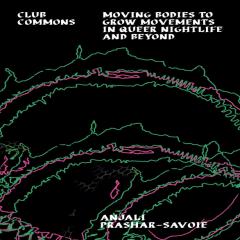
Queer communities have long transformed parties into something powerful: spaces where care flourishes, injustice gets challenged, and new worlds are danced into being. But today, DJs command huge fees while behind-the-scenes workers earn below minimum wage. Corporations profit from our culture while communities that created these spaces are displaced. As venues shut and workers burn out, it’s clear that something has gone deeply wrong.
Club Commons: Moving Bodies to Grow Movements in Queer Nightlife & Beyond by Anjali Prashar-Savoie takes you inside hidden stories of resistance and reinvention. We meet the people reshaping nightlife from below: abolitionist security teams creating safety without police, sober raves doubling as mental health support, radical childcare at parties, venues becoming worker cooperatives, and free party crews reclaiming public space. Through their work, we see how party-throwing skills build movements, how refusing to play changes everything, and why protecting queer nightlife means transforming who owns it.
Quotes
“When Anjali shines her perceptive light on dancefloor culture, everything is better illuminated. I can’t wait to read this book. It’s one we need.” Emma Warren (author of Dance Your Way Home/Up the Youth Club)
“Anjali’s one of the most exciting and insightful voices writing about dance music today, bringing fresh perspectives, intellectual rigour and emotive power to a conversation that’s too often homogenous, superficial or cynically commercial. Club Commons promises to be an essential and overdue book: a chance to reexamine the queer history of club culture, celebrate and critique its present, and map out radical possibilities for its future.” Ed Gillett (author of Party Lines)
“Beautifully written and unique, Anjali Prashar-Savoie’s behind-the-scenes journey through queer nightlife is as thorough as it is fascinating. Documenting a world that commercial interests are rapidly destroying, Club Commons is proof that queer culture holds the key to a better future for the dancefloor and beyond.” Professor Sam Parsley (author of Minor Keys, coach, DJ and founder of In the Key, a directory and platform championing the careers of women, trans and non-binary electronic music producers)
“Club Commons: Moving Bodies to Grow Movements in Queer Nightlife & Beyond is a vital reminder of how important the dance floor is to connect, unfurl and envision new futures. The text highlights the historic and existing care work entangled with the club space, particularly in providing temporary sites of refuge and embodied joy for Black and LGBTQIA+ communities. This is juxtaposed with research on the corporate and carceral commodification of nightlife in recent years, which exposes the false premise that club spaces are always radical. This book affirms my belief that the non-commercial nightlife ecosystem is an essential part of our social change infrastructure, rather than a luxury. Club Commons is a call to action to reclaim this space on our own terms and revive the underground.” Camille Sapara Barton, (author of Tending Grief: An Embodied Guide to Being with Grief Individually and in Community)
- 1: Leaving Santa Maria
- 2: Guitar On The River
- 3: Thirty Miles To The Beach
- 4: How Could You Think That
- 5: This Dawn Of Mine
- 6: Philly Eats Its Own
- 7: Sleeping In Public
- 8: Sand In My Shoes
- 9: Puddles (Here No More)
- 10: Born On Payday
Jefferson Berry combines story telling with the intricacies of JamBand and Roots instrumentation. His songs are performed by a cadre of unique
players: The Urban Acoustic Coalition. The band is anchored by the virtuosity of Bud Burroughs and the harmonies of Theresa Ratliff. While acoustic by nature, never missing is the locked-in bass/drums drive of Uncle Mike and Adam Stranburg. Complementing all this with a variety of guitar styles, Berry’s projects bring a danceable style and contemporary point of view to a unique wing of Philadelphia’s local music scene. With the release of his fourth album in five years, this reputation is spreading nationally.
Berry’s lyrics are informed by his years in corporate media followed by a dozen years teaching African American History, Economics and Government to inner-city Philadelphia high school students. Symeer Woods (aka Lil Uzi Vert) and the late Rasheen Jones (aka Runup Rico) were among his students. Born Into A Blizzard is the latest release from Jefferson Berry & the UAC and has 10 tracks in total featuring “Leaving Santa Maria", “Thirty Miles to the Beach” and “Philly Eats its Own”.
- A1: (Part I)
- B1: Prelude (Part Ii)
- B2: Maiysha
- C1: Interlude
- C2: Theme From Jack Johnson
The capstone of Miles Davis’ electric period, Agharta reigns as a funk-rock fireball — a blazing comet streaked energy and elan, a fearless organism feasting on adventure and freedom, a seven-headed Godzilla stomping its way through Osaka, Japan. Recorded on February 1, 1975 at Osaka Festival Hall at the first of a two-show stand, the double album offers an endless abundance of surprises and shifts — as well as a road-proven ensemble whose chemistry and abilities equal that of any of Davis’ celebrated bands. If the true measure of jazz is the capacity to adapt to the moment and challenge perception, Agharta is consummate.
Sourced from the original master tapes, housed in a Stoughton gatefold jacket, and pressed at Fidelity Record Pressing in California, Mobile Fidelity’s numbered-edition 180g 33RPM 2LP set of this epic live release presents it in audiophile sound on a domestic pressing for the first time. Offering greater degrees of separation, detail, and richness than the compressed CD editions and more clarity, openness, and presence than older vinyl copies, this version of the 1975 release helps bring the concert stage to your home. Just make sure your turntable and speakers are up to the challenge of Davis and Co.’s explosive performances — and producing the decibels they demand.
Teeming with vibrant colors, tones, and pace, Mobile Fidelity’s reissue captures the hear-it-to-believe-it flow, sweep, and moodiness of the music. Though the group honors looseness and freedom with religious verve, the specificity and scale rendered by this remaster allows you to detect methods behind the alleged madness that are often otherwise harder to discern. This insight extends to the understated changes in volume, harmonics, and phrasings. In many ways, you can listen as Davis himself did that early February evening as he helped coordinate the overall direction and decided on whether to blow his wah-wah-wired trumpet or take a turn on the organ.
Tellingly, Agharta would likely never have been made if not for Davis’ ventures overseas and, specifically, to the Land of the Rising Sun. Having for years faced a backlash on his native soil for his choices to experiment and blow past all known borders, Davis was welcomed with open arms in Japan. The concert documented on Agharta — as well as the day’s later show, captured on the equally exciting Pangea — stemmed from a sold-out three-week tour that would ultimately mark Davis’ final public appearances for years, as he soon settled into semi-retirement and nursed the wounds connected to an unprecedented stretch of restless and relentless output.
For all the band-fueled merit of Agharta — and there’s plenty, given the cast of saxophonist Sonny Fortune, bassist Michael Henderson, drummer Al Foster, percussionist James Mtume, and guitarists Reggie Lucas and Pete Cosey seemingly blasts off to outer space and travels distant galaxies by the time this minimally edited record runs its course — Davis’ own playing often remains overlooked. As critics Richard Cook and Brian Morton observed, it is “often fantastically subtle, creating surges and ebbs in a harmonically static line, allowing him to build huge melismatic variations on a single note.” He attacks like a man on a mission, out to prove naysayers wrong and bent on trailblazing another new path forward. Convention and skeptics be damned.
Noisy and furious, dark and discordant, abstract and off-balance, radical and intense, abrasive and atmospheric, strangely beautiful and hypnotically eccentric: Agharta evades simple description, and refuses to be pinned down in any established category — rock, jazz, punk, ambient, prog, avante-garde, or otherwise. Shot through with trench-deep grooves, screaming riffs, scalding solos, and free-improv leads, its cosmic thrust comes on as the equivalent of an animated pointillist painting comprised of millions of textured dots, dashes, and dabs that hold your attention so raptly you want to revisit the ideas again and again.
Always steps ahead of everyone else, Davis knew what he was doing even when Agharta debuted in Japan before later hitting U.S. markets. Though “Maiysha” and “Theme from Jack Johnson” are identified in the track listing, the record contains a number of uncredited references to other Davis works, including a nod to “So What.” This decision to bypass labels only adds to the art of the reveal — the rare black magic in which Agharta expertly deals.
- Meta Y Guaguancó
- Si Los Rumberos Me Llaman
- Cuando Suenan Los Tambores
- Galletana (Aka Calletana And Cayetana)
- Dulce Con Dulce
- El Sabio
- Caramelo A Kilo
- Mulence
- Yiri-Y Ri-Bom
- Sancocho E'güesito
- Invitación Guaguancó
- Tumba Tumbador
- Macho Cimarrón
- Rompe Saragüey
Classic Latin Tunes Became Sals Hits! Pablo Yglesias -aka DJ Bongohead- compiles Grosso Recordings an amazing serie with classics tunes from Caribbean music that became great successes of "Salsa". Some tracks have been remastered and restored, others are presented on vinyl again after many many years. "This is the four volume in our series on the Roots of Salsa...The main criterion was to pick tracks that sounded adequate for today's DJs to play at a gig or were sufficiently interesting (or enough of a surprise to fans of the later version) to merit inclusion. The other measuring stick was that they needed to come from the old-school, before the more modern era (from 1962 on) and all of its recording innovations and marketing strategies...for now, listen to these dozen gems and then go back to their more familiar cousins from recent times and compare and contrast, and we're sure you'll be enlightened and entertained." Liner notes by Pablo "Bongohead" Yglesias. Format and selection designed for DJs, collectors and general public.
House of Harm are proud to announce the forthcoming release of their new album Playground, out December 1st, 2023. The new record builds and expands upon the three-piece’s enthralling shadow-pop sound, a mix of midnight atmospherics, 90s era jangle pop, and contagious synth drenched hooks that further elevate the transcendent vocals of lead singer Michael Rocheford. Rounded out by Cooper Leardi (guitar / synths) and Tyler Kershaw (guitar / synth), House of Harm have amassed an impressive following as something of a best kept secret among their growing fanbase, leading to sold out shows on both coasts by the power of word of mouth alone.
The band members have been drawn to music for as long as any of them can remember, and the drive to be around like-minded artists and make their own noise drew them all to Boston after high school. There they all quickly enmeshed themselves, playing in other bands before meeting each other. Ever since, House of Harm have been quietly making a name for themselves among music fans with darker pop persuasions via a steady stream of releases in single, ep and album form.
That attention to detail and workmanlike approach at the expense of chasing instant gratification seems to be paying dividends after years of steady effort. The journey of their new album Playground saw House of Harm stay true to that ethos. The band painstakingly narrowed the record down to an efficient 10 tracks that they felt made the most sense, both standing on their own as well as fitting into an LP that built a cohesive world for the listener to get lost in. The album’s name also reflects the experimentation and happy accidents that came about during the writing and recording process.
On “The Face of Grace” they set out to explore different dynamics by writing a song entirely without drums, but couldn’t help themselves from putting emphasis on the song’s 6/8 waltz time signature. “Two Kinds” is another first for House Of Harm in that it’s predominantly driven by acoustic guitar. That aforementioned vulnerability shows up in other areas of the songwriting process as well with “Two Kinds”, one of their most revealing songs to date from a lyrical standpoint, written from a place of reflection and weakness and tackling feelings uneasy to be put on display for public consumption.
Taken as a whole, the end result is an album representing a collection of the band’s most raw and expressive songs yet.
- 1: Enough Abused
- 2: Adore
- 3: Every You
- 4: Brother
- 5: Draining By Your Flame
- 6: Neverhappy
- 7: Let It Rain
- 8: Motherfknway
- 9: Pinman
Mid Price Campaign! Heavy, melodic and passionate, Flat Earth is a hard rock band from Helsinki, Finland, founded by Ex-Amorphis bass player (Niclas Etelävuori) Ex-HIM guitarist (Linde Lindström) Ex-HIM drummer (Gas Lipstick) and Polanski singer (Anthony Pikkarainen). The band produces heavy riffs, blasting beats and cinematic chords that combine to create an unforgiving, passionate, and dynamic sound.
The band's debut single ‘Blame’ premiered on Radio Rock in 2018, immediately gaining popularity, throughout Finland and the rest of Europe. The single Cyanide followed in the footsteps of the debut single, gaining public recognition and earning them a spot opening for ‘Alice in Chains’, in Helsinki. To date, they have over half a million streams on Spotify, alone.
In the beginning of 2019, the band entered the studio to record the follow up to their debut album ‘None for One’. This time with legendary producer Tim Palmer behind the mixing desk.
Flat Earth is: Anthony Pikkarainen - Vocals (Polanski) Linde Lindström - Guitar (ex-HIM) Gas Lipstick - Drums (ex-HIM) Niclas Etelävuori - Bass (ex-Amorphis).
- 1: Overture
- 2: Dear One / Querido
- 3: I Do Miracles
- 4: Her Name Is Aurora (Stagg)
- 5: I Will Dance Alone
- 6: A Visit
- 7: Her Name Is Aurora (Gala)
- 8: Gimme Love
- 9: Never You
- 10: An Everyday Man
- 11: She's A Woman
- 12: Kiss Of The Spider Woman
- 13: Where You Are
- 14: Only In The Movies
Dream Girls, Beauty And The Beast director Bill Condon returns to the movie musical in this dazzling Technicolor-hued fantasy. Valentín (Diego Luna), a political prisoner, shares a cell with Molina (Tonatiuh), a window dresser convicted of public indecency. The two form an unlikely bond as Molina recounts the plot of a Hollywood musical starring his favorite silver screen diva, Ingrid Luna (Jennifer Lopez). Based on the Tony Award-winning Broadway musical hit. "The film juxtaposes very gritty, graphic, prison scenes with equally extreme 1950s period authentic technicolor musical sequences that replicate both technicolor look and aspect ratio as the film switches between both environments. Lopez looks great and the musical sequences are glorious. The supporting cast, especially the two male leads are top shelf Oscar worthy performances. It is superbly executed.
- 1: Subhuman
- 2: Blame
- 3: Given Time
- 4: Cyanide
- 5: None For One
- 6: The Glow
- 7: Noble Swine
- 8: Limelight
- 9: Freedoom
- 10: Blunt
- 11: Kill My God
Heavy, melodic and passionate, Flat Earth is a hard rock band from Helsinki, Finland, founded by Ex-Amorphis bass player (Niclas Etelävuori) Ex-HIM guitarist (Linde Lindström) Ex-HIM drummer (Gas Lipstick) and Polanski singer (Anthony Pikkarainen).
The band produces heavy riffs, blasting beats and cinematic chords that combine to create an unforgiving, passionate, and dynamic sound. The band's debut single ‘Blame’ premiered on Radio Rock in 2018, immediately gaining popularity, throughout Finland and the rest of Europe.
The single Cyanide followed in the footsteps of the debut single, gaining public recognition and earning them a spot opening for ‘Alice in Chains’, in Helsinki. To date, they have over half a million streams on Spotify, alone.
In the beginning of 2019, the band entered the studio to record the follow up to their debut album ‘None for One’. This time with legendary producer Tim Palmer behind the mixing desk.