Tristan Disco was an ephemeral Japanese project led by Takayuki Shiraishi (BGM, MLD) focused on making dubbish Post-Punk.
In 1982 they elaborate a no-wave full of unrehearsed breaks and cavernous vocals. Boundless dark jamming sessions through shades, effects and reverbs always submerged by a tense nervous bassline.
On the B side Krikor delivers a hard-hitting Industrial reconstruction of "Social Dance" perfect to shatter your brain.
Retakes from the mysterious ambient artist Civilistjävel! are more brooding.
Introspection and faded horizons are the main purposes here but a glimpse of hope still glow.
Suche:reconstruct
orange marbled vinyl
"How does it feel to reminisce? That was something I wanted to try to capture in soundwaves. I tend to reminisce a lot. About the good and bad parts in the past, and everything in between. I try to remember which specific parts in my life made me who I am today. Thinking about those events is going to make me feel a certain way, and i wanted to try to convert these feelings into songs.
Reminiscing to me, is also a very visual experience in my head. So I decided to take sounds that were close to me from the past and make something cinematic that still works as a full song. I've been using a lot of granulated sounds, which is almost like a shattered memory reconstructed into a new one, as your feelings can change recovering the same memory. So you can close your eyes and go on your own reminiscing journey, discovering loads of layers weaved through these soundwaves."
- Sam A La Bamalot
Marcel Fengler's IMF begins 2022 with IMF011, the beginning of a new era of the label's outlook, which will combine a focus on new talent, established remixers and a design overhaul.
Belgian artist Milo Spykers is first out of the traps for 2022, with his "Hier & Nu" EP (complete with a remix from Fengler) delivering a four-track punch of modern techno. Spyker's use of dense synths across the EP imbue his tracks with a memorable character that leaps out of the speakers.
From the jagged and oppressive leads of "Hier & Nu" to the outright anthemic riffs of "The Helicity" via the cascading stabs of "Happex", the "Hier & Nu" EP is a boisterous work of controlled chaos. Fengler's remix of "Hier Nu" extracts Spyker's synths, and with clinical precision, reconstructs them around a lean, muscular rhythm track that oozes tension.
"Milo's a very talented young producer. He's got an uncomrpimising taste in techno and that convinced me that he's both a DJ and producer I want to support. I'm really happy to welcome him to the IMF Family." (Marcel Fengler, Jan 2022)
AD 93 presents the new album from Polish composer Wojciech Rusin. Syphon is the second instalment of an ‘alchemical’ trilogy which started with The Funnel on Akashic records. The record consists of speculative medieval and renaissance music, imagined composed in the future, where it is reconstructed from the ashes of the past, via incomplete fragments.
"In a future where the old semantic systems don't apply anymore, what we are left with is some kind of delirium."
The album features 3D printed instruments, multilayered bagpipe chanters, double recorders and other hybrids. With additional voices of soprano Eden Girma and Emmy Broughton.
Artwork by Wojciech Rusin and Nicola Tirabasso. Mastered by Rupert Clervaux.
- A1: Silhouettes (Vanishing Twin Remix)
- A2: C'est Charles (Shungu Remix)
- A3: Tout A Une Fin (The Notwist Version)
- A4: Eyelids & Phosphenes (Aksak Maboul Reconstruction)
- A5: Sophie La Bevue (Cate Le Bon Interpretation)
- B1: Hotel Suites (Carl Stone Redesign)
- B2: Un Caid (Spooky-J Remix)
- B3: Uccellini The Menace (Aksak Maboul Full Version)
- B4: Retour Chez A (Kate Nv Remix)
- B5: Charles Undresses (& Goes To Bed) (& Goes To Bed)
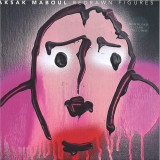
Im Mai 2020 erschien das Doppelalbum Figures der legendären belgischen Band Aksak Maboul. Nun folgen gleich zwei Alben mit Remixen, Coverversionen und neuen Versionen von fünfzehn ganz unterschiedlichen Musiker*innen auf Vinyl (jeweils streng auf 500 Exemplare limitiert). Betitelt sind sie Redrawn Figures 1 und Redrawn Figures 2. Mit von der Partie sind u.a. The Notwist, Cate Le Bon, Felix Kubin, Tolouse Low Trax und Matias Aguayo. Zu ihren Versionen kommen vier weitere von Aksak Maboul-Gründer Marc Hollander selbst. Wie im Albumtitel bereits anklingt, bat Aksak Maboul die Musiker*innen, sich nicht nur die Musik, sondern auch das von Véronique Vincent gestaltete Artwork von Figures vorzunehmen. Die daraus resultierenden sechzehn Bearbeitungen zieren das Cover von Redrawn Figures 1. Das Cover von Redrawn Figures 2 wiederum stammt vom französischen Maler Hervé Di Rosa, einem der Mitbegründer der "Figuration Libre"-Bewegung.
For Memory Pearl’s »Music for 7 Paintings« Moshe Fisher–Rozenberg traveled to art galleries throughout North America searching for paintings which would enrapture him.
Like the experience of being drawn into the worlds of those paintings, these seven tracks — each one directly referencing a single work by Joan Mitchell, Robert Ryman, Lee Krasner, Helen Frankenthaler, Franz Kline, or Jackson Pollock — are love letters to the sympathetic vibration of one creative mind encountering another. They trace the way art inspires and generates art. Each resonates with the reconstructive energy that comes from translating the visual to the auditory.
One might expect a jagged, alienating angularity, given the modernist and postmodern source material. Instead there is warmth and depth of sentiment, accented by the analogue and digital synth pitch–shifts and cascades. The pieces crackle with the energy of translation: something new is created as the medium changes, mediated across the boundaries of genre. There are associations, asides, tangents as each work is »read« into its new format. There is no alienation, no cold distance: only engagement and warmth. The album’s lead track, Natural Answer, 1976 opens with sounds that feel like the gaze being caught and drawn into an intimate emotional connection with a work. Cupola, 1958–1960 begins with a thickly layered wash of sound as nostalgic as a train ride through the outskirts of a city at night, then expands into a cavernous memory–scene of personal association.
Fisher–Rozenberg brings a vast experience to bear on the paintings that inspire »Music for 7 Paintings«. While this may be his debut full length as a solo artist, he is a consummate collaborator (Alvvays, Fucked Up, U.S. Girls, Youth Lagoon, Man Forever) best known as the drummer and synthesist in Absolutely Free. Also clear is his visual sensibility — his instinct for how to translate the emotive context of visual art into sound, honed in collaborative work on kinetic sculptures, immersive installations and film scores. But what most comes to the fore is perhaps his recent graduate work in music therapy, and the sensitivity learned through his leading of music therapy sessions at Toronto's Centre for Addiction and Mental Health. This direct encounter with music’s power to heal lends the tracks a sacred, therapeutic quality. They are suffused with curative frequencies that connect the isolated individual to a world of contemplative beauty.
»Music For 7 Paintings« catalogues the energy in the gaze of a seasoned musician, translating brushstroke to sound.
* taken from the digital version of bio-rhythm 3 and not included on the vinyl version of the album.
Network’s two groundbreaking bio-rhythm albums in 1990 were each accompanied by much loved 12” preview samplers of tracks from the iconic compilations.
For the third release - a mere 31 years after the first sets - Network have added a fresh twist. The sampler this time around contains 2 tracks from the bio-rhythm 3 vinyl release and 2 that will only be otherwise available on digital format.
It makes the sampler a must have for all electronica vinyl junkies.
Nexus 21 “Silicon”, a mainstay of the duo’s much acclaimed live sets, was recorded in 1991 but not released at the time. Memories are thin as it why such a gem was ignored but the most probable explanation is that the transformation of Nexus 21 into Altern 8 took attention away from the track. After being found in the tape vaults it has been remastered for the bio-rhythm 3 project.
It is joined on side A by the Octave One remix of 10th Planet “Strings Of Life” - which is not on the album vinyl. There is a proper labyrinthe story behind this remake of the Rhythim Is Rhythim classic of classics. Kool Kat, the predecessor to Network, arranged for Rhythim Is Rhythim to play live supporting Inner City at a London Town And Country Club concert in September 1989. The label recorded the show which featured Derrick May and his guest Carl Craig.
Fast forward to 1995 and the tapes were handed over to Ashley Beedle to reconstruct and remix for a release on Network under Ashley’s 10th Plane moniker, . On to 2003 and Network’s Neil Rushton was running the suSU label where an attempt to record a vocal of Strings Of Life with none other than Shara Nelson on vocals was made using the 10th Planet parts. That never came to completion, but at the time Neil was working with Octave One and they conjured up this recreation, which has only ever been previously released as a track on a suSU compilation. FIRST TIME ON VINYL ANYWHERE FOR THIS AMAZING VERSION OF “STRINGS OF LIFE”.
“Neurosilence” - Doggy is previously unreleased recording by Birmingham’s Peter Duggal. His bleep classic “Labyrinthine” would have been totally at home on Kool Kat/Network and in recent months both label and artist have both been shaking their heads as to how it didn’t happen. The release of the stark “Neuroslince” finally sees an 0121 alliance bond together.
The 4th track “In The Presence Of Beauty” is taken from the digital release of bio-rhythm 3 and is a truly beautiful “Reprise” take on the version on the vinyl album.
- A1: Tous Ko (Aksak Maboul Reconstruction)
- A2: Un Caid (Hello Skinny Remix)
- A3: Dramuscule (Ohh Luuu Remix)
- A4: Retour Chez A (Felix Kubin Remix)
- B1: L'adieu A L'histoire (Tolouse Low Trax Remix)
- B2: Fin (Stubbleman Remix)
- B3: Un Caid (Jordan Fields X Marc Hollander Old School Remix)
- B4: Anatomy Of A Dramuscule (Matias Aguayo Interpretation)
Im Mai 2020 erschien das Doppelalbum Figures der legendären belgischen Band Aksak Maboul. Nun folgen gleich zwei Alben mit Remixen, Coverversionen und neuen Versionen von fünfzehn ganz unterschiedlichen Musiker*innen auf Vinyl (jeweils streng auf 500 Exemplare limitiert). Betitelt sind sie Redrawn Figures 1 und Redrawn Figures 2. Mit von der Partie sind u.a. The Notwist, Cate Le Bon, Felix Kubin, Tolouse Low Trax und Matias Aguayo. Zu ihren Versionen kommen vier weitere von Aksak Maboul-Gründer Marc Hollander selbst. Wie im Albumtitel bereits anklingt, bat Aksak Maboul die Musiker*innen, sich nicht nur die Musik, sondern auch das von Véronique Vincent gestaltete Artwork von Figures vorzunehmen. Die daraus resultierenden sechzehn Bearbeitungen zieren das Cover von Redrawn Figures 1. Das Cover von Redrawn Figures 2 wiederum stammt vom französischen Maler Hervé Di Rosa, einem der Mitbegründer der "Figuration Libre"-Bewegung.
Music: Joe Hisaishi, 7 songs
(Music included on SIDE-A. Laser etched characters on the back side of SIDE-A.)
The soundtrack of "Pantai to Tamago Hime" at the Mitaka no Mori Ghibli Museum, Ghibli no Mori no Eiga.
Joe Hisaishi reconstructed Vivaldi's "La Folia" with a modern approach.
The music from the play is recorded so that it can be listened to as a suite.
There are records with empathy, records which are your friends and then there's the others... There might be little difference between them, a certain "je ne sais quoi", an "almost nothing but still something" which makes the difference between almost pointless and vital records. Despite, or rather thanks to his cynical despair, Matt Elliott's music never holds up a moralizing mirror to us - on the contrary, it creates a compassionate dialogue with listeners like the rhythm of two steps that synchronize to become as one. In 2016, Matt Elliot brought out his seventh solo album The Calm Before whose obscure title is neither exactly threatening nor comforting... the calm before what? Before the storm for sure but maybe also before the great record, the immediate classic we felt might be coming for a long time in the dual discography of the Bristol-born artist working under his own name and his electronic alias Third Eye Foundation. The elegant details and perspectives of Little Lost Soul (2000) already hinted at the upcoming masterpiece from the English singer-songwriter. The Mess We Made (2003) was Matt Elliott's first solo album and portrayed a universe in a kind of flight towards Balkan horizons made up of visceral despair. With the Songs trilogy, he put aside the electronic side of his work to continue working with a minimalist, stark and lucid style of writing. The Broken Man (2012) was full of tears and long laments sometimes carried by Katia Labèque's piano on a record which painted new shades of grey. On this record Matt began working with the producer, arranger and multi-instrumentalist David Chalmin (La Terre Invisible) who has kept on collaborating with the Bristol-born singer since then. Their partnership continued on Only Myocardial Infection Can Break Your Heart (2013) and The Calm Before (2016). Stéphane Grégoire is the head of the Ici D'Ailleurs label which has accompanied Matt Elliott since 2005 and perhaps he describes this album the best: "This new record by Matt is without a doubt his best album to date, a record that takes him into another dimension where he fully asserts himself as a songwriter and singer of the calibre of artists like Bill Callahan, Leonard Cohen or Johnny Cash." Matt Elliott's other records all seemed like empathic links between each other. Farewell To All We Know is an instant classic based on the sensitive piano and superb arrangements of David Chalmin, the sensitive cello of Gaspar Claus, the subtle bass of Jeff Hallam (who has also played with Dominique A and John Parish). There is a clear form of alchemy in all of this and still we find Matt Elliott's usual atmospheres and scenery, the same Eastern European folk music, long songs that take time to settle over time. Everything is the same but also is transfigured. By making his music stark and purifying and redefining the subject matter, Matt Elliott's work became so much more delicate. However this work is never frail nor really turned in on himself and thus becomes like a vital tune that vibrates and unfolds. The opening song Farewell To All We Know seems torn between the fear of what tomorrow may bring, inevitability and hope for the future in a permanent and progressive dramatic tension expressed by his Spanish guitar, the impressionist style piano and Matt's voice teetering on the edge of whispers. A funereal tribute to endless twilights and the dawns we all dream of seeing. There are touches of Leonard Cohen from Songs from a Room or Thanks For The Dance in The Day After That with Gaspar Claus's counterpoint cello. There is no spirit of resignation in Matt Elliott's work - life's path has to be followed against all odds. We have to follow the river's flow to reach the immense ocean and its infinite freedom. The haunted instrumental Guidance Is Internal harks back to the atmospheres of Howling Songs (2008) with its guitar parts full of scansions and muted threats. The music is transcendental but never seems afraid of the risk of falling. This is also what Bye Now tells us with its quasi-obsolete simplicity and sunburst melancholy reminiscent of the work of Luiz Bonfá, Bill Evans on Peace Piece or laidback crooners of the 50s. In Farewell To All We Know, Matt Elliott incessantly alternates between the dual desires to face up to the world or to protect himself from it. Hating The Player, Hating The Game is a lucid statement about the dullness of our daily lives sometimes, our right to get out of the game and no longer want to be part of it. Matt Elliott is tender but spares no one, particularly himself. Aboulia speaks of the tiredness of living and of looming death while Crisis Apparition says that there is always a time for reconstruction after chaos. This is like initially wearying wandering in the ruins of Aleppo with the slow dilution of the melody into a hallucinated drone. However the smell of great fires always fades and the earth always regenerates. Matt Elliott seems to suggest that the survival instinct is stronger than any cold winds could ever be. Matt Elliott never sings of certainties and prefers possibilities. Possibly the worst is over? Maybe... Maybe the storm has passed and devastated everything, now we just have to rebuild and live again. Farewell To All We Know shows us the distance that still needs to be walked and he walks next to you - right next to you, he is the friend who doesn't spare you the truth like all true friends really do.
On “First Flight REDUX,” Dave Harrington takes a scalpel to the multi-tracks of "First Flight" (LP/DL, Algorithm Free) remixing the raw material into something else entirely.
Originally recorded live at Nublu, September 20, 2019, "First Flight" documents the first and (thus far) only meeting of Chris Forsyth, Dave Harrington, Ryan Jewell, and Spencer Zahn as part of Forsyth's residency at the club that month.
Harrington's dub, created in his Los Angeles studio uses the original tracks improvised live by the group and incorporates loops and samples plus a variety of additional keys and synths, bass guitar, percussion, congas, pedal steel, bamboo flute, the Turkish stringed instrument cümbüş, and the North African double reed instrument ghaita, all played by Harrington himself.
While the light of the original performance recognizably shines through the canopy of new sounds in certain places, “First Flight REDUX” is radically reconstructed into something totally NEW. It’s very much its own album, related to and derived from “First Flight,” yes, but venturing into areas unforeseen in the original document, suggesting some kind of a party with “Live/Evil” blasting on one set of speakers,“Midnite Vultures” on another, and a Turkish psych band jamming in between.
Jondo's Little Princess EP sees Cologne's finest producer/DJ debut Dekmantel with a 4-track set of expansive atmospheres and reconstructed club tunes, alongside double bassist Maxwell Sterling and Australian producer DJ Plead.
Each track draws elements from the bass music trajectory, but effortlessly reassembles them in song-like arrangements that work just as fine in any headphone or home listening scenario.
The A-side has Jondo and Sterling team up for two dynamic pieces called "Dunkelziffer I" and "Dunkelziffer II". Whereas A1 serves drumless, RPG-like atmospheres reminiscent of Sterling's long-time collaborator James Ferraro, A2 is a full-on club joint packed with icy synths and complex rhythms that slowly eases into comforting ambient. On the B-side's "Whowhuwho", Jondo creates a powerful piece of instrumental-grime-turned-quasi-jungle with DJ Plead. For his remix, Russian techno prodigy Moa Pillar warps the already minimalist lead synth into an even more sparse yet effective dancefloor weapon.
Just as his celebrated DJ sets, the Little Princess EP proudly exhibits all of Jondo's musical roots – but instead of sticking with one style, tempo or formula, he innately trusts the music to let it take us into unexpected territories, time and time again
No less than 12 months later arrives ‘Deep Blue View’ – not so much of a follow-up, as a mini-flipside moving the Jazz from AM to PM, between city and sea.
“I originally had AM Jazz down as walking around some New York backstreet at 4am, smoking in a fedora, looking for crimes to solve but it now ends as night begins,” reveals Al, of his latest tale’s gradual evolution. “Deep Blue View is the night-time album now… like losing yourself deeper in the fog, or disappearing in the sea… would someone, or some 'thing' come to save you or would they , or it , come along for the ride?”
Usually by now, Daveyhulme’s own could-be John Barry would have left distractions of success for suburban side-projects and writing with his fellow Mancunian musicians, but AM Jazz left unfinished business - and, with 50 or so session recordings leaving a litter of sonic debris strewn about the cutting room floor, one major clean-up. Deep Blue View is 6 brand new tracks crafted from its reconstructed and revived remnants, unfurling like Sinatra’s Wee Small Hours to reinforce the strangely beautiful atmosphere of Al’s now revered repertoire. “I had the urge to create something new and started playing around with different EPs and pseudonyms but when I sequenced these tracks, I was really happy how smoothly they flowed; it just needed an opener. I quickly wrote ‘Deep Blue View’ and it fell into place. It’s great, so I carried on, knowing it was time to save the best stuff for myself,” Al grins.
Just as AM Jazz was created in the spirit of his earlier working style on debut album Tower of Love, Deep Blue View fuses Al’s love of finding the ‘right’ in the odd, weird, back-to-front and everything in between, with the hi-fi meets lo-fi sounds of his crate-digging curiosity and empathy for TV themes and movie soundtracks. Guided by melody, his home-based sorcery of working with analog, tape and field recordings opposed to the lure of studio mechanics allowed his inner subconscious to tap at the door and reveal itself in new musical forms. “In the studio it’s tempting to turn everything up loud but I’ve got bad tinnitus and don’t want to write anything else in a Beatles style. I have done all that now… at home I have a computer, a microphone and just go crazy and lose myself staring at the screen. Then suddenly loads of music is written.”
Setting his inner autopilot to flight mode, ‘Peppergone’ adds to the tracks’ nocturnal narrative and appears reborn after a last-minute culling from AM Jazz’s initial tracklist. Like a beautifully romantic ode to Beethoven’s Moonlight Sonata, it is a fitting tribute to dearly departed best friend 'Batfinks', written in the middle of a tough night. “I have no idea why or how the song came about because I was so upset to do anything, let alone record any music. But there you go. Somehow I did and it’s a really special thing. I know he would have dug me using his chords; growing up we’d both try to create the perfect chord sequence. This is his idea of that. I hope he doesn’t think it’s shit,” Al jests.
Also revived from AM Jazz’s archive is the simmering groove of ‘Night Talk Late Street’ and instrumental ‘Star Six Seven’, whilst ‘Have Another Cigar’ weaves its own semi-autobiographical fairy-tale with lyrics written and sung by long-time pal and former housemate Aidan Smith. Transformed from backing track into a cool morsel of story pop, it recalls the drunken joy of when the pair would make recordings together between singing the Everly Brothers at full volume. “I’m sure it’s about not wanting the musical party to stop and having to get on with real life,” Al says.
‘String Beat’ meanwhile, soars like a beautiful Bond theme with the shimmer of Lee Hazlewood holidaying in Palm Springs, alongside perhaps, the waltzing string-like synthonies of some long-lost rhythm and blues orchestra of Davyhulme (whose real-life origins reside with the Berlin Symphony Orchestra), introduced to him by Super Furry Animals’ Cian Ciaran. “I’ve never created anything this moody before and have always threatened to do something John Barry-esque with some slightly dark and spooky musical changes.”
DEATH's landmark ‘Spiritual Healing’ record is nothing short of genre-defining. Originally released in 1990, Spiritual Healing marked a new turn in the DEATH discography, one which ushered in cleaner production, a new level of boundary pushing musicianship and songwriting skills that were previously unimaginable from a metal band. Spiritual Healing sets the standard for riffs, insane time changes and of course mainman Chuck Schuldiner's masterful guitar solos. Includes Digital Download
“Spiritual Healing hacked and exploited gaps in the boundaries of death metal. It was brutal and toxic, yet replete with unorthodox, cleaner shadings. On this reissue, it sounds as visceral and vital as the day it was originally released, affirming the fact that its narrative and musical sophistication laid the groundwork for countless metal bands to explore frenetic musical pathways with unabashed artistic honesty.” - PopMatters
(Deluxe Edition) (translucent tri-coloured vinyl LP + MP3 download code in spot-varnished sleeve)
LP comes in gold foil lamination jacket housing printed record sleeve with 1x translucent gold, black & white insomnia effect vinyl, marketing sticker and free digital download card. The Sharecropper's Daughter Bonus Vinyl contains six new tracks serving as a companion piece to Sa-Roc's already acclaimed Rhymesayers debut, The Sharecropper's Daughter, released in October of 2020. These new songs further showcase Sa-Roc's sharp skills as a lyricist, and her gift for captivating melodies and engaging content, featuring production from Sol Messiah and Evidence, as well as a guest verse from MF DOOM. The lead single for the bonus vinyl, "Wild Seeds" is a lyrical testament to the beauty, mysticism, and wisdom of the elders and ancestors who've guided and bolstered generations of Black women through history's assault and neglect of them. With a title inspired by the sci-fi novel Wild Seed by visionary author Octavia Butler, the song serves as a celebration of women such as Queen Nanny, Harriet Tubman, Sojourner Truth and many others, whose legacies inform future generations of their propensity to bloom under the harshest of conditions. "Just like wild seeds, we remain unfettered and unbroken, adding beauty and immeasurable value to a world that chooses not to acknowledge us," Sa-Roc states, "but our very existence is the only acknowledgement we require." Throughout the songs of The Sharecropper's Daughter Bonus Vinyl, Sa-Roc maintains a concise blend of thought provoking commentary and razor sharp lyricism. On the opening track, "Options", she delivers a raw and searing testimony of the dedicated yet, all too often, underappreciated artist, reminding us to give our flowers to the living while we're still able. "The Great Escape" examines humankind's tendency to try to mask the unsavory elements of our past we're either unwilling or unable to confront head on. Echoing both sentimentality and sorrow, "Reconstruction of the Heart" recalls some of Roc's childhood memories and muses on the many ways in which our earliest experiences can scar, strengthen, and shape the very core of who we'll become. The Sharecropper's Daughter Bonus Vinyl chapter fittingly comes to a close with "The Rebirth", which remarks on the plight of the vulnerable artist and the quest for balance between creative transparency and overexposure. Here, Sa-Roc labors through her discomfort and commits to being brutally honest about the experiences that have informed her expression and made her a better artist. Featured guest, the late MF DOOM continues this line of thinking, offering his own unique observations, "Quick as a quitter will fold, some of what glitters is gold. Same story is old, getting left in the blistering cold. Broken souls get remold with little arbitration. Fortune favors the bold as does incarceration." This bonus vinyl pulls no punches in showcasing Sa-Roc's continual growth as an artist who, as NPR recently put it, "is a modern day griot whose aura radiates calm in a world of chaos."
As always high quality House Music by Chez who teamed up with Roy Burgess on A1 "Your Love". A2 is a great remix of "Your Love" by Dj Aly. On B1 it's Chez Damier with a very soulful track called "Soul Minimal", reconstructed by Stephan Hoellermann and as grand final on B2 it's Chez Damier and Ron Trent with the stunning "My House".
Fantastic release!
For their twelfth installment, Scatcity welcomes the duo Colossio & Sobek. Label head Skatman also makes an appearance on remix duty.
A versatile EP that combines the influences of both artists, low-tempo, tribal grooves, bi-zarre vocals, and deep melodies are the core of this EP named "Fragmentado".
Artwork by Crustcat
Brock Van Wey returns as Earth House Hold and his third full album under the alias, continuing to explore the furthest influences of Ambient-infused, deconstructed Deep House in all its varying elements.
“...from the second I descended those stairs, lived it for myself, and the events that followed, I knew my life had changed forever. A life that brought with it a beauty as infinite as its pain”.
Daybreak Basements and Broken Hearts explores a new aspect of Brock’s early Deep House influences, one that meticulous followers of this guise would have been patiently trying to guess since his last outing in 2018. If Brock’s debut Earth House Hold album (When Love Lived, 2012) took the grooves and danceability from Deep House, and his second, (Never Forget Us, 2018), highlighted the powerful progression of vocals and melodies, then Daybreak Basements and Broken Hearts continues to build on the many aspects and inspirations of the Deep House genre, with a raw, dirty and somehow deeper take on the sound that Brock grew up with many years ago.
Brock’s signature vocals once again provide the narration and backbone to an album that is designed to progress; from its patient and spacious beginnings to its energetic and emotional closing chapters. Reverberating synths fill cavernous spaces as basslines rumble, bringing a darker, more abstract, early-morning vibe to an album born from a place of both reflection, and personal experiences.
“This is a house album in the purest sense of the word - just as much as the furthest thing from one that ever existed. As much a deconstruction of what deep house means as an attempt to reconstruct a time, and a life, it built.”
For number 89 in the Brazil45 series, we present a no-nonsense Brazilian funk / samba rock double-sider courtesy of the mighty Golden Boys and Silvio C sar. The Golden Boys were a quartet formed in 1958 by the Correa brothers; Renato, Roberto, Ronaldo, and their cousin Valdir Anuncia o. They enjoyed a stellar recording career, from the 50s through to the 90s, with members of the group still involved in music to this day. For this selection we headed to their self-titled 1975 album released on Odeon and cherry-picked one of the group’s funkiest moments, ‘Segura Na Cintura Dela (O Gavi o)’. By now performing as a trio, they enlisted Paulo Deb tio of Lemos E Deb tio 8206;fame as executive producer and, on the controls, producer Milton Miranda. Miranda was a silent figure behind so many of the much-loved classic Odeon / EMI releases of the 60s and 70s. ‘Beco Sem Sa da’ is another Odeon release, and another classic produced by Milton Miranda. Taken from Silvio C sar’s self-titled 1971 album, here the prolific singer and composer delivers a swinging samba rock / groove. With fantastic arrangements by Geraldo Vespar, this addictive swing was reconstructed in the 2000s when Drumagick sampled it for their track ‘Sambarock’. So here we have two slices of Brazilian dancefloor pressure just waiting to take centre stage again.
- Next installment in BRAZIL45 Series.
- Brazilian funk and samba rock double-sider.
- Both tracks produced by Milton Miranda.
- A1: Dlin Dlon Cow Boy
- A2: Samba Paperino
- A3: Plastic City Dinamic
- A4: Cinzano
- A5: Pubblicita' (Documentario)
- A6: Sigla 1
- A7: Sigla 2
- A8: Sigla 3
- A9: Sigla 4
- A10: Sigla 5
- A11: Sigla 6
- B1: Nedbo Zip
- B2: Orinoco Blues
- B3: Plastic City Dinamic
- B4: Caruzon
- B5: Xxx?
- B6: Tralla' Papppa
- B7: Swing
- B8: Samba Paperino
- B9: Pensione Elastica
- 1: B Guerra In Africa
- B11: Volare
- B12: Bologna Rock
CONFUSIONAL QUARTET: A few months after the release of the first and self-titled LP, this 10-inch album carrying the same title "Confusional Quartet" was released. On this album the band continues to offer songs (called songs even if Confusional Quartet did not have a singer) using the energy of post punk and the mood of new wave.
This new project also includes the piece "Sigla" produced and edited in 6 different ways.
"Sigla" is an example of what Confusional Quartet used to call "Banal Music" inspired by the designer Mendini's "banal object". This track was recorded and edited by tape recorders to come out in different "metamusical" forms.
This record stands out also for the beautiful cover featuring a photo of Giacomo Balla's "flowers" sculptures, the Italian futurist artist who worked on a plastic and dynamic reconstruction of the universe.
You can now listen to the ten tracks of this 10" on the A -SIDE of the new release on a 12". The B-SIDE is dedicated to a rare live recording dated 1980.
Despite the quality of an amateur audio cassette, this recording testifies the band's iconoclastic energy. A fulminating live set, just over half an hour, no words, just music, quickly passing from a punk piece to a jazz piece or to a polka.
This record is also offered by Italian Records on a special colored vinyl edition of 180gr.