Search:region

Styles
All
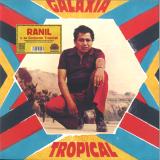
Ranil Y Su Conjunto Tropical - Galaxia Tropical

This release documents the legacy of Ranil, the Amazonian singer and bandleader who shaped a distinctive regional style blending cumbia, psychedelic textures and local rhythmic traditions. Born Jorge Raul Llerena Vasquez in 1935, Ranil rose from rural beginnings to front Los Silver's in the early 1970s before founding his own label, Producciones Llerena, to independently record his imaginative, genre-blurring music. His catalogue, long scattered across mismatched pressings, remains a vivid record of Amazonian creativity. Following his later career as a radio voice in Iquitos, this collection preserves key recordings and supports archival efforts that continue to highlight his cultural impact. Check the frisky percussion and euphoric vocals of 'Pueblo', the scratchy guitar and bustling funk of 'Bahia' or the lilting 'Albores De Mi Selva' for proof of just how irresisitble it still sounds today.

In Stock

On Stock and ready to ship

27,94
Debit - Potpourri LP

Debit

Potpourri LP

12inchNF109
NAAFI
12.06.2026

As the so-called “Latin boom” becomes a new anchor for hard-swung club sounds, it is crucial to recognize that the region’s musical culture extends far beyond dembow edits and the pop-trap hybrids that have edged into the mainstream. Monterrey-born, New York City-based producer and DJ Delia Beatriz, aka Debit, returns to NAAFI with Potpourri, a generous and kinetic collection of dancefloor-oriented tracks filled with percussive flourishes, squelching 303 basslines, and rhythmic mutations that actively challenge the status quo. Rather than rebuilding “Latin sounds” as a fixed category, the album rethinks their internal logic, tracing the evolution of techno and house in cities like Detroit, Chicago, and New York alongside parallel innovations emerging in Mexico, Colombia, and across the wider Latin world. Positioned on the bridge between Mexico and the US, Potpourri does not seek synthesis as a gesture of smooth fusion, but as a site of disruption.

The album can be heard as a loose follow-up to System (2018), Debit’s NAAFI-released EP that expanded the sonic potential of tribal guarachero through triplet-driven rhythms, industrial pressure, and noisy reconstruction. Potpourri retains guaracha as a structural backbone while drawing further influence from veteran DJ and producer Javier Estrada—who also appeared on System—and particularly from his fast-paced, nonlinear style of mixing. That approach becomes a formal principle here: canonical structures are dismantled, repetition is avoided, and tracks evolve without sacrificing propulsion. Coming after the introspective temporal inquiry of Desaceleradas and the speculative historical acoustics of The Long Count, Potpourri arrives as a deliberate surge of energy. As Beatriz explains: “It’s a manifesto for rethinking form and sound in dance music. By stepping outside traditional structures and embracing the potpourri approach, I’m creating new meaning with familiar rhythms. I’ve also been applying this to my DJ sets, using it as a tool to break free from established norms and explore new narrative possibilities.”

Years in the making, Potpourri imagines an alternate timeline in which the psychedelic squelch of acid—echoing pioneers such as DJ Pierre and Mr. Fingers—and the dub-inflected atmospheres of Basic Channel entered into direct and sustained contact with Latin American club mutations. Those references are legible, but never merely quoted. Instead, they are folded into syncopated hi-hats, overdriven kicks, and unstable arrangements that absorb both the intensity of the parties Beatriz remembers from Monterrey and the abrasive edge she sharpened at DIY noise shows in New England. The result is unmistakably a dancefloor record—heard in tracks as forceful as “Pero like” and the peak-time pressure of “tuvesuerte”—but one saturated with grotesque, psychedelic atmospheres, where sounds dissolve into hoarse croaks, acidic smears, and anxiety-inducing growls. Here, the rave becomes not simply a site of release, but a platform for navigating identity, hybridity, and artistic formation across borders. Moving through peaks and ruptures, Potpourri reveals a party narrative that is not linear but multidimensional.

By folding together the fluidity of DJ culture, the experimental charge of acid, and the rhythmic vitality of guaracha, Potpourri proposes a space of formal and political innovation within Latin America’s rapidly expanding electronic music landscape. It is a record that refuses containment, pushing against the templates through which Latin electronic music is often consumed, and insisting instead on friction, instability, and transformation as generative conditions for the dancefloor.

pre-order now12.06.2026

expected to be published on 12.06.2026

25,42
Various - MUSIC FOR A REVOLUTION VOL 2 - GUINEA'S SYLIPHONE RECORDING LABEL (1968-1980) LP 2x12"

On October 2 1958, after over 60 years of colonial rule, Guineans voted overwhelmingly for their independence, and Guinea was declared a Republic with Sékou Touré as President. Guinea was the first of West Africa’s Francophone colonies to gain independence. To free Guinea from its colonial legacy, president Touré sought to restore dignity to his nation and give cause for Guineans to take pride in their culture, history and newfound freedom. To achieve this, he instructed his government to implement new cultural policies that were intended to revitalise and celebrate indigenous culture. The focus of these new policies was on music.

In 1961, President Touré launched authenticité, the name of his new cultural policy for Guinea. One of its first acts was to assemble the best Guinean musicians into a new state-sponsored orchestras that were tasked with presenting traditional Guinean music in a new and modern style. All musicians in Guinea’s orchestras were officially designated as members of the public service. During the years of Sékou Touré’s presidency (1958 – 1984), the government’s cultural policy of authenticité was applied strictly to the creative arts. Guinea’s sole political party, the Parti Démocratique de Guinée exercised complete authority over artistic production. The scale of the Guinean government’s commitment and efforts to invigorate its indigenous musical cultures was unmatched in Africa, and it presented a clear contrast to the minimal endeavours undertaken by Guinea’s former colonial rulers.

From 1967 to 1983, Guinea’s government presented selections of songs from the Voix de la Révolution catalogue on its own recording label, Syliphone. These recordings were described as ‘the fruit of the revolution’. Syliphone was revolutionary in many aspects: it was the first recording label to feature traditional African musical instruments such as the kora and balafon within an orchestre setting; it was the first to present the traditional songs of the griots within an orchestre setting; and it was the first government-sponsored recording label of post-colonial Africa. Syliphone represented authenticité in action, and over 750 songs were released by the recording label on 12-inch and 7-inch vinyl discs. All are highly sought after by collectors worldwide.

This is the second of a two-volume release which presents a selection of the best songs from Guinea's Syliphone recording label. This volume focuses on recordings from the 1970s, when Guinea’s authenticité policy had transformed the nation's music through a network of over 30 orchestras, each representing their local region, and each presenting Guinean musical traditions alongside the influences of Cuban music, jazz and funk.

In Stock

On Stock and ready to ship

28,78
Yoichi Kamimura & Olli Aarni - Kori no ryoko / Jäämatkailu

Water can retain or wash away memory; flowing or freezing. It gives life and shapes earth, while frozen imprints of an ancient past are waiting to melt – back into sound or fluid motion, or simply to dissipate and disappear. For their split release, Yoichi Kamimura and Olli Aarni offer two distinct reinterpretations of a performance recorded live at the Temppeliaukio Kirkko – a church in Helsinki built directly into solid rock and bathed in natural light – meditating on glacial landscapes and water cycles, using shared field recordings that bifurcate into two sonic visions of “ice journey”.

Yoichi Kamimura’s extensive recordings formed the bedrock of the original performance, notably from time spent on Suomenlinna Island just outside Helsinki in 2021, aiming to capture the remnants of the glacial movements that formed the area’s geology. Elsewhere, the voices of ringed seals, underground waterways of Kyoto, and icy rivers in Lapland from Kamimura’s library float in as well. “The small, charming, and gentle islands floating in the Baltic Sea—some with little cottages and restaurants—reminded me of the drifting ice in the Sea of Okhotsk between Japan and Russia,” describes Kamimura. Fragments of a Christmas choir creep in too, recorded at the church on Suomenlinna Island. Titled Kōri no ryokō , Kaimimura’s reinterpretation of the performance emphasises a shared future across all icy sea regions of the world: thawing ancient memories and the threat of disappearing entirely.

On Jäämatkailu, Olli Aarni presents his own expansive reworking of the same source material, heavily processed alongside his own field recordings from Vantaanjoki river and Suontee lake in Finland. “I was thinking about the processes of erosion, water carving rock, the prehistoric glaciers over the landscape in my own environment,” explains Aarni. The soundscape hums with both intimate details and macrocosmic flow, and a submersible bass rumble hinting at an iceberg far below the tip, morphing at time scales beyond human comprehension.

Side A is composed by Yoichi Kamimura using field recordings of drift ice (Shiretoko, Hokkaido, 2019–2022), the Lake Biwa Canal (Kyoto, 2020), the Therme Vals baths (Vals, 2017), spring water (a fountain next to Saint Benedict Chapel, 2017), a Christmas choir (Suomenlinna Church, Helsinki, 2021), ice in the Juutuanjoki River (Inari, 2021), and recordings from Yoichi’s and Olli’s concert (Temppeliaukion kirkko, Helsinki, 2021), KORG iPolysix, and KORG minilogue xd.

Side B is composed by Olli Aarni using the aforementioned sounds + field recordings of the river Vantaanjoki and the lake Suontee, sampled sounds, and a computer.

In Stock

On Stock and ready to ship

23,95
LOVSKI - DISCOTEKA JUGOSLAVIJA

Lovski, alias Igor Sekulović, is redefining the Balkan musical landscape. A master guitarist and erstwhile “Projekt Rakjia” band member, he forges an uncanny blend of traditional folk melodies with dance, electronic and rock energy.
His debut solo album, Discoteka Jugoslavija—produced in collaboration with Napoli’s producer Raffaele “Whodamanny” Arcella—ventures through Italo-disco pulses, reggae grooves and psychedelic swirls, all anchored by the call-and-response warmth of Balkan traditional instruments. Each track feels like a borderless road trip: hypnotic rhythm sections give way to soaring guitar solos that nod to ancestral folk tunes, while propulsive synth arpeggios push listeners into tomorrow’s club.
Lovski’s signature lies in his seamless genre alchemy. He honors regional roots without succumbing to nostalgia, instead reframing folk elements as raw material for global dancefloors. As a performer, his live shows pulse with communal ecstasy—drawing dancing crowds around campfires of light, smoke and bass.
In a scene ripe for innovation, Lovski stands out as both torchbearer and trailblazer—proof that the Balkans still have surprises to offer, and that the old and new can coexist in brilliant harmony.

In Stock

On Stock and ready to ship

19,96
RYO FUKUI - MY FAVORITE TUNE

This third album by Ryo Fukui arrived a full 17 years after Mellow Dream, marking his first and only solo piano recording. Alongside signature pieces like “Scenery” and “Mellow Dream”, the album includes “Voyage” and “Nord”, both written during a trip toward the northern regions, as well as “Nobody’s”, a piece imbued with Fukui’s deep respect for his mentor Barry Harris. The selection is nothing short of a delight for fans.

Here, the depth and weight Fukui cultivated as a bebop pianist blend seamlessly with the profound “Hokkaido sensibility” that had always resided within him. It is a masterpiece that truly deserves to be passed down through time.

pre-order now26.06.2026

expected to be published on 26.06.2026

49,16
Loni Gamble Band feat. Lisa Warrington - I Like The Way You Do It

Loni Gamble stepped into the international spotlight with his 1983 debut synth funk album on Canadian imprint Tracey/Unidisc.

A year later Loni hit again but this time locally, with vocalist Lisa Warrington self-releasing "I Like The Way You Do It" on the start-up Philly imprint Sound Modification.

The record received local radio support, and some regional record shop distribution, but never really made it out of the area.

In Stock

On Stock and ready to ship

15,55
Various - Straight Outta Tenggara: Southeast Asian Hip-Hop, 1990s-2000s MC (TAPE)
  • A | Side A
  • B | Side B

Another DINTE tape curated by cult WFMU show and blogger Bodega Pop; Gary Sullivan's long-running project rooted in a passion for digging for music in bodegas and cell-phone stores across NYC's boroughs. This edition focuses in on late 1990s and early 00s hip-hop & rnb from across Southeastern Asia.

"While on a work trip to Chicago in the mid-2000s, I was craving a bowl of pho. A bit of sleuthing led me to hop on the red line "L" up to Argyle Street, ground zero of Chicago's Little Saigon. In the 1960s, Chicago restaurateur Jimmy Wong invested in property on Argyle Street with a vision to build the city's new Chinatown, a kind of mall with pagodas, trees, and reflecting pools. In 1971, the Hip Sing Association, a labor/criminal organization, established itself in the area, and along with Wong, they bought up 80% of the buildings on a three-block stretch of the street. Wong reportedly broke both hips in an accident, leaving his dream to wither; in 1979, Charlie Soo of the Asian American Small Business Association brought it back to life.

Soo expanded the area into a vibrant mix of Chinese, Vietnamese, and other Southeast Asian businesses, pushing for renovations, including an Argyle station facelift and the Taste of Argyle festival. At the time I exited the station and crossed the street to get a better look at a shop with a poster for A Vertical Ray of the Sun in the window, the area was home to some 37,000 Vietnamese residents.

Opening the door, I was gobsmacked by a cavernous Southeast Asian media store, bigger than any I'd been to in Dallas, Montreal, New York, or Seattle. I spent some time at the bins, pulling out collections by some of my then-favorite singers — Giao Linh, Khánh Ly, Phương Dung — before approaching the register to ask the young woman behind the counter if the they carried any Vietnamese rap. It was a longshot, I knew, but if such a thing existed on physical media and anyone carried it, it would be this place.

'Have you heard Vietnamese rap?' she replied, her tone of voice and facial expression betraying a comically exaggerated level of distaste. I admitted my ignorance but assured her that I had long cultivated a high threshold for cheesy pop music of all kinds and genuinely tended to like hip hop from around the world.

She rolled her eyes and pointed to an area I had missed. I walked toward a far corner of the store and knelt over a small box on the floor sparsely populated with CDs, VCDs, and cassettes. I pulled out half a dozen Vietnamese hip hop compilations and a strange-looking CD with a cavalcade of odd typefaces in a queasy multitude of colors: THAILAND RAP HIT, it boasted, with 泰國 "燒香" 勁歌金曲 below it. The information on the back provided an address in Kuala Lumpur and the titles in Thai and English translation. The first track included three simplified Chinese characters after the English-language version of the title, "The Chinese Association": 自己人.

WTF was going on here? Walking back to the register, I waved the CD, asking "What's up with this one?" She gave me a look. I placed it on the counter so she could bask in the cover's full glory. She shrugged. "I'm guessing it's Thai rap?" She looked disappointed in me when I said I'd take it.

It turned out to be a Malaysian pressing of half-Chinese Thai hip hop artist Joey Boy's third album, Fun Fun Fun from 1996, and it completely changed my sense what the genre could sound like. The rapper's self-assured, effortless, silly-but-cool rapid-fire delivery weaved in and out of the most bizarre, antic beats I'd ever heard. The six Vietnamese hip hop CDs were a mixed bag, mostly "serious" sounding mimicry of US rapping over predictable production, but the highs were very high. When I got home and listened to it all, I made a point to find as much hip hop from this part of the world as I could.

The tracks collected here provide a limited but potent reflection of the two-decade ascendency
and ultimate world-takeover of hip hop, as it displaced rock and its endless variants for millions of listeners. This not a fair and balanced overview of regional production: I've only included tracks from Cambodia, Indonesia, Myanmar, Philippines, Thailand, and Vietnam. Nor is this a biggest or most important artists collection; instead, I've tried to recapture the pure visceral thrill of that first time I heard Joey Boy, choosing bangers that sound like nothing else, from nowhere else."

—Gary Sullivan

In Stock

On Stock and ready to ship

16,39
VARIOUS - DISCOTECA SOUND - ITALIAN DISCOTECA UNDERGROUND 1975-1986 (2x12")

Everyone knows the story of American disco.
But few are aware that, between the late 1960s and the late 1980s, Italy wrote a parallel one — spontaneous, surprising, and incredibly creative.

It is a story that spans two distinct seasons: the Italian disco of the 1970s — melodic, handmade, sometimes naïve yet always original — and the emerging Italo Disco of the 1980s, electronic, futuristic, and lightheartedly projected toward the future.
Two different languages, yet both driven by the same desire for freedom and modernity. Discoteca Sound — Italian Discoteca Underground 1975–1986 brings together 18 rare tracks — including two previously unreleased — that tell this story of transition: from the orchestral and sentimental disco of Italian dance halls to the synthetic and visionary sound of the first drum machines.
A journey through private archives, local labels, regional studios, and forgotten voices — the sonic map of a country that has always danced, but to its own rhythm. From Mediterranean disco to the first Italo Disco, from the dim lights of provincial dance halls to the early home synthesizers, each track opens a window onto an Italy that dreamed of the dance floor as a universal language of connection during the brief season of revolutionary utopias.

This compilation celebrates ten years of work by Disco Segreta — a decade dedicated to the research, recovery, and appreciation of Italian disco and electronic culture. An act of justice owed to all those artists who had their moment yet were never remembered by history — bringing back to light an essential, still too little known part of our musical heritage.
Because dancing today remains, more than ever, a living act of memory.

Limited edition 2LP, features 2 previously unreleased tracks and a new 2025 version of Coscarella & Polimeno – Station to Station.


f Grazia Vitale – Poi (1975) Previously Unreleased


q Daniel Sentacruz Ensemble – Vivo Solo Con Te (1982) Previously Unreleased


f Grazia Vitale – Poi (1975) Previously Unreleased


q Daniel Sentacruz Ensemble – Vivo Solo Con Te (1982) Previously Unreleased


f B2. Grazia Vitale – Poi (1975) Previously Unreleased


q D4. Daniel Sentacruz Ensemble – Vivo Solo Con Te (1982) [Previously Unreleased]


[f] B2. Grazia Vitale – Poi (1975) [Previously Unreleased]


[q] D4. Daniel Sentacruz Ensemble – Vivo Solo Con Te (1982) [Previously Unreleased]


[f] B2. Grazia Vitale – Poi (1975) [Previously Unreleased]


[q] D4. Daniel Sentacruz Ensemble – Vivo Solo Con Te (1982) [Previously Unreleased]

In Stock

On Stock and ready to ship

32,35
KUTIMAN - HARAKA / KHAMSIN (7")

Kutiman joins Batov Records’ Middle Eastern Grooves Series with explosive double-sider

Batov Records is thrilled to announce the debut of pioneering producer, multi-instrumentalist, and multidisciplinary artist Kutiman on its highly collectable Middle Eastern Grooves 45s series. The release features two essential, souk-fuelled, psych-funk heaters: “Haraka” and “Khamsin”.

A prolific musical force, Kutiman delivers the goods on “Haraka” (“movement”), layering neck-snapping rock drums, irresistible psychedelic basslines, and haunting organ riffs, with microtonal-bending synths and tabla-inspired percussion.

On the B-side, “Khamsin” (“heatwave”) continues the trip with another heavy dose of Middle Eastern psych and funk, culminating in a blistering guitar solo in his signature Middle Eastern style by longtime collaborator Uri Brauner Kinrot (Ouzo Bazooka, Boom Pam), who also contributes beguilingly languid bass guitar riffs.

Both tracks showcase Kutiman’s distinctive ability to fuse regional traditions with modern grooves, marking a bold new addition to the label’s standout series.

In Stock

On Stock and ready to ship

13,40
Verb T - Homer Loan 1&2

Verb T – Homer Loan 1 & 2 (Half 'N Half Splatter Vinyl Release)
UK hip-hop veteran Verb T returns with the long-awaited vinyl release of Homer Loan 1 & 2. A definitive collection capturing two distinct creative periods from one of the scene’s most respected voices.

Originally released digitally, the Homer Loan series has become a cult favourite among Verb T fans, offering an intimate glimpse into his trademark balance of sharp lyricism, dry humour, and unfiltered honesty. The vinyl release brings both volumes together for the first time, celebrating the evolution of a prolific artist still pushing his craft forward. Homer Loan 1 is entirely self-produced, showcasing Verb T’s production skills and ear for soulful textures and lo-fi warmth. Built around introspective rhymes and smooth, laid-back beats, it reflects the self-contained creative process that defined its making.

With Homer Loan 2, the palette expands — featuring production from Cuth, Farma G, and Forrest Moon, each contributing their distinctive sonic fingerprints while complementing Verb T’s unmistakable flow and storytelling. The result is a cohesive yet dynamic project that bridges the personal and the universal, the underground and the timeless. The Homer Loan 1 & 2 Yellow and Purple Half 'N Half Splatter vinyl release stands as both a collector’s piece and a testament to Verb T’s consistency and artistry within UK hip-hop’s ever-changing landscape.

In Stock

On Stock and ready to ship

30,67
Yellow Fever - Yellow Fever

Yellow Fever

Yellow Fever

12inchRUTA5-08
Ruta5
21.11.2025

Ruta5 presents Yellow Fever, the debut EP from Chilean duo Yellow Fever — vocalist Nara Back and dj Haiti — a project born to ignite the dancefloor through hybrid sets that blend live vocals, DJ energy, and a visual world steeped in groove and color. Their first release channels over two decades of electronic roots into fresh, immediate form.

The record opens with ‘Díganle (Dandy Jack Remix)’, where Dandy Jack — a pioneering force in Chilean electronic music and co-founder of Ruta5 — transforms the track into a playful, stomping roller: punchy kicks, rolling bass, groovy percussion, and glitchy vocal fragments that nod to his legacy of bridging Chilean and European underground sounds. ‘Fiebre Amarilla’ (Yellow Fever) leans into space and motion, driven by growling bass stabs, modulated synths, and vibrant vocal energy that flirt with house textures while radiating raw dancefloor sensuality. ‘William Borrow’ brings crisp, electro-leaning drums and syncopated grooves that twist through dynamic shifts, hinting at synth-pop while maintaining tight club precision. Closing the EP, ‘Inspector (feat. Pier Bucci)’ folds in Pier Bucci’s unmistakable touch — a deep, minimal-house hybrid rich in warmth and Latin sensibility, connecting Santiago and Berlin with effortless lightness.

Founded to amplify electronic voices from underrepresented regions, Ruta5 remains a cultural bridge — its sound deeply Chilean yet globally resonant. Dandy Jack’s and Pier Bucci’s presence reaffirms that lineage, while Yellow Fever injects it with new energy: a reminder that consistency in quality need never mean predictability.

In Stock

On Stock and ready to ship

13,87
MADALA KUNENE & SIBUSILE XABA - KWANTU

Bringing together the elder statesman of the Zulu guitar Madala Kunene and internationally acclaimed Sibusile Xaba, kwaNTU pulls two generations of South African guitar mastery into a single point of focus. Under-represented on recordings outside of South Africa, Madala Kunene (b. 1951), the ‘King of the Zulu Guitar’, is revered as the greatest living master of the Zulu guitar tradition. Sibusile Xaba, whose collaboration with Mushroom Hour Half Hour reaches back to his first recording in 2017 (Open Letter To Adoniah/Unlearning), has garnered international acclaim for his unique voice and virtuoso guitar stylings, which bring together multiple South African guitar lineages in an original, spiritualised fusion. Collaborating with Mushroom Hour and New Soil for kwaNTU, the two players come together to weave a filigree sonic fabric which reaches down to the heartwood of Zulu guitar music but moves resolutely outward, building on the past to create a deeply rooted statement about present conditions and future travels. kwaNTU – which can be roughly translated ‘the place of the life-spirit’ – is also conclave of teacher and student, as Xaba has been taught by Kunene for the last decade. Meditative, rich and sonically sui generis, kwaNTU finds these two musicians linking up within the inimitable space of sound and spirit that they share through Kunene’s teaching.

The great masters of South African music have not all had equal exposure. For many years the generation of musicians who were exiled during apartheid took centre stage, as the regime made it very difficult for those at home to be heard. More recently, a new cohort of important voices, especially in jazz, has broken through to international consciousness. But for the generation of musicians in between – those who shone like beacons in the most difficult final years of apartheid and immediately afterward – international recognition has been slow in coming.

Madala Kunene, ‘the King of the Zulu Guitar’, is among this number. A revered figure for current generations of South African musicians, Kunene began his recording career in 1990, at the bitter end of apartheid, with a now classic self-titled LP for David Marks’ storied Third Ear imprint. Born in 1951 in Cato Manor, near Durban, he had determined to be a musician from early childhood, and by the time he first entered a recording studio he had already had a long career as a popular performer. His virtuoso absorption and transformation of the venerable Zulu maskanda guitar tradition and his richly spiritualised approach to music immediately marked him out as someone special, and in the years that followed, Kunene cemented his position as one of South Africa’s musical elders. He is without doubt the grand master of the Zulu guitar tradition, but his sound and sensibility ranges far beyond it into varied sonic terrain, and he has collaborated with a wide range of musicians both at home and abroad. Now in his mid-seventies, he remains a shining light for those that are making music in contemporary South Africa.

‘He is really an amazing person,’ says the guitarist Sibusile Xaba, who has been mentored by Kunene for over a decade, and now invites a collaboration with him on kwaNTU. ‘As a mentor, he's really powerful in showing us the way. For us to have this opportunity to make music together and have a project together is really a blessing to me.’

Xaba himself grew up in Newcastle, KwaZulu-Natal, where his mother had been in a band and his father sang in a church choir, and from early childhood Xaba played homemade tin guitars. He only later realised that music was his calling. ‘I just loved music. I was fortunate. My parents loved music. And when it was time for me to leave home and go to study outside Newcastle, I knew that music was what I wanted to do. There was no second option. It was just music.’ Moving to Pretoria to study music formally, Xaba committed himself to his craft, developing a unique style that draws on both US jazz masters such as Wes Montgomery and Jim Hall, and the rich and varied heritage of the South African guitar, from inspirational jazz players such as Allen Kwela and Enoch Mthalane, to the music of the Malombo groups and Dr. Philip Tabane (Xaba has previously collaborated with Dr. Tabane’s late son, Thabang), and the Zulu guitar tradition embodied by Kunene.

‘I was really in love with the jazz guitar, I really admired it, and I was digging a lot in that direction,’ says Xaba, recalling his first encounter with Kunene’s music, over a decade ago. ‘And then one day on my timeline, Kunene popped up, and I was like – “What's this sound?” I was so connected to it. It really touched me deep. I started checking out his records, and then I found out he's from the same region as I am, which is Zululand.’ After Kunene played a show at the Afrikan Freedom Station in Johannesburg, Xaba make contact with him, and visited him at home in Durban. They struck up a friendship, and Xaba became the elder’s student, as Kunene began to pass on his knowledge and his inimitable way of playing.

kwaNTU is a tribute to this relationship and the deep learning that has defined it. The album was recorded in Zululand in the town of Utrecht, at a cultural centre called Kwantu Village, which gives its name to the album. ‘It's such a broad word,’ Xaba says, ‘but the elders teach us that Ntu is basically an energy, almost chi, an energy, a force that all living beings have within them. It's a living energy, so kwaNTU is like, almost the place of this energy.’ The two men sequestered themselves for five days of jamming, improvising and planning, and then the session was recorded in one take over a single night, with Gontse Makhene joining on percussion and backing vocals and Fakazile on vocals. Other voices and overdubs were later added in the studio in Johannesburg.

The result is a rich and meditative recording that finds two generations in a deeply engaged dialogue. Teaching and passing on his knowledge, the elder Kunene has brought Xaba into a space of sound and knowledge that they now share; Xaba’s own practice of deep communion with nature and his dedication to his musical craft make him the perfect interlocutor for Kunene. The result is an album that foregrounds the two musicians engaged at the highest levels of responsive listening, sympathetic unity, and collaborative concentration. Bringing an elder statesman of South African music to an international listening audience for the first time in decades by pairing him with one of South Africa’s most important new voices, kwaNTU is a meeting of generations and a powerful demonstration of musical lineage and continuity.

‘Before music, there is sound,’ Xaba observes, speaking of Kunene’s unique approach to music. ‘And sound is like a common compartment…it's not restricted to particular people or particular geographic places, you know what I mean? It's sound. Everybody can hear it. So when he constructs that sound into music, I think everybody resonates with the energy behind his construction of sound into song. Here at home, we really love him for preserving our history through the guitar, through his stories as well the music, the songs that he writes. We really, really admire him.’

In Stock

On Stock and ready to ship

23,95
Various - Apron East Vol.2 MC

After the cult favourite Apron Japan Vol.1 dropped in 2023, we’re back with the next wave!

We’ve expanded our reach beyond Japan — this time diving deeper into the sounds of the East. Featuring a diverse lineup of producers and artists across Asia and the surrounding regions, Apron East Vol.2 celebrates the rawness, late night riddims, and future classics.

FEATURING MUSIC BY:
Benedek, DJ Dreamboy, Hookuo, Isaac, DJ Jeyon, J M S KHOSAH, Kendall Timmons, KO SAITO, Jarren, Steven Julien, and Yuka Sunflora.

In Stock

On Stock and ready to ship

14,08
João do Pife - Garoto Do Pife / Homenagem a Ludugero (7")

Presenting a joyous double dose of Brazilian pífano magic by João do Pife, taken from his iconic Folclore Alagoano LP and pressed for the first time on 7” vinyl. The infectious, uplifting energy of the instrumental track 'Garoto Do Pife' has been a dancefloor weapon for revered selectors such as Gilles Peterson, Cliffy and the Mr Bongo DJs, and we are proud to be reissuing it for the first time.

The pífano, pifaro or pife, which creates the distinctive melodies in these tracks, is a simple seven-hole woodwind instrument from the Northeast region of Brazil. Often made out of bamboo or taquara wood, they are rich in folkloric music tradition and paired with percussion instruments to form the Bandas de Pífanos groups, which originated from the Northeastern states of the country. "Pifeiros” such as João do Pife, Edmilson do Pífano, and Carlos Malta brought the pífano into a wider public eye through their albums and vinyl recordings.

A part of pífano maestro João do Pife’s rich legacy, these two mesmerizing and timeless tracks originate from his sought-after 1975 LP Folclore Alagoano, released on the Tropicana label. Born João Alfredo Marques dos Santos in 1943, in Riacho das Almas, João do Pife became an ambassador of Northern Brazilian culture and folklore through his music, which placed the pífano centre stage.

For this 7" issue, we have curated two of our favourite tracks from the album, 'Garoto Do Pife' and 'Homenagem a Ludugero', that exude a driving and joyous dancefloor energy. With lively accordion and organ accompaniments that weave around João do Pife's sublime pífano playing, they channel a folk spirit that will resonate deep within your soul.

As inspiration for the picture sleeve, we have adapted the original cover photo art for this 7 inch issue. João do Pife’s music, which is housed within, will sweep you away to Northeastern Brazil in an instant.

In Stock

On Stock and ready to ship

16,39
CAIN - Lineage

CAIN

Lineage

12inchFG015
Fine Grains
29.09.2025

Continuing the percussive-driven and emotive themes from his previous EPs, CAIN reaches beyond the boundaries of experimental electronic and Celtic music from the Scottish Highlands. "Lineage" is the result of a life-long goal to combine his passion and experience in these respective worlds. The album includes Brighde Chaimbeul on Scottish small pipes, James Mackenzie on flute and vocals by Katie Mackenzie.

The common thread that connects his discography is the intense rhythmic and melodic elements that convey his love of ‘infectious rhythm, ethereal beauty, or an otherworldly strangeness’. His productions have garnered support from DJs like Ben UFO, Gilles Peterson, Peggy Gou, Hunee, Haai, Erol Alkan, Ame, Oneman, and Midland, amongst others. Balancing rhythmic precision with profound harmonic depth, CAIN weaves evocative builders that ignite dancefloors at peak time and reveal intricate sonic tapestries in the intimate confines of headphones.

CAIN's musical background is rooted in traditional Scottish bagpipe music, which evolved through his competitive performances on an international level. His experience and knowledge enhanced CAIN’s understanding of how regional folk music reflects specific environments and cultures. Through the competition circuit he met Brìghde Chaimbeul, out on the scenic games fields of Uist, Glenfinnan and many others. He also competed against James Mackenzie, an amazing piper and flautist. James is a former member of the band Breabach. His wife, Katie Mackenzie is a superb Gaelic singer.

The recordings with James and Katie were done on the island of Bernera, off the Isle of Lewis in the Outer Hebrides and recordings with Brìghde were made in Edinburgh.

Mastered by Sam at Precise, Design by Alexander Horne, Pressed and printed at Record Industry

In Stock

On Stock and ready to ship

20,80
Various - Tribal Italia Breaks Vol. 2

The idea of the project is to reconstruct a different perspective of Tribal Italia, an imprint set in 1995 in Riccione.

The label recollected the attitude of the Afro/Cosmic djs of the region like Meo, Fary, Fattori and Brahms that created a distinctive "world-sound trademark" in whole Italy and Europe (as seen lately in the Austrian experiments of Stefan Egger).

There was a side of the label that was clearly influenced by the "heavy-sample" culture of Hip-Hop and, especially, by what was going on in the UK where groups like Transglobal Underground and Loop Guru were creating a new identitarian imagination.

These influences gave birth to a suggestive selection of the best breaks of the Tribal Italia catalogue

In Stock

On Stock and ready to ship

25,59
Sylvia Striplin - Searchin’/Instrumental

The original 12”, first released in 1981, is extremely rare and has exchanged hands for in the region of £200, and since the recent loss of the legendary Roy Ayers from our music world, his songs and productions have become increasingly more in demand. TOTALLY EXCLUSIVE TO THIS ISSUE, the ‘B’ side is a never before issued instrumental version, both sides capturing the essence of the period of music and genius of the late producer Roy Ayers. Sylvia previously sang with Roy at Polydor, sang lead momentarily with Aquarian Dream and one album with Eighties Ladies. “Searchin’” is taken from the album “Give Me Your Love”, also on Expansion.

In Stock

On Stock and ready to ship

21,81
Rainer Trueby - The Lost Tapes 2008

DAYBREAKERS are back from their first dive into the Music Station catalogue and hop from New Jersey to land in Germany’s Black Forest region for 002, more specifically they arrive into a basement in Freiburg.

In 2008, Rainer Trüby started on an album that ended up getting lost due to a crashed macbook. Two tracks were saved from this lost album and see the light of day 17 years later. After playing one of these tracks “Schoko-Bolla” in the woods at “Root Down With Love” at We Out Here 2024, miche and Rainer decided it was finally time to take this secret weapon for a full release.

The A Side is “Schoko-Bolla” features a looping brazilian vocal from an all time great, building gently into a real groove and the B side, a deeper than deep house track with latin elements. House deeper than the Neckar river, perfect for any dancefloor.

Don't miss out, buy or cry.

In Stock

On Stock and ready to ship

14,08
João Lágrima de Ouro feat. MC Pogba / Nina Kraviz feat. MC Nick - treats 001

Nina Kraviz launches a new label.

treats is the younger, bratty sister label to trip, specialised in cool music for the dance floor that seems to ignore the idea of genres. To prove this point the first release brings together two tracks that have been roasted in Nina's sets for months and are genre bending.

On the A-side, Brazilian phenomenon and SoundCloud cowboy Joao Lagrima de Ouro teams up with Baile Funk legend MC Pogba. "Pitbull de Glocada" is an excessively naughty heater, with a serious nod to the regional Brazilian electronic music, creating an authentic blend of sounds.

On the B-side, Nina herself teams up with Rio de Janeiro marvel Mc Nick. The two met online, as Nina came across Nick's sensual hit "Mete com forza e com talento" and made her own version of it. Later during a Brazilian tour, the two finally met up on the mythical beach of Mc Nick's hometown where "sem amor" was recorded. Nina's signature minimalist production and approach to vocals pairs idyllically with Mc Nick's fiercely carnal and feminine raps.

treats 001 consists of two tracks with a fluctuating identity, spilling over with risque playfulness that might require parental advisory for some, but it's hard to deny the sheer joy these tracks exude.

pre-order now

This item has not yet been released. You can pre-order the product now.

14,92
Items per Page:
N/ABPM
Vinyl