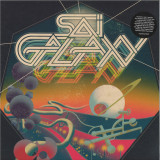
Released on Karl Kronfeld's Synoptik Records, it was the label's only release, thus becoming a rare, sought after, private pressing.
Weird, intriguing atmospheres and a plethora of synthesized sounds, sequencers, cold sounding keyboards and even mellotron parts make this a darker offering than Aphorisms Insane.
Venturing into stark, spooky post-industrial territories it manages to combine the primitive cosmicism of early Tangerine Dream with the dystopic sound-scapes of Asmus Tietchens, 80's Conrad Schnitzler or the synthetic gothicisms of Peter Frohmader.
An album that should appeal not only to fans of cosmic synthetic music, but also those interested in the more experimental strains of cold wave & minimal synth (Robert Rental, Dome, a.o.)
The Wah Wah edition is the first ever reissue of this rare sought after collector's item.
100% analogue lacquer cut direct from the original master tape by Moritz illner @ Duophonic Gmbh and reproducing the original Dalí-esque sleeve artwork in a strictly limited edition of 500 copies only.
Suche:repro
This is a very serene, almost entracing record that seems to inhabit its very own space, between "classical" ambient music (Eno, Budd), "systems music" (Reich, Glass, Riley, Hassell), japanese kankyo ongaku (Hiroshi Yoshimura, Takashi Kokubo), even hinting at what would become 90's ambient electronica (B12, Nuron, SAWII-era Aphex Twin or the Fax +49-69/40464 label). Actually, Lech would be one of the few artists to perform at the first-ever Sonar Festival (Barcelona) back in 1994 (together with Suso Saiz, Esplendor Geometrico, Mixmaster Morris or Laurent Garnier).
A key early effort from this musician and A/V artist whose career spans well over thirty years and a miriad of works, performances and instalations: Art Futura, Sonar, ISEA, Ars Electrónica (Austria), Festival Videoformes (France), Festival de Nuevas Músicas (Madrid & Sevilla), Ciclo Experimental LEM (Barcelona), Knitting Factory (New York), The Korner (Taipei), Festival Pop Komm (Cologne-Germany), Festival Experimenta (Madrid), Festival DAFT @ Taipei (Taiwan), ART BEIJING, Festival EXIS @ Seúl (South Korea), JMAF (Tokio, Japan) or Artefact:Chernobil 33 (Kiev-Ukraine).
The Wah Wah edition has been mastered from the original tapes, reproduces the original sleeve artwork and and features an insert with photos and info.
It is a strictly limited edition of 500 copies only.
Fractal head rearrangement from Keith Fullerton Whitman on his first vinyl release in what feels like years, here blessing Japan’s NAKID label with a new instalment in his forever-evolving Generators project, arcing from bleeping post-Kosmische sounds into completely unexpected drum mutations in footwork and grime modes. It’s properly head melting gear that links the algorithmic mind-fukkery of Laurie Spiegel with the floor-bending rhythmic experimentation of Mark Fell, Rian Treanor or Jana Rush, and the first in a three part series that offers some of the strongest gear we’ve heard from one of the very best in the game.
Modular synth scientist, critic and historian Keith Fullerton Whitman first debuted his »Generators« set in 2009, using a modular setup to create non-repeating melodic patterns that basically came close to generating themselves. Over the course of hundreds of live shows (and a handful of releases on Root Strata, Editions Mego and other labels), Whitman glacially honed his process and allowed the concept to slither down different avenues, mutating as it picked energy from the various venues it was situated in. His rigorous method meant ‘Generators’ was never played out the same way twice, veering from psychedelic Kosmische experimentation to obliterated, off-grid Techno.
In 2019, on the tenth anniversary of the project, Whitman was invited by the GRM in Paris to set up in Studio C, where he avoided the arsenal of pristine, museum-worthy modular synthesizers and instead reprogrammed his classic ‘Generators’ patch. Recorded in a single take using luxe analog- to-digital convertors, the result is a 45-minute durational piece, split into two distinct sides for this release.“Very little manual interaction happened,” Whitman explains. The music is, as its title suggests, generative, and at this point basically sounds as if it reached its most advanced, final form. The first few minutes of the opening side mine the original theme, with clocked LFO shapes triggering oscillator blips in mind-expanding non-looping patterns. Soon, percussion enters the matrix, at first wrong-footing us with a 4/4 fake-out - possibly nodding to the piece’s 2010 Root Strata iteration - before splitting into staccato polyrhythmic abstractions of the most loose- limbed and deadly variety.
General MIDI drums can sound almost hilariously boxed-in, but handled by Whitman they show off a plastic cultural sheen to piercing effect, deployed in a way that re-draws the rhythmic bass music of someone like Jlin while nodding to Mark Fell and Rian Treanor’s quasi-generative dance explorations. These comparisons take on even more weight on the second side, where Whitman opens up his filters to allow the synth bleeps to sing even more loudly, introducing that all- important clap/hat interplay that dialogues with Atlanta and Chicago simultaneously.
Red Vinyl
Time has come for Futurepast to release a long format album: Alarm Phase Red - catalogue number FPLP01 - will be the first full-length work from Futurepast founder Davy Vandegaer, appearing here under a new name: Brainwashed Today.
Rooted in a conceptual approach of electronic music, this double LP ranges from industrial ambient to experimental techno. Like an antidote to a twisted reality of controlled screens and mental isolation, Alarm Phase Red uses the raw language of electricity
to reach the core of the machine and sabotage it, reverse its effects by mirroring them. Fighting fire with fire, deflecting the pressure and strain of a world driven by fear and anger, the music of Brainwashed Today acts like a cathartic escape from technological enslavement.
With the purchase of the vinyl comes a batch of three digital bonus tracks pursuing further the sound research of the album.
Known for his work on Transient Force, Gigolo, and of course as a contributor for Fundamental's Time Capsule a.k.a. 808 Box project, -=UHU=-'s album is a selection of his best unreleased tracks. Compiled from an old folder full of tracks that have that twenty years old spirit in each of them, that futurist funk that -=UHU=- can deliver so well. ''Ezzential Electro'' is the biggest project Electro Records has done so far. It consists of 36 vinyl records produced by artists they consider essential for the current underground electro movement. The first six parts of the series come in beautiful white silkscreen printed sleeves on recycled cardboard and include a real puzzle piece on the front cover, indicating which part of the series you have in your hands.
Tibor Szemző's new LP features two composition, »The Other Shore« & »CUBA«. As the album title implies, »Snap #2« can be considered a sequel to his cult album »Snapshot from the Island« (released in 1987). Back then the island was a metaphor for isolation, while »Snap #2« offers Szemző’s reflections of his visits to real islands, Cuba (1988-1990) and Japan (1992-1994). As usual, Tibor Szemző processed the themes both visually and musically and has presented them many times live as cinematographic performances.
A previous version of »The Other Shore« was released in 1999 on CD. On this album, the original recording from 1997 is used; it has been recomposed, remixed and remastered and some additional recordings have been included. The core of Szemző’s Gordian Knot ensemble of the mid-nineties (Tibor Szemző on bass flute, Péter Magyar on drums and Tamás Tóth on bass guitar) has been enlarged by a string section and additional percussionists. The Other Shore composition has a multilayered texture; it starts with strings and is followed by prerecorded voices reciting the Sutra of the Lotus Flower of the Wonderful Law (Myôhô-Renge-Kyô in Japanese), the most important sutra of Mahayana Buddhism. Then percussion introduces the basic beat of the piece and the voice of the 102 year-old Buddhist priest Ônishi Ryôkei giving a lecture on Kannon sutra is heard. The following uneven entries of drums and bass guitar are like paint brush strokes in Zen calligraphy. The long tones of Szemző’s bass flute enters the piece as the last element suggesting itself as a connecting thread through all previous layers.
When Tibor Szemző first visited Cuba in 1988, he had just started shooting film on 8mm, something of a personal diary. When he met Jonas Mekas in Budapest a few years later, he realized that this footage could be screened publicly and also be an integral part of live performances. »CUBA« is the recording from 2000 of one such performance and was remixed by the author in 2021. It is as similar to and yet different from »The Other Shore«. The Gordian Knot band seemingly structures the piece in the same way, but the resulting sound is much heavier especially thanks to drummer Péter Magyar. Nevertheless, the contributions of Szemző on bass flute, Mihály Huszár on electric bass and T. Bali on prepared electric guitar also inject the proper rock sting. Incorporated Havanna street sounds and local radio broadcasts recorded by the author provide even more steamy roughness to the sound of Szemző’s »CUBA«.
The cover design of the »Snap #2« with photo reproductions from Szemző’s films reflects the aesthetics of the Snapshot from the Island album. This vinyl LP runs at 45 RPM for better sound quality.
Released as a limited edition for Record Store Day in 2019, the original mono mix of Pink Floyd’s A Saucerful of Secrets has been remastered by James Guthrie, Joel Plante, and Bernie Grundman from the 1968 analog tapes. Pressed on 180 gram vinyl, it will be presented inside a reproduction of the original LP sleeve.
With classics like "Set the Controls For The Heart Of The Sun", "Remember a Day" and "Jugband Blues", A Saucerful Of Secrets is the only album to feature the five band members: Roger Waters on bass and vocals, Richard Wright on keyboards and vocals, Nick Mason on drums, Syd Barrett and David Gilmour on guitar and vocals.
Nightports is based on a simple but unbreakable rule of restriction: only sounds produced by the featured musician can be used. Nothing else. These sounds can be transformed, distorted, translated, processed and reprocessed, stretched, cut, ordered and reordered without limitation. Nightports w/ Tom Herbert is the third in a series of albums from musician-producers Adam Martin and Mark Slater to be released on The Leaf Label, following 2018's Nightports w/ Matthew Bourne and 2020's Nightports w/ Betamax. Tom Herbert made his name as the bass player in Mercury Music Prize-nominated bands Polar Bear and The Invisible, and has become an in-demand collaborator and session musician, including work with Adele, Lana Del Rey and most recently The Smile. Having honed his craft holding the low-end down in some of the most forward-thinking British groups of recent times, and also appearing on some the biggest tracks of the last twenty years, Nightports w/ Tom Herbert brings Herbert's command of the double bass into the spotlight.
»Obsessions« is clearly a cult single of the era and one of their Neon's personal highlights. The band recorded the 4 track live in April 1982 and then reprocessed the take at Kindergarten Studio. The twelve inch was then released on the highly influential indie label Materiali Sonori. Neon is still considered as a legend of the Italian new-wave scene, one of the leading figure of the Florence underground movement that spread between the late '70s and the early' 80s.
As we emerge into the Now with a fresh perspective and renewed vigour, Red Laser Records usher in a novel epoch of Manctalo movements for our post-COVID enjoyment.
Entrusting piloting duties to four well decorated RL commandos, the EP serves to remind us all that despite everything that's happened, we can still find solace in red lasers, smoke machines and high-powered strobe lights.
Splitting open the collective dancefloor inertia is Kid Machine's 'Only Machines Allowed'.
A cybernetic b-boy jam straight outta the planet MEGOH circa 4044. Guided by electrified vocoder lines and a plutonium-grade, armoured groove this impenetrable battle rocket should issue the much needed power boost to get your body kinetics firing again when they release the e-barriers to hedonism.
Returning star fleet lieutenant Count Van Delicious has been collecting entities from the outer galaxies since his appearance on RL EP 9 ('Dark Fruit' w/ Senor Chugger).
Here he announces his return with an end-credits epic, an #inabiteveryoneelse theme from this young vet on a pants-off permo-buzz, up-scrolling through technicolored c64 visuals and deploying his now trademark zoopa-arps, euphoric synth stabs and thunderous low end shudder to deadly effect.
Meanwhile, Ste Spandex continues his cybernetic realignment surgery, dissecting a well circulated disco meme and adding voluptuous gender-neutral enhancements that'll be getting the next generation of androids frisky, despite their lack of reproductive organs. Fizzling synths, spherical repetition and a multi-dimensional mix of high voltage rhythms leaving that vocal line permanently downloaded in your memory cloud. No sharing necessary.
Scottish deep space observer Ernesto Harmon provides some cosmic ruggedness to close off our mission. Reinforced & galvanised low-end rhymix coalescing with humanoid synth expression and an infinite, carbon-free energy source keeping momentum plateaued through the morning after the night before. There's no off switch baby!
For astral travellers seeking solace in the new Now, EP12 kindly acts as an upgrade to your possibly dormant dancing system as you stumble out into the new nocturnal environment. Hopefully reminding us that the simple act of moving alongside one another in a pitch black, laser-guided club space hasn't changed that much...
Limited press, with artwork which could be the next top selling NFT, we urge our RL family to bag this collectable chronicle from the Red Laser Corp.
The artistic oeuvre of Berlin-based Sonja Deffner is as extensive and diverse as its contexts are high-profile: If the classically trained musician could in recent years be heard as a member of the groups Jason & Theodor, Die Heiterkeit, Globus and PTTRNS, as part of Christiane Rösinger's touring band, or as a recording musician on Andreas Spechtl's (Ja, Panik) albums, she has at the same time produced an acclaimed graphic work, video works and made her theater debut. Under the name Kalme, Deffner now presents her solo debut »Neue Sprache«, which feels like a culmination: Deffner doesn't need much space to present an artistic position of spectacular incisiveness and maturity.
The formal language of Kalme's debut evolves with reference to experimental pop and R&B, but equally informed by ambient electronics or dub techno. Analog and digital sound synthesis meet Deffner's characteristic use of field recordings, acoustic instrumentation (clarinet, percussion) meets musical post-production, sampling meets expressive synthesizer playing. At the center of the album, however, are Deffner's remarkable lyrics, written in German for the first time. Deffner creates a language of stark, emotional poignancy that is as conspiratorial as it is precise. The themes of the tracks develop between the poles of movement and stagnation, understood as motifs of biographical as well as musical ways of being or relating. In this forcefield, personal and political considerations coincide again and again, for example when Deffner reflects on her experiences with the social conditioning of femininity and motherhood.
The album title »Neue Sprache« (»New Language«), then, describes a search for forms of articulation of solidarization: language as a tool of a new relationship to the world that allows testimony to individual experience without reproducing categories of repression. In this way, Kalme's debut simultaneously achieves a radical intimacy, just as, on the other hand, the confrontation of language and sound repeatedly opens up fissures that deny any semblance of comfort. »Neue Sprache« does not stop at this modernist gesture, however, but unquestionably takes a stand. That's what Kalme's »Neue Sprache« ultimately is: the taking of a position. A statement.
Mitch Stahlmann's solo debut release Into The Wish is a kaleidoscopic adventure in sound. Resulting from the Oakland-based musician's personal practice of experimenting with ways to process and reintroduce the flute, the music on this record draws inspiration from the instrument's everlasting breath. Paying respect to its archaic history as well as leaving room for more strange, clownish impersonations, Into The Wish is a varied collection of flute-inspired pieces. The album traverses seamlessly between what sounds like ancient, sacred incantations and more playful, chaotic collage pieces where the flute is processed, reprocessed and performed using samplers.
Each piece offers a glimpse into a whole world that could be explored in depth, but Stahlmann's curiosity is ceaseless. The opening “Petrified Cloud” is a gentle piece, a velvety, digital introduction, whereas “Moon Arch” follows with more mystery and tropical drama. “Flat Earth” offers sonic depth and channels Hassell's fourth world music ideas into immersive, winding flute passages. “Paris 2107”, “Mega Mart” or “Real Life Drama”, on the other hand, move largely beyond the sound of the flute, burying it in layers of digital processing and (re)sampling. While extremely diverse, Stahlmann's Into The Wish is a fascinating, colourful exploration of his instrument.
The Bela Session is a full release of Bauhaus' first studio session from January 26 1979, where the iconic "Bela Lugosi's Dead" was recorded. This is the first and only official reissue of "Bela Lugosi's Dead" on vinyl, and the first time 3 of the 5 tracks have been released. This EP has been produced directly by the band with Leaving Records, in advance of the band's 40th anniversary
UK post-punk pioneers Bauhaus' immensely influential 'Bela Lugosi's Dead' - originally released in 1979 - is considered the original gothic rock record.
The first official vinyl reissue of 'Bela Lugosi's Dead' and first release of complete recording session (including 3 previously unreleased tracks), mastered by Mandy Parnell.
The live version of 'Bela Lugosi's Dead' was in iconic 1983 film The Hunger. It has been covered by Nine Inch Nails, Massive Attack and Nouvelle Vague.
The original version of 'Bela Lugosi's Dead' has never been on streaming services.
180g vinyl. The art is a variation of original 1979 12-inch. Reproduction of original recording session tape on inner sleeve. Includes 50x50cm poster of cover, gold retail sticker.
Tape
Lucia H. Chung is a Taiwanese experimental artist based in London. She performs and releases music under the alias 'en creux'.
Under this alias, Lucia is interested in the underlying structures of what we call noise and is examining the effects of human interventions into its complex web of tones. Repetition and chance operations are fundamental to Lucia‘s music. It is not built on the dionysian maximalism and symbolic harshness of lots of noise artists; catharsis is not reached via an explosion of sound, but via concentration on sound phenomena and small changes, which, not unlike some minimal disco night your usual mind-altering drone ritual, sucks you in more with every tiny alteration. This music is as intense as it is sensitive.
„The Liberated Mind“, in Lucia‘s own words, „is a sort of split release between two no-input configurations“. For „Wyldside“, she tuned two different feedback mixers with identical routings as close possible, as much as tuning is possible at all on these highly volatile instruments. „The two channels naturally phased in and out from each other. I guess the process was actually akin to Steve Reich's tape techniques on Come Out and It's Gonna Rain. The whole release extrapolated from that point onwards...“ Finding and replicating similar routings/settings on no input mixing desks is the nightmare of every control freak and a task doomed to failure, but in letting go and embracing these failures, patterns emerge. And thanks to Lucia‘s careful work, these patterns become hypnotic as she carves out the essence of each feedback loop, or, as she puts it: „Actually, I did remember the setting for the final track „Earthrise“, but for whatever reasons, I just cannot reproduce the sounds and it's forever lost (at least for this point in time, maybe when the conditions are primed again for the machine, the same sounds will emerge again...). I guess that's really the essences of improvised NIMB setup. Every single sound was the effect of the previous iteration and the cause of the next iteration... (Wait... isn't it just like a Blockchain? Ha!)“
A collection of no-input studio sessions improvised with Mackie 1202-VLZ Pro, TAPCO MIX260FX, MXR Phase 90 and Electro-Harmonix Bad Stone Phase Shifter. All tracks recorded live, no overdubs. Recorded in London in February 2020. Mastered by causeandcondition
Lucia also works as independent curator, producer and broadcaster at Happened. Check out Lucia‘s other albums on Hard Return, Falt and SM-LL.
"Two Duos" is pressed from cellist Okkyung Lee's most recent OTO Residency; the first side a duo with Jérôme Noetinger on Revox B77 and the second with Nadia Ratsimandresy on Ondes Martenot. Cut together, the two meetings seem to raise three cellos in the search for expressive voice: the cello, its magnetic reproduction, and the dual controls of the machine invented to expand on its musical qualities. On the A side Noetinger's opening tape hiss establishes a current; an electrical partner who gives Lee room to slide across and stretch out. Progressively the cello is returned, duplicated and manipulated with increased velocity and distortion. Noetinger draws out the full extent of Lee's extended technique; rewinding strands of Lee's horse hair and transmuting her percussive attacks into shuddering echos, before letting his own concrete interjections spin the duo's sonic tussle into an almost romantic daydream. On side B the ondes (invented by French cellist and wartime radio operator Maurice Eugene Louis Martenot and so loved by Bernard Parmegiani, Varese and Messiaen) seems shaken from classical tradition and those long, drawn out horrorscapes it has come to be associated with. In a duel with Lee, Ratsimandresy grasps the ondes' extraordinary capacity for dexterity, nuance and speed, hounding Lee's cello in a bid to drive her instrument out of the past and into the future. Two fantastic pairings and a testament to the freshness with which Lee and her collaborators continue to work with their instruments. Okkyung Lee / cello. Jérôme Noetinger / Revox B77. Nadia Ratsimandresy / ondes Martenot. Recorded live at Cafe OTO on. Mixed and mastered by Lasse Marhaug. Design by Maja Larrson.
Mixing funk, jazz, boogie, it is released for the first time on vinyl with remastered audio and new liner notes by Lebanese DJ and curator Ernesto Chahoud. In the early 80's, Rahbani created a landmark album, 'Houdou Nisbi' now considered one of the best jazz funk albums from the Middle East. Featuring such cult tracks as "Rouh Khabbir", a remake of the Crusaders' "Soul Shadow" sung by Rahbani
himself, the modern soul of "Bisaraha" and the Brazilian flavoured "For Sure", the album is both effortlessly groovy and steeped in Oriental music. Held as "one of Lebanon's best kept Musical treasures' by Ernesto Chahoud in his notes, the album is a certified Rahbani cult classic.
"Houdou Nisbi," which means "relatively calm", an expression used by news anchors on Lebanese TV to describe the mood during cease-fire in the civil war between 1975 and 1990 - has been remastered for vinyl from the original masters by David Hachour at Coloursound Studio in Paris. The artwork has faithfully been reproduced for the enlarged format. An iconic cover highlighting the strange life
in war ravaged Beirut during the cease-fire and in line with the political stance of Rahbani, a self proclaimed non- religious leftist. Wewantsounds is delighted to bring the first-ever vinyl release of this iconic album to the world.
Black vinyl, repro foldover sleeve, 8-page photo booklet A much anticipated reissue we’ve promised a long time ago, here it finally is: the first ever punk rock seven inch released in Finland, officially reissued with a number of photos from the recording sessions not seen before. Briard’s I Really Hate Ya / I Want Ya Back was, strangely enough, released on a mainstream label, Scandia, in 1977, although in an edition of just a few hundred copies, making it one of the rarest and most expensive Finnish punk records. Led by Pete Malmi and with a young Andy McCoy on guitar, Briard evolved from the earlier incarnation Philadelphia Motherfuckers and later went on to release a handful of seven inches and an album on other labels as Scandia parted ways with them soon after the single release. The Svart reissue reproduces the original foldover sleeve design and includes a booklet.
- A1: Speed Unlimited A (2:00)
- A2: Speed Unlimited B (0:45)
- A3: Speed Unlimited C (0:41)
- A4: Hurricane Wheels A (2:15)
- A5: Hurricane Wheels B (0:51)
- A6: Hurricane Wheels C (1:43)
- A7: Hurricane Wheels D (0:45)
- A8: Hurricane Wheels E (1:42)
- A9: Hurricane Wheels F (0:45)
- A10: Hurricane Wheels G (1:42)
- A11: Route Africaine A (1:14)
- A12: Route Africaine B (1:14)
- A13: Route Africaine C (1:14)
- B1: Kabul Trip A (1:58)
- B2: Kabul Trip B (1:58)
- B3: Kabul Trip C (0:47)
- B4: Kabul Trip D (1:16)
- B5: Water Pollution A (1:47)
- B6: Water Pollution B (1:02)
- B7: Water Pollution C (0:29)
- B8: Centurion A (1:47)
- B9: Centurion B (1:33)
- B10: Centurion C (1:09)
- B11: Gladiators (1:54)
- B12: News Background A (2:31)
- B13: News Background B (1:39)
C-L-A-S-S-I-C library breaks and beats set of super-heavyweight espionage-funk.
One of two Be With forays into the archives of revered British library institution Conroy, we present one of our favourites on the label - the super in-demand Background Action from Sammy Burdson, originally released in 1975. Rare and sought-after for many years now, this is one of those cult library LPs that rarely turns up on even the deepest dig.
Sammy Burdson was one of the many, many aliases of the mighty Austrian composer, arranger and conductor, Gerhard Narholz. Founder of adored library label Sonoton in 1965, and a classically trained composer, his work runs from easy listening through pop, jazz and electronic, to avant-garde.
Background Action’s first side is all Blaxploitation wah-wah, funky clav and heavy, heavy drums. It’s top-quality takes on the sort of hard-knocking psychedelic sleuth-funk that the library labels gave us in spades. However, we think the real killers are over on side B. Styles upon styles upon styles is what we have. The trio of swish “Water Pollution” variations are pure gold. The two-part mid-tempo b-boy drumathon “News Background” is nothing short of epic whilst the sensational “Kabul Trip A” and “Kabul Trip B” are two different takes on some tough funk, street jazz style with some dope organ, bass and drum sounds. In short, this is a must for both DJs and producers.
The British library label with those instantly recognisable “orangey-red” sleeves, Conroy began releasing production music in 1965. A sub-label of Berry Music Co, its catalogue typified the library industry’s strange mixture of tradition and experimentation from the start. Conroy’s early releases included work by big band stalwarts like Eddie Warner as well as early electronic recordings by the likes of Belgian experimental pioneer Arséne Souffriau. With Berry Music Co working as a distribution partner to the German library label Sonoton, it was through the Conroy that a great deal of German library music found its way into the UK market.
Conroy stopped putting out new music in the 1980s, but its history and its catalogue offer an excellent window into the trends and eccentricities of a highly unique industry at the height of its international appeal.
This re-issue of Background Action has been mastered for vinyl by Be With regular Simon Francis from audio from the original tapes. Richard Robinson has handled reproducing the iconic, hypnotic original Conroy sleeve. Essential.
Sammy Burdson/Klaus Weiss/Larry Robbins Backgr Ound Rhythms
Dramatic Tempi / Larry Robbins Background Rhythms
- A1: Pop Waves (1:49)
- A2: Cyclodrom (1:10)
- A3: Devils Drive (1:28)
- A4: Crime Ways (2:06)
- A5: Is It Hip (2:00)
- A6: The Camp (3:29)
- A7: Tomorrow (1:53)
- A8: Rhythm Trip (4:28)
- B1: Vox Pop (1:22)
- B2: Rock Pop (2:47)
- B3: Pop Phase (2:46)
- B4: Pop Twang (0:55)
- B5: Canned Pop (1:40)
- B6: Percussion Take 1 (1:24)
- B7: Percussion Take 2 (1:08)
- B8: Percussion Take 3 (1:16)
- B9: Percussion Take 4 (1:10)
- B10: Percussion Take 5 (0:52)
- B11: Percussion Take 6 (1:54)
- B12: Percussion Take 7 (1:24)
C-L-A-S-S-I-C library breaks and beats set of heavy drums and louche funk.
One of two Be With forays into the archives of revered British library institution Conroy, we present one of our favourites on the label - the super in-demand Dramatic Tempi / Larry Robbins Background Rhythms, originally released in 1975. Rare and sought-after for many years now, this is one of those cult library LPs that rarely turns up on even the deepest dig.
As a single LP, Dramatic Tempi / Larry Robbins Background Rhythms is two distinctly different collections of music. The first side, Dramatic Tempi, is made up of four tracks each from Sammy Burdson and Klaus Weiss.
Sammy Burdson was one of the many, many aliases of the mighty Austrian composer, arranger and conductor, Gerhard Narholz. Founder of adored library label Sonoton in 1965, and a classically trained composer, his work runs from easy listening through pop, jazz and electronic, to avant-garde.
About as cult as it gets when it comes to library music legends (German or otherwise) Klaus Weiss produced essential records on German library labels Coloursound, Selected Sound and Sonoton, as well as making two essential entries in the Conroy catalogue. Having started his career at the age of 16 as a jazz drummer, the Klaus Weiss trademark electronic sound is unsurprisingly built on top of sometimes funky, sometimes frenetic, but always hard-hitting drums.
The second side is both titled and also credited to Larry Robbins Background Rhythms. We have to admit to being stumped as to who Larry was, but we don’t think it’s too much of a stretch to assume it might well be yet another incarnation of Gerhard Narholz’s.
First up from Dramatic Tempi are the phased, gargantuan hip-hop beats of Sammy Burdson’s impeccable “Pop Waves”. This is otherworldly funk on a whole new level. Hearing is believing. The magnificently titled “Cyclodrom” is up next, a beast of booming bass and wah wah guitars over frenetic funk drums. “Devils Drive” is dramatic, blaxploitation street funk with rolling, pounding drums. “Crime Ways” is an acid-squelch, slow-pace neck-snapper.
Klaus Weiss starts by askings us “Is It Hip” and we can only answer “yes it is!” to the clean, skipping drums, booming bass and proto-hip-hop bells, layered beneath laconic and melodic guitar shredding. This is just horizontal soul perfection. “The Camp”, propelled by jazzy guitar à la Joe Pass over fast drum and conga breaks, gives way to the dark guitars and cymbal crashes of “Tomorrow”. It sounds like an early New Order jam session. Closing out a pretty startling side of library greatness, “Rhythm Trip” presents early stuttering funk before easin' on in to a jazzy, soulful groove; all breezy guitar and warm keys. Lush.
Larry Robbins Background Rhythms is a lighter, poppier affair, but it’s not without its drum-heavy bangers. “Vox Pop” and “Pop Phase” each have clean, open-ish drum breaks, ripe for sampling or more daring DJ sets. “Pop Twang” is a short and sweet beat-heavy number that gives way to the fantastically out-there “Canned Pop”. We‘d love to know if this was ever actually licensed for something! The final seven tracks are a set of 1-to-2 minute “Percussion Takes”. All compelling, and all equally useful for any number of production needs. Get sampling.
The British library label with those instantly recognisable “orangey-red” sleeves, Conroy began releasing production music in 1965. A sub-label of Berry Music Co, its catalogue typified the library industry’s strange mixture of tradition and experimentation from the start. Conroy’s early releases included work by big band stalwarts like Eddie Warner as well as early electronic recordings by the likes of Belgian experimental pioneer Arséne Souffriau. With Berry Music Co working as a distribution partner to the German library label Sonoton, it was through the Conroy that a great deal of German library music found its way into the UK market.
Conroy stopped putting out new music in the 1980s, but its history and its catalogue offer an excellent window into the trends and eccentricities of a highly unique industry at the height of its international appeal.
This re-issue of Dramatic Tempi / Larry Robbins Background Rhythms has been mastered for vinyl by Be With regular Simon Francis from audio from the original tapes. Richard Robinson has handled reproducing the iconic, hypnotic original Conroy sleeve. Essential.
- A1: Graceful (1:53)
- A2: Drumcrazy (2:58)
- A3: Giants (2:26)
- A4: Sound Inventions (3:04)
- A5: Glide (1:06)
- A6: Greenwich Street (0:50)
- A7: Stretching Out (1:42)
- A8: Air Space (2:11)
- A9: Statements (1:24)
- A10: Don’t Stumble (0:56)
- B1: Beauty (2:12)
- B2: Rhythm Function (1:20)
- B3: On Disco Street (0:56)
- B4: Fidget (0:38)
- B5: Waves (1:44)
- B6: Funky Art (2:06)
- B7: Rainbows (1:28)
- B8: Uncertain (0:56)
- B9: A Few Cuts (1:37)
- B10: Hot Chocolate (1:17)
- B11: Sections (1:20)
- B12: Early Start (1:01)
The second Be With foray into the archives of revered German library institution Selected Sound is one of our favourites, Sound Inventions from Klaus Weiss Rhythm And Sounds, originally released in 1979.
From the notoriously strong mind of Niagara drummer / library-funk overlord Klaus Weiss, Sound Inventions is loaded with tripped out studio funk-freakery, mad samples and swaggering abstract funk grooves. From dramatic deep disco with dark Italo/Moroder leanings to heavy German funk breaks, this is absolutely sensational. Absolute synth-and-string-drenched magic.
Born in 1942 in Gevelsberg, Germany, Klaus Weiss began his career as a jazz drummer at sixteen (with a group called the Jazzopators) before working with the internationally successful 60s groups the Klaus Doldinger Quartet and the Erwin Lehn Big Band. In 1965 he formed his own trio, the first of many groups to bear his name, and as his renown as a bandleader grew over the next decade it naturally lead to working in production music.
About as cult as it gets when it comes to library music legends (German or otherwise), he produced essential records on German library labels Coloursound, Selected Sound and Sonoton, as well as making two essential entries in the Conroy catalogue. Collections of music in the trademark Klaus Weiss sound of electronics unsurprisingly built on top of sometimes funky, sometimes frenetic, but always hard-hitting drums.
Sound Inventions is one of those library records with a hefty track list, 22 in total, but they’re all pretty stunning. That’s not something you can often say and picking out the highlights is almost impossible. If pushed, we’d steer you towards the tough teutonic funk of “Drumcrazy”, the by turns juddering and sweeping majesty of the title track “Sound Inventions”, the aquatic serenity of “Glide”, the elegant strut of “Greenwich Street”, the muted, eerie cosmic-funk of “Air Space”, the squelchy acid-clavs of “Rhythm Function”, the calming, melodic “Waves”, the stuttering proto-Timbaland sensation that is “Rainbows” and the percussive funk-fuelled workout of “A Few Cuts”. Phew. Heavy indeed!
Founded in the late 60s by German composer and musician Klaus Netzle, Selected Sound began as a production music company specialising in jazz, orchestral and electronic recordings. You can’t miss those early LPs in their iconic glossy metallic copper sleeves with minimal German typography. Serious, classy stuff.
This re-issue of Sound Inventions has been mastered for vinyl by Be With regular Simon Francis from audio from the original tapes. Richard Robinson has handled reproducing the glossy metallic (iconic) original Selected Sound sleeve. Essential.
Efficient Space presents Soft and Fragile by Ros Bandt and LIME (Live Improvised Music Events), originally released by Move Records in 1983. A pioneering figure in Australian music, Bandt is known for her work with sound sculpture, electronics, acoustic ecology, and invented instruments, as well as her writings and teaching.
Soft and Fragile comprises a series of structured improvisations performed on custom-built bells and gongs. On the side-long ‘Ocean Bells’, Bandt performs on her ‘flagong’, a three-tiered vertical glass marimba that she made in 1978, inspired by the ‘cloud chamber bowls’ of maverick instrument builder and microtonal composer Harry Partch. Over a long tape loop made up of slowed down sounds from the same instrument, she delicately strikes the glass bells with mallets, allowing individual pitch-es to ring out and decay with the aquatic wavering quality that suggested the piece’s title, eventually building into flowing melodic sequences. Structured as a series of events determined by the length of the performer’s breath, this gently undulating music invites listeners to lose themselves in delicate microtonal fluctuations and subtle yet expressive phrasing.
For ‘Shifts’, Bandt is joined by Julie Doyle, Gavan McCarthy, and Carolyn Robb on a collectively composed work for clay bells. Atop a steady pulse, melodic and rhythmic cells expand and contract, shifting between LIME’s four members. LIME also perform the closing ‘Annapurna’, where timbres sourced from glass, clay and metal are freely threaded through a pulsating tape backdrop generated from loops of the ensemble chanting.
Presented in a redesigned sleeve showcasing the performers and their instruments, the reissue repro-duces the extensive original liner notes. While Bandt’s ideas and techniques draw on aspects of the invented instrument tradition of Partch and Bertoia, Stockhausen’s intuitive music, and the cyclical structures of American minimalism and Javanese gamelan, the floating world of Soft and Fragile also resonates with the work of New Age outlier Stephan Micus and contemporary practitioners such as Tomoko Sauvage. In Bandt’s own words, this is ‘elegant and sensual music where the body and mind have the time to reflect and catch up with the moment as it passes…It is a music intended for res-pite’.
TAPE012 ASYLUM - Is This The Price? 7” EP Formed in 1981 by a crew of hardcore punx and skins from Stoke-on-Trent in the industrial Midlands of England, Asylum fully embraced the ‘Noise Not Music’ rallying call. The missing link between Discharge and Japanese Noisecore, their sound is characterised by detuned ear-piercing distortion: buzzsaw guitars, fuzzed bass, charging drums and gargled vocals battle each other in a maelstrom of lo-fi production murk that reflects the bleak outlook of their lyrics. Only existing for a brief moment in time (playing a handful of mainly local gigs and releasing one demo tape and the occasional track on compilation tapes) and obscure even during their existence, Asylum were nonetheless influential, their ‘1,000 M.P.H. Hardcore Punk’ inspiring other U.K. groups such as Skum Dribblurzzzz and Napalm Death. This release contains the 6 Track demo Is This The Price? Which was originally released as a tape only EP on Retaliation Records. The tracks have been remastered and mark the first time Asylum have released anything on vinyl. Asylum had an urgent intensity that surpassed other bands of the era: Death of Music - Birth of Noise. (Nic Bullen) This reissue comes with a 12 page booklet and repro of the original lyric insert. FFO: LÄRM, Early NAPALM DEATH, DISCHARGE, WRETCHED, GASMASK, TRANQUILIZER, DISCLOSE
The ninth album in BBE Music's J Jazz Masterclass Series presents ‘At the Room 427’ by Koichi Matsukaze Trio Featuring Ryojiro Furusawa, a rarely heard exemplar of post-modal power bop and free jazz. Delivered by a trio playing with an intensity and energy that draws on classic Eric Dolphy and mid-era Coltrane but definitely with its own particular vibe, At the Room 427 is an exemplar of febrile improvised jazz that could only come from Japan. This deluxe reissue sees a welcome return to the J Jazz Masterclass series for saxophonist Koichi Matsukaze. Originally issued in 1976 on the cult ALM label, At the Room 427 is the debut album from one of the most exciting and forward-thinking instrumentalists to emerge in the mid 1970s. Matsukaze's distinctively angular, deconstructive style adds an unpredictable quality to the session that is balanced by the muscular bass of Koichi Yamazaki and the kinetic drumming of Ryojiro Furusawa, who provides a sound footing for Matuskaze’s fiery solos and free-form chemistry. The album opens with the epic Acoustic Chicken, a 20-minute tour de force of dynamic and explosive interplay. Featured on J Jazz: Deep Modern Jazz From Japan volume 3 and written by Furusawa, Acoustic Chicken's strong melody lines and scorching sax finely mesh with the driving rhythm section. Furusawa’s Elvin Jones-like rolls and batteries of percussion are underpinned by Yamazaki’s driving and rounded bass. At the Room 427 also includes a radical deconstruction of the Billie Holiday classic Lover Man and three more original compositions by Matsukaze. The album was recorded live in November 1975 before a small audience in – as the title states – Room 427, a classroom in Chuo University, the alma mater of both Matsukaze and Furusawa. However, despite the rudimentary surroundings, the recording by Yukio Kojima, founder of ALM, manages to give the listener the feeling of being in the room itself, up close to the band, bristling with an intense energy. This reissue of a long-lost rarity of post-bop/free playing maintains the exceptionally high standard set by the previous releases in the BBE Music J Jazz Masterclass Series. As with all releases in the series, At the Room 427 comes with full reproduction artwork and extra sleeve notes, with artist interviews and biographies. The J Jazz Masterclass Series is curated by Tony Higgins and Mike Peden for BBE Music.
Miles Davis Kind of Blue meets Analogue Productions' UHQR, the pinnacle of high-quality vinyl!
Best-selling album in jazz history; mastered from the original master tapes by Bernie Grundman
Pressed at Quality Record Pressings using Clarity Vinyl® on a manual Finebilt press
Purest possible pressing and most visually stunning presentation and packaging!
Dream team of Davis, Adderley, Coltrane, Evans, Kelly, Chambers, Cobb make history.
Legends have a way of sticking around. If there was ever an album awaiting a high-fidelity, custom-pressed vinyl treatment of the level you now hold in your hands, it is Miles Davis' Kind of Blue. The top-selling jazz album of all time, it has been lauded, entered into "Best Of" lists and Halls of Fame, and universally acknowledged as a landmark recording — a five-track masterpiece of melancholy mood and melody.
It continues to be one of the most listened-to and studied recordings of all time, a required primer for many young musicians, and one of the most transcendent pieces of music ever recorded. Davis played trumpet sublime with his ensemble sextet featuring pianist Bill Evans, drummer Jimmy Cobb, bassist Paul Chambers, and saxophonists John Coltrane and Julian "Cannonball" Adderley with Wyton Kelly playing piano on "Freddy the Freeloader."
Now Analogue Productions, together with Quality Record Pressings, is putting Kind of Blue where it belongs: the Ultra High Quality Record (UHQR) pressed on Clarity Vinyl on a manual Finebilt press with attention paid to every single detail of every single record.
The 200-gram records will feature the same flat profile that helped to make the original UHQR so desirable. From the lead-in groove to the run-out groove, there is no pitch to the profile, allowing the customer's stylus to play truly perpendicular to the grooves from edge to center. Clarity Vinyl allows for the purest possible pressing and the most visually stunning presentation. Every UHQR will be hand inspected upon pressing completion, and only the truly flawless will be allowed to go to market. Each UHQR will be packaged in a deluxe box and will include a booklet detailing the entire process of making a UHQR along with a hand-signed certificate of inspection. This will be a truly deluxe, collectible product.
Kind of Blue is more than Miles Davis's most enduring recording, it's a testament to Miles' experimental approach, drastically simplifying modern jazz by returning to melody unlike the chord complexity more often heard at the time. "The music has gotten thick," Davis complained in a 1958 interview for The Jazz Review. "... There will be fewer chords but infinite possibilities as to what to do with them." Kind of Blue is, in a sense, all melody — and atmosphere.
None of the musicians had played any of the tunes before heading into the first of two recording sessions in early spring of 1959. In fact Miles had written out the settings for most of them only a few hours before the session. Miles also stuck to his old recording procedure of having virtually no rehearsal and only one take for each tune.
Miles remained proud of the album, performing at least two of its tracks — "So What" and "All Blues" — for years after, until his musical path took him in a different direction.
History was on the side of Kind of Blue; it was born in 1959, at the peak of the golden age of high-fidelity, featuring innovations in studio equipment (magnetic tape, high-quality condenser microphones), matched by advancements in home audio reproduction (long-player records — LPs; high-end turntables, and other stereo components). Kind of Blue also benefited from Miles' being signed to the leading major record company of the day — Columbia Records, a part of the CBS media conglomerate. Columbia had the means and wisdom to invest in cutting edge recording technology, and their own professional recording studio.
A minor audio complication with Kind of Blue has been addressed with this UHQR edition. The motor on the studio's 3-track master recorder was running slowly the day of the album's first session. This speed issue affected the album's first three tracks, "So What," "Freddie Freeloader" and "Blue in Green," making them a barely perceptible quarter-tone sharp. Before now, it was only addressed in 1995 for the Classic Records edition and by Columbia Records — or their latter-day parent, Sony Music — on a CD reissue in the late '90s.
Sixty years have passed; this LP bridges that time span in the best way possible, struck from the master reel of Kind of Blue, free of speed issues and replete with all the instrumental detail, sonic environment and minimal noise. As we set out to make our UHQR series the world's best-sounding vinyl records, we have also used Clarity Vinyl, which is free of any carbon black pigment which might introduce surface noise. All-in-all this edition of Kind of Blue meets the highest audiophile standards and offers the truest sound for the most enjoyment.
"UMC celebrate the 50th anniversary of The Band’s classic fourth album, Cahoots, with an assembly of newly remixed, remastered and expanded 50th Anniversary Edition packages, including a multi-format Super Deluxe 2CD/Blu-ray/1LP/7-inch vinyl box set along with a 2CD and 180-gram half-speed-mastered black vinyl. All the Anniversary Edition releases were overseen by principal songwriter Robbie Robertson and sport a new stereo mix by Bob Clearmountain from the original multi-track masters. The box set and CD configurations boast a bevy of unreleased recordings, including Live at the Olympia Theatre, Paris, May 1971, a rousing bootleg partial concert consisting of 11 tracks culled from the initial throes of a European tour that found The Band perched at the top of their live game; and early and alternate versions of “Endless Highway” and “When I Paint My Masterpiece” along with six other early takes, outtakes, instrumentals, and stripped-down mixes.
Exclusively for this box set, Clearmountain has also created new Dolby Atmos and 5.1 surround-sound mixes of both the album and four bonus tracks, presented in high resolution on Blu-ray, alongside the new stereo mix. Every new audio mix has been mastered by Adam Ayan at Gateway Mastering. The lift-top box set also includes an exclusive reproduction of the Japanese pressing of The Band’s 1971 7-inch vinyl single for “Life Is A Carnival” b/w “The Moon Struck One” in their new stereo mixes; a 20-page booklet with new notes by Robbie Robertson and extensive insider liner notes by Rob Bowman; three classic photo lithographs, one each by Barry Feinstein, Richard Avedon (his infamous eyes-closed group portrait from the back cover) and noted New York artist/illustrator Gilbert Stone (who painted the still stunning stretched-out portrait of The Band on the album’s front cover); plus a wealth of additional material and other historical data from the original recordings sessions. The limited-edition 180-gram black vinyl release that features a tip-on jacket also contains a photo lithograph by Barrie Wentzell that’s unique to the package."
CAM Sugar launches its new HERITAGE collection dedicated to the most celebrated soundtracks that made the history of Italian cinema. The opening title is Federico Fellini’s milestone AMARCORD, which is here presented for the first time ever as a 180gr gatefold double LP, carefully restored and remastered from the original master tapes. AMARCORD won an Academy Award in 1974 as Best Foreign Film, besides receiving two nominations for Best Director and Best Screenplay. The sweet and evocative music by Nino Rota takes the listener on a journey through the places of Fellini’s boyhood in Rimini, creating a combination of music and images that is absolutely perfect and still internationally appreciated today. This edition includes a 30x75cm illustrated poster, with a reproduction of the original Nino Rota music sheets. This very special re-release of this classic by Nino Rota is in honor of what would have been his 110th birthday.
- A1: Glad All Over (2019 - Remaster)
- A2: All Of The Time (2019 - Remaster)
- A3: Crying Over You (2019 - Remaster)
- A4: Stay (2019 - Remaster)
- A5: Chaquita (2019 - Remaster)
- A6: Do You Love Me (2019 - Remaster)
- B1: Bits And Pieces (2019 - Remaster)
- B2: I Know You (2019 - Remaster)
- B3: 3406 (2019 - Remaster)
- B4: Time (2019 - Remaster)
- B5: Who Do You Think You're Talking To (2019 - Remaster)
The debut studio album from British quintet The Dave Clark Five was originally released in March 1964. It includes the hit singles ‘Bits and Pieces’, ‘Do You Love Me’ and the title track ‘Glad All Over’, the single which at the time supplanted the Beatles ‘I Want to Hold Your Hand’ from the top of the UK Singles Chart. DC5 were one of first UK acts to achieve success in the US as part for the ‘British Invasion’, as well as making more appearances on The Ed Sullivan Show than any other UK act. This reissue includes recordings remastered from the original tapes and an updated tracklisting that differs from the original US release and the subsequent UK version entitled ‘A Session With The Dave Clark Five’. It is presented on limited edition white vinyl and features reproduced original artwork.
Far View’ is a compilation of tracks from Joel Vandroogenbroeck’s series of library
music releases for the Coloursound label, a uniquely trippy catalogue of music
vignettes long overdue for their day in the library music sun, remastered from the
original analogue reels.
The late Joel Vandroogenbroeck was among the rare breed of musicians who defy
all categorization, using music conventions to explore the far reaches of human and
cosmic consciousness. After passing through the jazz and rock worlds from the
1950s through the ‘70s, Joel found new outlets for his expansive vision in the ‘80s
with the Swiss library music label Coloursound. ‘Far View’ draws tracks from these
releases, which form a unique entry in the genre of library music. For the uninitiated,
this is just one way to begin a brilliant musical trip through Vandroogenbroeck’s
undersung career.
A musical prodigy from youth, Joel arrived at Brussels’ classical Music Conservatory
in the early ‘50s, but his studies were curtailed by the revelation of jazz. Soon, Joel
was touring in groups around Europe and beyond with luminaries like Eje Thelin,
Stan Getz, Bob Brookmeyer and Zoot Sims. As time passed, his musical
consciousness continued to expand: time spent in Africa sparked a deep exploration
of the music of the Middle East. The new rock sounds from England, like The Beatles
and Jimi Hendrix, were mind-blowing. And from Germany came the krautrockers,
with something completely else again.
Vibing on the eclectic energies of the day, Vandroogenbroeck formed Brainticket,
whose approach to composition fused jazz, rock and a mélange of global musical
traditions, combining a Western rhythm section and analogue synthesizers with an
astonishing array of acoustic instruments; ethnic flutes, sitar, harp, kalimba and all
manner of percussion. Steeped in diverse approaches of playing and listening,
Brainticket drew from prog rock and psych, traditional sounds and minimalist music,
all of which passed through their hands like the tributaries that formed the basis of
what would soon be known as New Age music.
In the late 1970s, Vandroogenbroeck began composing for sound libraries, with
recordings to be used as underlay music in films, radio and television. Gunter
Greffenius’ Coloursound Library was formed in 1979 with an inclusive vision of
music, including experimental, progressive rock, and some of the earliest examples
of ambient music - styles not well represented in other libraries. Coloursound gave
Joel the freedom to create music in any style or genre, and over the next decadeplus, he embarked on a musical journey that is unmatched anywhere in the world of
library music. Working under the pseudonyms VDB, his output on Coloursound is
some of his most sublime and otherworldly - ranging from dark electronics to
imagined music of the ancient past to ethereal ambient sounds of the future, which
makes sense, as Joel’s records were always ahead and in and out of their time.
Joel VandroogenbroeckJ passed away in in December 2019, while work was being
done assembling this collection. Curated by David Hollander, whose ‘Unusual
Sounds’ album and book of the same name delightfully explore the library music
world, ‘Far View’ draws from ten of Joel’s Coloursound albums with lovely cohesion.
Featuring brilliantly remastered sound, liner notes from David Hollander, album art
designed by Robert Beatty and reproductions of the Coloursound album jackets, ‘Far
View’ is an entry point to Joel Vandroogenbroek’s mind-bending body of work - sonic
soma to expand your consciousness and vibrate with the cosmos.
At long last, after decades out of print, joining their growing Cramps Records Reissue Series, Dialogo brings us the long-awaited vinyl reissue of Alvin Lucier's "Bird and Person Dyning", the composer's first solo LP. As legendary as they come, and easily among the most important and groundbreaking efforts in experimental music ever recorded, this is Lucier at his most visionary. Issued in a limited edition of 500 copies of black vinyl, with fully remastered audio, housed in a sleeve that beautifully reproduces the original design, complete with brand new English translations of the original liner notes, it doesn't get better than this.
Digging deep into the catalog of Cramps records, Dialogo returns with another stunning entry in their reissue series dedicated to the seminal imprint, the Croatian composer Martin Davorin Jagodić's 1975 masterstroke, "Tempo Furioso (Tolles Wetter)". A bristling work of monumental scale at the vanguard of electroacoustic composition and musique concrète, its stunning two sides, created by his sinfully under-recognized associate of Groupe de Recherches Musicales, reshapes history at every turn. Issued by Dialogo in a limited edition of 300 copies on black vinyl, with fully remastered audio, housed in a gatefold sleeve that beautifully reproduces the original design, and complete with brand new English translations of the original liner notes.
Horacio Vaggione (born 21 January 1943) is an Argentinian composer of electro-acoustic and instrumental music whose music is regularly played worldwide in major centers and festivals of contemporary music. "La Maquina de Cantar" (1978) is his first solo recorded work; originally released on the Italian Cramps Records label as the 18th volume of the Nova Musicha series dedicated to contemporary avant-garde composers, "La Maquina de Cantar" is now made available again on Dialogo in a faithful reproduction of the original gatefold cover artwork, including also an inner sleeve with the English translation of the liner notes
Steve Lacy (July 23, 1934 – June 4, 2004) was an American jazz saxophonist and composer recognized as one of the important players of soprano saxophone. Lacy worked extensively in experimental jazz and to a lesser extent in free improvisation, but his music was typically melodic and tightly-structured. Lacy also became a highly distinctive composer, with compositions often built out of little more than a single questioning phrase, repeated several times. In 1977 he released a one-off record titled "Straws" for the Italian Cramps Records label, as the 6th volume of the DIVerso series (which included, among others, Demetrio Stratos' solo albums) dedicated to contemporary avant-garde composers. "Straws" is now made available again on Dialogo in a faithful reproduction of the original gatefold cover artwork and inner sleeve.
* Kamana is a multiformat release inspired by and channeling the cultu- re and traditions of the Aeta, an indigenous group from the Zambales region in the Philippines. One of the oldest inhabitants of the region the Aetas are also some of the most fascinating and ancient nomadic and hunter gathering cultures. The release goes from the realms of the
real to the imaginary, from transcription to syncretism, from concrete to abstract. An (un)real Sonic Exorcism filled with
*Ancestral Frequencies, Haunted Ghosts and other animistic spirits roaming the Pinatubo forests.
The release features a series of materials released in different formats from the Field recording digital only release, an LP and CD release to a special 7inch vinyl featuring an Interview with a bat hunter.
* Kamana is a long due homage to the Aeta community that hosted me a few years back, fascinated by the endurance of these people and their connection to their land, devastated by the eruption of the Pinatubo volcano in 1991, they continued to go back to their ancestral lands surviving on basic agriculture and hunting bats and wild pigs. Living with them for weeks, I managed to capture some essential field recordings and sounds that form and com- pose the basis for this release, from the more reprocessed and interpreted LP release to the pure field recording documentation of the digital release. It is meant to be accessible to all and provide a window to the livelihoods of these unique communities. For this reason, this release serves as both an archival document and a syncretic one, trying to channel memories and feelings of living in these jungles whilst listening to their stories as well as witnessing their lifestyles.”
Carlos Casas, 2021
Junki Inoue presents the second release on his recently founded label SAISEI from prolific Japanese producer Takuya Sugimoto under his COLOGNe alias. Deep Talk EP features 6 tracks originally released on Japanese CD only label Viola in 1999 and is a snapshot of the elevated warped-techno meets IDM productions Sugimoto is so respected for.
Famous for releasing under many synonyms including COLOGNe, Web and Sammansa it was his EVA EP - the first release on FatCat Records in 1996 that stands out in his recording history. The tracks were in fact licenced from Syzygy Records in Japan, which was one of the main Japanese labels including Viola that homed his work during the 90s era he was most productive in. More recently German label Acido released The Sound There, a mini album of previously unreleased Web material recorded between 1994 and 1995 which was released last year in 2020.
Deep Talk EP presents 6 tracks of intelligent and elevated techno, which show the balanced and intricate approach Sugimoto applies to his output. It has all the warmth and positive essence of the 90s era of electronic music - combining deep and beautiful sounds with headsy and intricate constructions. This is the first time this music has been made available on the vinyl format.
SAISEI is a Japanese word which translates to ‘reproduction’ and ‘to play’ (as in playing records). Japanese culture is widely known for its traditional nature just as much as it is for being forward into the future and this label’s concept does justice to exactly that. Having started digging for records as early as 16 years old, Inoue delved into productions from 1990s Japan to uncover these native gems. SAISEI’s core concept is to recapture and reintroduce unique
pieces of Japanese electronic music onto vinyl, to an audience it never reached before as most of this music was only released in Japan
Welcome to Hell is the debut studio album by English metal band Venom. It was released in December 1981, through Neat Records, at the culmination of the New Wave of British Heavy Metal movement. The music of Welcome to Hell is often described as speed metal, but it had a great influence on the then-emerging thrash metal style, and crystallized the elements of what later became known as death metal and black metal and has been a huge influence on extreme metal as a whole, the band being the pioneers of the genre. This 40th anniversary, limited edition splatter vinyl version comes in an embossed sleeve, with a reproduction of the original lyric bag and poster.
First vinyl reissue for Darien, Connecticut hardcore punk legends Vatican Commandos’ 1983 second 7", originally on the Pregnant Nun label. A 'killed by death' holy grail for the US hardcore collectors finally back in print, courtesy of the original members. Faithful reproduction of the original cover art by Rob Zombie himself. Fully remastered.
Robbie Williams will be reissuing his first two multi-million selling solo albums ‘Life Thru A Lens’ and ‘I’ve Been Expecting You’ on vinyl for the very first time. To be released on 24 September, both titles have been newly mastered at Abbey Road Studios, are pressed on 180 gram heavyweight vinyl and housed in gatefold sleeves, reproducing the original distinctive artwork. Both titles come with Download codes. Originally released in October 1997, ‘Life Thru A Lens’ was Robbie’s debut solo album. It entered the chart at number 11 but had to wait almost six months before it reached number one. It eventually spent 147 weeks on the Top 100 and has been certified 8x Platinum by the BPI for UK sales in excess of 2 million copies. It includes the hit singles ‘Old Before I Die’ (No. 2), ‘Lazy Days’ (No. 8), ‘South Of The Border’ (No. 14), ‘Let Me Entertain You’ (No. 3) and ‘Angels’ (No. 4), the latter his biggest selling single to date, and voted the best song of the last twenty-five years at the 2005 BRIT Awards. Now certified 10 x Platinum by the BPI, with UK sales in excess of 2.5 million, ‘I’ve Been Expecting You’ was originally released in October 1998 when it entered the chart at number one. It returned to the summit the following January and once again a month later. It includes the hit singles ‘Millennium’ (No. 1), ‘No Regrets’ (No. 4), ‘Strong’ (No. 4) and ‘She’s The One’ (No. 1). ‘No Regrets’ features backing vocals from Pet Shop Boys’ Neil Tennant and The Divine Comedy’s Neil Hannon, while album track ‘Win Some Lose Some’ includes the ‘Telephone Voice’ of All Saints’ Nicole Appleton.