Oberman Knocks makes a welcome return to aperture records since his last release Dilankex in 2014, which featured an outstanding 17 minute remix from autechre.
Working on other projects during this time seems to have charged his creativity and Knocks now propels himself back into the fold for his third album Trilate Shift with cleaner, more polished production and a change of direction which should certainly see his appeal rise across a wider audience.
Last year Knocks produced the soundtrack to The Red Tree, an award winning documentary film from Still films (New York/Dublin) and in 2016 he was commissioned by The Lowry in Salford to produce a sound installation, 30 Days of The Smiths, forming part of their Week 53 festival, a version of which was also performed live.
Trilate Shift sees Knocks serve up fourteen lustrous tracks of proficiency and divergent ingenuity encompassing interjections of disembodied vocals, setting the scene for a distinctive musical trajectory.
Search:rise records
In the sweltering North-Eastern Brazilian state of Pernambuco lies the coastal city of Recife, where Amaro Freitas is pioneering the new sound of Brazilian jazz. For the prodigious young pianist, the spirit of his hometown runs deep. From the Afro-Brazilian maracatu born on the sugar plantations of slavery, to the high intensity carnival rhythms of frevo and baião, Amaro's heavily percussive approach to jazz is as indebted to these Pernambuco traditions as it is to Coltrane, Parker and Monk.
As with many of the greats before him, Amaro began playing piano in church aged 12, under the instruction of his father, leader of the church band. As his natural talents became obvious, the young prodigy quickly outgrew his father's instruction. He won a place at the prestigious Conservatório Pernambucano de Música but had to drop out as his family could not spare the money for the bus fare. Undeterred, Amaro gigged in bands at weddings and worked in a call centre to fund his tuition. The transformative moment came at age 15 when Amaro stumbled across a DVD of Chick Corea concert, 'he completely blew my mind, I'd never seen anything like it but I knew that's what I wanted to do with a piano'.
Despite not actually owning a piano, Amaro devoted himself to studying day and night - he would practice on imaginary keys in his bedroom, until eventually striking a deal with a local restaurant to practice before opening hours. By the age of 22 Amaro was one of the most sought-after musicians in Recife and resident pianist at the legendary jazz bar Mingus. It was during this time he met and begun collaborating with bassist Jean Elton and the pair went in search of a drummer. 'We kept hearing about this crazy kid who was playing in 7/8 or 6/4, we knew we had to meet him'. Hugo Medeiros joined, and the Amaro Freitas Trio was born.
'I want to show the simplicity of music, to break the stigma that the piano is for a particular social class. Yes, it's a difficult instrument, which many people do not have access to, but with it you can express everything.'
Following his critically acclaimed debut album Sangue Negro (black blood), the title of his sophomore release Rasif is a colloquial spelling of Amaro's home town. A love letter to his native northeast, Amaro explores its traditional rhythms through the jazz idiom, employing complex mathematical patterns reminiscent of some of the most challenging works by fellow Brazilian masters Hermeto Pascoal, Egberto Gismonti and Moacir Santos.
Preferring to see the piano as a though it were a drum with 88 unique tones, Amaro's intelligence and emotion intertwine on every track, from album opener 'Dona Eni': a scorching reconstruction of the baião rhythmic structure, played in seven measures instead of two, to the serene homage to the coastal reef and its ecosystems on the title track 'Rasif'. 'Aurora' is a suite of three parts, representing the sun's journey from the light and soft of the rise, to the aggressive dissonance at its midday zenith and descending chromatic cadences as the sun sets.
Due for an Autumn release on Far Out Recordings, Rasif sees Amaro Freitas take a deserved step onto the world stage. Having already made a name for himself in Brazil, Amaro and his phenomenal band will embark on their first European tour later this year.
Amaro Freitas - Piano
Hugo Medeiros - Drums & Percussion
Jean Elton - Double Bass
Henrique Albino - Baritone Sax, Flutes & Clarinet
All compositions by Amaro Freitas
Produced by Amaro Freitas
Recorded by Bruno Giorgi @ Carranca Studio, Recife, Brazil
Mixed and mastered by Bruno Giorgi @ Quarto Studio, Rio de Janeiro, Brazil
Executive producer and management: Laercio Costa
Nick Klein is an artist making electronic music born in southern Florida and based in Brooklyn, New York since 2012. Upon moving to New York the concentration of his works output has been to mine and investigate the troped qualities in various forms of electronic music, and then to realize singular directions in how to communicate these ideas himself. Alongside Miguel Alvarin~o he runs the music imprint Primitive Languages.
His latest offering since the January 2018 EP "Lowered Flaming Coffin" (Alter) is a continuation of his burnt dance music explorations with "The Bathroom Wall" on Bank Records. As a totem to reflect onto with text, to rest ones eyes in blur, or to physically hold ones self up in the throes of intoxication, the bathroom wall takes and gives numerous gestures of use. Klein uses the symbology of the bathroom wall to construct five disparate wall scrawlings and hazed meditations into the compositional grounds for four meaner mid-tempo, rhythmic purges. Tracks "The Worst Band In The World" and "American Gut" take on the pulsing build of an intoxicated night out. The record divides in on and itself in tone with "Rather Be Your Enemy", an homage in title to the legendary Lee Hazelwood song, wherein the synthesizer convulses slowly conjuring the bleaker qualities of tinnitus taking the lead over your senses. Side B of the record throbs quickly with the blown bass drums and hissing rhythms of "Pushing Your Luck" and comes to a drawn conclusion with the ten minute come-down at sun rise burner of "Poor Me Another".
The record was recorded using a modular synthesizer to tape by Nick Klein and mastered by Josh Bonati. Design work taken on by visual provocateur Chris Norris (Steak Mountain).
Rhythmic Brutalism' is the title of this release, available as a two CD set or two separate LPs, the title is also a very apt description of the music itself. Romanian-born Alexandra Atnif was fascinated by the harsh, grey concrete beauty and minimally repetitive force of the brutalist post-war architecture of her homeland, and this fascination has given rise to the music here. Vol. 1 is an EM Records edition, compiled from an earlier self-released double CD featuring recordings from 2014-15. Vol. 2 consists of previously unreleased recordings from 2015 to 2017. Using elemental, inexpensive technology, Atnif' s music is heavy and harsh, stripped down to distressed skeletal frameworks, rhythmic noise, rusting metal and weathered concrete, a distorted DIY realization of her beautifully brutal vision. With a background in European modernist/avant-garde music, Atnif has been influenced by early rhythmic industrial music such as Throbbing Gristle, Esplendor Geometrico and Muslimgauze, as well as later practitioners of rhythm and noise including Pan Sonic, Autechre, Winterkälte, Prurient and Scorn. Across the relatively brief span of years contained within these two volumes, we hear the rhythmic structures begin to fracture and fray, and the outlines darken and become more obscure, with Antif's sensibility evident throughout.
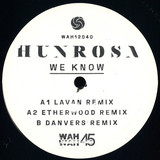
As bottom end provider for Cinematic Orchestra and Paper Tiger, Hunrosa (AKA Sam Vicary) already has something of a pedigree for a man of such tender years. His music glides effortlessly between Bonobo at his most sonorous, Jon Hopkins at his most ethereal and Flying Lotus at his most freaky. Currently based in Manchester, his music captures the wild organic senses of his Cornish childhood, anchoring it with a darker 2am undercurrent. Following the success of 'Ransom' (a firm favourite of BBC 6 Music's Tom Ravenscroft) Hunrosa returns with his newest offering 'We Know'. An eerie, ethereal track full of haunting atmospheres, Vicary enlists Austrian percussion maestro Manu
Delago, who lends his hang drum expertise to the proceedings weaving it amongst the twisting, intricate beats and Anna McLuckie's delicate vocals. the original is accompanied by a white label 12' containing three reworkings from burgeoning producers Lavan, Etherwood and Danvers. Newcomer Lavan is up first, moulding the organic melodies and earthy percussion into a dubbed out, soulful and bouncy 4/4 number. Hospital Records golden boy Etherwood (whose band Hunrosa is also a member of) brings a late-night liquid DnB atmosphere into play, harnessing the raw emotional power of the lyrics, as reverberating piano chords strike out into the darkness. Having turned the
heads of Bradley Zero and Gilles Peterson with his recent releases, CoOp and WotNot Music's Danvers resets the atmosphere with a zen like extended intro, before launching headfirst into a hypnotic and enthralling looped rhythm section. The groove locked in place, it rises and falls with precision, joined by spaced-out synths throughout the nine-minute duration, allowing the majestic instrumentation to gather pace as the spine chilling vocals drift overhead.
Cryovac Recordings is proud to release its' 20th edition on random colored vinyl. Cryovac is a gathering of minds that work together to create a physical record of their sound in this time. We go our own way in production and arrangement for our personal vision to endure. Our goal is to add a new layer to the Detroit soundscape.
D.J. Roach is a techno activist with a rhythm agenda of percussive techno. His banging and clanging romps rock through breakdowns and back again. Conga and claps work together to form a shaky funk. what is needed for a healthy dancefloor.
A.Garcia's subtle drone rides waves of synth in an offering of minimal ease. His moody atmosphere turns tone in soulful harmony; while simple drumming builds to a nonchalant bop. The rise and fall of the elements allow you to examine the track on all sides. Garcia smoothes out an early morning gem that is taylormade for a smoke.
The rising London based label is quickly defining his own and unique sound laying down the law with another live jam recorded 4 tracks release by his own boss DOTHEDU.Following the success of the first release, Senseverse Records has came back with Lost Acids EP, a rough lost minded trip with an unusual sense of refinement. The producer lets the trip's curtain rise with Lost Acids which takes us to a gloomy hidden place on the edge of the house and techno roots with a banging 909 and crescendo 303 which dives smoothly into the background own producer's voice, Colombine Acids explores the happier stage of the trip and keeps the sound on the thin line in between the 2 genres with his fat kick and the flying and clashing crashes.
The B1 throws us right back deep into the dark with a slowed down and mentally twisted remix by the very well known producer Florian Kupfer. Finally Early Acids rings down the curtain's trip with some fine classic house music sonorities that lead us to a dreamy and dancy closing.
Phil Gerus is a natural musical talent who oozes sound from every pore. Fusing together cassette pop, disco, soul, r&b and funk, his sounds are effortless but hugely emotive and have come out on labels like Sonar Kolkektiv, ManMakeMusic (George Fitzgerald's label), Futureboogie and True Romance. Growing up in Moscow, Phil studied classical piano and was heavily influenced by his parents' music tastes, including jazz records of Oscar Peterson, Bill Evans, and Keith Jarrett, it is these classy vibes that permeate his own creations. Phil has played around the world at leading clubs like Japan's Dommune, Studio 80 (Amsterdam), Mojo Club (Hamburg) and various hotspots in Europe and Russia. Phil is also a regular guest on radio shows around the planet and is considered as an artist on the rise.
- A1: Horace Andy - Illiteracy
- A2: The Heptones - Be A Man
- A3: The Manchesters - Natty Gone
- A4: The Gladiators - Down Town Rebel
- A5: Willie Williams - Calling
- B1: Roland Alphonso & Brentford All Stars - Sir D Special
- B2: Keith Wilson - God I God I Say
- B3: Alton Ellis - Almost Anything
- C1: Bobby Kalphat & The New Establishment - Adis A Wa Wa
- C2: Peter Broggs - Sing A New Song
- C3: Mystic Revelations Of Rastafari - Let Freedom Reign
- C4: Larry & Alvin - Free I Lord
- C5: Ernest Wilson & The Sound Dimension - Freedom Fighter
- D1: Jackie Mittoo - Happy People
- D2: Prince Lincoln - Daughters Of Zion
- D3: High Charles - Zion
- D4: Winston Jarrett - Love Jah Jah
This Is The Second Installment Of Deep Roots Rastafarian Reggae At Studio One And Features Classic Music From Some Of The Most Important Figures In Reggae Music - Alton Ellis, The Heptones, Jackie Mittoo, The Gladiators - Alongside A Host Of Rarities And Little-known Recordings, Such As A Truly Rare Mystic Revelation Of Rastafari Seven-inch Single, Willie William's First Ever Recording 'calling' And Horace Andy's Righteous (and Equally Rare) Masterpiece 'illiteracy. Black Man's Pride 2 Extends The Legacy Of Studio One's Ground-breaking Path In Roots Reggae Which Began At The End Of The 1960s And Continued Throughout The 1970s. The Album Tells The Story Of How The Rise Of Studio One Records And The Rastafari Movement Were Interconnected, Through The Adoption Of The Rastafari Faith By Key Reggae Artists - Everyone From The Skatalites And Wailers In The 1960s, Major Singers Such As Alton Ellis And Horace Andy At The End Of The Decade, Through To Major Roots Artists Such As The Gladiators In The 1970s - And How Clement Dodd Consistently Recorded This Heavyweight Roots Music Throughout Studio One's History.
The Sleeve-notes To This Album Also Discuss The Links Between Rastafari And Studio One In Time And Place, Noting How Both The Religion And Clement Dodd's Musical Empire Had Their Roots In The Intense Period Of Pre-independence Jamaica In Kingston, Expanded In The 1960s Following The Visit Of Haile Selassie In 1966, And How Roots Music Then Came To Dominate Reggae Music In The Early 1970s. Also Discussed Is How The Outsider Stance Of Both Reggae Music And The Rastafari Movement Relate Back Many Hundreds Of Years To The Original Rebel Stance Of The Maroons, Escaped Slaves Who Set Up Self-sufficient Enclaves In The Hills Of The Jamaican Countryside.
After releasing their Yantar LP digitally last year, Hell Yeah now serve up a much anticipated vinyl version of Richard Somerville and Craig Wilson's perfectly horizontal sounds. It features two of the superb originals with remixes from The Beat Broker and Los Gatos Escobar.
Somerville & Wilson have appeared on ISM Records, DWDK (Danny Was A Drag King), Paper Records and Music for Dreams and count the likes of Tensnake and Gerd Janson as fans of their laidback and charming grooves, and this EP is a real slab of heat that will surely sizzle souls across the world this summer.
First up, The Beat Broker proves he is on fire right now with a remix of the classic 'Melt'. His heart swelling remix has impossibly mellow chords ringing out into a yellow-orange sky as melodies rise and fall like a yacht bobbing on gentle waters. It's a blissed out musical sunset of the highest order.
Then comes Somerville & Wilson's 'Cero Gravity', eight minutes of cosmic synth workouts, yawning chords and long legged drums offset by soft acid. Drenched in reverb and rippling out in all directions, it's a warm musical rush that keeps washing over you until your soul melts away.
From New York, Los Gatos Escobar duo offer a more driving but just as tropical remix of 'Yantar' with big rubbery drums, zoned out chords and smeared pads. It's beautifully innocent and honest, heartfelt and meditative music that encourages you to escape to a seaside paradise.
Last of all, a melted Space Edit of Yantar is drowned in saturated chords, scorched pads and heat damaged keys that leave you adrift in a sea of sumptuousness.
Music doesn't come much more majestic, melodic and mellow than this.
e mighty Man Power returns to Correspondant. One of the earliest labels to champion his explorative technoid landscapes, and deliver his debut album, the Mexico based composer makes a welcome return with three truly singular trips...
'The Zen Of Xen' comes in two segued parts, comprising almost 13 minutes of full intergalactic immersion. Laced with the alluring deep-dream vocals of Tel Aviv's Xen, anchored with tripped-out humanized harmonics and weaved with soaring pads, it's a genuinely emotional narrative that's been cooking away on Man Power's creative wishlist since he first met Xen at a show five years ago.
Elsewhere 'Heart For Yes, Life For No' will have you spitting rainbow emojis all night. An incredible piece of vibrant melodic techno rooted in synthesis, galvanized with emotive layers, driven by feels it sets us up perfectly for the fantastical finale 'Hubris'. Cosmic, soft-focused, sparkling but topped with a choral chant that comes in from nowhere and arrests every sense as the elements rise and fuse with theatre.
By far one of Man Power's most techno-focused and biggest records to date.
Bluestaeb's Evolution From A Beatmaker To A Producer Is His Sophmore Album everything Is Always A Process'.
He Is One Of The Key Figures Of A New Generation Of Up And Coming Hiphop Beatmakers, Who Have Emancipated From Genre Thinking And Instead Merge Old School Aesthetics With A New School Attitude And Organic Instrumentation.
Everything Is Always A Process Re-iterates Bluestaeb's Overall Approach To Life (and Thinking), But Also Has Direct Reference To The Making Of The Album Itself, Which Began With Moving From Berlin To Paris In 2015 In The Search Of New Influences And A New Creative Environment.
Created Between 2015 And Early 2018, Eiaap Embodies The Process Of This Transition - As Well As Collaboration With Instrumentalists And Vocalists From All Over The World And Recording In Different Studios In Paris, London & Berlin.
"meeting All Those Musicians And Trying Out New Ways Of Producing By Using Real Analogue Synths, Rhodes, Drums And Percussion Etc. Made It Possible To Overcome The Creative Boundaries Of A Home Studio With Just A Midi Keyboard" / Bluestaeb
Influenced By Madlib's "shades Of Blue" And Trained In African Drum Techniques Such As Djembé And Daruka, Bluestaeb Had Been Crafting His Own Beats Since His Teenage Years And Gradually Found His Sound Identity Through Experimenting With Hiphop And Jazz - First To Be Heard By A Broader Music Community In 2013, When He Released His Debut Album "1991 Extraterrestrial" (radio Juicy). Since Then The Prolific Young Artist Has Released Numerous Solo And Collaboration Projects ("b.l.u.e. Friday" In 2015 And - sidekicks With S. Fidelity In 2016). In 2016, He Produced Collaborative Album "lit - Lost In Translation With Rapper Juju Rogers, A Keen Manifesto Against Racism, Xenophobia And The Rise Of Anti-heroes Such As Donald Trump.
Today, Bluestaeb Lives And Works In Paris And Berlin And Is Set To
Release His Third Solo Album everything Is Always A Process', A
Smooth Neo Soul-induced Epic Featuring Artists Such As Noah Slee, Harleighblu And Melodiesinfonie, Via Jakarta Records In 2018.
Two of Russian electronic music's rising stars, Phil Gerus and Alexander Lay-Far, invite you to join them at the Solitary High Social Club. While table service is provided, they'd much rather you throw caution to the wind and head to the dancefoor.
Before joining forces in the studio, both Moscow-based musicians have delivered a string of memorable solo productions. Lay-Far has previously released a wealth of material on such labels as Local Talk, City Fly, Lazy Days and 4Lux Black, while synthesizer fetishist Gerus has showcased his electrofunk and disco-fred cuts on Futureboogie Recordings, Sonar Kollektiv, Public Release
and Superior Elevation Records.
The fve tracks that make up Solitary High Social Club deliver a perfect marriage of the two producers' distinctive solo styles, combining the rich musicality of Lay-Far's house productions with the spacey, intergalactic electronics of Gerus's discoid adventures. In many ways, it's a marriage made in heaven - or in Lay-Far's celebrated In-Beat-Ween Studio, at least.
The duo's spacey and melodious musical fusion is arguably best exemplifed by lead cut City 2 City, Star 2 Star', a widescreen, mid-tempo disco epic rich in tactile Rhodes riffs, supernova synth solos, delay-laden drum beats, tumbling melody lines and heavy analogue bass. Fittingly, the track returns in Reprise' form - think sweeping, weightless ambient bliss - to round off the EP.
Elsewhere, the duo provides further proof of their combined musical talents.
Check, for example, the gentle drum machine electro beats, cascading new age melodies and sparkling, stretched-out synthesizer chords of the impeccably beautiful Am I Tripping', or the devilishly percussive, mind-altering brilliance of Love Life', where mutant electro bass, wide-eyed chords and alien melodies rise above a heavy, Afro-infuenced groove. As for Snowfakes On Her Lips', you'll struggle to fnd a more confdent and positive dancefoor workout all year. Blessed with killer piano parts, darting analogue synth-bass and a range of disco-tinged musical fourishes, it's by far and away the most celebratory moment on an already happy-go-lucky EP. It confrms, too, our initial hunch: at the Solitary High Social Club, life is always good.
Re-mastering by: Ray Staff at Air Mastering, Lyndhurst Hall, London
This jazz recording is considered as the 'magnum opus' of master "drummer extraordinaire'', composer, arranger, producer, and leader Norman Connor's in a career that has spanned 4 decades. This recording is what many will consider the debut of the legendary vocalist Dee Dee Bridgewater who has since gone on to a brilliant career. Connor's put together an all-star group with Herbie Hancock and Onaje Allan Gumbs on piano and Fender Rhodes, Dr. Eddie Henderson on trumpet/flugelhorn, Carlos Garnett on tenor/soprano saxes, Gary Bartz on alto/soprano saxes, Buster Williams on bass, drummer/vocalist Bill Summers and Kenneth Nash on percussion, and effective, crucial cameos by master flautist Hubert Laws. On the song, "Love From the Sun'", Connors added Nathan Rubin on violin and Terry Adams on cello.
The 'best of the best' begins with the exotic theme of Hancock's "Revelation", doubled wordlessly and beautifully by Ms. Bridgewater over Williams bouncing ostinato bass pattern with flights of fancy from Hubert Laws on flute, and superb, luminous solos from Henderson's exotic trumpet, Garnett on soprano, and Hancock on Fender Rhodes. Garnett's "Carlos II" is another great composition with remarkable solos. Connors' own "Drums Around The Worlds'" is influenced by African and latin rhythms with emotional vocals from Summers and a drum-only section that builds in intensity. One of the high points of the album is Dee Dee Bridgewater's awesome, glorious vocalizing on Richard Clay's lovely "Love From The Sun", in one of the greatest performances in her career, arranged by Gumbs. Elmer Gibson's "Kumakucha" (The Sun Has Risen) is a blazing display of uptempo musicianship by Connor's driving drums, the propulsive congas of Summers and Nash, and exciting solos from Bartz, Henderson on trumpet, and Hancock's furious piano solo. The set ends with a marvelous "Holy Waters" composed and arranged by Garnett in a scorching performance by Bridgewater on vocals, Garnett unleashing one of the greatest solos in his storied career, followed by Gumbs' astute solo.
My Highest Recommendation.
By John Braswell
Strut presents the brand new album from cosmic jazz travellers The Pyramids, led by saxophonist Idris Ackamoor, 'An Angel Fell'. I wanted to use folklore, fantasy and drama as a warning bell,' explains Ackamoor. The songs explore global themes that are important to me and to us all: the rise of catastrophic climate change and our lack of concern for our planet, loss of innocence and separation... but positive themes too, the healing power of music, collective action and the simple beauty of nature.' Produced by Malcolm Catto of The Heliocentrics, the album was recorded during an intense week at Quatermass studios in London and is one of the deepest, richest works yet from a band reaching their highest creative peak since the early '70s. Some of the many highlights include the poignant title track depicting a fallen angel in purgatory, outrage and grief on the powerful, hard hitting 'Soliloquy For Michael Brown' and the lilting, beautiful album closer, 'Sunset'.
The Pyramids originally came together in 1972 at Antioch College, Yellow Springs, Ohio where teachers included renowned pianist, Cecil Taylor. After forming in Paris and embarking on a cultural odyssey' across Africa, the group recorded three independent albums, 'Lalibela' (1973), 'King Of Kings' (1974) and 'Birth / Speed / Merging' (1976) and became renowned for their striking live shows, mixing percussive, spiritual and space-age jazz with performance theatre and dance. After migrating to San Francisco, they disbanded in 1977. 35 years later, the band reunited in 2012 following growing demand for their music from vinyl collectors. German label Disko B released the freeform album 'Otherwordly' and in 2016, they released their first album for Strut, the acclaimed 'We Be All Africans'.
'An Angel Fell' is released on Strut on 11th May 2018 and features full hand-painted artwork by Lewis Heriz.
New concept album by leading cosmic jazz collective exploring global apocalypse, climate change and the healing power of music
Produced by Malcolm Catto of The Heliocentrics - Superb cover painting by Lewis Heriz
Full priority worldwide PR campaign and marketing
Release supported by major European tour dates in May and key Summer festivals
In recent times Alex Pletnev has been making his mark on the musical stratosphere with an array of works from from cold wave edits, through gorgeous adaptations of african and world music to tribal techno originals. He joins us as Pletnev for "Aztec Code / Daywalker", a 12" combining his abundant influences to take us to bizarre, far-off places.
"Aztec Code" is a pure dance thing. Inspired by the fat kicks and live bass lines of the Big Beat era, Pletnev combines a jumping beat with african percussion and a charismatic vocal that seems to call out from between the palm fronds of somewhere steamy as we work up a sweat. Tenderly crafted with samples taken from almost 10 records, one-shots, drum layers and melodic licks are treated and mixed, giving rise to a warm, lush atmosphere perfect for circling a fire deep in the tropics.
On the flip, "Daywalker" is a completely original, synthesised outing. A sleazy lead line charms and slithers upwards between layers of syncopated tabla and a sultry acidic groove. The tune spins and twists around this central oriental theme, ever-evolving as layers of detailed percussion and ad-libbed melodies intensify the tone.
Sound artist Eva Geist joins Fleeting Wax label head Mehmet Aslan to spin "Daywalker". The pair create a sonic bridge between the two originals. Their hazy rework dubs out some electronic elements, adding contorted sound design, distant vocals, lofi samples and an italo leaning bass. A mystic incantation for spaced out late morning moments.
Cryovac Recordings enters a new sensible era of home grown production focusing on strong statements of personal style. Cryovac stresses a minimal approach to basic production with a simple soul to shape a tale of sound. The Broke Lighter E.P. is a versatile mix of characters that come together and combine their visions into one vista. This shared space of consciousness is translated to vinyl for your inspection. Cryovac Recordings continues to shine light on every corner of the Detroit Underground to expose a depth of talent that is overlooked.
The 19th edition of the Cryovac series is a moody stab at the heart of techno. It starts off with Disc Detroit's upliftingly melancholy 4/4 groover that transforms synth and turns percussion with a steady patience. Dutch Mike executes a smooth assault lead by a 303 harmony, backed by a heavy baseline and flanked by tricky programming that shifts cymbal formations. Vontell C. and his son Vontell F. sneak a dark vibe into the mix with a manic and excitable minimal ballad detuning and nodding out while detailing the burning of pretty things. Andy Garcia applies a minimalized Motown sound via strumming guitar, vintage vocals, and easy beat that rises and falls creating a serene phonic envirorment. Every track on the Broke Lighter is an opportunity to go in a new direction.
TRORA Vol. 1 is Panda Lassow's interpretation of recent global tropical bass movements like Gqom, Kuduro and more. She likes bass music from around the world. Thus, we can also hear influences from Bounce and Booty elements. As born and grown up in Eastern Germany, in TRORA Vol. 1 she combines these with her musical roots she found in techno and rave music.
Over the past few years orchestral instrumental music from outside the classical establishment has become huge, and Neil Leiter and Margaret Hermant of the Belgian Echo Collective have witnessed the evolution and extraordinary rise of this movement right up close. They've worked with some of the most important players, including Stars Of The Lid, Dustin O'Halloran and Adam Wiltze's A Winged Victory For The Sullen and O'Halloran's solo projects, as well as Jóhann Jóhannsson. And though the Echo Collective members themselves very much do come from within the classical music establishment, they don't care which side of the fence they are seen to be on. It was this which grabbed the attention of German music hub !K7's new sub-label 7K! - who have signed them for a two album deal: first to release the Amnesiac reinterpretation, then for a record of Echo Collective's own compositions. Not only that but they have been signed for publishing by Mutesong, which led to a hook-up with Mute mainstays Erasure, re-arranging and re-recording their latest album World Be Gone with classical instrumentation backing Andy Bell's vocals. This ability to flow easily from black metal to Radiohead, from Erasure to Stars Of The Lid shows exactly what kind of musicians Echo Collective are. The album, which features artwork by the renowned photographer and artist Roger Ballen, will be released on 30 March on CD, 2LP and digital platforms.
- New album by belgian band Echo Collective covering Radiohead's classic Amnesiac'.
- Perfect balance between classical, neoclassical & indie.
- Past and ongoing collaborations include Erasure, A Winged Victory for the Sullen, Stars of the Lid, Johann Johannsson and Dustin O'Halloran.
- Echo Collective have produced, arranged and performed on Erasure's upcoming album due to release early March on Mute.
- Artwork by renowned photographer / artist Roger Balle.
In an interview with Jazz Magazine in the early 1970s, Dharma, as a collective voice, outlined their method: 'we try to reach, within free jazz, the same sort of rhythmic cohesion as in Bop, a cohesion based not exactly on tempo, but something which feels like tempo. A kind of underlying pulse'. Evidence of these ideas can be heard immediately on listening to Mr Robinson, the first album by the Dharma Quintet, for whom community living seemed obvious, in order to add to the aforementioned cohesion. Through this, the group members played together on a daily basis, trying out things which were worked on day in, day out. They were also listening to a lot of records, with of course a preference for free jazz, but not forgetting Miles Davis in his electric period, notably for the keyboards of Keith Jarrett and Chick Corea. To which should be added esthetical-political concerns based on a refusal of hierarchy, and a desire to escape from a restrictive academic approach... It was within this framework that Jef Sicard and Gérard Coppéré (saxophones, flute, bass clarinet), Patricio Villarroel (electric and acoustic piano), Michel Gladieux (bass) and Jacques Mahieux (drums) formed the first version of a collective united by structured intentions. Because, within Dharma, individual improvisation cannot be envisaged outside of a clearly designated framework, even non-tempo. The result is a beneficial cohesion, and moments of great beauty born of a collective excitement and giving rise to ambiances which seemed almost possessed. The use of modes could seem to link Mr Robinson to the spiritual jazz of the past but that is without taking into account the fact that the benevolent spirit of Eric Dolphy seems to watch over this album. In France, a similar desire for cohesion could be found in the Cohelmec Ensemble, who had parallel preoccupations, to the point where their bassist, François Méchali, ended up by joining Dharma: there is unfortunately no recorded trace of this, just the memories. As a quintet, with however some personnel changes, Dharma recorded three albums (there is also one as a trio, under the name of Dharma Trio), which are all of fundamental importance (Dharma would also accompany, and to great effect, the songs of Jean-Marie Vivier and Colette Magny). Individually, the members would record with musicians passing through (notably Anthony Ortega, Dave Burrell) and participated in other key groups including Machi Oul and Full Moon Ensemble.