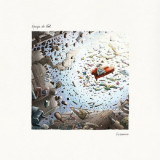
By now counting more than four decades of constant activity, Pierre Bastien erected such a towering and influential body of work that any blurb attempt regarding his music could easily fall into redundancy. Not that his revolving soundworld, deeply personal and unique, has ever stalled into gimmick or self mimicry, being Bastien the tireless explorer whose vision can never be complete, only continuously redefined in a process of discovery equally playful and challenging. So, completely in touch with Discrepant's ethos.
Returning to the label after 2017 The Mecanocentric Worlds of Pierre Bastien, the french musician, composer and instrument builder, brings an array of instruments from different cartographies and legacies with the appropriately titled Sonic Folkways. Resorting to different types of horns, prepared trumpet, an army of percussion, from gongs and tambourine to castanets and maracas, violin and too many others to mention here, Bastien weaves together a highly textured and hypnotic mosaic that projects an exotica beamed from scraps of the future. 'Aha!' in the same interstellar wavelength as Sun Ra's cosmic tones, 'Moor's Room’ almost orchestral tapestry of small percussion and insects or the non-western strings and tunings salvaged from ancient alien ceremonies on 'Pan's Nap'.
In an era where so much ink has been shed about world building in experimental music, Bastien can actually claim that to himself. The otherworld is right here, indeed.
Поиск:s g a t project
Все
In 2018, artists Haroon Mirza and Jack Jelfs spent two months in residency at CERN, the European Centre for Nuclear Research, and home of the Large Hadron Collider. From this collaboration the artists created the fictional reality of 'The Wave Epoch', a sprawling multimedia artwork drawing influence from science, mysticism and the nature of belief. ‘The Wave Epoch’ project spans live performance, film, art installations and their critically acclaimed 2020 album of the same title.
'one1one' is the latest transmission from this same universe, a magical incantation spoken by Jessica Barter, with words filtered through Google Translate to produce what the artists describe as “algorithmic mysticism”. This release presents remixes by Fracture and Jack Jelfs, alongside the original album track by Mirza and Jelfs, here on vinyl for the first time.
Experimental drum n' bass artist Fracture has transformed Mirza and Jelfs’ raw materials into a heavy 160 BPM workout that harkens back to the Blue Note-era Metalheadz sound of the mid-nineties, a crunching minimalist construction of metallic breaks and analogue sub bass. Accompanying his track is an AR (augmented reality) work by Scott Utting and Mirza.
- A1: Signe" (Eric Clapton) - 3:13
- A2: Before You Accuse Me" (Ellas Mcdaniel) - 3:36
- A3: Hey Hey" (Big Bill Broonzy) - 3:24
- A4: Tears In Heaven" (Clapton, Will Jennings) - 4:34
- B1: Lonely Stranger" (Clapton) - 5:28
- B2: Nobody Knows You When You're Down And Out" (Jimmy Cox)
- B3: Layla" (Clapton, Jim Gordon) - 4:46
- B4: Running On Faith" (Jerry Lynn Williams) - 6:35
- C1: Walkin' Blues" (Robert Johnson) - 3:37
- C2: Alberta" (Traditional) - 3:42
- C3: San Francisco Bay Blues" (Jesse Fuller) - 3:23
- D1: Malted Milk" (Robert Johnson) - 3:36
- D2: Old Love" (Clapton, Robert Cray) - 7:53
- D3: Rollin' & Tumblin'" (Muddy Waters) - 4:10
Strictly limited to 10,000 numbered copies, pressed on MoFi SuperVinyl at RTI, and mastered from the original master tapes, Mobile Fidelity's ultra-hi-fi UltraDisc One-Step 180g 45RPM 2LP collector's edition enhances the blockbuster work for today – and the ages to come. Surpassing the sonics of any prior version, it peels away any remaining limitations to provide a transparent, lively, ultra-nuanced presentation of a record that won six Grammy Awards – including prizes for Album of the Year, Best Male Rock Vocal Performance, and Best Rock Song. The expanse and depth of the soundstage, fullness of tones, natural snap and extension of the guitar strings, realistic rise and decay of individual notes, and roll of Clapton's vocals all attain demonstration-grade levels.
Housed in a deluxe box, the UD1S Unplugged pressing features special foil-stamped jackets and faithful-to-the-original graphics that illuminate the splendor of the recording and the reissue's premium quality. No expense has been spared. Aurally and visually, this UD1S reissue exists as a curatorial artifact meant to be preserved, touched, and examined. It is made for discerning listeners that prize sound quality and production, and who desire to fully immerse themselves in the art – and everything involved with the album, from the images to the finishes.
Truly, everything about Unplugged matters. Having sold more than 10 million copies in the U.S. and more than 26 million copies worldwide, the 1992 work resonates with listeners of all generations and speaks a universal language. Recorded for MTV before a very small audience on January 16, 1992, the 14-track set became the signpost for future acoustic-based endeavours that witnessed artists of all stripes re-examining their catalogues and, in many instances, as Clapton does here, placing familiar originals in fresh contexts and unveiling spirited versions of cover material. Needless to say, Clapton's session turned MTV's series into can't-miss programming for which the likes of Rod Stewart, Tony Bennett, Nirvana, Pearl Jam, and more would soon participate.
Kicking off his performance with a spirited instrumental to establish the mood, Clapton immediately wades into the style that originally caught his attention as a British teenager in the early 1960s: American blues. Backed by a superb band that includes guitarist Andy Fairweather Low, pianist Chuck Leavell, bassist Nathan East, and drummer Steve Ferrone, Slowhand delivers a rhythmic, toe-tapping rendition of Bo Diddley's "Before You Accuse Me" that announces he's come to reconnect with his muse. What follows over the course of nearly the next hour stirs the heart, shakes the soul, moves the mind, and invigorates the senses.
Of course, there's no talking about Unplugged without keying in on "Tears in Heaven," the striking ballad Clapton penned about the death of his four-year-old son. More emotional, direct, spare, and healing than the studio version released a year prior, it crackles with an intimacy, maturity, poignancy, honesty, sweetness, and integrity that inform the entire concert. Indeed, how Clapton frames other favorites here – transforming "Layla" into a relaxed, comfortable stroll and ruminating on the seasoned ripples flowing throughout "Old Love," for example – indicate both a creative rebirth and gleeful acceptance of the next phase of his career.
And that very direction (two of Clapton's next three albums would be all-blues projects) is what really makes Unplugged so indispensable. Equivalent in mastery if not in volume to the output that earned him his "God" nickname, interpretations of Jesse Fuller's "San Francisco Bay Blues" (complete with kazoo!), Big Bill Broonzy's "Hey Hey," Robert Johnson's "Walkin' Blues" and "Malted Milk," and Muddy Waters' "Rollin' & Tumblin'" showcase a learned professor in his element and all the wheels turning.
In every regard, Clapton's Unplugged session was appointment listening when it came out in August 1992. With the arrival of MoFi's UD1S pressing, that sensation is more urgent than before.
More About Mobile Fidelity UltraDisc One-Step and Why It Is Superior
Instead of utilizing the industry-standard three-step lacquer process, Mobile Fidelity Sound Lab's new UltraDisc One-Step (UD1S) uses only one step, bypassing two processes of generational loss. While three-step processing is designed for optimum yield and efficiency, UD1S is created for the ultimate in sound quality. Just as Mobile Fidelity pioneered the UHQR (Ultra High-Quality Record) with JVC in the 1980s, UD1S again represents another state-of-the-art advance in the record-manufacturing process. MFSL engineers begin with the original master tapes and meticulously cut a set of lacquers. These lacquers are used to create a very fragile, pristine UD1S stamper called a "convert." Delicate "converts" are then formed into the actual record stampers, producing a final product that literally and figuratively brings you closer to the music. By skipping the additional steps of pulling another positive and an additional negative, as done in the three-step process used in standard pressings, UD1S produces a final LP with the lowest noise floor possible today. The removal of the additional two steps of generational loss in the plating process reveals tremendous amounts of extra musical detail and dynamics, which are otherwise lost due to the standard copying process. The exclusive nature of these very limited pressings guarantees that every UD1S pressing serves as an immaculate replica of the lacquer sourced directly from the original master tape. Every conceivable aspect of vinyl production is optimized to produce the most perfect record album available today.
MoFi SuperVinyl
Developed by NEOTECH and RTI, MoFi SuperVinyl is the most exacting-to-specification vinyl compound ever devised. Analog lovers have never seen (or heard) anything like it. Extraordinarily expensive and extremely painstaking to produce, the special proprietary compound addresses two specific areas of improvement: noise floor reduction and enhanced groove definition. The vinyl composition features a new carbonless dye (hold the disc up to the light and see) and produces the world's quietest surfaces. This high-definition formula also allows for the creation of cleaner grooves that are indistinguishable from the original lacquer. MoFi SuperVinyl provides the closest approximation of what the label's engineers hear in the mastering lab.
SACD
Mastered from the original master tapes, Mobile Fidelity's numbered hybrid SACD enhances the blockbuster work for today – and the ages to come. Peeling away remaining sonic limitations to provide a transparent, lively, ultra-nuanced presentation of a record that won six Grammy Awards (including prizes for Album of the Year, Best Male Rock Vocal Performance, and Best Rock Song), it places Clapton and company in your room. The expanse and depth of the soundstage, fullness of tones, natural snap and extension of the guitar strings, realistic rise and decay of individual notes, and roll of Clapton's vocals all attain demonstration-grade levels. A perennial audiophile favourite, Unplugged now tosses its hat into the ring as a demonstration disc.
Vanuit het niets, ontsproten uit hetzelfde ecosysteem dat ons eerder al zegende met namen als NTREK en Brihang, was daar plots olsan. olsan - geen hoofdletter vereist - is het geesteskind van rapper D. Meeuws en producer DJ SNS, twee artiesten die de kilometers op hun teller allang niet meer hoeven te tellen. Om het hoofd te bieden aan de chaotische tijd waarin we leven, werkten zij in de afgelopen jaren elke maandag aan nieuw materiaal. Zonder vastomlijnd doel op voorhand, tot de urgentie het overnam. Het losse project dat ze hadden aangevat, bleek voor beide mannen al snel cruciaal om grip te blijven behouden op alles wat ze om zich heen zagen gebeuren. De vraag was niet langer of dit tot een plaat zou leiden, de vraag werd hoe snel dit zou gaan gebeuren.
Nog geen jaar later is daar dan dat debuutalbum 'millimeter', wederom zonder hoofdletter, en het is een bijzonder solide plaat geworden. De heerlijk tijdloze producties van DJ SNS vormen het ideale achtergronddecor voor D. Meeuws om de balans op te maken van z'n ervaringen in zijn eerste dertig levensjaren. De pieken, de dalen en zowat alles daar tussenin, ongefilterd. Singles 'millimeter' en 'asjeblief' (ft. Brihang) lichtten al een tipje op van de sluier, maar de andere nummers van deze plaat doen daar allesbehalve voor onder. De plaat werd gemixt door Tobie Speleman en gemasterd door Jeffrey De Gans.
De vinyl, ontworpen door Fabrice Parent, is een erg mooie uitgave op 300 exemplaren, die zich qua afwerking onderscheidt door het reliëf en de papieren feel van de outer sleeve, maar ook door het strategisch verstopte gedicht aan de binnenkant. De fysieke release staat gepland op vrijdag 10 juni. 'millimeter' is uitgegeven door Fake Records en geproduceerd en gedistribueerd door News Distribution Benelux.
For his very first solo and vinyl EP, the Parisian DJ and producer NTBR offers three energetic, melodic and banging tracks, the whole embellished by a remix from Julian Muller. This EP is also a milestone for Raise Records, the production of its first vinyl, after five projects released in less than a year and a half. With Raise 001, the label launches a new series of solo EPs in order to showcase
Raise Agency artists.
Mastering duality, NTBRs productions balance between two sides, ravy and melodic, raw and subtle. Recognized and played by several artists and promoters in the biggest festivals, NTBR has already been able to perform in many of the leading venues of the European techno scene such as Griessmuehle, Fold, Rex Club and many others.
- 1: The Rain Drops
- 2: Another Time
- 3: Melted Car (Feat. Karina Gill)
- 4: Deep In Squalor (Feat. Griffin Jones)
- 5: Hey There Flower
- 6: Cliché (Feat. Kati Mashikian)
- 7: Say It Now (By Françoise Hardy)
- 8: Uneasy
- 9: Ode To Little Bird (Feat. Alexis Harper)
- 10: September Skies (Feat. Karina Gill)
- 11: The Portal
- 12: The Word
- 13: Unled Lives (Feat. Hannah Lew)
- 14: Saint Matthew
Solo bedroom-pop project of Michael Ramos (Flowertown, April Magazine, Hectorine). Mostly recorded between last Christmas and New Year's during a window of isolation at home, “Hey There Flower” preserves Tony Jay’s prowess at making beautifully eerie lo-fi pop; like a hazy memory where your favorite Sixties girl-group melody is perpetually slowed down. Without a band to practice with, Tony Jay recorded the music alone, but recruited a slew of friends to remotely record backing vocals: Karina Gill (Cindy), Griffin Jones (Galore), Kati Mashikian (Mister Baby), Alexis Harper (Al Harper), & Hannah Lew (Cold Beat). "Hey There Flower", the most recent release from the prolific and mysterious Tony Jay delivers real melodies -- both lacey with vocal harmonies and dusty with layered guitars -- as fans have come to expect. This release also carries forward and elaborates on Tony Jay's tradition of songs that express a kind of naked honesty about things we all know -- love and loneliness and all that -- while communicating at the same time a wry edge of skepticism, so that the songs are like coins spinning on edge before landing heads, tails, or lost under the couch. Tony Jay brings us into a nostalgia where we recognize moods from music of the past -- Marc Boland definitely comes to mind, as well as Velvet Underground of the Nico era, and Tony Jay even covers Francoise Hardy on this collection -- but the songs create a three dimensional space with what feels like a thousand layers so that instead of being thrown back in time, it's like stepping into a little world with its own laws of nature, of which the listener gets just a few hints. - Karina Gill, Cindy/Flowertown. “Hey There Flower” is introduced by thudding snare beats eliciting reverb-stained tattered noisy guitar scrapes, to weave abrasive shimmery emotive vibrations, imbued with shattered nostalgic dreams, lit by brittle yet dazzling forsaken keyboard flows, over submerged and distorted male vocal’s whispery deluge of obsessive longing, lonely melancholy, and dark desire to exude a hazy gritty concoction of awkward sadness and brooding unrest.” White Light // White Heat // “What Tony sketches are concise commentaries on love, loneliness and a few things in between. His mode of expression is sparse, intense, and captivating. The arrangements are invariably lo-fi and slow tempo, blanketed with a fuzzy hiss. And it only took one listen to decide that it is a very special album. It has a '60s feel, albeit washed in an eerie slowcore machine. An ace example is "September Skies", which could be the 1965 'last dance' at the prom for the introverted students.” - When You Motor Away
Moundabout is a new folk project from Paddy Shine of Gnod and Phil Masterson of Los Langeros/Damp Howl/Bisect, but the words ‘new’ and ‘folk’ need to be treated with care here. Listening to ‘Flowers Rot, Bring Me Stones’ is like entering a trance state while staring at one of the Knowth spiral carvings at Brú na Bóinne in Ireland - the megalithic art in the neolithic “passage tombs” which also contain the oldest known representation of the moon made by man. As the album moves the listener, they are taken on a geographical and geological journey as well as psychological and spiritual, traveling inwards from the coast as well as down beneath the strata. And when you have been primed, it takes you all the way back to commune with older gods on the album’s epic centrepiece, ‘Dick Dalys Dance’, creating the kind of prehistoric drones and trance-inducing rhythms that the echoing, celestially aligned corridors of the Brú na Bóinne were built to amplify. This is not new music but the deep sensations it provokes will be new to most listeners. Imagine for a few minutes something as glorious as a Nurse With Wound List for the 21st Century - were I given such a formidable task as to organise such a collection of mind-bending music, Flowers Rot, Bring Me Stones by Moundabout would be one of the first records I would include.
Debut album by Goatman, now repressed. A solo project by one of the mysterious members from the Swedish collective GOAT. Recorded in GOAT’s northern Swedish hometown of Korpilombolo In late 2017 - the 6 tracks on Rhythms reveal a true collision of African Rock, Jazz, Reggae, Gospel and Psych, but all put through the famous GOAT filters.
Limited Baby Pink Vinyl LP. P.H.F. is the recording project of Auckland, NZ songwriter and producer Joe Locke. From its origins in Locke's 2008 bedroom productions, P.H.F. has gone on to collaborate with artists like Clairo and ARTHUR, toured globally, and had music released on pioneering vaporwave label Crystal Magic, before settling at its current home, Danger Collective Records. P.H.F's highly anticipated 2022 LP Purest Hell stands as a love letter to Locke's close friend and essential collaborator Reuben Winter (milk, Totems) who passed away in September 2020. Expanding on the genre-bending ambition of New Metal, Locke uses musical experimentation as a way to process grief, incorporating shredding guitar, careening breakbeat chops, and heavy electronics as a way of paying tribute to, and feeling closer to Winter. While tracks like "Skincare" and "A Letter From Purest Hell" draw power from a deep and impactful sense of loss, the album is more than just an elegy, but a celebration of life of a beloved friend and musical innovator. Locke rises to the occasion, and with the help of collaborators Fantasyluv, Rew, and fellow 909 Worldwide members 99jakes & Forcefeeded, crafts his strongest and most affecting collection of songs to date // Also Available From P.H.F. New Metal LP/CD, Anthology LP
Now available at a much cheaper price. SOS JFK, the one and only album from folk two-piece The Children’s Hour, which featured Josephine Foster and Andy Bar. Initially released in 2003, the album introduced audiences to Foster’s enchanting vocals and poetic folk, which would be developed to staggering effect in her later solo recordings, such as the recently released critically acclaimed album Blood Rushing (Fire Records). The Children’s Hour were an acoustic duo comprised of members Andy Bar and Josephine Foster. The two friends first connected in 2000 in a short-lived rock trio called Golden Egg, and then on a lark formed the pop song-writing duo oriented toward more naïve themes. Foster was a recent opera school dropout and the band became a vehicle for her to explore singing in a non-operatic manner into a microphone and learn to play the guitar. Bar was finishing studies at the Art Institute of Chicago and was honing a personal and highly melodic fingerpicking style inspired by bossa nova in particular. They were heard performing in a Chicago dive bar and given a surprise invitation to make a studio recording (SOS JFK), which both found to be an extremely nerve-wrecking learning experience. Meanwhile fans of their music rose up from unexpected corners, even invited by the band Zwan to open all the shows of both bands´ maiden tour. Initially conceived of as a modest front porch collaboration and side project, the band did not withstand all the attention long. Bar and Foster took meandering paths in diverse directions, although the two remain stalwart pals and both continue to dedicate themselves to the muses.
- A1: Scroll
- A2: Montana (Main Theme)
- A3: Noise Destroys Something
- A4: Wonderful
- A5: Pesticides
- A6: Revenge
- A7: Comtech
- A8: Greyhound
- A9: Second Test
- A10: Desecration
- B1: Tell Me Your Heart
- B2: Dark Materials
- B3: Becky's Theme
- B4: Blue Tunnel
- B5: Manifesto
- B6: Ranger Gary
- B7: At Peace - Freedom Club
- B8: Prophecy
- B9: Skidders
- B10: Montana (Reprise)
Ted K. Kaczynski is notorious for both tragically murdering three people (and wounding an additional 23) via bombs sent in the mail and for his numerous writings on the evils of technology he composed during his primitive residency in the woods of Montana. Film director Tony Stone's choice to have the renowned electronic artist Blanck Mass score the film is somewhat ironic and creates an obvious tension perfect for the controversial and complex subject matter. 2020 saw the first Blanck Mass movie score, for the soundtrack to Nick Rowland's acclaimed cinematic debut Calm with Horses. This expansion into new areas of melodic composition and textural exploration won Blanck Mass many new fans, with the BBC's acknowledged number one film buff Mark Kermode proclaiming the work the soundtrack of the year. In 2021, Blanck Mass won the prestigious Ivor Novello Award for Best Original Film Score and has firmly established himself at the forefront of the latest wave of experimental soundscape wizards. Recording during lockdown at his studio in Edinburgh, Scotland, Blanck Mass's Ben Power was in the perfect setting for a musical piece intended to capture the isolation central to Kaczynski's story. Power was also working with a director in a time zone 10 hours behind and thus many sessions required working in the middle of the night, which added a fitting intensity to the composition process. He said of the project "I wanted it to feel like an `epic'" and drew on the legends Sergio Leone and Ennio Morricone for inspiration in encapsulating the energy of the perceived good vs. evil. The gentle madness of sound achieved is exquisite and slowly builds in intensity and desperation as the score moves along. Power is able to perfectly capture the complexity, the terror and the deep emotionality of the film while presenting an often breathtakingly beautiful and always masterful album that stands on its own as a work of art. For Fans of Tim Hecker, Oneohtrix Point Never, DJ Shadow, Coil, Arca, Andy Stott, Fuck Buttons.
Joris Feiertag is a Dutch producer and drummer from the historic and culturally rich city of Utrecht. Having signed to Sonar Kollektiv in 2018, and released his debut long- playing record Time To Recover, and its subsequent remixes, two years later, he now brings us another side to his sound in the shape of the Dive mini LP. This new project sees the producer return to something like his musical roots, delving deeper into the use of synths and embracing more offbeat melodies.
After releasing her sophomore album Inner Song in the midst of the pandemic, Kelly Lee Owens was faced with the sudden realisation that her world tour could no longer go ahead. Keen to make use of this untapped creative energy, she made the spontaneous decision to go to Oslo instead. There was no overarching plan, it was simply a change of scenery and a chance for some undisturbed studio time. It just so happened that her flight from London was the last before borders were closed once again. The blank page project was underway. Arriving to snowglobe conditions and sub-zero temperatures, she began spending time in the studio with Lasse Marhaug. An esteemed avant-noise artist, Marhaug envisioned making music that would fall loosely in line with Throbbing Gristle. Kelly, on the other hand, had planned to create something inspired by Enya, an artist who has had an enduring impact on her creative being. They met each other halfway, pairing tough, industrial sounds with ethereal celtic mysticism, and creating music that ebbs and flows between tension and release. One month later, Kelly called her label to tell them she had created something of an outlier, her `eighth album'.
- A1: An Empty Space Is Not Just Filled With Air
- A10: Think, Blink, Breathe, Blink, Speak, Blink, Breathe
- A11: Drunk At Best
- A2: Cosy Nothing, Moving Coffin
- A3: A Silly Seal, Asleep, Rolling Down The Hill
- A4: Quatre - Vingt - Quatorze
- A5: Melancholy Eyes
- A6: Slvote
- A7: Love, Beers & A Queen Size Bed
- A8: Geranium
- A9: 15 Octobre
Equipe de Foot is a French duo of singer-songwriters who record pop
songs and play them much louder on stage
Since their formation in 2015, Alex & Mike have played hundreds of gigs, from the
sweaty basements of their hometown of Bordeaux to the stages of nationally
renown festivals and European venues, making a solid name for their band, and
little by little becoming part of the new wave of French rock. Equipe de Foot now
admit that their flaws might be their greatest strength, and bring their love for
English and American indie pop music and production to the forefront in their
songs. For 'Geranium' they have chosen to work with producer and sound
engineer (and fellow Beatles fan) Johannes Buff (Thurston Moore, Lee Ranaldo,
The Drones, Dalek and other various amazing projects) at Shorebreaker studio in
Tarnos, France. A meaningful choice both in terms of technical and artistic skills,
Johannes was able to assemble Equipe de Foot's good old wall of guitars, as well
as reach the heart of their pop songs to make the whole thing gloriously shine,
without altering the charming homemade vibe emanating from their beloved
demos.
The album is a constant rollercoaster, alternating lo- fi ballads and powerful
anthems, but always with a twist, be it a pitched loop on a chorus or an auto
tuned solo trumpet at the end of a sad piano song.
The past couple of years have provided an ideal breeding ground for periods of reflection. Of rediscovery. And for the reignition of dwindling flames. Perhaps this is why the meeting of Tom Churchill and 2Sox is the perfect match at the perfect time. A collision of minds stoking a fire that has sizzled away into a 12” slab of choice cuts. Introspective and deep, yet not forgetting what a dancefloor wants.
Tom started making music in the mid-90s, inspired by the house and techno records he was buying as a teenager growing up in Cardiff. Co-founder of cult 90’s label, Headspace Recordings and sister label Emoticon; Tom and partner Raeph Powell were responsible for some faultless releases in the 00’s. More recently, Tom has been one half of The Nuclear Family; a production, label and events project launched with Laurence Hughes in 2013. Much of what Tom has put his hand to over the years has been hot in demand. Incredibly, this is his first physical, solo release under his real name since 2002. Despite the 20 year gap, Tom’s enthuse for all things deep and electronic has arguably never been stronger.
“These tracks have been heavily inspired by two things - reconnecting with my surroundings and rediscovering my record collection - both of which have been made possible by the events over the past couple of years.” Tom says.
“As well as spending more time outdoors around my home on the west coast of Scotland, I recorded a lot of DJ mixes and radio shows during the first lockdown, which meant I spent a lot of time digging through older records. This reignited some creative energy that had been lying dormant for a while.
Before 2020 I’d been sporadically using a rented studio space to make music, but in that Spring I put together a basic, compact setup so I could work at home. My influences are pretty clear with these tracks - I’ve drawn on the palette of classic deep house, 90s techno and electro throughout - but while there are some retro elements and familiar sounds, I’ve tried to put my own twist on things. Being surrounded by nature and working exclusively on headphones has made for a more intimate sound, and these tracks are the most personal I’ve ever done.”
The latest offering from 12th Isle collects a variety of recordings from Vasily Stepanov and Vlad Dobrovolski as part of their on-going S A D project (Udacha/Muscut). As part of their process, S A D sample and distort old de-magnetised tapes, constantly adding to and reworking their own sound-world. Layers of kosmiche synthesisers, off-kilter woodblock percussion and lysergic field recordings interplay with dense ambient textures in a true collage-style approach to music making. Across the nine tracks, multiple collaborations and aliases coalesce to present a thorough look at both artists approach to communicating the world around them. Drawing influence from nature and the outdoor concerts of Vladislav’s band Kurvenschreiber as well as late night free jazz shows and a similar ‘hauntological’ approach seen in Dobrovolski’s recent ‘Playbacks for Dreaming’, the pair express a unique genre-traversing attitude. More from the 12th Isle due very soon!
180g vinyl pressing.
During the late 2010s, music lovers around the world began obsessively listening to increasingly esoteric albums on Youtube. More often than not, they’d leave the browser on autoplay. This was how Facundo Arena, the composer and producer behind The Kyoto Connection, discovered the technonaturalistic pleasures of Kankyō Ongaku (environmental music), a distinctly Japanese interpretation of European, British and American minimalist composition and ambient music. “It was a kind of algorithmic magic,” he says.
Upload by upload, the utopian music of Hiroshi Yoshimura and his 80s Japanese contemporaries transported Facundo back to his childhood. When he was five, his father placed him in karate lessons and began watching martial arts movies with him. From those early experiences, Facundo became fascinated Japanese history, tradition, and culture, particularly that of Kyoto - the cultural capital of Japan. Kankyō Ongaku reminded him of hearing the sounds of Japanese folkloric instruments as a young boy, and suddenly, the way the influence of Japan had manifested in his music made sense. “I had the sensation that for many years, I’d been doing something similar to the style,” he explains.
Inspired, Facundo used an iPad and an old Akai cassette deck to record Postcards, his homage to Japanese minimalism and Kankyō Ongaku. By this stage, he was twelve years deep with The Kyoto Connection, the musical project he launched in 2005 in his hometown of Buenos Aires, Argentina. Over that late 2000s and 2010s, Facundo, later on joined by collaborators Rodrigo Trado (drums), Jesica Rubino (violin) and Marian Benitez (vocals, now his wife), released numerous D.I.Y albums. Project by project, they followed the threads between 80s synth-pop, ambient, new age, house, techno and acoustic composition.
Postcards introduced The Kyoto Connection to listeners around the world and brought Facundo into our orbit. During Argentina’s covid lockdown, Facundo received a set of soundscapes recorded in Kyoto by the Japanese musician and sound designer Masafumi Komatsu. Over several insular months, he decorated them with synthesisers, samples and subtle rhythms, creating The Kyoto Connection’s next album, The Flower, The Bird and the Mountain to be released via Isle Of Jura offshoot Temples Of Jura.
Ostensibly made up of twelve distinct tracks, listening to The Flower, The Bird and the Mountain feels more akin to spending calm, meditative time in twelve specific environments. Although the foundations they rest on are recordings made in geographic locations around Kyoto, Facundo has yet to visit Japan. As a result, the landscapes he paints sit somewhere between fiction and fact, richly pictorial sonic imagination juxtaposed with echoes of reality. Regardless, as his bubbling melodies and glistening synthesisers glide against Masafumi Komatsu's recordings, Facundo guides us into a blissful zone of tranquillity well worth spending time within.
The project "Records Without Conception" shows toğrul's process of finding his sound. The album is not based on a concept, a statement or an overriding mood. The tracks are rather to be understood as portraits from protracted explorations of basic patterns in electronic genres and modular sound synthesis. The results are a not self- contained body of work, but rather discussions of various demands on sound and music that were experienced by the artist himself between the years 2018 and 2021. With his debut album, the German and Azerbaijan based producer wants to capture the process of this artistic searching and finding.
Surreal constructions of contrasting sounds evolve between the grids of genres. An experimental style and contemporary references across Contemporary RnB, Electro, Glitch and IDM form a sound logic of its own, which is additionally grounded by the singers Alice Dlugosch & Mariama Ceesay in two independent tracks.
London-based composer/bassist, Daniel Casimir returns with his solo debut album Boxed In, a dynamic collision of pulsing modern jazz and orchestral instrumentation.
Featuring Casimir's quintet of fellow British jazz luminaries, including Nubya Garcia, Moses Boyd, Al MacSween and James Copus, the album astutely bridges traditional and contemporary jazz forms enveloping strings, woodwind & brass arrangements.
Boxed In represents Casimir's debut set of compositions written for orchestra. Despite his interest in writing for orchestra while studying jazz and classical music, attending conservatoires and completing a masters degree at Trinity Laban, he was never given the opportunity or choice to fulfil his aspiration. Casimir notes that as only one of two black musicians in his study cohort the normalisation of the situation made it almost easy to miss its inherent injustice.
Coming up through the essential development foundation Tomorrow's Warriors, Casimir has gone on to feature on all of Nubya Garcia's recorded output to date as well as projects by Makaya McCraven and Ashley Henry and has performed with Lonnie Liston Smith and Jason Rebello amongst others.
This album reflects the experiences of navigating prescribed labels traditionally placed on black musicians. As well as being inspired by Wayne Shorter's hybrid orchestral jazz projects, Boxed In was also influenced by a conversation Casimir had in 2018 with legendary composer and producer Quincy Jones who talked a lot about classical music orchestration.
The album is also inspired by Derek Owusu's book Safe which reflects on the Black British male experience and becomes the broad thematic skeleton of Boxed In with the track Safe split into three parts across the album, the first of which opens proceedings in a purposeful up-tempo style with stylistic touches of Roni Size-esque drum & bass (in part courtesy of producer/polymath Moses Boyd). The album's title track follows, with Garcia's soaring tenor taking lead, followed by New Waters and the introduction of vocalist Ria Moran.
Flute, woodwind and brass melodies envelop Casimir's charming string arrangments on Your Side and Safe Part 2, showing off Casimir's command and ease in an orchestral setting. Get Even and Rewind The Time confirm Casimir's penchant for weaving brooding pop vocals with jazz composition while the fanfaric Into The Truth leads literally into The Truth where Copus and MacSween engage throughout to the track's triumphant close.
The closing track Outro is a lively Afrobeat-tipping style with Casimir's deft bass manoeuverings and large ensemble arrangement on full show.
- A1: Live At The Sahara Tahoe, 1973 (Remaster 2022)
- A2: Farben Says Love To Love You Baby (Remaster 2022)
- A3: Muskeln (Remaster 2022)
- B1: Suntouch Edit (Remaster 2022)
- B2: Farben Says As Long As There's Love Around (Remaster 2022)
- B3: 6Ff (Remaster 2022)
- C1: Beautone (Remaster 2022)
- C2: Farben Says So Much Love (Remaster 2022)
- C3: T Microsystems (Remaster 2022)
- D1: Raute (Remaster 2022)
- D2: Silikon (Remaster 2022)
- D3: Farben Says Love Oh Love (Remaster 2022)
On textstar+ Jan Jelinek brings together the material from the CMYK series, four EPs he released between 1999 and 2002 under the pseudonym farben (the German word for both colours and paints), on a vinyl double LP for the first time. The selection of tracks has been remastered from the original tapes, joined by two additional pieces that appeared on compilations during the same period.
A Polaroid. Still life with tangled leads and consumer electronics, late twentieth century. Black and various shades of dirty white are the dominant non-colours. The image’s spatial depth remains diffuse, the links between its elements speculative. A note stuck to the wall (a legend, perhaps, or an all-explaining blueprint in text form?) is impossible to decipher. You can’t see what connects the picture’s signs. You have to hear it.
farben says: Every sound is a text. A bearer of meaning in search of a reader. Hoping the ideas inscribed in its autonomous existence will be understood as intended. While its beauty lies precisely in misunderstanding, in reading the coded message a new way every time. A thousand colours of sound, a thousand different ways to hear, to see, to understand.
On textstar+ Jan Jelinek brings together the material from the CMYK series, four EPs he released between 1999 and 2002 under the pseudonym farben (the German word for both colours and paints), on a vinyl double LP for the first time. The selection of tracks has been remastered from the original tapes, joined by two additional pieces that appeared on compilations during the same period. Another new element is the Polaroid, showing the origins of a world: Jelinek’s home studio in Berlin at the time.
farben says: Move your body! The project has its roots in Jelinek’s love of house as a reductionist vision of soul. Of four to the floor as a proposition that can be accessed anywhere. Of electronic dance music as a realm of possibility that can be continually expanded. farben was written as contemporary house music. As a text about excitement and euphoria. The arrangements were made directly while recording to DAT, on a twelve-channel mixing desk. Several track titles suggest a link to live concerts, coupled with the context of machine music and bedroom recording. Others affirm pop music’s most extravagant stock phrases about various states of love.
Jelinek produced the tracks with the aim of making music for dancefloors. An idea that failed very productively. In the locations to which it was originally addressed, the project barely figured. But people did listen, and they listened all the more closely to this music that opened up new acoustic and associative scope for house. farben is the opposite of genre: a music spawning new terms (clicks & cuts, micro-house) that never manage to fully capture it.
farben says: Signifiers. The four CMYK EPs are designed as a network of references that cannot be missed but that can also never be precisely deciphered. The vectors of sound, word and image point to Isaac Hayes and Ornette Coleman, to Detroit and the first generation of the Red Army Faction, to Karl Marx and Friedrich Engels. So multifarious that they are distorted to the point of recognition. Overall we hear sonic docufictions whose appealing vagueness derives precisely from this oscillation between clarity and ambiguity, which is also the source of their poetry: the lyricism of the pure circulation of signs.
The artwork is based on photographs of former Red Army Faction members, broken down into the four colours of the CMYK model. The motifs dissolve into individual dots of a single colour, so close to the faces that their expressions are only hinted at. Taken together, the individual colours compose a new whole out of fragmentary material, defying definition and thus maintaining their vibrancy. The same occurs on the level of sound. The sampler Jelinek used for these tracks had to be fed with floppy disks, imposing a memory limit of 1.44 megabytes per audio quotation from soul or jazz records. As a necessary consequence of this, the individual references, like the dots of colour, are dissolved into details and abstractions. They appear as splinters that recombine in new ways to create new meanings. The joy of collapsing metaphors.
farben says: New departures. Even two decades after its original release, textstar+ does not come across as an epitaph to the modern era. Instead, it appears as a euphoric affirmation of the utopias of the twentieth century, translated into new sound texts via the aesthetic strategies of abstraction, collage, networking and speculation. 1.44 megabytes of history, one thousand signifiers, one album. From “Live ...” to “... Love”.
Arno Raffeiner, 2021