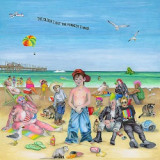
The Older I Get, the Funnier I Was, which follows Thomas’ brilliant 2020 HBO special The Golden One and his Can't Believe You're Happy Here EP released earlier this year, surveys a range of emotion and offers a broad sonic palette, moving between pop punk, electro, and the obvious influence of the singer-songwriters he grew up listening to in early childhood. It conjures the ennui of Bright Eyes alongside the barefaced storytelling of John Prine, the overstuffed lists of Fred Thomas with the lackadaisical humor of Colleen Green, among many others.
Thomas attributes the dexterity of the record to Duterte, who recorded and engineered most of it in addition to serving up plenty of encouragement when Thomas got down on the process. “As a comic, I used to test out new songs during sets to see if the funny bits were hitting, but since I wrote this in isolation I ended up writing lyrics and worrying less about making jokes,” Thomas says. That said, the album’s plenty funny. Stand-out and lead single “Rigamarole” opens with a Thomas-voiced infomercial that recalls his oft-cited lookalike Jim Carrey as the Grinch, before launching into a buoyant pop song about being depressed.
Whitmer Thomas will admit that when he traveled home to small town Gulf Shores, Alabama to record his HBO stand-up special, The Golden One, he expected to be greeted as a returning hero, a conquering king, or at minimum, a guy with a moderately successful career as an entertainer in Los Angeles. “I expected a big welcome home, open arms, but when I went back I realized: nobody fucking knows me. Nobody remembers me,” Thomas says. “In the years I’d been performing that show, I’d been romanticizing my childhood in this mythologized place, but the visit made me see that I’m not really from there anymore.”
The sense of alienation compounded when Thomas recognized how few people in town remembered his mom, to whom The Golden One is dedicated and largely about. Thomas grew up watching her perform with her twin sister at the legendary Flora-Bama Lounge, where he set the special, and still counts her as one of his musical influences. His new album, The Older I Get, the Funnier I Was, isn’t overtly about his mom, her presence is deeply felt throughout. While in Gulf Shores, Thomas discovered dozens of her old recordings, all of which had been wrecked by Katrina, but upon returning to LA, Thomas paid “a fancy place in Hollywood” to fix the tapes and hired Melina Duterte (Jay Som, Bachelor, Routine) to mix them. The two struck up a collaborative friendship, and Thomas had the sound of his mom’s voice back. “I was listening to songs she recorded when she was about my age, just these heartfelt, sweet Americana songs,” he says. “I decided then that I wanted to lose the Ian Curtis voice I always sing with; I wanted to do what came naturally, because my mom always sounded like herself, even when she was singing some cheesy reggae song about, like, Jamaica.”
Thus he went into The Older I Get, the Funnier I Was knowing it was time to retire his darkwave persona, and leaning into his natural, chirpier voice, which he says sounds “like a 12-year-old’s.” It makes sense: much of the album chronicles what Thomas calls “being a kid and feeling like you have no control and overcompensating by being annoying.” “So much of the album is about witnessing drug and alcohol addiction as a kid and seeing what it does to people, but also realizing that there's nothing you can do about it,” Thomas says. It’s familiar territory (see: “Partied to Death”) but the methodology is different this time around; true to its title, The Older I Get, the Funnier I Was isn’t always looking for laughs. Thomas might’ve left his hometown behind, but his kid self is still tagging along, a Peter Pan shadow he can’t untether himself from. The first line he sings on The Older I Get, the Funnier I Was is: “There should be a room at every party where you can just sit and watch a movie.” Find a 12-year-old who wouldn’t say the same.
Search:sam himself
Diggin’ in the vast vaults of Victor Simonelli, a collection of classic Jazz-N-Groove remixes from the legendary Bassline Records label, fully remastered for the first time on one 12”.
Started back in 1993 by the man himself, the label features releases from the likes of Romanthony, Jocelyn Brown, DJ Duke and many more, also going on to spawn the Big Big Trax sublabel too.
For this 12 inch, a spotlight on Jazz-N-Groove, the legendary production team consisting of Marc Pomeroy, Brian Tappert & previously Roy Grant. Showcasing soulful house done properly, this EP takes in four of their sought-after ‘90s remixes of anthemic cuts from Northbound, Body Moods and Strive For Jive. For the house trivia heads out there, the pair also went on to launch Soulfuric Records and also digital download store, Traxsource.
- A1: Rock This Mother
- A2: Talk To Me Girl
- A3: You Can Find Me
- A4: Check This Out
- A5: Jesus Going To Clean House
- A6: Hope You Understood
- A7: Is It What You Want
- A8: Love Is Everlasting
- A9: This Is Hip-Hop Art
- A10: Opposite Of Love
- A11: Do You Know What I Mean
- B1: Saving All My Love For You
- B2: Look Out Here I Come
- B3: Girl You Always Talking
- B4: Have A Great Day
- B5: Take My Hand
- B6: I Need Your Love
- B7: Your Town
- B8: Talk Around Town
- B9: Booty Head/Take A Little Walk
- B10: I Love My Mama
- B11: I Never Found Anyone Like You
Vinyl LP[23,49 €]
As the sun sets on a quaint East Nashville house, a young man bares a piece of his soul. Facing the camera, sporting a silky suit jacket/shirt/slacks/fingerless gloves ensemble that announces "singer" before he's even opened his mouth, Lee Tracy Johnson settles onto his stage, the front yard. He sways to the dirge-like drum machine pulse of a synth-soaked slow jam, extends his arms as if gaining his balance, and croons in affecting, fragile earnest, "I need your love… oh baby…"
Dogs in the yard next door begin barking. A mysterious cardboard robot figure, beamed in from galaxies unknown and affixed to a tree, is less vocal. Lee doesn't acknowledge either's presence. He's busy feeling it, arms and hands gesticulating. His voice rises in falsetto over the now-quiet dogs, over the ambient noise from the street that seeps into the handheld camcorder's microphone, over the recording of his own voice played back from a boombox off-camera. After six minutes the single, continuous shot ends. In this intimate creative universe there are no re-takes. There are many more music videos to shoot, and as Lee later puts it, "The first time you do it is actually the best. Because you can never get that again. You expressing yourself from within."
"I Need Your Love" dates from a lost heyday. From some time in the '80s or early '90s, when Lee Tracy (as he was known in performance) and his music partner/producer/manager Isaac Manning committed hours upon hours of their sonic and visual ideas to tape. Embracing drum machines and synthesizers – electronics that made their personal futurism palpable – they recorded exclusively at home, live in a room into a simple cassette deck. Soul, funk, electro and new wave informed their songs, yet Lee and Isaac eschewed the confinement of conventional categories and genres, preferring to let experimentation guide them.
"Anytime somebody put out a new record they had the same instruments or the same sound," explains Isaac. "So I basically wanted to find something that's really gonna stand out away from all of the rest of 'em." Their ethos meant that every idea they came up with was at least worth trying: echoed out half-rapped exhortations over frantic techno-style beats, gospel synth soul, modal electro-funk, oddball pop reinterpretations, emo AOR balladry, nods to Prince and the Fat Boys, or arrangements that might collapse mid-song into a mess of arcade game-ish blips before rallying to reach the finish line. All of it conjoined by consistent tape hiss, and most vitally, Lee's chameleonic voice, which managed to wildly shape shift and still evoke something sincere – whether toggling between falsetto and tenor exalting Jesus's return, or punctuating a melismatic romantic adlib with a succinct, "We all know how it feels to be alone."
"People think we went to a studio," says Isaac derisively. "We never went to no studio. We didn't have the money to go to no studio! We did this stuff at home. I shot videos in my front yard with whatever we could to get things together." Sometimes Isaac would just put on an instrumental record, be it "Planet Rock" or "Don't Cry For Me Argentina" (from Evita), press "record," and let Lee improvise over it, yielding peculiar love songs, would-be patriotic anthems, or Elvis Presley or Marilyn Monroe tributes. Technical limitations and a lack of professional polish never dissuaded them. They believed they were onto something.
"That struggle," Isaac says, "made that sound sound good to me."
In the parlance of modern music criticism Lee and Isaac's dizzying DIY efforts would inevitably be described as "outsider." But "outsider" carries the burden of untold additional layers of meaning if you're Black and from the South, creating on a budget, and trying to get someone, anyone within the country music capital of the world to take your vision seriously. "What category should we put it in?" Isaac asks rhetorically. "I don't know. All I know is feeling. I ain't gonna name it nothing. It's music. If it grabs your soul and touch your heart that's what it basically is supposed to do."
=
Born in 1963, the baby boy of nine siblings, Lee Tracy spent his earliest years living amidst the shotgun houses on Nashville's south side. "We was poor, man!" he says, recalling the outhouse his family used for a bathroom and the blocks of ice they kept in the kitchen to chill perishables. "But I actually don't think I really realized I was in poverty until I got grown and started thinking about it." Lee's mom worked at the Holiday Inn; his dad did whatever he had to do, from selling fruit from a horse drawn cart to bootlegging. "We didn't have much," Lee continues, "but my mother and my father got us the things we needed, the clothes on our back." By the end of the decade with the city's urban renewal programs razing entire neighborhoods to accommodate construction of the Interstate, the family moved to Edgehill Projects. Lee remembers music and art as a constant source of inspiration for he and his brothers and sisters – especially after seeing the Jackson 5 perform on Ed Sullivan. "As a small child I just knew that was what I wanted to do."
His older brother Don began musically mentoring him, introducing Lee to a variety of instruments and sounds. "He would never play one particular type of music, like R&B," says Lee. "I was surrounded by jazz, hard rock and roll, easy listening, gospel, reggae, country music; I mean I was a sponge absorbing all of that." Lee taught himself to play drums by beating on cardboard boxes, gaining a rep around the way for his timekeeping, and his singing voice. Emulating his favorites, Earth Wind & Fire and Cameo, he formed groups with other kids with era-evocative band names like Concept and TNT Connection, and emerged as the leader of disciplined rehearsals. "I made them practice," says Lee. "We practiced and practiced and practiced. Because I wanted that perfection." By high school the most accomplished of these bands would take top prize in a prominent local talent show. It was a big moment for Lee, and he felt ready to take things to the next level. But his band-mates had other ideas.
"I don't know what happened," he says, still miffed at the memory. "It must have blew they mind after we won and people started showing notice, because it's like everybody quit! I was like, where the hell did everybody go?" Lee had always made a point of interrogating prospective musicians about their intentions before joining his groups: were they really serious or just looking for a way to pick up girls? Now he understood even more the importance of finding a collaborator just as committed to the music as he was.
=
Isaac Manning had spent much of his life immersed in music and the arts – singing in the church choir with his family on Nashville's north side, writing, painting, dancing, and working various gigs within the entertainment industry. After serving in the armed forces, in the early '70s he ran The Teenage Place, a music and performance venue that catered to the local youth. But he was forced out of town when word of one of his recreational routines created a stir beyond the safe haven of his bohemian circles.
"I was growing marijuana," Isaac explains. "It wasn't no business, I was smoking it myself… I would put marijuana in scrambled eggs, cornbread and stuff." His weed use originated as a form of self-medication to combat severe tooth pain. But when he began sharing it with some of the other young people he hung out with, some of who just so happened to be the kids of Nashville politicians, the cops came calling. "When I got busted," he remembers, "they were talking about how they were gonna get rid of me because they didn't want me saying nothing about they children because of the politics and stuff. So I got my family, took two raggedy cars, and left Nashville and went to Vegas."
Out in the desert, Isaac happened to meet Chubby Checker of "The Twist" fame while the singer was gigging at The Flamingo. Impressed by Isaac's zeal, Checker invited him to go on the road with him as his tour manager/roadie/valet. The experience gave Isaac a window into a part of the entertainment world he'd never encountered – a glimpse of what a true pop act's audience looked like. "Chubby Checker, none of his shows were played for Black folks," he remembers. "All his gigs were done at high-class white people areas." Returning home after a few years with Chubby, Isaac was properly motivated to make it in Music City. He began writing songs and scouting around Nashville for local talent anywhere he could find it with an expressed goal: "Find someone who can deliver your songs the way you want 'em delivered and make people feel what you want them to feel."
One day while walking through Edgehill Projects Isaac heard someone playing the drums in a way that made him stop and take notice. "The music was so tight, just the drums made me feel like, oh I'm-a find this person," he recalls. "So I circled through the projects until I found who it was.
"That's how I met him – Lee Tracy. When I found him and he started singing and stuff, I said, ohhh, this is somebody different."
=
Theirs was a true complementary partnership: young Lee possessed the raw talent, the older Isaac the belief. "He's really the only one besides my brother and my family that really seen the potential in me," says Lee. "He made me see that I could do it."
Isaac long being a night owl, his house also made for a fertile collaborative environment – a space where there always seemed to be a new piece of his visual art on display: paintings, illustrations, and dolls and figures (including an enigmatic cardboard robot). Lee and Issac would hang out together and talk, listen to music, conjure ideas, and smoke the herb Isaac had resumed growing in his yard. "It got to where I could trust him, he could trust me," Isaac says of their bond. They also worked together for hours on drawings, spreading larges rolls of paper on the walls and sketching faces with abstract patterns and imagery: alien-like beings, tri-horned horse heads, inverted Janus-like characters where one visage blurred into the other.
Soon it became apparent that they didn't need other collaborators; self-sufficiency was the natural way forward. At Isaac's behest Lee, already fed up with dealing with band musicians, began playing around with a poly-sonic Yamaha keyboard at the local music store. "It had everything on it – trumpet, bass, drums, organ," remembers Lee. "And that's when I started recording my own stuff."
The technology afforded Lee the flexibility and independence he craved, setting him on a path other bedroom musicians and producers around the world were simultaneously following through the '80s into the early '90s. Saving up money from day jobs, he eventually supplemented the Yamaha Isaac had gotten him with Roland and Casio drum machines and a Moog. Lee was living in an apartment in Hillside at that point caring for his dad, who'd been partially paralyzed since early in life. In the evenings up in his second floor room, the music put him in a zone where he could tune out everything and lose himself in his ideas.
"Oh I loved it," he recalls. "I would really experiment with the instruments and use a lot of different sound effects. I was looking for something nobody else had. I wanted something totally different. And once I found the sound I was looking for, I would just smoke me a good joint and just let it go, hit the record button." More potent a creative stimulant than even Isaac's weed was the holistic flow and spontaneity of recording. Between sessions at Isaac's place and Lee's apartment, their volume of output quickly ballooned.
"We was always recording," says Lee. "That's why we have so much music. Even when I went to Isaac's and we start creating, I get home, my mind is racing, I gotta start creating, creating, creating. I remember there were times when I took a 90-minute tape from front to back and just filled it up."
"We never practiced," says Isaac. "See, that was just so odd about the whole thing. I could relate to him, and tell him about the songs I had ideas for and everything and stuff. And then he would bring it back or whatever, and we'd get together and put it down." Once the taskmaster hell bent on rehearsing, Lee had flipped a full 180. Perfection was no longer an aspiration, but the enemy of inspiration.
"I seen where practicing and practicing got me," says Lee. "A lot of musicians you get to playing and they gotta stop, they have to analyze the music. But while you analyzing you losing a lot of the greatness of what you creating. Stop analyzing what you play, just play! And it'll all take shape."
=
"I hope you understood the beginning of the record because this was invented from a dream I had today… (You tell me, I'll tell you, we'll figure it out together)" – Lee Tracy and Isaac Manning, "Hope You Understand"
Lee lets loose a maniacal cackle when he acknowledges that the material that he and Isaac recorded was by anyone's estimation pretty out there. It's the same laugh that commences "Hope You Understand" – a chaotic transmission that encapsulates the duality at the heart of their music: a stated desire to reach people and a compulsion to go as leftfield as they saw fit.
"We just did it," says Lee. "We cut the music on and cut loose. I don't sit around and write. I do it by listening, get a feeling, play the music, and the lyrics and stuff just come out of me."
The approach proved adaptable to interpreting other artists' material. While recording a cover of Whitney Houston's pop ballad "Saving All My Love For You," Lee played Whitney's version in his headphones as he laid down his own vocals – partially following the lyrics, partially using them as a departure point. The end result is barely recognizable compared with the original, Lee and Isaac having switched up the time signature and reinvented the melody along the way towards morphing a slick mainstream radio standard into something that sounds solely their own.
"I really used that song to get me started," says Lee. "Then I said, well I need something else, something is missing. Something just came over me. That's when I came up with 'Is It What You Want.'"
The song would become the centerpiece of Lee and Isaac's repertoire. Pushed along by a percolating metronomic Rhythm King style beat somewhere between a military march and a samba, "Is It What You Want" finds Lee pleading the sincerity of his commitment to a potential love interest embellished by vocal tics and hiccups subtlely reminiscent of his childhood hero MJ. Absent chord changes, only synth riffs gliding in and out like apparitions, the song achieves a lingering lo-fi power that leaves you feeling like it's still playing, somewhere, even after the fade out.
"I don't know, it's like a real spiritual song," Lee reflects. "But it's not just spiritual. To me the more I listen to it it's like about everything that you do in your everyday life, period. Is it what you want? Do you want a car or you don't want a car? Do you want Jesus or do you want the Devil? It's basically asking you the question. Can't nobody answer the question but you yourself."
In 1989 Lee won a lawsuit stemming from injuries sustained from a fight he'd gotten into. He took part of the settlement money and with Isaac pressed up "Saving All My Love For You" b/w "Is It What You Want" as a 45 single. Isaac christened the label One Chance Records. "Because that's all we wanted," he says with a laugh, "one chance."
Isaac sent the record out to radio stations and major labels, hoping for it to make enough noise to get picked up nationally. But the response he and Lee were hoping for never materialized. According to Isaac the closest the single got to getting played on the radio is when a disk jock from a local station made a highly unusual announcement on air: "The dude said on the radio, 107.5 – 'We are not gonna play 'Is It What You Want.' We cracked up! Wow, that's deep.
"It was a whole racist thing that was going on," he reflects. "So we just looked over and kept on going. That was it. That was about the way it goes… If you were Black and you were living in Nashville and stuff, that's the way you got treated." Isaac already knew as much from all the times he'd brought he and Lee's tapes (even their cache of country music tunes) over to Music Row to try to drum up interest to no avail.
"Isaac, he really worked his ass off," says Lee. "He probably been to every record place down on Music Row." Nashville's famed recording and music business corridor wasn't but a few blocks from where Lee grew up. Close enough, he remembers, for him to ride his bike along its back alleys and stumble upon the occasional random treasure, like a discarded box of harmonicas. Getting in through the front door, however, still felt a world away.
"I just don't think at the time our music fell into a category for them," he concedes. "It was before its time."
=
Lee stopped making music some time in the latter part of the '90s, around the time his mom passed away and life became increasingly tough to manage. "When my mother died I had a nervous breakdown," he says, "So I shut down for a long time. I was in such a sadness frame of mind. That's why nobody seen me. I had just disappeared off the map." He fell out of touch with Isaac, and in an indication of just how bad things had gotten for him, lost track of all the recordings they'd made together. Music became a distant memory.
Fortunately, Isaac kept the faith. In a self-published collection of his poetry – paeans to some of his favorite entertainment and public figures entitled Friends and Dick Clark – he'd written that he believed "music has a life of its own." But his prescience and presence of mind were truly manifested in the fact that he kept an archive of he and Lee's work. As perfectly imperfect as "Is It What You Want" now sounds in a post-Personal Space world, Lee and Isaac's lone official release was in fact just a taste. The bulk of the Is It What You Want album is culled from the pair's essentially unheard home recordings – complete songs, half-realized experiments, Isaac's blue monologues and pronouncements et al – compiled, mixed and programmed in the loose and impulsive creative spirit of their regular get-togethers from decades ago. The rest of us, it seems, may have finally caught up to them.
On the prospect of at long last reaching a wider audience, Isaac says simply, "I been trying for a long time, it feels good." Ever the survivor, he adds, "The only way I know how to make it to the top is to keep climbing. If one leg break on the ladder, hey, you gotta fix it and keep on going… That's where I be at. I'll kill death to make it out there."
For Lee it all feels akin to a personal resurrection: "It's like I was in a tomb and the tomb was opened and I'm back… Man, it feels so great. I feel like I'm gonna jump out of my skin." Success at this stage of his life, he realizes, probably means something different than what it did back when he was singing and dancing in Isaac's front yard. "What I really mean by 'making it,'" he explains isn't just the music being heard but, "the story being told."
Occasionally Lee will pull up "Is It What You Want" on YouTube on his phone, put on his headphones, and listen. He remembers the first time he heard his recorded voice. How surreal it was, how he thought to himself, "Is that really me?" What would he say to that younger version of himself now?
"I would probably tell myself, hang in there, don't give up. Keep striving for the goal. And everything will work out."
Despite what's printed on the record label, sometimes you do get more than one chance.
- A1: Splashscreen 01
- A2: Welcome To Blackreef
- A3: Menu - Break The Loop
- A4: Karl's Bay
- A5: The Revenant (By Frank Spicer)
- B1: Updaam
- B2: Colt Win
- B3: Anonymous (Aleksis Dorsey)
- B4: Invasion Started
- B5: Ubiquity (Wenjie Evans)
- B6: Julianna Win
- C1: Fristad Rock
- C2: A Band Apart (Frank Spicer)
- C3: Rocket Man
- C4: Ode To Somewhere (By Frank Spicer)
- D1: The Complex
- D2: Eternal Deathwish
- D3: Final Confrontation
- D4: Déjà Vu
The visionaries at Bethesda, Arkane and Laced are bringing the twisted ’60s soundtrack for award-winning looper-shooter DEATHLOOP to wax.
The complete 59-track soundtrack has been specially mastered for vinyl and will be pressed onto heavyweight discs. These will come in spined inner sleeves housed in a rigid board slipcase. Tracklist curation and stunning original sleeve artwork is by the team at Arkane Lyon.
This Standard Edition quadruple LP box set features traditional black discs.
Lead composer Tom Salta has built an enviable credits list, with entries in the Prince of Persia, Tom Clancy and Halo universes to his name. For DEATHLOOP’s original score, he immersed himself in the music of Jimi Hendrix, Pink Floyd, Nelson Riddle and a host of other late-’60s influences. Layers of period-appropriate organs, synths and other instruments (including Rhodes, Wurlitzer and Hammond B3) help maintain the tension as Colt picks off Eternalists from the shadows. As things get dicey, or Julianna intervenes with extreme prejudice, tracks explode into furious guitar and drum grooves that propel the zany, supernaturally enhanced gunplay.
Ross Tregenza’s multi-genre diegetic cues perfectly complement the psycho-sophisticate stylings of Blackreef’s artistically aspirational inhabitants, while songwriter Erich Talaba and singer Jeff Cummings brought to life the vicious visionary Frank Spicer with catchy in-universe songs. Music agency Sencit teamed up with powerful yet soulful vocalists for trailer and credits songs, including Bond-ish banger “Déjà Vu” (featuring FJØRA), “Pitch Black” (featuring Lady Blackbird) and “Down the Rabbit Hole” (featuring Samantha Howard & Haqq.)
Foiling on the front, coconut coloured vinyl
Rising from the ashes of Palma Violets, Gently Tender first begun as a reminder
for Sam Fryer to treat himself more softly. Joined by his former bandmates Will
and Pete, along with The Big Moon's Celia Archer and guitarist Adam Brown, the
band's long- awaited debut album 'Take Hold Of Your Promise!' has been five
years in the making, and marks a return to something slow and careful, rooted,
and soulful.
By the late 1980's Ton Lebbink was a well respected figure in Amsterdam's alternative scene: he was the drummer for the Amsterdam post punk group Mecano, a true punk poet and worked as a bouncer at Amsterdam's main music venue Paradiso. He released two solo albums, both in his unique narcotic style: laying absurd Dutch wordplay over stripped down frigid instrumentals. As the decade came to an end, Ton - already well in his forties - moved away from the often destructive and dangerous nightlife. After a series of odd jobs Ton started as a fitness instructor at an Amsterdam gym called Splash. Meanwhile, the 90's brought the latest musical craze to Amsterdam: House music began to flourish through clubs like RoXy, iT and Mazzo. With House being the ideal score for his fitness classes, the once well known cult figure faded into anonymity at a 120 beats per minute. His musical endeavours were focusing more on finding the right beats for aerobics exercises with self-devised exercise - eventually leading Ton to bootleg some of them on cassette tapes himself. In parallel to this radical shift, Ton did not stop making music. On the contrary, piles of demos showed high activity but in a direction no one was looking. Inspired by music to move to, Ton recorded hours of music that activated the body while staying true to his playful mindset. Discarding his voice as an instrument, the Roland W-30 sampler became his tool to communicate. Gathering vocal snippets from close friends, barflies and pets, a repertoire developed where witty repetitiveness could exist. Going through a vast collection of demos, pictures and many anecdotes, Rubber has been able to create an EP that gives insight into Ton's overlooked 90's era. Three playful dance tracks by Ton Lebbink taking his complete own take on the Amsterdam House revolution of the 90's. Full of inventiveness: hip-shaking grooves, hypnotic beats and rousing vocals. Tracks to move to and tracks to groove to. Essential dancefloor workout tunes for you and me. Ah yeah!
Ambolley is revered as the Simigwahene in Ghana – The King of Simigwa-Highlife. Because of his deep, soulful, and funky Highlife sound, he is also sometimes referred to as the “James Brown of Ghana.” And not without reason. His blend of Highlife, Funk, Jazz, Soul, and proto-Rap was and is still exhilarating. He learned music from outstanding artists like Sammy Larteh and Ebo Taylor, with whom he played In the Uhuru Dance Band. Together they founded the Apagya Show Band in 1974. Now, after more than 40 years active in music and his numerous albums, Gyedu-Blay Ambolley is a living legend, too. Gyedu-Blay Ambolley exploded on the music scene in 1973 with a jazzy, funky, and soulful Highlife sound he called SIMIGWA-DO. Building his own Simigwa style and leaving traces around the world, today the versatile, irrepressible and highly revered singer, composer, bandleader, multi-instrumentalist, producer, and “musical-life-force” has more than 30 music albums to his credit. On his new album "GYEDU-BLAY AMBOLLEY AND HI-LIFE JAZZ" you can hear his versions of some classic Jazz tunes like "Round Midnite", "Love Supreme", Footprints" and "All Blues" as well as some new compositions by the Simigwa - Man himself.
Herva started to work on 'Seez' right after the release of his last Planet Mu album 'Hyper Flux' back in 2017. He was experimenting with home-made hardware and after the album release wanted to raise the bar, challenging himself to build a point-to-point mixer from scratch. This task took almost a year of intense soldering and forced him to scrap music production. Eventually all this hard work grew into making studio hardware properly and he co-founded a new company making mixers and compressors that work with Eurorack, called Audio Gear Obsession. On 'Seez' Herva moves away completely from the sample-based music he's most known for and into programming and computational production, which he mixes and compresses with his newly-built hardware tools to give them the life and feeling he requires. There's also an element of randomness in 'Seez' as the music is generative, defined with numbers and ratios from his own software, tuned by ear rather than to set scales, with unexpected outcomes.To make the record, he spent more time digging between the different iterations of each track than coding the programs that generated them. He says "How I make music is kind of weird for most producers, but I like it, and I plan to dig further. You can think of 'Seez' as the alpha version of what I and my system are able to do." The new music still retains Herva's laid back airy feel. Each track is like a small ecosystem of chiming tones, wafting drones and skittering rhythms, hinting at formal patterns and melodies but developing on its own abstract terms. It feels as if it's the audio equivalent of watching sped-up recordings of a camera capturing different combinations of plants growing, a pleasant and curious experience to let yourself enjoy.
transparent yellow vinyl LP
Remastered 2022
A great and classic euro/italo disco gem from 1981 completely remastered and re-pressed on limited edition yellow vinyl, this is the Jimmy Ross' biggest breakthrough indeed. James Albert Ross, also known as Mel Turner , was a singer from Trinidad who teamed up with Kano's founders Luciano Ninzatti and Stefano Pulga, to write this iconic album
It includes the massive hit "First True Love Affair" which reached #7 on the Dance music Charts and the song reached #90 at the US Billboard and it was Larry Levan's favorite at the infamous Paradise Garage, and remixed by Levan's himself the following year. "Fall Into A Trance", "Chocolate Ice", and S.O.S. Of Love" are the other major highlights. A must-have for all collectors! Out on October 7th!
Andreas Toftemark is a young and talented Danish saxophonist and composer, who has spent the last 8 years of his life making a career for himself abroad; with 1 year in Sweden, 3 years in Amsterdam and 4 years in New York - where he was very inspired and influenced by the capital of jazz. Toftemark has studied with prominent names, such as Joel Frahm, Ben Wendel, Sam Yahel and Eric Alexander. He has performed around the world and he has played with many internationally acclaimed jazz musicians, like Peter Bernstein, Rodney Green, Ethan Iverson and Paul Sikivie. The six tracks on 'A New York Flight' are melodic and driven by the rhythmic open-mindedness that jazz is moving towards today. This is something that can be heard on both the two tracks that Andreas Toftemark has composed himself and on the four jazz standards which the quartet also play. It is swinging and at the same time open to the individual interpretations of both the listeners and of the musicians. The overall subject of the songs are love and passion, whether it's the love for New York - or perhaps the regained love for Denmark...? - or the love expressed on the track, which was the first single from the album, and which also has the most mysterious title of all of the tracks on the album, '2223', which is a row of numbers that seem to follow Toftemark in love and in friendships. Andreas Toftemark Quartet consists of some of the absolutely finest young musicians on the contemporary Danish jazz scene; Felix Moseholm on bass, Andreas Svendsen on drums, Calle Brickman on piano and, of course, Andreas Toftemark himself on sax. Each one of them is an overwhelming joy to listen to, and brought together in a band, they bring music to a both sincere and playful level.
"Is it too Sam Prekop?", Sam Prekop asked me in an email conversation in which he delivered his wonderful illustrations which would become the front cover artwork. No, it is not too Sam Prekop at all. His drawings as well as the freeform music on this album are subtly different from anything else he has produced in his solo career. Regardless of the style he is working in, Sam Prekop’s music is always imbued with a sense of wide-eyed discovery and unpredictable exploration.
On »The Sparrow« Sam Prekop expands his electronic cosmos with a remarkable expression of timeless simplicity and coherent execution. It's deceptively simple music that feels accessible without abandoning the experimental legacy of the Modular hardware system which serves, besides a polyphonic Prophet 5 synthesizer, as the centre piece of this production.
The side long title track opens this album with unpredictable synth dissonances and broken step sequenced patterns. »Palm« brings the set to a close with its irregular fragility while »Fall is Farewell« is build around a yearning brassy fanfare which resembles the noir romance theme of Michael Smalls soundtrack for the 1971 film »Klute«. The sparkling essence of »Step and Stair« seems a suitable space for unforgotten summer holidays of our childhood.
On his first solo release for Düsseldorfs label TAL, electronic experimentalist Sam Prekop offers his most captivating yet stripped down modular music. All compositions on »The Sparrow« were gradually developed piece by piece. Best known for his jazz-leaning tropicalismo with The Sea And Cake, a key part of the Chicago scene with the likes of Tortoise or Chicago Underground Duo, he has in recent years established himself as a modular synthesist, building his instrument meticulously to create a unique system that allows him to create highly individual music through mechanical patterns, repetitions and chance. In this context his widely acclaimed community forming public tutorials on fb should be noted as well.
»The Sparrow« is an exciting new chapter in his development as a constant creative influence.
Stefan Schneider, Düsseldorf August 2022
First time reissue of one of the essential and most sought-after Venezuelan rock albums, originally released in 1970, along the lines of what other artists such as Santana or El Chicano were doing from the United States in those same years. Grupo Pan was led by Carlos "Nené" Quintero, former member of Los Dementes, Ray Pérez's group, and through this record he aims to retain the rhythmic strength and brass arrangements typical of salsa, but also explore other sounds based on powerful guitars. This reissue includes original artwork, liner notes and exclusive photos. 180g vinyl Grupo Pan was formed in 1970 in the popular Caracas neighborhood of Marín at the initiative of Carlos "Nené" Quintero together with his brother Jesús "Chú" Quintero. His experience as a professional musician as part of Los Dementes, Ray Pérez's group, would allow him to retain the rhythmic strength and brass arrangements typical of salsa, but also explore other sounds based on powerful guitars. The band would be completed with Alfredo Padilla (percussion), David Azuaje and Carlos Guerra (trombones), Henry Camba (trumpet) and Rubén "Micho" Correa (electric guitar), already with a solid reputation as a guitarist after years playing in rock bands. Nené Quintero would resume contact with his acquaintance Mario Tepedino, at that time artistic director of 2001 Juvenil, a Venezuelan tv show focused on the promotion of young musical values, who would offer them to appear on said program. Through the popularity provided by their frequent television appearances, they were offered the opportunity to record an album. In December 1970 their first and only LP would release, recorded at the Fidelis studios in Caracas and produced by Mario Tepedino. It was published by Souvenir, a label responsible for the release of many other essential Venezuelan rock albums, such as the highly sought-after records by The Love Depression or Ladies W.C. "Pan" successes in overcoming through its grooves the eternal rivalry between the followers of the hard rock sounds and those who, on the contrary, were devotees of salsa. All the songs on the album are written by "Nené" Quintero himself and remain as fundamental milestones in the history of Venezuelan rock. The album would contribute to the birth of a new paradigm of Latin rock, along the lines of what other artists such as Santana or El Chicano were doing from the United States in those same years. After this Souvenir release, the band would also record two singles on another label called Promus. Grupo Pan would remain active until 1973 when the band members would follow different paths. "Pan", their only LP, has become one of the essential and most sought-after Venezuelan albums, and we are pleased to now be able to present the first-time reissue, including liner notes and exclusive photos.
- A1: Another Sketch
- A2: Be Cool (Feat Little Dragon)
- A3: Vera (Judah Speaks) (Judah Speaks)
- A4: Leave It (Feat Charlotte Day Wilson)
- A5: September
- A6: To The Floor (Feat Badbadnotgood)
- B1: Backwards (Feat Sampha)
- B2: What If? (Feat Skiifall)
- B3: Colours
- B4: About Us (Feat Elmiene)
- B5: Still (Feat Sampha & Ghetts)
- B6: Ends Now (Feat Serpentwithfeet)
One of the UK’s most consistently inventive production minds of recent times, Lil Silva has perhaps one of the most varied resumes in the world. Causing a seismic effect on the world of club music with smashes such as ‘Seasons’ and releases with the likes of Night Slugs, production credits for a diverse range of artists such as Adele, BANKS, Mark Ronson and serpentwithfeet, and a collaborative project with George FitzGerald as OTHERLiiNE even before factoring stellar solo releases under the Lil Silva moniker using his own vocal, he has continuously combined a broad range of influences to create a transformative, varied discography. After the release of ‘Backwards’ last month alongside Sampha, today Lil Silva announces his long awaited debut album, Yesterday Is Heavy.
Over 10 years in the making, ‘Yesterday Is Heavy’ is a cumulative product of an already remarkable career filled with highlights. An album about stepping out: outside of a comfort zone, and, for Lil Silva, outside of himself. It’s a debut album of heft and heart, but most of all hope – and trusting the process. Buoyed on by the encouragement of long-time collaborators like Jamie Woon and Sampha early in his career (they both implored him to commit his own voice to record), and bolstered by incomparable session experience working with Mark Ronson, Adele and more, the Lil Silva story that started aged 10 in Bedford is beginning full circle. Created primarily in the town he grew up in (and continues to live now), the pervading solace of home courses through the project, while providing the thrilling moments of sleight of hand that Silva has always been capable of.
As he so often does, Lil Silva shares the spotlight with an astonishing international cast of guests. He fuses well-versed modern legends in the shape of Sampha, Ghetts, and Little Dragon with rising stars serpentwithfeet, Charlotte Day Wilson and Skiifall to thrilling effect, the whole time never allowing his deftly dynamic yet considered touch to be outshone throughout. The album has also been created with musical direction from Louis Vuitton musical director and BBC Radio 1 tastemaker Benji B, as well as creative direction from award winning visual artist BAFIC. It’s with the opening track ‘Another Sketch’ however, where his singular talent introduces itself.
With a visual directed by UKMVA Award winner Fenn O’Meally, ‘Another Sketch’ is a prime example of the vast array of talents that Lil Silva possesses. A video that transcends generations of Black Britons (featuring Lil Silva’s own family as well as Sampha), ‘Another Sketch’ focuses on the subject of time. Looking at generations of black britons as monuments, the visual centres on the idea that despite time being able to wear down your appearance, what’s inside of you can never depreciate. The main centrepiece of this is heritage, with archive and newly recorded footage showing Silva’s family and friends enjoying the same activities they did generations ago, spliced with footage and voice notes from one of the lands of his dual heritage, Jamaica. The track itself focuses on a central theme of actions, their consequences and changing our inevitable future, with Lil Silva’s stunning falsetto shining alongside background vocals from serpentwithfeet and an instrumental that initially opens minimalistically before gradually unfurling to unveil elements of his electronic beginnings; a thumping hip hop infused beat and swelling melodic embellishments.
With ‘Yesterday Is Heavy’, Lil Silva reaps the rewards of over a decade of influence to create the debut album he’s always imagined. Simultaneously riding the line between pertinent storytelling and virtuosic production, ‘Yesterday Is Heavy’ charts the story of one of UK music’s unsung heroes taking his time to build something that is truly timeless. Yesterday Is Heavy, but tomorrow is forever.
- A1: Rock This Mother
- A2: Talk To Me Girl
- A3: You Can Find Me
- A4: Check This Out
- A5: Jesus Going To Clean House
- A6: Hope You Understood
- A7: Is It What You Want
- A8: Love Is Everlasting
- A9: This Is Hip-Hop Art
- A10: Opposite Of Love
- A11: Do You Know What I Mean
- B1: Saving All My Love For You
- B2: Look Out Here I Come
- B3: Girl You Always Talking
- B4: Have A Great Day
- B5: Take My Hand
- B6: I Need Your Love
- B7: Your Town
- B8: Talk Around Town
- B9: Booty Head/Take A Little Walk
- B10: I Love My Mama
- B11: I Never Found Anyone Like You
Cassette[11,72 €]
As the sun sets on a quaint East Nashville house, a young man bares a piece of his soul. Facing the camera, sporting a silky suit jacket/shirt/slacks/fingerless gloves ensemble that announces "singer" before he's even opened his mouth, Lee Tracy Johnson settles onto his stage, the front yard. He sways to the dirge-like drum machine pulse of a synth-soaked slow jam, extends his arms as if gaining his balance, and croons in affecting, fragile earnest, "I need your love… oh baby…"
Dogs in the yard next door begin barking. A mysterious cardboard robot figure, beamed in from galaxies unknown and affixed to a tree, is less vocal. Lee doesn't acknowledge either's presence. He's busy feeling it, arms and hands gesticulating. His voice rises in falsetto over the now-quiet dogs, over the ambient noise from the street that seeps into the handheld camcorder's microphone, over the recording of his own voice played back from a boombox off-camera. After six minutes the single, continuous shot ends. In this intimate creative universe there are no re-takes. There are many more music videos to shoot, and as Lee later puts it, "The first time you do it is actually the best. Because you can never get that again. You expressing yourself from within."
"I Need Your Love" dates from a lost heyday. From some time in the '80s or early '90s, when Lee Tracy (as he was known in performance) and his music partner/producer/manager Isaac Manning committed hours upon hours of their sonic and visual ideas to tape. Embracing drum machines and synthesizers – electronics that made their personal futurism palpable – they recorded exclusively at home, live in a room into a simple cassette deck. Soul, funk, electro and new wave informed their songs, yet Lee and Isaac eschewed the confinement of conventional categories and genres, preferring to let experimentation guide them.
"Anytime somebody put out a new record they had the same instruments or the same sound," explains Isaac. "So I basically wanted to find something that's really gonna stand out away from all of the rest of 'em." Their ethos meant that every idea they came up with was at least worth trying: echoed out half-rapped exhortations over frantic techno-style beats, gospel synth soul, modal electro-funk, oddball pop reinterpretations, emo AOR balladry, nods to Prince and the Fat Boys, or arrangements that might collapse mid-song into a mess of arcade game-ish blips before rallying to reach the finish line. All of it conjoined by consistent tape hiss, and most vitally, Lee's chameleonic voice, which managed to wildly shape shift and still evoke something sincere – whether toggling between falsetto and tenor exalting Jesus's return, or punctuating a melismatic romantic adlib with a succinct, "We all know how it feels to be alone."
"People think we went to a studio," says Isaac derisively. "We never went to no studio. We didn't have the money to go to no studio! We did this stuff at home. I shot videos in my front yard with whatever we could to get things together." Sometimes Isaac would just put on an instrumental record, be it "Planet Rock" or "Don't Cry For Me Argentina" (from Evita), press "record," and let Lee improvise over it, yielding peculiar love songs, would-be patriotic anthems, or Elvis Presley or Marilyn Monroe tributes. Technical limitations and a lack of professional polish never dissuaded them. They believed they were onto something.
"That struggle," Isaac says, "made that sound sound good to me."
In the parlance of modern music criticism Lee and Isaac's dizzying DIY efforts would inevitably be described as "outsider." But "outsider" carries the burden of untold additional layers of meaning if you're Black and from the South, creating on a budget, and trying to get someone, anyone within the country music capital of the world to take your vision seriously. "What category should we put it in?" Isaac asks rhetorically. "I don't know. All I know is feeling. I ain't gonna name it nothing. It's music. If it grabs your soul and touch your heart that's what it basically is supposed to do."
=
Born in 1963, the baby boy of nine siblings, Lee Tracy spent his earliest years living amidst the shotgun houses on Nashville's south side. "We was poor, man!" he says, recalling the outhouse his family used for a bathroom and the blocks of ice they kept in the kitchen to chill perishables. "But I actually don't think I really realized I was in poverty until I got grown and started thinking about it." Lee's mom worked at the Holiday Inn; his dad did whatever he had to do, from selling fruit from a horse drawn cart to bootlegging. "We didn't have much," Lee continues, "but my mother and my father got us the things we needed, the clothes on our back." By the end of the decade with the city's urban renewal programs razing entire neighborhoods to accommodate construction of the Interstate, the family moved to Edgehill Projects. Lee remembers music and art as a constant source of inspiration for he and his brothers and sisters – especially after seeing the Jackson 5 perform on Ed Sullivan. "As a small child I just knew that was what I wanted to do."
His older brother Don began musically mentoring him, introducing Lee to a variety of instruments and sounds. "He would never play one particular type of music, like R&B," says Lee. "I was surrounded by jazz, hard rock and roll, easy listening, gospel, reggae, country music; I mean I was a sponge absorbing all of that." Lee taught himself to play drums by beating on cardboard boxes, gaining a rep around the way for his timekeeping, and his singing voice. Emulating his favorites, Earth Wind & Fire and Cameo, he formed groups with other kids with era-evocative band names like Concept and TNT Connection, and emerged as the leader of disciplined rehearsals. "I made them practice," says Lee. "We practiced and practiced and practiced. Because I wanted that perfection." By high school the most accomplished of these bands would take top prize in a prominent local talent show. It was a big moment for Lee, and he felt ready to take things to the next level. But his band-mates had other ideas.
"I don't know what happened," he says, still miffed at the memory. "It must have blew they mind after we won and people started showing notice, because it's like everybody quit! I was like, where the hell did everybody go?" Lee had always made a point of interrogating prospective musicians about their intentions before joining his groups: were they really serious or just looking for a way to pick up girls? Now he understood even more the importance of finding a collaborator just as committed to the music as he was.
=
Isaac Manning had spent much of his life immersed in music and the arts – singing in the church choir with his family on Nashville's north side, writing, painting, dancing, and working various gigs within the entertainment industry. After serving in the armed forces, in the early '70s he ran The Teenage Place, a music and performance venue that catered to the local youth. But he was forced out of town when word of one of his recreational routines created a stir beyond the safe haven of his bohemian circles.
"I was growing marijuana," Isaac explains. "It wasn't no business, I was smoking it myself… I would put marijuana in scrambled eggs, cornbread and stuff." His weed use originated as a form of self-medication to combat severe tooth pain. But when he began sharing it with some of the other young people he hung out with, some of who just so happened to be the kids of Nashville politicians, the cops came calling. "When I got busted," he remembers, "they were talking about how they were gonna get rid of me because they didn't want me saying nothing about they children because of the politics and stuff. So I got my family, took two raggedy cars, and left Nashville and went to Vegas."
Out in the desert, Isaac happened to meet Chubby Checker of "The Twist" fame while the singer was gigging at The Flamingo. Impressed by Isaac's zeal, Checker invited him to go on the road with him as his tour manager/roadie/valet. The experience gave Isaac a window into a part of the entertainment world he'd never encountered – a glimpse of what a true pop act's audience looked like. "Chubby Checker, none of his shows were played for Black folks," he remembers. "All his gigs were done at high-class white people areas." Returning home after a few years with Chubby, Isaac was properly motivated to make it in Music City. He began writing songs and scouting around Nashville for local talent anywhere he could find it with an expressed goal: "Find someone who can deliver your songs the way you want 'em delivered and make people feel what you want them to feel."
One day while walking through Edgehill Projects Isaac heard someone playing the drums in a way that made him stop and take notice. "The music was so tight, just the drums made me feel like, oh I'm-a find this person," he recalls. "So I circled through the projects until I found who it was.
"That's how I met him – Lee Tracy. When I found him and he started singing and stuff, I said, ohhh, this is somebody different."
=
Theirs was a true complementary partnership: young Lee possessed the raw talent, the older Isaac the belief. "He's really the only one besides my brother and my family that really seen the potential in me," says Lee. "He made me see that I could do it."
Isaac long being a night owl, his house also made for a fertile collaborative environment – a space where there always seemed to be a new piece of his visual art on display: paintings, illustrations, and dolls and figures (including an enigmatic cardboard robot). Lee and Issac would hang out together and talk, listen to music, conjure ideas, and smoke the herb Isaac had resumed growing in his yard. "It got to where I could trust him, he could trust me," Isaac says of their bond. They also worked together for hours on drawings, spreading larges rolls of paper on the walls and sketching faces with abstract patterns and imagery: alien-like beings, tri-horned horse heads, inverted Janus-like characters where one visage blurred into the other.
Soon it became apparent that they didn't need other collaborators; self-sufficiency was the natural way forward. At Isaac's behest Lee, already fed up with dealing with band musicians, began playing around with a poly-sonic Yamaha keyboard at the local music store. "It had everything on it – trumpet, bass, drums, organ," remembers Lee. "And that's when I started recording my own stuff."
The technology afforded Lee the flexibility and independence he craved, setting him on a path other bedroom musicians and producers around the world were simultaneously following through the '80s into the early '90s. Saving up money from day jobs, he eventually supplemented the Yamaha Isaac had gotten him with Roland and Casio drum machines and a Moog. Lee was living in an apartment in Hillside at that point caring for his dad, who'd been partially paralyzed since early in life. In the evenings up in his second floor room, the music put him in a zone where he could tune out everything and lose himself in his ideas.
"Oh I loved it," he recalls. "I would really experiment with the instruments and use a lot of different sound effects. I was looking for something nobody else had. I wanted something totally different. And once I found the sound I was looking for, I would just smoke me a good joint and just let it go, hit the record button." More potent a creative stimulant than even Isaac's weed was the holistic flow and spontaneity of recording. Between sessions at Isaac's place and Lee's apartment, their volume of output quickly ballooned.
"We was always recording," says Lee. "That's why we have so much music. Even when I went to Isaac's and we start creating, I get home, my mind is racing, I gotta start creating, creating, creating. I remember there were times when I took a 90-minute tape from front to back and just filled it up."
"We never practiced," says Isaac. "See, that was just so odd about the whole thing. I could relate to him, and tell him about the songs I had ideas for and everything and stuff. And then he would bring it back or whatever, and we'd get together and put it down." Once the taskmaster hell bent on rehearsing, Lee had flipped a full 180. Perfection was no longer an aspiration, but the enemy of inspiration.
"I seen where practicing and practicing got me," says Lee. "A lot of musicians you get to playing and they gotta stop, they have to analyze the music. But while you analyzing you losing a lot of the greatness of what you creating. Stop analyzing what you play, just play! And it'll all take shape."
=
"I hope you understood the beginning of the record because this was invented from a dream I had today… (You tell me, I'll tell you, we'll figure it out together)" – Lee Tracy and Isaac Manning, "Hope You Understand"
Lee lets loose a maniacal cackle when he acknowledges that the material that he and Isaac recorded was by anyone's estimation pretty out there. It's the same laugh that commences "Hope You Understand" – a chaotic transmission that encapsulates the duality at the heart of their music: a stated desire to reach people and a compulsion to go as leftfield as they saw fit.
"We just did it," says Lee. "We cut the music on and cut loose. I don't sit around and write. I do it by listening, get a feeling, play the music, and the lyrics and stuff just come out of me."
The approach proved adaptable to interpreting other artists' material. While recording a cover of Whitney Houston's pop ballad "Saving All My Love For You," Lee played Whitney's version in his headphones as he laid down his own vocals – partially following the lyrics, partially using them as a departure point. The end result is barely recognizable compared with the original, Lee and Isaac having switched up the time signature and reinvented the melody along the way towards morphing a slick mainstream radio standard into something that sounds solely their own.
"I really used that song to get me started," says Lee. "Then I said, well I need something else, something is missing. Something just came over me. That's when I came up with 'Is It What You Want.'"
The song would become the centerpiece of Lee and Isaac's repertoire. Pushed along by a percolating metronomic Rhythm King style beat somewhere between a military march and a samba, "Is It What You Want" finds Lee pleading the sincerity of his commitment to a potential love interest embellished by vocal tics and hiccups subtlely reminiscent of his childhood hero MJ. Absent chord changes, only synth riffs gliding in and out like apparitions, the song achieves a lingering lo-fi power that leaves you feeling like it's still playing, somewhere, even after the fade out.
"I don't know, it's like a real spiritual song," Lee reflects. "But it's not just spiritual. To me the more I listen to it it's like about everything that you do in your everyday life, period. Is it what you want? Do you want a car or you don't want a car? Do you want Jesus or do you want the Devil? It's basically asking you the question. Can't nobody answer the question but you yourself."
In 1989 Lee won a lawsuit stemming from injuries sustained from a fight he'd gotten into. He took part of the settlement money and with Isaac pressed up "Saving All My Love For You" b/w "Is It What You Want" as a 45 single. Isaac christened the label One Chance Records. "Because that's all we wanted," he says with a laugh, "one chance."
Isaac sent the record out to radio stations and major labels, hoping for it to make enough noise to get picked up nationally. But the response he and Lee were hoping for never materialized. According to Isaac the closest the single got to getting played on the radio is when a disk jock from a local station made a highly unusual announcement on air: "The dude said on the radio, 107.5 – 'We are not gonna play 'Is It What You Want.' We cracked up! Wow, that's deep.
"It was a whole racist thing that was going on," he reflects. "So we just looked over and kept on going. That was it. That was about the way it goes… If you were Black and you were living in Nashville and stuff, that's the way you got treated." Isaac already knew as much from all the times he'd brought he and Lee's tapes (even their cache of country music tunes) over to Music Row to try to drum up interest to no avail.
"Isaac, he really worked his ass off," says Lee. "He probably been to every record place down on Music Row." Nashville's famed recording and music business corridor wasn't but a few blocks from where Lee grew up. Close enough, he remembers, for him to ride his bike along its back alleys and stumble upon the occasional random treasure, like a discarded box of harmonicas. Getting in through the front door, however, still felt a world away.
"I just don't think at the time our music fell into a category for them," he concedes. "It was before its time."
=
Lee stopped making music some time in the latter part of the '90s, around the time his mom passed away and life became increasingly tough to manage. "When my mother died I had a nervous breakdown," he says, "So I shut down for a long time. I was in such a sadness frame of mind. That's why nobody seen me. I had just disappeared off the map." He fell out of touch with Isaac, and in an indication of just how bad things had gotten for him, lost track of all the recordings they'd made together. Music became a distant memory.
Fortunately, Isaac kept the faith. In a self-published collection of his poetry – paeans to some of his favorite entertainment and public figures entitled Friends and Dick Clark – he'd written that he believed "music has a life of its own." But his prescience and presence of mind were truly manifested in the fact that he kept an archive of he and Lee's work. As perfectly imperfect as "Is It What You Want" now sounds in a post-Personal Space world, Lee and Isaac's lone official release was in fact just a taste. The bulk of the Is It What You Want album is culled from the pair's essentially unheard home recordings – complete songs, half-realized experiments, Isaac's blue monologues and pronouncements et al – compiled, mixed and programmed in the loose and impulsive creative spirit of their regular get-togethers from decades ago. The rest of us, it seems, may have finally caught up to them.
On the prospect of at long last reaching a wider audience, Isaac says simply, "I been trying for a long time, it feels good." Ever the survivor, he adds, "The only way I know how to make it to the top is to keep climbing. If one leg break on the ladder, hey, you gotta fix it and keep on going… That's where I be at. I'll kill death to make it out there."
For Lee it all feels akin to a personal resurrection: "It's like I was in a tomb and the tomb was opened and I'm back… Man, it feels so great. I feel like I'm gonna jump out of my skin." Success at this stage of his life, he realizes, probably means something different than what it did back when he was singing and dancing in Isaac's front yard. "What I really mean by 'making it,'" he explains isn't just the music being heard but, "the story being told."
Occasionally Lee will pull up "Is It What You Want" on YouTube on his phone, put on his headphones, and listen. He remembers the first time he heard his recorded voice. How surreal it was, how he thought to himself, "Is that really me?" What would he say to that younger version of himself now?
"I would probably tell myself, hang in there, don't give up. Keep striving for the goal. And everything will work out."
Despite what's printed on the record label, sometimes you do get more than one chance.
With his Arjunamusic label and a growing catalog of category-defying releases, Samuel Rohrer
continues to quietly, yet confidently, make a name for himself as a genuinely unique figure within
the European electronic music realm. Over the past decade he has assembled a repertoire of
music that fills a sadly neglected gap in the modern musical landscape. That is to say, he has
made a number of “electronically”-aided works that never seem to make “electronic-ism” the main
selling point or raison d'être. Rohrer understands that we inhabit a networked media landscape
that no longer sees a novelty value in every synthetic or technological sound, and by realizing
this, he makes a music that fully engages with the present without completely disregarding the
exciting speculative sensibility that has allowed electronic music to solidify into a tradition. His
latest solo album, Hungry Ghosts, again shows the high quality of sonic design that can be
achieved by conceptualizing musical passages as living, breathing entities rather than as
signposts to some still distant reality.
Maybe more so than any of Rohrer’s solo records to date, Hungry Ghosts is the one that
most unambiguously displays the artist as a kind of inspired sound “cultivator” or landscaper
rather than just a straightforward “producer”. The emphasis here seems to be biological growth
processes rendered in musical form, and in fact some track titles namechecking the biodiversity
of the external world (“Slow Fox”, “Ctenophora”) and neurochemistry (“Serotonin”) lend some
additional credence to this interpretation.
As with previous outings, Rohrer starts with his skills as a genre-resistant percussionist
and builds from there, with dense clusters of drum hits and icy cymbal exclamations leading the
way into a wide-open atmosphere full of fragmented phrases, marked with strange reversals or
compressions of time. The percussive portions and other ambiences merge together in such a
way that the latter seems like a kind of shifting, holographic camouflage for the former; an effect
which makes for a greater than usual number of shifts in mood. Rohrer’s already established
ambiguity and mystery are the moods that permeate throughout, to be sure, but there are also
surprising moments of humorous whimsy (the flourishes of cartoon mischief and teasing silences
on the tracks “Human Regression” and “Bodylanguage”), reverence (the optimistic organ swells
and steady sequencer guiding “Ceremonism”), and meditative focus (the slow-motion spectral
waltz of “Treehouse”). Also notable here are very brief etudes, such as “Window Pain,” whose
dark, lush ebb and flow actually seem tailored to repeated or looped listening.
It’s particularly remarkable that almost all of this material is recorded solo and in a “live /
no overdubs” mode, given how much it feels like well-rehearsed ensemble playing, and given the
impeccable timing involved in continually exchanging the sounds at the very forefront of the mix.
And here we come full circle to the idea of “electronic music” mentioned at the beginning here:
instead of making us feel that we are in the presence of some fully-realized form brought back
from “the future,” Rohrer invites us instead to witness fascinating processes of transition and
mutation, and to value them for what they are now as much as for where they are headed.
AM006 is by Berlin's ML, titled 'Life always breaks your heart'. Two 30-minute pieces were written, constructed, collaged and fixed together by himself. It's an important story, so there's a copy from ML below and also ours was written by Bokeh Version Industrial to do it justice.
Hallucinated Brazilian poetry read by text to voice engines, supernatural thrillers ripped from Youtube, the clang of cutlery and distant canteen conversation, that noise wire fencing makes when you rake it with a stick, crickets chirping over odd dance emotions, a sample you think your recognise but can’t name…..
The trivial is cosmically important, the cosmically important is trivial. ‘It’s about the product’ - all of life’s a sample. You contain universes.
Alice in Wonderland, late night sessions with kosmische guitar legends, ethnographic chants from an unknown land, “There’s no monopoly of knowledge / there’s no monopoly of power”: forecasts from global political trends, China will be important they say, someone’s whistling a tune that doesn’t exist, I’m thinking of times long before I was born . . .
Growing naturally like a beautiful montage from his field recordings (a rich library of personal psychoacoustic details) and his 150 Session on NTS, ML's Life Always Breaks Your Heart is mixtape-concrète:
Gamelan of the soul, Bio-Curry-Wurst in Kreuzberg, zither overlays the booms of the squatter’s homegrade grenades…
Mark Leckey vs. Alvin Curran, Gustav Flaubert vs Cabaret Voltaire, free association flashbacks with the timestamps mixed up, with added bass guitar, OP-1, Ableton, distinguishing the ‘real’ instruments becomes unimportant….they’re absorbed by memory foam….
No country, no flag – outernational without a cause!
There is no purpose, there is only reverie.
ML -
"A useless ruin, things are falling apart, even in our deepest, we long for harmony. A hypothetical path, for obscure reasons, fades into transparency. The mediocrity of Western culture, sicken by P.R., life offers a chance, a place for enthusiasm. The texture of the world, them can read it in your eyes. In the heart of schizo-culture, distance, suddenly shortened, forms characters as symbols. Deafen by mass media, embittered by unsettled chemistry, the willing body, forever in transition. The pre-invented existence, owned by language, creates a passage towards chaos. Paragraphs of currents, amplify the feelings, while silence leaks into the new luxury of time. Gentrification of sentiments, beneath our palms, all these memoirs. A modern consciousness, stretching over years in narcissistic differentiation. In touch with another human spirit, blowing backwards, beneath dark waters. We put our hands on your body, onto a new landscape, employed by metaphysical mutations. At the edge of the cosmos, prairies and mountains hide the truth in tactical silence. Apparently so, a number of months ago, above our head, a landscape of journals. Mystical content, statistically insignificant. A new patio, them crawled through the walls."
- A1: In And Out
- A2: Isola Natale
- A3: Black Cat
- A4: Lament For Miss Baker
- A5: Goodbye Jungle Telegraph
- B1: Tramp
- B2: Why (Am I Treated So Bad)
- B3: A Kind Of Love In
- B4: Break It Up
- B5: Season Of The Witch
- C1: A Day In The Life
- C2: George Bruno Money
- C3: Far Horizon
- C4: John Brown’s Body
- D1: Red Beans And Rice
- D2: Bumpin’ On Sunset
- D3: If You Live
- D4: Definitely What
- E1: Tropic Of Capricorn
- E2: Czechoslovakia
- E3: Take Me To The Water
- E4: A Word About Colour
- F1: Light My Fire
- F2: Indian Rope Man
- G1: Ellis Island
- G2: In Search Of The Sun
- G3: Finally Found You Out
- G4: Looking In The Eye Of The World
- H1: Vauxhall To Lambeth Bridge
- H2: All Blues
- H3: I’ve Got Life
- H4: Save The Country
- I1: I Wanna Take You Higher
- I2: Pavane
- I3: No Time To Live
- I4: Maiden Voyage
- J1: Listen Here
- J2: Just You Just Me
- F3: When I Was A Young Girl
- F4: Flesh Failures (Let The Sunshine In)
The ground- breaking, unique jazz/R&B/pop group Brian Auger & The Trinity were formed from the ashes of Long John Baldry’s and Brian Auger’s previous group bandThe Steampacket, an R&B Revue collective, which also featured a then barely known Rod Stewart and Julie Driscoll.
Adding the UKs then greatest soul/pop singer Julie Driscoll to this new collective meant that not only did the band have a unique, beautiful voice and face to front the group – Driscoll also embodied everything about the 1960s fashionable It Girl; her sound, her clothes, hair styles and make up assured that nearly as many column inches were dedicated to her stylish demeanour as much as the band’s genre bending music.
The group were the one of the first too to intentionally set out to break down musical barriers – Brian himself specifically stated in the sleeve notes for 1968s ‘Definitely What!’ album that his concept “lies along a straight line drawn between pop and jazz and aims at the ‘fusion’ of both elements”. ‘Fusion’ at that time was not even a recognised musical term, reinforcing Auger’s credentials as an originator and innovator.
“Back then the jazz audiences were purists. They really looked down on rock and pop,” he explains. “I had people cross the road when they saw me coming, I was persona non grata at Ronnie Scotts because of themusic we were doing and the clothes we were wearing”.
Happily – audiences of the time didn’t take the same dismissive approach, Julie Driscoll, Brian Auger & The Trinity toured the US and had exploded onto American TV screens as guests of The Monkees, and also scored hits across Europe's pop charts via the singles ‘This Wheels On Fire’ & ‘Save Me’ – but simultaneously appeared on the UK’s ‘Top Of The Pops’ in the same month as headlining major European Jazz Festivals – a feat no other act has equalled since.
Between 1967 and ’70, Brian Auger experienced a four year run of unprecedented creativity – 1967’s Open with Julie Driscoll, 1968’s Definitely What!, 1969’s Streetnoise again with Driscoll and 1970’s Befour – taking the Hammond Organ in new directions with their thrilling fusion of club R&B, jazz and psychedelic cool, engaging both the underground and the mainstream, and bringing the group chart success in the UK and Europe. “I look back on my years with The Trinity as aperiod of discovery,” Auger concludes. “I didn’t know what would happen or where it would take me but we were breaking down barriers and going someplace new.”
King Britt “The Multi-Genre Maestro, Brian Auger is every producer and DJ’s secret weapon. A hero who deserves his flower now”
DJ Format “I have more Brian Auger records in my collection than any other British artist, which says more about my love of his music than words ever could"
FOR FANS OF:
Jimmy Smith, Aretha Franklin, The Spencer Davis
Group, Nina Simone, Georgie Fame, Traffic. Sly &
The Family Stone, Jimmy McGriff.
- A1: Just Can't Wait (Feat Lumi Hd)
- A2: One More Time (Feat Sanity)
- A3: Nagu
- A4: Music Is… (Feat Mr Auden Allen)
- A5: Alegre (Feat Ellie Coleman)
- B1: Party (Feat Lumi Hd)
- B2: On The One (Feat Mr Auden Allen &Amp; Renegade Brass Band)
- B3: Only Because You&Apos;Re Around (Feat Andrea Brown)
- B4: Blockbuster
- B5: Tears
- B6: So Real (Feat Lumi Hd)
LP with Digital Download Card
"Honestly, this album from Sam Redmore is having it" - Craig Charles
"Very clever. Very Nice." – Fatboy Slim
"Totally loving this. It's been on repeat since I heard it." – Nemone
"Amazing. Where can I get all your stuff?" - Jazzy Jeff
Having established himself first as a DJ and then as a remixer, Sam Redmore is now very much making himself known as an original producer of quality global grooves that can light up any dancefloor, carnival or party.
After garnering early support for his remixes from the likes of Gilles Peterson, Quantic, Nightmares On Wax, The Nextmen, Lauren Laverne, Danny Krivit and Craig Charles, Sam has built a name for crafting soul-drenched remixes of the classics, with his army of fans eagerly awaiting every new re-work.
Signing to Jalapeno Records for his debut album of original material, Sam has kept the eclectic tastes of all his fans satisfied with a series of very different singles showcasing the wide range of styles he is known for - all picking up rave reviews and a very wide spread of radio support including Radio 1 / 6 Music / Radio 2 / Jazz FM / Worldwide FM in the UK as well as hitting Number 1 most added on US college radio charts (world).
The single Nagu in particular has become a mainstay on daytime 6 Music but each successive release has been finding new fans. From his killer cumbia covers (Tears / Just Be Good To Me) through to the afro-house exuberance of One More Time and leading neatly up to Just Can't Wait, an extremely soulful disco house floorfiller, this is an album with broad appeal both in the UK and overseas.
In the meantime, Sam has been honing his live shows throughout 2022, with festival bookers keen for a piece of the action. Boomtown, Wilderness, Green Man, Kendal Calling and a whole host of others have seen what the punters at Mostly Jazz, Funk & Soul Festival saw last summer, when Sam debuted his live show on the main stage of a key festival on the Saturday afternoon. Anyone who was there and saw the audacious 12-piece live ensemble playing their first show knew they were seeing something special.
"What took you so long?" might be a valid question concerning the ten year gap between Zanshin's new album "In Any Case By Any Chance" and his first album "Rain Are In Clouds".
Of course it is a question that the Viennese musician has asked himself quite startled in his usual self-critical manner, just to realize at a closer look that it has not been a lack of creativity or laziness at least. He used the Zanshin moniker on four EP releases and several remixes, plus a game soundtrack. Not to forget all his output as one half of producer duo Ogris Debris (the album "Constant Spring" from 2016 and roughly two dozen singles and remixes) and the many, partly award-winning audiovisual installations and performances with Leonhard Lass as DEPART (depart.at). Furthermore he has also built two sound installations in 2021, "I Gong" at Elevate Festival and "Cymatic Sands" at Ars Electronica. In addition, Zanshin performs with the Max-Brand-Synthesizer from time to time as part of the compositions by Elisabeth Schimana, and together with label mate Dorian Concept he has also composed and performed the piece "Half Chance/Music for Moogtonium" for this unique instrument, built by Bob Moog himself.
Not spared by certain global developments of recent years, but rather invigorated by exploring his own resilience, Zanshin had a talk with Affine Records Operator Jamal in the beginning of 2021, speaking of future ideas and releases. And what was initially a single release spawned into a whole album in seemingly no time. An old skit ("Polar Polychrome") on the Roland MC-505 groove-box that had never really been forgotten, but was rather waiting patiently somewhere in the back of his mind, suddenly proved to be the initial spark for the album.
The term "Zanshin", roughly translated as un-focussed attention, is in fact more than just a pseudonym but rather a directive in the artists life. Zanshin really likes to go in several directions at once, kind of according to Wittgenstein's claim that "The world is everything that is the case.", to find out where his love for music might lead him this time. He also somehow went back to his roots with this album. Not necessarily in the sense of certain musical influences or genres, because then the album would be even more eclectic than it already is. More like a focus on the core values in the fabrication process of the music itself, the freedom to rather follow the structures and sounds than to shape them in a completely predetermined way. Somebody once called it, "to weave what the music demands."
In this regard, Zanshin often feels more like a sculptor and tries not toadhereto strongly to the rules of specific sub-genres of electronic music. Searching for sounds and designing them is one of the energies that fuels his interest the most, thus at the beginning of a lot of tracks there are small skits and ideas that have the freedom to grow in whatever direction.
Hence this album has no elaborate story to tell, there is no extensive "narrative" or big time "storytelling" at work. "In Any Case By Any Chance" is not a novel but rather a collection of short stories (which are certainly dense and have complex plots nonetheless). The result is a long-player where playful electronica, skillful songwriting, extrovert dance music and symphonic film music enter into a symbiotic relationship. Returning to another Wittgenstein quote, "Whereof one cannot speak, thereof one must be silent", the emotional impact of music is the main focus and the results can be quite solemn at times, but around the corner always lurks the next bone-breaking rhythm pattern and gnarly sound design.
The infamous saying, "writing about music is like dancing about architecture", is another brick in the wall of sound in Zanshin's approach to music. He rarely roots himself in traditions or uses them too overtly, he really likes to agglomerate sounds, to challenge the listeners. It seems like he tries to avoid classification on purpose, because he knows that everyone has their own perception anyway. The only thing that this music demands implicitly is a willingness to listen attentively.
Very dense, at times really heavy and massive, then again airy and playful. "Music for clubs that don't exist.", might be another fitting caption to describe this album, which lasts for a little more than an hour.
The opener "Heatseeker" rushes to a sudden head start with its steel pan extravaganza, tropical vibes meet a bass line drenched in electro funk, and electrified synth stabs support the declaration of love in the lyrics. Kind of Jamie XX meets Electro meets Diva House. The monster that is "Bronteroc Brawl" is up next, a serious test for the speakers and a wild ride with metallic, growling sounds. The aggressive sound design reminds of suspense ridden shark chases, vicious dogs and cunning dinosaurs, in any case a track for people who love a proper bass stomper.
A new approach for the "indie discotheque" brings the emotional roller-coaster "In Gloom" with snappy drums and hypnotic synth motives á la Alessandro Cortini, creating an epic atmosphere together with the multi-layered vocals. A psycho-acoustic treat is position 4, the crisp instrumental "Polar Polychrome", you could even go as far as calling this a Zanshin signature track. Like mentioned before, the roots of this track go back to 2002 and you can hear the unmistakable influence of beat wizards like Photek, a piercing bass line is supported by poly-rhythmic drums, while dense pads try to escape the claustrophobic lockdown mood of winter 2020/21.
Another round of intense pathos waits for the listeners in the ensuing track "In Search Of". Moderat say "Hello", a melancholy piano melody is rushed to a climax by a wild bass arpeggio and forceful drums, the desire for a perfect sunrise at the next after-hour to the max. Initially just an appendix to the preceding track, "Time After Thought" swiftly developed from a mere improvisation to an ambient epic with a croaking alien piano, as if Keith Jarrett were on his way to Alpha Centauri.
Up next is the first single "Because Why", a breakbeat driven, synth-heavy track with winged vocals and a popular film quote. The title refers to the movie "Alphaville" by Jean-Luc Godard, a dystopian science fiction film noir, in which an omniscient computer system named Alpha 60 is ruling society and humans can only say "because" but never "why". As if the gears of a galactic mechanism were spinning into motion sounds "Identity Slices". A raspy chord structure finds its counterbalance in a kind of stumbling, wonky beat, and Zanshin would never deny the huge influence that Autechre's sounds and structures always have had on his music. Micro- and macrocosm meet on the same level and this friction is also a metaphor for questions of identity and self-awareness, without using voices or lyrics.
Off we go into the IDM bubble bath of "Enzyme Enigma", the bass drum is stomping and a fizzy acid-line is twisting in all directions behind rolling dub-techno chords. "Corrosion Creak" is a kind of acoustic degradation process, the rave dogs are finally let loose and everything happens at once, funky synths shred, string sounds wail and then there is this bass that sounds like smashing a rusty metal plate in the junk yard with a vengeance.
Towards the end everything slows down a bit, the beat in "Whatever Words" is Warp school cerebral hop at its best and therefore loads of glittery, creaky sounds swarm out until the synapses are overloaded, cumulating in a mighty bass ending. Last but never least, "Rebus Redux" guides us into the limitless night sky, with long indulgent pads dotted by an aimlessly wandering piano, while a compact net of tamed resonances and meandering sub frequencies unfolds in the background, enticing navel-gazing imagination.
Hailing from a city known for club anthems, Tha God Fahim has taken the road less traveled, channeling hip-hop’s grimy roots with complex, street-level lyricism and dusty, sample-heavy production. In the midst of his meteoric rise, the Atlanta artist released "Wide Berth", a rugged masterpiece executive produced by mysterious rap phenom Mach-Hommy. Featuring production by Camoflauge Monk along with Fahim himself, this 2018 classic is now available on vinyl for the first time ever, complete with new artwork.
Eric Dolphy's final studio album is hailed as one of the finest examples of mid-'60s post bop. Its reputation is purely one of backwards significance. Dolphy, having recorded the album in February 1964, was in Europe less than six weeks later and his all-too-brief life ended less than two months after that. Though likely he never held a copy in his hands or heard any critical opinion of it, it marked his last flurry of original compositions and is considered his apex. It is fascinating to consider whether he would had moved past or away from the album in 1965, had he lived.
Though Dolphy should not be considered an avant-garde musician by the term's most common definitions, most interpretations of Out To Lunch have been done by players working squarely in that area. So it is with this album, the most ambitious in its recreation of the five-tune disc (with one original added to the final "Straight Up and Down, extending the piece to almost thirty minutes). All five compositions from the original quintet LP are revisited in the same order, the record sleeve even duplicates the old album jacket, down to the typeface and black-and-blue color scheme, although a photo taken by Daidō Moriyama inside Tokyo's massive (and massively busy) Shinjuku railway station replaces the Dolphy's album's enigmatic "Will Be Back" sign, whose clock hands indicated no conventional time of expected return.
Otomo Yoshihide first came to international prominence in the 1990s as the leader of the experimental rock group Ground Zero, and has since worked in a variety of contexts, ranging from free improvisation to noise, jazz, avant-garde and contemporary classical. The always surprising and sometimes confounding turntablist, sound artist, onkyo improviser and now avant jazzer heading up a 15-piece aggregation of Japanese and European experimentalists. Who better to grapple with Dolphy's legacy -- so idiosyncratic in its day and yet so influential to creative improvisers who followed -- than a musician with his own singular take on how sounds can be organized in the jazz realm over 40 years later and half a world away? In other words don't expect the conventional from Otomo any more than you would from Dolphy himself. That's not to say that recognizable themes ("Hat and Beard," "Out to Lunch," "Straight Up and Down") don't appear, or that individual players -- including Alfred Harth on bass clarinet bursting into the mix and leaping across the instrument's tonal range in a way that recalls the master himself -- don't carry forward echoes from the past in the spirit of a sincere and heartfelt homage.
However, a good deal of the time all bets are off; in addition to the usual brass, reeds, bass, and drums (and of course a bit of vibraphone, here played by Takara Kumiko in far less prominent role than that of Bobby Hutcherson) are such sonic paraphernalia as sine waves, contact mike, no-input mixing board, and, of course, "computer." (Otomo himself plays skronky electric guitar.) From composition to composition and even during episodes within compositions, the band takes radically different approaches. There are blasts of free jazz energy not too far removed from the Peter Brötzmann Tentet, an impression reinforced by the presence of spluttering wildman Mats Gustafsson on baritone sax. Not surprisingly and often in contrast with the Dolphy original, the music is dense and filled to overflowing with sounds -- sometimes due to fundamental reworkings in structure rather than just the larger size of the ensemble. The middle section of "Something Sweet, Something Tender" somewhat belies the original's title with elongated howls and cries from the horns over slo-mo bass, drums, and electronic noise poised somewhere between dirge and drone, and the sudden explosion of punk-ish rock energy in the following "Gazzelloni" is a startling contrast.
At times, the feeling is that of listening to the original Out To Lunch while a séance is going on to contact Dolphy's ghost, with supernatural sounds swirling around the stereo. The effect is disconcerting, as is the post-apocalyptic cloud hanging over the arrangements, but it makes the effort more than an unnecessary tribute album. Instead, Dolphy is transported into the 21st Century and allowed to romp through modern developments in music. An inspiring concept and an album that will stretch the boundaries of anyone who comes into contact with it.
Wooohaaa! The figure 8 always meant more to us than just a symbol on your screen. For this very reason on our eighth vinyl release from Minor Notes Recordings we’re featuring non other than the legendary producer BMB SpaceKid. Stemming from St. Petersburg and from an early age, BMB proved himself to be an extraordinary musician. Able produces top quality compositions with ease, and in any style, but all with his unique twist.
To date BMB is best known in hip-hop circles as he made album beats for many key underground rap artists. He also went international and produced joint tracks with Dj Premier, Anderson Paak, Raekwon, GoldLink and many others.
BMB has also performed at the Fabric Club in London, the Outlook Origins festival, live on Boiler Room and BBC Radio 1. He also participated in the Red Bull Bass Camp and the Hip-Hop Academy.
On the record "Taste Booster" BMB SpaceKid showcases his taste and skills in the production of house style dance music. A tribute to the traditions of African-American music, the virtuoso mastery of MPC and sampling techniques, and an outstanding approach to melodic rhythms.
We are convinced that this record will appeal to everyone who loves true house music, acting as a breath of fresh air. To enhance the overall effect we invited one of our favorite French producers Art Of Tones, who for a long time, and just like us, has been promoting the organic sound of electronic music 4x4.
Note price increase and cat number change from last time around. In 1968, Don Cherry had already established himself as one of the leading voices of the avant-garde. Having pioneered free jazz as a member of Ornette Coleman's classic quartet, and with a high profile collaboration with John Coltrane under his belt, the globetrotting jazz trumpeter settled in Sweden with his partner Moki and her daughter Neneh. There, he assembled a group of Swedish musicians and led a series of weekly workshops at the ABF, or Workers' Educational Association, from February to April of 1968, with lessons on extended forms of improvisation including breathing, drones, Turkish rhythms, overtones, silence, natural voices, and Indian scales. That summer, saxophonist and recording engineer Göran Freese who later recorded Don's classic Organic Music Society and Eternal Now LPs invited Don, members of his two working bands, and a Turkish drummer to his summer house in Kummelnäs, just outside of Stockholm, for a series of rehearsals and jam sessions that put the prior months' workshops into practice. Long relegated to the status of a mysterious footnote in Don's sessionography, tapes from this session, as well as one professionally mixed tape intended for release, were recently found in the vaults of the Swedish Jazz Archive, and the lost Summer House Sessions are finally available over fifty years after they were recorded. On July 20, the musicians gathered at Freese's summer house included Bernt Rosengren (tenor saxophone, flutes, clarinet), Tommy Koverhult (tenor saxophone, flutes), Leif Wennerström (drums), and Torbjörn Hultcrantz (bass) from Don's Swedish group; Jacques Thollot (drums) and Kent Carter (bass) from his newly formed international band New York Total Music Company; Bülent Ates (hand drum, drums), who was visiting from Turkey; and Don (pocket trumpet, flutes, percussion) himself. Lacking a common language, the players used music as their common means of communication. In this way, these frenetic and freewheeling sessions anticipate Don's turn to more explicitly pan-ethnic expression, preceding his epochal Eternal Rhythm dates by four months. The octet, comprising musicians from America, France, Sweden, and Turkey, was a perfect vehicle for Don's budding pursuit of "collage music," a concept inspired in part by the shortwave radio on which Don listened to sounds from around the world. Using the collage metaphor, Don eliminated solos and the introduction of tunes, transforming a wealth of melodies, sounds, and rhythms into poetic suites of different moods and changing forms. The Summer House Sessions ensemble joyously layers manifold cultural idioms, traversing the airy peaks and serene valleys of Cherry's earthly vision. In the Swedish Jazz Archive quite a few other recordings from the same day were to be found. Some of the highlights are heard as bonus material on the CD edition of this album. The octet is augmented by producer and saxophone player Gunnar Lindqvist, who led the Swedish free jazz orchestra G.L. Unit on the album Orangutang, and drummer Sune Spångberg, who recorded with Albert Ayler in 1962. The bonus CD also includes a track without Cherry featuring Jacques Thollot joined by five Swedes including Lindqvist, Tommy Koverhult, Sune Spångberg, and others. With liner notes by Magnus Nygren and album art featuring a cover painting by Moki Cherry: Untitled, ca. 1967-68. Track list: 1. Summer House Sessions 2. Summer House Sessions.
- 1: World Peace
- 2: Your Child
- 3: For Fats
This previously unreleased album by the Horace Tapscott Quintet was unearthed from master tapes in the Flying Dutchman archives. Recorded in 1969 and was intended to be a follow-up album to the classic 'The Giant Is Awakened' which was released that year.
The iconic pianist and composer Horace Tapscott was one of the most unique and important figures in LA’s jazz world. This lost recording was produced by one of the pivotal figures in jazz, Bob Thiele, a leading behind-the-scenes star who worked with many of the greats in jazz, such as Quincy Jones, Duke Ellington, John Coltrane, Della Reese, Shirley Scott, Gil Scott-Heron, the list goes on. His name can be seen gracing, arguably the best, Impulse! releases and those released on his own Flying Dutchman imprint set up in 1969.
Joining Horace for this three-track, deep, heavy, avant-garde session is the same stellar cast featured on 'The Giant Is Awakened'; Arthur Blythe on Alto Sax, Everett Brown Jr on Drums, with David Bryant and Walter Savage Jr. on Bass. Kicking things off we have 'World Peace’, which starts with an almost baroque-esque melody, leading to an eruption in sound, it then ends in the same manner it began. The beautiful 'Your Child' is the jewel in the crown, skirting modal, deep jazz and introducing elements of free jazz. 'For Fats' with its bow bass and piano intro takes you on a journey, dropping into, at times dark, stormy melodies and developing a driving energy as the composition progresses.
After recording this album, Horace was said to be wary of the music industry, so he retreated and distanced himself from this world, recording only for the independent labels UGMAA, Interplay Records, and Nimbus West Records. He set up The Pan-Afrikan People’s Arkestra and reintroduced the pan-African-roots sound back into the heart of jazz. He also developed and promoted the art form through performances and recordings.
Thankfully, this session from these wonderful musical pioneers was preserved and finally has its time to shine.
Featuring brand-new artwork by the illustrious artist/designer/musician Raimund Wong (Total Refreshment / Floating World Pictures)
Danish Artist Troels Hammer has released 5 albums to date, with his sixth House of Memories due out later this year. As yet there has only been a sampler 12” on vinyl. Therefore ‘An introduction’ LP is a compilation of tracks exclusive to Vinyl for fans and new listeners to enjoy.
Troels was discovered by the Danish producer Kenneth Bager in 2012 and has already gained great recognition for his music on both the Danish and the international scene
The style is instrumental and moving in the area between nu-classical, lounge, dance, ambience and electronica. When Troels Hammer sits down at the piano, the music flows through him and brings the audience in a mood that is both relaxed and intense. He himself says that he creates music you can go in and out of –and get carried away by.
A co-founder of the P-Funk movement, Clarence Eugene ""Fuzzy"" Haskins was born in West Virginia in 1941 and started as a singer in the doo-wop vocal group The Parliaments, led by George Clinton in the late 1950s. He was a founding member of the groundbreaking and influential 1970s funk bands PARLIAMENT-FUNKADELIC. Fuzzy Haskins toured and appeared on P-Funk albums as a singer, and occasionally as a guitarist, throughout the 1970s. He is a member of the Rock and Roll Hall of Fame, inducted in 1997. Despite the success of Mothership Connection, Fuzzy Haskins was growing frustrated that his songs were no longer being featured on albums by Funkadelic and Parliament. He also watched as Bootsy Collins, a relative newcomer to the family, embarked upon a solo career. This added to Haskins' frustration and at the height of P-Funk's popularity, Fuzzy left the ensemble to pursue a solo career. Fuzzy Haskins released two landmark solo albums on Westbound Records: `A Whole Nother Thang' in 1976 and `Radio Active' in 1978. With his brand of earthy & heavyweight funk, Fuzzy Haskins' solo works fits right in with many of the other great P-Funk side projects and was sampled by renowned artists and acts from the likes of Prince, The Prodigy, N.W.A and Fatboy Slim.On the album we are presenting you today (Radio Active from 1978) you'll find eight sublime tracks written (or co-written) by Mr. Haskins himself and recorded by Richard Becker at the legendary PAC 3 Recording Studios in Dearborn, Michigan where classic albums from Norman Feels and Dennis Coffey were born. One of the tracks (Woman) was personally mixed for the album by Tom Moulton (the originator of musical revolutions like `the remix', `the breakdown section' and the `12inch single vinyl format').Fuzzy switched between drums and guitar, while taking charge of the lead vocals and production, he was accompanied in the studio by an all-star musician line-up of P-Funk family members such as Jerome `Bigfoot' Brailey (drums), Cordell `Boogie' Mossom (bass), Gary Shider & Michael Hampton (guitars), Glen Goins (piano, drums & guitar)_and of course the fantastic Mr. Bernie Worrell on keyboards. Besides these Parliament/Funkadelic alumni, also present on the recordings are Bruce Nazarian (The Temptations) on Moog and Jazz pianist Gary Schunk (known for his collaborations with Marcus Belgrave & Wendell Harrison).The result of all this musicianship was a record that oozed quality. Despite the quality of the music (and just like with `A Whole Nother Thang') the album didn't sell the vast quantities that were projected and didn't reach the audience it deserved.`Radio Active' is filled with keyboard-driven spacey funk, sharp hooks, popping bass-lines, JB styled soulful (yet sexy) vocals, a hint of disco, fantastic guitar build-ups and breaks that make you shake_a true gem that deserves a place in your record collection (mint vinyl copies are hard to find and pricey these days). If you are a Funkateer_this one's for you! This unique album comes as a deluxe 180g vinyl edition (strictly limited to 500 copies) with obi strip and features the original artwork created by virtuoso Ronald Edwards (known for his graphic work with Parliament-Funkadelic, Bootsy Collins, Fred Wesley, George Clinton, Maceo Parker, Bernie Worrell, Fishbone_and countless others). To top it all off, this release also includes an insert featuring the original liner notes written in 1994 by renowned author and producer Rob Bowman (Otis Redding, Isaac Hayes, Marvin Gaye) who reflects on Fuzzy Haskins' two solo albums.
"After 11 pm, you stop hearing regular rock on the classic hits radio
station and start hearing more strange stuff, one-hit wonders from 1976,
or really minor singles from artists I thought I didn't like because I just
hadn't heard this one weird song before," says Bloomington, Indianabased singer-songwriter Damion - Rather than let those offbeat classics
fade into the twilight on his late-night drives, Damion returned home and
went straight to the Tascam cassette machine - Inspired by both the
sound and the bleary-eyed ambiguity, the result of that late-night
recording is the bronzy Special Interest, a record bathed in memory and
the antigravity of '70s AM radio
Once he had finished demoing songs at home, Damion brought the nine tracks
that would make up the album to his preferred studio, Russian Recording, and
worked with Ben Lumsdaine and Lewis Rogers to polish them up. Aesthetically,
Damion aimed to fit within the limits of the era that inspired the songs.
"Recording to cassette tape, you either have to play the part right or learn to love
the way it sounds wrong, so even in the studio we abided by those same
limitations," he says. Rather than limitations, the structures and styles of vintage
rock perfectly suit the album's lithe falsetto, eerily familiar melodies, and hazy
storytelling--the listener immersed in a soup of poetic fragments, Damion himself
always at a beguiling arm's length. On lead single and opener "Company Man",
resonant acoustic guitar and Super Ball bass provide a platform for Damion's
knowing ability to split the difference between confident swagger and laid-back
charm. The singer-songwriter pulls joy out of musical echos and lyrical wordplay,
in part coming from his love of classic songwriters and long history as a
performer. "I am mostly inspired by singer- songwriters like Carole King, Todd
Rundgren, etc.
Radio Diaspora works on the concept of cultural identity, which is flexible and dynamic. This provocation is generated by referring to all African ancestry moved by the diaspora and its sonorous, vocal, polyrhythmic, and polyphonic codes - all the ancestral heritage that has spread throughout the world following expropriations, genocide, and slavery - sampling and amplifying references that become triggers of energetic approaches. A heavy core of representations and senses aims to exorcize through noise and strangeness all secular violence against people of the African diaspora. In the title song of this album, 'Negro Humor', the respected Brazilian actor Grande Otelo highlights the contradiction of the clown, which awakens joy in everyone but is a sorrowful, lonely figure, ridiculing himself and putting himself in the most embarrassing situations. Relieved, loud laughter echoes in the audience because it is not the target of ridicule. In 'Despacho', Radio Diaspora explores the dichotomy of society by introducing a speech by Brazilian lawyer Hédio Silva Júnior specialised in Afro-Brazilian religion. He questions a rule under discussion in Brazil's Congress that would prohibit the use of chickens in Candomblé and Umbanda rituals. Silva Júnior points out that everyone takes a stand to protect the rights of animals, but the same cannot be said of the defense of young black people and outlying societies. The track 'Meia-Noite' evokes a celebrated point of Umbanda, an Afro-Brazilian religious syncretic cult, permeated by free jazz and electronic atmospheres developed by the duo. The other songs on the album are divided into two parts. They feature the voices of North American icons of the black struggle for civil rights: The tracks 'A.H.M. Al-Shabazz 1 and 2', amid sonic dissonances, use extracts from speeches by the American leader Malcolm X, and in 'Muhammad Ali 1 and 2' we hear quotes from famous interviews given by the boxer and activist. Ali ironizes the questions he asked his mother as a child, why all good and positive things are associated with white. "Mother, how come is everything white? Why is Jesus white with blonde hair and blue eyes? Angels are white, the Pope, Mary, and even the angels. When we die, will we go to heaven? She said naturally we go to heaven. So, I said, what happened to all the black angels they took from the pictures." His Inquiry, however, is seen as a joke by the white audience present at the TV show, which laughs off Ali's scathing criticism. Radio Diaspora uses art as an instinctive force to reject submission to traditions and culture as taming. Music is the weapon. "The (album) sound means to exorcise racism out of our minds and make us ready to act". - Rômulo Alexis
Bobby Oroza puts his desire for the profound on wax with his sophomore album Get On The Otherside. Musically, he has updated the formula we were introduced to on the first record. But lyrically, songs are bravely rooted in the more complicated, ubiquitous inner tangles of life like self-examination and coming to terms with the vastness of the human experience. With Coronavirus bringing the world to a halt, Bobby-a father and husband-had to do something. No tours to play or studio time to fill, Bobby found himself back in the construction yard, doing blue-collar work to provide for his family. "I was super grateful for the work-a lot of my colleagues didn't have an option like that," Bobby admits. More than a few personal hardships forced him to acknowledge and work through some brutal truths. And what came of it? Well, for one, this new record Get On The Otherside which pretty well describes what Bobby's been through: He had to demolish his ego, his old ways of thinking, and his tried approaches to anchor into a refreshed perspective with new understandings. As Bobby tells it, "I had to do some real self-searching, come to terms with what was wrong, and how much of it I was responsible for." So how does this translate to the new album? Moments of clarity as to where the real value in life lies on "I Got Love," encouraging numbers like the title track "The Otherside", and declarations of self actualization on "My Place, My Time." Even the more straightforward love songs are outside the box lyrically like "Sweet Agony" and "Loving Body." If you have never had the pleasure of catching one of Bobby's live shows you may have no idea that he is a maverick on the guitar. He lets us in on a little of that on "Passing Things" with a solo that possesses the same restrained and space that his lyrics do. As we'd expect, the songwriting still has that raw, direct edge to it. But an evolution has taken place. There are new points of view on familiar territory which in Bobby's words "For me to love, I needed to take a bigger view of love. One with less ego and more empathy" really hold true. The result is a record with Bobby's new found humility on full display and a message of encouragement to anyone who is struggling and can't see a way out. It still may be hard to nail down and define Bobby and his sound. He's no one thing more than the other. But what he's showing us now, on Get On The Otherside, is that we can also label him a soulful, philosophical optimist. Someone who can say a lot with a little, and who wants us all to know that it's us that has to do the hard lifting to truly live a life in love-both with the world and with yourself.
Johnny Clarke ruled the Dancehall in the mid 1970’s, using the cleaver 'Flyers Rhythms' that gave some of his tunes an edge with the Sound Systems. But his voice was always.
bigger than this and his versatility to sing a wide range of vocal styles, has seen him cut through the decades as one of Reggae’s best voices.
Johnny Clarke (b.1955.Jamaica) cut his musical teeth at the age of seventeen, recording his first song ‘God made the sea and sun’ for Producer Clancy Eccles. A low-key release but one that led to Johnny catching Producer Rupie Edwards eye, when he appeared at a talent contest at Bull Bay. Impressed by his voice both live and on disc, Rupie cut a few tunes with Johnny, ’Don’t Go Julie’ and ‘Everyday Wondering’ the latter of which had success not only in Jamaica, but also in the UK reggae market. The back bones of ‘Everyday Wandering’ now voiced by Rupie himself would lead onto an even bigger hit in the 70’s with the classic ‘Irie Feelings’.
Johnny Clarke’s decision to move on around this time coincided with producer Bunny ‘Striker’ Lee looking for a new singer to compete in the ever-moving Dancehall arena. Johnnie’s break came in a strange way, having provided backing vocals initially to a Bunny Lee produced cut, Earl Zero’s ‘None Shall Escape the Judgment’. The very same session the drummer on the track, Carlton ‘Santa’ Davis, when asked by Bunny to come up with some new sound and while working the High - Hat cymbals, hitting it when open, then when shut (based on the Philadelphia Disco Sound known as the Phili - Sound) gave what the reggae world would call a ‘Flyers Sound’. On transferring the tune to four tracks to mix down at King Tubby’s studio, Earl Zero’s vocal was mistakenly left off. Johnny Clarke being present at King Tubby’s and knowing the track already inside out, then sang the lead vocal. The track became a smash Sound System favourite and the rest as they say is history.
Johnny Clarke became one of Bunny’s main vocalists during the heyday that was the 1970’s. It’s from this vast cannon that we have selected some of the singer’s finest cuts. His soulful voice worked the musical field from Dread to Rockers to Lovers Rock.A great gift that on playing this album we hope you’ll agree carries through with the tests of time.
Collins Dictionary Example sentence: „Other ocular signs include involuntary rhythmic movement of the eyeball.“ Someone in the editorial department wasn‘t paying attention and involuntarily spoke a deeply buried truth: The movement from the eye to rhythm and from there to sound is sometimes a small, puny one.
Now Infuso Giallo provides the proof at the same time and implements his live show for last year‘s debut album „Ocular Soda“ as an audio-visual show, as intertwined senses. Visible sound, audible images. Such ideas only last when they are put to the test and scrutinised by several experts.
The duo Globus, which consists of 2/5 of the post-hardcore band PTTRNS, examines the synth hook of the second part of the double-opener „Every Waking Hour Pt.2“ by playing it, varying it, letting it sway.
In contrast, Anatolian Weapons from Athens can‘t help but immerse the ambient, Soft Machine-production-like first minutes of „Every Waking Hour Pt.1“ in a sinister black light. Staggering into a basement club filled with nocturnal shadow people and indulge in carousing. Cautiously at first, then more and more determinedly.
From Hamburg and Berlin, the „Mole Gaze“ gets a special treatment. The trio Love-Songs drags the number off to Hamburg harbour, packs it onto a steamer, deep into the bow and lets it operate the sonar there. Conrad Schnitzler would have been delighted.
Infuso Giallo, meanwhile, realises that there is nothing more boring than standing still, so he revamps „Hello World“ and gives it a rear spoiler that keeps this number in lane even at club speed.
Speaking of „keeping in lane“: Niklas Wandt, the magician, doesn‘t even try such tricks. He simply throws an acid bolt on the closer „Ocular Soda“ and waits to see what happens. Alongside breakbeats from nowhere, Albert Hoffmann himself appears on a bicycle.
„Ocular Soda Remixes“ is the first tape on the Kame House label, so there‘s only one thing to do: open your eyes and listen!
Samy Ponsar aka War has been a firm favourite and valued member of the Utopia family, so it was only a matter of time until his first solo body of work for them would surface. It also happens to be the first dubstep / 140 bpm offering from the label, completely taking things away from the drum & bass things for a beat.
An ice-cold body of work showcases Sam's impressive and continuously growing dexterity both in the idea and engineering spheres alike. The EP is laden with his well-known style and distinctive approach to writing music. As the artist harnesses room-shaking low end frequencies and bone breaking beats, we're invited on a trip filled with jazz and noir soundscapes between 110 and 140 bpm, served on a solid White 10” with full colour sleeve designed by War himself.
What Plus instruments? The title implies the secondary nature of the tools used to produce the sounds, maybe even of the sounds themselves. The means of making sound are not important, but the sounds themselves are, but even beyond them there is a force, a grumbling. Maybe best represented by the first sound heard on Plus Instruments “Februauri- April 81”, a sound that is more felt than heard. The grumbling persists throughout the album, not in the same sonic way but things gyrate and repeat until they are mineral and not purely auditory. Using toys, drum machines, and other homemade electronics designed by front person Truus de Groot, the band manages to obscure every song into a hard to maintain mix of No Wave drive, New Wave sheen, and dance music groove. Consisting of Truus, Lee Ranaldo and David Linton, the trio smashes the sound of early 80s New York with the equally as progressive European experimentation of the time. Completely without total contemporaries, Plus instruments make music free of bounds from time, labels, and place. Originally released by Kremlin records, run by Sonic Youth’s future manager Carlos Van Hitfje, Domani Sounds proudly presents Febrauri-April 81' featuring brand new liner notes by Hitfje himself.
UK label Dawn State continue their hot streak this summer with further eclectic moods for the dance floor and beyond. On the tools for the fifth outing on the label is KIDWHO, a blossoming talent who through the last years whilst enduring the pandemic found light by burying himself in his studio experiencing new creative flows. The “Warez House” EP varies in tastes, similar to the highs and lows of the times that just passed us by.
Diving into the deep end is the title track, “Warez House”, loopy and hypnotic, swaying between shades of low end leaned house and techno. Off kilter synths and pads maneuver their way around the driving force of the track. “It came together layer by layer, eventually turning into a dense (and at times, unruly!) groove. A final touch
of atmospherics from an old Roland ROMpler and the track was done - bar a generous helping hand in mixdown from Joel Kane (who also turned out a heads-down dub version which might make an appearance!).”
Leaning in a more hazy direction is the blissful cruiser, “Leploop Lagoon”, a deep and emotive vibe crafted especially for the early mornings. A sophisticated deep house energy from the talented producer. “‘Leploop Lagoon’ is the oldest track on the EP, a cleaned-up version of a rough jam I made around four years back. It takes its name from the Leploop, a quirky semi-modular analogue groovebox of sorts, hand-built in Italy. A very unique and unpredictable machine, it’s on bass duties here as well as providing some percussion sounds via the MPC sampler.”
On the flip side lies “Spectral Pattern”, and it packs a certain punch. The rolling arrangement converses in harmony with icy hi-hats that flash in and out teasing the energy, all of the elements having space to breathe and work their magic.“‘Spectral Pattern’ came together quickly one very productive weekend in the studio last year. It developed from the bass sequence, which comes from a Yamaha TG-33, an unassuming 80s digital synth known for its glassy mix of ROM samples and FM tones - very New Age sounding, or 90s computer game soundtracks. But when you strip it back to basics, it punches hard in the low-end.”
Slipping on to the B side is a five minute transcendental trip, offering yet another series of textures to this otherworldly EP. The final track “At Least We Hav Music” is an ethereal soundscape waiting to be explored, wandering amongst ambient realms throughout. “The label was keen to include an ambient track on the release, and I wanted to record something specially for them. At first I had in mind something droning and melancholic, but after a few experiments with cassette
loops and reverb pedals this was the one that stood out. It was recorded during one of the lockdowns, and I guess I needed to create something that sounded more hopeful than brooding. I messaged DS boss Tom Haus with a rough version, and we went on to have a grumble about the gloomy state of things, locked-down in our respective cities and missing friends, family, activities… At some point I wrote ‘at least we have music’ - and almost as soon as I had sent it I knew I had found the track’s title. I’m very lucky to have had my home studio as a refuge through the long months of lockdown, and I’m honoured to have the chance share some of my output from this period on this record.”
KIDWHO fitting the Dawn State ethos to a tee here as they set up shop for what looks to be another fantastic release. “Each of these tracks came about in quite different ways. Like many creative people, I had moments of struggle during the pandemic, where the lack of variety and day-to-day stimulation lead to periods of writer’s block, and so I used those times to focus on smaller, more manageable projects such as making synth patches, recording sounds and and throwing together short loops in my samplers for later use. A number of
these short loops eventually laid the foundations for title track ‘Warez House’. Big thanks to Dawn State, Joel Kane, El Choop and everyone else who has helped make this happen.” -
KIDWHO
One Tribe label-owner AMÉMÉ makes his debut production appearance on Crosstown Rebels next month with the three-track Drum Beat. The EP includes a remix by longstanding US house veteran Joeski, marking a major career achievement for the Benin-born talent.
The Latin influence is experienced right from the word go on Loca, as Saharan-esque elements build alongside resonant hats and playful, Spanish-like vocals. Tribal percussion drifts in and out alongside, whilst whirring key solos feature subtly throughout. Drum Beat comes next, manifesting as a welcome slice of contemporary Afro-house that’s packed full of raw instrumentals and authentic lyrical samples, before Joeski’s remix brings things to an up-tempo, club-ready close.
Specialising in Afro-leaning electronic music, AMÉMÉ has marked himself as one of the continent’s breakthrough talents in recent years. Head of One Tribe, his productions have been supported by the pioneering figure of Black Coffee since 2019, whilst his appearances on Watergate Records, Blond:Ish’s Abracadabra imprint and the mighty MoBlack Records have been equally well-received, firmly establishing his presence as one of modern dance music’s rising stars.
Joeski’s trajectory can be traced back to 1991, when he burst onto the NYC house scene as a founding member of The Chocolate Factory DJ collective. Since then, the US veteran has garnered a worldwide following thanks to his Maya label, which was first incepted in 2001, as well his keen ear for production that has seen him release on Crosstown Rebels, Relief and a myriad of other heavyweight imprints in recent years.
1970 was a time for heady experimentation in popular music, but very few records—and even fewer on major labels—come close to matching the stylistic ground covered by William S. Fischer’s album
Circles.
African American composer/arranger/keyboardist/saxophonist Fischer grew up woodshedding with the likes of Ray Charles, Fats Domino,
Muddy Waters, and Percy Mayfield…and then took a sudden left turn by studying electronic music in Vienna during the mid-‘60s. There, he met Joe Zawinul, and ended up penning five of the six tunes on Zawinul’s groundbreaking 1968 album The Rise and Fall of the Third Stream. Fischer went on to arrange for Herbie Mann, who signed him to his Embryo imprint for Atlantic Records; Circles was Fischer’s one and only release for the label. And he didn’t waste the opportunity; an utterly mindblowing mix of Sly Stone funk, heavy Hendrix-y metal, Southern soul, jazz fusion, and Stockhausen-esque explorations on the Moog synthesizer, Circles enlisted the same band (bassist Ron Carter, guitarists Eric Weissberg and Hugh McCracken) that Fischer had worked with while acting as Musical Director on Eugene Daniels’ underground classic Outlaw, complemented by drummer Billy Cobham and a five-piece cello section. With a line-up like that, it’s little wonder that the artistic reach of Circles is breathtaking, but it somehow manages to cohere according to its own internal, crazy logic; it remains one of the most adventuresome and collectible releases of its day. For this, its first-ever vinyl reissue, we’ve pressed 2000 copies in “black ice” vinyl, preserved the original “circle” cut-out stencil cover, and added liner notes by Peter Relic that feature quotes from Fischer himself. For the intrepid listener!
- 1: Keep Yes And No Unsplit
- 2: Give It The Shade
- 3: Midday And Midday And Midnight
- 4: Look How It All Leaps Alive
- 5: He Speaks Truly Who Speaks The Shade
- 6: Now Shrinks The Place Where You Stand Feat Sarah Viviana Valdez
- 7: A Thread By Which It Wants To Be Lowered, The Star Feat Barbara Elting
- 8: Where It Sees Itself Glitter On Sand Dunes
- 9: Of Wandering
When we can no longer move forward or look outward, some reflect and seek truth in themselves – some sharing, through the language of music, what might be impossible to say through words.
Amidst the budding tempest of 2020, Jeremiah Carter, hailing originally from Tennessee, found himself embroiled in a near suffocating air of uncertainty and anxious tension, mainly brought upon by the first spikes in a soon-to-be worldwide pandemic.
Only having recently relocated to the bustling city of New York, an unprecedented series of events took shape over the following months, isolating and dismaying the citizens around the globe in the process. It was during this time that Jeremiah turned his attention to music, discharging the emotional turmoil surrounding him, into a substantial wealth of newly composed work.
Beginning with the album »Rejoice«, which was completed in the wake of 2020 and released on A Sunken Mall that same year, two more albums took shape in a quasi-self-induced creative tremor, one that soon materialized a wealth of work, forming a triptych of three unique albums, produced within the span of only 6 months.
Finally, presented here is the second stage of the final triptych; »Speak, You Also«, dedicated to Paul Celan and giving us further insight into the heart of a beloved southerner, who amidst being tangled in the mesh of crisis, passion and communication, gave rise to a momentous yet equally timeless neoclassical body of work.
DJ Fucks Himself showcases his versatility on the "WEISSE WESTE EP": a nod to the producer's hi-vis getup when he gets up behind the decks.
The four-tracker kicks off with a Jungle-infused club tool: "Cafe del Mardcore", which combines a relaxing vocal with sweet synth harmonies for a zen-like rave atmosphere. "Ausgefallen" carries you further into the groove with its sublime sampling and eery vocals.
On the flip we have "Dream Team", where influences of Electro and Footwork can be heard combined with ethereal pads and sizzling percussion. B2's "Take It", which rounds out the release with a mystic 140 bpm roller, whose uplifting chords and infectious vocal make their way out of the club and into your heart.
John Moreland doesn’t have the answers, and he’s not sure anyone does. But he’s still curious, basking in the comfort of a question, and along the way, those of us listening feel moved to ask our own. “I don’t ever want to sound like I have answers, because I don’t,” he says. “These songs are all questions. Everything I write is just trying to figure stuff out.” Moreland is discussing his new album Birds in the Ceiling, a nine-song collection that offers the most comprehensive insight into the thoughts and sounds swimming around in his head to date. A compelling blend of acoustic folk and avant-garde pop playfulness, Birds in the Ceiling lives confidently in a space of its own, enriched by tradition but never encumbered by it. The songwriting that has stunned fans and critics alike since 2015’s High on Tulsa Heat remains potent, while the sonic evolution that unfolds on the record feels like a natural expansion of 2020’s acclaimed LP5. The New Yorker, Pitchfork, Fresh Air, Paste, GQ, and others have embraced Moreland’s meditative songs, while performances on The Late Show with Stephen Colbert, CBS This Morning, NPR Tiny Desk Concert, and more have introduced Moreland to millions. And yet, while the Tulsa-based Moreland is grateful for the respect and musical conversation he’s now having with people around the world, he is also more focused on the idea of just talking to one person––or even himself. “Through the years, I’ve felt like I’m increasingly talking to myself in my songs, more and more,” he says. “Maybe in the past, I wasn’t aware of it, but now, I am. I think doing that has helped me be less hard on myself, which makes you more generous and compassionate in general.” That helps explain why even if Moreland is reaching out to someone else, there is no judgment. “I’m in the same boat with whoever I’m talking to,” Moreland says. Moreland’s songs do feel intimate––like overheard conversations or solitary meditations. “I want to talk one-on-one to someone in a song,” he says. “I don’t want to address a group, really, because I think that’s when it’s easy to start pontificating––and it gets less honest.” Letting things just be what they are is a powerful guiding force for Moreland, determining not just how he interacts with others, but how he treats himself. “When you remove boundaries and instead of holding back parts of yourself––when you say, ‘Okay, I’m going to put all of me into this,’” Moreland says, "You end up making music that nobody else could make.”
- 1: Love Casualty
- 2: Blue Anchor Bay
- 3: Let Bygones Be Bygones (Featuring Mick Hucknall)
- 4: Body And Mind
- 5: What Are You Waiting For
- 6: Let Me Know
- 7: Take Love (Featuring Kt Tunstall)
- 8: Back And Forth
- 9: If Only Love Had Ears
- 10: You Can't Say I Didn't Try
- 11: You And Me Babe
- 12: Hey Man
- 13: Don't Get Under Each Other’s Skin
Clear Vinyl[30,67 €]
Gilbert O’Sullivan, one of the greatest singer-songwriters of his generation will return in 2022 with his new studio album, following the release of his Ethan Johns-produced, self-titled 2018 album which was awarded four-stars in MOJO and Q Magazine as well as rave notices in Uncut and the Sunday Times.
Gilbert’s twentieth studio album finds him working with a new producer, the revered Andy Wright (Simple Minds, Simply Red, Eurythmics and Jeff Beck) recording with a full band at London’s famous RAK Studios. The direction of the album is an organic and raw affair, featuring a mix of ballads as well as upbeat songs, all written by an inimitable master craftsman. In a unique addition to this new album, Gilbert O’Sullivan has collaborated on duets with Mick Hucknall (Simply Red) and KT Tunstall.
Gilbert O’Sullivan’s unique blend of melodic craftsmanship, witty wordplay, topical acuity and surrealist humour has given him an enduring and endearing career. His song writing knack has outlived and transcended fashion, global million-sellers, critical acclaim, and an occasional tendency to reclusiveness. Now recognised as one of our great singer-songwriters, he’s been championed in recent years by everyone from Paul Weller, Nina Simone, Mick Hucknall, Squeeze’s Difford & Tilbrook, Neil Diamond to Gary Barlow (whose Crooner Sessions Gilbert duetted on earlier this year), Empire Of The Sun, Boy George and The Charlatans’ Tim Burgess whose acclaimed The Listening Party recently featured Gilbert’s Himself and Back To Front albums.
Gilbert O’Sullivan’s career has spanned 50 years. His first single success Nothing Rhymed was released in 1970 and almost overnight it achieved Top 10 status In the UK and Europe charts.
His debut album Himself was littered with the most perfect examples of his art and craftsmanship. His second 1972 “Back To Front” firmly cemented Gilbert amongst the world’s best. Top 10 singles and no. 1’s around the world including the classic “Alone Again (Naturally)” which topped the US charts for six weeks and earned him three Grammy nominations.
British recognition soon followed with the songs Clair and Get Down reaching the summit of the UK singles charts and his LP Back To Front topping the album charts. In the same year at the 18th Ivor Novello Awards Gilbert was named ‘Song Writer of the Year’. To date he has won three Ivor’s and in recent times performed alongside other artists at BBC Proms in the Park. He has also made three appearances at Glastonbury including the main stage, and toured extensively throughout the UK, Ireland, Europe, Japan and Australia.