While Toronto producer Demuir regularly features on a wide variety of house labels, it's always worth keeping an eye on his Purveyor Underground label and its' limited-edition offshoot. He's back on the latter label for this outing, where he shares vinyl space with long-serving Parisian producer (and Robsoul founder) Phil Weeks. Demuir handles side A, delivering two passes on 'The Spark': the lightly funk-fuelled original mix, where woozy jazz samples dance atop a rubbery bassline and vintage Masters at Work style beats, and the more bumpin', cut-up and sub-heavy swing of the 'Some Too Suspect remix'. On side B, Weeks delivers 'Party Time', a typically low-slung and analogue-rich deep house number where classic boogie-era vocal samples and occasional chords wrap around loose-limbed machine drums and a killer TB-303 acid bassline.
Suche:sam u l
- 2026 repress -
Released under the January full moon, 2025.
Early support from Abstract Division, Albert van Abbe, Brando Lupi, Iori, Lewis Fautzi, Samuli Kemppi, Svreca, Takaaki Itoh, Tommy Four Seven, Atomic Moog, Blazej Malinowski, Cassegrain, D-Leria, Forest on Stasys, Joachim Spieth, Ness and Yuka.
- A1: Bicep – Chroma 001 Helium
- A2: B.d.b – Chroma 002 L.a.v.a
- A3: Dove – Chroma 003 Bi83
- B1: Bicep – Chroma 004 Rola
- B2: B.d.b – Chroma 005 A.l.o.e
- B3: Bicep & Hammer – Chroma 007 Steall
- C1: Bicep & Eliza – Chroma 008 Tangz
- C2: Dove & Kehina – Chroma 009 Kr36
- C3: Bicep – Chroma 010 Brillo
- D1: B.d.b – Chroma 011 A.l.o.e Ii
- D2: Bicep & Eliza – Chroma 012 Tangz Ii
BICEP – das nordirische Duo Andy Ferguson und Matt McBriar – kündigt „CHROMA 000“ an, eine limitierte Sammler-Vinyl-Edition mit einer Sonderverpackung, die Tracks ihres Labels CHROMA zum Abschluss der Serie zusammenfasst und zwei neue Bonusversionen enthält. Sie umfasst zwei Schwarze Schallplatten (140g) mit maßgeschneiderten „Terrain6“-6-Wege-Hyperfarbdruck-Außenhüllen. Jede Einheit enthält außerdem eine 12-Zoll-Neon-Acrylplatte mit Lasergravur (eine von vier einzigartigen Versionen, die zufällig mit jedem Produkt geliefert werden), die alle in einer durchsichtigen braunen Mylar-Hülle mit Pantone-Siebdruck untergebracht sind. Wie bei allen visuellen Produkten von CHROMA basiert das Design des Boxsets auf der einzigartigen und unverwechselbaren visuellen Identität von CHROMA, die in Zusammenarbeit mit David Rudnick und seinem Terrain Studio entstanden ist. Diese basiert auf einem maßgeschneiderten visuellen System und einer Typografie, die sich durch alle Aspekte des CHROMA-Projekts ziehen, vom Artwork über die Pressefotos bis hin zu den visuellen Elementen, die von Zak Norman, dem visuellen Partner von BICEP LIVE, entwickelt wurden und die er in die unglaubliche CHROMA AV-, Licht- und Lasershow integriert hat. Die Veröffentlichung von „CHROMA 000“ bildet nur einen Teil des ehrgeizigen, weitreichenden CHROMA-Projekts von BICEP, das sich über fast zwei Jahre hinweg über ihr eigenes CHROMA-Plattenlabel, eine Reihe kuratierter Veranstaltungen und eine sich ständig weiterentwickelnde hybride DJ/ Live-CHROMA-AV-Show entwickelt hat, die rund um den Globus getourt ist und über 70 Shows vor mehr als 500.000 Menschen gespielt hat, darunter Prime-Slots bei legendären Festivals wie Glastonbury, Parklife und Coachella sowie zwei ausverkaufte Takeovers im Londoner Finsbury Park, Brighton Beach und aufeinanderfolgende jährliche Takeovers im Londoner Drumsheds mit einer Kapazität von 15.000 Besuchern.
After a series of successful outings alongside sidekicks Ofofo and Zongamin, studio wizard MYTRON turns in his debut solo full-length for Multi Culti World Records. With contributions on Invisible Inc, Calypso, Bongo Joe, Kalahari Oyster Cult, LYO, Codek Records and Earthly Measures, Mytron has carved out a name for himself in a carefully-curated left-field quadrant of the indie-dance galaxy. Tuning his oscillators to myriad sounds — from dub and disco to krautrock — the London-based producer perhaps most notably channels the pristine compositional style of Kraftwerk. While most apparent in the use of vocoder, there’s a consistent efficiency of arrangement that recalls the man-machine in effervescent, idealistic fashion. Mytron manages to keep it simple, funky and musical — whimsical tunes that bop along with analog grit, wilderness, and wonk. There’s a warmth and wit that shine through every synth line, an understated confidence that speaks of years spent tangled in wires and waveforms, with an inclusive sonic eclecticism that flattens hierarchies between genres, geographies, and generations. Each influence is invited to the table, treated not as pastiche but invited to dine and dance in a space where kosmische dub disco and Afro rhythms can coexist without borders. The sleeve design echoes this philosophy: video-feedback patterns hinting at our modern screens, both portals and filters — coloured, distorted intermediaries through which we perceive the world. In the trippiest sense, the record is both reflection and refraction — a sonic mirror held up to an interconnected, glitchy reality. Tailored equally for DJ use and home-listening head trip, the album is meticulous, mischievous and merry.
BanBanTonTon review:
On Mytron’s debut long-player for Multi Culti groovy 21st Century leftfield house gear collides with Daniele Baldelli and Beppe Loda’s hugely influential `80s afro / cosmic. The 9 tracks are chunky, chugging and full of funky, funny noises. Old school B-lines mixing with eccentric electronics. Spinning, spiralling sounds.
Sugar is an electro-pop, vocoder confection, cut from the same sonic cloth as cult classics like Codek’s Tam Tam. Created from tough trap drums, splashing effects and a mutant Giorgio Moroder bass arpeggio. The title track, Propellor, pits Kraftwerk-esque hardware harmonised vocals against a bongo loop and a whistling hook. Playground has simian shrieks surround tumbling tom-toms. Highway Maintenance adds kosmische synths to a dance of woodblocks and buzzing bottom end. Keep On Dubbing is an organ-led, clip clopping percussive canter.
Tracks such as Speaker Can Talk, shot through with disco lasers blasts and recalling Curt Cress’ Dschung Tek, also lift the tempo up, but the bulk of the music here is a mid-tempo, techno drum circle. Squelchy sequences gurgling in and out of programmed percussion. On Quasar, spiky acid edges in and slowly takes over.
Key references that come to mind are Baldelli’s own turn-of-the-2000s Cosmic Sound Project productions, and Wolf Müller’s scene shaking sides on Themes For Great Cites, from around a decade later.
DJ Tennis expands the universe of his recent single ‘Playa Paradiso’ featuring vocals by multifaceted British artist Eliza with a deep-diving Club Mix, retooling “Playa Paradiso” into a darker, longer-burning version aimed squarely at the dance floor.
Stripping back the sun-kissed gloss of the original, the Club Mix leans into his precision production instincts; elongating the groove, tightening the rhythm, and letting the low-end shine. With the vocal weaving in and out like a guiding light through the haze, it’s a hypnotic take that trades coastal charm for heady club
elevation. A masterclass in tension and release, the Club Mix underscores DJ Tennis’s ability to balance emotional depth with dance floor functionality. The remix is a reframing of “Playa Paradiso” for the night shift: smoke-filled rooms, peak-time crescendos, and sunrise afterglows. Both versions capture different corners of the
same world, one that basks in the Balearic sun, and the other pulsing in the strobe.
Together, they mark a full-circle return for DJ Tennis’s first solo material in three years as an artist whose sonic world has always defied simple categorization.
- A1: Sixfold Radianz (G-Man Remix) - 7 18 (From '8 1/2 Bit' )
- A2: Frontera Extraterrestre (Hardfloor Remix) - 5 55 (From 'The Psychonautic ..)
- B1: Hypothermia (34,8) (Silicon Scally Remix) - 6 58 (From 'Wetware Unveiled')
- B2: Mäckchen (Annie Hall Remix) 5 30 (From 'Wetware Unveiled')
- C1: Pseudoliparis Swirei (Electro Nation Remix) - 5 23 (From 'The Electrifying
- C2: Reklonstrusion (Martin Matiske Remix) - 5 00 (From 'Sermans Of The ..)
- D1: Verquerer Weise (Lloyd Stellar Remix) - 4 47 (From 'Sermans Of The Electr
- D2: Sycorax (Dj Di'jital Remix) - 5 17 (From 'Wetware Unveiled')
pdqb, the producer whose name sounds like a coded message, has surpassed the need for introduction. It emerged from nowhere, becoming omnipresent almost instantly, leaving every electronic music producer eager - if not obsessed - to work with it. Its original tracks are raw and elegant with warm synth lines, pulsing rhythms, and melodies that feel like echoes from forgotten futures. They always carry a strange magnetic pull.
Presented here are eight stunning remixes of its already-released tracks. Each one its own universe, each one remarkable in its own way, each one crafted by an expert in their field. The eight pieces twist, stretch, break apart, and rebuild the originals. They mutate into technoid creatures, melodies dissolve into vapor, and rhythms reorganize themselves into something alien and alive, yet each still holds a faint spark of pdqb's DNA, buried beneath layers of transformation.
Listeners will understand: this isn't just a remix album. It is an evolution - eight reinterpretations of the same musical core, each pushing pdqb's world into a new dimension.
Daniele Baldelli and Jolly Mare come together for a record that feels less like a collaboration and more like a shared state of mind. Flusso Uno moves through Afro-cosmic kraut-inflected psychedelia and cinematic electronics with a natural, unforced flow, where rhythm, texture and narrative all pull in the same direction.
Rather than referencing the past, the EP treats it as a living language. The longform, ritualistic percussion of early cosmic dance culture meets the hypnotic motorik pulse of krautrock and the more structured, sample-driven tribalism that followed in later decades. What ties it all together is a deep sense of atmosphere and intention: music that feels physical, emotional and quietly transportive.
“We particularly focused on ritual percussions, hypnotic grooves and suspended atmospheres, trying to blend musical anthropology, auteur electronics and narrative instinct.”
Dhol Parade opens the journey like a slow-burning procession, drums circling and expanding as if guiding the listener into another space. With Icari the perspective lifts, melodic lines drifting and tilting, constantly searching for balance between gravity and flight. Huldufolk pulls everything back into a shadowy, nocturnal zone, where textures feel half-real, half-imagined.
Finally, Viaggio Tascabile loses the record in a quietly reflective way, a compact voyage that sums up the EP’s philosophy: small in scale, deep in meaning. Flusso Uno is not about nostalgia or revivalism. It is about taking the spirit of cosmic culture and letting it breathe in the present, where storytelling, dancefloor intuition and sonic exploration still meet. A record made for open ears, open minds and long nights.
- A1: Slap, Whack And Blow
- A2: Duck Strut
- A3: The Needle Nose
- A4: Wiretap
- A5: Wigged Out
- A6: Nuclear Wind I
- B1: Kaye Okay
- B2: Siren's Sea
- B3: Midnight Heist
- B4: Nuclear Wind Ii
- B5: Planet Nine
The funky, atmospheric, evocative and sometimes downright weird output of companies such as DeWolfe, Cavendish, Burton and the ubiquitous KPM have always been a guiding inspiration for ATA Records, as evidenced in the spooky soundtrack works of The Sorcerers, the big band brass of The Yorkshire Film & Television Orchestra and even in the soul-jazz of The Lewis Express ('Theme From The Watcher).
Everything released on ATA is written and guided by the label heads Neil Innes and Pete Williams, who frequently dip their toes in the Library pond while working on other projects. These occasional one-off tracks have accumulated over the past few years and have now found a home on the first volume of an ongoing series : The Library Archive
Recorded using the same techniques and equipment used to create the now legendary catalogues of music sold to the film and television industry of the 60's & 70's, The Library Archive could easily sit alongside the plain minimalist covers of KPM or Telesound.
The fierce Brass of 'Whack, Slap & Blow' and 'Kaye Okay' could both be a Keith Mansfield cut, acting as a theme tune to a glamorous saturday night tv show circa 1972. 'Duck Strut' is a cheeky slice of Bass driven Brit-funk, Muted horns and flute adding an element of Quincy Jones amongst the grooving drums and percussion. 'The Needle Nose', 'Midnight Heist' and 'Wiretap' are amongst the more cinematic tracks on the album. Moody and atmospheric, they conjure up images of dark alleys, shadowy figures and dead letter drops. 'Wigged out' channels the wonky organ weirdness of Italian library legends I Marc 4 while 'Nuclear Wind I & II' use Moog and Mellotron as electronic counterpoint to ethereal voices. 'Siren's sea's' acoustic interlude conjures up images of distant clifftops, gossamer vocals enticing you onto the rocks before album closer 'Planet Nine' traverses the cosmos.
At the start of this summer, following a three-year hiatus for Daphni (punctuated only by his first ever collaborative Daphni track ‘Unidos’ alongside Sofia Kourtesis), he dropped ‘Sad Piano House’. The track represented something of a continuation in the Daphni catalogue, its roots growing from Cherry’s ‘Cloudy’ and its subsequent Kelbin remix, something in that song’s makeup having a profound effect when played on dancefloors by Snaith and countless others. ‘Sad Piano House’ deployed more intangibly irresistible bendy piano to equally satisfying effect and continues to achieve similarly rhapsodic dancefloor saturation.
Though a sizeable gap for Daphni releases, between Cherry and Butterfly however of course sits Honey, the latest Caribou album and one that saw the more instantaneous and dancefloor leaning traits of Daphni peaking through the cracks more than ever before. This blurring of the lines leads to an intriguing collaboration in Butterfly’s lead single ‘Waiting So Long (feat. Caribou)’. An unlikely duo - in that both artists are the same man, Dan Snaith - ‘Waiting So Long’ is not so much an identity crisis, ego trip, or the result of a chemical spill in the Snaith laboratory. It’s simply a track that Snaith felt for the first time belongs to both aliases, and might appeal to fans of both. He has never sung on a Daphni track before, and did not set out with the intention to do so this time, and yet this strange billing was born.
Daphni music has always been Snaith’s way of hitting directly to the core of the dancefloors he spends so much of his time playing to, and those dancefloors have been steadily expanding as his name grows, with the music following suit. This album however also draws from further back with a definite kinship to the very first Daphni album, the invigorating bag of ideas that was Jiaolong.
Butterfly is a showcase of the wonderful variety and surprising twists and turns that made that album such an exciting new prospect and that still to this day make Snaith such an intriguing DJ. There are more heavy hitters here, tracks that fill those dancefloors better than anyone, like ‘Clap Your Hands’ which picks up the energy of ‘Sad Piano House’ and flips it, exposing the gritty and intoxicating underbelly of Snaith’s hitmaking side, while retaining the playful urgency that runs through all of his work of late. Meanwhile ‘Hang’’s comic-strip horns are unpinned by gleeful force, unrelenting and thrillingly unshakeable. Elsewhere though comes a clutch of other tunes that might creep out somewhere more off the beaten path, a path Snaith has never stopped seeking in amongst his larger billings. ‘Lucky’ is squirmy and elusively intoxicating, ‘Invention’ skitters down meandering, inviting corridors, ‘Talk To Me’ grumbles and broods in the murk, and ‘Miles Smiles’ could roll on endlessly, so confident in its groove. There are no obvious peaks in these tracks or unifying moments, in fact many of them really have no business being on the dancefloor at all, and yet in the right setting, they could be the most fun to be had all night.
One such club is a good microcosm for the ethos of Butterfly as a whole. “Around the time I was finishing up this album I played a long set in a club called Open Ground in Wuppertal, Germany.” Snaith recalls, “It’s kind of, in one sense, the platonic ideal of the kind of club I’d want to play in. Every single decision has been taken, at great expense, with the aim of making the perfect sounding medium sized club room. But on top of it being the perfect acoustic environment it also is run by an amazing collection of people in a way that gives it a sense of community that dance music at its best provides. It is an absolute pleasure to play in that room to a crowd of people who come from all over. Playing in there you feel like you can play anything, and I played works in progress of pretty much every track on this album in my set there. Don’t get me wrong, I love playing a short set at a festival or in a more raw warehouse kind of club where you bang it out and only really functional music works but on record I guess the point of these Daphni records is to keep in mind a more expansive idea of dance music where the parameters are broad and the church is broad. I think that actually, putting really functional stuff next to weirder tracks (both on an album and in a dj set) might be the thing that’s still most interesting to me.”
This is the feeling that’s most palpable on Butterfly, and in every single time you see Snaith DJ. Right from the inception of the Daphni alias - and even before that – the thrill of trying stuff out, pushing at the boundaries has always been there and on Butterfly is present in all its twists and turns. It leaps all over the place and yet it hangs together, never feeling like a grab bag of dancefloor utilities but rather a distillation of all the strings to Snaith’s bow, exhilaratingly human and unified by one singular concept – simple and joyful exploration.
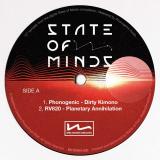
State of Minds compilation features Finnish artists working across house, electro, and techno. Industry veterans Freestyle Man (Sasse), Ender, and Phonogenic, along with label co-founder RV820, highlight a range of sounds from hypnotic house to Detroit techno, reflecting the diversity and depth of Finland’s electronic scene. Four tracks of the highest quality, this album sampler from Meltdown Deejays is not to be missed!
Vinylneuauflage von Mobys Sampler "Early Underground" (1993), einer Zusammenstellung seiner Frühwerke unter zahlreichen zusätzlichen Pseudonymen wie Barracuda, Brainstorm, UHF oder Voodoo Child. Mit Ausnahme einer limitierten Vinylausgabe 2022 gab es diese Kollektion nur als CD, nie flächendeckend auf Vinyl. "Early Underground" enthält auch seinen Techno-Klassiker "Go" in der Original Version, laut Rolling Stone "einer der besten Tracks aller Zeiten". Moby hat die Techno/Electronic-Szene massgeblich beeinflusst, später den Popmarkt erobert und Acts wie David Bowie, Public Enemy, Ozzy Osbourne, die Beastie Boys und Daft Punk produziert und geremixt.
- A1: Danny Bensi And Saunder Jurriaans - Promises (Knights Theme Medley)
- A2: Luc St-Pierre - The Sword Of Ashfeld (Knights Theme Medley)
- A3: Danny Bensi And Saunder Jurriaans - Storm And Fury (Unreleased)
- A4: Luc St-Pierre - Wyverndale’s Theme
- A5: Luc St-Pierre - The Wolf And The Hart
- A6: Luc St-Pierre - A Knight’s Resolve
- A7: Luc St-Pierre - Virtuosa’s Panache (Edited Version)
- B1: Danny Bensi And Saunder Jurriaans - The Warrior Spirit (Viking Theme Edited Version)
- B2: Luc St-Pierre - Engin Miskunn
- B3: Luc St-Pierre - Komidh Adh Skuldadogum
- B4: Luc St-Pierre - The Shield Of Svengard
- B5: Luc St-Pierre - Oathbreaker (Edited Version)
- B6: Luc St-Pierre - A Song For Gudmundr
- B7: Luc St-Pierre - The Serpent Sword
- C1: Danny Bensi And Saunder Jurriaans - Devotion (Samurai Theme Edited Version)
- C2: Luc St-Pierre - Hana No Chiruran
- C3: Luc St-Pierre - The Muramasa Blade
- C4: Luc St-Pierre - A Cavern In The Swamps/Downfall (Medley)
- C5: Luc St-Pierre - Stars Of Arabia
- C6: Luc St-Pierre - Glory Variation A (Year 10 Exclusive)
- D1: Luc St-Pierre - A Warrior’s Siege
- D2: Luc St-Pierre - Dao Jian Wu Yan
- D3: Luc St-Pierre - Common Enemies
- D4: Luc St-Pierre - Ghost Rites
- D5: Luc St-Pierre - Queen Of The Seven Seas
- D6: Luc St-Pierre - Glory Variation B (Year 10 Exclusive)
For the 10th Anniversary of the iconic and unique For Honor, Kid Katana Records teamed up with Ubisoft to bring you this high quality album on an exclusive double vinyl. With over 35 million players since its release, For Honor has kept on bringing new content in the game, enriching the players’ experience with new Heroes, Factions and Music to keep the battle for survival and honor alive.
The physical edition is a premium 2LP designed in close relationship with the game's creative team:
● Track selection handpicked by For Honor team, including 2 new tracks (Year 10 exclusive) and a track never released before from Y1 Season 7
● 2 Golden vinyls
● Exclusive cover art with glossy effect on the logo
● Exclusive 16-page booklet with insights on each faction’s music, liner notes
from the game’s creative team and composers Luc St-Pierre, Danny Bensi and
Saunder Jurriaans
The tracklist is a selection of music from the 10 seasons of the game, one side per faction:
Water can retain or wash away memory; flowing or freezing. It gives life and shapes earth, while frozen imprints of an ancient past are waiting to melt – back into sound or fluid motion, or simply to dissipate and disappear. For their split release, Yoichi Kamimura and Olli Aarni offer two distinct reinterpretations of a performance recorded live at the Temppeliaukio Kirkko – a church in Helsinki built directly into solid rock and bathed in natural light – meditating on glacial landscapes and water cycles, using shared field recordings that bifurcate into two sonic visions of “ice journey”.
Yoichi Kamimura’s extensive recordings formed the bedrock of the original performance, notably from time spent on Suomenlinna Island just outside Helsinki in 2021, aiming to capture the remnants of the glacial movements that formed the area’s geology. Elsewhere, the voices of ringed seals, underground waterways of Kyoto, and icy rivers in Lapland from Kamimura’s library float in as well. “The small, charming, and gentle islands floating in the Baltic Sea—some with little cottages and restaurants—reminded me of the drifting ice in the Sea of Okhotsk between Japan and Russia,” describes Kamimura. Fragments of a Christmas choir creep in too, recorded at the church on Suomenlinna Island. Titled Kōri no ryokō , Kaimimura’s reinterpretation of the performance emphasises a shared future across all icy sea regions of the world: thawing ancient memories and the threat of disappearing entirely.
On Jäämatkailu, Olli Aarni presents his own expansive reworking of the same source material, heavily processed alongside his own field recordings from Vantaanjoki river and Suontee lake in Finland. “I was thinking about the processes of erosion, water carving rock, the prehistoric glaciers over the landscape in my own environment,” explains Aarni. The soundscape hums with both intimate details and macrocosmic flow, and a submersible bass rumble hinting at an iceberg far below the tip, morphing at time scales beyond human comprehension.
Side A is composed by Yoichi Kamimura using field recordings of drift ice (Shiretoko, Hokkaido, 2019–2022), the Lake Biwa Canal (Kyoto, 2020), the Therme Vals baths (Vals, 2017), spring water (a fountain next to Saint Benedict Chapel, 2017), a Christmas choir (Suomenlinna Church, Helsinki, 2021), ice in the Juutuanjoki River (Inari, 2021), and recordings from Yoichi’s and Olli’s concert (Temppeliaukion kirkko, Helsinki, 2021), KORG iPolysix, and KORG minilogue xd.
Side B is composed by Olli Aarni using the aforementioned sounds + field recordings of the river Vantaanjoki and the lake Suontee, sampled sounds, and a computer.
Cindytalk has remained a majestic proposition over the decades, one marked by a continued process of disintegration and regeneration. Change has been a constant for Cindytalk, as has been the presence of the Scottish musician Cinder, who has fronted the project since the early '80s. The first Cindytalk albums embraced a dark theatricality of post-punk dissonance and abject rock deconstruction that coupled industrial dirges with Cinder's beatific vocals, these same vocals that were once plied to the earliest This Mortal Coil and Cocteau Twins recordings,forever binding Cinder to the 4AD lore. But even on those albums, Camouflage Heart and In This World, Cinder was pushing the band to embrace the studio as a tool for further abstraction of sodden drones, cobwebbed dark elegance, and decayed textures.
By the early aughts, Cinder had reimagined Cindytalk through the granular processes of digitalia with a handful of equally celebrated works of glitch-born expressionism for Editions Mego. Cinder explains that "those elements were growing roots under our sound and had started to organically change the shape of what we were doing. The fucked-up rock music was in retreat and the electro-acoustic abstractions were becoming apparent. Fast forward to the early part of the 21st Century and my first laptop. It seemed natural where I needed to begin that part of my new sonic journey. To further explore those and new territories. Sunset and Forever is intrinsically connected to what came before."
Sunset and Forever is a labyrinthine opus, one that returns to the themes of the sacred and profane that have rippled through all of Cindytalk's recordings, albeit in various guises. The opening track "Embers of Last Leaves" is a haunted piece of undulated, cyclical tones that entwine into a sorrowful chorale with Cinder's own voice. Thumps of electronic drum kicks and bass drops dot the apocalyptic menace of "Tower of the Sun" but serve not as a rhythmic grid, but as painterly noises that further disrupt and disturb the machined dissonance. A cinematic radioluminescence blooms from the tempered electronics within "For Those Eyes, Shadows Of Flowers." The finale "I See Her in Everywhere" bookends the opening number with a seemingly human chorus build from electronic tones cast in cathedral reverence. Sounds throughout may appear adjacent to those of Fennesz, Holly Herndon, or even Lovesliescrushing from time to time, but Sunset and Forever remains purely Cindytalk.
Cover designed by Chris Bigg, known for his iconic design work for 4AD. Mastered by James Plotkin.
The union of Antwerp synthesist David Edren and Tokyo minimalist Hiroki Takahashi is a fit so natural as to feel preordained. Both traffic in subtle shades of contemplative electronics, marked by patience, space, and poetic restraint. And both have rich histories of curation and collaboration – Edren in the duo Spirit & Form alongside Bent Von Bent, and Takahashi as proprietor of the Kankyō record shop, as well as one fourth of cosmic ambient quartet UNKNOWN ME. Mutual fans of one another’s work, they began sharing stems in the latter half of 2020, which slowly blossomed into a collection of multi-hued compositions inspired by notions of connectivity and impermanence, translated for east and west: Flow | 流れ.
Opener “Dusk Decorum | 黄昏 礼節” maps the mood of what’s to come, elegantly pirouetting and percolating through an expanding vista of looming stars and half-light horizons. Takahashi describes Edren’s arrangements as evoking “a strange feel, something we haven't heard much of before.” The sensation is one of “in-betweenness,” a restless current whispering beneath the beauty, like seasons seen in time-lapse footage: flickering but infinite, transience turned permanent. Takahashi’s signature sculpture garden tones plot spiral patterns over which Edren cascades dazzling pointillist synthesizer coloration. The pieces veer between delicate and dilated, micro and macro, their aperture forever softly in flux.
From the oscillating orchestral lullaby of “Stalactime | 鍾乳石時計” to the sweeping, sparkling dream sequence closer, “Shift Register | シフトレジスタ,” the album achieves the elusive goal of being more than the sum of its parts. This is music of rare air, elevated and amorphous, shimmering just out of reach. Though Edren and Takahashi have yet to cohabitate the same room in person (a fact that should be rectified soon by an astute festival booker), their palettes and poise are perfectly paired, twin fragilities woven into seven radiant and regenerative vibrational states. The cover design of a beatific, beaded leaf rippling on the surface of a hidden pond aptly captures the record’s muted majesty. Takahashi’s quiet pride is justified: “We are very happy with this time-consuming and carefully crafted work.”
Melbourne / Naarm strongholdButter Sessionsclock 15 years in the game with a trilogy of 12"s, sustaining their uncompromising streak of peak-form electronics. The family-style V/A binds friends, collaborators, former studio neighbours and DJ booth allies, capturing a label that exists as community as much as catalogue.
A new chapter in Butter Sessions' ongoing Japanese exchange sees Sapporo sound sculptor Kuniyukire-opening a 2015 tour collaboration with label heads Sleep D- a deep, spatial beatdown powered by dub pressure and percussive hypnosis. Shadow-lurking prodigy Mosam Howiesondrops in with his trademark scatterbrain techno, while Hasvat Informantlocks into joint-consciousness big-room radioactivity.
Opening the B-side, Fader Capfuses Balearic psy-ence with Mike Dunn-esque utilitarian jack, hovering somewhere between '80s memory and future vision. Tokyo's Mayurashkafollows with Survival Guide, big beat colliding with drug chug, before Albrecht La'Brooyreunite for a divine chill-out tent slowdown, magnifying sample detail with exacting flow. We're adrift until Sunju Hargunlights the beacon with スカイサーファ(Sky Surfer), Thailand's emissary of ritualistic minimal trance.
Whether taken alone or folded into the three-disc triptych, each instalment stands as a bag-ready constant, charged with Butter Sessions' curatorial finesse.
The arrival of REAL, Vol. 1 marks a seismic shift in the global music landscape, uniting two of Nigeria’s most formidable forces for a project that defines the current zenith of Afrobeats. This collaborative effort sees Wizkid, the smooth-talking pioneer of the genre’s international expansion, and Asake, the "Mr. Money" whose neo-Fuji sound redefined the street-pop aesthetic, finding a middle ground between luxury and grit. The project serves as a sonic bridge between eras, blending the minimalist, high-fashion sensibilities of Wizkid’s recent output with the high-octane, choir-backed energy that has made Asake a household name. It is less of a competition and more of a conversation between two masters of their craft, exploring themes of spiritual gratitude, the weight of superstardom, and the unyielding pulse of Lagos.
With soundscapes both cinematic and deeply rhythmic, the production moves beyond standard club formulas, opting instead for a sophisticated fusion of traditional Yoruba percussion, shimmering synths, and the heavy, resonant log drums of Amapiano. Wizkid provides the effortless, melodic swagger that acts as the project's anchor, while Asake injects a spiritual intensity through his signature layered chanting and rapid-fire flows.
Ultimately, REAL, Vol. 1 is a celebration of authenticity in an era of global crossover. By stripping away the pressure of conforming to Western pop standards, Wizkid and Asake have created a body of work that is unapologetically Nigerian yet universally resonant. It captures the spirit of a city that never sleeps and the ambition of two artists who have conquered the world without losing their souls. This is more than just a collection of hits; it is a blueprint for the future of African music, proving that when Wizkid and Asake occupy the same frequency, the result is nothing short of legendary.
- 112: Bells & A Baby Crying
- 2: Ur Cool Knife
- 3: I Haven't Forgotten You
- 4: Wash You Out
- 5: My Spell
- 6: Rock On (Ft. Royal Tusk, April Lawine)
- 7: Smash
- 8: Pt. Iii (Ft. Fireball Kid)
- 9: At Midnite
- 10: Underground Shopping District
- 11: This One
Wer ist Born At Midnite und warum sollte dich das interessieren? Born At Midnite sind keine gewöhnlichen Drag-and-Drop-Produzenten, sondern eine vertikal integrierte Songmaschine. Mit Samplern, künstlichen Drums, Tonbandgeräten und hauseigenem Artwork, alles im Homeoffice-Tempo; seit einem halben Jahrzehnt steuert das Duo aus Montreal ganz lässig auf den Status der ,coolsten Band der Szene" zu. Indem sie den allgegenwärtigen Narzissmus und die Selbstverliebtheit unserer Zeit ausspielen - und sich gleichzeitig darüber lustig machen -, flicken die Jungs eine Art ungesponserten ,Product-Placement-Punk" zusammen. Also sag mir, was hat es mit ihrem Debütalbum auf sich? Was ist das Gegenteil eines Wunsches, der mit einem schrecklichen Fluch einhergeht? Es ist etwas, das niemand wollte, das aber vor ewiger Verdammnis schützt; es ist ,Eternal BAM Nation", das lang erwartete und doch schnell zusammengestellte Debütalbum von Born At Midnite. Und du weißt, dass diese elfeinhalb Songs den Kern der Sache treffen.
- A1: Waiting For
- A2: I Couldn’t Remember So I Made Something Up
- A3: Bus To Fairlop
- A4: Orchids
- B1: Whistling On A Tuesday
- B2: Electrical Mobility
- B3: Holly Can Swim But She Doesn’t Really Like It
- B4: 7 Years Or More
dgoHn (pronounced “John") is the moniker of John Cunnane, who hails from somewhere between London and Essex. ‘Tessares,’ his fourth album but his first for Planet Mu, is playful, unconventional drum & bass that contrasts sparse effects and melodic elements with complex drumfunk and breakcore. He often uses unusual time signatures and head-spinning polyrhythms inspired by jazz and math rock, sometimes within the same track. Somehow he makes it sound effortless, and occasionally pretty as well, keeping a fine balance that never feels punishing; exploratory without getting lost.
He's built a name for himself over the last two decades performing live at festivals and events around the world, while collaborating with fellow artists such as Macc, Nic TVG, Jodey Kendrick and Badun as well as solo releases.
The album opens with ‘Waiting For’ which combines complex breaks with melodic fills, spacey effects and dubbed out vocals that feel like snatches of lost conversations - a combination he uses throughout the album giving it an eerie touch of humanity. Lead single ‘I Couldn't Remember So I Made Something Up’ is in 15/8 time. It feels like a conventional melodic drum & bass track, but the time signature disrupts the listeners’ expectations, while the detuned melody eases its sense of dislocation. ’Whistling On A Tuesday’ opens with a light echoey piano countdown into bass stabs which introduce heavy whirling amen breakbeats that switch between 180 and 120 bpm. ’Holly Can Swim But She Doesn’t Really Like It’ is the most rhythmically challenging track here. It feels hard to hang on to as its knotty breaks play out over bell chimes, like something Autechre might make if jungle was in their DNA. The album ends on the dubbed-out drumfunk of ‘7 Years Or More,’ with an arrangement that builds a filmic, dusty atmosphere of chimes and electric guitar, layering in vocals, vinyl crackle and echoing synth giving way to tough drums, before all that is taken away so that just a voice remains.
Companion 10" to the recent, superb LP Sampler from The Belfast duo...
After showcasing their broad and boisterous tastes on a series of super limited Edits 12's, plus original releases on labels like Touch Sensitive, Hoga Nord, Duca Bianco and Optimo Music, we finally have a fully formed suite of original cuts which take us on a journey through their varied and vivid vibrations...
On Barrios & Barricades, BB deliver two powerful Dark Disco delights...
The kind of peak-time industrial funk-outs that have soundtracked infamous, strobe-lit joy factories over the decades from Chicago's Medusa's, Ghent's Boccaccio or Optimo's legendary Sundays at The Sub Club.
Yes, it's that good !