Belgian-Japanese piano wizard Alex Koo seemed destined for a career as a classical concert pianist, but in his teens, he became completely enamored with jazz. Driven by his passion, he moved to New York, where he studied and taught at the renowned NYU Steinhardt. There he came into contact with jazz greats Mark Turner and Ralph Alessi, with whom he released the album "Applebueseagreen" in 2019, which was promptly included in the prestigious list of "Best Albums of 2019" by the legendary Downbeat Jazz Magazine with the words "Stunningly original". Domestically, too, one blazing review upon another: "Belgium is too small for pianist Alex Koo" or "We are stunned ", we read in national newspapers De Tijd and Le Soir.
With his brand new Etudes for Piano, composed for and commissioned by BoZar Brussels, he shows how his passion for both worlds - jazz and classical - merge perfectly. Adventurism and virtuosity go hand in hand with melancholy and elbow work (literally, for those who really know Koo knows). His music sounds like a marriage between Debussy, Chopin, Reich, Rachmaninov on the one hand and Keith Jarrett, Craig Taborn, Brian Eno and Philip Glass on the other. Alex Koo is a conjuring natural born storyteller on piano.
Поиск:satie
Все
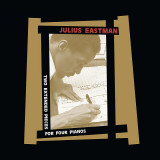
It is recognized today that these tutelary pieces for four pianos are among the most powerful in contemporary music,their impact is almost unparalleled. After the historical version recorded forty years ago, this one, featuring four of the greatest European performers, is now regaining its full power. High level recordings too.
There was some for John Cage, then came Christian Wolff, and finally Morton Feldman, from this school in New York. Only Julius Eastman remained outside the game, the last figure, the most solitary and enigmatic - undoubtedly also one of the most powerful, and it is this power that is revealed through these recordings. In the 1970s and 1980s, Eastman was one of the very few African-Americans to gain recognition in the New York avant-garde music scene. He was politically committed, a figure of queer culture and a solar and solitary poet whose melancholy influenced his genius as well as his tragic destiny : suffering from various addictions, declared missing, actually homeless. During Winter of 1981-82, he got deported from his apartment by the police, who destroyed most of what he owned - including scores and recordings. He was found dead in 1990, on the streets of Buffalo, after years of vagrancy.
The Performers Nicolas Horvath, pianist and electroacoustic composer Nicolas Horvath is known for his boundariesless musical explorations - he has collaborated with leading contemporary composers from around the world, including Alvin Lucier, Alvin Curran and Valentyn Silvestrov - the recordings of his complete works for piano by Phil Glass made a lasting impression. He has collaborated recently with Lustmord on the Deconstruction of November by Dennis Johnson (Sub Rosa SR502: The Fall).
Melaine Dalibert, a French composer and pianist, fascinated by natural phenomena which are both expected and unpredictable, Dalibert has developed his own algorithmic procedures of composition which contain the notion of stretched time evoking Morton Feldman, minimal and introspective, adopting a unique concept of fractal series.
Stephane Ginsburgh, a tireless surveyor of the repertoire but also explorer of new music, collaborated with composers such as Philippe Boesmans, Jean-Luc Fafchamps, Stefan Prins, Frederic Rzewski and Matthew Shlomowitz of whom he premiered works, as well as with choreographers such as Anne Teresa De Keersmaeker (Rosas) and recorded Feldman, Duchamp and Satie for Sub Rosa and the complete set of Prokofiev piano sonatas for Cypres. Wilhem Latchoumia, he embraces both new music and the classical repertoire with success and charisma. His two last recordings for La Dolce Volta (Prokofiev and de Falla) have been highly acclaimed by critics with a FFFF in Télérama. Winner of the Hewlett-Packard Foundation and the Montsalvatge International Piano Competition, he brilliantly won the First Prize in the 2006 Orléans International Piano Competition.
REPRESS
The second LP compendium of Emahoy Tsege Mariam Gebru's early solo piano works, recorded throughout the 1960s - finally available again. Emahoy Tsege Mariam Gebru is a true original - her compositions and unique playing style live somewhere between Erik Satie, Debussy, liturgical music of the Coptic Ethiopian Church, and Ethiopian traditional music. It is some of the most moving piano music you will ever hear! These original compositions, performed by Emahoy Tsege Mariam Gebru herself on solo piano, were originally self-released in Germany in small editions as fundraisers for orphanages, support organizations for widows of war victims, and other philanthropic causes. We are humbled and proud to present this album in collaboration with the EMAHOY TSEGE MARIAM MUSIC PUBLISHER and Foundation, and to assist in continuing her life-long mission of using music as a vessel to care for those who have been abandoned by society, or harmed by strife. Black vinyl LP comes in black inner-sleeves and heavy cardstock jacket with color printing and gold-foil stamping, and song notes by the composer herself. Restored and remastered by Timothy Stollenwerk.
Welcome to the world of Edward Blankman, a retired dentist who wrote elegant, minimalist jazz in obscurity circa 1970. At least that's the story. In truth, Edward Blankman's Cape Cod Cottage is the 2021 concept album from Echo Park composer Brendan Eder. A tender, wistful follow up to 2020's To Mix With Time, the Cape Cod Cottage sound evokes the spirit of Erik Satie, Miles Davis with Gil Evans, and Stevie Wonder, balanced with the accessibility of 1960s lounge-exotica. Eder created Blankman's story to channel his own grief, with bittersweet tenderness. Read the liner notes (or watch the mini-doc), and you'll be transported to the quiet shores of Cape Cod in the early 70s, where a lonely retiree mourns his late wife, Natalie, with walks in nature and evenings at his Wurlitzer. The story is brought to life with a meticulously crafted package sporting classic liner notes, faux 1970s photographs documenting Edward with the musicians (taken during the actual session), a make-believe jazz label, and a commissioned oil painting of Edward's cottage. Eder brought together a dream line up with a ton of chemistry for the project; drummer Christian Euman (Jacob Collier), saxophonist Josh Johnson (Jeff Parker, Leon Bridges), and bassist Alex Boneham (Billy Childs), who all studied together at the Hancock Institute of Jazz. Rounding out the group is flutist Sarah Robinson, a recurring player in Eder's ensemble, and Edward Blankman (Brendan) on the Wurlitzer. The cast was booked for a single date with coveted engineer Michael Harris (Kamasi Washington, Angel Olsen) at famed Electro-Vox Recording Studios. To create realism for Edward's story, the charts were purposefully withheld from the musicians until they arrived at the studio. The result is an authentic and natural performance delivered by players at the top of their game, captured on lauded vintage equipment including the legendary Neve-8028 console. This was, hands down, one of the very best records of last year so don't miss out on this extremely limited pressing for UK and Europe. Under license from Jazz Dad Records.
+ 10 Tracks for download
Preceded by the successive releases of lead singles "Sandcastles" and "My Mind", here comes the versatile debut full-length offering from Tel-Aviv-based producer Kadosh on Stil vor Talent, "Unanimously". Bridging the club universe with that of deeper, further immersive off-floor narratives, Kadosh entices us down a compelling path of rhythmic enlightenment and all-embracing togetherness. Casting mutable strains of EBM, house, pop and exotica entangled in one dizzying polyphony throughout the album, the Israeli vibist has us surfing our way across his musical headspace effortlessly.
From the stealth, neo-noir-like opening sequence of "Interstellar" feat. Marc Piñol to the epic Luso-Italo vibrations of "Sandcastles" feat. vocal hoodooist Abra~o, via the exquisite Afro-informed piano house and all-round atmospheric luxuriance of "My Mind" feat. Floyd Lavine and Erika Krall's supremely smooth yet characterful timbre, Kadosh swings the pendulum with constant surprise and bravura. Aside from his compositions' obvious hooking nature, there's also great lots of textural back funk to dive in at every corner. Hauntingly transporting, "From Jaffa to Frederichshain" feat. Upon You's Marco Resmann works a more jagged programming, flush with big-room reverbs and muted drums, while the slo-evolving "Pronto" feat. Emanuel Satie morphs from a low-key DJ tool into a full-fledged, melancholy-charged peak-time burner.
Bearing both Kadosh and David Mayer's signature, "1999" lets the 80s-inherited arsenal of iridescent Casio synths and lashing percussions talk in unhindered fashion, whereas "Volantage" feat. Murat Uncuoglu goes all in on the trampling kicks, sooty claps and prismatic keyboard stabs. Sensual to the fullest, "Moran" in collaboration with Rodriguez Jr. is certainly one of the album's highlights with its impeccably laid-down melange of bassy thunder and shapely Latin rhythmic backbone ushering us down an irresistibly poignant and hypnotic tunnel of sound. A joint effort with Locked Groove, "Far Too Close" is a further loopy discoid affair reminiscent of the French filtered-house scene's heyday, while the album's closer "Think it Over" feat. Stereo MC's is that perfect pop-indebted electro chugger that'll rev up any tired engine with reinvigorated, ecstasy-inducing horsepower.
Press play on Lanois’ captivating new instrumental collection, Player, Piano, and you’ll be transported, too. Each song here is a portal, an invitation to lose yourself in the moment and disappear into a world of imagination and memory. Lanois recorded the entire collection himself, capturing a series of gentle, exotic piano performances at his studio in Toronto with the help of co-producer Dangerous Wayne Lorenz, and the results are both intimate and expansive all at once. Melodies unfold slowly with patience and grace; ethereal arrangements drift around them like fog rolling through the mountains. More than just an album, Player, Piano is a gateway into a cinematic sonic universe full of mystery and wonder, a place where the lines between reality and fantasy blur and deep truths and desires reveal themselves in profound and unexpected ways.
“Making this record transported me,” says Daniel Lanois. “I got to travel to Cuba and Mexico and Jamaica. I got to visit with the ghosts of Erik Satie and Oscar Peterson and Harold Budd. I got to go back in time to my work with Brian Eno and Kate Bush and Emmylou Harris. And I did it all without ever leaving my studio.”
On their new album Looming, The Spindle, The Pleasure Majenta shape a
terrifying and sublime mix of noise, broken electronics and guitar
feedback that begs to remain untamed
From New Zealand by way of Berlin, these dystopian goth punks take their cues
from the harsh and heavy energy of The Birthday Party, Swans and The Fall
€"casting bummer vibes into the void to create the pain- soaked statement so
many albums want to make but wind up missing the mark.The lead single € Full
of It € fills the screen with flashes of cinematic post-punk savagery up to its ears
in swampy distortion and sleazy funhouse skronk. Velvety € 70s exploitation flick
saxophones hustle with devilish no-wave spaghetti western guitars and a slippery
bassline like a coffin dragged through mud in a grungy post- punk dirge. It's a
waking tour through a dysfunctional late- capitalist bardo where disassociation
becomes an effective coping mechanism for the cyclical, paralyzing grind of
clock- in, clock- out psychosis. € I felt okay when I wasn't myself "when I was
making music or playing onstage, so I decided I would contact myself in this way,
says The Pleasure Majenta's Lawrence Loz Fergus Goodwin. It's a dangerous
game to play.
Tracks: Satellite / Fabric / Sad2say / Smiles Through A Sneer / Anxious Patient /
Osc / Full Of It / It's Ten / Erik Satie / Gardens
WRWTFWW Records couldn't be happier to announce the release of Yutaka Hirose’s never-heard before 11-track collection TRACE: Sound Design Works 1986-1989, available on double LP and double CD, with liner notes from the artist.
TRACE is a collection of 11 unreleased tracks produced by Yutaka Hirose between 1986 and 1989, during the Sound Process Design sessions, right after the release of his classic Soundscape series album Nova. Sound Process Design was Satoshi Ashikawa's label, home of the Wave Notation trilogy (Hiroshi Yoshimura’s Music For Nine Postcards, Satsuki Shibano's Erik Satie 1866-1925 and Satoshi Ashikawa's Still Way). Following Wave Notation, Sound Process Design worked with museums, cafes and bars to create site-specific soundscapes, starting with the sound design of the Kushiro Museum. Yutaka Hirose was called to work on these projects.
Rather than simply providing pre-recorded compositions, Hirose sought to create a "sound scenery". To achieve this, he participated in the conception of the space and paid particular attention to the accidental combination of sounds by placing the speakers, using a multi-sound source, and following the concept of "sculpturing time through sound".
The composer explains: "sculpturing time through sound means that time, the space itself, the sound played in it, and the audience all become one sculpture. It is close to the idea of a Japanese tea ceremony where you use all of your 5 (or 6) senses to taste the tea."
TRACE: Sound Design Works 1986-1989 is divided into two parts. The Reflection segment is based on an ambient soundscape. It narrates "a sleep that starts with the sound of water droplets at dawn and slowly disappears into darkness" and feels like a natural and soothing progression of Nova. It was played in entrance halls, at events, in cafes and bars. The Voice from Past Technology segment expresses the dream world born out of that sleep and is based on what Yukata Hirose calls hardcore ambient, environmental music with a noise approach. It was played in museums and science centers.
All in all, TRACE is a crucial addition to every Japanese environmental music fan’s collection, alongside Midori Takada’s Through The Looking Glass, Hiroshi Yoshimura’s Green, Satoshi Ashikawa’s Still Way, Motohiko Hamase’s Notes of Forestry, Inoyamaland’s Danzindan-Pojidon, and Yutaka Hirose’s very own Nova.
Clear Vinyl
Dominique Lawalree (b. 1954) is a composer born and based in Brussels. 'First Meeting is Lawalree's first archival release to date. Culled from four different albums originally self-published on his private label Editions Walrus, circa 1978-1982, this compilation highlights the composer's unique sense of ambient and minimal composition. Originally considered for release on Brian Eno's Obscure Records, Lawalree's music is now no longer hidden.
In this collection the listener finds the sounds of piano, synthesizers, percussion, wurlitzer, organ, and voice, all performed by Lawalree. Using these tools Dominique creates miniature themes that gallop across the speakers in slow motion, stretching our normal sense of dynamics and color, effortlessly widening the stereo plane. On "Musique Satieerique," Dominique pays homage to the influence of Satie with simple repeated piano figures and a lush field of organs and flutes. And on other selections, like "Le Maison Des 5 Elements," he takes a more wistful, ambient approach, layering keyboard lines, and invoking found/tape sounds to create a hypnogogic world of his own. Childlike in its playfulness and surreal to the bone, the music spins like a carrousel placed inside the Rothko Chapel. Lawalree's sense of timbre, tone, and overarching composition is like an impression of a home movie whose charm lies in its knowledge of intimacy, shared by few.' An incantation of innocence.
"a quiet, understated music that is both touching and elegant" - Gavin Bryars
Available on color vinyl for the first time on limited edition opaque blue packaged with download code. Isotope 217 is made up of Dan Bitney, John Herndon, and Jeff Parker from Tortoise along with Rob Mazurek (Chicago Underground, Exploding Star Orchestra), and Matt Lux (Iron & Wine). The music of Isotope 217 is as complex and varied as the influences of it's members. Isotope 217 on Isotope 217: "It is hard to state exactly what this band is because of the diverse influences of the participants. One might say an eclectic avant funk ensemble dedicated to the Phonometric * system of universal thought. One might also say a freewheeling trans-moleculer unit dedicated to the betterment of all worlds." *Note phonometrics are, as described by Satie, the Science of measuring sound.
On the outskirts of late 1970s Olympia, Washington, something stirs, sings, and breathes. Cheri Knight, a music composition student at the Evergreen State College, is developing her practice in a quaint but adequately equipped campus recording studio, amalgamating with the sonic timbre of the surrounding time, space, and place, while devoting to her own inner maxims. At once performative and meditative, electronic and organic, collaborative and self-contained, Cheri’s early compositions are simultaneously complete and sketches of a ceremonial process at play. American Rituals captures the artist’s environmental emergence, unearthing a unique compositional voice and signposting a regional sonic ethos.
The path to Evergreen seems gently preordained for Cheri, a whisper in the trees. Growing up in a musical household in Western Massachusetts, she learned to play piano and clarinet, demurring from notated music but composing piano pieces in the minimalist mode of Erik Satie and folk songs inspired by Joni Mitchell. In high school, her class studied John Cage’s work, an epiphanic moment
for the young artist. The group also visited a studio outside Amherst where she encountered the modular limitlessness of a Moog synthesizer. Cheri studied philosophy and music at Whitman College in Washington, and then took a year to build a stone house with some friends in New Hampshire. She settled at Evergreen soon after, carrying with her a zeal for improvisation, creative investigation,
and hands-on experimentation.
Steve Cradock reveals a different side to his music talents with a new instrumental LP drawing on jazz, folk, classical and film soundtrack influences. Conceived during the “most extraordinary” months of lockdown, ‘A Sound track to An Imaginary Movie’ began life one afternoon in summer 2020 when Cradock felt struck by inspiration. The music that poured out in subsequent sessions suggested to Steve an imaginary film soundtrack – hence the album title – with many of the songs exuding a quiet, hymnal grace and a profound sensation of stillness and inner peace. Hints of Eric Satie, Burt Bacharach, Ennio Morricone and Philip Glass can be detected – together with a piquant flavour of the jazz and classical greats. Steve is joined by guests including, his wife Sally, Jess Cox (cello), the Stone Foundation’s Rob Newton (congas), son Cassius Cradock (piano), plus fellow members of The Specials’ touring band Nikolaj Larson (Hammond B-3) and Tim Smart (trombone). Cradock is keen to impress that the record is in his mind, essentially a folk record, despite being amazingly mixed “ultimately, I could play most of these tunes on an acoustic guitar.”
Since his debut with the "Darling Darling Darling"track, immediately spotted by the media as well as by electronic music lovers, Louis Warynski has continued to evolve a world that belongs to him alone, over the last ten years and eight albums.Like Lewis Caroll's universe, Chapelier Fou's music is multiple, simple and complex, serious and light, classic and modern. Louis Warynski's work is woven on a classical basis, but it is constantly disrupted by subtle electronic arrangements and rhythms, thus taking the tracks outside of all convention.We find in Chapelier Fou the facetiousness of French composers such as Erik Satie, François de Roubaix or Robert Cohen Solal, not hesitating to blend pop and concrete music, but also this formidable capacity to make serious what is not serious, and vice versa of course. His music, very much at home on screen as well as on stage, has everything that makes up the trait of genius composers: accessible in appearance and adaptable in all forms. This is how Chapelier Fou has performed on stage as a soloist, juggling between violin, guitar, keyboards and pedals, in trio, quartet and even in orchestral formation with the Orchestre National of Metz. Often described as "electronic chamber music", it was expected that one day Chapelier Fou would offer us a version of his music without a single electronic or electrified part. It is now done with this Ensemb7e who performed on the stage of L'Arsenal de Metz, broadcasted by Arte Concert. Chapelier Fou Ensemb7e has received direct support from a wide audience, but also from venues programmers where the septet has been performing since June 2021. Ensemb7e stands for a mainly wooden septet: violin, viola, cello, piano, clarinet and drums accompany the multi-instrumentalist composer. It's hard to resist such musical enthusiasm! The magic happens immediately because the re-reading of these little jewels in pop format gives a touching and fulfilling dimension to Chapelier Fou's work: even more dreamy versions, sometimes more mischievous, but the richness of the classical instruments and the obvious pleasure of the musicians in interpreting them give a new life to all these titles that have filled us with wonder. It therefore seemed obvious to us after listening to his Ensemb7e concerts that there was more than a concert to be recorded, but a real album to offer. A studio album, but with the energy and vitality of a live one, produced with the care and generosity of Thomas Poli (who has collaborated with Dominique A, Yann Tiersen and many others).
The glacial distillation of Pan•American aka Mark Nelson’s “romantic minimalism” achieves unique fruition on his latest Kranky collection, The Patience Fader.
A suite of solo guitar instrumentals accented with lap steel, harmonica, and twilit atmospherics, the strings smear and sparkle in elegant, windswept swells, a guitar mode once described by Brian Eno as “Duane Eddy playing Erik Satie.” These are elegies as much as songs, lulling and lilting in private currents of beauty and bereavement. Nelson speaks of the notion of “lighthouse music,” radiance cast from a stable vantage point, sending “a signal to help others through rocks and dangerous currents.”
Composed during the highly isolated summer of 2020, the pieces took shape as meditations on “roots and mourning, trying to connect with those deep hidden rivers that lead to a greater communality.” There’s something ageless, scarred, and American about this music, both displaced and devotional, the ghost of rust belts and dust bowls looming in a horizon of deepening dusk.
Gondwana Records sign LA bassist and composer Seth Ford-Young's Phi-Psonics project and announce a remastered deluxe-edition of The Cradle featuring bonus material
Phi-Psonics is a meditative, immersive instrumental group from Los Angeles, led by bassist Seth Ford-Young and featuring Sylvain Carton on woodwinds, Mitchell Yoshida on electric piano, and Josh Collazo on drums. Their deeply soulfulmusic draws on jazz and classical influences together with Ford-Young's own musical experiences, relationships, and his introduction to spirituality, yoga and philosophy at a young age, to create something uniquely its own. Phi-Psonics' name and ultimate aim is to find 'Phi' – the golden mean – in art, nature and self. Ford-Young explains:
"It's a bit of a cliché, but music saved my life many times and instilled in me a belief in the great power of healing through art. It is my hope and intention that this music provides healing to someone somewhere."
Originally from Washington DC area, Ford-Young moved to California in the early 90s and fell in love with the deep sounds of the upright bass and the music of Charles Mingus, John and Alice Coltrane, and Duke Ellington along with Bach, Chopin, Pärt, and Satie. He immersed himself deeply in music and keen to learn combinedintense personal study with collaborations, tours, and recordings with artists such as Tom Waits, Beats Antique, and John Vanderslice. In 2010 he moved from the San-Francisco Bay area to the Los Angeles hills and continued his explorations. But great music is rarely just about music and Ford-Young's meditative, soulful music draws on more than just the twin wellsprings of jazz and classical music:
"My mother was a yoga teacher from the early 70's until recently and taught me yoga and meditation at an early age, my stepfather is an Aikido instructor and student of the teachings of Gurdjieff. Those were all early areas of study that I came back to many times throughout my life. Phi-Psonics has been a project that unapologetically synthesizes some of these ideas into our music".
It's this mixture of influences, musical and extramusical, that gives the music of Phi-Psonics it's immersive quality and quiet power. Revealingly the music that would becomeThe Cradle, wasn't written specifically for an album, originally Ford-Young was just writing down what was coming through. As time went by and the album began to take shape, the world situation seemed to be getting darker and his compositions aim to offer hope as a response to the negative influences that abound today. Remarkably for such a beautiful sounding record, it was recorded at the composer's home, rather than in a studio, but the relaxed nature of this process gives the music an airy lightness that propels the music to some magical spaces.
Originally self-released on vinyl in a limited run just as the world went into lockdown, The Cradle reached Matthew Halsall (founder of Gondwana Records) when he aws looking for music for his Worldwide FM show and he was blown away, hearing a kindred spirit at work. Halsall explains:
"Phi-Psonics make beautiful, humble and honest music, it's not showy, but it has a deep vibe that will elevate your mind and soul if you let it. When we heard The Cradle we reached out and are really super delighted to welcome Seth and his band to our label". Whereas for Ford Young: "Connecting with Matthew and the Gondwana records family has been a light in the darkness of the last years - to have my music make connections even as we are more isolated."
Ford-Young is currently putting the finishing touches to the second Phi-Psonics record, but aware that only a select few had heard The Cradle, let alone had the chance to buy a copy, and entranced by its deceptive simplicity and elevating energy, Halsall suggested that Gondwana present the album as a remastered 'deluxe edition' with an extended running time featuring extra tracks and new artwork from Daniel Halsall.
The Cradle starts with First Step, perfectly setting the tone for the whole album, it is a beautiful, soulful slice of musical calm gently propelled by Ford-Young's resonant bass and elevated by sublime flute and Wurlitzer electric piano solos. The seductive title track The Cradle was written way back in 2011 during a time of great personal change that led the composer to a feeling of newness and nurture. The magical, winsome Desert Ride is inspired by many rides through the grandly cinematic Mojave Desert. You can experience how incredibly full of life it's harsh landscape is if you slow down to its tempo. The gentle, sublime Mama is a tribute to mothers of all kinds, beautiful and heroic. Drum Talk was largely improvised, Ford-Young and the band agreed on a topic and recorded their conversation. Choosing their notes based on how Josh's drums were tuned. Like Glass is named for the special properties of Glass. Like some music, glass is delicate, yet has structure. The first of the two bonus tracks Still Dancing was written during the early days of 2020 in response to the challenges we all were facing then. It's a reminder that the figurative dance continues and that real dancing is essential. And the second, The Searcher, also written as a response to 2020, is a gently hypnotic song about the introspection and growth that can spring from a difficult situation.
This then is The Cradle, a quiet self-contained masterpiece, life-affirming and elevating in equal measure and the first offering from a wonderful new voice in spiritual jazz and the latest members of the global Gondwana Records family.
Gondwana Records sign LA bassist and composer Seth Ford-Young's Phi-Psonics project and announce a remastered deluxe-edition of The Cradle featuring bonus material
Phi-Psonics is a meditative, immersive instrumental group from Los Angeles, led by bassist Seth Ford-Young and featuring Sylvain Carton on woodwinds, Mitchell Yoshida on electric piano, and Josh Collazo on drums. Their deeply soulfulmusic draws on jazz and classical influences together with Ford-Young's own musical experiences, relationships, and his introduction to spirituality, yoga and philosophy at a young age, to create something uniquely its own. Phi-Psonics' name and ultimate aim is to find 'Phi' – the golden mean – in art, nature and self. Ford-Young explains:
"It's a bit of a cliché, but music saved my life many times and instilled in me a belief in the great power of healing through art. It is my hope and intention that this music provides healing to someone somewhere."
Originally from Washington DC area, Ford-Young moved to California in the early 90s and fell in love with the deep sounds of the upright bass and the music of Charles Mingus, John and Alice Coltrane, and Duke Ellington along with Bach, Chopin, Pärt, and Satie. He immersed himself deeply in music and keen to learn combinedintense personal study with collaborations, tours, and recordings with artists such as Tom Waits, Beats Antique, and John Vanderslice. In 2010 he moved from the San-Francisco Bay area to the Los Angeles hills and continued his explorations. But great music is rarely just about music and Ford-Young's meditative, soulful music draws on more than just the twin wellsprings of jazz and classical music:
"My mother was a yoga teacher from the early 70's until recently and taught me yoga and meditation at an early age, my stepfather is an Aikido instructor and student of the teachings of Gurdjieff. Those were all early areas of study that I came back to many times throughout my life. Phi-Psonics has been a project that unapologetically synthesizes some of these ideas into our music".
It's this mixture of influences, musical and extramusical, that gives the music of Phi-Psonics it's immersive quality and quiet power. Revealingly the music that would becomeThe Cradle, wasn't written specifically for an album, originally Ford-Young was just writing down what was coming through. As time went by and the album began to take shape, the world situation seemed to be getting darker and his compositions aim to offer hope as a response to the negative influences that abound today. Remarkably for such a beautiful sounding record, it was recorded at the composer's home, rather than in a studio, but the relaxed nature of this process gives the music an airy lightness that propels the music to some magical spaces.
Originally self-released on vinyl in a limited run just as the world went into lockdown, The Cradle reached Matthew Halsall (founder of Gondwana Records) when he aws looking for music for his Worldwide FM show and he was blown away, hearing a kindred spirit at work. Halsall explains:
"Phi-Psonics make beautiful, humble and honest music, it's not showy, but it has a deep vibe that will elevate your mind and soul if you let it. When we heard The Cradle we reached out and are really super delighted to welcome Seth and his band to our label". Whereas for Ford Young: "Connecting with Matthew and the Gondwana records family has been a light in the darkness of the last years - to have my music make connections even as we are more isolated."
Ford-Young is currently putting the finishing touches to the second Phi-Psonics record, but aware that only a select few had heard The Cradle, let alone had the chance to buy a copy, and entranced by its deceptive simplicity and elevating energy, Halsall suggested that Gondwana present the album as a remastered 'deluxe edition' with an extended running time featuring extra tracks and new artwork from Daniel Halsall.
The Cradle starts with First Step, perfectly setting the tone for the whole album, it is a beautiful, soulful slice of musical calm gently propelled by Ford-Young's resonant bass and elevated by sublime flute and Wurlitzer electric piano solos. The seductive title track The Cradle was written way back in 2011 during a time of great personal change that led the composer to a feeling of newness and nurture. The magical, winsome Desert Ride is inspired by many rides through the grandly cinematic Mojave Desert. You can experience how incredibly full of life it's harsh landscape is if you slow down to its tempo. The gentle, sublime Mama is a tribute to mothers of all kinds, beautiful and heroic. Drum Talk was largely improvised, Ford-Young and the band agreed on a topic and recorded their conversation. Choosing their notes based on how Josh's drums were tuned. Like Glass is named for the special properties of Glass. Like some music, glass is delicate, yet has structure. The first of the two bonus tracks Still Dancing was written during the early days of 2020 in response to the challenges we all were facing then. It's a reminder that the figurative dance continues and that real dancing is essential. And the second, The Searcher, also written as a response to 2020, is a gently hypnotic song about the introspection and growth that can spring from a difficult situation.
This then is The Cradle, a quiet self-contained masterpiece, life-affirming and elevating in equal measure and the first offering from a wonderful new voice in spiritual jazz and the latest members of the global Gondwana Records family.
Gondwana Records sign LA bassist and composer Seth Ford-Young's Phi-Psonics project and announce a remastered deluxe-edition of The Cradle featuring bonus material
Phi-Psonics is a meditative, immersive instrumental group from Los Angeles, led by bassist Seth Ford-Young and featuring Sylvain Carton on woodwinds, Mitchell Yoshida on electric piano, and Josh Collazo on drums. Their deeply soulfulmusic draws on jazz and classical influences together with Ford-Young's own musical experiences, relationships, and his introduction to spirituality, yoga and philosophy at a young age, to create something uniquely its own. Phi-Psonics' name and ultimate aim is to find 'Phi' – the golden mean – in art, nature and self. Ford-Young explains:
"It's a bit of a cliché, but music saved my life many times and instilled in me a belief in the great power of healing through art. It is my hope and intention that this music provides healing to someone somewhere."
Originally from Washington DC area, Ford-Young moved to California in the early 90s and fell in love with the deep sounds of the upright bass and the music of Charles Mingus, John and Alice Coltrane, and Duke Ellington along with Bach, Chopin, Pärt, and Satie. He immersed himself deeply in music and keen to learn combinedintense personal study with collaborations, tours, and recordings with artists such as Tom Waits, Beats Antique, and John Vanderslice. In 2010 he moved from the San-Francisco Bay area to the Los Angeles hills and continued his explorations. But great music is rarely just about music and Ford-Young's meditative, soulful music draws on more than just the twin wellsprings of jazz and classical music:
"My mother was a yoga teacher from the early 70's until recently and taught me yoga and meditation at an early age, my stepfather is an Aikido instructor and student of the teachings of Gurdjieff. Those were all early areas of study that I came back to many times throughout my life. Phi-Psonics has been a project that unapologetically synthesizes some of these ideas into our music".
It's this mixture of influences, musical and extramusical, that gives the music of Phi-Psonics it's immersive quality and quiet power. Revealingly the music that would becomeThe Cradle, wasn't written specifically for an album, originally Ford-Young was just writing down what was coming through. As time went by and the album began to take shape, the world situation seemed to be getting darker and his compositions aim to offer hope as a response to the negative influences that abound today. Remarkably for such a beautiful sounding record, it was recorded at the composer's home, rather than in a studio, but the relaxed nature of this process gives the music an airy lightness that propels the music to some magical spaces.
Originally self-released on vinyl in a limited run just as the world went into lockdown, The Cradle reached Matthew Halsall (founder of Gondwana Records) when he aws looking for music for his Worldwide FM show and he was blown away, hearing a kindred spirit at work. Halsall explains:
"Phi-Psonics make beautiful, humble and honest music, it's not showy, but it has a deep vibe that will elevate your mind and soul if you let it. When we heard The Cradle we reached out and are really super delighted to welcome Seth and his band to our label". Whereas for Ford Young: "Connecting with Matthew and the Gondwana records family has been a light in the darkness of the last years - to have my music make connections even as we are more isolated."
Ford-Young is currently putting the finishing touches to the second Phi-Psonics record, but aware that only a select few had heard The Cradle, let alone had the chance to buy a copy, and entranced by its deceptive simplicity and elevating energy, Halsall suggested that Gondwana present the album as a remastered 'deluxe edition' with an extended running time featuring extra tracks and new artwork from Daniel Halsall.
The Cradle starts with First Step, perfectly setting the tone for the whole album, it is a beautiful, soulful slice of musical calm gently propelled by Ford-Young's resonant bass and elevated by sublime flute and Wurlitzer electric piano solos. The seductive title track The Cradle was written way back in 2011 during a time of great personal change that led the composer to a feeling of newness and nurture. The magical, winsome Desert Ride is inspired by many rides through the grandly cinematic Mojave Desert. You can experience how incredibly full of life it's harsh landscape is if you slow down to its tempo. The gentle, sublime Mama is a tribute to mothers of all kinds, beautiful and heroic. Drum Talk was largely improvised, Ford-Young and the band agreed on a topic and recorded their conversation. Choosing their notes based on how Josh's drums were tuned. Like Glass is named for the special properties of Glass. Like some music, glass is delicate, yet has structure. The first of the two bonus tracks Still Dancing was written during the early days of 2020 in response to the challenges we all were facing then. It's a reminder that the figurative dance continues and that real dancing is essential. And the second, The Searcher, also written as a response to 2020, is a gently hypnotic song about the introspection and growth that can spring from a difficult situation.
This then is The Cradle, a quiet self-contained masterpiece, life-affirming and elevating in equal measure and the first offering from a wonderful new voice in spiritual jazz and the latest members of the global Gondwana Records family.
This eponymous Sony Classical debut album is a creative melting pot of different styles of classical music. The album features new compositions contributed by British composer and pianist Alexis Ffrench, Dutch neo classical pianist Annelie, French pianist/composer Alban Claudin, Oscar winning British composer Rachel Portman, British Cellist/composer Julian Lloyd Webber and American film composer Jacob Shea. Additionally the album features original compositions by Clara Schumann and Amy Beach as well as several unique new arrangements of some of the most famous classical melodies by Pjotr Tchaikovsky, Eric Satie and Frédéric Chopin. Specialist promo/marketing activity. 180gm vinyl and CD.
'Dwell Time' focuses on the moments in between. Expanding on Satie's Furniture Music, which explores the role of music as a backdrop, Dwell Time explores the moments in between active and passive listening. A sound that maintains a unique balance of properties can start as an active relationship that slowly dissolves into the background and accompanies a listener over its course. The Dwell Time signal remains completely analog, utilizing homemade tape samples and hardware synthesizers to encourage the listener to move between the different states of listening. Produced by Rafael Anton Irisarri and Mastered by Taylor Deupree.
Tropicantesimo is a music ritual extended over time and a celebration of sound and dance. It all started 10 years ago at the Fanfulla club in Rome. Nothing more than a party that over the years has transformed into a collective listening experience out of time and space. Meanwhile the collective animated by DJ Hugo Sanchez, Lola Kola, Rocco Bartucci, Gabor and Egeeno moved to a new club called Pescheria, and opened up to spontaneous live jams and collaborations with musicians and DJs from various backgrounds. Rhythms are incessant while the BPM is slow and hypnotic. Vocals flow between songs, messages and pure sound, while music is an organism which produces energy. The fruit of all this lives through extensive production work based on recordings collected over the years.
"Tropicantesimo Session 2" is the second of a series of three EPs presented as anticipations of the Tropicantesimo Gitania album release.
Like the first EP, this new chapter contains three songs recorded and mixed at Pescheria, the Tropicantesimo laboratory. "Perfidia" is a jazz and easy listening "classic" from the 1940s, re-sung on a recent techno dub track produced by Donato Dozzy and slowed down to become a new, sexy and enchanting tune. Egeeno's fluidity gives new soul to the piece and projects it right into the future. This is one of those pieces born during live sessions, even though the recorded version reflects the truth of the moment in which it was recorded. An Instant classic! ‘Oro Rosso’ comes from a summer session in which we decided to work on a song by a raw garage band called Gli Offesi. This is a song about submission, sexism, racism and eventually revenge, even though Lola Kola's singing opens up further interpreta ve scenarios. As for most of Pescheria sessions, guests can be very unpredictable, and here we have Maria Violenza the Punk queen. 'Bolla Napoli' is a journey through timeless sounds and feelings. From Neapolitan storytellers to the sublime world of Erik Satie with Lola Kola and Egeeno joining in a jam inspired by two classic songs "Maruzzella" and "Anema e core" both combined with the unpredictable sound texture of the backing track.
'Dwell Time' focuses on the moments in between. Expanding on Satie's Furniture Music, which explores the role of music as a backdrop, Dwell Time explores the moments in between active and passive listening. A sound that maintains a unique balance of properties can start as an active relationship that slowly dissolves into the background and accompanies a listener over its course. The Dwell Time signal remains completely analog, utilizing homemade tape samples and hardware synthesizers to encourage the listener to move between the different states of listening. Produced by Rafael Anton Irisarri and Mastered by Taylor Deupree.
- A1: Image-Autumn-Womb (2021 Remaster) 03 09
- A2: In A Notebook (2021 Remaster) 02 16
- A3: Finding It There (2021 Remaster) 03 44
- A4: Subtle The Sum (2021 Remaster) 02 03
- A5: Threnody (2021 Remaster) 04 45
- A6: Now (2021 Remaster) 03 58
- A7: The Winter Of 1539-1540 (2021 Remaster) 02 19
- B1: John Harrington (2021 Remaster) 06 09
- B2: Apalachee (2021 Remaster) 05 00
- B3: Mound Builders (2021 Remaster) 02 55
- B4: Gifts (2021 Remaster) 04 18
- B5: Clement Danes (2021 Remaster) 04 12
Originally released in 2008 on CD and in a very limited vinyl edition, "The Malady Of Elegance" by Goldmund aka Keith Kenniff finally gets its long-deserved vinyl re-release, featuring a new artwork and remastered audio by Taylor Deupree.
Taking cues from 'Corduroy Road' Keith Kenniff (aka Helios) again restricts himself to the piano in conjuring up his humble soundscapes and again we are pulled into a deep, meditative and filmic world as the notes glide to a slow, pensive meter. Keith's precedent release was the challenging 'Two Point Discrimination' EP, released on the Western Vinyl label as part of their portrait series, but where that record was a collection of haunting experiments in form and sound, 'The Malady of Elegance' sees us back into the warming, homespun territory of 'Corduroy Road'. That's not to say these compositions are upbeat, far from it in fact, but there are lines to be drawn to folk music, and while Keith no longer draws on the American Civil War as a primary influence there is still the sense that the ghosts of old America haunt the keys.
On top of these references we see Keith tripping somewhat fittingly into a flickering filmic world somewhat in line with his taste in European film. There is a delicate narrative on show throughout the record from the opening hopefulness of Image-Autumn-Womb through the melancholy of Now to the sensitive romance of the album's closer Evelyn. Listening to the record almost creates its own cinematic accompaniment in the minds eye, and this is simply a testament to Keith's incredible talents as a composer.
Fans of Erik Satie, Sylvain Chauveau and Hauschka need look no further, 'The Malady of Elegance' is a deeply personal meditation which you cannot help but get lost inside.
Peggy Gou returns with 'Nabi' - her first single in over two years and the follow up to 2019's global crossover, 'Starry Night'.
'Nabi' is an incredible piece of slow-burning, 98bpm electronic pop, inspired by 80s synth classics, the piano pieces of renowned composer Erik Satie and the 80s and 90s Korean songs Gou’s mother used to play at home during her childhood. Showcasing a less familiar side of Gou’s diverse sound and influences, it retains the hallmarks of her unique take on electronic music; at once both nostalgic and totally modern.
‘Nabi’ - which translates as ‘Butterfly’ - is also Gou’s first ever vocal collaboration, as she teams up with fellow Korean sensation OHHYUK, the lead singer and guitarist in Hyukoh. It’s set to build on the widespread acclaim for her 2020 production collaboration with Baltimore techno legend Maurice Fulton (on his ‘Jigoo’ release for Gudu), ‘Nabi’ is the first of two songs Peggy Gou will release over the coming months.
While the forthcoming follow up is set to dial up the tempo, kicks, 808’s and 909s to soundtrack a summer where we can all (hopefully) dance together in our thousands again, ‘Nabi’ is very much the sound of now – a lowkey anthem fuelled by feelings of hope, freedom and positivity for what’s to come.
In 1970, Kevin and David met whilst they were working in the Labour Exchange Office on Aytoun St, Manchester. Both played guitar and had been searching for other musicians who played atmospheric music. Kevin had been playing in small clubs in Manchester and David performed in a few local bands. One evening, they jammed together at Kevin’s family home, and quickly realized that their playing blended together to form the basis of the sound they had been looking for. In the late ‘70s, the music scene in Manchester was bursting with new bands and music.
However, Kevin and David had little in common with the local acts, being disciples of a more meditative approach. They followed a path of their own, reaching for an otherworldly sound that they heard from artists like John Martyn, David Crosby, Erik Satie, Terry Riley, Eberhard Weber, Alice Coltrane, and Ralph Towner. They experimented combining their acoustic guitars and David’s bass with various effects pedals and techniques to try and achieve a warm and expansive sound that rides the line between ambient, jazz, and psychedelic folk Music.
Towards 1981, they had written eleven songs and accompanied a few with Moog synthesizer laid down by Rob Baxter. All were recorded on cassette decks in their simple home studios. They named this collection of music “Light Patterns”, after a poem Kevin had written. With Light Patterns complete, they set out to find a label to represent their music. They started playing a few gigs in Manchester; Band On The Wall, the Gallery, and other venues, such as Rotters which local promoter Alan Wise had organized. They set up with small amps along with their effects and played as though they were back at home. As Kevin remarks, “It was unusual, to say the least, to play such venues in a low volume chilled out way. However, people listened, often in shocked curiosity, and some even asked for tapes.”
Peter Jenner, of Blackhill Enterprises, eventually picked up the album for his new label, “Sheet”. Peter had managed lots of experimental bands and solo artists, including Pink Floyd in their early Syd Barrett days. He always favored outsiders! The tapes were taken to Strawberry Recording Studios in Manchester, who were surprised when Kevin and David walked in with just a couple of home-produced cassette tapes. Fortunately, they liked them and agreed to master the album. It was then sent to Portland Recording Studios in London for final mastering to vinyl. George Peckham, aka “Porky”, did the pressing with a personal message in the deadwax; “Kaftans, Candles and be Cool Man”. The artwork for the album cover was done by the late Barney Bubbles, a truly visionary artist.
After the album’s release, the pair continued to play together regularly until David moved away from the city. Kevin still resides near Manchester in the rolling hills outside of the city. He continues to experiment with dreamy music in his loft, and we are set to share a selection of his ethereal archival and current compositions in the coming months. David lives a quiet life in a small coastal town in the South, he likes to sail and is an avid cricket fan. We’re excited to make Light Patterns accessible again for the first time in nearly 40 years, remastered from the original tapes. As the original press release said, “Put the album on, lie back and enter the land of no floors”.
Clear Vinyl
Post-punk/new wave hero Ann Margaret Hogan’s second album of solo piano and field recordings for Downwards is a box of subtle wonders, mastered by Veronica Vasicka and highly recommended if yr into Satie, Virginia Astley, Sarah Davachi.
A weight of history flows through Hogan’s keys with a stark intimacy, beautifully illuminated by naturally effortless, quietly grand songwriting. It’s a direct continuation of the landscaped themes
and atavism of 2020’s ‘Honeysuckle Burials’ and the ‘Reversing Into Tomorrow’ collaboration with Karl O’Connor, vividly capturing the slow passage of time in a way that has quite literally compelled
us to stop the relentless mind-grind for its 40 minute duration on more than one occasion.
After previous fixations on the iron age forts and burial mounds of the Clywdian Range in North Wales, Hogan transmutes the scenery of her more immediate locale, Oxton on The Wirral - from the cadence of its red sandstone landmark Thor’s Rock, to memories of its boating lake, for example - into a quiet yet ravishing suite inflected with traces of wildlife and industry recorded on long walks, all subsumed within a deep blue estuarial atmosphere silted by the strange reality of life in
the current era, echoing the surreal, sunny period when the album was conceived.
A generation on from her pivotal work with spar Marc Almond and likes of Deux Filles and Nick Cave, and forty generations since The Wirral hosted, as she says “a Norse parliament at Thingwall”,
Hogan weaves time and place into a reflective, funereal sort of parlour music, turning daily ambulations amid the gorse and under luminous skies into gorgeous, life affirming and intimate self expressions.
The eight pieces are mostly improvised and flow with a free, fleeting concision from the palpable warmth of ‘Forgotten Prelude’ and bluesy ache of ‘Fragile Elements’ to more funereal modes in ’Mesto’ and ‘Funeral Cargo’ suggestive of a Viking burial soundtrack. At its core, ‘Wolfswalzer’, a dedication to her one time collaborator and erstwhile Kraftwerk member Wolfgang Flür - is described by Hogan as “a simple waltz of coffee, food, friends and music”, and ‘Impromptu’ is the
album’s slowest, soaked in the feeling of atmospheric immanence that defines the album’s timeless appeal. It’s an unspeakably moving album, words really do it no justice.
Spindle Ensemble’s highly anticipated sophomore album is scheduled for a release on Thursday 27th May 2021 on vinyl, CD and digital download via Hidden Notes Records. The vinyl version will be accompanied by a special 12 page booklet which also includes liner notes written by celebrated DJ and Broadcaster Nick Luscombe (BBC3’s Late Junction/Musicity/Flomotion Radio).
In conjunction with the announcement a brand new single Caligo - with B side Menilmontant - was released via Bandcamp on Friday 5th February 2021 together with a unique music video that combines super 8 footage and scratched 16mm film visual artist Narna Hue (watch the video below).
A special socially distanced album launch concert is due to take place at St George’s Bristol on Thursday 27th May depending on COVID guidelines and restrictions at that time.
Since their formation in Bristol in 2016 contemporary chamber quartet Spindle Ensemble led by composer and pianist Daniel Inzani (Yola, Alabaster dePlume, Tezeta) which also features tuned percussionist Harriet Riley (Charles Hazelwood’s Paraorchestra, Bristol Symphony Orchestra), cellist Jo Silverston (Mesadorm) and violinist Caelia Lunniss (Edward Penfold) have garnered much praise for their innovative take on contemporary classical music, rooted in spontaneity and improvisation performed with deft musicianship and unique instrumental pairing all resulting in truly captivating sonic soundscapes.
Equally at home performing in concert halls such as the Union Chapel, Southbank Centre, Bristol Beacon, St George’s Bristol and festivals including Shambala and Hidden Notes to churches, art centres, record shops and independent venues across the UK they continue to bring their music to a diverse and ever growing audience.
Listeners may hear influences from composers such as Satie, Pärt, Ravel, Reich, Glass and Moondog in their music but might also find the soundtracks of Morricone and the minimalist aesthetics of the Penguin Cafe Orchestra nestled alongside the more experimental leanings of groups such as Rachel’s, Esmerine, Bell Orchestre and Amiina.
The quartet’s forthcoming album Inkling was recorded at various venues across Bristol, capturing their performances as unique 3D sound images enabling the listener to hear each instruments position mimicking the audible experience as a live audience member. Unlike their debut BEA, some of the compositions on Inkling also features a collection of guest musicians expanding their sound to an orchestral scale, featuring the addition of brass and percussion instruments.
In September 2019 the group released a double A-side single of Chase and Okemah Sundown from the album with accompanying videos by acclaimed Director/Cinematographer Fred Reed and stop-motion animator Marie Lechevallier.
Spindle Ensemble’s highly anticipated sophomore album is scheduled for a release on Thursday 27th May 2021 on vinyl, CD and digital download via Hidden Notes Records. The vinyl version will be accompanied by a special 12 page booklet which also includes liner notes written by celebrated DJ and Broadcaster Nick Luscombe (BBC3’s Late Junction/Musicity/Flomotion Radio).
In conjunction with the announcement a brand new single Caligo - with B side Menilmontant - was released via Bandcamp on Friday 5th February 2021 together with a unique music video that combines super 8 footage and scratched 16mm film visual artist Narna Hue (watch the video below).
A special socially distanced album launch concert is due to take place at St George’s Bristol on Thursday 27th May depending on COVID guidelines and restrictions at that time.
Since their formation in Bristol in 2016 contemporary chamber quartet Spindle Ensemble led by composer and pianist Daniel Inzani (Yola, Alabaster dePlume, Tezeta) which also features tuned percussionist Harriet Riley (Charles Hazelwood’s Paraorchestra, Bristol Symphony Orchestra), cellist Jo Silverston (Mesadorm) and violinist Caelia Lunniss (Edward Penfold) have garnered much praise for their innovative take on contemporary classical music, rooted in spontaneity and improvisation performed with deft musicianship and unique instrumental pairing all resulting in truly captivating sonic soundscapes.
Equally at home performing in concert halls such as the Union Chapel, Southbank Centre, Bristol Beacon, St George’s Bristol and festivals including Shambala and Hidden Notes to churches, art centres, record shops and independent venues across the UK they continue to bring their music to a diverse and ever growing audience.
Listeners may hear influences from composers such as Satie, Pärt, Ravel, Reich, Glass and Moondog in their music but might also find the soundtracks of Morricone and the minimalist aesthetics of the Penguin Cafe Orchestra nestled alongside the more experimental leanings of groups such as Rachel’s, Esmerine, Bell Orchestre and Amiina.
The quartet’s forthcoming album Inkling was recorded at various venues across Bristol, capturing their performances as unique 3D sound images enabling the listener to hear each instruments position mimicking the audible experience as a live audience member. Unlike their debut BEA, some of the compositions on Inkling also features a collection of guest musicians expanding their sound to an orchestral scale, featuring the addition of brass and percussion instruments.
In September 2019 the group released a double A-side single of Chase and Okemah Sundown from the album with accompanying videos by acclaimed Director/Cinematographer Fred Reed and stop-motion animator Marie Lechevallier.
The reactivation of the Made To Measure series continues with this CD
reissue of ‘Geographies’, a very special album by the maverick French
composer and producer Hector Zazou that features an orchestral suite
originally released in 1985.
It showcases some of Zazou’s most exquisite compositional work, fusing a chamber ensemble, some classical and contemporary vocals, unorthodox production, and an ironical, affectionate take on early 20th century classics (think Satie et al).
With evocative song titles such as Cine Citta and Sidi Bel Abbes, and even a catchy folk-like tune, Vera C, this album is a playful voyage in time and space. In addition to the original 9 tracks there are 13 bonus tracks, entitled 13 African Proverbs for Vocal Quartet.
Emika & Paul Frick collaborate and make magical music from pianos, a vibraphone robot and synths that play themselves
* Their music feels like rainbow drops, raining colour, light bouncing from crystal gemstones. Reminiscent of Erik Satie, Laruie Anderson, with a melodic glitchy nod to Aphex Twin.
* This is music that channels some seriously beautiful light. It’s a great record to both wake up to and reflect under the moonlight.
* CNCPT brings the Berlin experimental Techno vibes, turning them into what they perhaps should have always been (if Emika & Paul Frick weren’t so in love with sound art minimalism). A perfect match for the flipside.
* A very satisfying A & B realisation on the vinyl. Vinyl release includes sticker with the digital download + score book + synth midi files
* An experimental Berlin trio at it’s finest.
Pressed at Duophonic Germany, minimal wait times, amazing sounding TPs, family run, buying from us supports them also.
The 10 Year Anniversary Reissue: PALE GOLD COLORED VINYL + Digital Download with 8 Bonus Tracks (3 unreleased Live at Copenhagen X Sessions & 2011 Remixes EP). Recommended If You Like: Boards of Canada, The Antlers, Erik Satie, Blonde Redhead, Forest Swords, Cocteau Twins. After several years of writing music in bands, Danish multi-instrumentalist Brian Batz began experimenting at home with digitally altered piano and voice. In 2008, he began uploading eerie and introspective songs as Sleep Party People, with a home-recorded, eponymous debut album of whispery, otherworldly post-rock released in 2010. 10 years on, Joyful Noise is honored to commemorate this truly special album with an anniversary reissue, including eight bonus tracks and reimagined cover artwork.
“The album title ADELA comes from a song by Rodrigo which constitutes the emotional culmination of our duo’s programme. What counts is not the name, but the person we love and long for. Everyone certainly has such a person, and so we hope that each listener will find something close to his or her heart on our album.
The piano and classical guitar virtually never collaborate in music. However, after our first joint performance with Łukasz Kuropaczewski, we immediately realised that we could create intriguing music worlds together. We followed the same line of thinking in our choice of programme, which derives from both the piano and guitar repertoires, though the spirit of the South that informs most of that music is more typically associated with the guitar tradition. In my arrangements of classical works, I strove to represent the sonic qualities of both instruments, their unique expression, and cultural associations. I reworked Domenico Scarlatti’s famous “Sonata in D Minor (Toccata)” K. 141 so as to bring out its Spanish roots. Titled “Domingo” on our album, it features distinctive flamenco qualities and an improvised layer. The “Aranjuez Concerto BWV 1056” is, as its very name suggests, a fusion of the world’s most famous piece for guitar and orchestra, Joaquin Rodrigo’s “Concierto de Aranjuez”, with Johann Sebastian Bach’s “Keyboard Concerto in F Minor” BWV 1056. Themes from the second, slow movements of both concertos interlink here as in the film cross-cutting technique, and we swap roles, Łukasz leading the Bach theme while I take up Rodrigo’s.
Three of the works on this album have been enriched by the angelic voice of Jakub Józef Orliński. In these three, Egberto Gismonti’s guitar composition “Água e Vinho”, my own “Quarantine Song”, and even the famous “Adela” by Joaquin Rodrigo, the voice has been treated more as an instrument than a lyrical subject. “Quarantine Song” was composed during the COVID-19 quarantine in 2020 specially for Jakub Józef Orliński as its performer. “Pedro” was inspired by the films of Pedro Almodóvar.
[c] A3. Água e Vinho [feat. Jakub Józef Orliński] - Egberto Gismonti
[f] B2. Quarantine Song [feat. Jakub Józef Orliński] - Aleksander Dębicz
[h] B4. Adela [feat. Jakub Józef Orliński] - Joaquín Rodrigo
Between Christmas 2000 and New Year 2001 producers Ekkehard Ehlers and Stephan Mathieu recorded an album of warm, soft, delicately crackling electronic music in the space of that week. It was christened with the ambivalent title "Heroin" and was released on CD via the label Brombron in 2001 and later in 2003 re-issued on Kit Clayton's Orthlorng Musork on double-LP with remixes the pair had commissioned as expansions.
17 years later Heroin sees its first vinyl release to include all 13 tracks from the original CD track-list on this LP + 12“ set. The centerpiece "Herz" finally receives its long deserved vinyl treatment (side C, at 45rpm) and on the flip side Thomas Brinkmann contributes a mirror in a magnificent remix of that very piece on side D.
Ehlers and Mathieu were both highly prolific solo artists during the period 2000-2004, and in just two years after the initial release of "Heroin" each had produced over half a dozen new solo recordings: among them the serial masterpiece Ehlers' "Plays" (Cornelius Cardew, Hurbert Fichte, John Cassavetes, Albert Ayler, Robert Johnson) released as 5 stunning LPs in a series on Staubgold, while Mathieu's 'Full Swing Edits' spread over five 10" records plus his album 'FrequencyLib' on Mille Plateaux, 'Die Entdeckung des Wetters' on Lucky Kitchen and ‘The Sad Mac’ on Atsushi Sasaki’s Headz label were greeted to critical acclaim.
Both artists were expanding their conceptual sonic approaches in the glow of developing laptop technologies which would to these times in 2020 seem quite primitive, but these two in that period used the state-of-the-art to aid and abet their conceptual visions, while at times the duo used unorthodox experimentation - yet always had a distinctively melodic and musical form at its heart and soul.
Ehlers can be seen as a conceptualist, as a meta-musician who interrogates the mediums and methods of sound production - reflecting on the conditions and possibilities of improvisation (e.g. "Plays Albert Ayler") and exploits ideas of mutation and distortion of popular aesthetics played out within a ghostly form of divine pop beauty in his project März.
Mathieu, originally a drummer and co-founder of what has come to be known as the Berlin 'Echtzeitmusik' scene. His approach could be similarly described as working a critical analyst and researcher: Subtly and precisely working in the realm of processing as a method of intervening in melodious/harmonic analog sound sources.
Ehlers and Mathieu may not think too much about their singular productions and publications outcomes, but instead concentrate on the process and musical personality that characterizes their gesture- style itself stays in the background - and they usher a music from small minimal sound sources coaching a patient music of slow intervention - much like a refraction of light than a concrete painting or a blurred photograph - beatus accident.
And indeed, "Heroin" is an album that embraces the happy accident being made up of reduced, often very catchy and very direct micro hooks which seem laser-guided into a space accepting obvious melodic beauty in what feels like an observation of musics unfolding and revealing it's DNA, embed with for a kind of yearning for innocence and naiveté - as if Satie were on the jukebox in "The Crying of Lot 49". Not to say the music is "reduced", but rather: 'restricted' and born from acceptance of limitations, and the artists allowing the sounds to just "be.." with some incremental degrees of coercion.
The album not only sounds like that of 2 producers who are both dreamers and scientists, but that Ehlers and Mathieu chose to work with these means in a dialogue together to reduce pop music to its musical/tonal core, it is not Pop music anymore, rather a ghostly pointilistic itteration of song. "Heroin" is located at this transition, around that point at which tracks, that were or could have become pop compositions, irrevocably slip into a static harmonic nirvana. We are invited to follow the arch of Heroin in a slow-motion morphine musical haze.
Heroin sounded timeless when originally released and proof is that it remains so, one wishes that Ehlers and Mathieu would convene again for a week, a month or an entire year to continue this process of slow rumination, picking affectionately over the sounds they both love - and then maybe when everything is condensed, evaporated they would write more songs with those sonic refractive elements that remain.
In the late 90’s, east-side LA was in the throws of a post-indie explosion; a network of stoned bands ranging from neo-psychedelia to pseudo-country overran Spaceland (our generation’s Troubadour) and the local Silverlake Lounge. I was playing freakbeat records twice a week in dive bars, half of Spacemen 3 was crashing at my house (my drop-out roomate was Sonic Boom’s tour drummer) and it was during this blur that I met Raymond Richards, a clean-cut all-American pedal steel guitarist playing in Mojave 3 (the country-tinged side project of 4AD shoegaze royalty, Slowdive). I was instantly swept off my feet, head over heals in love with Raymond's weeping tone—the most chill-inducing, emotionally responsive dialog I’d had with music since discovering Satie as a child—it was then and it is now, truly haunting. After a year of personnel trials, my roomate and I stole Raymond for our own band, and not only did he smother our songs with his enchanting steel, he was virtuosic with a variety of atypical instruments such as baritone guitar and theremin, he utilized them all. The band was short-lived—I joined Ariel Pink, Raymond fled to Portland and me subsequently to New York City—but in founding the ESP Institute years later, there was always a recurring mental note; we must make Raymond’s pedal steel album. I had managed to wrangle his blessed performance on a remix for Project Club’s El Mar Y La Luna, but it took almost a decade until I once again wore the producer hat and we began working on The Lost Art Of Wandering, a title borrowed from Sam Shepard’s Stories. Spiritually candid, expansive yet enveloping, this is the strung-out, visceral country music that simply radiates from Raymond. Each song is his set of coordinates in a vast open terrain, holding a sentimental familiarity, a truthful longing for the simple comforts that diffuse life’s complications, a place to get lost. –Lovefingers
- A1: Noir
- A2: Des Plumes Dans La Tete
- A3: Au Nombre Des Choses
- A4: Within The Orderly Life
- A5: Le Brasier De Tristesse
- A6: Anthracite
- B1: Pour Les Oiseaux
- B2: The Plot
- B3: Blanche Comme L'infini
- B4: Everything Will Be Fine
- B5: Notre Etrangere
- B6: Beast
- B7: Strangers Forever
- B8: Murmure
- B9: Situation Finale
- B10: Blanc
- B11: For C
- B12: Derniere Etape Avant Le Silence Ii
Active since the late 1990s, Brussels-based Frenchman Sylvain Chauuveau is an unsung pioneer of a now burgeoning scene and was making elegant post-classical compositions years ahead of celebrated current peers like Max Richter, Nils Frahm, Olafur Arnalds, Dustin O’Halloran and Hauschka.
Now reissued in a remastered, first-ever vinyl edition, ‘Simple’ was originally released in 2012 as a CD collection of Sylvain’s works for cinema - a set of out-of-print, rare, and unreleased tracks composed between 1998-2010 that span stark / minimal electronic drones, processed guitar explorations, chamber pieces, solo piano and two 40-piece string orchestra recordings.
Chauveau’s work here sounds as fresh and relevant today as it did back then and its author is long overdue some recognition / reappraisal of his role in helping prepare the ground for today’s scene. His music has been praised by numerous peers - Ryuichi Sakamoto listed ‘Nocturne Impalpable’ as one of his Top 5 records; Hauschka and Peter Broderick have admitted his influence and Jóhann Jóhannsson, Adam Wiltzie (A Winged Victory / Stars Of The Lid) and Fennesz have also praised his work.
“Occupies the twilit area where downbeat, muted experimental electronic music melts into downbeat, muted chamber music” - Pitchfork “One of the most brilliant minds of French Music” - Les
InRocks
For fans of Max Richter, Olafur Arnalds, Nils Frahm, Johann Johannsson, Erik Satie, Arvo Pärt, Labradford, Mogwai, Peter Broderick and Hauschka.
Ionisation is the first LP by Italian poet Adriano Spatola. Born in Yugoslavia in 1941, by the age of 23 he became a major force in the Italian avant-garde. “Towards Total Poetry,” Spatola’s critical study on the state of modern poetry, spells out his position: “to become a total medium, to escape all limitations to include theater, photography, music, painting, typography, cinematographic techniques, and every other aspect of culture, in a utopian ambition to return to origins.” Graphic poetry (cut-up zeroglyphs), volatile and beautiful prose (particularly his books The Porthole and Majakovskiiiiiiij), and of course sound poetry, represented here for the first time. Spatola was the editor of many underground publications: Baobab (a legendary audio-cassette magazine), Tam Tam, and Edition Geiger. Each of his pursuits spread the margins of the format, all done with a relentless, piercing curatorial eye.
Spatola has dark, drunken wit in spades. In his sound poems, an even more saturated persona is conjured. A desperate humor sneers through this LP, a humor that has surrendered to the severe joke of life long ago - lashing out on syllables and ingrown word games. Particularly, his classic “Aviation/Aviateur” (akin to his “Seduction/Seducteur,” & “Violacion/Violateur” etc.). Read by lesser performers, these pieces would falter and float by in the trough, though Spatola’s bull-like confidence tears through. “Poker Foundation” features the poet hysterically singing “the play of the words” over a classical radio piece, mocking and squawking against the string swells. Steve Lacy plays scissors, knife, and saxophone on “Hommage à Eric Satie,” a piece originally recorded for the luxurious Cramps LP boxset Futura. Collaborators Gian Paolo Roffi and Paul Vangelisti are also featured across the collection.
The LP concludes with the titular work “Ionisation,” recorded just days before his premature death in 1988. Feeling his sinking health, his belly in the quicksand, he prefaces the piece, “a funeral march for my body.” He proceeds to scrape and pound the microphone on his chest, face, and clothing. This thick pumping of Adriano’s torso rapping across the speakers abruptly stops after two minutes. A piercing moment.
I was born the day after Adriano died, which has some poetic meaning to me, naturally. I am indebted to him, his sickly sweet manner. The opportunity to publish these largely unknown sound works is an honor which brings a warmth to my torso. Much appreciation goes to Giovanni Fontana (poet and dear friend of Adriano), who helped produce this edition with me. “Every single word has been a tempest of gestures.“
Sean McCann, January 2020
- A1: Moon Hike
- A2: Pre-Memory Circle
- A3: Song For The Spirit Flights
- A4: Heart Way (Chapeau) (Chapeau)
- A5: Up In Flames (Feat Iogi)
- A6: Aura Sight
- A7: Earth Talk (Feat Sam Wilkes)
- B1: Crystal Lagoon
- B2: My Beans (Feat Kerendun)
- B3: The Pride, Oh, The Pride
- B4: No Bells Rang That Day (Feat Nitai Hershkovits)
- B5: Lemons (Feat Jenny Penkin)
- B6: Third Eye Jungle Run
- B7: Eagle In The Lodge
- B8: There Is Time
Rejoicer is a Tel Aviv-based musician making cosmic jazz-tinged electronica. 'Rejoicer' has collaborated with Mndsgn, Georgia Anne Muldrow and Dudley Perkins, as well as being a member of the band Buttering Trio and running the Raw Tapes label.
Several tracks on ‘Spiritual Sleaze’ include vocals, with featured guests including iogi, KerenDun, Nitai Hershkovits, Jenny Penkin and Sam Wilkes. Key tracks from the album have had videos made by visual collaborator Jengo, who will also tour with Rejoicer to perform their live A/V show in 2020.
Rejoicer cites Sun Ra, Aphex Twin, Steve Reich, Dabrye, Eric Satie, Wu Tang Clan and Scientist among his musical inspirations. For fans of Kiefer, Mndsgn, Teebs, Flying Lotus, BADBADNOTGOOD, Thundercat, Shigeto.
Press - Reviews & features in 405, RA, Faze, Clash, Mojo, Electronic Sound, Stamp The Wax, Mixmag, Faze, Musikexpress, Jazz News, Tsugi. / Online - 6 Music, Worldwide FM, NTS, Radio Nova, ByteFM, EGO FM, Triple J, Double J.
In the mid-80's, an original form of music was discovered on the midi-capable little planet of Austin, Texas. At the age of 32, Charles Ditto would release his first solo album applying cutting edge computers and synthesizers of the era (Roland DX7, Roland MKS-20, Roland MKS-80, Sequential Circuits Profit 2000 along with a Macintosh SE), creating a unique and detailed world that was inspired by Cluster, Eno & The Residents.
In Human Terms bridges the gab between contemporary classical and minimal pop. Rhythmic but melodically abstract. Microtonal and organic. Often described as experimental electronics, tone poems or Cyber-delic-psychotropic-avante-garde.
In Human Terms, remains very emotion, deep and different. Ditto's music imparts a new listening experience that is still somewhat indescribable today, but remains approachable and relatable.
'What makes Ditto's music so strikingly different is his overt use of emotion, very descriptive melodies and deep atmosphere' Audio Magazine - August 1988 // 'If Erik Satie had midi gear' Keyboard Magazine - April 1988 // 'Brian Eno meets Seastones, but with more melody' Relix Magazine - August, 1988 // 'Ditto's choice of Synthesizer tones are at once both organic and unique' Electronic Musician - June 1988.
With absolute devotion Shook has created an exceptional listening experience in which timeless influences of Hiroshi Yoshimura, Ryuichi Sakamoto, Steve Reich and Erik Satie are honored and thoughtfully integrated in his modern, energetic sound. Shook merges Japanese ambient and Indonesian gamelan with an uplifting mixture of electronic pop, jazz and funk. Inspired by city pop, techno pop and ambient Music for City and Nature spreads a new light on the contrasting balance between what we make and what we are. Shook: “In my 5th album I tried to document my emotional and mental state at this point in my career. It is inspired by the conflict between the energetic and busy city life and the calm, warmth and peace that nature gives. It isn’t a city ‘versus’ nature album though, it is about daily life existing in a gray area in between. I try to find a balance by connecting both sides. We can build a future in the city, but we must not forget that nature is our future.”
What are the best non-physical landfills for discarded thought? Do waves transition between naturally occurring substrates and audio signals? Does adrenal fatigue and replenishment in the human brain relate to cycles of euphoria and dysphoria in music? What is the mental effect of visual versus aural repetition? Is all music fictional? Can the language of objects and memories impregnate sound? Are bodies out of fashion? What is the music production equivalent to a green screen in film? What is the best non-physical preservation method for sound? Is film editing a way of ordering memories? Is repetition therapeutic? Are all films fictional? Have physical forms slipped into obsolescence? Did Erik Satie have an anxiety disorder? Is background music parasympathetic? Are physical players more virtuosic than virtual instruments? Is thought finite? Is physical music a fetish? Is reality fictional? What is the most elegant way to float between corporeal and ethereal forms? Do memories deteriorate and fade like audio signals exposed to the elements? Can thought exist without the body?
Artwork by Hiroshi Yoshimura, 350gsm Sleeve with selected UV High Gloss Varnish, Liner Notes by Midori Takada, Satoshi Ashikawa, and Gareth Quinn Redmond, Sticker
Initially released in 1982 as part of the Wave Notation series*, Still Way is, without a doubt, a seminal Japanese environmental/ambient/minimalism album, often mentioned alongside Midori Takada's Through Looking Glass and Hiroshi Yoshimura's Green as one of the genre's most important pieces.
"Like the moment of stillness, after the wind passes through the garden, when the rain stops for a brief second…" Notably inspired by Erik Satie's Furniture Music and Brian Eno's ambient work, Satoshi Ashikawa aimed to compose music "intended to be listened to in a casual manner, as a musical landscape or a sound object…not something that would stimulate listeners but music that should drift like smoke and become part of the environment."
The result is simply phenomenal, subtle minimalism and emotional elegance exquisitely orchestrated by Satoshi Ishikawa and his team consisting of his wife Masami Ashikawa (on flute), Midori Takada (on vibraphone), Yuko Utsumi (on harp), Tomoko Sono (on piano), and Junko Arase (on vibraphone).
In conjunction with Still Way, WRWTFWW is releasing Laistigh den Ghleo, a companion album by Irish ambient/minimalist composer Gareth Quinn Redmond, inspired by Ashikawa's approach.
*The Wave Notation series also includes Hiroshi Yoshimura's Music For Nine Postcards album.