REPRESS
The second LP compendium of Emahoy Tsege Mariam Gebru's early solo piano works, recorded throughout the 1960s - finally available again. Emahoy Tsege Mariam Gebru is a true original - her compositions and unique playing style live somewhere between Erik Satie, Debussy, liturgical music of the Coptic Ethiopian Church, and Ethiopian traditional music. It is some of the most moving piano music you will ever hear! These original compositions, performed by Emahoy Tsege Mariam Gebru herself on solo piano, were originally self-released in Germany in small editions as fundraisers for orphanages, support organizations for widows of war victims, and other philanthropic causes. We are humbled and proud to present this album in collaboration with the EMAHOY TSEGE MARIAM MUSIC PUBLISHER and Foundation, and to assist in continuing her life-long mission of using music as a vessel to care for those who have been abandoned by society, or harmed by strife. Black vinyl LP comes in black inner-sleeves and heavy cardstock jacket with color printing and gold-foil stamping, and song notes by the composer herself. Restored and remastered by Timothy Stollenwerk.
quête:sel
Ever been hit in the face with a wooden plank stuffed with rusty nails? Me neither, but I imagine the effect would be something like the sensation of having Montreal five-piece Puffer blasted into your eardrums. Put simply, this is the midpoint between hardcore and dirty ol’ rock’n’roll - part Poison Idea going dumpster-diving outside the garages of Melbourne’s punk scene, part Fucked Up playing their X records on a rotary sander. They’re equally at home with a pacy blur of riffs as they are going for a four-to-the-floor stomp; either way, the ragged larynx sits perfectly astride the roar, while the guitars go full Bob Stinson at his too-drunk-to-fuck-up best. You can practically hear the leather jackets creaking between phrases. This is music to move to. So what better place to start with this band than an LP compiling their must-have demo from 2022 and the remarkably excellent self-titled EP that followed in 2023? Originally released by New York’s increasingly-essential hc label Roachleg Records, these two highly digestible bursts of punk’n’roll complement each other perfectly. Whether you get your giddy thrills from the raw-as-hell likes of opener ‘Suffering’, or from the non-more-anthemic, holy-shit-I-need-to-bang-my-skull-against-the-wall double whammy of ‘Sister Marie’ and ‘Hard Way To Go’, you are guaranteed to find something to love here. You could always try hitting yourself with that plank, but you’ll probably find you return to this more often. Drunken Sailor delivers the goods again. Get the fuck involved.
Mit "The Machine in the Ghost" erreichen HAUJOBB den beeindruckenden Meilenstein des zehnten Studioalbums. Auch ihr neuestes Werk unterscheidet sich von all seinen Vorgängern. Das derzeit in Leipzig residierende Duo verweigert sich weiterhin standhaft jeder Wiederholung. "The Machine in the Ghost" unterscheidet sich bereits durch die Verwendung von Feldaufnahmen, um die Sounds für dieses Album zu erzeugen. Um die gewünschten Effekte zu erzielen, haben HAUJOBB bewusst auf eine Mischung aus Software und Hardware gesetzt - letzteres in Form von mit Alltagsgegenständen erzeugten Tönen. Diese symbolische Anspielung auf eine Zeit, in der es weniger Software und mehr analoges Drehen an den Reglern gab, ergänzt das Thema von "The Machine in the Ghost" um einen Hauch von Retro-Feeling - ohne jede nostalgische Verklärung. Das Album dreht sich um die spannungsgeladene Beziehung zwischen analog und digital, Geist und Materie. Als sich HAUJOBB im ostwestfälischen Bielefeld zunächst zu einem Trio formierten, kamen ihre Haupteinflüsse noch aus der Vancouver-Schule des Industrial - und speziell SKINNY PUPPY sowie FRONT LINE ASSEMBLY. Dies ist auf ihrem ersten Album "Homes & Gardens" (1993) noch hörbar, doch schon bald wurden HAUJOBB selbst als Aushängeschilder eines modernen elektronischen Industrial-Sounds angesehen. Auf den folgenden Alben "Freeze Frame Reality" (1995) und "Solutions for a Small Planet" (1996) entfernten sich die Deutschen zunehmend von den kanadischen Einflüssen, indem sie damit begannen, IDM (Intelligent Dance Music) mit Industrial und EBM zu verschmelzen. Damit katapultierten sich die Deutschen mitten in die internationale Szene und verschafften sich sogar in den USA einen Kultstatus. Auch nachdem HAUJOBB zum Duo mutiert waren, blieben sie einflussreich und insbesondere ihr 2011 in Eigenregie veröffentlichtes Album "New World March" gilt als weitere Großtat. Mit "The Machine in the Ghost" schlagen HAUJOBB ein neues spannendes Kapitel in ihrer bemerkenswerten Karriere auf. Unmittelbar zu Beginn der nächsten industriellen und kreativen Revolution, die der rasante Aufstieg der künstlichen Intelligenz auszulösen verspricht, legen HAUJOBB ihre metaphorischen musikalischen Finger erneut direkt an den Puls der Zeit.
- A1: Rappaz R. N. Dainja
- A2: De Automatic (Feat. Fat Joe)
- A3: Mc's Act Like They Don't Know
- A4: Ah-Yeah
- B1: R.e.a.l.i.t.y
- B2: Free Mumia (Feat. Channel Live)
- B3: Hold
- C1: Wannabemceez (Feat. Mad Lion)
- C2: Represent The Real Hip-Hop (Feat. Das Efx)
- C3: The Truth
- C4: Build Ya Skillz (Feat. Busta Rhymes)
- D1: Out For Fame
- D2: Squash All Beef
- D3: Health, Wealth, Self
PRESSED ON MYSTIC EYE COLORED VINYL HOUSED IN A GATEFOLD JACKET WITH LINER NOTES INCLUDING AN INTERVIEW WITH KRS-ONE
Last August marked the 50th anniversary of the birth of Hip-Hop and we continue to honor the artists and albums that had a significant impact on the culture. In partnership with Sony's CERTIFIED, we are following up on our RSD reissue of BDP's Edutainment and KRS-One's Return of the Boom Bap with a long overdue reissue of KRS-One's 1995 self-titled album, KRS-One. Two years after the release of Return of the Boom Bap, KRS-One got back in the studio and behind the boards and enlisted for additional production DJ Premier, Showbiz, Diamond D, Norty Cotto, and Big French Production. In August of '95 KRS-One dropped the Preemo-produced lead single "MC's Act Like They Don't Know" with "Represent The Real Hip-Hop" featuring Das EFX on the B-side of the 12-inch, boasting KRS-One's lyrical skills and backing up his status as one of the best live performers in the game. KRS-One knocked it out of the park on his second solo effort with another Premier single about the current state of Hip-Hop on "Rappers R, N. Dainja" and straight-up Boom Bap rap on the Fat Joe assisted track "De Automatic." He offers political and social commentary on "R.E.A.L.I.TY.", "Hold", and "Free Mumia" with Channel Live and continues to diss sucker MCs on "Wannabemceez" with Mad Lion. Get On Down is proud to present this deluxe reissue packaged in a gatefold jacket with a new interview by Check The Technique author Brian Coleman, complete with a foldout lyrics sheet.
- A1: A Dream Goes On Forever (Feat. John Glacier)
- A2: Another 9 Days (Feat. Ethan P. Flynn)
- A3: Turn Me Inside (Feat. Léa Sen)
- B1: Halo Flip (Feat. Lauren Auder)
- B2: Everything Is The Same
- C1: The Path Less Travelled
- C2: Makeshift Tourniquet
- C3: Time Well Spent
- D1: In The Front (Feat. John Glacier)
- D2: Trust (Feat. Matt Maltese)
- D3: Stress Test
- D4: Last Night I Dreamt I Was Alone
- D5: Unlucky For Some
Vegyn veröffentlicht auf seinem zweiten Album 'The Road To Hell Is Paved With Good Intentions' erhaben gestaltete Songs, die menschliche Unvollkommenheit zulassen, während sie auf einem Grat zwischen Hochgefühl und Melancholie schwanken - mit Gastbeiträgen von John Glacier, Léa Sen, Matt Maltese, Lauren Auder und Ethan P. Flynn. Das formverändernde Schaffen des britischen Produzenten tendiert gerne zum Exzess, wie bei der Zusammenarbeit mit Rap- und R&B-Topstars (Frank Ocean, Travis Scott, Kali Uchis) oder seinen 70-Track-Mixtapes. Im Gegensatz dazu entstand das neue Werk aus einem Raum frei fließender Experimente mit einer leichten Note. Bisher charakteristische Schnörkel und BPM-Änderungen treten gegenüber Melodie und Struktur in den Hintergrund. Oder wie Vegyn es selbst ausdrückt: 'Ich versuche einfach, interessante Songs zu machen – und das Gefühl stand im Mittelpunkt.'
A year after the release of the acclaimed Bright Magus album, the first remixes of the project dedicated to Miles Davis' electric turn in the 70s are out. The Bright Magus 'Super' Team, a sort of super group of musicians from the Italian alternative indie scene, has received unanimous acclaim from European critics and this positive wave has also struck many musicians and producers in the industry, including Luca LTJ Xperience Trevisi and Luca Dj Rocca Roccatagliati
who in this single remix respectively the title track of the album Jungle Cover, As Way (with Enrico Gabrielli from Calibro 35 as a super guest) and Selim/Miles, the most Davisian track of the project. Nu Fusion could be a new musical genre term suitable for this unusual sound that comes from it. Dance, Funk and Fusion mixed together.
Mark Templeton is a Canadian media artist and the founder of Graphical, an audiovisual label dedicated to publishing his own musical and image based experiments. Mark’s audio compositions are constructed from reel-to-reel tape loops and sampled cassettes that are contrasted with contemporary sound techniques. In his published photobooks, he incorporates his own 35mm pictures and found images, focusing on intangible fantasies and realities. During his audiovisual performances, he utilizes digital instruments while projecting his own photographs, VHS footage, Super 8 film, and other sampled video.
Mark Templeton’s reinterpretation of outdated media as musical instruments makes him a compelling artist for the Faitiche label roster. For his debut on Faitiche, he browsed his old hard drives and invited Andrew Pekler to listen through and co-produce a selection of Mark’s unreleased works. The compositions act as a series of snapshots: a look back at a decade of archived sounds, re-envisioned and re-imaged for Faitiche.
The album contains nine tracks that follow an AB song structure. Each piece begins with verse A, transitions into verse B, and then ends. This simple formula creates a dichotomy that is also present in Mark’s diptych photographs, featured in the artwork. Throughout the album, both juxtaposition and inherent connections are simultaneously at play. One way or another, Two Verses provides a beginner’s guide to Mark Templeton's highly idiosyncratic catalog.
Jomni and Jori is an electronic music duo that has been deeply involved in the Japanese club scene, consistently producing sounds with an emotional and spacey vibe while bringing out the gem in electronic music to create unique club experiences. The record lovers who met in Kyoto have now dispersed to Cologne, Kyoto, and Tokyo, and have started a new label influenced by old records yet dedicated to exploring fresh sounds together with Miki.
"Slips" is a captivating blend of swinging beats and retro sound, featuring lush pads, melancholic chords and the randomly pitched synths. "Naizo" includes the catchy lead synth that serves as a guiding light, encouraging acceptance and self-discovery with its unforgettable melody and infectious mid-tempo groove. "Neuk" transports listeners to a world of liberation, where shimmering pads evoke the luminous breeze beyond deep-sea caverns. Underpinned by an expansive sub-bass that conjures visions of vast landscapes, it embodies an unwavering devotion to the art of dance. "Hitoshio" unveils the pulsating stab synths project the afterimage of the body onto the dancefloor with accelerating drums and anchored by classic house vocal samples.
Francesco Farias, DJ, musician and producer, began his artistic life with the group Jestofunk in 1991 together with Alessandro Staderini (aka Blade). Their first single, which also inaugurated their label Rec In Pause, was produced by Claudio Moz-art Rispoli who became the third full member of the group. They had several international successes with songs like I’m Gonna Love you, Say It Again and especially with Can We Live and Special Love, the latter two respectively sung by CeCe Rogers and Jocelyn Brown. Their first album entitled Love In A Black Dimension is still a best seller in the Funky House and Acid Jazz genre.
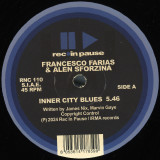
For the last years Jestofunk have not released new material and Francesco Farias has started to publish songs again on the label Rec In Pause. This first single printed on vinyl sees him in collaboration with Alen Sforzina in their personal Nu Funk version of Inner City Blues by Marvin Gaye where the echo of the Jestofunk project can be clearly heard. On the back an original piece by Farias contaminated as always by the Funky sound.
Riding a wave of critical praise and positive feedback for his most recent Emperor Machine album, the fabulous Island Boogie, Andrew Meecham returns with a typically wild and dancefloor-focused set of dubs, ‘versions’ and remixes.
According to Meecham, Island Boogie is his most personal set to date – a full-length excursion that not only delivers perfectly formed expressions of his dub-tinged, off-kilter synth-boogie sound, but also tracks that draw deeply on his earliest influences and long-held musical expressions.
It’s fitting, then, that this remix EP begins with his own sparse, stripped-back ‘version’ rework of ‘S-S-S-Single Bed’, a fine cover of the mid-80s Fox single featuring the vocals of Michelle Bee. Meecham’s dub-wise revision is a skeletal and driving affair, with snippets of echoing guitar, colourful synths and Bee’s distinctive vocalisations rising above a weighty dub disco bassline and rock-solid percussion.
It's followed by two revisions of album favourite ‘Wanna Pop With You’ from A Love From Outer Space main man Sean Johnston under his now familiar Hardway Brothers alias. Combining his own love of raw, analogue-sounding electronics and trippy dancefloor psychedelia with select elements of Meecham’s original – percussion, synth sounds, crisp guitar licks and elements of Severine Mouletin’s lead vocals, Johnston’s main ‘remix’ is a weighty, mid-tempo treat. Arguably even better is his accompanying dub, which is more groove-and-effects focused and makes more of Beecham’s superb original bassline. It’s heavy, spaced-out and undeniably intoxicating.
To round off the package, long-time friend of the label (and sometime contributor) Rose Robinson dons her Tigerbalm pseudonym and gets to work on ‘La Cassette’. Brilliantly cutting up Severine Mouletin’s vocals, she delivers a driving slab of spaced-out, synth-heavy dub disco that adds more weight and energy to Meecham’s original. It’s a fittingly on-point way to close out a superb selection of club-ready revisions.
A highly talented artist who has grown to make a notable impression amongst the scene’s most revered tastemakers, DJ/producer and label owner Jhobei is an individual who continues to blossom. His deep, expansive sound has already welcomed material on Up The Stuss, Limousine Dream, Mindhelmet and Picnic Records, amongst others, while featuring as a co-founder of London-based collective and label Bizarre Trax. In addition, his work as one-third of dynamic trio Felon5, coupled with his unique sound, has taken him from Albania’s ION Festival to Los Angeles, alongside making a handful of appearances for FUSE and its sister brands on home turf at fabric, The Cause and Village Underground - plus 2024’s Open Air event at Barking Park earlier this year. Building on that relationship, late September brings fresh music as Enzo Siragusa invites the exciting selector to make his label debut with an array of impressive productions across his ‘Age Of Virality’ EP. A-side opener ‘Swarming’ is all action and kicks things off with authority as a snaking bassline guides a garage-influenced trip through bumping low-ends and hooky vocal samples, while ‘Machine Language’ delivers a mix of playful tones amongst sweeping melodies while delivering a heavy dose of robot funk. On the flip, ‘Defusion Solution’ is a heady late-night excursion through skippy percussion and cosmic tones, with ‘Rising Sun’ stripping things back to deliver a classy, hazy journey as organic percussion grooves unravel effortlessly. Digital buyers are treated to a bonus cut in the form of ‘Kontrol Urload’, a sci-fi leaning cut merging glistening neon synth motifs with punchy kicks and zipping effects for maximum impact.
- A1: Cal Green “Revolution Rap” Part 1
- A2: Cesar Mariano And Cia “Metropole
- A3: Peter Lipa “My Album”
- A4: Stefano Torossi “Fearing Much”
- A5: Joyce “Longe Do Tempo
- A6: Cal Green “Revolution Rap” Part 2
- B1: Lorez Alexandria “Baltimore Oriole”
- B2: Willie Tee & The Gaturs “Concentrate”
- B3: Mary Lou Williams “Pale Blue”
- B4: Duke Ellington “Didjeridoo”
- B5: Ennio Morricone “Dies Irae Psichedelico”
- B6: Egberto Gismonti “Janela De Ouro”
Taken from the ultra-rare Japanese promo mix CD released in 2004 by madlib himself on his Mind Fusion label. Now on multi -coloured splater viny for the first time. Taking a selection of the best tracks, grooves and breaks from the legendary Mind Fusion Volume 2 mix CD here on vinyl for the first time ever are the entirety full length unmixed original versions. An amazing collection of extremely rare Jazz, Funk , Brazilian and Soul music from Madlibs eclectic and uber diverse record collection. The sleeve design is also a wonderful piece of contemporary art as first displayed on the Japanese mix CD now fully blown up to album cover size making this a must have for all rare art and music lovers.
Jade Hairpins waste no time fulfilling their second album's titular demand. From its harmony-drenched opening note to its baroque-anthemic conclusion, Get Me the Good Stuff is positively loaded with musical ideas, an absurdist buffet of sound and aesthetic that comes with one hell of a floorshow as the Hairpins stack those ideas higher and higher, almost daring them to crash to the floor. Instead, those elements - punksploitation, power pop, baggy, funk, and Italo disco are just some touchstones - are not only held aloft, they defy gravity and convention. These pyrotechnics are, in true Jade Hairpins fashion, something of a sleight of hand. While the music swaggers and gallops, Get Me the Good Stuff grapples with anxiety and self-doubt, obfuscating pain and alienation with sparkling wit and some straight-up ravers. Get Me the Good Stuff opens with one of those, "Let It Be Me," in which Jonah Falco shouts lyrics about being alone with one's shortcomings against guitars, synths, and harmonized vocals that are on the verge of closing in. The song is just over 90 seconds long, hitting with the gnarled-barb ferocity of punk and the gleeful insanity of theatrical art rock. It is, in other words, overwhelming. Or it would be if Jade Hairpins - Jonah Falco and Mike Haliechuk - weren't remarkably nimble in their ability to bring unity to sounds by placing them in competition against each other. When those sounds are adjacent, like the glam and disco that saturate "Drifting Superstition," the thrill of those universes colliding in the heat of an absolutely filthy clavichord line turns its lyrics, about the habit of solving personal problems by ignoring them, into a winner's anthem on the order of Bowie or Hot Chocolate. Get Me the Good Stuff arcs towards unequivocal joy as Falco, Jade Hairpins' primary lyricist, breaks these cycles and attempts to run away with his dreams. The arc is roughly analogous to how the album came to fruition. Four years removed from Harmony Avenue, an album of material that proved too strong to be contained within the narrative universe of Fucked Up's Dose Your Dreams, Jade Hairpins have gelled as a live act - with Tamsin M. Leach and Jack Goldstein centering them on stage - and planted their flag in the UK punk scene in which Falco has embedded himself. Working out new material live, Falco noticed that crowds were digging into his unfinished lyrics, and the album tightened around the anxieties of being in the spotlight, of being worthy of attention. At times, those songs are eager to please, like the album's title track in which a winking self-deprecation rubs up against the self-congratulatory bombast of Freddie Mercury, Falco simultaneously turning heads as a shooting star and a burning car. Elsewhere, as in "Better Here Than in Love," Jade Hairpins pitch themselves towards creating gorgeous soundscapes that exist nowhere else, channeling postpunk through the glimmering haze of '80s Japanese electronic music. Theatrical and personal, absurd and true-to-life, playful and serious, Get Me the Good Stuff is album of tremendous personal and artistic growth that signposts towards dozens of potential futures to come. It's not only worth the attention, it continuously rewards it.

Jade Hairpins waste no time fulfilling their second album's titular demand. From its harmony-drenched opening note to its baroque-anthemic conclusion, Get Me the Good Stuff is positively loaded with musical ideas, an absurdist buffet of sound and aesthetic that comes with one hell of a floorshow as the Hairpins stack those ideas higher and higher, almost daring them to crash to the floor. Instead, those elements_punksploitation, power pop, baggy, funk, and Italo disco are just some touchstones_are not only held aloft, they defy gravity and convention. These pyrotechnics are, in true Jade Hairpins fashion, something of a sleight of hand. While the music swaggers and gallops, Get Me the Good Stuff grapples with anxiety and self-doubt, obfuscating pain and alienation with sparkling wit and some straight-up ravers. Get Me the Good Stuff opens with one of those, "Let It Be Me," in which Jonah Falco shouts lyrics about being alone with one's shortcomings against guitars, synths, and harmonized vocals that are on the verge of closing in. The song is just over 90 seconds long, hitting with the gnarled-barb ferocity of punk and the gleeful insanity of theatrical art rock. It is, in other words, overwhelming. Or it would be if Jade Hairpins_Jonah Falco and Mike Haliechuk_weren't remarkably nimble in their ability to bring unity to sounds by placing them in competition against each other. When those sounds are adjacent, like the glam and disco that saturate "Drifting Superstition," the thrill of those universes colliding in the heat of an absolutely filthy clavichord line turns its lyrics, about the habit of solving personal problems by ignoring them, into a winner's anthem on the order of Bowie or Hot Chocolate. Get Me the Good Stuff arcs towards unequivocal joy as Falco, Jade Hairpins' primary lyricist, breaks these cycles and attempts to run away with his dreams. The arc is roughly analogous to how the album came to fruition. Four years removed from Harmony Avenue, an album of material that proved too strong to be contained within the narrative universe of Fucked Up's Dose Your Dreams, Jade Hairpins have gelled as a live act_with Tamsin M. Leach and Jack Goldstein centering them on stage_and planted their flag in the UK punk scene in which Falco has embedded himself. Working out new material live, Falco noticed that crowds were digging into his unfinished lyrics, and the album tightened around the anxieties of being in the spotlight, of being worthy of attention. At times, those songs are eager to please, like the album's title track in which a winking self-deprecation rubs up against the self-congratulatory bombast of Freddie Mercury, Falco simultaneously turning heads as a shooting star and a burning car. Elsewhere, as in "Better Here Than in Love," Jade Hairpins pitch themselves towards creating gorgeous soundscapes that exist nowhere else, channeling postpunk through the glimmering haze of '80s Japanese electronic music. Theatrical and personal, absurd and true-to-life, playful and serious, Get Me the Good Stuff is album of tremendous personal and artistic growth that signposts towards dozens of potential futures to come. It's not only worth the attention, it continuously rewards it.

- A1: Juan Piña Y Sus Muchachos - Toquen Cumbia
- A2: Los Corraleros De Majagual - La Pollera Colorá
- A3: Aníbal Velásquez Y Su Conjunto - La Negra Celina
- A4: Cumbia Cipote Vaina - Soledad
- A5: Calixto Ochoa Y Su Conjunto - Recordando El Pasado
- A6: Lucho Campillo Y Su Conjunto - Me Dejaste Solo
- B1: La Sonora Del Caribe - Gaita Colombiana
- B2: El Sexteto Miramar - Cumbiamba
- B3: Pello Torres Y Sus Diablos Del Ritmo - Lucy
- B4: Combo Los Galleros - Suena La Timba
- B5: Los Guacharacos - Baila Rosita
- B6: Combo Sampuesano - Cumbia Monterian
- C1: Conjunto Típico Vallenato - Cumbia Sampuesna
- C2: Pedro Laza Y Sus Pelayeros - Esperma Y Ro
- C3: Andrés Landero Y Su Conjunto - La Pollera Rosada
- C4: Los Golden Boys - Se Trabó La Banda
- C5: Orquesta Nuñez - La Samaria
- C6: Los Candelosos - Cumbia De Amores
- D1: Morgan Blanco Y Su Conjunto - Cumbia De Colombia
- D2: Pacho Galán Y Sus Sabaneros - Caracoleando
- D3: Los Gavilanes De La Costa - Lorenza
- D4: Las Estrellas De Tolú - Cumbia Al Amanecer
- D5: Los Warahuaco - El Pescador De Barú
- D6: Rodolfo Aicardi Y Su Tipica Ra7 - La Colegiala
A selection of 24 Colombian cumbia bangers for the dance floor from the deep vaults of Discos Fuentes, the most emblematic and best remembered label in the golden age of the genre. An invitation to enjoy and be amazed, above and beyond ethnographic and academic concerns. Double LP. The historical origins of cumbia in Colombia are nebulous and imprecise. The mythology surrounding it suggests an ancient past when Amerindian, African and European musical sounds were mixed together. The main record companies in Colombia such as Discos Fuentes, Discos Tropical, Sonolux, Zeida-Codiscos, Silver, Ondina, Discos Atlantic, Vergara and Curro were created between Barranquilla, Medellín, Cartagena and Bogotá from 1936 to 1954. All of them, without exception, recorded Colombian tropical music that over the years was given different names such as porro, gaita, fandango, paseaito, merecumbé, mapalé, bullerengue or, of course, cumbia. This first volume in the series “Cumbia Cumbia Cumbia!!!” comprises 24 Colombian cumbia bangers for the dance floor from the deep vaults of Discos Fuentes, the most emblematic and best remembered label in the golden age of the genre. This is complemented by a selection of cumbias recorded by the label Discos Tropical, which sold most of its catalog to Discos Fuentes in 1990. Discos Fuentes concentrated on recording cumbias played on the accordion and by orchestras and ensembles. The label produced a prodigious number of albums devoted to cumbias between 1962 and 1979, which served to define ambiguous stereotypes, rooted as much in authenticity and modernity as in demure sensuality and joyful nostalgia. “Cumbia Cumbia Cumbia!!!” combines well-known classics and rarities that are difficult to find in their original formats. An invitation to enjoy and be amazed, above and beyond ethnographic and academic concerns.
On Chastity’s upcoming, self-titled fourth record, Williams decided to write a fully non-fiction work. Out Friday, September 13 2024 on Deathwish (US), Dine Alone (Canada), and Big Scary Monsters (UK/E) ‘Chastity’ is a 13-track record about the things that have always run through the band’s records—struggle, death, despair, redemption, darkness, and light—but this time, the songs ascend to new depths of intensity and desperation, new heights of resolution and power. “It’s really about the first nosedive that I did as a young person,” says Williams. “It’s a record about struggle, about the missing years. It’s also a thank you to some people in my life.” The record hurtles through melodic hardcore, shoegaze, and emo, all magnificently and enormously rendered thanks to slick work from John Paul Peters (Propagandhi, Comeback Kid), who engineered and mixed the record. Chastity’s first three full-length records—2018’s Death Lust, 2019’s Home Made Satan, and 2022’s Suffer Summer—formed a trilogy that defined a 4-year arc of the band’s contribution to outsider music. Each record was informed by Williams’ life, but each was also conceptual and interpretive, refracting his experiences through a level of remove. On the self-titled record there’s a beautiful and affirming ending to it’s closer, centered on the band’s first and enduring idea: life is less shitty if we live it together.
2x12"[32,73 €]
The Balcony (10 year anniversary) - Debut and breakthrough record The Balcony has become a career-defining album for Catfish and the Bottlemen, with Double Platinum status and 9 BPI Certified Singles including ‘Cocoon’ and ‘Kathleen’, it was originally released through Communion/Island Records on 15th September 2014. Written by Van McCann and produced by Jim Abbiss, the collection of songs on this album showcase McCann’s talent for posing everyday, easily identifiable observations through his lyrics. The album’s success and the many sold out shows resulted in a Brit Award for British Breakthrough Act. The expanded album will be available on a collector’s 7” boxset, a beautiful black slipcase housing 7 discs, each with original artwork, and a tracklist that includes the full The Balcony album plus bonus tracks ‘Hourglass (Ewan McGregor Version)’ and ‘ASA’ This boxset will be numbered and limited to 2,000 copies worldwide. LTD 2LP - In celebration of the 10 Year Anniversary and after their biggest headline shows to date this Summer, The Balcony will be released on limited edition ultra-clear 2LP with inverted white artwork and 6 bonus tracks including a selection of previously unreleased acoustic versions of ‘Cocoon’, ‘Kathleen’ and ‘Pacifier’, ‘Rango’ (single version), ‘Hourglass’ (Ewan McGregor version) and rare bonus track ‘ASA’ available on a vinyl 12” for the first time after the original pressing of the limited edition 7” single 10 years ago.1CD - In celebration of the 10 Year Anniversary and after their biggest headline shows to date this Summer, The Balcony will be released on limited edition 1CD with inverted white artwork. This CD features the full album, plus a selection of previously unreleased acoustic versions of ‘Cocoon’, ‘Kathleen’ and ‘Pacifier’, ‘Rango’ (single version), ‘Hourglass’ (Ewan McGregor version) and rare bonus track ‘ASA’ available on CD for the first time after the original pressing of the limited edition 7” single 10 years ago.
By 1963, great Latin American artists such as Lucho Gatica, Felipe Pirela, Bienvenido Granda, Leo Marini, Benny Moré, Tito Rodríguez, Toña La Negra, Blanca Rosa Gil and the so- called queen of boleros, Olga Guillot, had enriched the musical landscape, giving personality to the bolero. That year, in the midst of a new panorama, a bolero star was born from the depths of Venezuelan radio: Estelita Del Llano. “Sensual”, her debut album, is one of the greatest gems of the genre, with arrangements and orchestration by Porfi Jiménez. The backing of the Porfi Jiménez Orchestra and his arrangements made “Sensual” one of the most successful albums of its time. The selection of the twelve songs on the album was also a success. Although the years of the bolero's greatest splendor seemed to have passed, the bolero continued to spread throughout Latin America. The great success of “Sensual” lay in the arrangements and the choice of boleros with elements of the cha-cha-cha, another genre that was enjoying great popularity.
Nach zwölf Jahren reich an Instrumental-Alben (von zwei Solo-Piano-Platten über Kammermusik bis hin zu gemeinsamen Alben mit Boys Noize, Jarvis Cocker und Plastikman und sogar einem Weihnachts-Bestseller) hat Chilly Gonzales sich eine Menge von der Seele zu schreiben. Die Notizbücher, die seit dem 2011 erschienenen orchestralen Rap-Opus 'The Unspeakable Chilly Gonzales' leer blieben, füllten sich seit Anfang 2022 wieder mit Worten, nachdem Gonzo ein langes Jahrzehnt der Psychoanalyse beendet hatte. Ein Zufall? Wohl kaum. Hinter all den Wortspielen und dem Namedropping (u.a. Ron Jeremy, Marie Kondo, Dschingis Khan und Philip Glass) offenbaren die Songs, die es auf das neue Album 'Gonzo' geschafft haben, eine anhaltende Spannung zwischen Überzeugung und Bekenntnis, Wahn und Selbsterkenntnis und schließlich Dankbarkeit. Auch das Spannungsfeld zwischen Kreativität und Kommerz ist für Gonzo ein Thema, das ihn schon lange beschäftigt. Ist dies wirklich ein Rap-Album? Instrumentalstücke wie das strawinsky-eske 'Fidelio' oder das tränenreiche 'Eau de Cologne' erinnern den Hörer an Gonzos selbsterklärte Rolle als 'musical genius', während sich die Worte und Reime der vorangegangenen Strophen im Ohr festsetzen.
Rotes 180g-Vinyl mit einem Einleger mit Artwork auf der einen Seite und einer Kurzgeschichte (auf Englisch) von Christian Kracht auf der anderen Seite