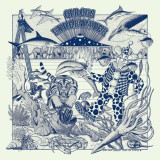
Blue Dolphin was a wild, iridescent punk band from Austin, Texas circa 2016. Over the course of a year, they created a buzzing, liberatory sound, a dark blood mix of melodic ease and existential gloom. This pairing suggests monuments like ’Peace?’ or ‘Is This Real?’ but Blue Dolphin found this path all on their own, through trust and reliance, that practice space unity that the best bands build simply through the joy of playing with each other.
Emboldened by this connection, the band birthed memorably fractured, brisk music full of daring and revelation.
At times, the songs barrel along as if the band is struggling to keep their instruments under control, an unrestrainable, breathless frenzy of notes. Other times, they take on a pensive ache, a weighted despair. Every time they form a perfect skeleton for Sarah Sissy’s vocal shove. The songs will squall and sway, reach overload, rattle half to death, and yet the moment Sissy begins singing they snap into a focused beam, a bulldozing, clear-eyed force.
‘Robert’s Lafitte’ is a rush of darkness, resilience, mystery and bliss, exactly what you’d want from a record named after Texas’s oldest running gay bar, and a band maybe named after the indescribable freedom of ocean life or maybe named after a type of ecstasy.
The LP contains the entire recorded output of Blue Dolphin, including all three self-released tapes and four previously unheard songs.
Members of Blue Dolphin have played in other bands like C.C.T.V., Chalk, Mystic Inane, Chronophage and NOSFERATU.
For fans of Silver Abuse, Chalk, Twelve Cubic Feet, Chronophage, C.C.T.V., Mystic Inane.
Includes poster / insert.
Suche:self self
C-50 Cassette Tape. 100 Copies only.
dispari introduces you to Hanoi-based Vietnamese artist Trần Uy Đức. Carried by large curiosity, urgency and delight, their sonic expression can be grasped as a self-exploration which is touchingly intimate, fragile, rebellious and cociliating. In their own words:
„It's my desire to escape into this person I don't know.
Die, orphaned kite flutes.
Watch me escape the orphaned kite flutes.
If you beat it up many times.
Don’t, don't, he predict thunder.
Who asked me tonight to explain one, two, two miracles.
Same problem.
C-c-c-fuck
I'm singing for my body.“
Trần Uy Đức
Farewell To The Welfare is now available in a limited edition teal vinyl pressing. The Tribe Records co-founder’s lost album, rumored to exist no more. Mastered from the original tapes and lacquered by Bernie Grundman. “As I thought about reflecting on an aggregate of music for this album, I projected my attitude and spirit while living and working here, in Detroit, Michigan. We are earning and learning a new way of life, which explicitly tells us to become self-reliant in taking care of our families and each other. Government hand-outs are not an option for us.” Wendell Harrison. The first ever issue of this Spiritual Jazz album. The Tribe label, one of the brightest lights of America’s 1970s jazz underground, receives the Now-Again reissue treatment. This is your chance to indulge in the music and story of one of the most meaningful, local movements of the 20th Century Black American experience, one that expanded outwards towards the cosmos. In the words of the collective themselves, “Music is the healing force of the universe.” Included in an extensive, oversized booklet, Larry Gabriel and Jeff “Chairman” Mao take us through the history of the Tribe, in a compelling story that delves not just into the history of the label and its principals, but into the story of Black American empowerment in the latter half of the 20th Century. The booklet features never-before-seen archival photos and rare ephemera from Tribe’s mid-1970s heyday.
The last decade has seen a seismic shift in how people buy and play music, vinyl has returned to being the dominant physical format with CDs consigned to second fiddle. Things were very different back in 2012 when we compiled and released the eponymous "Cool Runnings" on CD only. The vinyl revival is a belated opportunity to give the band their first long playing record to complement that earlier CD release. Together for a dozen years, Cool Runnings were one of Bristol's longest lasting bands gigging throughout the 1980s, though their failure to gig beyond the West Country meant they were also one of the City's best kept musical secrets. Originally formed in Weston-Super-Mare by Keyboardist Mark Tuck and Guitarist George Condover, they immediately relocated to Bristol and recruited various local musicians including an experienced and talented singer, Winston Minott. Although "Robin Hoods of The Ghetto" was their solitary release, the band regularly recorded material throughout their career and fortunately thanks to the foresight of George and Mark in holding onto various master tapes, Bristol Archive Records were able to release the band's self-titled debut album "Cool Runnings" in 2012. For this vinyl release we've selected eight tracks recorded between 1983 and 1985 at various local studios, and a solitary live track to give an idea of why the band were so popular in person. Although their music leans towards the more mellow end of the market, Lovers Rock, music ideally suited to Winston's soulful voice, the band were more than capable of writing good roots tunes including the excellent "We Must Go Home", "Children of Zion" and "Robin Hoods of The Ghetto". Winston Minott had spent many years touring all over Europe with soul band The Invaders and many songs showcase his vocal talent, but a particular highlight has to be "Playhouse" an alternative recording of which can be found on "The Bristol Reggae Explosion Volume 3". Perhaps proper management would have seen Cool Runnings achieve the success and wider exposure that their combined talents and unique take on reggae undoubtedly deserved. Now thirty years after the members went their separate ways, Bristol Archive Records are pleased to finally release the vinyl album that if things had worked out differently should have appeared in the 1980s
Portland-based Kevin Palmer returns to blundar with his Best Available Technology for another release (having previously been featured on cassette). This time it’s on vinyl but still messing about with the same business of constructing and deconstructing head-nodding beats into a foggy bowl of ambience that has become the trademark sound of BAT.
Initially inspired and influenced by the sound-worlds created by Hank Shocklee, BDP and KDAY, Palmer spent his formative years combing pawn shops for samplers. This kicked off his self-described obsessive compulsive work crunching out impossibly naive and obviously unschooled jams in what might have been and continues to be an attempt to capture and document something he felt when listening to the bombastic sonic collages of early hip hop.
Going backwards in order to go forward could be an apt mantra to describe the philosophy behind BAT. Often attached with labels like nostalgia and melancholy, Palmer surely deals with the longing for that perfect time capsule of N.Y. hip hop in the 90s - but where others zoning in on that era simply imitate it, Palmer goes way further into a world of his own making.
Far removed in both time and place to the outskirts of Portland, the sonics of Palmer filters through an outsider’s perspective, sometimes offering a personal journal of the here and now via field recordings from skateparks and surfing trips.
As if one would imagine looking slightly to the left of what was supposedly going on, these tracks continuously shift one's focus. That funky feel good beat is there, but almost always just out of grasp. Palmer gives us the sound of a memory slipping away.
Yet this reads not as the end of something, but rather a stepping stone into a world of possibilities. Operating at the outskirts of genre, you could imagine anything from dub, hip hop, ambient or techno to emerge and crystalize from the haze, yet it never does. This is all those things and nothing. Or maybe it’s just some “sad fucked up funk” as Palmer puts it.
Now Available In A Limited Edition Red Vinyl Pressing. Ayalew Mesfin stands aside the likes of Mulatu Astake, Mahmoud Ahmed, Hailu Mergia and Alemayehu Eshete as a legend of 1970s Ethiopia. Mesfin’s music is some of the funkiest to arise from this unconquerable East African nation. Mesfin’s recording career, captured in nearly two dozen 7” singles and numerous reel-to-reel tapes, shows the strata of the most fertile decade in Ethiopia’s 20th century recording industry, when records were pressed constantly by both independent upstarts and corporate behemoths, even if they were only distributed within the confines of this East African nation. Though Mesfin was forced underground by the Derg regime that took control of Ethiopia in 1974, he has returned almost 50 years later with this triumphant set albums – the first time that his music has been presented in this form. These albums give us a chance to discover a rare and beautiful moment in music history, in anthologies built from Mesfin’s uber-rare 7” single releases and from previously unreleased recordings taken from master tapes. Mot Aykerim gives us a chance to discover a rare & beautiful moment in music history, in an anthology built from his uber-rare 7” single releases. Contains an oversized 11” x 11” 16 page book that tells the story of modern Ethiopian music and Mesfin’s role within it.
Proper full-length outing from Naarm quartet and venerable live show Polito! Though prior associations with Butter Sessions have birthed EP's and compilation appearances, Collapse Phase gathers the most cohesive body of work from the group to date. Self-described as "a meeting of improvised contemporary dance and live improvised techno music, working together to create entrancing performance experiences", the project translates impressively to the long-player format. Holding no pretence with its title, opening cut 'Chuggalug' swirls around the stereo field building upon sustained synth warbles with low-key basslines and breaks propelling the track. As the album progresses from the chug into gridlocked, Mills-ian loops and fast, extra-terrestrial sound design (all swinging 909s + decay), we're also treated to contrasting downtempo acid cuts and dubwise, day-time festival vibes ('Fortune Teller'). 'Nine Lines' layers various patterns in a classy exercise of dancefloor tension building, with an undoubtedly in-the-moment feeling evidencing Polito's live show foundations. Across the board the group showcase their mastering of a kind of addition/subtraction push and pull, but the varying influences in sound design provide an extra layer of depth to the whole thing and cement the Polito brand. On both 'Inside The Sphere' and 'The Sphere Is Collapsing', the dreamier, more reflective edges of 90s IDM are given a nod and these two strike as up there with the best on the album. Head for 'Mercado Waltz' for a super interesting fusion of loopy techno and modular dubstep.
Polito is a collaboration between musicians Robert Downie and Finnian Langham, and dancers Arabella Frahn-Starkie and Hillary Goldsmith.
"If you can imagine a love child between MAC DEMARCO and SPAR-KLEHORSE, then this would be what you're left with." - SO YOUNG MAGA-ZINE
Raised in North Queensland, Australia, Jarrod Mahon is not one to shy away from bold new endeavors. Once parting ways with his previous record label in 2019, Mahon chose to go fully independent, relocating to Berlin in 2019 (where he still resides), despite having no contacts at all in the country. What’s more, having recorded/performed under the pseudonym Emerson Snowe for over a decade - during which time he home-recorded five albums and 13 EP’s, toured with the likes of King Krule or Ariel Pink, played showcases SXSW and the Great Escape, the works - Mahon took that brave, most uncommercial decision to release under his own name and start almost totally anew.
“There was never really a concept to that name Emerson Snowe other than having some kind of separation from who I was as a person,” Mahon explains, “using a moniker gave me that confidence to push myself further mentally and to give myself some kind of a freedom”. And through the process of creating what would become his debut album, Mahon saw that he had outgrown the need for this protective persona. ‘Everything Has A Life’ was meant to be the debut Snowe album”, he admits, “but after I finished mixing it with Syd Kemp, co-producer I realized that I had actually grown a lot and was much more comfort-able with who I am and what my personal beliefs are.”
The choice of ‘Everything Has A Life’ as the album title, pulled from beauteous opening track ‘All I Know’, neatly summarizes this new outlook: moving on from ‘self-pity’ of the past-self by becoming present for the loved ones around you, improving understanding of one’s own self, via the wider world at large.
That track marks the first written during a lockdown stint in LA where Mahon wrote and recorded every day for 2 months, produced nigh on 250 demos and birthed the bulk of the record. It also brought Mahon back to his all-time favorite, Sufjan Stevens’ Ilinois and its blend of widescreen orchestral landscapes and more candid, naked acoustic-leaning variations - an important influence for the album's stylistic contrasts. Another key inspiration for the record too brought Mahon back to his roots - those full-bloom strains of his Mum’s Beloved Neil Diamond, an annual Christmas irritant to Mahon as a child, yet an artist he’s come to respect in adulthood. “Whatever the reason, with age I came to love the big show band sounds,” he says, “the idea of a performer on stage with a mas-sive orchestra with strings was amazing to me.”
With the help of producer Syd Kemp (Ulrika Spacek, Vanishing Twin), such grand designs could be met. - “When we first met, he asked me if I would like real strings on it. I said of course.” Enter Magda Mclean on violin (Caroline/the Umlauts), and Gamaliel Rendle Traynor on Cello (Sweat, Fat White Family), whose strings helped lift the record to romantic new heights.
He continues: “I said to Syd that the only thing I wanted to achieve with this rec-ord was that I wanted it to make me cry at one point. And we got there eventual-ly.” The final culmination of all these strands, ’Everything Has A Life’ is indeed a treasure trove of emotive riches. Locking into that bittersweet, quintessentially ‘pop’ combination of triumphant rhythms and confessional, stream-of-consciousness lyrics plucked straight from the heart, Mahon faces up to years of substance abuse with a series of gorgeous, blushing melodies: “I was using, I was drinking, I was lying to my friends, I was messing up again, I was hiding from myself”, he joyously chants on ‘The Growing’.
A banquet fit for an indie king, Everything Has A Life is loaded with psych-pop lusciousness (‘All I Know’) and anthemic glam fuzz (‘Death Of The Ladies Man’, ‘Deadstar’, or ‘Sonny is my Best Friend’); recalling that foundational Sufjan Ste-vens influence too with shambling flecks of country (‘Charly (Romantic Heart)’). There’s also those lo-fi crepitations of ‘My Man’ and ‘I can’t’ harking back home-recorded demos that lie at the core of Mahon’s creative process.
Ils Veulent Nous Tuer is Bérurier Noir's 3rd maxi 45tours, the title of which is borrowed from the slogan of a banner unfurled by the mutineers from the roof of Fresnes prison. It was an apt title for the group, too, since at the time of its release, the political and police authorities decided to destabilise them by associating them with the Black War activists and arresting many of the Bérus' entourage.
It's a dark album, with hard-hitting lyrics rooted in the social reality of the time (1988) and tackling subjects as diverse as the problems of access to food for the precarious (On A Faim !), prison repression (Sur Les Toits), the excesses of marginal youth (Mineurs En Danger) and the omnipresence of the military and police in our daily lives (Et Hop !). The album compo
--
The band's name alone evokes the epic of alternative rock: rebellious and committed.
Born by mistake on a February evening in 1983, Bérurier Noir soon found themselves the driving force behind a vast "Mouv'ment d'la Jeunesse", determined to take control of their lives in the face of a society that was ultra-conservative at the time. Times have hardly changed.
From their first self-produced records distributed by hand to the creation of self-managed labels, from concerts in squats and wild appearances at demonstrations, on the street or in the metro to endless tours, from interviews given to fanzines and free radio stations to unclassifiable appearances in the mainstream media, Bérurier Noir waged the most exciting war of independence in the history of French rock, with just a microphone, a guitar, a drum machine, a few red noses and patched-up theatre masks.
François, Loran and their 'Troupeau d'Rock' gave the last finger to this turbulent, irredeemable raia, committing hara-kiri at the height of their glory, during three final concerts in the heart of Paris in November 1989.
Forty years after its birth, Bérurier Noir's work continues to resonate, whether at demonstrations or free parties, fuelling the hopes of all those who wish to turn this world upside down and build a truly libertarian society based on solidarity and brotherhood.
For those who missed this unprecedented adventure, the Archives de la Zone Mondiale label is bringing you 8 recordings by Bérurier Noir in the form of limited-edition reissues on highly original colour vinyl ("crown" finish), distributed throughout the year.
BOTANICA is the newly established Japanese label created by DJ/ Producer, Iori Wakasa. It was formed for him to utilize it as a foundation for the realization of his own unique, artistic expression.
And now, he has the pleasure to announce his label’s inaugural title with the release of his own BOTANICA EP.
Born in 1988 in a rural Japanese city surrounded by mountains and the sea with a mild climate, Iori grew up playing RPGs with a father who was a devoted game aficionado. And he was introduced to electronic music through game music from an early age and formed his musical sensibilities through playing the classical piano around the same time.
Influenced by the spirituality and idiosyncrasies of punk rock and ethnic and indigenous music in his youth, also gradually influenced by the Tokyo club scene and the music, it didn't take him long before
he made the choice to start DJing at the age of 17 and soon afterwards, started exploring the path of music production as a form of self-expression.
Iori set up Botanica to convey 2 main concepts of 'presenting music that provides each listener with their own viewpoint' and ‘to construct a fusion between 'nature' and 'man-made objects and human
activity’. Through the experience of traveling around Japan, Europe and Asia and connecting with people of different languages and cultures, he became to appreciate that music transcends all languages and grooves, and the framework in which he would like to shape his perspective and embody it as his way of life is what he envisions as the vital expression for BOTANICA, The two tracks and the artwork included in this first EP are the first steps towards hopefully chronicling the story of the vortex that he resides in now and the new forest that he plans to weave in the future with his label.
'The Pure Land' means in Japanese 'Gokuraku-Jodo (= a space where you can live in bliss)', but in English it is closer to 'utopia' or 'paradise'. However, 'The Pure Land' is a musical work that evokes a
hypnotic and pleasant euphoria through the gradual layering of multiple rhythms and soft particles of spatial sound design. It is also shaped with the aim of liberating the listener and guiding them towards their primal self.
In contrast, 'Lunar Down' expresses the changes that occur in the human state of mind during the extended period from moonrise to moonset especially when the moon sets from its zenith and is completed with a focus on maximum dance floor impact via an inner voice that resonates in the brain that echoes throughout a well-textured bass line and rhythm track.
The artwork for the front cover of this EP was created by SHINOZAKI HILOSHI, an illustrator who has been traveling and painting to express his true way of life that he learnt in the 10+ years of commuting between Tokyo (the end) and the Hawaii Islands (the beginning), and the graphic designer hiro, who stands by Iori`s side as his life partner and as the person who understands him the best. Iori`s first steps are complemented by the label design and art direction by graphic designer hiro, who stands by his side as his life partner and most understanding partner, and the proof is the physical cut, which is presented as the foundation for the future.
- A1: Pigs
- A2: How I Could Just Kill A Man
- A3: Hand On The Pump
- A4: Hole In The Head
- A5: Ultraviolet Dreams
- A6: Light Another
- A7: The Phuncky Feel One
- A8: Break It Up
- B1: Real Estate
- B2: Stoned Is The Way Of The Walk
- B3: Psycobetabuckdown
- B4: Something For The Blunted
- B5: Latin Lingo
- B6: The Funny Cypress Hill Shit
- B7: Tres Equis
- B8: Born To Get Busy
Cypress Hill’s self-titled debut album was hard as nails, with very few pop concessions. There was humor, but it was laced by cackling, homicidal sneering. Not well known outside of the hardcore hip-hop scene at first, faces of the three group members weren’t usually shown clearly in press photos; they preferred the shadows. As their first singles began hitting the airwaves and record racks, the press and music fans started to take notice.
From the opening notes of the group’s first single, “The Phuncky Feel One,” to deeper album cuts like “Stoned Is The Way Of The Walk” and “Tres Equis,” it was clear that Cypress Hill was something different. And very, very dope. The world Cypress Hill espoused was gang-ridden and far from cheery, but they managed to laugh through the pain. Lead rapper B-Real took each fuzzed-out, rock-hard DJ Muggs beat as a challenge, jumping around it like a spark off a joint as it makes its way to the concrete. MC Sen Dog always had B-Real’s back, to bring intensity and a no-bullshit gruffness that made the group both menacing and unpredictable.
When they introduced percussionist Eric Bobo to the mix in the early 90s, it brought new dimension to the band, making their live performances one of the most unique and accomplished shows in hip-hop. Journalist and author Chris Faraone highlights the group’s relationship in the reissue’s liner notes (which is included only in limited edition Skull) saying, “By the late ‘80s the undisputed Cypress unit finally formed. B and Sen realized that their diametric styles - the latter’s deep wrangle, the former’s inimitable high notes - complemented one another righteously. By then Muggs had bangers in the bag, as well as industry experience from a jaunt with the New York duo 7A3. B and Sen waited while Muggs messed with 7A3, and in that time began to build the blueprint for their raucous and weeded no-holds-barred style. Besides getting schooled on industry pitfalls, Muggs had also grown into hip-hop’s most formidable young producer, while straddling the bi-coastal gap.”
Cypress Hill’s debut went gold by the end of 1991 and has since pushed past double platinum status, making it the first album for a Latino-American hip hop group to do so. The album received raves from the likes of Rolling Stone and the Los Angeles Times, saw a #1 Hot Rap Single with the release of “The Phuncky One” and helped the band win Artist Of The Year at the 1992 Source Awards. After 25 years, it should come as no surprise that Cypress Hill is a cornerstone of the group’s live set to this day.
In the late '70s, The Avengers established themselves as one of the US's preeminent punk bands. Fusing incisive guitar hooks, explosive rhythms and adolescent venom, the group forged some of the most in-your-face songs of the era. Their live shows were legendary, playing up and down the West Coast and even blowing Sex Pistols off the stage at the latter's final performance.
As Byron Coley writes in the liner notes, "Of the best bands of San Francisco's first wave in 1977, The Avengers were by far the coolest and youngest sounding. They roared without irony, as though this were indeed Year Zero (and, for a moment, it was) with history being overwritten by the new. The honesty of their belief was carried by their sound. And it was convincing!"
Originally released in 1983, four years after the band's dissolution, The Avengers' self-titled LP is often referred to as "The Pink Album" for its magenta-hued cover design. Frontwoman Penelope Houston's iconic voice and razor-sharp lyrics resonate on anthems "We Are The One" and "The American In Me," while penetrating ballads like "Corpus Christi" reveal a truly out-of-body euphony.
The Pink Album remains The Avengers' definitive statement - collecting their classic Dangerhouse EP, sessions recorded with the Pistols' Steve Jones and a half-dozen revelatory demos. While much has been written about The Avengers in the past three decades, rock critic Greil Marcus puts it succinctly, "The word I always come back to is mystical, and that remains almost theirs alone."
1970, Ethel Agee, a local self-taught musician, and her two brothers Rev. Dorosco Scarber and Preston Scarber hit the studio and recorded Ethel's original composition 'Traveling Home", a gospel piece that has remained under the radar until very recently . Ethel's on piano playing as her and her brothers' vocals soar above rock solid chugging funk drums, way ahead of their time.
- Venice 100720, Hands In Soil
- Mighty Stillness
- Love Dedication (For Annelise
- Flutestargate
- Maha Rose North 102021, Breathwork
- Transcendental Bounce, Run To It
- Taaaud
- Spacial
- Am I Dreaming?
- Etheric Windsurfing, Flips And Twirls
- Boom Bap Spiritual
- Woo, Acknowledgement
- Sandra's Willows
- One For Derf
- Conversations
- Essence, The Mermaids Call
- Eightspace 082222
black 2x12"[27,94 €]
An evolved, ecosystemic love expression of Carlos Niño"s self-described "Spiritual, Improvisational, Space, Collage" expression - (I"m just) Chillin", on Fire is the prolific percussionist/producer"s most singular, intentional work ever, featuring a vibrant and abundant gathering of his "friends" (i.e. the highly skilled and accomplished musicians and improvisers that make up Niño"s extensive network of collaborators)
- A1: Can I Talk My Shit?
- A2: Carpenter
- A3: You Know How
- A4: Lexicon
- A5: Passing Me By
- A6: Autobahn
- B1: Nothing To Lose
- B2: It’s A Crisis
- B3: Do Your Worst
- B4: Interlude
- B5: Made Out With Your Best Friend
- B6: Anti-Fuck
Nonesuch releases Sorry I Haven’t Called, the new album by Vagabon, the moniker of Lætitia Tamko. Co-produced by Tamko and Rostam (Vampire Weekend, Haim, Clairo), it finds Tamko reinventing herself once again and features the most playful and adventurous music of her career, as evidenced by its lead track and opening song ‘Can I Talk My Shit?’. Vagabon has also announced an autumn tour that includes a headline run in the US, as well as European dates with Weyes Blood.
“I didn’t feel like being introspective,” says Tamko of her new album. “I just wanted to have fun.” Following her intimate 2017 debut Infinite Worlds, the New York artist favoured expansive and evocative electronic textures in her breakthrough 2019 self-titled follow-up. But her latest album feels like a wholly new era for Tamko, one that’s transformational and uncompromising. Across 12 vibrant tracks she wrote and produced primarily in Germany, she channels dance music and effervescent pop through her own confident sensibilities. These conversational songs are alive and unselfconscious, a document of an artist fully embracing her vision and reclaiming her joy.
The first words she sings on the album are, “Can I talk my shit? / I got way too high for this.” It’s a statement of purpose for the rest of the album that this is an unapologetic artist. “This whole record is how I talk to my friends and how to talk to my lovers,” says Tamko. “I think honesty and conversational songwriting can become poetry. There’s beauty in plainly speaking without metaphors and without flowery imagery.”
The story of Sorry I Haven’t Called started in grief after Tamko’s best friend died in 2021. This devastating and unexpected loss unmoored Tamko but also gave her a newfound clarity. “The things that I thought I cared about, I no longer cared about,” she says. “I had a realization that I need to make sure to feel everything that comes my way.” She decided to sell her things and move to a small lakeside village a few hours north of Hamburg in northern Germany to process everything. “There's no linear path to grief, and everyone handles it differently, but uprooting my life just felt like exactly what I had to do,” says Tamko. “I needed a place to think and go through my discomfort privately but to also explore the newness and urgency I was feeling in my life.” In the village, her phone didn’t work and there were no close grocery stores or restaurants, so she spent her time alone working on music.
Despite the palpable absence in her life, her new songs were her most disarming and ebullient yet. The first one she wrote was ‘Carpenter’, a mesmerizing track anchored by a tangible bass groove, where she sings, “I wasn’t ready to move on out / but I'm more ready now.” It’s a fully-realised track and feels like the culmination of her catalogue so far. “A lot of the music that I was making there had nothing to do with my grief at all,” says Tamko. “Once I gave myself permission to make a record that's full of life and energy, I realized that’s the point of this album. In the midst of going through all of these tough things, it became a record because of the vitality that these songs had.” For Tamko, there’s power in pursuing happiness.
While writing in Germany, Tamko nurtured her love for dance music and let it seep into her new songs. “The only things that were giving me access to a feeling were dance music and going to a rave in an extremely dark club where if I wanted to cry, I could do it and be around other people,” she says.
After a few months in Germany that included marathon writing sessions and a whirlwind romance, Tamko decided to stay with friends in Los Angeles and finish her record. She enlisted co-producer Rostam to help her unify her vision.
Sorry I Haven’t Called is a warm and resilient album about embracing the ecstatic moments wherever you can by knowing how you love and how you mourn. It’s an album born of both communal dancefloor revelations and the clarifying peace from solitude, an emotional rebirth as well as an artistic one. “This record feels like what I've been working towards,” says Tamko. “When I think of this album, I think of playfulness. It's completely euphoric. It's because things were dark that this record is so full of life and energy. It’s a reaction to what I was experiencing at the time, not a document of it.”
Memory is malleable. The day you met the person you love, what color shirt was she wearing? At precisely what angle did the sunlight strike his face? How exactly did they glow? These little details are precious, but the strange thing is, the more you cherish them, the more they change. Each recollection is another potential touch point where stories can shift—each replay degrades the truth. Reality's rough edges smooth, with time. Objectivity is a myth: cameras and recording devices all contort image and sound. There's no way to know exactly how things were. And yet we still tell the stories, to try to capture how things felt, even though the truth is always slipping through our fingers.
Lemon Quartet's second albumArts Festseems to unconsciously circle this thematic territory. Full of loose, yet lush repetition, it seems to function like memory—each dizzy melody recalling and rewriting what came before, subtly shaping each piece as time passes. Not that they seem especially concerned with the passage of time anyway. They space out, they work in the realm of feelings, scribbling melodious abstractions that feel familiar. Rich with compassion, harmony, and gestures toward ecstatic—if not objective—truth, it's full of the sort of pieces that demand you return to them, but sound a bit different each time, new details overtaking familiar comforts. Are you hearing them for the first time? Or just for the first time in a long time? Either way, drift away, and try to remember…
Adrian Borland and Graham Bailey might be better known as members of legendary post-punk group The Sound, but the two were childhood friends and had been playing together even earlier in The Outsiders, and continued their deep musical rapport as a duo, creating these intense and engaging songs as Second Layer at the same time as their higher profile band output. Following our release of Courts Or Wars, combining their early material, we are proud to reissue their only full length album, World Of Rubber.
Fueled by experimentation in both song construction and recording techniques, the duo leave you enveloped in what The Quietus described as, “a monochrome worldview morbidly obsessed with the dehumanizing effect of war, nuclear weapon annihilation, and the fracturing and negation of the self within an increasingly distorted and technologically mediated society.” Indeed, the goal had been to make each album a concept album, with this to be titled: Second Layer’s World Of Rubber. Alas, this was to be the first and last of those efforts. New detailed liner notes from Graham Bailey shed considerable light on the creation of this cold classic and its immediate aftermath.
Bailey’s inventive construction and deconstruction of various electronics, effects boxes and tape loops form the propulsive base for these songs. Borland’s guitar playing is jagged and unleashed. Above it all is an undeniable sense of melody and Adrian’s distinctive vocals. Soon, they would wonder where Second Layer ended and The Sound began, but World Of Rubber would stand as a document of this fertile period. It would also be a lasting testament to their desire to push the boundaries of their creativity. Dark and brooding the result is what Bandcamp described as “brutally bleak, blank-eyed post-punk that remains chillingly compelling.”
- A1: Big Buck Meets The Perpendicular Fish
- A2: Trees Walk
- A3: The Surface Of The Water
- A4: Rugaru By Itself
- B 1: I Wash My Hair With Limes
- B2: She Dreams Of Golden Gloves Dancing
- B3: Entrance Of The Deacon
- C1: Weeping Of Electric Sheep
- C2: First Hump Of Stately Plump
- C3: Thunder Daughters Underwater
- D1: Requiem For The Glass Trapeze
- D2: Muddy Ghosts Running From Rain
- D3: Behind The Altar There Is A Carousel
Soundway presents Circus Underwater’s 1984 self-titled masterpiece. Remastered and extended to a double LP, this deluxe version includes six unreleased tracks unearthed from the original ¼” tapes, and presented with an insert, including never-before-seen photos and the fascinating story behind the music.
Featuring artwork from Grateful Dead collaborator, David Lundquist, the album encapsulates a unique moment in time. Echoing the story of a generation that grew up in the 50s and 60s where music was everything, two friends embark on a journey of experimentation which begins in the beatnik suburbs of Washington DC and travels to the heart of hippie San Francisco.
The result is an opus that fearlessly blurs the boundaries of genres and embraces diverse influences. Elements of prog, rock, ambient and wave music culminate in an odyssey that seamlessly bridges the gap between the spaced-out creativity of the 70s and electronic music of today
From the intricate fictional details packed into the cover art (cocreated by Palomo and designer Robert Beatty), to the lyrical collage
of pop culture and political references, to the music’s early-digital
sheen, the album evokes the 80s golden age of rock stars like Bryan
Ferry and Sting leaving their own breakthrough projects to strike out
as jazzy solo musicians. It’s parody, sure - of rock star ego trips, the
mall-ification of America, and our own self-obsession, even on the
brink of apocalypse - but it’s also dead serious, the sound of history
repeating itself as the Doomsday Clock clicks past its Reagan-era
maximum and nuclear anxiety comes back into style along with digital
synthesizers and sax solos. The deeper it pulls you into its own
uncanny reality, the clearer it becomes how thin the borders are
between Alan Palomo’s ‘World of Hassle’ and our own.
Buffalo Nichols sophomore album, The Fatalist, is in stores September 15. Milwaukee, WI-based Buffalo Nichols today announced his anticipated new album The Fatalist will be released on September 15th, 2023 via Fat Possum, and shared its lead single: a dusky take on Blind Willie Johnson’s original "You're Gonna Need Somebody On Your Bond." The follow-up to his 2021 self-titled debut LP for Fat Possum–a critically acclaimed record that earned him his network television debut on The Late Show with Stephen Colbert, various major festival performances, and rave coverage via NPR Music (All Songs Considered, Tiny Desk (Home) Concert), Rolling Stone, Guitar World, Texas Monthly, and more–The Fatalist sounds unlike any blues record you’re likely to hear in 2023. The lead single’s video, directed by Samer Ghani, captures songwriter, guitarist, and vocalist Carl Nichols singing of salvation and relief in his soundscape that teems with the joyous claustrophobia of classic gospel. Sampled triggers of Charley Patton’s version connect the earliest blues recordings to the present, both singers’ voices urgent in their message. Nichols explains: “A traditional song made modern. Which aspects of ‘the Blues’ are essential? Is it a melody? A certain vocabulary? Delivery? Instrumentation? Is this still a blues song? And most importantly: who gets to decide? I tried to reimagine the blues with this song as if it were allowed to grow and progress uninterrupted, uncolonized and ungentrified.”