Wewantsounds is delighted to reissue Sylvia Robinson's super rare soul LP released in 1975 on her Vibration label, part of her All-Platinum/Stang/Turbo empire. A few years later, she would bring hip hop to the international stage producing "Rapper's Delight" in 1979 and "The Message" in 1982. "Sweet Stuff" features several Sylvia cult classics including "Private Performance," "Soul Je T'aime", a cover of Serge Gainsbourg's "Je T'aime Moi Non Plus" and the mellow favourite "Sho Nuff Boogie" recorded with The Moments. As bonus tracks, the release features "Sho Nuff Boogie, Part 2" which only came out as the single's b-side at the time and the long version of "Soul Je T'aime", all packaged in the album's original artwork.
Born and raised in New York, Sylvia Robinson began recording at a young age under the name "Little Sylvia" in the early 1950s. She gained exposure when she teamed up with Mickey Baker scoring a hit in 1956 with "Love Is Strange" as Mickey & Sylvia. She went on to record many singles during the late 50s and 60s before setting up her own label, All Platinum Records in 1966 followed by Stang Records and Vibration. Through these labels, she had several hit records in the 70s as a producer including The Moments' "Love On A Two Way Street" and Shirley & Co's "Shame Shame Shame".
Sylvia Robinson continued to record as a solo artist shortening her name as 'Sylvia'. She got a massive hit of her own with "Pillow Talk" in 1973, a song she'd originally penned with Al Green in mind. The song went to nr 3 in the charts and started a string of other hits over the next few years. In 1973 she covered Serge Gainsbourg's 1969 megahit "Je T'aime Moi Non Plus" renaming it here "Soul Je T'aime" and duetting with Fania Records' Latin soul singer Ralfi Pagan.
The following year was also busy for the singer and producer with three singles that went to the R&B chart: the Soul Ballad "Alfredo", the Funky "Private Performance" and "Sho Nuff Boogie," sung with The Moments. They are all featured on the album "Sweet Stuff" which was released in 1975. Interestingly the song "Sweet Stuff" notoriously sampled by J Dilla for "Crushin'" doesn't appear on this album even if "Sho Nuff Boogie" sounds very much like a forerunner of the song with its similar languorous pace and almost identical melody. "Sweet Stuff" is packed with other tasty soul songs including "I Can't Help It", "The Notion" and "Love Is The Only Thing."
Four years later in 1979, Sylvia Robinson would make another genius move with the launch of Sugarhill Records and the Sugarhill Gang's single "Rapper's Delight" but that's another chapter of Sylvia Robinson's life. Wewantsounds is delighted to reissue one of her rarest albums from her best 70s period for the first time in decades and make it available on vinyl.
quête:serg
Originally released onPrivilege, a sub-label of Polydor, this soundtrack by free jazz saxophonist Marion Brown is almost impossible to find in its original pressing. Nowmore than fifty years later it is finally reissued, to the delight of free jazz enthusiasts and film music collectors.
By 1967, Brown, then aged 36, already had a very successful career in the United States, appearing on John Coltrane’s ‘Ascension’, Archie Shepp’s ‘Fire Music’, performing with Sun Ra and Pharoah Sanders and recorded several records under his name for renowned avant-gade jazz label ESP Disk.
That year, he however decided to move to Europe where he met with German saxophonist and vibraphonist Gunter Hamphel. Accompanied by Steve Mc-Call (drums and percussions), Barre Phillips (double bass), Alain Corneau (Cowbells) and Ambrose Jackson (trumpet), they recorded in 1969 in the legendary Parisian studio Davout, the soundtrack of the movie by Marcel Camus entitled
“Le temps fou”.
This film, which starred Nino Ferrer, was released in 1970 under the title “Un été sauvage” and unfortunately it did not make history in cinema. Fallen into oblivion, only his two original soundtracks (there is also a 7’’ with titles composed by Richard de Bordeaux and Daniel Beretta) are spreading the word.
The album features a notable line-up of musician such as: Sami Yaffa (New York Dolls/Joan Jett), Dave Richmond (Serge Gainsbourg/Elton John), Christophe Deschamps (Jean-Michel Jarre), Kath Guifford (Stereolab), Will Crewdson (Adam & The Ants/The Selecters), Danny Ray (Bo Diddley/Brian Setzer)...Mastered at the legendary Abbey Road Studios and cut to vinyl across a 180g LP in a gatefold sleeve with booklet. L'homme de l'ombre immerses you from start to finish in a sonic and lyrical journey that rewards your mind and emotions. Here you will find the glamorous rock attitude of Marc O's musicianship colliding brilliantly with the wise and witty writing of french philosopher Bruno Pons Levy. The result is not so much a double identity, but an intangible and powerful third element, much like the mathematical equation described in the song The triangle squared (Le triangle au carré). This song is emblematic of Marc O's persona: a musician of style and vision, crossing cultures and decades to collaborate with a remarkable team and create this, his most personal album. Press quotes: Ten well realised, vintage aesthetic fantasies ****" MOJO "Singular debut set that lurches from glam-punk to Air-meets-Gainsbourg purr, infectiously Pulp-ish electro-rock and gauche, Bowie-esque panther strut. Formidable! 8/10" UNCUT "Never less than fascinating, this is an important and hugely enjoyable work ****" RECORD COLLECTOR "Propelled by his core rhythm section and lyricist collaborator, they address some weighty subjects with passion ****" SHINDIG! "Blends aggressive and powerful textures and melancholic soundscapes to break down language barriers and deliver a powerful, evocative and stunning album" LOUDER THAN WAR "The music is as strong as Pons Levy's lyrics, mingling melodic rock with chanson in the grand tradition ****" RNR
2021 Repress
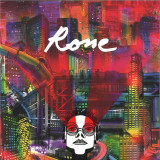
Rone is a stalwart of the French electronic scene and returns with his fourth album, 'Mirapolis', a synesthetic journey with features from Bryce Dessner (The National), Baxter Dury, John Stanier (Battles) and Saul Williams. The artwork was created by the critically acclaimed director Michel Gondry.
Stepping into Rone's music is like sleepwalking through a vividly colourful dream, eventually stumbling across a strange, scintillating Megapolis of saturated light and colours: 'Mirapolis'. Its twelve tracks / districts, each with their own specific planning, pulsate as though animated by their musical mastermind.
The project was an opportunity to get reacquainted with long- time stage and studio partners John Stanier, Gaspar Claus and the Vacarme band and Bryce Dessner (guitarist for The National,) while bringing in new collaborators (and thus, new interpretation of Rone's dreams). We find American slam-poet Saul Williams, who happened to be in Paris for a moment and contributes a searing anti-Trump screed, Baxter Dury, who brings an irresistible East London touch to 'Switches', a kind of fan fic that reimagines the Beatles' Sergeant Pepper lounging pensive in a club chair, Israeli electronic music muse Noga Erez, who inspired 'Waves' which, despite being recorded remotely, betrays a euphoric partnership, and finally, Kazu Makino, Blonde Redhead's bewitching singer and multi- instrumentalist, who contributes to the album's closer, the gauzy 'Down For The Cause'.
Rone remains a producer of grand instrumental pieces, which cannot be easily categorized in the architectural canon of our electronic music galaxy. Hypnotic, cinematic opening track 'I Philip' is an offshoot from the score for the first French virtual reality fiction, built around Philip K Dick - the perfect gate into a city that then opens up myriad temporal perspectives.
"In the fall of 1987, Serge Gainsbourg's success was at its zenith, both literally and figuratively: as his sixtieth birthday approached, he was preparing to take over the arena at the Porte de Pantin. Recorded during concerts on March 23, 24 and 25, 1988, Le Zénith de Gainsbourg would not appear until a year later, on April 10, 1989. In 2021, Le Zénith de Gainsbourg will now be released on two CDs offering for the first time five previously unavailable songs: In addition to unreleased tracks, meticulous cleaning work track by track has significantly improved sharpness and a more performance-friendly mix. Reviews in London Macadam, France in London, R2, Mojo and L’Echo
Ads London Macadam, France in London, and L’Echo"
Weaving its way through the tapestry of influences from Lonnie Liston Smith, Softmachine and Ravi Shankar, the title track takes a more contemporary approach merging U.K. urban / spoken word, with a meandering melancholic melody, driving home the message that it’s a 'Matter of Urgency’.
Opening the recording, 'Jazz Emergency' has a laid back vibe, coasting on a hypnotic bass line, with layered wailing trilled horns, creating a blanket of tenor sax, delayed Rhodes and pianos over and around.
Crooked Urge (Part 1 & 2) (Trk: A2, B1) came about from a first time session with drummer Sergiu Fanica, Ozan and pianist Aziz. Although a jam, the band were keen to share the spirit of this recording!
The track 'Matter of Urgency' is a call to the inner self, to take care of the world around us and to pave a better world for the generations ahead. It is an enchanting fusion of wailing horns with spoken word poetry over the top.
'Sound of Pulsar' is another spaced out journey that came about from a jam night in the studio, bass line looped and off into the musical cosmos...
Once again we thank all the amazing musicians and friends sharing their creativity on this album and to those who inspire us to create!
From Ernst Thoma's secret vaults. First 2 chapters of Mr. Thoma's fun with the Serge Modular Music System and TMS Synthesizer, accompanied by Knut Remond on weird "laced square drum"
Live recorded at Raum 2 and at Koprod Studio Zürich in 1981 and 1982
For fans of AMON DÜÜL, CAN, FAUST, NEUBAUTEN, BRIAN ENO, CLUSTER, CULT OF LUNA, NINE INCH NAILS, MASSIVE ATTACK OR - Norwegian for "dizzy, confusing" - is the third album from Italian avant-rock trio OSLO TAPES, and the album keeps what the word promises: a dizzying ride through a feverish dreamscape of imaginary Norwegian highlands painted in cubistic shapes. Hypnotic basslines, repetitive drum patterns, new wave synths and psychedelic guitar textures covering the full width of the stereo room, all seamlessly woven into a gloomy Kraut - tapestry which sounds refreshingly_ modern, while paying tribute to the aged genre. Marco Campitelli, born and raised in Lanciano on the Southern Adriatic coast of Italy, founded OSLO TAPES in the early 2010s after a trip to the Norwegian Capital left him deeply impressed. Under the influence of this infatuation, he composed and produced OSLO TAPES' first record "OT (un cuore in pasto a pesci con teste di cane)" within a week in 2013. Supervised and supported by friend Amaury Cambuzat (faUSt / Ulan Bator), Campitelli's first attempt to capture the mystical vibe of Norway was released on DeAmbula Records (Ulan Bator, The Marigold, 7C). In 2015 he was joined by Mauro Spada and Federico Sergente (Zippo) and together they recorded OSLO TAPES' sophomore album "Tango Kalashnikov", also released on DeAmbula Records. "OR" is a much more collaborative effort for OSLO TAPES than the first two records. Next to Campitelli, the album was co-produced by Amaury Cambuzat (Ulan Bator) and James Aparicio (house engineer for Mute Records and mixing and mastering engineer for Depeche Mode, Mogwai, Nick Cave). During production, Campitelli became friends with Emil Nikolaisen of Serena Maneesh w h o guided him "through the Norwegian imagination". As a result, the record's title is also courtesy of Nikolaisen. During this journey spanning over eight songs, OSLO TAPES, completed by Mauro Spada (bass) and Davide Di Virgilio (drums and percussions) construct a dense and ever so dark atmosphere that is captivating, brooding and imaginative. After a spiraling takeoff with "Space is the place", we find ourselves floating weightlessly above the nocturnal Norwegian highlands through "Zenith" and "Kosmik Feels", an airy circulation of jazzy drums, pulsating bass lines and shimmering guitar clouds. We saddle up, gallop across the sky on "Bodo Dakar" and drift back into the night on "Cosmonaut". The trifecta of "Norwegian Dream", "Exotic Dreams" and "Obession Is The Mother of All" conclude this agitated fever dream journey. There is a sense of solitude in OSLO TAPES' compositions which makes it easy to imagine them as interstellar jam sessions between cosmonauts, each in their own isolated space capsule. Every spin of "OR" brings new discoveries: sometimes it is a noise that we did not notice before, sometimes a slight change in the drum groove, sometimes just a piece of the lyrics, meandering through our mental space. "OR" is a vertiginious journey to be remembered - and repeated. "The focus of Oslo Tapes is to harmonize the noise" says Marco Campitelli.
Sub Rosa presents in their Early Electronic series, the final chapter of music by Beglian key composer of early electronic experiments, André Stordeur (1941-2020). Side A features a previously unreleased, stark and poignant composition from 1979; while the B side is vibrant and almost playful of pieces from the 2000s.
André Stordeur His musical career started in 1973 with a tape composition for the soundtrack to a film on Gordon Matta-Clark titled Office Baroque. Later in the 1970s, he participated to avantgarde music ensemble Studio voor Experimentele Muziek, founded in Antwerp, Flanders, by Joris De Laet. Since 1980, Stordeur composes exclusively on Serge synthesizer, either a Serge series 79 and a Serge prototype 1980, which was especially built for him by Serge Tcherepnin himself. In 1981, Stordeur composed the music of Belgian film director Christian Mesnil's documentary Du Zaïre au Congo. He studied at IRCAM in 1981 with David Wessel and then flew to the US to study with Morton Subotnick. Stordeur became an influential sound synthesis teacher and, in 1997, completed his Art of Analog Modular Synthesis by Voltage Control,4 a guide to everything modular.
Oberheim While 'Oberheim' is the centerpiece of this LP, we pressed for the first time on vinyl three pieces from the session André called 'Synthesis Studies,' previously featuring on Complete Analog and Digital Electronic Music, 1978-2000. 'I was helped in my studies by a must-have book: The Techniques of Electronic Music, by Thomas Wells and Eric Vogel (University Stores, 1974). That book aside, I learned synthesis on my own. After a trip to India in 1968, I discovered Indian music and took tabla and sitar classes in New Delhi; my teachers were students of Chatur Lal and Ravi Shankar. Later, in the 2000s, while living in the US, I tried to recreate through synthesis all the Indian musical instruments I loved so much.' 'Drone' is one of his most spectacular works.
Hella Love, the Hardly Art debut from Marinero, is an album about closing a chapter. It’s Jess Sylvester’s grand farewell, and love letter to his hometown and the place he grew up, The San Francisco Bay Area, before relocating to Los Angeles after finishing his debut release. Using the moniker Marinero (which means “sailor” in Spanish), Jess Sylvester was drawn to this name as a means to honor his parent’s stories -- his father, a sailor, and mother, a Mexican-American who grew up in San Francisco. This record blends many worlds from beginning to end, and as you go deeper it hits harder. It’s his goodbye to The Bay. Pulling sonic influences from classic Latin American groups and international composers from the 60’s & 70’s: Los Terricolas, Ennio Morricone, Esquivel, Carole King and, Serge Gainsbourg Hella Love finds Sylvester fusing classical arrangements with a variety of different genres, evoking a sonic nostalgia blended with other contemporary artists like Chicano Batman, Connan Mockasin, and Chris Cohen. The album was written, played, and produced by Jess Sylvester with help from Bay Area engineer Jason Kick (Mild High Club’s Skiptracing) at Tunnel Vision and Santo Recording in Oakland, California. On the standout single “Nuestra Victoria,” Sylvester shares “It’s my way of talking about gentrification in SF, or specifically the Mission where my mom and family grew up. The song is about a bakery, or panaderia called La Victoria, and was a place where my mother and tias went growing up, a place I also went to that is no longer there.” It was one of the oldest Mexican-American businesses in SF and I wanted to honor it”. “Through the Fog” highlights Sylvester’s exploration of his influences from the Tropicalia movement, weaving bossa rhythms with lush percussion and orchestration. Using SF’s infamous fog as a metaphor for “tough times”, Sylvester expands that it is a dedication to his friends and family who have helped him get through substance abuse issues, heartbreak, and other painful experiences. “There are a few easter eggs in the lyrics for Bay Area folks or people who have followed my music in the past but it’s mostly about getting through something difficult with the love and support from the homies and fam.” The album’s title track, “Hella Love,” summarizes both of his parent’s stories of how they ended up in the bay. The first verse is about his father’s voyage out west as a sailor during the late ’60s while the second verse follows his mother’s experience moving to The Mission District when she was a young girl.
It’s difficult to classify or generalize about Marinero’s music or identity. To him, it’s important to let his music do the talking. “I’m Chicanx, a bay native, biracial, and I’ve luckily gotten to travel and spend time in Mexico and I feel like my personality and specific musical tastes come through on this album. More than these generalizations we often make, I’m just a human who can both fear and love, and I’m just hoping to connect with others to share optimism and experience joy and laughter, even if for a moment.” Lean your ear to the ground because Jess Sylvester has been many things and will continue to share his journey. It is clear this gifted creator has more to say.
-Luz Elena Mendoza
- 01: Il Vuoto - Seq. 1 (Night Jazz Per Vibrafono)
- 02: Il Vuoto - Seq. 2 (Night Jazz Per Sax Baritono)
- 03: Il Vuoto - Seq. 3 (Swing Per Sax Baritono)
- 04: Estasi
- 05: Il Vuoto - Seq. 4 (Cordovox In 6/8)
- 06: Evasione
- 07: Il Vuoto - Seq. 5 (Sud-America - Ritmico Per Voce Maschile)
- 08: Frenesia
- 09: Il Vuoto - Seq. 6 (Twist)
- 10: Il Vuoto - Seq. 7 (Blues Per Organo)
Four Flies is proud and excited to present the first full-album release of the long-forgotten soundtrack composed by Armando Trovajoli for Piero Vivarelli's 1964 movie Il Vuoto.
Rightly considered by many to be a key figure, if not the key figure, in the history of Italian jazz, Trovajoli was responsible for fostering an appreciation and understanding of jazz among the generation of music listeners and musicians raised under Mussolini and Fascist nationalism. His outstanding work as a pianist, composer and conductor contributed immensely to the popularization of the genre among the general public and to the reduction of institutional bias against it.
The collaboration between Trovajoli and Vivarelli did not happen by chance. The latter, now regarded as one of Italy's "kings of the B's" for his work in the 'exotic-erotic' genre (Il dio serpente, Codice d'amore orientale, etc.), was a great music expert, a skilled talent scout for the Italian music industry, and a true lover of jazz.
Most of Trovajoli's score for Il vuoto has a refined smoothness that is clearly reminiscent of cool jazz – many tracks on the soundtrack are performed by a sextet featuring Trovajoli himself on piano, Carlo Zoffoli on vibraphone, Gino Marinacci on baritone sax and flute, Enzo Grillini on electric guitar, Berto Pisano on double bass, and Sergio Conti on drums and percussion. At the same time, Trovajoli explores other jazz styles or sub-styles in faster, more rhythm-oriented tracks influenced by bossa nova, samba, and even rock'n'roll, where instruments like drums and percussion, electric guitar, or flute take center stage.
This stylistic variety demonstrates both the maestro's versatility as a composer and the fine skills of the musicians who performed on the soundtrack. Like Trovajoli, they were all pioneers of Italian jazz and played in Italy's very first 'institutional' jazz orchestra: the Orchestra di Musica Leggera of the RAI (the Italian public broadcasting company), formed under Trovajoli's leadership in 1956 and credited as "his orchestra" in public performances and in the album The Beat Generation (RCA Italiana, 1960).
By making available for the first time ever almost all of the music recorded by Trovajoli for Il vuoto, this LP fills an important gap in the maestro's discography. Most importantly, it offers further insight not only into the history of Italian jazz, but also into the penetration of the genre into Italian film music, which was possible thanks to Trovajoli's mastery as a composer and to the virtuosity of the pioneering musicians who performed in his orchestra.
It is with great joy that we present the Mr Bongo edition of Marcos Valle's 1983 self-titled masterpiece. A pure vintage that features the ultimate Brazilian-boogie cult-classic ‘Estrelar’ and iconic 80s cover art that sees a gloriously sun-drenched Marcos dressed in a pink v-neck t-shirt surrounded by a generous selection of deadly-looking neon cocktails.
The album was produced by the legendary Lincoln Olivetti and Marcos' brother Paulo Sérgio Valle. It showcases a real who's who of Brazilian music at the time, with stellar performances from vocalists and musicians such as Rosana, Serginho Do Trombone, Robson Jorge and Oberdan Magalhães to name but a few. This was Marcos’ second album, after having moved back to Brazil from his time living in Los Angeles, and that US influence is evident through its prominent boogie, soul and funk sounds. It also features collaborations with the US singer-songwriter, composer, pianist, keyboardist, and record producer, Leon Ware, who co-penned three tracks including 'Estrelar'. To complete the album there are tracks such as 'Fogo Do Sol', which is pure AOR / Balaeric vibes, and tracks that are more MPB and pop-inspired, making a well-balanced track list for both home-listening pleasure and dancefloor business.
What could we do to give one of Marcos' most celebrated albums the treatment it deserved and produce the most definitive re-issue possible? The answer was to enlist the services of Miles Showell, Abbey Road Studios Mastering and lacquer-cutting engineer and all-around audio-magician, to cut a special half-speed master edition. Miles had previously worked his half-speed magic on our Arthur Verocai album re-issue, and once again we are totally blown away by the richness which Miles has brought out in his mastering technique. He has enhanced the listening experience and taken this wonderful album to another level.
To celebrate the release we have pressed up several vinyl versions; both standard master, and Miles' half-speed mastering editions on Black vinyl, alongside special limited edition Rose and Mint-Green coloured vinyl variants that were inspired by the audacious-looking cocktails on the cover - sheer 80s excess!
It is with great joy that we present the Mr Bongo edition of Marcos Valle's 1983 self-titled masterpiece. A pure vintage that features the ultimate Brazilian-boogie cult-classic ‘Estrelar’ and iconic 80s cover art that sees a gloriously sun-drenched Marcos dressed in a pink v-neck t-shirt surrounded by a generous selection of deadly-looking neon cocktails.
The album was produced by the legendary Lincoln Olivetti and Marcos' brother Paulo Sérgio Valle. It showcases a real who's who of Brazilian music at the time, with stellar performances from vocalists and musicians such as Rosana, Serginho Do Trombone, Robson Jorge and Oberdan Magalhães to name but a few. This was Marcos’ second album, after having moved back to Brazil from his time living in Los Angeles, and that US influence is evident through its prominent boogie, soul and funk sounds. It also features collaborations with the US singer-songwriter, composer, pianist, keyboardist, and record producer, Leon Ware, who co-penned three tracks including 'Estrelar'. To complete the album there are tracks such as 'Fogo Do Sol', which is pure AOR / Balaeric vibes, and tracks that are more MPB and pop-inspired, making a well-balanced track list for both home-listening pleasure and dancefloor business.
What could we do to give one of Marcos' most celebrated albums the treatment it deserved and produce the most definitive re-issue possible? The answer was to enlist the services of Miles Showell, Abbey Road Studios Mastering and lacquer-cutting engineer and all-around audio-magician, to cut a special half-speed master edition. Miles had previously worked his half-speed magic on our Arthur Verocai album re-issue, and once again we are totally blown away by the richness which Miles has brought out in his mastering technique. He has enhanced the listening experience and taken this wonderful album to another level.
To celebrate the release we have pressed up several vinyl versions; both standard master, and Miles' half-speed mastering editions on Black vinyl, alongside special limited edition Rose and Mint-Green coloured vinyl variants that were inspired by the audacious-looking cocktails on the cover - sheer 80s excess!
Recorded sporadically over five years from 2015 to 2019, Sixty Summers was shaped profoundly by Stone’s key collaborators on the album: Thomas Bartlett, aka Doveman, and Annie Clark, the Grammy-winning singer, songwriter and producer known as St. Vincent. Bartlett and Clark were the symbiotic pair Stone needed to realise her first pop vision. A wizard of production and songwriting, Bartlett helped coax Sixty Summers’ independent, elemental spirit from Stone, writing and recording over 50 demos with her at his studio in New York. Itself a thoroughfare for indie rock luminaries, some of whom, such as The National’s Matt Berninger and Bryce Dessner, ended up on the album, Bartlett’s studio was perfect fertile ground for Stone’s growth.
Clark was the incisive yang to Bartlett’s yin, a sharp musical polymath who, when presented with the work Bartlett and Stone had made together, quickly helped fashion Sixty Summers into the album it was destined to be. Contributing vocals and guitar in addition to production, Clark’s revered acidic touch ignited the sparks of Stone’s creations.
The scope of Sixty Summers is dizzyingly vast; miles away from Stone’s past work, it is a world unto itself, a surreal and breathtaking new landscape. Where Stone’s previous solo records, 2010’s The Memory Machine and 2014’s By The Horns, found her grappling with the natural darkness that comes with loving too much, Sixty Summers finds Stone claiming every part of herself: fire, fury, love, lust, longing. Touching on reference points as disparate as the avant-funk of Talking Heads (on ‘Break’) the romantic 2am musings of Serge Gainsbourg (‘Free’, ‘Dance’) and the sleek, ecstatic synth work of Lorde’s Melodrama (‘Substance’), Sixty Summers is an album you can dance to and one you can lose yourself in completely.
Released in 1983, Sandra Sá's 'Vale Tudo' is one of the essential Brazilian-boogie-funk records of the era. Pure class throughout, with a dream team of incredible musicians and producers behind the scenes. For some, this album is regarded as Sandra's magnum opus.
It is drenched in the essence of the Brazilian 80s boogie and funk sound. A driving force behind this is the writing, arrangement, and musicianship of Lincoln Olivetti, who was instrumental in forging this unique sound within Brazilian production at the time. It is heightened even further by the astonishing team that feature on the record. Brazilian icon and heavyweight Tim Maia, Robson Jorge, Serginho Trombone, Oberdan Magalhães, Claudio Stevenson and Jamil Joanes (of Banda Black Rio fame), Junior Mendes, the list goes on. This crew of musicians synergised perfectly with Sandra's vocal style, all complementing each other to create a classic.
One of our favourites from the album is the opening track 'Trem Da Central', an infectious groove that when paired with Sandra's cool and relaxed swaggering vocal resulted in an essential dancefloor jam! Equally delightful and dancefloor summoners are the catchy boogie funk of ‘Candura’, and the Earth, Wind & Fire sounding 'Pela Cidade'. Tim Maia features on the fast-paced duet 'Vale Tudo', which was written especially for Sandra to sing with Tim, who at the time was one of the biggest stars in Brazilian music. These boogie and funk compositions are balanced by fine slow jams giving the album a satisfyingly well-rounded feel.
Sandra had been working in music since the 70s and continues to do so to this day, but this period of the early 80s was a rich and prolific time for her. If you are a fan of Robson Jorge & Lincoln Olivetti's self-titled album from 1982 or Marcos Valle's 1983 album featuring the song 'Estrelar', then this one is definitely for you. 'Vale Tudo' is a must-have record from a talented artist at the top of her game and Sandra makes it all sound so effortless.
Zwerm is a Belgian-Dutch electric guitar quartet (with a backyard rehearsal shed located in Antwerp) that operates along the borders between styles and traverses traditions that are typically not convergent. Zwerm rhymes Larry Polansky with Nadah El Shazly and are galvanized by the likes of guitars pioneers like The Velvet Underground and Sonic Youth, the microtonal DYI-er Harry Partch, Middle Eastern sonorities and the prog-madness of Kind Gizzard & the Lizard Wizard. ‘Musical adventure’ is not just a hollow cliché for this quartet, but a genuine commitment. Zwerm calls itself a ‘guitar quartet’, but that can be interpreted broadly as well as with a pinch of salt: “If we want to do something on instruments we don’t really master, we’ll just figure out a way to make it work.”
Toon Callier, Johannes Westendorp, Kobe van Cauwenberghe and Bruno Nelissen all met in 2007 while working on a project with Glenn Branca. A new guitar quartet was born and it became clear rather quickly that staying in the strictly contemporary compositions lane was not for this quartet-with-five-to-six-members (an organizational chart is available upon request).
An appetite for new and lasting collaborations has been a constant theme throughout their artistic parcours. The group has shared stages with theatrical producers like Walpurgis and Post uit Hessdalen, dancers such as Ecce and with the musicians Fred Frith, Stephen O’Malley, Shiva Feshareki, Rudy Trouvé, Mauro Pawlowski, Larry Polansky, Eric Thielemans, Yannis Kyriakides, François Sarhan, Serge Verstockt and Stefan Prins. These projects have not always translated into records, but they have been decisive in creating a unique musical approach. In 2015, when Zwerm was asked by De Handelsbeurs to collaborate with Fred Frith, they proceeded to pen a few new musical sketches over which Firth sublimely improvised. In 2018 ‘Badminton in Tehran’ was released, their first record that was made up completely of only the group’s compositions.
“a basket full of buttons here
and if you push the wrong one: fear
and if you push the right one: love
or maybe none of the above”
The route that Zwerm has taken is often defined by the question “What if... ?” - like a dart thrown at a musical map, not quite blindly, but naive enough to lead to unexpected endings.
“What if we play Renaissance pieces written by John Dowland, but instead of playing lutes we play these tunes with a Telecaster – and then jam it through effect pedals and an amplifier?”
“What if we connect one hundred guitar pedals and just leave our guitars at home?”
“What if we record a record with ten different one-page-pieces that we found on the Internet?”
In 2020 our metaphorical dart landed on “What if we tried microtonality?”.
‘Microtonality’ sounds a bit creepy, but actually there is nothing to be afraid of: there are no out-of- tune notes, just alternate notes. On the continents where Western musical theory is less stringently applied, microtonality is the rule, and has become the subject of many deep and thoughtfully written theories. However for Zwerm, this phenomenon occurs in many, often surprisingly lighthearted forms. A dilapidated piano that has settled into a beautiful microtonal tuning of its own accord, enthusiastic choral singing, a guitar whose three strings are tuned a quarter-tone higher, a saz (Turkishquarter-tone lute), a maddening guitar pedal, ...
"the dreams they were convicted for telling only lies reality came after for claiming to be wise what you don’t see is what you get just never light a spark I’m a crow in the dark”
“And… what if we work with a drummer?” Enter Karen Willems - dummer, extraordinaire, and ardent player in groups, projects and collaborations galore. One chance meeting and the deal was done. It was obvious before the start that Willems was the versatile and creative percussionist-in-a-toy-store necessary for this project. And in the studio, to our delight, she demonstrated an easy dexterity when switching quickly from one idea to the next.
At the reins behind the scenes was producer Rudy Trouvé, who – during previous sessions for ‘Badminton in Terhran’, when the classically trained guitarists went completely off the rails, staring deeply and forlornly into their scores, looking for answers – was able to pinpoint the problem and get the wagons rolling in the right direction again. Completing the team were Mark Dedecker (recording)and Joris Calluwaerts (mixing).
The results are in and it’s called ‘ Great Expectations’ – a title that, in several ways, fits perfectly with these strange times.‘Great Expectations’ goes wide! Zwerm is at its best when it can run along the borders between style and across traditions that otherwise would not necessarily intersect. The most straightforward rockers have a proggy tinge while the dreamy psychedelic songs lean more toward Richard Youngs. And if a nice melody dared come to close to becoming a ‘Kit-Katjingle’, then barbs-a-la-Pere-Ubu were trailed, tracked, found and promptly embedded. ‘Heavy Machinery’ sits neatly somewhere between Captain Beefheart and Richard Wagner, and ‘On My Way To Aguno’, set to an Iranian folk song chord progression, grew into a hyper-personal lullaby. Zwerm used the saz (Turkish lute) and the sinter (Moroccan gnawa bass instrument) without falling into pastiche psychedelia, but you can still sense the orient.