Buscar:series

11
During autumn 2018, after moving to Germany, Aron Ottignon met Senegalese musician and percussionist Bakane Seck, founder and leader of the Jeri JeriBand, in his Berlin studio. This first meeting gave rise to a special connection between their instruments and the start of a musical adventurethat transcends borders, an instrumental conversation of profound simplicity nourished by the richness of jazz, electronic music and Wolof tradition. The brainchild of composer and producer Aron Ottignon and percussionist Sabar Bakane Seck, Aron & The Jeri Jeri Band (A&TJJB) was born at the crossroads between Berlin and Dakar and oscillates between the frenetic rhythm of mbalax, the strength of afrobeat, the warmth of afro funk and the eï¬Çervescence of jazz. Born in New Zealand, the pianist released a series of critically acclaimed jazz albums in the 2000s. As a composer, Aron Ottignonhas collaborated with Stromae, toured the world with Woodkid and worked with a host of artists including Electric Wire Hustle, Louane,Broken Back, Empire Of the Sun and Myele Manzanza. Senegalese musician and griot Bakane Seck"s mastery of the Sabar - "percussion instrument" in Wolof - has taken him all over the world alongsideAfrican music icons such asYoussou N"Dour and Baaba Maal.

Last Train are an exception on the French indie rock scene. From the Olympia in Paris to the biggest festivals, the four Alsatians have won over a devoted audience with their hypnotic, moving concerts. Independent or nothing, they self-produce their records and tours, as well as their music videos, short films and even documentaries, with rigour and determination. At the end of 2022, the musicians had the luxury of taking their time and the right to experiment. Far from the beaten track, they are rewriting their own repertoire in a cinematic and contemplative way. By collaborating with the Orchestre symphonique de Mulhouse, Last Trainconfirm their viscerallove of large-format sounds and images, and present a veritable compendium of inï¬,uences in twelve tracks.Original Motion PictureSoundtrack is the soundtrack to a film that doesn"texist. From a symphonic chaseto a neo-classical interlude, from an organ requiem to an electronic soaring, the Mulhouse-based band play with the boundaries of genres. Last Train sets the bar ever higher with this unexpected, singular and striking album. It is accompanied by a mini-series documenting the work done in the studio, the collaboration with the orchestra and the day-to-day life of an authentic, inspired band.

Last Train are an exception on the French indie rock scene. From the Olympia in Paris to the biggest festivals, the four Alsatians have won over a devoted audience with their hypnotic, moving concerts. Independent or nothing, they self-produce their records and tours, as well as their music videos, short films and even documentaries, with rigour and determination. At the end of 2022, the musicians had the luxury of taking their time and the right to experiment. Far from the beaten track, they are rewriting their own repertoire in a cinematic and contemplative way. By collaborating with the Orchestre symphonique de Mulhouse, Last Trainconfirm their viscerallove of large-format sounds and images, and present a veritable compendium of inï¬,uences in twelve tracks.Original Motion PictureSoundtrack is the soundtrack to a film that doesn"texist. From a symphonic chaseto a neo-classical interlude, from an organ requiem to an electronic soaring, the Mulhouse-based band play with the boundaries of genres. Last Train sets the bar ever higher with this unexpected, singular and striking album. It is accompanied by a mini-series documenting the work done in the studio, the collaboration with the orchestra and the day-to-day life of an authentic, inspired band.

- Various Organs
- Crow, Crow
- Night By Night (V3)
- Angelic Aye Are
- Last Summer (Ilkeston Version)
- Shark Attacks
- Two Minute Warning
- Suburban Monochrome
- Suburban Monochrome (Instrumental)
- My Mouth Is Bored
- No One Road (Early Version)
- In A Room 13 Blue Loop (Demo)
- The Long Run (Demo)
- Immaculate Mistake
- Unused Ymg Organ Riff
15
Young Marble Giants' "Colossal Youth" has mystified and beguiled audiences since its 1980 release. Seen by primary songwriter Stuart Moxham as "a last gasp" at making a record, Stuart insisted the one-off 7" deal offered by Rough Trade be altered to allow an entire album . . . that paid off when with a big seller which produces cover versions even from bands whose members were a decade or two away from being born on the album's release. When YMG disbanded, Stuart was at a loss; he'd never envisioned a follow-up. A series of experimental recordings made with pal Phil Legg (Essential Logic) and supported by other YMG members, musicians from This Heat and Swell Maps, old Cardiffian pals, and new friends like Vivien Goldman resulted in an album, "Embrace The Herd", as The Gist. Released just before Rough Trade made bold moves toward pop charts with Scritti Politti, The Smiths and others, the album was odd for its time, but has since taken on the lustre of genius. Years of silence followed, thereafter intermittently broken by the odd release from small labels. Stuart delved into family life, though he never stopped writing and recording. In more recent years, two retrospective compilation of lost recordings by The Gist have been released, as well as a superb collaboration with French arranger Louis Philippe, "The Devil Laughs". "Fabstract" is the final gathering of Stuart's lost recordings. Compiling long-lost YMG-era tracks with the recent brilliance of "Crow, Crow" and "Suburban Monochrome", through bits of whimsy and vastly alternate versions of fan faves, this diverse album shouldn't work . . . but it does, telling a satisfying story of an underrated talent whose mistake was following his muse, not the charts. This album precedes a new recording, years in the making, produced by Dave Trumfio, which promises to be Stuart's most complete - and original - work since "Colossal Youth". Tracks:

GT Replacement stylus for tough handling - extremely sturdy for scratching DJs
GT was developed by Ortofon in close co-operation with SWS Audio GmbH. The cartridge was named "Great and Tough" and was based on the construction of the well-known Ortofon Series 500 design - mend for standard half inch mounting - in a black housing with white printing.
The vital parts in the GT are based on a very robust and reliable parts used in Scratch. Further, during development of GT, efforts were also concentrated on supplying a very high output of 8 mV and improvement of frequency response to give higher resolution and sound image.
Tracking avility is decisive for the DJs especially when scratching and back-cuing. In this situation raise of tracking force could be an immediate, but in many cases not very effective solution. The reason is that the antiskating adjustment, if not at a very moderate level, will double the skating effect when back-cuing.
As a rule, never use more than half of normal antiskating related to the tracking force! To make GT even more resistant against violent handling, such as drop or touch of fingers, we have made a rubber suspension of the cantilever even more rigid against axial pull.
GT Stylus Technical data
Output voltage at 1000Hz, 5cm/sec. - 8 mV
Channel balance at 1kHz - 1,5 dB
Channel separation at 1kHz - 25 dB
Channel separation at 15 kHz - 18 dB
Frequency response - 20-18.000 Hz +/- 2 dB
Tracking ability at 315 Hz at recommended tracking force - 80 μm
Compliance, dynamic lateral - 6 μm/m N
Stylus type - Spherical
Stylus tip radius - R 18 μm
Tracking force range - 3.0-5.0 g (30-50 mN)
Tracking force recommended - 4.0 g (40 mN)
Tracking angle - 20°
Internal impedance, DC resistance - 1000 Ohm
Internal inductance - 580 mH
Recommended load resistance - 47 kOhm
Recommended load capacitance - 200-400 pF
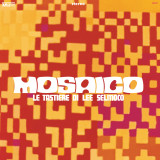
- A1: Ora Di Punta (Ruscigan)
- A2: Sin Palabras (Ruscigan)
- A3: Sole Rosso (Ruscigan)
- A4: Il Giorno Dopo (Ruscigan)
- A5: Festa Al Quartiere (Ruscigan)
- A6: Ansiedad (Ruscigan)
- A7: Chemin De Fer (Selmoco)
- B1: Itinerario B. (Ruscigan)
- B2: Semplice E Bella (Ruscigan)
- B3: Fuoco Freddo (Ruscigan)
- B4: Parentesi (Ruscigan)
- B5: Corner (Ruscigan)
- B6: Verso Sud-Ovest (Ruscigan)
- B7: Spag E Spig (Selmoco)
14
Francesco Anselmo, also known as Lee Selmoco, Dorsey Dodd, Alex Brown, Arsenio Bracco or Tommy Ruff, is an Italian keyboardist that covered the role of of artistic director for Vedette Records, historical Italian imprint founded by director and violinist Armando Sciascia, and also recorded for its notorious Phase 6 Super Stereo, its sub-label focused on instrumental records and production music.
"Mosaico (Le Tastiere Di Lee Selmoco)" is an incredible display of his creative and composing skills, featuring 14 tracks of what could be classified as "happy music", with killer electric organ and rhythms alternating with fuzzy guitars and spacey / psychedelic hints thrown in for good measures, written alongside Guido Baggiani, alias Ruscigan. We are very happy to start a series of reissues from the Vedette Records catalog with the first ever reissue of this title after 50 years from its original release, and since the original pressing did not feature the correct track listing, it is reissued here for the first time in its correct version!

Since its founding back in 2014, Blume has carved a unique place in cultural landscape, issuing free-standing works, spanning the historical and contemporary, that represent singular gestures of creativity within the field of experimental sound. Joining their broad efforts in building networks of context and understanding that already includes the works by Werner Durand, Sarah Hennies, Bruce Nauman, John Butcher, Jocy de Oliveira, Mary Jane Leach, Valentina Magaletti, Alvin Curran, Julius Eastman, Alvin Lucier, and shortly after returning with the first ever vinyl release to attend to James Tenney’s legendary “Postal Pieces”, the label is now offering a brand new, ambitious work by the American composer Ben Vida, entitled “Vocal Trio”, conceived, performed, and recorded in Bremen, Germany, during the Spring of 2022. A truly stunning work of compositional conceptualism, combining the ideas of systems based synthesis with real-time vocal collaboration - issued in a highly limited vinyl edition of 200 copies mastered by Stephan Mathieu, featuring specially commissioned liner notes by Bradford Bailey and a leporello insert offering the piece visual score - it’s a landmark in contemporary experimental practice and arguably the most forward-thinking and exciting piece by one of the most exciting American artists working today.
Ben Vida first emerged during the mid 1990s within a loose constellation of experimental musicians, centred around a performance series of improvised workshops at the Myopic Bookstore in Chicago, alongside Jim O'Rourke, Kevin Drumm, Chad Taylor, and the other future members of Town and Country - Jim Dorling, Joshua Abrams, and Liz Payne - the band within which he would gain widespread recognition over the following years. Like many other members of that scene, Vida remains a restless product of a fleeting context - Chicago during the 1990s and early 2000s - continuously undermining concrete notions of idiom and signifier within a practice that witnessed him rendering bristling abstractions within Pillow, glacial melodies with Town and Country, the art-rock mayhem of Bird Show Band, and the angular, driving indie rock of Joan of Arc, before becoming immersed in a practice of systems based synthesis, beginning in the 2010s, that guided much of his first decade of output as a solo performer and composer.
As early as 2013, he began to incorporate acoustic sound sources - specifically the human voice - into his work. It was this shift, evolving and refining itself over the last decade, that underscores radically the leap in his practice represented by “Vocal Trio”, a work that encounters Vida composing for the human voice with the ideas that allow for synthesis - transferring the underlying concepts and structures of both subtractive and additive synthesis to the acoustic realm - without using a synthesiser.
During the Spring of 2022 Vida was in Bremen, Germany, collaborating on a dance piece with the choreographer Fay Driscoll, when the production fell into delays. Finding himself with time on his hands, a space at his disposal, and the company of two dancers - Amy Gernux and Lotte Rudhart - who were also singers, the idea for the piece - to utilising the larynx as audio paths (multi-harmonic or harmonically pure) while conceptualising each person’s mouth as a filter to sculpt the timbre and resonance of a given tone - began to take shape in his mind. Considering how typographical scores might be developed into a non-linguistic social framework, Vida drafted a single page of text - what became the score for “Vocal Trio” - accompanied by a set of harmonic suggestion and loose parameters, seeking a core meaning from each word's phonic make-up by each of the three singers (Vida, Gernux and Rudhart) singing as slowly as possible.
At the core of the pulsing vocal drones - intoxicating, harmonically rich long-tones - that make up the duration abstraction of “Vocal Trio”, is Vida’s regard for music as a social space. It is an experiment that seeks liberation through the act of collective music making, by challenging the terms through which the act of composing is perceived and then relinquishing control. The piece’s rehearsals were simply the three performers hanging out, allowing their knowing each other and natural dynamics to contribute to its form as the score, before recording during a single afternoon at the end of a number of days sharing company and space.
Creatively visionary and groundbreaking on numerous terms, as well as being intoxicatingly beautiful and remarkably listenable, Ben Vida’s “Vocal Trio” represents a striking step forward for one of the most ambitious and outstanding sonic artists working in the United States today. Issued by Blume in a highly limited vinyl edition of 200 copies mastered by Stephan Mathieu, featuring specially commissioned liner notes by Bradford Bailey and a leporello insert offering the piece visual score, this is hands down one of the most important contemporary records we’re likely to encounter in 2024.

4
2nd In the series of releases celebrating 30 years of Peppermint Jam see's the label release one of its biggest tracks from label boss Mousse T - 'Horny'.
Remixes from Riva Starr, Radio Slave & Thomas Gandey alongside the classic original mix, comes in a freshly made Pep Jam House bag.

Dance floor in need of a little spark? Need some extra ammo in the record bag for this weekend’s set? Pleasure of Love has the key to your ignition with a new series of specialty re-edits from the vaults. "Covers Blown Vol. 1," features a pair of unlikely disco classics expertly done up in a smokin' tex-mex style

5
As an extension of his highly successful „Big Beat Manifesto“ series on Public Possession, currently standing at Volume XI, Eden now opens up his garden to invite some friends. The BBM label will host a series of releases that are close to his heart.
Secret D.J. Tools, meditative seances & more. Kicking of the new label is young fellow kiwi Colter Carson, delivering 5 stellar dance songs. Already tested & approved this mix of heavy percussion, quirky baselines and large synths will be just the right treat for all fans of the Big Beats!

South Korean label Walls And Pals is back with their split EP series, featuring label co-founders Mogwaa and Jesse You. Mogwaa is in charge of A Side, showcasing his very own minimal approach with electro-progressive touch. On B Side, there's Jesse You, armed with raw and heavy floor burner as well as 2000s influenced acid.

DJ S Replacement stylus
DJ S is a solid-built cartridge in a blue nylon material. It has a fine spherical stylus and a special developed and extremely balanced cantilever that provides outstanding rigidity.
Not only does the cartridge have a most sufficient tracking ability, it is also nearly unbreakable and provides the DJs with the most needed stringency. Furthermore, it equals very low record wear, an advantage for busy DJ. The DJ series has been known to many as the "jack of all trades," with improved tracking, alongside of accurate sound reproduction. Featuring a low wear stylus design, the DJ provides excellent groove handling, even with less weight applied.
The DJ series of cartridges are great for any style of music, and has been a favored choice of DJs around the world!
DJ S Stylus Technical data
Output voltage at 1000Hz, 5cm/sec. - 6 mV
Channel balance at 1kHz - 2 dB
Channel separation at 1kHz - 23 dB
Channel separation at 15 kHz - 15 dB
Frequency response - 20-18.000 Hz 3dB/-2dB
Tracking ability at 315 Hz at recommended tracking force - 80 μm
Compliance, dynamic lateral - 9 μm/m N
Stylus type - Spherical
Stylus tip radius - R 18 μm
Tracking force range - 2.0-4.0 g (20-40 mN)
Tracking force recommended - 3.0 g (30 mN)
Tracking angle - 20°
Internal impedance, DC resistance - 750 Ohm
Internal inductance - 450 mH
Recommended load resistance - 47 kOhm
Recommended load capacitance - 200-600 pF
Concorde cartridge weight - 18.5 g

- Waldgeist
- Face-Off At Mammoth Mountain
- Wily Stage 1 & Boss (Mega Man)
- Iron Whale (Shovel Knight)
- Ultramarine
- Quick Man Stage (Mega Man 2)
- Wily Stage 1 (Mega Man 2)
- Full Circle
- Needle Man Stage (Mega Man 3)
- Wily Medley (Mega Man 3)
- Mission (Pulstar)
- Ronin
- The Amazing Ryu (Ninja Gaiden)
- The Parasprinter (Ninja Gaiden 2)
- Stage 4-2 & Stage 1-1 (Ninja Gaiden 3)
- Terra Incognita
- Art Thou The Holy One (Panzer Dragoon Saga)
- Atolm Dragon (Panzer Dragoon Saga)
- Quiet & Falling (Celeste)
- Apricot Dreams
- Ultimate Medley (Gimmick!)
- Echoes
22
Pressed on heavy-weight 3xLP 180g curaçao vinyl GIANTS is an ambitious video game concept album, meticulously crafted over six years by Tokyo-based record label Brave Wave Productions under the direction of Mohammed Taher. The colossal 98-minute album showcases the talents of legendary composers known for their iconic work on series like Mega Man, Ninja Gaiden, Panzer Dragoon, Sonic the Hedgehog, Final Fantasy, among others. The album is a rich tapestry of new, gameinspired compositions from these celebrated artists, paired with innovative remixes from their classic catalogue as reimagined by their contemporaries. A highlight of the album is its emphasis on collaboration, exemplified by original tracks like Ultramarine_the first collaborative effort from Mega Man 2's Takashi Tateishi with Mega Man 3's Harumi Fujita and Sonic Mania's Tee Lopes. Another standout track, Ronin, marks a historic reunion for the Ninja Gaiden composer trio_Keiji Yamagishi, Ryuichi Nitta, and Kaori Nakabai_collaborating for the first time since their work on the NES Ninja Gaiden titles. The collaborative spirit extends to the remixes as well, such as Final Fantasy series composer Yoshitaka Suzuki's cinematic reimagining of Mega Man 2's Wily Stage, featuring Bayonetta co-composer Takahiro Izutani on acoustic guitars and producing, as well as Celeste composer Lena Raine's tranquil rendition of Panzer Dragoon Saga's Art Thou the Holy One, crafted in harmony with original composer Saori Kobayashi. GIANTS transcends traditional boundaries, featuring a diverse array of genres and styles brought to life by over two dozen talented musicians, making it a celebratory anthology of game music's rich history and evolution, led by Brave Wave's in-house rock band Super Strikers and a legion of legendary game composers.

Together Again!!!! vereint den Trompeter Howard McGhee und den Saxophonisten Teddy Edwards und wurde ursprünglich 1961 auf Contemporary Records veröffentlicht. Neben Edwards und McGhee sind auf dem Album auch Phineas Newborn Jr. (Klavier), Ray Brown (Bass) und Ed Thigpen (Schlagzeug) zu hören. Diese Neuauflage, die als Teil der Acoustic Sounds Series erscheint, enthält (AAA)-Lackierungen, die von den Original-Masterbändern von Bernie Grundman geschnitten wurden, und wird bei QRP auf 180-Gramm-Vinyl gepresst und in einer Tip-On-Hülle präsentiert.
4
También disponible
Vol.2[13,87 €]
Funkyjaws Music has decided to offer up its first solo EP here having decided to make the previous four volumes of its Let's Dance series various artists collections. JKriv gets the nod here and doesn't disappoint. First up is the leggy mid-tempo disco of 'Share The Night' with its chattery Chicago house style drums and rasping bass. 'Big Chief' is a brilliant mid-tempo jumble of percussion, toms, hits, grinding bass and lazy kicks and 'Let's Do It Right' then takes off on nice clean piano house grooves full of uplifting joy. 'Acid Fantasies' closes out a truly varied EP with a more raw and direct acid house jacker.

Some 14 years since last releasing, play:musik, the label founded by DJ Flight in 2005 is back with fresh tunes and a new look for ’24! First up - Geordie new-gen junglist, Nectax, who’s refined his style by drawing inspiration from mid-‘90s deep atmospheric jungle and US footwork flavours. The Body Talk EP features 4 tracks that distinctly tie together - pristinely produced, bass heavy, future-facing music that respects the roots and foundation.
* Tracklist:
A1. Body Talk: classic amen break fused with interesting drum edits, smooth synths, a huge vocal and driving bassline (wait for the 2nd drop). An underground anthem thanks to Nia Archives’ strong support.
A2. Twin Turbo: bouncy footwork-jungle mixed with fun techno vibes, tight percussion and squelchy sounds. Rolls very nicely in the mix. Supported heavily by Sully and Mantra.
B1. No Such Luck: a murky rumbling intro with grime sound and haunting vocal leads into a speaker-troubling drop packed with funk-fuelled breaks. Certified modern jungle stepper and firm Flight favourite.
B2. Sentinel Runner: smokey sci-fi feel, electro b-boy stylings, and big bottom end make this the perfect EP closing track. Recently featured in Om Unit’s great MISSIONQUEST mix series.
Robag Wruhme isn’t just a producer; he’s a sonic storyteller. His tracks are known for their emotional depth and technical brilliance – the perfect blend of minimal techno, deep house, and ambient music—each track a meticulously crafted journey through sound. With influences ranging from classical to jazz to world music, Robag’s music is as diverse as it is enchanting.
His latest offering on the trailblazing Speicher series is no exception. True to his unmistakable style, “Naila” meanders between heartwarming positivity and menacing darkness induced by one of those bass lines only Robag can deliver. In short: He nail(a)ed it!
On the flip side, he joins forces with the ominous Bruno Pronsato – an elusive character that has a string of cult releases on Perlon, Musique Risquée and Foom under his belt. “CDV” was initially released on his album “Live At Club Der Visionäre” on Logistic Records. Robag’s slick re-rub is pushing things decisively in an afterhour-ish direction. Mental music for mental times!

6
Black Truffle is thrilled to announce a reissue of Chico Mello and Helinho Brandão’s self-titled release from 1984, the first return to vinyl of this classic of Brazilian experimental music with its original cover art and complete track listing. An under-recognised figure whose work inhabits a singular terrain where radical new music techniques and music theatre meet musica popular brasileira, Mello has lived and worked in Berlin since the late 1980s. A student of Dieter Schnebel, Mello played in the 90s iteration of Arnold Dreyblatt’s Orchestra of Excited Strings alongside compatriot Silvia Ocougne, with whom he produced a radical and hilarious deconstruction of MPB classics on Musica Brasileira De(s)composta (an early and rather atypical release on Edition Wandelweiser).
On this release, his only recording predating his move to Europe, Mello works with the alto saxophonist Helinho Brandão, who appears to be otherwise unknown outside Brazil. The record’s six tracks range from solo saxophone improvisation to densely layered ensemble works bridging minimalism, acoustic sound art and a plaintive melodic sensibility that calls up Edu Lobo or Milton Nascimento. Beginning with a dramatic, dissonant wind and string surge from which emerge ominously pounding piano chords, opener ‘Água’ slowly builds in intensity, a halo of clustered vocal harmonies gradually closing in on Brandão’s squealing sax until the piece opens up to reveal a gorgeous passage of melodic singing. The piano accompaniment reduces to tolling bass notes as the voice begins a repeated incantation, suggesting a ritualistic atmosphere reminiscent of parts of Xenakis’ setting of Oresteia. Dissonant, sawing tremolos on the strings climb to a crescendo before disappearing into the sounds of water being poured and splashed into metal vessels, presented not as a field recording but as a percussive element performed by the ensemble. A child’s voice then appears, singing to piano accompaniment the same melody heard earlier in the piece. After a brief solo alto improvisation from Brandão, working with the guttural pops and fleeting melodic gestures of Braxton or Roscoe Mitchell, the remainder of the first side is dedicated to the leisurely unfolding of ‘Baiando’ over the course of twelve minutes. A trio for Brandão on soprano saxophone, Mello on a very period-appropriate phased nylon string guitar and Edu Dequech on bongos, the performance eases its way hypnotically through subtle variations on a set of rhythmic and melodic patterns, almost derailed at points by Brandão’s wild forays into extended technique but held together by Mello’s droning guitar notes.
The second side opens with another multi-part epic for a larger ensemble, ‘Matraca’, which makes use of strings, electric guitars and a wide range of South American percussion instruments. Rasping violin harmonics hover as drum hits, repeated guitar notes and triangle accompany a slowly descending bass glissando. A sudden change in direction introduces a thrumming, incessantly repeated bowed bass tone, beginning a series of episodes of minimalist phasing and pattern variation, the combinations of electric guitars and orchestral instruments giving the ensemble an ad hoc charm like the early Penguin Café Orchestra but with more percussive drive. Eventually the piece is overrun by a cacophony of the titular matracas (a kind of ratchet/cog rattle). Following a lyrical trio improvisation by Mello, Brandão and Gerson Kornin on bass, the final ‘Danca’ focuses entirely on Mello’s layered acoustic guitars and vocals, using this restricted palette to build up a haunting piece of almost orchestral density, reminiscent of the 70s work of Egberto Gismonti in how it thickens a folkish ambience with harmonic sophistication.
Arriving in a starkly beautiful gatefold sleeve and sounding better than ever in its new remaster, one might call the stunning music contained on Chico Mello/Helinho Brandão ahead of its time. But what (other than some of Mello’s own work) produced in the years since its initial release has really touched the organic fusion of minimalism, free improvisation, radical instrumental technique and popular song achieved here? Forty years after its first release, Chico Mello/Helinho Brandão remains music of the future.

Since surfacing into the Scandinavian synth-pop scene 16 years ago, Nicklas Stenemo and Christian Hutchinson Berg aka KITE have steadily grown from local icons to a global phenomenon, yet until now they've never released a full-length studio album. VII breaks the ice, collecting 14 of the duo's deepest and most dynamic anthems into a stormy saga of immersive, apocalyptic emotion. Sourced from a series of six 7-inch singles released over the past half-decade, the collection persuasively showcases KITE's distinctly cinematic strain of Swedish darkwave in all its glory and desolation. Stenemo and Berg had both logged time in other bands before joining forces in the mid-aughts, although their unique chemistry became apparent immediately. After forming in Malmö, Sweden, they soon relocated to Stockholm, further refining their fusion of brooding synths, booming rhythm, and vocal theatrics over a string of celebrated, numbered EPs (named I through VI). Despite their rising profile, KITE then and now have largely refrained from publicity, allowing their music to speak for itself - which it clearly has, as KITE's live performances have become the stuff of legend, prompting frequent festival invitations, international tours, and limited engagements on prestigious stages (recently at the Royal Swedish Opera, and Dalhalla, the former limestone quarry turned open air amphitheater, to name a few). VII offers a compendium of KITE's potent recent discography, including collaborations with Blanck Mass, Anna von Hausswolff, and Henric de la Cour. From yearning dystopian pop ("Hand Out The Drugs," "Bowie `95"), to widescreen existential balladry ("Tranas Stenslanda," "Glassy Eyes"), and sleek New Romantica ("Remember Me," "Teenage Bliss"), KITE's wavelength is one of soaring heights and abysmal depths, anguish and ecstasy, pouring one's burning, battered heart into the here and now. Their years of visceral commitment and artistic integrity have been hard fought and hard won; it bleeds between the words and melodies in one holy moment after another: "I switch my ways / To seize the day / To face my life / Not fade to gray."
