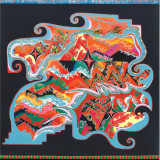
Simoncino is back again on SKYLAX with the volume 2 of the Resurrection series ! The made in Perugia prodigy delivers us once again 3 titles paying homage to the sound of chicago, the fabulous triplet lost tape 1, 2 & 3. On A1, the aptly named Lost tape 1 us leads into the meanders of the jungle house in direct tribute to the great marshall Jefferson all sprinkled with some "detroit" sauce, this peaktime track will delight the most humid and demanding dancefloors. Lost tape 2 is more airy with these sparkling bells and its bass that lifts your guts, mental we tell you ! A bit as if paris gray was remixed in a hovering dub version. On lost tape 3, it is clearly the quintessence of the spirit of simoncino, his genius. This way of creating a universe that is both a tribute to the original chicago house and the italian dream house straight from the 90s. Completely trippy. And cherry on the cake on B2, we have a remix of the now classic "on the dancefloor", a title created in collaboration with Merwyn Sanders from Virgo Four (Chicago), from Detroit legend : Marcellus Pittmann ! 9 mn of pure madness. The Detroit - Chicago axis has never been so obvious. A must. Comes out on clear vinyl. Note that on the label's bandcamp, with the purchase of the vinyl, you can get 1 exclusive bonus track (& what a track !) : Simoncino & Merwyn Sanders of Virgo Four "On The Dance Floor" (Marcellus Pittman smooth remix).
Search:series
Coloured Vinyl
Once again, acid volutes will bring you the wings for special dances, or special trips..
Gladio Operations inaugurates 2023 with its seventh release titled “Split Machine”, a new series of shared EPs, where in this first episode the producers Jauzas The Shining and Cycloplex go halves on the EP.
The French producer returns to Gladio with three cuts which possess his peculiar and characteristic rugged sound. The EP launches with “Business Machines” and “Isla De Encanto”, two powerful cuts with aggressive and noticeable basslines filled-up with dark textures. Jauzas gifts us a last cut titled “Equation”, a nod to the EBM sound, where he preserves the same darkness as in the previous cuts.
On side B we encounter the Spanish producer Francisco Aguado, who has recently released his first work under the “Cultivated Electronics” label under his new electro alias, Cycloplex. With two cuts titled “Intercepted” and “Acid Machine”, Cycloplex reveals his particular minimalist vision of electro sound in an abstract journey of excellent monotonous rhythms.
- A1: Electric Light Orchestra - Mr Blue Sky
- A2: Gerry Rafferty - Baker Street
- A3: Rod Stewart - Da Ya Think I'm Sexy?
- A4: 10Cc - Dreadlock Holiday
- A5: Justin Hayward - Forever Autumn
- A6: Wings - With A Little Luck
- A7: Kate Bush - The Man With The Child In His Eyes
- B1: Bonnie Tyler - It’s A Heartache
- B2: Suzi Quatro - If You Can't Give Me Love
- B3: Clout - Substitute
- B4: Crystal Gayle - Don't It Make My Brown Eyes Blue
- B5: Elton John - Part-Time Love
- B6: Billy Joel - Movin' Out (Anthony's Song) (Anthony's Song)
- B7: Joe Walsh - Life's Been Good
- B8: Blue Öyster Cult - (Don't Fear) The Reaper (Don't Fear)
- C1: Donna Summer - Macarthur Park
- C2: Chic - Le Freak
- C3: A Taste Of Honey - Boogie Oogie Oogie
- C4: The Three Degrees - Givin' Up Givin' In
- C5: Chaka Khan - I'm Every Woman
- C6: Yvonne Elliman - If I Can't Have You
- C7: Odyssey - Native New Yorker
- C8: Earth Wind & Fire - Fantasy
- D1: The Boomtown Rats - Rat Trap
- D6: Elvis Costello & The Attractions - (I Don't Want To Go To) Chelsea (I Don't Want To Go To)
- D7: The Jam - Down In The Tube Station At Midnight
- D8: Patti Smith - Because The Night
- E1: Abba - Take A Chance On Me
- E2: Baccara - Sorry, I'm A Lady
- E3: Boney M - Rivers Of Babylon
- E4: Althea & Donna - Uptown Top Ranking
- E5: Blondie - Denis
- E6: Olivia Newton-John - Hopelessly Devoted To You
- E7: Renaissance - Northern Lights
- E8: Dean Friedman - Lucky Stars (With Denise Marsa)
- F1: Marshall Hain - Dancing In The City
- F2: Eruption - I Can't Stand The Rain
- F3: Dee D Jackson - Automatic Lover
- F4: Sarah Brightman & Hot Gossip - I Lost My Heart To A Starship Trooper
- F5: Hot Chocolate - Every 1'S A Winner
- F6: Commodores - Three Times A Lady
- F7: Rose Royce - Wishing On A Star
- D2: The Undertones - Teenage Kicks
- D3: Buzzcocks - Ever Fallen In Love (With Someone You Shouldn’t’ve) (With Someone You Shouldn’t’ve)
- D4: Siouxsie & The Banshees - Hong Kong Garden
- D5: The Rezillos - Top Of The Pops
NOW Music is proud to present the next instalment in our ongoing ‘Yearbook’ series, NOW – Yearbook 1978; 85 tracks from a magical year in Pop! The 85 track special edition CD is housed in ‘hard-back-book’ packaging, including a 28-page booklet featuring a summary of the year, a track-by-track guide, a quiz, and original singles artwork. NOW – Yearbook 1978; 46 tracks on a 3LP set pressed on translucent pink vinyl - from a magical year in Pop!
Mike Parker lands his third chapter in The Devil's Curators series on Spazio Disponibile. Impressively warping time and tempo's with five iconic cuts of his deep mind trips.
From down tempo acid riffs to shuffling dnb, hysteric drones and his trademark metal kick drums, it's another package showing true style isn't bound to one genre.
- A1: La Sagesse (Women, I'm Calling You) 04:29
- A2: Speaking In Tongues Iii 02:14
- A3: Waiting 06:03
- A4: Shehnai Song 02:04
- A5: Love It Is A Killing Thing 04:49
- A6: Speaking In Tongues Iv 04:58
- B1: Woman And Child 03:37
- B2: En Mireal Del Penal 03:36
- B3: A Sailor's Life 04:21
- B4: Abbess Hildegard 03:26
- B5: Kafi Noir 06:45
An extraordinary exploration of pure vocal power and sensual expression, The Zen Kiss is a highly personal vision of a woman working on the boundaries of convention.
credits
released May 3, 1994
Produced by Steve Coe. Mixed at Real World Studios, Wiltshire, England, November 1993. Mixing engineer Stuart Bruce. Assistant mixing engineer James Cadsky. Recorded at the Coachhouse, Clifton, Bristol. Recorded by Andy Allen and Rik Dowding in the two weeks around the Neptune/ Uranus conjuction of October 1993.
Mastered by Ian Cooper at Metropolis, London.
All drones played or sung by Steve Coe and Sheila Chandra.
All songs written and arranged by Steve Coe and Sheila Chandra except ‘En Mireal del Penal’ by Arroyo/Benito.
Art Direction by Michael Coulson, Real World. Designed by Tony Stiles, Real World. Design Consultation Assorted Images. Series identity Garry Mouat. Photography by Sheila Rock.
Interview by Martha Ladly and Tatiana Spencer.
The leader of the European Dancehall/Shatta scene is still as productive as ever after his latest project Mad Ting 2 and a Europe/Latin America tour in 2022. By delivering multiple hits and appearing at major festivals, Blaiz Fayah is starting 2023 the same way he ended the previous year. The hit maker confirms his notoriety through his appearance in mixes played in clubs by the best DJs of the moment. His exponential growth on social networks, especially Tiktok, is also noteworthy.
A few digits: Blaiz Fayah has 850k monthly listeners on Spotify, 36M Spotify listens and 56M views YouTube for his hit "Bad", more than 9 million TikTok videos under the #blaizfayah.
For his upcoming project "Mad Ting 3" scheduled for June 2, 2023, which concludes the "Mad Ting" series, Blaiz Fayah highlights the vast range of his musical references by bringing in Dancehall, Kompa, Moombahton, Reggae, Shatta and Zouk influences.
For the occasion, some of the most renowned artists of their genre have been invited, such as Busy Signal, Jahyanai King and Nesly.
More than a mere sensation, the artist has seduced Dancehall fans all over the world with hits powered by a dancing energy that only he knows the formula. A unique energy that he was able to spread on some of the best European stages in 2022 (Solidays, Garorock) and that he will be able to continue to broadcast during some fifteen European dates in 2023 (Dour Festival, Reggae Sunska, No Logo...).
By collaborating with international DJs for the production of the tracks on his album (Netherlands, United Kingdom, Mauritius, West Indies...), the artist from the Parisian suburbs extends his influence across different international music stages, as shown by the success of his tour in Latin America (Colombia, Costa Rica, Chile...) and in the Indian Ocean (Mauritius, Reunion, Seychelles...).
- A1: End Titles (From "Star Trek The Motion Picture")
- A2: Main Titles (From "Star Trek Ii The Wrath Of Khan")
- A3: Bird Of Prey Decloaks (From "Star Trek Iii The Search Of Spock")
- A4: End Titles (From "Star Trek First Contact")
- B1: Hella Bar Talk / Enterprising Young Men (From "Star Trek")
- B2: Star Trek - Original Tv Version - Original Series Version
- B3: Theme (From "Star Trek The Next Generation")
- B4: Theme (From "Star Trek Deep Space Nine")
- B5: Theme (From "Star Trek Voyager")
- B6: Where My Heart Will Take Me (From Star Trek Enterprise")
Diese 10-Track-LP ist eine umfassende Geschichte von 43 Jahren Star Trek-Musik von der Original-TV-Serie von 1966 bis hin zu J.J. Abrams' kinoreifem Blockbuster-Neustart. Die Musik von Star Trek steht im Mittelpunkt der Legende – mysteriös und majestätisch, geschrieben von einigen der angesehensten Komponisten der Welt, darunter Größen wie Jerry Goldsmith, James Horner und Alexander Courage. Blaues Vinyl.
(Emotional) Especial and Giraffi Dog join forces once more to offer up the second installment of their concept EP series. It is focussed on live and studio collaborations and this one comes in two halves: the first half kicks off with '6th Chakra' (feat DJ Deflektorschild) - a fully live deep house and hi-tek soul exploration with mind-expanding synths and Detroit drum sounds. 'King OTN' is a jack dup acid cut ripped with cosmic synth details and 'DX Metero' has sheet metal synths lashing about next to ethereal synths and busted drum breaks. 'Starfather' is a star-facing closer with elegant piano notes dancing over serene grooves. A vital showcase of this essential live artist.
The next chapter of the Natural Information Society is here. Since Time Is Gravity, credited to Natural Information Society Community Ensemble with Ari Brown, presents a newly expanded manifestation of acclaimed composer & multi-instrumentalist Joshua Abrams nearly 15 year, 7 albums &-counting flagship ensemble. Joining the core NIS of Abrams (guimbri & bass), Lisa Alvarado (harmonium) Mikel Patrick Avery (drums) & Jason Stein (bass clarinet) are Hamid Drake (percussion), Josh Berman & Ben Lamar Gay (cornets), Nick Mazzarella & Mai Sugimoto (alto saxophones & flute), Kara Bershad (harp) & Chicago living legend of the tenor saxophone Ari Brown. Recorded live to tape at Electrical Audio & The Graham Foundation, cover painting Vibratory Cartography: Nepantla, by Lisa Alvarado. 2xLP on Eremite USA, 2xLP & CD on Aguirre/Eremite Europe. Out 14-04.
Since first developing Natural Information Society in 2010, Joshua Abrams has been gradually expanding the group’s conceptual underpinnings, its musical references & the sheer number of the group’s members. Its music is, in a sense, an expansive form of minimalism, based in repeated & overlaid rhythmic patterns, ostinatos & modality. Its roots, its scale & its meaning become clearer in time. If time is gravity, it also allows us to carry more. Having begun as fundamentally a rhythm section with Abrams’ guimbri at its core, the version here can stretch to a tentet, including six horns.
Abrams has been expanding his minimalism gradually, but he has long understood a key to minimalism’s potential: the breadth of its roots in the late 1950s & early 1960s, ranging from the dissatisfaction of young European-stream composers with the limitations of serialism to the simultaneous dissatisfaction of jazz musicians with the dense harmonic vocabulary of bop & hard bop. The former began exploring rhythmic complexity & narrow tonal palates in place of harmonic abstraction (Steve Reich’s Drumming, Philip Glass’ Music with Changing Parts; perhaps above all Terry Riley’s In C & his late ‘60s all-night organ & loop concerts); the later reduced dense chord changes to scales (signally with Miles Davis' Kind of Blue, but rapidly expanding with John Coltrane’s vast project). In the 1950s the LP record opened the world with documentation of Asian & African musics, key influences on both minimalists & jazz musicians. If John Coltrane’s soprano saxophone suggested the keening shehnai of Bismillah Khan, the instrument was rapidly taken up by two key minimalists, LaMonte Young & Riley, similarly appreciative of its flexible intonation, the same thing that kept it out of big bands.
If the guimbri, the North African hide-covered lute that Abrams plays with NIS, involves a rich tradition of hypnotic healing music associated with the Gnawa people, Abrams’ music also touches on other musics as well — other depths, memories & healings, different drones, rhythms & modes. As the group expands on Since Time Is Gravity, he has made certain jazz traditions in the same stream more explicit as well. If there is a mystical & elastic quality involved in the experience of time, both in direction & duration, you will catch it here. The parts for the choir of winds expand on the roles of Abrams’ guimbri, Mikel Patrick Avery & Hamid Drake’s percussion & Lisa Alvarado’s harmonium: at times, the winds are almost looping in the tentet version, each hitting a repeating note in turn, at once drone & distinct inflection on temporal sequence. The brilliance of the work resides in Abrams’ compositions, the NIS’ intuitive execution & in Ari Brown’s singular embodiment of the great tenor saxophone tradition, including the oracular genius of Eddie “Lockjaw” Davis, & Yusef Lateef. The three pieces by the expanded NIS featuring Brown —the opening “Moontide Chorus” & “Is” & the ultimate “Gravity”— have an immediate impact, & togther might be considered a kind of concerto for tenor saxophone. Here Brown presses almost indistinguishably from composed melody to improvised speech, getting so close to language that he might have a text. Everything here is a sign. Note the tap of the Rhythm Ace that links “Moontide Chorus” to “Is”, the attentive heart always present, even when signed by a machine. There’s a link here to the methodologies & meanings of dub music & the linear & vertical collage of beats, textures & tongues: treated with reverence, a sample of a beat-box can be as soulful, as hypnotic, as a mbira or a tamboura. If those pieces with Brown are heard as a suspended concerto, the three embrace & enfold the other works, like the sepals of a flower. That placement will also touch on the mysteries of our perception of time.
Particularly in “Is”, but elsewhere as well, a phenomenon of transcendence arises in which time appears to be tripartite, at once moving backwards & forwards & standing still. This is an act of technical brilliance certainly, but also an illumination of music’s ability to represent temporal consciousness through polymetrics. This particular listener has only heard it before in a few places, including the horn shouts & bowed basses of Coltrane’s Africa, in moments of Charles Mingus’ The Black Saint & the Sinner Lady, in certain pieces where tapes were literally running backwards, & earlier still in Dizzy Gillespie’s Cubana Be, Cubana Bop, in which the composer George Russell & conguero Chano Pozo found a music that spoke at once in the voices of Stravinsky’s Rite of Spring & the vestigial rites, rhythms & songs of the Yoruba language & Santeria religion of inland Cuba.
In Joshua Abrams’ compositions & the realization of them by the NIS, in the time of one’s close listening & memory thereof, distinctions between the “natural” & the “social”, the “quotidian” & the “transcendent” are erased, suspended or perhaps irrelevant. Consider two of the ensemble pieces, one named for nature, the other social science. In “Murmuration” the repeated wind figures of flute & alto saxophone combine with the interlocking patterns of harp, guimbri & frame drum (tar) to create a perfect moving stillness, not an imitation but a witness to the miracle of the starlings’ astonishing collective art, a surfeit of beauty that might be the ultimate defense tactic.
“Stigmergy” takes its name & concept from the Occupy movement’s Heather Marsh, who proposes a social system based on a cooperative rather than competitive models, one in which ideas are freely contributed & developed as ideas rather than an individual’s property. In its form, Abrams’ “Stigmergy” is the closes thing to traditional jazz, a series of accompanied solos by each of the wind players. However, the composed accompaniment is a radically collectivist notion: a repeated rhythmic figure, call it ostinato or riff, in which the different winds each play only a note or two of the figure, a concept both more collectivist & individualistic in its conception than any typical unison figure. It suggests another of the underlying recognitions that propel the Natural Information Society, the group as social organism, the teleology of hypnotic anarchy, all parts in place, functioning systematically, evolving & expressing itself, its nature & society, as a transformative organism.
George Lewis has described music as “a space for reflection on the human condition”. This suggests that, rather than a “distraction”, at least some music might serve as a distraction from distraction. It’s a focus, a clarity, a awareness, an external invitation to interiority, as if music itself is a model for form & contemplation, an organism contemplating for us or as us. If that is a possibility, & I am sure I have heard such musics, than this music is among them. How many of our rhythms, melodies & harmonies (cultural, historical, biological, psychic) might such music carry, translate & transform in the particulate ecstasy of our own murmuration? (Stuart Broomer, April 2022)
- A1: German Army - A Thirsty Garden
- A2: German Army - Klamath River
- A3: German Army - Last Habitat
- A4: German Army - The Distant Unseen Impact
- A5: German Army - Urban Extent
- B1: Group - 000703_1472
- B2: Group - 220412_1401
- B3: Group - 211020_1176
- B4: Group - 210122_1308
- B5: Group - 210323_1397
- B6: Group - 220503_1432
- B7: Group - 220415_1405
- B8: Group - 211020_1181
Faith Discipline presents on the same release two of the proposals that best define its identity as a recording project. Two artists, or two bands, or a band and an artist, who coincide in some of their qualities and who also perfectly represent the sound line that the label has pursued since it was launched in 2015. German Army and Group have a lot in common, but their personalities are also unique, as are the objectives that influence their work.
German Army and Group coincide in several ways, both operate from anonymity and their approach to music production is also very similar. The style and sound of German Army and Group is mainly based on extreme and lo-fi treatments, and their music can be categorised as tribal, industrial, ethnic or experimental. However, German Army adds to their style a series of moral principles, as the project is based on a vindictive nature with continuous messages and appeals to the population and the rulers, the health of our planet is in extreme danger and with it the life and dignity of the underprivileged.
What would have happened if Michael Dudikoff had gone missing in action, say – in Poland in 1987 – during the harshest freezing spell of the century? Would he have coped under these conditions like John Rambo has in the town of Hope? We shall never find out, but the soundtrack is already there. Latarnik and Cancer G (members of EABS and Błoto) would call this film Zima Stulecia: Minus 30°C.
When Twin Peaks debuted on Polish National Television with its oneiric music by Angelo Badalamenti, Poland could feel as eerie as the series. Seemingly nothing quite matched, but on the other hand, no one was surprised. Growing up in the 1990s inevitably brings back memories of stalls selling a variety of products. You could buy there cleaning products from Germany, some underwear, Haribo jellies and Jacobs coffee, and have access to the "latest" cultural releases, which would be arriving late in Poland. This is where one could obtain pirated copies of cassette tapes and VHS, the labels of which had typewritten film titles that transported kids' fantasies to another world. With such content distribution, many of these kids got their first glimpse of Predator, Terminator, Robocop, as well as Van Damme's stunts in Bloodsport and a plethora of other B action movies, which to this day - like American Ninja - are rerun on TV over and over again. The afterimages of these soundtracks nestled in the heads of Marcin Rak and Marek Pędziwiatr for years and found expression on their debut album.
The music of Zima Stulecia is difficult to label in terms of genre. It oscillates towards melancholic electronic music. For some it will be techno, others will hear elements of house, all accompanied by improvised synth and percussion music.
Zima Stulecia is a duo that was not supposed to have any chance of success. Many years ago, back in 2006, when they were still budding musicians they met for the first time at a jazz workshop. When they found out where they both came from and that they were separated by almost 800 kilometers, despite having great chemistry in playing, they
jokingly said goodbye with the sentence: "it was fun playing together!". They figured they would never meet again. At the time, none of them imagined that in a few years' time in Wrocław they will form one of the most interesting contemporary jazz bands in Poland: EABS and Błoto. On top of that, they were both born in January 1987. The last of the historic "winters of the century" (eng. for "zima stulecia") occurred at that time in Poland, which ultimately determined their name as a band. Minus 30°C album is a recording of the non-verbal workings of these soulmates, and a fruit of a musical collaboration that has lasted for 16 years.
Aufgang B never disappoint with their rough sound excursions. Finally they continue the infamous Demo series with three techno tools rich in mind-melting sound design. Just what all of us have been waiting for!
Bonzai Classics is thrilled to announce the highly anticipated release of the 3rd installment of the Bonzai Power Vinyl series. This 2 x 7" vinyl set comes in a stunning orange color and includes Phrenetic System's "Wayfarer," Aqua Contact's "Cinderella," B.W.P Experiments with "Organic," and Cyberdelia with "Deconstruction”.
This vinyl set is essential to any electronic music lover's collection. The tracks have been remastered for optimal sound quality and are presented in a beautiful gatefold sleeve. Be sure to grab your copy and experience the power of the 90s again!
London-based producer Prayer is set to release a 3-track EP titled "Io" on Rua Sound's SPHERES series. Following previous releases on esteemed imprints such as Hooversound, Black Acre, and Grade 10, Prayer is known for creating atmospheric jungle with an emotive energy that can range from poignant to ecstatic.
Prayer flexes that muscle on opening track 'Set Me Free' with layers of vocals over euphoric breakbeats. "Break Through" takes a turn towards trance-influenced synths, building to a four-on-the-floor finale that reaches for the sky.
On the B-side, Reteoric takes over with an epic jungle track that clocks in at just under 12 minutes. The emotive energy of this track is aptly described as "epic" and serves as a fitting conclusion to the EP. Tim Reaper comes through with a remix of this track as a digital bonus.
Named after the third-largest moon of Jupiter, "Io" is the third release in Rua Sound's SPHERES series. The EP will be available on June 16, 2023.
Damian Lazarus’ Secret Teachings imprint welcomes a unique project from Malian and French pairing Siraba, unveiling their debut single ‘Ngana Fôlly’ alongside remixes from Philou Louzolo and Peaking Lights. Meaning ‘The Great Path’ in Bambara, Siraba - the duo consisting of Malian hunter Boubacar Samake and Damien Vandesande, one half of French electronic band dOP - are on a path of bringing the traditional sound of the Wassoulou to the world. They met in 2003 when Damien visited Mali to work with local artists and met Boubacar’s father - the legendary Sibiri Samake. Working together on multiple occasions, the two promised to work with one another and Boubacar on a project one day, and 17 years later, the two connected to begin to develop their unique sound and showcase their shared universe.
Inspired by the music of the master hunters from across Mali, the ‘Dozo’, the project transmits values based on justice and righteousness, love and respect for others, moral and spiritual rectitude and protection for everyone. Debuting on Damian Lazarus’ Secret Teachings imprint, an outlet for the Crosstown Rebels boss to delve deeper into musical realms outside of the norm and away from the dance floor, the pair will release their debut album in September, with a series of live performances set to be announced. Their first single arrives in early June with ‘Ngana Fôlly’
A spiritual and hypnotic production rooted within Dozo musical tradition, featuring Boubacar playing the Ngoni while singing in Bambara, ‘Ngana Fôlly’ is a resonant and rich production combining organic textures with warping synths, rich bass and sweeping electronics, capturing the magical essence of Mali across a fascinating journey. Providing the first remix on the package, Dutch DJ/producer and DJ Mag ‘Artist To Watch for 2023’ Philou Louzolo harnesses Boubacar’s vocal and places it at the heart of his soaring remix as stripped-back percussion and a commanding low-ends guide sweeping synths, before handing over to San Francisco husband-and-wife pairing and Dekmantel signees Peaking Lights who tip things down a bright and blissful rabbit hole of soundscapes as vibrant guitar riffs and twisting leads work amongst off-kilter melodies and acid flecked tones for an eight-minute trip.
- A1: Carlos Picklin - La Charanga Del Espacio
- A2: Tito Chicoma - Cumbia A Go Go
- A3: Choche Merida - El Rock De Los Chinos
- A4: Benny Del Solar, Melochita, Ita Branda - Rumba Espanola
- A5: Lucho Macedo - Rock & Roll Mambo
- A6: Nallye Fernandez - Batijugando
- A7: Nelson Ferreyra - Twist En Guaracha
- B1: Los Kintos - Kintos Boogaloo
- B2: Patty Pastel - Computador Electronico
- B3: Luciano Luciani - A Bailar Bump
- B4: Willy Marambio - Trompeta A Go Go
- B5: Los Vikingos - Go Go En Patines
- B6: Edgar Zamudio - Dia De Pago
- B7: Lucha Macedo - El Maestro Del Rock & Roll
Exotica, ye-yé cumbia, guaracha infused twist, rock’n roll mambo, Spanish rumba, boogaloo beat, tropical garage and other unexpected bastard genres are featured in this festive compilation of bizarre hits taken from the glorious catalog of records released during the 60s and 70s on the Peruvian label Discos MAG. Some clearly unite genres, others are projects with creative names, but all are bold musical initiatives that got and will always get people onto the dance floor. “Sabroso Go Go” brings together fourteen musical mixes created in the recording studios of Manuel Antonio Guerrero (MAG), in which music directors combine rhythm with alchemy in a quest to find the philosopher's stone of the dance. Exotica, ye-yé cumbia, guaracha infused twist, rock’n roll mambo, Spanish rumba, boogaloo beat, tropical garage and other unexpected bastard genres are featured in this festive compilation. Although this compilation begins in 1957, experiments like this (some more memorable than others) were not new in Peru. The songs on this album were however much more successful hybrids. Some clearly unite genres, others are projects with creative names, but all are bold musical initiatives that got and will always get people onto the dance floor. At the end of the fifties, rock music shook the foundations of Peru, and orchestras rushed to cover hit songs and explore the possibilities of mixing them with tropical music. Lucho Macedo's orchestra took up the mantle and reinterpreted a well-known guaracha by Celia Cruz ('Rock and Roll') in mambo style, renaming it 'Rock and roll Mambo'. 'Maestro de Rock and Roll', a hit by the Cuban Conjunto Casino, received similar treatment. Another mix in this vein is the rock tune 'El Rock de los Chinos' by the Mexican Manolo Muñoz (author of 'Speedy González') recorded by the Chilean Choche Mérida for MAG in 1961. The following year, Chubby Checker’s 'The Twist' hit the scene and was immediately fused with guaracha by maestro Nelson Ferreyra. A legendary MAG musician, Carlos Pickling, composed 'La Charanga del Espacio' in 1963. The space sounds are produced by Pickling and his inseparable Hammond. He himself is the one who leads the orchestra that accompanies Benny Del Solar, Lita Branda and Pablo "Melcochita" Villanueva in the tropicalized version of Spanish Rumba, when the beats of the Iberian rumba were still exotic in South America. Around that time, the Chilean Willy Marambio was already living in Lima. In the track included on this album, the go-go style showcases his virtuosity on the trumpet. Another outstanding trumpet player, Roberto "Tito" Chicoma from Chiclayo, played as a session musician with MAG from 1959. A few years later, he became one of the most popular Colombian cumbia players, a talent he demonstrates in the song on this compilation, which blends the fun of go-go with yé-yé beats. 'Batijugando' was a hit from Mexico and was played in all the rhythms played across the Hispanic world since 1967. Inspired by the "Batman" series, it was performed at MAG by the Betico Salas orchestra, with vocals by the Panamanian lady crooner Nallye Fernández. 'Computador Electrónico' is another surprise on this album, performed by Panamanian vocalist Patty Pastel, it is the only known version in Spanish of 'Der Computer Nr. 3', originally sung in German by France Gall. Two other songs feature Edgar Zamudio. The versatility of Zamudio y Los Vikingos (originally a Chilean group) is demonstrated in the guitar-heavy song composed specifically for the late sixties skate fashion ('Go Go en Patines') and in his idiosyncratic protest song ('Día de Pago') performed in beat style. In the mid-seventies, Los Kintos, led by guitarist Francisco Acosta, developed different harmonic ideas in an instrumental track that veers from boogaloo to salsa, the fashionable rhythm of the day. Finally, in 1976, when the bumping hips dance craze swept the continent, Manuel Guerrero was quick to jump onto the bandwagon, composing a Bump song, together with his son Carlos. The Italian musician based in Lima, Luciano Luciani performed the song 'A Bailar Bump' backed by his band of local musicians Los Mulatos.
Vol.1[29,83 €]
Vol.1 Black Vinyl[28,15 €]
Vol.2 Black Vinyl[31,51 €]
Crass Records, alongside One Little Independent Records, reissue
their iconic three volume compilation series, ‘Bullshit Detector’, on LP,
available in both classic black and special edition grey vinyl.
‘Bullshit Detector’ was the name of a series of compilation LPs put
together by the anarcho-punk band Crass and released on their own
label. Three editions were released between 1980 and 1984,
consisting of demo tapes, rough recordings and artwork that had
been sent to the band.
The sound quality of the ‘Bullshit Detector’ series was mixed and
often basic, or even poor, as Crass would master the tapes directly to
record without any additional production or enhancement. For Crass,
the expectation of a polished performance was missing the point.
After punk had already been co-opted, re-packaged and sold back to
us, ‘Bullshit Detector’ volumes 1-3 were, and still are, seen by many
to capture the purest ethos of punk culture, an event that inspired
hundreds to take to their bedrooms and garages and join the DIY
revolution.
Crass believed in the power of community and that their movement
was for everybody. These compilations are an admittedly harsh but
important part of that story; when Crass gave punk back to the
people.
Sleeve notes from ‘Bullshit Detector Three’ read: “Don’t expect music
when the melody is anger, when the message sings defiance, three
chords are frustration when the words are from the heart.”