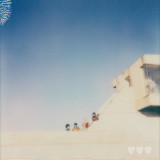
múm are returning with a new album on Morr Music. »History of Silence« is the first full body of work by the Icelandic collective since 2013's »Smilewound« and their seventh studio album to date—recorded, deconstructed, put back together again, refined and finished over the course of two years. Vibrantly oscillating around a carefully curated palette of electronic and analogue sounds, the eight new tracks reflect the group's continuous strive to explore sonic spaces through subtle yet gripping songwriting.
For a long time now, múm have been exploring the idea of distance in their music. In the beginning, this was born purely out of necessity. Founded in Iceland in the late 1990s, the members soon began embarking on journeys across the world—collectively while touring, but also individually, exploring new places to live and create. Settling in, moving on, catching up: The concept of distance soon became an integral part of the collective's process. »History of Silence« leans into this idea, with space and time becoming indispensable pillars of the arrangements. While being coherent and structured, they echo their origins from different seasons, cities, and spaces—neatly stitched together with unparalleled craftsmanship. They breathe an overall airy and intimate atmosphere, yet resonate with the structural heft of time.
On »History of Silence« time manifests in unexpected, liberating, and mesmerizing ways. It does not move reliably forward; it drifts, takes twists and turns, even disappears completely. Electronic textures blur into acoustic sounds, voices flicker and dissolve, melodies stumble and repeat. The arrangements often feel like they’re wandering, gently resisting direction. »Our Love is Distorting,« for instance, begins with a subtle piano motif, playing hide and seek with feedback noises, digital artefacts, and lush—yet very quiet—string arrangements, before gradually forming into a distinctive song. It's a perfect illustration of múm's general approach on this album. »Mild at Heart« turns this idea upside-down, flowing freely from start to finish with moments of silence sprinkled in—serving to emphasize the musical elements. The music on »History of Silence« moves like weather: unexpected, intimate, quietly detailed. Contrasted with vivid phrases, rhythmic shifts, and small hooks, the album offers a new angle of compositional clarity and vision.
Work on »History of Silence« began at Sudestudio in southern Italy. Additional recordings were made in Reykjavík, Berlin, Athens, Helsinki, New York, and Prague. The strings were recorded by Sinfonia Nord at the Hof concert hall, Akureyri, arranged and conducted by Ingi Garðar Erlendsson, who has worked with the band for many years. The orchestral elements don’t dominate the record—instead, they surface gently, adding depth and resonance to the songs without disturbing the songs' fragility.
Contrary to what the album title suggests, »History of Silence« is a collection of bold and colorful songs, no matter how muted they might sound at times. They tickle like a feather drifting through the wind, ending up in unexpected places, stimulating long-forgotten thoughts and feelings, intimate moments of introspection. The songs move through the echoes those moments leave behind: the emotional traces of things unsaid, the weight of stillness. Offering closeness by means of distance and much-needed support.
Cerca:seven seas
múm are returning with a new album on Morr Music. »History of Silence« is the first full body of work by the Icelandic collective since 2013's »Smilewound« and their seventh studio album to date—recorded, deconstructed, put back together again, refined and finished over the course of two years. Vibrantly oscillating around a carefully curated palette of electronic and analogue sounds, the eight new tracks reflect the group's continuous strive to explore sonic spaces through subtle yet gripping songwriting.
For a long time now, múm have been exploring the idea of distance in their music. In the beginning, this was born purely out of necessity. Founded in Iceland in the late 1990s, the members soon began embarking on journeys across the world—collectively while touring, but also individually, exploring new places to live and create. Settling in, moving on, catching up: The concept of distance soon became an integral part of the collective's process. »History of Silence« leans into this idea, with space and time becoming indispensable pillars of the arrangements. While being coherent and structured, they echo their origins from different seasons, cities, and spaces—neatly stitched together with unparalleled craftsmanship. They breathe an overall airy and intimate atmosphere, yet resonate with the structural heft of time.
On »History of Silence« time manifests in unexpected, liberating, and mesmerizing ways. It does not move reliably forward; it drifts, takes twists and turns, even disappears completely. Electronic textures blur into acoustic sounds, voices flicker and dissolve, melodies stumble and repeat. The arrangements often feel like they’re wandering, gently resisting direction. »Our Love is Distorting,« for instance, begins with a subtle piano motif, playing hide and seek with feedback noises, digital artefacts, and lush—yet very quiet—string arrangements, before gradually forming into a distinctive song. It's a perfect illustration of múm's general approach on this album. »Mild at Heart« turns this idea upside-down, flowing freely from start to finish with moments of silence sprinkled in—serving to emphasize the musical elements. The music on »History of Silence« moves like weather: unexpected, intimate, quietly detailed. Contrasted with vivid phrases, rhythmic shifts, and small hooks, the album offers a new angle of compositional clarity and vision.
Work on »History of Silence« began at Sudestudio in southern Italy. Additional recordings were made in Reykjavík, Berlin, Athens, Helsinki, New York, and Prague. The strings were recorded by Sinfonia Nord at the Hof concert hall, Akureyri, arranged and conducted by Ingi Garðar Erlendsson, who has worked with the band for many years. The orchestral elements don’t dominate the record—instead, they surface gently, adding depth and resonance to the songs without disturbing the songs' fragility.
Contrary to what the album title suggests, »History of Silence« is a collection of bold and colorful songs, no matter how muted they might sound at times. They tickle like a feather drifting through the wind, ending up in unexpected places, stimulating long-forgotten thoughts and feelings, intimate moments of introspection. The songs move through the echoes those moments leave behind: the emotional traces of things unsaid, the weight of stillness. Offering closeness by means of distance and much-needed support.
múm are returning with a new album on Morr Music. »History of Silence« is the first full body of work by the Icelandic collective since 2013's »Smilewound« and their seventh studio album to date—recorded, deconstructed, put back together again, refined and finished over the course of two years. Vibrantly oscillating around a carefully curated palette of electronic and analogue sounds, the eight new tracks reflect the group's continuous strive to explore sonic spaces through subtle yet gripping songwriting.
For a long time now, múm have been exploring the idea of distance in their music. In the beginning, this was born purely out of necessity. Founded in Iceland in the late 1990s, the members soon began embarking on journeys across the world—collectively while touring, but also individually, exploring new places to live and create. Settling in, moving on, catching up: The concept of distance soon became an integral part of the collective's process. »History of Silence« leans into this idea, with space and time becoming indispensable pillars of the arrangements. While being coherent and structured, they echo their origins from different seasons, cities, and spaces—neatly stitched together with unparalleled craftsmanship. They breathe an overall airy and intimate atmosphere, yet resonate with the structural heft of time.
On »History of Silence« time manifests in unexpected, liberating, and mesmerizing ways. It does not move reliably forward; it drifts, takes twists and turns, even disappears completely. Electronic textures blur into acoustic sounds, voices flicker and dissolve, melodies stumble and repeat. The arrangements often feel like they’re wandering, gently resisting direction. »Our Love is Distorting,« for instance, begins with a subtle piano motif, playing hide and seek with feedback noises, digital artefacts, and lush—yet very quiet—string arrangements, before gradually forming into a distinctive song. It's a perfect illustration of múm's general approach on this album. »Mild at Heart« turns this idea upside-down, flowing freely from start to finish with moments of silence sprinkled in—serving to emphasize the musical elements. The music on »History of Silence« moves like weather: unexpected, intimate, quietly detailed. Contrasted with vivid phrases, rhythmic shifts, and small hooks, the album offers a new angle of compositional clarity and vision.
Work on »History of Silence« began at Sudestudio in southern Italy. Additional recordings were made in Reykjavík, Berlin, Athens, Helsinki, New York, and Prague. The strings were recorded by Sinfonia Nord at the Hof concert hall, Akureyri, arranged and conducted by Ingi Garðar Erlendsson, who has worked with the band for many years. The orchestral elements don’t dominate the record—instead, they surface gently, adding depth and resonance to the songs without disturbing the songs' fragility.
Contrary to what the album title suggests, »History of Silence« is a collection of bold and colorful songs, no matter how muted they might sound at times. They tickle like a feather drifting through the wind, ending up in unexpected places, stimulating long-forgotten thoughts and feelings, intimate moments of introspection. The songs move through the echoes those moments leave behind: the emotional traces of things unsaid, the weight of stillness. Offering closeness by means of distance and much-needed support.
- Last Chance
- Wait For Us To Be Home
- Prayers And Pollen
- Transparent Towns
- Who You Thought I Was
- Jump The Gun
- Regret Without Reason
- Door Of No Return
- Sierra Dawn
- Cardinal Direction
John Calvin Abney rises again from the Oklahoman prairies with his latest album Transparent Towns. The ten songs focus on how we remember, and ultimately accept, though he is not always certain the memories we carry adequately mark the moments that make us. "This record is wrapped around the passage of time, whether or not we can trust the memories that we swear on, how we forgive ourselves and others as seasons turn, and how we define what is important as we roll the boulder back up the hill," Abney says of Transparent Towns. "We build these routines and live our stories, we rely on our histories and our memories - spoken and recorded. Now, we're relying on copies of copies, memories of memories, all packed like sardines into our phones, and we're losing the ability to tell our own stories. I have to constantly remind myself, as well as redefine what matters at the end of a day." Transparent Towns is the seventh studio album for Abney, and his first since 2022's Tourist, which he crafted after spending the pandemic as an itinerant writer. In contrast Abney penned most of the album's 10 tracks during a period of introspection and convalescence while recovering from vocal cord surgery in 2023. The time to himself - "I didn't sing for nearly a year, and after surgery, I couldn't talk for a month, and couldn't sing for over three months," he says, left him contemplating how to trace his experiences in the silence. The album's title track is Abney's take on the inaccessible past, witnessing loss and grief through the years, damning the "days we let go left unsaid", and accepting the uncontrollable circumstances we are sometimes placed in. "The troubles and the joys exist vibrantly in your memory, but you're wondering if you remember correctly," Abney remarks. "I've sometimes had this sort of confusion between memory and dreams - you crafted this ideal in your head of how things were or might be, in order to soften the blow of a harsher reality." The places we inhabit dictate how our memories form, and for Abney, there is one place to which he is constantly drawn: Oklahoma. Although he was born in the biggest little city in America, Reno, Nevada, he grew up learning guitar and piano in Tulsa, playing bars and DIY spaces from Norman to Stillwater. His affinity for the land that raised him is evident in the production of Transparent Towns. Abney self-produced the record, tracking most of it at Cardinal Song outside of Oklahoma City, with Michael Trepagnier handling mixing and engineering. The band was comprised mostly of Sooner State musicians too, along with Lydia Loveless and John Moreland contributing harmony vocals. His signature vulnerable voice and lyrical handiwork comes through in each of the songs, along with his penchant for alternative pop melodies set against colorful chords and subtle soundscapes. Having toured for years backing up artists like Moreland, Wild Child, Ben Kweller, and S.G. Goodman, Abney embraces a lead role again, as he presses forward with the loving lament and defiant joy throughout Transparent Towns, calling us to leave behind the pressures we place on our ourselves and recognize that just because there is an ending, it doesn't mean it's the end.
Limited first pressing on silver vinyl. Flying Horseman returns with their first new album in five years. Experience their renewed but signature sound with a fresh line-up.
Flying Horseman is back! After a five year hiatus and with a new line-up, the band is ready to once again captivate headphone junkies and live audiences alike with Anaesthesia, their seventh album. It's an urgent and passionate work of intelligent rock'n roll, hazy psychedelia and cosmic folk. Anaesthesia is brooding, angry and dark but at the same time full of life, wonder and sophistication. It's an invigorating, fascinating, electric brew.
Flying Horseman is still centered around the intensely personal song writing, singing and guitar playing of Bert Dockx. The band's line-up has changed,with Louis Evrard (Pruillip, Ottla, Grid Ravage) and Maximilian Dobbertin (Calicos, Frankie Fame) replacing drummer Alfredo Bravo and bassist Mattias Cré. Bravo and Cré were long-standing members, beloved by fans and fellow musicians alike, and they have played an important part in establishing Flying Horseman's musical identity. Today Evrard and Dobbertin are adding a fresh and personal twist to the idiosyncratic sound of Flying Horseman: their groove, their intuition and sensibility, their soul.
Then there's Loesje and Martha Maieu, who have been part of the group for almost as long as its frontman has, and who offer essential ingredients to bring about Flying Horseman's signature flavour, their haunting vocals and atmospheric electronics contrasting beautifully with Dockx' more earthy vocal delivery and his restless, fiery plucking of the guitar strings.
The whole record is fiery, alternately smouldering and violently burning. These are musical sounds capable of setting the listener's heart and mind ablaze. Anaesthesia is very consciously, a political record born out of Dockx and his friends' bafflement at the state of the world, the new rise of fascism, the onslaught of injustice, barbarism and stupidity which we, inhabitants of planet earth, are witnessing day in day out.
How to guard one's sanity in such a crazy world? How to maintain one's dignity? How to feel useful and joyful when surrounded by confusion and hate? These are the questions Flying Horseman is struggling with, as are so many of us today. But there is joy and purpose in the asking; in the struggling; in staying critical of dominant systems of oppression; in thinking or saying: "I don't agree, this is not how it's supposed to be"; in coming together and connecting, sharing, mourning and dreaming. Joy and purpose; questions and confusion; burning hearts and tarnished dreams: it's allhere, in the transportive sound world of Flying Horseman.
Anaesthesia was recorded in Antwerp by Joris Caluwaerts (keyboardist of the inimitable avant-jazz group .STUFF) and mixed by Yves De Mey (one of Belgium's most prominent & avant-garde electronic wizards), two experienced collaborators who know a thing or two about capturing sound and transforming it into a rewarding listening experience. With their help, Flying Horseman has crafted a tight collection of eight art-rock tunes with a clear identity, a rich sound, an original vision and a joyful purpose in the face of encroaching sinister forces.
- 1: The Hard Way
- 2: He Thinks He Ll Keep Her
- 3: Rhythm Of The Blues
- 4: I Feel Lucky
- 5: The Bug
- 6: Not Too Much To Ask (With Joe Diffie)
- 7: Passionate Kisses
- 8: Only A Dream
- 9: I Am A Town
- 10: Walking Through Fire
- 11: I Take My Chances
- 12: Come On Come On
Come On Come On isn’t just Mary Chapin Carpenter’s most popular album, with sales of 3 million copies. It’s also a contemporary country landmark. No less than seven of its songs became country hits: “I Feel Lucky,” “I Take My Chances,” “Not Too Much to Ask,” “The Hard Way,” “He Thinks He’ll Keep Her,” and two inspired covers, of Dire Straits’ “The Bug” and Lucinda Williams’ “Passionate Kisses.” More importantly, though, this 1992 release pointed the way towards what country music would become in the 21st century with its savvy seasoning of pop and soft-rock sounds into a more personal style of country songwriting from a female point of view. If you’re thinking that sounds familiar, you’re not wrong; Come On Come On’s prodigious commercial prowess isn’t the only thing this record has in common with the early work of Taylor Swift. But, it also crossed over into the rock realm in a way that, arguably, Swift’s records have not; the flourishing Americana and alt-country audiences of the early ‘90s ate this album up, and guest stars like Rosanne Cash, The Indigo Girls, and Shawn Colvin just upped its street cred. Somehow, this classic record has never (come on!) made it to vinyl; we’re making up for a whole lot of lost time with a grape vinyl pressing housed inside a color inner sleeve with lyrics. Essential!
Far Out Recordings continues its reissue campaign of the late Argentinian guitarist Agustin Pereyra Lucena's work with the first-ever vinyl reissue of his singular 1988 private press album, Puertos De Alternativa, now his most sought-after LP. The album features some of Agustin’s most uniquely beautiful compositions, including “Luces de Valeria” and “Preparativos Maritimos,” alongside Baden Powell's “Pequeño Vals” and “O Cego Aderaldo (Nordeste...),” and “Tema Barroco” by his longtime collaborator, Guilhermo Reuter.
By 1988, Agustín had established himself as one of Argentina’s foremost interpreters of Brazilian music. The seventies saw success with his group Candeias, and he gained recognition in Brazil, forming friendships and collaborations with luminaries such as Vinicius de Moraes, Baden Powell, Dorival Caymmi, Toquinho, and Maria Bethania. Following the era of dictatorship in South America, Agustín spent the late seventies and early eighties, living and touring in Norway as part of his European travels with his group Agustín Pereyra Lucena quartet.
Recorded after returning to his native Buenos Aires, Agustin Peyera Lucena’s Puertos de Alternativa emerged from this confluence of diverse experiences and influences, revealing an artist deeply connected to his environment. The album's title, meaning "Alternative Harbours," reflects Agustín's particular affinity for water. He observed that much of his favourite music originated from places with rivers and seas nearby, noting, "There is a flow near water that influences guitar playing for sure."
With a profound connection to both instrument and environment, Agustín’s music is often difficult to place. The album begins rooted deeply in South American soil, drawing clear inspiration from Brazilian guitar masters like Heitor Villa Lobos, Garoto and Baden Powell. But, as it progresses, a sense of journey unfolds, evoking new landscapes and horizons – from the crystalline beauty of glacial Norway to the gentle currents of the Rio de la Plata.
The ensemble on Puertos de Alternativa features notable Argentinian musicians, including drummer Osvaldo Avena, flautist Rubén Izarrualde, and saxophonist Bernardo Baraj.
Mastered by Stuart Hawkes at Metropolis Studios from the original master tapes which had been lovingly kept by Agustin’s nephew José Lucena Perreyra
Tracklist & Credits:
A1. Luces De Valeria (Agustin Pereyra Lucena)
Guitar, Vocals – Agustin Pereyra Lucena
Piano, Bass, Drums, Vocals – Guillermo Reuter
Tamboril – Julio Said
A2. Pequeña Valsa (Baden Powell)
Arranged By Flute – Lucho González
Drums – Osvaldo Avena
Flute – Alejandro Santos
Guitar – Agustin Pereyra Lucena
Tambora – Eduardo Avena
A3. Planicie (El Llano) (Agustin Pereyra Lucena)
Arranged By Flute – Lucho González
Flute – Rubén Izarrualde
Keyboards, Acoustic Bass, Percussion, Arranged By Keyboards – Guillermo Reuter
Guitar – Agustin Pereyra Lucena
A4. Tema Barroco (Guillermo Reuter)
Guitar – Agustin Pereyra Lucena
Percussion – Guillermo Reuter
A5. O Cego Aderaldo (Nordeste...) (Baden Powell)
Guitar – Agustin Pereyra Lucena
B1. Tres Que Quedaron (Agustin Pereyra Lucena, Andrés Laprida)
Drums – Osvaldo López
Flute – Rubén Izarrualde
Piano, Keyboards, Bass, Directed By – Guillermo Reuter
Soprano Saxophone – Bernardo Baraj
Electric Piano, Arranged By – Andrés Laprida
Guitar, Electric Guitar, Vocals – Agustin Pereyra Lucena
B2. Preparativos Maritimos (Andrés Laprida, Agustin Pereyra Lucena, Guillermo Reuter)
Guitar, Vocals – Agustin Pereyra Lucena
Keyboards, Acoustic Bass, Percussion, Arranged By – Guillermo Reuter
B3. Puertos De Alternativa (Agustin Pereyra Lucena)
Guitar, Effects – Agustin Pereyra Lucena
B4. Casi-Numbe (Luis González Cárpena, Agustin Pereyra Lucena)
Bass – Lucho González
Bass Flute – Rubén Izarrrualde
Berimbau – Horacio Veros
Keyboards, Piano, Vocals, Drums, Arranged By – Guillermo Reuter
Guitar, Vocals, Arranged By – Agustin Pereyra Lucena
- A1: Machines (Back To Humans) / Tear It Up
- A2: Tie Your Mother Down
- A3: Under Pressure
- B1: Somebody To Love
- B2: Killer Queen
- B3: Seven Seas Of Rhye
- B4: Keep Yourself Alive
- C1: Liar / Instrumental Jam
- C2: It's A Hard Life
- C3: Impromptu Sing Along
- D1: Dragon Attack
- D2: Now I'm Here
- D3: Is This The World We Created?
- D4: Love Of My Life
- Magic Hour
- Dragon In The Lagoon
- Seven Seas
- Just Being Alone
- Magic Hour Reprise
- The Fusang Tree
- Dewdrops On A Gold Tortoise
- Summoning Rain
- Kitakami
- Kitakami Outro
- A1: Tocotronic - Pure Vernunft Darf Niemals Siegen (Superpitcher / Wassermann Mix) (Edit)
- A2: Kaito - Everlasting (Edit)
- A3: Terranova - Paris Is For Lovers (My Love) Feat Tomas Høffding (Edit)
- A4: Justus Köhncke - Timecode (Edit)
- A5: Heiko Voss - I Think About You (Edit)
- B1: Leandro Fresco / Thore Pfeiffer - Neo (Edit)
- B2: The Bionaut - Everybody’s Kissing Everyone (Edit)
- B3: Ada - Lovestoned Feat Raz Ohara (Edit)
- B4: Superpitcher - Mushroom (Edit)
- B5: Rex The Dog - Prototype (Edit)
- C1: Dettinger - Blond 1 (Edit)
- C2: The Field - Over The Ice (Edit)
- C3: Robag Wruhme - Calma Calma (Edit)
- C4: Saschienne - Unknown (Dixon Mix) (Edit)
- C5: Max Würden - Circles (Edit)
- D1: Gas - Pop 1 (Edit)
- D2: Triola - Ag Penthouse (2 Epoche) (Edit)
- D3: Thomas Fehlmann - Making It Whistle (Edit)
- D4: Scsi-9 - All She Wants Is (Wighnomy Bros Mix) (Edit)
- D5: Jürgen Paape - Reval 1 (Edit)
- E1: The Modernist - Pearly Spencer (Edit)
- E2: Aril Brikha - Berghain (Edit)
- E3: T Raumschmiere - Augen Zu (Edit)
- E4: Reinhard Voigt - Superskunk (Edit)
- G1: Mike Ink - Rosenkranz (Edit)
- G2: Reinhard Voigt - Stille Hände (Edit)
- G3: Forever Sweet - The Bionaut (Edit)
- G4: Wassermann - W I.r. (Sven Väth Mix) (Edit)
- G5: Blank Gloss - Coiling (Edit)
- H1: Michael Mayer / Matias Aguayo - Slow (Edit)
- H2: Wighnomy Bros - Wurz + Blosse (Edit)
- H3: John Tejada - Unstable Condition (Edit)
- H4: Sam Taylor-Wood Produced By Pet Shop Boys - I’m In Love With A German Film Star (Gui Boratto Mix) (Edit)
- H5: Jürgen Paape - So Weit Wie Noch Nie (Edit)
- I1: Matias Aguayo - Walter Neff (Edit)
- I2: Voigt & Voigt - Tischlein Deck Dich (Edit)
- I3: Gui Boratto - Beautiful Life (Edit)
- I4: Kölsch - Goldfisch (Edit)
- I5: Gusgus - Rivals (Dj Hell Mix) (Edit)
- K1: Closer Musik - Maria (Edit)
- K2: Wassermann - Fackeln Im Sturm (Edit)
- K3: Jürgen Paape - Take That (Edit)
- K4: Superpitcher - Happiness (Michael Mayer Mix) (Edit)
- K5: Markus Guentner - Regensburg (Edit)
- E5: Schaeben & Voss - Dicht Dran 1 (Edit)
- F1: Dj Koze - Brutalga Square (Edit)
- F2: The Orb - Masterblaster (Edit)
- F3: Michael Mayer - Pride Is Weaker Than Love (Edit)
- F4: Laurent Garnier - From The Crypt To The Astrofloor (Edit)
- F5: Anna & Kittin - Forever Ravers (Edit)
Over the decades, the image of Kompakt as a pirate ship has taken root in our minds, braving the dangers of the seven seas of the music market. Sometimes it glides with a tailwind through calm waters, sometimes it has to survive violent storms. When we set sail in 1993, we never would have dreamt that our journey would still be going on after more than three decades and with 500 releases to date.
In our fast-paced business, the 500 mark is rarely reached, so we want to celebrate it with a lavish 5LP box set. In a democratic process, we have selected 50 pearls from the thousands of tracks released over the last 33 1/3 years and pressed them onto 5 brightly coloured vinyls. Alongside many Kompakt evergreens, there are also some real rarities from the early ‘Kompakt Sound of Cologne’, which have been lovingly remastered here to shine in new splendour.
The box also contains a 144-page book that tells the story of Kompakt from 1993 to today with detailed texts and images. In addition to the manifold musical and graphic achievements of Kompakt, the multidisciplinary links to the visual arts are also highlighted here.
The Bonus Picture Disc opens with the symbolic tolling of 500 bass drums, followed by 50 locked grooves from the 5 Kompakt founders, looping into infinity at 133 1/3 BPM, and the ‘33 1/3 Years Loop Opera’ – in which the loops are combined into one track that, in its reduced essence, is more than the sum of its individual parts. The magic of groovy loop minimalism and the ‘art of omission’ are once again brought to the proverbial point.
On 23 May 2025, the big KOMPAKT 500 art exhibition will open at the venerable Kölnischer Kunstverein to coincide with the release. The entire visual cosmos of Kompakt will be shown here in an unprecedented way on three floors, with the participation of many renowned artists. Of course, there will also be dancing and partying at the vernissage party, with DJ sets and live shows by the Kompakt Allstars.
The last one turns off the bass drum.
Im Laufe der Jahrzehnte hat sich in unseren Köpfen das Bild von Kompakt als Piratenschiff festgesetzt, das den Gefahren der sieben Weltmeere des Musikmarktes trotzt. Mal gleitet es mit Rückenwind durch ruhige Gewässer, mal muss es heftige Stürme überstehen. Als wir 1993 die Segel setzten, hätten wir uns nicht träumen lassen, dass unsere Reise nach über drei Jahrzehnten und mittlerweile 500 Veröffentlichungen immer noch andauert.
Die 500 ist in unserem schnelllebigen Geschäft eine selten erreichte Katalognummer und soll daher mit einer üppigen 5LP-Box gebührend gefeiert werden. In einem demokratischen Prozess haben wir aus den tausenden Tracks der letzten 33 1/3 Jahre 50 Perlen ausgewählt und auf 5 knallbunte Vinyls gepresst. Neben vielen Kompakt-Evergreens finden sich auch einige echte Raritäten des frühen “Kompakt Sound of Cologne”, die hier liebevoll remastered in neuem Glanz erstrahlen.
Die Box enthält außerdem ein 144-seitiges Buch, das mit ausführlichen Texten und Bildern die Kompakt-Geschichte von 1993 bis heute erzählt. Neben den mannigfaltigen musikalischen und grafischen Errungenschaften von Kompakt werden hier auch die multidisziplinären Vernetzungen zur bildenden Kunst beleuchtet.
Die Bonus Picture Disc wird mit einem symbolischen Glockenschlag von 500 Bassdrums eröffnet, gefolgt von 50 Endlosrillen der 5 Kompakt-Gründer, die sich bei 133 1/3 BPM in die Unendlichkeit schleifen sowie der “33 1/3 Years Loop Opera”, in der die Loops zu einem Track zusammengefügt werden, der in seiner reduzierten Essenz mehr ist als die Summe seiner Einzelteile. Die Magie des groovenden Loop-Minimalismus und die “Kunst des Weglassens” werden einmal mehr auf den sprichwörtlichen Punkt gebracht.
Am 23. Mai 2025 eröffnet parallel zum Release die große KOMPAKT 500 Kunstausstellung im ehrwürdigen Kölnischen Kunstverein. Der gesamte visuelle Kosmos von Kompakt wird hier unter Beteiligung vieler namhafter Künstler*Innen in nie gesehener Form auf drei Etagen gezeigt. Selbstverständlich darf zur Vernissagenparty auch getanzt und gefeiert werden zu DJ Sets und Liveshows der Kompakt Allstars.
Der Letzte macht die Bassdrum aus.
- Bleed
- Seven Steps To Hell
- The Four Seasons - Summer
- Alien Hip Hop
- Andromeda
- Ode To Joy (Vocal)
- Pick Up The Pieces
- The Devil's Staircase
- Ode To Joy (Instrumental)
Übercode Ouvre is the eagerly awaited album from Panzerballett, a unique jazz-metal quintet that fuses intricate metal riffs with jazz improvisation, humor, and high-level musicianship. The album pushes genre boundaries, featuring contributions from legendary drummers Virgil Donati, Marco Minnemann, Anika Nilles, Morgan Ågren, and others. It offers a thrilling listening experience for jazz fusion and progressive metal enthusiasts alike. Included are covers like "Bleed" from Meshuggah, "Alien Hip Hop" from Virgil Donati; re-imaginations of classical pieces like Beethoven's "Ode to Joy" and Vivaldi's "Summer"; as well as originals like "Seven Steps To Hell". They all showcase the band's blend of complex rhythms, virtuosic drumming, and unconventional arrangements. The album's diversity makes it stand out in the progressive metal and jazz scenes. Panzerballett, led by guitarist Jan Zehrfeld, has earned a cult following for their "Headbanging with Brain" approach to music, delivering not only technically advanced compositions but also humorous, organic reconstructions of well-known pieces. Their live performances are legendary for their energy and complexity, and Übercode Ouvre is poised to continue that legacy with tracks that balance intense technicality with an accessible groove. Übercode Ouvre is a musical journey and a perfect workout for developing brain-muscle connections with its meticulously constructed beats. If you want to experience one of the most innovative bands in progressive jazz and metal, having this album is a chance to own a piece of modern music history that challenges the boundaries of what metal can be and how jazz can speak to the heavy music world. Übercode Ouvre is the highly anticipated jazz-metal album by Panzerballett. A world-class line-up pushes genre boundaries more than ever. FFO The Aristocrats, Virgil Donati, Marco Minnemann, progressive metal etc, features legendary drummers Virgil Donati & Marco Minnemann
Revered as one of London’s ‘leading disco labels’, The Disco Express slows no signs of slowing down. Steaming in HOT with with seven Summer sizzlers, the much loved label serves up certified dance floor heat ahead of the sunny season.
Oozing in top tier quality, the Summer Heatwave vinyl compilation encompasses the best new music forthcoming on The Disco Express. Including superb remixes by the scintillating Bosq and Dr Packer, Summer Heatwave features 100% original music by label regulars Magnolia, Maryag, Rayowa, Third Attempt and label boss Bustin’ Loose.
Pulsating with pure infectious Summer grooves, this compilation is truly essential for Disco, Nu-Disco and House music lovers worldwide
The first release of 2025 on Big Saldo’s Chunkers comes in hot with an all-killer, no-filler four-tracker from London’s Papa Nugs. All four tunes on Move it or Lose it are playful, upbeat house jams, with carefully arranged elements firmly aimed at the dancefloor. The seventh release on the label is a fully realized vision of Papa Nugs’ take on the classic chunkers style: big, boshy, hip-catching basslines, infectious vocal chops, party-starting percussion, and a generous helping of rave-ready samples and FX. Nugs’ masterful production chops shine through especially bright here. The canon of 90s club music is referenced with expert poise: subtle nods to early trance, progressive and hard house, turn-of-the-century Ibiza tribal, and insouciantly sleazy tech house are delicately woven into the tracks, along with the contemporary hip house vibe the label has gained notoriety for. As the lead vocal in Turn it Down repeats: “We’re here to have a good time, ” and the EP is exactly that. With festival season just around the corner, this one is sure to be a staple on main stages worldwide. Needless to say, now is not the time to sleep on the latest offering from BSC.
- Main Titles
- Dragonstone
- Shall We Begin?
- The Queen S Justice
- A Game I Like To Play
- I Am The Storm
- The Gift
- Dragonglass
- Spoils Of War (Pt. 1)
- Spoils Of War (Pt. 2)
- The Dagger
- Home
- Gorgeous Beasts
- The Long Farewell
- Against All Odds
- See You For What You Are
- Casterly Rock
- A Lion S Legacy
- Message For Cersei
- Ironborn
- No One Walks Away From Me
- Truth
- The Army Of The Dead
- Winter Is Here
The seventh and penultimate season of the fantasy drama television series Game of Thrones premiered on HBO in 2017.
The penultimate season focuses on the convergence of the show's main plots in preparation for the final season. Daenerys Targaryen arrives in Westeros with her army and three large dragons and begins to wage war against the Lannisters, who have defeated her allies in the south and west of Westeros. Jon Snow leaves Sansa in charge of Winterfell and visits Daenerys to secure her help to defeat the White Walkers and the Army of the Dead. He mines the dragonglass at Dragonstone and begins a romance with Daenerys. Arya and Bran (now the Three-Eyed Raven) return home to Winterfell; the Starks execute the treacherous Littlefinger. Tyrion persuades Daenerys not to destroy King's Landing, reminding her that she does not want to be simply a queen of ashes. Instead, Jon goes north of the wall to capture a wight to prove to Cersei that the fearsome army of the dead exist and are coming; in doing so, his group is pinned down and nearly killed. Daenerys rescues them with her dragons but the Night King kills one of her dragons and makes it part of his army. The undead dragon later destroys part of the Wall and the dead march through. Bran learns that Jon is really his cousin, Aegon Targaryen, the legitimate heir to the Iron Throne.
Game of Thrones Season 7 received 22 nominations for the Primetime Emmy Awards and won for Outstanding Drama Series and Dinklage won for Outstanding Supporting Actor in a Drama Series. The score by Ramin Djawadi was also nominated for a Grammy Award for Best Score Soundtrack for Visual Media.
Game Of Thrones Season 7 is available as a limited edition of 750 numbered copies on silver coloured vinyl and includes a 4-page booklet.
- I Mean You
- All Of You
- Spring Is Here
- Star Eyes
- If I Were A Bell
- Summertime
- Autumn Leaves
When considering the jazz vibraphone giants of the 20th century, seven stand out: Lionel Hampton, Red Norvo, Milt Jackson, Terry Gibbs, Cal Tjader, Gary Burton, and Bobby Hutcherson. Bobby Hutcherson (1941-2016), originally inspired by Milt Jackson, emerged from Los Angeles in the late 1950s. After a stint with the Billy Mitchell-Al Grey sextet in 1962, Hutcherson moved to New York, becoming the house vibraphonist for the Blue Note label. His foundation in hard bop did not limit him, as he also played in avant-garde sessions with artists like Eric Dolphy and Jackie McLean. On December 11, 1983, the 42-year-old Hutcherson performed seven standards with a stellar group. Pianist George Cables, consistently excellent throughout his career, had been working with Hutcherson since 1977. Bassist Herbie Lewis, a versatile musician, had collaborated with Hutcherson since 1966. Drummer Philly Joe Jones, known for his work with Miles Davis, also contributed to the session. The recording of the Four Seasons album features seven standards, starting with Thelonious Monk’s “I Mean You,” which showcases each musician. Hutcherson’s solo on Cole Porter’s “All Of You” is particularly adventurous. “Spring Is Here” receives a beautiful interpretation, and “Star Eyes” is taken uptempo. Hutcherson’s introduction on “If I Were A Bell” is notable, as is Jones’s solo. The session spotlights Cables on “Summertime” and concludes with a vibrant version of “Autumn Leaves.” Decades later, the music remains a timeless classic. Four Seasons is available on black vinyl, celebrates its 40th Anniversary, and includes an insert with newly written liner-notes by Scott Yanow
- A1: Yeule - Anthems For A Seventeen Year-Old Girl (3 35)
- A2: Frances Quinlan - Another Season (3 42)
- A3: Caroline Polachek - Starburned & Unkissed (3 40)
- A4: Florist - Riding Around In The Dark (3 28)
- B1: Bartees Strange - Big Glow (2 52)
- B2: Maria Bc - Taper (4 16)
- B3: King Woman - Psychic Wound (3 09)
- B4: Jay Som - If I Could (4 08)
- C1: L'rain - Green (4 06)
- C2: The Weather Station - Moonlight (4 03)
- C3: Drab Majesty - Photograph (5 24)
- C4: Proper - The 90S (2 52)
- D1: Sadurn - How Can I Get Out (6 19)
- D2: King Woman - Bury (4 48)
- D3: Sloppy Jane - Claw Machine (Feat Phoebe Bridgers) (3 39)
- D4: Snail Mail - Tonight Tonight (4 17)
Original Soundtrack for A24's I SAW THE TV GLOW, featuring 16 original songs by an all-star ensemble, including Caroline Polachek, Florist and Jay Som. Also featuring a vinyl-only exclusive bonus track, "Tonight Tonight" by Snail Mail. Pressed on violet vinyl.
- Allads For Autumn Eyes
- First Snowfall
- Sherry's Song
- Gathering
- Secret She
- We Free
- Seasons
- A Gina Theme
- Him Sometimes
Gary Marks ‘ Gathering’ is exactly what you would call a miracle. Self-produced in 1974 and engineered at Vitra Sonic Recording Studios in New York, the album introduced the crispy talent of the guitarist/pianist and producer. A genuine blend of folksy harmonies and jazzy arrangements, the record could have been possibly the missing link between Tim Buckley ‘Starsailor’ and some early seventies Impulse ! session. Now it’s about time to get a hold of this masterpiece
”Gathering includes guitar legend John Scofield, the amazing jazz pianist Michael Cochrane, and one the of the top vibraphonists in the world, David Samuels. But at the time none of them were known to the general public. In fact, Gathering was the recording debut for all of us.” (from Gary Marks liner notes)
- A1: Progetto Tribale - The Sweep
- A2: Onirico - Echo Giomini
- A3: Open Spaces - Artist In Wonderland
- B1: Alex Neri – The Wizard (Hot Funky Version)
- B2: M C.j. Feat. Sima - To Yourself Be Free - Instrumental Mix Energy Prod
- B3: Mato Grosso - Titanic Expande
- C1: Dreamatic - I Can Feel It (Part 1)
- C2: Carol Bailey - Understand Me Free Your Mind (Dream Piano Remix)
- C3: The True Underground Sound Of Rome - Secret Doctrine
- D1: Don Carlos - Boy
- D2: Lazy Bird – Jazzy Doll (Odyssey Dub)
Vol 2[28,99 €]
Volume 1 of this expertly curated project of 90s Italian House - put together by Don Carlos.
If Paradise was half as nice… by Fabio De Luca.
Googling “paradise house”, the first results to pop up are an endless list of European b&b’s with whitewashed lime façades, all of them promising “…an unmatched travel experience a few steps from the sea”. Next, a little further down, are the institutional websites of a few select semi-luxury retirement homes (no photos shown, but lots of stock images of smiling nurses with reassuring looks). To find the “paradise house” we’re after, we have to scroll even further down. Much further down.
It feels like yesterday, and at the same time it seems like a million years ago. The Eighties had just ended, and it was still unclear what to expect from the Nineties. Mobile phones that were not the size of a briefcase and did not cost as much as a car? A frightening economic crisis? The guitar-rock revival?! Certainly, the best place to observe that moment of transition was the dancefloor. Truly epochal transformations were happening there. From America, within a short distance one from the other, two revolutionary new musical styles had arrived: the first one sounded a bit like an “on a budget” version of the best Seventies disco-music – Philly sound made with a set of piano-bar keyboards! – the other was even more sparse, futuristic and extraterrestrial. It was a music with a quite distinct “physical” component, which at the same time, to be fully grasped, seemed to call for the knotty theories of certain French post-modern philosophers: Gilles Deleuze, Félix Guattari, Paul Virilio... Both those genres – we would learn shortly after – were born in the black communities of Chicago and Detroit, although listening to those vinyl 12” (often wrapped in generic white covers, and with little indication in the label) you could not easily guess whether behind them there was a black boy from somewhere in the Usa, or a girl from Berlin, or a pale kid from a Cornish coastal town.
Quickly, similar sounds began to show up from all corners of Europe. A thousand variations of the same intuition: leaner, less lean, happier, slightly less intoxicated, more broken, slower, faster, much faster... Boom! From the dancefloors – the London ones at least, whose chronicles we eagerly read every month in the pages of The Face and i-D – came tales of a new generation of clubbers who had completely stopped “dressing up” to go dancing; of hot tempered hooligans bursting into tears and hugging everyone under the strobe lights as the notes of Strings of Life rose up through the fumes of dry ice (certain “smiling” pills were also involved, sure). At this point, however, we must move on to Switzerland.
In Switzerland, in the quiet and diligent town of Lugano, between the 1980s and 1990s there was a club called “Morandi”. Its hot night was on Wednesdays, when the audience also came from Milan, Como, Varese and Zurich. Legend goes that, one night, none less than Prince and Sheila E were spotted hiding among the sofas, on a day-off of the Italian dates of the Nude Tour… The Wednesday resident and superstar was an Italian dj with an exotic name: Don Carlos. The soundtrack he devised was a mixture of Chicago, Detroit, the most progressive R&B and certain forgotten classics of old disco music: practically, what the Paradise Garage in New York might have sounded like had it not closed in 1987. In between, Don Carlos also managed to squeeze in some tracks he had worked on in his studio on Lago Maggiore. One in particular: a track that was rather slow compared to the BPM in fashion at the time, but which was a perfect bridge between house and R&B. The title was Alone: Don Carlos would explain years later that it had to be intended both in the English meaning of “by itself” and like the Italian word meaning “halo”. That wasn’t the only double entendre about the song, anyway. Its own very deep nature was, indeed, double. On the one hand, Alone was built around an angelic keyboard pattern and a romantic piano riff that took you straight to heaven; on the other, it showcased enough electronic squelches (plus a sax part that sounded like it had been dissolved by acid rain) to pigeonhole the tune into the “junk modernity” section, aka the hallmark of all the most innovative sounds of the time: music that sounded like it was hand-crafted from the scraps of glittering overground pop.
No one knows who was the first to call it “paradise house”, nor when it happened. Alternative definitions on the same topic one happened to hear included “ambient house”, “dream house”, “Mediterranean progressive”… but of course none were as good (and alluring) as “paradise house”. What is certain is that such inclination for sounds that were in equal measure angelic and neurotic, romantic and unaffective, quickly became the trademark of the second generation of Italian house. Music that seemed shyly equidistant from all the rhythmic and electronic revolutions that had happened up to that moment (“Music perfectly adept at going nowhere slowly” as noted by English journalist Craig McLean in a legendary field report for Blah Blah Blah magazine). Music that to a inattentive ear might have sounded as anonymous as a snapshot of a random group of passers-by at 10AM in the centre of any major city, but perfectly described the (slow) awakening in the real world after the universal love binge of the so-called Second Summer of Love.
For a brief but unforgettable season, in Italy “paradise house” was the official soundtrack of interminable weekends spent inside the car, darting from one club to another, cutting the peninsula from North to centre, from East to West coast in pursuit of the latest after-hours disco, trading kilometres per hour with beats per minute: practically, a new New Year’s Eve every Friday and Saturday night. This too was no small transformation, as well as a shock for an adult Italy that was encountering for the first time – thanks to its sons and daughters – the wild side of industrial modernity. The clubbers of the so-called “fuoriorario” scene were the balls gone mad in the pinball machine most feared by newspapers, magazines and TV pundits. What they did each and every weekend, apart from going crazy to the sound of the current white labels, was linking distant geographical points and non-places (thank you Marc Augé!) – old dance halls, farmhouses and business centres – transformed for one night into house music heaven. As Marco D’Eramo wrote in his 1995 essay on Chicago, Il maiale e il grattacielo: “Four-wheeled capitalism distorts our age-old image of the city, it allows the suburbs to be connected to each other, whereas before they were connected only by the centre (…) It makes possible a metropolitan area without a metropolis, without a city centre, without downtown. The periphery is no longer a periphery of any centre, but is self-centred”.
“Paradise house” perfectly understood all of this and turned it into a sort of cyber-blues that didn’t even need words, and unexpectedly brought back a drop of melancholic (post?)-humanity within a world that by then – as we would wholly realise in the decades to come – was fully inhuman and heartless. A world where we were all alone, and surrounded by a sinister yellowish halo, like a neon at the end of its life cycle. But, for one night at least, happy.
- A1: Overture
- A2: End Of An Era
- A3: Houdini
- A4: Training Season
- A5: These Walls
- A6: Watcha Doing
- B1: French Exit
- B2: Illusion
- B3: Falling Forever
- B4: Anything For Love
- B5: Maria
- B6: Happy For You
- C1: Love Again
- C2: Pretty Please
- C3: Levitating
- C4: Sunshine
- D1: Cold Heart
- D2: Be The One
- D3: Dance The Night
- D4: Don't Start Now
‘Dua Lipa Live From The Royal Albert Hall’ offers a thrilling new way to experience Dua Lipa’s greatest hits reimagined with The Heritage Orchestra, a fourteen person choir and a seven piece band. The album features a medley of fan favourites, from the infectious pop hits “Levitating” and “Cold Heart” with the incredible Elton John, alongside the bold new sounds of Radical Optimism, from ‘Training Season’ to ‘These Walls’. vinyl on December 13th, this highly anticipated live album captures the magic of Dua's unforgettable performance at one of the world's most iconic venues.
Getting to perform at The Royal Albert Hall was unlike anything I’ve ever done,” Dua shares. “For the longest time, I’ve had this idea to reimagine my music with an orchestra, and when I was making Radical Optimism, I was constantly thinking about the live element and how these songs would transform on stage, so when The Royal Albert Hall show came up, it presented itself as the perfect opportunity to not only reconstruct these songs, but also celebrate them in such a beautiful and intimate way. The experience was entirely thrilling and equally rewarding. It was a dream come true, and something I’ll always take with me.”
Straight outta Rockaway Beach, Queens, New York City, USA, THE WORLD, Prison is a state of mind, an experience, a loose collective, a band, a jam band and a bunch of psychedelic dudes who aren"t your average bunch of jambanders. All that, all at once, ALL THE TIME. You get what you"re dealing with here? No...you don"t. The only way to REALLY get it is to go to Prison -- and if you"re not from greater NYC and haven"t showed at any of the shows, here"s your best bet: their breakout album, Upstate. And whatta breakout! So high, you can"t get under it; so wide, you can"t get over it! How wide? Every song has two titles, that"s how wide. And almost everybody sings, like, all the time. That wide. Sure, you can break down the numbers -- five guys, five songs and four sides of vinyl in one gatefold sleeve -- but that won"t get you Upstate, either. Prison is the sound of everybody in the room figuring out where to go, individually and collectively. As they go through it, the meaning changes, the destination changes, the words mean something different. It"s meaning and no meaning, rising and falling, sinking and flying on the back of something massive cacophonized by three guitars, four vocals, a bass and drums. A lot of information bouncing around and enough time to really get you out of yourself! Take a look at the titles: each one a dichotomous inquest that the assembled Prison-ers march upon with fervor, glee, vengeance -- a whole spectrum of feels and perspectives woven into the jam for you to see. The Prison population changes with the seasons, and during the season this album was recorded, Sarim Al-Rawi, Mike Fellows, Sam Jayne, Matt Lilly and Paul Major were in Prison. Sarim you might know from Liquor Store, Mike"s made a bunch of scenes and records as Mighty Flashlight, Sam, who passed away in 2020 (R.I.P., brother) was in Love as Laughter -- and Paul Major you know from Endless Boogie, who Matt had roadied for -- and despite being "just a skateboarder who loves music" with no previous experience on the drums, he and Sarim inaugurated the Prison experience, like, seven years ago. Since then, it just fell together and it keeps doing so. A free thing called Prison.
Bedouin return to their Human By Default imprint with a stunning double A-side The sublime ‘Into The Wind’ EP lands on the duo’s acclaimed label in early November and features a collaboration with vocalist IVETA.
Hot off the back of their Human By Default imprint’s fiftieth release milestone, Miami-based duo Bedouin return to home turf with two heady cuts that have already been road-tested on wide-eyed crowds at Pacha Ibiza during their weekly SAGA residency and beyond. Opener 'Better Than This' is a soul-stirring house track with tender vocals from IVETA that bring a seductive edge to the bouncy beats while worldly synths weave intricately through cascading strings. On the flip, 'Khazna' is a seven-minute deep house trip lit up with well-curated synth work and peppered with lush, swinging woodblocks. The arrival of a haunting lead at the mid-point adds an eerie touch to close out proceedings in style.
Multidisciplinary DJ and producer duo Bedouin, aka Rami Abousabe and Tamer Malki, are two of the most in-demand artists in the organic and melodic house spheres. Capping off another stand-out summer that included key festival appearances from Eastern Electrics to OFFSónar and a non-stop Ibiza season curating and fronting their award-winning SAGA party, Bedouin are back on their Human By Default label with the two-track ‘Into The Wind’ EP, featuring a collaboration with vocalist IVETA.
- A1: Polaris Hilda - 5:14
- A2: Ring Of The Nibelung - 5:17
- A3: Coming Of A New Battle - 3:12
- A4: Legendary God Warriors - 4:13
- A5: Brave Souls' Tears - 4:21
- B1: Go To Valhalla - 1:03
- B2: Cursed Goddess - 4:09
- B3: For Beloved Earth - 5:37
- B4: Knights Of The Zodiac Legend (Instrumental Music) - 3:29
- B5: Finding The Balmung Sword - 4:06
- B6: Dream Adventurer (Instrumental Music) - 3:43
The music of the Asgard season embodies an epic spirit reminiscent of Norse mythology, intertwining gods and legends.
Hyôga answers Saori's call, alarmed by an imminent danger. Before he can act, however, Saori is attacked by a divine warrior from Asgard, acting under the orders of Hilda of Polaris. Athena then travels to Asgard, setting the stage for a confrontation. To save humanity, she halts the melting of the ice, but only for half a day. During this brief window, Seiya and his companions face off against the seven divine warriors of Asgard to retrieve the Odin sapphires and free Hilda from the Nibelungen ring.
This vinyl adapts the second arc of the series, the Asgard arc, which is original to the anime and does not appear in the manga.
Melancholy, suspense, menace, sadness, hope, epicness—these are just some of the words that could describe the myriad sensations and emotions evoked by the great Seiji Yokoyama's music, enough to give chills to the most devoted fans of the series.
- A1: Rescue
- A2: The Puppet
- A3: Do It Clean
- A4: A Promise
- A5: Back Of Love
- A6: The Cutter
- B1: Never Stop
- B2: The Killing Moon
- B3: Silver
- B4: Seven Seas
- B5: Bring On The Dancing Horses
On February 18th, Echo & The Bunnymen’s first best-of compilation Songs To Learn And Sing will be back on vinyl for the first time since its original release in 1985. The album is a comprehensive collection of the band’s first four albums, from their second single Rescue, to The Cutter and the anthemic The Killing Moon. It also includes Bring On The Dancing Horses, originally released in conjunction with Songs To Learn & Sing back in 1985. It arrives back on vinyl as Echo & The Bunnymen go back on tour to celebrate 40 years of magical songs throughout 2022.
ECHO & THE BUNNYMEN were formed in Liverpool in 1978 with Ian McCulloch on vocals and rhythm guitar, Will Sergeant on lead guitar and Les Pattinson on bass. They were soon joined by Pete De Freitas on drums and the rest, as they say, is history. By the time of Songs To Learn & Sing original release the band were a force to be reckoned with, pioneering the post-punk, new wave scene with four highly acclaimed studio albums.
The first vinyl release by the Melbourne Soul / Funk trailblazers The Bamboos in over a year since their 'This Is How You Do It' album and UK / EU tour (which included two sold out nights at London's iconic Jazz Café) is something that guitarist / bandleader Lance Ferguson has wanted to do for many years: a Christmas EP!
This limited edition 7" comes in custom printed knitted Christmas sleeve that will rival even the most garish seasonal woollen jumper.
A side "Wrapt In A Beau" is classic Sweet Soul Bamboos style, recalling fan favourites such as "I Don't Wanna Stop" and "Golden Ticket", with a perfect vocal by The Antipodean Queen Of Soul, Kylie Auldist.
On the flip is the string drenched Funk instrumental "The Bells Of Holly Hill", which kicks off with a crisp breakbeat plus sleigh bells intro.
Paid promo service to Soul / Funk DJs w/wide for radio, club and online incl presenters on key radio stations such as BBC6, FIP France, KCRW.
LANCE FERGUSON "I'm never going to make an Xmas track without putting some sleigh bells in the mix, and you should see some of my yuletide knitwear...but for everyone who celebrates Christmas in the Southern Hemisphere it's something that falls right in the middle of Summer, flying in the face of much of that iconic festive imagery.
With these songs we thought we'd lean into some of those unique things that make a sun-drenched, snow-less festive season special."
Previous Bamboos seven inch pressings sold out straight away, so don't sleep on this.
- Old Happyhansel
- Saxa Vord
- Hiraeth
- Holes Of Scraada
- Up Helly Aa
- The Simmer Dim
- Ronas Voe
- Mara Mara
- The Long Dark
- Song For The Selkie
- Up Helly Aa (Alternate Take)
Like the ever-changing seascapes of award-winning saxophonist/composer Josephine Davies" Shetland birthplace, the music of her Satori project presents a constantly evolving tableau, at once consistent and different every time. The music on "Weatherwards", pays direct tribute to the islands that she left at an early age but that continue to exert a powerful fascination for her, drawing her back, just as the Satori project has continued to draw her back over the course of seven years and four albums - "Satori is where I find myself most at home as a saxophonist."
Lisa Gerrard, the renowned Australian vocalist and composer, presents the compilation "Come Tenderness". With the inspiration of the healing power of water at its core, the album has been personally curated by Lisa and features ten of her most exceptional works newly mastered alongside a brand-new song "Whispers". The hand-picked playlist forms a cohesive album showcasing each track in a new light alongside striking artwork by Nigel Grierson. In keeping with her collaborative nature, the album includes iconic pieces Lisa has created over the years with Daniel Johns, Astrid Williamson and Patrick Cassidy. At the forefront of every track is Lisa's ethereal and iconic vocals which, combined with her expressive and profound compositions, come together to form a truly emotional listening experience. With a vision and vocal style that is as unique as it is precise and all-embracing, Lisa Gerrard has established herself as one of the world's most highly acclaimed film composers and vocalists, including winning a Golden Globe for her work on the score for 'Gladiator' with Hans Zimmer. Her musical journey began in the early 1980s when she and fellow Australian Brendan Perry formed duo Dead Can Dance. With nine albums released between 1984 and 1995. Lisa's vocal performances continue to be heard across the world. She performed as part of 'Gladiator Live' at The Royal Albert Hall in London in 2018 and as part of 'The World of Hans Zimmer - A Symphonic Celebration' tour. In 2021 and 2024 she was a Featured Vocalist on the score for 'Dune' and 'Dune: Part Two', directed by Denis Villeneuve.
Rasmus Littauer (School Of X), Musiker hinter gefeierten Releases und Kollabos mit Liss, Trentemøller, Mø und Deb Never, veröffentlicht seine neue LP "Seventh Heaven". Da der verworfene Erstentwurf nach einer Wiederholung früherer Werke klang, erweiterte Rasmus das Team und gab die Produktion in fremde Hände. So wurden die Songs mit neuer Band und dem Produzenten Søren Buhl Lassen (Lucky Lo, Brimheim) aufgenommen, was Raum für Rasmus schuf, sich auf Musik und Songwriting zu konzentrieren, während die Band School Of X' intensive Live-Energie und vielschichtige Musik in eine dynamische Performance kanalisierte, die energetische Ausbrüche mit zarten, intimen Momenten ausbalanciert. Die LP ist per Sticker versiegelt und nicht cellophaniert.
Camelot, the legendary seat of King Arthur's court in Early Middle Ages Britain, was probably not a real place. A corruption of the name of a real Romano-Briton city, the word "Camelot" accumulated symbolic, mythic resonances over centuries, until achieving its present usage as a near-synonym of "utopia." In the mid-20th century alone, Camelot inspired an explosion of representations and appropriations, among them the violent, affectless Arthurian court of Robert Bresson's 1974 film Lancelot du Lac and the absurdist iteration of Monty Python's 1975 Holy Grail, both of which feature armored knights erupting into fountains of blood; the mystical Welsh world of novelist John Cowper Powys's profoundly weird 1951 novel Porius, with its Roman cults, wizards and witches, and wanton giants; and the nationalist nostalgia of President John F. Kennedy's White House. Unsurprisingly there are fewer Camelots in more recent memory. Camelot, Canadian songwriter Jennifer Castle's extraordinary, moving 2024 chronicle of the artist in early middle age, charts a realer, more rooted, and more metaphorical place than the fabled Camelot of the Early Middle Ages (or its myriad depictions), but it too is a space more psychic than physical. In Castle's Camelot, the fantastic interpenetrates the mundane, and the Grail, if there is one, distills everyday experience into art and art into faith, subliming terrestrial concerns into sublime celestial prayers to Mother Nature, and to the unfolding process of perfecting imperfection in one's own nature. Co-produced by Jennifer and longtime collaborator Jeff McMurrich, her seventh record is at once her most monumental and unguarded to date, demonstrating a mastery of rendering her verse and melodies alike with crisply poignant economy. For all their pointedly plainspoken lyrical detail and exhilarating full-band musical flourishes, these songs sound inevitable, eternal as morning devotions. "Back in Camelot," she sings on the lilting, vulnerable title track, "I really learned a lot / circles in the crops and / sky-high geometry." The album opens with a candid admission of sleeping "in the unfinished basement," an embarrassing joke that comes true. But the dreamer is redeemed by dreaming, setting sail in her airborne bed above "sirens and desert deities." If she questions her own agency_whether she is "wishing stones were standing" or just "pissing in the wind"_it does not diminish the ineffable existential jolt of such signs and wonders. This abiding tension between belief and doubt, magic and pragmatism, self and other, sacred and profane, and even, arguably, paganism and monotheism, suffuses these ten songs, which limn an interior landscape shot through with sunstriped shadows of "multi-felt dimensions" both mystical and quotidian. The epic scale and transport of "Camelot," with its swooning strings, gives way dramatically to "Some Friends," an acoustic-guitar-and-vocals meditation in miniature on Janus-faced friends and the lunar and solar temperatures of their promises_"bright and beaming verses" versus hot curses_which recalls her minimalist last album, 2020's achingly intimate Monarch Season. (In a symmetrical sequencing gesture, the penultimate track, the incantatory "Earthsong," bookends the central six with a similarly spare solo performance and coiled chord progression, this time an ambiguous appeal to _ a wounded lover? a wounded saint? our wounded planet?) Those whom "Trust" accuses of treacherous oaths spit through "gilded and golden tooth"_cynics, critics, hypocrites, gurus, scientists, doctors, lovers, government, the so-called entertainment industry_sow uncertainty that can infect the artist, as in "Louis": "What's that dance / and can it be done? What's that song / and can it be sung?" Answering affirmatively are "Lucky #8," an irrepressible ode to dancing as a bulwark against the "tidal pools of pain" and the "theory of collapse," and "Full Moon in Leo," which finds the narrator dancing around the house with a broom, wearing nothing but her underwear and "big hair." But the central question remains: who can we trust, and at what cost faith, in art or angels or otherwise? Castle's confidence in her collaborators is the cornerstone of Camelot. Carl Didur (piano and keys), Evan Cartwright (drums and percussion), and steadfast sideman Mike Smith (bass) comprise a rhythm section of exquisite delicacy and depth. This fundamental trio anchors the airiness of regular backing vocalists Victoria Cheong and Isla Craig and frames the guitars of Castle, McMurrich, and Paul Mortimer (and on "Lucky #8," special guest Cass McCombs). Reprising his decennial role on Castle's beloved 2014 Pink City, Owen Pallett arranged the strings for Estonia's FAMES Skopje Studio Orchestra. On the ravishing country-soul ballad "Blowing Kisses"_Pallett's crowning achievement here, which can be heard in its entirety in the penultimate episode of the third season of FX's The Bear_Jennifer contemplates time and presence, love and prayer_and how songwriting and poetry both manifest and limit all four dimensions: "No words to fumble with / I'm not a beggar to language any longer." Such rare moments of speechlessness_"I'm so fucking honoured," she bluntly proclaims_suggest a state "only a god could come up with." (If Camelot affirms Castle as one of the great song-poets of her generation, she is not immune to the despairing linguistic beggary that plagues all writers.) Camelot evinces a thoroughgoing faith not only in the natural world_including human bodies, which can, miraculously, dance and swim and bleed and embrace and birth_but also in our interpretations of and interventions in it: the "charts and diagrams" of "Lucky #8," a daydreamt billboard on Fairfax Ave. in LA in "Full Moon in Leo," the bloody invocations of the organ-stained "Mary Miracle," and all manner of water worship, rivers in particular. (Notably, Jennifer has worked as a farmer and a doula.) The album ends with "Fractal Canyon"'s repeated, exalted insistence that she's "not alone here." But where is here? The word "utopia" itself constitutes a pun, indicating in its ambiguous first syllable both the Greek "eutopia," or "good-place"_the facet most remembered today_and "outopia," or "no-place," a negative, impossible geography of the mind. Utopia, like its metonym Camelot, is imaginary. Or as fellow Canadian songwriter Neil Young once sang, "Everyone knows this is nowhere." "Can you see how I'd be tempted," Castle asks out of nowhere, held in the mystery, "to pretend I'm not alone and let the memory bend?"
. For Fans Of: The Weather Station, Weyes Blood, Adrianne Lenker, Phoebe Bridgers, Joan Shelley, Lana Del Rey, Cass McCombs, Angel Olsen & Neil Young. Camelot, the legendary seat of King Arthur’s court in Early Middle Ages Britain, was probably not a real place. A corruption of the name of a real Romano-Briton city, the word “Camelot” accumulated symbolic, mythic resonances over centuries, until achieving its present usage as a near-synonym of “utopia.” In the mid-20th century alone, Camelot inspired an explosion of representations and appropriations, among them the violent, affectless Arthurian court of Robert Bresson’s 1974 film Lancelot du Lac and the absurdist iteration of Monty Python’s 1975 Holy Grail, both of which feature armoured knights erupting into fountains of blood; the mystical Welsh world of novelist John Cowper Powys’s profoundly weird 1951 novel Porius, with its Roman cults, wizards and witches, and wanton giants; and the nationalist nostalgia of President John F. Kennedy’s White House. Unsurprisingly there are fewer Camelots in more recent memory. Camelot, Canadian songwriter Jennifer Castle’s extraordinary, moving 2024 chronicle of the artist in early middle age, charts a realer, more rooted, and more metaphorical place than the fabled Camelot of the Early Middle Ages (or its myriad depictions), but it too is a space more psychic than physical. In Castle’s Camelot, the fantastic interpenetrates the mundane, and the Grail, if there is one, distills everyday experience into art and art into faith, subliming terrestrial concerns into sublime celestial prayers to Mother Nature, and to the unfolding process of perfecting imperfection in one’s own nature. Co-produced by Jennifer and longtime collaborator Jeff McMurrich, her seventh record is at once her most monumental and unguarded to date, demonstrating a mastery of rendering her verse and melodies alike with crisply poignant economy. For all their pointedly plainspoken lyrical detail and exhilarating full-band musical flourishes, these songs sound inevitable, eternal as morning devotions. “Back in Camelot,” she sings on the lilting, vulnerable title track, “I really learned a lot / circles in the crops and / sky-high geometry.” The album opens with a candid admission of sleeping “in the unfinished basement,” an embarrassing joke that comes true. But the dreamer is redeemed by dreaming, setting sail in her airborne bed above “sirens and desert deities.” If she questions her own agency whether she is “wishing stones were standing” or just “pissing in the wind” it does not diminish the ineffable existential jolt of such signs and wonders. This abiding tension between belief and doubt, magic and pragmatism, self and other, sacred and profane, and even, arguably, paganism and monotheism, suffuses these ten songs, which limn an interior landscape shot through with sunstriped shadows of “multi-felt dimensions” both mystical and quotidian. The epic scale and transport of “Camelot,” with its swooning strings, gives way dramatically to “Some Friends,” an acoustic-guitar-and-vocals meditation in miniature on Janus-faced friends and the lunar and solar temperatures of their promises—“bright and beaming verses” versus hot curses which recalls her minimalist last album, 2020’s achingly intimate Monarch Season. (In a symmetrical sequencing gesture, the penultimate track, the incantatory “Earthsong,” bookends the central six with a similarly spare solo performance and coiled chord progression, this time an ambiguous appeal to … a wounded lover? a wounded saint? our wounded planet?). Those whom “Trust” accuses of treacherous oaths spit through “gilded and golden tooth” cynics, critics, hypocrites, gurus, scientists, doctors, lovers, government, the so-called entertainment industry sow uncertainty that can infect the artist, as in “Louis”: “What’s that dance / and can it be done? What’s that song / and can it be sung?” Answering affirmatively are “Lucky #8,” an irrepressible ode to dancing as a bulwark against the “tidal pools of pain” and the “theory of collapse,” and “Full Moon in Leo,” which finds the narrator dancing around the house with a broom, wearing nothing but her underwear and “big hair.” But the central question remains: who can we trust, and at what cost faith, in art or angels or otherwise? Castle’s confidence in her collaborators is the cornerstone of Camelot. Carl Didur (piano and keys), Evan Cartwright (drums and percussion), and steadfast sideman Mike Smith (bass) comprise a rhythm section of exquisite delicacy and depth. This fundamental trio anchors the airiness of regular backing vocalists Victoria Cheong and Isla Craig and frames the guitars of Castle, McMurrich, and Paul Mortimer (and on “Lucky #8,” special guest Cass McCombs). Reprising his decennial role on Castle’s beloved 2014 Pink City, Owen Pallett arranged the strings for Estonia’s FAMES Skopje Studio Orchestra. On the ravishing country-soul ballad “Blowing Kisses” Pallett’s crowning achievement here, which can be heard in its entirety in the penultimate episode of the third season of FX’s The Bear Jennifer contemplates time and presence, love and prayer and how songwriting and poetry both manifest and limit all four dimensions: “No words to fumble with / I’m not a beggar to language any longer.” Such rare moments of speechlessness “I’m so fucking honoured,” she bluntly proclaims suggest a state “only a god could come up with.” (If Camelot affirms Castle as one of the great song-poets of her generation, she is not immune to the despairing linguistic beggary that plagues all writers.) Camelot evinces a thoroughgoing faith not only in the natural world including human bodies, which can, miraculously, dance and swim and bleed and embrace and birth but also in our interpretations of and interventions in it: the “charts and diagrams” of “Lucky #8,” a daydreamt billboard on Fairfax Ave. in LA in “Full Moon in Leo,” the bloody invocations of the organ-stained “Mary Miracle,” and all manner of water worship, rivers in particular. (Notably, Jennifer has worked as a farmer and a doula.) The album ends with “Fractal Canyon”s repeated, exalted insistence that she’s “not alone here.” But where is here? The word “utopia” itself constitutes a pun, indicating in its ambiguous first syllable both the Greek “eutopia,” or “good-place” the facet most remembered today and “outopia,” or “no-place,” a negative, impossible geography of the mind. Utopia, like its metonym Camelot, is imaginary
- CD1: Queen I (2024 Mix)
- Keep Yourself Alive
- Doing All Right
- Great King Rat
- Mad The Swine
- My Fairy King
- Liar
- The Night Comes Down
- Modern Times Rock 'N' Roll
- Son And Daughter
- Jesus
- Seven Seas Of Rhye
- CD2: De Lane Lea Demos - 2024 Mix
- Keep Yourself Alive
- The Night Comes Down
- Great King Rat
- Jesus
- Liar
- CD3: Queen I Sessions
- Keep Yourself Alive (Trident Take 13 - Unused Master)
- Doing All Right (Trident Take 1 - With Guide Vocal)
- Great King Rat (De Lane Lea Take 1 - With Guide Vocal)
- Mad The Swine (Trident Take 3 - With Guide Vocal)
- My Fairy King (Trident Backing Track In Development)
- Liar (Trident Take 1 – Unused Master)
- The Night Comes Down (De Lane Lea Takes 1 & 2 - With Guide Vocal)
- Modern Times Rock 'N' Roll (Trident Takes 8 & 9)
- Son And Daughter (Trident Takes 1 & 2 - With Guide Vocal)
- Jesus (De Lane Lea Take 2 - With Guide Vocal)
- Seven Seas Of Rhye… (Trident Take 3)
- See What A Fool I've Been (De Lane Lea Test Session)
- CD4: Queen I Backing Tracks
- Keep Yourself Alive
- Doing All Right
- Great King Rat
- Mad The Swine
- My Fairy King
- Liar
- The Night Comes Down
- Modern Times Rock 'N' Roll
- Son And Daughter
- Jesus
- Seven Seas Of Rhye…
- CD5: Queen I At The Bbc
- My Fairy King (Bbc Session 1, February 1973)

- Keep Yourself Alive (Bbc Session 1, February 1973)
- Doing All Right (Bbc Session 1, February 1973)
- Liar (Bbc Session 1, February 1973)
- Keep Yourself Alive (Bbc Session 2, July 1973)
- Liar (Bbc Session 2, July 1973)
- Son And Daughter (Bbc Session 2, July 1973)
- Modern Times Rock 'N' Roll (Bbc Session 3, December 1973)
- Great King Rat (Bbc Session 3, December 1973
- Son And Daughter (Bbc Session 3, December 1973
- Modern Times Rock 'N' Roll (Bbc Session 4, April 1974)
- CD6: Queen I Live
- Son And Daughter (Live At The Rainbow - March 1974)
- Guitar Solo (Live At The Rainbow - March 1974)
- Son And Daughter (Reprise) (Live At The Rainbow - March 1974)
- Great King Rat (Live At The Rainbow - March 1974)
- Keep Yourself Alive (Live At The Rainbow - March 1974)
- Drum Solo (Live At The Rainbow - March 1974)
- Keep Yourself Alive (Reprise) (Live At The Rainbow - March 1974)
- Modern Times Rock 'N' Roll (Live At The Rainbow - March 1974)
- Liar (Live At The Rainbow - March 1974)
- Hangman (Live In San Diego - March 1976)
- Doing All Right (Live In San Diego - March 1976)
- Jesus (Live At Imperial College - August 1970)
- I’m A Man (Live At Imperial College - August 1970)
- 1: Lp Side One: Queen I (2024 Mix)
- Keep Yourself Alive
- Doing All Right
- Great King Rat
- Mad The Swine
- My Fairy King
- 1: Lp Side Two: Queen I (2024 Mix)
- Liar
- The Night Comes Down
- Modern Times Rock 'N' Roll
- Son And Daughter
- Jesus
- Seven Seas Of Rhye
LP[34,41 €]
Queen’s self-titled debut album will be remixed and released this October. This is the first time that a Queen album has been remixed. Retitled Queen I for this release, the front cover’s Queen logo, originally designed by Freddie Mercury, will be updated with the addition of the Roman numeral “I”. The original album was recorded in 1972 and was released in July 1973 on EMI Records in the UK and Elektra in the USA.
Featuring the singles “Keep Yourself Alive” and “Liar”, the album achieved Gold sales in the UK and USA, and has been a fan favourite ever since.
This Collector’s Edition sees the album presented in a whole new light, having been newly mixed from the original multi-track masters, and with the song “Mad The Swine” now reinstated into the album running order in its originally intended place.
The bonus discs that complete the 6CD+1LP set include: De Lane Lea Demos (also newly mixed from the original multi-track masters for the very first time); a CD comprised entirely of previously unreleased Queen I session out-take music and dialogue; a CD of instrumental and backing track versions of the album; a live CD featuring some of the best and most interesting live performances of songs from this album (some of which are previously unreleased); and finally, a disc comprised of Queen I tracks that were recorded for BBC Radio One (including DJ announcements).
Queen I – including “Mad The Swine” – is also presented on 180g black vinyl.
The Collector’s Edition is complemented by the addition of a 108-page 12” hardback book, which features a treasure trove of rare and previously unseen photography, hand-written lyrics, Freddie Mercury’s sketches, and more.
Presented in a rigid two-piece box with fold-out poster and four photo prints
Queen’s self-titled debut album will be remixed and released this October. This is the first time that a Queen album has been remixed. Retitled Queen I for this release, the front cover’s Queen logo, originally designed by Freddie Mercury, will be updated with the addition of the Roman numeral “I”. The original album was recorded in 1972 and was released in July 1973 on EMI Records in the UK and Elektra in the USA.
Featuring the singles “Keep Yourself Alive” and “Liar”, the album achieved Gold sales in the UK and USA, and has been a fan favourite ever since.
This Collector’s Edition sees the album presented in a whole new light, having been newly mixed from the original multi-track masters, and with the song “Mad The Swine” now reinstated into the album running order in its originally intended place.
The bonus discs that complete the 6CD+1LP set include: De Lane Lea Demos (also newly mixed from the original multi-track masters for the very first time); a CD comprised entirely of previously unreleased Queen I session out-take music and dialogue; a CD of instrumental and backing track versions of the album; a live CD featuring some of the best and most interesting live performances of songs from this album (some of which are previously unreleased); and finally, a disc comprised of Queen I tracks that were recorded for BBC Radio One (including DJ announcements).
Queen I – including “Mad The Swine” – is also presented on 180g black vinyl.
The Collector’s Edition is complemented by the addition of a 108-page 12” hardback book, which features a treasure trove of rare and previously unseen photography, hand-written lyrics, Freddie Mercury’s sketches, and more.
Presented in a rigid two-piece box with fold-out poster and four photo prints
- Live At Harvard Square Theater
- Cambridge, Ma, November 20, 1975
- Recording Supervised By Don Devito; Mixed By Sean Brennan
- 1: Introduction – Bob Neuwirth
- 2: Edith And The Kingpin
- 3: Don’t Interrupt The Sorrow
- Live At Music Hall
- Boston, Ma, November 21, 1975
- Recording Supervised By Don Devito; Mixed By Patrick Milligan
- 4: Introduction – Bob Neuwirth
- 5: Harry’s House
- Live In Bangor
- Bangor, Me, November 27, 1975
- Recorded By L.a. Johnson & Petur Hliddal
- 6: A Case Of You
- Live At Montreal Forum
- Montreal, Qc, Canada, December 4, 1975
- Recording Supervised By Don Devito; Mixed By Sean Brennan
- 1: Intro To Coyote
- 2: Coyote
- 1976: Tour Of The United States
- Recorded By Stanley Johnston From Pa Mixes By Brian Jonathan
- (Courtesy Of The Estate Of Stanley Tajima Johnston)
- Live At Music Hall
- Boston, Ma, February 19, 1976
- 3: Free Man In Paris
- 4: Shades Of Scarlett Conquering
- Live At Nassau Coliseum
- Uniondale, Ny, February 20, 1976
- 5: For Free
- Side Three
- Live At Music Hall
- Boston, Ma, February 19, 1976
- 1: Shadows And Light
- 2: In France They Kiss On Main Street
- 3: Intro To Furry Sings The Blues
- 4: Furry Sings The Blues
- Hejira Demos
- A&M Studios, Hollywood, Ca, March 1976
- Recorded By Henry Lewy; Mixed By Patrick Milligan
- 5: Traveling (Hejira)
- 1: Black Crow
- 2: Amelia
- Rolling Thunder Revue
- Tarrant County Convention Center, Fort Worth, Tx, May 16, 1976
- Recording Supervised By Don Devito; Engineered By
- Don Meehan; Mixed By Patrick Milligan
- 3: Intro To Song For Sharon
- 4: Song For Sharon
- Hejira Sessions
- A&M Studios, Hollywood, Ca, Summer 1976
- Recorded & Mixed By Henry Lewy
- 1: Refuge Of The Roads (Early Mix With Horns)
- 2: Don Juan’s Reckless Daughter (Early Rough Mix)
- Don Juan’s Reckless Daughter Sessions
- A&M Studios, Hollywood, Ca
- Recorded & Mixed By Henry Lewy
- 3: Otis And Marlena (Early Rough Mix)
- Mingus Sessions
- Electric Lady Studios, New York, Ny
- Recorded & Mixed By Henry Lewy & Jerry Solomon
- 4: Sweet Sucker Dance (Vocals & Drums Version – Take 5)
- Live At Bread & Roses Festival
- Greek Theatre, Berkeley, Ca, September 2 & 3, 1978
- Recorded & Mixed By Henry Lewy
- 1: Introduction
- 2: The Dry Cleaner From Des Moines
- 3: Intro To Goodbye Pork Pie Hat
- 4: Goodbye Pork Pie Hat
- 5: Intro To The Wolf That Lives In Lindsey
- 6: The Wolf That Lives In Lindsey
- Mingus Early Alternate Version
- Electric Lady Studios, New York, Ny And A&M Studios
- Hollywood, Ca, 1978 & 1979
- Recorded & Mixed By Henry Lewy & Jerry Solomon
- 15: God Must Be A Boogie Man
- 1: Sue And The Holy River
- 1979: Tour Rehearsals
- Sir Rehearsal Studios, Los Angeles, Ca
- Recorded By Joel Bernstein
- 2: Jericho
- 3: Help Me
- 1979: Tour Of The United States
- Live At Forest Hills Tennis Stadium
- Queens, Ny, August 25, 1979
- Recorded By Joel Bernstein From Pa Mix By Ed Wynne
- 4: Big Yellow Taxi
- 5: Just Like This Train
- 6: Raised On Robbery
- 1: The Last Time I Saw Richard
- Live At Greek Theatre
- Los Angeles, Ca, September 13, 1979
- Recorded By Andy Johns & Henry Lewy; Mixed By Patrick Milligan
- 2: Intro To A Chair In The Sky
- 3: A Chair In The Sky
Features Unreleased Studio Sessions, Alternate Versions, Live Recordings, Rarities, And 36-Page Book With New Photos & An Extensive Conversation Between Joni & Cameron Crowe
Sourced From Original Stereo Reels, Nagra Film Recordings, Multi-track Tapes, Radio Airchecks & Cassette Tapes
Throughout the latter half of the seventies, Joni continued to creatively break ground with her fearless and fluid exploration of jazz. Rather than tread the same path, she challenged and reinvented her style with a folk fusion like no other. Ascending to an unrivaled sonic peak, this innovative sound took shape across the gold-certified HEJIRA 1976, the gold-certified double-LP DON JUAN’S RECKLESS DAUGHTER [1977], her collaboration with Charles Mingus entitled MINGUS [1979], and live album SHADOWS AND LIGHT [1980]. Channeling the thrill and excitement of these records, she delves even further into this season on JONI MITCHELL ARCHIVES, VOL. 4: THE ASYLUM YEARS (1976-1980), due October 4th.
Available as a 6CD, 4LP (featuring Joni's personal favorites from the 6CD set), and digitally, this comprehensive and essential set spans one of the most prolific periods of her storied career. It boasts powerful live tracks from her time in Bob Dylan’s Rolling Thunder Revue during 1975 and 1976 Tour of the United States. It pulls back the curtain on the music by showcasing early recordings and alternate takes from the respective sessions for HEJIRA, DON JUAN’S RECKLESS DAUGHTER, and MINGUS. It covers the Bread & Roses Festival as well as the Anti-Nuclear Rally. Finally, VOL. 4 chronicles her 1979 tour, even showcasing two tracks from that year’s Tour Rehearsals. Not to mention, it showcases her versatility and adaptability, housing collaborations with everyone from Herbie Hancock and Jaco Pastorious to Wayne Shorter and Pat Metheny.
Vol. 4 culls the previously-unissued material from original stereo reels, cassette tapes, CD-Rs, and even a radio broadcast. Newly mixed tracks came from multi-track tapes, while a handful of hi-res digital tracks have been sourced from the Bob Dylan Archives.
Each version includes a book with never-before-seen photos and liner notes comprising a deep dive discussion between Mitchell and longtime friend Cameron Crowe. As part of their candid conversation, she shares intimate anecdotes, memories, and stories from that five-year creative run.
- A1: I'm Forrest... Forrest Gump
- A2: You're No Different
- A3: You Can't Sit Here
- A4: Run Forrest Run
- A5: Pray With Me
- A6: Crimson Gump
- A7: They're Sending Me To Vietnam
- A8: I Ran And Ran
- A9: I Had A Destiny
- A10: Washington Reunion
- A11: Jesus On The Main Line
- A12: That's My Boat
- B1: I Never Thanked You
- B2: Jenny Returns
- B3: Crusade
- B4: Forrest Meets Forrest
- B5: Wedding Guest
- B6: Where Heaven Ends
- B7: Jenny's Grave
- B8: I'll Be Right Here
- B9: Suite From Forrest Gump
Forrest Gump was the surprise hit of the 1994 summer movie season. The film traces the life of a half-wit through the major historical events of the 1950s, '60s, and '70s. It features Tom Hanks as the loveable Forrest Gump and Robin Wright (Claire Underwood in House Of Cards) as Forrest's insecure girlfriend Jenny.
Forrest Gump won six Academy Awards for Best Picture, Best Actor in a Leading Role, Best Director, Best Visual Effects, Best Adapted Screenplay, and Best Film Editing.
The film garnered for seven Golden Globe Award nominations, winning three of them, including Best Actor - Motion Picture Drama, Best Director - Motion Picture, and Best Motion Picture - Drama. The film was also nominated for six Saturn Awards and won two for Best Fantasy Film and Best Supporting Actor (Film. The film also won the Outstanding Achievement in Special Effects award at the 1995 BAFTA Film Awards.
Forrest Gump received numerous other awards such as one win from the Screen Actors Guild Awards in its first year for Tom Hanks in a total of four nominations.
The film was selected for preservation by the Library of Congress in the United States National Film Registry in 2011, being deemed culturally, historically, or aesthetically significant'. The movie has made multiple American Film Institute lists including the quote Mama always said life was like a box of chocolates. You never know what you're gonna get.' ranking 40th on 100 Years...100 Movie Quotes. The film ranked 240 on Empire's list of the 500 Greatest Movies Of All Time. The chain of restaurants, Bubba Gump Shrimp Company opened based on the film, and has opened many locations since its founding.
The score was composed and conducted by Alan Silvestri and was nominated for Best Original Score in the 67th Academy Awards.
The legendary Score is now finally available on vinyl for the first time. The first pressing of 1.500 copies are pressed on 'Chocolate' coloured vinyl. You never know what you'rei
gonna get...
- A1: I'm Forrest... Forrest Gump
- A2: You're No Different
- A3: You Can't Sit Here
- A4: Run Forrest Run
- A5: Pray With Me
- A6: Crimson Gump
- A7: They're Sending Me To Vietnam
- A8: I Ran And Ran
- A9: I Had A Destiny
- A10: Washington Reunion
- A11: Jesus On The Main Line
- A12: That's My Boat
- B1: I Never Thanked You
- B2: Jenny Returns
- B3: Crusade
- B4: Forrest Meets Forrest
- B5: Wedding Guest
- B6: Where Heaven Ends
- B7: Jenny's Grave
- B8: I'll Be Right Here
- B9: Suite From Forrest Gump
Forrest Gump was the surprise hit of the 1994 summer movie season. The film traces the life of a half-wit through the major historical events of the 1950s, '60s, and '70s. It features Tom Hanks as the loveable Forrest Gump and Robin Wright (Claire Underwood in House Of Cards) as Forrest's insecure girlfriend Jenny.
Forrest Gump won six Academy Awards for Best Picture, Best Actor in a Leading Role, Best Director, Best Visual Effects, Best Adapted Screenplay, and Best Film Editing.
The film garnered for seven Golden Globe Award nominations, winning three of them, including Best Actor - Motion Picture Drama, Best Director - Motion Picture, and Best Motion Picture - Drama. The film was also nominated for six Saturn Awards and won two for Best Fantasy Film and Best Supporting Actor (Film. The film also won the Outstanding Achievement in Special Effects award at the 1995 BAFTA Film Awards.
Forrest Gump received numerous other awards such as one win from the Screen Actors Guild Awards in its first year for Tom Hanks in a total of four nominations.
The film was selected for preservation by the Library of Congress in the United States National Film Registry in 2011, being deemed culturally, historically, or aesthetically significant'. The movie has made multiple American Film Institute lists including the quote Mama always said life was like a box of chocolates. You never know what you're gonna get.' ranking 40th on 100 Years...100 Movie Quotes. The film ranked 240 on Empire's list of the 500 Greatest Movies Of All Time. The chain of restaurants, Bubba Gump Shrimp Company opened based on the film, and has opened many locations since its founding.
The score was composed and conducted by Alan Silvestri and was nominated for Best Original Score in the 67th Academy Awards.
The legendary Score is now finally available on vinyl for the first time. The first pressing of 1.500 copies are pressed on 'Chocolate' coloured vinyl. You never know what you'rei
gonna get...
- A1: I'm Forrest... Forrest Gump
- A2: You're No Different
- A3: You Can't Sit Here
- A4: Run Forrest Run
- A5: Pray With Me
- A6: Crimson Gump
- A7: They're Sending Me To Vietnam
- A8: I Ran And Ran
- A9: I Had A Destiny
- A10: Washington Reunion
- A11: Jesus On The Main Line
- A12: That's My Boat
- B1: I Never Thanked You
- B2: Jenny Returns
- B3: Crusade
- B4: Forrest Meets Forrest
- B5: Wedding Guest
- B6: Where Heaven Ends
- B7: Jenny's Grave
- B8: I'll Be Right Here
- B9: Suite From Forrest Gump
Forrest Gump was the surprise hit of the 1994 summer movie season. The film traces the life of a half-wit through the major historical events of the 1950s, '60s, and '70s. It features Tom Hanks as the loveable Forrest Gump and Robin Wright (Claire Underwood in House Of Cards) as Forrest's insecure girlfriend Jenny.
Forrest Gump won six Academy Awards for Best Picture, Best Actor in a Leading Role, Best Director, Best Visual Effects, Best Adapted Screenplay, and Best Film Editing.
The film garnered for seven Golden Globe Award nominations, winning three of them, including Best Actor - Motion Picture Drama, Best Director - Motion Picture, and Best Motion Picture - Drama. The film was also nominated for six Saturn Awards and won two for Best Fantasy Film and Best Supporting Actor (Film. The film also won the Outstanding Achievement in Special Effects award at the 1995 BAFTA Film Awards.
Forrest Gump received numerous other awards such as one win from the Screen Actors Guild Awards in its first year for Tom Hanks in a total of four nominations.
The film was selected for preservation by the Library of Congress in the United States National Film Registry in 2011, being deemed culturally, historically, or aesthetically significant'. The movie has made multiple American Film Institute lists including the quote Mama always said life was like a box of chocolates. You never know what you're gonna get.' ranking 40th on 100 Years...100 Movie Quotes. The film ranked 240 on Empire's list of the 500 Greatest Movies Of All Time. The chain of restaurants, Bubba Gump Shrimp Company opened based on the film, and has opened many locations since its founding.
The score was composed and conducted by Alan Silvestri and was nominated for Best Original Score in the 67th Academy Awards.
The legendary Score is now finally available on vinyl for the first time. The first pressing of 1.500 copies are pressed on 'Chocolate' coloured vinyl. You never know what you'rei
gonna get...
Imaginative re-workings and improvisations by Andrew Tuttle of the late great Michael Chapman's unfinished instrumental album. Sonic explorations that bridge the Southern and Northern Hemisphere via the Caribbean, remote Northumberland and sub-tropical Australia. Navigating calm seas and turbulent waters of ambient corals, new-age pirates, waves of lapping banjos and drifting eroding guitars.
When Michael Chapman passed away in September of 2021, at the age of 80, he did so – as he spent much of his life – as both a pioneer and a legend. A veteran of the British blues/folk/jazz scene, Chapman emerged in 1966 and continued working throughout his life, always pushing the boundaries of his creations while collaborating with a slew of similarly heralded musicians along the way: Bert Jansch, Mick Ronson, Elton John, Thurston Moore, Steve Gunn; to name just a smattering of those he worked alongside over the years.
It's the latter of those – Brooklyn guitarist and songwriter Steve Gunn – who Chapman flourished alongside in recent years, the two collaborating on 50 and True North, two of Chapman’s final and finest records. It was through that friendship that Chapman’s music found Andrew Tuttle, the Brisbane-based multi-instrumentalist who has toured Australia several times alongside Gunn.
In the aftermath of Chapman’s passing, his partner Andru discovered Tuttle’s Fleeting Adventure LP, describing it as “one of the albums that kept me sane during that first brutal winter on my own.” The pair met in Australia shortly after, and before Andru had even made it back home to the north of England, Tuttle had begun working on the recordings she shared with him at that time. Those recordings were part of a project Chapman was working on at the time of his death, called Another Fish – what would have been a companion piece to his previously-released LP, simply called Fish.
Though Chapman had spent time in his local studio playing all the guitars, layering the different sounds and effects, he’d always intended to do much more work on the songs, however fate had its way and he never got to ribbon-bow those ideas and bring the album to its conclusion.
Though there was little intention in terms of how to finalise the project, Tuttle spent valuable time with those recordings. What materialised, eventually - with time, care, and diligent attention - is a two-disc set Another Tide, Another Fish, something both unusual and completely distinctive. The first disc, Another Tide is centred around Tuttle’s own work, which shaped all seven of Michael’s songs and ideas into new songs of their own, and the second disc which simply incorporates the recordings that Michael left behind.
“On all of the tracks I also ‘played along’ on banjo to the originals several times until I learned an approximation,” Tuttle continues. “This ended up resulting in a ‘hybrid’, where some works are easily identifiable to those who know Michael’s originals, and some took that inspiration to head altogether elsewhere. Each of the tracks, even where not obvious, does have at the very least a trace element sample of the original recordings so that it’s a true collaboration.”
What we’re left with is indeed a hybrid: part remix album, part cover album, both a solo work and a collaboration, of sorts. Inspired by Chapman’s original ideas and with new track titles directly referencing the numbered but otherwise untitled source material, Tuttle adds his own flashes of colours throughout, including editing, sampling, MIDI transposing and signal processing that twists these songs into beautiful new shapes. Perhaps Tuttle’s greatest achievement here then is that Another Tide sounds so effortlessly free of all this context.
Whether you know Michael’s, Andrew’s or even Andru’s story or not, these recordings will bristle with enchantment and intrigue, worlds are built, and while some thrive and grow, others fizzle out in a burst of light, such is the way. “It's been a long, long road but we got there and I think it's been more than worth it,” Andru says in the record’s liner notes. “I really hope you think the journey was worth it too.”
Guitars and effects by Michael Chapman recorded by Alex Warnes at Phoenix Studio, Brampton, Cumbria, 2017 Banjo, effects and edits by Andrew Tuttle at Bella Vista, Brisbane / Meanjin, 2023-2024
- A1: The Coin-Op Guillotine
- A2: Holy Smoke (2005)
- A3: A Psychic Wound
- A4: I Spit; Or, A Bite Mark In The Shape Of The Sunflower State
- B1: Long Throes
- B2: Feast Of Tongues
- B3: The Order Of The Seasons
- C1: Ii Music For Aerial Toll House
- C2: To Hell In A Handjob
- C3: Clown Blood/Orpheus’ Bobbing Head
- C4: Kms
- D1: Iii Surfing A Contrail
- D2: Moonstruck
- D3: 0898 Heartache
- D4: Adult Acne Stigmata
Cassette[12,82 €]
The UK’s first and only emo band Los Campesinos! return with their highly-anticipated seventh album, All Hell. It is perhaps their most ambitious and assured album yet, whilst simultaneously recalling everything we’ve come to love about LC! over their faultless discography. Recorded between October 2023 and February 2024, it is the first album to be wholly self-produced by band member Tom Bromley (having co-produced previous albums Sick Scenes and NO BLUES). The album is also self-released on the band’s own Heart Swells record label.
In the band’s words All Hell is an album about…
Drinking for fun and drinking for misery // adult acne // adult friendship // football // death and dying // love and sex // late-stage capitalism // Orpheus // day dreaming // night terrors // the heart as an organ and as a burden // suburban boredom // Tears of the Kingdom // the punks on the playlist // increments of time // climate apocalypse // the moon the moon the moon ///
Los Campesinos! have become one of the most important and influential cult acts in the UK since they formed in the mid-2000s. Starting out in the Cardiff indie scene and soundtracking Budweiser adverts, the seven-piece’s musical evolution since then has been slow, steady and remarkable. From the frenzied chaos of debut album Hold On Now, Youngster… (2008) through 2010 breakthrough Romance is Boring and the self-mythologising of latter day highlights NO BLUES (2013) and Sick Scenes (2017), their discography is an interconnected web of niche references, big swings and unflinching honesty.
Making self-professed sleeper hits for weeping dipshits, they’re as influenced by The Beautiful South as they are US emo, with emotional intensity and connection always at the core. Their lyrics are a treasure trove of football references, tales of romantic woe and painfully frank exorcisms, which have been tattooed across hundreds of fans’ bodies and served as comfort and insight during that break-up you had (there’s a reason the band’s tagline is “your ex-girlfriend’s favourite band”).
Now with the release of All Hell, Los Camp! approach their third decade as a band more brilliant, more potent and more vital than ever.
Wie eine Rauchwolke haben sich Stoned Jesus über die Karpaten erhoben und sind nicht nur die härteste, sondern vielleicht auch die wichtigste Rockband, die aus der Ukraine hervorgegangen ist.
Vor der Erstkommunion von Stoned Jesus war der sympathische Frontmann Igor Sydorenko nur ein weiteres bekanntes Gesicht unter den lokalen Progressive-Rockern. Doch nachdem er inmitten einer stürmischen Zeit in seinem Privatleben seine alte Flamme für den Metal wieder entfacht hatte, begaben sich Igor und seine beiden neuen Bandkollegen auf die Suche nach neuen, erdrückenden Höhepunkten.
Obwohl es erst ihr zweites Album ist, stellt Seven Thunders Roar einen frühen Meilenstein für Stoned Jesus dar. Die Riffs rollen immer noch mit der schlammigen Kraft einer Schlammlawine bergab, aber die Band hat knackige Akustikgitarren hinzugefügt, um ihre neu gefundene innere Stärke zu reflektieren.
Meghan Parnell (vocals) and Dave Barnes (guitar) are the founding
members of Bywater Call, a powerhouse seven-piece Southern soul,
roots rock band from Toronto, Canada
The band is completed by Bruce McCarthy on drums, Mike Meusel on Bass,
newest member, John Kervin on Keys, Stephen Dyte on Trumpet and Julian Nalli
on Tenor Sax. Bywater Call has received multiple Independent Blues and
Maple Blues Award nominations including Entertainer, Electric Act and Best
Female Vocalist for the 2024 Awards Season. They have toured extensively in
Europe where shows have been praised by Dutch, German and UK media, with
references to Meghan as one of the best female voices in blues and roots today.
In August 2023, the band participated in Joe Bonamassa's thirdKeeping the Blues
Alive at Sea Mediterranean Cruise alongside headliners Blackberry Smoke and
Christone "Kingfish" Ingram, and were invited to perform at the All-Star Jam on
the mainstage with Bonamassa himself. Guitarist Dave Barnes was also asked to
join legendary blues artist Jimmy Vivino (Conan O'Brien's Basic Cable Band) on
stage. On October 24, 2023, Bywater performed a live stream performance for the
famed German TV show and festival Rockpalast. The band's music is an
exploration of life's highs and lows. From intimate ballads that lay bare the
complexities of human emotion to electrifying anthems that demand to be played
at full volume, their catalogue is a journey through the human experience,
incorporating influences from the likes of The Band, The Wood Brothers, Tedeschi
Trucks Band, Otis Redding, Little Feat, Sly and the Family Stone, among others.
Video Link: