‘Horsepower’ marks the Dutchman’s third credit on Drumcode this year, following a strong collaborative work with Weska ‘Shades of Summer’ and the new remixes of ‘Your Mind’ from Charles D, his classic with Adam Beyer from 2018. Bart’s also been busy throughout the summer season, a fixture at our Off Sonar, Drumcode Miami and the Drumcode Ibiza event
His latest two tracker continues this reach vein of form. The title track is vintage Bart Skils; a searing festival-ready bomb built around a dreamy vocal sequence and long mid-section break that drops back into stomping techno territory. ‘Sunshine in the Dust’ brings the party with lively percussion, flamboyant vocal samples and tough bottom end. A super fun track bursting with Latin flavours.
Cerca:shades
- A1: Green Baize “Switch Back”
- A2: Night Communication “Let’s Face The Music”
- B1: Mental Detector ”Get Up”
- B2: More Heavy Soul "Load In Total Darkness”
- B3: Ivan Iacobucci "Melt The Sun”
- C1: Sima “Give You Myself (Ricky Montanari Ethos Mama Remix)”
- C2: Ricky Montanari & Davide Ruberto “London (Original Mix)”
- D1: Workin’ Happily ”Make My Move (Tira Dub)”
- D2: Sound Set ”So In Love With You (Club Mix)
Following up on the success of House Of Riviera released in 2019, Mona Musique releases House Of Riviera Volume 2 curated by label head Nick V, a compilation that pays homage to forgotten gems of the classic Italian House scene, circa 1991-1994. 9 tracks from the artists and record labels that were central to this seminal era of House music, including two never released cuts from Ricky Montanari, Davide Ruberto and Ivan Iacobucci.
In the early 1990s, Italy hosted one of the most prolific scenes in the burgeoning world of House music. Whilst the majority of Europe was only just beginning to digest the arrival of this new musical genre born in the US, Italian clubs, DJs and labels were hot on the heels of their counterparts in the already established scenes of New York and London. The clubs of the Adriatic coast, also known as the Italian Riviera, were full every weekend, hosting the major US and UK Djs of the time, but also seasoned resident DJs that had been honing their trade since the early 80s. By the early 90s, Italian House music was regularly exported around the world with labels such as UMM, MBG, Flying, Palmares, DFC, Oversky, Zippy, D:Vision, Irma - and its sublabels Antima and Calypso, releasing tracks inspired by the original New York House and Garage sound, but with a very different, unique and emotional take. This was the specific aesthetic that was to become the House sound of the Riviera, the soundtrack to the golden era of Italian House music.
With all releases between 1992 and 1994, House Of Riviera Vol. 2 unites a selection of 9 tracks that encapsulates the atmosphere, the energy and creativity that reigned during that era. Including 2 previously unreleased tracks from Ricky Montanari and Davide Ruberto, and Ivan Iacobucci, both in the vaults since 1992, the compilation spans the different shades of the genre : from classic deep vocal house by Ricky Montanari and Sound Set, to the more dubbier late night dance floor cuts by Workin’ Happily and Night Communication, with Mental Detector and More Heavy Soul bringing some well chosen disco samples to their contributions, without forgetting the characteristic deep Italian dream house style by Green Baize. Artists featured are iconic producers and DJs from the day : Ricky Montanari & Davide Ruberto, Alex Neri & Marco Baroni, Ivan Iacobucci, Workin’ Happily and More Heavy Soul.
The follow on from Viewfinder Vol 1:PHOSPHENE mixtape, released in 2019.
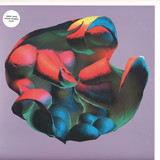
The artwork for the mixtape is an orb of colours, reflecting how Sam see’s various tones and shades through each track on the mixtape.
Featuring previous releases ‘Intertwine’, ‘Serotonin’, ‘Gullible’ and ‘Name To A Face’. Focus track of EP is ‘The One’. There is also the original demo version of ‘Picture In My Mind’ before PinkPantheress joined the track earlier in 2022.
This whole mixtape is solely written, sung, played, produced, mixed & mastered by Sam (apart from the addition of one sample from a folk show he found on Youtube).
Toronto label and party Hypnotic Mindscapes presents another issue of modern electronics crafted for the dancefloor with the third edition of their compilation series, displaying a bundle of trend-defying tunes from crew-adjacent artists.
A1 opens with long-time friend and collaborator Patamamba (half of Kimchi Records) with “Igoon of Blue”, shades of progressive house music simmered in evocative acid lines reminiscent of 90’s nostalgia. The A2 features Hypnotic originator Cosmic JD with a deep-slamming breakbeat piece titled “Steam”, punchy basslines and trancey Arps bubbling into the early morning. On the flip, scene-vet and Seekers boss Alex Picone debuts on the label with “WhyWasteWine” a fast-paced, modern tech-house number with wonky melodies and metallic artifacts. Rounding things up, Moroccan (via Montreal) up and coming artist Jalil enters with an electro-infused ode to “Technology”. Artwork by Sofia Eleni.
- A1: Save Your Tears
- A2: Blinding Lights
- A3: In Your Eyes
- A4: Can't Feel My Face
- A5: I Feel It Coming (With Daft Punk)
- B1: Starboy (With Daft Punk)
- B2: Pray For Me (With Kendrick Lamar)
- B3: Heartless
- B4: Often
- B5: The Hills
- C1: Call Out My Name
- C2: Die For You
- C3: Earned It (Fifty Shades Of Grey) (Fifty Shades Of Grey)
- C4: Love Me Harder (With Ariana Grande)
- D1: Acquainted
- D2: Wicked Games
- D3: The Morning
- D4: After Hours
Back in stock !
Career spanning collection. The Highlights includes such career-spanning favourites as 2015’s “Can’t Feel My Face” and “The Hills,” 2018’s “Call Out My Name,” as well as more recent hits like “Blinding Lights” and “Heartless.” The album also features many of the artist’s collaborative singles – including “I Feel It Coming” with Daft Punk, “Pray for Me” ft. Kendrick Lamar, and “Love Me Harder” with Ariana Grande. Released on 2LP set. LIMITED EDITION.
Nearly 10 years on since his last solo LP, Berlin techno icon Marcel Dettmann arrives on Dekmantel with an expansive album captured in a flash of inspiration.
In many ways Fear Of Programming is a reflection on the artistic process – the critical hurdles one has to overcome, the constant strive for originality, the ability to capture inspiration in its pure moment of inception. Bar the closing title track (and we all know Marcel loves a surprise closing), these 13 tracks came together during a period in which our hirsute host was able to immerse himself in studio practice and set the intention to record an album’s worth of material every single day. From the resulting mass of work there were many options to choose from, and Fear Of Programming stood out as one of the most complete statements on Dettmann’s approach in the here and now.
Unconcerned with an overarching concept, it was the work in the studio which drove the musical direction. No labouring over knotty arrangements, no painstaking mix downs – just honest expression, a moment caught, a groove locked, a stroke of synth sent pirouetting over a cavernous bed of texture. The results are varied, and while you might well hear plenty of bruising machinations in line with the techno Dettmann has made his name on, there are plenty of other shades expressed across the album.
Ambient sojourns, beatless epics and angular electronica have equal footing with strident, floor-friendly workouts. Standout piece ‘Water’ offers an icy ballet of swinging minimal and drip-drop melodics fronted by Ryan Elliott on lesser-spotted vocal duties, urging, ‘give me a sign, just a little something to let me know that you’re mine’. It’s playful, but still underpinned with the sincerity that comes with Dettmann’s work.
Running on instinct, Dettmann presents an honest version of himself in the here and now, speaking through the sonics and not over-thinking the results. His decades of experience helming a thousand techno parties speak for themselves, while his evolution as a musical entity through collaboration and his own BAD MANNERS label demonstrate his appetite for change. Indeed, the working method which resulted in the album also spurred him on to create a live set beyond his well-established DJ practice. Without resorting to a conceited overhaul, Fear Of Programming opens up the idea of what Dettmann represents in the modern techno landscape.
AI-31 sees the debut release from a new collaboration between Samuel van Dijk (Netherlands) and Rasmus Hedlund (Finland). Both key proponents to the scene in Northern Europe, they come together with mutual understanding and a common vision to sound. Dialog acts as a conversational exchange that sees the interplay of dynamic frequencies, evocative imagery and contemporary sonic art. Spread across four sides, the album as a whole exists as a kind of metaphysical process, eternally growing and contracting — change is the only constant, marked by a continuous progression of sound and space.
Expansive, deep, and at moments arresting, Dialog unfolds with sweeping soundscapes and shimmers with tactile sonic details. A chasmic rift of scintillating drone structures, each layer exposes a series of ever-deeper shades. In a play of dynamic dualities, the pair harnesses both earthly materials as well as access to more ethereal dimensions in the music. Side A begins with sub-terrestrial ruptures, gestating in a process of constant elemental changes. Rattling hits sputter amongst a state of nascent chaos, yet continues to be maintained in self-regulating stasis. Side B sets a more introspective tone, whispering with ghostly artefacts and bubbling synth lines, before building into a driving energy of layered field recordings and mechanistic timbres. The essence of form continues to be contested, until it subsides into momentary calm on side C. A cleansing period of soft drones float into the space and the pace slows, washing away remnants of past. The journey continues with side D’s conclusion - a solemn contour that reaches its internal extent, to then finally return to its source.
Kulør is proud to present My Space – Kasper Marott’s 2nd record for the label following 2019’s luscious, longform Forever Mix EP.
The EP represents the latest addition to a diverse but uniquely crafted discography for the Danish producer, DJ and label owner. After scoring something of a mega-hit in 2018 with ‘Keflavik,’ released on Modeselektor’s Seilscheibenpfeiler label and named by Resident Advisor as “one of the biggest club records of the year,” Marott would use that momentum to launch the community-focused label Axces alongside close friend Alfredo92 and release a string of records representing some of Denmark’s finest producers. At the beginning of 2021 Marott released his debut album Full Circle, allowing a more complete picture of his distinctively melodic sound, one described by Pitchfork as “stimulating the imagination as much as the limbs… This is music for dancing but also music for dreaming.”
The four pieces that make up the My Space EP seem to take that last quote as a jumping- off point, oscillating between the beatless serenity of ‘Mosens Tone’, the unashamed force of ‘NV Laser’ and the shades in between on the opening title track and closer ‘Microfest’. Marott’s influences snake over one another, folding crisp percussion underneath his signature glassy textures and intimate field recordings alongside supersaw riffs. This fluid shape-shifting results in an EP that hints at different genres while confining itself to none.
Nick Beringer debuts on INFUSE to open the label’s 2021 schedule, offering up his stellar ‘Blue Blood’ EP.
A rising DJ and producer at the heart of Berlin’s minimal house scene, Rubisco boss Nick Beringer has formed a growing reputation as a ‘go-to’ artist for quality productions across the genre in recent years, with his diverse
discography welcoming material via the likes of Raum…Musik, Taverna Tracks, Mulen Records and Berg Audio to name just a few. With a sound fusing classic Detroit house and techno with more modern shades, ranging from electro-tinged elements through to more dubby textures, the German talent kickstarts 2021 with an impressive debut outing on FUSE sister imprint INFUSE as he delivers his four-track ‘Blue Blood’ EP.
Lead cut ‘Concave’ is a perfect example of Beringer’s ability to fuse genres and nuances with ease and fluidity as skipping percussion licks guide skittering sci-fi electronics and sweeping atmospherics throughout an up-front EP opener, whilst vinyl only cut ‘Aint Got Nobody’ delves into deeper realms as squelching basslines merge with icy hats and infectious vocal iterations. The lively title cut ‘Blue Blood’ opens the B-Side in style as warping synths weave amongst aquatic melodies and deep sub-bass, before closing out proceedings via the dynamic, off-kilter tones of final production ‘Second Hand Emotion’.
- A1: Ryuichi Sakamoto - The End Of Asia
- A2: Mariah - Shinzo No Tobira
- A3: Chika Asamoto - Self Control
- A4: Jun Fukamachi - Treasure Hunter
- B1: Yumi Murata - Watashi No Bus
- B2: Hitomi 'Penny' Tohyama - Rainy Driver
- B3: Yumi Seino - La Maison Est En Ruine
- B4: Kyoko Furuya - Tokyo
- C1: Kazue Itoh - Chinatown Rose
- C2: Kazumi Watanabe - Tokyo Joe
- C3: Juicy Fruits - Jenie Gets Amgry
- C4: Haruo Chikada & Vibra-Tones - Soul Life
- D1: Colored Music - Heartbeat
- D2: Akira Sakata - Room
- D3: Yasuaki Shimizu - Semi Tori No Hi
- D4: Shigeo Sekito - The Word Ii
Repress!
A MAJOR EXPLORATION OF TOKYO'S CUTTING EDGE 80S SOUND THROUGH THE MUSIC OF CULT JAPANESE LABEL NIPPON COLUMBIA AND ITS BETTER DAYS IMPRINT, SELECTED BY BRITISH RADIO PRESENTER AND DJ NICK LUSCOMBE.
‘Tokyo Dreaming’ is a superb selection picked from the highly collectible Nippon Columbia label and its Better Days sub-label. For the occasion, we’ve teamed up with journalist and Japanese music expert Nick Luscombe who was granted rare access to the much-guarded Nippon Columbia's vaults for a masterful selection encapsulating the fascinating sound of Tokyo in the late 70s and 80s. The selection mixes electro, synth-pop, funk and ambient and features such artists as Ryuichi Sakamoto, Mariah, Shigeo Sekito, Juicy Fruits, Hitomi "Penny" Tohyama and Yumi Murata. The tracklist includes many sought-after rarities and hidden gems which have never been released outside of Japan and the set has been newly remastered by Nippon Columbia. The album has been designed by famed London-based designer Optigram and is annotated by Nick.
Nippon Columbia, one of Japan's oldest music labels is also one of its most collectible thanks to its sub-label Better Days which, in the late 70s, became a hotbed for Tokyo's new generation of pop artists eager to experiment with ambient, electro and funk. Armed with a string of new Japanese-made synthesizers and drum machines that would soon take the world by storm, they made cutting-edge music, which has since become highly sought-after by a new generation of Japanese music lovers. Nick Luscombe, who has long been a leading advocate of Japanese music from this era, has handpicked a selection of some of the sharpest music released on these labels at the time.
According to Nick, “Tokyo Dreaming is a look back to an incredible era of Japanese music, that still sounds and feels like the future. It was a moment when brand-new music tech from Japan helped forge new ideas and experiments that permeated pop, soul and jazz and helped create new forms of music including electro and techno. The perfect meeting point that would help create a new soundtrack for modern living.“
?The selection starts with "The End of Asia" by Ryuichi Sakamoto from his 1978 ground-breaking debut "Thousand Knives Of" (reissued last year by Wewantsounds). The track became a staple of Sakamoto's and YMO's live shows and was even re-recorded by the group for their 1980 album 'X Multiplies'. The track is followed by Mariah's cult Armenian folk flavoured synth pop classic "Shinzo No Tobira" (1983), which first spread outside of Japan when the Scottish DJ duo Optimo started playing the track regularly at their shows.
?Chika Asamoto's "Self Control" (1988) and Jun Fukamachi's "Treasure Hunter" (1985) are perfect songs in the synth-pop canon, while Yumi Murata's rendition of Akiko Yano's "Watashi No Bus" and Hitomi "Penny" Tohyama's "Rainy Driver" both from 1981, move closer towards the slicker, funkier sound of City Pop.
?'Tokyo Dreaming' superbly showcases the breadth of 80s Japanese music and the way electro pop was a playing ground for musicians to experiment with many styles, as showcased by Akira Sakata's dub-enfused "Room" from 1980, Kazumi Watanabe's discoid "Tokyo Joe" (1980) and Juicy Fruits' "kawai" robotic Techno pop song "Jenie Gets Angry".
?The selection flows effortlessly between many shades of synth and ends with two cult classics in the form of Yasuaki Shimizu's "Semi Tori No Hi" and Shigeo Sekito's ambient-jazz masterpiece "The Word II" from his highly sought-after album "Kareinaru Electone (The Word) Vol.2" which, although recorded in 1975, perfectly announces the synth revolution to come. Tokyo Dreaming showcases the groundbreaking sounds of a city turned giant sonic lab which was restlessly inventing the music of the future.
Nick Luscombe is a highly respected and in-demand music influencer who discovers great music from all over the world and shares it internationally through his many radio shows and DJ sets. He has been in charge of music selection for various radio programs since 1999, and from 2010 - 2019, was the DJ for the popular BBC Radio music program "Late Junction”. He has also curated and presented music shows for Monocle and British Airways radio stations. He has worked as both Chief Music Editor at iTunes and Director of Music at London’s Institute of Contemporary Art, and is the founder of MSCTY.
Berlin-based, Dutch-born Steffi possesses near-boundless prowess. As a DJ, she’s proved her effortless mastery of disco, house, electro, and techno; as helm of labels Klakson and Dolly, she’s long maintained her status as tastemaker; as a producer, she has graced us with three solo LPs and numerous 12”s. Dark Entries is now honored to unveil the debut of her project Crushed Soul, a moniker she had used only once in 2013 for an Ostgut Ton compilation track. The mutual esteem of Steffi and DE has been previously fruitful, with Steffi providing a remix for Cute Heels’ 2016 EP on DE, but this is their first full-length collaboration.
The Family of Waves EP represents both familiar and novel pastures for Steffi. While her love of electro and classic Detroit techno have been oft-evident, here we witness the darker shades of new wave and industrial creep to the forefront. This turn for the twisted feels not just natural, but predestined, an inevitable succumbing to morbid forces. But Steffi also views Family as “a playful association...a mix of my past and new modern waves". There is a kernel of whimsy, even joy, lurking within the record’s temporal jumblings. The A-side opens with “Gravitational Field”, which juxtaposes its gnarled bassline with unearthly percussives and a recurrent resonant gong. The wild sonic palette speaks Steffi’s singular voice. “Scalar Property” continues the paranoid propulsion with an unhealthy dose of what can only be described as Metroid-funk, its staccato bass jabs interlaced with ghastly vocal pads. The B-side contains a diptych of slower tracks that juggle reference points both retro and futurist. In “Family of Waves”, a churning EBM-esque bassline battles acerbic yelps. On this track, the collision of past and present is most pronounced, as if A Split Second were covering Mike Parker. “Diffusion of Heat” closes the EP with what feels like a perfect synthesis of Steffi’s musical passions: funky, warbling chord stabs; intricate rhythmic diversions; the ecstasy of repetition. Here, disco, new wave, and techno marry harmoniously, if only to inform us of the disharmony of our present.
All songs have been mastered for vinyl by George Horn at Fantasy Studios. The sleeve and accompanying postcard were designed by Eloise Leigh using video art stills by Goldenliustra.
The label ZIEMIA (Polish for EARTH) is centred around a growing group of friends from Poland. Administered by Bartosz Kruczyñski (Earth Trax), Adam Brocki and Jan Wójcicki (Private Press), it is a natural extension of a studio in the heart of Warsaw, where the majority of their music is being created. Ambient sounds and club vibes make the foundation layers of this collaboration, and you can see this theme evolving in some of their first releases on labels such as Growing Bin, Into The Light, Shall Not Fade, Indigo Aera, Phonica Records and Dopeness Galore. ZIEMIA's focus positions itself between club music and ethereal with an Eastern European background.
The second release captures different shades of club environment, from the straight-forward, rough DJ tool by Earth Trax and Newborn Jr. (A1) to deeper and more ethereal dub oriented grooves of Private Press (A2, B1). The last cut on the EP is an after hour downtempo anthem (Earth Trax and Newborn Jr. again), with uplifting pads and chilling leads layered over deep TR-808 drums.
'GO Wax' is a vinyl only record label designed to show off the underground sound that is the life and soul of the Game Over X One Night Stand parties in Ibiza.
The first release welcomes Salty Nuts & BE9 rising star Fabe who has been one of the all stars of the Game Over parties this summer -
The A-Side is straight club cuts designed to blow minds, while the
B-Side shows off the trademark Fabe groove which has made him one of the biggest names in the scene throughout 2019.
Vinyl Only.
"We Can Do Anything We Want Because They Say We Can't Afford The Police"
Talking Heads lost in Ancoats. Prince in a Berghaus. The Compass Point All-Stars meet the Piccadilly Gardens Spiceheads.
Welcome to the world of SEE THRU HANDS.
Here to bring salvation to a Broken Brexit Britain, See Thru Hands is a fresh band from Manchester with hooks for days and a SERIOUS live vibe. Their debut EP on Manchester legend RUF DUG's label RUF KUTZ - "The Hot City EP" - brings you two new songs backed with remixes tested on the world's best dance floors.
Opener HOT CITY's energetic punk/funk conveys a dark story of British city life outside the London bubble.
Our councils are fucked, our public services neutered and all anyone cares about is when Deliveroo is gonna be available in their neighbourhood. Throw away your post-apocalyptic fantasies because it's already like that - the only option is to dance. It's grim up north.
After dancing ur arse off and simultaneously coming to the realisation that we're all fucked pls don't worry - See Thru Hands are here to pick up your pieces with NOTHING TO LOSE, a whimsical modern pop banger with shades of New British House that will instil in you a sense of freedom and ease all your worries.
Yes we are all going to hell in a handcart but with See Thru Hands as our companions, I think it's all gonna be just fine.
The package comes backed with a pair of deadly remixes - boss man RUF DUG strips back Hot City to the bare bones, rigs up a couple of jazzy neon lights and a DMX drum machine and brings you his 'Metrolink Vibes In The Area' version, while young upstart METRODOME completes the all-Mancunian lineup on this record with a twisted Marmite 2-step interpretation that is either gonna make you buzz or spew. It's not for everyone.
with »redsuperstructure«, robert lippok created a new foundation for his musical endeavors. now - 7 years later - this system properly comes to life on »applied autonomy«. the title of the new album is a clear indicator as to what the berlin-based producer has been up to during the last couple of years, both on a conceptual level as well as how he molds his ideas into tracks.
»applied autonomy« orchestrates a certain state of frantic standstill, which occurs once a structure is set. has this state been reached, the artist is free to focus on other equally important aspects, balancing the various shades, pushing ideas even further to really make them shine and blossom in their self-declared autonomy. the more light one lets in, the more layers become visible.
layers are key when it comes to understanding »applied autonomy«. big chunks of the material with which the album has been produced derive from sketches specifically made for a club performance. rather than meticulously devising each and every detail, lippok focussed instead on recording as many fragments as possible in a short period of time, elements which he could later combine and layer on stage. based on this material and his experience experimenting with it in a live environment, the album slowly began to shape. an album culminating in a collaboration with klara lewis, with whom lippok spent 2 days at the EMS studios in stockholm, approaching the idea of autonomy from yet another angle. during the session, both musicians played and performed simultaneously, yet not explicitly together, lost in their own thoughts and ideas, only subconsciously taking in what the other one was coming up with. the result is »samtal«, 14 minutes of a constantly evolving state of poise, magically connecting all the dots Lippok had already defined as »applied autonomy«.
Discográfica 71 is a new record label which explores the borders of our beings through sound, movement and perception, a landscape full of darkness, strong and experimental shades.
The first reference of the label will be handled by Some Science, after his previous work, 'The Universe of Gödel', the duo returns to the scene with 'Shapeshifters', three-tracker EP, where they express their purest sound, a landscape full of darkness, strong and experimental shades,where they show their 'inner chaos' and their more inspirational
moments.
“One foot out the door, another in the otherworld…”
So begins Hannah Lew’s debut, self-titled solo record, soaked in imperious, wide-eyed pop songwriting and a girl-group/post punk aesthetic that belies the artist’s history in the U.S. underground. A towering, hook-laden album, it’s infused with an optimism and surrealism that conversely deals with the times we find ourselves in.
Recorded at home in Richmond, CA and in The Best House studio with Maryam Qudus in Oakland CA, with the assistance of a crack team of West Coast musicians, this album sees Hannah Lew stepping out from behind the legacy of her two groups Grass Widow and Cold Beat. While musically bearing similarities with her previous work, “Hannah Lew” is a bold leap into direct pop territory, making ample use of a vocal style that teases out the inherent melancholy in her melodies. Mastered by Sarah Register, each song is a perfectly honed nugget that frequently pulls the heart in two directions at once.
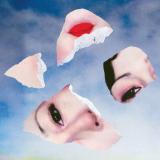
Themes of change, breaking up, shattering old ways of being are shot through the record. For the front cover, a photograph of the artist’s face was printed, ripped up and re-assembled, resembling the creative process embarked upon by Lew for her first “solo” material. The album feels instinctual, almost dream-like in its assemblage of sweeping synths and pulsating, propulsive drum machine beat patterns with Lew’s vocal performances sensitive and caressing over the top. Increasingly relying on the subconscious and dreams to guide her creative process, Hannah Lew frequently abandons literal interpretations or linear narratives, the songs seeming to exist in a swooning, effortless flow-state while remaining emotionally hard hitting.
On an album where every song could be a single, there are kaleidoscopic shades and varying emotional tones in abundance. First single Another Twilight is carried along a pumping, Italo-disco-style 4/4 beat and mono-synth bass line, the low end pulling at the heart and body. Lew’s vocal melody teases the track before swan-diving into a gorgeous chorus as she sings “it’s all over baby and I don’t mind… in decline, I take my time…” The album is suffused with moments like this. On slow builder Damaged Melody, an arpeggiated synth elongates the verse before a cascading synth showers down melodic glitter. The stunning Replica uses dual swirling synth patterns before a driving, synthpop chorus for the ages carries Hannah Lew’s vocal into the stereo field, sailing in on a high register singed with the embers of a break up.
In a departure from previous groups, her solo songs are guided by dreams and free association inspired by Dada and the Surrealist movement and sculpted afterwards. As such, the songs reveal themselves on repeated listens, revealing traces of heartbreak inspired by both personal and global elements - Hannah Lew regards the album “a wartime album.” On Move In Silence, Lew intones “there’s a war outside, just out of view,” revealing the dichotomy at play throughout. With the songs evolving naturally and in a flow state, the pressures and sadnesses of the modern age bleed through, mixed in with Lew’s inherent love, sensitivity and fractured-but-intact optimism. On the swooning, sublime Sunday layers of Numanoid synths open up for the commanding vocal performance pontificating on grief, love, pain as she “feels the ache on Sunday…” As the chorus builds and Lew’s call-and-response vocal adds to the emotional tension, it almost feels like too much to take.
Elsewhere, there are echoes of Hannah Lew’s previous work. On Time Wasted a bass guitar comes in with a heavy, punk attack before the synths and vocal harmonies reminiscent of later Cold Beat elevate everything. The glassy, sweetly resigned closer The Clock sounds like so classic it could be cover, a sweetened Jesus & Mary Chain tune perhaps, before it erupts into volcanic chorus that could only come from Hannah Lew in 2026.
4am Kru make a return to vinyl with the Love On The Line EP, an exploration of the familiar, bittersweet story of a romantic relationship between two people, from start to finish.
Across seven tracks led by collaborator Layla Sibelle, we feel every facet of this universal human experience. Exploring the more vulnerable shades of 4am Kru’s proven dancefloor technique, each track on the Love On The Line EP shakes sound systems, while staying true to the record’s emotional core.
From the tingle of excitement depicted on 'Rush', to the disappointment of being let down on ‘Boy’, the relationship ending on ‘Hush Now’, alongside everything in between, Love On The Line EP keeps bodies moving, while pushing the sound and songwriting of 4am Kru in unexpected new directions.