In 1969, singer and police lieutenant Pedro Gregorio López started recording a series of instrumental tracks and songs on the MAG record label in Peru, ranging from guaracha to cumbia, all cooked with musical eclecticism and simmered to appeal to a wide audience. Many of these musical ingredients combined on the 1971 album entitled "Cocinando", in reference to the similarities between Peruvian cooking and tropical music. López began his career as a singer and orchestra conductor many years earlier, when he joined the backing singers for Lucho Macedo's Sonora. After completing his police training, he adopted the stage name Martín López, in order to preserve the anonymity his job required. Between 1969 and 1971 Martín López y sus Estrellas recorded all the tracks comprised on this album, including salsa, guarachas, rumbas, chichas and boleros, proving their knowledge and mastery of the tropical music lexicon. It is not surprising since the orchestra was made up of the most talented label’s session stars: including the double bassist Joe di Roma, singer Pablo Villanueva "Melcochita", percussionists Ñiko Estrada and Coco Lagos, and trumpeter Tito Chicoma. "Cocinando" is an epic historical treasure that captures the explosive impact of the tropical music movement on Peruvian culture.
quête:simi
Time to Play is pleased to introduce the fifth chapter of its catalog, titled
Midnight Love, created by the young Japanese talent DJ Dreamboy. The main
track, which shares its name with the EP, serves as a true manifesto of
Japanese deep house: minimal, intense, balanced, and dreamy. It’s no
coincidence that this track was chosen by Brazilian producer Zopelar for a
tough and driving remix.
The B-side opens with “Vibe,” which starts with a minute of suspended
ambience before unleashing a burst of kicks and acid arpeggios that ignite a
contagious euphoria. “Dream Town” follows in a similar vein, maintaining a
softer profile akin to Midnight Love. The EP closes with “My House Style,” a
high-speed journey through nocturnal Tokyo, featuring deep basslines, dreamy
atmospheres, a relentless rhythm, and an irresistible desire for the experience
to never end.
Matching breezy, Bossa nova-tinged sophistication with softly spiralling psychedelia, Testbild! arrive in the Quindi lounge as though they've always been there. On their 12th album, Bed Stilt, the Swedish collective cast their attention back to the earlier days of their 25-year trip through sweetly mysterious pop-not-pop rendered in warm tones and shot through with surrealism. It's tricky to get a precise fix on the story and structure of Testbild! The project was spearheaded by Petter Herbertsson in his hometown of Malmö in the late 90s, although the story on their website credits the inspiration and source material to a chance meeting and unpublished manuscript from a retiring scientist. The collective's evolution since then is a tangled web of facts and fiction spun by a revolving cast of collaborators including Siri af Burén, Katja Ekman, Rikard Heberling, Douglas Holmquist, Mattias Nihlén and Petter Samuelsson. Along the way, their music has touched on chamber pop, post-punk and modern jazz with the elaborate harmonies and catchy songwriting charm of the Canterbury scene. The tracks which make up Bed Stilt were in fact track recorded in Malmö back in the mid- 00s, lying in wait for the right opportunity to be brought to light with some delicate overdubs and finishing flourishes in the here and now. The core musicians working on the record were Herbertsson and Douglas Holmquist on a similarly expansive list of vocals, guitars, bass, synths and keys, Siri af Burén on lead vocals and Mattias Nihlén on synths and additional mixing. Meanwhile Tomas Bodén - better known as Civilistjavel - lent some additional synth work as well as mastering the record. Musically, Testbild! stay true to their idiosyncratic approach on Bed Stilt with six immaculately rendered sojourns through lilting harmonies and brushed rhythms, feeling nostalgic but beguiling in equal measure. Theirs is a luxurious sound, not least on the opening strains of 'The First New Years Eve,' which purrs to life draped in silky Rhodes and chiming vibes. Behind this comfortable veneer the enigmatic lyrical themes unfurl through Herbertsson, Holmquist and af Burén's vocal harmonies like fractalized puzzles waiting to be solved. The finger-picking delicacy and languid harmonica of 'Streams' strike a pastoral mood neatly countered by the elegant slide into dislocated ambience for the track's final stretch. By contrast, 'And Her Eyes Are Red' surges with a big beat urgency which plays beautifully with the mellow jazziness of the chord sequences, boldly toying with song structure to dart down curious tangents without losing the immediate impulse of a great pop record. Somewhere in this tension between clarity and chaos we can understand the addictive charm of Testbild! - a band steeped in the considerable craft of making accomplished and unconventional music so very easy to sink into. If that doesn't make for a perfect addition to the Quindi catalogue, we don't know what does.
Celebrating thirty years of collaboration, Loren Connors and Alan Licht performed for two nights at OTO on May 5 and 6th, 2023. The shows celebrated a new release titled “At The Top of the Stairs”; a document of the pair's reunion in 2018 after a period of 8 years not playing together. It’s a dark, swirling two-sided spectral noir session, put out by the duo’s home label, Family Vineyard, and we expected a similar kind of atonal abyss to appear at the OTO residency. On the second night however, with the stage lit in blue, Connors took up a seat on the piano stool whilst Licht picked up the guitar. What followed was the duo’s first ever set with Connors on piano - one of only a few times Connors has played piano live at all - here captured and issued as The Blue Hour. Its spacious warmth came as a total surprise live, but makes complete sense for a duo whose dedicated expressionism takes inspiration from a vast spectrum of emotion. Both opening with single notes to start, it doesn't take long before a surface rises and begins to shimmer between the pair. A run up the keys, the drop of a feedback layer on a sustained and bent note. When the two begin to exchange notes in tandem, brief touches of melody and chord hover and the hush of the room is palpapale. After a while, Connors picks up the guitar, stands it in his lap and sweeps a wash of colour across Licht’s melody. Sharp, glassy edges begin to form, open strings and barred frets darkening the space. When his two pedals begin to merge, Licht finds a dramatic organ-like feedback and it’s hard not to imagine Rothko’s Chapel, its varying shades of blue black ascending and descending in the room. When Connors goes back to the piano for the second side, the pair quickly lock into a refrain and light pours in. It’s a kind of sound that Licht says reminds him of what he and Connors would do when the duo first started playing together 30 years ago. It’s certainly more melodic than some of their more recent shows, and the atonal shards of At The Top of the Stairs seem to totally dissolve. What is always remarkable about Licht is that his enormous frame of reference doesn't seem to weigh him down, and instead here he is able to delicately place fractures of a Jackson C Frank song (“Just Like Anything”,) amongst the vast sea of Connors’ blues. Perhaps it's the pleasure of playing two nights in a row together, or the nature of Connor’s piano playing combined with Licht’s careful listening, but the improvisation on The Blue Hour feels remarkably calm and unafraid. There’s nothing to prove and no agenda except the joy of sounding colour together. Totally beautiful.
- A1: Where's The Revolution (Autolux Remix)
- A1: Where's The Revolution (Pearson Sound Remix)
- B1: Where's The Revolution (Algiers Click Farm Remix)
- B2: Where's The Revolution (Simian Mobile Disco Remix)
- B3: Where's The Revolution (Pearson Sound Beatless Remix)
- C1: Where's The Revolution (Simian Mobile Disco Dub)
- C2: Where's The Revolution (Terence Fixmer Spatial Mix)
- D1: Where's The Revolution (Patrice Bäumel Remix)
- D2: Where's The Revolution (Ewan Pearson Kompromat Dub)
- E1: Going Backwards (Chris Liebing Mix)
- F1: Going Backwards (Solomun Club Remix)
- F2: Going Backwards (The Belleville Three Deep Bass Dub)
- G1: Going Backwards (Chris Liebing Burn Slow Mix)
- G2: Going Backwards (Point Point Remix)
- H1: You Move (Latroit Remix)
- H2: Poison Heart (Soulsavers Re-Work)
- I1: Cover Me (Ellen Allien U F.o. Rmx)
- I2: Cover Me (I Hate Models Cold Lights Remix)
- J1: Cover Me (Nicole Moudaber Remix)
- J2: So Much Love (Kalli Remix)
- K1: Over Me (Erol Alkan White Light Rework)
- K2: Cover Me (Texas Gentlemen Remix)
- L1: Cover Me (Warpaint Steez Remix)
- L2: Cover Me (Josh T Pearson Choose Hellth Remix)
- M2: So Much Love (Highline Sessions Version) - Previously Unreleased
- M3: Poison Heart (Highline Sessions Version) - Previously Unreleased
- O1: The Worst Crime (Highline Sessions Version)
- O2: Heroes (Highline Sessions Version)
- M1: Going Backwards (Highline Sessions Version)
DJ Support from Danny Howard, Annie Mac, Mistajam, Pete Tong, Charlie Hedges, Kraak & Smaak, Maxinne, Todd Terry, Alex Preston, Full Intention, GW Harrison, DJ Rae, Rudimental, Alaia & Gallo, Illyus & Barrientos, Johan S, David Penn, Sam Divine, Riva Starr, Claptone, Nice7, Dario D’Attis, Mousse T, SMan, Huxley, KC Lights, Friend Within, Dombresky, Gorgon City, Chris Lake, Format:B, Pirupa, TCTS, Alan Fitzpatrick, Low Steppa, Mat.Joe, Raumakustik, Eskuche
Toolroom’s leading lady ESSEL returns to the label with a brand new killer vinyl 2 tracker. First up is her recent smash ‘Rave Is The Weapon’ with fellow female powerhouse and talented DJ, producer and vocalist, Alex Mills. Alex Mills is on an incredible journey! She had a UK top 40 hit last year with ‘Million Dollar Bill’ and as a talented vocalist boasts writing credits on records with the likes of Camelphat, Solardo and Ferreck Dawn. When these 2 are in the same room together, the energy that exudes from them is on another level! Their genuine friendship and thirst for fun is clearly visable and this spills into the record in a massive way. This BANGS! A peak-time tech houser in a similar vein to ESSEL’s Beatport chart topping tracks ‘Sweat’, and ‘Lennon’ with a lyric that will be screamed on dance floors and at festivals for the foreseeable future… ‘RAVE is the weapon!’ On the flipside is her late 2023 Toolroom single ‘The Edge’ that already sits on an impressive 4m streams and almost 40 Radio 1 plays. She has received a huge amount of radio support over the past few years which was rewarded with a DJ booking at Radio 1’s ‘Big Weekend’ back in May alongside the world’s leading artists. As far as the record is concerned… This is a real EARWORM! A stripped back, fun record with insanely catchy vocals and one that will please radio DJs, and club DJs alike.
Countless radio plays on Radio 1 from Danny Howard, Sarah Storie, Pete Tong Other notable radio plays – Kiss FM, Toolroom Radio, Sirius XM, Data Transmission Radio, Radio 1 Dance Anthems, Radio 1 Party Anthems, Rinse FM, Select Radio, Tomorrowland Radio
- A1: Slowdive - Slomo
- A2: Chapterhouse - Pearl (Edit)
- A3: Ride - Vapour Trail
- A4: Blind Mr Jones - Henna & Swayed
- A5: The Telescopes - Flying
- B1: Lush - Sweetness & Light
- B2: Spirea X - Chlorine Dream
- B3: Kitchens Of Distinction - The 3Rd Time We Opened The Capsule
- B4: Pale Saints - Sight Of You
- B5: Lowtide - Alibi
- B6: Ringo Deathstarr - Kaleidoscope
- C1: Horsegirl - Billy
- C2: Air Formation - Daylight Storms
- C3: Diiv - Taker
- C4: Bdrmm - A Reason To Celebrate
- C5: Flyying Colours - Long Holiday
- C6: Echo Ladies - Overrated (Robin Guthrie Version)
- D1: Beach House - Lazuli
- D2: Mogwai - Kids Will Be Skeletons
- D3: Fleeting Joys - Go & Come Back
- D4: Ultra Vivid Scene - Mercy Seat
- D5: Galaxie 500 - Ceremony
Red Vinyl[36,93 €]
Waves of Distortion (The Best of Shoegaze 1990-2022) is a superbly curated trip through the genre from the good folks at Two_piers, who have served up similarly excellent collections focussed on everything from French psychedelic pop to garage psych. This serves as both a fine intro and a great retrospective for existing fans that will take you down a rabbit hole and leave you wanting more. Some of the scene's original pioneers feature and there are many a timeless tune here that help to document the subtle evolution of the genre throughout the decades.
Unequal cycles in search of synchronous experiences: On his new album »Pounding«, Frank Bretschneider tells of distance, convergence and congruence in a continuous, ever-changing flow of events. What is often regarded as an unquestionable dogma in club music (for which Bretschneider has provided significant impetus since the 1990s) – the groove – appears precarious, unstable, and in motion. Pulse and accent are volatile encounters and have to be found again and again for short, delightful moments. Music becomes a constant process of negotiation.
In search of new sound spaces, Bretschneider has recently worked a lot with modular synthesizers, both solo (for example on »abtasten_halten«, 2020) and in collaborations, including the project Beispiel together with Jan Jelinek. »Pounding« was created using similar means – conceived in 2020 for the Pochen Biennale in Chemnitz, subsequently developed further and recorded in March and April 2023 on a sample-based modular system. And in fact, Bretschneider is once again exemplarily scanning his own sound material, such as dub effects that listen to themselves disintegrate; but also the human voice, or more precisely: the stuttering of fragments of speech, far in the distance but omnipresent, like a mysterious narration. Aesthetically, the eleven pieces form part of a series of works with a focus on percussion. Bretschneider has already perfected this approach with albums like »Rhythm« (2007) and has been shifting the perspective ever since, for ever new results.
Shifting is the basic principle of »Pounding«. Bretschneider combines elements that are in different aggregate states, changing their relationship to each other and thus ensuring the complex overall movement. He lets one to two-bar loops run against each other and through small manipulations, develops a network of rhythms that creates a hypnotic state in the counterplay of repetition and mutation, between clearly recognizable meter and disorientation. There are comparable approaches in aleatoric music. Bretschneider combines them with sounds and patterns that are reminiscent of step sequencer logic and at the same time go far beyond it. The result is relational techno. Never obvious, always restless and exciting.
The Berlin-based artist Simina Grigoriu debuts on DCLTD. The opener ' Declare Me' steps up the energy with searing intent, while never losing a sense of deep brooding atmosphere. One for the marathon Sunday afternoon sets. ‘Astral Waters’ bubbles away with tight drum work and a deep Motor City vibe. ‘Technology of Prayer’ mixes late-night techno soundscapes with driving rhythms. An essential tool for bridging moods during longer sessions. And finally ‘The Right Calibre’ positions tribal rhythms at the fore for a rolling cut that doesn’t take a backwards step from creating plenty of tension through the mid-section via a stirring break.
A split between Discos Extendes and the label Lovers & Lollypops, puts side by side two of the most relevant and prolific artists in music made in Portuguese territory: Bruno Silva and his project “Serpente” and João Pais Filipe, Leon Marks and Valentina Magaletti with “CZN”. Two projects that developed in parallel, but with a mutual interest in the strength of the rhythm and the textures and timbral richness of percussion sounds. The similarities are undeniable. A mutual admiration, also.
Comes in a Tranparent Red Vinyl in PVC Sleeve. Includes A4 risograph print by Cláudia Lancaster.
Side A written and produced by Bruno Silva with collaboration of Kelly Jayne Jones on "Perda Outra" and Maxwell Sterling on "Em Vida Traz”. Side B written and produced by João Pais Filipe, Leon Marks and Valentina Magaletti. Master by Carlos Nascimento at Qualia Audio Lab Artwork by Cláudia Lancaster Design by Conhecido João.
Having spent the last decade evolving into one of dance music’s most sublimely effective producers, CWPT is delighted to welcome Theo Kottis at the peak of his powers, delivering a further four tracks that demonstrate a playful mastery of widescreen sounds for wide-eyed dancefloors.
Capturing the light still shining from his beloved ‘Lighthouse’, finally released earlier in 2024 via Dekmantel and escalated into notoriety thanks to support from trusted selectors such as Ben UFO, Francesco Del Garda and our own Palms Trax, title track ‘Rain’ retains a similar, blindingly authentic nineties reverence, finding ecstasy in a wash of cascading synths, powerful plunges of sub-bass and layer upon layer of elasticated everything.
The Scottish producer’s positive education in the foundations of club music with real personality makes itself known without indulgence; a belief in the subtle tweaks and imagination of classic tech-house, alongside a welcome flirtation with the over-the-top elements that create something potentially anthemic. In this regard, ‘Benirras’ proves to be pure pleasure for dancers who love to be toyed with, its stripped back opening giving way to slowly-escalating, wobbly-jawed hysteria.
On the flip, ‘Grazie’ proves as cordial as its title, a warm and refined slice of sleek house minimalism, a roller with Alfa Romeo sensibilities. Things take a more aquatic turn on ‘Lowkey’, a logically headsy conclusion that sees Kottis sensually bounce the word ‘electro’ around in that very style, its slower tempo and wider space allowing the impressive intricacies of his productions to float up for fresh air.
After the standout success of last year’s maiden edition, Drumcode returns with volume two of its acclaimed Elevate compilation featuring no less than seven label debutants. The compilation’s manifesto is simple. Platform a broader range of emerging artists on Drumcode and help elevate the next generation to make strides in their careers. At the same time, the project gives fans a taste of the future and a sneak peak of some of the names you can expect to see featuring on the label and at showcases over the coming year and beyond.
Switzerland’s Adam’s Bite welcomes Romanian artist Lumieux onto its roster this July with the ‘When I Think Of You’ EP.
Hailing for the Romanian capital of Bucharest, Lumieux is one of many artists coming out of this region and defining a style that’s driven by stripped-back percussion, subtle nuance and detailed intricacies. Lumieux’s productions have found a home on the likes of Subtil Records, Antrakt, Dissonant and UVAR among others, while as a DJ he operates a core member of the prized Sunrise Agency out of Romania. Here though, we see Lumieux delivering his latest EP for Adam’s Bite, following recent material from IULY.B, Flabbergast and Audio Werner.
‘Psycho’ leads the EP, laid out across nine and a half minutes with murky dub chords, fluttering bass tones and choppy vocals intertwined with a swinging drum groove. ‘Tifosi’ follows and retains a similar aesthetic, bringing choppy stab sequences and wandering bass licks to the forefront, underpinned by shuffled modulating percussion and crisp drums.
‘What You Are To Me’ opens the B-side next, stripping things back to twitchy acid tinged synths, hypnotic vocal lines and vocoded voices while bumpy delayed tom toms, weighty kicks and congas subtly evolve and unfold throughout. Lastly ‘Nebula’ rounds out the EP, employing a plucked stab-led bass groove at its core alongside expansive delayed atmospherics and a crunchy saturated rhythm.
Ten years after his first full-length effort ‘Man Is Deaf’ landed him firmly in the runnings for DJ Mag’s album of the year, prodigal son Michael Anthony Wright AKA Brassica returns to Civil Music with a deeply accomplished, painstakingly whittled LP of hydraulic electro slickness, rich synthscapes, and hooky, peak-time tearjerkers for the most discerning front-left lifers. ‘Tribeless Gathering’ is a barnstorming testament to Brassica’s stylistic and timbral deftness, touching down in the elusive epicentre of the club/home listening venn diagram with ease.
From the elastic, neon acid pointillism of opener ‘Hop Kweng’ to the mardy, miasmic plod of closing chugger ‘Changa Hill’, Brassica seamlessly segues between avenues of influence, his notoriously omnivorous musical knowledge roadmapping each turn. Raised on a diet of everything from early rave standards to metal, and schooled in avant garde sonics as a student of sound design at LCC, Brassica does a peerless job of sublimating his countless influences into a record of refined, heterogeneous, and most crucially, catchy, club moods.
Less spartan than his more recent oeuvre on Feel My Bicep, and less baroque than his technicolour experiments in postmodern synth pop with vocalist Stuart Warwick, Tribeless Gathering represents Brassica’s triumphant return to the main room, replete with rushy hooks primed for the planet’s finest soundsystems, and passages of heads-down tension bound to draw listeners right to the edge of their seats. Overall it is a concise and refined testament to Wright’s command of spectral sonics and effortless ability to pressurise a dancefloor. It is no surprise that he has also worked as a prolific mastering engineer, tuning music from a plethora of dance disciplines for maximum club impact. This work extends to his own projects (including this one), cementing them as rare expressions of complete artistry from studio to turntable.
As we delve deeper into the record, we are ushered through a series of accomplished and varied club moods, each channelling a unique cocktail of influences, but retaining a warm, ebullient analogue sensibility unique to Brassica’s work. This playful scope of influence calls to mind James T Cotton or Machinedrum’s experiments in dance music form, but Wright manages it all under one roof, wrangling everything from sashaying wub-laden two step to snarling Dillinja-esque FM damage into something inherently his.
Choice cut ‘Change Yourself’ layers an almost Cerrone-like piano refrain over radiant surges of saturated bass, dubby, strobing chords and a jagged, driving break, building to a jaw-clenching apex of dancefloor elation, while the rude, playful half-step of ‘Elevation’ breaks down the vintage speed garage formula into linear fragments, utilising a tight palette of resonant bass slugs, infectious synth leads and Papua New Guinea-style vocal strobes. The aptly named ‘Hold Tight’ fuses heart-in-mouth UK ‘ardkore pads with glissando acid disturbance and surgical snare fills in a formula which recalls the ethereal grit of Nubian Mindz’ 00s experiments in big-smoke break science, while the questing melodic arcs and arpeggiated squarewaves of ‘Pinball Marinara’ could easily have soundtracked an 80s sci-fi epic, beset with sparkling, bare-bones drum programming and hazy beds of sub sediment.
With ‘Tribeless Gathering’, Brassica both irreverently fuses and pays homage to the many unique and weird permutations of UK dance music. The short lived gathering of junglists, ravers and house hotsteppas of a similar name may have long since dissipated, along with the tribes themselves, but across these 11 tracks, he lays a blueprint for a new sound of togetherness.
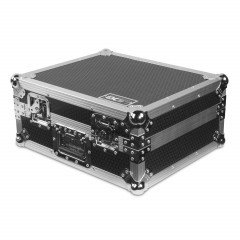
UDG Ultimate Flight Case Multi Format Turntable Silver not only transport your complete set up easily & securely, but also facilitates devices to be setup within minutes. With these premium features incoporated, the UDG Ultimate Flight cases provide premium professional quality in a very stylish modern black/ silver colored combination.
Fits: Technics SL-1200MK7, Reloop RP-8000MK2, Denon DJ VL12 Prime, Pioneer PLX-1000, Audio Technica LP120XUSB, or similar size turntables
Specification
Specification
EAN 8718969211734
Color Black/Silver
Weight 7,80 kg / 17.16 lbs
Outer Dimensions (W x H x D) 51.1 x 42.6 x 23 cm | 20.1 x 16.7 x 9.1 inch
Inner Dimensions (W x H x D) 45.1 x 38.6 x 7.8 cm | 17.7 x 15.2 x 3.1 inch
Material Heavy duty construction of 9 mm thick plywood
Protection Extra-wide silver solid aluminum profiles
Secure stacking due to stackable ball corners
Sturdy construction
Full padded interior keeps controller well-protected
High density diamond embossed EVA foam protective padding
Extra's Laminated in a black finish with a honeycomb/hexagonal "Stage Grip" pattern
Fits Technics SL-1200MK7, SL-1200GR, SL-1200GAE, SL-1210GR
Pioneer PLX-1000
Denon DJ VL12 Prime
Reloop RP-8000MK2, RP-7000MK2, RP-4000MK2, RP-2000MK2, RP-1000MK2
Stanton ST-150, STR8.150, T.52, T.55 USB, T.62, T.92 USB
Vestax PDX-3000
Numark TTX
Audio Technica LP120-USB, LP1240-USB, LP120XUSB, LP1240-USBXP, LP140XP, LP3, LP5, LP7, LPW40WN
American Audio Power Drive 2.2
Mixars LTA, STA
or similar size turntables
And accessories
When all you want to do is be the fire part of fire… say it to yourself and then say it again. Repeat it like a mantra. It’s what UTO did.
Anyone familiar with the UTO’s lauded 2022 debut Touch The Lock, which Pitchfork praised for its “prismatic synth pop”, will be aware of the variegated nature of what they do. This album is just as colourful, with Neysa’s vocalwork sparking similarities to Kim Gordon’s off-kilter vocals, which they both ceremoniously jets through a post-electronica blender mixing stylized indie sleaze productions with 90s breakbeats.
While they might appear as a singular entity to others, UTO wrote large sections of this album apart, converging by the fireside to discuss the day’s work before coming together to hone and finish the songs. 2023 was, by their own admission, a difficult year, and that’s reflected in the Dantean themes expressed in songs such as the lead single ‘Zombie’, which arrived at the end of November as a taster for the new record; the latter’s dark heart is belied by the skittering beats, glitchy electronics and pummeling sequencers that elevate it from the void.
From fire, early man’s discovery, to AI, humanity’s next great adventure - with all of the wonders and complexities of human relationships in between - When all you want to do is be the fire part of fire really is about life, the universe and everything. Just remember, be the flame, not the moth.
'Sounds From The Northern Hemisphere' is a collection of live-recorded takes, registered between 2021 and 2023. The Icelandic extraterrestrial scenery was the main inspiration for this work. Similarly to the nature of each landscape, every composition was crafted with a genuine and spontaneous approach, entirely avoiding digital instruments.
A methodical sound research was enacted, exploring the analog behaviours of classic and modern machines. The result is a minimalistic and intense merge of sounds: simple, but meaningful.
‘Diré’, Idrissa Soumaoro new album, comes as a surprise to Malian and international audiences. Composer, singer, guitarist and master of the kamalen n’goni Idrissa Soumaoro presents here a beautiful collection of songs on his third album, Diré, named in honor of the town where he met his wife and where his first daughter, who is no longer with us, was born.
In 1971, after his studies at the INA in Bamako, Idrissa was transferred to Diré to teach music at the lPEG (Pedagogical Institute of General Education). He was 22 years old when he arrived in Diré. Idrissa has always been nostalgic for this beautiful place in the 333 Saints of Timbuktu region. As Idrissa sings in ‘Diré taga’ (Going to Diré), the track that opens the album, the city evokes deep emotions for the artist, as if it were a long-lost friend or lover. Celebrating the memory of the city of Diré leads the artist to retrace stories and lived situations that marked and animated him in years gone by: ‘I really miss the people, the colleagues, the friends and that period. Despite the time that has flown by, I would ardently wish to see Diré again’. Today, at the difficult time Mali is experiencing, remembering the city of Diré in the 1970s also means for the artist not giving up hope for peace: ‘The memory of Diré, a beautiful town in northern Mali, strengthens my hope for peace, union and real independence for the happiness of my people’; as he sings in ‘Sababou’, ‘Without hope, there is no life. Together we will succeed’.
The ten highly original compositions of the album are strongly based upon traditional music of Mali, but Idrissa’s life experiences, travels, education, collaborations and personal musical career have led him to compose and perform music with other influences. As Idrissa quotes: ‘My inspiration generally comes from the donso n'goni, a Bambara instrument played by and for hunters throughout Mali. This is a pentatonic instrument, similar to the blues exported to the USA by black African slaves. I've also spent so much time playing a variety of music that my music also reflects rumba, salsa (as well as Bamanan blues and a few derivatives: jazz, country, soul, rhythm and blues) etc. I have looked for and hope to have found my own form of expression from these influences’.
Throughout the album, his strong, clear voice sings in French, Bambara and English. It rides seamlessly upon a complex rhythmic sea of distinctly West African stringed instrumentation and percussion with accents of flute and balafon. There are keyboards in a few songs, but these, happily, do not dominate the music as we hear so often in today’s music. This album presents the music of a mature artist who has ‘been there, done that’ and returned to celebrate his country, his roots and his dreams in a flawlessly produced collection of songs of love, reassurance, fatherly advice and hope.
The album already has a long history: it was initiated in 2012 by Marc-Antoine ‘Marko’ Moreau, former producer and manager of Amadou and Mariam. Moreau had plans to produce the album and invited Idrissa Soumaoro to start recording in Manjul's studio in Bamako. When Moreau suddenly passed away, work on the album was still missing. The pandemic still added time for the production to continue. With the help of Climax Orchestra, arrangements and orchestrations were finalized in France. At the artist's behest, 'Diré' will finally be presented to the public by Mieruba, the independent label based in Ségou, the home of the blues in Mali. 'Let's stand together so that Mali can flourish': from conception to production and distribution, this is the message that 'Diré' carries.
Glasgow based Seated Records return with more 1980s Scottish Post-Punk / New Wave material. In this 8-track mini compilation the label introduces the work of Stirling band 22 Beaches, offering a deep dive into music recorded between 1980-1984 - the majority of which has never seen the light of day!
22 Beaches formed in Stirling in the late 1970s as an evolution of the short lived group ‘Alone at Last’ - drummer Fred Parson’s and guitarist Stephen Hunter being the two who spanned the divide. Out of the six members of 22 Beaches, many were school friends, and the rest naturally fell together. The band toured extensively and played at a truly diverse set of venues across the UK: from a local swimming pool boiler room, to small nightclubs and university parties, to several fundraisers for the miners strike. Maybe most notably of all, drummer Fred Parsons described playing at what he calls “the Grangemouth International”, organised by local promoter Brian Guthrie and which featured an all-star lineup of 22 Beaches, The Exploited and the first incarnation of The Cocteau Twins. A coach was hired to ship the audience to Grangemouth from Stirling, the cost of which was included in the ticket. The gig then paused halfway through for a 'help yourself' buffet. Young promoters take heed. This is how it's done!
Over the course of the 80s the band released music on three different, and now sought after, various artists compilation cassettes. “What Day Is It?” and “Sadie When She Died” were released on a compilation of local Stirling artists 'The A.N.K.L.E File'. The track from which the current record takes its namesake - “Dust” - was initially released on a compilation-tape for the fanzine 'Another Spark'. And ‘‘Zoo” (also featured on this record) was first released on Glasgow label Pleasantly Surprised via compilation, 'An Hour Of Eloquent Sounds', where 22 Beaches rubbed shoulders with early music from Scottish names Primal Scream, Cocteau Twins, The Wake and Sunset Gun. Unfortunately, 22 Beaches never met the same level of commercial success as these others and decided to retire the project in 1984 - leaving their recordings and demos to gather dust (hehe)…until now!
This compilation, “Dust: recordings 1980-1984” follows the band's journey and the changes in their sound over the years. It moves from the raw, punk energy of early DIY recordings through to the A Certain Ratio style Balearica of their later pieces. The record's opener and title track “Dust” is perhaps the most shining example of the latter. Characterised by the plenitude of sonic space in the mix, “Dust” has an almost dub sensibility that is communicated through centrality of Parsons’ drums, McChord’s percussion, and Fildes’ Bass while the harmonising vocals of Sharkey and McGregor chant over the top to give the track its distinctive psychedelic edge. This is an atmosphere only exacerbated by the lofi quality of the recording which sits the vocals in the same aural realm as much 1960s psych-folk. On “Cartoon Boy”, the band strips things down further. A droning bass line persists through the tape fuzz and is accompanied by the sounds of a sole looping guitar chord sequence and McGregor and Sharkey’s vocals - respectively and carefully dancing around one another before harmonising in the most beautiful way. The result is a haunting and abstract Marine Girls style heartbreaker. ‘That Girl’ again delivers a dub adjacent rhythm section similar to that of “Dust”. However, on this instance crisp guitar chords, a distant, phased organ and blue-eyed soul vocal delivery, produce a track that could easily have been a lost Orange Juice recording from their sessions with Dennis Bovel. On “Somebody Got It Wrong” and “One Of Us” the band employ a more macro approach where a jangling guitar with an almost highlife-influenced tone, vocal ad-libs and syncopated percussion give the music a Talking Heads-esque swagger.
Taken together these tracks illustrate a clear trajectory in the band's sound, moving from from the high energy no-wave quality of early recordings towards a more dub influenced, and stripped-back sound - a sonic trajectory followed by so many bands of the time, not least those emerging from the diaspora of Manchester’s Factory Records.
On “Breathing’’ we hear the beginning of this transition, with the strong influence of the oddball NYC disco styles of Was (Not Was) and ZE records. All of this is meshed together with the residual punk rock energy of 1980s UK. This combination is employed to excellent effect with the addition of the distinctly Scottish (and what the band confirmed to me to be spontaneous) vocal delivery of: “Do you love me? Do you want me?” “Aye!” “Do you love me? Do you need me?” “Naw!”.
On the record’s closing tracks, “Zoo” and “Talent Show”, we hear early examples of the band’s work, playing with their rawest all-in-one-take live energy where Hunter’s spiralling guitar riffs and McGregor's distorted vocal exclamations lead the charge. The band recalls that these initial-forays did not always translate so well into multitrack recording and overdubbing: “the deconstruction took away some of the band's natural feel”. On “Talent Show” the record ends with Sharkey delivering an almost unintelligible spoken word section over the top of the track, making for one final, disorientating, almost manic slice of post-punk.
These tracks from 1980-1984 chart the progress of a unique contribution to the world of Scottish Post-Punk and New Wave, encapsulating not only the musical trajectory of 22 Beaches but also echoing the broader sonic landscape of 1980s UK, a testament to the adaptability and creativity of the UK’s underground music of the time.
Swedens #1 techno legend The Source Experience aka Robert Leiner delivers this disturbingly fat acid techno 12'' on Borft that gets into your ears and brain like a locomotive straight from the rave days. On the A-side a crushing stripped down funky repetitive acid stonker that will spank old and young ravers like they were one big ass. B1 continues in a similar fashion but with a almost electro-ish backbeat instead of straight 4/4 and strong hints of classic EBM in the bassline and percussions. The hairs on my arms were standing up at this point. B2 is a weird surprise ending with a downtempo, strangely harmonic, melodic and almost romantic track which somehow reminds me of the Frak classic ''Uttoz gives a song''. If you are into Acid in any form this 12'' is a no brainer, a must have, a future classic. And make sure you have doubles so you can mix together A and B1 and extend them into eternity. 2024-01-18 Joakim Cosmo