J. Alberts “config” EP for Couldn’t Care More is one more step into his very own microcosm of electronic music wizadry: There is the flickering groove of “Armor”, myriads of cut-up sonic pieces morphed into a glorious track somewhere next to Techno and House and there’s the distorted quiet beauty of slowly breathing “config4”, ambientesque but filled with tension like Huerco S does it. There are the holographic breakbeats of “config5”, with voice samples and synth stabs melted in New Yorks fiercest heat and there’s the sped-up ambient groove of ghostly “config2”. The last track “Court” sums it up, a breathless groove mutation topped by spheric keyboard sounds. J. Albert gets it all together and he does it with a quite uncanny certainty. A different level.
Buscar:slow
In partnership with Ebb Software and Kepler Interactive, we’re happy to present the haunting soundtrack to Scorn on vinyl.
14 tracks mastered specially for vinyl will be pressed to heavyweight black discs, and housed in a deluxe gatefold sleeve. Artwork is by Ebb Software.
To complement the visceral, nightmarish Giger- and Beksiński-inspired art design, Scorn’s composers created an ambient soundtrack that blurs the line between sound design and music. Brian Williams, aka Lustmord, is often credited for creating the dark ambient genre, and has arranged two whole-side suites of his cues for Scorn. His pieces slowly unfurl in a broodily meditative way, emanating with emptiness and loss. AdisKutkut contributed under the alias Aethek, delivering oppressive, sci-fi-industrial tracks filled with deep synth pads, twisted harmonics, and metallic sounds triggering cavernous reverbs.
Magna Pia, a.k.a seasoned producer, DJ, and composer Hüseyin Evirgen, announces his second full-length album, ‘QUT’, arriving on Inland’s Counterchange label in March on double vinyl.
After 2 steamrolling EPs of club tracks on the label - now entering its tenth year of action - Magna Pia presents his most complete and advanced body of work to date, weaving a dense narrative of drone, figurative synthesis, bass-heavy electronica, and abstract techno.
Over eight tracks each referencing his rich cultural and musical background, we are treated to a unique overview of a producer at the crest of his art. The word ‘Qut’ is an ancient positive affirmation, in one short word encompassing all that is scared, pure and good. The Old Turkic term meaning not only ‘good fortune’ and ‘joy’, but in shamanic circles, the ‘wonder of the heavens’, permeates the roots of Evirgen’s multi-heritage history.
That Evirgen expresses his interpretation of this central theme through the marriage of bewitching melodies with atonal, experimental and rumbling electronics is a conscious comment on the distortions and mutations of our Modern Era. We now exist in the digital age of the Technosphere for better or worse, and must seek beauty where-ever possible.
The opening ‘Prologue’ invites the listener into a futuristic yet organic sound world, where lush stereo processing goes hand in hand with rumbling bass and subtly detuned drone languages. From the echoes of traditional Uyghur folk music, translated via synthesizers into a glistening slow-diving opus (‘Qizil’), to churning dub-techno adorned with a symphony of evolving sine-waves (‘Venus M’), Evirgen then deploys ‘X’ - a haunting experimental piece composed predominantly with his voice and electronic processing.
The interweaving synth lines of ‘Gudanna’ pierce the fog with a radiant and transcendent club-techno bounce before the ode to the ancient Bronze Age goddess ‘Astarte’ unfolds its snare-driven broken-beat formations. The title track ‘Qut’ embodies by far the heaviest club track of the album, in a deadly, stripped-back moment of future-techno hypnotism. Dancing flames of purple-tongued synthesis are held (just) in line by a wonderfully tough throb of drums.
With his ‘Epilogue’, Magna Pia allows the spectral ideas and concepts laid out across the LP to connect and travel full circle, confirming our suspicions that this could be one of the most coherent and exciting works to emerge in the brave new field of introspective, and sensitive techno-electronic language.
The endlessly prolific and unpredictable Richard Youngs returns to Black Truffle with Modern Sorrow. As any Youngs fan knows, one of the great pleasures of following his career comes from not being able to predict what the next entry in his inexhaustible string of releases will bring: Unaccompanied voice? Country songs? Shakuhachi? Guitar pieces played with his feet? Shredding fuzz bass over the top of hyper-speed distorted drum machine beats? Continuing in the grand Youngs tradition of exploring new techniques, instrumentation and approaches while bringing to all of them his idiosyncratic touch, Modern Sorrow serves up two sides of twistedly elegiac, radically stark takes on contemporary pop production. The side-long title track is built from a piano sample, synthetic bass notes and organ swells, and an iterative blurt that seems to have wandered out of a 90s jungle track. Eventually joined by a shuffling drum machine, the track moves very slowly through a series of chords, each delayed long enough that its arrival comes as a major event. Over the top, Youngs’ heavily pitch-corrected voice is heard. The processing paints his signature wandering melodic improvisations with shades of contemporary R&B; at the same time, it cuts the natural swoops and glides of Youngs’ melodies into rapid microtonal trills, giving his voice a quavering, middle eastern feel. Unfolding languorously over more than 17 minutes, the piece’s final minutes make room for an extended drumless coda, returning to the stark palette of its opening moments. On the second side, the two parts of ‘Benevolence’ push this minimalism ever further, its first half consisting of nothing more than a remarkably slow drum machine hit, bass-heavy chords and pitch-corrected voice, here so heavily processed that it starts to resemble a shawn solo. In its second part, the harmonic foundation drops out from under the piece while two more voices join; at some moments the voices pause, leaving nothing more than isolated, metronomic drum hits. Though Youngs has explored the sound worlds associated with dance music and contemporary pop in previous work, here these elements are radically reduced, foregrounding a meditative bed of silence with a boldness equal to any more academically inclined contemporary composer. Embracing the accessible digital tools of contemporary music production just as at another moment he would pick up a kazoo, like much of Youngs’ work Modern Sorrow uses simple DIY tools to generous ends, producing formally radical music that remains both free from pretension and deeply moving.
All of us carry a piece of where we’re from with us, but these parcels of fallow land often in a uniquely mysterious way become the prey that nourishes our aspirations. Agnès Gayraud a refined thinker by day that transforms into la Féline at night left Tarbes many years ago in search of greener pastures. After making a name for herself with Adieu l’Enfance (2014), Triomphe (2017), and Vie Future (2019), the author and musician has evolved once again. Her latest release Tarbes reinvents the circle of life and challenges our preconceived notions. She welcomes us to her hometown with sweet and clear melodies over the backdrop of an electronic hum, reminiscent of Mark Twain classic Tom Sawyer. Tarbes is no more than a listen away. Physically prevented from returning to her hometown by the viral threat we all know all too well, Agnès found her way back with a small Electone home organ. The constraints of off-peak hours that called for some DIY savvy, slowly but surely, roused her spirit. With a drum machine, a bass and a guitar, she succeeded in making the young girl inside her smile again. With 13 songs and just as many adventures Tarbes is a concept album that tells the story of a young woman’s formative years, as spent in her hometown. The returning hymn doesn’t only imprint nostalgia, it paints the full emotional portrait of a town. Because for Agnès, Tarbes is not just her theater, but her whole world, showing how fiercely protective she is of her hometown in the song Solazur. Under a magnifying glass of emotion, and with the sentimental testimony that is La Panthère des Pyrénées, the artiste shows us the skeletons in our own closets. Tarbes, more than a brief stopover in a rail journey to the coast, broaches issues that touch on abandonment, desertification, aging and redevelopment that many French towns and cities face today. Alexandre Guirkinger’s photographs serve as album art that illustrates this strangely unique singularity. While fine-tuning this collection of stories, in an oh-so-intimate album where solitude rips away the mask of confidence, Agnès found solace in uniting with other spirits. For 3 songs Tarbes, Jeanne d’Albret and Fum, inspired by an Occitan poem of Louisa Paulin (1888-1944), she invited the young voices of Conservatoire Henri Duparc a building she knows intimately, despite never feeling allowed to enter as a child to breathe the energy of their adolescence into this record. She also collaborated with Lyon’s own François Virot to imbue his delicate rhythms into her work, as well as Belgian guitarist Mocke Depret. Lastly, La Féline entrusted the last production stages to her eternal partner in music, Xavier Thiry, with Stéphane “Alf” Briat on the mixing board. The final piece has a complex tranquility, surrounded by non-verbality, with Jeanne d’Albret, Louisa Paulin and the Pyrénées safeguarding Agnes’ secrets. With the calm reassurance of her metamorphoses, La Féline delivers a slice of silence to her town, serving as both her cradle and theater. Tarbes’ Théâtre des Nouveautés is where Agnès Gayraud, La Féline, has decided to present Tarbes to its residents on October 14, 2022. While “nouveautés” evokes newness, this theater is reminiscent of a future which is already outdated, where modernity is only vague and fictional, carrying reminders of French haute-kitsch accordionist Yvette Horner, whose parents were the caretakers of what was then called the Cani Eldorado a bastion of virtue through the 30s, with its lineup of Catholic films. However, by the 60s, it would have become a temple of pornographic cinema. Tarbes, “Les Nouveautés”, end card. In the mid 90s, then 16 years old, Agnès discovered the volatile dust and the ghosts of the past that were hidden in this apostate theater. This phantom bequeathed song the teenager with the gift of her undeniable talent at her first appearance on stage a high school performance of a guitar-laden ballad sung in Spanish, a language her Andalusian mother has infused her with. On October 14, 2022, Agnès returns to the stage, bass in hand and joined by François Virot (drums), Mocke Depret (guitar), Léa Moreau (keyboard) and the Conservatoire de Tarbes singers to perform the album in its entirety
Circassian-Turkish Producer Sine Buyuka debuts new solo project Sinemis with lush, graceful album ‘Dua’, gently combining the ancestral Sufi music of her homeland with sophisticated techno-inflected ambient. Dua’s life began with a life-threatening illness. “I started feeling unwell last year and no one could figure out the reason,” Sine writes. “It was a scary time, not knowing and trying to manage symptoms while they slowly worsened. In late 2021, while I was visiting my family in Turkey during the Christmas break, I was taken into A&E. After more tests, I had a diagnosis and had surgery in January.” Following this, within the healing process - highly emotional as well as physical - Sine was drawn to the traditional Sufi music of Turkey and the Middle East. Ritualistic music to accompany ancient sema ceremonies, in which whirling dervishes enter a transcendental consciousness through ecstatic movement and repetition. With this influence at heart, Sine began work on ‘Dua’, with a newly-formed artist name to signify new, unfamiliar music from a celebrated electronic producer. For her, the album marks a significant step in her recovery. But it is also a potent marriage of contemporary and ancestral trancestates, interweaving sci-fi synthesis and floor shaking bass tones with mystic imagery, textures and timbres. A meditative, spiritual balm that melds field recordings, found sounds, ambient soundscapes, electronics and acoustic instrumentation to celebrate life and survival in challenging circumstances. The breathy, cinematic tones of album opener ‘Dua’ hover and shiver in preparatory stasis as broken-machine punctuation begins to dot rhythmically through the space. A yearning, repeated vocal sample - a living, beating heart inside the machine - characterises a crucial theme for the album: the marriage of digital instrumentation with the analogue, the human and the organic. Later, ‘Elegy’ reflects its title with heartbreaking chordal shifts and glitching birdsong, conjuring a sound world somewhere between KMRU and Max Richter. Key track ‘Gazel’ moves in glacial slo-mo, like whirling dervishes frozen in time at the peak of their trance. Euphoric ceremony made haunting and poignant without losing a mote of power…Across the album, the timbres of Sufi ritual are often captured by the otherworldly presence of the historic ney flute, said to be as old as the Holy Books. “Sufi music can be created using several different instruments but the ney flute is at the heart of it. The sounds emanating from this fascinating instrument kept capturing my imagination,” Sine tells us. Working both with samples and with Turkish musician Omar Faruk Tekbilek, Sine achieves a rare balance of reverence and recontextualisation for such a time-honoured instrument, here performed by a lifelong student of its intricacies and mysteries. In Sinemis’ hands, the processing and sonic treatment of the ney even sometimes renders it indistinguishable from Dua’s synthesis and sound-design
This long-awaited inaugural release from DJ Fred Spider's Voom Voom Records visits an iteration of the legendary South African jazz funk ensemble of the 20th century. Spirits Rejoice recorded two incredible jazz fusion albums in the late 70’s with amble lashings of funk and soul. As the currents of popular music shifted in the 1980s, the group got behind a modern dance side project led by guitarist Paul Petersen and produced by the genius Patric Van Blerk.
The result was Doctor Rhythm and an album entitled I Feel It Rising from 1981. Based out of Cape Town's premier vintage vinyl emporium, Voom Voom presents the album's sultry slow-burner "I'm So Strong Now" (paired with a modern remix) and well as two versions of the disco-boogie swinger "Hook It Up" written by the pianist Mervyn Africa (the original track alongside a Fred Spider & Simbad edit and a crisp rework by DJ Turmix from NY to boot). The result is an essential dancefloor release documenting what is surely South Africa's best take on band-driven New York boogie from the disco years. Calum MacNaughton (Sharp-Flat Records/As-Shams-The Sun)
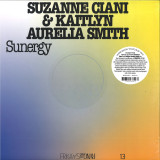
Sunergy brings together synthesists Kaitlyn Aurelia Smith and Suzanne Ciani for the thirteenth installment of FRKWYS, RVNG Intl.'s intergenerational collaboration series. For this edition, a panorama of the Pacific Coast provides the place and head space for a musical appreciation and consideration of a life-giving form vast and volatile with change. Fortuitously (as is the freaky way), Smith and Ciani were discovered to be neighbors in the small coastal community of Bolinas, California. The two had become close friends, bonding over their experience as woman musicians and, more unusually, their shared passion for the Buchla synthesizer. The music of Sunergy embraces this kinship, with Ciani and Smith respectively performing on the Buchla 200 E and the Buchla Music Easel, two modern configurations of the innovative instrument developed in the '60s by Don Buchla.
Sunergy was recorded in the Bolinas home where Ciani has lived for the last twenty-four years. Her living room overlooks the Pacific Ocean from a cliffside perch, creating an idyllic, inspired setting for music making. Setting up their synths side-by-side, Ciani and Smith took turns keeping time and freely improvising for the album sessions. As a complete piece, Sunergy is shaped by slow, pulsing forms and sinuous, melodic sequences that conjure both an oceanic world and the unlimited sound made possible by modular processing.For her part, Ciani has long been a Buchla voyager. Suzanne proselytized the potential of Don's synthesizer instruments in the '60s and '70s, performing her own compositions before introducing synthesized jingles and sound effects to household audiences. Ciani then achieved wide recognition for her debut album Seven Waves, a collection of colorful, classical song-like melodies fluidly working with harmonic textures and sounds of the ocean shore. Since its 1982 release, Seven Waves has become an important chapter of the ambient canon within which contemporary artists like Smith have developed their own synth syntax. Smith was born just a few years after the appearance of Seven Waves, growing up in Orcas Island, Washington. A place of profound natural beauty, the islands would inform Tides, her first instrumental collection from 2014. Smith composed Tides as an accompaniment for Yoga classes, ultimately freeing her from conventional songwriting into the exploratory, synth-based compositions demonstrated in ecstatic variety on 2016's Ears. Despite the serene setting where Sunergy was realized, the album does not romanticize a complete oneness with nature. Smith and Ciani use their collaborative ground to reflect on the unstable forces at play across the Bolinas horizon. Sunergy takes stock of Bolinas in the 21st century, a once-thriving artist's refuge now vulnerable to real estate pressure extending from affluent San Francisco, and more irreparably, the specter of climate change erasing its many waterfront habitats.
A diametric dynamic is present in Sunergy, a somber meditation amidst the intense cultural and solar forces transforming the landscape, and a hopeful assertion of the surviving creative culture of Bolinas. Far from rehashing the gentle grace of the artists' seminal works, Sunergy instead seeks to awaken and bear witness, employing the Buchla waveforms to mirror the infinite rhythms of the ocean and our essential relationship to it.
Kaitlyn Aurelia Smith and Suzanne Ciani's Sunergy will be released on September 16, 2016 on LP, CD, and digital formats. An accompanying documentary by Sean Hellfritsch will be offered in tandem.
Relentless raver and emerging artist from the Rinse France roster of captivating talent, RONI launches her imprint Nehza Records with a five-track EP titled ‘Slowing’ by Bordeaux-based Neida . Marking the debut release on the label, Neida is the first producer to bring RONI’s fantasy-led vision to life.
‘Slowing’ is a cross-pollination of breaks, acid, jungle and bass which nods to the sound of the underground UK rave scene circa 1990. An era that RONI closely aligns with in terms of sound, art and the sense of liberation synonymous with 90s club culture, Neida nails this aesthetic throughout the EP. ‘Bull’ sets a powerful tone as the opening track, packed with punchy drums layered below an orchestral-like vocal before ‘DSO’ burbles through with squelchy synthwork over a 4/4 beat — a clear hint of that UK rave sound simmering under the surface. Garnering his appreciation for reggae and Rasta dialect, Neida’s rework of a vocal derived from reggae artist Don Carlos is masterfully blended into this 6-minute churner.
Over on the B-side, ‘Guess Who’ burns slowly with downtempo breaks and mesmerising chords; you can almost smell an imaginary forest as the track unravels, creating an image of tripping in nature. ‘WHT’ rumbles through with a mellow introduction before going full-whack into barreling drums and clap-heavy percussion, illustrating Neida’s ability to dip into experimental textures that nod to complex rhythm patterns rather than club-cut melodies. ‘For All The Time Sake’ closes the EP with an acid bassline and bright, crisp percussion ending the EP on a significantly vibrant note to mark the first stepping stone of RONI’s record label. ‘Slowing’ is a spiralling myriad of bright atmospheres and escapism, likely to be one of many sonic trademarks on Nehza Records.
After the ambitious A Distant (Dark) Source (2018) and the subsequent artistic triumph of its live recording in 2021, French avant-garde metal outfit HYPNO5E return with their sixth studio album. Once more, these four visionary musicians and cinematographers take us back to the lost shores of the palaeolithic Lake Tauca, where we dive deeper into its dark source to fnd vibrant visions of a memory both distant and hazy as well as warm and evocative. Sheol shows HYPNO5E at the top of their game, revealing the epitome of their idiosyncratic sound while also exploring new and exciting aspects of their artistic identity. Since 2006 HYPNO5E have been taking grand strides in honing their brand of cinematographic metal, with each of their albums developing elements that would become essential building blocks to their sound. Their 2007 debut album Des Deux l'Une Est l'Autre harnessed a raw, chaotic energy, while the following Acid Mist Tomorrow (2012) saw them apply a hazy filter to their ferocious sound. On Shores of the Abstract Line (2015) HYPNO5E already transformed into the true modern metal grandmasters they are today, while the special soundtrack album Alba - Les Ombres Errantes explored a more subdued acoustic side of the band. Sheol sees the band sounding warmer and brighter than anywhere else in their storied discography, and the arrival of new drummer Pierre Rettien and bass player Charles Villanueva adds a fresh touch the classic HYPNO5E sound. The sweeping finales of «Lands of Haze» and «The Dreamer and His Dream» as well as the pastoral qualities of the quiet finger-picked parts on «Bone Dust» and «Lava From The Sky» hearken back to the old prog rock records of the seventies, albeit with an updated sonic palette and modern production parameters. Besides, these eight tracks also see the band carefully exploring new patterns, shapes, and forms within their own musical universe: from the alternating use of ritardando and accelerando on the aforementioned rim-clicks to the increased employment of string sections and vocal harmonies. With the addition of a whole new palette of warmer and brighter tones, HYPNO5E superbly bridge the sounds of the modern progressive metal and retro prog-movements creating an evocative sonic experience. FOR FANS OF Gojira, Opeth, Periphery, Uneven Structure, Steven Wilson Limited (100 copies ww) Single Colour (Gold Vinyl) Edition!
2023 Repress
Noisia's uncompromising approach to dance music has never been more keenly felt. While they're turning out remixes for commercial acts such as Katy Perry and Deadmau5 that sound just as filthy as any usual Noisia production, the Dutch trio are also sticking to their D&B roots with releases on their own Vision imprint.For Vision's latest release label bosses Noisia team up with long-term collaborators, Phace, to whip up 'Program'. As you'd expect from one of their collabs, this one is hard and heavy complete with an intense breakdown reminiscent of Wolfgang Gartner's 'Undertaker'. Winding bass notes finish the job and rib-crushing subs will have the dancefloor churning every time this drops.Flip over and 'Regurgitate' brings you in slowly, stuffing you gently with an epic atmosphere and sultry guitar licks. Looped vocals bring you up to the drop before a trademark Noisia bassline pukes all over your best dancing shoes. If this one doesn't get people 'going sick' we don't know what will!
- A1: Tolouse Low Trax - Sketches Of A Destroyed Meadow
- A2: Infuso Giallo - Torus
- A3: Claude De Tapol - Du Train Jaune
- B1: Puma & The Dolphin - The Grass Drum
- B2: T-Woc - Marty Eek
- B3: Houschyar - Intercontinental
- C1: Lamusa Ii - Artificiale
- C2: Ynv - Dw3
- C3: Bolva - Rite Ii
- D1: Anatolian Weapons - Float
- D2: Urverhext - Ubertan
- D3: Velvet C - Exalt Cut
Emotional Response is delighted to present elsewhere LVI. The 4th of soFa's compilation series, this double LP takes us to the darker side of the elsewhere ouvre, via another 12 artist / 12 track travelogue.
With certain future-retro feelings, this is club music for the open minded. An album that roams from dreamy ambient territories to rhythmic patterns - internationalism for the adventurous DJ.
Rusty slow-mo bangers and post-industrial synth-wave kidnap the listener to a dystopic and shady wasteland. Elements of ethnic folk, vintage vocoders and Gamelan samples all united on one homogeneous selection.
With artists now known to welcoming new brethren, this is an audio trip to leave reality behind. Exotic, hypnotic, tactile, trance-inducing meditations, washed down with a spoonful of magick.
“… an album which shows that Carter Tutti are in a state of continuing evolution” – The Wire. 2007’s Feral Vapours of the Silver Ether will be available here for the first time on vinyl, and was the second release under the Carter Tutti name. On it, the electronic and the acoustic are merged in a seamless, crafted album that is awash with echoes of the sea, the moon, the open road, and flatlands.
To celebrate the 50th release of Visions Recordings, Alex and Stephane Attias present here a 3 track EP featuringSohan Wilson on keyboards.
Starting on the A side with a long deep slow disco vibe and a shifting bass line, “In My Mind” will take you on a journey, a repetitive groove, a long jam that simply celebrates the essence of Visions Recordings with a soulful vibe.
On the B side we have “Overtones” a crazy dancefloor jam with a simple beat based on a kik drum and some percussions. The key to the track lies in the sick bass line and haunting piano riff that builds to a peak reaching a higher state of moody funkyness.
Rounding out the B-side, “Skylite” is a funky disco house track with a healthy dose of sunshine, pads, and keyboards by the wizard Sohan Wilson.
Aussie composer Cat Tyson Hughes is an experimental artist whose new album Crossing Water on Past Inside The Present marks her debut long player. It comes after she's been involved with several other projects and offers a fragile and delicate mix of subtle instrumentation and rich voice textures imbued with an array of lovely field recordings. These are superbly patient and slow-burn tracks that really have a cathartic effect as nature and natural sounds permeate each composition. The melodies take your mind away as the freely structured, minimal arrangements really make you take note.
Gold Vinyl
Since 2008, "438Hz As It Is, As You Are" is "only" the third solo release from Tomoyoshi Date. The last one dates from 2011. Less is more.
In parallel, from 2013 to 2021, he has recorded some releases in collaborations with Toshimaru Nakamura, Ken Ikeda, Stijn Hüwels, Asuna and Federico Durand.
"This record was recorded on Diapason's upright piano made in the 1950s at the house of his maternal grandmother's sister (*). The piano has moved and tuned many times, and now it has arrived at my living room. It was a pre-mass production piano with a thick board and good sound, but I couldn't tune it without replacing the screws and the weakened base. After consulting with the tuner, I decided to tune the whole tune to the sound of the strings wound around the loosest and most inseparable screws. "As it is"
*Mikiko Yamada: A performer who formed a Japanese music group of contemporary Japanese music in 1964 and made Biwa the first five-line score. She also had a samisen, so I called her "Aunt Pen Pen". Her husband was a shakuhachi player, so she was "Uncle Boo Boo".
When I tuned in the summer, I tried to tune at 442kHz, but I changed the tune in the winter to 438kHz. From now on, the pitch of this piano will decrease year by year as the material ages. I will play the decaying piano and continue to record music that can only be done at that time.
When you drop a needle on a record, a sound is produced on the spot, and the sound constantly changes depending on the air, temperature, and humidity around the needle. The sound also affects all of the listener's life, affecting the frequency of the person's body and mind. The effect of the sound once generated will last forever.
This work was created with the intention of having the listener adjust the pitch at the desired speed according to the mood and frequency of the listener at that time. With a little faster 45 turns, you can listen to this dilapidated piano at 440kHz or 442kHz. You can slow it down, or adjust the number of rotations as you like, whether it is 33 rotations early or late. I really like the stretched sound of the recorded piano. When you want to relax, use slow music to adjust the pitch of the space around you, the creatures, and your own body and mind. "As You Are"
Tomoyoshi Date
The 6th album from the Ohio band finds them adding a member and polishing the jagged edges off their lo-fi pop anthems ever so slightly, letting the album's twelve tracks dance and shimmer like sun glinting off the waters of the Scioto river, perfectly capturing the undeniably midwestern attitude of melancholic joy. For fans of: Sebadoh, Guided By Voices, Car Seat Headrest, The Men, Mike Krol, The Replacements, The Stevens.
Tape
The 6th album from the Ohio band finds them adding a member and polishing the jagged edges off their lo-fi pop anthems ever so slightly, letting the album's twelve tracks dance and shimmer like sun glinting off the waters of the Scioto river, perfectly capturing the undeniably midwestern attitude of melancholic joy. For fans of: Sebadoh, Guided By Voices, Car Seat Headrest, The Men, Mike Krol, The Replacements, The Stevens.
- A1: Thando (Feat Black R, K Dalo & Lah Presh)
- A2: Akulalwa (Feat Black R, K Dalo & Frego)
- A3: Bo Mbali Leboh Palesa (Feat Dea Rebbedy)
- B1: Dlozi Lam (Feat Jay, Frego & Gentow)
- B2: Lepiano (Feat Black R, K Dalo & Frego)
- B3: Lovey (Feat Black R, Frego & Khence)
- C1: Mekete (Feat Thapzin, Statah & Preshy Dee)
- C2: Mjolo (Feat Golden Krish & Black R)
- C3: Oskido (Feat Sphiwe, Black R & K Dalo)
- D1: Qhude (Black R, K Dalo & Frego)
- D2: Umshato (Black R, K Dalo & Frego)
- D3: Drive Through
There's more than a hint of ambition on the double LP sophomore effort from Sam Austin Rabede, the producer known as DJ Black Low. Pretoria, South Africa-born and based, the young man makes amapiano with new ways of expressing this local- turned-global style of dance music. In DJ Black Low's musical imagination, the songs manage to smoothly vacillate between dreamy and firmly-grounded. Adorned with vocalists across most of the twelve tracks, there's a new dimension to Black Low's now-signature approach to abstract, angular deconstruction of the rhythmic developments in his songs. The album references influences and ambitions in its song titles and lyrics while the music itself is anthemic in its sonic and structural aspirations. On many of the songs a slow-burning tension transforms into something unexpected until you're somewhere else as the track concludes. There is an emotional and compositional maturity that builds on his earlier work. Vocals and lyrics are in focus. Production collaborators among Black Low's Gauteng Province circle add to the constantly churning array of ideas that populate this consistently surprising release. Despite being a relative newcomer, DJ Black Low is onto something here.
It"s 2023, and even the turn of century seems a long time ago now - but oddly, Purling Hiss"s guitar-band ethos feels ever more timeless. The Hiss aren"t just a simple part of the tradition going back 50-odd years Their DNA, pulsing in waves of punk and classic radio rock, grunge and slacker, is ineffably, re-singably music - but their signature crushed guitar harmonics, fused with deep soulfulness, meld into something that cuts us with fresh heartbreak, an eternal recurrence that seems to be happening right now today, as it pours off the turntable and runs down the street. Drag On Girard, the first Purling Hiss album in six years, cruises through these states of mind and places in time. As before, but with new twists, Mike Polizze and his gang let loose with the chaos and noise implied by their name, applying high-end splatter and slow-rolling low end to eight vehicles, running the gamut from gleaming pop gems to head-cleaning epic jams before they"re done. One of the unique qualities of Drag On Girard is a specific lead-rhythm arrangement of the guitars, emitting the expected formidable roar while setting a certain type of rhythmic strut for the band. The two guitars style also trips power-pop impulses in the tunes, with sung-along harmony vocals that evoke classic collective magic and burnish the tunes one by one. Once this vibe"s established, side two turns around and stretches out with the molten flow of Purling Hiss at their very most epic; couched within loose improvisatory structures, the title track and "Shining Gilded Boulevard" play further with the yin/yang of nostalgia and truth as they trade places looking meditatively back to them old days and all their harshness and beauty.