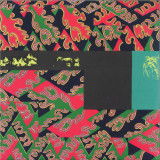
everything one needs to know about this album: a misshapen,
CHUD-like figure wanders in a graveyard bearing a cross,
while a mutated fish flops in a polluted ditch and a clutch
of factories belch their smoke above it all. The message of
the illustration is not to frighten or warn, but to celebrate
and admire.
Originally released in January of 1984, Disease Is Relative
is an unapologetic and wholesale embrace of death,
disease, and dystopia, with liberal doses of absurdism
and an unrelenting devotion to anything unexpected,
chromatic, or evil sounding. Sporting influences as
diverse as no wave, death rock, funk, post-punk, hardcore,
metal, and prog rock, this music somehow happened in the
midst of a first wave hardcore scene, before there was a
“post-” to be “post” of. Less surprising is that this happened
in Cleveland, which also inspired a desire to recreate the
feeling of the city’s post-industrial desolation in sound.
There’s also some epic screaming and crazy guitar playing.
The album features three songwriters (brothers Andrew
& Chris Marec, Robert Griffin), who also divide guitar,
bass, and vocals equally between themselves here.
Drummer Bruce Allen is the secret weapon, and provides
a clue to what a young Bill Bruford might have done in a
band like this. And yet, beyond all odds, the end result is
cohesive, cathartic, and utterly idiomatic. The distinct vibe
of the album, and its sheer quantity of killer riffs, songs
and performances have made it an album that people have
championed over time, while others have come to know it
through the interwebs as a result.
everything one needs to know about this album: a misshapen,
CHUD-like figure wanders in a graveyard bearing a cross,
while a mutated fish flops in a polluted ditch and a clutch
of factories belch their smoke above it all. The message of
the illustration is not to frighten or warn, but to celebrate
and admire.
Originally released in January of 1984, Disease Is Relative
is an unapologetic and wholesale embrace of death,
disease, and dystopia, with liberal doses of absurdism
and an unrelenting devotion to anything unexpected,
chromatic, or evil sounding. Sporting influences as
diverse as no wave, death rock, funk, post-punk, hardcore,
metal, and prog rock, this music somehow happened in the
midst of a first wave hardcore scene, before there was a
“post-” to be “post” of. Less surprising is that this happened
in Cleveland, which also inspired a desire to recreate the
feeling of the city’s post-industrial desolation in sound.
There’s also some epic screaming and crazy guitar playing.
The album features three songwriters (brothers Andrew
& Chris Marec, Robert Griffin), who also divide guitar,
bass, and vocals equally between themselves here.
Drummer Bruce Allen is the secret weapon, and provides
a clue to what a young Bill Bruford might have done in a
band like this. And yet, beyond all odds, the end result is
cohesive, cathartic, and utterly idiomatic. The distinct vibe
of the album, and its sheer quantity of killer riffs, songs
and performances have made it an album that people have
championed over time, while others have come to know it
through the interwebs as a result.
Toronto’s infamous psychedelic multimedia collective, Intersystems, make a surprise return with a new full-length LP, #IV. Coming via Waveshaper Media, #IV is Intersystems’ first new material since 1968! Intersystems’ pioneering avant/electronic music sounded positively alien in the 1960s, and more than 50 years later, this latest body of work sounds just as otherworldly.
When they arrived on the scene in the late 1960s, Intersystems stood out from their peers. Comprised of architect Dik Zander, light sculptor Michael Hayden, poet Blake Parker, and musician John Mills-Cockell (of Syrinx, Kensington Market and more), the group mounted groundbreaking pan-sensory events and released a trilogy of defiantly disorienting records.
Where more conventional purveyors of sonic psychedelia were content with fuzztone guitar and orientalist tropes, Intersystems managed to approximate the full psychedelic experience in all its euphoric wonder and terror. Initially wrangling homespun gadgetry, feverishly spliced-together tapes, and mutant beat poetry, Intersystems were also among the very first to deploy a Moog Synthesizer; their Moog modular system was the first to be imported into Canada. Intersystems’ three vinyl LP recordings, meanwhile, justifiably became coveted collector's items given their scarce quantity and singular unsettling vision.
The reissue of Intersystems’ full discography in 2015 prompted acclaim from a number of major outlets. Among them, PopMatters hailed the set as "one of those great lost recordings (three of 'em actually) that comes from the lysergic era..." Mills-Cockell’s work in Syrinx has also been reissued to great acclaim in recent years.
Fifty-plus years after their 1968 album Free Psychedelic Poster Inside, Hayden and Mills-Cockell decided to revive the long-dormant project with a series of sessions at Hamilton's storied Grant Avenue Studio. The resultant music remains remarkably congruent with the project's original vision while clearly emerging from the present moment. With original poet/lyricist Blake Parker now deceased, Hayden and Mills-Cockell made the counterintuitive (yet strangely apt) decision to render Parker's words electronically. As the computer-synthesized voice alternates between an eerily life-like delivery and slurred cybernetic faltering, it brings a new dystopian tint to the group's anxious surrealism. Taking cues from its predecessor, Free Psychedelic Poster Inside, a modular Moog Synthesizer system is the primary instrument, yet here it offers a dynamic blend of different sonorities: barbed wire basslines, Subotnickesque chirping, gestural plumes of colour and percussive filigree.
While the group cut their teeth in the 1960s, make no mistake these new Intersystems recordings aren't a “comeback" or an attempt to rehash the "good old days". What one hears instead is the sound of Mills-Cockell and Hayden re-energizing the project, bringing with them the myriad experience they’ve accumulated in the intervening 50 years. These aural concoctions—no less perplexing than their 1960s predecessors—build upon the Intersystems foundation but very decidedly reside in the present moment, reminding listeners of just how forward-looking this group was in the first place.
“After all is said and done, after 30 years, after a
pandemic which shattered the world, after
thousands of kilometres travelled and many more
thousands of notes played and sung, what
remains?
“A deep love and respect for great music and the
greatness in music, a deep love for the humanity
that is brought to life by it, a deep appreciation for
the gift of friendship and for the power and
resonance that brought and kept us together all
these years, and for that curiosity and passion, that
meticulous quest to unveil the deepest mysteries
of music, that drives us always onwards.
“Finally, we’ve given it a name: ‘Afterallogy’.” - Noa
LP pressed on 180g vinyl.
Re-press of the 2018 LP on green vinyl
In many ways Insecure Men - the band led by the fiercely talented songwriter and musician Saul Adamczewski and his schoolmate and stabilising influence, Ben Romans-Hopcraft - are the polar opposite of the Fat White Family. Whereas sleaze-mired, country-influenced, drug-crazed garage punks the Fat Whites are a “celebration of everything that is wrong in life”, Insecure Men, who blend together exotica, easy listening, lounge and timeless pop music, are, by comparison at least, the last word in wholesomeness. The band originally formed in 2015 in the cramped confines of The Queens Head pub, Stockwell, in the Fat White Family’s notorious South London ‘practice space’. Saul recorded all of the songs he wrote at The Queens Head onto tape at Sean Lennon’s studio in upstate New York. This tape, recorded on his own in a corridor onto an ancient Tascam while in a foul mood with his mates, essentially became Insecure Men’s self-titled debut album as more layers were dubbed over the top until nothing of the original demos remained. Saul lists some of the influences on their sound, mentioning the exotica of Arthur Lyman, the early electronic pop of Perrey and Kingsley, the supreme smoothness of The Carpenters, the songwriting chops of Harry Nilsson and the hypnagogic uncanniness conjured up by David Lynch, describing what they do as “pretty music with a dark underbelly to it”.
A. Smyth debut album, Last Animals, will be released early next year on 19th February. The album was produced by Darragh Nolan (Asta Kalapa) and mastered by JJ Golden. “…we made Last Animals in January of this year, moments before the world was to change forever. Throughout the record I reflect on the effect we as humans are having on our home, little did I know what was to come.... Last Animals is made up of 10 songs, some big, some small, but all with something to say”.
The forthcoming album’s first taster ’Hero’ (Oct 2019) racked up 338k streams with inclusion on Easy, Your Coffee Break and Breath of Fresh Eire Spotify playlists. It followed a series of equally well-received early singles released by A. Smyth over the last two years, including ‘Second Moon’, another add to Your Coffee Break playlist (alongside many other discovery playlists) with 642k Spotify streams to date, ‘Coming Back To You’ and ‘Fever’, both of which featured in ‘Made In Chelsea.’ With the singles gaining early support by major Irish radio stations RTE Radio 1 and Today FM.
A. Smyth has sold out Whelans in his hometown Dublin, and performed at Ireland Music Week and Other Voices festivals - with an appearance also on Other Voices TV show which aired this Spring. As well as performing UK/international showcases at Primavera Pro, Eastbound Festival and All Together Now (among others).
Over the past several years, the recorded output of Carl Stone has been turned on its head. In previous decades, Stone perennially toured new work but kept a harboring gulf of time between the live performances and their recorded release. This not only reflected the careful consideration of the pieces and technical innovations that went into the music but also the largely academic-minded audience that was themselves invested in the history and context of the work.
The time span of Stone's recorded output in both sheer musical duration and year range was generously expansive. Following multiple historical overviews of Stone's work on Unseen Worlds and a re-connection with a wider audience, the time between Stone's new work in concert and on record has grown shorter and shorter until there is now almost no distance at all. Stone's work has often at its core explored new potential within popular cultural musics, simultaneously unspooling and satisfying a pop craving.
On Stolen Car, the forms of Carl Stone's pieces have also become more compact, making for a progressive new stage in Stone's career where he is not only creating out of pop forms but challenging them. Stolen Car is the gleeful, heart racing sound of hijack, hotwire, and escape. Stone carries the easy smirk and confidence of a car thief just out of the can, a magician in a new town setting up a game of balls and cups. With each track he reaches under the steering wheel and yanks a fistful of wires. Boom, the engine roars to life, the car speeds off into the sunset, the cups are tipped over, the balls, like the car, are gone.
“At times it feels like Stone’s music is a secret decoder ring unlocking the in¬nite possibilities hidden within other recordings... deft manipulation and recreation of pop music’s emotional impact out of apparent chaos is a substantial part of what makes much of the music on Stolen Car the most fully realized of Stone’s career." - Jonathan Williger, Pitchfork, 7.8 Scored Review
"'Stolen Car,' by the sample-driven American composer Carl Stone — presents up-tempo found-melodies, pristinely rendered into fresh guises." - Seth Colter Walls, The New York Times
Musical composition, design and sound production carried out at the INA grm Studios (Paris) in 1993/95
Original audio recordings in the Drôme and the Mont Ventoux areas
Voice: Hélène Bettencourt
Vocal occurrences: Frédéric Malenfer, Bruno Roche, Lionel Marchetti
Bass clarinet (for processing): Jean Andréo
Micro-climat (1989/90), 21'33
Micro-climat is the first movement of the Sirrus cycle (Micro-climat, Passerelle, Sirrus) composed in 1989/90
Musical composition, sound design and production, audio recordings in 1989/90 at the CFMI studios in Lyon (Lumière University, Lyon 2)
"I wonder if my fascination for clouds (without being an obsession) may have risen at the end of the 80s as, whilst composing Micro-climat, I would regularly wander between the Vercors mountains and the high plateaus of the Monts du Forez discovering, through my eyes, body, breath, active observation and walk, that natural forms when constantly changing and yet swollen with a unity of matter (in this instance, water) open one up to a deep, fundamental breath and a clear field for the mind. The sky and its forces: our ally.
A model for a natural music which, although fixed, as in musique concrète (a rule of the genre), moreover on a recording tape, will remain charged with such a poetic quality that (isn't it its role or rather its reality?) it will ensure a perpetual renewal for our senses, so as to reach another idea of the world, far more open and richer than what we could have imagined."
Lionel Marchetti, 2011
Lionel Marchetti is a major figure of the "third generation" of concrète musicians, a term he values. Listening to these works, imbued with poetry and traversed by micro-narratives, one can indeed retrieve the original concrète spirit, the one that draws from the sonic world, with ears wide open, so as to extract a fertile, rich and multiple substance then shaped and conveyed towards a formal and musical abstraction. Lionel Marchetti has mastered this process, but his real distinctive feature is a truly unique talent for setting climates (as one sets traps) and keeping us on constant alert. The two pieces in this record perfectly illustrate the entrancing dimension of Lionel Marchetti's music, whose charm leads us, through each successive listening, to become voluntary captives so as to better liberate ourselves.
François Bonnet, Paris, 2020
out of Stock
Last delivered 5 years ago available to reorder, subject to availability
Minimal Wave presents ‘Recordings 1980-1982’ (MW077), a triple 7” box set by pioneering south Florida synth-punk band Futurisk, in honor of their 40th anniversary. Founded by Jeremy Kolosine in 1978, Futurisk recorded many songs and performed live throughout the early 1980s. Though they had released two 7”s that sold out, had a legendary live show, and even some videos, by 1984 Futurisk was history. Eventually, the main core of Futurisk would be the Jeremy Kolosine, Richard Hess, and Jack Howard line-up though much happened leading up to this point.
In 1979, the teenage Jeremy Kolosine won studio time and money in a competition with his drum-machine-triggered guitar-synth act called ‘Clark Humphrey & Futurisk’. He decided to form a band around the name to record a more punk release titled The Sound of Futurism 1980 / Army Now. It was an ambivalent anti-war anthem with Jack Howard on drums, Frank Lardino on synth, and Kolosine on vocals and guitar synth. Many live shows ensued with the line-up which included Jeff Marcus on bass and Vinnie Scrimenti on drums but in 1981 a rift between the band caused them to part ways. They continued for a bit as ‘Radio Berlin’ (no relation to the Vancouver act) and Kolosine, who had gotten absorbed in a new analog synthesizer with sequencer continued as Futurisk.
He recruited synthesist and recording engineer Richard Hess who had a myriad collection of Moogs, Oberhieims, and CATs. Jack Howard returned on drums and syn-drums and the lineup for the Player Piano EP was cast. The EP, like the live show, was a strange blend of punk, minimalist, and disco-influenced electro-pop, with drum machine triggered synths and often frantic real drums all led by Kolosine’s schizophrenic Bowie / Ferry / Foxx adulations. It was recorded by Richard Hess and the band in the rooms of a friend’s house. The drum sound, recorded in a bathroom, rocks, even today. Reportedly, Futurisk may have been the first synth-punk band in the American South, and their 1981 track ‘Push Me Pull You (Pt. 2)’ was an early pre- ‘Rockit’ excursion into electro-funk.
The ‘Recordings 1980-1982’ box set includes three 7”s, an Army Now (1982) Flexi 5” x 7” postcard, and a 16-page full-color booklet featuring unpublished photographs of the band, the history of the band, and an interview with founder Jeremy Kolosine. The three 7”s are The Sound of Futurism 1980 / Army Now which includes an unreleased track from the same session, the Player Piano five-song 7” EP from 1982, and the Ocean Sound 7”, which has not been released in this format until now. All three 7”s are remastered, pressed on heavyweight 70-gram vinyl, and housed in heavy color printed matte sleeves featuring the band’s original artwork. The box is case wrapped and depicts an early illustration of the band printed in black on white with a spot gloss. Limited edition of 600 copies.
out of Stock
Last delivered 43 days ago available to reorder, subject to availability
Liam Bailey follows up his 'Ekundayo' album with this heavy hitting remix 7" featuring two absolute legends. The A side is a remix of Champion featuring Black Thought of The Roots. Black Thought kills the first verse finding the pocket over the Leon Michels produced reggae banger designed to bust up woofers and blow out dance floors. Liam and Thought combine to sing praises to a woman worthy of all the admiration they can muster, and in doing so, they take what was already a classic to another level. The B side is straight from the far flung corners of outer space. Producer Leon Michels strips down and revamps the album cut Ugly Truth, making room for the most special of guests, the one and only, Mr. Lee "Scratch" Perry. The Upsetter switches between singing and talking, one minute proclaiming his powers and the next playing with the title of the original tune. Some proper Lee Perry business alongside the already unstoppable chemistry of Liam Bailey and Leon Michels...An absolute Big Crown Surehot.
out of Stock
Last delivered 5 years ago available to reorder, subject to availability
Negativland’s mirror image sequel to last year’s True False, The World Will Decide turns the focus away from the very human inability to accurately define reality, and towards the technologies being built to do a better job at it. But if sorting true from false seemed like a full time job back when all one had to keep track of was one’s own mind, life alongside the machines built to connect everyone only seems to multiply the uncertainties. On The World Will Decide, those uncertainties are made almost deliriously danceable: a netweb of densely sampled voices melting speech back down into music and back again, into what everyone can agree are the real questions—did that firefly really land on your finger? Would you like to be arrested? Does this app connect you to people, or replace them? Is this post an example of inauthentic behavior? Do people have to die? Or, as one of the many sampled voices on this work assures the listener: we can really feel like we’re here.
Scottish producer Gavin Sutherland revives his Other Lands alias with a collection of tracks that were crafted between 1997 and 2012, and were transferred straight from the original cassette.
"What Year Is It? Who Is The President?", is Sutherlands' first full offering with PULP. After multiple remixes for the label (under his Fudge Fingas alias), the release schedule for the Other Lands guise has picked up in the last few months. This resurgence of previously unreleased material will add to Sutherland's elaborate catalog, and confirm that even bits that never saw a release at the time, are sounding relevant and superbly produced.
"What Year Is It? Who Is The President?" (PULP13) starts with "The Caged Bird", which is a synth laden, lush sounding cut that is built around a playful bass sound and beautifully orchestrated chords. The drums are swinging as ever, and the hypnotic character of the lead is present throughout.
"Kaleidoscope" is a venture into the otherworldly. Deep splashes of synth and fx come together effortlessly to create an almost meditative state. The musicality of it all is remarkable, and hard to capture in a few words. The rhythm section is always the backbone, but the fx are equally as important. Fans of Sutherland's work will surely recognize and appreciate the ambiance that is set in Kaleidoscope.
The flipside starts with "It's Something Else". The main lead is indeed something refreshing. In a sense, it's reminiscent of a guitar, but it's clearly not that. The dance floor nature of everything else is supporting the wildness of the lead. Altogether this is something to space out to. On a dance floor, at home or perhaps even during a run.
The final track on the B-side is called "Mind Like A Steel Trap". This sample heavy, hazy sounding piece of beauty is blending soulful flutes, drums and the catchphrase of the song - no more mind games - together with an astonishing ease
out of Stock
Last delivered 4 years ago available to reorder, subject to availability
• Although no longer part of the current Band line-up, Hamish Stuart remains integral to the continuing Average
White Band catalogue reissues, a band that is widely regarded as one of the best ever soul and funk bands.
• For the last 40 years, Hamish Stuart has been an in-demand songwriter, producer and studio/live performer,
working with Paul McCartney, Chaka Khan and Aretha Franklin, being part of the Ringo Starr & His All-Starr Band,
or the occasional meet-up of the 360 Band, which also featured former band mates Steve Ferrone and the lateMalcolm ‘Molly’ Duncan.
• Hamish has also written for Smokey Robinson, George Benson, Diana Ross Jeffrey Osborne and Atlantic Starr,.
• ‘Sooner Or Later’ was his first solo album, released worldwide between 1999 and 2000, so although celebrating
it’s Coming-of-Age, 21 years later, it’s the album’s debut release on vinyl.
• ‘Sooner Or Later’ has been edited and reconfigured by Hamish to give it a tighter sound and includes the single
‘Midnight Rush’, co-writer with Incognito’s Jean-Paul ‘Bluey’ Maunick.
• Other song writing collaborations include ‘It Is What It Is’, with Richard Darbyshire and Frank Musker and ‘I Don’t
Wanna Be A Rock’, with Graham Lyle.
Alan Vega’s name is synonymous with unfettered, tireless creativity. Beginning in the late 1950s, when he was a fine art student at Brooklyn College, through his years playing in Suicide, and all the way up until his death in 2016, Vega was constantly creating. That
process naturally led to a wealth of material that didn’t see the light of day immediately when it was recorded, which came to be known as the Vega Vault. Mutator is the first in a series of archival releases from the Vault that will come out on Sacred Bones Records.
Mutator was recorded alongside Vega’s longtime collaborator Liz Lamere at his NYC studio from 1995-1996, and it serves as a document of a particularly fertile time in his creative life. He had 11 full-length solo albums come out during the ’80s, ’90s and ’00s - plus numerous collaborations, and Suicide records A Way of Life and Why Be Blue. Mutator wasn’t shelved intentionally, but Vega’s back-to-thegrindstone M.O. meant that he had moved on to making his next record before this one was finished. Lamere and Vega’s friend and confidante Jared Artaud (The Vacant Lots) rediscovered the raw, unmixed recordings from the Mutator sessions in the Vault in 2019. Soon after, they mixed and produced them into the visionary album that was lurking within those tapes.
“Our primary purpose for going into the studio was to experiment with sound, not to ‘make records,’” Lamere recalls. “I was playing the machines with Alan manipulating sounds. I played riffs while Alan morphed the sounds being channeled through the machines.”
At the time of the Mutator sessions, Vega was massively inspired by what was happening in the streets of New York - not only the hip hop scenes that were exploding throughout the outer boroughs, but also the literal sounds of the streets, the traffic noise and industrial ambience of city living. That influence trickled into the sounds he and Lamere captured in those sessions. That sensibility, paired with Vega’s unmistakable voice and force of personality, is what made it the great album it is now. The final piece was the production job, completed by Lamere and Artaud 25 years after the songs were first captured.
Alan Vega’s name is synonymous with unfettered, tireless creativity. Beginning in the late 1950s, when he was a fine art student at Brooklyn College, through his years playing in Suicide, and all the way up until his death in 2016, Vega was constantly creating. That
process naturally led to a wealth of material that didn’t see the light of day immediately when it was recorded, which came to be known as the Vega Vault. Mutator is the first in a series of archival releases from the Vault that will come out on Sacred Bones Records.
Mutator was recorded alongside Vega’s longtime collaborator Liz Lamere at his NYC studio from 1995-1996, and it serves as a document of a particularly fertile time in his creative life. He had 11 full-length solo albums come out during the ’80s, ’90s and ’00s - plus numerous collaborations, and Suicide records A Way of Life and Why Be Blue. Mutator wasn’t shelved intentionally, but Vega’s back-to-thegrindstone M.O. meant that he had moved on to making his next record before this one was finished. Lamere and Vega’s friend and confidante Jared Artaud (The Vacant Lots) rediscovered the raw, unmixed recordings from the Mutator sessions in the Vault in 2019. Soon after, they mixed and produced them into the visionary album that was lurking within those tapes.
“Our primary purpose for going into the studio was to experiment with sound, not to ‘make records,’” Lamere recalls. “I was playing the machines with Alan manipulating sounds. I played riffs while Alan morphed the sounds being channeled through the machines.”
At the time of the Mutator sessions, Vega was massively inspired by what was happening in the streets of New York - not only the hip hop scenes that were exploding throughout the outer boroughs, but also the literal sounds of the streets, the traffic noise and industrial ambience of city living. That influence trickled into the sounds he and Lamere captured in those sessions. That sensibility, paired with Vega’s unmistakable voice and force of personality, is what made it the great album it is now. The final piece was the production job, completed by Lamere and Artaud 25 years after the songs were first captured.
What's the equation that reveals your love? On the latest single from Alba & The Mighty Lions, the question is posed and answered in the form of a beautiful soul slow-roller. Alba Ponce de León's charming word play, both mathematically-minded and straight from the heart, is calculated as a sum of English and Español, and multiplied by the suave accompaniment of a Mighty Lions' backing track that cruises the border of lowrider soul and enchanted exotica. Adding it all up, you may find an answer to this magical schoolyard test, depending on how the numbers align for you. A witty and passionate take on a classic formula, "Matemática" is a deep and sweet flow, a slow dance mood for the heads and lovers alike.
out of Stock
Last delivered 5 years ago available to reorder, subject to availability
• Marion formed in Manchester in 1994 and released their debut album This World And Body in 1996. The album reached number 10 in the UK album chart and the band found further success with the singles ‘Let’s All Go Together’ and ‘Sleep’.
• To follow up on their triumphant debut, the band returned to the studio to record The Program with exSmiths guitarist Johnny Marr on production duties.
• Demon Records is proud to present The Program pressed on 180g heavyweight translucent green vinyl.
"Flowers Bloom, Butterflies Come" is the result of a dialog between the stunning Japanese photographer and artist Miho Kajioka and the wonderful UK musicians and composers Ian Hawgood and Craig Tattersall (The Humble Bee), initiated by IIKKI, between August 2019 and January 2021.
Born in the United Kingdom, Ian Hawgood spent most of his adult life living in Japan, Italy and Poland. Currently he calls Peacehaven (on the south coast, near Brighton) his home. Since 2009, he’s well-known with his work as the curator of the Home Normal label. He makes music using an array of reel-to-reel and tape machines in his studio by the sea, where he also master works for many labels and artists alike. You could often catch him on the coast with his faithful Nagra recorder, hydrophone and field microphones. These days his focus of music is on decayed ambient works using old synths and reels mostly, alongside his childhood piano. (site)
Craig Tattersall is a former member of The Remote Viewer and Famous Boyfriend bandmate Andrew Johnson. Tattersall's music can be found these days more often under his alias The Humble Bee; as a founder member of The Boats; and in his collaborative works with the likes of Bill Seaman in The Seaman And The Tattered Sail. He has run the wonderful label Cotton Goods from 2008 to 2015 and since 2009 he has recorded 12 albums on his moniker The Humble Bee.
Miho Kajioka (b. 1973, Japan, lives in Kyoto) is an artist and a photographer since 2011. Kajioka’s work has been exhibited in Spain, Italy, France, the Netherlands, the USA, Germany, Belgium, Portugal and the United Kingdom. Kajioka’s latest book ‘so it goes’ won Prix Nadar in October 2019. "Kajioka's artistic practice is in principal snapshot based; she carries her camera everywhere and intuitively takes photos of whatever she finds interesting. These collected images serve as the basic material for her work in the darkroom where she creates her poetic and suggestive image-objects through elaborate, alternative printing methods. Kajioka regards herself more as a painter/drawer than as a photographer. She feels that photographic techniques help her to create works that fully express her artistic vision. Her images evoke a sense of mystery in her constant search for beauty. The focused, creative and respectful way in which she uses the medium of photography to creating her works seems to fit in the tradition of Japanese art that is characterized by the specifically Japanese sense of beauty, wabi sabi. (…) According to her, photography captures moments and freezes them; printing impressions is like playing with the sense of time and getting lost in its timeline." (Ibasho Gallery)
out of Stock
Last delivered 5 years ago available to reorder, subject to availability
Following recent super-deluxe editions and multi-format releases of classic Who albums – ‘My Generation’, ‘Tommy’ and ‘Quadrophenia’, and the success of ‘Live at Fillmore’, we follow with The Who Sell Out – this set shaping up to be the most superlative of all…!!
Released in December 1967 – the album reflected a remarkable year in popular culture. As well as being forever immortalised as the moment when the counterculture and the ‘Love Generation’ went global, 1967 produced tremendous musical upheavals as “pop” metamorphosed to “rock”.
Originally planned by Pete Townshend and the band’s managers, as a loose concept album including jingles and commercials linking the songs styled as a Radio London broadcast – born out of necessity as the band’s managers wanted a new album and there weren’t enough songs.
The original plan was to sell advertising space on the album – Jaguar cars, Coca-Cola etc. The jingles pay tribute to the pirate radio stations and expose the myths of ‘pop-culture’ and mock consumer society – way ahead of their time…
The homage to pop-art is evident in both the advertising jingles and the iconic sleeve design – created by David King (art director at the Sunday Times) and Roger Law (who invented Spitting Image) producing four giant images for each band member – Odorono deodorant, Medac spot cream, Charles Atlas and Heinz baked beans (Roger apparently caught pneumonia from sitting in the cold beans for too long).
Photography by renowned portrait photographer David Montgomery (rare out-takes included)
The album is a bold depiction of the period in which it was made – the tail-end of the ‘swinging-60s’ meets pop-art mixed with psychedelia and straight-ahead pop craft. It’s glorious blend of classic powerful Who instrumentation, melodic harmonies, satirical lyrical imagery crystallised for what was only the group’s third album – the ambition and scope is unrivalled by the Who, or any others from that period.
Within the bold concept, were a batch of fabulous and diverse songs – I Can See for Miles (a Top Ten hit) is a Who classic, Rael, a Townshend ‘mini-opera’ with musical motifs that reappeared in Tommy and the psychedelic blast of Armenia City in the Sky and Relax are among the very best material of the 1960s.
One of the most extraordinary albums of any era – it’s The Who’s last ‘pop’ album. Two years later came Tommy – a double concept album about a deaf, dumb and blind kid…
“We were hoping to get free Jaguars. We got fifty tins of free Baked Beans”
In Spring 2021, Seoul-based label Extra Noir will make TENGGER’s first EP, Electric Earth Creation, available on vinyl for the first time. Previously limited to a small run of CDs sold only in Korea, this 5-song 2013 collection reveals the genesis of what would become TENGGER’s signature sound: hypnotic synths, spectral vocals, rhythmic propulsion and nature motifs. Electric Earth Creation, however, presents a harder, less ethereal and more danceable version of the band. The EP was produced on Korea’s Jeju island, after the birth of RAAI, son of Marqido (synthesizers and programming) and Itta (vocals), which followed the dissolution of their previous musical project, 10. Conceived in response to the house-bound isolation of becoming new parents and the wild nature that surrounded them outside, the songs of Electric Earth Creation feel like rituals to summon and celebrate Earth’s primordial forces.
Despite a COVID-19-related separation between Japan and Korea, TENGGER have gained increasing recognition throughout 2020, and are confirmed to play 2021’s SXSW Online, with their most recent LP Nomad appearing in multiple “Best of 2020” lists and Pitchfork describing the album as imbued with “rustic majesty”. Fans of TENGGER’s later work will find Electric Earth Creation an essential part of the band’s catalog.
2LP on crystal clear vinyl. In these trying times, where intimacy and closeness are fraught with danger, Dans Dans (Dance Dance) brings you the sound of connection, communication, passion and togetherness.
In these trying times, where intimacy and closeness are fraught with danger, Dans Dans (Dance Dance) brings you the sound of connection, communication, passion and togetherness.
Dans Dans unites the talents of three of Belgium's most prolific music makers in Bert Dockx (Flying Horseman), Fred 'Lyenn' Jacques (Lyenn, Lanegan band) and Steven Cassiers (Dez Mona, DAAU). An utterly unique musical collective, the trio are set to release new album 'Zink' on the 23rd April via Ghent based independent, Unday Records.
From jazz, psychedelic blues and ecstatic noir soundtracks to spacey rock 'n' roll, Dans Dans cut their teeth on the cool jazz cafe scene in Flanders, Brussels with their sensational live performances and have since gone on to become a mainstay on the flourishing Belgian musical landscape.
Releasing their self-produced, eponymous debut album back in 2012, their highly distinctive, intuitive mix of musical styles and their ever-imaginative live shows caught the attention of discerning music lovers, journalists and promoters. A relatively unknown tour de force outside the Benelux region, Dans Dans have built a solid fan base since their inception with limited edition runs of early releases becoming collector's items among vinyl enthusiasts.
Well-received appearances at Cactus Festival, North Sea Jazz and Pukkelpop, as well as Gent Jazz, Ljubljana Jazz and Jazz Middelheim have confirmed their reputation as one of the most unique and exciting bands to come out of Belgium. In recent years, the group has been touring throughout Europe, garnering enthusiastic reactions beyond the Belgian borders as well. There's a case to be made that Dans Dans even played a key role in breaking down the wall between the Belgian jazz scene and the pop/rock circuit (years before pop journalists began referring to a New Wave of Belgian Jazz).
Opening with the moody noir rhythms of 'Cinder Bay', Dans Dans look to construct their own musical universe across 'Zink'. 'Naiad' unfolds into a devastating explosion of heavy feedback and wild, crashing drums before subtle electronica and baroque art-rock collide on 'Anemone' giving a good indication of Dans Dans' eclecticism. There's unquestionably a deep, underlying filmic beauty to the music, an evolving darkness and a perpetual sense of dread and paranoia. Elsewhere, 'Ravine' is intoxicating, provocative and uncompromising while the beatific 'Shell Star' is an infectious exploration of hypnotic grooves, atmospheric sounds and mind-bending melodies.
Producer Christine Verschorren (Philippe Catherine, Ivan Paduart) accentuates the music's wondrous fluidity throughout 'Zink'; the intriguing interplay; the subtle ties; the deep layering. Musical styles and influences are being blended organically and sublimated into what can only be called Dans Dans-music. "This is no fusion, no rock or jazz or ambient. This is the sound of the searching, intuitive human; of a timeless, mysterious dream; of the heart, the gut and the soul," says Dockx.
Rich in musical associations yet utterly singular in its voice, joyous with an inner tranquility, the music of Natural Information Society is unlike any other being made today. Their sixth album in eleven years for eremite records, descension (Out of Our Constrictions) is the first to be recorded live, featuring a set from London’s Cafe OTO with veteran English free-improv great Evan Parker, & the first to feature just one extended composition. The 75-minute performance, inspired by the galvanizing presence of Parker, is a sustained bacchanalia of collective ecstasy. You could call it their party album.
This was the second time Parker played with NIS. Joshua Abrams: “Both times we played compositions with Evan in mind. I don’t tell Evan anything. He’s a free agent.”
The music is focused & malleable, energized & even-keeled, drawing on concepts of ensemble playing common to musics from many locations & eras without any one specific aesthetic realization completely defining it.
“The rhythms that Mikel plays are not an exact reference to Chicago house, but that’s in there,” Abrams says. “I like to take a cyclic view of music history, can we take that four-on-the-floor, & consider how it connects to swing-era music? Can we articulate a through line? I dee-jayed for years in Chicago & lessons I learned from playing records for dancing inform how I think about the group’s music. The listener can make connections to aspects of soul music, electronic music, minimalism, traditional folk musics, & other musics of the diaspora as well. It’s about these aspects coming together. I don’t need to mimic something, I need to embody it to get to the spirit, to get to the living thing.”
For jazz fans, the sound of Parker’s soprano & Jason Stein’s bass clarinet might evoke Coltrane & Dolphy, even though they didn’t necessarily set out to do that & they play with complete individuality. Abrams sees a bridge to the historical precedent, too. “Since we first met in the 1990s, one of the things that Evan and I connected on was Coltrane’s music,” he says. “I hoped that we would tap into that sound world intuitively. In this case, I think that level of evocation adds another layer of depth, versus a layer of reference.”
Indeed, this is a performance in which the connections among the ensemble & the creative tension between improvisation and composition build into a complex mesh of associations & interactions. While the band confines itself to the territory mapped out by Abrams’ composition, they are remarkably attentive & responsive, making adjustments to Parker’s improvisations. When Parker’s intricate patterns of notes interweave with the band, the parts reinforce one another & the music rockets upward. Sometimes, Parker’s lines are cradled by the group’s gentle pulse & an unearthly lyrical balance is struck.
Drummer Mikel Patrick Avery is locked-in, playing with hellacious long-form discipline, feel & responsiveness. Jason Stein’s animated, vocalized bass clarinet weaves in & out with Lisa Alvarado’s harmonium to state the piece’s thematic material; the pulsing tremolo on the harmonium brings a Spacemen 3 vibe to the party. Abrams ties together melody & rhythm on guimbri, a presence that leads without seeming to. Like his bandmates, he shifts modes of playing frequently, improvising & then returning to the composed structure.
“As specific as the composition is, the goal is to internalize it & mix it up,” Abrams says. “The idea is to get so comfortable that we can make spontaneous changes, find new routes of activity, stasis & byways every gig. It’s like a web we’re spinning. If someone makes a move, we all aim to be aware of it, make room for it. Experiencing & listening is what it’s about, & Evan supercharges that.”
& “supercharged” is the word for this album. With Parker further opening up their music, descension (Out of Our Constrictions) is the sound of Natural Information Society growing both more disciplined and freer, one of the great bands of its time on a deep run.
Aguirre edition: Mastered by Helge Sten, Audio Virus, Oslo. Lacquers by Dubplates & Mastering. Liner Notes by Theaster Gates. LPs pressed on premium audiophile-quality vinyl at Pallas Records. US 2xLP edition available thru Eremite records.
out of Stock
Last delivered 5 years ago available to reorder, subject to availability
‘Any Other City’ by Life Without Buildings, the only
album recorded in their brief existence, is
repressed and available again. Originally released
on Tugboat Records (a Rough Trade affiliated
label) in February 2001, ‘Any Other City’ has slowly
become a widely admired cult album.
Life Without Buildings formed in Glasgow in 1999,
they existed for three years and then split in 2002,
having released just one album and three double A
side singles, yet they’ve continued to build a
strong underground following in the years since,
which has culminated in copies of the original
album on vinyl changing hands for exorbitant
figures and numerous musicians citing it as a
major influence and inspiration.
Frontwoman Sue Tomkins’ unique vocal delivery
which is somewhere between talking and singing,
a kind of narrative, combined with the often spiky,
course backing that the rest of the band provide,
tends to prove magnetic after a few listens.
Life Without Buildings managed to be utterly
unique in the sound they made and ultimately
that’s what has made this album’s reputation grow
over time to be deemed absorbing, timeless and
utterly essential listening.
Wicca Phase Springs Eternal is the creative persona of Scranton, PA singer, songwriter, producer, and multi-instrumentalist Adam McIlwee. Since 2010, he has simultaneously established himself as a singular voice, adeptly combining his natural songwriting instincts with the digital culture enveloping his world. Through an extensive catalog of collaborations, singles, EPs and 2016’s Secret Boy LP, McIlwee has become a celebrated pioneer in this vital new direction of underground music. Along the way, he assembled
what would become his 2019 Run For Cover Records debut, Suffer On, with the sonic bedrock evolving yet again as he re-embraces an initial vision.
Suffer On is an exploration of familiar forms through the lens of something new and extraordinary. It is the first Wicca Phase record fully written by McIlwee, utilizing guitars and keyboards to create each song’s core and building upwards from there. Themes of longing, entrapment and sacrifice permeate the album - the notion of wanting more and not getting it. Production and lyrics are both intentionally sparse and bleak, reinforcing such feelings and allowing room for the weighty moods to fill the sonic void.
“It’s about making a deal with the devil,” he says. “It’s saying I can pursue this artistic thing as a career, but the consequence is I’m going to put myself out there in an emotional state for everybody to consume.” But it was never really a choice which path to follow - like all great songwriters, McIlwee is driven by the innate urge to express himself through song. And in the end, Suffer On emanates its own magic stemming from its creator.
Run For Cover & Wicca Phase Springs Eternal have partnerted to celebrate the anniversary of this release with a Deluxe Collectors Edition double album of Suffer On. The completely redesigned new version features a companion disc of each song performed acoustically, a new gatefold jacket, updated poster and a photo zine with over 40 photos and Suffer on Lyrics from Adam Mcilwee.
Los Angeles emcee Pawz One returns with Featured Unreleased Collab Kollection Issue Two (F.U.C.K I.T!), the second installment in the series that features guest appearances, unreleased songs and remixes.
The 16 track album includes artists like Talib Kweli, Ras Kass, A.G. of D.I.T.C and others are featured on the album along with artwork done by Gift Revolver who recently did artwork for Conway, Wu-Tang and Big Pun. Producers include Snowgoons and many others from Japan, Netherlands, Chicago and Los Angeles.
e 05: Mind Power (Remix) [feat. Termanology & Ras Kass]
"It's Only Us" is the sound of Monophonics continuing to grow as songwriters, musicians, performers and people _ reflecting on where they've been, and pushing the boundaries of what's possible in the years to come. The title track from their most recent album is arguably the song that epitomizes the album's sonic palette best: soulful, psychedelic, and looking forward. It is now available as a 7-inch single. Including a bonus B-side titled "Get The Gold".
Favorite Recordings and Charles Maurice proudly present the 5th edition of the AOR Global Sounds compilations series: 8 rare and hidden tracks, produced between 1977 and 1984 in various parts of the world. Started in 2015, the AOR Global Sounds series was born from the will of Charles Maurice (aka Pascal Rioux) to share his longtime love for the AOR and WestCoast movement and highlight its influence for many artists in the late 70s and early 80s. In this 5th volume, he selected again highly forgotten productions, deeply infused with Disco and Soul flavors.
Half of the compilation’s tracklist is naturally coming from the US, homeland of this music style, while the other half is made of productions from all over the globe, from France or United Kingdom to Venezuela. And for most of these beautiful songs, it came from artists and bands rather unknown and often released as private press.
Often, these records will have a special story, sometimes they’re just part of the universal quest of finding true love. Nonetheless, they all carry a wide range of emotions magnified by the music.
For example, “Don’t Take It Away” by Westside is as a love song about a new relationship, recorded in Minnesota and mastered on Sunset Bld. (Hollywood) by Bernie Grundman, who worked on Thriller – funny thing, the original LP is a picture-disc, which was still quite rare back in the days because the singer saw one from Mickael Jackson when visiting the studio. “Til’ Mornin’ Comes”, the only release by The Ferry Brothers, is also a love song, recorded in NYC with notably Gwen Guthrie, Vivian Cherry & Patti Austin singing as backup vocalists. On “What Its Meant To Me”, Jonathon Hansen remembers with emotion the good times spent with the members of his band including the vocalist he was in love with. On “J’Irai Squatter Ton Cœur”, Didier Makaga better-known as a French Boogie & Pop singer, arranger & composer, sings a charming declaration of love on a heavy and groovy eighties production. “You Never Know” by Rhapsody, recorded in Connecticut, sounds more like an East coast fusion of Soul and Jazz-Funk à la James Mason. “What You Do To Me” by Sugar Cane was highlighted on a Pittsburgh Rock Radio compilation: listening to this smooth ballad with its amazing Moog synth break will lift your soul. “Kailua” by Venezuelan Jazz-Funk band Esperanto, is a song about Hawaii which evocates bucolic dreamy nights facing the ocean, a typical AOR vibe. Finally, “I Need You” from Mark Williamson is a blue-eyed soul UK groover ending on a four-on-the-floor climax!
And we could detail stories but our guessing is the best way to learn more about all these gems is to listen to the compilation, fully remastered from originals, and whether your preference is for vinyl or CD formats.
out of Stock
Last delivered 22 months ago available to reorder, subject to availability
After NEF's album in 2019, Ici Bientôt is happy to present today the reissue of Comme Au Moulin by Nyssa Musique.
Paris 1985... ‘Extra-European’ Traditions meet Jazz and Minimal Music. An unusual array of instruments turn music into a dialogue. For a unique record ... vivid, full of texture, somewhere between Midori Takada, Don Cherry and Jon Hassell.
Beginning of the eighties, 5 musicians rehearse in a contemporary dance class hall, upstairs from the ‘’New Morning", renowned Music venue in Paris. Nyssa Musique is born. Passionate for a long time about traditional music, like those of the Middle East, India and East Asia, but also about African traditions, they throw a bridge between Jazz and ‘Extra-European’ traditions, resulting in what would be called "Spiritual Jazz" today, a little bit in the style of Don Cherry's Organic Music or Pharoah Sanders. With the notable difference, however, that their creations are strongly infused by contemporary classical and repetitive music, notably Steve Reich's work with whom they share a great interest for the traditional cultures of Southeast Asia, particularly Indonesia and its gamelans.
In the original group we have Armand Amar, Ballet Music composer and John Boswell. Both specialists of traditional hand percussion which they had been studying for a long time in India and the Middle East, they are also very fond of synthesizers. Three other talented musicians quickly join them: Jean-François Roger, percussionist, marimba and vibraphone specialist, Henri Tournier, multi-flutist and Renaud Garcia-Fons, double bass player, who has a passion for the Middle East and has developed a virtuosic play of the bow, reminding that of Cecil Mc Bee.
Each of them enriches the ensemble with their personality, originality and musical generosity. The rehearsal hall is rapidly invaded by the phenomenal instrumentarium put together by Armand Amar. A great opportunity for the musicians, for the dancers, to have access to an endless choice of instruments, offering infinite possibilities for mixing different colors and timbres. Their sense for being a group and their great capacity for improvising culminates, in 1986, in the composition of their first and only album Comme au Moulin (« As by the windmill"), testimony of years of creating without hidden agenda.
Authentic, free and vibrant, still today, this album has no real equivalent. Even though it recalls the Fourth World current by its combination of traditional instruments with a subtle use of synthesizers, Comme au moulin gives more space to improvisation. It may also recall those of Midori Takada, less the New Age esthetics. An album that should delight as well lovers of "Love Supreme" by John Coltrane, of "Vernal Equinox" by Jon Hassell, as those of Moondog, an artist who, like them, invented a music based on the use of untypical percussions, at the confluence of 'Extra-European' traditions, Jazz and Classical, all together complex and hypnotic.
out of Stock
Last delivered 4 years ago available to reorder, subject to availability
Deluxe 3LP mit 34 neu gemasterten Tracks und einem 60-seitigen Buch mit ausführlichen Linernotes, Interviews, bisher ungesehenen Archivphotos und den Texten (samt Übersetzung) in einem ,Tip On"-Schuber und drei ,Tip On"-Sleeves. Linernotes von Kevin ,Sipreano" Howes. Bisher fast nicht an die Öffentlichkeit gedrungen, kaum dokumentiert, aber im Kern ungeheuer revolutionär, nehmen die Aufnahmen verschiedenster Gemeinden amerikanischer Ureinwohner endlich in Form von ,Native North America (Vol. 1): Aboriginal Folk, Rock, and Country 1966-1985" den Platz ein, den sie verdienen. Eine Anthologie von Musik, die einst fast ausgestorben, aber nun für alle zu hören, ist ohne Frage eins der ambitioniertesten Projekte in der 12-järhigen Geschichte von Light In The Attic. ,Native Norht America (Vol. 1)" versammelt Musik der eingeborenen Völker Kanadas und der nördlichen USA, die in den turbulenten Jahrzehnten zwischen 1966 und 1985 aufgenommen wurde. Die Musik spiegelt die Zusammenführung globaler Popkultur und die Neuerweckung der eingeborenen Spiritualität und Ausdruckskraft wider. Der größte Teil dieses Materials war über Jahrzehnte lang durch fehlende Distributionskanäle und wenig Präsenz in den Massenmedien in Vergessenheit geraten - bis jetzt! Hier versammelt sich Garage Rock vom Polarkreis aus der Nunavik Region des nördlichen Quebec, melancholischer Yup'ik Folk aus Alaska und flüsternder Country Blues aus dem Wagmatcook First Nation Reservat in Nova Scotia. Man vernimmt Echos von NEIL YOUNG, VELVET UNDERGROUND, LEONARD COHEN, CREEDENCE CLEARWATER REVIVAL, JOHNNY CASH und anderen in den Songs, die jedoch mit eingeborenem Bewusstsein, Erzählkultur, Poesie, Geschichte und Zeremonie angereichert werden. Die Compilation ist gewidmet dem legendären Métis Singer/Songwriter und Dichter WILLIE DUNN, der auf der Anthologie auftritt, während der Zusammenstellung des Albums jedoch verstarb. ,Native North America (Vol. 1)" ist nur der Anfang; eine Zusammenstellung von Folk, Rock und Country aus den südlichen 48 Staaten der USA und Mexiko wird momentan in der Light In The Attic Goldmine ausgegraben.
out of Stock
Last delivered 5 years ago available to reorder, subject to availability
Exclusively on vinyl - 14 defining tracks from the most glamorous indie rock & roll legends.
Kicking off with The Killers ‘Mr Brightside’ and Franz Ferdinand’s ’Take Me Out’ - both huge anthems from the post-punk revival of the early 2000’s - a genre that took inspiration from the distorted rock scene of the late ’60s alongside the guitar & synth driven new wave of the early ’80s and produced some of the most creative and bruised tracks of the past twenty years. Some acts found mainstream appeal and delivered huge radio and chart friendly pop - The Bravery, Razorlight and Kasabian (represented here with ‘Club Foot’ which sounds as fresh today as it did when it was released).
The scene gave rise to bands whose growing fanbases could easily identify with them, not only for the music, but also the look and attitude. From New York, Yeah Yeah Yeahs and The Rapture are included here and from the West Coast, Dandy Warhols hit big with ‘Bohemian Like You’ and Black Rebel Motorcycle Club who scored a Top 5 album with their debut release. With particular emphasis on captivating live shows and an alignment to grittier rock aesthetics, The Vines, The Hives, The Libertines and The Fratellis all represented different elements of Indie Glam, while MGMT delivered one of the greatest debut albums of the period by melding Indie Pop with synth-driven psychedelia which included the incredible cut ‘Kids’, also featured here.
14 Essential Tracks on one vinyl album - ‘Glamorous Indie Rock And Roll’
out of Stock
Last delivered 5 years ago available to reorder, subject to availability
Veteran NYC based Scottish electronic musician Drew McDowall's latest work is his loftiest, most liturgical, and least industrial outing to date —and potentially the apex of his recent discography.Named after an ancient Greek word for votive offering, Agalmaexudes a hooded, devotional aura, creaking and keeling under vast rafters of stone, stained glass, and shredded wires. It's a music of majesty and mystery but also modernity, McDowall's refined modular system shape-shifting strings, piano, pipe organ, and choral masses into disorienting synthetic mirages of the sacred. He cites the intersection of “joy, terror, and the elegiac” as a centering inspiration –or, phrased more bluntly, “that 'what the fuck is going on' feeling.”
As a career collaborator himself, with stints in Coil, Psychic TV, and countless other shorter-lived partnerships, it's telling that McDowall chose this project to gather such an impressive spectrum of peers. Italian synthesist Caterina Barbieri, American drone organist Kali Malone, prolific multi-instrumentalistRobert Aiki Aubrey Lowe, operatic Humanbeast vocalist Maralie Armstrong-Rial, Saudi producer MSYLMA, and warped futurist beat-makers Bashar Suleiman and Elvin Brandhi cameo across the album's 42 minutes, contouring McDowall's nuanced negative spaces with shudders, shadows, and shivering flickers of serenity. Each of them shines in their spotlight, elevating these elusive alchemical states into surreal revelations of texture and transcendence.
McDowall's original working title for the record is revealing: Ritual Music.He speaks of his creative practice in ceremonial terms, negating binaries by seeking the middle path to anuminousequilibrium that erases the distinction between the inner and outer worlds.These compositions feel similarly processional and intuitive, at the crossroads of holiness and hallucination, the sacred vertigo of yawning naves rising into untouchable night skies. It's a vision of industrial music as enigma and invocation, cryptic hymnals of shroudedbeautysummoned in catacombs and crumbling cathedrals.
Despite its depths, Agalmais also an album of immediacy and emotion. Celestial laments of and for times of unrest and suffering. McDowall characterizes his initial intention for this music as an to attempt to convey experiences he felt incapable of putting into words: “To try and approach sublimity, or at least acknowledge it in some way.”Agalmamore than acknowledges the ineffable –it embodies it.
out of Stock
Last delivered 5 years ago available to reorder, subject to availability
The established favourite Nicolas Laugier AKA. The Reflex has been a crucial name in the fabric of electronic music, and is widely praised for his masterful production style which has gained the seal of approval of heritage artists such as Nile Rodgers, Giorgio Moroder, Nina Simon, Kid Creole, Kathy Sledge, Noel Gallagher, Bono and Paul Weller - morphing some of the world classics into contemporary; certified rave anthems. Loved by tastemakers alike including Rob Da Bank, Gilles Peterson, Craig Charles and Mistajam, The Reflex is responsible for unleashing some of the best remixes to date.
Returning off the back of his latest revision of Norman Doray and Darren Crook's 'Sweet Freedom', which has so far gained nearly 150 worldwide radio spins since it's release on 6th November, The Reflex now puts forward an incredible 2021 revision of two time Grammy award winner Nile Rogers' 'Do What You Wanna Do'. A modern disco anthem, the track has since been remixed by producers like MK, Eats Everything and Rob Da Bank. With an already established repertoire of essential remixes and re-edits, the London based producer combines his unique Disco and Soul blend with his acclaimed musical initiative to create what will be an intricate and exceptional upgrade, and a key selection of an already impressive arsenal of releases.
A percentage of the royalties from this release will be donated to Nile Rodgers' 'We Are Family Foundation' - who collaborate with forward thinking organisation who believe in youth and together, build creative programming and content, empowering young people to take humanity forward.
out of Stock
Last delivered 7 months ago available to reorder, subject to availability
LEGENDARY SESSION ! FIRST TIME EVER ON VINYL AND CUT DIRECTLY FROM THE ORIGINAL MASTER TAPES WITH NO DIGITAL PROCESS WHATSOEVER!!!
TIP ON SLEEVE PRINTED JUST LIKE THE OLD NIMBUS LP’s FROM THE 70’s and 80’s… BRAND NEW ARTWORK FROM ORIGINAL SESSION PHOTOS AND LINER NOTES BY Mark Weber
At long last…On Vinyl…From original tapes. 3/5ths of the Quintet that recorded "‘the Giant is Awakened’ LP in 1969…this album sat unreleased for 20+ years before it saw a small run on cd (with poor mastering the early 2000’s), now, 40 years after it was recorded, finally released in the original format it was intended for….This LP sounds fresh and amazing…if you’ve only heard the cd, you’ve not truly heard this lost gem in its full glory. edition of 500
Born in Mississippi in 1937 and beginning to play the saxophone at 14, Billie Harris relocated to Los Angeles in 1965 after a 4 year stint in the Air Force, becoming one of the great, unsung forces of underground jazz in the city for many years (he later relocated to the Mojave Desert, where, at last record, he still plays in a church band). A Venice Beach street musician and longtime member of the Pan Afrikan Peoples Arkestra - you can hear him playing on Live at I.U.C.C. and Flight 17, as well as Jesse Sharps Quintet & P.A.P.A.’s Sharps and Flats (reissued in 2018) - he was also director of the AZZ IZZ jazz club in Venice Beach during the 70s.
On April 29 and May 3, 1980, Harris entered the studio, backed by Horace Tapscott on piano, David Bryant on bass, Daa’oud Woods on percussion, and Everett Brown Jr on drums, recording, over those two days what was to be his only outing as a leader. Once heard, the tragic lack of further material can’t be ignored. It is a truly stunning piece of work, even more surprising for the fact that it sat unreleased for over 20 years, only to be released as a small, poorly mastered edition on CD during the early 2000’s. Now, finally appearing very first time on the format and label for which it was intended, 40 years after it was recorded, we can hear this lost gem in all its glory.
Harris was 43 years old at the time of the Nimbus West sessions that resulted in I Want Some Water, and the power and experience of his playing, honed over three decades, shows in full force. The band is equally imbued with power, sensitivity, and experience. Tapscott, Bryant, and Brown’s working partnership goes back to 1969, when they recorded Tapscott’s debut as a leader, The Giant Is Awakened. In quintet’s hands, channeling the heavy modal relationships pioneered by Coltrane, heavy spiritual groove lock and unfurl, threaded by the release via incredibly forward-thinking improvisation.
Like so much of the work that came out of the Pan Afrikan Peoples Arkestra scene, I Want Some Water has a giant sound, each track long in length, building slowly over time toward towering heights that leave the listener immersed in one of the greatest treasures of spiritual jazz that almost nobody ever heard. Rhythmic, rollicking, and tonally inspired, the joyous interplay of the band goes deep, locked in, and challenging the predictable path, while making nods to numerous, discreet traditions of music.
As far as reissues go, Nimbus’ first ever vinyl pressing of Harris’ I Want Some Water is about as good as it gets. Not only does it deliver some of the best music we’ve heard all year, but it takes huge steps toward allowing a crucial artist to be celebrated in a way that he’s always deserved.
Cut directly from the original master tapes, featuring brand new artwork from the original sessions and liner notes from Mark Weber, and issued in a limited edition of 500 copies, it’s an absolute must that can’t be missed.
out of Stock
Last delivered 5 years ago available to reorder, subject to availability
"Think Again is about reviewing the plan. It's about taking inventory, reorganizing, restocking, doing away with and adding what's needed. It's a project about transition - in body and soul" - Millsart
out of Stock
Last delivered 11 months ago available to reorder, subject to availability
The Besnard Lakes have passed through death and they’r e here to tell the tale. Nearly five years after their last lightning-tinted volley, the magisterial Montreal psych-rock band have sworn off compromise, split with their long-standing label, and completed a searing, 72-minute suite about the darkness of dying and the light on the other side. The Besnard Lakes Are The Last of the Great Thunderstorm Warnings is the group's sixth album and the first in more than 15 years to be released away from a certain midwestern American indie record company. After 2016's A Coliseum Complex Museum - which saw Jace Lasek and Olga Goreas attempting shorter, less sprawling songs - the Besnards and their label decided it was time to go their separate ways; with that decision came a question of whether to even continue the project at all. What use is a band with an instinct for long, tectonic tunes - rock songs with chthonic heft and ethereal grace, five or 10 or 18 minutes long? How do you sell that in an age of bite-sized streaming? How do you make it relevant? "Who gives a shit!" the Besnard Lakes realized. Ignited by their love for each other, for playing music together, the sextet found themselves unspooling the most uncompromising recording of their career. Despite all its grandeur, ...The Last of the Great Thunderstorm Warnings honours the very essence of punk rock: the notion that a band need only be relevant to itself. At last the Besnard Lakes have crafted a continuous long-form suite: nine tracks that could be listened together as one, like Spiritualized's Lazer Guided Melodies or even Dark Side of the Moon, overflowing with melody and harmony, drone and dazzle, the group's own unique weather. Here now, the Besnard Lakes finally dispensed with the two/three-year album cycle, taking all the time they needed to conceive, compose, record and mix their opus. Some of its songs were old, resurrected from demos cast aside years ago. Others were literally woodshedded in the cabanon behind Lasek and Goreas's "Rigaud Ranch" - invented and reinvented, relishing this rougher sound.
out of Stock
Last delivered 5 years ago available to reorder, subject to availability
Isasa’s fourth LP is a guitar excursion from a skillful, humble guide. Minimal, contemplative songs, rich in atmosphere and warm in spirit.
Some musicians give their name to their first album, signifying introduction. Some hold it in reserve — it took Wire 39 years to get around to calling an LP Wire. But whenever they do so, they are making a statement. For Conrado Isasa, an acoustic guitarist from Madrid, Spain, the decision to call his fourth album Isasa reflects the fact that his music’s relationship to his own identity has evolved. Isasa presents an artist whose work reflects that he knows and accepts where he comes from.
Between 1993 and 2003, he played electric guitar in the hardcore metal band Down For The Count and the post rock combo, A Room With A View. These were collective statements, communications between small groups and a select underground community. After the latter group’s demise, Isasa stepped back from recording, and for a while from guitar playing as well. He spent some time learning to play the trumpet, but was inspired to return to the guitar in 2007 after he heard Geoff Farina play a Mississippi John Hurt song for the encore of a Glorytellers gig. Then came another period of learning, during which he studied the playing of Hurt, John Fahey, Jack Rose, and Glenn Jones.
Performing as Isasa, he made three records, each of which can be heard as confrontation with an artistic challenge. Las Cosas (2015) is between the man and his acoustic guitar; what could he do with his fingers, a slide, six steel strings, and a box of wood? Los Días (2016) faces the broader issue of how to deal with the requirements of the American Primitive guitar style. Like Fahey, Rose, and Jones, Isasa sought to make an album that used a cohesive sequence of guitar and banjo instrumentals to express personal experiences. With its references to the sights, sounds, and tastes one might encounter in Madrid, it is like a poetic diary written with the distance that comes from having mastered a second language. After making that record, Isasa toured parts of the United States, and played at The Thousand Incarnations Of The Rose, a festival that gathered representatives of American Primitive guitar’s past, present, and future in Takoma Park, the town where the style’s original synthesist, John Fahey, was born. Insilio (2019) began to look beyond that style, dealing with Hindustani raga forms and adding other instrumental textures.
And now comes Isasa. The name suggests something very personal, and it’s true that it draws upon Isasa’s closest relationships. Two compositions are either named for or feature the voices of his children, but their presence helps this music to transcend the purely personal. For what could be more universally shared than the joy and love one feels for children? Others invoke concepts — absence, liberty, love, reunion. They may mean one thing to Isasa, and another thing to you, but by sharing his reactions to them, he invites you to recognize yours. Isasa isn’t just using his experiences to tell you about his life; he is using what he knows about life to help us know a little more about ours.
Elusive UK producer Kilig brings a six-track EP spanning the British sound palette - forward, complex, with inflections of jungle and garage - to the new Shall Not Fade Classic Cuts imprint. Off the back of releases for Scuffed and Origins in 2020, kilig pairs their intimate knowledge of London's rave scene with more minimalist tinges for What My Mind Needs EP, a simmering club record soaked deep in ambience.
Taking sombre organic vocal samples and delicately placing them over a sharp two-step rhythm, opening track "Closer" is intangible, fantasy-like - the memory of music in your ears after you've left the club. There are echoes of Burial's seminal Untrue across the EP. Kilig aptly reflects the certain melancholy of British club music in the gritty "Overthinking" and mournful "Without You", an ensemble of distorted vocals and dramatic droning synth.
The rest of the record pushes into a more euphoric atmosphere - the title track is a soaring rave number while "Clocking In", a wild beast of a track, glitches and confuses. "I Wanted To Call & Tell You" swells in waves of breakbeat, bringing together the emotional core of the record, fading to gentle keys, the dream of raves to come in 2021.
out of Stock
Last delivered 4 years ago available to reorder, subject to availability
Built on a foundation of authenticity, passion and innovation, Archie Lee Hooker & The Coast to Coast Blues Band is a spearheading group that has established itself in the world of music. Formedby Archie Lee Hooker, the nephew of John Lee Hooker, Archie and his leading handpicked team arehighly recognised for creating compelling, soul-enriching productions that leave their audienceswanting more.
Archie was born on Christmas Day of 1949 in Lambert, Mississippi, just 20 miles from thecrossroads where Robert Johnson supposedly sold his soul to the devil. He was the son of a sharecropper, and up until age thirteen, that was the life he was accustomed to. That all changed when he headed up north and found himself standing in the big city of Memphis,Tennessee.
The paved roads and city lights felt like a new world to Archie, one that was filled with opportunities. Inspired by the Memphis music scene, it didn’t take long for Archie to begin singing with his first gospel group called The Marvellous Five. However, December of 1989 was when hispassion for Blues started to surface. During this time, Archie lived with his uncle, John Lee (the Boogieman himself) until his death in 2001. Being surrounded by him and other committed, talented, and influencing musicians is what became the catalyst for Archie to crave sharing his own life experiences through music and leave his lasting impression.
Though Archie left for France in 2011 to join Carl Wyatt & The Delta Voodoo Kings to tour Europe, he eventually chose to seek the right musicians to have on his side. He wanted a team that resembled family, chemistry, and a bond unlike any other. Once he found them, Archie founded the Archie Lee Hooker & The Coast to Coast Blues Band, which was specially named after the late John Lee’s Coast to Coast Blues Band. Since then, the crew has done nothing but thrive and impress.
They released their first album called ‘Chilling’ under the French label Dixiefrog in 2018, which received a 5-star review in Rolling Stone Magazine. Fast forward to today, they have recorded a new 12 song CD called ‘Living in a Memory’, and this all-original playlist of storytelling art is set to be released through Dixiefrog worldwide on April 16th, 2021. In the end, every song and performance that Archie Lee Hooker & The Coast to Coast Blues Band creates paints an incredible picture that inevitably provokes uplifting emotional influences and invested attraction.
They are entirely passionate about delivering remarkable music, and continuously provide fully authentic productions that have shaped them to become what they are today. With their immense drive and determination, it is exciting to see what they will launch next.
17 Track compilation of all of their studio recordings, remastered and pressed on Electric Blue Vinyl. Presented in gatefold sleeve with never seen before photographs ,a printed lyric inner sleeve and poster.
The VIP’s were formed in 1978 while at Warwick University. Within weeks they were gigging at clubs in the Midlands, often on the same bill as THE SPECIALS in Coventry. Soon they found a manager, Clive Solomon, who with Timmy Mallet (now a TV and Radio presenter) and both students at the university, financed the group’s first single the EP ‘Music For Funsters. In the summer of 1978 they built up a loyal following in London. The single was picked up by John Peel, who played it constantly on his BBC radio show through the year. The 3 track EP, featuring ‘I’m Perfect’, ‘I Believe’ and ‘Boys of the City’ was released on Clive Solomon’s own ‘Bust’ label.
In 1979 the VIP’s could be found playing all over the country, frequently on the same bill as Squire, stablemates on Clive Solomon’s label.
In early 1980 they went into Olympic Studios in Chiswick to record some tracks with ex-THE ANIMALS bass player and SLADE/Jimi Hendrix manager Chas Chandler. The track ‘I Thought You Were My Friend’ was recorded at these sessions A few weeks later a major record deal was agreed with Gem Records/RCA and ‘Causing Complications’ came out in March. To coincide with the release the VIP’s went on tour supporting SECRET AFFAIR.
After the tour the single ‘The Quarter Moon’ was released, another track produced by Mike Leander. It received extensive airplay around the UK and beyond, and was also picked as BBC Radio 1’s Record of The Week by DJ Mike Reid on his Morning Show, as well as being Radio Luxembourg’s ‘Power Play’ for two weeks. The constant touring, recording and radio play had earned them a spot on Top of The Pops but they were suddenly told -on the afternoon that they were due to appear - that an industrial dispute at the BBC had resulted in the show being cancelled. Disappointed, they continued to record and tour, this time with MADNESS, THE BEAT and DEXYS MIDNIGHT RUNNERS amongst others. This time Bob Seargent (of The BEAT and HAIRCUT 100 fame) was recruited to give ‘Need Somebody To Love’ that sparkle and edge to capture The VIP’s live sound on vinyl. Although perhaps the most representative of the band’s sound, Top of The Pops again eluded them.
By the end of 1980 the VIP’s were selling in Spain, Germany, Italy and France through the RCA label but they seemed to be losing heart with the business. Illness -Jed had been touring with a collapsed lung - and tensions saw the band play their last concert at Leicester University. A fourth and final GEM single, ‘Things Aren’t What They Used To Be’ (a song taken from their earlier Mike Leander recording sessions) proved to be their last. With several songs still to be recorded, it was a frustrating time for all.
Paul Shurey and Guy Morley has already made alternative plans for THE NEW VIP’s and recruited Simon Smith from THE MERTON PARKAS to play drums while Paul returned to his native keyboards. With Tony Conway on guitar and Andy Godfrey on bass they became MOOD SIX.
Paul Shurey played a central part in the birth and proliferation of the Rave movement in the 80’s, 90’s and 2,000’s, initiating a great a great many DANCE RAVES all around the world. Very sadly he died in 2017. He was also a gifted artist/cartoonist, and it’s his picture which graces the album’s sleeve. He is a brother very greatly missed.
Guy Morley works in film editing and Andrew Price is involved in developing community projects in and around his native Bristol.
“We became lifelong friends and shared a great and very exciting rock and roll dream.”