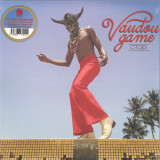
No one had been through those doors in years. Unchanged, seemingly untouched, just a Guard watching over it, one wondered whether the place would ever see the light of day again. Built in the 70s by Scotch, there were only twenty such places in the entire world. Twenty studios, all identical. Most had undergone a digital makeover in the 80s, but not this one; situated in Lomé, this studio had stayed true to its original form. Silent and uninhabited but waiting for one thing, and one thing only: for the sacred fire to be lit once again. That of the Togolese Recording Office, is studio OTODI for those in the know. Through thick layers of dust, the console was vibrating still, impatient to be turned on and spurt out the sound so unique to analog. That sound is what Peter Solo and his band Vaudou Game came to seek out.
The original vibrations of Lomé's sound, resonating within the studio space, an undercurrent pulsing within the walls, the floor, and the entire atmosphere. A presence at once electrical and mystical sourced through the amps that had never really gone cold, despite the deep sleep that they had been forced into. In taking over the studio's 3000 square feet, enough to house a full orchestra, Vaudou Game had the space necessary to conjure the spirits of voodoo, those very spirits who watch over men and nature, and with whom Peter converses every day.
For the most authentic of frequencies to fully imbibe this third album, Peter Solo entrusted the rhythmic section to a Togolese bass and drum duo, putting the groove in the expert hands of those versed in feeling and a type of musicianship that you can't learn in any school. This was also a way to put OTODI on the path of a more heavily hued funk sound, the backbone of which maintains flexibility and agility when moving over to highlife, straightens out when enhanced with frequent guest Roger Damawuzan's James Brown type screams, and softens when making the way for strings. Snaking and undulating when a chorus of Togolese women takes over, guiding it towards a slow, hypnotic trance. Up until now, Vaudou Game had maintained their connection to Togo from their base in France. This time, recording the entire album in Lomé at OTODI with local musicians, Peter Solo drew the voodoo fluid directly from the source, once again using only Togolese scales to make his guitar sing, his strings acting as channels between listeners and deities...
Поиск:solo id
Все
In 1990, raising their voices over the sound of Neuropolitique's 'Mind you don't trip' Sebastian S. and Mike DMA (Direct Memory Access) met, breaking the ice by swapping opinions on LFO and 808 State. They later went on to create the first live configuration of BWP Experiments (Bad Woofer Posse Experiments, for more info see basicmoves), and produced dozens of tracks together which, for the most part, were live takes and remain unreleased. Only
a few made it out into the world, and to this day have stayed well under the (discogs) radar:
Our Techno Theory' was put out on an 8-tracker cassette by Research and Development,
while only two productions 'Escape' and 'Pay your taxes' were pressed on vinyl for the same
imprint. Now Sebastian S. (aka Caustic 14) returns to the label with two previously unreleased tracks
found in his personal archive. 'Excalibur' was produced in tandem with Mike during the last
session the pair ever did in Sebastian's studio (Z'ha'dum) in 1996. It's a vibrant hommage to
their common passion outside of music: Sci-fi. This track refers specifically to the series Babylon
5 , which was a revolution in the genre, and the first tv series to outdo Star Trek (the intergalactic
reference since the early 1960's). The idea of being 'united against darkness' was key to the
series, and the motto remained essential for Sebastian, Mike and Deg's music productions,
collaborations, live shows and dj sets. The influence of what had been a passion since
childhood can be felt in their sound: unconsciously they had dreamt up the soundtrack to their
own space journey. The second track 'Cliffhanger', a solo production by Sebastian S., is a dig from several years
earlier (1994). The Detroit influence is strong here, yet the signature Caustic 14 "space opera"
melodies hold their ground and shine out.
We are very proud to propel this Belgian electronic music heritage out into the world.
In memory of Matt Cogger.
walrus & islas , September 2018.
- A1: Entrance
- A2: Level Zero
- A3: No Hay Trabajo Para Mi
- A4: Albania Fm Feat. Funkycan B1. Intershop
- B2: Midi Break 1
- B3: Srrr
- B4: Midi Lisa
- B5: Funk
- B6: Master Quest
- C1: Y
- C2: Arcadia
- C3: Termina Feat_ Gerry Franke
- C4: Rush
- C5: Lozt Feat. Ludi
- C6: Midi Break 2
- D1: Shrimp
- D2: All My Circuits
- D3: Burning 4 U Feat. Chrissley Benz
- D4: Exit
* Belia Winnewisser is returning to Präsens Editionen with Radikale Akzeptanz. The record is her debut album as a solo artist and it marks her second release on 'the curious label arm of Lucerne's zweikommasieben magazine.'
* Radikale Akzeptanz, a furious amalgamation of (synth-)pop references and more abstract sounds, combines long running traits from Winnewisser's practice in various band projects with rather new interests from her studies in sound art. Thus, bittersweet off-pop-hymns with bubble-y melodies can be found next to austere examinations. Add a good amount of time spent in clubs and you get a Skull Disco-esque banger at the end of this gutsy album.
The title Radikale Akzeptanz—or radical acceptance—stems from a concept in evidence-based psychotherapy. Even more than the concept as such that is about accepting uncompromisingly your situation, however, it is the expression's mere sound that is of interest to Winnewisser. Homey and adventurous, gentle and challenging, at ease with itself and full of tension(s).
Edition of 300copies, artwork (incl. booklet) by Vinzenz Meyner.
Quotes:
'Interesting stuff! It has a surprising bit of post-rock language in it to my ears, just executed with electronics.' - Byron Westbrook (Hands In The Dark, Umor Rex)
'A pleasant listen! Especially 'III,' 'Trapped In My Mind,' 'The View' and 'Albasty.' Also, found that the idea behind the title is weighty to the extent it can be related to relevant issues of today's ways of interaction!' - Arcagelo de Castris (Macao, Dance Affliction)
'Sounds like John T Gast, Caterina Barbieri and Klara Lewis making tunes on a space ship!' - James Marrs of Laura Lies In
'This is really good.' - Hypermedium's Timos Alexandropoulos
Press / Promotion*Airplays on NTS Radio by Flora Yin-Wong, Hypermedium and more, airplay on Radio Raheem by Arcagelo, feature on Noods RadioVarious (release) events upcoming, incl. a show at London's Café Oto, an exhibition in Lucerne and gigs next to Lorenzo Senni, Puce Mary and more.
Premiere of 'WAHDWTH' on Bizaarbazaar.PE / zweikommasieben mailing list = 2000 subscribers
Social NetworkingPräsens Editionen - Facebook = 550 likes / Insta = 500 / Spotify = 350 subscriberszweikommasieben - Facebook = 5200 likes / Insta = 2000 / Twitter: = 680 followers
In a time when Jazz music is entering a contemporary renaissance and exciting the ears and minds of new audiences, Zombie Zombie's Étienne Jaumet offers us his unique, idiosyncratic take on the sound with the sprawling '8 Regards Obliques', his 3rd solo album with the Versatile label.
Jazz requires a certain freedom of technique, interpretation and improvisation that already matches Jaumet's own production style and sonic aesthetic as well as his playful approach towards music. The eight pieces that make up the new LP were very quickly recorded; Jaumet let himself be carried away by the atmosphere without focusing too much on fine details or the laborious aspects of the composition process. The finished article is a spontaneous collection that stands out, a true mirror image of the creative process adopted by the artist. Not surprisingly, spontaneity is one of the characteristics already present in his music, in both his recorded output and his live happenings, where he leaves much room for freedom and improvisation.
'8 Regards Obliques' was recorded at the Versatile studio in less than 3 weeks with quite a basic set up: TR 808, selected synthesizers, vocals and of course the saxophone, which is a constant presence also in his previous albums. For the mix Etienne has again appealed to the maestro I:Cube, a central figure of the Versatile story and a prdigious engineer and artist in his own right. He immediately understood that it was necessary to keep the spontaneous side alive and to not over-produce the pieces or over-edit them, being constantly mindful to retain the power in the sound and in the frequencies. From Sun Ra with 'Nuclear war', Miles Davis in 'Shhh / Peaceful' or 'Theme from a symphony' by Ornette Coleman to 'Caravan' (already quoted by many jazzmen), Etienne enjoyed revisiting classic masterpieces and paying tribute to his inspirations. He allowed himself only one personal and original composition, 'Ma révélation mystique'.
- A1: Mahy - Antilles Méchant Bateau
- A2: Guy Conquete - Ban Moin Clé A Titine
- A3: Dolor - A Dardonnel
- A4: Joseph Lacides - Yo Ka Biguiné Joseph
- A5: Tino Saint-Val Mam\'Zelle Cancan
- A6: Dolor - Ki Vino
- A7: Dolor - Socié Cabrite
- B1: Gaby Siarras - Moana
- B2: Joseph Lacides - Citation Créole
- B3: Casimir Letang - Ménage Chalviré
- B4: Manuela Pioche - Pas Ban Moin Coup
- B5: Gerard Valton - Bel Mè A Présent
- B6: Beaujour - Ti Té Ya
- B7: Josianne Saint-Louis - Jeines Gaçons
- B8: Dolor - Vini Sauvé Moin
Fifteen track completion of deep biguines and Gwo Ka from the '60s French West Indies. The vinyl edition included a 4 page booklet + download code.
Biguine is a rhythmic style of music that originated in Guadeloupe and Martinique in the 19th century, which fuses 19th-century French ballroom
dance steps with African rhythms. Gwo Ka is found among all ethnic and religious groups of Guadeloupean society.
It combines responsorial singing in Guadeloupean Creole, rhythms played on the Ka drums and dancing. Gwo Ka is the musical and cultural product of the
region's African ancestry, forcibly brought to the Caribbean through slavery. Gwo Ka exists only in Guadeloupe, which is a very different island from much of
the Caribbean, in that it remains a 'department' of its original colonial master, France. Here the currency is the Euro and the baker sells croissants and café
au lait. This constant 'European-ising' of the island means that Gwo Ka plays a fundamental and important role in the defining of Guadeloupean identity.
'Antilles' Méchant Bateau', a low-tempo number with a bolero feel, indeed a pure case of the blues, and a terrific saxophone solo. What else would you
expect to set the tone for this selection, in which beguine regains its original colours, in the darkness of the Gwo Ka drums. This 45 by André Mahy, released
under the Aux Ondes sublabel, was recorded in the 1960s at Célini's, one of Guadeloupe's two main houses. Through its drum rolls and harrowing chant, it
recalled how, long before the mid-1960s, the Antilles' history was written in an ocean of teardrops - namely the Black Atlantic.
- A1: Mr Brown In Town
- A2: Mr Brown Dub
- A3: Trendsetter
- A4: Trendsettting Dub
- B1: Your Shadow Is Black
- B2: Your Shadow Is Dub
- B3: Dead Meat
- B4: Dead Meat Dub
- C1: Dub At Abbey Road
- C2: Abbey Road Version
- C3: Bumpy Road Of Life
- C4: Bumpy Dub
- C5: Captain Perry
- D1: Captain Dub
- D2: Killing Dancehall Softly
- D3: Killing Version
- D4: Solid State Communication
- D5: Solid State Dub
At 83 Years Of Age, Lee Scratch Perry Is Proud To Present To The World His Next Full Length Solo Album (with Dub Versions) , Continuing His Inimitable Roots Reggae Legacy.
Lee's Brief For The Album, Was To Blend The Vintage And The Obscure, During The Sessions Lee Referred To The Sound And 'black' And Wanted Space, Light And Darkness In The Songs And Their Respective Dub Versions.
The Result Sees Lee Having Mixed Up An Analogue Concoction Of Ultra-rare Effects, Sonic Wizardry And Deep Heavy Roots Rhythms.
Over 2017 and 2018, Lee Scratch Perry re united with Producer and Mixer Daniel Boyle, to start work on their second Solo album project for Lee.
Picking up where their last efforts ''Back on the Controls'' left off. Lee wanted to continue the raw analogue sound they had cultivated together over multiple past releases, and take it to the next level with new effects devices to create another sonic signature.
They entered the studio in 2017, to begin to put together ideas for the tracks, which were then taken to RAK studios in London with their ever changing Rolling Lion All Stars session band; to lay down the rhythm versions.
Using strictly vintage analogue equipment, they employed Neuman valve and RCA Ribbon microphones, and RAK's early model vintage API desk to record, the 'sound' for the album was sculpted in these sessions. Vintage, but punchy, which was then blended with Lee's choice of super rare and custom analogue effects. Ursa Major Space Station and Stargate delays and reverbs, old choruses, Plate and spring reverbs, and tape delays were used to create a tight vintage feel but retaining the rawness of the 'Low Fi' roots sound Lee was aiming for.
With the music coming together, the vocal sessions were held in Abbey Road studio 3, again using vintage RCA ribbon mics, over driving their EMI TG console and Fairchild compressors to create a pleasantly distorted Lo Fi vocal sound.
Lee and Daniel then returned to Daniels Rolling Lion Studio, to mix and Dub the album, live, on the mixing console.
'Rolling Lion All Stars' Musicians: Vocals: Lee 'Scratch' Perry Drums: Ed West Bass & Guitar: Hughie Izachaar Keys: Robbie Lynn Additional Keys: Calvin Bennion Percussion: Daniel Boyle Kete Drum: Mathias Liengme Hurdy Gurdy: Brian McCoy Horn Section: Rory Sadler, Robert Landen Melodica: Puraman Backing Vocals :
Hosono's solo career would take many twists and turns from this point forward, with forays into exotica, electronic, ambient, and techno, culminating in the massive success of techno pop group Yellow Magic Orchestra (YMO), who made their debut in 1978. Admired by artists ranging from Van Dyke Parks to Mac DeMarco, Hosono continues to forge ahead as he heads into his fifth decade as a musician. With the re-release of his key albums for the first time outside of Japan, his genius will be discovered by a whole new generation of fans around the world.
.
The unbelievably prolific Haruomi Hosono is one of the major architects of modern Japanese pop music. With his encyclopedic knowledge of music and boundless curiosity for new sounds, Hosono is the auteur of his own idiosyncratic musical world, putting his unmistakable stamp on hundreds of recordings as an artist, session player, songwriter and producer.
Born and raised in central Tokyo, his adolescent obsession with American pop culture informed his early forays into country music, which he would revisit later in his career. Hosono made his professional debut in 1969 as a member of Apryl Fool, whose heavy psychedelia was somewhat at odds with his influences, which leaned towards the rootsy sounds of Moby Grape and Buffalo Springfield. The latter was one of the main inspirations for his next group, Happy End, whose unique blend of West Coast sounds with Japanese lyrics proved to be highly influential over the course of three albums. After the band’s amicable break up in 1973, Hosono began his solo career with Hosono House, an intimate slice of Japanese Americana recorded inside a rented house with recording gear squeezed into its tiny bedroom.
Produced by Jenn Wasner of Wye Oak. LP is on coloured coke bottle green vinyl + inclues download code and 12x12' lyric sheet/ liner note insert.
Madeline will be on tour throughout the UK and Europe this Autumn.
'Building from understated beauty to dense guitar theatrics. It reminds me of Chicago circa '93 as remembered in a dream — a little bit of Liz Phair 'Exile In Guyville' - rendered in soft-focus with the graceful confidence of a young master. ' STEREOGUM
In January of 2018, five months after the release of her debut album Night Night at the First Landing, Madeline Kenney traveled from Oakland, California to the woods outside of Durham, North Carolina to record her sophomore album with a new collaborator, Wye Oak's Jenn Wasner.
The choice was a conscious decision to explore new methodology in writing, recording, production and even genre. Perfect Shapes sees Kenney leaping headfirst into fresh and adventurous territory, largely eschewing conventional rock structures in favor of theme and melody. Its ten songs are full of surprises big and small - from vibrant synth lines to taut bass figures and subtly modulated vocals - that instead of feeling fussed over, reveal Kenney's penchant for elegant and abstract composition.
Kenney's 2017 debut, Night Night at the First Landing, was a guitar-centric rock album, produced by friend and collaborator Chaz Bear of Toro Y Moi, Perfect Shapes leans on the foundational pieces of Night Night - fuzzed-out guitar tones, coy wordplay and Kenney's notably strong voice - but with an unconventional approach that allows them to bloom, reincarnated. Perfect Shapes marks Wasner's first foray into producing another artist's work and is permeated by the pair's collaborative spirit. Both Wasner and Kenney play multiple instruments on the record, and engineered the session alongside Kenney's touring percussionist, Camille Lewis.
An eagerness to explore and experiment is apparent from start to finish, as Kenney and Wasner weave endless sonic curve balls into the arrangements. From the delightfully warped percussion on opening track 'Overhead' to the burbling synths on the R&B-tinted 'The Flavor of the Fruit Tree' and the left-field trumpet solo in 'Your Art,' these rich and inventive ideas echo Yo La Tengo's everything-but-the-kitchen-sink mentality, as well as the surging soundscapes of Tame Impala and Wye Oak at their most impressionistic. Lead single "Cut Me Off" is a surprise of its own - the most pop-forward song Kenney has written yet. 'Bad Idea,' finds her balancing fragility as foil; later, 'I Went Home' manages to evoke both frustration and affection in a single breath.
The complex and open-ended questions that lay at the core of Perfect Shapes mark Kenney's arrival into a hard-hitting reflective space: How do you love another when it hurts to do so What is the physical limit to which one can carry the emotions of others How does a modern female artist reckon with the expectations demanded of her femininity Yet for all the notes of doubt and fear that Kenney raises, she delivers each song with confidence and poise, grounded by the pointedly laid and surging soundscape.
Kenney has always had a penchant for curiosity and experimentation. Raised in the Pacific Northwest, she began studying classical piano and dance in kindergarten, and grew to believe her future lay in modern dance choreography. Not one to be tied to a singular pursuit, however, Kenney took a hard left in college, studying Interpersonal Neurobiology and supporting herself with a career in baking. Music remained a constant however, and after moving to the Bay Area in 2013, Kenney quickly found footing in the supportive arts community in Oakland. There, she met and began collaborating with Chaz Bear (Toro Y Moi), which led to the production of her Signals EP and later her debut album, Night Night at the First Landing. Both releases were received with great critical acclaim, and saw Kenney exploring the sounds within her self-proclaimed twang-haze genre, defined by cathartic fuzz breakdowns and lyrical sensitivity.
Blackfilm is an anonymous Hungarian artist who introduced himself with his self-titled debut in 2008, sold out in a few months and later reissued on both CD and vinyl format via Denovali in 2010. His debut has garnered widespread attention - "Evolving from downtempo electronic music to orchestral paroxysms and, insanely, passing from down-pitched nothingness to frozen urban landscapes, it becomes inevitable to resist." / "Dark and brooding, Blackfilm envelopes you like a thick fog creeping off a cooling swampland." (Headphone Commute) - and is still a classic.
Since then, he has relocated to London and released the collaboration master-piece - Along the Corridors' with Italy's heavy dub producer Eraldo Bernocchi in 2010. After eight years of silence Denovali now proudly presents his second solo album - Zero One Seven', in line with a re-issue of - Along the Corridors' on vinyl for the first time.
On - Zero One Seven', Blackfilm merges tracks spanning across drum and bass, dub and electronic. The sounds on the album are built from the ideas on the original Blackfilm - S/T' and - Along the Corridors' and progress to a sound built on new ground mixing modern production techniques and influences while at times referencing the Blackfilm sound we know from his previous releases.
The album maintains a consistent focus on atmospherics, beats and heavy bass ranging from darker dub and drum and bass influences to vocal tracks and complex ambient soundscapes. Production wise, the familiar Blackfilm style incorporating the use of synthetic sounds mixed with samples enables the album to create an intriguing, shifting atmosphere as the album progresses. A dystopian journey through haunting vocals, hypnotic drum patterns and complex sound design.
- A1: Orlando
- A2: Saint
- A3: Take Your Time
- A4: Hope Feat. Puff Daddy & Teishi
- B1: Jewelry
- B2: Family Feat. Janet Mock
- B3: Charcoal Baby
- B4: Vulture Baby
- C1: Chewing Gum Feat. Feat. A$Ap Rocky & Project Pat
- C2: Holy Will Feat. Ian Isiah
- C3: Dagenham Dream
- C4: Nappy Wonder
- D1: Runnin' Feat. Georgia Anne Muldrow
- D2: Out Of Your League Feat. Steve Lacy
- D3: Minetta Creek
- D4: Smoke
Producer, multi-instrumentalist, composer, songwriter and vocalist Devonté Hynes returns with his fourth album as Blood Orange, Negro Swan, released on Domino on August 24, 2018.
Raised in England, Hynes started out as a teenage punk in the UK band Test Icicles before releasing two orchestral acoustic pop records as Lightspeed Champion. In 2011, he released Coastal Grooves, the first of three solo albums under the moniker Blood Orange. His last album, Freetown Sound, was released to critical acclaim in 2016, and saw Hynes defined as one of the foremost musical voices of his time, receiving comparisons to the likes of Kendrick Lamar and D'Angelo for his own searing and soothing personal document of life as a black man in America. He has collaborated with Solange Knowles, Skepta, fka twigs, Carly Rae Jepsen, A$AP Rocky, Charlotte Gainsbourg, Blondie, and many other artists, and was recently one of four artists invited to the Kennedy Center to perform alongside Philip Glass. In addition to his production work, he scored the film Palo Alto, directed by Gia Coppola.
Negro Swan was written and produced by Hynes. Says Hynes:
'My newest album is an exploration into my own and many types of black depression, an honest look at the corners of black existence, and the ongoing anxieties of queer/people of color. A reach back into childhood and modern traumas, and the things we do to get through it all. The underlying thread through each piece on the album is the idea of HOPE, and the lights we can try to turn on within ourselves with a hopefully positive outcome of helping others out of their darkness.'
HINOSCH are a duo of Koshiro Hino from Osaka and Stefan Schneider from Düsseldorf, they first (met and) began their collaborative work of musical interaction and exploring contrasting possibilities in 2017. After a number of concerts in the EU and in Japan a debut EP (HINOSCH EP/TAL05) was released in late 2017. Fully instrumental, their first full-length album HANDS offers a more steeply focussed approach than its largely improvised predecessor.
Encouraged by the momentum generated during a number of on-the-spot recordings in Osaka, where Schneider had held a residency in April 2017, the overall sound of the album has been honed down through meticulous studio engineering. One of the outstanding qualities of HANDS certainly is an unprejudiced approach of sound and song structures. The instrumentation is condently reduced to a small range of analogue and digital machines. Snatches of tape-loops deliver lower-pitched vocal and drum machine samples. This characteristic technical set up soon proved ideal in order to dene a tactile vocabulary of fully unsynchronized rhythm patterns. The word tactile perfectly conjures that quality which is the very essence of HANDS. It is the result of the manner in which interdependent threads of rhythm units are deliberately disconnected to form a cohesive, soulful and exible whole. Most tracks on HANDS are devoid of a central motif and examine an unpredictable dialogue. A fantasy of constant change and a search for musical suggestions is the most vital ingredient in this abstract environment.
The album title HANDS refers to physical aspects of electronic music production. Every live concert of Hinosch usually starts out with a hand shake between Hino and Schneider. The general process of collective music making, programming, button pushing, playing, recording, decision making, all demand utmost concentration. The image on the front of the abum sleeve (designed by Takashi Makabe) reects the general approach of HANDS: layers of tuckled fabrics confronting one another to articulate a form for themselves to no other end than their own orchestration.
After having emerged from the ever thrilling Osaka music scene onto the international playgrounds of electronic music just a few years ago Koshiro Hino's solo activities as YPY and his involvement with the band GOAT have already garnered him a very favourable international reception. Stefan Schneider has over the years produced and collaborated with a.o. Joachim Roedelius (Cluster), Arto Lindsay, Klaus Dinger (NEU!), Dieter Moebius (Cluster), Alexander Balanescu, John McEntire (tortoise), Katharina Grosse, Bill Wells and St.Etienne.
Italian sound artist GIULIO ALDINUCCI drops his 2nd album on Karl: "Disappearing In A Mirror" is again a truly masterfully composed and sound-designed ambient masterpiece and a more than worthy follow-up to the critically acclaimed "Borders And Ruins" which made it onto several year's best lists for 2017.
Over the course of four solo albums on labels like DRONARIVM plus EPs and collaborative albums (a.o. with IAN HAWGOOD), GIULIO ALDINUCCI successively has been refining his skills as composer and sound designer. His elegant style which blends ambient and field recordings came to full impact on his 2017 album "Borders And Ruins" which gained the Italian sound artist a lot of critical praise and made it onto several year's best lists, a.o. ALDINUCCI's latest effort is again not only a musical masterpiece ofsublime beauty and sacral majesty, it also deals with philosophical concerns. Where "Borders ..." was areflection on the instability of borders - borders as an extreme attempt to discriminate and rationalize that turnsinto a source of chaos and cultural ruins on both sides - and their impact on the relationship between people and territory, "Disappearing In A Mirror" raises the very personal question of identity. In the words of ALDINUCCI himself:
" 'Disappearing In A Mirror' focuses on the fluidity of the identity concept, highlighting the harmonious coexistence of contradictory elements and the transitional features that characterize every transformation. It is a reflection on the current situation of change and disruption and at the same time it is a gaze into the human timeless soul and its inner soundscapes."
Following Merv's EP, Taped Artifact now presents a new outing by the label co-founder Kevin Arnemann. With three original cuts, showcasing the labels characteristic dub-influenced techno sound, the EP is complemented with two remixes by Jonas Kopp. Arnemann's 'Trash Polka EP' kicks off with saturated 808-grooves, driven by steady dub-chords and hard hitting claps. Next, the original track sees a special dub influenced treatment by Jonas Kopp. The in Spain residing Argentinian delivers a stripped down, yet high energized techno version. As a digital exclusive, Kopp prepares a second interpretation, following the tradition of a classic rooted dub sound. On the flipside, 'Revertigo' sees Arnemann utilise a rumbling break beat, topped with icy rides, blissful dub chords and cinematic pads, taking you on an energetic trip. 'Ideology' is bringing the EP to a closing. With heavily processed chords and hard hitting drums, Kevin Arnemann creates a suspense that leave you wanting for more. Vital Sales Points: - 3rd solo EP by Kevin Arnemann on Taped Artifact - Two remixes by Jonas Kopp - EP comes with download code for full EP + digital exclusive bonus remix by Jonas Kopp
- A1: Off To See The Hangman, Part I
- A2: Sometimes There's Blood
- A3: Idumea
- A4: Off To See The Hangman, Part Ii
- A5: Face Down Strut
- A6: Laika's Song
- A7: Oh, Command Me Lord!
- B1: Sweep It Up
- B2: Requiem For John Fahey
- B3: Dance Of The Everlasting Faint
- B4: Bleeding Finger Blues
- B5: Sack 'Em Up, Parts I And Ii
- B6: It Was All Sackcloth And Ashes
Tompkins Square present the debut full-length by Welsh multi-instrumentalist, Gwenifer Raymond. Hailing from Cardiff and now residing in Brighton in the South of England, Raymond began playing guitar at the age of eight. Tompkins Square released her debut 7" on Record Store Day.
In Gwenifer's own words :
When I was about eight years old a pretty formative thing happened to me ... my mum bought me a cassette tape of Nirvana's Nevermind. Being so young I'd had no real interest in music prior to that, but I did have a 'My First Sony' cassette player that I used to listen to audiobooks. Anyway, I put the tape in, pressed play, and what I heard blew my little 8 year old mind. I don't know what it was about that wall of sound that so captured me, but I spent many hours hyperactively running around the house with headphones on, volume at full blast, and Nevermind on repeat. It was either for Christmas or my birthday that year, that I asked for a guitar.
I spent all my teenage years playing either guitar or drums in various punk and rock outfits around the Welsh valleys, but around that time I was also getting seriously into older stuff, Dylan, The Velvet Underground and the like. Through those cheap compilation CDs you could get then, I found that a common influence amongst these guys was pre-war delta and country blues, as well as Appalachian music. Eventually I stumbled upon Mississippi John Hurt, Skip James and Roscoe Holcomb, and they became the holy trinity of musicians I so wanted to able to play like. Eventually, I tracked down a blues man in Cardiff who could teach me and it was in studying these guys that I was introduced to John Fahey and the whole American Primitive thing.
I've always loved being in bands and the sonic chemistry it produces, but at the same time it's always a bit of a compromise that those sounds in my head have to pass through and be translated by someone else's. Sometimes it can be for the better, but sometimes not so much. American Primitive was the first time it had occurred to me that you didn't really need anything more than one solo instrument to fully express yourself, especially when those feelings and moods refuse to be articulated in words, sometimes it's a mystery to yourself what it is you're expressing. I still play in hard rock and punk bands and love to wail and hit my guitar with a complete lack of any subtlety or nuance, but in the end I think that all these things are really part of a circle, feeding back into itself. It's all just a lineup of strange mutations.
Originally from West Yorkshire, but now resident in Manchester, composer, bassist and producer Phil France is probably best known as a key collaborator alongside Jason Swinscoe in the Cinematic Orchestra, where he co-wrote, arranged and produced on classic albums including Everyday, Man With The Movie Camera, Ma Fleur and also the triple award winning soundtrack for The Crimson Wing nature documentary. In 2013 France released his debut solo album, The Swimmer (GOND016), an emotive, epic record influenced by the great second wave of film composers including John Carpenter and Vangelis, as well as minimalist composers such as Steve Reich and Philip Glass
Five years later, France presents the follow up, the enigmatically titled, Circle, which again represents a very personal journey for the artist. For France the album is an extension of work he began on The Swimmer. A process he has described as: " blocks of sound containing intricate minimal arpeggiated patterns and electronic textures that develop and shift in subtle, original and melodic ways. The trancelike quality, mood and electronic character of title track Circle led France to think of the circular patterns which eventually became a potent concept for the album. "Ideas and fashions repeat themselves in cycles. Events are said to travel 'full circle' and this is important to me because it represents my own recent personal and musical journey after 15 years touring as bassist and composer with The Cinematic Orchestra. I consider circles to be a strong symbol of unity, strength and inclusiveness and ultimately I've aspired to make something beautiful with those values at its heart".
The album opens with the title track, Circle, built on a minimal looped pattern with melodic embellishment and shifting additional harmonic textures. Bells was developed from the arpeggiator and offers a nod to the melodicism and atmosphere of French electronic music. The Jackal features an idea originally developed for The Crimson Wing score but which finally bears fruit here. Cathedrals features an improvised intro, Philip Glass inspired organ and vocal textures inspired by the work of Colin Stetson. Finally, the album ends with a reprise of Circle this time featuring layered pianos. But it isn't the conclusion of the journey, for France: "The Circle is infinite - During the process of making this record, I have been constantly reminded that nothing ever stays the same and that all is in constant flux. The challenge for me is always to respond positively, be aware of and seize the opportunity for progression constant change provides" And it is that sense of movement and flow, but also calm and beauty that permeates Circle and make it such a worthy successor to The Swimmer.
Lucrecia Dalt's Anticlines is a volume of bodily and geological substrates within poetic theory and sound. It is a place where skins and minerals dissolve and commingle, where gaseous subterranean leaks inflate lungs, where brain cavities echo interplanetary waves bent from passing through atmospheres.
A former geotechnical engineer from Colombia currently residing in Berlin, Dalt's concern with boundaries and edges shape the lyrics and music of Anticlines, her sixth album. Paying careful attention to pace, breath, and texture, Dalt microtonally shifts the distance between speech and song while using traditional South American rhythms to support her contemporary electronic composition.
Lucrecia arrived at the atmosphere of Anticlines after several months of studying and creating new patches for the Clavia Nord Modular, forming a rhythmic feedback flow with it, a Moogerfooger MuRF, and her voice. The overall effect of cavernous space backdroping Dalt's intimate vocal phrasing rewards contemplation, supported in the physical formats of Anticlines by a lyric booklet documenting Lucrecia's collaboration with Australian artist Henry Andersen.
The album opens with Edge,' bordering on a pathological circlusion of self upon other. The lyrics depart from the Colombian myth of El Boraro, an Amazonian monster who turns its victims insides to pulp before sucking them dry and inflating their bodies like balloons to lifelessly float away. Tar' ponders human dependence on earth at the boundary of the heliopause, where to inhale might be like breathing tar. Dalt's distant and obscured vocals end with, we touched only as atmospheres touch.'
The sonic rise and fall of Analogue Mountains' is inspired by martian traces found in Antarctica embedded by meteorite ALH84001, suggesting that we might well be living in mountains transferred from Mars.' The steadily winding music on Concentric Nothings' descends with the lyrical exercise of dissolution let my touch be indistinct and instinctive.'
Interspersed with the lyrical pieces of Anticlines are instrumental interstitials that demonstrate preceding concepts — as if to say, this is what antiforms sound like, and this is what the universe's indifference sounds like.' Dalt's ongoing experiments with visual artist Regina de Miguel support these ideas, their practice allowing the objects of their attention to slip in and out of being.
Mystic of matter, Lucrecia Dalt has previously performed and worked with Julia Holter and Gudrun Gut, her slippery spoken word and performative nature recalling the work of Laurie Anderson, Robert Ashley, Asmus Tietchens, or Lena Platonos. While touching stones, The Thing by Dylan Trigg, Cascade Experiment by Alice Fulton, and Wretched of the Screen by Hito Steyerl are but a few formative scripts that support Dalt's exploration of the betwixt and between.
In preparing a live set for Anticlines, Dalt plans to stage an uninterrupted configuration, like a kind of alienated lecture, aiming for gestures that create tensions with non-existent objects.' Dalt intends to provide meaning and a place for the listener to meditate or relate to the concerns and ideas' she presents.
- Lucrecia Dalt is a Colombian recording artist, songwriter, and producer.
- After studying civil engineering in Colombia, Dalt worked at a geo-technical company for two years and has since lived in Barcelona and Berlin, where she currently resides.
- She has released five solo albums and has collaborated with musicians Julia Holter, Laurel Halo and Rashad Becker, to name a few.
- Dalt has composed for sound design installations and performance pieces for institutions such as the Santa Monica Art Centre, Reina Sofia Museum and the Maisterravalbuena gallery of Madrid, in collaboration with visual artist Regina de Miguel.
- Anticlines is Dalt's sixth solo record, and her first on RVNG Intl., following the release of 2015's Ou.
- Anticlines explores the boundaries and limitations of human consciousness. The album's poetic lyrics were written collaboratively between Dalt and Henry Andersen during a weekend in Brussels, Belgium.
After a triplet of solo 12"s, all courtesy of label main man Rupert Marnie, Hamburg-based imprint The Press Group are set to break 2018 in with the multi-flavoured TPG004 - a versatile debut VA that offers a fine close up on the label's whole cast of operating forces with some choice contributions from TPG's core tetrad including Youthman(29), Ten Letu, DJ Dodo and Marnie himself. Mind your backs!
Shape-shifting yet coherent as a whole, this collective effort puts together a swinging confluence of sounds and aesthetics - clearly aimed at the dancefloor but equally poised for laid-back chill sessions. First release on the label to reunite the entire crew, TPG004 mashes up a wide-spanning array of grooves and tempi in exploded view, giving full vent to each artist's idiosyncratic universe whilst establishing a hyper-modern sound ID, both infectiously funky and undeniably potent.
Casting its net far and wide: from the pared-down astronautical breakbeat of Youthman's 'Aemilia' to DJ Dodo's breezy jacking jazz-footwork hybrid 'The Machine' via Rupert Marnie's lithe ganjah-smelling shuffler 'Health' and Ten Letu's muscle-flexing acid roller 'Ah, You Shot Me!', it's a feast of feelgood beats that you're invited to, neatly connecting the dots between the guys' shared love for video game soundtracks, liquid dubstep, heavy jungle breaks, minimal house and further daydreaming, hazy harmonics to drape yourself into.
One half of the KWC 92 (who has previously delivered two top notch lps for L.I.E.S.), Swedish producer Max Stenerudh aka Maxxx Bass steps forward with a 9 track solo effort titled "Gone Fishing". Right off the bat we hear Stenerudh immersing himself in a world of chilled out and narrative FM electronic explorations that call to mind places past. The untitled tracks leave it to the listerner to create a story on their own, as voice pads, hand drums and dare we say pan flutes push and pull their way through the album creating dreamlike textures and otherwordly escapes. Ideal music to fall into a late afternoon summer siesta to. LP comes come with full color 22cmx28cm color poster and download card
The music on this EP was conceived in China, between 1989 and 1993. The original tracks were mixed to DAT in real time, in a small neighbour-proof studio inside my apartment in Macau, a 19th floor with a view to the hurricanes. There's a small, unexpected or improbable story behind each track, some little magic fused with the local atmosphere, certainly guaranteeing their lasting authenticity 25 years later.
TAIPEI DISCO
Late 80s Guangzhou was an exotic city where the traditional past coexisted in harmony with the present and even already with the future.
I'd rather spend my weekends in Guangzhou than diving into Hong Kong consumerism - as most ex-pats in Macau did. I took a cab at the border and travelled 150 Km through chaotic roads with family and friends until reaching the hot, humid, mega South China metropolis.
We ate on street joints in the evenings, went on to a karaoke bar and ended up at Taipei Disco, the only proper club in town. All the others were inside hotels and played generic music or they were seedy, sleazy, smoky cabarets.
Taipei Disco used to be a cinema and played cantonese pop music and anglo-saxon pop/rock (that was new). The spacious dance floor was generously lighted, the atmosphere was airy and modern. Boys and girls were in the habit of dancing in pairs, one in front of the other, observing a respectful yet sensual distance. When the girl took a few steps back, the boy went along and vice versa. With legs and feet (more than the upper bodies) synchronized with the music, they never exceeded in extroversion. Cool.
I always carried a MicroComposer and a portable DAT recorder in my travels through China and weekends in Canton. Any spontaneous musical idea was imediately recorded and memorized. The MicroComposer allowed multitrack recording, which was very handy on the road. Based on the emphatic choreography of Taipei Disco's dancers, i started to compose a rhythm track while sitting at a table, with headphones, listening to Cantopop in the background. As if by magic - not a rare occasion in music - everything began fitting together. Odd as it may seem, the track ended up sounding more germanic (Kraftwerkian) than Cantonese pop.
The story ends in a circle: the cantonese DJ at Taipei Disco, whom i used to ask to play certain records, wanted to play my music at the disco when it was basically only just a rhythm track and little else. From a cupboard under his set up he took out a battered keyboard (unrecognizable brand) and invited me to play over the track with the available sounds on the keyboard. The circle was complete, with Cantonese clubbers happily dancing forwards and backwards, as if it were another Cantopop hit.
I didn't get payed but the house offered us free ice cream cups in which little Portuguese flags were sticked.
The track would be finished later, in studio, with vocoder strings ensemble and synth solos.
TAIPEI DISCO (LIVE)
The live version of 'Taipei Disco' was recorded during a live set at the China Pop venue, in Macau, 1993. China Pop was a rock club built in the ample space of an old fishing warehouse, located in the labyrinthic Inner Harbour area. It was decorated with large Mao Zedong and Cultural Revolution posters and memorabilia and had a unique atmosphere, fusing Pop Art with film noir. We began our performance at 1AM, pretty early for Macau's nightlife standards. We were lucky. An audience showed up. And in Macau there were always several friends among the audience, which tranformed a musical performance into a relaxed party.
The atmosphere was particularly surreal on that night. The front row was dominated by French Crazy Horse dancers, a sort of Oriental Moulin Rouge. The girls had finished their last performance of the evening at the Crazy Horse and were still energized from their show. During our performance, right in front of us and perfectly synched, we could hear the famous irreverent screams of can-can dancers. You always had to expect the unexpected in Macau.
RED MAMBO (IMPROMPTU)
I was familiar with the Portuguese-speaking African countries well before having lived in China. I found myself returning several times to one in particular, always attracted by its magic and very distinct, identitary culture and music: Cape Verde.
During the early years of DWART a lot of the inspiration for drum machine rhythms (Roland's TR series) came from African music, especially from new musical trends that gained full autonomy with Cape Verde's independence from Portugal, as was the case with funaná.
I had the privilege of having known and befriended some of the greatest Capeverdian composers, musicians and singers during the 70s and 80s, such as Bana, Luís Morais, Cesária Évora, Paulino Vieira, Chico Serra, Tito Paris, and historical bands such as Bulimundo (ambassadors of funaná) and Os Tubarões (great innovators of morna, coladera and funaná, with the sonic impact of an afro-beat big band).
When Luís Filipe de Barros began playing Os Tubarões for the first time on Portuguese radio, that was the turning point for African music in Portugal. The 'Tabanca' album was so widely heard and talked about that it quickly got a Portuguese release through one of the big labels of the time.
The mystic of this band from the Santiago Island would reach the East. Os Tubarões played to a packed room in Macau in 1992, and after the bombastic gig we arranged a dinner and party at my place.
We ate and drank generously and the moment came for a jam session at the small studio on the 19th floor. Because Os Tubarões didn't all fit in the studio, we recorded an impromptu with only three of the musicians: Tótó Silva (electric guitar), Mário Russo Bettencourt (bass) and Zeca Couto (piano). And there we were improvising without barriers, suddenly detached from cultural roots, labels and constraints, a truly unique moment. The track is now being released exactly as it was recorded, imbued with the real communion between the musicians. And it could only be titled 'Red Mambo'. I wish to dedicate it to the memory of Ildo Lobo and Jaime do Rosário, founders of Os Tubarões, sadly and too soon departed from the land of music.