- Upward Bound' is a long lost, incredibly rare and very expensive classic disco era album! It combines soul, funk with and slick pop appeal into a great cocktail of grooves and melodies! This will drive you to the dancefloor and make you sing along at the same time! The lush arrangements, tight grooves and powerful soul vocals with catchy harmonies make this album an instant evergreen. I'm least surprised that the arrangements should pose a challenge to every rhythm section and that the catchy melodies instantly stick to the listener. The flashing horn arrangements are amazing! The funky bass grooves and guitar riffs weave a cocoon of sound around your soul. The sound is certainly clean but also vivid and the music feels grounded despite it's larger than life expression. The swirling backing vocals in combination with the lead singer are the icing on the cake that already consists of catchy and outstanding songs. This is more funk and soul than simple disco music. There is depth in the arrangements with awesome details as you delve deeper into each single track. You can of course groove along and just enjoy the songs as they are, but be sure to at least be on the lookout for the beautiful ornaments in each song. This music will surely move you, it makes it impossible sit still . In this album you'll find a wide range of funky music, from Slow groovers to fast paced tunes, you will get them all. Some with a deep atmosphere, some energetic, all of them memorable with arrangements that keep your attention going even with the 50th spin on your turntable. To my opinion this album is an unmissable gem of the disco era at it's peak! The original album retails at $ 400 going up, rarely a decent copy could surfaces on the market once a year. So here's a chance for you to grab an affordable copy of this well-deserved and long overdue reissue on vinyl and be enchanted!
Search:som sam
Leifur James will release his debut album in October through Late Night Tales' artist label Night Time Stories.
A Louder Silence is the London-based producer and multi-instrumentalist's first proper release; his two earlier singles feature on the record, after gaining support from Gilles Peterson's Worldwide FM with a live airing and interview in 2017, plus continued backing from XLR8R, Stamp the Wax, and BBC Radio 6 Music DJ's.
The album is both spacious and thought-provoking, energetic yet restrained, brimming with nuanced electronic instrumentals, dubby synths, and jazz breaks — creating an array of rich textures, complemented occasionally by James' own soulful vocals.
While James' early unreleased work was singularly electronic, A Louder Silence focuses on analog synths and warm acoustic instruments, all played by his own hand. It's the product of a two-year spell in James' home studio, with additional live drums recorded with Jim Macrae at London's Old Paradise Audio.
James' rich musical influences are laced through the release. Encouraged by his mother, a classically trained pianist, he learned to play the cello and developed adeep understanding of rhythm and melody that informs his approach to writing electronic music. James playsthe piano he grew up listening to in 'Mumma Don't Tell' and samples an indefinable percussive element to drive forward 'Suns Of Gold.' 'Night and Day' sees cello plucks and long melodic strokes interlink with a grooving synth line. He also field records the atmospheric Moroccan sea in 'Red Sea.' Inspiration stems from the experimentation of modern day electronic producers, fused with the Jazz, Classical, Blues, and Soul music that soundtracked his youth.
Central to the album is the idea of space. James recalls the early advice of his uncle, a jazz guitarist, who features on 'Uncle Blue': 'I remember him saying to me: "What goes in comes out' James says. 'Every detail should be a worthy detail; sometimes nothing is better than something.' Moments of blissful, structured intensity are juxtaposed with stillness and near silence — dark and light; loud and quiet. This also forms the foundation for the album title: A Louder Silence reflects the dichotomy of finding pockets of stillness in a noisy world.
The result is 10 distinct tracks delivered as one coherent and well-structured long-player debut, set for release on LP, CD, and digital, on 5th October 2018.
Live dates follow a debut live show earlier this year at the Jazz Café with Yazz Ahmed, including an album launch at London's Ghost Notes in October.
The New York Downtown Producer/Composer Returns With His First New Album In 3 Years
EIGHTEEN: the year of release, 2018. EIGHTEEN: the age at which I first used a synthesizer.
In creating EIGHTEEN I worked independently in the studio, initially building up tracks with synthesizers and found sounds recorded in my daily comings and goings. After working with the tracks over a period of months,I shared them with a few musicians, who added their own instrumental layers. Though working independently, we all shared a similar working process: working in our personal recording spaces, as opposed to larger recording studios.
The musicians are: Gabe Gurnsey (drums) of Factory Floor, with whom I collaborated on the Beachcombing EP and performed live at London's ICA. I appear on Gabe's newly released album Physical;
Larry Saltzman (guitar) has played in my Love Of Life Orchestra since the 1970's. Well-known for his work with Arthur Russell ('Kiss Me Again', Flying Hearts), he is in high demand in NYC by acts such as Simon and Garfunkel;
Paul Nowinski, (bass) has played with LOLO since the 1980's. Paul has an impressive list of credits, including Les Paul, Keith Richards, Bernard Purdie and the Boston Pops; Matt Mottel, (electric piano), is the newest addition to the Love Of Life Orchestra. He is half the duo Talibam!, a leading act in the noise jazz scene; Lewin Barringer, (guitar), is a talented guitarist and producer in Philadelphia.
After mixing the final tracks, I brought the mixes to Berlin. There I worked with the brilliant mastering engineer Mike Grinser who helped to give the album a unified sound.
I think of this album as electronic music. It was created in my home studio, using analog and digital synthesizers, found sounds recorded on my phone, and instrumental parts contributed by friends. Finely crafted melodies and harmonies are set against subway noises, street construction, and distant foghorns. Sometimes there are sustained clusters, generated by my leaning against the keyboard. Deliberateness paired with randomness: this is what guided the artistic process.
This album is atypical for me as I am not playing saxophone. (I do play one reed instrument - a harmonica.) I grew up with the sax as my primary instrument. Yet my father was a radio journalist so the reel-to-reel tape recorder was a ubiquitous presence in the family home. From an early age,
I experimented with the tape machine: recording, overdubbing and splicing tape. I learned about Varese from Frank Zappa liner notes; I read John Cage's 'Silence.' Electronic music was on my radar.
My first exposure to an actual synthesizer came when I recorded my first single at the fabled Sound City Studio in Van Nuys, CA. The studio had a custom Neve board, but it also had a firstgeneration Moog modular synthesizer sitting unused in the maintenance room. I asked and they kindly let me experiment with it. Soon, I enrolled at the University of California - San Diego after I discovered they had separate studios for their Moog and Buchla systems. These large modular synthesizers were affordable then only by institutions and rock stars. But these would be soon eclipsed by smaller, cheaper synths in the 70's and early 80's. In the same way, recording studio technology became accessible in the 90's. . And thus the personal computer and digital audio allowed studio quality production in the home studio. Electronic music had become democratized.
Handmade music by way of digital technology: this is the music of EIGHTEEN
A hiatus is always something needed to experience, silence is a process in which one can value and have a closer perspective within sound. An-Archon come to brake that silence, HERMES is on duties for it delivering two massive harsh noise weapons, Samuel Kerridge and Caos + Inmediatismo complete the EP on remixing labors. No one can escape from the An-Archon.
An Island In The Moon is the perfectly conceived minimal ambient project from Italian composers Pier Luigi Andreoni (Doubling Riders, ATROX) and Silvio Linardi. Andreolina being a mix of the names of the two musicians who were both deeply involved with the label Auf Dem Nil on which the album was originally released in 1990.
The duo stick to a disciplined and simple palette using only two synthesizers and a Roland S50 sampler. They are joined by fellow electronic journeyman Riccardo Sinigaglia who contributes piano and samples on two tracks. Taking influences from Italian minimalism while adding some jazz hints Andreolina sprawls, weightless instrumentals that never stay soporific for too long on this singular rare album.
Auf Dem Nil or ADN was one of the most adventurous Italian record labels of the 80's and early 90's with releases by De Fabriek, Riccardo Sinigaglia and Pierre Bastien. Leaving their mark on the experimental music scene back than and influencing musicians worldwide up until today.
Edizioni Mondo as a label, has the goal to produce music that is descriptive of concepts, images and environments. Inspired by library music, a genre frequently used as theme or background music in radio, film and television in that very same period, the name MONDO has its roots in 'MONDO MOVIES", an Italian movie genre born in the 60's. Mondo movies are characterized by documentary-like content that addresses several topics from around the world ("mondo"). Numero nove comes courtesy of ROTLA. Also known as Mario Pierro and Raiders of the Lost Arp, 'Waves' is his third contribution to Edizioni Mondo. Downtempo, trippy, playful and pardon us, balearic, it's the soundtrack to the fading summer or the one starting somewhere else in this universe. Accompanied by remix works from label head L.U.C.A. and balearic (again!) mastermind Mark Barrott with his Sketches form an Island Healing Hands, it's the most balearic (three's a charm) record you will hear this side of the summer (wherever you are).
Batida is to release his new album "Dois" via Soundway Records.
Strands of Afro-House, Kuduro, Benga, Semba, samples from old Angolan movies and Afrobeat tracks, African MCs and musicians from all over the world are all deftly mixed together by Pedro Coquenão.
Inspired by the multicultural hotbed of his home city of Lisbon and trips to Nairobi and Luanda, 'Dois' was predominately produced in his own garage-studio over a two-year period.
In 2012 Batida's explosive self-titled debut came out on Soundway Records. Mixing the syncopated rhythms of Kuduro with elements of 1970s Semba and Congolese-influenced guitar licks, Pedro Coquenão won fans for an album that "demanded movement" (The Line of Best Fit) and "gave a view of the old and new, the West and Africa." (The Guardian)
Much of the remix and sampling spirit from the first record remains but 'Dois' also features live instrumentation along with a host of different guests.
English, Portuguese, Quimbundo and Zulu languages all feature on 'Luxo' with Spoek Mathambo (South Africa) & his crew contributing the lyrics together with Angolan MC Sacerdote and a guitar riff by Duncan Lloyd (Maximo Park). On 'Céu' Coquenão pushes things in a deeper direction, dis-assembling and reforming elements of the Francois & The Atlas Mountains studio sessions of the track 'Les Plus Beaux' .
His widely acclaimed live show, featuring dancers, MC's, visuals and live electronics has seen him perform at Africa Express and on the Ten Cities project, live on the Boiler Room and all across Europe at some of the biggest festivals.
Soundway present something completely different, they are pleased to announce another Dutch artist to their roster, Felbm.
Having previously released more electronic music under the moniker Falco Benz, the multi-instrumentalist Eelco Topper moves towards a more acoustic, instrumental and sketch-like approach with the Felbm project.
The two-part project is being released as 2 separate digital EPs ("Tape 1" and "Tape 2"), the first of which will be released on 21 September. The second digital EP "Tape 2" will be released on the same date as the vinyl, 26 October.
Recorded direct to two cassettes, which comprise each side of the vinyl album, the cover art also reflects this - with both sides of the sleeve acting as separate front covers.
- 1: Only A Man (Feat. Dan Salem)
- 2: Same Old Game (Feat. Leo Will)
- 3: Against All Odds
- 4: Let The Music Play (Feat. Manoo)
- 5: Only Rainbows (Feat. Dan Salem)
- 6: Can't Be No Crime (Feat. Rick)
- 7: Fast Lane
- 8: Gain Station
- 9: Rush Zone
- 10: The Turnaround
- 11: The Modern Way (Feat. Dan Salem)
- 12: Cranberry Dream (Feat. Elaine Thomas)
Confunktion Records own Mr. Confuse returns with his fifth studio album 'Only A Man'.
This album is about the depths of Mr. Confuse and therefore a very personal album in a way. From well-known soul topics of love and hate to social issues of modern life - this album is all about an odyssey through time, rhythm and music.
Times of big studio personals are long gone so a big part of creating this album was the imagination what kind of instruments, musicians and sound design is wanted. With up to 16 international musicians, Mr. Confuse created incredible sounding big arrangements.
The way Mr. Confuse produces his music is inspired by growing up with the 90s hip hop producer technique of creating something new by referring unheard funk and soul. This from of appreciating 60s and 70s music in order to bring it on a new level of musical expression is a clear trademark of Mr. Confuse.
The process of sampling and resampling recorded musicians creates an organic, powerful, authentic and danceable funk sound, which can be heard in each and every second on this record.
Twisting electro funk from the 80s into heavy 60s and 70s funk that could have been the blue print for the original version became a true Mr. Confuse feature already years ago. This time he re-funked the well-known freestyle electro classic 'Let The Music Play' by Shannon.
Also one of the reasons it's entitled 'Only A Man' is because it means composing, producing, arranging, mixing, recording, organising, promoting and going abroad preforming by just one 'man'.
Bill Brown and Al Hall jr met around 1971, they were both in south central L.A and shared the same apartment building, also in the same building was Doug Carn and brownstone singer billy Wilson.
These studio sessions were don't at Paramount studios Hollywood where Al Hall jr was working for producer Art Smith a&c music.
The main distributor for A&C was Accent records. So the Soul Injections very first single "Stay off the moon" was released via Accent, as was Bill Browns "Bip Bam" The group wasn't that pleased with how Accent handle the releases so Bill took it upon himself to set up his own label called Brownstone records. Many musicians were called in for studio sessions these included
Doug Carn, organ; Kirk Lightsey, keyboards; Mel Bolton,
guitars; Mel Lee, drums; Al Hall jr (trombones), Willaim 'Bill'Henderson strings.
The label was met with some confrontation from other Hollywood labels and many of the Brownstone releases were told not to hit the shops by Mafia run labels. Later around 1975 Brownstone released a track by Everyday people feat Alexis "world full of people"....A now cult soul 45 ....But wait, we at Super disco edits have unearthed the original tapes with the very first incarnation of that song and music, different lyric content and sung by Bill Brown. Not just this you get the instrumental on the b side!!
The free fall, to dive head first into something, is scary for most people.
For some it is the most exciting thing however and the only possible path anyways. Florian is one of those driven artists who never sounds the same, his signature tone is the free fall into new soundscapes, new ways of using his analog electronic instruments and carving out the essence for the dancing individual.
- A1: First Overture (Spiritual Atom) (4:59)
- A2: Annotation (4:04)
- A3: Carbonb 12 (5:05)
- B1: Unorthodox Elements (3:35)
- B2: Anamenesis (Part 1) (3:30)
- B3: The Abyss Of Doubt (3:35)
- B4: Mutation (5:03)
- C1: Fist Interlude (Absence Of Measure) (4:40)
- C2: Permutation (4:39)
- C3: Kundalini (4:48)
- D1: Anamnesis (Part 2) (4:05)
- D2: Blue I (4:01)
- D3: Second Interlude (The Choosing) (6:26)
By now, the story of how Jlin went from working in a steel factory in Gary, Indiana to being one of the most widely appreciated electronic musicians is well known. 'Black Origami' was one of the most reviewed and lauded albums last year. Seriously prolific and seriously hard-working, she has toured constantly since its May 2017 release and despite being involved in a wide range of projects, still manages to find a balance and 'do some personal healing and growing.'
Here we are over a year later with 'Autobiography,' the score for her collaboration with renowned British choreographer Wayne McGregor arranged by Unsound. This isn't technically her third album (that's due to arrive in 2019 or 2020), but the soundtrack stands up on its own with all the emotional peaks and troughs of a well-sequenced longplayer.
For Jlin, making music for dance is the fulfillment of one of her lifelong dreams - and remarkably, Company Wayne McGregor's performance was the first show she'd ever seen. She describes the process of working with Wayne: 'We first met face to face in October 2016 in a downtown Chicago hotel, talking for about a solid two hours. Immediately, I saw Wayne was very friendly and energetic. He's brilliant, witty, and knows exactly what he wants; an absolute gem to work with. Before I even started composing for Autobiography, Wayne told me so gently that he trusts me completely with my direction of creating the score. That was the best feeling in the world. I would wake up at two in the morning and work until six in the evening until I completed all the pieces. We were both very happy with the outcome. Creating the score for an impeccable piece of work such as Autobiography changed my life as an artist.'
'Autobiography' is a highlight in an evolving and growing career. During the last year, Jlin has also become an in-demand remixer, securing her place among a roster of music heavyweights. Unsurprisingly, given her positive and outgoing nature, she also developed friendships with the artists she has remixed such as Björk, Max Richter and Ben Frost.
Jlin will be touring with Company Wayne McGregor performing 'Autobiography' this year in addition to completing a commission for the Kronos Quartet titled 'Little Black Book.' She still approaches every performance 'with the same attitude of doing my best to execute a good show, no more, no less. Doing my best is what's most important to me.' She also still lives in Gary, Indiana, which keeps her grounded. She notes with her typical humility, 'The local community is a little more knowledgeable of me now. But I don't mind my community taking its time.'
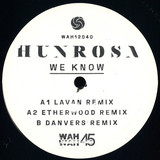
As bottom end provider for Cinematic Orchestra and Paper Tiger, Hunrosa (AKA Sam Vicary) already has something of a pedigree for a man of such tender years. His music glides effortlessly between Bonobo at his most sonorous, Jon Hopkins at his most ethereal and Flying Lotus at his most freaky. Currently based in Manchester, his music captures the wild organic senses of his Cornish childhood, anchoring it with a darker 2am undercurrent. Following the success of 'Ransom' (a firm favourite of BBC 6 Music's Tom Ravenscroft) Hunrosa returns with his newest offering 'We Know'. An eerie, ethereal track full of haunting atmospheres, Vicary enlists Austrian percussion maestro Manu
Delago, who lends his hang drum expertise to the proceedings weaving it amongst the twisting, intricate beats and Anna McLuckie's delicate vocals. the original is accompanied by a white label 12' containing three reworkings from burgeoning producers Lavan, Etherwood and Danvers. Newcomer Lavan is up first, moulding the organic melodies and earthy percussion into a dubbed out, soulful and bouncy 4/4 number. Hospital Records golden boy Etherwood (whose band Hunrosa is also a member of) brings a late-night liquid DnB atmosphere into play, harnessing the raw emotional power of the lyrics, as reverberating piano chords strike out into the darkness. Having turned the
heads of Bradley Zero and Gilles Peterson with his recent releases, CoOp and WotNot Music's Danvers resets the atmosphere with a zen like extended intro, before launching headfirst into a hypnotic and enthralling looped rhythm section. The groove locked in place, it rises and falls with precision, joined by spaced-out synths throughout the nine-minute duration, allowing the majestic instrumentation to gather pace as the spine chilling vocals drift overhead.
First track from Rhythm Storm brings some old school tribe techno, dry kick and some italians samples...
Second track goes more energik, with some electro background and a Pumpin nervous kick "à la LSDF" from Trashwasher.
Third tune is cool Joke of tribecore sampling an old tune from Pierre Bachelet ^^
Last track brings a cool dancefloor tribe sober track... Easy baby !
- A1: N'écrire Que Du Vent
- A2: La Visite Au Musée
- A3: And Then The Wind
- A4: Chienne De Vie
- A5: Quand Natalia Peint
- A6: Thème Entre Deux Chants
- A7: Les Sanglots Du Locataire
- B1: John Doe
- B2: C'était À L'aube
- B3: Le Dialogue Des Joueurs De Cartes
- B4: Et L'obscurité Toute Entière Pour Me Rappeler Cela
- B5: Le Train Ne S'arrêtera Plus
- B6: L'oubli
- B7: Chryséléphantines
- B8: D'un Pas Chancelant
Le Raccourci is a welcome introduction to the world of modern classical identity Sebastian Gandera. The impressionist landscapes of a sensitive soul self-reflecting, these miniature compositions alternate across a rudimentary set up of piano, field recorder, sampler and four track. Melancholic utterings hastily captured some 100km east of Paris. Classically trained by the same teacher as his parents, Gandera first began recording in the confines of his university dorm room, inspired by a C60 from friend and future collaborator Bernard Odot (A Gethsémani). Humbly existing without sparing a thought to music industry or career, Gandera's personal effects surfaced via the European and US cassette networks from 1988 to 1994. Impressively accomplished for the DIY scene they orbited, these tapes were issued in scant quantities, rendering his pieces as private secrets shared and duplicated in small concentric circles. Aside from a sole, avowedly traumatic performance, the material was never shared in a live context.
After a string of acclaimed EPs on Heist, Dirt Crew and Quartet Series, Amsterdam's Nachtbraker presents 'When You Find a Stranger in the Alps', his first longplayer on his own Quartet Series imprint. The good-humoured Dutchman - tongue always firmly in cheek - has always refused to stick to the 'sound du jour' and the industry's conventions, following his own path instead, continually willing to step out of his comfort zone. 'When You Find a Stranger in the Alps', a nod to his favourite Coen Brothers' movie, is testament to Nachtbraker's studio prowess and drive to explore new sonic pastures and styles. The album consists of thirteen tracks, made over the course of 2,5 years in his studio at Volkshotel Amsterdam. Constantly shifting through different settings and moods, the album feels like a deep dream, with vivid details, blurry edges and a warped sense of time. The word 'stranger' in the title references to this dream state in which you sometimes can be a stranger to yourself. Album opener 'The Dream Sequence' sets the mood with a lo-slung hip-house groove that relies heavily on field recordings, like the sound of one of the capital's trams. 'Flambo', a delectable slice of up-tempo French filtered house, is aimed straight at the dance floor. Nachtbraker dims the lights on 'NSFW', cleverly manipulating samples from adult oriented flicks, and turns in a hilarious skit with 'LOL'. Flip over for 'Randy', a quintessential Nac
If you check the credits of The Rolling Stones' Goats Head Soup LP from 1973 you'll find a certain "Pascal" listed on the percussion section. That is none other than Los Angeles based artist Nicolas Pascal Raicevik (1933-1994), aka 107-34-8933, aka Head, aka Nik Pascal, aka Nik Raicevic. Besides his hitting the bongoes on the Stones album, Nik was a great artist on his own, both as a painter and as a musician. As a musician, he was a pioneer in the use of synthesizers, preceeding the Berlin school by some years when his Head LP was released on on Buddah in 1970. Buddah probably saw in Head the opportunity to cash in some money from the remains of the psychedelic scene - the three tracks on the LP are named after drugs used in the late sixties. The sounds, however, are accomplished works that show Raicevic as one of the most interesting pioneers in the use of synths. The album probably didn't do too well, since Buddah didn't renew the contract with Raicevic, who instead took his own way releasing his works on his very own Narco Records and Tapes label. Between 1968 and 1975 Narco would issue 4 LPs credited either to Nik Raicevic (Beyond The End... Eternity) or Nik Pascal (The Sixth Ear, Magnetic Web and Zero Gravity) plus one credited to 107-34-8933 (Numbers, which is in fact the same LP as Buddah's Head, albeit with different cover art). Copies of these LPs came with an ironic sticker over the shrinkwrap that read "Do not listen to this LP if you are stoned".
1972 saw the release of The Sixth Ear (Narco NR666), this time credited to Nik Pascal. A more complex work than Beyond The End..., it adds consistent rhythmic patterns to the mix with the addition of bongoes and also explores some interesting chord progressions.
Besides his musical explorations, Nik was also an interesting painter. His paintings are auctioned from time to time, and are consciousness expanding works influenced by abstract cubism and surrealism, some kind of Salvador Dalí on drugs exploring the outter and inner space. All the artwork on the sleeves of his LPs is done by himself. Spacey landscapes and psychedelic colours that fit perfectly to the music they contain.
"Nik Raicevic's music is at the intersection of radical psycho-electronic weirdness and kraut kosmische music (in particular the scifi-hypno-minimal modules of Conrad Schnitzler in Grun, Rot and Blau). It presents mega epic & tripped out electronic improvisations.
"This is an absolute must for collectors and fans of visceral, neurotic soundscapes." (progarchives)
"As far as late-60s / early-70s American Bedroom' Electronic Music goes, these LPS have to be among the first transmissions from this sector, made all the more attractive when coupled with Raicevic's alien topographIes - the covers are high-color portrayals of Venusian lanes, knotted growths, & future-past architecture in a style you might equate with Vintage' sci-fi pulp-novel covers - & copious Downer' sentiment. This music is imbued with a sort of lonely, anti-social sensibility that's about as far as you can get from the Academic' Early Electronic vector. I will say that if the Steve Birchall, Cellutron & the Invisible, and/or Pythagoron™ seed your garden, this will likely do the same." (twoheadeddog)
Never reissued before on vinyl format, the Wah Wah reissue features original sleeve artwork made of paintings and drawings by Nik himself and reproduction of the famous ironic "Do not listen if you are stoned" sticker. Limited edition, 500 copies only.
If you check the credits of The Rolling Stones' Goats Head Soup LP from 1973 you'll find a certain "Pascal" listed on the percussion section. That is none other than Los Angeles based artist Nicolas Pascal Raicevik (1933-1994), aka 107-34-8933, aka Head, aka Nik Pascal, aka Nik Raicevic. Besides his hitting the bongoes on the Stones album, Nik was a great artist on his own, both as a painter and as a musician. As a musician, he was a pioneer in the use of synthesizers, preceeding the Berlin school by some years when his Head LP was released on on Buddah in 1970. Buddah probably saw in Head the opportunity to cash in some money from the remains of the psychedelic scene - the three tracks on the LP are named after drugs used in the late sixties. The sounds, however, are accomplished works that show Raicevic as one of the most interesting pioneers in the use of synths. The album probably didn't do too well, since Buddah didn't renew the contract with Raicevic, who instead took his own way releasing his works on his very own Narco Records and Tapes label. Between 1968 and 1975 Narco would issue 4 LPs credited either to Nik Raicevic (Beyond The End... Eternity) or Nik Pascal (The Sixth Ear, Magnetic Web and Zero Gravity) plus one credited to 107-34-8933 (Numbers, which is in fact the same LP as Buddah's Head, albeit with different cover art). Copies of these LPs came with an ironic sticker over the shrinkwrap that read "Do not listen to this LP if you are stoned".
Magnetic Web was released in 1973. It appeared under the Nik Pascal monicker and showed a clear evolution in sound, favoured by the addition of an Arp 2600 and some rhythm boxes. It also included percussions and cymbals. The Two Headed Dog site thinks "this is his masterpiece in all of its acid-laced glory."
Besides his musical explorations, Nik was also an interesting painter. His paintings are auctioned from time to time, and are consciousness expanding works influenced by abstract cubism and surrealism, some kind of Salvador Dalí on drugs exploring the outter and inner space. All the artwork on the sleeves of his LPs is done by himself. Spacey landscapes and psychedelic colours that fit perfectly to the music they contain.
"Nik Raicevic's music is at the intersection of radical psycho-electronic weirdness and kraut kosmische music (in particular the scifi-hypno-minimal modules of Conrad Schnitzler in Grun, Rot and Blau). It presents mega epic & tripped out electronic improvisations.
"This is an absolute must for collectors and fans of visceral, neurotic soundscapes."
"As far as late-60s / early-70s American Bedroom' Electronic Music goes, these LPS have to be among the first transmissions from this sector, made all the more attractive when coupled with Raicevic's alien topographIes - the covers are high-color portrayals of Venusian lanes, knotted growths, & future-past architecture in a style you might equate with Vintage' sci-fi pulp-novel covers - & copious Downer' sentiment. This music is imbued with a sort of lonely, anti-social sensibility that's about as far as you can get from the Academic' Early Electronic vector. I will say that if the Steve Birchall, Cellutron & the Invisible, and/or Pythagoron™ seed your garden, this will likely do the same."
Never reissued before on vinyl format, the Wah Wah reissue features original sleeve artwork made of paintings and drawings by Nik himself, and reproduction of the famous ironic "Do not listen if you are stoned" sticker. Limited edition, 500 copies only.