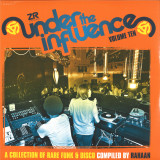
Z Records continues its commitment to unearthing the obscure and
long forgotten tracks from the last 40 years through the ever-popular
Under The Influence series. Following on from Red Greg, Nick The
Record, Sean P, Faze Action, and last years Alena Arpels. It’s now the
turn of one of the scene’s most impressive collectors & DJs; Rahaan
Hailing from Chicago his love affair with muzik started in the late 70’s early 80’s, listening to muzik on the radio combined with his mom and dad playing their records every weekend. In the early 80’s on the South side of Chicago, he started hearing something a bit different, what they called ‘house muzik’. A combination of Disco, Jazz, Soul Funk, New Wave and Italo Disco. Here Rahaan digs deep into his impressive record collection that he has collected, built up and crafted over his many years of travelling, networking and DJin to showcase 22 of his finest and rarest cuts. Many of the tracks on the album would cost hundreds and that’s if you were even able to find the originals! As always with ZR compilations a lot of time and effort has been spent on creating these masters from the original vinyl, cleaning them up, removing all the clicks and pops resulting in the cleanest sounding copy possible.
out of Stock
Last delivered 6 months ago available to reorder, subject to availability
In 1962, Black Music was making its transition from R&B to soul and the Chicago music industry was exploding, producing thousands of records and dozens of new labels. The two biggest black labels Vee-Jay and Chess led in the creation of the distinctive, smooth, Chicago soul brand with names familiar and not so familiar: the former with Curtis Mayfield and Jerry Butler and the latter with Mitty Collier, Etta James and Billy Stewart. And yet it's the smaller labels that make up the bulk of the Chicago story: Hawk with Geraldine Taylor, Lu-Cee with Roberta, M-Pac with Dorothy Prince and it's here that we explore some of the finest sounds of the era in this collection. Extensive liner notes written by Robert Pruter, author of the acclaimed 'Chicago Soul'. Side One. 1. The Town I Live In - McKinley Mitchell 2. I'm The One Who Loves You - The Impressions 3. Shake A Tail Feather - The Five Du-Tones 4. Mama Didn't Lie - Jan Bradley 5. Make It Easy On Yourself - Jerry Butler 6. Seven Day Fool - Etta James 7. The Blues Don't Like Nobody - Tony Adams 8. I've Got To Get Away From It All - Mitty Collier 9. How Much Longer - Geraldine Taylor 10. I'm On The Prowl - Roberta. Side Two: 1. Fat Boy - Billy Stewart 2. Can't Take No More - Ted Taylor 3. I Don't Want To Suffer - Walter Jackson 4. Open Your Heart - Sugar Pie DeSanto 5. Shook Up Over You - Dee Clark 6. Something's Got A Hold On Me - Etta James 7. Why Not Tonight - Dorothy Prince 8. Delilah - Major Lance 9. Money In My Pocket - Moss Tolbert
West Mineral returns with lushly amorphous actions by Shiner, Pontiac Streator & Ben Bondy aka Shinetiac; together fused for an immersive flux of vapoured dub, chopped and droned Billie Eilish, and fidgety algorithmic jams.
There's not a single, specific sound you can peg to the West Mineral axis at this stage in the label’s evolution - it's rather a set of shared aesthetics that freely bend into various interconnected shapes. Shinetiac's contemptuous, critic-baiting gear is the ideal example; on their last album, 2023's 'Not All Who Wander Are Lost', skittery, ketamized IDM sparkled over Spice Girls samples and the Foo Fighters' 'Everlong' was transmuted into Sneaker Pimps-style trip-hop. 'Infiltrating Roku City' might be a little less blatant with its out-and-out poptimism, but it takes a similarly dim view of conservative "big ambient" snobbishness. Just a few minutes of 'Bluemosa' should be enough to let you know what's up; the overall character of the sound is hazed, with frozen pads and garbled, dubbed-out voices smudged into a mess of effects and samples. But it sups up different nuances as it wriggles, absorbing scampering breaks, dizzy acoustic guitar strums and half-heard wordless vocals, flipping in the third act to emerge from its shell as minimalist balearic folk-pop - something like Bon Iver doing 'Electric Counterpoint'.
Brooklyn's Shiner, Philly's Pontiac Streator and Berlin-based Ben Bondy navigate the labyrinthine streaming landscape, guided by their own private experiences of mindless doom-scrolling and cruising the darkest corners of YouTube. They formulated 'Infiltrating Roku City' while they were rehearsing last year and spent the winter stitching together various recordings and jams into a layered, dry-witted commentary on our algorithmic reality. Laden with inside jokes and refried memes, it's surprisingly elegant gear; handling the most unseemly elements like sonic recyclers, earnestly repurposing pop and nostalgia to create an atmospheric echo of contemporary reality.
Screwing Chief Keef's enduring 'Citgo', 'Clublyfe (hulu)' emphasises the original's AFX-pilled euphoria with Robert Miles-style piano hits, replacing Young Ravisu's brittle 128kbps trap rhythm with a glitchy rattle that picks up dembow spikes as it rolls. 'I Hate Being Sober' vaporises the Chicago drill pioneer's 'Hate Bein' Sober', blocking out his voice with glitchy, downsampled interference and elasticated Rhodes. The trio team up with Orange Milk's goo age on the sublime 'Crisis Angel', catching a ray of Malibu's sunshine in the process, and reduce Billie Eilish's voice to a Romance-does-Celine cinder on 'Billie', stretching it to fit next to gassed Future ad-libs and swooping 808 Mafia sub womps. And although the album takes a murky diversion on 'Roku Axes Ultra’, and a cloud-stepping centrepiece ‘Purelink’ in homage to the eponymous dubbed ambient dynamos, it's back on course with 'Jiafei (NETFLIX)', taking aim at TikTok bot videos and welding screams from Florida metal band Underoath to AI-strength vocal curlicues.
out of Stock
Last delivered 7 months ago available to reorder, subject to availability
Do You Want More?!!!??! Is the second studio album and the major-label debut from The Legendary Roots Crew. The album, recorded with the original crew, including Scott Storch, was released January 17th, 1995, and was immediately welcomed with open arms by critics, the Chicago Tribune wrote, “This is an impressive display of skills, intelligently arranged and performed.” Do You Want More?!!!??! prepped fans for what The Roots were capable of, and would later show on their magnum opus, Things Fall Apart.
From the heart of Tamanrasset in South Algeria, Imarhan transcend Tuareg tradition, weaving hypnotic synths into desert blues. The result is a timeless work—deeply respectful of their roots, yet alive with a stirring sense of modernity.
ESSAM is the band’s fourth album, recorded with the same core lineup, but marks a significant shift in their sound and approach. Musically, it marks a departure from the rocky, bluesy, psychedelic Tuareg guitar-driven sound influenced by Tinariwen’s heritage — moving toward something more open, modern, and exploratory.
For the first time, their long-time sound engineer Maxime Kosinetz stepped in as producer. He travelled to Tamanrasset with Emile Papandreou (of the French duo UTO), a multi-instrumentalist who introduced electronic elements by sampling live instruments and reprocessing them in real time with a modular synthesizer — subtly reshaping the band's sonic identity.
The album was recorded mostly live, in one big room at Aboogi Studio — the band’s own rehearsal and recording space in Tamanrasset. The studio, a converted concert hall, has become a kind of cultural hub for the local youth. Friends dropped by during the sessions to contribute handclaps, vocals, and just be part of the energy. It’s a space where people gather, hang out, play dominoes, smoke chicha — a rare communal spot in a city that doesn’t offer many for young people, somewhat like a youth and community center.
This context — the creative shift, the live recording process, the atmosphere around Aboogi — might be interesting threads to explore in the conversation.
Chicago producer Ellery Cowles lands on Apnea Records with three tracks that draw from the city's foundational rhythms while reaching for something more devotional. Walking by Faith isn't chasing nostalgia--it's after deeper ground. "Fall of Jericho" kicks things off with syncopated Chicago swing colliding with latin percussion and acid basslines that curl and bite in equal measure. "Fly" builds around a looped vocal fragment, letting raw drum patterns stretch and breathe as the track slowly reveals itself. Closer "Crying of Yahweh" is the most patient of the three--seven minutes of hypnotic techno coiling around latin rhythms, carrying a quiet spiritual weight that lingers long after it fades. Cowles moves between reference points with ease--Chicago house, devotional threads, latin heat--but never forces the connection. The music feels like it's been lived in rather than simply constructed, generous with its time and intentional with its space. Out now on Apnea Records.
out of Stock
Last delivered 7 months ago available to reorder, subject to availability
For its 25th anniversary, Cocoon Recordings returns to its roots with an elaborate vinyl LP box set, marking the first part of a two-volume anniversary project. 25 Years Cocoon Recordings – Volume
One brings together exclusive contributions from international artists who have defined the sound and diversity of the label over the past two decades, complemented by fresh talents who are helping to shape its future.
Over the span of 25 years, Cocoon Recordings has created a catalog that now comprises hundreds of releases, 12-inches, albums, mix CDs, and iconic compilation box sets, always bridging past, present, and future. While firmly rooted in techno and house, the label has also provided space for electronica,
ambient, and other evolving genres.
25 Years Cocoon Recordings – Volume One is more than just a compilation. It is both a homage to the label’s history and a glimpse into what lies ahead. With exclusive tracks that embody the Cocoon sound in all its depth and complexity, this release marks a milestone in the legacy of one of electronic
music’s most influential labels, arguably the strongest compilation in Cocoon’s history. To mark this special occasion, Sven Väth’s label presents the first of two carefully curated volumes, uniting 15 exclusive tracks from international artists in celebration of nearly three decades of Cocoon
Recordings. The luxurious 5x12" box set features a spectral-reflective foil finish and includes contributions from renowned names such as Butch, Robag Wruhme, Josh Wink, Guy J, and Dino Lenny, alongside longtime companions of the label including Extrawelt, Harvey McKay, Johannes
Volk, and Raxon. New discoveries of recent years, Jonathan Kaspar and Riccardo De Polo, enrich the release in their own distinctive ways. The compilation is completed by the unmistakable talents of Damiano von Erckert, Fedele, and ja:ck, who provide the perfect conclusion to the first of two parts.
This release sets the stage for what's next: a daring diptych where musical voices emerge, shining with originality and passion, carrying the spirit forward. The story is just beginning. Something special is on the horizon. One can only wonder which artists will shine on the second chapter.
out of Stock
Last delivered 85 days ago available to reorder, subject to availability
Rochelle Jordan is proudly stepping into her diva era. To those in the know, the Los Angeles-based British-Canadian singer and songwriter has long been an underground force coaxing together the mutually flirtatious scenes of daring alt-R&B and heart-pumping electronic music. With her longtime creative director/producer KLSH, she’s cultivated a singular marriage of sound — mixing soulful sensuality, house bump, DnB wildness, hip-hop swagger, and pure experimentalism — that’s spread not only through certain circles, but also to the mainstream. At the same time that her gauzy 2014 single “Lowkey” was going viral in 2023 — racking up 21 million streams on Spotify alone — she was in the studio cooking with tastemaking beatsmiths like KAYTRANADA and Sango, quietly preparing to melt dance floors and headphones alike.
Now, as the timelines merge, Jordan is approaching success with the sparkle of a brand new star and the stance of someone who’s earned everything she has. Her new musical chapter aims to carry forward the magic that fans feel in her coquettish vocals and bold soundscapes even as she reaches deeper into her pop bag. The fact that her first single of 2025, the darkly dazzling “Crave,” was produced by Chicago house legend Terry Hunter (Janet Jackson, Mariah Carey, Beyoncé) speaks volumes to this exact moment in Jordan’s ascendent trajectory.
“My goal when I first started making music was to bring back something that I felt had started to fade away for me,” says Jordan. “That certain essence or sound that would give me butterflies in my stomach when I’d listen to music — it would unleash some kind of chemical that would make me feel happy and excitable and curious, something that would make my soul shine. My number one goal is always: How do I give people that feeling when they listen to my music?”
Jordan grew up in Toronto raised by British-Jamaican parents. She remembers hearing one of her older brothers cycling through a variety of music at maximum volume in the room next to hers. “Reggae to soul to drum and bass to garage music to gospel,” Jordan recalls. “It was all intertwining for me at such a young age.” She developed her own sound quietly, and soon met KLSH through MySpace. They traded multiple songs back and forth daily until he flew her out to L.A. to record what would become her debut project, 2011’s R O J O. That collaboration hasn’t faltered since, resulting in sonically surprising, subtly infectious sets like Jordan’s breakthrough 2014 album 1021 (with “Lowkey”) and 2021’s dance-steeped revelation, Play with the Changes.
“If you’re talking about Rochelle Jordan, you’re talking about KLSH,” she says. “It’s one and the same. We come from the same inspiration source.” With him at her side to this day, Jordan is crafting new listening experiences as radiant as refracted light glimmering through a prism — an incredible space from within which to explore love in all its iterations — from romantic infatuation to self-affirmation, and strength in womanhood to pride for what she’s accomplished thus far.
More than a decade into her career, Jordan has arrived at a new stage of life and creativity — she’s a seasoned professional, a fully realized woman, and she’s excited to continue growing. “I know my story isn’t necessarily a new one,” she says. “I look at 2 Chainz, who became 2 Chainz way later on in his life. I look at Tina Turner, who became Tina Turner at 40. I want to be another story of resilience for people.” As she prepares to unveil more of her vision, and fans clamber for a long-awaited fourth album, Rochelle Jordan is casting aside self-doubt, and appreciating and underlining her status as a verifiably influential reigning diva in her one-of-one sonic space.
out of Stock
Last delivered 32 days ago available to reorder, subject to availability
The duality of "man" is a subject that has been explored in art for centuries, from writings of the Bible to Descartes, all the way up to filmmakers like Lynch, Cronenberg, & Carpenter. Who is your "true self" & what do they want? With their sixth studio album "Wish Defense" (again for longtime home Trouble In Mind Records), Chicago trio FACS take a good, long look in the mirror to face themselves. The return of original member Jonathan Van Herik - who stepped away from the group just before their debut album "Negative Houses" was released in 2018 - replacing longtime bassist Alianna Kalaba brings renewed vigor & a marked angularity from the band's more recent output. The songs still hit hard, but the approach is sideways - the roles have changed since Van Herik's original tenure & his previous time with Case & powerhouse drummer Noah Leger in Disappears; now on bass, Van Herik was originally the group's guitar player and features on the debut, while current guitarist Brian Case played bass. This role reversal has helped the band's dynamic, offering up a different musical perspective than before, now revisiting the trio's long-going collaboration with some distance and time. Case notes that the lyrics on "Wish Defense" revolve around doppelgängers or "doubles", tackling the idea of facing yourself and observing your ideas and motivations. Look no further than the album's title track; "Enter the mirror / Double walker / An intimate / Wish defense / Is it real? / You beside me / The detail / Terrifying / Abject self / Your grief / A public / Performance". Case lays out the entire album's theme in one stanza; Are your actions & emotions your true self? Or are they a performative aspect of that "other" person you put forward? Case says that ultimately the sentiment is "_don't let the bastards get you down, there's something beyond this moment, like hope - but not in the naive belief that ultimately people are good". "Wish Defense"s artwork is also a subtle reference to "Negative Houses"' art, returning to that album's black & white starkness & minimalism. The album's checkerboards everywhere are offset reflections of themselves, mirrored with the album's lyrics printed front & center on the cover. Everything is out in the open. A final note; "Wish Defense" is the last album engineered by Steve Albini. Two days were recorded at Electrical Audio in early May of 2024 before Steve's untimely passing, with renowned engineer & friend Sanford Parker stepping in to finish the session 24 hours later, tracking the last bits of vocals and overdubs. Longtime collaborator John Congleton mixed the album as Albini would have; in Electrical Audio's A room, off the tape, using Albini's notes about the session.
These albums are important because they are Sun Ra's first recordings before the Saturn sessions, made in 1956 when the Chicago musicians were searching for something more, something beyond.
In 1957, Transition Records gave us Volume 1, but before Volume 2 could be released, the label went bankrupt, and it took more than a decade for it to finally be released on the Delmark label. Today, for the first time, both volumes are available, as they were meant to be from the beginning.
Volume 2 is presented here for the first time with the silver cover originally planned by Transition!
Sex Tapes From Mars presents Outdom Records' boss, LATENT, who shares a brand-new four-track EP that spars with breakbeat, electro, house, and left-field electronics, neatly centring them all into a steady, sexy collision. The record as a whole captures genuinely original-sounding, rough-edged b-boy breaking badness - nostalgic, but never polite. It's a few BPMs slower than Sex Tapes' last few outings, but no less effective. Arguably, it's more late '80s sounding than ever, although, in fact, it's a brand-new, stonking release that showcases the label's versatility and unpredictability.
The opening track, "Break Machine", sets the pace with a clear nod to the '80s US group of the same name, bringing tidy drum workouts and clipped vocal samples that recall early Chicago, as well as choppy rave and street party energy at its most unfiltered.
"Disco Hijack" pushes the clutch into a more functional gear, merging delay-heavy, druggy, chuggy, sludgy bass with more robotic vocoder tropes, sharing something playful but IDM and European skewed. It's a dancefloor tool with a wink - just the style this now accomplished label has made its identity. Oh, don't forget the amens and clattering jungle breaks. 1990 or 2040? Fuck knows.
On "Distress Robot", pneumatic percussion and malfunctioning android chatter bring a darker, more mechanical edge, while "Virtual Body" closes with a spacious, garage-leaning shuffle that pulls the EP into recognisable contemporary yet still very much peak-time territory.
LATENT gives lean grit, pushes the edges, and lets the tracks feel alive in their imperfections. It’s music that thrives on tension between old-school reference points and modern floor pressure.
Bristol's label head Elon Dust HAS done it again.
Vinyl-only as per, don't sleep."
out of Stock
Last delivered 89 days ago available to reorder, subject to availability
Pelican has always been a band that's not just from Chicago, but distinctly of Chicago. Formed in 2000 by guitarists Trevor Shelley de Brauw and Laurent Schroeder-Lebec alongside brothers Bryan and Larry Herweg on bass and drums respectively, Pelican's foundation was built upon the rule-free, genre-agnostic scene synonymous with the Fireside Bowl. "The `90s in Chicago was a free-for-all. Everyone was just coming from a place of pure creativity," says Shelley de Brauw. With Schroeder-Lebec returning to the band following Dallas Thomas' exit in 2022, this reunified version of Pelican allowed the band to tap back into those influences and build something distinctly new with Flickering Resonance. While longtime Pelican fans will find an updated version of the band's ethos_one that's been constantly evolving since their very first EP_their new partnership with Run For Cover Records emphasizes something that's always been implicit to the Pelican formula. These songs take as much inspiration from titanic `90s post-hardcore, space-rock, and emo as they do traditional metal, showing that though Godflesh and Goatsnake records occupied the shelves of Pelican's songwriters, so too did Quicksand, Christie Front Drive, and Hum. "A lot of people didn't hear it," says Schroeder-Lebec. "I was like, well, I guess the metal world is where we fit. But now, I'm willing to acknowledge all the suits we're wearing." On Flickering Resonance, Pelican allowed themselves to look at their music less as a means of hard-earned catharsis and more as an appreciation for the glimmers of joy that occur even in the bleakest landscapes.
AXNER aka Chris Davies from Acid Jazz Records and singer Julia Axner drop a 12" that perfectly closes their disco trilogy. Original cut 'Gyaml' is the sort of cool, musical disco groove that's laden with Chicp-style basslines and airy, soulful vocals perfect for outdoor summer fun. First up then is Al Kent's remix of 'GYAML', which elevates the track with lush orchestral strings and a soulful, emotive disco vibe. Complementing this are two fresh house remixes from London's rising talents HVN SENT and H.O.P. HVN SENT delivers an uplifting, piano-driven remix, while H.O.P offers a smooth, deep house interpretation filled with vocal chops and subtle textures. This package has something for all discerning disco dancers.
out of Stock
Last delivered 10 months ago available to reorder, subject to availability
Detroit-born artist, Jalen Elk Star unveils his debut LP, ESIN on L.I.E.S. Known in certain circles as filmmaker, music producer, playwright, and collagist, Jalen often draws from controversial themes to craft modern avant-garde works redefining the way art is seen in today’s chaotic universe. After years working on diverse projects under various aliases, his shift to a more liberated creative process under this new moniker has allowed his vision to reach a broader audience, continuing the path with the music on this new lp.
ESIN, a 13-track sonic collage, builds on his past, blending raps, noise, ambience, samplers, drum machines and synths into a raw, vibrant narrative. This work traces Jalen’s journey between his cities, Detroit and Chicago, offering a profound glimpse into his dynamic, limitless world of sound and vision. Something along the lines of the dusty crunched out vapors of the 2010s getting in a car crash with the abstractions of Rammellzee. A headtrip for the headphones.
Für Joyer, das Indie-Rock-Duo der Brüder Nick und Shane Sullivan von der Ostküste, ist Distanz in letzter Zeit ein seltsamer roter Faden - Distanz von zu Hause, Distanz zueinander, Distanz von einer stabilen Routine. Ihr aktuelles Album ,On the Other End of the Line_" reflektiert, wie Aufenthalte an weit entfernten Orten sie geprägt haben, Ängste und ein brennendes Verlangen nach Verbindung offenbart haben. Letztendlich ist es jedoch eine hoffnungsvolle Reflexion zweier unterschiedlicher Perspektiven auf wechselnde Kulissen und den Druck der Kreativität, gefiltert durch eingängige Ernsthaftigkeit und knackige Sechs-Saiten-Klänge. Seit ihrem letzten Album ,Night Songs", das 2024 erschien, sind sowohl Nick als auch Shane in andere Städte gezogen - Nick von Brooklyn nach Philadelphia und Shane von Boston nach Brooklyn - und mussten sich an ein neues Leben gewöhnen. Zusammen mit Joyers immer hektischer werdendem Tourplan, bei dem sie mit Horse Jumper of Love, Wishy und villagerrr, um nur einige zu nennen, suchten die Brüder nach gesünderen Ansätzen für ihr Leben auf Tour und zu Hause und kämpften mit der Einsamkeit in einer neuen Stadt. Trotz der Höhen und Tiefen war das Tourleben für Joyer bereichernd - sie trafen Gleichgesinnte und wuchsen als Band zusammen, was den Wunsch nach neuem Material weckte. Eifrig darauf bedacht, die Pop-Melodik von Night Songs noch weiter voranzutreiben, begannen Joyer mit dem Schreiben eines neuen Albums und buchten acht Tage in einem Studio in Chicago mit Henry Stoehr von Slow Pulp, der sie zu einem experimentelleren Aufnahmeprozess ermutigte, der an Joyers Zeit vor der Live-Band erinnerte, als sie ohne Deadlines im Keller ihrer Mutter Demos aufnahmen. Sie reduzierten ihre Shoegaze-Einflüsse zugunsten folkigerer Elemente und weniger konventioneller, ambitionierterer Arrangements. On the Other End of the Line_ zeigt Joyer von ihrer verletzlichsten Seite, weniger auf Bilder und Abstraktionen setzend und einen Blick auf ihr brodelndes Inneres gewährend.
Für Joyer, das Indie-Rock-Duo der Brüder Nick und Shane Sullivan von der Ostküste, ist Distanz in letzter Zeit ein seltsamer roter Faden - Distanz von zu Hause, Distanz zueinander, Distanz von einer stabilen Routine. Ihr aktuelles Album ,On the Other End of the Line_" reflektiert, wie Aufenthalte an weit entfernten Orten sie geprägt haben, Ängste und ein brennendes Verlangen nach Verbindung offenbart haben. Letztendlich ist es jedoch eine hoffnungsvolle Reflexion zweier unterschiedlicher Perspektiven auf wechselnde Kulissen und den Druck der Kreativität, gefiltert durch eingängige Ernsthaftigkeit und knackige Sechs-Saiten-Klänge. Seit ihrem letzten Album ,Night Songs", das 2024 erschien, sind sowohl Nick als auch Shane in andere Städte gezogen - Nick von Brooklyn nach Philadelphia und Shane von Boston nach Brooklyn - und mussten sich an ein neues Leben gewöhnen. Zusammen mit Joyers immer hektischer werdendem Tourplan, bei dem sie mit Horse Jumper of Love, Wishy und villagerrr, um nur einige zu nennen, suchten die Brüder nach gesünderen Ansätzen für ihr Leben auf Tour und zu Hause und kämpften mit der Einsamkeit in einer neuen Stadt. Trotz der Höhen und Tiefen war das Tourleben für Joyer bereichernd - sie trafen Gleichgesinnte und wuchsen als Band zusammen, was den Wunsch nach neuem Material weckte. Eifrig darauf bedacht, die Pop-Melodik von Night Songs noch weiter voranzutreiben, begannen Joyer mit dem Schreiben eines neuen Albums und buchten acht Tage in einem Studio in Chicago mit Henry Stoehr von Slow Pulp, der sie zu einem experimentelleren Aufnahmeprozess ermutigte, der an Joyers Zeit vor der Live-Band erinnerte, als sie ohne Deadlines im Keller ihrer Mutter Demos aufnahmen. Sie reduzierten ihre Shoegaze-Einflüsse zugunsten folkigerer Elemente und weniger konventioneller, ambitionierterer Arrangements. On the Other End of the Line_ zeigt Joyer von ihrer verletzlichsten Seite, weniger auf Bilder und Abstraktionen setzend und einen Blick auf ihr brodelndes Inneres gewährend.
Für Joyer, das Indie-Rock-Duo der Brüder Nick und Shane Sullivan von der Ostküste, ist Distanz in letzter Zeit ein seltsamer roter Faden - Distanz von zu Hause, Distanz zueinander, Distanz von einer stabilen Routine. Ihr aktuelles Album ,On the Other End of the Line_" reflektiert, wie Aufenthalte an weit entfernten Orten sie geprägt haben, Ängste und ein brennendes Verlangen nach Verbindung offenbart haben. Letztendlich ist es jedoch eine hoffnungsvolle Reflexion zweier unterschiedlicher Perspektiven auf wechselnde Kulissen und den Druck der Kreativität, gefiltert durch eingängige Ernsthaftigkeit und knackige Sechs-Saiten-Klänge. Seit ihrem letzten Album ,Night Songs", das 2024 erschien, sind sowohl Nick als auch Shane in andere Städte gezogen - Nick von Brooklyn nach Philadelphia und Shane von Boston nach Brooklyn - und mussten sich an ein neues Leben gewöhnen. Zusammen mit Joyers immer hektischer werdendem Tourplan, bei dem sie mit Horse Jumper of Love, Wishy und villagerrr, um nur einige zu nennen, suchten die Brüder nach gesünderen Ansätzen für ihr Leben auf Tour und zu Hause und kämpften mit der Einsamkeit in einer neuen Stadt. Trotz der Höhen und Tiefen war das Tourleben für Joyer bereichernd - sie trafen Gleichgesinnte und wuchsen als Band zusammen, was den Wunsch nach neuem Material weckte. Eifrig darauf bedacht, die Pop-Melodik von Night Songs noch weiter voranzutreiben, begannen Joyer mit dem Schreiben eines neuen Albums und buchten acht Tage in einem Studio in Chicago mit Henry Stoehr von Slow Pulp, der sie zu einem experimentelleren Aufnahmeprozess ermutigte, der an Joyers Zeit vor der Live-Band erinnerte, als sie ohne Deadlines im Keller ihrer Mutter Demos aufnahmen. Sie reduzierten ihre Shoegaze-Einflüsse zugunsten folkigerer Elemente und weniger konventioneller, ambitionierterer Arrangements. On the Other End of the Line_ zeigt Joyer von ihrer verletzlichsten Seite, weniger auf Bilder und Abstraktionen setzend und einen Blick auf ihr brodelndes Inneres gewährend.
Can you believe it? Devendra Banhart's Cripple Crow - originally released by XL in 2005 - is turning 20 years old. This was the 5th album from the Venezuelan American artist who is considered the pioneer of the "Freak Folk" and "New Weird America" movements. To celebrate - Devendra has compiled a reissue of the out of print release that features a 3rd Bonus LP (on Clear Green Smoke Vinyl) featuring 9 bonus tracks, including 1 B-Side, 5 previously unreleased demos, 2 previously unreleased live tracks, and 1 unearthed smash hit from the recording sessions. This release is the first on his newly created Heavy Flowers label. The album received a "Best New Music" 8.4 review from Pitchfork upon its release. The release date will fall 1 day prior to the actual 20th Anniversary, which will be the first time Devendra is early for anything. Now THAT is something to celebrate! Limited to 2000 units on 3xLP with Bonus LP on Clear Green Smoke Vinyl. 36 tracks of music and 1 track of .... well... you decide! "Cripple Crow is undoubtedly impressive, vastly singular but entirely accessible, and an inspired listening experience where Banhart again proves himself as one of the more talented and charismatic forces in modern music." - Pitchfork
'it’s his loosest, dreamiest dispatch yet, an enveloping and atmospheric collection that constantly comes together and breaks apart.'
Maxo releases his new album Mars Is Electric. Earlier this week, Maxo released a third haunting video, directed by Vincent Haycock, from the visual world of ‘Mars’ for the title track. Maxo previewed the album with the release of singles “Human?” and “Donahoo’s Chicken” this spring, which arrived with equally raw, inventive, and unnerving music videos.
Mars Is Electric is Maxo’s first official release since he dropped two critically acclaimed albums in 2023 with Even God Has A Sense of Humor and Debbie’s Son. His fifth full-length album finds the Southern Californian artist self-aware and mature. Having lived the last decade of his musical life intentionally creating specific bodies of work rooted in imagery, observation, and capturing moments, Maxo spent this previous year freely creating without a specific plan, relieved from all obligations and restrictions.
“This is the first time that I really didn’t care, I didn’t approach things so seriously,” the artist shrugs off, meaning that without expectations or specific goals, his creativity flourished. This opening finds the artist having conversations he’s been avoiding, having lived silently in the pain of those topics for the past few years. Exploring uncomfortable themes about personal life, relationships, and family fractures, life before and after the loss of innocence, and an abundance of existential spirals.
The exploration was not only thematic but also musical in nature. During the creation process, Maxo was immersed in a wide array of music from past to present - France Joli, $amaad, Steve Spacek, Cherelle, DJ Quik, Lisha G - influences that seeped their way into these songs. The album opens in a loose, dreamlike state—experimental and searching, mirroring the emotional fog of someone looking for something real to hold onto. But as it progresses, so does Maxo’s energy as he fiercely rides and weaves on songs with a contagious confidence, producing some of his most kinetic and lyrically impressive music to date.
As the work and vision coalesced into a body of work, Maxo found that he was unlocking a creative language with his collaborators that felt wholly new - a new understanding of why and how he was making art for this world. What emerged from this year-long process was a new musical journey and a future where Maxo refuses to be another bad example of what could be, refusing to mind the blueprint set down. Maxo is the sole voice on the album featuring production by lastnamedavid, Quelle Chris, Baird, Groove, and more.
Listen to Mars Is Electric above, see full album details below, and stay tuned for more from Maxo very soon.
MEMOTONE, aka Will Yates, has announced details of a new 12-track album, smallest things, set for release on World of Echo on 1 August 2025 on vinyl and digitally.
The album launches today with first track, ‘Time Is Away Theme’, a live favourite that is finally available on album. Watch the video HERE Talking about the release, Will has said, “Staring at a square inch of neglected concrete, I recognise the beauty of existence. Quietly hysterical. While humanitarian catastrophes bubble across the planet, the tides remain in constant and disinterested motion. Your money is worth less than the dusty moss that powders this pavement.
It's certainly not worth a life. We are the smallest things, along with everything else." Will Yates has made music as Memotone since 2007. He operates in the tradition of what Robert Fripp has called 'a small, independent, mobile, and intelligent unit.' If you book him, he will come. When he arrives, he will have everything he needs to make his complex, engaging music: a clarinet, a guitar, synths, samplers and pedals, quickly unpacked in the corner of a club, gallery or village hall. Starting small, he will build layer upon layer of melody, accompanying himself and cutting across himself, creating a music that avoids cliche and moves beyond easy description. His recordings have followed the same trajectory. Moving quickly, he has released fifteen or so albums across various labels (including Trilogy Tapes, Discrepant, Soda Gong). Taken together, these recordings are the sound of a skilled, inventive composer pushing at the edges of what he wants to listen to himself. It is possible to hear a variety ofinfluences in his music: folk and jazz forms, the textural inventiveness of British DI electronica and Chicago post-rock and the blurred sci-fi brass of Jon Hassell are all discernible. But mostly, Will's work seems to stem from a constant drift between long hours in his home studio, and time spent outside in the woods and hills around his home in Wales.
Listening to the album, lushness creeps in at the edges, tiny green shoots appear on what might at first appear to be bare soil. smallest things sheds the skin of Will's previous recordings, removing the electronics and the looping and layering of previous work, to create something almost entirely acoustic. But don't be fooled into imagining music that's folksy, pastoral or twee. Opening track 'I Could See the Smallest Things' is a statement of intent. Widely spaced guitar is underpinned by earthy cello and sleepwalking clarinet, making a gorgeous threadbare pattern, which recalls a Morton Feldman miniature or a Morandi still life.
Beyond the skill involved and the years of self-taught music making that have gone into putting this record together, it is Will's close, careful attention and his talent for existing, observing and creating in the moment that make his work special. Memotone will perform at World of Echo’s annual birthday celebration on 8 Nov Expected Music, when they take over Walthamstow Trades Hall for an inter-genre, day-long investigation into some of the more outré manifestations of the contemporary worldwide underground.
out of Stock
Last delivered 14 months ago available to reorder, subject to availability
Pelican has always been a band that's not just from Chicago, but distinctly of Chicago. Formed in 2000 by guitarists Trevor Shelley de Brauw and Laurent Schroeder-Lebec alongside brothers Bryan and Larry Herweg on bass and drums respectively, Pelican's foundation was built upon the rule-free, genre-agnostic scene synonymous with the Fireside Bowl. "The `90s in Chicago was a free-for-all. Everyone was just coming from a place of pure creativity," says Shelley de Brauw. With Schroeder-Lebec returning to the band following Dallas Thomas' departure in 2022, this reunified version of Pelican allowed the band to tap back into the spirit of their formative era and build something distinctly new with Flickering Resonance. While longtime Pelican fans will recognize the album as an update to the band's ethos_one that's been constantly evolving since their very first EP_their new partnership with Run For Cover Records emphasizes something that's always been implicit to the Pelican formula. These songs take as much inspiration from titanic `90s post-hardcore, space-rock, and emo as they do traditional metal, showing that though Godflesh and Goatsnake records occupied the shelves of Pelican's songwriters, so too did Quicksand, Christie Front Drive, and Hum. "A lot of people didn't hear it at first," says Schroeder-Lebec. "I was like, well, I guess the metal world is where we fit. But now, we're more willing to acknowledge all the suits we're wearing."On Flickering Resonance, Pelican doesn't attempt to reinvent itself as much as emphasize the elements that were so often overlooked. Though Pelican's thick sonic backbone remains intact, the songs on Flickering Resonance show a more humanistic side of the band. Tracks like "Evergreen" and "Indelible" tease Pelican's doom-metal roots, but these songs feel equally, ebullient and truthful, playing like Texas Is The Reason songs transmuted into a post-rock landscape. Recorded with longtime musical compatriot Sanford Parker, who recorded their first EP, Pelican begins this new chapter of their career with an album that's neither full reinvention nor back-to-roots revivalism. After so much time apart, and with so much life having been lived between the original Pelican lineup's last recording sessions together, the band approached it with renewed vigor and a more communal spirit."There was more room for openness and critique with the understanding that we're all trying to craft the best song possible and that every suggestion is valid until it's proven invalid," says Shelley de Brauw. That process allowed everyone to embrace the material with a shared vision. "We didn't move forward unless we all wanted to move forward, and that felt like real community building," says Schroeder-Lebec of this unified approach. "I went from seeing it as my art and my craft to our craft that we were shaping together."In doing so, Pelican allowed themselves to look at their music less as a means of hard-earned catharsis and more as an appreciation for the glimmers of joy that occur even in the bleakest landscapes. Songs like "Cascading Crescent" and "Indelible" don't languish in what's been lost, these tracks see the band embracing what remains in their hands instead of lamenting what's slipped through their fingers. It's a concept that's mirrored in the artwork of Christian Degn that graces the cover of Flickering Resonance. It's a piece built off the concept of flame meditation, and how the smallest flames can often bring about the biggest transformations. A song like "Flickering Stillness" exemplifies this feeling through its sonic expanse, putting the band's sonic density and hyper-focused clarity on display, but with an emphasis on the profound human connections that have kept Pelican going all these years. "When Laurent left and we were able to carry it through, there became a real sense of gratitude for the fact we still have this artistic outlet and a community of people who want to be a part of it" That feeling of deep, grounded appreciation isn't just one that's within the band members, it's expressed in every track on Flickering Resonance. Because at the very core of Pelican, are four individuals who have grown both separately and together, and always will.Like a distant light faintly glowing in the darkest night, Flickering Resonance is a reminder of all that has passed us by, but also all that is still to come.
It's rare that a certain sound is entirely an artist's own. Although undeniably a stew of impeccable influences - from blues to folk to Latin to dusty funk, soul and hip-hop - one cannot hear a Tommy Guerrero song without immediately recognising it as his - and his only.The cult skater from San Francisco is globally renowned as one of the original members of the legendary "Bones Brigade" team. And as an accomplished multi-instrumentalist, his laid-back soul is beloved by all who've basked in its blissful glow.There's something elemental about this music that really stirs the soul. Strikingly beautiful and instantly addictive, it's a kind of funk-fuelled, melody-driven, groove-based magic. There's a serenity and heart in the playing that radiates warmth and splendour, as if crafted for endless sunsets. His albums that surfaced on Mo Wax at the turn of the century have been treasured since their release and it's two of his most vital LPs that we're honoured to reintroduce.The originals were quietly pressed on to a single piece of vinyl so we've worked closely with Tommy this year to bring you these fresh, limited editions. They have been lovingly remastered, cut nice and loud on to heavyweight double vinyl and presented in deluxe gatefold jackets.A Little Bit Of Somethin' is a quietly majestic gem. Brimming with Guerrero's horizontal "loose grooves", these brief but innovative instrumentals demonstrate a rich variety and, as such, comprise an LP that is aptly titled. An enchanting start-to-finish listen, it was instantly regarded as essential upon release via Mo Wax in 2000. It has aged remarkably well.Throughout this inspired collection, simplicity is key. In deploying it, Guerrero presents a beautifully crafted melodic soundscape. The distinctive, mellifluous approach of his guitar style, blending Brazilian, Cuban, Mexican, soul and jazz motifs, is at once startlingly new and tantalisingly familiar. Set against unrushed percussion, the music releases a crystal clear stream of healing frequencies to create a fragile, hypnotic atmosphere.Each track clocks in at around three minutes and, with a lack of studio polish or commitment to traditional song structure, it's a wonder how this enigmatic record demands your attention. However, through its gentle dynamism and impressive playing, it does just that. Whilst resolutely low-key, this lo-fi aesthetic feels genuinely organic and remarkably personal, its powerful intimacy truly connects. It's what makes this album so beloved of those lucky enough to be already familiar with it. From Margaret Kilgallen's truly iconic cover artwork to the music contained within, it's all brilliantly effortless.Guerrero's musical ideas are consistently compelling throughout, making it impossible to select highlights. The album's laconic drift touches upon jazz-fusion workouts and slow-mo hip-hop drums, Tortoise-style experimental post-rock and cinematic sound textures. It's at once hazy, light and bouncy yet sombre and bluesy. The Latin soul of El Chicano blends with the breezy jazz of Grant Green. By employing guitars and drum machines to create a stripped down rhythmic tapestry of spellbinding, addictive songs, there are even traces of The Durutti Column. A little bit of country, a little bit of rock & roll. A Little Bit Of Somethin', indeed.
out of Stock
Last delivered 15 months ago available to reorder, subject to availability
"Chasing the funky symphonies that filled my head and my dreams..."
December 25th, 2023 - an Instagram post. Stimulator Jones shared half a dozen FIRE tracks from his beat tape archive. We were immediately drawn to the rough hewn boom bap.
"I'd release that", Rob commented.
Hours of material was shared and the result is this: Cool Green Trees (1999-2005). A collection of beats and loops Stimulator Jones created between the ages of 14-20 at home in his basement, bedroom and computer room in Roanoke, Virginia.
You will not believe the profound soulful genius contained within these naive schoolboy melodies.
December 25th, 1998 - 25 years ago to the day and his much-coveted Yamaha SU10 sampler was finally bestowed upon young Stimmy AKA Sam Lunsford: "I immediately hooked up a CD Walkman to the input jack and looped the beginning two bars of Grover Washington Jr.'s "Mercy Mercy Me". I don't know what exactly was so thrilling about hearing two measures of music repeating over and over but it was so infectious and hypnotizing and enthralling to me. I'll never forget that ecstatic rush of making my first loop - an uncontrollable, gleeful smile plastered all over my face." When you hear the pocket breakbeat symphonies featured here on Cool Green Trees, you'll feel the same sense of frisson.
In the wake of his Stones Throw breakthrough - Exotic Worlds & Master Treasures - Stimulator Jones was pegged by many as a 90s throwback artist. However, he literally IS a 90s artist. He's been recording music most of his life and he's now 40. He created the bulk of Cool Green Trees as a teenager. Everything before 2004 was recorded when Sam was still in school. He was in 8th grade when he made the 1999 tracks - he didn't even have his learner's permit. This album is a snapshot of a young man in a simpler time. Things were still mysterious back then and he was flying blind, relying on his ears and having to figure things out for himself: "I had no road map for becoming a beatmaker. I have been collecting music since I was a kid, I am a lifelong digger and seeker of cool and interesting sounds. I was there in the golden age of Hip Hop, and while I may have been a suburban white kid in Roanoke, Virginia, I was tuned in and I bought so many classic albums when they came out. I was attracted to Hip Hop because of the musical and poetic quality. I was hypnotized by the rhythms, partially because I was a drummer. I didn't brag about collecting my breakbeat records or making beats - it was something I did in isolation. It wasn't something I generally wanted to bring attention to and it didn't really score me any cool points. I certainly wasn't flexing on social media about it."
Hell, he can do that now!
Opener "Pharoah Jones" was inspired by Yesterday's New Quintet and Madlib's ability to capture that classic 70s sound whilst playing all the instruments. Sam created this one stoned afternoon by laying down a 2 bar loop and a shaker loop on his Yamaha SU700 sampler. He hung a microphone from the ceiling and played his Yamaha Stage Custom drum kit over the top before adding ender Rhodes and playing his dad's Selmer tenor sax through an Electro Harmonix Memory Man echo pedal. Yes! Up next, "Ghost Gospel" utilises a dope loop from a gospel record and adds some soul-funk drums overtop, whilst working that filter knob. Says Sam: "The loop reminded me of something Ghostface would rap over. The sample was in 3/4 waltz time but I flipped it for a 4/4 groove, a technique I picked up from RZA. "Ill Feeling" uses sped-up pieces from a dusty old funk record and putting them over a classic NOLA drum loop; gain chopping up a slow, bluesy 3/4 time signature and bending it to a 4/4 groove. Classy shit. "Capital Punishment" features drums tapped in live, inspired by MF Doom's Special Herbs series. "Do Not Adjust" consists loops found on a compilation of 70s French music at Happy's Flea Market, a classic Roanoke digging spot.
The sublime, evocative title track, "Cool Green Trees" was created when Sam was still living at home. He dumped samples off his SU10 into the family desktop and arranged them in a demo version of Pro Tools: "This track was sort of my ode to the DJ Shadow style of sample based production. Super spacey, slow, and moody. The heavily filtered drums were inspired by Alec Empire's 'Low on Ice' album. I later added some scratches and sounds from a Spider Man storybook record." "Chill Scratch" snags the final bit of a bossanova record and pairs it with a drum loop before adding experimental scratching run through an Electro Harmonix Memory Man echo pedal. "Poisonous Fumes" was made using a sampler, mixer and a turntable; a kind of mixtape beat collage with added scratches and sounds from various records. Using dialogue from superhero records was a nod to Madlib. "Welcome Aboard The Starship" is dark, downtempo trip-hop with a spooky bent. Sam paired a slow, hard drum loop with a guitar sample grabbed off a psychedelic rock record. To finish, he added various backwards sounds and weird atmospheric effects and a little scratching. Swoon.
Side B opens with "Keep On Runnin", made on a borrowed Roland SP202 sampler. Having always loved the sound of the Lo-Fi filter on those machines, reminiscent of the Emu SP1200, Sam always imagined Del or another of the Hieroglyphics crew rapping over this beat. You can certainly hear why. "Sounds Impossible" sees Sam experimenting with layering multiple kick samples at different volumes to create patterns similar to those heard by Showbiz and Lord Finesse during their God-level 1995 period. "Painted Faces" was made by chopping up a REDACTED record which he had gotten from Happy's Flea Market and paired it with a REDACTED drum loop. By the time Sam recorded "The Knew Style", he had acquired a shitty old 1960s portable turntable off eBay. It didn't function properly when he bought it but his brother opened it up, cleaned it out and got it working: "I remember he told me that there was a bunch of sand inside of it when he opened it up, as if its previous owner had taken it to the beach. I would take that turntable on my Happy's Flea Market digs so I could preview records...that's how I found this loop."
"Chicken Wing Blues Sauce" loops up a classic blues joint and pairs it with some REDACTED drums. A bit of filtering and arranging et voilà! "Kool Breeze", from 1999, is one of Sam's oldest surviving beats, as is "Sexx Bullets". The Roots sampled the same record, leaving Sam frustrated yet vindicated. "Soul Child" was an early SU10 creation, looping a dusty old Soul Children 45 and pairing it with 70s rock drum loops to great effect. "Take Off Runnin" was another loop found digging with a portable turntable. Paired with some boom bap drums it makes for a hypnotic head-nod groove. "Centurian" was intended to be a little beat interlude a la Pete Rock. The sample is from a sun-dappled soft-psych record and it's paired with a Robin Trower drum loop that just happens to fit perfectly. Sometimes you slap things together kind of haphazardly and magic happens. "Bozack" was the first beat Sam made using Pro Tools, his first foray into using chopped sounds instead of loops, an exciting new world. "Church" is beat interlude using a Phil Upchurch loop with the "Long Red" drums - a favourite break of Dilla et al. Sam was really on a tear in late 2004, probably because he was unemployed and phoneless and able to just make beats all day. He made "Splash One" on a borrowed Yamaha SU700 and again was experimenting with tapping the drums in live with his fingers, instead of using a loop or sequenced pattern. Channeling 9th Wonder, Sam used a water splash sound effect from a Batman record as a percussive element, hence the title (also a 13th Floor Elevators reference). The main loop is a backwards portion of one of his favourite Roy Ayers songs.
"Hank" is another fun little beat interlude thing, created on a borrowed Roland SP202 sampler with the fantastic Lo-Fi effect that resembled the Emu SP1200 at a fraction of the price. "73 goatee", from 99, is another of his oldest surviving beats, created in his bedroom with his Yamaha SU10 and his brother's Vestax MR-300 4-track recorder: "This one will always feel special. I can remember having a feeling all the way back then on the night that I created it that this was a solid beat with a catchy loop. There was something in the Fender Rhodes melody that resonated with me emotionally, and I had never heard a producer sample that portion before. I felt like I had found my own unique sound, my own unique loop. It came from an Ahmad Jamal '73. I actually even recorded myself rapping and scratching over this beat way back then, I still have that version in all its imperfect sloppy glory."
Sam explains just how much these tracks mean to him: "They all have immense historical and sentimental value and I'm proud of them. These beats come from an innocent, simple time when I was just figuring out how to craft these sounds. They're something very personal to me. They are the initial part of a journey that I really was taking *alone*. There was no YouTube. I couldn't Google shit. I didn't even know any other beatmakers, producers or DJs in my town that could teach me anything. It was always just me, alone, in a room with some equipment - chasing the funky symphonies that filled my head and my dreams. What I was doing wasn't cool. Most of my peers thought I was a weirdo and couldn't care less. Creating these sounds was an anti-social endeavour. In a sense, I felt like it was me against the world, and all I had to instruct and assist me were the recordings produced by my heroes - RZA, DJ Premier, Erick Sermon, Beatminerz, Showbiz, Diamond D, Beatnuts, Prince Paul, The Bomb Squad, Pete Rock, Q-Tip, E-Swift, Mista Lawnge, DJ Shadow, Cut Chemist, Peanut Butter Wolf, El-P and so many more...I dedicate this collection to them, and to my older brother Joe who has always been a musical and technical guiding light for me.
This was a time before every kid was a self-described producer and beatmaker, before everyone had a DAW, before Kanye and "chipmunk soul", before Red Bull beat battles, before there was any social media beyond chat rooms and AOL Instant Messenger, before Soundcloud, before SP-404 mania, before lo-fi beats to study to, before Splice, before targeted ads for MIDI chord packs, etc. In 99 when I told people that I had a sampler and made beats I was mostly met with bewildered confusion and indifference. Kids and adults alike would wonder why I got this weird machine for Christmas instead of something worthwhile like a Playstation or a mountain bike or even a guitar for that matter because at least that could be used to make "real music". Back then, sampling was still not widely respected as an art form - it was seen as lazy, talentless and unoriginal at best and outright criminal theft at worst. I had gotten respect for playing drums and guitar and things of that nature but this was a step in the wrong direction in the eyes of many."
The cover photo is a picture of Sam standing on his back porch in the latter part of 1998, just before he got his first sampler. He was 13 years old, in 8th grade. His dad took the picture with his 35mm film camera: "I actually wanted to be pointing my dad's .22 pistol at the camera lens but he wouldn't let me. He gave me an old walking cane to use instead. The Tommy Hilfiger puffer jacket came from the lost and found at William Fleming High School where my mom worked as a secretary. I was thrilled when she brought it home because we never spent money on expensive name brand clothing like that - we were for the most part strictly a sale rack, bargain bin, thrift store, yard sale, flea market kind of family when it came to clothes. My watch is some cheap off-brand fake gold department store watch." Mastering for this vinyl edition was overseen by Be With regular Simon Francis and it was cut by the esteemed Cicely Balston at Abbey Road Studios to be pressed in the Netherlands by Record Industry.
out of Stock
Last delivered 15 months ago available to reorder, subject to availability
The debut recording by The Ancients, the intergenerational coalition of Isaiah Collier, William Hooker, & William Parker formed by parker to play concerts in conjunction with the milford graves mind body deal exhibition at the institute of contemporary art los angeles & now a working group. across x2LPs of side-length long-form improvised sets recorded at 2220 arts & archives in LA & the chapel in San Francisco, The Ancients bring the free jazz trio languages first explored by the Cecil Taylor Unit & Ornette Coleman’s -Golden Circle- band (expanded upon in later eras by Sam Rivers' Trio & Parker’s collective trios with Charles Gayle/Graves & Peter Brötzmann/Hamid Drake) into their own unique & scintillating realms of expression.
As we tumble further into the throes of history’s tides, people of hope & creativity rely on the works of our great artists to lift our spirits & focus our resolve. -ascension- was recorded less than a year after the passage of the civil rights act & four months after the assassination of Malcolm X. -journey in satchidananda- was recorded the month reagan was re-elected governor of California. M’boom made its debut recording weeks after the watergate scandal broke & a couple months after the wounded knee occupation ended. The music of the ancients builds on these great musical legacies. it resounds with the pride of survival & the joys of making & sharing music. It delivers to us hope & balm. something real in you, real in history, & real in the music is shared, right on time.
When Eremite records commenced operations during the 1990s free jazz resurgence, heavyweight freedom-seeking tenor saxophonists such as Fred Anderson, Peter Brötzmann, Charles Gayle, Kidd Jordan, & David S. Ware were at the height of their powers. Isaiah Collier’s tenor playing in the ancients is bracing testimony that the wellspring lives on. to hear the young chicago firebrand blowing freely with veteran improvisers in an entirely open-form group music is a revelatory study of his vast talent, personal voice, & the intensity of his expression —as well as a bold complement to his composition-based albums as a bandleader (including -the almighty-, a new york times' best albums of 2024 selection).
I've admired drummer William hooker since first encountering his music in a hartford ct city park, early ‘90s (on a double bill with Jerry González & Fort Apache Band). From the man himself right off the bandstand i bought his even-then rare 1st recording, the 1976 self-released x2LP opus -is eternal life- (reissued 2019 by superior viaduct). An imposing force on his instrument & an intrepid DIY cat, Hooker’s been exuberantly swinging in&out of free time for 50+ years. informed by the innovations of Sunny Murray & Tony Williams yet entirely himself, there is no other term for it than “pure hooker.” at age 78, with the ancients & everywhere else, THE HOOK is in peak form.
With a discography approaching 600 entries & 50+ years working across the musical maps, including in the history-defining bands of Don Cherry, Cecil Taylor, Bill Dixon, Peter Brötzmann, in his own wondrous ensembles from small group to orchestra to opera, a bastion of compassionate leadership & a poetic champion of his musical community, in tireless service to what he rather egolessly refers to as “the tone world”, multi-instrumentalist, improviser & composer william parker is a living hero of the grassroots & the black mystery musics, not to mention one of the great bassists in the history of jazz. To quote George Clinton, conquering the stumbling blocks comes easier when the conqueror is in tune with the infinite.
Live to 2-track concert recordings by Bryce Gonzales, Highland Dynamics. Mastered by Joe Lizzi, Queens, NY.
out of Stock
Last delivered 7 months ago available to reorder, subject to availability
I must admit to being a sucker for two-guitar bands. Ok, Hendrix pulled off a trio. But I don’t care what anybody says: The Yardbirds were a better band than anything that came out of them (Ok, maybe not Zep. But Cream?).
Maybe the reason I go back so far in my references is that, within the two-guitar band format, original new roles are difficult and rare. There’s the classic (socially problematic and often boring) “rhythm/lead” solution. There’s the JB’s or Nile Rodgers’ chicken pickin’ vs comping solution (which avoids chordal clashes by relegating one of the guitars to the role of single-note percussion instrument). There’s Ornette’s Prime Time division between Bern Nix’s rolled-off “jazz” tone and Charles Ellerbee’s trebly wah. Almost everything else is a variation on one of these.
In Ches Smith’s record Clone Row, each piece is built around a different concept for guitar interaction. The delightful and gifted weirdness of Mary Halvorson’s playing is counterpointed, contrasted, unisoned with, played off, juxtaposed (that is to say, enters every relationship possible) with Liberty Ellman’s equally amazing sound palette, chops, and imagination. This definitely ain’t your father’s guitar band.
The overall vibe of the record—despite Halvorson’s occasional noise outbursts or Ellman’s distorted guitar lines (see Mixed Fridge) is neither punk/funk, nor Zorn-ish metal—and certainly not the looser parameters of Ornette’s improvised harmolodics. Smith’s vibraphone playing, Halvorson’s guitar tone (whammy pedal squiggles aside), the brilliant electronics, and (most of all) the compositions themselves are somehow strangely West Coast cool. It’s as if I’m hearing a Jim Hall concert in which one of us did a lot of mushrooms, or (dare I write this?) some post-punk post-Dave Brubeck post-trip-hop experiment with classical form.
This recording is, most of all, about Ches as composer. He’s picked up a lot on his long, strange trip of the last few decades. The Haitian funkiness of his work with We All Break is audible—but deeply buried, encoded in the polyrhythms (check out Heart Breakthrough). His long-running side musician collaborations with John Zorn and Tim Berne are also evident but sublimated here into something new.
Not that improvising is absent. Check out the compelling collective statements in Sustained Nightmare and Ready Beat. Check out the brilliant interplay and bass soloing on Abrade With Me (a Weather Report for the age of extreme weather?) Nick Dunston is my favorite bassist of the new generation, and he plays brilliantly throughout. And Ches’ drumming here has all the groove, energy, and incredible range that have kept him in demand from Saturday night Vodou services to jazz and new music recording sessions (…the thinking man’s rock barbarian?).
The sus chords in Abrade With Me do build, for a moment, towards a fusion type of climax...but just at the moment I was gritting my teeth in anticipated defense against some horrible synth solo, the drums drop out, and we’re transported to the ambient lounge at the rave, and we suddenly understand we’re in the hands of a composer with the power to transport us just about anywhere.
So, this is a composer’s record most of all; a composer’s record performed by musicians who happen to be great improvisers. Ches Smith builds here on his reputation as a gifted new voice with an important vision, while showcasing some of the most creative musicians of our time.
Claire Chicha aka Spill Tab is feeling more free than ever before. The LA-based, French-Korean songwriter and producer,has spent the past five years as spill tab honing a sound that is as raw-edged as it is refined, channelling low-slung guitar-strumming confessionals as well as the earworming melodic hooks of anthemic pop to produce a heady and distinctive mix.
Following the 2019 release of her intimate and infectious debut single “Decompose”, Spill Tab has evolved her spill tab project through three EPs: 2020’s synth-pop influenced Oatmilk, 2021’s playful, uptempo Bonnie, featuring Gus Dapperton and Tommy Genesis, and 2023’s co-produced, sonically-intricate Klepto, which gleefully meanders from the Hiatus Kaiyote-influenced jazz freakouts of “CRÈME BRÛLÉE!” to the guitar-chugging thump of “Splinter”. Live, meanwhile, Spill Tab has been tapped for her explosively energetic presence to open the North American leg of popstar Sabrina Carpenter’s tour, as well as touring through Australia with alt-rock trio Wallows.
With “PINK LEMONADE”, opening single from her forthcoming debut album “ANGIE” , spill tab’s freewheeling sound finds its fullest expression, harnessing this onstage experience and recorded experimentation with her bass-weight and pitched-up vocals. Here we find Chicha only ever chasing that “weird thing”, fizzing with an infectious enthusiasm and intricate musicianship. “The best songs come from writing the main idea in a day, as it’s so instinctual,” she says, such as “PINK LEMONADE” recorded “from a clip taken out of a 40-minute jam that we then chopped and spliced”.
Born to her French Algerian composer father and Korean pianist mother, Claire Chicha spent her early childhood in the mixing room of her parents’ LA post-production studio, bringing coffees to artists as they tracked scores for exciting new projects. “I hung out in that studio all the time until I was around 10 years old, absorbing jazz music my dad was into and classical music that my mom loved,” Chicha says. “My mom had a big hand in making me an adventurous kid, always trying new things from piano to harp and violin, forever soaking up new sounds.”
At 12, Chicha’s life was uprooted as she relocated to Thailand to live with her mother’s family following the collapse of her parents’ business after the 2008 recession. What followed was an unstable and formative few years of early teenagedom, navigating new cultures and life changes. In Thailand, Chicha began learning guitar to cover the Paramore and Green Day tracks she had grown to love while also becoming immersed in Thai traditional music. After a year, she moved once more to live with her aunt in Paris and there she was introduced to the classic sound of Serge Gainsbourg and Édith Piaf before ultimately returning to LA following the untimely death of her father.
“I had to become a real people person to fit in everywhere I was moving, and it immersed me into so many different styles of music,” she says. “I went from listening to the nasal singing of Thai traditional music at muay thai fights in Bangkok, to emotive classic French songs. It definitely informed the need to experiment with my sound as I became more interested in making music.”
At high school in LA, Chicha joined one of the country’s foremost show choirs and realised a natural aptitude for stagecraft and performance as she sang medleys in competitions throughout the US. Going on to study Music Business at NYU, Chicha found a love for the alternative soul and singer-songwriting of the likes of Moses Sumney and Bon Iver, as well as developing her own sound while spending summers interning as an A&R at Atlantic Records and being exposed to the gamut of New York’s live music scene.
“I was going to so many shows as an A&R intern and seeing just how much a lot of music sounded alike,” she says. “It made me realise I wanted my music to feel different, to cut through the noise but still make something that felt honest to me.”
Beginning to independently release tracks, Soill Tab gradually built a loyal fanbase with the release of wistful early numbers “Calvaire” and “Cotton Candy” and soon found herself signed to a major label. Yet, as her career progressed through the COVID pandemic the demands of a corporate major began to conflict with her own searching style. “My last two EPs were under contract and it felt like I was always chasing the carrot,” she says, “I felt a certain pressure to put out tracks quickly and find that ‘hit’. It wasn’t the right environment to truly make what I wanted.”
Ultimately parting ways with her label, Chicha began work on a new album, exploring new sounds and ideas with her LA-based community of collaborators like producer David Marinelli, Solomonophonic, Wyatt and Austin and John DeBold, without expectation. “It became this beautiful experience of only following ideas that I really believed in and exploring all the musical avenues I hadn’t before,” she says. “I’ve never been more excited about songs and I’ve never felt like a project is more mine.”
Writing and recording while touring with Sabrina Carpenter and Wallows, Chicha road-tested her new tracks to see what might land best with an audience who had likely never heard her music before. “You have to win people’s hearts as an opener and you can see what resonates and what doesn’t,” she says. “I would watch people fall in love or not and it’s usually always the song you’re having the most fun with that does the best. That’s what I put on the record.”
« Angie », Spill’s Tab debut album is relased on because Music and expected for May 16th release.
out of Stock
Last delivered 16 months ago available to reorder, subject to availability
Pelican has always been a band that's not just from Chicago, but distinctly of Chicago. Formed in 2000 by guitarists Trevor Shelley de Brauw and Laurent Schroeder-Lebec alongside brothers Bryan and Larry Herweg on bass and drums respectively, Pelican's foundation was built upon the rule-free, genre-agnostic scene synonymous with the Fireside Bowl. "The `90s in Chicago was a free-for-all. Everyone was just coming from a place of pure creativity," says Shelley de Brauw. With Schroeder-Lebec returning to the band following Dallas Thomas' exit in 2022, this reunified version of Pelican allowed the band to tap back into those influences and build something distinctly new with Flickering Resonance. While longtime Pelican fans will find an updated version of the band's ethos_one that's been constantly evolving since their very first EP_their new partnership with Run For Cover Records emphasizes something that's always been implicit to the Pelican formula. These songs take as much inspiration from titanic `90s post-hardcore, space-rock, and emo as they do traditional metal, showing that though Godflesh and Goatsnake records occupied the shelves of Pelican's songwriters, so too did Quicksand, Christie Front Drive, and Hum. "A lot of people didn't hear it," says Schroeder-Lebec. "I was like, well, I guess the metal world is where we fit. But now, I'm willing to acknowledge all the suits we're wearing." On Flickering Resonance, Pelican allowed themselves to look at their music less as a means of hard-earned catharsis and more as an appreciation for the glimmers of joy that occur even in the bleakest landscapes.
OONA Recordings is proud to announce the upcoming release of the soundtrack for The Girl With The Needle by Frederikke Hoffmeier. Hoffmeier, whom performs under the stage name Puce Mary, brings a raw, intense and atmospheric score to this Oscar-nominated film, which is contending for Best International Feature. Known for her bold, experimental approach to sound, Hoffmeier’s composition immerses listeners in the film’s dark, emotionally-charged world. Directed by Magnus von Horn, The Girl With The Needle premiered at the Cannes Film Festival, where it earned praise for its uncompromising vision. The film went on to receive a Golden Globe nomination for Best Non-English Language Film and won two prestigious awards at the European Film Awards, including Best Score for Hoffmeier’s hauntingly powerful work. The score to The Girl With The Needle is as dark as it is compelling, a masterclass in creating tension, unease, and raw emotional weight. Hoffmeier’s sound design is equal parts abrasive and intimate, drawing the listener into a world of fractured beauty. Her use of organic textures, electro-acoustic undertones, and dissonant, atonal melodies challenges traditional notions of film music, offering something deeply visceral and unpredictable. The Guardian described Hoffmeier’s score as "nerve-abrading," highlighting the relentless, uncomfortable energy that underpins the film. The Chicago Reader similarly calls the score haunting, noting how it amplifies the film’s stark atmosphere. Drawing comparisons to the intense works of composers like Mica Levi, Awards Radar Magazine praises Hoffmeier for pushing the film’s emotional core to its breaking point, deepening the agony of the protagonist. Throughout the film, Hoffmeier’s score becomes as much a character as the people on screen. Her collaboration with von Horn is marked by a shared vision of pushing the limits of cinema and sound. Screen Daily describes the score as "daring," with its aggressive, contemporary tones standing in stark contrast to conventional film scores. The result is a uniquely modern, avant-garde work that reflects the film's visceral and unsettling nature. Hoffmeier crafts a world of sound that lingers long after the credits roll. The soundtrack’s fusion of organic instrumentation with electro-acoustic elements and bold industrial sounds sets it apart from the ordinary. The British Film Institute notes how Hoffmeier’s "atonal score" creates an "enervating effect," pulling listeners deeper into the film’s raw emotional depths. The combination of brutal sound design and haunting melodies builds a layered, evocative listening experience, one that grows increasingly intense with every listen.
Growing up is painful, brutal, and sometimes beautiful _ something Brooklyn-based indie-rock band Bedridden knows all too well. The band's name is even a nod to that ineffable period between childhood and the jagged edges of the real world. "When I was 21, I kind of lost my home," says frontman/guitarist Jack Riley. "I was couch-surfing. I was having a hard time.The next iteration in the band's maturation, then, is their debut, LP Moths Strapped To Eachother's Backs, 10 fuzzed-out (and sometimes gnarly) ruminations on dating, drugs, and survival out April 11 on Julia's War. The title came from a mysterious missive Riley received on astrology app Co-Star. "Last year I was way too reliant on other people _ my partner at the time, my friends," he says. "I was strapped to them in a weird way _ and flying in circles. This album is about that time."The current incarnation of Bedridden encompasses a patchwork of styles, influences, and friends Riley accumulated over the years. A Chicago native who first started making music at age five on a thrift-store guitar emblazoned with Kurt Cobain's name, Riley moved to New Orleans for college where he dabbled in punk before falling in love with shoegaze. There, he launched the first version of Bedridden. Sebastian Duzian (bass) _ a jazz musician and Pasadena native _ linked up with Riley in NOLA along with his bandmate, drummer Nick Pedroza. Pedroza, from Claremont, grew up on rock, metal, and jazz, honing his style after joining the band. Wesley Wolffe _ a guitarist fed on a steady diet of New Wave and `90s alt _ rounded out the crew just a few months back. Bedridden's previous lineup released their first EP, Amateur Heartthrob, in 2023 _ a noise-washed blend of shoegaze, DIY, and indie that Riley says is a "coming-of-age EP _ these formative stories about not having a bed, dating, being kind of a jackass. I was making fun of myself a lot." That release caught the attention of Douglas Dulgarian from Philly Label Julia's War (and TAGABOW), who signed them for Moths."Some of these songs have been around for years," says Riley, adding that they were recorded last February at Studio G Brooklyn; the album was produced by Aron Kobayashi Ritch (Momma). "As opposed to Amateur Heartthrob, we attempted to blend more clean guitars into a driving sound to capture more clarity _ one that also sounds live_ and raw," Riley says. That rawness thrums through the record, which kicks off with the thrashed "Gummy," about an incident when Riley had to gently fend off a co-worker's unwanted advances while both drunk and high on an MDMA gummy. And then there's mournful rager "Etch," which sees Riley daydreaming about beating up a meddler in his personal life _ in the minor key.The annihilating "Chainsaw" revs in next, a lightning-fast Lemonheads-inspired track that recalls Riley moving in with new roommates who were unnaturally obsessed with purchasing a lamp. "For some reason that pissed me off," he laughs; that rage is evident in the album cover, which shows said power tool demolishing a lampshade. Heavy-shredding "Heaven's Leg" showcases the band's affinity for `90s mainstays like Smashing Pumpkins while telling the tale of a gig at a local church. "The lyrics are about a pastor I had met that had lost his leg," Riley says. "The church had signs about not cussing and I had a feeling that neither of us had anything to talk about without potentially offending the other."The band's not afraid to get confrontational, though, on the anger-fueled, drum-heavy "Philadelphia, Get Me Through," which deals with a dead-end relationship and the mistaken assumption that getting drunk in the titular city would be a balm against the pain. And the nasty, brutist, and short hardcore-adjacent "MainStage"? "It's about being disrespected at a show on New Year's and how I lashed out," Riley says. "I then began to take it out on other people, which was a quality that I despise."Things get contemplative and mournful from here on out _ the emo-edged "Snare" is about bringing flowers to a hospital room where you're not welcome, while the Smiths-inspired "Uno" wrestles with self-loathing. "I guess the big finale of that song was my response to dealing with this recurring experience of feeling like I wasn't good enough by getting really into whippets," Riley says. Nu-metal bop "Bonehead," then, recalls an embarrassing dinner that turned into an argument _ the name applies both to that incident and the delicious simplicity of the guitar parts.After all that turmoil and pain, the band caps everything off with their eyes to the future on the jangle-pop "Ring Size." "All my friends are getting married _ do I follow in their footsteps? Or is it all a waste of time?" Riley says of the song. "At the end, through it all, I guess that's what I've been trying to figure out _ how to grow up, how to move on. I'm trying to navigate things as an adult and I'm not very good at it. But this is just the first record. This is just the beginning."And, hey, at least now he has a bed.
Portland's contemporary music makers and the city's historic Black music community come together on this new remix project which draws from the Albina Music Trust's archive. Across the long player, the artist reinvents the sounds of Portland's Black musicians with a modern beat-based sensibility, all of which subtly pay homage to the 1968 "Soul Assembly" program by the Black Student Union which educated audiences about Black Portland's cultural identity. Among many standouts are reimagined works by Jonny Cool, Jumbo of The Lifesavas and Tony Ozier who do a fine job of bridging generations and highlighting Portland's rich heritage.
The Ibex Band, with Giovanni Rico and Selam Woldemariam at the creative helm, provided the musical backbone for legends like Aster Aweke, Girma Beyene, Tilahun Gessesse, Mulatu Astatke, and Mahmoud Ahmed, including the iconic album Ere Mela Mela, shaping modern Ethiopian music as we know it today. This 1976 album (Ge’ez Year 1968) played a pivotal role in that legacy and has now resurfaced to set the record straight.
There’s a tendency to talk about the seventies as a golden age of Ethiopian music. There are good reasons for that, and just as good reasons against it. However, the notion of a golden past privileges the role of Western explorers and suggests that the pinnacle of Ethiopia’s musical culture is something only a foreigner can appreciate and unearth. It downplays the complexities of Ethiopia’s culture and history, creating an artificial divide between then and now. And it underestimates the constantly evolving sound that has followed.
The legendary musical outfit The Ibex Band, later metamorphosed into The Roha Band, has played a central role in defining the sound of many of the greatest stars on the music scene of Ethiopia from the mid-seventies onwards–but their golden output has never really waned. The story of the origins of the band that provided the musical backbone for greats such as Aster Aweke, Girma Beyene, Tilahun Gessesse, backing the solo career of group member Mahmoud Ahmed as well as backing Mulatu Astatke and many others has yet to be properly told.
Two misconceptions plague the image of Ethiopian music, one is that the music is pure because it is, by some notion, unexploited, the other is that it is all traditional. To begin with, a combination of political changes between the late sixties and the mid-nineties created an environment where only the most dedicated and skilled musicians struggled on and pursued a musical career against fierce odds. The whole Ibex Band, with Giovanni Rico and Selam “Selamino” Seyoum Woldermarian at the creative helm, are arguably the origo of the vibrant scene in the mid-seventies, and the said pair are foremost responsible for not only navigating the band through troubled times, but also modernizing the 6/8 chickchicka rhythm to a contemporary form. Giovanni laid the rhythmic foundation with heavy looped basslines that reinvented traditional melodies as dance music, and with Selamino’s innovative guitar work they influenced scores of musicians from Abegaz Kibrework Shiota to Henock Temesgen. Even Giovanni’s Fender bass and Selamino’s Gibson guitar inspired younger musicians in their choice of instruments. Not only in choice of instruments but also in sound–even as the digital revolution hit Ethiopian music, a lot of popular music still took its cue from the masters from Ibex and Roha.
Ibex emerged out of the ashes of the sixties group the Soul Echos band, adding Giovanni and Selamino to their ranks and taking their cues from a slew of influences, such as Motown and The Beatles, fused with traditional music. A tighter-knit unit than most bands at the time – Ibex has remained six to seven members throughout their whole career, compared to many bands that were as large as fifteen or sixteen men strong when Ibex set out. Their playing has been viciously focused, economical yet heavy. Just a year before the recording sessions of the album in your hands, Giovanni and Selamino made a contribution to the popular musical lexicon of Ethiopia that was simply defining the popular sound: their arrangement and recording of bandmate Mahmoud Ahmed’s solo effort and real commercial breakthrough tune and eponymous album, Ere Mela Mela, from 1975.
Selamino has never limited himself to being an adroit lead guitarist, but has always been a scholar of history, and as such he has probably contributed as much to modern Ethiopian music with his guitar playing and compositions as with a deepened understanding of modern or contemporary – Zemenawi – Ethiopian music. Selamino’s contributions serve as a metaphor for those of the whole band, at one and the same time creating and defining a new, danceable and updated sound anchored in Giovanni’s bass, whilst also elevating the broader scene through their support for others on the scene and on top of that, increasing the understanding of the music.
There is an understandable desire to romanticize the musical heyday Ibex and Roha were at the forefront of, because so much of the output is sorrowfully hard to come by. Ibex creativity was nothing short of ridiculously fierce compared to many of their Western contemporaries. Based on their sheer recorded output alone they could have usurped the title “hardest working in show business” from James Brown, recording more than 250 albums or 2500 songs in the seventies and eighties. Some only surface as cassettes today, others were never given full LP release, and some are simply impossible to find today. In the light of that, it’s nothing short of a miracle that the recording Stereo Instrumental Music from 1976 (Ge’ez Year 1968) has resurfaced. Unearthed in perfect condition on a chrome cassette, this is musical history comes alive–to set the future straight. Stereo Instrumental Music was recorded in collaboration with Karl-Gustav Lundgren, a Swedish national working for the Radio Voice of the Gospel. It took two sessions at the Ras Hotel ballroom in Addis Ababa. The Ibex Band was the first band in Ethiopia to employ a four-track recorder for their recording (the first available in the country, lent by Karl-Gustav). Later the same week, Giovanni and Selamino realized that, lengthwise, the recorded material fell short of what they wished for, so they recorded four more tracks in one more session on a single-track recorder. The Ras Hotel and Ghion Hotel, where the Ibex Band held musical residencies were to Ethiopia in general and Addis Ababa in particular what Motown was to the USA and Detroit a few years earlier – a hotbed of musical creativity and showmanship.
The most astonishing thing about Ethiopian music of the last half century is how tradition and modernity are intertwined. Because of this feature, it’s kind of hard to tell when there ever was or when we are in a “golden age”. So much of music from the past has been criminally neglected, but because of the hardships in the past, it would be an oversimplification to say that said past was a golden age. Probably, the golden age is what we are approaching, because for the first time both the past and future are accessible, and the monumental contributions from before can lay a firm foundation for a thriving music scene today. The Ibex Band stands firmly in the past, present and the future. That, if anything, is golden.
The detailed history of Stereo Instrumental Music is in many ways unique. To begin with, it couldn’t have been recorded earlier (there were no four-track recorders available) and it really couldn’t have been recorded afterwards either, at least not in the years directly following, because of the toll the musical scene took from the unfavorable political climate that followed when the nascent Derg regime and rival groups tried to assert themselves, the musical equipment lent from The Voice of Gospel Radio simply disappeared from Ethiopia when the radio station folded in 1977. Karl-Gustav Lundgren,
the Swedish foreign national who assisted during the recording, worked with the Ethiopian Evangelical Church Mekane Yesus at the time, recalls how they only had about fifteen minutes to get the microphones in place for the recording as to not alert neither the management at Ras Hotel nor the authorities and most importantly, to complete the recording before the curfew came into effect at midnight. In leaping to the opportunity to use previously unavailable equipment to push their sound forward and improvising to meet the logistical challenges, the Ibex Band displayed the very avant-gardism and adaptability that explains their longevity as a band through the years. The recording of Stereo Instrumental Music is from a given time in history, but it sounds as beyond time.
Much of the energy that burst out of the scene that Stereo Instrumental Music came out of dissipated or got sidetracked during the societal changes Ethiopia went through in the 1970s and 80s. Whilst leaders might have professed to be revolutionary, the work ethic of the Ibex Band can truly be described as that. They never called it quits, but adapted, toured extensively abroad in Africa, Europe, and the Middle East, and found ways to work even in the face of the curfew that curtailed a lot of musical life. They even played major arenas in the nineteen eighties, despite said curfew and restrictions. The whole extent of their legacy has never been told, but their music speaks louder than words, so therefore… tune in to the Ibex Band’s Stereo Instrumental Music.
out of Stock
Last delivered 15 months ago available to reorder, subject to availability
It’s always fun to let our audience peer through the party peephole with some hot behind-the-scenes info. For months, Black Light Smoke’s Control EP has supplied several of label head Tiga’s secret DJ weapons. In fact, he’s been sneaking out constantly after 9pm to play it out anywhere they’ll have him. And it’s little wonder to those who wonder why, as the Chicago-born producer’s top-flight mix of EBM, electro and Benadryl-soaked vocals has all the right people dancing.
Leadoff track "New York Is Dead” eulogizes the famous Big Apple Dance Party Scene in a way that will confuse the many who have embraced the city’s thriving “Groove With the Avengers” day rave series in Times Square. But the nihilism-liking doesn’t stop there, with the Friday-Til-I-Die attitude of “Black Hole at the Disco,” the pleather-dreaded post-cyberpunk of “Last Song Before Sunrise”, and the oxygen-deprived acid of “Break Your Back” culminating in the 11:45am-peak-time industrial trance of closer “Mind Control.”
Because we want this to be available to as many inhabitants of the blasted apocalyptic landscape we have pencilled in for 2034 or so, we have decided to make this release available both digitally and on vinyl. So whether you’ve managed to jack in illegally to a Spotify Wind Farm or you’re relegated to the hand-cranked misery of a Victrola while living in a barn or something, we’ve got you covered!
out of Stock
Last delivered 10 months ago available to reorder, subject to availability
Liner Notes Shawn Pittman 'My Journey' Since releasing my first album in
1998, I have been on a road with many twists and turns and some interesting
stops along the way - Like the title song of this album 'My Journey' reveals,
"if I played on the streets, or on the biggest stage..." I think of high points like
getting a standing ovation and an encore as the opening act at The Fillmore in
San Francisco
Opening up for B.B. King for two nights in Houston at The House of Blues. Playing the
Chicago Blues Festival and having hundreds of people standing in line for an
autographed CD. Playing with the Muddy Waters band at Antone's in Austin and doing
a duo with James Cotton. Being a guest front man with Double Trouble in Minneapolis
and many more special moments. There were also gigs where I played for tips on the
street (mainly 6th street in Austin) and played at a shark auction on a pier in Bordeaux
(the auctioneer would interrupt the song and speak in very fast French!). I played 3
nights a week on the Riverwalk in San Antonio for people throwing wadded up napkins
at me and yelling "Play something we've heard!"
During this journey you meet people along the way that can see something in you that
maybe you can't even see yourself. I have been fortunate enough to meet many
people like that that have encouraged me to continue to use the gift that God gave
me. Erkan Ozdemir is one of those people. We started doing tours together around
2011 and I have had the privilege of sharing the band stand with him many times in
Europe and even in the USA. He is a great bass player and has raised up some
amazing young men as well as musicians, Kenan and Levent. You may know them as
the Ozdemirs. I am kind of like the "American cousin" to them as I have seen them
grow up and felt like family. This is the second time we have teamed up on a record.
The first was 'Make it Right' with Levent on drums and Erkan on bass. We have a great
chemistry live and in the studio.
I think this album might just be my favorite one of them all! Hope you enjoy!
Two days after his 100th birthday, Marshall Allen started recording New Dawn, his debut solo album. A member of Sun Ra’s Arkestra since 1958, Allen assumed leadership of the band in 1995. Throughout his nearly seventy-year career, Allen has never released a solo album under his own name, and yet, instead of capping such a legendary output, New Dawn seems to herald a new beginning. A love letter to spacetime, it channels a century of musical intelligence into seven tracks, showing Allen at his most protean—freely moving from relaxed, transdimensional palettes to bluesy big band and beyond.
The title track “New Dawn” is the centerpiece of this impressive album and the arranger Knoel Scott wrote the lyrics himself. We are thrilled to have the incomparable Neneh Cherry, stepdaughter of legendary jazz musician Don Cherry, lend her unmistakable voice to this song.
“It’s gorgeous! Neneh is a jazz singer now! Sounds like something Nina Simone might have done.” – David Byrne
The 7” single is limited to 300 copies, numbered, and comes in a chic screen-printed cover …
out of Stock
Last delivered 19 months ago available to reorder, subject to availability
After a near-total silence of twenty years, Edith Frost is back again, and in full bloom with In Space. Her first new record since 2005"s It"s a Game is just in time - the world needs Edith"s voice back in the conversation. And her ineffable way with a tune . . . It seems Edith needed something, too: from the notebooks of her long hiatus, a line like "I say too much/I wait too long/I wait forever/And notice that it"s gone" speaks volumes about feelings of lack. Overwhelmed by the demands of day-to-day living and the details and anxieties that always come, Edith squirreled herself away for as long as she could - only to find herself isolated, spun even farther into the doldrums. In Space isn"t simply a song-cum-album title so much as a very real exploration of the remote place she"d found herself, with her songs registering this recognition and measuring the vast distances between herself, the life that is and the life that was. It was the only way back in! Over the years away, Edith was immersed in music everyday, and spent lots of time learning - in addition to new lyric perspectives, her reinvention of herself as a keyboard player is one of the waves lifting the album In Space. The keys suggested different places within Edith"s harmonic palette; for us listening, this attenuation seems to create a deep focus on emotional life within the songs and a breathtakingly visceral presence in the performances. Her voice as well, in all its iterations, sounds quite fine and vital. The songs, as ever, are low-key brilliance elevated by the vitality of Edith"s voice. Mark Greenberg, alongside longtime Frost A&R man Rian Murphy, brought fresh arrangement ideas to complement the strange-new-world vibe of Edith"s songs. Recorded at The Loft in Chicago, with invaluable contributions from Jim Becker (Califone, Air Blue Gowns), Sima Cunningham (Finom, formerly OHMME), Bill MacKay and Jeff Ragsdale, In Space feels like the most Edith Frost record yet made, pulled from deep inside with great feeling, awash in harmonized voices and - more often than ever before - featuring her own playing. Alternatively approaching and avowing connection, Edith"s crafty songwriting orbits the human exchange with an increasing sense of possibility. It"s what the world needs the most of today.
out of Stock
Last delivered 19 months ago available to reorder, subject to availability
Limited Indies “white split vinyl variant while supplies last. RIYL: Unwound, MBV, The Jesus Lizard, SUUNS, Preoccupations, METZ, Les Rallizes Denudes, The Dead C, Echo & The Bunnymen, Liars, This Heat, PIL. Sixth studio album from the Chicago trio. Features newly-rejoined original member Jonathan Van Herik. Recorded at Electrical Audio May 6 & 7, 2024 - final album recorded by Steve Albini. The duality of “man” is a subject that has been explored in art for centuries, from writings of the Bible to Descartes, all the way up to filmmakers like Lynch, Cronenberg, & Carpenter. Who is your “true self” & what do they want? With their sixth studio album “Wish Defense” (again for longtime home Trouble In Mind Records), Chicago trio FACS take a good, long look in the mirror to face themselves. The return of original member Jonathan Van Herik - who stepped away from the group just before their debut album “Negative Houses” was released in 2018 - replacing longtime bassist Alianna Kalaba brings renewed vigor & a marked angularity from the band’s more recent output. The songs still hit hard, but the approach is sideways - the roles have changed since Van Herik’s original tenure & his previous time with Case & powerhouse drummer Noah Leger in Disappears; now on bass, Van Herik was originally the group’s guitar player and features on the debut, while current guitarist Brian Case played bass. This role reversal has helped the band’s dynamic, offering up a different musical perspective than before, now revisiting the trio’s long-going collaboration with some distance and time. Case notes that the lyrics on “Wish Defense” revolve around doppelgängers or "doubles”, tackling the idea of facing yourself and observing your ideas and motivations. Look no further than the album’s title track; “Enter the mirror / Double walker / An intimate / Wish defense / Is it real? / You beside me / The detail / Terrifying / Abject self / Your grief / A public / Performance”. Case lays out the entire album’s theme in one stanza; Are your actions & emotions your true self? Or are they a performative aspect of that “other” person you put forward? Case says that ultimately the sentiment is “...don’t let the bastards get you down, there’s something beyond this moment, like hope - but not in the naive belief that ultimately people are good”. “Wish Defense”s artwork is also a subtle reference to “Negative Houses”’ art, returning to that album’s black & white starkness & minimalism. The album’s checkerboards everywhere are offset reflections of themselves, mirrored with the album’s lyrics printed front & center on the cover. Everything is out in the open. A final note; “Wish Defense” is the last album engineered by Steve Albini. Two days were recorded at Electrical Audio in early May of 2024 before Steve’s untimely passing, with renowned engineer & friend Sanford Parker stepping in to finish the session 24 hours later, tracking the last bits of vocals and overdubs. Longtime collaborator John Congleton mixed the album as Albini would have; in Electrical Audio’s A room, off the tape, using Albini’s notes about the session.
Limited Indies “white split vinyl variant while supplies last. RIYL: Unwound, MBV, The Jesus Lizard, SUUNS, Preoccupations, METZ, Les Rallizes Denudes, The Dead C, Echo & The Bunnymen, Liars, This Heat, PIL. Sixth studio album from the Chicago trio. Features newly-rejoined original member Jonathan Van Herik. Recorded at Electrical Audio May 6 & 7, 2024 - final album recorded by Steve Albini. The duality of “man” is a subject that has been explored in art for centuries, from writings of the Bible to Descartes, all the way up to filmmakers like Lynch, Cronenberg, & Carpenter. Who is your “true self” & what do they want? With their sixth studio album “Wish Defense” (again for longtime home Trouble In Mind Records), Chicago trio FACS take a good, long look in the mirror to face themselves. The return of original member Jonathan Van Herik - who stepped away from the group just before their debut album “Negative Houses” was released in 2018 - replacing longtime bassist Alianna Kalaba brings renewed vigor & a marked angularity from the band’s more recent output. The songs still hit hard, but the approach is sideways - the roles have changed since Van Herik’s original tenure & his previous time with Case & powerhouse drummer Noah Leger in Disappears; now on bass, Van Herik was originally the group’s guitar player and features on the debut, while current guitarist Brian Case played bass. This role reversal has helped the band’s dynamic, offering up a different musical perspective than before, now revisiting the trio’s long-going collaboration with some distance and time. Case notes that the lyrics on “Wish Defense” revolve around doppelgängers or "doubles”, tackling the idea of facing yourself and observing your ideas and motivations. Look no further than the album’s title track; “Enter the mirror / Double walker / An intimate / Wish defense / Is it real? / You beside me / The detail / Terrifying / Abject self / Your grief / A public / Performance”. Case lays out the entire album’s theme in one stanza; Are your actions & emotions your true self? Or are they a performative aspect of that “other” person you put forward? Case says that ultimately the sentiment is “...don’t let the bastards get you down, there’s something beyond this moment, like hope - but not in the naive belief that ultimately people are good”. “Wish Defense”s artwork is also a subtle reference to “Negative Houses”’ art, returning to that album’s black & white starkness & minimalism. The album’s checkerboards everywhere are offset reflections of themselves, mirrored with the album’s lyrics printed front & center on the cover. Everything is out in the open. A final note; “Wish Defense” is the last album engineered by Steve Albini. Two days were recorded at Electrical Audio in early May of 2024 before Steve’s untimely passing, with renowned engineer & friend Sanford Parker stepping in to finish the session 24 hours later, tracking the last bits of vocals and overdubs. Longtime collaborator John Congleton mixed the album as Albini would have; in Electrical Audio’s A room, off the tape, using Albini’s notes about the session.
Limited Indies “white split vinyl variant while supplies last. RIYL: Unwound, MBV, The Jesus Lizard, SUUNS, Preoccupations, METZ, Les Rallizes Denudes, The Dead C, Echo & The Bunnymen, Liars, This Heat, PIL. Sixth studio album from the Chicago trio. Features newly-rejoined original member Jonathan Van Herik. Recorded at Electrical Audio May 6 & 7, 2024 - final album recorded by Steve Albini. The duality of “man” is a subject that has been explored in art for centuries, from writings of the Bible to Descartes, all the way up to filmmakers like Lynch, Cronenberg, & Carpenter. Who is your “true self” & what do they want? With their sixth studio album “Wish Defense” (again for longtime home Trouble In Mind Records), Chicago trio FACS take a good, long look in the mirror to face themselves. The return of original member Jonathan Van Herik - who stepped away from the group just before their debut album “Negative Houses” was released in 2018 - replacing longtime bassist Alianna Kalaba brings renewed vigor & a marked angularity from the band’s more recent output. The songs still hit hard, but the approach is sideways - the roles have changed since Van Herik’s original tenure & his previous time with Case & powerhouse drummer Noah Leger in Disappears; now on bass, Van Herik was originally the group’s guitar player and features on the debut, while current guitarist Brian Case played bass. This role reversal has helped the band’s dynamic, offering up a different musical perspective than before, now revisiting the trio’s long-going collaboration with some distance and time. Case notes that the lyrics on “Wish Defense” revolve around doppelgängers or "doubles”, tackling the idea of facing yourself and observing your ideas and motivations. Look no further than the album’s title track; “Enter the mirror / Double walker / An intimate / Wish defense / Is it real? / You beside me / The detail / Terrifying / Abject self / Your grief / A public / Performance”. Case lays out the entire album’s theme in one stanza; Are your actions & emotions your true self? Or are they a performative aspect of that “other” person you put forward? Case says that ultimately the sentiment is “...don’t let the bastards get you down, there’s something beyond this moment, like hope - but not in the naive belief that ultimately people are good”. “Wish Defense”s artwork is also a subtle reference to “Negative Houses”’ art, returning to that album’s black & white starkness & minimalism. The album’s checkerboards everywhere are offset reflections of themselves, mirrored with the album’s lyrics printed front & center on the cover. Everything is out in the open. A final note; “Wish Defense” is the last album engineered by Steve Albini. Two days were recorded at Electrical Audio in early May of 2024 before Steve’s untimely passing, with renowned engineer & friend Sanford Parker stepping in to finish the session 24 hours later, tracking the last bits of vocals and overdubs. Longtime collaborator John Congleton mixed the album as Albini would have; in Electrical Audio’s A room, off the tape, using Albini’s notes about the session.
The duality of "man" is a subject that has been explored in art for centuries, from writings of the Bible to Descartes, all the way up to filmmakers like Lynch, Cronenberg, & Carpenter. Who is your "true self" & what do they want? With their sixth studio album "Wish Defense" (again for longtime home Trouble In Mind Records), Chicago trio FACS take a good, long look in the mirror to face themselves. The return of original member Jonathan Van Herik - who stepped away from the group just before their debut album "Negative Houses" was released in 2018 - replacing longtime bassist Alianna Kalaba brings renewed vigor & a marked angularity from the band's more recent output. The songs still hit hard, but the approach is sideways - the roles have changed since Van Herik's original tenure & his previous time with Case & powerhouse drummer Noah Leger in Disappears; now on bass, Van Herik was originally the group's guitar player and features on the debut, while current guitarist Brian Case played bass. This role reversal has helped the band's dynamic, offering up a different musical perspective than before, now revisiting the trio's long-going collaboration with some distance and time. Case notes that the lyrics on "Wish Defense" revolve around doppelgängers or "doubles", tackling the idea of facing yourself and observing your ideas and motivations. Look no further than the album's title track; "Enter the mirror / Double walker / An intimate / Wish defense / Is it real? / You beside me / The detail / Terrifying / Abject self / Your grief / A public / Performance". Case lays out the entire album's theme in one stanza; Are your actions & emotions your true self? Or are they a performative aspect of that "other" person you put forward? Case says that ultimately the sentiment is "_don't let the bastards get you down, there's something beyond this moment, like hope - but not in the naive belief that ultimately people are good". "Wish Defense"s artwork is also a subtle reference to "Negative Houses"' art, returning to that album's black & white starkness & minimalism. The album's checkerboards everywhere are offset reflections of themselves, mirrored with the album's lyrics printed front & center on the cover. Everything is out in the open. A final note; "Wish Defense" is the last album engineered by Steve Albini. Two days were recorded at Electrical Audio in early May of 2024 before Steve's untimely passing, with renowned engineer & friend Sanford Parker stepping in to finish the session 24 hours later, tracking the last bits of vocals and overdubs. Longtime collaborator John Congleton mixed the album as Albini would have; in Electrical Audio's A room, off the tape, using Albini's notes about the session.