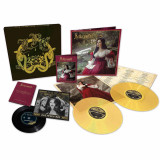
Dies ist das Sequel zum letztjährigen Album The Hypnogue, das neue Songs enthält, die die Geschichte und den Mythos des The Hypnogue-Albums erweitern und bisher nur bei Konzerten erhältlich war. Der Nachfolger oder zweite Teil von The Hypnogue wird in einer Deluxe-Papphülle geliefert (eine Doppel-LP auf Vinyl folgt möglicherweise später im Jahr). Der Schwesteralbum "Eros Zeta & The Perfumed Guitars" führt das Thema des letztjährigen, von der Kritik hochgelobten Erfolgsalbum The Hypnogue fort und erzählt die Geschichte in 15 neuen Songs weiter. Die Doppel-LP kommt in Galaxy green-Vinyl, die CD wird in einer luxuriösen Papphülle mit farbigem Booklet, schwarz bedruckter Stecktasche und wieder mit einem Coverartwork von Christiana Monored präsentiert. 15 großartige neue Songs von The Church, die uns weiter in den Kaninchenbau von Antarctic City führen. This is the companion album to last year's The Hypnogogue, featuring further tracks that expand the story and mythos of The Hypnogogue albums theme, previously available at gigs only. The follow up or second part of The Hypnogogue will be supplied in deluxe gatefold card sleeve (vinyl double LP possibly to follow later the year) Following on the theme from last year's critically acclaimed The Hypnogogue, 15 new songs take the story further. Double vinyl in Galaxy Green colour, CD presented in deluxe card gatefold sleeve with full colour booklet, black printed inners and sleeve with cover art again by Christiana Monored. 15 superb new tunes from the Church taking you further down the Antarctic City rabbit hole.
Buscar:son lux
THE VISION BLEAK kehren in der Luxusklasse zurück: Mit ihrem siebten Album "Weird Tales" zollt das deutsche Metal-Duo dem gleichnamigen amerikanischen Pulp-Magazin sowie anderen Geschichten voller Mystik und dunkler Phantasie einen monumentalen Tribut. Das Album besteht aus einem einzigen Track, der in interne Kapitel unterteilt ist. Diese erzählen schaurig-schöne Geschichten, vertonen Gedichte und sind von der klassischen Literatur des Horror sowie des Makabren inspiriert. Unter anderen beziehen sich THE VISION BLEAK auf bedeutende Autoren des legendären Weird Tales Magazins wie H. P. Lovecraft und Clark Ashton Smith. Sie spielen aber auch auf andere Großmeister der Phantastischen Literatur an wie zum Beispiel Edgar Allen Poe und Lafcadio Hearn, dessen "Fantastics and Other Fancies" einen starken Einfluss auf dieses Album ausgeübt hat. Für diese Hommage ziehen THE VISION BLEAK alle Register ihres enormen musikalischen Könnens. Die Kapitel decken die gesamte stilistische Bandbreite von extravagantem Gothic Rock über düsteren Doom bis hin zu harschen Black und Death Metal Parts - sowie so ziemlich alles dazwischen - ab. All die spannenden Elemente, welche die Anhängerschar des Duos lieben und schätzen gelernt hat, sind auf diesem Album vertreten: das Dramatische und Theatralische, das Raue und Schwere, das Melancholische und Unheimliche, aber auch eingängige und symphonische Momente. All diese Stränge sind zu einem dichten Klangteppich verwoben, der von einem wiederkehrendem Auf- und Abschwellen zusammengehalten wird, das an klassische Kompositionen erinnert. THE VISION BLEAK sind aus der Freundschaft zwischen Gitarrist, Bassist und Sänger Markus Stock alias Ulf Theodor Schwadorf und Schlagzeuger und Sänger Tobias Schönemann alias Allen B. Konstanz entstanden. Nach anfänglichen Experimenten in Richtung Gothic Rock fanden THE VISION BLEAK ihre eigentliche Berufung, als das Duo begann, ihre gemeinsame Liebe zum Horror-Genre mit einzubeziehen. Bereits das Debütalbum "The Deathship Has a New Captain" (2004) erzielte sowohl in Gothic- als auch Metal-Kreisen auf Anhieb einen Volltreffer und gilt mittlerweile als Klassiker. Da das Debütalbum thematisch an bedeutende Horrorfilme angelehnt war, nannten die Deutschen ihren Stil treffend: Horror Metal. Mit den folgenden Alben kultivierten THE VISION BLEAK einen Ruf als Garanten für stilvolle und hochwertige Musik. Thematisch drehen sich alle Werke um das Horror-Genre: Auf "Carpathia" (2005) folgten "The Wolves Go Hunt Their Prey" (2007) und "Set Sail to Mystery" (2010), "Witching Hour" (2013) und "The Unknown" (2016). THE VISION BLEAK, die Meister des Horror Metal, schenken der Welt ihr bisher ambitioniertestes Werk: "Weird Tales". Diese ausnehmend schöne und von Herzen kommende Hommage an das goldene Zeitalter der Phantastischen Literatur ist musikalische Poesie. Der Hörer möge mit Bedacht lauschen, sollte dabei aber immer auf der Hut sein. In diesem Song lauern unheimliche und verbotene Klänge aus anderen dunklen Welten!
We’re hugely excited to announce the brand new album from Dee C. Lee - ‘Just Something’, out 22 March on Acid Jazz. It follows the incredible response to the new single ‘Walk Away’ and last year’s double-sider ‘Don’t Forget About Love’ / ‘Be There In The Morning’, marking the return of one of the UK’s most revered soul singers. Dee is known for her work with The Style Council, Wham!, Slam Slam and Animal Nightlife, and an illustrious solo career (including the Top 3 hit ‘See The Day’). ‘Just Something’ is her first new record since 1998, and her debut for Acid Jazz. Available on LP and CD, all pre-orders from the Acid Jazz Store will be signed by Dee.
‘Just Something’ features 11 songs: nine originals co-written by Dee, a song penned by her daughter Leah Weller, a successful singer/songwriter in her own right, and two inspired covers. Produced by Sir Tristan Longworth, the album is a soulful collection that frames her instantly recognisable vocals in luxurious horns, percussion and keys, and heritage soul with a disco backdrop. While making the record has been a collaborative process, ‘Just Something’ is nevertheless the sound of a singer in charge of her own style and direction. Her vocal delivery and phrasing steal the show throughout, bright and lilting one moment, passionate and ringing the next. She cites Chaka Khan and Jean Carn as major influences, but Lee’s voice is resolutely her own, the product of a life lived.
Inspired by classic Motown, current single ‘Walk Away’ was written by Dee with one of her ‘brothers from another mother’, former fellow Style Council member Mick Talbot, and features Talbot’s distinctive piano and Wulitzer playing on the track. Talbot also plays on another of the album’s many standouts, the Leah Weller-penned ‘Everyday Summer’.
Three of the album’s songs, opener ‘Back In Time’, first single ‘Don’t Forget About Love’ and ‘How To Love’ were co-written with Michael McEvoy and Ernest McKone, whom Dee wrote with back in the 1980s. All three songs channel her musical past, from the thrill and excitement of those early Wham! days, going out and partying, to The Style Council’s trademark jazzy soul, and expressive balladry and killer choruses, which places Lee in the lineage of classic soul singers.
Elsewhere, on ‘Anything’, co-written with Paul Barry, Dee sings her heart out on a song full of optimism and hope for the future, while ‘For Once In My Life’, the oldest song here dates back to 1998, is effortlessly commercial and has hit written all over it, with Lee empowered and regal sounding over a warm blanket of bassy funk.
The album’s two covers, meanwhile, were both suggested to Lee by Acid Jazz’s Eddie Piller. In Lee’s hands, Renee Geyer’s ‘Be There In The Morning’ is pure celebration, taking its cue from the Norman Connors version from 1979. ‘I Love You’, written by Don Blackman and recorded by Weldon Irvine in 1976, could have been written with Lee in mind. A big club tune, Dee recalls hearing it everywhere she went and I wanted to keep as close to the original vibe as she could.
Dee’s relationship with Acid Jazz the goes back to The Style Council days, and it was the 2019 documentary ‘Long Hot Summers’ that renewed Dee’s friendship with label founder Ed Piller and director Dean Rudland. We’re honoured to release this record and be a part of Dee’s return to the forefront of UK soul music.
One could be forgiven for getting that familiar feeling when listening to the music of Ghost Woman. And that's not just because songwriter & multi-instrumentalist Evan Uschenko is deeply steeped in classic guitar-led rock & pop songwriting (more on that later), it's that the music was, by design, intended to be evocative. But not evocative, however, of any one thing; what separates the music of Ghost Woman from a great many other bands working today is his openness to non-specificity. He's not trying to impart any sort of message to the listener; instead, the hope is that one will find themselves luxuriating in nuances of how the music is delivered, and the feelings it stirs up for each individual.
For the past couple of years Ghost Woman has been Evan Uschenko's outlet for his interest in songwriting and recording, which began after a number of years spent playing as a sideman in various Canadian indie ensembles, most notably in the Michael Rault band, a group that displays a similar affinity for perfectly dialed, partially yesteryear-looking guitar pop. Following 2022's self-titled
debut, issued by UK-based Full Time Hobby to great critical acclaim, Anne, If presents a slightly more expansive vision of what Ghost Woman can offer.
Forest Green Vinyl. Als uneheliches Kind von Elvis und Lux Interior hat der israelische Gitarrist Charlie Megira während seiner viel zu kurzen 44 Reisen um die Sonne ein berauschendes Amalgam aus 50er-Jahre-Trash-Rock, Surf-Tremolo und hallgetränktem Goth gebraut. In 15 Jahren nahm er sieben Alben auf, die hauptsächlich auf CD-R veröffentlicht wurden, die meisten davon sind heute unlesbar oder liegen auf einer Mülldeponie. Nur mit einer Eko-Gitarre, einem schwarzen Smoking und seiner charakteristischen Sonnenbrille bewaffnet, war Charlie Megira ein Künstler, der sich in Luft auflöste, während wir alle auf unsere Telefone starrten. Auf seinem Debütalbum "Da Abtomatic Meisterzinger Mambo Chic" aus dem Jahr 2000 kanalisiert Megira den Optimismus der amerikanischen Nachkriegszeit, narkoleptischen Surf und den Soundtrack von Twin Peaks zu einem ganz eigenen Lo-Fi-Meisterwerk. "Mambo Chic", das sowohl auf Hebräisch als auch auf Englisch gesungen wird, bewegt sich in einem bedächtigen Tempo, unbekümmert um den Verkehr der modernen Welt und eingehüllt in eine Decke aus Tascam-4-Spur-Rauschen. Auf "Tomorrow's Gone" gelingt Megira das Kunststück, so weit in der Vergangenheit zu sein, dass er irgendwie in der Zukunft lebt und darauf wartet, dass der Rest von uns ankommt.
- Mar Vista - Visions Part 1 Her Eyes Are Closed
- Kennlisch - Kennlisch
- Crystal Eyes - Crystalzed
- Warlus - Girl Like You
- Gerard Alfonsi - Fana Stickle
- Geoffroy - Viking
- Amphyrite - Symphonie Pour 3 Oeufs Brouilles
- Eole - Friendship
- Capucine - Les Elephants
- Rictus - Flashes
- Inscir Transit Express
- Polaris - Polaris
- Joel Boutolleau - Force
- Spotch Forcey - Frustre
- Demon Wizard - Black Witch
- Temple Sun - Voyage Sans Retour
- Chantal Weber - Ballade Aux Chataignes Tombees
- Jean-Claude Zemour - X Kmh
- Rhodes Co - Baoum
- Guidon Edmond Et Clafoutis - Stormy Sunday
"For a long time, I'd come across these discs without really understanding what connected them, apart from a button and that famous logo designed by René Dessirier. Then, with a little more digging, I discovered the "self-production" link. For choirs, schools, folk singers, young pop groups, popular homes and even great composers who engraved unique copies of certain recording sessions...
The French equivalent of the English "Derby Service", the Kiosque d'Orphée, formerly at 7 Rue Grégoire de Tours in the 6th arrondissement, was taken over by Georges Batard in 1967 and moved to 20 Rue des Tournelles in the 4th arrondissement of Paris. The adventure lasted until 1991. Georges Batard was a sound engineer who used a Neumann tube engraver to engrave acetates from the tapes he received, before printing the precious vinyls in the press factories of the day, where he was able to produce very small runs of between 50 and 500 copies.
Of course, there were other structures for releasing his records, such as Voxigrave or, later, FLVM, but none of them had so many records in their catalog. Le Kiosque d'Orphée was neither a label nor a publisher, but a structure that allowed you to press your own vinyl, at a time when it was quite an adventure to get your first 45 rpm or 33 rpm album released!
Georges Batard was described as passionate and conscientious. His son, bassist Didier Batard, wrote of him:
"Georges was passionate about recording and reproducing the stereo sound of his great passion, music. He paid close attention to distortion rates, signal-to-noise ratios, response curves, rise times and other damping factors in audio equipment. He was looking for the exact reproduction of concert hall sound in his living room (with the same sound level, if possible...). In the late '50s/early '60s, he found other sound enthusiasts in AFDERS (Association Française pour le Développement de l'Enregistrement et de la Reproduction Sonores). He became its honorary president. Every Saturday afternoon, its members met to test au- dio equipment. Their opinions were published in the monthly Revue du Son.
All you had to do was send in your tapes and choose the number of record copies you'd like to take home with you, so you could finally share your creations and, in a way, exist. You could opt for a generic sleeve, available in several colors, directly customizable with your name and credits, or you could design your dream sleeve yourself in your living room or at a printer's.
This "Do It Yourself" temple gave birth to some superb pouches. Stencilled, hand-written, illustrated with paintings, drawings, illustrations by friends or girlfriends of the time, photo prints hastily stuck in the middle of a blank, white sleeve, on which the traces of time would leave their imprints, so that collectors and the curious would come and buy them decades later, with the promise of a musical discovery, unfortunately not always fulfilled...
What most of these records have in common is the youth of their songwriters, whether or not they've had a career. Stories of buddies, of getting by and dreams of glory made up this catalog. Most of them were amateur productions, both in terms of the level of the musicians and the quality of the recordings, made on a two-track or, the ultimate luxury, a 4-track in a teenager's bedroom or parents' living room.
It was the beginning of the home studio, thanks to the advent of the Revox portable tape recorder. A bit of a shaky DIY system, but, in return, the luxury of setting no limits: one-sided tracks, no outside censorship, no artistic director, no manager, no Barclay or EMI/Pathé Marconi logos...
When you finally had your own record, you could give it away or sell it to friends, family or after concerts. You could also drop it off at the nearest record shop, with undisguised pride.
It was also a calling card that could be sent to radio stations or music labels, in the hope of launching a career...
Many of the protagonists in this story tried to sign with labels, but in those days, bridges were not so easy to build between one's hometown, or even one's village, and the major or more specialized label that might have released these records. At the time, the advertisements published in the press by the Kiosque d'Orphée opened up the field of possibilities for provincial composers. It was now possible to make their own record, without having to go through the process of signing with a label.
Some of the composers who have gone on to make a career have used this channel to release their first record or parallel projects (Claude Engel, Dominique A, Andy Emler, Michel Deneuve, Claude Mairet, Mick Piellard, Tristan Mu- rail...) and sometimes even single or very limited pressings of work or promotional copies (Bernard Parmegiani, Jef Gilson...).
This album is the conclusion of a long investigation, begun six years ago. It took a long time to find the records, scattered all over the place, in the homes of collectors and sometimes the musicians themselves, and then to listen to them, sometimes painstakingly, to unearth these moments of grace.
From this work, 23 tracks remain, but there are dozens of others that could have been included, so we had to choose, and the choice had to be as universal as possible. This selection is obviously not objective, but I hope you'll like it.
Today's music is raw, touching and powerful. "
Jean-Baptiste Guillot - Born Bad Records

For the 15th anniversary of this timeless classic, !K7 Records are re-issuing Tosca’s seminal album ‘No Hassle’ in an audiophile 3LP format.
Multi-instrumentalists Richard Dorfmeister and Rupert Huber have been friends since their Vienna schooldays. Richard later became half of the globally acclaimed DJ-producer duo Kruder and Dorfmeister, while Rupert worked in piano composition and sound-art installation. ‘No Hassle’ is Tosca’s fifth studio album.
A luxurious tapestry of analogue and digital sounds, submerged samples and live instruments, it evolves and expands into an hour-long ambient symphony. The title reflects not only the duo’s laidback approach to making music but their whole philosophy of life.
‘No Hassle’ is all about contemplation and concentration. While recent Tosca releases like J.A.C. (2005) and the remix collection Souvenirs (2006) were a move towards classic song structures and club-friendly grooves, their latest is a much more introspective journey into inner space.
Tucked away in a corner of northwestern Europe and so small you could drive through it in minutes without noticing you were ever there, Luxembourg is often overlooked. This is also true for Luxembourg’s music scene, and even more so in the early 1980s. Aside from a string of victories at the annual Eurovision song contest or the mighty Radio Luxembourg that had for decades been blasting jazz, rock and other modern music into stolid Western European ears, very little else seemed to be going on. But even in a country of barely 350,000 people, musical adventurers had picked up on the spaced-out jazz-funk of bands like Return to Forever, Herbie Hancock’s Mwandishi, Weather Report, George Duke, and the electric Miles Davis. Under the leadership of trumpet player Gast Waltzing, a handful of them put together a band called “Atmosphere” and used the sound of their inspirations as a launchpad for their own musical exploration.
What you hold in your hands is a “best of” the Atmosphere band, which released two albums and a 7” single between 1981 and 1986. Privately pressed and long out of print, with original copies very hard to come by even in their country of origin, these records have for years been unheard by anyone outside hardcore collector circles. With no master tapes available, it was a real labor of love to track down the best quality vinyl copies and to reissue a selection of our favorite tracks in professionally remastered form.
Editions de Lux is a new label dedicated to unearthing and releasing records we love and believe deserve more attention, with a focus on Luxembourg and the surrounding countries. We are just the latest in a long line of immigrants who have come to work in Luxembourg and who are trying to find our own path into the heart of this mysterious little country that has much more to it than dark forests, medieval castles, rusting steel mills, and shadowy banks.
After humble lo-fi beginnings in the Australian Art-Pop Underground, Donny Benet has expanded his cult-like following across the Globe with a resonant Array of danceable Repertoire dealing with Love- and Affection. New album "Mr Experience" marks a new chapter, informed by a wealth of musical- and personal development.
For Mr Experience, Donny envisioned a Soundtrack to a Dinner-Party- Set in the late 1980's. While his earlier Recordings drew Inspiration from DIY Pop Conspirators such as Ariel Pink & John Maus, Donny channelled the Stylings of Bryan Ferry & Hiroshi Yoshimura as the Impetus for new Material, evident on the Intimacy found on ‘Girl Of My Dreams’ and it's lush production- with a soothing whistle-along Chorus for good Measure!
Sincerity has been a key component of Donny Benet’s output since the beginning. His songs deal with genuine Emotion served on a kitsch Platter. An alter-ego manifested in the beginning of the 2010's, Donny has blurred the Lines of Artifice to create a back- Catalogue that can embrace- and challenge, often simultaneously, - the notion of Irony in Art.
"Mr Experience" moves further away from ironic Notions as Donny explores lyrical- and musical themes which embody Observations of Maturation in his audience, his tightknit musical Community- and himself. While ‘mature’ is a term that often rings hollow as an album descriptor, the term couldn’t be more apt for Mr Experience.
Previous album The Don was created with the luxury of time. The phenomenal Response to that Album across Europe- and the United States - fuelled by accompanying Music Videos clocking in Views in the Millions- meant that there were scant Windows of Opportunity to write- and record a follow-up.
With a legacy in Sydney’s music community, working with Sarah Blasko, and tightknik collaborators Jack Ladder & Kirin J Callinan, Donny Benet is accustomed to collaboration on the Stage- and in the Studio, mostnotably on the 2014 full-length release Weekend At Donny’s.
“There is such immense talent evident in every aspect of the Donny Bene experience - the vision of the character, the steadfast adherence his narrative and the musicality of Benet himself all combine to makesomething truly genius.” - Double J, Australin.
“Donny Benet makes feminine music for everybody” - Vice, Netherlands.
“The Don does not sound like amusical copying machine”. - 3voor12 National, Netherlands.
“The set was punctuated with virtuosic solos and exquisite harmonies, and added another layer of genius to the show.
We almost couldn’t handle it... Donny for president!" - Indie Berlin.
“Everyone loves Donny Benet” - Feature in Gonzai, France.
“Phenomenal Australian Showman... Offers Top-Class Dance Music with Virtuose-Bass Guitar- and Keyboard Parts & incredible Sound-Colour feel.” - Podujatie.sk, Slovakia.
Donny has toured Europe five times since the start of 2018 and has played in the UK, Austria, Germany, Slovakia, France, Netherlands, Spain, Portugal, Belgium, Denmark, Switzerland, Czech Republic, Greece and Sweden. The Don will revisit Europe twice in 2020, once for his own headline shows in May then back again in August for festivals!
Complete with 10" vinyl record and booklet presenting Laurianne Bixhain's photographic work and text by Chloe Chignell.
Presented at the Mudam (Museum of Modern Art of Luxembourg) and initiated by a photographic exploration by Laurianne Bixhain, the work "The day begins with a loud boom" interrogates the manner and extent to which we are defined by our relationship to the physical environment, and the cultural import of the techniques of production. Its imagery follows the trajectories of the materials subjected to the processes of diamond cutting and automotive glassware fabrication, and presents the traces of human intervention of which those materials are both the object and the repository.
The interplay of its imagery, music and text constitutes a theatrical whole: both the staging of the text and the sonorities create an architectural space within which each constituent object is deployed. That spatiality is shared and complemented by the text’s sonorous and performative qualities. Likewise, the elements of texture and abstraction in the imagery invoke our sense of touch, as a means of material and spatial appreciation.
The succeeding reiterations of the ostinato the day begins with are treated graphically by its progressive effacement, evoking the tension in assembly line work between repetition and linearity, accumulation and exhaustion, trace and erasure. Such attrition is equally conveyed by the harsh, impassive, and architectural qualities of both the images and the music which accompany the text. The latter notably deploys a range of insidious effects, from the marriage of dissonance and unsettling rhythm evocative of the competing cycles of multiple industrial machines, to sensual and reassuring sonorities which are contaminated by their contrast with the harsh acoustic aesthetic elsewhere.
A Colourful Storm begins 2024 with a luxurious suite of daydreaming introspection courtesy of Unchained, the longstanding solo project of Nathaniel Davis who was last seen on vinyl in the final Blackest Ever Black release. Recorded at home between 2020 and 2023, Gabbeh is the latest expression of Davis's guitar-based instrumental musings and represents a stylistic evolution of his self-released noise tapes and CD-Rs into romantic, bossa nova-influenced melody-making. He wrote the tracks sporadically, with minimal instrumentation and intervention. Electric guitar, bass improvisations and rhythms from an old drum machine are layered and given new life, the space between them softly breathing with minutiae of the everyday: the buzz of cicadas, the passing of cars, the whistling of passersby. The psychogeography of Grenoble, Davis' home since 2018, played a conscious role in the weaving of Gabbeh's fabric: "I think certain songs reflect, in ways, Grenoble's natural surroundings. 'Drac' is named after the river that flows from the mountains down to the city… 'Dru' is the name of a well-known peak near Chamonix". Opener 'Largo' sets the mood, its primitive samba rhythm concealed by a cloud of saudade. The bebop sensibility follows suit, the tension between its angular picks and percussive shuffle a wondrous balancing act, while the intoxicating sway of 'Rambler' is perhaps the most poignant expression of longing and loss we've heard in recent years. Highly recommended for fans of Durutti Column, Maurice Feebank, Toninho Horta.
From out of nowhere - if nowhere is the febrile, warped and twilit imagination of Julia McFarlane - comes Whoopee, the second album by J.McFarlane’s Reality Guest. Whoopee is an esoteric, kaleidoscopic movie in music form directed by Julia McFarlane and co-conspirator Thomas Kernot. Full of life, breakbeats and smokey vignettes on the fragile nature of interpersonal relationships, Whoopee is a stylistic evolution from everything McFarlane has done before. Surreal, beautiful in parts and replete with the aching wisdom McFarlane’s songwriting has always promised, this Reality Guest pulls back the curtain on a whole scene of naked truth. Recorded in Melbourne in bursts since the release of 2019’s Ta Da, Whoopee features a new sound palette and band member in Kernot. The duo dive deep into electronic pop tropes, mining digital synths, samples, breakbeats and deep bass grooves, largely dispensing with live instrumentation. If Ta Da took twists and turns with your expectations, offering a Dada-ist, monochromatic take on pop music, Whoopee is McFarlane’s subterranean love-sick pinks, reds, greens, purples and blues. Becoming something of a tradition, the album starts with an instrumental intro pilfered from a 90s’ spy film or cinema intro music, puffing up the listener for the heart-squeezing bathos of Full Stops. Over a bleary backdrop of walking bass lines, jazz- inflected keys and smoked-out atmosphere, McFarlane’s poetry narrates the fragile state of a relationship: “You put a full stop where I thought there’d be a comma, I want the story to continue even with all the drama.” Over a palpable pain, the narrator is revelling in the drama of a relationship, addicted to tumult and heightened emotion. On Sensory, a space age bachelor lounge pad ballad, the converse state of the previous song is explored, here the narrator is battling the numbness of being out of the drama, stuck in a sensory-deprivation tank, anaesthesized and battling to emerge from the fog. Wrong Planet explores an otherworldly pop music, hewing a bright hook out of a sense of confusion. A bona-fide, sing-along chorus bursts out of the narrator musing on the absurdity of existing in this reality. It speaks of one of Julia McFarlane’s main talents, her knack of inspecting human relationships and states with a clear perspective, like an alien visiting Earth and realising everything we are is really, really strange. Whoopee is both more accessible than previous Reality Guest work and somehow more obfuscated. Where the production on Ta Da was dry, sharp and strange, this Reality Guest is blurred, almost smeared with the effluvium of 90s+00s culture and existence. Through it all, it’s hard to deny the undeniable pull of the songs. Precious Boy carries on the lounge theme with a whole sampler of cut up sounds fading in and out of the haze as McFarlane’s voice is right up to the speaker cooing and free- associating, maybe in love or maybe in confusion... maybe they’re the same thing? Sometimes the listener is invited to just bathe in the tone of the vocal, as on Apocalypse, where the texture and timbre of the vocal is luxurious, bathing in piano tinkles and double bass throb. On lead single Slinky, a cut up beat reminiscent of Washingtonian Go-Go drum patterns leads, the song slipping through your fingers, elusive and presenting sound as pure pleasure. Closer Caviar jumps back into the broken breakbeats of a surreal funk, fuelled by the sensory pleasure of the music, a hedonistic whirl in rapture, the narrator now living life to the fullest in all its giddy heights and deep troughs. This is the album’s main character fully-actualised and in the terrible, beautiful moment.
Massimiliano Pagliara’s Funnuvojere Records is thrilled to present a very special addition to its flourishing catalogue. This new release, ‘Hanging in The Stars Part 1’, comes from Voiski, aka Luc Kheradmand.
Voiski has been a prominent figure in the electronic scene for over a decade, with a discography that spans across labels such as Dekmantel, L.I.E.S, and Delsin Records. With ‘Hanging in the Stars Part 1’, he delivers a collection of tracks that showcases his mastery of sound design and emotive melodies.
‘Romance Mentale’ sets the tone for the EP with its deep, rolling bass line and soaring synth lines. The ambient ‘Harmonie Du Soir’ follows. It’s made of spacious pads creating a weightless atmosphere that provides a luxurious sonic experience.
‘Call It Madness’ has an infectious groove and propulsive tempo. With its layering of arpeggios that implode and scatter, the track creates a sense of euphoric energy that is driven by an unyielding beat.
The EP concludes with the ethereal pads and poignant melodies of its title track. With this unforgettable collection of tracks, anticipation for Part 2 is already building.
Orchestral Manoeuvres In The Dark (OMD) return with their 14th studio album Bauhaus Staircase, over six years after the triumph of their Top 4-charting record The Punishment of Luxury. The album was born from the impetus to kickstart new explorations during lockdown when as Andy McCluskey admits: “I rediscovered the creative power of total boredom.”
The album’s first offering as a single is the title track which serves as a nod both to Andy McCluskey’s love of the Bauhaus era & the power of protest art. “I am a huge lover of visual arts especially mid 20th century movements” Andy comments. “The song is a metaphor for strength and artist passion in the face of criticism and adversity. When times are hard there is a tendency for Governments to look at cutting funding for creativity just at the moment when the arts are most needed to nourish our souls. It seems appropriate that the song and its eponymous album were created during Covid Lockdown.”
Ranging further from the beautiful film noir ballad of ‘Veruschka’ and the dance stylings of ‘Anthropocene’ - a term for the current epoch in Earth’s evolution to the sinister ‘Evolution Of Species’ and the hectic ‘Kleptocracy’ - OMD’s greatest straight-up protest song - the new album is a broad electronic sonic masterpiece that lyrically tackles the topics of the future. The record closes on ‘Healing’ - a moment of reflective calm.
By rights OMD should be in semi-retirement performing classics like Enola Gay and Maid Of Orleans on the nostalgia festival circuit like so many peers. Instead they’ve created a landmark album worthy of their finest work. Bauhaus Staircase remains unmistakably the work of a duo who are still perfectly in sync 45 years after their first gig at legendary Liverpool club Eric’s.
“I’m very happy with what we’ve done on this record" McCluskey summarises. “I’m comfortable if this is OMD’s last statement.”
Featuring for the first time in the UK on 7-inch vinyl, ‘Touching And Caring’. Originally recorded in 1985 for the album Nina’s Back! In truth, Nina’s resurgence came a couple of years later in 1987 when the luxury brand Chanel No. 5 featured ‘My Baby Just Cares For Me’ in a UK TV ad campaign. Charly released the song and took it to #5 on the national pop charts. We reissue here as part of the forthcoming 50th Anniversary celebrations.
Four essential cuts from Ghana & Cape Verde, compiled by Arp Frique...
Music is a great connector, bringing people together in many ways. On his journey in music so far, Arp Frique has been fortunate to meet many beautiful artists. The songs on this first edition of "Radio Familia" are deeply connected to the musicians he performs with. Join the music family on a trip through exciting sounds from Ghana and Cape Verde and listen to their story in both words and music.
Arp Frique never played a show without including Americo Brito’s epic song “C’est Dudu”. The song originally appeared on his album “Fidjo Di Mizeria” from 1989 but he had been performing his anthem for years and it came in many shapes and forms. After spending a lot of time in Paris, he (like many others in those days) got inspired by new records from Guadeloupe and Martinique, especially “kadans”. Incorporating latin piano motifs borrowed from salsa and merengue and a bold choice to sing in French, the song and album became an instant success for Americo in and outside the clubscene (note: DJs were not the primary source of dance music in those days, bands played all night to keep the dancers moving). The addition of C’est Dudu to this compilation became especially relevant since Americo recently passed away. Fortunately, his anthem just like all his other music will remain with us for decades to come.
While going through the archives with Americo Brito for the Radio Verde compilation, he introduced Arp Frique to a band called Imilux Star, of course again well connected with Americo. This Cape Verdean band residing in Luxemburg (where there is a substantial Cape Verdean community) definitely added a different flavor to the musical pallet the islands are famous for: heavy syncopated rhythms coming from the drum computer. They released two albums which both became very popular in their scene and the track “Yolanda” from their 1988 album “Jota Dê” got to Arp Frique’s attention too late to add to the Radio Verde comp. The band is still performing to this day in the Luxemburg-Cape Verdean live circuit.
While Arp Frique was on the road with his lead singer Mariseya, they talked much and deep about Ghanaian music (especially highlife) and he learned a lot about the community from Ghana in the Netherlands, mostly in Amsterdam and The Hague. Mariseya’s dad, Nana Adomako Nyamekye, came to see their liveshow while in the UK which was very special to them considering he is one of the highlife artists Arp Frique has grown to be very fond of. His deeply funky and bubbly bass driven song “Obra Twa Owuo” is about life and death, telling us we should all love each other as we still have life to live. Originally released on “Ano Plan” from 1982, the album is filled with philosophical advice. In his own words: “A message to all humans that something awaits us all at the end of life. Let’s live together with love.
Bnnyhunna, from the Ghanaian community in the Netherlands, joined Arp Frique’s live experience several times playing keyboards and synthesizers. His dad Elvis Kwasi Ankomah, just like him, developed a high level of musicianship while performing regularly in church. The song “Fa Wokoma Mame” (give me your heart) from his only studioalbum “Mfa Menko” released in 1995 is about showing his love to a lady but only if she puts her trust in him completely. The album talks about love, pain, relationships and life. Having worked with artists like Daddy Lumba, Nana Ampadu, Amakye Dede and many other hiplife and highlife legends, he still plays in church every week and has been doing so ever since he was 15 years young.
1STEP Process 180g 45rpm Double LP Pressed on VR900-Supreme Vinyl!
Mastered From The Original Analogue Master Tapes by Bernie Grundman!
Super-Luxe "Monster Pak" Jacket with a Rich 36-Page Booklet & Striking Outer Slipcase!
New lacquers cut for every 500 pressings!
Strictly Limited To 7,500 Numbered Pressings!
There have been more than 40 U.S. releases (and hundreds more worldwide) of Stan Getz's cultural touchstone album and for good reason: few recordings better capture the breezy warmth and easy-going sophistication of Brazilian bossa nova for an American jazz audience. Fewer recordings can replicate the you-are-there presence and flawlessly tight studio acoustics. Only Getz/Gilberto has Billboard Top-10-charting singles like "The Girl from Ipanema." When Impex Records jumps into this densely-populated fray with our own production, we need to bring maximum value and prestige to it. Challenge accepted. We worked directly with Stan's wife Monica Getz and their son Nicolaus to create the most authentic, best-presented Getz/Gilberto ever.
Exclusive to Impex's 1STEP Getz/Gilberto includes an insightful new interview/essay by Charles Granata featuring Monica reminiscences of the making of this record, the subsequent cultural phenomenon, and Stan's battles with some pretty heavy demons. Also unique to this release are two bonus tracks: an alternate mono 7" mix of "The Girl from Ipanema" (without the added echo, thank you very much) and a live recording of "Corcovado" from Carnegie Hall. Finally, the large-format, 36-page booklet features dozens of rare photos, the original album notes, and a fascinating personal remembrance from Monica Getz herself, celebrating her late husband's work and an inside look at Stan's family life while making the record!
Using the original analog master tapes and no computers at all, Bernie Grundman at Bernie Grundman Mastering sought to keep the sense of space and tone on the master tape intact without unnecessary embellishment. Impex 1STEPs get you closer to the source, not the ideal.
We know you have many choices when it comes to enjoying this singular album. The Impex 1STEP of Getz/Gilberto cuts above all other releases with added-value content that takes you deeper into Stan Getz's life and process in a way never previously possible.
The 1STEP Process:
The Impex 1STEP process relies on short, tightly-controlled runs that require a new lacquer after each 500 pressings. This unforgiving format has the lacquer skipping the regular father-mother process, going right to a single convert and then pressing. Though this dramatically increases mastering and production costs, it also assures each run is more consistent from disc to disc, with less noise, clearer details and deeper bass.
Reducing production complexity to just a single "convert" disc between the lacquer and the press greatly improves groove integrity, diminishes non-fill anomalies and increases signal integrity from the master tape to your system.
Features:
The only release of this fundamental jazz classic crafted with the full participation of the Getz family, including never-before-seen photos and notes from Monica and Nick Getz
Exclusive new interview essay about Getz's life and the recording of the album by noted producer and historian Charles L. Granata
Exclusive ultra-luxe Impex 1STEP packaging featuring a deluxe 36-page booklet within a heavy-stock two-sleeve Monster Pack jacket and striking colour-matched slip case
Two all-analogue bonus tracks: an alternate mono 7" mix of "The Girl from Ipanema" and a live recording of "Corcovado" from Carnegie Hall
Limited to 7,500 copies
With its tenth record from Fortunato Durutti Marinetti, Quindi continues to celebrate songwriting and storytelling framed by curious musicality. In keeping with the label's trajectory to date, this is an album which draws on a universal human sentimentality and presents it with an uncommon flair. In the case of Toronto-based Daniel Colussi, the man behind Eight Waves In Search Of An Ocean, his melancholic poetry cuts through with a clarity which calls to mind all-time greats from Anette Peacock through to Lou Reed and Leonard Cohen.
Turin-born Colussi has drifted through various bands, guises and styles over the past 20 years, but since settling into Fortunato Durutti Marinetti as a vehicle for his songs, he's found a strong expressive impetus which transcends genre to become entirely hinged on the power of his words and melodies. The first album under this alias was a 2020 cassette album, Desire, later pressed on vinyl due to demand in tandem with the release of 2022's Memory's Fool. On each record, Colussi has found distinct arrangements of players to set the mood, ranging from gently lilting art and folk rock through to orchestrated balladry, but Eight Waves In Search Of An Ocean widens the palette of Fortunato Durutti Marinetti to create an album in which each song feels like a tale unto itself.
Colussi's renewed approach is instantly apparent as album opener 'Lightning On A Sunny Day' unfurls, informed greatly by producer Sandro Perri's input pursuing a hybrid electro-organic sound. The addition of drum machines and synths to the musical palette bring with them the strong connotations of pop while the sax and violin sounds similarly smooth and silky, and one can't help but think of John Martyn's slide into the digital sound of Sapphire or Kraftwerk's bittersweet synthetic tenderness.
Within this sound, there's still space for the energy to fluctuate according to the whims of songs. 'The Flowers' turns inward with a soft-touch composition as delicate as the petals Colussi describes falling to the floor. 'Misfit Streams' and first single 'Clerk Of Oblivion' savour the fluid, luxuriant tone of fretless bass with all the 80s connotations intact. Colussi remains the central focus whatever happens around him, in possession of the kind of unforced charisma which drives a song deep into the listener's heart. It's at once entirely his own style and yet comforting and familiar. The lyrics might sweep you into the singer's inner world, similarly to the experience listening to late 60s Tim Buckley, or you might well inhale the mellow jazziness of the harmonic movement like you would Joni Mitchell on Hejira.
The emotional direction of each track is never linear - 'Smash Your Head Against The Wall' snarls its rhythm section before the strings sow their aching beauty to cool the song's temper, winding up as a track of distinct halves jabbing at each other. "I Need You More' leaves space for spiralling flute solos and strangely stiff, militaristic drum rolls in the midst of a sweet, slightly sad synth ballad, the final wave receding back into the tidal undulations of Colussi's unique exploration of his muse.
The artist himself dubs his musical expression as "poetic jazz rock" with a sideways glance - it's not exactly poetry, far from trad jazz and it doesn't really rock, yet the tag feels uncannily like it fits, just like the curious music it's used to describe.
Seven Steps to Heaven arrived at a crucial junction in Miles Davis' career. Recorded at two separate locations in spring 1963, it served as Davis' first release in more than a year – a layoff that was then unprecedented for the jazz visionary who had issued at least one LP a year since debuting in the early '50s. Equally notable, Seven Steps to Heaven marks the point at which the core of Davis' Second Great Quintet started to assemble. The twice Grammy-nominated effort is also Davis' final studio record to blend standards with originals. And it happens to be one of the expressive, well-played albums in the jazz canon.
Sourced from the original master tapes, pressed at RTI, and housed in a Stoughton gatefold jacket, Mobile Fidelity's 180g SuperVinyl LP of Seven Steps to Heaven adds yet another step (or more) towards the bliss suggested by the album title. Playing with standout clarity, detail, tone, and balance, this audiophile reissue pulls back the curtain on the instrumentalists. Afforded the tremendous advantages of SuperVinyl – including a nearly inaudible noise floor, dead-quiet surfaces, and superb groove definition – this numbered-edition version presents Davis and Co. amid a wide, deep soundstage whose dimensions and solidity help bring the record's historical importance and musical merit into focus. Warm, organic, and present, the SuperVinyl LP of Seven Steps to Heaven is what great-sounding hi-fi is all about.
And there's nary a passage on this 1963 landmark that isn't great. That Davis manages to make it feel so cohesive and seamless is a testament to the inspired performances and engaging compositions. Davis didn't draw it up the way it unfolded. No matter. He held trump cards that stayed up his sleeve for the next three decades: A drive to be nothing less than superb, a refusal to settle for mediocrity, and standards to which nearly no other composer or player could match. "The toughest critic I got, and the only one I worry about, is myself," Davis wrote in the liner notes. "The music has to get past me."
Davis' demanding approach partly explains why he switched up his band between the first and second sessions – and underscores how fast his mind was racing with new ideas. Seven Steps to Heaven acts as the stable bridge between the transitional period that followed the dissolution of his First Great Quintet and formation of the Second; without it, Davis perhaps doesn't invite then-23-year-old Herbie Hancock and a still-teenage Tony Williams into the fold. The trumpeter not only got his men – he preserved in amber for the only time (well, magnetic tape anyway) the chemistry and vibe he achieved with pianist Victor Feldman, drummer Frank Butler, tenor saxophonist George Coleman, and bassist Ron Carter.
That line-up gels for half of the six songs on Seven Steps to Heaven. Captured in Los Angeles April '63, the quintet stretches out on a luxurious reading of the late '20s New Orleans staple "Basin Street Blues"; lays on the romance for a candlelit stroll through the '40s standard "I Fall in Love Too Easily"; and explores the rounded contours and melodic crevices of the early blues "Baby Won't You Please Come Home." The performances are refined, elegant, emotional; the band lets the feelings linger and gives the listener time to absorb the colours and textures.
A month later, Davis returned to New York City with Coleman and Carter, and partnered them with Hancock and Williams. Tellingly, the quintet tried its collective hand at the title track and "Joshua" – Feldman-penned songs already recorded in Los Angeles – as well as the yearning "So Near, So Far." Those are the tunes that comprise the other piece of Seven Steps to Heaven, with the revised quintet's liquid pulse, articulate dynamics, and timing shifts a harbinger of things to come.
It's also worth mentioning that the interpretations of the bounding "Seven Steps to Heaven" – a showcase for Davis' trumpet – and interlocking "Joshua" netted considerable radio airplay and attracted the attention of other contemporaries who covered the songs. Keeping Carter and Williams as the rhythmic engine, and Hancock as the anchor between solo flights and structural motifs, Davis would soon soon welcome Wayne Shorter into the family and transform jazz. Again. The aptly – and, in hindsight, perhaps prophetically titled Seven Steps to Heaven – is how he got there.
The American singer-songwriter tradition has always been tethered to a rustic austerity, the sort of front-porch authenticity that suggests an age where home electronics are still considered luxury items. But there's also the ongoing influence of Bob Dylan and The Band's Basement Tapes-that strange and beloved document of the magic that happens when private experiments with the folk template flourish into layered and lush songs-and its genesis through informal recording sessions. In our modern age, these kinds of casual DIY constructions are perhaps the more honest contribution to the Americana lineage-the true homespun artform. When Michael Nau and Whitney McGraw struck out on their own in the wake of the dissolution of their beloved indie-folk outfit Page France, they continued their songwriting practice with a new project called Cotton Jones Basket Ride. As legend has it, Nau and McGraw were working on the material for their debut full-length Paranoid Cocoon (2009) when they realized they had an entire album's worth of odds-and-ends from various recording sessions. The resultant album - The River Strumming - was released in 2008 on St. Ives in a batch of 300 unique hand-packaged LPs. As the label advertised it back in the day, the band "initially set out to make a cohesive record, and made just the opposite." Like The Basement Tapes, The River Strumming is a document of a band exploring possibilities without the weight of expectation. The band would eventually condense their name to Cotton Jones and make a name for themselves in the indie world for their fusion of dreamy folk and psychedelic baroque pop. But in the beginning, there was this weird and wonderful collection of songs made by musicians who were enjoying the private process of finding their path. Suicide Squeeze is proud to present a 15th-anniversary vinyl reissue of this long out-of-print classic with updated artwork by Kayleigh Montgomery-Morris.
Limited Edition Vinyl Reissue mit 8-seitigem Songbook mit Texten und Akkorden, den 68-seitigen Locas In Love Winter Chronicles / Tour-Diary + Foto-Druck.
Ende 2008 veröffentliche die Kölner Band Locas In Love ihr drittes Album „Winter“ als Follow-Up zum Überraschungserfolg "Saurus" (2007). Geschrieben und aufgenommen wurde es innerhalb von zwei Monaten im Sommer 2008, es sollte unkompliziert, schnell und unmittelbar passieren und konsequenterweise wurde "Winter" als erstes komplett selbstproduziertes Album der Band in Wohnzimmern zwischen dem Kölner Gereons-Viertel und Brooklyn, NY produziert. Durch das titelgebende Thema ist es nach wie vor das geschlossenste ihrer Alben, und es ist das Dokument einer Freundschaft.
Anlass für das Vinyl-Reissue ist nur in zweiter Linie das 15jährige Release-Jubiläum oder die Tatsache, dass das Album lange vergriffen war, sondern vorrangig der unerwartete Tod von LD Beghtol im Jahre 2020. Den New Yorker Ausnahmekünstler lernten Locas In Love als Fan seiner Musik (u.a. als Mitwirkender und Sänger der Magnetic Fields auf "69 Love Songs") kennen. Auf „Winter“ trat er als Quasi-Mitglied und Co-Producer in Erscheinung und kann so auch zukünftig von neuen Musikfans u.a. mit seiner meisterhaften Song-Miniatur "Packice" entdeckt werden, dieser herzzerreißenden Mischung aus Winter-Blues und Kryogenik-Science-Fiction.
Und so erscheint nun beim Berliner Label Staatsakt (das soeben sein eigenes 20jähriges Bestehen ausgiebig feierte) das luxuriös ausgestattete Reissue. Die handnummerierte Limited Edition samt neuem Artwork von Stefanie Schrank enthält das von LD Beghtol gestaltete Scrapbook, das auch der Erstpressung beilag, ein 8-seitiges Songbook mit Texten und Akkorden, sowie die 68-seitigen Locas In Love Winter Chronicles, in denen Tour-Tagebücher und andere Texte aus der Zeit mit einem aktuellen Selbstinterview der Band zusammengefasst sind. Im umfangreichen Bonusmaterial geht es weniger um Mythen oder kleinteilige Schreib- und Aufnahmeprozesse, sondern darum, was es heißt eine Band zu sein, mit einander und der eigenen Musik zu leben – und zu altern.
Marjaa: The Battle of the Hotels” is a concept album born of the idea of merging singer & songwriter Mayssa Jallad’s two vocations: music and urban research/architectural history. Written in collaboration with producer Fadi Tabbal, the music builds upon Tabbal’s spatial approach to sound and Jallad’s research on Beirut’s Hotel District. The album is a reference to Jallad’s Historic Preservation master's thesis, in which she detailed the history of the “Battle of the Hotels”, a 5-months battle that took place in Beirut at the beginning of the Lebanese Civil War, from October 22nd, 1975 to March 29th, 1976. Jallad saw architecture as a main protagonist of the battle, as she discovered it was the first high rise urban battle in the world. The close of the battle resulted in the 15-year Green Line, an urban rift which split Beirut into “East and West”, restricting movement and communication and creating a violent divide that still resonates today. The album comprises two parts. Part A: Dahaliz, is a stroll in the city, where Jallad tries (and fails) to follow an old map. Musician Youmna Saba is a companion in this journey of remembering the once winding corridors (“Dahaliz”) of the city, destroyed by new developments since the 1960s. Empty skyscrapers propel her onto a past filled with the violence of snipers, and a present filled with the glamorous injustice of empty luxury real estate endorsed by powerful warlords-turned-politicians. In Part B: Maaraka, Jallad inhabits the building of the Battle of the Hotels, as its events unfold. She calls the fighting militias the Blues and Reds, respectively the Lebanese Front (Christian Nationalists) and the Lebanese National Movement (Pro-Palestinian leftists), leveling the playing field, and drawing a map of the battle through songwriting. Sary Moussa produces the conclusion of the battle in “Holiday Inn (March 21 to 29)”, which ends with the ultimate severance of the city of Beirut. The music caters to post-war youth who have never been taught this difficult history. Once we consider the “Battle of the Hotels” as our common heritage, it provides an opportunity to teach the value of civil peace. It is also a call to protest for the renewal, rather than the recycling of the political class that has once destroyed the country and holds us, to this day, hostage of its violence. Limited edition of 300 copies. 140gsm vinyl pressed at Microforum (Canada).
The Roger Webb Sound's Moonshade is one of the coolest records ever. Originally appearing via the legendary De Wolfe library in 1971, it's a sumptuous jazz-soul-funk instrumental set. Full of melodic, melancholic yet sun-drenched songs, rich with colour and contrast, it was composed by self-taught jazz pianist Roger Webb and features vocal performances by Barbara Moore. That's right; *the* powerhouse library music duo! It makes Moonshade the perfect precursor and accompaniment to Barbara Moore's eternal classic Vocal Shades And Tones. It will come as no surprise that original copies, if you can ever find them, will set you back north of 200 notes.
Moonshade is a phenomenal showcase of Brit maestro Webb's own roots in jazz. Those roots are served up here with a plethora of fast-stepping rhythms that truly give flight to the vocals of Barbara Moore, as they soar in wonderful ways. Moore sings wordlessly throughout, allowing her voice to act like another instrument in concert with the horns and keyboards elevating the fine arrangements. This is a deeply beautiful record.
The album opens with the ornate Baroque pop splendour of the sun-dappled melancholia of "Sunshine". Strings, piano and wordless female vocals combine to create this brief beauty of unimaginable grace. The cool "Gentle Eyes" features haunting and beautiful vocals, smooth jazz piano and horns and a general easy vibe without being easy listening, if you know what we mean. You do. Just listen. The pounding "Heavy Lace" is one for the beat-heads, funky open drums (!) with muted organ, bassy piano chords and ace horns. Sampled by Quakers for their great debut album on Stones Throw. The nostalgic "Yesterday" is wistful and beautifully melodic instrumental soul music with gorgeous acoustic guitar and flutes. It's followed by the light, lilting "Petal Soft" which features more Baroque styles, overflowing with flutes and harps. The bright, bouncing "Coaster" is an easy-going piano-led, guitar-driven swinger whilst "Grey Sigh" is another classic. A real highlight, with more fantastic propulsive drums and percussion and plaintive wordless vocals courtesy of Barbara. Speaking of which, the soft, sweet Rhodes jazz of the lilting "Sweet Thing" is another staggering showcase of the brilliance of Barbara. Just astounding.
Head straight past the honky-tonk-by-numbers piano jaunt "Cough Drop" and luxuriate in the soft, delicate beauty of the album's melodic, cyclical title track, "Moon Shade". Fragile flutes and acoustic guitar float across judicious bass notes before giving way to slightly ominous piano and, again, those beguiling wordless vocals. And then round again to the flute refrain of the intro. This time with the vocals to see us out. Majestic drama jazz at its finest. The cello-and-flute adorned "Sapphire" is a fluid orchestral beauty whilst "Interweave" rides with more urgency in its string and bass stabs. When the warm keys enter, it's a bonafide mellifluous wonder. The softer "Musette" begins in beautifully gentle fashion before pivoting for a driving yet elegant piano middle section. It reverts back to the mellow intro, for its outro. Understood? The melodic organ and prominent rhythm section running through "Reminiscence" makes for a delightfully understated folk-funk instrumental whilst the cool, rolling piano feels of "7.30 For 8.00" seem to perfectly suit the phrase "dinner jazz". It's no bad thing, c'mon. This classy, memorable set is rounded out by the half-minute mince of the Barbara-blessed "Sparky". It's just over too soon!
The audio for Moonshade has been brilliantly remastered by Be With regular Simon Francis, ensuring this release sounds better than ever. Cicely Balston's expert skills have made sure nothing is lost in the cut whilst the records have been pressed to the highest possible standard at Record Industry in Holland. The original, iconic sleeve has been restored here at Be With HQ as the finishing touch to this long overdue re-issue.
Die Neuauflage des zweiten Albums für Prestige des John Wright Trios!
John Wright und sein Trio mit Wendell Marshall und J.C. Heard verkörpern den gefühlvollen Chicago-Sound der frühen 1960er Jahre. New Land fühlt sich geehrt, diese atemberaubende Platte zum ersten Mal seit ihrer Erstveröffentlichung weltweit präsentieren zu können. Direkt von den Originalbändern von Kevin Gray gemastert und in einer luxuriösen Reverse-Board-Verpackung mit einem Fotodruck mit einem bisher unbekannten Bild von Wright aus den South Side Story-Fotosessions von Esmond Edwards. Dies ist ein Muss für jede Sammlung. Wahrlich einer der am meisten unterschätzten Pianisten der frühen 1960er Jahre, dessen Alben im Laufe der Jahre bei Prestige an Bedeutung gewonnen haben. Diese Aufnahmen, die eine Mischung aus gefühlvollem Hard Bop mit einer swingenden Chicago-Kante vereinen, sind ein echter Schatz. Sein letztes Prestige-Album wurde 1965 veröffentlicht (die Aufnahmen stammen aus dem Jahr 61), bevor Wright in der Versenkung verschwand, in der Chicagoer Clubszene auftrat und von Mitte der 1980er Jahre bis 1999 als Bibliothekar im Cook County Jail in Chicago arbeitete. "Nice 'N' Tasty" war seine zweite Veröffentlichung für Prestige und eine großartige Sammlung von Songs. Das Set, das vier Originale enthält, wurde von dem großartigen Rudy Van Gelder produziert und von Esmond Edwards betreut.
Orchestral Manoeuvres In The Dark (OMD) return with their 14th studio album Bauhaus Staircase, over six years after the triumph of their Top 4-charting record The Punishment of Luxury. The album was born from the impetus to kickstart new explorations during lockdown when as Andy McCluskey admits: “I rediscovered the creative power of total boredom.”
The album’s first offering as a single is the title track which serves as a nod both to Andy McCluskey’s love of the Bauhaus era & the power of protest art. “I am a huge lover of visual arts especially mid 20th century movements” Andy comments. “The song is a metaphor for strength and artist passion in the face of criticism and adversity. When times are hard there is a tendency for Governments to look at cutting funding for creativity just at the moment when the arts are most needed to nourish our souls. It seems appropriate that the song and its eponymous album were created during Covid Lockdown.”
Ranging further from the beautiful film noir ballad of ‘Veruschka’ and the dance stylings of ‘Anthropocene’ - a term for the current epoch in Earth’s evolution to the sinister ‘Evolution Of Species’ and the hectic ‘Kleptocracy’ - OMD’s greatest straight-up protest song - the new album is a broad electronic sonic masterpiece that lyrically tackles the topics of the future. The record closes on ‘Healing’ - a moment of reflective calm.
By rights OMD should be in semi-retirement performing classics like Enola Gay and Maid Of Orleans on the nostalgia festival circuit like so many peers. Instead they’ve created a landmark album worthy of their finest work. Bauhaus Staircase remains unmistakably the work of a duo who are still perfectly in sync 45 years after their first gig at legendary Liverpool club Eric’s.
“I’m very happy with what we’ve done on this record" McCluskey summarises. “I’m comfortable if this is OMD’s last statement.”
Heavy-traction bodyjack and sun-streaked disco straight out the Mediterranean belt, here comes Italian producer Giuseppe Scarano with the bouncy next instalment of Fluid Funk, 'My Life' EP. True to his solar-powered take on the classic US house sound, the owner of the Nice People outlet beckons us onto the path of luscious summer lounging with a quartet of no-nonsense dance floor rippers, lithely alternating sequences of hi-intensity shuffle, Roule-style dynamics and further space age-infused drifts across the scintillating vaults of glam disco. Jacuzzi-warm funk and coastal luxuriance all the way.
Drawing first blood, 'My Life My Love' is a proper fiery blast-off, flush with Scarano's continental breakfast of roaring Chicago drums, spinning synth motifs, processed brass and balearic-like ambience. Churning it like there's no tomorrow. 'Gedda Feelin' continues on a slightly more jagged note and true-school discoid vibe. Propelled by a springy drum work, mesmeric vocal loops and soulful Rhodes chords, it's a restless jacking house number that unfurls, bold and pumped-up at full stretch. On 'Playin da Song', Scarano blends in a fine match of Afro-funk, retro-laced electronica and filtered house chug, whereas the closing cut '2404' opts for a finely integrated mish-mash of piano-fuelled nostalgia, heavy-lidded bop phrases and low-slung boogie, ready to take on any smokey lounge and beachside party with its sluggish punch and exquisite suavity.
Silvan Kuntz ist hauptberuflich Sänger, Texter und Gitarrist der Schweizer Indie-Band Panda Lux. Unter dem Namen San Silvan präsentiert er seine erste Solo-EP 'Lass Mich Los'! Prominente Unterstützung bekam er dabei von einer der renommiertesten Künstlerinnen der Schweiz: Sophie Hunger, die nicht nur am Songwriting beteiligt war, sondern die EP auch mitproduzierte.
Moana Pozzi in the late 1980s, following in the footsteps of her illustrious colleague Ilona Staller/Cicciolina, made her official singing debut by recording several songs arranged and produced by Jayhorus. The music ended up in several of her films as well as being performed in her hot live shows.
Discographically at the time only a few tracks were released on 7″ and 12″ singles that are now cult collector’s items for fetishists and weird DJs.
At last, Cinedelic has gotten their hands on the original masters, unearthing some unreleased ones as well, producing a luxurious gatefold LP.
This is part two. From the original master tapes. Unmissable!
Kevin Morby writes (and records, and imagines) at an almost incomparable clip, and his most recent album, This Is A Photograph, studies life, time and mortality through myriad lenses. It's a dynamic, buoyant record on big, heavy themes, so it only makes sense that Morby found he wasn't quite done with it on its completion. More Photographs (A Continuum) finds new nooks, corners and vantage points. "If This Is A Photograph is a house that you have been living inside of," says Morby, "then More Photographs is, perhaps, the same home just experienced differently. As if you, its inhabitant, have taken a tab of something psychedelic and now, suddenly, you've replaced your eyeglasses with kaleidoscopes." Here, Morby returns to his landmark album's bottomless themes with new wisdom, new imagination, and the winking, looping call backs that tie his full body of work together in uniquely special ways." Everything you once thought was familiar," he continues, "suddenly appears differently, shifting shapes, color and sonic landscapes." "Five Easy Pieces Revisited" captures the same moment from Bobby's point of view; "This Is A Photograph II" takes a similar tact, revisiting its predecessor from a different angle. "Triumph" explores more of the myths and deaths that surround Memphis, TN, this time inspired by Big Star's Chris Bell. And "Kingdom Of Hearts" arrives as an origin story to both This Is A Photograph and its new companion." With every collection of songs," says Morby, "I feel I must cast them out of me before moving onto the next project, and here I knew that what I had begun with This Is A Photograph was not finished. Releasing this collection is my tying a bow on that time and place in my creative life." With a luxurious nine tracks - three re-imaginings and six brand new songs - More Photographs (A Continuum) is prequel, sequel and primer to an already rich and generous record from one of our most luminous modern songwriters.
It would be insufficient to call Rory McPike “prolific”; it does a disservice to the depth and breadth of his oeuvre as Rings Around Saturn, Cactus Head, Bleekman, 2200, Dan White, and as one half of Turner St. Sound. His work can be broken into a litany of different genres, but at the heart of it all lies an endlessly explorative spirit with a restless desire for expression. This impulse spans his diverse body of work and all the different facets of his musical practice.
‘All Things Shining’ touches on ambient, electroacoustic studies and filmic/VGM composition, but outside of these references, it stands as a beautiful suite of songs and a testament to the power of the creative impulse. Best Effort is proud to present the realization of Rory's vision.
Repress!
LA producer Blake Robin aka LUXXURY’s new full-length album finds the bassline obsessed disco addict experimenting with funk, synthpop and even (gasp!) pure instrumentals. ‘Increasingly in my most recent singles I’ve been treating vocals like instruments’ says Robin, ‘backgrounding and balancing them as sonic elements instead of centerpieces, so the listener gets lost in the groove.’ And indeed the star of these 11 songs is undoubtedly the 11 stellar basslines that ground the swirling synths and melodies as vocal fragments coolly dip in and out of the mix along.
Highlights include: KCRW fave ‘What Are We Gonna Do?’; the slap bass workout ‘Somebody Tonight’; the contemplative ‘…At Any Moment’ (playlisted by Purple Disco Machine) and its sister track, the title track ‘Alright’; while playful disco-house burner ‘Let’s Stay Together’ blends house and jazz funk rhythms with his trademark dusty basslines.
The album was 100% created by Robin, who wrote, performed, recorded and mixed all 11 songs, and even created the artwork. The 11 songs on LUXXURY’s album are all infectiously rhythmically-oriented while exploring new disco direction
- A1: Memory Of The Gods (Full Version)
- A2: Opening Act
- A3: Carbo Village ~ Pious Believers
- A4: A Deus
- A5: Dangerous Zone
- A6: That Which Lurks In The Darkness
- A7: Garmia Tower
- B1: Fight!! Ver.1
- B2: You Won’t Be Able To Kill Me Just Like That!
- B3: Come On, Let’s Travel
- B4: Agear Town ~ Cursed Land
- B5: Commercial City Of Liligue ~ Pretense Of Prosperity
- B6: The Broken Seal
- B7: Having Dinner
- C1: Purification Of Darkness ~ Battle With The Parts
- C2: Nightmare Village Mirumu ~ A Good, Unknown Anxiety
- C3: Fight!! Ver.2
- C4: St. Heim Papal State ~ Pious Believers
- C5: Granas Sanctuary
- C6: Granasaber
- D1: Cyrum Kingdom ~ Prosperity And Freedom
- D2: Live! Live!! Live!!!
- D3: Cyrum Castle
- D4: Cyrum Kingdom Announcement ~ March
- D5: Romance At A Windy Isle
- D6: Have Faith In Yourself
- D7: Fight!! Ver.3 ~ Middle Boss Battle
- D8: Heh, They Didn’t Even Get To Fight Back!
- E1: Skye’s Reminiscence
- E2: Nanan Village ~ Placid Nature
- E3: Traditional Song ~ The Villager’s Chorus
- E4: Despair And Hope
- E5: Elegy
- E6: Collapse
- E7: The Mythical World
- F1: Valmar
- F2: A Farewell, And Decision
- F3: Ryudo Awakens ~ Prayers Of The People
- F4: Fight!! Ver.4 ~ The Final Battle
- F5: Canção Do Povo
Join Ryudo and his team on their greatest adventure yet! We're delighted to be collaborating again with Game Arts on this new vinyl edition of the Grandia II soundtrack, composed and arranged by Noriyuki Iwadare and entirely remastered for the vinyl format!
A cult title for the Dreamcast released in Japan in 2000 and acclaimed in particular for its innovative combat system, the game recently benefited from a remastered version in 2019 on Nintendo Switch and PC.
The Grandia II Memorial Soundtrack Edition comes in the form of a luxurious vinyl box set, newly illustrated for the occasion by the game's original character designer, Youshi Kanoe.
It contains 3 yellow color discs inserted in individually illustrated sleeves and a newly designed 16-page booklet with illustrations by Youshi Kanoe and new comments from the team, including Kei Shigema (Scenario Writer), Atsuko Nishida (Designer), Noriyuki Iwadare (Composer) and vocal Kaori Kawasumi.
The Grandia II Original Soundtrack CD Edition comes in the form of a luxurious box set, newly illustrated for the occasion by the game's original character designer, Youshi Kanoe.
It includes 2 CDs and a 16-page booklet with illustrations by Youshi Kanoe and new comments from the team, including Kei Shigema (scriptwriter), Atsuko Nishida (designer), Noriyuki Iwadare (composer) and singer Kaori Kawasumi.
- 1: Wires
- 1: 2 End Times
- 1: 3 Shitty Bushes
- 1: 4 Send The Bill
- 1: 5 Figures
- 1: 6 Good Thing
- 1: 7 Paloma
- 1: 8 Boulders
- 1: 9 Runaways
- 1: 0 Baccardi
- 2: 1 Doom
- 2: Oceans
- 2: 3 Sparkles
- 2: 4 Sweet Square
- 2: 5 Faucets
- 2: 6 Lux Rafael
- 2: 7 Homework
- 2: 8 Eulogy For The Heath Ledger
- 2: 9 Gulo Gulo
- 2: 10 Neon
- 2: 11 Subjects
- 2: 1 Someday
1 LP[21,81 €]
10 new songs with Tiger Lou. You will instantly hear that it"s Tiger Lou on Rasmus Kellerman vocals, the driven drums of Pontus Levahn and the charismatic typical Tiger Lou electric guitars. Tiger Lou fans, you get what you want!
Rare Montreux festival sessions from 1982.
Live Album by Detroit/Tribe Jazz Icon Reggie Fields.
Featuring an All-Star Line-up.
First ever vinyl reissue.
180g BLACK vinyl limited to 500 copies (w/obi strip) . Non-Returnable.
The Real ShooBeeDoo (AKA Reggie Fields) has always been a consistent name on the Detroit jazz scene … Fields who played with Pharoah Sanders while he was living in Motor City, worked with Sun Ra in the late 1970s and early 80s and who was also a close associate of the Afro-centric TRIBE label and artist collective, leaving his marks on a few essential TRIBE sessions such as Phil Ranelin’s “The Time Is Now!” as well as Ranelin & Wendell Harrison’s masterpiece “A Message From The Tribe”. It was Wendell Harrison who gave Fields the chance to record his landmark solo album (Reminiscing from 1981) to be released on his Wenha imprint. Reggie chose to record under his moniker “The Real ShooBeeDoo” because he built a rock-solid reputation as an internationally acclaimed performer under that name.
In 1982 he embarked on a European tour and performed at various clubs in countries such as Germany, Holland, Belgium, Italy, Switzerland, Luxemburg, France and Norway. This ecstatic touring vibe can later be heard on his fantastic ‘‘Live at Montreux Jazz Festival, 1982” album (simply called ‘Good To Go’).
“Good To Go” which we are proudly presenting you today features 10 tracks consisting of smooth Jazz-rumbas, French avant-garde jazz vocalizations, bass lines that can blow through walls as if they were made from paper, foot stomping rhythmic beats, lyrics that are pure poetry and ecstatic beats that took the crowd on a musical trip that ended in them raving for more. Playing before a large and enthusiastic crowd, Reggie’s spiritual cosmic free-flowing rhythms took the audience by storm…and the stakes were high because the bill was pretty impressive, he shared the stage with some of the biggest names in the genre (the festival bill also included Miles Davis, Dizzy Gillespie and Sonny Rollins).
Also…a quick closer look at the cast of all-star players featured on the album is most likely to be enough to get an impression that this is a very special record. Detroit preferred pianist Earl Van Riper brings his rich musical experience to the table that he perfected during his collaborations with Marcus Belgrave, Eddy ‘Cleanhead’ Vinson, Dinah Washington, Wes Montgomery and countless others. On the tenor saxophone we have Robert Barnes known for his work with Donald Bird…and last but not least we have Tani Tabbal on drums who is famous for his performances and recordings with Roscoe Mitchell and Sun Ra!
All of the above makes this rare album a total must-have that just begs for a prominent place in your record collection.
Tracklist:
Jumping With The Bellboy , Dark Eyes , Qu'est Ceque C’est , Do You Call that Friendship , Oo Shoobee Doo , Crazy She Calls Me , Have You Met Miss Jones , Ye Brac Hareesee , Hit That Jive Jack , Too Late Now
Verheyen reflects on how he "learned a valuable lesson, from all those years making records and touring with Supertramp. We always lamented that the record was a demo for the tour, because the songs developed so much more on the road. This time I was fortunate to play the music for a year and a half before committing it to CD and vinyl, so the songs feel much more fully realized. It was a luxury recording music we all knew so well."
This is reflected in the musicianship heard on the album, which includes a masterful duet between Carl and Sophia James – of American Idol fame – on Riverboat Sky’s title track. The supporting musicians consist of Verheyen’s regular touring band – Dave Marotta (bass), John Mader (drums) and Troy Dexter (keyboards); who are supplemented by Jim Cox, Alex Acuna and Chad Wackerman.
Whispers is the first proper P.G. Six album since 2011"s Starry Mind. Time passes slowly, as they"ve been known to say out in the country, and before you know it, there"s a bunch of it behind you. After five releases in the first decade of P.G. Six, it may seem a bit of a surprise to have not heard something new in the past twelve years - but a cursory listen to Murmurs & Whispers will answer why, as the deep acoustic focus of the tracks imply an investment of the type of compassion and understanding that takes time and concentrated effort to conjure. Additionally, Pat Gubler"s always got a few pots going at once in his ever-expanding musical universe. He"s been active since the mid-90s, first with Memphis Luxure and Tower Recordings, then as P.G. Six, and as a member of Metal Mountains, Wet Tuna, Garcia Peoples and Weeping Bong Band. Additionally, some time was spent making collaborative records with Dan Melchior (in 2019) and Louise Bock (in 2021). Pat"s been playing the harp for more years than he"s been in bands, but when he realized that he was writing a set of songs centered around harp compositions, he spent some time in the woodshed with his instrument, a late 80s model Triplett Celtic 34 String Harp (which replaced a lovely Paraguayan harp he"d played for years previously). After the previous P.G. albums of electric band arrangements, he was in a place of writing songs with more silence in them. He ended up playing a lot of the parts himself on Murmurs & Whispers, adding guitar, bass, keyboards, recorder and hurdy gurdy, in addition to his harp and vocals. Clark Griffin and Wednesday Knudson, who Pat plays with in Weeping Bong Band, played and sang a bit themselves, and the record was recorded piece by piece in houses around upstate New York by Mike Fellows. Returning to the quiet acoustic sound of the first couple of P.G. Six albums, Parlor Tricks and Porch Favorites (which has seen a much-needed reissue in the past year after too many years OOP) and The Well of Memory, Murmurs & Whispers is more straightforward in expressing its vision of rural celestial wonder. Bucolic and comfortably lived in, Murmurs & Whispers nonetheless projects the transcendent heart of P.G. Six once again, and as ever, it is magnificent to hear it passing through us.
Welchem 60s-Fan klingen die Songs nicht in den Ohren: 'Painter Man', 'Making Time', 'Cool Jerk', 'Tom Tom', 'Biff Bang Pow', ihre ultra-coolen Versionen von 'Like A Rolling Stone' oder 'Hey Joe' und einige mehr. Speziell in Deutschland hatte die 1966 formierte Beat-Band um Gitarrist Eddie Phillips eine treue Fan-Gemeinde.. Stilistisch nah bei The Who und den Kinks wurde The Creation von deren Produzenten Shel Talmy produziert. Bis sich die Band 1968 erstmalig auflöste, entstand kein reines Studioalbum, aber jede Menge Single-Hits. Später wurde das legendäre Label von Alan McGee nach ihnen benannt. Das luxuriöse 2CD-Set im 7inch Format hält nochmal alle Klassiker bereit, die die Band in den 1960er Jahren aufgenommen hat. Die im Tracklisting reduzierte Halfspeed-Master-LP kommt mit dem dänischen Artwork , OBI-Strip, 4-Seiten-Booklet und natürlich auf 180Gr. Black Vinyl.
Black Vinyl[41,39 €]
Jerome Reuters Musikprojekt ROME verbindet mehr mit der Ukraine als der gelegentliche Gastauftritt. Seit 2015 bereist der Luxemburger Singer-Songwriter auf seinen Europatourneen das Land regelmäßig für Konzerte. So auch im Februar 2022, als Reuter nur wenige Tage vor der großen russischen Invasion noch Soloauftritte in Kyiv und Odessa trotz drastischer Reisewarnungen absolvierte.
Doch Reuter - ein von seiner Kreativität Getriebener, der schon immer eigenwillig seinen Weg ging - schwor sogar darüber hinaus, in absehbarer Zeit mit der kompletten Band zurückzukehren. Einige Monate später, nachdem er mehrere Online-Wohltätigkeitsshows zur Unterstützung der Ukraine gespielt hatte, kam er zunächst für einen Soloauftritt zurück und war damit der erste ausländische Künstler, der seit Beginn des Krieges ein komplettes Konzert auf ukrainischem Boden absolvierte. Dieser Auftritt im Juli 2022 wurde genutzt, um Spenden für eine Flüchtlingsunterkunft in Lwiw zu sammeln. Auf den Tag genau ein Jahr nach Reuters letztem Auftritt in Kyiv, löste er dann sein Versprechen ein und spielte zum ersten Jahrestag des Kriegsbeginns zwei mittlerweile geschichtsträchtige Full-Band-Shows mit ROME in Lwiw und Kyiw.
Reuters Unterstützung für den Freiheitskampf der Ukraine ist für jeden, der das bisherige Schaffen von ROME kennt, keine Überraschung. Seit fast zwei Jahrzehnten besingt Reuter die europäische Solidarität und Kultur, und so ist es nur eine logische Konsequenz, dass er nun mit "Gates of Europe" eine konzeptionelle Arbeit über den anhaltenden Krieg in Europa veröffentlicht.
Das Album beginnt mit einem Paukenschlag - einer unheilvollen und bedrohlichen Collage der Klänge des 24. Februar 2022, der ersten Stunde des Einmarsches - und führt mit minutiös geschliffenen Kleinoden fast chronologisch durch das erste Kriegsjahr. Auf "Gates of Europe" werden traditionelles Songwriter-Handwerk mit raffinierter Poesie und ungewöhnlichen Arrangements zu einem Gesamtkunstwerk verschmolzen. Die 14 Lieder sind packende Momentaufnahmen der inneren Befindlichkeit des Landes, das sich dem Sturm wider Erwarten entschlossen entgegenstellt. Und so ist "Gates of Europe" vor allem eines: Bekenntnis zu einem freien Europa aus der Feder eines Mannes, der mit tausend Fäden an vergangene Jahrhunderte gespannt zu sein scheint und doch in seinem Werk die zeitlose Zeit anvisiert.
Dieses Album scheint in vielerlei Hinsicht der Höhepunkt aller bisherigen Arbeiten Reuters zu sein, so als ob die letzten zwei Jahrzehnte nur der Übungsplatz für diesen Moment in der europäischen Geschichte waren. In mehr als 50 offiziellen Veröffentlichungen, darunter etwa 20 Studioalben, Live-Sessions und verschiedene andere offizielle Veröffentlichungen, hat es ROME geschafft, eine ganz eigene künstlerische Welt zu schaffen und sich eine starke und treue Anhängerschaft in Europa und der ganzen Welt aufzubauen.
Das Engagement für die Ukraine ist für den überzeugten Europäer Reuter eine Selbstverständlichkeit und doch in seiner Kompromisslosigkeit vorbildlich.
To Life!
- Schwarzes, 180 Gramm schweres 12" Vinyl
- Extra audiophiler Tonträger von hoher Qualität - deutsche Pressung!
- Opulentes Gatefold Cover
- Gatefold im Inside-Out Druckverfahren bedruckt
- 20-seitiges Vinylbooklet aus speziellem, rauem Papier
- Alle Grafiken in einem der Bildwelten würdigen Großformat (ca. 30 x 30cm)
- Mehrfarbig bedruckte Innenhülle
- Innenhülle aus speziellem, rauem Papier
- Mehrfarbig bedruckte Vinyletiketten
- Zertifikat von Jérôme Reuter handnummeriert und signiert
- Limitiert auf 500 Exemplare