Originally released and sold on their fall 2009 US tour, Flower-Corsano Duo’s “The Chocolate Cities” stands as one of the group's most spirited releases. Recorded live in Cambridge, England and Geneva, Switzerland these recordings capture the power and energy being harnessed by the duo at a time of frequent touring, just after the release of their monumental double-LP “The Four Aims.” Michael Flower is perhaps best known for his work in Vibracathedral Orchestra, along with a slew of other bands, collaborations, and solo work. Meanwhile, Chris Corsano is well known as one of the premier drummers of modern times, and a frequent collaborator of Joe McPhee, Bill Orcutt, Bill Nace, Paul Flaherty, and many more. As a duo Flower and Corsano present an endlessly shifting and transforming sound, meshing elements of free jazz, drone, and ecstatic psychedelia into something all its own. While Corsano guides with his nimble and dynamic drumming, Flower plays amplified Japan Banjo (also known as a Shahi Baaja) providing melody, lead, and drone, often simultaneously. Gripping even in its quietest passages, thoughtful even in its most unrestrained crescendos, “The Chocolate Cities” documents a duo at the height of their collective prowess. Saved from the obscurity of its original CDr format and presented for the first time on vinyl with stunning new artwork by Chris Corsano, “The Chocolate Cities” stands as testament to the power of two magnificent players even 15 years on.
Buscar:sound man
Two underground artists with many years in the scene behind them in Darwin Chamber and DJ Spun come together for the second in their Episode series on Rong Music.
Once again they dig into the sounds of their formative years while also looking to the future as they blend dub, trance and techno into lithe new forms. 'The Revolution' is a mid-tempo and atmospheric roller with hypnotic vocals, while 'The Playa' is a deft bit of electronic minimalism with a deep space feel and ticking 808 sounds. Things get more loose with the warped synths and dusty tech beats of 'Dysfunction' while 'Acid Tounge' closes with trippy designs, a skeletal rhythm and a sense of late-night melodic and afterparty mischief.
Burnski's Pilot label fires up the back burners once again here for some cruising tech house that oozes cool. Robin Graham is the man on the machines and his 'Like This" (Italo Summer mix) kicks off with some subtle prog vibes, a throwback bassline and bubbly synths that percolate through the mix to soothing effect. 'Set Me Free' has glistening and silvery hi-hats and a choppy groove with some big stabs and 'Enter 1' is the sort of cut you want to hear at the afters with its trippy melodic details and deft synth sequences dancing about the mix. 'Subject A' is a driving tech house number with plenty of astral synth sounds and fresh future feels.
Moshe Fisher-Rozenberg returns to Altin Village & Mine with his second album as Memory Pearl. »Cosmic-Astral« reimagines a music programme used by psychotherapists in the 1970s in combination with LSD. While the original album was designed to take the listener on a cosmic journey of personal discovery through classical music, Fisher-Rozenberg draws on the sounds of electronic instruments and a collage-like approach: he converted the scores of the original pieces by Richard Strauss, Alexander Scriabin, and others into MIDI files, manipulated those into entirely new shapes and sounds using a variety of techniques, while also combining them with improvisational input from artists such as Sam Prekop, Joseph Shabason, Moritz Fasbender, Alec O’Hanley, Bram Gielen, and Brandon Valdivia.
Besides his work as a multi-instrumentalist, producer and collaborator of bands such as Alvvays as well as a member of the group Absolutely Free, Fisher-Rozenberg is also a registered psychotherapist and certified music therapist. »Cosmic-Astral« is hence marked by his expertise in both fields while also displaying the conceptual rigour and aesthetic playfulness that had already been in full effect on his Memory Pearl debut, 2021’s »Music for 7 Paintings« for Altin Village & Mine. Aiming to create his own version of the »Cosmic-Astral« programme, but making it more »delicate and tender,« as he puts it, Fisher-Rozenberg combines the ethereal with the terrestrial, abstraction and concretion, synthesization and the organic across these nine tracks.
As a whole, the resulting album is quite literally trippy. »Each piece is meant to bring the listener deeper into their journey,« explains the Toronto-based artist. »You can think of it in terms of space travel, with each tune taking you further out of yourself and deeper into a cosmic realm.« Think about »Cosmic Astral« as a map through which you can find your way towards sonic healing.
When The World Was One is something of a companion piece to Matthew Halsall’s 2012 album Fletcher Moss Park (much of the music was written at the same time) but draws more explicitly on Halsall’s love of spiritual jazz and Eastern music as well as his own studies in meditation and travels in Japan. Beautifully recorded at Hasall’s favourite studio, 80 Hertz in Manchester, and engineered by Brendan Williams and George Atkins it features the recording debut of Halsall’s large ensemble, The Gondwana Orchestra, which utilises the exotic flavours of harp, koto and bansuri flute and Eastern scales to create a global palate for Halsall’s life-affirming sounds.
In Todmorden, the oddly-named market border town in West Yorkshire with a habit for embracing the weird and wonderful, a burst of sunshine is a precious thing. Through the thick of Winter, through every season in fact, the town’s folk are used to the wind and rain, fog and mist. As much a part of the town as the trademark deep valley it sits in, here the lay of the land invites the weather in, just as it does the many musicians, artists, and unique characters that have come to call the place home over the centuries.
Bridget Hayden is one such soul who found a home among these hills. The experimental musician, who invites the ghosts in for the classic folk songs that make up her stunning new album, knows only too well about such weather, how rare and treasured the breaks from it are. Her favourite thing to do in the valley, she says, is “to make the most of every tiny minute of sunshine.”
Such aspirations nearly derailed the recording of Cold Blows the Rain, her new eight-song collection released via the Todmorden- based label Basin Rock. Having hired the town’s Oddfellow’s Hall to record these new songs in the late summer of 2022, Hayden says the weather was so good she ended up basking in every second of it, only moving inside to begin recording when the sun was setting, working deep into the night to make up the time.
There’s a good chance, however, that it had to be this way. The songs that make up Cold Blows the Rain are not made for the sunlight. They come, instead, wrapped in mist and coated with drizzle, those elements shaping the album as much as the voice and the instruments held within, as real but ambiguous as the ghosts that linger in the shadows. The sound of the dark valley floor.
Mostly centred around meditative and experimental improvisation, Bridget’s work to-date has seen her spend more than two decades recording and performing on the underground music scene. She’s also toured internationally both as a solo artist and as part of bands such as Schisms and The Telescopes, while working on various side-projects with the likes of Folklore Tapes.
For all of this sonic exploration, so much of her work has been formed around elements of traditional folk aesthetics and, over time, she began to piece together a collection of reinterpreted traditional songs that she absorbed as a child from her mother: through The Dubliners and Muddy Waters, to Bessie Smith and The Leadbelly Songbook. Harvesting her love for Nina Simone, Karen Dalton, Margaret Barry, and more, Bridget takes these traditional songs and transforms them into something uniquely evocative
"It goes back to the womb,” Bridget says of that connection. “I would not call it a memory as it is so deep within my blood and bones. My mum was the source, she sang all the time, as part of life. So it was a very lulling and natural introduction. It seemed common to hear her singing – unbeknownst to her – in time with a raindrop dripping at the window,” Bridget continues. “I’ve always wanted to do a folk record as I love these songs so much. It comes much more naturally to me to sing other people’s words, especially when they’re as beautiful as these old verses.”
Underpinned by waves of analogue reverb, and led by Bridget’s stirring and weather-beaten voice, the songs on Cold Blows the Rain drift and crawl like low heavy clouds on flat-top hills, shaped by the land. The backdrop is equally as arresting, all subtle gloom cast in shadow, a gentle but pronounced swirling of textures, crafted from harmonium and violin courtesy of The Apparitions (Sam Mcloughlin and Dan Bridgewood-Hill).
“The weather speaks the most eloquently about human loss,” Bridget says, articulating such sentiments. “It’s good to feel enveloped by something so much vaster than ourselves. The rain and the tears all become one.”
- A1: S.i.v.a 01 31
- A2: Galassia M81 04 35
- A3: L'abeille Pourpre 04 31 Video
- A4: Miami 2064 06 09
- A5: L'uomo E La Natura (Part 1) Una Melodia, I Miei Ricordi 04 16
- B1: Dernier Stop Avant Neptune 06 55
- B2: Mer Méditerranée 03 51
- B3: The End Of Capitalism 03 49
- B4: La Terre C'est L'espace 04 29
- B5: L'uomo E La Natura (Part 2) Sogni E Realta 03 25
Emmanuel Mario returns to Karaoke Kalk with his third album under his Astrobal moniker for the Berlin-based imprint. »L’uomo e la natura« (»Man and Nature«) sees the prolific drummer and producer, who has worked with artists such as Laetitia Sadier and label mate Pink Shabab, take a different musical route than before. The French electronic music composer pays homage to the spirit of library music while also making concessions to different strains of pop and even classical music. With only two of the ten songs putting words to the music, »L’uomo e la natura« is a masterful exercise in the evocation of atmospheres: expressing much while saying very little outright—show, don’t tell.
The album was born out of a desire to push the envelope. »I wanted to make music that was both pop and ambitious in its chord progressions as well as surprising in its construction,« explains the Paris-based artist. Taking inspiration from library music artists such as Alessandro Alessandroni or Bruno Nicolai as well as the more cosmic strains of electronic instrumental music, he strove »to create a soundtrack that would immediately bring to mind outer space.« The first of the three singles released ahead of the full album, »L’abeille pourpre,« captures this spirit with funky rhythms and an overjoyed interplay of different melodies, all tied together by wordless yet terminally catchy vocals.
The second single, »Miami 2064,« traverses through many different moods in its six-minute run-time: Starting off as neo-noir synth-wave piece, it then proceeds to pay its dues to the masters of the cosmic music tradition such as Tangerine Dream or, of course, Jean-Michel Jarre before slowly descending back to Earth with guitars and dreamy synthetic vocals, playfully punctuated by a plethora of wistful melodies. It is the perfect encapsulation of the open-ended approach Mario follows throughout the entire album, taking full creative licence in regards to songwriting and arrangements. »I wanted to surprise myself,« he shrugs. He succeeded.
»L’uomo e la natura« rewards multiple listens not only emotionally, but also intellectually. »I also wanted to talk about politics and ecology, because it’s impossible not to,« Mario notes. Some of the track titles express this more openly than others and the two title tracks sung by Mario and Nina Savary use French and Italian lyrics, respectively. However, as a whole the album leaves things open to interpretation. Does »The End of Capitalism« sound elegiac or triumphant? And what do you actually make of this musical vision of the Floridian metropolis, whose mere existence is threatened by climate change already today, four decades from now? Mario doesn’t necessarily answer these questions—he doesn’t tell, he shows.
- La La La
- Cruz
- Lost Angel
- Taquero
- Dream Suite
- The Mystery Of Miss Mari Jane
- Cha Cha Cha
- Sea Changes
- Cinema Lover
- Die Again, Yesterday
- Hollywood Ten
As Jess Sylvester finished his Hardly Art debut as Marinero in the fall of 2020, he realized it was time for a change. Sylvester grew up in Marin County, on the doorstep of San Francisco. It was a nurturing community for a high-school punk with a pompadour and, later, for a sober songwriter with a proclivity for moody psychedelia. But he wanted to be challenged and inspired by a new setting and scenario around strangers who prompted him to approach his music in unexpected ways. So in September 2020, as the world continued to reel in lockdown, Sylvester headed several hours south to Los Angeles, a city that, despite the relative proximity, the film buff knew largely from classic and cult films situated there. When he arrived, he kept digging into that cinematic past-Robert Altman's The Long Goodbye, with John Williams' classic theme, or classic 90s movies about East LA, many featuring Edward James Olmos. They shaped his understanding of his new town just as it began to open. This is one pillar of the multivalent and endlessly lush La La La, Marinero's new album about sobriety, identity, and fantasy that is playfully named both for the city that helped shape it and the sophisticated pop it contains. Sylvester wrote about characters outside of himself, whether considering the heroine reckoning with her own version of keeping clean or the screenwriters whose work was deemed communist simply as a political convenience. He linked those songs with motivational anthems about self-acceptance and playful numbers about flirting through food, shaping a 12-song set rich with humor, empathy, and encouragement. Sure, La La La is a continuation of the slippery genre play Sylvester started with 2021's Hella Love, 2019's Trópico de Cáncer, or even before that. But it also feels like a fresh beginning for Marinero, as Sylvester realizes how boundless this project can be. He began to think about the music of his childhood, how his mother is from San Francisco with Mexican roots, and how he'd heard so much salsa growing up as an impetuous teenager. So he wrote "Taquero," a red-hot salsa tune that uses tacos and their trappings as a source of endless metaphors for come-ons. And then there was the Ray Barreto or Santana-inspired "Pocha Pachanga," with organ gliding and percussion pulsing beneath his yearning vocals, warped as if by desert winds. In Los Angeles, he found a wealth of players who spoke this music like language itself (including Chicano Batman's Eduardo Arenas), all ready to play with and push these familiar forms. Sylvester has also been sober for 21 years, since a cross-country sojourn to attend college in Boston ended in a chemical haze. Today, he sees friends facing the same decisions he made two decades ago, and he brings bits of that experience to bear in songs that feel like self-help anthems. Recorded with a musical hero (and labelmate) of his, Chris Cohen, "Sea Changes" feels like sunshine breaking through dark clouds, as Sylvester acknowledges the newfound confidence and clarity in a friend who has stepped away from destructive habits. In the past, Sylvester has been intractably linked to his identity as a Mexican-American, born to parents from Mexico and Irish- American descent who settled in San Francisco. That can be limiting, of course, tying him to notions of sound and style that aren't always correct. On La La La, he simultaneously steps into and out of those preconceptions, singing tracks above salsa in joyous Spanish or pondering the dynamics of the Hollywood Ten and blacklists above mysterious lap steel and teasing trumpet. His identity, then, should now be clear: He is a Californian, making music shaped by the diversity of encounters and experiences that are a central part of that state's fabric. Never before has he presented himself so fully and unabashedly on tape as with La La La, an album Sylvester built with new inspirations to deliver new charms.
"Langt Fra Jorden" ("Lejos De La Tierra", in Spanish, for the book) is the result of the dialogue between the Spanish photographer and artist Irene Zottola and the Danish musician and artist øjeRum initiated by IIKKI, between June 2024 and November 2024.
øjeRum is Copenhagen based musician and collage artist Paw Grabowski. In his øjeRum guise, he plucks and strums his treated acoustic instruments, sounding at times like church bells, at times like angelic harp, at time like drones, and suspends the listener in the magic of his melodies.
With a deep back-catalogue of releases since 2014 - spanning labels such as eilean rec., Room40, Line, Opal Tapes and many more - he continues exploring his minimal, textural and deeply personal style of ambient music.
Irene Zottola is a Spanish photographer and artist who explores the limits of analog photography to generate a world of dreamlike and poetic character, often accompanying her images with text.
She has been self-taught in Madrid in the laboratory of the Slow Photo collective since 2016. In 2017 she is a finalist in the Rfotofolio Grant.
Her work has been exhibited in Spain, Italy and Morocco. She has published with editorials such as La Bella Varsovia and Lumen (Spain) and magazines such as She shoots film (Australia), Fisheyemagazine (France) and Vostmagazine (Korea).
In 2021 she received one of the Grants to Creation granted by VEGAP with which she began a new project in Paris and was part of the artistic residence ART(e)gileak of the BBK with a participatory photography project. She is one of the 33 authors of the Mission Region project organized by the Community of Madrid and is part of the platform of the National Image Centre in Spain. Winner in 2020 of the V Edition of the Photochannel Contest, she has published with Ediciones Anómalas her first photobook, "Icarus", which has been a finalist in PhotoEspaña and in Les Photobook Awards of Les Rencontres d'Arles 2022.
"Lejos De La Tierra’’ is her second book.
Fine Art Book, Ltd. to 500 copies:
Hardcover book printed on Munken Print Cream 115g/m2 // 80 pages, 17cm x 23cm, 42 photos // Logo and slot embossed // Hot gold stamping // Visible seam and cutting cover pages // Hand-numbered, hand-stamped.
The music of Green Cosmos makes us realize that our never- ending quest for love can find fulfillment. You take a long, slow breath and feel the magic of transcendent wisdom. There is not one note too many, and everything gets to the heart of the matter. A saxophone that sails ahead on a world- map of sound, driven by the beat of Kalimba and drums, sometimes fraternizing with a bass that‘s now insistent and then shy, and closely listens to a reassuringly omniscient piano until the music merges into a unit that‘s greater than its parts and sees us through the night.
The influence of the UK’s Steel City on electronic music is well documented and undisputed and continues to push the envelope with key figures such as Winston Hazel (Forgemasters, The Step), DJ Parrot/Crooked Man, Richard Benson (RAC, SWAG, Altern 8), Chris Duckenfield (RAC, Popular Peoples Front, SWAG, All Ears Distribution), a thriving underground club scene and the likes of Synaptic Voyager reinforcing the city’s rich musical legacy.
Matt White and Paul Baines have been making off-kilter, emotive, late night electronic jams since meeting in the early 90’s and while life took them on different paths for a while, they have recently blown the thick layer of dust from their synths and drum machines and got busy in the studio to create some amazing new music which draws influence from that classic UK techno sound which played such an important part in the development of dance music culture around the world. With recent releases on Frame Of Mind, Acquit and Telomere Plastic the duo are clearly on a roll, wearing the heritage of their city on their sleeve and delivering what can only be described as heartfelt, authentic machine music made with love and soul.
From the opening beats of lead track Dawn Till Dusk we are drawn in to another place which feels comfortably familiar yet organic, fluid and loose in a way that tugs on the heartstrings. A million miles from cookie-cutter tech house, this is two guys in a bedroom studio, digging deep on hardware machines to create a sound to get completely lost in. Lonely Promontory takes things deeper still with immersive pads, taught electro beats and blissed-out melodic lines which give just hint of optimism and recall those beloved sounds of B12, Redcell and Likemind.
Flipping over we have Stellar Engine which goes a littler heavier on the beats and bass whilst still retaining a floating quality, once again highlighting the hardware jam workflow that Synaptic Voyager utilise in their studio. Once Exposed takes us back to those heady days of the early 90’s when techno, house and ambient electronics combined to create a heady blend of deep atmospherics and driving beats which could work on both dance floors and car stereos alike. Rounding off the EP we have Cognitive Network which goes for a straighter four on the floor techno groove and a killer bassline to lose yourself in. These recordings were delivered to the label in unedited long form (some tracks totalling 15 minutes or more in length!) which Jimpster lovingly edited into the versions which you hear on this release.
- A1: Progetto Tribale - The Sweep
- A2: Onirico - Echo Giomini
- A3: Open Spaces - Artist In Wonderland
- B1: Alex Neri – The Wizard (Hot Funky Version)
- B2: M C.j. Feat. Sima - To Yourself Be Free - Instrumental Mix Energy Prod
- B3: Mato Grosso - Titanic Expande
- C1: Dreamatic - I Can Feel It (Part 1)
- C2: Carol Bailey - Understand Me Free Your Mind (Dream Piano Remix)
- C3: The True Underground Sound Of Rome - Secret Doctrine
- D1: Don Carlos - Boy
- D2: Lazy Bird – Jazzy Doll (Odyssey Dub)
Vol 2[28,99 €]
Volume 1 of this expertly curated project of 90s Italian House - put together by Don Carlos.
If Paradise was half as nice… by Fabio De Luca.
Googling “paradise house”, the first results to pop up are an endless list of European b&b’s with whitewashed lime façades, all of them promising “…an unmatched travel experience a few steps from the sea”. Next, a little further down, are the institutional websites of a few select semi-luxury retirement homes (no photos shown, but lots of stock images of smiling nurses with reassuring looks). To find the “paradise house” we’re after, we have to scroll even further down. Much further down.
It feels like yesterday, and at the same time it seems like a million years ago. The Eighties had just ended, and it was still unclear what to expect from the Nineties. Mobile phones that were not the size of a briefcase and did not cost as much as a car? A frightening economic crisis? The guitar-rock revival?! Certainly, the best place to observe that moment of transition was the dancefloor. Truly epochal transformations were happening there. From America, within a short distance one from the other, two revolutionary new musical styles had arrived: the first one sounded a bit like an “on a budget” version of the best Seventies disco-music – Philly sound made with a set of piano-bar keyboards! – the other was even more sparse, futuristic and extraterrestrial. It was a music with a quite distinct “physical” component, which at the same time, to be fully grasped, seemed to call for the knotty theories of certain French post-modern philosophers: Gilles Deleuze, Félix Guattari, Paul Virilio... Both those genres – we would learn shortly after – were born in the black communities of Chicago and Detroit, although listening to those vinyl 12” (often wrapped in generic white covers, and with little indication in the label) you could not easily guess whether behind them there was a black boy from somewhere in the Usa, or a girl from Berlin, or a pale kid from a Cornish coastal town.
Quickly, similar sounds began to show up from all corners of Europe. A thousand variations of the same intuition: leaner, less lean, happier, slightly less intoxicated, more broken, slower, faster, much faster... Boom! From the dancefloors – the London ones at least, whose chronicles we eagerly read every month in the pages of The Face and i-D – came tales of a new generation of clubbers who had completely stopped “dressing up” to go dancing; of hot tempered hooligans bursting into tears and hugging everyone under the strobe lights as the notes of Strings of Life rose up through the fumes of dry ice (certain “smiling” pills were also involved, sure). At this point, however, we must move on to Switzerland.
In Switzerland, in the quiet and diligent town of Lugano, between the 1980s and 1990s there was a club called “Morandi”. Its hot night was on Wednesdays, when the audience also came from Milan, Como, Varese and Zurich. Legend goes that, one night, none less than Prince and Sheila E were spotted hiding among the sofas, on a day-off of the Italian dates of the Nude Tour… The Wednesday resident and superstar was an Italian dj with an exotic name: Don Carlos. The soundtrack he devised was a mixture of Chicago, Detroit, the most progressive R&B and certain forgotten classics of old disco music: practically, what the Paradise Garage in New York might have sounded like had it not closed in 1987. In between, Don Carlos also managed to squeeze in some tracks he had worked on in his studio on Lago Maggiore. One in particular: a track that was rather slow compared to the BPM in fashion at the time, but which was a perfect bridge between house and R&B. The title was Alone: Don Carlos would explain years later that it had to be intended both in the English meaning of “by itself” and like the Italian word meaning “halo”. That wasn’t the only double entendre about the song, anyway. Its own very deep nature was, indeed, double. On the one hand, Alone was built around an angelic keyboard pattern and a romantic piano riff that took you straight to heaven; on the other, it showcased enough electronic squelches (plus a sax part that sounded like it had been dissolved by acid rain) to pigeonhole the tune into the “junk modernity” section, aka the hallmark of all the most innovative sounds of the time: music that sounded like it was hand-crafted from the scraps of glittering overground pop.
No one knows who was the first to call it “paradise house”, nor when it happened. Alternative definitions on the same topic one happened to hear included “ambient house”, “dream house”, “Mediterranean progressive”… but of course none were as good (and alluring) as “paradise house”. What is certain is that such inclination for sounds that were in equal measure angelic and neurotic, romantic and unaffective, quickly became the trademark of the second generation of Italian house. Music that seemed shyly equidistant from all the rhythmic and electronic revolutions that had happened up to that moment (“Music perfectly adept at going nowhere slowly” as noted by English journalist Craig McLean in a legendary field report for Blah Blah Blah magazine). Music that to a inattentive ear might have sounded as anonymous as a snapshot of a random group of passers-by at 10AM in the centre of any major city, but perfectly described the (slow) awakening in the real world after the universal love binge of the so-called Second Summer of Love.
For a brief but unforgettable season, in Italy “paradise house” was the official soundtrack of interminable weekends spent inside the car, darting from one club to another, cutting the peninsula from North to centre, from East to West coast in pursuit of the latest after-hours disco, trading kilometres per hour with beats per minute: practically, a new New Year’s Eve every Friday and Saturday night. This too was no small transformation, as well as a shock for an adult Italy that was encountering for the first time – thanks to its sons and daughters – the wild side of industrial modernity. The clubbers of the so-called “fuoriorario” scene were the balls gone mad in the pinball machine most feared by newspapers, magazines and TV pundits. What they did each and every weekend, apart from going crazy to the sound of the current white labels, was linking distant geographical points and non-places (thank you Marc Augé!) – old dance halls, farmhouses and business centres – transformed for one night into house music heaven. As Marco D’Eramo wrote in his 1995 essay on Chicago, Il maiale e il grattacielo: “Four-wheeled capitalism distorts our age-old image of the city, it allows the suburbs to be connected to each other, whereas before they were connected only by the centre (…) It makes possible a metropolitan area without a metropolis, without a city centre, without downtown. The periphery is no longer a periphery of any centre, but is self-centred”.
“Paradise house” perfectly understood all of this and turned it into a sort of cyber-blues that didn’t even need words, and unexpectedly brought back a drop of melancholic (post?)-humanity within a world that by then – as we would wholly realise in the decades to come – was fully inhuman and heartless. A world where we were all alone, and surrounded by a sinister yellowish halo, like a neon at the end of its life cycle. But, for one night at least, happy.
- A1: Dadge Von O Von Non "83
- A2: Azo Nkplon Doun Nde
- A3: Mo Ngbadun Re
- A4: Fini Les Paves
- B1: Feso Jaiye
- B2: Adigbedoto
- B3: Tu Es Tout Seul
- B4: Yiri Yiri Boum
- C1: Agbadja Moderne No2
- C2: Manzanillo
- C3: L'indomptable Gnonnas
- C4: Bailando Mi Solo
- D1: Gbeto Enon Mon
- D2: El Cochechivo
- D3: Ati Mawuin Dagamasi
- D4: Avivogbe
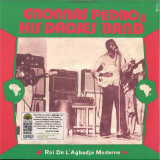
Analog Africa is back with a dedicated project celebrating Gnonnas Pedro, the king of Modern Agbadja, and they press it up on a marvellous double album that includes an eight-page booklet with a ton of extra info. Although four tracks of his have previously appeared on the 2009 Legends of Benin compilation, this bumper pack features 16 of Pedro's best works, all of which captivated Africa at the time. His vibrant blend of Agbadja, Cuban fon, jerk, highlife and more unique styles, all of which come with vocals sung in Fon, Mina, Yoruba, French, English and Spanish, add up to one hell of a rich sound. This is a great testament to the artist's extraordinary legacy.
Jazz & Milk-Labelhead und Freestyle-DJ-Koryphäe Dusty aus München meldet sich mit seiner neuen EP "As Above So Below" zurück, die gefühlvoll, warm und grenzüberschreitend Deep-House-Grooves mit Elementen aus Jazz, Dub und westafrikanischen Rhythmen kombiniert, die einen Sound erzeugen, der ebenso introspektiv wie dancefloortauglich ist. Die EP ist eine berauschende Mischung der rohen Stimmkraft und den perkussiven Rhythmen des ghanaischen Künstlers King Owusu (Jembaa Groove), der die Bühne mit Legenden wie Ebo Taylor und Pat Thomas teilte, und erscheint zum 20-jährigen Labeljubiläum in 2025. Support kommt von Peter Kruder, Severino, Don Letts, Opolopo und dem jüngst verstorbenen DJ Harvey. Dusty legt weiterhin weltweit - Johannesburg bis Istanbul, Manila bis London - auf, veranstaltet die Jazz & Milk-Labelabende in München und Köln und eine Radiosendung auf dublab.de moderiert.
"Full support of EP!" - DJ Harvey, Klymax Bali, International Feel, Pikes
"Very nice! Thank you!" - Peter Kruder, Kruder & Dorfmeister
"Great EP! Love it!" - Ruff Stuff, Shall Not Fade
"SEXY... DEEEEEP." - Severino, Horse Meat Disco
"Warm and deep - very nice!" - Opolopo
"Good to go on Culture Clash Radio!" - Don Letts, BBC Radio 6 Music
Recorded in 1997, Mountain Top features the commanding vocals of Tony Roots, backed by the legendary Firehouse Crew and produced by the visionary Fada Waz (Clifton Carnegie). This record’s release was driven by the people, evidenced and encouraged by the countless wheel-ups and sing-alongs during King Original’s international tour dates over the last three years whenever this seminal recording was dropped in the set.
Tony Roots, known for his cultural and spiritual themes, delivers a powerful vocal performance, reminding us that life’s most important journey is overcoming obstacles to find ‘Jah Love on the Mountain Top.’ This message is as relevant in today’s fast-paced, easy-come-easy-go consumer culture as it was when recorded three decades ago.
The Firehouse Crew renowned for their work with iconic acts like Luciano and Sizzla—shine brightly on this riddim, with the MPC drum machine-centered sound of 90s Jamaican roots reggae. An up-tempo 4/4 steppers beat layered with rich analogue textures and soulful instrumentation defines this timeless recording.
The first of many collaborations between Studio 55, Before Zero Records, and Footsie, the King Original legacy continues into the future, honouring the enduring contributions of Fada Waz and his collaborators.
Clifton Carnegie aka Ras Wazair aka Fada Waz - Clifton Carnegie, known as Ras Wazair, founded King Original Sound System in 1973, establishing it as East London’s foremost reggae sound. Operating under his Studio 55 moniker, he collaborated with legends like Johnny Osbourne, Barry Brown, Michael Prophet, Cornell Campbell, and Frankie Paul through imprints such as Original Sounds, Studio 55, and Original International. A mentor to many of the UK’s top sound systems and a key figure in London’s RasTafari community, Ras Wazair’s connections with prominent Jamaican artists, bands, and producers like Fattis Burrell ensured that Jamaican music remained an influential force in the UK sound system scene.
King Original
Founded in 1973 by Fada Waz, King Original Sound System shaped East London’s reggae scene for over two decades. Fada Waz and his son Footsie—a UK Grime pioneer who in later years expanded the legacy through his KO LP series and sold-out King Original mixed-genre events at London’s top venues—worked together until Footsie assumed full control following Fada Waz’s passing in 2021. Having worked with artists such as Dizzee Rascal, Arctic Monkeys, The Prodigy, D-Double E, Wiley, and Skepta, Footsie’s dedication to King Original has reinvigorated the legacy that underpins all UK bass music—the reggae sound system. Joining Footsie is his brother, Wazair’s last born Ras D also Jah Model, and long-time collaborator Sir Spyro, producer of two UK number-one hits with Stormzy and son of UK reggae stalwart Nerious Joseph. Armed with cutting-edge QSS sound system technology, King Original continues to set trends, shaping the future of UK bass music.
Tony Roots
Hailing from Manchester, Jamaica, in the 1980s, Tony Roots emerged alongside iconic figures like Garnet Silk and Tony Rebel. While his peers remained in Jamaica, Tony moved to the UK, where he went on to release ten albums and numerous singles, including hits like Grow Your Natty Dread Locks and Hola Zion. A steadfast champion of Rastafari, Tony has collaborated with legends such as the Firehouse Crew, earning worldwide respect and a devoted following within both the reggae community and the UK sound system scene.
The Firehouse Crew
Formed in 1986, The Firehouse Crew became a cornerstone of the 1990s roots-reggae revival. Initially associated with King Tubby’s Firehouse label before establishing their own, the band rose to prominence through collaborations with producer Philip “Fattis” Burrell at Xterminator Records. Their contributions to timeless albums like Luciano’s Where There is Life highlight their extraordinary musicianship. Over the years, The Firehouse Crew has backed iconic artists such as Sizzla, Buju Banton, and Beres Hammond, cementing their legacy as masters of roots reggae.
Efficient Space honours the memory of producer and MC Ali Omar with Hashish Hits, a posthumous selection from the dub rebel’s self-released discography.
One of ten children in working-class Liverpool, Omar drew deep influence from his father's Arabic heritage—a thread central to his identity and sample origins. After art school and a spell clubbing during Manchester's halcyon days, he relocated to Sydney, where he cofounded the blunted downbeat duo Atone with fellow British expatriate Andy Fitzgerald. As an MC, he infiltrated the city’s house, dub, jungle, and bass circuits, becoming a regular fixture at the Bentley Bar, where he commanded the mic with his versatile, rumbling baritone and charisma.
Freakishly talented in the studio, Omar was a pioneer of the Akai sampler and Atari, deftly recording live sessions straight to DAT. Drawing on industry insights from his sister, Merseybeat firebrand Beryl Marsden—who supported The Beatles on their final UK tour and was signed to Decca and Columbia—the non-conformist sought to build a self-sufficient business model. Between 1998 and 2004, he independently issued four albums on CD through his Hashish Studios imprint, hustling copies directly to local record stores and live shows for instant returns, even hand-sewing screen-printed hessian sleeves for his final release.
Uncompromising in his principles and refusing to suffer fools or charlatans, Omar relished the opportunity to collaborate with those who embodied the same spirit. Hashish Hits offers a snapshot of his inner sanctum—Fitzgerald on the opening track's billowing smoke stacks, the serpentine vocals of Gina Mitchell and the magic hands of mixer Louis Mitchell on 'On Release,' and Wicked Beat Sound System’s Kye on 'Poor Man Beggar Man Thief'. Meanwhile, 'Suicide Bomber' smoulders with the tension of a lost Muslimgauze relic, as the instructional 'Roll Up' and 'The Last Straw' spiral deeper into Omar’s signature production vortex— where space stretches in slow motion and walls reverberate with ricocheting delay.
A true icon of Sydney’s underground scene, the larger-than-life Omar passed away on 23 June 2009 after a valiant battle with cancer. He is remembered for his assertive spirit, larrikin humour, wild anarchic personality, and enduring mantra: “Love and live your life”.1
Texture returns for its second release with debut EP by Detroit-based STS. ‘Swallowed by a Whale’, dips a toe into the deep ocean of a swirling mind, notated with captivating rhythms and intense, otherworldly sounds. Danny Daze and Jonny from Space turn 'Souvlaki Man' on its head, highlighting the Miami-Detroit psychedelic sonic connection. On the Bside, Lyon's Warzou thickens 'Boot Stuck in the Swamp' to a sludgy lowend workout.
- In The Arms Of Morpheus
- Night Terror
- A Broken Man
- Dead Asleep
- Midnight Messiah
- Are We Dreaming
- Bend The Clock
- The Shadow Man Incident
Ltd Deluxe Boxset: 180g dunkelgrüne 2LP in Gatefold-Hülle mit alternativem Coverartwork; 2CD (Album + Instrumentals); Blu-Ray (Dolby Atmos & Surround Sound, High Res Stereo Mixes); 68 seitiges Artbook); Poster 600x600mm; Schlafmaske; Traumfänger Schlüsselanhänger; A5 Dream Journal
Miki Yui is a musician, artist, and composer, originally from Tokyo, who has been based in Düsseldorf since 1994. Her whose work has long explored multiple forms of media, while documenting liminal zones of perception. On her latest album, As If, Yui creates a subtly connected suite of electronic music, drawn from improvisations and randomised processes that she has engaged with modular synthesis. Deeply poetic in its expression, even at its most minimal, the six pieces on As If have a curious tenor – they are, each of them, intensely sensuous, almost haptic listening experiences, as though the laser focus that Yui displays towards her compositions allows her to engage them as almost physical presences in the world.
One of the keys that unlocks the intimate complexity-in-simplicity of As If was Yui’s encounters with the Amazonian rainforest in Manaus, Brazil in 2018. Finding that the sounds in the rainforest both shadowed and echoed the music she had been making for two decades, she embraced the possibilities of modular synthesis, the sounds of which she discovered “have astonishing similarities to the sounds I experienced in the rainforest.” There is, indeed, something natural about the way these sounds bloom in real time; in their dedicated focus to the subtle development and mutation of several discrete parameters of sound, they grow slowly, gradually, their rhizomic structures suggesting that we are always situated within the middle of sound.
Sometimes, the material here has a kind of febrile energy, as on the ticking, clacking electronics of “Generativ”, a track that seems to rotate in the air in front of the listener, the light reflecting off its multiple surfaces as we catch the intricacies of its micro-patterns. Elsewhere, we slide into a cooled but welcoming environment, like the late-night fire-fly horizon of “Song 4”; there’s also the humid, dripping tropical sunset that’s documented on “Summernight”. It’s a music that’s hard to locate external coordinates for, though there are, perhaps, some parallels with the work of Laurie Spiegel, Eliane Radigue’s Vice Versa, and Pauline Oliveros’s “Roots of the Moment”. But As If is an extraordinary collection of naturally developing, rich studies for slowly mutating, enveloping, elemental electronics.
- Dalbane 1:07
- My Hair Will Be Long Until Death 2:14
- Enkel Resa Till Limfabriken 1:31
- Minus Och Minus Blir Minus Och Minus 1:47
- Mosh For Mika (Waddle Waddle) 2:12
- Dying The Dream 3:06
- Life... But How To Leave It? 1:47
- We're Not Gonna Make It 2:07
- Ormer Til Tarmer, Måne På Hodet 2:18
Beaten To Death’s brutal and innovative sound is somewhat melodic, in a strange way, and that’s why their sound is often called ‘melodic grindcore’; an oxymoronic definition, some might even say a moronic definition, but still the definition that best applies to this Norwegian quintet’s music. Beaten To Death consists of members from Insense, Tsjuder, The Cumshots, Gothminister and She Said Destroy and have won fans over globally for their energetic, strangely melodic and innovative approach to grindcore. With their combination of hysterical blast beats, meaty grooves, double guitar twang attack, asshole-of-god-earthquake bass and tongue in cheek lyrical approach to the shittiness of life, Beaten To Death have dug out their very own little niche in the music world. Their new sixth album “Sunrise Over Rigor Mortis” was recorded and mixed by Tommy Hjelm, and the amazing artwork is once again by William Hay. Since their last album from 2021, all the band members have aged horribly, and this is also the theme of the album. The positive thing about getting closer to the grave, is that profound grindcore poetry comes much easier than when the member were still carefree youngster, frolicking in the Norwegian forests…