James Bangura’s Wichita EP is sound experience reflecting on the adolescent pursuit of finding freedom through driving.
Looking back on intense driving experiences with high school and college friends through canyons like Turn Bull, Idylewild, and San Timoteo, This EP represents the transition from childhood to adulthood - from being reckless to being thankful and more self aware.
Cerca:sound signals
It’s almost four years since their last opus - two years since the most-recent run
of live shows. Now, Bitchin Bajas return from whatever kind of rare ether they
occupy when they’re at home, bearing the riches of the whole cosmos in their
hands. And strictly OG as well - on cassette only.
‘Switched On Ra’ is the outcome of a typical Bajas exercise: pouring some out
for the pioneers that came before (as they’ve done with Bitchitronics and their
participation in the annual Chicago performance of ‘In C’ over the years). It’s a
nice way to get a flow - they play a little of themselves, then some for the
pioneers, then a little more for the band. Before long, they’re playing with the
inspirations twined, as they can only come from within.
For ‘Switched On Ra’, this meant a deep delve into the song-book of one of their
soul-predecessors, Sun Ra, whose music is literally written in the Bajas DNA.
Digging into this music sounded wild on paper: the drone synth group taking on
the Arkestra harmonies and Ra’s loose grooves? The trick was to get that sense
of rhythm to translate across the spectrum from Ra to Bajas, in a way that
worked for them both.
Their rearrangements of the tunes went good - up and down the EQ band, they
were finding the round sounds and jagged edges that brought Ra’s music into
their own thing. Then at the last minute, there was another twist - why not pay
tribute to the Queen herself, and think of the arrangements with a Wendy Carlos
vibe? A little side homage? After all, ‘Switched on Bach’ was visionary, bringing
analogue synths from the outside all the way into the mainstream in the late 60s -
and this take on Ra is meant to take him to new ears everywhere.
Sun Ra of course was his own kind of original keyboard visionary, using electric
keyboards in the late 40s and 50s to fill a role in jazz that had traditionally been
played on acoustic piano only. Once he’d done so, he took his writing in
directions inspired by the electricity, places no one had thought to go before
then.
Bitchin Bajas have been content to dominate in a microtonal world, usually
without a single chord to be found anywhere. But here, they step up righteously,
their vibe triangulated as they bring Ra’s music forward with some Wendy C
style, making an unexpected space for all to thrive. There’s a real feeling of joy
as these collected signals bounce off the tape and through the speakers into
your space.
To get this unique colloid exactly right, Bitchin Bajas used nineteen different
keyboards. They abstained from deploying their arsenal of reed and woodwind
instruments: everything had to be on the keys. This meant Yamahas, Rolands,
Korgs, Casios, a MicroMoog and of course their trusty Ace Tone organ. They
even broke out the Crumar DS-2, to have some of Ra’s chosen tone in the mix.
Then Jayve Montgomery added an EWI as a solo voice on a few tunes, just to
get some air-blown signal (and a natural shout out to EWI master Marshall Allen)
in there, after all. It felt like somewhere in the universe, Ra was decreeing it.
Having first met in 1991, music photographer STEVE GULLICK and JAMES JOHNSTON, founder of Gallon Drunk, began blurring the boundaries between audio and visual in 2004 when they formed their own band, '...bender'. They’ve maintained the habit ever since, with Gullick subsequently founding Tenebrous Liar and Johnston pursuing a career, alongside his work with PJ Harvey and a tenure in Nick Cave & The Bad Seeds, as an acclaimed visual artist and painter.After working together on an art show in late 2019, the idea of making music again immediately resurfaced. Without any firm strategy, Johnston and Gullick began recording, unprompted, drawing upon a shared love of noise, folk, and classical. This became the album ‘We Travel Time’, a compelling and mysterious record that bravely embraced beautiful piano, voice, violin, and guitar to create a drifting haze, forging an imagined soundtrack which offers echoes of Big Star, Nico, Lee Hazlewood and Palace Brothers alongside the haunting influence of contemporary minimal classical. Due for release this coming November 18th via God Unknown Records, Johnston and Gullick have returned to their craft to create a stunning new selection of songs and moods, brought together for the album ‘Everybody’s Sunset’. Recorded at their homes throughout 2021 and 2022, the ten songs on this new album take the fragile intimacy and agenda-free approach of its predecessor and go out even further into the fringes of tone and feeling. Utilising a vast selection of instruments between them (violin, organ, guitar, banjo, autoharp, harmonica, piano, synthesisers….), ‘Everybody’s Sunset’ ebbs and flows, bringing different instruments and signals to the fore as the album progresses. a bold, adventurous musical trip that finds Johnston and Gullick’s musical bond grow ever deeper and closer. Tune in and watch the Sunset glow. All songs written, arranged and recorded by James Johnston and Steve Gullick James Johnston: Violin, voice, organ, piano, guitar, banjo, autoharp. Steve Gullick: Voice, guitar, piano, organ, harmonica, harmonium. 1. The Moon & The Stars 2. Shimmer 3. Fear of Everything 4. Save Our Souls 5. Ice Moon 6. The Town That Couldn't Sleep 7. Medieval Death Song 8. Greater Silence 9. Who I Who 10. Everybody's Sunset
Anyone who has had even half an eye on the electro scene over the past decade will already be familiar with Emile Facey aka Plant43's unique sound, mixing an uncompromising approach to off kilter rhythms and machine-led funk with an emotive and powerful use of melody. This trio of ultra fresh tracks were penned for recent live shows in The Hague and Berlin and are brimming with the energy and excitement Facey felt on his return to the live circuit. 'Remote Signals' is led by a booming kick drum heavy enough to command any audience with Facey weaving ever more complex webs of melody around it. 'Searching The Skies' builds a mysterious atmosphere based around a call and response between characterful melodic elements while 'Constantly Morphing Entity' closes the EP with a flourish of forward moving beats and an SH101 bass line designed to move any dancefloor.
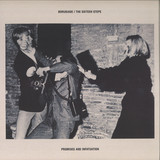
Ingredient is the elegant collaboration of Toronto poets, composers, producers and dear friends Ian Daniel Kehoe and Luka Kuplowsky. Their self-titled release is an enigmatic electronic avant-pop record attuned to the micro and macro perspectives of the natural world. Ingredient is an album whose lyrics are more poem than lyric, and whose songs exist in a merger of house music, philosophically-minded lyricism and contemporary R&B. One might recall electronic and art-pop luminaries such as Yukihiro Takahashi, The Blue Nile, and Arthur Russell, or connect it to contemporaries like Nite Jewel, Westerman and Blood Orange. A distinct world of dance, of questions, of secrecy and ultimate softness.
Eight years of friendship forges strange telepathy.
In the summer of 2020, Ian Daniel Kehoe was entrenched in a new feeling of heaviness; psychosomatic symptoms had started to proliferate; stress made new pores across the body, bending sensitivity into pain. His days were met with confusion, detachment, sleeplessness and pain without causation. Disfigured, he felt that what had been central and centering was blown out to the periphery of things. In a moment of self-preservation he reached out to his dear friend Luka Kuplowsky to make an album together. For Kehoe, it was an instinctual grasp for the anchoring truthfulness of deep friendship and the potential for a dedicated creative collaboration. Kuplowsky’s presence was light, supportful and curious, eager to explore musically the sounds they were mutually drawn to: house music, ambient pop, dub. The duality between Kuplowsky and Kehoe – between the Aflight and the Unmoored – is a portrait of a friendship whose exchanges came easy and produced an outpouring of song. Creation and therapy crisscross. In email correspondence that catalogs their process of collaboration, affection abounds: “feels bare without the Luka Licks”, or “Love you so much”, or “Kinda just overwhelmed with deadliness coming in at all angles.” When their voices first come in together on “Wolf,” that harmony arrives in a dramatic avant-pop sound that is bold and wondrous.
Kuplowsky and Kehoe both arrive at Ingredient as established artists whose works are committed to language’s propensity to provoke and mystify. Kuplowsky’s 2020 album Stardust is an idiosyncratic and otherworldly blend of pop and jazz romanticism grounded by Cohen-esque vocals and a stirring philosophical curiosity. Kehoe’s entrance into the new decade has hatched four records of pop experimentation, most recently 2022’s Yes Very So, a euphoric and bold album of poetic synth-pop and meditative ambient instrumentals. Kuplowsky and Kehoe’s union as Ingredient is a beautiful and unusual chemistry that integrates their distinct approaches while bringing forth a newness: a sound that alternates between cinematic technicolor and dubbed out fogginess; a lyricism that exchanges their lucid and clear poetics for a playful and obtuse verse. The album intuitively taps into the opposing emotional states of Kuplowsky and Kehoe during the conception of the record, contrasting the buoyancy of trumpeting keyboards (“Resurface”), angelic synthesized voices (“Come”), and rolling bass (“Photo”) with the record’s underlying darkness of whirring buzzsaw textures (“Transmission”), whooping sirens (“Wolf”) and murky ambience (“Illumination”). Lyrically, this duality arises in the record’s flux between openness (“Variation”, “Raindrop”) and existential dread (“Wolf”). “Illumination” most clearly crystalizes this opposition, reconciling the verses’ neurotic yearning for enlightenment with the chorus’ liberating doctrine of negation: “no more devotion… no more delusion”. Amidst the gradations of light and dark, Kuplowsky and Kehoe trade indelible, lush melodies as though their voices are made of a substance that melts easily one into the other. The harmony of poetry, sound, and texture cuts through your brain fog like a wet diamond.
Ingredient’s self-titled record was assembled by Kuplowsky and Kehoe over the course of six months in a home studio they frequented daily. Amidst synthesizers and drum machines they composed, re-composed, and workshopped a wide array of music, ultimately focusing on a set of eight songs that lived in a shared musical and philosophical world. Recording days often ended in basketball games at a local court or a rooftop commune over a pot of tulsi tea and a crossword puzzle. Kuplowsky brought in the Blue Cliff Record – the classic anthology of Chan Buddhism – whose inscrutable and sublime insights remained constant throughout the recording process as an activator of reorientation and reflection. While Kehoe was frequently rendered physically immobile by bouts of anxiety, a patience and mutual caring governed the pace of their creation; rest, stretching and meditation became equally important as the act of arrangement. Invited into their intimate circle of composition was Thom Gill, whose heavenly voice uplifts “Variation” and “Raindrop,” and Karen Ng, whose alto sax simmers and dances around the funky strut of “Raindrop.”
The lyrics on Ingredient reflect the persistence of change, the infinite variability of nature where randomness and divergence are no accidents. In Daoism, duality, in the form of Yin and Yang, is not contradictory as it is in Western idealist philosophy, but rather composes the eternal and lived paradox of our changeless-changing universe: changeless because all is change, and changing because the dynamism of the Dao makes each moment transformational. Kuplowsky and Kehoe refract this way of seeing the world, as in Variation: “Variation in the natural world / there it is.” Ingredient is an experience of the manifold ways of saying there it is of the transformational world, and there it is, unfolding. Elsewhere, change and ephemerality is addressed through the record’s preoccupation with non-human perspectives, reorienting the listener to the wolf, the mouse, the emerald frog, the centipede, the bird, the fly in the lamp. The album cover visualizes this fascination with the striking image of a reddish-orange frog atop a defamiliarized landscape of dark green leaves. Mirroring the exploratory process of the record’s collaboration, the frog also signals the amphibian’s natural inclination to leap into boundless potential. Kuplowsky and Kehoe’s lyrics manifest philosopher and ecologist Timothy Morton’s concept of “the mesh,” drawing attention to the “vast, entangled web” of interconnectedness that connects all life forms and interweaving the songwriters’ shared wonder into the Animal’s unknowability. As Luka narrates in the breakdown of the dance-floor ready “Photo,” “the closer we observe things, the further they retreat into abstraction.” In Ingredient’s ecosystem, perception is a reversible fractal where the world’s minutest details mirror the shape of the cosmos.
According to the Dao, the path to healing starts by reorienting perception away from the self and toward the self’s subsumption in Totality. For Kehoe, collaborating with Kuplowsky became the reorientation necessary for the self-preservation he was seeking, opening up a shared creative practice to navigate and soften the complexity of his psychological shattering. The album begins with Kuplowsky intoning “colossal faith” which bounces around the stereo field in a cloud of echo, and it is the enormity of “faith” that centers both Kuplowsky and Kehoe’s collaboration and their inquisitiveness in the vast mysteries of our very being. Truth in Ingredient is not an essential nugget, but a bending of the light – it is the equivocal entanglement of how we are in nature as nature, but with a plea or prayer under our breath that marks our felt distance from what we are a part of: “carry me towards the mountains of my birth / returning to the nest / the silence of the earth.”
The East Coast of England is a land living on borrowed time. Time we borrowed from the North Sea, reclaimed a thousand years ago. But now it seems that sea has come to claim it all back. Michael C Coldwell spent three years travelling up and down this rapidly disappearing shoreline, collecting ghost stories, photographing the roads to nowhere, the monumental sound mirrors and pillboxes teetering on the edges of cliffs, making field recordings of the waves and fog signals, and writing mournful electronic music from static caravans. This hauntological project finally culminated in a short essay film entitled Views from Sunk Island - and this new Conflux Coldwell album. More than just a film score, The Phantomatic Coast stretches beyond the original aims of the documentary, to evoke something deeper about our troubled relationship with the sea – the many towns and ships lost beneath the waves, and ancient forgotten lands lying out beyond the windfarms like some Yorkshire Atlantis. Memory and mythology became obvious themes in the work, as did the ruins and remains of the world wars, now slipping beneath shifting sands forever. The Phantomatic Coast will be released via digital platforms and limited edition pressed vinyl in a deluxe gatefold sleeve.
The third studio release from the There’s Something About Mary star Produced by Beserkley Records founder Matthew King Kauffman and pop-legend and Rock ‘n’ Roll Hall Of Famer, Kenny Lagun. Available CD & LP, with an exclusive green colored variant for Independent retail Jonathan Richman’s intended Beserkley catalog is available again. His true releases, Jonathan Richman & The Modern Lovers and Rock ‘n’ Roll With The Modern Lovers are back, as originally intended, on CD and LP with exclusive coloured variants for Independent retail. Enter Back In Your Life. While credited to Jonathan and the Modern Lovers (which now included Andy Paley – Brian Wilson, Chris Isaak, NRBQ, John Wesley Harding), the release was Jonathan, accompanied on about half of the material by the Lovers. It followed the 'Live' record” Another musician on the record, and co-producer, was Kenny Laguna, whose work with Buddah Records (The Ohio Express, 1910 Fruitgum Company, The Lemon Pipers,) plus Tommy James & The Shondells, Crazy Elephant, Bow Wow Wow, and Joan Jett. Laguna was a perfect person to put Jonathan’s sound where it needed to go. Featuring the Richman staples, “Abdul And Cleopatra,” “Affection,” and the title track, Back In Your Life signals the ending of his Beserkley tenure, but with much more to come . . .
For over two decades Bjørke has cut his own path, as a solo artist and enthusiastic collaborator. Bjørke’s Copenhagen home may be one of Europe’s great cultural hubs, and he’s certainly added a paragraph or two to that story, but his music is distinctly international. Even a cursory listen exposes an impressive, ever-evolving career. However, few expected him to initiate the collaborative ambient / neo-classical project Kasper Bjørke Quartet. In 2018 The Fifty Eleven Project was released on Kompakt Records, a deeply personal record that musically documents Bjørkes encounter with, and triumph over, cancer. The album topped many critics' lists, and was included among The Guardian’s Best Contemporary Albums of the year.
Mother, which will be released on October 28th, represents a quantum leap forward. Literally, when you consider the terrestrial shifts that informed it. Six compositions explore what the evolution of our planet sounds like. While Holst may have gotten there first, Mother singularly focuses on the orb where we reside, from its formation, to its likely conclusion. Other artists have tackled song cycles that parallel a day, a year, or even a lifetime. Mother spans a timeframe from 4.5 billion years ago up to humankind’s impending demise. It hints at how that may be sooner than we think, as well as the earth’s resilience, and the promise of another chapter.
Additional gravity comes courtesy of evocative choir arrangements - - and marimba recorded at the Copenhagen Opera House. “Formation” condenses 20 million years of runaway accretion into 20 minutes. It is sublimely padded by feature artist Sofie Birch’s gentle synths. “Abiogenesis” intimates a different type of emergence: the first life to inhabit our nascent planet. The entire cosmos is condensed into the layered vocals of Philip|Schneider. Birch returns on “Miocene,” which signals the divergence of proto-humans from primates not with foreboding, but rather cascaded notes and swells adumbrating a pure and curious being, revealing nothing of what the Catch-22 of knowledge will bring. That’s addressed in the diptych of “Anthropocene” and “Tipping Points,” respectively marking the dawn and foreshadowing the probable downfall of homosapians, through wondrous advancements and their climate damaging byproducts. It’s tempting to think the album’s finale, “Requiem,” implies only a dark conclusion, owing to its sparkling verrillon’s coronach, and the return of Philip|Schneider’s empyrean vocals, but its juxtaposition with revolving, enigmatic piano chords infers the earth will enter its next act.
Mother is a staggering achievement, encouraging contemplative thought. The album is released October 28th on Kompakt Records, both digitally and on limited edition double vinyl. The atwork is designed by multidisciplinary artist Trevor Jackson.
Seit mehr als zwei Jahrzehnten folgt Kasper Bjørke seinem ganz eigenen Weg, sowohl als Solokünstler als auch als umtriebiger Kollaborateur, während er gleichzeitig das Beste aus Techno, Pop, Elektro, New Wave, House, Ambient, Italo und klassischer Disco aufgreift und in seinen Produktionen zusammenfügt. Bjørke’s Heimat Kopenhagen gilt als eines der großen kulturellen Zentren Europas, und die Stadt hat dieser Geschichte sicherlich den einen oder anderen Absatz hinzugefügt, aber Kasper’s Musik ist eindeutig international. Schon ein flüchtiges Hineinhören gibt den Blick frei auf eine beeindruckende, sich ständig weiterentwickelnde Karriere. Nur wenige hätten jedoch erwartet, dass dieser Werdegang 2018 in der Gründung eines neoklassischen Quartetts gipfeln würde. In diesem Jahr wurde “The Fifty Eleven Project” auf KOMPAKT veröffentlicht. Ein sehr persönliches Album, das musikalisch dokumentierte, wie Bjørke seinen Kampf gegen den Krebs gewonnen hatte. Es wurde unter anderem in die Liste der besten zeitgenössischen Klassik-Alben des Jahres von The Guardian aufgenommen.
“Mother”, das am 28. Oktober erscheint, ist ein Quantensprung für das Kasper Bjørke Quartett. Im wahrsten Sinne des Wortes, wenn man die tektonischen Bewegungen bedenkt, die dem Album zugrunde liegen. Sechs Kompositionen erforschen, wie sich die Evolution unseres Planeten anhört. Gustav Holst (englischer Komponist, dessen bekanntestes Werk die Orchestersuite “Die Planeten” darstellt; Anm. des Übersetzers) war vielleicht zuerst da, aber “Mother” konzentriert sich ausschließlich auf die Erdkugel, auf der wir uns befinden, von ihrer Entstehung bis zu ihrem wahrscheinlichen Ende. Andere Künstler haben sich mit Songzyklen beschäftigt, die einen Tag, ein Jahr oder sogar ein ganzes Leben abdecken. “Mother” umfasst etwa 4,5 Milliarden Jahre, vom Anfang aller Zeit bis zum bevorstehenden Untergang der Menschheit. Das Werk deutet an, dass dies schneller geschehen könnte, als wir alle denken, aber auch die Widerstandsfähigkeit der Erde und das Versprechen auf ein neues Kapitel.
Für zusätzliche Erdanziehung sorgen stimmungsvolle Chor Arrangements und eine Marimba-Sektion, die im Kopenhagener Opernhaus aufgenommen wurde. "Formation" verdichtet 20 Millionen Jahre unkontrollierter Akkumulation in 20 Minuten, subtil untermalt von den sanften Klängen der Ambient-Künstlerin Sofie Birch. "Abiogenesis" beschreibt das erste Leben, das entsteht und unseren Planeten besiedelt. Der gesamte Kosmos verdichtet sich hier in den vielschichtigen Vocals von Philip|Schneider. Birch taucht erneut im Track "Miocene" auf, in dem das evolutionäre Streben des Proto-Menschen weg vom Primaten noch keine böse Vorahnung enthält, sondern mit kaskadenartigen Sounds und langsam anschwellenden Klängen musikalisch vom reinen und neugierigen Wesen des Menschen erzählt, in dem noch nichts von der Zwickmühle zum Vorschein kommt, in die ihn sein Wissen bringen wird.
Das wird im Diptychon "Anthropocene" und "Tipping Points" thematisiert, die den Anfang vom Ende, den Beginn des wahrscheinlichen Untergangs des Homo sapiens durch die Folgen des Fortschritts und seiner klimaschädlichen Nebenprodukte vorhersagen. Es ist naheliegend zu denken, dass das Finale des Albums, "Requiem", nur das düstere Ende von allem darstellt. Doch as funkelnde Glockenspiel und Philip|Schneiders eindringlicher Gesang in Gegenüberstellung mit sich windenden und erratischen Klavierakkorden deuten an, dass die Geschichte der Erde ein neues Kapitel aufschlagen wird.
Mother ist eine beeindruckende Performance, die zum Nachdenken anregt.
AI-32 signals the arrival of ‘The Fifth World Recordings’, by Son of Chi (Hanyo van Oosterom) and long-term collaborator Arthur Flink. A tribute to the late Jon Hassell, who passed away in 2021, the album connects a deep running thread that goes back to the source of Chi project. Carrying on from where Hassell left off, the album takes inspiration and references from his Fourth World music concept and the ancient Hopi tradition of Native America. Illuminating the subliminal space of the arising Fifth World, Son of Chi pays respects to an inimitable force in contemporary music.
Hassell’s ‘Dream Theory in Malaya’ forms a touchstone to Hanyo van Oosterom’s musical journey, which soundtracked long, deep and reflective periods living in the cave of the Kallikatsou (Patmos, Greece) back in the early 80s. This period resulted in Hanyo’s track as Chi - ‘Hopi’ - in 1984. Hanyo met Hassell shortly after in 1987 at his “The Surgeon in the Nightsky” concert in Rotterdam - it wasn’t until twenty years later that Hanyo invited him for two magic nights of “Instant Composing Sessions” with the Numoonlab Orchestra (with a host of other artists) at the LantarenVenster, the very same stage where Hassell had performed in 1987 and also where Chi did their first live performance.
Dreamful, mysterious, prophetic, the Fifth World Recordings features the quiet yet elaborate sound of Chi awash with rich instrumentation, field recordings, and old stories by the firelight. Sketches were created with drones, loops, and soundscapes, with which Arthur Flink (also a member of the Numoonlab Orchestra) jammed on trumpet. Channelling Hassell’s idiosyncratic style, floating melodies and lyrical improvisations are parsed into the mix, where Hanyo has processed and manipulated the recordings, also referencing Hassell’s exotic scales and unique harmonics.
Additionally, the wah Bamboo flute at the closing piece is an homage to the works of Chi co-founder Jacobus Derwort (1952-2019). For this piece Hanyo used his first bamboo flute he made at the cave of the Kallikatsou in 1984. Arthur Flink answers in counterpoint with the wah trumpet, almost like the intuitive communication of the nightbirds..
On his debut album producer and Squama co-founder Martin Brugger hovers through Ambient, (upbeat) Downbeat and unfulfilled build-ups.
Conceptualized as a blank soundtrack, the music was sent to fellow artists who shared their visual and verbal associations which became the source for the artwork and tracktitles, effectively making the album a collective effort.
Evident in all of his recent projects is Brugger's passion for working and thriving within closely set limits.
The only audio sources in the process of making the album were his record player and a Dave Smith Prophet 08 synthesizer. In an antithesis to most sample-based music, Brugger takes the more ephemeral moments of recorded music and uses pitching tools as a magnifying glass to dive deeper into the sound and bare layers that normally remain unheard.
Shinedoe readies her fifth album ‘Freedom Riders’ on her MTM Records imprint with the release of her vinyl-focused ‘Wake Up’ EP, offering a four-track preview into the project while unveiling a selection of diverse electronic productions for home listening through to the dancefloor.
Over two decades, Dutch DJ and producer Chinedum Nwosu, aka Shinedoe, has established her presence as one of house and techno’s most loved talents, while carving a true path to her own vision. Based in Amsterdam and featuring as a key part of the city’s rich and blossoming underground scene, with performances across De Martkantine, Shelter and Thuishaven to international institutions such as Berghain to fabric, her releases on the likes of Rekids, Cocoon, Bpitch Control and her 2021 release ‘The Observer’ on Jeff Mills’ iconic Axis cemented her reputation as one of the scene’s first talents. Having launched her own label MTM Records in 2018, releasing four EPs on the label to date, October signals the arrival of the label’s first album in the form of her ten-track ‘Freedom Riders’ - an expansive and diverse project created in lockdown capturing sonics from across the spectrum - with the LP preceded by Nwosu’s four-track album sampler EP titled ‘Wake Up’.
“Freedom Riders is about living in a world where there is peace, and all our basic needs are fulfilled. Each being having the right to live in peace, be happy and to be. We are all Freedom Riders, some of us get lost and need to get back to the source.” - Shinedoe.
Opening production ‘Wake Up’ is a tension-building journey through metallic textures, warped vocals and eerie interludes, while album title cut ‘Freedom Riders’ fuses hazy atmospherics, rich chords, crisp percussion and sweeping acid lines to offer a late-night ride through smoky territories. On the flip, B1 ‘Peace’ offers an exemplary balance of light and dark with delicate yet vibrant leads guiding murky undertones and sharp percussion throughout, before closing with the hypnotic, off-kilter and mind-altering sonics of ‘Safety First’, traversing soundscapes to showcase and excellently crafted early-morning cut.
Cuts across the album continue this wide-reaching and rich variation, with the likes of ‘Shine’ and ‘Lockdown’ drawing on classic and modern house influences to offer striking additions for the dancefloor, while ‘Floor Action’ and closing track ‘See The Light’ veering into more dubby, paired back territories to offer up a sense of space and tranquillity - with the ten-track project showcasing a carefully crafted album rich in sound design showcasing one of Amsterdam’s finest talents.
DJ FEEDBACK
early support from
Laurent Garnier: Really like PEACE & SAFETY FIRST niiiiiiiiice
Marcel Dettmann: thx
Luke Slater: nice release thanks!
Ame (Innervisions): thanks
Ben Sims: safety first my fave, thx!!
Slam (Soma): Thanx
Chris Liebing (CLR): great vibe
Radio Slave (Rekids): Woah ! "Freedom Riders" is great... and just in time for the weekend ! Thankyou x
Bambounou (50 Weapons / Sound Pellegrino): There's a vibe I like it thanks
Anthony Parasole (The Corner) this is so good
Truncate: Solid cuts!
18 Figures debuts on Southern Lights with a wide-ranging release covering magnetic and esoteric signals, including a blazing remix from Sciahri.
The EP is a nod to the ancient Roman festival Saturnalia, a celebration and holiday in honour of the god Saturn. The A-side introduces 18 Figures’ intent with 82 Moons and God’s Sickle: off-beat, obscure and opaque productions before closing with the ambient composition of Accretion Disk.
The B-side features Ammonia and a ferocious remix by Sublunar head Sciahri, turning the ritual-esqe and hypnotic sounds of the original on its head with an impulsive and heady interpretation.
Novelists FR sind zurück! Aber „Déjà Vu“ setzt sie die Messlatte höher als je zuvor. Mit einem Vibe der an Bring Me The Horizon erinnert, kreieren viele Songs einen Pop-zentrierten Ansatz zeitgemäßer Rockmusik mit Akzenten des modernen Metalcore. Das Resultat sind große Riffs und eingängige Refrains, die in „Smoke Signals“ und „Made By Design“ perfekt vermischt sind.
Auf „Déjà Vu“ gibt es fünf atmosphärische Interludes, die als angenehme Zwischenspiele inmitten der explosiven Songs, wie „Terrorist“, „Do You Really Wanna Know“ und „Lost Cause“ zu finden sind. Diese Zwischenspiele reichen von elektronischen Soundscapes („Mae“) über liebevoll gespielte klassische Gitarre („Erre“) hin zu beflügelndem Post Rock („Colas“).
Novelists FR halten 2022 noch immer ihren groovigen und druckvollen Metalcore Sound („Heretic“). Die Band zeigt immer noch ihre Gitarrenskills, die in kurzen Solopassagen durchblitzen und sich mitsamt der Synthesizer-lastigen Klangwelten perfekt in Szene setzen. Darüber hinaus sind es die elektronischen Elemente, die die Produktion des Albums unglaublich reich klingen lassen.
Viele Dinge haben sich geändert, aber es ist auch aufgrund von Tisches eingängigen Vocals, das Novelists FR ihr Level auf „Déjà Vu“ erneut angehoben haben und am Ende mit einer gewissen Leichtigkeit ihr stärkstes, überzeugendstes, sowie authentischstes Material überhaupt abliefern.
Albert van Abbe & Jochem Paap join forces for General Audio.
Recorded at Willem Twee studios in Den Bosch, General Audio explores a unique and esoteric approach to sound creation. Using test and measure equipment from the 1950’s, originally designed for the maintenance of various audio and radio transmitters, van Abbe and Paap create otherworldly walls of sound and dense rhythmic abstractions with an early form of synthesis. Rudimentary signals are combined and processed before being committed to tape via mic’s set up to capture the Willem Twee studio’s unique acoustics. The equipment itself predates the invention of the analog, modular synthesizers developed in the 70’s that are now commonplace in many studios.
The record opens with 220Lock-in, a gently undulating drone composition. Effervescent at the top end and fathoms deep at the bottom, it shifts ominously with ring modulated tones that build and then give way to thick washes of white noise. A single synth flourish provides a surprising final moment. The record continues with WZ-1Wobbel Zusatz, a low-sunk percussive piece with an off-kilter rhythm and wet spring reverb doing the bulk of the sonic heavy lifting. Deep in the mix, delicate shifts in pitch and tone deliver a kind of arcane musicality, and as the recording approaches its final moments the piece descends into an exhilarating chaos, with sonic components falling slowly by the wayside. Pegelmesser riffs on a similar reverb characteristic, but this time a driven, arp-like lead propels the work forward. Crisp shifts in colour and distortion arrive unexpectedly, providing a curious musical sensation once more – and harsher moments of feedback break up the recording in its later stages. On Rel 3L 212c LC-pi the pair strip things back, with more present percussive components and subtle distortion lines, before Wandel ups the ante with a corrosive dirge broken up by sporadic submerged synth hits. The penultimate recording SR 250 Boxcar Averager shows off impressive pitch modulation, resulting in a variety of intriguing sensations. Cinematic and remarkably visual, it charts a strange and affecting course, the synth lead underpinned by a repetitive percussive motif and all manner of sends delivering fascinating details. Nim Bin closes the record and once more van Abbe and Paap invite that subtle musicality into the recording. A tight VCO modulation drives the piece while various percussive synth strikes provide a kind of rhythmic component, though they remain untethered to any time signature – a neat conclusion to an intriguing and exploratory record.
Written and Produced by Albert Van Abbe & Jochem Paap
This album presents two multichannel works recorded at the seminal INA GRM Studio in Paris and ZKM Institute in Karlsruhe respectively, mixed to stereo at the composer's Cellule 75 Studio in Hamburg with excellent mastering by Rashad Becker. While his releases under the Black To Comm moniker often touched the fringes of acousmatic techniques and Musique Concrete this is Richter's first foray into a more abstract spatial music.
Recorded in the week leading up to the Paris terror attacks at the GRM studio, "Diode, Triode" (21:57) is loosely based on a reading of (and, in parts, a failure to understand) "Le Parasite" (1980) by Michel Serres, a philosophic metaphor about human interaction and communication (which can also be interpreted as a lyrical essay on capitalism; part confusion, part enlightenment).
As core elements Richter is using speech synthesis and the transformation and distortion of concrete sounds, instruments, voices and breathing. Abstract incognisable sounds are combined with strings, reeds and percussion while dismembered musical fragments emerge and vanish rapidly. Chunks of interfering noise are followed by long periods of silence; chaos and order are alternating. Choirs of synthetic and processed human voices are recounting stock market values, seemingly random sequences of numbers and inscrutable lyrics while parasitic sounds are trying to crack, collapse and fractionise the compositional stream and sonic interactions. Finally, a haunting piano chord is wrestling with a broken Publison machine. Like the book, it's part confusing, part enlightening - and a radical piece of sonic art.
"We are buried within ourselves; we send out signals, gestures, and sounds indefinitely and uselessly. No one listens to anyone else. Everyone speaks; no one hears; direct or reciprocal communication is blocked." (Le Parasite)
"Diode, Triode" was premiered on the Acousmonium at INA GRM's Akousma Festival in Paris, January 22, 2016 alongside new works by François Bayle, Robert Hampson, Leo Kupper and Ragnar Grippe.
The second piece "Spiral Organ of Corti" (17:00) has been composed in 2014 for the 47-speaker Klangdom concert hall at ZKM Karlsruhe at the foot of the Black Forest (where Richter was born and raised).
How does one listen with closed ears? Sine tones, alienated human voices and breathing noises build a labyrinthine puzzle alternating between the natural and the artificial. Human sounds merge with winds and strings, sine tones morph into metal sounds. Acoustic illusions confuse the listener, and dense noise-clouds slowly emerge from deceptive silence. Deep base sounds define space. Temporary focus glides into chaos. "Spiral Organ of Corti" is yet another extended composition that proves Richter is on a path of his very own.
"Spiral Organ of Corti" is dedicated to the late Gary Todd.
"Tongues that came from wind and noise. To speak in tongues after the fire." (Le Parasite)
Marc Richter records as Black To Comm for Thrill Jockey, Type and Dekorder and under the Mouchoir Ètanche and Jemh Circs monikers for his own Cellule 75 imprint. He collaborated with visual artists such as Ho Tzu Nyen, Jan van Hasselt and Mike Kelley. Under his own name he is composing for film and installations.
- 1: L'anomalie
- 2: Assault
- 3: Steinmeck
- 4: Histoire D'un Conflit
- 5: Hémizygote
- 6: Critique De L'effacement
- 7: Le Bouffon Moderne
- 8: Tonalités Cosmiques Pour Anorexie Mentale
- 9: White Horse Against Ufo's
- 10: Eine Andere Magische Stadt
- 11: Loop
- 12: Loop
- 13: Loop
- 14: Loop
- 15: Loop
- 16: Loop
- 17: Loop
- 18: Loop
- 19: Loop
- 20: Loop
- 21: Loop
- 22: Loop
The music on this long-awaited solo vinyl album by legendary tape artist Jérôme Noetinger was recorded live in the studio with no overdubs. Signals were sent through tube broadcast monitors and picked up with room microphones. Produced by Tobias Levin. Cover by Meeuw.
Long-time touchstone of international experimental music presents his monolithic (and first) solo vinyl »Sur Quelques Mondes Étranges« on Felix Kubin’s Gagarin Records. Jérôme Noetinger is known to most for the audio-visual trio Cellule d’Intervention Metamkine, alongside his countless recorded & live collaborations, compositions for radio & stage, and breathtaking multi-channel diffusions in the acousmatic tradition.
Discovering the ReVox B77 tape machine as his tool for live electro-acoustic music in 1987, Noetinger has doggedly investigated his instrument over 35 years, establishing him as a vital contemporary composer/performer of the medium. His work is radical and interrogatory, using a pan-historical array of analogue devices to construct soundworlds which sidestep digital monochrome, landing in a galaxy of simmering malfunction, dynamic physicality & rhythmic debris. Programming Le 102 in Grenoble for over a decade, as well as directing Metamkine distribution for over three, his encyclopaedic knowledge of manifold sonic traditions is on display here; unified by a staunch discipline, impressive dedication and flat rejection of empty trends.
The results synthesise his tireless timbral research into 11 striking sonic investigations which combine modern studio possibilities with years of performance experience worldwide. An ominous malaise hovers over proceedings; yet it never feels nihilistic, presenting solutions which electrify the listener with ecstatic discovery. The perceptual orchestration therein - from throwing our ears right against the body of the tape machine to flinging them into cavernous space alive with the aurally strange - is both delirious & calming. Noetinger is all too aware things are bad, but his drive for discovery and joyous belief in music somehow coruscates brilliantly through contemporary gloom.
Meticulously recorded & produced with Tobias Levin in Hamburg, Sur quelques mondes étranges presents a detailed & rich vocabulary both real & unreal: gesture & repetition, structure & collapse, familiar & uncanny all dance with each in the most pumping discothèque concrète in this universe. This is a powerful and exacting statement from an elegant composer & extraordinary musician who has humbly dedicated his life to his practice.
– Anthony Pateras
Light Splitting is a love letter to the purest of sonic signals, to curiosity and to the way we interact with sound.
Based out of Berlin, Germany, electronic music composer and performer Hainbach creates shifting audio landscapes THE WIRE called "One hell of a trip". His music has been released on Opal Tapes, Seil Records, Spring Break Tapes, Limited Interest and Marionette. He has been fascinated with sine tones, noise and FM since he discovered the dial on the radio. Never losing his childhood wonder, he still searches for the sounds in between on modular synths and other devices.
Through his YouTube channel Hainbach brings experimental music techniques to a wider audience. He creates videos on the composition of experimental electronic music, esoteric music equipment and avant-garde music techniques. His live A/V show, performing with tape loops, modular synths and test equipment, accompanied by the visuals of Nani Gutiérrez aka Orca, was presented at venues such as Kantine am Berghain, Uebel & Gefährlich, Acud Macht Neu and Arkaoda Berlin.
Very limited vinyl pressing, 500 copies in a full colour single outer sleeve and full colour printed lyric inner sleeve, housing a 2-colour blue and yellow cosmic swirl vinyl. Full download included as well. Blacklab are back. The self-proclaimed ‘Doom witch duo from Osaka’ are set to drop their 3rd album ‘In A Bizarre Dream’ this summer. Their debut ‘Under the Strawberry Moon 2.0’ saw them taking Sabbath inspired doom, mashing it with a Japanese sensibility and a fuzzed-up groove. It certainly caused a stir, but only hinted at their potential. Album two ‘Abyss’ added to the mix. A Stooges like squalor to the riffs, dollops of lo-fi hardcore punk and loose riffing, pointing the way towards a signature sound. So what of the ‘difficult’ third album? Not so difficult at all it seems. ‘In A Bizarre Dream’ ups the ante considerably, to let rip and define what Blacklab are about. The combined talents of Jun Morino on production and Wayne Adams (Big Lad, Green Lung, Pet Brick, John, Cold In Berlin) on the mix have conspired to produce a towering beast of a record. A real step forward for the ‘Doom Witch Duo’. The drums have a humungous ‘Fugazi’ like welly, and the guitars are a boiling maelstrom of fuzz dense riffola and warped psychedelics, with added synth. Yuko’s throat shredding snarls are as mean as a pissed off Satan, and melodious, often within the same song. This is doom meets hardcore punk, hooky melodies, and killer riffs, all cranked up to the max. Japan has always had a special take on ‘noise’ and ‘heavy’ and with ‘In A Bizarre Dream’ Blacklab add their own spin to that tradition. Gone is the lo-fi approach, here is Blacklab in full effect. ‘Cold Rain’ and ‘Abyss Woods’ (debuted at their storming set at London’s Desert Fest and appearing here in its full version) are two nuggets of epic fuzz heavy doom with added screamo and a neat and canny grasp of melody at its core. Very much a Blacklab trademark. ‘Dark Clouds’ is D-beat fuelled hardcore, fierce and ferocious, with Chia’s rolling thunder drumming underpinning the distorted guitar. It’s pretty exhilarating stuff that shifts the mood perfectly. ‘Evil I’ is just that, a riff as evil as it gets, morphing into a chugging punk wig out. Then followed by ‘Evil II’ a breather, almost mellow, melancholy, with layers of dark overdrive threatening to explode beneath a sweet yet menacing vocal. Then, the mid-point of the album drops a real surprise. Yuko has said before that the band’s name is a combination of her two favourite bands, Black Sabbath and Stereolab. Odd bedfellows to be sure, but if you want to know what that combination might sound like ... here it is. ‘Crows, Sparrows and Cats’ actually features Laetitia Sadier of Stereolab, no less, providing the lead vocal, adding a layer of cool over Blacklab’s Hawkwind meets krautrock sludge. It’s a stoner groove with pop at its heart ...Sludge Pop even, a surprising gem amongst the maelstrom of sound around it. The skewed, sludgecore of ‘Lost’ with its push-pull riffs and rolling thunder drumming, signals that it’s back to business as usual. And after the brief atmospheric instrumental interlude that gives the album its title, comes ‘Monochrome Rainbow’ a huge beast of a track so simple, yet so seductive, from its filtered bass intro to its massive ebb and flow groove and stomping ending. The vocals are all mystery and melody, and the music is kind of a Groundhogs meets Goatsnake ten-ton fuzz-fest, with a singalong, wave your arms in the air chorus. The new Japanese Doom-blues, and what could be the album’s defining moment. ‘In A Bizarre Dream’ closes with ‘Collapse’ verging on noise rock, complete with throat shredding vocals and a crushing wall of guitars, that switch from a stoner groove to full on punk assault, teetering on mayhem before finally ending with the sound of Yuko switching off her fuzz pedal. Perfect. Blacklab have negotiated that ‘difficult’ third album with aplomb and have created a sound that, despite their many influences, is all their own.
(Cargo Collective Title) RIYL: Silver Mt Zion, Rachel’s, Grails & Do Make Say Think. 180g LP, custom window-cut letterpress jacket with artworked 300gsm inner + DL. Esmerine presents Everything Was Forever Until It Was No More, its first album in five years, following a celebrated run of Juno Award winning and nominated records throughout the preceding decade. Founded by ex-Godspeed You! Black Emperor percussionist Bruce Cawdron and cellist Rebecca Foon (Saltland, Silver Mt Zion, Set Fire To Flames), the acclaimed instrumental music ensemble and has long embroidered emotive chamber works using threads of post-classical, post-rock, Minimalism, neo-Baroque, jazz, pop and a wide array of folk traditions. Esmerine conjures a distinctive and immediately identifiable sound that consistently defies the trappings of “fusion”, forging emotive cinematic soundtracks under the overriding sonic sensibilities of postpunk grit, Wall-of-Sound, drone and dark ambient. Recorded by longtime co-producer Jace Lasek (The Besnard Lakes), the new album manifestly carries on in this fine tradition. Everything Was Forever Until It Was No More completes Esmerine’s “Anthropocene” triptych: a series of album-length meditations that began in 2015. The album title itself has minor meme status in eco-artistic circles, appropriated from its original context Alex Yurchak’s 2005 book about the collapse of Soviet Russia by several exhibitions and works interrogating artistic production in the age of environmental crisis. (Foon is also well-known for her climate activism as co-founder of Pathway To Paris.) The album grapples with existential tensions between atmosphere and airlessness, seclusion and claustrophobia, forbearance and satiation, scarcity and abundance; it is one of Esmerine’s most restrained and wistful works. Instrumental densities ebb and flow, melding into each other with gauzy timbral warmth, sometimes tracing fleeting tendrils outwards, but always rotating around the saturnine gravitational force of a darkly glowing sonic center. Everything Was Forever Until It Was No More is like a somber forest lit by a closely-orbiting opalescent planet; it could be the alternate score to Von Trier’s Melancholia or Cormac McCarthy’s The Road.Esmerine planted these compositional seeds before pandemic rooted everyone in place, under the auspices of a grant from the Canada Council for the Arts and a 2019 residency at Le Château de Monthelon in France. Lasek then began documenting the band between lockdowns in various stripped-down configurations with spartan remote equipment at the rural Québec homesteads of Cawdron and Foon, culminating in final sessions at Foon’s converted barn in summer/fall 2021, notably with extensive use of the barn’s resonant acoustic piano. Brian Sanderson appears on his fourth Esmerine album since joining in 2012, continuing to expand the ensemble’s ethnomusicological sensibility and melodic sound palette with guitars, ngoni, ekonting, hulusi, and brass horns of all sorts. Everything Was Forever… also signals the full integration of bassist Philippe Charbonneau, who joined Esmerine as a touring member pre-pandemic and plays throughout the new album, along with sound design contributions via synth, tape echo and other processing. Everything Was Forever Until It Was No More features the pandemic collage artwork of Maciek Sczcerbowksi, in a second Esmerine album art collaboration following their Juno award for Album Package of the Year for Lost Voices in 2015.
Deluxe 180gram vinyl edition comes in a foil-embossed and die-cut cardstock jacket with printed inner sleeve and additional 12x12 art cards featuring the collages of Maciek Szczerbowski. All the art interacts with the die-cut jacket framing. Edition of 300. Rooted in a distinct and immediately identifiable sound_with the cello of Rebecca Foon (Saltland, Set Fire To Flames, Thee Silver Mt Zion) and the marimba of ex-Godspeed You! Black Emperor percussionist Bruce Cawdron at its core_Esmerine has long embroidered emotive chamber works using threads of post-classical, post-rock, Minimalism, neo-Baroque, jazz, pop and a wide array of folk traditions. Multi-instrumentalist Brian Sanderson, who joined the group in 2012, has furthered Esmerine's melodic and ethnomusicological sensibility ever since, expanding the ensemble's palette as its third core member with guitars, ngoni, ekonting, hulusi, brass horns of all sorts, and more. Since 2003, six stately and filmic instrumental albums have inscribed compositional landscapes through epigrammatic miniatures, longform multi-movement chronicles, and all manner of evocative musical prosody between. Marked by an inimitably turbid yet tempered pastoralism, alternately lit by dappled dawn and disquieted dusk, Esmerine's musical narratives balance asceticism and romanticism, melancholy and hope, stillness and wanderlust. Esmerine now shares Everything Was Forever Until It Was No More, its seventh full-length album and first in five years. The band surprise-dropped the full album digitally on 06 May 2022, with the CD and Deluxe 180gram LP editions hitting stores on official release date 26 August 2022. Following an acclaimed run of mid-career records on Constellation through the 2010s_the last three of which have all been finalists or winners of Juno Awards for Instrumental Album of the Year and/or Album Packaging of the Year_Esmerine began working on new music at decade's end. Under the auspices of a grant from the Canada Council for the Arts, and a summer 2019 residency at Le Château de Monthelon (an artist commune in France where the band has cherished long-standing spiritual, creative, and personal connections), compositional seeds were planted_and then pandemic rooted everyone in place. In between lockdown waves, at the respective rural Québec homesteads of Cawdron and Foon, longtime co-producer Jace Lasek (The Bernard Lakes) began capturing the band in various stripped-down configurations with spartan remote equipment. More fulsome arrangement and overdub sessions at Foon's converted barn during the summer of 2021 brought the album to full fruition_where a notable increase in the use of acoustic piano also poured forth, with just about every band member having a go. The record also signals the definitive integration of bassist Philippe Charbonneau_having joined Esmerine as a touring member pre-pandemic, he plays throughout the album on upright and electric bass, with turns on piano and synth, as well as sound design contributions via tape echo and other processing. Everything Was Forever Until It Was No More grapples with the existential tensions between atmosphere and airlessness, seclusion and claustrophobia, forbearance and coalescence. In many ways it is one of Esmerine's most restrained records. Only a few passages are driven by full percussion. There is palpably less Sturm and Drang or overt crescendos compared to its recent predecessors. The new album roils with a different sort of dynamic intensity, where instrumental densities ebb and flow within an overtonal centre, melding into each other with gauzy timbral warmth, sometimes tracing fleeting tendrils outwards, but always rotating around a saturnine gravitational force. Everything Was Forever Until It Was No More is like a dark forest lit by a closely-orbiting opalescent planet; it could be the alternate score to Von Trier's Melancholia or Cormac McCarthy's The Road.
Emerald Green Vinyl[29,83 €]
Option Explore, Dylan Moon’s second full-length album, is a glassy-eyed survey of pop’s playing field both past and present, and a collection of clever, colorful songs filtered through frequencies, timbres, and dreams discovered and discarded while its maker shifts from one sub-genre to the next.
Option Explore signals a significant departure from Moon’s debut 2019 album Only the Blue s, which at its heart is a folk record from the forlorn fringes of psychedelia: a little mysterious, but ultimately lucid in its internal logic and generous with standalone, but sing- along, songs. Dylan’s 2020 EP Oh No Oh No Oh No suggested both a shift in his writing and listening habits, culminating with the 2021 compilation Moon’s Toons Vol. 1. On Option Explore, Moon willfully spins multitudes. With a careful study of synthpop, a penchant for warped yet unwavering guitar grooves, and an effortless songwriting ability, he leans into unlikely convergences, and arrives at something deeply futuristic in its disregard for genre sanctity.
A guiding principle for Option Explore was the “explore/exploit trade-off” concept, a behavioral mechanism of foraging (“the choice between exploiting a familiar option for a known reward and exploring unfamiliar options for unknown rewards”) which has been employed within computational neuroscience and psychiatry. Moon uses exploratory foraging as a manifesto for song construction: music without end, without limit. Many of these songs avoid conclusive compositional conventions, and sound more like turning a radio dial than pressing preset play. Tracks begin at what feels like a midpoint and fade out with little warning, adding to the sensation of sonic melt.
Black Vinyl[29,83 €]
Option Explore, Dylan Moon’s second full-length album, is a glassy-eyed survey of pop’s playing field both past and present, and a collection of clever, colorful songs filtered through frequencies, timbres, and dreams discovered and discarded while its maker shifts from one sub-genre to the next.
Option Explore signals a significant departure from Moon’s debut 2019 album Only the Blue s, which at its heart is a folk record from the forlorn fringes of psychedelia: a little mysterious, but ultimately lucid in its internal logic and generous with standalone, but sing- along, songs. Dylan’s 2020 EP Oh No Oh No Oh No suggested both a shift in his writing and listening habits, culminating with the 2021 compilation Moon’s Toons Vol. 1. On Option Explore, Moon willfully spins multitudes. With a careful study of synthpop, a penchant for warped yet unwavering guitar grooves, and an effortless songwriting ability, he leans into unlikely convergences, and arrives at something deeply futuristic in its disregard for genre sanctity.
A guiding principle for Option Explore was the “explore/exploit trade-off” concept, a behavioral mechanism of foraging (“the choice between exploiting a familiar option for a known reward and exploring unfamiliar options for unknown rewards”) which has been employed within computational neuroscience and psychiatry. Moon uses exploratory foraging as a manifesto for song construction: music without end, without limit. Many of these songs avoid conclusive compositional conventions, and sound more like turning a radio dial than pressing preset play. Tracks begin at what feels like a midpoint and fade out with little warning, adding to the sensation of sonic melt.
- B1: Undercover Agent - Oh Gosh! (Daz '95 Dubplate)
- C1: M.t.s - Baad Boy Sound ('95 Vip)
- D2: M.t.s. - Hard Disk (Dj Zinc Remix Vip Dubplate)
- E2: Undercover Agent - Five Tones (97 Daz Vip Mix)
- F2: Undercover Agent & The Kriminal - Jah Works (Exclusive '95 Alternative Studio Mix)
- A1: Splash - Babylon (Original 94 Studio)
- A2: Splash - Babylon (Dj Trace Remix Part 2)
- B2: Splash Collective - Rebels (Studio Master Dat Source)
- C2: M.t.s. - Brothers & Sisters ('95 Original Remastered)
- D1: M.t.s. - Inspiration ('95 Original Remastered)
- E1: Undercover Agent - Dub Plate Circles ('96 Original Remastered)
- F1: Undercover Agent & The Kriminal - World Mash Up (Original '95 Studio Master)
- G1: Undercover Agent - Rougher Pt.3 ('94 Original Remastered)
- G2: Undercover Agent - Bass Kick Mix 2 ('96 Exclusive Unreleased Version From Dat)
- H1: Undercover Agent - Dangerous ('96 Original Remastered)
- H2: M.t.s. - Revolution ('96 Original Remastered)
A truly incredible collection of foundation Jungle / Drum & Bass from these ground-breaking labels. Splash aka Undercover Agent aka Daz has been with SubBase since the start, having signed to Suburban Base Publishing (including the iconic track Babylon) back in the 90's and remained with us ever since. As part of the SubBase Family we’ve collaborated once again to deliver a perfect package of in-demand classics and unearthed dubplate specials.
Daz Ellis, most commonly known as Undercover Agent, was a true pioneer of the emerging jungle scene back in the early 90’s. He was heavily involved in the pirate radio scene, setting up the infamous Cyndicut FM to transmit breakbeats & basslines across the airwaves of the South East of England, noted for having one of the strongest and widest reaching broadcast signals of the period.
Under various aliases he produced music that defined the sound of the dancefloor. Early releases featured on the genre-defining Suburban Base & Lucky Spin labels.
As Splash his seminal track Babylon set the standard for how amens and ragga infused samples should sound, a format that has stood the test of time and can still be heard today regularly getting played by the world’s biggest drum & bass DJ Andy C! This compilation includes the 2 most in demand versions of this foundation anthem.
In 1994 off the back of his success he launched Splash Recordings, then the year after Juice Records came into fruition. Under the guises of DAZ, M.T.S. and various releases as Splash Collective, all on his own Juice & Splash imprints he gained an army of dedicated fans, demand from whom has led to the creation of this special vinyl box set!
For this exclusive compilation project Undercover Agent went searching back through his original studio master tapes from his impressive back catalogue to find both the original recordings, and some of the alternative edits that never made it to vinyl back in the day. There were also a handful of special versions made exclusively for DJ’s to play on dubplate that are now available for the first time ever.
Exclusive to this collectors box set are 6 never before released versions of classics such as Oh Gosh, Five Tones, Jah Works, an alternative mix of DJ Zinc’s remix of Hard Disk & Bass Kick that were unearthed from the original session DAT’s!
This album features 16 of his most legendary tracks, remastered & pressed across 4 slices of vinyl.
c B1. Undercover Agent - Oh Gosh! (Daz '95 Dubplate) Unreleased
e C1. M.T.S - Baad Boy Sound ('95 VIP) Unreleased
h D2. M.T.S. - Hard Disk (DJ Zinc Remix VIP Dubplate) Unreleased
j E2. Undercover Agent - Five Tones (97 Daz VIP Mix) Unreleased
l F2. Undercover Agent & The Kriminal - Jah Works (Exclusive '95 Alternative Studio Mix) [Unreleased]
[c] B1. Undercover Agent - Oh Gosh! (Daz '95 Dubplate) [Unreleased]
[e] C1. M.T.S - Baad Boy Sound ('95 VIP) [Unreleased]
[h] D2. M.T.S. - Hard Disk (DJ Zinc Remix VIP Dubplate) [Unreleased]
[j] E2. Undercover Agent - Five Tones (97 Daz VIP Mix) [Unreleased]
[l] F2. Undercover Agent & The Kriminal - Jah Works (Exclusive '95 Alternative Studio Mix) [Unreleased]
Bassist and composer Milo Fitzpatrick (Portico Quartet) launches new collaborative project with saxophonist Jordan Smart (Mammal Hands)
Vega Trails is a new project from double-bassist and composer Milo Fitzpatrick, a founder member of Portico Quartet, who has also performed with the likes of Nick Mulvey and Jono McCleary and features saxophonist Jordan Smart (Mammal Hands, Sunda Arc) in a richly powerful duo bringing together two powerfully charismatic musicians. The project which takes its name from Carl Sagan's science fiction novel 'Contact' (a book about signals of new life detected from the Vega system) andwas born out of a desire to bring the elements of bass and melody to the foreground in their rawest form and Fitzpatrick explains that he deliberatelychose the stripped back approach.
"There is so much in just one musician's sound; the emotional, the intellectual, the vulnerability and power of their character. But often these delicate nuances can be submerged in the quest for a group sound. In Vega Trails I wanted to grant the musicians space to breathe and be heard and for the listener to witness the intimacy and depth of a conversation between two voices, bass and melody. I was also interested in how the limitations would guide both the composition and performance and to push us both to places close to the limits of what we could play, and it is in this place where I believe the character of a musician blossoms and comes forward".
Tremors in the Static was composed during Lockdown as Fitzpatrick immersed himself in music that had space and sparseness such as Swedish fiddle music and Indian Classical music. Jan Johansson's legendary 'Jazz på Svenska' (jazz versions of Swedish folk songs) was another influence, as was a collection of ancient lullabies by Spanish soprano singer Montserrat Figueras. Through exploring the harmonic and textural possibilities on the bass, Fitzpatrick would cycle riffs and motifs whilst singing melodies, and he began to create the music debuted here. However, it was only after listening to Charlie Haden's album of duets, 'Closeness', that the project would come into focus as a duo, and Fitzpatrick immediately knew that the second musician had to be Jordan Smart.
"I saw Jordan play at two Gondwana Records events – in Berlin and Tokyo. Both times I was mesmerised by the intensity and conviction of his playing. His commitment to the cause of transcending himself and the listener made a lasting impression on me. When I began writing this record, I knew I needed a strong player who had equal conviction in their playing as me, but also someone who understood the importance of melody"
It was an inspired idea as Smart brought an openness and positivity which allowed the music to be both experimental and bold. Smart's ability to play tenor and soprano saxophone with equal command, as well as bass clarinet and Ney flute, allowed them to open up the pallet of sound and pull the melodies into varying emotional landscapes.The final piece of the puzzle was the performance space. Fitzpatrick knew that he wanted the two players to react off of a third element. The music was written for an ambient space which interacted with the notes: decaying and disintegrating them into silence. They found the perfect space in a church in Fitzpatrick's local neighbourhood of Stamford Hill.
"The recording space is the canvas on which the sound interacts and flows, it is the frame in which notes can live, breathe and die and is as important as the other elements. A resonant recording space, like a church, allows this stripped back sound to resonate, echo and linger, enough to create images and landscapes in which stories can play out".
This then is Vega Trails, a project that brings together two open-mined and communicative musicians for the first time, to tell beautiful winding stories together and to create something soulful and new.Something bigger than both of them and something that leaves us all richer for hearing it. Enjoy!
Magnonic Signals are proud to welcome the mighty Inkipak to the roster.
Having released serious heat on the likes of Mighty Force, Ping Disc and Moatun 7, Confine is a sublime 4 track EP that straddles the lines between Acid, Electro & IDM.
The record kicks off with the majestic title track Confine (+) beautiful & shimmering with hallmarks of early UK techno and break laden IDM that sets the scene for what’s to come.
Next up is the atmospheric brilliance of Outbreak (++) an almighty track that will take you to a far-off place, with some delicate acid work for those 303 nuts, seriously good!
On the flip we find Alastria (-) and the ominous sounding Omichron (- -) both of which fire up thunderous breakbeats and otherworldly synth lines together with some acid from the dark side.
All in all a superbly crafted EP from this exciting newly emerging artist.
Signal are getting stronger…
- A1: Way Out
- A2: Greener (Feat Santana)
- A3: Us
- B1: The Mission
- B2: Can't Stop (Feat Little Dragon)
- B3: Ihm
- B4: Brass Necklace (Feat ((( O )
- C1: Different Masks For Different Days
- C2: A Moment Of Mystery (Feat Toro Y Moi)
- C3: Let's Live
- D1: Once Again I Close My Eyes
- D2: New Life
- D3: Does It Exist
- D4: Stay A Child
“V I N C E N T” is FKJ’s second album and signals a new dawn, not just as a go-to producer and remixer for artists like PinkPantheress and Moses Sumney but as an artist in his own right, continuously selling out headline tours across the globe with his acclaimed ‘one-man-band’ live shows, and having a billion plus streams across all platforms for his music.
The concept for “V I N C E N T” came about during a solo trip to Los Angeles before 2020. “I just stayed in this house totally on my own, turned my phone off and had some time away from everything to figure out what I wanted to do.” He realised he wanted to tap into the freedom of being a teenager: “back then, I was making music strictly for playfulness, without overthinking it,” he says. “V I N C E N T’s” opening and closing songs underline the sentiment of the new album: the future-jazz of ‘Way Out’ (a playful mini soundtrack in one; a dainty piano motif underscored by a skittering trap beat and serene strings) and the lullaby-styled “Stay A Child”. “I wanted to get back some of that lost innocence of making music purely for pleasure,” he says.
Back in his home studio in the Philippines, with no wifi and an impending global lockdown, FKJ was quite literally cut off from the world, able to explore music’s endless possibilities. “Sometimes I would get into it for the whole night and go to bed when the sun came up.” Out of this freedom comes an expressionistic, touching album that’s impossible to pin down. There’s no more hiding behind a branch of leaves, as he did on the cover of his 2017 debut: “V I N C E N T” marks FKJ out as a crucial new voice. He’s redefining chillout music with his bursts of late-night jazz sax and piano, coupled with his wood-cabin whispery vocals, recalling Bon Iver’s early work, and those Santana-styled guitar flourishes.
Much of “V I N C E N T” is wilfully romantic, sometimes super sexy, and often with its head in the clouds, as on tracks like “Us”, a dreamy ode to his wife June, or “IHM”, which has a 90s hip-hop flavour slowed right down to lights-out tempo. Not entirely a solo record, ((( O )))) appears on ‘Brass Necklace’ – which has the soft power of The Internet and Stevie Wonder’s keys. It’s no wonder that lead single ‘A Moment of Mystery’, featuring Toro Y Moi, has a spacey vibe: while recording in San Francisco together, FKJ, Toro and his keyboard player Tony took some of what Tony called “holy water” – “we shared this bottle and took a bit of a trip,” laughs FKJ. The result is a gentle electronic ode to long-term love that could rival Tame Impala for melodic progginess.
Little Dragon’s Yukimi Nagano vocal, meanwhile, laces its way through the stunning “Can’t Stop”, and there is a call back to FKJ’s dancier beginnings with “Let’s Live”, a galvanising techno-pop number that blends piano, handclaps and soulful vocals to dazzling effect. Each of FKJ’s songs glistens, lambently, with a myriad of ideas but it never sounds overblown or too dizzying.
“V I N C E N T” is a marvel – and testament to the magic that can happen when you dig deep. “This was a challenging record,” he says. “I’m a perfectionist and it’s hard to shake that off. But once I did, and I let the music take over, I felt totally free.”
Acid dancefloor Tribe/Hardtek sound... Collabs only from Europe...
Big smily sound !
- A1: Sudden Reverb - Sound Tlakotli (Deadbeat Remix)
- A2: Pitch Black - Transient Transmission (Adrian Sherwood's Delta B(0)=B Remix)
- A3: The Orb - Say Cheese (Gaudi's Dubble Mozzarella Mix)
- A4: David Harrow - In My Head (Inside My Head Mix)
- B1: Subset - The Astrogator (Sub Signals Mix)
- B2: 3Head - Afnaz (Dennis Bovell Dub Mix)
- B3: Groove Armada - Oh Tweak To Me (Gaudi Remix)
- B4: Shpongle - How The Jellyfish Jumped Up The Mountain (Cosmic Trigger Remix)
- C1: Aux25 - Passing Through
- C2: Simm Feat Phelimuncasi - Cracks
- C3: Alpha Steppa - Colour
- C4: Radikal Guru - Badman Skank
- C5: Paolo Baldini Dubfiles - Ethiolò Dub
- D1: African Head Charge - Disciplined And Dignified
- D2: Gaudi Feat Steel Pulse - Cry Dubber
- D3: 100Th Monkey - Fly Higher Dub
- D4: Dub Fx - Dub Everyday (Gaudi's Sub Signals Remix)
- D5: Phonolab Feat Bill Laswell - Where Do Comets Come From
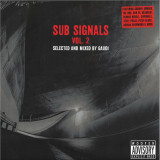
Sub Signals Vol.2 is a deep dive into underground bass, guided by artist and producer Gaudi. Featuring predominantly unreleased originals and versions by some of the biggest names in the worldwide dub collective, it intricately combines analogue elements with digital grooves to stunning effect.
Much more than just a compilation, the Sub Signals series is a celebration of the evolution of the sound of dub, from its original roots in reggae to its fusion with a much wider spectrum of sounds and influences. Gaudi curated the first volume back in 2006 for the cult Canadian label Interchill, sourcing tracks and dubs from High Tone, Zion Train, Manasseh, Almamegretta, Noiseshaper, Creation Rebel, Greg Hunter, Dubadelic and more.
15 years on, Gaudi has created the second volume, blending contributions by established reggae names Steel Pulse, Dennis Bovell and African Head Charge with next generation dub producers Alpha Steppa, Radikal Guru and Paolo Baldini Dubfiles, headline acts Groove Armada, Dub FX and The Orb with underground artists Deadbeat, Pitch Black and SUBSET, to create a seamless 75 minute mix.
“With Volume 2, I wanted to create a deep vibrational experience by shaping an aural trajectory that encompassed the many aspects of dub and its related sub-frequencies. To achieve my goal, I reached out to the artists I regularly work with to ask for contributions, in some cases digging in their archives to find what I was looking for.”
As a solo artist, Gaudi has recorded over 20 albums, while as a producer he has hundreds of productions under his belt. He has worked with legends of the reggae and electronic music worlds including Lee "Scratch" Perry, Horace Andy, Dub Pistols, Hollie Cook, Youth, Mad Professor, Prince Fatty, Lamb, Trentemøller and Nusrat Fateh Ali Khan.
Dedicated to the sound of dub in its many forms, Gaudi’s latest excursion of his Sub Signals series is pure bass therapy, designed to excite your eardrums and worry your woofers.
- A1: Seventh Mirror
- A2: Ionization
- A3: Cloud Chamber
- A4: Harmonic Oscillator
- A5: Transfiguration
- A6: Urzeit
- A7: Cybernetic Dreams
- B1: Interference
- B2: Computer Garden
- B3: Pyramid
- B4: Halide Crystals
- B5: Integratron
- B6: Imaginary Forces
- B7: Phantom Lfo
- B8: Opticks
- C1: Mannequin
- C2: Mind In Light
- C3: Palantir
- C4: Vertigo Of Flaws
- C5: Exit Syndrome
- C6: Stasi
- D1: Atomic Voyage
- D2: Ultraviolet
- D3: Violence Cascades
- D4: Traumsprache
- D5: Zeitgeber
- D6: Prism
- D7: Threnody
- D8: Mind Oscillation
Trees Speak are back!
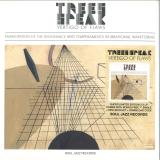
Speak’s new album, “Vertigo of Flaws: Emancipation of the Dissonance and Temperaments in
Irrational Waveforms” comes as a double-vinyl edition, single CD and digital release. The limitededition first pressing only of the vinyl includes a bonus 45 enclosed in an 8-page 7”x7” booklet
insert housed within the gatefold sleeve with cover artwork created by Soviet Union propaganda
artist Lazar Markovich Lissitzky in 1911.
Trees Speak are back!
This new release is a vast leap into an ocean of space and sound, a quantum leap into cybernetics, biology, anti-gravity,
time travel, dream speech and transfiguration. A seriously next step release!
Showing no signs of slowing down their rapid creative pace – incredibly this is their fourth album in the space of just over
one year – ‘Vertigo of Flaws’ is a mighty 29 tracks, one and a half hours of music across one double album that is surely
going to be a defining point in their musical career, a giant leap into the sonic unknown, an epic exploration of intensity
and sound.
Alongside their now trademark German krautrock motoric-beat rhythms, angular New York post-punk attitude, tripped-out
60s spy soundtrack, psyche-rock, and 70s synthesizers and vocoders, here you will also hear a new cosmic spacial
awareness (both personal inner space and galactic outer space) and a truly wilful pushing of sonic boundaries - as police
sirens, static noise, alarms, radio signals, avant-garde voices, and orchestral string quartets, all collide to add beautiful
dissonance to uber-powerful, intense, addictive and propulsive rhythms - in the process creating a truly unique
soundscape that Trees Speak have made wholly their own.
If you ever wanted to hear Can, Hawkwind, Destroy All Monsters, Pere Ubu, electric eels, John Cage, Liquid Liquid,
Tangerine Dream, Suicide, Neu!, Laurie Spiegel, Art Ensemble of Chicago, John Barry, Mother Mallard’s Portable
Masterpiece Company, Sun Ra, Stockhausen, John Carpenter, Electro-Acoustic and Musique Concrete and Mars in one
band - then this is it!
Trees Speak are Daniel Martin Diaz and Damian Diaz from Tucson, Arizona and their music often draws on the cosmic nighttime magic of Arizona’s natural desert landscapes. ‘Trees Speak’ relates to the idea of future technologies storing
information and data in trees and plants - using them as hard drives - and the idea that Trees communicate collectively.
Special guests from the hyper-creative hub of the Tucson music scene on this release are Gabriel Sullivan, Ben Nisbet, Saul
Millan, Stephani Guilmette, and Davis Jones.
The album Vertigo of Flaws was recorded in Brooklyn, New York, and Tucson, Arizona during the plague of 2021.
Extract from Vertigo of Flaws sleevenotes:
‘As we travel through space and time, avoiding the discarded remains of the industrial period, the
deconstruction of social norms through the expression of art, music, and philosophy guide the human
experience towards the unknown.
All that remains are musical echoes scattered throughout the universe, like ancient vibrations that now
populate the cosmos. These waves now show signs of decay. Melody, beauty, tonality have all but fallen
away as dissonance blossoms. As John Cage wrote in 1937,
“Whereas, in the past, the point of disagreement has been between dissonance and consonance, it will be,
in the immediate future, between noise and so-called musical sounds. New methods will be discovered,
bearing a definite relation to Schoenberg’s twelve-tone system and present methods of writing percussion
music and any other methods which are
free from the concept of a fundamental tone”.
Similarly, George Van Tassel claimed the Integratron as capable of
rejuvenation, anti-gravity, and time travel. So, what remains of the
“people”? We have adopted from them our own Zeitgeber: their pulses
now guide our sun, our planets, our earths, and are the new circadian,
diurnal, and ultradian rhythms of the galaxy. Traumsprache, dream
speech, is now the internal language of trees.
Decaying metal and machines liberated the note unto nature’s table,
and we sip the delicious nectar of music once more irrational, elaborate,
violent, vast. The past is the future, musical disintegration its own rebirth.
We are nature, once more the computer of the Universe.’
Nachpressung des Albums von 2015. Obwohl er vielleicht nicht so bekannt ist, hat sich die sinnträchtige, deutlich amerikanische Musik von Kenniff zu einem allgegenwärtigen Sound gemausert, der im Radio, in Filmen, im Fernsehen und in Werbung von Apple, Facebook, Google und anderen auftaucht. Aufgenommen über drei Jahre hinweg fungieren die Songs auf seinem neuen Album ,Sometimes" wie ein Tagebuch, das die kurzen Momente am Tag dokumentiert, in denen Kenniff sich für Trost und unendliche kreative Möglichkeiten dem Klavier zuwandte. Kenniff schrieb und nahm alles auf dem Album selbst auf, mit der Ausnahme von ,A Word I Give", das eine Kollaboration mit dem japanischen Pianisten Ryuichi Sakamoto ist, der die Musik von GOLDMUND einst als ,so, so, so wunderschön" beschrieb. In einem Interview mit NPR diskutierte Keith Kenniff seine Vorliebe für Musik aus der Zeit des Bürgerkriegs und ihre Möglichkeit, ,in nur wenigen Noten solche Geschichten" zu erzählen. Auch die Improvisationen auf ,Sometimes" schaffen es, trotz ihrer technischen und kompositionellen Einfachheit, tiefgründig zu sein. Subtile Details und Dynamiken drücken das aus, was sonst nicht zu artikulieren wäre. ENG Though he may not be a household name, Kenniff's evocative, distinctly American music has become quietly ubiquitous in the past few years, often appearing on NPR, in films, on TV, and in ads for Apple, Facebook, and Google among others. Recorded over the course of three years, the material on his new album Sometimes functions as a journal, documenting brief moments in Kenniff's day when he could turn to the piano as a source of solace and unending creative possibilities. Kenniff wrote and recorded everything on the album with the exception of the track "A Word I Give", which is a collaboration with preeminent Japanese pianist Ryuichi Sakamoto, who once described Goldmund's music as "...so, so, so beautiful." In an interview with NPR's Weekend Edition Keith Kenniff discussed his appreciation of Civil War era music, and it's ability to covey "...so much story in so few notes." Similarly, these improvisations manage to be richly evocative despite their technical and compositional simplicity, using subtle details and dynamics to express what might otherwise be inexpressible.
Part 1[10,88 €]
Part two of Arthur Robert’s most recent EP package showcases his atmospheric style of dubby, strong rhythms and rich, detailed sound design.
On this EP Robert explores his mastery of mesmerizing machines, looping bleepy signals into trance-inducing patterns on Abundance, Watchful and Homecoming. A welcome brief respite from the madness, delicate ambient interlude You Cannot Hurt Me twinkles soothingly, as does the warmth offered by subdued hazy chords on the almost housy Tunnelvision.
Such versatility not only further establishes Arthur Robert as one of current Techno’s most promising producers but also makes this EP package a strong contender for one of the year’s defining releases.
Vinyl Edition of 300 copies
Aesthetical in collaboration with Sync presents "Detect" by Marco Monfardini.
Originally developed as an audio/video live performance, Marco Monfardini based his research for Detect on the decoding of inaudible sounds, sound generated by electromagnetic emissions left from electronic devices and inaudible to the human ear. By using various electro-smog detectors Marco Monfardini creates a sort of detection mapping where electromagnetic emissions are the starting point for the sonorous development of each single composition.
A path that creates a parallel with our lives by questioning how much these emissions affect unconsciously our choices, tastes and perceptions, seeking a relationship between the massive use of technology in everyday life and our emotional state.
The album Detect is developed in 15 tracks in continuous play, an imperfect, faulty mosaic inhabited by invisible beings manifesting themselves in the form of sound streams, mutable entities that find a definitive form in the pattern of the compositional structure.
The album opens with “aR1 detection", sounds of pure detection place themselves in the sound space giving the initial coordinates for the exploration of unconscious parallel areas. The boundaries transform and gradually expand until they flow into the structure of "kernel variations", a growing rhythmic pattern decodes the impulses projecting a perspective that dissolves in the unstable and fluctuating electromagnetic emissions of the subsequent "[a]3020t detection", "binary defect "and "core[2] ". “[A.box]emission” confronts the use of sound downloaded random from internet sample banks and the emissions generated during the download itself, micro sound fragments arrange themselves in an organized and regular pattern, shaping a rhythmic structure. The first part ends with the short “[sa]6030” and “[det]x1a”, absence and presence provide an alternation of movements, inaudible and elusive signals all trying to establish a contact with our perception. “det : scan” opens the second part of Detect, a sort of scanning, leaving EMF (electromagnetic field) textures, a static multilayer that progressively expands until it dissolves into the rhythmic emissions of a common smartphone “[4s]detection”.The track “[rs]zone” " is pushing itself deeper, two minutes of sound speleology that reveal the existence of sound artifacts that seem to vanish getting in contact with the light accented by the bass drum of "[det] 0100+" a constant, rhythmic pumping, a luminous pulsation that reveals an apparent void, which seems to subside entering in the winding and waving atmosphere of "conductive [area]" and "[s3] microfunktion". Detect comes to the end with “[emf]terminal” a mirror of the unarrestable technological acceleration intercepting the flow of data that feeds the system of communication , digital micro waste suffocates the living space by centering up the invisible in an unconscious map.
[a] A1
[c] A3
[e] A5 core[2]
[f] A6 [A.box]emission (2)
[g] A7
[i] B2 [4s]detection
[j] B3
[k] B4 [det]0100+
[l] B5 conductive[area]
[m] B6 [s3]microfunktion
[n] B7 [emf]terminal
Following two stunning singles, prodigiously talented producer and composer Frederic Robinson is set to drop his debut album,
'Mixed Signals', on Blu Mar Ten Music on 14th October. The album is the culmination of over a year's work and a lifetime of musical
obsession for Robinson, comprising of a series of intricately crafted and delicately emotive tracks exploring a forward-thinking
electronic vision, which he describes as "music for the listener with a broad horizon and a short attention span'.
Over its eleven tracks, 'Mixed Signals' gives Robinson the canvas to showcase the full breadth of his talents like never before.
Amalgamating the many influences that inform his productions, from drum & bass and electronica to contemporary classical
composers, 'Mixed Signals' is a brilliantly crafted and coherent artistic statement that draws upon his talents as a classically trained
multi-instrumentalist as well as an electronic producer. Filled with light and shade, impact and intricacy, 'Mixed Signals' is much more
than a drum & bass record or a collection of club tracks; this is an album in the truest sense of the word.
"So far, this album is my biggest musical project and my greatest achievement. I worked on it for about a year and went through many
different creative phases in that time, all of which are represented somewhere on the LP. It is a summary of my current talents, skills
and interests. It marks the end for some ideas and concepts and the beginning for many others." - Frederic Robinson.
Built from a collage of acoustic and electronic elements, Robinson's music is a dense patchwork of skittering rhythms, found sound
and lush instrumentation, which harnesses a compelling emotional draw as much as it does an undeniable dance floor energy. Both
immediate and nuanced, 'Mixed Signals' is a brilliant balance of contrasts.
The sweeping drama of previous single 'Theme Park' opens the album, remaining as fresh and brilliantly unique as ever, while 'Off
Topic' and 'Bloom' featuring Stray both also provide familiar touchstones, exploring esoteric manifestations of 170 bpm's outer
possibilities. Three vocal tracks are scattered throughout the tracklist, with the soft, otherworldly tones of Melanie Robinson providing
an entry point to Robinson's world of broken percussion and wandering melodies.
Elsewhere, 'Vamp Till Ready' balances rich string orchestration against a wave of skittering percussion and 'Shut' offers an expansive
beauty in its naïve, dreamlike melodies. 'Particles' showcases an innate understanding of drum & bass constructs, warping tight
breaks and deep bass against bold blasts of colour while the eponymous track explores a playfully off-kilter and delicately nuanced
downtempo vision, before the album is played out on wave of hazy melodies and light-footed rhythms with closer 'Static Float'.
'Mixed Signals' provides the broad canvas that Robinson thrives in painting with his sprawling musical influences and complex
arrangements, and the results are phenomenal. The album is a masterpiece in dance floor escapism from a talent whose career is
undoubtedly in the ascendant.
- A1: Maureen Mason - I'm Believing (In Love Again)
- A2: Ashaye - What's This World Coming To
- A3: Julie Stapleton - Just Dreaming
- A4: Ashaye - Dreaming (Original Mix)
- A5: Julie Stapleton (Feat. Ashaye) - All The Way (Guitar Mix)
- B1: Maureen Mason - If This Is A Dream
- B2: The Wades - Get Off That (Poison)
- B3: Ashaye - Come Go With Me
- B4: Julie Stapleton - Where's Your Love Gone (Remix)
- B5: Rohan Delano - The Way I Love You
- C1: Ashaye - Dreaming (Jungle Mix)
- C2: Endangered Species - Just A Memory (Vocal Mix)
- C3: Endangered Species - Endangered Species
- C4: Insight (Feat. Ashaye) - Fantasy (Insight Mix)
- D1: Ashaye - Nowhere To Run (Instrumental South Side Mix)
- D2: Insight - Paradise (Para Dub)
- D3: V4 Visions Or Jungle Biznizz - Joy In The Jungle
- D4: Rohan Delano - Inflight
Clear Smoke Vinyl[41,13 €]
In the midst of the UK house rave-olution of the early-’90s, London’s V4 Visions imprint documented the confluence of street soul, deep house, swingbeat, and jungle sounds emanating from the clubs and pirate radio signals. Over the course of half a decade, V4’s unparalleled 12” output referenced every significant Black British music scene; from lovers rock to jazz-funk, sound system reggae to hip hop, new jack swing to garage, from artists Ashaye, Julie Stapleton, Maureen Mason, Rohan Delano, The Wades, and Endangered Species. This 18-track double LP is the first critical overview of the label, with extensive notes by Simon Reynolds, era-defining photographs, and fresh remasters, all housed in a glorious foil-stamped gatefold tip-on sleeve. Is this a dream?
Mattiel, the Atlanta based group made up of Mattiel Brown and Jonah Swilley, announce
the release of their third album, ‘Georgia Gothic’, on Heavenly Recordings. ‘Georgia
Gothic’, a magic third in Mattiel’s run of full-length albums, was shaped in the quiet
seclusion of a woodland cabin in the north of the Atlanta duo’s mother-state; “Some
faraway place that just Jonah and I could go where there would be no distractions,
nothing else going on, and we could turn everything off and only focus on writing songs,”
reflects Brown.
Where 2017’s self-titled debut and its 2019 follow-up Satis Factory were written with what
Swilley refers to as a “hands-off” approach - he arranging the music and Brown the lyrics
and vocals, the two working largely separately - the making of ‘Georgia Gothic’ was, for
the first time, a truly collaborative undertaking. “This was the first time we made a point to
just be together and work out ideas in the same room. That was the initial intention... it
was about learning what each other wanted to accomplish on a sonic level, and then just
trying different things out,” Swilley continues. “Everything happened backwards. Normally,
you’d have friends that make a band... with us, we started making music from the jump,
and then became homies.”
Cultivated by time spent together on the road touring the first two albums, it is this
newfound sense of intimacy between Mattiel’s members that enabled the writing of
‘Georgia Gothic’ not as two separate musicians, but rather as one creative entity. The
album remained within the four walls of Brown and Swilley’s private world for much of its
evolution - with recording taking place in a simple studio set up by the pair in the
borrowed room of a dialysis centre, Swilley in the producer’s seat - until, nearing
completion, it was transferred into the trusted hands of the Grammy award-winning John
Congleton (whose extensive list of credits includes artists as diverse as Angel Olsen, Earl
Sweatshirt, Erykah Badu and Sleater Kinney) for mixing.
Not only does the affinity between its creators translate into an electric synergy between
‘Georgia Gothic’s words and music - the brine-shock of Brown’s taut lyricism cut against
the bourbon-smoothness of Swilley’s instrumentation - but here too are the palpable
spoils of experimentation, each party trustful enough of the other to trial and error their
practices into new geometries. Swilley puts this wide palate, in part, down to the place
they call home. “I definitely feel like being from Georgia allows us to have a certain way of
approaching music.” Brown chimes in: “We haven’t really highlighted where we’re from in
the past two records, even though those were also written in Georgia. There’s so much
great art and great music that’s come from Georgia, from all different types of genres and
all over the state - but take R.E.M. and OutKast: there’s this weirdness that I can’t really
put my finger on.” Swilley concurs: “It’s the same with the B-52s, the Black Lips... it
doesn’t feel like L.A., it doesn’t feel like New York, it feels like another planet. We’re not
really in a ‘scene’ here in the same way. You have to make your own sound, create your
own identity.”
And it is precisely the forging of Mattiel’s distinct musical identity that ‘Georgia Gothic’
signals; its members guiding each other ever-homewards not just in a geographical or
sonic sense, but spiritually, too.
Initial LP pressing on Red Hot coloured 140g vinyl with digital download code. (Once this
format has sold out, a black 140g vinyl edition with digital download - HVNLP202 - will be
made available.)
As a confluence of ideas and methods, WILD ROCKET endeavour to interpret the subtle signals of the universe - the interplanetary vibrations - and present them as brash manifestations of sound. Scientists and Shaman alike have endeavoured to interpret the universal whispers, to elucidate meaning from the measurable and the sensible. It is known that to measure and interpret is to alter and colour those signals and this is what drives the development of WILD ROCKET's sound and interpretation.
FORMLESS ABYSS showcases the band's unflinching pummelling style, drifting from repetitive blows to unhinged swirls of din yet always remaining innately infectious and perhaps surprisingly danceable. The record is presented as a continuous piece in three parts.
The title track A FORMLESS ABYSS appears here for the first time in recorded form – a behemoth of a tune which builds around a drone, joined by dual drums and minimal bass locked into a repetitive groove. A groove that is slowly expanded via multiple guitars and synthesis. Vocals eventually join at just the right moment imploring the listener to “leave your criticisms down” and realise “we're all equal now” in the formless abyss or the place between worlds where our earthly preoccupation with human differences are meaningless. We're all in it together, whether we realise it or not.
The second track INTERPLANETARY VIBRATIONS may seem familiar to some in a simpler form. The expanded line up and extended development of the core theme brings a new interpretation and experience that is more than worthwhile. The track's vocals juxtapose the hybrid Germanic language of English with the ancient native Irish language of Gaeilge. Both used to promote meaning and interpretation of the interplanetary vibrations felt by all. The track features large dynamic shifts and changes of pace as the message that “it's time to leave” propagated by the Earth itself becomes more frantic and more desperate. The track culminates in a wash of smashed gongs and distorted guitars, leaving the listener to interpret the message for themselves. Should we leave, to protect ourselves or the Earth itself?
The final track FUTURE ECHOES is a doom/kraut juggernaut coming in at just under twenty minutes. Only one question is asked and none answered, are we doomed to repeat the mistakes of previous civilisations over and over, or can we find the cracks of light that echo through and show us a new way forward? We're left in a swirling formless abyss to consider who we are and where we're headed. Will we ever reach the cosmic truth? Or will we be continuously mocked by the cosmic trout?
WILD ROCKET have proven themselves on the live circuit, playing with such visionaries as Ufomammut, Slomatics, Earth, Boris, The Cosmic Dead and old school rock legends Girlschool. One of the heaviest bands to emerge from the melting pot of talent in the Irish music scene, WILD ROCKET's reputation precedes them wherever they travel and audiences and venues alike are left to piece themselves together in the discombobulation.
- A1: Mouse On The Keys - Plateau (Kuniyuki Remix)
- A2: Paul Randolph & Kathy Kosins - Could Cou Be Me? (Kuniyuki Remix)
- B1: Mr Raoul K - Dounougnan Magni (Kuniyuki Remix)
- B2: Kazumi Watanabe - Garuda (Kuniyuki Remix)
- C1: Erika Nishi - Summer Party (Kuniyuki Remix)
- C2: Jungle By Night - Love Boat (Kuniyuki Remix)
- D1: Sth Notional - Song With No Words (Kuniyuki Remix)
- D2: Nabowa - Ries (Kuniyuki Remix)
It works in clubs. it works at after hours. Also, small bars vibrate meaningful on it: the music of Kuniyuki Takahashi enthralls everywhere and is made for heedful listeners, that love the thrill of little musical nuances, shifting in a deeply composed ocean of sound.
In terms of composition, melodic sensitivity, and subtle progression the music of japanese producer, Sound designer and dj stands out. Ambient, Future-Jazz, Deep House, Leftfield Elec-tronics: since more then 25 years the man from Sapporo expresses his emotions with a wide stylistic range.
As Kuniyuki or under pseudonyms like Koss or Newwave project, he released a body of work consisting of numerous albums and EP’s, that display his deep musical consciousness pro-foundly. Now his home label Mule Musiq drops “Remix Works “, an eighth tune strong compila-tion featuring for the second time since 2013 Kuniyuki Takahashi’s very own virtuosity of re-mixing.
A double vinyl that carries the full pallet of his skills – from yacht rock leaning synth-pop and balearic dreams to sweet wave signals and soulful Pop House.
It all starts with Kuniyuki’s Remix of “Plateau”, a tune by japanese Nu-Jazz / Post‐Rock band mouse on the keys, released in 2013 on the short living japanese retalk label. An epic, almost ten-minute-long house voyage, full of discreet acid shades and enlightening Jazz chords, that play spirited tricks on each other’s manic musical preaching.
It’s time for a new Reinhard Voigt EP on Kompakt? It doesn’t feel like it was that long ago since we last heard from him but then again, time is running! His latest release on Kompakt "Was wir spüren" (KOM 402) was released in May 2019. From there we encountered Reinhard's musical work mainly in the form of various digital reissues or in union with his brother Wolfgang together as Voigt & Voigt. Then in August of 2021, a glimmer of musical life from Reinhard reached his loyal fans in the form of a continuation of his RV ultra-minimalist concept series as "RV 05 / RV 06" via our KX imprint.
So that brings us to the present. Two new tracks that preach and spin on the classic Reinhard Voigt sound. Tracks that are as relentless as they are consistent to his signature stoic, radical, minimal techno. "Cha Cha Club" creaks and stomps along so mercilessly that they leave us impatient for the reopening of a dark, foggy club room and to have the bitter taste of gin and chemicals on our palates. Bass drum in, bass drum out - sometimes that's all it takes to be happy.
With "Die Frau, die nach Deutz ging" Reinhard discloses a small tale in the title...that this is the continuation of "Der Mann, der nie nach Deutz kam", a track from “Was wir spüren”. Elements recall Reinhard Voigt's SPEICHER tracks; sovereign, modern techno, monotonous in principle, but here and there interrupted and structured by unexpected signals and sounds in such a way that the track will also work on larger dance floors.
Eine reguläre, brandneue Reinhard Voigt 12inch? Das ist nicht nur gefühlt schon eine ganze Weile her. Time ist ja bekanntlich running. Seit “Was wir spüren” (KOM 402), erschienen im Mai 2019, begegnete uns Reinhards musikalisches Schaffen vor allem in Form diverser digitaler Wiederveröffentlichungen oder im Duett mit seinem Bruder Wolfgang als Voigt & Voigt. Im August letzten Jahres erreichte die treue Fangemeinde dann wenigstens ein kleines Lebenszeichen in Form der “RV 05 / RV 06”, der Fortsetzung seiner ultra-minimalistischen Konzeptreihe auf KX.
Nun also zwei neue Tracks, die so unerbittlich wie konsequent den klassischen Reinhard Voigt-Sound predigen und weiterspinnen – stoisch, radikal, minimal. “Cha Cha Club” knarzt und stampft dabei so gnadenlos voran, dass wir die Wiedereröffnung von geschlossenen Räumen voller Nebel und Dunkelheit und mit dem bitteren Geschmack von Gin und Chemikalien an unseren Gaumen kaum erwarten können. Bassdrum rein, Bassdrum raus, mehr braucht es manchmal nicht zum glücklich sein.
Mit “Die Frau, die nach Deutz ging” erzählt uns Reinhard zumindest im Titel die Fortsetzung von “Der Mann, der nie nach Deutz kam”, einem Track von “Was wir spüren”. Hier erinnert manches an Voigts SPEICHER-Tracks, souveräner, moderner Techno, vom Grundsatz her monoton, aber hier und da von unerwarteten Signalen und Tönen so unterbrochen und strukturiert, dass er auch auf größeren Tanzflächen funktioniert.
Breaking News! DJs Pareja and Matias Aguayo have joined to form the dance project MDM Factory!
Modern transcendental Techno music for those who know, and those who want to learn!
In a turmoil of events nightlife would change forever, and confined to their respective places - A flat in Buenos Aires and a house in the jungle Diego Irasusta, Mariano Caloso and Matias Aguayo joined forces to create new communication on distance via music.
Taking all their dance floor knowledge and dreaming of sound systems and togetherness in a better future, DJs Pareja & Aguayo put their minds, bodies and souls to work on this stunning EP that will please the forward thinking underground freaks as well as the big room techno pros.
Let’s dive into this divine mess of glorious dance floor jams from the future...
A1. Curvas Peligrosas
With the first track it becomes clear what this is all about: Wobbly metamorphous sounds from outer space jamming with stomping and bass driven techno beats of tomorrow, a new kind of rave, hypnotic and seductive, utterly strange but wonderfully catchy and contagious in a good sense, harsh shuffled hiatus and alternating kick drums, a relentless bassline and sophisticated electronic sounds in a a permanent evolution resembling and invoking altered states of consciousness.
A2. Love Boat
This new rave anthem seems like a classic you haven’t heard about. Muscle memories from dancefloor days trigger your body as you listen on your headphones, awaiting the chance to play it out soon, hopefully, as the dance floors slowly reopen. Alternating between parts of kickdrum, clap and snare awesomeness, and the mangled rave signals that slowly morph into a more concrete melody reminiscent of ancient dreams of the future, this track has it all for the club kids of today.
B1. La Vida Loca
The title track is a tech banger that will please those who dig Kenny Larkin, Claude Young, The Surgeon, Dave Clark or any other star in the nocturnal sky of Techno Techno, as well as the lovers of DJs Pareja’s classic Cómeme Clubbangers, or the more Techno side of Mr. Aguayo. Definitely has the potential to become a huge hit if enough djs that don’t rely on algorithms get their hands on it
B2. Las Llaves
The closer is hyper modern tech funk at its best. Percussive greatness as you can find it on many Cómeme releases is triggered in a different way, “sabroso” rhythms that are played in the light and purposeful way of an elegant jazz drummer, pave the way for an always evolving psychedelic lead synth sound, that will be a useful tool for the dj who knows when to keep the groove, prolonging those magic times between the risings...
The Bristol-based composer and producer FFT signs to Numbers for Disturb Roqe and an album to follow in 2022.
Disturb Roqe is out on vinyl & digital on December 3rd, 2021. The EP presents three meticulous, spacious tracks that channel bass-heavy tendencies, with whirring details that showcase masterly sound design in a controlled yet aggressive delivery.
Josh Thompson has released music dispersed across a number of labels, including The Trilogy Tapes, Low End Activist’s Bruk Records, his own Super Hexagon imprint and more. Through transmitting under a series of obscurant aliases, he composed and created while leading a nomadic life between houses, cities, occupations and attractions.
His body of work demonstrates an impressive, evolving artistry, exploring harmonic and textural sounds underlined by a powerful devotion to computer-based production. It’s a focus captured by his artist name FFT, short for Fast Fourier Transform, a process by which signals can be converted from temporal or spatial to frequency domains, or in the other direction.
Multi Culti launch a new quarterly 12" series in step with the seasons beginning with SOLSTICE I:
Post-pandemic lockdown inspiration can be found in the great planetary balancing act that has taken place since a cataclysmic impact with an asteroid caused mass extinction and set our earth’s orbit off axis. This AXIAL TILT, or obliquity, is responsible for the seasons, and life as we know it has evolved around these unleashed forces. As our lives and for many, careers, have spun dramatically off axis as of late, we look ahead to the coming seasons, with the hope that we can weather the changes, and maintain inner stability. To aid in this quest, Multi Culti promises to deliver sonic support with utmost regularity at the peak moments of cosmic significance, with each Solstice and Equinox.
Beginning this journey are some of the label’s most beloved artists. Israeli duo RED AXES provide a chakra-elevating soundtrack with their inimitable blend of psych-garage-tronica, a sun-kissed banger that signals a long-awaited return to the togetherness of the dancefloor.
ZILLAS ON ACID turn in a robustly wiggly jam that electrifies, frazzling zaps and frenetic percussion recall the fritzy tension of the past year, a cathartic shock-treatment for traumatized dancers looking to get back to prime spine-shaking shape.
Mexico managed to stay open for the most part, and TYU seems to have not skipped a beat here, still in perfect form after breaking out as one of the hottest young producers to emerge in recent years. Dark disco, Mexi-chug, call it what you want, but the emergent genre is never better represented than here… spooky, phosphorescent tribal dance, Tulumminati-tested and approved.
Finally, the big guy - MANFREDAS - whose remixes and edits have been highlight-reel material the past couple of years, delivers a long awaited original track with his requisite heavy-weight swag. Wonky tunings and a chunky downtempo beat underpin Manny’s trademark masterful arrangement style, building patiently, with breakdowns that managed to wring every last drop of impact out of an odd, other-worldy assortment of sounds.
Interiors, the title of this new release from Ultramarine, may have a topical resonance for many listeners who have found themselves in involuntary confinement during the past year, but the five tracks on this EP were actually recorded in 2011, and they represent a significant opening out of the duo's evolving musical perspective.
Ian Cooper and Paul Hammond, who had become friends while growing up together in the Essex countryside, formed Ultramarine in 1989. Throughout the 90s their distinctive music, an enticing blending of acoustic with electronic instruments, secured a loyal following and won critical acclaim. Then, throughout the whole of the next decade, Ultramarine lay dormant. Interiors documents their reawakening, with Cooper and Hammond exploring approaches to music-making made possible by recently developed software, designed specifically with live performance in mind.
Four of the five tracks to be heard here were issued digitally last year. But as Paul Hammond has pointed out, "with Ultramarine the whole point is to create an artefact, so the form and the look of the finished product is central." That's an outlook shared passionately by Simon Lewin's label Blackford Hill, and the music now available on this vinyl record is appropriately enhanced with cover art by printmaker Katherine Jones. Her imagery matches the music neatly in its nuanced interplay of solidity and shadow, line and colour, geometric form and organic growth.
Ultramarine returned refreshed in October 2011, bursting back into public awareness with "Find A Way," issued as a 7" single on their own label, Real Soon. Clive Bell, writing in The Wire, extolled its engaging mix of electronic beats with cool vocals and tropical percussion. More generally Bell embraced Ultramarine's thoughtful hybrid electronica as "music you could enjoy at home without feeling your intelligence was being scorned, or that if you were not physically in a club, you were wasting your time."
On Interiors, the roots of that slinky single are laid bare on the purely instrumental track "Find A Way Back." Its two distinct parts stretch out the beats and flaunt those tropical flourishes, shuffling and flexing, vibrant and heady, languid and sultry. This is techno filtered through the fabric of magic realism, an exotically spiced concoction, chilled and ready to be savoured at home.
With the diagrammatic clarity of its punchy thrust and spooling loops "Even When" distils the essence of Cooper and Hammond's way of working with their musical material: layering and shaping, nurturing textures, plaiting rhythms and juggling accents. The cumulative impact is almost sculptural in its physical immediacy and looming presence. In contrast, on "By Return" the duo skew the outcome, projecting a selection of limber figures into dub's auditory hall of mirrors. They are clearly revelling in the reverb, relishing the recoil and decay.
Interiors ultimately opens out onto "Decoy Point (Version)." With its ozone saturated ambience, this closing track evokes marshland and mudflat soundscapes, seabird mews, maritime signals and tidal wash. Cooper and Hammond feel deep attachment to the Essex landscape and, in particular, to the local history and physical features of the Blackwater estuary. Blackford Hill provides an accommodating home for Ultramarine's ongoing project Blackwaterside, which has featured to date a 7" vinyl record plus 28-page booklet, and a photo film with soundtrack. Now, delving into the Ultramarine archive, this welcome incarnation of Interiors offers a fascinating glimpse of the duo finding their bearings, at a vital stage along the way.
Bukkha finally lands on LoDubs after over a decade of false starts and missed signals, and it's with a release he seemingly read our minds about wanting: A riddim album featuring some of the best toasting and instrumental performances yet on a release of its kind, rubbing it up with the likes of Dandelion of early Hyperdub renown, Jane Bee (the Ragga Queen of Germany) toasting in unison with fellow Jahtari Alumnus Roger Robinson, and Sarah Tobias, the current keeper of that classic Ska / Rocksteady / Roots Sax tone. Truly a melding pot of Roots-Centric sounds!
DJ Support From: O.B.F, Channel One Soundsystem + more
ALTER- : A REACTION TO THE ALTERMODERNISM IN SOUND ART
For the Automatisme - Alter- album. I am inspired by how the art historian Nicolas Bourriaud defines the Altermodernism. Bourriaud understands the term "Alter" as a way to mean "other". The altermodernism would be another modernity that is different from the avant-garde modernism and post-modernism. More precisely, this is a new paradigm from the XXIe century with alternative ways to motivate artists to be more radical in art by traveling in the physical and digital world, by cutting the frontiers and by creating other time lines. I apply the "alter" subject to time and to landscape and those, to the rhythmic and the ambient glitch music.
1- THE ALBUM HAS A RHYTHMIC SIDE AND A LANDSCAPE SIDE.
1- a : The rhythmic tracks are named Alter-Rate. That means that I offer other types of rhythms by calculating beats with time rate experimentations. The form of the rhytmic tracks, expresses a course, a wandering, which, in the altermodern life, is not just in a standard 4/4 , or just grid based or non-grid based, but it's in a complex hybrid of all of those.
1- b : The ambient tracks are named Alter-Scape. That means that I offer another type of landScapes by a paused temporality and not by a random time or by the time of the nature. Alter-Scape tracks mimic the saturated globalized soundscapes of the XXIe century.
2- THE GLOBALISED AND SATURATED TIME
For Bourriaud, the artists respond to a new globalised perception. They traverse a cultural landscape saturated with signs and create new pathways between multiple formats of expressions and communications1. The Alter- album tracks have saturated rhythms Rates and static ambient soundScapes. The specific context within which we live is the age of globalisation2. In this album, it means that globalised or always evolving rhythm Rates are in constant movements and are also different every time an Alter-Rate track is exported or performed. On the other hand, a globalised landScape is an ambient track with a motionless temporality. In the era of the altermodern, displacement has become a method of depiction3. The movement of the sound in the Alter- album is two sound spaces. The first is the rhythms that make time movement become apparent and the second is an ambient paused or static time that makes possible to feel and to analyze the movement effect of our surroundings.
3- THE CONSTANT TENSION STATE OF ART
For Gilles Deleuze, art is in a constant state of tension, in as much as it oscillates between the poles of chaos and order4. The Alter- album is a tension between chaos and order in rhythmic beat tracks and ambient soundscapes tracks. It is a deterritorialization of the rhythms and the ambiences of today's natural and digital landscapes and it brings them into the computer glitch music format.
By pushing new softwares to their limits, I push at the extreme the software capacity to calculate and to generate sounds. The Alter-Rate tracks are experimentations with time rates and rhythms with the use of probability and artificial intelligence based sequencers. The partition signal starts from a master sequencer that gets into all instruments on a track. Each instrument receives this signal and modulates it with other sequencers that are each programmed differently for every instrument. Finally, all the instruments signals return to a master output that contains a stutter effect. This master channel is sequencing all other channels into one single rhythm. In short, a single rate merges and expands into a vast archipelago of rates and the transformed signal becomes a new single rate. The Alter-Scape tracks are experimentations with midi triggers that give the sensation of a timelessness. Multiple reverb effects are also routed into each other to create soundscapes of continuity. About the type of sounds created in this album, I do experimentations with deep frequency modulation synthesises (FM) on all Alter-Rate and Alter-Scape tracks.
I put a few layers in the tracks to be able to focus on the time space and perception. The tracks are generative and every parameter uses probabilities to be programmed. This is something that was not possible some years ago. The computers are enough powerful to generate that now. I export many times the tracks and i push the computers to their limits by making hard for them to calculate and to generate the tracks with a deep, a pointillist and an extreme software programming. These techniques do different versions every time that I export or perform a track and in my opinion, that opens a fresh and innovative way to do new experimental club music and ambient music. The computer has its own limits too.
Reviews in The Wire, Gonzo, A Closer Listen, Datacide, African Paper, Silent and Sound, and more
The infinitive is the basic dictionary form of a verb when used
non-finitely. It is also the form chosen by Danieli and Purl
for the tracks of WHS 03: return to the basics, simplicity, pure nature distilled into music.
Pulsate starts with an ethereal soundscape, created to then open to a deeper underwater exploration. There´s a universe down there and the listener will be guided to appreciate its beauty: lanternfish giving the tempo of this journey, marine life to marvel at. We take a step back to observe and fill our eyes and ears. We come back to the surface, finding peace and calm.
Opening in a slow, thoughtful and majestic way, Compensate is a
hymn to balance. Since the very beginning, the listener will notice a contrast between gloomy atmospheres and lighter sounds, resulting in a chasing sensation that´s uncomfortable, yet fascinating. Desire to explore, together with acceptance, surrender to the things we simply can´t understand as humans.
The listener is then invited to explore darker, faster, more pounding atmospheres. Intimidate anticipate it all in its title : sounds, tempos, images, they all chase each other to create an atmosphere that's daunting and fascinating at the same time.
A track to accompany one's journey, be it real or spiritual, a trip where we let things happen as they come, accepting the flow of life.
Resonate closes the B side drawing with sounds the depth of our
natural state. Close your eyes and transport yourself in lost woods, alone in a tent at sunset, when the day is almost over and ready to make room for the night. The wood is speaking, the animals are awake, it's frightening but incredibly beautiful.
Crickets are singing their songs, frogs are bouncing from one pond to another, water connects with air, resonate with earth and with the smallnes of man in the face of nature.
anthéne, one of ambient drone’s most recognised names, presents ‘maritime’. A shift from his usual expansive, time-stretching soundscapes, maritime is something altogether more grounded, more present. It signals the call of the open ocean, of its vast possibilities and terrors, as a similitude for the night.
In both, one faces the peace, the limitlessness, the reverence, and the promise, while at the same time the uncertain, the uncontrollable, the danger and the fear of the unknown. In such a way, maritime is presented in two parts: Side A demonstrates the beauty and inspiration of ocean views and night time explorations, while Side B addresses the vulnerable nature of vast, boundless experience.
An artist with an astounding workrate, Brad Deschamps has worked with such artists as Ian Hawgood, James McDermid, Andrew Tasselmyer and Fossil Hunting Collective (as Still Harbours), and releases the likes of Hakobune, Moss Covered Technology and Forest Management on his own Polar Seas Recordings.
His patient style is clear throughout the album, shimmering guitar tones overlaying with warmth and stability, yet the addition of more troubled melodies and subtle vocal parts make for something far more poignant. The duality of awe and terror, of the two primary elements of the sublime, channel through as one in one of anthéne’s most thoughtful offerings to date.
Compound X launch new limited edition vinyl label CX BLACK, with four innovative tracks that set an immediately high standard.
Compound X is DAR and DULUM, both progressive and dedicated journeymen, their visions melting psychedelic rock and deconstructed techno to deliver a forward-thinking take on electronica. Their innovative sound first debuted in April 2020 on Distopic Utopia Records, and a live debut is scheduled for Dark Mofo festival in Tasmania, Australia, this June. The act's dynamic range and genuine sound artistry are what set Compound X beyond the status quo, something that’s clearly displayed with this latest release.
The opener 'Sending Me Signals' is dark and thrilling techno. The blistering synths bring fizzing energy to the hammering kicks, while tortured voices add extra layers of eeriness. There is haunting paranoia to the unsettling voices that loop in the background of 'Gone 2 Far.' The drums are again brilliantly brutal, and the whole atmosphere is utterly arresting.
The synths on 'Asexual Orgasm' sound as if fired from a machine gun with caustic textures, scraping hits, and dehumanised vocals add up to a wall of intense techno noise that will disorientate all dance-floors. Finally, 'Ancient Sentient' is a slightly more spacious cut with buzzsaw synths, undulating rhythms, and distorted bass that makes for maximum impact.
Since 2005, under the moniker Sonmi451 (a character from David Mitchell's novel "Cloud Atlas"), Bernard Zwijzen is creating his own blend of minimal, soundscape-laden atmospheric electronics in Hasselt, Belgium.
He has been previously released on labels such as: Astral Industries, U-Cover, Slaapwel Records, Time Released Sounds, Eilean Rec. "Seven Signals In The Sky" is his twelfth releases.
Nothing can beat the thrill of thrash at its best, and no one is keeping the spirit and sound of the genre alive quite like Berlin’s Space Chaser. Marking their ten-year anniversary with their third full-length, Give Us Life, they are returning in force and once again establishing their importance in the scene. While they predominantly take their lyrics seriously they also have moments of fun, such as on “Army Of Awesomeness”, but the band are primarily drawn to dystopian sci-fi stories with roots in real-life physics and the works of Carl Sagan, and as they point out “it’s still a lot of fun to sing about a dying sun turning into a black hole and becoming a galaxy devouring behemoth.” The title track might possibly contain the most epic theme ever covered, describing the emergence of life and its inevitable death from the smallest to the largest possible scale.
Beautifully presented translucent blue heavyweight vinyl LP, cased in 4 panel printed outer and inner sleeves.
Subexotic Records presents our first project with talented producer Onepointwo. Konstantinos Giazlas (aka Onepointwo) hails from Thessaloniki, Greece, and sites influences from the late 50s electronic experimental sounds, motorik,krautrock, lush shoegaze melodies and modern electronica. Talking about hiscreative outlook, Kostas says: "I continually look to emulate a musical journey into space, time, memories and frequencies". This journey is conducted with the use of minimal electronics, abstract and distorted shortwave radio signals, dystopian soundscapes, all carefully wrung out from criss-crossing digital and analogue sources, fused with a passion for heavyeffects and percussive sounds. Fashioned from a collection of tracks hitherto believed to be lost to a cruel computer malfunction, Synchronization was salvaged from a final reboot. No editing, no tweaking, no second chance - these tracks have reached terminal velocity. Luck is on our side, as what remains reveals a series of intricate yet powerful soundscapes, with finely wrought motifs that repeat and build to create Onepointwo's trademark shimmering psychedelic impact. His previous discography includes Keene (Poeta Negra) / SANS (Lotus RecordShop Editions) and various appearances & remixes on domesticlabel compilations. 2020 brought about 2 album releases on highly regarded cult UK labels Miracle Pond and Woodford Halse, garnering a slew of positive reviews, including warm praise in Electronic Sound Magazine.
The connection between Dr. Atmo and Mick Chillage goes back to one of the finest labels to ever grace this planet, FAX records. Many will remember the defining collective for their deep, extended excursions into the far-reaches of ambient mysticism - a style that is still revered to this day.
Ruhleben sees a welcome return for Dr. Atmo who, after appearing on some of the very first FAX releases under his own name and different guises throughout its tenure, has been somewhat elusive of late with side-steps into other genres. Now, partnering with another FAX alumni and a foundational figure within today’s ambient music genre, Mick Chillage, the pair have returned to their roots and a defining style of ambient music.
Taking Dr. Atmo’s distinctive hooks, haunting loops, and graceful melodies, Mick Chillage improvised on these foundational elements further with fine-tuned details such as delicate bass additions, rhythmic looping signals, or more organic fixtures like a finely woven Harp and extended Piano loops. Across its four extended tracks, Ruhleben is an infinite flight into mystical formations that yearn for dramatic soundscapes. A time-lapsed, slow-motion soundtrack, where Mother Nature breathes destructive fire from the depths, breaking the Earth’s surface to form dramatic cathedrals, scarred by super-natural atmospheres and eventually flooded with the life we know today.
Featuring artwork by Tomas Jirku and mastered by Rafael Anton Irisarri.
Muck Spreader found a home in the London circuit, performing alongside the likes of Fat White Family, Wolf Alice, Warmduscher and Black Midi; though this is not an indication of their sound, which continues to be forever morphing, unique and uncategorizable. The band’s latest EP Abysmal is their first vinyl release and signals a louder and further departure into sonic experimentation.
The EP follows Rodeo Mistakes, released last year to acclaim from the likes of So Young Magazine, DIY, Dork, Huw Stephens at BBC 6music and Jack Saunders at BBC Radio 1. With Abysmal we find deranged screams and a music rich with filthy bass, sludgy guitar, shrieking saxophone, and glitchy effects. The drums anchor the chaos.
On EP openerTake Flight Muck Spreader offer the following: "Fasten your seatbelts, find your nearest exit, and in the event of an emergency please assume the brace position. It’s going to be a bumpy ride. You are now in the safe hands of Captain Frosty Theodore, and the crew will do everything in their power to Keep it Mucky Take Flight"
Up to kick off 2021 in the most adequately frenzied, thoroughly corrosive fashion, DDS04 serves up a quintet of chrome-tanned, hi-velocity beats courtesy of Italian hardware fetishist Anna Funk Damage (previously heard on the likes of Mind Records, Lux Rec, Lazy Tapes and more) and Austrian-Hungarian outfit Dutch Courage - alias Superskin & Új Bála - each of whom step up to the plate to deliver an exquisitely ear-wormy slice of their deranged industrial gospel.
A-side starts off to the sound of AFD's hard bouncin' "48 Hours Death" - a raw-cooked deluge of head-reducing EBM grit, flaring binary signals and Giallo-infused arpeggios out a blood-stained Suspirian tale. Fear for the deadly scalp hunters lurking in the club's darkest nooks, they've just sniffed out your trail.
Brutal churner "Youssef" picks up the torch and pulls out the quake-inducing breaks without further ado, dressed out with languorous Orientalistic melodies and steely distortions tailored to bend mind by the dozens. Forged in the furnace, the full-out punk-minded "I Come From Fire" rounds off the side on a drum and bass-heavy note, drawing as much from 60s psych-garage as it does from 80s deconstructionist tape music.
Flip sides and here's Budapest unit Dutch Courage taking the reins with the off-kilter treat "Hand Of The Sword" - navigating a weird zone of its own, floating astride post-apocalyptic Bristol bass, sliced-and-diced abstraction and overly textured yet equally bone-bruising riddims.
Wrapping up the journey with both force and serenity, "Neo-Soulmates" follows a similar path with its warped synth flexions and raucous machine cries making the rounds from one end of the spectrum to the other effortlessly, merging to give birth to something genetically contrasting from any contemporary. A most fitting finale to an EP that celebrates and encourages sonic bizarro in all its forms and manifestations.
- A1: An Introduction To Intention
- A2: Yesterday's Sun
- A3: Sustainer| Cub/Cub
- A4: The Scouring Of The White Horse
- A5: Throbbing Motor Lifeforms
- A6: Heralding The Dawn
- A7: Sage
- A8: And They Named Him Hen The Sun Stands Still
- A9: All Of Us, Under The Sun
- A10: Midsummer Men
- A11: The Sun-Stone
- A12: First Rays Of The Summer Sun
Beautiful orange & yellow sunburst vinyl - Solstice '21 sees twelve bright lights of independent electronic music mark the coming Summer Solstice. In such dark days, the age-old practice of celebrating the move from shadow to light, feels steeped in a renewed symbolic power. Solstice '21 marks this significant moment with a rich array of musical offerings. Reflective, lively, and always powerful, this collection is spun with modern twists of an ancient thread. Rotator - This is the first outing under this moniker from Justin Owen, also known under the alias Licit, as well as being a protagonist in the world of modular synthesis as the man behind the Abstract Data modules; Letters from Mouse - "Bubbling analogue synthesis from Scotland." This analogue synth maestro and inimitable broadcaster (aka The Magic Window), boasts a string of quality releases, including the recent highly acclaimed album An gàrradh, also on Subexotic; Cub/cub - "Cub/cub explores the world in-between nostalgia and nihilism, analogue and digital, real and false; creating evocative and mournful musical collages." First discovered on Boards of Canada forum Twoism, Cub/cub's two debut releases with Subexotic demonstrated his considerable talent to mix fascinating texture with beguiling melody. With an astonishing follow-up album coming soon, his rising star feels unstoppable; Orbury Common - "aural ephemera from the home of the orbs." This mysterious duo from the West of England are blessed with delightful musical cunning; their brilliant debut on Subexotic lifted the lid, and this offering reaffirms exciting times lie ahead; Onepointwo - "Minimal electronics, abstract radio signals and dystopian soundscapes are proceeded from both digital and analogue sources." A creator of intricate yet powerful collage, with finely wrought motifs that repeat and build to create a shimmering psychedelic impact. This is Onepointwo's glorious trademark. Spell-binding releases already exist on Woodford Halse, Poeta Negra, Lotus, as well as an imminent powerhouse album forthcoming on Subexotic; Giants of Discovery - "Experimental electronica with the occasional noisy guitar thrown in." Giants of Discovery's ability to get to grips with the musicality of his subject, has lead to previous exquisite sojourns into realms such as Victorian cosmic horror and Greek mythology, as well as an equally fantastical, towering follow up album on Woodford Halse; Wonderful Beasts - "A Wonderful collaboration between boycalledcrow and Xqui." Their playful interaction finds ways of crafting acoustic fragments into unexpected kaleidoscopes of sound. With beguiling debuts on cult label Wormhole World (soon to be followed up by an extraordinary new album on Subexotic), there is a kind of breathless magic about everything they do; Dogs versus Shadows - Electronic Sound Magazine says "A rare example of gamekeeper turned poacher...a welter of impressive electronica." Lee Pylon's ability to straddle a wealth of uncompromisingly inventive creations, and his broadcasting prowess as the much loved Kites & Pylons, is already the stuff of legend. A multitude of releases across many labels including Subexotic, Woodford Halse, Miracle Pond, Third Kind, Submarine Broadcasting, Sensory Leakage, provide a glittering treasure trove of work; Counter Silence - A stalwart of Subexotic, Counter Silence's sparkling and wistful musical work very much stands alone in temperament and style. 2020's Pathways EP on Subexotic remains a precious oasis, imbued with a haunting solitude that lives on in the memory; Transient Visitor - "All music unlocked by Alex Cargill (C.O.I. Central Office of Information) and Martin Jensen (The Home Current)." These two intercontinental maestros (well Sidcup & Luxembourg) boast impressive solo back catalogues across many labels (including Castles in Space, Polytechnic Youth, Woodford Halse). Their newly conceived collaborative Transient Visitor project, brought about the superb TV1 album in 2020 - we can see the sparks fly again in this welcome 2021 return; Simon Klee - "Natural, Electric, Organic Psychedelic - Sounds, noise and psychedelic beats." Klee's playful alchemy engages the mind and spirit, as witnessed in a flurry of top quality releases in recent times (e.g. Subexotic, ANR, Woodford Halse), and there is a visceral joy in his work that is perfectly placed for a midsummer celebration. Klee also produces a truly excellent mixcast and increasingly essential tape label, both under the guise of Anticipating Nowhere; Rupert Lally - "Hailing originally from England but now based in Switzerland, Guitarist, Percussionist and Electronic Musician Rupert Lally began his career as a Sound Designer and Composer for Theatre and TV, before launching his solo career in 2005. Since then his releases have blurred the boundaries between electronic and acoustic music." Lally's consistently brilliant work is always a highlight of the electronic music calendar, including recent stellar works across many labels such as Spun Out Of Control, Third Kind, Woodford Halse, and Modern Aviation.
Once upon a time, two operators stared at their screens. They sat silently for hours, their whole being dedicated to the task they had been assigned to. Days and nights passed in the same monotonous manner. Suddenly signals showed up on their monitors. Alarms started to ring. Both reacted at the same speed and did what they were supposed to do. Controls and commands were entered, as was protocol. After observing these waves for 61:01 minutes, everything became quiet again. What they had just witnessed made them wonder. For the first time they addressed each other. "The data is transferring through our system," announced the first. “Let us both check how this can be interpreted.” The second validated the response. Together, they looked at what had been recorded. Ideas raced through their complicated minds until they realized simultaneously: sounds! They listened. “Is this an unknown language?” one asked. “This is the first time this has been heard throughout our history,” the other answered. They listened again and again. “This electricity has been arranged to form a cohesive entity,” the first said. “Why would machines be used to create that?” the second mused. Something had awakened inside of them, an obsessive curiosity they had never experienced before. They did not understand and were blown away by the beauty of it. “Do you think it could have been left by humans before us?” one whispered. “If it was, these would be Major Signals,” the other concluded. As they processed these thoughts, the two artificial intelligences sat still.
They Say: “New directions in contemporary scoring”.
We say: Contempo is one of the best full album listens in the KPM 1000 library. Succinct smoking soul, super tight breaks and string-drenched sleaze composed by the library master, Keith Mansfield.
The creator of the romping tunes that became the iconic themes to the BBC’s Grandstand programme and their televised Wimbledon Tennis Championship coverage, Keith Mansfield was perhaps KPM’s most prolific artist from the mid 1960s right the way through the 1980s. As well as the sort of pop orchestral sound that is all over these classic library records, he could also turn his hand to raw, edgy rock and funk. Quentin Tarantino is a big fan, going as far as including some of Keith’s work on the soundtracks to Kill Bill and Grindhouse.
Many library records are a game of two halves and Contempo is certainly one of those. The first side cooks on a high funk breaks flame whilst the flip is something altogether more tranquil, yet no less groovy. It lays back with dreamier, post-coital grooves.
Rugged funk opener “The Fix” confidently displays its low slung languid grooves with heavy drums, horns and bass. Smokin’ in slow motion. The punchy “What’s Cooking” follows and has a lighter, more whimsical touch. But the drums still roll and the clavs wiggle in fascinating opposition to those horns. The dark and moody intro to “Cut To Music” gives way to a more inclusive, relaxed funk that’s all irresistible bass and stabbing horns. The mid-tempo “Man Alive” signals the time to really get down. A percussive monster jam. If you can’t strut to this then we really can’t help you! Closing out the A side, fresh guitar licks drip all over the slick drums of “Funky Footage”, with a New Orleans piano vibe coming on to really light a fire.
Whilst the dramatic crime funk of the A side is enough on its own to have earned this record its place in the great library record canon, it’s undoubtedly the more smoothed out B side for which Contempo is rightfully adored and celebrated. It’s so chilled and mellow, with beautifully arranged, sweeping strings, sax solos aplenty and a real 70s soundtrack feel. Think Love Boat, CTI label, Bob James, Grover Washington Jr.-type jams.
The super sleek and sexy jazz funk of “Breezin’” is as light and magical as you’d hope. An open-air masterpiece, its indulgent sound is just a taster of the sophisticated funk to follow. The elegant, romantic feels of “Good Vibrations” (used brilliantly by Odd Future’s Mike G for “Swiss Army”) is a string-drenched, wah-wah fuelled ode to living your best life. Nonchalantly. Whilst it keeps a very West Coast feel, the blaxploitation strut is certainly more Blackbyrds than Brian Wilson. “Sun Goddess” will blow your mind with the sensuous sound of glorious horns and beautiful keys. The luxurious “Love De Luxe” and its horizontal grooves have been much sampled, but here it proves that it doesn’t need any help to get you in an intimate mood. Closer “Snake Hips” is a cool mid-pace slouch. Just divine.
Originally released in 1976 but, like the very best KPM records, wonderfully timeless, Contempo is also no mere LP-length collection of loosely related tracks. This is a rare example of a library record that is a genuinely great listen from start to finish.
As with all of our KPM re-issues, the audio for Contempo comes from the original analogue tapes and has been remastered for vinyl by Be With regular Simon Francis. And as usual, the sleeve reproduction duties were handed over to Richard Robinson, the current custodian of KPM’s brand identity.
: Contempo (KPM) (LP)
Horse Time is the first release from Phonopsia's new label - Horse Category. As a statement of intent for the sounds to come, this debut record shows the breadth of Phonopsia's craft in the studio looking to not be limited by genre or tempo. Across the EP he delivers a slow techno track with housey leanings, a room shaking minimal techno track, up-tempo electro wigged out with oddball elements, and a down-tempo finale that abuses time. Phonopsia has been making and playing music for a good number of years and was Sud Electronic resident from 2007-2009 and regular guest for Bleep43 from 2002-2010.
Altın Gün return with a masterful album that widens their critically acclaimed exploration of Anatolian rock and Turkish psychedelic stylings to include dreamy 80’s synth-pop and dancefloor excursions. Yol (Road) brings together all vectors of the AltınGün experience and delivers their most compelling and individual album to date.
Amsterdam’s Altın Gün have built a strong reputation for melding past and present to make brilliantly catchy, psychedelic pop music, as seen with their Grammy-nominated second album, Gece. They are also a renowned live band with strings of sold-out shows on three continents, who have consistently brought a muscular groove to their recordings. Yol, their third album in as many years, excitedly continues these trends; while also digging in deep to unveil a new palette of sonic surprises.
Though it draws from the rich and incredibly diverse traditions of Anatolian and Turkish folk music, Yol is not just a record that reframes traditional sounds for a contemporary audience. The album often presents a textured, avant-pop sound as evidenced by the debut single "Ordunun Dereleri.” Mysterious and atmospheric, the track is a thrilling evolution for the band. It patiently coaxes the listener into a resonant soundworld of down-tempo electro beats, majestic synths and Erdinç Ecevit's yearning vocal of unrequited love.
The album also signals a very different approach in making and recording for the band. Singer Merve Dasdemir takes up the story: “We were basically stuck at home for three months making home demos, with everybody adding their parts. The transnational feeling maybe comes from that process of swapping demos over the internet, some of the music we did in the studio, but lockdown meant we had to follow a different approach.”
Yol displays a noticeable dreaminess, maybe born from this enforced time to reflect. And select elements of late 1970s or early 1980s “Euro” synth pop also shines through. This new musical landscape was nurtured by certain instrument choices; namely the Omnichord, heard on ‘Arda Boylari’, ‘Kara Toprak’ and ‘Sevda Olmasaydi’, and the drum-machine, an instrument that is key to the gorgeous closing number, ‘Esmerim Güzelim’. Dasdemir once more: “bass player Jasper Verhulst loved the song. He said, ‘it doesn’t sound like Altın Gün, this sounds like a Turkish kindergarten music teacher from the 1980s using an 808!”
As ever, the tracks are the result of a true group effort, with ideas on Omnichord, 808 and other elements - such as field recordings and new age-esque ideas - continually kicked about between the six band members. At a safe distance of course. The record also owes something special to its production team, the band working this time with Asa Moto (the Ghent-based producer-crew, Oliver Geerts and Gilles Noë) who mixed the record. Before this Altın Gün always recorded on tape with their own sound engineer.
It would be wrong to say that what made Altın Gün such a loved and successful band has been left to one side. The pressure-cookers ‘Sevda Olmasaydı’ and ‘Maçka Yolları’ are classic cuts from the band. And their signature employment of a dizzying array of ideas and approaches can be heard with the marked Brazilian feel of ‘Kara Toprak’ and ‘Yekte’. Cosmic reggae filters through the grooves of ‘Yüce Dağ Başında’, and there is a steaming version of ‘Hey Nari’ which gives the traditional composition by Ali Ekber Çiçek a kick onto the dancefloor.
But with Yol, Altın Gün have maybe patented their own magical process of reimagining and sonic path-finding, one probably not heard since the late 1960s and early 1970s British folkrock boom. Less of a reworking than a seduction, their recordings transport the listener to a world where the original songs never previously inhabited. Merve Dasdemir again: “After we worked on them, they got a whole new life of their own. Maybe we went a little bit too far (laughs).”
Presenting the long sought after, groundbreaking and classic 1990 UK long-player finally remastered and reissued for 2018. London's Warriors Dance label was a unique operation and a pioneering London label during the late 80's acid house phenomena. Home to an assortment of DJs, MCs and soundmen, they went on to make their own original and indelible mark on the rave scene from the infamous 'Addis Ababa' studio on Harrow Road on the North-West side of the city.
A former reggae and soul studio that was instrumental to the output of influential artists like Soul II Soul and more, a steady diet of reggae, bass, hip-hop, house and techno kept their edgy, and die hard UK sound and style right at the cutting edge of the dance music underground across the globe with the top DJs and producers of the day celebrating the label.
The studio, helmed by label owner Tony 'Addis', acted as an incubator for artists whose names would go down in the history books - No Smoke, Bang The Party, The Addis Posse, Melancholy Man, Hollywood Beyond, The Housemaids and more all featured heavily on the label and contributed to its legendary output. The attitude and approach to the music was utterly and unapologetically a London thing, with heavy African and Caribbean influences also drawing on the sounds emanating from Chicago, Detroit and further afield.
Years later, and with the advent of the internet, Discogs, Youtube and any other digital platform you'd care to mention, Warriors Dance continues to be discovered and rediscovered again by curious diggers and music heads with a thirst for heavyweight tracks to play in their DJ sets. This saw the WD mythology rise again, making their records much sought after by fans from all over the world.
When 'International Smoke Signal' landed in 1990 there was nothing else quite like it in the musical landscape, the perfect sonic example of the Warriors Dance ethos and style incorporating all of the influences and grooves that made the label's output so unique, a sound heavily inspired by the preceding period in London and the UK where hip-hop, soul, reggae, rare groove and acid house were played side by side in the warehouses and empty spaces of former industrial areas. Throughout the late 1980's these often drab and dangerous places were transformed by local DJ crews like Soul II Soul and Shake 'N' Fingerpop with more to offer those looking for an open-minded party scene new places to explore, in turn switching people on to broader styles of music.
It's all in here, the heavy breakbeat driven B-boy house flavour of the album version of the classic 'Koro Koro', the Manu Dibango featuring tribal acid groove of 'International Smoke Signal' to the percussive and ultra-deep stylings of 'Oh Yes (Freedom)' the LP encapsulate a time and place yet continue to capture the imagination today.
Timeless music. There's no doubt the No Smoke project is a direct influence on the deeper, tribal house sounds around today and pioneered the afro house sound alongside 'Yeke Yeke', 'Motherland' etc as the acid house phenomenon swept the world. 'Koro Koro' is the omnipresent anthem which was broken at London clubs like Confusion by Bang The Party's Kid Batchelor and RIP which went on to blow up in New York, and was then signed by Profile Records. Hugely sampled and still played to this day.
'International Smoke Signal' fuses the otherworldly science of dub and reggae with Bronx breakbeats, synth laden ambient house excursions and the heartbeat of mother Africa with the technoid thrum of the motor city effortlessly, all while maintaining its London roots and swagger. A true dance music masterpiece. This is the first time the LP has been remastered and reissued, spread across 2 heavy slabs of high quality vinyl for maximum sonic impact. Made in conjunction with the Warriors Dance family and Tony Addis.
Special thanks to Nicky Trax & Tony Addis. - Remastered by Optimum Mastering, Bristol UK. Proudly distributed by Above Board distribution. 2018.
'Endlessly strange and formlessly mesmerising' - The Quietus. 'on the feet of a wind' is a wild assemblage of carbonated synthetic music from Powell and a sister record to 'flash across the intervals' and 'multiply the sides' - two albums already released in 2020. Recalling Xenakis, Parmegiani and Hecker but with the smile/smirk of vintage Powell, the record is released via a folder, a new music and film platform created by Powell, Michael Amstad and Marte Eknæs that bundles up music, film, image, text and other forms of madness into folders that are shared/expanded online.The release is accompanied by a 'Hi-sensitive' film directed by Amstad and Eknæs entitled 'flares, currents'. The film contains a recombined live version of 'rise, world unfold', the musical series that concludes this album. a folder is a collection of disorienting works of experimental film, ambiguous texts, and other assorted media set to the most brazenly strange and formlessly mesmerising musical structures of Powell's career. It's also a work of artistic assemblage, without fixed notions of time. Tarkovsky once described his filmmaking as "sculpting in time," and a folder exists in a similar kind of "zone;" it is a project continuously added to, subtracted from, abstracted, and injected into the glut of cyberspace like a slow moving pathogen that refuses to be defined or categorised. Shunning titles in favour of oblique category markers, films like a34 present a mosaic of images of biological forms and sublime landscapes set to super-synthetic, carbonated compositions. All of this signals an artist liberated from the confines of the narrow branding signifiers an electronic musician can find themselves in. While it is aware of its place in cyberspace, this project also connects to something primordial and awesome. "Xenakis talked about creating universes with sound," says Powell, "and we are all free to create our own worlds in life, art - whatever. This is what happened to me in a way: I have been in this world for three years or something, and I don't really want to leave. The folder is a refuge.'
There is a blink-and-you’ll-miss-it anecdote tucked into one of
the many fine documentaries about seminal 20th Century artist
Jean-Michel Basquiat regarding the habits of his studio practice.
As we watch inspiring footage of Basquiat darting from one
piece to the next with rapid-fire brush strokes, a friend or
gallerist in a voice over says that it was not unusual for
Basquiat to be working on several paintings in the same
moment as several radio stations and televisions played in the
background. Not much more time is spent on the anecdote but
it feels like a skeleton key into Basquiat’s endlessly alluring,
neoexpressionist work.
And while Bryan Devendorf’s solo curio ‘Royal Green’ doesn’t
possess the only-in-New York vibe of Basquiat’s work, there is
something shared in its many-channels-open style of creation.
Satellite signals, strange voices from lost television
documentaries and radio operas are all woven into its fabric -
like it’s using these endless tides of media and information to
unlock the subconscious. Even its covers - Bob Dylan,
Fleetwood Mac, The National (with a nice big wink), The
Beatles - are like stunning, albeit satanic takes on hymns, or
like American standards almost dragged into the underworld.
Like the best of Spacemen 3, Sparklehorse or massively
underrated San Fran band Skygreen Leopards - the music
makes you queasy in one movement and lulls you into
blissmode in the next. It’s the very edge of outsider pop
songwriting.
For all the amphitheaters and festival fields Devendorf has
played to over his career, ‘Royal Green’ almost feels like an unlearning and a newfound love of homemade/found/fractured
sounds - and how, if collaged just so, detritus can become
stunningly gorgeous and surreal. And not without hooks. Look
no further than ‘Frosty’, which could be Little Billy Corgan’s
decayed demo tape from just before the Smashing Pumpkins
appeared on the scene. And the unspooling, slightly unglued
dream-pop of ‘Breaking the River’ is as rapturous as it is
sinister. And that’s probably where Devendorf wants it.
There is a blink-and-you'll-miss-it anecdote tucked into one of the many fine documentaries about seminal 20th Century artist Jean-Michel Basquiat regarding the habits of his studio practice. As we watch inspiring footage of Basquiat darting from one piece to the next with rapid-fire brush strokes, a friend or gallerist in a voice over says that it was not unusual for Basquiat to be working on several paintings in the same moment as several radio stations and televisions played in the background. Not much more time is spent on the anecdote, but it feels like a skeleton key into Basquiat's endlessly alluring, neoexpressionist work. And while Bryan Devendorf's solo curio `Royal Green' doesn't possess the only-in-New York vibe of Basquiat's work, there is something shared in its many-channels-open style of creation. Satellite signals, strange voices from lost television documentaries and radio operas are all woven into its fabric _ like it's using these endless tides of media and information to unlock the subconscious. Even its covers _ Bob Dylan, Fleetwood Mac, The National (with a nice big wink), The Beatles _ are like stunning, albeit satanic takes on hymns, or like American standards almost dragged into the underworld. Like the best of Spacemen 3, Sparklehorse or massively underrated San Fran band Skygreen Leopards _ the music makes you queasy in one movement and lulls you into blissmode in the next. It's the very edge of outsider pop songwriting. For all the amphitheaters and festival fields Devendorf has played to over his career, `Royal Green' almost feels like an un-learning and a newfound love of homemade/found/fractured sounds _ and how, if collaged just so, detritus can become stunningly gorgeous and surreal. And not without hooks. Look no further than "Frosty" which could be Little Billy Corgan's decayed demo tape from just before the Smashing Pumpkins appeared on the scene. And the unspooling, slightly unglued dream-pop of "Breaking the River" is as rapturous as it is sinister. And that's probably where Devendorf wants it.
Fabrizio Maurizi makes his debut on Infuse this October as he delivers his latest EP ‘Jumping’, backed by a remix from Pierre Codarin.
A staple within the Italian house and techno scene for over a decade, Bologna’s Fabrizio Maurizi is a producer and DJ now known across the globe for his seamless blend of the two styles across his productions and DJ sets. One half of the duo Bassa Clan, with material via their self-titled imprint, and a member of the Bolo Represent collective, Maurizi’s recent releases include EPs via labels such Bodyparts, Memoria, Want?, Re.face, whilst playing sets worldwide for renowned institutions such as fabric, Robert Johnson, Womb and Cocoricò. Next up, October signals the arrival of a new name to his catalogue as he heads to FUSE sister imprint Infuse to deliver three fresh productions in the form of his ‘Jumping’ EP – accompanied by bubbling UK talent Pierre Codarin on remix duties.
The slick and paired back title track ‘Jumping’ opens proceedings as Maurizi fuses minimal soundscapes with more jazz-influenced notes and tones, whilst Pierre Codarin’s remix ups the energy levels as he introduces metallic drum licks, spiralling electronics and a snaking bassline to the mix. On the flip, ‘Night and Day’ harnesses a classy blend of dubby chords, slinking hats and echoed vocals, before closing the package via the off-kilter rhythms and loose, glitch-driven drums of hypnotic after-hours cut ‘Caravel’.
West coast composer, artist, and producer Kaitlyn Aurelia Smith has chartered a pioneering career with multiple critically-acclaimed albums since 2015. Following the release of The Kid in 2017, Smith focused her energy in several directions. She founded Touchtheplants, a multidisciplinary creative environment for projects including the first volumes in her instrumental Electronic Series and pocket-sized poetry books on the practice of listening within. She's continued to explore the endless possibilities of electronic instruments as well as the shapes, movements, and expressions found in the physical body's relationship to sound and color. It is this life-guiding interest that forms the foundational frequencies of her most recent full-length, The Mosaic of Transformation, a bright, sensorial glide through unbound wave phenomena and the radiant power discovered within oneself. "I guess in one sentence, this album is my expression of love and appreciation for electricity," says Smith. While writing and recording, she embraced a daily practice of physical movement, passing electricity through her body and into motion, in ways reflecting her audio practice, which sends currents through modular synthesizers and into the air through speakers. Not a dancer by any traditional definition, she taught herself improvisatory movement realizing flexibility, strength, and unexpectedly, a "visual language" stemming from the human body and comprised of vibrational shapes. Understood as cymatics, as Smith says, "as a reference for how frequencies can be visualized," much like a mosaic. Smith describes her first encounters with this mosaic; "the inspiration came to me in a sudden bubble of joy. It was accompanied by a multitude of shapes that were moving seamlessly from one into the other...My movement practice has been a constant transformation piece by piece. I made this album in the same way. Every day I would transform what I did yesterday...into something else. This album has gone through about 12 different versions of itself." As it has arrived, in a completed state, The Mosaic of Transformation is a holistic manifestation of embodied motions. Smith's signature textural curiosity that fans have grown to adore pivots naturally into a proprioceptive study of melody and timbre. Airy organ and voice interweave with burbling Buchla-spawned harmonic bubbles. "The Steady Heart" quivers to life, peppering blasts of wooden organ between winding vocal affirmations. As with a body, moving one portion requires a balance and counterbalance; here, subtle tonal twitchy signals fire in conjunction with coiling arias to create a mesmeric core. When the beat arrives at the midway mark, a swooping and jittery waltz, a sense of stasis in motion, a flow state, is sonically achieved. As soon as it syncs, it disappears back into the swirling ebbs of electric force. Other tracks stray into more ruminative physical realms. "Carrying Gravity" is built around string-like pads that expand and contract like a solar plexus, becoming taught and then loose. If the record could be summarized in a single movement, it is the 10-minute closing suite, a rapturous collage called "Expanding Electricity." Symphonic phrases establish the piece before washes of glittering electric peals and synthesized vibraphone helix into focus. Soon, Smith's voice grounds it all with an intuitive vocal hook, harmonized and augmented by concentric spirals of harp-and-horn-like sounds. Smith's music doesn't capture a specific emotion as much as it captures the joys of possessing a body, and the ability to, with devotion and a steady open heart, maneuver that vessel in space by way of electricity to euphoric degrees.
Jazz funk and gritty rare grooves ensemble from down under - Kerbside Collection - return with their third record "Smoke Signals"! Continuing in a down home, instrumental approach, but this time crafting newer ideas and flavours into their spectrum of warm, analogue, dusty grooves from much more Fender Rhodes electric jazz elements, to New Orleans sprinklings alongside their 60's inspired West Coast style.
"Smoke Signals" continues the wilder tones, textures and 'library' sounds of extra instrumentation found on their last output "Trash or Treasure", whilst introducing hints of fusion and cinematic analogue electric colours into the mix bringing things into early 70s territory. Opening with the lush, analogue synth and keys palate of "Waiting Game", reminiscent of some classic Air "Moon Safari" grooves, before the album properly begins with a fresh rendition of the Rhodes heavy Cedar Walton 70's jazz funk classic "Jacob's Ladder".
Then straight into the street-styled jazz bongo breaks and funky flute of "Traffic", a skankin' New Orleans reggae homage to one of its finest Creole dishes, featuring funky Hammond organ courtesy of guest Jake Mason (Cookin' on 3 Burners) and tasty piano work from multi instrumentalist Andrew Fincher who handles both guitar and keys on the whole record.
The middle of the record comes with a steaming afro funk workout, and a low slung N'awlins styled blues 'n' soul groove, both featuring the fruity, low-end brass action of Papa Jo on the big baritone sax, before taking a gentle emotional breather with a delightful, soft, soulful, Rhodes ballad, and a 'waltz-jazz-wig-out' attributed to their label's A&R Mr Mellow (reminiscent of some humorous UK acid jazz à la Corduroy and James Taylor Quartet) featuring some beautiful jazzy Flugelhorn, and acoustic double bass.
The album wraps up with another cover - a grittier reinterpretation and arrangement of a Bob James 80s jazz funk classic "Westchester Lady" complete with funky flute and soaring guitar solo, before finishing with the explosive rock funk workout and title track "Smoke Signals", rounding out a record with a full spectrum of handmade jazz funk, reggae, soul, library and gritty rare grooves all recorded to tape machine.
► One half of duo Lumisokea and persistent sonic explorer ANDREA TAEGGI (Opal Tapes, SM-LL, Type, Präsens Editionen) debuts on OOH-sounds with a new solo album under-the-influence of mushrooms.
► Recorded at Willem-Twee synthesis studios in Holland, Mycorrhiza is a lucid excursion into a new form of 'ritual-computer-music' — gamelan from the future.
►Master + Cut by Helmut Erler, D&M Berlin. Limited Edition of 200, 12" black vinyl housed in gold cardboard sleeve with 'ad-hoc' fluo sticker.
Of course this is not the first album born under-the-influence of mushrooms, but apparentlyTaeggi doesn't take them here as he rather observes the cognitive and intelligent behavior of mycorrhizal fungal roots—one of the great mysteries inhabiting the forest soil, and from which a network of beneficial underground relationships with plants sprouts. Known as Mycelium, this fascinating wood-wide-web very much resembles the intricacy of the human neural system—transporting carbon, water and nutrients from one tree to another. A mutualistic symbiosis that Taeggi similarly establishes with the rather rare arsenal of sound machineries he had access to at Willem-Twee synthesis studios in Holland—a center for experimentation inspired by Berio and Maderna's Studio di Fonologia RAI in 1950s Milan.
In the process of tweaking and feeding electric impulses and sound signals into instruments of the likes of the iconic ARP 2500/2600 and a number of testing/measuring units from the 50/60s—originallynot conceived as musical instruments—Taeggi engages into an exchange of nutrients and information, while abruptly sabotaging un-welcome elements, hence accelerating the sound superhighway towards spectral psychedelic tension—a process he seems to be extremely in control of. Taking a step aside from his usual minimal approach to address more complex structures and augmented mind-sets, Mycorrhiza sounds at times like gamelan from the future: a lucid excursion into a form of "ritual-computer-music" with a conspicuous penchant for detail,alluding to a continuitybetween pseudo-cerimonial and laboratory-like computer music, steering clear from any reference to a specific creed or religion—imagine Stockhausen drinking the Amazonian sacred brew Ayahuasca..
The swarming micro-movements of "Cuttleburrs" multiply in a series of crescendos marked by sudden falls, saturated drums incursions and tense sonic clusters, introducing the more explicit gamelan percussive tones and compositional forms of "Kodama" and "Icaro". Recorded on the ARP 2500, "Mycorrhiza" uses white noise generators, resonant bass and spring reverb to conjure up a magical fungal diorama, which expands into the spooky shadows of skeletons and demons of "Phantasmagoria" and the spectral mystics of "Oculus Cordis"—the Eye of the Spirit — in which Taeggi grapples with the same sine-wave generators that Stockhausen used in his seminal "Studie I" and "Studie II".
Luz Azul is a group started by LA-based vocal and performance artist Anna Homler (aka Breadwoman) together with musicians Marcos Fernandes and Robert Montoya in 2007. On this record they compose their own mesmerising cosmic universe where the hypnotic speaking in tongue voice of Anna Homler blends mesmerising together with the sound of her found toys intensified by the shamanistic percussion of Marcos and the pulsating electronics of Montoya.
As fellow percussionists and sound artists, Marcos Fernandes and Robert Montoya's collaborations began in 1983 and ran the gamut from ambient to noise, rock to electronica to improvisation. Both were founding members of Trummerflora, a collective of creative musicians based in San Diego from 1999 to 2009.
All three artists were active in the improvised music scene in Southern California and met at Spring Reverb 2006, an annual festival of experimental music curated by the Trummerflra Collective. At the time, Fernandes was experimenting with processed percussion as well as phonography and samples while Montoyawas exploring improvisational possibilities on the computer.
Fernandes and Homler expressed their mutual interest in collaborating but it was not until the fall of 2007 that they performed a series of concerts together. Pleased with the results, they performed together again in the spring of 2008 with the addition of Montoya. There was chemistry and the trio promptly decided to enter the studio to capture their collective magic. The session yielded the music found on Luz Azul.
Anna Homler - voice, pocket theremin, sample sticks, whistles, assorted dry and squeaky objects, greeting cards, wood devil, tiny metals and motors and potato slicer
Marcos Fernandes - percussion & electronics
Robert Montoya - electronics
Beyond the Mikrosector, passed the Love Quadrant and over the Intersect lies another reality that exists in contrary to our own. This is where we now find Mr. 8040, the Space Dimension Controller, on a planète contraire, a world very much like our own, but one that runs in opposite to the norm. Here he toys with intergalactic Detroit funk and sequenced machines, creating celestial signals of minimalistic, atmospheric boogie. It’s a new course of interconnected, cinematic electro that exists outside of time and yet is apt for moments of timelessness.
Within the world of astrophysics there are select scientists out there that believe space-time gradually loops in on itself. Within this infinite realm of time and space, we can find ourselves once again living our past lives. It’s in this eternal domain that the Space Dimension Controller returns once more, applying his knowledge from the planète contraire to his absorbing palette of C-beams, moon-lit orchestrations, and graviton beats. Matured from his time cavorting through the core of the unknown, the Space Dimension Controller’s sound becomes more focussed, filled with the knowledge of the worlds his visited.
On the A side, Mr. 8040’s strain of progressive and unequivocal deep-space disco lends towards his studio competence, creating lush melodies that will have even the geysers of Enceladus erupting in time along with the symphony of syncopated drum machines. On the flipside, the prodigious Jack Hamill, aka. the Space Dimension Controller, flexes his machine savviness once more creating a timeless electro-funk rhythm for a timeless, time-travelling pioneer.
'Control Voltage Project' is a long running project of Alper Maral & Mert Topel; Alper Maral is one of the most significant sound discoverers around Turkey through auditory and academical researches he has made about experimental electronic music.
Mert Topel is a versatile musician, one of the most important keyboardist for many artists in popular music in Turkey. He has released his first solo album “Serendipity” in 2017.
Control Voltage Project is named after the electric signals which are used for the interactions between various physical sound layers. Recordings of CVP -first album from the duo- was finished in 2005, and released in 2015 on “Müzik Hayvanı” as free download on web.
The album is making its roots through an endless sound pool that created by synthesizers, vocoders and tape recorders such as KORG MS 20, YAMAHA Motif 8, PROPHET 5 and TASCAM MS 16 which have characterized by different styles and times.
The duo’s 12 track album is a complete adventure from abstract
and fragile moments to groovy but spooky sounds.
Control Voltage Project is finally released on vinyl via Müstesna Records.
Named lovingly after the venerable boozer from Only Fools and Horses, Interpret 'The Nag's Head' is the sonic moniker of Brighton artist Stephen Maskell. Combining on the fly recordings, kitchen sink instrumentation and addictively constructed beats, Maskell's music is as one customer puts it - at times moving, at time hilarious and sometimes just great dance music. Following a trilogy of tapes, 'ENTROPY NOODLE' is Maskell's first LP proper, and signals a maturation of sound - bending, twisting and manipulating synthesis to explore every microtonal corridor of the sonic spectrum.
pparel Music is delighted to welcome aboard one of the most talented house music producers in the scene, Goddard, who’s the protagonist of APLTD012. The twelfth release of the Apparel’s limited catalogue is a brand new 4 tracks EP called “Signals” by the Mancunian featuring a 4-hands collaboration with Harry Wolfman and a remix by Jad & The. Every single track has been chosen carefully since the beginning of the project to make this record a representative work of the artist who perfectly blends his musical knowledge with the label’s imprint. The opening track “Fourth Dimension” is a teamwork between Goddard and the above mentioned Wolfman and is the ideal start with its crunchy, slightly distorted beat, bold bassline and spacey chords and arpeggios, surely a track for the DJ’s out there to play out to a busy dancefloor. A2 is the title track “Signals” and it lowers the heartbeat, displaying all Goddard’s talent on the keys and creating an impeccable fluctuating soundscape of his musical characteristics: the beat is an oscillating, yet solid structure while the different timbres of his synths evaporate and reappear conceiving a dreamy, spacey track. Side B begins with the whimsical chords of “It’s Not So Cold In Tromso” where the artist takes the listener to a brief and intense trip to see the Norwegian northern lights; the track is made by a strong rhythm section and flighty, far-out, harmonies which really evoke Scandinavian landscapes. B2 is a free interpretation of the previous track by the Australian Jad & The who amalgamates a jungle-ish beat to Goddard’s introspective harmonic section telling his opinion on the trip to “Tromso”.
Signals EP will be released the 2nd of December on 12” vinyl and we’re more than happy to welcome Goddard to Apparel Music’s family.
What are the best non-physical landfills for discarded thought? Do waves transition between naturally occurring substrates and audio signals? Does adrenal fatigue and replenishment in the human brain relate to cycles of euphoria and dysphoria in music? What is the mental effect of visual versus aural repetition? Is all music fictional? Can the language of objects and memories impregnate sound? Are bodies out of fashion? What is the music production equivalent to a green screen in film? What is the best non-physical preservation method for sound? Is film editing a way of ordering memories? Is repetition therapeutic? Are all films fictional? Have physical forms slipped into obsolescence? Did Erik Satie have an anxiety disorder? Is background music parasympathetic? Are physical players more virtuosic than virtual instruments? Is thought finite? Is physical music a fetish? Is reality fictional? What is the most elegant way to float between corporeal and ethereal forms? Do memories deteriorate and fade like audio signals exposed to the elements? Can thought exist without the body?
Introspection Recordings is proud to present his new limited 300 copies series.
A four-track EP that practically oozes class, the debut offering from Italian label Introspection is nothing if not an auspicious one. Featuring four tracks from an evidently shrewdly chosen bunch of artists, Introspection001 takes on numerous different styles and sounds, with the end result one that's thoroughly uncompromising and always engaging throughout. Featuring the work of four Italian producers; E-dward!, Matthew Redden, Lorenzo Magnozzi and BCFHBH, it's a release that dazzles from start to finish.
We get going courtesy of Edoardo Scarpellini aka E-dward!'s 'Got It'. A firm fixture in discerning Italian circles, as a DJ he has played in practically all of his country's foremost nightspots, not least Cocoricò in Riccione, Spazio 900 in Roma as well as Tenax and Fortezza da Basso in Florence. Equally renowned as a producer, his sounds have brought him to a wide range of respected outlets, including Bosconi, Stardub and Apparel Music. A minimal track that's but a sum of a few parts, Scarpellini's contribution here is a dubby, weighty, emotional cut that's high on intensity throughout.
Next up is Matteo Salvadorini aka Matthew Redden. A native of Livorno, Redden's contribution here, the whimsical, curious strands of 'Melancholic Probe In A Sad Space' serves up a very different sound to what's come before. A nimble, microhouse-inspired cut that's both happy and sad while serving up a host of introspective vibes, Redden's contribution here is truly a joy to behold.
The B side kicks off courtesy of label owner Lorenzo Magnozzi and his track, the wonderful 'Acid Morning (Space Time)'. Another track on display here that's been suitably named, it's teeming with peak-time prowess, with its sporadic vocal stabs only adding to the sense of drama. A considerable move into a different sound sphere, it signals the EP's intentions with some prowess. Supported by a host of respected names such as Ricardo Villalobos, Dana Ruh, Raresh, Tobi Neumann and Nastia, his is a sound that defines categorisation but one that always follows a discerning script.
Born in Huntingdon in the UK but raised in Pisa, BCFHBH started his musical journey at the age of 11, meddling with his parent's vinyl collection, a move that would ultimately inspire a life-long love affair with all things electronic music. His deep house flavoured track, 'Kin' is a wonderfully deep number that harks back to the days when deep truly did mean deep. A classy, sophisticated and wonderfully restrained track, it signs off the release in some style.
"Re-Calibrate", the companion piece to Donoso's 2018 acclaimed album "Calibrate" continues to obfuscate any clear definition of genre or style and continues to push his music into stranger, more complex and extreme territories. Equal parts tender and twisted, cynical and honest, beautiful and obnoxious, ‘Re_Calibrate’ shines through as a major point in the composer’s discography – and provides a glimpse into the new directions being taken. ‘Re_Calibrate’ is a challenging listen; void of any trendy tropes or appeal for consumers of watered down, homogenized and dogmatic electronic music.
“Quicksilver frequencies, gravelly formants and shimmering, mirage-like washes of tone. Sometimes his sounds feel like signals picked up by a radio telescope, or pure electricity poured through a sieve” Pitchfork
"Portico Quartet stake claims to territory occupied by Radiohead, Cinematic Orchestra and Efterklang". The Guardian *****
Portico Quartet return with Memory Streams, their fifth studio album and one that continues the journey that first started with 2008's Mercury nominated debut Knee Deep in the North Sea. It's a creative path that has seen the band embrace new technology and explore ambient and electronic influences alongside minimalism, jazz and beyond. It is a process that has encouraged change. Each album has seen the band expand its palate or explore new trajectories. From the gentle charm of their breakthrough's inimitable mix of jazz, world and minimalist influences, to the tight-knit brilliance of Isla, the electronic infused eponymous Portico Quartet to 2016's return Art in the Age of Automation (the band's most electronic statement to date) they have never been a band to look backwards. Each record has been its own world, its own statement and offered its own meaning. It's the mark of a band that has always both stood apart from any scene and been prepared to challenge its self and find new things to say and to push the limits of what they could do.
It is an approach that has encouraged the band to plough their own furrow. Drummer Duncan Bellamy notes that "For better or worse I think we have always been quite an isolated band. Perhaps that comes from never feeling like we really belonged to or fit in to a scene when we first started making music" While for saxophonist Jack Wyllie " I feel more connected to other musicians these days and those relationships influence the sound we have in some way. But I wouldn't say we feel a part of scene, it still feels quite out on its own, which is cool, because it helps the music feel unique".
Mihail P (Verdant/Where We Met/Magnonic Signals) returns to Distant Worlds with 4 more communiques of inter-dimensional wonder. Here, the Macedonian sonic strategist sets his sound palette ever wider whilst still maintaining his signature emotional pads and haunting melodies integral to all his productions. His hauntological approach bears fruit throughout -the future fails us so let's explore different futures, different interpretations of the past, the present. Certainly a maturation in sound, this manifesto offers up 4 distinct meditations on the continuum of electronic sound from the early 90s through to the present day and beyond...
The Jazz Diaries is proud to announce NYC’s favorite underground papi Toribio will be releasing his sophomore EP June 14th 2019. Hot of-the-heels of his Gator Boots 12” for Soul Clap, which received hands in the air support from Seth Troxler, Adam Port, and Soul Clap, Toribio makes you feel at home in the club with his expressive new EP - Capicua!
Growing up playing Dominican percussion instruments from an early age, and being a staple DJ in the NYC circuit for the last 7+ years playing with a who’s who of DJs (Danny Krivit, Rick Wilhite, Louie Vega etc), Toribio expands the palette of what dance music is, fusing his Dominican roots, afro-cuban latin riddims and 90s hip-hop to create a cultural melting pot that signals a change in the guard for NYC House Music.
As Toribio rightly puts…
“Capicua!” is an expression Dominicans yell as they slam the last domino of a certain hand with belligerent righteousness. It means you win on both sides of the table no matter which way you look at it. Top to bottom. This my musical way of saying in a Dominican style... I won on both sides with this record.
This is certainly true of EP opener ‘Get Up’, which hits you on the upside with a nasty dose of p-funk over a bed of live and programmed house riddims. The record showcases Toribio’s penchant for the funky, yet rhythmically inquisitive. It is this trademark sound that permeates the record and continues its way through the acid tinged ‘Make Your Mark’, where long time friend and collaborator Byron the Aquarius steps in on remix duties - providing a lush reprise from the frenetic afro-cuban percussion found in the original mix.
Last but not least, Toribio rounds of the EP with a sensual, take your girl home cover of ‘Household’ by Totally Enormous Extinct Dinosaurs. The tune showcases the broad depth of Toribio’s musical portrait, prominently featuring his voice and guitar, further giving credence to the musicality and diasporic nature of the new Nu York, and further cementing Toribio’s place in it for years to come.
Repress available in early May.
Faitiche releases a new collaboration between the Japanese sound artist ASUNA and Jan Jelinek: the album Signals Bulletin brings together joint improvisations and compositions made over a period of three years in Berlin, Kyoto and Kanazawa. ASUNA’s meandering organ drones merge with Jelinek’s pulsating synthesizer and field recording loops to create dense superclusters that span broad harmonic arcs.
"Watching the Japanese sound artist ASUNA playing the organ, some people might be surprised. ASUNA is no virtuoso flying over the keyboard in a rage. Instead, with the calm gestures of an office worker, he cuts strips of adhesive tape to the correct length before sticking them onto the keys of his instrument. In this way, large clusters of keys are held down, creating a dense and sustained range of frequencies, while the sound artist continually prepares further sets of keys or removes tape again. I have rarely seen a more convincing performance concept, with such a power to fascinate.
I first met ASUNA when we both gave a concert at the 21st Century Museum of Contemporary Art in Kanazawa, his home city. He performed the organ drones as described above and I immediately knew I wanted to collaborate with him. Six years and five meetings later, we completed Signals Bulletin. The album includes both joint improvisations and compositions, recorded in Berlin, Kanazawa and Kyoto.
Whether using prepared organ, Casio keyboards or mechanical plastic toys, ASUNA creates rich textures of sound that barely change over long stretches of time. It is a music without breaks. For a while, I was unsure how my loops made using modular synthesizers and live sampling fitted here – until I realized the role I had to take in this duet: I would provide the rhythmically pulsating foundation over which his dense continuums could unfold.
The result is harmonically drifting superclusters that put us into a meditation-like state. It can perhaps be compared to Automatic Writing – a mode of creative expression floating somewhere between concentration and distraction. Both the structure of our pieces and our approach to our instruments allow a similar “absence”: we let the machines play and repeat themselves – while we, in a mild form of trance, adopt the role of observers, intervening only occasionally.
It is no coincidence that ASUNA owns a collection of Doodle Art – drawings jotted down during conversations or while talking on the phone. It is said that works made like this point to the unconscious and reveal pet motifs – because a doodler always inadvertently returns to his or her favourite themes. The artwork for Signals Bulletin features pictures from the collection, in this case sheets of paper from the pads provided in stationery shops to test out pens. The special quality of such doodles is that the jumble of drawings is the work of a collective whose individual members do not know each other. Layer by layer is added, by someone different each time – until it becomes a dense cluster of lines and symbols ..."
Jan Jelinek, Berlin 2018
Spatial Cues releases split singles and solo EPs that sound out main(void)’s and Kon Janson’s shared musical space. Operating out of Berlin and London, the two artists join forces to showcase their mutual vision of techno music.
CUES005 aligns itself with the deep and hypnotic side of the series by inserting repetitive themes into flowing soundscapes and subtly shifting rhythms.
Spiralling deeper and deeper into a slowly evolving vortex of sound, CUES005 A emits gleaming signals into the expansive space emanating from its mesmerising bass line.
Held together by the gravitational pull of its sub-heavy kick drum, CUES005 B’s swirling drums orbit around a minimalistic synth pattern that echoes back in bleepy accents.
A new addition to the label’s extended family, Tracey arrives on Dial with his debut LP, Biostar. Following previous releases on Aus Music, Voyage Direct and Intergraded, ‘Biostar’ pushes the technical and emotional craft of this vital young producer in exciting new directions, submerging listeners in thirteen tracks of sublime electro, ambient experimentation and warm, tonal techno. Based in the Netherlands, Tracey’s music is undoubtedly indebted to a legacy of emotive electronic music, the sort whose stark futurist vision cannot be equalled. Instead he strives and succeeds to create something personal and charismatic from a perhaps familiar palette of sounds. Somewhere between experimentation and understated songwriting, ‘Biostar’ is a worthy edition to Dial’s legacy of unique, artist-led albums. In the tradition of established Dial artists such as Lawrence, Roman Flugel and Efdemin, Tracey’s immediately apparent strength is an almost supernatural ability to conjure affecting and memorable melodies with minimalist intent, often just utilising the raw textures of his machines. From album-opener ‘THRRVL’, Tracey tracks the initially gentle undulations of his studio seemingly waking to life, plotting a neat melodic shuffle on ‘TRR’ and then, by, ‘CCLRT’, something dense, trippy and yearning. From hereon in, ‘Biostar’ plots an intriguing course through hypnotic, clockwork crunch (‘THWRD’), to Drexciyan submersion (‘HDRCSTCS’) and rhythmic experimentation on ‘PHTCPHRK’. Some of the more affecting moments on ‘Biostar’ emerge from it’s more obtuse sections; ‘DTFNK’ deciphers a surprisingly catchy melody among waves of scrambled signals, while the initially skittish ‘DRMRBT’ blossoms into an electro lullaby at 126bpm. By the arrival of wistful closing track ‘CLSTLBNG’, listeners are likely to emerge content from the deepest exploration yet of Tracey’s unique analogue ecosystem.
Salour is a German artist who runs his own esteemed events in Hamburg and has played all over Europe from Watergate in Berlin to Culture Box in Copenhagen. His dub infused style is utterly distinctive and these new cuts prove that once more.
North Scapes opens up with a molten, acid tinged bassline. As it grows more wild there are icy hi hat loops layered in with some big piano chords to finish it in style and mean the floor will really go wild. Liquid Lava is more direct, with hard hitting techno kicks and deft synth sounds colouring in the grooves. Then comes the excellent Urban Signals, a dramatic, dubbier cut with cavernous bottom ends and subtle, supple synths layering in warmth and atmosphere. Last of all, Peter Schumann's LSD25 Restyle of North Scapes pairs it back to a warm, bubbly warm up house tune that will get you moving with its sonar blips and nice, deep cut and churning drums.
All four of these tracks are fresh and classy efforts sure to make their mark.
After the solo album Paths Of The Errant Gaze in 2016 Reinier van Houdt returns to Hallow Ground with Igitur Carbon Copies - an album based on the unfinished gothic tale Igitur, a collection of texts that eventually was abandoned by its author Stéphane Mallarmé in 1869.
Connecting with Mallarmé's obsessions about chance and destiny, Igitur Carbon Copies is the fragmentation of all the roots that ran under its predecessor Paths Of The Errant Gaze and brings these to a provisional close: guided by David Tibet's voice reading the reworked text we descend through spheres of deserted anthems, disembodied voices, morse signals, crank calls, corroded tapes, radio statics, stones, while doing counting games. Here the acoustical spaces are manifold, blended or shifted in a heartbeat, where far and near, up and down are relative, where Riemann's god is pointless and angels are enjoying their space. Here perception is a vice that constantly hallucinates realities.
Reinier van Houdt started experimenting with taperecorders, radio's and objects at a young age. Later he studied piano at the Liszt Academy in Budapest and the Royal Conservatory in The Hague. He developed a fascination for all matters that defy notation: sound, timing, space, physicality, memory, noise, environment - points beyond composition, interpretation and improvisation. He has built himself an unusual repertoire that consistently resulted from personal quests; from composing with non-musical sources, from collaborations with composers and musicians, from research in archives or from unorthodox studies of classical music. He has collaborated with artists like Francisco López, Maria de Alvear, Robert Ashley, Luc Ferrari, Annea Lockwood, Alvin Curran, John Cage, Christian Marclay, Walter Marchetti, Charlemagne Palestine and joined the legendary outsider-collective Current 93 in 2012.
Produced by Jenn Wasner of Wye Oak. LP is on coloured coke bottle green vinyl + inclues download code and 12x12' lyric sheet/ liner note insert.
Madeline will be on tour throughout the UK and Europe this Autumn.
'Building from understated beauty to dense guitar theatrics. It reminds me of Chicago circa '93 as remembered in a dream — a little bit of Liz Phair 'Exile In Guyville' - rendered in soft-focus with the graceful confidence of a young master. ' STEREOGUM
In January of 2018, five months after the release of her debut album Night Night at the First Landing, Madeline Kenney traveled from Oakland, California to the woods outside of Durham, North Carolina to record her sophomore album with a new collaborator, Wye Oak's Jenn Wasner.
The choice was a conscious decision to explore new methodology in writing, recording, production and even genre. Perfect Shapes sees Kenney leaping headfirst into fresh and adventurous territory, largely eschewing conventional rock structures in favor of theme and melody. Its ten songs are full of surprises big and small - from vibrant synth lines to taut bass figures and subtly modulated vocals - that instead of feeling fussed over, reveal Kenney's penchant for elegant and abstract composition.
Kenney's 2017 debut, Night Night at the First Landing, was a guitar-centric rock album, produced by friend and collaborator Chaz Bear of Toro Y Moi, Perfect Shapes leans on the foundational pieces of Night Night - fuzzed-out guitar tones, coy wordplay and Kenney's notably strong voice - but with an unconventional approach that allows them to bloom, reincarnated. Perfect Shapes marks Wasner's first foray into producing another artist's work and is permeated by the pair's collaborative spirit. Both Wasner and Kenney play multiple instruments on the record, and engineered the session alongside Kenney's touring percussionist, Camille Lewis.
An eagerness to explore and experiment is apparent from start to finish, as Kenney and Wasner weave endless sonic curve balls into the arrangements. From the delightfully warped percussion on opening track 'Overhead' to the burbling synths on the R&B-tinted 'The Flavor of the Fruit Tree' and the left-field trumpet solo in 'Your Art,' these rich and inventive ideas echo Yo La Tengo's everything-but-the-kitchen-sink mentality, as well as the surging soundscapes of Tame Impala and Wye Oak at their most impressionistic. Lead single "Cut Me Off" is a surprise of its own - the most pop-forward song Kenney has written yet. 'Bad Idea,' finds her balancing fragility as foil; later, 'I Went Home' manages to evoke both frustration and affection in a single breath.
The complex and open-ended questions that lay at the core of Perfect Shapes mark Kenney's arrival into a hard-hitting reflective space: How do you love another when it hurts to do so What is the physical limit to which one can carry the emotions of others How does a modern female artist reckon with the expectations demanded of her femininity Yet for all the notes of doubt and fear that Kenney raises, she delivers each song with confidence and poise, grounded by the pointedly laid and surging soundscape.
Kenney has always had a penchant for curiosity and experimentation. Raised in the Pacific Northwest, she began studying classical piano and dance in kindergarten, and grew to believe her future lay in modern dance choreography. Not one to be tied to a singular pursuit, however, Kenney took a hard left in college, studying Interpersonal Neurobiology and supporting herself with a career in baking. Music remained a constant however, and after moving to the Bay Area in 2013, Kenney quickly found footing in the supportive arts community in Oakland. There, she met and began collaborating with Chaz Bear (Toro Y Moi), which led to the production of her Signals EP and later her debut album, Night Night at the First Landing. Both releases were received with great critical acclaim, and saw Kenney exploring the sounds within her self-proclaimed twang-haze genre, defined by cathartic fuzz breakdowns and lyrical sensitivity.
Artilect's varied musical background is one of the primary reasons why his production is so coveted throughout the back catalogue of the labels he's released on. Beginning his career in Manchester during the mid 90s, his love of breakbeats lead him into the world of hardcore and jungle, where his appreciation of electronic music grew year by year, whether that was the sounds of Detroit or Acid Techno. Having supported artists like the legendary Marcus Intalex at Guidance, his part in the Northern collective Audiosalad helped promote his finely honed craft to a more widespread audience. And now he joins the roster of Horizons Music, an imprint who strives to only deliver the most cutting-edge records from the underground; it seemed like the perfect home for an artist who has only offered the same standard with every track he's released. And the 'Black Fire' EP is no different, with its full spectrum look at the influences which have enabled Artilect to reach this monumental stage in his career.* Title-track 'Black Fire' is chaotic with its swathes of crashing percussion; its impact gains more and more momentum as it gradually builds and crashes along its finely-chiselled bassline. 'Hoax' has the same old-school feel, paying homage to the producer's roots whilst he flexes his ability to create hard-lined breaks which crash against the record's firing drum sequences. 'Deep Signals' is moodier in its approach, with each weighty bass pad lowering the tone as it draws you in gradually. Whilst 'Deep Signals' still nods its head to the type of music which made drum & bass so infamous during its explosion, it alludes to its more contemporary world, with Artilect enabling you to become fully immersed within it. Finally, 'Tryptamine' once again offers a darker edge although this time is goes to even filthier depths, taking you along for the journey through shaking subs and cranking atmospherics. It has a creeping blow, proving that Artilect reigns supreme over his soundscape; another reason why Horizons brought him on board to deliver such a mind-bending release, alongside his eloquent production standard and refusal to bow against commercial pressure.
- A1: Heron Dance
- A2: Twilight Song
- A3: Yes—Singing
- A4: Dragonfly Song
- A5: A Homesick Song
- A6: The Willows
- A7: Lullaby—Lahel
- B1: Long Singing
- B2: The Quail Song
- B3: A Teaching Poem
- B4: A River Song
- B5: Sun Dance Poem
- B6: A Music Of The Eighth House
Music and Poetry of the Kesh is the documentation of an invented Pacific Coast peoples from a far distant time, and the soundtrack of famed science fiction author, Ursula K. Le Guin's Always Coming Home In the novel, the story of Stone Telling, a young woman of the Kesh, is woven within a larger anthropological folklore and fantasy. The ways of the Kesh were originally presented in 1985 as a five hundred plus page book accompanied with illustrations of instruments and tools, maps, a glossary of terms, recipes, poems, an alphabet (Le Guin's conlang, so she could write non-English lyrics), and with early editions, a cassette of field recordings' and indigenous song. Le Guin wanted to hear the people she'd imagined, she embarked on an elaborate process with her friend Todd Barton to invoke their spirit and tradition.
For Music and Poetry of the Kesh, the words and lyrics are attributed to Le Guin as composed by Barton, an Oregon-based musician, composer and Buchla synthesist (the two worked together previously on public radio projects). But the cassette notes credit the sounds and voices to the world of the Kesh, making origins ambiguous. For instance, The River Song' description reads, The prominent rhythm instrument is the doubure binga, a set of nine brass bowls struck with cloth-covered wooden mallets, here played by Ready.' According to writer and long-time friend of LeGuin, Moe Bowstern (who pens the liners for the Freedom To Spend edition of Kesh), Barton built and then taught himself to play several instruments of Le Guin's design, among them the seven-foot horn known to the Kesh as the Houmbúta and the Wéosai Medoud Teyahi bone flute.' Barton's crafting of original instruments lends an other-worldly texture to the recordings of the Kesh, not unlike fellow builders Bobby Brown and Lonnie Holley. Bowstern notes, Other musician / makers have crafted their own Kesh instruments after encountering the earlier cassette recordings that accompanied some editions of the book.' Both Barton and Le Guin are sensitive to the sovereignty of indigenous Californians and were careful not to trample the traditions of the Tolowa people who lived in the valley long before the Kesh. You research deeply, and then you bring your own voice to the table,' said Barton. Within the Kesh culture, the numbers four and five shape the lives, society and rituals. Barton composed loosely around these numbers, patiently listening to the land of Napa Valley for signs and audio signals from the natural elements. Todd incorporated ambient sounds of the creek by Le Guin's house and a campfire they built together. The songs of Kesh are joyful, soothing and meditative, while the instrumental works drift far past the imaginary lands. Heron Dance' is an uplifting first track, featuring a Wéosai Medoud Teyahi (made from a deer or lamb thigh bone with a cattail reed) and the great Houmbúta (used for theatre and ceremony). A Music of the Eighth House' sends gossamer waves of the faintest sounds to float on the wind.' Like the languages invented in the vocal work of Anna Homler, Meredith Monk, and Elizabeth Fraser, the Kesh songs and poems play with the shape of voice.
The Music and Poetry of the Kesh cassette was meant to accompany and enhance the experience of reading Always Coming Home. Presented in this edition as a long-playing album, where only traces of the book linger (the jacket offers some of Le Guin's illustration, and a letterpressed bookmark featuring the the narrative modes of western civilization and the Kesh valley is included), the music alone breaking the silence of what might be. It can transport—offering a landscape for imagining a future homecoming. One in which we are balanced, peaceful, and tend to the earth and its creatures. A line from the Sun Dance poem reminds us, We are nothing much without one another.' Freedom To Spend gives new life to the recordings of the Kesh people in the first ever vinyl edition of Music and Poetry of the Kesh, out on LP, and digital formats on March 23, 2018. The LP will include a deluxe spot printed jacket with illustrations from Always Coming Home, a facsimile of the original lyric sheet, liner notes by Moe Bowstern, multi-format digital download code and a limited edition bookmark letter pressed by Stumptown Printers in Portland, OR.
This past Monday, January 22, Ursula passed from this realm to another leaving a life spent building and exploring other worlds while challenging social concepts of the real word she inhabited.
Freedom To Spend had been working under Ursula's enthusiastic endorsement and with Todd Barton, her musical collaborator on Kesh, to give the music that accompanied her 1985 epoch a new life. With the Le Guin family's encouragement to move forward with our planned release, we are humbled to play this small role in sharing Ursula's work.
As Pete Swanson, one third of Freedom To Spend, stated, Ursula's legacy is her work which transformed the world, and this is another piece of the universe that her imagination birthed becoming real.' Listen to A Teaching Poem / Heron Dance' below.
Prairie is the project of multi-instrumentalist and producer Marc Jacobs, hailing from Brussels with roots in The Netherlands. He previously released an EP (I'm so in love I almost forgot I survived a Disaster - 2013) and an LP (Like a Pack of Hounds - 2015) on the Berlin imprint Shitkatapult. On stage, Prairie plays with two or three musicians and together they re-create a free association of musical ideas and atmospheres. Prairie has played in selected venues and festivals across Europe and toured with Apparat in 2016.If the apocalypse was painted in several layers of pastel gouache, its soundtrack might be PRAIRIE's Flash Flood. Listening to the album, we drift through a series of frozen landscapes that gesture at a post-apocalyptic ambience. This is a kind of blackened music that has been left to sediment, excavated from traces in ice core samples. Flash Flood showcases a deep sensitivity to narrative and rich cinematic textures as Marc Jacobs returns with palimpsestic sonic layers. It has been three years since PRAIRIE's last release—the 2015 Cormac McCarthy-inspired Like a Pack of Hounds—and it is clear that it has been several years of pensive reflection. Now, PRAIRIE takes the sentiment of his 2012 debut, I'm So In Love I Almost Forgot I Survived A Disaster, several steps further: it is after the apocalypse, and no one has survived. And yet with Flash Flood, we can hear the hum of this impossible future.
'After the Flash Flood' introduces the sonic ruins of distorted guitars, field recordings, drum programming and synths that create the textures of the entire album. The melancholic and subdued black metal churn of 'Raindeath' becomes the cold backdrop for unnerving, paranoiac speech. The third track, 'Sisters', foregrounds this coldness while slowly moving away toward alternate vistas where the acoustic timbres of the saz-driven 'A Permanent War Economy' take over. 'Underwater Body Hunting' and 'Rabid Ibrahim' are hard hitting beat-oriented tracks that insist on burning slow. There is a patience with PRAIRIE's FLASH FLOOD that is difficult to deny. The lamentation of 'Elephants Will Rise Again' perhaps signals that it is not only the human that is lost after catastrophe. The album closes with 'Hard Water: Cracked Ice' and 'Hayashi Clock'. The former is a beautiful coalescence of clean harmonious tones and softly overdriven drums, while the latter brings us back to a meditative state, drifting through the final pastel tapestry.
"... his cosmos is located somewhere between Bohren & der Club of Gore and Sunn O))), ambient is as familiar to him as brachial sounds, and he is as much acquainted with guitars as with synths and modern technology" (GROOVE)
"... Like Ben Frost, (Prairie) exudes a certain harshness while tempering his work with moments of sublime beauty. This isn't club material, it's music for the hammer in one's hand, the confrontation of the demon, the soul-shattering revelation." (A Closer Listen)
Deep space techno electro on TRUST celebrating the label's year XX. /DL/MS/ is the viennese duo behind recent Frustrated Funk outing, 'Omakuda', last year's TRUST29, 'Rogue Intent', as well as one of the most-played electro tracks of 2017 - their remix of Second Storey's 'Attack Of The Modlings'. 'Exit Ghosts' takes the /DL/MS/ sound far into haunted new orbits, trading some of its earthy rumble for more ethereal emanations. stark and sombre bass signals return, but find themselves enveloped in delicately threaded string anomalies, copious amounts of melodic ectoplasm, and spirit-like liquid funk dilutions. Vinyl 12" contains three locked grooves and ships in new TRUST XX color sleeves.
LYBES DIMEM is a project by visual artist and musician Lukas Rehm. With a focus on digital sound-de- sign, elaborate beat structures and the use of error, the music plays with cognitive phenomena and abstraction while maintaining an emotional refuge. LYBES DIMEM is presented in formats ranging from spatial sound experiences to sy- nesthetic shows complementing the auditive layers with visualiza- tions of real-time data, computer graphics and moving image. Lukas Rehms installative art, and compo- sitions have been internationally presented and awarded with multi- ple emerging arts prices.
SYNCLEFT CHRONEM is the first album released by LYBES DIMEM in both digital and vinyl format and accompanied by a moving image artwork. The title reflects the pro- jects interest in the potential of difference, cognitive frictions and exertion: sync = variability in the processing of auditive and visual signals, syncleft = the synaptic cleft, which is a crucial empty spa- ce in biological neural networks, chronem = the chroneme as a the- oretical unit to measure the time of
an articulated sound. Mathemati- cally clean sounds juxtapose pat- terns and transitions familiar from the realm of organic acoustics. Multi-layered noise textures ex- plore the simulated space. A tem- porary continuity is provided by percussive and melodic elements, right until the next escalation, eventually awaiting a concluding resolution.
The visual language explores dif- ferent phenomena and techniques of cognition inspired by the rhe- torics of big science (computer graphics, discontinuity of materi- al, pop cultural references). Both the moving image artwork and the graphic design of the release pay tribute to the multi-layered appro- ach of the music. The design of the vinyl cover by studio BNAG.cc uses subtractive colour synthesis to interchange between abstract for- mality and representationalism.
SYNCLEFT CHRONEM is the first release by LYBES DIMEM on SVS Records following a first encounter at the SVS residency at the 4D Spa- tial Sound Institute in Budapest.
Here We Are Releasing The Second Album Of Cologne Born Producer Thyladomid Who Is Familiar To Many Through His Work On Hamburg Label Diynamic Which Has Lead Him To Perform Around The World, Together With Artists Such As: Adriatique, Solomun, Kollektiv Turmstraße, Hosh, David August, Stimming, And Many More. More Then 30 Minutes Playing Time, 6 Tracks And Artwork By Florian Kramer Offer A Lot To Discover. Thyladomid Is Famous For His Forward Thinking Deep Melodic Dance Music Which Earned Him Respect And Support From Many People Of The Scene And Evolved Also In Cooperations With Adriatique And The Singer Mahfoud. You Can Find Two Tracks Featuring Mahfoud On The Album. With His First Album "interstellar Destiny" In 2015 Thyladomid Has Already Changed Towards More Introspective Music And You Will Hear He Has Taken That A Step Further Here. In Comparison To His First Album, "places" Refers To Different Places Which Inspired Him To Write The Album And Offers A Higher Level Of Complexity In The Making Of Music Which Has Helped Thyladomid To Enhance The Moody Quality In A Dazzling Way Sometimes Even Spine Tingling When You Let Yourself Go To Explore The Abundance Of The Trax. As He Said In His Own Words: - the Albums Intention Was That Of An Organic Produced Album With Different Moods. Instruments Such As Piano And And Violin As Well As Field Recording Bring Alive A Special Quality. The Bouncing Of Stones On A Frozen Pond Recorded With Multiple Microphones Suggest For Example An Authentic Spacious Quality. The Self Recorded Percussion, Sometimes Quite Exotic Were Included In All Of The Tracks. The Combination Of Synthetic Sounds With Traditionally Instruments Was One Of The Big Challenges For Me. The Piano And Prophet 6 Und The Moog Sub37 Were The Main Instruments Used For The Album'. Thyladomid Started Working On The Album 2 1/2 Years Ago. His Classical Training On The Piano Helped To Quickly Come Up With A Musical Theme Which Is Based On Different Tonalities Which Were Then Linked To Each Other And Which Actually Helped To Structure The Whole Release. The Good Weather In Summer Was A Good Inspiration And Finally Led To The Idea To Dedicate Tracks To A Certain Place, A Place Which Means A Lot For Him. From That Idea The Title Of The Whole Album Derived: "places ". "a Little Church In Amsterdam" As He Says "is Such A Track Encouraged By The City Of Amsterdam I Love And Respects So Much And Actually Have Spend So Much Time In. It Is A Track I Played Outside In My Garden To Friends And Which Works Perfectly For Me.' "a Little Church In Amsterdam" Is A Track Where Melodies Bloom And Flourish. It Feels Like Zooming In On Nature Grasping A Time Lapse Symphony. "blossoming Limburg Ft Mahfoud" Was Born In The Capital Of Limburg Which Is Located In The South Of The Netherlands And Reflects The Summer Of 2017 And Was Recorded In A Warehouse. It Reflects The Intimacy And Synergetic Level Between Mahfoud And Thyladomid. The Fantastic Deep Vocal Track Is Spiced Up With Lots Of Acoustic Details Which All Happen In The Background But Effectively Surface To Pull The Listener Into His World. "night Owl" Is A Lyrical Dreamy Piano Piece With A Melancholic Note And An Ear For Details. Acoustic Finesse Presented On An Episodic Scale. We Guess The Track Was Influenced By The Works Of Four Tet Or Pantha Du Prince. "kollwitzplatz" Is A Small Park In Berlin's Prenzlauer Berg Which Was Thyladomid's Home For 2 Years . - the Cafes And Restaurants Laced By The Alleys Of The Kollwitz District Resemble A Piece Of Home For Me And Represents The Time Of My Stay In Berlin'. Musically "kollwitzplatz" Is Full Of Life. You Can Hear Children Talking While The Piano Attracts Sounds Like Moths Are Attracted To Light. The Track Offers This Richness Of Percussive Elements And Sound Sources Creating A Stunning Complexity Which Does Not Limiting Itself But Rather Creates This Free Flow Of Acoustic Signals. You Instantly Will Feel: There Is A Lot To Discover At "kollwitzplatz". "underwater Rhapsody", The Title Says It All: It Has That Episodic, Free-flowing Structure, Featuring A Range Of Highly Contrasted Moods, Color And Tonality. What It Actually Means To The Listener Is That Grande Chords Meet Dissonances Of Sound That Fly In Like Drones Cross The Big Time Melodies That Gain A Centrifugal Force At Times... And All This Leaves You Dizzy And Creates Another Big Listening Experience As The Whole Album Is Directed To Entertain You In A Smart And Distinguished Way.
[E b2 | Places Ft. Mahfoud
"The kind of melancholia I'm talking about, by contrast, consists not in giving up on desire, but in refusing to yield. It consists, that is to say, in a refusal to adjust to what current conditions call 'reality' - even if the cost of that refusal is that you feel like an outcast in your own time." (Mark Fisher, Ghosts Of My Life, Zero Books 2014, p. 24) In Ghosts of My Life: Writings on Depression, Hauntology and Lost Futures', the author Mark Fisher outlines - to put it in a big way - a resistant melancholy. This stands in contrast to leftist melancholy resignation', as well as something which Fisher does not talk about: its common masculine counterpart, habitual post-left cynicism - as in seen it all before'. Fisher calls this hauntological melancholy. Haunting, spooks, ghosts and apparitions are an almost constant presence on I Started Wearing Black', the second album by the Cologne-based artist Sonae (pronounced so-nah'). The term hauntology shares a fate with retro-futurism when it comes to inflationary overuse and abuse. It's a conceptual container that looks good and can hold a lot, indeed, too much. Furthermore, hauntology has its peak season behind it, a term on the threshold of its expiration date. Nevertheless, I would like to rehabilitate hauntology and use it properly to characterize I Started Wearing Black', because the term is rarely as compelling to describe music as is the case here. The most recent other example could be Asiatisch' by Fatma Al Qadiri, but with a completely different frame of reference. What are the ghosts of this music It rustles, crackles, ruffles, crunches, rattles, scrapes, sometimes a beat emerges from the constant noise, sometimes an obscure voice mumbles incomprehensibly, sometimes a melancholy piano figure is prevented by this noise from coming too much to the foreground. It definitely is eerie - to bring into play another term used by Fisher in the title of his latest book, The Weird and the Eerie'. In British pop-jargon, eerie first occurred to me more often when referring to particularly leftfield, spooky and... well... ghostly dub, a bass-heavy, echoing noise, from Augustus Pablo to Creation Rebel to Burial. Unlike the Wald & Wagner records by Wolfgang Voigt, Sonae is not a kind of neo-romantic veiling with a tendency for escapist nebula. It is more a noise of latency. The noise signals a latent - not necessarily acute - threat, a latent uneasiness about... yes... about what About a System Immanent Value Defect' That's the name of a track on I Started Wearing Black' where something that sounds like a French Horn (or a foghorn) battles for attention through or against the background noise. An email from Sonae: The piece 'System Immanent Value Defect' should actually be called 'I See Turkey'. I wrote it for my fellow student Elif - she is a pianist and Gezi Park activist from Istanbul. Through her I witnessed the inner conflict and agitation that political circumstances can create: her feelings of guilt when there was an attack, with her safe in Germany as a student, watching the events from afar. It was horrible. When her mother begged her not to come home because she feared for her safety, I felt a cold shiver run down my spine. I started with the piece from this mood, beginning with the piano, then the noise (modulated sinusoidal curves), which reminded me of waves and the then heatedly discussed Mediterranean sea: atmospheric, melancholy motifs. In contrast is the anger, the pressure, represented in corresponding sounds - hopefully audible! - During this time I started to think about world views as they can be found around the globe, in how far they held by societies and their political representation. I realized that I know of no political system that is actually about the people and what would do them good. It's always about positions, power, money. I thought that was a lot more frightening on a global scale than merely viewing Turkey in isolation. That's why the piece is called "System Immanent Value Defect", because our world suffers from precisely that. Everywhere, it's all about the wrong things.' Between the wrong things there are happy moments. In the title track, after 184 seconds of rattling and hissing, a beat is unleashed, like an arrow released from a spanned bow, a beatific relief, if there is such a thing. White Trash Rouge Noir' first meanders along spookily, then after 144 seconds it transforms itself into a distant cousin of Einstu¨rzende Neubauten's Yu¨ Gung', but there is no Big Male Ego to be fed here, and the black in the album title is a completely different type of black from that of the Neubauten. Furthermore, I Started Wearing Black' was finished long before the black dresses were worn at the Golden Globes as a sign of protest against sexual violence. Sonae writes that she herself started wearing black some time ago. Her reasons are so-called personal ones: ... resulting from an individual situation (lovesickness), I started to wear black (gaining weight and feeling ugly).' The political dimension of gaining weight, feeling ugly and therefore dressing in black in I Started Wearing Black' lurks within the noise and never becomes explicit and only rarely manifest - or a manifesto. Sonae writes about the track We Are Here': A piece for minorities... in this case, considering the current pop-feminist discourse, explicitly for women. Female artists have long been saying loud and clear that 'we are here' and 'electronic music is not a boys club!' But this pop-feminist moment should only be seen as one part of the dedication of the piece. It is for minorities, for the oppressed, who didn't belong enough.'
Klaus Walter
Sonic Groove Records presents the advent of a new strain of contemporary techno for 2018 and advancing electronic music culture further into the future with this release. This is a document of the convergence and alliance of two distinct artistic visions, that of veteran and pioneer Thomas P Heckmann under his Drax moniker and current dedicated activist Blush Response. The results of this cutting edge collaboration are pure dance floor revelations of the infectious and mind expanding kind. Four cryptic transmissions initiating a sequence of combined sonic DNA output.
This is an interpretation of techno rooted in radical experimentation and upgraded to the next level with compelling innovation. Side A initiates the drama with mysterious analog machine signals of both purist and experimental dark techno that are composed of elements crafted at the molecular level. Side B continues with intensity delivering more of the combined audio expression of the artists. The intense coded communication weaves through in waves of perfectly balanced synthesis that is reinforced with heavy percussion and complex intertwined and engaging rhythms. A new key to other dimensions in sound. Essential
Granny13 opens with Nicola Ratti's 'Odd Doubt'. With the use of a modular system and tape loops, a broken rhythm is obtained by parallelism between single sound signals as LFO one or processed tapes.On the second side, Giovanni Lami's 'Johnny Leech' is made with a small bunch of equipment, just a chaotic hand-made synth (cacophonator) and a memoryman, working mainly on static electricity and leakage current in the synth used without any kind of power supply.
Reviews
The Wire
''Two Italian mucisians share a split single of glitchy fun and everyone goes some happy. Lami s piece uses a defective unplugged synthesizer to make huzzing chitters that have a kind of rhythm in spots. Ratti s contribution is a bit more structured it sounds like a record of accordion miniatures broken into pieces, then glued back together with little pieces of felt stuck onto it. Which would definitely be a pretty hep thing to hear.''
Textura
''Some releases qualify as art objects as much as musical collections, a case in point this recent seven-inch vinyl outing featuring material by Nicola Ratti on one side and Giovanni Lami on the other. That shouldn't be interpreted to mean that the musical content isn't worthy of one's time, as it assuredly is, but more to emphasize how striking the sleeve artwork by Opora is and how effectively it complements the musical content.Mastered by Giuseppe Ielasi and issued in an edition of 150 copies, the release opens with Odd Doubt, a concise experimental setting by the Milan-born Ratti, who's issued material on labels such as Anticipate, Preservation, Die Schachtel, and Entr'acte and who's presently working with Ielasi in the project Bellows, with Attila Faravelli as Faravelliratti, and with Enrico Malatesta and Faravelli in ~Tilde. Though Ratti started out as a guitar player, his current focus is more on beat-analog experimentation and sound installation. In Odd Doubt, Ratti's modular system and tape loops generate broken rhythms that varyingly call to mind dub-techno, even if dub-techno of an extremely wonky variety. Off-beat chords, crackle, and snare strikes add to the dubwise flavour of the material, though ultimately it registers as more of an experimental exploration than straight-up dub exercise.The flip side features Johnny Leech by Lami, a one-time photographer now known as both a field recordist and a musician focusing on soundscaping and sound-ecology. In his contribution to the seven-inch, Lami's chaotic hand-made synth (cacophonator) and memoryman give birth to blustery smears of static electricity that ultimately mutate into an Oval-like array of ripples and scratches. Johnny Leech is so removed from anything conventionally musical, it makes Odd Doubt sound like a Top 40 pop song. Like Ratti's piece, Lami's is short, so short, in fact, it gives the impression of being an excerpt from a larger sound art work. Here's a release where the abstract nature of the musical content matches its visual presentation.December 2014''
Vital Weekly 951
''Granny Records is from Greece, but the two musicians here are from Italy, of which I don't I heard from Giovanni Lami before. His piece is called 'Johnny Leech' and he uses a hand-made synth known as the cacophonator and a memory man (a delay machine), 'working mainly on static electricity and leakage current in the synth used without any kind of power supply'. It makes up for a nice piece of chaotic lo-fi sound, which is put forward through methods of improvisation. Quite a nice piece and it fits the format very well. The crackling of vinyl surely adds an extra layer. Nicola Ratti uses a modular synth and tape loops, of what seems to be percussive material, but the rhythm is broken down and the whole thing has a nice gentle feel to it, even when it bumps, clicks and glides, but the synth makes it more subtle. Here too one could say this perfect for a 7": one doesn't have the idea that this is cut from a longer part as is not unusual with this kind music. Especially Ratti seems to have worked out his music as a composition, which is very nice. (FdW)''Vital Weekly 951''Granny Records is from Greece, but the two musicians here are from Italy, of which I don't I heard from Giovanni Lami before. His piece is called 'Johnny Leech' and he uses a hand-made synth known as the cacophonator and a memory man (a delay machine), 'working mainly on static electricity and leakage current in the synth used without any kind of power supply'. It makes up for a nice piece of chaotic lo-fi sound, which is put forward through methods of improvisation. Quite a nice piece and it fits the format very well. The crackling of vinyl surely adds an extra layer. Nicola Ratti uses a modular synth and tape loops, of what seems to be percussive material, but the rhythm is broken down and the whole thing has a nice gentle feel to it, even when it bumps, clicks and glides, but the synth makes it more subtle. Here too one could say this perfect for a 7": one doesn't have the idea that this is cut from a longer part as is not unusual with this kind music. Especially Ratti seems to have worked out his music as a composition, which is very nice. (FdW)''Vital Weekly 951''Granny Records is from Greece, but the two musicians here are from Italy, of which I don't I heard from Giovanni Lami before. His piece is called 'Johnny Leech' and he uses a hand-made synth known as the cacophonator and a memory man (a delay machine), 'working mainly on static electricity and leakage current in the synth used without any kind of power supply'. It makes up for a nice piece of chaotic lo-fi sound, which is put forward through methods of improvisation. Quite a nice piece and it fits the format very well. The crackling of vinyl surely adds an extra layer. Nicola Ratti uses a modular synth and tape loops, of what seems to be percussive material, but the rhythm is broken down and the whole thing has a nice gentle feel to it, even when it bumps, clicks and glides, but the synth makes it more subtle. Here too one could say this perfect for a 7": one doesn't have the idea that this is cut from a longer part as is not unusual with this kind music. Especially Ratti seems to have worked out his music as a composition, which is very nice. (FdW)''
The new EP by rRoxymore signals another audacious step forward for one of the most daring artists in the electronic music diaspora. 'Thoughts Of An Introvert Part 1' is born out of introspection, out of the necessity to disconnect from the frenzy of crowds and to create a soundtrack to an inner landscape which exists beyond the reach of government and dogma. In the words of the artist, "it is a sonic diary of sorts, cataloguing the events of a world which has not yet been invented, in the form of three mesmerizing dance tracks free of nostalgia and the expectations of style."
The spatial afro futurist funk of 'Prodrome' finds rRoxymore balancing darkness and optimism as only she can. The title track, 'Thoughts Of An Introvert' is instantly familiar and carries a soothing utopian spirit, so needed today. Mycetozoa, the closing track is bouncing, drum driven and mad, a celebration of rRoxymore's complex musical mind, offset by irresistibly banging toms and rolling rimshot patterns. It is a track which is at once melancholic, happy, vulnerable, and full of hope. Everything seems possible on the dancefloor this music was written for.
Mnestic Pressure' is Lee Gamble's first album since 2014 and his first with Hyperdub, a reset that sees a noticeable change in his sound and the concepts that feed into his music. Lee says 'From Diversions 1994-1996' (2012) through to Koch' (2014) - my music felt like I was dealing with signals from elsewhere - signals from the unconscious, sub-aqua, hallucinated, dreamt. Mnestic Pressure' feels like their decoded offspring, a terra interpretation.' The title Mnestic Pressure' comes from Lee's thinking about how our contemporary memory is pressured, individually, but also collectively. 'We live in these strobing, visual times, like a constant subliminal advertisement but, also over the last few years the world seems to have become more and more dreamlike, alien, and parodic itself and there was this part of me that wanted to drag my music back from this Shangri-La, but fully drenched and infected by its ghosts.' Mnestic Pressure' as a whole is a simulation of this experience, a flow of targeted information, through contrasting and quickly changing terrain, from one track to another you're dragged into a new space. The pressure to move is intrinsic to the flow of the album, one thing morphologically transforms into another, zooming in and out from wide angle to detail, reshaping into new forms at a speed Lee's music hasn't before. The music on Mnestic Pressure' has a hardness, with a structure and melody that was sublimated in Lee's previous LPs. It builds on his more recent experiments with more functional dancefloor forms. Here his hypermodern production and crunchy, dissembled beats feel like they could be malfunctioning holograms projected onto the hallucinated memories of his early work.
Osaka, not being Japan's capital city, has a history of producing some unique underground movements and artists. Without the attention or the funds Tokyo artists may have access to, Osakan artists over the years have had to make their own way with raw innovation.Iku Sakan, an electronic musician and DJ from Osaka, has spent most of the last decade living in Berlin. Prior to that, he was active in the underground club scene of Kyoto & Osaka. A previous unit was Sakan & Senju (with Muneomi Senju of The Boredoms). Together, they produced a 15 copy handmade edition of their music on CDr. Iku personally handed a copy to Karlheinz Stockhausen, when he was visiting Tokyo for his last festival appearance in Japan.Sakan began playing steel drum at the Görlizer park in Berlin, Tori Kudo of Maher Shalal Hash Baz then invited him to accompany the band. Immersing himself in the international DIY / noise / improv scene back in Berlin, he became active as an improviser, DJ and promoter, and has since worked with Sun Araw, Anders Lauge Meldgaard, Pekka Airaksinen, Günter Schickert, and Damo Suzuki.Playing and improvising, touring and DJing, has led to his sound, a kind of metaphysical music, with circular rhythms and an emotive, melodic feel. He combines analogue and digital devices (Omnichord, Roland MC303, and a DIY electronic doll synth. made by his friend Stephane Shibatsuji-Perrin in Tokyo), and pre-recorded materials, mixing and merging all four signals into one mixer (no MIDI sync.), through an effect pedal. When recording, he usually lets these devices run until something clicks. Then he records and starts to improvise, like he's playing an imaginary instrument, entering a timeless region where track length loses its meaning.2017 has seen some of Sakan's Berlin recordings released, initially on two tapes: 'Human Wave Music', for Natural Sciences, and 'Cepheidian' for Planet Almanac. The two track long player 'Prism in Us All' on Japan Blues' imprint is his first LP. His on/off-world sound, part kalimba, part gamelan, part E2-E4 - and at the same time, none of them. A hypnotic, musical mantra, centring the spirit, and resonating with the harmonics of the spheres.Prism In Us All' is the second release on Japan Blues' eponymous imprint, after featuring the album on his NTS show in January.300 copies only, in silk-screened sleeve.
After showcasing his knack for emotive productions via various EPs throughout his career, including chart-topping singles on Hot Since 82's Knee Deep in Sound and Dave Seaman's Selador, the Swiss artist Several Definitions now reveals his first full-length album. It should come as no surprise that the artist found familiarity in what he calls the Berlin style' of electronic music and notably, that of Oliver Koletzki's Stil vor Talent. Reborn After The Road is an intense and emotional affair, consisting of 14 tracks crafted using field and live recordings, switching between analogue and digital to mould a sonic atmosphere that emblazons the artist's core ethos. Although the personal experience that sparked the inspiration for the LP is far from pleasant, Several Definitions' style is audibly resolute. Reborn After The Road, the album's eponymous track, creates a fitting intro for the healing process that is to follow. Its airy pads and majestic strings sonically stand at the epicenter of the expressive album. Several Definitions continues to explore these sounds on vaporous slices like Pontceard 32 or the more acidical Last Breath. The mellifluous, feminine vocals of LaMeduza on Learn To Feel and Her, as well as Spanish singer Goldsun's crooner talents on the introspective Trust, on the other hand, showcase Several Definitions' ability to work the human voice into his musical explorations. Taking introspection one step further towards darker realms, Senelity then feels like a rite of passage into the deeper and more intense segment at the album's core. Over You briefly signals a turning point, with its alarm-like synths and grave leads, which is then followed by the glitchy resistance on Modular Spaces. The Escape
Ltd. to 999 copies, initial copies on black inside milky clear vinyl,
Cititrax present a split EP by two massive talents, Borusiade and The Sixteen Steps. Borusiade, originally from Bucharest, Romania began as a DJ in the early 2000s and then started producing music in 2005. With a background in classical music, she combined her love of raw electronics, obscure themes and melodic lines to create her own signature sound. She has released on the Cómeme label as well as Corresepondent. Infatuation and Confutation are dark, moody and intense tracks that catch you upon first listen. The flip side of the Promises and Infatuation EP features The Sixteen Steps, the brainchild of George Lanham who cut his musical teeth DJing and running events in the south of England. We have been listening to many of his tracks endlessly for a while now. They've also been a highlight of Veronica Vasicka's DJ sets as of late. Signals From The South and Promises On The Run are both immaculately produced, hypnotic, dance floor killers. They are sparse ebm meets smoky warehouse techno, and offer a wonderful contrast to Borusiade's layered emotive tracks that reminisce of an East Village club in the 1980s. Themes of infatuation, appearances, and anonymity appear throughout this EP from the music itself right through to the cover art.
Limited edition vinyl pressing of 999 copies, first 500 copies are pressed on black inside milky clear vinyl (each record is one of a kind), housed in a matte printed sleeve.
Inspired by the likes of Raresh, Zip, and Villalobos, the artist known as Kepler has something special in store for your local area dance floor. "Making Chords" is an exciting new release that's guaranteed to please.
The title track "Making Chords" can be appropriately described as nothing less than an addictive, bona fide banger that will instantaneously hook its end user after one listen. From the beginning Kepler. sets the pace with a smooth, sexy bass line that will command your attention and aggressively compel any crowd to start dancing. This passionate production pushes its agenda with a rumbling tempo, dynamic drums, and intriguing vocals that are well worth repeating. Laced with clever sounding samples and purposeful piano licks, "Making Chords" is made for anyone and everyone.
The second offering, "Wire" is a quirky, fun departure that gives insight to Kepler's wide range. This spooky sounding track is characterized by its off-beat rhythm, saturating bass tones and curious sounding signals that slide up and down while continually building momentum. As the "Wire" progresses, one can't help but to take note of how its unpredictable nature is dictated in such a well-organized manner. Very, very interesting.
Bnjmn's exceptional back catalogue, straddling gorgeous synth-laden house, experimental techno and textural ambient diversions, spans 2 LPs on key Dutch labels Rush Hour, and numerous Eps for Delsin, alongside 12''s on his own Brack imprint.
The prolific British producer now follows up his recent 'Droid' single on Delsin, which featured remixes from close colleagues Cassegrain and Ed Davenport's Inland alter-ego.
Tipping his cap to 90s industrial techno, the A side delivers two uncompromising cuts. 'MDCCLXXII' is pacy and tough - brash drums merging with metallic, tonal signals and searing hats. 'Tor' is similarly
up-tempo however more stripped in comparison, Bnjmn continuing his inventive and challenging sound design in this Beltram-esque bassline killer.
The B side makes quite a contrast - 'T.E.N.S' being a short collage of buzzing,
cerebral electronics, leading into 'Where The Wild Berries Grow'. It's a fuzzy, hypnotic trip stretching out over 8 minutes - a glistening blend of lo-fi ambience and post-club psychedelia, all the while keeping us locked into a padded 4/4 throb.
Silencio, a new label out of Chicago, will debut its first release from new young talent Cirq'on titled the Other Side EP. On the A-Side, 'Screaming Around', makes its presence felt with a beefy bass line that periodically stacks and stutters throughout its progression. This track is impossible to resist. Even the most hardened scenester, the type of person who never dances in an effort to look cool, will be forced to cut a rug as they acquiesce to the bombardment of this pleasing beat. Peppered throughout with spooky vocals, tempestuous tones and mysterious snippets, it leads you down a path of rhythms that pushes past the point of no return. Similar to the first transmissions intentionally broadcast out into our universe for the purpose of contacting intelligent life, 'The Messenger' delivers on the B-side with layers of haunting harmonies that unfold over simple, satisfying drums. It's steadily driven by scintillating sounds in the form earthbased radio signals that rise and fall, as if bouncing off of orbiting space debris on their journey to the great unknown. This track is best described as a mind-exp.
THE ASSISTENZ is the culmination of a four year creative hot streak as vivid as any part of CRISTAN VOGEL's long career. The trio of dance oor-oriented records formed by 2012's The Inertials, 2014's Polyphonic Beings and now THE ASSISTENZ are sensual pleasures rst and foremost: a lifetime of study of frequencies and rhythms on the frontline of the world's clubs has been put into the creation of sounds that interface with the nervous system and emotional re- sponses with extraordinary immediacy. But there's much more too: together with the more ab- stracted album Eselsbru¨cke, these form an enticing sonic narrative, encoded themes running through them, each part revealing more about the whole. THE ASSISTENZ, then, is many things: a personal document, a tribute to Copenhagen where it was recorded and after whose famous cemetery it is named - but also the nal piece in this bigger puzzle, which unlocks untold secrets from the previous three records.
There's a deeper history, of course. CRISTIAN's productions going back to the start of the 1990s have woven their way into the fabric of underground culture. His own recent remasters of his early albums, and the Sub Rosa Classics 1993-1998 collections have shown just how potent his early work remains. But his new work exists in a very different world to those past works, and is far removed from the recent electronic generations who he has in uenced too. In fact, as you listen to THE ASSISTENZ, you realise that there's no point making comparisons with other elec- tronic producers at all. While you will certainly hear some of the most fundamental and enduring vectors of underground music - dub, electro, acid, funk - owing through the tracks, even those things are rebuilt from the molecular level, created completely afresh with new, precise, but some- what skewed vision.
CRISTIAN's understanding of music now is spectral. That is to say, with every step through his exploration of sound over the years, he has made more and more detailed analyses of the specif- ic frequencies that make up speci c sounds and produce speci c effects on the human mind and body. And as a result, his own sound synthesis - increasingly done via the Kyma programming platform - is more and more able to reach beyond the 'synthetic' and impact in uncanny and wonderful ways. The most obvious sense of this is the way his sounds touch on the human voice: not just in the chattering, shimmering, singing tones of THE ASSISTENZ's ghostly centrepiece 'Barefoot Agnete', in the alien radio signals of 'The Merman's Dream' or even in the subliminal 'aaah's hiding in the background of the noisy 'Vessels', but in the way any sound, anywhere in any track can sound peculiarly vocal, heard from the right angle.
And it's not just the boundary between human and non-human, or that between acoustic and synthetic, that get blurred to the point of non-existence. CRISTAN's creative methodology now is all about leaving you so uncertain about where anything came from, or what scale the sounds are operating on, that you have no choice but to let go of preconceptions and standardised criti- cal faculties and go with it. Sometimes that can take you to places where darkness and physical- ity close in on you as on 'Vessels' or 'Telemorphosis', or into haunted spaces on the edge of the void like those of 'Snowcrunch' and 'Barefoot Agnete', but even in those, there is euphoria. And in the voluptuousness of 'Hold' or the body-rocking funk of 'Cubic Haze', all the abstraction is grounded in the sheer pleasure of your own bodily responses to the sound.
So many of the science ction dreams of the 1990s are now (virtual) reality. We live in a time when social networks consciously manipulate our emotions, where data is money, where ma- chines learn, where images can't be trusted, and where the synthetic can feel more real than real. Over some 25 years, CRISTIAN's experiments have traced much of this weirdness and evolved with it, and his understanding of synthesis and algorithmic processes to create structure makes him one of the most important composers working today. But THE ASSISTENZ doesn't just ex- periment with the interfaces between mind, body and machine: it expresses those relationships in ways that are beautiful, troubling, moving and scary, and which even make you want to dance. Together with the preceding three albums it enacts a glorious, endlessly-explorable mapping of just what electronic music can do.
Born in Canada, Fatima Camara was raised in a large Portuguese family where traditional song and dance were as integral to her family gatherings as food, laughter, and wine. Before We Sleep, her debut album, is as a collage of the diverse musical inuences that have dened each chapter of her storied life: bass guitar lines wrought with the new wave sound that marked her formative adolescence, drums that echo the electronic music she migrated to during her early adulthood in Toronto's dance music scene, and an overriding melancholy that signals the conicted feelings she has when considering the thin layer of dust that has collected upon her chair at the family dinner table since she made her move to Berlin.
Apart from music, Fatima appreciates happy accidents, blended horizons, and unlit corners.
Toby Tobias has been responsible for some fine quality music over the past 10 years with labels such as Rekids, Nang, Let's Play House and Quintessentials all dropping his unique brand of raw, analogue house and techno. A DJ's DJ who always seems to pull out a lesser known gem and make it sound like a classic, Toby knows his music as well as his studio, inside out. We've been proud to deliver three EP's from him on Delusions but we all felt the time was right for a full length, especially considering that 7 years have passed since his debut LP Space Shuffle on Rekids. Toby fully embraced the scope and breadth that an LP affords a producer, holing up in his Hackney studio and losing himself in his machines. Rising Son is the result of those sessions and it's brilliant!
From the opening machine funk of The Wonder featuring vocals from Atwell we can hear that Toby is quite sure about the direction he's taken for the LP. 808 beats bring vintage electro vibes whilst Atwell's vocal hints at the golden era of Chicago house, adding a soulful touch to the rigid groove. Love Affair continues the theme of off-world utopia where the droids have a heart and soul and sing torch songs of love lost, the Moroder-esque influences bringing a retro sheen to the LP. As we continue through tracks such as Sloflava and Sending Signals we find blissful, downtempo jams which perfectly soundtrack this imagined night time world which Toby seems so happy to immerse himself and his listeners in.
I Robot follows, providing the one cover version on the LP from the Alan Parsons Project as well as being an LP defining focal point. A track which shows that when the machines are working for you, it could just be a perfect world. But Broken Computer soon shows us what can happen when things go wrong. Incidentally, this is from a genuine computer crash which Toby managed to capture using his phone. A beautiful glitch in the system which spewed out such a mournful noise and a very happy accident that would be completely impossible to create if you set out to try.
As we continue we're treated to the likes of Friday Analogue Jam, Whisper It and Weird Danger, all echoing bleeps, squelching bass notes, heavenly pads and precision beats. In some ways we get a feeling of a land that time forgot, in others something of sublime beauty and futurism. That Toby can paint pictures with his music in this way speaks volumes, knowing instinctively when to draw out a mood or feeling or flip things on their head to command your attention and beg another listen. And another.....
Streetlight Soul' is the inaugural release on new imprint Gnosis. This four track EP is the fifth Myriadd record, following 12"s for Crème organization, Pinkman and Signals. The past decade has seen releases from the artist under a variety of pseudonyms including Acid Phreex (Djax-Up-Beats), Mantra (Bunker, Abstract Acid, Solar One Music) and Monofonix (Iwari, Cataclyst). Across the EP, Myriadd remoulds the template of vintage Chicago house, acid and deep house into his vision of modern house music. Opening with 'Midnight Obsession'; working a dark hypnotic bassline into an endless groove of crisp jacking drums and soul stirring melody, all primed for maximum effect at 4AM when lost in the smoke and strobes. 'Visions Of Love' is driven by a Juno bassline, a classic palette of tumbling, infectiously funky drums, warm, enveloping synth atmospherics and elevated by lush, celestial string work which comes off like some fantasy Mr Fingers + Virgo psychedelic jam. The EP's titular track goes deeper into the night with 909 claps, off-kilter snare hits, melancholy synth and ethereal melodies that ascend and dissolve into neon clouds. Closer 'Back To Nature' is a trip into blissed out, tropical house sounding like a lost Balearic classic re-tweaked for the 21st Century..
These last few years Rome based producer Egisto Sopor has been turning heads with a steady stream of most excellent releases. A cdr on Legowelt's Strange Life Records, a tape on 100 % Silk, a double LP on Planet Mu and an evergrowing series of jams that are put on soundcloud or on his youtube channel. All of which offer atmospheric acid tinged techno laced with idiosyncratic touches. He has thus developed quite a cult following among lovers of lo fi electronic music who eagerly await his next grainy video, that feel like lost transmissions from an early nineties MTV broadcast. Polysick doesn't get out much and keeps a low profile which adds to his rather enigmatic standing.
With his new LP 'Daydream', Egisto has created the perfect soundtrack to a midnight trip through darkened cityscapes. Starting out like a confused jam session it slowly takes off and twists into uncanny shapes conjuring up images of a futuristic nightlife that plays out under neon lights, with a feeling of dread constantly lurking in the shadows. This is techno that tells a tale; a storyboard that comes pushing through in muffled flashes. A chase scene through deserted back alleys, executed while hunter and prey are both in a half-awake state, stuck in an infinite loop. And when the ambient synth twirls unravel and a 4/4 pulse kicks in and tears through the dreamy state of conciousness, it never signals a reassuring release of tension. You might dance to it, but not without anxiously looking over your shoulder.


![Daniel[i] & Purl - WHS 03](https://www.deejay.de/images/l/3/6/985236.jpg)