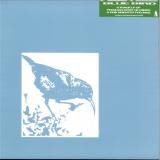
Following the critical success of last year’s ‘Cold Feet’ LP, producer, DJ, and multi-instrumentalist Alek Lee returns to Isle of Jura with his most introspective work to date, the ‘Blue Bird’ album. Across eight tracks, the Athens-based artist explores what he describes as a "Peculiar state of minds & Dub Orientated Feelings," blending his signature guerrilla style production with deep, organic soul.
The album’s centerpiece and title track, ‘Blue Bird’ features the haunting vocals of singer-songwriter Keren Ilan. It is a raw, heartfelt exploration of the aftermath of a breakup. The lyrics speak of a "desert heart" and a "loss that grows tall and loud," eventually finding a path toward healing as the "blue bird sings the dawn." Musically, the track is anchored by hazy, sun drenched guitars, a central instrument that weaves a consistent Balearic thread throughout the LP.
The journey through ‘Blue Bird’ is one of shifting shadows and unexpected textures. ‘Treasures’ is a standout instrumental, leaning into a grit-flecked, bluesy "twang" reminiscent of Duane Eddy, while ‘The Beach Road’ sees long time collaborator and ‘Shame On Us’ bandmate, Yovav, lending his magical bass and guitar work to a track that feels like a slow drive toward the horizon.
Side B shifts the energy toward the dancefloor and the sophisticated leftfield pop of the 80s. ‘First Rain’ is a subtle house leaning gem underpinned by a kick drum and lush, synth heavy emotive chord progression. ‘Thanks to Sade’ is a seductive downtempo groove with epic guitar lines shifting through, while ‘Remember the Good’ brings a subtle reggae skank and a French-influenced organ sound into the mix. The LP comes full circle with a smoked out Dub version of the title track ‘Blue Bird’.
A 180 gram pressing in a 3mm spine full colour sleeve and sticker designed by Bradley Pinkerton.

Поиск:spe
Все
Amsterdam's Dionisos' (also known for his collaborations with Pete Blaker for LL & Hot Biscuit Recordings) debut 12" on his own Lovers Yacht imprint.
Dionisos, the project’s producer, possesses a solid foundation in live music, which is clearly reflected in the way the grooves evolve, resonate, and gradually heighten in intensity. The tracks “Mother Earth”, “Father Sky,” and “Bon Voyage” form an exciting trilogy—a daring journey into the musical universe. Captured in a single take, they were subsequently methodically overdubbed and layered, preserving the essence of musicians interacting in real time.
Instead of pursuing drops or studio glitz, the music focuses on capturing the spirit, interacting only with the original vibrations of the one take. These songs flow with the precision of musicians in a band. They develop organically, demonstrating their strength gradually; music for dancing that relies on emotion rather than spectacle.
Italy’s own L.D.F. makes his debut on Shadow Pressings with a fresh slab of raw, analog funk—pressed strictly to wax and destined for selectors who still worship the turntable altar. With contributions from Detroit icons, Javonntte, Gary Romalis, & European groove architects Tilman & Böhm, the EP threads classic motifs through a modern underground sensibility—never nostalgic, always alive.
Shrunken Elvis ist ein Trio aus Nashville, bestehend aus Spencer Cullum, Sean Thompson und Rich Ruth - drei erfahrenen Musikern, die ihre Liebe zu genreübergreifender Instrumentalmusik verbindet. Die Gruppe entstand aus langen Autofahrten durch Europa, Winter-Jam-Sessions und dem gemeinsamen Bestreben, Musik eher aus dem Bauch heraus als aus Ambitionen heraus zu machen. Cullum, ein in East London geborener Pedal-Steel-Gitarrist, spielte bereits mit Angel Olsen, Lambchop, Miranda Lambert und Billy Strings gespielt und zwei Solo-Folk-Psych-LPs bei Full Time Hobby veröffentlicht. Thompson kam mit Gnarwhal und Promised Land Sound in der DIY-Szene von Nashville groß heraus und tourte später mit Margo Price und Skyway Man. Ruth schafft unter dem Namen Rich Ruth (Third Man Records) immersive Soloarbeiten, die spirituellen Jazz, Ambient und Post-Rock miteinander verbinden. Ihre Anfänge gehen auf eine Europatournee im Jahr 2022 zurück, die sie im Rahmen von Cullums Soloalbum unternahmen. Mit einem kompakten Setup aus Gitarren, Pedal Steel und Synthesizern in einem VW Passat zusammengepfercht, begannen sie unterwegs zu komponieren - und entwickelten eine gemeinsame musikalische Sprache, die sie in ihre Wintersessions in Nashville mitnahmen. Sie nahmen in einem Studio in einem Schuppen um einen Heizstrahler herum auf und fingen den Geist dieser Reisen mit Spontaneität und Vertrauen ein. Ihr Debütalbum zielt nicht darauf ab, individuelle Fähigkeiten in den Vordergrund zu stellen, sondern die Instrumente zu etwas völlig Neuem verschmelzen zu lassen. Mit der Einstellung ,keine Ziele, nur Ideen" schufen sie Musik, die sich ungezwungen, explorativ und lebendig anfühlt. Verwurzelt in den Traditionen von Kosmischer Musik, Jazz-Fusion, Elektronik und Ambient, lässt sich Shrunken Elvis von Alice Coltrane, Michael Rother, Pat Metheny, Ashra und KLF inspirieren lassen - zusammen mit visuellen Einflüssen wie ECM-Albumcovern und den Filmen von Kurosawa und Bergman. Gemischt von Jake Davis (William Tyler) und mit Artwork von Max Kinghorn-Mills (Hollow Hand) ist ihr Debüt ein leise drängendes, zutiefst kollaboratives Album - Musik, die ohne Erwartungen entstanden ist, aber voller Absicht.
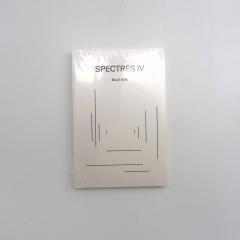
Fourth issue of Shelter Press' annual publication series »Spectres« (in association with INA GRM), this time themed around ›voice‹. Featuring contributions from/about François J. Bonnet, John Giorno, David Grubbs, Yannick Guédon, Lee Gamble, Sarah Hennies, Haela Ravenna Hunt-Hendrix, Stine Janvin, Joan La Barbara, Youmna Saba, Akira Sakata, Pierre Schaeffer, Peter Szendy and Ghédalia Tazartès.
The book includes an essay about the essence of improvisation by Joan La Barbara, Lee Gamble looking at neural networks and vocal simulation systems, an untitled anecdote from Ghédalia Tazartès (RIP) and Stine Janvin on the necessity of singing, plus much more.
»The voice is everywhere, infiltrating everything, making civilisation, marking out territories with infinite borders, spreading from the farthest reaches to the most intimate spaces. It can be neither reduced nor summarised. And accordingly, when taken as a theme, the voice is inexhaustible, even when seen in the light of its very particular relation with the sonic or the musical, as is the case in most of the texts collected in this volume. There is no point therefore in trying to circumscribe or amalgamate the multiple avatars of the voice. We must rather try to apprehend what the voice can do, to envisage its landscape, its potential effects.«
— Extract from the editors' foreword.
- A1: Träumerei 02 31
- A2: Brenne 06 02
- A3: Taxi Driver 04 57
- A4: Sehnsucht 05 30
- B1: Entwurf Einer Ballade 05 06
- B2: Schock 04 17
- B3: Flüchtlingswalzer 05 13
- B4: In Die Disko 03 13
- C1: Der Lärmkrieg 04 46
- C2: Liebe Emmi 05 51
- C3: Im Atelier 03 54
- C4: Take The Red Pill 04 15
- D1: Ashley Smith 04 13
- D2: Zweites Vierteljahr 04 54
- D3: Da Fliegt Die Rakete 02 30
- D4: Die Erde Ist Mir Fremd Geworden 03 16
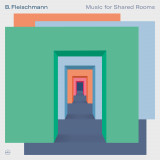
»Music for Shared Rooms« is B. Fleischmann’s eleventh solo album and his first since 2018. It is also not an album, or at least not in the conventional sense of the word. These 16 instrumental pieces provide a kaleidoscopic glimpse of a forward-thinking musician at home in many different musical worlds, including experimental and abstract music, pop and more classically-minded compositional forms. These pieces were culled from an archive of roughly 600 compositions for theatre pieces and films written throughout the past twelve years. The Österreichischer Filmpreis-awarded composer, however, aimed for more than simply documenting his extensive work in and with different media. To do so, he edited and re-mixed the individual recordings for this release, taking them out of their contexts and reworking them for an audience who can experience them in a different setting. »Music for Shared Rooms« makes it possible for its listeners to engage with the sounds and to fill the spaces they open up with their own imagination.
Roughly speaking, music for theatre or film can serve two functions: it either takes the lead, or underscores what is happening on stage or screen. The marvelous thing about these pieces is that they manage to do both. Fleischmann’s work as a prolific producer has always drawn on contrasts, at times combining pop sentiment with rigid experimentation, the seemingly naive with the intricate and complex. This approach also marks the tracks collected here: bringing together acoustic elements and electronic sounds, at times working with conventional structures but always de- and re-contextualising them, Fleischmann constructs a vivid dramaturgy out of discrete singular compositions, letting them interact across the record.
Take, for example, the opener »Träumerei« and the following »Brenne«: after the soothing acoustic sounds of the former, the latter quickly picks up speed with hard-hitting drum machine rhythms. It’s a stark contrast sonically and stylistically, however both tracks are tied together by a certain harmonic sensibility. This sort of dramaturgical interconnectedness of varied musical materials is the thread that runs through »Music for Shared Rooms«. A droney piece for string instruments like »Sehnsucht« is followed by a trip-hop beat, before »Schock« lives up to its title with skittering beats and piercing high frequencies. The differences between the pieces may be striking, but the progression from one to the other is subtle. It goes on like this through different moods and tempos. There’s soothing-yet-eerie piano pieces like the »Für Elise«-inspired »Der Lärmkrieg«, gentle house grooves, joyful synthesizer excursions and, finally, »Die Erde ist mir fremd geworden«, a collage of abstract textures and concrete sounds.
All these pieces create distinct situations through the juxtaposition of diverse musical elements, but are also bound together by a single vision. Writing music for theatre pieces or film requires a composer and his pieces to engage with people and their movements in space, which is exactly what Fleischmann offers on this record. He breaks down the fourth wall and invites his listeners into his world, a wide-ranging musical panorama. »Music for Shared Rooms« is indeed not an album in the conventional sense of the word, but more like a photo album in which each page opens up a new space to get lost in; recreates different scenes in which you can immerse yourself. These are shared rooms indeed.
First time reissue of JP free jazz rarity, pre-Seikatsu Kōjyō Iinkai group.
The single album self-released by the quartet Shūdan Sokai in 1977 is one of the most vital documents of mid-seventies Japanese free jazz, documenting Tokyo’s free scene at the precise moment when it began to shift to a handful of tiny venues on the western fringes of the city. In Free Jazz in Japan, Teruto Soejima identifies the extant venue Aketa no Mise in Nishi-Ogikubo as the pioneer of this decamping from the centre: a cramped basement beneath a rice shop, seating just 20 people. Musician-run, operated on a shoestring, these spaces offered a vital site for community, creativity, and a small measure of financial independence — “even though it was in a basement, in spirit it was a loft.”
Among the most active of the new venues was Alone in Hachiōji, nearly an hour from Shinjuku, in a district shaped by universities, lower rents, and a thriving counterculture. Originally opened in 1973 as a jazu kissa, Alone was unusually spacious and equipped with a stage, grand piano, and drum kit. Around 1974, Junji Mori and Yasuhiro Sakakibara began working there, booking free jazz players on weekends and establishing the venue as a crucial hub. Mori recalls early appearances by figures including Kazutoki Umezu, Toshinori Kondo, and others who would define the scene.
In early 1976, Umezu and pianist Yoriyuki Harada — recently returned from New York’s loft jazz environment, where they had played with musicians such as David Murray and William Parker — formed Shūdan Sokai with Mori and drummer Takashi Kikuchi. The name, meaning “mass evacuation,” pointed to their self-chosen exile in Hachiōji. With Alone as their home base, the quartet developed a music characterized by an infectious sense of enjoyment and a willingness to integrate free jazz with elements of song structure. Harada switched between piano and bass; the group experimented with rap-like vocal pieces, jabbering nursery rhymes over bass rhythms.
They returned to Alone on December 24 to record Sono zen’ya (Eve), releasing it on their own Des Chonboo Records, partially funded by advertisements from local businesses printed on the rear cover. The closing “Ballad for Seshiru,” dedicated to Harada’s newborn son, unfolds over a delicate piano melody that moves into emphatic chords as intertwining alto lines rise and spiral.
Alone closed in September 1977, and Shūdan Sokai soon dissolved, later morphing into the expanded Seikatsu Kōjyō Iinkai Orchestra. What remains is a recording rooted in a specific place and moment: a fiercely independent scene sustained by small rooms, close listening, and collective commitment.
"Hayalet Kırıkları" unfolds like a diary of fragmented memories, where voices, textures and distant echoes blur into something both intimate and unsettling.
Hilal Can’s luminous presence meets Tzii’s raw sonic landscapes, creating a music that feels suspended—between memory and invention, absence and desire.
With the spectral violin of Ruben Tenenbaum, the record shimmers like a fragile world on the verge of dissolving.
- A1: Notax - Broken Brain
- A2: Cyberpunkers - Leaper
- A3: Malke & Mr Madness - Djenty
- B1: Chrs - Ly1 2
- B2: Perimix - Deep Breath
- B3: Pisapia- Scream
- C1: Satronica & Narc - Battle Stations
- C2: A-Kriv & Wzx_O - Drugs In The Club
- C3: Mozzy Rekorder & Purple Mash - Alizee
- D1: Lazy Ants - Low Drive
- D2: Cobra Cane - Speedway Tripper
- D3: Xhl Unit & Virus Voice - Reality
Afterimages is the debut vinyl LP from experimental musician Urner. Across ten compositions, the album unfolds as an adventurous ambient record, inventively constructed yet warmly immersive. Speculative pasts and emergent futures intertwine through gestural manipulation and improvisatory sampling. The sound sources of Afterimages include Sanukite lithophone tones, VGM soundfonts, uncanny PCM loops, modular synthesis, and the artist’s voice, all converging into a shifting, tactile sound world. In a thriving experimental scene filled with fresh voices, Urner’s world proves surprisingly addictive.
The LP is released by adventurous electronic music label topo2 on April 3, 2026. The record is pressed on 180 grams of ICCS-certified bio-vinyl and housed in a heavy full-colour sleeve. Mastering is done by Ike Zwanikken and artwork by Rohan Chaurasia.
Conscious and intentional. The Transnationality EP marks the first release of TEMAS Records, fully composed and mixed between Paris and Lisbon, featuring artists from both countries: Paul Cut (FR), Flabaire (FR), Sara Wual (PT) and Mayan (PT). Within the spectrum of House Music, each artist captured a selection of oldschool aesthetics using gear from different eras. The intention is to praise the references that shaped their path as artists, where they find beauty. Mastered by DJ Steaw at Rutilance Lab Paris. TEMAS Records is an independent music label founded by Sara Wual, Paul Cut and Cíntia Aguiar Pinto. The label prioritizes a slower release schedule for a more sustainable music industry, with only 1 vinyl record release per year. The albums are mindfully produced in Portugal through the use of recycled vinyl left-overs, that otherwise would go to waste. Funded by the European Union via Goethe-Institut.
Soul Quest Records reaches a milestone moment with its 20th release, welcoming a debut that feels anything but new. Enter Sean Green… a mysterious new name whose sound suggests deep roots, sharp instincts, and the quiet confidence of a seasoned producer operating under a fresh alias. While details remain deliberately sparse, the music speaks volumes.
- A1: Another Friday Night
- A2: Head & Heart Feat Mnek
- A3: Bed Feat Raye & David Guetta
- A4: Out Out Feat Jax Jones, Charli Xcx & Saweetie
- A5: Desire Feat Icona Pop & Rain Radio
- A6: Dance Around It Feat Caity Baser
- A7: Do U Want Me Baby? Feat Billen Ted & Elphi
- B1: 0800 Heaven Feat Nathan Dawe & Ella Henderson
- B2: Lionheart Feat Tom Grennan
- B3: History Feat Becky Hill
- B4: Sorry
- B5: Lonely
- B6: I Wish Feat Mabel
- B7: What Would You Do? Feat David Guetta & Bryson Tiller
Black[29,37 €]
On 6th October, multi BRIT-nominated DJ/producer Joel Corry releases his debut album, ‘Another Friday Night’ via Asylum / Atlantic Records, with the pre-order going live on the 18th August.
To be released on both vinyl & CD, as well as via streaming/download, ‘Another Friday Night’ is a collection of Joel’s most iconic records of the last five years, including breakthrough hit ‘Sorry’, ‘Lonely’, multi-platinum UK #1 single ‘Head & Heart’ ft. MNEK, ‘BED’ w/ RAYE & David Guetta, ‘OUT OUT’ w/ Jax Jones, Charli XCX & Saweetie, plus fresh 2023 cuts like ‘Dance Around It’ with Caity Baser and the anthemic ‘0800 HEAVEN’ with Nathan Dawe & Ella Henderson, ‘Another Friday Night’ toasts a remarkable run of releases that’s seen Joel become one of the UK’s biggest and most impactful dance acts.
“My debut album ‘Another Friday Night’ is the biggest moment of my life”, says Joel Corry. “Everything I have dreamed about and worked so hard for has come together with the release of this record. It has been an incredible journey and I am so proud to have reached this moment in my career. I want the songs to make people feel good and bring happiness to their days, and the album includes everyone’s favourite bangers from over the years, as well as some really exciting new material. This is the ultimate Joel Corry playlist, perfect for Another Friday Night.”
Ahead of the release of ‘Another Friday Night’ on October 6th, Joel has also announced a special headline show at London’s Ministry Of Sound on Friday 29th September – his first London headline date since playing at former 5000-cap venue, Printworks, in autumn 2021.
Fans who pre-order ‘Another Friday Night’ will be granted early pre-sale access to tickets on August 24th, before general sale opens on August 25th
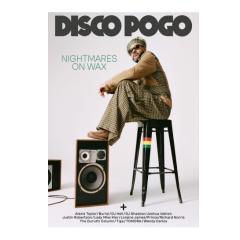
The new issue of Disco Pogo features 20 pages on Prince’s influence on electronic music marking 10 years since his passing.
Our other two cover stars are Warp’s Nightmares on Wax, who is celebrating 30 years since his classic album ‘Smokers Delight’ having just sold out The Royal Albert Hall, and TOMORA who are a new duo made up of Tom from The Chemical Brothers and Scandi pop star Aurora.
Plus features on The Durutti Column, Wendy Carlos’ ‘Clockwork Orange’ soundtrack, Burial, Lorraine James, DJ Hell, DJ Shadow, Hot Chip’s Alexis Taylor, Speedy J, Tiga and much more!
194 pages of quality music journalism by the world’s best music writers plus beautiful photography and design in a quality print magazine.