dreamcastmoe is the recording project of singer, songwriter, producer, and DJ Davon Bryant, a lifelong resident of Washington, DC. His music moves freely between moods and modes, hypnotic, romantic, traversing electronic, R&B, funk, soul, and hip-hop... Resident Advisor dubs it "soulful, cross-genre dance music." This ability to adapt and finesse, to twist in different directions while staying true and coherent in vision, can be traced to his home city and its complex cultural history. "Most Black kids in DC don't ever get to this point," he says. "This is what I am making this music for, in the DC tradition of soul and empathy and love that is rooted in this city. My music is for real people dealing with shit every day." A versatile, modern artist and collaborator, dreamcastmoe has thrived in the underground since his first uploads to Soundcloud and Bandcamp in 2017 and subsequent releases with labels like People's Potential Unlimited, Trading Places, and In Real Life Music. Bryant's laid-back personality, emotional honesty, and infectious energy shine through his work and how he talks about it, as Crack Magazine notes in their 2021 Rising feature: "a steady combination of confidence, creativity, and calmness." He grew up playing drums in church; he's worked dead-end jobs, had ups and downs, even sold off all his gear one time, but never stopped reinvesting in himself. He is quick to praise his co-producers, rattle off influences _ the visual feel of NBA 2K, the comedic timing of Bernie Mac, the savvy legacy of Duke Ellington, for starters _ and credit resourceful DC breakouts like Ankhlejohn that showed him the roadmap. His voice, a steady instrument, seemingly connects it all, capable of slow falsetto flow, swaggering talk-rap, and outright croon. His storytelling style is choppy yet fluid, like a mixtape, which is how Bryant sees Sound Is Like Water, his debut on Ghostly's International's freeform label, Spectral Sound. The two-part project culminates as a full-length LP release in November 2022. The first side, released as Part I, opens on the blurred beats of "El Dorado," which dreamcastmoe dedicates to his journey. It's a head-nodder, an off-kilter earworm co-produced by Max D (Future Times, RVNG Intl, etc.), with Bryant harmonizing hooks with synth jabs and a pitched-down presence. "Complicated" is the slow jam, delivered smoothly from a Saturday night crossroads. dreamcastmoe is contemplative and committed... gliding and locking ad-libs into skittering rhythms courtesy of co-producer Zackary Dawson _ but also willing to let something go, "acknowledging that everything in life IS NOT easy." "RU Ready" takes off from the jump as a tribute, challenge, and promise to his partner and his city ("The times you sat with me when I needed you the most / Told me the things that I needed to see / Young black man, really trying to be what I can be / And I'm really from DC). In its potent two-plus minutes, the sonics (co-produced by ZDBT) press the message, all cymbal crashes, breakbeats, and serrated synth lines. "Cloudy Weather, Wear Boots" is a blitzing dance-punk track made in collaboration with Jordan GCZ on Bryant's first trip to Amsterdam. The album's flipside opens on "Much More," the first of two synth-and-beat ballads co-produced by ZDBT. Later on "Long Songz," he claims, "I'm not writing love songs no more," prioritizing the vibe with "all my day ones." He calls it "a cry for more normal moments. Everything doesn't have to be a fantasy love story, more time spent getting to the money, growing, and making a way." He saves two of his most propulsive cuts for the finale, co-produced by Sami, co-founder of DC dance label 1432 R. As their titles suggest, "Take A Moment" and "Make Ya Mind" operate as anthems for movement, with Bryant free-flowing commands above wildly-styled percussion. Per Bryant, the latter is both "wake & bake jam" and a "dance floor bomb." His parting line: "Action / You got to show me action / Reaction." The world of dreamcastmoe straddles virtual reality and the realness of DC, images both imagined and lived-in. Bryant has a knack for unexpected melodies but what makes his music so exciting is his capacity to defy the expectations of genre and image. A fluid ingenuity and vulnerability bottled by Sound Is Like Water, and this is just the beginning.
Buscar:spectral sound
dreamcastmoe is the recording project of singer, songwriter, producer, and DJ Davon Bryant, a lifelong resident of Washington, DC. His music moves freely between moods and modes, hypnotic, romantic, traversing electronic, R&B, funk, soul, and hip-hop... Resident Advisor dubs it "soulful, cross-genre dance music." This ability to adapt and finesse, to twist in different directions while staying true and coherent in vision, can be traced to his home city and its complex cultural history. "Most Black kids in DC don't ever get to this point," he says. "This is what I am making this music for, in the DC tradition of soul and empathy and love that is rooted in this city. My music is for real people dealing with shit every day." A versatile, modern artist and collaborator, dreamcastmoe has thrived in the underground since his first uploads to Soundcloud and Bandcamp in 2017 and subsequent releases with labels like People's Potential Unlimited, Trading Places, and In Real Life Music. Bryant's laid-back personality, emotional honesty, and infectious energy shine through his work and how he talks about it, as Crack Magazine notes in their 2021 Rising feature: "a steady combination of confidence, creativity, and calmness." He grew up playing drums in church; he's worked dead-end jobs, had ups and downs, even sold off all his gear one time, but never stopped reinvesting in himself. He is quick to praise his co-producers, rattle off influences _ the visual feel of NBA 2K, the comedic timing of Bernie Mac, the savvy legacy of Duke Ellington, for starters _ and credit resourceful DC breakouts like Ankhlejohn that showed him the roadmap. His voice, a steady instrument, seemingly connects it all, capable of slow falsetto flow, swaggering talk-rap, and outright croon. His storytelling style is choppy yet fluid, like a mixtape, which is how Bryant sees Sound Is Like Water, his debut on Ghostly's International's freeform label, Spectral Sound. The two-part project culminates as a full-length LP release in November 2022. The first side, released as Part I, opens on the blurred beats of "El Dorado," which dreamcastmoe dedicates to his journey. It's a head-nodder, an off-kilter earworm co-produced by Max D (Future Times, RVNG Intl, etc.), with Bryant harmonizing hooks with synth jabs and a pitched-down presence. "Complicated" is the slow jam, delivered smoothly from a Saturday night crossroads. dreamcastmoe is contemplative and committed... gliding and locking ad-libs into skittering rhythms courtesy of co-producer Zackary Dawson _ but also willing to let something go, "acknowledging that everything in life IS NOT easy." "RU Ready" takes off from the jump as a tribute, challenge, and promise to his partner and his city ("The times you sat with me when I needed you the most / Told me the things that I needed to see / Young black man, really trying to be what I can be / And I'm really from DC). In its potent two-plus minutes, the sonics (co-produced by ZDBT) press the message, all cymbal crashes, breakbeats, and serrated synth lines. "Cloudy Weather, Wear Boots" is a blitzing dance-punk track made in collaboration with Jordan GCZ on Bryant's first trip to Amsterdam. The album's flipside opens on "Much More," the first of two synth-and-beat ballads co-produced by ZDBT. Later on "Long Songz," he claims, "I'm not writing love songs no more," prioritizing the vibe with "all my day ones." He calls it "a cry for more normal moments. Everything doesn't have to be a fantasy love story, more time spent getting to the money, growing, and making a way." He saves two of his most propulsive cuts for the finale, co-produced by Sami, co-founder of DC dance label 1432 R. As their titles suggest, "Take A Moment" and "Make Ya Mind" operate as anthems for movement, with Bryant free-flowing commands above wildly-styled percussion. Per Bryant, the latter is both "wake & bake jam" and a "dance floor bomb." His parting line: "Action / You got to show me action / Reaction." The world of dreamcastmoe straddles virtual reality and the realness of DC, images both imagined and lived-in. Bryant has a knack for unexpected melodies but what makes his music so exciting is his capacity to defy the expectations of genre and image. A fluid ingenuity and vulnerability bottled by Sound Is Like Water, and this is just the beginning.
Since completing his two-decade-long hip-hop trilogy as Dabrye in 2018, Ann Arbor-based artist and Bopside label head Tadd Mullinix has engaged his arsenal of aliases with renewed heat. First came the debut of X-Altera, a new project flexing a wildstyle hybrid of drum & bass and deep techno. Now, he returns to James T. Cotton, a moniker which dates back as far as Dabrye and helped define Spectral Sound, the dance imprint of Ghostly International. While historically tagged as Mullinix’s acid house alias, JTC has always expressed with a more pliable sense of genre, freely fusing an eclectic blend of classic electronic sounds; helpings of Chicago acid, Belgian New Beat, and the leftfield techno stylings popularized both in Berlin and Detroit. With Indigo, Flesh and Fire, Mullinix moves closer to the latter city, adopting a bright, optimistic tone informed by minimalism and futurism.
"I have been more withdrawn and introspective on a personal level, in a positive sense, and I think that fact has made my creativity reach toward feelings about peace, positivity, fantasy, wonder, and openness,” says Mullinix.
The EP is packed, but still playfully ambiguous; a club-ready set built to max out mixing boards with spacious and nuanced melodies and motorized percussion. Five tracks, each with roughly five-minute run-times, offering all but a few breaths in a quest for highly operative dancefloor hypnosis. The record wastes little time locking in; on the first track, “Innerloire Rendezvous,” a dense square kick plows through a brisk four-on-the-floor routine phasing over harmonious synth stacks of rubbery fifths and sevenths. The title track splatters a lenticular static spray between thumping kick, billowy melodic swells, and staticky clicks, snaps, and claps.
Mullinix’s distilled musical vocabulary, developed by his many years in the game, gives the set a misty-eyed quality without compromising its contemporary merit. This is music, inspired by history but fiercely forward-thinking, that feels both subterranean and airborne; in the grind on the ground and soaring above in an iridescent super-charged fog.
key selling points: - Debut release on Spectral Sound - Past releases on Firm Tracks, Nite Owl Diner, Sweat Equity, FCR, Clave - Limited to 300 copies worldwide.
Under the alias Ciel, Xi'an-born/Toronto-based producer, pianist, DJ, and Discwoman affiliate Cindy Li embodies the social conscience of progressive electronic music. She is at once a local and global artist, having flourished at the fringe of cutting-edge club culture since 2015, firmly rooted in her adopted city while reaching increasingly outward, her sets echoing from Berlin’s Berghain to Chicago’s Smartbar to Lisbon’s Lux Fragil. Back in Toronto, she co-runs the label Parallel Minds and event initiative Work In Progress, an extension of her radio show in both name and M.O. to improve female representation in the scene. She’s helped write safe space policies, hosted DJ workshops, and applied activist pressure on promoters through varying methods with a single-minded resolve. Those efforts have evoked responses, which Li has spent time reckoning with over the past two years. Now, manifesting as a self-guided reaction to her experiences as an artist and activist is Ciel’s Spectral Sound debut, Why Me?, a deeply personal and physical work.
Ciel’s stylistic pocket as a producer remains that of “soft-touch slammers,” but fans will note the material on Why Me? hits harder. “I wanted to write something that was heavy,” she says of the title track, the result of processing the noise leveled at her specifically after she amassed a database of female and nonbinary talents to highlight the lack of bookings amongst a subset of clubs in the community. “I was dealing with a lot... anger, despair, paranoia, feeling unjustly targeted.” She channeled these antiphons into her art. The cut’s namesake is sourced from the foregrounded sample, a snippet of dialogue from an old film about a man who believes he’s been abducted by aliens. Pulsing metallic drum patterns steer through the hypnotic passage; permeating beneath the beats are lush pads, washing the rattled urgency with unease.
Hardware-built tracks “Go Fish” and “Uri’s Song” came together over studio time with friend and occasional collaborator Colin Sims aka Wiretapping. Ciel brought her sampler to the sessions, with Sims contributing additional drums, which she’d arrange further at home, adding synth parts and basslines and effects, distilling it all down to its most potent core. The latter track — an effervescent minimal techno exercise both tender and tough — expresses Li’s reflections on today’s cyclical conditions for activism, dissension, and, ultimately, optimism. “These are harsher sounds but they also have elements that are really beautiful about them. I wanted to communicate that nothing is permanent, that there’s always hope for understanding and resolution.”
Todd Osborn Returns To Spectral Sound In His Osborne Guise With His First Release On On The Label Since 2013's Hold Up (feat. Joe Goddard). Fools Finds Osborn In His Best Self, As A Shapeshifter Bringing Together Strands Of Various Genres. The Title Track Is A Lesson In House Reduction, While "different" Is A Chunk Of Bassline-led Techno. On The B-side, "back Whenever" Kicks Off In Proto-idm Electro Form, All Melody And Light, And "integrate" Slows It Down To A Walking Pace For A Dash Of Synth Funk.
- A1: Gunnar Haslam - Versione Antica
- A2: Minimal Violence - Travel By Night
- B1: Matrixxman & Riccardo Limiti - Inferno
- B2: Russell E.l. Butler - Run Away With My Heart
- C1: D'marc Cantu - Regular People
- C2: Earth Trax X Newborn Jr. - Paradox
- D1: X-Altera - Entry (Jtc's Sparkz Mahlecyul Remix)
- D2: Nigel Caenaan - January's End
For over 18 years, Spectral Sound, the dance music imprint of Ghostly International, has thrived at the forefront of techno and house. It has been a source of support for numerous DJs and producers during that time, from Matthew Dear and Benoit & Sergio to Avalon Emerson and Hieroglyphic Being. Now, Spectral brings the past alongside the present with its latest release, a compilation that offers a vibrant cross-section of the current moment in underground dance music. Despite the wide-ranging selections on Spectral 139, a throughline of classic style and infectious energy emerges from the up-and-coming and established artists alike. Rising talents such as Minimal Violence, Russell E.L. Butler, and Earth Trax x Newborn Jr. bring unique perspectives to their hardware-centric productions. Veteran producers bring their own edge as well: D'Marc Cantu blows the roof off with the outsized funk of "Regularly People," and Nigil Caenaan's "January's End," a low-key Detroit classic from the late '90s, closes Spectral 139 with a whirlwind of manic rhythms and sedate synths. Gunnar Haslam opens the tracklist with his acidic mindbender, "Versione Antica." And Ghostly regulars like Tadd Mullinix, who drops a lush JTC remix of his new X-Altera alias, and Matrixxman, who collaborates with Riccardo Limiti on the cavernous "Inferno," tie everything back to the label's roots. The double-12" compilation, as well as each individual single, features original work by Los Angeles-based artist Nina Hartmann. Her designs have appeared on releases from labels such as Ascetic House and Big Love, and the pieces for Spectral 139 continue to develop her cryptic aesthetic. The marriage of Hartmann's striking, high-contrast symbols with such bold dance music speaks to a collection that aims to stand out.
This grouping of audio recordings is for aural use only. Any emotional content perceived herein is borne of its listener, and is in no way intended by its author. Any sounds resembling speech are not intended to convey meaning.
Several Shades Of The Same Color is Patricia's first album for Spectral Sound — produced in conjunction with his own label Active Cultures.
Tips for listeners: consider the moment in which you exist; pay attention to how these sounds evoke physiological (rather than cognitive) responses. Listeners may find themselves deriving immense physical pleasure from exposure to these sounds. Inability to achieve such pleasure is likely attributable to over-analysis of the aforementioned audio content — or to improper amplification.
Each of Shades' three LPs features suites of tracks that, considered alone, comprise their own distinct, unique worlds. Disc One opens with "I Know The Face, But Not The Name," an unabashedly plaintive trip through classic electro rhythms; flip it over for "The Words Are Only Sounds," a haunting affair for synthesizer and voice. Disc Two's "The Electric Eye is Upon Me" swirls endlessly, while "Shiba Inu Dub" is cut for the floor and coy as its namesake. Disc Three's jackin' "Feel Your Body" will cause you to do just that; "German Friendship" sounds like D.A.F. on dissociatives.
Any emotional associations incurred while listening come at the listener's discretion. Furthermore, the identity of the author and/or their passions regarding the recordings herein shall bear no weight on the listener's experience. This body of work is not intended to generate ideas; rather, its goal is to produce physical sensations in the listener.
Taken altogether, Several Shades Of The Same Color is kaleidoscopic, a multi-faceted techno trip. Listen in full, or listen in part. And if you consider only one of these intermittent listening notes, make it this one: Don't think; just hear.
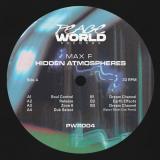
Peace World Records returns with Hidden Atmospheres, the debut release produced by Max F and mixed by Space Ghost. Drawing from classic deep house and esoteric club sounds of the '90s and early 2000s, this seven-track collection channels these influences into fresh territory while preserving the digital grit and dreamlike essence of the era.
The release strikes a delicate balance between the meditative and the kinetic. On the A Side, tracks “Soul Control” and “Zone 6” highlight subtle yet hard-hitting percussion grooves and deep basslines that anchor the mix beneath ethereal pads and sweeps. Each track builds through hypnotic, evolving arrangements that reward close listening. On the B side, “Dream Channel” and “Earth Effects" both feature airy, spectral synth progressions that interweave with ephemeral yet decisive melodies, demonstrating a refined insight of space and dynamics. To round things off, Space Ghost took a crack at an energetic club remix of “Dream Channel. ” Carried by a classic 909 house rhythm and a bubbly bassline, the remix offers a fun, uplifting take on the original, complete with organ stabs and MIDI sax!
As a whole, Hidden Atmospheres delivers something new for fans of 90s and 2000s era house music. Think Ronin, Hanna, Chris Brann, Wamdue Kids—artists whose work holds its own in the club while remaining equally suited for intimate late-night listening. Throughout the record, tracks drift seamlessly between shimmering dancefloor functionality and liminal, introspective ambience, inviting repeat listens that reveal new details and "hidden atmospheres" with eachpass.
Hidden Atmospheres lands on Peace World Records April 9th, 2026.
g B3. Dream Channel Space Ghost Club Remix
The long-overdue revival of Bim Sherman’s catalog begins here. These essential recordings will become widely available again for the first time in decades, opening a new chapter in the appreciation of one of Jamaica’s most distinctive voices and representing a major moment for reggae and dub aficionados around the world. This reissue series will not only preserve his legacy but will also offer listeners the chance to experience the depth and timeless resonance of Sherman’s work in its full glory.
Bim Sherman—born Jarret Lloyd Vincent, in Westmoreland, Jamaica—holds a unique place in reggae history. Emerging in the mid 70s, his ethereal, haunting vocal style quickly set him apart from his contemporaries. He was soon collaborating with the top producers and musicians of the era, including Adrian Sherwood and the On-U Sound collective, bridging the gap between roots reggae and experimental dub and laying the groundwork for the fusion of Jamaican sounds with the vibrant underground scene in the UK. His career, from Kingston to London to Mumbai, was marked by an artistic daring and spiritual intensity that has earned him enduring respect across generations.
The centerpiece of this reissue campaign is Ghetto Dub from 1988, a record that distills Sherman’s artistry into its most potent form. Originally released in a limited number, the album embodies the stark yet soulful beauty of dub production. With its reverb-drenched drums, cavernous basslines, and echo-laden atmospherics, Ghetto Dub transforms Sherman’s various tracks into spectral presences that drift in and out of the mix. The arrangement and production—minimal yet profoundly textured—captures both the raw urgency of Jamaican street culture and the forward-looking experimentation of the UK dub scene. Each track unfolds like a meditation, balancing grit with grace, density with space. Ghetto Dub is more than an album; it is an immersive soundscape that reaffirms Bim Sherman as one of reggae’s most otherworldly and visionary figures.
Superonda’s debut release, Aurora Spectralis, introduces the latest project from Mahatmos, a duo emerging from long-established practices in electronic music, sound design and composition for moving images. Released on 12” vinyl and digitally, the EP unfolds across four tracks of electronic ambient music shaped by atmosphere, con1nuity and restrained propulsion. Ambient textures open a broad emotional and spa1al field, while slow, insistent rhythms provide steady forward motion.
Superonda has created a space for Mahatmos to sharpen their focus on sound as material. Modular synthesis, analogue instruments and live processes techniques are balanced with precision and restraint, resulting in music that moves between progressive and hypnotic forms, informed as much by underground club culture as by cinematic composition.
Mahatmos is a Rome-based duo with complementary and deep-rooted practices. Gianluca Meloni brings a long-standing presence in techno and experimental music scene, with international releases and performances (as Laertes and as part of Modern Heads). Maurizio Loffredo contributes an extensive background in composition, production and sound engineering across popular music and film, with a refined sensitivity to timbre, structure and sonic narrative.
Superonda is a Rome-based label founded by artists engaged in deep sonic research and advanced technical exploration. Operating as an open platform, it connects collaborators working across recording, synthesis and composition, approaching music as a process-driven practice rather than a fixed genre. Each release stands as a distinct exploration, linked by shared sensibilities rather than formal constraints.
The physical edition of Aurora Spectralis is conceived as an extension of the work itself. Alongside a standard black vinyl pressing, a limited run of color and marbled copies has been produced, each one unique. Variability and tactility are embraced as part of the object’s identity, reinforcing the record as something to be experienced gradually, over time.
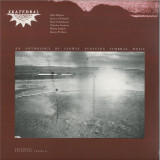
XKatedral Anthology Series II (An Anthology Of Slowly Evolving Timbral Music), featuring exclusive music from Kali Malone, Jessica Ekomane, Mats Erlandsson, Theodor Kentros, Wilma Hultén, and Maria W Horn.
"XKatedral Anthology II is the second instalment in a series of archival releases dedicated to presenting music by composers affiliated with XKatedral working within the realm of slowly evolving harmonic and timbral music. This double-vinyl set contains an array of pieces dating from 2018 - 2020. This collection of pieces focuses on the use of synthetic sound and algorithmic composition languages as tools for precise work within the realm of spectral exploration. In addition to this, the electronic instrumentation in many of the pieces is augmented by acoustic instruments.
The first piece on side A is Kali Malone’s Music for Low Quartet. This piece is an adaptation of the composition “Rose Wreath Crown” originally released on The Sacrificial Code in 2019. In this iteration, the music is scored for two double basses played by Vilhelm Bromander and Zach Rowden, and sine tone electronics performed by Malone herself. The recording of this piece was made at EMS in 2019.
Closing side A is Jessica Ekomane’s ‘First Light’. This computer music piece focuses exclusively on digital sound, layering razor sharp synthetic textures into an otherworldly dynamic weave. The music heard here is a reworked version of a piece originally commissioned by Semibreve in 2020.
Side B contains the work ‘Hands Melt In The Sun’ by Mats Erlandsson. This composition is built from electronically processed tuned zithers and synthetically generated tones arranged in a series of chordal inversions over a sustained fundamental tone. This music, written as a love-letter to the localized drone tradition of Stockholm in the years 2008-2012, was composed and recorded in seven days while in residence at Ställbergs Gruva in Bergslagen, in the summer of 2018.
Opening the second half of the collection is Rough Draft v.7 by Theodor Kentros. Kentros’ compositional practice usually combines acoustic and electronic source material and in this piece he molds the sound of the Buchla 200 and a collection of recorded wind instruments into a molten mass of sound. In its original form, this music was presented as a multichannel immersive work and even in the current stereo configuration it retains some of that enveloping sense of depth.
The second piece on side B, Inertia, is by Wilma Hultén, who makes her debut on record here. An exclusively synthetic piece, Inertia utilizes internal digital feedback in a sealed synthetic system to manifest a harmonic field that swells and abates throughout the length of the piece, interspersed by small gestural elements.
Closing Anthology II is Maria W Horn's work ‘Dies Irae’ for female vocal quartet, pitched glass and synthesis. ‘Dies Irae’ uses a modified form of traditional tonal harmonic language to invoke an uncanny and restless middle ground between the classical western polyphonic vocal tradition and contemporary electronic music. The version heard here is a live recording from Eric Ericssonhallen in Stockholm on May 30th 2020. Performing the piece here are the vocalists Katarina Henryson, Lisa Holmgren, Vilma Ogenblad and Paula Wegmann, as well as Maria herself on glass and electronics."
XKatedral Anthology I is the first in a series of archival releases dedicated to presenting music by XKatedral affiliated composers working within the realm of slowly evolving harmonic and timbral music. This double-vinyl set contains an array of pieces dating from 2010 - 2020. Four of the works included here were originally released on cassette tape early on in the label's history, while the two remaining pieces are presented by the label for the first time.
"The works Ir Himinn, Grooenn by Kristoffer Svensson, Disquiet (Heart) by Marta Forsberg and Lamé by Isak Edberg were first released on the compilation XKatedral Volume II in 2016. Svenssons piece from 2014 combines justly tuned gamelan percussion and prepared piano intricately interwoven in a way that obscures the boundaries between the two instrument groups. Forsberg and Edbergs pieces both use a monolithic form to explore the timbral and harmonic spaces provided by the Düben Baroque organ situated in Tyska Kyrkan in the oldest part of Stockholm. While similar in terms of instrumentation the two works differ formally - Edbergs Lamé composed in 2010 uses the registers of the organ to articulate a seamless spectral transformation while Forsbergs Disquiet (Heart) from 2014 deals in blocks of sound with a varying degree of opacity, saturation and intensity.
Glory for two electric guitars by Caterina Barbieri and Kali Malone was composed and recorded in Tempo Reale in Florence, Italy, and was originally released on the cassette compilation XKatedral Volume III in 2016. This music takes the form of an ever-evolving hypnotic pattern shared by the two instruments articulated through an additive and subtractive canon. Dissolving Ceremony, composed in 2012 by Edberg/Erlandsson/Lisinski, was first presented publicly on the self-released record Stratum. The music contained in that release was formed from a collection of gamelan percussion instruments augmented by two sets of live-electronic instruments tuned to the harmonic framework formed by the partials of the metal percussion. Originally positioned in the center of the record running order between two long monolithic process-based pieces, Dissolving Ceremony now stands on its own as a memory of a time and methodology from the not so distant past.
The newest piece in this set is Shipwrecks by Daniel M Karlsson. While this work is a recent one Karlsson should be considered one of the forerunners of the musical expression contained within this record set. Active within new music for two decades his strongly articulated musical ideas and constantly evolving craftsmanship has resulted in an enormous body of work, and has served as an inspiration for many of his fellow composers. This piece is a celebration of transposition and its immense capacity for timbral transformation using a vast array of instruments performed, recorded and electronically treated by the composer to form a liquid uncanny topography where a deeply personal harmonic language constantly shifts, slides and shivers."
An EP of the darker side of electronic dance music is always a welcome addition to Especial. Up and coming producer / DJ Miles J Paralysis steps away from releasing on his own Crying Outcast label to explore left of centre, new wave and cosmic sounds; songs woven from his own vocals and samples.
A love of Dub, Hip Hop and Electro-Funk led into electronic music. Sampling TV shows, making beats, jamming. Exposed to Leeds and Manchester club cultures, seeking the more experimental. African Head Charge, Muslimgauze, The Rootsman and Weatherall were early influences in forming a no rules philosophy.
Born and raised around West Yorkshire, the beauty and bleakness of the moors have a strong bond on Miles Henry aka Miles J Paralysis and his music. Folklore and the occult link and connect an interest in Northern Hauntology. Unresolved histories, stuck between past glory and phantoms of possible futures.
The EP starts with It’s Only Shadows Talking. A play on the Paralysis persona, the spectral dub house groove meets industrial overtures, encasing his own eerie and unsettling vocals to begin the narrative.
Don’t Forget The Ritual takes a direct link from British folk traditions. Sacred and ceremonial; the laid-back breakbeat, samples and delays are the transition to the evocative embrace of melancholia.
Come On Fleet, the hypnotic Latin (vocal) sample creates a lurking murmuration, rimshot percussion meets gothic sound design for the EPs’ most straight forward and direct club cut.
Surreal and dreamlike soundscape, closing track The Delicate Fairytale is the perfect platform for Miles own phantasm. Inspired by the stories of Dorothy K Haynes and Robert Hickman, the pervading sense of a David Lynch aesthetic, exploring the nostalgic nature of memory.
DISPLACES represents Fabris' most personal musical journey to date, inspired by the concept of hyperobjects and cartographic practices. The album sculpts a high-dimensional phased time-space composed of concrete materials and digital archetypes in a state of constant displacement. It delves into the symbolic and philosophical realms of mapping as one of the greatest sense-making mechanisms for life, in dialogue with object-oriented environments, superimposition and non-locality applied to cosmic, temporal, and emotional memory.
The sonic ecosystem expands on the image of navigating a path through a set of places, from the microcosm of quanta to the macro force of dark matter, from underwater depths to overland terrains, encapsulating the cyclical flow between birth and death, both in ecological and anthropological sense. The intersection of these shifting states is explored through the extensive processing of the langspil, Iceland's only traditional instrument, intertwined with manipulated field recordings of biophonies and geophonies captured across Icelandic and Venetian territories. These recordings form the backdrop for a meditative process that relocate familiar objects into unfamiliar realms, reflecting on the transformative power of self-reflection while encapsulating the fragmentation and entanglement found in nature and the human state. The record plunges the listener into a disconcerting and physical soundscape, as a “ghostly spectrality that comes in and out of phase with normalized human spacetime,” evoking sensations of suffocation and release as each layer continuously unfolds the palimpsest of the enclosed labyrinth.
“Extraction of the I” embodies a subatomic reaction—erupting as a molecular force that rises, only to re-submerge with a solitary exhale underwater. In this mutated dark space, beluga whales breathe into "Xanadu Phasing," creating a pulsating tension that releases only to unveil a frozen landscape.
In “Barricading the Ice Sheets” the glacial material morphs into a liquid tunnel of digital artifacts, building a wall of noise that shatters into scattered fragments of ice, resembling bird calls from another world.
A moment of stasis is offered with the appearance of an asymmetrical loop in Monolith I, evoking a primitive rite before an unknown force emerges.
The physical intensity of subsonic material in "A Quake in Being" interrupts the hieratic tone, detuning into polluted sonic matter sourced from relics of the First World War in the Venetian Prealps. The geography of this place reconciles with the original homeland in "The Map is the Territory," blending negative space with anthropogenic elements and exploited sounds of the langspil.
The burning density of "Wolf-Rayet" projects into the void, echoing the residual sounds of a local church as relics of fossilized religions. Wolf tones are the remains in Monolith II, introducing the final track, "Topography of Extinction," where evolving psilocin textures invite the listener to uncover deeper layers of meaning and dislocation.
Convergence is an ambient album formed through a series of morning rituals during rehabilitation following a severe medical event and an extended hospital stay. After weeks immersed in the constant alarms, beeps, and environmental signals of medical equipment, the act of listening itself became recalibrated. The music was performed and assembled using glass marimba, flute, and analog synthesizers, with each instrument treated as a source of resonance and gradually dissected through spectral analysis—allowing melody to emerge from fragments through repetition, attention, and daily practice, where synthesis functions not as traditional composition but as an exchange of signals.
Working slowly and intuitively, Stardust Multiplier approaches sound as a communicative medium between humans, the natural environment, and non-ordinary states of perception. Motifs evolve through repetition and subtle variation, informed by ceremonial music, mythic structures, and speculative communication frameworks associated with non-human intelligence—not as narrative devices, but as metaphors for attuned listening and pattern recognition.
Rather than moving toward resolution, Convergence documents moments of alignment—instances where intention, system, and environment briefly synchronize. The result is a restrained, deeply focused record, less concerned with atmosphere than attention, where synthesis functions as both a grounding practice and a method of inquiry.
Berlin-based duo Mug present their debut album 'The Well'. With a range of influences from no-wave, shoe-gaze, rock, and ambient, “Mug’s” emotional rawness refracts through a lens of spectral soundscapes and austere textures.
Intimate and sincere, 'The Well' is about licking your wounds after a breakup, finding light within the cracks and letting it grow.
Ludwig Wandinger and Yves B Golden began their musical collaborations based on mutual respect and interest in each artist's vastly different backgrounds. Golden grew up singing in her grandmother’s pentecostal church, but is known widely for published essays and poetry. Wandinger, is an internationally acclaimed drummer, music producer and visual artist, interacting in various fringe music scenes.
What began as long distance collaborations released under various outlets such as Caterina Barbieri´s light years, Wandinger and Golden, now living in the same city, morphed into a protracted exploration of songwriting and improvisation, a process defined by immediacy and unfiltered expression: “first thought, best thought.”
Though “The Well” marks the first release from this impulse driven duo, this album promises an ongoing evolution, or discovery, wherein genre specificity is inconsequential.
Maybe it was inevitable that Vilhelm Bromander and Fredrik Rasten would find each other. A symbiotic musical alliance of suggestive combinatory magic that stretches back to the interstitial two day space that separates their dates of birth and manifests here as the movement between ‘perfect’ or ‘just’ intonation and the ragged, psychoactive energy of the slippages from and towards that togetherness that render otherwise simple patterns or generally understood repetitions as wildly other and alive.
Astral Twins shares ‘twin’ works by each composer. The patiently unfolding real time retuning of Fredrik Rasten’s guitars on the a-side’s Sojourns and Vilhelm Bromander’s quickened steps and spry looping melodies on the flip’s Partially Dancing.
Both artists have history of going deep into the aesthetic and acoustic impact of intonation (how you think about what is ‘in tune’). Where their first LP (...for some reason that escapes us, 2019, Differ Records) shared a gorgeous set of sustained tone colour fields, this time they lean more explicitly into the folk music traditions of Scandinavia and further afield, whilst echoing the zoned minimalist atmosphere of Arthur Russell’s classic Instrumentals.
Recorded up close and in real time at Fylkingen’s soon-to-be-abandoned temporary location in Stockholm’s southern suburb of Bredäng, Astral Twins sings with the possibility that one plus one can equal more than two.
Fredrik Rasten:
Sojourns explores the live retuning of guitar and double bass in a sequence of just intonation harmonies. A guitar ostinato runs throughout the piece where the retuning becomes an integral part of the composition. The slow pace reveals every detail in the transition from one harmonic arpeggio to another — how interfering waves emerge and disappear as the tonal interactions settle in electric clarity. The double bass shadows the guitar's process and comments with occasional pizzicato tones and register jumps, at times providing a low foundation for the sound and sometimes soaring together with the guitar. This is music that is deeply listening; experimental and at the same time humbly inviting many kinds of being with sound.
Vilhelm Bromander:
As the title suggests, this song has a partially dancing character. The title also has a double meaning with reference to the partials and harmonics that dance together. The basic idea was to write music in just intonation that instead of being drone-based is reminiscent of a lightly dancing folk music, where the joyous feeling of just being in the music — “musicking" — is allowed to lead the way.
The double bass plays repeated overtone double stops in an open harmonic progression with subtle modulations that is inspired in equal parts by Steve Lacy's persistent repetition of phrases as east-asian khaen music. The guitars and mandolin have a freer role, with plucked retuned strings that enhance the bass's modulations and provide forward movement. The music invites to both melodic and spectral listening, suddenly halting so that other focal points can reveal themselves. For example, a chord sequence suddenly transitions to a more spectral part where Fredrik is playing a bowed guitar with a chain, several plucking guitars, voices, and pitch pipes. I wanted to make something ‘orchestral’ with just two people and no overdubs: a dance of overtones and open resonant strings, where we seamlessly take turns standing in the foreground.
FELT wade deeper into the murky waters of contemporary Scandinavian electroacoustic music following the recent reissue of Johan Wieth’s Health & Safety project on sub-label LEFT and established gems from the likes of Civilistjävel!
Gintė Preisaitė, a Lithuanian artist and graduate of Copenhagen’s Rhythmic Music Conservatory, reveals her first solo release under her own name, following a collaborative effort with Toshimaru Nakamura in 2025 and a number of cassettes as “Baraboro”. The deliberately genre-blurring sound Preisaitė deploys works with composed pop vignettes, sustained drones, FX manipulations and guttural bursts of noise. Sparse piano movements, sample-laden psychedelia and moments of big beat/trip-hop rhythms gel with crowd noise, close mic’d intimacy and experimental percussion with a focus on instrumental timbres and extended techniques.
With a background in composing for large ensembles, Preisaitė's multi-instrumental approach is evident across the eight tracks, moments of dense concrète-style sound collages anchored by the human voice never being far away. She laments on fantasy, absurdity and relationships as a cast of players contribute string, brass, accordion, and guitar parts. Passages move from delicate acoustic folk motifs through to wide-eyed, cut-and-paste glitch electronics and spectral melodic riffs, making the album an unorthodox and welcome addition to Denmark's current world-class music scene.
Jim O'Rourke and Jos Smolders teamed up again after their first collaboration, Additive Inverse from 2021. Over a period of three years, both artists worked in sessions of a day, each in their own studio.
The result is sometimes like a warm cloud of sounds, suddenly breaking up into a rhythmic, irregular pattern, after which it dives into introverted mindsets. The music is in constant flux
The project followed the same workflow, but this time Jim took the lead and kicked off with a salvo of sounds that he extracted from his Kyma System. Both Jos and Jim were quite interested in the spectral character of sounds. Jim applied Kyma algorithms while Jos granulated his basic recordings. That way, textures are built, quite slowly moving from warm to gritty, from hard surfaces to deep sonic wells.
Accepting the darkness can be a liberating experience. Realising, and struggling with just who we are and what world we live in requires it. By further complicating the fractured sense of beauty found on his droning 2022 release, ‘I dreamt we found a way’, Bristol-based composer, Rob Winstone creates a language that encapsulates the lifelong reach for our own personal heavens, along with the darkness and fear on which those foundations are built.
Winstone’s instrumental palette continues to reach out far from behind his keyboards, however the sound of ‘sifting through heaven’ is stripped back and pared down, putting melody front and centre. 'postcards and loose tea', a love song written for Winstone’s partner during a period coming to terms with health difficulties had previously self-released with heavy spectral and granular manipulation from the artist. Here Winstone re-presents the original: “the stripped back recording I made in my old damp and cold studio that was in a building that has since been demolished”. It reflects the composer’s own journey, doing away with veils and histrionics, and embracing emotional bliss wherever it can be found, warts and all. Even the rumbling dark ambience of ’hospital corridor’ - where distant chimings, groans, and droplets synthesized from field recordings made nervously in a hospital waiting for test results coalesce - harbours a sacred-seeming beauty and aseptic warmth within its very bleak sense of dread.
There’s no better way to describe Winstone’s method than ‘sifting through heaven’. The hymnal organ chords, sketched out acoustic guitar phrases, scattering drum thuds, and meditative field recordings may flit between tenebrous to incandescent, but his focus is always on the embrace of love; “a view of life that embraces positive growth, yet doesn't deny immense suffering,” as he puts it. The album is bookended by two of Winstone’s most outright peaceful moments, summarising his core message: 'in spite of it all...' '...love finds a way'.
Rhiza Semar presents its fourth chapter with Yildizlara, a four-track odyssey shaped from shadow, rhythm, and elemental texture. Crafted as both visceral tools and introspective journeys, the record navigates between ominous density and luminous release, guided by a deep awareness of space, myth, and matter. As an artist, Hitam paves the way for a new sound emerging from his burrows to build bridges between electronic subgenres while shaping a landscape unmistakably his own. Orb Weaver opens the cycle with jagged IDM rhythms that coil and release like threads of a web pulled taut. Originally composed for the graduation project of fashion designer Tim van der Plas, who's collection was inspired on climbing out of depression, its atmosphere is dark and ceremonial, with textures scraping against silence until catharsis emerges from the tension. A confrontation between inner turmoil and release. On Vanishing of the Anasazi, cavernous reverbs carry traces of lost structures, percussion echoing as if across ruins. A relentless drive holds the ghost of ritual processions, summoning a spectral energy that feels at once monumental and hollowed-out. The track suspends itself between presence and absence, architecture and collapse, leaving the listener in a space where echoes become the only surviving form of memory. Mesh Grip plunges downward into subterranean force. A thundering groove rumbles like minerals being unearthed, goblin-like figures at work in hidden shafts, chiseling away at stone in endless rhythm. From this pressure, a sudden swell of melancholy pads rises, reframing the heaviness with emotional resonance as if the whispers of angelic guardians seep into the caverns, transforming extraction into elegy. What begins as pure drive of endurance evolves into an introspective meditation. Closing the release, Yildizlara unfolds as an epic ascent. Layered rhythms rush forward with urgency, intricate yet propulsive, while chopped vocals bring back a sensual human element, scattering like signals across the night sky. Animalistic atmospheres dart through the mix as spectral cries and furtive movements, adding a primal dimension to the drive. What begins as erratic and untamed slowly converges into warmth and ultimate catharsis: a cosmic tale inscribed in sound, both intimate and monumental, familiar yet born of hidden memory. Yildizlara is both innovative and ancestral; a release where turbulence becomes ritual, and where rhythmic complexity unearths fragments of hidden memory. Beneath its dark and erratic surfaces lies a strange familiarity, like echoes of a primal past resurfacing through sound, reminding us of worlds once known but long concealed. Words by A. Veyra
The Goblin Walk is an invitation to trace the footsteps of the eponymous creature through five swampy, dubby, liquid techno interpretations from four different artists. Label head Caldera opens with the gently underlapping space chug of 'Today', followed by Traevor's 'Reef' which turns marimba into a dubbed-out bass meditation. Caldera then features again under his Loop LF alias with 'Tiz', which pairs spectral sonic sketches with whimsical melodies that drift and float as if in a gravity-free zone. Streetfaxx then unearths a long-lost 2013 Cologne track, its patient rhythmic progression untouched by the passing years, before ambient textures take centre stage in Nightwaif's 'Xmas1 (vocal dub)' as tape experiments float over deep sub-bass, caught somewhere between 1980s new age and modern ambient minimalism. A compelling, exploratory world of sound.
Inner Image is a series of live studio recordings by Kamran Sadeghi, an Iranian, New York City-based composer and interdisciplinary artist working across electronic music, sound art, and multichannel composition. The EP is focused on rhythm programming and non-sample-based, hyper-sculpted synthesis. Audible artifacts become compositional material, producing shifting textures while exploring auditory illusion, spectral layering, and spatial perception. This debut release on amenthia recordings bridges Sadeghi's club sound system music with his ongoing work in sound art and avant-garde composition.
- A1: Jonathan Kaspar – Her
- B1: Robag Wruhme – Ratibor Numida
- B2: Ja Ck - Neverland
- A1: Butch – Straight Tripping
- B1: Josh Wink – Self Acceptance
- B2: Raxon – Believe In Mi
- A1: Dino Lenny – Sayonara Chicago
- B1: Extrawelt – Mindwear
- B2: Frank Sonic & Dist_42 – Silberschwein
- A1: Guy J – Alive Again
- B1: Riccardo De Polo – Melancholia
- B2: Johannes Volk – Vaporized Memories
- A1: Harvey Mckay – Tears In Rain
- B1: Damiano Von Erckert - Mad Man (I Told You What I Know)
- B2: Fedele - Zommerfest 25
Vol.2[89,03 €]
For its 25th anniversary, Cocoon Recordings returns to its roots with an elaborate vinyl LP box set, marking the first part of a two-volume anniversary project. 25 Years Cocoon Recordings – Volume
One brings together exclusive contributions from international artists who have defined the sound and diversity of the label over the past two decades, complemented by fresh talents who are helping to shape its future.
Over the span of 25 years, Cocoon Recordings has created a catalog that now comprises hundreds of releases, 12-inches, albums, mix CDs, and iconic compilation box sets, always bridging past, present, and future. While firmly rooted in techno and house, the label has also provided space for electronica,
ambient, and other evolving genres.
25 Years Cocoon Recordings – Volume One is more than just a compilation. It is both a homage to the label’s history and a glimpse into what lies ahead. With exclusive tracks that embody the Cocoon sound in all its depth and complexity, this release marks a milestone in the legacy of one of electronic
music’s most influential labels, arguably the strongest compilation in Cocoon’s history. To mark this special occasion, Sven Väth’s label presents the first of two carefully curated volumes, uniting 15 exclusive tracks from international artists in celebration of nearly three decades of Cocoon
Recordings. The luxurious 5x12" box set features a spectral-reflective foil finish and includes contributions from renowned names such as Butch, Robag Wruhme, Josh Wink, Guy J, and Dino Lenny, alongside longtime companions of the label including Extrawelt, Harvey McKay, Johannes
Volk, and Raxon. New discoveries of recent years, Jonathan Kaspar and Riccardo De Polo, enrich the release in their own distinctive ways. The compilation is completed by the unmistakable talents of Damiano von Erckert, Fedele, and ja:ck, who provide the perfect conclusion to the first of two parts.
This release sets the stage for what's next: a daring diptych where musical voices emerge, shining with originality and passion, carrying the spirit forward. The story is just beginning. Something special is on the horizon. One can only wonder which artists will shine on the second chapter.
10” EP, 50 COPIES LIMITED EDITION, (25 BLACK, 25 TRANSPARENT)
Dubblack closes its 2025 vinyl series with DBB010, a rare 10” edition limited to only 50 copies — 25 black, 25 transparent.
The release introduces eoobe, the Amsterdam-based duo of Elina Tapio and Marco Segato, known for their immersive sound design and instinctive approach to rhythm. Across two downtempo analog compositions, they explore the intersection of ritual and circuitry, sound as both matter and movement.
Recorded live with analog synths, stomp boxes and drum machines, DBB010 unfolds through tactile tension and subtle repetition. On the B-side, Louis Bataille (Low Bat, Trystero, AnDerMole, Jean-Luc) joins with his voice, adding a spectral presence that drifts through the mix like a forgotten transmission.
Marking the final chapter of the 2025 vinyl series, DBB010 distills the raw and introspective spirit of Dubblack, deep, reduced, and emotionally resonant.
From out of the dark, sparks of feedback birdsong signal a return to the singular sonic environments of Rafael Toral"s sound-world. A year after Spectral Evolution, his acclaimed album of electric guitar conceptions, comes the companion work Traveling Light. Sharpening his focus around a set of jazz standards, his move from abstract form to solid song elicits glints from beyond time and space, crafting a unique listening lens for deep listeners. In the early years of his practice, Toral used the guitar as a generator to create discreet texture and droning tones. Later, he abandoned the guitar entirely, focusing on self-made electronics to render his music with a post-free jazz perspective. For the music of Spectral Evolution and Traveling Light, Toral has combined his methodologies: radically expanding the space within their harmonies with his self-made machines, while engaging directly with his instrument and the chords of the material. In addition to Toral"s proxy orchestra of guitars, sine wave, feedback and bass guitar, Traveling Light features the sounds of clarinetist José Bruno Parrinha, tenor saxophonist Rodrigo Amado, flügelhorn player Yaw Tembe, flautist Clara Saleiro, who each guest on one song. In every contour of Traveling Light"s path - arrangement, improvisation and production - the spring of the old pours through the new in an unstoppable flow. The result is a listening experience of these standards that remains "in the tradition", even as the elongated harmonies seem to alter time such that, as Toral notes, "the chords become events on their own."
In the wake of their widely-acclaimed album Union, JUNO-nominated duo ÈBONY rematerialize on the dancefloor with the otherworldly Shades of Meridian EP, projecting a waking futurist dream haunted by echoes of Detroit techno, Chicago house, South African melodies, and the rich mythology of Ancient Toronto.
Opener "Break My Skin explores a hidden pocket of after-hours techno space-time with an ethereal vocal by James Baley, leading into the tense, disembodied jack of "Forever." Next, "Dull Side First" rides a spectral break through a sepulchral warehouse trip, "RIFT" invokes peak-time witchcraft, and closer "My Daylight" entrances even the most self-possessed sound-and-lighting guys to spam the smoke machine until reality itself is occluded.
And to those who say that working with JUNO-nominated artists proves that Turbo is just a cog in the CanCon cabal, we would like to familiarize you with the facts: Canadian Tire refused to carry our 2023 Bryan Adams remix LP and we have rejected five separate demos from Justin Trudeau's tech-house alias "Arabian Nights." It's called integrity - try looking it up sometime.
In 2018, Rian Treanor left his home in Rotherham, UK, and headed to Kampala for a residency at Nyege Nyege's villa studio. The mind-expanding experience inspired his critically acclaimed 2020 full-length "File Under UK Metaplasm", but that wasn't the end of the story. Treanor also spent time working alongside Acholi fiddle player Ocen James, developing an improvisation-heavy collaboration that would push both musicians' idiosyncrasies into completely new places. Treanor wanted this collaboration to be as tactile and reactive as a live performance with traditional instruments, so he set about working on a digital process that would synchronize with James' approach. Using physical modeling techniques, Treanor created an instrument that explored the tunings and sounds of the a'dungu, an arched harp, and the nah or nag. With Ocen playing his rigi rigi, a single string violin, they intuitively experimented with the spectral properties of sound, using texture and acoustic contours as their structural framework. They were able to develop a sound together that was unconventionally rooted in traditional Ugandan culture, but shuttled into different dimensions of noise, computer music and radical UK rave. "Saccades" is the buffer between two vastly different sonic universes, united in respect and sprightly curiosity. Treanor's hyperactive computer-controlled rhythms are immediately identifiable on opening track 'Bunga Bule', but the sound palette is distinct: it's more flexible and less digital. James' expressionistic fiddle strokes are a revelation, contorted into hoarse squeals and rough vibrations that rub and flex off Treanor's tin can shuffle.
Sea Oleena is the project of Montreal-based musician Charlotte Oleena. Drifting between ambient dream pop and atmospheric folk, her music is rich with textural warmth. With her softly whispered vocals and atmospheric tones, Oleena's music has been compared to acts like Grouper and Julianna Barwick, though in her more structured moments there are echoes of alternative pop icons the Cocteau Twins and Julee Cruise. Alded by her brother Luke Loseth, she released a stf-titled mini-album in 2010, followed by a second LP titled Sleeplessness a year later. Her third release, Shallow, arrived in 2014. Six years later, Sea Oleena returned with Weaving a Basket, a seven-track album that combines austere piano and guitar arrangements with ebbing swells of instrumentation and misty harmonies layered in a spectral chorus. Throughout the record, Oleena embraces the ambient backdrops of her surroundings - birds chirping, wind rustling, urban traffic - creating a close, intimate, and lived in listening experience. Released one year ago, in late fall 2020, these sounds capture the dual interiority and solemnity of that moment. The result is a wistful and impressionistic collection of songs, in turns haunting and hymnal.
“Vox Flora Vox Fauna” is an invocation in which ECE CANLI channels the voice of Earth itself. A ritual of breath, rebirth, bone, and buried memory. Like the most transcendent moments of Dead Can Dance, the soundscapes are primitive, tribal, atmospheric, and utterly cathartic: echoes of a wounded planet, mourning and resisting at once. They unleash the raw force of Gaia, vibrating through ancient rhythms and spectral chants that seem to rise from the soil itself. In an age of collapse, this is music as prayer, protest, and purification, an elemental cry from the Mother to all who still listen. ECE CANLI “Vox Flora Vox Fauna”. Ltd. Edition Album presented in ONE-OFF truly limited edition of 100 copies lacquered pressed on 180 gr. high quality solid BLACK vinyl. Includes a printed innersleeve.
More Rice and Jugaar Records – Two Bangkok-affiliated labels – bring together an assemblage of their mutual friends for a heady, floor-focused VA with moods to soundtrack peak flow, after-hours rabbit holes, and just about everything in between.
Rudoh of Jugaar Records fame kicks us off with ‘Madoh’, a bendy groove that initially bares flex of early 2000s Minimal with its trimmed, rubbery percussion and obscured vocal snippets. As the track progresses, a hefty break and a catchy synth line bolster things before breakdowns unfold like little trippy slumbers rudely interrupted by bold, punchy drops.
Next up is Tokyo legend Gonno who follows up with ‘Rad’, a broad-shouldered banger propelled by a heaving kick and clap combo. A wrought synth is paired with odd shocks of acid and a sequence that flickers like a strobe. All the while a thick, gnarled bass line rumbles underneath, keeping vibes at boiling point throughout.
More Rice’s DOTT follows up with a swampy excursion propelled by a potent kick and nimble submarine tones. Drums are neatly stacked in polyrhythms as an infectious swing unfolds, one that’s decorated with ghostly synths and a generous dose of psychedelic synthesis.
Sarayu – also of More Rice fame, closes things up with ‘Fuijan Groove’, a brilliantly lean cut that lets the subs do the talking. Sharp tonal blobs flesh out a simple but highly effective march as spectral pads expand in plumes of smoke until the conclusion of a rich and varied record that unites two kindred labels perfectly.’
‘More Rice and Jugaar Records – Two Bangkok-affiliated labels – bring together an assemblage of their mutual friends for a heady, floor-focused VA with moods to soundtrack peak flow, after-hours rabbit holes, and just about everything in between.
Rudoh of Jugaar Records fame kicks us off with ‘Madoh’, a bendy groove that initially bares flex of early 2000s Minimal with its trimmed, rubbery percussion and obscured vocal snippets. As the track progresses, a hefty break and a catchy synth line bolster things before breakdowns unfold like little trippy slumbers rudely interrupted by bold, punchy drops.
Next up is Tokyo legend Gonno who follows up with ‘Rad’, a broad-shouldered banger propelled by a heaving kick and clap combo. A wrought synth is paired with odd shocks of acid and a sequence that flickers like a strobe. All the while a thick, gnarled bass line rumbles underneath, keeping vibes at boiling point throughout.
More Rice’s DOTT follows up with a swampy excursion propelled by a potent kick and nimble submarine tones. Drums are neatly stacked in polyrhythms as an infectious swing unfolds, one that’s decorated with ghostly synths and a generous dose of psychedelic synthesis.
Sarayu – also of More Rice fame, closes things up with ‘Fuijan Groove’, a brilliantly lean cut that lets the subs do the talking. Sharp tonal blobs flesh out a simple but highly effective march as spectral pads expand in plumes of smoke until the conclusion of a rich and varied record that unites two kindred labels perfectly.’
On Biotope, Valentino Mora ventures even further from the dancefloor, delving into a rich, psychoacoustic realm shaped by modular and spectral synthesis. Built primarily around the Rossum Panharmonium, a module that analyzes and re-synthesizes audio into evolving harmonic clusters in real time, the album conjures an imagined ecosystem, where sound behaves with the logic and fluidity of organic life. Eschewing traditional field recordings, Mora instead sculpts textures and gestures that feel deeply natural yet are entirely synthetic. Inspired by elements such as soil composition, air, humidity, light, temperature, and the chemical properties of both land and aquatic environments and the living creatures that inhabit them, the soundscapes emerge as a kind of sonic biology. The result is a collection of slow-moving, tension-laden compositions that blur the boundaries between physical sensation and abstract design. Biotope unfolds like a closed ecosystem: modular synthesis treated as a breathing entity, shaped by resonance, friction, and organic motion. It embodies a kind of mystical biology, where textures mimic living forms, and frequencies pulse with intent. This is music to be felt as much as heard, Biotope invites you to listen with your skin, not just your ears.
With its 10th edition, Dalmata Daniel's split series brings together two artists who have both left their mark on the label's compilations, now presenting their first full releases on the imprint. Anatolian Weapons and The Spy approach electronic music from different angles, one rooted in hypnotic techno rituals, the other in raw electro and post-punk energy. Both craft sounds that thrive in the shadows of the dancefloor.
On the A-side, Anatolian Weapons delivers three cold, hypnotic cuts. "Trapped" opens with heavy EBM percussion and a buzzkill bassline, setting a tense, mechanical tone. "Further Spiralling Down" sinks deeper into darkness with a grinding low end, tight drums, and electro-tinged claps, forming the side's relentless highlight. "Apathy Through Shock" closes with pounding, catatonic rhythms and a mournful, otherworldly melody, pushing the listener into disorienting depths.
Flipping over, The Spy's raw, electro-driven energy takes hold. "Same Blur" channels sharp electro beats with a punkish sneer and cosmic synth lines. "Falling", featuring The Spy's own vocals, leans into melancholic new wave, pairing bouncy rhythms with bittersweet melodies. The closing "Pretending" drifts into the darkest corners, offering low-slung, haunted electro layered with distant, spectral harmonies.
Book[37,40 €]
In the final month of 2024, Meitei arrived in Beppu, a city long steeped in vapor, myth, and mineral memory. Invited to create onsen ambient music commemorating Beppu’s 100th anniversary, he immersed himself in the city’s geothermal psychogeography, where sound rises from the ground and time clings to mist.
Known for his Lost Japan (Shitsu-nihon) works, which channel forgotten eras into flickering auditory relics, Meitei took residence in the warehouse of Yamada Bessou, a century-old inn perched by the bay. Over two weeks, he listened intently to steam, to stone, to the atmosphere itself. The resulting work, Sen’nyū, traces the inner spirit of onsen culture. Like water finding its path, the music emerged with quiet inevitability, shaped by Meitei’s synesthetic sensibility and deep attunement to place.
Equipped with a microphone, he wandered Beppu’s sacred sites: Takegawara Onsen, Bouzu Jigoku, Hebin-yu, and the private baths of Yamada Bessou. There, he captured the breath of the springs, bubbling mud, hissing vents, wind against bamboo, and the murmurs of daily visitors. These field recordings became the sonic bedrock of Sen’nyū, an act of deep listening that attempts to render even the rising mist and shifting heat into sound.
Unfolding as a single, continuous piece, Sen’nyū drifts like fog through sulfur and stone. It traverses the veiled madness of Bouzu Jigoku, the spectral resonance of Yamada Bessou’s inner bath, and the hushed voices of Takegawara Onsen. It is a gesture of quiet reverence, for water’s patience, the land’s memory, and the hands that have bathed here for generations.
Where Meitei’s earlier works conveyed his personal impression of a fading Japan, Sen’nyū is grounded in tactile presence, music not imagined but encountered. Here, his practice moves closer to the spirit of kankyō ongaku, environmental music born from place, shaped by it, and inseparable from it.
As part of the project, Meitei conceived a two-day public sound installation inside Takegawara Onsen, culminating in a live performance. Bathers soaked in mineral-rich waters while submerged in sound, an embodied ritual of place, body, and listening.
Sen’nyū marks Meitei’s first full-length work centered entirely on onsen and opens a new chapter of his Lost Japan project under the expanded title 失日本百景 (One Hundred Lost Views of Japan), a series exploring extant sites of longing still quietly breathing within contemporary life. The album will be accompanied by Meitei’s first photo book, a visual document of his time in Beppu. A new layer is added to the world he has, until now, built only through sound.
Sen’nyū continues Meitei’s devotion to Japan as subject, while opening new terrain: both ritual and remembrance, an immersion into the mineral soul of Beppu.
Vinyl A Black Vinyl[12,56 €]
Vinyl B Black Vinyl[12,56 €]
Vinyl B Coloured Vinyl[20,59 €]
Known for his ability to create captivating, emotionally charged techno, Jonathan Kaspar eventually returns to Cocoon Recordings with his third contribution Twofold Split. One, yet simultaneously two releases that once again showcase his extraordinary talent through condensed techno with a pinch of trance, weaving together driving rhythms and atmospheric textures in a way that feels innovatively progressive.
Drifting hypnotically, this might be the most fitting way to describe what Jonathan Kaspar unfolds before us here. The rolling percussion grooves seamlessly intertwine with the siren's spectral tone, gradually blending into the alchemy of ‘Yah’ as it erupts into the mix. By the time the peak arrives, there’s a raw intensity in the air - the track seems to bend and stretch then drills and twists until it cracks, but never loses its sense of purpose and remainsanchored in its deep, pulsating groove. On the flip side, ‘Silver Lines’ stands as a counterpart, offering a contrast in both sound and atmosphere. With its minimalist arrangement, the track first nestles in gently, lulling the listener into its world—only to tighten its grip as a synth sequence gradually opens its cut-off filter, slicing through the calm, drilling into the mind, and shifting the mood from tranquil to tense.
Multi-instrumentalist, visual artist, and scene creator, Jonathan Uliel Saldanha, has been releasing music under various guises for two decades. With the successes of his moniker HHY (Nyege Nyege Tapes) whether in symbiosis with The Kampala Unit or the syncopationophilic big band of The Macumbas, Jonathan Uliel Saldanha's sonic signature continues to grow more and more singular. Ever synthetic and digital, Uliel Saldanha's work-ethic never eases—having recently started a label of his own, Horror Vector.
Surface Disorder sees the release of the music from Jonathan Uliel Saldanha's large-scale exhibition of the same name that occurred in Porto & Lisbon, (2024-25). As with much of his work, there is a Ballardian sense of a near-future in dystopia. And since we're already living the apocalypse, there's never a hidden moral to veer away from the torment. Instead, Uliel Saldanha dives into it and catalyzes it further.
Information from Angels feels like a cunty John Dee AI (credited as The Mouth) becoming an oracle of information overload, accompanied by an instrumental bidirectionally that splits into a lush harmonic layer of blissful punctuated pads and another that is a speedy but subdued melodic bassline. The Mouth intones a 15-minute fever dream that flows through themes that have occupied Uliel Saldanha for quite some time.
On Swarming the Pit, the intricacy of Jonathan Uliel Saldanha sonic wizardry is on full display. A constantly moving swarm of granulated particulates of sonic material morph into a variety of textures: coins or gunshell casings hit the floor, engines rev their monstrosity, rubber-like pulses are splayed into spectral blurs and pops. This is clearly an update on music conrète's obsessions.
The Mouth on the closing track, Wolf & Virus Dialogues, has a completely different texture from the first, alerting the listener to the uncanny nature of its genesis. Here the instrumental sounds are all triggered by the articulations of the voice: a weird unison, it serves as its own artificial accompaniment. The reiteration of a self-model (a rabid 'my') creates a greater tension between computational self-certainty and the terror of its inevitable actualization.
for the next release on galaxiid, we present "carpet watcher", the long-awaited second album from ishome, the project of russian producer and visual artist mirabella karyanova.
emerging from the far eastern port city of nakhodka, ishome's music has always carried a sense of distance and introspection. her debut album confession (2013) became a cult classic, a fragile, cinematic blend of ambient textures, submerged rhythms and quiet emotion.
carpet watcher was completed in 2018 but remained unreleased until now. like much of ishome's work, it was created with no urgency to be heard, a self-contained world suspended in time. drifting between viscous beats and spectral melodies, the album feels like a memory slowly coming into focus.
from her earliest recordings, mirabella has resisted genre classification. her sound draws from minimal techno, ambient, leftfield pop, outsider art, and the surrealism of soviet-era animation. in her hands, these influences dissolve into something deeply personal, a language of mood and movement rather than style.
beyond the studio, ishome has performed live across europe and russia, including sets at berghain and signal festival, as well as appearances on boiler room and nts. she also creates under the mischievous alias shadowax, where playful chaos replaces introspection. her audiovisual performances, combining original music, iphone-shot footage, digital collage and hand-drawn animation, reveal the full breadth of her artistic vision. dreamlike, humorous and emotionally direct.
ishome rarely releases her music, and when she does, it feels less like a project and more like a postcard from a world she's still wandering through. carpet watcher is the first glimpse into that world in over ten years.
Robot Says E is a meticulously assembled four-track compilation that connects the tactile groove of dub tech house with the lucid propulsion of contemporary techno. The release is divided over two contrasting but complementary sides, presenting an impressive palette for those who move purposefully and listen intently. Side A kicks off in an immersive warm atmosphere; A1. Tvardovsky – Eleven and A2. Spectral Model – Plasma both deliver deep low-end foundations, atmospheric dub textures, and clean dancefloor-ready production quality. The sound is fluid, minimalist, and very physical; perfectly complimentary to subtle intensity and groove-based hypnosis.
On the flip, the energy shifts. B1. Rene Lorenzo – Reflections and B2. Kirill Matveev – Code Redeemed push off in much faster, gliding, terrain – where flow and high-speed rhythms embrace their high velocity, and deep repetition creates a trance-like state. This is techno that feels both expressive and “summer-in-the-city” active and is meant to enhance your sensory plates and keep you energized. Easily executed, future forward designed and mood-blissfully transformative, WRSE1 VA –What Robot Says E is not just a VA, it's a sonically-derived blueprint for refined dance music going forward.
Orphx makes a striking comeback with a six-track EP on KR3, celebrating Rich & Christie's three-decade career in the industrial music scene.
Theikos EP - spans multiple eras and moods, merging raw, ancient production methods with modern interpretations. The result is a sonic landscape that bridges pulsing club rhythms with the intense energy of extreme electronics and death industrial. The title track, "Theikos," began in 1998 and was only finalized in 2024, years of evolution shaping it into a truly formidable piece.
This 12" release stands out as a deep and fully realized body of work, filled with personal insight and resonant echoes of a primordial world.
The standard edition comes in a sleek single-pocket gatefold sleeve, featuring a 1997 photograph taken in Toronto by Michael Nine, capturing the duo in their early years and visually anchoring the album to the roots of their sound. Limited and special editions include an exclusive booklet with archival photos of Orphx and a poster, along with a promotional videos featuring remastered and reimagined archival footage created especially for this release.