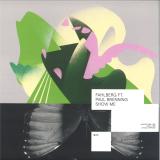
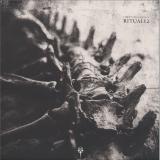
The Rituals series rises again, a fresh strike carved deep into black wax. RITUAL12 summons an international assembly of techno insurgents from the OMEN roster, each delivering their own sonic rite. Across two sides, the intent is absolute: raw, unfiltered power pulled from the shadows and unleashed on the dance floor.
RITUAL12 is not a compilation, it’s a convocation. Forged in analogue heat, drenched in distortion, and aimed directly at the heart of the floor, this record demands full surrender. Step in. There is no turning back.
SIDE A
Swarm Intelligence – Inexorable
Berlin’s Swarm Intelligence ignites the record with precision-tooled percussion and fractured basslines. Polyrhythmic tension winds tighter with every measure, industrial grit locking into a cybernetic march toward total hypnosis.
B.A.R.K – Shikijitsu
A bone-rattling invocation of distorted low-end and ceremonial drums. B.A.R.K drives forward like ancient machinery grinding to life, a Japanese primal energy sharpened to a deadly edge.
Axkan + Duellist – Resilence
Mexico meets Scotland for a brutalist assault: hammering kicks, serrated synth textures, and walls of analogue saturation. No safe passage here, only forward momentum into the heart of chaos.
SIDE B
EAS – Honored One
From Los Angeles, EAS delivers a tense, ritualistic construction where a subterranean EBM bassline pulses through metallic drones. Hypnotic, uneasy, and charged with controlled dissonance.
Ha†elove + Ogmah – Hanged Bodies
A dark ceremonial groove, heavy with ritual percussion and spectral synth chants. The layers rise to a fever pitch, blurring the line between transcendence and collapse.
Crystal Geometry + Axkan – Kratom
France’s Crystal Geometry joins Axkan for a militaristic strike of modular chaos and pummeling drums. EBM infused basslines drive beneath razor-sharp synth fire, rallying the midnight faithful to the front lines.
Buscar:spectral
More Rice and Jugaar Records – Two Bangkok-affiliated labels – bring together an assemblage of their mutual friends for a heady, floor-focused VA with moods to soundtrack peak flow, after-hours rabbit holes, and just about everything in between.
Rudoh of Jugaar Records fame kicks us off with ‘Madoh’, a bendy groove that initially bares flex of early 2000s Minimal with its trimmed, rubbery percussion and obscured vocal snippets. As the track progresses, a hefty break and a catchy synth line bolster things before breakdowns unfold like little trippy slumbers rudely interrupted by bold, punchy drops.
Next up is Tokyo legend Gonno who follows up with ‘Rad’, a broad-shouldered banger propelled by a heaving kick and clap combo. A wrought synth is paired with odd shocks of acid and a sequence that flickers like a strobe. All the while a thick, gnarled bass line rumbles underneath, keeping vibes at boiling point throughout.
More Rice’s DOTT follows up with a swampy excursion propelled by a potent kick and nimble submarine tones. Drums are neatly stacked in polyrhythms as an infectious swing unfolds, one that’s decorated with ghostly synths and a generous dose of psychedelic synthesis.
Sarayu – also of More Rice fame, closes things up with ‘Fuijan Groove’, a brilliantly lean cut that lets the subs do the talking. Sharp tonal blobs flesh out a simple but highly effective march as spectral pads expand in plumes of smoke until the conclusion of a rich and varied record that unites two kindred labels perfectly.’
‘More Rice and Jugaar Records – Two Bangkok-affiliated labels – bring together an assemblage of their mutual friends for a heady, floor-focused VA with moods to soundtrack peak flow, after-hours rabbit holes, and just about everything in between.
Rudoh of Jugaar Records fame kicks us off with ‘Madoh’, a bendy groove that initially bares flex of early 2000s Minimal with its trimmed, rubbery percussion and obscured vocal snippets. As the track progresses, a hefty break and a catchy synth line bolster things before breakdowns unfold like little trippy slumbers rudely interrupted by bold, punchy drops.
Next up is Tokyo legend Gonno who follows up with ‘Rad’, a broad-shouldered banger propelled by a heaving kick and clap combo. A wrought synth is paired with odd shocks of acid and a sequence that flickers like a strobe. All the while a thick, gnarled bass line rumbles underneath, keeping vibes at boiling point throughout.
More Rice’s DOTT follows up with a swampy excursion propelled by a potent kick and nimble submarine tones. Drums are neatly stacked in polyrhythms as an infectious swing unfolds, one that’s decorated with ghostly synths and a generous dose of psychedelic synthesis.
Sarayu – also of More Rice fame, closes things up with ‘Fuijan Groove’, a brilliantly lean cut that lets the subs do the talking. Sharp tonal blobs flesh out a simple but highly effective march as spectral pads expand in plumes of smoke until the conclusion of a rich and varied record that unites two kindred labels perfectly.’
With its 10th edition, Dalmata Daniel's split series brings together two artists who have both left their mark on the label's compilations, now presenting their first full releases on the imprint. Anatolian Weapons and The Spy approach electronic music from different angles, one rooted in hypnotic techno rituals, the other in raw electro and post-punk energy. Both craft sounds that thrive in the shadows of the dancefloor.
On the A-side, Anatolian Weapons delivers three cold, hypnotic cuts. "Trapped" opens with heavy EBM percussion and a buzzkill bassline, setting a tense, mechanical tone. "Further Spiralling Down" sinks deeper into darkness with a grinding low end, tight drums, and electro-tinged claps, forming the side's relentless highlight. "Apathy Through Shock" closes with pounding, catatonic rhythms and a mournful, otherworldly melody, pushing the listener into disorienting depths.
Flipping over, The Spy's raw, electro-driven energy takes hold. "Same Blur" channels sharp electro beats with a punkish sneer and cosmic synth lines. "Falling", featuring The Spy's own vocals, leans into melancholic new wave, pairing bouncy rhythms with bittersweet melodies. The closing "Pretending" drifts into the darkest corners, offering low-slung, haunted electro layered with distant, spectral harmonies.
Book[37,40 €]
In the final month of 2024, Meitei arrived in Beppu, a city long steeped in vapor, myth, and mineral memory. Invited to create onsen ambient music commemorating Beppu’s 100th anniversary, he immersed himself in the city’s geothermal psychogeography, where sound rises from the ground and time clings to mist.
Known for his Lost Japan (Shitsu-nihon) works, which channel forgotten eras into flickering auditory relics, Meitei took residence in the warehouse of Yamada Bessou, a century-old inn perched by the bay. Over two weeks, he listened intently to steam, to stone, to the atmosphere itself. The resulting work, Sen’nyū, traces the inner spirit of onsen culture. Like water finding its path, the music emerged with quiet inevitability, shaped by Meitei’s synesthetic sensibility and deep attunement to place.
Equipped with a microphone, he wandered Beppu’s sacred sites: Takegawara Onsen, Bouzu Jigoku, Hebin-yu, and the private baths of Yamada Bessou. There, he captured the breath of the springs, bubbling mud, hissing vents, wind against bamboo, and the murmurs of daily visitors. These field recordings became the sonic bedrock of Sen’nyū, an act of deep listening that attempts to render even the rising mist and shifting heat into sound.
Unfolding as a single, continuous piece, Sen’nyū drifts like fog through sulfur and stone. It traverses the veiled madness of Bouzu Jigoku, the spectral resonance of Yamada Bessou’s inner bath, and the hushed voices of Takegawara Onsen. It is a gesture of quiet reverence, for water’s patience, the land’s memory, and the hands that have bathed here for generations.
Where Meitei’s earlier works conveyed his personal impression of a fading Japan, Sen’nyū is grounded in tactile presence, music not imagined but encountered. Here, his practice moves closer to the spirit of kankyō ongaku, environmental music born from place, shaped by it, and inseparable from it.
As part of the project, Meitei conceived a two-day public sound installation inside Takegawara Onsen, culminating in a live performance. Bathers soaked in mineral-rich waters while submerged in sound, an embodied ritual of place, body, and listening.
Sen’nyū marks Meitei’s first full-length work centered entirely on onsen and opens a new chapter of his Lost Japan project under the expanded title 失日本百景 (One Hundred Lost Views of Japan), a series exploring extant sites of longing still quietly breathing within contemporary life. The album will be accompanied by Meitei’s first photo book, a visual document of his time in Beppu. A new layer is added to the world he has, until now, built only through sound.
Sen’nyū continues Meitei’s devotion to Japan as subject, while opening new terrain: both ritual and remembrance, an immersion into the mineral soul of Beppu.
Formed by George Thompson, Kyle Martin and Jonathan Nash, Kommune were active between 2014-2015. As close friends living near each other, their musical journeys were intertwined; Nash and Martin had recently completed their debut album as Land Of Light, while Thompson (aka Black Merlin), at that time putting the finishing touches to his debut album ‘Hipnotik Tradisi’, was also working with Martin as part of the duo Spectral Empire. Sharing equipment and ideas, Kommune arose organically, serving as a creative outlet for exploring analogue machine music in an improvisational context.
Sessions in their North London studios led to a handful of gigs at venues including Hamburg’s legendary Golden Pudel and London’s LN-CC. This fleeting chapter of musical history may well have gone entirely undocumented had it not been for the fortuitous decision to meet up for a recording session in October 2014. Filling a car with their machines, they drove to a converted barn in the south of England, proceeded to set up, settle in and hit the record button. Over the course of two days, fuelled by the experiences of recent performances, the trio immersed themselves in the machines, crafting subtly evolving, long-form compositions with an enchanting balance and flow.
Across the four long-form compositions that make up ‘Oast’, the trio summons barely controllable scrapes, acid-like bubbles, and bleeps from their machines, leaning on dub mixing techniques to give the tracks a sense of depth, dynamism and organic ambience. Mastery of the TR-808 drum machine is central, with remarkably nuanced drum programming imparting a hypnotic rhythm to the work, allowing other elements to emerge and unfold at a beautifully measured tempo.
Recorded entirely live and improvised without any overdubs, ‘Oast’ offers a profound journey into minimalist electronic music while serving as a tribute to friendship, curiosity, and the spirit of experimentation.
Sleeve art and design by Michael Willis.
Vinyl A Black Vinyl[12,56 €]
Vinyl B Black Vinyl[12,56 €]
Vinyl B Coloured Vinyl[20,59 €]
Known for his ability to create captivating, emotionally charged techno, Jonathan Kaspar eventually returns to Cocoon Recordings with his third contribution Twofold Split. One, yet simultaneously two releases that once again showcase his extraordinary talent through condensed techno with a pinch of trance, weaving together driving rhythms and atmospheric textures in a way that feels innovatively progressive.
Drifting hypnotically, this might be the most fitting way to describe what Jonathan Kaspar unfolds before us here. The rolling percussion grooves seamlessly intertwine with the siren's spectral tone, gradually blending into the alchemy of ‘Yah’ as it erupts into the mix. By the time the peak arrives, there’s a raw intensity in the air - the track seems to bend and stretch then drills and twists until it cracks, but never loses its sense of purpose and remainsanchored in its deep, pulsating groove. On the flip side, ‘Silver Lines’ stands as a counterpart, offering a contrast in both sound and atmosphere. With its minimalist arrangement, the track first nestles in gently, lulling the listener into its world—only to tighten its grip as a synth sequence gradually opens its cut-off filter, slicing through the calm, drilling into the mind, and shifting the mood from tranquil to tense.
Multi-instrumentalist, visual artist, and scene creator, Jonathan Uliel Saldanha, has been releasing music under various guises for two decades. With the successes of his moniker HHY (Nyege Nyege Tapes) whether in symbiosis with The Kampala Unit or the syncopationophilic big band of The Macumbas, Jonathan Uliel Saldanha's sonic signature continues to grow more and more singular. Ever synthetic and digital, Uliel Saldanha's work-ethic never eases—having recently started a label of his own, Horror Vector.
Surface Disorder sees the release of the music from Jonathan Uliel Saldanha's large-scale exhibition of the same name that occurred in Porto & Lisbon, (2024-25). As with much of his work, there is a Ballardian sense of a near-future in dystopia. And since we're already living the apocalypse, there's never a hidden moral to veer away from the torment. Instead, Uliel Saldanha dives into it and catalyzes it further.
Information from Angels feels like a cunty John Dee AI (credited as The Mouth) becoming an oracle of information overload, accompanied by an instrumental bidirectionally that splits into a lush harmonic layer of blissful punctuated pads and another that is a speedy but subdued melodic bassline. The Mouth intones a 15-minute fever dream that flows through themes that have occupied Uliel Saldanha for quite some time.
On Swarming the Pit, the intricacy of Jonathan Uliel Saldanha sonic wizardry is on full display. A constantly moving swarm of granulated particulates of sonic material morph into a variety of textures: coins or gunshell casings hit the floor, engines rev their monstrosity, rubber-like pulses are splayed into spectral blurs and pops. This is clearly an update on music conrète's obsessions.
The Mouth on the closing track, Wolf & Virus Dialogues, has a completely different texture from the first, alerting the listener to the uncanny nature of its genesis. Here the instrumental sounds are all triggered by the articulations of the voice: a weird unison, it serves as its own artificial accompaniment. The reiteration of a self-model (a rabid 'my') creates a greater tension between computational self-certainty and the terror of its inevitable actualization.
A name that breathes, a voice that whispers and howls in soliloquy. Collecting the echoes that follow—field recordings from Colombia, murmured poems, the spectral songs of birds—she stitches together a sonic diary, an audible thread between past and present.
Like the shifting landscapes of Colombian magical realism, she bends nature as memory bends truth. From this alchemy arises Un Pensiero Intrusivo: seven folk incantations, captured live in Cagliari, Italy.
A new genre, steeped in something unnameable—a haunted flamenco, spectral invocations, a piano unmoored from time.
The air thickens, the horizon tilts. A slow descent into vertical tropics, where distant sensibilities collapse into a single, hypnotic pulse.
for the next release on galaxiid, we present "carpet watcher", the long-awaited second album from ishome, the project of russian producer and visual artist mirabella karyanova.
emerging from the far eastern port city of nakhodka, ishome's music has always carried a sense of distance and introspection. her debut album confession (2013) became a cult classic, a fragile, cinematic blend of ambient textures, submerged rhythms and quiet emotion.
carpet watcher was completed in 2018 but remained unreleased until now. like much of ishome's work, it was created with no urgency to be heard, a self-contained world suspended in time. drifting between viscous beats and spectral melodies, the album feels like a memory slowly coming into focus.
from her earliest recordings, mirabella has resisted genre classification. her sound draws from minimal techno, ambient, leftfield pop, outsider art, and the surrealism of soviet-era animation. in her hands, these influences dissolve into something deeply personal, a language of mood and movement rather than style.
beyond the studio, ishome has performed live across europe and russia, including sets at berghain and signal festival, as well as appearances on boiler room and nts. she also creates under the mischievous alias shadowax, where playful chaos replaces introspection. her audiovisual performances, combining original music, iphone-shot footage, digital collage and hand-drawn animation, reveal the full breadth of her artistic vision. dreamlike, humorous and emotionally direct.
ishome rarely releases her music, and when she does, it feels less like a project and more like a postcard from a world she's still wandering through. carpet watcher is the first glimpse into that world in over ten years.
Robot Says E is a meticulously assembled four-track compilation that connects the tactile groove of dub tech house with the lucid propulsion of contemporary techno. The release is divided over two contrasting but complementary sides, presenting an impressive palette for those who move purposefully and listen intently. Side A kicks off in an immersive warm atmosphere; A1. Tvardovsky – Eleven and A2. Spectral Model – Plasma both deliver deep low-end foundations, atmospheric dub textures, and clean dancefloor-ready production quality. The sound is fluid, minimalist, and very physical; perfectly complimentary to subtle intensity and groove-based hypnosis.
On the flip, the energy shifts. B1. Rene Lorenzo – Reflections and B2. Kirill Matveev – Code Redeemed push off in much faster, gliding, terrain – where flow and high-speed rhythms embrace their high velocity, and deep repetition creates a trance-like state. This is techno that feels both expressive and “summer-in-the-city” active and is meant to enhance your sensory plates and keep you energized. Easily executed, future forward designed and mood-blissfully transformative, WRSE1 VA –What Robot Says E is not just a VA, it's a sonically-derived blueprint for refined dance music going forward.
2025 Repress
Growing up on the north Atlantic island of Iceland bestows one with an unusual and often intense relationship with light and colour: Summers come with endless days, Winters with scant sunlight yet increased sightings of the Aurora Borealis; the mysterious and awe-inspiring glow across the sky. Channelling these energies, Exos
comes to Tresor with his Green Light EP, a five-track collection of the sort of spectrally rich techno synonymous with the Northman’s 27-year career.
Across the EP, the five tracks fizz and pulsate driving ever forward, making the release’s title a three-way play on words referencing the continuous travelling of photons, the verdant warping of the Northern Lights, and the universal colour for Go, for forward propulsion. Smart wordplay can also be found in titles like Grátt Silfur, a term in Íslenska (literally “grey sliver”) which signifies a tension between two parties, further extending the colour metaphor and dark/light dichotomy found elsewhere.
The digital release comes with three extra tracks that continue the dynamic energy, pushed along by the same shifting, mutating force where the music often feels like voices calling out from the darkness or the shimmer of light as the sun rises across the horizon.
Green Light EP continues this year’s blazing return from an artist who, similar to his output, is never stagnant: ever changing form yet ever moving forward.
Greville returns to Mad Habitat, consorting with the enigmatic Lonely Voices to realize a four-song suite steeped in vivid acoustic psychotomimesis. Each track is underpinned by Greville’s unerring sensitivity to sonic texture and atmosphere. The snappy, febrile drum programming of “I Miss Terry” is a deft counterpoint to the thrumming bassline. The chords of “Purgatory” swirl around the stereo field like hypnopompic hallucinations. On the flip side, vocals bleed in and out of the mix, spectral and elusive, threading through both tracks. “Electric Push” follows the monologue of “Dad’s Folk,” nudging it into even more surreal territory. It evokes a chance encounter between Ifach-era Baby Ford & the occult industrialism of late-period Coil.
Passing Currents aims to stand out from the predictable by offering a deeply human touch in its music. This five-tracker backs that up by melding academic expertise with dancefloor intuition and the A-side features txted by Phil Moffa remixed by Yamaha DSP coder okpk after they met during doctoral studies, they flip technical mastery into bass-driven energy while Atrevido' fuses California warmth with analogue electro, Josh Dahlberg's rediscovered 2009 electro gem, 'Ass On The Floor', still bangs and Detroit's Kevin Reynolds delivers hypnotic grooves before Hazmat Live pushes boundaries with a sound rooted in soulful, experimental innovation.
"Dylan Hayes' album debut LP, We Don't Own, We Create, released on Futurepast, is a sonic trip balancing club functionality with experimentation. The two-discs project is a bold statement of artistic intent-where minimalism, industrial textures, and introspective loopy moods collide.
As the result of 8 years of research and experimentation, We Don't Own, We Create is an electronic sci-fi odyssey, unfolding across eight tracks balancing structure with unpredictability. Co-produced and mixed by Davy Vandegaer, this album is also the story of a friendship rooted in a shared vision-crafting a signature 'futurepast' sound where old-school techno aesthetics meet fresh, yet edgy, sonic treatments. The first disc unfolds like a waking dream. My Ikigai sets the tone with pulsating, introspective club energy, blending loopy synths and a growling bass. Plastic World plunges into eerie depths, weaving spectral vocals and fragmented rhythms. Silent Reverie in To Memory drifts through textured atmospheres and layered percussive echoes. Remind Me Ridley twists hypnotic techno into a dense, mantra-like piece-its reverbs and delays build an intensity conjuring into a foggy, shifting auditive illusion.
The second disc marks the awakening, shaking off the haze with Beautiful Struggle, where abrasive loops, industrial bass surges, and dissonant synth layers build tension. Echoes of Fate condenses the album's ethos, unleashing pulsating stabs and humming rhythms that slice through the mix with razor-sharp precision. The eponymous We Don't Own, We Create is an electronic ode to the creative process, where haunting vocal loops weave through deep, trippy synth lines, blurring the boundaries between organic and synthetic. Closing on Mizze, the journey dissolves into pure introspection, fading into the ether.
The record balances four club-driven tracks and four experimental pieces, crafting a distorted, explorative soundscape-an immersive journey where dance music meets dark, avant-garde sound design."
We present you the third installment of our limited only vinyl series, Esuoh Limited 003. Four track V.A. featuring Ale Castro, Hurlee, Housewife & Midas Field.
Ekman returns to Shipwrec! "Five years is a long time. For many, 2020 seems like a lifetime ago. It was in this fabled year that Ekman last appeared on Shipwrec, Kronkel marking a shift from the blackened acid blooms to more considered, yet unsettling, sounds. It is from this audio fount the dutchman returns with Elixer. Throbs of bass and rasping snares shear a path for smoother tones in Alruin Met Cranberry. Injecting the ever-present sense of unease, a menacing melody stalks the constricting recesses as paranoia takes hold. These inner alcoves are further explored in the disturbing Doornappel Met Peer. Spectral synth-lines don a thin shimmering veil, warbling notes tremble while beats offer little relief in this unstable outing. Aquatic undercurrents introduce the flip, a sharp drum slicing through the burbling bass of Codeine En Rozemarijn. From this murky soup, a string ascends as Ekman toys with contrasting tones to produce a piece of acid dipped elegance. Shattered drums pierce the ambient fog of the finale. Alsem Met Anijs blends intricate percussion with soulful strings to produce a hauntingly beautiful dreamscape to finish Ekman's heady brew."
- A1: Gilb'r - Reaching
- A2: Goldie, Ulterior Motive & Natalie Williams - I Adore Yo
- A3: Aquarian - Death, Taxes & Hanger
- B1: Roni Size - Forget Me Knots (Bailey Remix)
- B2: Special Request - Spectral Frequency
- B3: Tek 9 - Slow Down (Nookie Remix)
- C1: Jonny L - Piper
- C2: Rockwell - Noir (Ulterior Motive Remix)
- C3: Phume - So Many Times
- D1: Lu2K - Prema
- D2: Breakbeat Era - Breakbeat Era
- D3: Hidden Orchestra - Vorka (Dc Breaks Remix)
Listen to all the pearls of Electronic Music withe the releases dedicated to House, Techno & Drum"n"Bass, sélected by the REXCLUB in a doble vinyl collection ! DISCOVER THE NEW VOLUME OF THE REX CLUB COLLECTION : THE DOUBLE VINYL DRUM"N"BASS With : Roni Size * DJ Gilb"r * Phume * Goldie * Tek 9 * Special Request * Rockwall * Aquarian * LU2K * ...
Magic Source is back with an exclusive 2 tracks single filled with their special rootsy cosmic funky touch.
Led by producer & notorious tape operator Björn Wagner (of Mighty Mocambos, Bacao Rhythm & Steel Band and Mocambo Records), the group follows up to the release of their 2nd LP last year, Voyage Spectral. This time again, the German band dives into the Tropical and international aspects of Disco and Funk music, always using 100% organic production and recordings material.
On this 2 tracks single, you’ll first find a blazing and unexpected covers of “Voodoo Ray” the classic acid-house track by A Guy Called Gerald, with special vocals by Mounam & Gizelle Smith. Following up to this already dancefloor classic, comes “Interplanetary Bounce”, a new and exclusive composition from the band also tailored to make you move, with its Boogie touch and heavy breaks.
Following a fallow 2023, a rejuvenated Growing Bin return to your turntable with this sublime collaborative LP from Gosha Martynov & Natasha Sinyakova. On their first foray into the physical, the duo expand the spectral ambience and medicated breaks of their earlier work with lithe touches of organic jazz and Cafe Del Mar cool, creating a complex assemblage of dreamy downbeat and emotive electronica that's entirely easy on the ears.
Opener "Pozhaluysta" seduces with smart syncopation and beguiling melody, its flute and fretwork finding ample space to slip around Natasha's voice, equal parts Cocteau operatics and jazz-club coquette, in an expression of a want beyond words. The mood shifting "Osvobodi Menia" sees the solemn, snaking sound of a sampled duduk drift into an optimism of airy pads and escapist mantra, suspended in reverb until the end of time. "Ya Tebia Zhdala" began life as a break-led experiment, gradually evolving into a romantic and naive sketch rich with splashes of piano and dynamic chorus pads. Naturalist hymn "O Dereve" weaves a dark and intimate tale from the point of view of a veteran tree as its buzzsaw guitar loops blossom into multilayered vocals full of emotion.
Awash with sonar sweeps, sumptuous pads and rolling subs, the titular "Imena Rek" channels post-rave bliss into the hypnagogic anthem the contemporary IDM-ographic have been searching for. Infectious hooks and spaced out pads ride the breakbeat rhythm for a dreamy experimental pop banger from another planet. The sombre sway of "Rany", filtered through the fog of a broken cassette recorder, trance djembe and unpredictable bass tones rivals the finest Motion Ward or In:dex releases for crepuscular charm, while "Smeshno" sees serrated drones sink into a slinking rhythm, playing counterpoint to the tender chords and yearning vocals.
"Iskra" closes out the chiasmus with a return to the organic experience of the opener, the flute and acoustic guitar augmented with nuanced hand percussion and a music box refrain. Listening to this album is like a midnight walk through an ancient forest - an experience which both scares and tempts you at the same time. From touching damp moss to feeling the thick fog with your body and watching mushrooms glow in the dark, 'Imena Rek' guides you through the terrain.
Flawlessly arranged and executed, this LP alludes to a long lineage of innovative downbeat, feels absolutely essential in the present and pushes the trip hop revivalists towards a fascinating future - Gosha Martynov & Natasha Sinyakova have created a timeless piece of music,
but what else do you expect from the Bin?
Over the past several years, The Voidz, led by Julian Casablancas, have been releasing various singles and performing unique residencies in different cities, all to critical acclaim. Now, they are returning with their highly anticipated third album, "Like All Before You."
This new release marks a shift back to album mode, showcasing The Voidz's unique sound that blends different styles into an immersive experience. The band will be promoting it in fall 2024 and 2025
Exploration, collaboration and curiosity define the rhythm at the beating heart of Mehmet Aslan’s exemplary compositions. The Swiss-born producer of Turkish heritage has already forged a singular path through production, DJing and full-band performances, navigating the more esoteric corners of Berlin’s club culture without sacrificing his musical heritage or innate creativity.
A conceptual new LP ‘Auguri’ follows on from 2021’s gnomic, ornate ‘The Sun Is Parallel’, which saw Aslan musically associate with the likes of Valentina Magaletti and Niño De Elche. ‘Auguri’ also has its foundations in collaboration, born out of a musical lab at Lyon’s annual
Nuits Sonores, the forward-thinking festival with whom Aslan has maintained a lengthy creative relationship.
The resulting audio-visual performance, ‘Bird Signals For Earthly Survival’ introduced Aslan, to the Greek filmmaker Stratis Vogiatzis. Drawing on the philosophy of Donna Haraway and envisioning new ways of being, of living on earth, Aslan and Vogiatzis crane their necks to the sky to witness flocks of birds performing spectacular movements in unison. Fluid and ancient, their organic waltz provides inspiration for Aslan’s extension of the project, spanning sonic shades of electro, ambient and modern folk psychedelia.
On the coastline of Vogiatzis’s home country of Greece, as in many places across the world, climate change threatens to effect the ancient migration pattern of millions of birds, just as their fellow beings on terra firma become increasingly entangled in a man-made disaster of their own creation. In unison, ‘Auguri’ is adorned by artwork from designer Xavi Bou. Known for his ‘ornithographies’, this striking visual captures avian life not only as a force, but a wry observer.
“We need to transform our connections with other living beings to protect the Earth and live together harmoniously”, reflects Aslan. “Personally, this project has made me more sensitive to this issue. I wanted to give back in return for the inspiration I've received."
Perhaps upending expectations of a more traditional ‘ambient’ album, Aslan commits some of his finest compositional work and understated songwriting to this urgent imperative, creating original music that nonetheless, has nature flowing through it. ‘Critters’ presents a spectral sound collage on which Aslan himself speaks from the texts composed at the residency, conjuring visions of “the birds flying… shape of the future”. Meanwhile, the undulating, psychedelic ‘Pigeon Blinks’ takes inspiration from more domestic scenes, charting the unexpected roosting and hatching of an egg on a kitchen window, while ‘Auguri’ gives the album it’s title in connecting to a higher plain, demonstrating Aslan’s ability to lure melody and catharsis from looping hypnosis.
Opener ‘Spectra’ provides a forceful, almost industrial breakbeat that establishes the exigency of the album as well as its sense of wonder, while ‘Euphoria’ reaches the potency of its promise slowly, with Aslan’s modular melodies meeting the flourishing percussion of guest player and multi-instrumentalist, POPP. Finally, ‘Aura’ delivers a cinematic conclusion, mixing an elegiac organ motif, haunting guitar chords and the prophetic sense of a scorched earth. Here, with patience and soaring production, Aslan once more makes the abstract and the unthinkable somehow tangible, mixing in sampled birdsong.
Accordingly, ‘Auguri’ is being released in accordance with EarthPercent, the music industry’s climate foundation, co-founded by Brian Eno. A portion of the album’s publishing will be credited as part of ‘The Earth As Your Co-Writer’ initiative, allowing artists to directly credit The Earth in their new compositions. Here, streaming and publishing from Aslan’s recorded sounds are automatically paid back to a number of vital initiatives worldwide.
Leaning into some of the most vital questions and anxieties of our time, ‘Auguri’ is not a project without a sense of hope. From studio to sea, Mehmet Aslan continues to look to the skies and beyond.
Anders Enge follows up last year’s ”Visceral Hump” EP and previous releases on BÖRFT rec. with ”Phantom Ladies”: A combination of tracks that are loose but lucid, spectral techno with a shadow of phantasm. From acid draped electronica to the b-side’s almost 17 minutes long dreamy and melancholic, yet manic house techno groover. Printed discosleeve, handstamped & numbered.
Celebrating thirty years of collaboration, Loren Connors and Alan Licht performed for two nights at OTO on May 5 and 6th, 2023. The shows celebrated a new release titled “At The Top of the Stairs”; a document of the pair's reunion in 2018 after a period of 8 years not playing together. It’s a dark, swirling two-sided spectral noir session, put out by the duo’s home label, Family Vineyard, and we expected a similar kind of atonal abyss to appear at the OTO residency. On the second night however, with the stage lit in blue, Connors took up a seat on the piano stool whilst Licht picked up the guitar. What followed was the duo’s first ever set with Connors on piano - one of only a few times Connors has played piano live at all - here captured and issued as The Blue Hour. Its spacious warmth came as a total surprise live, but makes complete sense for a duo whose dedicated expressionism takes inspiration from a vast spectrum of emotion. Both opening with single notes to start, it doesn't take long before a surface rises and begins to shimmer between the pair. A run up the keys, the drop of a feedback layer on a sustained and bent note. When the two begin to exchange notes in tandem, brief touches of melody and chord hover and the hush of the room is palpapale. After a while, Connors picks up the guitar, stands it in his lap and sweeps a wash of colour across Licht’s melody. Sharp, glassy edges begin to form, open strings and barred frets darkening the space. When his two pedals begin to merge, Licht finds a dramatic organ-like feedback and it’s hard not to imagine Rothko’s Chapel, its varying shades of blue black ascending and descending in the room. When Connors goes back to the piano for the second side, the pair quickly lock into a refrain and light pours in. It’s a kind of sound that Licht says reminds him of what he and Connors would do when the duo first started playing together 30 years ago. It’s certainly more melodic than some of their more recent shows, and the atonal shards of At The Top of the Stairs seem to totally dissolve. What is always remarkable about Licht is that his enormous frame of reference doesn't seem to weigh him down, and instead here he is able to delicately place fractures of a Jackson C Frank song (“Just Like Anything”,) amongst the vast sea of Connors’ blues. Perhaps it's the pleasure of playing two nights in a row together, or the nature of Connor’s piano playing combined with Licht’s careful listening, but the improvisation on The Blue Hour feels remarkably calm and unafraid. There’s nothing to prove and no agenda except the joy of sounding colour together. Totally beautiful.
Ten years after his first full-length effort ‘Man Is Deaf’ landed him firmly in the runnings for DJ Mag’s album of the year, prodigal son Michael Anthony Wright AKA Brassica returns to Civil Music with a deeply accomplished, painstakingly whittled LP of hydraulic electro slickness, rich synthscapes, and hooky, peak-time tearjerkers for the most discerning front-left lifers. ‘Tribeless Gathering’ is a barnstorming testament to Brassica’s stylistic and timbral deftness, touching down in the elusive epicentre of the club/home listening venn diagram with ease.
From the elastic, neon acid pointillism of opener ‘Hop Kweng’ to the mardy, miasmic plod of closing chugger ‘Changa Hill’, Brassica seamlessly segues between avenues of influence, his notoriously omnivorous musical knowledge roadmapping each turn. Raised on a diet of everything from early rave standards to metal, and schooled in avant garde sonics as a student of sound design at LCC, Brassica does a peerless job of sublimating his countless influences into a record of refined, heterogeneous, and most crucially, catchy, club moods.
Less spartan than his more recent oeuvre on Feel My Bicep, and less baroque than his technicolour experiments in postmodern synth pop with vocalist Stuart Warwick, Tribeless Gathering represents Brassica’s triumphant return to the main room, replete with rushy hooks primed for the planet’s finest soundsystems, and passages of heads-down tension bound to draw listeners right to the edge of their seats. Overall it is a concise and refined testament to Wright’s command of spectral sonics and effortless ability to pressurise a dancefloor. It is no surprise that he has also worked as a prolific mastering engineer, tuning music from a plethora of dance disciplines for maximum club impact. This work extends to his own projects (including this one), cementing them as rare expressions of complete artistry from studio to turntable.
As we delve deeper into the record, we are ushered through a series of accomplished and varied club moods, each channelling a unique cocktail of influences, but retaining a warm, ebullient analogue sensibility unique to Brassica’s work. This playful scope of influence calls to mind James T Cotton or Machinedrum’s experiments in dance music form, but Wright manages it all under one roof, wrangling everything from sashaying wub-laden two step to snarling Dillinja-esque FM damage into something inherently his.
Choice cut ‘Change Yourself’ layers an almost Cerrone-like piano refrain over radiant surges of saturated bass, dubby, strobing chords and a jagged, driving break, building to a jaw-clenching apex of dancefloor elation, while the rude, playful half-step of ‘Elevation’ breaks down the vintage speed garage formula into linear fragments, utilising a tight palette of resonant bass slugs, infectious synth leads and Papua New Guinea-style vocal strobes. The aptly named ‘Hold Tight’ fuses heart-in-mouth UK ‘ardkore pads with glissando acid disturbance and surgical snare fills in a formula which recalls the ethereal grit of Nubian Mindz’ 00s experiments in big-smoke break science, while the questing melodic arcs and arpeggiated squarewaves of ‘Pinball Marinara’ could easily have soundtracked an 80s sci-fi epic, beset with sparkling, bare-bones drum programming and hazy beds of sub sediment.
With ‘Tribeless Gathering’, Brassica both irreverently fuses and pays homage to the many unique and weird permutations of UK dance music. The short lived gathering of junglists, ravers and house hotsteppas of a similar name may have long since dissipated, along with the tribes themselves, but across these 11 tracks, he lays a blueprint for a new sound of togetherness.
Having plied his trade around the world for more than three decades, German guitarist, bandleader and musical explorer Jan Whitefield has always instilled in his craft a natural aesthetic of authenticity, a key component which has seen him amass a sizeable and varied catalogue of material which has remained timeless where some of his contemporaries have faded away.
In the early 90s, as various UK bands were signed up by sizeable labels and enjoyed even mainstream chart success in the Acid Jazz and rare groove boom, Jan and his brother Max formed the Poets Of Rhythm, self-releasing their own uncompromisingly hard-edged take on 70s street funk on the then completely unfashionable 7" single format, forerunning the Deep Funk scene by almost a decade. 30 years on, in spite of a legion of retro-focused bands having followed in their wake, few have yet to come close to matching the energy and spirit of those early Poets 45s.
Since then, Jan has applied himself to all manner of new incarnations and innovative side-projects, releasing further funk surveys as the Whitefield Brothers before leading his own band under the pseudonym Karl Hector, with releases on labels such as Stones Throw, Daptone, Ninja Tune, Mo'Wax, Strut and more. An avid music lover, explorer and record collector extraordinaire, Whitefield's music has effortlessly absorbed his expanding interests along the way, particularly drawing influence from Ethiopian Jazz and West African funk and highlife, as well as Kraut-rock and ambient via his Rodinia alter-ego.
More recently, Whitefield has begun to venture into the astral planes of what's now commonly referred to as 'spiritual jazz', and this is very much where we find him manifesting on 'The Infinity Of Nothingness'. A set of mature, delicate and meditative orchestrations, like much of Whitefield's best work the album is studiously true to its key influences - and in this instance the twin figureheads of Sun Ra and Pharoah Sanders are particularly preeminent - but also completely avoids falling into a trap of mere tribute or facsimile. With subtle yet diverse accents of Hip Hop, Library and the Avant Garde appearing wholly unobtrusively, the album is unified by a marked trance-like feel, beginning with the sparse, processional opener 'Nothingness' through to the 3 part 'Infinity Suite' of 'Time', 'Space' and 'Energy'.
As he did as a schoolboy with the Poets of Rhythm, with 'The Infinity Of Nothingness' Whitefield achieves that exceptionally rare feat of creating music that is not only worthy of sitting alongside that of his overarching influences, but will also stand up with it against the tests of time.
Recorded on the edge of Berlin in a semi-deserted building complex formerly used by the East German Sociality party, André Uhl's debut on the label taps into the spectral frequencies of the space and the ritual practices of recording.
Created in isolation amongst this decaying structure and surrounded by lakes, dense forestry and the sounds of boars and unknown wildlife outside, Every Step Causes a Crack is a title that reflects Andrés connection to the environment around him and the death or glory stance of the artist, with field recordings, electric doom synthesis and lurching drum tracks temporarily fracturing the darkness before being pulled back through the void.
Limited vinyl release of 150 copies.
Since 2019 Demdike Stare had been playing edits of Dolo Percussion’s bare-boned breaks in their DJ sets, eventually sharing them with Dolo’s Andrew Field-Pickering (Beautiful Swimmers, boss of Future Times) and fomenting a creative fusion that hits at the square root of their shared tastes for unruly, deadly rhythms. In a transatlantic back ’n forth - or what Kodwo Eshun termed a double refraction - they juggle the rudest aspects of UK hardcore, as derived from electro, breaks and garage-house - that would feed into Dolo’s pool of sound, and return to the UK via the likes of breakbeat wizard Karizma, who was a key touchstone for the whole late ‘90s broken beat movement key to Demdike’s tastes.
Still following the thread? It’s not that tricky - both US and UK operators favour breakbeat music more than anywhere else, and this devilish hook-up is the epitome of a conversation ongoing for generations now. At each parry, the three cuts here are exemplary of the way DJs, producers and dancers on both sides of the pond have pushed each other to new heights in a feedback loop designed to make the dance throw the maddest shapes.
‘DOLO DS 1’ racks up a full clip of flintiest breakbeat hardcore, pivoting gasping samples inna dervish of ruffneck syncopation, ruggedly distinguished from the pitching, gritty drum machine chicanery of ‘DS DOLO EDIT 1’, and their super crafty sidestep into the offbeats, hingeing around ghost snares and practically spectral levels of percussive suss in ’DOLO DS 2’ which basically sounds like a prime Autechre tumbling thru dub.
Three years on from the bands acclaimed ‘Grateful End’ album, and following up last years reissue of their live release ‘Psychedelic Scum Freaks’. Taipei's underground psych monsters Dope Purple return with their new album proper, ‘This Is The Harsh Trip For New Psyche’
The album is co released again by Riot Season & WV Sorcerer Productions and is available on three vinyl variants, and also digitally.
The album, it's a mixture of harsh noise and psych rock, the noise element being well recorded and presented so we can hear many details, and blends perfectly with the other instruments in all frequencies. The whole album moves between a spectral sadness and insanity, each track takes a rather different direction, recognising the influence of Classic Japanese bands such as High Rise, Mainliner, and Les Rallizes Dénudés.
The album is a collaboration with Berserk, a young underground pioneer from the Taipei scene, and has been performing chaotic frequency manipulation and carefully textured post-apocalyptic soundscape since 2015.
Marina Herlop is often described as a pianist, a lingering remnant of her classical training. But what strikes the listener on Herlop’s breakout track miu is the intricate trickery of her voice, tracing rhythmical clusters around the subtlest of musical beds, in a technique inspired by Carnatic music of Southern India.
miu, the opening track of Herlop’s new studio album Pripyat, was among the first songs that the young Catalan artist made on a computer, after two albums – 2016’s Nanook and 2018’s Babasha – that brought spectral elegance to the sound of piano and voice. This spirit of adventure continues into Pripyat, Herlop’s first full album produced on a computer, and her most intensely emotional work to date.
Listening to Pripyat you can feel the emotional toil and creative endeavour that went into the record. Fans of Nanook and Babasha will recognise the combination of melancholic piano and elegant vocal lines that is found on Pripyat tracks like abans abans. But Pripyat has a far fuller, almost chaotic sound when compared to Herlop’s previous work, with the addition of electronic drums, electric bass lines and a wealth of sublime production effects.
Quoth is proud to present its second EP of spectral dance music, following Coralie’s 'Barney’s Maze'.
Coming from the third mind of Pearl River Sound and The Horn, two artists with illustrious solo back catalogues, the 'Top Shelf Material EP' is a kaleidoscopic trip into the timeless psychedelia of UK rave music. Highly referential, but never pastiche, the sound world draws from IDM, mutant hardcore stylings, grime, 80s fantasy, and pulp cinema.
‘What the fuck?’ moments of full throttle breakbeat pressure are counter-poised with the liminal robot romanticism of heart-rendingly detuned electronica. Eschewing refinement and polish for raw sensibility, the 'Top Shelf Material EP' is emotive and propulsive, playful and tragic, wistful and optimistic. We couldn't recommend it more.
- A1: Radio Dada
- A2: Holeg Spies & Rip Van Hippy - Face The Strange
- A3: Lostrosphere
- A4: Holeg Spies & Thierry Gotti - Urban Resilience
- A5: Kuba - Pharoahs Day Out (Feat Youth & Gaudi - Holeg Spies Remix)
- B1: Holeg Spies & Youth - Pomegranate
- B2: Holeg Spies & Thierry Gotti - Captain Haze
- B3: Lady L
- B4: Desert Cruising
- B5: Notinism Dot Org
Holeg Spies’ 7th album BRAVE NEW WORLD is a new step towards his creation of an immersive sound world intermixing his various music influences. The album features collaborations with YOUTH (Killing Joke, The Orb, producer of Pink Floyd and The Verve), well known Dub producer GAUDI, renown Australian percussionist RIP VAN HIPPY, psychedelic dub artist KUBA and French Goa-trance pioneer THIERRY GOTTI (Spectral/Blue Room).
This unshackled album escapes all classification, getting lost in the confines of Electronic, Progressive Rock, Dub, Ambient, Symphonic and Psychedelic music.
French trail-blazer electronic artist, Holeg’s 30-year music exploration has taken him from the early days of techno productions to composing music for films.
Touring Europe and Japan, where he was regularly invited to perform thanks to JUNO REACTOR, Holeg crossed paths with his first filmmaker, the notorious TAKASHI MIIKE, for whom he made an audiovisual remix of one of his most famous films, ICHI THE KILLER in 2001.
His film music duo SAVAGE & SPIES created the soundtrack for the cult classic THE HUMAN CENTIPEDE, BLACKSITE, a $15M thriller by the producers of SICARIO & JOHN WICK and ABRUPTIO starring Oscar-winner JORDAN PEELE. Released on Liquid Sound Design in 2021, his latest opus AXIS MUNDI RELOAD was based on personal immersive journeys in the steppes of Mongolia and among the Hopi tribe in Arizona and features collaborations with YOUTH as well as JAIA and DF TRAM.
Toronto-based producer and DJ Ciel is renowned for a style of dancefloor material that’s as heady as it is visceral. The Xi’an-born artist’s ascendant profile has seen her cutting- edge and club-ready EPs released on UK labels Peach Discs and Coastal Haze, as well as Stateside imprints Spectral Sound and Mister Saturday Night.
As a member of the renowned collective Discwoman and the creator of femme-forward party Work in Progress Ciel’s thoughtful narratives are clear, running in parallel to the perception-altering sounds that are consistently woven deeply into her wide-ranging sets, beloved mixes and inventive collaborations. Now the Parallel Minds label co- founder is crystallising her imaginative and omnivorous sound with her !K7 Records debut, ORLANDO.
Written during her emergence from an uncharacteristic bout of writers’ block, the three original tracks of Orlando chart a return to the musical self, spurred along by a cinephile’s embrace of film, a love of classic literature, and a curiosity for the oddest corners of popular culture. “SCENES FROM A MARRIAGE” might share a name with the episodic series, but is rather a nuanced critique of the modern rite of union, moving through structured chapters, and mirroring the un-static nature of longtime love.Inspired by Virginia Woolf’s radical novel, and its superphysical protagonist, “ORLANDO” considers the cult literary figure who lived from the renaissance to the modern age, and embodies both sides of the sex binary.
The thrown sounds and aural illusions of “EL CALIFA” create the effect of a beckoning, beguiling psychedelic experience. To complete the EP, Ali Berger, Ciel’s recent collaborator on the Jacktone Records’ release Damn Skippy! repurposes the mind-bending flourishes of “El Califa” into a noodly and spacious deep house production, replete with pillowy, gauzy pads.
"Brazilian-born and Milan-based producer Worli makes his debut on Baroque Sunburst with an evocative EP rooted in the depths of 90's D&B. On the A side, Dynamo recalls the ciclicality of a generator, with enthralling grooves rolling through a landscape made of cavernous basslines and spectral vocals.
Breath - Dance totally lives up to it's name, exploring the psycho-physical experiences instigated by the alternation of caustic breaks and introspective ambiances. UK HC wizard Etch overstates the situation by giving Dynamo the full jungle treatment."
FELT summon the hand of two of the most uncannily suited producers around to remix cuts from Civilistjävel!’s "Järnnätter" album one year on from its initial release.
As a regular collaborator with SVN and Dynamo Dreesen as well as having a slew of experimental techno 12”s to his name, A Made Up Sound immediately got the memo. The Dutch producer takes the foggier, subdued angle of his own craft into wildly captivating effect when tasked to build upon the stems from the “civilian bastard”.
Whilst the A Made Up Sound remix constantly builds in intensity, Ossia’s “Disoriented Dub” explores a much more radiophonic, lost-at-sea headspace with echoes of early concrete compositions and a spectral approach to dub; an olive branch of muggy hauntological weirdness extending from Bristol up to Scandinavia and back via the lowlands.
After last year’s Black Clouds Above The Bows, Amsterdam-based collective Wanderwelle presents the second entry of their trilogy for Important Records, which is dedicated to telling the story of the climate crisis and its effects on coastal areas around the globe. For this album the artists incorporated the sound of a dying organ, fatally wounded in a climate related event.
All Hands Bury The Cliffs At Sea consists of electro-acoustic threnodies for an environment at risk due to the effects caused by receding coastlines around the globe. Wailing odes tell the story of the catastrophic activity of eroding waves and winds shaping the land that are enhanced by the climate crisis. First hand experiences and meetings with local maritime experts on the subject of these receding coastlines inspired Wanderwelle to compose these albums.
During their travels, the artists stumbled upon a small church in a town on the east coast of Scotland. The building was quite damaged, the roof was being stabilized and the ancient walls showed great tears running vertically down the structure. One of the church’s volunteers told Wanderwelle that the damage had been caused by a nearby cliff that collapsed in the sea. An event increasingly common in the region.
The church organ was ruined in such a way that it was deemed unplayable, as most of the pipes were gravely damaged and in dire need of restoration. Musical instruments directly affected by the environment -and especially the climate crisis- are quite rare. Despite the damage, the artists were allowed to record a few tones of the instrument with their equipment, which was actually meant to be used for field recordings later that day.
In Black Clouds Above The Bows, antique cavalry trumpets were recorded and manipulated by Wanderwelle to sound an environmental alarm in the same manner as they were once used to warn men on the battlefield. Similar processing was used on the recordings of the dying organ, resulting in spectral, deconstructed tones beyond recognition. In addition to the damaged organ, the artists recorded piano, cello and harmonic additive synthesizers in later stages of the composition process, manipulating these sounds to mimic the perpetual activity of the sea shaping the land.Furthermore, a great deal of inspiration was found in maritime superstition, lore and mythology.
As told in the legend of Aspidochelone, a legendary sea creature of enormous size, was once mistaken for an island. After sailors docked and lit a fire, the beast submerged resembling a land mass sliding into the sea. The album’s title is derived from the saying ‘All Hands Bury The Dead’, a maritime burial phrase, as the duo likes to think ‘All Hands’ refers to all of mankind since we are all responsible for these impending catastrophes.
Cello, violin, voice, pipe organ (damaged), bowed guitar, EBow, Prophet-6 synthesizer, modular synthesizer, field recordings.
RIYL: Oliveros/Deep Listening, Arvo Part, Lambda Sond, Sarah Davachi
Workaday Strangeness: Gyrating Death Throes From a Void Axiom' is the new LP from Glasgow-based music originator Wormhook. The music therein, we understand, emerged for highly personal therapeutic reasons; nevertheless to describe it as ‘idiosyncratic’ would do a disservice both to Wormhook and to the concept of idiosyncrasy. While the record is certainly a profoundly unique, irreplicable creation, its music is nevertheless based on a visceral, breathing human rhythm which is common to all living bodies. It represents a celebration of the act of creation as a means of processing psychic and spiritual conflict, unconscious thought leading to spontaneous musical discovery.
Through something approaching the musical equivalent of automatic writing, Wormhook gives birth to fluid, home-woven spectral incantations and an untutored, backward-masked concrète hymnody. Brittle-as-glass guitar and grainy, hand-processed electronics underpin cantorial, intuitively modal vocals delivering a kind of raw, revelatory yet anti-prophetic ur-poetry, bridging the centuries between Hildegard von Bingen and Lonnie Holley and fixing the solitary star of Wormhook within the hermetic constellation which these visionaries inhabit.
- Alasdair Roberts 2023
KR3 Records, is proud to welcome – Shuya – to its roster. The Japanese producer whose influences come mostly from the Noise Scene, began his sonic journey as a singer and guitarist with the experimental avant-garde group called Qujaku. With his s/h/u/y/a solo project he keeps a noise-industrial attitude to his electronic music productions. The beginning of his collaboration with KR3 was therefore inevitable. The artist and the label share a mutual approach to sound, with the processing of raw materials into scratchy, deep and mental beats playing a key part in their interpretation of Techno. The Sleeper EP – is the first vinyl release under this pseudonym. The cover art is curated by the designer Pablo I Prada, who says about his works: “I try to capture human evil in my paintings”. With his music, Shuya does exactly the same. His productions are a disturbing mixture of noise-techno that perfectly evokes the infernal spirit of human existence that also appears in the artwork. The Sleeper, is a cerebral, red-painted sonic assault. The intro and outro are composed by recordings of his voice and guitar riffs that show us how deep is his connection to his artistic origins. Written & Produced by Shuya Onuki Artwork by Pablo I Prada
Mischa Blanos - acoustic piano, electric piano, synthesizers.
Khori Ander - bass clarinet, clarinet.
Cezar Lazăr - electronics and sound manipulation on track 7.
"The seven stories unfolded on this album, debugged by a
fabulous clarinet technique and a wonderful piano craft, narrate
about the Universe, about the Chaos and also about the miracle
of the musical sound.
These imaginative stories, made with talent by musicians
Mischa Blanos & Khori Ander, talk about a special attitude
towards a distinguished estate of mind, a unique colour of the
space around us, devoted to a spirit of meditation, introspection
on vast temporal surfaces, each piece representing facets of the
same unique and unrepeatable algorithm of an improvisational
euphonious Universe.
By developing ideas in the process Cezar Lazar engineering
craftsmanship reveals the outcome of a thoughtful recording
and duo's synergy, refining and defying predictable musical
territories."
Dr. Irina Hasnas
Composer, Musicologist , Journalist and Professor
Recorded, engineered, mixed and produced by Cezar Lazăr
Assistant engineer Stefan Mihăilescu
Vinyl & Digital master Cezar Lazăr
Lacquer Cut Mike Grinser @ Manmade Mastering, Berlin
Recorded in 2019 @ Understand Studios, Bucharest
Kapoor and Hvitling’s first album, The Odyssey, is monumental. It boasts eight tracks that are generous in terms of length and sophistication. Each has a distinctive feel and predominant mood, balancing intricate sonic arrangements with dynamic and rhythmically pleasant beats. Yet certain ethereal sound textures and melodies
make the tracks echo each other, creating a sense of journeying through uncharted waters. Masterfully produced female vocal synths become spectral presences in several tracks, most notably in Vox Diaboli and Vox Angeli. In the former, seductive whispers hiss a hymed incantation, creating a delightfully spooky atmosphere; while the latter lures the listener into sacred ecstasy with a combination of vibrant synths pristinely arranged with a string orchestra and LFO female vocals. Akumandra’s fourth official vinyl release stays true to its multicultural essence, adding this young Polish and Swedish producer duo to their vinyl catalog.