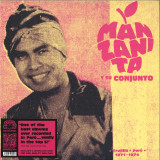
Following the 70s Peruvian cumbia compilation by Ranil last year, Analog Africa returns to Latin America to highlight the work of one of Perú’s undisputed masters of the electric guitar: Manzanita. This 13th release in the Limited Dance Edition Series includes 14 mostly instrumental compositions of electrifying Peruvian cumbia and guaracha. Manzanita's unique guitar lines rest on confident foundations that shifts gears effortlessly. Limited Edition LP in Gatefold Cover pressed on 180g high quality virgin vinyl
"I was in Lima, hanging out with collector-extraordinaire Victor Zela, who had spent the previous few years pouring his passion for Peruvian Cumbia into the blog „la cumbia de mis viejos“, a trove of incredible music. But after the birth of his first child, his priorities shifted and he decided to part with some of his rarest LPs. I was one of the lucky few given an early chance to examine his treasures, and when I picked up the album Manzaneando com Manzanita, Victor said: “Take it! its one of the best LPs ever recorded in Perú … easily in the top five”. That was all the encouragement I needed … two years later many of the songs from that masterpiece have made it onto Manzanita y su Conjunto, a compilation of electrifying Cumbia sides from Manzanita’s golden era.
Berardo Hernández – better known as Manzanita – first surfaced during the psychedelic Cumbia craze. At the head of the scene were the magnificent Los Destellos, whose leader, Enrique Delgado, was such a six-string wizard that other guitarists found it impossible to escape his shadow. But when Manzanita arrived, his electric criollo style sent shockwaves through Lima’s music scene and posed a serious threat to Delgado’s dominance as king of the Peruvian guitar.
Manzanita had come to Lima from the coastal city of Trujillo, five hundred miles up the coast – a place where Spanish, African and indigenous populations had been living and making music together for centuries – and came of age at a time when the first wave of psychedelic rock from the US and UK was starting to sweep the airwaves. But the sounds of Cream and Hendrix disappeared from the radio just as quickly in 1968 when Juan Velasco seized control of the country in a military coup. The new regime, which favoured local traditions over cultural ‘imports’ from the north, was a blessing in disguise for the Peruvian music scene.
Record labels flourished as new bands, raised on a hybrid diet of electric guitars and Cuban rhythms, rushed in to fill the vacuum created by the lack of imported rock. A new genre, known as Peruvian cumbia, was born and Manzanita quickly became one of its most original voices.
Starting in 1969, Manzanita y su Conjunto released a steady stream of singles that used Cuban guaracha rhythms as the foundation for dazzling electric guitar lines. After countless 45s and several years on the touring circuit, the band signed to Virrey, an important Peruvian label, and recorded two LPs acknowledged as masterpieces among aficionados of tropical music. Most of the songs on Analog Africa’s new compilation Manzanita y su Conjunto are drawn from those legendary sessions of 1973 and 74.
Although he scored a few more hits in the later 70s, his dissatisfaction with the music industry caused him to withdraw from the scene for several years; and when he finally retired for good, the golden age of Peruvian cumbia was a distant memory. But when Manzanita was at the top of his game he had few equals. Victor Zela was right: this is some of the best music ever recorded in Perú."
quête:su
HIGHLIGHTS "A Buenaventura" is surely one of Julian y su Combo's best albums, a sought-after collector's record that is also popular with tropical DJs. We have added two bonus tracks from 1976, 'Salsa y bembé' and 'Colorin colorao' that were originally a 45 single, resulting a winning combination of familiar and obscure tunes of rich sonic variety. Presented in its original artwork and pressed on 180g vinyl. Recommended by DJ Bongohead of Peace & Rhythm DESCRIPTION During a 20-year period Julián Y Su Combo released 8 LPs on almost as many different companies and "A Buenaventura" was their only record with Medellín-based label Indústria Fonográfica Metrópoli (later reissued by INS on their Fabuloso imprint as "Descarga Salsa Y Boogaloo"). Julián Angulo described the combo's sound as afroantillano, combining Cuban, New Y ork Latin, and Puerto Rican elements with Colombia's own tropical costeño traditions. The group's swinging, jazzy arrangements were distinguished by Angulo's prominent rhythm guitar, a hot rhythm section, and the potent brass lineup of two saxophones and a trumpet (much like Cortijo Y Su Combo) but with the occasional addition of a clarinet or flute (for extra Cuban flavor). Singer José Arboleda lends an earthy, joyful Afro-Colombian sound to the vocals and the entire unit is held together by a combination of his fantastic voice and super-tight, swinging ensemble playing with the occasional expert instrumental solo at just the right interval. "A Buenaventura" is a sought-after collector's record that is popular with DJs not only for the power ('salsa brava' all the way) and diversity of its sound (with hot dance genres that range from guaracha, son montuno and guaguancó to boogaloo and descarga, as well as cumbia and currulao) but also for how well it was arranged, engineered and recorded, making it both a pleasurable listening experience and a dance floor killer. Though the credits do not list a year, most likely it was released in the late 1960s or early 1970s and then pick up again with INS in 1975. In addition to several tasty originals by Julián and other Colombian composers, there are also covers of Cuban classics as well as the funky boogaloo anthem 'Palo de mango' by New York's Eddie Palmieri (with lyrics by the Puerto Rican sonero Cheo Feliciano).
Florence Adooni shares a long history with Philophon. Being part of Guy One's group she is the voice on his radio hit "Estre". Furthermore, she is a member of Alogte Oho's Sounds of Joy and can be heard on his smasher "Mam Yinne Wa". Last but not least, Jimi Tenor chose her to sing on his instant club classic "Vocalize My Luv". In addition to all these cooperations, Florence has locally released a series of albums under her own name and with no doubt she can called the queen of Frafra-Gospel.
"Mam Pe'ela Su'ure" is a typical Frafra-Gospel Hymn, sung during Sunday services accompanied only with shakers and hand clapping. Our version here is backed up by Kumasi's finest High Life players, who transform the song into a massive wave of groove. "Naba Aferda" is a homage to the Chief of Zuarungu, Florence's home village, which was also the home village of the legendary Christy Azuma, who became the first international Frafra-Star in the 70s. Christy was always a big inspiration for Florence and makes her proud to be from a small village called Zuarungu.
After the tremendous success of the first two boxsets of Nuyorican goodies, Rocafort Records heads to Peru for our next instalment of Salsa & Boogaloo treats!
We have compiled six of the finest songs from Alfredito Linares' first two albums, both recorded for Manuel Guerrero's label 'MAG'. 'El Pito Y Otros Exitos' was released in 1968, followed by 'Yo Traigo Boogaloo' in 1969. Both albums are highly sought after and prized by collectors, DJs and music lovers. Not only do they showcase Linares' talents as a pianist, composer, and arranger, but they perfectly capture the infectious rhythms of the era 'con tremendo swing'.
Including liner notes by DJ Timber.
Long sought after by collectors, DJs and lovers of hard salsa and boogaloo alike, 'Yo Traigo Boogaloo' is now lovingly reissued in replica form with the original cover art, remastered from the studio tapes, reproducing that magical MAG studio sound for today's aficionados to enjoy like it was 1969 all over again. Alfredo Linares is a globetrotting pianist, composer, bandleader and producer from Peru with a long, prolific career in latin music. His long sought after by DJs and collectors of hard salsa and boogaloo alike, 'Yo Traigo Boogaloo' is now lovingly reissued in replica form with the original cover art, remastered from the studio tapes, reproducing that magical MAG studio sound for today's aficionados to enjoy like it was 1969 all over again. Details: Alfredito "Sabor" Linares is a globetrotting pianist, composer, bandleader and producer from Lima, Peru with a long, prolific career in hot Latin music spanning more than half a century. Though Linares has come to recent international fame through his work with William "Quantic" Holland, he was already quite popular and famous in his adopted countries of Colombia and Venezuela in the 1970s and 80s during the salsa boom. However, his career began in Lima, backing timbalero Ñico Estrada at age 17 in 1961, and Alfredito's first notable recording as a sideman was a few years later on the now legendary 'El Combo de Pepe' album for IEMPSA/Odeon. Subsequently Linares would advance his career by recording two fabulous records under his own capable leadership as Alfredo Linares Y Su Sonora at the end of the decade for the MAG label. These releases capitalized on recent developments in New York Latin music, namely Latin jazz, boogaloo, descarga (jam session) and what would later be marketed as "salsa" with roots in the Cuban guaguancó and guaracha genres. One can hear direct inspiration coming from Joe Cuba, Ricardo Ray, and Eddie Palmieri, especially on the first album, 'El Pito', and yet by the second record, there are plenty of original tunes as well. More importantly there is a 'swing' and assertiveness to the playing (and arrangements) that prove every bit as authentic, tough and danceable as their New York inspirations. As Linares himself recounts, "In that era, we fought against a generation that was half-blind, because the people who understood what we were doing were few. We had to fight hard for our space in Perú, that's where the swing comes from." That special 'swing' also emanated from Linares' ace backing band, which happened to be a talented stable of MAG studio musicians who all understood Cuban and jazz music: percussionists Mario Allison and Coco Lagos, bassist Joey di Roma, Kiko Fuentes and Carlos Muñoz on lead vocals and Melcochita on coro (vocal chorus). According to Linares, the studio band was "open-ended, some musicians came some days, others on other days_Nilo Espinoza on saxophone, Betico Salas and Tito Chicoma on trumpets. Otto de Rojas played piano, and so did Charlie Palomares, who played vibraphone. Another good musician was guitarist Carlos Hayre." Though the recordings were cut "live in the studio" and many were basically composed on the spot, the intrinsic strength and maturity of the performances on 'Yo Traigo Boogaloo' stand the test of time as one of Peru's most important contributions to tropical music across the decades, establishing Alfredito Linares as a master of the idiom and serving as a harbinger for great things to come for him in Colombia and Venezuela. Long sought after by collectors, DJs and lovers of hard salsa and boogaloo alike, 'Yo Traigo Boogaloo' is now lovingly reissued in replica form with the original cover art, remastered from the studio tapes, reproducing that magical MAG studio sound for today's aficionados to enjoy like it was 1969 all over again. Pablo E Yglesias DJ Bongohead of Peace & Rhythm
Pianist Roberto de la Barrera was arguably the first musician from Cartagena, Colombia to record music that would later be labeled "tropical" and "salsa" with his own group in the early to mid-1960s. He took the piano seat in the Discos Fuentes house orchestra and was also an arranger on several releases.
In 1970 he recorded his third album for the label, "Se formó la salsa", featuring an irresistible mix of Colombian and Cuban flavors, sometimes within the same tune, and often with that wonderful raw, loose, improvisational quality associated with the "descarga" jam sessions of Cachao and others a decade before.
Roberto de la Barrera was a pioneer in introducing modern Latin sounds from Havana, New York and San Juan. Sadly, his contributions in bringing salsa to the Caribbean region of Colombia and hence the rest of the country have gone largely unheralded, but hopefully this reissue will help set things straight.
Presented in facsimile artwork and pressed on 180g vinyl. Part of Vampisoul's reissue series of classic Fuentes LPs.
The impact and influence of music of (Afro) Cuban origin has spread from Cuba to the far corners of the world. Its fingerprint can be found through salsa, jazz, funk, soul, hip hop and everything in between. Cuba has an incredibly rich culture of music and dance which is ingrained in its people from birth. With this release we celebrate two compositions by one of Cuba's finest songwriters: Silvestre Méndez.
Here at Rocafort Records we are delighted to serve up two of Méndez's biggest compositions at their finest. "Mi Bomba Sonó" featuring the emblematic Celia Cruz and her explosive vocals over La Sonora Matancera's inimitable pulsating rhythms! On the flip side we have Joey Pastrana's thundering rendition of 'A Bailar Oriza', a funky reinterpretation of one of Méndez's most covered compositions.
Disclaimer: We will not be held responsible for any turntables, dance floors or pants catching on fire! We hope you enjoy this little tribute to Silvestre Méndez as much as we have delighted in putting it together!
Enigmatic multi-instrumentalist Clive Tanaka returns after nearly a decade since his cult-classic Jet Set Siempre was released into the world with a collection of indie gems entitled ‘Pre-Sunrise Authority.’ This is an album experience ready for
summer road trips, shifting FM dials as the terrain changes and signals fade. In his words: What started as a rejection of loneliness with lyrics grew into a rejection of the ephemeral with the final musical composition. The dissonance between the mission
of the lyrics and the music is what finally satisfied me. The album, Pre-sunrise Authority, took 10 years to finish. This record is a tribute to scheduled, communal listening to music; to driving up to the bluff to get a clear signal of America’s Top 40 with Casey Kasem; to the friend that gave you Beck’s Mellow Gold on CD and said, “You have to listen to this;” and to my friend Carroll, who played all over this record, but passed away before he could every hear it… Music is not disposable.
Fiestas is an ultra catchy foxtrot by the Colombian clarinet player and ar-ranger Ricaurte Arias. This American-style swing spiced up with a layer of Colombian sauce is an irresistible ear worm that takes the concept of smoothness to another level. Definitely the foxiest of all foxes.
The legendary composer and band leader Pacho Galan’s take on Estambul is another example of how American swing and Colombian music can blend into a unique musical melting pot. The song starts with hard tambor breaks and maracas kicking in badly. The playful horns driven by the cumbia rhythm make it impossible not to dance on this tune.
Tribal psychedelic tribe, at the Trancy frontier... with an experimental size awaking the hardness as well as the naivless scale. Difficult cult ! Enjoy ! And finally The Illusionist will reward the patient mlistenners with his kicker mental morphing. To seem simple is not so easy.
- A1: Lady Madonna
- A2: The Inner Light
- A3: Hey Jude
- A4: Revolution
- B1: Can't Buy Me Love
- B2: And I Love Her
- B3: Eleaner Rigby
- B4: Sgt. Pepper's Lonely Club Band
- B5: A Day In The Life
Matasuna Records has once again unearthed two Latin gems for its latest release: two rare tracks by Argentina-born musician Enrique Lynch. Lynch moved from Argentina to Peru in the 1960s and became artistic director and producer of the Sono Radio label. He released an astonishing amount of albums with his various bands over the span of nearly three decades.
The two songs will be available together on a vinyl single for the first time - and the track from the flipside will also be released on a 7inch for the first time. For this official reissue Matasuna was lucky enough to have access to the original master tapes. The tracks were carefully restored and remastered in Lima (Peru).
African Bump is one of Enrique Lynch's greatest tracks and the original 7inch is much sought after by collectors and DJs alike. The song immediately captivates the listener as the Wah Wah guitar begins to play and enters into perfect harmony with organ and brass. A thrilling disco funk beat, rhythmic percussion elements and a hypnotic hookline spice up the track and show what great musical treasures South America has to offer.
On the flipside there's a great cover version of the Soul and Funk anthem K-Jee by American band The Nite-Liters, which had a hit with this song in 1971 and even entered the billboard charts. Enrique's version adds some extra grooves with killer beats and breaks, a heavy bassline and wild percussion parts. A distinctive horn section meets funky guitar riffs and deep organ sounds. A fantastic funk tune that will set any dance floor on fire!
- A1: La Tuna Club (S. Mantequilla' Font)
- A2: Azul Trompeta (S. Mantequilla' Font)
- A3: Whisky Jazz (S. Mantequilla' Font)
- A4: Jamboree (S. Mantequilla' Font)
- A5: Blue Note (S. Mantequilla' Font)
- A6: Full De Ases (S. Mantequilla' Font)
- B1: Moanin' (Timmons)
- B2: Not Problem (Marray)
- B3: Blues 3/4 (S. Mantequilla' Font)
- B4: Atmosfera (S. Mantequilla' Font)
- B5: Vat 69 (S. Mantequilla' Font)
- B6: Balada (S. Mantequilla' Font)
Salvador Font studied violin, clarinet, composition and harmony at the Conservatori Municipal de Barcelona, but very soon started to gain notoriety as a saxophonist in the rich jazz scene of 1940s Barcelona. Font would soon be playing tenor sax and clarinet in the Orquesta Gran Casino. He was in his early twenties and his hot swing technique was already praised through the citiy's scene, he would grow to be considered the best saxophonist in Spain by playing in many orchestras and combos, among them: José Puertas', Antonio Vilá's Virgina, Bonet de San Pedro's band, Pierre Michel, El Lirio Campestre, Los Marios, Luis Rovira y su orquesta, Orquesta brasileña Fon-Fon, Jaime Camino, Los Embajadores, Italo Leone's... With these and others, Font toured constantly, visiting many countries and even staying on some for long seasons: Mexico, Morocco, Switzerland, Egypt... Hungarian violinst of Turkish ancestry Kurt Dogan gave him the "Mantequilla" surname - he felt "Mantequilla" (which means "butter") fit Font's mellow yet swinging improvisation style.
Mantequilla y su conjunto
In the early sixties, "Mantequilla" had the chance to lead his own combo, Mantequilla y su conjunto, with which he was to record the three splendid EPs that are compiled on the present album. All these 7" have become elusive collector pieces in the record market, with sellers demanding from 200 to as much as 950 euros per copy.
In 1961 "Mantequilla" was at his best moment, his gigs at the Jamboree Jazz Cava had brought him back to the first line of Barcelona's jazzmen after he had been working abroad for a long time, and was approached by the Belter label to record an EP. On the sessions he was accompanied by Manolo Mercedes on trumpet, Pedro Ferré on piano, Rafael Lizandra on double bass and Rafael Verdura on Drums. The material chosen for the disc were four original compositions by Salvador Font which had a high West Coast flavour all over: "La Tuna Club", "Whisky Jazz" and "Jamboree" named after famous jazz clubs and "Azul Trompeta", dedicated to Manolo Mercedes.
In late 1962, after spending some time in Madrid working as members of the Italo Leone combo, "Mantequilla" and pianist Manuel Gas came back to Barcelona for the recording of the second "Mantequilla" EP, also on Belter. We find again Manolo Mercedes on trumpet, Pedro Ferré on piano and Rafael Lizandra on double bass, the drummer this time was José Farreras. Another news is that Manuel Gas also sat on piano and vibraphone. The songs chosen for the occasion were two tunes from the Art Blakey Jazz Messengers repertoire: Bobby Timmons' classic "Moanin'" and the Jacques Marray track "No Problem" from the soundtrack of the Les liaisons dangereuses film (mispelled "Not Problem" on the sleeve and label), plus the Salvador Font penned "Blue Note" and "Full de ases" - on "Full de ases" "Mantequilla" trades his sax for the violin, which he also mastered under high influence from Stephane Grapelli. The record was released on Belter in early 1963 and showed "Mantequilla" adding a certain aggressivity to his sound, in a soloist style which has been compared to that of tenor saxophonists Barney Wilen or Benny Golson.
1965 was the year of release of Mantequilla y su conjunto's third EP, now on the Discophon label. Mercedes and Farreras are again present in the recording sessions, joined by Ricardo Miralles on piano and Enrique Ponsa on double bass. Four original Font compositions make up the fantastic EP: "Blues 3/4", "Atmósfera", "Vat 69" and "Balada".
There would be a further EP on Belter, released in 1971 as Mantequilla Group it was a cash-in operation to take some redits of the ye-yé discothèque phenomenon, it gets quite afar in style from the jazz works of Mantequilla y su conjunto, so we just left it aside for the present edition.
"Mantequilla"'s career would continue, in 1968 he would settle in Majorca and form a swing band with Bonet de San Pedro and Manuel Bolao. He played in local orquestras and also with first class world acts like Gerry Mulligan, Tete Montoliu, Errol Gardner, a.o. He was even approached by Henry Mancini to play sax on The Pink Panther Theme in a gig Mancini did with his orchestra in Palma de Mallorca in 1975, He also joined his son Salvador Font (a demanded drummer himself who has played with Máquina!, Orquestra Mirasol, Música Urbana, Gary Burton Quartet, Georgie Fame, and many others) and his peers Carles Benavent, Emili Baleriola, Josep Mas 'Kitflus' and Jordi Bonell with whom he recorded his acclaimed "Mantequilla" album in 1987.
Now, for the first time ever, the legendary three ultra rare and imposible to find EPs by Mantequilla y su conjunto are compiled in a lavish vinyl LP with remastered sound, featuring liner notes and photos and a fantastic period inspired, three backflaped, front laminated sleeve. It is a stricly limited edition of only 500 copies and they are expected to sell out very soon, do not miss your chance of getting yours - it may be the last chance of chasing the Mantequilla sound on vinyl at a reasonable price!
l
A native of the Caribbean coast of Colombia, Abelardo Carbono achieved legendary status in his country's storied ranks of musical icons by combining the homegrown sounds of cumbia with the chiming guitars of West African soukous, enormously popular with the local tropical sound systems, and drenching the whole thing in his off-kilter, surreal and slightly psychedelic sensibility.
With the exception of a well-received compilation of songs from his 1980s heyday, Carbono has been rarely heard from outside the sweaty dancehalls he still commands in his hometown of Barranquilla. Now, Names You Can Trust has welcomed the reclusive guitarist and singer back to the vinyl format with a simmering Afro-Carib beast of a cut, recorded with the assistance of Will "Quantic" Holland on rhythm guitar and Mario Galeano (Frente Cumbiero, Ondatropica) on keys and in conjunction with Lucas SIlva of Palenque Records & Polen Records. It's a true cross-generational and international collaboration that is uniquely possible via Colombia. The first release of this expansive & power packed studio session is a cover of vallenato pioneer Guillermo Buitrago's La Piña Madura. This updated take veers heavily towards Africa on a rock solid foundation of bass and drums, with Abelardo's trademark guitar and quirky vocals leading the way.
- A1: Charlie Palomares Y Su Yuboney - Vives Boogaloo
- A2: Nilo Espinosa Y Orquesta - Baby Boogaloo
- A3: Los Hilton's - Hilton's Descarga
- A4: Silvestre Montez Y Sus Guantanameros - Silbando
- A5: Alfredo Linares Y Su Sonora - El Pito
- A6: Melcochita Y Karamanduka - Booga Jazz
- B1: La Sonora De Lucho Macedo - Caramelos
- B2: Mario Allison Y Su Combo - Un Regalo Para Ti
- B3: Coco Lagos Y Su Orates - Descarga Jala Jala
- B4: Tito Chicoma Y Su Orquesta - Fat Mama
- B5: Alfredo Linares Y Su Sonora - Cool
- B6: Nico Estrada Y Su Sonora - Ven Pa' Mi Casa
- C1: Mario Allison Y Su Combo - Ensueno
- C2: Charlie Palomares Y Su Yuboney - Push Push Push
- C3: Al Valdez - Que Rico Sabor
- C4: Tito Chicoma Y Su Orquesta - Clap Your Hands
- C5: Coco Lagos Y Sus Orates - Mamblues
- C6: Mario Allison Y Su Combo - Uno-Dos-Tres
- C7: La Sonora De Lucho Macedo - Guayaba
- D1: Alfredo Linares Y Su Sonora - Yo Traigo Boogaloo
- D2: Nico Estrada Y Su Sonora - Juan Jose
- D3: S Montez Y Sus Guantanameros - El Diablo
- D4: Alfredo Linares Y Su Sonora - Linares Blues
- D5: Nilo Espinosa Y Orquesta - Do The Boogaloo
- D6: La Sonora De Lucho Macedo Con Lina Panchano - Moliendo Cafe
- D7: Al Valdez - Guajira
- A1: Silvestre Montez Y Sus Guantanameros - El Avispón
- A2: Los Orientales De Paramonga - Lobos Al Escape
- A3: Los Destellos - Pasión Oriental
- A4: Grupo Celeste - Viento
- A5: Los Mirlos - Cabalgando Con Ella
- A6: Manzanita Y Su Conjunto - Arre Caballito
- B1: Los Mirlos - El Escape
- B2: Los Wembler's De Iquitos - Un Silbido Amoroso
- B3: Los Destellos - La Ardillita
- B4: Los Beltons - Cumbia Pop
- B5: Los Beta 5 - Beteando
- B6: Los Galax - Lamento De Un Galax
- B7: Aniceto Y Sus Fabulosos - Mi Gran Noche
- C1: Juaneco Y Su Combo - Mujer Hilandera
- C2: Los Sander's De Ñaña - El Tramboyito
- C3: Los Beta 5 - La Danza De La Tortuga
- C4: Los Destellos - Guajira Sicodélica
- C5: Los Orientales De Paramonga - Captura De Lobos
- C6: Los Diablos Rojos - Malambo
- D1: Los Átomos De Paramonga - El Trencito
- D2: Los Beta 5 - La Jorobita
- D3: Los Ecos - Aquí En La Fiesta (I Don't Want To Spoil The Party)
- D4: Los Demonios De Corocochay - La Chichera
- D5: Los Demonios Del Mantaro - Liliana
- D6: Los Mirlos - Lamento En La Selva
Peruvian cumbia, also know as "chicha", brings together tropical music styles from Colombia and Cuba, Western influences such as 60s beat and psychedelic rock, and mixes them with indigenous melodies from the Amazonian jungle and traditional Andean songs. The result is a unique and vibrant style of music which reverberates with life. Vampisoul's compilation includes tracks by the most important bands of the genre. Peruvian cumbia is currently being rediscovered by new audiences and there exists a thriving club and live venue scene in cities like New York, London and Madrid.
36-page booklet with extensive liner notes in English and Spanish plus photos and memorabilia.
Mancunian Hidden Spheres has showcased himself as one of the most innovative producers out there, releasing across the likes of Lobster Theremin, Rhythm Section International and his own imprint Fruit Merchant, all of which have been the perfect outlets for his inspiring blend of house and jazz. Church now features as the latest addition, who continue their stellar discography with 'Words Can't Explain', a collaborative EP which sees Hidden Spheres alongside singer-songwriter and guitarist, Oscar Jerome.
The collection begins with the original mix, lowering you into slick jazz guitar licks and echoing vocals, before Hidden Spheres provides a tight groove to lock around the melodies in fine form. The hybrid creation of jazz meets house binds perfectly as warm keys hang effortlessly in the air and popping guitar lines carry you onwards, supporting the sublime vocal from Oscar.
The dub version opens up room for the guitar licks and synth top lines to take centre stage, a real opportunity to marvel at the arrangement here.
On the flip is Yu Su's rework who ups the tempo and dims the lights for a punchier rework.. The half way point welcomes a percussive led break before the hats return and pick up the groove once again, closing the 'Words Can't Explain' EP in style.