
pas en stock
Commandez maintenant et nous commanderons l'article pour vous chez notre fournisseur.
Last In: 13 months ago
9,03 €
Commandez maintenant et nous commanderons l'article pour vous chez notre fournisseur.

This is a special one. Very much indeed. I was on a train on my way to Galicia earlier this year when my phone started off. It was Mike. Me and him exchange a call every now and then, so I thought it was the classic how-you-doing thing, which of course was. Only that this time the call ended with him saying “I’ve emailed you something, a couple of vocal takes plus the only music line that survived that session which is some great drumming by Gad”. Nothing more. Gad (scratches head)? Who the hell is Gad? When I arrived at destination and found some steady wifi connection I downloaded the stuff and found out “who the hell” Gad was. Nothing less than the “most recorded drummer in the history of soul music” aka James “Big Foot” Gadson who, beside the Kirklands, in his career has been drumming for the likes of Marvin Gaye, Charles Wright, Bill Withers, The Temptations, Martha Reeves, Quincy Jones, you name a Soul Star or a famous album, or a legendary recording session, he was there beating snares and kicks. Having been much satisfied by our work on the “Love Scenario” release Mike wanted us, and I quote him literally, “to do our magic”. We did our best of course, but you just can imagine the pressure. This time we went the extra mile though because at some point, listening again and again to the verses and choruses I figured out it would have been a great experiment to give an ultra retro feel to an original recording of 1980. So, while we were doing our thing I’ve asked my mate Paul from Blue Lotus Recordings in Saint Louis, if they could “do their magic” themselves. They gladly accepted the challenge, I handed them over the vocal takes and Gad’s drumming and the result is this 4 tracks 7”/33 rpm biscuit which we hope you will enjoy as much as we all have enjoyed producing it.
il devrait être publié sur 19.11.2021

• Within a year of her ground-breaking Double-Album “Bad Girls”, Donna Summer left
Casablanca Records to become the first Artist signed to the new Geffen Records label.
• The fourth album released for the label was 1987’s “ALL SYSTEMS GO”, was recorded in both Los
Angeles and Munich and was predominantly produced by long-term Giorgio Moroder
collaborator and movie soundtrack composer, Harold Faltermeyer, giving the album a slightly
harder-edged, FM-radio friendly sound with a heavier R&B influence.
• Out of the two further tracks recorded for the album, ‘Dinner With Gershwin’, which was
produced by Richard Perry and written by Brenda Russell, gave the album that desired FMradio sound, with the single becoming a worldwide hit reaching #13 in the UK singles chart.
Other singles include ‘Only The Fool Survives’, a duet with Starship’s lead-singer Mickey Thomas
and the album’s title track ‘All Systems Go’.
• This special edition revisits the original album on 180g Orange Colour vinyl.
Commandez maintenant et nous commanderons l'article pour vous chez notre fournisseur.

‘SON’ was recorded in London and Freetown between 2019-21. Inspired by the pair’s shared love of choral music, it began as an experiment to explore playing with the voice in more creative ways, using layered vocals as an instrument following piano harmony, arrangement and sampling.
The project started in London with the title track and became a story about a world in which we hide our true ‘colours’ in order to fit in. A mother tells her son that he needs to fit in to survive before realising that she is following the same tropes passed on to her as a child. Following this realisation she encourages her son to protect his dreams and not to listen to anybody telling him he can’t be whatever he chooses.
Rosie joined Duval for a week in Freetown in February 2020 where they wrote the rest of the project, bringing friends Daniel Koroma, Kandeh Bangura, Valentine Coker, Chino Greene and Tom Herbert in for musical contributions;
“We were interested in bringing our surroundings into the recordings; leaving doors open, recording in different spaces and locations, inviting the listener to experience the life that was going on around us whilst capturing the process”.
Full-colour inner sleeve
Illustrations by Duval Timothy
Insert of a specially commission Julianknxx poem
Shrink-wrapped
Commandez maintenant et nous commanderons l'article pour vous chez notre fournisseur.

In the afterglow of her acclaimed 2020 album Silver Ladders, Los Angeles-based harpist Mary Lattimore returns with a culminating counterpart release, Collected Pieces: 2015- 2020. The limited-edition LP features new and previously unreleased material, Bandcamp-only singles, and other obscurities alongside standouts from her 2017 tape Collected Pieces. Beyond the vinyl compendium, an expanded tracklist on the cassette/digital version brings more of Lattimore's archives together for the first time. Lattimore has described the process of arranging these releases as akin to "opening a box filled with memories," and here that box continues to populate, accessible for both the artist and fans. Evocative material separated by years, framed as a portrait of an instrumental storyteller who rarely pauses, recording and often sharing music as soon as it strikes her. Seemingly in constant forward motion for the last five years since her Ghostly debut, Lattimore glances back for a breath, inviting new chances to live in these fleeting moments and emotions; all the beauty, sorrow, sunshine, and darkness housed within. Opening the cassette version is "Mary, You Were Wrong," which mirrors an author's bout with a broken heart. "It's about how you have to keep on going even if you make some mistakes," she says. The bittersweet refrain cycles throughout, a little brighter every time, slowly, like the way time tends to heal. Unreleased track "Sleeping Deer" came together during Lattimore's artist residency on a cattle ranch in Wyoming. She remembers, "a small deer whose mother I think had been run over by a car would hang out in the yard. I called him Lollipop and would leave vegetable scraps out." Lollipop returned daily to eat, rest, and wait for more. The music this vision inspired is patient and droning, with light plucks giving way to deeper, vibrating tones, permeating with a sense of anticipation. Next is a newer single, "We Wave From Our Boats," which she improvised after walking her neighborhood during the early days of lockdown in 2020, and shared on her Bandcamp. "I would just wave at neighbors I didn't know in a gesture of solidarity and it reminded me of how you're compelled to wave at people on the other boat when you're on a boat yourself, or on a bridge or something. The pull to wave feels very innate and natural." The heart of the track is a somber loop, over top which Lattimore's synth notes ruminate, each a gentle shimmer of optimism in the most anxious and absurd of days. Also recorded in 2020, "What The Living Do" is inspired by Marie Howe's poem of the same name, which reflects on loss through an appreciation for the mundane messiness of being human. The echoed, slow-marching track has a distant feel to it, as if the listener is outside of it, watching life play out as a film. "Princess Nicotine (1909)" scores actual footage, a dream sequence Lattimore imagined for J. Stuart Blackton's surreal silent film Princess Nicotine; or, the Smoke Fairy. She adopted the same approach for "Polly of the Circus," explaining it was the name of one of the old silent films discovered in permafrost in the Yukon featured in the documentary Dawson City: Frozen Time, "the only copy that survived and it kind of warped in the aging process." A trove of pieces are collected here, most recorded in the moment, just Lattimore and her Lyon and Healy Concert Grand Harp, contact mics, and pedals. Like her most affecting work, these songs showcase Lattimore's gifts as an observer, able to shape her craft around emotional frequencies and scenes. Her power as a musician is rooted in how she sees the world: in vivid detail, profoundly empathic, with deep gratitude for nature and nuance.
Commandez maintenant et nous commanderons l'article pour vous chez notre fournisseur.

EVERY TIME I DIE is a loud rock institution committed to leaving an outpouring of chaotic passion and blissful malcontent all over their records and on the stage. With boiling charisma and unrelenting energy to spare, the Buffalo, NY band manages not one but two near-impossible tasks. They've survived two decades as an underground entity cherished for coloring outside the lines, and contrary to most career arcs, continually improving with each successive album as they charge ahead. EVERY TIME I DIE makes a glorious hardcore-punk noise. Alchemized by a swampy summoning of Southern rock and coarse poetry, the music swirls beneath sardonic and clever wordplay, cementing them as leaders, not followers. The band's ninth studio album, Radical, is 16 tracks of peak-EVERY TIME I DIE, including raucous new anthems. They deliver what you have come to know and love and then diverge into new paths. To say that "All This And War" featuring guest vocals by Josh Scogins from The '68 is absolute brutal heaviness is an understatement. It's an addictive punch in the face, you'll want on repeat. The boys then run off to explore the dark haunted woods of a more somber and melodic side in the track "Thing With Feathers" featuring Andy Hull from Manchester Orchestra. Radical proves with every track that it is a distillation of the strengths of their past, injected with their unyielding revelry and signature sarcasm while cognizant - and fiercely combative - of the present state of world affairs.
il devrait être publié sur 22.10.2021

Black vinyl[30,71 €]
Belched from Hell’s depths into the rustic charms of the Witch County, Suffolk thirty long and disturbing years ago, CRADLE OF FILTH are undisputed giants of the heavy metal realm. Imperious purveyors of a perennially unique strain of dark, dastardly and wilfully extreme metal, with deep roots in the worlds of gothic horror and occult curiosity, the band led by Dani Filth has weathered three decades of tumult and trial, earning a formidable reputation as both a singular creative force and one of the most riotously entertaining live bands the metal world has ever produced.
From primitive early works like 1992 debut »The Principle Of Evil Made Flesh« to more expansive and theatrical classics like ‘Cruelty And The Beast’ and ‘Midian’, CRADLE OF FILTH defied trends and constructed their own idiosyncratic world of foul grandeur, becoming one of the UK’s most notable metal bands in the process. Since then, they have traversed the world countless times, hoovering up plaudits and praise from an ever-expanding international fan base. Resolutely prolific, the band’s catalogue has grown in depth and stature all the while, irrespective of line-up changes or the whims of the faithful.
In more recent times, CRADLE OF FILTH have hit an unmistakable hot streak of creativity and urgency. As a new line-up coalesced around the creation of 2015’s »Hammer Of The Witches«, fresh impetus propelled the band to new heights, as the revitalised crew became more in demand around the world than ever before. 2017’s ‘Cryptoriana - The Seductiveness Of Decay’ repeated the trick with even more explosive flamboyance. Until a global pandemic brought the music industry to a jarring halt, CRADLE OF FILTH were almost permanently on the road and absolutely fucking flying. As a result, it should surprise no one that the band’s brand new album, ‘Existence Is Futile’, is yet another monumental and electrifying journey through the dark.
Buoyed by these recent triumphs, CRADLE OF FILTH recorded »Existence Is Futile« during 2020, piecing the record together in isolation, at Grindstone Studios in Suffolk with studio guru Scott Atkins (Devilment/Benediction/Vader). Although instantly recognisable as the work of these veteran blackhearts, the thirteenth CRADLE OF FILTH album is a wholly different beast from its immediate predecessors. Pitch-black, perverse and at times absurdly brutal and extreme, it hangs together with mesmerising fluidity. It is also absolutely rammed with giant, rousing melodies and moments of jaw-dropping invention. No one could mistake the venomously catchy likes of ‘How Many Tears To Nurture A Rose?’ or monstrous ballad ‘Discourse Between A Man And His Soul’ for anything other than CRADLE OF FILTH, of course, but ‘Existence Is Futile’ confirms that the band’s exploratory instincts remain as sharp as ever.
Underpinned by its huge and disarmingly organic production, »Existence Is Futile« is plainly the darkest and most unsettling album CRADLE OF FILTH have made in a while. Eschewing the band’s trademark twisted storytelling in favour of horrified glimpses into the mortal void and ruminations on the inevitable destruction of life on Earth, its poignancy and relevance to the cluster of nightmares facing humanity in 2021 is impossible to ignore, even if Dani Filth insists, not unreasonably, that he didn’t anticipate a global pandemic when the news songs were being written.
With the best possible timing, CRADLE OF FILTH were already due to make a new album during those long, lonely months of lockdown in 2020. Having grabbed the opportunity with both hands, Dani avows that unavoidable isolation from the rest of the world was the best possible incentive to get the job done, while also adding plenty of eerie atmosphere to the whole experience.
Sonically speaking, ‘Existence Is Futile’ is easily the most powerful and dramatic record CRADLE OF FILTH have ever made: it’s the sound of band’s enviable onstage chemistry spilling over into the studio, propelling each member of the band to new levels of intensity. Combined with the expected labyrinthine arrangements and moments of spellbinding bombast, ‘Existence Is Futile’ may be the most vivid representation of the CRADLE OF FILTH experience yet.
Also, diehard fans will be thrilled to learn that horror icon Doug 'Pinhead' Bradley makes a welcome return to the CRADLE fold, lending his dulcet tones to the epic ‘Suffer Our Dominion’, and to one of the forthcoming new record’s bonus tracks, as Dani explains.
“There are also two bonus tracks in addition to the album, one of which is the culmination to the ‘Her Ghost In The Fog’ trilogy, which began on »Midian«.
For this we had little hesitation in enlisting our friend and actor Doug Bradley to reprise his narrative role. Doug lives in Pittsburgh, which he refers to ‘The Pit’, thus we directed his narrative over Skype from his local studio. He adopts this almost David Attenborough-ish role on ‘Suffer Our Dominion’, which is possibly the most politically astute song we’ve written of late. As a band we usually shy from branching into politics, but it’s something that needed spouting. The fact we’re fucking our ecology up and desperately need to address the situation pronto…”
So, if we’re all going to perish in the fire of our own stupidity, we might as well have a suitably deranged and destructive soundtrack to do it by.
A bewitching, fearless nosedive into the abyss, the band's thirteenth studio album confirms the ferocious efficacy of CRADLE OF FILTH in 2021. Bold, brave, wildly imaginative and heavy as hell, the band’s latest runaway train-ride through the flames is the perfect album for these most imperfect of times. As Dani concludes, “Be like the virus! Mutate and survive!”
il devrait être publié sur 22.10.2021
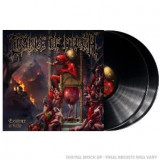
Purple/Black Marbled Vinyl[39,62 €]
Belched from Hell’s depths into the rustic charms of the Witch County, Suffolk thirty long and disturbing years ago, CRADLE OF FILTH are undisputed giants of the heavy metal realm. Imperious purveyors of a perennially unique strain of dark, dastardly and wilfully extreme metal, with deep roots in the worlds of gothic horror and occult curiosity, the band led by Dani Filth has weathered three decades of tumult and trial, earning a formidable reputation as both a singular creative force and one of the most riotously entertaining live bands the metal world has ever produced.
From primitive early works like 1992 debut »The Principle Of Evil Made Flesh« to more expansive and theatrical classics like ‘Cruelty And The Beast’ and ‘Midian’, CRADLE OF FILTH defied trends and constructed their own idiosyncratic world of foul grandeur, becoming one of the UK’s most notable metal bands in the process. Since then, they have traversed the world countless times, hoovering up plaudits and praise from an ever-expanding international fan base. Resolutely prolific, the band’s catalogue has grown in depth and stature all the while, irrespective of line-up changes or the whims of the faithful.
In more recent times, CRADLE OF FILTH have hit an unmistakable hot streak of creativity and urgency. As a new line-up coalesced around the creation of 2015’s »Hammer Of The Witches«, fresh impetus propelled the band to new heights, as the revitalised crew became more in demand around the world than ever before. 2017’s ‘Cryptoriana - The Seductiveness Of Decay’ repeated the trick with even more explosive flamboyance. Until a global pandemic brought the music industry to a jarring halt, CRADLE OF FILTH were almost permanently on the road and absolutely fucking flying. As a result, it should surprise no one that the band’s brand new album, ‘Existence Is Futile’, is yet another monumental and electrifying journey through the dark.
Buoyed by these recent triumphs, CRADLE OF FILTH recorded »Existence Is Futile« during 2020, piecing the record together in isolation, at Grindstone Studios in Suffolk with studio guru Scott Atkins (Devilment/Benediction/Vader). Although instantly recognisable as the work of these veteran blackhearts, the thirteenth CRADLE OF FILTH album is a wholly different beast from its immediate predecessors. Pitch-black, perverse and at times absurdly brutal and extreme, it hangs together with mesmerising fluidity. It is also absolutely rammed with giant, rousing melodies and moments of jaw-dropping invention. No one could mistake the venomously catchy likes of ‘How Many Tears To Nurture A Rose?’ or monstrous ballad ‘Discourse Between A Man And His Soul’ for anything other than CRADLE OF FILTH, of course, but ‘Existence Is Futile’ confirms that the band’s exploratory instincts remain as sharp as ever.
Underpinned by its huge and disarmingly organic production, »Existence Is Futile« is plainly the darkest and most unsettling album CRADLE OF FILTH have made in a while. Eschewing the band’s trademark twisted storytelling in favour of horrified glimpses into the mortal void and ruminations on the inevitable destruction of life on Earth, its poignancy and relevance to the cluster of nightmares facing humanity in 2021 is impossible to ignore, even if Dani Filth insists, not unreasonably, that he didn’t anticipate a global pandemic when the news songs were being written.
With the best possible timing, CRADLE OF FILTH were already due to make a new album during those long, lonely months of lockdown in 2020. Having grabbed the opportunity with both hands, Dani avows that unavoidable isolation from the rest of the world was the best possible incentive to get the job done, while also adding plenty of eerie atmosphere to the whole experience.
Sonically speaking, ‘Existence Is Futile’ is easily the most powerful and dramatic record CRADLE OF FILTH have ever made: it’s the sound of band’s enviable onstage chemistry spilling over into the studio, propelling each member of the band to new levels of intensity. Combined with the expected labyrinthine arrangements and moments of spellbinding bombast, ‘Existence Is Futile’ may be the most vivid representation of the CRADLE OF FILTH experience yet.
Also, diehard fans will be thrilled to learn that horror icon Doug 'Pinhead' Bradley makes a welcome return to the CRADLE fold, lending his dulcet tones to the epic ‘Suffer Our Dominion’, and to one of the forthcoming new record’s bonus tracks, as Dani explains.
“There are also two bonus tracks in addition to the album, one of which is the culmination to the ‘Her Ghost In The Fog’ trilogy, which began on »Midian«.
For this we had little hesitation in enlisting our friend and actor Doug Bradley to reprise his narrative role. Doug lives in Pittsburgh, which he refers to ‘The Pit’, thus we directed his narrative over Skype from his local studio. He adopts this almost David Attenborough-ish role on ‘Suffer Our Dominion’, which is possibly the most politically astute song we’ve written of late. As a band we usually shy from branching into politics, but it’s something that needed spouting. The fact we’re fucking our ecology up and desperately need to address the situation pronto…”
So, if we’re all going to perish in the fire of our own stupidity, we might as well have a suitably deranged and destructive soundtrack to do it by.
A bewitching, fearless nosedive into the abyss, the band's thirteenth studio album confirms the ferocious efficacy of CRADLE OF FILTH in 2021. Bold, brave, wildly imaginative and heavy as hell, the band’s latest runaway train-ride through the flames is the perfect album for these most imperfect of times. As Dani concludes, “Be like the virus! Mutate and survive!”
il devrait être publié sur 22.10.2021

EVERY TIME I DIE is a loud rock institution committed to leaving an outpouring of chaotic passion and blissful malcontent all over their records and on the stage. With boiling charisma and unrelenting energy to spare, the Buffalo, NY band manages not one but two near-impossible tasks. They've survived two decades as an underground entity cherished for coloring outside the lines, and contrary to most career arcs, continually improving with each successive album as they charge ahead. EVERY TIME I DIE makes a glorious hardcore-punk noise. Alchemized by a swampy summoning of Southern rock and coarse poetry, the music swirls beneath sardonic and clever wordplay, cementing them as leaders, not followers. The band's ninth studio album, Radical, is 16 tracks of peak-EVERY TIME I DIE, including raucous new anthems. They deliver what you have come to know and love and then diverge into new paths. To say that "All This And War" featuring guest vocals by Josh Scogins from The '68 is absolute brutal heaviness is an understatement. It's an addictive punch in the face, you'll want on repeat. The boys then run off to explore the dark haunted woods of a more somber and melodic side in the track "Thing With Feathers" featuring Andy Hull from Manchester Orchestra. Radical proves with every track that it is a distillation of the strengths of their past, injected with their unyielding revelry and signature sarcasm while cognizant - and fiercely combative - of the present state of world affairs.
il devrait être publié sur 22.10.2021

Featuring Anthony Green of Circa Survive, Adam Lazzara and John Nolan of Taking Back Sunday and additional percussion from Benjamin Homola of Grouplove, Fuckin Whatever is a fluid project born of longtime friendships and late nights on the road, but what it could grow to become is entirely unwritten. It all started on the 2016 Taste Of Chaos tour. After Green wrapped his opening set with Saosin each night, itching to play more music, he started setting up impromptu acoustic gigs in the parking lots after his set. One night, his restless energy led to an impromptu backstage jam session with Lazzara, Nolan, Homola, and others––except there were no instruments involved. Using just their voices and a stomp or two in lieu of percussion... before they even realized it, Fuckin Whatever was born. They decided to start recording these nightly jam sessions on their phones, and by the end of the tour, there were literally dozens of recordings. There are some as long as 17-minutes, some recorded in bathrooms, and even one in the legendary tunnel between the stage and sound booth at Red Rocks Amphitheatre in Colorado. What they share in common is the camaraderie of the many talented voices (and sounds) involved. Fast forward to 2020––ugh. With a creative need to continue making and releasing music, Anthony approached the group about releasing some of those recordings. Feeling a similar restlessness, Nolan suggested they try making and recording something for real instead. "I'm Waiting On You" is what came next, and it's truly the spark that led to the rest of this EP coming together. There are zero instruments on Fuckin Whatever's self-titled debut. "It's pretty much 80% mouth noises and 20% Ben slapping things around the house," Lazzara explains. Those voices, however, are among some of the most recognizable in modern rock music, yet here they take on a new life. Call it a band, or a supergroup... it's Fuckin Whatever.
il devrait être publié sur 15.10.2021

This building was intended to fall. The dust in all 6 rooms suspends in the air and light glitters on each particulate, a piercing bright like a headache behind the eye. Knuckles chapped like a dancer's feet, a listener survives in the building like it's a home. Makes it a home. Frantic energy holding still remains frantic. Trying to swallow, trying to catch your breath. Enough dust to settle and make the building in its exact image. Beating at the walls only makes the walls once more, 6 rooms, listening and responding. This is the sound of a space that cannot be unmade. Sorcery is permanent.
Commandez maintenant et nous commanderons l'article pour vous chez notre fournisseur.

Music is a means to purpose. Consuming music, dancing to music or creating music is a form of survivalism, and a purpose to serve. ‘Survivalism’ is the next mini LP offering from Label boss Sepehr as he returns to Shaytoon with a diverse mini LP of music making nods to late 90’s drum n bass, storming and beautiful techno, middle eastern flavors and more. Music to survive to.
Commandez maintenant et nous commanderons l'article pour vous chez notre fournisseur.

• Long lost 1968 album from visionary South African jazz composer incorporating traditional African music sources and instruments.
• Officially licensed from the Nxumalo family and reissued with inner sleeve containing archival photographs and new liner notes by Francis Gooding.
Gideon Nxumalo’s Gideon Plays might just be the most mythologised and sought-after LP in the whole South African canon. A sophisticated bop excursion with a distinctive African edge, it was only Nxumalo’s second LP as leader, despite his crucial place in South African jazz history. Pianist Nxumalo was a visionary jazz composer who had recorded regularly during the 1950s, and his 1962 Jazz Fantasia album was the first South African jazz recording to incorporate traditional African musical sources and instruments. But he was also the country’s most significant radio presenter and jazz tastemaker – from 1954 onwards, he had worn the nickname ‘Mgibe’ to introduce ‘This Is Bantu Jazz’, South African radio’s premier jazz show.
But in the aftermath of the Sharpeville Massacre in 1961, Nxumalo had been side-lined from radio play, and was eventually sacked for playing records with political meanings. By 1968, he had not been heard on record or airwave for several years. Gideon Plays was a celebrated return to the studio for one of South Africa’s best loved and most forward-thinking jazzmen, and it showcases Nxumalo’s deep understanding of jazz, his brilliant touch as a composer, and his commitment to bringing South Africa’s indigenous sound into the music.
However, it was released on the tiny JAS Pride label owned by production impresario Ray Nkwe, and after one pressing in 1968, Gideon Plays fell into the undeserved silence that has obscured so much of the South African jazz discography. It has since become a legend: hardly more than a rumour, it has been bootlegged by the unscrupulous, changed hands for eye-watering sums, and has scarcely been heard outside the circles of the most committed South African jazz devotees. It goes without saying that it has never been released outside South Africa, and even now only a handful of original copies are known to have survived.
Over the last ten years, Matsuli Music has been proud to present some of the greatest lost and found jazz recordings in South African history – but we have never presented a rarer, lesser known album than the mighty Gideon ‘Mgibe’ Nxumalo’s Gideon Plays.
Commandez maintenant et nous commanderons l'article pour vous chez notre fournisseur.

Short while after Anushka's debut album "Halfie", that has won her "Tsinandali Prize" and has been nominated for "The Album Of The Year 2020" Impala awards, 23 years old Anushka Chkheidze is back with her second album "Move 20-21". Created during 2020 pandemics, spent mostly in lockdown. In Anushkas own words "Move 20 – 21" is a mind journey through space and time without any physical movement.
Digitally released earlier 2021, "Move 20-21" cout the attention of Music Moves Europe Talent Awards; has been nemed as "Band of the day" by Europavox; has been choosen as track of the day by KEXP; has been broadcasted by United We Stream for FEMMELY AFFAIR in the light of International Women's Day 2021.
Commandez maintenant et nous commanderons l'article pour vous chez notre fournisseur.

il devrait être publié sur 30.08.2021

Demon Records presents the narrated TV soundtrack of a ‘lost’ four-part adventure set in ancient
Greece, starring William Hartnell as the Doctor.
When the TARDIS lands on the plains of Asia Minor, not far from the walled city of Troy, the
Doctor is hailed as the great god Zeus. He’s enlisted by the Greek army – led by Odysseus and
Agamemnon – to come up with a strategy for defeating the Trojans. With his companions already
prisoners of the opposing side, the Doctor draws his inspiration from the legend of a certain
wooden horse…
Presented across two 140g vinyl Trojan Sunset splatter discs, this 1965 TV soundtrack – no
episodes of which survive as film recordings - is narrated by Peter Purves, who co-stars as the
Doctor’s companion Steven, with Maureen O’Brien making her final appearance as Vicki. The
guest cast includes Max Adrian as King Priam, Barrie Ingham as Paris, Frances White as Cassandra
and Ivor Salter as Odysseus. Incidental music is by Humphrey Searle, and the familiar strains of
the Doctor Who theme are courtesy of the BBC Radiophonic Workshop.
The coloured LPs are presented in a gatefold sleeve with fully illustrated inner sleeves. Original
episode billings, and full cast and credits, are included.
Dummedy-dum, Dummedy-dum, Dummedy-dum, Dum-dum…
il devrait être publié sur 27.08.2021

You have never heard of Janet Beat. She has been making beautiful electro acoustic work since the early 1960s. Loads of people tried to stop her making music, people like her parents and male musicians who probably felt threatened by a talented woman in their post war male dominated electronic field. Her music has not been issued before. It’s here now, you lucky people. And no, I have not made her up.
Janet Beat does not make beats. She makes sublime electro acoustic music, much of it sounds like the music from Forbidden Planet, or maybe music just beamed in from another planet. Her early 1960s tape work was all destroyed by her father when he used her tapes to hang up his tomato plants. What a bastard. Anyway, her late 1970s and 1980s work has survived, and here it is for the very first time. And before you start asking questions about the title of this LP, I asked Janet Beat if it was OK. I spent ages trying to think of a good title, but then looked at the superb photo of her in her front room (the one on the LP front) and my mind was made up.
Commandez maintenant et nous commanderons l'article pour vous chez notre fournisseur.

The new single ‘Gold’ opens with the gritty, fervent soul of AJ Dean-Revington’s vocals, before the band’s patented harmonies surge to the fore, while thunderous drums and a euphoric hook escalate the song’s drama. It offers a timely reminder that challenging experiences will in time fade in favour of a better future. Gold stemmed from the idea of something being more beautiful having been broken. We had chatted about the Japanese art form Kinsugi or Kinstsukuroi and how things are mended with lacquer mixed with gold, and this was the perfect imagery for what we were writing about. Our scars are a visual representation of our struggles and our stories of loss are stories of survival. At the start of 2020 when we were in Woodstock finishing the album with Simone and David, we could not have imagined how the year would pan out. Gold feels even more connected and poignant now, after a year of so much loss and everyone just trying to survive.
il devrait être publié sur 06.08.2021

RECORD STORE DAY 2021 TITLE!!!
Negative approach - Tied down demo - complete session (green vinyl)
Vinyl re-issue - long out of print now available once again on limited collector's green vinyl!!
Commandez maintenant et nous commanderons l'article pour vous chez notre fournisseur.

After completing their acclaimed folk-rock trilogy in 1979, Jethro Tull returned a year later with A, an album that introduced a different sound and a new line-up. Originally intended as a solo record by the band’s founder Ian Anderson, the album’s single-letter title refers to the studio tapes, which were marked “A” for Anderson. When the album was finished, the group’s label Chrysalis insisted that it be credited to Jethro Tull, even though only two members from the band’s previous incarnation were featured: Anderson and guitarist Martin Barre. Despite that, the album and subsequent tour were well-received by fans around the world.
Back in April, Rhino released ‘A’ (A La Mode) (The 40th Anniversary Edition), a new 3CD/3DVD set to mark the album’s anniversary. Featuring on this album anniversary set, we will release the 1LP breakout of the original album ‘A’, newly mixed by Steven Wilson.
Produced by Anderson and Robin Black, A was recorded in London during the summer of 1980 at Maison Rouge Mobile and Maison Rouge Studios. Along with Anderson and Barre, the band also featured Dave Pegg (bass, mandolin) and Mark Craney (drums), along with guest performer Eddie Jobson – a Roxy Music alumnus – on keyboard, synthesizer and electric violin.
il devrait être publié sur 09.07.2021

After completing their acclaimed folk-rock trilogy in 1979, Jethro Tull returned a year later with A, an album that introduced a different sound and a new line-up. Originally intended as a solo record by the band’s founder Ian Anderson, the album’s single-letter title refers to the studio tapes, which were marked “A” for Anderson. When the album was finished, the group’s label Chrysalis insisted that it be credited to Jethro Tull, even though only two members from the band’s previous incarnation were featured: Anderson and guitarist Martin Barre. Despite that, the album and subsequent tour were well-received by fans around the world.
Back in April, Rhino released ‘A’ (A La Mode) (The 40th Anniversary Edition), a new 3CD/3DVD set to mark the album’s anniversary. Featuring on this album anniversary set, we will release the 1LP breakout of the original album ‘A’, newly mixed by Steven Wilson.
Produced by Anderson and Robin Black, A was recorded in London during the summer of 1980 at Maison Rouge Mobile and Maison Rouge Studios. Along with Anderson and Barre, the band also featured Dave Pegg (bass, mandolin) and Mark Craney (drums), along with guest performer Eddie Jobson – a Roxy Music alumnus – on keyboard, synthesizer and electric violin.
il devrait être publié sur 09.07.2021

Aye Aye Mi Mi’ is the second single from Mano Le Tough’s new album, ‘At The Moment’ which is coming soon on Pampa Records; . The single really highlights the vocal & instrumental skills of the Irish producer, resulting in an indie dance ear-worm that’s hard to shake.
“It’s the only tune on the record that survived from my original batch of demos and sketches” says Mano. “It’s a kind of reflection on narcissism, social media saturation and the ego”.
Commandez maintenant et nous commanderons l'article pour vous chez notre fournisseur.

Coming from Oslo, Norway, Bizarrekult is bridging the two identities of it mastermind - philosophical depth
of frozen Siberian steppe and the majestic beauty of Norwegian soil on this debut album. Bizarrekult was
formed back in 2006 as a response to the chaos of the surroundings and already with
a first demo got attention through 2000 copy split CD release. However, following the second studio demo
and then a two track rehearsal demo in Bergen, the project was laid on ice. “Vi Overlevde” (we survived)
speaks to the heart of every post-Black Metal fan that is looking for something different. The tracks
are filled with great riffing and beautiful melodies, tightly connected to the lyrical themes of frustration,
despair, sorrow, forgiveness and finally - hope.
il devrait être publié sur 02.07.2021

678 records are proud to present an historical concert recording of the legendary ethnic kraut-jazz formation Pork Pie. It is difficult to define the music of Pork Pie. It ranges from rhythmic Jazz-rock and meditative Indian sounds to Brazilian songs, and from acoustic improvisations to electric “space” sounds. Paris, December 1973: Pork Pie was founded by piano player Jasper van 't Hof (then 27 years old) and guitarist Philip Catherine (then 31 years old). They had met up with Charlie Mariano, who was 51 years old then, and whom they knew from his playing with Charles Mingus in the fifties and sixties. He had left America, lived in India for some years and founded his new home in Europe. Jasper and Philip were nervous to ask him if he would like to start a band with them but he immediately accepted the invitation. After some concerts in Holland, Germany and France the group recorded their debut album Transitory in May 1974 in the studio of the legendary engineer Conny Plank for MPS-BASF. It became an immediate success and Pork Pie were subsequently booked for many European jazz festivals. Their legendary concert on the first of November 1974 in the Berliner Philharmonie during the Berliner Jazztage was a milestone in the bands existence. The concert hall was packed to the rafters with 2500 over enthusiastic people who were totally overwhelmed by the amazing live sound of Pork Pie in which each of the five individual musicians took his own part, but never once lost the unique togetherness.
In the past 44 years Jasper van 't Hof always retained fond memories about this special concert. Fortunately, in his personal archive (which was for a while stored under a tarpaulin in his garden!) a master tape was discovered & had survived intact. P-Dog & Zembie (a.k.a. Sander Huibers & Frank Jochemsen) dug it up, played it on a tape machine, were totally blown away by the music and initiated this limited vinyl only release. It comes in a hand silkscreened cover designed by Piet Schreuders.
line up
il devrait être publié sur 30.06.2021

Eight years passes like nothing for Birds of Maya. Their fourth
album kicks out the Philly jams with every bit as much fervour
as their earlier releases - in fact, as it was recorded in 2014, it
kind of is one of their earlier releases.
A long era of dull ringing and nothing else in our ears is over.
Once again, winds of warm guitar and humid thunderheads of
bass and toms rumble all around. With ‘Valdez’, Birds of Maya
are back in flight. And like the first song title explicitly states, this
latest is a soaring blast of riffers, rife with punk rock abandon,
sludge, treble, distortion, neck-throttling rock ‘n’ roll solos,
pummelling drums and bass and half-shouted/half-gargled
vocals, all of it half on and half off the mic.
‘Valdez’ was recorded in 2014 at Black Dirt Studios in otherstate New York. After a Purling Hiss session there, Birds of
Maya got a bunch of tunes they liked into shape - that is,
different shapes on different days. But nice shapes. Once they
got to the studio, they loaded in and set up, curious to see how
they felt playing in a different room. Pretty good as it turned out
- running through the songs that first night, they accidentally
recorded the whole album. Then they finished up the next day,
mostly. Trading the crushed harmonics of their basement tapes
for studio-grade mics, overdubs in the mix and only slightly lessbruised harmonics, their roiling essence not only survives but
thrives, non-stop, on ‘Valdez’, stuttering, screaming and
stomping through six circuitous numbers.
At the time this was recorded, Birds of Maya were standing on
the other side of ten years kicking around town, suddenly far
away from the primordial ooze they’d flopped forth from. The
streets where all this had happened on were changing, with new
money rolling in, but they were the same old Birds, content with
their libations and ear-splitting variations on old favourite
Stooges chords. The cover art of Valdez is a couple of images
from those days, glimpses at the old grass roots before they
were ripped up by developers to build condos. But nothing ever
really goes away. ‘Valdez’ is a totem of the wildness that refuses
be tamed
il devrait être publié sur 25.06.2021

Commandez maintenant et nous commanderons l'article pour vous chez notre fournisseur.

ith canceled shows, closed venues and lost incomes, the pandemic was bad news for many music artists. But it wasn't only bad news in 2020, as many artists used their struggle to do what they do best during difficult times: create great music. This is why N.E.W.S. Records, a record company based in Ghent releases 'Bad News. Good News.'. A limited edition vinyl record with great songs that couldn't be played live because of the pandemic. The record itself is made from the ashes of newspapers and magazines containing the bad news that hit the music industry in 2020 (and prevented artists from performing live). As proof that great music always survives bad news, no matter how desperate things can get. To create the records, N.E.W.S. Records worked with And Vinyly, a UK-based company specialized in pressing vinyl records with ashes.
Many artists collaborated on the project and shared their insight on how the bad news happening in the music world influenced their music, like Johannes Genard, lead singer of School is Cool: "The one good thing about bad times is that they open new perspectives on things you've grown accustomed to, and that is exactly our core business as artists: comforting during challenging times; challenging during comfortable times and finding new ways to look at old things."
The compilation contains some exclusives like the Brihang & Compact Disk Dummies 'Steentje / I Remember' mash up, recorded live for 'Week van de Belgische Muziek' and Sam De Nef's cover of the belpop classic 'Satelliet Suzy' recorded for StuBru.
il devrait être publié sur 11.06.2021

Demon Records presents the narrated TV soundtrack of a partially ‘lost’ six-part adventure set in a
future Ice Age, starring Patrick Troughton as the Doctor.
The Doctor and his friends land on Earth in the future, and find it in the grip of a new Ice Age.
They join a team of scientists struggling to hold back the huge glaciers that threaten all human
life. A giant creature is discovered inside the ice and quickly comes to monstrous life – it’s an Ice
Warriors from Mars! It intends to find its crashed spaceship, where a whole crew of Warriors is
waiting to be revived…
Presented across a trio of 140g Molten Ice vinyl discs, this 1967 TV soundtrack – only four
episodes of which survive as film recordings - is narrated by Frazer Hines, who co-stars as the
Doctor’s companion Jamie, with Deborah Watling as Victoria. The guest cast includes Bernard
Bresslaw as the Ice Warrior Varga, Peter Barkworth as Leader Clent, and Peter Sallis as Penley.
Incidental music is by Dudley Simpson, and the familiar strains of the Doctor Who theme are
courtesy of the BBC Radiophonic Workshop.
The coloured LPs are presented in fully illustrated sleeves which, when assembled together, form
the cover image. Original episode billings, and full cast and credits, are included.
Dummedy-dum, Dummedy-dum, Dummedy-dum, Dum-dum…
il devrait être publié sur 04.06.2021

Every Dunbarrow album has a hauntingly classic sound of, in the band’s own
words, “an eerie rawness.” But their third album feels like you’ve discovered a
mysterious half-century old recording tucked away in a decrepit abandoned
mansion. Perhaps there’s a note attached, begging its courier to beware. Alas,
whoever possessed the tape apparently never survived. ...that is to say, it feels like there’s a solemn
story to this album, not just in the
lyrics, but in the sound itself. Much like
the eponymous debut of Black Sabbath,
the band uses subtle sound effects to
dramatically set the scene for its mostly
clean tones and masterful use of open
space for which the band has become
known. But unlike their first two albums,
this one does see the band branching
out just a bit into heavier, more distorted
guitars. The result is a much more
in-your-face sound, while retaining the
Haugesund, Norway quintet’s masterful
proto-metal sound.
The album opens with the sound of falling
rain as Lønning and Eirik Øvregård’s
guitars seep into the speakers like
funereal bells and haunted drones on
“Death That Never Dies.” Drummer Pål
Gunnar Dale slams down three snare
beats as bassist Sondre Berge Engedal
slinks in harmony over it all. Andersen’s
crisp vocals paint a bleak picture of
dark perdition until the band slips into
a swaggering piano-led coda reminiscent
of “Sabbra Cadabra.” The 7-minute
psychedelic folk masterpiece “Turn In
Your Grave” is the album centerpiece,
replete with mournfully shimmering
Mellotron and bleak folkloric lyrics. Its
hypnotically spinning guitar notes and
old European parlando-rubato singing
hearken to dark early Steeleye Span with
a sinister edge. “In My Heart” perfectly
showcases the band’s penchant for folk
based, yet head-banging riffs that break
with tradition that has stilted modern
heavy music.
“I think with this record, we have managed
to create our own unique sound
with its own Dunbarrow tag,” says the
band. With that sound comes the perfect
artwork: A cover illustration from the
early 1900’s by artist Harry Clarke from
his work for Edgar Allen Poe’s Tales of
Mystery and Imagination.
il devrait être publié sur 21.05.2021

Be With is delighted to present Jorge López Ruiz’s El Grito (Suite Para Orquesta De Jazz), eternal Argentinian magic released on CBS in 1967 that must be one of the most sought-after South American jazz LPs.
Living in Buenos Aires in the 60s, driven by creative impulse and rage Jorge López Ruiz used music as his platform to protest the Argentine military dictatorship: “I could never stand dictatorships, to be told how you have to think, what you have to do. Nor did I endure discrimination”.
A young López Ruiz had appeared on a television panel alongside writer, politician and philosopher Arturo Jauretche, criticising the Onganía dictatorship. Jauretche told López Ruiz “Now say it with music”. This was the deep inhale that lead to El Grito, literally “The Scream”. As López Ruiz later explained “Jauretche urged me that my protests should not remain in words and acquire the consistency of a work… but it was not so much what he told me but how he told me, what prompted me to make the work take shape, first in a live concert and then in a recording”.
As the police and military began resorting to kidnapping, torture and summary executions to quiet dissent, with depressing inevitability the artist community and their work were a particular target of the increasingly brutal regime. El Grito was banned not long after it was released and the majority of original copies were unceremoniously destroyed.
The work of a genius artist living under an opressive dictatorship, erased by the government of the time, this is buried treasure in every sense and it’s been a rare record for over 50 years. But it isn’t just being hard to find that has pushed up the prices of those few original copies that survived, this is a foundational record in the development of jazz in South America.
El Grito (Suite Para Orquesta De Jazz) is a showcase for Jorge López Ruiz’s skills as a composer and arranger as he leads a virtuoso orchestra of the likes of Mario Cosentino (alto sax), Baby López Furst (piano), Pichi Mazzei (drums), Gustavo Bergalli (trumpet), Oscar López Ruiz (guitar), Arturo Schneider (flute) and Jorge López Ruiz himself plays double bass on the fourth and fifth movements.
As the album’s sub-title explains, The album is a Jazz orchestra concept suite. Five movements, to be heard as a whole, that end where they begin.
“When I wrote it there was no history of a cyclical work in jazz. But I didn't notice that, I needed to express something and I did it. At that time they told me I was crazy, that such a thing was very difficult to do. But hey, I like challenges”.
Yet this is not challenging jazz. There are certainly avant garde, free jazz flourishes, but the hard bop characteristics make this a very accessible album: easy to listen to without being easy listening. López Ruiz’s love of film brings a definite cinematic feel.
The title movement opens the album in bombastic style. “El Grito” grabs you by the lapels and refuses to let go. Raw then controlled, it’s by turns stabbing then soothing, with rage weaved in and out of the elegant styles. “M.A.B. = Amor” is our favourite here. With a tense introduction and a patient build, a gentle sax sweeps in to lift everything up to meet the serene piano and soft drums. Elegantly paced, it moves back and forth between deep contemplation and a more urgent call and response between strings and horns. A near-eight-minute, slow motion marvel.
The second side eases in with the beautifully-titled “Hasta El Cielo, Sin Nubes, Con Todas Las Estrellas” (“Up To The Sky, No Clouds, With All The Stars”) a relatively brief mid-tempo piece featuring López Ruiz’s insistent bass notes high in the mix, and again blending the sublime with the emotive with its wild horns and tight rhythm section.
It’s followed by “Tendré El Mundo” (“I Will Have The World”) which also leads with hypnotic bass, but this time swifter, driven by crashing drums, rapid horn conversations and effortlessly cool piano flourishes. Rounding out the suite, “De Nuevo El Grito” (something like “The Next Scream” or “The Scream Renewed”) is a stylish closer. Whilst López Ruiz’s bass shifts the track along, the horns and piano are more restrained, yet no less stunning.
This Be With edition of El Grito sounds sensational, if we do say so ourselves. Working with audio from the original analogue tapes, the vinyl mastering chops of Simon Francis are on full show here in what he considers to be some of his best ever work for Be With. Pete Norman’s cutting skills have made sure nothing is lost. The tortured artwork has been restored here at Be With HQ as the finishing touch to helping this revered work find a rightful place in every protest art collection.
Commandez maintenant et nous commanderons l'article pour vous chez notre fournisseur.

"Lesbo" is a 1969 erotic film directed by Edoardo Mulargia, his only experiment in this genre within a filmography mostly focused on Western films and sentimental/romantic comedies. Calling "Lesbo" an underground film is practically an understatement, as no official home video releases of this movie seem to exist; its soundtrack instead has luckily survived to the present day and, given the caliber of its two composers, it could only be a terrific work.
The friendship between Francesco De Masi and Alessandro Alessandroni is even more dated than the artistic partnership that was later born between the most famous spaghetti western whistle and Morricone, and "Lesbo" is 'only' one of the various collaborations between these two composers.
Introduced as usual by a sensual theme sung by a seducing female voice, this warm and Mediterranean-flavoured soundtrack has numerous variations with a romantic/symphonic, lounge, even jazz taste, with some typically 'Morriconian' moments of tension too.
An extremely varied work, therefore, of which in 1969 - the year the film was released in theaters - only eight tracks were published on the single side of an LP containing, in addition to the soundtrack of "Lesbo", also that of "L'amore questo sconosciuto" on side B. Recently reissued with the addition
of numerous bonus tracks, it is here in its full version - 24 tracks! - on vinyl for the first time ever.
il devrait être publié sur 19.03.2021

Johnny Cash had a birth certificate marked J. R. Cash because his parents couldn’t decide what to call him. Their environment was the recurrent poverty that reigned in Thirties America, a background of depression where J. R. went to work in flooded fields, learned music and sang along with other cotton pickers, picking up jobs here and there, and finally signing up for three years in the Army.
In 1954 he went back to civilian life, married Vivian Liberto, and went through the studio doors at Sun Records, where Sam Phillips recorded his first hits. In ’57 he joined Columbia Records and a decade later married June Carter (of The Carter Family) in 1968. The following years were complicated by drugs, alcohol and constant tours, yet the pair remained together until June passed away in 2003. Johnny Cash only survived another four months.
His original country music showed empathy for those who had been rejected, and his vision of the misery around him. But he also had an especially warm baritone, and it gave Johnny Cash an immense and faithful audience. He sold 90 million albums, confirming him as one of the greatest artists in music, all genres included.
il devrait être publié sur 05.03.2021

‘The Darkest Skies Are The Brightest’ is Anneke van Giersbergen’s 23rd career album. It was created in a time of personal crisis, with just an acoustic guitar and basic recording gear, in a small house near the woods just outside of Anneke’s hometown, and it grew into something much bigger. Lyrically, and musically, the award-winning Dutch artist lays her soul bare with the most evocative record of her career – captivating song-stories told with acoustic guitars, strings, horns, percussion, and Anneke's hypnotic vocal harmonies, combined with surprising departures into swampier, foot-stomping grooves.
il devrait être publié sur 26.02.2021

“This lighthouse is under attack, and by morning we might all be dead!”
Demon Records presents the thrilling narrated TV soundtrack of this vintage four-part adventure at sea, starring Tom Baker as the Doctor.
A remote lighthouse in the early 1900s is the scene of this suspenseful adventure for the Doctor and Leela, when a light in the sky and a sudden dense fog are the preludes to a night of terror.
With a lighthouse keeper dead, Old Reuben fears the legendary Beast of Fang Rock has returned.
A shipwreck brings others in search of shelter, but nobody’s safety can be guaranteed. The Doctor must use all his ingenuity if he and Leela are to survive…
Presented across 2 x 140g vinyl discs in Rutan Blob green, this 1977 TV soundtrack is narrated by Louise Jameson, who plays Leela in the story. The supporting cast includes Colin Douglas, John Abbott, Alan Rowe, Sean Caffrey and Annette Woollett. Incidental music is composed by Dudley Simpson, and the familiar strains of the Doctor Who theme are courtesy of the BBC Radiophonic Workshop.
The coloured vinyl LPs are presented in a fully illustrated gatefold sleeve showing cast and credits, and inner bags featuring complete episode billings.
Dummedy-dum, Dummedy-dum, Dummedy-dum, Dum-dum…
il devrait être publié sur 19.02.2021

one of englands rarest privately pressed progressive lps, isolation is barely known and generally misunderstood. its a concept lp tackling the sense of loneliness and loss after the breakup of a relationship, and was performed with an accompanying experimental film which has miraculously survived. the film is 18 minutes long in glorious black and white, the use of shadow is very akin to the work of Alexandr Hackenschmied and Maya Derren, and follows a beautiful young woman from a London Railway Station on a train journey to a country field. The lp has fantastic compositions of melodic progressive rock with a repeated Theme and returns to the lines "And now theres nothing" throughout.
il devrait être publié sur 31.01.2021

It was 1977, there may well have been “knives in West 11”, but at a student’s hall of residence in Leicester, a packed room of cross legged intellectuals were about to witness the debut of The Disco Zombies; Andy Ross on vocals and guitar, Geoff Dodimead on bass, Johnny ‘Guitar’ Hawkins on guitar and Andy Fullerton on drums. They were loud, fast and they had some witty one-liners.
The four-piece became five with the addition of Dave Henderson from The Blazers, a chirpy power pop punk quintet, who were part of a burgeoning scene in the city that included The Foamettes, Dead Fly Syndrome, Wendy Tunes, The RTRs, Robin Banks And The Payrolls and many more. Wine bars, canteens and bowling alleys in pubs were the home of this phenomenon until Subway Sect and The Lou’s arrived for The Great Unknown Tour. They needed a local band for support and the Disco Zombies obliged.
Record Shop owner - and now Mayor Of Mablethorpe - Carl Tebbutt was keen to ride the punk rollercoaster and decided to launch Uptwon Records with a Disco Zombies EP. Recorded in Chester in one four hour session, it included The Blazers’ ‘Top Of The Pops’ and Andy’s ‘Time Will Tell’, ‘Punk A Go Go’ and ‘Disco Zombies’.
Carl had done a deal with a one-stop music production company who went bust almost immediately and the record was shelved. Unperturbed the band pressed on and recorded a session at the local radio station, ‘TV Screen Existence’ being the only track that survived. A tour of Leicester – five pubs in five days – was the end of that era and the band without Johnny ‘Guitar’ who had another year to do at Uni, relocated to London taking with them The Foamettes’ guitarist Steve Gerrard who wisely returned to Leicester and become part of The Bomb Party. Steve was replaced by Mark Sutherland in what was to become the recognised line up of The Disco Zombies for several years, playing lots of London gigs from The Hope And Anchor to The Moonlight Club, North London Poly to the Scala.
By 1978, there was an eruption of small DIY indie labels and Andy Ross launched South Circular Records to release the band’s debut single, ‘Drums Over London’ - an ironic stab at people’s hostility to the arrival of other cultures, a piss-take of Spear And Jackson-wielding Tory attitudes. John Peel played it regularly until Rock Against Racism complained even though Peel explained that it was actually supporting their views. Ho hum. South Circular wasn’t to last but Dave Henderson launched Dining Out. Dave and Andy journeyed to Ipswich to record the debut EP from the Peel-approved Adicts, the plan being to follow it with a Disco Zombies’ single and regain momentum. ‘Here Comes The Buts’ was the second Dining Out release, featuring the breakthrough Dr Boss drum machine; it was greeted with great enthusiasm in some quarters, although strangely it was likened to The Cramps meets Neil Young in NME.
Dining Out was always just one step ahead of going out of business and even though the follow up had been recorded - ‘The Year Of The Sex Olympics’, backed with ‘Target Practice’ and ‘New Scars’ – it never saw the light of day as the money finally ran out.
Somehow, Dining Out had a second lease of life and Andy wanted to record a new track for a new release amid 45s from The Sinatras, New Age and Spit Like Paint. By now, the Zombies had been through their dark post punk phase and ‘Where Have You Been Lately Tony Hateley’ was a clever upbeat anthem which told the tale of the nomadic footballer. The test pressing gained many Peel minutes but by the time it was ready to release, the band had finally split up. It eventually saw the light of day on the Cordelia label’s ‘Obscure Independent Classics’ album. Very fitting.
So, it was 1980: Mark Sutherland opened a studio in Bow, Dod got a day job, Andy Fullerton already had one. Andy and Dave went a bit experimental in Club Tango; Andy eventually discovering Blur for Food which he started with The Teardrop Explodes’ David Balfe, while Dave flirted with Worldbackwards.
In 2011, the drum machine line up descended on Mark’s studio, rehearsing for a show at the Bull And Gate. They recorded two of their lengthier tracks – ‘Night Of The Big Heat’ and ‘LHO’ powered by a waning Dr Rhythm – these were pressed as an extremely limited edition ten-inch. A few years later Andy Fullerton returned to the fold recording three more originals ‘Hit’, ‘Lenin’s Tomb’ and ‘Paint It Red’ for an even more limited edition ten-inch in 2018 and a show in October that year at The Dublin Castle.
Since then, meandering lunchtime discussions in restaurants that were popular in the ‘70s (Joe Allen, Café De Pacifico, etc) have led to arguments about the lost tracks – ‘Man From UNCLE’, ‘I Need You Like I Need VD’, ‘Throwaway Line’, ‘I Thought You Were Only Joking’, ‘London Nights’, ‘Cosmetics For China’, ‘When Doo Wop Hit Hampstead’. It’s only a matter of time. Until then.....
il devrait être publié sur 29.01.2021

Under the impression of the racially motivated murders on 19 February 2020 in Hanau, her hometown, the visual artist and musician Michaela Meise recorded the piece "Cemalim" by the Turk Erkin Koray in German translation. The production of the song was supported by the Städtische Galerie Nordhorn and the NS-Dokumentationszentrum München, both of which have included the work in their exhibition programmes this year.
Erkin Koray is a representative of the psychedelic Anadolu-Rock and published "Cemalim" as an arrangement in 1973. The original composer, Rafik Başaran, came from the Cappadocian town of Ürgüp, which is also mentioned in the song. "Cemalim" means, translated into German, "My darling Cemal", and is a lament for the dead. Meise wrote the German text based on the translation by Fatih Alasalvaroglu, who also comes from Hanau.
Besides the mourning of nine young people, solidarity with the relatives and friends of the murder victims is urgently needed. They have organised themselves in the "Initiative 19 February Hanau" - on their website you can find information about what support they would like to receive.
Most of the concert programme of the last two years included anti-fascist songs and was a reaction to the increasing right-wing populism. Folk songs, hits and chansons of the 1960s, published in July 2018 on the album "Ich bin Griechin" (Martin Hossbach), dealt with the experience of the Second World War, told of the longing to leave home or the experiences of a seasonal worker. The songs were composed by the anti-fascist Mikis Theodorakis, the musician Barbara, who survived the Shoah with her family in the underground, and George Moustaki and Alexandra, who crossed both national borders.
Unter dem Eindruck der rassistisch motivierten Morde am 19. Februar 2020 in Hanau, ihrer Heimatstadt, hat die bildende Künstlerin und Musikerin Michaela Meise das Stück »Cemalim« des Türken Erkin Koray in deutscher Übersetzung eingespielt. Die Produktion des Liedes wurde von der Städtischen Galerie Nordhorn und dem NS-Dokumentationszentrum München unterstützt, die beide das Werk in ihre diesjährigen Ausstellungsprogramme aufgenommen haben.
Erkin Koray ist ein Vertreter des psychedelischen Anadolu-Rock und veröffentlichte »Cemalim« im Jahr 1973 als Bearbeitung. Der ursprüngliche Komponist, Rafik Başaran, stammte aus der kappadokischen Stadt Ürgüp, von der auch im Lied die Rede ist. »Cemalim« bedeutet, ins Deutsche übersetzt, »Mein Liebling Cemal«, und ist eine Totenklage. Meise schrieb den deutschen Text auf Grundlage der Übersetzung von Fatih Alasalvaroglu, der ebenfalls aus Hanau kommt.
Neben der Trauer um neun junge Menschen ist Solidarität mit den Angehörigen und Freunden der Mordopfer dringend notwendig. Sie haben sich in der »Initiative 19. Februar Hanau« organisiert – auf ihrer Website finden sich Informationen, welche Unterstützung sie sich wünschen.
Meises Konzertprogramm der letzten zwei Jahre umfasste anti-faschistische Lieder und reagierte somit auf den zunehmenden Rechtspopulismus. Volkslieder, Schlager und Chansons der 1960er Jahre, erschienen im Juli 2018 auf dem Album »Ich bin Griechin« (Martin Hossbach), verarbeiteten die Erfahrung des Zweiten Weltkrieges, erzählten von der Sehnsucht, die Heimat zu verlassen oder den Erfahrungen eines Saisonarbeiters. Die Lieder stammten vom Antifaschisten Mikis Theodorakis, der Musikerin Barbara, welche die Shoah mit ihrer Familie im Untergrund überlebte, sowie von George Moustaki und Alexandra, die beide nationale Grenzen überschritten.
Downloads
Commandez maintenant et nous commanderons l'article pour vous chez notre fournisseur.

In a time where everyone from Whitney Houston to Frank Zappa have been re-created in hologram form, where Grimes recently suggested in an interview that “we were at the end of human art”; there could scarcely be a better time for genre-shifting Leeds-based six-piece Team Picture to bring forth the thrillingly expansive synth-pop opus of their debut album The Menace of Mechanical Music.
Inspired by an early 20th century essay under the same name by American marching band leader John Philip Sousa, Team Picture take a look at the automation of creativity on this, their first record with a fully settled line up. Themes centre around the value of creative identity in an automated age, the increasingly disposable nature of art and where that leaves its creators. At twelve songs split into a three-part suite; The Menace of Mechanical Music is emphatically maximalist.
Tracks like the breathy, twinkling Flowerpots, Electric Beds and Handsome Machines’ Icarus-like striving for the sun are an antidote to a music world awash with digital production manipulation and songs written to algorithm. In debating the loosening of the human grip on creativity, Team Picture have poured every last drop of emotion into the recording process.
The group’s now trademark three-way vocal delivery and blurring of textures takes on new structure and purpose. They’ve always had a self-awareness to themselves, too. Initially grouped in with the guitar psych crowd, thanks to their fledgling repeato-rock, they were quick to disassociate themselves from that on 2018's mini-album Recital. With The Menace of Mechanical Music, they expand their sound further still, pirouetting from the likes of Sleeptype Auction – which glimmers like a late 80’s 4AD artefact – through various FX-laden dreamscapes, to the squelchy post-punk of closer Quit Reading. Yet the group were as much influenced by the work of the Early Netherlandish painter Hieronymus Bosch, and his triptych The Garden of Earthly Delights, as they were music touchstones ranging from Kate Bush, Cass McCombs and The Cure.
It’s Sousa words that resonate most deeply within the record however: “The fears of Sousa echo the fears of today's musician,” says Lewis of the late band leader’s 1907 text. “The re-appropriation of funds and support that the artist needs to survive, the gradual erosion of musicianship and self-improvement, that art will become disposable, and that our cultural identity will disappear.”
Recorded with producer Matt Peel (W.H Lung, Eagulls), half the group were unemployed during the session and a daily routine would see them undertake universal credit meetings and job interviews in the morning, before heading to the studio to work into the night. “It was an anxious process but an enjoyable one” says the band’s guitarist Josh Lewis. Indeed, beyond the increasingly golden gated idea of ‘making it’ as an artist, this new album is simply about surviving as one.
Sousa’s vision of a society that had deferred to automation, where babies were rocked to sleep by wheels and pulleys, and people no longer played piano with their own hands. Well over 100 years later and on the precipice of a technological shift never seen before, The Menace of Mechanical Music is the most human response that Team Picture could have given.
il devrait être publié sur 22.01.2021

Here in solo instrumental mode, the entire record consists of just one instrument, the pipe organ, and represents absolute liberation of the imagination.All Thoughts Fly radiates a melancholic beauty, and is distinguished by fluid transitions of contrasting elements; calmness and drama, harmony and dissonance, much like the place that inspires the music. About the album Anna explains"there's a sadness and wilderness that inspired me to write this album, also a timelessness. I believe that this park has survived not only due to its beauty but also because of the iconography, it has been liberated from predictable ideas and ideals. The people who built this park truly set their minds and imagination free. All thoughts fly is a homage to this creation, and an effort to articulate the atmosphere and the feelings that this place evokes inside of me. It's a very personal interpretation of a place that I lack the words to describe. I'd like to believe Orsini built this monumental park out of grief for his dead wife, and in my Sacro Bosco I used this story as a core for my own inspiration: love as a foundation for creation."
Commandez maintenant et nous commanderons l'article pour vous chez notre fournisseur.

Previously Unreleased material recorded in 1979 at Allen Toussaint's legendary Sea-Saint Recording Studio in New Orleans, LA.
Freaky With You is a Six-and-a-half minute Psychedelic Disco Funk excursion taking you on a wild mojo trip with a four on the floor backbeat and extended conga breakdown peppered with some New Orleans Voodoo that reaches for the Bondye Celestial Heavens.
On the B-Side, Welcome To My World is a Modern Soul Steppers masterpiece. A version was also recorded by Joe Chopper for the Lanor Records label.
James Dumaine remembers the studio session well. After having oral surgery that morning, a grotesque, theatre of the absurd incident followed causing him to bleed onto the microphone as he was singing. That combined with the miscommunication with the audio engineer to watch the volume levels on his new synthesizer: The Engineer decided not to take heed to the warning… Half way into the recording all the band could see from the other side of the glass were heads frantically rushing to the mixing board. The synthesizer levels had caused the monitors in the control room to blow up. Superior Elevation wasn't invited back to record at Sea-Saint. 40 years later, with all that chaos, hoodoo and gris-gris enveloped into the magnetic tape, it magically survived the catastrophic 2005 floods during Hurricane Katrina and ended up in the hands of Mike Nishita along with many other Reel to Reel Tapes of Allen Toussaints' masters of The Meters albums he produced and recorded. It's available now, preserved with Family Groove Records.
Commandez maintenant et nous commanderons l'article pour vous chez notre fournisseur.
