Following his trio debut ‘Triptych’ last year, trumpeter Matthias Lindermayr presents his duo record ‘Sequence’ with long-time companion and ECM Recording Artist Matthieu Bordenave on tenor saxophone.
In contrast to its technical title, ‘Sequence’ is a very lyrical record, sacral at times. Like two figure skaters, the voices gracefully glide along and whirl around in perfect synch, always sensing where the other one is going. A fitting comparison also, as the recording session was equally exhausting, due to the level of concentration required to perform this music.
The minimalist line-up and the hyper-focused playing gives the album both a breath-like purity and solemn depth.
quête:sync
Futuropaco’s long sold out debut is finally repressed! it’s a wet, enigmatic cocktail of part 1970’s Italian library music, part krautalicious beat-galore and part riff-driven heavy psych. Justin Pinkerton, from Oakland, California, is the one-man army behind the opaque merge of seemingly different forces: from mad fuzz guitar breakdowns à la Morricone at his most intense, to the syncopated drum learnings of Can’s Jaki Liebezeit, Justin weaves a blanket of sound that’s simply loaded with deep vibes
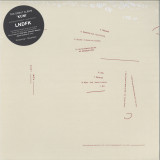
LNDFK (aka Linda Feki) presents her ground-breaking debut album, "Kuni" on Brooklyn-based Bastard Jazz Recordings. Undeniably on the rise after her 2019 breakout performance at Primavera Sound, LNDFK has already caught the attention of Pitchfork, Rolling Stone, Clash Magazine, Noisey, and Brooklyn Vegan (among many others) while being championed by the likes of Gilles Peterson, Tom Ravenscroft, and Jamz Supernova & landing spots on tastemaker playlists like Spotify's "Pollen" and "Fresh Finds."
"Kuni" is a spellbinding exploration of dichotomies: Love & Death (Eros & Thanatos), Flower & Fire, Delicacy & Violence, Poetry & Realism, Purification & Destruction. These opposites are reified in the 10-track LPs multifarious and multifaceted sounds, elegantly meandering through a variety of styles and genres, spearheaded by Linda and features the production wizardry of Darrio Bassolino who co-wrote the album.
"Kuni" opens with "Hana-bi," an ambient instrumental piece that sets the tone for the album. Inspired by the Takeshi Kitano 1997 film of the same name – particularly Joe Hisaishi's stunning soundtrack, as well as Kitano's paintings which appear in the film. "Hana-bi" expresses the dialoguing opposites of flowers and fire, the first of many dichotomous representations throughout the album. "Takeshi" acts as an extension and to "Hana-bi," albeit one of opposing sound, with its driving, highly syncopated drums (which reappear throughout "Kuni") – à la Karriem Riggins, Questlove, or Yussef Dayes – frenetic bass line, and jazz chords. Linda's sultry voice is interspersed, initially jumping around in scat fashion, being triggered as if a sample, before her lyrics come in; her vocals are used like an additional instrument, adding to the song's rich texture. "Kuni" truly hits its stride with the next song, "Smoke – a moon or a button" (its title lifted from the 1959 book by Ruth Krauss and Remy Charlip), which is structured like a jazz standard yet flows into neo-soul territory sonically with those prodigious drums a highlight once again.
LNDFK touches on experimental hip hop in two songs on the record (both of which were released as singles in 2021): "Don't Know I'm Dead or Not (feat. Chester Watson)" – track #4 – and "How Do We Know We're Alive (feat. Pink Siifu)" – track #9. Although they embrace a more hip hop-leaning sound, these songs by no means shy away from the exploratory theme, and feature two of the alt-rap scenes rising stars with Chester Watson and Pink Siifu who offer provocatively impressing verses, combining dense word play with unconventional flows. While these tracks may first appear to be outliers on the album, they are undeniably in tune with "Kuni's" message and sonic palette, acting as testaments to LNDFK's willingness to explore and experiment.
Meanwhile, "Ku" – the third and last single before the album release – furthers the pre-established future soul sound while meandering through nu jazz and left-field electronic. Inspired by the graphic novel and film, "Sin City," and its female assassin protagonist Miho, "Ku" is a musical interpretation of Miho's story, incorporating both her beauty – the first half of the song – and murderous tendencies – the second half – to create a stunning juxtaposition, culminating in an ambient finale that suggests the character's vulnerability and inner peace. The song gracefully bridges the gap between Hiatus Kaiyote-esque songwriting, Dilla's rhythmic syncopation, and Thundercat's instrumental prowess (LNDFK has shared a stage Brainfeeder labelmate Kamasi Washington).
Mixed in throughout "Kuni" are a series of instrumental pieces that function as something akin to an interlude. The aforementioned intro, "Hana-bi," and the album closer "se mi stacco da te, mi strappo tutto:" act as bookends, while "Om" indicates the half-way mark, and "Ktm" sees Jason Lindner add his sound the album. These tracks are the ambient foundation of "Kuni," representing the thematic duality of the work. Clocking in at only 24 minutes, "Kuni" packs an astonishingly diverse array of sounds, styles, and themes, all while showcasing virtuosic musicianship and instrumental prowess.
Appearing on "Hana-bi" and "Ktm," renowned international artists Asa-Chang and Jason Lindner add an additional perspective to "Kuni": Asa-Chang on "Hana-bi," and Jason Lindner on "Ktm." Asa-Chang - famously of the Japanese avant-garde group Asa-Chang & Junray - provides vocals and percussion to an alternate version of the instrumental opener, while the acclaimed keyboardist Jason Lindner offers his synth expertise on "Ktm." These features highlight the spirit of collaboration found in LNDFK's music, always willing to try out new ways of working.
LNDFK is a singer and songwriter, born of two cultures – an Italian mother and Arab father. She grew up in Naples, away from her father, the Sahara, her homeland and traditions, which has helped nourish the desire to rediscover – through art – an engagement to her roots. Her music melts with jazz, neo-soul and hip-hop influences, filtered through her experiences and sensibility.
Her first EP, "Lust Blue," was composed with the artistic production of Dario Bass and released by Feelin' Music; after that she released several singles that saw international radio support (BBC, NTS, Wordwide FM) and gained a massive audience on digital platforms. Together with her band, she toured around Europe, performing alongside such notable artists as Kamasi Washington and Mndsgn, among others. Most recently she toured Italy, and performed at Primavera Sound Festival 2019 in Barcelona.
"Kuni," is due out on NYC label Bastard Jazz Recordings in February, 2022, while the vinyl LP will follow shortly after.
Cologne-based, multi-instrumentalist and creative jazz powerhouse
Gianni Brezzo presents his full-length LP “Tutto Passa,” arriving via
Berlin’s Jakarta Records May 5th.
Gianni Brezzo is the jazz affiliated band / studio project headed by
Cologne-based producer & creative maestro Marvin Horsch, whose diverse musical profile is reflected both in his scene-hopping as well as his creative output. Besides producing cologne bands like Keshavara, Woman and Xul Zolar, Gianni has released a number of EP and LP’s since 2017, culminating most recently with “The Awakening” EP in 2021 on Jakarta Records. While Gianni’s works are usually instrumental only, “The Awakening” featured vocal appearances from Berlin/Tel Aviv based singer / producer J.Lamotta and soul singer Otis Junior from Louisville, Kentucky. Gianni’s tracks have consistently placed on Editorial Lists including Spotify’s “State Of Jazz” and “Café / Croissant”, and most recently was synced in an episode of Gossip Girl for HBO US.
Gianni’s new LP, “Tutto Passa” is a meditation around Marvin’s relationship to Italian culture, accompanied by research into Italian composers of the 60’s / 70’s such as Piero Umiliani, Stelvio Cipriani, Piero Piccioni and Armando Trovajoli to more recent work by Sven Wunder. Sonically rich, the album rides a sonic wave similar to some Matthew Halsall, Surprise Chef, El Michels Affair and BadBadNotGood all rolled into one beautifully luscious work. Jakarta is ecstatic to share such a career-defining work, arriving May 6th, 2022.
The albums 1st single, “Il Sole” will be released Wednesday, March 2nd with the LP pre-order announcement that Friday, March 4th to capitalize on Bandcamp Friday. The track is a perfect sonic voyage that encapsulates the growth of Gianni’s sound and gives a sonic peak into the LP. Subtle, yet lush layers of synths, horns, keys and strong, beat-driven percussion all ebb and flow together, bringing to mind the finest Library Themes of Umiliani, Sven Wunder, Janko Nilovic and others. Visualizer accompaniments for all singles provided by Robert Winter and his DIE OTTOS crew that perfectly captures the sonic mood.
The LP’s 2nd single, “Capture This,” will be released March 30th and is a splash of pure, groovy, jazz-funk. Instantly catchy, the track will have you imagining yourself in a movie that perfectly captures the musical themes: playful flutes, crisp, fluid guitar riffs, heart-pulling strings, all held together by a strong, swingin’ drum groove.
The third single is the stunning, swirling, thematic track “Rising Of My
Mind.” Careful layers of harmonized brass, flutes, percussion ebb & flow, bubbling up to the acoustic surface like sonic ripples effortlessly bursting from Gianni’s auditory palette. Only reaching the tracks full crescendo more than 2 minutes in, “Rising Of My Mind” is on that finest jazz tip, raising Gianni’s musical caliber into the skies.
Focus track is the effortlessly smooth, soulful jazz-funk piece, “Torino.” Certified fresh, the progression gives you that euphoric, elated feeling, like you’re finally arrived at that special place you never knew existed, but were always meant to find.
“Tutto Passa” is a project with a variety of moods ranging from Arthur
Verocai and David Axelrod inspired arrangements to lush, thematic jazz progressions with a swingin’ percussive edge. It’s a timeless release, one that would sit just as well in 1972 as it does in 2022, and one that, as Gianni says:
“…reflects exactly the feeling I had last year when I was in Italy with my own family. As a musician, I was looking for the challenge of a more orchestral approach on this album, which I hoped to achieve with my arsenal from the Cologne jazz scene and the support of musicians from around the world.”
Besides online promotion from the label and artist profiles, the album will further be promoted by external agencies within the US, UK & Italy
Yosh returns with his fourth Time Is Now release. Following the success of UKG-focused 5-tracker, "The Warning" released at the end of last year, Modulate EP sees the London producer put his inimitable spin on breaks, translating into 4 tracks firmly rooted in the genre's antecedents yet offering something distinctly new.
"New Dawn" is a prime example of Yosh's priceless ability to create something which is at once hard-hitting and soulful with clattering breaks and luscious vocals which float blissfully above them. Next up, "Modulate" adds a thumping 4/4 beat into the equation, creating an assertive march with plenty of swing before "Snap Back" brings the ruffage with a sharp two-step rhythm and fierce bass womps. Finally, it's up to "Track 1" to close proceedings. A real heater, a syncopated triplet rhythm lends it its driving propulsion - almost resembling the club sounds native to northeastern regions of the US such as Jersey and Baltimore. Thudding assertively beneath the stylistic tropes of UKG, this makes for a truly unique sound and solidifies Yosh's status as a highly innovative and forward-facing producer.
Kate Bollinger's songs tend to linger well beyond their run times, filling the negative space of ordinary days with charming melodies and smart phrasings. She writes them at home in Richmond, Virginia, letting her subconscious lead, an open-ended process she likens to dreaming. From a chord progression appears a line, maybe a syllable will start to stick, enough to pursue, but she says sometimes the words don't feel likeher own, more like shapes that form in the mind's sky. Bollinger's musical universe is relaxed, tender, and unassuming; within lives a timeless sensibility, a songwriter's knack for noticing the little things and their counterpoints. Darkness and light, pain and pleasure, reality and escape. Her new EP, Look at it in the Light, her first project on Ghostly International, is collaborative; she shoots music videos with her friends and colors each of her folk-pop songs with musicians in her community. The title Look at it in the Light is a reference to the aspects of Bollinger's life that she knows need examining. For one, there's her persistent resistance to change _ she chooses to ignore it on the title track ("I try not to notice / I deny my fate"), as wiry strums sync with crisp drums. She surrenders to comfort on "Who Am I But Someone," a light and softly psychedelic number. "Yards / Gardens" finds Bollinger in full swing, skipping verses of uncertainty above a bright and nimble bassline and kick. Guitar riffs unravel across the bridge, trailing her lines like ellipses. The string-backed "Lady in the Darkest Hour" is the set's most luxuriant statement, recorded during a session at Matthew E. White's Spacebomb Studios with in-house arranger Trey Pollard (Natalie Prass, Helado Negro). Here her lines ring bittersweet yet reassuring, uplifted by swells of golden-hued instrumentation. From the hushed abstractions of "I Found Out" to the biting suspicions of closer "Connecting Dots," Kate Bollinger uses every inch of this dazzling EP to find her footing amidst the ever-present sways of life.
Constructed in the initial chaos of the pandemic, Baby Blue’s dystopian debut LP “End Of Sleep” finds solace in the unearthly home of Planet Euphorique. 7 offerings from the Canadian artiste dive deep into a heightened reflective state; an amalgamation of memories stitched together via looped dissonance and destruction. A contrast of lightness and dark constantly working against each other and at times in harmony; a familiar connection that can be found in complex electronic music and mental states alike. Strap in and be guided through a wormhole of cyber analog journeys, thematic explorations and catastrophic calls to celestial beings.
Ethereal echoes of LSG break in the opening of the record, fleeting cries nodding to ancestry; yet A Rainy Trip To Netherworld Sequence embraces the storm. Knee jerk kick distortions disrupt the angelic hypnosis; reality rolling through the clouds. The sequential energy continues through A2 and A3, driving and rolling viciously with heavy contorted noise infiltrating the low end whilst flickers of melodious song sail unbothered, thriving amongst the destruction. The Spring Is Coming feels like a seasonal change, a melting and defrosting; thawed harmony shining through; textural and flowing with movement, a perfect bridge.
An arguably more delicate chaos emerges on the B side, elongated pads stream endlessly whilst drums cultivate and expand into sudden frisson. Fragile voices begin to gate and sweep in Equal Parts Damaged, lingering and ringing through ear drums whilst glued in rhythmic unison to induce a state of floating, a game of elevated push and pull. Syncopated howls of distortion leads the closing track, Violet summarizing the brilliantly confronting conversations pulsating through the record.
PE016 urges you to join the otherworldly personal journey and sufferings of Baby Blue, a moment to connect with her meditative dreams and struggles; sonic synergy expanding to anyone with the invitation to surrender.
Welcoming Arfa to the Time Is Now family with his debut EP: a tight 5-tracker which sees the emerging producer come into his powers with a fiercely forward-facing take on dark garage, featuring a raucous remix from London's Bakey.
Real Badman EP starts as it means to go on. 'Run It Back' is driven by a fractured syncopated rhythm and a heavy warped bassline which lends it its tune, fusing together the stylistic elements of dark garage and speed garage to offer a fresh take on both genres. Clattering rimshots and a womping bassline compliment 'For The Mandem's luscious pads before being carried onto 'Ain't Ready' which adds a tight two-step rhythm and the chopped-up vocals of an old skool garage MC. Finally, 'Real Badman' sees the EP at its most playful. Staccato piano chords infuse it with an uplifting melody before Time Is Now family member Bakey steps in to deliver his take: a half-time rendition which strips back the higher ends to make way for a focus on the subs. A real stomper.
2022 repress. Their cover of The Chakacha's classic, "Jungle Fever" has been burning up dancefloors since its first pressing on Plane Jane Records. BRSB put the punch in the drums and the one drop in the arrangements, taking the original tune and updating it into something DJs and their audiences are going crazy for. "Tender Trap", the flip side, starts out with a syncopated intro that will catch the ear of any hip hop fan for a number of reasons, then the tune turns into an all out funk burner, steel pans and guitars taking turns over the driving drums. Another BRSB sureshot.
In March 2020, Tahiti 80 had a plan to start recording their new album in the studio. That plan, of course, along with everything else in the world, got derailed. But the five-piece group was resilient and resourceful. They quickly shifted to a socially distanced plan B that included file swapping and virtual sessions, all refereed by producer Julien Vignon. The result, due for release in March 2022, is the buoyant Here With You, a collection of eleven upbeat songs that unfold like a prescription for a post-pandemic panacea.
“When lockdown in France happened, we said, 'We're not going to stay at home not doing anything,'” says singer-guitarist Xavier Boyer. “And our new plan became a hopeful thing, waking up every morning and seeing what the other guys had worked on. It wasn't always easy, but this new method allowed a freer approach where we could really go all the way with an idea without being influenced by each other’s suggestions. It must've been overwhelming for Julien, who ended up selecting all our arrangements. But he stayed positive all the way through.”
To help stay inspired and focused during their time in isolation, the band created a mood board, with the centerpiece a photo of an early '90s rave in the UK.
Boyer says, “Whenever you see pictures from this era, people seem very innocent. There are no cell phones and everybody is in to what they are experiencing. We kept that picture in mind as a kind of mantra that would help everyone feel connected to this idea of people celebrating, gathering and just having fun. We were missing the connection with people, and thought it would be great if we could create music that would inspire that kind of emotion.”
Indeed, the songs on Here With You are brimming the feeling of communion that we've all been missing over the past two years. It's there in the catchy opener Lost in the Sound, which walks the walk with Chic guitar flicks, urban nightfall sparkles and an inviting chorus (“Your heart grooves like a thousand 808s on the right time”). It's there in the Jackson 5-style syncopated bounce of “Vintage Creem,” the lush, dreamy “Breakfast in L.A.” and the panoramic sweep of “UFO.” And it's there in the first single “Hot,” which matches an irresistible groove with a neon-lit, percolating arrangement that evokes the disco clubs of 1979.
What's remarkable is that though Tahiti 80 displays a clear affection for sounds of the past, from bubble gum to '70s soul, they never trade in mere pastiche. Their take is more a slightly warped and playful carnival mirror mash-up of classic pop styles, given depth through Boyer's hang-gliding, coolly emotive vocals and lyrics that often rub against the euphoric grain of the music.
“I like to think of songs as a three-minute drama,” says Boyer. “This concept of drama definitely adds different levels to our music. There's the melody, the lyrics, then the production that can maybe emphasize or counterbalance the interaction between the yin and yang in a song.
“There's a difference between the very upbeat, sunshine-y soft rock and the lyrics, even on our past albums,” he continues. “Not dark, but a little more melancholy, and also looking for some kind of motivation, talking to yourself. Like with a lot of Motown songs, you get that feeling where you body’s dancing while your mind’s reflecting, reminiscing.”
That alluring blend of happy-sad has been a signature part of the Tahiti 80 sound from the time Boyer and bassist Pedro Resende formed the group in 1993, as students at the University of Rouen. Taking their name from a souvenir t-shirt given to Boyer's father in 1980, the duo recruited guitarist Mederic Gontier in 1994, and with the addition of drummer Sylvain Marchand a year later, the lineup was complete. The foursome released a self-produced and self-financed EP, 20 Minutes, in 1996, which resulted a record deal with French label Atmospheriques in 1998. Their full-length debut Puzzle, produced with Ivy's Andy Chase and mixed by Tore Johansson, went gold and featured the international hit “Heartbeat” that established the band throughout Europe and Asia.
In the years since, Tahiti 80 – with the additions of Raphaël Léger on drums and Hadrien Grange on keys - has released eight acclaimed albums. The band has fused what MOJO called a “glorious entente of old and new technology” (including singles like “Yellow Butterfly,” “1000 Times,” “Sound Museum,” “Crush!” and “Big Day,” which was featured on a FIFA video game soundtrack), while collaborating with such producers and arrangers as Richard Swift, Tony Lash and Richard Anthony Hewson, who famously arranged The Beatles' “Long and Winding Road.” Boyer has also put out two solo albums, the first under the anagram Axe Riverboy and the second under his name. In 2019, the band released Fear of an Acoustic Planet, a stripped-down reimagining of some of their best-loved tracks from the previous twenty years. It served not only as a look back but a reminder of their formidable songwriting skills.
Boyer is definitely a student of the timeless three-minute pop song format pioneered by '60s artists like The Beatles and The Beach Boys. He says, “I see it as kind of a frame for a painting. Most of the songs on this album, I wrote a verse, pre-chorus and chorus. There aren't many middle eights. I wanted it to be very concise. I feel like people have less attention. There's so much music. It's too easy to switch off or skip to another track, so I want to hook the listener. The three-minute song is kind of an easy code to crack, but at the same time you have to figure out a new way to tell the stories that we've heard before.”
And the stories on Here With You are very much about the longing for connection. Of the album title, Boyer says, “In the world right now, that can mean a lot of different things. Like missing our fans, missing going to concerts. In a way, it can be a statement of what happened last year, and a wish of 'I want to be here with you again.' It's our ninth album. We've had some had some very open, conceptual titles like Puzzle, Activity Center. Sometimes they were more specific like Fosbury orWallpaper for the Soul. Here with You, seems more personal, more engaging in terms of relationships. When I suggested that title, everyone in the band said, 'Yeah, that's it.'”
Until Tahiti 80 can resume a full tour schedule, Boyer says he hopes the new record will make that personal connection. “If I see from the point of view as a music fan, sometimes I see albums I like as companions throughout my life. So if we can be a part of people's existence, even if it's a song that reminds them of the time they were driving with the windows open and it was sunny. Or a sad song that resonates with them after a breakup. That's what we're all looking for when we're making music. You do this very personal thing and you want it to touch as many people as possible.”
Planet Mu presents ‘ADDLE’ – Bogdan Raczynski’s first album of new music in 15 years. Marking a change from the high-octane jungle tekno braindance for which he is most commonly known, here we find the Polish American musician in a more melodic and zen-like place of peace, which is ergonomic and decluttered, whilst also bittersweet and tinged with melancholy. ‘ADDLE’ is closest in spirit to 2001’s tender ‘myloveilove’, or the light-hearted ditties of this year’s ‘BANANS’ EP, but is also a markedly new milestone. A robust and bottom-heavy rhythm section juxtaposes with sad electronic tear jerkers, at points laced with the soft cooing wail of his vocals, which are loaded with a haunting, heavy and almost wounded emotion. Bogdan comments “Calm is great. You need to take a breather in the eye of the storm now and then. But the real growth happens in turbulence, when your feelings oscillate in and out of sync. It’s not dry land you’re after. You’re trying to build a new island while on a piddly raft. Beleaguered and weary you lay the foundation with your bare hands while the rain lashes your back; a new place for you and yours to moor yourself to until the next storm hits. ‘ADDLE’ is about that storm, its adjacent periphery, and what you look like, in and out, when you set foot. As space and time push against you, that process of adapting becomes an anchor. Among that state of being addled, out of flow, seemingly untethered, there is beauty.”
Although less unhinged and riotous than some of his previous work, ‘ADDLE’ is no less impactful. Lean, punchy and purposeful, this seemingly simple combination of beats and melody belies a razor sharp skill, which bursts with verve and virtuosity. Across its eight unique and moving tracks the listener experiences tenderness, feelings somewhere between unease and comfort, and a sense of reflection, with Bogdan seemingly gazing at twinkling stars, but with his view distorted by welling-up. Sonically, spaces range from razor-sharp choppage, juddering heavyweight head-nodders, bit-crushed siren squall and something akin to Philip Glass’ ‘Candyman’ score played through a high-tech-fairy-tale music box. There’s also a warming, life-affirming moment as close to deep house as Bogdan will ever comfortably get, neck-snapping metallic percussion, Casiotone on steroids and reverberant warehouse throb. Booming drum machines are a prominent factor too – reminiscent of early hip hop instrumentals – but spirited off somewhere, lost in purgatory. Bogdan Raczynski (born 1977) is a Polish-American electronic musician. Raczynski’s work draws inspiration from the chaotic breakbeats of jungle and hardcore rave as well as traditional Polish music and other sources. He has collaborated with Bjork, remixed Autechre, CLPNG and Jonsi from Sigur Ross, and toured with Aphex Twin, who commented how “his records are so underrated.” Bogdan was also a roster mainstay of Richard James’s seminal Rephlex label, with additional releases on Warp, Ghostly, Disciples and Unknown to the Unknown. A keen proponent of tech, he created a sample pack using pollution and recently collaborated with Polyend on a custom made banana-themed tracker.
Vinyl Edition of 300 copies
Aesthetical in collaboration with Sync presents "Detect" by Marco Monfardini.
Originally developed as an audio/video live performance, Marco Monfardini based his research for Detect on the decoding of inaudible sounds, sound generated by electromagnetic emissions left from electronic devices and inaudible to the human ear. By using various electro-smog detectors Marco Monfardini creates a sort of detection mapping where electromagnetic emissions are the starting point for the sonorous development of each single composition.
A path that creates a parallel with our lives by questioning how much these emissions affect unconsciously our choices, tastes and perceptions, seeking a relationship between the massive use of technology in everyday life and our emotional state.
The album Detect is developed in 15 tracks in continuous play, an imperfect, faulty mosaic inhabited by invisible beings manifesting themselves in the form of sound streams, mutable entities that find a definitive form in the pattern of the compositional structure.
The album opens with “aR1 detection", sounds of pure detection place themselves in the sound space giving the initial coordinates for the exploration of unconscious parallel areas. The boundaries transform and gradually expand until they flow into the structure of "kernel variations", a growing rhythmic pattern decodes the impulses projecting a perspective that dissolves in the unstable and fluctuating electromagnetic emissions of the subsequent "[a]3020t detection", "binary defect "and "core[2] ". “[A.box]emission” confronts the use of sound downloaded random from internet sample banks and the emissions generated during the download itself, micro sound fragments arrange themselves in an organized and regular pattern, shaping a rhythmic structure. The first part ends with the short “[sa]6030” and “[det]x1a”, absence and presence provide an alternation of movements, inaudible and elusive signals all trying to establish a contact with our perception. “det : scan” opens the second part of Detect, a sort of scanning, leaving EMF (electromagnetic field) textures, a static multilayer that progressively expands until it dissolves into the rhythmic emissions of a common smartphone “[4s]detection”.The track “[rs]zone” " is pushing itself deeper, two minutes of sound speleology that reveal the existence of sound artifacts that seem to vanish getting in contact with the light accented by the bass drum of "[det] 0100+" a constant, rhythmic pumping, a luminous pulsation that reveals an apparent void, which seems to subside entering in the winding and waving atmosphere of "conductive [area]" and "[s3] microfunktion". Detect comes to the end with “[emf]terminal” a mirror of the unarrestable technological acceleration intercepting the flow of data that feeds the system of communication , digital micro waste suffocates the living space by centering up the invisible in an unconscious map.
[a] A1
[c] A3
[e] A5 core[2]
[f] A6 [A.box]emission (2)
[g] A7
[i] B2 [4s]detection
[j] B3
[k] B4 [det]0100+
[l] B5 conductive[area]
[m] B6 [s3]microfunktion
[n] B7 [emf]terminal
LeSale is back with the Synchronized EP, which marks his fifth solo EP on Luv Shack Records.
The title track is LeSale´s first foray into boogie-funk, featuring lyrics and vocals by Kathy Diamond, one of the great voices of the early nu-disco era and former singer of the duo KDMS, as well as tape mixing by vienna based studio wizard Sam Irl. "Synchronized" comes in 4 versions; the classic vocal mix featuring the full vocals by Kathy Diamond, the instrumental mix which is stripped of the vocals entirely, the extended dub mix, featuring arrangement and additional overdubs by Sam Irl, concentrating on the bare,funky essence of the track and finally a special remix by Ooft!.
The Ooft! remix lays a club foundation for "Synchronized", taking it to proto house territory with a sparse use of original vocals and additional drums, synth leads and pads.
As a bonus original track, we get "Superfluid", an upbeat elektro-funk journey with the right amount of
Bringing together therapeutic frequencies, forest bathing
(shinrin-yoku) and binaural sound, Hinako Omori's ‘a journey...’
combines inner healing and natural landscapes into in an
immersive cartography of the mind in ambient electronics. The
album progresses not track by track but as a continuous
journey, a stream of consciousness tracing hills and valleys with
the warmth of analogue synthesis and Omori’s voice always
close at hand. Omori detuned oscillators to create binaural
beats, syncing to the Hz of our brainwaves so that listeners
might further find themselves calmed by and immersed in these
soundscapes
‘a journey...’ was recorded at Omori’s home studio and Real
World Studios, when Omori was an invited to perform at the
immersive online festival WOMAD At Home. Spatial 3D
recordings are woven throughout the album, and situate each
track in different environments, from waterways to forests in and
around the Mendip Hills.
It is Hinako’s work in sound engineering that provides the
bedrock of skills that manifest her vision for ‘a journey...’,
articulating a whole world in binaural field recordings, analogue
synthesisers, and augmented vocals.
The album sits within a rich lineage of electronic musicians who
have looked to music for its healing properties, from
Venezuelan musician Miguel Noya to Pauline Anna Strom’s
ambient soundscapes; Pauline Oliveros’ deep listening
meditations and the augmented field recordings of Irv Teibel’s
‘Environments’ series.
Mastered and cut by Matt Colton at Metropolis.
LP pressed on white vinyl.
Ben Ritz has released EPs on Sweat Equity and Merge Layers. He's not afraid of the high bpms, but this isn't all blender no tender. This is futuristic, hard yet funky techno that is undeniably for the freaks. Find him in NYC or on his vinyl debut right here.
A1 "Up And Down" opens up with an ear-worm, repetitive melody that bangs and jacks with the hard kick and hi-hats. Freakish manipulation of the melody, tasteful breakdown and build-up, and a good dose of space throughout the track make this an undeniable sweat-dripper, trippy chugger. A2 "Do Make Me Strange" has a similarly catchy diddy that undulates around the drums. Restraint is the key here. Hard but funky, with distorted and drippy acidic takes on the main simplistic melodic line--this is a cerebral come-up, cooling your sweaty skin and leading your body to the nooks and crannies of the Hyper Groove.
The title track "Easily Disturbed" opens up the B side by ushering in the mood of the later hours. This is titillating, popping, syncopated, subtle, but still raucous techno right here. Perfect for mid-peak and when you're in your head, sending forces of rave rhythm telepathically to the rest of the dance floor. "Crystalline" closes out the EP with a boom and bang. Hypnosis overcomes. The ego-death has won out against your anxieties. This is music for the thrill-seekers of metropolitan dystopias worldwide...executed with nuance and style.