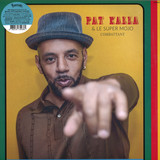
Favorite Recordings proudly presents Combattant, first EP by Pat Kalla produced by Bruno Patchworks' Hovart (aka VOILAAA).
PAT KALLA is a musician, singer and storyteller. Patrice of his birth name, in tribute to the great Lumumba! Lover of words, French language, and music of course. Born in Lyon, from a Cameroonian father, musician and political activist, and a French and literary mother, he explores from his childhood the Soul, the Slam, the Funk ... and the art of telling stories, life being a great one...
After years of touring alongside many bands (Conte & Soul, Legend of Eboa King, Mento Cloub, Voilaaa Sound System), and several acclaimed titles on the two albums by Voilaaa, he comes back with this project to put a bit of primordial lightness in a rainy world: A tribute to the African culture in honor of a father with "Sawa" origins, the tribe from the people of Makossa.
Jojo Ngallé, Moni Bilé, Pain, Manu Dibango, Franco, Rochereau, Kabaselé, Fela, François Nkotti & The Black Style, all these legends' vinyls have turned on the family turntable and the collection has whetted the child's appetite. Through this new trip, he revisits styles that are sometimes little known to Western audiences, such as High-Life, Makossa, Angolan Music, Afrobeat, Afro-Disco and others. We could talk about Franc CFA', we could talk about Jacques Foccart, but we will rather dance, because "the dancer seems naive, but his feet must be connected with earth to understand history..."
Backed by the "Super Mojo Disco", a hyperactive band from Lyon with deep groove and positive energy, Pat Kalla offers us an anti-crisis project, where swaying and feel-good humor is mandatory! An album soon in the crates, beware « c'est médicament » (it's medicine)!!
It's been over 10 years since the release of Gui Boratto's breakthrough full length debut 'Chromophobia'. As to what its title suggests, he shook up the techno game with a contrast of lushly coloured minimal grooves and melody, whilst many will recall that the album included the highlight single Beautiful Life' which became a dance floor anthem for that era. Four albums in and countless EPs and remixes under his belt, the Brazilian producer's unique savoir-faire in carving out a functional album out of diversely routed singles and features is back at it on his fifth studio LP, 'Pentagram'. Here Gui Boratto lays down a nuanced 12-track narrative that reinvigorates his signature sound into a refreshingly different perspective that feels all too familiar - including the return of Beautiful Life' vocalist (and Gui Boratto's wife) Luciana Villanova on the single "Overload".
Through his signature kaleidoscopic approach, Boratto delivers an album built as a far-reaching hub-and-spoke system, broadly inclusive as can be. From the opening cut, 'The Walker' - hot on the trail of Tears For Fears 'Elemental' (one of Boratto's "favourite 80's bands") - to the hi-NRG euphoria of 'Forgotten' and its pounding tech alter ego 'Forgive Me'. "I was going into 2 different directions", Boratto says, "the typical indie- electronic-rock' Boratto kind of production like It's Majik' or Like You' and a much more techno approach." He goes on, "I decided to split them into two twin sister songs. When I play live I always put these two songs together."
The Brazilian Producer further embraces the pop-friendly essence of his past work on tracks like 'The Phoenix', featuring vocalist Nathan Berger, and 'Overload', both melding acidulous synthlines with laser-precise breaks, vox hooks and drops calibrated for extended radio and club use, although sieved through his distinctive rainbow-hued musical prism. For the symbolists out there, the album's pared-down closer '618' duration accidentally happens to equate the proportions of the said pentagram. "Coincidence" Boratto questions, and capsulises, "not so ufanista and supporter of Brazilian neo-concretism, but I guess the brazilian sculptor Lygia Clark also inspired me a lot. Not the meaning of her sculptures, but the shape of the hinge of most of her work. I've wanted to transmit the scientific pentagram's point of view. It's not a religious kind of thing."
Whereas 'Spur' (a field-tested 808 and 909-heavy "purist track", "very, very old school" Boratto insists) and 'Alcazar' are sheer smooth-edged four-to- the-floor epics, the album also shares its lot of startling moments, such as with the John Barry'esque 'Scene 2' (with a hint of Amon Tobin, 'Easy Muffin' style, throw in) and its refined string-laden buildup, 100% fitted for a 007 opening credit sequence, or with 'Hallucination' (feat B.T.) and the further James Holden-ish title-track 'Pentagram' (think 'The Idiots Are Winning'), "one of those exercises I did when I got my Buchla modular synth" Boratto analyses, "I think I've used more then 30 different snares, with different delays and reverbs. The whole song is alive". And so is 'Pentagram' in its entirety: alive and definitely just as manifold and hopeful as its architectonics are the stuff of science and dreams all at once.
Es ist zehn Jahre her seit der Veröffentlichung von Gui Borattos bahnbrechendem Debütalbum - Chromophobia . So wie der Titel vermuten ließ, war das Album mit seinen kontrastreichen Minimalgrooves und den üppig gefärbten Melodien ein Schocker im besten Sinne. Ihr erinnert euch sicher noch an die Hit-Single - Beautiful Life , eine Dancefloor-Hymne aus dieser Zeit. Nach vier Alben und unzähligen EPs und Remixen ist das einmalige Savoir-faire des brasilianischen Produzenten, aus vielfältigen Singles und Features stimmige Alben zu schaffen, auch auf seinem fünften Studioalbum - Pentagram zu hören. Hier legt Gui Boratto ein Zwölf-Track-Narrativ vor, das seine Handschrift auf erquickende Weise wiederbelebt. Wiederbelebt wird auch die Stimme von - Beautiful Life (die der Frau Gui Borattos gehört) auf dem Stück - Overload .
Durch seinen charakteristisch kaleidoskopischen Ansatz liefert Boratto ein Album, das gebaut ist wie die Speichen deines Fahrrads, von dem Opener - The Walker - direkt auf der Spur von Tears For Fears - Elemental (einer von Borattos - favourite 80's bands ) - zur Hi-NRG-Euphorie von - Forgotten und seinem stampfenden Counterpart - Forgive Me . - Ich bin in zwei unterschiedlichen Richtungen gegangen , sagt Boratto: - den typischen ,Indie-Electronic-Rock'-Weg wie in - It's Majik oder - Like You und den Techno-Weg. Er fügt hinzu: - Ich hab mich entschieden jedem Track seinen Zwillings-Track an die Seite zu stellen. Immer wenn ich live spiele lege ich die zwei Stücke zusammen.
Der brasilianische Produzent erschließt weiter die Pop-Essenz seiner vergangenen Arbeit auf Tracks wie - The Phoenix (feat. Nathan Berger) und - Overload . Beide kombinieren zwitschernde Synthi-Melodien mit lasergenauen Breaks, Hooklines, Drops und sind wie gemacht für die Rotation und den Club. Und für die Symbolisten da draußen: die Länge des reduzierten Closers - 618 beträgt zufälliger Weise genau die Proportionen des besagten Pentagramms. - Fügung , fragt Boratto und fasst zusammen: - Ich bin kein Anhänger des brasilianische Neo-Konkretismus , aber ich glaube die brasilianische Künstlerin Lygia Clark hat mich sehr inspiriert. Nicht die Bedeutung ihre Skulpturen aber die Form der meisten ihrer Arbeiten. Ich wollte den wissenschaftlichen Blickwinkel auf das Pentagramm übersetzen. Nicht im religiösen Sinne oder so."
Während - Spur (ein erprobter - purist track auf der Basis von 808 und 909, - sehr, sehr old school , wie Boratto betont) und - Alcazar glatte Vierviertel-Epen sind, hält das Album auch Überraschungsmomente bereit. Z.B. das John Barryschen - Scene 2 (auch eine Spur von Amon Tobins - Easy Muffin ist darin zu hören) und seinem Streicher-Aufbau, der hundertprozentig geeignet wär für eine Eröffnungssequenz in einem Bond-Film. Auch - Hallucination (feat. B.T.) oder der James-Holden-hafte Titeltrack - Pentagram (wir denken da an - The Idiots Are Winning ) wäre da zu nennen. - Einer dieser Übungen, die ich gemacht habe, als ich meinen Buchla-Modular-Synthesizer bekommen habe, war , erinnert sich Boratto, - mehr als 30 verschiedene Snares, Delays und Reverbs zu verwenden. Der ganze Song sollte am Leben sein. Und so ist - Pentagram im Ganzen: lebendig und sicher genau so vielfältig wie sein Bauplan, der auch der Wissenschaft und den Träumen zugrundeliegt.
out of Stock
Last delivered 3 years ago available to reorder, subject to availability
with »redsuperstructure«, robert lippok created a new foundation for his musical endeavors. now - 7 years later - this system properly comes to life on »applied autonomy«. the title of the new album is a clear indicator as to what the berlin-based producer has been up to during the last couple of years, both on a conceptual level as well as how he molds his ideas into tracks.
»applied autonomy« orchestrates a certain state of frantic standstill, which occurs once a structure is set. has this state been reached, the artist is free to focus on other equally important aspects, balancing the various shades, pushing ideas even further to really make them shine and blossom in their self-declared autonomy. the more light one lets in, the more layers become visible.
layers are key when it comes to understanding »applied autonomy«. big chunks of the material with which the album has been produced derive from sketches specifically made for a club performance. rather than meticulously devising each and every detail, lippok focussed instead on recording as many fragments as possible in a short period of time, elements which he could later combine and layer on stage. based on this material and his experience experimenting with it in a live environment, the album slowly began to shape. an album culminating in a collaboration with klara lewis, with whom lippok spent 2 days at the EMS studios in stockholm, approaching the idea of autonomy from yet another angle. during the session, both musicians played and performed simultaneously, yet not explicitly together, lost in their own thoughts and ideas, only subconsciously taking in what the other one was coming up with. the result is »samtal«, 14 minutes of a constantly evolving state of poise, magically connecting all the dots Lippok had already defined as »applied autonomy«.
'It is now clear that humans are no longer the most important things in the universe, that their knowledge, creativity and intelligence are ultimately limited.'
The Posthuman realises that the ultimate questions about existence and being do not require answers and accepts that humans have a finite capacity to understand and control nature. Even just to know the ultimate nature of the universe would require knowing everything about the universe, everything that has happened and everything that will happen. If one thing were not known it would imply that all knowledge of the universe is partial, potentially incomplete and, therefore, not ultimate.
Humans privilege to order over disorder on the assumption that the essential laws of nature are gradually being discovered. This is a fundamental error; nature is neither essentially ordered or disordered. What we perceive as regular, patterned information we classify as order; what we perceive as irregular, unpatterned information we classify as disorder. The appearance of order and disorder implies more about the way in which we process information than the intrinsic presence of order or disorder in nature.
The humanist era was characterized by certainty about the operation of the universe and the place of humans within it. The Posthuman era is characterized by uncertainty about the operation of the universe and about what it is to be human.
What is a human Is there such a thing
No finite division can be drawn between the environment, the body and the brain. The human is identifiable, but not definable.
Consciousness, (the interaction body-brain) and the environment (reality) cannot be separated; they are continuous that defines the being.
All technological progress of human society is geared towards the transformation of the human species as we currently know it; the posthumans regard their own being as embodied in an extended technological world. In such 'synthetik' reality power no longer needs to impose physical regulations, as it is able to manipulate and shape up the minds directly, becoming part of it.
There won't be any resistance from the individual, as he will have embodied the needs of the system in his own being, and their ambition will serve the economy.
Currently the output of machines is predictable; the Posthuman era fully starts when the output of machines becomes unpredictable, so that complex machines, apparatus whose workings we do not fully understand or control, become an emerging form of life.
In the Posthuman era, the future never arrives.
..from ´The Posthuman Manifesto´, Robert Pepperel, 1995
Grammy-nominated Ostinato Records presents "Abu Obaida Hassan & His Tambour: The Shaigiya Sound of Sudan" in a gatefold LP packaging with vintage photos and authentic Sudanese designs.
A complex blend of Arab melodies, Nubian rhythms, and signature Sudanese call and response by a legend of Shaigiya music from nothern Sudan.
Abu Obaida Hassan and the wonders of his five-string tambour remained largely a mystery. In the early 2000's, a prominent Sudanese newspaper declared him dead. Internet forums confirmed his passing. Many in Khartoum, Sudan's capital, said he had indeed died.
But rumors that he was still alive persisted.
What was always certain is Abu Obaida Hassan's mercurial talent.
His command of a modified tambour, backed by a chorus and two drummers, unleashed swirling melodies alongside complex Nubian rhythms and hypnotic Sudanese call and response. His bands roster constantly changed, but he remained at the helm, playing for sold out shows in cities across the country and capturing the dancefloors and youth of 1970's and 80's Sudan. This is a rich, raw example of the human experience with sound from northern Sudan, an ancient part of the world, and the birthplace of civilization. Music like this isn't mastered overnight.
The Ostinato team first came across Abu Obaida's recordings in 2011, finding scratchy bits and pieces along the years. We traveled to Sudan in 2016 to find the clues to piece together the Abu Obaida Hassan puzzle. Through some extensive detective work with our man in Khartoum, Ahmed Asysouti, and a generous dose of good fortune, we tracked Abu Obaida to the rural outskirts of Omdurman, the old capital just across the White Nile from Khartoum. Age has taken its toll, but he remains full of life and music, ready to jointly curate a selection of his eight best cuts. He has written over 100 songs, only 30 were recorded.
Abu Obaida comes from the Shaigiya people, whose culture is spread around the ancient city of Merowe, home of traditional Nubian culture, where pyramids older than those in Egypt still stand. They trace their entire lineage to one man, Shaig, who migrated from the Arabian peninsula in the 15th century. An endlessly rhythmic syncretism between Arab and Nubian styles, Abu Obaida's Shaigiya music was an in demand party affair in an era when a vibrant nightlife and roving sound systems were a staple of life in Sudan.
It was music for a modern era, and Abu Obaida, at just 19, rebelliously abandoned traditional Shaigiya music traditions, pioneering a new sound by adding an extra string to his tambour and electrifying an instrument adored across East Africa. The result was complexity in simplicity and a hyper-talented artist who mirrors the story of Sudan's highs and lows, from the leading tambour maestro of the hour to such obscurity on the fringes that he was believed dead. "They killed me!", he likes to joke.
Abu Obaida Hassan, his music and the musical traditions of the Shaigiya remain alive and kicking. A culmination of a 7-year journey — from first hearing Abu Obaida's distinct sound, found only in Sudan, to finding the man — has produced the first global release of Shaigiya music and is just the beginning of Ostinato's immersion into Sudan, with a full compilation of the lavish musical history of one the most diverse countries in Africa due later this year. All brought to you by the Grammy-nominated team behind last year's "Sweet As Broken Dates."
Sent from a nearby star system, from one world to ours. Wondering the streets with misguided importance. How du is new to our planet, but does not yet know why he is here, only that he must heal himself and all those he meets in order to find his home. An inherent feeling that he has arrived to protect and serve others from the deepest patterns of evil overwhelms him. Evil that spreads through the mind in conscious frequencies of the brain. Areas we call the Shadow Realms of oneself. Unable to communicate in the correct language his correspondence with Earth people can only be transmitted through sound and melody. Music is his language and his tool. This is the Landing.
Deep Garage with a minimal spin and a broken beat format. A story in sounds. Best served on the rocks. Shouts to the bristol crew. Banoffee x
For Alan Oldham, artistic expression is a way of life, taking multiple forms and medi-ums throughout his lifetime. Before he was ever known as DJ T-1000, he was a published car-toon artist and radio DJ in Detroit writing press releases for Underground Resistance to get by. One day, Underground Resistance was in need of a last minute DJ for their tour in Aus-tralia, and a door flew open for Alan Oldham. With passport in hand he departed on his jour-ney as a DJ, which little did he know would eventually span continents. Influenced by every-thing around him, his work has dynamically changed and evolved along with his life. Currently as an international DJ living in Berlin, his latest creation is the ACIDSPACE EP, released by Elypsia Records under the DetroitRocketScience name. The traveler himself takes us on an intergalactic adventure, beginning with ACIDSPACE (8:48). With a steady beat and a unique blend of serene space sounds, this jam excites the imagination for the journey to come. It is followed by ROCKET TO BERLIN (7:20), a subtle and intricate mix that entices one to enter the unknown. VESTA SYSTEM (6:22) finishes the EP off on a note that leaves lis-teners grooving and enjoying the ride. Creativity and sweet sounds are what it's all about for Alan Oldham. With his recent musical shift to mellower, sci-fi inspired jams, he continues to let listeners see for themselves.
"The kind of melancholia I'm talking about, by contrast, consists not in giving up on desire, but in refusing to yield. It consists, that is to say, in a refusal to adjust to what current conditions call 'reality' - even if the cost of that refusal is that you feel like an outcast in your own time." (Mark Fisher, Ghosts Of My Life, Zero Books 2014, p. 24) In Ghosts of My Life: Writings on Depression, Hauntology and Lost Futures', the author Mark Fisher outlines - to put it in a big way - a resistant melancholy. This stands in contrast to leftist melancholy resignation', as well as something which Fisher does not talk about: its common masculine counterpart, habitual post-left cynicism - as in seen it all before'. Fisher calls this hauntological melancholy. Haunting, spooks, ghosts and apparitions are an almost constant presence on I Started Wearing Black', the second album by the Cologne-based artist Sonae (pronounced so-nah'). The term hauntology shares a fate with retro-futurism when it comes to inflationary overuse and abuse. It's a conceptual container that looks good and can hold a lot, indeed, too much. Furthermore, hauntology has its peak season behind it, a term on the threshold of its expiration date. Nevertheless, I would like to rehabilitate hauntology and use it properly to characterize I Started Wearing Black', because the term is rarely as compelling to describe music as is the case here. The most recent other example could be Asiatisch' by Fatma Al Qadiri, but with a completely different frame of reference. What are the ghosts of this music It rustles, crackles, ruffles, crunches, rattles, scrapes, sometimes a beat emerges from the constant noise, sometimes an obscure voice mumbles incomprehensibly, sometimes a melancholy piano figure is prevented by this noise from coming too much to the foreground. It definitely is eerie - to bring into play another term used by Fisher in the title of his latest book, The Weird and the Eerie'. In British pop-jargon, eerie first occurred to me more often when referring to particularly leftfield, spooky and... well... ghostly dub, a bass-heavy, echoing noise, from Augustus Pablo to Creation Rebel to Burial. Unlike the Wald & Wagner records by Wolfgang Voigt, Sonae is not a kind of neo-romantic veiling with a tendency for escapist nebula. It is more a noise of latency. The noise signals a latent - not necessarily acute - threat, a latent uneasiness about... yes... about what About a System Immanent Value Defect' That's the name of a track on I Started Wearing Black' where something that sounds like a French Horn (or a foghorn) battles for attention through or against the background noise. An email from Sonae: The piece 'System Immanent Value Defect' should actually be called 'I See Turkey'. I wrote it for my fellow student Elif - she is a pianist and Gezi Park activist from Istanbul. Through her I witnessed the inner conflict and agitation that political circumstances can create: her feelings of guilt when there was an attack, with her safe in Germany as a student, watching the events from afar. It was horrible. When her mother begged her not to come home because she feared for her safety, I felt a cold shiver run down my spine. I started with the piece from this mood, beginning with the piano, then the noise (modulated sinusoidal curves), which reminded me of waves and the then heatedly discussed Mediterranean sea: atmospheric, melancholy motifs. In contrast is the anger, the pressure, represented in corresponding sounds - hopefully audible! - During this time I started to think about world views as they can be found around the globe, in how far they held by societies and their political representation. I realized that I know of no political system that is actually about the people and what would do them good. It's always about positions, power, money. I thought that was a lot more frightening on a global scale than merely viewing Turkey in isolation. That's why the piece is called "System Immanent Value Defect", because our world suffers from precisely that. Everywhere, it's all about the wrong things.' Between the wrong things there are happy moments. In the title track, after 184 seconds of rattling and hissing, a beat is unleashed, like an arrow released from a spanned bow, a beatific relief, if there is such a thing. White Trash Rouge Noir' first meanders along spookily, then after 144 seconds it transforms itself into a distant cousin of Einstu¨rzende Neubauten's Yu¨ Gung', but there is no Big Male Ego to be fed here, and the black in the album title is a completely different type of black from that of the Neubauten. Furthermore, I Started Wearing Black' was finished long before the black dresses were worn at the Golden Globes as a sign of protest against sexual violence. Sonae writes that she herself started wearing black some time ago. Her reasons are so-called personal ones: ... resulting from an individual situation (lovesickness), I started to wear black (gaining weight and feeling ugly).' The political dimension of gaining weight, feeling ugly and therefore dressing in black in I Started Wearing Black' lurks within the noise and never becomes explicit and only rarely manifest - or a manifesto. Sonae writes about the track We Are Here': A piece for minorities... in this case, considering the current pop-feminist discourse, explicitly for women. Female artists have long been saying loud and clear that 'we are here' and 'electronic music is not a boys club!' But this pop-feminist moment should only be seen as one part of the dedication of the piece. It is for minorities, for the oppressed, who didn't belong enough.'
Includes 12' Vinyl and Deluxe CD album, 30 page hard back book
Now that I've been to Nashville,' Kylie Minogue says with audible affection, I understand. It's like some sort of musical ley-line...'
Golden, Kylie's fourteenth studio album, is the result of an intensive working trip to the home of Country music, a city whose influence lingered on long after the pop legend and her team returned to London to finish the record: We definitely brought a bit of Nashville back with us,' she states. The album is a vibrant hybrid, blending Kylie's familiar pop-dance sound with an unmistakeable Tennessee twang. It was Jamie Nelson, Kylie's long-serving A&R man, who first came up with the concept of incorporating a Country element' into Kylie's tried-and-trusted style. That idea sat there for a little while, with Minogue and her team initially unsure about how to bring it to life. Then, when Grammy-winning songwriter Amy Wadge's publisher suggested Kylie should come over to collaborate in Nashville, a city Kylie had previously never visited, something clicked. You know when you're so excited about something,' she recalls, that you repeat it an octave higher and double the decibels I was like that. 'Nashville! Yes! Of course I would!'. I hoped it would help the album to reveal itself. I thought 'If I don't get it in Nashville, I'm not going to get it anywhere.''
Kylie's Nashville trip involved working alongside two key writers, both with homes in the city. One was British-born songwriter Steve McEwan (whose credits include huge Country hits for Keith Urban, Kenny Chesney and Carrie Underwood), and the other was the aforementioned Amy Wadge, another Brit (best known for her mega-selling work with Ed Sheeran). It was then a truly international project: Golden was mainly created with African-German producer Sky Adams and a list of contributors including Jesse Frasure, Eg White, Jon Green, Biff Stannard, Samuel Dixon, Danny Shah and Lindsay Rimes, and there's a duet with English singer Jack Savoretti.
However, the album's agenda-setting lead single Dancing was, significantly, first demoed with Nathan Chapman, the man who guided Taylor Swift's transition from Country starlet to Pop megastar. If anyone knows how to mix those two genres, Chapman does. Nathan was the only actual Nashvillean I worked with. He's got a huge studio in his house, which is probably due to his success with Taylor... there's plenty of platinum discs of her, and others on his walls.' There's something of the spirit of Peggy Lee's Is That All There Is, of Dylan Thomas' Do Not Go Gentle Into That Good Night, even of Liza Minnelli's Cabaret about Dancing, a song which not only opens the album but sets out its stall, providing a microcosm of what is to come. You've got the lyrical edge, that Country feel, mixed with some sampling of the voice and electronic elements, so it does what it says on the label. And I love that it's called 'Dancing', it's immediately accessible and seemingly so obvious, but there's depth within the song.'
The experience of simply being in Nashville was an overwhelming one, before Kylie had even arrived. Once I knew I was going to Nashville, people talked about the place with such enthusiasm. They said without doubt I would love it and, I would come back with songs. They were sending lists of restaurants, coffee shops and bars. It really was a beautiful and genuine response and it felt like I was about to have a life changing experience and in a way, I did.' The reality came as something of a surprise, when she found a far more modern metropolis than the vintage one she'd envisaged. I thought it would be like New Orleans: little houses and bars, with music spilling out onto the street. It reminded me more of Melbourne: apartment blocks going up everywhere! The main strip, Broadway, where the honky tonk bars are, that's where the street was filled with music and it was just amazing.' Mainly, Minogue remembers the heat and humidity. It was 100 degrees. It was like it was raining with no rain.' She also relished the chance to wander around unrecognised, visit a few venerable music bars and soak in the atmosphere. I didn't get to the Grand Ole Opry or the music museums but I managed to go to a couple of the institutions there like The Bluebird Cafe and The Listening Room, and just by being there, through some kind of osmosis, you get this rejuvenated respect for The Song, and the writing of The Song. There's no hoo-hah around it. There's a singer-songwriter there, talking about the song and singing the song, to an audience who are there to listen. Although, I have to confess I was guilty of starting to clap too soon during a long pause at the end of one of the songs. The guy made a bit of a joke out of it and got a laugh from it, but I thought 'Of all people in the audience, no...''
It's probably no coincidence, therefore, that every track on Golden is a Kylie co-write, making it arguably her most personal album to date. The end of 2016 was not a good time for me,' she says, referring to well-documented personal upheavals, so when I started working on the album in 2017, it was, in many ways, a great escape. Making this album was a kind of saviour. I'd been through some turmoil and was quite fragile when I started work on it, but being able to express myself in the studio made quick work of regaining my sense of self. Writing about various aspects of my life, the highs and lows, with a real sense of knowing and of truth. And irony. And joy!'
The songwriting process allowed Kylie to get a few things out of her system. Initially, she admits, it was cathartic, but it also wasn't very good. I think I was writing too literally. But I reached a point where I was writing about the bigger-picture, and that was a breakthrough. It made way for songs like Stop Me From Falling and One Last Kiss. It also meant I had enough distance to write an autobiographical song, like A Lifetime To Repair, with a certain amount of humour. The countdown in that song: 'Six-five-four-three, too many times...'. I don't know if that will be a single, but I can just imagine a girl with framed pictures of past boyfriends, and kind of going 'Oh god, when am I going to get this right'' When she listens back to Golden, Kylie can vividly hear the Nashville in it. It is, she'll agree, probably the first time that a Kylie album has sounded like the place it was made. You wouldn't normally relate my songs to the cities. Can't Get You Out Of My Head sounds more like Outer Space than London. But Shelby '68, for example, was written in London but it was done with Nashville in mind. It's about my Dad's car, and my brother recorded Dad driving it! I don't think I'd have written a number of the songs, including Shelby '68 and Radio On without having had that Nashville experience.'
The latter, she says, is about music being the one to save you.' Throwing herself into the making of the record, she says, crystallised that idea. If there's one love that will always be there for you, it's music. Well, it is for me, anyway.' That song, in particular, carries nostalgic echoes of the golden age of Country, as heard through Medium Wave transistors and tinny home stereos in the distant past. Like any child of the Seventies, Kylie had a basic grounding in Country music, mainly absorbed from older family members. My Step-Grandfather was born in Kentucky and though he lived most of his adult life in Australia, he never stopped listening to his beloved Country artists.' If there's any classic Country singer whose imprint can be heard on Golden, it's Dolly Parton.
Kylie saw Dolly live for the first time at the end of 2016, at the Hollywood Bowl. It was like seeing the light,' she beams. It was incredible. Everyone, whether they know it or not, is a Dolly Parton fan. When I was in Nashville, I did pick up a T-shirt that said 'What Would Dolly Do' Maybe that should be my mantra.' And, whether consciously or otherwise, there's a timbre and trill to Kylie's vocals on Radio On that is distinctly Parton-esque. My delivery is quite different on this album,' she says. A lot of things are 'sung' less. The first time I did that was with Where The Wild Roses Grow. On the day I met Nick Cave, when I recorded my vocals, he said 'Just sing it less. Talk it through, tell the story.' This album wasn't quite to that extreme, but a lot of the songs were done in fewer takes, to just capture the moment and keep imperfections that add to the song. I remember on my last album, a lot of producers were trying to take out literally every vibrato they heard. And that's not natural to my voice. I mean, I can make myself sound like a robot, but it's nice to sound like a human!' Working within the Country genre also gave Kylie permission to write in the Nashville vernacular. Because we were going there, I wasn't afraid to have lines like 'When he's fallen off the wagon we'd still dance to our favourite slow song', 'Ten sheets to the wind, I was all confused', 'I'll take the ride if it's your rodeo'. The challenge of bringing a Country element to the album made the process feel very fresh to me, kind of like starting over. I started to look at writing a different way, singing a different way.'
If ever Kylie lost confidence in the Country-Pop concept, and found herself pondering This is great, but back in the real world - my real world - how will this work', Jamie Nelson was there to badger her into sticking to the path. We found a way to make it a hybrid with what we'll call my 'usual' sound. It had to stay 'pop' enough to stay authentic to me, but country enough to be a new sound for this album. The closer we zoomed in, and the more we honed it, I knew Jamie was right. We sacrificed good songs that weren't right for this album, because we wanted it to be as cohesive as possible. The songs that were hitting the mark were these ones, so we decided to be strong, and that's how we wrapped up the album. What he said, that stuck with me, was that 'I'd hate to get to the end of this and really wish we'd gone for it.'' Having worked with Kylie for so long, Nelson was able to put this latest shift of direction into perspective. He said 'You've traditionally done it throughout your career. You had your PWL time, then you did a complete turn when you went to deConstruction, then another complete turn with Spinning Around, and R&B dance-pop, and then another turn with Can't Get You Out Of My Head, icy synth-pop, and this is another one.' He was right. It felt like the right time to have a change sonically. New label, new stories to tell, and a new decade almost upon me.'
Kylie Minogue will, it's scarcely believable, turn 50 this year. This looming milestone is partly behind the album's title, and title track. I had this line that I wanted to use: 'We're not young, we're not old, we're golden' because I'm asked so often about being my age in this industry. This year, I'll be 50. And I get it, I get the interest, but I don't know how to answer it. And that line, for my personal satisfaction, says it as succinctly as possible. We can't be anyone else, we can't be younger or older than we are, we can only be ourselves. We're golden. And the album title, Golden, reflects all of this. I liked the idea of everyone being golden, shining in their own way. The sun shines in daylight, the moon shines in darkness. Wherever we are in life, we are still golden.' One of the album's shiniest moments is Raining Glitter, an exuberant banger which ventures closest to Kylie's traditional dance-pop comfort zone. Eg White, who is one of the producers and writers and a great character, was talking about disco one day. I said 'I love disco, but you know the brief.' We needed to be going down the Country lane, so to speak. But we managed to bring them both together. When I wrote it, I was thinking about the Jacksons video for Can You Feel It where they're sprinkling glitter over everyone. And I think there's a Donna Summer record that's got that feel to it. I think that's my job: I basically leave a trail of glitter after every show I do anyway.'
Kylie is looking forward to the challenge of incorporating the Golden material into her live shows. Mixing these songs in with my existing catalogue is going to be fun. And it could be fun to do some of those songs with just a guitar. It'll make my acoustic set interesting...'Her incredibly loyal fans - to whom one Golden song, Sincerely Yours, is intended as a love letter' - will, she believes, have no problem with her latest stylistic shift. My audience have been with me on the journey, so I shouldn't be afraid that they won't come with me on this part. I've had fun with it, and I'm sure they will too.'
The time spent making Golden has, Kylie says, been a time of creative and personal renewal. I've met some amazing people, truly inspiring writers and musicians. My passion for music has never gone away, but it's got bigger and stronger.' And if there's an overriding theme to the record, it is one of acceptance. We're all human and it's OK to make mistakes, get it wrong, to want to run, to want to belong, to love, to dream. To be ourselves.'
I was able to both lose and find myself whilst making this album.'
About this release *First 10 tracks only come with the limited edition Nijmegen's ESHU welcomes co-founder Ivano Tetelepta for his first solo release on the label. It is also the imprint's first full length, but Tetelepta's second album after the hypnotic drum workout that was True Colours, his debut on Fear of Flying in 2012. It comes as a double vinyl release with the first disc being limited, and finds the producer casting himself free from the dance floor and serving up a beautifully atmospheric soundtrack that would be a perfect companion for a nature documentary. When making EPs and 12"s, Tetelepta's smooth and infectious drums are always front and centre in his work, whether solo or as producing with label mates under the ESHU alias. He's also worked with labels like Siena and KERING, but here he shows another side that focusses on short pieces, melody and blissful sound design. To give this album its perfectly warm analogue sound, the whole thing was recorded via cassette and revox tape. The first ten tracks are short, immersive musical worlds with poignant chords and glistening melodies. Some twinkle and shimmer, some sound like an underwater eco system coming to life, and others seem to come from deepest space where solar winds and sonar pulses pass you by. It's cinematic and evocative stuff that takes you away from the here and now and into a different realm. The four tracks on disc two then start with Senang, a suspensory and multi-layered piece of music that has keys, modulations and samples wrapping all around you before Whistle Of Patience has a supple minimal drum line that slowly gets under your skin. Ede 2 Nijmegen is then a turbulent dub track which builds a darker mood before closer De Test sinks back into supple, rubbery and warm drums laced up with hypnotic pads that circle all around. This is an ambitious album of meditative music that offers a beautiful place to lose your mind.
After 2 long years, Michal Wolski is back with his second release for International Day Off. From what we can hear, we're definitely sure that at least half of this time he wasn't leaving his studio. The music just sounds big, 4 fat tracks, including remix from Gathaspar, is a heavy based techno stream, making every cardiovascular system pumping more blood. Thanks to the fact that Michal apart from production was responsible for mastering, we guarantee that this Ep will generate the appropriate sound pressure from every speaker so be careful with the volume knob!
Support: Âme, Aurora Halal, Carl Craig, Drumcell, Electric Indigo, Ilario Alicante, Richie Hawtin, Slam, Subjected...
The third chapter in the vinyl installments on Gaze ill's Danish Cue Line Records is written by Belgian artist Zygos, Georgio Roumans. An unforgettable piece formed by 3 distinct original tracks plus an outstanding remix by Italy's most wanted, DPRTNDRP (D- Operation Drop).
The EP opens with the toxic symphony of 'Laicism'. By chest pressuring hits right from the beginning, we're pushed into another world where everything is moving though it feels like time stands still for a moment. Mellow melodies formed in layers of feedback alike sounds and endless reverberated stabs generate a persistent tension held tight by the static, marching drums. The title track 'Sudd' forms part 2 of the journey through Georgio Roumans' explorative universe. To think everything can move this fast yet keeping a minimal expression is beyond reality. From 8th to 16th to 24th notes - variations through the bass, percussion, and melody sections - a discreetly conducted progression is reached throughout the track. Accompanied by weird background soundscapes the sub bass takes the lead on the tight Halfstep- package of 'Tapered'. The drums are simple and hard, which is just what's needed to tame and control the strong movements from the sub. Super minimal for the sound system. Italian DPRTNDRP brings new life to 'Sudd', which awakens in a completely different light than the tempo- filled original. Strange sounds and rhythms, raw and dirty. DPRTNDRP makes the remix a must hear.
The vibe is intense from start to end, and the EP hits perfection due to Georgio's naturally alive style, and the clever remix from the ever boundary pushing DPRTNDRP. Signature sound, deluxe on 180 grams heavyweight vinyl!
The Berlin-based Citylow label has been releasing quality house and techno for some time now. Born from a mix of musical influences from the metropolitan suburban life, the label is characterized by vintage, analogue sounds, modular systems and the many other influences of label manager Alfredo Trastulli aka F.T.G. The heart of the label is Citylow Humans Crew, a movement of underground artists around the world who day-after-day match their story with an underground music philosophy.
Staunchly dedicated to vinyl culture and with an ethos that tends to veer toward assured, confident sounding house and techno, theirs is a modus operandi that's served them very well indeed. For their latest, the attention switches to Fuckthegovernment.Ltd label boss F.T.G, who hooks up with regular collaborator Brando Torri aka Siyha Kuma for another release that speaks volumes of their talents. The A side features the remix, which comes at us from none other than the fucking parisienne talent Jef K, who in this instance has hooked up with Mikael Weill to supply a differing take on the original. Jef K of course, is a man who needs no introduction to house music fans. One of Paris' most acclaimed DJs and producers, he has a monthly gig at famed club Concrete, where he's renowned for sumptuous basslines and exquisite house music. Gritty and relentless, their remix is characterised by some steely bass hits and a stubborn refusal to compromise. A gnarly jam that soon comes to life courtesy of a quite brilliant bassline, this one is sure to make an impression wherever it's let out of the bag. Exceptional stuff we're sure you'll agree. Elsewhere, the B side features the original, which we soon realise is where the aforementioned remix earned its industrial stripes.
Rat Life Records presents Serial Error a Project by Credit 00, Jacob Korn & Sneaker. This outfit was brought to life in 2013 when Red D called for some New Beat style tracks for his "Our Beat Is Still New" Compilation. Flying a bit too low under the radar ever since Rat Life decided to reissue Drum Abuse on a Super Sound Maxi Single. The Track was made in Jacob Korn's headquarter studio / synthesizer museum. The task distribution was hit quickly: Jacob squeezing the acid out of his huge Formant modular system, Credit 00 beating the drums on the Boss DR 660 and Sneaker throwing his unique vocals on top!
This is RRR01 :)
Record open on a 160 BPM cruiser... kind of tribe electro techno with a cool suspense melody. Then comes a Banging acidfucker... Finished comes with GIS from LPR : banging dancefloor Hardtek !
We deliver an electrobraindancehybrid: 8 tracks of gorgeous analogue machinery music recorded during midnight jams. YUYAY's third vinyl installment steps back three catalognumbers and brings this LP to physical life upon heavy request. Including the hit 'Chord Memory' and gems like 'Sunrise Faders' and 'Accumulator'. Comes in silkprinted and handnumbered cardboard sleeve
It's just over 3 years since we launched the Africa Seven label in Paris and London. Our first release back then (Airways One) is still our best seller and had to be repressed 4 times so far. Forty or so releases later it is time to take to the clouds again. Being the unimaginative bunch we are, the fourth installment of our African sky filled musical cornucopia is called African Airways Four (Disco Funk Touchdown - 1976 - 1983). This time around all tunes have the Disco flavour. As ever it's all about the music... the skies are wide and funky and the air is filled with musical goodness. Your flight is about to leave.
Your flight opens with a punchy disco funk assault from Paris based Cameroonian Tala AM. Here with his drive bass and guitar funk riff 1981 stomper "Get Up Tchmassi". Next up and staying with the Cameroonian connection is Eko with "Bowaa Mba Ngebe". The lyrics talk of accomplishing the things in life for your family and yourself. The sweeping strings and gloriously uplifting music matching the sentiments of the words perfectly. Uta Bella began singing in the 60's and by the time disco hit in the 70's she was already established a singer in her native Cameroon, here the locked on groove of "Nassa Nassa" is a perfect snapshot of the sound and the African disco times.
Charly Kingson (cousin of Manu Dibango) is next with his "Nimele Bolo". Recorded in Germany with the cream of Munich's session musicians the bass synth is out in force on this one. Punchy brass, rock solid grooves and jazzy Rhodes add all the right ingredients for a fine disco synth excursion. Next is the musical heavyweight from Cameroon cousin Manu with his 1978 Disco, jazz funk masterpiece "Sun Explosion".
Side two opens with a blast of Elvis Kemayo and his piano and guitar funk bomb "Biram". Next Momo Joseph gives us "Africain". Best known in France as an actor, this disco funk groover was released on his self pressed LP "War For Ground" in 1983. A true gem indeed. Nigerian, ex Funkees member Jake Sollo is next with "Tinni Yanana". Recorded in the UK in 83 its slick and smooth with a hint of "at the car wash" groove. Pierre Didy Tchakounte follows on with his soul funk 'golden years' style groover "Soul Magabe". Produced by one of our favourite Parisian producers Slim Pezin. We close off our journey with the tribal chant disco-funk special from the Monstars "Funny Saga".
Ladies and Gentleman, we have landed at your destination, please remain seated until the aircraft has reached the terminal. We look forward to welcoming you aboard Africa Airways again soon.
Signum" was initially released more than twenty years ago on cd format and became a larger-than-life cornerstone of P.A.L's discography as well as a historical document in industrial music. recorded over a three year period from 1993- 95 this album displays the past & present face of this artist's sonic variety ranging from sweeping minimalistic soundscapes and powerloaded percussion-driven floorburners to heavily distorted harsh power noise attacks presented as a unified front. the industrial anthem 'Gelo¨bnis' is a truly fine example for the combination of crystal clear mastering and the selective, inspired implementation of samples which was always an important factor for p.a.l and became a trademark of his works.
ant-zen and aufnahme + wiedergabe are proud to present the extraordinary reissue of this long-deleted legendary release on coloured heavy double vinyl in a gatefold sleeve. a timeless opus for being re-discovered by adepts and recovered by novices.
recorded 1993-95 at Upper Meadow Field, Munich. Some overdubs were done at His Master's Studio, L.A.
mastered & co-produced in L.A. by rudy r. 1995.
cut by Christoph Grote-Beverborg at Dubplates & Mastering
(180 gr) Mark Barrott steps away from the Balearic sound he's become synonymous with to take a journey back to the territory he first explored with Bepu N'Gali. The Pathways Of Our Lives is a joyous, life affirming piece of 70's Afro Soul with amodern twist, continuing Barrott's love affair with African Polyrhythms and 70's Philly Strings.
It's also the first time since 2014's aforementioned Bepu N'Gali release that he has worked with a full band and sees The Grünewald Quartet return to string duties after collaborating on Barrott's Sketches from an Island 2 album last year.
The Bside, Music for Santoor, Bansuri, Tanpura y Sarod is another track recorded live during one of his spring meditation sessions in Northern Ibiza, with India's Vishnu Quartet performing a 2 hour piece with Barrott directing and later editing it down into the form you hear today.
After a busy and productive first half of 2017 in which Barrott released his Music for Presence EP and two Talamanca System releases, this summer sees Mark Barrott step into high gear with his work at La Torre in Ibiza, where he is sunset resident and has compiled the second edition of their compilation
series (last year's debut charting high in best mixes of the year by Resident Advisor).
Pathways invites the listener inside Barrott's mystical world, where stillness and meditation are the foundations, non-attachment and non-judgement are the windows, and through the music he mindfully sketches a vista into the next chapter in his career.
Pitchfork calls International Feel's "Pathways Of Our Lives" incredible. Hell of a track.
We are proud to present our second release by Beat Pharmacy AKA Brendon Moeller AKA Echologist, a singular voice in contemporary electronic, techno, and sound system musics in his various guises. Beat Pharmacy tunes begin life as live hardware jams where reverb, echo and delay rule the day, and rugged textures rub against digital processing.
In Density,' bass, kick and heavily reverbed piano skanks anchor an instantly enveloping soundworld of deepest dubwise ambience. From around hidden corners emerge the hiss of distant pistons and valves, sentient machinery working in complex relationships. Wobbles, wubs and sweeps communicate across cavernous spaces, as strange rhythmic elements sputter and spatter, tangling and massing in double-time to the point of rupture, only to resolve into crystalline moments of suspension into gorgeous, neck-snapping drops. Simply mesmerizing, and heavy in the dance. Everything to Gain' is spun from the same heavy metals, with a sparser feel, processed voice, and a buzzing, repeating alarm figure that sounds like a submarine warning that the dive is getting too deep, too dangerous...
Music that is moving, powerful, evocative and kinetic, slotting beautifully into 140 sets while defying easy categorization or description, always following vision over fashion. This is why we love Beat Pharmacy.
NAISSANCE MUSIK proudly presents ELEPHANTOMS, the second EP, produced by HEAR and SAN PROPER.
Elephants represent past and present, but also part of our future.
They are among the largest and oldest animals on earth - powerful and yet fragile, eternal and yet almost extinct. When you think about music, similar ideas come to mind - of course the power of sound and dance, the energy of the party because of that group-feeling of the herd, but also the fragile aspect of harmony, the quality of family that is so difficult to reach in a formation of individuals, plus that moment when the music adapts to the people, and the people adapt to the music.
Elephants are phantoms in music, they haunt dancers and listeners. But they haunt us in a positive way, to remind us with the idea that we are part of a refreshing and renewing cycle, the circle of life. This is why this elephantism' brings awareness, love and care to your sound-system, think about it and remember.
(the first track Up the Hill' starts the journey and will make you climb the first mountain, then The Groin allows you to copulate and get sexy with your crew through the tune. Macha Moves brings laughter and tears after sex, makes sweat in the late hours but whips up breakfast and morning-glory at the same time, while the last track is a medley of memories, for an Elephantom remembers everything...).
ELEPHANTOMS is the collaboration between HEAR & SAN PROPER, two dedicated musicians who have created this EP in Canada, Lebanon, Holland and Germany in honour of a dying breed which is close to extinction.
This is for the spirit of the elephant.
While you purchase this piece of music, please also look into the right organisation to donate and help these dinosaurs before they will haunt you like phantoms. (Manuel Benguigui)
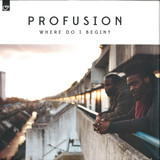
The sonic partnership of K15 and Emeson originated in the days of MySpace. A future of combining their skills was inevitable, and now in 2017, it's time to unleash their debut studio album into the ether.
The solo-projects of Tottenham-raised Kieron Ifill (aka K15) date back a decade, but were truly kick-started on labels such as Kyle Hall's Wild Oats and WotNot Music, with a number of genre-crossing releases dropping ever since, including the WU15 project (along with Yussef Kamaal's Henry Wu, on Eglo Records). Additionally to his production work, he has established himself internationally as a DJ, from the Jazz Cafe to the CoOp parties.
Partner in Profusion, Emeson, has many skills to his bow - singing, songwriting, producing, promoting, DJing (under the alias Ed Nice) and acting. As a musician, his varied skill-set has seen him work with Chico Hamilton, Carla Duke, Karmasound, Uzo Madu and Chris Jerome. A frontman for soul-jazz groups LifeSize, The One and Saturn's Children, he has featured on releases for BBE and Tokyo Dawn, and appeared live on stage at the likes of Ronnie Scott's.
The debut single was supported by tastemaker blogs Wonderland, XLR8R and Stamp The Wax, has been bumped by selectors such as Lefto and Jazzie B, and played on NTS, Worldwide FM, Mi-Soul, LeMellotron, Balamii Radio, Itch FM, Invader FM, Soho Radio and various stations across Europe and the US.
This album is full to the brim with summery sun-soaked synths, drifting across the warmest of basslines and heavyweight beats. Emeson's rich vocals gracefully ride atop of K15's delectably bruk twist on neo-soul sonics and electronics, this is some seriously classy contemporary London soul music, that manages to incorporate flashes of various dance music techniques, sound-system etiquette and jazz-tinged rhythms. As future-thinking as it is subtly retrospective, it doesn't lend itself to one genre, it intentionally embodies the best of many. An array of everything that is great about British black music in 2017. The message the album conveys itself couldn't have come at a more poignant time. Where do we begin
Profusion - an abundance of something rich indeed.
(Locked Groove, Nuno De Satos remixes) Something Happening Somewhere and Mary Go Wild combine their forces for a very special record, containing two cuts by Presk and remixes by Locked Groove and label honcho Nuno dos Santos.
Something Happening Somewhere and Mary Go Wild combine their forces for a very special record, containing two cuts by Presk and remixes by Locked Groove and label honcho Nuno dos Santos. The original A1 side has already been released on SoHaSo last summer on their SOMEWHERE compilation, but has now found a place on delicious black gold and is further enriched with a fresh B-side and aforementioned remixers delivering quality reworks.
2BXPRZD is an ode to the celebration of night life and the diverse spectrum of people that move within it. The club has always been a place where people from every background, religion and gender imaginable can meet and express their being through Dancing. It doesn't matter in what way you move, only that it's authentic and respecting towards the fellow dancers around you. Presk provides all the necessary ingredients: the funkiness in the drums melting with the dark and sinister bassline and pitched vocal perfectly assemble the conditions for such an interaction to take place.
Locked Groove takes this celebratory dance and turns it into an even darker and hypnotizing affair. Stripping the original to its bare essence with a pounding kickdrum to lead the way. Pulsing atmospheres and emotive pads swirl around and behind, granulated in a way that they almost fall apart. This is further reinforced by the stream of voices that are processed to sound like a field recording from beyond the iron curtain in Soviet times, anticipating the unavoidable collapse that follows.
The B sides provides a little more uplifting environment with Starets, unsettling melodies and dissonant atmospheres propel forward before restraining the whole thing and letting broken chord stabs seep through the system. Again reworking the original material into a more skeletal structure, Nuno dos Santos adds a poignant arp melody that is typical for his melancholic style. Driving yet breathing with emotion, it's the perfect accompaniment for a night drive while floating through clear skies. This records proves a delightful combination, containing something imperative for every soul feeling the need to express themselves in a unique way.
Life and Death welcomes Italian synth wizard Lucy, for the label's inaugural release of 2017. Luca Mortellaro's cavernous techno offering comes equipped with a DJ Sotofett version and a rendition by Planetary Assault Systems, further cementing the diversity of the label's scope. DJ Sotofett recalls fine nineties loop techno while Luke Slater once again confirms his pioneer status.
out of Stock
Last delivered 37 days ago available to reorder, subject to availability
Black Truffle is thrilled to announce Reverse Tree, the new LP from the acclaimed duo of Eyvind Kang and Jessika Kenney, two musicians who have established themselves as powerful voices working at a unique intersection of contemporary composition, improvisation, and Asian traditional music forms. Either individually or as a pair, they have worked in contexts ranging from performances of traditional Persian and Javanese music to collaborations with Sunn O))), but their work together as a duo (documented on The face of the earth and Aestuarium, both released on Ideological Organ/Editions Mego) most clearly represents the central concerns of their diverse practices: a music of the inner life of sound, demanding ritualistic focus and promising heightened sensations.
On Reverse Tree, the duo expand their work together into the realm of the chamber ensemble, presenting two side-long works that feature Kenney's voice and Kang's viola alongside a multitude of other instrumentalists. Kang's Thoughts on Being Exiled to the Frontier, for Lord Wei, inspired by a text by the Tang dynasty poet Hsueh T'ao, features an all-star international ensemble: Kang, Kenney, maverick Israeli conductor Ilan Volkov on violin, Icelandic cellist Hildur Guðnadóttir, and guitarists Oren Ambarchi and Stephen O'Malley. The piece is primarily composed of irregular patterns of pizzicato notes and guitar harmonics, gently falling in and out of sync and providing a subtly unstable support for Kenney's voice, which sings long, wavering tones, at times reminiscent of Michiko Hirayama's classic performances of Scelsi. Drawing on 20th century instrumental techniques, alternate tuning systems, non-western music and the experience of nature (the irregular rhythms of the piece calling to mind nothing so much as drops of rain), the piece opens a space both serene and subtly uneasy.
Kenney's 'Elm features Kenney and vocalist Nova Ruth (of Filastine & Twin Sista) alongside an ensemble of strings and Seattle's Gamelan Pacifica, performing on Javanese instruments tuned to the slendro scale. An uncanny timbre created by bowing the keys of the Gamelan's instruments, supported by bowed harmonics from the strings, is heard consistently throughout the piece. After a long introductory section in which this harmonic cloud slowly descends from shimmering high notes to rumbling bass, the vocalists enter, singing a slow and stately setting of a 19th century Surakarta poem (attributed to Mangkunegara the IV). The melody is sung as a rich and wavering heterophony, with the ensemble sometimes rising up to support individual notes. The poem deals with the idea of a form of knowledge achieved through deeds, as a practice and state of the heart. This is music in slow motion, in which, in Kenney's words,
The Europe-centered techno scene might be thinking: Where is techno in a city as vast, dynamic and electric as New York It's alive and well, and keeps growing through aptly-named NEW YORK TRAX. Founded in 2016 and based in Brooklyn, NEW YORK TRAX is an outlet for New York music, by New York artists, in New York city.
New York Trax 02 was written by Boris Brenecki (Ontal, Impulse Controls), who has recently relocated to New York, starting a new chapter in his life and artistic career. This record is the very first material he produced in New York, heavily inspired by the city and its people. 'The Oven', with its continuous filthy groove intensified by metallic percussions, is a serious candidate for an instant classic and a deadly weapon when used on a dancefloor. The grittiness of "The Oven" was depicted through images of the less beaten paths of New York in a well-received official video published recently by the label. Dark yet insanely dynamic "Transit System", based on field recordings of the New York City subway, opens with a bang the B side of the record, followed by "Strictly Hardcore", a sonic manifesto of brutality. Get it while it's hot!
THE ASSISTENZ is the culmination of a four year creative hot streak as vivid as any part of CRISTAN VOGEL's long career. The trio of dance oor-oriented records formed by 2012's The Inertials, 2014's Polyphonic Beings and now THE ASSISTENZ are sensual pleasures rst and foremost: a lifetime of study of frequencies and rhythms on the frontline of the world's clubs has been put into the creation of sounds that interface with the nervous system and emotional re- sponses with extraordinary immediacy. But there's much more too: together with the more ab- stracted album Eselsbru¨cke, these form an enticing sonic narrative, encoded themes running through them, each part revealing more about the whole. THE ASSISTENZ, then, is many things: a personal document, a tribute to Copenhagen where it was recorded and after whose famous cemetery it is named - but also the nal piece in this bigger puzzle, which unlocks untold secrets from the previous three records.
There's a deeper history, of course. CRISTIAN's productions going back to the start of the 1990s have woven their way into the fabric of underground culture. His own recent remasters of his early albums, and the Sub Rosa Classics 1993-1998 collections have shown just how potent his early work remains. But his new work exists in a very different world to those past works, and is far removed from the recent electronic generations who he has in uenced too. In fact, as you listen to THE ASSISTENZ, you realise that there's no point making comparisons with other elec- tronic producers at all. While you will certainly hear some of the most fundamental and enduring vectors of underground music - dub, electro, acid, funk - owing through the tracks, even those things are rebuilt from the molecular level, created completely afresh with new, precise, but some- what skewed vision.
CRISTIAN's understanding of music now is spectral. That is to say, with every step through his exploration of sound over the years, he has made more and more detailed analyses of the specif- ic frequencies that make up speci c sounds and produce speci c effects on the human mind and body. And as a result, his own sound synthesis - increasingly done via the Kyma programming platform - is more and more able to reach beyond the 'synthetic' and impact in uncanny and wonderful ways. The most obvious sense of this is the way his sounds touch on the human voice: not just in the chattering, shimmering, singing tones of THE ASSISTENZ's ghostly centrepiece 'Barefoot Agnete', in the alien radio signals of 'The Merman's Dream' or even in the subliminal 'aaah's hiding in the background of the noisy 'Vessels', but in the way any sound, anywhere in any track can sound peculiarly vocal, heard from the right angle.
And it's not just the boundary between human and non-human, or that between acoustic and synthetic, that get blurred to the point of non-existence. CRISTAN's creative methodology now is all about leaving you so uncertain about where anything came from, or what scale the sounds are operating on, that you have no choice but to let go of preconceptions and standardised criti- cal faculties and go with it. Sometimes that can take you to places where darkness and physical- ity close in on you as on 'Vessels' or 'Telemorphosis', or into haunted spaces on the edge of the void like those of 'Snowcrunch' and 'Barefoot Agnete', but even in those, there is euphoria. And in the voluptuousness of 'Hold' or the body-rocking funk of 'Cubic Haze', all the abstraction is grounded in the sheer pleasure of your own bodily responses to the sound.
So many of the science ction dreams of the 1990s are now (virtual) reality. We live in a time when social networks consciously manipulate our emotions, where data is money, where ma- chines learn, where images can't be trusted, and where the synthetic can feel more real than real. Over some 25 years, CRISTIAN's experiments have traced much of this weirdness and evolved with it, and his understanding of synthesis and algorithmic processes to create structure makes him one of the most important composers working today. But THE ASSISTENZ doesn't just ex- periment with the interfaces between mind, body and machine: it expresses those relationships in ways that are beautiful, troubling, moving and scary, and which even make you want to dance. Together with the preceding three albums it enacts a glorious, endlessly-explorable mapping of just what electronic music can do.
The Sound Of Young Jamaica - More Early Cuts From The Vaults Of Studio One 1959-63
This is the second collection to bring together many of the visionary producer Clement 'Sir Coxsone' Dodd's early recordings made with Jamaica's most exciting young artists and musicians who helped define the world of reggae music over the decades following Jamaican Independence. These recordings were made when Sir Coxsone ruled the dancehalls of Kingston in the late 1950s and early 1960s with his number one Downbeat Sound System, where songs were tested out on dub plates at a dance to see a crowd's reaction - the most popular of which were then released commercially. Featuring early material by Roland Alphonso, Don Drummond, Tommy McCook (all of whom would form The Skatalites), Toots and The Maytals, young singers such as Bob Marley and The Wailers, Delroy Wilson, Owen Gray all captured in their formative days. The music here spans a wealth of styles - Jamaican rhythm and blues, jazz, gospel, proto-ska, Rastafarian - all of which were drawn upon to create the future sounds of Jamaican reggae that Sir Coxsone and the artists featured would soon create at Studio One which opened its doors in 1963. This collection is released on heavyweight triple-vinyl plus download code and double CD with slipcase. Sleevenotes and text is by the author Noel Hawks.
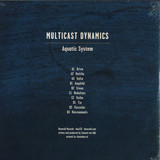
"Aquatic System"" is the second installment of the series, written and composed in two remote geographical places - namely at waters in Finland and Fuerteventura. Inspired by the complexity of water, its movement, various forms, inhabitants and hidden energy, the album was assembled mainly using synthesizers and processed field recordings of the ponds, streams, lakes and oceans of the different locations. With a vibrant story and conceptualization the focus lies in taking the listener on a observing, thoughtful and reflective journey through the aquatic system of our waters. Aquatic System opens with an impression of a frozen surface imagining icy and calm underwater movements underneath. Soon a slow process of melting begins and while the water starts to move in tiny streams of sound, small lifeforms evolve, curiously sending out small pulses in their flowing and constantly moving habitat. The aquatic nature awakens. Zooming out to larger waters high frequencies arise and colliding forms become audible. Larger marine life forms can be faintly heard when entering a much wilder environment, sensing sound-swirls of wind, foaming water tops and impressive large waves crashing on dark rocks. Finally ending at the shore, where the great ocean appears on the horizon, the environment is surrounded with moisture. From the calm reflective landscape derives an inward moment, recalling the organic and atmospheric quality of the sound journey. ""Aquatic System"" has been developed into an audiovisual performance together with visual artist Emilia Kwiatkowska and was performed several times in Spain and Finland, before the music has been finalized for the tracks.
OneOffs volume 3 offers just like the previous volume four new cuts from four different producers.
First up we got Swedish producer Jonas Rathsman and 'Yes I Am', a lush deep house track that's both heartfelt and sublime. Let it breathe on a large sound system for maximum effect!
Ending the a-side is duo Twinpeaks funk-fuelled ride ' Not That Tech House - DJ Tool Dropped By Paris Hilton You Were Searching For'. A track that would fit right into any peak time set, even by Paris Hilton.
Want from Pixel82 is a punchy track with it's scattered synth chords, jerky hats and a thick groove followed by Life Is A Gamble where Jesse Futerman takes us on a soul inspired journey of deft sample manipulation
Local Talk is talking to you!
Rogue Vogue has been making a name for himself as a producer worth keeping an eye on with releases on French Express and remixes on Deep&Disco & French Horn Rebellion. He's finally ready to release his next original EP titled 'Say You Will' on his new home at House of Disco Records.
'Say You Will' includes 2 originals that brim with the joyous side of 90's house backed up with 3 remixes from Dublin Aunts, LeSale and House of Disco's Sixth Avenue Express. The originals are in keeping with each other while each of the 3 remixes bring something new to the table.
First up is the title track, 'Say You Will' which is a hip swaying homage to the sunny side of 90's house with more hooks than a 'Hellraiser' film. Addictive vocal stabs and sax hits are the name of the game as this one will have you digging in your drawer for those stonewashed jeans you'd forgotten about.
The first of the remixes by Dublin Aunts has a day rave written all over it with an epic acid tinged bassline and clever vocal treatments. The second remix by LeSale takes a slower, sexier tip and just grows and grows, leaning heavily on the keys but also introducing some strings into the equation.
Next up is the second original 'More Than Enough' which samples a vocal that many will recognise and makes it his own. A lot of this originals charm is in the lower end and will come to life on the right system. A dreamy breakdown cements this as a track that you'll keep coming back to.
Finally the last remix of the package by Sixth Avenue Express ads a heavy dose of sleaze to the original with a swinging melody line. Choosing to do away with the dreamy breakdown and instead replace it with an dramatic, elongated and memorable dancefloor moment.